EP3232361A1 - A method, computer program and filter for protecting a computer device against malicious rdf content in linked data - Google Patents
A method, computer program and filter for protecting a computer device against malicious rdf content in linked data Download PDFInfo
- Publication number
- EP3232361A1 EP3232361A1 EP17153795.4A EP17153795A EP3232361A1 EP 3232361 A1 EP3232361 A1 EP 3232361A1 EP 17153795 A EP17153795 A EP 17153795A EP 3232361 A1 EP3232361 A1 EP 3232361A1
- Authority
- EP
- European Patent Office
- Prior art keywords
- rdf
- triples
- sparql
- filter
- malicious
- Prior art date
- Legal status (The legal status is an assumption and is not a legal conclusion. Google has not performed a legal analysis and makes no representation as to the accuracy of the status listed.)
- Granted
Links
Images





Classifications
-
- G—PHYSICS
- G06—COMPUTING OR CALCULATING; COUNTING
- G06F—ELECTRIC DIGITAL DATA PROCESSING
- G06F21/00—Security arrangements for protecting computers, components thereof, programs or data against unauthorised activity
- G06F21/60—Protecting data
- G06F21/62—Protecting access to data via a platform, e.g. using keys or access control rules
- G06F21/6218—Protecting access to data via a platform, e.g. using keys or access control rules to a system of files or objects, e.g. local or distributed file system or database
- G06F21/6227—Protecting access to data via a platform, e.g. using keys or access control rules to a system of files or objects, e.g. local or distributed file system or database where protection concerns the structure of data, e.g. records, types, queries
-
- G—PHYSICS
- G06—COMPUTING OR CALCULATING; COUNTING
- G06F—ELECTRIC DIGITAL DATA PROCESSING
- G06F21/00—Security arrangements for protecting computers, components thereof, programs or data against unauthorised activity
- G06F21/50—Monitoring users, programs or devices to maintain the integrity of platforms, e.g. of processors, firmware or operating systems
- G06F21/55—Detecting local intrusion or implementing counter-measures
- G06F21/56—Computer malware detection or handling, e.g. anti-virus arrangements
Definitions
- the present invention relates to a method, computer program and filter for protecting a computer device against malicious RDF content in Linked Data.
- Linked Data is a data publishing paradigm for sharing machine-readable data on the World Wide Web ("the Web") as interlinked datasets.
- Linked Data uses web and semantic web technologies such as HTTP (Hypertext Transfer Protocol), RDF (Resource Description Framework, a standard model for data interchange on the Web) , RDFS/OWL (RDF Schema and Web Ontology Language - syntaxes used to annotate RDF data with semantic metadata), and SPARQL (SPARQL Protocol and RDF Query Language, a standard query language and data access protocol for the RDF data model).
- HTTP Hypertext Transfer Protocol
- RDF Resource Description Framework
- RDFS/OWL RDF Schema and Web Ontology Language - syntaxes used to annotate RDF data with semantic metadata
- SPARQL SPARQL Protocol and RDF Query Language, a standard query language and data access protocol for the RDF data model.
- a triple is an instance of a statement according to the RDF model. It consists of three components: a subject, which is typically a URI (a Uniform Resource Identifier), a predicate (which is a URI), and an object, typically a URI or a literal value (e.g. a string, a number, a date, etc.).
- a subject typically a URI (a Uniform Resource Identifier)
- a predicate which is a URI
- an object typically a URI or a literal value (e.g. a string, a number, a date, etc.).
- Linked Datasets (created by companies, governments, and public sector bodies) contain rich information about different domains of knowledge. They are published using RDF so as to be easily interchanged by agents and applications, as Linked Data providers publish data in different ways and formats. Roughly, these can be divided into two methods: a) on-line methods and b) off-line methods.
- On-line methods usually include a SPARQL endpoint (database) accepting HTTP requests containing SPARQL queries
- off-line methods usually include RDF serializations in static files using formats like RDF/XML, N-Triples, or Turtle.
- Linked Data spam affects both data publishers (an individual, institution, or company that publishes data on the web, whether this is open, paywall-protected, or access-restricted) and data consumers (the person, software or process that uses data available on the Web). Publishers must offer data with an acceptable level of quality, e.g. for the sake of law compliance, community reputation, service layer agreements with customers, etc. Also, hosting undesired spam triples is an obvious waste of resources. On the other hand, consumers retrieve spam triples without any protection, and spammers might reach end users by polluting the user interfaces (Uls) of Linked Data clients (i.e. a Web client that supports HTTP content negotiation for the retrieval of Linked Data from URLs and/or SPARQL points). Moreover, there is also the possibility that machine-to-machine Linked Data processing could also be contaminated.
- Uls user interfaces
- Spam filters also called anti-spam
- Spam filters comprise software, hardware or processes that are used to combat the proliferation of spam or to keep spam from entering a system.
- RDF triples classified as spam by such a filter are quarantined, i.e. stored in an isolated repository or "quarantine".
- Spam in Linked Data inherits challenges from classic spam domains such as emails (e.g. spam delivered as polluted text), but it also has specificities (e.g. pollution of RDFS/OWL vocabularies, exploitation of inference and reasoning, etc.).
- emails e.g. spam delivered as polluted text
- specificities e.g. pollution of RDFS/OWL vocabularies, exploitation of inference and reasoning, etc.
- Linked Data-specific spam threats are known - e.g. content-based, link-based and protocol-based - no countermeasures have yet been proposed, and no spam filter for Linked Data exists.
- Example 1 The first example shows a single-triple spam threat that can be filtered out by a conventional binary classifier trained to detect malicious string literals.
- a triple-by-triple conventional classifier only labels as spam the triple at line 2.
- Such a conventional approach fails to label as spam triples at lines 1 and 3 (indeed, such triples do not look malicious at first sight) .
- it does not detect that the spam threat in the second example is about false authorship attribution.
- a method of protecting a computer device running a Linked Data client application from malicious Resource Description Framework - RDF - content in data retrieved by the Linked Data application by screening RDF triples in data retrieved by the Linked Data client application (for example, from the World Wide Web or local files) for malicious RDF content before the RDF triples are further processed by the Linked Data client application, wherein the screening comprises: storing RDF triples from the retrieved data in a cache; employing a SPARQL Protocol and RDF Query Language - SPARQL - engine equipped with a list of SPARQL queries relating to at least one content-based Linked Data spam threat to analyse each of the RDF triples stored in the cache and identify those of the triples which contain RDF content deemed to be malicious; removing from the cache any triples which have been identified as containing malicious RDF content; and allowing triples remaining in the cache to be further processed by the Linked Data client application.
- a method embodying the first aspect of the present invention preferably further comprises quarantining triples which have been identified as containing malicious RDF content.
- the SPARQL queries preferably comprise determining whether a graph pattern in an RDF triple matches a stored graph pattern for malicious RDF content.
- a sequence of RDF triple patterns, with optional filters, is defined as a single basic graph pattern.
- Graph patterns are the basis for the SPARQL query language.
- a SPARQL query can specify variables and conditions that one or more values satisfy; sets of such elements are called graph patterns.
- SPARQL graph pattern matching is defined in terms of combining the results from matching basic graph patterns. For example, the following graph pattern:
- Analysing each of the RDF triples may comprise using at least one SPARQL FILTER function.
- the SPARQL filter function may comprise a first filter which labels RDF string literals as spam or ham and a second filter which labels URIs as spam or ham.
- the first and second filters may comprise respective first and second binary classifiers, and the method may further comprise training the first classifier to identify malicious RDF string literals and training the second classifier to identify malicious URIs.
- a computer program which, when run on a computer, causes that computer to carry out a method embodying the first aspect of the present invention.
- a filter configured to protect a computer device running a Linked Data client application from malicious Resource Description Framework - RDF - content in data retrieved by the Linked Data application, which filter is operable to screen RDF triples in data retrieved by the Linked Data client application (for example, from the World Wide Web or local files) for malicious RDF content before the Linked Data is further processed by the Linked Data client application, wherein the filter comprises: a cache configured to store RDF triples from the retrieved Linked Data; a Simple Protocol and RDF Query Language - SPARQL - engine equipped with a list of SPARQL queries relating to at least one known content-based Linked Data threat, which engine is configured to analyse each of the RDF triples stored in the cache and identify those of the triples which contain RDF content deemed to be malicious; and a subtractor configured to remove from the cache any triples which have been identified as containing malicious RDF content before the triples in the cache are further processed by the filter
- a filter embodying the present invention may further comprise an isolated repository for storing copies of triples, which have been identified as containing malicious RDF content, in quarantine.
- the SPARQL queries preferably comprises determining whether a graph pattern in an RDF triple matches a stored graph pattern for malicious RDF content.
- a filter embodying the present invention may further comprise at least one SPARQL FILTER function for use by the SPARQL engine in analysing each of the RDF triples.
- the SPARQL filter function may comprise a first filter which labels RDF string literals as spam or ham and a second filter which labels URIs as spam or ham.
- the first and second filters may comprise respective first and second binary classifiers, the first classifier having been trained to identify malicious RDF string literals and the second classifier having been trained to identify malicious URIs.
- An embodiment of the present invention can provide SPARQL-based spam screening for content-based threats, i.e. threats based on malicious RDF content, for Linked Data client applications.
- the screening can identify a plurality of known Linked Data spam threats, and can be further extended to protect against unforeseen attacks, regardless of the data access method adopted by Linked Data clients (i.e. SPARQL or HTTP operations).
- a filter embodying the present invention can detect complex Linked Data spam threats owing to the interplay of deterministic graph pattern matching (to detect spam-prone RDF subgraphs, that is a subset of the RDF triples included in the whole RDF graph) and supervised learning (to identify malicious literals and URIs within a triple). Thus, deceptive, harmless-looking triples included in multi-statements spam threats can be identified.
- the present invention is designed to work with Linked Data only, i.e. with RDF, URIs, HTTP, and SPARQL.
- the output methodology and artefacts are not designed to solve the spam problem in general (e.g. emails, web pages, social networking, SMS).
- a filter embodying the present invention can be plugged into any Linked Data client application, as it is compatible with any data access strategy for Linked Data (i.e. it supports HTTP operations on triples and SPARQL queries).
- the present invention is intended to protect only against content-based spam threats, in particular content-based threats defined as spam vectors that are entirely based on malicious RDF content, rather than threats based on HTTP protocol abuses or low-severity threats such as presentation knowledge pollution and Data URI embedding.
- threat severity is determined by different factors, for example whether spam is directly delivered to end users, how frequently the threat can affect end users, which kind of Linked Data applications and application layers it affects, etc.
- Table 1 below includes a list of known single-triple content-based Linked Data spam threats. These threats can be detected by ad-hoc heuristics based on conventional binary classifiers from prior art.
- Table 2 shows known content-based threats that span multiple RDF triples. As explained above, these threats include harmless-looking RDF statements that conventional binary classifiers cannot label as spam.
- An embodiment of the present invention can detect all the threats presented in Tables 1 and 2 (i.e. all content-based Linked Data threats known to date). Note that additional threats might be discovered in the future, hence the lists in Tables 1 and 2 are by no means complete and serve only as example. As described below, the proposed spam filter may be extensible and support additional threats.
- Table 1 Known content-based Linked Data single-triple spam threats Threat Definition & Example Severity False labelling High Assigns a malicious label to an entity.
- Linked Data applications Uls use the rdfs:label property to display labels. This will lead to presenting spam directly to end users.
- Table 2 Known content-based Linked Data multiple-triple spam threats Threat Definition & Example Severity Misattribution Uses the dc:creator property to assign spam to unaware entities (e.g. people, organizations, companies).
- Medium gm:REPLICABuyer a owl:Class This threat targets Linked Data applications that use reasoning services.
- the block diagram in Figure 1 shows a Linked Data server/client configuration.
- Linked Data consumers 101 humans, software, or processes that use Linked Data published on the Web
- access Linked Data via one or more Linked Data clients 104, which may be any machine running a Linked Data client application 102.
- the Linked Data client application 102 includes a spam filter 103 embodying the present invention.
- the Linked Data clients 104 exchange data with one or more servers 110 (any machine hosting data sources 105 to 108 on the Web as Linked Data) via a computer network 111.
- the data sources 105 to 108 may be any kind of data source that can be published on the web as triples by Linked Data Publishers, and are not necessarily restricted to those shown in Figure 1 .
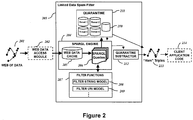
- FIG 2 shows the architecture of a Linked Data spam filter 203 embodying the present invention.
- the filter 203 is designed to be included in a Linked Data client application, such as 102 shown in Figure 1 (note that the dotted blocks in Figure 2 refer to other components of a Linked Data client application), but in other embodiments the Linked Data spam filter may be provided separately from the Linked Data client application.
- the Linked Data spam filter 203 is configured to receive as input, via a web data access module 202 (which may be any kind of client-side access strategy for Linked Data (HTTP or SPARQL client)), the RDF content (hereafter the "web of data” or the "input") 201 that will be analysed by the spam filter. It consists of any kind of RDF repository (e.g. RDF files, triplestores, Linked Data APIs).
- a web data access module 202 which may be any kind of client-side access strategy for Linked Data (HTTP or SPARQL client)
- the RDF content hereafter the "web of data” or the "input”
- It consists of any kind of RDF repository (e.g. RDF files, triplestores, Linked Data APIs).
- the Linked Data spam filter 203 comprises a SPARQL engine 204, which may be any off-the-shelf SPARQL 1.1 engine.
- the SPARQL engine 204 comprises a web data cache 205 into which triples from the web of data 201 are cached by the web data access module 202.
- the web data cache 205 can be any type of triple repository (i.e. an RDF file, an in-memory triplestore, a persisted triplestore, etc.).
- the SPARQL engine 204 is provided with an extensible list of SPARQL queries 206, comprising SPARQL FILTER statements, each aimed at filtering spam triples for a given spam threat.
- the SPARQL engine 204 processes input triples from the web data cache 205.
- Each SPARQL query 206 matches malicious triples according to a specific spam threat, and copies such triples to a quarantine 211 of the Linked Data spam filter 203.
- the quarantine 211 comprises in this embodiment an extensible set of threat-specific data stores 210 where "suspicious" triples are temporarily stored.
- the quarantine is organised as a set of threat-specific data stores to i) keep track of the type of threat suffered by suspicious triples, and ii) preserve the original named graphs seen in the input data 201. Quarantined content can be reviewed by end users for additional validation and false positives removal.
- the threat-specific stores 210 can be any type of triple repository (e.g. RDF files, in-memory stores or persisted triplestores). Each threat-specific store 210 holds copies of suspicious triples associated to a specific spam threat. Note that the copy operation (performed by the SPARQL queries in 206) preserves the original named graphs.
- the SPARQL queries 206 make use of custom SPARQL FILTER functions 207 to detect malicious content in triples.
- the filter comprises an extensible list of such functions. This list includes two functions by default, that is a string spam filter 208, which is a binary classifier that labels RDF string literals as spam or ham, and a URI Spam filter 209, which is a binary classifier that labels URIs as spam or ham.
- the filters 208 and 209 adopt algorithms from statistical machine learning, and hence may detect false positives or true positives. These filters are discussed in more detail below.
- the Linked Data spam filter 203 further comprises a quarantine subtractor 212.
- the SPARQL engine outputs the content of the quarantine to the quarantine subtractor 212, and the quarantine subtractor 212 creates "ham" triples 213, i.e. RDF triples not marked as spam by the spam filters 208, 209, by removing quarantined triples from the web data cache 205.
- the ham triples 213 are output to client application code 214 (i.e. the Linked Data client application business logic).
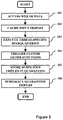
- step 301 a client application accesses Linked Data on the web (i.e. the Web of Data 201) with HTTP operations and/or SPARQL queries via the web data access module 202.
- step 302 input triples are cached in the web data cache 205.
- step 303 threat-specific SPARQL queries 206 are executed over the input data in the web data cache 205. Portions of the SPARQL queries 206 might also be executed over data in the quarantine 211, to check whether known harmful patterns occurred in input data 201.
- step 304 the SPARQL queries 206 trigger the execution of some or all of the custom FILTER functions 207 (e.g.
- step 305 solutions of SPARQL queries 206 executed in steps 303 and 304 which are considered harmful triples are stored in the quarantine 211. Harmful triples are stored in the specific store 210 associated with the detected threat. Named graphs are preserved.
- step 306 the quarantine subtractor 212 removes quarantined triples from input data, i.e. from triples stored in the web data cache 205. This step creates "ham triples" that can be safely consumed by the Linked Data client application code 214. Note that the client application code 214 may also access the quarantine 211, so that end users can manually revise false positives.
- FIG 4 illustrates how SPARQL queries 403 (206 in Figure 2 ) quarantine suspicious triples.
- Each anti-spam SPARQL query 403 in SPARQL engine 402 inserts suspicious triples from input RDF 401 in a given threat-specific store 405 (210 in Figure 2 ) of quarantine 404 (211 in Figure 2 ). If a triple is found in a given threat-specific store "X", it means that such triple meets the characteristics specified by threat "X”.
- the filter preserves all named graphs 406 in the input triples 401, e.g. ⁇ graph_1>, ⁇ graph_2>. This helps users identify the source of spam. Also, this is crucial to restoring possible false positives in their original location.
- the custom SPARQL FILTER functions 207 used by the threat-specific SPARQL queries 206 may comprise off-the-shelf, supervised binary classifiers.
- the list of custom binary classifiers is extensible, as described later.
- Figure 5 shows that a list of manually selected features 504 are extracted (feature extraction 503) from a training set 502, to create a training input vector 505.
- This vector 505 is used to train a machine learning classifier 506, in order to obtain a classifier model 507 that will be used to label records as spam or ham.
- the string spam filter 208 may be an off-the-shelf linear support vector machine (SVM) binary classifier, which has been trained to label suspicious string literals as spam.
- the classifier may be trained on string literals by adopting a "bag-of-words" approach (i.e. each string literal is transformed into a vector of word occurrences, and these word occurrences are the features on which the classifier model has been trained).
- the adopted bag-of-words approach uses unigrams (i.e. space-separated words). It is preferable not to exclude English "stop words" (i.e.
- tf-idf term-frequency inverse document-frequency term weighting scores
- step 601 the classifier receives a string literal from a SPARQL FILTER statement in the SPARQL queries list 606.
- BoW bag-of-words
- the SPARQL engine included in the spam filter includes FILTER statements that require the detection of polluted string literals:
- the binary classifier labels the first string literal as ham, whereas the second is labeled as spam.
- the URI spam filter 209 which labels URIs as spam or ham, may be an off-the-shelf Na ⁇ ve Bayes binary classifier.
- the training set includes manually labeled spam URIs from a spam email dataset. Two categories of features are extracted from each URI, Lexical Features and Syntactical Features:
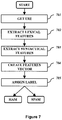
- the flowchart in Figure 7 shows how the classifier used as the URI spam filter 209 works.
- the classifier receives a URI from a SPARQL FILTER statement in the SPARQL queries list 206.
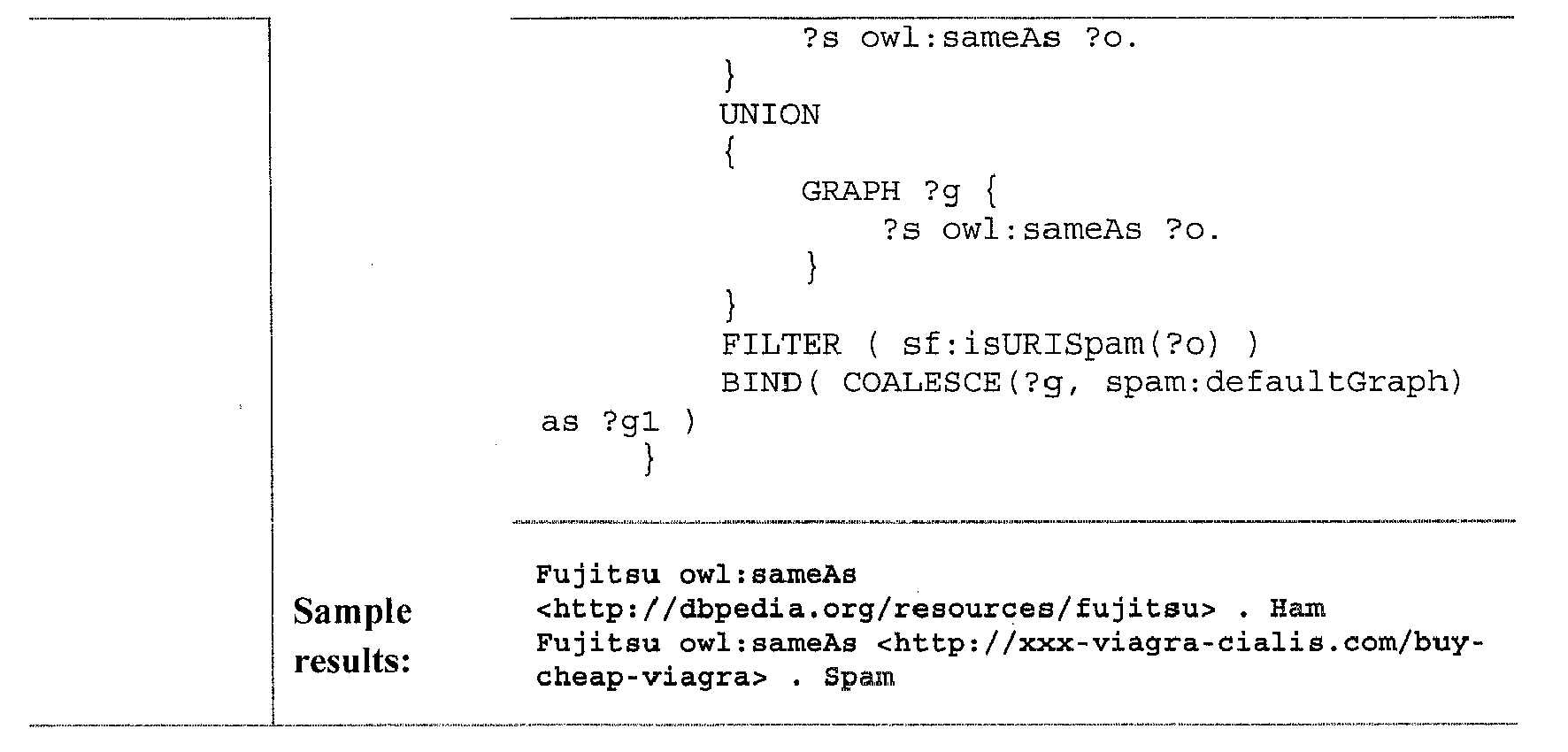
- the SPARQL engine included in the spam filter includes FILTER statements that require a spam check for the following URIs:
- the URI classifier labels the object of the first triple as ham, and the second as spam.
- the SPARQL engine 204 can be any off-the-shelf SPARQL engine compliant with the SPARQL 1.1 specifications.
- the SPARQL engine 204 is provided with an (extensible) list of SPARQL queries 206 that target a number of spam threats. Such queries 206 will be evaluated on input triples fetched from the web data cache 205. Solutions of such queries are considered malicious triples, and stored into the threat-specific stores 210 in the quarantine 211.
- step 901 the SPARQL engine loads in memory the references to the graph(s) on which the WHERE pattern block 803 will be executed.
- Block 804 indicates the data source This embodiment uses SPARQL 1.1 Federated Query, hence the SERVICE statement.
- the WHERE pattern block 803 specifies what the spam triples look like. More precisely, it describes the graph pattern(s) that has(have) to be matched by the SPARQL engine 204 to identify malicious triples. Note that the block matches malicious triples in the default graph and in all named graphs. As shown in block 806, if desired the SPARQL engine 204 can also match part of the query against threat-specific stores 210 in the quarantine 211. This means that this portion of the query will not be executed on the data source specified at block 804, but on one (or more) threat-specific stores 210 in the quarantine 211. This is done with a SPARQL 1.1 Federated Query, hence the SERVICE statement.
- step 903 the binary classifiers are run.
- the WHERE pattern block 803 needs to identify spam string literals or spam URIs. This is typically required within FILTER statements.
- the spam filter 203 includes two binary classifiers 208, 209 wrapped as custom FILTER functions, isURISpam () for URIs and isStringSpam () for string literals, as shown in block 805.
- the INSERT block labelled 801 adds triples identified as spam to the quarantine 211. More specifically, triples are copied to a threat-specific store 210 associated with the query.
- the threat-specific store 210 for "Malicious Subclassing" is ⁇ http://localhost/quarantine/malicious_subclassing.rdf>.
- Original named graphs (see block 802) are preserved during the copying. Malicious triples found in the default graph are stored under the spam: defaultGraph graph, as specified by the last line of the query (the COALESCE statement assigns the spam: defaultGraph value to the unbound variable ?g, in the case of the default graph).
- Tables 3 and 4 below include sample SPARQL queries, to detect known content-based Linked Data spam threats, that protect against the spam threats such as those shown in Tables 1 and 2. More precisely, Table 3 and Table 4 show how the proposed filtering strategy compares to the approach of possible na ⁇ ve heuristics. Table 3 describes single-triple threats (which can be also filtered by na ⁇ ve heuristics), whereas Table 4 describes multiple-triples threats, that cannot be filtered with na ⁇ ve heuristics and triple-by-triple binary classifiers. The lists of SPARQL queries are extensible, to support additional spam threats, as described below.
- an embodiment of the present invention uses binary classifiers in the custom SPARQL FILTER functions 207 to detect malicious content in triples, as illustrated in block 1002 shown in the example below.
- the SPARQL FILTER functions 207 have two default built-in binary classifiers 208 and 209. If the adopted SPARQL engine 204 supports it, such list of classifiers is extensible as follows:
- Such a declarative, SPARQL-based approach enables easy sharing of anti-spam SPARQL queries between end users; for example, queries might be published on a web-based sharing service, and instances of the spam filter might pull updates from the remote sharing service to their local list of SPARQL queries.
- An embodiment of the present invention may support human curation 1104 of the filter results. More specifically, as illustrated in Figure 9 , the system can enable: i) the refinement of SPARQL queries 1102 (206 in Figure 2 ) over time, and ii) the re-training of the custom FILTER functions 1103 (207 in Figure 2 ).
- a user 1105 of the filter can access the threat-specific stores (not shown in Figure 9 ) in quarantine 1101, and remove any misclassified triples (false positives).
- a user 1105 can also edit the anti-spam SPARQL queries 1102. Misclassified triples are then sent to an in-memory store 1106 which will be used to retrain the binary classifiers wrapped as custom FILTER functions 1103.
- An embodiment of the present invention provides an apparatus and method for filtering spam triples from input RDF data.
- the filter supports any Linked Data access strategy, whether this is URI dereferencing (i.e. HTTP operations) or SPARQL queries.
- Linked Data client applications may be protected from consuming malicious content injected by spammers in the Web of Data, and allows malicious data to be quarantined in a separate repository.
- Embodiments of the present invention may be implemented in hardware, or as software modules running on one or more processors, or on a combination thereof. That is, those skilled in the art will appreciate that a microprocessor or digital signal processor (DSP) may be used in practice to implement some or all of the functionality described above.
- DSP digital signal processor
- the invention may also be embodied as one or more device or apparatus programs (e.g. computer programs and computer program products) for carrying out part or all of the methods described herein.
- Such programs embodying the present invention may be stored on computer-readable media, or could, for example, be in the form of one or more signals.
- signals may be data signals downloadable from an Internet website, or provided on a carrier signal, or in any other form.
- Figure 10 is a block diagram of a computing device, such as a data storage server, which embodies the present invention, and which may be used to implement some or all of the steps of a method embodying the present invention, and perform some or all of the tasks of apparatus of an embodiment.
- the computing device of Figure 10 may be used to implement all the steps of the method illustrated in Figure 3 and perform all the tasks of the Linked Data client application module shown in Figure 2 , or only to implement steps 302 to 306 in the method of Figure 2 which are carried out by the Linked Data spam filter, and only to perform the tasks of the Linked Data spam filter 203 in Figure 2 .
- the computing device comprises a processor 993, and memory, 994.
- the computing device also includes a network interface 997 for communication with other such computing devices, for example with other computing devices of invention embodiments.
- an embodiment may be composed of a network of such computing devices.
- the computing device also includes one or more input mechanisms such as keyboard and mouse 996, and a display unit such as one or more monitors 995.
- the components are connectable to one another via a bus 992.
- the memory 994 may include a computer readable medium, which term may refer to a single medium or multiple media (e.g., a centralized or distributed database and/or associated caches and servers) configured to carry computer-executable instructions or have data structures stored thereon.
- Computer-executable instructions may include, for example, instructions and data accessible by and causing a general purpose computer, special purpose computer, or special purpose processing device (e.g., one or more processors) to perform one or more functions or operations.
- the term "computer-readable storage medium” may also include any medium that is capable of storing, encoding or carrying a set of instructions for execution by the machine and that cause the machine to perform any one or more of the methods of the present disclosure.
- computer-readable storage medium may accordingly be taken to include, but not be limited to, solid-state memories, optical media and magnetic media.
- computer-readable media may include non-transitory computer-readable storage media, including Random Access Memory (RAM), Read-Only Memory (ROM), Electrically Erasable Programmable Read-Only Memory (EEPROM), Compact Disc Read-Only Memory (CD-ROM) or other optical disk storage, magnetic disk storage or other magnetic storage devices, flash memory devices (e.g., solid state memory devices).
- RAM Random Access Memory
- ROM Read-Only Memory
- EEPROM Electrically Erasable Programmable Read-Only Memory
- CD-ROM Compact Disc Read-Only Memory
- flash memory devices e.g., solid state memory devices
- the processor 993 is configured to control the computing device and execute processing operations, for example executing computer program code stored in the memory 994 to implement the methods described with reference to Figures 3 , 6 , 7 and/or 8 and defined in the claims.
- the memory 994 stores data being read and written by the processor 993.
- a processor may include one or more general-purpose processing devices such as a microprocessor, central processing unit, or the like.
- the processor may include a complex instruction set computing (CISC) microprocessor, reduced instruction set computing (RISC) microprocessor, very long instruction word (VLIW) microprocessor, or a processor implementing other instruction sets or processors implementing a combination of instruction sets.
- CISC complex instruction set computing
- RISC reduced instruction set computing
- VLIW very long instruction word
- the processor may also include one or more special-purpose processing devices such as an application specific integrated circuit (ASIC), a field programmable gate array (FPGA), a digital signal processor (DSP), network processor, or the like.
- ASIC application specific integrated circuit
- FPGA field programmable gate array
- DSP digital signal processor
- a processor is configured to execute instructions for performing the operations and steps discussed herein.
- the display unit 995 may display a representation of data stored by the computing device and may also display a cursor and dialog boxes and screens enabling interaction between a user and the programs and data stored on the computing device.
- the input mechanisms 996 may enable a user to input data and instructions to the computing device.
- the network interface (network I/F) 997 may be connected to a network, such as the Internet, and is connectable to other such computing devices via the network.
- the network I/F 997 may control data input/output from/to other apparatus via the network.
- Other peripheral devices such as microphone, speakers, printer, power supply unit, fan, case, scanner, trackerball etc may be included in the computing device.
- Methods embodying the present invention may be carried out on a computing device such as that illustrated in Figure 10 .
- a computing device need not have every component illustrated in Figure 10 , and may be composed of a subset of those components.
- a method embodying the present invention may be carried out by a single computing device in communication with one or more data storage servers via a network.
- the computing device may be a data storage itself storing at least a portion of the data.
- a method embodying the present invention may be carried out by a plurality of computing devices operating in cooperation with one another.
- One or more of the plurality of computing devices may be a data storage server storing at least a portion of the data.
Landscapes
- Engineering & Computer Science (AREA)
- Computer Security & Cryptography (AREA)
- Theoretical Computer Science (AREA)
- Software Systems (AREA)
- Computer Hardware Design (AREA)
- General Engineering & Computer Science (AREA)
- Physics & Mathematics (AREA)
- Health & Medical Sciences (AREA)
- General Physics & Mathematics (AREA)
- General Health & Medical Sciences (AREA)
- Virology (AREA)
- Databases & Information Systems (AREA)
- Bioethics (AREA)
- Information Transfer Between Computers (AREA)
- Computer And Data Communications (AREA)
- Data Exchanges In Wide-Area Networks (AREA)
Abstract
Description
- The present invention relates to a method, computer program and filter for protecting a computer device against malicious RDF content in Linked Data.
- Linked Data is a data publishing paradigm for sharing machine-readable data on the World Wide Web ("the Web") as interlinked datasets. Linked Data uses web and semantic web technologies such as HTTP (Hypertext Transfer Protocol), RDF (Resource Description Framework, a standard model for data interchange on the Web) , RDFS/OWL (RDF Schema and Web Ontology Language - syntaxes used to annotate RDF data with semantic metadata), and SPARQL (SPARQL Protocol and RDF Query Language, a standard query language and data access protocol for the RDF data model).
- A triple is an instance of a statement according to the RDF model. It consists of three components: a subject, which is typically a URI (a Uniform Resource Identifier), a predicate (which is a URI), and an object, typically a URI or a literal value (e.g. a string, a number, a date, etc.).
- Data providers have so far published hundreds of Linked Datasets and billions of Triples on the Web, thus contributing to the birth of the so-called "Web of Data". Linked Datasets (created by companies, governments, and public sector bodies) contain rich information about different domains of knowledge. They are published using RDF so as to be easily interchanged by agents and applications, as Linked Data providers publish data in different ways and formats. Roughly, these can be divided into two methods: a) on-line methods and b) off-line methods. On-line methods usually include a SPARQL endpoint (database) accepting HTTP requests containing SPARQL queries, whilst off-line methods usually include RDF serializations in static files using formats like RDF/XML, N-Triples, or Turtle. However, it has been shown that the process of publishing and consuming Linked Data is prone to electronic spam (i.e. irrelevant or unsolicited messages sent over the Internet, typically to large number of users, for example for the purposes of advertising, phishing, and spreading malware, including messages where the recipient has not verifiably granted deliberate, explicit, and still-revocable permission for it to be sent; non-spam is known as "ham"). Although in its infancy, spam on the Web of Data might play an important role in preventing a widespread adoption of Linked Data. For example, as Linked Data becomes more popular in enterprise applications (e.g. Schema.org, GoodRelations, the Open Graph Protocol), issuers of spam ("spammers") might see it as an opportunity to gain economic advantages, or simply to have fun, as has already happened in other domains (e.g., emails, web pages, social networking, SMS). Nevertheless, Linked Data researchers and practitioners have so far overlooked such adversary behaviour. This means that there exists no specific countermeasure to prevent spam on the Web of Data.
- Linked Data spam affects both data publishers (an individual, institution, or company that publishes data on the web, whether this is open, paywall-protected, or access-restricted) and data consumers (the person, software or process that uses data available on the Web). Publishers must offer data with an acceptable level of quality, e.g. for the sake of law compliance, community reputation, service layer agreements with customers, etc. Also, hosting undesired spam triples is an obvious waste of resources. On the other hand, consumers retrieve spam triples without any protection, and spammers might reach end users by polluting the user interfaces (Uls) of Linked Data clients (i.e. a Web client that supports HTTP content negotiation for the retrieval of Linked Data from URLs and/or SPARQL points). Moreover, there is also the possibility that machine-to-machine Linked Data processing could also be contaminated.
- Spam filters (also called anti-spam) comprise software, hardware or processes that are used to combat the proliferation of spam or to keep spam from entering a system. RDF triples classified as spam by such a filter are quarantined, i.e. stored in an isolated repository or "quarantine".
- Spam in Linked Data inherits challenges from classic spam domains such as emails (e.g. spam delivered as polluted text), but it also has specificities (e.g. pollution of RDFS/OWL vocabularies, exploitation of inference and reasoning, etc.). Although different types of Linked Data-specific spam threats are known - e.g. content-based, link-based and protocol-based - no countermeasures have yet been proposed, and no spam filter for Linked Data exists.
- In the following we show two examples of spam attacks that may affect Linked Data:
-
A well-known company is assigned a malicious label:
- example:Fujitsu rdfs:label "Buy Cheap Replica Watches".
-
Attacks may attribute false authorship to a person:
- example:statement a bibo:Quote.
- example:statement bibo:content "I buy REPLICA WATCHES on replicaking.com".
- example:statement dc:creator <http://www.w3.org/People/Berners-Lee>.
- As spam attacks in Linked Data (e.g. Example 1) may come in different guises and use different strategies, it is desirable that measures put in place to protect against such attacks should take input RDF triples and process them according to the kind of threat they represent, regardless of the data access method adopted by consumers (i.e. SPARQL or HTTP operations). Unforeseen threats might also arise, hence the filtering mechanism should preferably be extensible.
- Conventional binary classifiers trained to detect malicious string literals (or malicious URIs) can filter single-triple spam threats. However, a number of Linked Data spam threats span multiple RDF statements. These malicious RDF triples, hereafter referred to as multi-statements spam threats, might include deceptive, harmless-looking RDF statements that conventional binary classifiers cannot label as spam, thus falling short of detecting the correct type of spam threat. Thus, it is also desirable to identify multi-statements spam threats correctly.
- Consider Example 1: The first example shows a single-triple spam threat that can be filtered out by a conventional binary classifier trained to detect malicious string literals. On the other hand, in the second example a triple-by-triple conventional classifier only labels as spam the triple at
line 2. Such a conventional approach fails to label as spam triples atlines 1 and 3 (indeed, such triples do not look malicious at first sight). As a consequence, it does not detect that the spam threat in the second example is about false authorship attribution. - According to an embodiment of a first aspect of the present invention there is provided a method of protecting a computer device running a Linked Data client application from malicious Resource Description Framework - RDF - content in data retrieved by the Linked Data application, by screening RDF triples in data retrieved by the Linked Data client application (for example, from the World Wide Web or local files) for malicious RDF content before the RDF triples are further processed by the Linked Data client application, wherein the screening comprises: storing RDF triples from the retrieved data in a cache; employing a SPARQL Protocol and RDF Query Language - SPARQL - engine equipped with a list of SPARQL queries relating to at least one content-based Linked Data spam threat to analyse each of the RDF triples stored in the cache and identify those of the triples which contain RDF content deemed to be malicious; removing from the cache any triples which have been identified as containing malicious RDF content; and allowing triples remaining in the cache to be further processed by the Linked Data client application.
- A method embodying the first aspect of the present invention preferably further comprises quarantining triples which have been identified as containing malicious RDF content.
- The SPARQL queries preferably comprise determining whether a graph pattern in an RDF triple matches a stored graph pattern for malicious RDF content. At least in the context of the present application, a sequence of RDF triple patterns, with optional filters, is defined as a single basic graph pattern. Graph patterns are the basis for the SPARQL query language. A SPARQL query can specify variables and conditions that one or more values satisfy; sets of such elements are called graph patterns. SPARQL graph pattern matching is defined in terms of combining the results from matching basic graph patterns. For example, the following graph pattern:
?var rdfs:label "Fujitsu Ltd."includes the ?var variable that might match against the RDF entity : Fujitsu (see also Example 2).
-
Figure 1 shows a diagram of a Linked Data server/client configuration in which an embodiment of the present invention may be employed; -
Figure 2 shows a diagram of apparatus embodying the present invention according to a first embodiment; -
Figure 3 is a flowchart of a method embodying the present invention for use with the apparatus ofFigure 2 ; -
Figure 4 shows a diagram of apparatus embodying the present invention according to a second embodiment; -
Figure 5 illustrates a prior art procedure for training binary classifiers; -
Figure 6 is a flowchart for explaining the operation of part of the apparatus ofFigure 2 ; -
Figure 7 is a flowchart for explaining the operation of another part of the apparatus ofFigure 2 ; -
Figure 8 is a flowchart for explaining the operation of a further part of the apparatus ofFigure 2 ; -
Figure 9 shows a diagram of apparatus embodying the present invention according to a third embodiment; and -
Figure 10 is a block diagram of a computing device suitable for carrying out a method embodying the present invention.
| Threat | Definition & Example | Severity |
| False labelling | High | |
| Assigns a malicious label to an entity. | Linked Data applications Uls use the rdfs:label property to display labels. This will lead to presenting spam directly to end users. | |
| :Fujitsu rdfs:label "BUY CHEAP VIAGRA"@en. | ||
| Identity assumption | Assigns a misleading link to a legitimate entity, thus | High |
| leading to untrusted web sources. | This threat can be harmful for applications that heavily rely on entity disambiguation. | |
| :Fujitsu owl:sameAs <http://85.2.5.6/cheap-viagra>. |
| Threat | Definition & Example | Severity |
| Misattribution | Uses the dc:creator property to assign spam to unaware entities (e.g. people, organizations, companies). | Medium |
| :statement a bibo:Quote ; | This threat tricks users using or looking for trusted entities. | |
| bibo:content "I buy REPLICA WATCHES"; | ||
| dc:creator <http://www.w3.org/People/Berners-Lee>. | ||
| Malicious sub classing | Associates harmless RDFS/OWL classes to malicious classes. | Medium |
| gm:REPLICABuyer a owl:Class ; | This threat targets Linked Data applications that use reasoning services. | |
| foaf:homepage <http://replica_master.com/>; | ||
| rdfs:label "A class for REPLICA customers". | ||
| foaf:Person rdfs:subClassOf gm:REPLICABuyer. | ||
| Inverse-functional property cloning | Medium | |
| Spammers can use inverse-functional properties to associate spam to harmless entities. | This threat targets Linked Data applications that use reasoning services. Also dangerous for applications that heavily rely on entity disambiguation. | |
| ex:person_id3423 a foaf:Person; | ||
| foaf:homepage <http://www.w3.org/People/Berners-Lee>; | ||
| foaf:name "Buy REPLICA WATCHES at | ||
| replica_king.com". |
                    example:Fujitsu rdfs:label "Fujitsu Ltd.". ] Ham
                    example:Fujitsu rdfs:label "Buy Cheap Replica Watches" . ] Spam
- Lexical Features: these include the bag-of-word representation of a URI. Other features in this group include the URI scheme, the top level domain, the host, the query string, and the port.
- Syntactical Features: these include the length of the URI, the count of punctuation characters, count of capitalized letters, digits, letters, etc.

As previously-mentioned, the




- 1.Implement and train the classifier (see
Figure 5 ). - 2. Wrap the classifier as a FILTER function. Note this step is SPARQL-engine dependent. For example, if the spam filter is based on Jena, FILTER extensions must comply with Jena custom FILTER functions APIs.
- 3. Dynamically load the new FILTER function at query time. This step is implementation-specific. For example, Jena requires a custom SPARQL prefix defined in the query declaration as shown in block 1001.

- 1. Identify the new threat and the affected graph pattern(s).
- 2. Write the SPARQL 1.1 INSERT query to identify the malicious pattern(s) and copy suspicious triples to the
quarantine 211. The query can be executed only over the data fetched from theweb data cache 205, or on theweb data cache 205 and the quarantine 211 (e.g. when it is required to identify known malicious triples in input data). Note that theSPARQL engine 204 must also be instructed to execute the query against the correct threat-specific store 210 in thequarantine 211. - 3. Load the new query in the SPARQL filter.
Claims (13)
- A method of protecting a computer device running a Linked Data client application from malicious Resource Description Framework - RDF - content in data retrieved by the Linked Data application, by screening RDF triples in data retrieved by the Linked Data client application for malicious RDF content before the RDF triples are further processed by the Linked Data client application, wherein the screening comprises:storing RDF triples from the retrieved data in a cache;employing a SPARQL Protocol and RDF Query Language - SPARQL - engine equipped with a list of SPARQL queries relating to at least one content-based Linked Data spam threat to analyse each of the RDF triples stored in the cache and identify those of the triples which contain RDF content deemed to be malicious;removing from the cache any triples which have been identified as containing malicious RDF content; andallowing triples remaining in the cache to be further processed by the Linked Data client application.
- A method as claimed in claim 1, further comprising quarantining triples which have been identified as containing malicious RDF content.
- A method as claimed in claim 1 or 2, wherein the SPARQL queries comprise determining whether a graph pattern in an RDF triple matches a stored graph pattern for malicious RDF content.
- A method as claimed in any preceding claim, wherein analysing each of the RDF triples comprises using at least one SPARQL FILTER function.
- A method as claimed in claim 4, wherein the SPARQL filter function comprises a first filter which labels RDF string literals as spam or ham and a second filter which labels Uniform Resource Identifiers - URIs - as spam or ham.
- A method as claimed in claim 5, wherein the first and second filters comprise respective first and second binary classifiers, and the method further comprises training the first classifier to identify malicious RDF string literals and training the second classifier to identify malicious URIs.
- A computer program which, when run on a computer, causes that computer to carry out the method of any one of claims 1 to 6.
- A filter configured to protect a computer device running a Linked Data client application from malicious Resource Description Framework - RDF - content in data retrieved by the Linked Data application, which filter is operable to screen RDF triples in data retrieved by the Linked Data client application for malicious RDF content before the RDF triples are further processed by the Linked Data client application, wherein the filter comprises:a cache configured to store RDF triples from the retrieved data;a SPARQL Protocol and RDF Query Language - SPARQL - engine equipped with a list of SPARQL queries relating to at least one content-based Linked Data spam threat, which engine is configured to analyse each of the RDF triples stored in the cache and identify those of the triples which contain RDF content deemed to be malicious; anda subtractor configured to remove from the cache any triples which have been identified as containing malicious RDF content before the triples in the cache are further processed by the Linked Data client application.
- A filter as claimed in claim 8, further comprising an isolated repository for storing copies of triples, which have been identified as containing malicious RDF content, in quarantine.
- A filter as claimed in claim 8 or 9, wherein the SPARQL queries comprise determining whether a graph pattern in an RDF triple matches a stored graph pattern for malicious RDF content.
- A filter as claimed in any one of claims 8 to 10, further comprising at least one SPARQL FILTER function for use by the SPARQL engine in analysing each of the RDF triples.
- A filter as claimed in claim 11, wherein the SPARQL filter function comprises a first filter which labels RDF string literals as spam or ham and a second filter which labels Uniform Resource Identifiers - URIs - as spam or ham.
- A filter as claimed in claim 12, wherein the first and second filters comprise respective first and second binary classifiers, the first classifier having been trained to identify malicious RDF string literals and the second classifier having been trained to identify malicious URIs.
Applications Claiming Priority (2)
| Application Number | Priority Date | Filing Date | Title |
|---|---|---|---|
| GB201606605 | 2016-04-15 | ||
| DE102016206436 | 2016-04-15 |
Publications (2)
| Publication Number | Publication Date |
|---|---|
| EP3232361A1 true EP3232361A1 (en) | 2017-10-18 |
| EP3232361B1 EP3232361B1 (en) | 2019-10-16 |
Family
ID=57914906
Family Applications (1)
| Application Number | Title | Priority Date | Filing Date |
|---|---|---|---|
| EP17153795.4A Active EP3232361B1 (en) | 2016-04-15 | 2017-01-30 | A method, computer program and filter for protecting a computer device against malicious rdf content in linked data |
Country Status (1)
| Country | Link |
|---|---|
| EP (1) | EP3232361B1 (en) |
Citations (1)
| Publication number | Priority date | Publication date | Assignee | Title |
|---|---|---|---|---|
| US20120173493A1 (en) * | 2011-01-03 | 2012-07-05 | Nokia Corporation | Method and apparatus for providing safeguarding against malicious ontologies |
-
2017
- 2017-01-30 EP EP17153795.4A patent/EP3232361B1/en active Active
Patent Citations (1)
| Publication number | Priority date | Publication date | Assignee | Title |
|---|---|---|---|---|
| US20120173493A1 (en) * | 2011-01-03 | 2012-07-05 | Nokia Corporation | Method and apparatus for providing safeguarding against malicious ontologies |
Non-Patent Citations (2)
| Title |
|---|
| CARUANA GODWIN: "MapReduce based RDF Assisted Distributed SVM for High Throughput Spam Filtering", 10 July 2013 (2013-07-10), pages 1 - 176, XP055351301, Retrieved from the Internet <URL:http://bura.brunel.ac.uk/bitstream/2438/7572/1/FulltextThesis.pdf> [retrieved on 20130710] * |
| SEONGWOOK YOUN ET AL: "Spam decisions on gray e-mail using personalized ontologies", APPLIED COMPUTING, ACM, 2 PENN PLAZA, SUITE 701 NEW YORK NY 10121-0701 USA, 8 March 2009 (2009-03-08), pages 1262 - 1266, XP058183380, ISBN: 978-1-60558-166-8, DOI: 10.1145/1529282.1529565 * |
Also Published As
| Publication number | Publication date |
|---|---|
| EP3232361B1 (en) | 2019-10-16 |
Similar Documents
| Publication | Publication Date | Title |
|---|---|---|
| Aljabri et al. | Detecting malicious URLs using machine learning techniques: review and research directions | |
| Alam et al. | Looking beyond iocs: Automatically extracting attack patterns from external cti | |
| Joo et al. | S-Detector: an enhanced security model for detecting Smishing attack for mobile computing | |
| Khan et al. | Defending malicious script attacks using machine learning classifiers | |
| US11250256B2 (en) | Binary linear classification | |
| US20150088933A1 (en) | Controlling disclosure of structured data | |
| JP2017512329A (en) | Tag system objects related to security | |
| CN121794683A (en) | Data leakage protection using generative large language model | |
| Laorden et al. | Word sense disambiguation for spam filtering | |
| Shin et al. | Focusing on the weakest link: A similarity analysis on phishing campaigns based on the ATT&CK matrix | |
| Zaimi et al. | An enhanced mechanism for malicious URL detection using deep learning and DistilBERT-based feature extraction: R. Zaimi et al. | |
| AS et al. | Natural language based malicious domain detection using machine learning and deep learning | |
| CN120296754A (en) | Multimodal Data Loss Protection Using Artificial Intelligence | |
| Moussaileb et al. | Watch out! Doxware on the way… | |
| Nguyen et al. | Utilizing large language models with human feedback integration for generating dedicated warning for phishing emails | |
| Abiramasundari et al. | Cacography based ransomware email phishing attack prevention using Language pack tuned transformer Language model | |
| Ibrishimova | Cyber incident classification: issues and challenges | |
| Youn | SPONGY (SPam ONtoloGY): Email Classification Using Two‐Level Dynamic Ontology | |
| EP3232361B1 (en) | A method, computer program and filter for protecting a computer device against malicious rdf content in linked data | |
| US12475222B2 (en) | Method and apparatus for mapping similarity spaces | |
| Solanki et al. | MapperDroid: Verifying app capabilities from description to permissions and API calls | |
| Alhindi et al. | Preventing Data Loss by Harnessing Semantic Similarity and Relevance. | |
| Mishra et al. | A study on cyber security, its issues and cyber crime rates in India | |
| Raja et al. | Artificial Intelligence Techniques for Malicious Domain Detection in Cyberspace | |
| Fugkeaw et al. | Design and development of a dynamic and efficient PII data loss prevention system |
Legal Events
| Date | Code | Title | Description |
|---|---|---|---|
| PUAI | Public reference made under article 153(3) epc to a published international application that has entered the european phase |
Free format text: ORIGINAL CODE: 0009012 |
|
| STAA | Information on the status of an ep patent application or granted ep patent |
Free format text: STATUS: REQUEST FOR EXAMINATION WAS MADE |
|
| 17P | Request for examination filed |
Effective date: 20170821 |
|
| AK | Designated contracting states |
Kind code of ref document: A1 Designated state(s): AL AT BE BG CH CY CZ DE DK EE ES FI FR GB GR HR HU IE IS IT LI LT LU LV MC MK MT NL NO PL PT RO RS SE SI SK SM TR |
|
| AX | Request for extension of the european patent |
Extension state: BA ME |
|
| GRAP | Despatch of communication of intention to grant a patent |
Free format text: ORIGINAL CODE: EPIDOSNIGR1 |
|
| STAA | Information on the status of an ep patent application or granted ep patent |
Free format text: STATUS: GRANT OF PATENT IS INTENDED |
|
| RIC1 | Information provided on ipc code assigned before grant |
Ipc: G06F 21/56 20130101AFI20190527BHEP Ipc: G06F 21/62 20130101ALI20190527BHEP |
|
| INTG | Intention to grant announced |
Effective date: 20190612 |
|
| GRAS | Grant fee paid |
Free format text: ORIGINAL CODE: EPIDOSNIGR3 |
|
| GRAA | (expected) grant |
Free format text: ORIGINAL CODE: 0009210 |
|
| STAA | Information on the status of an ep patent application or granted ep patent |
Free format text: STATUS: THE PATENT HAS BEEN GRANTED |
|
| AK | Designated contracting states |
Kind code of ref document: B1 Designated state(s): AL AT BE BG CH CY CZ DE DK EE ES FI FR GB GR HR HU IE IS IT LI LT LU LV MC MK MT NL NO PL PT RO RS SE SI SK SM TR |
|
| REG | Reference to a national code |
Ref country code: GB Ref legal event code: FG4D |
|
| REG | Reference to a national code |
Ref country code: CH Ref legal event code: EP |
|
| REG | Reference to a national code |
Ref country code: DE Ref legal event code: R096 Ref document number: 602017007737 Country of ref document: DE |
|
| REG | Reference to a national code |
Ref country code: IE Ref legal event code: FG4D |
|
| REG | Reference to a national code |
Ref country code: AT Ref legal event code: REF Ref document number: 1191996 Country of ref document: AT Kind code of ref document: T Effective date: 20191115 |
|
| REG | Reference to a national code |
Ref country code: NL Ref legal event code: MP Effective date: 20191016 |
|
| REG | Reference to a national code |
Ref country code: LT Ref legal event code: MG4D |
|
| REG | Reference to a national code |
Ref country code: AT Ref legal event code: MK05 Ref document number: 1191996 Country of ref document: AT Kind code of ref document: T Effective date: 20191016 |
|
| PG25 | Lapsed in a contracting state [announced via postgrant information from national office to epo] |
Ref country code: LV Free format text: LAPSE BECAUSE OF FAILURE TO SUBMIT A TRANSLATION OF THE DESCRIPTION OR TO PAY THE FEE WITHIN THE PRESCRIBED TIME-LIMIT Effective date: 20191016 Ref country code: SE Free format text: LAPSE BECAUSE OF FAILURE TO SUBMIT A TRANSLATION OF THE DESCRIPTION OR TO PAY THE FEE WITHIN THE PRESCRIBED TIME-LIMIT Effective date: 20191016 Ref country code: GR Free format text: LAPSE BECAUSE OF FAILURE TO SUBMIT A TRANSLATION OF THE DESCRIPTION OR TO PAY THE FEE WITHIN THE PRESCRIBED TIME-LIMIT Effective date: 20200117 Ref country code: PL Free format text: LAPSE BECAUSE OF FAILURE TO SUBMIT A TRANSLATION OF THE DESCRIPTION OR TO PAY THE FEE WITHIN THE PRESCRIBED TIME-LIMIT Effective date: 20191016 Ref country code: NO Free format text: LAPSE BECAUSE OF FAILURE TO SUBMIT A TRANSLATION OF THE DESCRIPTION OR TO PAY THE FEE WITHIN THE PRESCRIBED TIME-LIMIT Effective date: 20200116 Ref country code: LT Free format text: LAPSE BECAUSE OF FAILURE TO SUBMIT A TRANSLATION OF THE DESCRIPTION OR TO PAY THE FEE WITHIN THE PRESCRIBED TIME-LIMIT Effective date: 20191016 Ref country code: BG Free format text: LAPSE BECAUSE OF FAILURE TO SUBMIT A TRANSLATION OF THE DESCRIPTION OR TO PAY THE FEE WITHIN THE PRESCRIBED TIME-LIMIT Effective date: 20200116 Ref country code: FI Free format text: LAPSE BECAUSE OF FAILURE TO SUBMIT A TRANSLATION OF THE DESCRIPTION OR TO PAY THE FEE WITHIN THE PRESCRIBED TIME-LIMIT Effective date: 20191016 Ref country code: NL Free format text: LAPSE BECAUSE OF FAILURE TO SUBMIT A TRANSLATION OF THE DESCRIPTION OR TO PAY THE FEE WITHIN THE PRESCRIBED TIME-LIMIT Effective date: 20191016 Ref country code: PT Free format text: LAPSE BECAUSE OF FAILURE TO SUBMIT A TRANSLATION OF THE DESCRIPTION OR TO PAY THE FEE WITHIN THE PRESCRIBED TIME-LIMIT Effective date: 20200217 Ref country code: AT Free format text: LAPSE BECAUSE OF FAILURE TO SUBMIT A TRANSLATION OF THE DESCRIPTION OR TO PAY THE FEE WITHIN THE PRESCRIBED TIME-LIMIT Effective date: 20191016 |
|
| PG25 | Lapsed in a contracting state [announced via postgrant information from national office to epo] |
Ref country code: RS Free format text: LAPSE BECAUSE OF FAILURE TO SUBMIT A TRANSLATION OF THE DESCRIPTION OR TO PAY THE FEE WITHIN THE PRESCRIBED TIME-LIMIT Effective date: 20191016 Ref country code: IS Free format text: LAPSE BECAUSE OF FAILURE TO SUBMIT A TRANSLATION OF THE DESCRIPTION OR TO PAY THE FEE WITHIN THE PRESCRIBED TIME-LIMIT Effective date: 20200224 Ref country code: HR Free format text: LAPSE BECAUSE OF FAILURE TO SUBMIT A TRANSLATION OF THE DESCRIPTION OR TO PAY THE FEE WITHIN THE PRESCRIBED TIME-LIMIT Effective date: 20191016 |
|
| PG25 | Lapsed in a contracting state [announced via postgrant information from national office to epo] |
Ref country code: AL Free format text: LAPSE BECAUSE OF FAILURE TO SUBMIT A TRANSLATION OF THE DESCRIPTION OR TO PAY THE FEE WITHIN THE PRESCRIBED TIME-LIMIT Effective date: 20191016 |
|
| REG | Reference to a national code |
Ref country code: DE Ref legal event code: R097 Ref document number: 602017007737 Country of ref document: DE |
|
| PG2D | Information on lapse in contracting state deleted |
Ref country code: IS |
|
| PG25 | Lapsed in a contracting state [announced via postgrant information from national office to epo] |
Ref country code: EE Free format text: LAPSE BECAUSE OF FAILURE TO SUBMIT A TRANSLATION OF THE DESCRIPTION OR TO PAY THE FEE WITHIN THE PRESCRIBED TIME-LIMIT Effective date: 20191016 Ref country code: DK Free format text: LAPSE BECAUSE OF FAILURE TO SUBMIT A TRANSLATION OF THE DESCRIPTION OR TO PAY THE FEE WITHIN THE PRESCRIBED TIME-LIMIT Effective date: 20191016 Ref country code: RO Free format text: LAPSE BECAUSE OF FAILURE TO SUBMIT A TRANSLATION OF THE DESCRIPTION OR TO PAY THE FEE WITHIN THE PRESCRIBED TIME-LIMIT Effective date: 20191016 Ref country code: CZ Free format text: LAPSE BECAUSE OF FAILURE TO SUBMIT A TRANSLATION OF THE DESCRIPTION OR TO PAY THE FEE WITHIN THE PRESCRIBED TIME-LIMIT Effective date: 20191016 Ref country code: ES Free format text: LAPSE BECAUSE OF FAILURE TO SUBMIT A TRANSLATION OF THE DESCRIPTION OR TO PAY THE FEE WITHIN THE PRESCRIBED TIME-LIMIT Effective date: 20191016 Ref country code: IS Free format text: LAPSE BECAUSE OF FAILURE TO SUBMIT A TRANSLATION OF THE DESCRIPTION OR TO PAY THE FEE WITHIN THE PRESCRIBED TIME-LIMIT Effective date: 20200216 |
|
| PLBE | No opposition filed within time limit |
Free format text: ORIGINAL CODE: 0009261 |
|
| STAA | Information on the status of an ep patent application or granted ep patent |
Free format text: STATUS: NO OPPOSITION FILED WITHIN TIME LIMIT |
|
| PG25 | Lapsed in a contracting state [announced via postgrant information from national office to epo] |
Ref country code: SM Free format text: LAPSE BECAUSE OF FAILURE TO SUBMIT A TRANSLATION OF THE DESCRIPTION OR TO PAY THE FEE WITHIN THE PRESCRIBED TIME-LIMIT Effective date: 20191016 Ref country code: SK Free format text: LAPSE BECAUSE OF FAILURE TO SUBMIT A TRANSLATION OF THE DESCRIPTION OR TO PAY THE FEE WITHIN THE PRESCRIBED TIME-LIMIT Effective date: 20191016 Ref country code: IT Free format text: LAPSE BECAUSE OF FAILURE TO SUBMIT A TRANSLATION OF THE DESCRIPTION OR TO PAY THE FEE WITHIN THE PRESCRIBED TIME-LIMIT Effective date: 20191016 Ref country code: MC Free format text: LAPSE BECAUSE OF FAILURE TO SUBMIT A TRANSLATION OF THE DESCRIPTION OR TO PAY THE FEE WITHIN THE PRESCRIBED TIME-LIMIT Effective date: 20191016 |
|
| REG | Reference to a national code |
Ref country code: CH Ref legal event code: PL |
|
| 26N | No opposition filed |
Effective date: 20200717 |
|
| REG | Reference to a national code |
Ref country code: BE Ref legal event code: MM Effective date: 20200131 |
|
| PG25 | Lapsed in a contracting state [announced via postgrant information from national office to epo] |
Ref country code: LU Free format text: LAPSE BECAUSE OF NON-PAYMENT OF DUE FEES Effective date: 20200130 Ref country code: FR Free format text: LAPSE BECAUSE OF NON-PAYMENT OF DUE FEES Effective date: 20200131 |
|
| PG25 | Lapsed in a contracting state [announced via postgrant information from national office to epo] |
Ref country code: SI Free format text: LAPSE BECAUSE OF FAILURE TO SUBMIT A TRANSLATION OF THE DESCRIPTION OR TO PAY THE FEE WITHIN THE PRESCRIBED TIME-LIMIT Effective date: 20191016 Ref country code: LI Free format text: LAPSE BECAUSE OF NON-PAYMENT OF DUE FEES Effective date: 20200131 Ref country code: BE Free format text: LAPSE BECAUSE OF NON-PAYMENT OF DUE FEES Effective date: 20200131 Ref country code: CH Free format text: LAPSE BECAUSE OF NON-PAYMENT OF DUE FEES Effective date: 20200131 |
|
| REG | Reference to a national code |
Ref country code: DE Ref legal event code: R082 Ref document number: 602017007737 Country of ref document: DE Representative=s name: HL KEMPNER PATENTANWAELTE, SOLICITORS (ENGLAND, DE Ref country code: DE Ref legal event code: R082 Ref document number: 602017007737 Country of ref document: DE Representative=s name: HL KEMPNER PATENTANWALT, RECHTSANWALT, SOLICIT, DE Ref country code: DE Ref legal event code: R082 Ref document number: 602017007737 Country of ref document: DE Representative=s name: HL KEMPNER PARTG MBB, DE |
|
| PG25 | Lapsed in a contracting state [announced via postgrant information from national office to epo] |
Ref country code: IE Free format text: LAPSE BECAUSE OF NON-PAYMENT OF DUE FEES Effective date: 20200130 |
|
| PG25 | Lapsed in a contracting state [announced via postgrant information from national office to epo] |
Ref country code: TR Free format text: LAPSE BECAUSE OF FAILURE TO SUBMIT A TRANSLATION OF THE DESCRIPTION OR TO PAY THE FEE WITHIN THE PRESCRIBED TIME-LIMIT Effective date: 20191016 Ref country code: MT Free format text: LAPSE BECAUSE OF FAILURE TO SUBMIT A TRANSLATION OF THE DESCRIPTION OR TO PAY THE FEE WITHIN THE PRESCRIBED TIME-LIMIT Effective date: 20191016 Ref country code: CY Free format text: LAPSE BECAUSE OF FAILURE TO SUBMIT A TRANSLATION OF THE DESCRIPTION OR TO PAY THE FEE WITHIN THE PRESCRIBED TIME-LIMIT Effective date: 20191016 |
|
| PG25 | Lapsed in a contracting state [announced via postgrant information from national office to epo] |
Ref country code: MK Free format text: LAPSE BECAUSE OF FAILURE TO SUBMIT A TRANSLATION OF THE DESCRIPTION OR TO PAY THE FEE WITHIN THE PRESCRIBED TIME-LIMIT Effective date: 20191016 |
|
| PGFP | Annual fee paid to national office [announced via postgrant information from national office to epo] |
Ref country code: GB Payment date: 20251219 Year of fee payment: 10 |
|
| PGFP | Annual fee paid to national office [announced via postgrant information from national office to epo] |
Ref country code: DE Payment date: 20251217 Year of fee payment: 10 |