EP3231506A1 - Olefin polymerization apparatus and olefin polymerization process - Google Patents
Olefin polymerization apparatus and olefin polymerization process Download PDFInfo
- Publication number
- EP3231506A1 EP3231506A1 EP15868513.1A EP15868513A EP3231506A1 EP 3231506 A1 EP3231506 A1 EP 3231506A1 EP 15868513 A EP15868513 A EP 15868513A EP 3231506 A1 EP3231506 A1 EP 3231506A1
- Authority
- EP
- European Patent Office
- Prior art keywords
- gas
- condensate
- reactor
- reaction
- polymerization reactor
- Prior art date
- Legal status (The legal status is an assumption and is not a legal conclusion. Google has not performed a legal analysis and makes no representation as to the accuracy of the status listed.)
- Granted
Links
Images
Classifications
-
- C—CHEMISTRY; METALLURGY
- C08—ORGANIC MACROMOLECULAR COMPOUNDS; THEIR PREPARATION OR CHEMICAL WORKING-UP; COMPOSITIONS BASED THEREON
- C08F—MACROMOLECULAR COMPOUNDS OBTAINED BY REACTIONS ONLY INVOLVING CARBON-TO-CARBON UNSATURATED BONDS
- C08F2/00—Processes of polymerisation
- C08F2/01—Processes of polymerisation characterised by special features of the polymerisation apparatus used
-
- C—CHEMISTRY; METALLURGY
- C08—ORGANIC MACROMOLECULAR COMPOUNDS; THEIR PREPARATION OR CHEMICAL WORKING-UP; COMPOSITIONS BASED THEREON
- C08F—MACROMOLECULAR COMPOUNDS OBTAINED BY REACTIONS ONLY INVOLVING CARBON-TO-CARBON UNSATURATED BONDS
- C08F210/00—Copolymers of unsaturated aliphatic hydrocarbons having only one carbon-to-carbon double bond
- C08F210/16—Copolymers of ethene with alpha-alkenes, e.g. EP rubbers
-
- B—PERFORMING OPERATIONS; TRANSPORTING
- B01—PHYSICAL OR CHEMICAL PROCESSES OR APPARATUS IN GENERAL
- B01J—CHEMICAL OR PHYSICAL PROCESSES, e.g. CATALYSIS OR COLLOID CHEMISTRY; THEIR RELEVANT APPARATUS
- B01J8/00—Chemical or physical processes in general, conducted in the presence of fluids and solid particles; Apparatus for such processes
- B01J8/18—Chemical or physical processes in general, conducted in the presence of fluids and solid particles; Apparatus for such processes with fluidised particles
- B01J8/1818—Feeding of the fluidising gas
- B01J8/1827—Feeding of the fluidising gas the fluidising gas being a reactant
-
- B—PERFORMING OPERATIONS; TRANSPORTING
- B01—PHYSICAL OR CHEMICAL PROCESSES OR APPARATUS IN GENERAL
- B01J—CHEMICAL OR PHYSICAL PROCESSES, e.g. CATALYSIS OR COLLOID CHEMISTRY; THEIR RELEVANT APPARATUS
- B01J8/00—Chemical or physical processes in general, conducted in the presence of fluids and solid particles; Apparatus for such processes
- B01J8/18—Chemical or physical processes in general, conducted in the presence of fluids and solid particles; Apparatus for such processes with fluidised particles
-
- B—PERFORMING OPERATIONS; TRANSPORTING
- B01—PHYSICAL OR CHEMICAL PROCESSES OR APPARATUS IN GENERAL
- B01J—CHEMICAL OR PHYSICAL PROCESSES, e.g. CATALYSIS OR COLLOID CHEMISTRY; THEIR RELEVANT APPARATUS
- B01J8/00—Chemical or physical processes in general, conducted in the presence of fluids and solid particles; Apparatus for such processes
- B01J8/18—Chemical or physical processes in general, conducted in the presence of fluids and solid particles; Apparatus for such processes with fluidised particles
- B01J8/24—Chemical or physical processes in general, conducted in the presence of fluids and solid particles; Apparatus for such processes with fluidised particles according to "fluidised-bed" technique
- B01J8/44—Fluidisation grids
-
- C—CHEMISTRY; METALLURGY
- C08—ORGANIC MACROMOLECULAR COMPOUNDS; THEIR PREPARATION OR CHEMICAL WORKING-UP; COMPOSITIONS BASED THEREON
- C08F—MACROMOLECULAR COMPOUNDS OBTAINED BY REACTIONS ONLY INVOLVING CARBON-TO-CARBON UNSATURATED BONDS
- C08F2/00—Processes of polymerisation
- C08F2/34—Polymerisation in gaseous state
-
- C—CHEMISTRY; METALLURGY
- C08—ORGANIC MACROMOLECULAR COMPOUNDS; THEIR PREPARATION OR CHEMICAL WORKING-UP; COMPOSITIONS BASED THEREON
- C08F—MACROMOLECULAR COMPOUNDS OBTAINED BY REACTIONS ONLY INVOLVING CARBON-TO-CARBON UNSATURATED BONDS
- C08F2/00—Processes of polymerisation
- C08F2/44—Polymerisation in the presence of compounding ingredients, e.g. plasticisers, dyestuffs, fillers
-
- B—PERFORMING OPERATIONS; TRANSPORTING
- B01—PHYSICAL OR CHEMICAL PROCESSES OR APPARATUS IN GENERAL
- B01J—CHEMICAL OR PHYSICAL PROCESSES, e.g. CATALYSIS OR COLLOID CHEMISTRY; THEIR RELEVANT APPARATUS
- B01J2219/00—Chemical, physical or physico-chemical processes in general; Their relevant apparatus
- B01J2219/00274—Sequential or parallel reactions; Apparatus and devices for combinatorial chemistry or for making arrays; Chemical library technology
- B01J2219/00277—Apparatus
- B01J2219/00452—Means for the recovery of reactants or products
-
- B—PERFORMING OPERATIONS; TRANSPORTING
- B01—PHYSICAL OR CHEMICAL PROCESSES OR APPARATUS IN GENERAL
- B01J—CHEMICAL OR PHYSICAL PROCESSES, e.g. CATALYSIS OR COLLOID CHEMISTRY; THEIR RELEVANT APPARATUS
- B01J2219/00—Chemical, physical or physico-chemical processes in general; Their relevant apparatus
- B01J2219/00274—Sequential or parallel reactions; Apparatus and devices for combinatorial chemistry or for making arrays; Chemical library technology
- B01J2219/00277—Apparatus
- B01J2219/00477—Means for pressurising the reaction vessels
-
- C—CHEMISTRY; METALLURGY
- C08—ORGANIC MACROMOLECULAR COMPOUNDS; THEIR PREPARATION OR CHEMICAL WORKING-UP; COMPOSITIONS BASED THEREON
- C08F—MACROMOLECULAR COMPOUNDS OBTAINED BY REACTIONS ONLY INVOLVING CARBON-TO-CARBON UNSATURATED BONDS
- C08F2800/00—Copolymer characterised by the proportions of the comonomers expressed
- C08F2800/20—Copolymer characterised by the proportions of the comonomers expressed as weight or mass percentages
Definitions
- the present invention relates to the technical field of olefin polymerization, and in particular relates to an olefin polymerization apparatus and an olefin polymerization process for producing polyolefins.
- the gas-phase fluidized bed reactors can be used to produce a variety of polyolefins.
- the olefin polymers produced by fluidized bed reactor are usually in the form of powder, and fluidization is supplied by a circulation gas consisting of one or more monomers, an inert gas and the like.
- the conventional gas-phase fluidized bed polymerization apparatus consists of a fluidized bed reactor, a circulation gas compressor, and a circulation gas cooler to form a closed circulation loop, and a circulation gas consisting of reaction monomer ethylene, ⁇ -olefin, hydrogen gas and inert gas nitrogen is operated in the circulation loop and brings out the heat released from the polymerization reaction.
- the catalyst used in the gas-phase fluidized bed polymerization reaction process includes a Ziegler-Natta catalyst, a chromium oxide catalyst and a metallocene catalyst. Because the traditional gas-phase fluidized bed polymerization reaction process has the characteristics of less equipment, short process flow, flexible operation, less discharge, no solvent and low noise, it is an economical and environment-friendly petrochemical industry technology, and gradually becomes the mainstream of the polyethylene process.
- the molecular weight and the molecular weight distribution greatly affect the mechanical properties and processabilities of the polymers.
- the higher the molecular weight the higher the mechanical properties.
- the high-molecular-weight polyolefins have poor fluidity, are difficult to process, and are difficult to blow and extrude at a high shear rate. It is known in the art that expanding the molecular weight distribution of polyethylene can achieve the purpose of improving the rheological properties while maintaining the mechanical properties of the final product; wherein the high-molecular-weight portion ensures the mechanical properties of the product, and the low-molecular-weight portion contributes to improving the processabilities of the product.
- a single conventional gas-phase reactor can only produce polyethylene products with single distribution. It is known in the art that simple melt blending of two ethylene polymers with high and low molecular weight distributions can result in heterogeneity of the product. In addition, it has been recognized in the art that it is possible to produce polyethylene having broad/bimodal distribution by subjecting the catalyst or the polymer having the active site to two or more different reaction conditions or gas compositions for reacting continuously.
- EP-A-691353 describes a process for producing broad/bimodal polyethylene by two conventional gas-phase reactors connected in series; in which the problems that the reactants are routed with each other in the two gas-phase reactors, the residence time of polymer particles in the two gas-phase reactors is not equal and the like are caused.
- Patent EP-B-517868 , US 6642323 and Patent US 7115687B disclose a process in which a first loop reactor and a second gas-phase fluidized bed reactor are connected in series; in which the problems that the residence time of polymer particles in the two gas-phase reactors is not equal, and the resin produced in the first reactor contains more fine powder are caused.
- European Patent EP-B-1012195 and Chinese Patent Application No. 200480030566.3 propose a multi-area circulation reactor and process for producing polyolefins having a bimodal molecular weight distribution.
- the reactor is characterized by comprising an ascending section in a rapid fluidization state and a descending section in a moving bed state which are connected with each other.
- the two patents have the problems that the reaction gas is routed, and the descending section in the moving bed state cannot be applied to polyethylene production with large heat release.
- Chinese Patent Application CN 102060943 A discloses a process for preparation of bimodal polyethylene and a gas-phase reactor comprising at least four fluidized beds.
- the polymer particles are bubble-fluidized in the first reactor or the third reactor, and the fine powder in the polymer particles is entrained and blown by the elution to the second reactor or the fourth reactor in a rapid fluidization state, the polymer fine powder enters a cyclone separator from the outlet of the second reactor or the fourth reactor for gas-solid separation, and the circulation gas is returned to the reactor in the same reaction condition via the circulation loop; and the solid polymer particles enter another bubbling bed in different reaction conditions.
- the process has the problems that the operation is complicated and the circulation amount of the polymer particles between reactors having different reaction conditions is limited by the entrained amount of the fine powder.
- the gas discharged from the polymerization reactor is subjected to condensation and gas-liquid separation, the gas portion is recycled to the reactor to form a circulation loop, the condensate portion can be intermittently introduced into the polymerization reactor, and the condensate contains a condensing agent and/or a comonomer.
- the condensate contains a condensing agent and/or a comonomer.
- the condensate separated by the gas-liquid separation unit additionally arranged in the apparatus is rich in an inert condensing agent and/or a comonomer, which can well consume the high heat generated by the reaction when introduced into the reactor.
- an olefin polymerization apparatus comprising:
- the numbers of the storage tanks are 2 or more, preferably 2 to 4, which are respectively used for storing the condensate containing different comonomers.
- the condensate in each of the storage tanks is selectively introduced into the polymerization reactor under the action of the control unit, to achieve the switch between different copolymerization reactions in the polymerization reactor.
- the switch between different copolymerization reactions of olefins can also be achieved by controlling different comonomers in different storage tanks to be introduced or not into the polymerization reactor, as needed.
- the liquid comonomers introduced into the reactor from the storage tanks are capable of absorbing the high heat generated by the reaction and requiring in-time consumption or discharge when undergoing evaporating vaporization in the reactor.
- the polymerization reactor is preferably a fluidized bed reactor.
- the polymerization reactor comprises two or more, preferably 3 to 6 condensate inlets for receiving condensate; and any two of the inlets are located in the same water level or in different water levels.
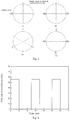
- the arrangement of the condensate inlets may be shown, for example, in Fig. 2 of the present invention ( Fig. 2 is a schematic view of the positions of the condensate inlets above the distribution plate of the polymerization reactor).
- the gas-liquid separation unit is a buffer tank type separator or a cyclone type separator.
- the condensation unit is used to cool and partially condense the gas material; and for example, the condensation unit is capable of condensing the gas material in such a way that the condensate content in the material condensed by the condensation unit is in the range of 5-50wt%, preferably 10-30wt%.
- the condensation unit is preferably a heat exchanger, such as a shell-and-tube heat exchanger, a loop heat exchanger.
- the apparatus further comprises a compression unit, and the gas material discharged from the polymerization reactor is firstly compressed by the compression unit then enters into the condensation unit.
- the compression unit properly compresses the gas material, to keep the gas material flows in the pipeline at a certain rate.
- pumps are connected between the storage tanks and the polymerization reactor.
- the apparatus can be controlled such that the switch frequency between the olefin homopolymerization and copolymerization in the polymerization reactor is at least 1 time/hour, preferably greater than or equal to 3 times/hour.
- the apparatus can be controlled such that the switch frequency between the different copolymerization reactions of olefins in the polymerization reactor is at least 1 time/hour, preferably greater than or equal to 3 times/hour.
- the olefin is selected from ethylene and/or ⁇ -olefins, and the ⁇ -olefins are preferably ⁇ -olefins with less than 18 carbon atoms.
- the comonomer is selected from butene, hexene, octene or other olefins with less than 18 carbon atoms, preferably ⁇ -olefins.
- the polymerization reactor is further provided with a catalyst inlet for intermittently or continuously introducing the catalyst.
- the polymerization reactor is further provided with a discharge port for intermittently or continuously discharging the reaction product polyolefin.
- the reaction pressure of the polymerization reactor is 0.5-10MPa, preferably 1.5-5MPa; and the reaction temperature is 40-150°C, preferably 50-120°C.
- the feeding port of the gas reaction feedstock is arranged between the condensation unit and the gas material discharge port of the polymerization reactor in the circulation loop, more preferably between the compression unit and the gas material discharge port of the polymerization reactor.
- the feeding port of the liquid reaction feedstock is preferably arranged between the compression unit and the condensation unit. This arrangement of the feeding ports of the reaction feedstock is advantageous in improving the yield of the apparatus.
- an olefin polymerization process includes the following steps:
- the above-described process provided in the present invention is implemented on the olefin polymerization apparatus as described above according to the present invention.
- the olefin polymerization process and the olefin polymerization apparatus provided in the present invention have a consistent inventive idea.
- the gas discharged from the polymerization reactor is subjected to condensation and gas-liquid separation, wherein the gas portion is recycled to the reactor to form a circulation loop, the condensate can be intermittently introduced to the polymerization reactor, in order to achieve the switch between the homopolymerization reaction and the copolymerization reaction or between different copolymerization reactions, and at the same time the heat release of the reactor is achieved.
- the polymerization reaction in the reactor is freely switched between homopolymerization and copolymerization.
- the gas reaction feedstock (which may contain a small amount of liquid) containing the olefin monomer is introduced from the position below the distribution plate of the polymerization reactor and contacted with the added catalyst to produce a solid-phase polyolefin.
- the reacted gas stream is discharged from the reactor, and compressed, condensed, and gas-liquid separated in the circulation loop, the gas portion is returned to the reactor, and the liquid portion is stored in the comonomer storage tanks as the condensate to be stand-by without being returned to the reactor.
- the comonomer contained in the condensate is, for example, one of butene, hexene, octene and like higher olefins, and may be used as a copolymerization feedstock.
- different condensates are stored in different storage tanks.
- the circulation gas stream is substantially free of comonomer after multiple circulations, and now only the homopolymerization reaction occurs in the reactor.
- the stream from the condensation unit is substantially free of condensate and is substantially a gas which is returned directly to the reactor.
- the condensate containing the condensing agent and the comonomer is introduced from the storage tanks into the condensate inlets of the reactor (above the polymerization distribution plate of the reactor), and the condensate is gradually vaporized in the reactor, so that a gas-solid area and a gas-liquid-solid three-phase area are formed in the reactor.
- the gas reactant and the liquid reactant are contacted with the added catalyst to form a solid-phase polyolefin, and the gas reactant is contacted with the added catalyst in the gas-solid area to form a solid-phase polyolefin.
- the reacted gas stream is discharged from the reactor, and compressed, condensed, and gas-liquid separated in the circulation loop, and the gas portion is returned to the reactor.
- the separated liquid enters the comonomer storage tanks and is returned to the reactor; and the unseparated portion of the liquid is returned to the reactor from the position below the distribution plate together with the gas portion.
- the polymer product is taken out from the reactor intermittently or continuously through the discharge pipeline.
- the condensate means the condensate that may be generated after the gas material is condensed in the homopolymerization stage and the condensate generated after the gas material is condensed in the copolymerization stage.
- the stream from the condensation unit is substantially free of condensate after multiple circulations because the introduction of the condensate from the storage tanks into the reactor is stopped; and except this, (namely except the case that the condensed gas material is free of condensate in the homopolymerization reaction stage), all the condensed gas material contains a certain amount of condensate, and the gas-liquid separation unit separates the gas and at least portion of the condensate.
- the olefin polymer having specific properties can be prepared by the switch between homopolymerization and copolymerization reactions and between different copolymerization reactions.
- the olefin polymerization process provided in the present invention can be used for olefin homopolymerization, binary copolymerization, ternary copolymerization or quaternary or higher copolymerization.
- the olefin is selected from ethylene and/or ⁇ -olefins, such as one of ethylene, butene, hexene and octene.
- the ⁇ -olefin is preferably a C 4 -C 20 linear or branched ⁇ -olefin, preferably a C 4 -C 18 linear ⁇ -olefin, such as ⁇ -butene, ⁇ -hexene or ⁇ -octene.
- the comonomer is selected from C 2 -C 20 linear or branched olefins, preferably olefins with less than 18 carbon atoms, such as ethylene, butene, hexene or octene, preferably butene, hexene or octene.
- the comonomer is preferably ⁇ -olefin, for example, preferably selected from ⁇ -butene, ⁇ -hexene and ⁇ -octene.
- the olefin is ethylene and the comonomer is selected from butene, hexene and octene.
- olefin a comonomer of the olefin; therefore, in the above defined range of the terms “olefin” and “comonomer” in the present invention, "olefin” and “comonomer” are not the same olefin monomer simultaneously.
- the number of the storage tanks is 2 or more, preferably 2-4, and the storage tanks are respectively used for storing condensate containing different comonomers; and the condensate in each of the storage tanks is controlled to be selectively introduced into the polymerization reactor to achieve the switch between homopolymerization and copolymerization of olefins or between different copolymerization reactions of olefins in the polymerization reactor.
- the switch frequency between the olefin homopolymerization and copolymerization is at least 1 time/hour, preferably greater than or equal to 3 times/hour, for example, preferably 3-6 times/hour.
- the switch frequency between different copolymerization reactions of olefins is at least 1 time/hour, preferably greater than or equal to 3 times/hour, for example, preferably 3-6 times/hour.
- the free switch between the copolymerization reaction and the homopolymerization reaction or between different copolymerization reactions can be achieved.
- the switch frequency in the preferred embodiment described above is adopted, on one hand, feasibility is considered, and sufficient time can be ensured to consume the comonomer of the previous step at the time of switching, and on the other hand, it is possible to ensure that polyolefins produced in different modes (homopolymerization ⁇ ⁇ copolymerization, copolymerization ⁇ ⁇ copolymerization) can be mixed sufficiently.
- the olefin is ethylene
- the average residence time of polyethylene in the fluidized bed is about 1-3 hours
- the switch frequency is at least 1 time/hour, preferably 3 times/hour or more.
- the operation time of each homopolymerization stage is maintained for 3-60 minutes, preferably 8-20 minutes; and the operation time of each copolymerization stage is maintained for 5-60 minutes, preferably 8-20 minutes.
- both the industrial achievability can be ensured, and the molecular chains of the resulting polyolefins can have a good monomer distribution state, thus a polymer product with stable properties can be obtained.
- the operation time of the homopolymerization reaction is at least 18 minutes when the comonomer is butene.
- the homopolymeric monomer is preferably ethylene.
- the operation time of the homopolymerization reaction is at least 6 minutes when the comonomer is hexene.
- the homopolymeric monomer is preferably ethylene.
- the operation time of the homopolymerization reaction is at least 3 minutes when the comonomer is octene or other olefins with higher molecular weight.
- the homopolymeric monomer is preferably ethylene.
- the "homopolymerization stage” or “homopolymerization reaction stage” can be understood as the stage in which the condensate in the storage tanks is not introduced into the reactor.
- the “copolymerization stage” or “copolymerization reaction stage” can be understood as the stage in which the condensate in the storage tanks is introduced into the reactor.
- the condensate content in the stream resulting from the condensation of the gas material is 5-50wt%, preferably 10-30wt% based on the weight of the stream.
- the stream is typically a gas-liquid mixture.
- 30-100wt%, preferably 60-100wt% of the total condensate entering the gas-liquid separation unit is separated by the gas-liquid separation unit. This portion of the condensate is introduced from the condensate inlet above the distribution plate of the reactor. In this case, the unseparated condensate is returned to the reactor together with the gas.
- the pressure drop of the gas in the circulation stream passing through the gas-liquid separation unit is 1500-6500Pa.
- the catalyst used may be a conventional catalyst such as a Ziegler-Natta catalyst, a chromium-based catalyst, a metallocene catalyst and a post-transition metal catalyst, and the complex thereof.
- At least one of a cocatalyst, a polymeric monomer, an antistatic agent, a chain transfer agent, a molecular weight modifier, a condensing agent and an inert gas are introduced into the reactor and/or the circulation loop.
- the cocatalyst is a cocatalyst commonly used in the polymerization of olefins, such as alkyl aluminum, aluminum alkoxide and the like, preferably at least one of the following: modified aluminoxane, monochlorodiethyl aluminum, monochlorodiisobutyl aluminum, sesquioethyl aluminum, diisobutyl aluminum, dichloromonoethyl aluminum, trimethyl aluminum, triethyl aluminum, triisobutyl aluminum, trioctyl aluminum, monohydrodiethyl aluminum and monohydrodiisobutyl aluminum, preferably triethyl aluminum and triisobutyl aluminum.
- modified aluminoxane monochlorodiethyl aluminum, monochlorodiisobutyl aluminum, sesquioethyl aluminum, diisobutyl aluminum, dichloromonoethyl aluminum, trimethyl aluminum, triethyl aluminum, triis
- the polymeric monomer may be suitably selected depending on the target product and may be the same as or different from the olefin or comonomer, for example, may be selected from one or more of olefin monomers such as ethylene, butene, hexene and octene.
- the antistatic agent is a conventional antistatic agent, for example, selected from one or more of aluminum distearate, ethoxylated amines, polysulfone copolymers, polymeric polyamines, oil-soluble sulfonic acids and the like.
- a suitable antistatic agent should be carefully selected to avoid introduction of the poisonous materials into the reactor, while using a minimal amount of the antistatic agent to control the electrostatic charges in the reactor within the desired range.
- the chain transfer agent is a conventional chain transfer agent including hydrogen and an alkyl metal, preferably hydrogen.
- the inert gas is a conventionally used inert gas, such as nitrogen.
- the molecular weight modifier is a conventionally used molecular weight modifier.
- the condensing agent is selected from at least one of C 4 -C 7 saturated linear or branched alkanes, and C 4 -C 7 cycloalkanes; preferably at least one of n-pentane, iso-pentane, hexane and heptane; most preferably iso-pentane and/or hexane.
- the condensate may be either a comonomer (e.g., hexene, heptene, octene or the like), or a saturated alkane (condensing agent) which does not participate in the reaction, and generally a C 4 -C 7 alkane.
- a comonomer e.g., hexene, heptene, octene or the like
- a saturated alkane condensing agent
- C 4 -C 7 alkane alkane
- the molecular weight of cyclopentane is similar to that of isopentane, but the latent heat of vaporization is higher than that of isopentane by 25%, and thus the space-time yield can be increased by 25% in the case of the same amount of inert condensate.
- Isopentane is preferred in the present invention.
- the circulation gas is compressed and cooled in the condensation process to produce a portion of liquid stream, and a portion of the liquid stream is returned to the reactor through the storage tanks and the pump, and a portion of the liquid stream can be returned to the reactor with the gas stream.
- the vaporization of the liquid stream can absorb a lot of heat, the heat transfer capacity of the fluidized bed reaction is improved, thereby improving the space-time yield of the reactor.
- the reaction pressure of the reaction in the step 1) is 0.5-10MPa, preferably 1.5-5MPa, more preferably 2.0-3.5MPa; the reaction temperature is 40-150°C, preferably 50-120°C, more preferably 75-100°C.
- the gas reaction feedstock is preferably introduced to the reaction system from the position between the condensation unit and the gas material discharge port of the polymerization reactor in the circulation loop, more preferably from the position between the compression unit and the gas material discharge port of the polymerization reactor.
- the liquid reaction feedstock is preferably introduced from the position between the compression unit and the condensation unit.
- the preferred introduction mode of the reaction feedstock can increase the yield of the reaction system.
- the present invention have, but are not limited to, the following advantages:
- the partial performance parameters of the polyolefin products in the examples are determined by the following method.
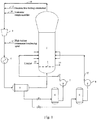
- Fig. 1 shows the olefin polymerization apparatus and the simplified operational flow according to one particular embodiment of the present invention.
- the shown olefin polymerization apparatus comprises the following components:
- the circulation gas stream after the reaction flows out from the top of the fluidized bed reactor 2, enters the gas circulation pipeline 10, and flows through the compression unit 3 and the heat exchanger 4, and the partially condensed circulation stream flowing from the heat exchanger 4 enters the gas-liquid separation unit 5, the liquid material in the gas-liquid separation unit 5 is partially or completely separated and enters the first storage tank 6 and the second storage tank 8, and the unseparated liquid material enters the gas-phase distribution area of the reactor 2 with the circulation stream to complete one circulation.
- the condensate in the first storage tank 6 and the second storage tank 8 is no longer introduced into the fluidized bed reactor 2; in the copolymerization reaction stage, the condensate in the first storage tank 6 and the second storage tank 8 is introduced to the position above the distribution plate 1 of the fluidized bed reactor 2 from the fluid pipeline 11 and 12 by the first feeding pump 7 and the second feeding pump 9, respectively.
- the first storage tank 6 and the second storage tank 8 may each contain the condensate containing different major comonomers; and certainly may also contain the same condensate.
- the condensate in one or more storage tanks may be controlled by the control unit (not shown) to be introduced into the reactor 2 as needed.
- the fresh reaction feed gas required for the reaction is fed into the gas circulation pipeline 10 through the pipeline 15, the molecular weight modifier or the like can enter the gas circulation pipeline 10 through the pipeline 16, the high-boiling-point comonomer and the condensing agent can enter the gas circulation pipeline 10 through the pipeline 17, the catalyst intermittently or continuously enters the reactor 2 through the pipeline 13, and the solid-phase polymer produced in the polymerization reaction is intermittently or continuously discharged from the pipeline 14 and transported to the downstream stage for further processing.
- At least one, preferably 3-6 liquid introduction points, i.e., condensate inlets, are distributed in the axial and radial directions of the reactor.
- Fig. 2 shows the distribution of the liquid introduction points in the radial direction of the reactor.
- Figs. 2 (a)-(d) show the conditions in which 1-4 liquid introduction points are arranged in a plane, respectively.
- the linear low density polyethylene (LLDPE) is produced in the fluidized bed polymerization reactor apparatus shown in Fig. 1 .
- the polymerization reaction temperature is 88°C
- the pressure is 2.1MPa
- the superficial velocity of the reactor is 0.61m/s.
- the circulation gas in the pipeline 10 includes hydrogen, nitrogen, methane, ethane, ethylene, butene, inert C 4 and isopentane, the pressure is 2.1MPa and the temperature is 90°C.
- the circulation gas stream from the heat exchanger 4 contained no condensate, and the gas-phase density is 28.0kg/m 3 ; and gas-solid two-phase reaction is performed in the fluidized bed reactor, and ethylene is contacted with the continuously added catalyst to produce solid polyolefins.
- the circulation gas in the pipeline 10 includes hydrogen, nitrogen, methane, ethane, ethylene, butene, inert C 4 and isopentane.
- the circulation gas stream from the heat exchanger 4 contained 15wt% of condensate, the condensate contained isopentane and ⁇ -butene and the density is 593kg/m 3 .
- 80wt% of the total condensate in the circulation gas stream entered the first storage tank 6 and the condensate not entering the first storage tank 6 entered the reactor 2 with the circulation gas stream.
- the condensate rich in the comonomer in the first storage tank 6 is introduced into the fluidized bed through the first feeding pump 7 for copolymerization reaction.
- the above-mentioned copolymerization and homopolymerization reactions are switched repeatedly at 3 times/hour.
- the space-time yield of the system is 135kg/m 3 ⁇ hr; and the production capacity is increased by 50% compared to those of conventional gas-phase process.
- the density of the linear low density polyethylene produced according to the example is 0.9210g/cm 3 , the melt flow rate is 0.78g/10min, the tensile yield stress is up to 11.6MPa, the elongation at break is 765%, the haze is 11.7%, and the free-falling dart impact damage weight is 114g.
- the linear low density polyethylene (LLDPE) is produced in the fluidized bed polymerization reactor apparatus shown in Fig. 1 by using a stepwise polymerization reaction process. Under the action of the Z-N catalyst system, the polymerization reaction temperature is 87°C, the pressure is 2.1MPa, and the superficial velocity of the reactor is 0.72m/s.
- the circulation gas in the pipeline 10 includes hydrogen, nitrogen, methane, ethane, ethylene, isopentane and hexene, the pressure is 2.1MPa and the temperature is 87°C.
- the circulation gas stream from the heat exchanger 4 contained no condensate, and the gas-phase density is 28.8kg/m 3 ; and gas-solid two-phase reaction is performed in the fluidized bed reactor, and ethylene is contacted with the continuously added catalyst to produce the solid-phase polymer.
- the circulation gas in the pipeline included hydrogen, nitrogen, methane, ethane, ethylene, isopentane and hexene
- the circulation gas stream from the heat exchanger 4 contained 30wt% of condensate
- the density is 601kg/m 3
- the gas-phase density is 29.1kg/m 3 .
- the condensate flowing into the second storage tank 8 can reach 50wt% of the total condensate in the circulation gas stream, and is injected into the fluidized bed from three condensate inlets in different heights above the distribution plate through the second feeding pump 9.
- the pressure of the second feeding pump 9 is 3.5MPa and the rate at which the liquid-phase material is injected into the fluidized bed reactor 2 is 60t/hr.
- the condensate is atomized and injected into the fluidized bed through nozzles.
- the above-mentioned copolymerization and homopolymerization reactions are switched repeatedly at 5 times/hour.
- the space-time yield of the system is 151kg/m 3 ⁇ hr; and the production capacity is increased by 68% compared to those of conventional gas-phase process.
- the density of the linear low density polyethylene produced according to the example is 0.9175g/cm 3 , the melt flow rate is 1.9g/10min, the tensile yield stress is up to 9.9MPa, the elongation at break is 670%, the haze is 17.9%, and the free-falling dart impact damage weight is 142g.
- the linear low density polyethylene (LLDPE) is produced in the fluidized bed polymerization reactor apparatus shown in Fig. 1 by using a stepwise polymerization reaction process. Under the action of the Z-N catalyst system, the polymerization reaction temperature is 85°C, the pressure is 2.3MPa, and the superficial velocity of the reactor is 0.70m/s.
- the circulation gas in the pipeline 10 includes hydrogen, nitrogen, methane, ethane, ethylene, hexene, hexane and the like, the pressure is 2.3MPa and the temperature is 86°C.
- the circulation gas stream from the heat exchanger 4 contained no condensate, and the gas-phase density is 29.1kg/m 3 ; and gas-solid two-phase reaction is performed in the fluidized bed reactor, and ethylene is contacted with the continuously added catalyst to produce the solid-phase polymer.
- the circulation gas stream from the heat exchanger 4 contained 10wt% of condensate, and the condensate contained hexene and hexane, the density is 618.7kg/m 3 and the gas-phase density is 30.0kg/m 3 .
- the condensate entering the second storage tank 8 can reach 65wt% of the total condensate in the circulation gas stream, and is injected into the reactor from three liquid introduction points in the same level through the second feeding pump 9.
- the distribution of the three liquid introduction points is shown in Fig. 2 (c) .
- the flow rate of the introduced liquid material is 26t/h, the temperature is 52°C, and the pressure is 3.6MPa.
- the condensate is atomized and injected into the reactor through nozzles.
- the above-mentioned copolymerization and homopolymerization reactions are switched repeatedly at 6 times/hour.
- the space-time yield of the fluidized bed reactor is 140kg/m 3 ⁇ hr; and the production capacity is increased by 56% compared to those of conventional gas-phase process.
- the density of the linear low density polyethylene produced according to the example is 0.9218g/cm 3 , the melt flow rate is 0.95g/10min, the tensile yield stress is up to 11.7MPa, the elongation at break is 635%, the haze is 13.0%, and the free-falling dart impact damage weight is 168g.
- the linear low density polyethylene (LLDPE) is produced in the fluidized bed polymerization reactor apparatus shown in Fig. 1 by using a stepwise polymerization reaction process. Under the action of the Z-N catalyst system, the polymerization reaction temperature is 85°C, the pressure is 2.5MPa, and the superficial velocity of the reactor is 0.67m/s.
- the circulation gas in the pipeline 10 includes hydrogen, nitrogen, methane, ethane, ethylene, isopentane, hexene and the like, the pressure is 2.5MPa and the temperature is 86°C.
- the circulation gas stream from the heat exchanger 4 contained no condensate, and the gas-phase density is 28.9kg/m 3 ; and gas-solid two-phase reaction is performed in the fluidized bed reactor, and ethylene is contacted with the continuously added catalyst to produce the solid-phase polymer.
- the circulation gas stream from the heat exchanger 4 contained 28wt% of condensate, the liquid phase is isopentane and hexene, the density is 620.4kg/m 3 and the gas-phase density is 31.2kg/m 3 .
- the condensate entering the second storage tank 8 can reach 70wt% of the total condensate in the circulation gas stream, and is introduced into the reactor from four liquid introduction points in the same level on the sidewall of the reactor through the second feeding pump 9.
- the distribution of the four liquid introduction points is shown in Fig. 2 (d) .
- the flow rate of the introduced liquid material is 56t/h, and the pressure is 3.9MPa.
- the condensate is atomized and injected into the reactor through nozzles.
- the above-mentioned copolymerization and homopolymerization reactions are switched repeatedly at 4 times/hour.
- the space-time yield of the fluidized bed reactor is 165kg/m 3 ⁇ hr; and the production capacity is increased by 83%.
- the density of the linear low density polyethylene produced according to the example 4 is 0.9119g/cm 3 , the melt flow rate is 0.87g/10min, the tensile yield stress is up to 8.4MPa, the elongation at break is 864%, the haze decreases to 10.3%, and the free-falling dart impact damage weight is 149g.
- Fig. 3 is a schematic view showing the change in the amount of liquid injected from the side wall of the reactor over time in the example. It can be seen from Fig. 3 that the copolymerization time is 10 minutes and the homopolymerization time is 15 minutes. It is to be noted that in the example, the separation efficiency of the gas-liquid separator 5 is 70wt%, i.e., after the gas-liquid mixed stream discharged from the heat exchanger 4 passes through the gas-liquid separator 5, the condensate accounting for 70 wt% of the condensate in the circulation gas stream enters the second storage tank 8 and enters the reactor 2 from the liquid introduction points on the sidewall through the second feeding pump 9.
- the liquid is introduced from the sidewall of the reactor, so that the liquid accumulation on the distribution plate is avoided, the introduction amount of the condensate in the reactor can be increased and the space-time yield can be improved; and in addition, a plurality of low-temperature/comonomer enrichment areas and high-temperature areas are formed in the reactor, so that the products with wide molecular weight distribution can be produced.
- the linear low density polyethylene (LLDPE) is produced in the fluidized bed polymerization reactor apparatus shown in Fig. 1 by using a stepwise polymerization reaction process. Under the action of the Z-N catalyst system, the polymerization reaction temperature is 80°C, the pressure is 2.3MPa, and the superficial velocity of the reactor is 0.67m/s.
- the circulation gas in the pipeline 10 includes hydrogen, nitrogen, methane, ethane, ethylene, butene, inert C 4 , a small amount of isopentane, a small amount of hexene and the like, the pressure is 2.3MPa and the temperature is 80°C.
- the circulation gas stream from the heat exchanger 4 contained no condensate; and gas-solid two-phase reaction is performed in the fluidized bed reactor, and ethylene is contacted with the continuously added catalyst to produce the solid-phase polymer.
- the circulation gas stream from the heat exchanger 4 contained 9wt% of condensate, the liquid phase is butene and isopentane, the density is 580kg/m 3 and the gas-phase density is 30.9kg/m 3 .
- the condensate entering the first storage tank 6 can reach 65wt% of the total condensate in the circulation gas stream, and is injected into the reactor from liquid introduction points shown in Fig. 2(b) through the first feeding pump 7.
- the flow rate of the liquid material introduced from the sidewall is 22t/h, and the pressure is 3.7MPa.
- the circulation gas stream from the heat exchanger 4 contained 22wt% of condensate, the liquid phase is isopentane and hexene, the density is 616.8kg/m 3 and the gas-phase density is 28.3kg/m 3 .
- the condensate entering the second storage tank 8 can reach 65wt% of the total condensate in the circulation gas stream, and is introduced into the reactor from four liquid introduction points in the same level through the second feeding pump 9.
- the distribution of the four liquid introduction points is shown in Fig. 2 (d) .
- the flow rate of the liquid material introduced from the sidewall is 60t/h, and the pressure is 3.9MPa.
- the condensate is atomized and injected into the reactor through nozzles.
- the above-mentioned copolymerization and homopolymerization reactions are switched repeatedly at 7 times/hour.
- the space-time yield of the fluidized bed reactor is 130kg/m 3 ⁇ hr; and the production capacity is increased by 44%.
- the density of the linear low density polyethylene produced according to the example 5 is 0.9150g/cm 3 , the melt flow rate is 0.91g/10min, the tensile yield stress is up to 8.6MPa, the elongation at break is 870 %, the haze decreases to 10.7%, and the free-falling dart impact damage mass is 210g.
- MDPE medium density polyethylene
- Fig. 1 The medium density polyethylene (MDPE) is produced in the fluidized bed polymerization reactor apparatus shown in Fig. 1 by using a stepwise polymerization reaction process. Under the action of the Z-N catalyst system, the polymerization reaction temperature is 91°C, the pressure is 2.1 MPa, and the superficial velocity of the reactor is 0.65m/s.
- the circulation gas in the pipeline 10 includes hydrogen, nitrogen, methane, ethane, ethylene, a small amount of isopentane, a small amount of hexene and the like, the pressure is 2.3MPa and the temperature is 91°C.
- the circulation gas stream from the heat exchanger 4 contained no condensate; and gas-solid two-phase reaction is performed in the fluidized bed reactor, and ethylene is contacted with the continuously added catalyst to produce the solid-phase polymer.
- the duration time of each homopolymerization reaction stage is about 8 minutes.
- the circulation gas stream from the heat exchanger 4 contained 26wt% of condensate, the liquid phase is isopentane and hexene, the density is 604.4kg/m 3 and the gas-phase density is 28.6kg/m 3 .
- the condensate entering the second storage tank 8 can reach 70wt% of the total condensate in the circulation gas stream, and is introduced into the reactor from four liquid introduction points two of which are located in the same level through the second feeding pump 9. The distribution of the four liquid introduction points is shown in Fig. 2 (d) .
- the flow rate of the liquid material introduced from the sidewall is 65t/h, and the pressure is 3.8MPa.
- the condensate is atomized and injected into the reactor through nozzles.
- the duration time of each homopolymerization reaction stage is about 12 minutes.
- the above-mentioned copolymerization and homopolymerization reactions are switched repeatedly at 5 times/hour.
- the space-time yield of the fluidized bed reactor is 145kg/m 3 ⁇ hr; and the production capacity is increased by 60%.
- the density of the medium density polyethylene produced according to the example 6 is 0.9300g/cm 3 , the melt flow rate is 0.34g/10min, the tensile yield stress is up to 20.5MPa, the elongation at break is 592%, the haze is 17%, and the free-falling dart impact damage mass is 75g.
- the high density polyethylene (HDPE) is produced in the fluidized bed polymerization reactor apparatus shown in Fig. 1 by using a stepwise polymerization reaction process.
- the polymerization reaction temperature is 100°C
- the pressure is 2.1MPa
- the superficial velocity of the reactor is 0.63m/s.
- the homopolymerization reaction is predominant in the fluidized bed reactor
- the circulation gas stream in the pipeline 10 includes hydrogen, nitrogen, methane, ethane, ethylene, isopentane, a small amount of butene and the like
- the pressure is 2.1 MPa and the temperature is 100°C.
- the circulation gas stream at the outlet of the heat exchanger 4 contained no condensate; and gas-solid two-phase reaction is performed in the fluidized bed reactor, and ethylene is contacted with the continuously added catalyst to produce the solid-phase polymer.
- the density of the high density polyethylene produced according to the example 7 is 0.9485g/cm 3 , the melt flow rate is 1.1g/10min, the tensile yield stress is 21MPa, the elongation at break is 500%, the haze is 21%, and the free-falling dart impact damage mass is 65g.
- the olefin polymerization apparatus and the olefin polymerization process provided in the present invention can produce the polyolefin products having excellent mechanical properties and excellent processabilities, and have wide application space and high application value.
Landscapes
- Chemical & Material Sciences (AREA)
- Organic Chemistry (AREA)
- Chemical Kinetics & Catalysis (AREA)
- Engineering & Computer Science (AREA)
- Combustion & Propulsion (AREA)
- Health & Medical Sciences (AREA)
- Medicinal Chemistry (AREA)
- Polymers & Plastics (AREA)
- Polymerisation Methods In General (AREA)
- Addition Polymer Or Copolymer, Post-Treatments, Or Chemical Modifications (AREA)
Abstract
Description
- This application claims the priority of China Patent Application No.
CN 201410748898.0, filed December 9, 2014 CN 201410748891.9, filed December 9, 2014 - The present invention relates to the technical field of olefin polymerization, and in particular relates to an olefin polymerization apparatus and an olefin polymerization process for producing polyolefins.
- The gas-phase fluidized bed reactors can be used to produce a variety of polyolefins. The olefin polymers produced by fluidized bed reactor are usually in the form of powder, and fluidization is supplied by a circulation gas consisting of one or more monomers, an inert gas and the like. The conventional gas-phase fluidized bed polymerization apparatus consists of a fluidized bed reactor, a circulation gas compressor, and a circulation gas cooler to form a closed circulation loop, and a circulation gas consisting of reaction monomer ethylene, α-olefin, hydrogen gas and inert gas nitrogen is operated in the circulation loop and brings out the heat released from the polymerization reaction. The catalyst used in the gas-phase fluidized bed polymerization reaction process includes a Ziegler-Natta catalyst, a chromium oxide catalyst and a metallocene catalyst. Because the traditional gas-phase fluidized bed polymerization reaction process has the characteristics of less equipment, short process flow, flexible operation, less discharge, no solvent and low noise, it is an economical and environment-friendly petrochemical industry technology, and gradually becomes the mainstream of the polyethylene process.
- For polyolefins, especially polyethylene, the molecular weight and the molecular weight distribution greatly affect the mechanical properties and processabilities of the polymers. In the study of the art, it has been recognized that the higher the molecular weight, the higher the mechanical properties. However, the high-molecular-weight polyolefins have poor fluidity, are difficult to process, and are difficult to blow and extrude at a high shear rate. It is known in the art that expanding the molecular weight distribution of polyethylene can achieve the purpose of improving the rheological properties while maintaining the mechanical properties of the final product; wherein the high-molecular-weight portion ensures the mechanical properties of the product, and the low-molecular-weight portion contributes to improving the processabilities of the product.
- A single conventional gas-phase reactor can only produce polyethylene products with single distribution. It is known in the art that simple melt blending of two ethylene polymers with high and low molecular weight distributions can result in heterogeneity of the product. In addition, it has been recognized in the art that it is possible to produce polyethylene having broad/bimodal distribution by subjecting the catalyst or the polymer having the active site to two or more different reaction conditions or gas compositions for reacting continuously.
- In the past, bimodal polyethylene is produced in such a way that two or more reactors under different reaction conditions are used in series. European Patent
EP-A-691353 EP-B-517868 US 6642323 and PatentUS 7115687B disclose a process in which a first loop reactor and a second gas-phase fluidized bed reactor are connected in series; in which the problems that the residence time of polymer particles in the two gas-phase reactors is not equal, and the resin produced in the first reactor contains more fine powder are caused. - European Patent
EP-B-1012195 and Chinese Patent Application No.200480030566.3 CN 102060943 A discloses a process for preparation of bimodal polyethylene and a gas-phase reactor comprising at least four fluidized beds. In the process, the polymer particles are bubble-fluidized in the first reactor or the third reactor, and the fine powder in the polymer particles is entrained and blown by the elution to the second reactor or the fourth reactor in a rapid fluidization state, the polymer fine powder enters a cyclone separator from the outlet of the second reactor or the fourth reactor for gas-solid separation, and the circulation gas is returned to the reactor in the same reaction condition via the circulation loop; and the solid polymer particles enter another bubbling bed in different reaction conditions. The process has the problems that the operation is complicated and the circulation amount of the polymer particles between reactors having different reaction conditions is limited by the entrained amount of the fine powder. - It is an object of the present invention to provide a novel olefin polymerization apparatus and process. In the olefin polymerization apparatus and process, the gas discharged from the polymerization reactor is subjected to condensation and gas-liquid separation, the gas portion is recycled to the reactor to form a circulation loop, the condensate portion can be intermittently introduced into the polymerization reactor, and the condensate contains a condensing agent and/or a comonomer. On one hand, by selectively introducing the condensate into the reactor, the switch between the homopolymerization reaction and the copolymerization reaction or between the different copolymerization reactions can be achieved. On the other hand, the condensate separated by the gas-liquid separation unit additionally arranged in the apparatus is rich in an inert condensing agent and/or a comonomer, which can well consume the high heat generated by the reaction when introduced into the reactor.
- According to an aspect of the present invention, there is provided an olefin polymerization apparatus, comprising:
- a polymerization reactor for olefin homopolymerization and/or copolymerization reaction;
- a condensation unit for condensing a gas material discharged from the polymerization reactor;
- a gas-liquid separation unit for carrying out gas-liquid separation on the material from the condensation unit to generate a gas and a condensate;
- storage tanks for receiving the condensate discharged from the gas-liquid separation unit; and
- a control unit,
- wherein,
- the gas from the gas-liquid separation unit is introduced into the polymerization reactor,
- and the condensate from the storage tanks is selectively introduced into the polymerization reactor under the action of the control unit to achieve the switch between the olefin homopolymerization and copolymerization in the polymerization reactor.
- In some preferred embodiments of the present invention, the numbers of the storage tanks are 2 or more, preferably 2 to 4, which are respectively used for storing the condensate containing different comonomers.
- In some preferred embodiments of the present invention, the condensate in each of the storage tanks is selectively introduced into the polymerization reactor under the action of the control unit, to achieve the switch between different copolymerization reactions in the polymerization reactor.
- According to the olefin polymerization apparatus provided in the present invention, it is possible to achieve the switch between homopolymerization and copolymerization reactions of an olefin by providing only one polymerization reactor to produce an olefin polymer having specific properties, thereby saving the equipment cost and equipment occupation area. More importantly, according to the apparatus provided in the present invention, the switch between different copolymerization reactions of olefins can also be achieved by controlling different comonomers in different storage tanks to be introduced or not into the polymerization reactor, as needed. At the same time, the liquid comonomers introduced into the reactor from the storage tanks are capable of absorbing the high heat generated by the reaction and requiring in-time consumption or discharge when undergoing evaporating vaporization in the reactor.
- According to the apparatus provided in the present invention, the polymerization reactor is preferably a fluidized bed reactor.
- According to some preferred embodiments of the present invention, the polymerization reactor comprises two or more, preferably 3 to 6 condensate inlets for receiving condensate; and any two of the inlets are located in the same water level or in different water levels. The arrangement of the condensate inlets may be shown, for example, in
Fig. 2 of the present invention (Fig. 2 is a schematic view of the positions of the condensate inlets above the distribution plate of the polymerization reactor). - In some embodiments of the present invention, the gas-liquid separation unit is a buffer tank type separator or a cyclone type separator.
- In some embodiments of the present invention, the condensation unit is used to cool and partially condense the gas material; and for example, the condensation unit is capable of condensing the gas material in such a way that the condensate content in the material condensed by the condensation unit is in the range of 5-50wt%, preferably 10-30wt%. The condensation unit is preferably a heat exchanger, such as a shell-and-tube heat exchanger, a loop heat exchanger.
- In some embodiments of the present invention, the apparatus further comprises a compression unit, and the gas material discharged from the polymerization reactor is firstly compressed by the compression unit then enters into the condensation unit. The compression unit properly compresses the gas material, to keep the gas material flows in the pipeline at a certain rate.
- In some embodiments of the present invention, pumps are connected between the storage tanks and the polymerization reactor.
- In some preferred embodiments of the present invention, the apparatus can be controlled such that the switch frequency between the olefin homopolymerization and copolymerization in the polymerization reactor is at least 1 time/hour, preferably greater than or equal to 3 times/hour.
- In some preferred embodiments of the present invention, the apparatus can be controlled such that the switch frequency between the different copolymerization reactions of olefins in the polymerization reactor is at least 1 time/hour, preferably greater than or equal to 3 times/hour.
- In some preferred embodiments of the present invention, the olefin is selected from ethylene and/or α-olefins, and the α-olefins are preferably α-olefins with less than 18 carbon atoms.
- In some preferred embodiments of the present invention, the comonomer is selected from butene, hexene, octene or other olefins with less than 18 carbon atoms, preferably α-olefins.
- In some preferred embodiments of the present invention, the polymerization reactor is further provided with a catalyst inlet for intermittently or continuously introducing the catalyst.
- In some preferred embodiments of the present invention, the polymerization reactor is further provided with a discharge port for intermittently or continuously discharging the reaction product polyolefin.
- In some preferred embodiments of the present invention, the reaction pressure of the polymerization reactor is 0.5-10MPa, preferably 1.5-5MPa; and the reaction temperature is 40-150°C, preferably 50-120°C.
- In some preferred embodiments of the present invention, in the apparatus according to the present invention, the feeding port of the gas reaction feedstock is arranged between the condensation unit and the gas material discharge port of the polymerization reactor in the circulation loop, more preferably between the compression unit and the gas material discharge port of the polymerization reactor. The feeding port of the liquid reaction feedstock is preferably arranged between the compression unit and the condensation unit. This arrangement of the feeding ports of the reaction feedstock is advantageous in improving the yield of the apparatus.
- According to another aspect of the present invention, there is provided an olefin polymerization process, includes the following steps:
- 1) reacting an olefin-containing reaction feedstock in a polymerization reactor and discharging a gas material from the polymerization reactor;
- 2) condensing the gas material, and then separating a gas and at least a portion of condensate (if produced) through a gas-liquid separation unit; and
- 3) circulating the gas separated by the gas-liquid separation unit into the polymerization reactor, thereby forming a circulation loop, and introducing the condensate into storage tanks;
- In some preferred embodiments of the present invention, the above-described process provided in the present invention is implemented on the olefin polymerization apparatus as described above according to the present invention.
- In fact, the olefin polymerization process and the olefin polymerization apparatus provided in the present invention have a consistent inventive idea. By adopting the apparatus or process provided in the present invention, the gas discharged from the polymerization reactor is subjected to condensation and gas-liquid separation, wherein the gas portion is recycled to the reactor to form a circulation loop, the condensate can be intermittently introduced to the polymerization reactor, in order to achieve the switch between the homopolymerization reaction and the copolymerization reaction or between different copolymerization reactions, and at the same time the heat release of the reactor is achieved.
- In particular, according to the process provided in the present invention, the polymerization reaction in the reactor is freely switched between homopolymerization and copolymerization. When the copolymerization reaction stage is switched to the homopolymerization reaction stage, the gas reaction feedstock (which may contain a small amount of liquid) containing the olefin monomer is introduced from the position below the distribution plate of the polymerization reactor and contacted with the added catalyst to produce a solid-phase polyolefin. The reacted gas stream is discharged from the reactor, and compressed, condensed, and gas-liquid separated in the circulation loop, the gas portion is returned to the reactor, and the liquid portion is stored in the comonomer storage tanks as the condensate to be stand-by without being returned to the reactor. The comonomer contained in the condensate is, for example, one of butene, hexene, octene and like higher olefins, and may be used as a copolymerization feedstock. Depending on different kinds of the comonomers contained, different condensates are stored in different storage tanks. In the homopolymerization reaction stage, the circulation gas stream is substantially free of comonomer after multiple circulations, and now only the homopolymerization reaction occurs in the reactor. At the same time, after multiple circulations in the homopolymerization reaction stage, the stream from the condensation unit is substantially free of condensate and is substantially a gas which is returned directly to the reactor.
- If it is desired to switch the homopolymerization reaction stage into the copolymerization reaction stage, the condensate containing the condensing agent and the comonomer is introduced from the storage tanks into the condensate inlets of the reactor (above the polymerization distribution plate of the reactor), and the condensate is gradually vaporized in the reactor, so that a gas-solid area and a gas-liquid-solid three-phase area are formed in the reactor. In the gas-liquid-solid three-phase area, the gas reactant and the liquid reactant are contacted with the added catalyst to form a solid-phase polyolefin, and the gas reactant is contacted with the added catalyst in the gas-solid area to form a solid-phase polyolefin. The reacted gas stream is discharged from the reactor, and compressed, condensed, and gas-liquid separated in the circulation loop, and the gas portion is returned to the reactor. The separated liquid enters the comonomer storage tanks and is returned to the reactor; and the unseparated portion of the liquid is returned to the reactor from the position below the distribution plate together with the gas portion. The polymer product is taken out from the reactor intermittently or continuously through the discharge pipeline.
- Thus, the above-mentioned "(if produced) condensate" is understood by the skilled person in the art, that is, the condensate means the condensate that may be generated after the gas material is condensed in the homopolymerization stage and the condensate generated after the gas material is condensed in the copolymerization stage. During the homopolymerization operation stage, the stream from the condensation unit is substantially free of condensate after multiple circulations because the introduction of the condensate from the storage tanks into the reactor is stopped; and except this, (namely except the case that the condensed gas material is free of condensate in the homopolymerization reaction stage), all the condensed gas material contains a certain amount of condensate, and the gas-liquid separation unit separates the gas and at least portion of the condensate.
- The olefin polymer having specific properties can be prepared by the switch between homopolymerization and copolymerization reactions and between different copolymerization reactions.
- The olefin polymerization process provided in the present invention can be used for olefin homopolymerization, binary copolymerization, ternary copolymerization or quaternary or higher copolymerization.
- In some preferred embodiments of the present invention, the olefin is selected from ethylene and/or α-olefins, such as one of ethylene, butene, hexene and octene. Among them, the α-olefin is preferably a C4-C20 linear or branched α-olefin, preferably a C4-C18 linear α-olefin, such as α-butene, α-hexene or α-octene.
- In some preferred embodiments of the present invention, the comonomer is selected from C2-C20 linear or branched olefins, preferably olefins with less than 18 carbon atoms, such as ethylene, butene, hexene or octene, preferably butene, hexene or octene. The comonomer is preferably α-olefin, for example, preferably selected from α-butene, α-hexene and α-octene.
- In one preferred embodiment of the present invention, the olefin is ethylene and the comonomer is selected from butene, hexene and octene.
- It is easy to understand that the comonomer is a comonomer of the olefin; therefore, in the above defined range of the terms "olefin" and "comonomer" in the present invention, "olefin" and "comonomer" are not the same olefin monomer simultaneously.
- In some preferred embodiments of the present invention, the number of the storage tanks is 2 or more, preferably 2-4, and the storage tanks are respectively used for storing condensate containing different comonomers; and the condensate in each of the storage tanks is controlled to be selectively introduced into the polymerization reactor to achieve the switch between homopolymerization and copolymerization of olefins or between different copolymerization reactions of olefins in the polymerization reactor.
- In some preferred embodiments of the present invention, the switch frequency between the olefin homopolymerization and copolymerization is at least 1 time/hour, preferably greater than or equal to 3 times/hour, for example, preferably 3-6 times/hour.
- In some preferred embodiments of the present invention, the switch frequency between different copolymerization reactions of olefins is at least 1 time/hour, preferably greater than or equal to 3 times/hour, for example, preferably 3-6 times/hour.
- In the process of the present invention, the free switch between the copolymerization reaction and the homopolymerization reaction or between different copolymerization reactions can be achieved. The switch frequency in the preferred embodiment described above is adopted, on one hand, feasibility is considered, and sufficient time can be ensured to consume the comonomer of the previous step at the time of switching, and on the other hand, it is possible to ensure that polyolefins produced in different modes (homopolymerization← → copolymerization, copolymerization← → copolymerization) can be mixed sufficiently.
- For example, in one preferred embodiment of the present invention, the olefin is ethylene, the average residence time of polyethylene in the fluidized bed is about 1-3 hours, and the switch frequency is at least 1 time/hour, preferably 3 times/hour or more.
- In some preferred embodiments of the present invention, the operation time of each homopolymerization stage is maintained for 3-60 minutes, preferably 8-20 minutes; and the operation time of each copolymerization stage is maintained for 5-60 minutes, preferably 8-20 minutes. Within the foregoing range, both the industrial achievability can be ensured, and the molecular chains of the resulting polyolefins can have a good monomer distribution state, thus a polymer product with stable properties can be obtained.
- In some preferred embodiments of the present invention, the operation time of the homopolymerization reaction is at least 18 minutes when the comonomer is butene. In this embodiment, the homopolymeric monomer is preferably ethylene.
- In some preferred embodiments of the present invention, the operation time of the homopolymerization reaction is at least 6 minutes when the comonomer is hexene. In this embodiment, the homopolymeric monomer is preferably ethylene.
- In some preferred embodiments of the present invention, the operation time of the homopolymerization reaction is at least 3 minutes when the comonomer is octene or other olefins with higher molecular weight. In this embodiment, the homopolymeric monomer is preferably ethylene.
- According to the present invention, the "homopolymerization stage" or "homopolymerization reaction stage" can be understood as the stage in which the condensate in the storage tanks is not introduced into the reactor. The "copolymerization stage" or "copolymerization reaction stage" can be understood as the stage in which the condensate in the storage tanks is introduced into the reactor.
- In some preferred embodiments of the present invention, in the copolymerization reaction stage, the condensate content in the stream resulting from the condensation of the gas material is 5-50wt%, preferably 10-30wt% based on the weight of the stream. The stream is typically a gas-liquid mixture.
- In some preferred embodiments of the present invention, 30-100wt%, preferably 60-100wt% of the total condensate entering the gas-liquid separation unit is separated by the gas-liquid separation unit. This portion of the condensate is introduced from the condensate inlet above the distribution plate of the reactor. In this case, the unseparated condensate is returned to the reactor together with the gas.
- Preferably, the pressure drop of the gas in the circulation stream passing through the gas-liquid separation unit is 1500-6500Pa.
- In the present invention, the catalyst used may be a conventional catalyst such as a Ziegler-Natta catalyst, a chromium-based catalyst, a metallocene catalyst and a post-transition metal catalyst, and the complex thereof.
- In some preferred embodiments of the present invention, in the method, before or during polymerization reaction, at least one of a cocatalyst, a polymeric monomer, an antistatic agent, a chain transfer agent, a molecular weight modifier, a condensing agent and an inert gas are introduced into the reactor and/or the circulation loop.
- The cocatalyst is a cocatalyst commonly used in the polymerization of olefins, such as alkyl aluminum, aluminum alkoxide and the like, preferably at least one of the following: modified aluminoxane, monochlorodiethyl aluminum, monochlorodiisobutyl aluminum, sesquioethyl aluminum, diisobutyl aluminum, dichloromonoethyl aluminum, trimethyl aluminum, triethyl aluminum, triisobutyl aluminum, trioctyl aluminum, monohydrodiethyl aluminum and monohydrodiisobutyl aluminum, preferably triethyl aluminum and triisobutyl aluminum.
- The polymeric monomer may be suitably selected depending on the target product and may be the same as or different from the olefin or comonomer, for example, may be selected from one or more of olefin monomers such as ethylene, butene, hexene and octene.
- The antistatic agent is a conventional antistatic agent, for example, selected from one or more of aluminum distearate, ethoxylated amines, polysulfone copolymers, polymeric polyamines, oil-soluble sulfonic acids and the like. In the embodiments disclosed of the present invention, when the antistatic agent is used, a suitable antistatic agent should be carefully selected to avoid introduction of the poisonous materials into the reactor, while using a minimal amount of the antistatic agent to control the electrostatic charges in the reactor within the desired range.
- The chain transfer agent is a conventional chain transfer agent including hydrogen and an alkyl metal, preferably hydrogen.
- The inert gas is a conventionally used inert gas, such as nitrogen.
- The molecular weight modifier is a conventionally used molecular weight modifier.
- In some preferred embodiments of the present invention, the condensing agent is selected from at least one of C4-C7 saturated linear or branched alkanes, and C4-C7 cycloalkanes; preferably at least one of n-pentane, iso-pentane, hexane and heptane; most preferably iso-pentane and/or hexane.
- In the present invention, the condensate may be either a comonomer (e.g., hexene, heptene, octene or the like), or a saturated alkane (condensing agent) which does not participate in the reaction, and generally a C4-C7 alkane. As an inert condensate, the molecular weight of cyclopentane is similar to that of isopentane, but the latent heat of vaporization is higher than that of isopentane by 25%, and thus the space-time yield can be increased by 25% in the case of the same amount of inert condensate. Isopentane is preferred in the present invention.
- In the present invention, the circulation gas is compressed and cooled in the condensation process to produce a portion of liquid stream, and a portion of the liquid stream is returned to the reactor through the storage tanks and the pump, and a portion of the liquid stream can be returned to the reactor with the gas stream. As the vaporization of the liquid stream can absorb a lot of heat, the heat transfer capacity of the fluidized bed reaction is improved, thereby improving the space-time yield of the reactor.
- In one preferred embodiment of the present invention, the reaction pressure of the reaction in the step 1) is 0.5-10MPa, preferably 1.5-5MPa, more preferably 2.0-3.5MPa; the reaction temperature is 40-150°C, preferably 50-120°C, more preferably 75-100°C.
- According to the process provided in the present invention, the gas reaction feedstock is preferably introduced to the reaction system from the position between the condensation unit and the gas material discharge port of the polymerization reactor in the circulation loop, more preferably from the position between the compression unit and the gas material discharge port of the polymerization reactor. The liquid reaction feedstock is preferably introduced from the position between the compression unit and the condensation unit. The preferred introduction mode of the reaction feedstock can increase the yield of the reaction system.
- Compared with the prior art, the present invention have, but are not limited to, the following advantages:
- 1) by selectively introducing the condensate containing the condensing agent and the comonomer into the reactor, the homopolymerization and copolymerization of the olefins are carried out alternately to obtain the product having excellent mechanical properties and processabilities;
- 2) the circularly produced condensate in the system not only provides the comonomer to carry out the copolymerization reaction, but also serves to absorb the heat in the reactor, so that the heat generated by the reaction can be brought out in time;
- 3) the amount of the condensate entering from the position below the distribution plate into the fluidized bed is small to avoid the phenomenon of liquid accumulation at the bottom of the fluidized bed;
- 4) the kind of the comonomer and the amount of the comonomer condensate introduced into the reactor can be changed according to different product requirements, so that the operation flexibility is increased and a high process application value is achieved;
- 5) the apparatus and process of the present invention are capable of achieving higher production yields.
- The drawings, which are intended to provide a further understanding of the present invention and form a part of the specification, are intended to be illustrative of the present invention in conjunction with the examples of the present invention and are not to be construed as limiting the present invention.
-
Fig. 1 is an olefin polymerization apparatus and a simplified operational flow chart in one particular embodiment of the present invention. -
Fig. 2 is a schematic view showing the arrangement of condensate inlets above the polymerization distribution plate in one particular embodiment of the present invention, whereinFigs. 2 (a), (b), (c) and (d) show the conditions in which 1, 2, 3 and 4 condensate inlets are arranged, respectively. -
Fig. 3 shows the change in the amount of liquid injected from the condensate inlets over time according to Example 4 disclosed herein. - The embodiments of the present invention will be described in detail with reference to the drawings and examples, and how the technical solutions of the present invention can be applied to solve the technical problems and the realization of the technical effects can be fully understood and implemented. It is to be noted that the various examples of the present invention and the various features in the examples may be combined with each other as long as they are not conflicted, and the resulting technical solutions are within the scope of the present invention.
- The partial performance parameters of the polyolefin products in the examples are determined by the following method.
- (1) Melt flow rate (MFR): the melt flow rate is measured according to the conditions in GB/T 19466.3-2004 (190°C, load of 2.16kg), and usually noted as MI2.16.
- (2) Density: measured according to the method in
GB/T 1033.2-2010 - (3) Tensile yield stress: measured in both machine direction (MD) and transverse direction (TD) according to ASTM D882.
- (4) Elongation at break: the elongation at break is measured according to the method in
GB/T 6344-2008 - (5) Free-falling dart impact value: the free-falling dart impact value is measured according to the A method in
GB/T 9639.1-2008 - (6) Density: measured according to the method in
GB/T 2410-2008 -
Fig. 1 shows the olefin polymerization apparatus and the simplified operational flow according to one particular embodiment of the present invention. The shown olefin polymerization apparatus comprises the following components: - a fluidized bed reactor 2 for homopolymerization reaction and copolymerization reaction, in which a
distribution plate 1 is arranged; - a
gas circulation pipeline 10 for circulating the gas material from the outlet of the reactor 2 to the gas-phase distribution area of the reactor 2; - a compression unit 3 for compressing the material in the
circulation pipeline 10; - a heat exchanger 4 for cooling the material in the
circulation pipeline 10; - a gas-
liquid separation unit 5; - a
first storage tank 6 and a second storage tank 8 (exemplary) for storing the condensate; - fluid pipelines 11 and 12 (exemplary) for introducing the condensing agent into the reactor 2;
- a
first feeding pump 7 and a second feeding pump 9 (exemplary) for introducing the condensate into the reactor 2; - a
pipeline 13 for introducing a polymerization catalyst into the reactor 2; - a
pipeline 14 for taking out the solid polyolefin from the reactor 2; - fluid pipelines 15 and 16 (exemplary) for introducing the gas material into the reactor 2; and
- a fluid pipeline 17 (exemplary) for introducing the high-boiling-point comonomer and the condensing agent into the reactor 2.
- Wherein, the circulation gas stream after the reaction flows out from the top of the fluidized bed reactor 2, enters the
gas circulation pipeline 10, and flows through the compression unit 3 and the heat exchanger 4, and the partially condensed circulation stream flowing from the heat exchanger 4 enters the gas-liquid separation unit 5, the liquid material in the gas-liquid separation unit 5 is partially or completely separated and enters thefirst storage tank 6 and thesecond storage tank 8, and the unseparated liquid material enters the gas-phase distribution area of the reactor 2 with the circulation stream to complete one circulation. - In the homopolymerization reaction stage, the condensate in the
first storage tank 6 and thesecond storage tank 8 is no longer introduced into the fluidized bed reactor 2; in the copolymerization reaction stage, the condensate in thefirst storage tank 6 and thesecond storage tank 8 is introduced to the position above thedistribution plate 1 of the fluidized bed reactor 2 from thefluid pipeline 11 and 12 by thefirst feeding pump 7 and the second feeding pump 9, respectively. Wherein thefirst storage tank 6 and thesecond storage tank 8 may each contain the condensate containing different major comonomers; and certainly may also contain the same condensate. The condensate in one or more storage tanks may be controlled by the control unit (not shown) to be introduced into the reactor 2 as needed. - The fresh reaction feed gas required for the reaction is fed into the
gas circulation pipeline 10 through the pipeline 15, the molecular weight modifier or the like can enter thegas circulation pipeline 10 through thepipeline 16, the high-boiling-point comonomer and the condensing agent can enter thegas circulation pipeline 10 through thepipeline 17, the catalyst intermittently or continuously enters the reactor 2 through thepipeline 13, and the solid-phase polymer produced in the polymerization reaction is intermittently or continuously discharged from thepipeline 14 and transported to the downstream stage for further processing. - At least one, preferably 3-6 liquid introduction points, i.e., condensate inlets, are distributed in the axial and radial directions of the reactor.
Fig. 2 shows the distribution of the liquid introduction points in the radial direction of the reactor.Figs. 2 (a)-(d) show the conditions in which 1-4 liquid introduction points are arranged in a plane, respectively. During the copolymerization reaction operation, the condensate in thefirst storage tank 6 and thesecond storage tank 8 are continuously fed into the reactor 2 from the liquid introduction points through thefirst feeding pump 7 and the second feeding pump 9. - The linear low density polyethylene (LLDPE) is produced in the fluidized bed polymerization reactor apparatus shown in
Fig. 1 . Under the action of a Ziegler-Natta (Z-N) catalyst system, the polymerization reaction temperature is 88°C, the pressure is 2.1MPa, and the superficial velocity of the reactor is 0.61m/s. - When the compolymerization reaction is switched into homopolymerization reaction, the circulation gas in the
pipeline 10 includes hydrogen, nitrogen, methane, ethane, ethylene, butene, inert C4 and isopentane, the pressure is 2.1MPa and the temperature is 90°C. After multiple circulations of the circulation gas, the circulation gas stream from the heat exchanger 4 contained no condensate, and the gas-phase density is 28.0kg/m3; and gas-solid two-phase reaction is performed in the fluidized bed reactor, and ethylene is contacted with the continuously added catalyst to produce solid polyolefins. - When the homopolymerization reaction is switched into compolymerization reaction, the circulation gas in the
pipeline 10 includes hydrogen, nitrogen, methane, ethane, ethylene, butene, inert C4 and isopentane. The circulation gas stream from the heat exchanger 4 contained 15wt% of condensate, the condensate contained isopentane and α-butene and the density is 593kg/m3. When passing through the external gas-liquid separator 5, 80wt% of the total condensate in the circulation gas stream entered thefirst storage tank 6, and the condensate not entering thefirst storage tank 6 entered the reactor 2 with the circulation gas stream. The condensate rich in the comonomer in thefirst storage tank 6 is introduced into the fluidized bed through thefirst feeding pump 7 for copolymerization reaction. - The above-mentioned copolymerization and homopolymerization reactions are switched repeatedly at 3 times/hour. The space-time yield of the system is 135kg/m3·hr; and the production capacity is increased by 50% compared to those of conventional gas-phase process.
- The density of the linear low density polyethylene produced according to the example is 0.9210g/cm3, the melt flow rate is 0.78g/10min, the tensile yield stress is up to 11.6MPa, the elongation at break is 765%, the haze is 11.7%, and the free-falling dart impact damage weight is 114g.
- The linear low density polyethylene (LLDPE) is produced in the fluidized bed polymerization reactor apparatus shown in
Fig. 1 by using a stepwise polymerization reaction process. Under the action of the Z-N catalyst system, the polymerization reaction temperature is 87°C, the pressure is 2.1MPa, and the superficial velocity of the reactor is 0.72m/s. - When the compolymerization reaction is switched into homopolymerization reaction, the circulation gas in the
pipeline 10 includes hydrogen, nitrogen, methane, ethane, ethylene, isopentane and hexene, the pressure is 2.1MPa and the temperature is 87°C. After multiple circulations of the circulation gas, the circulation gas stream from the heat exchanger 4 contained no condensate, and the gas-phase density is 28.8kg/m3; and gas-solid two-phase reaction is performed in the fluidized bed reactor, and ethylene is contacted with the continuously added catalyst to produce the solid-phase polymer. - When the homopolymerization reaction is switched into the compolymerization reaction, the circulation gas in the pipeline included hydrogen, nitrogen, methane, ethane, ethylene, isopentane and hexene, the circulation gas stream from the heat exchanger 4 contained 30wt% of condensate, the condensate contained isopentane and α-hexene, the density is 601kg/m3 and the gas-phase density is 29.1kg/m3. After separation and enrichment of the gas-
liquid separator 5, the condensate flowing into thesecond storage tank 8 can reach 50wt% of the total condensate in the circulation gas stream, and is injected into the fluidized bed from three condensate inlets in different heights above the distribution plate through the second feeding pump 9. In this process, the pressure of the second feeding pump 9 is 3.5MPa and the rate at which the liquid-phase material is injected into the fluidized bed reactor 2 is 60t/hr. The condensate is atomized and injected into the fluidized bed through nozzles. - The above-mentioned copolymerization and homopolymerization reactions are switched repeatedly at 5 times/hour. The space-time yield of the system is 151kg/m3·hr; and the production capacity is increased by 68% compared to those of conventional gas-phase process.
- The density of the linear low density polyethylene produced according to the example is 0.9175g/cm3, the melt flow rate is 1.9g/10min, the tensile yield stress is up to 9.9MPa, the elongation at break is 670%, the haze is 17.9%, and the free-falling dart impact damage weight is 142g.
- The linear low density polyethylene (LLDPE) is produced in the fluidized bed polymerization reactor apparatus shown in
Fig. 1 by using a stepwise polymerization reaction process. Under the action of the Z-N catalyst system, the polymerization reaction temperature is 85°C, the pressure is 2.3MPa, and the superficial velocity of the reactor is 0.70m/s. - When the compolymerization reaction is switched into homopolymerization reaction, the circulation gas in the
pipeline 10 includes hydrogen, nitrogen, methane, ethane, ethylene, hexene, hexane and the like, the pressure is 2.3MPa and the temperature is 86°C. After multiple circulations of the circulation gas, the circulation gas stream from the heat exchanger 4 contained no condensate, and the gas-phase density is 29.1kg/m3; and gas-solid two-phase reaction is performed in the fluidized bed reactor, and ethylene is contacted with the continuously added catalyst to produce the solid-phase polymer. - When the homopolymerization reaction is switched into the compolymerization reaction, the circulation gas stream from the heat exchanger 4 contained 10wt% of condensate, and the condensate contained hexene and hexane, the density is 618.7kg/m3 and the gas-phase density is 30.0kg/m3. After separation and enrichment of the gas-
liquid separator 5, the condensate entering thesecond storage tank 8 can reach 65wt% of the total condensate in the circulation gas stream, and is injected into the reactor from three liquid introduction points in the same level through the second feeding pump 9. The distribution of the three liquid introduction points is shown inFig. 2 (c) . The flow rate of the introduced liquid material is 26t/h, the temperature is 52°C, and the pressure is 3.6MPa. The condensate is atomized and injected into the reactor through nozzles. - The above-mentioned copolymerization and homopolymerization reactions are switched repeatedly at 6 times/hour. The space-time yield of the fluidized bed reactor is 140kg/m3·hr; and the production capacity is increased by 56% compared to those of conventional gas-phase process.
- The density of the linear low density polyethylene produced according to the example is 0.9218g/cm3, the melt flow rate is 0.95g/10min, the tensile yield stress is up to 11.7MPa, the elongation at break is 635%, the haze is 13.0%, and the free-falling dart impact damage weight is 168g.
- The linear low density polyethylene (LLDPE) is produced in the fluidized bed polymerization reactor apparatus shown in
Fig. 1 by using a stepwise polymerization reaction process. Under the action of the Z-N catalyst system, the polymerization reaction temperature is 85°C, the pressure is 2.5MPa, and the superficial velocity of the reactor is 0.67m/s. - When the compolymerization reaction is switched into the homopolymerization reaction, the circulation gas in the
pipeline 10 includes hydrogen, nitrogen, methane, ethane, ethylene, isopentane, hexene and the like, the pressure is 2.5MPa and the temperature is 86°C. After multiple circulations of the circulation gas, the circulation gas stream from the heat exchanger 4 contained no condensate, and the gas-phase density is 28.9kg/m3; and gas-solid two-phase reaction is performed in the fluidized bed reactor, and ethylene is contacted with the continuously added catalyst to produce the solid-phase polymer. - When the homopolymerization reaction is switched into the compolymerization reaction, the circulation gas stream from the heat exchanger 4 contained 28wt% of condensate, the liquid phase is isopentane and hexene, the density is 620.4kg/m3 and the gas-phase density is 31.2kg/m3. After separation and enrichment of the gas-
liquid separator 5, the condensate entering thesecond storage tank 8 can reach 70wt% of the total condensate in the circulation gas stream, and is introduced into the reactor from four liquid introduction points in the same level on the sidewall of the reactor through the second feeding pump 9. The distribution of the four liquid introduction points is shown inFig. 2 (d) . The flow rate of the introduced liquid material is 56t/h, and the pressure is 3.9MPa. At the liquid introduction points, the condensate is atomized and injected into the reactor through nozzles. - The above-mentioned copolymerization and homopolymerization reactions are switched repeatedly at 4 times/hour. The space-time yield of the fluidized bed reactor is 165kg/m3·hr; and the production capacity is increased by 83%.
- The density of the linear low density polyethylene produced according to the example 4 is 0.9119g/cm3, the melt flow rate is 0.87g/10min, the tensile yield stress is up to 8.4MPa, the elongation at break is 864%, the haze decreases to 10.3%, and the free-falling dart impact damage weight is 149g.
-
Fig. 3 is a schematic view showing the change in the amount of liquid injected from the side wall of the reactor over time in the example. It can be seen fromFig. 3 that the copolymerization time is 10 minutes and the homopolymerization time is 15 minutes. It is to be noted that in the example, the separation efficiency of the gas-liquid separator 5 is 70wt%, i.e., after the gas-liquid mixed stream discharged from the heat exchanger 4 passes through the gas-liquid separator 5, the condensate accounting for 70 wt% of the condensate in the circulation gas stream enters thesecond storage tank 8 and enters the reactor 2 from the liquid introduction points on the sidewall through the second feeding pump 9. - In this example, the liquid is introduced from the sidewall of the reactor, so that the liquid accumulation on the distribution plate is avoided, the introduction amount of the condensate in the reactor can be increased and the space-time yield can be improved; and in addition, a plurality of low-temperature/comonomer enrichment areas and high-temperature areas are formed in the reactor, so that the products with wide molecular weight distribution can be produced.
- The linear low density polyethylene (LLDPE) is produced in the fluidized bed polymerization reactor apparatus shown in
Fig. 1 by using a stepwise polymerization reaction process. Under the action of the Z-N catalyst system, the polymerization reaction temperature is 80°C, the pressure is 2.3MPa, and the superficial velocity of the reactor is 0.67m/s. - When the compolymerization reaction is switched into the homopolymerization reaction, the circulation gas in the
pipeline 10 includes hydrogen, nitrogen, methane, ethane, ethylene, butene, inert C4, a small amount of isopentane, a small amount of hexene and the like, the pressure is 2.3MPa and the temperature is 80°C. After multiple circulations of the circulation gas, the circulation gas stream from the heat exchanger 4 contained no condensate; and gas-solid two-phase reaction is performed in the fluidized bed reactor, and ethylene is contacted with the continuously added catalyst to produce the solid-phase polymer. - When the homopolymerization reaction is switched into the compolymerization reaction, the circulation gas stream from the heat exchanger 4 contained 9wt% of condensate, the liquid phase is butene and isopentane, the density is 580kg/m3 and the gas-phase density is 30.9kg/m3. After separation and enrichment of the gas-
liquid separator 5, the condensate entering thefirst storage tank 6 can reach 65wt% of the total condensate in the circulation gas stream, and is injected into the reactor from liquid introduction points shown inFig. 2(b) through thefirst feeding pump 7. The flow rate of the liquid material introduced from the sidewall is 22t/h, and the pressure is 3.7MPa. - When the homopolymerization reaction is switched into the compolymerization reaction, the circulation gas stream from the heat exchanger 4 contained 22wt% of condensate, the liquid phase is isopentane and hexene, the density is 616.8kg/m3 and the gas-phase density is 28.3kg/m3. After separation and enrichment of the gas-
liquid separator 5, the condensate entering thesecond storage tank 8 can reach 65wt% of the total condensate in the circulation gas stream, and is introduced into the reactor from four liquid introduction points in the same level through the second feeding pump 9. The distribution of the four liquid introduction points is shown inFig. 2 (d) . The flow rate of the liquid material introduced from the sidewall is 60t/h, and the pressure is 3.9MPa. At the liquid introduction points, the condensate is atomized and injected into the reactor through nozzles. - The above-mentioned copolymerization and homopolymerization reactions are switched repeatedly at 7 times/hour. The space-time yield of the fluidized bed reactor is 130kg/m3·hr; and the production capacity is increased by 44%.
- The density of the linear low density polyethylene produced according to the example 5 is 0.9150g/cm3, the melt flow rate is 0.91g/10min, the tensile yield stress is up to 8.6MPa, the elongation at break is 870 %, the haze decreases to 10.7%, and the free-falling dart impact damage mass is 210g.
- The medium density polyethylene (MDPE) is produced in the fluidized bed polymerization reactor apparatus shown in
Fig. 1 by using a stepwise polymerization reaction process. Under the action of the Z-N catalyst system, the polymerization reaction temperature is 91°C, the pressure is 2.1 MPa, and the superficial velocity of the reactor is 0.65m/s. - When the compolymerization reaction is switched into the homopolymerization reaction, the circulation gas in the
pipeline 10 includes hydrogen, nitrogen, methane, ethane, ethylene, a small amount of isopentane, a small amount of hexene and the like, the pressure is 2.3MPa and the temperature is 91°C. After multiple circulations of the circulation gas, the circulation gas stream from the heat exchanger 4 contained no condensate; and gas-solid two-phase reaction is performed in the fluidized bed reactor, and ethylene is contacted with the continuously added catalyst to produce the solid-phase polymer. In the example, the duration time of each homopolymerization reaction stage is about 8 minutes. - When the homopolymerization reaction is switched into the ethylene-hexene compolymerization reaction, the circulation gas stream from the heat exchanger 4 contained 26wt% of condensate, the liquid phase is isopentane and hexene, the density is 604.4kg/m3 and the gas-phase density is 28.6kg/m3. After separation and enrichment of the gas-
liquid separator 5, the condensate entering thesecond storage tank 8 can reach 70wt% of the total condensate in the circulation gas stream, and is introduced into the reactor from four liquid introduction points two of which are located in the same level through the second feeding pump 9. The distribution of the four liquid introduction points is shown inFig. 2 (d) . The flow rate of the liquid material introduced from the sidewall is 65t/h, and the pressure is 3.8MPa. At the liquid introduction points, the condensate is atomized and injected into the reactor through nozzles. In the example, the duration time of each homopolymerization reaction stage is about 12 minutes. - The above-mentioned copolymerization and homopolymerization reactions are switched repeatedly at 5 times/hour. The space-time yield of the fluidized bed reactor is 145kg/m3·hr; and the production capacity is increased by 60%.
- The density of the medium density polyethylene produced according to the example 6 is 0.9300g/cm3, the melt flow rate is 0.34g/10min, the tensile yield stress is up to 20.5MPa, the elongation at break is 592%, the haze is 17%, and the free-falling dart impact damage mass is 75g.
- The high density polyethylene (HDPE) is produced in the fluidized bed polymerization reactor apparatus shown in
Fig. 1 by using a stepwise polymerization reaction process. Under the action of the Z-N catalyst system, the polymerization reaction temperature is 100°C, the pressure is 2.1MPa, and the superficial velocity of the reactor is 0.63m/s. In the production process, the homopolymerization reaction is predominant in the fluidized bed reactor, the circulation gas stream in thepipeline 10 includes hydrogen, nitrogen, methane, ethane, ethylene, isopentane, a small amount of butene and the like, the pressure is 2.1 MPa and the temperature is 100°C. The circulation gas stream at the outlet of the heat exchanger 4 contained no condensate; and gas-solid two-phase reaction is performed in the fluidized bed reactor, and ethylene is contacted with the continuously added catalyst to produce the solid-phase polymer. The density of the high density polyethylene produced according to the example 7 is 0.9485g/cm3, the melt flow rate is 1.1g/10min, the tensile yield stress is 21MPa, the elongation at break is 500%, the haze is 21%, and the free-falling dart impact damage mass is 65g. - From the results of the above examples, it can be seen that the olefin polymerization apparatus and the olefin polymerization process provided in the present invention can produce the polyolefin products having excellent mechanical properties and excellent processabilities, and have wide application space and high application value.
the condensate in the storage tanks comprises a comonomer, and
the condensate is controlled to be selectively introduced into the polymerization reactor to achieve the switch between olefin homopolymerization and copolymerization in the polymerization reactor.
Claims (23)
- An olefin polymerization apparatus, comprising:a polymerization reactor for olefin homopolymerization and/or copolymerization reaction;a condensation unit for condensing a gas material discharged from the polymerization reactor;a gas-liquid separation unit for carrying out gas-liquid separation on the material from the condensation unit to generate a gas and a condensate;storage tanks for receiving the condensate discharged from the gas-liquid separation unit; anda control unit,wherein,the gas from the gas-liquid separation unit is introduced into the polymerization reactor, andthe condensate from the storage tanks is selectively introduced into the polymerization reactor under the action of the control unit to achieve the switch between the olefin homopolymerization and copolymerization in the polymerization reactor.
- The apparatus according to claim 1, characterized in that, the numbers of the storage tanks are 2 or more, preferably 2 to 4, and the storage tanks are respectively used for storing the condensate containing different comonomers.
- The apparatus according to claim 2, characterized in that, the condensate in each of the storage tanks is selectively introduced into the polymerization reactor under the action of the control unit to achieve the switch between different copolymerization reactions in the polymerization reactor.
- The apparatus according to any one of claims 1 to 3, characterized in that, the polymerization reactor is a fluidized bed reactor.
- The apparatus according to any one of claims 1 to 4, characterized in that, the polymerization reactor comprises two or more, preferably 3 to 6 condensate inlets for receiving condensate; any two of the inlets are located in the same water level or in different water levels.
- The apparatus according to any one of claims 1 to 5, characterized in that, the gas-liquid separation unit is a buffer tank type separator or a cyclone type separator.
- The apparatus according to any one of claims 1 to 6, characterized in that, the apparatus further comprises a compression unit, and the gas material discharged from the polymerization reactor is firstly compressed by the compression unit and then enters into the condensation unit.
- The apparatus according to any one of claims 1 to 7, characterized in that, pumps are connected between the storage tanks and the polymerization reactor.
- The apparatus according to any one of claims 2 to 8, characterized in that, the apparatus can be controlled such that the switch frequency between the olefin homopolymerization and copolymerization in the polymerization reactor is at least 1 time/hour, preferably greater than or equal to 3 times/hour.
- The apparatus according to any one of claims 2 to 9, characterized in that, the apparatus can be controlled such that the switch frequency between the different copolymerization reactions of olefins in the polymerization reactor is at least 1 time/hour, preferably greater than or equal to 3 times/hour.
- An olefin polymerization process, includes the following steps:1) reacting an olefin-containing reaction feedstock in a polymerization reactor and discharging a gas material from the polymerization reactor;2) condensing the gas material, and then separating a gas and at least a portion of condensate through a gas-liquid separation unit; and3) circulating the gas separated by the gas-liquid separation unit into the polymerization reactor, thereby forming a circulation loop, and introducing the condensate into storage tanks;wherein,
the condensate in the storage tanks comprises a comonomer, and
the condensate is controlled to be selectively introduced into the polymerization reactor to achieve switch between olefin homopolymerization and copolymerization in the polymerization reactor. - The process according to claim 11, characterized in that, the process is implemented on the apparatus according to any one of claims 1 to 10.
- The process according to claim 11 or 12, characterized in that, the olefin is selected from ethylene and/or α-olefins; the comonomer is selected from olefins with less than 18 carbon atoms, preferably selected from butene, hexene and octene.
- The process according to any one of claims 11 to 13, characterized in that, the numbers of the storage tanks are 2 or more, preferably 2 to 4, which are respectively used for storing the condensate containing different comonomers; and
the condensate in each of the storage tanks is controlled to be selectively introduced into the polymerization reactor to achieve switch between homopolymerization and copolymerization of olefins or the different copolymerization reactions of olefins in the polymerization reactor. - The process according to any one of claims 11 to 14, characterized in that, the switch frequency between the olefin homopolymerization and copolymerization is at least 1 time/hour, preferably greater than or equal to 3 times/hour.
- The process according to claim 14 or 15, characterized in that, the switch frequency between different copolymerization reactions of olefins is at least 1 time/hour, preferably greater than or equal to 3 times/hour.
- The process according to any one of claims 11 to 16, characterized in that, the operation time of each homopolymerization stage is maintained for 3-60 minutes, preferably 8-20 minutes; the operation time of each copolymerization stage is maintained for 5-60 minutes, preferably 8-20 minutes.
- The process according to claim 17, characterized in that, when the comonomer is butene, the operation time of homopolymerization reaction is at least 18 minutes; when the comonomer is hexene, the operation time of homopolymerization reaction is at least 6 minutes; when the comonomer is octene or other olefins with higher molecular weights, the operation time of homopolymerization reaction is at least 3 minutes.
- The process according to any one of claims 11 to 18, characterized in that, in the copolymerization reaction stage, the condensate content in the stream resulting from the condensation of the gas material is 5-50wt%, preferably 10-30wt% based on the weight of the stream.
- The process according to any one of claims 11 to 19, characterized in that, 30-100wt%, preferably 60-100wt% of the total condensate entering the gas-liquid separation unit is separated by the gas-liquid separation unit.
- The process according to any one of claims 11 to 20, characterized in that, in the polymerization process of the process, at least one of a cocatalyst, a polymeric monomer, an antistatic agent, a chain transfer agent, a molecular weight modifier, a condensing agent and an inert gas are introduced into the reactor and/or the circulation loop.
- The process according to claim 21, characterized in that, the condensing agent is selected from at least one of C4-C7 saturated linear or branched alkanes, and C4-C7 cycloalkanes; preferably at least one of n-pentane, iso-pentane, hexane and heptane; most preferably iso-pentane and/or hexane.
- The process according to any one of claims 11 to 22, characterized in that, the reaction pressure of the reaction in the step 1) is 0.5-10MPa, preferably 1.5-5MPa; and the reaction temperature is 40-150°C, preferably 50-120°C.
Applications Claiming Priority (3)
| Application Number | Priority Date | Filing Date | Title |
|---|---|---|---|
| CN201410748898.0A CN105732870B (en) | 2014-12-09 | 2014-12-09 | A kind of polyethylene |
| CN201410748891.9A CN105732849B (en) | 2014-12-09 | 2014-12-09 | A kind of olefinic polymerization device and method |
| PCT/CN2015/096863 WO2016091175A1 (en) | 2014-12-09 | 2015-12-09 | Olefin polymerization apparatus and olefin polymerization process |
Publications (3)
| Publication Number | Publication Date |
|---|---|
| EP3231506A1 true EP3231506A1 (en) | 2017-10-18 |
| EP3231506A4 EP3231506A4 (en) | 2018-07-25 |
| EP3231506B1 EP3231506B1 (en) | 2023-11-01 |
Family
ID=56106722
Family Applications (1)
| Application Number | Title | Priority Date | Filing Date |
|---|---|---|---|
| EP15868513.1A Active EP3231506B1 (en) | 2014-12-09 | 2015-12-09 | Olefin polymerization apparatus and olefin polymerization process |
Country Status (7)
| Country | Link |
|---|---|
| US (1) | US10266625B2 (en) |
| EP (1) | EP3231506B1 (en) |
| KR (1) | KR102403464B1 (en) |
| CN (1) | CN107405593B (en) |
| RU (1) | RU2701923C2 (en) |
| SA (1) | SA517381698B1 (en) |
| WO (1) | WO2016091175A1 (en) |
Cited By (2)
| Publication number | Priority date | Publication date | Assignee | Title |
|---|---|---|---|---|
| WO2020244833A1 (en) * | 2019-06-04 | 2020-12-10 | Name: Borealis Ag | A process and a multi-stage reactor assembly for the production of polyolefins |
| KR20230088133A (en) * | 2021-12-10 | 2023-06-19 | 주식회사 엘지화학 | Bubble column reactor |
Families Citing this family (10)
| Publication number | Priority date | Publication date | Assignee | Title |
|---|---|---|---|---|
| CN111848841A (en) * | 2019-04-29 | 2020-10-30 | 浙江大学 | Propylene polymerization method |
| CN111718437A (en) * | 2020-06-11 | 2020-09-29 | 国家能源集团宁夏煤业有限责任公司 | Copolymerization reaction system and method for preparing impact-resistant polypropylene |
| CN115073634B (en) * | 2021-03-16 | 2024-03-01 | 中国石油化工股份有限公司 | Preparation method of poly-1-butene and poly-1-butene |
| US12060443B2 (en) * | 2021-12-09 | 2024-08-13 | Ineos Usa Llc | Process |
| CN117000157B (en) * | 2022-04-27 | 2025-09-23 | 中国石油化工股份有限公司 | Polyolefin fluidized bed reactor and stable operation method, system, terminal and medium |
| CN115057953B (en) * | 2022-07-26 | 2023-11-21 | 浙江大学 | Olefin polymerization method and device |
| CN115850549B (en) * | 2022-11-14 | 2024-07-23 | 浙江大学杭州国际科创中心 | Solution polymerization method for olefin ternary polymerization |
| CN116832729B (en) * | 2023-03-21 | 2025-09-19 | 北京石油化工工程有限公司 | Process system for preparing vinyl rubbery copolymer |
| CN119505057A (en) * | 2023-08-16 | 2025-02-25 | 中国石油化工股份有限公司 | A kind of ethylene and alpha-olefin multi-polymer and its preparation method and application |
| CN119306872B (en) * | 2024-12-16 | 2026-05-26 | 新疆独山子石油化工有限公司 | Method and system for continuous gas-phase production of polyolefin elastomers |
Family Cites Families (15)
| Publication number | Priority date | Publication date | Assignee | Title |
|---|---|---|---|---|
| BE786462R (en) * | 1972-07-19 | 1973-01-19 | Solvay | CHLORIDE POLYMERIZATION PROCESS |
| FR2634212B1 (en) * | 1988-07-15 | 1991-04-19 | Bp Chimie Sa | APPARATUS AND METHOD FOR POLYMERIZATION OF GASEOUS OLEFINS IN A FLUIDIZED BED REACTOR |
| ZA943399B (en) * | 1993-05-20 | 1995-11-17 | Bp Chem Int Ltd | Polymerisation process |
| EP0814100A1 (en) * | 1996-06-21 | 1997-12-29 | Bp Chemicals S.N.C. | Polymerisation process |
| ES2143254T3 (en) * | 1996-01-05 | 2000-05-01 | Bp Chem Int Ltd | POLYMERIZATION PROCEDURE. |
| ID23510A (en) * | 1997-06-27 | 2000-04-27 | Bp Chem Int Ltd | POLYMERIZATION PROCESS |
| FI981034A7 (en) * | 1998-05-08 | 1999-11-09 | Borealis Polymers Oy | HD polyethylene compositions and method for preparing them |
| US6218484B1 (en) * | 1999-01-29 | 2001-04-17 | Union Carbide Chemicals & Plastics Technology Corporation | Fluidized bed reactor and polymerization process |
| US6306981B1 (en) * | 1999-04-02 | 2001-10-23 | Union Carbide Chemicals & Plastics Technology Corporation | Gas phase polymerization process |
| US6455644B1 (en) * | 2000-02-28 | 2002-09-24 | Union Carbide Chemicals & Plastics Technology Corporation | Polyolefin production using condensing mode in fluidized beds, with liquid phase enrichment and bed injection |
| JP2012514086A (en) * | 2008-12-29 | 2012-06-21 | バーゼル・ポリオレフィン・イタリア・ソチエタ・ア・レスポンサビリタ・リミタータ | Gas phase polymerization reactor control |
| BR112012013675A2 (en) * | 2009-12-07 | 2016-04-19 | Univation Tech Llc | methods for the static charge production of a catalyst and methods for using the catalyst to produce polyolefins |
| WO2014095624A1 (en) * | 2012-12-18 | 2014-06-26 | Ineos Europe Ag | Process for stopping and restarting polymerisation |
| CN103285785B (en) * | 2013-03-01 | 2015-03-25 | 浙江大学 | Spouted fluidized bed reactor and polymer preparation method |
| EP3135695A1 (en) * | 2015-08-27 | 2017-03-01 | SABIC Global Technologies B.V. | Process for continuous polymerization of olefin monomers in a reactor |
-
2015
- 2015-12-09 EP EP15868513.1A patent/EP3231506B1/en active Active
- 2015-12-09 CN CN201580067116.XA patent/CN107405593B/en active Active
- 2015-12-09 KR KR1020177018982A patent/KR102403464B1/en active Active
- 2015-12-09 RU RU2017121226A patent/RU2701923C2/en not_active Application Discontinuation
- 2015-12-09 US US15/534,322 patent/US10266625B2/en active Active
- 2015-12-09 WO PCT/CN2015/096863 patent/WO2016091175A1/en not_active Ceased
-
2017
- 2017-06-11 SA SA517381698A patent/SA517381698B1/en unknown
Cited By (5)
| Publication number | Priority date | Publication date | Assignee | Title |
|---|---|---|---|---|
| WO2020244833A1 (en) * | 2019-06-04 | 2020-12-10 | Name: Borealis Ag | A process and a multi-stage reactor assembly for the production of polyolefins |
| US12290803B2 (en) | 2019-06-04 | 2025-05-06 | Borealis Ag | Process and a multi-stage reactor assembly for the production of polyolefins |
| KR20230088133A (en) * | 2021-12-10 | 2023-06-19 | 주식회사 엘지화학 | Bubble column reactor |
| EP4218997A4 (en) * | 2021-12-10 | 2024-01-17 | Lg Chem, Ltd. | Bubble column reactor |
| JP2024502519A (en) * | 2021-12-10 | 2024-01-22 | エルジー・ケム・リミテッド | bubble column reactor |
Also Published As
| Publication number | Publication date |
|---|---|
| WO2016091175A1 (en) | 2016-06-16 |
| KR102403464B1 (en) | 2022-05-27 |
| KR20170113545A (en) | 2017-10-12 |
| CN107405593B (en) | 2020-07-21 |
| EP3231506B1 (en) | 2023-11-01 |
| SA517381698B1 (en) | 2022-01-26 |
| RU2017121226A (en) | 2019-01-10 |
| RU2701923C2 (en) | 2019-10-02 |
| EP3231506A4 (en) | 2018-07-25 |
| US20180258204A1 (en) | 2018-09-13 |
| RU2017121226A3 (en) | 2019-06-04 |
| CN107405593A (en) | 2017-11-28 |
| US10266625B2 (en) | 2019-04-23 |
Similar Documents
| Publication | Publication Date | Title |
|---|---|---|
| EP3231506B1 (en) | Olefin polymerization apparatus and olefin polymerization process | |
| CN105732849B (en) | A kind of olefinic polymerization device and method | |
| CN105199031B (en) | A kind of olefine polymerizing process and device | |
| CN104592426B (en) | Method and device for polymerization of olefins | |
| CN101084059B (en) | Process and apparatus for the polymerization of propylene | |
| CN105793291B (en) | Multi-stage process for the manufacture of polyethylene compositions | |
| US20160280821A1 (en) | Multistage process for producing polyethylene compositions | |
| US11505625B2 (en) | Polymerization process including discharging polyolefin particles from a gas-phase polymerization reactor | |
| KR102919043B1 (en) | Olefin polymerization method and system | |
| CN101942051A (en) | Continuous polymerization process for liquid-phase propylene bulk polymerization | |
| JP2002507226A (en) | Polymerization method | |
| CN107303478A (en) | Fluidized-bed reactor, olefinic polymerization device and olefine polymerizing process | |
| CN107530671B (en) | Continuous gas fluidized bed polymerization process | |
| AU703936B2 (en) | Polymerisation process | |
| CN115057953B (en) | Olefin polymerization method and device | |
| CN104558349B (en) | A kind of method, thus obtained olefin polymer and its application carrying out olefinic polymerization using fluidized bed plant | |
| KR20220147149A (en) | Suspension Process for Preparation of Ethylene Polymers Comprising Work-Up of Suspension Medium | |
| CN115073634B (en) | Preparation method of poly-1-butene and poly-1-butene | |
| RU2809919C2 (en) | Method and system designed for olefin polymerization | |
| CN119186414B (en) | An olefin polymerization apparatus for producing polyolefins and a method for producing polyolefins. | |
| CN118324956A (en) | A kind of preparation method of polypropylene resin | |
| WO2007034847A1 (en) | Method for producing olefin polymer |
Legal Events
| Date | Code | Title | Description |
|---|---|---|---|
| STAA | Information on the status of an ep patent application or granted ep patent |
Free format text: STATUS: THE INTERNATIONAL PUBLICATION HAS BEEN MADE |
|
| PUAI | Public reference made under article 153(3) epc to a published international application that has entered the european phase |
Free format text: ORIGINAL CODE: 0009012 |
|
| STAA | Information on the status of an ep patent application or granted ep patent |
Free format text: STATUS: REQUEST FOR EXAMINATION WAS MADE |
|
| 17P | Request for examination filed |
Effective date: 20170621 |
|
| AK | Designated contracting states |
Kind code of ref document: A1 Designated state(s): AL AT BE BG CH CY CZ DE DK EE ES FI FR GB GR HR HU IE IS IT LI LT LU LV MC MK MT NL NO PL PT RO RS SE SI SK SM TR |
|
| AX | Request for extension of the european patent |
Extension state: BA ME |
|
| DAV | Request for validation of the european patent (deleted) | ||
| DAX | Request for extension of the european patent (deleted) | ||
| RIN1 | Information on inventor provided before grant (corrected) |
Inventor name: YANG, YAO Inventor name: DU, HUANJUN Inventor name: HAN, GUODONG Inventor name: SUN, JINGYUAN Inventor name: YANG, YONGRONG Inventor name: WANG, XIAOFEI Inventor name: JIANG, BINBO Inventor name: WU, WENQING Inventor name: FAN, XIAOQIANG Inventor name: LIAO, ZUWEI Inventor name: WANG, JINGDAI Inventor name: HUANG, ZHENGLIANG |
|
| A4 | Supplementary search report drawn up and despatched |
Effective date: 20180622 |
|
| RIC1 | Information provided on ipc code assigned before grant |
Ipc: B01J 8/44 20060101ALI20180618BHEP Ipc: C08F 2/34 20060101ALI20180618BHEP Ipc: B01J 8/18 20060101AFI20180618BHEP |
|
| STAA | Information on the status of an ep patent application or granted ep patent |
Free format text: STATUS: EXAMINATION IS IN PROGRESS |
|
| 17Q | First examination report despatched |
Effective date: 20210617 |
|
| GRAP | Despatch of communication of intention to grant a patent |
Free format text: ORIGINAL CODE: EPIDOSNIGR1 |
|
| STAA | Information on the status of an ep patent application or granted ep patent |
Free format text: STATUS: GRANT OF PATENT IS INTENDED |
|
| INTG | Intention to grant announced |
Effective date: 20230814 |
|
| GRAS | Grant fee paid |
Free format text: ORIGINAL CODE: EPIDOSNIGR3 |
|
| GRAA | (expected) grant |
Free format text: ORIGINAL CODE: 0009210 |
|
| STAA | Information on the status of an ep patent application or granted ep patent |
Free format text: STATUS: THE PATENT HAS BEEN GRANTED |
|
| P01 | Opt-out of the competence of the unified patent court (upc) registered |
Effective date: 20230919 |
|
| AK | Designated contracting states |
Kind code of ref document: B1 Designated state(s): AL AT BE BG CH CY CZ DE DK EE ES FI FR GB GR HR HU IE IS IT LI LT LU LV MC MK MT NL NO PL PT RO RS SE SI SK SM TR |
|
| REG | Reference to a national code |
Ref country code: GB Ref legal event code: FG4D |
|
| REG | Reference to a national code |
Ref country code: CH Ref legal event code: EP |
|
| REG | Reference to a national code |
Ref country code: IE Ref legal event code: FG4D |
|
| REG | Reference to a national code |
Ref country code: DE Ref legal event code: R096 Ref document number: 602015086399 Country of ref document: DE |
|
| REG | Reference to a national code |
Ref country code: RO Ref legal event code: EPE |
|
| REG | Reference to a national code |
Ref country code: NL Ref legal event code: FP |
|
| REG | Reference to a national code |
Ref country code: LT Ref legal event code: MG9D |
|
| PG25 | Lapsed in a contracting state [announced via postgrant information from national office to epo] |
Ref country code: GR Free format text: LAPSE BECAUSE OF FAILURE TO SUBMIT A TRANSLATION OF THE DESCRIPTION OR TO PAY THE FEE WITHIN THE PRESCRIBED TIME-LIMIT Effective date: 20240202 |
|
| PG25 | Lapsed in a contracting state [announced via postgrant information from national office to epo] |
Ref country code: IS Free format text: LAPSE BECAUSE OF FAILURE TO SUBMIT A TRANSLATION OF THE DESCRIPTION OR TO PAY THE FEE WITHIN THE PRESCRIBED TIME-LIMIT Effective date: 20240301 |
|
| PG25 | Lapsed in a contracting state [announced via postgrant information from national office to epo] |
Ref country code: LT Free format text: LAPSE BECAUSE OF FAILURE TO SUBMIT A TRANSLATION OF THE DESCRIPTION OR TO PAY THE FEE WITHIN THE PRESCRIBED TIME-LIMIT Effective date: 20231101 |
|
| REG | Reference to a national code |
Ref country code: AT Ref legal event code: MK05 Ref document number: 1626588 Country of ref document: AT Kind code of ref document: T Effective date: 20231101 |
|
| PG25 | Lapsed in a contracting state [announced via postgrant information from national office to epo] |
Ref country code: AT Free format text: LAPSE BECAUSE OF FAILURE TO SUBMIT A TRANSLATION OF THE DESCRIPTION OR TO PAY THE FEE WITHIN THE PRESCRIBED TIME-LIMIT Effective date: 20231101 |
|
| PG25 | Lapsed in a contracting state [announced via postgrant information from national office to epo] |
Ref country code: ES Free format text: LAPSE BECAUSE OF FAILURE TO SUBMIT A TRANSLATION OF THE DESCRIPTION OR TO PAY THE FEE WITHIN THE PRESCRIBED TIME-LIMIT Effective date: 20231101 |
|
| PG25 | Lapsed in a contracting state [announced via postgrant information from national office to epo] |
Ref country code: LT Free format text: LAPSE BECAUSE OF FAILURE TO SUBMIT A TRANSLATION OF THE DESCRIPTION OR TO PAY THE FEE WITHIN THE PRESCRIBED TIME-LIMIT Effective date: 20231101 Ref country code: IS Free format text: LAPSE BECAUSE OF FAILURE TO SUBMIT A TRANSLATION OF THE DESCRIPTION OR TO PAY THE FEE WITHIN THE PRESCRIBED TIME-LIMIT Effective date: 20240301 Ref country code: GR Free format text: LAPSE BECAUSE OF FAILURE TO SUBMIT A TRANSLATION OF THE DESCRIPTION OR TO PAY THE FEE WITHIN THE PRESCRIBED TIME-LIMIT Effective date: 20240202 Ref country code: ES Free format text: LAPSE BECAUSE OF FAILURE TO SUBMIT A TRANSLATION OF THE DESCRIPTION OR TO PAY THE FEE WITHIN THE PRESCRIBED TIME-LIMIT Effective date: 20231101 Ref country code: BG Free format text: LAPSE BECAUSE OF FAILURE TO SUBMIT A TRANSLATION OF THE DESCRIPTION OR TO PAY THE FEE WITHIN THE PRESCRIBED TIME-LIMIT Effective date: 20240201 Ref country code: AT Free format text: LAPSE BECAUSE OF FAILURE TO SUBMIT A TRANSLATION OF THE DESCRIPTION OR TO PAY THE FEE WITHIN THE PRESCRIBED TIME-LIMIT Effective date: 20231101 Ref country code: PT Free format text: LAPSE BECAUSE OF FAILURE TO SUBMIT A TRANSLATION OF THE DESCRIPTION OR TO PAY THE FEE WITHIN THE PRESCRIBED TIME-LIMIT Effective date: 20240301 |
|
| PG25 | Lapsed in a contracting state [announced via postgrant information from national office to epo] |
Ref country code: SE Free format text: LAPSE BECAUSE OF FAILURE TO SUBMIT A TRANSLATION OF THE DESCRIPTION OR TO PAY THE FEE WITHIN THE PRESCRIBED TIME-LIMIT Effective date: 20231101 Ref country code: RS Free format text: LAPSE BECAUSE OF FAILURE TO SUBMIT A TRANSLATION OF THE DESCRIPTION OR TO PAY THE FEE WITHIN THE PRESCRIBED TIME-LIMIT Effective date: 20231101 Ref country code: PL Free format text: LAPSE BECAUSE OF FAILURE TO SUBMIT A TRANSLATION OF THE DESCRIPTION OR TO PAY THE FEE WITHIN THE PRESCRIBED TIME-LIMIT Effective date: 20231101 Ref country code: NO Free format text: LAPSE BECAUSE OF FAILURE TO SUBMIT A TRANSLATION OF THE DESCRIPTION OR TO PAY THE FEE WITHIN THE PRESCRIBED TIME-LIMIT Effective date: 20240201 Ref country code: LV Free format text: LAPSE BECAUSE OF FAILURE TO SUBMIT A TRANSLATION OF THE DESCRIPTION OR TO PAY THE FEE WITHIN THE PRESCRIBED TIME-LIMIT Effective date: 20231101 Ref country code: HR Free format text: LAPSE BECAUSE OF FAILURE TO SUBMIT A TRANSLATION OF THE DESCRIPTION OR TO PAY THE FEE WITHIN THE PRESCRIBED TIME-LIMIT Effective date: 20231101 |
|
| PG25 | Lapsed in a contracting state [announced via postgrant information from national office to epo] |
Ref country code: DK Free format text: LAPSE BECAUSE OF FAILURE TO SUBMIT A TRANSLATION OF THE DESCRIPTION OR TO PAY THE FEE WITHIN THE PRESCRIBED TIME-LIMIT Effective date: 20231101 |
|
| PG25 | Lapsed in a contracting state [announced via postgrant information from national office to epo] |
Ref country code: CZ Free format text: LAPSE BECAUSE OF FAILURE TO SUBMIT A TRANSLATION OF THE DESCRIPTION OR TO PAY THE FEE WITHIN THE PRESCRIBED TIME-LIMIT Effective date: 20231101 |
|
| PG25 | Lapsed in a contracting state [announced via postgrant information from national office to epo] |
Ref country code: SK Free format text: LAPSE BECAUSE OF FAILURE TO SUBMIT A TRANSLATION OF THE DESCRIPTION OR TO PAY THE FEE WITHIN THE PRESCRIBED TIME-LIMIT Effective date: 20231101 |
|
| PG25 | Lapsed in a contracting state [announced via postgrant information from national office to epo] |
Ref country code: SM Free format text: LAPSE BECAUSE OF FAILURE TO SUBMIT A TRANSLATION OF THE DESCRIPTION OR TO PAY THE FEE WITHIN THE PRESCRIBED TIME-LIMIT Effective date: 20231101 Ref country code: SK Free format text: LAPSE BECAUSE OF FAILURE TO SUBMIT A TRANSLATION OF THE DESCRIPTION OR TO PAY THE FEE WITHIN THE PRESCRIBED TIME-LIMIT Effective date: 20231101 Ref country code: EE Free format text: LAPSE BECAUSE OF FAILURE TO SUBMIT A TRANSLATION OF THE DESCRIPTION OR TO PAY THE FEE WITHIN THE PRESCRIBED TIME-LIMIT Effective date: 20231101 Ref country code: DK Free format text: LAPSE BECAUSE OF FAILURE TO SUBMIT A TRANSLATION OF THE DESCRIPTION OR TO PAY THE FEE WITHIN THE PRESCRIBED TIME-LIMIT Effective date: 20231101 Ref country code: CZ Free format text: LAPSE BECAUSE OF FAILURE TO SUBMIT A TRANSLATION OF THE DESCRIPTION OR TO PAY THE FEE WITHIN THE PRESCRIBED TIME-LIMIT Effective date: 20231101 |
|
| REG | Reference to a national code |
Ref country code: CH Ref legal event code: PL |
|
| REG | Reference to a national code |
Ref country code: DE Ref legal event code: R097 Ref document number: 602015086399 Country of ref document: DE |
|
| PG25 | Lapsed in a contracting state [announced via postgrant information from national office to epo] |
Ref country code: LU Free format text: LAPSE BECAUSE OF NON-PAYMENT OF DUE FEES Effective date: 20231209 |
|
| PG25 | Lapsed in a contracting state [announced via postgrant information from national office to epo] |
Ref country code: MC Free format text: LAPSE BECAUSE OF FAILURE TO SUBMIT A TRANSLATION OF THE DESCRIPTION OR TO PAY THE FEE WITHIN THE PRESCRIBED TIME-LIMIT Effective date: 20231101 |
|
| PG25 | Lapsed in a contracting state [announced via postgrant information from national office to epo] |
Ref country code: MC Free format text: LAPSE BECAUSE OF FAILURE TO SUBMIT A TRANSLATION OF THE DESCRIPTION OR TO PAY THE FEE WITHIN THE PRESCRIBED TIME-LIMIT Effective date: 20231101 Ref country code: LU Free format text: LAPSE BECAUSE OF NON-PAYMENT OF DUE FEES Effective date: 20231209 |
|
| PLBE | No opposition filed within time limit |
Free format text: ORIGINAL CODE: 0009261 |
|
| STAA | Information on the status of an ep patent application or granted ep patent |
Free format text: STATUS: NO OPPOSITION FILED WITHIN TIME LIMIT |
|
| 26N | No opposition filed |
Effective date: 20240802 |
|
| REG | Reference to a national code |
Ref country code: IE Ref legal event code: MM4A |
|
| PG25 | Lapsed in a contracting state [announced via postgrant information from national office to epo] |
Ref country code: IE Free format text: LAPSE BECAUSE OF NON-PAYMENT OF DUE FEES Effective date: 20231209 |
|
| PG25 | Lapsed in a contracting state [announced via postgrant information from national office to epo] |
Ref country code: CH Free format text: LAPSE BECAUSE OF NON-PAYMENT OF DUE FEES Effective date: 20231231 |
|
| PG25 | Lapsed in a contracting state [announced via postgrant information from national office to epo] |
Ref country code: SI Free format text: LAPSE BECAUSE OF FAILURE TO SUBMIT A TRANSLATION OF THE DESCRIPTION OR TO PAY THE FEE WITHIN THE PRESCRIBED TIME-LIMIT Effective date: 20231101 |
|
| PG25 | Lapsed in a contracting state [announced via postgrant information from national office to epo] |
Ref country code: SI Free format text: LAPSE BECAUSE OF FAILURE TO SUBMIT A TRANSLATION OF THE DESCRIPTION OR TO PAY THE FEE WITHIN THE PRESCRIBED TIME-LIMIT Effective date: 20231101 Ref country code: IE Free format text: LAPSE BECAUSE OF NON-PAYMENT OF DUE FEES Effective date: 20231209 Ref country code: CH Free format text: LAPSE BECAUSE OF NON-PAYMENT OF DUE FEES Effective date: 20231231 |
|
| PG25 | Lapsed in a contracting state [announced via postgrant information from national office to epo] |
Ref country code: FI Free format text: LAPSE BECAUSE OF FAILURE TO SUBMIT A TRANSLATION OF THE DESCRIPTION OR TO PAY THE FEE WITHIN THE PRESCRIBED TIME-LIMIT Effective date: 20231101 |
|
| PG25 | Lapsed in a contracting state [announced via postgrant information from national office to epo] |
Ref country code: CY Free format text: LAPSE BECAUSE OF FAILURE TO SUBMIT A TRANSLATION OF THE DESCRIPTION OR TO PAY THE FEE WITHIN THE PRESCRIBED TIME-LIMIT; INVALID AB INITIO Effective date: 20151209 |
|
| PG25 | Lapsed in a contracting state [announced via postgrant information from national office to epo] |
Ref country code: HU Free format text: LAPSE BECAUSE OF FAILURE TO SUBMIT A TRANSLATION OF THE DESCRIPTION OR TO PAY THE FEE WITHIN THE PRESCRIBED TIME-LIMIT; INVALID AB INITIO Effective date: 20151209 |
|
| PGFP | Annual fee paid to national office [announced via postgrant information from national office to epo] |
Ref country code: NL Payment date: 20251024 Year of fee payment: 11 |
|
| PG25 | Lapsed in a contracting state [announced via postgrant information from national office to epo] |
Ref country code: TR Free format text: LAPSE BECAUSE OF FAILURE TO SUBMIT A TRANSLATION OF THE DESCRIPTION OR TO PAY THE FEE WITHIN THE PRESCRIBED TIME-LIMIT Effective date: 20231101 |
|
| PGFP | Annual fee paid to national office [announced via postgrant information from national office to epo] |
Ref country code: DE Payment date: 20251022 Year of fee payment: 11 |
|
| PGFP | Annual fee paid to national office [announced via postgrant information from national office to epo] |
Ref country code: GB Payment date: 20251023 Year of fee payment: 11 |
|
| PGFP | Annual fee paid to national office [announced via postgrant information from national office to epo] |
Ref country code: IT Payment date: 20251121 Year of fee payment: 11 |
|
| PGFP | Annual fee paid to national office [announced via postgrant information from national office to epo] |
Ref country code: FR Payment date: 20251023 Year of fee payment: 11 |
|
| PGFP | Annual fee paid to national office [announced via postgrant information from national office to epo] |
Ref country code: BE Payment date: 20251117 Year of fee payment: 11 |
|
| PGFP | Annual fee paid to national office [announced via postgrant information from national office to epo] |
Ref country code: RO Payment date: 20251105 Year of fee payment: 11 |