EP3231406B1 - Seat cushion assembly and personal mobility vehicle with such a seat cushion assembly - Google Patents
Seat cushion assembly and personal mobility vehicle with such a seat cushion assembly Download PDFInfo
- Publication number
- EP3231406B1 EP3231406B1 EP17163828.1A EP17163828A EP3231406B1 EP 3231406 B1 EP3231406 B1 EP 3231406B1 EP 17163828 A EP17163828 A EP 17163828A EP 3231406 B1 EP3231406 B1 EP 3231406B1
- Authority
- EP
- European Patent Office
- Prior art keywords
- fluid
- seat cushion
- cushion assembly
- oil
- nanoparticles
- Prior art date
- Legal status (The legal status is an assumption and is not a legal conclusion. Google has not performed a legal analysis and makes no representation as to the accuracy of the status listed.)
- Active
Links
Images

Classifications
-
- A—HUMAN NECESSITIES
- A61—MEDICAL OR VETERINARY SCIENCE; HYGIENE
- A61G—TRANSPORT, PERSONAL CONVEYANCES, OR ACCOMMODATION SPECIALLY ADAPTED FOR PATIENTS OR DISABLED PERSONS; OPERATING TABLES OR CHAIRS; CHAIRS FOR DENTISTRY; FUNERAL DEVICES
- A61G5/00—Chairs or personal conveyances specially adapted for patients or disabled persons, e.g. wheelchairs
- A61G5/10—Parts, details or accessories
- A61G5/1091—Cushions, seats or abduction devices
-
- A—HUMAN NECESSITIES
- A47—FURNITURE; DOMESTIC ARTICLES OR APPLIANCES; COFFEE MILLS; SPICE MILLS; SUCTION CLEANERS IN GENERAL
- A47C—CHAIRS; SOFAS; BEDS
- A47C27/00—Spring, stuffed or fluid mattresses or cushions specially adapted for chairs, beds or sofas
- A47C27/08—Fluid mattresses
- A47C27/085—Fluid mattresses of liquid type, e.g. filled with water or gel
-
- A—HUMAN NECESSITIES
- A47—FURNITURE; DOMESTIC ARTICLES OR APPLIANCES; COFFEE MILLS; SPICE MILLS; SUCTION CLEANERS IN GENERAL
- A47C—CHAIRS; SOFAS; BEDS
- A47C7/00—Parts, details, or accessories of chairs or stools
- A47C7/02—Seat parts
- A47C7/021—Detachable or loose seat cushions
-
- A—HUMAN NECESSITIES
- A47—FURNITURE; DOMESTIC ARTICLES OR APPLIANCES; COFFEE MILLS; SPICE MILLS; SUCTION CLEANERS IN GENERAL
- A47C—CHAIRS; SOFAS; BEDS
- A47C7/00—Parts, details, or accessories of chairs or stools
- A47C7/62—Accessories for chairs
- A47C7/72—Adaptations for incorporating lamps, radio sets, bars, telephones, ventilation, heating or cooling arrangements or the like
- A47C7/74—Adaptations for incorporating lamps, radio sets, bars, telephones, ventilation, heating or cooling arrangements or the like for ventilation, heating or cooling
- A47C7/742—Adaptations for incorporating lamps, radio sets, bars, telephones, ventilation, heating or cooling arrangements or the like for ventilation, heating or cooling for ventilating or cooling
- A47C7/746—Adaptations for incorporating lamps, radio sets, bars, telephones, ventilation, heating or cooling arrangements or the like for ventilation, heating or cooling for ventilating or cooling without active means, e.g. with openings or heat conductors
-
- A—HUMAN NECESSITIES
- A47—FURNITURE; DOMESTIC ARTICLES OR APPLIANCES; COFFEE MILLS; SPICE MILLS; SUCTION CLEANERS IN GENERAL
- A47C—CHAIRS; SOFAS; BEDS
- A47C7/00—Parts, details, or accessories of chairs or stools
- A47C7/62—Accessories for chairs
- A47C7/72—Adaptations for incorporating lamps, radio sets, bars, telephones, ventilation, heating or cooling arrangements or the like
- A47C7/74—Adaptations for incorporating lamps, radio sets, bars, telephones, ventilation, heating or cooling arrangements or the like for ventilation, heating or cooling
- A47C7/748—Adaptations for incorporating lamps, radio sets, bars, telephones, ventilation, heating or cooling arrangements or the like for ventilation, heating or cooling for heating
-
- A—HUMAN NECESSITIES
- A61—MEDICAL OR VETERINARY SCIENCE; HYGIENE
- A61G—TRANSPORT, PERSONAL CONVEYANCES, OR ACCOMMODATION SPECIALLY ADAPTED FOR PATIENTS OR DISABLED PERSONS; OPERATING TABLES OR CHAIRS; CHAIRS FOR DENTISTRY; FUNERAL DEVICES
- A61G5/00—Chairs or personal conveyances specially adapted for patients or disabled persons, e.g. wheelchairs
- A61G5/10—Parts, details or accessories
- A61G5/1043—Cushions specially adapted for wheelchairs
- A61G5/1045—Cushions specially adapted for wheelchairs for the seat portion
-
- C—CHEMISTRY; METALLURGY
- C08—ORGANIC MACROMOLECULAR COMPOUNDS; THEIR PREPARATION OR CHEMICAL WORKING-UP; COMPOSITIONS BASED THEREON
- C08K—Use of inorganic or non-macromolecular organic substances as compounding ingredients
- C08K3/00—Use of inorganic substances as compounding ingredients
- C08K3/02—Elements
- C08K3/04—Carbon
- C08K3/042—Graphene or derivatives, e.g. graphene oxides
-
- C—CHEMISTRY; METALLURGY
- C08—ORGANIC MACROMOLECULAR COMPOUNDS; THEIR PREPARATION OR CHEMICAL WORKING-UP; COMPOSITIONS BASED THEREON
- C08K—Use of inorganic or non-macromolecular organic substances as compounding ingredients
- C08K5/00—Use of organic ingredients
- C08K5/04—Oxygen-containing compounds
- C08K5/09—Carboxylic acids; Metal salts thereof; Anhydrides thereof
-
- C—CHEMISTRY; METALLURGY
- C08—ORGANIC MACROMOLECULAR COMPOUNDS; THEIR PREPARATION OR CHEMICAL WORKING-UP; COMPOSITIONS BASED THEREON
- C08K—Use of inorganic or non-macromolecular organic substances as compounding ingredients
- C08K7/00—Use of ingredients characterised by shape
- C08K7/16—Solid spheres
-
- C—CHEMISTRY; METALLURGY
- C08—ORGANIC MACROMOLECULAR COMPOUNDS; THEIR PREPARATION OR CHEMICAL WORKING-UP; COMPOSITIONS BASED THEREON
- C08K—Use of inorganic or non-macromolecular organic substances as compounding ingredients
- C08K2201/00—Specific properties of additives
- C08K2201/002—Physical properties
- C08K2201/005—Additives being defined by their particle size in general
-
- C—CHEMISTRY; METALLURGY
- C08—ORGANIC MACROMOLECULAR COMPOUNDS; THEIR PREPARATION OR CHEMICAL WORKING-UP; COMPOSITIONS BASED THEREON
- C08K—Use of inorganic or non-macromolecular organic substances as compounding ingredients
- C08K2201/00—Specific properties of additives
- C08K2201/011—Nanostructured additives
Definitions
- This invention relates to a seat cushion assembly in particular for personal mobility vehicles.
- thixotropic fluid formed from an oil and a block polymer.
- the block polymer includes both oil-compatible and oil-incompatible portions of the polymeric chain.
- Microspheres are added to decrease the fluid density and the overall weight of the cushion and to provide an adjustment to fluid viscosity.
- the resulting thixotropic fluid provides support by conforming to the contours of contacted body parts, deforms in response to a continuously applied pressure, and maintains the deformed shape and position in the absence of the continuously applied pressure.
- the fluid particularly when positioned in a stabilized temperature environment, does not promote a desired level of heat movement from the seated user (heat source) into the fluid and on to the surrounding thermal environment.
- heat movement away from a user has a comforting feel, much like the familiar feel of a cool pillow.
- the movement of heat away from the area of user contact influences both the temperature and humidity levels of the microclimate of the cushion-body interface, which impacts metabolic and physical conditions of the user's skin. Since comfort levels are influenced by heat and moisture characteristics, reducing heat and moisture levels provides an increase in comfort level.
- Latex based foams more in particular, functionalized latex foams for use in bedding or seating product, in which the foam is impregnated with one or more of additive, are known from EP 2 425 961 A1 .
- Methods of obtaining latex foam can be those where latex being poured into a closed mould provided with aluminium pins to ensure good heat conduction, and subsequently being vulcanised, washed and dried into an end product.
- the end product comprises vertical, continuous recesses that ensure a proper ventilation.
- WO 2006/100558 A1 teaches an apparatuses designed for bodily support that provide an improved level of comfort, particularly pressure relief, as well as improved control of heat transfer.
- Said apparatus comprises a gel layer overlying one or more additional support layers, wherein said gel layer comprises a gel having a hardness in the range of about 0.5 kPa to about 50 kPa.
- US 2007/0246157 A1 discloses a method for preparing a support apparatus comprising a gel layer and a second layer, in particular for preparing a mattress.
- the foam layer may have a surface having a cavity formed therein for receiving the gel layer.
- a heat-insulated composite profile particularly for use in the production of windows, doors, facade elements or the like, is described in US 6,803,083 B2 .
- the profile has an inner and an outer metallic profile, which metallic profiles are interlinked by at least one solid or hollow plastics profile, particularly for absorption of tensile, bending and/or pressure loads, wherein a surface layer of a solid, non-porous first plastics material and a core region comprising a fine-pored, closed-cell cellular structure of a second plastics material, the cellular structure in the core region having an average cell size ranging from 0.005 to 0.15 mm.
- US 2005/017396 discloses a seat cushion assembly comprising a seat cushion which includes a flexible polymer envelope containing a thixotropic fluid.
- the invention also refers to a seat mobility vehicle, in particular in form of a wheel chair, having a seat cushion assembly according to the invention.
- the invention relates to personal mobility seating systems.
- the invention relates to pressure relieving seat cushions having enhanced thermal conduction properties.
- the invention provides a fluid-filled, pressure compensating seat cushion, particularly suited for personal mobility vehicles, having an adjustable thermal conduction characteristic.
- the seat cushion includes a flexible polymer envelope and a thixotropic fluid contained within the flexible polymer envelope.
- the thixotropic fluid includes a base fluid having an oil and a block polymer.
- the block polymer has a first portion that has an affinity to the oil and a second portion. The first and second portions interact to provide a fluid viscosity that deforms under a generally constantly applied pressure and retains the deformed shape when the pressure is removed.
- the thixotropic fluid further has a concentration of nanoparticles that increase heat transfer from a seated user to provide a reduced temperature sensory effect.
- the invention further relates to a seat cushion having a flexible polyurethane envelope and a thixotropic fluid contained within the envelope
- the thixotropic fluid includes a base fluid having an oil and one of a di-block and a tri-block polymer.
- the polymer either formed as the di-block or the tri-block polymer has a first portion that has an affinity to the oil and a second portion. The first and second portions interacting to provide a fluid viscosity that deforms under a generally constantly applied pressure and retains the deformed shape when the pressure is removed.
- the thixotropic fluid has concentration of nanoparticles configured to increase heat transfer from a seated user to provide a reduced temperature sensory effect.
- the base fluid is formulated with the tri-block polymer that includes a third portion having the same oil affinity as the first portion.
- certain embodiments relate to pressure relieving seats having enhanced thermal conduction properties.
- the invention provides a fluid-filled, pressure compensating seat cushion, particularly suited for personal mobility vehicles, having an adjustable thermal conduction characteristic.
- a pressure compensating, fluid-filled seat cushion assembly 10 that is configured for use in a personal mobility vehicle, such as a wheelchair or scooter (not shown).
- the seat cushion assembly 10 includes a foundation cushion 12, a central fluid pad 14, and a plurality of secondary fluid pads 16.
- the fluid pads 14 and 16 include a pressure-compensating fluid composition.
- the pads 14 and 16 may have the same or different fluid formulations, that provide both support and temperature control of a seated user.
- the fluid is formulated from a block polymer, an oil, and a proportioned quantity of microspheres and nanoparticles.
- the fluid pads 14 and 16 have an outer containment structure configured as a polymer bag or envelope that is flexible in response to an applied pressure.
- the polymer bag is a polyurethane envelope.
- the flexible polymer envelope may be formed from any suitable flexible material that is chemically compatible with a thixotropic, pressure relieving and thermally conductive fluid.
- the nanoparticles are formulated and constructed to increase the thermal energy transfer from a heat source, such as a seated user (not shown) in contact with the fluid pads 14 and 16, to the fluid composition, and subsequently to the atmosphere. While the seat cushion assembly 10 is shown having a plurality of cushion elements, such is not required. It may alternatively comprise a single fluid-filled envelope of any size, shape, and thickness.
- thermal energy transfer in the form of heat, may also be increased and directed back to the user.
- Active cooling and heating may utilize a thermoelectric generator that is configured to drive a temperature gradient across the fluid (thermoelectric generator on one side of a fluid bladder and a user on the other of the fluid bladder).
- the heat transfer may act in a manner similar to a heating pad.
- the thermal pumping mechanism, such as the thermoelectric generator, of the nanoparticle fluid may be switch from directing heat to the user to directing heat away from the user, or visa versa.
- the fluid composition is a viscous fluid having a base of an oil and a block polymer.
- the block polymer may be configured as a di-block polymer or a tri-block polymer.
- the di-block polymer includes two sections having different affinity characteristics with respect to the oil.
- One of the block sections such as an elastomer block, has a strong affinity to the oil and the other while the other block section, such as a rigid polystyrene block, has a poor affinity to the oil.
- the rigid polystyrene blocks have a strong affinity to each other causing these blocks to cluster together. Consequently, the elastomer based blocks will radiate outwardly.
- the tri-block polymer includes three sections where the end sections have a different oil affinity than the center polymer block section.
- the di-block polymer may be a polystyrene/polybutadiene or polystyrene/polyisoprene block.
- the polystyrene portion exhibits a weak or poor affinity to the oil and the polybutadiene or polyisoprene block exhibits a strong affinity for the oil.
- the oil may be a polyalphaolefin oil or vegetable oil, such as canola oil.
- the fluid base composition may be an emulsified, thixotropic paste formulated similar to grease.
- the base blend of oil and block polymer may form micelles based on the polarizing effect of the di-block constituents combining with the selected oil.
- the base blend fluid may include hollow or low density, solid microspheres in order to decrease the density of the formulation and adjust the blend to a desired viscosity.
- the microspheres may be plastic in composition and may include a gas to fill the hollow center.
- the microspheres may be a polyacrilonitrile and polymethylmethacrylate (PAN/PMMA) material filled with isobutane gas.
- the fluid blend of oil, block polymer and microspheres may exhibit a viscosity in a range of about 100,000 - 300,000 centipoise. In another embodiment, the viscosity range may be in a range of about 180,000 to 200,000 centipoise.
- supplemental thickeners may also be added to adjust the final viscosity level.
- Nanoparticles may be added to increase heat transfer from the user to the fluid.
- Nanoparticles made from materials having higher values of thermal conductivity such as metals or graphine, provide an improved heat transfer capability of the supporting fluid.
- the nanoparticles made be formed in any suitable shape, such as tubular, round, spherical, disk, platelet, amorphous particulate, or combination thereof and any arrangement such as long or short, tangled, striated, or parallel.
- the nanoparticles may be of a generally round shape forming nanospheres.
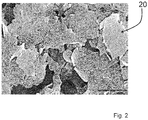
- the nanoparticles are graphine nanoplatelets 20.
- the nanoparticles have a size range from about 1 to 20 nanometers thick and about 1 to 50 microns wide.
- the nanoparticles, and in one particular embodiment of nanoplatelets may be provided in a weight fraction range of up to 20%.
- the nanoplatelets may be in a weight fraction range from about 1-10%.
- the weight fraction range may be about 4-6%.
- the nanoparticles may be mixed into the base fluid by stirring or shaking in order to provide a generally homogenous and even dispersion.
- the even dispersion of nanoparticles in the base fluid facilitates a more even heat transfer over the surface area of the seat pads 14 and 16. The more even heat transfer provides an improved perception of comfort and cooling to the seated user.
- Test samples having a weight fraction of about 4% graphine nanoparticles added to the base fluid yielded results of 0.118 W/m-K, 0.111 W/m-K, and 0.119 W/m-K.
- the effectiveness of nanoparticles in increasing thermal conductivity of the thixotropic pressure-compensating support fluid has been demonstrated and verified.
- the samples listed under "Specimen ID include different amounts of graphine, by weight, added to the base fluid grease.
- Specimen #1 50-50 included graphine in a range of about 10% to about 10.5% by weight.
- Specimen #2 50-25 included graphine in a range of 13% to 13.5% by weight.
- Specimen #3 50-15 included graphine in a range of about 15% to about 15.5% by weight. The test results show improved thermal conductivity as the graphine content increases.
- the addition of nanoparticles to the base fluid influences the overall viscosity of the fluid.
- Increases in fluid viscosity influences the support characteristics of the seat cushions, particularly where boney protuberances, such as the ischial tuberosities, are involved in supporting the seated weight of a user.
- a target viscosity of about 100,000 to 300,000 Cp provides a desired seating feel to a user and tends to support areas around the boney protuberances, such as the ischial tuberosities which minimize focused pressure on the skin against these protuberances.
- the increases in viscosity with the addition of nanoparticles may be compensated for by reducing the volume of microspheres.
- the tradeoff is an increased material density and higher cushion weight.
- the weight fraction of graphine added to the base fluid without microspheres is in a range of 10-15% and produces a viscosity similar to the base fluid with microspheres in the range of about 100,000 to 300,000 Cp.
- the invention in summary, provides, a seating system, particularly suited for personal mobility vehicles, such as wheelchairs, which includes a seat cushion having pressure relieving properties and enhanced thermal conduction properties.
- the seat cushion includes a thixotropic fluid contained within a flexible envelope.
- the thixotropic fluid includes nanoparticles that enhance the thermal conduction properties of the seat cushion to increase heat transfer from a seated user to provide a reduced temperature sensory effect.
Landscapes
- Chemical & Material Sciences (AREA)
- Health & Medical Sciences (AREA)
- Public Health (AREA)
- Life Sciences & Earth Sciences (AREA)
- Animal Behavior & Ethology (AREA)
- General Health & Medical Sciences (AREA)
- Veterinary Medicine (AREA)
- Medicinal Chemistry (AREA)
- Polymers & Plastics (AREA)
- Organic Chemistry (AREA)
- Chemical Kinetics & Catalysis (AREA)
- Dispersion Chemistry (AREA)
- Mattresses And Other Support Structures For Chairs And Beds (AREA)
- Compositions Of Macromolecular Compounds (AREA)
- Lubricants (AREA)
Description
- This invention relates to a seat cushion assembly in particular for personal mobility vehicles.
- Seating systems, particularly for personal mobility vehicles, such as wheelchairs, having fluid-filled cushions are known in the art. One such type of cushion and fluid system is disclosed in
US 5,869,164 to Nickerson, et al. This type of fluid-filled cushion utilizes a thixotropic fluid formed from an oil and a block polymer. The block polymer includes both oil-compatible and oil-incompatible portions of the polymeric chain. Microspheres are added to decrease the fluid density and the overall weight of the cushion and to provide an adjustment to fluid viscosity. The resulting thixotropic fluid provides support by conforming to the contours of contacted body parts, deforms in response to a continuously applied pressure, and maintains the deformed shape and position in the absence of the continuously applied pressure. - The fluid, particularly when positioned in a stabilized temperature environment, does not promote a desired level of heat movement from the seated user (heat source) into the fluid and on to the surrounding thermal environment. Such heat movement away from a user has a comforting feel, much like the familiar feel of a cool pillow. The movement of heat away from the area of user contact influences both the temperature and humidity levels of the microclimate of the cushion-body interface, which impacts metabolic and physical conditions of the user's skin. Since comfort levels are influenced by heat and moisture characteristics, reducing heat and moisture levels provides an increase in comfort level.
- Latex based foams, more in particular, functionalized latex foams for use in bedding or seating product, in which the foam is impregnated with one or more of additive, are known from
EP 2 425 961 A1 . Methods of obtaining latex foam can be those where latex being poured into a closed mould provided with aluminium pins to ensure good heat conduction, and subsequently being vulcanised, washed and dried into an end product. As a result of the presence of the aluminium pins in the closed mould, the end product comprises vertical, continuous recesses that ensure a proper ventilation. -
WO 2006/100558 A1 teaches an apparatuses designed for bodily support that provide an improved level of comfort, particularly pressure relief, as well as improved control of heat transfer. Said apparatus comprises a gel layer overlying one or more additional support layers, wherein said gel layer comprises a gel having a hardness in the range of about 0.5 kPa to about 50 kPa. -
US 2007/0246157 A1 discloses a method for preparing a support apparatus comprising a gel layer and a second layer, in particular for preparing a mattress. In certain embodiments, where a foam layer is used as the second layer, the foam layer may have a surface having a cavity formed therein for receiving the gel layer. - A heat-insulated composite profile, particularly for use in the production of windows, doors, facade elements or the like, is described in
US 6,803,083 B2 . The profile has an inner and an outer metallic profile, which metallic profiles are interlinked by at least one solid or hollow plastics profile, particularly for absorption of tensile, bending and/or pressure loads, wherein a surface layer of a solid, non-porous first plastics material and a core region comprising a fine-pored, closed-cell cellular structure of a second plastics material, the cellular structure in the core region having an average cell size ranging from 0.005 to 0.15 mm. -
US 2005/017396 discloses a seat cushion assembly comprising a seat cushion which includes a flexible polymer envelope containing a thixotropic fluid. - It is the object of the present invention to provide a seat cushion assembly, in particular for a personal mobility vehicle, with improved thermal conductivity. Especially a pressure compensating, fluid-filled seat cushion is to be provided.
- This object is solved by a seat cushion assembly according to claim 1. Preferred embodiments of said seat cushion assembly are described in the subclaims.
- The invention also refers to a seat mobility vehicle, in particular in form of a wheel chair, having a seat cushion assembly according to the invention.
- This invention relates to personal mobility seating systems. In particular, the invention relates to pressure relieving seat cushions having enhanced thermal conduction properties. In at least one embodiment, the invention provides a fluid-filled, pressure compensating seat cushion, particularly suited for personal mobility vehicles, having an adjustable thermal conduction characteristic. The seat cushion includes a flexible polymer envelope and a thixotropic fluid contained within the flexible polymer envelope. The thixotropic fluid includes a base fluid having an oil and a block polymer. The block polymer has a first portion that has an affinity to the oil and a second portion. The first and second portions interact to provide a fluid viscosity that deforms under a generally constantly applied pressure and retains the deformed shape when the pressure is removed. The thixotropic fluid further has a concentration of nanoparticles that increase heat transfer from a seated user to provide a reduced temperature sensory effect.
- The invention further relates to a seat cushion having a flexible polyurethane envelope and a thixotropic fluid contained within the envelope where the thixotropic fluid includes a base fluid having an oil and one of a di-block and a tri-block polymer. The polymer, either formed as the di-block or the tri-block polymer has a first portion that has an affinity to the oil and a second portion. The first and second portions interacting to provide a fluid viscosity that deforms under a generally constantly applied pressure and retains the deformed shape when the pressure is removed. The thixotropic fluid has concentration of nanoparticles configured to increase heat transfer from a seated user to provide a reduced temperature sensory effect. In one embodiment, the base fluid is formulated with the tri-block polymer that includes a third portion having the same oil affinity as the first portion.
- In particular, certain embodiments relate to pressure relieving seats having enhanced thermal conduction properties. In at least one embodiment, the invention provides a fluid-filled, pressure compensating seat cushion, particularly suited for personal mobility vehicles, having an adjustable thermal conduction characteristic.
- Various aspects of this invention will become apparent to those skilled in the art from the following detailed description of the preferred embodiment, when read in light of the accompanying drawings.
- Fig. 1
- is an exploded, perspective view of an embodiment of a seat cushion assembly of the invention which includes a thermally conductive, pressure compensating fluid.
- Fig. 2
- is a photomicrograph of an embodiment of a nanoparticle constituent of the thermally conductive, pressure compensating fluid used by the seat cushion assembly of
Fig. 1 . - Referring now to the drawings, there is illustrated in
Fig. 1 a pressure compensating, fluid-filledseat cushion assembly 10 that is configured for use in a personal mobility vehicle, such as a wheelchair or scooter (not shown). Theseat cushion assembly 10 includes afoundation cushion 12, acentral fluid pad 14, and a plurality ofsecondary fluid pads 16. Thefluid pads pads fluid pads fluid pads seat cushion assembly 10 is shown having a plurality of cushion elements, such is not required. It may alternatively comprise a single fluid-filled envelope of any size, shape, and thickness. - In another embodiment, thermal energy transfer, in the form of heat, may also be increased and directed back to the user. Active cooling and heating may utilize a thermoelectric generator that is configured to drive a temperature gradient across the fluid (thermoelectric generator on one side of a fluid bladder and a user on the other of the fluid bladder). In one embodiment, the heat transfer may act in a manner similar to a heating pad. In another embodiment, the thermal pumping mechanism, such as the thermoelectric generator, of the nanoparticle fluid may be switch from directing heat to the user to directing heat away from the user, or visa versa.
- The fluid composition is a viscous fluid having a base of an oil and a block polymer. The block polymer may be configured as a di-block polymer or a tri-block polymer. The di-block polymer includes two sections having different affinity characteristics with respect to the oil. One of the block sections, such as an elastomer block, has a strong affinity to the oil and the other while the other block section, such as a rigid polystyrene block, has a poor affinity to the oil. In one embodiment, the rigid polystyrene blocks have a strong affinity to each other causing these blocks to cluster together. Consequently, the elastomer based blocks will radiate outwardly. As the concentration of di-block clusters becomes sufficient, the elastomer block section tend to entangle, causing the fluid to take on a thixotropic flow characteristic. This thixotropic characteristic tends to cause the fluid to deform in response to a constantly applied pressure and to maintain the deformed shape when the pressure is removed. The tri-block polymer includes three sections where the end sections have a different oil affinity than the center polymer block section. In one embodiment, the di-block polymer may be a polystyrene/polybutadiene or polystyrene/polyisoprene block. The polystyrene portion exhibits a weak or poor affinity to the oil and the polybutadiene or polyisoprene block exhibits a strong affinity for the oil. The oil may be a polyalphaolefin oil or vegetable oil, such as canola oil. Alternatively, the fluid base composition may be an emulsified, thixotropic paste formulated similar to grease.
- The base blend of oil and block polymer may form micelles based on the polarizing effect of the di-block constituents combining with the selected oil. The base blend fluid may include hollow or low density, solid microspheres in order to decrease the density of the formulation and adjust the blend to a desired viscosity. The microspheres may be plastic in composition and may include a gas to fill the hollow center. In one embodiment, the microspheres may be a polyacrilonitrile and polymethylmethacrylate (PAN/PMMA) material filled with isobutane gas. In one embodiment, the fluid blend of oil, block polymer and microspheres may exhibit a viscosity in a range of about 100,000 - 300,000 centipoise. In another embodiment, the viscosity range may be in a range of about 180,000 to 200,000 centipoise. In addition, supplemental thickeners may also be added to adjust the final viscosity level.
- In order to improve the thermal conductivity of the fluid, nanoparticles may be added to increase heat transfer from the user to the fluid. Nanoparticles made from materials having higher values of thermal conductivity (expressed in W/(m-K)), such as metals or graphine, provide an improved heat transfer capability of the supporting fluid. The nanoparticles made be formed in any suitable shape, such as tubular, round, spherical, disk, platelet, amorphous particulate, or combination thereof and any arrangement such as long or short, tangled, striated, or parallel. In one embodiment, the nanoparticles may be of a generally round shape forming nanospheres. In another embodiment, shown in
Fig. 2 , the nanoparticles are graphine nanoplatelets 20. In one embodiment, the nanoparticles have a size range from about 1 to 20 nanometers thick and about 1 to 50 microns wide. The nanoparticles, and in one particular embodiment of nanoplatelets, may be provided in a weight fraction range of up to 20%. In another embodiment, the nanoplatelets may be in a weight fraction range from about 1-10%. In yet another embodiment, the weight fraction range may be about 4-6%. - The nanoparticles may be mixed into the base fluid by stirring or shaking in order to provide a generally homogenous and even dispersion. The even dispersion of nanoparticles in the base fluid facilitates a more even heat transfer over the surface area of the
seat pads - Experimental data has verified the effect of improved thermal conductivity with the addition of graphine nanoparticles. Three samples each of the base fluid and the nanoparticle enhanced fluid were subjected to testing and measurement of thermal properties. The base fluid and the nanoparticle enhanced base fluid both contained microspheres or micro-balloons which are added to reduce the fluid density and increase the fluid viscosity. Thermal conductivity of the samples were measured using a modified transient plane source sensor, placed in contact with each of the specimens. The thermal conductivity was measured at a test temperature of approximately 23 degrees C. Test samples for the base fluid (without nanoplatelets) yielded thermal conductivity measurements of 0.087 W/m-K, 0.086 W/m-K and 0.085 W/m-K. Test samples having a weight fraction of about 4% graphine nanoparticles added to the base fluid yielded results of 0.118 W/m-K, 0.111 W/m-K, and 0.119 W/m-K. Thus, the effectiveness of nanoparticles in increasing thermal conductivity of the thixotropic pressure-compensating support fluid has been demonstrated and verified.
- Additional testing on samples of base fluid material without the addition of microspheres (referred to as "grease") and with varying amounts of graphine also confirm improved thermal conductivity. In addition, the graphine material provides the ability to increase fluid density, albeit at a higher fluid density as compared to fluids using microspheres. Under similar test conditions to those above, three specimens were each sampled three times and the results listed in the table below.
Specimen ID Nominal Temperatue (°C) Sensor Temperatue (°C) Apparent Thermal Corductivity (W/m.K) Standard Deviation (W/m·K) Derived Specific Heat (J/kg-K) Test Number #1 50-50 23 24.7 0.419 0.001 3005 566 24.5 0.414 0.001 2972 567 23.1 0.433 0.001 3087 572 Averages 0.422 - 3021 - #2 50-25 23 24.4 0.480 0.001 3368 568 24.2 0.527 0.002 3627 569 23.2 0.496 0.002 3456 573 Averages 0.501 - 3483 - #3 50-15 23 24.1 0.557 0.002 3776 570 23.9 0.552 0.001 3747 571 23.3 0.526 0.002 3612 574 Averages 0.545 - 3712 - - The samples listed under "Specimen ID include different amounts of graphine, by weight, added to the base fluid grease. Specimen #1 50-50 included graphine in a range of about 10% to about 10.5% by weight. Specimen #2 50-25 included graphine in a range of 13% to 13.5% by weight. Specimen #3 50-15 included graphine in a range of about 15% to about 15.5% by weight. The test results show improved thermal conductivity as the graphine content increases.
- Within and above the ranges and amounts of nanoparticles described above, the addition of nanoparticles to the base fluid influences the overall viscosity of the fluid. Increases in fluid viscosity influences the support characteristics of the seat cushions, particularly where boney protuberances, such as the ischial tuberosities, are involved in supporting the seated weight of a user. Thus, there is a desired range of viscosity to support a user's weight and provide isolation of these pressure points. A target viscosity of about 100,000 to 300,000 Cp provides a desired seating feel to a user and tends to support areas around the boney protuberances, such as the ischial tuberosities which minimize focused pressure on the skin against these protuberances. The increases in viscosity with the addition of nanoparticles may be compensated for by reducing the volume of microspheres. The tradeoff is an increased material density and higher cushion weight. In one embodiment, the weight fraction of graphine added to the base fluid without microspheres is in a range of 10-15% and produces a viscosity similar to the base fluid with microspheres in the range of about 100,000 to 300,000 Cp.
- The invention, in summary, provides, a seating system, particularly suited for personal mobility vehicles, such as wheelchairs, which includes a seat cushion having pressure relieving properties and enhanced thermal conduction properties. The seat cushion includes a thixotropic fluid contained within a flexible envelope. The thixotropic fluid includes nanoparticles that enhance the thermal conduction properties of the seat cushion to increase heat transfer from a seated user to provide a reduced temperature sensory effect.
- The principle and mode of operation of this invention have been explained and illustrated in its preferred embodiment. However, it must be understood that this invention may be practiced otherwise than as specifically explained and illustrated without departing from its scope.
-
- 10
- pressure compensating, fluid-filled seat cushion assembly
- 12
- foundation cushion
- 14
- central fluid pad
- 16
- secondary fluid pad
- 20
- graphine nanoplatelets
Claims (14)
- A seat cushion assembly (10), in particular for a personal mobility vehicle, comprising:a flexible envelope; anda thixotropic fluid contained within the flexible envelope, the thixotropic fluid including a base fluid comprising an oil and a block polymer, the block polymer having a first portion that has an affinity to the oil and a second portion, the first and second portions interacting to provide a fluid viscosity that deforms under a generally constantly applied pressure andretains the deformed shape when the pressure is removed, characterized in that the thixotropic fluid has concentration of nanoparticles configured to increase heat transfer from a seated user to provide a reduced temperature sensory effect.
- The seat cushion assembly (10) of claim 1, wherein
the nanoparticles have a geometric shape of at least one of a tubular, round, spherical, disk, platelet, and amorphous particulate. - The seat cushion assembly (10) of claim 1 or 2, wherein
the nanoparticles are nanoplatelets, preferably the nanoparticles being graphine nanoplatelets (20) and/or having a size range of about 1 to 20 nanometers thick and about 1 to 50 microns wide. - The seat cushion assembly (10) of one of the preceding claims, wherein
the heat transfer increase is proportional to the percent weight fraction of nanoparticles, preferably the nanoparticles being provided in a weight fraction range of up to 20% of the base fluid,
most preferably the nanoplatelets being provided in a weight fraction range of up to 20% of the base fluid. - The seat cushion assembly (10) of claim 4, whereini) the nanoparticles are provided with a weight fraction range of about 10-15%, orii) the nanoparticles are provided with a weight fraction range of about 4-6% and the base fluid includes microspheres, the base fluid having a viscosity in the range of about 100,000 to 300,000 Cp.
- The seat cushion assembly (10) of one of the preceding claims, wherein
the block polymer is configures as a di-block or a tri-block polymer. - The seat cushion assembly (10) of one of the preceding claims, wherein
the block polymer is a di-block polymer formed from one of polystyrene/polybutadiene and polystyrene/polyisoprene, the polystyrene block forming the second portion providing a weak affinity to the oil and the one of polybutadiene or polyisoprene block exhibits a strong affinity for the oil. - The seat cushion assembly (10) of claim 6, wherein
the base fluid comprises the oil and the tri-block polymer, and the tri-block polymer includes a third portion that has the same oil affinity as the first portion. - The seat cushion assembly (10) of claim 6, wherein
the oil is one of a polyalphaolefin oil, a vegetable oil, and a synthetic oil, preferably the oil being a canola oil. - The seat cushion assembly (10) of one of the preceding claims, wherein
the base fluid includes microspheres. - The seat cushion assembly (10) of one of the preceding claims, wherein
the flexible envelope is a flexible polymer envelope or a flexible polyurethane envelope. - The seat cushion assembly (10) of one of the preceding claims, wherein
a thermal pumping means or thermoelectric generator is provided to drive a temperature gradient across the fluid to either heat or cool a user on the seat cushion assembly (10). - The seat cushion assembly (10) of one of the preceding claims, wherein
a foundation cushion (12), a central fluid pad (14) and a plurality of secondary fluid pads (16) are provided, with the fluid pads (14 and 16) each including a pressure-compensating fluid composition, which can have the same or different fluid formulations and at least one of which comprises the thixotropic fluid. - A personal mobility vehicle, in particular in form of a wheelchair, having a seat cushion assembly (10) of one of the preceding claims.
Applications Claiming Priority (2)
| Application Number | Priority Date | Filing Date | Title |
|---|---|---|---|
| US201662319098P | 2016-04-06 | 2016-04-06 | |
| US15/256,181 US20170290723A1 (en) | 2016-04-06 | 2016-09-02 | Seating system having pressure compensating fluid with thermal conduction properties |
Publications (2)
| Publication Number | Publication Date |
|---|---|
| EP3231406A1 EP3231406A1 (en) | 2017-10-18 |
| EP3231406B1 true EP3231406B1 (en) | 2018-11-28 |
Family
ID=57536838
Family Applications (1)
| Application Number | Title | Priority Date | Filing Date |
|---|---|---|---|
| EP17163828.1A Active EP3231406B1 (en) | 2016-04-06 | 2017-03-30 | Seat cushion assembly and personal mobility vehicle with such a seat cushion assembly |
Country Status (3)
| Country | Link |
|---|---|
| US (1) | US20170290723A1 (en) |
| EP (1) | EP3231406B1 (en) |
| DE (1) | DE202016105443U1 (en) |
Families Citing this family (1)
| Publication number | Priority date | Publication date | Assignee | Title |
|---|---|---|---|---|
| CN109793990A (en) * | 2019-01-16 | 2019-05-24 | 辽宁东戴河新区惠惠梦甜科技有限责任公司 | A kind of magnetic bed mattress |
Family Cites Families (10)
| Publication number | Priority date | Publication date | Assignee | Title |
|---|---|---|---|---|
| US4561441A (en) * | 1984-08-09 | 1985-12-31 | Kolodziej Ronald M | Liquid back support pad for inclined surfaces |
| US5869164A (en) * | 1995-11-08 | 1999-02-09 | Rik Medical Llc | Pressure-compensating compositions and pads made therefrom |
| US5749111A (en) * | 1996-02-14 | 1998-05-12 | Teksource, Lc | Gelatinous cushions with buckling columns |
| DE19962964A1 (en) | 1999-12-24 | 2001-07-05 | Wilfried Ensinger | Full or hollow chamber plastic profiles |
| US20070061978A1 (en) | 2005-03-21 | 2007-03-22 | Technogel Italia Srl | Support apparatus with gel layer |
| US20070246157A1 (en) | 2006-04-25 | 2007-10-25 | Technogel Gmbh & Co. | Process for preparing an apparatus comprising a gel layer |
| US20140141233A1 (en) * | 2012-07-03 | 2014-05-22 | Peterson Chemical Technology, Inc. | Surface Infusion of Flexible Cellular Foams With Novel Liquid Gel Mixture |
| EP2425961A1 (en) | 2010-09-07 | 2012-03-07 | Latexco NV | Functionalized latex based foam |
| US20140312263A1 (en) * | 2013-04-22 | 2014-10-23 | Uchicago Argonne, Llc | Advanced thermal properties of a suspension with graphene nano-platelets (gnps) and custom functionalized f-gnps |
| US20160276056A1 (en) * | 2013-06-28 | 2016-09-22 | Graphene 3D Lab Inc. | Dispersions for nanoplatelets of graphene-like materials and methods for preparing and using same |
-
2016
- 2016-09-02 US US15/256,181 patent/US20170290723A1/en not_active Abandoned
- 2016-09-29 DE DE202016105443.5U patent/DE202016105443U1/en active Active
-
2017
- 2017-03-30 EP EP17163828.1A patent/EP3231406B1/en active Active
Non-Patent Citations (1)
| Title |
|---|
| None * |
Also Published As
| Publication number | Publication date |
|---|---|
| US20170290723A1 (en) | 2017-10-12 |
| DE202016105443U1 (en) | 2016-11-17 |
| EP3231406A1 (en) | 2017-10-18 |
Similar Documents
| Publication | Publication Date | Title |
|---|---|---|
| RU2420220C2 (en) | Method to manufacture device containing gel layer | |
| CA2978341C (en) | Mattress assembly including thermally conductive foam layer | |
| JP5898626B2 (en) | Method for preparing flexible urethane foam and urethane foam obtained by the method | |
| US20070061978A1 (en) | Support apparatus with gel layer | |
| US20140130265A1 (en) | All-foam mattress assemblies with foam engineered cores having thermoplastic and thermoset materials, and related assemblies and methods | |
| WO2022015429A1 (en) | Thermally conductive nanomaterials flexible foam | |
| EP3231406A1 (en) | Seat cushion assembly and personal mobility vehicle with such a seat cushion assembly | |
| WO2016117704A1 (en) | Flame-resistant three-dimensional lattice-shaped cushion | |
| EP3629843B1 (en) | Seating system having pressure compensating fluid with thermal absorption and distribution properties | |
| CN112437799A (en) | Cushion foam made by adding metal material for enhancing heat conduction | |
| JP2016135226A (en) | Flame retardant cubic lattice shape cushion | |
| Paul et al. | Modelling of multilayered foams for universal seat design | |
| JP2013116227A (en) | Cushion for wheelchair | |
| Sprigle et al. | Wheelchair Cushions-The Science behind seating | |
| JP2007014427A (en) | Fatigue reduction sheet using polymer gel | |
| JP2006316255A (en) | Care bedding and method for manufacturing the same |
Legal Events
| Date | Code | Title | Description |
|---|---|---|---|
| PUAI | Public reference made under article 153(3) epc to a published international application that has entered the european phase |
Free format text: ORIGINAL CODE: 0009012 |
|
| STAA | Information on the status of an ep patent application or granted ep patent |
Free format text: STATUS: THE APPLICATION HAS BEEN PUBLISHED |
|
| AK | Designated contracting states |
Kind code of ref document: A1 Designated state(s): AL AT BE BG CH CY CZ DE DK EE ES FI FR GB GR HR HU IE IS IT LI LT LU LV MC MK MT NL NO PL PT RO RS SE SI SK SM TR |
|
| AX | Request for extension of the european patent |
Extension state: BA ME |
|
| STAA | Information on the status of an ep patent application or granted ep patent |
Free format text: STATUS: REQUEST FOR EXAMINATION WAS MADE |
|
| 17P | Request for examination filed |
Effective date: 20180416 |
|
| RBV | Designated contracting states (corrected) |
Designated state(s): AL AT BE BG CH CY CZ DE DK EE ES FI FR GB GR HR HU IE IS IT LI LT LU LV MC MK MT NL NO PL PT RO RS SE SI SK SM TR |
|
| GRAP | Despatch of communication of intention to grant a patent |
Free format text: ORIGINAL CODE: EPIDOSNIGR1 |
|
| STAA | Information on the status of an ep patent application or granted ep patent |
Free format text: STATUS: GRANT OF PATENT IS INTENDED |
|
| RIC1 | Information provided on ipc code assigned before grant |
Ipc: A61G 5/10 20060101AFI20180515BHEP |
|
| INTG | Intention to grant announced |
Effective date: 20180612 |
|
| GRAS | Grant fee paid |
Free format text: ORIGINAL CODE: EPIDOSNIGR3 |
|
| GRAA | (expected) grant |
Free format text: ORIGINAL CODE: 0009210 |
|
| STAA | Information on the status of an ep patent application or granted ep patent |
Free format text: STATUS: THE PATENT HAS BEEN GRANTED |
|
| AK | Designated contracting states |
Kind code of ref document: B1 Designated state(s): AL AT BE BG CH CY CZ DE DK EE ES FI FR GB GR HR HU IE IS IT LI LT LU LV MC MK MT NL NO PL PT RO RS SE SI SK SM TR |
|
| REG | Reference to a national code |
Ref country code: CH Ref legal event code: EP |
|
| REG | Reference to a national code |
Ref country code: AT Ref legal event code: REF Ref document number: 1069383 Country of ref document: AT Kind code of ref document: T Effective date: 20181215 |
|
| REG | Reference to a national code |
Ref country code: IE Ref legal event code: FG4D |
|
| REG | Reference to a national code |
Ref country code: DE Ref legal event code: R096 Ref document number: 602017001049 Country of ref document: DE |
|
| REG | Reference to a national code |
Ref country code: LT Ref legal event code: MG4D Ref country code: NL Ref legal event code: FP |
|
| REG | Reference to a national code |
Ref country code: AT Ref legal event code: MK05 Ref document number: 1069383 Country of ref document: AT Kind code of ref document: T Effective date: 20181128 |
|
| PG25 | Lapsed in a contracting state [announced via postgrant information from national office to epo] |
Ref country code: AT Free format text: LAPSE BECAUSE OF FAILURE TO SUBMIT A TRANSLATION OF THE DESCRIPTION OR TO PAY THE FEE WITHIN THE PRESCRIBED TIME-LIMIT Effective date: 20181128 Ref country code: HR Free format text: LAPSE BECAUSE OF FAILURE TO SUBMIT A TRANSLATION OF THE DESCRIPTION OR TO PAY THE FEE WITHIN THE PRESCRIBED TIME-LIMIT Effective date: 20181128 Ref country code: LV Free format text: LAPSE BECAUSE OF FAILURE TO SUBMIT A TRANSLATION OF THE DESCRIPTION OR TO PAY THE FEE WITHIN THE PRESCRIBED TIME-LIMIT Effective date: 20181128 Ref country code: FI Free format text: LAPSE BECAUSE OF FAILURE TO SUBMIT A TRANSLATION OF THE DESCRIPTION OR TO PAY THE FEE WITHIN THE PRESCRIBED TIME-LIMIT Effective date: 20181128 Ref country code: ES Free format text: LAPSE BECAUSE OF FAILURE TO SUBMIT A TRANSLATION OF THE DESCRIPTION OR TO PAY THE FEE WITHIN THE PRESCRIBED TIME-LIMIT Effective date: 20181128 Ref country code: IS Free format text: LAPSE BECAUSE OF FAILURE TO SUBMIT A TRANSLATION OF THE DESCRIPTION OR TO PAY THE FEE WITHIN THE PRESCRIBED TIME-LIMIT Effective date: 20190328 Ref country code: LT Free format text: LAPSE BECAUSE OF FAILURE TO SUBMIT A TRANSLATION OF THE DESCRIPTION OR TO PAY THE FEE WITHIN THE PRESCRIBED TIME-LIMIT Effective date: 20181128 Ref country code: BG Free format text: LAPSE BECAUSE OF FAILURE TO SUBMIT A TRANSLATION OF THE DESCRIPTION OR TO PAY THE FEE WITHIN THE PRESCRIBED TIME-LIMIT Effective date: 20190228 |
|
| REG | Reference to a national code |
Ref country code: NO Ref legal event code: T2 Effective date: 20181128 |
|
| PG25 | Lapsed in a contracting state [announced via postgrant information from national office to epo] |
Ref country code: AL Free format text: LAPSE BECAUSE OF FAILURE TO SUBMIT A TRANSLATION OF THE DESCRIPTION OR TO PAY THE FEE WITHIN THE PRESCRIBED TIME-LIMIT Effective date: 20181128 Ref country code: PT Free format text: LAPSE BECAUSE OF FAILURE TO SUBMIT A TRANSLATION OF THE DESCRIPTION OR TO PAY THE FEE WITHIN THE PRESCRIBED TIME-LIMIT Effective date: 20190328 Ref country code: GR Free format text: LAPSE BECAUSE OF FAILURE TO SUBMIT A TRANSLATION OF THE DESCRIPTION OR TO PAY THE FEE WITHIN THE PRESCRIBED TIME-LIMIT Effective date: 20190301 Ref country code: SE Free format text: LAPSE BECAUSE OF FAILURE TO SUBMIT A TRANSLATION OF THE DESCRIPTION OR TO PAY THE FEE WITHIN THE PRESCRIBED TIME-LIMIT Effective date: 20181128 Ref country code: RS Free format text: LAPSE BECAUSE OF FAILURE TO SUBMIT A TRANSLATION OF THE DESCRIPTION OR TO PAY THE FEE WITHIN THE PRESCRIBED TIME-LIMIT Effective date: 20181128 |
|
| PG25 | Lapsed in a contracting state [announced via postgrant information from national office to epo] |
Ref country code: PL Free format text: LAPSE BECAUSE OF FAILURE TO SUBMIT A TRANSLATION OF THE DESCRIPTION OR TO PAY THE FEE WITHIN THE PRESCRIBED TIME-LIMIT Effective date: 20181128 Ref country code: CZ Free format text: LAPSE BECAUSE OF FAILURE TO SUBMIT A TRANSLATION OF THE DESCRIPTION OR TO PAY THE FEE WITHIN THE PRESCRIBED TIME-LIMIT Effective date: 20181128 Ref country code: DK Free format text: LAPSE BECAUSE OF FAILURE TO SUBMIT A TRANSLATION OF THE DESCRIPTION OR TO PAY THE FEE WITHIN THE PRESCRIBED TIME-LIMIT Effective date: 20181128 |
|
| REG | Reference to a national code |
Ref country code: DE Ref legal event code: R097 Ref document number: 602017001049 Country of ref document: DE |
|
| PG25 | Lapsed in a contracting state [announced via postgrant information from national office to epo] |
Ref country code: RO Free format text: LAPSE BECAUSE OF FAILURE TO SUBMIT A TRANSLATION OF THE DESCRIPTION OR TO PAY THE FEE WITHIN THE PRESCRIBED TIME-LIMIT Effective date: 20181128 Ref country code: EE Free format text: LAPSE BECAUSE OF FAILURE TO SUBMIT A TRANSLATION OF THE DESCRIPTION OR TO PAY THE FEE WITHIN THE PRESCRIBED TIME-LIMIT Effective date: 20181128 Ref country code: SM Free format text: LAPSE BECAUSE OF FAILURE TO SUBMIT A TRANSLATION OF THE DESCRIPTION OR TO PAY THE FEE WITHIN THE PRESCRIBED TIME-LIMIT Effective date: 20181128 Ref country code: SK Free format text: LAPSE BECAUSE OF FAILURE TO SUBMIT A TRANSLATION OF THE DESCRIPTION OR TO PAY THE FEE WITHIN THE PRESCRIBED TIME-LIMIT Effective date: 20181128 |
|
| PLBE | No opposition filed within time limit |
Free format text: ORIGINAL CODE: 0009261 |
|
| STAA | Information on the status of an ep patent application or granted ep patent |
Free format text: STATUS: NO OPPOSITION FILED WITHIN TIME LIMIT |
|
| PG25 | Lapsed in a contracting state [announced via postgrant information from national office to epo] |
Ref country code: SI Free format text: LAPSE BECAUSE OF FAILURE TO SUBMIT A TRANSLATION OF THE DESCRIPTION OR TO PAY THE FEE WITHIN THE PRESCRIBED TIME-LIMIT Effective date: 20181128 Ref country code: MC Free format text: LAPSE BECAUSE OF FAILURE TO SUBMIT A TRANSLATION OF THE DESCRIPTION OR TO PAY THE FEE WITHIN THE PRESCRIBED TIME-LIMIT Effective date: 20181128 |
|
| 26N | No opposition filed |
Effective date: 20190829 |
|
| PG25 | Lapsed in a contracting state [announced via postgrant information from national office to epo] |
Ref country code: LU Free format text: LAPSE BECAUSE OF NON-PAYMENT OF DUE FEES Effective date: 20190330 |
|
| REG | Reference to a national code |
Ref country code: BE Ref legal event code: MM Effective date: 20190331 |
|
| PG25 | Lapsed in a contracting state [announced via postgrant information from national office to epo] |
Ref country code: IE Free format text: LAPSE BECAUSE OF NON-PAYMENT OF DUE FEES Effective date: 20190330 |
|
| PG25 | Lapsed in a contracting state [announced via postgrant information from national office to epo] |
Ref country code: BE Free format text: LAPSE BECAUSE OF NON-PAYMENT OF DUE FEES Effective date: 20190331 |
|
| PG25 | Lapsed in a contracting state [announced via postgrant information from national office to epo] |
Ref country code: TR Free format text: LAPSE BECAUSE OF FAILURE TO SUBMIT A TRANSLATION OF THE DESCRIPTION OR TO PAY THE FEE WITHIN THE PRESCRIBED TIME-LIMIT Effective date: 20181128 |
|
| PG25 | Lapsed in a contracting state [announced via postgrant information from national office to epo] |
Ref country code: MT Free format text: LAPSE BECAUSE OF NON-PAYMENT OF DUE FEES Effective date: 20190330 |
|
| REG | Reference to a national code |
Ref country code: CH Ref legal event code: PL |
|
| PG25 | Lapsed in a contracting state [announced via postgrant information from national office to epo] |
Ref country code: CH Free format text: LAPSE BECAUSE OF NON-PAYMENT OF DUE FEES Effective date: 20200331 Ref country code: LI Free format text: LAPSE BECAUSE OF NON-PAYMENT OF DUE FEES Effective date: 20200331 |
|
| PG25 | Lapsed in a contracting state [announced via postgrant information from national office to epo] |
Ref country code: CY Free format text: LAPSE BECAUSE OF FAILURE TO SUBMIT A TRANSLATION OF THE DESCRIPTION OR TO PAY THE FEE WITHIN THE PRESCRIBED TIME-LIMIT Effective date: 20181128 |
|
| PG25 | Lapsed in a contracting state [announced via postgrant information from national office to epo] |
Ref country code: HU Free format text: LAPSE BECAUSE OF FAILURE TO SUBMIT A TRANSLATION OF THE DESCRIPTION OR TO PAY THE FEE WITHIN THE PRESCRIBED TIME-LIMIT; INVALID AB INITIO Effective date: 20170330 |
|
| PG25 | Lapsed in a contracting state [announced via postgrant information from national office to epo] |
Ref country code: MK Free format text: LAPSE BECAUSE OF FAILURE TO SUBMIT A TRANSLATION OF THE DESCRIPTION OR TO PAY THE FEE WITHIN THE PRESCRIBED TIME-LIMIT Effective date: 20181128 |
|
| P01 | Opt-out of the competence of the unified patent court (upc) registered |
Effective date: 20230619 |
|
| PGFP | Annual fee paid to national office [announced via postgrant information from national office to epo] |
Ref country code: IT Payment date: 20250331 Year of fee payment: 9 |
|
| PGFP | Annual fee paid to national office [announced via postgrant information from national office to epo] |
Ref country code: GB Payment date: 20260324 Year of fee payment: 10 |
|
| PGFP | Annual fee paid to national office [announced via postgrant information from national office to epo] |
Ref country code: DE Payment date: 20260320 Year of fee payment: 10 Ref country code: NO Payment date: 20260320 Year of fee payment: 10 |
|
| PGFP | Annual fee paid to national office [announced via postgrant information from national office to epo] |
Ref country code: NL Payment date: 20260323 Year of fee payment: 10 |
|
| PGFP | Annual fee paid to national office [announced via postgrant information from national office to epo] |
Ref country code: FR Payment date: 20260324 Year of fee payment: 10 |