EP3228617A1 - Production method for tetrahydro-2h-pyran derivative - Google Patents
Production method for tetrahydro-2h-pyran derivative Download PDFInfo
- Publication number
- EP3228617A1 EP3228617A1 EP17164739.9A EP17164739A EP3228617A1 EP 3228617 A1 EP3228617 A1 EP 3228617A1 EP 17164739 A EP17164739 A EP 17164739A EP 3228617 A1 EP3228617 A1 EP 3228617A1
- Authority
- EP
- European Patent Office
- Prior art keywords
- compound
- pyran
- tetrahydro
- production method
- alkyl
- Prior art date
- Legal status (The legal status is an assumption and is not a legal conclusion. Google has not performed a legal analysis and makes no representation as to the accuracy of the status listed.)
- Withdrawn
Links
- 0 *CCC(CC1)OCC1C(C(*)=O)N Chemical compound *CCC(CC1)OCC1C(C(*)=O)N 0.000 description 1
Classifications
-
- C—CHEMISTRY; METALLURGY
- C07—ORGANIC CHEMISTRY
- C07D—HETEROCYCLIC COMPOUNDS
- C07D309/00—Heterocyclic compounds containing six-membered rings having one oxygen atom as the only ring hetero atom, not condensed with other rings
- C07D309/16—Heterocyclic compounds containing six-membered rings having one oxygen atom as the only ring hetero atom, not condensed with other rings having one double bond between ring members or between a ring member and a non-ring member
- C07D309/28—Heterocyclic compounds containing six-membered rings having one oxygen atom as the only ring hetero atom, not condensed with other rings having one double bond between ring members or between a ring member and a non-ring member with hetero atoms or with carbon atoms having three bonds to hetero atoms with at the most one bond to halogen, e.g. ester or nitrile radicals, directly attached to ring carbon atoms
-
- C—CHEMISTRY; METALLURGY
- C07—ORGANIC CHEMISTRY
- C07D—HETEROCYCLIC COMPOUNDS
- C07D309/00—Heterocyclic compounds containing six-membered rings having one oxygen atom as the only ring hetero atom, not condensed with other rings
- C07D309/02—Heterocyclic compounds containing six-membered rings having one oxygen atom as the only ring hetero atom, not condensed with other rings having no double bonds between ring members or between ring members and non-ring members
- C07D309/04—Heterocyclic compounds containing six-membered rings having one oxygen atom as the only ring hetero atom, not condensed with other rings having no double bonds between ring members or between ring members and non-ring members with only hydrogen atoms, hydrocarbon or substituted hydrocarbon radicals, directly attached to ring carbon atoms
- C07D309/06—Radicals substituted by oxygen atoms
-
- C—CHEMISTRY; METALLURGY
- C07—ORGANIC CHEMISTRY
- C07D—HETEROCYCLIC COMPOUNDS
- C07D309/00—Heterocyclic compounds containing six-membered rings having one oxygen atom as the only ring hetero atom, not condensed with other rings
- C07D309/02—Heterocyclic compounds containing six-membered rings having one oxygen atom as the only ring hetero atom, not condensed with other rings having no double bonds between ring members or between ring members and non-ring members
- C07D309/04—Heterocyclic compounds containing six-membered rings having one oxygen atom as the only ring hetero atom, not condensed with other rings having no double bonds between ring members or between ring members and non-ring members with only hydrogen atoms, hydrocarbon or substituted hydrocarbon radicals, directly attached to ring carbon atoms
-
- C—CHEMISTRY; METALLURGY
- C07—ORGANIC CHEMISTRY
- C07D—HETEROCYCLIC COMPOUNDS
- C07D309/00—Heterocyclic compounds containing six-membered rings having one oxygen atom as the only ring hetero atom, not condensed with other rings
- C07D309/16—Heterocyclic compounds containing six-membered rings having one oxygen atom as the only ring hetero atom, not condensed with other rings having one double bond between ring members or between a ring member and a non-ring member
- C07D309/20—Heterocyclic compounds containing six-membered rings having one oxygen atom as the only ring hetero atom, not condensed with other rings having one double bond between ring members or between a ring member and a non-ring member with hydrogen atoms and substituted hydrocarbon radicals directly attached to ring carbon atoms
- C07D309/22—Radicals substituted by oxygen atoms
- C07D309/24—Methylol radicals
-
- C—CHEMISTRY; METALLURGY
- C07—ORGANIC CHEMISTRY
- C07D—HETEROCYCLIC COMPOUNDS
- C07D405/00—Heterocyclic compounds containing both one or more hetero rings having oxygen atoms as the only ring hetero atoms, and one or more rings having nitrogen as the only ring hetero atom
- C07D405/02—Heterocyclic compounds containing both one or more hetero rings having oxygen atoms as the only ring hetero atoms, and one or more rings having nitrogen as the only ring hetero atom containing two hetero rings
- C07D405/12—Heterocyclic compounds containing both one or more hetero rings having oxygen atoms as the only ring hetero atoms, and one or more rings having nitrogen as the only ring hetero atom containing two hetero rings linked by a chain containing hetero atoms as chain links
-
- C—CHEMISTRY; METALLURGY
- C09—DYES; PAINTS; POLISHES; NATURAL RESINS; ADHESIVES; COMPOSITIONS NOT OTHERWISE PROVIDED FOR; APPLICATIONS OF MATERIALS NOT OTHERWISE PROVIDED FOR
- C09K—MATERIALS FOR MISCELLANEOUS APPLICATIONS, NOT PROVIDED FOR ELSEWHERE
- C09K19/00—Liquid crystal materials
- C09K19/02—Liquid crystal materials characterised by optical, electrical or physical properties of the components, in general
- C09K19/0258—Flexoelectric
-
- C—CHEMISTRY; METALLURGY
- C09—DYES; PAINTS; POLISHES; NATURAL RESINS; ADHESIVES; COMPOSITIONS NOT OTHERWISE PROVIDED FOR; APPLICATIONS OF MATERIALS NOT OTHERWISE PROVIDED FOR
- C09K—MATERIALS FOR MISCELLANEOUS APPLICATIONS, NOT PROVIDED FOR ELSEWHERE
- C09K19/00—Liquid crystal materials
- C09K19/04—Liquid crystal materials characterised by the chemical structure of the liquid crystal components, e.g. by a specific unit
- C09K19/06—Non-steroidal liquid crystal compounds
- C09K19/34—Non-steroidal liquid crystal compounds containing at least one heterocyclic ring
- C09K19/3402—Non-steroidal liquid crystal compounds containing at least one heterocyclic ring having oxygen as hetero atom
-
- C—CHEMISTRY; METALLURGY
- C09—DYES; PAINTS; POLISHES; NATURAL RESINS; ADHESIVES; COMPOSITIONS NOT OTHERWISE PROVIDED FOR; APPLICATIONS OF MATERIALS NOT OTHERWISE PROVIDED FOR
- C09K—MATERIALS FOR MISCELLANEOUS APPLICATIONS, NOT PROVIDED FOR ELSEWHERE
- C09K19/00—Liquid crystal materials
- C09K19/04—Liquid crystal materials characterised by the chemical structure of the liquid crystal components, e.g. by a specific unit
- C09K19/06—Non-steroidal liquid crystal compounds
- C09K19/34—Non-steroidal liquid crystal compounds containing at least one heterocyclic ring
- C09K19/3441—Non-steroidal liquid crystal compounds containing at least one heterocyclic ring having nitrogen as hetero atom
- C09K19/3444—Non-steroidal liquid crystal compounds containing at least one heterocyclic ring having nitrogen as hetero atom the heterocyclic ring being a six-membered aromatic ring containing one nitrogen atom, e.g. pyridine
-
- C—CHEMISTRY; METALLURGY
- C09—DYES; PAINTS; POLISHES; NATURAL RESINS; ADHESIVES; COMPOSITIONS NOT OTHERWISE PROVIDED FOR; APPLICATIONS OF MATERIALS NOT OTHERWISE PROVIDED FOR
- C09K—MATERIALS FOR MISCELLANEOUS APPLICATIONS, NOT PROVIDED FOR ELSEWHERE
- C09K19/00—Liquid crystal materials
- C09K19/04—Liquid crystal materials characterised by the chemical structure of the liquid crystal components, e.g. by a specific unit
- C09K19/06—Non-steroidal liquid crystal compounds
- C09K19/34—Non-steroidal liquid crystal compounds containing at least one heterocyclic ring
- C09K19/3441—Non-steroidal liquid crystal compounds containing at least one heterocyclic ring having nitrogen as hetero atom
- C09K19/3477—Non-steroidal liquid crystal compounds containing at least one heterocyclic ring having nitrogen as hetero atom the heterocyclic ring being a five-membered aromatic ring containing at least one nitrogen atom
- C09K19/348—Non-steroidal liquid crystal compounds containing at least one heterocyclic ring having nitrogen as hetero atom the heterocyclic ring being a five-membered aromatic ring containing at least one nitrogen atom containing at least two nitrogen atoms
-
- C—CHEMISTRY; METALLURGY
- C09—DYES; PAINTS; POLISHES; NATURAL RESINS; ADHESIVES; COMPOSITIONS NOT OTHERWISE PROVIDED FOR; APPLICATIONS OF MATERIALS NOT OTHERWISE PROVIDED FOR
- C09K—MATERIALS FOR MISCELLANEOUS APPLICATIONS, NOT PROVIDED FOR ELSEWHERE
- C09K19/00—Liquid crystal materials
- C09K19/04—Liquid crystal materials characterised by the chemical structure of the liquid crystal components, e.g. by a specific unit
- C09K19/06—Non-steroidal liquid crystal compounds
- C09K19/34—Non-steroidal liquid crystal compounds containing at least one heterocyclic ring
- C09K19/3491—Non-steroidal liquid crystal compounds containing at least one heterocyclic ring having sulfur as hetero atom
- C09K19/3497—Non-steroidal liquid crystal compounds containing at least one heterocyclic ring having sulfur as hetero atom the heterocyclic ring containing sulfur and nitrogen atoms
-
- C—CHEMISTRY; METALLURGY
- C09—DYES; PAINTS; POLISHES; NATURAL RESINS; ADHESIVES; COMPOSITIONS NOT OTHERWISE PROVIDED FOR; APPLICATIONS OF MATERIALS NOT OTHERWISE PROVIDED FOR
- C09K—MATERIALS FOR MISCELLANEOUS APPLICATIONS, NOT PROVIDED FOR ELSEWHERE
- C09K19/00—Liquid crystal materials
- C09K19/04—Liquid crystal materials characterised by the chemical structure of the liquid crystal components, e.g. by a specific unit
- C09K19/06—Non-steroidal liquid crystal compounds
- C09K19/34—Non-steroidal liquid crystal compounds containing at least one heterocyclic ring
- C09K19/3402—Non-steroidal liquid crystal compounds containing at least one heterocyclic ring having oxygen as hetero atom
- C09K2019/3422—Non-steroidal liquid crystal compounds containing at least one heterocyclic ring having oxygen as hetero atom the heterocyclic ring being a six-membered ring
Definitions
- the invention relates to a production method for a tetrahydro-2H-pyran derivative, and an intermediate and a derivative thereof.
- Patent literature No. 3 discloses a liquid crystal compound being a tetrahydro-2H-pyran derivative. Then, 5-((4-ethoxy-2,3-difluorophenoxy)methyl)-2-propyltetrahydro -2H-pyran or the like disclosed in Patent literature No.1 is useful as a liquid crystal compound having negative dielectric anisotropy.
- the synthesis method for the compound is described in Patent literature No. 2 or the like, but requires a comparatively expensive starting material, and has a disadvantage of a large number of steps or a low yield. Therefore, a desire has been expressed for a production method suitable for industrial production.
- a first object of the invention is to solve the above-described problems of conventional arts, and to provide a production method for a tetrahydro-2H-pyran derivative suitable for industrial production, and to provide an intermediate capable of efficiently synthesizing a derivative.
- a second object is to provide a liquid crystal compound, a liquid crystal composition and a liquid crystal display device at a lower cost.
- the present inventors have found that a tetrahydro-2H-pyran derivative can be effectively obtained by using compound (A), compound (B) or compound (C), and have completed the invention.
- R 1 is alkyl, alkenyl or alkoxy
- R 2 is hydrogen or alkoxy
- X is a leaving group
- a first advantage of the invention is a capability of providing a production method for a tetrahydro-2H-pyran derivative suitable for industrial production, and a capability of providing an intermediate capable of efficiently synthesizing a derivative.
- a second advantage is a capability of providing a liquid crystal compound, a liquid crystal composition and a liquid crystal display device at a lower cost.
- Non-Patent literature Nos. 1 to 3 describe a synthesis method to compound (12) or compound (13). Synthesis procedures are described in a section in Examples. With regard to a reaction of forming a carbon-carbon bond and a reaction of conversion of a functional group, a method described in books such as “ Organic Syntheses” (John Wiley & Sons, Inc. ), “ Organic Reactions” (John Wiley & Sons, Inc. ), “ Comprehensive Organic Synthesis” (Pergamon Press ) and “ New Experimental Chemistry Course (Shin Jikken Kagaku Koza in Japanese)” (Maruzen Co., Ltd. ) can be applied, in addition to the methods described in Examples. As a solvent to be used for synthesis, a suitable solvent by which the reaction is not adversary affected can be used, in addition to the solvents described in Examples.
- the invention includes items described below.
- R 1 examples include alkyl having 1 to 10 carbons, alkenyl having 1 to 10 carbons and alkoxy having 1 to 9 carbons. Further preferred examples include alkyl having 1 to 10 carbons. Still further preferred examples include alkyl having 1 to 5 carbons.
- R 3 is alkyl. Specific preferred examples of R 3 include methyl, ethyl, propyl, isopropyl, butyl and t- butyl. Further preferred examples include methyl and ethyl. Still further preferred examples include methyl.
- an acid catalyst examples include hydrochloric acid, sulfuric acid, p-toluenesulfonic acid monohydrate, heteropolyacid and a sulfonic acid-modified silica gel.
- a reducing agent examples include lithium aluminum hydride, sodium borohydride, diisobutylaluminum hydride and sodium bis(2-methoxyethoxy)aluminum hydride. Further preferred examples include lithium aluminum hydride and sodium bis(2-methoxyethoxy)aluminum hydride.
- a reduction method include catalytic hydrogenation and silane reduction. From a viewpoint of stereoselectivity, the silane reduction is further preferred.
- a catalyst in the catalytic hydrogenation, specific preferred examples of a catalyst include a supported catalyst such as palladium on carbon and platinum on carbon, palladium black and Raney nickel.
- a supported catalyst such as palladium on carbon and platinum on carbon, palladium black and Raney nickel.
- alumina, silica, zeolite, hydroxyapatite or the like may be used in addition to carbon.
- silane reducing agent examples include triethylsilane, diphenylsilane, phenylsilane and 1,1,3,3-tetramethyldisiloxane. Further preferred examples include triethylsilane and 1,1,3,3-tetramethyldisiloxane.
- an acid examples include methanesulfonic acid, trifluoroacetic acid, aluminum chloride, zinc chloride, a boron trifluoride-diethylether complex. Further preferred examples include methanesulfonic acid.
- a preferred reaction temperature is 50°C or lower.
- a further preferred temperature is in the range from 0°C to 40°C.
- Hydrolysis is preferably performed under basic conditions.
- Specific preferred examples of a base include potassium hydroxide, sodium hydroxide, lithium hydroxide and calcium hydroxide.
- a reducing agent include lithium aluminum hydride, sodium borohydride, diisobutylaluminum hydride, sodium bis(2-methoxyethoxy)aluminum hydride and triethylsilane. Further preferred examples include lithium aluminum hydride and sodium bis(2-methoxyethoxy)aluminum hydride.
- compound (16) is obtained from compound (13).
- hydrogenation catalyst examples include platinum oxide and rhodium oxide.
- silane reducing agent examples include triethylsilane, diphenylsilane and 1,1,3,3-tetramethyldisiloxane. Further preferred examples include triethylsilane and 1,1,3,3-tetramethyldisiloxane.
- an acid examples include methanesulfonic acid, trifluoroacetic acid, aluminum chloride, zinc chloride and a boron trifluoride-diethylether complex.
- a preferred reaction temperature is 120°C or lower.
- a further preferred temperature is in the range from 40°C to 100°C.
- Compound (17) is a dihydropyran derivative, and functions as a protecting group of a hydroxy group under acidic conditions.
- the process is preferred in which compound (15) is synthesized from compound (13), and then compound (16) is derived from compound (15).
- a preferred reducing agent is a borane complex.
- the hydroxy group in compound (14) or compound (16) can be converted into a leaving group by a publicly known method.
- R 3 is alkyl.
- R 3 is alkyl, and therefore OR 3 serves as alkoxy.
- X being the leaving group
- specific preferred examples of X being the leaving group include nonafluorosulfonate, trifluoromethanesulfonate, fluorosulfonate, tosilate, mesilate, iodine, bromine and chlorine. Further preferred examples include tosilate, mesilate, iodine, bromine and chlorine.
- Compound (14) and compound (16) correspond to compound (C).
- Compound (18) and compound (19) correspond to compound (A).
- Compound (A) can be synthesized with a high yield without using an expensive reagent. From compound (A), phosphonium salt (20) to be used in a Wittig reaction, and sulfone compound (21), compound (22) or compound (23) to be used each in a Julia-Kocienski reaction can be synthesized.
- the tetrahydro-2H-pyran derivative can be synthesized by performing an etherification reaction, an esterification reaction and a carbon-carbon formation reaction by using compound (A), compound (B), compound (C), compound (20), compound (21), compound (22) or compound (23).
- OG is an organic group.
- Tetrahydro-2H-pyran has a cis form and a trans form.
- the trans form is thermodynamically more stable, and is preferred.
- the trans form is preferred from a viewpoint of liquid crystallinity.
- a ratio of the trans form in compound (15), compound (16) or compound (19) is determined by the reduction method for olefin in compound (13).
- the ratio of the trans form in compound (19) is about 75 to 90%.
- a trans-tetrahydro-2H-pyran derivative can be further easily synthesized in comparison with conventional arts.
- the elimination reaction takes precedence in the cis form in compound (19), and the etherification reaction takes precedence in the trans form.
- the ratio of the trans form in the compound is improved.
- an amount of alcohol, phenol or the like can be reduced to an amount corresponding to the trans form in compound (19).
- OG is an organic group.
- the compound that is represented by formula (1) and is suitable for the liquid crystal compound can be synthesized by using compound (A), compound (B), compound (C), compound (20), compound (21), compound (22) or compound (23) according to the invention.
- R 1 examples include -CH 3 , -C 2 H 5 , -C 3 H 7 , -C 4 H 9 and -C 5 H 11 .
- ring A 1 , ring A 2 or ring A 3 include 1,4-cyclohexylene, 1,4-cyclohexenylene, 1,4-phenylene, 2-fluoro-1,4-phenylene and 2,3-difluoro-1,4-phenylene.
- 2-fluoro-1,4-phenylene means two divalent groups described below.
- fluorine may be leftward (L) or rightward (R).
- L leftward
- R rightward
- a same rule applies also to a divalent group derived from an asymmetrical ring such as tetrahydro-2H-pyran-2,5-diyl.
- NMR analysis For measurement, DRX-500 made by Bruker BioSpin Corporation was used. In 1 H-NMR measurement, a sample was dissolved in a deuterated solvent such as CDCl 3 , and measurement was carried out under conditions of room temperature, 500 MHz and 16 times of accumulation. Tetramethylsilane was used as an internal standard. In 19 F-NMR measurement, CFCl 3 was used as an internal standard, and measurement was carried out under conditions of 24 times of accumulation.
- s, d, t, q, quin, sex and m stand for a singlet, a doublet, a triplet, a quartet, a quintet, a sextet and a multiplet, and br being broad, respectively.
- GC-2010 Gas Chromatograph made by Shimadzu Corporation was used.
- a capillary column DB-1 (length 30 m, bore 0.25 mm, film thickness 0.25 ⁇ m) made by Agilent Technologies, Inc. was used.
- Helium (1 mL/min) was used as a carrier gas.
- a temperature of a sample vaporizing chamber was set to 300°C and a temperature of a detector (FID) part was set to 300°C.
- a sample was dissolved in acetone and prepared to be a 1 wt% solution, and then 1 ⁇ L of the solution obtained was injected into the sample vaporizing chamber.
- GC Solution System made by Shimadzu Corporation or the like was used.
- Gas chromatography mass spectrometry For measurement, QP-2010 Ultra Series Gas Chromatograph Mass Spectrometer made by Shimadzu Corporation was used. As a column, a capillary column DB-1 (length 60 m, bore 0.25 mm, film thickness 0.25 ⁇ m) made by Agilent Technologies, Inc. was used. Helium (1 mL/min) was used as a carrier gas. For measurement, a temperature of a sample vaporization chamber was set to 300°C, a temperature of an ion source was set to 200°C, an ionization voltage was set to 70 eV, and an emission current was set to 150 ⁇ A. A sample was dissolved in acetone and prepared to be a 1 w% solution, and then 1 ⁇ L of the solution obtained was injected into the sample vaporizing chamber. As a recorder, GCMS Solution System made by Shimadzu Corporation was used.
- HPLC analysis For measurement, Prominence (LC-20 AD; SPD-20A) made by Shimadzu Corporation was used. As a column, YMC-Pack ODS-A (length 150 mm, bore 4.6 mm, particle diameter 5 ⁇ m) made by YMC Co., Ltd. was used. As an eluate, acetonitrile and water were appropriately mixed and used. As a detector, a UV detector, an RI detector, a CORONA detector or the like was appropriately used. When the UV detector was used, a detection wavelength was set at 254 nm. A sample was dissolved in acetonitrile and prepared to be a 0.1 w% solution, and then 1 ⁇ L of the solution was injected into a sample chamber. As a recorder, C-R7 Aplus made by Shimadzu Corporation was used.
- Example 1 Into a toluene solution of sodium bis(2-methoxyethoxy)aluminum hydride (3.6 M toluene solution, 23.8 mL, 86.56 mmol), a toluene solution of 2-propyl-3,4-dihydro-2H-pyran-5-carboxylic acid methyl ester (14.66 g, 77.80 mmol) obtained in Example 1 was added dropwise under ice-cooling. The resulting reaction solution mixture was stirred at 40°C for 1 hour, and then poured into a 1 N hydrochloric acid aqueous solution, and subjected to extraction with ethyl acetate.
- sodium bis(2-methoxyethoxy)aluminum hydride 3.6 M toluene solution, 23.8 mL, 86.56 mmol
- 2-propyl-3,4-dihydro-2H-pyran-5-carboxylic acid methyl ester 14.66 g,
- a tetrahydro-2H-pyran derivative and an intermediate thereof can be provided further easily with a lower cost by using a production method of the invention in comparison with conventional arts.
- a trans-tetrahydro-2H-pyran-2,5-diyl derivative suitable for a liquid crystal compound can be provided.
Landscapes
- Chemical & Material Sciences (AREA)
- Organic Chemistry (AREA)
- Crystallography & Structural Chemistry (AREA)
- Engineering & Computer Science (AREA)
- Materials Engineering (AREA)
- Pharmaceuticals Containing Other Organic And Inorganic Compounds (AREA)
- Plural Heterocyclic Compounds (AREA)
Abstract

Description
- The invention relates to a production method for a tetrahydro-2H-pyran derivative, and an intermediate and a derivative thereof.
- Patent literature No. 3 discloses a liquid crystal compound being a tetrahydro-2H-pyran derivative. Then, 5-((4-ethoxy-2,3-difluorophenoxy)methyl)-2-propyltetrahydro -2H-pyran or the like disclosed in Patent literature No.1 is useful as a liquid crystal compound having negative dielectric anisotropy. The synthesis method for the compound is described in Patent literature No. 2 or the like, but requires a comparatively expensive starting material, and has a disadvantage of a large number of steps or a low yield. Therefore, a desire has been expressed for a production method suitable for industrial production.
-
- Patent literature No. 1:
WO 2008-114821 A . - Patent literature No. 2:
WO 2009-136534 A . - Patent literature No. 3:
WO 2011-021534 A . Non-Patent literature - Non-Patent literature No. 1: Chemische Berichte (1955), 88, 1676-84.
- Non-Patent literature No. 2: Chemische Berichte (1959), 92, 877-883.
- Non-Patent literature No. 3: Chemische Berichte (1959), 92, 884-894.
- A first object of the invention is to solve the above-described problems of conventional arts, and to provide a production method for a tetrahydro-2H-pyran derivative suitable for industrial production, and to provide an intermediate capable of efficiently synthesizing a derivative. A second object is to provide a liquid crystal compound, a liquid crystal composition and a liquid crystal display device at a lower cost.
- The present inventors have found that a tetrahydro-2H-pyran derivative can be effectively obtained by using compound (A), compound (B) or compound (C), and have completed the invention.

- In compound (A), compound (B) and compound (C), R1 is alkyl, alkenyl or alkoxy, R2 is hydrogen or alkoxy, and X is a leaving group.
- A first advantage of the invention is a capability of providing a production method for a tetrahydro-2H-pyran derivative suitable for industrial production, and a capability of providing an intermediate capable of efficiently synthesizing a derivative. A second advantage is a capability of providing a liquid crystal compound, a liquid crystal composition and a liquid crystal display device at a lower cost.
- One example of synthesis method for compound (A), compound (B) and compound (C) will be described. Non-Patent literature Nos. 1 to 3 describe a synthesis method to compound (12) or compound (13). Synthesis procedures are described in a section in Examples. With regard to a reaction of forming a carbon-carbon bond and a reaction of conversion of a functional group, a method described in books such as "Organic Syntheses" (John Wiley & Sons, Inc.), "Organic Reactions" (John Wiley & Sons, Inc.), "Comprehensive Organic Synthesis" (Pergamon Press) and "New Experimental Chemistry Course (Shin Jikken Kagaku Koza in Japanese)" (Maruzen Co., Ltd.) can be applied, in addition to the methods described in Examples. As a solvent to be used for synthesis, a suitable solvent by which the reaction is not adversary affected can be used, in addition to the solvents described in Examples.
- The invention includes items described below.
- Item 1. A production method for a tetrahydro-2H-pyran derivative, applying compound (A), compound (B) or compound (C) as an intermediate:

- Item 2. The production method for tetrahydro-2H-pyran according to item 1, wherein, in compound (A), compound (B) or compound (C), R1 is alkyl, X is nonafluorosulfonate, trifluoromethanesulfonate, fluorosulfonate, tosilate, mesilate, iodine, bromine or chlorine, and R2 is hydrogen.
- Item 3. The production method for the tetrahydro-2H-pyran derivative according to item 1 or 2, wherein compound (A), compound (B) or compound (C) that may be substituted and derived from 5-valerolactone is applied as an intermediate.
- Item 4. The production method for the tetrahydro-2H-pyran derivative according to any one of items 1 to 3, wherein a compound represented by formula (1) is applied as an objective substance:

- R1 is alkyl having 1 to 10 carbons;
- R4 is hydrogen, cycloalkane having 3 to 8 carbons or alkyl having 1 to 10 carbons, and in the alkyl, at least one piece of -CH2- may be replaced by -O-, and at least one piece of -CH2CH2- may be replaced by -CH=CH-;
- ring A1, ring A2 and ring A3 are independently 1,4-cyclohexylene, 1,4-cyclohexenylene, 1,4-phenylene, 1,4-phenylene in which at least one piece of hydrogen is replaced by halogen, naphthalene-2,5-diyl, naphthalene-2,5-diyl in which at least one piece of hydrogen is replaced by halogen, tetrahydro-2H-pyran-2,5-diyl, pyrimidine-2,5-diyl, pyridine-2,5-diyl or 1,3-dioxane-2,5-diyl;
- Z1 is -CH2CH2-, -CH=CH-, -CH2O- or -COO-;
- Z2 and Z3 are independently a single bond, -CH2CH2-, -C=C-, -CH=CH-, -CF2O-, -OCF2-, -OCH2-, -CH2O-, -OCO-, -COO-, -CH2CH2CH2O- or -OCH2CH2CH2-; and
- n and m are independently 0 or 1.
- Item 5. The production method for the tetrahydro-2H-pyran derivative according to any one of items 1 to 4, including a step of an etherification reaction.
- Item 6. A compound represented by formula (2):
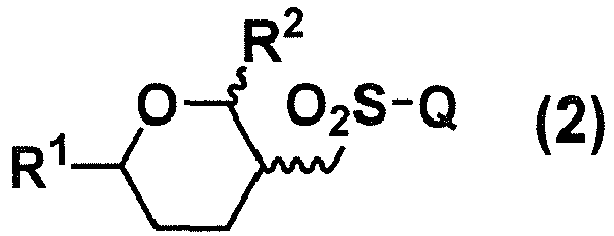
Q is any one of structures described below.
- Item 7. Utilization of the compound that is represented by formula (1) and produced by the production method according to item 4 or 5 as a component of a liquid crystal medium.
- Then, if substituted δ-valerolactone (10) is allowed to react with sodium hydride and ethyl formate, compound (11) is obtained. If compound (11) is allowed to react with hydrochloric acid in an alcohol solvent, a mixture of compound (12) and compound (13) is obtained. Compound (12) and compound (13) can be separated by silica gel chromatography or the like.

- Specific preferred examples of R1 include alkyl having 1 to 10 carbons, alkenyl having 1 to 10 carbons and alkoxy having 1 to 9 carbons. Further preferred examples include alkyl having 1 to 10 carbons. Still further preferred examples include alkyl having 1 to 5 carbons.
- R3 is alkyl. Specific preferred examples of R3 include methyl, ethyl, propyl, isopropyl, butyl and t- butyl. Further preferred examples include methyl and ethyl. Still further preferred examples include methyl.
- If compound (12) is subjected to elimination of R3OH in the presence of an acid catalyst, compound (13) is obtained.

- Specific preferred examples of an acid catalyst include hydrochloric acid, sulfuric acid, p-toluenesulfonic acid monohydrate, heteropolyacid and a sulfonic acid-modified silica gel.
- If compound (12) is subjected to hydride reduction, compound (14) is obtained.
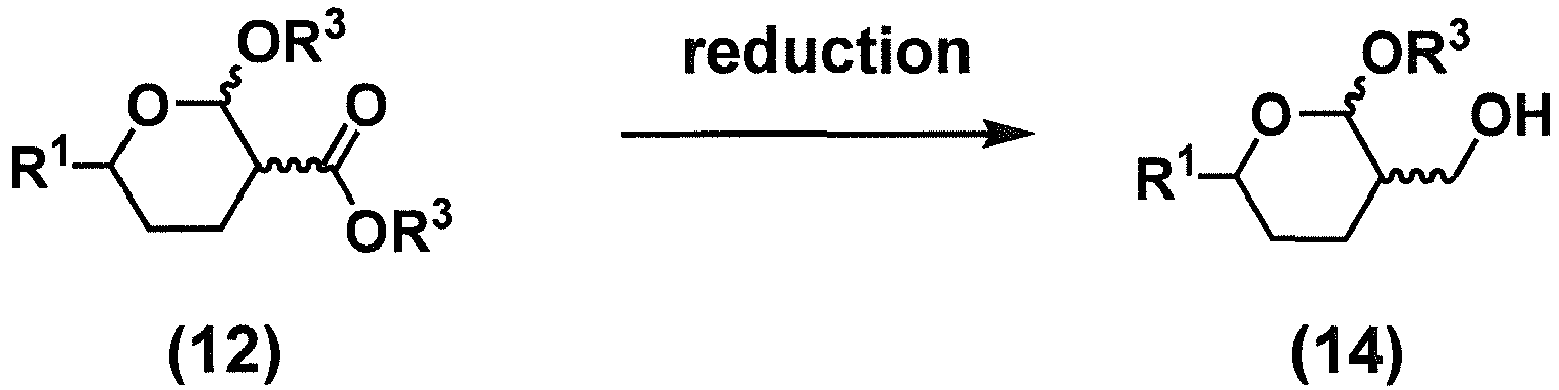
- Specific preferred examples of a reducing agent include lithium aluminum hydride, sodium borohydride, diisobutylaluminum hydride and sodium bis(2-methoxyethoxy)aluminum hydride. Further preferred examples include lithium aluminum hydride and sodium bis(2-methoxyethoxy)aluminum hydride.
- If compound (13) is subjected to hydrogenation, compound (15) is obtained.

- Specific preferred examples of a reduction method include catalytic hydrogenation and silane reduction. From a viewpoint of stereoselectivity, the silane reduction is further preferred.
- In the catalytic hydrogenation, specific preferred examples of a catalyst include a supported catalyst such as palladium on carbon and platinum on carbon, palladium black and Raney nickel. As a support, alumina, silica, zeolite, hydroxyapatite or the like may be used in addition to carbon.
- In the silane reduction, specific preferred examples of a silane reducing agent include triethylsilane, diphenylsilane, phenylsilane and 1,1,3,3-tetramethyldisiloxane. Further preferred examples include triethylsilane and 1,1,3,3-tetramethyldisiloxane.
- In the silane reduction, specific preferred examples of an acid include methanesulfonic acid, trifluoroacetic acid, aluminum chloride, zinc chloride, a boron trifluoride-diethylether complex. Further preferred examples include methanesulfonic acid.
- In the silane reduction, a preferred reaction temperature is 50°C or lower. A further preferred temperature is in the range from 0°C to 40°C.
- If compound (15) is subjected to hydrolysis, compound (B) is obtained.

- Hydrolysis is preferably performed under basic conditions. Specific preferred examples of a base include potassium hydroxide, sodium hydroxide, lithium hydroxide and calcium hydroxide.
- If compound (15) is subjected to hydride reduction, compound (16) is obtained.

- Specific preferred examples a reducing agent include lithium aluminum hydride, sodium borohydride, diisobutylaluminum hydride, sodium bis(2-methoxyethoxy)aluminum hydride and triethylsilane. Further preferred examples include lithium aluminum hydride and sodium bis(2-methoxyethoxy)aluminum hydride.
- If a hydrogenation catalyst or a silane reducing agent capable of reducing both olefin and ester is used, compound (16) is obtained from compound (13).

- In the catalytic hydrogenation, specific preferred examples of the hydrogenation catalyst include platinum oxide and rhodium oxide.
- In the silane reduction, specific preferred examples of the silane reducing agent include triethylsilane, diphenylsilane and 1,1,3,3-tetramethyldisiloxane. Further preferred examples include triethylsilane and 1,1,3,3-tetramethyldisiloxane.
- In the silane reduction, specific preferred examples of an acid include methanesulfonic acid, trifluoroacetic acid, aluminum chloride, zinc chloride and a boron trifluoride-diethylether complex.
- In the silane reduction, a preferred reaction temperature is 120°C or lower. A further preferred temperature is in the range from 40°C to 100°C.
- If compound (13) is subjected to hydride reduction, and then hydrogenation, compound (16) is obtained.

- Compound (17) is a dihydropyran derivative, and functions as a protecting group of a hydroxy group under acidic conditions. In consideration of stability of compound (17), the process is preferred in which compound (15) is synthesized from compound (13), and then compound (16) is derived from compound (15).
- If compound (B) is subjected to reduction, compound (16) is obtained.

- A preferred reducing agent is a borane complex.
- The hydroxy group in compound (14) or compound (16) can be converted into a leaving group by a publicly known method.


- In compound (14) and compound (18), R3 is alkyl. R3 is alkyl, and therefore OR3 serves as alkoxy.
- In compound (18) or compound (19), specific preferred examples of X being the leaving group include nonafluorosulfonate, trifluoromethanesulfonate, fluorosulfonate, tosilate, mesilate, iodine, bromine and chlorine. Further preferred examples include tosilate, mesilate, iodine, bromine and chlorine.
- Compound (14) and compound (16) correspond to compound (C). Compound (18) and compound (19) correspond to compound (A). Compound (A) can be synthesized with a high yield without using an expensive reagent. From compound (A), phosphonium salt (20) to be used in a Wittig reaction, and sulfone compound (21), compound (22) or compound (23) to be used each in a Julia-Kocienski reaction can be synthesized.


- The tetrahydro-2H-pyran derivative can be synthesized by performing an etherification reaction, an esterification reaction and a carbon-carbon formation reaction by using compound (A), compound (B), compound (C), compound (20), compound (21), compound (22) or compound (23).

- In formula (3), OG is an organic group.
- Tetrahydro-2H-pyran has a cis form and a trans form. The trans form is thermodynamically more stable, and is preferred. In a liquid crystal compound used in a liquid crystal display device, the trans form is preferred from a viewpoint of liquid crystallinity.

- A ratio of the trans form in compound (15), compound (16) or compound (19) is determined by the reduction method for olefin in compound (13). When the silane reduction is performed under preferred conditions, the ratio of the trans form in compound (19) is about 75 to 90%. A trans-tetrahydro-2H-pyran derivative can be further easily synthesized in comparison with conventional arts.
- In the etherification reaction, the elimination reaction takes precedence in the cis form in compound (19), and the etherification reaction takes precedence in the trans form. As a result, the ratio of the trans form in the compound is improved. Further, an amount of alcohol, phenol or the like can be reduced to an amount corresponding to the trans form in compound (19).

- In formula (4), OG is an organic group.
- The compound that is represented by formula (1) and is suitable for the liquid crystal compound can be synthesized by using compound (A), compound (B), compound (C), compound (20), compound (21), compound (22) or compound (23) according to the invention.

- In formula (1),
- R1 is alkyl having 1 to 10 carbons;
- R4 is hydrogen, cycloalkane having 3 to 8 carbons or alkyl having 1 to 10 carbons, and in the alkyl, at least one piece of -CH2- may be replaced by -O-, and at least one piece of -CH2CH2- may be replaced by -CH=CH-;
- ring A1, ring A2 and ring A3 are independently 1,4-cyclohexylene, 1,4-cyclohexenylene, 1,4-phenylene, 1, 4-phenylene in which at least one piece of hydrogen is replaced by halogen, naphthalene-2,5-diyl, naphthalene-2,5-diyl in which at least one piece of hydrogen is replaced by halogen, tetrahydro-2H-pyran-2,5-diyl, pyrimidine-2,5-diyl, pyridine-2,5-diyl or 1,3-dioxane-2,5-diyl;
- Z1 is -CH2CH2-, -CH=CH-, -CH2O- or -COO-;
- Z2 and Z3 are independently a single bond, -CH2CH2-, -C=C-, -CH=CH-, -CF2O-, -OCF2-, -OCH2-, -CH2O-, -OCO-, -COO-, -CH2CH2CH2O- or -OCH2CH2CH2-; and
- n and m are independently 0 or 1.
- Specific preferred examples of R1 include -CH3, -C2H5, -C3H7, -C4H9 and -C5H11.
- Specific preferred example of R4 include -CH3, -C2H5, -C3H7, -C4H9, -C5H11, -CH=CH2, -CH=CHCH3, -CH=CHC2H5, -CH=CHC3H7, - (CH2)2CH=CH2, -(CH2)2CH=CHCH3, -CH=CH(CH2)2CH=CH2, (CH2)2CH=CH(CH2)2CH=CH2, -OCH3, -OC2H5, -OC3H7 and -OC4H9.
- Specific preferred examples of ring A1, ring A2 or ring A3 include 1,4-cyclohexylene, 1,4-cyclohexenylene, 1,4-phenylene, 2-fluoro-1,4-phenylene and 2,3-difluoro-1,4-phenylene.
- Specific preferred examples of Z1 include -CH2CH2-, -CH=CH- and -CH2O-.
- Specific preferred examples of Z2 or Z3 include a single bond, -CH2CH2-, -CH=CH-, -OCH2- and -CH2O-.
- Then, 2-fluoro-1,4-phenylene means two divalent groups described below. In a chemical formula, fluorine may be leftward (L) or rightward (R). A same rule applies also to a divalent group derived from an asymmetrical ring such as tetrahydro-2H-pyran-2,5-diyl.

- The invention will be described in greater detail by way of Examples. However, the invention is not limited by the Examples.
- Compound (A), compound (B) and a derivative thereof were synthesized according to procedures described below. The synthesized compound was identified by methods such as an NMR analysis.
- NMR analysis: For measurement, DRX-500 made by Bruker BioSpin Corporation was used. In 1H-NMR measurement, a sample was dissolved in a deuterated solvent such as CDCl3, and measurement was carried out under conditions of room temperature, 500 MHz and 16 times of accumulation. Tetramethylsilane was used as an internal standard. In 19F-NMR measurement, CFCl3 was used as an internal standard, and measurement was carried out under conditions of 24 times of accumulation. In the explanation of a nuclear magnetic resonance spectrum, s, d, t, q, quin, sex and m stand for a singlet, a doublet, a triplet, a quartet, a quintet, a sextet and a multiplet, and br being broad, respectively.
- Gas chromatographic analysis: For measurement, GC-2010 Gas Chromatograph made by Shimadzu Corporation was used. As a column, a capillary column DB-1 (length 30 m, bore 0.25 mm, film thickness 0.25 µm) made by Agilent Technologies, Inc. was used. Helium (1 mL/min) was used as a carrier gas. A temperature of a sample vaporizing chamber was set to 300°C and a temperature of a detector (FID) part was set to 300°C. A sample was dissolved in acetone and prepared to be a 1 wt% solution, and then 1 µL of the solution obtained was injected into the sample vaporizing chamber. As a recorder, GC Solution System made by Shimadzu Corporation or the like was used.
- Gas chromatography mass spectrometry: For measurement, QP-2010 Ultra Series Gas Chromatograph Mass Spectrometer made by Shimadzu Corporation was used. As a column, a capillary column DB-1 (length 60 m, bore 0.25 mm, film thickness 0.25 µm) made by Agilent Technologies, Inc. was used. Helium (1 mL/min) was used as a carrier gas. For measurement, a temperature of a sample vaporization chamber was set to 300°C, a temperature of an ion source was set to 200°C, an ionization voltage was set to 70 eV, and an emission current was set to 150 µA. A sample was dissolved in acetone and prepared to be a 1 w% solution, and then 1 µL of the solution obtained was injected into the sample vaporizing chamber. As a recorder, GCMS Solution System made by Shimadzu Corporation was used.
- HPLC analysis: For measurement, Prominence (LC-20 AD; SPD-20A) made by Shimadzu Corporation was used. As a column, YMC-Pack ODS-A (length 150 mm, bore 4.6 mm, particle diameter 5 µm) made by YMC Co., Ltd. was used. As an eluate, acetonitrile and water were appropriately mixed and used. As a detector, a UV detector, an RI detector, a CORONA detector or the like was appropriately used. When the UV detector was used, a detection wavelength was set at 254 nm. A sample was dissolved in acetonitrile and prepared to be a 0.1 w% solution, and then 1 µL of the solution was injected into a sample chamber. As a recorder, C-R7 Aplus made by Shimadzu Corporation was used.
-

- Into an ether suspension of sodium hydride (26.14 g, 599.16 mmol), an ether solution of 6-propyltetrahydro-2H-pyran-2-one (71.00 g, 499.30 mmol) and ethyl formate (44.39 g, 599.16 mmol) was added dropwise under ice-cooling. The resulting reaction mixture was stirred at room temperature for 2 hours, and then refluxed under heating for 5 hours. The resulting mixture was poured into a 1 N hydrochloric acid aqueous solution, and subjected to extraction with ethyl acetate. Combined organic layers were washed with saturated brine, and dried over anhydrous magnesium sulfate. A solvent was distilled off to obtain 3-(hydroxymethylene)-6-propyltetrahydro-2H-pyran-2-one (84.99 g, yield: 99.0%).
- Into a methanol solution of 3-(hydroxymethylene)-6-propyltetrahydro-2H-pyran-2-one (74.99 g, 440.58 mmol) obtained in the first step, concentrated hydrochloric acid (36.7 mL, 440.58 mmol) was added, and the resulting mixture was stirred at room temperature for 3 hours. The resulting reaction solution was poured into water, and subjected to extraction with ethyl acetate. Combined organic layers were washed with a saturated aqueous solution of sodium hydrogencarbonate, water and saturated brine, and dried over anhydrous magnesium sulfate. A solvent was distilled off, and the residue was purified by silica gel chromatography to obtain a mixture (78.86 g) of 2-methoxy-6-propyl-tetrahydro-2H-pyran-3-carboxylic acid methyl ester and 2-propyl-3,4-dihydro-2H-pyran-5-carboxylic acid methyl ester.
- A mixture of (78.86 g) of 2-methoxy-6-propyl-tetrahydro-2H-pyran-3-carboxylic acid methyl ester and 2-propyl-3,4-dihydro-2H-pyran-5-carboxylic acid methyl ester obtained in the second step, and 12 Tungsto (VI) phosphoric acid n-hydrate (0.394 g, 0.14 mmol) was added to toluene, and the resulting mixture was refluxed for 3 hours under attaching a Dean-Stark condenser. The resulting reaction mixture was washed with a saturated aqueous solution of sodium hydrogencarbonate, water and saturated brine, and dried over anhydrous magnesium sulfate. A solvent is distilled off to obtain 2-propyl-3,4-dihydro-2H-pyran-5-carboxylic acid methyl ester (65.71 g, yield: 80.5% (a second step)).
-

- Into a toluene solution of sodium bis(2-methoxyethoxy)aluminum hydride (3.6 M toluene solution, 16.6 mL, 59.71 mmol), a toluene solution of 2-propyl-3,4-dihydro-2H-pyran-5-carboxylic acid methyl ester (10.00 g, 54.28 mmol) obtained in Example 1 was added dropwise under ice-cooling. The resulting reaction solution mixture was stirred at 40°C for 1 hour, and then poured into an aqueous solution of sodium potassium tartrate, and subjected to extraction with ethyl acetate. Combined organic layers were washed with water and saturated brine, dried over anhydrous magnesium sulfate, and a solvent was distilled off. The residue was purified by silica gel chromatography to obtain (2-propyl-3,4-dihydro-2H-pyran-5-yl)methanol (7.26 g, 46.47 mmol).
-
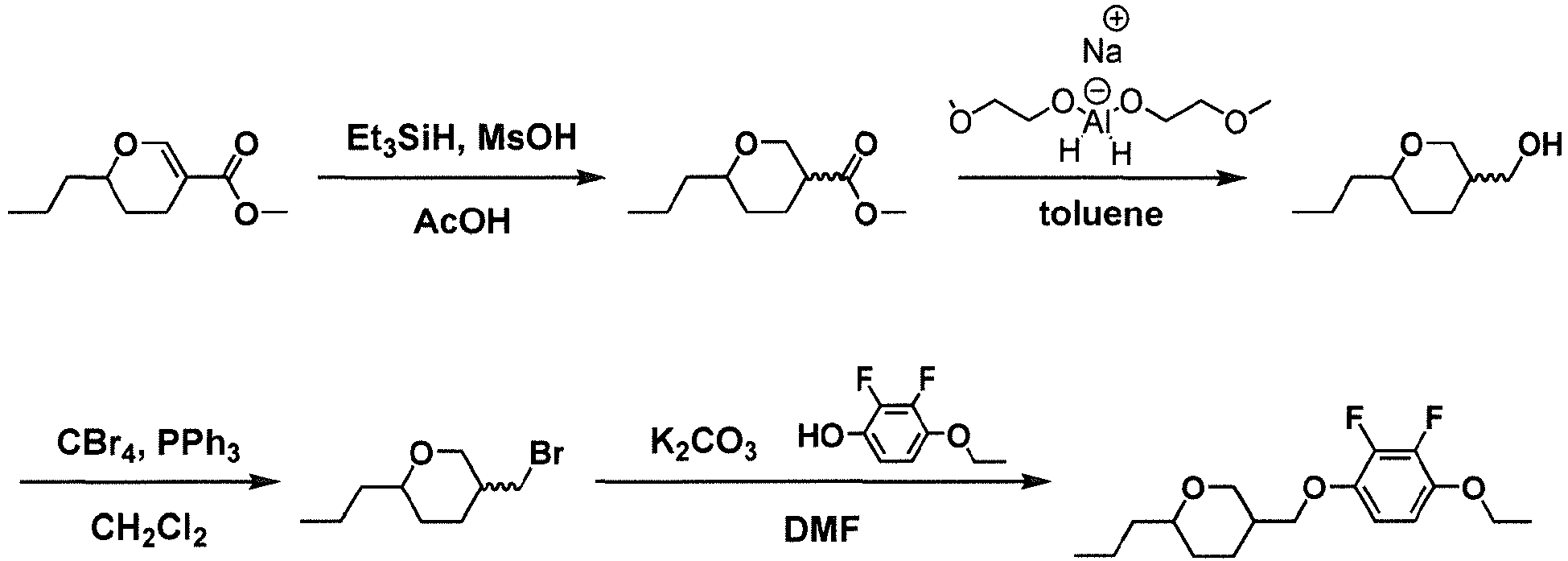
- Into an acetic acid solution of 2-propyl-3,4-dihydro-2H-pyran-5-carboxylic acid methyl ester (44.29 g, 240.40 mmol) obtained in Example 1 and triethylsilane (83.86 g, 721.20 mmol), methanesulfonic acid (69.31 g, 721.20 mmol) was added dropwise under ice-cooling. The resulting reaction solution was stirred at room temperature for 3 hours, and then poured into water, and subjected to extraction with ethyl acetate. Combined organic layers were washed with water and saturated brine, dried over anhydrous magnesium sulfate, and then a solvent was distilled off. The residue was purified by silica gel chromatography to obtain 6-propyl-tetrahydro-2H-pyran-3-carboxylic acid methyl ester (39.00 g, yield: 86.7%). A ratio of isomers in the product obtained was cis : trans = 17.4 : 82.6.
- Into a toluene solution of sodium bis(2-methoxyethoxy)aluminum hydride (3.6 M toluene solution, 23.8 mL, 86.56 mmol), a toluene solution of 2-propyl-3,4-dihydro-2H-pyran-5-carboxylic acid methyl ester (14.66 g, 77.80 mmol) obtained in Example 1 was added dropwise under ice-cooling. The resulting reaction solution mixture was stirred at 40°C for 1 hour, and then poured into a 1 N hydrochloric acid aqueous solution, and subjected to extraction with ethyl acetate. Combined organic layers were washed with water and saturated brine, and dried over anhydrous magnesium sulfate. A solvent was distilled off to obtain (6-propyltetrahydro-2H-pyran-3-yl)methanol (10.00 g, yield: 80.2%). A ratio of isomers in the product obtained was cis : trans = 16.7 : 83.3.
- Into a dichloromethane solution of (6-propyltetrahydro-2H-pyran-3-yl)methanol (10.00 g, 63.19 mmol) obtained in the second step and carbon tetrabromide (22.00 g, 66.35 mmol), triphenyl phosphine (17.40 g, 66.35 mmol) was added under ice-cooling. The resulting reaction mixture was stirred at room temperature for 1 hour, and then the resulting mixture was concentrated by an evaporator. The residue was purified by silica gel chromatography to obtain 5-(bromomethyl)-2-propyltetrahydro-2H-pyran (11.00 g, yield: 78.7%). A ratio of isomers in the product obtained was cis : trans = 8.8 : 91.2.
- A mixture of 5-(bromomethyl)-2-propyltetrahydro-2H-pyran (11.00 g, 49.74 mmol) obtained in the third step, potassium carbonate (6.87 g, 49.74 mmol) and 4-ethoxy-2,3-difluorophenol (8.66 g, 49.74 mmol) was added to DMF, and the resulting mixture was stirred at 70°C for 5 hours. The resulting reaction mixture was poured into water, and subjected to extraction with toluene. Combined organic layers were washed with water and saturated brine, dried over anhydrous magnesium sulfate, and a solvent was distilled off. The residue was purified by silica gel chromatography and recrystallization to obtain trans-5-((4-ethoxy-2,3-difluorophenoxy)methyl)-2-propyltetr ahydro-2H-pyran (9.32 g, yield: 59.6%). A ratio of isomers in the crude product was cis : trans = 1.9 : 98.1.
- 1H-NMR (CDCl3; δ ppm): 6.63 - 6.57 (2H, m), 4.15 (1H, ddd, J = 11.2, 4.1, 2.2 Hz), 4.05 (2H, q, J = 7.0 Hz), 3.82, 3.75 (2H, ABqd, J = 9.5, 5.3, 7.1 Hz), 3.26 (1H, dd, J = 11.2, 11.2 Hz), 3.25 - 3.21 (1H, m), 2.15 - 2.06 (1H, m), 1.95 - 1.91 (1H, m), 1.71 - 1.67 (1H, m), 1.57 - 1.31 (6H, m), 1.41 (3H, t, J = 7.0 Hz), 0.92 (3H, t, J = 7.1 Hz).
-

- Into an acetic acid solution of 2-pentyl-3,4-dihydro-2H-pyran-5-carboxylic acid methyl ester (2.00 g, 9.42 mmol) synthesized according to the method described in Example 1 and 1,1,3,3-tetramethyldisiloxane (1.89 g, 28.26 mmol), methanesulfonic acid (2.72 g, 28.26 mmol) was added dropwise under ice-cooling. The resulting reaction solution was stirred at room temperature for 3 hours, and then poured into water, and subjected to extraction with ethyl acetate. Combined organic layers were washed with water and saturated brine, dried over anhydrous magnesium sulfate, and a solvent was distilled off. The residue was purified by silica gel chromatography to obtain 6-pentyl-tetrahydro-2H-pyran-3-carboxylic acid methyl ester (1.94g, yield: 96.0%). A ratio of isomers in the product obtained was cis : trans = 18.4 : 81.6.
-

- Into a dichloromethane solution of (6-pentyltetrahydro-2H-pyran-3-yl)methanol (cis : trans = 11.1 : 88.9) (8.00 g, 42.94 mmol) synthesized according to a method in a manner similar to Example 2 and pyridine (3.74 g, 47.24 mmol), p-toluenesulfonyl chloride (8.60 g, 45.09 mmol) was added under ice-cooling. The resulting mixture was stirred overnight, and then poured into a 1 N hydrochloric acid. A dichloromethane layer was washed with water and saturated brine, dried over anhydrous magnesium sulfate, and a solvent was distilled off. The residue was used for the next step without purification. Formation of (6-pentyltetrahydro-2H-pyran-3-yl)methyl 4-methylbenzene sulfonate was confirmed by gas chromatography mass analysis.
- A mixture of (6-pentyltetrahydro-2H-pyran-3-yl)methyl 4-methylbenzene sulfonate (14.62 g, 42.94 mmol) obtained in the first step, potassium carbonate (5.93 g, 42.94 mmol) and 4-ethoxy-2,3-difluoro phenol (7.47 g, 42.94 mmol) was added to DMF, and the resulting mixture was stirred at 70°C for 5 hours. The reaction mixture was poured into water, and subjected to extraction with toluene. Combined organic layers were washed with water and saturated brine, dried over anhydrous magnesium sulfate, and a solvent was distilled off. Formation of 5-((4-ethoxy-2,3-difluorophenoxy)methyl)-2-propyltetrahydro -2H-pyran was confirmed by gas chromatography mass analysis. A ratio of isomers in the crude product was cis : trans = 5.8 : 94.2.
- 1H-NMR (CDCl3; δ ppm) : 6.65 - 6.59 (2H, m), 4, 18 (1H, ddd, J = 11.2, 4.1, 2.2 Hz), 4.07 (2H, q, J = 7.0 Hz), 3.84, 3.78 (2H, ABqd, J = 9.5 Hz, 5.5, 7.1 Hz), 3.28 (1H, dd, J = 11.1, 11.1 Hz), 3.27 - 3.22 (1H, m), 2.17 - 2.09 (1H, m), 1. 97 - 1.93 (1H, m), 1.74 - 1.70 (1H, m), 1.58 - 1.51 (1H, m), 1.49 - 1.26 (9H, m), 1.44 (3H, t, J = 7.0Hz), 0.91 (3H, t, J = 7.3 Hz).
-

- A mixture of 5-(bromomethyl)-2-propyltetrahydro-2H-pyran (cis : trans = 17.8 : 82.2) (5.00 g, 18.54 mmol), potassium carbonate (5.12 g, 37.08 mmol) and 4'-ethoxy-2',3,3'-trifluoro-[1,1'-biphenyl]-4-ol (5.22 g, 19.47 mmol) was added to DMF, and the resulting mixture was stirred at 70°C for 5 hours. The resulting reaction mixture was poured into water, and subjected to extraction with toluene. Combined organic layers were washed with water and saturated brine, dried over anhydrous magnesium sulfate, and a solvent was distilled off. The residue was purified by silica gel chromatography and recrystallization to obtain trans-5-((4'-ethoxy-2',3,3'-trifluoro-[1,1'-biphenyl]-4-yl) oxy)methyl-2-propyltetrahydro-2H-pyran (4.55 g, yield: 60.0%). A ratio of isomers in the crude product was cis : trans = 6.4 : 93.6.
- 1H-NMR (CDCl3; δ ppm) : 7.23 (1H, dt, J = 12.3, 1.4 Hz), 7.19 (1H, d, J = 8.7 Hz), 7.03 (1H, td, J = 8.6, 2.2 Hz), 6.97 (1H, t, J = 8.7 Hz), 6.77 (1H, dd, J = 8.3, 1.8 Hz), 4.18 (1H, ddd, J = 11.2, 4.2, 2.2 Hz), 4.15 (2H, q, J = 7.1 Hz), 3.90, 3.84 (2H, ABqd, J = 9.5, 5.4, 7.0 Hz), 3.28 (1H, dd, J = 11.5, 11.1 Hz), 3.28 - 3.23 (1H, m), 2.20 - 2.12 (1H, m), 1.99 - 1.96 (1H, m), 1.72 - 1.68 (1H, m), 1.55 - 1.30 (6H, m), 1.47 (3H, t, J = 7.0 Hz), 0.92 (3H, t, J = 7.3Hz).
-

- A mixture of 5-(bromomethyl)-2-propyltetrahydro-2H-pyran (cis: trans = 17.8:82.2) (10.33 g, 46.71 mmol), 1-phenyl-1H-tetrazole-5-thiol (7.57 g, 42.47 mmol), tetrabutylammonium hydrogensulfate (1.44 g, 4.25 mmol) and potassium hydroxide (2.62 g, 46.71 mmol) was added to a toluene-water mixed solvent, and the resulting mixture was stirred at room temperature for 3 hours. A toluene layer was washed with water and saturated brine, dried over anhydrous magnesium sulfate, and a solvent was distilled off. The residue was purified by silica gel chromatography to obtain 1-phenyl-5-(((6-propyltetrahydro-2H-pyran-3-yl)methyl)thio) -1H-tetrazole (9.64 g, yield: 71.3%).
- Into an ethanol solution of 1-phenyl-5-(((6-propyltetrahydro-2H-pyran-3-yl)methyl)thio) -1H-tetrazole (9.64 g, 30.27 mmol) obtained in the first step, tetrabutylammonium hydrogensulfate (1.03 g, 3.03 mmol) and ammonium molybdate (1.00 g, 1.51 mmol), 30% hydrogen peroxide water was added dropwise at 30°C or lower. The resulting mixture was stirred overnight, and then poured into water, and subjected to extraction with toluene. Combined organic layers were washed with water and saturated brine, dried over anhydrous magnesium sulfate, and a solvent was distilled off. The residue was purified by recrystallization to obtain 1-phenyl-5-(((6-propyltetrahydro-2H-pyran-3-yl)methyl)sulfo nyl)-1H-tetrazole (9.08 g, yield: 85.6%).
- Into a dimethoxyethane solution of 1-phenyl-5-(((6-propyltetrahydro-2H-pyran-3-yl)methyl)sulfo nyl)-1H-tetrazole (7.59 g, 21.66 mmol) obtained in the second step and 4-(4-ethoxy-2,3-difluorophenyl)cyclohexane-1-carboaldehyde (7.57 g, 42.47 mmol), potassium t-butoxide was added at -65°C. The resulting reaction mixture was returned to room temperature, and then stirred at 60°C for 2 hours. The resulting reaction mixture was poured into water, and subjected to extraction with toluene. Combined organic layers were washed with water and saturated brine, dried over anhydrous magnesium sulfate, and a solvent was distilled off. The residue was purified by silica gel chromatography to obtain (E)-5-(2-(4-(2,3-difluoro-4-propylphenyl)cyclohexyl)vinyl)-2-propyltetrahydro-2H-pyran (1.40 g, yield: 19.7%).
- 1H-NMR (CDCl3; δ ppm) : 6.83 (1H, td, J = 8.9, 2.2 Hz), 6.66 (1H, ddd, J = 16.5, 8.1, 1.8 Hz), 5.44, 5.19 (2H, AXqd, J = 15. 8, 6.9 Hz), 4.09 (2H, q, J = 7.0 Hz), 3.86 (1H, ddd, J = 11.2, 4.4, 2.1 Hz), 3.21 - 3.16 (1H, m), 3.10 (1H, dd, J = 14.1, 11.2 Hz), 2.73 (1H, tt, J = 12.2, 3.2 Hz), 2.21 - 2.15 (1H, m), 1.98 - 1.90 (1H, m), 1.88 - 1.81 (5H, m), 1.65 - 1.63 (1H, m), 1.53 - 1.20 (10H, m), 1.43 (3H, t, J = 7.0 Hz), 0.91 (3H, t, J = 7.3 Hz).
- A tetrahydro-2H-pyran derivative and an intermediate thereof can be provided further easily with a lower cost by using a production method of the invention in comparison with conventional arts. In particular, a trans-tetrahydro-2H-pyran-2,5-diyl derivative suitable for a liquid crystal compound can be provided.
Claims (7)
- A production method for a tetrahydro-2H-pyran derivative, applying compound (A), compound (B) or compound (C) as an intermediate:

- The production method for the tetrahydro-2H-pyran according to claim 1, wherein, in compound (A), compound (B) or compound (C), R1 is alkyl, X is nonafluorosulfonate, trifluoromethanesulfonate, fluorosulfonate, tosilate, mesilate, iodine, bromine or chlorine, and R2 is hydrogen.
- The production method for the tetrahydro-2H-pyran derivative according to claim 1 or 2, wherein compound (A), compound (B) or compound (C) that may be substituted and derived from 5-valerolactone is applied as an intermediate.
- The production method for the tetrahydro-2H-pyran derivative according to any one of claims 1 to 3, wherein a compound represented by formula (1) is an objective substance:
 R1 is alkyl having 1 to 10 carbons;R4 is hydrogen, cycloalkane having 3 to 8 carbons or alkyl having 1 to 10 carbons, and in the alkyl, at least one piece of -CH2- may be replaced by -O-, and at least one piece of -CH2CH2- may be replaced by -CH=CH-;ring A1, ring A2 and ring A3 are independently 1,4-cyclohexylene, 1,4-cyclohexenylene, 1,4-phenylene, 1,4-phenylene in which at least one piece of hydrogen is replaced by halogen, naphthalene-2,5-diyl, naphthalene-2,5-diyl in which at least one piece of hydrogen is replaced by halogen, tetrahydro-2H-pyran-2,5-diyl, pyrimidine-2,5-diyl, pyridine-2,5-diyl or 1,3-dioxane-2,5-diyl;Z1 is -CH2CH2-, -CH=CH-, -CH2O- or -COO-;Z2 and Z3 are independently a single bond, -CH2CH2-, -C=C-, -CH=CH- -CF2O-, -OCF2-, -OCH2-, -CH2O-, -OCO-, -COO-, -CH2CH2CH2O- or -OCH2CH2CH2-; andn and m are independently 0 or 1.
- The production method for the tetrahydro-2H-pyran derivative according to any one of claims 1 to 4, comprising a step of etherification reaction.
- A compound represented by formula (2):

Q is any one of structures described below:
- Utilization of the compound that is represented by formula (1) and produced by the production method according to claim 4 or 5 as a component of a liquid crystal medium.
Applications Claiming Priority (2)
| Application Number | Priority Date | Filing Date | Title |
|---|---|---|---|
| JP2016077955 | 2016-04-08 | ||
| JP2016210895A JP2017190323A (en) | 2016-04-08 | 2016-10-27 | Method for producing tetrahydro-2H-pyran derivative |
Publications (1)
| Publication Number | Publication Date |
|---|---|
| EP3228617A1 true EP3228617A1 (en) | 2017-10-11 |
Family
ID=58489231
Family Applications (1)
| Application Number | Title | Priority Date | Filing Date |
|---|---|---|---|
| EP17164739.9A Withdrawn EP3228617A1 (en) | 2016-04-08 | 2017-04-04 | Production method for tetrahydro-2h-pyran derivative |
Country Status (2)
| Country | Link |
|---|---|
| EP (1) | EP3228617A1 (en) |
| CN (1) | CN107266403A (en) |
Citations (5)
| Publication number | Priority date | Publication date | Assignee | Title |
|---|---|---|---|---|
| US4677190A (en) * | 1986-05-09 | 1987-06-30 | University Patents, Inc. | Synthesis and ring-opening polymerization of bicyclic lactones containing a tetrahydropyran ring |
| EP1655360A1 (en) * | 2004-11-09 | 2006-05-10 | Chisso Corporation | Compound having alkyl on benzene ring, liquid crystal compositions having the compound and liquid crystal display device having the liquid crystal composition |
| WO2008114821A1 (en) | 2007-03-22 | 2008-09-25 | Chisso Corporation | Liquid-crystal composition and liquid-crystal display element |
| WO2009136534A1 (en) | 2008-05-09 | 2009-11-12 | チッソ株式会社 | Liquid crystalline compound with negative dielectric anisotropy, liquid crystal composition, and liquid crystal display device |
| WO2011021534A1 (en) | 2009-08-19 | 2011-02-24 | チッソ株式会社 | Tetrahydropyran compounds, liquid crystal compositions and liquid crystal display elements |
Family Cites Families (4)
| Publication number | Priority date | Publication date | Assignee | Title |
|---|---|---|---|---|
| EP0869953A1 (en) * | 1994-10-22 | 1998-10-14 | Chong Kun Dang Corp | Nucleoside derivatives and process for preparing thereof |
| WO2009031437A1 (en) * | 2007-09-06 | 2009-03-12 | Chisso Corporation | Tetra- or penta-cyclic liquid crystalline compound having lateral fluorine, liquid crystal composition, and liquid crystal display element |
| WO2010047260A1 (en) * | 2008-10-21 | 2010-04-29 | チッソ株式会社 | Pentacyclic liquid crystal compound having nitrogen-containing heterocyclic ring, liquid crystal composition, and liquid crystal display element |
| JP6115303B2 (en) * | 2012-05-18 | 2017-04-19 | Jnc株式会社 | Phenol compound having carbonyl group as adjacent group and use thereof |
-
2017
- 2017-03-31 CN CN201710211211.3A patent/CN107266403A/en not_active Withdrawn
- 2017-04-04 EP EP17164739.9A patent/EP3228617A1/en not_active Withdrawn
Patent Citations (8)
| Publication number | Priority date | Publication date | Assignee | Title |
|---|---|---|---|---|
| US4677190A (en) * | 1986-05-09 | 1987-06-30 | University Patents, Inc. | Synthesis and ring-opening polymerization of bicyclic lactones containing a tetrahydropyran ring |
| EP1655360A1 (en) * | 2004-11-09 | 2006-05-10 | Chisso Corporation | Compound having alkyl on benzene ring, liquid crystal compositions having the compound and liquid crystal display device having the liquid crystal composition |
| WO2008114821A1 (en) | 2007-03-22 | 2008-09-25 | Chisso Corporation | Liquid-crystal composition and liquid-crystal display element |
| EP2128225A1 (en) * | 2007-03-22 | 2009-12-02 | Chisso Corporation | Liquid-crystal composition and liquid-crystal display element |
| WO2009136534A1 (en) | 2008-05-09 | 2009-11-12 | チッソ株式会社 | Liquid crystalline compound with negative dielectric anisotropy, liquid crystal composition, and liquid crystal display device |
| EP2272837A1 (en) * | 2008-05-09 | 2011-01-12 | Chisso Corporation | Liquid crystalline compound with negative dielectric anisotropy, liquid crystal composition, and liquid crystal display device |
| WO2011021534A1 (en) | 2009-08-19 | 2011-02-24 | チッソ株式会社 | Tetrahydropyran compounds, liquid crystal compositions and liquid crystal display elements |
| EP2468740A1 (en) * | 2009-08-19 | 2012-06-27 | JNC Corporation | Tetrahydropyran compounds, liquid crystal compositions and liquid crystal display elements |
Non-Patent Citations (9)
| Title |
|---|
| "Comprehensive Organic Synthesis", PERGAMON PRESS |
| "New Experimental Chemistry Course", MARUZEN CO., LTD. |
| "Organic Reactions", JOHN WILEY & SONS, INC. |
| "Organic Syntheses", JOHN WILEY & SONS, INC. |
| C. S. MARVEL ET AL: "Synthesis and polymerization of 6-hydroxy-4-hydroxymethylhexanal diethyl acetal and 5-hydroxy-4-hydroxymethylpentanal diethyl acetal", JOURNAL OF THE AMERICAN CHEMICAL SOCIETY, vol. 75, 1 January 1953 (1953-01-01), pages 4601 - 4602, XP055370111 * |
| CHEMISCHE BERICHTE, vol. 88, 1955, pages 1676 - 84 |
| CHEMISCHE BERICHTE, vol. 92, 1959, pages 877 - 883 |
| CHEMISCHE BERICHTE, vol. 92, 1959, pages 884 - 894 |
| FRIEDHELM KORTE: "Syntheses in the pyran series. II. The oxymethylenelactone rearrangement", CHEMISCHE BERICHTE, vol. 88, 1 January 1955 (1955-01-01), pages 1676 - 1684, XP055370291 * |
Also Published As
| Publication number | Publication date |
|---|---|
| CN107266403A (en) | 2017-10-20 |
Similar Documents
| Publication | Publication Date | Title |
|---|---|---|
| US11040932B2 (en) | Synthesis of cannabigerol | |
| TWI454453B (en) | Intermediates for the synthesis of benzindene prostaglandins and preparations thereof | |
| Cahiez et al. | Efficient procedures to prepare primary and secondary alkyl halides from alkanols via the corresponding sulfonates under mild conditions | |
| DE19909761A1 (en) | New optically inactive benzo(b)furan, benzo(1,2-b:4,5-b')difuran and benzo(1,2-b:5,4-b')difuran derivatives, used in liquid crystal media | |
| Moreira et al. | Enantioselective synthesis of three stereoisomers of 5, 9-dimethylpentadecane, sex pheromone component of Leucoptera coffeella, from (−)-isopulegol | |
| CN104053650B (en) | Preparation method of cyclopentanone derivative, intermediate compound, and preparation method of intermediate compound | |
| DK3250556T3 (en) | PROCEDURES FOR THE PREPARATION OF COMPOUNDS, SUCH AS 3-ARYL BUTANALS THAT CAN BE USED FOR THE SYNTHESIS OF MEDETOMIDINE | |
| TWI493021B (en) | Liquid crystal compounds | |
| Shibuya et al. | Preparation of methylenedifluorocyclopropanes via cyclopropyl anion promoted β-elimination | |
| CN1995030B (en) | Difluoro bezene derivative production method and produced intermediate | |
| EP2868651B1 (en) | Method for producing 2-isopropylidene-5-methyl-4-hexenyl butyrate | |
| WO2012075316A2 (en) | Cyclopropyl mida boronate | |
| Hartmann et al. | CYP 17 and CYP 19 inhibitors. Evaluation of fluorine effects on the inhibiting activity of regioselectively fluorinated 1-(Naphthalen-2-ylmethyl) imidazoles | |
| KR20170115941A (en) | Production method of tetrahydro-2h-pyran derivatives | |
| CN103483201A (en) | Synthetic method of (R)-2-methyl-4-nitro-1-butanol | |
| EP3181545A1 (en) | Method for producing triphenylbutene derivative | |
| CN107266403A (en) | Manufacture method, intermediate and its derivative of tetrahydrochysene 2H pyran derivates | |
| Li | A facile synthesis and application of ethyl 6-(bromomethyl)-[1, 3] dioxolo [4, 5-g] quinoline-7-carboxylate | |
| CN106278942B (en) | A method of preparing oxime ethers insecticidal active compound active isomer | |
| Fourriere et al. | Synthesis of exo-methylenedifluorocyclopentanes as precursors of fluorinated carbasugars by 5-exo-dig radical cyclization | |
| EP2514738B1 (en) | Process for the preparation of alkyl 5-methyl-5-hexenoates | |
| EP3415491B1 (en) | Method for producing phenoxyethanol derivative | |
| JP4396025B2 (en) | Process for producing 4-methoxymethyl-2,3,5,6-tetrafluorobenzenemethanol | |
| JP2020079224A (en) | Method for isomerizing trans-2,5-disubstituted-1,3-dioxane derivative | |
| Kamat et al. | Synthesis of flavans: One-pot synthesis of flavans from 4-methylcoumarins |
Legal Events
| Date | Code | Title | Description |
|---|---|---|---|
| PUAI | Public reference made under article 153(3) epc to a published international application that has entered the european phase |
Free format text: ORIGINAL CODE: 0009012 |
|
| STAA | Information on the status of an ep patent application or granted ep patent |
Free format text: STATUS: THE APPLICATION HAS BEEN PUBLISHED |
|
| AK | Designated contracting states |
Kind code of ref document: A1 Designated state(s): AL AT BE BG CH CY CZ DE DK EE ES FI FR GB GR HR HU IE IS IT LI LT LU LV MC MK MT NL NO PL PT RO RS SE SI SK SM TR |
|
| AX | Request for extension of the european patent |
Extension state: BA ME |
|
| STAA | Information on the status of an ep patent application or granted ep patent |
Free format text: STATUS: REQUEST FOR EXAMINATION WAS MADE |
|
| 17P | Request for examination filed |
Effective date: 20171024 |
|
| RBV | Designated contracting states (corrected) |
Designated state(s): AL AT BE BG CH CY CZ DE DK EE ES FI FR GB GR HR HU IE IS IT LI LT LU LV MC MK MT NL NO PL PT RO RS SE SI SK SM TR |
|
| STAA | Information on the status of an ep patent application or granted ep patent |
Free format text: STATUS: EXAMINATION IS IN PROGRESS |
|
| 17Q | First examination report despatched |
Effective date: 20180725 |
|
| STAA | Information on the status of an ep patent application or granted ep patent |
Free format text: STATUS: THE APPLICATION IS DEEMED TO BE WITHDRAWN |
|
| 18D | Application deemed to be withdrawn |
Effective date: 20201203 |