EP3228589B1 - Carbon material and method relating to same - Google Patents
Carbon material and method relating to same Download PDFInfo
- Publication number
- EP3228589B1 EP3228589B1 EP15865283.4A EP15865283A EP3228589B1 EP 3228589 B1 EP3228589 B1 EP 3228589B1 EP 15865283 A EP15865283 A EP 15865283A EP 3228589 B1 EP3228589 B1 EP 3228589B1
- Authority
- EP
- European Patent Office
- Prior art keywords
- carbon material
- hydrogen storage
- carbon
- hydrogen
- less
- Prior art date
- Legal status (The legal status is an assumption and is not a legal conclusion. Google has not performed a legal analysis and makes no representation as to the accuracy of the status listed.)
- Active
Links
Images



Classifications
-
- C—CHEMISTRY; METALLURGY
- C01—INORGANIC CHEMISTRY
- C01B—NON-METALLIC ELEMENTS; COMPOUNDS THEREOF; METALLOIDS OR COMPOUNDS THEREOF NOT COVERED BY SUBCLASS C01C
- C01B3/00—Hydrogen; Gaseous mixtures containing hydrogen; Separation of hydrogen from mixtures containing it; Purification of hydrogen; Reversible storage of hydrogen
- C01B3/0005—Reversible storage of hydrogen, e.g. by hydrogen getters or electrodes
- C01B3/001—Reversible storage of hydrogen, e.g. by hydrogen getters or electrodes characterised by the uptaking media; Treatment thereof
- C01B3/0018—Inorganic elements or compounds, e.g. oxides, nitrides, borohydrides or zeolites; Solutions thereof
- C01B3/0021—Elemental carbon, e.g. active carbon, carbon nanotubes or fullerenes
-
- B—PERFORMING OPERATIONS; TRANSPORTING
- B01—PHYSICAL OR CHEMICAL PROCESSES OR APPARATUS IN GENERAL
- B01J—CHEMICAL OR PHYSICAL PROCESSES, e.g. CATALYSIS OR COLLOID CHEMISTRY; THEIR RELEVANT APPARATUS
- B01J20/00—Solid sorbent compositions or filter aid compositions; Sorbents for chromatography; Processes for preparing, regenerating or reactivating thereof
- B01J20/02—Solid sorbent compositions or filter aid compositions; Sorbents for chromatography; Processes for preparing, regenerating or reactivating thereof comprising inorganic material
- B01J20/20—Solid sorbent compositions or filter aid compositions; Sorbents for chromatography; Processes for preparing, regenerating or reactivating thereof comprising inorganic material comprising free carbon; comprising carbon obtained by carbonising processes
-
- B—PERFORMING OPERATIONS; TRANSPORTING
- B01—PHYSICAL OR CHEMICAL PROCESSES OR APPARATUS IN GENERAL
- B01J—CHEMICAL OR PHYSICAL PROCESSES, e.g. CATALYSIS OR COLLOID CHEMISTRY; THEIR RELEVANT APPARATUS
- B01J20/00—Solid sorbent compositions or filter aid compositions; Sorbents for chromatography; Processes for preparing, regenerating or reactivating thereof
- B01J20/28—Solid sorbent compositions or filter aid compositions; Sorbents for chromatography; Processes for preparing, regenerating or reactivating thereof characterised by their form or physical properties
- B01J20/28054—Solid sorbent compositions or filter aid compositions; Sorbents for chromatography; Processes for preparing, regenerating or reactivating thereof characterised by their form or physical properties characterised by their surface properties or porosity
- B01J20/28057—Surface area, e.g. B.E.T specific surface area
-
- B—PERFORMING OPERATIONS; TRANSPORTING
- B01—PHYSICAL OR CHEMICAL PROCESSES OR APPARATUS IN GENERAL
- B01J—CHEMICAL OR PHYSICAL PROCESSES, e.g. CATALYSIS OR COLLOID CHEMISTRY; THEIR RELEVANT APPARATUS
- B01J20/00—Solid sorbent compositions or filter aid compositions; Sorbents for chromatography; Processes for preparing, regenerating or reactivating thereof
- B01J20/28—Solid sorbent compositions or filter aid compositions; Sorbents for chromatography; Processes for preparing, regenerating or reactivating thereof characterised by their form or physical properties
- B01J20/28054—Solid sorbent compositions or filter aid compositions; Sorbents for chromatography; Processes for preparing, regenerating or reactivating thereof characterised by their form or physical properties characterised by their surface properties or porosity
- B01J20/28057—Surface area, e.g. B.E.T specific surface area
- B01J20/28061—Surface area, e.g. B.E.T specific surface area being in the range 100-500 m2/g
-
- B—PERFORMING OPERATIONS; TRANSPORTING
- B01—PHYSICAL OR CHEMICAL PROCESSES OR APPARATUS IN GENERAL
- B01J—CHEMICAL OR PHYSICAL PROCESSES, e.g. CATALYSIS OR COLLOID CHEMISTRY; THEIR RELEVANT APPARATUS
- B01J20/00—Solid sorbent compositions or filter aid compositions; Sorbents for chromatography; Processes for preparing, regenerating or reactivating thereof
- B01J20/28—Solid sorbent compositions or filter aid compositions; Sorbents for chromatography; Processes for preparing, regenerating or reactivating thereof characterised by their form or physical properties
- B01J20/28054—Solid sorbent compositions or filter aid compositions; Sorbents for chromatography; Processes for preparing, regenerating or reactivating thereof characterised by their form or physical properties characterised by their surface properties or porosity
- B01J20/28069—Pore volume, e.g. total pore volume, mesopore volume, micropore volume
- B01J20/28071—Pore volume, e.g. total pore volume, mesopore volume, micropore volume being less than 0.5 ml/g
-
- B—PERFORMING OPERATIONS; TRANSPORTING
- B01—PHYSICAL OR CHEMICAL PROCESSES OR APPARATUS IN GENERAL
- B01J—CHEMICAL OR PHYSICAL PROCESSES, e.g. CATALYSIS OR COLLOID CHEMISTRY; THEIR RELEVANT APPARATUS
- B01J20/00—Solid sorbent compositions or filter aid compositions; Sorbents for chromatography; Processes for preparing, regenerating or reactivating thereof
- B01J20/30—Processes for preparing, regenerating, or reactivating
- B01J20/3078—Thermal treatment, e.g. calcining or pyrolizing
-
- C—CHEMISTRY; METALLURGY
- C01—INORGANIC CHEMISTRY
- C01B—NON-METALLIC ELEMENTS; COMPOUNDS THEREOF; METALLOIDS OR COMPOUNDS THEREOF NOT COVERED BY SUBCLASS C01C
- C01B32/00—Carbon; Compounds thereof
- C01B32/05—Preparation or purification of carbon not covered by groups C01B32/15, C01B32/20, C01B32/25, C01B32/30
-
- C—CHEMISTRY; METALLURGY
- C01—INORGANIC CHEMISTRY
- C01B—NON-METALLIC ELEMENTS; COMPOUNDS THEREOF; METALLOIDS OR COMPOUNDS THEREOF NOT COVERED BY SUBCLASS C01C
- C01B32/00—Carbon; Compounds thereof
- C01B32/30—Active carbon
- C01B32/312—Preparation
- C01B32/318—Preparation characterised by the starting materials
-
- C—CHEMISTRY; METALLURGY
- C01—INORGANIC CHEMISTRY
- C01P—INDEXING SCHEME RELATING TO STRUCTURAL AND PHYSICAL ASPECTS OF SOLID INORGANIC COMPOUNDS
- C01P2006/00—Physical properties of inorganic compounds
- C01P2006/12—Surface area
-
- C—CHEMISTRY; METALLURGY
- C01—INORGANIC CHEMISTRY
- C01P—INDEXING SCHEME RELATING TO STRUCTURAL AND PHYSICAL ASPECTS OF SOLID INORGANIC COMPOUNDS
- C01P2006/00—Physical properties of inorganic compounds
- C01P2006/14—Pore volume
-
- C—CHEMISTRY; METALLURGY
- C01—INORGANIC CHEMISTRY
- C01P—INDEXING SCHEME RELATING TO STRUCTURAL AND PHYSICAL ASPECTS OF SOLID INORGANIC COMPOUNDS
- C01P2006/00—Physical properties of inorganic compounds
- C01P2006/80—Compositional purity
-
- C—CHEMISTRY; METALLURGY
- C01—INORGANIC CHEMISTRY
- C01P—INDEXING SCHEME RELATING TO STRUCTURAL AND PHYSICAL ASPECTS OF SOLID INORGANIC COMPOUNDS
- C01P2006/00—Physical properties of inorganic compounds
- C01P2006/90—Other properties not specified above
-
- Y—GENERAL TAGGING OF NEW TECHNOLOGICAL DEVELOPMENTS; GENERAL TAGGING OF CROSS-SECTIONAL TECHNOLOGIES SPANNING OVER SEVERAL SECTIONS OF THE IPC; TECHNICAL SUBJECTS COVERED BY FORMER USPC CROSS-REFERENCE ART COLLECTIONS [XRACs] AND DIGESTS
- Y02—TECHNOLOGIES OR APPLICATIONS FOR MITIGATION OR ADAPTATION AGAINST CLIMATE CHANGE
- Y02E—REDUCTION OF GREENHOUSE GAS [GHG] EMISSIONS, RELATED TO ENERGY GENERATION, TRANSMISSION OR DISTRIBUTION
- Y02E60/00—Enabling technologies; Technologies with a potential or indirect contribution to GHG emissions mitigation
- Y02E60/30—Hydrogen technology
- Y02E60/32—Hydrogen storage
Definitions
- the present invention relates to a carbon material, and more particularly, to a carbon material that exhibits a hydrogen storage capacity.
- Hydrogen is drawing attention as a clean energy source that does not generate carbon dioxide even when burnt. Therefore, in order to use hydrogen as fuel, a method of storing and transporting hydrogen has been investigated.
- the gas cylinder As the method of storing and transporting hydrogen, a method using a high-pressure gas cylinder is generally used.
- the gas cylinder has a drawback that it is heavy.
- the storage efficiency per unit volume of the gas cylinder has a practical limit, and hence a significant increase in storage efficiency thereof cannot be expected.
- carbon materials for example, a carbon nanotube, a carbon nanofiber, and an activated carbon have drawn attention as materials that are lightweight and can store hydrogen, and a use of those materials as hydrogen storage materials has been investigated.
- Patent Literature 1 there is disclosed a hydrogen storage body that contains a carbon material having a specific surface area of 1,000 m 2 /g or more.
- EP 2540665A1 discloses a hydrogen-storing carbon material having a total pore volume of 0.5 cm 3 /g or more, a specific surface area of at least 400 m 2 /g and a hydrogen storage capacity of 2.0 mg/m 2 or higher at 40 MPa.
- the related-art carbonmaterials have a large specific surface area, and hence the related-art carbon materials are inevitably bulky in order to achieve a desired hydrogen storage amount.
- the present invention has been made in view of the above-mentioned problem, and one of the objects of the present invention is to provide a carbon material that is compact and exhibits an excellent hydrogen storage capacity.
- a carbon material according to one embodiment of the present invention for solving the above-mentioned problem has a specific surface area of 0.010 m 2 /g or more and 200 m 2 /g or less, exhibits a hydrogen storage capacity of 1.5 ⁇ 10 -5 g/m 2 or more at a hydrogen pressure of 10 MPa and wherein the carbon material has a total pore volume of 0.001 cm 3 / g or more and 0.400 cm 3 /g or less.
- a carbon material that is compact and exhibits an excellent hydrogen storage capacity is provided.
- the carbon material has total pore volume of 0.001 cm 3 /g or more and 0.400 cm 3 /g or less. Further, the carbon material may have a ratio of a molar content of nitrogen atoms with respect to a molar content of carbon atoms, which is measured by an elemental analysis method, of 0.030 or more. Further, the carbon material may be free of a transition metal. Further, the carbon material may be obtained by carbonizing a raw material that contains an organic substance and is free of a transition metal.
- the carbon material may have a hydrogen storage amount (wt%) that increases linearly with respect to a hydrogen pressure. Further, when a hydrogen storage amount (wt%) of the carbon material is measured while a hydrogen pressure is increased from 0 MPa to 11.5 MPa, and then the hydrogen storage amount is measured while the hydrogen pressure is decreased from 11.5 MPa to 0 MPa, a ratio of the hydrogen storage amount at the hydrogen pressure of 4.0 MPa measured while the hydrogen pressure is decreased, with respect to the hydrogen storage amount at the hydrogen pressure of 4.0 MPa measured while the hydrogen pressure is increased, may be 1.2 or more.
- a method according to one embodiment of the present invention for solving the above-mentioned problem includes using any one of the above-mentioned carbon materials for hydrogen storage.
- a method of storing hydrogen including using a carbon material that is compact and exhibits an excellent hydrogen storage capacity is provided.
- a method of producing a carbon material according to one embodiment of the present invention for solving the above-mentioned problem is a method of producing any one of the above-mentioned carbon materials by carbonizing a raw material containing an organic polymer, the method including: determining a main chain of the organic polymer; determining a plurality of candidate terminal groups as terminal groups of the determined main chain; providing a plurality of candidate polymers each containing the main chain and at least one kind of the determined plurality of candidate terminal groups; carbonizing raw materials containing the provided plurality of candidate polymers to prepare a plurality of candidate carbon materials; evaluating a hydrogen storage capacity of each of the prepared plurality of candidate carbon materials; selecting at least one kind of the candidate carbon material from the plurality of candidate carbon materials based on a result of the evaluation of the hydrogen storage capacity; and carbonizing a raw material containing, as the organic polymer, the candidate polymer used for preparing the selected candidate carbon material, to thereby produce the carbon material.
- a method of producing a carbon material according to one embodiment of the present invention for solving the above-mentioned problem is a method of producing a carbon material by carbonizing a raw material containing an organic polymer, the method including: determining a main chain of the organic polymer; determining a plurality of candidate terminal groups as terminal groups of the determined main chain; providing a plurality of candidate polymers each containing the main chain and at least one kind of the determined plurality of candidate terminal groups; carbonizing raw materials containing the provided plurality of candidate polymers to prepare a plurality of candidate carbon materials; evaluating a hydrogen storage capacity of each of the prepared plurality of candidate carbon materials; selecting at least one kind of the candidate carbon material from the plurality of candidate carbon materials based on a result of the evaluation of the hydrogen storage capacity; and carbonizing a raw material containing, as the organic polymer, the candidate polymer used for preparing the selected candidate carbon material, to thereby produce the carbon material.
- a carbon material that is compact and exhibits an excellent hydrogen storage capacity and methods relating to the same are provided.
- a carbon material according to the embodiment of the present invention (hereinafter referred to as "carbon material of the present invention”) has a specific surface area of 0.010 m 2 /g or more and 200m 2 /g or less, exhibits a hydrogen storage capacity of 1.5 ⁇ 10 -5 g/m 2 or more at a hydrogen pressure of 10 MPa and has a total pore volume of 0.001 cm 3 /g or more and 0.400 cm 3 /g or less.
- the carbon material of the present invention is compact and exhibits an excellent hydrogen storage capacity as described above.
- the carbon material of the present invention is preferably used as a carbon material for hydrogen storage. That is, the carbon material of the present invention is preferably applied to various devices and systems using hydrogen as fuel.
- one method according to the embodiment of the present invention may be a method including using the carbon material of the present invention for hydrogen storage. That is, in this method, the carbon material of the present invention is caused to store hydrogen to be used as fuel. Further, in this method, after the carbon material of the present invention is caused to store hydrogen, the hydrogen may be released from the carbon material of the present invention.
- the specific surface area of the carbon material of the present invention is of 0.010 m 2 /g or more and 200 m 2 /g or less.
- the upper limit of the specific surface area may be, for example, 170 m 2 /g or less, 150 m 2 /g or less, less than 100 m 2 /g, 90 m 2 /g or less, or 80 m 2 /g or less.
- the specific surface area is measured by a BET method using nitrogen gas.
- the specific surface area of the carbon material of the present invention may be, for example, 0.050 m 2 /g or more, or 0.100 m 2 /g or more.
- the hydrogen storage amount per unit surface area at a hydrogen pressure of 10 MPa of the carbon material of the present invention there is no particular limitation on the hydrogen storage amount per unit surface area at a hydrogen pressure of 10 MPa of the carbon material of the present invention as long as the hydrogen storage amount is 1.5 ⁇ 10 -5 g/m 2 or more.
- the hydrogen storage amount per unit surface area at a hydrogen pressure of 10 MPa may be, for example, 1.8 ⁇ 10 -5 g/m 2 or more, or 2.0 ⁇ 10 -5 g/m 2 or more.
- the upper limit value of the hydrogen storage amount the upper limit value may be, for example, 10 g/m 2 or less.
- the hydrogen storage amount (wt%) of the carbon material of the present invention may increase linearly with respect to the hydrogen pressure.
- a coefficient of correlation (R) obtained by subjecting values of the hydrogen storage amounts measured at the at least three points to linear approximation by a least-square method may be 0.950 or more.
- a ratio of the hydrogen storage amount (wt%) at the hydrogen pressure of 4.0 MPa measured while the hydrogen pressure is decreased, with respect to the hydrogen storage amount (wt%) at the hydrogen pressure 4.0 MPa measured while the hydrogen pressure is increased, may be 1.2 or more.
- the carbon material of the present invention exhibits a relatively large hysteresis in a change in hydrogen storage amount (wt%) in association with the hydrogen pressure.
- the reason that such large hysteresis is exhibited is not clear, but it is conceivable that a chemical interaction with hydrogen, which is specific to the carbon structure of the carbon material of the present invention, is reflected.
- the carbon material of the present invention is a porous carbon material. Specifically, the carbon material of the present invention has pores each having a diameter of less than 100 nm. In this respect, the carbon material of the present invention has a total pore volume of 0.001 cm 3 /g or more and 0.400 cm 3 /g or less.
- the total pore volume of the carbon material of the present invention may be, for example, 0.300 cm 3 /g or less, 0.200 cm 3 /g or less, 0.150 cm 3 /g or less, or 0.100 cm 3 /g or less. More specifically, the total pore volume of the carbon material of the present invention may be, for example, 0.001 cm 3 /g or more and 0.300 cm 3 /g or less, 0.001 cm 3 /g or more and 0.200 cm 3 /g or less, 0.001 cm 3 /g or more and 0.150 cm 3 /g or less, or 0.001 cm 3 /g or more and 0.100 cm 3 /g or less.
- the total pore volume of the carbon material of the present invention may be, for example, 0.002 cm 3 /g or more, or 0.003 cm 3 /g or more.
- the total pore volume of the carbon material is calculated based on the maximum adsorption amount in the BET method using nitrogen gas.
- the carbon material of the present invention has, as part of the pores, micropores each having a diameter of less than 2 nm.
- the total micropore volume of the carbon material of the present invention may be, for example, 0.040 cm 3 /g or less, 0.035 cm 3 /g or less, or 0.030 cm 3 /g or less.
- the total micropore volume of the carbon material of the present invention may be, for example, 0.001 cm 3 /g or more and 0.040 cm 3 /g or less, 0.001 cm 3 /g or more and 0.035 cm 3 /g or less, or 0.001 cm 3 /g or more and 0.030 cm 3 /g or less. Further, in those cases, the total micropore volume of the carbon material of the present invention may be 0.002 cm 3 /g or more, or 0.003 cm 3 /g or more. The total micropore volume of the carbon material is calculated by applying a DR method to a nitrogen adsorption isotherm.
- the carbon material of the present invention has, as part of the pores, mesopores each having a diameter of 2 nm or more and 50 nm or less.
- the total mesopore volume of the carbon material of the present invention may be, for example, 0.300 cm 3 /g or less, 0.200 cm 3 /g or less, 0.100 cm 3 /g or less, 0.050 cm 3 /g or less, 0.015 cm 3 /g or less, or 0.010 cm 3 /g or less.
- the total mesopore volume of the carbon material of the present invention may be, for example, 0.001 cm 3 /g or more and 0.300 cm 3 /g or less, 0.001 cm 3 /g or more and 0.200 cm 3 /g or less, 0.001 cm 3 /g or more and 0.100 cm 3 /g or less, 0.001 cm 3 /g or more and 0.050 cm 3 /g or less, 0.001 cm 3 /g or more and 0.015 cm 3 /g or less, or 0.001 cm 3 /g or more and 0.010 cm 3 /g or less.
- the total mesopore volume of the carbon material is calculated by a BJH method.
- the carbon material of the present invention may contain nitrogen.
- the carbon material of the present invention may have a ratio of a molar content (%) of nitrogen atoms with respect to a molar content (%) of carbon atoms (hereinafter referred to as "N/C ratio"), which is measured by an elemental analysis method, of 0.030 or more.
- the N/C ratio (-) of the carbon material of the present invention may be, for example, 0.035 or more, 0.039 or more, 0.040 or more, or 0.041 or more. More specifically, the N/C (-) of the carbon material of the present invention may be, for example, 0.030 or more and 0.075 or less, 0.035 or more and 0.075 or less, 0.039 or more and 0.075 or less, 0.040 or more and 0.075 or less, or 0.041 or more and 0.075 or less. Further, in those cases, the N/C (-) of the carbon material of the present invention may be, for example, 0.070 or less, or 0.065 or less.
- the carbon material of the present invention may be free of a transition metal.
- the transition metal refers to a metal belonging to the groups 3 to 12 in the periodic table.
- the carbon material of the present invention may be obtained by carbonizing a raw material that contains an organic substance and is free of a transition metal. That is, a method of producing the carbon material of the present invention may be a method involving carbonizing a raw material that contains an organic substance and is free of a transition metal.
- the carbon material of the present invention may be free of a metal. Further, the carbon material of the present invention may be obtained by carbonizing a raw material that contains an organic substance and is free of a metal. That is, the method of producing the carbon material of the present invention may be a method involving carbonizing a raw material that contains an organic substance and is free of a metal.
- Carbonization is performed by heating a raw material and keeping the raw material at a temperature at which the raw material is carbonized (hereinafter referred to as "carbonization temperature").
- carbonization temperature a temperature at which the raw material is carbonized.
- the carbonization temperature may be, for example, 300°C or more, or 700°C or more. More specifically, the carbonization temperature may be, for example, from 300 °C to 3,000°C, or from 700°C to 2,000°C.
- the temperature increase rate up to the carbonization temperature is, for example, from 0.5°C/min to 300°C/min.
- a time period for keeping the raw material at the carbonization temperature is, for example, from 5 minutes to 24 hours. It is preferred that carbonization be performed under a stream of inert gas such as nitrogen.
- organic substance contained in the raw material can be carbonized (can be used as a carbon source), and any one or more kinds of organic substances, such as an organic high-molecular-weight compound (for example, an organic polymer), an organic low-molecular-weight compound, and biomass, are used.
- organic high-molecular-weight compound for example, an organic polymer
- organic low-molecular-weight compound for example, an organic low-molecular-weight compound, and biomass
- an organic substance containing nitrogen is preferably used as the organic substance.
- the nitrogen-containing organic substance there is no particular limitation on the nitrogen-containing organic substance as long as the organic substance contains an organic compound containing a nitrogen atom in a molecule thereof.
- any one or more kinds of nitrogen-containing organic substances such as a nitrogen-containing organic high-molecular-weight compound, a nitrogen-containing organic low-molecular-weight compound, and nitrogen-containing biomass, are used.
- a nitrogen-containing organic polymer is preferably used as the nitrogen-containing organic compound.
- the nitrogen-containing organic polymer There is no particular limitation on the nitrogen-containing organic polymer as long as the organic polymer contains a nitrogen atom in a molecule thereof. Any one or more kinds of nitrogen-containing organic polymers are used.
- the nitrogen-containing organic polymer may be, for example, one or more kinds selected from the group consisting of polycarbodiimide, polypyrrole, polyvinylpyrrole, 3-methylpolypyrrole, polyvinylpyridine, polyaniline, polyaminobismaleimide, polyimide, polybenzimidazole, polyamide, polyacrylonitrile, chitin, chitosan, silk, wool, polyamino acids, nucleic acids, DNA, RNA, polycarbazole, polybismaleimide, guanamine resins, melamine resins, and polyamide imide resins.
- the content of the organic polymer (for example, the nitrogen-containing organic polymer) in the raw material is not particular limitation.
- the content may be, for example, from 1 wt% to 100 wt%, or from 10 wt% to 100 wt%.
- the nitrogen-containing organic polymer for example, polycarbodiimide is preferably used.
- the carbon material of the present invention may be obtained by carbonizing a raw material that contains polycarbodiimide and is free of a transition metal.
- the polycarbodiimide is a polymer of a carbodiimide.
- the polymerization degree of the polycarbodiimide may be, for example, 2 or more and 30 or less, 2 or more and 25 or less, or 2 or more and 20 or less. Further, in those cases, the polymerization degree of the polycarbodiimide may be, for example, 3 or more, or 4 or more.
- polycarbodiimide for example, polycarbodiimide obtained by a condensation reaction of an organic diisocyanate involving the removal of carbon dioxide may be used. More specifically, the polycarbodiimide is obtained, for example, by heating with stirring the organic diisocyanate in a solvent or without a solvent in the presence of a phosphorus catalyst or a titanium catalyst.
- the form of the polycarbodiimide thus obtained varies depending on the kind of the organic diisocyanate used as the raw material and is mainly a powder form, a lump form, a liquid form, a starch syrup form, or a varnish form dissolved in a solvent. In this embodiment, polycarbodiimide in any form may be used.
- the carbodiimide is synthesized through use of one or more kinds selected from the group consisting of an aromatic diisocyanate, an aliphatic diisocyanate, and an alicyclic diisocyanate.
- the carbodiimide forming the polycarbodiimide may be synthesized through use of one or more kinds selected from the group consisting of, for example, 2,4-tolylene diisocyanate (TDI), 2,6-tolylene diisocyanate (TDI), xylylene diisocyanate (XDI), tetramethylxylylene diisocyanate (TMXDI), diphenylmethane diisocyanate (MDI), isophorone diisocyanate (IPDI), 1,5-naphthylene diisocyanate (NDI), hexamethylene diisocyanate (HDI), tolidine diisocyanate (TODI), phenylene diisocyanate (PPDI), dicyclohexylmethane diisocyanate (HMDI), lysine diisocyanate (LDI), hydrogenated xylylene diisocyanate (hydrogenated XDI), cyclohexy
- the content of the polycarbodiimide in the rawmaterial maybe, for example, 1 wt% or more and 100 wt% or less, or 2 wt% or more and 100 wt% or less.
- the raw material may contain a polymer having a main chain formed of the polycarbodiimide.
- the carbon material of the present invention may be obtained by carbonizing a raw material that contains a polymer having a main chain formed of polycarbodiimide and is free of a transition metal.
- the polymer having a main chain formed of polycarbodiimide has a terminal group. That is, in polymerization of a polymer having a main chain formed of polycarbodiimide, a sealing agent that reacts with an isocyanate group is used, and as a result, the polymer has a terminal group formed of the sealing agent.
- the sealing agent forming the terminal group may have, for example, one or more kinds of functional groups selected from the group consisting of an NH 2 group, an OH group, a COOH group, an NCO group, and an SH group.
- the molar mass of the sealing agent forming the terminal group may be, for example, 17 g/mol or more and 1,000 g/mol or less, 17 g/mol or more and 800 g/mol or less, 17 g/mol or more and 600 g/mol or less, or 17 g/mol or more and 400 g/mol or less. Further, in those cases, the molar mass of the sealing agent forming the terminal group may be, for example, 18 g/mol or more, or 19 g/mol or more.
- the content of the polymer having a main chain formed of polycarbodiimide in the raw material may be, for example, 1 wt% or more and 100 wt% or less, or 2 wt% or more and 100 wt% or less.
- the carbon material of the present invention may be produced without performing activation treatment.
- the activation treatment has hitherto been performed in order to enhance their characteristics.
- the above-mentioned excellent characteristics of the carbon material of the present invention are achieved without performing the activation treatment. Therefore, the carbon material of the present invention is produced efficiently in a process simplified compared to that of the related art.
- the carbon material of the present invention is produced by the method involving carbonizing a raw material as described above.
- the inventors of the present invention have found that, when a carbon material is produced by carbonizing a raw material containing an organic polymer having a main chain and a terminal group, the hydrogen storage capacity of the carbon material varies depending on the kind of the terminal group.
- a method of producing a carbonmaterial may be, for example, a method of producing a carbon material by carbonizing a raw material containing an organic polymer, the method including: determining a main chain of the organic polymer; determining a plurality of candidate terminal groups as terminal groups of the determined main chain; providing a plurality of candidate polymers each containing the main chain and at least one kind of the determined plurality of candidate terminal groups; carbonizing raw materials containing the provided plurality of candidate polymers to prepare a plurality of candidate carbon materials; evaluating a hydrogen storage capacity of each of the prepared plurality of candidate carbon materials; selecting at least one kind of the candidate carbon material from the plurality of candidate carbon materials based on a result of the evaluation of the hydrogen storage capacity; and carbonizing a raw material containing, as the organic polymer, the candidate polymer used for preparing the selected candidate carbon material, to thereby produce the carbon material.
- a main chain of an organic polymer is determined.
- the organic polymer be the above-mentioned nitrogen-containing organic polymer.
- a main chain of the nitrogen-containing organic polymer for example, a main chain formed of polycarbodiimide is preferably used.
- a plurality of candidate terminal groups are determined as terminal groups of the determined main chain.
- the plurality of candidate terminal groups are different kinds of groups.
- a main chain formed of polycarbodiimide is used, a plurality of candidate terminal groups of different kinds, each of which reacts with an isocyanate group, are preferably used.
- the plurality of candidate terminal groups may be, for example, a plurality of candidate terminal groups obtained from a plurality of sealing agents having different molar masses.
- the molar mass of each of the sealing agents forming the terminal groups may be, for example, 17 g/mol or more and 1,000 g/mol or less, 17 g/mol or more and 800 g/mol or less, 17 g/mol or more and 600 g/mol or less, or 17 g/mol or more and 400 g/mol or less.
- the molar mass of each of the sealing agents forming the terminal groups may be, for example, 18 g/mol or more, or 19 g/mol or more.
- a plurality of candidate polymers each containing the main chain and at least one kind of the plurality of candidate terminal groups are provided.
- the candidate polymers may be synthesized or the candidate polymers synthesized in advance may be obtained.
- raw materials containing the provided plurality of candidate polymers are carbonized to prepare a plurality of candidate carbon materials. That is, raw materials containing different candidate polymers are carbonized to prepare a plurality of candidate carbon materials using different candidate polymers in their raw materials.
- the hydrogen storage capacity of each of the prepared plurality of candidate carbon materials is evaluated. That is, the hydrogen storage capacity of each of the plurality of candidate carbon materials is measured and they are compared to each other.
- At least one kind of the candidate carbon material is selected from the plurality of candidate carbon materials based on a result of the evaluation of the hydrogen storage capacity. That is, a candidate carbon material having a desired hydrogen storage capacity is selected from the plurality of candidate carbon materials .
- a candidate carbon material having a desired hydrogen storage capacity is selected from the plurality of candidate carbon materials .
- one kind of the candidate carbon material having the highest hydrogen storage capacity may be selected from the plurality of candidate carbon materials, or two or more kinds (but not all the kinds) of the candidate carbon materials each having a high hydrogen storage capacity may be selected from the plurality of candidate carbon materials.
- a raw material containing, as the organic polymer, the candidate polymer used for preparing the selected candidate carbon material is carbonized to produce a carbon material. That is, the candidate polymer used for preparing the selected candidate carbon material is determined as an organic polymer preferred for achieving the desired hydrogen storage capacity, and the raw material containing the organic polymer is actually carbonized to produce a carbon material. According to such a method, the carbon material having the desired hydrogen storage capacity is produced efficiently.
- a carbon material was produced by a method including carbonizing a raw material that contained an organic polymer and was free of a transition metal.
- the organic polymer a polymer having a main chain formed of polycarbodiimide having a polymerization degree of from 4 to 13 and a terminal group obtained from a sealing agent having a molar mass of from 30 g/mol to 400 g/mol was used.
- TDI tolylene diisocyanate
- TODI tolidine diisocyanate
- MDI diphenylmethane diisocyanate
- NDI naphthylene diisocyanate
- PPDI phenylene diisocyanate
- XDI xylylene diisocyanate
- methanol (molar mass: 32.04 g/mol), phenyl isocyanate (molar mass: 119.12 g/mol), octanol (molar mass: 130.23 g/mol), dodecyl alcohol (molar mass: 186.34 g/mol), oleyl alcohol (molar mass: 268.48 g/mol), or polyethylene glycol methyl ether (molar mass: 400.00 g/mol) was used.
- the obtained organic polymer solution was cast onto a Teflon (trademark) sheet and dried in a fume hood for half a day to remove the solvent. Then, the resultant was kept in a muffle furnace under a stream of air at 80°C for 3 hours and at 120°C for 3 hours, to thereby further remove the solvent. After that, the composition was kept at 200°C for 5 hours and at 230°C for 4 hours to be subjected to curing treatment. The cured product thus obtained was used as a raw material for carbonization.
- the raw material prepared as described above was heated at 10°C/min in a tubular furnace under a stream of nitrogen and kept at 1,000°C for 1 hour to be carbonized, to thereby provide a carbon material.
- An organic polymer was synthesized and a carbon material was produced in the same manner as in Example 1 except that 23.0 g of tolylene diisocyanate (TDI) was used as the diisocyanate in place of NDI, 0.12 g of the carbodiimidization catalyst and 1.7 g of methanol were used, and the polymerization was performed for 9 hours.
- TDI tolylene diisocyanate
- An organic polymer was synthesized and a carbon material was produced in the same manner as in Example 1 except that 22.7 g of xylylene diisocyanate (XDI) was used as the diisocyanate in place of NDI, cyclohexanone was used as the solvent in place of toluene, 0.12 g of the carbodiimidization catalyst and 1.5 g of methanol were used, and the polymerization was performed for 4 hours.
- XDI xylylene diisocyanate
- cyclohexanone was used as the solvent in place of toluene
- 0.12 g of the carbodiimidization catalyst and 1.5 g of methanol were used, and the polymerization was performed for 4 hours.
- An organic polymer was synthesized and a carbon material was produced in the same manner as in Example 1 except that 22.0 g of diphenylmethane diisocyanate (MDI) was used as the diisocyanate in place of NDI, 0.12 g of the carbodiimidization catalyst and 1.1 g of methanol were used, the reaction was performed at 65°C for 45 minutes, and the polymerization was performed at 100°C for 3 hours.
- MDI diphenylmethane diisocyanate
- An organic polymer was synthesized and a carbon material was produced in the same manner as in Example 1 except that 32.8 g of tolidine diisocyanate (TODI) was used as the diisocyanate in place of NDI, 0.17 g of the carbodiimidization catalyst and 1. 6 g of methanol were used, the total concentration of the diisocyanate and the sealing agent (methanol) was set to 30 wt%, the reaction was performed at 65°C for 30 minutes, and the polymerization was performed at 100°C for 4 hours and 30 minutes.
- TODI tolidine diisocyanate
- methanol sealing agent
- An organic polymer was synthesized and a carbon material was produced in the same manner as in Example 1 except that 46.4 g of tolylene diisocyanate (TDI) was used as the diisocyanate in place of NDI, 0.10 g of the carbodiimidization catalyst was used, 4.5 g of phenyl isocyanate was used as the sealing agent in place of methanol, the total concentration of the diisocyanate and the sealing agent was set to 40 wt%, and the polymerization was performed for 3 hours.
- TDI tolylene diisocyanate
- TDI tolylene diisocyanate
- 0.10 g of the carbodiimidization catalyst 0.10 g
- phenyl isocyanate was used as the sealing agent in place of methanol
- the total concentration of the diisocyanate and the sealing agent was set to 40 wt%, and the polymerization was performed for 3 hours.
- An organic polymer was synthesized and a carbon material was produced in the same manner as in Example 6 except that 34.4 g of TDI and 0.19 g of the carbodiimidization catalyst were used, 3.7 g of octanol was used as the sealing agent in place of phenyl isocyanate, and the total concentration of the diisocyanate and the sealing agent was set to 30 wt%.
- An organic polymer was synthesized and a carbon material was produced in the same manner as in Example 6 except that 30.4 g of TDI and 0.19 g of the carbodiimidization catalyst were used, 6.7 g of oleyl alcohol was used as the sealing agent in place of phenyl isocyanate, the total concentration of the diisocyanate and the sealing agent was set to 30 wt%, and the polymerization was performed for 6 hours.
- An organic polymer was synthesized and a carbon material was produced in the same manner as in Example 6 except that 32.7 g of TDI and 0.19 g of the carbodiimidization catalyst were used, 5.0 g of dodecyl alcohol was used as the sealing agent in place of phenyl isocyanate, the total concentration of the diisocyanate and the sealing agent was set to 30 wt%, and the polymerization was performed for 6 hours.
- An organic polymer was synthesized and a carbon material was produced in the same manner as in Example 6 except that 27.4 g of TDI and 0.18 g of the carbodiimidization catalyst were used, 9.0 g of polyethylene glycol methyl ether (molecular weight: 400) was used as the sealing agent in place of phenyl isocyanate, the total concentration of the diisocyanate and the sealing agent was set to 30 wt%, and the polymerization was performed for 4 hours.
- Each carbon material obtained as described above was subj ected to nitrogen adsorption and desorption measurement at 77 K. That is, the specific surface area, the total pore volume, the total micropore volume, and the total mesopore volume of the carbon material were measured through a use of an automatic specific surface area and pore distribution measurement apparatus (BELSORP-mini II manufactured by BEL Japan, Inc.).
- BELSORP-mini II manufactured by BEL Japan, Inc.
- 0.05 g of a carbon material was kept at 400°C and a pressure of 1 Pa or less for 12 hours to remove water adsorbing to the carbon material. Then, the specific surface area of the carbon material was measured by a BET method using nitrogen gas. Further, the total pore volume was calculated from the maximum adsorption amount of nitrogen gas. Further, the micropore volume was calculated by a DR method, and the mesopore volume was calculated by a BJH method.
- the DR method is a method developed for investigation of micropores of activated carbon, and is used for samples having various micropores ( Dubinin, M. M. In Progress in Surface and Membrane Science, 9 (D. A. Cadenhead ed.), Academic Press 1975 ). Further, the BJH method is a typical method of determining the distribution of mesopores proposed by Barrett, Joyner, and Halenda ( E. P. Barrett, L. G. Joyner, and P. P. Halenda, J. Am. Chem. Soc., 73, 373, (1951 )).
- Each carbon material obtained as described above was measured for a hydrogen storage amount at a hydrogen pressure of from 0 MPa to 11.5 MPa at 298 K in accordance with JIS H 7201. That is, first, about 1 g of the carbon material was loaded into a sample tube and evacuated until the pressure in the sample tube reached 10 Pa or less. The sample tube was kept at 200°C for 2 hours, to thereby subject the carbon material to pretreatment. After that, He gas was introduced into the sample tube, and the volume of the carbon material was measured. Further, the sample tube was evacuated for 3 hours or more to remove the He gas from the test tube.
- the hydrogen storage amount (wt%) at a hydrogen pressure of 10 MPa thus obtained was converted into a hydrogen storage amount (g) per g of the carbon material.
- the obtained value was divided by the specific surface area obtained as described above, to thereby calculate a hydrogen storage amount (g/m 2 ) per unit surface area at a hydrogen pressure of 10 MPa.
- the hydrogen storage amount (wt%) represents a ratio (wt%) of a hydrogen amount (g) stored per g of the carbon material.
- the contents of carbon atoms and nitrogen atoms in each carbon material were measured by a combustion method through use of an organic elemental microanalysis apparatus (2400II manufactured by PerkinElmer Co., Ltd.). 2 mg of the carbon material was analyzed using helium as a carrier gas under conditions of a combustion tube temperature of 980°C and a reduction tube temperature of 640°C. A ratio of the molar content (%) of the nitrogen atoms with respect to the molar content (%) of the carbon atoms thus obtained was calculated as an N/C ratio.
- a carbon material was produced by a method including carbonizing a raw material containing an organic polymer and a transition metal.
- the raw material was carbonized. Specifically, the raw material was loaded into a quartz tube, and the quartz tube was purged with nitrogen gas for 20 minutes in an elliptical surface reflection type infrared gold image furnace. Then, heating was started to increase the temperature in the gold image furnace from room temperature to 800°C at a temperature increase rate of 10°C/min. After that, the quartz tube was kept at 800°C for 1 hour. Thus, a carbon material generated by carbonizing the raw material was obtained.
- the carbon material was subjected to pulverization treatment. Specifically, silicon nitride balls each having a diameter of 1.5 mm were placed in a planetary ball mill (P-7 manufactured by Fritsch Japan Co., Ltd.), and the carbon material obtained by carbonization treatment was pulverized at a rotation speed of 800 rpm for 60 minutes. The pulverized carbon material was removed from the planetary ball mill and classified with a sieve having an opening of 106 ⁇ m. Thus, a powdery carbon material having passed through the sieve was obtained as a comparative material 1.
- the comparative material 1 obtained in Comparative Example 1 was subjected to CO 2 activation treatment. Specifically, the comparative material 1 was loaded into a quartz tube, and the quartz tube was purged with CO 2 gas for 20 minutes in an elliptical surface reflection type infrared gold image furnace. Then, heating was started to increase the temperature in the gold image furnace from room temperature to 800°C at a temperature increase rate of 50°C/min. After that, the quartz tube was kept at 800°C for 1 hour. A carbon material thus obtained was used as a comparative material 2.
- a carbon material was produced by a method including carbonizing a raw material containing an organic polymer and a transition metal.
- the raw material was subjected to infusibilization treatment. Specifically, the raw material was placed in a forced-circulation type dryer. Then, the forced-circulation type dryer was increased in temperature from room temperature to 150°C over 30 minutes in the atmosphere and subsequently increased in temperature from 150°C to 220°C over 2 hours. After that, the raw material was kept at 220°C for 3 hours. Thus, the raw material was infusibilized.
- the raw material was carbonized. Specifically, the raw material subjected to infusibilization treatment was loaded into a quartz tube, and the quartz tube was purged with nitrogen for 20 minutes in an elliptical surface reflection type infrared gold image furnace. Then, heating was started to increase the temperature in the gold image furnace from room temperature to 900°C at a temperature increase rate of 10°C/min. After that, the quartz tube was kept at 900°C for 1 hour. Thus, a carbon material generated by carbonizing the raw material was obtained.
- the carbon material was subjected to pulverization treatment in the same manner as in the comparative material 1, to thereby provide a powdery carbon material as a comparative material 3.
- the comparative material 3 obtained in Comparative Example 3 was subjected to CO 2 activation treatment in the same manner as in Comparative Example 2.
- a carbon material thus obtained was used as a comparative material 4.
- Porous carbon (MAXSORB (trademark) manufactured by Kansai Coke and Chemicals Co., Ltd.) which was alkali-activated carbon was used as a comparative material 5.
- Powdery activated carbon (Kuraray Coal PW for water purification manufactured by Kuraray Chemical Co., Ltd.) was used as a comparative material 6.
- Carbon black (VULCAN XC-72 manufactured by Cabot Japan K.K.) was used as a comparative material 7.
- Carbon black (Ketjenblack EC600JD manufactured by Lion Corporation) was prepared as a comparative material 8.
- Each of the comparative materials 1 to 8 was measured for a specific surface area, a total pore volume, a total micropore volume, a total mesopore volume, an N/C ratio, and a hydrogen storage capacity in the same manner as in Examples 1 to 10.
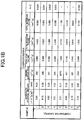
- FIG. 1A and FIG. 1B are each a table for showing the raw material (main chain of the polymer, the polymerization degree of the main chain, the kind and molar mass of the sealing agent forming the terminal group), the hydrogen storage amount at a hydrogen pressure of 10 MPa, the specific surface area, the total pore volume, the total mesopore volume, the total micropore volume, and the N/C ratio of each material of Examples 1 to 10 and Comparative Examples 1 to 8.
- the specific surface area of each carbon material according to Comparative Examples 1 to 8 was from 301 m 2 /g to 2,870m 2 /g.
- the specific surface area of each carbon material according to Examples 1 to 10 was from 1 m 2 /g to 160 m 2 /g. That is, the specific surface area of each carbon material according to Examples 1 to 10 was significantly smaller than that of each carbon material according to Comparative Examples 1 to 8. Of those, the specific surface area of each carbon material according to Examples 1, 2, and 4 to 10 was particularly significantly small.
- the hydrogen storage amount per unit area at a hydrogen pressure of 10 MPa of each carbon material according to Comparative Examples 1 to 8 was from 0.27 ⁇ 10 -5 g/m 2 to 0.82 ⁇ 10 -5 g/m 2 .
- the hydrogen storage amount at a hydrogen pressure of 10 MPa of each carbon material according to Examples 1 to 10 was from 1.94 ⁇ 10 -5 g/m 2 to 180 ⁇ 10 -5 g/m 2 . That is, the hydrogen storage amount per unit area of each carbon material according to Examples 1 to 10 was significantly larger than that of each carbon material according to Comparative Examples 1 to 8. Of those, the hydrogen storage amount per unit area of each carbon material according to Examples 1, 2, and 4 to 10 was particularly significantly large.
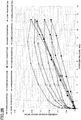
- FIG. 2A and FIG. 2B are each a graph for showing results obtained by measuring the hydrogen storage amount (wt%) of each carbonmaterial according to Examples 1 to 5 and Examples 6 to 10 while changing a hydrogen pressure.
- the hydrogen storage amounts black marks in FIG. 2A and FIG. 2B , which were measured while the hydrogen pressure was increased, increased linearly with respect to the hydrogen pressure.
- a coefficient of correlation (R) which was obtained by subjecting values of the hydrogen storage amounts measured while the hydrogen pressure was increased from 0 MPa to 11.5 MPa to linear approximation by a least-square method, was from 0.968 to 0.999.
- a relatively large hysteresis was confirmed. Specifically, a ratio of the hydrogen storage amount (wt%) at the hydrogen pressure of 4.0 MPa measured while the hydrogen pressure was decreased, with respect to the hydrogen storage amount (wt%) at the hydrogen pressure of 4.0 MPa measured while the hydrogen pressure was increased, was from 1.2 to 2.9.
- FIG. 3 is a graph for showing a correlation between the molar mass (g/mol) of the sealing agent forming the terminal group of the organic polymer used in the production of each carbon material according to Examples 6 to 10 and the hydrogen storage amount (wt%) of the carbon material.
- the hydrogen storage capacity of the carbon material changed in accordance with the molar mass of the sealing agent forming the terminal group of the organic polymer used in the production of the carbon material.
- the hydrogen storage amount (wt%) of the carbon material also increased with an increase in molar mass of the sealing agent forming the terminal group.
- the hydrogen storage capacity of the carbon material could be controlled by the kind and molar mass of the sealing agent forming the terminal group of the organic polymer used in the raw material for carbonization. Further, a terminal group capable of achieving a desired hydrogen storage capacity is specified by comparing a plurality of terminal groups obtained from a plurality of sealing agents having different molar masses in terms of the hydrogen storage capacity of the carbon material, and then, a carbon material having the desired hydrogen storage capacity should also be produced efficiently through use of an organic polymer having the specified terminal group.
- polycarbodiimide was used as the main chain of the nitrogen-containing organic polymer, but other main chains may be used as long as the carbon material of the present invention is produced. Specifically, for example, it is presumed that polycarbodiimide forms a trimer, and hence a main chain formed of a melamine resin or a guanamine resin having a triazine ring similar to the trimer may be used.
Landscapes
- Chemical & Material Sciences (AREA)
- Organic Chemistry (AREA)
- Chemical Kinetics & Catalysis (AREA)
- Analytical Chemistry (AREA)
- Inorganic Chemistry (AREA)
- Engineering & Computer Science (AREA)
- Materials Engineering (AREA)
- Physics & Mathematics (AREA)
- Thermal Sciences (AREA)
- Nanotechnology (AREA)
- Combustion & Propulsion (AREA)
- Carbon And Carbon Compounds (AREA)
- Hydrogen, Water And Hydrids (AREA)
Description
- The present invention relates to a carbon material, and more particularly, to a carbon material that exhibits a hydrogen storage capacity.
- Hydrogen is drawing attention as a clean energy source that does not generate carbon dioxide even when burnt. Therefore, in order to use hydrogen as fuel, a method of storing and transporting hydrogen has been investigated.
- As the method of storing and transporting hydrogen, a method using a high-pressure gas cylinder is generally used. However, the gas cylinder has a drawback that it is heavy. Further, the storage efficiency per unit volume of the gas cylinder has a practical limit, and hence a significant increase in storage efficiency thereof cannot be expected.
- Meanwhile, as a method of storing hydrogen, which replaces the gas cylinder, for example, a method using a hydrogen storage alloy has been known. However, the hydrogen storage alloy has a drawback that the hydrogen storage alloy itself is heavy. Therefore, there is a demand for development of a material which is more lightweight than the hydrogen storage alloy and which exhibits a high hydrogen storage capacity.
- In this respect, in recent years, carbon materials, for example, a carbon nanotube, a carbon nanofiber, and an activated carbon have drawn attention as materials that are lightweight and can store hydrogen, and a use of those materials as hydrogen storage materials has been investigated.
- Specifically, for example, in
Patent Literature 1, there is disclosed a hydrogen storage body that contains a carbon material having a specific surface area of 1,000 m2/g or more. - [Patent Literature 1]
JP 2003-038953 A -
EP 2540665A1 discloses a hydrogen-storing carbon material having a total pore volume of 0.5 cm3/g or more, a specific surface area of at least 400 m2/g and a hydrogen storage capacity of 2.0 mg/m2 or higher at 40 MPa. - However, the related-art carbonmaterials have a large specific surface area, and hence the related-art carbon materials are inevitably bulky in order to achieve a desired hydrogen storage amount.
- The present invention has been made in view of the above-mentioned problem, and one of the objects of the present invention is to provide a carbon material that is compact and exhibits an excellent hydrogen storage capacity.
- A carbon material according to one embodiment of the present invention for solving the above-mentioned problem has a specific surface area of 0.010 m2/g or more and 200 m2/g or less, exhibits a hydrogen storage capacity of 1.5×10⁻⁵ g/m2 or more at a hydrogen pressure of 10 MPa and wherein the carbon material has a total pore volume of 0.001 cm3/ g or more and 0.400 cm3/g or less. According to the embodiment of the present invention, a carbon material that is compact and exhibits an excellent hydrogen storage capacity is provided.
- The carbon material has total pore volume of 0.001 cm3/g or more and 0.400 cm3/g or less. Further, the carbon material may have a ratio of a molar content of nitrogen atoms with respect to a molar content of carbon atoms, which is measured by an elemental analysis method, of 0.030 or more. Further, the carbon material may be free of a transition metal. Further, the carbon material may be obtained by carbonizing a raw material that contains an organic substance and is free of a transition metal.
- Further, the carbon material may have a hydrogen storage amount (wt%) that increases linearly with respect to a hydrogen pressure. Further, when a hydrogen storage amount (wt%) of the carbon material is measured while a hydrogen pressure is increased from 0 MPa to 11.5 MPa, and then the hydrogen storage amount is measured while the hydrogen pressure is decreased from 11.5 MPa to 0 MPa, a ratio of the hydrogen storage amount at the hydrogen pressure of 4.0 MPa measured while the hydrogen pressure is decreased, with respect to the hydrogen storage amount at the hydrogen pressure of 4.0 MPa measured while the hydrogen pressure is increased, may be 1.2 or more.
- A method according to one embodiment of the present invention for solving the above-mentioned problem includes using any one of the above-mentioned carbon materials for hydrogen storage. According to the embodiment of the present invention, a method of storing hydrogen including using a carbon material that is compact and exhibits an excellent hydrogen storage capacity is provided.
- A method of producing a carbon material according to one embodiment of the present invention for solving the above-mentioned problem is a method of producing any one of the above-mentioned carbon materials by carbonizing a raw material containing an organic polymer, the method including: determining a main chain of the organic polymer; determining a plurality of candidate terminal groups as terminal groups of the determined main chain; providing a plurality of candidate polymers each containing the main chain and at least one kind of the determined plurality of candidate terminal groups; carbonizing raw materials containing the provided plurality of candidate polymers to prepare a plurality of candidate carbon materials; evaluating a hydrogen storage capacity of each of the prepared plurality of candidate carbon materials; selecting at least one kind of the candidate carbon material from the plurality of candidate carbon materials based on a result of the evaluation of the hydrogen storage capacity; and carbonizing a raw material containing, as the organic polymer, the candidate polymer used for preparing the selected candidate carbon material, to thereby produce the carbon material. According to the embodiment of the present invention, a method of producing a carbon material that is compact and exhibits an excellent hydrogen storage capacity is provided.
- A method of producing a carbon material according to one embodiment of the present invention for solving the above-mentioned problem is a method of producing a carbon material by carbonizing a raw material containing an organic polymer, the method including: determining a main chain of the organic polymer; determining a plurality of candidate terminal groups as terminal groups of the determined main chain; providing a plurality of candidate polymers each containing the main chain and at least one kind of the determined plurality of candidate terminal groups; carbonizing raw materials containing the provided plurality of candidate polymers to prepare a plurality of candidate carbon materials; evaluating a hydrogen storage capacity of each of the prepared plurality of candidate carbon materials; selecting at least one kind of the candidate carbon material from the plurality of candidate carbon materials based on a result of the evaluation of the hydrogen storage capacity; and carbonizing a raw material containing, as the organic polymer, the candidate polymer used for preparing the selected candidate carbon material, to thereby produce the carbon material. According to the embodiment of the present invention, a method of producing a carbon material that is compact and exhibits an excellent hydrogen storage capacity is provided.
- According to the present invention, a carbon material that is compact and exhibits an excellent hydrogen storage capacity, and methods relating to the same are provided.
-
-
FIG. 1A is an explanatory table for showing an example of results obtained by evaluating the characteristics of carbon materials in Examples 1 to 10 according to one embodiment of the present invention. -
FIG. 1B is an explanatory table for showing an example of results obtained by evaluating the characteristics of carbon materials in Comparative Examples 1 to 8 according to one embodiment of the present invention. -
FIG. 2A is an explanatory graph for showing an example of a correlation between the hydrogen pressure and the hydrogen storage amount of a carbon material, which is evaluated in Examples 1 to 5 according to one embodiment of the present invention. -
FIG. 2B is an explanatory graph for showing an example of a correlation between the hydrogen pressure and the hydrogen storage amount of a carbon material, which is evaluated in Examples 6 to 10 according to one embodiment of the present invention. -
FIG. 3 is an explanatory graph for showing an example of a correlation between the molar mass of a sealing agent forming a terminal group of an organic polymer and the hydrogen storage amount of a carbon material, which is evaluated in Examples according to one embodiment of the present invention. - Now, one of the embodiments of the present invention will be described. The present invention is not limited to examples shown in the embodiment.
- A carbon material according to the embodiment of the present invention (hereinafter referred to as "carbon material of the present invention") has a specific surface area of 0.010 m2/g or more and 200m2/g or less, exhibits a hydrogen storage capacity of 1.5×10⁻⁵ g/m2 or more at a hydrogen pressure of 10 MPa and has a total pore volume of 0.001 cm3/g or more and 0.400 cm3/g or less. In this connection, in order to enhance the hydrogen storage capacity of a carbon material, it has hitherto been considered to be effective to increase the number of pores of the carbon material, that is, to increase the specific surface area thereof. In contrast, unexpectedly, the carbon material of the present invention is compact and exhibits an excellent hydrogen storage capacity as described above. Thus, the carbon material of the present invention is preferably used as a carbon material for hydrogen storage. That is, the carbon material of the present invention is preferably applied to various devices and systems using hydrogen as fuel.
- Therefore, one method according to the embodiment of the present invention may be a method including using the carbon material of the present invention for hydrogen storage. That is, in this method, the carbon material of the present invention is caused to store hydrogen to be used as fuel. Further, in this method, after the carbon material of the present invention is caused to store hydrogen, the hydrogen may be released from the carbon material of the present invention.
- There is no particular limitation on the specific surface area of the carbon material of the present invention as long as the specific surface area is of 0.010 m2/g or more and 200 m2/g or less. The upper limit of the specific surface area may be, for example, 170 m2/g or less, 150 m2/g or less, less than 100 m2/g, 90 m2/g or less, or 80 m2/g or less. The specific surface area is measured by a BET method using nitrogen gas.
- Further, in those cases, the specific surface area of the carbon material of the present invention may be, for example, 0.050 m2/g or more, or 0.100 m2/g or more.
- There is no particular limitation on the hydrogen storage amount per unit surface area at a hydrogen pressure of 10 MPa of the carbon material of the present invention as long as the hydrogen storage amount is 1.5×10⁻⁵ g/m2 or more. The hydrogen storage amount per unit surface area at a hydrogen pressure of 10 MPa may be, for example, 1.8×10⁻⁵ g/m2 or more, or 2.0×10⁻⁵ g/m2 or more. While there is no particular limitation on the upper limit value of the hydrogen storage amount, the upper limit value may be, for example, 10 g/m2 or less.
- The hydrogen storage amount (wt%) of the carbon material of the present invention may increase linearly with respect to the hydrogen pressure. Specifically, for example, when hydrogen storage amounts (wt%) of the carbon material of the present invention at hydrogen pressures at at least three points are measured while the hydrogen pressure is increased from 0 MPa to 11.5 MPa, a coefficient of correlation (R) obtained by subjecting values of the hydrogen storage amounts measured at the at least three points to linear approximation by a least-square method may be 0.950 or more.
- When the hydrogen storage amount (wt%) of the carbon material of the present invention is measured while the hydrogen pressure is increased from 0 MPa to 11.5 MPa, and subsequently, the hydrogen storage amount (wt%) is measured while the hydrogen pressure is decreased from 11.5 MPa to 0 MPa, a ratio of the hydrogen storage amount (wt%) at the hydrogen pressure of 4.0 MPa measured while the hydrogen pressure is decreased, with respect to the hydrogen storage amount (wt%) at the hydrogen pressure 4.0 MPa measured while the hydrogen pressure is increased, may be 1.2 or more.
- That is, the carbon material of the present invention exhibits a relatively large hysteresis in a change in hydrogen storage amount (wt%) in association with the hydrogen pressure. The reason that such large hysteresis is exhibited is not clear, but it is conceivable that a chemical interaction with hydrogen, which is specific to the carbon structure of the carbon material of the present invention, is reflected.
- The carbon material of the present invention is a porous carbon material. Specifically, the carbon material of the present invention has pores each having a diameter of less than 100 nm. In this respect, the carbon material of the present invention has a total pore volume of 0.001 cm3/g or more and 0.400 cm3/g or less.
- In this case, the total pore volume of the carbon material of the present invention may be, for example, 0.300 cm3/g or less, 0.200 cm3/g or less, 0.150 cm3/g or less, or 0.100 cm3/g or less. More specifically, the total pore volume of the carbon material of the present invention may be, for example, 0.001 cm3/g or more and 0.300 cm3/g or less, 0.001 cm3/g or more and 0.200 cm3/g or less, 0.001 cm3/g or more and 0.150 cm3/g or less, or 0.001 cm3/g or more and 0.100 cm3/g or less. Further, in those cases, the total pore volume of the carbon material of the present invention may be, for example, 0.002 cm3/g or more, or 0.003 cm3/g or more. The total pore volume of the carbon material is calculated based on the maximum adsorption amount in the BET method using nitrogen gas.
- The carbon material of the present invention has, as part of the pores, micropores each having a diameter of less than 2 nm. In this respect, the total micropore volume of the carbon material of the present invention may be, for example, 0.040 cm3/g or less, 0.035 cm3/g or less, or 0.030 cm3/g or less.
- More specifically, the total micropore volume of the carbon material of the present invention may be, for example, 0.001 cm3/g or more and 0.040 cm3/g or less, 0.001 cm3/g or more and 0.035 cm3/g or less, or 0.001 cm3/g or more and 0.030 cm3/g or less. Further, in those cases, the total micropore volume of the carbon material of the present invention may be 0.002 cm3/g or more, or 0.003 cm3/g or more. The total micropore volume of the carbon material is calculated by applying a DR method to a nitrogen adsorption isotherm.
- The carbon material of the present invention has, as part of the pores, mesopores each having a diameter of 2 nm or more and 50 nm or less. In this respect, the total mesopore volume of the carbon material of the present invention may be, for example, 0.300 cm3/g or less, 0.200 cm3/g or less, 0.100 cm3/g or less, 0.050 cm3/g or less, 0.015 cm3/g or less, or 0.010 cm3/g or less.
- More specifically, the total mesopore volume of the carbon material of the present invention may be, for example, 0.001 cm3/g or more and 0.300 cm3/g or less, 0.001 cm3/g or more and 0.200 cm3/g or less, 0.001 cm3/g or more and 0.100 cm3/g or less, 0.001 cm3/g or more and 0.050 cm3/g or less, 0.001 cm3/g or more and 0.015 cm3/g or less, or 0.001 cm3/g or more and 0.010 cm3/g or less. The total mesopore volume of the carbon material is calculated by a BJH method.
- It is preferred that the carbon material of the present invention contain nitrogen. In this respect, the carbon material of the present invention may have a ratio of a molar content (%) of nitrogen atoms with respect to a molar content (%) of carbon atoms (hereinafter referred to as "N/C ratio"), which is measured by an elemental analysis method, of 0.030 or more.
- In this case, the N/C ratio (-) of the carbon material of the present invention may be, for example, 0.035 or more, 0.039 or more, 0.040 or more, or 0.041 or more. More specifically, the N/C (-) of the carbon material of the present invention may be, for example, 0.030 or more and 0.075 or less, 0.035 or more and 0.075 or less, 0.039 or more and 0.075 or less, 0.040 or more and 0.075 or less, or 0.041 or more and 0.075 or less. Further, in those cases, the N/C (-) of the carbon material of the present invention may be, for example, 0.070 or less, or 0.065 or less.
- The carbon material of the present invention may be free of a transition metal. In this case, the transition metal refers to a metal belonging to the
groups 3 to 12 in the periodic table. The carbon material of the present invention may be obtained by carbonizing a raw material that contains an organic substance and is free of a transition metal. That is, a method of producing the carbon material of the present invention may be a method involving carbonizing a raw material that contains an organic substance and is free of a transition metal. - The carbon material of the present invention may be free of a metal. Further, the carbon material of the present invention may be obtained by carbonizing a raw material that contains an organic substance and is free of a metal. That is, the method of producing the carbon material of the present invention may be a method involving carbonizing a raw material that contains an organic substance and is free of a metal.
- Carbonization is performed by heating a raw material and keeping the raw material at a temperature at which the raw material is carbonized (hereinafter referred to as "carbonization temperature"). There is no particular limitation on the carbonization temperature as long as the raw material is carbonized at the temperature. The carbonization temperature may be, for example, 300°C or more, or 700°C or more. More specifically, the carbonization temperature may be, for example, from 300 °C to 3,000°C, or from 700°C to 2,000°C.
- The temperature increase rate up to the carbonization temperature is, for example, from 0.5°C/min to 300°C/min. A time period for keeping the raw material at the carbonization temperature is, for example, from 5 minutes to 24 hours. It is preferred that carbonization be performed under a stream of inert gas such as nitrogen.
- There is no particular limitation on the organic substance contained in the raw material as long as the organic substance can be carbonized (can be used as a carbon source), and any one or more kinds of organic substances, such as an organic high-molecular-weight compound (for example, an organic polymer), an organic low-molecular-weight compound, and biomass, are used.
- As the organic substance, an organic substance containing nitrogen is preferably used. There is no particular limitation on the nitrogen-containing organic substance as long as the organic substance contains an organic compound containing a nitrogen atom in a molecule thereof. For example, any one or more kinds of nitrogen-containing organic substances, such as a nitrogen-containing organic high-molecular-weight compound, a nitrogen-containing organic low-molecular-weight compound, and nitrogen-containing biomass, are used.
- As the nitrogen-containing organic compound, a nitrogen-containing organic polymer is preferably used. There is no particular limitation on the nitrogen-containing organic polymer as long as the organic polymer contains a nitrogen atom in a molecule thereof. Any one or more kinds of nitrogen-containing organic polymers are used.
- Specifically, the nitrogen-containing organic polymer may be, for example, one or more kinds selected from the group consisting of polycarbodiimide, polypyrrole, polyvinylpyrrole, 3-methylpolypyrrole, polyvinylpyridine, polyaniline, polyaminobismaleimide, polyimide, polybenzimidazole, polyamide, polyacrylonitrile, chitin, chitosan, silk, wool, polyamino acids, nucleic acids, DNA, RNA, polycarbazole, polybismaleimide, guanamine resins, melamine resins, and polyamide imide resins.
- There is no particular limitation on the content of the organic polymer (for example, the nitrogen-containing organic polymer) in the raw material as long as the carbon material of the present invention having the above-mentioned characteristics is obtained. The content may be, for example, from 1 wt% to 100 wt%, or from 10 wt% to 100 wt%.
- As the nitrogen-containing organic polymer, for example, polycarbodiimide is preferably used. In this case, the carbon material of the present invention may be obtained by carbonizing a raw material that contains polycarbodiimide and is free of a transition metal.
- There is no particular limitation on the polycarbodiimide as long as the polycarbodiimide is a polymer of a carbodiimide. There is no particular limitation on the polymerization degree of the polycarbodiimide. The polymerization degree may be, for example, 2 or more and 30 or less, 2 or more and 25 or less, or 2 or more and 20 or less. Further, in those cases, the polymerization degree of the polycarbodiimide may be, for example, 3 or more, or 4 or more.
- As the polycarbodiimide, for example, polycarbodiimide obtained by a condensation reaction of an organic diisocyanate involving the removal of carbon dioxide may be used. More specifically, the polycarbodiimide is obtained, for example, by heating with stirring the organic diisocyanate in a solvent or without a solvent in the presence of a phosphorus catalyst or a titanium catalyst. The form of the polycarbodiimide thus obtained varies depending on the kind of the organic diisocyanate used as the raw material and is mainly a powder form, a lump form, a liquid form, a starch syrup form, or a varnish form dissolved in a solvent. In this embodiment, polycarbodiimide in any form may be used.
- There is no particular limitation on the carbodiimide forming the polycarbodiimide as long as the carbodiimide is a compound having a functional group "-N=C=N-". For example, the carbodiimide is synthesized through use of one or more kinds selected from the group consisting of an aromatic diisocyanate, an aliphatic diisocyanate, and an alicyclic diisocyanate.
- Specifically, the carbodiimide forming the polycarbodiimide may be synthesized through use of one or more kinds selected from the group consisting of, for example, 2,4-tolylene diisocyanate (TDI), 2,6-tolylene diisocyanate (TDI), xylylene diisocyanate (XDI), tetramethylxylylene diisocyanate (TMXDI), diphenylmethane diisocyanate (MDI), isophorone diisocyanate (IPDI), 1,5-naphthylene diisocyanate (NDI), hexamethylene diisocyanate (HDI), tolidine diisocyanate (TODI), phenylene diisocyanate (PPDI), dicyclohexylmethane diisocyanate (HMDI), lysine diisocyanate (LDI), hydrogenated xylylene diisocyanate (hydrogenated XDI), cyclohexyl diisocyanate (CHPI), bis(4-isocyanatocyclohexyl)methane, hydrogenated diphenylmethane diisocyanate, and derivatives thereof.
- There is no particular limitation on the content of the polycarbodiimide in the rawmaterial. The content maybe, for example, 1 wt% or more and 100 wt% or less, or 2 wt% or more and 100 wt% or less.
- When the raw material contains polycarbodiimide, the raw material may contain a polymer having a main chain formed of the polycarbodiimide. In this case, the carbon material of the present invention may be obtained by carbonizing a raw material that contains a polymer having a main chain formed of polycarbodiimide and is free of a transition metal.
- The polymer having a main chain formed of polycarbodiimide has a terminal group. That is, in polymerization of a polymer having a main chain formed of polycarbodiimide, a sealing agent that reacts with an isocyanate group is used, and as a result, the polymer has a terminal group formed of the sealing agent. There is no particular limitation on the sealing agent forming the terminal group as long as the sealing agent reacts with an isocyanate group and is used as a sealing agent in polymerization. Specifically, the sealing agent forming the terminal group may have, for example, one or more kinds of functional groups selected from the group consisting of an NH2 group, an OH group, a COOH group, an NCO group, and an SH group. The molar mass of the sealing agent forming the terminal group may be, for example, 17 g/mol or more and 1,000 g/mol or less, 17 g/mol or more and 800 g/mol or less, 17 g/mol or more and 600 g/mol or less, or 17 g/mol or more and 400 g/mol or less. Further, in those cases, the molar mass of the sealing agent forming the terminal group may be, for example, 18 g/mol or more, or 19 g/mol or more.
- The content of the polymer having a main chain formed of polycarbodiimide in the raw material may be, for example, 1 wt% or more and 100 wt% or less, or 2 wt% or more and 100 wt% or less.
- The carbon material of the present invention may be produced without performing activation treatment. In this respect, in production of a large number of carbon materials, the activation treatment has hitherto been performed in order to enhance their characteristics. In contrast, the above-mentioned excellent characteristics of the carbon material of the present invention are achieved without performing the activation treatment. Therefore, the carbon material of the present invention is produced efficiently in a process simplified compared to that of the related art.
- The carbon material of the present invention is produced by the method involving carbonizing a raw material as described above. In this connection, the inventors of the present invention have found that, when a carbon material is produced by carbonizing a raw material containing an organic polymer having a main chain and a terminal group, the hydrogen storage capacity of the carbon material varies depending on the kind of the terminal group.
- In view of the foregoing, a method of producing a carbonmaterial according to the embodiment of the present invention may be, for example, a method of producing a carbon material by carbonizing a raw material containing an organic polymer, the method including: determining a main chain of the organic polymer; determining a plurality of candidate terminal groups as terminal groups of the determined main chain; providing a plurality of candidate polymers each containing the main chain and at least one kind of the determined plurality of candidate terminal groups; carbonizing raw materials containing the provided plurality of candidate polymers to prepare a plurality of candidate carbon materials; evaluating a hydrogen storage capacity of each of the prepared plurality of candidate carbon materials; selecting at least one kind of the candidate carbon material from the plurality of candidate carbon materials based on a result of the evaluation of the hydrogen storage capacity; and carbonizing a raw material containing, as the organic polymer, the candidate polymer used for preparing the selected candidate carbon material, to thereby produce the carbon material.
- That is, in this method, first, a main chain of an organic polymer is determined. In this case, it is preferred that the organic polymer be the above-mentioned nitrogen-containing organic polymer. Further, as a main chain of the nitrogen-containing organic polymer, for example, a main chain formed of polycarbodiimide is preferably used.
- Next, a plurality of candidate terminal groups are determined as terminal groups of the determined main chain. There is no particular limitation on the plurality of candidate terminal groups as long as the plurality of candidate terminal groups are different kinds of groups. For example, when a main chain formed of polycarbodiimide is used, a plurality of candidate terminal groups of different kinds, each of which reacts with an isocyanate group, are preferably used.
- Further, the plurality of candidate terminal groups may be, for example, a plurality of candidate terminal groups obtained from a plurality of sealing agents having different molar masses. The molar mass of each of the sealing agents forming the terminal groups may be, for example, 17 g/mol or more and 1,000 g/mol or less, 17 g/mol or more and 800 g/mol or less, 17 g/mol or more and 600 g/mol or less, or 17 g/mol or more and 400 g/mol or less. Further, in those cases, the molar mass of each of the sealing agents forming the terminal groups may be, for example, 18 g/mol or more, or 19 g/mol or more.
- Next, a plurality of candidate polymers each containing the main chain and at least one kind of the plurality of candidate terminal groups are provided. For providing the plurality of candidate polymers, the candidate polymers may be synthesized or the candidate polymers synthesized in advance may be obtained.
- Next, raw materials containing the provided plurality of candidate polymers are carbonized to prepare a plurality of candidate carbon materials. That is, raw materials containing different candidate polymers are carbonized to prepare a plurality of candidate carbon materials using different candidate polymers in their raw materials.
- Next, the hydrogen storage capacity of each of the prepared plurality of candidate carbon materials is evaluated. That is, the hydrogen storage capacity of each of the plurality of candidate carbon materials is measured and they are compared to each other.
- Next, at least one kind of the candidate carbon material is selected from the plurality of candidate carbon materials based on a result of the evaluation of the hydrogen storage capacity. That is, a candidate carbon material having a desired hydrogen storage capacity is selected from the plurality of candidate carbon materials . Specifically, for example, one kind of the candidate carbon material having the highest hydrogen storage capacity may be selected from the plurality of candidate carbon materials, or two or more kinds (but not all the kinds) of the candidate carbon materials each having a high hydrogen storage capacity may be selected from the plurality of candidate carbon materials.
- Next, a raw material containing, as the organic polymer, the candidate polymer used for preparing the selected candidate carbon material is carbonized to produce a carbon material. That is, the candidate polymer used for preparing the selected candidate carbon material is determined as an organic polymer preferred for achieving the desired hydrogen storage capacity, and the raw material containing the organic polymer is actually carbonized to produce a carbon material. According to such a method, the carbon material having the desired hydrogen storage capacity is produced efficiently.
- Next, specific Examples according to the embodiment are described.
- A carbon material was produced by a method including carbonizing a raw material that contained an organic polymer and was free of a transition metal. As the organic polymer, a polymer having a main chain formed of polycarbodiimide having a polymerization degree of from 4 to 13 and a terminal group obtained from a sealing agent having a molar mass of from 30 g/mol to 400 g/mol was used.
- As the polycarbodiimide, a polymer of tolylene diisocyanate (TDI), tolidine diisocyanate (TODI), diphenylmethane diisocyanate (MDI), naphthylene diisocyanate (NDI), phenylene diisocyanate (PPDI), or xylylene diisocyanate (XDI) was used.
- As the sealing agent forming the terminal group, methanol (molar mass: 32.04 g/mol), phenyl isocyanate (molar mass: 119.12 g/mol), octanol (molar mass: 130.23 g/mol), dodecyl alcohol (molar mass: 186.34 g/mol), oleyl alcohol (molar mass: 268.48 g/mol), or polyethylene glycol methyl ether (molar mass: 400.00 g/mol) was used.
- 22.4 g of naphthylene diisocyanate (NDI), 0.11 g of a carbodiimidization catalyst (3-methyl-1-phenyl-2-phospholene-1-oxide), 1.37 g of methanol, and toluene serving as a solvent were loaded into a four-necked flask, and the mixture was adjusted so that the total concentration of the diisocyanate and the sealing agent (methanol) reached 20 wt%. Next, the resultant was caused to react at 60°C for 1 hour with stirring in a nitrogen gas atmosphere and polymerized at 100°C for 5 hours. It was confirmed by an IR (Fourier transform infrared spectrometer manufactured by Shimadzu Corporation) that a peak of isocyanate was eliminated. Thus, an organic polymer containing a main chain formed of polycarbodiimide was synthesized.
- Next, the obtained organic polymer solution was cast onto a Teflon (trademark) sheet and dried in a fume hood for half a day to remove the solvent. Then, the resultant was kept in a muffle furnace under a stream of air at 80°C for 3 hours and at 120°C for 3 hours, to thereby further remove the solvent. After that, the composition was kept at 200°C for 5 hours and at 230°C for 4 hours to be subjected to curing treatment. The cured product thus obtained was used as a raw material for carbonization.
- The raw material prepared as described above was heated at 10°C/min in a tubular furnace under a stream of nitrogen and kept at 1,000°C for 1 hour to be carbonized, to thereby provide a carbon material.
- An organic polymer was synthesized and a carbon material was produced in the same manner as in Example 1 except that 23.0 g of tolylene diisocyanate (TDI) was used as the diisocyanate in place of NDI, 0.12 g of the carbodiimidization catalyst and 1.7 g of methanol were used, and the polymerization was performed for 9 hours.
- An organic polymer was synthesized and a carbon material was produced in the same manner as in Example 1 except that 22.7 g of xylylene diisocyanate (XDI) was used as the diisocyanate in place of NDI, cyclohexanone was used as the solvent in place of toluene, 0.12 g of the carbodiimidization catalyst and 1.5 g of methanol were used, and the polymerization was performed for 4 hours.
- An organic polymer was synthesized and a carbon material was produced in the same manner as in Example 1 except that 22.0 g of diphenylmethane diisocyanate (MDI) was used as the diisocyanate in place of NDI, 0.12 g of the carbodiimidization catalyst and 1.1 g of methanol were used, the reaction was performed at 65°C for 45 minutes, and the polymerization was performed at 100°C for 3 hours.
- An organic polymer was synthesized and a carbon material was produced in the same manner as in Example 1 except that 32.8 g of tolidine diisocyanate (TODI) was used as the diisocyanate in place of NDI, 0.17 g of the carbodiimidization catalyst and 1. 6 g of methanol were used, the total concentration of the diisocyanate and the sealing agent (methanol) was set to 30 wt%, the reaction was performed at 65°C for 30 minutes, and the polymerization was performed at 100°C for 4 hours and 30 minutes.
- An organic polymer was synthesized and a carbon material was produced in the same manner as in Example 1 except that 46.4 g of tolylene diisocyanate (TDI) was used as the diisocyanate in place of NDI, 0.10 g of the carbodiimidization catalyst was used, 4.5 g of phenyl isocyanate was used as the sealing agent in place of methanol, the total concentration of the diisocyanate and the sealing agent was set to 40 wt%, and the polymerization was performed for 3 hours.
- An organic polymer was synthesized and a carbon material was produced in the same manner as in Example 6 except that 34.4 g of TDI and 0.19 g of the carbodiimidization catalyst were used, 3.7 g of octanol was used as the sealing agent in place of phenyl isocyanate, and the total concentration of the diisocyanate and the sealing agent was set to 30 wt%.
- An organic polymer was synthesized and a carbon material was produced in the same manner as in Example 6 except that 30.4 g of TDI and 0.19 g of the carbodiimidization catalyst were used, 6.7 g of oleyl alcohol was used as the sealing agent in place of phenyl isocyanate, the total concentration of the diisocyanate and the sealing agent was set to 30 wt%, and the polymerization was performed for 6 hours.
- An organic polymer was synthesized and a carbon material was produced in the same manner as in Example 6 except that 32.7 g of TDI and 0.19 g of the carbodiimidization catalyst were used, 5.0 g of dodecyl alcohol was used as the sealing agent in place of phenyl isocyanate, the total concentration of the diisocyanate and the sealing agent was set to 30 wt%, and the polymerization was performed for 6 hours.
- An organic polymer was synthesized and a carbon material was produced in the same manner as in Example 6 except that 27.4 g of TDI and 0.18 g of the carbodiimidization catalyst were used, 9.0 g of polyethylene glycol methyl ether (molecular weight: 400) was used as the sealing agent in place of phenyl isocyanate, the total concentration of the diisocyanate and the sealing agent was set to 30 wt%, and the polymerization was performed for 4 hours.
- Each carbon material obtained as described above was subj ected to nitrogen adsorption and desorption measurement at 77 K. That is, the specific surface area, the total pore volume, the total micropore volume, and the total mesopore volume of the carbon material were measured through a use of an automatic specific surface area and pore distribution measurement apparatus (BELSORP-mini II manufactured by BEL Japan, Inc.).
- Specifically, first, 0.05 g of a carbon material was kept at 400°C and a pressure of 1 Pa or less for 12 hours to remove water adsorbing to the carbon material. Then, the specific surface area of the carbon material was measured by a BET method using nitrogen gas. Further, the total pore volume was calculated from the maximum adsorption amount of nitrogen gas. Further, the micropore volume was calculated by a DR method, and the mesopore volume was calculated by a BJH method.
- The DR method is a method developed for investigation of micropores of activated carbon, and is used for samples having various micropores (Dubinin, M. M. In Progress in Surface and Membrane Science, 9 (D. A. Cadenhead ed.), Academic Press 1975). Further, the BJH method is a typical method of determining the distribution of mesopores proposed by Barrett, Joyner, and Halenda (E. P. Barrett, L. G. Joyner, and P. P. Halenda, J. Am. Chem. Soc., 73, 373, (1951)).
- Each carbon material obtained as described above was measured for a hydrogen storage amount at a hydrogen pressure of from 0 MPa to 11.5 MPa at 298 K in accordance with JIS H 7201. That is, first, about 1 g of the carbon material was loaded into a sample tube and evacuated until the pressure in the sample tube reached 10 Pa or less. The sample tube was kept at 200°C for 2 hours, to thereby subject the carbon material to pretreatment. After that, He gas was introduced into the sample tube, and the volume of the carbon material was measured. Further, the sample tube was evacuated for 3 hours or more to remove the He gas from the test tube.
- Then, hydrogen gas was introduced into the test tube, and a hydrogen storage amount (wt%) was measured while the hydrogen pressure was increased from 0 MPa to 11.5 MPa. Subsequently, the hydrogen storage amount (wt%) was measured while the hydrogen pressure was reduced from 11.5 MPa to 0 MPa.
- Further, the hydrogen storage amount (wt%) at a hydrogen pressure of 10 MPa thus obtained was converted into a hydrogen storage amount (g) per g of the carbon material. The obtained value was divided by the specific surface area obtained as described above, to thereby calculate a hydrogen storage amount (g/m2) per unit surface area at a hydrogen pressure of 10 MPa. Specifically, the hydrogen storage amount (wt%) represents a ratio (wt%) of a hydrogen amount (g) stored per g of the carbon material. Therefore, for example, the hydrogen storage amount (g/m2) per unit surface area of a carbon material having a specific surface area of 200 m2/g and a hydrogen storage amount of 0.2 (wt%) is calculated by the following expression: (0.2/100)/200=1.0×10-5 (g/m2).
- The contents of carbon atoms and nitrogen atoms in each carbon material were measured by a combustion method through use of an organic elemental microanalysis apparatus (2400II manufactured by PerkinElmer Co., Ltd.). 2 mg of the carbon material was analyzed using helium as a carrier gas under conditions of a combustion tube temperature of 980°C and a reduction tube temperature of 640°C. A ratio of the molar content (%) of the nitrogen atoms with respect to the molar content (%) of the carbon atoms thus obtained was calculated as an N/C ratio.
- A carbon material was produced by a method including carbonizing a raw material containing an organic polymer and a transition metal.
- Specifically, 100 mL of acetone was mixed with 10 g of a phenol resin to prepare a mixed solution. 3.05 g of phthalocyanine iron was added to the mixed solution, and the resultant was stirred at normal temperature for 1 hour through use of a magnetic stirrer. The solvent was removed from the mixture at 60°C through use of a rotary evaporator while the mixture was irradiated with an ultrasonic wave. Thus, a raw material containing an organic polymer and a transition metal was obtained.
- Next, the raw material was carbonized. Specifically, the raw material was loaded into a quartz tube, and the quartz tube was purged with nitrogen gas for 20 minutes in an elliptical surface reflection type infrared gold image furnace. Then, heating was started to increase the temperature in the gold image furnace from room temperature to 800°C at a temperature increase rate of 10°C/min. After that, the quartz tube was kept at 800°C for 1 hour. Thus, a carbon material generated by carbonizing the raw material was obtained.
- Further, the carbon material was subjected to pulverization treatment. Specifically, silicon nitride balls each having a diameter of 1.5 mm were placed in a planetary ball mill (P-7 manufactured by Fritsch Japan Co., Ltd.), and the carbon material obtained by carbonization treatment was pulverized at a rotation speed of 800 rpm for 60 minutes. The pulverized carbon material was removed from the planetary ball mill and classified with a sieve having an opening of 106 µm. Thus, a powdery carbon material having passed through the sieve was obtained as a
comparative material 1. - The
comparative material 1 obtained in Comparative Example 1 was subjected to CO2 activation treatment. Specifically, thecomparative material 1 was loaded into a quartz tube, and the quartz tube was purged with CO2 gas for 20 minutes in an elliptical surface reflection type infrared gold image furnace. Then, heating was started to increase the temperature in the gold image furnace from room temperature to 800°C at a temperature increase rate of 50°C/min. After that, the quartz tube was kept at 800°C for 1 hour. A carbon material thus obtained was used as acomparative material 2. - A carbon material was produced by a method including carbonizing a raw material containing an organic polymer and a transition metal.
- Specifically, 1.5 g of a polyacrylonitrile-polymethacrylic acid copolymer was dissolved in 20 g of dimethylformamide. After that, 1.5 g of cobalt chloride hexahydrate and 1.5 g of 2-methylimidazole were added to the resultant, and the mixture was stirred for 2 hours to provide a blue solution. Ketjenblack (EC600JD manufactured by Lion Corporation) was added to the obtained solution so as to achieve 30 wt%, followed by mixing through use of a mortar. Thus, a raw material containing an organic polymer and a transition metal was obtained.
- Next, the raw material was subjected to infusibilization treatment. Specifically, the raw material was placed in a forced-circulation type dryer. Then, the forced-circulation type dryer was increased in temperature from room temperature to 150°C over 30 minutes in the atmosphere and subsequently increased in temperature from 150°C to 220°C over 2 hours. After that, the raw material was kept at 220°C for 3 hours. Thus, the raw material was infusibilized.
- Then, the raw material was carbonized. Specifically, the raw material subjected to infusibilization treatment was loaded into a quartz tube, and the quartz tube was purged with nitrogen for 20 minutes in an elliptical surface reflection type infrared gold image furnace. Then, heating was started to increase the temperature in the gold image furnace from room temperature to 900°C at a temperature increase rate of 10°C/min. After that, the quartz tube was kept at 900°C for 1 hour. Thus, a carbon material generated by carbonizing the raw material was obtained.
- Further, the carbon material was subjected to pulverization treatment in the same manner as in the
comparative material 1, to thereby provide a powdery carbon material as acomparative material 3. - The
comparative material 3 obtained in Comparative Example 3 was subjected to CO2 activation treatment in the same manner as in Comparative Example 2. A carbon material thus obtained was used as acomparative material 4. - Porous carbon (MAXSORB (trademark) manufactured by Kansai Coke and Chemicals Co., Ltd.) which was alkali-activated carbon was used as a
comparative material 5. - Powdery activated carbon (Kuraray Coal PW for water purification manufactured by Kuraray Chemical Co., Ltd.) was used as a
comparative material 6. - Carbon black (VULCAN XC-72 manufactured by Cabot Japan K.K.) was used as a
comparative material 7. - Carbon black (Ketjenblack EC600JD manufactured by Lion Corporation) was prepared as a
comparative material 8. - Each of the
comparative materials 1 to 8 was measured for a specific surface area, a total pore volume, a total micropore volume, a total mesopore volume, an N/C ratio, and a hydrogen storage capacity in the same manner as in Examples 1 to 10. -
FIG. 1A andFIG. 1B are each a table for showing the raw material (main chain of the polymer, the polymerization degree of the main chain, the kind and molar mass of the sealing agent forming the terminal group), the hydrogen storage amount at a hydrogen pressure of 10 MPa, the specific surface area, the total pore volume, the total mesopore volume, the total micropore volume, and the N/C ratio of each material of Examples 1 to 10 and Comparative Examples 1 to 8. - As shown in
FIG. 1B , the specific surface area of each carbon material according to Comparative Examples 1 to 8 was from 301 m2/g to 2,870m2/g. In contrast, as shown inFIG. 1A , the specific surface area of each carbon material according to Examples 1 to 10 was from 1 m2/g to 160 m2/g. That is, the specific surface area of each carbon material according to Examples 1 to 10 was significantly smaller than that of each carbon material according to Comparative Examples 1 to 8. Of those, the specific surface area of each carbon material according to Examples 1, 2, and 4 to 10 was particularly significantly small. - Further, the hydrogen storage amount per unit area at a hydrogen pressure of 10 MPa of each carbon material according to Comparative Examples 1 to 8 was from 0.27×10⁻⁵ g/m2 to 0.82×10⁻⁵ g/m2. In contrast, the hydrogen storage amount at a hydrogen pressure of 10 MPa of each carbon material according to Examples 1 to 10 was from 1.94×10⁻⁵ g/m2 to 180×10-5 g/m2. That is, the hydrogen storage amount per unit area of each carbon material according to Examples 1 to 10 was significantly larger than that of each carbon material according to Comparative Examples 1 to 8. Of those, the hydrogen storage amount per unit area of each carbon material according to Examples 1, 2, and 4 to 10 was particularly significantly large.
- As described above, it was confirmed that each carbon material according to Examples 1 to 10 (in particular, Examples 1, 2, and 4 to 10) was compact and exhibited an excellent hydrogen storage capacity compared to each carbon material according to Comparative Examples 1 to 8.
-
FIG. 2A andFIG. 2B are each a graph for showing results obtained by measuring the hydrogen storage amount (wt%) of each carbonmaterial according to Examples 1 to 5 and Examples 6 to 10 while changing a hydrogen pressure. As shown inFIG. 2A andFIG. 2B , the hydrogen storage amounts (black marks inFIG. 2A andFIG. 2B ), which were measured while the hydrogen pressure was increased, increased linearly with respect to the hydrogen pressure. - Specifically, a coefficient of correlation (R), which was obtained by subjecting values of the hydrogen storage amounts measured while the hydrogen pressure was increased from 0 MPa to 11.5 MPa to linear approximation by a least-square method, was from 0.968 to 0.999.
- Further, as shown in
FIG. 2A andFIG. 2B , a relatively large hysteresis was confirmed. Specifically, a ratio of the hydrogen storage amount (wt%) at the hydrogen pressure of 4.0 MPa measured while the hydrogen pressure was decreased, with respect to the hydrogen storage amount (wt%) at the hydrogen pressure of 4.0 MPa measured while the hydrogen pressure was increased, was from 1.2 to 2.9. -
FIG. 3 is a graph for showing a correlation between the molar mass (g/mol) of the sealing agent forming the terminal group of the organic polymer used in the production of each carbon material according to Examples 6 to 10 and the hydrogen storage amount (wt%) of the carbon material. - As shown in
FIG. 3 , the hydrogen storage capacity of the carbon material changed in accordance with the molar mass of the sealing agent forming the terminal group of the organic polymer used in the production of the carbon material. In particular, in a range of the molar mass of the sealing agent forming the terminal group of from 100 g/mol to 300 g/mol, the following tendency was confirmed: the hydrogen storage amount (wt%) of the carbon material also increased with an increase in molar mass of the sealing agent forming the terminal group. - Thus, it was considered that the hydrogen storage capacity of the carbon material could be controlled by the kind and molar mass of the sealing agent forming the terminal group of the organic polymer used in the raw material for carbonization. Further, a terminal group capable of achieving a desired hydrogen storage capacity is specified by comparing a plurality of terminal groups obtained from a plurality of sealing agents having different molar masses in terms of the hydrogen storage capacity of the carbon material, and then, a carbon material having the desired hydrogen storage capacity should also be produced efficiently through use of an organic polymer having the specified terminal group.
- In Examples, polycarbodiimide was used as the main chain of the nitrogen-containing organic polymer, but other main chains may be used as long as the carbon material of the present invention is produced. Specifically, for example, it is presumed that polycarbodiimide forms a trimer, and hence a main chain formed of a melamine resin or a guanamine resin having a triazine ring similar to the trimer may be used.
Claims (7)
- A carbon material, which has a specific surface area of 0.010 m2/g or more and 200 m2/g or less and exhibits a hydrogen storage capacity of 1.5×10⁻⁵ g/m2 or more at a hydrogen pressure of 10 MPa, wherein the carbon material has a total pore volume of 0.001 cm3/g or more and 0.400 cm3/g or less.
- The carbon material according to claim 1, wherein the carbon material has a ratio of a molar content of nitrogen atoms with respect to a molar content of carbon atoms, which is measured by an elemental analysis method, of 0.030 or more.
- The carbon material according to any one of claims 1 to 2, wherein the carbon material is free of a transition metal.
- The carbon material according to any one of claims 1 to 3, wherein the carbon material is obtained by carbonizing a raw material that contains an organic substance and is free of a transition metal.
- The carbon material according to any one of claims 1 to 4, wherein the carbon material has a hydrogen storage amount (wt%) that increases linearly with respect to a hydrogen pressure.
- The carbon material according to any one of claims 1 to 5, wherein, when a hydrogen storage amount (wt%) of the carbon material is measured while a hydrogen pressure is increased from 0 MPa to 11.5 MPa, and then the hydrogen storage amount is measured while the hydrogen pressure is decreased from 11.5 MPa to 0 MPa, a ratio of the hydrogen storage amount at the hydrogen pressure of 4.0 MPa measured while the hydrogen pressure is decreased, with respect to the hydrogen storage amount at the hydrogen pressure of 4.0 MPa measured while the hydrogen pressure is increased, is 1.2 or more.
- A method, comprising using the carbon material of any one of claims 1 to 6 for hydrogen storage.
Applications Claiming Priority (2)
| Application Number | Priority Date | Filing Date | Title |
|---|---|---|---|
| JP2014246814 | 2014-12-05 | ||
| PCT/JP2015/083612 WO2016088715A1 (en) | 2014-12-05 | 2015-11-30 | Carbon material and method relating to same |
Publications (3)
| Publication Number | Publication Date |
|---|---|
| EP3228589A1 EP3228589A1 (en) | 2017-10-11 |
| EP3228589A4 EP3228589A4 (en) | 2018-06-13 |
| EP3228589B1 true EP3228589B1 (en) | 2020-08-26 |
Family
ID=56091657
Family Applications (1)
| Application Number | Title | Priority Date | Filing Date |
|---|---|---|---|
| EP15865283.4A Active EP3228589B1 (en) | 2014-12-05 | 2015-11-30 | Carbon material and method relating to same |
Country Status (6)
| Country | Link |
|---|---|
| US (1) | US11214485B2 (en) |
| EP (1) | EP3228589B1 (en) |
| JP (1) | JP6738737B2 (en) |
| CN (1) | CN107001043B (en) |
| CA (1) | CA2969394C (en) |
| WO (1) | WO2016088715A1 (en) |
Families Citing this family (3)
| Publication number | Priority date | Publication date | Assignee | Title |
|---|---|---|---|---|
| CN110788329B (en) * | 2019-11-07 | 2022-11-04 | 江苏集萃安泰创明先进能源材料研究院有限公司 | Carbon-containing composite hydrogen storage alloy and preparation method thereof, composite solid hydrogen storage tank and hydrogen storage performance testing method |
| JP2025527301A (en) * | 2022-11-25 | 2025-08-20 | 香港時代新能源科技有限公司 | Carbon material, its manufacturing method, and secondary battery and power consumption device containing the carbon material |
| CN119015910B (en) * | 2024-10-28 | 2025-01-28 | 河南师范大学 | A polyamide reverse osmosis composite membrane for efficiently removing endocrine disruptors and a preparation method thereof |
Family Cites Families (11)
| Publication number | Priority date | Publication date | Assignee | Title |
|---|---|---|---|---|
| JP2725705B2 (en) * | 1988-12-02 | 1998-03-11 | 日清紡績株式会社 | Cell separator for fuel cells |
| AU2002307283A1 (en) | 2001-04-12 | 2002-10-28 | Honda Giken Kogyo Kabushiki Kaisha | Purification of carbon filaments and their use in storing hydrogen |
| JP2003038953A (en) | 2001-07-31 | 2003-02-12 | Toyota Central Res & Dev Lab Inc | Hydrogen storage body and hydrogen storage device |
| JP2003246673A (en) * | 2002-02-27 | 2003-09-02 | Nisshinbo Ind Inc | Glassy carbon foam and method for producing the same |
| JP2005000752A (en) * | 2003-06-10 | 2005-01-06 | Matsushita Electric Ind Co Ltd | Hydrogen storage body, method for producing the same, and hydrogen storage device using the same |
| US20080300131A1 (en) * | 2005-09-08 | 2008-12-04 | Research Foundation Of The City University Of New York | Catalytic adsorbents obtained from municipal sludges, industrial sludges, compost and tobacco waste and a rotary drying process for their production |
| CA2631624A1 (en) | 2005-11-30 | 2007-06-07 | University Of Washington | Carbon-based foam nanocomposite hydrogen storage material |
| US9421518B2 (en) * | 2008-07-17 | 2016-08-23 | Blucher Gmbh | Process for producing carbon substrates loaded with metal oxides and carbon substrates produced in this way |
| JP2010275140A (en) * | 2009-05-27 | 2010-12-09 | Hokkaido Univ | Hydrogen storage carbon material and manufacturing method thereof |
| JP4890623B2 (en) | 2010-02-26 | 2012-03-07 | 国立大学法人群馬大学 | Hydrogen storage carbon material |
| CN103250283B (en) | 2010-12-31 | 2016-01-13 | 爱敬油化株式会社 | For the cathode active material and preparation method thereof of lithium secondary battery, and utilize its lithium secondary battery |
-
2015
- 2015-11-30 CN CN201580066022.0A patent/CN107001043B/en active Active
- 2015-11-30 US US15/531,611 patent/US11214485B2/en active Active
- 2015-11-30 JP JP2016562447A patent/JP6738737B2/en active Active
- 2015-11-30 CA CA2969394A patent/CA2969394C/en active Active
- 2015-11-30 WO PCT/JP2015/083612 patent/WO2016088715A1/en not_active Ceased
- 2015-11-30 EP EP15865283.4A patent/EP3228589B1/en active Active
Non-Patent Citations (1)
| Title |
|---|
| None * |
Also Published As
| Publication number | Publication date |
|---|---|
| CN107001043B (en) | 2020-12-01 |
| CA2969394C (en) | 2023-06-13 |
| JP6738737B2 (en) | 2020-08-12 |
| US11214485B2 (en) | 2022-01-04 |
| CN107001043A (en) | 2017-08-01 |
| US20180282156A1 (en) | 2018-10-04 |
| EP3228589A1 (en) | 2017-10-11 |
| WO2016088715A1 (en) | 2016-06-09 |
| EP3228589A4 (en) | 2018-06-13 |
| CA2969394A1 (en) | 2016-06-09 |
| JPWO2016088715A1 (en) | 2017-09-21 |
Similar Documents
| Publication | Publication Date | Title |
|---|---|---|
| CN103130206B (en) | Nitrogen doped carbon material and preparation method | |
| CA2926530C (en) | A process for preparing a microporous carbon material and its use as absorption product | |
| Bang et al. | Flexible aerogels from hyperbranched polyurethanes: probing the role of molecular rigidity with poly (urethane acrylates) versus poly (urethane norbornenes) | |
| Shi et al. | Sustainable preparation of bio-based polybenzoxazine resins from amino acid and their application in CO2 adsorption | |
| EP2345685B1 (en) | Polymer and preparation method thereof | |
| Davletbaeva et al. | Synthesis and properties of novel polyurethanes based on amino ethers of boric acid for gas separation membranes | |
| US11214485B2 (en) | Carbon material, and method relating to same | |
| CN102770371B (en) | Preparation method of hydrogen storage carbon material | |
| CN117085654B (en) | Load polyamidoxime biochar sphere adsorbent material for efficiently extracting uranium and preparation method thereof | |
| Liu et al. | Facial synthesis of N-doped microporous carbon derived from urea furfural resin with high CO2 capture capacity | |
| Khalili et al. | Selective CO2 adsorption using N-rich porous carbon derived from KOH-activated polyaniline | |
| Liu et al. | Nitrogen doped nanoflower porous carbon as a nonmetal catalyst for acetylene hydrochlorination | |
| CN116656135B (en) | UiO-66-NH2@ ANFs aerogel and preparation method and application thereof | |
| Luo et al. | Preparation and characterization of toughened polyurea aerogels incorporating linear long‐chain in the structure | |
| US9994516B2 (en) | Flexible to rigid nanoporous polyurethane-acrylate (PUAC) type materials for structural and thermal insulation applications | |
| Burshtein et al. | Template‐Free Formation of Regular Macroporosity in Carbon Materials Made from a Folded Polymer Precursor | |
| Abdolhosseini et al. | Characterization of a biodegradable polyurethane elastomer derived from castor oil | |
| RU2415808C1 (en) | Method of obtaining activated carbon | |
| Hu et al. | Co-immobilization of PPL and GOx on DUT-5/PVDF hybrid membranes and catalytic activity in the cascade oxidation of glucose and styrene | |
| US8329769B2 (en) | Facile synthesis of microporous triple-bond based polymer networks using acetylene gas as a building unit | |
| Wuest et al. | Direct light-induced (co-) grafting of photoactive polymers to graphitic nanodiamonds | |
| Yang et al. | Enhancement of the Excellent Properties of an Intrinsically Antimicrobial Poly (Oxime‐Urethane) Coating with a Bio‐Based Furan Chain Extender | |
| Huang et al. | Rapid coating of polyamide, polyurea, and polythiourea on metal–organic framework surfaces | |
| RU2451547C2 (en) | Method of producing porous carbon support | |
| Chokai et al. | Preparation of carbon alloy catalysts from a polyhydroxyamide with iron phthalocyanine via a poly-biphenylenebisoxazole composite |
Legal Events
| Date | Code | Title | Description |
|---|---|---|---|
| STAA | Information on the status of an ep patent application or granted ep patent |
Free format text: STATUS: THE INTERNATIONAL PUBLICATION HAS BEEN MADE |
|
| PUAI | Public reference made under article 153(3) epc to a published international application that has entered the european phase |
Free format text: ORIGINAL CODE: 0009012 |
|
| STAA | Information on the status of an ep patent application or granted ep patent |
Free format text: STATUS: REQUEST FOR EXAMINATION WAS MADE |
|
| 17P | Request for examination filed |
Effective date: 20170702 |
|
| AK | Designated contracting states |
Kind code of ref document: A1 Designated state(s): AL AT BE BG CH CY CZ DE DK EE ES FI FR GB GR HR HU IE IS IT LI LT LU LV MC MK MT NL NO PL PT RO RS SE SI SK SM TR |
|
| AX | Request for extension of the european patent |
Extension state: BA ME |
|
| DAV | Request for validation of the european patent (deleted) | ||
| DAX | Request for extension of the european patent (deleted) | ||
| A4 | Supplementary search report drawn up and despatched |
Effective date: 20180514 |
|
| RIC1 | Information provided on ipc code assigned before grant |
Ipc: C01B 32/05 20170101AFI20180508BHEP Ipc: C01B 3/00 20060101ALI20180508BHEP Ipc: B01J 20/20 20060101ALI20180508BHEP |
|
| STAA | Information on the status of an ep patent application or granted ep patent |
Free format text: STATUS: EXAMINATION IS IN PROGRESS |
|
| 17Q | First examination report despatched |
Effective date: 20190731 |
|
| GRAP | Despatch of communication of intention to grant a patent |
Free format text: ORIGINAL CODE: EPIDOSNIGR1 |
|
| STAA | Information on the status of an ep patent application or granted ep patent |
Free format text: STATUS: GRANT OF PATENT IS INTENDED |
|
| RIC1 | Information provided on ipc code assigned before grant |
Ipc: C01B 32/05 20170101AFI20200326BHEP Ipc: B01J 20/30 20060101ALI20200326BHEP Ipc: B01J 20/20 20060101ALI20200326BHEP Ipc: B01J 20/28 20060101ALI20200326BHEP Ipc: C01B 3/00 20060101ALI20200326BHEP |
|
| INTG | Intention to grant announced |
Effective date: 20200417 |
|
| GRAS | Grant fee paid |
Free format text: ORIGINAL CODE: EPIDOSNIGR3 |
|
| GRAA | (expected) grant |
Free format text: ORIGINAL CODE: 0009210 |
|
| STAA | Information on the status of an ep patent application or granted ep patent |
Free format text: STATUS: THE PATENT HAS BEEN GRANTED |
|
| AK | Designated contracting states |
Kind code of ref document: B1 Designated state(s): AL AT BE BG CH CY CZ DE DK EE ES FI FR GB GR HR HU IE IS IT LI LT LU LV MC MK MT NL NO PL PT RO RS SE SI SK SM TR |
|
| REG | Reference to a national code |
Ref country code: GB Ref legal event code: FG4D |
|
| REG | Reference to a national code |
Ref country code: CH Ref legal event code: EP |
|
| REG | Reference to a national code |
Ref country code: AT Ref legal event code: REF Ref document number: 1306188 Country of ref document: AT Kind code of ref document: T Effective date: 20200915 |
|
| REG | Reference to a national code |
Ref country code: IE Ref legal event code: FG4D |
|
| REG | Reference to a national code |
Ref country code: DE Ref legal event code: R096 Ref document number: 602015058152 Country of ref document: DE |
|
| REG | Reference to a national code |
Ref country code: LT Ref legal event code: MG4D |
|
| PG25 | Lapsed in a contracting state [announced via postgrant information from national office to epo] |
Ref country code: SE Free format text: LAPSE BECAUSE OF FAILURE TO SUBMIT A TRANSLATION OF THE DESCRIPTION OR TO PAY THE FEE WITHIN THE PRESCRIBED TIME-LIMIT Effective date: 20200826 Ref country code: LT Free format text: LAPSE BECAUSE OF FAILURE TO SUBMIT A TRANSLATION OF THE DESCRIPTION OR TO PAY THE FEE WITHIN THE PRESCRIBED TIME-LIMIT Effective date: 20200826 Ref country code: BG Free format text: LAPSE BECAUSE OF FAILURE TO SUBMIT A TRANSLATION OF THE DESCRIPTION OR TO PAY THE FEE WITHIN THE PRESCRIBED TIME-LIMIT Effective date: 20201126 Ref country code: PT Free format text: LAPSE BECAUSE OF FAILURE TO SUBMIT A TRANSLATION OF THE DESCRIPTION OR TO PAY THE FEE WITHIN THE PRESCRIBED TIME-LIMIT Effective date: 20201228 Ref country code: HR Free format text: LAPSE BECAUSE OF FAILURE TO SUBMIT A TRANSLATION OF THE DESCRIPTION OR TO PAY THE FEE WITHIN THE PRESCRIBED TIME-LIMIT Effective date: 20200826 Ref country code: FI Free format text: LAPSE BECAUSE OF FAILURE TO SUBMIT A TRANSLATION OF THE DESCRIPTION OR TO PAY THE FEE WITHIN THE PRESCRIBED TIME-LIMIT Effective date: 20200826 Ref country code: GR Free format text: LAPSE BECAUSE OF FAILURE TO SUBMIT A TRANSLATION OF THE DESCRIPTION OR TO PAY THE FEE WITHIN THE PRESCRIBED TIME-LIMIT Effective date: 20201127 Ref country code: NO Free format text: LAPSE BECAUSE OF FAILURE TO SUBMIT A TRANSLATION OF THE DESCRIPTION OR TO PAY THE FEE WITHIN THE PRESCRIBED TIME-LIMIT Effective date: 20201126 |
|
| REG | Reference to a national code |
Ref country code: NL Ref legal event code: MP Effective date: 20200826 |
|
| REG | Reference to a national code |
Ref country code: AT Ref legal event code: MK05 Ref document number: 1306188 Country of ref document: AT Kind code of ref document: T Effective date: 20200826 |
|
| PG25 | Lapsed in a contracting state [announced via postgrant information from national office to epo] |
Ref country code: LV Free format text: LAPSE BECAUSE OF FAILURE TO SUBMIT A TRANSLATION OF THE DESCRIPTION OR TO PAY THE FEE WITHIN THE PRESCRIBED TIME-LIMIT Effective date: 20200826 Ref country code: NL Free format text: LAPSE BECAUSE OF FAILURE TO SUBMIT A TRANSLATION OF THE DESCRIPTION OR TO PAY THE FEE WITHIN THE PRESCRIBED TIME-LIMIT Effective date: 20200826 Ref country code: RS Free format text: LAPSE BECAUSE OF FAILURE TO SUBMIT A TRANSLATION OF THE DESCRIPTION OR TO PAY THE FEE WITHIN THE PRESCRIBED TIME-LIMIT Effective date: 20200826 Ref country code: PL Free format text: LAPSE BECAUSE OF FAILURE TO SUBMIT A TRANSLATION OF THE DESCRIPTION OR TO PAY THE FEE WITHIN THE PRESCRIBED TIME-LIMIT Effective date: 20200826 Ref country code: IS Free format text: LAPSE BECAUSE OF FAILURE TO SUBMIT A TRANSLATION OF THE DESCRIPTION OR TO PAY THE FEE WITHIN THE PRESCRIBED TIME-LIMIT Effective date: 20201226 |
|
| PG25 | Lapsed in a contracting state [announced via postgrant information from national office to epo] |
Ref country code: CZ Free format text: LAPSE BECAUSE OF FAILURE TO SUBMIT A TRANSLATION OF THE DESCRIPTION OR TO PAY THE FEE WITHIN THE PRESCRIBED TIME-LIMIT Effective date: 20200826 Ref country code: DK Free format text: LAPSE BECAUSE OF FAILURE TO SUBMIT A TRANSLATION OF THE DESCRIPTION OR TO PAY THE FEE WITHIN THE PRESCRIBED TIME-LIMIT Effective date: 20200826 Ref country code: RO Free format text: LAPSE BECAUSE OF FAILURE TO SUBMIT A TRANSLATION OF THE DESCRIPTION OR TO PAY THE FEE WITHIN THE PRESCRIBED TIME-LIMIT Effective date: 20200826 Ref country code: SM Free format text: LAPSE BECAUSE OF FAILURE TO SUBMIT A TRANSLATION OF THE DESCRIPTION OR TO PAY THE FEE WITHIN THE PRESCRIBED TIME-LIMIT Effective date: 20200826 Ref country code: EE Free format text: LAPSE BECAUSE OF FAILURE TO SUBMIT A TRANSLATION OF THE DESCRIPTION OR TO PAY THE FEE WITHIN THE PRESCRIBED TIME-LIMIT Effective date: 20200826 |
|
| REG | Reference to a national code |
Ref country code: DE Ref legal event code: R097 Ref document number: 602015058152 Country of ref document: DE |
|
| PG25 | Lapsed in a contracting state [announced via postgrant information from national office to epo] |
Ref country code: ES Free format text: LAPSE BECAUSE OF FAILURE TO SUBMIT A TRANSLATION OF THE DESCRIPTION OR TO PAY THE FEE WITHIN THE PRESCRIBED TIME-LIMIT Effective date: 20200826 Ref country code: AT Free format text: LAPSE BECAUSE OF FAILURE TO SUBMIT A TRANSLATION OF THE DESCRIPTION OR TO PAY THE FEE WITHIN THE PRESCRIBED TIME-LIMIT Effective date: 20200826 Ref country code: AL Free format text: LAPSE BECAUSE OF FAILURE TO SUBMIT A TRANSLATION OF THE DESCRIPTION OR TO PAY THE FEE WITHIN THE PRESCRIBED TIME-LIMIT Effective date: 20200826 |
|
| PG25 | Lapsed in a contracting state [announced via postgrant information from national office to epo] |
Ref country code: SK Free format text: LAPSE BECAUSE OF FAILURE TO SUBMIT A TRANSLATION OF THE DESCRIPTION OR TO PAY THE FEE WITHIN THE PRESCRIBED TIME-LIMIT Effective date: 20200826 Ref country code: MC Free format text: LAPSE BECAUSE OF FAILURE TO SUBMIT A TRANSLATION OF THE DESCRIPTION OR TO PAY THE FEE WITHIN THE PRESCRIBED TIME-LIMIT Effective date: 20200826 |
|
| REG | Reference to a national code |
Ref country code: CH Ref legal event code: PL |
|
| PLBE | No opposition filed within time limit |
Free format text: ORIGINAL CODE: 0009261 |
|
| STAA | Information on the status of an ep patent application or granted ep patent |
Free format text: STATUS: NO OPPOSITION FILED WITHIN TIME LIMIT |
|
| GBPC | Gb: european patent ceased through non-payment of renewal fee |
Effective date: 20201130 |
|
| PG25 | Lapsed in a contracting state [announced via postgrant information from national office to epo] |
Ref country code: IT Free format text: LAPSE BECAUSE OF FAILURE TO SUBMIT A TRANSLATION OF THE DESCRIPTION OR TO PAY THE FEE WITHIN THE PRESCRIBED TIME-LIMIT Effective date: 20200826 Ref country code: LU Free format text: LAPSE BECAUSE OF NON-PAYMENT OF DUE FEES Effective date: 20201130 |
|
| 26N | No opposition filed |
Effective date: 20210527 |
|
| REG | Reference to a national code |
Ref country code: BE Ref legal event code: MM Effective date: 20201130 |
|
| PG25 | Lapsed in a contracting state [announced via postgrant information from national office to epo] |
Ref country code: SI Free format text: LAPSE BECAUSE OF FAILURE TO SUBMIT A TRANSLATION OF THE DESCRIPTION OR TO PAY THE FEE WITHIN THE PRESCRIBED TIME-LIMIT Effective date: 20200826 Ref country code: LI Free format text: LAPSE BECAUSE OF NON-PAYMENT OF DUE FEES Effective date: 20201130 Ref country code: CH Free format text: LAPSE BECAUSE OF NON-PAYMENT OF DUE FEES Effective date: 20201130 |
|
| REG | Reference to a national code |
Ref country code: IE Ref legal event code: MM4A |
|
| PG25 | Lapsed in a contracting state [announced via postgrant information from national office to epo] |
Ref country code: FR Free format text: LAPSE BECAUSE OF NON-PAYMENT OF DUE FEES Effective date: 20201130 Ref country code: IE Free format text: LAPSE BECAUSE OF NON-PAYMENT OF DUE FEES Effective date: 20201130 |
|
| PG25 | Lapsed in a contracting state [announced via postgrant information from national office to epo] |
Ref country code: GB Free format text: LAPSE BECAUSE OF NON-PAYMENT OF DUE FEES Effective date: 20201130 |
|
| PG25 | Lapsed in a contracting state [announced via postgrant information from national office to epo] |
Ref country code: IS Free format text: LAPSE BECAUSE OF FAILURE TO SUBMIT A TRANSLATION OF THE DESCRIPTION OR TO PAY THE FEE WITHIN THE PRESCRIBED TIME-LIMIT Effective date: 20201226 Ref country code: TR Free format text: LAPSE BECAUSE OF FAILURE TO SUBMIT A TRANSLATION OF THE DESCRIPTION OR TO PAY THE FEE WITHIN THE PRESCRIBED TIME-LIMIT Effective date: 20200826 Ref country code: MT Free format text: LAPSE BECAUSE OF FAILURE TO SUBMIT A TRANSLATION OF THE DESCRIPTION OR TO PAY THE FEE WITHIN THE PRESCRIBED TIME-LIMIT Effective date: 20200826 Ref country code: CY Free format text: LAPSE BECAUSE OF FAILURE TO SUBMIT A TRANSLATION OF THE DESCRIPTION OR TO PAY THE FEE WITHIN THE PRESCRIBED TIME-LIMIT Effective date: 20200826 |
|
| PG25 | Lapsed in a contracting state [announced via postgrant information from national office to epo] |
Ref country code: MK Free format text: LAPSE BECAUSE OF FAILURE TO SUBMIT A TRANSLATION OF THE DESCRIPTION OR TO PAY THE FEE WITHIN THE PRESCRIBED TIME-LIMIT Effective date: 20200826 |
|
| PG25 | Lapsed in a contracting state [announced via postgrant information from national office to epo] |
Ref country code: BE Free format text: LAPSE BECAUSE OF NON-PAYMENT OF DUE FEES Effective date: 20201130 |
|
| PGFP | Annual fee paid to national office [announced via postgrant information from national office to epo] |
Ref country code: DE Payment date: 20241001 Year of fee payment: 10 |