EP3228323B1 - Adjuvant composition containing at least one influenza virus neutralizing and binding molecule and vaccine composition containing same - Google Patents
Adjuvant composition containing at least one influenza virus neutralizing and binding molecule and vaccine composition containing same Download PDFInfo
- Publication number
- EP3228323B1 EP3228323B1 EP15866215.5A EP15866215A EP3228323B1 EP 3228323 B1 EP3228323 B1 EP 3228323B1 EP 15866215 A EP15866215 A EP 15866215A EP 3228323 B1 EP3228323 B1 EP 3228323B1
- Authority
- EP
- European Patent Office
- Prior art keywords
- vaccine
- group
- adjuvant
- migg2a
- seq
- Prior art date
- Legal status (The legal status is an assumption and is not a legal conclusion. Google has not performed a legal analysis and makes no representation as to the accuracy of the status listed.)
- Not-in-force
Links
Images





Classifications
-
- A—HUMAN NECESSITIES
- A61—MEDICAL OR VETERINARY SCIENCE; HYGIENE
- A61K—PREPARATIONS FOR MEDICAL, DENTAL OR TOILETRY PURPOSES
- A61K39/00—Medicinal preparations containing antigens or antibodies
- A61K39/39—Medicinal preparations containing antigens or antibodies characterised by the immunostimulating additives, e.g. chemical adjuvants
-
- A—HUMAN NECESSITIES
- A61—MEDICAL OR VETERINARY SCIENCE; HYGIENE
- A61K—PREPARATIONS FOR MEDICAL, DENTAL OR TOILETRY PURPOSES
- A61K39/00—Medicinal preparations containing antigens or antibodies
- A61K39/12—Viral antigens
-
- A—HUMAN NECESSITIES
- A61—MEDICAL OR VETERINARY SCIENCE; HYGIENE
- A61K—PREPARATIONS FOR MEDICAL, DENTAL OR TOILETRY PURPOSES
- A61K39/00—Medicinal preparations containing antigens or antibodies
- A61K39/12—Viral antigens
- A61K39/145—Orthomyxoviridae, e.g. influenza virus
-
- A—HUMAN NECESSITIES
- A61—MEDICAL OR VETERINARY SCIENCE; HYGIENE
- A61K—PREPARATIONS FOR MEDICAL, DENTAL OR TOILETRY PURPOSES
- A61K39/00—Medicinal preparations containing antigens or antibodies
- A61K39/395—Antibodies; Immunoglobulins; Immune serum, e.g. antilymphocytic serum
-
- A—HUMAN NECESSITIES
- A61—MEDICAL OR VETERINARY SCIENCE; HYGIENE
- A61K—PREPARATIONS FOR MEDICAL, DENTAL OR TOILETRY PURPOSES
- A61K39/00—Medicinal preparations containing antigens or antibodies
- A61K39/395—Antibodies; Immunoglobulins; Immune serum, e.g. antilymphocytic serum
- A61K39/42—Antibodies; Immunoglobulins; Immune serum, e.g. antilymphocytic serum viral
-
- A—HUMAN NECESSITIES
- A61—MEDICAL OR VETERINARY SCIENCE; HYGIENE
- A61P—SPECIFIC THERAPEUTIC ACTIVITY OF CHEMICAL COMPOUNDS OR MEDICINAL PREPARATIONS
- A61P31/00—Antiinfectives, i.e. antibiotics, antiseptics, chemotherapeutics
- A61P31/12—Antivirals
- A61P31/14—Antivirals for RNA viruses
- A61P31/16—Antivirals for RNA viruses for influenza or rhinoviruses
-
- C—CHEMISTRY; METALLURGY
- C07—ORGANIC CHEMISTRY
- C07K—PEPTIDES
- C07K16/00—Immunoglobulins [IG], e.g. monoclonal or polyclonal antibodies
-
- C—CHEMISTRY; METALLURGY
- C07—ORGANIC CHEMISTRY
- C07K—PEPTIDES
- C07K16/00—Immunoglobulins [IG], e.g. monoclonal or polyclonal antibodies
- C07K16/08—Immunoglobulins [IG], e.g. monoclonal or polyclonal antibodies against material from viruses
- C07K16/10—RNA viruses
- C07K16/108—Orthomyxoviridae (F), e.g. influenza virus
-
- C—CHEMISTRY; METALLURGY
- C12—BIOCHEMISTRY; BEER; SPIRITS; WINE; VINEGAR; MICROBIOLOGY; ENZYMOLOGY; MUTATION OR GENETIC ENGINEERING
- C12N—MICROORGANISMS OR ENZYMES; COMPOSITIONS THEREOF; PROPAGATING, PRESERVING, OR MAINTAINING MICROORGANISMS; MUTATION OR GENETIC ENGINEERING; CULTURE MEDIA
- C12N5/00—Undifferentiated human, animal or plant cells, e.g. cell lines; Tissues; Cultivation or maintenance thereof; Culture media therefor
- C12N5/06—Animal cells or tissues; Human cells or tissues
- C12N5/0602—Vertebrate cells
- C12N5/0634—Cells from the blood or the immune system
- C12N5/0635—B lymphocytes
-
- C—CHEMISTRY; METALLURGY
- C12—BIOCHEMISTRY; BEER; SPIRITS; WINE; VINEGAR; MICROBIOLOGY; ENZYMOLOGY; MUTATION OR GENETIC ENGINEERING
- C12N—MICROORGANISMS OR ENZYMES; COMPOSITIONS THEREOF; PROPAGATING, PRESERVING, OR MAINTAINING MICROORGANISMS; MUTATION OR GENETIC ENGINEERING; CULTURE MEDIA
- C12N5/00—Undifferentiated human, animal or plant cells, e.g. cell lines; Tissues; Cultivation or maintenance thereof; Culture media therefor
- C12N5/06—Animal cells or tissues; Human cells or tissues
- C12N5/0602—Vertebrate cells
- C12N5/0634—Cells from the blood or the immune system
- C12N5/0636—T lymphocytes
-
- C—CHEMISTRY; METALLURGY
- C12—BIOCHEMISTRY; BEER; SPIRITS; WINE; VINEGAR; MICROBIOLOGY; ENZYMOLOGY; MUTATION OR GENETIC ENGINEERING
- C12N—MICROORGANISMS OR ENZYMES; COMPOSITIONS THEREOF; PROPAGATING, PRESERVING, OR MAINTAINING MICROORGANISMS; MUTATION OR GENETIC ENGINEERING; CULTURE MEDIA
- C12N7/00—Viruses; Bacteriophages; Compositions thereof; Preparation or purification thereof
-
- A—HUMAN NECESSITIES
- A61—MEDICAL OR VETERINARY SCIENCE; HYGIENE
- A61K—PREPARATIONS FOR MEDICAL, DENTAL OR TOILETRY PURPOSES
- A61K39/00—Medicinal preparations containing antigens or antibodies
- A61K2039/505—Medicinal preparations containing antigens or antibodies comprising antibodies
-
- A—HUMAN NECESSITIES
- A61—MEDICAL OR VETERINARY SCIENCE; HYGIENE
- A61K—PREPARATIONS FOR MEDICAL, DENTAL OR TOILETRY PURPOSES
- A61K39/00—Medicinal preparations containing antigens or antibodies
- A61K2039/54—Medicinal preparations containing antigens or antibodies characterised by the route of administration
- A61K2039/541—Mucosal route
- A61K2039/543—Mucosal route intranasal
-
- A—HUMAN NECESSITIES
- A61—MEDICAL OR VETERINARY SCIENCE; HYGIENE
- A61K—PREPARATIONS FOR MEDICAL, DENTAL OR TOILETRY PURPOSES
- A61K39/00—Medicinal preparations containing antigens or antibodies
- A61K2039/555—Medicinal preparations containing antigens or antibodies characterised by a specific combination antigen/adjuvant
- A61K2039/55505—Inorganic adjuvants
-
- A—HUMAN NECESSITIES
- A61—MEDICAL OR VETERINARY SCIENCE; HYGIENE
- A61K—PREPARATIONS FOR MEDICAL, DENTAL OR TOILETRY PURPOSES
- A61K39/00—Medicinal preparations containing antigens or antibodies
- A61K2039/555—Medicinal preparations containing antigens or antibodies characterised by a specific combination antigen/adjuvant
- A61K2039/55511—Organic adjuvants
- A61K2039/55516—Proteins; Peptides
-
- A—HUMAN NECESSITIES
- A61—MEDICAL OR VETERINARY SCIENCE; HYGIENE
- A61K—PREPARATIONS FOR MEDICAL, DENTAL OR TOILETRY PURPOSES
- A61K39/00—Medicinal preparations containing antigens or antibodies
- A61K2039/555—Medicinal preparations containing antigens or antibodies characterised by a specific combination antigen/adjuvant
- A61K2039/55511—Organic adjuvants
- A61K2039/55566—Emulsions, e.g. Freund's adjuvant, MF59
-
- A—HUMAN NECESSITIES
- A61—MEDICAL OR VETERINARY SCIENCE; HYGIENE
- A61K—PREPARATIONS FOR MEDICAL, DENTAL OR TOILETRY PURPOSES
- A61K39/00—Medicinal preparations containing antigens or antibodies
- A61K2039/57—Medicinal preparations containing antigens or antibodies characterised by the type of response, e.g. Th1, Th2
- A61K2039/575—Medicinal preparations containing antigens or antibodies characterised by the type of response, e.g. Th1, Th2 humoral response
-
- C—CHEMISTRY; METALLURGY
- C07—ORGANIC CHEMISTRY
- C07K—PEPTIDES
- C07K2317/00—Immunoglobulins specific features
- C07K2317/50—Immunoglobulins specific features characterized by immunoglobulin fragments
- C07K2317/54—F(ab')2
-
- C—CHEMISTRY; METALLURGY
- C07—ORGANIC CHEMISTRY
- C07K—PEPTIDES
- C07K2317/00—Immunoglobulins specific features
- C07K2317/50—Immunoglobulins specific features characterized by immunoglobulin fragments
- C07K2317/56—Immunoglobulins specific features characterized by immunoglobulin fragments variable (Fv) region, i.e. VH and/or VL
- C07K2317/565—Complementarity determining region [CDR]
-
- C—CHEMISTRY; METALLURGY
- C07—ORGANIC CHEMISTRY
- C07K—PEPTIDES
- C07K2317/00—Immunoglobulins specific features
- C07K2317/70—Immunoglobulins specific features characterized by effect upon binding to a cell or to an antigen
- C07K2317/76—Antagonist effect on antigen, e.g. neutralization or inhibition of binding
-
- C—CHEMISTRY; METALLURGY
- C12—BIOCHEMISTRY; BEER; SPIRITS; WINE; VINEGAR; MICROBIOLOGY; ENZYMOLOGY; MUTATION OR GENETIC ENGINEERING
- C12N—MICROORGANISMS OR ENZYMES; COMPOSITIONS THEREOF; PROPAGATING, PRESERVING, OR MAINTAINING MICROORGANISMS; MUTATION OR GENETIC ENGINEERING; CULTURE MEDIA
- C12N2760/00—MICROORGANISMS OR ENZYMES; COMPOSITIONS THEREOF; PROPAGATING, PRESERVING, OR MAINTAINING MICROORGANISMS; MUTATION OR GENETIC ENGINEERING; CULTURE MEDIA ssRNA viruses negative-sense
- C12N2760/00011—Details
- C12N2760/16011—Orthomyxoviridae
- C12N2760/16111—Influenzavirus A, i.e. influenza A virus
- C12N2760/16134—Use of virus or viral component as vaccine, e.g. live-attenuated or inactivated virus, VLP, viral protein
-
- C—CHEMISTRY; METALLURGY
- C12—BIOCHEMISTRY; BEER; SPIRITS; WINE; VINEGAR; MICROBIOLOGY; ENZYMOLOGY; MUTATION OR GENETIC ENGINEERING
- C12N—MICROORGANISMS OR ENZYMES; COMPOSITIONS THEREOF; PROPAGATING, PRESERVING, OR MAINTAINING MICROORGANISMS; MUTATION OR GENETIC ENGINEERING; CULTURE MEDIA
- C12N2760/00—MICROORGANISMS OR ENZYMES; COMPOSITIONS THEREOF; PROPAGATING, PRESERVING, OR MAINTAINING MICROORGANISMS; MUTATION OR GENETIC ENGINEERING; CULTURE MEDIA ssRNA viruses negative-sense
- C12N2760/00011—Details
- C12N2760/16011—Orthomyxoviridae
- C12N2760/16111—Influenzavirus A, i.e. influenza A virus
- C12N2760/16171—Demonstrated in vivo effect
Definitions
- the present invention relates to an adjuvant composition comprising at least one binding molecule for neutralizing influenza virus, for use in a method for enhancing an immune response induced by a vaccine, and more particularly to an adjuvant composition including at least one human monoclonal antibody having neutralizing activity against influenza virus, for use in a method for enhancing an immune response induced by a vaccine to thus increase the efficacy of the vaccine.
- Influenza which is an illness caused by infecting the respiratory tract with an influenza virus, is common in the winter and is highly infectious and easily spread to all ages, and is also known to particularly afflict the elderly ( Treanor J, 2004, N Engl. J Med. 350(3):218-20 ).
- Influenza viruses which are enveloped viruses belonging to the Orthomyxoviridae family and the genome of which consists of eight negative-sense single-stranded RNA (ribonucleic acid) segments, are classified into groups A, B and C, and influenza A viruses are further divided into a number of subtypes depending on HA (hemagglutinin) and NA (neuraminidase) as the major surface proteins.
- Influenza viruses continuously produce variant viruses to thus features that may infect birds, pigs and humans depending on the types thereof and create a variety of gene combinations and mutations due to the genome comprising RNA segments. Treanor J, 2004. N Engl. J Med. 350(3):218-20 ). Because of such persistent mutations, it is difficult to obtain permanent immunity, and currently, the most effective prevention method is to form immunity appropriate for a particular type annually by inoculating a vaccine against influenza virus, which is predicted to be popular every year.
- the influenza virus vaccine which is currently inoculated every year, is a trivalent or tetravalent vaccine composed of HA of H1 and H3 subtypes of influenza A and one or two kinds of HA of influenza B.
- a vaccine against various infectious diseases may be added with a substance for increasing immunogenicity, and such a substance is referred to as an adjuvant.
- adjuvants approved for use on humans may include Alum, composed of aluminum hydroxide and aluminum phosphate, an oil-in-water emulsion MF59, AS03, and AS04, composed of the TLR4 agonist MPL and aluminum hydroxide ( Rappuoli R, 2011. Nature Reviews Immunology 11, 11(12):865-72 ).
- the antibody against influenza A virus exhibits neutralizing activity against various influenza subtypes, and particularly, the antibody disclosed in Korean Patent Application No. 10-2011-0020061 mainly shows neutralizing activity against phylogenetic group 1 (H1, H2, H5, H9, etc.) and the antibody disclosed in Korean Patent Application No. 10-2012-0107512 mainly shows neutralizing activity against phylogenetic group 2 (H3, H7, etc.).
- a cocktail formulation which is configured such that two or more kinds of antibodies are mixed and co-administered to thereby exhibit preventive and therapeutic effects against viruses of Groups 1 and 2, which are likely to become pandemic, as disclosed in Korean Patent Application No. 10-2014-0036601 .
- the patent application EP2762491 also discloses human monoclonal antibodies having neutralizing activity against influenza A virus.
- the present inventors have ascertained that the effect of a vaccine may be increased by administering the vaccine together with the antibody for neutralizing influenza virus, which was already developed by the present inventors, and have found the new use of the already-developed antibody as the adjuvant, thus culminating in the present invention.
- an adjuvant composition comprising at least one binding molecule for neutralizing influenza virus.
- the present specification describes a vaccine composition comprising the adjuvant composition and a target antigen.
- the present specification describes a method of producing the vaccine composition comprising the adjuvant composition and the target antigen.
- the present specification describes a method of increasing an immune response to a target antigen by administering the adjuvant composition to a host.
- the present specification describes a method of immunizing a host by administering the vaccine composition to the host.
- the present specification describes a method of preparing an immunological product from the host immunized by administering the vaccine composition to the host.
- the present invention provides a composition comprising at least one monoclonal antibody for neutralizing an influenza A virus, selected from the group consisting of:
- the at least one monoclonal antibody is at least one selected from the group consisting of i) a monoclonal antibody including a light chain having a polypeptide sequence of SEQ ID NO:13 and a heavy chain having a polypeptide sequence of SEQ ID NO:14; and ii) a monoclonal antibody including a light chain having a polypeptide sequence of SEQ ID NO:15 and a heavy chain having a polypeptide sequence of SEQ ID NO:16.
- the vaccine for the prevention of a disease caused by an influenza virus comprises a target antigen that is an influenza A virus antigen.
- the weight ratio of the antigen and the composition as described above ranges from 1:0.02 to 1:200.
- the present specification also describes an adjuvant composition comprising at least one binding molecule for neutralizing influenza virus.
- the binding molecule may bind to an epitope in a stem region of a hemagglutinin (HA) protein of influenza A virus.
- HA hemagglutinin
- the epitope of the binding molecule may be at least one selected from the group consisting of i) an epitope comprising any one amino acid residue selected from the group consisting of amino acids at positions 18, 25, 27, 32, 33, 38, 40, 54, 55, 278, 291, 292, 310, 311, 312 and 318 of an HA1 polypeptide; and ii) an epitope comprising any one amino acid residue selected from the group consisting of amino acids at positions 18, 19, 20, 21, 38, 39, 41, 42, 45, 46, 48, 49, 52, 53, 56, 57, 58, 60 and 99 of an HA2 polypeptide.
- the epitope of the binding molecule may include amino acid residues at positions 18, 38, 40, 291, 292 and 318 of the HA1 polypeptide. Also, the epitope of the binding molecule may include amino acid residues at positions 18, 19, 20, 21, 41, 42, 45, 48, 49, 52 and 53 of the HA2 polypeptide.
- the epitope of the binding molecule may include amino acid residues at positions 18, 38, 40, 291, 292 and 318 of the HA1 polypeptide and may include amino acid residues at positions 18, 19, 20, 21, 41, 42, 45, 48, 49, 52 and 53 of the HA2 polypeptide.
- the epitope of the binding molecule may include amino acid residues at positions 278 and 318 of the HA1 polypeptide. Also, the epitope of the binding molecule may include amino acid residues at positions 38, 39, 41, 42, 45, 48, 49, 52, and 53 of the HA2 polypeptide.
- the epitope of the binding molecule may include amino acid residues at said positions of the HA1 polypeptide and/or the HA2 polypeptide of a first monomer of HA, and may further include amino acid residues at positions 25, 32 and 33 of the HA1 polypeptide of a second monomer adjacent to the first monomer.
- the epitope of the binding molecule may include amino acid residues at positions 278 and 318 of the HA1 polypeptide, and amino acid residues at positions 38, 39, 41, 42, 45, 48, 49, 52, and 53 of the HA2 polypeptide.
- the epitope of the binding molecule may include amino acid residues at said positions of the HA1 polypeptide and the HA2 polypeptide of a first monomer of HA, and may further include amino acid residues at positions 25, 32 and 33 of the HA1 polypeptide of a second monomer adjacent to the first monomer.
- the epitope of the binding molecule may include amino acid residues at positions 278 and 318 of the HA1 polypeptide, and amino acid residues at positions 38, 39, 41, 42, 45, 48, 49, 52, 53, 58 and 99 of the HA2 polypeptide.
- the epitope of the binding molecule may include amino acid residues at said positions of the HA1 polypeptide and the HA2 polypeptide of a first monomer of HA, and may further include amino acid residues at positions 25, 27, 32 and 33 of the HA1 polypeptide of a second monomer adjacent to the first monomer.
- the epitope of the binding molecule may include amino acid residues at positions 54, 55, 278, 291 and 318 of the HA1 polypeptide and amino acid residues at positions 19, 20, 21, 38, 39, 41, 42, 45, 46, 48, 49, 52, 53, 56, 57 and 60 of the HA2 polypeptide.
- the epitope of the binding molecule may include amino acid residues at said positions of the HA1 polypeptide and the HA2 polypeptide of a first monomer of HA, and may further include amino acid residues at positions 25, 32, 33, 310, 311, and 312 of the HA1 polypeptide of a second monomer of HA adjacent to the first monomer of HA.
- the numbering of the amino acid positions of the epitope is based on an H3 HA numbering system.
- the binding molecule is at least one selected from the group consisting of i) a binding molecule, comprising a light-chain variable domain including a CDR1 region of SEQ ID NO:1, a CDR2 region of SEQ ID NO:2 and a CDR3 region of SEQ ID NO:3, and a heavy-chain variable domain including a CDR1 region of SEQ ID NO:4, a CDR2 region of SEQ ID NO:5 and a CDR3 region of SEQ ID NO:6, as determined according to the Kabat method; and ii) a binding molecule, comprising a light-chain variable domain including a CDR1 region of SEQ ID NO:7, a CDR2 region of SEQ ID NO:8 and a CDR3 region of SEQ ID NO:9, and a heavy-chain variable domain including a CDR1 region of SEQ ID NO:10, a CDR2 region of SEQ ID NO:11 and a CDR3 region of SEQ ID NO:12, as determined according to the Kabat method
- CDRs of the variable domains are determined using a typical method in accordance with the system devised by Kabat et al. (Reference [ Kabat et al., Sequences of Proteins of Immunological Interest (5th), National Institutes of Health, Bethesda, MD. (1991 )]).
- the CDR numbering used in the present invention was performed using the Kabat method, but the present invention also encompasses binding molecules comprising CDRs determined by other methods, including the IMGT method, the Chothia method, and the AbM method, etc.
- the binding molecule may include at least one selected from the group consisting of i) a binding molecule including a light chain comprising a polypeptide sequence of SEQ ID NO:13 and a heavy chain comprising a polypeptide sequence of SEQ ID NO:14; and ii) a binding molecule including a light chain comprising a polypeptide sequence of SEQ ID NO:15 and a heavy chain comprising a polypeptide sequence of SEQ ID NO:16.
- the binding molecule includes a binding molecule binding to an Fc receptor of a cell surface.
- the present invention provides a composition for use in a method as previously mentioned, wherein the vaccine for the prevention of a disease caused by an influenza virus comprises a target antigen that is an influenza virus antigen.
- the influenza virus antigen includes an influenza A virus or influenza B virus antigen.
- the influenza virus antigen may be hemagglutinin (HA) or neuraminidase (NA) but is not limited thereto.
- the composition for use in a method as previously mentioned may include the antigen and the composition at a weight ratio of 1:0.02 to 1:200, and preferably 1:0.2 to 1:20, but is not limited thereto.
- the weight ratio of the antigen and the composition may be decreased or increased to modulate immunogenic activity.
- the present invention provides a composition for use in a method as previously mentioned, further comprising an additional adjuvant composition, in addition to the said composition as well as the said adjuvant composition.
- the additional adjuvant composition may include, but is not limited to, Alum, metabolizable oils (e.g. squalene), tocols (e.g. ⁇ -tocopherol), sterols (e.g. cholesterol), saponins (e.g. QS21), Toll-like receptor ligands (e.g. poly(I:C)), an oligonucleotide having a CpG motif and/or LPS derivatives (e.g. 3D-MPL).
- Alum metabolizable oils
- tocols e.g. ⁇ -tocopherol
- sterols e.g. cholesterol
- saponins e.g. QS21
- Toll-like receptor ligands e.g. poly(I:C)
- the present specification provides a method of preparing a vaccine composition comprising the adjuvant composition and a target antigen.
- the vaccine composition may be an influenza virus vaccine composition, but is not limited thereto.
- the present specification provides a method of increasing an immune response to a target antigen by administering the adjuvant composition to a host.
- the vaccine composition may be an influenza virus vaccine composition, but is not limited thereto.
- the immune response may be induced by a cell having an Fc receptor on the surface thereof, but the present invention is not limited thereto.
- the present specification provides a method of preventing a disease caused by virus, comprising administering an effective amount of the vaccine composition containing the adjuvant composition to a subject.
- the disease caused by a virus may be a disease caused by the influenza virus.
- the present specification provides a method of immunizing a host by administering the vaccine composition to the host.
- the present specification provides a method of preparing an immunological product, comprising a) immunizing a host by administering the vaccine composition to the host and b) obtaining the immunological product from the immunized host.
- the immunological product may be T cells, B cells, or an antibody.
- the immunological product may be other kinds of cells having an Fc receptor on the cell surface, like the B cells, for example, neutrophils, macrophages, natural killer cells or dendritic cells.
- influenza virus refers to an enveloped virus belonging to the Orthomyxoviridae family and having a genome composed of eight negative-sense single-stranded RNA (ribonucleic acid) segments. Influenza viruses are classified into groups A, B and C, and are further divided into a number of subtypes depending on HA (hemagglutinin) and NA (neuraminidase) as the major surface proteins thereof. 17 types of HA and 10 types of NA have been reported to date.
- H1 subtype includes H1N1, H1N2, H1N3, H1N4, H1N5, H1N6, H1N7, H1N8, H1N9 and H1N10.
- H2 subtype includes H2N1, H2N2, H2N3, H2N4, H2N5, H2N6, H2N7, H2N8, H2N9 and H2N10.
- H5 subtype includes H5N1, H5N2, H5N3, H5N4, H5N5, H5N6, H5N7, H5N8, H5N9 and H5N10.
- H9 subtype includes H9N1, H9N2, H9N3, H9N4, H9N5, H9N6, H9N7, H9N8, H9N9 and H9N10.
- H3 subtype includes H3N1, H3N2, H3N3, H3N4, H3N5, H3N6, H3N7, H3N8, H3N9 and H3N10.
- H7 subtype includes H7N1, H7N2, H7N3, H7N4, H7N5, H7N6, H7N7, H7N8, H7N9 and H7N10.
- hemagglutinin refers to the envelope glycoprotein of influenza virus. HA mediates the adsorption and penetration of influenza virus into a host cell. 17 HA subtypes have been reported to date.
- NA neuroaminidase
- an influenza vaccine is regarded as being the most effective method of preventing seasonal or pandemic influenza, and largely includes a live vaccine and an inactivated vaccine.
- a live vaccine a live attenuated vaccine is developed and used.
- the inactivated vaccine may include a whole virus vaccine using the entire virus in which a virus incubated from an embryonated egg or via cell culture is purified and inactivated with formalin or the like, a split vaccine in which the envelope of the virus is disrupted with ether or the like, and a subunit vaccine in which HA and NA components are purified.
- a vaccine including H1 and H3 subtypes of the influenza A group and one kind from the influenza B group is a trivalent vaccine
- a vaccine including H1 and H3 subtypes of the influenza A group and two kinds from the influenza B group is a tetravalent vaccine.
- influenza vaccine includes all live vaccines and inactivated vaccines, which are trivalent, tetravalent, seasonal, and pandemic.
- binding molecule refers to an intact immunoglobulin including monoclonal antibodies, such as chimeric, humanized or human monoclonal antibodies, fusion protein which comprising Fc of immunoglobulin or immunoglobulin which binds to antigen, for example, a variable domain including an immunoglobulin fragment that competes with the intact immunoglobulin in order to bind to the monomeric HA or trimeric HA of influenza A virus, a substrate-binding enzyme, a receptor or a protein. Regardless of the structure, an antigen-binding fragment binds with the same antigen that is recognized by the intact immunoglobulin.
- the antigen-binding fragment may comprise a peptide or polypeptide comprising an amino acid sequence consisting of at least 2 contiguous amino acid residues, at least 20 contiguous amino acid residues, at least 25 contiguous amino acid residues, at least 30 contiguous amino acid residues, at least 35 contiguous amino acid residues, at least 40 contiguous amino acid residues, at least 50 contiguous amino acid residues, at least 60 contiguous amino acid residues, at least 70 contiguous amino acid residues, at least 80 contiguous amino acid residues, at least 90 contiguous amino acid residues, at least 100 contiguous amino acid residues, at least 125 contiguous amino acid residues, at least 150 contiguous amino acid residues, at least 175 contiguous amino acid residues, at least 200 contiguous amino acid residues, or at least 250 contiguous amino acid residues of the amino acid sequence of the binding molecule.
- the above fragments may be produced synthetically or by enzymatic or chemical cleavage of intact immunoglobulins, or they may be genetically engineered by recombinant DNA techniques. Such production methods are well known in the art.
- the term “adjuvant” refers to a substance or composition that is added to a vaccine or pharmaceutically active ingredients to thus increase and/or effect an immune response. Examples thereof include an immunogenic carrier or assistant material and/or other pharmaceutically active materials or compositions. Typically, the term “adjuvant” should be interpreted broadly and refers to a broad range of substances or stratagems that may be incorporated into the adjuvant or may enhance the immunogenicity of the antigen administered with the adjuvant. Furthermore, the adjuvant may include, but is not limited to, an immune potentiator, an antigen delivery system or a combination thereof.
- the term "immunological product” refers to a protective immune mediator or cell generated from the host immunized by the administration of the adjuvant composition and/or the antigen, and examples thereof may include, but are not limited to, activated T cells, B cells or antibodies.
- the term "pharmaceutically acceptable excipient” means any inert substance that is combined with an active molecule such as a drug, agent, or binding molecule for preparing an admittable or convenient dosage form.
- the pharmaceutically acceptable excipient is an excipient that is non-toxic or at least less toxic to recipients at the used dosages and concentrations, and is compatible with other ingredients of the formulation comprising the drug, agent or binding molecule.
- the term "effective amount” refers to an amount of the binding molecule of the invention that is effective for increasing the effect of the vaccine upon administration with the vaccine against influenza A virus.
- the already-filed antibodies Korean Patent Application Nos. 10-2011-0020061 , 10-2012-0107512 , and 10-2014-0036601
- a composition comprising at least one antibody selected from antibodies CT120 and CT149, such as described in Korean Patent Application Nos. 10-2011-0020061 , 10-2012-0107512 , and 10-2014-0036601 , filed by the present applicant, is described as being used in a method of enhancing an immune response induced by a vaccine for the prevention of a disease caused by an influenza virus, to thus increase the efficacy of said vaccine.
- a composition including at least one binding molecule for neutralizing influenza virus can enhance the effect of a vaccine, and can thus be used in a method for increasing an immune response upon administration of a vaccine and is very effective at preventing diseases caused by influenza viruses.
- H1N1 split vaccine 0.2 ⁇ g - i.m. 4
- H1N1 split vaccine 0.2 ⁇ g CT 120 10 ⁇ g i.m. 4
- Group 6 H1N1 split vaccine 0.2 ⁇ g CT 120 5 ⁇ g i.m. 4
- Group 7 H1N1 split vaccine 0.2 ⁇ g CT120 1 ⁇ g i.m. 4
- Group 8 H1N1 split vaccine 0.2 ⁇ g CT120 0.5 ⁇ g i.m. 4
- Group 9 H1N1 split vaccine 0.2 ⁇ g CT149 10 ⁇ g i.m.
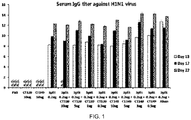
- the H1N1 vaccine composition was intramuscularly injected twice to mice at an interval of two weeks, after which the immune response induced in each test group was observed. 13 days, 17 days and 27 days after the first intramuscular injection, the serum was sampled from each test group and the antibody titer thereof was measured through ELISA.
- the antibody able to detect a virus corresponding to the vaccine administered as a whole was produced in a larger amount in the groups administered with the vaccine in combination with CT120, CT149 or Alum than in the group administered only with the vaccine.
- the amounts of the produced antibodies were similar in the group administered with 5 ⁇ g of CT120 or 10 ⁇ g of CT149 and the group administered with Alum, and the group administered with 1 ⁇ g or 0.5 ⁇ g of CT149 produced the antibody in a large amount compared to the group administered with Alum.
- the groups administered with 5 ⁇ g of CT120 and 10 ⁇ g of CT149 (Groups 6 and 9) exhibited an HI titer similar to that of the group administered with Alum (Group 13), and the groups administered with 1 ⁇ g and 0.5 ⁇ g of CT149 (Groups 11 and 12) exhibited high HI titer compared to the group administered with Alum.
- CT120 or CT149 When CT120 or CT149 was administered together upon injection of the influenza virus vaccine, an immunogenicity-enhancing effect similar or superior to that of the Alum adjuvant was manifested. Thereby, CT120 and CT149 can be found to be effective in a method of enhancing an immune response induced by the influenza virus vaccine.
- H1N1 vaccine (cell-based) in an amount ranging from 0.01 ⁇ g to 1 ⁇ g was administered alone or in combination with an Alum adjuvant, after which the antibody titers were measured through ELISA, and the neutralizing antibody titers were measured through HI. "Standard” indicates a commercially available trivalent vaccine, and was used for comparison of test results.
- Group 3 H1N1 vaccine 1 ⁇ g Alum i.m.
- H1N1 vaccine 0.5 ⁇ g - i.m. 5
- Group 6 H1N1 vaccine 0.5 ⁇ g Alum i.m. 5
- Group 7 H1N1 vaccine 0.2 ⁇ g - i.m. 5
- Group 8 H1N1 vaccine 0.2 ⁇ g Alum i.m. 5
- Group 9 H1N1 vaccine 0.1 ⁇ g - i.m. 5
- Group 10 H1N1 vaccine 0.1 ⁇ g Alum i.m. 5
- Group 12 H1N1 vaccine 0.05 ⁇ g - i.m. 5
- Group 13 H1N1 vaccine 0.05 ⁇ g Alum i.m. 5
- Group 14 H1N1 vaccine 0.01 ⁇ g - i.m. 5
- Group 15 H1N1 vaccine 0.01 ⁇ g Alum i.m. 5
- Group 16 0.03 ⁇ g - i.m. 5
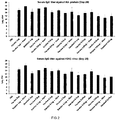
- the H1N1 vaccine composition was intramuscularly injected twice to mice at an interval of two weeks, after which the immune response induced in each test group was observed. 28 days after the first intramuscular injection, the serum was sampled from each test group and the antibody titer against HA protein and virus in the serum was measured through ELISA and the neutralizing antibody titer was measured through HI assay.
- the HI titer was increased in the test groups administered with the antigen and Alum compared to the test groups administered only with the antigen. Furthermore, in the test groups having an antigen concentration of 0.1 ⁇ g (Groups 9 and 10) and the test groups having an antigen concentration of 0.05 ⁇ g (Groups 12 and 13), the HI titer was increased 8 times and 4 times respectively when the Alum adjuvant was further added compared to when only the antigen was added, whereby a difference in the vaccine effects with or without the adjuvant was clearly confirmed.
- 10MLD 50 of CA/04/09 H1N1 virus was inoculated to the immunized mouse nasal cavity and allowed to infect it, after which changes in the survival rate and body weight of each mouse were measured for 15 days.
- the protective immunity effect against influenza virus was high at all concentrations in the test groups administered with the antigen and the adjuvant compared to the test group administered only with the antigen. Furthermore, as for the test groups of two antigen concentrations (0.1 ⁇ g and 0.05 ⁇ g) at which the vaccine effect was significantly different in the presence or absence of the adjuvant through HI titer measurement, in the 0.1 ⁇ g test groups, the test group administered only with the antigen exhibited a survival rate of 80% and the test group administered with the antigen and the adjuvant showed a survival rate of 100%. On the other hand, in the 0.05 ⁇ g test groups, the test group administered only with the antigen exhibited a survival rate of 60% and the test group administered with the antigen and the adjuvant showed a survival rate of 100%.
- the HI titer results were different but a difference in the protective immunity effects depending on whether or not the adjuvant was present was low, and thus, 0.05 ⁇ g, at which differences in the HI titer results and the protective immunity effects were significant depending on whether or not the adjuvant was present, was determined as the ultimate antigen concentration. Subsequently, animal testing was performed to evaluate the adjuvant effect using the same.
- the mouse-form antibody was manufactured by replacing the constant region of the Fc region in CT120 or CT149, which is the human IgG1 form, with the IgG1 or IgG2a region of the mouse.
- CT120 and CT120 were determined by selecting the concentrations effective as the adjuvant through the preliminary test (not described herein).
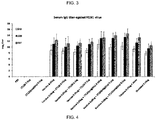
- the H1N1 vaccine (cell-based) was mixed with the therapeutic antibody at various concentrations, reacted at 37°C for 1 hr, and intramuscularly injected twice to mice at an interval of 2 weeks, as shown in Table 5 below. 13 days, 20 days, and 27 days after the first intramuscular injection, the serum was sampled in each test group and the antibody titer against H1N1 virus in the serum and the neutralizing antibody titer were measured through ELISA and HI assay, respectively.
- H1N1 vaccine 0.05 ⁇ g - i.m. 10
- Group 5 H1N1 vaccine 0.05 ⁇ g CT 120 0.05 ⁇ g i.m. 10
- Group 6 H1N1 vaccine 0.05 ⁇ g CT 120 0.1 ⁇ g i.m. 10
- Group 7 H1N1 vaccine 0.05 ⁇ g CT 120 0.5 ⁇ g i.m. 10
- Group 8 H1N1 vaccine 0.05 ⁇ g CT 120 (mIgG2a) 0.05 ⁇ g i.m. 10
- Group 9 H1N1 vaccine 0.05 ⁇ g CT 120 (mIgG2a) 0.1 ⁇ g i.m.
- Group 10 H1N1 vaccine 0.05 ⁇ g CT 120 (mIgG2a) 0.5 ⁇ g i.m. 10
- Group 11 H1N1 vaccine 0.05 ⁇ g Alum i.m. 10
- Group 12 Standard 0.15 ⁇ g - i.m. 10
- the antibody titer against H1N1 virus was higher in the test group using the mouse-form CT120 (mIgG2a) as the adjuvant than in the test group using CT120 as the adjuvant. Furthermore, in the case of the test group using CT120 (mIgG2a), the antibody titer was high compared to the test group using Alum as the adjuvant, and the antibody titer was drastically increased in the serum (D20 of FIG. 5 ) sampled 3 weeks after the first immunization. [Table 6] Ag Adjuvant HI titer G1 PBS - N.D. G2 PBS CT 120 0.5 ⁇ g N.D.
- G3 PBS CT 120 (mIgG2a) 0.5 ⁇ g N.D.
- G4 H1N1 vaccine 0.05 ⁇ g - 20 G5 H1N1 vaccine 0.05 ⁇ g CT 120 0.05 ⁇ g 40 G6 H1N1 vaccine 0.05 ⁇ g CT 120 0.1 ⁇ g 20 G7 H1N1 vaccine 0.05 ⁇ g CT 120 0.5 ⁇ g 20 G8 H1N1 vaccine 0.05 ⁇ g CT 120 (mIgG2a) 0.05 ⁇ g 40 G9 H1N1 vaccine 0.05 ⁇ g CT 120 (mIgG2a) 0.1 ⁇ g 80 G10 H1N1 vaccine 0.05 ⁇ g CT 120 (mIgG2a) 0.5 ⁇ g 160 G11 H1N1 vaccine 0.05 ⁇ g Alum 80 G12 Standard 0.15 ⁇ g - N.D.
- the HI titer was generally increased a maximum of 4 times depending on the concentration in the test group using CT120 (mIgG2a) as the adjuvant compared to the test group using CT120 as the adjuvant.
- 10MLD 50 of CA/04/09 H1N1 virus was inoculated to the immunized mouse nasal cavity and allowed to infect it, after which changes in the survival rate and body weight of each mouse were measured for 15 days.
- the survival rate was higher than in the test group using CT120 as the adjuvant or the test group using only the antigen, and the changes in body weight were the lowest.
- the test group using, as the adjuvant, 0.5 ⁇ g of CT120 (mIgG2a), having the highest antibody titer and HI titer results exhibited a survival rate of 100%, which is 30% higher than that of the test group using Alum as the adjuvant.
- CT120 (mIgG2a) can be found to be more effective as the adjuvant compared to CT120 and to manifest the greatest effect when administered at a concentration of 0.5 ⁇ g.
- G4 H1N1 vaccine 0.05 ⁇ g - 20 G5 H1N1 vaccine 0.05 ⁇ g CT 149 0.01 ⁇ g 20 G6 H1N1 vaccine 0.05 ⁇ g CT 149 0.05 ⁇ g 40 G7 H1N1 vaccine 0.05 ⁇ g CT 149 0.5 ⁇ g 20 G8 H1N1 vaccine 0.05 ⁇ g CT 149 (mIgG2a) 0.01 ⁇ g 20 G9 H1N1 vaccine 0.05 ⁇ g CT 149 (mIgG2a) 0.05 ⁇ g 40 G10 H1N1 vaccine 0.05 ⁇ g CT 149 (mIgG2a) 0.5 ⁇ g 80 G11 H1N1 vaccine 0.05 ⁇ g Alum 80 G12 Standard 0.15 ⁇ g - N.D.
- the HI titer was not significantly increased in the test group using CT149 or CT149 (mIgG2a) as the adjuvant, and as in the results of antibody titer measured through ELISA, the HI titer in the test group using 0.5 ⁇ g of CT149 (mIgG2a) (Group 10) was the same as that in the test group using the Alum adjuvant (Group 11).
- 10MLD 50 of CA/04/09 H1N1 virus was inoculated to the immunized mouse nasal cavity and allowed to infect it, after which changes in the survival rate and body weight of each mouse were measured for 15 days.
- the test group using 0.5 ⁇ g of CT149 (mIgG2a) as the adjuvant exhibited a survival rate of 80%, which is 10% higher than when using Alum.
- the extent of changing the body weight was not significantly improved compared to when using Alum.
- CT120 (mIgG2a) exhibited an outstanding adjuvant effect for the H1N1 vaccine, especially the greatest effect when used at a concentration of 0.5 ⁇ g.
- CT149 (mIgG2a) was used at 0.5 ⁇ g, the adjuvant effect was exhibited, but was lower than that of CT120 (mIgG2a).
- CT120 and CT149 as the adjuvant for H1N1 vaccine were confirmed through Examples 1 to 3, and, using another influenza virus strain, Philippines/2/82(H3N2), H3N2 vaccine (cell-based) was produced, and animal testing was performed to evaluate the effects of CT120 and CT149 as the adjuvant for H3N2 vaccine.
- H3N2 vaccine in an amount ranging from 0.01 ⁇ g to 1 ⁇ g was administered alone or in combination with the Alum adjuvant, after which the antibody titers were measured through ELISA and the neutralizing antibody titers were measured through HI. Furthermore, in order to evaluate the protective immunity effect, each mouse was infected with mouse-adapted Philippines/2/82(H3N2) virus and changes in the survival rate and body weight thereof were measured. [Table 9] Group Ag Adjuvant Route Mouse # Group 1 PBS - i.m. 5 Group 2 H3N2 vaccine 1 ⁇ g - i.m.
- the H3N2 vaccine composition was intramuscularly injected twice to mice at an interval of two weeks, after which the immune response induced in each test group was observed. 2 weeks after each intramuscular injection, the serum was sampled from each test group and the antibody titer against H3N2 virus in the serum was measured through ELISA and the neutralizing antibody titer was measured through HI assay.
- H3N2 vaccine 1 ⁇ g - 160
- Group 4 H3N2 vaccine 0.5 ⁇ g - 160
- Group 5 H3N2 vaccine 0.5 ⁇ g Alum 320
- Group 6 H3N2 vaccine 0.2 ⁇ g - 80
- Group 7 H3N2 vaccine 0.2 ⁇ g
- Group 8 H3N2 vaccine 0.1 ⁇ g - 80
- Group 9 H3N2 vaccine 0.1 ⁇ g Alum 320
- Group 12 H3N2 vaccine 0.01 ⁇ g - N.D.
- Group 13 H3N2 vaccine 0.01 ⁇ g Alum 160
- the HI titer was higher in the test group using the antigen and Alum than in the test group using only the antigen.
- the test groups using 0.01 ⁇ g and 0.05 ⁇ g of the antigen (Groups 12 and 10)
- the HI titer could not be measured, but the HI titers were increased to 160 and 640 in the test groups further added with the Alum as adjuvant (Groups 13 and 11), respectively.
- 10MLD 50 of A/Philippines/2/82 H3N2 virus was inoculated to the immunized mouse nasal cavity and allowed to infect it, after which changes in the survival rate and body weight of each mouse were measured for 15 days.
- the immune response effects were high in the test groups other than the test groups administered only with low-dose antigens, namely 0.01 ⁇ g of the antigen and 0.05 ⁇ g of the antigen.
- the H3N2 vaccine composition exhibited variable HI titer and survival rate depending on the presence or absence of the adjuvant at the antigen concentration (0.05 ⁇ g) used in the H1N1 test of Example 3.
- animal testing for evaluating adjuvant effects of the therapeutic antibodies CT120 and CT149 using the determined H3N2 antigen concentration of 0.05 ⁇ g was performed in the same manner as in Example 3, whereby the effects of CT120 and CT149 as the adjuvant for H3N2 vaccine serving as the antigen were confirmed.
- the therapeutic influenza antibody was concluded to function as an adjuvant in a method for enhancing the effect of the influenza vaccine.
- animal testing for the mechanism for generating the adjuvant effect was performed.
- the hypothesis about the mechanism for exhibiting the effect of the therapeutic antibody in a method of enhancing an immune response induced by an influenza vaccine is that the Fc region of the antibody may bind to the Fc receptor present in immune cells, whereby the immune response to influenza vaccine may occur more efficiently.
- CT120 (mIgG2a)-administered group was tested at concentrations of 0.1 ⁇ g and 0.5 ⁇ g, at which the greatest effects as the H1N1 vaccine adjuvant were shown in Example 3.
- testing was performed in the group in which the same amount was administered as to CT120 (mIgG2a) and in the group in which the amount of CT120 (mIgG2a) F(ab')2 was calculated and administered so as to be identical to the molar ratio with the vaccine at 0.5 ⁇ g and 0.1 ⁇ g of CT120 (mIgG2a).
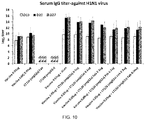
- H1N1 vaccine was mixed with various concentrations of CT120 (mIgG2a) or CT120 (mIgG2a) F(ab')2, reacted at 37°C for 1 hr, and intramuscularly injected twice to mice at an interval of 2 weeks as shown in Table 11, after which the immune response induced in each test group was observed. 13 days, 20 days and 27 days after the first intramuscular injection, the serum was sampled in each test group and the antibody titer against H1N1 virus in the serum and the neutralizing antibody titer against H1N1 virus were measured through ELISA and HI, respectively.
- the HI titer in all of the test groups using CT120 (mIgG2a) F(ab')2 as the adjuvant (Groups 8 to 11) was similar to that of the test group (Group 2) in which the H1N1 vaccine was administered alone without the adjuvant.
- the test groups (Groups 6 and 7) using intact CT120 (mIgG2a) as the adjuvant exhibited HI titers of 160 and 80, respectively, which are increased 8 times and 4 times compared to the test group in which the H1N1 vaccine was administered alone (Group 2).
- 10MLD 50 of CA/04/09 H1N1 virus was inoculated to the immunized mouse nasal cavity and allowed to infect it, after which the survival rate of each mouse was measured for 15 days.
- the Fc region of the antibody was found to play an important role as the influenza vaccine adjuvant.
- the Fc region of the influenza antibody was confirmed to play an important function as the adjuvant in Example 5. Accordingly, animal testing was performed to discover cells having an immune response varying depending on the binding to the Fc region, among immune cells that express the Fc receptor. Used as the amount of the antibody was mouse-form CT120 (mIgG2a) 0.5 ⁇ g, which exhibited the greatest effect as the H1N1 vaccine adjuvant in Example 3.
- the H1N1 vaccine and the adjuvant were mixed, reacted at 37°C for 1 hr, and intramuscularly injected twice to mice at an interval of 2 weeks, as set forth in Table 14. 1 day, 3 days and 7 days thereafter, the spleen and the inguinal lymph node in each mouse were separated and thus the number of various immune cells and the corresponding cell proportion were measured.
- the CT120 adjuvant was confirmed to increase the immune response of B cells through the Fc region.
- the CT120 F(ab')2-administered group there was no difference with the mouse to which the PBS control was administered, and thus the importance of the Fc region was confirmed once more. Accordingly, the CT120 adjuvant can be found to increase the immunogenicity of the H1N1 vaccine through a mechanism different from that of the commercially available adjuvant Alum.
- CT120 adjuvant was confirmed to enhance B cell immunity in Example 6-1. Based thereon, animal testing for evaluating whether the CT120 adjuvant is able to be associated with the protective immunity of B cells even in a state of viral inoculation was performed.
- the H1N1 vaccine composition was intramuscularly injected twice to mice at an interval of 2 weeks. After 4 weeks, 10MLD 50 of CA/04/09 H1N1 virus was inoculated to the immunized mouse nasal cavity. 1 day and 3 days after viral infection, the spleen and the internal lymph node in each mouse were separated and the B cell proportion in all the cells was measured using a flow cytometer.
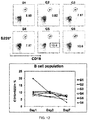
- the B cell population was increased by about 10% in the test group using both the H1N1 vaccine and CT120 compared to the PBS control.
- the B cell population was significantly increased compared to the PBS control, but was not greatly increased compared to the test group using CT120.
- immature B cells namely B-1 cells (CD19 + B220-) were present in the other groups, but only B-2 cells (CD19+B220+) developed from the B-1 cells were present in the test group using the H1N1 vaccine and CT120.
- lymph nodes as in the spleen, the B cell proportion was not drastically increased, but was significantly increased in three repeated experiments.
- CT120 was confirmed to be effective as the influenza vaccine adjuvant, and this effect was compared with the effect of a currently useful influenza vaccine adjuvant.
- the currently commercially available seasonal influenza vaccine adjuvant is MF59, Fluad of Novartis.
- AddaVaxTM InvivoGen, Catalog # vac-adx-10) having the same composition as MF59 was used.
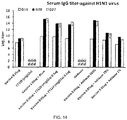
- H1N1 vaccine was mixed with CT120 (mIgG2a) or AddaVax having the same composition as the commercially available adjuvant, reacted at 37°C for 1 hr, and intramuscularly injected twice to mice at an interval of 2 weeks, as set forth in Table 16, and the immune response induced in each test group was then observed. 13 days, 20 days and 27 days after the first intramuscular injection, the serum was sampled in each test group and the antibody titer against H1N1 virus in the serum and the neutralizing antibody titer against H1N1 virus were measured through ELISA and HI, respectively.
- H1N1 vaccine 0.05 ⁇ g Alum 160 Group 6 H1N1 vaccine 0.05 ⁇ g CT 120 (mIgG2a) 0.5 ⁇ g 160 Group 7 H1N1 vaccine 0.05 ⁇ g CT 120 (mIgG2a) 0.1 ⁇ g 80 Group 8 H1N1 vaccine 0.05 ⁇ g AddaVax 100% 160 Group 9 H1N1 vaccine 0.05 ⁇ g AddaVax 10% 20 Group 10 H1N1 vaccine 0.05 ⁇ g AddaVax 1% N.D.
- 10MLD 50 of CA/04/09 H1N1 virus was inoculated to the immunized mouse nasal cavity and allowed to infect it, after which the mouse survival rate was measured for 15 days.
Landscapes
- Health & Medical Sciences (AREA)
- Life Sciences & Earth Sciences (AREA)
- Chemical & Material Sciences (AREA)
- Medicinal Chemistry (AREA)
- Immunology (AREA)
- General Health & Medical Sciences (AREA)
- Virology (AREA)
- Organic Chemistry (AREA)
- Microbiology (AREA)
- Engineering & Computer Science (AREA)
- Veterinary Medicine (AREA)
- Pharmacology & Pharmacy (AREA)
- Animal Behavior & Ethology (AREA)
- Public Health (AREA)
- Epidemiology (AREA)
- Mycology (AREA)
- Bioinformatics & Cheminformatics (AREA)
- Genetics & Genomics (AREA)
- Biochemistry (AREA)
- Biomedical Technology (AREA)
- Zoology (AREA)
- Wood Science & Technology (AREA)
- Molecular Biology (AREA)
- Chemical Kinetics & Catalysis (AREA)
- General Chemical & Material Sciences (AREA)
- Biotechnology (AREA)
- Pulmonology (AREA)
- Biophysics (AREA)
- Proteomics, Peptides & Aminoacids (AREA)
- General Engineering & Computer Science (AREA)
- Hematology (AREA)
- Cell Biology (AREA)
- Communicable Diseases (AREA)
- Oncology (AREA)
- Nuclear Medicine, Radiotherapy & Molecular Imaging (AREA)
- Medicines Containing Antibodies Or Antigens For Use As Internal Diagnostic Agents (AREA)
- Micro-Organisms Or Cultivation Processes Thereof (AREA)
- Peptides Or Proteins (AREA)
Description
- The present invention relates to an adjuvant composition comprising at least one binding molecule for neutralizing influenza virus, for use in a method for enhancing an immune response induced by a vaccine, and more particularly to an adjuvant composition including at least one human monoclonal antibody having neutralizing activity against influenza virus, for use in a method for enhancing an immune response induced by a vaccine to thus increase the efficacy of the vaccine.
- Influenza, which is an illness caused by infecting the respiratory tract with an influenza virus, is common in the winter and is highly infectious and easily spread to all ages, and is also known to particularly afflict the elderly (Treanor J, 2004, N Engl. J Med. 350(3):218-20). Influenza viruses, which are enveloped viruses belonging to the Orthomyxoviridae family and the genome of which consists of eight negative-sense single-stranded RNA (ribonucleic acid) segments, are classified into groups A, B and C, and influenza A viruses are further divided into a number of subtypes depending on HA (hemagglutinin) and NA (neuraminidase) as the major surface proteins. 17 types of HA and 10 types of NA are known so far (Cheung TK and Poon LL 2007, Ann N Y Acad. Sci. 1102:1-25; Tong S, et al. 2012, Proc. Natl. Acad. Sci. U. S. A. 109:4269-4274). Influenza viruses continuously produce variant viruses to thus features that may infect birds, pigs and humans depending on the types thereof and create a variety of gene combinations and mutations due to the genome comprising RNA segments. Treanor J, 2004. N Engl. J Med. 350(3):218-20). Because of such persistent mutations, it is difficult to obtain permanent immunity, and currently, the most effective prevention method is to form immunity appropriate for a particular type annually by inoculating a vaccine against influenza virus, which is predicted to be popular every year.
- The influenza virus vaccine, which is currently inoculated every year, is a trivalent or tetravalent vaccine composed of HA of H1 and H3 subtypes of influenza A and one or two kinds of HA of influenza B.
- A vaccine against various infectious diseases, including the influenza virus vaccine, may be added with a substance for increasing immunogenicity, and such a substance is referred to as an adjuvant. Examples of adjuvants approved for use on humans may include Alum, composed of aluminum hydroxide and aluminum phosphate, an oil-in-water emulsion MF59, AS03, and AS04, composed of the TLR4 agonist MPL and aluminum hydroxide (Rappuoli R, 2011. Nature Reviews Immunology 11, 11(12):865-72).
- In addition thereto, there are many reports on enhancing an immune response by administering an antibody and an antigen together, and many attempts are being made to use the antibody as the adjuvant.
- The antibody against influenza A virus, filed by the present applicant, exhibits neutralizing activity against various influenza subtypes, and particularly, the antibody disclosed in
Korean Patent Application No. 10-2011-0020061 Korean Patent Application No. 10-2012-0107512 Groups Korean Patent Application No. 10-2014-0036601
The patent applicationEP2762491 also discloses human monoclonal antibodies having neutralizing activity against influenza A virus. - The present inventors have ascertained that the effect of a vaccine may be increased by administering the vaccine together with the antibody for neutralizing influenza virus, which was already developed by the present inventors, and have found the new use of the already-developed antibody as the adjuvant, thus culminating in the present invention.
- Accordingly, the present specification describes an adjuvant composition comprising at least one binding molecule for neutralizing influenza virus.
- In addition, the present specification describes a vaccine composition comprising the adjuvant composition and a target antigen.
- In addition, the present specification describes a method of producing the vaccine composition comprising the adjuvant composition and the target antigen.
- In addition, the present specification describes a method of increasing an immune response to a target antigen by administering the adjuvant composition to a host.
- In addition, the present specification describes a method of immunizing a host by administering the vaccine composition to the host.
- In addition, the present specification describes a method of preparing an immunological product from the host immunized by administering the vaccine composition to the host.
- Therefore, the present invention provides a composition comprising at least one monoclonal antibody for neutralizing an influenza A virus, selected from the group consisting of:
- i) a monoclonal antibody, comprising a light-chain variable domain including a CDR1 region of SEQ ID NO:1, a CDR2 region of SEQ ID NO:2 and a CDR3 region of SEQ ID NO:3, and a heavy-chain variable domain including a CDR1 region of SEQ ID NO:4, a CDR2 region of SEQ ID NO:5 and a CDR3 region of SEQ ID NO:6, as determined according to the Kabat method; and
- ii) a monoclonal antibody, comprising a light-chain variable domain including a CDR1 region of SEQ ID NO:7, a CDR2 region of SEQ ID NO:8 and a CDR3 region of SEQ ID NO:9, and a heavy-chain variable domain including a CDR1 region of SEQ ID NO:10, a CDR2 region of SEQ ID NO:11 and a CDR3 region of SEQ ID NO:12, as determined according to the Kabat method,
- In a specific embodiment of the invention, the at least one monoclonal antibody is at least one selected from the group consisting of i) a monoclonal antibody including a light chain having a polypeptide sequence of SEQ ID NO:13 and a heavy chain having a polypeptide sequence of SEQ ID NO:14; and ii) a monoclonal antibody including a light chain having a polypeptide sequence of SEQ ID NO:15 and a heavy chain having a polypeptide sequence of SEQ ID NO:16.
- In another specific embodiment of the invention, the vaccine for the prevention of a disease caused by an influenza virus comprises a target antigen that is an influenza A virus antigen.
- In another specific embodiment of the invention, the weight ratio of the antigen and the composition as described above ranges from 1:0.02 to 1:200.
- The present specification also describes an adjuvant composition comprising at least one binding molecule for neutralizing influenza virus.
- In a particular aspect of the present specification, the binding molecule may bind to an epitope in a stem region of a hemagglutinin (HA) protein of influenza A virus.
- In a particular aspect of the present specification, the epitope of the binding molecule may be at least one selected from the group consisting of i) an epitope comprising any one amino acid residue selected from the group consisting of amino acids at
positions positions - In a particular aspect of the present specification, the epitope of the binding molecule may include amino acid residues at
positions positions - In a particular aspect of the present specification, the epitope of the binding molecule may include amino acid residues at
positions positions - In a particular aspect of the present specification, the epitope of the binding molecule may include amino acid residues at positions 278 and 318 of the HA1 polypeptide. Also, the epitope of the binding molecule may include amino acid residues at positions 38, 39, 41, 42, 45, 48, 49, 52, and 53 of the HA2 polypeptide.
- In a particular aspect of the present specification, the epitope of the binding molecule may include amino acid residues at said positions of the HA1 polypeptide and/or the HA2 polypeptide of a first monomer of HA, and may further include amino acid residues at
positions 25, 32 and 33 of the HA1 polypeptide of a second monomer adjacent to the first monomer. - In a particular aspect of the present specification, the epitope of the binding molecule may include amino acid residues at positions 278 and 318 of the HA1 polypeptide, and amino acid residues at positions 38, 39, 41, 42, 45, 48, 49, 52, and 53 of the HA2 polypeptide.
- In a particular aspect of the present specification, the epitope of the binding molecule may include amino acid residues at said positions of the HA1 polypeptide and the HA2 polypeptide of a first monomer of HA, and may further include amino acid residues at
positions 25, 32 and 33 of the HA1 polypeptide of a second monomer adjacent to the first monomer. - In a particular aspect of the present specification, the epitope of the binding molecule may include amino acid residues at positions 278 and 318 of the HA1 polypeptide, and amino acid residues at positions 38, 39, 41, 42, 45, 48, 49, 52, 53, 58 and 99 of the HA2 polypeptide.
- In a particular aspect of the present specification, the epitope of the binding molecule may include amino acid residues at said positions of the HA1 polypeptide and the HA2 polypeptide of a first monomer of HA, and may further include amino acid residues at
positions - In a particular aspect of the present specification, the epitope of the binding molecule may include amino acid residues at positions 54, 55, 278, 291 and 318 of the HA1 polypeptide and amino acid residues at
positions - In a particular aspect of the present specification, the epitope of the binding molecule may include amino acid residues at said positions of the HA1 polypeptide and the HA2 polypeptide of a first monomer of HA, and may further include amino acid residues at
positions 25, 32, 33, 310, 311, and 312 of the HA1 polypeptide of a second monomer of HA adjacent to the first monomer of HA. - The numbering of the amino acid positions of the epitope is based on an H3 HA numbering system.
- According to the present invention, the binding molecule is at least one selected from the group consisting of i) a binding molecule, comprising a light-chain variable domain including a CDR1 region of SEQ ID NO:1, a CDR2 region of SEQ ID NO:2 and a CDR3 region of SEQ ID NO:3, and a heavy-chain variable domain including a CDR1 region of SEQ ID NO:4, a CDR2 region of SEQ ID NO:5 and a CDR3 region of SEQ ID NO:6, as determined according to the Kabat method; and ii) a binding molecule, comprising a light-chain variable domain including a CDR1 region of SEQ ID NO:7, a CDR2 region of SEQ ID NO:8 and a CDR3 region of SEQ ID NO:9, and a heavy-chain variable domain including a CDR1 region of SEQ ID NO:10, a CDR2 region of SEQ ID NO:11 and a CDR3 region of SEQ ID NO:12, as determined according to the Kabat method.
- In the present invention, CDRs of the variable domains are determined using a typical method in accordance with the system devised by Kabat et al. (Reference [Kabat et al., Sequences of Proteins of Immunological Interest (5th), National Institutes of Health, Bethesda, MD. (1991)]). The CDR numbering used in the present invention was performed using the Kabat method, but the present invention also encompasses binding molecules comprising CDRs determined by other methods, including the IMGT method, the Chothia method, and the AbM method, etc.
- In a particular aspect of the present specification, the binding molecule may include at least one selected from the group consisting of i) a binding molecule including a light chain comprising a polypeptide sequence of SEQ ID NO:13 and a heavy chain comprisinga polypeptide sequence of SEQ ID NO:14; and ii) a binding molecule including a light chain comprising a polypeptide sequence of SEQ ID NO:15 and a heavy chain comprising a polypeptide sequence of SEQ ID NO:16.
- In an embodiment of the present invention, the binding molecule includes a binding molecule binding to an Fc receptor of a cell surface.
- In addition, the present invention provides a composition for use in a method as previously mentioned, wherein the vaccine for the prevention of a disease caused by an influenza virus comprises a target antigen that is an influenza virus antigen. The influenza virus antigen includes an influenza A virus or influenza B virus antigen. The influenza virus antigen may be hemagglutinin (HA) or neuraminidase (NA) but is not limited thereto.
- Also, in another embodiment of the present invention, the composition for use in a method as previously mentioned may include the antigen and the composition at a weight ratio of 1:0.02 to 1:200, and preferably 1:0.2 to 1:20, but is not limited thereto. The weight ratio of the antigen and the composition may be decreased or increased to modulate immunogenic activity.
- Also, in another embodiment of the present invention, the present invention provides a composition for use in a method as previously mentioned, further comprising an additional adjuvant composition, in addition to the said composition as well as the said adjuvant composition. The additional adjuvant composition may include, but is not limited to, Alum, metabolizable oils (e.g. squalene), tocols (e.g. α-tocopherol), sterols (e.g. cholesterol), saponins (e.g. QS21), Toll-like receptor ligands (e.g. poly(I:C)), an oligonucleotide having a CpG motif and/or LPS derivatives (e.g. 3D-MPL).
- In addition, the present specification provides a method of preparing a vaccine composition comprising the adjuvant composition and a target antigen. The vaccine composition may be an influenza virus vaccine composition, but is not limited thereto.
- In addition, the present specification provides a method of increasing an immune response to a target antigen by administering the adjuvant composition to a host. The vaccine composition may be an influenza virus vaccine composition, but is not limited thereto.
- Also, in another embodiment of the present invention, the immune response may be induced by a cell having an Fc receptor on the surface thereof, but the present invention is not limited thereto.
- In addition, the present specification provides a method of preventing a disease caused by virus, comprising administering an effective amount of the vaccine composition containing the adjuvant composition to a subject. For example, the disease caused by a virus may be a disease caused by the influenza virus.
- In addition, the present specification provides a method of immunizing a host by administering the vaccine composition to the host.
- In addition, the present specification provides a method of preparing an immunological product, comprising a) immunizing a host by administering the vaccine composition to the host and b) obtaining the immunological product from the immunized host.
- Also, in a particular aspect of the present specification, the immunological product may be T cells, B cells, or an antibody. The immunological product may be other kinds of cells having an Fc receptor on the cell surface, like the B cells, for example, neutrophils, macrophages, natural killer cells or dendritic cells.
- Hereinafter, the terms used in the present invention and/or specification are defined as follows.
- As used herein, the term "influenza virus" refers to an enveloped virus belonging to the Orthomyxoviridae family and having a genome composed of eight negative-sense single-stranded RNA (ribonucleic acid) segments. Influenza viruses are classified into groups A, B and C, and are further divided into a number of subtypes depending on HA (hemagglutinin) and NA (neuraminidase) as the major surface proteins thereof. 17 types of HA and 10 types of NA have been reported to date.
- As used herein, "H1 subtype" includes H1N1, H1N2, H1N3, H1N4, H1N5, H1N6, H1N7, H1N8, H1N9 and H1N10.
- As used herein, "H2 subtype" includes H2N1, H2N2, H2N3, H2N4, H2N5, H2N6, H2N7, H2N8, H2N9 and H2N10.
- As used herein, "H5 subtype" includes H5N1, H5N2, H5N3, H5N4, H5N5, H5N6, H5N7, H5N8, H5N9 and H5N10.
- As used herein, "H9 subtype" includes H9N1, H9N2, H9N3, H9N4, H9N5, H9N6, H9N7, H9N8, H9N9 and H9N10.
- As used herein, "H3 subtype" includes H3N1, H3N2, H3N3, H3N4, H3N5, H3N6, H3N7, H3N8, H3N9 and H3N10.
- As used herein, "H7 subtype" includes H7N1, H7N2, H7N3, H7N4, H7N5, H7N6, H7N7, H7N8, H7N9 and H7N10.
- As descripted herein, the term "hemagglutinin" (hereinafter referred to as "HA") refers to the envelope glycoprotein of influenza virus. HA mediates the adsorption and penetration of influenza virus into a host cell. 17 HA subtypes have been reported to date.
- As descripted herein, the term "neuraminidase" (hereinafter referred to as "NA") refers to the envelope glycoprotein of influenza virus. NA plays an important role when influenza viruses have been spread after proliferation. 10 NA subtypes have been reported to date.
- As descripted herein, an influenza vaccine is regarded as being the most effective method of preventing seasonal or pandemic influenza, and largely includes a live vaccine and an inactivated vaccine. As the live vaccine, a live attenuated vaccine is developed and used. The inactivated vaccine may include a whole virus vaccine using the entire virus in which a virus incubated from an embryonated egg or via cell culture is purified and inactivated with formalin or the like, a split vaccine in which the envelope of the virus is disrupted with ether or the like, and a subunit vaccine in which HA and NA components are purified. A vaccine including H1 and H3 subtypes of the influenza A group and one kind from the influenza B group is a trivalent vaccine, and a vaccine including H1 and H3 subtypes of the influenza A group and two kinds from the influenza B group is a tetravalent vaccine.
- As descripted herein, "influenza vaccine" includes all live vaccines and inactivated vaccines, which are trivalent, tetravalent, seasonal, and pandemic.
- As descripted herein, the term "binding molecule" refers to an intact immunoglobulin including monoclonal antibodies, such as chimeric, humanized or human monoclonal antibodies, fusion protein which comprising Fc of immunoglobulin or immunoglobulin which binds to antigen, for example, a variable domain including an immunoglobulin fragment that competes with the intact immunoglobulin in order to bind to the monomeric HA or trimeric HA of influenza A virus, a substrate-binding enzyme, a receptor or a protein. Regardless of the structure, an antigen-binding fragment binds with the same antigen that is recognized by the intact immunoglobulin. The antigen-binding fragment may comprise a peptide or polypeptide comprising an amino acid sequence consisting of at least 2 contiguous amino acid residues, at least 20 contiguous amino acid residues, at least 25 contiguous amino acid residues, at least 30 contiguous amino acid residues, at least 35 contiguous amino acid residues, at least 40 contiguous amino acid residues, at least 50 contiguous amino acid residues, at least 60 contiguous amino acid residues, at least 70 contiguous amino acid residues, at least 80 contiguous amino acid residues, at least 90 contiguous amino acid residues, at least 100 contiguous amino acid residues, at least 125 contiguous amino acid residues, at least 150 contiguous amino acid residues, at least 175 contiguous amino acid residues, at least 200 contiguous amino acid residues, or at least 250 contiguous amino acid residues of the amino acid sequence of the binding molecule.
- As descripted herein, the term "antigen-binding fragment", particularly, includes Fab, F(ab'), F(ab')2, Fv, dAb, Fd, complementarity-determining region (CDR) fragments, single-chain antibodies (scFv), bivalent single-chain antibodies, single-chain phage antibodies, diabodies, triabodies, tetrabodies, polypeptides that include at least one fragment of an immunoglobulin that is sufficient to confer specific antigen binding to the polypeptide, etc. The above fragments may be produced synthetically or by enzymatic or chemical cleavage of intact immunoglobulins, or they may be genetically engineered by recombinant DNA techniques. Such production methods are well known in the art.
- As used herein, the term "adjuvant" refers to a substance or composition that is added to a vaccine or pharmaceutically active ingredients to thus increase and/or effect an immune response. Examples thereof include an immunogenic carrier or assistant material and/or other pharmaceutically active materials or compositions. Typically, the term "adjuvant" should be interpreted broadly and refers to a broad range of substances or stratagems that may be incorporated into the adjuvant or may enhance the immunogenicity of the antigen administered with the adjuvant. Furthermore, the adjuvant may include, but is not limited to, an immune potentiator, an antigen delivery system or a combination thereof.
- As used herein, the term "immunological product" refers to a protective immune mediator or cell generated from the host immunized by the administration of the adjuvant composition and/or the antigen, and examples thereof may include, but are not limited to, activated T cells, B cells or antibodies.
- As used herein, the term "pharmaceutically acceptable excipient" means any inert substance that is combined with an active molecule such as a drug, agent, or binding molecule for preparing an admittable or convenient dosage form. The pharmaceutically acceptable excipient is an excipient that is non-toxic or at least less toxic to recipients at the used dosages and concentrations, and is compatible with other ingredients of the formulation comprising the drug, agent or binding molecule.
- As used herein, the term "effective amount" refers to an amount of the binding molecule of the invention that is effective for increasing the effect of the vaccine upon administration with the vaccine against influenza A virus.
- In the present invention, the already-filed antibodies (
Korean Patent Application Nos. 10-2011-0020061 10-2012-0107512 10-2014-0036601 Korean Patent Application Nos. 10-2011-0020061 10-2012-0107512 10-2014-0036601 - According to the present invention, a composition including at least one binding molecule for neutralizing influenza virus can enhance the effect of a vaccine, and can thus be used in a method for increasing an immune response upon administration of a vaccine and is very effective at preventing diseases caused by influenza viruses.
-
-
FIG. 1 shows the ELISA results of a specific antibody titer against H1N1 influenza virus in a serum that is sampled 13 days, 17 days and 27 days after the first intramuscular injection under the condition that each mouse is intramuscularly injected twice with an H1N1 vaccine composition at an interval of two weeks (Table 1); -
FIG. 2 shows the ELISA results of a specific antibody titer against H1N1 HA protein and H1N1 influenza virus in a serum that is sampled 28 days after the first intramuscular injection under the condition that each mouse is intramuscularly injected twice with an H1N1 vaccine composition at an interval of two weeks (Table 3); -
FIG. 3 shows changes in the survival rate and body weight of the immunized mouse after inoculating the immunized mouse with 10MLD50 of H1N1 influenza virus ; -
FIG. 4 shows the ELISA results of a specific antibody titer against H1N1 influenza virus in a serum that is sampled 13 days, 20 days and 27 days after the first intramuscular injection under the condition that each mouse is intramuscularly injected twice with an H1N1 vaccine composition at an interval of two weeks (Table 5); -
FIG. 5 shows changes in the survival rate and body weight of the immunized mouse after inoculating the immunized mouse with 10MLD50 of H1N1 influenza virus; -
FIG. 6 shows the ELISA results of a specific antibody titer against H1N1 influenza virus in a serum that is sampled 13 days, 20 days and 27 days after the first intramuscular injection under the condition that each mouse is intramuscularly injected twice with an H1N1 vaccine composition at an interval of two weeks (Table 7); -
FIG. 7 shows changes in the survival rate and body weight of the immunized mouse after inoculating the immunized mouse with 10MLD50 of H1N1 influenza virus; -
FIG. 8 shows the ELISA results of a specific antibody titer against H3N2 influenza virus in a serum that is sampled 13 days and 27 days after the first intramuscular injection under the condition that each mouse is intramuscularly injected twice with an H3N2 vaccine composition at an interval of two weeks (Table 9); -
FIG. 9 shows changes in the survival rate and body weight of the immunized mouse after inoculating the immunized mouse with 10MLD50 of H3N2 influenza virus; -
FIG. 10 shows the ELISA results of a specific antibody titer against H1N1 influenza virus in a serum is sampled 13 days, 20 days and 27 days after the first intramuscular injection under the condition that each mouse is intramuscularly injected twice with an H1N1 vaccine composition at an interval of two weeks (Table 11); -
FIG. 11 shows the results of measurement the proportion of the B cell population among immune cells in thespleen 1 day, 3 days and 7 days after the second intramuscular injection under the condition that each mouse is intramuscularly injected twice with an H1N1 vaccine composition at an interval of two weeks (Table 14); -
FIG. 12 shows the results of measurement the proportion of the B cell population among immune cells in theinguinal lymph node 1 day, 3 days and 7 days after the second intramuscular injection under the condition that each mouse is intramuscularly injected twice with an H1N1 vaccine composition at an interval of two weeks (Table 14); -
FIG. 13 shows the results of measurement the proportion of the B cell population in the spleen andlymph nodes 1 day and 3 days after inoculation withH1N1 virus 4 weeks after the second intramuscular injection under the condition that each mouse is intramuscularly injected twice with an H1N1 vaccine composition at an interval of two weeks (Table 15); and -
FIG. 14 shows the ELISA results of a specific antibody titer against H1N1 influenza virus in a serum that is sampled 13 days, 20 days and 27 days after the first intramuscular injection under the condition that each mouse is intramuscularly injected twice with an H1N1 vaccine composition at an interval of two weeks (Table 16). - Hereinafter, the present invention will be explained in more detail with reference to the following examples. However, the following examples and test examples are provided only to illustrate the present invention but are not to be construed as the limit of present invention.
- In order to evaluate the effect of therapeutic CT120 and CT149 antibodies in a method of enhancing an immune response induced by an influenza virus vaccine, as set forth in Table 1 below, animal testing was performed. As shown in Table 1 below, 0.2 µg of H1N1 split vaccine was administered alone, or in combination with an adjuvant Alum (1 mg) typically used as an adjuvant or a CT120 antibody (0.5 µg, 1 µg, 5 µg, 10 µg) or a CT149 antibody (0.5 µg, 1 µg, 5 µg, 10 µg) as an adjuvant, after which the antibody titer against influenza virus in each mouse was measured.
[Table 1] Group Antigen Adjuvant Route Mouse # Group 1 PBS - i.m. 4 Group 2PBS CT 120 10 µg i.m. 4 Group 3PBS CT 149 10 µg i.m. 4 Group 4H1N1 split vaccine 0.2 µg - i.m. 4 Group 5H1N1 split vaccine 0.2 µg CT 120 10 µg i.m. 4 Group 6H1N1 split vaccine 0.2 µg CT 120 5 µg i.m. 4 Group 7H1N1 split vaccine 0.2 µg CT120 1 µg i.m. 4 Group 8H1N1 split vaccine 0.2 µg CT120 0.5 µg i.m. 4 Group 9H1N1 split vaccine 0.2 µg CT149 10 µg i.m. 4 Group 10H1N1 split vaccine 0.2 µg CT149 5 µg i.m. 4 Group 11H1N1 split vaccine 0.2 µg CT149 1 µg i.m. 4 Group 12H1N1 split vaccine 0.2 µg CT149 0.5 µg i.m. 4 Group 13H1N1 split vaccine 0.2 µg Alum i.m. 4 - As set forth in Table 1, the H1N1 vaccine composition was intramuscularly injected twice to mice at an interval of two weeks, after which the immune response induced in each test group was observed. 13 days, 17 days and 27 days after the first intramuscular injection, the serum was sampled from each test group and the antibody titer thereof was measured through ELISA.
- As seen in the results of
FIG. 1 , the antibody able to detect a virus corresponding to the vaccine administered as a whole was produced in a larger amount in the groups administered with the vaccine in combination with CT120, CT149 or Alum than in the group administered only with the vaccine. When comparing the amounts of theantibodies 27 days after administration of the vaccine and the adjuvant, the amounts of the produced antibodies were similar in the group administered with 5 µg of CT120 or 10 µg of CT149 and the group administered with Alum, and the group administered with 1 µg or 0.5 µg of CT149 produced the antibody in a large amount compared to the group administered with Alum. - As shown in Table 2 below, in order to verify whether the therapeutic antibodies CT120 and CT149 are effective in a method of enhancing an immune response induced by an influenza virus vaccine, the effectiveness of the vaccine was evaluated through hemagglutinin inhibition assay (HI assay). 13 days, 17 days and 27 days after administration of the vaccine and the adjuvant, the serum was obtained from each mouse, and the antibody titer able to inhibit the hemagglutination of influenza virus and chicken erythrocyte was measured.
[Table 2] Group Antigen Adjuvant HI titer Day 13 Day 17 Day 27Group 1PBS - N.D. N.D. N.D. Group 2PBS CT 120 10 µg N.D. N.D. N.D. Group 3PBS CT 149 10 µg N.D. N.D. N.D. Group 4H1N1 split vaccine 0.2 µg - N.D. N.D. 40 Group 5H1N1 split vaccine 0.2 µg CT 120 10 µg N.D. N.D. 40 Group 6H1N1 split vaccine 0.2 µg CT 120 5 µg N.D. N.D. 80 Group 7H1N1 split vaccine 0.2 µg CT120 1 µg N.D. N.D. 40 Group 8H1N1 split vaccine 0.2 µg CT120 0.5 µg N.D. N.D. 40 Group 9H1N1 split vaccine 0.2 µg CT149 10 µg N.D. N.D. 80 Group 10H1N1 split vaccine 0.2 µg CT149 5 µg N.D. N.D. 40 Group 11H1N1 split vaccine 0.2 µg CT149 1 µg N.D. 40 160 Group 12H1N1 split vaccine 0.2 µg CT149 0.5 µg N.D. N.D. 160 Group 13 H1N1 split vaccine 0.2 µg Alum N.D. 20 80 - As in the results of
FIG. 1 , when comparing the amounts of theantibodies 27 days after administration of the vaccine and the adjuvant, the groups administered with 5 µg of CT120 and 10 µg of CT149 (Groups 6 and 9) exhibited an HI titer similar to that of the group administered with Alum (Group 13), and the groups administered with 1 µg and 0.5 µg of CT149 (Groups 11 and 12) exhibited high HI titer compared to the group administered with Alum. - When CT120 or CT149 was administered together upon injection of the influenza virus vaccine, an immunogenicity-enhancing effect similar or superior to that of the Alum adjuvant was manifested. Thereby, CT120 and CT149 can be found to be effective in a method of enhancing an immune response induced by the influenza virus vaccine.
- As shown in Table 3 below, animal testing was performed to determine the appropriate antigen concentration before the verification of the adjuvant effect of the therapeutic antibody. H1N1 vaccine (cell-based) in an amount ranging from 0.01 µg to 1 µg was administered alone or in combination with an Alum adjuvant, after which the antibody titers were measured through ELISA, and the neutralizing antibody titers were measured through HI. "Standard" indicates a commercially available trivalent vaccine, and was used for comparison of test results.
[Table 3] Group Ag Adjuvant Route Mouse # Group 1 PBS - i.m. 5 Group 2H1N1 vaccine 1 µg- i.m. 5 Group 3H1N1 vaccine 1 µgAlum i.m. 5 Group 4Standard 3 µg- i.m. 5 Group 5H1N1 vaccine 0.5 µg - i.m. 5 Group 6H1N1 vaccine 0.5 µg Alum i.m. 5 Group 7H1N1 vaccine 0.2 µg - i.m. 5 Group 8H1N1 vaccine 0.2 µg Alum i.m. 5 Group 9H1N1 vaccine 0.1 µg - i.m. 5 Group 10H1N1 vaccine 0.1 µg Alum i.m. 5 Group 11Standard 0.3 µg - i.m. 5 Group 12H1N1 vaccine 0.05 µg - i.m. 5 Group 13H1N1 vaccine 0.05 µg Alum i.m. 5 Group 14H1N1 vaccine 0.01 µg - i.m. 5 Group 15H1N1 vaccine 0.01 µg Alum i.m. 5 Group 16Standard 0.03 µg - i.m. 5 - As set forth in Table 3, the H1N1 vaccine composition was intramuscularly injected twice to mice at an interval of two weeks, after which the immune response induced in each test group was observed. 28 days after the first intramuscular injection, the serum was sampled from each test group and the antibody titer against HA protein and virus in the serum was measured through ELISA and the neutralizing antibody titer was measured through HI assay.
- As seen in the results of
FIG. 2 , the antibody titer was increased in approximate proportion to the amount of the antigen that was added, and the antibody titer was higher when the Alum adjuvant was added therewith. Furthermore, there was no great difference between the antibody titer against HA protein and the antibody titer against H1N1 virus.[Table 4] Group HI titer Group 1 PBS N.D. Group 2H1N1 1 µg160 Group 3H1N1 1 µg + alum1280 Group 4Standard 3 µg80 Group 5H1N1 0.5 µg 160 Group 6H1N1 0.5 µg + alum 320 Group 7H1N1 0.2 µg 80 Group 8H1N1 0.2 µg + alum 160 Group 9H1N1 0.1 µg 20 Group 10H1N1 0.1 µg + alum 160 Group 11Standard 0.3 µg N.D. Group 12H1N1 0.05 µg 20 Group 13H1N1 0.05 µg + alum 80 Group 14H1N1 0.01 µg N.D. Group 15H1N1 0.01 µg + alum N.D. Group 16Standard 0.03 µg N.D. - As is apparent from the results of Table 4, the HI titer was increased in the test groups administered with the antigen and Alum compared to the test groups administered only with the antigen. Furthermore, in the test groups having an antigen concentration of 0.1 µg (
Groups 9 and 10) and the test groups having an antigen concentration of 0.05 µg (Groups 12 and 13), the HI titer was increased 8 times and 4 times respectively when the Alum adjuvant was further added compared to when only the antigen was added, whereby a difference in the vaccine effects with or without the adjuvant was clearly confirmed. - In order to evaluate the protective immunity against influenza virus, 4 weeks after the second immunization, 10MLD50 of CA/04/09 H1N1 virus was inoculated to the immunized mouse nasal cavity and allowed to infect it, after which changes in the survival rate and body weight of each mouse were measured for 15 days.
- As shown in the results of
FIG. 3 , the protective immunity effect against influenza virus was high at all concentrations in the test groups administered with the antigen and the adjuvant compared to the test group administered only with the antigen. Furthermore, as for the test groups of two antigen concentrations (0.1 µg and 0.05 µg) at which the vaccine effect was significantly different in the presence or absence of the adjuvant through HI titer measurement, in the 0.1 µg test groups, the test group administered only with the antigen exhibited a survival rate of 80% and the test group administered with the antigen and the adjuvant showed a survival rate of 100%. On the other hand, in the 0.05 µg test groups, the test group administered only with the antigen exhibited a survival rate of 60% and the test group administered with the antigen and the adjuvant showed a survival rate of 100%. - Based on the HI titer results and the protective immunity effects against influenza virus, as for the 0.1 µg test groups, the HI titer results were different but a difference in the protective immunity effects depending on whether or not the adjuvant was present was low, and thus, 0.05 µg, at which differences in the HI titer results and the protective immunity effects were significant depending on whether or not the adjuvant was present, was determined as the ultimate antigen concentration. Subsequently, animal testing was performed to evaluate the adjuvant effect using the same.
- Using an antigen concentration of 0.05 µg, determined based on the animal test results (Example 2), animal testing for verifying the adjuvant effects of therapeutic antibodies CT120 and CT149 was carried out. Here, in mouse testing, the adjuvant effects of CT120 (mIgG2a) and CT149 (mIgG2a), corresponding to the mouse forms of CT120 and CT149 antibodies, are expected to be effective compared to CT120 or CT149, and thus all of CT120 and CT149 and mouse forms thereof were used for animal testing.
- The mouse-form antibody was manufactured by replacing the constant region of the Fc region in CT120 or CT149, which is the human IgG1 form, with the IgG1 or IgG2a region of the mouse.
- The amounts of CT120 and CT120 (mIgG2a) were determined by selecting the concentrations effective as the adjuvant through the preliminary test (not described herein).
- The H1N1 vaccine (cell-based) was mixed with the therapeutic antibody at various concentrations, reacted at 37°C for 1 hr, and intramuscularly injected twice to mice at an interval of 2 weeks, as shown in Table 5 below. 13 days, 20 days, and 27 days after the first intramuscular injection, the serum was sampled in each test group and the antibody titer against H1N1 virus in the serum and the neutralizing antibody titer were measured through ELISA and HI assay, respectively.
[Table 5] Group Ag Adjuvant Route Mouse # Group 1 PBS - i.m. 10 Group 2PBS CT 120 0.5 µg i.m. 10 Group 3PBS CT 120 (mIgG2a) 0.5 µg i.m. 10 Group 4H1N1 vaccine 0.05 µg - i.m. 10 Group 5H1N1 vaccine 0.05 µg CT 120 0.05 µg i.m. 10 Group 6H1N1 vaccine 0.05 µg CT 120 0.1 µg i.m. 10 Group 7H1N1 vaccine 0.05 µg CT 120 0.5 µg i.m. 10 Group 8H1N1 vaccine 0.05 µg CT 120 (mIgG2a) 0.05 µg i.m. 10 Group 9H1N1 vaccine 0.05 µg CT 120 (mIgG2a) 0.1 µg i.m. 10 Group 10H1N1 vaccine 0.05 µg CT 120 (mIgG2a) 0.5 µg i.m. 10 Group 11H1N1 vaccine 0.05 µg Alum i.m. 10 Group 12Standard 0.15 µg - i.m. 10 - As seen in the results of
FIG. 4 , the antibody titer against H1N1 virus was higher in the test group using the mouse-form CT120 (mIgG2a) as the adjuvant than in the test group using CT120 as the adjuvant. Furthermore, in the case of the test group using CT120 (mIgG2a), the antibody titer was high compared to the test group using Alum as the adjuvant, and the antibody titer was drastically increased in the serum (D20 ofFIG. 5 ) sampled 3 weeks after the first immunization.[Table 6] Ag Adjuvant HI titer G1 PBS - N.D. G2 PBS CT 120 0.5 µg N.D. G3 PBS CT 120 (mIgG2a) 0.5 µg N.D. G4 H1N1 vaccine 0.05 µg - 20 G5 H1N1 vaccine 0.05 µg CT 120 0.05 µg 40 G6 H1N1 vaccine 0.05 µg CT 120 0.1 µg 20 G7 H1N1 vaccine 0.05 µg CT 120 0.5 µg 20 G8 H1N1 vaccine 0.05 µg CT 120 (mIgG2a) 0.05 µg 40 G9 H1N1 vaccine 0.05 µg CT 120 (mIgG2a) 0.1 µg 80 G10 H1N1 vaccine 0.05 µg CT 120 (mIgG2a) 0.5 µg 160 G11 H1N1 vaccine 0.05 µg Alum 80 G12 Standard 0.15 µg - N.D. - As is apparent from the results of Table 6, the HI titer was generally increased a maximum of 4 times depending on the concentration in the test group using CT120 (mIgG2a) as the adjuvant compared to the test group using CT120 as the adjuvant. The test group (Group 10) using 0.5 µg of CT120 (mIgG2a), having the highest antibody titer, exhibited the highest HI titer, specifically 160, among all test groups.
- In order to evaluate the protective immunity against influenza virus, 4 weeks after the second immunization, 10MLD50 of CA/04/09 H1N1 virus was inoculated to the immunized mouse nasal cavity and allowed to infect it, after which changes in the survival rate and body weight of each mouse were measured for 15 days.
- As seen in the results of
FIG. 5 , when CT120 (mIgG2a) was used as the adjuvant, the survival rate was higher than in the test group using CT120 as the adjuvant or the test group using only the antigen, and the changes in body weight were the lowest. In particular, the test group using, as the adjuvant, 0.5 µg of CT120 (mIgG2a), having the highest antibody titer and HI titer results, exhibited a survival rate of 100%, which is 30% higher than that of the test group using Alum as the adjuvant. - Thereby, CT120 (mIgG2a) can be found to be more effective as the adjuvant compared to CT120 and to manifest the greatest effect when administered at a concentration of 0.5 µg.
- As shown in Table 7 below, the concentration at which the adjuvant effect was exhibited in the preliminary test (not described herein) for CT149 was determined, and the same testing as in Example 3-1-1 was carried out.
[Table 7] Group Ag Adjuvant Route Mouse # Group 1 PBS - i.m. 10 Group 2PBS CT 149 0.5 µg i.m. 10 Group 3PBS CT 149 (mIgG2a) 0.5 µg i.m. 10 Group 4H1N1 vaccine 0.05 µg - i.m. 10 Group 5H1N1 vaccine 0.05 µg CT 149 0.01 µg i.m. 10 Group 6H1N1 vaccine 0.05 µg CT 149 0.05 µg i.m. 10 Group 7H1N1 vaccine 0.05 µg CT 149 0.5 µg i.m. 10 Group 8H1N1 vaccine 0.05 µg CT 149 (mIgG2a) 0.01 µg i.m. 10 Group 9H1N1 vaccine 0.05 µg CT 149 (mIgG2a) 0.05 µg i.m. 10 Group 10H1N1 vaccine 0.05 µg CT 149 (mIgG2a) 0.5 µg i.m. 10 Group 11H1N1 vaccine 0.05 µg Alum i.m. 10 Group 12Standard 0.15 µg - i.m. 10 - As seen in the results of
FIG. 6 , the adjuvant effect of CT149 was generally weak, unlike CT120, and the antibody titer similar to the test group using the Alum adjuvant was represented in the test group using 0.5 µg of CT149 (mIgG2a).[Table 8] Ag Adjuvant HI titer G1 PBS - N.D. G2 PBS CT 149 0.5 µg N.D. G3 PBS CT 149 (mIgG2a) 0.5 µg N.D. G4 H1N1 vaccine 0.05 µg - 20 G5 H1N1 vaccine 0.05 µg CT 149 0.01 µg 20 G6 H1N1 vaccine 0.05 µg CT 149 0.05 µg 40 G7 H1N1 vaccine 0.05 µg CT 149 0.5 µg 20 G8 H1N1 vaccine 0.05 µg CT 149 (mIgG2a) 0.01 µg 20 G9 H1N1 vaccine 0.05 µg CT 149 (mIgG2a) 0.05 µg 40 G10 H1N1 vaccine 0.05 µg CT 149 (mIgG2a) 0.5 µg 80 G11 H1N1 vaccine 0.05 µg Alum 80 G12 Standard 0.15 µg - N.D. - As is apparent from the results of Table 8, the HI titer was not significantly increased in the test group using CT149 or CT149 (mIgG2a) as the adjuvant, and as in the results of antibody titer measured through ELISA, the HI titer in the test group using 0.5 µg of CT149 (mIgG2a) (Group 10) was the same as that in the test group using the Alum adjuvant (Group 11).
- In order to evaluate the protective immunity against influenza virus, 4 weeks after the second immunization, 10MLD50 of CA/04/09 H1N1 virus was inoculated to the immunized mouse nasal cavity and allowed to infect it, after which changes in the survival rate and body weight of each mouse were measured for 15 days.
- As seen in the results of
FIG. 7 , the test group using 0.5 µg of CT149 (mIgG2a) as the adjuvant exhibited a survival rate of 80%, which is 10% higher than when using Alum. The extent of changing the body weight was not significantly improved compared to when using Alum. - Based on the above results, CT120 (mIgG2a) exhibited an outstanding adjuvant effect for the H1N1 vaccine, especially the greatest effect when used at a concentration of 0.5 µg. When CT149 (mIgG2a) was used at 0.5 µg, the adjuvant effect was exhibited, but was lower than that of CT120 (mIgG2a).
- The effects of CT120 and CT149 as the adjuvant for H1N1 vaccine were confirmed through Examples 1 to 3, and, using another influenza virus strain, Philippines/2/82(H3N2), H3N2 vaccine (cell-based) was produced, and animal testing was performed to evaluate the effects of CT120 and CT149 as the adjuvant for H3N2 vaccine.
- As shown in Table 9 below, animal testing was performed to determine the appropriate antigen concentration before verification of the adjuvant effect of the therapeutic antibody. H3N2 vaccine in an amount ranging from 0.01 µg to 1 µg was administered alone or in combination with the Alum adjuvant, after which the antibody titers were measured through ELISA and the neutralizing antibody titers were measured through HI. Furthermore, in order to evaluate the protective immunity effect, each mouse was infected with mouse-adapted Philippines/2/82(H3N2) virus and changes in the survival rate and body weight thereof were measured.
[Table 9] Group Ag Adjuvant Route Mouse # Group 1 PBS - i.m. 5 Group 2H3N2 vaccine 1 µg- i.m. 5 Group 3H3N2 vaccine 1 µgAlum i.m. 5 Group 4H3N2 vaccine 0.5 µg - i.m. 5 Group 5H3N2 vaccine 0.5 µg Alum i.m. 5 Group 6H3N2 vaccine 0.2 µg - i.m. 5 Group 7H3N2 vaccine 0.2 µg Alum i.m. 5 Group 8H3N2 vaccine 0.1 µg - i.m. 5 Group 9H3N2 vaccine 0.1 µg Alum i.m. 5 Group 10H3N2 vaccine 0.05 µg - i.m. 5 Group 11H3N2 vaccine 0.05 µg Alum i.m. 5 Group 12H3N2 vaccine 0.01 µg - i.m. 5 Group 13H3N2 vaccine 0.01 µg Alum i.m. 5 - As set forth in Table 9, the H3N2 vaccine composition was intramuscularly injected twice to mice at an interval of two weeks, after which the immune response induced in each test group was observed. 2 weeks after each intramuscular injection, the serum was sampled from each test group and the antibody titer against H3N2 virus in the serum was measured through ELISA and the neutralizing antibody titer was measured through HI assay.
- As seen in the results of
FIG. 8 , the antibody titer was increased in proportion to the amount of the antigen that was added, and the antibody titer was higher when used together with the Alum adjuvant.[Table 10] Group Ag Adjuvant HI titer Group 1 PBS - N.D. Group 2H3N2 vaccine 1 µg- 160 Group 3H3N2 vaccine 1 µgAlum 320 Group 4H3N2 vaccine 0.5 µg - 160 Group 5H3N2 vaccine 0.5 µg Alum 320 Group 6H3N2 vaccine 0.2 µg - 80 Group 7H3N2 vaccine 0.2 µg Alum 640 Group 8H3N2 vaccine 0.1 µg - 80 Group 9H3N2 vaccine 0.1 µg Alum 320 Group 10H3N2 vaccine 0.05 µg - N.D. Group 11H3N2 vaccine 0.05 µg Alum 640 Group 12H3N2 vaccine 0.01 µg - N.D. Group 13H3N2 vaccine 0.01 µg Alum 160 - As is apparent from the results of Table 10, the HI titer was higher in the test group using the antigen and Alum than in the test group using only the antigen. In the test groups using 0.01 µg and 0.05 µg of the antigen (
Groups 12 and 10), the HI titer could not be measured, but the HI titers were increased to 160 and 640 in the test groups further added with the Alum as adjuvant (Groups 13 and 11), respectively. - In order to evaluate the protective immunity against influenza virus, 4 weeks after the second immunization, 10MLD50 of A/Philippines/2/82 H3N2 virus was inoculated to the immunized mouse nasal cavity and allowed to infect it, after which changes in the survival rate and body weight of each mouse were measured for 15 days.
- As shown in the results of
FIG. 9 , the immune response effects were high in the test groups other than the test groups administered only with low-dose antigens, namely 0.01 µg of the antigen and 0.05 µg of the antigen. - The H3N2 vaccine composition exhibited variable HI titer and survival rate depending on the presence or absence of the adjuvant at the antigen concentration (0.05 µg) used in the H1N1 test of Example 3. Thus, animal testing for evaluating adjuvant effects of the therapeutic antibodies CT120 and CT149 using the determined H3N2 antigen concentration of 0.05 µg was performed in the same manner as in Example 3, whereby the effects of CT120 and CT149 as the adjuvant for H3N2 vaccine serving as the antigen were confirmed.
- Based on the test results of Examples 1 to 4, the therapeutic influenza antibody was concluded to function as an adjuvant in a method for enhancing the effect of the influenza vaccine. Thus, animal testing for the mechanism for generating the adjuvant effect was performed.
- The hypothesis about the mechanism for exhibiting the effect of the therapeutic antibody in a method of enhancing an immune response induced by an influenza vaccine is that the Fc region of the antibody may bind to the Fc receptor present in immune cells, whereby the immune response to influenza vaccine may occur more efficiently.
- In order to prove this hypothesis, the antibody concentrations of CT120 (mIgG2a) 0.1 µg and 0.5 µg, which manifested the apparent adjuvant effect in Example 3, were chosen, and intact CT120 (mIgG2a) and Fc-free CT120 (mIgG2a) F(ab')2 in various amounts as shown in Table 11 below were reacted with 0.05 µg of H1N1 vaccine and were then intramuscularly injected to mice, after which the induced immune response was observed.
- As shown in Table 11 below, the CT120 (mIgG2a)-administered group was tested at concentrations of 0.1 µg and 0.5 µg, at which the greatest effects as the H1N1 vaccine adjuvant were shown in Example 3. As for the CT120 (mIgG2a) F(ab')2-administered group, testing was performed in the group in which the same amount was administered as to CT120 (mIgG2a) and in the group in which the amount of CT120 (mIgG2a) F(ab')2 was calculated and administered so as to be identical to the molar ratio with the vaccine at 0.5 µg and 0.1 µg of CT120 (mIgG2a).
[Table 11] Group Ag Adjuvant Route Mouse # Group 1 PBS - i.m. 10 Group 2H1N1 vaccine 0.05 µg - i.m. 10 Group 3PBS CT 120 (mIgG2a) F(ab')2 0.5 µg i.m. 10 Group 4PBS CT 120 (mIgG2a) 0.5 µg i.m. 10 Group 5H1N1 vaccine 0.05 µg Alum i.m. 10 Group 6H1N1 vaccine 0.05 µg CT 120 (mIgG2a) 0.5 µg i.m. 10 Group 7H1N1 vaccine 0.05 µg CT 120 (mIgG2a) 0.1 µg i.m. 10 Group 8H1N1 vaccine 0.05 µg CT 120 (mIgG2a) F(ab')2 0.5 µg i.m. 10 Group 9H1N1 vaccine 0.05 µg CT 120 (mIgG2a) F(ab')2 0.3 µg i.m. 10 Group 10H1N1 vaccine 0.05 µg CT 120 (mIgG2a) F(ab')2 0.1 µg i.m. 10 Group 11H1N1 vaccine 0.05 µg CT 120 (mIgG2a) F(ab')2 0.06 µg i.m. 10 - H1N1 vaccine was mixed with various concentrations of CT120 (mIgG2a) or CT120 (mIgG2a) F(ab')2, reacted at 37°C for 1 hr, and intramuscularly injected twice to mice at an interval of 2 weeks as shown in Table 11, after which the immune response induced in each test group was observed. 13 days, 20 days and 27 days after the first intramuscular injection, the serum was sampled in each test group and the antibody titer against H1N1 virus in the serum and the neutralizing antibody titer against H1N1 virus were measured through ELISA and HI, respectively.
- As shown in the results of
FIG. 10 , the antibody titer was relatively low when using CT120 (mIgG2a) F(ab')2, and the antibody titer difference was not significantly different in any of the test groups.[Table 12] Group Ag Adjuvant Route HI titer Group 1 PBS - i.m. N.D. Group 2H1N1 vaccine 0.05 µg - i.m. 20 Group 3PBS CT 120 (mIgG2a) F(ab')2 0.5 µg i.m. N.D. Group 4PBS CT 120 (mIgG2a) 0.5 µg i.m. N.D. Group 5H1N1 vaccine 0.05 µg Alum i.m. 160 Group 6H1N1 vaccine 0.05 µg CT 120 (mIgG2a) 0.5 µg i.m. 160 Group 7H1N1 vaccine 0.05 µg CT 120 (mIgG2a) 0.1 µg i.m. 80 Group 8H1N1 vaccine 0.05 µg CT 120 (mIgG2a) F(ab')2 0.5 µg i.m. 40 Group 9H1N1 vaccine 0.05 µg CT 120 (mIgG2a) F(ab')2 0.3 µg i.m. 20 Group 10H1N1 vaccine 0.05 µg CT 120 (mIgG2a) F(ab')2 0.1 µg i.m. 20 Group 11H1N1 vaccine 0.05 µg CT 120 (mIgG2a) F(ab')2 0.06 µg i.m. 40 - As is apparent from the results of Table 12, the HI titer in all of the test groups using CT120 (mIgG2a) F(ab')2 as the adjuvant (
Groups 8 to 11) was similar to that of the test group (Group 2) in which the H1N1 vaccine was administered alone without the adjuvant. In contrast, the test groups (Groups 6 and 7) using intact CT120 (mIgG2a) as the adjuvant exhibited HI titers of 160 and 80, respectively, which are increased 8 times and 4 times compared to the test group in which the H1N1 vaccine was administered alone (Group 2). - In order to evaluate the protective immunity against influenza virus, 4 weeks after the second immunization, 10MLD50 of CA/04/09 H1N1 virus was inoculated to the immunized mouse nasal cavity and allowed to infect it, after which the survival rate of each mouse was measured for 15 days.
[Table 13] Group Ag Adjuvant Survival rate (%) Group 1PBS - 0 % Group 2 H1N1 vaccine 0.05 µg - 20 % Group 3 PBS CT 120 (mIgG2a) F(ab')2 0.5 µg 0 % Group 4 PBS CT 120 (mIgG2a) 0.5 µg 0 % Group 5 H1N1 vaccine 0.05 µg Alum 80 % Group 6 H1N1 vaccine 0.05 µg CT 120 (mIgG2a) 0.5 µg 100 % Group 7 H1N1 vaccine 0.05 µg CT 120 (mIgG2a) 0.1 µg 90 % Group 8 H1N1 vaccine 0.05 µg CT 120 (mIgG2a) F(ab')2 0.5 µg 50 % Group 9 H1N1 vaccine 0.05 µg CT 120 (mIgG2a) F(ab')2 0.3 µg 30 % Group 10 H1N1 vaccine 0.05 µg CT 120 (mIgG2a) F(ab')2 0.1 µg 30 % Group 11 H1N1 vaccine 0.05 µg CT 120 (mIgG2a) F(ab')2 0.06 µg 30% - As is apparent from the results of Table 13, the test groups using intact CT120 (mIgG2a) as the adjuvant (
Groups 6 and 7) exhibited a high survival rate, as in Example 3, but the test groups using CT120 (mIgG2a) F(ab')2 as the adjuvant (Groups 8 to 11) manifested a survival rate similar to that of the test group using only the antigen (Group 2). - Based on the above results, the Fc region of the antibody was found to play an important role as the influenza vaccine adjuvant.
- The Fc region of the influenza antibody was confirmed to play an important function as the adjuvant in Example 5. Accordingly, animal testing was performed to discover cells having an immune response varying depending on the binding to the Fc region, among immune cells that express the Fc receptor. Used as the amount of the antibody was mouse-form CT120 (mIgG2a) 0.5 µg, which exhibited the greatest effect as the H1N1 vaccine adjuvant in Example 3.
[Table 14] Group Ag Adjuvant Route Mouse# Group 1 PBS - i.m 3 Group 2H1N1 vaccine 0.05 µg - i.m 3 Group 3 - CT 120 (mIgG2a) 0.5 µg i.m 3 Group 4H1N1 vaccine 0.05 µg Alum i.m 3 Group 5H1N1 vaccine 0.05 µg CT 120 (mIgG2a) 0.5 µg i.m 3 Group 6H1N1 vaccine 0.05 µg CT 120 (mIgG2a) F(ab')2 0.5 µg i.m 3 - The H1N1 vaccine and the adjuvant were mixed, reacted at 37°C for 1 hr, and intramuscularly injected twice to mice at an interval of 2 weeks, as set forth in Table 14. 1 day, 3 days and 7 days thereafter, the spleen and the inguinal lymph node in each mouse were separated and thus the number of various immune cells and the corresponding cell proportion were measured.
- As shown in the results of
FIGS. 11 and12 , when H1N1 vaccine and CT120 (mIgG2a) were added, the amount of B cells was approximately doubled in both the spleen and theinguinal lymph node 1 day after the two intramuscular injections, compared to the other administered groups. On the 3rd day and the 7th day, relatively similar cell proportion resulted. - Thus, the CT120 adjuvant was confirmed to increase the immune response of B cells through the Fc region. In the CT120 F(ab')2-administered group, there was no difference with the mouse to which the PBS control was administered, and thus the importance of the Fc region was confirmed once more. Accordingly, the CT120 adjuvant can be found to increase the immunogenicity of the H1N1 vaccine through a mechanism different from that of the commercially available adjuvant Alum.
- The CT120 adjuvant was confirmed to enhance B cell immunity in Example 6-1. Based thereon, animal testing for evaluating whether the CT120 adjuvant is able to be associated with the protective immunity of B cells even in a state of viral inoculation was performed.
[Table 15] Group Ag Adjuvant Route Mouse# Group 1 PBS - i.m 3 Group 2H1N1 vaccine 0.05 µg - i.m 3 Group 3H1N1 vaccine 0.05 µg CT 120 (mIgG2a) 0.5 µg i.m 3 Group 4H1N1 vaccine 0.05 µg Alum i.m 3 - As set forth in Table 15, the H1N1 vaccine composition was intramuscularly injected twice to mice at an interval of 2 weeks. After 4 weeks, 10MLD50 of CA/04/09 H1N1 virus was inoculated to the immunized mouse nasal cavity. 1 day and 3 days after viral infection, the spleen and the internal lymph node in each mouse were separated and the B cell proportion in all the cells was measured using a flow cytometer.
- As seen in the results of
FIG. 13 , when the spleen was analyzed 1 day after viral infection, the B cell population was increased by about 10% in the test group using both the H1N1 vaccine and CT120 compared to the PBS control. In the test group using both the vaccine and Alum, the B cell population was significantly increased compared to the PBS control, but was not greatly increased compared to the test group using CT120. Furthermore, immature B cells, namely B-1 cells (CD19 + B220-) were present in the other groups, but only B-2 cells (CD19+B220+) developed from the B-1 cells were present in the test group using the H1N1 vaccine and CT120. In the case of lymph nodes, as in the spleen, the B cell proportion was not drastically increased, but was significantly increased in three repeated experiments. - Thereby, when CT120 was used as the adjuvant, more mature B cells were rapidly formed.
- Through the above Example, CT120 was confirmed to be effective as the influenza vaccine adjuvant, and this effect was compared with the effect of a currently useful influenza vaccine adjuvant. The currently commercially available seasonal influenza vaccine adjuvant is MF59, Fluad of Novartis. In the following comparison test, AddaVax™ (InvivoGen, Catalog # vac-adx-10) having the same composition as MF59 was used.
- Testing was performed using 0.5 µg and 0.1 µg of mouse-form CT120 (mIgG2a), showing the greatest effect as the H1N1 vaccine adjuvant in Example 3. In Table 16 below, 100% AddaVax indicates the amount of the adjuvant contained in 45 µg of seasonal influenza vaccine HA.
[Table 16] Group Ag Adjuvant Route Mouse # Group 1 PBS - i.m. 10 Group 2H1N1 vaccine 0.05 µg - i.m. 10 Group 3PBS CT 120 (mIgG2a) Fab 0.5 µg i.m. 10 Group 4PBS AddaVax 100% i.m. 10 Group 5H1N1 vaccine 0.05 µg Alum i.m. 10 Group 6H1N1 vaccine 0.05 µg CT 120 (mIgG2a) 0.5 µg i.m. 10 Group 7H1N1 vaccine 0.05 µg CT 120 (mIgG2a) 0.1 µg i.m. 10 Group 8H1N1 vaccine 0.05 µg AddaVax 100% i.m. 10 Group 9H1N1 vaccine 0.05 µg AddaVax 10% i.m. 10 Group 10H1N1 vaccine 0.05 µg AddaVax 1% i.m. 10 - H1N1 vaccine was mixed with CT120 (mIgG2a) or AddaVax having the same composition as the commercially available adjuvant, reacted at 37°C for 1 hr, and intramuscularly injected twice to mice at an interval of 2 weeks, as set forth in Table 16, and the immune response induced in each test group was then observed. 13 days, 20 days and 27 days after the first intramuscular injection, the serum was sampled in each test group and the antibody titer against H1N1 virus in the serum and the neutralizing antibody titer against H1N1 virus were measured through ELISA and HI, respectively.
- As seen in the results of
FIG. 14 , only the test group administered with 100% AddaVax exhibited the antibody titer similar to that of the test groups administered with 0.5 µg and 0.1 µg of CT120 (mIgG2a). When 10% and 1% AddaVax were administered, low antibody titers resulted.[Table 17] Group Ag Adjuvant HI titer Group 1 PBS - N.D. Group 2H1N1 vaccine 0.05 µg - 20 Group 3PBS CT 120 (mIgG2a) Fab 0.5 µg N.D. Group 4PBS AddaVax 100% N.D. Group 5H1N1 vaccine 0.05 µg Alum 160 Group 6H1N1 vaccine 0.05 µg CT 120 (mIgG2a) 0.5 µg 160 Group 7H1N1 vaccine 0.05 µg CT 120 (mIgG2a) 0.1 µg 80 Group 8H1N1 vaccine 0.05 µg AddaVax 100% 160 Group 9H1N1 vaccine 0.05 µg AddaVax 10% 20 Group 10H1N1 vaccine 0.05 µg AddaVax 1% N.D. - As is apparent from the results of Table 17, the 100% AddaVax-administered test group (Group 8) exhibited the HI titer similar to the test groups administered with 0.5 µg and 0.1 µg of CT120 (mIgG2a) (
Groups 6 and 7), but the test groups administered with 1% and 10% AddaVax (Groups 10 and 9) manifested the HI titer similar to the test group administered only with H1N1 vaccine (Group 2) or the HI titer thereof was not measured. - In order to evaluate the protective immunity against influenza virus, 4 weeks after the second immunization, 10MLD50 of CA/04/09 H1N1 virus was inoculated to the immunized mouse nasal cavity and allowed to infect it, after which the mouse survival rate was measured for 15 days.
[Table 18] Group Ag Adjuvant Survival rate (%) Group 1PBS - 0 Group 2H1N1 vaccine 0.05 µg - 20 Group 3PBS CT 120 (mIgG2a) Fab 0.5 µg 0 Group 4PBS AddaVax 100% 0 Group 5H1N1 vaccine 0.05 µg Alum 80 Group 6H1N1 vaccine 0.05 µg CT 120 (mIgG2a) 0.5 µg 100 Group 7H1N1 vaccine 0.05 µg CT 120 (mIgG2a) 0.1 µg 90 Group 8H1N1 vaccine 0.05 µg AddaVax 100% 90 Group 9H1N1 vaccine 0.05 µg AddaVax 10% 60 Group 10H1N1 vaccine 0.05 µg AddaVax 1% 0 - As is apparent from the results of Table 18, the test group administered with 100% AddaVax (Group 8) exhibited a survival rate similar to that of the test groups administered with 0.5 µg and 0.1 µg of CT120 (mIgG2a) (
Groups 6 and 7), and the survival rate was decreased in the test groups administered with 1% and 10% AddaVax (Groups 10 and 9). - Therefore, the adjuvant effect when H1N1 vaccine was added with 0.5 µg and 0.1 µg of CT120 (mIgG2a) was similar to the effect when the adjuvant was added in an amount (100% AddaVax) in 45 µg of the commercially available influenza vaccine HA. In Example 4, when 0.5 µg of CT149 (mIgG2a) was used as the adjuvant, similar results were obtained compared to when 0.1 µg and 0.5 µg of CT120 (mIgG2a) were administered, from which CT149 (mIgG2a) can be expected to exhibit effects similar to those of CT120 (mIgG2a).
- <110> CELLTRION INC.
- <120> Adjuvant composition comprising one or more influenza virus neutralizing binding molecules and vaccine composition comprising thereof
- <130> CPD2015043KR
- <160> 16
- <170> KopatentIn 2.0
- <210> 1
<211> 11
<212> PRT
<213> Artificial Sequence - <220>
<223> CT120 light chain CDR1 - <400> 1

- <210> 2
<211> 7
<212> PRT
<213> Artificial Sequence - <220>
<223> CT120 light chain CDR2 - <400> 2

- <210> 3
<211> 9
<212> PRT
<213> Artificial Sequence - <220>
<223> CT120 light chain CDR3 - <400> 3

- <210> 4
<211> 5
<212> PRT
<213> Artificial Sequence - <220>
<223> CT120 heavy chain CDR1 - <400> 4

- <210> 5
<211> 17
<212> PRT
<213> Artificial Sequence - <220>
<223> CT120 heavy chain CDR2 - <400> 5

- <210> 6
<211> 14
<212> PRT
<213> Artificial Sequence - <220>
<223> CT120 heavy chain CDR3 - <400> 6

- <210> 7
<211> 12
<212> PRT
<213> Artificial Sequence - <220>
<223> CT149 light chain CDR1 - <400> 7

- <210> 8
<211> 7
<212> PRT
<213> Artificial Sequence - <220>
<223> CT149 light chain CDR2 - <400> 8

- <210> 9
<211> 9
<212> PRT
<213> Artificial Sequence - <220>
<223> CT149 light chain CDR3 - <400> 9

- <210> 10
<211> 5
<212> PRT
<213> Artificial Sequence - <220>
<223> CT149 heavy chain CDR1 - <400> 10

- <210> 11
<211> 17
<212> PRT
<213> Artificial Sequence - <220>
<223> CT149 heavy chain CDR2 - <400> 11

- <210> 12
<211> 17
<212> PRT
<213> Artificial Sequence - <220>
<223> CT149 heavy chain CDR3 - <400> 12

- <210> 13
<211> 234
<212> PRT
<213> Artificial Sequence - <220>
<223> CT120 light chain - <400> 13

- <210> 14
<211> 472
<212> PRT
<213> Artificial Sequence - <220>
<223> CT120 heavy chain - <400> 14
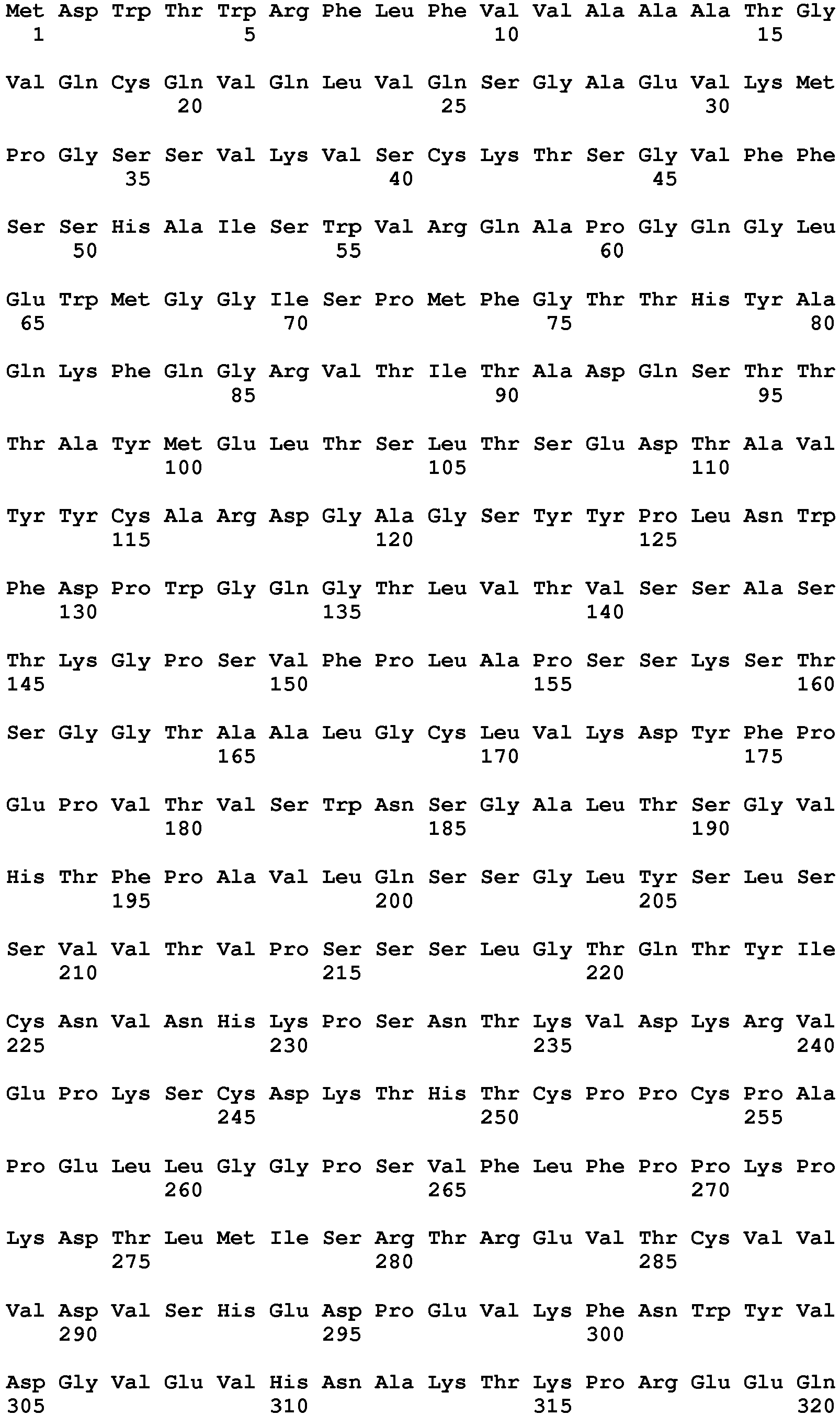

- <210> 15
<211> 215
<212> PRT
<213> Artificial Sequence - <220>
<223> CT149 light chain

- <210> 16
<211> 456
<212> PRT
<213> Artificial Sequence - <220>
<223> CT149 heavy chain

Claims (3)
- A composition comprising at least one monoclonal antibody for neutralizing an influenza A virus, selected from the group consisting of:i) a monoclonal antibody, comprising a light-chain variable domain including a CDR1 region of SEQ ID NO:1, a CDR2 region of SEQ ID NO:2 and a CDR3 region of SEQ ID NO:3, and a heavy-chain variable domain including a CDR1 region of SEQ ID NO:4, a CDR2 region of SEQ ID NO:5 and a CDR3 region of SEQ ID NO:6, as determined according to the Kabat method; andii) a monoclonal antibody, comprising a light-chain variable domain including a CDR1 region of SEQ ID NO:7, a CDR2 region of SEQ ID NO:8 and a CDR3 region of SEQ ID NO:9, and a heavy-chain variable domain including a CDR1 region of SEQ ID NO:10, a CDR2 region of SEQ ID NO:11 and a CDR3 region of SEQ ID NO:12, as determined according to the Kabat method; and a target antigen,for use in a method of enhancing an immune response induced by a vaccine for the prevention of a disease caused by an influenza virus, to thus increase the efficacy of said vaccine.
- The composition for use in a method according to claim 1, wherein the at least one monoclonal antibody is at least one selected from the group consisting ofi) a monoclonal antibody including a light chain having a polypeptide sequence of SEQ ID NO:13 and a heavy chain having a polypeptide sequence of SEQ ID NO:14; andii) a monoclonal antibody including a light chain having a polypeptide sequence of SEQ ID NO:15 and a heavy chain having a polypeptide sequence of SEQ ID NO:16.
- The composition for use in a method according to claim 1 or 2, wherein the vaccine for the prevention of a disease caused by an influenza virus comprises a target antigen that is an influenza A virus antigen.
Applications Claiming Priority (3)
| Application Number | Priority Date | Filing Date | Title |
|---|---|---|---|
| KR20140173469 | 2014-12-05 | ||
| KR1020150113515A KR20160068636A (en) | 2014-12-05 | 2015-08-11 | Adjuvant composition comprising one or more influenza virus neutralizing binding molecules and vaccine composition comprising thereof |
| PCT/KR2015/013279 WO2016089181A1 (en) | 2014-12-05 | 2015-12-05 | Adjuvant composition containing at least one influenza virus neutralizing and binding molecule and vaccine composition containing same |
Publications (3)
| Publication Number | Publication Date |
|---|---|
| EP3228323A1 EP3228323A1 (en) | 2017-10-11 |
| EP3228323A4 EP3228323A4 (en) | 2018-02-21 |
| EP3228323B1 true EP3228323B1 (en) | 2021-10-13 |
Family
ID=56135271
Family Applications (1)
| Application Number | Title | Priority Date | Filing Date |
|---|---|---|---|
| EP15866215.5A Not-in-force EP3228323B1 (en) | 2014-12-05 | 2015-12-05 | Adjuvant composition containing at least one influenza virus neutralizing and binding molecule and vaccine composition containing same |
Country Status (6)
| Country | Link |
|---|---|
| US (2) | US20180008702A1 (en) |
| EP (1) | EP3228323B1 (en) |
| JP (1) | JP6496409B2 (en) |
| KR (3) | KR20160068636A (en) |
| CN (1) | CN106999570B (en) |
| ES (1) | ES2902702T3 (en) |
Families Citing this family (4)
| Publication number | Priority date | Publication date | Assignee | Title |
|---|---|---|---|---|
| US20180008702A1 (en) | 2014-12-05 | 2018-01-11 | Celltrion Inc. | Adjuvant composition containing at least one influenza virus neutralizing and binding molecule and vaccine composition containing same |
| CN110680912B (en) * | 2019-09-26 | 2021-08-17 | 中国农业大学 | H3N2 and H3N8 subtype canine influenza bivalent inactivated vaccine and preparation method and application thereof |
| KR102475104B1 (en) | 2021-11-05 | 2022-12-07 | 에이피알지 주식회사 | Vaccine Adjuvant Composition comprising Agrimonia pilosa Extract and Galla rhois Extract |
| WO2023230448A1 (en) * | 2022-05-23 | 2023-11-30 | Vir Biotechnology, Inc. | Combination immunotherapy for influenza |
Citations (1)
| Publication number | Priority date | Publication date | Assignee | Title |
|---|---|---|---|---|
| WO2014158001A1 (en) * | 2013-03-29 | 2014-10-02 | (주)셀트리온 | Composition comprising at least two influenza a virus-neutralizing-binding molecules |
Family Cites Families (11)
| Publication number | Priority date | Publication date | Assignee | Title |
|---|---|---|---|---|
| AT409086B (en) * | 1999-11-16 | 2002-05-27 | Igeneon Krebs Immuntherapie | NEW USE OF ANTIBODIES AS VACCINE |
| KR100476343B1 (en) | 2003-01-24 | 2005-03-16 | 한국생명공학연구원 | Neutralizing human monoclonal antibody specific to hepatitis A virus |
| US8148085B2 (en) * | 2006-05-15 | 2012-04-03 | Sea Lane Biotechnologies, Llc | Donor specific antibody libraries |
| EP2164511A1 (en) * | 2007-05-22 | 2010-03-24 | Baylor College Of Medicine | Immune complex vaccination as a strategy to enhance immunity in the elderly and other immune compromised populations |
| EP2274334A2 (en) | 2008-03-28 | 2011-01-19 | Sea Lane Biotechnologies,llc. | Neutralizing molecules to viral antigens |
| CA2733218A1 (en) | 2008-07-25 | 2010-01-28 | Institute For Research In Biomedicine | Neutralizing anti-influenza a virus antibodies and uses thereof |
| CN101732716B (en) * | 2008-11-04 | 2011-12-28 | 中国科学院动物研究所 | Antigen-antibody complex for preventing and/or treating avian influenza |
| CA2849668A1 (en) * | 2010-03-08 | 2011-09-15 | Celltrion, Inc. | Human monoclonal antibodies derived from human b cells and having neutralizing activity against influenza a viruses |
| CN102233133A (en) * | 2010-04-29 | 2011-11-09 | 上海市农业科学院 | Preparation method and application of Newcastle disease virus infected immune complex vaccines |
| JP5998222B2 (en) * | 2011-09-30 | 2016-09-28 | セルトリオン・インコーポレイテッド | Binding molecule with neutralizing activity of influenza A virus produced in human B cells |
| US20180008702A1 (en) | 2014-12-05 | 2018-01-11 | Celltrion Inc. | Adjuvant composition containing at least one influenza virus neutralizing and binding molecule and vaccine composition containing same |
-
2015
- 2015-05-12 US US15/533,269 patent/US20180008702A1/en not_active Abandoned
- 2015-08-11 KR KR1020150113515A patent/KR20160068636A/en active Pending
- 2015-12-05 JP JP2017530090A patent/JP6496409B2/en not_active Expired - Fee Related
- 2015-12-05 CN CN201580065445.0A patent/CN106999570B/en not_active Expired - Fee Related
- 2015-12-05 KR KR1020150172803A patent/KR101814615B1/en active Active
- 2015-12-05 EP EP15866215.5A patent/EP3228323B1/en not_active Not-in-force
- 2015-12-05 ES ES15866215T patent/ES2902702T3/en active Active
-
2017
- 2017-12-27 KR KR1020170180869A patent/KR20180003518A/en not_active Withdrawn
-
2018
- 2018-09-13 US US16/130,405 patent/US10610587B2/en active Active
Patent Citations (2)
| Publication number | Priority date | Publication date | Assignee | Title |
|---|---|---|---|---|
| WO2014158001A1 (en) * | 2013-03-29 | 2014-10-02 | (주)셀트리온 | Composition comprising at least two influenza a virus-neutralizing-binding molecules |
| EP3011968A1 (en) * | 2013-03-29 | 2016-04-27 | Celltrion, Inc. | Composition comprising at least two influenza a virus-neutralizing-binding molecules |
Also Published As
| Publication number | Publication date |
|---|---|
| KR20160068636A (en) | 2016-06-15 |
| EP3228323A4 (en) | 2018-02-21 |
| KR20180003518A (en) | 2018-01-09 |
| KR101814615B1 (en) | 2018-01-04 |
| ES2902702T3 (en) | 2022-03-29 |
| US20180008702A1 (en) | 2018-01-11 |
| JP2017537931A (en) | 2017-12-21 |
| CN106999570B (en) | 2021-10-29 |
| EP3228323A1 (en) | 2017-10-11 |
| JP6496409B2 (en) | 2019-04-03 |
| CN106999570A (en) | 2017-08-01 |
| US10610587B2 (en) | 2020-04-07 |
| KR20160068692A (en) | 2016-06-15 |
| US20190000968A1 (en) | 2019-01-03 |
Similar Documents
| Publication | Publication Date | Title |
|---|---|---|
| Nachbagauer et al. | Age dependence and isotype specificity of influenza virus hemagglutinin stalk-reactive antibodies in humans | |
| Laursen et al. | Broadly neutralizing antibodies against influenza viruses | |
| AU2014244668B2 (en) | Composition comprising at least two influenza A virus-neutralizing-binding molecules | |
| EP2596017B1 (en) | Cross-protective antibody against influenza viral infection | |
| EP2793945B1 (en) | Antibodies useful in passive influenza immunization | |
| US20130289246A1 (en) | Influenza virus antibodies and immunogens and uses therefor | |
| CN104011077B (en) | From the binding molecule with influenza A virus neutralization activity that human B cell is produced | |
| JP7719725B2 (en) | Antibodies and treatments for influenza A infection | |
| US10610587B2 (en) | Adjuvant composition containing at least one influenza virus neutralizing and binding molecule and vaccine composition containing same | |
| JP2016531934A (en) | Influenza vaccine and treatment | |
| Wang et al. | Generation, characterization, and protective ability of mouse monoclonal antibodies against the HA of A (H1N1) influenza virus | |
| Nishiyama et al. | Post-fusion influenza vaccine adjuvanted with SA-2 confers heterologous protection via Th1-polarized, non-neutralizing antibody responses | |
| JP2023553888A (en) | Antibodies and methods for the treatment of influenza A infection | |
| WO2026021428A1 (en) | Anti-neuraminidase antibodies and uses thereof | |
| HK1234651A1 (en) | Adjuvant composition containing at least one influenza virus neutralizing and binding molecule and vaccine composition containing same | |
| CN107216387A (en) | A kind of Type B influenza virus wide spectrum neutralizing antibody, its preparation method and application | |
| HK1234651B (en) | Adjuvant composition containing at least one influenza virus neutralizing and binding molecule and vaccine composition containing same | |
| HK1203410B (en) | Antibodies useful in passive influenza immunization | |
| NZ626716B2 (en) | Antibodies useful in passive influenza immunization |
Legal Events
| Date | Code | Title | Description |
|---|---|---|---|
| STAA | Information on the status of an ep patent application or granted ep patent |
Free format text: STATUS: THE INTERNATIONAL PUBLICATION HAS BEEN MADE |
|
| PUAI | Public reference made under article 153(3) epc to a published international application that has entered the european phase |
Free format text: ORIGINAL CODE: 0009012 |
|
| STAA | Information on the status of an ep patent application or granted ep patent |
Free format text: STATUS: REQUEST FOR EXAMINATION WAS MADE |
|
| 17P | Request for examination filed |
Effective date: 20170531 |
|
| AK | Designated contracting states |
Kind code of ref document: A1 Designated state(s): AL AT BE BG CH CY CZ DE DK EE ES FI FR GB GR HR HU IE IS IT LI LT LU LV MC MK MT NL NO PL PT RO RS SE SI SK SM TR |
|
| AX | Request for extension of the european patent |
Extension state: BA ME |
|
| RIC1 | Information provided on ipc code assigned before grant |
Ipc: C12N 5/0783 20100101ALI20170926BHEP Ipc: A61K 39/39 20060101AFI20170926BHEP Ipc: C12N 5/0781 20100101ALI20170926BHEP Ipc: C07K 16/00 20060101ALI20170926BHEP Ipc: A61P 31/12 20060101ALI20170926BHEP Ipc: A61K 39/395 20060101ALI20170926BHEP Ipc: A61K 39/145 20060101ALI20170926BHEP |
|
| A4 | Supplementary search report drawn up and despatched |
Effective date: 20180118 |
|
| RIC1 | Information provided on ipc code assigned before grant |
Ipc: C07K 16/00 20060101ALI20180112BHEP Ipc: A61P 31/12 20060101ALI20180112BHEP Ipc: C12N 5/0783 20100101ALI20180112BHEP Ipc: A61K 39/395 20060101ALI20180112BHEP Ipc: A61K 39/145 20060101ALI20180112BHEP Ipc: C12N 5/0781 20100101ALI20180112BHEP Ipc: A61K 39/39 20060101AFI20180112BHEP |
|
| DAV | Request for validation of the european patent (deleted) | ||
| DAX | Request for extension of the european patent (deleted) | ||
| STAA | Information on the status of an ep patent application or granted ep patent |
Free format text: STATUS: EXAMINATION IS IN PROGRESS |
|
| 17Q | First examination report despatched |
Effective date: 20181030 |
|
| GRAP | Despatch of communication of intention to grant a patent |
Free format text: ORIGINAL CODE: EPIDOSNIGR1 |
|
| STAA | Information on the status of an ep patent application or granted ep patent |
Free format text: STATUS: GRANT OF PATENT IS INTENDED |
|
| INTG | Intention to grant announced |
Effective date: 20210216 |
|
| GRAJ | Information related to disapproval of communication of intention to grant by the applicant or resumption of examination proceedings by the epo deleted |
Free format text: ORIGINAL CODE: EPIDOSDIGR1 |
|
| STAA | Information on the status of an ep patent application or granted ep patent |
Free format text: STATUS: EXAMINATION IS IN PROGRESS |
|
| INTC | Intention to grant announced (deleted) | ||
| GRAS | Grant fee paid |
Free format text: ORIGINAL CODE: EPIDOSNIGR3 |
|
| STAA | Information on the status of an ep patent application or granted ep patent |
Free format text: STATUS: GRANT OF PATENT IS INTENDED |
|
| GRAP | Despatch of communication of intention to grant a patent |
Free format text: ORIGINAL CODE: EPIDOSNIGR1 |
|
| INTG | Intention to grant announced |
Effective date: 20210707 |
|
| GRAA | (expected) grant |
Free format text: ORIGINAL CODE: 0009210 |
|
| STAA | Information on the status of an ep patent application or granted ep patent |
Free format text: STATUS: THE PATENT HAS BEEN GRANTED |
|
| AK | Designated contracting states |
Kind code of ref document: B1 Designated state(s): AL AT BE BG CH CY CZ DE DK EE ES FI FR GB GR HR HU IE IS IT LI LT LU LV MC MK MT NL NO PL PT RO RS SE SI SK SM TR |
|
| REG | Reference to a national code |
Ref country code: GB Ref legal event code: FG4D |
|
| REG | Reference to a national code |
Ref country code: CH Ref legal event code: EP |
|
| REG | Reference to a national code |
Ref country code: DE Ref legal event code: R096 Ref document number: 602015074169 Country of ref document: DE |
|
| REG | Reference to a national code |
Ref country code: IE Ref legal event code: FG4D |
|
| REG | Reference to a national code |
Ref country code: AT Ref legal event code: REF Ref document number: 1437671 Country of ref document: AT Kind code of ref document: T Effective date: 20211115 |
|
| REG | Reference to a national code |
Ref country code: LT Ref legal event code: MG9D |
|
| REG | Reference to a national code |
Ref country code: NL Ref legal event code: MP Effective date: 20211013 |
|
| REG | Reference to a national code |
Ref country code: AT Ref legal event code: MK05 Ref document number: 1437671 Country of ref document: AT Kind code of ref document: T Effective date: 20211013 |
|
| REG | Reference to a national code |
Ref country code: ES Ref legal event code: FG2A Ref document number: 2902702 Country of ref document: ES Kind code of ref document: T3 Effective date: 20220329 |
|
| PG25 | Lapsed in a contracting state [announced via postgrant information from national office to epo] |
Ref country code: RS Free format text: LAPSE BECAUSE OF FAILURE TO SUBMIT A TRANSLATION OF THE DESCRIPTION OR TO PAY THE FEE WITHIN THE PRESCRIBED TIME-LIMIT Effective date: 20211013 Ref country code: LT Free format text: LAPSE BECAUSE OF FAILURE TO SUBMIT A TRANSLATION OF THE DESCRIPTION OR TO PAY THE FEE WITHIN THE PRESCRIBED TIME-LIMIT Effective date: 20211013 Ref country code: FI Free format text: LAPSE BECAUSE OF FAILURE TO SUBMIT A TRANSLATION OF THE DESCRIPTION OR TO PAY THE FEE WITHIN THE PRESCRIBED TIME-LIMIT Effective date: 20211013 Ref country code: BG Free format text: LAPSE BECAUSE OF FAILURE TO SUBMIT A TRANSLATION OF THE DESCRIPTION OR TO PAY THE FEE WITHIN THE PRESCRIBED TIME-LIMIT Effective date: 20220113 Ref country code: AT Free format text: LAPSE BECAUSE OF FAILURE TO SUBMIT A TRANSLATION OF THE DESCRIPTION OR TO PAY THE FEE WITHIN THE PRESCRIBED TIME-LIMIT Effective date: 20211013 |
|
| PG25 | Lapsed in a contracting state [announced via postgrant information from national office to epo] |
Ref country code: IS Free format text: LAPSE BECAUSE OF FAILURE TO SUBMIT A TRANSLATION OF THE DESCRIPTION OR TO PAY THE FEE WITHIN THE PRESCRIBED TIME-LIMIT Effective date: 20220213 Ref country code: SE Free format text: LAPSE BECAUSE OF FAILURE TO SUBMIT A TRANSLATION OF THE DESCRIPTION OR TO PAY THE FEE WITHIN THE PRESCRIBED TIME-LIMIT Effective date: 20211013 Ref country code: PT Free format text: LAPSE BECAUSE OF FAILURE TO SUBMIT A TRANSLATION OF THE DESCRIPTION OR TO PAY THE FEE WITHIN THE PRESCRIBED TIME-LIMIT Effective date: 20220214 Ref country code: PL Free format text: LAPSE BECAUSE OF FAILURE TO SUBMIT A TRANSLATION OF THE DESCRIPTION OR TO PAY THE FEE WITHIN THE PRESCRIBED TIME-LIMIT Effective date: 20211013 Ref country code: NO Free format text: LAPSE BECAUSE OF FAILURE TO SUBMIT A TRANSLATION OF THE DESCRIPTION OR TO PAY THE FEE WITHIN THE PRESCRIBED TIME-LIMIT Effective date: 20220113 Ref country code: NL Free format text: LAPSE BECAUSE OF FAILURE TO SUBMIT A TRANSLATION OF THE DESCRIPTION OR TO PAY THE FEE WITHIN THE PRESCRIBED TIME-LIMIT Effective date: 20211013 Ref country code: LV Free format text: LAPSE BECAUSE OF FAILURE TO SUBMIT A TRANSLATION OF THE DESCRIPTION OR TO PAY THE FEE WITHIN THE PRESCRIBED TIME-LIMIT Effective date: 20211013 Ref country code: HR Free format text: LAPSE BECAUSE OF FAILURE TO SUBMIT A TRANSLATION OF THE DESCRIPTION OR TO PAY THE FEE WITHIN THE PRESCRIBED TIME-LIMIT Effective date: 20211013 Ref country code: GR Free format text: LAPSE BECAUSE OF FAILURE TO SUBMIT A TRANSLATION OF THE DESCRIPTION OR TO PAY THE FEE WITHIN THE PRESCRIBED TIME-LIMIT Effective date: 20220114 |
|
| REG | Reference to a national code |
Ref country code: DE Ref legal event code: R097 Ref document number: 602015074169 Country of ref document: DE |
|
| PG25 | Lapsed in a contracting state [announced via postgrant information from national office to epo] |
Ref country code: SM Free format text: LAPSE BECAUSE OF FAILURE TO SUBMIT A TRANSLATION OF THE DESCRIPTION OR TO PAY THE FEE WITHIN THE PRESCRIBED TIME-LIMIT Effective date: 20211013 Ref country code: SK Free format text: LAPSE BECAUSE OF FAILURE TO SUBMIT A TRANSLATION OF THE DESCRIPTION OR TO PAY THE FEE WITHIN THE PRESCRIBED TIME-LIMIT Effective date: 20211013 Ref country code: RO Free format text: LAPSE BECAUSE OF FAILURE TO SUBMIT A TRANSLATION OF THE DESCRIPTION OR TO PAY THE FEE WITHIN THE PRESCRIBED TIME-LIMIT Effective date: 20211013 Ref country code: MC Free format text: LAPSE BECAUSE OF FAILURE TO SUBMIT A TRANSLATION OF THE DESCRIPTION OR TO PAY THE FEE WITHIN THE PRESCRIBED TIME-LIMIT Effective date: 20211013 Ref country code: EE Free format text: LAPSE BECAUSE OF FAILURE TO SUBMIT A TRANSLATION OF THE DESCRIPTION OR TO PAY THE FEE WITHIN THE PRESCRIBED TIME-LIMIT Effective date: 20211013 Ref country code: DK Free format text: LAPSE BECAUSE OF FAILURE TO SUBMIT A TRANSLATION OF THE DESCRIPTION OR TO PAY THE FEE WITHIN THE PRESCRIBED TIME-LIMIT Effective date: 20211013 Ref country code: CZ Free format text: LAPSE BECAUSE OF FAILURE TO SUBMIT A TRANSLATION OF THE DESCRIPTION OR TO PAY THE FEE WITHIN THE PRESCRIBED TIME-LIMIT Effective date: 20211013 |
|
| REG | Reference to a national code |
Ref country code: CH Ref legal event code: PL |
|
| PLBE | No opposition filed within time limit |
Free format text: ORIGINAL CODE: 0009261 |
|
| STAA | Information on the status of an ep patent application or granted ep patent |
Free format text: STATUS: NO OPPOSITION FILED WITHIN TIME LIMIT |
|
| 26N | No opposition filed |
Effective date: 20220714 |
|
| REG | Reference to a national code |
Ref country code: BE Ref legal event code: MM Effective date: 20211231 |
|
| PG25 | Lapsed in a contracting state [announced via postgrant information from national office to epo] |
Ref country code: LU Free format text: LAPSE BECAUSE OF NON-PAYMENT OF DUE FEES Effective date: 20211205 Ref country code: IE Free format text: LAPSE BECAUSE OF NON-PAYMENT OF DUE FEES Effective date: 20211205 Ref country code: AL Free format text: LAPSE BECAUSE OF FAILURE TO SUBMIT A TRANSLATION OF THE DESCRIPTION OR TO PAY THE FEE WITHIN THE PRESCRIBED TIME-LIMIT Effective date: 20211013 |
|
| PG25 | Lapsed in a contracting state [announced via postgrant information from national office to epo] |
Ref country code: SI Free format text: LAPSE BECAUSE OF FAILURE TO SUBMIT A TRANSLATION OF THE DESCRIPTION OR TO PAY THE FEE WITHIN THE PRESCRIBED TIME-LIMIT Effective date: 20211013 Ref country code: BE Free format text: LAPSE BECAUSE OF NON-PAYMENT OF DUE FEES Effective date: 20211231 |
|
| PG25 | Lapsed in a contracting state [announced via postgrant information from national office to epo] |
Ref country code: LI Free format text: LAPSE BECAUSE OF NON-PAYMENT OF DUE FEES Effective date: 20211231 Ref country code: CH Free format text: LAPSE BECAUSE OF NON-PAYMENT OF DUE FEES Effective date: 20211231 |
|
| PG25 | Lapsed in a contracting state [announced via postgrant information from national office to epo] |
Ref country code: HU Free format text: LAPSE BECAUSE OF FAILURE TO SUBMIT A TRANSLATION OF THE DESCRIPTION OR TO PAY THE FEE WITHIN THE PRESCRIBED TIME-LIMIT; INVALID AB INITIO Effective date: 20151205 |
|
| P01 | Opt-out of the competence of the unified patent court (upc) registered |
Effective date: 20230503 |
|
| PG25 | Lapsed in a contracting state [announced via postgrant information from national office to epo] |
Ref country code: CY Free format text: LAPSE BECAUSE OF FAILURE TO SUBMIT A TRANSLATION OF THE DESCRIPTION OR TO PAY THE FEE WITHIN THE PRESCRIBED TIME-LIMIT Effective date: 20211013 |
|
| PGFP | Annual fee paid to national office [announced via postgrant information from national office to epo] |
Ref country code: GB Payment date: 20231221 Year of fee payment: 9 |
|
| PGFP | Annual fee paid to national office [announced via postgrant information from national office to epo] |
Ref country code: IT Payment date: 20231211 Year of fee payment: 9 Ref country code: FR Payment date: 20231114 Year of fee payment: 9 Ref country code: DE Payment date: 20231208 Year of fee payment: 9 |
|
| PGFP | Annual fee paid to national office [announced via postgrant information from national office to epo] |
Ref country code: ES Payment date: 20240108 Year of fee payment: 9 |
|
| PG25 | Lapsed in a contracting state [announced via postgrant information from national office to epo] |
Ref country code: MK Free format text: LAPSE BECAUSE OF FAILURE TO SUBMIT A TRANSLATION OF THE DESCRIPTION OR TO PAY THE FEE WITHIN THE PRESCRIBED TIME-LIMIT Effective date: 20211013 |
|
| PG25 | Lapsed in a contracting state [announced via postgrant information from national office to epo] |
Ref country code: TR Free format text: LAPSE BECAUSE OF FAILURE TO SUBMIT A TRANSLATION OF THE DESCRIPTION OR TO PAY THE FEE WITHIN THE PRESCRIBED TIME-LIMIT Effective date: 20211013 |
|
| PG25 | Lapsed in a contracting state [announced via postgrant information from national office to epo] |
Ref country code: MT Free format text: LAPSE BECAUSE OF FAILURE TO SUBMIT A TRANSLATION OF THE DESCRIPTION OR TO PAY THE FEE WITHIN THE PRESCRIBED TIME-LIMIT Effective date: 20211013 |
|
| REG | Reference to a national code |
Ref country code: DE Ref legal event code: R119 Ref document number: 602015074169 Country of ref document: DE |
|
| GBPC | Gb: european patent ceased through non-payment of renewal fee |
Effective date: 20241205 |
|
| PG25 | Lapsed in a contracting state [announced via postgrant information from national office to epo] |
Ref country code: DE Free format text: LAPSE BECAUSE OF NON-PAYMENT OF DUE FEES Effective date: 20250701 |
|
| PG25 | Lapsed in a contracting state [announced via postgrant information from national office to epo] |
Ref country code: IT Free format text: LAPSE BECAUSE OF NON-PAYMENT OF DUE FEES Effective date: 20241205 |
|
| PG25 | Lapsed in a contracting state [announced via postgrant information from national office to epo] |
Ref country code: GB Free format text: LAPSE BECAUSE OF NON-PAYMENT OF DUE FEES Effective date: 20241205 |
|
| PG25 | Lapsed in a contracting state [announced via postgrant information from national office to epo] |
Ref country code: FR Free format text: LAPSE BECAUSE OF NON-PAYMENT OF DUE FEES Effective date: 20241231 |
|
| REG | Reference to a national code |
Ref country code: ES Ref legal event code: FD2A Effective date: 20260128 |
|
| PG25 | Lapsed in a contracting state [announced via postgrant information from national office to epo] |
Ref country code: ES Free format text: LAPSE BECAUSE OF NON-PAYMENT OF DUE FEES Effective date: 20241206 |