EP3226930B1 - Control system - Google Patents
Control system Download PDFInfo
- Publication number
- EP3226930B1 EP3226930B1 EP15807992.1A EP15807992A EP3226930B1 EP 3226930 B1 EP3226930 B1 EP 3226930B1 EP 15807992 A EP15807992 A EP 15807992A EP 3226930 B1 EP3226930 B1 EP 3226930B1
- Authority
- EP
- European Patent Office
- Prior art keywords
- blood
- gas
- oxygen
- oxygenator
- oxygenation
- Prior art date
- Legal status (The legal status is an assumption and is not a legal conclusion. Google has not performed a legal analysis and makes no representation as to the accuracy of the status listed.)
- Active
Links
Images


Classifications
-
- A—HUMAN NECESSITIES
- A61—MEDICAL OR VETERINARY SCIENCE; HYGIENE
- A61M—DEVICES FOR INTRODUCING MEDIA INTO, OR ONTO, THE BODY; DEVICES FOR TRANSDUCING BODY MEDIA OR FOR TAKING MEDIA FROM THE BODY; DEVICES FOR PRODUCING OR ENDING SLEEP OR STUPOR
- A61M1/00—Suction or pumping devices for medical purposes; Devices for carrying-off, for treatment of, or for carrying-over, body-liquids; Drainage systems
- A61M1/14—Dialysis systems; Artificial kidneys; Blood oxygenators ; Reciprocating systems for treatment of body fluids, e.g. single needle systems for hemofiltration or pheresis
- A61M1/16—Dialysis systems; Artificial kidneys; Blood oxygenators ; Reciprocating systems for treatment of body fluids, e.g. single needle systems for hemofiltration or pheresis with membranes
- A61M1/1698—Blood oxygenators with or without heat-exchangers
-
- A—HUMAN NECESSITIES
- A61—MEDICAL OR VETERINARY SCIENCE; HYGIENE
- A61M—DEVICES FOR INTRODUCING MEDIA INTO, OR ONTO, THE BODY; DEVICES FOR TRANSDUCING BODY MEDIA OR FOR TAKING MEDIA FROM THE BODY; DEVICES FOR PRODUCING OR ENDING SLEEP OR STUPOR
- A61M1/00—Suction or pumping devices for medical purposes; Devices for carrying-off, for treatment of, or for carrying-over, body-liquids; Drainage systems
- A61M1/14—Dialysis systems; Artificial kidneys; Blood oxygenators ; Reciprocating systems for treatment of body fluids, e.g. single needle systems for hemofiltration or pheresis
- A61M1/16—Dialysis systems; Artificial kidneys; Blood oxygenators ; Reciprocating systems for treatment of body fluids, e.g. single needle systems for hemofiltration or pheresis with membranes
- A61M1/1601—Control or regulation
-
- A—HUMAN NECESSITIES
- A61—MEDICAL OR VETERINARY SCIENCE; HYGIENE
- A61M—DEVICES FOR INTRODUCING MEDIA INTO, OR ONTO, THE BODY; DEVICES FOR TRANSDUCING BODY MEDIA OR FOR TAKING MEDIA FROM THE BODY; DEVICES FOR PRODUCING OR ENDING SLEEP OR STUPOR
- A61M1/00—Suction or pumping devices for medical purposes; Devices for carrying-off, for treatment of, or for carrying-over, body-liquids; Drainage systems
- A61M1/36—Other treatment of blood in a by-pass of the natural circulatory system, e.g. temperature adaptation, irradiation ; Extra-corporeal blood circuits
- A61M1/3607—Regulation parameters
-
- A—HUMAN NECESSITIES
- A61—MEDICAL OR VETERINARY SCIENCE; HYGIENE
- A61M—DEVICES FOR INTRODUCING MEDIA INTO, OR ONTO, THE BODY; DEVICES FOR TRANSDUCING BODY MEDIA OR FOR TAKING MEDIA FROM THE BODY; DEVICES FOR PRODUCING OR ENDING SLEEP OR STUPOR
- A61M1/00—Suction or pumping devices for medical purposes; Devices for carrying-off, for treatment of, or for carrying-over, body-liquids; Drainage systems
- A61M1/36—Other treatment of blood in a by-pass of the natural circulatory system, e.g. temperature adaptation, irradiation ; Extra-corporeal blood circuits
- A61M1/3621—Extra-corporeal blood circuits
- A61M1/3666—Cardiac or cardiopulmonary bypass, e.g. heart-lung machines
-
- A—HUMAN NECESSITIES
- A61—MEDICAL OR VETERINARY SCIENCE; HYGIENE
- A61M—DEVICES FOR INTRODUCING MEDIA INTO, OR ONTO, THE BODY; DEVICES FOR TRANSDUCING BODY MEDIA OR FOR TAKING MEDIA FROM THE BODY; DEVICES FOR PRODUCING OR ENDING SLEEP OR STUPOR
- A61M1/00—Suction or pumping devices for medical purposes; Devices for carrying-off, for treatment of, or for carrying-over, body-liquids; Drainage systems
- A61M1/36—Other treatment of blood in a by-pass of the natural circulatory system, e.g. temperature adaptation, irradiation ; Extra-corporeal blood circuits
- A61M1/3621—Extra-corporeal blood circuits
- A61M1/3623—Means for actively controlling temperature of blood
-
- A—HUMAN NECESSITIES
- A61—MEDICAL OR VETERINARY SCIENCE; HYGIENE
- A61M—DEVICES FOR INTRODUCING MEDIA INTO, OR ONTO, THE BODY; DEVICES FOR TRANSDUCING BODY MEDIA OR FOR TAKING MEDIA FROM THE BODY; DEVICES FOR PRODUCING OR ENDING SLEEP OR STUPOR
- A61M2202/00—Special media to be introduced, removed or treated
- A61M2202/02—Gases
- A61M2202/0208—Oxygen
-
- A—HUMAN NECESSITIES
- A61—MEDICAL OR VETERINARY SCIENCE; HYGIENE
- A61M—DEVICES FOR INTRODUCING MEDIA INTO, OR ONTO, THE BODY; DEVICES FOR TRANSDUCING BODY MEDIA OR FOR TAKING MEDIA FROM THE BODY; DEVICES FOR PRODUCING OR ENDING SLEEP OR STUPOR
- A61M2205/00—General characteristics of the apparatus
- A61M2205/33—Controlling, regulating or measuring
- A61M2205/3303—Using a biosensor
-
- A—HUMAN NECESSITIES
- A61—MEDICAL OR VETERINARY SCIENCE; HYGIENE
- A61M—DEVICES FOR INTRODUCING MEDIA INTO, OR ONTO, THE BODY; DEVICES FOR TRANSDUCING BODY MEDIA OR FOR TAKING MEDIA FROM THE BODY; DEVICES FOR PRODUCING OR ENDING SLEEP OR STUPOR
- A61M2205/00—General characteristics of the apparatus
- A61M2205/33—Controlling, regulating or measuring
- A61M2205/3306—Optical measuring means
-
- A—HUMAN NECESSITIES
- A61—MEDICAL OR VETERINARY SCIENCE; HYGIENE
- A61M—DEVICES FOR INTRODUCING MEDIA INTO, OR ONTO, THE BODY; DEVICES FOR TRANSDUCING BODY MEDIA OR FOR TAKING MEDIA FROM THE BODY; DEVICES FOR PRODUCING OR ENDING SLEEP OR STUPOR
- A61M2205/00—General characteristics of the apparatus
- A61M2205/33—Controlling, regulating or measuring
- A61M2205/3331—Pressure; Flow
- A61M2205/3334—Measuring or controlling the flow rate
-
- A—HUMAN NECESSITIES
- A61—MEDICAL OR VETERINARY SCIENCE; HYGIENE
- A61M—DEVICES FOR INTRODUCING MEDIA INTO, OR ONTO, THE BODY; DEVICES FOR TRANSDUCING BODY MEDIA OR FOR TAKING MEDIA FROM THE BODY; DEVICES FOR PRODUCING OR ENDING SLEEP OR STUPOR
- A61M2230/00—Measuring parameters of the user
- A61M2230/20—Blood composition characteristics
- A61M2230/202—Blood composition characteristics partial carbon oxide pressure, e.g. partial dioxide pressure (P-CO2)
-
- A—HUMAN NECESSITIES
- A61—MEDICAL OR VETERINARY SCIENCE; HYGIENE
- A61M—DEVICES FOR INTRODUCING MEDIA INTO, OR ONTO, THE BODY; DEVICES FOR TRANSDUCING BODY MEDIA OR FOR TAKING MEDIA FROM THE BODY; DEVICES FOR PRODUCING OR ENDING SLEEP OR STUPOR
- A61M2230/00—Measuring parameters of the user
- A61M2230/20—Blood composition characteristics
- A61M2230/205—Blood composition characteristics partial oxygen pressure (P-O2)
Definitions
- the present invention relates to a control system for controlling parameters of a perfusion system. More specifically, the present invention relates to apparatus and methods comprising a closed loop control to maintain blood gas parameters during extracorporeal blood oxygenation.
- Certain medical procedures require the heart or lung of a patient to be kept still. This may be necessary in order for a surgeon to perform surgical procedures, such as cardiac surgery. While the heart is unable to circulate blood or the lung is unable to re-oxygenate blood or to remove carbon dioxide, heart-lung machines are used for life support, providing extracorporeal oxygenation to maintain a supply of oxygen to a patient.
- H1N1 viral infections
- Patients suffering from such infections may require long-term ventilation, in the region of several weeks (typically 20 days, but in severe cases ventilation may be required for several months, e.g. for up to 180 days), in order to facilitate treatment and drainage of the lung, and in order to permit the lung to rest and heal while the patient's immune system is given an opportunity to defeat the viral infection.
- the partial pressures of oxygen and carbon dioxide, pO2 and pCO2 are indicative of physiological activity and, thus, of interest for extracorporeal oxygenation management.
- PCT-published application WO2012066280 by the present applicant discloses a method and apparatus for determining pO2 and/or pCO2 as a function of, inter alia, the amount of carbon dioxide CO2 entering and exiting a ventilation machine.
- United Kingdom patent application number GB1503805.2 by the present applicant describes methods and apparatus for determining the partial pressure of oxygen pO2 as a function of, inter alia, the oxygen uptake in an oxygenator.
- Further relevant prior art WO 2011/021978 A1 , US 5 810 759 A , US 2009/182258 A1 , US 2011/129389 A1 , US 4 493 692 A .
- the present invention seeks to provide improved options for ventilation management.
- control system controlling one or more blood gas values in blood processed by an oxygenator, as defined by claim 1.
- the control system is suitable for an oxygenator of an extracorporeal perfusion system, i.e., for an oxygenator of the type configured to generate arterial blood by exposing venous blood to oxygen from an oxygenation gas supply.
- the control system comprises a monitoring arrangement to determine a level of the one or more blood gas values in the arterial blood, and a controller responsive to the monitoring arrangement, wherein the controller is configured to control parameters of the oxygenation gas supply to the oxygenator, to adjust one or more of the blood gas values toward a pre-determined level.
- the oxygenator receives an oxygenation gas supply via an external supply system.
- the oxygenation gas comprises oxygen; it may also consist of pure oxygen.
- the oxygen transfer in the oxygenator from the oxygenation gas to venous blood depends on factors such as the flow rate of the oxygenation gas supply and the fraction of oxygen in the oxygenation gas supply.
- Unused gas of the gas supply and excess gases leave the oxygenator as exhaust gas.
- Properties of the exhaust gas may be indicative of the oxygenation performance (e.g., how much oxygen was taken up by the blood in the oxygenator).
- deriving information on the oxygenation performance based on exhaust gas properties is not trivial, because oxygenators are not air-tight. It cannot necessarily be assumed that gas leaving an oxygenator port is constituted only of unused oxygenation supply gas.
- a controller responsive to the monitoring arrangement can be regarded as a closed loop control. This provides a more responsive mechanism for maintaining blood gas values at a pre-determined level.
- Blood gas values of a patient may change even though perfusion parameters remain constant. For instance, the body temperature or metabolic activity of a patient may change. This will affect the oxygen consumption. Thus, the venous blood entering the perfusion system may have different blood gas properties.
- a mechanism is provided that allows oxygenated blood to be provided with blood gas values at a steady, pre-determined level, or within pre-determined boundaries.
- the blood gas values comprise the partial pressure of oxygen in the arterial blood and/or the partial pressure of carbon dioxide in the arterial blood.
- the controller comprises a configuration permitting it to alter the composition of the oxygenation gas supplied to the oxygenator.
- the partial pressure of oxygen in the arterial blood can be influenced by the composition of the oxygenation gas, because the partial pressure of oxygen depends on the fraction fiO2 of oxygen in the oxygenation gas (and also on the flow rate of the oxygenation gas) supplied into the oxygenator.
- the controller comprises a configuration permitting it to alter the flow rate of the oxygenation gas supplied to the oxygenator.
- the partial pressure of carbon dioxide in the arterial blood can be influenced by the flow rate of the oxygenation gas, because the partial pressure of carbon dioxide depends on the flow rate of the oxygenation gas supplied into the oxygenator.
- the controller is configured to adjust the partial pressure of carbon dioxide in the arterial blood by altering the flow rate of the oxygenation gas supply.
- the controller is configured to adjust the partial pressure of oxygen in the arterial blood by altering the fraction of oxygen in the oxygenation gas supply.
- Adjusting the partial pressure of oxygen by altering the oxygen fraction in the oxygenation gas provides some independence in controlling other parameters.
- the flow rate may be changed to adjust the partial pressure of carbon dioxide in the oxygenation gas supply.
- the controller comprises decision logic to determine a difference between the level of the blood gas value and the pre-determined level, and to determine oxygenation gas supply parameters suitable for reducing the difference.
- the decision logic is configured to reduce the difference by calculating an offset value representing a change in oxygenation gas supply parameters suitable for reducing the difference.
- the pre-determined level is a pre-determined partial pressure of carbon dioxide in the arterial blood
- the oxygenation gas supply parameters comprise a flow rate suitable for reducing the difference
- the pre-determined level is a pre-determined partial pressure of oxygen in the arterial blood
- the oxygenation gas supply parameters comprise a fraction of oxygen suitable for reducing the difference
- the monitoring arrangement comprises a configuration permitting it to simultaneously determine levels of a plurality of blood gas values.
- the monitoring arrangement may comprise a configuration permitting it to simultaneously determine both the partial pressure of oxygen in the arterial blood and the partial pressure of carbon dioxide in the arterial blood.
- the relationship between the oxygenation gas supply condition and the blood gas parameters in the arterial blood may be complex. For instance, a change in the flow rate of oxygenation gas affects the partial pressures of both carbon dioxide and oxygen. This has to be taken into account, e.g., if the partial pressure of carbon dioxide is to be adjusted by a different amount than the partial pressure of oxygen. Measuring a plurality of blood gas values simultaneously provides a basis for determining adjustment parameters to be calculated for each blood gas value while taking into account potential effects on other blood gas values.
- the controller is configured to simultaneously control a plurality of parameters of the oxygenation gas supply to the oxygenator, to simultaneously adjust levels of a plurality of blood gas values.
- the controller is configured in this manner to simultaneously adjust the partial pressure of oxygen in the arterial blood and the partial pressure of carbon dioxide in the arterial blood.
- the partial pressure of oxygen in the arterial blood can be influenced by the flow rate of the oxygenation gas and by the fraction of oxygen in the oxygenation gas.
- the partial pressure of carbon dioxide in the arterial blood can be influenced by the flow rate of the oxygenation gas.
- the partial pressures of oxygen and of carbon dioxide are influenced simultaneously by setting the flow rate of the oxygenation gas to a level suitable for adjusting the partial pressure of carbon dioxide, and at the flow rate, setting the fraction of oxygen in the oxygenation gas to a level suitable for adjusting the partial pressure of oxygen.
- the monitoring arrangement is configured to determine the one or more blood gas values without contacting blood.
- the blood gas values may be determined without contacting blood.
- the determination of the blood gas values may be on the basis of estimates corrected by a calibration step, as set out below.
- the monitoring arrangement is configured to determine the one or more blood gas values continuously.
- the method is suitable for an oxygenator of an extracorporeal perfusion system, i.e., for an oxygenator of the type configured to generate arterial blood by exposing venous blood to oxygen from an oxygenation gas supply.
- the method comprises the steps of determining a level of each of the one or more blood gas values in the arterial blood, and controlling, in response to the level, parameters of the oxygenation gas supply to the oxygenator, to adjust one or more of the blood gas values toward a pre-determined level.
- determining a level of one or more blood gas values comprises monitoring the partial pressure of oxygen in the arterial blood and/or the partial pressure of carbon dioxide in the arterial blood.
- the method further comprises altering the composition of the oxygenation gas supplied to the oxygenator.
- the method further comprises altering the flow rate of the oxygenation gas supplied to the oxygenator.
- the method further comprises adjusting the partial pressure of carbon dioxide in the arterial blood by altering the flow rate of the oxygenation gas supply.
- the method further comprises adjusting the partial pressure of oxygen in the arterial blood by altering the fraction of oxygen in the oxygenation gas supply.
- the method further comprises determining a difference between the level of the blood gas value and the pre-determined level, and determining oxygenation gas supply parameters suitable for reducing the difference.
- the method further comprises calculating an offset value representing a change in oxygenation gas supply parameters suitable for reducing the difference, and determining the oxygenation gas supply parameters on the basis of the offset value.
- the method further comprises determining the difference between the level of the partial pressure of carbon dioxide in the arterial blood and the pre-determined level of the partial pressure of carbon dioxide in the arterial blood, and determining an oxygenation gas flow rate suitable for reducing the difference.
- the method further comprises determining the difference between the level of the partial pressure of oxygen in the arterial blood and the pre-determined level of the partial pressure of oxygen in the arterial blood, and determining an oxygenation gas oxygen fraction suitable for reducing the difference.
- the method further comprises simultaneously determining levels of a plurality of blood gas values.
- the method further comprises simultaneously controlling a plurality of parameters of the oxygenation gas supply to the oxygenator, to simultaneously effect an adjustment of levels of a plurality of blood gas values.
- the method further comprises determining the one or more blood gas values without contacting blood.
- the method further comprises determining the one or more blood gas values continuously.
- an oxygenator is a device configured to receive oxygenation gas and venous blood, to re-oxygenate the blood by exposure to the oxygenation gas, and to provide oxygenated blood as arterial blood. Unused oxygenation gas is vented as exhaust gas which will also carry any gas given away by the blood.
- the oxygenation gas is referred to as "inlet gas” with reference to the oxygenator.
- inlet gas the same oxygenation gas may be referred to differently (e.g. as “exit gas” with reference to a gas source).
- exit gas or exhaust gas denotes gas leaving the oxygenator.
- a blood analysis methods For the understanding of some embodiments, described herein are several unconventional variants of methods of analysing blood gas parameters to better determine the partial pressure of oxygen of arterial blood leaving an oxygenator.
- such unconventional methods may be referred to as a "blood analysis methods”.
- the blood analysis methods disclosed herein are described in the applicant's co-pending United Kingdom patent application number GB1503805.2 .
- a good estimate of the partial pressure of oxygen in arterial blood can be obtained by first determining an initial estimate of the partial pressure of oxygen in the exhaust gas, and by adjusting the initial estimate based on the oxygen uptake by the blood passing the oxygenator.
- the blood oxygen uptake can be determined with optical sensors.
- optical sensors are regarded as non-contact sensors because the optical radiation does not require physical contact with blood.
- Oxygenation gas (a mixture of gas components including oxygen) is supplied to an oxygenator at an inlet gas flow rate GI with an oxygen fraction fiO2 and a carbon dioxide fraction fiCO2.
- oxygen O2 from the inlet gas is taken up by blood.
- the remaining gas leaves the oxygenator as exhaust gas through an exhaust port (an exhaust port in principle, as there are also ventilation ports, as explained below) at an exhaust gas flow rate GE.
- Knowledge of the fraction feO2 of oxygen GEO2 in the exhaust gas GE would be desirable because this is directly related to the partial pressure pO2 GE of oxygen O2 in the exhaust gas and the atmospheric (ambient) pressure Patm.
- Flow rates GE, GEO2 and GECO2 may be referred to as "amounts" in day-to-day language, but are conventionally measured in L/min.
- the fractions feO2 and feCO2 are given as a percentage.
- the partial pressure pO2 GE may be calculated by determining the proportion of the amount GEO2 (of oxygen O2 in the exhaust gas GE) relative to relation to the exhaust gas GE.
- the exhaust gas flow rate GE measured at the exhaust port of an oxygenator housing is not directly related to the total gas exiting the gas-blood interface (the gas-blood interface typically being provided in the form of hollow fibres) inside the oxygenator, because oxygenators are not air-tight.
- an oxygenator housing comprises ventilation ports that prevent a pressure increase in the event of a blockage of the exhaust port. Such a pressure increase could lead, for example, to life-threatening gaseous blood emboli.
- the exhaust gas flow rate GE if measured at the oxygenator exhaust port, may be affected by gas flow through ventilation ports and will not necessarily provide an accurate indication of the total exhaust gas given away from the gas-blood interface inside the oxygenator.
- the present applicant has appreciated that it is possible to determine the fraction feO2 of oxygen O2 in the exhaust gas GE as the difference between (a) the oxygen supplied to the oxygenator as inlet gas oxygen GIO2 and (b) the oxygen taken up by the blood in the oxygenator.
- the oxygen take-up in the oxygenator can be described as the difference between the amount of oxygen in the arterial blood BEO2 (exiting the oxygenator in an oxygen-enriched state) and the venous blood BIO2 (entering into the oxygenator in an oxygen-decreased state).
- the amount GEO2 of oxygen O2 in the exhaust gas GE is described by the difference between the amount of oxygen GIO2 supplied to the oxygenator and the amount of oxygen taken up by the blood (BEO2 - BIO2).
- GEO 2 GIO 2 ⁇ BEO 2 ⁇ BIO 2
- the inlet gas flow rate GIO2 of oxygen O2 and the inlet gas flow rate GICO2 of carbon dioxide CO2 are a fraction fiO2 or fiCO2, respectively, of the total inlet gas flow rate GI.
- the fraction fiO2 of oxygen and the fraction fiCO2 of carbon dioxide relative to the atmospheric pressure determine the partial pressure of oxygen or carbon dioxide, pO2 GI and pCO2 GI, respectively.
- GI may be measured by a pressure drop technique (the higher the flow, the higher the pressure drop).
- the inlet gas flow rate may be measured using a mass flow meter or any other suitable method, e.g., a Venturi tube or an orifice plate.
- the partial pressure pCO2 GI of carbon dioxide in the inlet gas may be measured with an optical (non-contact) sensor that provides an output indicative of the partial pressure pCO2 GI of carbon dioxide CO2 in the inlet gas.
- fiCO2 is calculated according to equation 9. fiCO2 is dimensionless and typically given as a percentage.
- the partial pressure pO2 GI of oxygen in the inlet gas may be measured with a galvanic cell type oxygen sensor.
- a galvanic cell type oxygen sensor produces a voltage which is proportional to the partial pressure of oxygen in the inlet gas, and so is proportional to both the oxygen concentration and the gas pressure.
- the oxygen sensor may be calibrated with calibration gases having a known O2 fraction. For instance, readings may be obtained for two calibration gases, each having an externally verified oxygen content.
- a first calibration gas may have an oxygen fraction of 21% (v/v, in air).
- a second calibration gas may have 100% oxygen (i.e., for practical purposes, pure oxygen).
- the oxygen sensor may take a first O2 sensor reading of the first calibration gas.
- the oxygen sensor may take a second O2 sensor reading of the second calibration gas.
- the ambient gas pressure Patm may also be measured so that it may be taken into account when calibrating the sensor. In operation, the sensor reading is thus relatable to values of known oxygen content values, and also the ambient gas pressure can be
- Patm may be obtained, for instance, via a direct measurement from an integrated sensor, and/or provided as an input parameter. For instance, Patm may be measured at the inlet or at the outlet of an oxygenator. A typical Patm value is in the region of 1013 mbar (1 atm).
- the sensors for measuring the total inlet gas flow GI, the inlet gas oxygen fraction fiO2, and the inlet gas carbon dioxide fraction fiCO2 may be provided in a sensor unit.
- the sensors may be integrated into a single sensor unit.
- the sensor unit may be installed at the oxygenation gas inlet into the oxygenator.
- Exemplary measurement systems that are suitable for this purpose include the Spectrum System M (TM) range of diagnostic monitors available from Spectrum Medical Ltd, of Gloucester, GL2 9QL, England (the applicant of the present specification).
- the sensor unit may also comprise a sensor for measuring atmospheric pressure Patm.
- the exchange of oxygen O2 between the oxygenation gas and the blood depends on the partial oxygen pressures pO2, namely the partial oxygen pressure in the oxygenation gas, and the partial pressure pO2 BLOOD in the blood: a higher gas partial oxygen pressure causes more oxygen to dissolve in blood and increases the blood partial oxygen pressure. In the absence of other influences the partial pressures will over time reach equilibrium.
- a notable property of blood is that oxygen will be bound by haemoglobin. The relationship between haemoglobin-bound oxygen and the blood partial oxygen pressure is complex, and the oxygen-binding properties of haemoglobin are dependent on various factors, such as temperature, pressure, blood pH, etc., which are omitted in this explanation for simplicity.
- the total amount of oxygen in blood includes oxygen dissolved in blood plasma, which determines the blood partial oxygen pressure pO2 BLOOD , and oxygen bound to haemoglobin, which does not contribute to pO2 BLOOD .
- Haemoglobin binds oxygen highly effectively and at physiological haemoglobin concentrations the amount of haemoglobin-bound oxygen exceeds the plasma-dissolved oxygen significantly.
- the amount of oxygen bound to haemoglobin in a given volume of blood depends on the number of oxygen binding sites and, thus, the number of haemoglobin molecules per volume of blood and the level of oxygen saturation of the oxygen binding sites.
- BEO 2 Hb ⁇ 0.1551 ⁇ Q ⁇ 4 ⁇ SaO 2 / 100
- the values of the blood flow Q, the arterial oxygen saturation SaO2, the venous oxygen saturation SvO2, and the haemoglobin concentration Hb can be obtained by non-contact measurement (examples described below).
- one mol of haemoglobin weighs 64,458 g. It follows that 1g of haemoglobin comprises 0.01551 mol, and a factor of 0.1551 allows g/dl to be converted to mmol/L.
- the factor 4 accounts for the number of oxygen molecules that can bind to each molecule of haemoglobin.
- Blood flow Q may be measured by any suitable means, e.g., a Doppler flow meter or by determining the positive displacement of a peristaltic roller pump.
- the unit of the flow rate Q is usually L/min.
- Oxygen saturation SO2 both arterial oxygen saturation SaO2 and venous oxygen saturation SvO2
- haemoglobin Hb may be measured by a non-contact optical measurement method locatable at a suitable position of the oxygenator.
- Exemplary optical measurements use LEDs and multiple-wavelength light sensors to determine blood absorption characteristics (the redness of blood changes depending on the haemoglobin oxygenation state).
- the unit of saturation is dimensionless and typically given per cent.
- the haemoglobin concentration is conventionally provided in g/dl.
- An exemplary measurement system that is capable of measuring the flow rate Q, haemoglobin concentration Hb, and both the arterial and venous oxygen saturation is the Spectrum System M (TM) range of diagnostic monitors available from Spectrum Medical Ltd, of Gloucester, GL2 9QL, England (the applicant of the present specification).
- TM Spectrum System M
- equations 10 and 11 are not limited to non-contact sensors; any suitable sensor may be used to measure these quantities.
- BEO2 - BIO2 Hb ⁇ 0.1551 ⁇ Q ⁇ 4 ⁇ SaO 2 ⁇ SvO 2 / 100
- the amount GEO2 of oxygen O2 in the exhaust gas GE can be determined without an exhaust gas sensor. Knowledge of the exhaust gas flow GE is then required to solve equations 2 and 4.
- the exhaust gas GE transported away from the oxygenator is assumed to consist of O2, CO2, and N2. Any amount of water H2O is assumed to be negligible. Likewise, any amount of substantially insoluble gases, such as noble gases and common fluorinated anaesthetic agents, is assumed to be either negligible or as included with the nitrogen term N2 for the purposes of pO2 prediction.
- GE GEO 2 + GECO 2 + GEN 2
- GEO2 is determined via equation 5.
- GECO2 According to equation 4, the amount GECO2 of carbon dioxide in the exhaust gas depends on the fraction feCO2 of carbon dioxide and the amount of exhaust gas GE. However, as will be shown in equations 17 to 19 below, a direct measurement of the fraction feCO2 of the carbon dioxide CO2 in the total exhaust gas flow GE will suffice for the purpose of determining an estimate of GE.
- the feCO2 sensor may be a stand-alone sensor at the exhaust port of the oxygenator.
- GIN2 For a determination of GIN2, it is assumed that the gas mixture GI consists only of O2, CO2, and N2, whereas the amount of water H2O and the amount of noble gases can be regarded as negligible and/or as included with the GIN2 term.
- GI GIO 2 + GICO 2 + GIN 2
- Equation 16 The right-hand terms of equation 16, GI, fiO2, and fiCO2, can be measured by sensors at the oxygenator inlet as described above, avoiding a need for a separate measurement of the amount GIN2 of nitrogen N2 in the inlet gas GI or of the amount GEN2 in the outlet gas GE.
- a sufficiently representative estimate of the outlet gas flow GE can be determined by substituting right-hand terms of equation 13 using equation 5 (for GEO2), equation 4 (for GECO2), and equations 14 and 16 (for GEN2).
- GE GEO 2 + GIN 2 + feCO 2 ⁇ GE
- the fraction feCO2 of carbon dioxide in the exhaust gas can be assumed to be accurately determined by a direct sensor measurement from the main oxygenator exhaust port.
- the partial pressure pO2 GE of oxygen in the exhaust gas can be obtained via equations 1 and 2.
- the inlet flow rates in L/min can be converted into mmol/min by assuming ideal gas conditions and that, therefore, 1 mol of gas occupies 22.41 L at standard temperature and pressure (STAP).
- STAP standard temperature and pressure
- the system may be configured to adjust for measured gas pressure. In practice, sufficient accuracy can be achieved by assuming that the ambient air has a temperature of 20°C. Alternatively, the ambient temperature may be measured by a sensor, allowing the temperature to be considered when converting L/min to mmol/min.
- the blood temperature T BLOOD is the temperature of the blood entering or exiting the oxygenator in celsius.
- the blood temperature may be measured by any suitable thermometer.
- the thermometer may be located at a suitable location.
- offset OXYGENATOR A ⁇ Q + B ⁇ SaO 2 ⁇ SvO 2 + C ⁇ Q ⁇ SaO 2 ⁇ SvO 2
- the oxygenator term offset OXYGENATOR comprises a term defining the blood oxygen uptake (SaO2 - SvO2), the oxygenator term constitutes a blood oxygen uptake value indicative of an amount of oxygen taken up by the blood in the oxygenator.
- the coefficients A, B and C in equation 21 are determined by best fitting of test values with experimental data obtained for a given oxygenator type.
- the coefficients depend on the oxygenator type and on the surface area and/or efficiency of the oxygenator membrane.
- the coefficients are obtained for a given oxygenator model by establishing the difference between pO2 BLOOD as calculated and pO2 BLOOD as measured by a reference method, e.g., using a conventional blood gas analyser.
- the difference is established in for a plurality of blood samples each oxygenated under different conditions.
- the oxygenation conditions may differ by the blood flow rate, temperature, pressure, haemoglobin concentration, inlet gas flow rate, inlet gas oxygen concentration, and/or venous blood oxygenation saturation.
- the number of blood samples is chosen to cover a wide range of values for each condition, including values that would be expected during typical use of an oxygenator and values that would not be expected in a clinical setting.
- the coefficients A, B, and C are then adjusted so that the difference between the reference values (blood gas analyser values) and the calculated value for pO2 BLOOD is minimised.
- the exemplary coefficients A, B, C of equations 22 to 24 have been determined on the basis of values measured from 40 samples from which a descriptive model was prepared using a least squares fitting method (using a Levenberg-Marquardt algorithm). Equation 21 is provided for illustrative purposes, and other fitting methods (e.g., mathematical models, for instance regression analysis) may be used.
- the present example uses three coefficients A, B and C, a different number of coefficients may be appropriate depending on which mathematical model is used to describe the oxygenator term offset OXYGENATOR .
- the coefficients can be determined off-line, during manufacture or setup. This allows the mathematical model to be optimised for a specific oxygenator, if required.
- the coefficients may be adjusted in the form of a retro-fit to existing equipment, e.g., as a software update. It is contemplated that the coefficients can be entered on a setup page.
- the setup page may be accessible to authorised personnel only.
- a more accurate estimate pO2 EST of the partial oxygen pressure is obtained by applying the temperature term offset TEMP and/or the oxygenator term offset OXYGENATOR to the partial pressure pO2GE as determined via equation 1.
- pO 2 EST pO 2 GE + offset TEMP + offset OXYGENATOR
- a more accurate estimate pO2 EST can be understood as an output of the partial pressure of oxygen in the arterial blood, which output is generated by way of equation 25 on the basis of an estimate of the partial pressure of oxygen in the exhaust gas (the estimate being constituted by pO2 GE ) and on the basis of a blood oxygen uptake value (the blood oxygen uptake value being constituted by the term offset OXYGENATOR which is indicative of the amount of oxygen taken up in the oxygenator).
- various parameters of the clinical setting may cause an operational offset between the estimate pO2 EST and the actual partial pressure pO2 BLOOD of arterial blood leaving the oxygenator.
- the operational offset may be taken into account by a calibration or synchronisation step in order to further improve the accuracy of the estimate.
- the synchronisation involves measuring the partial pressure pO2 BGA using a blood gas analyser and comparing the value to the estimate pO2 EST to calculate a synchronisation offset offset SYNC .
- offset SYNC pO 2 BGA ⁇ pO 2 EST
- blood samples are routinely obtained from a patient and their blood parameters are measured, usually with a blood gas analyser that measures several blood analytes including pO2 or pCO2. It is not untypical during a ventilation procedure for two, three, or more blood samples to be taken from the patient and analysed externally (e.g., in a blood gas analyser).
- the time when a blood sample is taken for routine analysis may be registered as a sampling event, to register the sample with the estimated partial pressure pO2 EST as estimated during the sampling event.
- a processor may be configured to correlate the blood analysis values pO2 BGA with the value for pO2 EST as determined at the time of the sampling event, to obtain a synchronisation offset via equation 26.
- the synchronisation offset can be applied to all future values to provide a more accurate reading. It would also be possible to apply the synchronisation offset retrospectively, i.e., to values of pO2 EST determined and recorded at previous points in time.
- Subsequent blood partial oxygen pressure values pO2 BLOOD CURRENT are then calculated by applying the offset determined via equation 27 to the subsequent pO2 estimates pO2 EST CURRENT .
- pO 2 BLOOD CURRENT pO 2 EST CURRENT + offset SYNC SAMPLE
- the blood partial oxygen pressure estimate obtained via equation 28 can be carried out more often than a blood sample analysis, i.e. results can be provided continuously or in defined intervals, e.g., every second.
- the synchronisation may be repeated. I.e., that sampling event may be registered in order to update via equation 27 the synchronisation offset value offset SYNC SAMPLE that is then applied subsequently via equation 28.
- equations (26) to (28) are explained using the example of the partial pressure pO2 of oxygen in blood, but they are equally suitable to calibrate, or synchronise, the partial pressure pCO2 of carbon dioxide in the blood.
- a current estimate pCO2 EST CURRENT may be obtained by a direct measurement of the fraction feCO2 of carbon dioxide in the exhaust gas, and by relating this to the atmospheric pressure as set out in equation (3).
- the effect of any ambient air drawn into the exhaust gas on the fraction feCO2 of carbon dioxide in the exhaust gas can be neglected.
- an inaccuracy resulting from ignoring carbon dioxide in air may amount to 0.045 to 0.06%, which is negligible.
- the amount of ambient air drawn into the exhaust gas may vary considerably if the exhaust gas flow rate is not adjusted relative to the oxygenation gas flow rate.
- the values of pCO2 and pO2 thus obtained are related to the oxygen consumption and carbon dioxide production and, therefore, provide an empirical, or measurement-based, basis for optimising the composition of the oxygenation gas and for optimising the flow rate into the oxygenator. In particular, this allows the composition and/or the flow rate to be adjusted according to the development of a patient. This facilitates an unsupervised, or automated, oxygenation of a patient, which is believed to be particularly useful for long-term ventilation of a patient.
- the blood partial oxygen pressure pO2 BLOOD may be related to the exhaust gas partial oxygen pressure pO2 GE directly.
- Measuring pO2 GE directly requires no knowledge of the inlet gas properties (GI, fiO2, fiCO2) or of other (non-O2) exhaust gas properties (such as feCO2). However, if measured directly, pO2 GE is affected by the amount of gas passing through any ventilation ports or auxiliary ports of the oxygenator and, thus, cannot be assumed to directly relate to the unconsumed oxygen in the inlet gas at the point it exits the gas-blood interface inside the oxygenator. As an aside, commercial pO2 sensors may provide the value of pO2 GE as a percentage, based on the assumption that the reading is taken with reference to unity atmospheric pressure (1 atm 1013 mbar).
- Coefficients A, B, and C are determinable as set forth above.
- the oxygenator term offset OXYGENATOR comprises a term defining the blood oxygen uptake (SaO2 - SvO2)
- the oxygenator term constitutes a blood oxygen uptake value indicative of an amount of oxygen taken up by the blood in the oxygenator.
- pO2 EST can be understood as an output of the partial pressure of oxygen in the arterial blood, which output is generated by way of equation 31 on the basis of an estimate of the partial pressure of oxygen in the exhaust gas (the estimate being constituted by pO2 GE ) and on the basis of a blood oxygen uptake value (the blood oxygen uptake value being constituted by the term offset OXYGENATOR which is indicative of the amount of oxygen taken up in the oxygenator).
- Embodiments of the present invention may include a sensor system that is configured to continuously determine an estimate of the partial pressure pO2 GE of oxygen in the exhaust gas, either by way of a measuring the input values required for equations 1-19 and a processor configured to process equations 1-19, or by direct measurement of the partial oxygen pressure pO2 GE in the exhaust gas.
- the system may record values in defined intervals, e.g. every second.
- the system may be configured to apply a temperature term offset TEMP and/or the oxygenator term offset OXYGENATOR to calculate an estimated partial pressure pO2 EST in accordance with equation 25 or 31.
- the sensor system may be configured to register a sampling event.
- a sampling event occurs when a blood sample is taken, and pO2 and/or pCO2 estimates determined at the time of the blood sampling can be associated with the blood sample. In a clinical setting, it may take a few minutes until blood sample values are available. During this time, the sensor system is able to continue determining pO2 and/or pCO2 estimates. Once the values from the blood analysis are available, these can be entered into the sensor system.
- the sensor system is configured to correlate the blood analysis values with the pO2 and/or pCO2 estimates determined during the sampling event. This allows any deviation between the blood value and the estimate to be determined, and a synchronisation value can be applied to the sensor values. It is then possible to apply the synchronisation value to future pO2 and/or pCO2 estimates determined by the sensor system.
- the p02/pCO2 estimates can be determined continuously or in defined intervals.
- Multiple sampling events may be registered, whenever appropriate, e.g. according to the number of blood samples taken during an intervention, in order to update the synchronisation offset.
- the described sensor system may be part of, or constitute, a monitoring system of the present invention.
- the blood gas values of pO2 and pCO2 are typically obtained at a standardised temperature.
- Most blood gas analysers set the blood sample temperature to 37°C as the standardised temperature.
- the partial pressures pO2 and pCO2 are temperature-dependent. It is often the case that the blood circulating in the oxygenator has a different temperature than the temperature-controlled sample in the blood gas analyser. For instance, the body temperature and blood of a patient may be cooled to significantly below 37°C during surgery, whereas a blood gas analyser may routinely warm the blood to 37°C. In contrast, any values obtained by sensors from the oxygenator will be close to the patient temperature. Any difference between the blood temperatures needs to be taken into account.
- pO2 ADJ pO 2 BLOOD 10 0.0252 0.234 pO 2 BLOOD 100 3.88 + 1 + 0.00564 ⁇ t ⁇ 37
- pCO 2 ADJ pCO 2 BLOOD 10 0.019 ⁇ t ⁇ 37
- Equation 32 corresponds to the formula used by the Radiometer AML-3
- equation 33 corresponds to the formula used by Corning Models 178, 170, 168 and 158, both reported by Edward R. Ashwood in Clinical Chemistry Vol 29 No 11, pg 1877 (1993 ).
- step 110 blood is provided for oxygenation through an oxygenator.
- step 120 a sensor system is provided suitable for determining one or more gas values.
- step 130 a sensor system is provided suitable for determining one or more blood values.
- step 140 one or more gas values are determined, the gas values comprising an estimate of the partial pressure of oxygen in the exhaust gas of the oxygenator.
- step 150 one or more blood values are determined, the blood values comprising a blood oxygen uptake value indicative of an amount of oxygen taken up by the blood in the oxygenator.
- step 160 an output is generated by using the blood oxygen uptake value to adjust the estimate of the partial pressure of oxygen in the exhaust gas.
- Some or all steps of method 100 may be carried out to implement one or more of the algorithms described above.
- Step 150 may comprise measuring the venous oxygen saturation of the blood entering the oxygenator, measuring the arterial oxygen saturation of the blood leaving the oxygenator, and calculating the blood oxygen uptake value as a function of the difference between the arterial oxygen saturation and the venous oxygen saturation.
- Step 150 may comprise measuring the flow rate, the temperature, and/or the haemoglobin concentration of the blood passing through the oxygenator.
- Step 150 may comprise calculating the blood oxygen uptake value as a function of the flow rate, the temperature, and/or the haemoglobin concentration.
- Step 160 may comprise calculating the output as a function of the flow rate, the temperature, and/or the haemoglobin concentration.
- Step 140 may comprise obtaining a measurement of the partial pressure of oxygen in the exhaust gas and using the measurement as the estimate.
- Step 140 may comprise determining the amount of oxygen in the exhaust gas and the amount of exhaust gas leaving the oxygenator, determining the fraction of oxygen in the exhaust gas as a quotient of the amount of oxygen in the exhaust gas and the amount of exhaust gas, and deriving the estimate of the partial pressure of oxygen in the exhaust gas from the fraction of oxygen in the exhaust gas.
- Step 140 may further comprise determining an inlet gas value indicative of the amount of oxygen entering the oxygenator.
- Step 160 may comprise determining the amount of oxygen in the exhaust gas based on the difference between the inlet gas value and the blood oxygen uptake value.
- Step 140 may comprise measuring one or more of the total amount of the oxygenation gas, the amount or fraction of oxygen in the oxygenation gas, the amount or fraction of carbon dioxide in the oxygenation gas, and the amount or fraction of carbon dioxide in the exhaust gas.
- FIG. 1 Included in Figure 1 is a method 200 for characterising the oxygenation efficiency of an oxygenator.
- the method 200 employs the steps of method 100 for a plurality of blood samples.
- a reference value of the partial pressure of oxygen in the arterial blood is obtained using a reference method, such as by measuring the blood in a conventional blood gas analyser.
- step 180 an offset value is calculated to describe the difference between the output generated in step 160 and the reference value measured in step 170.
- the offset value may be used to adjust the output.
- step 190 one or more coefficients for a model describing the oxygenation efficiency of an oxygenator are calculated based on multiple offset values.
- step 210 a blood sample or blood volume is provided for oxygenation in the oxygenator, and one or more of the conditions for steps 110 to 160 are altered, before steps 110 to 160 are repeated.
- an unconventional oxygenation system that allows the flow rates of oxygenation gases into an oxygenator and/or of exhaust gases out of an oxygenator to be determined by control of gas flow parameters.
- an unconventional oxygenation system may be referred to as a "flow-control" oxygenation system.
- the flow-control oxygenation system disclosed herein is described in the applicant's co-pending United Kingdom patent application number GB1421498.5 .
- Embodiments of the present invention may be incorporated in, or make use of, a flow-control oxygenation system.
- This provides a means allowing the flow rate ("sweep") and/or the fraction of oxygen of the supply gas into the oxygenator to be controlled.
- the flow rate of the exhaust gas GE out of the main oxygenator exhaust port may be considered in the determination of blood or oxygenation gas parameters. For instance, instead of determining GE by way of equation 19 above, it may be possible to derive an estimate of GE from flow control parameters.
- a flow-control oxygenation system may allow a flow rate to be applied that sucks only a fraction of the gas leaving the gas-blood interface. Any remaining amount of exhaust gas would leave the oxygenator via the ventilation ports.
- the composition of the fraction of the exhaust gas through the oxygenator exhaust port will closely correspond to the composition of the gas leaving the gas-blood interface inside the oxygenator, because it is not diluted by ambient air drawn in via the ventilation ports. This will allow a more accurate measurement to be made of the fraction of a component of the exhaust gas, such as the fraction feO2 of oxygen in the exhaust gas or the fraction feCO2 of carbon dioxide in the exhaust gas.
- This operating mode may be appropriate if there is no concern about unused oxygenation gas leaking out of the oxygenator, for instance during extracorporeal ventilation without anaesthesia.
- a flow-control oxygenation system may allow a flow rate high enough to suck all of the exhaust gas leaving the gas-blood interface inside the oxygenator, and also ambient air drawn into the oxygenator housing via ventilation ports.
- the composition of the exhaust gas through the oxygenator exhaust port includes ambient air.
- This operating mode may be appropriate if passage of unused oxygenation gas (e.g., comprising unused anaesthetic agent) out of the oxygenator is of concern.
- This operating mode may also be necessary to achieve sufficiently accurate measurements if the flow rate of oxygenation gas into the oxygenator is low. With knowledge of the composition of the ambient air and knowledge of the flow rate of the oxygenation gas entering the oxygenator, the oxygen concentration just after the gas-blood interface may be determined.
- Values determined via the different operating modes e.g. the fraction of an exhaust gas component or the amount of exhaust gas, may be used to solve the algorithms above.
- the various methods described herein may be used in a complementary fashion.
- the flow rate of the exhaust gas GE may be determined both via equation 19 above and via derivation from flow-control parameters.
- Figure 2 provides an overview of system components of a flow-control ventilation system for use with embodiments of the present invention.
- a pulmonary (blood) bypass loop crosses a gas (oxygen) line.
- the pulmonary bypass loop circulates blood from a patient in order for the blood to be oxygenated and to be returned to the patient.
- the gas line provides the oxygenation gas for blood oxygenation.
- Venous blood from a patient is circulated in the direction indicated by arrow 12 towards a reservoir 10 via a venous line V.
- the venous blood is pumped by a pump 13 in the direction indicated by arrows 14 towards an oxygenator 20.
- the blood is oxygenated.
- Blood leaves the oxygenator 20 to be supplied, as arterial blood, via an arterial line A in the direction indicated by arrow 16 towards a patient.
- a flow sensor 18 is provided to measure the flow rate of the re-oxygenated blood exiting the oxygenator 20.
- a temperature sensor 22 is provided to measure the temperature of the re-oxygenated blood exiting the oxygenator 20.
- Water lines 21 connect the oxygenator 20 to a water bath for maintaining a predefined temperature.
- a gas circulator 35 comprises a blender 30 for preparation of oxygenation gases.
- the blender also comprises a vacuum subsystem 40 for removal of exhaust gases.
- conventional oxygenation gas blending systems do not comprise a vacuum sub-system.
- Gases such as nitrogen (N2) and oxygen (O2) of predetermined purity levels are supplied from hospital supply lines 32 into a blender 30. Compressed air with a composition of about 79% nitrogen and 21% oxygen may be supplied. Hospital-supplied gases may contain traces of carbon-dioxide and/or noble gases. The hospital mains also provide a source of low pressure or vacuum. The hospital supplies may also include oxygenation gas of a predetermined composition or oxygen at a predetermined purity level, which may be supplied via a supply line 57 to the blender 30.
- N2 nitrogen
- O2 oxygen
- the gases are mixed to a composition that is to be supplied to the oxygenator 20 and fed in the direction indicated by arrow 34 via a supply line 24.
- the haemoglobin molecules of the venous blood are to take up oxygen and to release carbon dioxide.
- other gases such as waste anaesthetic gases, may be released from or not be taken up in the oxygenator. Any gases released in or passing through the oxygenator 20 and gas components not taken up from the inlet gas are collected as waste gas or exhaust gas and leave the oxygenator 20 via an exhaust line 26 in the direction of arrow 36 and are transported away.
- the gas flow via the exhaust line 26 is assisted by a vacuum.
- the vacuum is supplied via a vacuum subsystem 40 that is part of the gas circulator 35.
- an oxygenator is connected directly to a hospital vacuum port.
- Venous blood carrying CO2 enters the oxygenator 20 via venous line V (in direction 14), as shown in detail in Figures 3 and 4 .
- Venous blood enters the oxygenator 20 in a condition indicated herein by the symbol BI.
- the blood transports an amount of oxygen BIO2 and an amount of carbon dioxide BICO2 per unit of time.
- Figure 3 illustrates the uptake of oxygen by the blood in the oxygenator 20.
- the venous blood is transported within the oxygenator 20 along line 15 and exposed to the gas mixture, inlet gas GI from the blender 30, that is transported along the line 25.
- the gas mixture GI has a higher oxygen partial pressure and a lower carbon dioxide partial pressure than the blood, causing the haemoglobin to release CO2 and take up O2.
- Figure 3 indicates, schematically, a concurrent exchange, oxygenators use, in practice, a countercurrent exchange.
- FIG. 4 illustrates a flow diagram.
- CO2 is released from the blood into the gas stream, as indicated by arrow 42.
- the blood stream takes up O2 in a reaction indicated by arrow 44.
- Other components such as waste anaesthetic gas, may not be taken up by the blood and enter or remain in the exhaust gas stream as indicated by arrow 46.
- Oxygenated blood is referred to as arterial blood.
- the oxygenator 20 is not an air-tight unit. It may comprise one or more secondary (i.e., ventilation) exhaust ports 27 as a failsafe measure, to avoid pressure build-up within the oxygenator 20 if the exhaust line 26 is blocked. As the secondary exhaust ports 27 permit passage of air or gases, the amount of exhaust gas GE leaving the oxygenator 20 at the exhaust line 26 cannot be assumed to be identical to the amount of exhaust gas at a point 29 immediately downstream of the gas-blood interface inside the oxygenator 20.
- secondary exhaust ports 27 permit passage of air or gases, the amount of exhaust gas GE leaving the oxygenator 20 at the exhaust line 26 cannot be assumed to be identical to the amount of exhaust gas at a point 29 immediately downstream of the gas-blood interface inside the oxygenator 20.
- exhaust line 26 As or if a vacuum-induced flow is applied via exhaust line 26, this draws, therefore, not only exhaust gas GE from the oxygenator 20, but also ambient air 48 via secondary exhaust ports 27.
- 2.1L of exhaust gas may be drawn through exhaust line 26.
- the difference in flow rates that causes ambient air 48 to be drawn into the oxygenator 20 can also be used to ensure that any waste anaesthetic gas 46 is removed via the exhaust line 26.
- waste anaesthetic gas 46 is prevented from seeping out of the oxygenator 20, as indicated by arrow 49, into the operating theatre, where anaesthetic gases could affect staff.
- the amount of oxygen of the arterial blood BEO2 is related to the arterial oxygen saturation SaO2 and also depends on the haemoglobin concentration in the blood.
- Exhaust gas GE which carries components released from the blood, such as CO2 from transfer 42, or waste anaesthetic gas that has not been taken up inside the oxygenator 20, is drawn via exhaust line 26 towards the vacuum sub-system 40 of gas circulator 35.
- the blender 30 is drawn enlarged as part of the gas circulator 35. Gas components supplied via inlets 32 are mixed to provide a supply gas for the oxygenator 20.
- the processing steps in the blender 30 are set out in Figure 6 . Hospital-supplied gases 32 are fed first into a gas mixer 52, and then passed through a flow control 54, a failsafe control 56, and sensors 58, before being supplied via supply line 24 to the oxygenator 20.
- the gas mixer 52 comprises a mixing chamber into which component gases are received via an inlet and mixed to an oxygenation gas.
- the mixing chamber constitutes a blending unit in which the component gases are blended into an oxygenation gas.
- the mixing chamber also constitutes a holding unit or reservoir in which component gases may homogenise.
- the gas pressure may be controlled via a back pressure regulator. Excess gas may be vented into the atmosphere. From the mixing chamber of the gas mixer 52, the oxygenation gas passes through the blender flow control 54.
- the blender flow control 54 allows the flow rate of the gas mixture, the oxygenation gas, to be adjusted to a pre-determined flow rate.
- the blender flow control 54 controls the flow rate of the oxygenation gas from the holding unit, or mixing chamber, and thus constitutes a flow controller suitable for controlling the supply gas parameters in accordance with embodiments of the invention. This allows the amount of gas supplied to the oxygenator to be set, and allows this to be used in the calculation of oxygenation-related parameters.
- a flow control unit in the blender allows the flow rate of the gas mixture to be set to low rates after it has been mixed as required. This improves the accuracy of the composition particularly at low flow rates, which are preferred in pulmonary systems.
- the flow control therefore addresses the problem of how to obtain an accurately mixed oxygenation gas, while also providing the oxygenation gas to the oxygenator 20 at a low flow rate.
- both oxygen and nitrogen may be supplied at 1.05 L/min.
- the failsafe control 56 provides an additional safety feature, by providing an option to switch to an external gas supply 57.
- the failsafe control 56 may be responsive to the gas mixer 52, the blender flow control 54, and/or sensors 58, and is configured to switch to the external gas supply 57 oxygen in the event one of the gas mixer 52 or the blender flow control 54 fail to provide oxygenation gas of pre-determined composition or flow rate.
- the gas supplied via the external gas supply 57 may be pure oxygen.
- the gas supplied may be provided by a mechanical blender, or an emergency backup gas supply.
- the sensors 58 are configured to measure parameters of the supply gas mixture.
- the parameters include the flow rate of the gas mixture, the pressure of the gas mixture, the temperature of the gas mixture, the oxygen concentration, the carbon dioxide concentration, or combinations thereof.
- the values obtained by the output measurement can be checked against expected values and countermeasures can be taken in the event of any discrepancy.
- the flow rate as determined by sensors 58 can be compared to the flow rate set by the blender flow control 54.
- countermeasures can be taken. Countermeasures include the generation of a notification signal, the increase or decrease of the flow rate by the blender flow control 54, or the switching to an external gas supply 57 by the failsafe control 56.
- the sensors 58 allow the composition, pressure, temperature, and flow rate to be monitored regardless of the source, e.g., whether this is from gas mixer 52 or from an external gas supply 57.
- the oxygenation gas of known properties leaves the blender 30 via an outlet to be supplied to the oxygenator 20.
- the flow controller allows the total flow rate, or "sweep", of the gas supplied into the oxygenator to be controlled. Likewise, this allows the fraction of oxygen supplied into the oxygenator to be controlled.
- Vacuum may be used to create a flow gradient to assist gas flow.
- the vacuum pressure gradients are controlled by a vacuum subsystem 40 which in turn is supplied from a single vacuum supply, e.g. from a hospital.
- the flow gradient in the exhaust line 26 is indicated by arrow 36 and pulls exhaust gas from the oxygenator 20.
- supply gas GI may be supplied to the oxygenator 20 at a rate of 2L/min.
- the vacuum sub-system may be set to withdraw exhaust gas at a flow rate of 2.1L/min.
- the combination of the blender 30 and the vacuum sub-system 40 in a gas circulator 35 facilitates the integration of sensors and the evaluation of measured properties of the oxygenation gas and the exhaust gas (e.g., flow rate, pressure, temperature, composition, oxygen fraction, carbon dioxide fraction, and combinations thereof).
- measured properties of the oxygenation gas and the exhaust gas e.g., flow rate, pressure, temperature, composition, oxygen fraction, carbon dioxide fraction, and combinations thereof.
- gas supply 32 and 57 is described herein as being provided by a hospital, this is exemplary for a typical setting.
- the gas supply may be provided by another source. Any number and type of supply gases may be used, according to requirements.
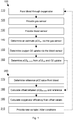
- Figure 7 illustrates steps of a method 60 for controlling a blood gas value, such as the partial pressure of oxygen, or carbon dioxide, or both, in arterial blood.
- a blood gas value such as the partial pressure of oxygen, or carbon dioxide, or both
- an oxygenation gas is provided at a flow rate and with a composition comprising an oxygen fraction.
- the oxygenation gas is used in an oxygenator to oxygenate venous blood to generate arterial blood.
- the level of one or more blood gas values of the arterial blood exiting the oxygenator is determined as the set blood gas level. This may be done using one or more of the above-described methods.
- step 68 while the oxygenator continues to oxygenate blood, one or more current blood gas levels of the arterial (oxygenated) blood exiting the oxygenator are monitored.
- step 70 it is determined whether or not there is a difference between the current blood gas level and the set blood gas level. If there is a difference, then, in step 72, one or more parameters of the oxygenation gas are adjusted. For instance, the flow rate and/or the oxygen fraction may be altered. In step 74, the oxygenation gas with the altered flow rate or composition is supplied to the oxygenator, and in step 76, the blood is oxygenated by oxygenation gas with the altered parameters. This will result in an adjustment of the levels of the blood gas values. The method 60 continues to monitor the blood gas levels and alters the oxygenation gas if an adjustment is required.
- a clinician may start a perfusion treatment with initial perfusion parameters based on clinical expertise, taking into account patient size, age, clinical requirements, etc. Perfusion may then be performed and the system may settle, i.e., blood gas values including the partial pressure pO2 of oxygen and the partial pressure pCO2 of carbon dioxide may settle at a value.
- the value may be acceptable to the clinician or not, if not, the clinician may manually adjust perfusion parameters to improve the response of the patient.
- the manual adjustment may be too weak or to strong, and may have to be repeated until a desired clinical response is observed. Note that a clinician is likely to be interested in a clinical response, rather than setting a particular blood gas level value.
- the control system of the invention may be instructed to take over.
- the control system may determine one or more blood gas values in the arterial blood, as set by the clinician.
- the blood gas value may be a level of the partial pressure of oxygen in the arterial blood.
- the blood gas value may be a level of the partial pressure of carbon dioxide in the arterial blood.
- the blood gas values thus determined may be stored as a value indicating a pre-determined level.
- the monitoring arrangement continues to monitor the blood gas values.
- the control system comprises a configuration permitting it to change the flow rate of the oxygenation gas and/or the fraction of oxygen in the oxygenation gas, in order to adjust the gas values in response to changes of the blood gas values. If a change of blood gas values is detected, the control system changes the flow rate and/or the fraction of oxygen accordingly, to adjust the blood gas values towards the pre-determined level.
- the pre-determined level may be determined by analysing the arterial blood, e.g. the blood exiting the oxygenator, or by using any of the above-described methods.
- the pre-determined level for each blood gas value may be set via an interface.
- the control mechanism improves the responsiveness of the perfusion system. This further allows the blood gas values to be maintained at a pre-determined level, or within pre-determined boundaries. This eliminates the risk of fluctuations. This improves the safety of the perfusion system.
- the control system of the invention may allow pro-longed periods of unsupervised perfusion.
Landscapes
- Health & Medical Sciences (AREA)
- Heart & Thoracic Surgery (AREA)
- Vascular Medicine (AREA)
- Urology & Nephrology (AREA)
- Hematology (AREA)
- Engineering & Computer Science (AREA)
- Anesthesiology (AREA)
- Biomedical Technology (AREA)
- Life Sciences & Earth Sciences (AREA)
- Animal Behavior & Ethology (AREA)
- General Health & Medical Sciences (AREA)
- Public Health (AREA)
- Veterinary Medicine (AREA)
- Emergency Medicine (AREA)
- Cardiology (AREA)
- Pulmonology (AREA)
- External Artificial Organs (AREA)
Description
- The present invention relates to a control system for controlling parameters of a perfusion system. More specifically, the present invention relates to apparatus and methods comprising a closed loop control to maintain blood gas parameters during extracorporeal blood oxygenation.
- Certain medical procedures require the heart or lung of a patient to be kept still. This may be necessary in order for a surgeon to perform surgical procedures, such as cardiac surgery. While the heart is unable to circulate blood or the lung is unable to re-oxygenate blood or to remove carbon dioxide, heart-lung machines are used for life support, providing extracorporeal oxygenation to maintain a supply of oxygen to a patient.
- More recently, extracorporeal oxygenation has been explored for the management of viral infections (such as H1N1) that affect lung function by causing pulmonary embolisms. Patients suffering from such infections may require long-term ventilation, in the region of several weeks (typically 20 days, but in severe cases ventilation may be required for several months, e.g. for up to 180 days), in order to facilitate treatment and drainage of the lung, and in order to permit the lung to rest and heal while the patient's immune system is given an opportunity to defeat the viral infection.
- The partial pressures of oxygen and carbon dioxide, pO2 and pCO2, are indicative of physiological activity and, thus, of interest for extracorporeal oxygenation management. PCT-published application
WO2012066280 GB1503805.2 WO 2011/021978 A1 ,US 5 810 759 A ,US 2009/182258 A1 ,US 2011/129389 A1 ,US 4 493 692 A . - The present invention seeks to provide improved options for ventilation management.
- In accordance with a first aspect of the invention, there is disclosed a control system controlling one or more blood gas values in blood processed by an oxygenator, as defined by claim 1.
- The control system is suitable for an oxygenator of an extracorporeal perfusion system, i.e., for an oxygenator of the type configured to generate arterial blood by exposing venous blood to oxygen from an oxygenation gas supply.
- The control system comprises a monitoring arrangement to determine a level of the one or more blood gas values in the arterial blood, and a controller responsive to the monitoring arrangement, wherein the controller is configured to control parameters of the oxygenation gas supply to the oxygenator, to adjust one or more of the blood gas values toward a pre-determined level.
- It will be appreciated that the oxygenator receives an oxygenation gas supply via an external supply system. The oxygenation gas comprises oxygen; it may also consist of pure oxygen. The oxygen transfer in the oxygenator from the oxygenation gas to venous blood depends on factors such as the flow rate of the oxygenation gas supply and the fraction of oxygen in the oxygenation gas supply.
- Unused gas of the gas supply and excess gases leave the oxygenator as exhaust gas. Properties of the exhaust gas may be indicative of the oxygenation performance (e.g., how much oxygen was taken up by the blood in the oxygenator). However, deriving information on the oxygenation performance based on exhaust gas properties is not trivial, because oxygenators are not air-tight. It cannot necessarily be assumed that gas leaving an oxygenator port is constituted only of unused oxygenation supply gas.
- A controller responsive to the monitoring arrangement can be regarded as a closed loop control. This provides a more responsive mechanism for maintaining blood gas values at a pre-determined level.
- Blood gas values of a patient may change even though perfusion parameters remain constant. For instance, the body temperature or metabolic activity of a patient may change. This will affect the oxygen consumption. Thus, the venous blood entering the perfusion system may have different blood gas properties. By modulating perfusion parameters to adjust the blood gas values of the arterial blood before this is provided to a patient, a mechanism is provided that allows oxygenated blood to be provided with blood gas values at a steady, pre-determined level, or within pre-determined boundaries.
- This improves reaction times. This reduces fluctuations of supply conditions of arterial blood that is prepared for subsequent administration to a patient.
- The blood gas values comprise the partial pressure of oxygen in the arterial blood and/or the partial pressure of carbon dioxide in the arterial blood.
- The controller comprises a configuration permitting it to alter the composition of the oxygenation gas supplied to the oxygenator.
- The partial pressure of oxygen in the arterial blood can be influenced by the composition of the oxygenation gas, because the partial pressure of oxygen depends on the fraction fiO2 of oxygen in the oxygenation gas (and also on the flow rate of the oxygenation gas) supplied into the oxygenator.
- The controller comprises a configuration permitting it to alter the flow rate of the oxygenation gas supplied to the oxygenator.
- The partial pressure of carbon dioxide in the arterial blood can be influenced by the flow rate of the oxygenation gas, because the partial pressure of carbon dioxide depends on the flow rate of the oxygenation gas supplied into the oxygenator.
- The controller is configured to adjust the partial pressure of carbon dioxide in the arterial blood by altering the flow rate of the oxygenation gas supply.
- The controller is configured to adjust the partial pressure of oxygen in the arterial blood by altering the fraction of oxygen in the oxygenation gas supply.
- Adjusting the partial pressure of oxygen by altering the oxygen fraction in the oxygenation gas provides some independence in controlling other parameters. E.g. the flow rate may be changed to adjust the partial pressure of carbon dioxide in the oxygenation gas supply.
- In embodiments, the controller comprises decision logic to determine a difference between the level of the blood gas value and the pre-determined level, and to determine oxygenation gas supply parameters suitable for reducing the difference.
- This allows the feedback loop to respond in proportion to the difference. This provides a more responsive feedback mechanism.
- In embodiments, the decision logic is configured to reduce the difference by calculating an offset value representing a change in oxygenation gas supply parameters suitable for reducing the difference.
- This further improves the responsiveness of the feedback loop.
- In embodiments, the pre-determined level is a pre-determined partial pressure of carbon dioxide in the arterial blood, and the oxygenation gas supply parameters comprise a flow rate suitable for reducing the difference.
- In embodiments, the pre-determined level is a pre-determined partial pressure of oxygen in the arterial blood, and the oxygenation gas supply parameters comprise a fraction of oxygen suitable for reducing the difference.
- In embodiments, the monitoring arrangement comprises a configuration permitting it to simultaneously determine levels of a plurality of blood gas values.
- For instance, the monitoring arrangement may comprise a configuration permitting it to simultaneously determine both the partial pressure of oxygen in the arterial blood and the partial pressure of carbon dioxide in the arterial blood.
- The relationship between the oxygenation gas supply condition and the blood gas parameters in the arterial blood may be complex. For instance, a change in the flow rate of oxygenation gas affects the partial pressures of both carbon dioxide and oxygen. This has to be taken into account, e.g., if the partial pressure of carbon dioxide is to be adjusted by a different amount than the partial pressure of oxygen. Measuring a plurality of blood gas values simultaneously provides a basis for determining adjustment parameters to be calculated for each blood gas value while taking into account potential effects on other blood gas values.
- In embodiments, the controller is configured to simultaneously control a plurality of parameters of the oxygenation gas supply to the oxygenator, to simultaneously adjust levels of a plurality of blood gas values.
- The controller is configured in this manner to simultaneously adjust the partial pressure of oxygen in the arterial blood and the partial pressure of carbon dioxide in the arterial blood.
- The partial pressure of oxygen in the arterial blood can be influenced by the flow rate of the oxygenation gas and by the fraction of oxygen in the oxygenation gas. The partial pressure of carbon dioxide in the arterial blood can be influenced by the flow rate of the oxygenation gas. The partial pressures of oxygen and of carbon dioxide are influenced simultaneously by setting the flow rate of the oxygenation gas to a level suitable for adjusting the partial pressure of carbon dioxide, and at the flow rate, setting the fraction of oxygen in the oxygenation gas to a level suitable for adjusting the partial pressure of oxygen.
- In embodiments, the monitoring arrangement is configured to determine the one or more blood gas values without contacting blood.
- Using blood gas analysis algorithms and flow control systems described herein, the blood gas values (partial pressures of oxygen and/or carbon dioxide in the arterial blood) may be determined without contacting blood.
- The determination of the blood gas values may be on the basis of estimates corrected by a calibration step, as set out below.
- In embodiments, the monitoring arrangement is configured to determine the one or more blood gas values continuously.
- This improves the responsiveness of the closed loop control.
- There is disclosed a method of controlling one or more blood gas values in blood processed by an oxygenator.
- The method is suitable for an oxygenator of an extracorporeal perfusion system, i.e., for an oxygenator of the type configured to generate arterial blood by exposing venous blood to oxygen from an oxygenation gas supply.
- The method comprises the steps of determining a level of each of the one or more blood gas values in the arterial blood, and controlling, in response to the level, parameters of the oxygenation gas supply to the oxygenator, to adjust one or more of the blood gas values toward a pre-determined level.
- In embodiments, determining a level of one or more blood gas values comprises monitoring the partial pressure of oxygen in the arterial blood and/or the partial pressure of carbon dioxide in the arterial blood.
- In embodiments, the method further comprises altering the composition of the oxygenation gas supplied to the oxygenator.
- In embodiments, the method further comprises altering the flow rate of the oxygenation gas supplied to the oxygenator.
- In embodiments, the method further comprises adjusting the partial pressure of carbon dioxide in the arterial blood by altering the flow rate of the oxygenation gas supply.
- In embodiments, the method further comprises adjusting the partial pressure of oxygen in the arterial blood by altering the fraction of oxygen in the oxygenation gas supply.
- In embodiments, the method further comprises determining a difference between the level of the blood gas value and the pre-determined level, and determining oxygenation gas supply parameters suitable for reducing the difference.
- In embodiments, the method further comprises calculating an offset value representing a change in oxygenation gas supply parameters suitable for reducing the difference, and determining the oxygenation gas supply parameters on the basis of the offset value.
- In embodiments, the method further comprises determining the difference between the level of the partial pressure of carbon dioxide in the arterial blood and the pre-determined level of the partial pressure of carbon dioxide in the arterial blood, and determining an oxygenation gas flow rate suitable for reducing the difference.
- In embodiments, the method further comprises determining the difference between the level of the partial pressure of oxygen in the arterial blood and the pre-determined level of the partial pressure of oxygen in the arterial blood, and determining an oxygenation gas oxygen fraction suitable for reducing the difference.
- In embodiments, the method further comprises simultaneously determining levels of a plurality of blood gas values.
- In embodiments, the method further comprises simultaneously controlling a plurality of parameters of the oxygenation gas supply to the oxygenator, to simultaneously effect an adjustment of levels of a plurality of blood gas values.
- In embodiments, the method further comprises determining the one or more blood gas values without contacting blood.
- In embodiments, the method further comprises determining the one or more blood gas values continuously.
- Exemplary embodiments will now be described with reference to the Figures, in which:
-
Figure 1 shows steps of an exemplary sequence of steps of a method for determining the partial pressure of oxygen in arterial blood; -
Figure 2 shows a schematic layout of components of an exemplary ventilation system described herein for the understanding of embodiments of the invention; -
Figure 3 shows an oxygenator of an exemplary ventilation system described herein for the understanding of an embodiment of the invention; -
Figure 4 shows a schematic flow analysis for theFigure 3 oxygenator, described herein for the understanding of embodiments of the invention; -
Figure 5 shows a gas blender for use with a ventilation system, described herein for the understanding of embodiments of the invention; -
Figure 6 shows a schematic flow chart of the blender gas supply, described herein for the understanding of embodiments of the invention; and -
Figure 7 shows an exemplary sequence of steps of a method for controlling blood gas level. - By way of background, an oxygenator is a device configured to receive oxygenation gas and venous blood, to re-oxygenate the blood by exposure to the oxygenation gas, and to provide oxygenated blood as arterial blood. Unused oxygenation gas is vented as exhaust gas which will also carry any gas given away by the blood.
- Herein, the oxygenation gas is referred to as "inlet gas" with reference to the oxygenator. Note that in some literature the same oxygenation gas may be referred to differently (e.g. as "exit gas" with reference to a gas source). Herein, exit gas or exhaust gas denotes gas leaving the oxygenator. An oxygenator setup will be described in more detail with reference to
Figures 2 to 4 below. - For the understanding of some embodiments, described herein are several unconventional variants of methods of analysing blood gas parameters to better determine the partial pressure of oxygen of arterial blood leaving an oxygenator. Herein, such unconventional methods may be referred to as a "blood analysis methods". The blood analysis methods disclosed herein are described in the applicant's co-pending United Kingdom patent application number
GB1503805.2 - The present applicant has appreciated that a good estimate of the partial pressure of oxygen in arterial blood can be obtained by first determining an initial estimate of the partial pressure of oxygen in the exhaust gas, and by adjusting the initial estimate based on the oxygen uptake by the blood passing the oxygenator. The blood oxygen uptake can be determined with optical sensors. Herein, optical sensors are regarded as non-contact sensors because the optical radiation does not require physical contact with blood.
- This allows the partial pressure of oxygen in blood to be determined without requiring a sensor coming into contact (such as the Clark electrode) and without an external contrast agent to be injected into the blood.
- Oxygenation gas (a mixture of gas components including oxygen) is supplied to an oxygenator at an inlet gas flow rate GI with an oxygen fraction fiO2 and a carbon dioxide fraction fiCO2.
- In the oxygenator, oxygen O2 from the inlet gas is taken up by blood. The remaining gas leaves the oxygenator as exhaust gas through an exhaust port (an exhaust port in principle, as there are also ventilation ports, as explained below) at an exhaust gas flow rate GE. Knowledge of the fraction feO2 of oxygen GEO2 in the exhaust gas GE would be desirable because this is directly related to the partial pressure pO2GE of oxygen O2 in the exhaust gas and the atmospheric (ambient) pressure Patm.


- Equivalent considerations apply to the partial pressure pCO2GE of carbon dioxide CO2 in the exhaust gas GE.


- Flow rates GE, GEO2 and GECO2 may be referred to as "amounts" in day-to-day language, but are conventionally measured in L/min. The fractions feO2 and feCO2 are given as a percentage.
- It follows that the partial pressure pO2GE may be calculated by determining the proportion of the amount GEO2 (of oxygen O2 in the exhaust gas GE) relative to relation to the exhaust gas GE.
- However, the exhaust gas flow rate GE measured at the exhaust port of an oxygenator housing is not directly related to the total gas exiting the gas-blood interface (the gas-blood interface typically being provided in the form of hollow fibres) inside the oxygenator, because oxygenators are not air-tight. For safety reasons, an oxygenator housing comprises ventilation ports that prevent a pressure increase in the event of a blockage of the exhaust port. Such a pressure increase could lead, for example, to life-threatening gaseous blood emboli. Thus, the exhaust gas flow rate GE, if measured at the oxygenator exhaust port, may be affected by gas flow through ventilation ports and will not necessarily provide an accurate indication of the total exhaust gas given away from the gas-blood interface inside the oxygenator.
- The present applicant has appreciated that it is possible to determine the fraction feO2 of oxygen O2 in the exhaust gas GE as the difference between (a) the oxygen supplied to the oxygenator as inlet gas oxygen GIO2 and (b) the oxygen taken up by the blood in the oxygenator. The oxygen take-up in the oxygenator can be described as the difference between the amount of oxygen in the arterial blood BEO2 (exiting the oxygenator in an oxygen-enriched state) and the venous blood BIO2 (entering into the oxygenator in an oxygen-decreased state).
- Thus, the amount GEO2 of oxygen O2 in the exhaust gas GE is described by the difference between the amount of oxygen GIO2 supplied to the oxygenator and the amount of oxygen taken up by the blood (BEO2 - BIO2).

- The values GIO2 and (BEO2 - BIO2) are now considered in turn.
- The inlet gas flow rate GIO2 of oxygen O2 and the inlet gas flow rate GICO2 of carbon dioxide CO2 are a fraction fiO2 or fiCO2, respectively, of the total inlet gas flow rate GI. The fraction fiO2 of oxygen and the fraction fiCO2 of carbon dioxide relative to the atmospheric pressure determine the partial pressure of oxygen or carbon dioxide, pO2GI and pCO2GI, respectively.


- The factors at the right-hand side of equations 6 to 9 may be measured as follows:
GI may be measured by a pressure drop technique (the higher the flow, the higher the pressure drop). To provide an illustrative example, the inlet gas flow rate may be measured using a mass flow meter or any other suitable method, e.g., a Venturi tube or an orifice plate. The units of the flow rate are usually L/min (1min = 60 seconds), but it is understood that other units may be used. - The partial pressure pCO2GI of carbon dioxide in the inlet gas may be measured with an optical (non-contact) sensor that provides an output indicative of the partial pressure pCO2GI of carbon dioxide CO2 in the inlet gas. fiCO2 is calculated according to equation 9. fiCO2 is dimensionless and typically given as a percentage.
- The partial pressure pO2GI of oxygen in the inlet gas may be measured with a galvanic cell type oxygen sensor. A galvanic cell type oxygen sensor produces a voltage which is proportional to the partial pressure of oxygen in the inlet gas, and so is proportional to both the oxygen concentration and the gas pressure. The oxygen sensor may be calibrated with calibration gases having a known O2 fraction. For instance, readings may be obtained for two calibration gases, each having an externally verified oxygen content. A first calibration gas may have an oxygen fraction of 21% (v/v, in air). A second calibration gas may have 100% oxygen (i.e., for practical purposes, pure oxygen). The oxygen sensor may take a first O2 sensor reading of the first calibration gas. The oxygen sensor may take a second O2 sensor reading of the second calibration gas. The ambient gas pressure Patm may also be measured so that it may be taken into account when calibrating the sensor. In operation, the sensor reading is thus relatable to values of known oxygen content values, and also the ambient gas pressure can be taken into account. fiO2 is a percentage value.
- Patm may be obtained, for instance, via a direct measurement from an integrated sensor, and/or provided as an input parameter. For instance, Patm may be measured at the inlet or at the outlet of an oxygenator. A typical Patm value is in the region of 1013 mbar (1 atm).
- The sensors for measuring the total inlet gas flow GI, the inlet gas oxygen fraction fiO2, and the inlet gas carbon dioxide fraction fiCO2 may be provided in a sensor unit. The sensors may be integrated into a single sensor unit. Conveniently, the sensor unit may be installed at the oxygenation gas inlet into the oxygenator. Exemplary measurement systems that are suitable for this purpose include the Spectrum System M (TM) range of diagnostic monitors available from Spectrum Medical Ltd, of Gloucester, GL2 9QL, England (the applicant of the present specification). The sensor unit may also comprise a sensor for measuring atmospheric pressure Patm.
- In conditions where the supply GIO2 of oxygen into the oxygenator is relatively low, e.g. due to a low fiO2 fraction and/or a low inlet gas flow rate GI (known as "sweep"), the use of oxygen by a patient may be large enough to significantly lower the oxygen content of the gas. Therefore, in order to ensure that the algorithm for estimating GEO2 is applicable to a wide range of clinical scenarios, including scenarios with low oxygen supply, a more accurate estimate can be obtained by taking into consideration the oxygen consumption by the patient, by way of the term BEO2 - BIO2.
- In the oxygenator, the exchange of oxygen O2 between the oxygenation gas and the blood depends on the partial oxygen pressures pO2, namely the partial oxygen pressure in the oxygenation gas, and the partial pressure pO2BLOOD in the blood: a higher gas partial oxygen pressure causes more oxygen to dissolve in blood and increases the blood partial oxygen pressure. In the absence of other influences the partial pressures will over time reach equilibrium. A notable property of blood is that oxygen will be bound by haemoglobin. The relationship between haemoglobin-bound oxygen and the blood partial oxygen pressure is complex, and the oxygen-binding properties of haemoglobin are dependent on various factors, such as temperature, pressure, blood pH, etc., which are omitted in this explanation for simplicity. As a simplification, it can be assumed that, once bound to haemoglobin, an oxygen molecule no longer contributes directly to the blood partial oxygen pressure. Thus, the total amount of oxygen in blood includes oxygen dissolved in blood plasma, which determines the blood partial oxygen pressure pO2BLOOD, and oxygen bound to haemoglobin, which does not contribute to pO2BLOOD. Haemoglobin binds oxygen highly effectively and at physiological haemoglobin concentrations the amount of haemoglobin-bound oxygen exceeds the plasma-dissolved oxygen significantly.
- For the determination of arterial blood BEO2 and venous blood BIO2 it can be assumed that the oxygen taken away from the inlet gas by dissolving directly in the blood plasma is negligible compared to that bound to haemoglobin. The present applicant has appreciated that, as a simplification, it can be assumed that oxygen in the inlet gas decreases only by binding to haemoglobin. Likewise, it can be assumed that an increase in haemoglobin-bound blood oxygen inside the oxygenator corresponds to the consumption of inlet gas oxygen.
- The amount of oxygen bound to haemoglobin in a given volume of blood depends on the number of oxygen binding sites and, thus, the number of haemoglobin molecules per volume of blood and the level of oxygen saturation of the oxygen binding sites. Thus, the amount BIO2 of oxygen O2 in the venous blood BI and the amount BEO2 of oxygen O2 in the arterial blood BE can be expressed as:


- The values of the blood flow Q, the arterial oxygen saturation SaO2, the venous oxygen saturation SvO2, and the haemoglobin concentration Hb, can be obtained by non-contact measurement (examples described below). Conventionally, BIO2, BEO2, and Q are provided in L/min (1 min = 60 seconds), Hb in g/dl (1dl = 0.1L), and SaO2 and SvO2 per cent. As an aside, one mol of haemoglobin weighs 64,458 g. It follows that 1g of haemoglobin comprises 0.01551 mol, and a factor of 0.1551 allows g/dl to be converted to mmol/L. In equations 10 and 11, the factor 4 accounts for the number of oxygen molecules that can bind to each molecule of haemoglobin.
- Blood flow Q may be measured by any suitable means, e.g., a Doppler flow meter or by determining the positive displacement of a peristaltic roller pump. The unit of the flow rate Q is usually L/min.
- Oxygen saturation SO2 (both arterial oxygen saturation SaO2 and venous oxygen saturation SvO2) and haemoglobin Hb may be measured by a non-contact optical measurement method locatable at a suitable position of the oxygenator. Exemplary optical measurements use LEDs and multiple-wavelength light sensors to determine blood absorption characteristics (the redness of blood changes depending on the haemoglobin oxygenation state). The unit of saturation is dimensionless and typically given per cent. The haemoglobin concentration is conventionally provided in g/dl.
- An exemplary measurement system that is capable of measuring the flow rate Q, haemoglobin concentration Hb, and both the arterial and venous oxygen saturation is the Spectrum System M (TM) range of diagnostic monitors available from Spectrum Medical Ltd, of Gloucester, GL2 9QL, England (the applicant of the present specification).
- It is possible to determine BIO2 and BEO2 without contacting the blood via
equations 10 and 11 when non-contact sensors are used to measure Q, Hb, SaO2 and SvO2. This is an advantage over using a contact electrode such as a Clark-type electrode. Even if, e.g., a conventional Clark-type electrode were to be used as a reference sensor for calibration prior to use, this avoids having to bring a blood sensor in direct blood contact during continual measurements of the quantities Q, Hb, SaO2 and SvO2. Of course,equations 10 and 11 are not limited to non-contact sensors; any suitable sensor may be used to measure these quantities. - It can further be assumed that during a relevant time scale the amount of haemoglobin in the venous blood (entering the oxygenator) and in the arterial blood (leaving the oxygenator) remains steady, as does the blood flow rate Q. Therefore, the blood oxygen uptake (BEO2 - BIO2) can be described by equation 12:

- This allows the values BEO2 and BIO2 to be determined using a sensor for the blood flow Q and/or or the haemoglobin concentration Hb at a single location. For the avoidance of doubt, two sensors are used for the oxygen saturation measurements, one for arterial oxygen saturation SaO2 and one for venous oxygen saturation SvO2.
- Via
equation 5, the amount GEO2 of oxygen O2 in the exhaust gas GE can be determined without an exhaust gas sensor. Knowledge of the exhaust gas flow GE is then required to solve equations 2 and 4. - Later in the present specification a description will follow of a non-conventional perfusion system design that allows the flow rate GE out of a main exhaust port of the oxygenator to be controlled. This provides a route to determining GE from the control parameters.
- However, with conventional oxygenators it is not possible to control the exhaust gas flow rate. As described above, because oxygenators are not closed systems, the exhaust gas flow GE measured at a conventional oxygenator exhaust port does not provide an accurate indication of the amount of exhaust gas exiting the gas-blood interface inside the oxygenator. An alternative to directly determining the exhaust flow rate GE is presented in the following passages of the present description.
- The exhaust gas GE transported away from the oxygenator is assumed to consist of O2, CO2, and N2. Any amount of water H2O is assumed to be negligible. Likewise, any amount of substantially insoluble gases, such as noble gases and common fluorinated anaesthetic agents, is assumed to be either negligible or as included with the nitrogen term N2 for the purposes of pO2 prediction.

- GEO2 is determined via
equation 5. - GECO2: According to equation 4, the amount GECO2 of carbon dioxide in the exhaust gas depends on the fraction feCO2 of carbon dioxide and the amount of exhaust gas GE. However, as will be shown in equations 17 to 19 below, a direct measurement of the fraction feCO2 of the carbon dioxide CO2 in the total exhaust gas flow GE will suffice for the purpose of determining an estimate of GE. The feCO2 sensor may be a stand-alone sensor at the exhaust port of the oxygenator.
- GEN2: It is assumed that the amount of N2, and of any inert or largely insoluble gas, remains constant during oxygenation, i.e., that N2 is neither taken up nor given away by the blood.

- For a determination of GIN2, it is assumed that the gas mixture GI consists only of O2, CO2, and N2, whereas the amount of water H2O and the amount of noble gases can be regarded as negligible and/or as included with the GIN2 term.

- By substituting right-hand terms of
equation 15 with equations 6 and 8, the flow rate GIN2 of nitrogen N2 can be expressed as:
- The right-hand terms of
equation 16, GI, fiO2, and fiCO2, can be measured by sensors at the oxygenator inlet as described above, avoiding a need for a separate measurement of the amount GIN2 of nitrogen N2 in the inlet gas GI or of the amount GEN2 in the outlet gas GE. - Thus, a sufficiently representative estimate of the outlet gas flow GE can be determined by substituting right-hand terms of
equation 13 using equation 5 (for GEO2), equation 4 (for GECO2), andequations 14 and 16 (for GEN2).
- Thus,

- Thus,

- The fraction feCO2 of carbon dioxide in the exhaust gas can be assumed to be accurately determined by a direct sensor measurement from the main oxygenator exhaust port.
- Having determined an estimate of GE via equation 19, the partial pressure pO2GE of oxygen in the exhaust gas can be obtained via equations 1 and 2.
- By way of background, the inlet flow rates in L/min can be converted into mmol/min by assuming ideal gas conditions and that, therefore, 1 mol of gas occupies 22.41 L at standard temperature and pressure (STAP). The system may be configured to adjust for measured gas pressure. In practice, sufficient accuracy can be achieved by assuming that the ambient air has a temperature of 20°C. Alternatively, the ambient temperature may be measured by a sensor, allowing the temperature to be considered when converting L/min to mmol/min.
- Blood temperature affects the partial pressure pO2BLOOD of blood oxygen. It was found by the applicant that it is possible to account for temperature effects by applying a linear offset, temperature term offsetTEMP, that correlates with blood temperature TBLOOD

- The blood temperature TBLOOD is the temperature of the blood entering or exiting the oxygenator in celsius. The blood temperature may be measured by any suitable thermometer. The thermometer may be located at a suitable location.
- When calculating the oxygen uptake BEO2 - BIO2 in the afore-described manner, simplifying assumptions are made about the oxygenator efficiency. The simplifying assumptions ignore that oxygen saturation is influenced by factors including the exchange area available for oxygenation, the blood flow rate (the slower the flow rate, the more time to approach equilibrium), and the oxygen load of the venous blood versus the desired oxygenation of the arterial blood (the bigger the difference, the more oxygen needs to cross an oxygenator membrane). This results in a non-linear influence of the blood flow rate Q and the difference in saturation (arterial oxygen saturation level SaO2 - venous oxygen saturation level SvO2). The influence depends on the oxygenator type and can be described by an oxygenator term offsetOXYGENATOR:

- As the oxygenator term offsetOXYGENATOR comprises a term defining the blood oxygen uptake (SaO2 - SvO2), the oxygenator term constitutes a blood oxygen uptake value indicative of an amount of oxygen taken up by the blood in the oxygenator.
- The coefficients A, B and C in
equation 21 are determined by best fitting of test values with experimental data obtained for a given oxygenator type. To provide an illustrative example, the coefficients forequation 18 for commercially available Medtronic Fusion and Terumo RX25 oxygenators, may be in the region of


- The coefficients depend on the oxygenator type and on the surface area and/or efficiency of the oxygenator membrane. In practice, the coefficients are obtained for a given oxygenator model by establishing the difference between pO2BLOOD as calculated and pO2BLOOD as measured by a reference method, e.g., using a conventional blood gas analyser. The difference is established in for a plurality of blood samples each oxygenated under different conditions. The oxygenation conditions may differ by the blood flow rate, temperature, pressure, haemoglobin concentration, inlet gas flow rate, inlet gas oxygen concentration, and/or venous blood oxygenation saturation. The number of blood samples is chosen to cover a wide range of values for each condition, including values that would be expected during typical use of an oxygenator and values that would not be expected in a clinical setting. Using an appropriate method, the coefficients A, B, and C are then adjusted so that the difference between the reference values (blood gas analyser values) and the calculated value for pO2BLOOD is minimised. For instance, the exemplary coefficients A, B, C of
equations 22 to 24 have been determined on the basis of values measured from 40 samples from which a descriptive model was prepared using a least squares fitting method (using a Levenberg-Marquardt algorithm).Equation 21 is provided for illustrative purposes, and other fitting methods (e.g., mathematical models, for instance regression analysis) may be used. For instance, while the present example uses three coefficients A, B and C, a different number of coefficients may be appropriate depending on which mathematical model is used to describe the oxygenator term offsetOXYGENATOR. The coefficients can be determined off-line, during manufacture or setup. This allows the mathematical model to be optimised for a specific oxygenator, if required. The coefficients may be adjusted in the form of a retro-fit to existing equipment, e.g., as a software update. It is contemplated that the coefficients can be entered on a setup page. The setup page may be accessible to authorised personnel only. - A more accurate estimate pO2EST of the partial oxygen pressure is obtained by applying the temperature term offsetTEMP and/or the oxygenator term offsetOXYGENATOR to the partial pressure pO2GE as determined via equation 1.

- Thus, a more accurate estimate pO2EST can be understood as an output of the partial pressure of oxygen in the arterial blood, which output is generated by way of
equation 25 on the basis of an estimate of the partial pressure of oxygen in the exhaust gas (the estimate being constituted by pO2GE) and on the basis of a blood oxygen uptake value (the blood oxygen uptake value being constituted by the term offsetOXYGENATOR which is indicative of the amount of oxygen taken up in the oxygenator). - In use, various parameters of the clinical setting may cause an operational offset between the estimate pO2EST and the actual partial pressure pO2BLOOD of arterial blood leaving the oxygenator. The operational offset may be taken into account by a calibration or synchronisation step in order to further improve the accuracy of the estimate.
- The synchronisation involves measuring the partial pressure pO2BGA using a blood gas analyser and comparing the value to the estimate pO2EST to calculate a synchronisation offset offsetSYNC.

- During ventilation procedures, blood samples are routinely obtained from a patient and their blood parameters are measured, usually with a blood gas analyser that measures several blood analytes including pO2 or pCO2. It is not untypical during a ventilation procedure for two, three, or more blood samples to be taken from the patient and analysed externally (e.g., in a blood gas analyser).
- The time when a blood sample is taken for routine analysis may be registered as a sampling event, to register the sample with the estimated partial pressure pO2EST as estimated during the sampling event. Once the values from the blood analysis are available (which may take a few minutes), these can be related to the estimated values. For instance, a processor may be configured to correlate the blood analysis values pO2BGA with the value for pO2EST as determined at the time of the sampling event, to obtain a synchronisation offset via
equation 26. The synchronisation offset can be applied to all future values to provide a more accurate reading. It would also be possible to apply the synchronisation offset retrospectively, i.e., to values of pO2EST determined and recorded at previous points in time. - To elaborate on
equation 26, the synchronisation offset offsetSYNC SAMPLE is determined from a sample value pO2BGA SAMPLE for a partial pressure estimate calculated during the sampling event pO2EST SAMPLE:
- Subsequent blood partial oxygen pressure values pO2BLOOD CURRENT are then calculated by applying the offset determined via
equation 27 to the subsequent pO2 estimates pO2EST CURRENT.
- Even though, in order to obtain the synchronisation value, a routine blood gas analysis or equivalent analysis may have to be performed, the blood partial oxygen pressure estimate obtained via
equation 28 can be carried out more often than a blood sample analysis, i.e. results can be provided continuously or in defined intervals, e.g., every second. - Whenever a new blood sample is taken for a blood gas analysis, the synchronisation may be repeated. I.e., that sampling event may be registered in order to update via
equation 27 the synchronisation offset value offsetSYNC SAMPLE that is then applied subsequently viaequation 28. - Herein, equations (26) to (28) are explained using the example of the partial pressure pO2 of oxygen in blood, but they are equally suitable to calibrate, or synchronise, the partial pressure pCO2 of carbon dioxide in the blood. I.e., a current estimate pCO2EST CURRENT may be obtained by a direct measurement of the fraction feCO2 of carbon dioxide in the exhaust gas, and by relating this to the atmospheric pressure as set out in equation (3).
- In this regard, the effect of any ambient air drawn into the exhaust gas on the fraction feCO2 of carbon dioxide in the exhaust gas can be neglected. For practical purposes, it can be assumed that the carbon dioxide fraction in air is close to 0%, as carbon dioxide in air typically varies between 450 ppm and 600 ppm (ppm = parts per million), whereas the fraction feCO2 of carbon dioxide in the exhaust gas is between 1% and 10%. Given the differences in magnitude, an inaccuracy resulting from ignoring carbon dioxide in air may amount to 0.045 to 0.06%, which is negligible. The amount of ambient air drawn into the exhaust gas may vary considerably if the exhaust gas flow rate is not adjusted relative to the oxygenation gas flow rate.
- The values of pCO2 and pO2 thus obtained are related to the oxygen consumption and carbon dioxide production and, therefore, provide an empirical, or measurement-based, basis for optimising the composition of the oxygenation gas and for optimising the flow rate into the oxygenator. In particular, this allows the composition and/or the flow rate to be adjusted according to the development of a patient. This facilitates an unsupervised, or automated, oxygenation of a patient, which is believed to be particularly useful for long-term ventilation of a patient.
- As an alternative to determining pO2BLOOD via
equation 5 using the algorithms set out above, the applicant discovered that the blood partial oxygen pressure pO2BLOOD may be related to the exhaust gas partial oxygen pressure pO2GE directly. - Measuring pO2GE directly requires no knowledge of the inlet gas properties (GI, fiO2, fiCO2) or of other (non-O2) exhaust gas properties (such as feCO2). However, if measured directly, pO2GE is affected by the amount of gas passing through any ventilation ports or auxiliary ports of the oxygenator and, thus, cannot be assumed to directly relate to the unconsumed oxygen in the inlet gas at the point it exits the gas-blood interface inside the oxygenator. As an aside, commercial pO2 sensors may provide the value of pO2GE as a percentage, based on the assumption that the reading is taken with reference to unity atmospheric pressure (1 atm = 1013 mbar).
- Using a sensor system capable of measuring blood temperature TBLOOD, blood flow Q, and arterial and venous blood saturation SaO2 and SvO2, adjustment terms equivalent to
equations 


- Coefficients A, B, and C are determinable as set forth above. In particular, as the oxygenator term offsetOXYGENATOR comprises a term defining the blood oxygen uptake (SaO2 - SvO2), the oxygenator term constitutes a blood oxygen uptake value indicative of an amount of oxygen taken up by the blood in the oxygenator. Likewise, pO2EST can be understood as an output of the partial pressure of oxygen in the arterial blood, which output is generated by way of equation 31 on the basis of an estimate of the partial pressure of oxygen in the exhaust gas (the estimate being constituted by pO2GE) and on the basis of a blood oxygen uptake value (the blood oxygen uptake value being constituted by the term offsetOXYGENATOR which is indicative of the amount of oxygen taken up in the oxygenator).
- Embodiments of the present invention may include a sensor system that is configured to continuously determine an estimate of the partial pressure pO2GE of oxygen in the exhaust gas, either by way of a measuring the input values required for equations 1-19 and a processor configured to process equations 1-19, or by direct measurement of the partial oxygen pressure pO2GE in the exhaust gas. In practice, the system may record values in defined intervals, e.g. every second.
- The system may be configured to apply a temperature term offsetTEMP and/or the oxygenator term offsetOXYGENATOR to calculate an estimated partial pressure pO2EST in accordance with
equation 25 or 31. - For synchronisation, the sensor system may be configured to register a sampling event. A sampling event occurs when a blood sample is taken, and pO2 and/or pCO2 estimates determined at the time of the blood sampling can be associated with the blood sample. In a clinical setting, it may take a few minutes until blood sample values are available. During this time, the sensor system is able to continue determining pO2 and/or pCO2 estimates. Once the values from the blood analysis are available, these can be entered into the sensor system. The sensor system is configured to correlate the blood analysis values with the pO2 and/or pCO2 estimates determined during the sampling event. This allows any deviation between the blood value and the estimate to be determined, and a synchronisation value can be applied to the sensor values. It is then possible to apply the synchronisation value to future pO2 and/or pCO2 estimates determined by the sensor system.
- In this manner, a large number of readings can be taken, whereas it would not be practical to take and analyse a large number of blood samples. The p02/pCO2 estimates can be determined continuously or in defined intervals.
- Multiple sampling events may be registered, whenever appropriate, e.g. according to the number of blood samples taken during an intervention, in order to update the synchronisation offset.
- By applying a synchronisation offset, a more accurate determination of the arterial partial oxygen pressure pO2BLOOD to be made based on the estimate derived from the partial oxygen pressure pO2GE, which can be obtained without blood contact. Likewise, the partial pressure of carbon dioxide may be determined. As such, the described sensor system may be part of, or constitute, a monitoring system of the present invention.
- Because the reading of many blood analytes is dependent on temperature, the blood gas values of pO2 and pCO2 are typically obtained at a standardised temperature. Most blood gas analysers set the blood sample temperature to 37°C as the standardised temperature.
- However, also the partial pressures pO2 and pCO2 are temperature-dependent. It is often the case that the blood circulating in the oxygenator has a different temperature than the temperature-controlled sample in the blood gas analyser. For instance, the body temperature and blood of a patient may be cooled to significantly below 37°C during surgery, whereas a blood gas analyser may routinely warm the blood to 37°C. In contrast, any values obtained by sensors from the oxygenator will be close to the patient temperature. Any difference between the blood temperatures needs to be taken into account.
- A suitable temperature adjustment to obtain a temperature-adjusted value pO2ADJ or pCO2ADJ, respectively, may be obtained using known equations.


-
Equation 32 corresponds to the formula used by the Radiometer AML-3, and equation 33 corresponds to the formula used byCorning Models 178, 170, 168 and 158, both reported by Edward R. Ashwood in ). - Turning to
Figure 1 , a sequence of steps of amethod 100 in accordance with the above principles are shown. Instep 110, blood is provided for oxygenation through an oxygenator. Instep 120, a sensor system is provided suitable for determining one or more gas values. Instep 130, a sensor system is provided suitable for determining one or more blood values. Instep 140, one or more gas values are determined, the gas values comprising an estimate of the partial pressure of oxygen in the exhaust gas of the oxygenator. Instep 150, one or more blood values are determined, the blood values comprising a blood oxygen uptake value indicative of an amount of oxygen taken up by the blood in the oxygenator. Instep 160, an output is generated by using the blood oxygen uptake value to adjust the estimate of the partial pressure of oxygen in the exhaust gas. - Some or all steps of
method 100 may be carried out to implement one or more of the algorithms described above. - Step 150 may comprise measuring the venous oxygen saturation of the blood entering the oxygenator, measuring the arterial oxygen saturation of the blood leaving the oxygenator, and calculating the blood oxygen uptake value as a function of the difference between the arterial oxygen saturation and the venous oxygen saturation.
- Step 150 may comprise measuring the flow rate, the temperature, and/or the haemoglobin concentration of the blood passing through the oxygenator. Step 150 may comprise calculating the blood oxygen uptake value as a function of the flow rate, the temperature, and/or the haemoglobin concentration. Step 160 may comprise calculating the output as a function of the flow rate, the temperature, and/or the haemoglobin concentration.
- Step 140 may comprise obtaining a measurement of the partial pressure of oxygen in the exhaust gas and using the measurement as the estimate.
- Step 140 may comprise determining the amount of oxygen in the exhaust gas and the amount of exhaust gas leaving the oxygenator, determining the fraction of oxygen in the exhaust gas as a quotient of the amount of oxygen in the exhaust gas and the amount of exhaust gas, and deriving the estimate of the partial pressure of oxygen in the exhaust gas from the fraction of oxygen in the exhaust gas.
- Step 140 may further comprise determining an inlet gas value indicative of the amount of oxygen entering the oxygenator. Step 160 may comprise determining the amount of oxygen in the exhaust gas based on the difference between the inlet gas value and the blood oxygen uptake value.
- Step 140 may comprise measuring one or more of the total amount of the oxygenation gas, the amount or fraction of oxygen in the oxygenation gas, the amount or fraction of carbon dioxide in the oxygenation gas, and the amount or fraction of carbon dioxide in the exhaust gas.
- Included in
Figure 1 is amethod 200 for characterising the oxygenation efficiency of an oxygenator. Themethod 200 employs the steps ofmethod 100 for a plurality of blood samples. - In
step 170, a reference value of the partial pressure of oxygen in the arterial blood is obtained using a reference method, such as by measuring the blood in a conventional blood gas analyser. - In
step 180, an offset value is calculated to describe the difference between the output generated instep 160 and the reference value measured instep 170. The offset value may be used to adjust the output. - In
step 190, one or more coefficients for a model describing the oxygenation efficiency of an oxygenator are calculated based on multiple offset values. - In
step 210, a blood sample or blood volume is provided for oxygenation in the oxygenator, and one or more of the conditions forsteps 110 to 160 are altered, beforesteps 110 to 160 are repeated. - The algorithms above apply to oxygenators that are conventional in the sense that the amount/proportion of gas or ambient air passing through auxiliary/ventilation ports is treated as an unknown quantity, and so the amount of exhaust gas GE and any components therein are not directly relatable to the amount of exhaust gas exiting the gas-blood interface inside the oxygenator.
- For the understanding of some embodiments, described herein is an unconventional oxygenation system that allows the flow rates of oxygenation gases into an oxygenator and/or of exhaust gases out of an oxygenator to be determined by control of gas flow parameters. Herein, such an unconventional oxygenation system may be referred to as a "flow-control" oxygenation system. The flow-control oxygenation system disclosed herein is described in the applicant's co-pending United Kingdom patent application number
GB1421498.5 - Embodiments of the present invention may be incorporated in, or make use of, a flow-control oxygenation system. This provides a means allowing the flow rate ("sweep") and/or the fraction of oxygen of the supply gas into the oxygenator to be controlled. Also, the flow rate of the exhaust gas GE out of the main oxygenator exhaust port may be considered in the determination of blood or oxygenation gas parameters. For instance, instead of determining GE by way of equation 19 above, it may be possible to derive an estimate of GE from flow control parameters.
- In one operating mode, a flow-control oxygenation system may allow a flow rate to be applied that sucks only a fraction of the gas leaving the gas-blood interface. Any remaining amount of exhaust gas would leave the oxygenator via the ventilation ports. In that case, the composition of the fraction of the exhaust gas through the oxygenator exhaust port will closely correspond to the composition of the gas leaving the gas-blood interface inside the oxygenator, because it is not diluted by ambient air drawn in via the ventilation ports. This will allow a more accurate measurement to be made of the fraction of a component of the exhaust gas, such as the fraction feO2 of oxygen in the exhaust gas or the fraction feCO2 of carbon dioxide in the exhaust gas. This operating mode may be appropriate if there is no concern about unused oxygenation gas leaking out of the oxygenator, for instance during extracorporeal ventilation without anaesthesia.
- In one operating mode, a flow-control oxygenation system may allow a flow rate high enough to suck all of the exhaust gas leaving the gas-blood interface inside the oxygenator, and also ambient air drawn into the oxygenator housing via ventilation ports. In that case, the composition of the exhaust gas through the oxygenator exhaust port includes ambient air. This operating mode may be appropriate if passage of unused oxygenation gas (e.g., comprising unused anaesthetic agent) out of the oxygenator is of concern. This operating mode may also be necessary to achieve sufficiently accurate measurements if the flow rate of oxygenation gas into the oxygenator is low. With knowledge of the composition of the ambient air and knowledge of the flow rate of the oxygenation gas entering the oxygenator, the oxygen concentration just after the gas-blood interface may be determined.
- Values determined via the different operating modes, e.g. the fraction of an exhaust gas component or the amount of exhaust gas, may be used to solve the algorithms above.
- In particular, the applicant contemplates that the various methods described herein may be used in a complementary fashion. For instance, in a flow-control oxygenator, the flow rate of the exhaust gas GE may be determined both via equation 19 above and via derivation from flow-control parameters.
-
Figure 2 provides an overview of system components of a flow-control ventilation system for use with embodiments of the present invention. A pulmonary (blood) bypass loop crosses a gas (oxygen) line. The pulmonary bypass loop circulates blood from a patient in order for the blood to be oxygenated and to be returned to the patient. The gas line provides the oxygenation gas for blood oxygenation. - Venous blood from a patient (not shown in
Figure 2 ) is circulated in the direction indicated byarrow 12 towards areservoir 10 via a venous line V. From thereservoir 10, the venous blood is pumped by apump 13 in the direction indicated byarrows 14 towards anoxygenator 20. In theoxygenator 20, the blood is oxygenated. Blood leaves theoxygenator 20 to be supplied, as arterial blood, via an arterial line A in the direction indicated byarrow 16 towards a patient. Aflow sensor 18 is provided to measure the flow rate of the re-oxygenated blood exiting theoxygenator 20. Atemperature sensor 22 is provided to measure the temperature of the re-oxygenated blood exiting theoxygenator 20.Water lines 21 connect theoxygenator 20 to a water bath for maintaining a predefined temperature. - A
gas circulator 35 comprises ablender 30 for preparation of oxygenation gases. In the particular depiction, the blender also comprises avacuum subsystem 40 for removal of exhaust gases. However, conventional oxygenation gas blending systems do not comprise a vacuum sub-system. - Gases, such as nitrogen (N2) and oxygen (O2) of predetermined purity levels are supplied from
hospital supply lines 32 into ablender 30. Compressed air with a composition of about 79% nitrogen and 21% oxygen may be supplied. Hospital-supplied gases may contain traces of carbon-dioxide and/or noble gases. The hospital mains also provide a source of low pressure or vacuum. The hospital supplies may also include oxygenation gas of a predetermined composition or oxygen at a predetermined purity level, which may be supplied via asupply line 57 to theblender 30. - In the
blender 30, the gases are mixed to a composition that is to be supplied to theoxygenator 20 and fed in the direction indicated byarrow 34 via asupply line 24. In theoxygenator 20, the haemoglobin molecules of the venous blood are to take up oxygen and to release carbon dioxide. In theoxygenator 20, other gases, such as waste anaesthetic gases, may be released from or not be taken up in the oxygenator. Any gases released in or passing through theoxygenator 20 and gas components not taken up from the inlet gas are collected as waste gas or exhaust gas and leave theoxygenator 20 via anexhaust line 26 in the direction ofarrow 36 and are transported away. The gas flow via theexhaust line 26 is assisted by a vacuum. In the embodiment described herein, the vacuum is supplied via avacuum subsystem 40 that is part of thegas circulator 35. Conventionally, an oxygenator is connected directly to a hospital vacuum port. - The operation of the
oxygenator 20, theblender 30 and thevacuum sub-system 40 will now be described in more detail with reference toFigures 3, 4 ,5 and 6 . - Venous blood carrying CO2 enters the
oxygenator 20 via venous line V (in direction 14), as shown in detail inFigures 3 and 4 . Venous blood enters theoxygenator 20 in a condition indicated herein by the symbol BI. In particular, the blood transports an amount of oxygen BIO2 and an amount of carbon dioxide BICO2 per unit of time. -
Figure 3 illustrates the uptake of oxygen by the blood in theoxygenator 20. The venous blood is transported within theoxygenator 20 alongline 15 and exposed to the gas mixture, inlet gas GI from theblender 30, that is transported along theline 25. The gas mixture GI has a higher oxygen partial pressure and a lower carbon dioxide partial pressure than the blood, causing the haemoglobin to release CO2 and take up O2. Note that althoughFigure 3 indicates, schematically, a concurrent exchange, oxygenators use, in practice, a countercurrent exchange. -
Figure 4 illustrates a flow diagram. In theoxygenator 20, CO2 is released from the blood into the gas stream, as indicated byarrow 42. The blood stream takes up O2 in a reaction indicated byarrow 44. Other components, such as waste anaesthetic gas, may not be taken up by the blood and enter or remain in the exhaust gas stream as indicated by arrow 46. Oxygenated blood is referred to as arterial blood. - The
oxygenator 20 is not an air-tight unit. It may comprise one or more secondary (i.e., ventilation)exhaust ports 27 as a failsafe measure, to avoid pressure build-up within theoxygenator 20 if theexhaust line 26 is blocked. As thesecondary exhaust ports 27 permit passage of air or gases, the amount of exhaust gas GE leaving theoxygenator 20 at theexhaust line 26 cannot be assumed to be identical to the amount of exhaust gas at apoint 29 immediately downstream of the gas-blood interface inside theoxygenator 20. - As or if a vacuum-induced flow is applied via
exhaust line 26, this draws, therefore, not only exhaust gas GE from theoxygenator 20, but alsoambient air 48 viasecondary exhaust ports 27. To provide an illustrative example, for every 2L of gas mixture supplied into theoxygenator 20 viasupply line 24, 2.1L of exhaust gas may be drawn throughexhaust line 26. - The difference in flow rates that causes
ambient air 48 to be drawn into theoxygenator 20 can also be used to ensure that any waste anaesthetic gas 46 is removed via theexhaust line 26. Thus, waste anaesthetic gas 46 is prevented from seeping out of theoxygenator 20, as indicated byarrow 49, into the operating theatre, where anaesthetic gases could affect staff. - Arterial blood leaves the
oxygenator 20 in a condition BE. The amount of oxygen of the arterial blood BEO2 is related to the arterial oxygen saturation SaO2 and also depends on the haemoglobin concentration in the blood. - Exhaust gas GE which carries components released from the blood, such as CO2 from
transfer 42, or waste anaesthetic gas that has not been taken up inside theoxygenator 20, is drawn viaexhaust line 26 towards thevacuum sub-system 40 ofgas circulator 35. - In
Figure 5 , theblender 30 is drawn enlarged as part of thegas circulator 35. Gas components supplied viainlets 32 are mixed to provide a supply gas for theoxygenator 20. The processing steps in theblender 30 are set out inFigure 6 . Hospital-suppliedgases 32 are fed first into agas mixer 52, and then passed through aflow control 54, afailsafe control 56, andsensors 58, before being supplied viasupply line 24 to theoxygenator 20. - The
gas mixer 52 comprises a mixing chamber into which component gases are received via an inlet and mixed to an oxygenation gas. The mixing chamber constitutes a blending unit in which the component gases are blended into an oxygenation gas. The mixing chamber also constitutes a holding unit or reservoir in which component gases may homogenise. The gas pressure may be controlled via a back pressure regulator. Excess gas may be vented into the atmosphere. From the mixing chamber of thegas mixer 52, the oxygenation gas passes through theblender flow control 54. - The
blender flow control 54 allows the flow rate of the gas mixture, the oxygenation gas, to be adjusted to a pre-determined flow rate. Theblender flow control 54 controls the flow rate of the oxygenation gas from the holding unit, or mixing chamber, and thus constitutes a flow controller suitable for controlling the supply gas parameters in accordance with embodiments of the invention. This allows the amount of gas supplied to the oxygenator to be set, and allows this to be used in the calculation of oxygenation-related parameters. - A flow control unit in the blender allows the flow rate of the gas mixture to be set to low rates after it has been mixed as required. This improves the accuracy of the composition particularly at low flow rates, which are preferred in pulmonary systems.
- It is difficult to achieve a good quality mixture of the oxygenation gas when throttling the flow rate of the hospital-supplied gas. Thus, to obtain an accurate mixture, the hospital-supplied gas is fed at a suitably high flow rate. The flow control therefore addresses the problem of how to obtain an accurately mixed oxygenation gas, while also providing the oxygenation gas to the
oxygenator 20 at a low flow rate. - To illustrate this with an example, both oxygen and nitrogen may be supplied at 1.05 L/min. A 50%/50% mixture of these two gases would create a volume flow of 2.1 L/min (1.05 L/min + 1.05 L/min = 2.1 L/min). If, for instance, it is desired to supply only 2.0 L/min oxygenation gas to the oxygenator, the excess of 0.1 L/min (2.1 L/min - 0.1 L/min = 2.0 L/min) is vented, or "bled", into the atmosphere. Any suitable mixing ratios may be used in practice.
- The
failsafe control 56 provides an additional safety feature, by providing an option to switch to anexternal gas supply 57. In particular, thefailsafe control 56 may be responsive to thegas mixer 52, theblender flow control 54, and/orsensors 58, and is configured to switch to theexternal gas supply 57 oxygen in the event one of thegas mixer 52 or theblender flow control 54 fail to provide oxygenation gas of pre-determined composition or flow rate. - The gas supplied via the
external gas supply 57 may be pure oxygen. The gas supplied may be provided by a mechanical blender, or an emergency backup gas supply. - The
sensors 58 are configured to measure parameters of the supply gas mixture. The parameters include the flow rate of the gas mixture, the pressure of the gas mixture, the temperature of the gas mixture, the oxygen concentration, the carbon dioxide concentration, or combinations thereof. - The values obtained by the output measurement can be checked against expected values and countermeasures can be taken in the event of any discrepancy. For instance, the flow rate as determined by
sensors 58 can be compared to the flow rate set by theblender flow control 54. In the event of any discrepancy, countermeasures can be taken. Countermeasures include the generation of a notification signal, the increase or decrease of the flow rate by theblender flow control 54, or the switching to anexternal gas supply 57 by thefailsafe control 56. - The
sensors 58 allow the composition, pressure, temperature, and flow rate to be monitored regardless of the source, e.g., whether this is fromgas mixer 52 or from anexternal gas supply 57. - The oxygenation gas of known properties leaves the
blender 30 via an outlet to be supplied to theoxygenator 20. - This allows a controller to control parameters of the oxygenation gas supply to the oxygenator. For instance, the flow controller allows the total flow rate, or "sweep", of the gas supplied into the oxygenator to be controlled. Likewise, this allows the fraction of oxygen supplied into the oxygenator to be controlled.
- Vacuum may be used to create a flow gradient to assist gas flow. In the system described herein, the vacuum pressure gradients are controlled by a
vacuum subsystem 40 which in turn is supplied from a single vacuum supply, e.g. from a hospital. - The flow gradient in the
exhaust line 26 is indicated byarrow 36 and pulls exhaust gas from theoxygenator 20. - To illustrate this with an example, supply gas GI may be supplied to the
oxygenator 20 at a rate of 2L/min. The vacuum sub-system may be set to withdraw exhaust gas at a flow rate of 2.1L/min. Thus, it can be assumed that, absent any influences by the blood oxygenation processes, 0.1L/min (0.1L/min = 2.1L/min exhaust gas - 2.0L/min inlet gas) of ambient air were drawn in via the oxygenator. - The combination of the
blender 30 and thevacuum sub-system 40 in agas circulator 35 facilitates the integration of sensors and the evaluation of measured properties of the oxygenation gas and the exhaust gas (e.g., flow rate, pressure, temperature, composition, oxygen fraction, carbon dioxide fraction, and combinations thereof). - Although the
gas supply -
Figure 7 illustrates steps of amethod 60 for controlling a blood gas value, such as the partial pressure of oxygen, or carbon dioxide, or both, in arterial blood. Instep 62, an oxygenation gas is provided at a flow rate and with a composition comprising an oxygen fraction. Instep 64, the oxygenation gas is used in an oxygenator to oxygenate venous blood to generate arterial blood. Instep 66, the level of one or more blood gas values of the arterial blood exiting the oxygenator is determined as the set blood gas level. This may be done using one or more of the above-described methods. Instep 68, while the oxygenator continues to oxygenate blood, one or more current blood gas levels of the arterial (oxygenated) blood exiting the oxygenator are monitored. Instep 70, it is determined whether or not there is a difference between the current blood gas level and the set blood gas level. If there is a difference, then, instep 72, one or more parameters of the oxygenation gas are adjusted. For instance, the flow rate and/or the oxygen fraction may be altered. Instep 74, the oxygenation gas with the altered flow rate or composition is supplied to the oxygenator, and instep 76, the blood is oxygenated by oxygenation gas with the altered parameters. This will result in an adjustment of the levels of the blood gas values. Themethod 60 continues to monitor the blood gas levels and alters the oxygenation gas if an adjustment is required. - In practice, a clinician (perfusionist) may start a perfusion treatment with initial perfusion parameters based on clinical expertise, taking into account patient size, age, clinical requirements, etc. Perfusion may then be performed and the system may settle, i.e., blood gas values including the partial pressure pO2 of oxygen and the partial pressure pCO2 of carbon dioxide may settle at a value. The value may be acceptable to the clinician or not, if not, the clinician may manually adjust perfusion parameters to improve the response of the patient. The manual adjustment may be too weak or to strong, and may have to be repeated until a desired clinical response is observed. Note that a clinician is likely to be interested in a clinical response, rather than setting a particular blood gas level value.
- If a clinician is content with the perfusion performance, e.g. because blood gas values are within clinically acceptable boundaries, the control system of the invention may be instructed to take over. Using the monitoring arrangement, the control system may determine one or more blood gas values in the arterial blood, as set by the clinician. The blood gas value may be a level of the partial pressure of oxygen in the arterial blood. The blood gas value may be a level of the partial pressure of carbon dioxide in the arterial blood. The blood gas values thus determined may be stored as a value indicating a pre-determined level.
- The monitoring arrangement continues to monitor the blood gas values. The control system comprises a configuration permitting it to change the flow rate of the oxygenation gas and/or the fraction of oxygen in the oxygenation gas, in order to adjust the gas values in response to changes of the blood gas values. If a change of blood gas values is detected, the control system changes the flow rate and/or the fraction of oxygen accordingly, to adjust the blood gas values towards the pre-determined level.
- The pre-determined level may be determined by analysing the arterial blood, e.g. the blood exiting the oxygenator, or by using any of the above-described methods. The pre-determined level for each blood gas value may be set via an interface.
- The control mechanism improves the responsiveness of the perfusion system. This further allows the blood gas values to be maintained at a pre-determined level, or within pre-determined boundaries. This eliminates the risk of fluctuations. This improves the safety of the perfusion system. The control system of the invention may allow pro-longed periods of unsupervised perfusion.
Claims (9)
- A control system configured for controlling one or more blood gas values in blood processed by an oxygenator of an extracorporeal perfusion system, wherein the oxygenator is configured to generate arterial blood by exposing venous blood to oxygen from an oxygenation gas supply, the control system comprising:a monitoring arrangement to determine a level of the one or more blood gas values in the arterial blood, anda controller responsive to the monitoring arrangement, the controller configured to control parameters of the oxygenation gas supply to the oxygenator, to adjust one or more of the blood gas values toward a pre-determined level, and wherein the controller comprises a configuration permitting it to alter the composition and the flow rate of the oxygenation gas supplied to the oxygenator,characterized in that the controller is configured to simultaneously control the partial pressure of oxygen in the arterial blood and the partial pressure of carbon dioxide in the arterial blood by setting the flow rate of the oxygenation gas supply to a level suitable for adjusting the partial pressure of carbon dioxide, and at the flow rate, setting the fraction of oxygen in the oxygenation gas supply to a level suitable for adjusting the partial pressure of oxygen.
- The control system in accordance with any one of the preceding claims, wherein the controller comprises decision logic to determine a difference between the level of the blood gas value and the pre-determined level, and to determine oxygenation gas supply parameters suitable for reducing the difference.
- The control system in accordance with claim 2, wherein the decision logic is configured to reduce the difference by calculating an offset value representing a change in oxygenation gas supply parameters suitable for reducing the difference.
- The control system in accordance with claim 2 or 3, wherein the pre-determined level is a pre-determined partial pressure of carbon dioxide in the arterial blood, and wherein the oxygenation gas supply parameters comprise a flow rate suitable for reducing the difference.
- The control system in accordance with any one of claims 2 to 4, wherein the pre-determined level is a pre-determined partial pressure of oxygen in the arterial blood, and wherein the oxygenation gas supply parameters comprise a fraction of oxygen suitable for reducing the difference.
- The control system in accordance with any one of the preceding claims, wherein the monitoring arrangement comprises a configuration permitting it to simultaneously determine levels of a plurality of blood gas values.
- The control system in accordance with any one of the preceding claims, wherein the controller is configured to simultaneously control a plurality of parameters of the oxygenation gas supply to the oxygenator, to simultaneously adjust levels of a plurality of blood gas values.
- The control system in accordance with any one of the preceding claims, wherein the monitoring arrangement is configured to determine the one or more blood gas values without contacting blood.
- The control system in accordance with any one of the preceding claims, wherein the monitoring arrangement is configured to determine the one or more blood gas values continuously.
Applications Claiming Priority (4)
| Application Number | Priority Date | Filing Date | Title |
|---|---|---|---|
| GB1421498.5A GB2557863B (en) | 2014-12-03 | 2014-12-03 | Ventilation System |
| GB1503805.2A GB2540724A (en) | 2015-03-06 | 2015-03-06 | Blood analysis apparatus and method |
| GB1517433.7A GB2533027B (en) | 2014-12-03 | 2015-10-02 | Control system |
| PCT/GB2015/053697 WO2016087861A1 (en) | 2014-12-03 | 2015-12-03 | Control system |
Publications (2)
| Publication Number | Publication Date |
|---|---|
| EP3226930A1 EP3226930A1 (en) | 2017-10-11 |
| EP3226930B1 true EP3226930B1 (en) | 2021-01-20 |
Family
ID=54606000
Family Applications (1)
| Application Number | Title | Priority Date | Filing Date |
|---|---|---|---|
| EP15807992.1A Active EP3226930B1 (en) | 2014-12-03 | 2015-12-03 | Control system |
Country Status (6)
| Country | Link |
|---|---|
| US (1) | US10556052B2 (en) |
| EP (1) | EP3226930B1 (en) |
| JP (1) | JP2017536198A (en) |
| CN (1) | CN107206144A (en) |
| GB (1) | GB2533027B (en) |
| WO (1) | WO2016087861A1 (en) |
Families Citing this family (20)
| Publication number | Priority date | Publication date | Assignee | Title |
|---|---|---|---|---|
| DE102016010398A1 (en) | 2016-06-10 | 2017-12-14 | Hemovent Gmbh | Gas exchange unit, method for manufacturing a gas exchange unit and set with a gas exchange unit and a humidifying and heating device |
| JP7053630B2 (en) | 2016-09-22 | 2022-04-12 | クリストファー, ジェイ プロット, | Equipment and methods for in vitro conditioning of blood |
| JP7020786B2 (en) * | 2017-02-28 | 2022-02-16 | 日本光電工業株式会社 | Gas measuring device and extracorporeal circulation system equipped with it |
| GB2563062A (en) | 2017-06-02 | 2018-12-05 | Spectrum Medical Ltd | Oxygenation system |
| LU100759B1 (en) | 2017-09-20 | 2019-07-17 | Hemovent Gmbh | Gas-exchange unit |
| EP3758768B1 (en) | 2018-02-26 | 2026-04-15 | Hemovent GmbH | Control or regulation device for a heart-lung machine |
| EP3731892B1 (en) | 2018-03-02 | 2022-08-24 | Spectrum Medical Ltd. | Oxygenation system |
| BR112020023473A2 (en) * | 2018-05-17 | 2021-03-30 | Gambro Lundia Ab | TREATMENT APPLIANCE WITH METHODS AND GAS SEPARATION DEVICE LEVEL CONTROLS |
| GB2574015A (en) | 2018-05-22 | 2019-11-27 | Spectrum Medical Ltd | Blood processing system |
| GB2583532B (en) | 2019-05-03 | 2023-04-05 | Spectrum Medical Ltd | Control system |
| EP3884970A1 (en) * | 2020-03-27 | 2021-09-29 | Abiomed Europe GmbH | Device and method for determination of a co2 partial pressure value on a blood side of an oxygenator |
| US20230099024A1 (en) * | 2020-03-31 | 2023-03-30 | Zoll Circulation, Inc. | System and method for controlling supersaturated oxygen therapy based on patient parameter feedback |
| CN111905170B (en) * | 2020-09-15 | 2021-08-10 | 山东大学 | System and equipment for controlling blood oxygen saturation in VV-ECMO mode |
| JP7553950B2 (en) * | 2021-02-01 | 2024-09-19 | 泉工医科工業株式会社 | Auxiliary circulatory control device, auxiliary circulatory system |
| DE102022104340A1 (en) | 2022-02-23 | 2023-08-24 | Hamilton Medical Ag | Device for quantitatively determining an entry of oxygen into blood in an oxygenator |
| GB2624451B (en) * | 2022-11-18 | 2025-06-04 | Spectrum Medical Ltd | System and method for controlling blood oxygenation |
| CN120152751A (en) * | 2022-11-18 | 2025-06-13 | 频谱医疗有限公司 | Gas supply apparatus |
| DE102023102145A1 (en) * | 2023-01-30 | 2024-08-01 | Fresenius Medical Care Deutschland Gmbh | Blood treatment device for gas exchange |
| CN117160354B (en) * | 2023-10-25 | 2024-02-06 | 北京航天长峰股份有限公司 | Air-oxygen mixing device and control method thereof |
| CN120431782B (en) * | 2025-04-21 | 2025-12-09 | 大连医科大学 | Simulation interaction quality evaluation system and method for intravenous infusion |
Citations (1)
| Publication number | Priority date | Publication date | Assignee | Title |
|---|---|---|---|---|
| US4493692A (en) * | 1982-09-29 | 1985-01-15 | Reed Charles C | Blood gas concentration control apparatus and method |
Family Cites Families (7)
| Publication number | Priority date | Publication date | Assignee | Title |
|---|---|---|---|---|
| US5810759A (en) * | 1997-03-27 | 1998-09-22 | Michigan Critical Care Consultants, Inc. | Control system for regulating gas exchange in extracoporeal circulation |
| US20090182258A1 (en) | 2006-11-27 | 2009-07-16 | Nogueira Sanches Osvaldo Sobrenome | Oximetry and capnography system for use in connection with an extracorporeal circulation procedure |
| WO2011021978A1 (en) | 2009-08-21 | 2011-02-24 | Maquet Critical Care Ab | Coordinated control of ventilator and lung assist device |
| US8518326B2 (en) | 2009-11-27 | 2013-08-27 | Ken M. Brady | Extra-corporeal membrane oxygenation control |
| GB2485558B (en) * | 2010-11-18 | 2018-04-25 | Spectrum Medical Ltd | Blood analysis apparatus for use with an oxygenator |
| WO2014162335A1 (en) * | 2013-04-01 | 2014-10-09 | テルモ株式会社 | Circulation device and method for controlling same |
| CN103830783B (en) * | 2014-03-10 | 2016-01-13 | 北京工业大学 | A kind of Cardiopulmonary bypass decision system |
-
2015
- 2015-10-02 GB GB1517433.7A patent/GB2533027B/en active Active
- 2015-12-03 US US15/532,656 patent/US10556052B2/en active Active
- 2015-12-03 JP JP2017529362A patent/JP2017536198A/en active Pending
- 2015-12-03 EP EP15807992.1A patent/EP3226930B1/en active Active
- 2015-12-03 CN CN201580075295.1A patent/CN107206144A/en active Pending
- 2015-12-03 WO PCT/GB2015/053697 patent/WO2016087861A1/en not_active Ceased
Patent Citations (1)
| Publication number | Priority date | Publication date | Assignee | Title |
|---|---|---|---|---|
| US4493692A (en) * | 1982-09-29 | 1985-01-15 | Reed Charles C | Blood gas concentration control apparatus and method |
Also Published As
| Publication number | Publication date |
|---|---|
| WO2016087861A1 (en) | 2016-06-09 |
| US20170361008A1 (en) | 2017-12-21 |
| GB2533027B (en) | 2020-06-03 |
| JP2017536198A (en) | 2017-12-07 |
| GB2533027A (en) | 2016-06-08 |
| GB201517433D0 (en) | 2015-11-18 |
| US10556052B2 (en) | 2020-02-11 |
| EP3226930A1 (en) | 2017-10-11 |
| CN107206144A (en) | 2017-09-26 |
Similar Documents
| Publication | Publication Date | Title |
|---|---|---|
| US10556052B2 (en) | Control system | |
| EP3265145B1 (en) | Blood analysis apparatus and method | |
| US7008380B1 (en) | Automatic lung parameter estimator | |
| Siggaard-Andersen et al. | Measured and derived quantities with modern pH and blood gas equipment: calculation algorithms with 54 equations | |
| EP3226929B1 (en) | Ventilation system | |
| US7766857B2 (en) | Non-invasive determination of cardiac output, gas exchange and arterial blood gas concentration | |
| WO2012066280A2 (en) | Blood analysis apparatus and method | |
| Walsh et al. | A comparison between the Fick method and indirect calorimetry for determining oxygen consumption in patients with fulminant hepatic failure | |
| Mahutte et al. | Development of a patient-dedicated, on-demand, blood gas monitor. | |
| CN113164670B (en) | Performance monitoring of regional citrate anticoagulation | |
| Misiano et al. | Critically Ill Patients | |
| Pappert et al. | Preliminary evaluation of a new continuous intra‐arterial blood gas monitoring device | |
| JP4562490B2 (en) | Artificial lung gas exchange monitor | |
| Potger et al. | Membrane oxygenator exhaust capnography for continuously estimating arterial carbon dioxide tension during cardiopulmonary bypass | |
| CN119317458A (en) | Control of carbon dioxide transfer in oxygenators for extracorporeal blood gas exchange | |
| CN119325396A (en) | Multiple sampling sidestream gas analyzer for gas exchange analysis | |
| Clark et al. | Early Clinical Experience with Gas-STAT™ | |
| US20250295334A1 (en) | Blood monitoring systems and methods | |
| Marion et al. | Arterial Blood Gas Interpretation During Cardiopulmonary Bypass | |
| Gøthgen et al. | Fiber-optic chemical sensors (Gas-Stat®) for blood gas monitoring during hypothermic extracorporeal circulation | |
| Luppa et al. | Blood gas analysis and disorders of acid-base balance–including analytical methods | |
| SIGGAARD‐ANDERSEN et al. | Oxygen parameters of arterial and mixed venous blood,‐new and old | |
| Grosse et al. | In vitro comparison of the new in-line monitor BMU 40 versus a conventional laboratory analyzer | |
| Carraro | Blood Gas Analysis | |
| Eijking et al. | A New Catheter for Quasi-Continuous Measurement of Arterial Partial Oxygen Pressure |
Legal Events
| Date | Code | Title | Description |
|---|---|---|---|
| STAA | Information on the status of an ep patent application or granted ep patent |
Free format text: STATUS: THE INTERNATIONAL PUBLICATION HAS BEEN MADE |
|
| PUAI | Public reference made under article 153(3) epc to a published international application that has entered the european phase |
Free format text: ORIGINAL CODE: 0009012 |
|
| STAA | Information on the status of an ep patent application or granted ep patent |
Free format text: STATUS: REQUEST FOR EXAMINATION WAS MADE |
|
| 17P | Request for examination filed |
Effective date: 20170629 |
|
| AK | Designated contracting states |
Kind code of ref document: A1 Designated state(s): AL AT BE BG CH CY CZ DE DK EE ES FI FR GB GR HR HU IE IS IT LI LT LU LV MC MK MT NL NO PL PT RO RS SE SI SK SM TR |
|
| AX | Request for extension of the european patent |
Extension state: BA ME |
|
| DAV | Request for validation of the european patent (deleted) | ||
| DAX | Request for extension of the european patent (deleted) | ||
| STAA | Information on the status of an ep patent application or granted ep patent |
Free format text: STATUS: EXAMINATION IS IN PROGRESS |
|
| 17Q | First examination report despatched |
Effective date: 20190215 |
|
| GRAP | Despatch of communication of intention to grant a patent |
Free format text: ORIGINAL CODE: EPIDOSNIGR1 |
|
| STAA | Information on the status of an ep patent application or granted ep patent |
Free format text: STATUS: GRANT OF PATENT IS INTENDED |
|
| INTG | Intention to grant announced |
Effective date: 20201002 |
|
| GRAS | Grant fee paid |
Free format text: ORIGINAL CODE: EPIDOSNIGR3 |
|
| GRAA | (expected) grant |
Free format text: ORIGINAL CODE: 0009210 |
|
| STAA | Information on the status of an ep patent application or granted ep patent |
Free format text: STATUS: THE PATENT HAS BEEN GRANTED |
|
| AK | Designated contracting states |
Kind code of ref document: B1 Designated state(s): AL AT BE BG CH CY CZ DE DK EE ES FI FR GB GR HR HU IE IS IT LI LT LU LV MC MK MT NL NO PL PT RO RS SE SI SK SM TR |
|
| REG | Reference to a national code |
Ref country code: GB Ref legal event code: FG4D |
|
| REG | Reference to a national code |
Ref country code: CH Ref legal event code: EP |
|
| REG | Reference to a national code |
Ref country code: DE Ref legal event code: R096 Ref document number: 602015065008 Country of ref document: DE |
|
| REG | Reference to a national code |
Ref country code: AT Ref legal event code: REF Ref document number: 1355806 Country of ref document: AT Kind code of ref document: T Effective date: 20210215 |
|
| REG | Reference to a national code |
Ref country code: IE Ref legal event code: FG4D |
|
| REG | Reference to a national code |
Ref country code: NL Ref legal event code: MP Effective date: 20210120 |
|
| REG | Reference to a national code |
Ref country code: LT Ref legal event code: MG9D |
|
| REG | Reference to a national code |
Ref country code: AT Ref legal event code: MK05 Ref document number: 1355806 Country of ref document: AT Kind code of ref document: T Effective date: 20210120 |
|
| PG25 | Lapsed in a contracting state [announced via postgrant information from national office to epo] |
Ref country code: LT Free format text: LAPSE BECAUSE OF FAILURE TO SUBMIT A TRANSLATION OF THE DESCRIPTION OR TO PAY THE FEE WITHIN THE PRESCRIBED TIME-LIMIT Effective date: 20210120 Ref country code: NO Free format text: LAPSE BECAUSE OF FAILURE TO SUBMIT A TRANSLATION OF THE DESCRIPTION OR TO PAY THE FEE WITHIN THE PRESCRIBED TIME-LIMIT Effective date: 20210420 Ref country code: PT Free format text: LAPSE BECAUSE OF FAILURE TO SUBMIT A TRANSLATION OF THE DESCRIPTION OR TO PAY THE FEE WITHIN THE PRESCRIBED TIME-LIMIT Effective date: 20210520 Ref country code: HR Free format text: LAPSE BECAUSE OF FAILURE TO SUBMIT A TRANSLATION OF THE DESCRIPTION OR TO PAY THE FEE WITHIN THE PRESCRIBED TIME-LIMIT Effective date: 20210120 Ref country code: FI Free format text: LAPSE BECAUSE OF FAILURE TO SUBMIT A TRANSLATION OF THE DESCRIPTION OR TO PAY THE FEE WITHIN THE PRESCRIBED TIME-LIMIT Effective date: 20210120 Ref country code: GR Free format text: LAPSE BECAUSE OF FAILURE TO SUBMIT A TRANSLATION OF THE DESCRIPTION OR TO PAY THE FEE WITHIN THE PRESCRIBED TIME-LIMIT Effective date: 20210421 Ref country code: BG Free format text: LAPSE BECAUSE OF FAILURE TO SUBMIT A TRANSLATION OF THE DESCRIPTION OR TO PAY THE FEE WITHIN THE PRESCRIBED TIME-LIMIT Effective date: 20210420 |
|
| PG25 | Lapsed in a contracting state [announced via postgrant information from national office to epo] |
Ref country code: SE Free format text: LAPSE BECAUSE OF FAILURE TO SUBMIT A TRANSLATION OF THE DESCRIPTION OR TO PAY THE FEE WITHIN THE PRESCRIBED TIME-LIMIT Effective date: 20210120 Ref country code: AT Free format text: LAPSE BECAUSE OF FAILURE TO SUBMIT A TRANSLATION OF THE DESCRIPTION OR TO PAY THE FEE WITHIN THE PRESCRIBED TIME-LIMIT Effective date: 20210120 Ref country code: RS Free format text: LAPSE BECAUSE OF FAILURE TO SUBMIT A TRANSLATION OF THE DESCRIPTION OR TO PAY THE FEE WITHIN THE PRESCRIBED TIME-LIMIT Effective date: 20210120 Ref country code: LV Free format text: LAPSE BECAUSE OF FAILURE TO SUBMIT A TRANSLATION OF THE DESCRIPTION OR TO PAY THE FEE WITHIN THE PRESCRIBED TIME-LIMIT Effective date: 20210120 Ref country code: PL Free format text: LAPSE BECAUSE OF FAILURE TO SUBMIT A TRANSLATION OF THE DESCRIPTION OR TO PAY THE FEE WITHIN THE PRESCRIBED TIME-LIMIT Effective date: 20210120 |
|
| PG25 | Lapsed in a contracting state [announced via postgrant information from national office to epo] |
Ref country code: IS Free format text: LAPSE BECAUSE OF FAILURE TO SUBMIT A TRANSLATION OF THE DESCRIPTION OR TO PAY THE FEE WITHIN THE PRESCRIBED TIME-LIMIT Effective date: 20210520 |
|
| REG | Reference to a national code |
Ref country code: DE Ref legal event code: R097 Ref document number: 602015065008 Country of ref document: DE |
|
| PG25 | Lapsed in a contracting state [announced via postgrant information from national office to epo] |
Ref country code: CZ Free format text: LAPSE BECAUSE OF FAILURE TO SUBMIT A TRANSLATION OF THE DESCRIPTION OR TO PAY THE FEE WITHIN THE PRESCRIBED TIME-LIMIT Effective date: 20210120 Ref country code: EE Free format text: LAPSE BECAUSE OF FAILURE TO SUBMIT A TRANSLATION OF THE DESCRIPTION OR TO PAY THE FEE WITHIN THE PRESCRIBED TIME-LIMIT Effective date: 20210120 Ref country code: SM Free format text: LAPSE BECAUSE OF FAILURE TO SUBMIT A TRANSLATION OF THE DESCRIPTION OR TO PAY THE FEE WITHIN THE PRESCRIBED TIME-LIMIT Effective date: 20210120 |
|
| PLBE | No opposition filed within time limit |
Free format text: ORIGINAL CODE: 0009261 |
|
| STAA | Information on the status of an ep patent application or granted ep patent |
Free format text: STATUS: NO OPPOSITION FILED WITHIN TIME LIMIT |
|
| PG25 | Lapsed in a contracting state [announced via postgrant information from national office to epo] |
Ref country code: SK Free format text: LAPSE BECAUSE OF FAILURE TO SUBMIT A TRANSLATION OF THE DESCRIPTION OR TO PAY THE FEE WITHIN THE PRESCRIBED TIME-LIMIT Effective date: 20210120 Ref country code: RO Free format text: LAPSE BECAUSE OF FAILURE TO SUBMIT A TRANSLATION OF THE DESCRIPTION OR TO PAY THE FEE WITHIN THE PRESCRIBED TIME-LIMIT Effective date: 20210120 Ref country code: DK Free format text: LAPSE BECAUSE OF FAILURE TO SUBMIT A TRANSLATION OF THE DESCRIPTION OR TO PAY THE FEE WITHIN THE PRESCRIBED TIME-LIMIT Effective date: 20210120 |
|
| 26N | No opposition filed |
Effective date: 20211021 |
|
| PG25 | Lapsed in a contracting state [announced via postgrant information from national office to epo] |
Ref country code: AL Free format text: LAPSE BECAUSE OF FAILURE TO SUBMIT A TRANSLATION OF THE DESCRIPTION OR TO PAY THE FEE WITHIN THE PRESCRIBED TIME-LIMIT Effective date: 20210120 Ref country code: ES Free format text: LAPSE BECAUSE OF FAILURE TO SUBMIT A TRANSLATION OF THE DESCRIPTION OR TO PAY THE FEE WITHIN THE PRESCRIBED TIME-LIMIT Effective date: 20210120 |
|
| PG25 | Lapsed in a contracting state [announced via postgrant information from national office to epo] |
Ref country code: SI Free format text: LAPSE BECAUSE OF FAILURE TO SUBMIT A TRANSLATION OF THE DESCRIPTION OR TO PAY THE FEE WITHIN THE PRESCRIBED TIME-LIMIT Effective date: 20210120 |
|
| PG25 | Lapsed in a contracting state [announced via postgrant information from national office to epo] |
Ref country code: IS Free format text: LAPSE BECAUSE OF FAILURE TO SUBMIT A TRANSLATION OF THE DESCRIPTION OR TO PAY THE FEE WITHIN THE PRESCRIBED TIME-LIMIT Effective date: 20210520 |
|
| PG25 | Lapsed in a contracting state [announced via postgrant information from national office to epo] |
Ref country code: MC Free format text: LAPSE BECAUSE OF FAILURE TO SUBMIT A TRANSLATION OF THE DESCRIPTION OR TO PAY THE FEE WITHIN THE PRESCRIBED TIME-LIMIT Effective date: 20210120 |
|
| REG | Reference to a national code |
Ref country code: CH Ref legal event code: PL |
|
| REG | Reference to a national code |
Ref country code: BE Ref legal event code: MM Effective date: 20211231 |
|
| PG25 | Lapsed in a contracting state [announced via postgrant information from national office to epo] |
Ref country code: LU Free format text: LAPSE BECAUSE OF NON-PAYMENT OF DUE FEES Effective date: 20211203 Ref country code: IE Free format text: LAPSE BECAUSE OF NON-PAYMENT OF DUE FEES Effective date: 20211203 |
|
| PG25 | Lapsed in a contracting state [announced via postgrant information from national office to epo] |
Ref country code: BE Free format text: LAPSE BECAUSE OF NON-PAYMENT OF DUE FEES Effective date: 20211231 |
|
| PG25 | Lapsed in a contracting state [announced via postgrant information from national office to epo] |
Ref country code: LI Free format text: LAPSE BECAUSE OF NON-PAYMENT OF DUE FEES Effective date: 20211231 Ref country code: CH Free format text: LAPSE BECAUSE OF NON-PAYMENT OF DUE FEES Effective date: 20211231 |
|
| PG25 | Lapsed in a contracting state [announced via postgrant information from national office to epo] |
Ref country code: HU Free format text: LAPSE BECAUSE OF FAILURE TO SUBMIT A TRANSLATION OF THE DESCRIPTION OR TO PAY THE FEE WITHIN THE PRESCRIBED TIME-LIMIT; INVALID AB INITIO Effective date: 20151203 |
|
| P01 | Opt-out of the competence of the unified patent court (upc) registered |
Effective date: 20230505 |
|
| PG25 | Lapsed in a contracting state [announced via postgrant information from national office to epo] |
Ref country code: NL Free format text: LAPSE BECAUSE OF NON-PAYMENT OF DUE FEES Effective date: 20210120 Ref country code: CY Free format text: LAPSE BECAUSE OF FAILURE TO SUBMIT A TRANSLATION OF THE DESCRIPTION OR TO PAY THE FEE WITHIN THE PRESCRIBED TIME-LIMIT Effective date: 20210120 |
|
| PG25 | Lapsed in a contracting state [announced via postgrant information from national office to epo] |
Ref country code: MK Free format text: LAPSE BECAUSE OF FAILURE TO SUBMIT A TRANSLATION OF THE DESCRIPTION OR TO PAY THE FEE WITHIN THE PRESCRIBED TIME-LIMIT Effective date: 20210120 |
|
| PG25 | Lapsed in a contracting state [announced via postgrant information from national office to epo] |
Ref country code: TR Free format text: LAPSE BECAUSE OF FAILURE TO SUBMIT A TRANSLATION OF THE DESCRIPTION OR TO PAY THE FEE WITHIN THE PRESCRIBED TIME-LIMIT Effective date: 20210120 |
|
| PG25 | Lapsed in a contracting state [announced via postgrant information from national office to epo] |
Ref country code: MT Free format text: LAPSE BECAUSE OF FAILURE TO SUBMIT A TRANSLATION OF THE DESCRIPTION OR TO PAY THE FEE WITHIN THE PRESCRIBED TIME-LIMIT Effective date: 20210120 |
|
| PGFP | Annual fee paid to national office [announced via postgrant information from national office to epo] |
Ref country code: FR Payment date: 20250930 Year of fee payment: 11 |
|
| PGFP | Annual fee paid to national office [announced via postgrant information from national office to epo] |
Ref country code: DE Payment date: 20250930 Year of fee payment: 11 |
|
| PGFP | Annual fee paid to national office [announced via postgrant information from national office to epo] |
Ref country code: GB Payment date: 20251001 Year of fee payment: 11 |
|
| PGFP | Annual fee paid to national office [announced via postgrant information from national office to epo] |
Ref country code: IT Payment date: 20251121 Year of fee payment: 11 |