EP3226016A1 - Lithium precipitation detection method, secondary battery charging method and apparatus using same, and secondary battery system - Google Patents
Lithium precipitation detection method, secondary battery charging method and apparatus using same, and secondary battery system Download PDFInfo
- Publication number
- EP3226016A1 EP3226016A1 EP16839425.2A EP16839425A EP3226016A1 EP 3226016 A1 EP3226016 A1 EP 3226016A1 EP 16839425 A EP16839425 A EP 16839425A EP 3226016 A1 EP3226016 A1 EP 3226016A1
- Authority
- EP
- European Patent Office
- Prior art keywords
- secondary battery
- charging
- charge
- voltage
- soc
- Prior art date
- Legal status (The legal status is an assumption and is not a legal conclusion. Google has not performed a legal analysis and makes no representation as to the accuracy of the status listed.)
- Granted
Links
Images



Classifications
-
- G—PHYSICS
- G01—MEASURING; TESTING
- G01R—MEASURING ELECTRIC VARIABLES; MEASURING MAGNETIC VARIABLES
- G01R31/00—Arrangements for testing electric properties; Arrangements for locating electric faults; Arrangements for electrical testing characterised by what is being tested not provided for elsewhere
- G01R31/36—Arrangements for testing, measuring or monitoring the electrical condition of accumulators or electric batteries, e.g. capacity or state of charge [SoC]
- G01R31/382—Arrangements for monitoring battery or accumulator variables, e.g. SoC
- G01R31/3842—Arrangements for monitoring battery or accumulator variables, e.g. SoC combining voltage and current measurements
-
- G—PHYSICS
- G01—MEASURING; TESTING
- G01N—INVESTIGATING OR ANALYSING MATERIALS BY DETERMINING THEIR CHEMICAL OR PHYSICAL PROPERTIES
- G01N27/00—Investigating or analysing materials by the use of electric, electrochemical, or magnetic means
- G01N27/02—Investigating or analysing materials by the use of electric, electrochemical, or magnetic means by investigating impedance
-
- G—PHYSICS
- G01—MEASURING; TESTING
- G01R—MEASURING ELECTRIC VARIABLES; MEASURING MAGNETIC VARIABLES
- G01R31/00—Arrangements for testing electric properties; Arrangements for locating electric faults; Arrangements for electrical testing characterised by what is being tested not provided for elsewhere
- G01R31/36—Arrangements for testing, measuring or monitoring the electrical condition of accumulators or electric batteries, e.g. capacity or state of charge [SoC]
-
- G—PHYSICS
- G01—MEASURING; TESTING
- G01R—MEASURING ELECTRIC VARIABLES; MEASURING MAGNETIC VARIABLES
- G01R31/00—Arrangements for testing electric properties; Arrangements for locating electric faults; Arrangements for electrical testing characterised by what is being tested not provided for elsewhere
- G01R31/44—Testing lamps
-
- H—ELECTRICITY
- H01—ELECTRIC ELEMENTS
- H01M—PROCESSES OR MEANS, e.g. BATTERIES, FOR THE DIRECT CONVERSION OF CHEMICAL ENERGY INTO ELECTRICAL ENERGY
- H01M10/00—Secondary cells; Manufacture thereof
- H01M10/05—Accumulators with non-aqueous electrolyte
- H01M10/052—Li-accumulators
- H01M10/0525—Rocking-chair batteries, i.e. batteries with lithium insertion or intercalation in both electrodes; Lithium-ion batteries
-
- H—ELECTRICITY
- H01—ELECTRIC ELEMENTS
- H01M—PROCESSES OR MEANS, e.g. BATTERIES, FOR THE DIRECT CONVERSION OF CHEMICAL ENERGY INTO ELECTRICAL ENERGY
- H01M10/00—Secondary cells; Manufacture thereof
- H01M10/42—Methods or arrangements for servicing or maintenance of secondary cells or secondary half-cells
- H01M10/44—Methods for charging or discharging
-
- H—ELECTRICITY
- H01—ELECTRIC ELEMENTS
- H01M—PROCESSES OR MEANS, e.g. BATTERIES, FOR THE DIRECT CONVERSION OF CHEMICAL ENERGY INTO ELECTRICAL ENERGY
- H01M10/00—Secondary cells; Manufacture thereof
- H01M10/42—Methods or arrangements for servicing or maintenance of secondary cells or secondary half-cells
- H01M10/48—Accumulators combined with arrangements for measuring, testing or indicating the condition of cells, e.g. the level or density of the electrolyte
-
- H—ELECTRICITY
- H02—GENERATION; CONVERSION OR DISTRIBUTION OF ELECTRIC POWER
- H02J—ELECTRIC POWER NETWORKS; CIRCUIT ARRANGEMENTS OR SYSTEMS FOR SUPPLYING OR DISTRIBUTING ELECTRIC POWER; SYSTEMS FOR STORING ELECTRIC ENERGY
- H02J7/00—Circuit arrangements for charging or discharging batteries or for supplying loads from batteries
-
- H—ELECTRICITY
- H02—GENERATION; CONVERSION OR DISTRIBUTION OF ELECTRIC POWER
- H02J—ELECTRIC POWER NETWORKS; CIRCUIT ARRANGEMENTS OR SYSTEMS FOR SUPPLYING OR DISTRIBUTING ELECTRIC POWER; SYSTEMS FOR STORING ELECTRIC ENERGY
- H02J7/00—Circuit arrangements for charging or discharging batteries or for supplying loads from batteries
- H02J7/90—Regulation of charging or discharging current or voltage
-
- Y—GENERAL TAGGING OF NEW TECHNOLOGICAL DEVELOPMENTS; GENERAL TAGGING OF CROSS-SECTIONAL TECHNOLOGIES SPANNING OVER SEVERAL SECTIONS OF THE IPC; TECHNICAL SUBJECTS COVERED BY FORMER USPC CROSS-REFERENCE ART COLLECTIONS [XRACs] AND DIGESTS
- Y02—TECHNOLOGIES OR APPLICATIONS FOR MITIGATION OR ADAPTATION AGAINST CLIMATE CHANGE
- Y02E—REDUCTION OF GREENHOUSE GAS [GHG] EMISSIONS, RELATED TO ENERGY GENERATION, TRANSMISSION OR DISTRIBUTION
- Y02E60/00—Enabling technologies; Technologies with a potential or indirect contribution to GHG emissions mitigation
- Y02E60/10—Energy storage using batteries
Definitions
- the present disclosure relates to a method for detecting lithium plating in a lithium ion secondary battery, and more particularly, to a method for determining whether lithium plating occurred in real time by a non-destructive method. Further, the present disclosure relates to a charging method and apparatus for charging a secondary battery under the condition in which lithium plating does not occur by using this method. In addition, the present disclosure relates to a secondary battery system for detecting the state of a secondary battery by using this method.
- the present application claims priority to Korean Patent Application No. 10-2015-0118919 filed in the Republic of Korea on August 24, 2015, the disclosures of which are incorporated herein by reference.
- HEV hybrid electric vehicle
- EV electric vehicle
- Lithium ion secondary batteries are the most realistic technology for high performance secondary batteries and secondary batteries for vehicle.
- a lithium ion secondary battery works by repeated intercalation and deintercalation of lithium ions at a negative electrode and a positive electrode.
- a lithium salt containing electrolyte in which lithium ions move but electrons do not move is present between the electrodes.
- lithium-plating Li-plating
- the present disclosure is directed to providing a non-destructive method for detecting lithium plating by which lithium plating can be detected in real time in an actual use environment of a secondary battery.
- the present disclosure is further directed to providing a secondary battery system for detecting the state of a secondary battery by using this method.
- a method for detecting lithium plating is a method for detecting lithium plating in a negative electrode in real time by observing a change in battery voltage (full cell potential) as a function of SOC during charging a secondary battery, and determines a point at which a rise speed of the battery voltage slows down as a lithium plating occurrence point.
- a SOC-V graph is obtained by measuring battery voltage as a function of SOC while charging the secondary battery. From this, a SOC-dV/dQ graph showing a change in battery voltage dV/dQ as a function of SOC is obtained. A point at which a slope increase slows down on the SOC-dV/dQ graph is determined as the lithium plating occurrence point.
- a method for charging a secondary battery according to the present disclosure includes acquiring data by measuring battery voltage (full cell potential) as a function of SOC at different charge rates; obtaining a protocol designed to change a charge rate stepwise by setting a point at which a rise speed of the battery voltage slows down as a lithium plating occurrence point and charging limitation from the acquired data; and charging a secondary battery according to the protocol.
- the charge rate at the data acquisition step may be in a range of 0.25C ⁇ 5C.
- the protocol may have an initial charge rate higher than 1C. Particularly, the protocol may have an initial charge rate of from 1.5C to 5C.
- the protocol may include a stepwise-decreasing charge rate and charge voltage information after termination of charging at each charge rate.
- a secondary battery system is a secondary battery system including a secondary battery, and the secondary battery system includes a dV/dQ calculation means configured to calculate a value of dV/dQ, the value of dV/dQ being a ratio of a variation dQ of an amount of stored energy Q to a variation dV of battery voltage V of the secondary battery when the amount of stored energy Q in the secondary battery changed during charging of the secondary battery, wherein a point at which a slope increase slows down on a SOC-dV/dQ graph showing a relationship between SOC and dV/dQ is determined as a lithium plating occurrence point in a negative electrode of the secondary battery.
- the secondary battery system may include a current sensor to sense a current value I flowing in the secondary battery; a voltage sensor to sense battery voltage of the secondary battery; and a controller as the dV/dQ calculation means, and the controller may estimate an amount of stored energy in the secondary battery by integrating the current value for each predetermined time, obtain the battery voltage for each predetermined time by synchronizing with the integrated current, and calculate a value of dV/dQ by differentiating the battery voltage of the secondary battery with respect to its corresponding amount of stored energy during charging of the secondary battery.
- the controller may stop charging when determining as the lithium plating occurrence point. Instead, the controller may reduce at least one of charge current and charge voltage to the secondary battery while being charged, to accomplish full charge, when determining as the lithium plating occurrence point.
- the method for detecting lithium plating according to the present disclosure can be used to set a charging condition in which lithium plating does not occur. Using this, a secondary battery can be charged rapidly and degradation caused by lithium plating can be prevented, ensuring a long life.
- the present disclosure is useful in quick charging.
- a secondary battery is charged without lithium-plating, there is no side reaction of deposited lithium with an electrolyte solution and changes in kinetic balance of the secondary battery, and the cause of degradation of the secondary battery is prevented.
- Charging is accomplished at a high charge rate within the limitation that does not cause lithium-plating, thereby achieving fast charging.
- Changes in battery voltage as a function of SOC may differ in each secondary battery.
- the present disclosure accurately grasps a condition in which lithium-plating occurs during charging based on testing of the secondary battery and proposes an optimum charging approach for each secondary battery, rather than uniform charging limitation proposal irrespective of the characteristics of the secondary battery.
- the secondary battery system implements a method for detecting lithium plating.
- the state of the secondary battery can be accurately detected in a convenient manner while the secondary battery is being used, and there is an effect on impeding the propagation of degradation of the secondary battery by dealing with a situation such as lithium plating rapidly.
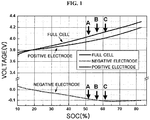
- FIG. 1 is a potential vs SOC graph (SOC-V graph) by fabricating a LiNi x Co y Mn z O 2 /graphite tri-electrode cell according to experimental example of the present disclosure and charging it at the charge rate of 3C.
- a tri-electrode cell is used in the study of a secondary battery to investigate behaviors of each of a negative electrode and a positive electrode, and it has a unit cell and a reference electrode.
- the potential continues its rise during charging irrespective of lithium plating at the negative electrode. This can be also observed in the positive electrode potential of FIG. 1 .
- the battery voltage (full cell potential) is determined by a potential difference between the positive electrode and the negative electrode. Accordingly, the potential changes of the negative electrode as a result of lithium plating affect the battery voltage, and in FIG. 1 , it can be seen that there are changes in battery voltage at points A, B, C.
- the inventors determine point B in which changes in potential drop speed at the negative electrode are observed as shown in FIG. 1 as a lithium plating occurrence point, and by making use of the fact that changes in negative electrode potential are reflected on changes in battery voltage, propose a method for detecting lithium plating at the negative electrode in real time by observing changes in battery voltage as a parameter that can be measured in an actual use environment of a secondary battery. In this method, a point in which the battery voltage rise speed slows down as shown in point B of FIG. 1 is determined as a lithium plating occurrence point.
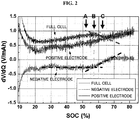
- a SOC-dV/dQ graph showing a change in potential with respect to a change in charge capacity (dV/dQ) vs SOC can be plotted as shown in FIGS. 1 and 2 .
- point B is an inflection point, and in the case of the battery voltage, the slope increase slows down at point B.
- the point B in which lithium plating at the negative electrode is determined to have occurred is created at a point in which the slope increase slows down on a change in potential with respect to a change in charge capacity (dV/dQ) vs SOC in an actual use environment of a secondary battery. Accordingly, it is suggested that a SOC-dV/dQ graph is obtained during charging of a secondary battery, and a point in which the slope increase slows down on dV/dQ is determined as a lithium plating occurrence point.
- the life of a battery is a measure of how long a secondary battery can be used, and is indicated in number of cycles, and it is termed cycle characteristic. That is, the life of a battery refers to how many a secondary battery can be recharged, and in the sense of electrical energy, a period of time during which a secondary battery is used until it is fully discharged after charged once is a cycle, and the number of cycles is life.
- FIG. 3 shows changes in capacity as a function of the number of cycles.
- the condition was 30°C 1.6C charge and 0.33C discharge.
- a secondary battery needs to maintain the capacity as original without significant reduction even for long charge and discharge cycles.
- point B is determined as a lithium plating occurrence point, and when a cell is charged during cycles using it as a charging limitation, the capacity retention is maintained, and degradation of the cell is prevented, resulting in prolonged life.
- the method for detecting lithium plating according to the present disclosure can be used to set a charge protocol at the initial time of using a secondary battery by determining a lithium plating occurrence point using this method and setting it as a charging limitation, and when charged accordingly, a secondary battery can have a long life without lithium plating.
- a method and apparatus for charging a secondary battery according to the present disclosure will be described in further detail.
- a method for charging a secondary battery using the method for detecting lithium plating according to the present disclosure is first descried with reference to FIGS. 4 and 5 .
- FIG. 4 is a flowchart of a method for charging a secondary battery according to the present disclosure.
- a data acquisition step is performed in which the battery voltage of a secondary battery (full cell potential) as a function of SOC is measured at different charge rates (S110).
- C secondary battery capacity of A ⁇ h in charge unit (often indicated as Q)
- an electric current in ampere unit is selected as a fraction (or a multiplier) of C.
- 1C charge rate refers to a charge/discharge rate at which the capacity of a fully charged secondary battery is consumed or replenished within one hour, and also may refer to a current density at the time.
- an amount of current required for use in devices within a predetermined period of time increases in a high proportion. Accordingly, a secondary battery used as an energy source is required to have much higher performance.
- the charge rate higher than 1C is desirable from the point of view of fast charging.
- the charge rate should be set in consideration of the type and characteristics of secondary battery.
- the range of charge rate in the data acquisition step may change depending on the type and characteristics of secondary battery.
- secondary batteries for EV set an initial charge rate to 1.5C and acquire data in the range of charge rate of 0.25C ⁇ 1.5C.
- secondary batteries for plug-in hybrid electric vehicle (PHEV) set an initial charge rate to 3C and acquire data in the range of charge rate of 0.25C ⁇ 3C.
- the range of initial charge rate and charge rate may be limited by not only the type of secondary battery but also a maximum current of a motor actually used in vehicle.
- secondary batteries for EV may have an initial charge rate set to 1.5C
- secondary batteries for PHEV may have an initial charge rate set to 3C.
- the initial charge rate may be increased, for example, up to 5C.
- the initial charge rate may be from 1.5C to 5C
- the range of charge rate at the data acquisition step of the present disclosure may be in the range of 0.25C ⁇ 5C.
- lithium-plating occurs at a point at which SOC is 33% (a point at which a solid line indicating the potential 0V and a potential graph meet). Subsequently, the charge rate is changed to the next charge rate 2C. In charging accordingly, lithium-plating occurs at the point at which SOC is 45%. Thus, the charge rate is changed to the next charge rate 1.6C. In charging accordingly, lithium-plating occurs at the point at which SOC is 58%. Thus, the charge rate is changed to the next charge rate 1C. In charging accordingly, lithium-plating occurs at the point at which SOC is 73%. Thus, the charge rate is changed to the next charge rate 0.5C. In charging accordingly, lithium-plating occurs at the point at which SOC is 78%. Using this stepwise reduction in charge current, the time taken to charge until SOC reaches 78% is 29.955 minutes in total.
- the range of initial charge rate and the range of charge rate at the data acquisition step may change as mentioned previously, and an amount of reduction of the charge rate may be an arbitrary value, not 0.5C, 0.6C, 0.4C as in this embodiment.
- the protocol may include the stepwise-decreasing charge rate and charge voltage information after termination of charging at each charge rate. If secondary batteries are charged according to this charge protocol, the secondary batteries can be charged rapidly without a lithium plating problem. As such, according to the present disclosure, a charge protocol can be obtained under the condition in which lithium plating does not occur, and according to this protocol, fast charging can be achieved by applying an optimized charge current.
- the charge protocol may be realized using an apparatus for charging a secondary battery according to the present disclosure as described below.
- FIG. 6 is an outline diagram of an apparatus for charging a secondary battery according to the present disclosure.
- the apparatus 100 for charging a secondary battery includes a power source unit 10 and a charging unit 20.
- the power source unit 10 outputs charge voltage inputted from a commercial power source.
- the charging unit 20 outputs the charge voltage inputted from the power source unit 10 to a secondary battery 30 as a charge current, to charge the secondary battery 30.
- the charging unit 20 takes control of the charge current to cause the charge current outputted to the secondary battery 30 to change stepwise.
- the charging unit 20 charges the secondary battery with the stepwise-adjusted charge current according to the protocol designed to change the charge rate stepwise by setting a point at which the battery voltage rise speed of the secondary battery 30 slows down as a lithium-plating occurrence point.
- the logic of the protocol of the charging method according to the present disclosure may be incorporated into the apparatus 100 for charging a secondary battery and used to charge the secondary battery 30.
- the charging unit 20 employs a processor for embodying fast charging.
- the processor stores logic of the charge protocol in memory, and can enable precise control over voltage and current and measure voltage and current with high accuracy to ensure the apparatus performance.
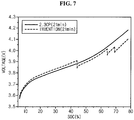
- FIGS. 7 and 8 are a SOC-battery voltage graph and a life comparison graph comparing the charging method using a stepwise reduction in charge current according to the present disclosure and a conventional CP (constant power) charging scheme.
- Table 2 is the charge protocol according to the present disclosure used in experimentation. A 10-second rest was given between each charging stage. [Table 2] C-rate SOC Delta SOC Charge time (min) Rest (sec) 2.59 44 38 8.80 10 2.07 64 20 5.80 10 1.66 69 5 1.81 10 1.24 78 9 4.35 21 min
- FIG. 7 shows the battery voltage as a result of charging.
- the charge time was 21 minutes equally.
- the conventional art (CP) tends to show a continuous rise in voltage, while the charging method according to the present disclosure shows a saw-like rising curve due to changes between each charging stage because it uses a stepwise reduction in charge current.
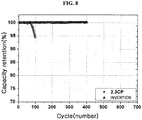
- FIG. 8 is a graph comparing the life of the secondary battery between the charging method using a stepwise reduction in charge current according to the present disclosure and the conventional CP charging scheme.
- the life of each case was compared where the charge time was 21 minutes equally and discharging was performed under the same condition (1C CC).
- the capacity retention starts to reduce after 75 cycles, and after 100 cycles, the capacity retention reduces to about 95%, while in the case of the present disclosure (step charge), the capacity retention amounts to 100% even after 400 cycle.
- the life of the secondary battery is set by various factors, and structural stability of the electrode, especially, stability of the negative electrode, is important.
- An ideal negative electrode should have high reaction reversibility with lithium ions. If an ideal reversible reaction is accomplished, there is no change in capacity retention based on cycle. It can be seen that the charging method using a stepwise reduction in charge current according to the present disclosure has higher reaction reversibility than the conventional art, and it is a result of preventing lithium-plating at the negative electrode. As such, in accordance with the charging method using a stepwise reduction in charge current according to the present disclosure, it can be seen that the secondary battery has a longer life than the conventional art by preventing degradation.
- the charging method using a stepwise reduction in charge current charges the secondary battery rapidly using the initial charge rate higher than 1C with a stepwise decrease in charge rate by setting the point at which the battery voltage rise speed slows down as the lithium-plating occurrence point, thereby charging the secondary battery rapidly without lithium-plating occurrence. Damage to the internal structure of the secondary battery can be prevented, and the life of the secondary battery can be improved.
- the method for detecting lithium plating according to the present disclosure can be used to monitor the state of the secondary battery in using the secondary battery, and stop charging or change the charge protocol in response to lithium plating detected.
- This is a secondary battery system using the method for detecting lithium plating according to the present disclosure.
- FIG. 9 is an outline diagram of the secondary battery system according to the present disclosure.
- the method for detecting lithium plating according to the present disclosure may be embodied as the secondary battery system 200 as shown in FIG. 9 .
- the secondary battery system detects the state of a secondary battery such as a state of charge (remaining capacity or SOC) based on the voltage of the secondary battery, and the secondary battery system 200 according to the present disclosure is characterized in that it can detect lithium plating.
- the secondary battery system 200 includes a secondary battery 130, a current sensor 110, a voltage sensor 120, and a controller 140.
- the controller 140 employs a processor having a memory such as ROM and RAM.
- the controller 140 calculates a value of dV/dQ, namely, a ratio of a variation dQ of the amount of stored energy Q to a variation dV of the battery voltage V of the secondary battery 130 when the amount of stored energy Q of the secondary battery 130 changed. Particularly, during charging of the secondary battery 130, a value of dV/dQ is calculated by differentiating battery voltage V of the secondary battery 130 with respect to its corresponding amount of stored energy Q.
- battery voltage V and an amount of stored energy Q is acquired for each predetermined time t, and a variation dV of the battery voltage V and a variation dQ of the amount of stored energy Q are calculated for each predetermined time t, and based on them, a value of dV/dQ is calculated for each predetermined time t.
- the controller 140 determines it as a lithium plating occurrence point. That is, the method for detecting lithium plating according to the present disclosure is performed by the controller 140, and the controller 140 determines whether plating occurred by detecting whether lithium plating occurs in the secondary battery 130.
- the controller 140 may stop charging or change the charge condition to accomplish full charge (for example, up to SOC 80%). In the case of changing the charge condition, it may be accomplished by reducing at least one of charge current and charge voltage to the secondary battery 130 while being charged.
- the secondary battery system 200 may be configured to stop charging and change the charging condition through a control command for a charge/discharge circuit (not shown) of the secondary battery 130.
- an I/O interface may be included the processor of the controller 140 to allow the controller 140 to control the charge/discharge circuit through it.
Landscapes
- Chemical & Material Sciences (AREA)
- Engineering & Computer Science (AREA)
- Chemical Kinetics & Catalysis (AREA)
- Electrochemistry (AREA)
- Manufacturing & Machinery (AREA)
- General Chemical & Material Sciences (AREA)
- Physics & Mathematics (AREA)
- General Physics & Mathematics (AREA)
- Materials Engineering (AREA)
- Power Engineering (AREA)
- Health & Medical Sciences (AREA)
- Life Sciences & Earth Sciences (AREA)
- Analytical Chemistry (AREA)
- Biochemistry (AREA)
- General Health & Medical Sciences (AREA)
- Immunology (AREA)
- Pathology (AREA)
- Secondary Cells (AREA)
- Charge And Discharge Circuits For Batteries Or The Like (AREA)
- Tests Of Electric Status Of Batteries (AREA)
- Microelectronics & Electronic Packaging (AREA)
- Battery Electrode And Active Subsutance (AREA)
Abstract
Description
- The present disclosure relates to a method for detecting lithium plating in a lithium ion secondary battery, and more particularly, to a method for determining whether lithium plating occurred in real time by a non-destructive method. Further, the present disclosure relates to a charging method and apparatus for charging a secondary battery under the condition in which lithium plating does not occur by using this method. In addition, the present disclosure relates to a secondary battery system for detecting the state of a secondary battery by using this method. The present application claims priority to Korean Patent Application No.
10-2015-0118919 - Recently, with the dramatic increasing demand for handheld electronic products such as laptop computers and mobile phones and the growing demand for electric carts, electric wheelchairs, and electric bikes, studies are being intensively made on high performance secondary battery that can be recharged repeatedly. Also, more recently, with the gradual exhaustion of carbon energy and the increasing interest in environment, the global demand for hybrid electric vehicle (HEV) and electric vehicle (EV) is gradually increasing. Accordingly, deeper interest and more intensive studies concentrate on secondary batteries for vehicle as a key component of HEV or EV.
- Lithium ion secondary batteries are the most realistic technology for high performance secondary batteries and secondary batteries for vehicle. A lithium ion secondary battery works by repeated intercalation and deintercalation of lithium ions at a negative electrode and a positive electrode. A lithium salt containing electrolyte in which lithium ions move but electrons do not move is present between the electrodes.
- Many studies are being made on secondary batteries in aspects of high capacity and high density, but it is also important to improve life and safety. To this end, it is necessary to inhibit a decomposition reaction with an electrolyte solution on the electrode surface, and prevent overcharge/overdischarge.
- Particularly, there is a need to prevent the deposition of lithium, so-called lithium-plating (Li-plating), on the negative electrode surface. The reason is that lithium plating not only causes side reactions with an electrolyte solution and changes in kinetic balance of the secondary battery, resulting in degradation of the secondary battery such as capacity loss, but also affects the life of the secondary battery and causes a safety problem with loss of an overcharge control function.
- Conventionally, however, it is very difficult to detect lithium plating in secondary batteries in real time. Earlier non-destructive detection of lithium plating on the negative electrode includes discharging at low temperature, heat capacity analysis, and thickness increase analysis. However, they do not involve measuring in an environment in which a secondary battery is used. Therefore, there is a need for real-time detection of lithium plating in an actual use environment of a secondary battery.
- The present disclosure is directed to providing a non-destructive method for detecting lithium plating by which lithium plating can be detected in real time in an actual use environment of a secondary battery.
- The present disclosure is further directed to providing a secondary battery charging method and apparatus for charging a secondary battery under the condition in which lithium plating does not occur by using this method.
- The present disclosure is further directed to providing a secondary battery system for detecting the state of a secondary battery by using this method.
- To achieve the object, a method for detecting lithium plating according to the present disclosure is a method for detecting lithium plating in a negative electrode in real time by observing a change in battery voltage (full cell potential) as a function of SOC during charging a secondary battery, and determines a point at which a rise speed of the battery voltage slows down as a lithium plating occurrence point.
- In an embodiment, a SOC-V graph is obtained by measuring battery voltage as a function of SOC while charging the secondary battery. From this, a SOC-dV/dQ graph showing a change in battery voltage dV/dQ as a function of SOC is obtained. A point at which a slope increase slows down on the SOC-dV/dQ graph is determined as the lithium plating occurrence point.
- To achieve another object, a method for charging a secondary battery according to the present disclosure includes acquiring data by measuring battery voltage (full cell potential) as a function of SOC at different charge rates; obtaining a protocol designed to change a charge rate stepwise by setting a point at which a rise speed of the battery voltage slows down as a lithium plating occurrence point and charging limitation from the acquired data; and charging a secondary battery according to the protocol.
- The charge rate at the data acquisition step may be in a range of 0.25C ∼ 5C.
- The protocol may have an initial charge rate higher than 1C. Particularly, the protocol may have an initial charge rate of from 1.5C to 5C. The protocol may include a stepwise-decreasing charge rate and charge voltage information after termination of charging at each charge rate.
- An apparatus for charging a secondary battery according to the present disclosure includes a power source unit configured to output charge voltage inputted from a commercial power source; and a charging unit configured to output the charge voltage inputted from the power source unit to a secondary battery as a charge current, to charge the secondary battery, and when battery voltage (full cell potential) of the secondary battery reaches a preset stage, to take control of the charge current to cause the charge current outputted to the secondary battery to change stepwise, wherein the charging unit charges the secondary battery with the stepwise-adjusted charge current according to a protocol designed to change a charge rate stepwise by setting a point at which a rise speed of the battery voltage of the secondary battery slows down as a lithium plating occurrence point and charging limitation.
- A secondary battery system according to the present disclosure is a secondary battery system including a secondary battery, and the secondary battery system includes a dV/dQ calculation means configured to calculate a value of dV/dQ, the value of dV/dQ being a ratio of a variation dQ of an amount of stored energy Q to a variation dV of battery voltage V of the secondary battery when the amount of stored energy Q in the secondary battery changed during charging of the secondary battery, wherein a point at which a slope increase slows down on a SOC-dV/dQ graph showing a relationship between SOC and dV/dQ is determined as a lithium plating occurrence point in a negative electrode of the secondary battery.
- The secondary battery system may include a current sensor to sense a current value I flowing in the secondary battery; a voltage sensor to sense battery voltage of the secondary battery; and a controller as the dV/dQ calculation means, and the controller may estimate an amount of stored energy in the secondary battery by integrating the current value for each predetermined time, obtain the battery voltage for each predetermined time by synchronizing with the integrated current, and calculate a value of dV/dQ by differentiating the battery voltage of the secondary battery with respect to its corresponding amount of stored energy during charging of the secondary battery.
- Here, the controller may stop charging when determining as the lithium plating occurrence point. Instead, the controller may reduce at least one of charge current and charge voltage to the secondary battery while being charged, to accomplish full charge, when determining as the lithium plating occurrence point.
- According to the present disclosure, lithium plating can be detected in real time in an actual use environment of a lithium ion secondary battery. This method is non-destructive and can detect not only in real time but also in an actual use environment, providing an effect on accurate determination of the state of a secondary battery.
- The method for detecting lithium plating according to the present disclosure can be used to set a charging condition in which lithium plating does not occur. Using this, a secondary battery can be charged rapidly and degradation caused by lithium plating can be prevented, ensuring a long life.
- Because care should be taken of lithium plating, especially when charging rapidly at a high charge rate, the present disclosure is useful in quick charging. In accordance with the apparatus and method for charging a secondary battery according to the present disclosure, a secondary battery is charged without lithium-plating, there is no side reaction of deposited lithium with an electrolyte solution and changes in kinetic balance of the secondary battery, and the cause of degradation of the secondary battery is prevented. Charging is accomplished at a high charge rate within the limitation that does not cause lithium-plating, thereby achieving fast charging.
- Changes in battery voltage as a function of SOC may differ in each secondary battery. The present disclosure accurately grasps a condition in which lithium-plating occurs during charging based on testing of the secondary battery and proposes an optimum charging approach for each secondary battery, rather than uniform charging limitation proposal irrespective of the characteristics of the secondary battery.
- The secondary battery system according to the present disclosure implements a method for detecting lithium plating. By this system, the state of the secondary battery can be accurately detected in a convenient manner while the secondary battery is being used, and there is an effect on impeding the propagation of degradation of the secondary battery by dealing with a situation such as lithium plating rapidly.
- The accompanying drawing illustrates a preferred embodiment of the present disclosure and together with the foregoing disclosure, serves to provide further understanding of the technical spirit of the present disclosure. However, the present disclosure is not construed as being limited to the drawing.
-
FIG. 1 is a potential vs SOC graph obtained by fabricating a LiNixCoyMnzO2/graphite tri-electrode cell according to experimental example of the present disclosure and charging it at the charge rate of 3C. -
FIG. 2 is a change in potential with respect to a change in charge capacity (dV/dQ) vs SOC graph obtained fromFIG. 1 . -
FIG. 3 is a cycle life comparison graph for verifying the effectiveness of a method for detecting lithium plating according to the present disclosure. -
FIG. 4 is a flowchart of a method for charging a secondary battery according to the present disclosure. -
FIG. 5 is a battery voltage vs charge rate presented to describe a method for charging a secondary battery according to the present disclosure and battery voltage during protocol-oriented charging based on it. -
FIG. 6 is an outline diagram of an apparatus for charging a secondary battery according to the present disclosure. -
FIG. 7 is a battery voltage vs SOC graph for a charging method using a stepwise reduction in charge current according to the present disclosure and a conventional CP charging scheme. -
FIG. 8 is a graph comparing the life of a secondary battery between a charging method using a stepwise reduction in charge current according to the present disclosure and a conventional CP charging scheme. -
FIG. 9 is an outline diagram of a secondary battery system according to the present disclosure. - Hereinafter, preferred embodiments of the present disclosure will be described in detail with reference to the accompanying drawings. However, the present disclosure is not limited to the embodiments disclosed below and will be embodied in a variety of different forms, and this embodiment is only provided to fully disclose the present disclosure, and give those skilled in the art a complete understanding of the scope of the invention.
- First of all, the background of how the present disclosure was derived is described with reference to
FIG. 1 . -
FIG. 1 is a potential vs SOC graph (SOC-V graph) by fabricating a LiNixCoyMnzO2/graphite tri-electrode cell according to experimental example of the present disclosure and charging it at the charge rate of 3C. As well know, a tri-electrode cell is used in the study of a secondary battery to investigate behaviors of each of a negative electrode and a positive electrode, and it has a unit cell and a reference electrode. - Generally, during charging, lithium intercalates into a negative electrode active material, and the lower the stage is, the lower the negative electrode potential is. In this instance, if the charge current density is increased, the stage is not observed well, but due to intercalation of lithium and resistance increases, the negative electrode potential continues its descent. It can be seen from
FIG. 1 that the negative electrode potential continuously reduces to point A. - However, during charging, a reaction in which lithium intercalates into a negative electrode active material and a reaction in which lithium-plating occurs competitively occur. The inventors discovered through repeated experimentation that when lithium-plating occurs during charging, lithium does not intercalate into a negative electrode active material, causing changes in potential drop of a negative electrode. That is, they found that when lithium plating starts, the negative electrode reduces in the speed at which the potential drops. In
FIG. 1 , changes in drop speed are observed at point B of the negative electrode potential. Also, subsequent to point B, a region in which a predetermined flat plateau in the negative electrode potential appears is observed, and point C resides in such a region. - On the other hand, in the case of the positive electrode, the potential continues its rise during charging irrespective of lithium plating at the negative electrode. This can be also observed in the positive electrode potential of
FIG. 1 . - The battery voltage (full cell potential) is determined by a potential difference between the positive electrode and the negative electrode. Accordingly, the potential changes of the negative electrode as a result of lithium plating affect the battery voltage, and in
FIG. 1 , it can be seen that there are changes in battery voltage at points A, B, C. - In the case of a secondary battery, not a tri-electrode cell fabricated for experimentation, only the battery voltage can be measured in an actual use environment. Therefore, the inventors discovered that it is possible to detect lithium plating at the negative electrode in real time when observing changes in battery voltage during charging, and proposed the present disclosure.
- The inventors determine point B in which changes in potential drop speed at the negative electrode are observed as shown in
FIG. 1 as a lithium plating occurrence point, and by making use of the fact that changes in negative electrode potential are reflected on changes in battery voltage, propose a method for detecting lithium plating at the negative electrode in real time by observing changes in battery voltage as a parameter that can be measured in an actual use environment of a secondary battery. In this method, a point in which the battery voltage rise speed slows down as shown in point B ofFIG. 1 is determined as a lithium plating occurrence point. - To find the point in which lithium-plating occurs more accurately, a SOC-dV/dQ graph showing a change in potential with respect to a change in charge capacity (dV/dQ) vs SOC can be plotted as shown in
FIGS. 1 and2 . - Seeing dV/dQ of
FIG. 2 , in the case of the negative electrode potential, point B is an inflection point, and in the case of the battery voltage, the slope increase slows down at point B. The point B in which lithium plating at the negative electrode is determined to have occurred is created at a point in which the slope increase slows down on a change in potential with respect to a change in charge capacity (dV/dQ) vs SOC in an actual use environment of a secondary battery. Accordingly, it is suggested that a SOC-dV/dQ graph is obtained during charging of a secondary battery, and a point in which the slope increase slows down on dV/dQ is determined as a lithium plating occurrence point. - An experiment was conducted to verify the effectiveness of the method for detecting lithium plating. Three secondary batteries having the same unit cell as the tri-electrode cell used in the above experiment were prepared, one was charged and discharged to the point (point B in
FIG. 2 ) in which lithium-plating is determined to occur, the other was charged and discharged before the lithium-plating occurrence point (up to point A), and another was charged and discharged after the lithium-plating occurrence point (up to point C) during charge and discharge cycles, and their results are shown inFIG. 3 . - The life of a battery is a measure of how long a secondary battery can be used, and is indicated in number of cycles, and it is termed cycle characteristic. That is, the life of a battery refers to how many a secondary battery can be recharged, and in the sense of electrical energy, a period of time during which a secondary battery is used until it is fully discharged after charged once is a cycle, and the number of cycles is life.
-
FIG. 3 shows changes in capacity as a function of the number of cycles. The condition was 30°C 1.6C charge and 0.33C discharge. To have a long life, a secondary battery needs to maintain the capacity as original without significant reduction even for long charge and discharge cycles. - As can be seen from
FIG. 3 , after 80 cycle life test to point C, when a cell is dissembled, a great deal of lithium-plating is observed. In contrast, in the case of a cell charged and discharged for 80 cycles to points A and B, lithium-plating was not observed. Also, as can be seen from the life test results, a cell charged and discharged to point C reduced in capacity retention to 80% even after performing 20 cycles, and the capacity retention was below 64% after 80 cycles. - It can be seen that plated lithium generated during charging and discharging (as a result of lithium plating occurred during charging to point C) causes cell life characteristics to degrade. As proposed by the present disclosure, point B is determined as a lithium plating occurrence point, and when a cell is charged during cycles using it as a charging limitation, the capacity retention is maintained, and degradation of the cell is prevented, resulting in prolonged life.
- As such, the method for detecting lithium plating according to the present disclosure can be used to set a charge protocol at the initial time of using a secondary battery by determining a lithium plating occurrence point using this method and setting it as a charging limitation, and when charged accordingly, a secondary battery can have a long life without lithium plating. Hereinafter, a method and apparatus for charging a secondary battery according to the present disclosure will be described in further detail.
- A method for charging a secondary battery using the method for detecting lithium plating according to the present disclosure is first descried with reference to
FIGS. 4 and5 . -
FIG. 4 is a flowchart of a method for charging a secondary battery according to the present disclosure. - Referring to
FIG. 4 , a data acquisition step is performed in which the battery voltage of a secondary battery (full cell potential) as a function of SOC is measured at different charge rates (S110). - If "C" is secondary battery capacity of A·h in charge unit (often indicated as Q), an electric current in ampere unit is selected as a fraction (or a multiplier) of C. For example, 1C charge rate refers to a charge/discharge rate at which the capacity of a fully charged secondary battery is consumed or replenished within one hour, and also may refer to a current density at the time. Recently, with diverse functions of electronic devices, an amount of current required for use in devices within a predetermined period of time increases in a high proportion. Accordingly, a secondary battery used as an energy source is required to have much higher performance. In the case of mobile phones, most of traditional mobile phones needed a charge and discharge rate of C/2, but as these functions improve in the future, performance corresponding to a charge and discharge rate of 1C will be required. Currently, secondary batteries for laptop computers, EV, and PHEV require a similar charge rate and a much higher discharge rate.
- The charge rate higher than 1C is desirable from the point of view of fast charging. However, if a secondary battery is continuously charged with high current, high heat generation may occur inside the secondary battery, and due to resistance of the secondary battery, each electrode may be in overvoltage state. Accordingly, the charge rate should be set in consideration of the type and characteristics of secondary battery.
- The range of charge rate in the data acquisition step may change depending on the type and characteristics of secondary battery. For example, secondary batteries for EV set an initial charge rate to 1.5C and acquire data in the range of charge rate of 0.25C ∼ 1.5C. As another example, secondary batteries for plug-in hybrid electric vehicle (PHEV) set an initial charge rate to 3C and acquire data in the range of charge rate of 0.25C ∼ 3C. The range of initial charge rate and charge rate may be limited by not only the type of secondary battery but also a maximum current of a motor actually used in vehicle.
- As previously mentioned, in consideration of characteristics of secondary battery, secondary batteries for EV may have an initial charge rate set to 1.5C, and secondary batteries for PHEV may have an initial charge rate set to 3C. According to the secondary battery specification needed for a higher charge rate and a higher discharge rate, the initial charge rate may be increased, for example, up to 5C. Accordingly, the initial charge rate may be from 1.5C to 5C, and the range of charge rate at the data acquisition step of the present disclosure may be in the range of 0.25C ∼ 5C.
- As previously mentioned, deeper interest and more intensive studies concentrate on secondary batteries for vehicle as a key component of HEV or EV, and along with this, there is an urgent need for the development of fast charging technology to charge secondary batteries rapidly. The demand for charge time is gradually increasing in the automobile market, and to meet the demand, a higher initial charge rate is needed. From the viewpoint of fast charging, a high initial charge rate is advantageous, but due to the problem as discussed previously, there is concern that each electrode will become an overvoltage state at a too high charge rate due to the resistance of secondary batteries. Also, at too high charge rate, charging reaches the limitation at the same time as the start, so the total charge time may be not significantly reduced. Thus, to increase the initial charge rate, improvements in resistance characteristics of secondary batteries should be involved together. The present disclosure can increase the initial charge rate up to 5C for secondary batteries with improved resistance as compared to traditional secondary batteries.
-
FIG. 5 shows battery voltage vs charge rate. As shown inFIG. 5 , a graph can be obtained by measuring battery voltage as a function of SOC, with varying charge rates from 2.5C to 0.33C. - Subsequently, from the acquired data, by setting a point at which the battery voltage rise speed slows down as a lithium-plating occurrence point, protocol designed to change a charge rate stepwise is obtained (S120). If the point at which the battery voltage rise speed slows down is set as the lithium-plating occurrence point, the secondary battery can be charged without causing lithium-plating to the negative electrode.
- For example, in
FIG. 5 , if the point at which the battery voltage rise speed slows down is set as the lithium-plating occurrence point and the charging limitation, protocol such as Table 1 can be obtained.[Table 1] C-rate SOC Delta SOC Charge time (min) 2.5 33 27 6.48 2 45 12 3.6 1.6 58 13 4.875 1 73 15 9 0.5 78 5 6 29.955 - Referring to Table 1 and
FIG. 5 together, in charging at the initial charge rate of 2.5C, lithium-plating occurs at a point at which SOC is 33% (a point at which a solid line indicating the potential 0V and a potential graph meet). Subsequently, the charge rate is changed to the next charge rate 2C. In charging accordingly, lithium-plating occurs at the point at which SOC is 45%. Thus, the charge rate is changed to the next charge rate 1.6C. In charging accordingly, lithium-plating occurs at the point at which SOC is 58%. Thus, the charge rate is changed to the next charge rate 1C. In charging accordingly, lithium-plating occurs at the point at which SOC is 73%. Thus, the charge rate is changed to the next charge rate 0.5C. In charging accordingly, lithium-plating occurs at the point at which SOC is 78%. Using this stepwise reduction in charge current, the time taken to charge until SOC reaches 78% is 29.955 minutes in total. - As seen from Table 1, a large SOC variation can be obtained at a high charge rate in the initial time, and accordingly, the total charge time can be shortened, and especially, even in the case of rapid charging, the charge rate is not maintained at high condition all the time and is changed stepwise in consideration of lithium plating, thereby producing an effect on charging without a lithium plating problem.
- Through the method described above, an effective charge protocol can be obtained for each secondary battery. Although the battery voltage vs SOC graph changes according to the type of secondary battery, this method by which the protocol is obtained is equally applied.
- Also, although this embodiment describes that the charge rate is reduced from 2.5C to 0.5C, the range of initial charge rate and the range of charge rate at the data acquisition step may change as mentioned previously, and an amount of reduction of the charge rate may be an arbitrary value, not 0.5C, 0.6C, 0.4C as in this embodiment.
- Subsequently, after this protocol is obtained, the secondary battery is charged (S130). The protocol may include the stepwise-decreasing charge rate and charge voltage information after termination of charging at each charge rate. If secondary batteries are charged according to this charge protocol, the secondary batteries can be charged rapidly without a lithium plating problem. As such, according to the present disclosure, a charge protocol can be obtained under the condition in which lithium plating does not occur, and according to this protocol, fast charging can be achieved by applying an optimized charge current.
- The charge protocol may be realized using an apparatus for charging a secondary battery according to the present disclosure as described below.
-
FIG. 6 is an outline diagram of an apparatus for charging a secondary battery according to the present disclosure. - Referring to
FIG. 6 , theapparatus 100 for charging a secondary battery includes apower source unit 10 and a chargingunit 20. - The
power source unit 10 outputs charge voltage inputted from a commercial power source. - The charging
unit 20 outputs the charge voltage inputted from thepower source unit 10 to asecondary battery 30 as a charge current, to charge thesecondary battery 30. In this instance, if the charge voltage (battery voltage) of thesecondary battery 30 reaches a preset stage, the chargingunit 20 takes control of the charge current to cause the charge current outputted to thesecondary battery 30 to change stepwise. - Particularly, the charging
unit 20 charges the secondary battery with the stepwise-adjusted charge current according to the protocol designed to change the charge rate stepwise by setting a point at which the battery voltage rise speed of thesecondary battery 30 slows down as a lithium-plating occurrence point. The logic of the protocol of the charging method according to the present disclosure may be incorporated into theapparatus 100 for charging a secondary battery and used to charge thesecondary battery 30. - The charging
unit 20 employs a processor for embodying fast charging. According to the embodiment of the present disclosure, the processor stores logic of the charge protocol in memory, and can enable precise control over voltage and current and measure voltage and current with high accuracy to ensure the apparatus performance. - In accordance with the method and apparatus for charging a secondary battery according to the present disclosure, because it has a charging process controlling to avoid going the lithium-plating occurrence point during charging, when compared to a general charging scheme, there is no concern that lithium-plating will occur to the negative electrode, and accordingly, there is an effect on longer life of the secondary battery.
-
FIGS. 7 and8 are a SOC-battery voltage graph and a life comparison graph comparing the charging method using a stepwise reduction in charge current according to the present disclosure and a conventional CP (constant power) charging scheme. - Table 2 is the charge protocol according to the present disclosure used in experimentation. A 10-second rest was given between each charging stage.
[Table 2] C-rate SOC Delta SOC Charge time (min) Rest (sec) 2.59 44 38 8.80 10 2.07 64 20 5.80 10 1.66 69 5 1.81 10 1.24 78 9 4.35 21 min -
FIG. 7 shows the battery voltage as a result of charging. In the present disclosure and the conventional art, the charge time was 21 minutes equally. The conventional art (CP) tends to show a continuous rise in voltage, while the charging method according to the present disclosure shows a saw-like rising curve due to changes between each charging stage because it uses a stepwise reduction in charge current. -
FIG. 8 is a graph comparing the life of the secondary battery between the charging method using a stepwise reduction in charge current according to the present disclosure and the conventional CP charging scheme. In the present disclosure and the conventional art, the life of each case was compared where the charge time was 21 minutes equally and discharging was performed under the same condition (1C CC). - In the conventional art (CP) as shown in
FIG. 8 , the capacity retention starts to reduce after 75 cycles, and after 100 cycles, the capacity retention reduces to about 95%, while in the case of the present disclosure (step charge), the capacity retention amounts to 100% even after 400 cycle. - The life of the secondary battery is set by various factors, and structural stability of the electrode, especially, stability of the negative electrode, is important. An ideal negative electrode should have high reaction reversibility with lithium ions. If an ideal reversible reaction is accomplished, there is no change in capacity retention based on cycle. It can be seen that the charging method using a stepwise reduction in charge current according to the present disclosure has higher reaction reversibility than the conventional art, and it is a result of preventing lithium-plating at the negative electrode. As such, in accordance with the charging method using a stepwise reduction in charge current according to the present disclosure, it can be seen that the secondary battery has a longer life than the conventional art by preventing degradation.
- The charging method using a stepwise reduction in charge current according to the present disclosure charges the secondary battery rapidly using the initial charge rate higher than 1C with a stepwise decrease in charge rate by setting the point at which the battery voltage rise speed slows down as the lithium-plating occurrence point, thereby charging the secondary battery rapidly without lithium-plating occurrence. Damage to the internal structure of the secondary battery can be prevented, and the life of the secondary battery can be improved.
- Also, the method for detecting lithium plating according to the present disclosure can be used to monitor the state of the secondary battery in using the secondary battery, and stop charging or change the charge protocol in response to lithium plating detected. This is a secondary battery system using the method for detecting lithium plating according to the present disclosure.
-
FIG. 9 is an outline diagram of the secondary battery system according to the present disclosure. - The method for detecting lithium plating according to the present disclosure may be embodied as the
secondary battery system 200 as shown inFIG. 9 . Generally, the secondary battery system detects the state of a secondary battery such as a state of charge (remaining capacity or SOC) based on the voltage of the secondary battery, and thesecondary battery system 200 according to the present disclosure is characterized in that it can detect lithium plating. - Referring to
FIG. 9 , thesecondary battery system 200 includes asecondary battery 130, acurrent sensor 110, avoltage sensor 120, and acontroller 140. Thecontroller 140 employs a processor having a memory such as ROM and RAM. - The
current sensor 110 senses a current value I flowing in thesecondary battery 130. Also, thevoltage sensor 120 senses the battery voltage V (voltage across terminals) of thesecondary battery 130, i.e., full cell potential. The current value I and the battery voltage V is converted to digital data, for example, by an A/D converter and the processor of thecontroller 140 can obtain the data. - The
controller 140 calculates an amount of charged energy or discharged energy of thesecondary battery 130 by integrating the current value I sensed by thecurrent sensor 110 for each predetermined time t, and estimates an amount of stored energy Q of thesecondary battery 130 from the calculated amount of charged energy or discharged energy. Also, thecontroller 140 acquires the battery voltage V of eachsecondary battery 130 sensed by thevoltage sensor 120 for each predetermined time t by synchronizing with the integrated current. - Also, the
controller 140 calculates a value of dV/dQ, namely, a ratio of a variation dQ of the amount of stored energy Q to a variation dV of the battery voltage V of thesecondary battery 130 when the amount of stored energy Q of thesecondary battery 130 changed. Particularly, during charging of thesecondary battery 130, a value of dV/dQ is calculated by differentiating battery voltage V of thesecondary battery 130 with respect to its corresponding amount of stored energy Q. - Specifically, during charging of the
secondary battery 130, battery voltage V and an amount of stored energy Q is acquired for each predetermined time t, and a variation dV of the battery voltage V and a variation dQ of the amount of stored energy Q are calculated for each predetermined time t, and based on them, a value of dV/dQ is calculated for each predetermined time t. - As described in the foregoing, the dV/dQ value is continuously monitored for each predetermined time t, and when a point at which the slope increase slows down takes place on dV/dQ, the
controller 140 determines it as a lithium plating occurrence point. That is, the method for detecting lithium plating according to the present disclosure is performed by thecontroller 140, and thecontroller 140 determines whether plating occurred by detecting whether lithium plating occurs in thesecondary battery 130. - When the
controller 140 determines that lithium plating occurred, thecontroller 140 may stop charging or change the charge condition to accomplish full charge (for example, up toSOC 80%). In the case of changing the charge condition, it may be accomplished by reducing at least one of charge current and charge voltage to thesecondary battery 130 while being charged. Thesecondary battery system 200 may be configured to stop charging and change the charging condition through a control command for a charge/discharge circuit (not shown) of thesecondary battery 130. For example, an I/O interface may be included the processor of thecontroller 140 to allow thecontroller 140 to control the charge/discharge circuit through it. - Hereinabove, while the preferred embodiments of the present disclosure have been illustrated and described, the present disclosure is not limited to the particular preferred embodiment described above, and it is apparent to those skilled in the art that modifications may be made in various forms without departing from the features of the present disclosure set forth in the claims, and such modifications reside in the scope of the claims.
Claims (12)
- A method for detecting lithium plating, by which lithium plating in a negative electrode is detected in real time by observing a change in battery voltage as a function of SOC during charging a secondary battery, the method comprising:determining a point at which a rise speed of the battery voltage slows down as a lithium plating occurrence point.
- The method for detecting lithium plating according to claim 1, wherein the method comprises:obtaining a SOC-V graph by measuring battery voltage as a function of SOC while charging the secondary battery;obtaining a SOC-dV/dQ graph showing a change in battery voltage dV/dQ as a function of SOC from the SOC-V graph; anddetermining a point at which a slope increase slows down on the SOC-dV/dQ graph as the lithium plating occurrence point.
- A method for charging a secondary battery, comprising:acquiring data by measuring battery voltage as a function of SOC at different charge rates;obtaining a protocol designed to change a charge rate stepwise by setting a point at which a rise speed of the battery voltage slows down as a lithium plating occurrence point and charging limitation from the acquired data; andcharging a secondary battery according to the protocol.
- The method for charging a secondary battery according to claim 3, wherein the charge rate at the data acquisition step is in a range of 0.25C ∼ 5C.
- The method for charging a secondary battery according to claim 3, wherein the protocol has an initial charge rate higher than 1C.
- The method for charging a secondary battery according to claim 3, wherein the protocol has an initial charge rate of from 1.5C to 5C.
- The method for charging a secondary battery according to claim 3, wherein the protocol includes a stepwise-decreasing charge rate and charge voltage information after termination of charging at each charge rate.
- An apparatus for charging a secondary battery, comprising:a power source unit configured to output charge voltage inputted from a commercial power source; anda charging unit configured to output the charge voltage inputted from the power source unit to a secondary battery as a charge current, to charge the secondary battery, and when battery voltage of the secondary battery reaches a preset stage, to take control of the charge current to cause the charge current outputted to the secondary battery to change stepwise,wherein the charging unit charges the secondary battery with the stepwise-adjusted charge current according to a protocol designed to change a charge rate stepwise by setting a point at which a rise speed of the battery voltage of the secondary battery slows down as a lithium plating occurrence point and charging limitation.
- A secondary battery system, comprising a secondary battery,
the secondary battery system comprising:a dV/dQ calculation means configured to calculate a value of dV/dQ, the value of dV/dQ being a ratio of a variation dQ of an amount of stored energy Q to a variation dV of battery voltage V of the secondary battery when the amount of stored energy Q in the secondary battery changed during charging of the secondary battery,wherein a point at which a slope increase slows down on a SOC-dV/dQ graph showing a relationship between SOC and dV/dQ is determined as a lithium plating occurrence point in a negative electrode of the secondary battery. - The secondary battery system according to claim 9, wherein the secondary battery system comprises:a current sensor to sense a current value I flowing in the secondary battery;a voltage sensor to sense battery voltage of the secondary battery; anda controller as the dV/dQ calculation means, andthe controller estimates an amount of stored energy in the secondary battery by integrating the current value for each predetermined time, obtains the battery voltage for each predetermined time by synchronizing with the integrated current, and calculates a value of dV/dQ by differentiating the battery voltage of the secondary battery with respect to its corresponding amount of stored energy during charging of the secondary battery.
- The secondary battery system according to claim 9, wherein the controller stops charging when determining as the lithium plating occurrence point.
- The secondary battery system according to claim 9, wherein the controller reduces at least one of charge current and charge voltage to the secondary battery while being charged, to accomplish full charge, when determining as the lithium plating occurrence point.
Priority Applications (1)
| Application Number | Priority Date | Filing Date | Title |
|---|---|---|---|
| PL16839425T PL3226016T3 (en) | 2015-08-24 | 2016-06-20 | A method for detecting Li-electroplating, a method and apparatus for charging a battery, and a battery system in which it is applied |
Applications Claiming Priority (2)
| Application Number | Priority Date | Filing Date | Title |
|---|---|---|---|
| KR1020150118919A KR101897859B1 (en) | 2015-08-24 | 2015-08-24 | Detection method of Li plating, method and apparatus for charging secondary battery and secondary battery system using the same |
| PCT/KR2016/006532 WO2017034135A1 (en) | 2015-08-24 | 2016-06-20 | Lithium precipitation detection method, secondary battery charging method and apparatus using same, and secondary battery system |
Publications (3)
| Publication Number | Publication Date |
|---|---|
| EP3226016A1 true EP3226016A1 (en) | 2017-10-04 |
| EP3226016A4 EP3226016A4 (en) | 2018-05-02 |
| EP3226016B1 EP3226016B1 (en) | 2021-01-06 |
Family
ID=58100482
Family Applications (1)
| Application Number | Title | Priority Date | Filing Date |
|---|---|---|---|
| EP16839425.2A Active EP3226016B1 (en) | 2015-08-24 | 2016-06-20 | Detection method of li-plating, method and apparatus for charging secondary battery and secondary battery system using the same |
Country Status (8)
| Country | Link |
|---|---|
| US (1) | US10126367B2 (en) |
| EP (1) | EP3226016B1 (en) |
| JP (1) | JP6731041B2 (en) |
| KR (1) | KR101897859B1 (en) |
| CN (1) | CN107112605B (en) |
| PL (1) | PL3226016T3 (en) |
| TW (1) | TWI633694B (en) |
| WO (1) | WO2017034135A1 (en) |
Cited By (2)
| Publication number | Priority date | Publication date | Assignee | Title |
|---|---|---|---|---|
| CN117546032A (en) * | 2021-12-06 | 2024-02-09 | 株式会社Lg新能源 | Battery state estimation apparatus and method |
| EP3585063B1 (en) * | 2018-06-19 | 2025-01-08 | Starkey Laboratories, Inc. | Portable charging unit with accelerated charging for hearing assistance devices |
Families Citing this family (74)
| Publication number | Priority date | Publication date | Assignee | Title |
|---|---|---|---|---|
| US12081057B2 (en) | 2010-05-21 | 2024-09-03 | Qnovo Inc. | Method and circuitry to adaptively charge a battery/cell |
| US11397215B2 (en) | 2010-05-21 | 2022-07-26 | Qnovo Inc. | Battery adaptive charging using battery physical phenomena |
| US10800284B2 (en) * | 2016-01-20 | 2020-10-13 | Ford Global Technologies, Llc | Charging strategies to mitigate lithium plating in electrified vehicle battery |
| US11173775B2 (en) * | 2016-01-20 | 2021-11-16 | Ford Global Technologies, Llc | Closed loop feedback control to mitigate lithium plating in electrified vehicle battery |
| KR102253781B1 (en) * | 2017-04-28 | 2021-05-20 | 주식회사 엘지화학 | Apparatus and method for controlling discharge |
| US11237216B1 (en) | 2017-08-15 | 2022-02-01 | Qnovo Inc. | Method of detecting metal plating in intercalation cells |
| DE102017215249A1 (en) * | 2017-08-31 | 2019-02-28 | Volkswagen Aktiengesellschaft | Method for charging a battery, battery management system, system for charging a battery, energy consumer and charger |
| KR102441469B1 (en) * | 2017-11-13 | 2022-09-06 | 주식회사 엘지에너지솔루션 | Battery charging method and battery charging device |
| KR102563753B1 (en) * | 2017-12-29 | 2023-08-04 | 삼성전자주식회사 | Method and apparatus for battery charging |
| CN110109029B (en) * | 2018-01-29 | 2022-05-03 | 宁德时代新能源科技股份有限公司 | Battery cell lithium analysis parameter detection method and device, battery cell detection system and computer readable storage medium |
| CN108398649B (en) * | 2018-03-09 | 2020-02-07 | 宁德时代新能源科技股份有限公司 | Lithium analysis detection method and device |
| JP7073837B2 (en) | 2018-03-27 | 2022-05-24 | トヨタ自動車株式会社 | Lithium-ion secondary battery control device and vehicle |
| WO2019199064A1 (en) | 2018-04-10 | 2019-10-17 | 주식회사 엘지화학 | Battery diagnosis device and method |
| JP6870187B2 (en) | 2018-04-10 | 2021-05-12 | エルジー・ケム・リミテッド | Battery diagnostic equipment and method |
| EP3674730B1 (en) | 2018-04-10 | 2021-04-07 | LG Chem, Ltd. | Battery diagnostic device and method |
| KR102349300B1 (en) | 2018-04-10 | 2022-01-10 | 주식회사 엘지에너지솔루션 | Apparatus, method, battery pack and electrical system for determining electrode information of battery |
| CN108761344A (en) * | 2018-06-06 | 2018-11-06 | 江苏塔菲尔新能源科技股份有限公司 | A kind of detection method and system of lithium ion battery analysis lithium |
| CN108931736B (en) * | 2018-07-13 | 2021-05-07 | 江苏塔菲尔新能源科技股份有限公司 | Method for judging lithium ion battery lithium separation critical condition |
| KR102259415B1 (en) | 2018-08-29 | 2021-06-01 | 주식회사 엘지에너지솔루션 | Battery management apparatus, battery management method, battery pack and electric vehicle |
| CN111175662B (en) * | 2018-11-13 | 2021-07-09 | 清华大学 | Li-ion battery evaluation method and lithium-ion battery detection system |
| CN109596983B (en) * | 2018-11-19 | 2020-07-14 | 清华大学 | Method for predicting capacity water jump in battery aging process |
| US11228193B2 (en) * | 2018-12-31 | 2022-01-18 | Chongqing Jinkang Powertrain New Energy Co., Ltd. | Serial SOC testing for improved fast-charge algorithm |
| JP7224227B2 (en) * | 2019-04-05 | 2023-02-17 | 本田技研工業株式会社 | METAL LITHIUM DEPOSITION DETECTION DEVICE AND METHOD FOR SECONDARY BATTERY |
| KR102684199B1 (en) | 2019-04-17 | 2024-07-10 | 주식회사 엘지에너지솔루션 | Apparatus, method and battery pack for determining degradation state of battery |
| KR102659679B1 (en) * | 2019-04-22 | 2024-04-19 | 주식회사 엘지에너지솔루션 | Apparatus and method for determining differential voltage curve of battery, and battery pack including the apparatus |
| US10829004B1 (en) | 2019-05-15 | 2020-11-10 | Sf Motors, Inc. | Continuous derating fast charging method based on multiple particle reduced order model |
| US12296714B2 (en) * | 2019-06-12 | 2025-05-13 | Mitsubishi Electric Corporation | Charge and discharge control device and charge and discharge control method including first, second, and third charge level ranges |
| US11159039B2 (en) * | 2019-06-29 | 2021-10-26 | Intel Corporation | Apparatus and method for battery charging with lithium plating detection and battery degradation detection and separation |
| WO2021035736A1 (en) * | 2019-08-30 | 2021-03-04 | Oppo广东移动通信有限公司 | Charging control method and apparatus, charging test method and system, and electronic device |
| KR102714079B1 (en) | 2019-09-11 | 2024-10-04 | 주식회사 엘지에너지솔루션 | Apparatus and method for managing battery |
| KR102309014B1 (en) * | 2019-10-17 | 2021-10-07 | 디티아이코리아(주) | Intelligent apparatus and method of battery charge/discharge using charging profile |
| KR102824059B1 (en) | 2019-11-26 | 2025-06-20 | 주식회사 엘지에너지솔루션 | Apparatus and method for diagnosing battery state |
| KR102829176B1 (en) | 2020-01-02 | 2025-07-04 | 주식회사 엘지에너지솔루션 | Electrode assembly for performance test and performance test method of electrode assembly |
| CN111257772A (en) * | 2020-01-22 | 2020-06-09 | 重庆金康新能源汽车有限公司 | Continuous SOC testing for improved fast charge algorithm |
| KR102708074B1 (en) * | 2020-02-05 | 2024-09-19 | 주식회사 엘지에너지솔루션 | Detection method of lithium plating, method and apparatus for battery managing using the same |
| KR102858853B1 (en) * | 2020-03-11 | 2025-09-11 | 주식회사 엘지에너지솔루션 | Secondary battery and detecting method for lithium dendrite of the same |
| KR102900642B1 (en) | 2020-04-10 | 2025-12-15 | 주식회사 엘지에너지솔루션 | Battery cell for evaluating the lithium-plating and its manufacturing method |
| HUE070142T2 (en) | 2020-07-31 | 2025-05-28 | Lg Energy Solution Ltd | Overvoltage characteristics evaluation apparatus and method for battery |
| CN114285103B (en) * | 2020-09-27 | 2024-12-10 | 比亚迪股份有限公司 | Battery charging method, system, vehicle and medium based on lithium plating detection |
| CN112151899A (en) * | 2020-10-10 | 2020-12-29 | 惠州亿纬锂能股份有限公司 | Method and device for detecting lithium separation of battery |
| CN112394289B (en) * | 2020-10-27 | 2021-10-08 | 同济大学 | A method for detecting lithium evolution during charging of a lithium ion battery |
| US12117501B2 (en) * | 2020-10-27 | 2024-10-15 | Lg Energy Solution, Ltd. | Battery management apparatus and method |
| KR102847768B1 (en) | 2020-11-17 | 2025-08-18 | 주식회사 엘지에너지솔루션 | Apparatus and method for managing battery |
| KR102887324B1 (en) | 2020-11-25 | 2025-11-14 | 주식회사 엘지에너지솔루션 | Apparatus and method for managing battery |
| CN112782599A (en) * | 2020-12-28 | 2021-05-11 | 清华大学 | Nondestructive lithium analysis detection method and device for lithium ion battery and computer equipment |
| KR102511976B1 (en) * | 2020-12-29 | 2023-03-17 | 아주대학교산학협력단 | Fast charge method to prevent lithium plating in an electric vehicle lithium-ion battery |
| KR102926936B1 (en) * | 2020-12-29 | 2026-02-11 | 주식회사 엘지에너지솔루션 | Battery diagnosis system, battery diagnosis method, battery pack, and electric vehicle |
| KR102834536B1 (en) | 2021-01-11 | 2025-07-15 | 주식회사 엘지에너지솔루션 | Battery module comprising expansion relief unit |
| KR102920717B1 (en) | 2021-04-28 | 2026-01-29 | 주식회사 엘지에너지솔루션 | Apparatus and method for detecting lithium precipitation |
| KR20220159818A (en) * | 2021-05-26 | 2022-12-05 | 주식회사 엘지에너지솔루션 | Apparatus and method for monitoring battery |
| KR20230018208A (en) | 2021-07-29 | 2023-02-07 | 주식회사 엘지에너지솔루션 | Lithium secondary battery and manufacturing method thereof |
| CN115298878B (en) * | 2021-10-26 | 2024-06-25 | 东莞新能安科技有限公司 | Electrochemical device management method, system, electrochemical device and electronic equipment |
| JP7584679B2 (en) * | 2021-11-15 | 2024-11-15 | 香港時代新能源科技有限公司 | METHOD FOR DETECTING LITHIUM DEPOSITION IN BATTERY PACK, COMPUTER READABLE STORAGE MEDIUM, AND POWER CONSUMPTION DEVICE |
| KR102937556B1 (en) * | 2021-12-24 | 2026-03-11 | 가부시키가이샤 덴소 | Battery monitoring device, battery transport device, battery monitoring method |
| JP7715087B2 (en) * | 2021-12-24 | 2025-07-30 | 株式会社デンソー | battery monitoring device |
| KR20230111506A (en) * | 2022-01-18 | 2023-07-25 | 주식회사 엘지에너지솔루션 | Apparatus and method for controlling battery |
| KR20230119958A (en) * | 2022-02-08 | 2023-08-16 | 주식회사 엘지에너지솔루션 | Apparatus and method for managing battery |
| KR102619695B1 (en) * | 2022-04-21 | 2023-12-29 | 주식회사 엘지에너지솔루션 | Battery control apparatus and battery control method |
| EP4394998A4 (en) * | 2022-04-21 | 2025-06-25 | LG Energy Solution, Ltd. | BATTERY CONTROL APPARATUS AND BATTERY CONTROL METHOD |
| KR102600139B1 (en) | 2022-07-11 | 2023-11-08 | 주식회사 엘지에너지솔루션 | Apparatus and method for managing battery |
| EP4542718A4 (en) | 2022-07-21 | 2026-03-04 | Lg Energy Solution Ltd | ASSEMBLY OF THE ELECTRODE AND SECONDARY LITHIUM BATTERY INCLUDING IT |
| US20260031477A1 (en) | 2022-07-21 | 2026-01-29 | Lg Energy Solution, Ltd. | Electrode assembly and lithium secondary battery including the same |
| KR20240048370A (en) | 2022-10-06 | 2024-04-15 | 주식회사 엘지에너지솔루션 | Battery charging method and battery system using the same |
| JP7744091B2 (en) * | 2022-11-08 | 2025-09-25 | エルジー エナジー ソリューション リミテッド | Battery management system, battery pack including the same, and method for establishing charging protocol for lithium secondary batteries |
| KR102767066B1 (en) * | 2022-11-08 | 2025-02-11 | 주식회사 엘지에너지솔루션 | Apparatus and method for controlling quick charging |
| KR20240127630A (en) | 2023-02-16 | 2024-08-23 | 주식회사 엘지에너지솔루션 | Device and method for detecting precipitated lithium in secondary battery |
| CN116718931A (en) * | 2023-03-31 | 2023-09-08 | 蜂巢能源科技(无锡)有限公司 | Lithium battery detection method |
| KR102876224B1 (en) * | 2023-05-17 | 2025-10-27 | 주식회사 엘지에너지솔루션 | Apparatus for managing battery and operating method of the same |
| US12463446B2 (en) | 2023-05-22 | 2025-11-04 | Lg Energy Solution, Ltd. | Charging control apparatus and charging control method |
| KR20250078072A (en) * | 2023-11-24 | 2025-06-02 | 주식회사 엘지에너지솔루션 | Battery diagnosis apparatus and battery diagnosis method |
| KR102822135B1 (en) * | 2023-12-27 | 2025-06-17 | 주식회사 엘지에너지솔루션 | Apparatus and method for setting charging protocol |
| KR102942463B1 (en) | 2023-12-28 | 2026-03-23 | 국립군산대학교산학협력단 | Battery State of Charge Estimation method |
| KR102914456B1 (en) * | 2024-01-08 | 2026-01-19 | 삼성전자주식회사 | Method and system for determining battery performance of electronic devices |
| FR3160471A1 (en) | 2024-03-21 | 2025-09-26 | Commissariat à l'Energie Atomique et aux Energies Alternatives | METHOD FOR DETECTING LITHIUM FORMATION ON AN ELECTRODE IN A LITHIUM-ION BATTERY |
Family Cites Families (18)
| Publication number | Priority date | Publication date | Assignee | Title |
|---|---|---|---|---|
| KR101326118B1 (en) * | 2004-10-29 | 2013-11-06 | 메드트로닉 인코포레이티드 | Method of charging lithium-ion battery |
| JP4561859B2 (en) * | 2008-04-01 | 2010-10-13 | トヨタ自動車株式会社 | Secondary battery system |
| JP2010066232A (en) * | 2008-09-12 | 2010-03-25 | Toyota Motor Corp | Device for determining degradation of lithium ion battery, vehicle, and method of determining degradation of lithium ion battery |
| JP2011049040A (en) * | 2009-08-27 | 2011-03-10 | Toyota Motor Corp | Fuel cell system |
| EP2485318B1 (en) | 2009-10-01 | 2018-01-24 | Toyota Jidosha Kabushiki Kaisha | Nonaqueous electrolyte solution type lithium-ion secondary battery system, method for determining lithium precipitation by the system, and vehicle having the system mounted therein |
| JP4952808B2 (en) * | 2010-02-22 | 2012-06-13 | トヨタ自動車株式会社 | Lithium deposition discrimination device for lithium ion secondary battery, method thereof, and vehicle equipped with the device |
| JP5537236B2 (en) | 2010-04-13 | 2014-07-02 | トヨタ自動車株式会社 | Lithium ion secondary battery deterioration determination device and deterioration determination method |
| JP5782803B2 (en) * | 2010-06-03 | 2015-09-24 | 日産自動車株式会社 | Battery charging device and battery charging method |
| US8866444B2 (en) * | 2010-06-08 | 2014-10-21 | Tesla Motors, Inc. | Methodology for charging batteries safely |
| JP5488343B2 (en) | 2010-08-27 | 2014-05-14 | 株式会社Gsユアサ | Charge control device and power storage device |
| JP5315369B2 (en) * | 2011-03-01 | 2013-10-16 | 株式会社日立製作所 | Abnormally charged state detection device and inspection method for lithium secondary battery |
| JP5779528B2 (en) | 2012-03-16 | 2015-09-16 | 株式会社日立製作所 | Lithium ion secondary battery system and control method of lithium ion secondary battery system |
| EP2838151B1 (en) * | 2012-04-13 | 2017-08-23 | LG Chem, Ltd. | System of secondary cell including mixed cathode material, and apparatus and method for secondary cell management |
| JP2013247003A (en) * | 2012-05-28 | 2013-12-09 | Sony Corp | Charge control device for secondary battery, charge control method for secondary battery, charged state estimation device for secondary battery, charged state estimation method for secondary battery, deterioration degree estimation device for secondary battery, deterioration degree estimation method for secondary battery, and secondary battery device |
| JP5817657B2 (en) * | 2012-06-20 | 2015-11-18 | トヨタ自動車株式会社 | Battery system, battery system manufacturing method, battery control device |
| US9461490B2 (en) * | 2013-03-13 | 2016-10-04 | GM Global Technology Operations LLC | Method and apparatus for evaluating a rechargeable battery |
| JP2015104138A (en) * | 2013-11-20 | 2015-06-04 | 株式会社Wave Technology | Secondary battery charging method and charging device using the same |
| EP2990818B1 (en) * | 2014-09-01 | 2019-11-27 | Yokogawa Electric Corporation | Secondary battery capacity measurement system and secondary battery capacity measurement method |
-
2015
- 2015-08-24 KR KR1020150118919A patent/KR101897859B1/en active Active
-
2016
- 2016-06-20 CN CN201680005885.1A patent/CN107112605B/en active Active
- 2016-06-20 WO PCT/KR2016/006532 patent/WO2017034135A1/en not_active Ceased
- 2016-06-20 PL PL16839425T patent/PL3226016T3/en unknown
- 2016-06-20 JP JP2018501202A patent/JP6731041B2/en active Active
- 2016-06-20 US US15/310,193 patent/US10126367B2/en active Active
- 2016-06-20 EP EP16839425.2A patent/EP3226016B1/en active Active
- 2016-08-02 TW TW105124464A patent/TWI633694B/en active
Cited By (3)
| Publication number | Priority date | Publication date | Assignee | Title |
|---|---|---|---|---|
| EP3585063B1 (en) * | 2018-06-19 | 2025-01-08 | Starkey Laboratories, Inc. | Portable charging unit with accelerated charging for hearing assistance devices |
| CN117546032A (en) * | 2021-12-06 | 2024-02-09 | 株式会社Lg新能源 | Battery state estimation apparatus and method |
| EP4350374A4 (en) * | 2021-12-06 | 2024-10-30 | LG Energy Solution, Ltd. | APPARATUS AND METHOD FOR ESTIMATING BATTERY STATE |
Also Published As
| Publication number | Publication date |
|---|---|
| WO2017034135A1 (en) | 2017-03-02 |
| KR20170023583A (en) | 2017-03-06 |
| TW201727990A (en) | 2017-08-01 |
| US10126367B2 (en) | 2018-11-13 |
| EP3226016B1 (en) | 2021-01-06 |
| US20170234930A1 (en) | 2017-08-17 |
| JP6731041B2 (en) | 2020-07-29 |
| JP2018528573A (en) | 2018-09-27 |
| TWI633694B (en) | 2018-08-21 |
| PL3226016T3 (en) | 2021-05-17 |
| CN107112605B (en) | 2020-02-11 |
| CN107112605A (en) | 2017-08-29 |
| KR101897859B1 (en) | 2018-09-12 |
| EP3226016A4 (en) | 2018-05-02 |
Similar Documents
| Publication | Publication Date | Title |
|---|---|---|
| EP3226016B1 (en) | Detection method of li-plating, method and apparatus for charging secondary battery and secondary battery system using the same | |
| US10605870B2 (en) | Method for predicting battery charge limit, and method and apparatus for rapidly charging battery using same | |
| JP6656383B2 (en) | Battery cell performance testing apparatus and method | |
| US10120035B2 (en) | Monitoring and control of electrochemical cell degradation via strain based battery testing | |
| CN105659428B (en) | Battery system | |
| EP2989675B1 (en) | Method and system for estimating a capacity of individual electrodes and the total capacity of a lithium-ion battery system | |
| US20170261560A1 (en) | State of charge estimation method and state of charge estimation apparatus | |
| JP5565276B2 (en) | Method for correcting the amount of charge in a lithium ion battery | |
| KR20170100526A (en) | Charging method for lithium ion secondary cell and charging control system therefor, and electronic apparatus and cell pack having charging control system | |
| CN110471001A (en) | Method for diagnosing lithium ion battery and device for diagnosing lithium ion battery | |
| JP7739632B2 (en) | Method for establishing charging protocol for lithium secondary battery, battery management system, battery pack, and battery cell charging device | |
| Gerschler et al. | Investigation of open-circuit-voltage behaviour of lithium-ion batteries with various cathode materials under special consideration of voltage equalisation phenomena | |
| CN109991552B (en) | A method for estimating the remaining capacity of a battery | |
| JP2014082121A (en) | Method for manufacturing nonaqueous electrolyte secondary battery | |
| JP7744091B2 (en) | Battery management system, battery pack including the same, and method for establishing charging protocol for lithium secondary batteries | |
| CN109991553B (en) | Estimation method of battery SOC | |
| US20260079215A1 (en) | Method for Controlling Battery Module of Rechargeable Battery | |
| Kwon et al. | Comparative analysis of NCM LIB equivalent parameter according to AC-DC impedance estimation method |
Legal Events
| Date | Code | Title | Description |
|---|---|---|---|
| STAA | Information on the status of an ep patent application or granted ep patent |
Free format text: STATUS: THE INTERNATIONAL PUBLICATION HAS BEEN MADE |
|
| PUAI | Public reference made under article 153(3) epc to a published international application that has entered the european phase |
Free format text: ORIGINAL CODE: 0009012 |
|
| STAA | Information on the status of an ep patent application or granted ep patent |
Free format text: STATUS: REQUEST FOR EXAMINATION WAS MADE |
|
| 17P | Request for examination filed |
Effective date: 20170630 |
|
| AK | Designated contracting states |
Kind code of ref document: A1 Designated state(s): AL AT BE BG CH CY CZ DE DK EE ES FI FR GB GR HR HU IE IS IT LI LT LU LV MC MK MT NL NO PL PT RO RS SE SI SK SM TR |
|
| AX | Request for extension of the european patent |
Extension state: BA ME |
|
| A4 | Supplementary search report drawn up and despatched |
Effective date: 20180404 |
|
| RIC1 | Information provided on ipc code assigned before grant |
Ipc: H01M 10/42 20060101ALI20180327BHEP Ipc: G01N 27/02 20060101ALI20180327BHEP Ipc: G01R 31/36 20060101AFI20180327BHEP Ipc: H01M 10/44 20060101ALI20180327BHEP |
|
| DAV | Request for validation of the european patent (deleted) | ||
| DAX | Request for extension of the european patent (deleted) | ||
| STAA | Information on the status of an ep patent application or granted ep patent |
Free format text: STATUS: EXAMINATION IS IN PROGRESS |
|
| 17Q | First examination report despatched |
Effective date: 20190424 |
|
| GRAP | Despatch of communication of intention to grant a patent |
Free format text: ORIGINAL CODE: EPIDOSNIGR1 |
|
| STAA | Information on the status of an ep patent application or granted ep patent |
Free format text: STATUS: GRANT OF PATENT IS INTENDED |
|
| INTG | Intention to grant announced |
Effective date: 20200810 |
|
| GRAS | Grant fee paid |
Free format text: ORIGINAL CODE: EPIDOSNIGR3 |
|
| GRAA | (expected) grant |
Free format text: ORIGINAL CODE: 0009210 |
|
| STAA | Information on the status of an ep patent application or granted ep patent |
Free format text: STATUS: THE PATENT HAS BEEN GRANTED |
|
| REG | Reference to a national code |
Ref country code: DE Ref legal event code: R082 Ref document number: 602016051166 Country of ref document: DE Representative=s name: HOFFMANN - EITLE PATENT- UND RECHTSANWAELTE PA, DE |
|
| AK | Designated contracting states |
Kind code of ref document: B1 Designated state(s): AL AT BE BG CH CY CZ DE DK EE ES FI FR GB GR HR HU IE IS IT LI LT LU LV MC MK MT NL NO PL PT RO RS SE SI SK SM TR |
|
| REG | Reference to a national code |
Ref country code: GB Ref legal event code: FG4D |
|
| REG | Reference to a national code |
Ref country code: AT Ref legal event code: REF Ref document number: 1352954 Country of ref document: AT Kind code of ref document: T Effective date: 20210115 Ref country code: CH Ref legal event code: EP |
|
| REG | Reference to a national code |
Ref country code: DE Ref legal event code: R096 Ref document number: 602016051166 Country of ref document: DE |
|
| REG | Reference to a national code |
Ref country code: IE Ref legal event code: FG4D |
|
| REG | Reference to a national code |
Ref country code: SE Ref legal event code: TRGR |
|
| REG | Reference to a national code |
Ref country code: NL Ref legal event code: MP Effective date: 20210106 |
|
| REG | Reference to a national code |
Ref country code: AT Ref legal event code: MK05 Ref document number: 1352954 Country of ref document: AT Kind code of ref document: T Effective date: 20210106 |
|
| REG | Reference to a national code |
Ref country code: LT Ref legal event code: MG9D |
|
| PG25 | Lapsed in a contracting state [announced via postgrant information from national office to epo] |
Ref country code: BG Free format text: LAPSE BECAUSE OF FAILURE TO SUBMIT A TRANSLATION OF THE DESCRIPTION OR TO PAY THE FEE WITHIN THE PRESCRIBED TIME-LIMIT Effective date: 20210406 Ref country code: LT Free format text: LAPSE BECAUSE OF FAILURE TO SUBMIT A TRANSLATION OF THE DESCRIPTION OR TO PAY THE FEE WITHIN THE PRESCRIBED TIME-LIMIT Effective date: 20210106 Ref country code: PT Free format text: LAPSE BECAUSE OF FAILURE TO SUBMIT A TRANSLATION OF THE DESCRIPTION OR TO PAY THE FEE WITHIN THE PRESCRIBED TIME-LIMIT Effective date: 20210506 Ref country code: NO Free format text: LAPSE BECAUSE OF FAILURE TO SUBMIT A TRANSLATION OF THE DESCRIPTION OR TO PAY THE FEE WITHIN THE PRESCRIBED TIME-LIMIT Effective date: 20210406 Ref country code: HR Free format text: LAPSE BECAUSE OF FAILURE TO SUBMIT A TRANSLATION OF THE DESCRIPTION OR TO PAY THE FEE WITHIN THE PRESCRIBED TIME-LIMIT Effective date: 20210106 Ref country code: FI Free format text: LAPSE BECAUSE OF FAILURE TO SUBMIT A TRANSLATION OF THE DESCRIPTION OR TO PAY THE FEE WITHIN THE PRESCRIBED TIME-LIMIT Effective date: 20210106 Ref country code: GR Free format text: LAPSE BECAUSE OF FAILURE TO SUBMIT A TRANSLATION OF THE DESCRIPTION OR TO PAY THE FEE WITHIN THE PRESCRIBED TIME-LIMIT Effective date: 20210407 |
|
| PG25 | Lapsed in a contracting state [announced via postgrant information from national office to epo] |
Ref country code: AT Free format text: LAPSE BECAUSE OF FAILURE TO SUBMIT A TRANSLATION OF THE DESCRIPTION OR TO PAY THE FEE WITHIN THE PRESCRIBED TIME-LIMIT Effective date: 20210106 Ref country code: RS Free format text: LAPSE BECAUSE OF FAILURE TO SUBMIT A TRANSLATION OF THE DESCRIPTION OR TO PAY THE FEE WITHIN THE PRESCRIBED TIME-LIMIT Effective date: 20210106 Ref country code: LV Free format text: LAPSE BECAUSE OF FAILURE TO SUBMIT A TRANSLATION OF THE DESCRIPTION OR TO PAY THE FEE WITHIN THE PRESCRIBED TIME-LIMIT Effective date: 20210106 |
|
| PG25 | Lapsed in a contracting state [announced via postgrant information from national office to epo] |
Ref country code: IS Free format text: LAPSE BECAUSE OF FAILURE TO SUBMIT A TRANSLATION OF THE DESCRIPTION OR TO PAY THE FEE WITHIN THE PRESCRIBED TIME-LIMIT Effective date: 20210506 |
|
| REG | Reference to a national code |
Ref country code: DE Ref legal event code: R097 Ref document number: 602016051166 Country of ref document: DE |
|
| PG25 | Lapsed in a contracting state [announced via postgrant information from national office to epo] |
Ref country code: EE Free format text: LAPSE BECAUSE OF FAILURE TO SUBMIT A TRANSLATION OF THE DESCRIPTION OR TO PAY THE FEE WITHIN THE PRESCRIBED TIME-LIMIT Effective date: 20210106 Ref country code: CZ Free format text: LAPSE BECAUSE OF FAILURE TO SUBMIT A TRANSLATION OF THE DESCRIPTION OR TO PAY THE FEE WITHIN THE PRESCRIBED TIME-LIMIT Effective date: 20210106 Ref country code: SM Free format text: LAPSE BECAUSE OF FAILURE TO SUBMIT A TRANSLATION OF THE DESCRIPTION OR TO PAY THE FEE WITHIN THE PRESCRIBED TIME-LIMIT Effective date: 20210106 |
|
| PLBE | No opposition filed within time limit |
Free format text: ORIGINAL CODE: 0009261 |
|
| STAA | Information on the status of an ep patent application or granted ep patent |
Free format text: STATUS: NO OPPOSITION FILED WITHIN TIME LIMIT |
|
| PG25 | Lapsed in a contracting state [announced via postgrant information from national office to epo] |
Ref country code: RO Free format text: LAPSE BECAUSE OF FAILURE TO SUBMIT A TRANSLATION OF THE DESCRIPTION OR TO PAY THE FEE WITHIN THE PRESCRIBED TIME-LIMIT Effective date: 20210106 Ref country code: SK Free format text: LAPSE BECAUSE OF FAILURE TO SUBMIT A TRANSLATION OF THE DESCRIPTION OR TO PAY THE FEE WITHIN THE PRESCRIBED TIME-LIMIT Effective date: 20210106 Ref country code: DK Free format text: LAPSE BECAUSE OF FAILURE TO SUBMIT A TRANSLATION OF THE DESCRIPTION OR TO PAY THE FEE WITHIN THE PRESCRIBED TIME-LIMIT Effective date: 20210106 |
|
| 26N | No opposition filed |
Effective date: 20211007 |
|
| PG25 | Lapsed in a contracting state [announced via postgrant information from national office to epo] |
Ref country code: MC Free format text: LAPSE BECAUSE OF FAILURE TO SUBMIT A TRANSLATION OF THE DESCRIPTION OR TO PAY THE FEE WITHIN THE PRESCRIBED TIME-LIMIT Effective date: 20210106 Ref country code: AL Free format text: LAPSE BECAUSE OF FAILURE TO SUBMIT A TRANSLATION OF THE DESCRIPTION OR TO PAY THE FEE WITHIN THE PRESCRIBED TIME-LIMIT Effective date: 20210106 Ref country code: ES Free format text: LAPSE BECAUSE OF FAILURE TO SUBMIT A TRANSLATION OF THE DESCRIPTION OR TO PAY THE FEE WITHIN THE PRESCRIBED TIME-LIMIT Effective date: 20210106 |
|
| REG | Reference to a national code |
Ref country code: CH Ref legal event code: PL |
|
| PG25 | Lapsed in a contracting state [announced via postgrant information from national office to epo] |
Ref country code: SI Free format text: LAPSE BECAUSE OF FAILURE TO SUBMIT A TRANSLATION OF THE DESCRIPTION OR TO PAY THE FEE WITHIN THE PRESCRIBED TIME-LIMIT Effective date: 20210106 |
|
| REG | Reference to a national code |
Ref country code: BE Ref legal event code: MM Effective date: 20210630 |
|
| PG25 | Lapsed in a contracting state [announced via postgrant information from national office to epo] |
Ref country code: LU Free format text: LAPSE BECAUSE OF NON-PAYMENT OF DUE FEES Effective date: 20210620 |
|
| PG25 | Lapsed in a contracting state [announced via postgrant information from national office to epo] |
Ref country code: LI Free format text: LAPSE BECAUSE OF NON-PAYMENT OF DUE FEES Effective date: 20210630 Ref country code: IT Free format text: LAPSE BECAUSE OF FAILURE TO SUBMIT A TRANSLATION OF THE DESCRIPTION OR TO PAY THE FEE WITHIN THE PRESCRIBED TIME-LIMIT Effective date: 20210106 Ref country code: IE Free format text: LAPSE BECAUSE OF NON-PAYMENT OF DUE FEES Effective date: 20210620 Ref country code: CH Free format text: LAPSE BECAUSE OF NON-PAYMENT OF DUE FEES Effective date: 20210630 |
|
| PG25 | Lapsed in a contracting state [announced via postgrant information from national office to epo] |
Ref country code: IS Free format text: LAPSE BECAUSE OF FAILURE TO SUBMIT A TRANSLATION OF THE DESCRIPTION OR TO PAY THE FEE WITHIN THE PRESCRIBED TIME-LIMIT Effective date: 20210506 |
|
| PG25 | Lapsed in a contracting state [announced via postgrant information from national office to epo] |
Ref country code: BE Free format text: LAPSE BECAUSE OF NON-PAYMENT OF DUE FEES Effective date: 20210630 |
|
| REG | Reference to a national code |
Ref country code: DE Ref legal event code: R081 Ref document number: 602016051166 Country of ref document: DE Owner name: LG ENERGY SOLUTION, LTD., KR Free format text: FORMER OWNER: LG CHEM, LTD., SEOUL, KR |
|
| PG25 | Lapsed in a contracting state [announced via postgrant information from national office to epo] |
Ref country code: HU Free format text: LAPSE BECAUSE OF FAILURE TO SUBMIT A TRANSLATION OF THE DESCRIPTION OR TO PAY THE FEE WITHIN THE PRESCRIBED TIME-LIMIT; INVALID AB INITIO Effective date: 20160620 |
|
| P01 | Opt-out of the competence of the unified patent court (upc) registered |
Effective date: 20230408 |
|
| PG25 | Lapsed in a contracting state [announced via postgrant information from national office to epo] |
Ref country code: NL Free format text: LAPSE BECAUSE OF NON-PAYMENT OF DUE FEES Effective date: 20210206 Ref country code: CY Free format text: LAPSE BECAUSE OF FAILURE TO SUBMIT A TRANSLATION OF THE DESCRIPTION OR TO PAY THE FEE WITHIN THE PRESCRIBED TIME-LIMIT Effective date: 20210106 |
|
| REG | Reference to a national code |
Ref country code: GB Ref legal event code: 732E Free format text: REGISTERED BETWEEN 20231026 AND 20231101 |
|
| PG25 | Lapsed in a contracting state [announced via postgrant information from national office to epo] |
Ref country code: MK Free format text: LAPSE BECAUSE OF FAILURE TO SUBMIT A TRANSLATION OF THE DESCRIPTION OR TO PAY THE FEE WITHIN THE PRESCRIBED TIME-LIMIT Effective date: 20210106 |
|
| PG25 | Lapsed in a contracting state [announced via postgrant information from national office to epo] |
Ref country code: TR Free format text: LAPSE BECAUSE OF FAILURE TO SUBMIT A TRANSLATION OF THE DESCRIPTION OR TO PAY THE FEE WITHIN THE PRESCRIBED TIME-LIMIT Effective date: 20210106 |
|
| PG25 | Lapsed in a contracting state [announced via postgrant information from national office to epo] |
Ref country code: MT Free format text: LAPSE BECAUSE OF FAILURE TO SUBMIT A TRANSLATION OF THE DESCRIPTION OR TO PAY THE FEE WITHIN THE PRESCRIBED TIME-LIMIT Effective date: 20210106 |
|
| PGFP | Annual fee paid to national office [announced via postgrant information from national office to epo] |
Ref country code: PL Payment date: 20250521 Year of fee payment: 10 Ref country code: DE Payment date: 20250520 Year of fee payment: 10 |
|
| PGFP | Annual fee paid to national office [announced via postgrant information from national office to epo] |
Ref country code: GB Payment date: 20250520 Year of fee payment: 10 |
|
| PGFP | Annual fee paid to national office [announced via postgrant information from national office to epo] |
Ref country code: FR Payment date: 20250521 Year of fee payment: 10 |
|
| PGFP | Annual fee paid to national office [announced via postgrant information from national office to epo] |
Ref country code: SE Payment date: 20250523 Year of fee payment: 10 |