EP3225636B1 - Modified styrene-butadiene copolymer, method for preparing same, and rubber composition including the same - Google Patents
Modified styrene-butadiene copolymer, method for preparing same, and rubber composition including the same Download PDFInfo
- Publication number
- EP3225636B1 EP3225636B1 EP15864093.8A EP15864093A EP3225636B1 EP 3225636 B1 EP3225636 B1 EP 3225636B1 EP 15864093 A EP15864093 A EP 15864093A EP 3225636 B1 EP3225636 B1 EP 3225636B1
- Authority
- EP
- European Patent Office
- Prior art keywords
- carbon atoms
- amino
- propanoate
- triethoxysilyl
- group
- Prior art date
- Legal status (The legal status is an assumption and is not a legal conclusion. Google has not performed a legal analysis and makes no representation as to the accuracy of the status listed.)
- Active
Links
- 0 C**(CC(C)*)*C(ON)=O Chemical compound C**(CC(C)*)*C(ON)=O 0.000 description 2
- GQTZMONWVLXVGO-UHFFFAOYSA-N CCO[Si](CCCN(CCC[Si+](OCC)(OCC)OCC)CCC(OCCOC)=O)(OCC)OCC Chemical compound CCO[Si](CCCN(CCC[Si+](OCC)(OCC)OCC)CCC(OCCOC)=O)(OCC)OCC GQTZMONWVLXVGO-UHFFFAOYSA-N 0.000 description 1
Classifications
-
- C—CHEMISTRY; METALLURGY
- C08—ORGANIC MACROMOLECULAR COMPOUNDS; THEIR PREPARATION OR CHEMICAL WORKING-UP; COMPOSITIONS BASED THEREON
- C08C—TREATMENT OR CHEMICAL MODIFICATION OF RUBBERS
- C08C19/00—Chemical modification of rubber
- C08C19/25—Incorporating silicon atoms into the molecule
-
- B—PERFORMING OPERATIONS; TRANSPORTING
- B60—VEHICLES IN GENERAL
- B60C—VEHICLE TYRES; TYRE INFLATION; TYRE CHANGING; CONNECTING VALVES TO INFLATABLE ELASTIC BODIES IN GENERAL; DEVICES OR ARRANGEMENTS RELATED TO TYRES
- B60C1/00—Tyres characterised by the chemical composition or the physical arrangement or mixture of the composition
-
- B—PERFORMING OPERATIONS; TRANSPORTING
- B60—VEHICLES IN GENERAL
- B60C—VEHICLE TYRES; TYRE INFLATION; TYRE CHANGING; CONNECTING VALVES TO INFLATABLE ELASTIC BODIES IN GENERAL; DEVICES OR ARRANGEMENTS RELATED TO TYRES
- B60C1/00—Tyres characterised by the chemical composition or the physical arrangement or mixture of the composition
- B60C1/0016—Compositions of the tread
-
- C—CHEMISTRY; METALLURGY
- C07—ORGANIC CHEMISTRY
- C07F—ACYCLIC, CARBOCYCLIC OR HETEROCYCLIC COMPOUNDS CONTAINING ELEMENTS OTHER THAN CARBON, HYDROGEN, HALOGEN, OXYGEN, NITROGEN, SULFUR, SELENIUM OR TELLURIUM
- C07F7/00—Compounds containing elements of Groups 4 or 14 of the Periodic Table
- C07F7/02—Silicon compounds
- C07F7/08—Compounds having one or more C—Si linkages
- C07F7/18—Compounds having one or more C—Si linkages as well as one or more C—O—Si linkages
- C07F7/1804—Compounds having Si-O-C linkages
-
- C—CHEMISTRY; METALLURGY
- C08—ORGANIC MACROMOLECULAR COMPOUNDS; THEIR PREPARATION OR CHEMICAL WORKING-UP; COMPOSITIONS BASED THEREON
- C08C—TREATMENT OR CHEMICAL MODIFICATION OF RUBBERS
- C08C19/00—Chemical modification of rubber
- C08C19/22—Incorporating nitrogen atoms into the molecule
-
- C—CHEMISTRY; METALLURGY
- C08—ORGANIC MACROMOLECULAR COMPOUNDS; THEIR PREPARATION OR CHEMICAL WORKING-UP; COMPOSITIONS BASED THEREON
- C08C—TREATMENT OR CHEMICAL MODIFICATION OF RUBBERS
- C08C19/00—Chemical modification of rubber
- C08C19/26—Incorporating metal atoms into the molecule
-
- C—CHEMISTRY; METALLURGY
- C08—ORGANIC MACROMOLECULAR COMPOUNDS; THEIR PREPARATION OR CHEMICAL WORKING-UP; COMPOSITIONS BASED THEREON
- C08F—MACROMOLECULAR COMPOUNDS OBTAINED BY REACTIONS ONLY INVOLVING CARBON-TO-CARBON UNSATURATED BONDS
- C08F212/00—Copolymers of compounds having one or more unsaturated aliphatic radicals, each having only one carbon-to-carbon double bond, and at least one being terminated by an aromatic carbocyclic ring
- C08F212/02—Monomers containing only one unsaturated aliphatic radical
- C08F212/04—Monomers containing only one unsaturated aliphatic radical containing one ring
- C08F212/06—Hydrocarbons
- C08F212/08—Styrene
-
- C—CHEMISTRY; METALLURGY
- C08—ORGANIC MACROMOLECULAR COMPOUNDS; THEIR PREPARATION OR CHEMICAL WORKING-UP; COMPOSITIONS BASED THEREON
- C08F—MACROMOLECULAR COMPOUNDS OBTAINED BY REACTIONS ONLY INVOLVING CARBON-TO-CARBON UNSATURATED BONDS
- C08F236/00—Copolymers of compounds having one or more unsaturated aliphatic radicals, at least one having two or more carbon-to-carbon double bonds
- C08F236/02—Copolymers of compounds having one or more unsaturated aliphatic radicals, at least one having two or more carbon-to-carbon double bonds the radical having only two carbon-to-carbon double bonds
- C08F236/04—Copolymers of compounds having one or more unsaturated aliphatic radicals, at least one having two or more carbon-to-carbon double bonds the radical having only two carbon-to-carbon double bonds conjugated
- C08F236/06—Butadiene
-
- C—CHEMISTRY; METALLURGY
- C08—ORGANIC MACROMOLECULAR COMPOUNDS; THEIR PREPARATION OR CHEMICAL WORKING-UP; COMPOSITIONS BASED THEREON
- C08F—MACROMOLECULAR COMPOUNDS OBTAINED BY REACTIONS ONLY INVOLVING CARBON-TO-CARBON UNSATURATED BONDS
- C08F236/00—Copolymers of compounds having one or more unsaturated aliphatic radicals, at least one having two or more carbon-to-carbon double bonds
- C08F236/02—Copolymers of compounds having one or more unsaturated aliphatic radicals, at least one having two or more carbon-to-carbon double bonds the radical having only two carbon-to-carbon double bonds
- C08F236/04—Copolymers of compounds having one or more unsaturated aliphatic radicals, at least one having two or more carbon-to-carbon double bonds the radical having only two carbon-to-carbon double bonds conjugated
- C08F236/10—Copolymers of compounds having one or more unsaturated aliphatic radicals, at least one having two or more carbon-to-carbon double bonds the radical having only two carbon-to-carbon double bonds conjugated with vinyl-aromatic monomers
-
- C—CHEMISTRY; METALLURGY
- C08—ORGANIC MACROMOLECULAR COMPOUNDS; THEIR PREPARATION OR CHEMICAL WORKING-UP; COMPOSITIONS BASED THEREON
- C08F—MACROMOLECULAR COMPOUNDS OBTAINED BY REACTIONS ONLY INVOLVING CARBON-TO-CARBON UNSATURATED BONDS
- C08F36/00—Homopolymers and copolymers of compounds having one or more unsaturated aliphatic radicals, at least one having two or more carbon-to-carbon double bonds
- C08F36/02—Homopolymers and copolymers of compounds having one or more unsaturated aliphatic radicals, at least one having two or more carbon-to-carbon double bonds the radical having only two carbon-to-carbon double bonds
- C08F36/04—Homopolymers and copolymers of compounds having one or more unsaturated aliphatic radicals, at least one having two or more carbon-to-carbon double bonds the radical having only two carbon-to-carbon double bonds conjugated
-
- C—CHEMISTRY; METALLURGY
- C08—ORGANIC MACROMOLECULAR COMPOUNDS; THEIR PREPARATION OR CHEMICAL WORKING-UP; COMPOSITIONS BASED THEREON
- C08F—MACROMOLECULAR COMPOUNDS OBTAINED BY REACTIONS ONLY INVOLVING CARBON-TO-CARBON UNSATURATED BONDS
- C08F4/00—Polymerisation catalysts
- C08F4/42—Metals; Metal hydrides; Metallo-organic compounds; Use thereof as catalyst precursors
- C08F4/44—Metals; Metal hydrides; Metallo-organic compounds; Use thereof as catalyst precursors selected from light metals, zinc, cadmium, mercury, copper, silver, gold, boron, gallium, indium, thallium, rare earths or actinides
- C08F4/46—Metals; Metal hydrides; Metallo-organic compounds; Use thereof as catalyst precursors selected from light metals, zinc, cadmium, mercury, copper, silver, gold, boron, gallium, indium, thallium, rare earths or actinides selected from alkali metals
-
- C—CHEMISTRY; METALLURGY
- C08—ORGANIC MACROMOLECULAR COMPOUNDS; THEIR PREPARATION OR CHEMICAL WORKING-UP; COMPOSITIONS BASED THEREON
- C08F—MACROMOLECULAR COMPOUNDS OBTAINED BY REACTIONS ONLY INVOLVING CARBON-TO-CARBON UNSATURATED BONDS
- C08F4/00—Polymerisation catalysts
- C08F4/42—Metals; Metal hydrides; Metallo-organic compounds; Use thereof as catalyst precursors
- C08F4/44—Metals; Metal hydrides; Metallo-organic compounds; Use thereof as catalyst precursors selected from light metals, zinc, cadmium, mercury, copper, silver, gold, boron, gallium, indium, thallium, rare earths or actinides
- C08F4/46—Metals; Metal hydrides; Metallo-organic compounds; Use thereof as catalyst precursors selected from light metals, zinc, cadmium, mercury, copper, silver, gold, boron, gallium, indium, thallium, rare earths or actinides selected from alkali metals
- C08F4/48—Metals; Metal hydrides; Metallo-organic compounds; Use thereof as catalyst precursors selected from light metals, zinc, cadmium, mercury, copper, silver, gold, boron, gallium, indium, thallium, rare earths or actinides selected from alkali metals selected from lithium, rubidium, caesium or francium
-
- C—CHEMISTRY; METALLURGY
- C08—ORGANIC MACROMOLECULAR COMPOUNDS; THEIR PREPARATION OR CHEMICAL WORKING-UP; COMPOSITIONS BASED THEREON
- C08K—Use of inorganic or non-macromolecular organic substances as compounding ingredients
- C08K3/00—Use of inorganic substances as compounding ingredients
- C08K3/02—Elements
- C08K3/04—Carbon
-
- C—CHEMISTRY; METALLURGY
- C08—ORGANIC MACROMOLECULAR COMPOUNDS; THEIR PREPARATION OR CHEMICAL WORKING-UP; COMPOSITIONS BASED THEREON
- C08K—Use of inorganic or non-macromolecular organic substances as compounding ingredients
- C08K3/00—Use of inorganic substances as compounding ingredients
- C08K3/34—Silicon-containing compounds
- C08K3/36—Silica
-
- C—CHEMISTRY; METALLURGY
- C08—ORGANIC MACROMOLECULAR COMPOUNDS; THEIR PREPARATION OR CHEMICAL WORKING-UP; COMPOSITIONS BASED THEREON
- C08L—COMPOSITIONS OF MACROMOLECULAR COMPOUNDS
- C08L15/00—Compositions of rubber derivatives
-
- C—CHEMISTRY; METALLURGY
- C08—ORGANIC MACROMOLECULAR COMPOUNDS; THEIR PREPARATION OR CHEMICAL WORKING-UP; COMPOSITIONS BASED THEREON
- C08L—COMPOSITIONS OF MACROMOLECULAR COMPOUNDS
- C08L9/00—Compositions of homopolymers or copolymers of conjugated diene hydrocarbons
-
- C—CHEMISTRY; METALLURGY
- C08—ORGANIC MACROMOLECULAR COMPOUNDS; THEIR PREPARATION OR CHEMICAL WORKING-UP; COMPOSITIONS BASED THEREON
- C08L—COMPOSITIONS OF MACROMOLECULAR COMPOUNDS
- C08L9/00—Compositions of homopolymers or copolymers of conjugated diene hydrocarbons
- C08L9/06—Copolymers with styrene
Definitions
- the present invention relates to a modified styrene-butadiene copolymer having a high modification ratio, a preparation method thereof, a modifier, and a method of preparing the modifier.
- a conjugated diene polymer having a small rolling resistance, good abrasion resistance and tensile properties, and vehicle stability which is represented by wet skid resistance is required as a rubber material for a tire.
- a method of decreasing the hysteresis loss of vulcanized rubber is suggested.
- the evaluation index of the vulcanized rubber repulsive elasticity at 50°C to 80°C, tan ⁇ , Goodrich heating, etc. are used. That is, a rubber material having large repulsive elasticity or small tan ⁇ or Goodrich heating is preferably used.
- a rubber material having small hysteresis loss natural rubber, polyisoprene rubber, polybutadiene rubber, etc., are known, however these materials have small wet skid resistance.
- a conjugated diene (co)polymer such as styrene-butadiene rubber (hereinafter, will be referred to as SBR) and butadiene rubber (hereinafter, will be referred to as BR) is prepared by an emulsion polymerization or a solution polymerization, and used as rubber for a tire.
- the strongest points of the solution polymerization with respect to the emulsion polymerization includes that the amount of a vinyl structure and the amount of styrene regulating the physical properties of the rubber may be optionally controlled, and the molecular weight and the physical properties may be controlled via coupling, modification, etc. Therefore, the structure of the SBR or BR rubber finally produced may be easily change, the movement of the terminal of a chain may decrease due to the bonding or modification of the terminal of a chain, and the bonding force with a filler such as silica and carbon black may increase. Accordingly, the SBR rubber by the solution polymerization may be widely used as a rubber material for a tire.
- the vinyl content in the SBR may increase, the glass transition temperature of the rubber may increase, physical properties required for the tire such as running resistance and breaking power may be controlled, and the glass transition temperature may be appropriately controlled, thereby reducing fuel consumption.
- the SBR by the solution polymerization is prepared using an anion polymerization initiator, and is used after combining or modifying the terminal of the chain of the polymer thus formed using various modifiers.
- silica is used as a filler for reinforcing a tire tread.
- the silica is used as the filler for reinforcing, low hysteresis loss and wet skid resistance may be improved.
- the silica with a hydrophilic surface with respect to carbon black with a hydrophobic surface has low affinity for rubber and inferior dispersibility, and a separate silane coupling agent is required to be used to improve dispersibility or impart bonding force between silica-rubber.
- the affinity only for the silica is increased, the affinity for the carbon black may be relatively deteriorated, and the application range thereof may be limited.
- AN 2013-E55395 (see also JP 2013-060525 ) describes the manufacture of a modified conjugated diene polymer for tire compositions.
- the modifier is an amino-group-containing compound having an alkoxy group coupled with a silyl group.
- the obtained polymer reportedly provides a composition having excellent workability, economical efficiency and mechanical growth.
- JP 2014-177520 A describes a modified conjugated diene type polymer composition containing a rubber ingredient containing (A) a conjugated diene type polymer and (B) a modified conjugated diene type polymer B; wherein (A) is a conjugated diene type polymer containing a conjugated diene type polymer A obtained by polymerization compounds defined therein and using an organic lithium compound as a polymerization initiator, and (B) is a modified conjugated diene type polymer B obtained by reacting a conjugated diene type polymer (b1) obtained by polymerization with a lanthanum series metal compound as a polymerization initiator with an amino-containing organic compound (b2) having at least one alkoxy group bonded to a silyl group and at least one ester group.
- JP 2014-177517 A describes a modified conjugated diene type polymer composition containing a rubber ingredient containing (A) a conjugated diene type polymer formed by polymerizing a conjugated diene type compound in the presence of a polymerization initiator (a1) obtained by reacting a polyvinyl aromatic compound (I) with an alkali metal compound or an alkaline earth metal compound (II) or a modified conjugated diene type polymer obtained by modifying the conjugated diene type polymer; and (B) a modified conjugated diene type polymer formed by reacting a conjugated diene type polymer (b1) which is obtained by polymerizing a conjugated diene type compound in the presence of a lanthanum series metal compound with an amino compound (b2) containing an alkoxy group bonded to a silyl group and an ester group.
- a polymerization initiator a1 obtained by reacting a polyvinyl aromatic compound (I) with an alkali metal compound or
- a modified styrene-butadiene copolymer having a high modification ratio is provided.
- a method of preparing the modified styrene-butadiene copolymer is provided.
- a useful modifier for preparing the modified styrene-butadiene copolymer is provided.
- a modified styrene-butadiene copolymer including a functional group derived from a modifier represented by the following Formula 1, and wherein the copolymer has a vinyl content from 14 wt% to 70 wt%:
- A is hydrocarbon of 1 to 20 carbon atoms including at least one heteroatom selected from the group consisting of N, S and O
- R 1 and R 2 are each independently substituted or unsubstituted divalent hydrocarbon of 1 to 20 carbon atoms, the substituted hydrocarbon being substituted with at least one substituent selected from the group consisting of linear or branched alkyl of 1 to 20 carbon atoms, cycloalkyl of 3 to 20 carbon atoms and aryl of 6 to 30 carbon atoms
- R 3 to R 5 are each independently monovalent hydrocarbon having 1 to 20 carbon atoms
- m is an integer from 0 to 3
- n is an integer of 1 or 2.
- a method of preparing the modified styrene-butadiene copolymer including preparing an active polymer combined with an alkali metal by polymerizing an aromatic vinyl monomer and a conjugated diene monomer in the presence of an organometallic compound in a hydrocarbon solvent (step 1); and reacting the active polymer with a modifier represented by Formula 1 (step 2).
- the modified styrene-butadiene copolymer according to the present invention includes a functional group derived from a modifier represented by Formula 1, for example, a tertiary amine, and a group having affinity for silica or a group having affinity for hexane, and may have good affinity for a filler such as silica and exhibit a high modification ratio.
- a modifier represented by Formula 1 for example, a tertiary amine, and a group having affinity for silica or a group having affinity for hexane, and may have good affinity for a filler such as silica and exhibit a high modification ratio.
- modified styrene-butadiene copolymer according to the present invention may easily produce a modified styrene-butadiene copolymer having a high modification ratio by using a modifier represented by Formula 1 and having a high solubility.
- the rubber composition according to the present invention includes a modified styrene-butadiene copolymer having good affinity for a filler, processability may be good, and as a result, processed goods (for example, a tire) manufactured using the rubber composition may have good tensile strength, abrasion resistance and wet surface resistance.
- the modifier represented by Formula 1 according to the present invention includes a carbonyl group having high reactivity at the terminal of an anion, pattern viscosity due to hydrolysis and condensation reaction may not be increased.
- FIG. 1 schematically illustrates a modification reaction using a modifier according to an embodiment of the present invention.
- the present invention provides a modified styrene-butadiene copolymer having good affinity for a filler and improved processability.
- the modified styrene-butadiene copolymer according to an embodiment of the present invention includes a functional group derived from a modifier represented by the following Formula 1, and wherein the copolymer has a vinyl content from 14 wt% to 70 wt%:
- A is hydrocarbon of 1 to 20 carbon atoms including at least one heteroatom selected from the group consisting of N, S and O
- R 1 and R 2 are each independently substituted or unsubstituted divalent hydrocarbon of 1 to 20 carbon atoms, the substituted hydrocarbon being substituted with at least one substituent selected from the group consisting of linear or branched alkyl of 1 to 20 carbon atoms, cycloalkyl of 3 to 20 carbon atoms and aryl of 6 to 30 carbon atoms
- R 3 to R 5 are each independently monovalent hydrocarbon having 1 to 20 carbon atoms
- m is an integer from 0 to 3
- n is an integer of 1 or 2.
- the modified styrene-butadiene copolymer may be prepared by reacting an active polymer combined with an organo alkali metal with the modifier represented by the above Formula 1 via the following preparation method.
- the physical properties of the modified styrene-butadiene copolymer may be improved by including the functional group derived from the modifier represented by the above Formula 1.
- the modifier represented by Formula 1 may include at least one of a functional group for improving the dispersibility of an inorganic filler, a functional group having affinity for an inorganic filler or a functional group having affinity for a solvent, as a functional group capable of improving the physical properties of the copolymer.
- the modifier of Formula 1 includes an ester group having high reactivity with respect to the active part of an active polymer and may modify the styrene-butadiene copolymer with a high modification ratio.
- a substituted functional group in the modifier may be introduced into the styrene-butadiene copolymer with high yield.
- the modifier may be a functional group improving the dispersibility of the inorganic filler by preventing the cohesion between inorganic fillers in a rubber composition and may particularly include an amino group, particularly, a tertiary amino group.
- the inorganic filler cohesion may be easily generated due to a hydrogen bonding between hydroxyl groups present on the surface thereof.
- the tertiary amino group in the modifier may prevent the hydrogen bond between hydroxyl groups to improve the dispersibility of silica.
- the modifier may include at least one of the functional group having affinity for the inorganic filler capable of improving the abrasion resistance and the processability of the rubber composition via interaction with the inorganic filler together with the amino group, or a functional group having affinity for a solvent having good affinity for a solvent used in the modification reaction of the styrene-butadiene copolymer.
- the functional group having affinity for the inorganic filler may improve the abrasion resistance and the processability of the styrene-butadiene copolymer after being introduced to the styrene-butadiene copolymer and then being undergone a condensation reaction with the functional group at the surface of the inorganic filler, for example, in the case where the inorganic filler is silica, with a silanol group at the surface of the silica.
- Such an improving effect may increase with the increase of the number of the alkoxysilyl group.
- the functional group having affinity for the solvent may be a hydrocarbon group such as alkyl and aryl, which may increase the solubility of the modifier with respect to a solvent during conducting a modification process with respect to the styrene-butadiene copolymer.
- the modification ratio of the styrene-butadiene copolymer may increase.
- A is hydrocarbon of 1 to 20 carbon atoms, including at least one heteroatom selected from the group consisting of N, S and O.
- A may be one in which the heteroatom is included instead of at least one carbon atom in the hydrocarbon; or one in which at least one hydrogen atom combined with a carbon atom in the hydrocarbon may be substituted with the heteroatom or a functional group including the heteroatom.
- A is hydrocarbon of 1 to 20 carbon atoms including the heteroatom
- A may be alkoxy; phenoxy; carboxyl; acid anhydride; amino; amide; epoxy; mercapto; -[R 11 O] x R 12
- R 11 is alkylene of 2 to 20 carbon atoms
- R 12 is selected from the group consisting of a hydrogen atom, alkyl of 1 to 20 carbon atoms, cycloalkyl of 3 to 20 carbon atoms, aryl of 6 to 20 carbon atoms, and arylalkyl of 7 to 20 carbon atoms, and x is an integer from 2 to 10
- hydrocarbon of 1 to 20 carbon atoms including at least one functional group selected from the group consisting of hydroxyl, alkoxy, phenoxy, carboxyl, ester, acid anhydride, amino, amide, epoxy and mercapto (for example, hydroxyalkyl, alkoxyalkyl, phenoxyalkyl, aminoalkyl or th
- A is alkyl of 1 to 20 carbon atoms, including a heteroatom
- A may be selected from the group consisting of alkoxy of 1 to 20 carbon atoms, alkoxyalkyl of 2 to 20 carbon atoms, phenoxyalkyl of 7 to 20 carbon atoms, aminoalkyl of 1 to 20 carbon atoms and - [R 11 O] x R 12 (where R 11 is alkylene of 2 to 20 carbon atoms, R 12 is selected from the group consisting of a hydrogen atom, alkyl of 1 to 10 carbon atoms, cycloalkyl of 3 to 12 carbon atoms, aryl of 6 to 18 carbon atoms, and arylalkyl of 7 to 18 carbon atoms, and x is an integer of 2 to 10).
- R 1 and R 2 are each independently divalent hydrocarbon of 1 to 20 carbon atoms, and may be particularly, alkylene of 1 to 10 carbon atoms such as methylene, ethylene and propylene; arylene of 6 to 20 carbon atoms such as phenylene; or arylalkylene of 7 to 20 carbon atoms as the combination thereof. More particularly, R 1 and R 2 are each independently alkylene of 1 to 5 carbon atoms. Further particularly, R 1 may be alkylene of 2 or 3 carbon atoms, and R 2 may be alkylene of 1 to 3 carbon atoms.
- R 1 and R 2 may be each independently substituted with at least one substituent selected from the group consisting of linear or branched alkyl of 1 to 20 carbon atoms, cycloalkyl of 3 to 20 carbon atoms and aryl of 6 to 30 carbon atoms.
- R 3 to R 5 may be each independently monovalent hydrocarbon of 1 to 20 carbon atoms, and may particularly be selected from the group consisting of alkyl of 1 to 10 carbon atoms, cycloalkyl of 3 to 18 carbon atoms, aryl of 6 to 18 carbon atoms and the combination thereof. More particularly, R 3 and R 4 may be each independently alkyl of 1 to 5 carbon atoms, R 5 may be alkyl of 1 to 5 carbon atoms or cycloalkyl of 3 to 8 carbon atoms. More particularly, R 3 to R 5 may be each independently alkyl of 1 to 5 carbon atoms.
- m may be an integer from 0 to 3, and more particularly, an integer from 0 to 2.
- n may be an integer of 1 to 2.
- A may be one selected from the group consisting of alkoxyalkyl of 2 to 10 carbon atoms, phenoxyalkyl of 7 to 12 carbon atoms, aminoalkyl of 1 to 10 carbon atoms and -[R 11 O] x R 12 (where R 11 is alkylene of 2 to 10 carbon atoms, R 12 is selected from the group consisting of a hydrogen atom, alkyl of 1 to 10 carbon atoms, cycloalkyl of 3 to 12 carbon atoms, aryl of 6 to 18 carbon atoms, and arylalkyl of 7 to 18 carbon atoms, and x is an integer of 2 to 10).
- R 1 and R 2 are each independently alkylene of 1 or 5 carbon atoms
- R 3 and R 4 are each independently alkyl of 1 to 5 carbon atoms
- R 5 is alkyl of 1 to 5 carbon atoms or cycloalkyl of 3 to 8 carbon atoms
- m is an integer of 0 to 2
- n is an integer of 1 or 2.
- the modifier may be 2-methoxyethyl 3-(bis(3-triethoxysilylpropyl)amino)propanoate, 2-phenoxyethyl 3-(bis(3-(triethoxysilyl)propyl)amino)propanoate, 2-methoxyethyl 3-(bis(3-(diethoxy(methyl)silyl)propyl)amino)propanoate, 2-ethoxyethyl 3-(bis(3-(diethoxy(methyl)silyl)propyl)amino)propanoate, 2-phenoxyethyl 3-(cyclohexyl((triethoxysilyl)methyl)amino)propanoate, 2-methoxyethyl 3-(cyclohexyl((triethoxysilyl)methyl)amino)propanoate, 2-dimethylaminoethyl 3-(cyclohexyl((triethoxysilyl)methyl)a
- the modifier of Formula 1 may be at least one selected from the group consisting of 2-phenoxyethyl 3-(cyclohexyl((triethoxysilyl)methyl)amino)propanoate, 2-methoxyethyl 3-(cyclohexyl((triethoxysilyl)methyl)amino)propanoate, 2-(dimethylamino)ethyl 3-(cyclohexyl((triethoxysilyl)methyl)amino)propanoate, 2,5,8,11,14,17,20,23,26-nonaoxaoctacosane-28-yl 3-(bis(3-(triethoxysilyl)propyl)amino)propanoate, 2-(2-(2-(2-phenoxyethoxy)ethoxy)ethoxy)ethyl 3-(bis(3-(triethoxysilyl)propyl)amino)propanoate, 2-phenoxyethyl
- the modifier may have solubility of 10 g or more with respect to 100 g of a non-polar solvent such as hexane at 25°C under 1 atm.
- solubility of the modifier means the degree of clear dissolution without turbidity when observed with naked eyes. With such high solubility, a good modification ratio with respect to the styrene-butadiene copolymer may be attained.
- the modifier according to the present invention has an optimized functional group which may maximize affinity for an inorganic filler and a solvent, and used as the modifier of the styrene-butadiene copolymer to impart the styrene-butadiene copolymer with good viscoelasticity, tensile properties, and processability.
- the modified styrene-butadiene copolymer may be a copolymer of a conjugated diene monomer and an aromatic vinyl monomer. That is, the modified styrene-butadiene copolymer may include a conjugated diene monomer derived unit and an aromatic vinyl monomer derived unit.
- derived unit may mean a component or a structure come from a material, or the material itself.
- modified styrene-butadiene copolymer may be a random copolymer.
- random copolymer may mean random arrangement of constituting units composing a copolymer.
- the conjugated diene monomer is not specifically limited, however may be at least one selected from the group consisting of 1,3-butadiene, 2,3-dimethyl-1,3-butadiene, piperylene, 3-butyl-1,3-octadiene, isoprene and 2-phenyl-1,3-butadiene.
- the modified styrene-butadiene copolymer may include 60 wt% or more, particularly, from 60 wt% to 90 wt%, and more particularly, from 60 wt% to 85 wt% of the conjugated diene monomer derived unit.
- the aromatic vinyl monomer is not specifically limited, however may be at least one selected from the group consisting of styrene, ⁇ -methyl styrene, 3-methyl styrene, 4-methyl styrene, 4-propyl styrene, 1-vinylnaphthalene, 4-cyclohexylstyrene, 4-(p-methylphenyl)styrene and 1-vinyl-5-hexylnaphthalene.
- the modified styrene-butadiene copolymer may include an aromatic vinyl monomer derived unit in an amount ratio of 40 wt% or less, particularly, from 10 wt% to 40 wt%, and more particularly, from 15 wt% to 40 wt%.
- the modified styrene-butadiene copolymer may have a number average molecular weight of 1,000 g/mol to 2,000,000 g/mol, particularly, from 10,000 g/mol to 2,000,000 g/mol, and more particularly, from 100,000 g/mol to 2,000,000 g/mol.
- the modified styrene-butadiene copolymer may have a molecular weight distribution (Mw/Mn) of 1.1 to 10, particularly, 1.1 to 5, and more particularly, 1.1 to 4.
- Mw/Mn molecular weight distribution
- a rubber composition including the same may have improved processability, and as a result, the mechanical properties, the low fuel consumption properties and the abrasion resistance of a molded product thus manufactured may be improved.
- the modified styrene-butadiene copolymer may have a vinyl content of 5 wt%, particularly, 10 wt% or more, and more particularly, from 14 wt% to 70 wt%.
- a glass transition temperature may be controlled to an appropriate range, and in the case of applying thereof to a tire, physical properties required for a tire such as running resistance and breaking force may be satisfied, and fuel consumption may be decreased.
- the vinyl content means the amount of not 1,4-added but 1,2-added conjugated diene monomer on the basis of 100 wt% of the styrene-butadiene copolymer composed of a monomer having a vinyl group and an aromatic vinyl monomer.
- the preparation method according to an embodiment of the present invention is characterized in including a step of preparing an active polymer combined with an alkali metal by polymerizing an aromatic vinyl monomer and a conjugated diene monomer in the presence of an organometallic compound in a hydrocarbon solvent (step 1); and a step of reacting the active polymer with a modifier represented by the following Formula 1 (step 2).
- A is hydrocarbon of 1 to 20 carbon atoms including at least one heteroatom selected from the group consisting of N, S and O
- R 1 and R 2 are each independently substituted or unsubstituted divalent hydrocarbon of 1 to 20 carbon atoms, the substituted hydrocarbon being substituted with at least one substituent selected from the group consisting of linear or branched alkyl of 1 to 20 carbon atoms, cycloalkyl of 3 to 20 carbon atoms and aryl of 6 to 30 carbon atoms
- R 3 to R 5 are each independently monovalent hydrocarbon having 1 to 20 carbon atoms
- m is an integer from 0 to 3
- n is an integer of 1 or 2.
- Step 1 is a step for preparing an active polymer combined with an organic metal and may be performed by polymerizing a conjugated diene monomer and an aromatic vinyl monomer in the presence of an organometallic compound in a hydrocarbon solvent.
- the active polymer may represent a polymer in which a polymer anion and an organometallic cation are combined.
- conjugated diene monomer and the aromatic vinyl monomer may be the same as described above, and the amount used of each monomer may be appropriately controlled so that the amounts of the conjugated diene monomer derived unit and the aromatic vinyl monomer derived unit in the modified styrene-butadiene copolymer are in the range described above.
- the hydrocarbon solvent is not specifically limited, however may be at least one selected from the group consisting of n-pentane, n-hexane, n-heptane, isooctane, cyclohexane, toluene, benzene and xylene.
- the organometallic compound may be at least one selected from the group consisting of an organo alkali metal compound, an organolithium compound, an organosodium compound, an organopotassium compound, an organorubidium compound and an organocesium compound.
- the organometallic compound may be at least one selected from the group consisting of methyllithium, ethyllithium, propyllithium, n-butyllithium, s-butyllithium, t-butyllithium, hexyllithium, n-decyllithium, t-octyllithium, phenyllithium, 1-naphthyllithium, n-eicosyllithium, 4-butylphenyllithium, 4-tolyllithium, cyclohexyllithium, 3,5-di-n-heptylcyclohexyllithium, 4-cyclopentyllithium, naphthyllithium, naphthylsodium, naphthylpotassium, lithium alkoxide, sodium alkoxide, potassium alkoxide, lithium sulfonate, sodium sulfonate, potassium sulfonate, lithium amide, sodium amide, sodium
- the organometallic compound may be used in an amount of 0.01 mmol to 10 mmol on the basis of 100 g of the total monomer. Particularly, the organometallic compound may be used in an amount of 0.05 mmol to 5 mmol, particularly, 0.1 mmol to 2 mmol, and more particularly, 0.1 mmol to 1 mmol on the basis of 100 g of the total monomer.
- the polymerization in step 1 may be performed after further adding a polar additive as occasion demands, and the amount of the polar additive may be from 0.001 g to 50 g, particularly, from 0.001 g to 10 g, and more particularly, from 0.005 g to 0.1 g on the basis of 100 g of the total monomer.
- the amount of the polar additive may be from 0.001 g to 10 g, particularly, from 0.005 g to 1 g, and more particularly, from 0.005 g to 0.1 g on the basis of 1 mmol of the total amount of the organometallic compound.
- the polar additive may be at least one selected from the group consisting of salts, ethers, amines, or a mixture thereof, and particularly, tetrahydrofuran, ditetrahydrofurylpropane, diethyl ether, cycloamyl ether, dipropyl ether, ethylenedimethyl ether, ethylenedimethyl ether, diethylene glycol, dimethyl ether, tertiary butoxyethoxyethane bis(3-dimethylaminoethyl) ether, (dimethylaminoethyl)ethyl ether, trimethylamine, triethylamine, tripropylamine, and tetramethylethylenediamine. More particularly, ditetrahydropropylpropane, triethylamine or tetramethylethylenediamine may be used.
- the difference of the reaction rates thereof may be compensated to produce a random copolymer easily.
- the polymerization in step 1 may be an anionic polymerization and may particularly be a living anionic polymerization by which an active part may be obtained via a growth reaction by anions.
- the polymerization may be a heating polymerization, an isothermal polymerization, or a constant temperature polymerization (insulation polymerization).
- the constant temperature polymerization is a polymerization method including a step of polymerizing without applying heat optionally but using heat from the reaction itself after injecting an organometallic compound.
- the heating polymerization is a polymerization method by which heat is applied optionally to increase the temperature after injecting an organometallic compound.
- the isothermal polymerization is a polymerization method by which the temperature of a polymer is maintained constant by applying or taking heat after injecting the organometallic compound.
- the polymerization may be performed in a temperature range of -20°C to 200°C, particularly, from 0°C to 150°C, and more particularly, from 10°C to 120°C.
- Step 2 is a step of reacting the active polymer and the modifier represented by Formula 1 to prepare the modified styrene-butadiene copolymer.
- the modifier represented by Formula 1 may be the same as described above, and one or a mixture of at least two materials may be used in the reaction.
- the modifier represented by Formula 1 may be used in an amount of 0.1 mol to 10 mol relative to 1 mol of the organometallic compound. Particularly, the modifier represented by Formula 1 may be used in an amount of 0.3 mol to 2 mol relative to 1 mol of the organometallic compound. In the case that the modifier is used in an amount satisfying the ratio range, a modification reaction with optimized performance may be attained, and a styrene-butadiene copolymer with a high modification ratio may be obtained.
- the reaction of step 2 is a modification reaction for introducing a functional group to a copolymer and may be performed at 0°C to 90°C for from 1 minute to 5 hours.
- the preparation method of the modified styrene-butadiene copolymer according to an embodiment of the present invention may be performed by a batch type polymerization method or a continuous type polymerization method including at least one reactor.
- the preparation method according to an embodiment of the present invention may further include at least one step of recovering or drying of solvents or unreacted monomers after step 2 as occasion demands.
- a rubber composition including the modified styrene-butadiene copolymer.
- the rubber composition according to an embodiment of the present disclosure may include 10 wt% or more, particularly, from 10 wt% to 100 wt%, and more particularly, from 20 wt% to 90 wt% of the modified styrene-butadiene copolymer.
- the amount of the modified styrene-butadiene copolymer is less than 10 wt%, the improving effect of the abrasion resistance and the crack resistance of a product manufactured using the rubber composition, for example, a tire, may be insignificant.
- the rubber composition may further include other rubber components as well as the modified styrene-butadiene copolymer as occasion demands.
- the rubber component may be included in an amount ratio of 90 wt% or less relative to the total amount of the rubber composition.
- the rubber component may be included in an amount ratio of 1 to 900 parts by weight relative to 100 parts by weight of the modified styrene-butadiene copolymer.
- the rubber component may be natural rubber or synthetic rubber, for example, the rubber component may include natural rubber (NR) including cis-1,4-polyisoprene; modified natural rubber such as epoxidized natural rubber (ENR), deproteinized natural rubber (DPNR), and hydrogenated natural rubber, which are obtained by modifying or purifying common natural rubber; or synthetic rubber such as styrene-butadiene copolymer (SBR), polybutadiene (BR), polyisoprene (IR), butyl rubber (IIR), ethylene-propylene copolymer, polyisobutylene-co-isoprene, neoprene, poly(ethylene-co-propylene), poly(styrene-co-butadiene), poly(styrene-co-isoprene), poly(styrene-co-isoprene-co-butadiene), poly(isoprene-co-butadiene), poly(ethylene-co-propy
- the rubber composition may include 0.1 to 200 parts by weight of a filler, particularly, 10 to 120 parts by weight of a filler relative to 100 parts by weight of a modified styrene-butadiene copolymer.
- the filler may be a silica filler, and the silica filler is not specifically limited and may include, for example, wet silica (hydrous silicate), dry silica (anhydrous silicate), calcium silicate, aluminum silicate or colloidal silica. More particularly, the filler may be the wet silica having the most remarkable effects of the improving effect of breaking properties and the compatible effect of wet grip.
- the rubber composition according to an embodiment of the present invention may further include a carbon black filler as occasion demands.
- silica is used as the filler
- a silane coupling agent may be used together to improve reinforcing properties and low heating properties.
- the silane coupling agent may particularly include bis(3-triethoxysilylpropyl)tetrasulfide, bis(3-triethoxysilylpropyl)trisulfide, bis(3-triethoxysilylpropyl)disulfide, bis(2-triethoxysilylethyl)tetrasulfide, bis(3-trimethoxysilylpropyl)tetrasulfide, bis(2-trimethoxysilylethyl)tetrasulfide, 3-mercaptopropyltrimethoxysilane, 3-mercaptopropyltriethoxysilane, 2-mercaptoethyltrimethoxysilane, 2-mercaptoethyltriethoxysilane, 3-trimethoxysilylpropyl-N,N-dimethylthiocarbamoyltetrasulfide, 3-triethoxysilylpropyl-N,N-
- the silane coupling agent may be bis(3-triethoxysilylpropyl)polysulfide or 3-trimethoxysilylpropylbenzothiazyltetrasulfide in consideration of the improving effect of reinforcing properties.
- the rubber composition according to an embodiment of the present disclosure may be sulfur crosslinkable, and so may further include a vulcanizing agent.
- the vulcanizing agent may be particularly a sulfur powder and may be included in an amount ratio of 0.1 to 10 parts by weight relative to 100 parts by weight of a rubber component.
- the vulcanizing agent is included in the above amount range, the elasticity and the strength required for the vulcanized rubber composition may be secured, and at the same time, a low combustion ratio may be attained.
- the rubber composition according to an embodiment of the present disclosure may further include various additives used in common rubber industry other than the above components, particularly, a vulcanization accelerator, a process oil, a plasticizer, an antiaging agent, a scorch preventing agent, a zinc white, stearic acid, a thermosetting resin, or a thermoplastic resin.
- various additives used in common rubber industry particularly, a vulcanization accelerator, a process oil, a plasticizer, an antiaging agent, a scorch preventing agent, a zinc white, stearic acid, a thermosetting resin, or a thermoplastic resin.
- the vulcanization accelerator is not specifically limited and particularly includes a thiazole compound such as 2-mercaptobenzothiazole (M), dibenzothiazyldisulfide (DM), N-cyclohexyl-2-benzothiazylsulfenamide (CZ), etc. or a guanidine compound such as diphenylguanidine (DPG).
- a thiazole compound such as 2-mercaptobenzothiazole (M), dibenzothiazyldisulfide (DM), N-cyclohexyl-2-benzothiazylsulfenamide (CZ), etc.
- a guanidine compound such as diphenylguanidine (DPG).
- the vulcanization accelerator may be included in an amount ratio of 0.1 to 5 parts by weight relative to 100 parts by weight of the rubber component.
- the process oil plays the role of a softener in a rubber composition and may particularly include paraffins, naphthenes, or aromatic compounds. More particularly, an aromatic process oil may be used in consideration of tensile strength and abrasion resistance, and the naphthene or paraffin process oil may be used in consideration of hysteresis loss and low temperature properties.
- the process oil may be included in an amount ratio of 100 parts by weight or less relative to 100 parts by weight of the rubber component. In the case of using the above-described amount, the deterioration of the tensile strength and the low heating properties (a low fuel combustion ratio) of the vulcanized rubber may be prevented.
- the antiaging agent may particularly include N-isopropyl-N'-phenyl-p-phenylenediamine, N-(1,3-dimethylbutyl)-N'-phenyl-p-phenylenediamine, 6-ethoxy-2,2,4-trimethyl-1,2-dihydroquinoline, or a condensate of diphenylamine and acetone at a high temperature.
- the antiaging agent may be used in an amount ratio of 0.1 to 6 parts by weight relative to 100 parts by weight of the rubber component.
- the rubber composition according to an embodiment of the present disclosure may be obtained by mulling using a mulling apparatus such as a banbury mixer, a roll, and an internal mixer according to the mixing prescription. After a molding process, a rubber composition having low heating properties and good abrasion resistance may be obtained by the vulcanizing process.
- a mulling apparatus such as a banbury mixer, a roll, and an internal mixer according to the mixing prescription.
- the rubber composition may be usefully used for the manufacture of the members of a tire such as a tire tread, an under tread, a side wall, a carcass coating rubber, a belt coating rubber, a bead filler, a chafer, and a bead coating rubber, or for the manufacture of a rubber product for various industries such as a dustproof rubber, a belt conveyor, and a hose.
- the tire may include a tire or a tire tread.
- a modifier useful for the modification of the modified styrene-butadiene copolymer is provided in the present invention.
- the modifier is the same as described above.
- the modifier represented by Formula 1 may be prepared by the reaction of a compound of the following Formula 2 and a compound of the following Formula 3.
- R may be alkenyl of 2 to 20 carbon atoms substituted with at least one substituent selected from the group consisting of linear or branched alkyl of 1 to 20 carbon atoms, cycloalkyl of 3 to 20 carbon atoms and aryl of 6 to 30 carbon atoms, or unsubstituted alkenyl of 2 to 20 carbon atoms.
- R may be alkenyl of 2 to 10 carbon atoms, and more particularly, alkenyl of 2 to 5 carbon atoms such as ethylene.
- the compound of Formula 2 may be ethylene glycol methyl ether acrylate, 2-phenoxyethyl acrylate, ethyl acrylate, etc.
- the compound of Formula 3 may be bis[3-(triethoxysilyl)propyl]amine, bis(methyldiethoxysilylpropyl)amine, etc.
- the compound of Formulae 2 and 3 may be used in stoichiometric amounts and particularly, 0.01 to 0.2 molar ratio, more particularly, 0.05 to 0.1 molar ratio, and further particularly, 0.05 to 0.08 molar ratio of the compound of Formula 3 may be used relative to 1 mol of the compound of Formula 2.
- reaction of the compound of Formula 2 and the compound of Formula 3 may be performed in an aqueous solvent.
- the aqueous solvent may particularly include an alcohol (for example, a lower alcohol of 1 to 5 carbon atoms such as ethanol), and one or a mixture of at least two thereof may be used.
- reaction of the compound of Formula 2 and the compound of Formula 3 may be performed under an inert gas atmosphere.
- the inert gas may include nitrogen, argon, etc.
- the reaction of the compound of Formula 2 and the compound of Formula 3 may be conducted in a temperature range of 20°C to 60°C.
- a reaction rate may be too slow, and reaction efficiency may be deteriorated.
- the temperature during the reaction is greater than 60°C, the reaction rate may be too fast, the control of the reaction may be difficult, and side reaction may be generated.
- a modifier including a functional group having affinity for a filler and a functional group having affinity for a solvent in a single molecule may be easily prepared.
- Example 1 Modified styrene-butadiene copolymer
- a modified conjugated diene copolymer was prepared by performing the same procedure described in Example 1 except for using N,N-bis(triethoxysilylpropyl)piperazine as the modifier.
- Weight average molecular weight (Mw), number average molecular weight (Mn), molecular weight distribution (MWD), maximum peak molecular weight (Mp), combination efficiency (%) and pattern viscosity (MV) were measured for the modified conjugated diene copolymers prepared in Example 1, Reference Example 2 and Comparative Example. The results are shown in the following Table 1.
- the weight average molecular weight (Mw), the number average molecular weight (Mn), and the maximum peak molecular weight (Mp) were measured via gel permeation chromatography (GPC) analysis, and the molecular weight distribution (MWD, Mw/Mn) and the combination efficiency (%) were obtained by calculating using each molecular weight thus measured.
- GPC gel permeation chromatography
- Mw/Mn molecular weight distribution
- % the combination efficiency
- the modified styrene-butadiene copolymers of Example 1 and Reference Example 2 prepared using the modifiers according to the present invention or disclosure have markedly increased combination efficiency of a polymer component when compared to the modified styrene-butadiene copolymer of Comparative example, which was prepared using the conventional modifier.
- the combination efficiency (62%, in the case that Mp was 77 x 10 4 and 124 x 10 4 ) of the polymer component of the modified styrene-butadiene copolymer of Example 1 increased by 2.7 times when compared to the combination efficiency (57%, in the case that Mp was 53 x 10 4 ) of the polymer component of the styrene-butadiene copolymer of Comparative Example, and the molecular weight was high for the modified styrene-butadiene copolymer of Example 1.
- the increase of the molecular weight even with the same number of triethoxysilane groups in the modifier means that a highly modified polymer was produced by increasing reactivity by introducing a polymer an active part and an ester group having high reactivity to the modifier according to the present invention when compared to the conventional modifier.
- the combination efficiency of the polymer component was increased (60%) with high modification efficiency even though the amount used of the modifier was 77% relative to the amount used of the modifier of Comparative Example. From the results, as shown in FIG.
- the active part (-Li + ) of a copolymer combined with a metal may be combined with oxygen in the ethylene glycol of the modifier, and the reactivity of anions may increase, the reaction rate may increase, and the modification reaction may become easy, thereby increasing the combination efficiency of the polymer component as described above.
Landscapes
- Chemical & Material Sciences (AREA)
- Organic Chemistry (AREA)
- Chemical Kinetics & Catalysis (AREA)
- Health & Medical Sciences (AREA)
- Medicinal Chemistry (AREA)
- Polymers & Plastics (AREA)
- Engineering & Computer Science (AREA)
- General Chemical & Material Sciences (AREA)
- Mechanical Engineering (AREA)
- Materials Engineering (AREA)
- Addition Polymer Or Copolymer, Post-Treatments, Or Chemical Modifications (AREA)
- Compositions Of Macromolecular Compounds (AREA)
- Tires In General (AREA)
- Polymerization Catalysts (AREA)
- Transition And Organic Metals Composition Catalysts For Addition Polymerization (AREA)
Description
- This application claims the benefits of priority based on Korean Patent Application Nos.
10-2014-0168978, filed on November 28, 2014 10-2014-0172962, filed on December 4, 2014 10-2014-0186009, filed on December 22, 2014 10-2015-0166690, filed on November 26, 2015 - The present invention relates to a modified styrene-butadiene copolymer having a high modification ratio, a preparation method thereof, a modifier, and a method of preparing the modifier.
- Recently, according to the requirement of low fuel consumption in an automobile, a conjugated diene polymer having a small rolling resistance, good abrasion resistance and tensile properties, and vehicle stability which is represented by wet skid resistance is required as a rubber material for a tire.
- In order to decrease the rolling resistance of the tire, a method of decreasing the hysteresis loss of vulcanized rubber is suggested. As the evaluation index of the vulcanized rubber, repulsive elasticity at 50°C to 80°C, tan δ, Goodrich heating, etc. are used. That is, a rubber material having large repulsive elasticity or small tan δ or Goodrich heating is preferably used.
- As a rubber material having small hysteresis loss, natural rubber, polyisoprene rubber, polybutadiene rubber, etc., are known, however these materials have small wet skid resistance. Recently, a conjugated diene (co)polymer such as styrene-butadiene rubber (hereinafter, will be referred to as SBR) and butadiene rubber (hereinafter, will be referred to as BR) is prepared by an emulsion polymerization or a solution polymerization, and used as rubber for a tire. The strongest points of the solution polymerization with respect to the emulsion polymerization includes that the amount of a vinyl structure and the amount of styrene regulating the physical properties of the rubber may be optionally controlled, and the molecular weight and the physical properties may be controlled via coupling, modification, etc. Therefore, the structure of the SBR or BR rubber finally produced may be easily change, the movement of the terminal of a chain may decrease due to the bonding or modification of the terminal of a chain, and the bonding force with a filler such as silica and carbon black may increase. Accordingly, the SBR rubber by the solution polymerization may be widely used as a rubber material for a tire.
- In the case that such SBR obtained by the solution polymerization is used as the rubber material for a tire, the vinyl content in the SBR may increase, the glass transition temperature of the rubber may increase, physical properties required for the tire such as running resistance and breaking power may be controlled, and the glass transition temperature may be appropriately controlled, thereby reducing fuel consumption.
- The SBR by the solution polymerization is prepared using an anion polymerization initiator, and is used after combining or modifying the terminal of the chain of the polymer thus formed using various modifiers.
- Meanwhile, carbon black, silica, etc. are used as a filler for reinforcing a tire tread. In the case that the silica is used as the filler for reinforcing, low hysteresis loss and wet skid resistance may be improved. However, the silica with a hydrophilic surface with respect to carbon black with a hydrophobic surface has low affinity for rubber and inferior dispersibility, and a separate silane coupling agent is required to be used to improve dispersibility or impart bonding force between silica-rubber.
- Accordingly, a method of introducing a functional group having affinity for or reactivity with silica at the terminal part of a rubber molecule is suggested, however effects thereof are insufficient.
- In addition, in the case that the affinity only for the silica is increased, the affinity for the carbon black may be relatively deteriorated, and the application range thereof may be limited.
- Accordingly, the development of rubber having high affinity for carbon black as well as silica is necessary.
- AN
2013-E55395 JP 2013-060525 -
JP 2014-177520 A -
JP 2014-177517 A - According to an aspect of the present invention to solve the limitations of the conventional technique, a modified styrene-butadiene copolymer having a high modification ratio is provided.
- According to another aspect of the present invention, a method of preparing the modified styrene-butadiene copolymer is provided.
- Further, according to another aspect of the present invention, a useful modifier for preparing the modified styrene-butadiene copolymer is provided.
- According to an aspect of the present invention, there is provided a modified styrene-butadiene copolymer including a functional group derived from a modifier represented by the following Formula 1, and wherein the copolymer has a vinyl content from 14 wt% to 70 wt%:

- In the above Formula 1,
A is hydrocarbon of 1 to 20 carbon atoms including at least one heteroatom selected from the group consisting of N, S and O,
R1 and R2 are each independently substituted or unsubstituted divalent hydrocarbon of 1 to 20 carbon atoms, the substituted hydrocarbon being substituted with at least one substituent selected from the group consisting of linear or branched alkyl of 1 to 20 carbon atoms, cycloalkyl of 3 to 20 carbon atoms and aryl of 6 to 30 carbon atoms,
R3 to R5 are each independently monovalent hydrocarbon having 1 to 20 carbon atoms,
m is an integer from 0 to 3, and n is an integer of 1 or 2. - In addition, there is provided in the present invention, a method of preparing the modified styrene-butadiene copolymer including preparing an active polymer combined with an alkali metal by polymerizing an aromatic vinyl monomer and a conjugated diene monomer in the presence of an organometallic compound in a hydrocarbon solvent (step 1); and reacting the active polymer with a modifier represented by Formula 1 (step 2).
- Further, there is provided in the present invention a modifier having a structure of the above Formula 1.
- The modified styrene-butadiene copolymer according to the present invention includes a functional group derived from a modifier represented by Formula 1, for example, a tertiary amine, and a group having affinity for silica or a group having affinity for hexane, and may have good affinity for a filler such as silica and exhibit a high modification ratio.
- In addition, the modified styrene-butadiene copolymer according to the present invention may easily produce a modified styrene-butadiene copolymer having a high modification ratio by using a modifier represented by Formula 1 and having a high solubility.
- In addition, since the rubber composition according to the present invention includes a modified styrene-butadiene copolymer having good affinity for a filler, processability may be good, and as a result, processed goods (for example, a tire) manufactured using the rubber composition may have good tensile strength, abrasion resistance and wet surface resistance.
- Also, since the modifier represented by Formula 1 according to the present invention includes a carbonyl group having high reactivity at the terminal of an anion, pattern viscosity due to hydrolysis and condensation reaction may not be increased.
- The following drawing accompanied with the present disclosure is for illustrating preferred embodiments of the present invention and plays the role of further understanding of the technical spirit of the present invention together with the features described above. Therefore, the present invention should not be limited and interpreted to the following description taken in conjunction with the accompanying drawings, in which:
FIG. 1 schematically illustrates a modification reaction using a modifier according to an embodiment of the present invention. - Hereinafter, the present invention will be described in more detail to assist the understanding of the present invention.
- It will be understood that words or terms used in the description and claims shall not be interpreted as the meaning used in common or defined in dictionaries. It will be further understood that the words or terms should be interpreted as having a meaning that is consistent with their meaning in the context of the relevant art and the technical idea of the invention, based on the principle that an inventor may properly define the meaning of the words or terms to best explain the invention.
- The present invention provides a modified styrene-butadiene copolymer having good affinity for a filler and improved processability.
- The modified styrene-butadiene copolymer according to an embodiment of the present invention includes a functional group derived from a modifier represented by the following Formula 1, and wherein the copolymer has a vinyl content from 14 wt% to 70 wt%:
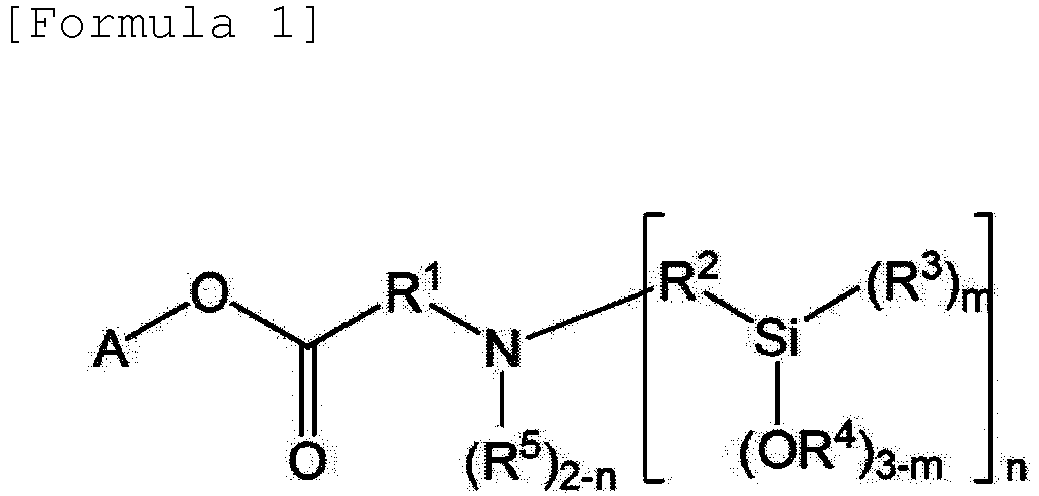
- In the above Formula 1,
A is hydrocarbon of 1 to 20 carbon atoms including at least one heteroatom selected from the group consisting of N, S and O,
R1 and R2 are each independently substituted or unsubstituted divalent hydrocarbon of 1 to 20 carbon atoms, the substituted hydrocarbon being substituted with at least one substituent selected from the group consisting of linear or branched alkyl of 1 to 20 carbon atoms, cycloalkyl of 3 to 20 carbon atoms and aryl of 6 to 30 carbon atoms,
R3 to R5 are each independently monovalent hydrocarbon having 1 to 20 carbon atoms, and
m is an integer from 0 to 3, and
n is an integer of 1 or 2. - The modified styrene-butadiene copolymer may be prepared by reacting an active polymer combined with an organo alkali metal with the modifier represented by the above Formula 1 via the following preparation method. The physical properties of the modified styrene-butadiene copolymer may be improved by including the functional group derived from the modifier represented by the above Formula 1.
- The modifier represented by Formula 1 may include at least one of a functional group for improving the dispersibility of an inorganic filler, a functional group having affinity for an inorganic filler or a functional group having affinity for a solvent, as a functional group capable of improving the physical properties of the copolymer.
- In particular, the modifier of Formula 1 includes an ester group having high reactivity with respect to the active part of an active polymer and may modify the styrene-butadiene copolymer with a high modification ratio. As a result, a substituted functional group in the modifier may be introduced into the styrene-butadiene copolymer with high yield. In addition, the modifier may be a functional group improving the dispersibility of the inorganic filler by preventing the cohesion between inorganic fillers in a rubber composition and may particularly include an amino group, particularly, a tertiary amino group. For example, in the case that silica is used as the inorganic filler, cohesion may be easily generated due to a hydrogen bonding between hydroxyl groups present on the surface thereof. The tertiary amino group in the modifier may prevent the hydrogen bond between hydroxyl groups to improve the dispersibility of silica. In addition, the modifier may include at least one of the functional group having affinity for the inorganic filler capable of improving the abrasion resistance and the processability of the rubber composition via interaction with the inorganic filler together with the amino group, or a functional group having affinity for a solvent having good affinity for a solvent used in the modification reaction of the styrene-butadiene copolymer. The functional group having affinity for the inorganic filler, particularly, an alkoxysilyl group may improve the abrasion resistance and the processability of the styrene-butadiene copolymer after being introduced to the styrene-butadiene copolymer and then being undergone a condensation reaction with the functional group at the surface of the inorganic filler, for example, in the case where the inorganic filler is silica, with a silanol group at the surface of the silica. Such an improving effect may increase with the increase of the number of the alkoxysilyl group. In addition, the functional group having affinity for the solvent may be a hydrocarbon group such as alkyl and aryl, which may increase the solubility of the modifier with respect to a solvent during conducting a modification process with respect to the styrene-butadiene copolymer. As a result, the modification ratio of the styrene-butadiene copolymer may increase.
- A is hydrocarbon of 1 to 20 carbon atoms, including at least one heteroatom selected from the group consisting of N, S and O. A may be one in which the heteroatom is included instead of at least one carbon atom in the hydrocarbon; or one in which at least one hydrogen atom combined with a carbon atom in the hydrocarbon may be substituted with the heteroatom or a functional group including the heteroatom. More particularly, in the case that A is hydrocarbon of 1 to 20 carbon atoms including the heteroatom, A may be alkoxy; phenoxy; carboxyl; acid anhydride; amino; amide; epoxy; mercapto; -[R11O]xR12 (where R11 is alkylene of 2 to 20 carbon atoms, R12 is selected from the group consisting of a hydrogen atom, alkyl of 1 to 20 carbon atoms, cycloalkyl of 3 to 20 carbon atoms, aryl of 6 to 20 carbon atoms, and arylalkyl of 7 to 20 carbon atoms, and x is an integer from 2 to 10); hydrocarbon of 1 to 20 carbon atoms including at least one functional group selected from the group consisting of hydroxyl, alkoxy, phenoxy, carboxyl, ester, acid anhydride, amino, amide, epoxy and mercapto (for example, hydroxyalkyl, alkoxyalkyl, phenoxyalkyl, aminoalkyl or thiolalkyl). More particularly, in the case that A is alkyl of 1 to 20 carbon atoms, including a heteroatom, A may be selected from the group consisting of alkoxy of 1 to 20 carbon atoms, alkoxyalkyl of 2 to 20 carbon atoms, phenoxyalkyl of 7 to 20 carbon atoms, aminoalkyl of 1 to 20 carbon atoms and - [R11O]xR12 (where R11 is alkylene of 2 to 20 carbon atoms, R12 is selected from the group consisting of a hydrogen atom, alkyl of 1 to 10 carbon atoms, cycloalkyl of 3 to 12 carbon atoms, aryl of 6 to 18 carbon atoms, and arylalkyl of 7 to 18 carbon atoms, and x is an integer of 2 to 10).
- In addition, in Formula 1, R1 and R2 are each independently divalent hydrocarbon of 1 to 20 carbon atoms, and may be particularly, alkylene of 1 to 10 carbon atoms such as methylene, ethylene and propylene; arylene of 6 to 20 carbon atoms such as phenylene; or arylalkylene of 7 to 20 carbon atoms as the combination thereof. More particularly, R1 and R2 are each independently alkylene of 1 to 5 carbon atoms. Further particularly, R1 may be alkylene of 2 or 3 carbon atoms, and R2 may be alkylene of 1 to 3 carbon atoms. In addition, R1 and R2 may be each independently substituted with at least one substituent selected from the group consisting of linear or branched alkyl of 1 to 20 carbon atoms, cycloalkyl of 3 to 20 carbon atoms and aryl of 6 to 30 carbon atoms.
- In addition, in Formula 1, R3 to R5 may be each independently monovalent hydrocarbon of 1 to 20 carbon atoms, and may particularly be selected from the group consisting of alkyl of 1 to 10 carbon atoms, cycloalkyl of 3 to 18 carbon atoms, aryl of 6 to 18 carbon atoms and the combination thereof. More particularly, R3 and R4 may be each independently alkyl of 1 to 5 carbon atoms, R5 may be alkyl of 1 to 5 carbon atoms or cycloalkyl of 3 to 8 carbon atoms. More particularly, R3 to R5 may be each independently alkyl of 1 to 5 carbon atoms.
- In addition, in Formula 1, m may be an integer from 0 to 3, and more particularly, an integer from 0 to 2. In addition, n may be an integer of 1 to 2.
- More particularly, in the modifier in Formula 1, A may be one selected from the group consisting of alkoxyalkyl of 2 to 10 carbon atoms, phenoxyalkyl of 7 to 12 carbon atoms, aminoalkyl of 1 to 10 carbon atoms and -[R11O]xR12 (where R11 is alkylene of 2 to 10 carbon atoms, R12 is selected from the group consisting of a hydrogen atom, alkyl of 1 to 10 carbon atoms, cycloalkyl of 3 to 12 carbon atoms, aryl of 6 to 18 carbon atoms, and arylalkyl of 7 to 18 carbon atoms, and x is an integer of 2 to 10). R1 and R2 are each independently alkylene of 1 or 5 carbon atoms, R3 and R4 are each independently alkyl of 1 to 5 carbon atoms, R5 is alkyl of 1 to 5 carbon atoms or cycloalkyl of 3 to 8 carbon atoms, m is an integer of 0 to 2, and n is an integer of 1 or 2.
- More particularly, the modifier may be 2-methoxyethyl 3-(bis(3-triethoxysilylpropyl)amino)propanoate, 2-phenoxyethyl 3-(bis(3-(triethoxysilyl)propyl)amino)propanoate, 2-methoxyethyl 3-(bis(3-(diethoxy(methyl)silyl)propyl)amino)propanoate, 2-ethoxyethyl 3-(bis(3-(diethoxy(methyl)silyl)propyl)amino)propanoate, 2-phenoxyethyl 3-(cyclohexyl((triethoxysilyl)methyl)amino)propanoate, 2-methoxyethyl 3-(cyclohexyl((triethoxysilyl)methyl)amino)propanoate, 2-dimethylaminoethyl 3-(cyclohexyl((triethoxysilyl)methyl)amino)propanoate, 2,5,8,11,14,17,20,23,26-nonaoxaoctacosan-28-yl 3-(bis(3-(triethoxysilyl)propyl)amino)propanoate, 2-(2-(2-(2-phenoxyethoxy)ethoxy)ethoxy)ethyl 3-(bis(3-(triethoxysilyl)propyl)amino)propanoate, 2-(dimethylamino)ethyl 3-(bis(3-(triethoxysilyl)propyl)amino)propanoate, 2-(2-(2-(2-phenoxyethoxy)ethoxy)ethoxy)ethyl 3-(cyclohexyl((triethoxysilyl)methyl)amino)propanoate, or 2-methoxyethyl 3-(bis(3-(diethoxy(methyl)silyl)propyl)amino)propanoate. Among the compounds, one or a mixture of at least two may be used.
- Among the compounds, the modifier of Formula 1 may be at least one selected from the group consisting of 2-phenoxyethyl 3-(cyclohexyl((triethoxysilyl)methyl)amino)propanoate, 2-methoxyethyl 3-(cyclohexyl((triethoxysilyl)methyl)amino)propanoate, 2-(dimethylamino)ethyl 3-(cyclohexyl((triethoxysilyl)methyl)amino)propanoate, 2,5,8,11,14,17,20,23,26-nonaoxaoctacosane-28-yl 3-(bis(3-(triethoxysilyl)propyl)amino)propanoate, 2-(2-(2-(2-phenoxyethoxy)ethoxy)ethoxy)ethyl 3-(bis(3-(triethoxysilyl)propyl)amino)propanoate, 2-phenoxyethyl 3-(bis(3-triethoxysilyl)propyl)amino)propanoate, 2-methoxyethyl 3-(bis(3-(triethoxysilyl)propyl)amino)propanoate, 2-(dimethylamino)ethyl 3-(bis(3-triethoxysilyl)propyl)amino)propanoate, 2-(2-(2-(2-phenoxyethoxy)ethoxy)ethoxy)ethyl 3-(cyclohexyl((triethoxysilyl)methyl)amino)propanoate, and 2-methoxyethyl 3-(bis(3-(diethoxy(methyl)silyl)propyl)amino)propanoate.
- In addition, the modifier may have solubility of 10 g or more with respect to 100 g of a non-polar solvent such as hexane at 25°C under 1 atm. Here, the solubility of the modifier means the degree of clear dissolution without turbidity when observed with naked eyes. With such high solubility, a good modification ratio with respect to the styrene-butadiene copolymer may be attained.
- The modifier according to the present invention has an optimized functional group which may maximize affinity for an inorganic filler and a solvent, and used as the modifier of the styrene-butadiene copolymer to impart the styrene-butadiene copolymer with good viscoelasticity, tensile properties, and processability.
- Meanwhile, the modified styrene-butadiene copolymer may be a copolymer of a conjugated diene monomer and an aromatic vinyl monomer. That is, the modified styrene-butadiene copolymer may include a conjugated diene monomer derived unit and an aromatic vinyl monomer derived unit.
- In the present invention, the terms "derived unit" may mean a component or a structure come from a material, or the material itself.
- In addition, the modified styrene-butadiene copolymer may be a random copolymer.
- In the present invention, the terms "random copolymer" may mean random arrangement of constituting units composing a copolymer.
- The conjugated diene monomer is not specifically limited, however may be at least one selected from the group consisting of 1,3-butadiene, 2,3-dimethyl-1,3-butadiene, piperylene, 3-butyl-1,3-octadiene, isoprene and 2-phenyl-1,3-butadiene.
- The modified styrene-butadiene copolymer may include 60 wt% or more, particularly, from 60 wt% to 90 wt%, and more particularly, from 60 wt% to 85 wt% of the conjugated diene monomer derived unit.
- The aromatic vinyl monomer is not specifically limited, however may be at least one selected from the group consisting of styrene, α-methyl styrene, 3-methyl styrene, 4-methyl styrene, 4-propyl styrene, 1-vinylnaphthalene, 4-cyclohexylstyrene, 4-(p-methylphenyl)styrene and 1-vinyl-5-hexylnaphthalene.
- The modified styrene-butadiene copolymer may include an aromatic vinyl monomer derived unit in an amount ratio of 40 wt% or less, particularly, from 10 wt% to 40 wt%, and more particularly, from 15 wt% to 40 wt%.
- In addition, the modified styrene-butadiene copolymer may have a number average molecular weight of 1,000 g/mol to 2,000,000 g/mol, particularly, from 10,000 g/mol to 2,000,000 g/mol, and more particularly, from 100,000 g/mol to 2,000,000 g/mol.
- The modified styrene-butadiene copolymer may have a molecular weight distribution (Mw/Mn) of 1.1 to 10, particularly, 1.1 to 5, and more particularly, 1.1 to 4. In the case that the modified styrene-butadiene copolymer has the above-described molecular weight distribution, a rubber composition including the same may have improved processability, and as a result, the mechanical properties, the low fuel consumption properties and the abrasion resistance of a molded product thus manufactured may be improved.
- In addition, the modified styrene-butadiene copolymer may have a vinyl content of 5 wt%, particularly, 10 wt% or more, and more particularly, from 14 wt% to 70 wt%. In the case that the modified styrene-butadiene copolymer has the vinyl content in the above range, a glass transition temperature may be controlled to an appropriate range, and in the case of applying thereof to a tire, physical properties required for a tire such as running resistance and breaking force may be satisfied, and fuel consumption may be decreased.
- Here, the vinyl content means the amount of not 1,4-added but 1,2-added conjugated diene monomer on the basis of 100 wt% of the styrene-butadiene copolymer composed of a monomer having a vinyl group and an aromatic vinyl monomer.
- In addition, there is provided in the present invention a method of preparing a modified styrene-butadiene copolymer including a group derived from a modifier represented by Formula 1.
- The preparation method according to an embodiment of the present invention is characterized in including a step of preparing an active polymer combined with an alkali metal by polymerizing an aromatic vinyl monomer and a conjugated diene monomer in the presence of an organometallic compound in a hydrocarbon solvent (step 1); and a step of reacting the active polymer with a modifier represented by the following Formula 1 (step 2).

- In the above Formula 1,
A is hydrocarbon of 1 to 20 carbon atoms including at least one heteroatom selected from the group consisting of N, S and O,
R1 and R2 are each independently substituted or unsubstituted divalent hydrocarbon of 1 to 20 carbon atoms, the substituted hydrocarbon being substituted with at least one substituent selected from the group consisting of linear or branched alkyl of 1 to 20 carbon atoms, cycloalkyl of 3 to 20 carbon atoms and aryl of 6 to 30 carbon atoms,
R3 to R5 are each independently monovalent hydrocarbon having 1 to 20 carbon atoms,
m is an integer from 0 to 3, and n is an integer of 1 or 2. - Step 1 is a step for preparing an active polymer combined with an organic metal and may be performed by polymerizing a conjugated diene monomer and an aromatic vinyl monomer in the presence of an organometallic compound in a hydrocarbon solvent.
- The active polymer may represent a polymer in which a polymer anion and an organometallic cation are combined.
- Particular kinds of the conjugated diene monomer and the aromatic vinyl monomer may be the same as described above, and the amount used of each monomer may be appropriately controlled so that the amounts of the conjugated diene monomer derived unit and the aromatic vinyl monomer derived unit in the modified styrene-butadiene copolymer are in the range described above.
- The hydrocarbon solvent is not specifically limited, however may be at least one selected from the group consisting of n-pentane, n-hexane, n-heptane, isooctane, cyclohexane, toluene, benzene and xylene.
- The organometallic compound may be at least one selected from the group consisting of an organo alkali metal compound, an organolithium compound, an organosodium compound, an organopotassium compound, an organorubidium compound and an organocesium compound.
- In particular, the organometallic compound may be at least one selected from the group consisting of methyllithium, ethyllithium, propyllithium, n-butyllithium, s-butyllithium, t-butyllithium, hexyllithium, n-decyllithium, t-octyllithium, phenyllithium, 1-naphthyllithium, n-eicosyllithium, 4-butylphenyllithium, 4-tolyllithium, cyclohexyllithium, 3,5-di-n-heptylcyclohexyllithium, 4-cyclopentyllithium, naphthyllithium, naphthylsodium, naphthylpotassium, lithium alkoxide, sodium alkoxide, potassium alkoxide, lithium sulfonate, sodium sulfonate, potassium sulfonate, lithium amide, sodium amide, potassium amide, and lithium isopropyl amide.
- The organometallic compound may be used in an amount of 0.01 mmol to 10 mmol on the basis of 100 g of the total monomer. Particularly, the organometallic compound may be used in an amount of 0.05 mmol to 5 mmol, particularly, 0.1 mmol to 2 mmol, and more particularly, 0.1 mmol to 1 mmol on the basis of 100 g of the total monomer.
- The polymerization in step 1 may be performed after further adding a polar additive as occasion demands, and the amount of the polar additive may be from 0.001 g to 50 g, particularly, from 0.001 g to 10 g, and more particularly, from 0.005 g to 0.1 g on the basis of 100 g of the total monomer.
- In addition, the amount of the polar additive may be from 0.001 g to 10 g, particularly, from 0.005 g to 1 g, and more particularly, from 0.005 g to 0.1 g on the basis of 1 mmol of the total amount of the organometallic compound.
- The polar additive may be at least one selected from the group consisting of salts, ethers, amines, or a mixture thereof, and particularly, tetrahydrofuran, ditetrahydrofurylpropane, diethyl ether, cycloamyl ether, dipropyl ether, ethylenedimethyl ether, ethylenedimethyl ether, diethylene glycol, dimethyl ether, tertiary butoxyethoxyethane bis(3-dimethylaminoethyl) ether, (dimethylaminoethyl)ethyl ether, trimethylamine, triethylamine, tripropylamine, and tetramethylethylenediamine. More particularly, ditetrahydropropylpropane, triethylamine or tetramethylethylenediamine may be used.
- In the preparation method according to an embodiment of the present invention, in the case that the conjugated diene monomer and the aromatic vinyl monomer are copolymerized using the polar additive, the difference of the reaction rates thereof may be compensated to produce a random copolymer easily.
- The polymerization in step 1 may be an anionic polymerization and may particularly be a living anionic polymerization by which an active part may be obtained via a growth reaction by anions.
- In addition, the polymerization may be a heating polymerization, an isothermal polymerization, or a constant temperature polymerization (insulation polymerization).
- Here, the constant temperature polymerization is a polymerization method including a step of polymerizing without applying heat optionally but using heat from the reaction itself after injecting an organometallic compound. The heating polymerization is a polymerization method by which heat is applied optionally to increase the temperature after injecting an organometallic compound. The isothermal polymerization is a polymerization method by which the temperature of a polymer is maintained constant by applying or taking heat after injecting the organometallic compound.
- The polymerization may be performed in a temperature range of -20°C to 200°C, particularly, from 0°C to 150°C, and more particularly, from 10°C to 120°C.
- Step 2 is a step of reacting the active polymer and the modifier represented by Formula 1 to prepare the modified styrene-butadiene copolymer.
- The modifier represented by Formula 1 may be the same as described above, and one or a mixture of at least two materials may be used in the reaction.
- The modifier represented by Formula 1 may be used in an amount of 0.1 mol to 10 mol relative to 1 mol of the organometallic compound. Particularly, the modifier represented by Formula 1 may be used in an amount of 0.3 mol to 2 mol relative to 1 mol of the organometallic compound. In the case that the modifier is used in an amount satisfying the ratio range, a modification reaction with optimized performance may be attained, and a styrene-butadiene copolymer with a high modification ratio may be obtained.
- The reaction of step 2 is a modification reaction for introducing a functional group to a copolymer and may be performed at 0°C to 90°C for from 1 minute to 5 hours.
- In addition, the preparation method of the modified styrene-butadiene copolymer according to an embodiment of the present invention may be performed by a batch type polymerization method or a continuous type polymerization method including at least one reactor.
- The preparation method according to an embodiment of the present invention may further include at least one step of recovering or drying of solvents or unreacted monomers after step 2 as occasion demands.
- In addition, there is provided in the present disclosure a rubber composition including the modified styrene-butadiene copolymer.
- The rubber composition according to an embodiment of the present disclosure may include 10 wt% or more, particularly, from 10 wt% to 100 wt%, and more particularly, from 20 wt% to 90 wt% of the modified styrene-butadiene copolymer. In the case that the amount of the modified styrene-butadiene copolymer is less than 10 wt%, the improving effect of the abrasion resistance and the crack resistance of a product manufactured using the rubber composition, for example, a tire, may be insignificant.
- In addition, the rubber composition may further include other rubber components as well as the modified styrene-butadiene copolymer as occasion demands. In this case, the rubber component may be included in an amount ratio of 90 wt% or less relative to the total amount of the rubber composition. In particular, the rubber component may be included in an amount ratio of 1 to 900 parts by weight relative to 100 parts by weight of the modified styrene-butadiene copolymer.
- The rubber component may be natural rubber or synthetic rubber, for example, the rubber component may include natural rubber (NR) including cis-1,4-polyisoprene; modified natural rubber such as epoxidized natural rubber (ENR), deproteinized natural rubber (DPNR), and hydrogenated natural rubber, which are obtained by modifying or purifying common natural rubber; or synthetic rubber such as styrene-butadiene copolymer (SBR), polybutadiene (BR), polyisoprene (IR), butyl rubber (IIR), ethylene-propylene copolymer, polyisobutylene-co-isoprene, neoprene, poly(ethylene-co-propylene), poly(styrene-co-butadiene), poly(styrene-co-isoprene), poly(styrene-co-isoprene-co-butadiene), poly(isoprene-co-butadiene), poly(ethylene-co-propylene-co-diene), polysulfide rubber, acryl rubber, urethane rubber, silicone rubber, epichlorohydrin rubber, butyl rubber, and halogenated butyl rubber, and one or a mixture of at least two thereof may be used.
- In addition, the rubber composition may include 0.1 to 200 parts by weight of a filler, particularly, 10 to 120 parts by weight of a filler relative to 100 parts by weight of a modified styrene-butadiene copolymer.
- The filler may be a silica filler, and the silica filler is not specifically limited and may include, for example, wet silica (hydrous silicate), dry silica (anhydrous silicate), calcium silicate, aluminum silicate or colloidal silica. More particularly, the filler may be the wet silica having the most remarkable effects of the improving effect of breaking properties and the compatible effect of wet grip.
- In addition, the rubber composition according to an embodiment of the present invention may further include a carbon black filler as occasion demands.
- Meanwhile, in the case that silica is used as the filler, a silane coupling agent may be used together to improve reinforcing properties and low heating properties.
- The silane coupling agent may particularly include bis(3-triethoxysilylpropyl)tetrasulfide, bis(3-triethoxysilylpropyl)trisulfide, bis(3-triethoxysilylpropyl)disulfide, bis(2-triethoxysilylethyl)tetrasulfide, bis(3-trimethoxysilylpropyl)tetrasulfide, bis(2-trimethoxysilylethyl)tetrasulfide, 3-mercaptopropyltrimethoxysilane, 3-mercaptopropyltriethoxysilane, 2-mercaptoethyltrimethoxysilane, 2-mercaptoethyltriethoxysilane, 3-trimethoxysilylpropyl-N,N-dimethylthiocarbamoyltetrasulfide, 3-triethoxysilylpropyl-N,N-dimethylthiocarbamoyltetrasulfide, 2-triethoxysilylethyl-N,N-dimethylthiocarbamoyltetrasulfide, 3-trimethoxysilylpropylbenzothiazolyltetrasulfide, 3-triethoxysilylpropylbenzolyltetrasulfide, 3-triethoxysilylpropylmethacrylatemonosulfide, 3-trimethoxysilylpropylmethacrylatemonosulfide, bis(3-diethoxymethylsilylpropyl)tetrasulfide, 3-mercaptopropyldimethoxymethylsilane, dimethoxymethylsilylpropyl-N,N-dimethylthiocarbamoyltetrasulfide, or dimethoxymethylsilylpropylbenzothiazolyltetrasulfide, and one or a mixture of at least two thereof may be used. More particularly, the silane coupling agent may be bis(3-triethoxysilylpropyl)polysulfide or 3-trimethoxysilylpropylbenzothiazyltetrasulfide in consideration of the improving effect of reinforcing properties.
- In addition, the rubber composition according to an embodiment of the present disclosure may be sulfur crosslinkable, and so may further include a vulcanizing agent.
- The vulcanizing agent may be particularly a sulfur powder and may be included in an amount ratio of 0.1 to 10 parts by weight relative to 100 parts by weight of a rubber component. In the case that the vulcanizing agent is included in the above amount range, the elasticity and the strength required for the vulcanized rubber composition may be secured, and at the same time, a low combustion ratio may be attained.
- In addition, the rubber composition according to an embodiment of the present disclosure may further include various additives used in common rubber industry other than the above components, particularly, a vulcanization accelerator, a process oil, a plasticizer, an antiaging agent, a scorch preventing agent, a zinc white, stearic acid, a thermosetting resin, or a thermoplastic resin.
- The vulcanization accelerator is not specifically limited and particularly includes a thiazole compound such as 2-mercaptobenzothiazole (M), dibenzothiazyldisulfide (DM), N-cyclohexyl-2-benzothiazylsulfenamide (CZ), etc. or a guanidine compound such as diphenylguanidine (DPG). The vulcanization accelerator may be included in an amount ratio of 0.1 to 5 parts by weight relative to 100 parts by weight of the rubber component.
- In addition, the process oil plays the role of a softener in a rubber composition and may particularly include paraffins, naphthenes, or aromatic compounds. More particularly, an aromatic process oil may be used in consideration of tensile strength and abrasion resistance, and the naphthene or paraffin process oil may be used in consideration of hysteresis loss and low temperature properties. The process oil may be included in an amount ratio of 100 parts by weight or less relative to 100 parts by weight of the rubber component. In the case of using the above-described amount, the deterioration of the tensile strength and the low heating properties (a low fuel combustion ratio) of the vulcanized rubber may be prevented.
- In addition, the antiaging agent may particularly include N-isopropyl-N'-phenyl-p-phenylenediamine, N-(1,3-dimethylbutyl)-N'-phenyl-p-phenylenediamine, 6-ethoxy-2,2,4-trimethyl-1,2-dihydroquinoline, or a condensate of diphenylamine and acetone at a high temperature. The antiaging agent may be used in an amount ratio of 0.1 to 6 parts by weight relative to 100 parts by weight of the rubber component.
- The rubber composition according to an embodiment of the present disclosure may be obtained by mulling using a mulling apparatus such as a banbury mixer, a roll, and an internal mixer according to the mixing prescription. After a molding process, a rubber composition having low heating properties and good abrasion resistance may be obtained by the vulcanizing process.
- Therefore, the rubber composition may be usefully used for the manufacture of the members of a tire such as a tire tread, an under tread, a side wall, a carcass coating rubber, a belt coating rubber, a bead filler, a chafer, and a bead coating rubber, or for the manufacture of a rubber product for various industries such as a dustproof rubber, a belt conveyor, and a hose.
- Also, there is provided in the present disclosure a tire manufactured using the rubber composition. The tire may include a tire or a tire tread.
- Further, there is provided in the present invention a modifier useful for the modification of the modified styrene-butadiene copolymer.
- The modifier is the same as described above.
- Meanwhile, the modifier represented by Formula 1 according to an embodiment of the present invention may be prepared by the reaction of a compound of the following Formula 2 and a compound of the following Formula 3.
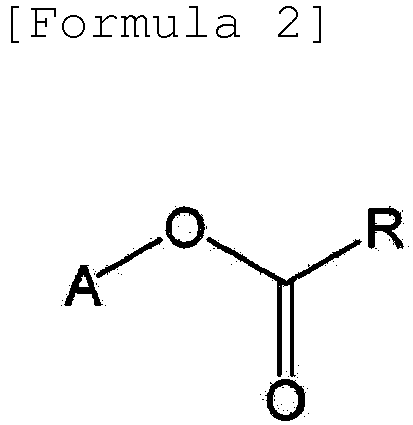


- In Formulae 2 and 3, A, R2 to R5, m and n are the same as explained above,
R may be alkenyl of 2 to 20 carbon atoms substituted with at least one substituent selected from the group consisting of linear or branched alkyl of 1 to 20 carbon atoms, cycloalkyl of 3 to 20 carbon atoms and aryl of 6 to 30 carbon atoms, or unsubstituted alkenyl of 2 to 20 carbon atoms. - More particularly, in Formula 2, R may be alkenyl of 2 to 10 carbon atoms, and more particularly, alkenyl of 2 to 5 carbon atoms such as ethylene.
- More particularly, the compound of Formula 2 may be ethylene glycol methyl ether acrylate, 2-phenoxyethyl acrylate, ethyl acrylate, etc. In addition, the compound of Formula 3 may be bis[3-(triethoxysilyl)propyl]amine, bis(methyldiethoxysilylpropyl)amine, etc.
- The compound of Formulae 2 and 3 may be used in stoichiometric amounts and particularly, 0.01 to 0.2 molar ratio, more particularly, 0.05 to 0.1 molar ratio, and further particularly, 0.05 to 0.08 molar ratio of the compound of Formula 3 may be used relative to 1 mol of the compound of Formula 2.
- In addition, the reaction of the compound of Formula 2 and the compound of Formula 3 may be performed in an aqueous solvent. The aqueous solvent may particularly include an alcohol (for example, a lower alcohol of 1 to 5 carbon atoms such as ethanol), and one or a mixture of at least two thereof may be used.
- In addition, the reaction of the compound of Formula 2 and the compound of Formula 3 may be performed under an inert gas atmosphere. In particular, the inert gas may include nitrogen, argon, etc.
- In addition, the reaction of the compound of Formula 2 and the compound of Formula 3 may be conducted in a temperature range of 20°C to 60°C. In the case that the temperature during the reaction is less than 20°C, a reaction rate may be too slow, and reaction efficiency may be deteriorated. In the case that the temperature during the reaction is greater than 60°C, the reaction rate may be too fast, the control of the reaction may be difficult, and side reaction may be generated.
- According to the preparation method, a modifier including a functional group having affinity for a filler and a functional group having affinity for a solvent in a single molecule may be easily prepared.
- Hereinafter, the present invention will be explained in more detail referring to embodiments and experimental embodiment.
- To a 50 ml, round-bottomed flask, 5.744 mmol of (N-cyclohexylaminomethyl)triethoxysilane (Gelest Co.) and 5 ml of ethanol were added for dissolving, and 5.744 mmol of 2-phenoxyethyl acrylate (TCI Co.) was added thereto, followed by stirring at room temperature in nitrogen conditions for 8 hours. After finishing the reaction, solvents were removed under a reduced pressure and distilled at 120°C under a reduced pressure to obtain 4.990 mmol of a 2-phenoxyethyl 3-(cyclohexyl((triethoxysilyl)methyl)amino)propanoate compound of Formula (i) (Yield 91.4%). 1H NMR spectroscopic data of separated 2-phenoxyethyl 3-(cyclohexyl((triethoxysilyl)methyl)amino)propanoate are as follows.

- 1H-NMR (500 MHz, CDCl3) δ 7.49-7.23 (m, 2H), δ 6.97-6.86(m, 3H), δ 4.40-4.36(m, 2H), δ 4.16-34.03(m, 4H), δ 3.87-3.81(m, 3H), δ 2.78-2.75(m,2H), δ 2.50-2.41(m, 4H), δ 2.17-2.11(m, 3H), δ 1.72-1.56(m, 7H), δ 1.26-1.16(m, 12H)
- To a 50 ml, round-bottomed flask, 8.468 mmol of (N-cyclohexylaminomethyl)triethoxysilane (Gelest Co.) and 5 ml of ethanol were added for dissolving, and 8.468 mmol of ethylene glycol methyl ether acrylate (Acros Co.) was added thereto, followed by stirring at room temperature in nitrogen conditions for 8 hours. After finishing the reaction, solvents were removed under a reduced pressure and distilled at 120°C under a reduced pressure to obtain 8.19 mmol of a 2-methoxyethyl 3-(cyclohexyl((triethoxysilyl)methyl)amino)propanoate compound of Formula (ii) (Yield 96.7%). 1H NMR spectroscopic data of separated 2-methoxyethyl 3-(cyclohexyl((triethoxysilyl)methyl)amino)propanoate are as follows.

- 1H-NMR (500 MHz, CDCl3) δ 4.18-4.16(t, 2H), δ 3.84-3.79(m, 3H), δ3.55-3.54(t, 2H), δ 3.35(s, 3H), δ 2.76-2.73(m, 2H), δ 2.48-2.45(m, 4H), δ2.14-2.08(m, 3H), δ 1.73-1.71(m, 7H), δ 1.22-1.18(m, 13H)
- To a 50 ml, round-bottomed flask, 6.586 mmol of (N-cyclohexylaminomethyl)triethoxysilane (Gelest Co.) and 5 ml of ethanol were added for dissolving, and 6.586 mmol of 2-(dimethylamino)ethyl acrylate (Sigma-Aldrich Co.) was added thereto, followed by stirring at room temperature in nitrogen conditions for 8 hours. After finishing the reaction, solvents were removed under a reduced pressure and distilled at 120°C under a reduced pressure to obtain 6.24 mmol of a 2-(dimethylamino)ethyl 3-(cyclohexyl((triethoxysilyl)methyl)amino)propanoate compound of Formula (iii) (Yield 94.8%). 1H NMR spectroscopic data of separated 2-(dimethylamino)ethyl 3-(cyclohexyl((triethoxysilyl)methyl)amino)propanoate are as follows.

- 1H-NMR (500 MHz, CDCl3) δ 4.16-4.08(m, 3H), δ 2.76-2.73(m, 2H), δ2.53-2.50(m, 3H), δ 2.47-2.41(m, 3H), δ 2.25-2.23(m, 10H), δ 2.11-2.08(t, 2H), δ 1.73-1.72(m, 9H), δ 1.54-1.47(m, 4H), δ 1.24-1.16(m, 10H)
- To a 50 ml, round-bottomed flask, 2.279 mmol of bis (3-triethoxysilylpropyl)amine (Gelest Co.) and 5 ml of ethanol were added for dissolving, and 2.279 mmol of poly(ethylene glycol) methyl ether acrylate (Sigma-Aldrich Co.) was added thereto, followed by stirring at room temperature in nitrogen conditions for 8 hours. After finishing the reaction, solvents were removed under a reduced pressure and distilled at 120°C under a reduced pressure to obtain 2.13 mmol of a 2,5,8,11,14,17,20,23,26-nonaoxaoctacosane-28-yl 3-(bis(3-(triethoxysilyl)propyl)amino)propanoate compound of Formula (iv) (Yield 93.5%). 1H NMR spectroscopic data of separated 2,5,8,11,14,17,20,23,26-nonaoxaoctacosane-28-yl 3-(bis(3-(triethoxysilyl)propyl)amino)propanoate are as follows.

- 1H-NMR (500 MHz, CDCl3) δ 4.17-4.15(t, 2H), δ 3.78-3.73(m, 12H), δ 3.60-3.59(m, 32H), δ 3.50-3.48(m, 2H), δ 3.32(s, 3H), δ 2.74-2.71(m, 2H), δ 2.37-2.34(t, 6H), δ 1.50-1.43(m, 4H), δ 1.19-1.15(t, 18H), δ 0.54-0.50(m, 4H)
- To a 50 ml, round-bottomed flask, 2.279 mmol of bis(3-triethoxysilylpropyl)amine and 5 ml of ethanol were added for dissolving, and 2.279 mmol of poly(ethylene glycol) phenyl ether acrylate (Sigma-Aldrich, Mn 324) was added thereto, followed by stirring at room temperature in nitrogen conditions for 8 hours. After finishing the reaction, solvents were removed under a reduced pressure and distilled at 120°C under a reduced pressure to obtain 2.15 mmol of a 2-(2-(2-(2-phenoxyethoy)ethoxy)ethoxy)ethyl 3-(bis(3-triethoxysilyl)propyl)amino)propanoate compound of Formula (v) (Yield 93.7%). 1H NMR spectroscopic data of separated 2-(2-(2-(2-phenoxyethoy)ethoxy)ethoxy)ethyl 3-(bis(3-triethoxysilyl)propyl)amino)propanoate are as follows.

- 1H-NMR (500 MHz, CDCl3) δ 7.26-7.22(t, 2H), δ 6.92-6.87(m, 3H), δ4.20-4.17(t, 2H), δ 4.11-4.07(m, 3H), δ 3.84-3.82(m, 2H), δ 3.81-3.75(m, 10H), δ 3.71-3.60(m, 10H), δ 2.77-2.74 (t, 2H), δ 2.39-2.36(t, 6H), δ1.52-1.46(m, 4H), δ 1.21-1.78(m, 18H), δ 0.57-0.53(m, 4H)
- To a 50 ml, round-bottomed flask, 4.557 mmol of bis(3-triethoxysilylpropyl)amine (Gelest Co.) and 5 ml of ethanol were added for dissolving, and 4.557 mmol of 2-phenoxyethyl acrylate (TCI Co.) was added thereto, followed by stirring at room temperature in nitrogen conditions for 8 hours. After finishing the reaction, solvents were removed under a reduced pressure and distilled at 120°C under a reduced pressure to obtain 4.17 mmol of a 2-phenoxyethyl 3-(bis(3-(triethoxysilyl)propyl)amino)propanoate compound of Formula (vi) (Yield 91.6%). 1H NMR spectroscopic data of separated 2-phenoxyethyl 3-(bis(3-(triethoxysilyl)propyl)amino)propanoate are as follows.

- 1H-NMR (500 MHz, CDCl3) δ 7.26-7.23 (m, 2H), δ 6.94-6.84(m, 3H), δ4.39-4.37(t, 2H), δ 4.14-4.12(t, 3H), δ 3.79-3.75(m, 12H), δ 2.78-2.75(t,2H), δ 2.46-2.43(t, 2H), δ 2.39-2.36(t, 4H), δ 1.63-1.43(m, 4H), δ 1.20-1.17(m, 18H), δ 0.56-0.52(m, 4H)
- To a 50 ml, round-bottomed flask, 4.557 mmol of bis(3-triethoxysilylpropyl)amine (Gelest Co.) and 5 ml of ethanol were added for dissolving, and 4.557 mmol of ethylene glycol methyl ether acrylate (Acros Co.) was added thereto, followed by stirring at room temperature in nitrogen conditions for 8 hours. After finishing the reaction, solvents were removed under a reduced pressure and distilled at 120°C under a reduced pressure to obtain 4.430 mmol of a 2-methoxyethyl 3-(bis(3-(triethoxysilyl)propyl)amino)propanoate compound of Formula (vii) (Yield 97.3%). 1H NMR spectroscopic data of separated 2-methoxyethyl 3-(bis(3-triethoxysilyl)propyl)amino)propanoate are as follows.

- 1H-NMR (500 MHz, CDCl3) δ 4.21-4.19(t, 2H), δ 3.81-3.77(m, 12H), δ 3.57-3.56(t, 2H), δ 3.36(s, 3H), δ 2.79-2.76(t, 2H), δ 2.47-2.44(t, 2H), δ 2.40-2.37(t, 4H), δ 1.54-1.47(m, 4H), δ 1.22-1.19(t, 18H), δ 0.57-0.54(t, 4H)
- To a 50 ml, round-bottomed flask, 4.5573 mmol of bis(3-triethoxysilylpropyl)amine (Gelest Co.) and 5 ml of ethanol were added for dissolving, and 4.55764 mmol of 2-(dimethylamino)ethyl acrylate (Sigma-Aldrich Co.) was added thereto, followed by stirring at room temperature in nitrogen conditions for 8 hours. After finishing the reaction, solvents were removed under a reduced pressure and distilled at 120°C under a reduced pressure to obtain 4.18 mmol of a 2-(dimethylamino)ethyl 3-(bis(3-(triethoxysilyl)propyl)amino)propanoate compound of Formula (viii) (Yield 91.7%). 1H NMR spectroscopic data of separated 2-(dimethylamino)ethyl 3-(bis(3-(triethoxysilyl)propyl)amino)propanoate are as follows.

- 1H-NMR (500 MHz, CDCl3) δ 4.12-4.09(t, 2H), δ 3.78-3.74(m, 12H), δ 2.75-2.73(t, 2H), δ 2.51-2.49(t, 3H), δ 2.42-2.40(t, 2H), δ 2.37-2.34(t, 3H), δ 2.22-2.19(m, 6H), δ 1.54-1.44(m, 4H), δ 1.18-1.15(m, 18H), δ 0.52-0. 50(m, 4H)
- To a 50 ml, round-bottomed flask, 3.449 mmol of (N-cyclohexylaminomethyl)triethoxysilane and 50 ml of ethanol were added for dissolving, and 3.449 mmol of poly(ethylene glycol) phenyl ether acrylate (Sigma-Aldrich, Mn 324) was added thereto, followed by stirring at room temperature in nitrogen conditions for 8 hours. After finishing the reaction, solvents were removed under a reduced pressure and distilled at 120°C under a reduced pressure to obtain 3.13 mmol of a 2-(2-(2-(2-phenoxyethoy)ethoxy)ethoxy)ethyl 3-(cyclohexyl((triethoxysilyl)methyl)amino)propanoate compound of Formula (ix) (Yield 91.1%). 1H NMR spectroscopic data of separated 2-(2-(2-(2-phenoxyethoy)ethoxy)ethoxy)ethyl 3-(cyclohexyl((triethoxysilyl)methyl)amino)propanoate are as follows.

- 1H-NMR (500 MHz, CDCl3) δ 7.26-7.24(m, 2H), δ 6.93-6.88(m, 3H), δ 4.18-4.16(m, 2H), δ 4.11-4.09(m, 3H), δ 3.85-3.80(m, 6H), δ 3.71-3.61(m, 12H), δ 2.76-2.72(m, 2H), δ 2.50-2.39(m, 3H), δ 2.10-2.09(m, 2H), δ 1.74-1.72(m, 4H), δ 1.58-1.59(m, 1H) δ 1.24-1.15(m, 12H), δ 1.03-1.00(m, 1H)
- To a 100 ml, round-bottomed flask, 73.03 mmol of bis(methyldiethoxysilylpropyl)amine (Gelest Co.) and 20 ml of ethanol were added for dissolving, and 73.03 mmol of ethylene glycol methyl ether acrylate (Acros Co.) was added thereto, followed by stirring at room temperature in nitrogen conditions for 8 hours. After finishing the reaction, solvents were removed under a reduced pressure and distilled at 120°C under a reduced pressure to obtain 71.77 mmol of a 2-methoxyethyl 3-(bis(3-diethoxy(methyl)silyl)propyl)amino)propanoate compound of Formula (x) (Yield 98.327%). 1H NMR spectroscopic data of separated 2-methoxyethyl 3-(bis(3-diethoxy(methyl)silyl)propyl)amino)propanoate are as follows.

- 1H-NMR (500 MHz, CDCl3) δ 4.23-4.21(t, 2H), δ 3.78-3.74(m, 8H), δ3.60-3.58(1, 2H), δ 3.39(s, 3H), δ 2.81-2.78(t, 2H), δ 2.49-2.46(t, 2H), δ 2.42-2.39(t, 3H), δ 1.51-1.45(m, 5H), δ 1.23-1.20(t, 18H), δ 0.57-0.54(t, 4H), δ 0.12(s, 6H)
- To a 100 ml, round-bottomed flask, 72.99 mmol of bis(methyldiethoxysilylpropyl)amine (Gelest Co.) and 20 ml of ethanol were added for dissolving, and 72.99 mmol of ethyl acrylate (Sigma-Aldrich Co.) was added thereto, followed by stirring at room temperature in nitrogen conditions for 8 hours. After finishing the reaction, solvents were removed under a reduced pressure and distilled at 120°C under a reduced pressure to obtain 72.18 mmol of a 3-(bis(3-diethoxy(methyl)silyl)propyl)amino)propanoate compound of Formula (xi) (Yield 98.9%). 1H NMR spectroscopic data of separated ethyl 3-(bis(3-diethoxy(methyl)silyl)propyl)amino)propanoate are as follows.

- 1H-NMR (500 MHz, CDCl3) δ 4.14-4.10(m, 2H), δ 3.78-3.74(m, 8H), δ 2.80-2.79(t, 2H), δ 2.43-2.39(m, 6H), δ 1.52-1.54(m, 4H), δ 1.27-1.20(m, 15H), δ 0.58-0.54(t, 4H), δ 0.11(s, 6H)
- To a 2L, autoclave reactor, 29.7 g of styrene, 78.1 g of 1,3-butadiene, 550 g of normal hexane, and 0.124 g of 2,2-di(2-tetrahydrofuryl)propane (DTP) as a polar additive were added, followed by elevating the temperature in the reactor to 50°C. The temperature in the reactor reached 50°C, 3 mmol of n-butyllithium was added to the reactor, followed by performing an adiabatic and heating reaction. After about 20 minutes, 2.2 g of 1,3-butadiene was added for capping the terminal of SSBR with butadiene. After 5 minutes, 0.181 g of 2-methoxyethyl 3-(bis(3-triethoxysilyl)propyl)amino)propanoate prepared in Preparation Example 7 was added and reacted for 15 minutes ([DTP]/[act. Li] = 2.3, [modifier]/[act. Li] = 1.0). After that, a polymerization reaction was stopped using ethanol, and 4.5 ml of a solution in which 0.3 wt% of butylated hydroxytoluene (BHT) as an antioxidant was dissolved in hexane was added. As a result, the polymer thus obtained was added to warm water heated using steam and stirred to remove solvents. Remaining solvents and water were removed by roll drying to prepare a modified conjugated diene copolymer.
- To a 20L, autoclave reactor, 270 g of styrene, 710 g of 1,3-butadiene, 5 kg of normal hexane, and 0.94 g of 2,2-di(2-tetrahydrofuryl)propane (DTP) as a polar additive were added, followed by elevating the temperature in the reactor to 40°C. The temperature in the reactor reached 40°C, 25.40 g (2.62 wt% in hexane, 33% activation) of n-butyllithium was added to the reactor, followed by performing an adiabatic and heating reaction. After about 20 minutes, 20.0 g of 1,3-butadiene was added for capping the terminal of SSBR with butadiene. After 5 minutes, 1.98 g of an ethyl 3-(bis (3-triethoxy(methyl)silyl)propyl)amino)propanoate modifier prepared in Preparation Example 11 was added and reacted for 15 minutes ([DTP]/[act. Li] = 1.46, [modifier]/[act. Li] = 0.85). After that, a polymerization reaction was stopped using ethanol, and 33 g of a solution in which 30 wt% of Wingstay K as an antioxidant was dissolved in hexane was added. As a result, the polymer thus obtained was added to warm water heated using steam and stirred to remove solvents. Remaining solvents and water were removed by roll drying to prepare a modified conjugated diene copolymer.
- A modified conjugated diene copolymer was prepared by performing the same procedure described in Example 1 except for using N,N-bis(triethoxysilylpropyl)piperazine as the modifier.
- Weight average molecular weight (Mw), number average molecular weight (Mn), molecular weight distribution (MWD), maximum peak molecular weight (Mp), combination efficiency (%) and pattern viscosity (MV) were measured for the modified conjugated diene copolymers prepared in Example 1, Reference Example 2 and Comparative Example. The results are shown in the following Table 1.
- The weight average molecular weight (Mw), the number average molecular weight (Mn), and the maximum peak molecular weight (Mp) were measured via gel permeation chromatography (GPC) analysis, and the molecular weight distribution (MWD, Mw/Mn) and the combination efficiency (%) were obtained by calculating using each molecular weight thus measured. In particular, for GPC, two columns of PLgel Olexis (Polymer Laboratories Co.) and one column of PLgel mixed-C (Polymer Laboratories Co.) were in combination, and polystyrene (PS) was used as a GPC standard material for calculating the molecular weight.
[Table 1] Division GPC Mn (g/mol, x 104) Mw (g/mol, x 104) Mp (g/mol, x 104) Combination efficiency(%) Molecular weight distribution (Mw/Mn) Example 1 49 120 35 38 2.4 77 28 124 34 Reference Example 2 27 42 30 40 1.4 64 60 Comparative Example 34 45 25 43 1.3 53 57 - As shown in the above Table 1, the modified styrene-butadiene copolymers of Example 1 and Reference Example 2, prepared using the modifiers according to the present invention or disclosure have markedly increased combination efficiency of a polymer component when compared to the modified styrene-butadiene copolymer of Comparative example, which was prepared using the conventional modifier.
- In particular, when comparing the modified styrene-butadiene copolymer of Example 1 with the modified styrene-butadiene copolymer of Comparative Example, the combination efficiency (62%, in the case that Mp was 77 x 104 and 124 x 104) of the polymer component of the modified styrene-butadiene copolymer of Example 1 increased by 2.7 times when compared to the combination efficiency (57%, in the case that Mp was 53 x 104) of the polymer component of the styrene-butadiene copolymer of Comparative Example, and the molecular weight was high for the modified styrene-butadiene copolymer of Example 1.
- The increase of the molecular weight even with the same number of triethoxysilane groups in the modifier means that a highly modified polymer was produced by increasing reactivity by introducing a polymer an active part and an ester group having high reactivity to the modifier according to the present invention when compared to the conventional modifier. In addition, for Reference Example 2, the combination efficiency of the polymer component was increased (60%) with high modification efficiency even though the amount used of the modifier was 77% relative to the amount used of the modifier of Comparative Example. From the results, as shown in FIG. 1, the active part (-Li+) of a copolymer combined with a metal may be combined with oxygen in the ethylene glycol of the modifier, and the reactivity of anions may increase, the reaction rate may increase, and the modification reaction may become easy, thereby increasing the combination efficiency of the polymer component as described above.
Claims (15)
- A modified styrene-butadiene copolymer comprising a functional group derived from a modifier represented by the following Formula 1, and
wherein the copolymer has a vinyl content from 14 wt% to 70 wt%: A is hydrocarbon of 1 to 20 carbon atoms comprising at least one heteroatom selected from the group consisting of N, S and O,R1 and R2 are each independently substituted or unsubstituted divalent hydrocarbon of 1 to 20 carbon atoms, the substituted hydrocarbon being substituted with at least one substituent selected from the group consisting of linear or branched alkyl of 1 to 20 carbon atoms, cycloalkyl of 3 to 20 carbon atoms and aryl of 6 to 30 carbon atoms,R3 to R5 are each independently monovalent hydrocarbon having 1 to 20 carbon atoms,m is an integer from 0 to 3, and n is an integer of 1 or 2.
 - The modified styrene-butadiene copolymer of claim 1, wherein
in the above Formula 1,
A is selected from the group consisting of alkoxy of 1 to 20 carbon atoms, alkoxyalkyl of 2 to 20 carbon atoms, phenoxyalkyl of 7 to 20 carbon atoms, aminoalkyl of 1 to 20 carbon atoms, and -[R11O]xR12 (where R11 is alkylene of 2 to 10 carbon atoms, R12 is selected from the group consisting of a hydrogen atom, alkyl of 1 to 10 carbon atoms, cycloalkyl of 3 to 12 carbon atoms, aryl of 6 to 18 carbon atoms, and arylalkyl of 7 to 18 carbon atoms, and x is an integer from 2 to 10). - The modified styrene-butadiene copolymer of claim 1, wherein
in the above Formula 1,
A is selected from the group consisting of alkoxyalkyl of 2 to 10 carbon atoms, phenoxyalkyl of 7 to 12 carbon atoms, aminoalkyl of 1 to 10 carbon atoms, and -[R11O]xR12 (where R11 is alkylene of 2 to 10 carbon atoms, R12 is selected from the group consisting of a hydrogen atom, alkyl of 1 to 10 carbon atoms, cycloalkyl of 3 to 12 carbon atoms, aryl of 6 to 18 carbon atoms, and arylalkyl of 7 to 18 carbon atoms, and x is an integer from 2 to 10),
R1 and R2 are each independently alkylene of 1 to 5 carbon atoms,
R3 and R4 are each independently alkyl of 1 to 5 carbon atoms,
R5 is alkyl of 1 to 5 carbon atoms, or cycloalkyl of 3 to 8 carbon atoms,
m is an integer from 0 to 2, and n is an integer of 1 or 2. - The modified styrene-butadiene copolymer of claim 1, wherein
A is one selected from the group consisting of alkoxyalkyl of 2 to 10 carbon atoms and phenoxyalkyl of 7 to 12 carbon atoms,
R1 and R2 are each independently alkylene of 1 to 5 carbon atoms,
R3 and R4 are each independently alkyl of 1 to 5 carbon atoms,
m is an integer of 0 or 1, and n is an integer of 2. - The modified styrene-butadiene copolymer of claim 1, wherein the modifier is at least one selected from the group consisting of 2-phenoxyethyl 3-(cyclohexyl((triethoxysilyl)methyl)amino)propanoate, 2-methoxyethyl 3-(cyclohexyl((triethoxysilyl)methyl)amino)propanoate, 2-(dimethylamino)ethyl 3-(cyclohexyl((triethoxysilyl)methyl)amino)propanoate, 2,5,8,11,14,17,20,23,26-nonaoxaoctacosane-28-yl 3-(bis(3-(triethoxysilyl)propyl)amino)propanoate, 2-(2-(2-(2-phenoxyethoxy)ethoxy)ethyl 3-(bis(3-(triethoxysilyl)propyl)amino)propanoate, 2-phenoxyethyl 3-(bis(3-triethoxysilyl)propyl)amino)propanoate, 2-methoxyethyl 3-(bis(3-(triethoxysilyl)propyl)amino)propanoate, 2-(dimethylamino)ethyl 3-(bis(3-triethoxysilyl)propyl)amino)propanoate, 2-(2-(2-(2-phenoxyethoxy)ethoxy)ethoxy)ethyl 3-(cyclohexyl((triethoxysilyl)methyl)amino)propanoate and 2-methoxyethyl 3-(bis(3-(diethoxy(methyl)silyl)propyl)amino)propanoate.
- The modified styrene-butadiene copolymer of claim 1, wherein the copolymer has a number average molecular weight of 1,000 g/mol to 2,000,000 g/mol.
- The modified styrene-butadiene copolymer of claim 1, wherein the copolymer has a molecular weight distribution (Mw/Mn) of 1.05 to 10.
- A method of preparing a modified styrene-butadiene copolymer according to claim 1, the method comprising:1) preparing an active polymer combined with an alkali metal by polymerizing an aromatic vinyl monomer and a conjugated diene monomer in the presence of an organometallic compound in a hydrocarbon solvent; and2) reacting the active polymer with a modifier represented by the following Formula 1:in Formula 1,
 A is hydrocarbon of 1 to 20 carbon atoms, comprising at least one heteroatom selected from the group consisting of N, S and O,R1 and R2 are each independently substituted or unsubstituted divalent hydrocarbon of 1 to 20 carbon atoms, the substituted hydrocarbon being substituted with at least one substituent selected from the group consisting of linear or branched alkyl of 1 to 20 carbon atoms, cycloalkyl of 3 to 20 carbon atoms and aryl of 6 to 30 carbon atoms,R3 to R5 are each independently monovalent hydrocarbon having 1 to 20 carbon atoms,m is an integer from 0 to 3, and n is an integer of 1 or 2.
 - The method of preparing a modified styrene-butadiene copolymer of claim 8, wherein the modifier represented by Formula 1 is at least one selected from the group consisting of 2-phenoxyethyl 3-(cyclohexyl((triethoxysilyl)methyl)amino)propanoate, 2-methoxyethyl 3-(cyclohexyl((triethoxysilyl)methyl)amino)propanoate, 2-(dimethylamino)ethyl 3-(cyclohexyl((triethoxysilyl)methyl)amino)propanoate, 2,5,8,11,14,17,20,23,26-nonaoxaoctacosane-28-yl 3-(bis(3-(triethoxysilyl)propyl)amino)propanoate, 2-(2-(2-(2-phenoxyethoxy)ethoxy)ethoxy)ethyl 3-(bis(3-(triethoxysilyl)propyl)amino)propanoate, 2-phenoxyethyl 3-(bis(3-triethoxysilyl)propyl)amino)propanoate, 2-methoxyethyl 3-(bis(3-(triethoxysilyl)propyl)amino)propanoate, 2-(dimethylamino)ethyl 3-(bis(3-triethoxysilyl)propyl)amino)propanoate, 2-(2-(2-(2-phenoxyethoxy)ethoxy)ethoxy)ethyl 3-(cyclohexyl((triethoxysilyl)methyl)amino)propanoate and 2-methoxyethyl 3-(bis(3-(diethoxy(methyl)silyl)propyl)amino)propanoate.
- The method of preparing a modified styrene-butadiene copolymer of claim 8, wherein the modifier represented by Formula 1 is used in an amount ratio of 0.1 mol to 10 mol relative to 1 mol of the organometallic compound.
- A modifier having a structure of the following Formula 1:
 A is hydrocarbon of 1 to 20 carbon atoms, comprising at least one heteroatom selected from the group consisting of N, S and O,R1 and R2 are each independently substituted or unsubstituted divalent hydrocarbon of 1 to 20 carbon atoms, the substituted hydrocarbon being substituted with at least one substituent selected from the group consisting of linear or branched alkyl of 1 to 20 carbon atoms, cycloalkyl of 3 to 20 carbon atoms and aryl of 6 to 30 carbon atoms,R3 to R5 are each independently monovalent hydrocarbon having 1 to 20 carbon atoms,m is an integer from 0 to 3, and n is an integer of 1 or 2.
 - The modifier of claim 11, wherein
in Formula 1, A is one selected from the group consisting of alkoxy of 1 to 20 carbon atoms, alkoxyalkyl of 1 to 20 carbon atoms and phenoxyalkyl of 7 to 20 carbon atoms,
R1 and R2 are each independently alkylene of 1 to 5 carbon atoms,
R3 to R5 are each independently alkyl of 1 to 5 carbon atoms,
m is an integer of 0 or 1, and n is an integer of 2. - The modifier of claim 11, wherein the modifier is for modifying a styrene-butadiene copolymer.
- A method of preparing a modifier according to claim 11, the method comprising a step of reacting a compound of the following Formula 2 and a compound of the following Formula 3:


 A is hydrocarbon of 1 to 20 carbon atoms, comprising at least one heteroatom selected from the group consisting of N, S and O,R is substituted or unsubstituted alkenyl of 2 to 20 carbon atoms, the substituted alkenyl being substituted with a substituent selected from the group consisting of linear or branched alkyl of 1 to 20 carbon atoms, cycloalkyl of 3 to 20 carbon atoms and aryl of 6 to 30 carbon atoms,R2 is substituted or unsubstituted divalent hydrocarbon of 1 to 20 carbon atoms, the substituted hydrocarbon being substituted with a substituent selected from the group consisting of linear or branched alkyl of 1 to 20 carbon atoms, cycloalkyl of 3 to 20 carbon atoms and aryl of 6 to 30 carbon atoms,R3 to R5 are each independently hydrocarbon of 1 to 20 carbon atoms,m is an integer from 0 to 3, and n is an integer of 1 or 2.
 - The method of preparing a modifier of claim 14, wherein 0.01 to 0.2 mol of the compound of Formula 3 is used relative to 1 mol of the compound of Formula 2.
Applications Claiming Priority (5)
| Application Number | Priority Date | Filing Date | Title |
|---|---|---|---|
| KR20140168978 | 2014-11-28 | ||
| KR20140172962 | 2014-12-04 | ||
| KR1020140186009A KR101814861B1 (en) | 2014-12-22 | 2014-12-22 | method for preparing rubber composition using terminal modifier of functionalized aminosilane, and rubber composition prepared using the same |
| KR1020150166690A KR101672655B1 (en) | 2014-11-28 | 2015-11-26 | Modified styrene-butadiene copolymer, preparation method thereof and rubber composition comprising the same |
| PCT/KR2015/012821 WO2016085285A1 (en) | 2014-11-28 | 2015-11-27 | Modified styrene-butadiene copolymer, method for preparing same, and rubber composition comprising same |
Publications (3)
| Publication Number | Publication Date |
|---|---|
| EP3225636A1 EP3225636A1 (en) | 2017-10-04 |
| EP3225636A4 EP3225636A4 (en) | 2017-12-06 |
| EP3225636B1 true EP3225636B1 (en) | 2019-07-31 |
Family
ID=59314045
Family Applications (2)
| Application Number | Title | Priority Date | Filing Date |
|---|---|---|---|
| EP15864093.8A Active EP3225636B1 (en) | 2014-11-28 | 2015-11-27 | Modified styrene-butadiene copolymer, method for preparing same, and rubber composition including the same |
| EP15863701.7A Active EP3225635B1 (en) | 2014-11-28 | 2015-11-27 | Modified butadiene polymer and modifying agent useful in production of same |
Family Applications After (1)
| Application Number | Title | Priority Date | Filing Date |
|---|---|---|---|
| EP15863701.7A Active EP3225635B1 (en) | 2014-11-28 | 2015-11-27 | Modified butadiene polymer and modifying agent useful in production of same |
Country Status (4)
| Country | Link |
|---|---|
| US (2) | US10184012B2 (en) |
| EP (2) | EP3225636B1 (en) |
| JP (2) | JP6496400B2 (en) |
| CN (1) | CN107074987B (en) |
Families Citing this family (15)
| Publication number | Priority date | Publication date | Assignee | Title |
|---|---|---|---|---|
| JP6487220B2 (en) * | 2015-01-22 | 2019-03-20 | 旭化成株式会社 | Modified conjugated diene polymer, method for producing modified conjugated diene polymer, and composition thereof |
| KR102067787B1 (en) | 2016-10-04 | 2020-01-17 | 주식회사 엘지화학 | Modified polymerization initiator and modified conjugated diene polymer comprising the same |
| KR102122469B1 (en) | 2016-11-01 | 2020-06-12 | 주식회사 엘지화학 | Modified diene polymer and preparation method thereof |
| US11230618B2 (en) | 2016-11-01 | 2022-01-25 | Lg Chem, Ltd. | Modified conjugated diene-based polymer and method of preparing the same |
| KR102123081B1 (en) | 2016-11-04 | 2020-06-15 | 주식회사 엘지화학 | Modified conjugated diene polymer and preparation method thereof |
| KR102122470B1 (en) | 2016-12-08 | 2020-06-12 | 주식회사 엘지화학 | Modified agent and modified conjugated diene polymer comprising functional group derived from the same |
| TWI674278B (en) * | 2017-02-08 | 2019-10-11 | 日商日本彈性體股份有限公司 | Conjugated diene polymer, conjugated diene polymer composition, and tire |
| KR102122468B1 (en) | 2017-07-31 | 2020-06-12 | 주식회사 엘지화학 | Modified agent, method for preparing thereof and modified conjugated diene polymer comprising the same |
| EP3699226B1 (en) * | 2017-10-20 | 2021-06-30 | LG Chem, Ltd. | Modified conjugated diene-based polymer and method for preparing same |
| CN110577647B (en) * | 2018-06-07 | 2022-07-08 | 中国石油化工股份有限公司 | Epoxy-terminated polysulfide rubber modified SBS (styrene butadiene styrene), preparation method thereof and application thereof in modified asphalt |
| JP7607553B2 (en) * | 2019-03-27 | 2024-12-27 | 株式会社Eneosマテリアル | Hydrogenated conjugated diene polymer, polymer composition, crosslinked product and tire |
| CN113906058B (en) | 2019-05-07 | 2024-05-17 | 普利司通美国轮胎运营有限责任公司 | Modified high cis polybutadiene polymers, related methods and rubber compositions |
| US12264232B2 (en) | 2019-05-14 | 2025-04-01 | Bridgestone Corporation | Modified high-cis polybutadiene polymer, related methods and tire components |
| US12098232B2 (en) | 2019-09-25 | 2024-09-24 | Lg Chem, Ltd. | Modified conjugated diene-based polymer, method for preparing the same and rubber composition including the same |
| KR102440985B1 (en) * | 2019-10-31 | 2022-09-07 | 주식회사 엘지화학 | Modifying agent, modified conjugated diene polymer and method for preparing thereof |
Family Cites Families (24)
| Publication number | Priority date | Publication date | Assignee | Title |
|---|---|---|---|---|
| US4239539A (en) | 1979-06-25 | 1980-12-16 | Union Carbide Corporation | Aminosilane modified zinc-rich coating compositions |
| US4330444A (en) * | 1979-09-04 | 1982-05-18 | Ppg Industries, Inc. | Sizing composition and sized fibers with increased hardness |
| JPH0657767B2 (en) | 1987-01-28 | 1994-08-03 | 住友化学工業株式会社 | Modified rubber composition |
| DE4011044A1 (en) | 1990-04-05 | 1991-10-10 | Fraunhofer Ges Forschung | SILANES, METHOD FOR THE PRODUCTION THEREOF AND THEIR USE FOR THE PRODUCTION OF POLYMERISATS AND POLYCONDENSATES |
| US5948927A (en) | 1998-04-01 | 1999-09-07 | Witco Corporation | Bis-silyl tertiary amines |
| US6228496B1 (en) | 1999-05-26 | 2001-05-08 | Ppg Industries Ohio, Inc. | Sizing composition for glass fibers |
| ATE427969T1 (en) | 2001-09-27 | 2009-04-15 | Jsr Corp | (CO)POLYMER RUBBER BASED ON CONJUGATEDIOLEFIN, METHOD FOR PRODUCING (CO)POLYMER RUBBER, RUBBER COMPOSITION, COMPOSITE MATERIAL AND TIRES |
| JP4176486B2 (en) | 2003-01-06 | 2008-11-05 | 横浜ゴム株式会社 | Curable resin composition |
| US20050288415A1 (en) * | 2004-06-23 | 2005-12-29 | Beers Melvin D | Highly elastomeric and paintable silicone compositions |
| BRPI1014300A2 (en) * | 2009-04-30 | 2016-04-05 | Dow Corning | silane modified elastomeric compositions |
| EP2463325B1 (en) | 2010-12-09 | 2013-08-07 | 3M Innovative Properties Company | Coating compositions containing silane-terminated polysiloxanes |
| US20130323519A1 (en) * | 2011-01-31 | 2013-12-05 | 3M Innovative Properties Company | Coatings for barrier films and methods of making and using the same |
| WO2012106184A2 (en) | 2011-01-31 | 2012-08-09 | 3M Innovative Properties Company | Vapor-deposited coating for barrier films and methods of making and using the same |
| JP5959172B2 (en) * | 2011-09-13 | 2016-08-02 | 旭化成株式会社 | Modified conjugated diene polymer and production method thereof, modified conjugated diene polymer composition and production method thereof, and tire and production method thereof |
| JP5964570B2 (en) | 2011-10-12 | 2016-08-03 | 旭化成株式会社 | Method for producing modified conjugated diene polymer, modified conjugated diene polymer, modified conjugated diene polymer composition, and tire |
| JP5965608B2 (en) * | 2011-10-19 | 2016-08-10 | 旭化成株式会社 | Modified conjugated diene polymer composition for tire sidewall |
| JP6032882B2 (en) * | 2011-10-19 | 2016-11-30 | 旭化成株式会社 | Rubber composition for sidewall |
| KR101455508B1 (en) | 2012-02-06 | 2014-10-27 | 주식회사 엘지화학 | Modified Conjugated Diene Polymer And Method For Preparing The Same |
| BR112015002685A2 (en) | 2012-08-08 | 2017-07-04 | 3M Innovative Properties Co | barrier film coatings and methods for producing and using them. |
| JP6106476B2 (en) * | 2013-03-13 | 2017-03-29 | 旭化成株式会社 | Modified conjugated diene polymer composition, tread, sidewall and tire |
| JP6166066B2 (en) * | 2013-03-13 | 2017-07-19 | 旭化成株式会社 | Modified conjugated diene polymer composition, tread, sidewall and tire |
| JP6118156B2 (en) | 2013-03-28 | 2017-04-19 | 住友ゴム工業株式会社 | Rubber composition for base tread |
| DE102013206266A1 (en) | 2013-04-10 | 2014-10-16 | Wacker Chemie Ag | Crosslinkable compositions based on organosilicon compounds |
| JP2016014122A (en) | 2014-07-03 | 2016-01-28 | 旭化成ケミカルズ株式会社 | Method for producing modified conjugated diene-based polymer, modified conjugated diene-based polymer, modified conjugated diene-based polymer composition, and tire |
-
2015
- 2015-11-27 EP EP15864093.8A patent/EP3225636B1/en active Active
- 2015-11-27 CN CN201580048069.4A patent/CN107074987B/en active Active
- 2015-11-27 US US15/505,371 patent/US10184012B2/en active Active
- 2015-11-27 JP JP2017508619A patent/JP6496400B2/en active Active
- 2015-11-27 JP JP2016574228A patent/JP6633553B2/en active Active
- 2015-11-27 EP EP15863701.7A patent/EP3225635B1/en active Active
- 2015-11-27 US US15/324,815 patent/US10174133B2/en active Active
Non-Patent Citations (2)
| Title |
|---|
| MARTIN SCHMIDER ET AL: "A Versatile Synthetic Route to Phosphonate-Functional Monomers, Oligomers, Silanes, and Hybrid Nanoparticles", MACROMOLECULES, vol. 38, no. 23, 1 November 2005 (2005-11-01), US, pages 9548 - 9555, XP055515524, ISSN: 0024-9297, DOI: 10.1021/ma047526e * |
| TARIK EREN ET AL: "Polymerization of methacryl and triethoxysilane functionalized stearate ester: Titanium dioxide composite films and their photocatalytic degradations", JOURNAL OF APPLIED POLYMER SCIENCE, vol. 105, no. 3, 5 August 2007 (2007-08-05), pages 1426 - 1436, XP055516029, ISSN: 0021-8995, DOI: 10.1002/app.26307 * |
Also Published As
| Publication number | Publication date |
|---|---|
| JP2017538790A (en) | 2017-12-28 |
| US10184012B2 (en) | 2019-01-22 |
| JP6496400B2 (en) | 2019-04-03 |
| US20170275390A1 (en) | 2017-09-28 |
| EP3225635A4 (en) | 2017-12-06 |
| EP3225636A4 (en) | 2017-12-06 |
| JP6633553B2 (en) | 2020-01-22 |
| CN107074987B (en) | 2020-05-19 |
| EP3225635A1 (en) | 2017-10-04 |
| CN107074987A (en) | 2017-08-18 |
| US20170204205A1 (en) | 2017-07-20 |
| EP3225636A1 (en) | 2017-10-04 |
| JP2017537170A (en) | 2017-12-14 |
| US10174133B2 (en) | 2019-01-08 |
| EP3225635B1 (en) | 2019-09-04 |
Similar Documents
| Publication | Publication Date | Title |
|---|---|---|
| US10174133B2 (en) | Modified styrene-butadiene copolymer, preparation method thereof, and rubber composition including the same | |
| KR101672655B1 (en) | Modified styrene-butadiene copolymer, preparation method thereof and rubber composition comprising the same | |
| EP3508509B1 (en) | Both-end-modified conjugated diene-based polymer and method for producing same | |
| EP3357943B1 (en) | Modified conjugated diene-based polymer and method of preparing the same | |
| EP3269742A1 (en) | Polymerization initiator, modified conjugated diene-based polymer, and methods for preparing them | |
| US10538128B2 (en) | Silyl group-containing novel compound, modified and conjugated diene-based polymer, and method for preparing same | |
| US10538599B2 (en) | Modified polymer, method of preparing the same, and rubber composition including the modified polymer | |
| JP6803977B2 (en) | Aminosilane compound, its production method, and modified conjugated diene polymer containing it | |
| JP2025537642A (en) | Modified conjugated diene polymer and method for producing same | |
| KR102479146B1 (en) | Both ends-modified diene polymer and preparation method thereof | |
| CN108368195B (en) | Modifier, method for producing the modifier, and modified conjugated diene-based polymer containing the modifier | |
| EP3345941B1 (en) | Modifier, modified conjugated diene-based polymer and method for preparing the same | |
| KR102281110B1 (en) | Modified diene polymer and preparation method thereof | |
| JP2025537632A (en) | Modifier, modified conjugated diene polymer containing the same, and method for producing the polymer | |
| US10913805B2 (en) | Modifier, method for preparing the same, and modified conjugated diene-based polymer including the same | |
| TW202128799A (en) | Modifier, modified conjugated diene-based polymer comprising thereof and method for preparing the polymer | |
| US20220064351A1 (en) | Modified Conjugated Diene-Based Polymer, Method for Preparing the Same and Rubber Composition Including the Same |
Legal Events
| Date | Code | Title | Description |
|---|---|---|---|
| STAA | Information on the status of an ep patent application or granted ep patent |
Free format text: STATUS: THE INTERNATIONAL PUBLICATION HAS BEEN MADE |
|
| PUAI | Public reference made under article 153(3) epc to a published international application that has entered the european phase |
Free format text: ORIGINAL CODE: 0009012 |
|
| STAA | Information on the status of an ep patent application or granted ep patent |
Free format text: STATUS: REQUEST FOR EXAMINATION WAS MADE |
|
| 17P | Request for examination filed |
Effective date: 20170110 |
|
| AK | Designated contracting states |
Kind code of ref document: A1 Designated state(s): AL AT BE BG CH CY CZ DE DK EE ES FI FR GB GR HR HU IE IS IT LI LT LU LV MC MK MT NL NO PL PT RO RS SE SI SK SM TR |
|
| AX | Request for extension of the european patent |
Extension state: BA ME |
|
| RIC1 | Information provided on ipc code assigned before grant |
Ipc: B60C 1/00 20060101ALI20171026BHEP Ipc: C08L 15/00 20060101ALI20171026BHEP Ipc: C08C 19/22 20060101ALI20171026BHEP Ipc: C08C 19/25 20060101AFI20171026BHEP Ipc: C08F 212/08 20060101ALI20171026BHEP Ipc: C08F 4/48 20060101ALI20171026BHEP Ipc: C08C 19/26 20060101ALI20171026BHEP Ipc: C08F 4/46 20060101ALI20171026BHEP Ipc: C08F 236/06 20060101ALI20171026BHEP |
|
| A4 | Supplementary search report drawn up and despatched |
Effective date: 20171107 |
|
| DAV | Request for validation of the european patent (deleted) | ||
| DAX | Request for extension of the european patent (deleted) | ||
| STAA | Information on the status of an ep patent application or granted ep patent |
Free format text: STATUS: EXAMINATION IS IN PROGRESS |
|
| 17Q | First examination report despatched |
Effective date: 20181026 |
|
| RIC1 | Information provided on ipc code assigned before grant |
Ipc: C08C 19/25 20060101ALI20190218BHEP Ipc: C08F 236/06 20060101ALI20190218BHEP Ipc: C08C 19/44 20060101AFI20190218BHEP Ipc: C08F 4/48 20060101ALN20190218BHEP Ipc: C08F 236/10 20060101ALI20190218BHEP Ipc: C08C 19/22 20060101ALI20190218BHEP |
|
| GRAP | Despatch of communication of intention to grant a patent |
Free format text: ORIGINAL CODE: EPIDOSNIGR1 |
|
| STAA | Information on the status of an ep patent application or granted ep patent |
Free format text: STATUS: GRANT OF PATENT IS INTENDED |
|
| RIC1 | Information provided on ipc code assigned before grant |
Ipc: C08F 236/10 20060101ALI20190314BHEP Ipc: C08C 19/22 20060101ALI20190314BHEP Ipc: C08F 4/48 20060101ALN20190314BHEP Ipc: C08C 19/25 20060101ALI20190314BHEP Ipc: C08C 19/44 20060101AFI20190314BHEP Ipc: C08F 236/06 20060101ALI20190314BHEP |
|
| INTG | Intention to grant announced |
Effective date: 20190408 |
|
| GRAS | Grant fee paid |
Free format text: ORIGINAL CODE: EPIDOSNIGR3 |
|
| GRAJ | Information related to disapproval of communication of intention to grant by the applicant or resumption of examination proceedings by the epo deleted |
Free format text: ORIGINAL CODE: EPIDOSDIGR1 |
|
| GRAL | Information related to payment of fee for publishing/printing deleted |
Free format text: ORIGINAL CODE: EPIDOSDIGR3 |
|
| STAA | Information on the status of an ep patent application or granted ep patent |
Free format text: STATUS: EXAMINATION IS IN PROGRESS |
|
| REG | Reference to a national code |
Ref country code: DE Ref legal event code: R079 Ref document number: 602015035006 Country of ref document: DE Free format text: PREVIOUS MAIN CLASS: C08C0019250000 Ipc: C08C0019440000 |
|
| GRAR | Information related to intention to grant a patent recorded |
Free format text: ORIGINAL CODE: EPIDOSNIGR71 |
|
| STAA | Information on the status of an ep patent application or granted ep patent |
Free format text: STATUS: GRANT OF PATENT IS INTENDED |
|
| GRAA | (expected) grant |
Free format text: ORIGINAL CODE: 0009210 |
|
| STAA | Information on the status of an ep patent application or granted ep patent |
Free format text: STATUS: THE PATENT HAS BEEN GRANTED |
|
| INTC | Intention to grant announced (deleted) | ||
| RIC1 | Information provided on ipc code assigned before grant |
Ipc: C08F 236/06 20060101ALI20190614BHEP Ipc: C08C 19/22 20060101ALI20190614BHEP Ipc: C08F 236/10 20060101ALI20190614BHEP Ipc: C08C 19/44 20060101AFI20190614BHEP Ipc: C08F 4/48 20060101ALN20190614BHEP Ipc: C08C 19/25 20060101ALI20190614BHEP |
|
| AK | Designated contracting states |
Kind code of ref document: B1 Designated state(s): AL AT BE BG CH CY CZ DE DK EE ES FI FR GB GR HR HU IE IS IT LI LT LU LV MC MK MT NL NO PL PT RO RS SE SI SK SM TR |
|
| INTG | Intention to grant announced |
Effective date: 20190624 |
|
| REG | Reference to a national code |
Ref country code: CH Ref legal event code: EP Ref country code: GB Ref legal event code: FG4D |
|
| REG | Reference to a national code |
Ref country code: AT Ref legal event code: REF Ref document number: 1160801 Country of ref document: AT Kind code of ref document: T Effective date: 20190815 |
|
| REG | Reference to a national code |
Ref country code: IE Ref legal event code: FG4D |
|
| REG | Reference to a national code |
Ref country code: DE Ref legal event code: R096 Ref document number: 602015035006 Country of ref document: DE |
|
| REG | Reference to a national code |
Ref country code: NL Ref legal event code: MP Effective date: 20190731 |
|
| REG | Reference to a national code |
Ref country code: LT Ref legal event code: MG4D |
|
| REG | Reference to a national code |
Ref country code: AT Ref legal event code: MK05 Ref document number: 1160801 Country of ref document: AT Kind code of ref document: T Effective date: 20190731 |
|
| PG25 | Lapsed in a contracting state [announced via postgrant information from national office to epo] |
Ref country code: NL Free format text: LAPSE BECAUSE OF FAILURE TO SUBMIT A TRANSLATION OF THE DESCRIPTION OR TO PAY THE FEE WITHIN THE PRESCRIBED TIME-LIMIT Effective date: 20190731 Ref country code: HR Free format text: LAPSE BECAUSE OF FAILURE TO SUBMIT A TRANSLATION OF THE DESCRIPTION OR TO PAY THE FEE WITHIN THE PRESCRIBED TIME-LIMIT Effective date: 20190731 Ref country code: BG Free format text: LAPSE BECAUSE OF FAILURE TO SUBMIT A TRANSLATION OF THE DESCRIPTION OR TO PAY THE FEE WITHIN THE PRESCRIBED TIME-LIMIT Effective date: 20191031 Ref country code: SE Free format text: LAPSE BECAUSE OF FAILURE TO SUBMIT A TRANSLATION OF THE DESCRIPTION OR TO PAY THE FEE WITHIN THE PRESCRIBED TIME-LIMIT Effective date: 20190731 Ref country code: LT Free format text: LAPSE BECAUSE OF FAILURE TO SUBMIT A TRANSLATION OF THE DESCRIPTION OR TO PAY THE FEE WITHIN THE PRESCRIBED TIME-LIMIT Effective date: 20190731 Ref country code: NO Free format text: LAPSE BECAUSE OF FAILURE TO SUBMIT A TRANSLATION OF THE DESCRIPTION OR TO PAY THE FEE WITHIN THE PRESCRIBED TIME-LIMIT Effective date: 20191031 Ref country code: AT Free format text: LAPSE BECAUSE OF FAILURE TO SUBMIT A TRANSLATION OF THE DESCRIPTION OR TO PAY THE FEE WITHIN THE PRESCRIBED TIME-LIMIT Effective date: 20190731 Ref country code: PT Free format text: LAPSE BECAUSE OF FAILURE TO SUBMIT A TRANSLATION OF THE DESCRIPTION OR TO PAY THE FEE WITHIN THE PRESCRIBED TIME-LIMIT Effective date: 20191202 Ref country code: FI Free format text: LAPSE BECAUSE OF FAILURE TO SUBMIT A TRANSLATION OF THE DESCRIPTION OR TO PAY THE FEE WITHIN THE PRESCRIBED TIME-LIMIT Effective date: 20190731 |
|
| PG25 | Lapsed in a contracting state [announced via postgrant information from national office to epo] |
Ref country code: LV Free format text: LAPSE BECAUSE OF FAILURE TO SUBMIT A TRANSLATION OF THE DESCRIPTION OR TO PAY THE FEE WITHIN THE PRESCRIBED TIME-LIMIT Effective date: 20190731 Ref country code: AL Free format text: LAPSE BECAUSE OF FAILURE TO SUBMIT A TRANSLATION OF THE DESCRIPTION OR TO PAY THE FEE WITHIN THE PRESCRIBED TIME-LIMIT Effective date: 20190731 Ref country code: RS Free format text: LAPSE BECAUSE OF FAILURE TO SUBMIT A TRANSLATION OF THE DESCRIPTION OR TO PAY THE FEE WITHIN THE PRESCRIBED TIME-LIMIT Effective date: 20190731 Ref country code: GR Free format text: LAPSE BECAUSE OF FAILURE TO SUBMIT A TRANSLATION OF THE DESCRIPTION OR TO PAY THE FEE WITHIN THE PRESCRIBED TIME-LIMIT Effective date: 20191101 |
|
| PG25 | Lapsed in a contracting state [announced via postgrant information from national office to epo] |
Ref country code: TR Free format text: LAPSE BECAUSE OF FAILURE TO SUBMIT A TRANSLATION OF THE DESCRIPTION OR TO PAY THE FEE WITHIN THE PRESCRIBED TIME-LIMIT Effective date: 20190731 |
|
| PG25 | Lapsed in a contracting state [announced via postgrant information from national office to epo] |
Ref country code: DK Free format text: LAPSE BECAUSE OF FAILURE TO SUBMIT A TRANSLATION OF THE DESCRIPTION OR TO PAY THE FEE WITHIN THE PRESCRIBED TIME-LIMIT Effective date: 20190731 Ref country code: EE Free format text: LAPSE BECAUSE OF FAILURE TO SUBMIT A TRANSLATION OF THE DESCRIPTION OR TO PAY THE FEE WITHIN THE PRESCRIBED TIME-LIMIT Effective date: 20190731 Ref country code: PL Free format text: LAPSE BECAUSE OF FAILURE TO SUBMIT A TRANSLATION OF THE DESCRIPTION OR TO PAY THE FEE WITHIN THE PRESCRIBED TIME-LIMIT Effective date: 20190731 Ref country code: RO Free format text: LAPSE BECAUSE OF FAILURE TO SUBMIT A TRANSLATION OF THE DESCRIPTION OR TO PAY THE FEE WITHIN THE PRESCRIBED TIME-LIMIT Effective date: 20190731 |
|
| PG25 | Lapsed in a contracting state [announced via postgrant information from national office to epo] |
Ref country code: IS Free format text: LAPSE BECAUSE OF FAILURE TO SUBMIT A TRANSLATION OF THE DESCRIPTION OR TO PAY THE FEE WITHIN THE PRESCRIBED TIME-LIMIT Effective date: 20200224 Ref country code: CZ Free format text: LAPSE BECAUSE OF FAILURE TO SUBMIT A TRANSLATION OF THE DESCRIPTION OR TO PAY THE FEE WITHIN THE PRESCRIBED TIME-LIMIT Effective date: 20190731 Ref country code: SK Free format text: LAPSE BECAUSE OF FAILURE TO SUBMIT A TRANSLATION OF THE DESCRIPTION OR TO PAY THE FEE WITHIN THE PRESCRIBED TIME-LIMIT Effective date: 20190731 Ref country code: SM Free format text: LAPSE BECAUSE OF FAILURE TO SUBMIT A TRANSLATION OF THE DESCRIPTION OR TO PAY THE FEE WITHIN THE PRESCRIBED TIME-LIMIT Effective date: 20190731 |
|
| REG | Reference to a national code |
Ref country code: DE Ref legal event code: R097 Ref document number: 602015035006 Country of ref document: DE |
|
| REG | Reference to a national code |
Ref country code: CH Ref legal event code: PL |
|
| PLBE | No opposition filed within time limit |
Free format text: ORIGINAL CODE: 0009261 |
|
| STAA | Information on the status of an ep patent application or granted ep patent |
Free format text: STATUS: NO OPPOSITION FILED WITHIN TIME LIMIT |
|
| PG2D | Information on lapse in contracting state deleted |
Ref country code: IS |
|
| PG25 | Lapsed in a contracting state [announced via postgrant information from national office to epo] |
Ref country code: CH Free format text: LAPSE BECAUSE OF NON-PAYMENT OF DUE FEES Effective date: 20191130 Ref country code: LI Free format text: LAPSE BECAUSE OF NON-PAYMENT OF DUE FEES Effective date: 20191130 Ref country code: LU Free format text: LAPSE BECAUSE OF NON-PAYMENT OF DUE FEES Effective date: 20191127 Ref country code: MC Free format text: LAPSE BECAUSE OF FAILURE TO SUBMIT A TRANSLATION OF THE DESCRIPTION OR TO PAY THE FEE WITHIN THE PRESCRIBED TIME-LIMIT Effective date: 20190731 Ref country code: IS Free format text: LAPSE BECAUSE OF FAILURE TO SUBMIT A TRANSLATION OF THE DESCRIPTION OR TO PAY THE FEE WITHIN THE PRESCRIBED TIME-LIMIT Effective date: 20191030 |
|
| 26N | No opposition filed |
Effective date: 20200603 |
|
| REG | Reference to a national code |
Ref country code: BE Ref legal event code: MM Effective date: 20191130 |
|
| PG25 | Lapsed in a contracting state [announced via postgrant information from national office to epo] |
Ref country code: SI Free format text: LAPSE BECAUSE OF FAILURE TO SUBMIT A TRANSLATION OF THE DESCRIPTION OR TO PAY THE FEE WITHIN THE PRESCRIBED TIME-LIMIT Effective date: 20190731 |
|
| PG25 | Lapsed in a contracting state [announced via postgrant information from national office to epo] |
Ref country code: ES Free format text: LAPSE BECAUSE OF FAILURE TO SUBMIT A TRANSLATION OF THE DESCRIPTION OR TO PAY THE FEE WITHIN THE PRESCRIBED TIME-LIMIT Effective date: 20190731 Ref country code: IE Free format text: LAPSE BECAUSE OF NON-PAYMENT OF DUE FEES Effective date: 20191127 |
|
| PG25 | Lapsed in a contracting state [announced via postgrant information from national office to epo] |
Ref country code: BE Free format text: LAPSE BECAUSE OF NON-PAYMENT OF DUE FEES Effective date: 20191130 |
|
| PG25 | Lapsed in a contracting state [announced via postgrant information from national office to epo] |
Ref country code: CY Free format text: LAPSE BECAUSE OF FAILURE TO SUBMIT A TRANSLATION OF THE DESCRIPTION OR TO PAY THE FEE WITHIN THE PRESCRIBED TIME-LIMIT Effective date: 20190731 |
|
| PG25 | Lapsed in a contracting state [announced via postgrant information from national office to epo] |
Ref country code: HU Free format text: LAPSE BECAUSE OF FAILURE TO SUBMIT A TRANSLATION OF THE DESCRIPTION OR TO PAY THE FEE WITHIN THE PRESCRIBED TIME-LIMIT; INVALID AB INITIO Effective date: 20151127 Ref country code: MT Free format text: LAPSE BECAUSE OF FAILURE TO SUBMIT A TRANSLATION OF THE DESCRIPTION OR TO PAY THE FEE WITHIN THE PRESCRIBED TIME-LIMIT Effective date: 20190731 |
|
| PG25 | Lapsed in a contracting state [announced via postgrant information from national office to epo] |
Ref country code: MK Free format text: LAPSE BECAUSE OF FAILURE TO SUBMIT A TRANSLATION OF THE DESCRIPTION OR TO PAY THE FEE WITHIN THE PRESCRIBED TIME-LIMIT Effective date: 20190731 |
|
| PGFP | Annual fee paid to national office [announced via postgrant information from national office to epo] |
Ref country code: DE Payment date: 20251020 Year of fee payment: 11 |
|
| PGFP | Annual fee paid to national office [announced via postgrant information from national office to epo] |
Ref country code: GB Payment date: 20251023 Year of fee payment: 11 |
|
| PGFP | Annual fee paid to national office [announced via postgrant information from national office to epo] |
Ref country code: IT Payment date: 20251021 Year of fee payment: 11 |
|
| PGFP | Annual fee paid to national office [announced via postgrant information from national office to epo] |
Ref country code: FR Payment date: 20251021 Year of fee payment: 11 |