EP3225614B1 - Kinetic resolution of asymmetric catalytic hydrogenation of racemic -hydroxy ester and application thereof - Google Patents
Kinetic resolution of asymmetric catalytic hydrogenation of racemic -hydroxy ester and application thereof Download PDFInfo
- Publication number
- EP3225614B1 EP3225614B1 EP15862425.4A EP15862425A EP3225614B1 EP 3225614 B1 EP3225614 B1 EP 3225614B1 EP 15862425 A EP15862425 A EP 15862425A EP 3225614 B1 EP3225614 B1 EP 3225614B1
- Authority
- EP
- European Patent Office
- Prior art keywords
- alkyl
- racemic
- catalytic hydrogenation
- hydroxyl esters
- chiral
- Prior art date
- Legal status (The legal status is an assumption and is not a legal conclusion. Google has not performed a legal analysis and makes no representation as to the accuracy of the status listed.)
- Not-in-force
Links
- 238000009903 catalytic hydrogenation reaction Methods 0.000 title claims description 39
- -1 racemic -hydroxy ester Chemical class 0.000 title claims description 25
- 238000000034 method Methods 0.000 claims description 35
- LFQSCWFLJHTTHZ-UHFFFAOYSA-N Ethanol Chemical compound CCO LFQSCWFLJHTTHZ-UHFFFAOYSA-N 0.000 claims description 29
- 239000011541 reaction mixture Substances 0.000 claims description 29
- RTZKZFJDLAIYFH-UHFFFAOYSA-N Diethyl ether Chemical compound CCOCC RTZKZFJDLAIYFH-UHFFFAOYSA-N 0.000 claims description 28
- 125000001997 phenyl group Chemical group [H]C1=C([H])C([H])=C(*)C([H])=C1[H] 0.000 claims description 26
- 239000003054 catalyst Substances 0.000 claims description 24
- 239000002904 solvent Substances 0.000 claims description 19
- OKKJLVBELUTLKV-UHFFFAOYSA-N Methanol Chemical compound OC OKKJLVBELUTLKV-UHFFFAOYSA-N 0.000 claims description 18
- 125000001424 substituent group Chemical group 0.000 claims description 18
- 125000001072 heteroaryl group Chemical group 0.000 claims description 16
- 125000004209 (C1-C8) alkyl group Chemical group 0.000 claims description 14
- 229910052739 hydrogen Inorganic materials 0.000 claims description 14
- 229910052741 iridium Inorganic materials 0.000 claims description 14
- GKOZUEZYRPOHIO-UHFFFAOYSA-N iridium atom Chemical compound [Ir] GKOZUEZYRPOHIO-UHFFFAOYSA-N 0.000 claims description 14
- 125000004076 pyridyl group Chemical group 0.000 claims description 14
- 125000003545 alkoxy group Chemical group 0.000 claims description 13
- 125000003118 aryl group Chemical group 0.000 claims description 13
- 239000003814 drug Substances 0.000 claims description 13
- 229940079593 drug Drugs 0.000 claims description 13
- IAZDPXIOMUYVGZ-UHFFFAOYSA-N Dimethylsulphoxide Chemical compound CS(C)=O IAZDPXIOMUYVGZ-UHFFFAOYSA-N 0.000 claims description 12
- 239000001257 hydrogen Substances 0.000 claims description 12
- WYURNTSHIVDZCO-UHFFFAOYSA-N Tetrahydrofuran Chemical compound C1CCOC1 WYURNTSHIVDZCO-UHFFFAOYSA-N 0.000 claims description 11
- XYFCBTPGUUZFHI-UHFFFAOYSA-N Phosphine Chemical compound P XYFCBTPGUUZFHI-UHFFFAOYSA-N 0.000 claims description 10
- 238000005984 hydrogenation reaction Methods 0.000 claims description 10
- 239000003446 ligand Substances 0.000 claims description 10
- 125000002347 octyl group Chemical group [H]C([*])([H])C([H])([H])C([H])([H])C([H])([H])C([H])([H])C([H])([H])C([H])([H])C([H])([H])[H] 0.000 claims description 10
- URCFGFMSZBUDDP-UHFFFAOYSA-N (+)-(2S,6S)-(cis-6-methyltetrahydropyran-2-yl)acetic acid Natural products CC1CCCC(CC(O)=O)O1 URCFGFMSZBUDDP-UHFFFAOYSA-N 0.000 claims description 9
- UFHFLCQGNIYNRP-UHFFFAOYSA-N Hydrogen Chemical compound [H][H] UFHFLCQGNIYNRP-UHFFFAOYSA-N 0.000 claims description 9
- 239000002585 base Substances 0.000 claims description 9
- 125000002541 furyl group Chemical group 0.000 claims description 9
- 125000001544 thienyl group Chemical group 0.000 claims description 9
- JZYJAUIHTOTZTF-GHMZBOCLSA-N (5r,8ar)-5-propyl-1,2,3,5,6,7,8,8a-octahydroindolizine Chemical compound CCC[C@@H]1CCC[C@@H]2CCCN12 JZYJAUIHTOTZTF-GHMZBOCLSA-N 0.000 claims description 8
- NSMXQKNUPPXBRG-SECBINFHSA-N (R)-lisofylline Chemical compound O=C1N(CCCC[C@H](O)C)C(=O)N(C)C2=C1N(C)C=N2 NSMXQKNUPPXBRG-SECBINFHSA-N 0.000 claims description 8
- 125000001622 2-naphthyl group Chemical group [H]C1=C([H])C([H])=C2C([H])=C(*)C([H])=C([H])C2=C1[H] 0.000 claims description 8
- 125000001931 aliphatic group Chemical group 0.000 claims description 8
- 125000000217 alkyl group Chemical group 0.000 claims description 8
- 125000003368 amide group Chemical group 0.000 claims description 8
- 125000001797 benzyl group Chemical group [H]C1=C([H])C([H])=C(C([H])=C1[H])C([H])([H])* 0.000 claims description 8
- 239000000203 mixture Substances 0.000 claims description 8
- 230000003287 optical effect Effects 0.000 claims description 8
- 125000003003 spiro group Chemical group 0.000 claims description 8
- NDNUANOUGZGEPO-MRVPVSSYSA-N (2r)-2-propylpiperidine Chemical compound CCC[C@@H]1CCCCN1 NDNUANOUGZGEPO-MRVPVSSYSA-N 0.000 claims description 7
- 125000001637 1-naphthyl group Chemical group [H]C1=C([H])C([H])=C2C(*)=C([H])C([H])=C([H])C2=C1[H] 0.000 claims description 7
- ZMXDDKWLCZADIW-UHFFFAOYSA-N N,N-Dimethylformamide Chemical compound CN(C)C=O ZMXDDKWLCZADIW-UHFFFAOYSA-N 0.000 claims description 6
- KWYUFKZDYYNOTN-UHFFFAOYSA-M Potassium hydroxide Chemical group [OH-].[K+] KWYUFKZDYYNOTN-UHFFFAOYSA-M 0.000 claims description 6
- HEMHJVSKTPXQMS-UHFFFAOYSA-M Sodium hydroxide Chemical compound [OH-].[Na+] HEMHJVSKTPXQMS-UHFFFAOYSA-M 0.000 claims description 6
- YXFVVABEGXRONW-UHFFFAOYSA-N Toluene Chemical compound CC1=CC=CC=C1 YXFVVABEGXRONW-UHFFFAOYSA-N 0.000 claims description 6
- BWHMMNNQKKPAPP-UHFFFAOYSA-L potassium carbonate Chemical group [K+].[K+].[O-]C([O-])=O BWHMMNNQKKPAPP-UHFFFAOYSA-L 0.000 claims description 6
- 229910000073 phosphorus hydride Inorganic materials 0.000 claims description 5
- KFZMGEQAYNKOFK-UHFFFAOYSA-N Isopropanol Chemical compound CC(C)O KFZMGEQAYNKOFK-UHFFFAOYSA-N 0.000 claims description 4
- BZLVMXJERCGZMT-UHFFFAOYSA-N Methyl tert-butyl ether Chemical compound COC(C)(C)C BZLVMXJERCGZMT-UHFFFAOYSA-N 0.000 claims description 4
- LRHPLDYGYMQRHN-UHFFFAOYSA-N N-Butanol Chemical compound CCCCO LRHPLDYGYMQRHN-UHFFFAOYSA-N 0.000 claims description 4
- CDBYLPFSWZWCQE-UHFFFAOYSA-L Sodium Carbonate Chemical compound [Na+].[Na+].[O-]C([O-])=O CDBYLPFSWZWCQE-UHFFFAOYSA-L 0.000 claims description 4
- 150000004945 aromatic hydrocarbons Chemical class 0.000 claims description 4
- 125000003710 aryl alkyl group Chemical group 0.000 claims description 4
- 125000004432 carbon atom Chemical group C* 0.000 claims description 4
- 125000001183 hydrocarbyl group Chemical group 0.000 claims description 4
- LPNYRYFBWFDTMA-UHFFFAOYSA-N potassium tert-butoxide Chemical compound [K+].CC(C)(C)[O-] LPNYRYFBWFDTMA-UHFFFAOYSA-N 0.000 claims description 4
- MFRIHAYPQRLWNB-UHFFFAOYSA-N sodium tert-butoxide Chemical compound [Na+].CC(C)(C)[O-] MFRIHAYPQRLWNB-UHFFFAOYSA-N 0.000 claims description 4
- 125000000999 tert-butyl group Chemical group [H]C([H])([H])C(*)(C([H])([H])[H])C([H])([H])[H] 0.000 claims description 4
- BVKZGUZCCUSVTD-UHFFFAOYSA-L Carbonate Chemical compound [O-]C([O-])=O BVKZGUZCCUSVTD-UHFFFAOYSA-L 0.000 claims description 3
- 239000003513 alkali Substances 0.000 claims description 3
- 125000005018 aryl alkenyl group Chemical group 0.000 claims description 3
- 239000012298 atmosphere Substances 0.000 claims description 3
- 125000004122 cyclic group Chemical group 0.000 claims description 3
- 229910052736 halogen Inorganic materials 0.000 claims description 3
- 150000002367 halogens Chemical class 0.000 claims description 3
- 229910000000 metal hydroxide Inorganic materials 0.000 claims description 3
- 150000004692 metal hydroxides Chemical class 0.000 claims description 3
- 239000003960 organic solvent Substances 0.000 claims description 3
- 229910000027 potassium carbonate Inorganic materials 0.000 claims description 3
- 125000002924 primary amino group Chemical group [H]N([H])* 0.000 claims description 3
- BDERNNFJNOPAEC-UHFFFAOYSA-N propan-1-ol Chemical compound CCCO BDERNNFJNOPAEC-UHFFFAOYSA-N 0.000 claims description 3
- 239000007858 starting material Substances 0.000 claims description 3
- RYHBNJHYFVUHQT-UHFFFAOYSA-N 1,4-Dioxane Chemical compound C1COCCO1 RYHBNJHYFVUHQT-UHFFFAOYSA-N 0.000 claims description 2
- GSNUFIFRDBKVIE-UHFFFAOYSA-N DMF Natural products CC1=CC=C(C)O1 GSNUFIFRDBKVIE-UHFFFAOYSA-N 0.000 claims description 2
- 125000003158 alcohol group Chemical group 0.000 claims description 2
- 125000001511 cyclopentyl group Chemical group [H]C1([H])C([H])([H])C([H])([H])C([H])(*)C1([H])[H] 0.000 claims description 2
- 150000002170 ethers Chemical class 0.000 claims description 2
- WQKGAJDYBZOFSR-UHFFFAOYSA-N potassium;propan-2-olate Chemical compound [K+].CC(C)[O-] WQKGAJDYBZOFSR-UHFFFAOYSA-N 0.000 claims description 2
- 229910000029 sodium carbonate Inorganic materials 0.000 claims description 2
- WBQTXTBONIWRGK-UHFFFAOYSA-N sodium;propan-2-olate Chemical compound [Na+].CC(C)[O-] WBQTXTBONIWRGK-UHFFFAOYSA-N 0.000 claims description 2
- ANIDRZQDJXBHHM-UHFFFAOYSA-N pyridin-2-ylphosphane Chemical compound PC1=CC=CC=N1 ANIDRZQDJXBHHM-UHFFFAOYSA-N 0.000 claims 1
- XEKOWRVHYACXOJ-UHFFFAOYSA-N Ethyl acetate Chemical compound CCOC(C)=O XEKOWRVHYACXOJ-UHFFFAOYSA-N 0.000 description 65
- HEDRZPFGACZZDS-MICDWDOJSA-N Trichloro(2H)methane Chemical compound [2H]C(Cl)(Cl)Cl HEDRZPFGACZZDS-MICDWDOJSA-N 0.000 description 58
- CSNNHWWHGAXBCP-UHFFFAOYSA-L Magnesium sulfate Chemical compound [Mg+2].[O-][S+2]([O-])([O-])[O-] CSNNHWWHGAXBCP-UHFFFAOYSA-L 0.000 description 32
- 239000000243 solution Substances 0.000 description 32
- 235000019439 ethyl acetate Nutrition 0.000 description 26
- HEDRZPFGACZZDS-UHFFFAOYSA-N Chloroform Chemical compound ClC(Cl)Cl HEDRZPFGACZZDS-UHFFFAOYSA-N 0.000 description 22
- 239000010410 layer Substances 0.000 description 18
- VYPSYNLAJGMNEJ-UHFFFAOYSA-N Silicium dioxide Chemical compound O=[Si]=O VYPSYNLAJGMNEJ-UHFFFAOYSA-N 0.000 description 16
- 229910052943 magnesium sulfate Inorganic materials 0.000 description 16
- 239000000047 product Substances 0.000 description 16
- 238000005160 1H NMR spectroscopy Methods 0.000 description 15
- 238000001644 13C nuclear magnetic resonance spectroscopy Methods 0.000 description 14
- 230000015572 biosynthetic process Effects 0.000 description 14
- 239000012043 crude product Substances 0.000 description 14
- 239000007788 liquid Substances 0.000 description 14
- 238000003786 synthesis reaction Methods 0.000 description 14
- YMWUJEATGCHHMB-UHFFFAOYSA-N Dichloromethane Chemical compound ClCCl YMWUJEATGCHHMB-UHFFFAOYSA-N 0.000 description 13
- 239000003208 petroleum Substances 0.000 description 12
- 150000001875 compounds Chemical class 0.000 description 11
- 238000003818 flash chromatography Methods 0.000 description 11
- 239000000741 silica gel Substances 0.000 description 10
- 229910002027 silica gel Inorganic materials 0.000 description 10
- 239000012230 colorless oil Substances 0.000 description 8
- NLXLAEXVIDQMFP-UHFFFAOYSA-N Ammonia chloride Chemical class [NH4+].[Cl-] NLXLAEXVIDQMFP-UHFFFAOYSA-N 0.000 description 6
- IJGRMHOSHXDMSA-UHFFFAOYSA-N Atomic nitrogen Chemical compound N#N IJGRMHOSHXDMSA-UHFFFAOYSA-N 0.000 description 6
- UIIMBOGNXHQVGW-UHFFFAOYSA-M Sodium bicarbonate Chemical class [Na+].OC([O-])=O UIIMBOGNXHQVGW-UHFFFAOYSA-M 0.000 description 6
- ZMANZCXQSJIPKH-UHFFFAOYSA-N Triethylamine Chemical compound CCN(CC)CC ZMANZCXQSJIPKH-UHFFFAOYSA-N 0.000 description 6
- 238000011914 asymmetric synthesis Methods 0.000 description 6
- 235000019341 magnesium sulphate Nutrition 0.000 description 6
- VLKZOEOYAKHREP-UHFFFAOYSA-N n-Hexane Chemical compound CCCCCC VLKZOEOYAKHREP-UHFFFAOYSA-N 0.000 description 6
- 0 CC(C)(CN)*(Cc1cccc*1C)(c1cccc(CC2)c1[C@@]21c2c(*O)cccc2CC1)I Chemical compound CC(C)(CN)*(Cc1cccc*1C)(c1cccc(CC2)c1[C@@]21c2c(*O)cccc2CC1)I 0.000 description 5
- 150000001298 alcohols Chemical class 0.000 description 5
- 239000012267 brine Substances 0.000 description 5
- HPALAKNZSZLMCH-UHFFFAOYSA-M sodium;chloride;hydrate Chemical compound O.[Na+].[Cl-] HPALAKNZSZLMCH-UHFFFAOYSA-M 0.000 description 5
- YBYIRNPNPLQARY-UHFFFAOYSA-N 1H-indene Chemical compound C1=CC=C2CC=CC2=C1 YBYIRNPNPLQARY-UHFFFAOYSA-N 0.000 description 4
- VHYFNPMBLIVWCW-UHFFFAOYSA-N 4-Dimethylaminopyridine Chemical compound CN(C)C1=CC=NC=C1 VHYFNPMBLIVWCW-UHFFFAOYSA-N 0.000 description 4
- KDLHZDBZIXYQEI-UHFFFAOYSA-N Palladium Chemical compound [Pd] KDLHZDBZIXYQEI-UHFFFAOYSA-N 0.000 description 4
- PXIPVTKHYLBLMZ-UHFFFAOYSA-N Sodium azide Chemical compound [Na+].[N-]=[N+]=[N-] PXIPVTKHYLBLMZ-UHFFFAOYSA-N 0.000 description 4
- WGQKYBSKWIADBV-UHFFFAOYSA-N benzylamine Chemical compound NCC1=CC=CC=C1 WGQKYBSKWIADBV-UHFFFAOYSA-N 0.000 description 4
- 125000004185 ester group Chemical group 0.000 description 4
- 150000002148 esters Chemical class 0.000 description 4
- 239000000284 extract Substances 0.000 description 4
- 125000002887 hydroxy group Chemical group [H]O* 0.000 description 4
- 239000012299 nitrogen atmosphere Substances 0.000 description 4
- 239000007787 solid Substances 0.000 description 4
- UHOVQNZJYSORNB-UHFFFAOYSA-N Benzene Chemical compound C1=CC=CC=C1 UHOVQNZJYSORNB-UHFFFAOYSA-N 0.000 description 3
- 230000003197 catalytic effect Effects 0.000 description 3
- RAXXELZNTBOGNW-UHFFFAOYSA-N imidazole Natural products C1=CNC=N1 RAXXELZNTBOGNW-UHFFFAOYSA-N 0.000 description 3
- 229930014626 natural product Natural products 0.000 description 3
- 229910052757 nitrogen Inorganic materials 0.000 description 3
- 239000012044 organic layer Substances 0.000 description 3
- 239000000377 silicon dioxide Substances 0.000 description 3
- 239000000758 substrate Substances 0.000 description 3
- 230000009466 transformation Effects 0.000 description 3
- RZTOWFMDBDPERY-YFKPBYRVSA-N (6s)-6-methyloxan-2-one Chemical compound C[C@H]1CCCC(=O)O1 RZTOWFMDBDPERY-YFKPBYRVSA-N 0.000 description 2
- 229960000549 4-dimethylaminophenol Drugs 0.000 description 2
- WFDIJRYMOXRFFG-UHFFFAOYSA-N Acetic anhydride Chemical compound CC(=O)OC(C)=O WFDIJRYMOXRFFG-UHFFFAOYSA-N 0.000 description 2
- WMFOQBRAJBCJND-UHFFFAOYSA-M Lithium hydroxide Chemical compound [Li+].[OH-] WMFOQBRAJBCJND-UHFFFAOYSA-M 0.000 description 2
- 238000005481 NMR spectroscopy Methods 0.000 description 2
- JUJWROOIHBZHMG-UHFFFAOYSA-N Pyridine Chemical compound C1=CC=NC=C1 JUJWROOIHBZHMG-UHFFFAOYSA-N 0.000 description 2
- KWIGMRKVCTWEPN-SSDOTTSWSA-N [(5R)-5-hydroxyhexyl] methanesulfonate Chemical compound CS(=O)(=O)OCCCC[C@@H](C)O KWIGMRKVCTWEPN-SSDOTTSWSA-N 0.000 description 2
- DHKHKXVYLBGOIT-UHFFFAOYSA-N acetaldehyde Diethyl Acetal Natural products CCOC(C)OCC DHKHKXVYLBGOIT-UHFFFAOYSA-N 0.000 description 2
- 125000002777 acetyl group Chemical class [H]C([H])([H])C(*)=O 0.000 description 2
- 125000003342 alkenyl group Chemical group 0.000 description 2
- 238000009876 asymmetric hydrogenation reaction Methods 0.000 description 2
- SHZIWNPUGXLXDT-UHFFFAOYSA-N caproic acid ethyl ester Natural products CCCCCC(=O)OCC SHZIWNPUGXLXDT-UHFFFAOYSA-N 0.000 description 2
- 238000006243 chemical reaction Methods 0.000 description 2
- 238000004587 chromatography analysis Methods 0.000 description 2
- 230000007613 environmental effect Effects 0.000 description 2
- 125000001495 ethyl group Chemical group [H]C([H])([H])C([H])([H])* 0.000 description 2
- 238000004128 high performance liquid chromatography Methods 0.000 description 2
- 150000002431 hydrogen Chemical class 0.000 description 2
- 238000004519 manufacturing process Methods 0.000 description 2
- 238000002360 preparation method Methods 0.000 description 2
- 238000007789 sealing Methods 0.000 description 2
- 239000011734 sodium Substances 0.000 description 2
- 238000003756 stirring Methods 0.000 description 2
- YAPQBXQYLJRXSA-UHFFFAOYSA-N theobromine Chemical compound CN1C(=O)NC(=O)C2=C1N=CN2C YAPQBXQYLJRXSA-UHFFFAOYSA-N 0.000 description 2
- XLYOFNOQVPJJNP-UHFFFAOYSA-N water Substances O XLYOFNOQVPJJNP-UHFFFAOYSA-N 0.000 description 2
- RRKODOZNUZCUBN-CCAGOZQPSA-N (1z,3z)-cycloocta-1,3-diene Chemical compound C1CC\C=C/C=C\C1 RRKODOZNUZCUBN-CCAGOZQPSA-N 0.000 description 1
- ULYONBAOIMCNEH-HNNXBMFYSA-N (3s)-3-(5-chloro-2-methoxyphenyl)-3-fluoro-6-(trifluoromethyl)-1h-indol-2-one Chemical compound COC1=CC=C(Cl)C=C1[C@@]1(F)C2=CC=C(C(F)(F)F)C=C2NC1=O ULYONBAOIMCNEH-HNNXBMFYSA-N 0.000 description 1
- UNVGBIALRHLALK-ZCFIWIBFSA-N (5r)-hexane-1,5-diol Chemical compound C[C@@H](O)CCCCO UNVGBIALRHLALK-ZCFIWIBFSA-N 0.000 description 1
- 125000004973 1-butenyl group Chemical group C(=CCC)* 0.000 description 1
- 125000004974 2-butenyl group Chemical group C(C=CC)* 0.000 description 1
- 125000003229 2-methylhexyl group Chemical group [H]C([H])([H])C([H])([H])C([H])([H])C([H])([H])C([H])(C([H])([H])[H])C([H])([H])* 0.000 description 1
- 125000003903 2-propenyl group Chemical group [H]C([*])([H])C([H])=C([H])[H] 0.000 description 1
- 125000004172 4-methoxyphenyl group Chemical group [H]C1=C([H])C(OC([H])([H])[H])=C([H])C([H])=C1* 0.000 description 1
- 125000000590 4-methylphenyl group Chemical group [H]C1=C([H])C(=C([H])C([H])=C1*)C([H])([H])[H] 0.000 description 1
- 102000004190 Enzymes Human genes 0.000 description 1
- 108090000790 Enzymes Proteins 0.000 description 1
- 239000007818 Grignard reagent Substances 0.000 description 1
- AFVFQIVMOAPDHO-UHFFFAOYSA-N Methanesulfonic acid Chemical compound CS(O)(=O)=O AFVFQIVMOAPDHO-UHFFFAOYSA-N 0.000 description 1
- 150000001412 amines Chemical class 0.000 description 1
- 125000004429 atom Chemical group 0.000 description 1
- 125000002915 carbonyl group Chemical group [*:2]C([*:1])=O 0.000 description 1
- 239000012018 catalyst precursor Substances 0.000 description 1
- YLFMPILRUAGGFE-UHFFFAOYSA-N chloro methanesulfonate Chemical compound CS(=O)(=O)OCl YLFMPILRUAGGFE-UHFFFAOYSA-N 0.000 description 1
- 230000000052 comparative effect Effects 0.000 description 1
- 238000010668 complexation reaction Methods 0.000 description 1
- 238000001816 cooling Methods 0.000 description 1
- 125000001559 cyclopropyl group Chemical group [H]C1([H])C([H])([H])C1([H])* 0.000 description 1
- 125000002704 decyl group Chemical group [H]C([H])([H])C([H])([H])C([H])([H])C([H])([H])C([H])([H])C([H])([H])C([H])([H])C([H])([H])C([H])([H])C([H])([H])* 0.000 description 1
- 230000007547 defect Effects 0.000 description 1
- 238000010511 deprotection reaction Methods 0.000 description 1
- 125000001499 diphthine group Chemical group [H]N([H])[C@]([H])(C(=O)[*])C([H])([H])C1=C([H])N([H])C(C([H])([H])C([C@@]([H])([N+](C([H])([H])[H])(C([H])([H])[H])C([H])([H])[H])C(O[H])=O)([H])[H])=N1 0.000 description 1
- 239000003480 eluent Substances 0.000 description 1
- 238000002474 experimental method Methods 0.000 description 1
- 150000004795 grignard reagents Chemical class 0.000 description 1
- 125000004051 hexyl group Chemical group [H]C([H])([H])C([H])([H])C([H])([H])C([H])([H])C([H])([H])C([H])([H])* 0.000 description 1
- 238000009905 homogeneous catalytic hydrogenation reaction Methods 0.000 description 1
- USZLCYNVCCDPLQ-UHFFFAOYSA-N hydron;n-methoxymethanamine;chloride Chemical compound Cl.CNOC USZLCYNVCCDPLQ-UHFFFAOYSA-N 0.000 description 1
- 125000001041 indolyl group Chemical group 0.000 description 1
- 125000001972 isopentyl group Chemical group [H]C([H])([H])C([H])(C([H])([H])[H])C([H])([H])C([H])([H])* 0.000 description 1
- 125000001449 isopropyl group Chemical group [H]C([H])([H])C([H])(*)C([H])([H])[H] 0.000 description 1
- 150000002576 ketones Chemical class 0.000 description 1
- 229910052751 metal Inorganic materials 0.000 description 1
- 239000002184 metal Substances 0.000 description 1
- QARBMVPHQWIHKH-UHFFFAOYSA-N methanesulfonyl chloride Chemical compound CS(Cl)(=O)=O QARBMVPHQWIHKH-UHFFFAOYSA-N 0.000 description 1
- 125000002496 methyl group Chemical group [H]C([H])([H])* 0.000 description 1
- 125000006606 n-butoxy group Chemical group 0.000 description 1
- 125000004108 n-butyl group Chemical group [H]C([H])([H])C([H])([H])C([H])([H])C([H])([H])* 0.000 description 1
- 125000003136 n-heptyl group Chemical group [H]C([H])([H])C([H])([H])C([H])([H])C([H])([H])C([H])([H])C([H])([H])C([H])([H])* 0.000 description 1
- 125000004123 n-propyl group Chemical group [H]C([H])([H])C([H])([H])C([H])([H])* 0.000 description 1
- 125000001971 neopentyl group Chemical group [H]C([*])([H])C(C([H])([H])[H])(C([H])([H])[H])C([H])([H])[H] 0.000 description 1
- YYZUSRORWSJGET-UHFFFAOYSA-N octanoic acid ethyl ester Natural products CCCCCCCC(=O)OCC YYZUSRORWSJGET-UHFFFAOYSA-N 0.000 description 1
- 125000004430 oxygen atom Chemical group O* 0.000 description 1
- 125000003854 p-chlorophenyl group Chemical group [H]C1=C([H])C(*)=C([H])C([H])=C1Cl 0.000 description 1
- 125000001147 pentyl group Chemical group C(CCCC)* 0.000 description 1
- QMVQPDHYQQDAJA-UHFFFAOYSA-N phosphane;ruthenium Chemical compound P.P.[Ru] QMVQPDHYQQDAJA-UHFFFAOYSA-N 0.000 description 1
- LJCNRYVRMXRIQR-OLXYHTOASA-L potassium sodium L-tartrate Chemical class [Na+].[K+].[O-]C(=O)[C@H](O)[C@@H](O)C([O-])=O LJCNRYVRMXRIQR-OLXYHTOASA-L 0.000 description 1
- CUQOHAYJWVTKDE-UHFFFAOYSA-N potassium;butan-1-olate Chemical compound [K+].CCCC[O-] CUQOHAYJWVTKDE-UHFFFAOYSA-N 0.000 description 1
- 239000002243 precursor Substances 0.000 description 1
- 125000004368 propenyl group Chemical group C(=CC)* 0.000 description 1
- 125000006239 protecting group Chemical group 0.000 description 1
- UMJSCPRVCHMLSP-UHFFFAOYSA-N pyridine Natural products COC1=CC=CN=C1 UMJSCPRVCHMLSP-UHFFFAOYSA-N 0.000 description 1
- 125000005493 quinolyl group Chemical group 0.000 description 1
- 230000035484 reaction time Effects 0.000 description 1
- 238000010992 reflux Methods 0.000 description 1
- BCNZYOJHNLTNEZ-UHFFFAOYSA-N tert-butyldimethylsilyl chloride Chemical compound CC(C)(C)[Si](C)(C)Cl BCNZYOJHNLTNEZ-UHFFFAOYSA-N 0.000 description 1
- FPGGTKZVZWFYPV-UHFFFAOYSA-M tetrabutylammonium fluoride Chemical compound [F-].CCCC[N+](CCCC)(CCCC)CCCC FPGGTKZVZWFYPV-UHFFFAOYSA-M 0.000 description 1
- 229960004559 theobromine Drugs 0.000 description 1
- JOXIMZWYDAKGHI-UHFFFAOYSA-N toluene-4-sulfonic acid Chemical compound CC1=CC=C(S(O)(=O)=O)C=C1 JOXIMZWYDAKGHI-UHFFFAOYSA-N 0.000 description 1
- JLTRXTDYQLMHGR-UHFFFAOYSA-N trimethylaluminium Chemical compound C[Al](C)C JLTRXTDYQLMHGR-UHFFFAOYSA-N 0.000 description 1
- IIHPVYJPDKJYOU-UHFFFAOYSA-N triphenylcarbethoxymethylenephosphorane Chemical compound C=1C=CC=CC=1P(C=1C=CC=CC=1)(=CC(=O)OCC)C1=CC=CC=C1 IIHPVYJPDKJYOU-UHFFFAOYSA-N 0.000 description 1
Classifications
-
- C—CHEMISTRY; METALLURGY
- C07—ORGANIC CHEMISTRY
- C07C—ACYCLIC OR CARBOCYCLIC COMPOUNDS
- C07C67/00—Preparation of carboxylic acid esters
- C07C67/30—Preparation of carboxylic acid esters by modifying the acid moiety of the ester, such modification not being an introduction of an ester group
- C07C67/333—Preparation of carboxylic acid esters by modifying the acid moiety of the ester, such modification not being an introduction of an ester group by isomerisation; by change of size of the carbon skeleton
-
- C—CHEMISTRY; METALLURGY
- C07—ORGANIC CHEMISTRY
- C07D—HETEROCYCLIC COMPOUNDS
- C07D211/00—Heterocyclic compounds containing hydrogenated pyridine rings, not condensed with other rings
- C07D211/02—Preparation by ring-closure or hydrogenation
-
- C—CHEMISTRY; METALLURGY
- C07—ORGANIC CHEMISTRY
- C07C—ACYCLIC OR CARBOCYCLIC COMPOUNDS
- C07C69/00—Esters of carboxylic acids; Esters of carbonic or haloformic acids
- C07C69/66—Esters of carboxylic acids having esterified carboxylic groups bound to acyclic carbon atoms and having any of the groups OH, O—metal, —CHO, keto, ether, acyloxy, groups, groups, or in the acid moiety
- C07C69/67—Esters of carboxylic acids having esterified carboxylic groups bound to acyclic carbon atoms and having any of the groups OH, O—metal, —CHO, keto, ether, acyloxy, groups, groups, or in the acid moiety of saturated acids
- C07C69/675—Esters of carboxylic acids having esterified carboxylic groups bound to acyclic carbon atoms and having any of the groups OH, O—metal, —CHO, keto, ether, acyloxy, groups, groups, or in the acid moiety of saturated acids of saturated hydroxy-carboxylic acids
-
- B—PERFORMING OPERATIONS; TRANSPORTING
- B01—PHYSICAL OR CHEMICAL PROCESSES OR APPARATUS IN GENERAL
- B01J—CHEMICAL OR PHYSICAL PROCESSES, e.g. CATALYSIS OR COLLOID CHEMISTRY; THEIR RELEVANT APPARATUS
- B01J31/00—Catalysts comprising hydrides, coordination complexes or organic compounds
- B01J31/16—Catalysts comprising hydrides, coordination complexes or organic compounds containing coordination complexes
- B01J31/18—Catalysts comprising hydrides, coordination complexes or organic compounds containing coordination complexes containing nitrogen, phosphorus, arsenic or antimony as complexing atoms, e.g. in pyridine ligands, or in resonance therewith, e.g. in isocyanide ligands C=N-R or as complexed central atoms
- B01J31/1805—Catalysts comprising hydrides, coordination complexes or organic compounds containing coordination complexes containing nitrogen, phosphorus, arsenic or antimony as complexing atoms, e.g. in pyridine ligands, or in resonance therewith, e.g. in isocyanide ligands C=N-R or as complexed central atoms the ligands containing nitrogen
- B01J31/181—Cyclic ligands, including e.g. non-condensed polycyclic ligands, comprising at least one complexing nitrogen atom as ring member, e.g. pyridine
-
- B—PERFORMING OPERATIONS; TRANSPORTING
- B01—PHYSICAL OR CHEMICAL PROCESSES OR APPARATUS IN GENERAL
- B01J—CHEMICAL OR PHYSICAL PROCESSES, e.g. CATALYSIS OR COLLOID CHEMISTRY; THEIR RELEVANT APPARATUS
- B01J31/00—Catalysts comprising hydrides, coordination complexes or organic compounds
- B01J31/16—Catalysts comprising hydrides, coordination complexes or organic compounds containing coordination complexes
- B01J31/18—Catalysts comprising hydrides, coordination complexes or organic compounds containing coordination complexes containing nitrogen, phosphorus, arsenic or antimony as complexing atoms, e.g. in pyridine ligands, or in resonance therewith, e.g. in isocyanide ligands C=N-R or as complexed central atoms
- B01J31/189—Catalysts comprising hydrides, coordination complexes or organic compounds containing coordination complexes containing nitrogen, phosphorus, arsenic or antimony as complexing atoms, e.g. in pyridine ligands, or in resonance therewith, e.g. in isocyanide ligands C=N-R or as complexed central atoms containing both nitrogen and phosphorus as complexing atoms, including e.g. phosphino moieties, in one at least bidentate or bridging ligand
-
- B—PERFORMING OPERATIONS; TRANSPORTING
- B01—PHYSICAL OR CHEMICAL PROCESSES OR APPARATUS IN GENERAL
- B01J—CHEMICAL OR PHYSICAL PROCESSES, e.g. CATALYSIS OR COLLOID CHEMISTRY; THEIR RELEVANT APPARATUS
- B01J31/00—Catalysts comprising hydrides, coordination complexes or organic compounds
- B01J31/16—Catalysts comprising hydrides, coordination complexes or organic compounds containing coordination complexes
- B01J31/24—Phosphines, i.e. phosphorus bonded to only carbon atoms, or to both carbon and hydrogen atoms, including e.g. sp2-hybridised phosphorus compounds such as phosphabenzene, phosphole or anionic phospholide ligands
- B01J31/2404—Cyclic ligands, including e.g. non-condensed polycyclic ligands, the phosphine-P atom being a ring member or a substituent on the ring
- B01J31/2442—Cyclic ligands, including e.g. non-condensed polycyclic ligands, the phosphine-P atom being a ring member or a substituent on the ring comprising condensed ring systems
- B01J31/249—Spiro-condensed ring systems
-
- C—CHEMISTRY; METALLURGY
- C07—ORGANIC CHEMISTRY
- C07B—GENERAL METHODS OF ORGANIC CHEMISTRY; APPARATUS THEREFOR
- C07B53/00—Asymmetric syntheses
-
- C—CHEMISTRY; METALLURGY
- C07—ORGANIC CHEMISTRY
- C07B—GENERAL METHODS OF ORGANIC CHEMISTRY; APPARATUS THEREFOR
- C07B57/00—Separation of optically-active compounds
-
- C—CHEMISTRY; METALLURGY
- C07—ORGANIC CHEMISTRY
- C07C—ACYCLIC OR CARBOCYCLIC COMPOUNDS
- C07C29/00—Preparation of compounds having hydroxy or O-metal groups bound to a carbon atom not belonging to a six-membered aromatic ring
- C07C29/132—Preparation of compounds having hydroxy or O-metal groups bound to a carbon atom not belonging to a six-membered aromatic ring by reduction of an oxygen containing functional group
- C07C29/136—Preparation of compounds having hydroxy or O-metal groups bound to a carbon atom not belonging to a six-membered aromatic ring by reduction of an oxygen containing functional group of >C=O containing groups, e.g. —COOH
- C07C29/147—Preparation of compounds having hydroxy or O-metal groups bound to a carbon atom not belonging to a six-membered aromatic ring by reduction of an oxygen containing functional group of >C=O containing groups, e.g. —COOH of carboxylic acids or derivatives thereof
- C07C29/149—Preparation of compounds having hydroxy or O-metal groups bound to a carbon atom not belonging to a six-membered aromatic ring by reduction of an oxygen containing functional group of >C=O containing groups, e.g. —COOH of carboxylic acids or derivatives thereof with hydrogen or hydrogen-containing gases
-
- C—CHEMISTRY; METALLURGY
- C07—ORGANIC CHEMISTRY
- C07C—ACYCLIC OR CARBOCYCLIC COMPOUNDS
- C07C31/00—Saturated compounds having hydroxy or O-metal groups bound to acyclic carbon atoms
- C07C31/18—Polyhydroxylic acyclic alcohols
- C07C31/20—Dihydroxylic alcohols
-
- C—CHEMISTRY; METALLURGY
- C07—ORGANIC CHEMISTRY
- C07C—ACYCLIC OR CARBOCYCLIC COMPOUNDS
- C07C67/00—Preparation of carboxylic acid esters
- C07C67/48—Separation; Purification; Stabilisation; Use of additives
-
- C—CHEMISTRY; METALLURGY
- C07—ORGANIC CHEMISTRY
- C07D—HETEROCYCLIC COMPOUNDS
- C07D211/00—Heterocyclic compounds containing hydrogenated pyridine rings, not condensed with other rings
- C07D211/04—Heterocyclic compounds containing hydrogenated pyridine rings, not condensed with other rings with only hydrogen or carbon atoms directly attached to the ring nitrogen atom
- C07D211/06—Heterocyclic compounds containing hydrogenated pyridine rings, not condensed with other rings with only hydrogen or carbon atoms directly attached to the ring nitrogen atom having no double bonds between ring members or between ring members and non-ring members
- C07D211/08—Heterocyclic compounds containing hydrogenated pyridine rings, not condensed with other rings with only hydrogen or carbon atoms directly attached to the ring nitrogen atom having no double bonds between ring members or between ring members and non-ring members with hydrocarbon or substituted hydrocarbon radicals directly attached to ring carbon atoms
- C07D211/10—Heterocyclic compounds containing hydrogenated pyridine rings, not condensed with other rings with only hydrogen or carbon atoms directly attached to the ring nitrogen atom having no double bonds between ring members or between ring members and non-ring members with hydrocarbon or substituted hydrocarbon radicals directly attached to ring carbon atoms with radicals containing only carbon and hydrogen atoms attached to ring carbon atoms
- C07D211/12—Heterocyclic compounds containing hydrogenated pyridine rings, not condensed with other rings with only hydrogen or carbon atoms directly attached to the ring nitrogen atom having no double bonds between ring members or between ring members and non-ring members with hydrocarbon or substituted hydrocarbon radicals directly attached to ring carbon atoms with radicals containing only carbon and hydrogen atoms attached to ring carbon atoms with only hydrogen atoms attached to the ring nitrogen atom
-
- C—CHEMISTRY; METALLURGY
- C07—ORGANIC CHEMISTRY
- C07D—HETEROCYCLIC COMPOUNDS
- C07D305/00—Heterocyclic compounds containing four-membered rings having one oxygen atom as the only ring hetero atoms
- C07D305/02—Heterocyclic compounds containing four-membered rings having one oxygen atom as the only ring hetero atoms not condensed with other rings
- C07D305/04—Heterocyclic compounds containing four-membered rings having one oxygen atom as the only ring hetero atoms not condensed with other rings having no double bonds between ring members or between ring members and non-ring members
- C07D305/06—Heterocyclic compounds containing four-membered rings having one oxygen atom as the only ring hetero atoms not condensed with other rings having no double bonds between ring members or between ring members and non-ring members with only hydrogen atoms, hydrocarbon or substituted hydrocarbon radicals, directly attached to the ring atoms
-
- C—CHEMISTRY; METALLURGY
- C07—ORGANIC CHEMISTRY
- C07D—HETEROCYCLIC COMPOUNDS
- C07D309/00—Heterocyclic compounds containing six-membered rings having one oxygen atom as the only ring hetero atom, not condensed with other rings
- C07D309/02—Heterocyclic compounds containing six-membered rings having one oxygen atom as the only ring hetero atom, not condensed with other rings having no double bonds between ring members or between ring members and non-ring members
- C07D309/04—Heterocyclic compounds containing six-membered rings having one oxygen atom as the only ring hetero atom, not condensed with other rings having no double bonds between ring members or between ring members and non-ring members with only hydrogen atoms, hydrocarbon or substituted hydrocarbon radicals, directly attached to ring carbon atoms
-
- C—CHEMISTRY; METALLURGY
- C07—ORGANIC CHEMISTRY
- C07D—HETEROCYCLIC COMPOUNDS
- C07D309/00—Heterocyclic compounds containing six-membered rings having one oxygen atom as the only ring hetero atom, not condensed with other rings
- C07D309/02—Heterocyclic compounds containing six-membered rings having one oxygen atom as the only ring hetero atom, not condensed with other rings having no double bonds between ring members or between ring members and non-ring members
- C07D309/04—Heterocyclic compounds containing six-membered rings having one oxygen atom as the only ring hetero atom, not condensed with other rings having no double bonds between ring members or between ring members and non-ring members with only hydrogen atoms, hydrocarbon or substituted hydrocarbon radicals, directly attached to ring carbon atoms
- C07D309/06—Radicals substituted by oxygen atoms
-
- C—CHEMISTRY; METALLURGY
- C07—ORGANIC CHEMISTRY
- C07D—HETEROCYCLIC COMPOUNDS
- C07D471/00—Heterocyclic compounds containing nitrogen atoms as the only ring hetero atoms in the condensed system, at least one ring being a six-membered ring with one nitrogen atom, not provided for by groups C07D451/00 - C07D463/00
- C07D471/02—Heterocyclic compounds containing nitrogen atoms as the only ring hetero atoms in the condensed system, at least one ring being a six-membered ring with one nitrogen atom, not provided for by groups C07D451/00 - C07D463/00 in which the condensed system contains two hetero rings
- C07D471/04—Ortho-condensed systems
-
- C—CHEMISTRY; METALLURGY
- C07—ORGANIC CHEMISTRY
- C07D—HETEROCYCLIC COMPOUNDS
- C07D473/00—Heterocyclic compounds containing purine ring systems
- C07D473/02—Heterocyclic compounds containing purine ring systems with oxygen, sulphur, or nitrogen atoms directly attached in positions 2 and 6
- C07D473/04—Heterocyclic compounds containing purine ring systems with oxygen, sulphur, or nitrogen atoms directly attached in positions 2 and 6 two oxygen atoms
-
- C—CHEMISTRY; METALLURGY
- C07—ORGANIC CHEMISTRY
- C07D—HETEROCYCLIC COMPOUNDS
- C07D473/00—Heterocyclic compounds containing purine ring systems
- C07D473/02—Heterocyclic compounds containing purine ring systems with oxygen, sulphur, or nitrogen atoms directly attached in positions 2 and 6
- C07D473/04—Heterocyclic compounds containing purine ring systems with oxygen, sulphur, or nitrogen atoms directly attached in positions 2 and 6 two oxygen atoms
- C07D473/06—Heterocyclic compounds containing purine ring systems with oxygen, sulphur, or nitrogen atoms directly attached in positions 2 and 6 two oxygen atoms with radicals containing only hydrogen and carbon atoms, attached in position 1 or 3
-
- B—PERFORMING OPERATIONS; TRANSPORTING
- B01—PHYSICAL OR CHEMICAL PROCESSES OR APPARATUS IN GENERAL
- B01J—CHEMICAL OR PHYSICAL PROCESSES, e.g. CATALYSIS OR COLLOID CHEMISTRY; THEIR RELEVANT APPARATUS
- B01J2231/00—Catalytic reactions performed with catalysts classified in B01J31/00
- B01J2231/60—Reduction reactions, e.g. hydrogenation
- B01J2231/64—Reductions in general of organic substrates, e.g. hydride reductions or hydrogenations
- B01J2231/641—Hydrogenation of organic substrates, i.e. H2 or H-transfer hydrogenations, e.g. Fischer-Tropsch processes
- B01J2231/646—Hydrogenation of organic substrates, i.e. H2 or H-transfer hydrogenations, e.g. Fischer-Tropsch processes of aromatic or heteroaromatic rings
-
- B—PERFORMING OPERATIONS; TRANSPORTING
- B01—PHYSICAL OR CHEMICAL PROCESSES OR APPARATUS IN GENERAL
- B01J—CHEMICAL OR PHYSICAL PROCESSES, e.g. CATALYSIS OR COLLOID CHEMISTRY; THEIR RELEVANT APPARATUS
- B01J2531/00—Additional information regarding catalytic systems classified in B01J31/00
- B01J2531/80—Complexes comprising metals of Group VIII as the central metal
- B01J2531/82—Metals of the platinum group
- B01J2531/827—Iridium
-
- B—PERFORMING OPERATIONS; TRANSPORTING
- B01—PHYSICAL OR CHEMICAL PROCESSES OR APPARATUS IN GENERAL
- B01J—CHEMICAL OR PHYSICAL PROCESSES, e.g. CATALYSIS OR COLLOID CHEMISTRY; THEIR RELEVANT APPARATUS
- B01J31/00—Catalysts comprising hydrides, coordination complexes or organic compounds
- B01J31/16—Catalysts comprising hydrides, coordination complexes or organic compounds containing coordination complexes
- B01J31/24—Phosphines, i.e. phosphorus bonded to only carbon atoms, or to both carbon and hydrogen atoms, including e.g. sp2-hybridised phosphorus compounds such as phosphabenzene, phosphole or anionic phospholide ligands
-
- C—CHEMISTRY; METALLURGY
- C07—ORGANIC CHEMISTRY
- C07B—GENERAL METHODS OF ORGANIC CHEMISTRY; APPARATUS THEREFOR
- C07B2200/00—Indexing scheme relating to specific properties of organic compounds
- C07B2200/07—Optical isomers
-
- C—CHEMISTRY; METALLURGY
- C07—ORGANIC CHEMISTRY
- C07C—ACYCLIC OR CARBOCYCLIC COMPOUNDS
- C07C2601/00—Systems containing only non-condensed rings
- C07C2601/12—Systems containing only non-condensed rings with a six-membered ring
- C07C2601/14—The ring being saturated
-
- C—CHEMISTRY; METALLURGY
- C07—ORGANIC CHEMISTRY
- C07C—ACYCLIC OR CARBOCYCLIC COMPOUNDS
- C07C33/00—Unsaturated compounds having hydroxy or O-metal groups bound to acyclic carbon atoms
- C07C33/26—Polyhydroxylic alcohols containing only six-membered aromatic rings as cyclic part
-
- C—CHEMISTRY; METALLURGY
- C07—ORGANIC CHEMISTRY
- C07C—ACYCLIC OR CARBOCYCLIC COMPOUNDS
- C07C69/00—Esters of carboxylic acids; Esters of carbonic or haloformic acids
- C07C69/66—Esters of carboxylic acids having esterified carboxylic groups bound to acyclic carbon atoms and having any of the groups OH, O—metal, —CHO, keto, ether, acyloxy, groups, groups, or in the acid moiety
- C07C69/67—Esters of carboxylic acids having esterified carboxylic groups bound to acyclic carbon atoms and having any of the groups OH, O—metal, —CHO, keto, ether, acyloxy, groups, groups, or in the acid moiety of saturated acids
- C07C69/708—Ethers
-
- C—CHEMISTRY; METALLURGY
- C07—ORGANIC CHEMISTRY
- C07C—ACYCLIC OR CARBOCYCLIC COMPOUNDS
- C07C69/00—Esters of carboxylic acids; Esters of carbonic or haloformic acids
- C07C69/66—Esters of carboxylic acids having esterified carboxylic groups bound to acyclic carbon atoms and having any of the groups OH, O—metal, —CHO, keto, ether, acyloxy, groups, groups, or in the acid moiety
- C07C69/73—Esters of carboxylic acids having esterified carboxylic groups bound to acyclic carbon atoms and having any of the groups OH, O—metal, —CHO, keto, ether, acyloxy, groups, groups, or in the acid moiety of unsaturated acids
- C07C69/732—Esters of carboxylic acids having esterified carboxylic groups bound to acyclic carbon atoms and having any of the groups OH, O—metal, —CHO, keto, ether, acyloxy, groups, groups, or in the acid moiety of unsaturated acids of unsaturated hydroxy carboxylic acids
-
- C—CHEMISTRY; METALLURGY
- C07—ORGANIC CHEMISTRY
- C07D—HETEROCYCLIC COMPOUNDS
- C07D309/00—Heterocyclic compounds containing six-membered rings having one oxygen atom as the only ring hetero atom, not condensed with other rings
- C07D309/16—Heterocyclic compounds containing six-membered rings having one oxygen atom as the only ring hetero atom, not condensed with other rings having one double bond between ring members or between a ring member and a non-ring member
- C07D309/28—Heterocyclic compounds containing six-membered rings having one oxygen atom as the only ring hetero atom, not condensed with other rings having one double bond between ring members or between a ring member and a non-ring member with hetero atoms or with carbon atoms having three bonds to hetero atoms with at the most one bond to halogen, e.g. ester or nitrile radicals, directly attached to ring carbon atoms
- C07D309/30—Oxygen atoms, e.g. delta-lactones
Definitions
- the present invention relates to a kinetic resolution method of racemic ⁇ -hydroxy ester via asymmetric catalytic hydrogenation, the method can efficiently provide chiral ⁇ -hydroxy esters and ⁇ -1,5-diols in good yields with high enantioselectivities,
- the present invention also relates to their use in asymmetric synthesis of chiral drugs (R)-lisofylline and natural drugs (+)-civet, (-)-indolizidine 167B and (-)-coniine.
- Optically active aliphatic alcohols are common substructures in natural products and are also useful chiral building blocks for the synthesis of chiral drugs.
- considerable attention has been devoted to the development of efficient methods for the synthesis of optically active aliphatic alcohols, including highly efficient asymmetric hydrogenation of aryl alkyl ketones to prepare optically active chiral alcohols, it still remains an open challenge for most of the methods are limited to synthesize the category of aryl alkyl type of optically active chiral alcohols. It still lacks of efficient method to prepare optically active aliphatic alcohols( de Vries, J. G.; Elsevier, C. J.
- Noyori et al use chiral ruthenium diphosphine/amine pyridine catalysts in the catalytic hydrogenation of tert-butyl substituted di-alkyl alcohols with the enantioselectivity 98%ee( Ohkuma, T.; Sandoval, C. A.; Srinivasan, R.; Lin, Q.; Wei, Y.; Mu ⁇ iz, K.; Noyori, R. J. Am. Chem. Soc.2005, 127, 8288 ) . While low enantioselectivity can be obtained in the catalytic hydrogenation of aliphatic ketones with little difference of the alkyl groups existed by the two sides of carbonyl groups.
- Optically active chiral ⁇ -hydroxy esters are obtained with the yield of 43-49 percent and with the enantioselectivity of 90-99 percent ee.
- Optically active chiral ⁇ -1,5-diols are obtained with the yield of 44-50 percent and with the enantioselectivity of 91-97 percent ee.
- the kinetic resolution of asymmetric catalytic hydrogenation of ester group has high efficiency, and can obtain good results even reducing the amount of catalyst to 0.001 mol%. So the present kinetic resolution of racemic ⁇ -hydroxy ester via asymmetric catalytic hydrogenation has the advantages of high efficiency, high enantioselectivity, economic, good operation, environmental friendly and can be used to industry manufacturing.
- the present kinetic resolution method of optically active aliphatic alcohols has been successfully used in asymmetric synthesis of chiral drugs (R)-lisofylline and natural drugs (+)-civet, (-)-indolizidine 167B and (-)-coniine via asymmetric catalytic hydrogenation.
- the objective of the present invention is to provide a highly efficient kinetic resolution method of racemic ⁇ -hydroxyl esters via asymmetric catalytic hydrogenation. In this way to provide an efficient method for preparing optical active chiral ⁇ -hydroxyl esters and corresponding chiral 1,5-diols, which can further be used as the starting material in asymmetric synthesis of chiral drugs and natural products via asymmetric catalytic hydrogenation.
- racemic ⁇ -hydroxyl esters via asymmetric catalytic hydrogenation, wherein, in the presence of chiral spiro pyridyl phosphihe ligand Iridium catalyst and base, racemic ⁇ -hydroxyl esters were subjected to asymmetric catalytic hydrogenation to obtain extent optical purity chiral ⁇ -hydroxyl esters and corresponding 1,5-diols.
- optical purity chiral ⁇ -hydroxyl esters and corresponding 1,5-diols through the method disclosed in the present invention, which the configuration can be ( R ), or can be ( S ).
- the corresponding 1,5-diols is R configuration.
- the corresponding 1,5-diols is S configuration.
- R 1 is C 1 ⁇ C 20 alkyl, C 1 ⁇ C 20 halogen alkyl, C 2 ⁇ C 20 chain alkenyl, C 4 ⁇ C 24 aryl, C 5 ⁇ C 25 aryl alkyl, C6-C26 aryl alkenyl, -(C1-C8 alkyl)-SR4, -(C 1 ⁇ C 8 alkyl)-NR 5 R 6 , wherein, R 4 , R 5 and R 6 is separately C 1 ⁇ C 8 alkyl, C 5 ⁇ C 14 aryl alkyl or C 4 ⁇ C 15 aryl, R 5 and R 6 also can be cyclic annular amino which have 4-20 carbon atoms.
- R 2 is C 1 ⁇ C 5 alkyl; To be preferable, R 1 is C 1 ⁇ C 8 alkyl, phenyl, cyclopentyl, tert-butyloxyl methyl; R 2 is ethyl.
- the configuration of the chiral ⁇ -hydroxyl esters is S, and the corresponding chiral 1,5-diols is R configuration.
- the base used in the present kinetic resolution method of ⁇ esters via asymmetric catalytic hydrogenation is alcohol alkalis, such as potassium tert-butoxide, sodium tert-butoxide, potassium isopropoxide or sodium isopropoxide; metal hydroxide, such as potassium hydroxide, sodium hydroxide, alkali carbonate, such as potassium carbonate or sodium carbonate.
- the preferable base is alcohol alkalis.
- the preferable embodiment of the present kinetic resolution method of racemic ⁇ -hydroxyl esters via asymmetric catalytic hydrogenation is carried out in the presence of solvent.
- the solvent used in the present kinetic resolution of ⁇ -hydroxyl esters via asymmetric catalytic hydrogenation is selected from any single or mixture of alcohol solvent, ether solvent or arene solvent.
- the alcohol solvent included methanol, ethanol, propanol, isopropanol, butanol.
- Ethers solvent included THF, methyl tert-butyl ether or dioxane.
- Arene solvent included toluene, DMF or DMSO.
- the configuration of the general formula alcohol I and II can be ( R ), or can be ( S ).
- the hydrogen pressure of asymmetric catalytic hydrogenation is 8-100atm. To be preferable, the hydrogen pressure is 10 atm.
- the reaction temperature is 25-100°C. To be preferable, the reaction temperature is room temperature like 25-30 °C .
- the molar ratio of substrate racemic ⁇ -hydroxyl esters and catalyst is 1000:1-100000:1. To be preferable, the molar ratio is 1000:1.
- the concentration of base is 0.01-0.1 M. To be preferable, the concentration of base is 0.02-0.06 M.
- the concentration of substrate is 0.001-2.0 M, the preferred substrate concentration is 0.01-1.0 M.
- the asymmetric catalytic hydrogenation reaction time is 1-12h, and the preferred time is 0.5-6h.
- the present kinetic resolution method of racemic ⁇ -hydroxy ester via asymmetric catalytic hydrogenation has been realized in the presence of chiral spiro pyridyl amido phosphine ligand Iridium complex catalyst with the following structure III( Xie, J.-H.; Liu, X.-Y.; Xie, J.-B.; Wang, L.-X.; Zhou, Q.-L. Angew. Chem., Int. Ed. 2011, 50, 7329 ; Zhou, Q.-L.; Xie, J.-H.; Liu, X.-Y.; Xie, J.-B.; Wang, L.-X.
- Preferable chiral spiro pyridyl amido phosphine ligand Iridium complex catalyst included the following structure: Wherein, DTB is 3,5-di-tert butyl phenyl, Xyl is 3,5-di-methyl phenyl, t Bu is tert-butyl;
- the Iridium catalysts with the structure can be R configuration or S configuration.
- C 1 ⁇ C 10 alkyl represents linear or branch chain which contains at most 10 carbon atoms, such as methyl, ethyl, n-propyl, isopropyl, cyclopropyl, n-butyl, tert-butyl, pentyl, isoamyl, neopentyl, hexyl, tert-hexyl, n-heptyl, isoheptyl, n-octyl or isooctyl.
- C 1 ⁇ C 10 alkoxy represents linked by oxygen atom with alkyl defined as above, such as methoxy, ethoxy, n-propoxy or n-butoxy etc.
- Aryl represents the substituents with aromatic ring structure property, such as phenyl, furyl, thienyl, pyridyl, quinolyl, indolyl, or aryl which the aromatic ring with different substituents in, such as p-methylphenyl, p-methoxy phenyl, p-chloro phenyl etc.
- Chain alkenyl represents chain alkyl which contains double bond, such as allyl, propenyl, 1- butenyl, 2-butenyl etc.
- the chiral spiro pyridylamidophosphine ligand Irdidium catalysts used in the present invention for kinetic resolution of ⁇ -hydroxyl esters via asymmetric catalytic hydrogenation which are prepared as the method disclosed by the literature ( Xie, J.-H.; Liu, X.-Y.; Xie, J.-B.; Wang, L.-X.; Zhou, Q.-L. Angew. Chem., Int. Ed. 2011, 50, 7329 ; Zhou, Q.-L.; Xie, J.-H.; Liu, X.-Y.; Xie, J.-B.; Wang, L.-X.
- the preferable Iridium catalyst precursor is [Ir(cod)Cl] 2
- the preferable ligand is (R)-N-(3 -methylpyridyl-2-methyl)-7-di-(3,5-di-tert-butyl phenyl)phosphine-7'-amino-1,1'-spiro-di-hydroge n indene.
- the provided optical, chiral ⁇ -hydroxy ester and ⁇ -1,5-diols in the present invention can be the chiral starting material, which are used in asymmetric synthesis of chiral drugs (R)-lisofylline and natural drugs (+)-civet, (-)-indolizidine 167B and (-)-coniine via asymmetric catalytic hydro genation.
- the present invention has the advantages shown as follows: the kinetic resolution of asymmetric catalytic hydrogenation of ester group has high efficiency, high enantioselectivity, economic, good operation, environmental friendly and can be used to industry manufacturing.
- the present method can obtain high yield and enantioselectivity optical active compounds which is very important compounds in chiral drugs and natural products via asymmetric catalytic hydrogenation, even reducing the amount of catalyst to very low amount. So the present kinetic resolution of racemic ⁇ -hydroxy ester via asymmetric catalytic hydrogenation has the advantages of high efficiency.
- the present kinetic resolution method of optically active aliphatic alcohols has been successfully used in asymmetric synthesis of chiral drugs (R)-lisofylline and natural drugs (+)-civet, (-)-indolizidine 167B and (-)-coniine via asymmetric catalytic hydrogenation.
- Iridium catalyst can be prepared as the same method as above.
- the desired product is the mixture of ⁇ -hydroxyl ketone and hemiketal with the yield 82%.
Landscapes
- Chemical & Material Sciences (AREA)
- Organic Chemistry (AREA)
- Inorganic Chemistry (AREA)
- Engineering & Computer Science (AREA)
- Materials Engineering (AREA)
- Chemical Kinetics & Catalysis (AREA)
- Organic Low-Molecular-Weight Compounds And Preparation Thereof (AREA)
- Low-Molecular Organic Synthesis Reactions Using Catalysts (AREA)
- Nitrogen Condensed Heterocyclic Rings (AREA)
- Hydrogenated Pyridines (AREA)
- Pyrane Compounds (AREA)
- Catalysts (AREA)
Description
- The present invention relates to a kinetic resolution method of racemic δ-hydroxy ester via asymmetric catalytic hydrogenation, the method can efficiently provide chiral δ-hydroxy esters and δ-1,5-diols in good yields with high enantioselectivities, The present invention also relates to their use in asymmetric synthesis of chiral drugs (R)-lisofylline and natural drugs (+)-civet, (-)-indolizidine 167B and (-)-coniine.
- Optically active aliphatic alcohols are common substructures in natural products and are also useful chiral building blocks for the synthesis of chiral drugs. However, although in recent decades considerable attention has been devoted to the development of efficient methods for the synthesis of optically active aliphatic alcohols, including highly efficient asymmetric hydrogenation of aryl alkyl ketones to prepare optically active chiral alcohols, it still remains an open challenge for most of the methods are limited to synthesize the category of aryl alkyl type of optically active chiral alcohols. It still lacks of efficient method to prepare optically active aliphatic alcohols(de Vries, J. G.; Elsevier, C. J. The Handbook of Homogeneous Hydrogenation; Wiley-VCH: Weinheim, 2007; Zhao, B.; Han, Z.; Ding, K. Angew. Chem., Int. Ed. 2013, 52, 4744; Xie, J.-H.; Zhou, Q.-L. Acta Chim. Sinica 2012, 70, 1427). Catalytic asymmetric hydrogenation of aliphatic carbonyl compounds is an effective and atom economic way to obtain chiral aliphatic alcohols, but this method is limited to the preparation of sterically hindered chiral aliphatic alcohols substituted with alkyl groups. For example, Noyori et al use chiral ruthenium diphosphine/amine pyridine catalysts in the catalytic hydrogenation of tert-butyl substituted di-alkyl alcohols with the enantioselectivity 98%ee(Ohkuma, T.; Sandoval, C. A.; Srinivasan, R.; Lin, Q.; Wei, Y.; Muñiz, K.; Noyori, R. J. Am. Chem. Soc.2005, 127, 8288) . While low enantioselectivity can be obtained in the catalytic hydrogenation of aliphatic ketones with little difference of the alkyl groups existed by the two sides of carbonyl groups.
- Besides asymmetric catalytic hydrogenation method, using enzyme or chiral catalysts to resolve racemic alcohols has been studied to be a method to obtain active chiral alcohols, still, these methods are mainly used to prepare active chiral alcohols with the two alkyl groups which lied by two sides of hydroxyl existed big difference (Vedejs, E.; Jure, M. Angew. Chem. Int. Ed. 2005, 44, 3974; Pellissier, H. Adv. Synth. Catal. 2011, 353, 1613.). In addition, the kinetic resolution method under developed was existed the problem that transferring one enantiomer to ketone or ester.
- For this reason, to overcome the defects existed in preparing optically active aliphatic alcohols, we develop a highly efficient kinetic resolution of racemic δ-hydroxy ester via asymmetric catalytic hydrogenation of ester group. And this method has been efficiently obtained chiral δ-hydroxy esters and δ-1,5-diols in good yields with high enantioselectivities. It is the chiral spiro pyridylamidophosphine ligand complexed with Iridium to form the catalysts (Xie, J.-H.; Liu, X.-Y.; Xie, J.-B.; Wang, L.-X.; Zhou, Q.-L. Angew. Chem., Int. Ed. 2011, 50, 7329;
Zhou, Q.-L.; Xie, J.-H.; Liu, X.-Y.; Xie, J.-B.; Wang, L.-X. WO2012065571A1 ;Zhou, Q.-L.; Xie, J.-H.; Liu, X.-Y.; Xie, J.-B.; Wang, L.-X. CN102040625 B ) developed by us that realized the highly efficient kinetic resolution of racemic δ-hydroxy ester via asymmetric catalytic hydrogenation of ester group. Optically active chiral δ-hydroxy esters are obtained with the yield of 43-49 percent and with the enantioselectivity of 90-99 percent ee. Optically active chiral δ-1,5-diols are obtained with the yield of 44-50 percent and with the enantioselectivity of 91-97 percent ee. The kinetic resolution of asymmetric catalytic hydrogenation of ester group has high efficiency, and can obtain good results even reducing the amount of catalyst to 0.001 mol%. So the present kinetic resolution of racemic δ-hydroxy ester via asymmetric catalytic hydrogenation has the advantages of high efficiency, high enantioselectivity, economic, good operation, environmental friendly and can be used to industry manufacturing. The present kinetic resolution method of optically active aliphatic alcohols has been successfully used in asymmetric synthesis of chiral drugs (R)-lisofylline and natural drugs (+)-civet, (-)-indolizidine 167B and (-)-coniine via asymmetric catalytic hydrogenation. - The objective of the present invention is to provide a highly efficient kinetic resolution method of racemic δ-hydroxyl esters via asymmetric catalytic hydrogenation. In this way to provide an efficient method for preparing optical active chiral δ-hydroxyl esters and corresponding chiral 1,5-diols, which can further be used as the starting material in asymmetric synthesis of chiral drugs and natural products via asymmetric catalytic hydrogenation.
- The kinetic resolution method disclosed in the present invention of racemic δ-hydroxyl esters via asymmetric catalytic hydrogenation, wherein, in the presence of chiral spiro pyridyl phosphihe ligand Iridium catalyst and base, racemic δ-hydroxyl esters were subjected to asymmetric catalytic hydrogenation to obtain extent optical purity chiral δ-hydroxyl esters and corresponding 1,5-diols.

- The obtained extent optical purity chiral δ-hydroxyl esters and corresponding 1,5-diols through the method disclosed in the present invention, which the configuration can be (R), or can be (S).
- Further, when the obtained δ-hydroxyl esters is S configuration, the corresponding 1,5-diols is R configuration. When the obtained δ-hydroxyl esters is R configuration, the corresponding 1,5-diols is S configuration.


- But preferably, the obtained δ-hydroxyl esters is S configuration, and the corresponding 1,5-diols is R configuration.
In the above general formula I and II,
R1 is C1∼C20 alkyl, C1∼C20 halogen alkyl, C2∼C20 chain alkenyl, C4∼C24 aryl, C5∼C25 aryl alkyl, C6-C26 aryl alkenyl, -(C1-C8 alkyl)-SR4, -(C1∼C8 alkyl)-NR5R6, wherein, R4, R5 and R6 is separately C1∼C8 alkyl, C5∼C14 aryl alkyl or C4∼C15 aryl, R5 and R6 also can be cyclic annular amino which have 4-20 carbon atoms.
R2 is C1∼C5 alkyl;
To be preferable, R1 is C1∼C8 alkyl, phenyl, cyclopentyl, tert-butyloxyl methyl; R2 is ethyl.
- Preferably, the configuration of the chiral δ-hydroxyl esters is S, and the corresponding chiral 1,5-diols is R configuration.
- The base used in the present kinetic resolution method of δ esters via asymmetric catalytic hydrogenation is alcohol alkalis, such as potassium tert-butoxide, sodium tert-butoxide, potassium isopropoxide or sodium isopropoxide; metal hydroxide, such as potassium hydroxide, sodium hydroxide, alkali carbonate, such as potassium carbonate or sodium carbonate. The preferable base is alcohol alkalis.
- The preferable embodiment of the present kinetic resolution method of racemic δ-hydroxyl esters via asymmetric catalytic hydrogenation is carried out in the presence of solvent. The solvent used in the present kinetic resolution of δ-hydroxyl esters via asymmetric catalytic hydrogenation is selected from any single or mixture of alcohol solvent, ether solvent or arene solvent. The alcohol solvent included methanol, ethanol, propanol, isopropanol, butanol. Ethers solvent included THF, methyl tert-butyl ether or dioxane. Arene solvent included toluene, DMF or DMSO.
- The specific embodiment of the present kinetic solution method of δ-hydroxyl esters via asymmetric catalytic hydrogenation is, in the presence of organic solvent, were added δ-hydroxyl esters, catalysts, base. The reaction mixture was stirred for 0.5∼24h to react at the hydrogen atmosphere 1∼100 atm to obtain optical active chiral δ-hydroxyl esters and corresponding chiral 1,5-diols.

- R1 is C1∼C20 alkyl, C1∼C20 halogen alkyl, C2∼C20chain alkenyl, C4∼C24 aryl, C5∼C25 aryl alkyl, C6∼C26 aryl alkenyl, -(C1∼C8 alkyl)-SR4or -(C1∼C8 alkyl)-NR5R6, wherein, R4, R5 and R6 is separately C1∼C8 alkyl, C5∼C14 aryl alkyl or C4∼C15 aryl, R5 and R6 also can be cyclic annular amino which have 4-20 carbon atoms.
- R2 is C1∼C5 alkyl.
- The configuration of the general formula alcohol I and II can be (R), or can be (S).
- In the asymmetric catalytic hydrogenation reaction, the hydrogen pressure of asymmetric catalytic hydrogenation is 8-100atm. To be preferable, the hydrogen pressure is 10 atm. The reaction temperature is 25-100°C. To be preferable, the reaction temperature is room temperature like 25-30 °C . The molar ratio of substrate racemic δ-hydroxyl esters and catalyst is 1000:1-100000:1. To be preferable, the molar ratio is 1000:1. The concentration of base is 0.01-0.1 M. To be preferable, the concentration of base is 0.02-0.06 M. The concentration of substrate is 0.001-2.0 M, the preferred substrate concentration is 0.01-1.0 M. The asymmetric catalytic hydrogenation reaction time is 1-12h, and the preferred time is 0.5-6h.
- The present kinetic resolution method of racemic δ-hydroxy ester via asymmetric catalytic hydrogenation has been realized in the presence of chiral spiro pyridyl amido phosphine ligand Iridium complex catalyst with the following structure III(Xie, J.-H.; Liu, X.-Y.; Xie, J.-B.; Wang, L.-X.; Zhou, Q.-L. Angew. Chem., Int. Ed. 2011, 50, 7329;
Zhou, Q.-L.; Xie, J.-H.; Liu, X.-Y.; Xie, J.-B.; Wang, L.-X. WO2012065571A1 ;Zhou, Q.-L.; Xie, J.-H.; Liu, X.-Y.; Xie, J.-B.; Wang, L.-X. CN102040625 B ),
- wherein, R1 is C1-C8 chain hydrocarbyl, phenyl, substituted phenyl, 1-naphthyl, 2-naphthyl, heteroaryl or benzyl, and the substituent on said substituted phenyl is C1-C8 alkyl or alkoxy, with a substituent amount of 1-5, and said heteroaryl is furyl, thienyl or pyridyl;
- R2, R3, R4, R5 are H, C1-C8 alkyl, phenyl, substituted phenyl, 1-naphthyl, 2-naphthyl, heteroaryl or benzyl, and the substituent on said substituted phenyl is C1-C8 hydrocarbyl, alkoxy, with a substituent amount of 1-5, and said heteroaryl is furyl, thienyl or pyridyl; or R2-R3, R4-R5 are incorporated into C3-C7 aliphatic ring, aromatic ring; R2, R3, R4 and R5 can be the same or different;
- R6, R7 are selected from the group consisting of H, C1-C8 alkyl, C1-C8 alkoxy, C1-C8 aliphatic amido group, n = 0 ∼ 3; or when n ≥ 2, two adjacent R6 groups or two adjacent R7 groups can be incorporated into a C3-C7 aliphatic ring or aromatic ring, and R6, R7 can be the same or different;
- R8, R9 are H, halogen, C1-C8 alkyl, C1-C8 alkoxy, phenyl, substituted phenyl,1-naphthyl, 2-naphthyl, heteroaryl or benzyl, , and the substituent on said substituted phenyl is halogen, C1-C8 alkyl, alkoxy, with a substituent amount of 1-5, and said heteroaryl is furyl, thienyl or pyridyl, and m=0-3; or when m ≥ 2, adjacent R9 or R8 and R9 groups can be incorporated into a C3-C7 aliphatic ring or aromatic ring, and R8, R9 can be the same or different;
- R10 is H, C1-C8 alkyl, phenyl, substituted phenyl, 1-naphthyl, 2-naphthyl, heteroaryl or benzyl, and the substituent on said substituted phenyl is C1-C8 alkyl, alkoxy, with a substituent amount of 1-5, and said heteroaryl is furyl, thienyl or pyridyl.
- Preferable chiral spiro pyridyl amido phosphine ligand Iridium complex catalyst included the following structure:


The Iridium catalysts with the structure can be R configuration or S configuration. - The present invention C1∼C10 alkyl represents linear or branch chain which contains at most 10 carbon atoms, such as methyl, ethyl, n-propyl, isopropyl, cyclopropyl, n-butyl, tert-butyl, pentyl, isoamyl, neopentyl, hexyl, tert-hexyl, n-heptyl, isoheptyl, n-octyl or isooctyl. Similarly, C1∼C10 alkoxy represents linked by oxygen atom with alkyl defined as above, such as methoxy, ethoxy, n-propoxy or n-butoxy etc. Aryl represents the substituents with aromatic ring structure property, such as phenyl, furyl, thienyl, pyridyl, quinolyl, indolyl, or aryl which the aromatic ring with different substituents in, such as p-methylphenyl, p-methoxy phenyl, p-chloro phenyl etc. Chain alkenyl represents chain alkyl which contains double bond, such as allyl, propenyl, 1- butenyl, 2-butenyl etc.
- The chiral spiro pyridylamidophosphine ligand Irdidium catalysts used in the present invention for kinetic resolution of δ-hydroxyl esters via asymmetric catalytic hydrogenation, which are prepared as the method disclosed by the literature (Xie, J.-H.; Liu, X.-Y.; Xie, J.-B.; Wang, L.-X.; Zhou, Q.-L. Angew. Chem., Int. Ed. 2011, 50, 7329;
Zhou, Q.-L.; Xie, J.-H.; Liu, X.-Y.; Xie, J.-B.; Wang, L.-X. WO2012065571A1 ;Zhou, Q.-L.; Xie, J.-H.; Liu, X.-Y.; Xie, J.-B.; Wang, L.-X. CN102040625 B ) . - Under the pressure of 1∼10 atm, at the temperature of 25∼40 °C, complexation reaction between 1∼1.2 equivalent chiral spiro-pyridylamidophosphine compound with 1 equivalent Iridium metal precursor such as [Ir(cod)Cl]2 (cod = cyclooctadiene), [Ir(cod)2]BF4, [Ir(cod)2]PF6, [Ir(cod)2]SbF6, [Ir(cod)2]OTf) is performed in an organic solvent for 0.5-4 hours, then desolventization is performed to obtain the corresponding Iridum catalysts.
- The preferable Iridium catalyst precursor is [Ir(cod)Cl]2, the preferable ligand is (R)-N-(3 -methylpyridyl-2-methyl)-7-di-(3,5-di-tert-butyl phenyl)phosphine-7'-amino-1,1'-spiro-di-hydroge n indene.
- The provided optical, chiral δ-hydroxy ester and δ-1,5-diols in the present invention can be the chiral starting material, which are used in asymmetric synthesis of chiral drugs (R)-lisofylline and natural drugs (+)-civet, (-)-indolizidine 167B and (-)-coniine via asymmetric catalytic hydro genation.
- The present invention has the advantages shown as follows: the kinetic resolution of asymmetric catalytic hydrogenation of ester group has high efficiency, high enantioselectivity, economic, good operation, environmental friendly and can be used to industry manufacturing. The present method can obtain high yield and enantioselectivity optical active compounds which is very important compounds in chiral drugs and natural products via asymmetric catalytic hydrogenation, even reducing the amount of catalyst to very low amount. So the present kinetic resolution of racemic δ-hydroxy ester via asymmetric catalytic hydrogenation has the advantages of high efficiency. The present kinetic resolution method of optically active aliphatic alcohols has been successfully used in asymmetric synthesis of chiral drugs (R)-lisofylline and natural drugs (+)-civet, (-)-indolizidine 167B and (-)-coniine via asymmetric catalytic hydrogenation.
- In order to further understand the present invention, preferred embodiments of the present invention will be described by reference to the examples, but it should be appreciated that these descriptions are merely intended to further illustrate the features and advantages of the present invention, rather than limiting the claims of the invention.
- Preparation of chiral spiro pyridyl amido phosphine ligand Iridium catalyst, use Iridium catalyst IIId as the example.
- Under the atmosphere of 1 atm hydrogen, [Ir(cod)Cl]2 (30 mg, 0.045 mmol) and (R)-N-(3-methylpyridyl-2-methyl)-7-di-(3,5-di-tert-butyl phenyl)phosphine-7'-amino-1,1'-spiro-di-hydrogen indene (70.5 mg, 0.094 mmol) were dissolved in ethanol(6 mL), the reaction mixture was stirred at room temperature for 3 hours, then desolventization at reduced pressure is performed to obtain light yellow solid. The solid is directly used in hydrogenation reaction.
- Other Iridium catalyst can be prepared as the same method as above.
- Kinetic resolution of racemic δ-hydroxy esters via catalytic ester hydrogenation.
- Under the protection of nitrogen, to a hydrogenation vessel in an autoclave was added 1 mmol 5-hydroxyl ethyl hexanoate, 0.001 mmol catalyst in ethanol solution(0.5 mL), a solution of t-BuOK in EtOH(0.04 mmol) and 1mL ethanol. After sealing, the autoclave was purged with hydrogen by pressurizing to 10 atm. The reaction mixture was stirred at room temperature for 0.5-6 hour. After the hydrogenation reaction finished, slowly releasing hydrogen, the solvent was subjected to desolventization at reduced pressure. Using NMR to measure transformation, HPLC to measure the enantioselectivity of the compound, the result is shown as table 1.

Table 1. entry R time (h) conv (%) (R)/(S)-I (R)/(S)-II yield (%) ee (%) yield (%) ee (%) 1 Me 1 50 47 93.7 46 94.2 2 Et 2 52 44 95.3 47 94.4 3 n Pr 2 52 43 95.8 47 96.0 4 n Bu 2 50 45 95.1 48 95.9 5 i Bu 3 48 49 89.7 44 95.9 6 i Pr 6 53 43 97.5 49 96.6 7 Cy 5 54 44 99.0 50 93.5 8 MeO(CH2)3 1 50 45 97.2 46 91.2 9 Me2CHCH(CH2)2 2 53 44 93.5 48 92.5 10 Ph 0.5 49 49 93.7 47 94.8 - High transformation experiment(S/C = 100000) of kinetic resolution of racemic δ-hydroxy esters via catalytic ester hydrogenation
- Under the protection of nitrogen, to a hydrogenation vessel in an autoclave was added 50 mmol 5-hydroxyl ethyl hexanoate, 0.0005 mmol catalyst in ethanol solution(1 mL), a solution of t-BuOK (1.8 mmol) in EtOH(9 mL) and 9mL ethanol. After sealing, the autoclave was purged with hydrogen by pressurizing to 17 atm. The reaction mixture was stirred at room temperature for 24 hours. After the hydrogenation reaction finished, slowly releasing hydrogen, the solvent was subjected to desolventization at reduced pressure. Using NMR to measure the transformation with 52%, using HPLC to measure ee value of (S)-I compound with 97% and ee value of (R)-II compound with 93% enantioselectivity.
-

- To a solution of (S)-5-methyl-5-valerolactone(528 mg, 3 mmol) in benzene(10 mL) was added TsOH (114 mg, 0.6 mmol) at room temperature. After the reaction mixture was stirred for 24 h, saturated NaHCO3 was added. The layers were separated and the aqueous layer was extracted with EtOAc. The combined organic layers were washed with brine, dried over MgSO4 and concentrated in vacuo to afford a crude product, which was purified by chromatography on silica gel column (petroleum ether/ethyl acetate = 3:1) to provide the desired product (S)-4 (308 mg, 90% yield) as a colorless oil.
[α]20 D -31.1 (c 1.0, EtOH). 1H NMR (400 MHz, CDCl3) δ 4.48-4.37 (m, 1H), 2.64-2.51 (m, 1H), 2.50-2.37 (m, 1H), 1.99-1.77 (m, 3H), 1.60-1.43 (m, 1H), 1.36 (d, J = 6.4 Hz, 3H). -

- Under the protection of nitrogen,to a solution of (S)-5-methyl-5-valerolactone (228 mg, 2 mmol) in DCM(5 mL) was added dropwise DIBAL-H (1.0 M in hexane, 2 mL, 2 mmol) at -78 °C. After finishing adding, the reaction mixture was stirred for 1h at this temperature, saturated sodium potassium tartrate was added. The mixture was allowed to warm to room temperature and vigorously stirred for 1 h. The layers were separated and the aqueous layer was extracted with DCM. The combined organic layers were washed with brine, dried over MgSO4 and concentrated in vacuo to afford colorless liquid. The liquid is directly used into the next step without further purifying.
- To a solution of the liquid as above in Tol (10 mL) was added (carbethoxymethylene)-triphenylphosphorane (1.04 g, 3 mmol), and the mixture was stirred at 80°C for 6 h. The solvent was evaporated and the remaining crude product was purified by chromatography on silica gel column (petroleum ether/ethyl acetate = 3:1) to provide the desired product (308 mg, 83% yield over two steps) as a colorless oil.
[α]20 D +9.1 (c 1.0, CHCl3). 1H NMR (400 MHz, CDCl3) δ 6.95 (dt, J = 15.6, 6.8 Hz, 1H), 5.81 (dt, J = 15.6, 1.6 Hz, 1H), 4.17 (q, J = 7.2 Hz, 2H), 3.85-3.74 (m, 1H), 2.26-2.17 (m, 2H), 1.66-1.39 (m, 5H), 1.27 (t, J = 7.2 Hz, 3H), 1.18 (d, J = 6.4 Hz, 3H). 13C NMR (100 MHz, CDCl3) δ 166.69, 148.87, 121.51, 67.74, 60.16, 38.54, 32.02, 24.15, 23.54, 14.22. HRMS (ESI) Calcd for C10H18O3 ([M + H]+): 187.1329, Found: 187.1327. -

- To (S)-6-hydroxyl-2-octadienoic acid ethyl ester obtained from step 4.2, were added i PrOH (5 mL) and t BuOK (22.4 mg, 0.2 mmol), the mixture were stirred at room temperature for 5h. The solvent of the reaction mixture was slowly removed under reduce pressure and the residue was dissolved with methanol (5 mL). 1 N LiOH (5 mL, 5 mmol) was added to the mixture and the reaction mixture was stirred for 1 h. After acidified with 2 N HCl to pH 1, the solution was extracted with EtOAc, dried over anhydrous MgSO4, and concentrated in vacuo to yield a crude product, which was purified by flash chromatography on silica gel column (petroleum ether/ethyl acetate = 1:1) to provide the desired product (+)-civet (107 mg, 68% yield over two steps) as a colorless oil.
[α]20 D +22.0 (c 1.0, CHCl3). 1H NMR (400 MHz, CDCl3) δ 9.40 (s, 1H), 3.81-3.71 (m, 1H), 3.56-3.45 (m, 1H), 2.56 (dd, J = 15.6, 7.6 Hz, 1H), 2.46 (dd, J = 15.6, 5.2 Hz, 1H), 1.86-1.77 (m, 1H), 1.67-1.46 (m, 3H), 1.30-1.19 (m, 2H), 1.16 (d, J= 6.4 Hz, 3H). 13C NMR (100 MHz, CDCl3) δ 175.72, 74.41, 73.93, 41.23, 32.71, 30.72, 23.16, 21.94. -

- To a solution of (S)-5-hydroxyl octadienoic acid ethyl ester(1.76 g, 9.4 mmol) in DCM(40 mL) was added imidazole (959 mg, 14.1 mmol), DMAP (115 mg, 0.94 mmol) and TBSCl (1.7 g, 11.3 mmol). The reaction mixture was stirred at room temperature for 24h. Then the reaction mixture was quenched with saturated NH4Cl. The layers were separated and the aqueous layer was extracted with DCM. After dried over anhydrous MgSO4 and concentrated in vacuo to afford a crude product, which was purified by flash chromatography on silica gel column (petroleum ether/ethyl acetate = 80:1) to provide the desired product (2.61g, 92% yield) as a colorless oil.
[α]20 D -0.4 (c 4.7, CHCl3). 1H NMR (400 MHz, CDCl3) δ 4.12 (q, J = 7.2 Hz, 2H), 3.69-3.61 (m, 1H), 2.29 (t, J = 7.2 Hz, 2H), 1.75-1.55 (m, 2H), 1.50-1.28 (m, 6H), 1.25 (t, J = 7.2 Hz, 3H), 0.91-0.85 (m, 12H), 0.03 (s, 6H). 13C NMR (100 MHz, CDCl3) δ 173.70, 71.67, 60.15, 39.29, 36.38, 34.50, 25.88, 20.81, 18.47, 18.09, 14.28, 14.22, -4.48, -4.51. HRMS (ESI) Calcd for C16H35O3Si ([M + H]+): 303.2350, Found: 303.2354. -

- Under the N2 atmosphere, to a solution of N,O-dimethyl hydroxylamine hydrochloric acid salt (2.52 g, 25.8 mmol) in DCM(70 mL), was slowly added AlMe3 (25.8 mL, 1.0 M in hexane, 25.8 mmol), the reaction mixture was stirred for 0.5h at room temperature. Then (S)-5-hydroxyl ethyl caprylate which the hydroxyl group was protected with TBS obtained from 5.1 in DMC was added, the reaction mixture was reacted when heated to reflux for 3h and cooled to room temperature. Then the reaction mixture was quenched with 0.5 N HCl. The layers were separated and the aqueous layer was extracted with DCM. After dried over anhydrous MgSO4 and concentrated in vacuo to afford a crude product, which was purified by flash chromatography on silica gel column (petroleum ether/ethyl acetate = 1:2) to provide the desired product (2.55g, 93% yield) as a colorless oil.
[α]20 D -3.4 (c 1.0, CHCl3). 1H NMR (400 MHz, CDCl3) δ 3.70-3.63 (m, 4H), 3.17 (s, 3H), 2.41 (t, J = 8.0 Hz, 2H), 1.74-1.59 (m, 2H), 1.51-1.23 (m, 6H), 0.93-0.84 (m, 12H), 0.04 (d, J = 1.2 Hz, 6H). 13C NMR (100 MHz, CDCl3) δ 174.59, 71.89, 61.15, 39.25, 36.73, 32.09, 25.89, 20.45, 18.48, 18.09, 14.29, -4.46, -4.50. HRMS (ESI) Calcd for C16H36NO3Si ([M + H]+): 318.2459, Found: 318.2465. -

- Under the N2 atmosphere, to a solution of amide compound (2.55 g, 8.0 mmol) obtained from 5.2 in THF(60 mL) was added grignard reagent(24 mL, 1.0 M in THF, 24.0 mmol), the solution was reacted for 11h at the room temperature. Then the reaction mixture was quenched with saturated NH4Cl. The layers were separated and the aqueous layer was extracted with EtOAc. After dried over anhydrous MgSO4 and concentrated in vacuo to afford a crude product, which was purified by flash chromatography on silica gel column (petroleum ether/ethyl acetate = 15:1) to provide the desired product (2.76g, 96% yield) as a colorless oil.
[α]20 D -0.8 (c 1.0, CHCl3). 1H NMR (400 MHz, CDCl3) δ 4.89 (t, J = 4.4 Hz, 1H), 3.98-3.78 (m, 4H), 3.67-3.58 (m, 1H), 2.51 (t, J = 7.2 Hz, 2H), 2.40 (t, J = 7.2 Hz, 2H), 2.00-1.92 (m, 2H), 1.69-1.49 (m, 2H), 1.44-1.22 (m, 6H), 0.91 - 0.83 (m, 12H), 0.02 (s, 6H). 13C NMR (100 MHz, CDCl3) δ 210.03, 103.32, 71.81, 64.93, 42.94, 39.26, 36.48, 36.36, 27.54, 25.88, 19.66, 18.46, 18.09, 14.28, -4.48. HRMS (ESI) Calcd for C19H39O4Si ([M + H]+): 359.2612, Found: 359.2616. -

- To a solution of acetal or ketal compound(2.76 g, 7.7 mmol) obtained from 5.3 in THF (20 mL) was added TBAF (38.5 mL, 1.0 M in THF, 38.5 mmol), the solution was reacted for 20h at the room temperature. Then the reaction mixture was quenched with saturated NH4Cl. The layers were separated and the aqueous layer was extracted with EtOAc. After dried over anhydrous MgSO4 and concentrated in vacuo to afford a crude product, which was purified by flash chromatography on silica gel column (petroleum ether/ethyl acetate = 3:1) to provide the desired product (1.54g). The desired product is the mixture of δ-hydroxyl ketone and hemiketal with the yield 82%.
1H NMR (400 MHz, CDCl3) δ 4.93-4.81 (m, 1H), 4.01-3.89 (m, 2H), 3.88-3.78 (m, 2.3H), 3.59-3.49 (m, 0.7H), 3.32 (s, 0.2H), 2.51 (t, J= 7.2 Hz, 1.4H), 2.44 (t, J= 7.2 Hz, 1.4H), 1.99-1.90 (m, 1.7H), 1.86-1.51 (m, 4H), 1.48-1.22 (m, 6H), 0.95-0.81 (m, 3H). 13C NMR (100 MHz, CDCl3) δ 210.24, 104.29, 103.24, 95.44, 71.04, 69.32, 64.89, 42.46, 39.56, 38.40, 36.73, 36.46, 36.36, 34.00, 31.15, 27.49, 26.64, 19.62, 19.16, 18.76, 18.63, 14.04. -

- To a solution of the compound (635 mg, 2.6 mmol) obtained from 5.4 in DCM(20 mL), were added Et3N (394 mg, 3.9 mmol) and MeSO3Cl(388 mg, 3.4 mmol), the reaction mixture was reacted for 3h. Then the reaction mixture was quenched with saturated NH4Cl. The layers were separated and the aqueous layer was extracted with EtOAc. After dried over anhydrous MgSO4 and concentrated in vacuo to afford a crude product as a colorless liquid. DMF (20 mL) was added for attenuation, then NaN3 (3.38 g, 52 mmol) was added in batches. The solution was stirred for 20h to react at the temperature of 100°C. Then the reaction mixture was cooed to room temperature, and subjected to filter to remove NaN3. The organic layer was washed with H2O, dried over anhydrous MgSO4 and concentrated in vacuo to afford a crude product, which was purified by flash chromatography on silica gel column (petroleum ether/ethyl acetate = 10:1) to provide the desired product as a colorless liquid (420mg, yield 60%).
[α]20 D -2.8 (c 1.0, CHCl3). 1H NMR (400 MHz, CDCl3) δ 4.86 (t, J = 4.4 Hz, 1H), 3.95-3.74 (m, 4H), 3.25-3.14 (m, 1H), 2.48 (t, J = 7.2 Hz, 2H), 2.41 (t, J = 7.2 Hz, 2H), 1.97-1.88 (m, 2H), 1.75-1.53 (m, 2H), 1.52-1.26 (m, 6H), 0.88 (t, J = 7.2 Hz, 3H). 13C NMR (100 MHz, CDCl3) δ 209.34, 103.11, 64.82, 62.45, 42.01, 36.31, 36.24, 33.57, 27.41, 20.15, 19.14, 13.71. HRMS (ESI) Calcd for C13H23N3O3Na ([M + Na]+): 292.1632, Found: 292.1636. -

- To a solution of the compound(250 mg, 0.93 mmol) obtained from 5.5 in THF(9 mL) was added 2 N HCl solution and reacted for 4h at the room temperature, the solution was extracted with EtOAc. The solution was dried over anhydrous MgSO4 and concentrated in vacuo to afford a crude product, which was purified by flash chromatography on silica gelcolumn (petroleum ether/ethyl acetate = 5:1) to provide the desired product as a colorless liquid(186 mg,89% yield).
[α]20 D -6.6 (c 2.0, CHCl3). 1H NMR (400 MHz, CDCl3) δ 9.80 (s, 1H), 3.32-3.20 (m, 1H), 2.80-2.69 (m, 4H), 2.52 (t, J = 7.2 Hz, 2H), 1.83-1.59 (m, 2H), 1.54-1.35 (m, 6H), 0.93 (t, J = 7.2 Hz, 3H). 13C NMR (100 MHz, CDCl3) δ 208.10, 200.40, 62.52, 42.11, 37.44, 36.35, 34.56, 33.60, 20.24, 19.25, 13.81. - To the hydrogenation reaction vessel were added the above colorless liquid(50 mg, 0.22 mmol), 10 wt% Pd/C (23 mg, 0.022 mmol), and MeOH (5 mL), the reaction mixture was stirred for 4h to react after injecting the hydrogen to 10 atm. The reaction mixture was filtrated, dissolved to obtain a colorless liquid. EtOAc was added to attenuation, then the liquid was acidized with 1 N HCl (5 mL), the liquid was layered. The water layer was washed with EtOAc and saturated NaHCO3 was added to adjust the pH to be alkalescence. The water layer was extracted by EtOAc ,dried and concentrated to obtain a colorless liquid(26 mg, yield 71%).
[α]20 D -101.3 (c 1.0, CH2Cl2), 1H NMR (400 MHz, CDCl3) δ 3.26 (dt, J = 2.0, 8.8 Hz, 1H), 1.96 (q, J = 8.8 Hz, 1H), 1.87-1.57 (m, 8H), 1.49-1.09 (m, 8H), 0.90 (t, J= 7.2 Hz, 3H). 13C NMR (100 MHz, CDCl3) δ 64.97, 63.67, 51.53, 36.89, 31.00, 30.82, 30.52, 24.67, 20.37, 19.08, 14.50. HRMS (ESI) Calcd for C11H22N ([M + H]+): 168.1747, Found: 168.1750. -

- To a solution of (R)-hexane-1,5-diol(730 mg, 5 mmol) in DCM(10 mL) was added Et3N (555 mg, 5.5 mmol) and MsCl (570 mg, 5 mmol) at -20 °C under N2 atmosphere. The reaction mixture was stirred at the same temperature for 2 h and quenched with saturated NH4Cl. The layers were separated and the aqueous layer was extracted with DCM. The combined extracts were washed with saturated NaHCO3 and brine, dried over anhydrous MgSO4 and concentrated in vacuo to afford a crude product, which was purified by flash chromatography on silica gel column (petroleum ether/ethyl acetate = 3:1) to provide the desired product (R)-5-hydroxyhexyl methanesulfonate (672 mg, 69% yield) as a colorless oil.
[α]20 D -9.6 (c 1.0, CHCl3). 1H NMR (400 MHz, CDCl3) δ 4.24 (t, J = 6.4 Hz, 2H), 3.87-3.77 (m, 1H), 3.01 (s, 3H), 1.83-1.73 (m, 2H), 1.68 (s, 1H), 1.58-1.42 (m, 4H), 1.20 (d, J= 6.0 Hz, 3H). 13C NMR (100 MHz, CDCl3) δ 69.92, 67.63, 38.37, 37.31, 29.03, 23.56, 21.64. HRMS (ESI) Calcd for C7H17O4S ([M + H]+): 197.0843, Found: 197.0841. - A mixture of (R)-5-hydroxyhexyl methanesulfonate (390 mg, 1.74 mmol), Ac2O (673 mg, 6.6 mmol),NEt3 (707 mg, 7.0 mmol), DMAP (61 mg, 0.5 mmol) and THF (10 mL) were stirred at room temperature for 4 h. After removing of THF in vacuo, the residue was diluted with EtOAc (10 mL). The solution was washed with saturated NaHCO3, dried over anhydrous MgSO4 and concentrated in vacuo to afford a crude product, which was purified by flash chromatography on silica gelcolumn (petroleum ether/ethyl acetate = 3:1) to provide the desired product (426 mg, 92% yield) as a colorless oil.
[α]20 D -1.8 (c 1.0, CHCl3). 1H NMR (400 MHz, CDCl3) δ 4.94-4.83 (m, 1H), 4.21 (t, J = 6.4 Hz, 2H), 3.00 (s, 3H), 2.02 (s, 3H), 1.81-1.70 (m, 2H), 1.66-1.39 (m, 4H), 1.20 (d, J = 6.4 Hz, 3H). 13C NMR (100 MHz, CDCl3) δ 170.71, 70.39, 69.67, 37.32, 35.15, 28.85, 21.33, 21.31, 19.87. HRMS (ESI) Calcd for C9H19O5S ([M + H]+): 239.0948, Found: 239.0950. -

- To a solution of NaH (38.4 mg, 1.6 mmol) in DMSO (10 mL) was slowly added the theobromine (288 mg, 1.6 mmol) under N2 atmosphere. The reaction mixture was heated to 60 °C and added slowly a solution of compound obtained in 6.1 (288 mg, 1.6 mmol) in DMSO (2 mL). After stirring 7 h and cooling to room temperature, H2O was added to the reaction mixture. The solution was extracted with EtOAc, and the combined extracts were washed with brine, dried over anhydrous MgSO4 and concentrated in vacuo to afford a crude white product. The obtained crude white product was dissolved in MeOH (20 mL) and K2CO3 (1.1 g, 8 mmol) was added to the solution at room temperature. After stirring 4 h, H2O was added to the reaction mixture. The solution was extracted with EtOAc, and the combined extracts were washed with brine, dried over anhydrous MgSO4 and concentrated in vacuo to afford a crude product, which was purified by flash chromatography on silica gel column with ethyl acetate as the eluent to provide the desired white product (R)-lisofylline (375 mg, 77% yield) as white solid. m.p.123-125 °C.
[α]20 D -5.0 (c 1.0, CHCl3). 1H NMR (400 MHz, CDCl3) δ 7.50 (s, 1H), 4.00 (t, J= 7.6 Hz, 2H), 3.97 (s, 3H), 3.83-3.75 (m, 1H), 3.55 (s, 3H), 1.73-1.62 (m, 2H), 1.56-1.35 (m, 5H), 1.17 (d, J = 6.0 Hz, 3H). 13C NMR (100 MHz, CDCl3) δ 155.33, 151.47, 148.71, 141.39, 107.64, 67.79, 41.10, 38.73, 33.55, 29.66, 27.86, 23.46, 22.87. HRMS (ESI) Calcd for C13H21N4O3 ([M + H]+): 281.1609, Found: 281.1613. -

- To a solution of (S)-octane-1,5-diol(231 mg, 1.58 mmol) in DCM(10 mL) was added NEt3(479 mg, 4.74 mmol) and MeSO3H(450 mg, 3.95 mmol) at the temperature of -20°C and reacted for 2h at the temperature. The reaction mixture was subjected to cancellation with saturated NH4Cl solution and then was extracted by DCM. The solution was washed with saturated NaHCO3, dried over anhydrous MgSO4 and concentrated in vacuo to afford a colorless liquid. Benzylamine was added to the colorless liquid at the temperature of 0°C and stirred for 12h to react. The reaction mixture was concentrated to get out of benzylamine at reduced pressure, The solution was extracted with EtOAc, and the combined extracts were washed with saturated NaHCO3, dried over anhydrous MgSO4 and concentrated in vacuo to afford a crude product, which was purified by flash chromatography on silica gelcolumn (petroleum ether/ethyl acetate = 15:1) to provide the desired product as a colorless liquid(236 mg,69% yield).
[α]20 D -77.6 (c 2.0, CHCl3). 1H NMR (400 MHz, CDCl3) δ 7.35-7.27 (m, 4H), 7.25-7.19 (m, 1H), 3.97 (d, J = 13.2 Hz, 1H), 3.22 (d, J = 13.2 Hz, 1H), 2.73 (dt, J = 11.2, 4.4 Hz, 1H), 2.32-2.23 (m, 1H), 2.07-1.97 (m, 1H), 1.71-1.23 (m, 10H), 0.91 (t, J = 7.2 Hz, 3H). 13C NMR (100 MHz, CDCl3) δ 139.84, 128.93, 128.05, 126.55, 60.61, 57.50, 51.68, 34.10, 30.25, 25.14, 23.71, 18.69, 14.63. -
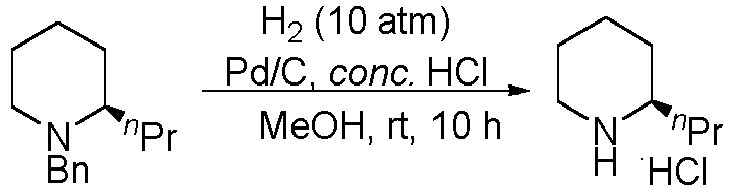
- To the hydrogenation reaction vessel were added piperidyl compound obtained in 7.1(17 mg, 0.078 mmol), 10 wt% Pd/C (8.3 mg, 0.0078 mmol), concentrated HCl (0.1 mL) and MeOH (3 mL), the reaction mixture was stirred for 3h to react after injecting the hydrogen to 10 atm. The reaction mixture was filtrated, dissolved to obtain light yellow solid (13 mg,98% yield), m.p. 220-222 °C.
[α]20 D -6.4 (c 1.0, EtOH). 1H NMR (400 MHz, CDCl3) δ 9.23 (br s, 1H), 8.95 (br s, 1H), 3.62-3.43 (m, 1H), 3.05-2.75 (m, 2H), 2.10-1.58 (m, 7H), 1.58-1.35 (m, 3H), 0.95 (t, J = 6.0 Hz, 3H). 13C NMR (100 MHz, CDCl3) δ 57.23, 45.07, 35.41, 28.10, 22.39, 22.23, 18.64, 13.77.
Claims (11)
- A kinetic resolution method of racemic δ-hydroxyl esters via asymmetric catalytic hydrogenation, wherein, in the presence of chiral spiro pyridyl phosphine ligand Iridium catalyst and base, racemic δ-hydroxyl esters were subjected to asymmetric catalytic hydrogenation to obtain extent optical purity chiral δ-hydroxyl esters and corresponding 1,5-diols,
 when the obtained δ-hydroxyl esters is S configuration, the corresponding 1,5-diols is R configuration; When the obtained δ-hydroxyl esters is R configuration, the corresponding 1,5-diols is S configuration;R1 is C1∼C20 alkyl, C1∼C20 halogen alkyl, C2∼C20 chain alkenyl, C4∼C24 aryl, C5∼C25 aryl alkyl, C6∼C26 aryl alkenyl, -(C1∼C8 alkyl)-SR4or -(C1∼C8 alkyl)-NR5R6, wherein, R4, R5 and R6 is separately C1∼C8 alkyl, C5∼C14 aryl alkyl or C4∼C15 aryl, R5 and R6 also can be cyclic annular amino which have 4-20 carbon atoms;R2 is C1∼C5 alkyl.
 - The kinetic resolution method of racemic δ-hydroxyl esters via asymmetric catalytic hydrogenation according to claim 1, wherein, comprising the following hydrogenation process:

- The kinetic resolution method of racemic δ-hydroxyl esters via asymmetric catalytic hydrogenation according to claim 1, wherein, R1 is C1∼C8 alkyl, phenyl, cyclopentyl, tert-butyloxyl methyl.
- The kinetic resolution method of racemic δ-hydroxyl esters via asymmetric catalytic hydrogenation according to claim 1 or claim 2, wherein, in which the chiral catalyst has the following general structure formula III named chiral spiro pyridyl amido phosphine ligand Iridium catalyst,
 wherein, R1 is C1-C8 chain hydrocarbyl, phenyl, substituted phenyl, 1-naphthyl, 2-naphthyl, heteroaryl or benzyl, and the substituent on said substituted phenyl is C1-C8 alkyl or alkoxy, with a substituent amount of 1-5, and said heteroaryl is furyl, thienyl or pyridyl;R2, R3, R4, R5 are H, C1-C8 alkyl, phenyl, substituted phenyl, 1-naphthyl, 2-naphthyl, heteroaryl or benzyl, and the substituent on said substituted phenyl is C1-C8 hydrocarbyl, alkoxy, with a substituent amount of 1-5, and said heteroaryl is furyl, thienyl or pyridyl; or R2-R3, R4-R5 are incorporated into C3-C7 aliphatic ring, aromatic ring; R2, R3, R4 and R5 can be the same or different;R6, R7 are selected from the group consisting of H, C1-C8 alkyl, C1-C8 alkoxy, C1-C8 aliphatic amido group, n = 0 ∼ 3; or when n ≥ 2, two adjacent R6 groups or two adjacent R7 groups can be incorporated into a C3-C7 aliphatic ring or aromatic ring, and R6, R7 can be the same or different;R8, R9 are H, C1-C8 alkyl, C1-C8 alkoxy, phenyl, substituted phenyl, 1-naphthyl, 2-naphthyl, heteroaryl or benzyl, , and the substituent on said substituted phenyl is halogen, C1-C8 alkyl, alkoxy, with a substituent amount of 1-5, and said heteroaryl is furyl, thienyl or pyridyl, and m=0-3; or when m ≥ 2, adjacent R9 or R8 and R9 groups can be incorporated into a C3-C7 aliphatic ring or aromatic ring, and R8, R9 can be the same or different;R10 is H, C1-C8 alkyl, phenyl, substituted phenyl, 1-naphthyl, 2-naphthyl, heteroaryl or benzyl, and the substituent on said substituted phenyl is C1-C8 alkyl, alkoxy, with a substituent amount of 1-5, and said heteroaryl is furyl ,thienyl or pyridyl.
 - The kinetic resolution method of racemic δ-hydroxyl esters via asymmetric catalytic hydrogenation according to claim 6, wherein, said chiral spiro pyridyl amido phosphine ligand Iridium complex catalyst included the following structure:


- The kinetic resolution method of racemic δ-hydroxyl esters via asymmetric catalytic hydrogenation according to claim 2, wherein, in the presence of organic solvent, were added δ-hydroxyl esters, catalysts, base; the reaction mixture was stirred for 0.5∼24h to react at the hydrogen atmosphere 1∼100 atm to obtain optical active chiral δ-hydroxyl esters and corresponding chiral 1,5-diols.
- The kinetic resolution method of racemic δ-hydroxyl esters via asymmetric catalytic hydrogenation according to claim 1-5, wherein, the said base is alcohol alkalis, metal hydroxide, alkali carbonate.
- The kinetic resolution method of racemic δ-hydroxyl esters via asymmetric catalytic hydrogenation according to claim 9, wherein, the said alcohol alkalis is potassium tert-butoxide, sodium tert-butoxide, potassium isopropoxide or sodium isopropoxide; the said metal hydroxide is potassium hydroxide, sodium hydroxide, the said alkali carbonate is potassium carbonate or sodium carbonate.
- The kinetic resolution method of racemic δ-hydroxyl esters via asymmetric catalytic hydrogenation according to claim 1-4, wherein, the said solvent is selected from any single or mixture of alcohol solvent, ether solvent or arene solvent.
- The kinetic resolution method of racemic δ-hydroxyl esters via asymmetric catalytic hydrogenation according to claim 11, wherein, the alcohol solvent included methanol, ethanol, propanol, isopropanol, butanol; Ethers solvent included THF, methyl tert-butyl ether or dioxane; Arene solvent included toluene, DMF or DMSO.
- The kinetic resolution method of racemic δ-hydroxyl esters according to claim 1, wherein the resulting chiral active δ-hydroxyl esters and δ∼1,5-diols are usedas a chiral starting material to prepare chiral drugs (R)-lisofylline and natural drugs (+)-civet, (-)-indolizidine 167B and (-)-coniine, the(+)-civet has the following structure:


Applications Claiming Priority (2)
| Application Number | Priority Date | Filing Date | Title |
|---|---|---|---|
| CN201410714176.3A CN104355997B (en) | 2014-11-28 | 2014-11-28 | Racemization δ-hydroxy ester asymmetric catalytic hydrogenation Kinetic Resolution and its application |
| PCT/CN2015/086425 WO2016082583A1 (en) | 2014-11-28 | 2015-08-08 | Kinetic resolution of asymmetric catalytic hydrogenation of racemic δ-hydroxy ester and application thereof |
Publications (3)
| Publication Number | Publication Date |
|---|---|
| EP3225614A1 EP3225614A1 (en) | 2017-10-04 |
| EP3225614A4 EP3225614A4 (en) | 2018-08-01 |
| EP3225614B1 true EP3225614B1 (en) | 2020-10-28 |
Family
ID=52523336
Family Applications (1)
| Application Number | Title | Priority Date | Filing Date |
|---|---|---|---|
| EP15862425.4A Not-in-force EP3225614B1 (en) | 2014-11-28 | 2015-08-08 | Kinetic resolution of asymmetric catalytic hydrogenation of racemic -hydroxy ester and application thereof |
Country Status (5)
| Country | Link |
|---|---|
| US (1) | US10676422B2 (en) |
| EP (1) | EP3225614B1 (en) |
| JP (1) | JP6487568B2 (en) |
| CN (1) | CN104355997B (en) |
| WO (1) | WO2016082583A1 (en) |
Families Citing this family (9)
| Publication number | Priority date | Publication date | Assignee | Title |
|---|---|---|---|---|
| CN104355997B (en) * | 2014-11-28 | 2019-05-31 | 浙江九洲药业股份有限公司 | Racemization δ-hydroxy ester asymmetric catalytic hydrogenation Kinetic Resolution and its application |
| JP6738090B2 (en) * | 2016-10-21 | 2020-08-12 | 学校法人 名城大学 | Asymmetric bromolactonization catalyst and method for synthesizing chiral bromolactone |
| CN107827802B (en) * | 2017-10-17 | 2021-06-11 | 南京红杉生物科技有限公司 | Synthesis method of D-proline |
| CN110128472B (en) * | 2018-02-08 | 2021-04-02 | 凯特立斯(深圳)科技有限公司 | Synthesis and application of an oxaspirocyclic PNN-type ligand |
| CN109970795B (en) * | 2019-05-05 | 2022-03-04 | 浙江九洲药业股份有限公司 | Preparation method and application of 4-substituted chiral spiro aminophosphine ligand on pyridine ring |
| CN112812097B (en) * | 2021-01-26 | 2023-01-13 | 河南师范大学 | Method for synthesizing 3- (2-pyridine) substituted pyrrole compound by visible light catalysis |
| CN115160264B (en) * | 2021-03-18 | 2025-12-19 | 九洲药业(杭州)有限公司 | Preparation method of Engliflozin intermediate |
| CN118218027A (en) * | 2024-04-09 | 2024-06-21 | 郑州大学 | Application of multidentate ligand/ruthenium catalyst and method for preparing diol compounds by hydrogenation reaction of α-hydroxy ester |
| CN118373766B (en) * | 2024-04-17 | 2025-11-04 | 南开大学 | Asymmetric catalytic hydrogenation method of indolecyclopentenyl malonate and its application |
Family Cites Families (7)
| Publication number | Priority date | Publication date | Assignee | Title |
|---|---|---|---|---|
| JP5119923B2 (en) * | 2005-09-02 | 2013-01-16 | 宇部興産株式会社 | Process for producing optically active (S or R) -α-hydroxy acid and optically active (R or S) -α-hydroxy acid ester |
| JP5477557B2 (en) * | 2008-09-09 | 2014-04-23 | 高砂香料工業株式会社 | Process for producing alcohols by hydrogen reduction of esters or lactones |
| CN102126954A (en) * | 2009-12-15 | 2011-07-20 | 中国科学院成都有机化学有限公司 | New synthesis method of optically pure lactone |
| CN102040625B (en) * | 2010-11-19 | 2013-09-25 | 浙江九洲药业股份有限公司 | Chiral spiro pyridylamidophosphine ligand compounds and synthesis method and application thereof |
| JP2013056848A (en) * | 2011-09-08 | 2013-03-28 | Nissan Chem Ind Ltd | Method for producing optically active alcohol compound |
| CN103420908B (en) * | 2012-05-25 | 2016-04-06 | 浙江九洲药物科技有限公司 | The preparation method of montelukast chiral intermediate |
| CN104355997B (en) * | 2014-11-28 | 2019-05-31 | 浙江九洲药业股份有限公司 | Racemization δ-hydroxy ester asymmetric catalytic hydrogenation Kinetic Resolution and its application |
-
2014
- 2014-11-28 CN CN201410714176.3A patent/CN104355997B/en active Active
-
2015
- 2015-08-08 JP JP2017547036A patent/JP6487568B2/en not_active Expired - Fee Related
- 2015-08-08 WO PCT/CN2015/086425 patent/WO2016082583A1/en not_active Ceased
- 2015-08-08 US US15/526,763 patent/US10676422B2/en active Active
- 2015-08-08 EP EP15862425.4A patent/EP3225614B1/en not_active Not-in-force
Non-Patent Citations (1)
| Title |
|---|
| None * |
Also Published As
| Publication number | Publication date |
|---|---|
| JP6487568B2 (en) | 2019-03-20 |
| EP3225614A1 (en) | 2017-10-04 |
| US20170334831A1 (en) | 2017-11-23 |
| US10676422B2 (en) | 2020-06-09 |
| CN104355997B (en) | 2019-05-31 |
| EP3225614A4 (en) | 2018-08-01 |
| WO2016082583A1 (en) | 2016-06-02 |
| CN104355997A (en) | 2015-02-18 |
| JP2017537153A (en) | 2017-12-14 |
Similar Documents
| Publication | Publication Date | Title |
|---|---|---|
| US10676422B2 (en) | Kinetic resolution of racemic hydroxy ester via asymmetric catalytic hydrogenation and application thereof | |
| EP2641910B1 (en) | Chiral spiro-pyridylamidophosphine ligand compound, synthesis method therefor and application thereof | |
| EP2910540B1 (en) | Novel ruthenium complex and method for preparing methanol and diol | |
| CN114644614B (en) | Preparation method of levo-nicotine | |
| CN109956970A (en) | Biphenyl-type tridentate ligand ruthenium complex and its preparation method and application | |
| CN110937985B (en) | Synthesis method of paradol | |
| US11028110B2 (en) | Process for the alkoxycarbonylation of alcohols | |
| JP5256029B2 (en) | Method for producing 3,7-diaza-bicyclo [3.3.1] nonane compound | |
| KR20130133315A (en) | Method for preparing isosorbide from sorbitol using water-compatible lewis acid | |
| CN107216332B (en) | The synthetic method of 5 (6H) formic acid base ester of tert-butyl -7- methylol -7,8- dihydro 4H pyrazolo diazepine | |
| US7649117B2 (en) | Process of preparing optically active β-hydroxycarboxylic acid derivative | |
| CN109776618B (en) | Metal complex and preparation method and application thereof | |
| CN110475783B (en) | Cationic ruthenium complex, preparation method and application thereof | |
| KR101304003B1 (en) | Eco―friendly method of manufacturing for 3,4―dihydroquinoxaline―2―amine derivative using a three―component coupling of one―pot condensation reaction | |
| CN107827916B (en) | Synthesis method of (R) - (1-amino-3-methyl) butyl-1-pinanediol borate | |
| CN115974788B (en) | A method for synthesizing α-straight-chain alkyl-substituted heteroaromatic hydrocarbons | |
| RU2836890C2 (en) | Method of producing l-nicotine | |
| JP2009504606A (en) | Process for producing heteroaromatic alcohol | |
| US20110028718A1 (en) | Paracyclophane-based ligands, their preparation and use in catalysis | |
| JP5233675B2 (en) | Process for producing optically active 2- (2'-piperidinyl) acetate | |
| Breitenlechner et al. | Kinetic study on the esterification of hexanoic acid with n, n-dialkylamino alcohols: Evidence for an activation by hydrogen bonding | |
| CN114853662A (en) | Preparation method of chiral hydrazinylpiperidine derivative | |
| HK40019078A (en) | Process for the preparation of deuterated ethanol from d2 | |
| KR20190135847A (en) | Novel process for preparing 1-methyl-2-(2-hydroxyethyl)pyrrolidine | |
| JPH07107040B2 (en) | Process for producing polycyclic iminocyclopentenes |
Legal Events
| Date | Code | Title | Description |
|---|---|---|---|
| STAA | Information on the status of an ep patent application or granted ep patent |
Free format text: STATUS: THE INTERNATIONAL PUBLICATION HAS BEEN MADE |
|
| PUAI | Public reference made under article 153(3) epc to a published international application that has entered the european phase |
Free format text: ORIGINAL CODE: 0009012 |
|
| STAA | Information on the status of an ep patent application or granted ep patent |
Free format text: STATUS: REQUEST FOR EXAMINATION WAS MADE |
|
| 17P | Request for examination filed |
Effective date: 20170616 |
|
| AK | Designated contracting states |
Kind code of ref document: A1 Designated state(s): AL AT BE BG CH CY CZ DE DK EE ES FI FR GB GR HR HU IE IS IT LI LT LU LV MC MK MT NL NO PL PT RO RS SE SI SK SM TR |
|
| AX | Request for extension of the european patent |
Extension state: BA ME |
|
| DAV | Request for validation of the european patent (deleted) | ||
| DAX | Request for extension of the european patent (deleted) | ||
| A4 | Supplementary search report drawn up and despatched |
Effective date: 20180628 |
|
| RIC1 | Information provided on ipc code assigned before grant |
Ipc: C07C 69/708 20060101ALI20180622BHEP Ipc: C07C 33/26 20060101ALI20180622BHEP Ipc: C07C 29/149 20060101ALI20180622BHEP Ipc: C07D 309/30 20060101ALI20180622BHEP Ipc: C07C 69/732 20060101ALI20180622BHEP Ipc: C07C 69/675 20060101ALI20180622BHEP Ipc: C07C 31/20 20060101ALI20180622BHEP Ipc: B01J 31/24 20060101ALI20180622BHEP Ipc: C07C 67/48 20060101AFI20180622BHEP |
|
| STAA | Information on the status of an ep patent application or granted ep patent |
Free format text: STATUS: EXAMINATION IS IN PROGRESS |
|
| 17Q | First examination report despatched |
Effective date: 20190911 |
|
| GRAP | Despatch of communication of intention to grant a patent |
Free format text: ORIGINAL CODE: EPIDOSNIGR1 |
|
| STAA | Information on the status of an ep patent application or granted ep patent |
Free format text: STATUS: GRANT OF PATENT IS INTENDED |
|
| INTG | Intention to grant announced |
Effective date: 20200603 |
|
| GRAS | Grant fee paid |
Free format text: ORIGINAL CODE: EPIDOSNIGR3 |
|
| GRAA | (expected) grant |
Free format text: ORIGINAL CODE: 0009210 |
|
| STAA | Information on the status of an ep patent application or granted ep patent |
Free format text: STATUS: THE PATENT HAS BEEN GRANTED |
|
| AK | Designated contracting states |
Kind code of ref document: B1 Designated state(s): AL AT BE BG CH CY CZ DE DK EE ES FI FR GB GR HR HU IE IS IT LI LT LU LV MC MK MT NL NO PL PT RO RS SE SI SK SM TR |
|
| REG | Reference to a national code |
Ref country code: GB Ref legal event code: FG4D |
|
| REG | Reference to a national code |
Ref country code: CH Ref legal event code: EP |
|
| REG | Reference to a national code |
Ref country code: DE Ref legal event code: R096 Ref document number: 602015061298 Country of ref document: DE |
|
| REG | Reference to a national code |
Ref country code: AT Ref legal event code: REF Ref document number: 1328068 Country of ref document: AT Kind code of ref document: T Effective date: 20201115 |
|
| REG | Reference to a national code |
Ref country code: IE Ref legal event code: FG4D |
|
| REG | Reference to a national code |
Ref country code: AT Ref legal event code: MK05 Ref document number: 1328068 Country of ref document: AT Kind code of ref document: T Effective date: 20201028 |
|
| REG | Reference to a national code |
Ref country code: NL Ref legal event code: MP Effective date: 20201028 |
|
| PG25 | Lapsed in a contracting state [announced via postgrant information from national office to epo] |
Ref country code: FI Free format text: LAPSE BECAUSE OF FAILURE TO SUBMIT A TRANSLATION OF THE DESCRIPTION OR TO PAY THE FEE WITHIN THE PRESCRIBED TIME-LIMIT Effective date: 20201028 Ref country code: RS Free format text: LAPSE BECAUSE OF FAILURE TO SUBMIT A TRANSLATION OF THE DESCRIPTION OR TO PAY THE FEE WITHIN THE PRESCRIBED TIME-LIMIT Effective date: 20201028 Ref country code: PT Free format text: LAPSE BECAUSE OF FAILURE TO SUBMIT A TRANSLATION OF THE DESCRIPTION OR TO PAY THE FEE WITHIN THE PRESCRIBED TIME-LIMIT Effective date: 20210301 Ref country code: NL Free format text: LAPSE BECAUSE OF FAILURE TO SUBMIT A TRANSLATION OF THE DESCRIPTION OR TO PAY THE FEE WITHIN THE PRESCRIBED TIME-LIMIT Effective date: 20201028 Ref country code: NO Free format text: LAPSE BECAUSE OF FAILURE TO SUBMIT A TRANSLATION OF THE DESCRIPTION OR TO PAY THE FEE WITHIN THE PRESCRIBED TIME-LIMIT Effective date: 20210128 Ref country code: GR Free format text: LAPSE BECAUSE OF FAILURE TO SUBMIT A TRANSLATION OF THE DESCRIPTION OR TO PAY THE FEE WITHIN THE PRESCRIBED TIME-LIMIT Effective date: 20210129 |
|
| REG | Reference to a national code |
Ref country code: LT Ref legal event code: MG4D |
|
| PG25 | Lapsed in a contracting state [announced via postgrant information from national office to epo] |
Ref country code: ES Free format text: LAPSE BECAUSE OF FAILURE TO SUBMIT A TRANSLATION OF THE DESCRIPTION OR TO PAY THE FEE WITHIN THE PRESCRIBED TIME-LIMIT Effective date: 20201028 Ref country code: AT Free format text: LAPSE BECAUSE OF FAILURE TO SUBMIT A TRANSLATION OF THE DESCRIPTION OR TO PAY THE FEE WITHIN THE PRESCRIBED TIME-LIMIT Effective date: 20201028 Ref country code: PL Free format text: LAPSE BECAUSE OF FAILURE TO SUBMIT A TRANSLATION OF THE DESCRIPTION OR TO PAY THE FEE WITHIN THE PRESCRIBED TIME-LIMIT Effective date: 20201028 Ref country code: LV Free format text: LAPSE BECAUSE OF FAILURE TO SUBMIT A TRANSLATION OF THE DESCRIPTION OR TO PAY THE FEE WITHIN THE PRESCRIBED TIME-LIMIT Effective date: 20201028 Ref country code: IS Free format text: LAPSE BECAUSE OF FAILURE TO SUBMIT A TRANSLATION OF THE DESCRIPTION OR TO PAY THE FEE WITHIN THE PRESCRIBED TIME-LIMIT Effective date: 20210228 Ref country code: SE Free format text: LAPSE BECAUSE OF FAILURE TO SUBMIT A TRANSLATION OF THE DESCRIPTION OR TO PAY THE FEE WITHIN THE PRESCRIBED TIME-LIMIT Effective date: 20201028 Ref country code: BG Free format text: LAPSE BECAUSE OF FAILURE TO SUBMIT A TRANSLATION OF THE DESCRIPTION OR TO PAY THE FEE WITHIN THE PRESCRIBED TIME-LIMIT Effective date: 20210128 |
|
| PG25 | Lapsed in a contracting state [announced via postgrant information from national office to epo] |
Ref country code: HR Free format text: LAPSE BECAUSE OF FAILURE TO SUBMIT A TRANSLATION OF THE DESCRIPTION OR TO PAY THE FEE WITHIN THE PRESCRIBED TIME-LIMIT Effective date: 20201028 |
|
| REG | Reference to a national code |
Ref country code: DE Ref legal event code: R097 Ref document number: 602015061298 Country of ref document: DE |
|
| PG25 | Lapsed in a contracting state [announced via postgrant information from national office to epo] |
Ref country code: CZ Free format text: LAPSE BECAUSE OF FAILURE TO SUBMIT A TRANSLATION OF THE DESCRIPTION OR TO PAY THE FEE WITHIN THE PRESCRIBED TIME-LIMIT Effective date: 20201028 Ref country code: EE Free format text: LAPSE BECAUSE OF FAILURE TO SUBMIT A TRANSLATION OF THE DESCRIPTION OR TO PAY THE FEE WITHIN THE PRESCRIBED TIME-LIMIT Effective date: 20201028 Ref country code: LT Free format text: LAPSE BECAUSE OF FAILURE TO SUBMIT A TRANSLATION OF THE DESCRIPTION OR TO PAY THE FEE WITHIN THE PRESCRIBED TIME-LIMIT Effective date: 20201028 Ref country code: SM Free format text: LAPSE BECAUSE OF FAILURE TO SUBMIT A TRANSLATION OF THE DESCRIPTION OR TO PAY THE FEE WITHIN THE PRESCRIBED TIME-LIMIT Effective date: 20201028 Ref country code: SK Free format text: LAPSE BECAUSE OF FAILURE TO SUBMIT A TRANSLATION OF THE DESCRIPTION OR TO PAY THE FEE WITHIN THE PRESCRIBED TIME-LIMIT Effective date: 20201028 Ref country code: RO Free format text: LAPSE BECAUSE OF FAILURE TO SUBMIT A TRANSLATION OF THE DESCRIPTION OR TO PAY THE FEE WITHIN THE PRESCRIBED TIME-LIMIT Effective date: 20201028 |
|
| PG25 | Lapsed in a contracting state [announced via postgrant information from national office to epo] |
Ref country code: DK Free format text: LAPSE BECAUSE OF FAILURE TO SUBMIT A TRANSLATION OF THE DESCRIPTION OR TO PAY THE FEE WITHIN THE PRESCRIBED TIME-LIMIT Effective date: 20201028 |
|
| PLBE | No opposition filed within time limit |
Free format text: ORIGINAL CODE: 0009261 |
|
| STAA | Information on the status of an ep patent application or granted ep patent |
Free format text: STATUS: NO OPPOSITION FILED WITHIN TIME LIMIT |
|
| 26N | No opposition filed |
Effective date: 20210729 |
|
| PG25 | Lapsed in a contracting state [announced via postgrant information from national office to epo] |
Ref country code: AL Free format text: LAPSE BECAUSE OF FAILURE TO SUBMIT A TRANSLATION OF THE DESCRIPTION OR TO PAY THE FEE WITHIN THE PRESCRIBED TIME-LIMIT Effective date: 20201028 Ref country code: IT Free format text: LAPSE BECAUSE OF FAILURE TO SUBMIT A TRANSLATION OF THE DESCRIPTION OR TO PAY THE FEE WITHIN THE PRESCRIBED TIME-LIMIT Effective date: 20201028 |
|
| PG25 | Lapsed in a contracting state [announced via postgrant information from national office to epo] |
Ref country code: SI Free format text: LAPSE BECAUSE OF FAILURE TO SUBMIT A TRANSLATION OF THE DESCRIPTION OR TO PAY THE FEE WITHIN THE PRESCRIBED TIME-LIMIT Effective date: 20201028 |
|
| REG | Reference to a national code |
Ref country code: DE Ref legal event code: R119 Ref document number: 602015061298 Country of ref document: DE |
|
| REG | Reference to a national code |
Ref country code: CH Ref legal event code: PL |
|
| PG25 | Lapsed in a contracting state [announced via postgrant information from national office to epo] |
Ref country code: MC Free format text: LAPSE BECAUSE OF FAILURE TO SUBMIT A TRANSLATION OF THE DESCRIPTION OR TO PAY THE FEE WITHIN THE PRESCRIBED TIME-LIMIT Effective date: 20201028 |
|
| REG | Reference to a national code |
Ref country code: BE Ref legal event code: MM Effective date: 20210831 |
|
| GBPC | Gb: european patent ceased through non-payment of renewal fee |
Effective date: 20210808 |
|
| PG25 | Lapsed in a contracting state [announced via postgrant information from national office to epo] |
Ref country code: LI Free format text: LAPSE BECAUSE OF NON-PAYMENT OF DUE FEES Effective date: 20210831 Ref country code: CH Free format text: LAPSE BECAUSE OF NON-PAYMENT OF DUE FEES Effective date: 20210831 |
|
| PG25 | Lapsed in a contracting state [announced via postgrant information from national office to epo] |
Ref country code: IS Free format text: LAPSE BECAUSE OF FAILURE TO SUBMIT A TRANSLATION OF THE DESCRIPTION OR TO PAY THE FEE WITHIN THE PRESCRIBED TIME-LIMIT Effective date: 20210228 Ref country code: LU Free format text: LAPSE BECAUSE OF NON-PAYMENT OF DUE FEES Effective date: 20210808 |
|
| PG25 | Lapsed in a contracting state [announced via postgrant information from national office to epo] |
Ref country code: IE Free format text: LAPSE BECAUSE OF NON-PAYMENT OF DUE FEES Effective date: 20210808 Ref country code: GB Free format text: LAPSE BECAUSE OF NON-PAYMENT OF DUE FEES Effective date: 20210808 Ref country code: FR Free format text: LAPSE BECAUSE OF NON-PAYMENT OF DUE FEES Effective date: 20210831 Ref country code: DE Free format text: LAPSE BECAUSE OF NON-PAYMENT OF DUE FEES Effective date: 20220301 Ref country code: BE Free format text: LAPSE BECAUSE OF NON-PAYMENT OF DUE FEES Effective date: 20210831 |
|
| PG25 | Lapsed in a contracting state [announced via postgrant information from national office to epo] |
Ref country code: HU Free format text: LAPSE BECAUSE OF FAILURE TO SUBMIT A TRANSLATION OF THE DESCRIPTION OR TO PAY THE FEE WITHIN THE PRESCRIBED TIME-LIMIT; INVALID AB INITIO Effective date: 20150808 |
|
| PG25 | Lapsed in a contracting state [announced via postgrant information from national office to epo] |
Ref country code: CY Free format text: LAPSE BECAUSE OF FAILURE TO SUBMIT A TRANSLATION OF THE DESCRIPTION OR TO PAY THE FEE WITHIN THE PRESCRIBED TIME-LIMIT Effective date: 20201028 |
|
| PG25 | Lapsed in a contracting state [announced via postgrant information from national office to epo] |
Ref country code: MK Free format text: LAPSE BECAUSE OF FAILURE TO SUBMIT A TRANSLATION OF THE DESCRIPTION OR TO PAY THE FEE WITHIN THE PRESCRIBED TIME-LIMIT Effective date: 20201028 |
|
| PG25 | Lapsed in a contracting state [announced via postgrant information from national office to epo] |
Ref country code: TR Free format text: LAPSE BECAUSE OF FAILURE TO SUBMIT A TRANSLATION OF THE DESCRIPTION OR TO PAY THE FEE WITHIN THE PRESCRIBED TIME-LIMIT Effective date: 20201028 |
|
| PG25 | Lapsed in a contracting state [announced via postgrant information from national office to epo] |
Ref country code: MT Free format text: LAPSE BECAUSE OF FAILURE TO SUBMIT A TRANSLATION OF THE DESCRIPTION OR TO PAY THE FEE WITHIN THE PRESCRIBED TIME-LIMIT Effective date: 20201028 |