EP3223446A1 - A method for protecting a link in an optical network - Google Patents
A method for protecting a link in an optical network Download PDFInfo
- Publication number
- EP3223446A1 EP3223446A1 EP16161645.3A EP16161645A EP3223446A1 EP 3223446 A1 EP3223446 A1 EP 3223446A1 EP 16161645 A EP16161645 A EP 16161645A EP 3223446 A1 EP3223446 A1 EP 3223446A1
- Authority
- EP
- European Patent Office
- Prior art keywords
- constellation
- link
- distortion
- predetermined
- traffic
- Prior art date
- Legal status (The legal status is an assumption and is not a legal conclusion. Google has not performed a legal analysis and makes no representation as to the accuracy of the status listed.)
- Withdrawn
Links
- 238000000034 method Methods 0.000 title claims abstract description 31
- 230000003287 optical effect Effects 0.000 title claims abstract description 24
- 238000010586 diagram Methods 0.000 claims abstract description 45
- 230000005540 biological transmission Effects 0.000 claims abstract description 41
- 238000013507 mapping Methods 0.000 claims abstract description 8
- 238000000638 solvent extraction Methods 0.000 claims abstract description 6
- 239000000969 carrier Substances 0.000 claims description 4
- 238000004891 communication Methods 0.000 description 5
- 230000003247 decreasing effect Effects 0.000 description 5
- 239000000835 fiber Substances 0.000 description 5
- 238000013459 approach Methods 0.000 description 4
- 230000000694 effects Effects 0.000 description 4
- 238000005516 engineering process Methods 0.000 description 4
- 230000006870 function Effects 0.000 description 4
- 230000006978 adaptation Effects 0.000 description 3
- 230000001427 coherent effect Effects 0.000 description 3
- 238000012986 modification Methods 0.000 description 3
- 230000004048 modification Effects 0.000 description 3
- 230000010287 polarization Effects 0.000 description 3
- 239000006185 dispersion Substances 0.000 description 2
- 238000002372 labelling Methods 0.000 description 2
- 230000007246 mechanism Effects 0.000 description 2
- 238000010606 normalization Methods 0.000 description 2
- 230000011664 signaling Effects 0.000 description 2
- 239000000654 additive Substances 0.000 description 1
- 230000000996 additive effect Effects 0.000 description 1
- 230000002776 aggregation Effects 0.000 description 1
- 238000004220 aggregation Methods 0.000 description 1
- 230000004075 alteration Effects 0.000 description 1
- 230000008901 benefit Effects 0.000 description 1
- 230000002457 bidirectional effect Effects 0.000 description 1
- 230000001276 controlling effect Effects 0.000 description 1
- 238000012937 correction Methods 0.000 description 1
- 230000001419 dependent effect Effects 0.000 description 1
- 238000009795 derivation Methods 0.000 description 1
- 238000013461 design Methods 0.000 description 1
- 238000001514 detection method Methods 0.000 description 1
- 238000011161 development Methods 0.000 description 1
- 230000018109 developmental process Effects 0.000 description 1
- 230000009977 dual effect Effects 0.000 description 1
- 238000001914 filtration Methods 0.000 description 1
- 230000001771 impaired effect Effects 0.000 description 1
- 238000005192 partition Methods 0.000 description 1
- 230000008569 process Effects 0.000 description 1
- 230000001737 promoting effect Effects 0.000 description 1
- 238000011084 recovery Methods 0.000 description 1
- 230000009467 reduction Effects 0.000 description 1
- 230000001105 regulatory effect Effects 0.000 description 1
- 230000008672 reprogramming Effects 0.000 description 1
- 230000004044 response Effects 0.000 description 1
- 238000004088 simulation Methods 0.000 description 1
- 230000001960 triggered effect Effects 0.000 description 1
Images

Classifications
-
- H—ELECTRICITY
- H04—ELECTRIC COMMUNICATION TECHNIQUE
- H04L—TRANSMISSION OF DIGITAL INFORMATION, e.g. TELEGRAPHIC COMMUNICATION
- H04L27/00—Modulated-carrier systems
- H04L27/32—Carrier systems characterised by combinations of two or more of the types covered by groups H04L27/02, H04L27/10, H04L27/18 or H04L27/26
- H04L27/34—Amplitude- and phase-modulated carrier systems, e.g. quadrature-amplitude modulated carrier systems
- H04L27/3405—Modifications of the signal space to increase the efficiency of transmission, e.g. reduction of the bit error rate, bandwidth, or average power
- H04L27/3444—Modifications of the signal space to increase the efficiency of transmission, e.g. reduction of the bit error rate, bandwidth, or average power by applying a certain rotation to regular constellations
-
- H—ELECTRICITY
- H04—ELECTRIC COMMUNICATION TECHNIQUE
- H04B—TRANSMISSION
- H04B10/00—Transmission systems employing electromagnetic waves other than radio-waves, e.g. infrared, visible or ultraviolet light, or employing corpuscular radiation, e.g. quantum communication
- H04B10/03—Arrangements for fault recovery
- H04B10/032—Arrangements for fault recovery using working and protection systems
-
- H—ELECTRICITY
- H04—ELECTRIC COMMUNICATION TECHNIQUE
- H04B—TRANSMISSION
- H04B10/00—Transmission systems employing electromagnetic waves other than radio-waves, e.g. infrared, visible or ultraviolet light, or employing corpuscular radiation, e.g. quantum communication
- H04B10/50—Transmitters
- H04B10/516—Details of coding or modulation
- H04B10/5161—Combination of different modulation schemes
-
- H—ELECTRICITY
- H04—ELECTRIC COMMUNICATION TECHNIQUE
- H04B—TRANSMISSION
- H04B10/00—Transmission systems employing electromagnetic waves other than radio-waves, e.g. infrared, visible or ultraviolet light, or employing corpuscular radiation, e.g. quantum communication
- H04B10/50—Transmitters
- H04B10/516—Details of coding or modulation
- H04B10/54—Intensity modulation
- H04B10/541—Digital intensity or amplitude modulation
-
- H—ELECTRICITY
- H04—ELECTRIC COMMUNICATION TECHNIQUE
- H04B—TRANSMISSION
- H04B10/00—Transmission systems employing electromagnetic waves other than radio-waves, e.g. infrared, visible or ultraviolet light, or employing corpuscular radiation, e.g. quantum communication
- H04B10/50—Transmitters
- H04B10/516—Details of coding or modulation
- H04B10/548—Phase or frequency modulation
-
- H—ELECTRICITY
- H04—ELECTRIC COMMUNICATION TECHNIQUE
- H04L—TRANSMISSION OF DIGITAL INFORMATION, e.g. TELEGRAPHIC COMMUNICATION
- H04L1/00—Arrangements for detecting or preventing errors in the information received
- H04L1/004—Arrangements for detecting or preventing errors in the information received by using forward error control
- H04L1/0056—Systems characterized by the type of code used
- H04L1/007—Unequal error protection
-
- H—ELECTRICITY
- H04—ELECTRIC COMMUNICATION TECHNIQUE
- H04L—TRANSMISSION OF DIGITAL INFORMATION, e.g. TELEGRAPHIC COMMUNICATION
- H04L27/00—Modulated-carrier systems
- H04L27/32—Carrier systems characterised by combinations of two or more of the types covered by groups H04L27/02, H04L27/10, H04L27/18 or H04L27/26
- H04L27/34—Amplitude- and phase-modulated carrier systems, e.g. quadrature-amplitude modulated carrier systems
- H04L27/3405—Modifications of the signal space to increase the efficiency of transmission, e.g. reduction of the bit error rate, bandwidth, or average power
-
- H—ELECTRICITY
- H04—ELECTRIC COMMUNICATION TECHNIQUE
- H04L—TRANSMISSION OF DIGITAL INFORMATION, e.g. TELEGRAPHIC COMMUNICATION
- H04L27/00—Modulated-carrier systems
- H04L27/32—Carrier systems characterised by combinations of two or more of the types covered by groups H04L27/02, H04L27/10, H04L27/18 or H04L27/26
- H04L27/34—Amplitude- and phase-modulated carrier systems, e.g. quadrature-amplitude modulated carrier systems
- H04L27/36—Modulator circuits; Transmitter circuits
- H04L27/366—Arrangements for compensating undesirable properties of the transmission path between the modulator and the demodulator
- H04L27/367—Arrangements for compensating undesirable properties of the transmission path between the modulator and the demodulator using predistortion
Definitions
- the present invention is in the field of communication technology.
- the present invention relates to a fast protection technique realized in the optical transport layer of a network.
- Optical networks are usually organized in ring or meshed structures consisting of several nodes connected by unidirectional or, more often, bidirectional links.
- the usage of reconfigurable optical cross-connects introduces the possibility to reroute traffic and reallocate network resources in a dynamic way.
- Modern optical transport networks for telecommunications rely upon coherent technology to convey information in the amplitude, phase and polarization of light.
- first generation of optical coherent systems usually employed dual polarization QPSK (DP-QPSK) with hard-decision (HD) forward error correction (FEC)
- DP-QPSK dual polarization QPSK
- HD hard-decision
- FEC forward error correction
- state-of-the-art systems support a variety of mQAM modulation formats and coding schemes, where m could e.g. be 16, 32, or 64.
- multi-rate multi-format transponders allow to choose coding and modulation according to the characteristics of the link at hand.
- Transport networks are critical telecommunication infrastructures and are therefore subject to strict reliability constraints.
- An important requirement often referred to as “survivability”, is the ability of the network to provide the committed quality of service (QoS) in several failure scenarios, as regulated by the service level agreement (SLA) between network customers and provider.
- QoS quality of service
- SLA service level agreement
- the traffic is rerouted onto an available backup link.
- a dedicated backup is assigned to some critical links, but typically a shared backup offers a better trade-off between reliability and costs.
- the network is provided with a certain amount of over-capacity, which is used in the case of failure to establish the required protection paths.
- the protection paths are often preplanned to guarantee the shortest possible service interruption. Note that in the present disclosure, the terms "path" and "link” are used interchangeably.
- the preplanned or calculated protection link at the optical transport layer might possibly support only a fraction of the bit rate supported by the working link. This happens for instance when the protection path is impaired by stronger noise, nonlinear fiber effects, and/or filtering effects than the designated working path or "given link". This situation is not uncommon, especially when the backup is shared and hence cannot be finely optimized as the working path. However, depending on the SLA, a reduced throughput over the protection link in some fault scenarios is an acceptable option. In this case higher layers must take care of recovering the remaining traffic.
- multi-rate multi-format transponders offers a convenient way to downgrade the end-to-end throughput, by adapting the coding and modulation schemes. For instance, a 200 Gb/s signal transmitted over the working link using DP-16QAM could be downgraded to a 100 Gb/s signal using DP-QPSK to maintain satisfactory transmission quality over a longer protection link, by discarding the low-priority traffic.
- the adaptation of the transmission format could either be requested by a central control unit or could be negotiated autonomously between the involved transponders.
- the problem underlying the invention is to provide a method and apparatus for protecting a link in an optical network which allows for avoiding long interruption times but at the same time avoids high overcapacities in the network.
- This problem is solved by a method according to claim 1 as well as by a control device according to claim 11, a transmitter according to claim 14 and a receiver according to claim 15.
- Preferred embodiments are defined in the dependent claims.
- the link to be protected is configured for transmitting digital data employing a predetermined modulation format, wherein
- the method further comprises the following steps:
- the n-dimensional Euclidean signal space could e. g. be a two-dimensional plane, such as an I-Q-signal plane.
- traffic to be transferred over the link is hence partitioned in at least two priority classes.
- Higher priority traffic is mapped to predefined bit positions within the binary symbol addresses. These would typically be bit positions which even in the modulation format without constellation distortion are better protected, or - in other words - have a lower error probability.
- the modulation format allows for a constellation distortion, according to which the relative positions of constellation points in the constellation diagram are varied in a predetermined way by a predetermined degree as compared to a default constellation, which is also referred to as "uniform constellation" herein.
- a suitable choice of distortion it becomes possible to further increase the protection of the predefined bit positions to which the priority traffic is mapped.
- the "higher priority traffic” is the traffic associated with the highest or, if there are more than two priority classes, possibly two or more highest priority classes.
- a degree of distortion of the constellation diagram is determined such that a desired transmission quality for the transmission of the traffic of the highest priority class or classes via said predetermined protection link is ensured.
- the degree of distortion is chosen such that a desired transmission quality for the full traffic via the given link (working link) is simultaneously ensured.
- the corresponding distorted constellation diagram with the determined degree of distortion is used for the transmittal of digital data over the given link.
- the traffic can be switched to the protection link without a need for adapting the coding and modulation scheme and the reconfiguration time associated therewith, which allows for an extremely fast recovery of at least the high-priority traffic. If no such degree of distortion can be found, this would indicate that the quality of the protection link is insufficient, and that hence another protection link needs to be considered.
- the skilled person will appreciate that with the method of the invention, due to the possibility to adjust the distortion of the constellation diagram, the available links can be used much more efficiently than in the prior art described above, and that effectively the requirement to the quality of the links is considerably relaxed.
- the method further comprises, in case of failure of said given link, a step F) of rerouting the traffic to said protection path.
- step C) the quality of a plurality of alternative predetermined protection links are evaluated, and in step D), the degree of distortion of the constellation diagram is determined such that a desired transmission quality for the worst of said plurality of alternative predetermined protection links is ensured.
- the predetermined way of varying the relative positions of constellation points preferably comprises one or more of
- the "predefined position in the signal space” may correspond to the center of mass of a subset of constellation points, or may be chosen such that upon the variation, the average power of the signal remains unchanged, bearing in mind that the power associated with a symbol is proportional to the square of the symbol distance from the origin of the n -dimensional signal space.
- the "center of mass" of a number of constellation points shall refer to an average position defined by the average of their respective coordinates.
- the constellation diagram is two-dimensional and comprises four quadrants, and in said binary addresses of said constellation points, there are two predetermined bit positions which have identical values for each constellation point within the same quadrant.
- higher priority traffic is mapped to said predetermined two bit positions.
- the modulation format employs a 16QAM constellation
- the predetermined way of varying the relative positions of constellation points comprises reducing the distances between constellation points within the same quadrant while increasing the minimum distance between constellation points of different quadrants, as compared to an even distribution of constellation points. This way, the error probability of bit positions related to the quadrants is further decreased, although at the expense of an increased error probability associated with symbols within a quadrant.
- the modulation format employs a 32QAM constellation, and in said constellation distortion, the predetermined way of varying the relative positions of constellation points comprises
- the modulation format employs an 8QAM constellation, and in said constellation distortion, the predetermined way of varying the relative positions of constellation points comprises rotating the four constellation points farthest away from the origin around said origin by an angle, said angle defining said degree of variation.
- the error probability of the two bit positions can be decreased at the expense of the error probability of the remaining bit position, as will become more apparent from an example of a specific embodiment below.
- the traffic to be transmitted over the link corresponds to one of the following:
- the method further comprises mapping individual FlexEthernet streams to different bit sets in the binary address of the constellation symbols.
- a control device for controlling the protection of a link in an optical network.
- a control device could e.g. be a network management tool employing suitable software provided for being executed on one or more computers.
- the control device is not limited to any specific type of hardware element, as long as it is capable of carrying out the functions recited below.
- the control device is configured to be operatively connected to a transmitter and a receiver associated with said link, said transmitter being configured for transmitting digital data employing a predetermined modulation format of the type recited above with reference to the method of the invention.
- the associated transmitter is further configured for partitioning the data to be transmitted over the link in two or more priority classes, and mapping higher priority traffic to predefined bit positions within the binary symbol addresses.
- the control device is further configured for evaluating the quality of a predetermined protection link via which a part of the traffic could be transmitted in case of failure of the given link, determining a degree of distortion of the constellation diagram such that a desired transmission quality for the transmission of the traffic of the highest priority class or classes via said predetermined protection link and a desired transmission quality for the full traffic via said given link are simultaneously ensured, and instructing said transmitter and said receiver to employ a distorted constellation diagram with the determined degree of distortion for said transmission of digital data over said given link.
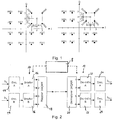
- Fig. 1 shows a uniform 16QAM two-dimensional constellation diagram with Gray labeling:
- the binary addresses of any two symbols at minimum Euclidean distance differ exactly in one position.
- the two rightmost bits identify the quadrant, whereas the two leftmost bits determine the symbol in the quadrant on the in-phase (I) - quadrature (Q) plane.
- the average of the four constellation points in the first quadrant referred to as "a center of mass” herein and marked by a cross, lies at (2, 2).
- the distance ⁇ between the projection of every symbol and the projection of the center is equal to 1 both on the I and Q axes.
- the situation is referred to as the "uniform" or "non-distorted" constellation.
- Fig. 1 shows a non-uniform, "distorted" 16QAM constellation where ⁇ has been decreased to 0.75.
- ⁇ is a geometrical parameter that indicates the "degree of distortion” referred to above, and is also referred to as “distortion parameter” herein.
- disortion parameter the distance between symbols belonging to different quadrants is enhanced at the expense of the intra-quadrant distances.
- a reduction of ⁇ hence increases the error resilience on the two rightmost bit positions and degrades that of the two leftmost bit positions in the binary address. Since the two rightmost bits are better protected, they are also referred to as “strong bits” herein, and the two leftmost bits will be referred to as "weak bits".
- this distortion of the constellation is an example of the "varying of the distances of a subset of constellation points from a predefined position in the signal space which does not coincide with a constellation point" referred to in the introductory portion of the specification, where the predefined position corresponds to the center of mass of the four constellation points in each quadrant.
- the position of the center of mass could be further shifted such as to keep the average power of the corresponding signal constant.
- the 200G signal is partitioned in a high-priority and a low-priority 100G client according to step A) referred to above.
- the high-priority traffic is mapped to the strong bits and the low-priority traffic is mapped to the weak bits.
- Fig. 2 a transmitter 10 and a receiver 12 are shown.
- the transmitter 10 comprises two identical encoders A and B at reference sign 14, two interleavers A and B at reference sign 16 and a mapper 18.
- the receiver 12 comprises a demapper 20, de-interleavers A and B at reference sign 22 and decoders A and B at reference sign 24.
- the high-priority and low-priority bit streams, b A and b B respectively, are separately encoded by the two identical encoders A and B shown at reference sign 14.
- Each encoded stream is distributed by the corresponding interleaver 16 between two different inputs of the mapper, corresponding to different bit positions in the binary address.
- the binary positions are numbered from right to left from 1 to 4.
- the receiver 12 implements the corresponding sequence of inverse operations.
- Fig. 2 is a control device 8 which is operatively coupled with the transmitter 10 and the receiver 12.
- the control device 8 can be realized in software, in hardware or both.
- the control device 8 is capable for carrying out the above-mentioned method steps C) and D), and to communicate to the transmitter 10 and the receiver 12 the degree of distortion of the constellation that shall be employed.
- Fig. 3 shows simulation results for DP-16QAM over a DP additive white Gaussian noise (AWGN) channel.
- a symbol rate of 30.7 GHz is chosen to transport the whole 200G traffic and accommodate for 15% FEC overhead and for pilot symbols employed for non-differential transmission.
- ROSNR optical signal-to-noise ratio
- the dotted line shows also the ROSNR for a conventional approach with uniform 16QAM when a single FEC code is applied through bitinterleaving to all four bit positions.
- Fig. 3 it is seen that by reducing ⁇ , or in other words increasing the degree of distortion, the resilience of the strong bits is increased while sacrificing the performance of the weak bits.
- step C) the quality of a predetermined protection link via which a part of the traffic could be transmitted in case of failure of the given link or working path is determined.
- this comprises determining the available optical signal-to-noise ratio (OSNR) on the working path and the worst-case protection path.
- OSNR optical signal-to-noise ratio
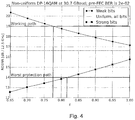
- the "worst-case protection path” is the protection path among a set of predetermined alternative protection paths providing the worst transmission quality. For the sake of exemplification it shall be assumed that that these values are 19 dB and 14 dB, respectively, as shown by the additional horizontal lines in Fig. 4 .
- the geometry parameter ⁇ is determined such as to ensure that the pre-FEC BER is equal or better than the desired threshold both on the working path and the worst protection path.
- allowed values of the geometry parameter ⁇ range roughly from 0.775 to 0.817.
- the distorted constellation diagram with the determined degree of distortion i.e. with 0.775 ⁇ ⁇ ⁇ 0.817, is then employed for the transmission of digital data over the working path.
- the traffic is rerouted according to step F) without changing the modulation format, and maintaining the geometry parameter or "degree of distortion" ⁇ . Having chosen the geometry parameter ⁇ in the allowable range, it is ensured that the receiver is still capable of detecting the high-priority traffic with the desired performance without reconfiguration of the coding and modulation scheme.
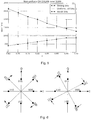
- Fig. 5 shows the performance of non-uniform DP-16QAM over a nonlinear fiber-optic link consisting of several 80 km spans of standard single-mode fiber (SSMF) connected through erbium-doped fiber amplifiers (EDFAs). Again a non-differential transmission and 15% overhead FEC with a BER threshold of 2 ⁇ 10 -2 are assumed.
- the performance of 96 wavelength division multiplexed carriers with 50 GHz spacing is evaluated, assuming a system margin of 3 dB, an implementation penalty of 2 dB and an EDFA noise figure of 5 dB.
- the nonlinear interference caused by the fiber is evaluated according to the semi-analytical GN-model described by A. Carena, V. Curri, G. Bosco, P. Poggiolini, and F. Forghieri in the article "Modeling of the impact of non-linear propagation effects in uncompensated optical coherent transmission links ", IEEE Journal of Lightwave Technology, volume 30, number 10, pp.1524-1539 (2012 ). A launch power of ⁇ 3 dBm per channel is assumed, which corresponds to optimum performance.
- Fig. 5 shows the maximum reach both for the strong and the weak bits as a function of the geometry parameter ⁇ . Additionally, the dotted line indicates the reach of a conventional transmission system with uniform 16QAM and a single FEC code applied to all four bit positions. It is apparent that the nonlinear fiber effects do not alter the qualitative trend observed in Fig. 3 .
- step F some parameters of the receiver may still need resynchronization or adaptation.
- the accumulated chromatic dispersion (CD) and the polarization mode dispersion (PMD) over the protection link are typically different from the working link.
- the resynchronization of the CD compensator (not shown) at the receiver 12 could be either triggered externally together with the reconfiguration of the cross-connects (not shown) or initiated automatically by a locally generated alarm.
- the PMD compensator is continuously adapted at run-time and therefore reacts automatically to the new channel conditions.
- the benefit of the approach of the invention stems from the fact that with the current transponder technology, the adaptation of the receiver parameters is much faster (roughly by two orders of magnitude) than a reconfiguration of the coding and modulation scheme.
- the high-priority client experiences only a short interruption due to failure detection time, reconfiguration of the cross-connects and resynchronization of the receiver: its protection mechanism is completely implemented in the optical layer.
- the low-priority traffic is dropped at the optical link layer and its protection is fully delegated to the higher layers.
- low-priority traffic is likely to undergo a longer downtime, consistent with the state of the art.
- the protection level of distinct ODU4 (100G) clients can be altered.
- various embodiments of the invention allow also a different granularity of the traffic classes when the transport equipment implements traffic aggregation. This becomes particularly attractive in conjunction with the FlexEthernet project started by the Optical Internetworking Forum (OIF) with the aim of introducing flexible rate connections between routers.
- OIF Optical Internetworking Forum
- one can map individual FlexEthernet streams to different bit-sets in the binary address of the constellation symbols.
- Square mQAM constellations like 64QAM, can be treated similarly to 16QAM by clustering their symbols around their center of mass in each quadrant. If necessary, each group of four neighboring points can be further clustered around their respective center of mass, and the center of mass may optionally be shifted.
- the left side of Fig. 6 shows a uniform 8QAM constellation with quasi-Gray labeling.
- the constellation on the right side of Fig. 6 is obtained, where the two leftmost bits are strengthened at the expense of the rightmost bit.
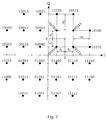
- Fig. 7 shows a quasi-Gray labeled 32QAM constellation together with two possible distortion parameters ⁇ 1 and ⁇ 2 that control its geometry.
Landscapes
- Engineering & Computer Science (AREA)
- Computer Networks & Wireless Communication (AREA)
- Signal Processing (AREA)
- Physics & Mathematics (AREA)
- Electromagnetism (AREA)
- Optical Communication System (AREA)
- Digital Transmission Methods That Use Modulated Carrier Waves (AREA)
Abstract
Enclosed herewith is a method for protecting a link in an optical network configured for transmitting digital data employing a predetermined modulation format which comprises a number of symbols in a constellation diagram. A binary address is associated with each symbol. The modulation format allows for a constellation distortion, according to which the relative positions of constellation points in the constellation diagram are varied in a predetermined way by a predetermined degree. The method comprises the steps of:
A) partitioning the traffic in two or more priority classes,
B) mapping higher priority traffic to predefined bit positions within the binary symbol addresses,
C) evaluating the quality of a predetermined protection link,
D) determining a degree of distortion such that a desired transmission quality for the transmission of the traffic of the highest priority class or classes via said predetermined protection link and a desired transmission quality for the full traffic via said given link are simultaneously ensured, and
E) employing said distorted constellation diagram for transmission of digital data over said given link.
A) partitioning the traffic in two or more priority classes,
B) mapping higher priority traffic to predefined bit positions within the binary symbol addresses,
C) evaluating the quality of a predetermined protection link,
D) determining a degree of distortion such that a desired transmission quality for the transmission of the traffic of the highest priority class or classes via said predetermined protection link and a desired transmission quality for the full traffic via said given link are simultaneously ensured, and
E) employing said distorted constellation diagram for transmission of digital data over said given link.
Description
- The present invention is in the field of communication technology. In particular, the present invention relates to a fast protection technique realized in the optical transport layer of a network.
- Optical networks are usually organized in ring or meshed structures consisting of several nodes connected by unidirectional or, more often, bidirectional links. The usage of reconfigurable optical cross-connects introduces the possibility to reroute traffic and reallocate network resources in a dynamic way.
- Modern optical transport networks for telecommunications rely upon coherent technology to convey information in the amplitude, phase and polarization of light. Whereas the first generation of optical coherent systems usually employed dual polarization QPSK (DP-QPSK) with hard-decision (HD) forward error correction (FEC), state-of-the-art systems support a variety of mQAM modulation formats and coding schemes, where m could e.g. be 16, 32, or 64. In particular, multi-rate multi-format transponders allow to choose coding and modulation according to the characteristics of the link at hand.
- Transport networks are critical telecommunication infrastructures and are therefore subject to strict reliability constraints. An important requirement, often referred to as "survivability", is the ability of the network to provide the committed quality of service (QoS) in several failure scenarios, as regulated by the service level agreement (SLA) between network customers and provider. Although failure protection mechanisms can be realized in different layers of the protocol stack, in this disclosure particular focus is put on implementations at the physical layer.
- Generally, whenever a link failure is detected, the traffic is rerouted onto an available backup link. In some cases a dedicated backup is assigned to some critical links, but typically a shared backup offers a better trade-off between reliability and costs. According to this approach, the network is provided with a certain amount of over-capacity, which is used in the case of failure to establish the required protection paths. At least for single failure scenarios on the most critical links, the protection paths are often preplanned to guarantee the shortest possible service interruption. Note that in the present disclosure, the terms "path" and "link" are used interchangeably.
- In case of link failure, the preplanned or calculated protection link at the optical transport layer might possibly support only a fraction of the bit rate supported by the working link. This happens for instance when the protection path is impaired by stronger noise, nonlinear fiber effects, and/or filtering effects than the designated working path or "given link". This situation is not uncommon, especially when the backup is shared and hence cannot be finely optimized as the working path. However, depending on the SLA, a reduced throughput over the protection link in some fault scenarios is an acceptable option. In this case higher layers must take care of recovering the remaining traffic.
- The flexible nature of multi-rate multi-format transponders offers a convenient way to downgrade the end-to-end throughput, by adapting the coding and modulation schemes. For instance, a 200 Gb/s signal transmitted over the working link using DP-16QAM could be downgraded to a 100 Gb/s signal using DP-QPSK to maintain satisfactory transmission quality over a longer protection link, by discarding the low-priority traffic. The adaptation of the transmission format could either be requested by a central control unit or could be negotiated autonomously between the involved transponders. Unfortunately, both approaches require, besides some signaling overhead, a full reconfiguration of the transponders at the end nodes of the link, which would typically include reprogramming registers of framer and modem devices, tuning analog oscillators and adjusting analog signal levels. This process is, however, extremely time-consuming and results in practice into severe service interruption which will often not be tolerable for high-priority traffic.
- If the long reconfiguration time of the transponders and the additional signaling overhead shall be avoided, the problem could be circumvented, rather than solved, by constraining all protection paths to support at least the same throughput as their respective working path. However, this solution comes at a tremendous cost in terms of required overcapacity in the network. Further, this cost increases with the network size due to the growing number of possible failure scenarios that must be taken into account.
- As an alternative, the throughput on the working path could be artificially lowered below the actual link capacity according to the transmission conditions of the worst-case protection path. Obviously, also this solution comes at a high price, because it sacrifices throughput during normal operation to guarantee a quick failure response.
- The problem underlying the invention is to provide a method and apparatus for protecting a link in an optical network which allows for avoiding long interruption times but at the same time avoids high overcapacities in the network. This problem is solved by a method according to
claim 1 as well as by a control device according to claim 11, a transmitter according toclaim 14 and a receiver according toclaim 15. Preferred embodiments are defined in the dependent claims. - According to the method of the invention, the link to be protected is configured for transmitting digital data employing a predetermined modulation format, wherein
- said modulation format uses a constellation diagram comprising a number of symbols,
- each symbol is represented by a point in an n-dimensional Euclidean signal space with n ≥1,
- a binary address is associated with each symbol, and
- said modulation format allows for a constellation distortion, according to which the relative positions of constellation points in the constellation diagram are varied in a predetermined way by a predetermined degree.
- The method further comprises the following steps:
- A) partitioning the traffic to be transmitted over the link in two or more priority classes,
- B) mapping higher priority traffic to predefined bit positions within the binary symbol addresses,
- C) evaluating the quality of a predetermined protection link via which a part of the traffic could be transmitted in case of failure of the given link,
- D) determining a degree of distortion of the constellation diagram such that a desired transmission quality for the transmission of the traffic of the highest priority class or classes via said predetermined protection link and a desired transmission quality for the full traffic via said given link are simultaneously ensured, and
- E) employing a distorted constellation diagram with the determined degree of distortion for said transmission of digital data over said given link.
- Herein, the n-dimensional Euclidean signal space could e. g. be a two-dimensional plane, such as an I-Q-signal plane. According to the invention, traffic to be transferred over the link is hence partitioned in at least two priority classes. Higher priority traffic is mapped to predefined bit positions within the binary symbol addresses. These would typically be bit positions which even in the modulation format without constellation distortion are better protected, or - in other words - have a lower error probability. Moreover, according to the invention the modulation format allows for a constellation distortion, according to which the relative positions of constellation points in the constellation diagram are varied in a predetermined way by a predetermined degree as compared to a default constellation, which is also referred to as "uniform constellation" herein. As will become more apparent with reference to specific examples, due to a suitable choice of distortion, it becomes possible to further increase the protection of the predefined bit positions to which the priority traffic is mapped.
- According to the invention, it is ensured that at least the higher priority traffic will be safely transmitted in case the traffic is switched from the given link or "working link" to the protection link. Herein, the "higher priority traffic" is the traffic associated with the highest or, if there are more than two priority classes, possibly two or more highest priority classes. For this purpose, in step D) recited above, a degree of distortion of the constellation diagram is determined such that a desired transmission quality for the transmission of the traffic of the highest priority class or classes via said predetermined protection link is ensured. At the same time, the degree of distortion is chosen such that a desired transmission quality for the full traffic via the given link (working link) is simultaneously ensured.
- If a degree of distortion that fulfills both requirements is found, then the corresponding distorted constellation diagram with the determined degree of distortion is used for the transmittal of digital data over the given link. In case of link value, the traffic can be switched to the protection link without a need for adapting the coding and modulation scheme and the reconfiguration time associated therewith, which allows for an extremely fast recovery of at least the high-priority traffic. If no such degree of distortion can be found, this would indicate that the quality of the protection link is insufficient, and that hence another protection link needs to be considered. However, the skilled person will appreciate that with the method of the invention, due to the possibility to adjust the distortion of the constellation diagram, the available links can be used much more efficiently than in the prior art described above, and that effectively the requirement to the quality of the links is considerably relaxed.
- Note that some of the individual elements of the inventive method are known from prior art but in a different context. Assigning transmitted bits to different priority classes according to some importance criterion is e.g. described in R. Calderbank and N. Seshadri, "Multilevel codes for unequal error protection ", IEEE Transactions on Information Theory, vol. 39, no. 4, pp. 1234-1248, July 1993 . Further refinements were proposed by R. H. Morelos-Zaragoza, M. P. C. Fossorier, S. Lin and H. Imai in "Multilevel coded modulation for unequal error protection and multistage decoding - Part I: Symmetric constellations ", IEEE Transactions on Communications, vol. 48, no. 2, pp. 204-213, February 2000 and by M. Isaka, M. P. C. Fossorier, R. H. Morelos-Zaragoza, S. Lin and H. Imai in "Multilevel coded modulation for unequal error projection and multistage decoding - Part II: Asymmetric constellations ", IEEE Transactions on Communications, vol. 48, no. 5, pp. 774-786, May 2000 , where also the possibility of distorting constellation diagrams is mentioned. More recent developments are described by C. Shen, and M. Fitz in "On the Design of Modern Multilevel Coded Modulation for Unequal Error Projection Communications, " available in the proceedings of the IEEE International Conference on Communications ICC '08 on pp. 1355-1359 and by N. von Deetzen, and W. Henkel in "Unequal error protection multilevel codes and hierarchical modulation for multimedia transmission" included in the proceedings of the IEEE International Symposium on Information Theory ISIT 2008 on pp. 2237-2241 . However, none of these documents consider the possibility of these generic techniques in the context of network survivability, or employing any of steps C) to E) above.
- In a preferred embodiment, the method further comprises, in case of failure of said given link, a step F) of rerouting the traffic to said protection path.
- In a preferred embodiment, in step C), the quality of a plurality of alternative predetermined protection links are evaluated, and in step D), the degree of distortion of the constellation diagram is determined such that a desired transmission quality for the worst of said plurality of alternative predetermined protection links is ensured. This way, in case of failure of the working link, it is possible to switch to any one of the alternative predetermined protection links, upon their availability, while still ensuring that at least the high-priority traffic will be safely transmitted. Accordingly, the number of predetermined protection links can be shared with further working links, which allows for a more efficient use of network capabilities.
- In the constellation distortion referred to above, the predetermined way of varying the relative positions of constellation points preferably comprises one or more of
- varying the distances of a subset of adjacent constellation points in said constellation diagram,
- varying the distances of a subset of constellation points from a predefined position in the signal space which does not coincide with a constellation point, or
- rotating the position of a subset of constellation points with respect to an origin of said signal space.
- As will become more apparent from the description below, these types of constellation distortions do in fact allow for further decreasing the error probability of the bit positions to which the higher priority traffic is mapped. Herein, the "predefined position in the signal space" may correspond to the center of mass of a subset of constellation points, or may be chosen such that upon the variation, the average power of the signal remains unchanged, bearing in mind that the power associated with a symbol is proportional to the square of the symbol distance from the origin of the n-dimensional signal space. The "center of mass" of a number of constellation points shall refer to an average position defined by the average of their respective coordinates.
- In a preferred embodiment, the constellation diagram is two-dimensional and comprises four quadrants, and in said binary addresses of said constellation points, there are two predetermined bit positions which have identical values for each constellation point within the same quadrant. Herein, higher priority traffic is mapped to said predetermined two bit positions. This embodiment exploits the fact that even in case of a poor link quality, such as due to higher noise, it will more likely be possible to distinguish symbols from each other that are located in different quadrants and hence comparatively far spaced apart. On the other hand, if symbols within the same quadrant are confused with each other due to a poor signal quality, this does not affect the two bits at the bit positions related to the quadrant, which would hence still be correct. In other words, the error probability for these bits is comparatively low.
- In a preferred embodiment, the modulation format employs a 16QAM constellation, and in said constellation distortion, the predetermined way of varying the relative positions of constellation points comprises reducing the distances between constellation points within the same quadrant while increasing the minimum distance between constellation points of different quadrants, as compared to an even distribution of constellation points. This way, the error probability of bit positions related to the quadrants is further decreased, although at the expense of an increased error probability associated with symbols within a quadrant.
- In another preferred embodiment, the modulation format employs a 32QAM constellation, and in said constellation distortion, the predetermined way of varying the relative positions of constellation points comprises
- for the four constellation points in each quadrant that are closest to the origin of the two-dimensional plane, reducing their respective distance from their center of mass, and
- for the four constellation points in each quadrant that are the farthest from the origin of the two-dimensional plane, increasing their respective distance from the closest one among the four constellation points closest to the origin,
- In another preferred embodiment, the modulation format employs an 8QAM constellation, and in said constellation distortion, the predetermined way of varying the relative positions of constellation points comprises rotating the four constellation points farthest away from the origin around said origin by an angle, said angle defining said degree of variation. In this embodiment, the error probability of the two bit positions can be decreased at the expense of the error probability of the remaining bit position, as will become more apparent from an example of a specific embodiment below.
- In various embodiments, the traffic to be transmitted over the link corresponds to one of the following:
- 200G traffic transmitted over a single DP-16QAM optical carrier partitioned in two 100 G signals with different priorities,
- 300G traffic transmitted over a super channel consisting of two DP-8QAM carriers, or
- a single carrier 400 G transmission using 32QAM or 64QAM.
- In a preferred embodiment, the method further comprises mapping individual FlexEthernet streams to different bit sets in the binary address of the constellation symbols.
- According to a further aspect of the invention, a control device for controlling the protection of a link in an optical network is provided. Such a control device could e.g. be a network management tool employing suitable software provided for being executed on one or more computers. However, the control device is not limited to any specific type of hardware element, as long as it is capable of carrying out the functions recited below. The control device is configured to be operatively connected to a transmitter and a receiver associated with said link, said transmitter being configured for transmitting digital data employing a predetermined modulation format of the type recited above with reference to the method of the invention. The associated transmitter is further configured for partitioning the data to be transmitted over the link in two or more priority classes, and mapping higher priority traffic to predefined bit positions within the binary symbol addresses.
- The control device is further configured for evaluating the quality of a predetermined protection link via which a part of the traffic could be transmitted in case of failure of the given link, determining a degree of distortion of the constellation diagram such that a desired transmission quality for the transmission of the traffic of the highest priority class or classes via said predetermined protection link and a desired transmission quality for the full traffic via said given link are simultaneously ensured, and instructing said transmitter and said receiver to employ a distorted constellation diagram with the determined degree of distortion for said transmission of digital data over said given link.
-
- Figure 1
- shows a Gray labeled 16QAM constellation diagram without distortion on the left and with distortion on the right,
- Figure 2
- shows a transmitter and a receiver for use in the method of the invention,
- Figure 3
- shows the required OSNR at a pre-FEC BER of 2·10-2 for non-uniform DP-16QAM with a symbol rate of 30.7 GHz,
- Figure 4
- is a diagram illustrating the derivation of a required degree of distortion of a constellation diagram,
- Figure 5
- is a diagram showing the reach of the strong bits and the week bits as a function of the degree of distortion of the constellation diagram,
- Figure 6
- shows a Gray labeled 8QAM constellation diagram without distortion on the left and with distortion on the right,
- Figure 7
- shows a quasi-Gray labeled 32QAM constellation diagram distorted according to two independent distortion parameters.
- For the purposes of promoting an understanding of the principles of the invention, reference will now be made to a preferred embodiment illustrated in the drawings, and specific language will be used to describe the same. It will nevertheless be understood that no limitation of the scope of the invention is thereby intended, such alterations and further modifications in the illustrated apparatus and such further applications of the principles of the invention as illustrated therein being contemplated as would normally occur now or in the future to one skilled in the art to which the invention relates.
- For the sake of exemplification we give a detailed description of the method of the invention for the important case that the given link or "working path" carries a payload of about 200 Gb/s, shortly referred to as a "200G client", over a single optical carrier. The modulation format of choice for this application is considered to be DP-16QAM.
- The left side of
Fig. 1 shows a uniform 16QAM two-dimensional constellation diagram with Gray labeling: The binary addresses of any two symbols at minimum Euclidean distance differ exactly in one position. In this shown example, the two rightmost bits identify the quadrant, whereas the two leftmost bits determine the symbol in the quadrant on the in-phase (I) - quadrature (Q) plane. With the adopted normalization, the average of the four constellation points in the first quadrant, referred to as "a center of mass" herein and marked by a cross, lies at (2, 2). In each quadrant the distance δ between the projection of every symbol and the projection of the center is equal to 1 both on the I and Q axes. The situation is referred to as the "uniform" or "non-distorted" constellation. - The right side of
Fig. 1 shows a non-uniform, "distorted" 16QAM constellation where δ has been decreased to 0.75. Herein, δ is a geometrical parameter that indicates the "degree of distortion" referred to above, and is also referred to as "distortion parameter" herein. In this case the distance between symbols belonging to different quadrants is enhanced at the expense of the intra-quadrant distances. A reduction of δ hence increases the error resilience on the two rightmost bit positions and degrades that of the two leftmost bit positions in the binary address. Since the two rightmost bits are better protected, they are also referred to as "strong bits" herein, and the two leftmost bits will be referred to as "weak bits". Note that this distortion of the constellation is an example of the "varying of the distances of a subset of constellation points from a predefined position in the signal space which does not coincide with a constellation point" referred to in the introductory portion of the specification, where the predefined position corresponds to the center of mass of the four constellation points in each quadrant. The position of the center of mass could be further shifted such as to keep the average power of the corresponding signal constant. - In the described example, it shall be assumed that the 200G signal is partitioned in a high-priority and a low-priority 100G client according to step A) referred to above.
- In the following step B), the high-priority traffic is mapped to the strong bits and the low-priority traffic is mapped to the weak bits. This is illustrated in
Fig. 2 , in which atransmitter 10 and areceiver 12 are shown. As further shown inFig. 2 , thetransmitter 10 comprises two identical encoders A and B atreference sign 14, two interleavers A and B atreference sign 16 and amapper 18. Thereceiver 12 comprises ademapper 20, de-interleavers A and B atreference sign 22 and decoders A and B atreference sign 24. - The high-priority and low-priority bit streams, bA and bB respectively, are separately encoded by the two identical encoders A and B shown at
reference sign 14. Each encoded stream is distributed by the correspondinginterleaver 16 between two different inputs of the mapper, corresponding to different bit positions in the binary address. With reference toFig. 1 , the binary positions are numbered from right to left from 1 to 4. Thereceiver 12 implements the corresponding sequence of inverse operations.
Further shown inFig. 2 is acontrol device 8 which is operatively coupled with thetransmitter 10 and thereceiver 12. Thecontrol device 8 can be realized in software, in hardware or both. In particular, thecontrol device 8 is capable for carrying out the above-mentioned method steps C) and D), and to communicate to thetransmitter 10 and thereceiver 12 the degree of distortion of the constellation that shall be employed. -
Fig. 3 shows simulation results for DP-16QAM over a DP additive white Gaussian noise (AWGN) channel. A symbol rate of 30.7 GHz is chosen to transport the whole 200G traffic and accommodate for 15% FEC overhead and for pilot symbols employed for non-differential transmission. The required optical signal-to-noise ratio (ROSNR), defined over a noise bandwidth of 12.5 GHz, for a pre-FEC bit error rate (BER) of 2·10-2, which is assumed to be the FEC threshold, is plotted as a function of the geometry parameter or "distortion parameter" δ both for the strong and the weak bits. The dotted line shows also the ROSNR for a conventional approach with uniform 16QAM when a single FEC code is applied through bitinterleaving to all four bit positions. InFig. 3 , it is seen that by reducing δ, or in other words increasing the degree of distortion, the resilience of the strong bits is increased while sacrificing the performance of the weak bits. - Next, according to step C) referred to above, the quality of a predetermined protection link via which a part of the traffic could be transmitted in case of failure of the given link or working path is determined. In particular, this comprises determining the available optical signal-to-noise ratio (OSNR) on the working path and the worst-case protection path. Herein, the "worst-case protection path" is the protection path among a set of predetermined alternative protection paths providing the worst transmission quality. For the sake of exemplification it shall be assumed that that these values are 19 dB and 14 dB, respectively, as shown by the additional horizontal lines in
Fig. 4 . - Proceeding with step D), the geometry parameter δ, or in other words, the degree of distortion, is determined such as to ensure that the pre-FEC BER is equal or better than the desired threshold both on the working path and the worst protection path. As indicated by the additional vertical lines in
Fig. 4 , allowed values of the geometry parameter δ range roughly from 0.775 to 0.817. According to step E) the distorted constellation diagram with the determined degree of distortion, i.e. with 0.775 < δ < 0.817, is then employed for the transmission of digital data over the working path. In case of link failure, the traffic is rerouted according to step F) without changing the modulation format, and maintaining the geometry parameter or "degree of distortion" δ. Having chosen the geometry parameter δ in the allowable range, it is ensured that the receiver is still capable of detecting the high-priority traffic with the desired performance without reconfiguration of the coding and modulation scheme. - Although the proposed solution was exemplified over an idealized AWGN channel model, it works without fundamental modifications also under realistic channel conditions.
Fig. 5 shows the performance of non-uniform DP-16QAM over a nonlinear fiber-optic link consisting of several 80 km spans of standard single-mode fiber (SSMF) connected through erbium-doped fiber amplifiers (EDFAs). Again a non-differential transmission and 15% overhead FEC with a BER threshold of 2·10-2 are assumed. The performance of 96 wavelength division multiplexed carriers with 50 GHz spacing is evaluated, assuming a system margin of 3 dB, an implementation penalty of 2 dB and an EDFA noise figure of 5 dB. The nonlinear interference caused by the fiber is evaluated according to the semi-analytical GN-model described by A. Carena, V. Curri, G. Bosco, P. Poggiolini, and F. Forghieri in the article "Modeling of the impact of non-linear propagation effects in uncompensated optical coherent transmission links ", IEEE Journal of Lightwave Technology, volume 30, ). A launch power of ∼3 dBm per channel is assumed, which corresponds to optimum performance. -
Fig. 5 shows the maximum reach both for the strong and the weak bits as a function of the geometry parameter δ. Additionally, the dotted line indicates the reach of a conventional transmission system with uniform 16QAM and a single FEC code applied to all four bit positions. It is apparent that the nonlinear fiber effects do not alter the qualitative trend observed inFig. 3 . Once again, by tuning δ one can optimize the performance of strong and weak bits according to the characteristics of protection and working paths. - Note that after step F), some parameters of the receiver may still need resynchronization or adaptation. In particular the accumulated chromatic dispersion (CD) and the polarization mode dispersion (PMD) over the protection link are typically different from the working link. The resynchronization of the CD compensator (not shown) at the
receiver 12 could be either triggered externally together with the reconfiguration of the cross-connects (not shown) or initiated automatically by a locally generated alarm. The PMD compensator is continuously adapted at run-time and therefore reacts automatically to the new channel conditions. The benefit of the approach of the invention stems from the fact that with the current transponder technology, the adaptation of the receiver parameters is much faster (roughly by two orders of magnitude) than a reconfiguration of the coding and modulation scheme. - According to the invention, in case of link failure, the high-priority client experiences only a short interruption due to failure detection time, reconfiguration of the cross-connects and resynchronization of the receiver: its protection mechanism is completely implemented in the optical layer. On the contrary, the low-priority traffic is dropped at the optical link layer and its protection is fully delegated to the higher layers. As a consequence, low-priority traffic is likely to undergo a longer downtime, consistent with the state of the art.
- In the previous example, the 200G traffic transmitted over a single DP-16QAM optical carrier was partitioned in two 100G signals with different priorities. This application addresses in a natural way the problem of transporting two optical data units 4 (ODU4), which are standard 100G client signals defined in the optical transport network (OTN) multiplexing hierarchy introduced in the ITU-T recommendation G.709/Y.1331 (02/2012).
- Other advantageous embodiments of the invention relate to
the transport of 300G traffic over a super-channel consisting of two DP-8QAM carriers, single carrier 400G transmission using 32QAM, or
400G transmission over a single 64QAM carrier. - In all these cases, by distorting the symbol constellation, the protection level of distinct ODU4 (100G) clients can be altered. However, various embodiments of the invention allow also a different granularity of the traffic classes when the transport equipment implements traffic aggregation. This becomes particularly attractive in conjunction with the FlexEthernet project started by the Optical Internetworking Forum (OIF) with the aim of introducing flexible rate connections between routers. Using FlexEthernet-aware transport equipment, in one embodiment one can map individual FlexEthernet streams to different bit-sets in the binary address of the constellation symbols. For example, one can partition 250G traffic transported over a single DP-16QAM carrier into two 125G FlexEthernet clients with different priorities or 150G traffic transported over a single DP-8QAM carrier into a 100G and a 50G client. Further examples are easily conceivable in view of the present disclosure.
- While in the embodiment above, only DP-16QAM modulation formats have been discussed in detail, the invention is by no means limited to this. Square mQAM constellations, like 64QAM, can be treated similarly to 16QAM by clustering their symbols around their center of mass in each quadrant. If necessary, each group of four neighboring points can be further clustered around their respective center of mass, and the center of mass may optionally be shifted.
- According to a further embodiment, the left side of
Fig. 6 shows a uniform 8QAM constellation with quasi-Gray labeling. By rotating the outer constellation points in clockwise direction, the constellation on the right side ofFig. 6 is obtained, where the two leftmost bits are strengthened at the expense of the rightmost bit. - According to a further embodiment,
Fig. 7 shows a quasi-Gray labeled 32QAM constellation together with two possible distortion parameters δ1 and δ2 that control its geometry. With the adopted normalization, for δ1=δ2=1 the uniform constellation is obtained. By decreasing δ1, for the four constellation points in each quadrant that are closest to the origin of the two-dimensional plane, the respective distance from their center of mass is reduced, which strengthens thequadrant bits 3 and 4 (numbering from right to left) at the expense of therightmost bits - Alternative geometry parameters for the constellations mentioned above and for further symbol constellations can be determined the framework of alternative embodiments.
Although a preferred exemplary embodiment is shown and specified in detail in the drawings and the preceding specification, these should be viewed as purely exemplary and not as limiting the invention. It is noted in this regard that only the preferred exemplary embodiment is shown and specified, and all variations and modifications should be protected that presently or in the future lie within the scope of protection of the invention as defined in the claims.
Claims (15)
- A method for protecting a link in an optical network, said link being configured for transmitting digital data employing a predetermined modulation format, wherein• said modulation format uses a constellation diagram comprising a number of symbols,• each symbol is represented by a point in an n-dimensional Euclidean signal space with n ≥1,• a binary address is associated with each symbol, and• said modulation format allows for a constellation distortion, according to which the relative positions of constellation points in the constellation diagram are varied in a predetermined way by a predetermined degree as compared to a non-distorted constellation,said method comprising the following steps:A) partitioning the traffic to be transmitted over the link in two or more priority classes,B) mapping higher priority traffic to predefined bit positions within the binary symbol addresses,C) evaluating the quality of a predetermined protection link via which a part of the traffic could be transmitted in case of failure of the given link,D) determining a degree of distortion of the constellation diagram such that a desired transmission quality for the transmission of the traffic of the highest priority class or classes via said predetermined protection link and a desired transmission quality for the full traffic via said given link are simultaneously ensured, andE) employing a distorted constellation diagram with the determined degree of distortion for said transmission of digital data over said given link.
- The method of claim 1, wherein said predefined bit positions are bit positions which in the non-distorted constellation have an error probability less than the average error probability of all bit positions.
- The method according to claim 1 or 2, further comprising, in case of failure of said given link, a step F) of rerouting the traffic to said protection path.
- The method according to one of the preceding claims, wherein in step C), the quality of a plurality of alternative predetermined protection links are evaluated, and wherein in step D), the degree of distortion of the constellation diagram is determined such that a desired transmission quality for the worst of said plurality of alternative predetermined protection links is ensured.
- The method according to one of the preceding claims, wherein in said constellation distortion, said predetermined way of varying the relative positions of constellation points comprises one or more of• varying the distances of a subset of adjacent constellation points in said constellation diagram,• varying the distances of a subset of constellation points from a predefined position in the signal space which does not coincide with a constellation point,• rotating the position of a subset of constellation points with respect to an origin of said signal space, and/orwherein said predefined position in the signal space corresponds to the center of mass of a subset of constellation points, or is chosen such that upon the variation, the average power of the signal remains unchanged.
- The method according to one of the preceding claims,
wherein said constellation diagram is two-dimensional and comprises four quadrants, wherein in said binary addresses of said constellation points, there are two predetermined bit positions which have identical values for each constellation point within the same quadrant, and
wherein higher priority traffic is mapped to said predetermined two bit positions. - The method according to one of claims 5 to 6, wherein said modulation format employs a 16QAM constellation, and wherein in said constellation distortion, said predetermined way of varying the relative positions of constellation points comprises reducing the distances between constellation points within the same quadrant while increasing the minimum distance between constellation points of different quadrants, as compared to an even distribution of constellation points.
- The method according to one of claims 5 to 6, wherein said modulation format employs a 32QAM constellation, and wherein in said constellation distortion, said predetermined way of varying the relative positions of constellation points comprises• for the four constellation points in each quadrant that are closest to the origin of the two-dimensional plane, reducing their respective distance from their center of mass, and• for the four constellation points in each quadrant that are the farthest from the origin of the two-dimensional plane, increasing their respective distance from the closest one among the four constellation points closest to the origin,as compared to an even distribution of constellation points.
- The method according to one of claims 5 to 6, wherein said modulation format employs an 8QAM constellation, and wherein in said constellation distortion, said predetermined way of varying the relative positions of constellation points comprises rotating the four constellation points farthest away from the origin around said origin by an angle, said angle defining said degree of variation.
- The method of one of the preceding claims, wherein said traffic to be transmitted over the link corresponds to one of the following:• 200G traffic transmitted over a single DP-16QAM optical carrier partitioned in two 100 G signals with different priorities,• 300G traffic transmitted over a super channel consisting of two DP-8QAM carriers,• a single carrier 400 G transmission using 32QAM or 64QAM, and/orwherein said method further comprises mapping individual FlexEthernet streams to different bit sets in the binary address of the constellation symbols.
- A control device (8) for controlling the protection of a link in an optical network, said control device (8) configured to be operatively connected to a transmitter (10) and a receiver (12) associated with said link, said transmitter (10) being configured for transmitting digital data employing a predetermined modulation format, wherein• said modulation format uses a constellation diagram comprising a number of symbols,• each symbol is represented by a point in an n-dimensional Euclidean signal space, wherein n ≥1,• a binary address is associated with each symbol, and• said modulation format allows for a constellation distortion, according to which the relative positions of constellation points in the constellation diagram are varied in a predetermined way by a predetermined degree as compared to a non-distorted constellation,said transmitter (10) further being configured for• partitioning the data to be transmitted over the link in two or more priority classes, and• mapping higher priority traffic to predefined bit positions within the binary symbol addresses,the control device (8) further being configured for• evaluating the quality of a predetermined protection link via which a part of the traffic could be transmitted in case of failure of the given link,• determining a degree of distortion of the constellation diagram such that a desired transmission quality for the transmission of the traffic of the highest priority class or classes via said predetermined protection link and a desired transmission quality for the full traffic via said given link are simultaneously ensured, and• instructing said transmitter and said receiver to employ a distorted constellation diagram with the determined degree of distortion for said transmission of digital data over said given link.
- The control device (8) of claim 11, wherein said control device is operatively connected to said transmitter (10) and said receiver (12).
- The control device (8) of claim 11 or 12, wherein said control device is configured for carrying out a method according to one of claims 1 to 12.
- A transmitter (10) configured for transmitting digital data employing a predetermined modulation format, wherein• said modulation format uses a constellation diagram comprising a number of symbols,• each symbol is represented by a point in an n-dimensional Euclidean signal space, wherein n ≥1• a binary address is associated with each symbol, and• said modulation format allows for a constellation distortion, according to which the relative positions of constellation points in the constellation diagram are varied in a predetermined way by a predetermined degree as compared to a non-distorted constellation,wherein said transmitter (10) is further configured for• partitioning the data to be transmitted in two or more priority classes,• mapping higher priority traffic to predefined bit positions within the binary symbol addresses,• receiving instructions to employ said distorted constellation diagram with a determined degree of distortion for said transmission of digital data, and• employing a distorted constellation diagram with the determined degree of distortion for said transmission of digital data.
- A receiver (12) configured for receiving digital data employing a predetermined modulation format, wherein• said modulation format uses a constellation diagram comprising a number of symbols,• each symbol is represented by a point in an n-dimensional Euclidean signal space, wherein n ≥1• a binary address is associated with each symbol, and• said modulation format allows for a constellation distortion, according to which the relative positions of constellation points in the constellation diagram are varied in a predetermined way by a predetermined degree as compared to a non-distorted constellation,wherein said receiver (12) is further configured for• receiving instructions to employ said distorted constellation diagram with a determined degree of distortion for receiving said digital data, and• employing a distorted constellation diagram with the determined degree of distortion for receiving said digital data.
Priority Applications (5)
| Application Number | Priority Date | Filing Date | Title |
|---|---|---|---|
| EP16161645.3A EP3223446A1 (en) | 2016-03-22 | 2016-03-22 | A method for protecting a link in an optical network |
| US16/083,717 US10749727B2 (en) | 2016-03-22 | 2017-03-22 | Method for protecting a link in an optical network |
| EP17717090.9A EP3433962B1 (en) | 2016-03-22 | 2017-03-22 | A method for protecting a link in an optical network |
| CN201780018290.4A CN108781132A (en) | 2016-03-22 | 2017-03-22 | Method for protecting the link in optical-fiber network |
| PCT/EP2017/056758 WO2017162709A1 (en) | 2016-03-22 | 2017-03-22 | A method for protecting a link in an optical network |
Applications Claiming Priority (1)
| Application Number | Priority Date | Filing Date | Title |
|---|---|---|---|
| EP16161645.3A EP3223446A1 (en) | 2016-03-22 | 2016-03-22 | A method for protecting a link in an optical network |
Publications (1)
| Publication Number | Publication Date |
|---|---|
| EP3223446A1 true EP3223446A1 (en) | 2017-09-27 |
Family
ID=55628828
Family Applications (2)
| Application Number | Title | Priority Date | Filing Date |
|---|---|---|---|
| EP16161645.3A Withdrawn EP3223446A1 (en) | 2016-03-22 | 2016-03-22 | A method for protecting a link in an optical network |
| EP17717090.9A Active EP3433962B1 (en) | 2016-03-22 | 2017-03-22 | A method for protecting a link in an optical network |
Family Applications After (1)
| Application Number | Title | Priority Date | Filing Date |
|---|---|---|---|
| EP17717090.9A Active EP3433962B1 (en) | 2016-03-22 | 2017-03-22 | A method for protecting a link in an optical network |
Country Status (4)
| Country | Link |
|---|---|
| US (1) | US10749727B2 (en) |
| EP (2) | EP3223446A1 (en) |
| CN (1) | CN108781132A (en) |
| WO (1) | WO2017162709A1 (en) |
Families Citing this family (9)
| Publication number | Priority date | Publication date | Assignee | Title |
|---|---|---|---|---|
| CN111245573B (en) * | 2015-03-06 | 2022-09-20 | 韩国电子通信研究院 | Broadcast signal receiving apparatus and method using boot code and preamble |
| CN109729037B (en) * | 2017-10-27 | 2020-03-20 | 华为技术有限公司 | Signal generation method and electronic equipment |
| JP2019153872A (en) * | 2018-03-01 | 2019-09-12 | 富士通株式会社 | Transmission device, transmission system, and transmission method |
| JP7116302B2 (en) * | 2018-06-21 | 2022-08-10 | 日本電信電話株式会社 | Signal quality information notification method and relay communication device |
| US10778337B1 (en) * | 2019-05-17 | 2020-09-15 | Google Llc | Phase noise tolerant coherent modulation formats for short reach optical communication systems |
| CN115706692A (en) * | 2021-08-13 | 2023-02-17 | 中兴通讯股份有限公司 | Data transmission method, device, communication node and storage medium |
| US12250100B2 (en) * | 2022-02-14 | 2025-03-11 | David E. Newman | Selecting a modulation scheme responsive to fault types in 5G/6G |
| US11736320B2 (en) * | 2022-02-14 | 2023-08-22 | Ultralogic 6G, Llc | Multiplexed amplitude-phase modulation for 5G/6G noise mitigation |
| CN115882923B (en) * | 2022-09-28 | 2024-07-02 | 西安电子科技大学 | Symbol-level residual phase deviation compensation method for broadband satellite communication |
Citations (2)
| Publication number | Priority date | Publication date | Assignee | Title |
|---|---|---|---|---|
| WO2010024619A2 (en) * | 2008-08-28 | 2010-03-04 | Electronics And Telecommunications Research Institute | Symbol mapping apparatus and method |
| US20130215942A1 (en) * | 2012-02-22 | 2013-08-22 | Cisco Technology, Inc. | Application-aware dynamic bit-level error protection for modulation-based communication |
Family Cites Families (73)
| Publication number | Priority date | Publication date | Assignee | Title |
|---|---|---|---|---|
| USRE42643E1 (en) * | 1991-03-27 | 2011-08-23 | Panasonic Corporation | Communication system |
| US5289501A (en) * | 1991-11-26 | 1994-02-22 | At&T Bell Laboratories | Coded modulation with unequal error protection for fading channels |
| US5892879A (en) * | 1992-03-26 | 1999-04-06 | Matsushita Electric Industrial Co., Ltd. | Communication system for plural data streams |
| US6334219B1 (en) * | 1994-09-26 | 2001-12-25 | Adc Telecommunications Inc. | Channel selection for a hybrid fiber coax network |
| US6889356B1 (en) * | 1994-11-23 | 2005-05-03 | Cingular Wireless Ii, Llc | Cyclic trellis coded modulation |
| US6404525B1 (en) * | 1997-07-31 | 2002-06-11 | Nec Corporation | Optical add-drop multiplexer |
| EP1363438A3 (en) * | 1998-01-30 | 2004-02-11 | Matsushita Electric Industrial Co., Ltd. | Modulation method and radio communication system |
| JP3152217B2 (en) * | 1998-10-09 | 2001-04-03 | 日本電気株式会社 | Wire transmission device and wire transmission method |
| US6608868B1 (en) * | 1999-01-19 | 2003-08-19 | Matsushita Electric Industrial Co., Ltd. | Apparatus and method for digital wireless communications |
| US6233075B1 (en) * | 1999-01-25 | 2001-05-15 | Telcordia Technologies, Inc. | Optical layer survivability and security system |
| US6259744B1 (en) * | 1999-06-01 | 2001-07-10 | Motorola, Inc. | Method and apparatus for mapping bits to an information burst |
| US7856049B2 (en) * | 1999-08-31 | 2010-12-21 | Broadcom Corporation | Ranging and registering cable modems under attenuated transmission conditions |
| US7529289B2 (en) * | 1999-08-31 | 2009-05-05 | Broadcom Corporation | Signal processing under attenuated transmission conditions |
| US20020109879A1 (en) * | 2000-08-23 | 2002-08-15 | Wing So John Ling | Co-channel modulation |
| EP1360790B1 (en) * | 2000-08-25 | 2008-04-30 | Broadwing Corporation | Optical transmission systems including optical protection systems, apparatuses, and methods |
| US6934317B1 (en) * | 2000-10-11 | 2005-08-23 | Ericsson Inc. | Systems and methods for communicating spread spectrum signals using variable signal constellations |
| US7173551B2 (en) * | 2000-12-21 | 2007-02-06 | Quellan, Inc. | Increasing data throughput in optical fiber transmission systems |
| US20020141408A1 (en) * | 2001-01-30 | 2002-10-03 | Gee-Kung Chang | Optical layer multicasting using multiple sub-carrier headers with header detection, deletion, and insertion via transmit single sideband optical processing |
| KR100539862B1 (en) * | 2001-04-04 | 2005-12-28 | 삼성전자주식회사 | Method and apparatus for transporting and receiving data in cdma mobile system |
| KR100744347B1 (en) * | 2001-10-29 | 2007-07-30 | 삼성전자주식회사 | Apparatus and method for data transmission / reception in code division multiple access mobile communication system |
| US7210092B1 (en) * | 2002-05-31 | 2007-04-24 | Broadcom Corporation | Symbol by symbol variable constellation type and/or mapping capable communication device |
| US7062700B2 (en) * | 2002-05-31 | 2006-06-13 | Broadcom Corporation | 16 QAM and 16 APSK TTCM (Turbo Trellis Coded Modulation) with minimum bandwidth efficiency of 3 bit/s/Hz using a rate 2/4 constituent encoder |
| US7171116B2 (en) * | 2002-09-17 | 2007-01-30 | Lucent Technologies Inc. | Provisionable keep-alive signal for physical-layer protection of an optical network |
| JP4353774B2 (en) * | 2002-12-04 | 2009-10-28 | パナソニック株式会社 | Data transmission method and data reception method, and transmission apparatus and reception apparatus using them |
| US7411895B2 (en) * | 2003-02-19 | 2008-08-12 | Qualcomm Incorporated | Controlled superposition coding in multi-user communication systems |
| DE60337035D1 (en) * | 2003-07-29 | 2011-06-16 | Fujitsu Ltd | Pilot multiplexing and transmitting device for an OFDM system |
| US7376075B1 (en) * | 2003-09-26 | 2008-05-20 | Conexant Systems, Inc. | Circular constellations with coherent gain/differential phase and pilots |
| US7324613B2 (en) * | 2003-11-25 | 2008-01-29 | University Of Florida Research Foundation, Inc. | Multi-layer differential phase shift keying with bit-interleaved coded modulation and OFDM |
| FI20055012A0 (en) * | 2005-01-07 | 2005-01-07 | Nokia Corp | Trimming a broadcast signal |
| US7515532B2 (en) * | 2005-01-28 | 2009-04-07 | International Business Machines Corporation | Method, system, and storage medium for preventing duplication and loss of exchanges, sequences, and frames |
| US20100157833A1 (en) * | 2005-03-10 | 2010-06-24 | Qualcomm Incorporated | Methods and systems for improved timing acquisition for varying channel conditions |
| US7839766B1 (en) * | 2005-08-19 | 2010-11-23 | At&T Intellectual Property Ii, L.P. | Method and system for long haul optical transport for applications sensitive to data flow interruption |
| US7860194B2 (en) * | 2005-11-11 | 2010-12-28 | Samsung Electronics Co., Ltd. | Method and apparatus for normalizing input metric to a channel decoder in a wireless communication system |
| WO2007066973A2 (en) * | 2005-12-06 | 2007-06-14 | Lg Electronics Inc. | Apparatus and method for transmitting data using a plurality of carriers |
| JP4684299B2 (en) * | 2005-12-27 | 2011-05-18 | 富士通株式会社 | Digital wireless communication method, transmitter and receiver using multi-level modulation system |
| CN101005445B (en) * | 2006-01-18 | 2012-08-15 | 华为技术有限公司 | Method for mapping service flow to service transmission channel and optical network terminal |
| JP5037605B2 (en) * | 2006-04-25 | 2012-10-03 | エルジー エレクトロニクス インコーポレイティド | Configuration method and structure of multi-user packet in wireless communication system |
| KR100795226B1 (en) * | 2006-06-20 | 2008-01-17 | 강릉대학교산학협력단 | Digital signal modulation method and apparatus using triangular constellation |
| KR100987269B1 (en) * | 2006-08-22 | 2010-10-12 | 삼성전자주식회사 | Burst Mapping Method and Apparatus Based on Higher Order Modulation in Mobile Communication System |
| US8464120B2 (en) * | 2006-10-18 | 2013-06-11 | Panasonic Corporation | Method and system for data transmission in a multiple input multiple output (MIMO) system including unbalanced lifting of a parity check matrix prior to encoding input data streams |
| CN101001123B (en) * | 2006-12-31 | 2011-04-13 | 华为技术有限公司 | Inversion method and device for optical transmission |
| US7856067B2 (en) * | 2007-04-04 | 2010-12-21 | The Aerospace Corporation | Unequal hierarchical communications modulation method |
| US7876784B1 (en) * | 2007-09-27 | 2011-01-25 | Marvell International Ltd. | Methods and apparatus for providing receivers for use in superposition coded multi-user systems |
| DE602008003566D1 (en) * | 2008-07-16 | 2010-12-30 | Alcatel Lucent | Adaptive nonlinearity compensation in a coherent receiver |
| TWI424699B (en) * | 2008-08-31 | 2014-01-21 | Realtek Semiconductor Corp | Multilevel cluster-based mimo detection method and mimo detector thereof |
| US8238488B1 (en) * | 2008-09-02 | 2012-08-07 | Marvell International Ltd. | Multi-stream maximum-likelihood demodulation based on bitwise constellation partitioning |
| US20100158512A1 (en) * | 2008-10-20 | 2010-06-24 | Georgia Tech Research Corporation | Centrally Managed, Self-Survivable Wavelength Division Multiplexed Passive Optical Network |
| US8831117B2 (en) * | 2009-04-27 | 2014-09-09 | Xilinx, Inc. | Peak-to-average power ratio reduction with bounded error vector magnitude |
| US8675751B2 (en) * | 2010-04-08 | 2014-03-18 | Comtech Ef Data Corp. | Meta-carrier embedding technique with improved performance for BPSK, MSK, and O-QPSK modulation |
| EP2383949B1 (en) * | 2010-04-29 | 2016-01-06 | Xieon Networks S.à r.l. | Method and arrangement for signal processing in a communication system |
| CA2803906C (en) * | 2010-12-10 | 2018-10-30 | Panasonic Corporation | Signal generation method and signal generation device |
| US8848830B2 (en) * | 2011-11-17 | 2014-09-30 | Intel Mobile Communications GmbH | Method for providing a modulation scheme |
| US8306166B1 (en) * | 2012-01-17 | 2012-11-06 | Casa Systems, Inc. | System and method for detecting burst noise during quadrature amplitude modulation communications |
| US8422579B1 (en) * | 2012-05-08 | 2013-04-16 | Douglas Howard Morais | Quadrature amplitude modulation via modified-square signal point constellation |
| US8675769B1 (en) * | 2012-06-20 | 2014-03-18 | MagnaCom Ltd. | Constellation map optimization for highly spectrally efficient communications |
| EP4228166A1 (en) * | 2012-09-28 | 2023-08-16 | InterDigital Patent Holdings, Inc. | Method for wifi beamforming, feedback, and sounding (wibeam) |
| EP2926488A1 (en) * | 2012-11-28 | 2015-10-07 | Sony Corporation | Receiver for receiving data in a broadcast system using redundancy data |
| US9755781B2 (en) * | 2012-11-28 | 2017-09-05 | Sony Corporation | Broadcast system and method for error correction using redundant data |
| WO2014082997A1 (en) * | 2012-11-28 | 2014-06-05 | Sony Corporation | Receiver for receiving data in a broadcast system |
| EP3624348B1 (en) * | 2013-01-11 | 2021-02-24 | Sun Patent Trust | Data processing method, precoding method, and communication device |
| CA2899822C (en) * | 2013-02-08 | 2023-01-17 | Sony Corporation | Data processing device and data processing method |
| CN105103511B (en) * | 2013-04-12 | 2019-02-15 | 太阳专利托管公司 | delivery method |
| US20160156498A1 (en) * | 2013-07-05 | 2016-06-02 | Sony Corporation | Coding and modulation apparatus using non-uniform constellation |
| JP2015080089A (en) * | 2013-10-17 | 2015-04-23 | インターナショナル・ビジネス・マシーンズ・コーポレーションInternational Business Machines Corporation | Transmission apparatus, communication system, circuit apparatus, communication method and program (emphasized signal point arrangement operation for compensating dc imbalance) |
| KR102143466B1 (en) * | 2014-01-03 | 2020-08-12 | 삼성전자주식회사 | Transmitter, receiver and controlling method thereof |
| EP2978146A1 (en) * | 2014-07-25 | 2016-01-27 | Xieon Networks S.à r.l. | Modulation codée résistante aux glissements de cycle pour des communications par fibres optiques |
| US10148465B2 (en) * | 2015-12-08 | 2018-12-04 | Zte Corporation | Training assisted joint equalization |
| EP3403384B1 (en) * | 2016-01-11 | 2019-12-11 | Telefonaktiebolaget LM Ericsson (PUBL) | Configuration dependent compensation rotation of symbols |
| US10608780B2 (en) * | 2016-02-02 | 2020-03-31 | Massachusetts Institute Of Technology | Methods, apparatus and systems for transmission and reception of sparse signals in wireless sensor networks |
| US10171207B2 (en) * | 2017-04-26 | 2019-01-01 | Cavium, Llc | Methods and apparatus for control bit detection |
| WO2019032747A1 (en) * | 2017-08-08 | 2019-02-14 | Aviat U.S., Inc. | Traffic management for variable bandwidth networks using rsvp |
| US10313048B1 (en) * | 2017-11-17 | 2019-06-04 | Adva Optical Networking Se | Method and system for establishing at least two bidirectional communication links using coherent detection |
| US10320486B1 (en) * | 2018-03-05 | 2019-06-11 | Mitsubishi Electric Research Laboratories, Inc. | Optical signal transmitter and optical signal encoder using constant modulus formats, and method for generating modulation codes |
-
2016
- 2016-03-22 EP EP16161645.3A patent/EP3223446A1/en not_active Withdrawn
-
2017
- 2017-03-22 EP EP17717090.9A patent/EP3433962B1/en active Active
- 2017-03-22 US US16/083,717 patent/US10749727B2/en active Active
- 2017-03-22 WO PCT/EP2017/056758 patent/WO2017162709A1/en not_active Ceased
- 2017-03-22 CN CN201780018290.4A patent/CN108781132A/en active Pending
Patent Citations (2)
| Publication number | Priority date | Publication date | Assignee | Title |
|---|---|---|---|---|
| WO2010024619A2 (en) * | 2008-08-28 | 2010-03-04 | Electronics And Telecommunications Research Institute | Symbol mapping apparatus and method |
| US20130215942A1 (en) * | 2012-02-22 | 2013-08-22 | Cisco Technology, Inc. | Application-aware dynamic bit-level error protection for modulation-based communication |
Non-Patent Citations (7)
| Title |
|---|
| A. CARENA; V CURRI; G. BOSCO; P. POGGIOLINI; F. FORGHIERI: "Modeling of the impact of non-linear propagation effects in uncompensated optical coherent transmission links", IEEE JOURNAL OF LIGHTWAVE TECHNOLOGY, vol. 30, no. 10, 2012, pages 1524 - 1539 |
| C. SHEN; M. FITZ: "On the Design of Modern Multilevel Coded Modulation for Unequal Error Protection Communications", PROCEEDINGS OF THE IEEE INTERNATIONAL CONFERENCE ON COMMUNICATIONS ICC '08, pages 1355 - 1359 |
| M. ISAKA; M. P. C. FOSSORIER; R. H. MORELOS-ZARAGOZA; S. LIN; H. IMAI: "Multilevel coded modulation for unequal error protection and multistage decoding - Part II: Asymmetric constellations", IEEE TRANSACTIONS ON COMMUNICATIONS, vol. 48, no. 5, May 2000 (2000-05-01), pages 774 - 786, XP000936016, DOI: doi:10.1109/26.843190 |
| MOTOHIKO ISAKA ET AL: "Multilevel Coded Modulation for Unequal Error Protection and Multistage Decoding-Part II: Asymmetric Constellations", IEEE TRANSACTIONS ON COMMUNICATIONS, IEEE SERVICE CENTER, PISCATAWAY, NJ. USA, vol. 48, no. 5, 1 May 2000 (2000-05-01), pages 774 - 786, XP011010844, ISSN: 0090-6778, DOI: 10.1109/26.843190 * |
| N. VON DEETZEN; W HENKEL: "Unequal error protection multilevel codes and hierarchical modulation for multimedia transmission", PROCEEDINGS OF THE IEEE INTERNATIONAL SYMPOSIUM ON INFORMATION THEORY ISIT, 2008, pages 2237 - 2241, XP031303310 |
| R. CALDERBANK; N. SESHADRI: "Multilevel codes for unequal error protection", IEEE TRANSACTIONS ON INFORMATION THEORY, vol. 39, no. 4, July 1993 (1993-07-01), pages 1234 - 1248, XP000412045, DOI: doi:10.1109/18.243441 |
| R. H. MORELOS-ZARAGOZA; M. P. C. FOSSORIER; S. LIN; H. IMAI: "Multilevel coded modulation for unequal error protection and multistage decoding - Part I: Symmetric constellations", IEEE TRANSACTIONS ON COMMUNICATIONS, vol. 48, no. 2, February 2000 (2000-02-01), pages 204 - 213, XP011010776, DOI: doi:10.1109/26.823553 |
Also Published As
| Publication number | Publication date |
|---|---|
| US10749727B2 (en) | 2020-08-18 |
| CN108781132A (en) | 2018-11-09 |
| EP3433962B1 (en) | 2022-06-29 |
| US20190081845A1 (en) | 2019-03-14 |
| WO2017162709A1 (en) | 2017-09-28 |
| EP3433962A1 (en) | 2019-01-30 |
Similar Documents
| Publication | Publication Date | Title |
|---|---|---|
| US10749727B2 (en) | Method for protecting a link in an optical network | |
| US10396899B1 (en) | Probabilistic constellation shaping using set-partitioned M-QAM | |
| US11283524B2 (en) | Software programmable flexible and dynamic optical transceivers | |
| US11265086B2 (en) | Low rate loss bit-level distribution matcher for constellation shaping | |
| EP2251999B1 (en) | Data transmission method and network for transmitting a digital optical signal over optical transmission links and networks | |
| US10530490B1 (en) | Probabilistic constellation shaping for optical networks with diverse transmission media | |
| EP3202057B1 (en) | Hitless, multi-rate optical transmission and reception | |
| US10601517B1 (en) | Probabilistic shaping on eight-dimensional super-symbols | |
| US9806804B2 (en) | Method and apparatus for configuring an optical path | |
| US20030039321A1 (en) | Method and apparatus for providing higher order modulation that is backwards compatible with quaternary phase shift keying(QPSK) or offset quaternary phase shift keying (OQPSK) | |
| US9571375B2 (en) | Method and node for detecting subframe sequence error in inverse multiplexing | |
| US20180295103A1 (en) | Use of optical transport network overhead data for encryption | |
| US20180294958A1 (en) | Encryption control in optical networks without data loss | |
| US10225008B1 (en) | Systems and methods for reconfiguring an adaptive optical network when adding an optical path | |
| CA3048173C (en) | Error correction device, error correction method, and communication device | |
| US20080259968A1 (en) | Differential quadrature phase-shift keying transmission system with variable transmission rate | |
| EP2107702B1 (en) | Device and method for transmitting optical data signals | |
| EP3080936B1 (en) | Coded modulation for small step-size variable spectral efficiency | |
| Nakamura et al. | Long haul transmission of four-dimensional 64SP-12QAM signal based on 16QAM constellation for longer distance at same spectral efficiency as PM-8QAM | |
| Karlsson et al. | Multidimensional optimized optical modulation formats | |
| US20260012290A1 (en) | Data Processing Method and Apparatus in Optical Communication | |
| Monroy et al. | Cognitive heterogeneous reconfigurable optical networks (CHRON): Enabling technologies and techniques | |
| US20200213009A1 (en) | Optical communication apparatus, server apparatus, optical transport system, and optical communication method | |
| WO2017022232A1 (en) | Optical transmitter, optical transmission device, optical transmission/reception system, and optical transmission method | |
| US10715363B1 (en) | Optical communication apparatus, server apparatus, and optical transport system |
Legal Events
| Date | Code | Title | Description |
|---|---|---|---|
| PUAI | Public reference made under article 153(3) epc to a published international application that has entered the european phase |
Free format text: ORIGINAL CODE: 0009012 |
|
| AK | Designated contracting states |
Kind code of ref document: A1 Designated state(s): AL AT BE BG CH CY CZ DE DK EE ES FI FR GB GR HR HU IE IS IT LI LT LU LV MC MK MT NL NO PL PT RO RS SE SI SK SM TR |
|
| AX | Request for extension of the european patent |
Extension state: BA ME |
|
| STAA | Information on the status of an ep patent application or granted ep patent |
Free format text: STATUS: THE APPLICATION IS DEEMED TO BE WITHDRAWN |
|
| 18D | Application deemed to be withdrawn |
Effective date: 20180328 |