EP3223191A1 - Creation of a 3d city model from oblique imaging and lidar data - Google Patents
Creation of a 3d city model from oblique imaging and lidar data Download PDFInfo
- Publication number
- EP3223191A1 EP3223191A1 EP16162106.5A EP16162106A EP3223191A1 EP 3223191 A1 EP3223191 A1 EP 3223191A1 EP 16162106 A EP16162106 A EP 16162106A EP 3223191 A1 EP3223191 A1 EP 3223191A1
- Authority
- EP
- European Patent Office
- Prior art keywords
- imaging
- data
- lidar
- point cloud
- city
- Prior art date
- Legal status (The legal status is an assumption and is not a legal conclusion. Google has not performed a legal analysis and makes no representation as to the accuracy of the status listed.)
- Granted
Links
Images


Classifications
-
- G—PHYSICS
- G01—MEASURING; TESTING
- G01S—RADIO DIRECTION-FINDING; RADIO NAVIGATION; DETERMINING DISTANCE OR VELOCITY BY USE OF RADIO WAVES; LOCATING OR PRESENCE-DETECTING BY USE OF THE REFLECTION OR RERADIATION OF RADIO WAVES; ANALOGOUS ARRANGEMENTS USING OTHER WAVES
- G01S17/00—Systems using the reflection or reradiation of electromagnetic waves other than radio waves, e.g. lidar systems
- G01S17/88—Lidar systems specially adapted for specific applications
- G01S17/89—Lidar systems specially adapted for specific applications for mapping or imaging
-
- G—PHYSICS
- G01—MEASURING; TESTING
- G01C—MEASURING DISTANCES, LEVELS OR BEARINGS; SURVEYING; NAVIGATION; GYROSCOPIC INSTRUMENTS; PHOTOGRAMMETRY OR VIDEOGRAMMETRY
- G01C11/00—Photogrammetry or videogrammetry, e.g. stereogrammetry; Photographic surveying
- G01C11/02—Picture taking arrangements specially adapted for photogrammetry or photographic surveying, e.g. controlling overlapping of pictures
- G01C11/025—Picture taking arrangements specially adapted for photogrammetry or photographic surveying, e.g. controlling overlapping of pictures by scanning the object
-
- G—PHYSICS
- G01—MEASURING; TESTING
- G01S—RADIO DIRECTION-FINDING; RADIO NAVIGATION; DETERMINING DISTANCE OR VELOCITY BY USE OF RADIO WAVES; LOCATING OR PRESENCE-DETECTING BY USE OF THE REFLECTION OR RERADIATION OF RADIO WAVES; ANALOGOUS ARRANGEMENTS USING OTHER WAVES
- G01S17/00—Systems using the reflection or reradiation of electromagnetic waves other than radio waves, e.g. lidar systems
- G01S17/86—Combinations of lidar systems with systems other than lidar, radar or sonar, e.g. with direction finders
-
- G—PHYSICS
- G01—MEASURING; TESTING
- G01S—RADIO DIRECTION-FINDING; RADIO NAVIGATION; DETERMINING DISTANCE OR VELOCITY BY USE OF RADIO WAVES; LOCATING OR PRESENCE-DETECTING BY USE OF THE REFLECTION OR RERADIATION OF RADIO WAVES; ANALOGOUS ARRANGEMENTS USING OTHER WAVES
- G01S7/00—Details of systems according to groups G01S13/00, G01S15/00, G01S17/00
- G01S7/48—Details of systems according to groups G01S13/00, G01S15/00, G01S17/00 of systems according to group G01S17/00
- G01S7/4808—Evaluating distance, position or velocity data
-
- G—PHYSICS
- G03—PHOTOGRAPHY; CINEMATOGRAPHY; ANALOGOUS TECHNIQUES USING WAVES OTHER THAN OPTICAL WAVES; ELECTROGRAPHY; HOLOGRAPHY
- G03B—APPARATUS OR ARRANGEMENTS FOR TAKING PHOTOGRAPHS OR FOR PROJECTING OR VIEWING THEM; APPARATUS OR ARRANGEMENTS EMPLOYING ANALOGOUS TECHNIQUES USING WAVES OTHER THAN OPTICAL WAVES; ACCESSORIES THEREFOR
- G03B15/00—Special procedures for taking photographs; Apparatus therefor
- G03B15/006—Apparatus mounted on flying objects
-
- G—PHYSICS
- G03—PHOTOGRAPHY; CINEMATOGRAPHY; ANALOGOUS TECHNIQUES USING WAVES OTHER THAN OPTICAL WAVES; ELECTROGRAPHY; HOLOGRAPHY
- G03B—APPARATUS OR ARRANGEMENTS FOR TAKING PHOTOGRAPHS OR FOR PROJECTING OR VIEWING THEM; APPARATUS OR ARRANGEMENTS EMPLOYING ANALOGOUS TECHNIQUES USING WAVES OTHER THAN OPTICAL WAVES; ACCESSORIES THEREFOR
- G03B37/00—Panoramic or wide-screen photography; Photographing extended surfaces, e.g. for surveying; Photographing internal surfaces, e.g. of pipe
- G03B37/04—Panoramic or wide-screen photography; Photographing extended surfaces, e.g. for surveying; Photographing internal surfaces, e.g. of pipe with cameras or projectors providing touching or overlapping fields of view
-
- G—PHYSICS
- G06—COMPUTING OR CALCULATING; COUNTING
- G06F—ELECTRIC DIGITAL DATA PROCESSING
- G06F18/00—Pattern recognition
- G06F18/20—Analysing
- G06F18/24—Classification techniques
- G06F18/243—Classification techniques relating to the number of classes
- G06F18/2431—Multiple classes
-
- G—PHYSICS
- G06—COMPUTING OR CALCULATING; COUNTING
- G06T—IMAGE DATA PROCESSING OR GENERATION, IN GENERAL
- G06T17/00—Three-dimensional [3D] modelling for computer graphics
- G06T17/05—Geographic models
-
- G—PHYSICS
- G06—COMPUTING OR CALCULATING; COUNTING
- G06T—IMAGE DATA PROCESSING OR GENERATION, IN GENERAL
- G06T7/00—Image analysis
- G06T7/0002—Inspection of images, e.g. flaw detection
-
- G—PHYSICS
- G06—COMPUTING OR CALCULATING; COUNTING
- G06V—IMAGE OR VIDEO RECOGNITION OR UNDERSTANDING
- G06V20/00—Scenes; Scene-specific elements
- G06V20/10—Terrestrial scenes
-
- G—PHYSICS
- G06—COMPUTING OR CALCULATING; COUNTING
- G06V—IMAGE OR VIDEO RECOGNITION OR UNDERSTANDING
- G06V20/00—Scenes; Scene-specific elements
- G06V20/10—Terrestrial scenes
- G06V20/17—Terrestrial scenes taken from planes or by drones
-
- G—PHYSICS
- G06—COMPUTING OR CALCULATING; COUNTING
- G06V—IMAGE OR VIDEO RECOGNITION OR UNDERSTANDING
- G06V20/00—Scenes; Scene-specific elements
- G06V20/10—Terrestrial scenes
- G06V20/176—Urban or other man-made structures
-
- G—PHYSICS
- G06—COMPUTING OR CALCULATING; COUNTING
- G06V—IMAGE OR VIDEO RECOGNITION OR UNDERSTANDING
- G06V20/00—Scenes; Scene-specific elements
- G06V20/60—Type of objects
- G06V20/64—Three-dimensional [3D] objects
-
- H—ELECTRICITY
- H04—ELECTRIC COMMUNICATION TECHNIQUE
- H04N—PICTORIAL COMMUNICATION, e.g. TELEVISION
- H04N13/00—Stereoscopic video systems; Multi-view video systems; Details thereof
- H04N13/20—Image signal generators
- H04N13/282—Image signal generators for generating image signals corresponding to three or more geometrical viewpoints, e.g. multi-view systems
-
- G—PHYSICS
- G06—COMPUTING OR CALCULATING; COUNTING
- G06T—IMAGE DATA PROCESSING OR GENERATION, IN GENERAL
- G06T2200/00—Indexing scheme for image data processing or generation, in general
- G06T2200/08—Indexing scheme for image data processing or generation, in general involving all processing steps from image acquisition to 3D model generation
-
- G—PHYSICS
- G06—COMPUTING OR CALCULATING; COUNTING
- G06T—IMAGE DATA PROCESSING OR GENERATION, IN GENERAL
- G06T2207/00—Indexing scheme for image analysis or image enhancement
- G06T2207/10—Image acquisition modality
- G06T2207/10028—Range image; Depth image; 3D point clouds
-
- G—PHYSICS
- G06—COMPUTING OR CALCULATING; COUNTING
- G06T—IMAGE DATA PROCESSING OR GENERATION, IN GENERAL
- G06T2207/00—Indexing scheme for image analysis or image enhancement
- G06T2207/30—Subject of image; Context of image processing
- G06T2207/30168—Image quality inspection
-
- G—PHYSICS
- G06—COMPUTING OR CALCULATING; COUNTING
- G06T—IMAGE DATA PROCESSING OR GENERATION, IN GENERAL
- G06T2207/00—Indexing scheme for image analysis or image enhancement
- G06T2207/30—Subject of image; Context of image processing
- G06T2207/30181—Earth observation
- G06T2207/30184—Infrastructure
Definitions
- the present invention relates to a method for surveying of a city scape and for creation of a 3D city model of the surveyed city scape according to claim 1, to a hybrid 3D-imaging device for surveying of a city scape for creation of a 3D city model according to claims 7 and 14, and to a computer program product according to claim 13.
- 3D city models i.e. digital models of urban areas representing different terrain surfaces and infrastructure, are used in a large number of different application domains.
- 3D city models allow for displaying, managing, and analysing complex urban city scenarios.
- the 3D city models are generated at various levels of detail (LOD) and abstraction, and at multiple resolutions.
- LOD level of detail
- CityGML is a common information model for the representation of 3D urban objects which defines five LODs for building models:
- the models typically comprise of GIS data, in particular for creating digital terrain models (DTM), high-level CAD data for buildings and infrastructure elements, and BIM data for providing the highest level of detail for building components.
- DTM digital terrain models
- BIM data for providing the highest level of detail for building components.
- Applications for 3D city models are multifarious, e.g. navigation systems, urban planning and architecture, archaeology, geodesign, emergency management, gaming or augmented reality applications, intelligent transportation systems, property management, and so forth.
- 3D city models (GIS ready buildings) and 3D meshes assists in providing up-to-date geospatial base layers for Smart City applications, wherein textured and GIS-ready 3D models are usually generated from stereo images and/or perspective views.
- point clouds are generated using single global matching algorithms (SGM) or similar techniques.
- Specialized software is used, to extract 3D models out of these point clouds, e.g. based on additional input such as building footprints or data from multispectral cameras.
- the Leica RCD30 with multispectral capability allows the generation of normalized difference vegetation index images (NDVI images) to eliminate vegetation and thus to improve the recognition rate of objects within the point cloud, e.g. by geometric or semantic classification.
- NDVI images normalized difference vegetation index images
- 3D representation of landscapes and urban areas may also be achieved by creating meshes from point clouds, the point clouds being generated through the extraction from stereo images using SGM or similar techniques.
- objects might also be extracted from lidar data, however in the case of city modelling objects such as buildings or infrastructure are often not textured and of low resolution.
- meshes are more likely generated from nadir and/or oblique imaging as image data offers better resolution and thus more detail.
- Point clouds from lidar data generally do not have such issues. However, due to the lower point density, meshes have far less detail and are often not textured.
- Another object of the invention is to reduce point mismatching in a stereo imaging method for creating a 3D city model, in particular caused by homogeneous surfaces, vegetation, occlusions, or low lighting conditions, e.g. caused by shadow areas.
- the invention relates to a method for surveying of a city scape and for creation of a 3D city model of the surveyed city scape, in particular from aerial mapping data, the method comprising
- simultaneous acquisition of the imaging and lidar data means an acquisition of the imaging and lidar data during the same measuring process, in particular from one combined device, i.e. in one go when surveying a city scape but not necessarily exactly time synchronous.
- the method is characterized in that the generation of the 3D point cloud of the area of the city scape is based on
- At least one of the first and second classification criteria might be based on at least one of geometric and semantic classification, e.g. such as a classification into at least one of regions with shadowing, e.g. with low signal to noise (S/N), regions with occlusions, regions with specific surface texture, e.g. such as very homogeneous regions such as water, and regions with vegetation.
- classification might be based on statistical properties, e.g. such as noise background, particularly by means of a S/N threshold, and/or thresholds based on an error propagation model for point matching in a stereoscopic image processing method.
- the combination of the imaging data and the lidar data might be based on at least one of a 3D mesh of two or more point clouds, the point clouds particularly being generated by a point matching algorithm such as single global matching (SGM), replacement of imaging data with lidar data, replacement of lidar data with imaging data, and a reference model generated based on the lidar data, in particular the reference model comprising at least one of a digital terrain model, a digital elevation model, and a digital surface model.
- SGM single global matching
- the generation of the 3D city model might be based on generic classification algorithms for extracting a 3D city model from a point cloud, particularly a point cloud generated by stereoscopic imaging, and the extraction and generation of the 3D city model might be further based on at least one of GIS data, in particular for creating digital terrain models (DTM), high-level CAD data for buildings and infrastructure elements, BIM data, and multispectral information, e.g. such as normalized difference vegetation index images (NDVI images).
- DTM digital terrain models
- NDVI images normalized difference vegetation index images
- the generation of a 3D city model is strongly improved, in particular regarding efficiency and accuracy of object extraction.
- Problems regarding wrong building extraction and wrong ground height identification of automatic 3D building model creation are strongly mitigated and in particular for 3D mesh generation a meltdown on building edges, wrong ground height, or modelling of trees inside the mesh are strongly prevented.
- the generation of the 3D point cloud is further based on a quality assessment of the lidar data, wherein at least part of the lidar data being assigned to a second class being defined by at least one of
- the quality of the lidar data might be assessed by inherent properties of the lidar data, e.g. such as a local resolution threshold, a local S/N threshold, and/or a semantic classification into objects particularly well suited for lidar observations, e.g. such as flat surfaces.
- a local resolution threshold e.g. a local S/N threshold
- a semantic classification e.g. a semantic classification into objects particularly well suited for lidar observations, e.g. such as flat surfaces.
- the first comparison criterion might provide a quality control in a sense that a combination of the imaging data with the lidar data actually leads to an improved 3D point cloud generation compared to a 3D point cloud solely based on the imaging data.
- a comparison criterion might be based on a differential S/N threshold, a resolution threshold, and/or a differential threshold based on systematic error propagation.
- lidar data is only consulted for critical areas, e.g. where lighting conditions for classical imaging are not favourable.
- LOD level of detail
- the desired LOD might only be achieved by a combination of imaging data with lidar data.
- it might be preferred to replace as much of the imaging data by lidar data e.g. because processing of lidar data might require less computing power, in particular since lidar data is inherently representing a point cloud.
- a main driver for combining the imaging data with the lidar data might also be based on the overall quality of the lidar data acquired for the area of the surveyed city scape, i.e. not only for critical areas of the imaging data. Therefore, in another embodiment of the invention the generation of the 3D point cloud is further based on a quality assessment of the lidar data based on data classification, wherein at least part of the lidar data being assigned to a third class being defined by at least one of
- the quality of the lidar data might be assessed by inherent properties of the lidar data, e.g. such as a local resolution threshold, a local S/N threshold, and/or a semantic classification into objects particularly well suited for lidar observations, e.g. such as flat surfaces.
- a local resolution threshold e.g. a local S/N threshold
- a semantic classification into objects particularly well suited for lidar observations, e.g. such as flat surfaces.
- the second comparison criterion might provide a quality control in a sense that a combination of the imaging data with the lidar data actually leads to an improved 3D point cloud generation compared to a 3D point cloud solely based on the imaging data.
- a comparison criterion might be based on a differential S/N threshold, a resolution threshold, and/or a differential threshold based on systematic error propagation.
- a particular embodiment of the method is characterized in that at least one of the first to fourth classification criteria being based on a semantic classification, in particular wherein the semantic classification comprises semantic classifiers defining at least one of shadowing, a region with an occlusion, a region with vegetation, and a region with a homogeneous surface, in particular a water surface. For these regions even lower resolution lidar data may provide substantial support for point matching algorithms, e.g. by providing a digital surface model and lighting independent information.
- Semantic classification might comprise any generic semantic classification algorithms, e.g. based on identification of geometric 3D primitives, single point recognition and edge tracking algorithms, object extraction based on probabilistic algorithms, infrastructure models, and statistical models for different surface texture.
- At least one of the first to second comparison criteria is based on at least one of a signal to noise threshold, a resolution threshold, and a systematic error threshold, in particular based on an error propagation model for point mismatching.
- the thresholds may be based on the desired level of detail of the 3D city scape or they may be specifically tuned for efficient processing.
- the lidar data is typically used as supporting data, e.g. for critical areas when generating a 3D point cloud based on stereoscopic imaging
- the acquisition of the lidar data might be specifically tuned to be only taken for these critical areas of the city scape, e.g. to reduce requirements on data storage and processing power.
- the lidar data is acquired for a selected region of the area within the surveyed city scape, based on at least one of an a-priori model of the surveyed city scape, and an analysis of the imaging data, particularly the quality assessment of the imaging data, in particular the critical area.
- a first estimate or a first 3D model of the city might be available before surveying.
- the scan pattern for acquiring the lidar data might be specifically tuned to cover only the critical areas, but e.g. with high resolution, in particular using a Palmer scanning lidar device or a lidar device with a fast sweeping mirror.
- the selection might also be based on a real-time analysis and information of the imaging data, e.g. by a 2D classification of the imaging data or the quality assessment of the imaging data for generating the 3D point cloud.
- the generation of the 3D point cloud for the 3D city model is based on a photogrammetric method, in particular a semi global matching algorithm, wherein the photogrammetric method being adapted for processing at least one of nadir and/or oblique images, particularly with oblique angles between 30-45 degrees, multispectral images, in particular RGB and/or RGBN images, normalized difference vegetation index images (NDVI images), building footprints, and a reference model comprising at least one of a digital terrain model, a digital elevation model, and a digital surface model.
- a photogrammetric method in particular a semi global matching algorithm
- the photogrammetric method being adapted for processing at least one of nadir and/or oblique images, particularly with oblique angles between 30-45 degrees, multispectral images, in particular RGB and/or RGBN images, normalized difference vegetation index images (NDVI images), building footprints, and a reference model comprising at least one of a digital terrain model, a digital elevation model, and a digital surface model.
- multispectral image information and NDVI images might be used for semantic discrimination of objects with specific wavelength and polarization dependent reflection properties, such as for example typical reflection signals for vegetation and water.
- Building footprints and the reference model might particularly provide a ground reference and thus improve infrastructure modelling.
- the building footprints and the reference model might be automatically generated based on the lidar data.
- the imaging data and the lidar data are acquired by one single hybrid 3D-imaging device, in particular the hybrid 3D-imaging device comprising a nadir imaging camera, in particular exactly one nadir imaging camera, particularly with multispectral bands, an oblique imaging camera, in particular a RGB or RGBN camera, in particular exactly four oblique imaging cameras with oblique angles of 30-45 degrees, and a lidar device, in particular exactly one lidar device.
- the hybrid 3D-imaging device comprising a nadir imaging camera, in particular exactly one nadir imaging camera, particularly with multispectral bands, an oblique imaging camera, in particular a RGB or RGBN camera, in particular exactly four oblique imaging cameras with oblique angles of 30-45 degrees, and a lidar device, in particular exactly one lidar device.
- this setup provides an efficient and simultaneous acquisition of both imaging and lidar data, in a sense that the imaging and lidar data are acquired during the same surveying measurement, i.e. in one go, and wherein the imaging data can be readily processed within a stereoscopic method, e.g. by semi global matching, for creating the 3D point cloud for the generation of the 3D city model.
- a hybrid 3D-imaging device might be installed in one standard aircraft hole, e.g. using a single stabilization system for stabilizing a common inertial system for the cameras and the lidar device, and being controlled by a single operator from a single controlling interface. Operation might be further supported by a dedicated mission planning software taking into account the surveyable city scape and making recommendations for operating both lidar and imaging devices to optimize data acquisition.
- the invention further relates to a hybrid 3D-imaging device for surveying of a city scape, in particular an aerial hybrid 3D-imaging device, for creation of a 3D city model of the surveyed city scape, the hybrid 3D-imaging device comprising
- simultaneous acquisition of the imaging and lidar data means an acquisition of the imaging and lidar data during the same measuring process, i.e. in one go when surveying a city scape but not necessarily exactly time synchronous.
- control and processing unit being adapted for generating the 3D point cloud with
- control and processing unit is adapted for generating the 3D point cloud with a quality assessment of the lidar data, wherein at least part of the lidar data being assigned to a second class being defined by at least one of
- control and processing unit is adapted for generating the 3D point cloud with a quality assessment of the lidar data based on data classification, wherein at least part of the lidar data being assigned to a third class being defined by at least one of
- a particular embodiment of the hybrid 3D-imaging device is characterized in that at least one of the first to fourth classification criteria being based on a semantic classification, in particular wherein the semantic classification comprises semantic classifiers defining at least one of shadowing, a region with an occlusion, a region with vegetation, and a region with a homogeneous surface, in particular a water surface.
- At least one of the first to second comparison criteria is based on at least one of a signal to noise threshold, a resolution threshold, and a systematic error threshold, in particular based on an error propagation model for point mismatching.
- the hybrid 3D-imaging device is adapted for acquiring lidar data for a selected region of the area within the surveyed city scape, based on at least one of an a-priori model of the surveyed city scape, and an analysis of the imaging data, particularly the quality assessment of the imaging data, in particular the critical area.
- control and processing unit is adapted for generating the 3D point cloud for the 3D city model with a photogrammetric method, in particular a semi global matching algorithm, and wherein the control and processing unit is adapted for processing at least one of nadir and/or oblique images, particularly with oblique angles between 30-45 degrees, multispectral images, in particular RGB and/or RGBN images, normalized difference vegetation index images (NDVI images), building footprints, and a reference model comprising at least one of a digital terrain model, a digital elevation model, and a digital surface model.
- the hybrid 3D-imaging device is built as one single hybrid 3D-imaging device, in particular the hybrid imaging device comprising a nadir imaging camera, in particular exactly one nadir imaging camera, particularly with multispectral bands, an oblique imaging camera, in particular a RGB or RGBN camera, in particular exactly four oblique imaging cameras with oblique angles of 30-45 degrees, and a lidar device, in particular exactly one lidar device or two lidar devices.
- the invention also relates to a computer program product for generating a 3D city model of a surveyed city scape according to the inventive method, the computer program product being stored on a control and processing unit, particularly being part of a hybrid 3D-imaging device according to the invention, and comprising program code being configured for
- the invention further relates to a hybrid 3D-imaging device for aerial surveying of a city scape, the hybrid 3D-imaging device comprising one single sensor platform supporting a nadir imaging camera, particularly with multispectral bands, an oblique imaging camera, in particular a RGB or RGBN camera, in particular with an oblique angle of 30-45 degrees, and a lidar device, wherein the nadir and oblique imaging cameras being arranged on the sensor platform on a circumferential area around the lidar device.
- the sensor platform supporting a nadir imaging camera, particularly with multispectral bands, in particular exactly one nadir camera, four oblique imaging cameras with oblique angles of 30-45 degrees with respect to the sensor platform, in particular RGB or RGBN cameras, in particular exactly four oblique cameras, and a lidar device, in particular being adapted for a Palmer lidar scan, in particular exactly one lidar device or exactly two lidar devices, wherein the four oblique imaging cameras all have different viewing directions from each other and wherein the four oblique imaging cameras and the nadir camera being placed circumferentially around the lidar device, in particular with a mostly uniform angular separation and with a common distance from the center.
- This device setup provides an efficient and simultaneous acquisition of both imaging and lidar data, in a sense that the imaging and lidar data are acquired during the same surveying measurement, i.e. in one go, and wherein the imaging data can be readily processed within a stereoscopic method, e.g. by semi global matching, for creating a 3D point cloud for the generation of a 3D city model.
- a hybrid 3D-imaging device might be installed in one standard aircraft hole, e.g. using a single stabilization system for stabilizing a common inertial system for the cameras and the lidar device, and being controlled by a single operator from a single controlling interface. Operation might be further supported by a dedicated mission planning software taking into account the surveyable city scape and making recommendations for operating both lidar and imaging devices to optimize data acquisition.
- the hybrid sensor setup may vary depending on the application and the area to be surveyed.
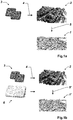
- Figure 1 shows generic stereoscopic image processing steps for creating a 3D city model, here a 3D city model in LOD 2, based on stereoscopic imaging data and based on a combination of stereoscopic imaging data with additional model data, here building footprint data.
- Figure 1a illustrates a general process for creating a 3D city model 1 from a 3D point cloud 2 generated from stereoscopic imaging data 3 with a point matching algorithm 4, e.g. such as a single global matching (SGM) algorithm or a similar technique.
- a point matching algorithm 4 e.g. such as a single global matching (SGM) algorithm or a similar technique.
- SGM single global matching
- specialized extraction models 5 are used to extract a 3D city model 1 of a given level of detail (LOD).
- LOD level of detail
- object classification algorithms particularly based on geometric and semantic classification, and usually make use of additional input such as building footprints, GIS data for creating digital terrain models (DTM), high-level CAD data for buildings and infrastructure elements, and BIM data for providing the highest level of detail for building components.
- DTM digital terrain models
- BIM BIM data for providing the highest level of detail for building components.
- 3D city models might also be generated by creating meshes from point clouds, the point clouds being generated through the extraction from stereo images using SGM or similar techniques.
- objects might also be extracted from lidar data, however in the case of city modelling objects such as buildings or infrastructure are often not textured and of low resolution.
- meshes are more likely generated from Nadir and/or oblique imaging as image data offers better resolution and thus more detail.
- Figure 1b illustrates a generic creation of a 3D city model 1' from a 3D point cloud 2 generated from stereoscopic imaging data 3 with a point matching algorithm 4, wherein additional building footprint data 6 is used for the extraction model 5' to generate the 3D city model.
- Building footprints and/or reference models such as digital surface models might particularly provide a ground reference and thus improve infrastructure modelling.
- the building footprints and the reference model might be automatically generated based on the lidar data.
- Figure 2 shows a generic 3D point cloud 2 generated from stereoscopic imaging data 3, for example by means of a point matching algorithm 4 such as a semi global matching algorithm.
- a point matching algorithm 4 such as a semi global matching algorithm.
- point extraction efficiency is substantially worse (below average) than for the rest of the point cloud 2.
- This is for example the case for occlusions and canyons 7 with low lighting conditions, for shadow areas 8 exhibiting increased noise, for very inhomogeneous areas such as vegetation 9, e.g. because complex modelling is required, and for very homogeneous surfaces 10, e.g. due to a lack of defined reference structure for point matching.
- automatic 3D building model creation this might cause wrong building identification, wrong ground height identification, and reduced accuracy.
- 3D mesh generation problems such as meltdown on building edges, wrong ground height, and modelling of trees inside the mesh may occur.
- Point clouds from lidar data generally do not have such issues. However, due to the lower point density, meshes have far less detail and are often not textured. Again, lidar data is not depending on lighting conditions and provides 1 st , 2 nd , and 3 rd return to see through vegetation. Therefore, according to the invention, generic (stereoscopic) imaging data is combined with lidar data, in particular for compensating and addressing particular problem areas of generic stereoscopic image processing where the accuracy and efficiency of point matching and point extraction is below average.
- lidar data is for example used to provide ground reference in low lighting areas and occlusions, and for improving point matching for vegetation areas and homogeneous surface areas such as water.
- lidar data is acquired simultaneously with the acquisition of imaging data for stereoscopic imaging.
- simultaneous acquisition of data means an acquisition of the imaging and lidar data during the same measuring process, i.e. in one go when surveying a city scape. Therefore, by combining the best of the two worlds of stereoscopic imaging and lidar, i.e. high resolution information by stereoscopic imaging and lighting independent information by lidar, the generation of a 3D city model is strongly improved.
- Figure 3 shows a hybrid 3D-imaging device 11 according to the invention for surveying of a city scape and for acquiring data for a method according to the invention, i.e. combining an oblique imager with a lidar device in the same sensor for simultaneous acquisition of both data.
- the hybrid 3D-imaging device 11 might be an airborne sensor device which can be installed in one standard aircraft hole, wherein the hybrid 3D-imaging device 11 comprises a single stabilizing platform 12 and its imaging and lidar subsystems can be controlled by one operator from a single control interface.
- the hybrid 3D-imaging device 11 comprises one single sensor platform 13 supporting exactly one nadir camera 14, particularly with multispectral bands, exactly four oblique RGB or RGBN cameras 15, in particular with oblique angles of 30-45 degrees, and exactly one lidar device 16, in particular wherein the lidar device is adapted for providing a Palmer scan.
- the four oblique imaging cameras 15 all have different viewing directions from each other, and the four oblique imaging cameras 15 and the nadir camera 14 are placed circumferentially around the lidar device 16, in particular with a mostly uniform angular separation and with a common distance from the center.
- the hybrid sensor setup may vary depending on the application and the area to be surveyed.
Landscapes
- Engineering & Computer Science (AREA)
- Physics & Mathematics (AREA)
- General Physics & Mathematics (AREA)
- Remote Sensing (AREA)
- Theoretical Computer Science (AREA)
- Radar, Positioning & Navigation (AREA)
- Multimedia (AREA)
- Computer Networks & Wireless Communication (AREA)
- Electromagnetism (AREA)
- Geometry (AREA)
- Software Systems (AREA)
- Computer Graphics (AREA)
- Computer Vision & Pattern Recognition (AREA)
- Signal Processing (AREA)
- Data Mining & Analysis (AREA)
- Quality & Reliability (AREA)
- Bioinformatics & Computational Biology (AREA)
- General Engineering & Computer Science (AREA)
- Evolutionary Computation (AREA)
- Evolutionary Biology (AREA)
- Life Sciences & Earth Sciences (AREA)
- Bioinformatics & Cheminformatics (AREA)
- Artificial Intelligence (AREA)
- Image Processing (AREA)
- Optical Radar Systems And Details Thereof (AREA)
Abstract
Description
- The present invention relates to a method for surveying of a city scape and for creation of a 3D city model of the surveyed city scape according to
claim 1, to a hybrid 3D-imaging device for surveying of a city scape for creation of a 3D city model according toclaims claim 13. - 3D city models, i.e. digital models of urban areas representing different terrain surfaces and infrastructure, are used in a large number of different application domains. Within a single framework 3D city models allow for displaying, managing, and analysing complex urban city scenarios. Typically, the 3D city models are generated at various levels of detail (LOD) and abstraction, and at multiple resolutions. For example, "CityGML" is a common information model for the representation of 3D urban objects which defines five LODs for building models:
- LOD 0: 2.5D footprints,
- LOD 1: buildings represented by block models,
- LOD 2: building models with standard roof structures,
- LOD 3: detailed (architectural) building models, and
- LOD 4: LOD 3 supplemented with interior features.
- The models typically comprise of GIS data, in particular for creating digital terrain models (DTM), high-level CAD data for buildings and infrastructure elements, and BIM data for providing the highest level of detail for building components. Applications for 3D city models are multifarious, e.g. navigation systems, urban planning and architecture, archaeology, geodesign, emergency management, gaming or augmented reality applications, intelligent transportation systems, property management, and so forth.
- Automatic creation of 3D city models (GIS ready buildings) and 3D meshes assists in providing up-to-date geospatial base layers for Smart City applications, wherein textured and GIS-ready 3D models are usually generated from stereo images and/or perspective views. In a first step, based on image based point matching, point clouds are generated using single global matching algorithms (SGM) or similar techniques. Specialized software is used, to extract 3D models out of these point clouds, e.g. based on additional input such as building footprints or data from multispectral cameras. For example, the Leica RCD30 with multispectral capability allows the generation of normalized difference vegetation index images (NDVI images) to eliminate vegetation and thus to improve the recognition rate of objects within the point cloud, e.g. by geometric or semantic classification.
- 3D representation of landscapes and urban areas may also be achieved by creating meshes from point clouds, the point clouds being generated through the extraction from stereo images using SGM or similar techniques. In certain cases objects might also be extracted from lidar data, however in the case of city modelling objects such as buildings or infrastructure are often not textured and of low resolution. Thus, for city modelling it is common practice however, that such meshes are more likely generated from nadir and/or oblique imaging as image data offers better resolution and thus more detail.
- Point clouds generated from imaging, even for very dense overlaps (dense matching), typically show problem areas where efficient point extraction is not good enough. For example, this is the case for occlusions and canyons with low lighting conditions, for shadow areas exhibiting increased noise, for very inhomogeneous areas such as vegetation, and for very homogeneous surfaces such as water. In the case of automatic 3D building model creation this might cause wrong building identification, wrong ground height identification, and reduced accuracy. In the case of 3D mesh generation problems such as meltdown on building edges, wrong ground height, and modelling of trees inside the mesh may occur.
- Point clouds from lidar data generally do not have such issues. However, due to the lower point density, meshes have far less detail and are often not textured.
- It is therefore an object of the present invention to improve creation of 3D city models and 3D meshes.
- It is an object to generally improve the efficiency and accuracy of object extraction, particularly building extraction, from stereo images for creating a 3D city model, wherein it is a particular object to improve point cloud extraction from stereo images.
- Another object of the invention is to reduce point mismatching in a stereo imaging method for creating a 3D city model, in particular caused by homogeneous surfaces, vegetation, occlusions, or low lighting conditions, e.g. caused by shadow areas.
- It is a particular object of the invention to improve ground referencing, particularly to improve infrastructure height referencing and street modelling.
- Those objects are achieved by realising the features of the independent claims. Features which further develop the invention in an alternative or advantageous manner are described in the dependent patent claims.
- The invention relates to a method for surveying of a city scape and for creation of a 3D city model of the surveyed city scape, in particular from aerial mapping data, the method comprising
- acquisition of imaging data of an area of the city scape, the imaging data being adapted for generation of 3D information, and simultaneous acquisition of lidar data for the area of the city scape,
- generation of a 3D point cloud of the area of the city scape, based on the imaging and lidar data, and
- generation of a 3D city model with automated building model extraction, based on the 3D point cloud.
- Here, simultaneous acquisition of the imaging and lidar data means an acquisition of the imaging and lidar data during the same measuring process, in particular from one combined device, i.e. in one go when surveying a city scape but not necessarily exactly time synchronous.
- The method is characterized in that the generation of the 3D point cloud of the area of the city scape is based on
- processing of the imaging data regarding generation of 3D information,
- a quality assessment of the imaging data based on data classification, wherein at least part of the imaging data being assigned to a first class being defined by at least one of
- ∘ a defined first classification criterion for the imaging data, and
- ∘ a defined second classification criterion within a first auxiliary 3D point cloud solely based on the imaging data, in particular wherein the auxiliary 3D point cloud being generated solely by the imaging data fulfilling the first classification criterion,
- a combination of the imaging data of the first class with lidar data corresponding to the fraction of the area of the city scape defined by the imaging data of the first class, in the following called the critical area, in particular wherein the imaging data being replaced or supplemented by the lidar data.
- In particular, at least one of the first and second classification criteria might be based on at least one of geometric and semantic classification, e.g. such as a classification into at least one of regions with shadowing, e.g. with low signal to noise (S/N), regions with occlusions, regions with specific surface texture, e.g. such as very homogeneous regions such as water, and regions with vegetation. Furthermore, classification might be based on statistical properties, e.g. such as noise background, particularly by means of a S/N threshold, and/or thresholds based on an error propagation model for point matching in a stereoscopic image processing method.
- The combination of the imaging data and the lidar data might be based on at least one of a 3D mesh of two or more point clouds, the point clouds particularly being generated by a point matching algorithm such as single global matching (SGM), replacement of imaging data with lidar data, replacement of lidar data with imaging data, and a reference model generated based on the lidar data, in particular the reference model comprising at least one of a digital terrain model, a digital elevation model, and a digital surface model.
- The generation of the 3D city model might be based on generic classification algorithms for extracting a 3D city model from a point cloud, particularly a point cloud generated by stereoscopic imaging, and the extraction and generation of the 3D city model might be further based on at least one of GIS data, in particular for creating digital terrain models (DTM), high-level CAD data for buildings and infrastructure elements, BIM data, and multispectral information, e.g. such as normalized difference vegetation index images (NDVI images).
- Therefore, by combining the best of the two worlds of stereoscopic imaging and lidar, i.e. high resolution information by stereoscopic imaging and lighting independent information by lidar, the generation of a 3D city model is strongly improved, in particular regarding efficiency and accuracy of object extraction. Problems regarding wrong building extraction and wrong ground height identification of automatic 3D building model creation are strongly mitigated and in particular for 3D mesh generation a meltdown on building edges, wrong ground height, or modelling of trees inside the mesh are strongly prevented.
- In a particular embodiment of the method according to the invention, the generation of the 3D point cloud is further based on a quality assessment of the lidar data, wherein at least part of the lidar data being assigned to a second class being defined by at least one of
- a defined third classification criterion within a second auxiliary 3D point cloud solely based on the lidar data, in particular solely based on the lidar data of the critical area, and
- a defined first comparison criterion for comparing the first auxiliary 3D point cloud solely based on the imaging data with a third auxiliary point cloud based on a combination of the imaging and the lidar data, in particular wherein the imaging and lidar data being solely data of the critical area,
- Therefore, before combining the imaging data and the lidar data for the critical area, the quality of the lidar data might be assessed by inherent properties of the lidar data, e.g. such as a local resolution threshold, a local S/N threshold, and/or a semantic classification into objects particularly well suited for lidar observations, e.g. such as flat surfaces. On the other hand, there might be regions or objects which are not well suited for lidar observations, e.g. very low reflection surfaces, and thus a combination of the imaging data with lidar data would introduce additional noise or systematic errors. Furthermore, the first comparison criterion might provide a quality control in a sense that a combination of the imaging data with the lidar data actually leads to an improved 3D point cloud generation compared to a 3D point cloud solely based on the imaging data. For example such a comparison criterion might be based on a differential S/N threshold, a resolution threshold, and/or a differential threshold based on systematic error propagation.
- Typically point clouds generated from lidar data have much lower point density and meshes have far less detail and are often not textured. Therefore, in most cases for 3D city modelling the point cloud generation is mainly based on stereoscopic imaging with much higher resolution, and, according to the present invention, the lidar data is only consulted for critical areas, e.g. where lighting conditions for classical imaging are not favourable. However, depending on the desired level of detail (LOD) of the 3D city model and/or the type of the imaging device, there might be applications where the desired LOD might only be achieved by a combination of imaging data with lidar data. On the other hand, for example for a quick look analysis of very low level of detail it might be preferred to replace as much of the imaging data by lidar data, e.g. because processing of lidar data might require less computing power, in particular since lidar data is inherently representing a point cloud.
- Thus a main driver for combining the imaging data with the lidar data might also be based on the overall quality of the lidar data acquired for the area of the surveyed city scape, i.e. not only for critical areas of the imaging data. Therefore, in another embodiment of the invention the generation of the 3D point cloud is further based on a quality assessment of the lidar data based on data classification, wherein at least part of the lidar data being assigned to a third class being defined by at least one of
- a defined fourth classification criterion within the second auxiliary 3D point cloud solely based on the lidar data, and
- a defined second comparison criterion for comparing the first auxiliary 3D point cloud solely based on the imaging data with the third auxiliary point cloud based on a combination of the imaging and the lidar data,
- Again the quality of the lidar data might be assessed by inherent properties of the lidar data, e.g. such as a local resolution threshold, a local S/N threshold, and/or a semantic classification into objects particularly well suited for lidar observations, e.g. such as flat surfaces. On the other hand, there might be regions or objects which are not well suited for lidar observations, e.g. very low reflection surfaces, and thus a combination of the imaging data with lidar data would introduce additional noise or systematic errors. Similar to the case of the first comparison criterion above the second comparison criterion might provide a quality control in a sense that a combination of the imaging data with the lidar data actually leads to an improved 3D point cloud generation compared to a 3D point cloud solely based on the imaging data. For example such a comparison criterion might be based on a differential S/N threshold, a resolution threshold, and/or a differential threshold based on systematic error propagation.
- A particular embodiment of the method is characterized in that at least one of the first to fourth classification criteria being based on a semantic classification, in particular wherein the semantic classification comprises semantic classifiers defining at least one of shadowing, a region with an occlusion, a region with vegetation, and a region with a homogeneous surface, in particular a water surface. For these regions even lower resolution lidar data may provide substantial support for point matching algorithms, e.g. by providing a digital surface model and lighting independent information. Semantic classification might comprise any generic semantic classification algorithms, e.g. based on identification of geometric 3D primitives, single point recognition and edge tracking algorithms, object extraction based on probabilistic algorithms, infrastructure models, and statistical models for different surface texture.
- In a further embodiment at least one of the first to second comparison criteria is based on at least one of a signal to noise threshold, a resolution threshold, and a systematic error threshold, in particular based on an error propagation model for point mismatching. The thresholds may be based on the desired level of detail of the 3D city scape or they may be specifically tuned for efficient processing.
- Since the lidar data is typically used as supporting data, e.g. for critical areas when generating a 3D point cloud based on stereoscopic imaging, the acquisition of the lidar data might be specifically tuned to be only taken for these critical areas of the city scape, e.g. to reduce requirements on data storage and processing power. Thus in another embodiment the lidar data is acquired for a selected region of the area within the surveyed city scape, based on at least one of an a-priori model of the surveyed city scape, and an analysis of the imaging data, particularly the quality assessment of the imaging data, in particular the critical area. For many applications of city modelling a first estimate or a first 3D model of the city might be available before surveying. Thus, the scan pattern for acquiring the lidar data might be specifically tuned to cover only the critical areas, but e.g. with high resolution, in particular using a Palmer scanning lidar device or a lidar device with a fast sweeping mirror. Furthermore, the selection might also be based on a real-time analysis and information of the imaging data, e.g. by a 2D classification of the imaging data or the quality assessment of the imaging data for generating the 3D point cloud.
- Another embodiment of the method according to the invention is described wherein the generation of the 3D point cloud for the 3D city model is based on a photogrammetric method, in particular a semi global matching algorithm, wherein the photogrammetric method being adapted for processing at least one of nadir and/or oblique images, particularly with oblique angles between 30-45 degrees, multispectral images, in particular RGB and/or RGBN images, normalized difference vegetation index images (NDVI images), building footprints, and a reference model comprising at least one of a digital terrain model, a digital elevation model, and a digital surface model.
- Here, multispectral image information and NDVI images might be used for semantic discrimination of objects with specific wavelength and polarization dependent reflection properties, such as for example typical reflection signals for vegetation and water. Building footprints and the reference model might particularly provide a ground reference and thus improve infrastructure modelling. In particular the building footprints and the reference model might be automatically generated based on the lidar data.
- A further embodiment is described in that the imaging data and the lidar data are acquired by one single hybrid 3D-imaging device, in particular the hybrid 3D-imaging device comprising a nadir imaging camera, in particular exactly one nadir imaging camera, particularly with multispectral bands, an oblique imaging camera, in particular a RGB or RGBN camera, in particular exactly four oblique imaging cameras with oblique angles of 30-45 degrees, and a lidar device, in particular exactly one lidar device.
- Thus, this setup provides an efficient and simultaneous acquisition of both imaging and lidar data, in a sense that the imaging and lidar data are acquired during the same surveying measurement, i.e. in one go, and wherein the imaging data can be readily processed within a stereoscopic method, e.g. by semi global matching, for creating the 3D point cloud for the generation of the 3D city model. In particular, such a hybrid 3D-imaging device might be installed in one standard aircraft hole, e.g. using a single stabilization system for stabilizing a common inertial system for the cameras and the lidar device, and being controlled by a single operator from a single controlling interface. Operation might be further supported by a dedicated mission planning software taking into account the surveyable city scape and making recommendations for operating both lidar and imaging devices to optimize data acquisition.
- The invention further relates to a hybrid 3D-imaging device for surveying of a city scape, in particular an aerial hybrid 3D-imaging device, for creation of a 3D city model of the surveyed city scape, the hybrid 3D-imaging device comprising
- an imaging device for generating imaging data for an area of the city scape, the imaging data being adapted for generation of 3D information, in particular wherein the area being imaged from at least two different image viewing angles,
- a lidar device for generating lidar data for the area of the city scape, simultaneously to the generation of the imaging data, and
- a control and processing unit being adapted for
- o controlling the imaging device and the lidar device,
- o generating a 3D point cloud for the area of the city scape based on the imaging and the lidar data, and
- o generating a 3D city model with automated building model extraction, based on the 3D point cloud.
- Here, simultaneous acquisition of the imaging and lidar data means an acquisition of the imaging and lidar data during the same measuring process, i.e. in one go when surveying a city scape but not necessarily exactly time synchronous.
- The system is characterized in that the control and processing unit being adapted for generating the 3D point cloud with
- processing of the imaging data regarding generation of 3D information,
- assessing a quality of the imaging data based on data classification, wherein at least part of the imaging data being assigned to a first class being defined by at least one of
- o a defined first classification criterion for the imaging data, and
- o a defined second classification criterion within a first auxiliary 3D point cloud solely based on the imaging data, in particular wherein the auxiliary 3D point cloud being generated solely by the imaging data fulfilling the first classification criterion,
- combining the imaging data of the first class with lidar data corresponding to the fraction of the area of the city scape defined by the imaging data of the first class, in the following called the critical area, in particular wherein the imaging data being replaced or supplemented by the lidar data.
- In a particular embodiment of the hybrid 3D-imaging device according to the invention, the control and processing unit is adapted for generating the 3D point cloud with a quality assessment of the lidar data, wherein at least part of the lidar data being assigned to a second class being defined by at least one of
- a defined third classification criterion within a second auxiliary 3D point cloud solely based on the lidar data, in particular solely based on the lidar data of the critical area, and
- a defined first comparison criterion for comparing the first auxiliary 3D point cloud solely based on the imaging data with a third auxiliary point cloud based on a combination of the imaging and the lidar data, in particular wherein the imaging and lidar data being solely data of the critical area,
- In another embodiment of the hybrid 3D-imaging device the control and processing unit is adapted for generating the 3D point cloud with a quality assessment of the lidar data based on data classification, wherein at least part of the lidar data being assigned to a third class being defined by at least one of
- a defined fourth classification criterion within the second auxiliary 3D point cloud solely based on the lidar data, and
- a defined second comparison criterion for comparing the first auxiliary 3D point cloud solely based on the imaging data with the third auxiliary point cloud based on a combination of the imaging and the lidar data,
- A particular embodiment of the hybrid 3D-imaging device is characterized in that at least one of the first to fourth classification criteria being based on a semantic classification, in particular wherein the semantic classification comprises semantic classifiers defining at least one of shadowing, a region with an occlusion, a region with vegetation, and a region with a homogeneous surface, in particular a water surface.
- In a further embodiment of the hybrid 3D-imaging device at least one of the first to second comparison criteria is based on at least one of a signal to noise threshold, a resolution threshold, and a systematic error threshold, in particular based on an error propagation model for point mismatching.
- In another embodiment the hybrid 3D-imaging device is adapted for acquiring lidar data for a selected region of the area within the surveyed city scape, based on at least one of an a-priori model of the surveyed city scape, and an analysis of the imaging data, particularly the quality assessment of the imaging data, in particular the critical area.
- In a particular embodiment of the hybrid 3D-imaging device the control and processing unit is adapted for generating the 3D point cloud for the 3D city model with a photogrammetric method, in particular a semi global matching algorithm, and wherein the control and processing unit is adapted for processing at least one of nadir and/or oblique images, particularly with oblique angles between 30-45 degrees, multispectral images, in particular RGB and/or RGBN images, normalized difference vegetation index images (NDVI images), building footprints, and a reference model comprising at least one of a digital terrain model, a digital elevation model, and a digital surface model.
- In a further embodiment the hybrid 3D-imaging device is built as one single hybrid 3D-imaging device, in particular the hybrid imaging device comprising a nadir imaging camera, in particular exactly one nadir imaging camera, particularly with multispectral bands, an oblique imaging camera, in particular a RGB or RGBN camera, in particular exactly four oblique imaging cameras with oblique angles of 30-45 degrees, and a lidar device, in particular exactly one lidar device or two lidar devices.
- The invention also relates to a computer program product for generating a 3D city model of a surveyed city scape according to the inventive method, the computer program product being stored on a control and processing unit, particularly being part of a hybrid 3D-imaging device according to the invention, and comprising program code being configured for
- automatically communicating with a database comprising imaging and lidar data of a surveyed city scape,
- generating a 3D point cloud of the area of the city scape based on the imaging and lidar data, wherein the generation of the 3D point cloud being further based on
- o a quality assessment of the imaging data based on data classification, wherein at least part of the imaging data being assigned to a first class being defined by at least one of
- o a defined first classification criterion for the imaging data, and
- o a defined second classification criterion within a first auxiliary 3D point cloud solely based on the imaging data, in particular wherein the auxiliary 3D point cloud being generated solely by the imaging data fulfilling the first classification criterion,
- combining the imaging data of the first class with lidar data corresponding to the fraction of the area of the city scape defined by the imaging data of the first class, in the following called the critical area, in particular wherein the imaging data being replaced or supplemented by the lidar data,
- The invention further relates to a hybrid 3D-imaging device for aerial surveying of a city scape, the hybrid 3D-imaging device comprising one single sensor platform supporting a nadir imaging camera, particularly with multispectral bands, an oblique imaging camera, in particular a RGB or RGBN camera, in particular with an oblique angle of 30-45 degrees, and a lidar device, wherein the nadir and oblique imaging cameras being arranged on the sensor platform on a circumferential area around the lidar device.
- In a particular embodiment of the hybrid 3D-imaging device the sensor platform supporting a nadir imaging camera, particularly with multispectral bands, in particular exactly one nadir camera, four oblique imaging cameras with oblique angles of 30-45 degrees with respect to the sensor platform, in particular RGB or RGBN cameras, in particular exactly four oblique cameras, and a lidar device, in particular being adapted for a Palmer lidar scan, in particular exactly one lidar device or exactly two lidar devices, wherein the four oblique imaging cameras all have different viewing directions from each other and wherein the four oblique imaging cameras and the nadir camera being placed circumferentially around the lidar device, in particular with a mostly uniform angular separation and with a common distance from the center.
- This device setup provides an efficient and simultaneous acquisition of both imaging and lidar data, in a sense that the imaging and lidar data are acquired during the same surveying measurement, i.e. in one go, and wherein the imaging data can be readily processed within a stereoscopic method, e.g. by semi global matching, for creating a 3D point cloud for the generation of a 3D city model. In particular, such a hybrid 3D-imaging device might be installed in one standard aircraft hole, e.g. using a single stabilization system for stabilizing a common inertial system for the cameras and the lidar device, and being controlled by a single operator from a single controlling interface. Operation might be further supported by a dedicated mission planning software taking into account the surveyable city scape and making recommendations for operating both lidar and imaging devices to optimize data acquisition.
- Depending on the acquisition area, a variety of sensor platform configurations may be possible to best support the simplified generation of the model. Thus, the hybrid sensor setup may vary depending on the application and the area to be surveyed.
- Devices, methods and setups and computer programs according to the invention are described or explained in more detail below, purely by way of example, with reference to working examples shown schematically in the drawing. Specifically,
-
Fig. 1a , b: generic stereoscopic image processing steps for creating a 3D city model, based on stereoscopic imaging data (a) and in combination with additional building footprint data (b); -
Fig. 2 : generic 3D point cloud generated from stereoscopic imaging data, indicating point mismatching and other critical areas for a point matching algorithm; -
Fig. 3 : exemplary embodiment of a hybrid 3D-imaging device according to the invention. - The diagrams of the figures should not be considered as being drawn to scale. Where appropriate, the same reference signs are used for the same features or for features with similar functionalities.
-
Figure 1 shows generic stereoscopic image processing steps for creating a 3D city model, here a 3D city model inLOD 2, based on stereoscopic imaging data and based on a combination of stereoscopic imaging data with additional model data, here building footprint data. -
Figure 1a illustrates a general process for creating a3D city model 1 from a3D point cloud 2 generated fromstereoscopic imaging data 3 with apoint matching algorithm 4, e.g. such as a single global matching (SGM) algorithm or a similar technique. Based on the3D point cloud 2specialized extraction models 5 are used to extract a3D city model 1 of a given level of detail (LOD). Typicallysuch extraction models 5 are based on object classification algorithms, particularly based on geometric and semantic classification, and usually make use of additional input such as building footprints, GIS data for creating digital terrain models (DTM), high-level CAD data for buildings and infrastructure elements, and BIM data for providing the highest level of detail for building components. 3D city models might also be generated by creating meshes from point clouds, the point clouds being generated through the extraction from stereo images using SGM or similar techniques. In certain cases objects might also be extracted from lidar data, however in the case of city modelling objects such as buildings or infrastructure are often not textured and of low resolution. Thus, for city modelling it is common practice however, that such meshes are more likely generated from Nadir and/or oblique imaging as image data offers better resolution and thus more detail. -
Figure 1b illustrates a generic creation of a 3D city model 1' from a3D point cloud 2 generated fromstereoscopic imaging data 3 with apoint matching algorithm 4, wherein additionalbuilding footprint data 6 is used for the extraction model 5' to generate the 3D city model. Building footprints and/or reference models such as digital surface models might particularly provide a ground reference and thus improve infrastructure modelling. In particular the building footprints and the reference model might be automatically generated based on the lidar data. -
Figure 2 shows a generic3D point cloud 2 generated fromstereoscopic imaging data 3, for example by means of apoint matching algorithm 4 such as a semi global matching algorithm. Even for dense matching, i.e. for very dense image overlaps, there are areas within thepoint cloud 2 where point extraction efficiency is substantially worse (below average) than for the rest of thepoint cloud 2. This is for example the case for occlusions andcanyons 7 with low lighting conditions, forshadow areas 8 exhibiting increased noise, for very inhomogeneous areas such asvegetation 9, e.g. because complex modelling is required, and for veryhomogeneous surfaces 10, e.g. due to a lack of defined reference structure for point matching. In the case of automatic 3D building model creation this might cause wrong building identification, wrong ground height identification, and reduced accuracy. In the case of 3D mesh generation problems such as meltdown on building edges, wrong ground height, and modelling of trees inside the mesh may occur. - Point clouds from lidar data generally do not have such issues. However, due to the lower point density, meshes have far less detail and are often not textured. Anyway, lidar data is not depending on lighting conditions and provides 1st, 2nd, and 3rd return to see through vegetation. Therefore, according to the invention, generic (stereoscopic) imaging data is combined with lidar data, in particular for compensating and addressing particular problem areas of generic stereoscopic image processing where the accuracy and efficiency of point matching and point extraction is below average.
- According to the invention lidar data is for example used to provide ground reference in low lighting areas and occlusions, and for improving point matching for vegetation areas and homogeneous surface areas such as water.
- In particular, according to the invention lidar data is acquired simultaneously with the acquisition of imaging data for stereoscopic imaging. Here, simultaneous acquisition of data means an acquisition of the imaging and lidar data during the same measuring process, i.e. in one go when surveying a city scape. Therefore, by combining the best of the two worlds of stereoscopic imaging and lidar, i.e. high resolution information by stereoscopic imaging and lighting independent information by lidar, the generation of a 3D city model is strongly improved.
-
Figure 3 shows a hybrid 3D-imaging device 11 according to the invention for surveying of a city scape and for acquiring data for a method according to the invention, i.e. combining an oblique imager with a lidar device in the same sensor for simultaneous acquisition of both data. Here, the hybrid 3D-imaging device 11 might be an airborne sensor device which can be installed in one standard aircraft hole, wherein the hybrid 3D-imaging device 11 comprises a single stabilizingplatform 12 and its imaging and lidar subsystems can be controlled by one operator from a single control interface. - Here, the hybrid 3D-
imaging device 11 comprises onesingle sensor platform 13 supporting exactly onenadir camera 14, particularly with multispectral bands, exactly four oblique RGB orRGBN cameras 15, in particular with oblique angles of 30-45 degrees, and exactly onelidar device 16, in particular wherein the lidar device is adapted for providing a Palmer scan. The fouroblique imaging cameras 15 all have different viewing directions from each other, and the fouroblique imaging cameras 15 and thenadir camera 14 are placed circumferentially around thelidar device 16, in particular with a mostly uniform angular separation and with a common distance from the center. - Depending on the acquisition area, a variety of sensor platform configurations may be possible to best support the simplified generation of the model. Thus, the hybrid sensor setup may vary depending on the application and the area to be surveyed.
Claims (15)
- Method for surveying of a city scape and for creation of a 3D city model (1,1') of the surveyed city scape, in particular from aerial mapping data, the method comprising• acquisition of imaging data (3) of an area of the city scape, the imaging data (3) being adapted for generation of 3D information, and simultaneous acquisition of lidar data for the area of the city scape,• generation of a 3D point cloud (2) of the area of the city scape based ono processing of the imaging data (3) regarding generation of 3D information,o a quality assessment of the imaging data (3) based on data classification, wherein at least part of the imaging data being assigned to a first class being defined by at least one of▪ a defined first classification criterion for the imaging data (3), and▪ a defined second classification criterion within a first auxiliary 3D point cloud solely based on the imaging data, in particular wherein the auxiliary 3D point cloud being generated solely by the imaging data fulfilling the first classification criterion,o a combination of the imaging data of the first class with lidar data corresponding to the fraction of the area of the city scape defined by the imaging data of the first class, in the following called the critical area, in particular wherein the imaging data being replaced or supplemented by the lidar data,• generation of a 3D city model (1,1') with automated building model extraction, based on the 3D point cloud (2).
- Method according to claim 1,
characterized in that,
the generation of the 3D point cloud (2) being further based on a quality assessment of the lidar data, wherein at least part of the lidar data being assigned to a second class being defined by at least one of• a defined third classification criterion within a second auxiliary 3D point cloud solely based on the lidar data, in particular solely based on the lidar data of the critical area, and• a defined first comparison criterion for comparing the first auxiliary 3D point cloud solely based on the imaging data with a third auxiliary point cloud based on a combination of the imaging and the lidar data, in particular wherein the imaging and lidar data being solely data of the critical area,wherein the imaging data of the first class being only combined with lidar data of the critical area where the critical area is overlapping the fraction of the area of the city scape defined by the lidar data of the second class. - Method according to any one of the preceding claims,
characterized in that,
the generation of the 3D point cloud (2) being further based on a quality assessment of the lidar data based on data classification, wherein at least part of the lidar data being assigned to a third class being defined by at least one of• a defined fourth classification criterion within the second auxiliary 3D point cloud solely based on the lidar data, and• a defined second comparison criterion for comparing the first auxiliary 3D point cloud solely based on the imaging data with the third auxiliary point cloud based on a combination of the imaging and the lidar data,wherein the imaging data corresponding to the fraction of the area of the city scape defined by the lidar data of the third class being combined with the lidar data of the third class. - Method according to any one of the preceding claims,
characterized in that,
at least one of the first to fourth classification criteria being based on a semantic classification, in particular wherein the semantic classification comprises semantic classifiers defining at least one of• shadowing (8),• a region with an occlusion (7),• a region with vegetation (9), and• a region with a homogeneous surface (10), in particular a water surface. - Method according to any one of the preceding claims,
characterized in that,
at least one of the first to second comparison criteria being based on at least one of• a signal to noise threshold,• a resolution threshold, and• a systematic error threshold, in particular based on an error propagation model for point mismatching. - Method according to any one of the preceding claims,
characterized in that,
the imaging data (3) and the lidar data being acquired by one single hybrid 3D-imaging device (11), in particular wherein• the hybrid 3D-imaging device (11) comprisingo a nadir imaging camera (14), in particular exactly one nadir imaging camera, particularly with multispectral bands,o an oblique imaging camera (15), in particular a RGB or RGBN camera, in particular exactly four oblique imaging cameras with oblique angles of 30-45 degrees, ando a lidar device (16), in particular exactly one lidar device,• the lidar data being acquired for a selected region of the area within the surveyed city scape, based on at least one ofo an a-priori model of the surveyed city scape, ando an analysis of the imaging data (3), particularly the quality assessment of the imaging data, in particular the critical area,and/or• the generation of the 3D point cloud (2) being based on a photogrammetric method, in particular a semi global matching algorithm, wherein the photogrammetric method being adapted for processing at least one ofo nadir and/or oblique images, particularly with oblique angles between 30-45 degrees,o multispectral images, in particular RGB and/or RGBN,o normalized difference vegetation index images,o building footprints, ando a reference model comprising at least one of a digital terrain model, a digital elevation model, and a digital surface model. - A hybrid 3D-imaging device (11) for surveying of a city scape, in particular an aerial hybrid 3D-imaging device, for creation of a 3D city model (1,1') of the surveyed city scape, the hybrid 3D-imaging device (11) comprising• an imaging device (14,15) for generating imaging data (3) for an area of the city scape, the imaging data (3) being adapted for generation of 3D information, in particular wherein the area being imaged from at least two different image viewing angles,• a lidar device (16) for generating lidar data for the area of the city scape, simultaneously to the generation of the imaging data (3), and• a control and processing unit being adapted forcharacterized in that,o controlling the imaging device (14,15) and the lidar device (16),o generating a 3D point cloud (2) for the area of the city scape based on the imaging and the lidar data, ando generating a 3D city model (1,1') with automated building model extraction, based on the 3D point cloud (2),
the control and processing unit being adapted for generating the 3D point cloud (2) with• processing of the imaging data (3) regarding generation of 3D information,• assessing a quality of the imaging data (3) based on data classification, wherein at least part of the imaging data being assigned to a first class being defined by at least one ofo a defined first classification criterion for the imaging data (3), ando a defined second classification criterion within a first auxiliary 3D point cloud solely based on the imaging data, in particular wherein the auxiliary 3D point cloud being generated solely by the imaging data fulfilling the first classification criterion,• combining the imaging data of the first class with lidar data corresponding to the fraction of the area of the city scape defined by the imaging data of the first class, in the following called the critical area, in particular wherein the imaging data being replaced or supplemented by the lidar data. - The hybrid 3D-imaging device (11) according to claim 7,
characterized in that,
the control and processing unit being adapted for generating the 3D point cloud (2) with a quality assessment of the lidar data, wherein at least part of the lidar data being assigned to a second class being defined by at least one of• a defined third classification criterion within a second auxiliary 3D point cloud solely based on the lidar data, in particular solely based on the lidar data of the critical area, and• a defined first comparison criterion for comparing the first auxiliary 3D point cloud solely based on the imaging data with a third auxiliary point cloud based on a combination of the imaging and the lidar data, in particular wherein the imaging and lidar data being solely data of the critical area,wherein the imaging data of the first class being only combined with lidar data of the critical area where the critical area is overlapping the fraction of the area of the city scape defined by the lidar data of the second class. - The hybrid 3D-imaging device (11) according to any one of claims 7 to 8,
characterized in that,
the control and processing unit being adapted for generating the 3D point cloud (2) with a quality assessment of the lidar data based on data classification, wherein at least part of the lidar data being assigned to a third class being defined by at least one of• a defined fourth classification criterion within the second auxiliary 3D point cloud solely based on the lidar data, and• a defined second comparison criterion for comparing the first auxiliary 3D point cloud solely based on the imaging data with the third auxiliary point cloud based on a combination of the imaging and the lidar data,wherein the imaging data corresponding to the fraction of the area of the city scape defined by the lidar data of the third class being combined with the lidar data of the third class. - The hybrid 3D-imaging device (11) according to any one of claims 7 to 9,
characterized in that,
at least one of the first to fourth classification criteria being based on a semantic classification, in particular wherein the semantic classification comprises semantic classifiers defining at least one of• shadowing (8),• a region with an occlusion (7),• a region with vegetation (9), and• a region with a homogeneous surface (10), in particular a water surface. - The hybrid 3D-imaging device (11) according to any one of claims 7 to 10,
characterized in that,
at least one of the first to second comparison criteria being based on at least one of• a signal to noise threshold,• a resolution threshold, and• a systematic error threshold, in particular based on an error propagation model for point mismatching. - The hybrid 3D-imaging device (11) according to any one of claims 7 to 11,
characterized in that,
the hybrid 3D-imaging device (11) being built as one single hybrid 3D-imaging device, in particular wherein• the hybrid 3D-imaging device comprisingo a nadir imaging camera (14), in particular exactly one nadir imaging camera, particularly with multispectral bands,o an oblique imaging camera (15), in particular a RGB or RGBN camera, in particular exactly four oblique imaging cameras with oblique angles of 30-45 degrees, ando a lidar device (16), in particular exactly one lidar device or two lidar devices,• the hybrid 3D-imaging device (11) being adapted for acquiring lidar data for a selected region of the area within the surveyed city scape, based on at least one ofo an a-priori model of the surveyed city scape, ando an analysis of the imaging data (3), particularly the quality assessment of the imaging data, in particular the critical area,and/or• the control and processing unit being adapted for generating the 3D point cloud (2) with a photogrammetric method, in particular a semi global matching algorithm, and being adapted for processing at least one ofo nadir and/or oblique images, particularly with oblique angles between 30-45 degrees,o multispectral images, in particular RGB and/or RGBN,o normalized difference vegetation index images,o building footprints, ando a reference model comprising at least one of a digital terrain model, a digital elevation model, and a digital surface model. - Computer program product for generating a 3D city model (1,1') of a surveyed city scape according to one of claims 1 to 6,
characterized in that,
the computer program product being stored on a control and processing unit, particularly being part of a hybrid 3D-imaging device (11) according to one of claims 7 to 12, and comprising program code being configured for• automatically communicating with a database comprising imaging (3) and lidar data of a surveyed city scape,• generating a 3D point cloud (2) of the area of the city scape based on the imaging (3) and lidar data, wherein the generation of the 3D point cloud (2) being further based onin particular wherein the output is made available to a hybrid 3D-imaging device (11) according to one of claims 7 to 12.o processing of the imaging data (3) regarding generation of 3D information,o a quality assessment of the imaging data (3) based on data classification, wherein at least part of the imaging data being assigned to a first class being defined by at least one of▪ a defined first classification criterion for the imaging data, and▪ a defined second classification criterion within a first auxiliary 3D point cloud solely based on the imaging data, in particular wherein the auxiliary 3D point cloud being generated solely by the imaging data fulfilling the first classification criterion,o combining the imaging data of the first class with lidar data corresponding to the fraction of the area of the city scape defined by the imaging data of the first class, in the following called the critical area, in particular wherein the imaging data being replaced or supplemented by the lidar data, - A hybrid 3D-imaging device (11) for aerial surveying of a city scape, the hybrid 3D-imaging device (11) comprising one single sensor platform (13) supporting• a nadir imaging camera (14), particularly with multispectral bands,• an oblique imaging camera (15), in particular a RGB or RGBN camera, in particular with an oblique angle of 30-45 degrees, and• a lidar device (16),wherein the nadir (14) and oblique imaging cameras (15) being arranged on the sensor platform (13) on a circumferential area around the lidar device (16).
- The hybrid 3D-imaging device (11) according to claim 14
characterized in that,
the sensor platform (13) supporting• a nadir imaging camera (14), particularly with multispectral bands, in particular exactly one nadir camera,• four oblique imaging cameras (15) with oblique angles of 30-45 degrees with respect to the sensor platform, in particular RGB or RGBN cameras, in particular exactly four oblique cameras, and• a lidar device (16), in particular being adapted for a Palmer lidar scan, in particular exactly one lidar device or exactly two lidar devices,wherein the four oblique imaging cameras (15) all have different viewing directions from each other and wherein the four oblique imaging cameras (15) and the nadir camera (14) being placed circumferentially around the lidar device (16), in particular with a uniform angular separation and with a common distance from the center.
Priority Applications (4)
| Application Number | Priority Date | Filing Date | Title |
|---|---|---|---|
| DK16162106.5T DK3223191T3 (en) | 2016-03-23 | 2016-03-23 | CREATING A 3D URBAN MODEL FROM Oblique IMAGE FORMATION AND LEADER DATA |
| EP16162106.5A EP3223191B1 (en) | 2016-03-23 | 2016-03-23 | Creation of a 3d city model from oblique imaging and lidar data |
| CN201710174515.7A CN107230251B (en) | 2016-03-23 | 2017-03-22 | Method of creating 3D city model, hybrid 3D imaging apparatus, and storage medium |
| US15/468,057 US11222204B2 (en) | 2016-03-23 | 2017-03-23 | Creation of a 3D city model from oblique imaging and lidar data |
Applications Claiming Priority (1)
| Application Number | Priority Date | Filing Date | Title |
|---|---|---|---|
| EP16162106.5A EP3223191B1 (en) | 2016-03-23 | 2016-03-23 | Creation of a 3d city model from oblique imaging and lidar data |
Publications (2)
| Publication Number | Publication Date |
|---|---|
| EP3223191A1 true EP3223191A1 (en) | 2017-09-27 |
| EP3223191B1 EP3223191B1 (en) | 2021-05-26 |
Family
ID=55642251
Family Applications (1)
| Application Number | Title | Priority Date | Filing Date |
|---|---|---|---|
| EP16162106.5A Active EP3223191B1 (en) | 2016-03-23 | 2016-03-23 | Creation of a 3d city model from oblique imaging and lidar data |
Country Status (4)
| Country | Link |
|---|---|
| US (1) | US11222204B2 (en) |
| EP (1) | EP3223191B1 (en) |
| CN (1) | CN107230251B (en) |
| DK (1) | DK3223191T3 (en) |
Cited By (9)
| Publication number | Priority date | Publication date | Assignee | Title |
|---|---|---|---|---|
| CN111458720A (en) * | 2020-03-10 | 2020-07-28 | 中铁第一勘察设计院集团有限公司 | Oblique photography modeling method based on airborne lidar data in complex mountainous areas |
| CN112232335A (en) * | 2019-07-15 | 2021-01-15 | 德国邮政股份公司 | Determination of distribution information and/or sorting information for automated distribution and/or sorting of consignments |
| CN112487521A (en) * | 2020-11-03 | 2021-03-12 | 重庆大学 | Point cloud-based BIM (building information modeling) method and system for tunnel reconstruction project |
| CN113412505A (en) * | 2019-03-22 | 2021-09-17 | 华为技术有限公司 | System and method for ordered representation and feature extraction of point clouds obtained by detection and ranging sensors |
| CN113724381A (en) * | 2021-07-23 | 2021-11-30 | 广州市城市规划勘测设计研究院 | Dynamic three-dimensional scene rapid reconstruction method based on high-resolution remote sensing image |
| CN113989670A (en) * | 2021-10-27 | 2022-01-28 | 北京四象爱数科技有限公司 | A rapid extraction method for the height of tree obstacles in power grid transmission lines |
| CN114549780A (en) * | 2022-01-27 | 2022-05-27 | 重庆大学 | Point cloud data-based intelligent detection method for large complex component |
| EP3951719A4 (en) * | 2019-03-28 | 2023-02-08 | Southeast University | MIXED URBAN DEVELOPMENT SCENE SIMULATION PROCESS AND ASSOCIATED SYSTEM |
| CN115915156A (en) * | 2022-09-26 | 2023-04-04 | 中铁第四勘察设计院集团有限公司 | Network optimization method and system for wireless coverage prediction based on railway ray tracing |
Families Citing this family (30)
| Publication number | Priority date | Publication date | Assignee | Title |
|---|---|---|---|---|
| JP6854195B2 (en) * | 2017-06-09 | 2021-04-07 | 株式会社トプコン | Image processing device, image processing method and program for image processing |
| US11204896B2 (en) | 2017-08-18 | 2021-12-21 | International Business Machines Corporation | Scalable space-time density data fusion |
| EP3460685A1 (en) * | 2017-09-12 | 2019-03-27 | Bricsys NV | Improved semantic classification of an entity in a building information model |
| US10713839B1 (en) * | 2017-10-24 | 2020-07-14 | State Farm Mutual Automobile Insurance Company | Virtual vehicle generation by multi-spectrum scanning |
| CN109509256B (en) * | 2018-06-21 | 2023-07-18 | 华南理工大学 | Automatic measurement and 3D model generation method of building structure based on lidar |
| CN108955645A (en) * | 2018-07-16 | 2018-12-07 | 福州日兆信息科技有限公司 | Three-dimensional modeling method and device applied to communication iron tower intelligent patrol detection |
| US10839264B2 (en) | 2018-11-09 | 2020-11-17 | International Business Machines Corporation | Scalable feature classification for laser scanning data and digital elevation models |
| US11360970B2 (en) | 2018-11-13 | 2022-06-14 | International Business Machines Corporation | Efficient querying using overview layers of geospatial-temporal data in a data analytics platform |
| CN109727199A (en) * | 2018-11-28 | 2019-05-07 | 中铁北京工程局集团有限公司 | A kind of display methods of GPS device on BIM |
| CN109377191A (en) * | 2018-11-29 | 2019-02-22 | 江苏燕宁工程科技集团有限公司 | The highway asset management system and method |
| CN109859315B (en) * | 2018-12-20 | 2022-12-09 | 浙江省测绘科学技术研究院 | Surface vegetation separation method of three-dimensional image |
| US12566899B2 (en) | 2018-12-21 | 2026-03-03 | Geospan Corporation | Shared geographic information system for creation, change management and delivery of 3D structure models |
| US10823562B1 (en) | 2019-01-10 | 2020-11-03 | State Farm Mutual Automobile Insurance Company | Systems and methods for enhanced base map generation |
| CN109827548A (en) * | 2019-02-28 | 2019-05-31 | 华南机械制造有限公司 | The processing method of aerial survey of unmanned aerial vehicle data |
| WO2020225886A1 (en) * | 2019-05-08 | 2020-11-12 | 日本電信電話株式会社 | Point cloud analysis device, method, and program |
| CN110992418B (en) * | 2019-12-12 | 2023-05-23 | 中国南方电网有限责任公司超高压输电公司大理局 | Wire icing thickness monitoring system and method |
| US11472571B2 (en) * | 2020-01-09 | 2022-10-18 | Appareo Systems, Llc | Aviation integrated optics and lighting unit |
| JP2021131652A (en) * | 2020-02-19 | 2021-09-09 | 株式会社トプコン | Data structure, recording medium, program, and system |
| CN111415409B (en) * | 2020-04-15 | 2023-11-24 | 北京煜邦电力技术股份有限公司 | Modeling method, system, equipment and storage medium based on oblique photography |
| CN111583411A (en) * | 2020-04-25 | 2020-08-25 | 镇江市勘察测绘研究院 | Three-dimensional model building method based on oblique photography |
| CN111928824A (en) * | 2020-08-07 | 2020-11-13 | 贵州正业工程技术投资有限公司 | Engineering investigation method combining laser radar and oblique photography |
| CN112230759B (en) * | 2020-09-10 | 2021-10-29 | 东南大学 | A dynamic interactive method for identification and planning simulation of urban viewing gallery |
| US11995157B2 (en) | 2020-12-04 | 2024-05-28 | Caterpillar Inc. | Intelligent LiDAR scanning |
| CN112729259A (en) * | 2020-12-10 | 2021-04-30 | 华能伊敏煤电有限责任公司 | Intelligent mapping method for three-dimensional model of strip mine |
| US12298499B2 (en) | 2021-09-30 | 2025-05-13 | Iain A. Neil | Residual aberration controller for adjustable aesthetic imaging in imaging optical systems |
| AU2022439107A1 (en) | 2022-02-01 | 2024-09-19 | Landscan Llc | Systems and methods for multispectral landscape mapping |
| CN115272591B (en) * | 2022-05-10 | 2023-09-05 | 泰瑞数创科技(北京)股份有限公司 | Geographic entity polymorphic expression method based on three-dimensional semantic model |
| JP2023172299A (en) * | 2022-05-23 | 2023-12-06 | 株式会社建設システム | Survey information processing method |
| US20250124513A1 (en) * | 2023-10-16 | 2025-04-17 | nearmap australia pty ltd. | Assessment tool, graphical user interface, and associated functionality |
| CN117274535B (en) * | 2023-11-22 | 2024-02-02 | 北京飞渡科技股份有限公司 | Method and device for reconstructing live-action three-dimensional model based on point cloud density and electronic equipment |
Citations (2)
| Publication number | Priority date | Publication date | Assignee | Title |
|---|---|---|---|---|
| US20120007982A1 (en) * | 2010-07-07 | 2012-01-12 | Giuffrida Frank D | Real-Time moving platform management system |
| US20160061954A1 (en) * | 2014-08-27 | 2016-03-03 | Leica Geosystems Ag | Multi-camera laser scanner |
Family Cites Families (10)
| Publication number | Priority date | Publication date | Assignee | Title |
|---|---|---|---|---|
| US6664529B2 (en) * | 2000-07-19 | 2003-12-16 | Utah State University | 3D multispectral lidar |
| EP2058765A1 (en) * | 2007-11-07 | 2009-05-13 | 3D Geo GmbH | Method and device for texturizing an object of a virtual three-dimensional geometrical model |
| US9471934B2 (en) * | 2011-02-25 | 2016-10-18 | Nokia Technologies Oy | Method and apparatus for feature-based presentation of content |
| US8429195B2 (en) * | 2011-05-13 | 2013-04-23 | Hntb Holdings Ltd | Managing large datasets obtained through a survey-data-acquisition process |
| US9892550B2 (en) * | 2013-10-08 | 2018-02-13 | Here Global B.V. | Photorealistic rendering of scenes with dynamic content |
| US8805088B1 (en) * | 2013-12-16 | 2014-08-12 | Google Inc. | Specularity determination from images |
| CN104049245B (en) * | 2014-06-13 | 2017-01-25 | 中原智慧城市设计研究院有限公司 | Urban building change detection method based on LiDAR point cloud spatial difference analysis |
| CN104376595B (en) * | 2014-11-28 | 2017-03-29 | 史文中 | A 3D Road Generation Method Based on Airborne LiDAR and GIS Collaboration |
| US10430961B2 (en) * | 2015-12-16 | 2019-10-01 | Objectvideo Labs, Llc | Using satellite imagery to enhance a 3D surface model of a real world cityscape |
| US10151970B2 (en) * | 2016-04-11 | 2018-12-11 | As Vision Limited | Aerial panoramic oblique photography apparatus |
-
2016
- 2016-03-23 EP EP16162106.5A patent/EP3223191B1/en active Active
- 2016-03-23 DK DK16162106.5T patent/DK3223191T3/en active
-
2017
- 2017-03-22 CN CN201710174515.7A patent/CN107230251B/en active Active
- 2017-03-23 US US15/468,057 patent/US11222204B2/en active Active
Patent Citations (2)
| Publication number | Priority date | Publication date | Assignee | Title |
|---|---|---|---|---|
| US20120007982A1 (en) * | 2010-07-07 | 2012-01-12 | Giuffrida Frank D | Real-Time moving platform management system |
| US20160061954A1 (en) * | 2014-08-27 | 2016-03-03 | Leica Geosystems Ag | Multi-camera laser scanner |
Non-Patent Citations (3)
| Title |
|---|
| MICHAEL CRAMER: "The DGPF-Test on Digital Airborne Camera Evaluation - Over- view and Test Design", 12 January 2010 (2010-01-12), Stuttgart, XP055306582, Retrieved from the Internet <URL:http://www.ifp.uni-stuttgart.de/publications/2010/01-pfg02-2010-ueberblick-finalversion-20100112.pdf> [retrieved on 20160929] * |
| N. DEMIR ET AL: "AUTOMATED MODELING OF 3D BUILDING ROOFS USING IMAGE AND LIDAR DATA", ISPRS ANNALS OF PHOTOGRAMMETRY, REMOTE SENSING AND SPATIAL INFORMATION SCIENCES, vol. I-4, 25 August 2012 (2012-08-25), pages 35 - 40, XP055305127, DOI: 10.5194/isprsannals-I-4-35-2012 * |
| VU T T ET AL: "Multi-scale solution for building extraction from LiDAR and image data", INTERNATIONAL JOURNAL OF APPLIED EARTH OBSERVATION ANDGEOINFORMATION, ELSEVIER, AMSTERDAM, NL, vol. 11, no. 4, 1 August 2009 (2009-08-01), pages 281 - 289, XP026140767, ISSN: 0303-2434, [retrieved on 20090425], DOI: 10.1016/J.JAG.2009.03.005 * |
Cited By (14)
| Publication number | Priority date | Publication date | Assignee | Title |
|---|---|---|---|---|
| US11556745B2 (en) | 2019-03-22 | 2023-01-17 | Huawei Technologies Co., Ltd. | System and method for ordered representation and feature extraction for point clouds obtained by detection and ranging sensor |
| CN113412505B (en) * | 2019-03-22 | 2022-09-09 | 华为技术有限公司 | Processing unit and method for ordered representation and feature extraction of point clouds obtained by detection and ranging sensors |
| CN113412505A (en) * | 2019-03-22 | 2021-09-17 | 华为技术有限公司 | System and method for ordered representation and feature extraction of point clouds obtained by detection and ranging sensors |
| EP3951719A4 (en) * | 2019-03-28 | 2023-02-08 | Southeast University | MIXED URBAN DEVELOPMENT SCENE SIMULATION PROCESS AND ASSOCIATED SYSTEM |
| CN112232335A (en) * | 2019-07-15 | 2021-01-15 | 德国邮政股份公司 | Determination of distribution information and/or sorting information for automated distribution and/or sorting of consignments |
| CN111458720B (en) * | 2020-03-10 | 2023-06-30 | 中铁第一勘察设计院集团有限公司 | Oblique photography modeling method based on airborne lidar data in complex mountainous areas |
| CN111458720A (en) * | 2020-03-10 | 2020-07-28 | 中铁第一勘察设计院集团有限公司 | Oblique photography modeling method based on airborne lidar data in complex mountainous areas |
| CN112487521A (en) * | 2020-11-03 | 2021-03-12 | 重庆大学 | Point cloud-based BIM (building information modeling) method and system for tunnel reconstruction project |
| CN113724381A (en) * | 2021-07-23 | 2021-11-30 | 广州市城市规划勘测设计研究院 | Dynamic three-dimensional scene rapid reconstruction method based on high-resolution remote sensing image |
| CN113724381B (en) * | 2021-07-23 | 2022-06-28 | 广州市城市规划勘测设计研究院 | A fast reconstruction method of dynamic 3D scene based on high-resolution remote sensing images |
| CN113989670A (en) * | 2021-10-27 | 2022-01-28 | 北京四象爱数科技有限公司 | A rapid extraction method for the height of tree obstacles in power grid transmission lines |
| CN114549780A (en) * | 2022-01-27 | 2022-05-27 | 重庆大学 | Point cloud data-based intelligent detection method for large complex component |
| CN114549780B (en) * | 2022-01-27 | 2024-04-05 | 重庆大学 | Intelligent detection method for large complex component based on point cloud data |
| CN115915156A (en) * | 2022-09-26 | 2023-04-04 | 中铁第四勘察设计院集团有限公司 | Network optimization method and system for wireless coverage prediction based on railway ray tracing |
Also Published As
| Publication number | Publication date |
|---|---|
| EP3223191B1 (en) | 2021-05-26 |
| DK3223191T3 (en) | 2021-08-16 |
| US20170277951A1 (en) | 2017-09-28 |
| CN107230251B (en) | 2021-12-03 |
| CN107230251A (en) | 2017-10-03 |
| US11222204B2 (en) | 2022-01-11 |
Similar Documents
| Publication | Publication Date | Title |
|---|---|---|
| US11222204B2 (en) | Creation of a 3D city model from oblique imaging and lidar data | |
| CN108319655B (en) | Method and device for generating grid map | |
| Dorninger et al. | 3D segmentation of unstructured point clouds for building modelling | |
| US8199977B2 (en) | System and method for extraction of features from a 3-D point cloud | |
| US8427505B2 (en) | Geospatial modeling system for images and related methods | |
| US8224097B2 (en) | Building segmentation for densely built urban regions using aerial LIDAR data | |
| CN112927370A (en) | Three-dimensional building model construction method and device, electronic equipment and storage medium | |
| CN118424295B (en) | Method and system for intelligent routing inspection route planning of unmanned aerial vehicle at construction site | |
| Maurer et al. | Tapping into the Hexagon spy imagery database: A new automated pipeline for geomorphic change detection | |
| WO2018061010A1 (en) | Point cloud transforming in large-scale urban modelling | |
| EP2120009A1 (en) | Road/feature measuring device, feature identifying device, road/feature measuring method, road/feature measuring program, measuring device, measuring method, measuring program, measured position data, measuring terminal, measuring server device, drawing device, drawing method, drawing program, and drawing data | |
| CN115953535B (en) | Three-dimensional reconstruction methods, devices, computing equipment and storage media | |
| Habib et al. | Generation of complex polyhedral building models by integrating stereo-aerial imagery and lidar data | |
| Alidoost et al. | An image-based technique for 3D building reconstruction using multi-view UAV images | |
| WO2013002280A1 (en) | Device for generating three-dimensional feature data, method for generating three-dimensional feature data, and recording medium on which program for generating three-dimensional feature data is recorded | |
| Orthuber et al. | 3D building reconstruction from lidar point clouds by adaptive dual contouring | |
| CN110889899A (en) | Method and device for generating digital earth surface model | |
| JP7682607B2 (en) | Information processing device, control method, program, and storage medium | |
| CN107808160B (en) | Three-dimensional building extraction method and device | |
| Yu et al. | Advanced approach for automatic reconstruction of 3d buildings from aerial images | |
| US20250109940A1 (en) | System and method for providing improved geocoded reference data to a 3d map representation | |
| CN120445226A (en) | A UAV route planning method for hydropower projects | |
| Xiao | Automatic building outlining from multi-view oblique images | |
| US11175399B2 (en) | Information processing device, information processing method, and storage medium | |
| Pohl et al. | Extraction and refinement of building faces in 3D point clouds |
Legal Events
| Date | Code | Title | Description |
|---|---|---|---|
| PUAI | Public reference made under article 153(3) epc to a published international application that has entered the european phase |
Free format text: ORIGINAL CODE: 0009012 |
|
| STAA | Information on the status of an ep patent application or granted ep patent |
Free format text: STATUS: THE APPLICATION HAS BEEN PUBLISHED |
|
| AK | Designated contracting states |
Kind code of ref document: A1 Designated state(s): AL AT BE BG CH CY CZ DE DK EE ES FI FR GB GR HR HU IE IS IT LI LT LU LV MC MK MT NL NO PL PT RO RS SE SI SK SM TR |
|
| AX | Request for extension of the european patent |
Extension state: BA ME |
|
| STAA | Information on the status of an ep patent application or granted ep patent |
Free format text: STATUS: REQUEST FOR EXAMINATION WAS MADE |
|
| 17P | Request for examination filed |
Effective date: 20180327 |
|
| RBV | Designated contracting states (corrected) |
Designated state(s): AL AT BE BG CH CY CZ DE DK EE ES FI FR GB GR HR HU IE IS IT LI LT LU LV MC MK MT NL NO PL PT RO RS SE SI SK SM TR |
|
| STAA | Information on the status of an ep patent application or granted ep patent |
Free format text: STATUS: EXAMINATION IS IN PROGRESS |
|
| 17Q | First examination report despatched |
Effective date: 20190626 |
|
| RIC1 | Information provided on ipc code assigned before grant |
Ipc: G03B 37/04 20060101ALI20201208BHEP Ipc: G01S 17/86 20200101ALI20201208BHEP Ipc: H04N 13/282 20180101ALI20201208BHEP Ipc: G01S 7/48 20060101ALI20201208BHEP Ipc: G06K 9/00 20060101AFI20201208BHEP Ipc: G03B 15/00 20060101ALI20201208BHEP Ipc: G01S 17/89 20200101ALI20201208BHEP |
|
| GRAP | Despatch of communication of intention to grant a patent |
Free format text: ORIGINAL CODE: EPIDOSNIGR1 |
|
| STAA | Information on the status of an ep patent application or granted ep patent |
Free format text: STATUS: GRANT OF PATENT IS INTENDED |
|
| INTG | Intention to grant announced |
Effective date: 20210115 |
|
| GRAS | Grant fee paid |
Free format text: ORIGINAL CODE: EPIDOSNIGR3 |
|
| GRAA | (expected) grant |
Free format text: ORIGINAL CODE: 0009210 |
|
| STAA | Information on the status of an ep patent application or granted ep patent |
Free format text: STATUS: THE PATENT HAS BEEN GRANTED |
|
| AK | Designated contracting states |
Kind code of ref document: B1 Designated state(s): AL AT BE BG CH CY CZ DE DK EE ES FI FR GB GR HR HU IE IS IT LI LT LU LV MC MK MT NL NO PL PT RO RS SE SI SK SM TR |
|
| REG | Reference to a national code |
Ref country code: GB Ref legal event code: FG4D |
|
| REG | Reference to a national code |
Ref country code: CH Ref legal event code: EP |
|
| REG | Reference to a national code |
Ref country code: AT Ref legal event code: REF Ref document number: 1396951 Country of ref document: AT Kind code of ref document: T Effective date: 20210615 |
|
| REG | Reference to a national code |
Ref country code: DE Ref legal event code: R096 Ref document number: 602016058312 Country of ref document: DE |
|
| REG | Reference to a national code |
Ref country code: IE Ref legal event code: FG4D |
|
| REG | Reference to a national code |
Ref country code: DK Ref legal event code: T3 Effective date: 20210812 |
|
| REG | Reference to a national code |
Ref country code: LT Ref legal event code: MG9D |
|
| PG25 | Lapsed in a contracting state [announced via postgrant information from national office to epo] |
Ref country code: FI Free format text: LAPSE BECAUSE OF FAILURE TO SUBMIT A TRANSLATION OF THE DESCRIPTION OR TO PAY THE FEE WITHIN THE PRESCRIBED TIME-LIMIT Effective date: 20210526 Ref country code: LT Free format text: LAPSE BECAUSE OF FAILURE TO SUBMIT A TRANSLATION OF THE DESCRIPTION OR TO PAY THE FEE WITHIN THE PRESCRIBED TIME-LIMIT Effective date: 20210526 Ref country code: HR Free format text: LAPSE BECAUSE OF FAILURE TO SUBMIT A TRANSLATION OF THE DESCRIPTION OR TO PAY THE FEE WITHIN THE PRESCRIBED TIME-LIMIT Effective date: 20210526 Ref country code: BG Free format text: LAPSE BECAUSE OF FAILURE TO SUBMIT A TRANSLATION OF THE DESCRIPTION OR TO PAY THE FEE WITHIN THE PRESCRIBED TIME-LIMIT Effective date: 20210826 |
|
| REG | Reference to a national code |
Ref country code: NL Ref legal event code: MP Effective date: 20210526 |
|
| REG | Reference to a national code |
Ref country code: DE Ref legal event code: R079 Ref document number: 602016058312 Country of ref document: DE Free format text: PREVIOUS MAIN CLASS: G06K0009000000 Ipc: G06V0010000000 |
|
| PG25 | Lapsed in a contracting state [announced via postgrant information from national office to epo] |
Ref country code: IS Free format text: LAPSE BECAUSE OF FAILURE TO SUBMIT A TRANSLATION OF THE DESCRIPTION OR TO PAY THE FEE WITHIN THE PRESCRIBED TIME-LIMIT Effective date: 20210926 Ref country code: GR Free format text: LAPSE BECAUSE OF FAILURE TO SUBMIT A TRANSLATION OF THE DESCRIPTION OR TO PAY THE FEE WITHIN THE PRESCRIBED TIME-LIMIT Effective date: 20210827 Ref country code: LV Free format text: LAPSE BECAUSE OF FAILURE TO SUBMIT A TRANSLATION OF THE DESCRIPTION OR TO PAY THE FEE WITHIN THE PRESCRIBED TIME-LIMIT Effective date: 20210526 Ref country code: RS Free format text: LAPSE BECAUSE OF FAILURE TO SUBMIT A TRANSLATION OF THE DESCRIPTION OR TO PAY THE FEE WITHIN THE PRESCRIBED TIME-LIMIT Effective date: 20210526 Ref country code: SE Free format text: LAPSE BECAUSE OF FAILURE TO SUBMIT A TRANSLATION OF THE DESCRIPTION OR TO PAY THE FEE WITHIN THE PRESCRIBED TIME-LIMIT Effective date: 20210526 Ref country code: PT Free format text: LAPSE BECAUSE OF FAILURE TO SUBMIT A TRANSLATION OF THE DESCRIPTION OR TO PAY THE FEE WITHIN THE PRESCRIBED TIME-LIMIT Effective date: 20210927 Ref country code: PL Free format text: LAPSE BECAUSE OF FAILURE TO SUBMIT A TRANSLATION OF THE DESCRIPTION OR TO PAY THE FEE WITHIN THE PRESCRIBED TIME-LIMIT Effective date: 20210526 Ref country code: NO Free format text: LAPSE BECAUSE OF FAILURE TO SUBMIT A TRANSLATION OF THE DESCRIPTION OR TO PAY THE FEE WITHIN THE PRESCRIBED TIME-LIMIT Effective date: 20210826 |
|
| PG25 | Lapsed in a contracting state [announced via postgrant information from national office to epo] |
Ref country code: NL Free format text: LAPSE BECAUSE OF FAILURE TO SUBMIT A TRANSLATION OF THE DESCRIPTION OR TO PAY THE FEE WITHIN THE PRESCRIBED TIME-LIMIT Effective date: 20210526 |
|
| PG25 | Lapsed in a contracting state [announced via postgrant information from national office to epo] |
Ref country code: RO Free format text: LAPSE BECAUSE OF FAILURE TO SUBMIT A TRANSLATION OF THE DESCRIPTION OR TO PAY THE FEE WITHIN THE PRESCRIBED TIME-LIMIT Effective date: 20210526 Ref country code: ES Free format text: LAPSE BECAUSE OF FAILURE TO SUBMIT A TRANSLATION OF THE DESCRIPTION OR TO PAY THE FEE WITHIN THE PRESCRIBED TIME-LIMIT Effective date: 20210526 Ref country code: CZ Free format text: LAPSE BECAUSE OF FAILURE TO SUBMIT A TRANSLATION OF THE DESCRIPTION OR TO PAY THE FEE WITHIN THE PRESCRIBED TIME-LIMIT Effective date: 20210526 Ref country code: EE Free format text: LAPSE BECAUSE OF FAILURE TO SUBMIT A TRANSLATION OF THE DESCRIPTION OR TO PAY THE FEE WITHIN THE PRESCRIBED TIME-LIMIT Effective date: 20210526 Ref country code: SK Free format text: LAPSE BECAUSE OF FAILURE TO SUBMIT A TRANSLATION OF THE DESCRIPTION OR TO PAY THE FEE WITHIN THE PRESCRIBED TIME-LIMIT Effective date: 20210526 Ref country code: SM Free format text: LAPSE BECAUSE OF FAILURE TO SUBMIT A TRANSLATION OF THE DESCRIPTION OR TO PAY THE FEE WITHIN THE PRESCRIBED TIME-LIMIT Effective date: 20210526 |
|
| REG | Reference to a national code |
Ref country code: DE Ref legal event code: R097 Ref document number: 602016058312 Country of ref document: DE |
|
| PLBE | No opposition filed within time limit |
Free format text: ORIGINAL CODE: 0009261 |
|
| STAA | Information on the status of an ep patent application or granted ep patent |
Free format text: STATUS: NO OPPOSITION FILED WITHIN TIME LIMIT |
|
| 26N | No opposition filed |
Effective date: 20220301 |
|
| PG25 | Lapsed in a contracting state [announced via postgrant information from national office to epo] |
Ref country code: IS Free format text: LAPSE BECAUSE OF FAILURE TO SUBMIT A TRANSLATION OF THE DESCRIPTION OR TO PAY THE FEE WITHIN THE PRESCRIBED TIME-LIMIT Effective date: 20210926 Ref country code: AL Free format text: LAPSE BECAUSE OF FAILURE TO SUBMIT A TRANSLATION OF THE DESCRIPTION OR TO PAY THE FEE WITHIN THE PRESCRIBED TIME-LIMIT Effective date: 20210526 |
|
| PG25 | Lapsed in a contracting state [announced via postgrant information from national office to epo] |
Ref country code: IT Free format text: LAPSE BECAUSE OF FAILURE TO SUBMIT A TRANSLATION OF THE DESCRIPTION OR TO PAY THE FEE WITHIN THE PRESCRIBED TIME-LIMIT Effective date: 20210526 |
|
| PG25 | Lapsed in a contracting state [announced via postgrant information from national office to epo] |
Ref country code: MC Free format text: LAPSE BECAUSE OF FAILURE TO SUBMIT A TRANSLATION OF THE DESCRIPTION OR TO PAY THE FEE WITHIN THE PRESCRIBED TIME-LIMIT Effective date: 20210526 |
|
| REG | Reference to a national code |
Ref country code: CH Ref legal event code: PL |
|
| GBPC | Gb: european patent ceased through non-payment of renewal fee |
Effective date: 20220323 |
|
| REG | Reference to a national code |
Ref country code: BE Ref legal event code: MM Effective date: 20220331 |
|
| PG25 | Lapsed in a contracting state [announced via postgrant information from national office to epo] |
Ref country code: LU Free format text: LAPSE BECAUSE OF NON-PAYMENT OF DUE FEES Effective date: 20220323 Ref country code: LI Free format text: LAPSE BECAUSE OF NON-PAYMENT OF DUE FEES Effective date: 20220331 Ref country code: IE Free format text: LAPSE BECAUSE OF NON-PAYMENT OF DUE FEES Effective date: 20220323 Ref country code: GB Free format text: LAPSE BECAUSE OF NON-PAYMENT OF DUE FEES Effective date: 20220323 Ref country code: FR Free format text: LAPSE BECAUSE OF NON-PAYMENT OF DUE FEES Effective date: 20220331 Ref country code: CH Free format text: LAPSE BECAUSE OF NON-PAYMENT OF DUE FEES Effective date: 20220331 |
|
| PG25 | Lapsed in a contracting state [announced via postgrant information from national office to epo] |
Ref country code: BE Free format text: LAPSE BECAUSE OF NON-PAYMENT OF DUE FEES Effective date: 20220331 |
|
| PG25 | Lapsed in a contracting state [announced via postgrant information from national office to epo] |
Ref country code: HU Free format text: LAPSE BECAUSE OF FAILURE TO SUBMIT A TRANSLATION OF THE DESCRIPTION OR TO PAY THE FEE WITHIN THE PRESCRIBED TIME-LIMIT; INVALID AB INITIO Effective date: 20160323 |
|
| PG25 | Lapsed in a contracting state [announced via postgrant information from national office to epo] |
Ref country code: MK Free format text: LAPSE BECAUSE OF FAILURE TO SUBMIT A TRANSLATION OF THE DESCRIPTION OR TO PAY THE FEE WITHIN THE PRESCRIBED TIME-LIMIT Effective date: 20210526 Ref country code: CY Free format text: LAPSE BECAUSE OF FAILURE TO SUBMIT A TRANSLATION OF THE DESCRIPTION OR TO PAY THE FEE WITHIN THE PRESCRIBED TIME-LIMIT Effective date: 20210526 |
|
| PG25 | Lapsed in a contracting state [announced via postgrant information from national office to epo] |
Ref country code: MT Free format text: LAPSE BECAUSE OF FAILURE TO SUBMIT A TRANSLATION OF THE DESCRIPTION OR TO PAY THE FEE WITHIN THE PRESCRIBED TIME-LIMIT Effective date: 20210526 |
|
| REG | Reference to a national code |
Ref country code: AT Ref legal event code: UEP Ref document number: 1396951 Country of ref document: AT Kind code of ref document: T Effective date: 20210526 |
|
| PG25 | Lapsed in a contracting state [announced via postgrant information from national office to epo] |
Ref country code: TR Free format text: LAPSE BECAUSE OF FAILURE TO SUBMIT A TRANSLATION OF THE DESCRIPTION OR TO PAY THE FEE WITHIN THE PRESCRIBED TIME-LIMIT Effective date: 20210526 |
|
| PGFP | Annual fee paid to national office [announced via postgrant information from national office to epo] |
Ref country code: DE Payment date: 20260319 Year of fee payment: 11 Ref country code: DK Payment date: 20260324 Year of fee payment: 11 |
|
| PGFP | Annual fee paid to national office [announced via postgrant information from national office to epo] |
Ref country code: AT Payment date: 20260320 Year of fee payment: 11 |