EP3222629A1 - Novel peptide compound, production method therefor, and use thereof - Google Patents
Novel peptide compound, production method therefor, and use thereof Download PDFInfo
- Publication number
- EP3222629A1 EP3222629A1 EP15851785.4A EP15851785A EP3222629A1 EP 3222629 A1 EP3222629 A1 EP 3222629A1 EP 15851785 A EP15851785 A EP 15851785A EP 3222629 A1 EP3222629 A1 EP 3222629A1
- Authority
- EP
- European Patent Office
- Prior art keywords
- peptide
- peptide compound
- substituted
- unsubstituted
- group
- Prior art date
- Legal status (The legal status is an assumption and is not a legal conclusion. Google has not performed a legal analysis and makes no representation as to the accuracy of the status listed.)
- Withdrawn
Links
- UIZUVLUWXRNWRK-LXQANSOTSA-N CCCCCCCCC[C@H](CC(N[C@@H](CC(N)=O)C(N[C@@H](CCC(N)=O)C(N[C@H](CC(C)C)CC(c1c(C(c(c(O)ccc2)c2O)O)c(O)cc(C)c1)=O)=O)=O)=O)O Chemical compound CCCCCCCCC[C@H](CC(N[C@@H](CC(N)=O)C(N[C@@H](CCC(N)=O)C(N[C@H](CC(C)C)CC(c1c(C(c(c(O)ccc2)c2O)O)c(O)cc(C)c1)=O)=O)=O)=O)O UIZUVLUWXRNWRK-LXQANSOTSA-N 0.000 description 2
- FETSGBKTQVYEAV-UHFFFAOYSA-N CCCCCCCCCC(CC(NC(CC(N)=O)C(NC(CCC(N)=O)C(NC(CC(C)C)CC(c1c(C(c(c(O)ccc2)c2O)=O)c(O)cc(C)c1)=O)=O)=O)=O)O Chemical compound CCCCCCCCCC(CC(NC(CC(N)=O)C(NC(CCC(N)=O)C(NC(CC(C)C)CC(c1c(C(c(c(O)ccc2)c2O)=O)c(O)cc(C)c1)=O)=O)=O)=O)O FETSGBKTQVYEAV-UHFFFAOYSA-N 0.000 description 1
- FETSGBKTQVYEAV-BETQZWDCSA-N CCCCCCCCC[C@H](CC(N[C@@H](CC(N)=O)C(N[C@@H](CCC(N)=O)C(N[C@H](CC(C)C)CC(c1c(C(c(c(O)ccc2)c2O)=O)c(O)cc(C)c1)=O)=O)=O)=O)O Chemical compound CCCCCCCCC[C@H](CC(N[C@@H](CC(N)=O)C(N[C@@H](CCC(N)=O)C(N[C@H](CC(C)C)CC(c1c(C(c(c(O)ccc2)c2O)=O)c(O)cc(C)c1)=O)=O)=O)=O)O FETSGBKTQVYEAV-BETQZWDCSA-N 0.000 description 1
Images





Classifications
-
- C—CHEMISTRY; METALLURGY
- C07—ORGANIC CHEMISTRY
- C07K—PEPTIDES
- C07K5/00—Peptides containing up to four amino acids in a fully defined sequence; Derivatives thereof
-
- C—CHEMISTRY; METALLURGY
- C07—ORGANIC CHEMISTRY
- C07K—PEPTIDES
- C07K5/00—Peptides containing up to four amino acids in a fully defined sequence; Derivatives thereof
- C07K5/02—Peptides containing up to four amino acids in a fully defined sequence; Derivatives thereof containing at least one abnormal peptide link
-
- C—CHEMISTRY; METALLURGY
- C12—BIOCHEMISTRY; BEER; SPIRITS; WINE; VINEGAR; MICROBIOLOGY; ENZYMOLOGY; MUTATION OR GENETIC ENGINEERING
- C12N—MICROORGANISMS OR ENZYMES; COMPOSITIONS THEREOF; PROPAGATING, PRESERVING, OR MAINTAINING MICROORGANISMS; MUTATION OR GENETIC ENGINEERING; CULTURE MEDIA
- C12N1/00—Microorganisms; Compositions thereof; Processes of propagating, maintaining or preserving microorganisms or compositions thereof; Processes of preparing or isolating a composition containing a microorganism; Culture media therefor
- C12N1/14—Fungi; Culture media therefor
- C12N1/145—Fungi isolates
-
- A—HUMAN NECESSITIES
- A61—MEDICAL OR VETERINARY SCIENCE; HYGIENE
- A61K—PREPARATIONS FOR MEDICAL, DENTAL OR TOILETRY PURPOSES
- A61K31/00—Medicinal preparations containing organic active ingredients
- A61K31/12—Ketones
-
- A—HUMAN NECESSITIES
- A61—MEDICAL OR VETERINARY SCIENCE; HYGIENE
- A61K—PREPARATIONS FOR MEDICAL, DENTAL OR TOILETRY PURPOSES
- A61K31/00—Medicinal preparations containing organic active ingredients
- A61K31/16—Amides, e.g. hydroxamic acids
- A61K31/165—Amides, e.g. hydroxamic acids having aromatic rings, e.g. colchicine, atenolol, progabide
-
- A—HUMAN NECESSITIES
- A61—MEDICAL OR VETERINARY SCIENCE; HYGIENE
- A61K—PREPARATIONS FOR MEDICAL, DENTAL OR TOILETRY PURPOSES
- A61K38/00—Medicinal preparations containing peptides
- A61K38/04—Peptides having up to 20 amino acids in a fully defined sequence; Derivatives thereof
- A61K38/06—Tripeptides
-
- A—HUMAN NECESSITIES
- A61—MEDICAL OR VETERINARY SCIENCE; HYGIENE
- A61K—PREPARATIONS FOR MEDICAL, DENTAL OR TOILETRY PURPOSES
- A61K38/00—Medicinal preparations containing peptides
- A61K38/04—Peptides having up to 20 amino acids in a fully defined sequence; Derivatives thereof
- A61K38/07—Tetrapeptides
-
- A—HUMAN NECESSITIES
- A61—MEDICAL OR VETERINARY SCIENCE; HYGIENE
- A61K—PREPARATIONS FOR MEDICAL, DENTAL OR TOILETRY PURPOSES
- A61K45/00—Medicinal preparations containing active ingredients not provided for in groups A61K31/00 - A61K41/00
- A61K45/06—Mixtures of active ingredients without chemical characterisation, e.g. antiphlogistics and cardiaca
-
- A—HUMAN NECESSITIES
- A61—MEDICAL OR VETERINARY SCIENCE; HYGIENE
- A61P—SPECIFIC THERAPEUTIC ACTIVITY OF CHEMICAL COMPOUNDS OR MEDICINAL PREPARATIONS
- A61P35/00—Antineoplastic agents
-
- C—CHEMISTRY; METALLURGY
- C07—ORGANIC CHEMISTRY
- C07C—ACYCLIC OR CARBOCYCLIC COMPOUNDS
- C07C49/00—Ketones; Ketenes; Dimeric ketenes; Ketonic chelates
- C07C49/76—Ketones containing a keto group bound to a six-membered aromatic ring
- C07C49/782—Ketones containing a keto group bound to a six-membered aromatic ring polycyclic
- C07C49/784—Ketones containing a keto group bound to a six-membered aromatic ring polycyclic with all keto groups bound to a non-condensed ring
- C07C49/786—Benzophenone
-
- C—CHEMISTRY; METALLURGY
- C07—ORGANIC CHEMISTRY
- C07K—PEPTIDES
- C07K5/00—Peptides containing up to four amino acids in a fully defined sequence; Derivatives thereof
- C07K5/02—Peptides containing up to four amino acids in a fully defined sequence; Derivatives thereof containing at least one abnormal peptide link
- C07K5/0202—Peptides containing up to four amino acids in a fully defined sequence; Derivatives thereof containing at least one abnormal peptide link containing the structure -NH-X-X-C(=0)-, X being an optionally substituted carbon atom or a heteroatom, e.g. beta-amino acids
-
- C—CHEMISTRY; METALLURGY
- C12—BIOCHEMISTRY; BEER; SPIRITS; WINE; VINEGAR; MICROBIOLOGY; ENZYMOLOGY; MUTATION OR GENETIC ENGINEERING
- C12N—MICROORGANISMS OR ENZYMES; COMPOSITIONS THEREOF; PROPAGATING, PRESERVING, OR MAINTAINING MICROORGANISMS; MUTATION OR GENETIC ENGINEERING; CULTURE MEDIA
- C12N1/00—Microorganisms; Compositions thereof; Processes of propagating, maintaining or preserving microorganisms or compositions thereof; Processes of preparing or isolating a composition containing a microorganism; Culture media therefor
- C12N1/14—Fungi; Culture media therefor
-
- C—CHEMISTRY; METALLURGY
- C12—BIOCHEMISTRY; BEER; SPIRITS; WINE; VINEGAR; MICROBIOLOGY; ENZYMOLOGY; MUTATION OR GENETIC ENGINEERING
- C12P—FERMENTATION OR ENZYME-USING PROCESSES TO SYNTHESISE A DESIRED CHEMICAL COMPOUND OR COMPOSITION OR TO SEPARATE OPTICAL ISOMERS FROM A RACEMIC MIXTURE
- C12P21/00—Preparation of peptides or proteins
- C12P21/02—Preparation of peptides or proteins having a known sequence of two or more amino acids, e.g. glutathione
-
- A—HUMAN NECESSITIES
- A61—MEDICAL OR VETERINARY SCIENCE; HYGIENE
- A61K—PREPARATIONS FOR MEDICAL, DENTAL OR TOILETRY PURPOSES
- A61K38/00—Medicinal preparations containing peptides
-
- C—CHEMISTRY; METALLURGY
- C12—BIOCHEMISTRY; BEER; SPIRITS; WINE; VINEGAR; MICROBIOLOGY; ENZYMOLOGY; MUTATION OR GENETIC ENGINEERING
- C12R—INDEXING SCHEME ASSOCIATED WITH SUBCLASSES C12C - C12Q, RELATING TO MICROORGANISMS
- C12R2001/00—Microorganisms ; Processes using microorganisms
- C12R2001/645—Fungi ; Processes using fungi
- C12R2001/66—Aspergillus
Definitions
- the present invention relates to a novel peptide compound, a method of producing the same, and use of the novel peptide compound.
- Physiologically active substances derived from microorganisms have been a source of antibiotics, antifungal agents, and anticancer drugs, and have been developed as new drugs for treatment of various diseases or become templates for development of new drugs.
- antibiotics derived from microorganisms are amphotericin, erythromycin, streptomycin, tetracycline, and vancomycin.
- deptomycin isolated from streptomyces which is an actinomyces was approved as a next-generation antibiotic by (FDA) in 2013.
- anticancer drugs originated from microbes are doxorubicin, bleomycin, mithramycin, neocarzinostatin, pentostatin, and epothilone. As such, research on physiologically active substances derived from bacteria is very important in the development of antibacterial agents, antifungal agents, and antifungal agents.
- the provided is a novel peptide compound, and an isomer, a derivative, or a pharmaceutically acceptable salt of the peptide compound isomer of the peptide compound.
- strain F452 of Aspergillus speies producing the peptide compound.
- the provided is a method of producing the peptide compound.
- the provided is a pharmaceutical composition for preventing or treating cancer, the pharmaceutical composition including the peptide compound.
- the provided is a method of preventing or treating cancer.
- a novel peptide compound including a lipopeptide and a benzophenone, or an isomer, a derivative, or a pharmaceutically acceptable salt of the peptide compound.
- a strain F452 of Aspergillus sp. producing the peptide compound is provided.
- a pharmaceutical composition comprising the peptide compound or the isomer, the derivative, or the pharmaceutically acceptable salt of the peptide compound.
- a method of preventing or treating cancer the method using the peptide compound or the derivative, or the pharmaceutically acceptable salt of the peptide compound.
- a new peptide including a lipopeptide and a benzophenone has anticancer activity, and thus, can be used for the prevention or treatment of various cancer types.
- a low-priced mass culture medium can be used to provide a high yield of the peptide compound.
- An aspect of the present invention provides a peptide compound including a lipopeptide and a benzophenone, or an isomer, a derivative, or a pharmaceutically acceptable salt of the peptide compound.
- peptide compound refers to a compound including a peptide.
- a peptide is a compound in which two or more amino acids are linked by a peptide bond between a carboxyl group of one amino acid and an amino group of another amino acid. Depending on the number of amino acids constituting a peptide, the peptide may be a dipeptide, a tripeptide, a tetrapeptide, or the like.
- a peptide having about 10 or less peptide bonds is called an oligopeptide, and a peptide having multiple peptide bonds is called a polypeptide.
- isomer refers to a compound with the same molecular formula as another molecule, but with different link or spacial arrangement of constituent atoms in the molecule.
- the isomer may include, for example, a structural isomer and a stereoisomer.
- derivative refers to a compound obtained by substituting a part of the structure of a compound with another or an atomic group.
- pharmaceutically acceptable salt refers to an inorganic salt and an organic addition salt of a compound.
- lipopeptide refers to a substance including a lipid connected to a peptide.
- the lipopeptide may include a lipid connected to a peptide by an amide bond.
- the amide bond is also referred to as a peptide bond, and is a covalent bond in which an amino group of one molecule and a carboxyl group of another molecule are linked.
- the lipid may be a substituted or unsubstituted C 12 -C 20 alkyl group, a substituted or unsubstituted C 2 -C 20 alkenyl group, or a substituted or unsubstituted C 2 -C 20 alkynyl group.
- the alkyl group may be a C 2 -C 20 alkyl group, a C 5 -C 20 alkyl group, or a C 10 -C 15 alkyl group.
- the alkyl group may include 12 carbons.
- the alkenyl group may be a C 2 -C 20 alkenyl group, a C 5 -C 20 alkenyl group, a C 10 -C 20 alkenyl group, or a C 10 -C 15 alkenyl group.
- the alkynyl group may be a C 2 -C 20 alkynyl group, a C 5 -C 20 alkynyl group, a C 10 -C 20 alkynyl group, or a C 10 -C 15 alkynyl group.
- substituted refers means that a hydrogen atom in an organic compound is substituted with another atomic group to form a derivative.
- a "substituent” is the atomic atom introduced thereto.
- the substituent may be, for example, a hydroxyl group, a halogen atom, a C 1 -C 20 alkyl group, a C 2 -C 20 alkenyl group, a C 2 -C 20 alkynyl group, a C 1 -C 20 heteroalkyl group, a C 6 -C 20 aryl group, a C 6 -C 20 arylalkyl group, a C 6 -C 20 heteroaryl group, or a C 6 -C 20 heteroarylalkyl group, a nitro group, a cyano group, an amino group, an amidino group, a hydrazine group, a hydrazone group, a carboxyl group or a salt thereof, a sulfonic acid or a salt thereof, or a phosphoric acid or a salt thereof.
- the peptide may include two, three, or four or more amino acids.
- the peptide may be, for example, a tripeptide including three amino acids.
- the peptide may include, for example, N terminal-Asparagine (Asp)-Glutamine (Gln)-Leucine (Leu)-C terminal.
- the peptide may include one or more beta ( ⁇ )-amino acids.
- An amino acid may include an amino group, a carboxyl group, and a side chain specific to the amino acid. 20 types of standard biological amino acids have an amino group linked to ⁇ carbon of a carboxyl group, whereas ⁇ -amino acids have an amino group linked to ⁇ carbon of a carboxyl group.
- ⁇ -amino acids of which side chains are linked to carbons next to amines are ⁇ 3 -amino acids
- ⁇ -amino acids of which side chains are linked to carbons next to carboxyl groups are ⁇ 2 -amino acids.
- the ⁇ -amino acid may be ⁇ -leucine.
- the ⁇ -amino acid may be ⁇ 3 -leucine.
- the benzophenone may be a diphenylmethanone which is an organic compound having a formula of (C 6 H 5 ) 2 CO.
- the benzophenone may be, for example, a compound substituted with 1, 2, or 3 or more hydroxyl groups.
- the benzophenone may be a compound of which at least one selected from 5 th carbon, 9 th carbon, and 13 th carbon is substituted with a hydroxyl group.
- the lipopeptide and the benzophenone may be linked via a ketone linkage.
- the benzophenone may be linked to a C-terminal end of the lipopeptide.
- the peptide compound may be represented by Formula 1:
- R 1 may be substituted or unsubstituted C 1 -C 20 alkyl group, a substituted or unsubstituted C 1 -C 20 alkenyl group, or a substituted or unsubstituted C 1 -C 20 alkynyl group, wherein R 1 may be selectively unsubstituted or substituted with a hydroxyl group,
- R 5 may be a substituted or unsubstituted benzophenone.
- the alkyl group, the alkenyl group, the alkynyl group, and the substitution, and the benzophenone are the same as described above.
- the peptide compound may be a compound represented by Formula 2:
- the compound represented by Formula may be a compound represented by Formula 3 or 4, or an isomer, a derivative, or a pharmaceutically acceptable salt thereof: ;
- An aspect of the present disclosure provides a strain F452 of Aspergillus sp. (Accession Number: KCTC12688BP), the strain producing a peptide compound including a lipopeptide and a benzophenone.
- the lipopeptide, the benzophenone, and the peptide compound are the same as described above.
- the strain may include a mutant thereof.
- the mutant may be, for example, caused by a natural mutant or an artificial mutant.
- the artificial mutant may be caused by a physical mutagen, such as an ultraviolet ray, or a chemical mutagen, such as base compound.
- the strain may include its pore, fungus body, bacterial call, or culture.
- the strain may be separated or derived from marine sediments.
- An aspect of the present disclosure provides a method of producing a peptide compound including a lipopeptide and a benzophenone, the method including culturing a strain F452 (Accession Number: KCTC12688BP) of Aspergillus sp. to prepare a culture medium; and separating a peptide compound including a lipopeptide and a benzophenone from the culture medium.
- a strain F452 Accesion Number: KCTC12688BP
- the method may include culturing the strain F452 of Aspergillus sp. (Accession Number: KCTC12688BP) to prepare a culture medium.
- strain F452 of Aspergillus sp. is the same as described above.
- the culturing may be culturing a strain in a liquid medium or a solid medium.
- the medium may include instant ocean.
- the medium may include carbon sources, such as glucose, rice, starch syrup, dextrin, starch, molasses, animal oils, or plant oils.
- the medium may include nitrogen sources, such as yeast extracts, peptones, wheat bran, soybean oil meal, wheat, malt, cottonseed meal, fish scrap, corn steep liquor, meat juice, ammonium sulfate, sodium nitrate, or urea.
- the medium may include, if necessary, table salt, potassium, magnesium, cobalt, chlorine, phosphoric acid, sulfuric acid, or inorganic salt that stimulates production of other ions.
- the medium may include, for example, instant ocean, yeast extracts, peptones, and rice.
- the culturing may be shake culture or stationary culture that is performed under aerobic conditions.
- the temperature at which the culturing is performed may be, for example, in a range of about 20°C to about 37°C or about 25°C to about 30°C, or may be 27°C.
- the time required for the culturing may be, for example 1 day to 2 months, 1 week to 2 months, 2 weeks to 2 months, 1 month to 2 months, or 6 weeks.
- the method may include separating a peptide compound from the culture medium, the peptide compound including a lipopeptide and a benzophenone.
- the lipopeptide, the benzophenone, and the peptide compound are the same as described above.
- the separating of the peptide compound from the culture medium may include performing concentration, centrifugation, filtration, or chromatography on the culture medium.
- the culture medium may be extracted with ethylacetate, water, or a combination thereof.
- the obtained concentrate may be divided by chromatography, into 8 fractions depending on polarity.
- the chromatography may be, for example, reverse phase flash chromatography using, for example, water, acetonitrile, or a combination thereof as a mobile phase.
- the fractions may be fractioned by using the reverse phase flash chromatography, to thereby obtain 8 fractions.
- fractions eluted with a water/acetonitrile mixed solution which is mixed at a volume ratio of 50:50, may be capable of separating the peptide compound by using high performance liquid chromatography (HPLC).
- HPLC uses a water/methanol mixed solution, which is mixed at a volume ratio of 70:30, as a mobile phase, and may be performed by using reversed-phase semi-preparative HPLC.
- the separated peptide compound may have purity of about 80%, about 90%, or about 99% or more.
- An aspect of the present disclosure provides a pharmaceutical composition for preventing or treating cancer, the pharmaceutical composition including a peptide compound including a lipopeptide and a benzophenone, or an isomer, a derivative, or a pharmaceutically acceptable salt of the peptide compound.
- the lipopeptide, the benzophenone, the peptide compound, the isomer, the derivative, and the pharmaceutically acceptable salt are the same as described above.
- the cancer may include, for example, intrahepatic cholangiocarcinoma, liver cancer, thyroid cancer, colon cancer, testis cancer, myelodysplastic syndrome, glioblastoma, oral cavity cancer, mycosis fungoides, acute myeloid leukemia, chronic myeloid leukemia, acute lymphoblastic leukemia, chronic lymphoblastic leukemia, base cell carcinoma, ovarian epithelial cancer, ovarian germ cell tumor, male breast cancer, brain tumor, pituitary adenoma, multiple myeloma, gallbladder cancer, biliary tract cancer, colon cancer, retinoblastoma, choroid melanoma, ampullar of vater cancer, bladder cancer, peritoneal cancer, parathyroid carcinoma, adrenal gland cancer, non-small cell lung cancer, tongue cancer, astroma, small cell lung cancer, pediatric brain tumor, pediatric lymphoma, pediatric leukemia, small bowel neoplasm, meningioma,
- prevention refers to any action that inhibits diseases or delays onset by administration of a composition.
- treatment refers to any action that improves or alleviates a symptom of a disease by the administration of a composition.
- the pharmaceutical composition may further include a known active ingredient having anticancer activity.
- a known active ingredient may be an anticancer drug.
- the anticancer drug may be irinotecan, 5-fluotouracil, gemcitabine, etoposide, paclitaxel, or a combination thereof.
- the pharmaceutical composition may be a single composition or an individual composition.
- the pharmaceutical composition may further include a carrier, an excipient, or a diluent.
- a carrier, an excipient, or a diluent may be, for example, lactose, dextrose, sucrose, sorbitol, mannitol, xylitol, erythritol, maltitol, starch, acacia rubber, alginate, gelatin, calcium phosphate, calcium silicate, cellulose, methylcellulose, microcrystalline cellulose, polyvinylpyrrolidone, water, methylhydroxybenzoate, propylhydroxybenzoate, talc, magnesium stearate, or mineral oil.
- the pharmaceutical composition may be formulated in the form of oral preparations such as powders, granules, tablets, capsules, suspensions, emulsions, and syrups, aerosols, external preparations, suppositories, or sterilized injection solutions, according to a conventional method.
- a diluent or an excipient such as a filler, an extender, a binder, a wetting agent, a disintegrant, and a surfactant, that are typically used may be used.
- solid preparations for oral administration may be tablets, pills, powders, granules, or capsules.
- the solid preparations may further include an excipient.
- Such an excipient may be, for example, starch, calcium carbonate, sucrose, lactose, or gelatin.
- the solid preparations may further include a lubricant, such as magnesium stearate or talc.
- liquid preparations for oral use may be suspensions, solutions, emulsions, or syrups.
- the liquid preparations may include water or liquid paraffin.
- the liquid preparations may include an excipient, such as a wetting agent, a sweetening agent, an air freshener, or a preservative.
- formulations for parenteral administration may be sterilized aqueous solutions, non-aqueous solutions, suspensions, emulsions, lyophilized agents, or suppositories.
- Non-aqueous solutions or suspensions may include vegetable oils or esters.
- Vegetable oils may include, for example, propylene glycol, polyethylene glycol, or olive oil.
- Esters may include, for example, ethyl oleate.
- a base of the suppository may be witepsol, macrogol, tween 61, cacao paper, laurin, or glycerogelatin.
- An aspect of the present discloser provides a method of preventing or treating cancer, the method including administering a pharmaceutical composition for preventing or treating cancer into an individual, the pharmaceutical composition including a peptide compound including a lipopeptide and a benzophenone, or an isomer, a derivative, or a pharmaceutically acceptable salt of the peptide compound.
- the lipopeptide, the benzophenone, the peptide compound, the isomer, the derivative, the pharmaceutically acceptable salt, cancer, prevention, treatment, and the pharmaceutical composition are the same as described above.
- the individual may be a mammal including a rat, a mouse, a dog, a cow, a monkey, and a human being.
- a preferred dosage of the peptide compound varies depending on the conditions and weight of a patient, a degree of disease, drug form, and administration route and time, but may be appropriately selected by one of ordinary skill in the art.
- the peptide compound may be, for example, administered in an amount of about 0.0001 mg/kg to about 100 mg/kg, or about 0.001 mg/kg to about 100 mg/kg, once or several times a day.
- the peptide compound in the pharmaceutical composition may be included in an amount of about 0.0001 wt% to about 10 wt% or about 0.001 wt% to about 1 wt%, based on the total weight of the total composition.
- the pharmaceutical dosage forms of the peptide compound may be in the form of a pharmaceutically acceptable salt of the peptide compound.
- the peptide compound may be used alone or in combination with other pharmaceutically active compound.
- the pharmaceutical composition may be administered in a variety of routes to a mammal including a rat, a mouse, a dog, a cow, a horse, a monkey, and a human being.
- An administration method may be, for example, oral, rectal or intravenous, intramuscular, subcutaneous, intrauterine, or intra-cerebroventricular injections.
- the method may further include administering an anticancer drug into an individual.
- the peptide compound, its isomer, derivative, or pharmaceutically acceptable salt, and the anticancer drug may be administered simultaneously, individually, or sequentially.
- the anticancer drug may be administered into the individual after the administration of the peptide compound or the isomer, the derivative, or the pharmaceutically acceptable salt of the peptide compound into the individual.
- a strain F452 was isolated from tropical marine sediments. The whole genome of the strain F452 was isolated, and an 18S ribosomal DNA sequence was cloned by using a polymerase chain reaction (PCR). The nucleic acid sequence of the 18S ribosomal DNA was analyzed (SEQ ID NO: 1).
- strain F452 was identified as a novel strain that was systematically similar to Aspergillus versicolor.
- the strain F452 was named as strain F452 of Aspergillus sp., and then, deposited at the Depositary Authority on October 13 th , 2014 (Accession Number: KCTC12688BP).
- the strain F452 of Aspergillus sp. was inoculated into a sterilized YPG solid medium (5 g of yeast extract, 5 g of peptone, 10 g of glucose, 16 g of agar, and 24.8 g of INSTANT OCEAN ® (Aquarium systems) per 1 L of distilled water), and then, was subjected to primary culture at a temperature of 27°C for several days.
- YPG solid medium 5 g of yeast extract, 5 g of peptone, 10 g of glucose, 16 g of agar, and 24.8 g of INSTANT OCEAN ® (Aquarium systems) per 1 L of distilled water
- the strain F452 cultured in the solid medium of the primary culture was inoculated into a sterilized YPG liquid medium (5 g of yeast extract, 5 g of peptone, 10 g of glucose, and 24.8 g of INSTANT OCEAN ® (Aquarium systems) per 1 L of distilled water), and then, was subjected to second culture at a temperature of 27°C for 7 days while being shaken at 150 rpm.
- YPG liquid medium 5 g of yeast extract, 5 g of peptone, 10 g of glucose, and 24.8 g of INSTANT OCEAN ® (Aquarium systems) per 1 L of distilled water
- 10 ml of the second culture was inoculated into a solid rice medium (200 g of rice (Organica Co., Ltd., Icheon Rice, Gyeonggi-do), 2.5 g of yeast extract, 2.5 g of peptone, 12.4 g of INSTANT OCEAN ® (Aquarium systems) per 500 ml of distilled water), and then, was subjected to third culture at a temperature of 27°C for 6 weeks.
- a solid rice medium 200 g of rice (Organica Co., Ltd., Icheon Rice, Gyeonggi-do)
- 2.5 g of yeast extract 2.5 g of yeast extract
- 2.5 g of peptone 12.4 g of INSTANT OCEAN ® (Aquarium systems) per 500 ml of distilled water
- the solid medium of the third culture in which strain F452 was cultured in Example 1-2 was obtained, and then, 1 L of ethylacetate (Daejung Chemicals & Metals Co., Ltd.) was immersed in every 100 g of the obtained solid medium for 1 day. Such a procedure was repeated three times in total. Ethylacetate thus obtained was filtered through a filter paper (Advantec), and the filtrate was decompressed, to thereby remove ethylacetate which was a solvent. Such a procedure was repeated to obtain 25 g of a crude extract.
- methanol (Daejung Chemicals & Metals Co., Ltd.) was added to the crude extract, and then, the methanol layer was decompressed, to thereby obtain 11.4 g of a methanol extract.
- the methanol extract thus obtained was divided into 8 fractions according to reversed phase chromatography (MERCK, C18, 700 g, reversed-phase).
- An eluent used in 5 fractions was used by reducing water by 5% from a water/acetonitril (Burdick & Jackson) solution mixed at a volume ratio of 60:40.
- the final fraction was divided using 100% methanol (Daejung Chemicals & Metals Co., Ltd.), acetone (Daejung Chemicals & Metals Co., Ltd.), and ethylacetate (Daejung Chemicals & Metals Co., Ltd.), to thereby obtain fractions.
- Fraction 3 divided using a water/acetonitril solution mixed at a volume ratio of 50:50 was analyzed according to liquid chromatography (LC)-mass spectrometry (MS) and based on hydrogen nuclear resonance spectrum.
- LC/MS liquid chromatography
- MS mass spectrometry
- the mass spectrum was obtained using an LTQ-Orbitrap ESI-MS mass spectrometer manufactured by Thermo-Finnigan Company, and was represented in a mass-to-charge (m/z) form.
- m/z mass-to-charge
- Fraction 3 was isolated using C 18 reversed-phase semi-preparative HPLC (particle diameter of 5 ⁇ m, 250 mm x 10 mm (length x inner particle diameter), elution rate of 2 ml/min) with a refractive index (RI) detector (Shodex).
- a mobile phase used for the isolation was a water/methanol solution mixed at a volume ratio of 70:30, and the reversed-phase semi-preparative HPLC was performed for about one and half an hour. Accordingly, 50.0 mg of Asperphenin A and 46.0 mg of Asperphenin B were obtained.
- Asperphenin A and Asperphenin B were in a pale yellow, stable at room temperature, and well dissolved in a moderate organic solvent, such as methanol and acetone.
- the structures of Asperphenin A and Asperphenin B were determined based on nuclear magnetic resonance spectrum, infrared and ultraviolet spectral data, optical rotary power, and high-resolution mass spectrometry data.
- the nuclear magnetic resonance spectrum ( 1 H NMR, 13 C NMR) was obtained using 500 MHz NMR manufactured by Bruker Company and DMSO- d 6 as a solvent.
- the mass spectrum was obtained using an LTQ-Orbitrap ESI-MS mass spectrometer manufactured by Thermo-Finnigan Company, and was represented in a mass-to-charge (m/z) form.
- the infrared spectrum was obtained using an FT-IR-4200 spectrometer manufactured by Jasco Company.
- the ultraviolet spectrum was obtained using an U-3010 UV/VIS spectrometer manufactured by Hitachi Company.
- the optical rotary power was obtained using a P-1020 polarimeter manufactured by Jasco Company.
- a lung cancer cell line A549 (Korean Cell line Bank), a colon cancer cell line HCT116 (ATCC), a stomach cancer cell line SNU638 (Korean Cell Line Bank), a liver cancer cell line SK-HEP-1 (Korean Cell line Bank), and a breast cancer cell line MDA-MB-231 (Korean Cell line Bank), a sulforhodamine B (SRB) assay which is a method of measuring cell viability was used for measuring apoptosis effects of Asperphenin.
- SRB sulforhodamine B
- 190 ⁇ l of a cell suspension at a concentration of 3.5x10 4 cells/ml was inoculated in each well of a 96-well microplate.
- 0.8 ⁇ M, 4 ⁇ M, 20 ⁇ M, or 100 ⁇ M of Asperphenin was added to the cell culture medium, and cultured at a temperature of 37°C for 72 hours under the condition of 5% CO 2 .
- 50 ⁇ l of 50%(v/v) trichloroacetic acid solution (Sigma Aldrich) was added to each well, and then, incubated at a temperature of 4°C for 30 minutes, to thereby fix the cells thereto.
- the fixed cells were washed with water five times, and then, dried in the air.
- Asperphenin A exhibited strong cell inhibition effects against the cell lines of lung cancer, colon cancer, stomach cancer, and breast cancer.
- Asperphenin B exhibited strong cell inhibition effects against the cell lines of colon cancer, stomach cancer, liver cancer, and breast cancer, except for the cell line A549.
- Asperphenin A and Asperphenin B both exhibited similar anticancer activity to or better anticancer activity against the colon cancer cell line HCT116 than that of etoposid which is a positive control.
- Asperphenin B strongly inhibited the cell growth of 4 colon cancer cell lines, except for the cell line SW480, and more particularly, Asperphenin B exhibited the strongest inhibitory effects against the cell line RKO.
- RKO cells (ATCC) were diluted in a medium containing 10%(v/v) FBS to become 1x10 5 cells/ml, and then, inoculated into a 60 mm culture dish.
- the inoculated cells were cultured for about 24 hours at a temperature of 37°C under the condition of 5% CO 2 .
- the cultured cells were washed with phosphate-buffered saline (PBS) once, and the medium was replaced by a fresh medium.
- Asperphenin B at the final concentration of 0.625 ⁇ M, 1.25 ⁇ M, 2.5 ⁇ M, 5 ⁇ M, or 10 ⁇ M was added to the cultured cells, and then, the cells were cultured at a temperature of 37°C under condition of 5% CO 2 .
- Propidium iodide(PI) at a final concentration of 50 ⁇ g /ml was added to the cells, and then, the cells were incubated at room temperature for about 30 minutes in a condition where reactants were in the shaded state.
- the cells stained with PI were subjected to analysis of cell cycle by using a BD FACSCalibur flow cytrometer (manufactured by BD Biosciences). Based on the flow cytometry results, cell ratios at the sub-G 1 , G 0 /G 1 , S, and G 2 /M phases were calculated.
- Asperphenin B was not added was used as a negative control.
- the cells at the sub-G 1 phase were increased according to the concentrations of Asperphenin, as compared to the control, whereas the cells at the G 0 /G 1 and S phases were decreased.
- the cells in the G 2 /M phase were increased as compared to a control in which low-concentrated Asperphenin B was treated, and were decreased as compared to a control in which high-concentrated Asperphenin B was treated.
- the cells in the sub-G 1 and G 2 /M phases were changed depending on the treatment time of Asperphenin B.
- the cells in the G 2 /M phase increased as compared to a control.
- Asperphenin B at the concentration of 2.5 ⁇ M or 5 ⁇ M was treated for about 48 hours
- the cells in the G 2 /M phase decreased as compared to the case where Asperphenin B at the concentration of 2.5 ⁇ M or 5 ⁇ M was treated for about 24 hours.
- the ratio of cells in the sub-G 1 phase showing no change for 0 to 24 hours during the treatment of Asperphenin B increased. It was confirmed that the cells in the G 2 /M phase occurred cell cycle arrest until 24 hours of the treatment of Asperphenin B, but after 48 hours of the treatment of Asperphenin B, the cell apoptosis was induced.
- Asperphenin B at the concentration of 0.625 ⁇ M, 1.25 ⁇ M, 2.5 ⁇ M, 5 ⁇ M, or 10 ⁇ M was added to the RKO cells, cultured for 48 hours to obtain cells.
- 5 ⁇ l of Annexin V and 5 ⁇ l of PI were added to 100 ⁇ l of the cell mixture, and allowed to react at room temperature for 15 minutes in the shaded stated.
- ratios of cells that were not stained i.e., living cells
- cells stained with annexin V i.e., cells apoptosized at the early state
- cells stained with both PI and annexin V i.e., cells apoptosized at the late state or cells necrotized
- cells stained with PI only i.e., cells necrotized
- Example 2-3 cells were obtained in a way that Asperphenin B at the concentration of 0.625 ⁇ M, 1.25 ⁇ M, 2.5 ⁇ M, 5 ⁇ M, or 10 ⁇ M was added to the RKO cells, and then, cultured for 48 hours. However, cells were obtained in a way that Asperphenin B at the concentration of 5 ⁇ M was added to the RKO cells, and then, cultured for 0 to 48 hours. Then, proteins were obtained from the obtained cells.
- anti-p-cyclin B1 (Ser147) antibody Cell Signaling Technology
- anti-cyclin B1 antibody Santa Cruz
- anti-p-cdc2(Tyr15) antibody Cell Signaling Technology
- anti-cdc2 antibody Santa Cruz
- anti- ⁇ -actin antibody Santa Cruz
- anti-ATM antibody Cell Signaling Technology
- anti-p-Chk (Thr68) antibody Cell Signaling Technology
- anti-Chk antibody Cell Signaling Technology
- anti-p-H2AX antibody Cell Signaling Technology
- anti-p53 antibody Santa Cruz
- anti-Bax antibody Santa Cruz
- anti-BID antibody Cell Signaling Technology
- anti-Caspase-8 antibody Cell Signaling Technology
- anti-Caspase-3 antibody Cell Signaling Technology
- anti-Caspase-9 antibody Cell Signaling Technology
- anti-cleaved PARP antibody BD Biosciences
- anti- ⁇ -actin antibody Santa Cruz
- ROS was capable of inducing apoptosis within a cell, and in this regard, it was examined whether ROS has been produced within a cell by Asperphenin B.
- Asperphenin B at the concentration of 2.5 ⁇ M, 5 ⁇ M, or 10 ⁇ M wad added to the RKO cells.
- Cells were collected after the RKO cells were cultured for 24 hours.
- N-acetylcysteine (NAC) Sigma Aldrich
- DCFH-DA 2',7'-dichlorofluorescin diacetate
- Sigma Aldrich 2',7'-dichlorofluorescin diacetate
- DCFH-DA 2',7'-dichlorofluorescin diacetate
- RKO cells diluted in a medium containing 10%(v/v) FBS were inoculated in each well of a 96-well microplate so that each plate included 7x10 3 cells, and then, the cells were cultured for about 24 hours at a temperature of 37°C under the condition of 5% CO 2 .
- the medium containing 10%(v/v) FBS irinotecan (Sigma Aldrich), 5-fluorouracil (Sigma Aldrich), or gemsitabin (Sigma Aldrich) was mixed with Asperphenin B at a ratio of 1:1, and then, the mixture was added to the cultured cells. Then, the cells were cultured for 48 hours at a temperature of 37°C under the conditions of 5% CO 2 .
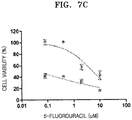
- FIGS. 7A to 7C The cell viability was measured according to an SRB assay, and the measured cell viability results are shown in FIGS. 7A to 7C .
- FIG. 7A shows the cell viability (%) in the case using irinotecan only at the concentrations of 1.25 ⁇ M to 10 ⁇ M ( ⁇ ) and the case using irinotecan and 2.5 ⁇ M of Asperphenin B in combination ( ⁇ ).
- FIG. 7B shows the cell viability (%) in the case using gemsitabin only at the concentrations of 1 nM to 100 nM ( ⁇ ) or the case using gemsitabin and 8 ⁇ M of Asperphenin B in combination ⁇ ).
- FIG. 7C shows the cell viability (%) in the case using 5-fluorouracil at the concentrations of 0.1 ⁇ M to 10 ⁇ M ( ⁇ ) or 5-fluorouracil and 8 ⁇ M of Asperphenin B in combination ( ⁇ ).
- Asperphenin B The anticancer effect of Asperphenin B was verified in a tumor xenograft mouse model to which human colon cancer cell line was transplanted.
- RKO cells were subcutaneously injected at a concentration of 3.5x10 6 cells/150 ⁇ l into the right side of a nude mouse (Central Lab. Aminol Inc., hairless and small mouse that was tymus free and had dried beard at birth).
- a nude mouse Central Lab. Aminol Inc., hairless and small mouse that was tymus free and had dried beard at birth.
- the tumor size was measured by using a digital caliper for 21 days at intervals of 3 to 4 days.
- Tumor volume mm 3 length ⁇ width ⁇ height ⁇ ⁇ / 6
- Tumor growth inhibition ratio % 1 ⁇ final mean tumor volume in Asperphenin B ⁇ treated group / final mean tumor volume in control ⁇ 100
Landscapes
- Health & Medical Sciences (AREA)
- Chemical & Material Sciences (AREA)
- Life Sciences & Earth Sciences (AREA)
- Organic Chemistry (AREA)
- General Health & Medical Sciences (AREA)
- Engineering & Computer Science (AREA)
- Medicinal Chemistry (AREA)
- Genetics & Genomics (AREA)
- Bioinformatics & Cheminformatics (AREA)
- Zoology (AREA)
- Wood Science & Technology (AREA)
- Biochemistry (AREA)
- Proteomics, Peptides & Aminoacids (AREA)
- Biotechnology (AREA)
- Public Health (AREA)
- Veterinary Medicine (AREA)
- Animal Behavior & Ethology (AREA)
- Pharmacology & Pharmacy (AREA)
- Epidemiology (AREA)
- Molecular Biology (AREA)
- Microbiology (AREA)
- General Engineering & Computer Science (AREA)
- Biophysics (AREA)
- Virology (AREA)
- Biomedical Technology (AREA)
- Botany (AREA)
- Mycology (AREA)
- Tropical Medicine & Parasitology (AREA)
- Immunology (AREA)
- Gastroenterology & Hepatology (AREA)
- Chemical Kinetics & Catalysis (AREA)
- General Chemical & Material Sciences (AREA)
- Crystallography & Structural Chemistry (AREA)
- Nuclear Medicine, Radiotherapy & Molecular Imaging (AREA)
- Medicines That Contain Protein Lipid Enzymes And Other Medicines (AREA)
- Peptides Or Proteins (AREA)
- Pharmaceuticals Containing Other Organic And Inorganic Compounds (AREA)
- Preparation Of Compounds By Using Micro-Organisms (AREA)
Abstract

Description
- The present invention relates to a novel peptide compound, a method of producing the same, and use of the novel peptide compound.
- Physiologically active substances derived from microorganisms have been a source of antibiotics, antifungal agents, and anticancer drugs, and have been developed as new drugs for treatment of various diseases or become templates for development of new drugs. Examples of antibiotics derived from microorganisms are amphotericin, erythromycin, streptomycin, tetracycline, and vancomycin. In addition, deptomycin isolated from streptomyces which is an actinomyces was approved as a next-generation antibiotic by (FDA) in 2013. Examples of anticancer drugs originated from microbes are doxorubicin, bleomycin, mithramycin, neocarzinostatin, pentostatin, and epothilone. As such, research on physiologically active substances derived from bacteria is very important in the development of antibacterial agents, antifungal agents, and antifungal agents.
- To screen physiologically active substances that are structurally different from existing substances, one strategy of the recent studies is to research natural products in a geographically and phylogeneticlly specific environment. Although readily accessible soil microorganisms and land plants have been extensively studied for natural products over a long period of time, studies on microorganisms or marine origin have been relatively inactively done. Oceans cover about 70% of the surface of the earth, and the ocean itself is presented as a space of opportunity that is mostly unexplored. Although the diversity of marine microorganisms is not exactly identified, there has been little research in this area so far that only 1% of marine microorganisms are believed to be cultured or identified.
- Therefore, in consideration of the development of structurally new antibiotics and anticancer drugs, it is necessary to select marine microorganisms producing useful physiologically active substances, and to explore and develop new compounds producing such marine microorganisms.
- As such, new strains were discovered while selecting and studying new marine fungi. In addition, while studying the new strain, it was found that the new strain is capable of producing a new peptide compound which is also accordingly found to exhibit anticancer activity, thereby completing the present invention.
- The provided is a novel peptide compound, and an isomer, a derivative, or a pharmaceutically acceptable salt of the peptide compound isomer of the peptide compound.
- In addition, the provided is a strain F452 of Aspergillus speies producing the peptide compound.
- In addition, the provided is a method of producing the peptide compound.
- In addition, the provided is a pharmaceutical composition for preventing or treating cancer, the pharmaceutical composition including the peptide compound.
- In addition, the provided is a method of preventing or treating cancer.
- According to an aspect, there is provided a novel peptide compound including a lipopeptide and a benzophenone, or an isomer, a derivative, or a pharmaceutically acceptable salt of the peptide compound.
- According to another aspect, there is provided a strain F452 of Aspergillus sp. producing the peptide compound.
- According to another aspect, there is provided a method of producing the peptide compound.
- According to another aspect, there is provided a pharmaceutical composition comprising the peptide compound or the isomer, the derivative, or the pharmaceutically acceptable salt of the peptide compound.
- According to another aspect, there is provided a method of preventing or treating cancer, the method using the peptide compound or the derivative, or the pharmaceutically acceptable salt of the peptide compound.
- A new peptide including a lipopeptide and a benzophenone has anticancer activity, and thus, can be used for the prevention or treatment of various cancer types. In addition, a low-priced mass culture medium can be used to provide a high yield of the peptide compound.
-
-
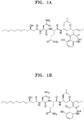
FIGS. 1A and 1B show structure formulas of Asperphenin A and Asperphenin B, respectively; -
FIG. 2 is an image showing a medium culturing a strain F452 of the genus of Aspergillus; -
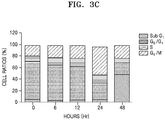
FIG. 3A is a graph showing RKO cell ratios (%)of each cell cycle according to the concentration of Asperphenin B, and FIGG. 3B and 3C are each a graph showing RKO cell ratios (%) of a cell cycle according to the incubation time of Asperphenin B at a concentration of 2.5 µM and 5 µM; -
FIG. 4 is a graph showing ratios (%) of living cells, cells of early apoptosis, cells of late apoptosis or necrosis, or cells of necrosis, according to the concentration of Asperphenin B; -
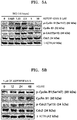
FIGS. 5A and 5B are each an immunoblot image of cell cycle-related proteins according to the concentration of Asperphenin B and the incubation time (in hours) of Asperphenin B at a concentration of 5 µM; -
FIGS. 6A and6B are each an immunoblot image of cell apoptosis-related proteins according to the concentration of Asperphenin B and the incubation time (in hours) of Asperphenin B at a concentration of 5 µM; -
FIGS. 7A to 7C are each a graph showing cell viability (%) of a combination of Asperphenin B and other anticancer drugs, or other anticancer drugs only; and -
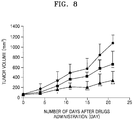
FIG. 8 is a graph showing the tumor volume (mm3) of a mouse according to the number of days after 4 mg/kg or 8 mg/kg of Asperphenin B was administered into the mouse. - An aspect of the present invention provides a peptide compound including a lipopeptide and a benzophenone, or an isomer, a derivative, or a pharmaceutically acceptable salt of the peptide compound.
- The term "peptide compound" as used herein refers to a compound including a peptide. A peptide is a compound in which two or more amino acids are linked by a peptide bond between a carboxyl group of one amino acid and an amino group of another amino acid. Depending on the number of amino acids constituting a peptide, the peptide may be a dipeptide, a tripeptide, a tetrapeptide, or the like. A peptide having about 10 or less peptide bonds is called an oligopeptide, and a peptide having multiple peptide bonds is called a polypeptide.
- The term "isomer" as used herein refers to a compound with the same molecular formula as another molecule, but with different link or spacial arrangement of constituent atoms in the molecule. The isomer may include, for example, a structural isomer and a stereoisomer.
- The term "derivative" as used herein refers to a compound obtained by substituting a part of the structure of a compound with another or an atomic group.
- The term "pharmaceutically acceptable salt" as used herein refers to an inorganic salt and an organic addition salt of a compound.
- The term "lipopeptide" as used herein refers to a substance including a lipid connected to a peptide. The lipopeptide may include a lipid connected to a peptide by an amide bond. The amide bond is also referred to as a peptide bond, and is a covalent bond in which an amino group of one molecule and a carboxyl group of another molecule are linked.
- The lipid may be a substituted or unsubstituted C12-C20 alkyl group, a substituted or unsubstituted C2-C20 alkenyl group, or a substituted or unsubstituted C2-C20 alkynyl group. The alkyl group may be a C2-C20 alkyl group, a C5-C20 alkyl group, or a C10-C15 alkyl group. The alkyl group may include 12 carbons. The alkenyl group may be a C2-C20 alkenyl group, a C5-C20 alkenyl group, a C10-C20 alkenyl group, or a C10-C15 alkenyl group. The alkynyl group may be a C2-C20 alkynyl group, a C5-C20 alkynyl group, a C10-C20 alkynyl group, or a C10-C15 alkynyl group. The expression "substituted" as used herein refers means that a hydrogen atom in an organic compound is substituted with another atomic group to form a derivative. Here, a "substituent" is the atomic atom introduced thereto. The substituent may be, for example, a hydroxyl group, a halogen atom, a C1-C20 alkyl group, a C2-C20 alkenyl group, a C2-C20 alkynyl group, a C1-C20 heteroalkyl group, a C6-C20 aryl group, a C6-C20 arylalkyl group, a C6-C20 heteroaryl group, or a C6-C20 heteroarylalkyl group, a nitro group, a cyano group, an amino group, an amidino group, a hydrazine group, a hydrazone group, a carboxyl group or a salt thereof, a sulfonic acid or a salt thereof, or a phosphoric acid or a salt thereof.
- The peptide may include two, three, or four or more amino acids. The peptide may be, for example, a tripeptide including three amino acids. The peptide may include, for example, N terminal-Asparagine (Asp)-Glutamine (Gln)-Leucine (Leu)-C terminal. The peptide may include one or more beta (β)-amino acids. An amino acid may include an amino group, a carboxyl group, and a side chain specific to the amino acid. 20 types of standard biological amino acids have an amino group linked to α carbon of a carboxyl group, whereas β-amino acids have an amino group linked to β carbon of a carboxyl group. β-amino acids of which side chains are linked to carbons next to amines are β3-amino acids, and β-amino acids of which side chains are linked to carbons next to carboxyl groups are β2-amino acids. The β-amino acid may be β-leucine. The β-amino acid may be β3-leucine.
- The benzophenone may be a diphenylmethanone which is an organic compound having a formula of (C6H5)2CO. The benzophenone may be, for example, a compound substituted with 1, 2, or 3 or more hydroxyl groups. For example, the benzophenone may be a compound of which at least one selected from 5th carbon, 9th carbon, and 13th carbon is substituted with a hydroxyl group.
- The lipopeptide and the benzophenone may be linked via a ketone linkage. For example, the benzophenone may be linked to a C-terminal end of the lipopeptide.
- The peptide compound may be represented by Formula 1:

- In
Formula 1, R1 may be substituted or unsubstituted C1-C20 alkyl group, a substituted or unsubstituted C1-C20 alkenyl group, or a substituted or unsubstituted C1-C20 alkynyl group, wherein R1 may be selectively unsubstituted or substituted with a hydroxyl group, - R2, R3, and R4 may each independently be selected from hydrogen, a hydroxyl group, a halogen group, a cyano group, -C(=O)Ra, -C(=O)ORa,-OCO(ORa), -C=N(Ra), -SRa, -S(=O)Ra, -S(=O)2Ra, -PRa, a substituted or unsubstituted C1-C20 alkyl group, a substituted or unsubstituted C1-C20 alkoxy group, a substituted or unsubstituted C2-C20 alkenyl group, a substituted or unsubstituted C2-C20 alkynl group, a C2-C20 alkylene oxide group, a substituted or unsubstituted C3-C30 cycloalkyl group, a substituted or unsubstituted C6-C30 aryl group, a substituted or unsubstituted C6-C30 aryloxy group, a substituted or unsubstituted C6-C30 heteroaryl group, or a combination thereof, and
- R5 may be a substituted or unsubstituted benzophenone.
- The alkyl group, the alkenyl group, the alkynyl group, and the substitution, and the benzophenone are the same as described above.
- The peptide compound may be a compound represented by Formula 2:

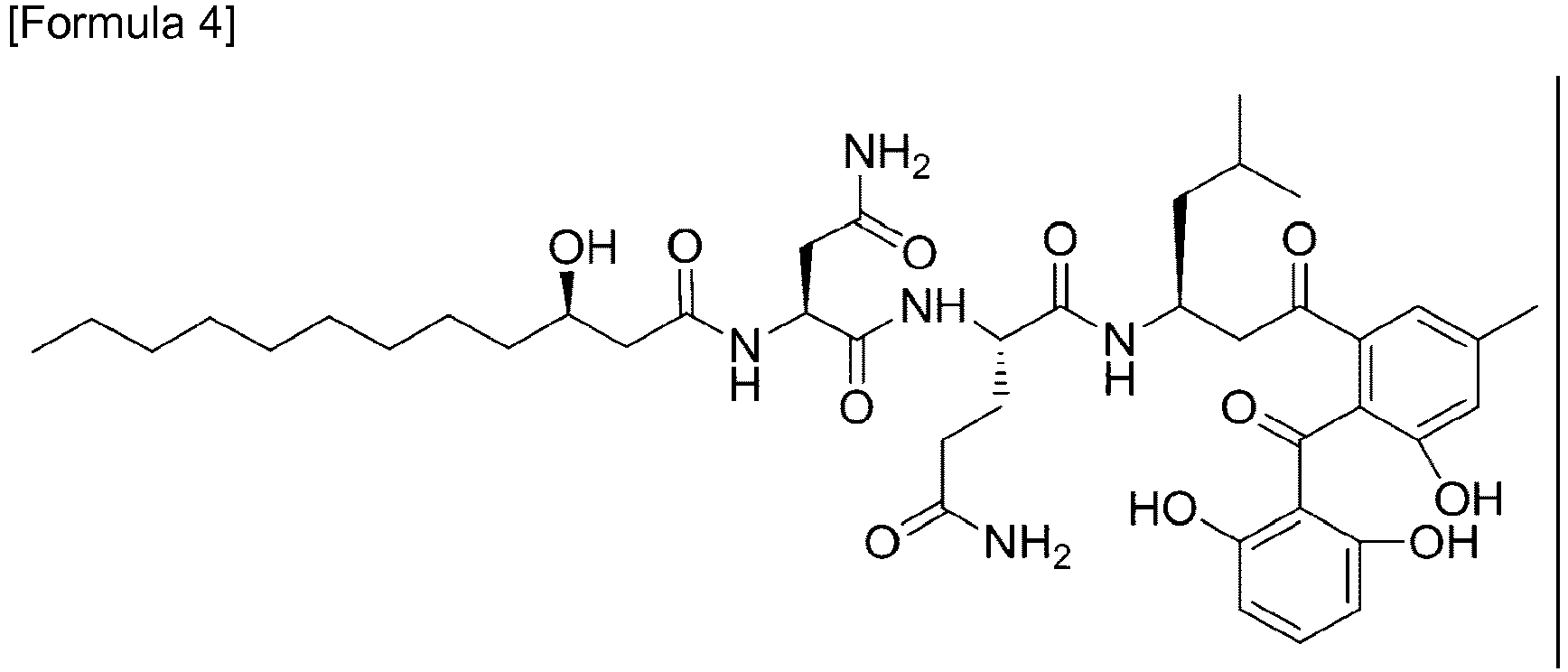
- The compound represented by Formula may be a compound represented by Formula 3 or 4, or an isomer, a derivative, or a pharmaceutically acceptable salt thereof:

- An aspect of the present disclosure provides a strain F452 of Aspergillus sp. (Accession Number: KCTC12688BP), the strain producing a peptide compound including a lipopeptide and a benzophenone.
- The lipopeptide, the benzophenone, and the peptide compound are the same as described above.
- The strain may include a mutant thereof. The mutant may be, for example, caused by a natural mutant or an artificial mutant. The artificial mutant may be caused by a physical mutagen, such as an ultraviolet ray, or a chemical mutagen, such as base compound.
- The strain may include its pore, fungus body, bacterial call, or culture.
- The strain may be separated or derived from marine sediments.
- An aspect of the present disclosure provides a method of producing a peptide compound including a lipopeptide and a benzophenone, the method including culturing a strain F452 (Accession Number: KCTC12688BP) of Aspergillus sp. to prepare a culture medium; and separating a peptide compound including a lipopeptide and a benzophenone from the culture medium.
- The method may include culturing the strain F452 of Aspergillus sp. (Accession Number: KCTC12688BP) to prepare a culture medium.
- The strain F452 of Aspergillus sp. is the same as described above.
- The culturing may be culturing a strain in a liquid medium or a solid medium. The medium may include instant ocean. The medium may include carbon sources, such as glucose, rice, starch syrup, dextrin, starch, molasses, animal oils, or plant oils. The medium may include nitrogen sources, such as yeast extracts, peptones, wheat bran, soybean oil meal, wheat, malt, cottonseed meal, fish scrap, corn steep liquor, meat juice, ammonium sulfate, sodium nitrate, or urea. The medium may include, if necessary, table salt, potassium, magnesium, cobalt, chlorine, phosphoric acid, sulfuric acid, or inorganic salt that stimulates production of other ions. The medium may include, for example, instant ocean, yeast extracts, peptones, and rice.
- The culturing may be shake culture or stationary culture that is performed under aerobic conditions. The temperature at which the culturing is performed may be, for example, in a range of about 20°C to about 37°C or about 25°C to about 30°C, or may be 27°C. The time required for the culturing may be, for example 1 day to 2 months, 1 week to 2 months, 2 weeks to 2 months, 1 month to 2 months, or 6 weeks.
- The method may include separating a peptide compound from the culture medium, the peptide compound including a lipopeptide and a benzophenone.
- The lipopeptide, the benzophenone, and the peptide compound are the same as described above.
- The separating of the peptide compound from the culture medium may include performing concentration, centrifugation, filtration, or chromatography on the culture medium. For example, the culture medium may be extracted with ethylacetate, water, or a combination thereof. The obtained concentrate may be divided by chromatography, into 8 fractions depending on polarity. The chromatography may be, for example, reverse phase flash chromatography using, for example, water, acetonitrile, or a combination thereof as a mobile phase. The fractions may be fractioned by using the reverse phase flash chromatography, to thereby obtain 8 fractions.
- Among the obtained fractions, fractions eluted with a water/acetonitrile mixed solution, which is mixed at a volume ratio of 50:50, may be capable of separating the peptide compound by using high performance liquid chromatography (HPLC). The HPLC uses a water/methanol mixed solution, which is mixed at a volume ratio of 70:30, as a mobile phase, and may be performed by using reversed-phase semi-preparative HPLC. The separated peptide compound may have purity of about 80%, about 90%, or about 99% or more.
- An aspect of the present disclosure provides a pharmaceutical composition for preventing or treating cancer, the pharmaceutical composition including a peptide compound including a lipopeptide and a benzophenone, or an isomer, a derivative, or a pharmaceutically acceptable salt of the peptide compound.
- The lipopeptide, the benzophenone, the peptide compound, the isomer, the derivative, and the pharmaceutically acceptable salt are the same as described above.
- The cancer may include, for example, intrahepatic cholangiocarcinoma, liver cancer, thyroid cancer, colon cancer, testis cancer, myelodysplastic syndrome, glioblastoma, oral cavity cancer, mycosis fungoides, acute myeloid leukemia, chronic myeloid leukemia, acute lymphoblastic leukemia, chronic lymphoblastic leukemia, base cell carcinoma, ovarian epithelial cancer, ovarian germ cell tumor, male breast cancer, brain tumor, pituitary adenoma, multiple myeloma, gallbladder cancer, biliary tract cancer, colon cancer, retinoblastoma, choroid melanoma, ampullar of vater cancer, bladder cancer, peritoneal cancer, parathyroid carcinoma, adrenal gland cancer, non-small cell lung cancer, tongue cancer, astroma, small cell lung cancer, pediatric brain tumor, pediatric lymphoma, pediatric leukemia, small bowel neoplasm, meningioma, esophageal cancer, glioma, neuroblastoma, renal pelvis and ureter cancer, kidney cancer, malignant soft tissue tumor, malignant bone tumor, malignant lymphoma, malignant mesothelioma, malignant melanoma, ocular tumor, pudendum cancer, urethral tumor, carcinoma of unknown primary origin, gastric lymphoma, stomach cancer, gastric carcinoid tumor, gastrointestinal stromal tumor, Willms tumor, breast cancer, sarcoma, penile carcinoma, pharynx cancer, gestational trophoblastic disease, cervical cancer, endometrial cancer, sarcoma of uterus, prostate cancer, metastatic brain tumor, rectal cancer, rectal carcinoid tumor, vaginal cancer, spinal tumor, vestibular schwannoma, pancreatic cancer, salivary gland tumor, tonsillar cancer, squamous cell carcinoma, adenocarcinoma of lung, lung cancer, squamous cell carcinoma of lung, skin cancer, anal cancer, larynx cancer, or a combination thereof. The cancer may be, for example, lung cancer, colon cancer, stomach cancer, liver cancer, or breast cancer.
- The term "prevention" as used herein refers to any action that inhibits diseases or delays onset by administration of a composition. The term "treatment" as used herein refers to any action that improves or alleviates a symptom of a disease by the administration of a composition.
- The pharmaceutical composition may further include a known active ingredient having anticancer activity. Such a known active ingredient may be an anticancer drug. The anticancer drug may be irinotecan, 5-fluotouracil, gemcitabine, etoposide, paclitaxel, or a combination thereof. When the anticancer drug is further included, the pharmaceutical composition may be a single composition or an individual composition.
- The pharmaceutical composition may further include a carrier, an excipient, or a diluent. Such a carrier, an excipient, or a diluent may be, for example, lactose, dextrose, sucrose, sorbitol, mannitol, xylitol, erythritol, maltitol, starch, acacia rubber, alginate, gelatin, calcium phosphate, calcium silicate, cellulose, methylcellulose, microcrystalline cellulose, polyvinylpyrrolidone, water, methylhydroxybenzoate, propylhydroxybenzoate, talc, magnesium stearate, or mineral oil.
- The pharmaceutical composition may be formulated in the form of oral preparations such as powders, granules, tablets, capsules, suspensions, emulsions, and syrups, aerosols, external preparations, suppositories, or sterilized injection solutions, according to a conventional method. In the case of formulation, a diluent or an excipient, such as a filler, an extender, a binder, a wetting agent, a disintegrant, and a surfactant, that are typically used may be used.
- Regarding the pharmaceutical composition, solid preparations for oral administration may be tablets, pills, powders, granules, or capsules. The solid preparations may further include an excipient. Such an excipient may be, for example, starch, calcium carbonate, sucrose, lactose, or gelatin. In addition, the solid preparations may further include a lubricant, such as magnesium stearate or talc. Regarding the pharmaceutical composition, liquid preparations for oral use may be suspensions, solutions, emulsions, or syrups. The liquid preparations may include water or liquid paraffin. The liquid preparations may include an excipient, such as a wetting agent, a sweetening agent, an air freshener, or a preservative. Regarding the pharmaceutical composition, formulations for parenteral administration may be sterilized aqueous solutions, non-aqueous solutions, suspensions, emulsions, lyophilized agents, or suppositories. Non-aqueous solutions or suspensions may include vegetable oils or esters. Vegetable oils may include, for example, propylene glycol, polyethylene glycol, or olive oil. Esters may include, for example, ethyl oleate. A base of the suppository may be witepsol, macrogol, tween 61, cacao paper, laurin, or glycerogelatin.
- An aspect of the present discloser provides a method of preventing or treating cancer, the method including administering a pharmaceutical composition for preventing or treating cancer into an individual, the pharmaceutical composition including a peptide compound including a lipopeptide and a benzophenone, or an isomer, a derivative, or a pharmaceutically acceptable salt of the peptide compound.
- The lipopeptide, the benzophenone, the peptide compound, the isomer, the derivative, the pharmaceutically acceptable salt, cancer, prevention, treatment, and the pharmaceutical composition are the same as described above.
- The individual may be a mammal including a rat, a mouse, a dog, a cow, a monkey, and a human being.
- A preferred dosage of the peptide compound varies depending on the conditions and weight of a patient, a degree of disease, drug form, and administration route and time, but may be appropriately selected by one of ordinary skill in the art. However, the peptide compound may be, for example, administered in an amount of about 0.0001 mg/kg to about 100 mg/kg, or about 0.001 mg/kg to about 100 mg/kg, once or several times a day. The peptide compound in the pharmaceutical composition may be included in an amount of about 0.0001 wt% to about 10 wt% or about 0.001 wt% to about 1 wt%, based on the total weight of the total composition.
- The pharmaceutical dosage forms of the peptide compound may be in the form of a pharmaceutically acceptable salt of the peptide compound. The peptide compound may be used alone or in combination with other pharmaceutically active compound.
- The pharmaceutical composition may be administered in a variety of routes to a mammal including a rat, a mouse, a dog, a cow, a horse, a monkey, and a human being. An administration method may be, for example, oral, rectal or intravenous, intramuscular, subcutaneous, intrauterine, or intra-cerebroventricular injections.
- The method may further include administering an anticancer drug into an individual. The peptide compound, its isomer, derivative, or pharmaceutically acceptable salt, and the anticancer drug may be administered simultaneously, individually, or sequentially. For example, the anticancer drug may be administered into the individual after the administration of the peptide compound or the isomer, the derivative, or the pharmaceutically acceptable salt of the peptide compound into the individual.
- Hereinafter, the present disclosure will now be described more fully with reference to the accompanying Examples below. However, these Examples are for illustrative purposes only, and should not be construed as being limited to the scope of the inventive concept in any way.
- In order to screen a strain producing a substance having anticancer activity, a strain F452 was isolated from tropical marine sediments. The whole genome of the strain F452 was isolated, and an 18S ribosomal DNA sequence was cloned by using a polymerase chain reaction (PCR). The nucleic acid sequence of the 18S ribosomal DNA was analyzed (SEQ ID NO: 1).
- As a result of the nucleic acid sequence analysis, the strain F452 was identified as a novel strain that was systematically similar to Aspergillus versicolor. The strain F452 was named as strain F452 of Aspergillus sp., and then, deposited at the Depositary Authority on October 13th, 2014 (Accession Number: KCTC12688BP).
- The strain F452 of Aspergillus sp. was inoculated into a sterilized YPG solid medium (5 g of yeast extract, 5 g of peptone, 10 g of glucose, 16 g of agar, and 24.8 g of INSTANT OCEAN® (Aquarium systems) per 1 L of distilled water), and then, was subjected to primary culture at a temperature of 27°C for several days.
- The strain F452 cultured in the solid medium of the primary culture was inoculated into a sterilized YPG liquid medium (5 g of yeast extract, 5 g of peptone, 10 g of glucose, and 24.8 g of INSTANT OCEAN® (Aquarium systems) per 1 L of distilled water), and then, was subjected to second culture at a temperature of 27°C for 7 days while being shaken at 150 rpm.
- 10 ml of the second culture was inoculated into a solid rice medium (200 g of rice (Organica Co., Ltd., Icheon Rice, Gyeonggi-do), 2.5 g of yeast extract, 2.5 g of peptone, 12.4 g of INSTANT OCEAN® (Aquarium systems) per 500 ml of distilled water), and then, was subjected to third culture at a temperature of 27°C for 6 weeks.
- The solid medium of the third culture in which strain F452 was cultured in Example 1-2 was obtained, and then, 1 L of ethylacetate (Daejung Chemicals & Metals Co., Ltd.) was immersed in every 100 g of the obtained solid medium for 1 day. Such a procedure was repeated three times in total. Ethylacetate thus obtained was filtered through a filter paper (Advantec), and the filtrate was decompressed, to thereby remove ethylacetate which was a solvent. Such a procedure was repeated to obtain 25 g of a crude extract. 200 ml of methanol (Daejung Chemicals & Metals Co., Ltd.) was added to the crude extract, and then, the methanol layer was decompressed, to thereby obtain 11.4 g of a methanol extract. The methanol extract thus obtained was divided into 8 fractions according to reversed phase chromatography (MERCK, C18, 700 g, reversed-phase). An eluent used in 5 fractions was used by reducing water by 5% from a water/acetonitril (Burdick & Jackson) solution mixed at a volume ratio of 60:40. The final fraction was divided using 100% methanol (Daejung Chemicals & Metals Co., Ltd.), acetone (Daejung Chemicals & Metals Co., Ltd.), and ethylacetate (Daejung Chemicals & Metals Co., Ltd.), to thereby obtain fractions.
- Fraction 3 divided using a water/acetonitril solution mixed at a volume ratio of 50:50 was analyzed according to liquid chromatography (LC)-mass spectrometry (MS) and based on hydrogen nuclear resonance spectrum. To identify the compositions of the fractions, LC/
MS using Agilent 1200 Series LC (Agilent technologies) and 6130 Series MS was used. Here, the mass spectrum was obtained using an LTQ-Orbitrap ESI-MS mass spectrometer manufactured by Thermo-Finnigan Company, and was represented in a mass-to-charge (m/z) form. According to the analysis on the LC-MS and the hydrogen nuclear resonance spectrum, it was confirmed that the culture medium of the strain contained a novel secondary metabolite, which was to be named as Asperphenin. - Fraction 3 was isolated using C18 reversed-phase semi-preparative HPLC (particle diameter of 5 µm, 250 mm x 10 mm (length x inner particle diameter), elution rate of 2 ml/min) with a refractive index (RI) detector (Shodex). A mobile phase used for the isolation was a water/methanol solution mixed at a volume ratio of 70:30, and the reversed-phase semi-preparative HPLC was performed for about one and half an hour. Accordingly, 50.0 mg of Asperphenin A and 46.0 mg of Asperphenin B were obtained.
- Asperphenin A and Asperphenin B were in a pale yellow, stable at room temperature, and well dissolved in a moderate organic solvent, such as methanol and acetone. The structures of Asperphenin A and Asperphenin B were determined based on nuclear magnetic resonance spectrum, infrared and ultraviolet spectral data, optical rotary power, and high-resolution mass spectrometry data. The nuclear magnetic resonance spectrum (1H NMR, 13C NMR) was obtained using 500 MHz NMR manufactured by Bruker Company and DMSO-d 6 as a solvent. The mass spectrum was obtained using an LTQ-Orbitrap ESI-MS mass spectrometer manufactured by Thermo-Finnigan Company, and was represented in a mass-to-charge (m/z) form. The infrared spectrum was obtained using an FT-IR-4200 spectrometer manufactured by Jasco Company. The ultraviolet spectrum was obtained using an U-3010 UV/VIS spectrometer manufactured by Hitachi Company. The optical rotary power was obtained using a P-1020 polarimeter manufactured by Jasco Company.
- The structure positioning of each of Asperphenin A and Asperphenin B by the nuclear magnetic resonance spectrum was as follows in Tables 1 and 2.
-
- (1) Molecular formula : C42H61N5O11
- (2) Molecular weight: 811
- (3) Color: Pale yellow
- (4) Optical rotary power: -24.7 (c 1.0, methanol, 25°C)
- (5) Infrared absorption band (neat) : 3309, 1671 wavenumbers
- (6) 1H-NMR (DMSO-d 6, 600 MHZ) : see Table 1
- (7) 13C-NMR (DMSO-d 6, 150 MHZ) : see Table 1
-
- (1) Molecular formula: C42H61N5O11
- (2) Molecular weight: 811
- (3) Color: Pale yellow
- (4) Optical rotary power: -18.4 (c 1.0, methanol, 25°C)
- (5) Infrared absorption band (neat): 3309, 1671 wavenumbers
- (6) 1H-NMR (DMSO-d 6, 600 MHZ) : see Table 2
- (7) 13C-NMR (DMSO-d 6, 150 MHZ) : see Table 2
- The structure of each of Asperphenin A and Asperphenin B analyzed on the basis of the nuclear magnetic resonance spectrum was represented by a chemical formula below.
-

-

- Regarding a lung cancer cell line A549 (Korean Cell line Bank), a colon cancer cell line HCT116 (ATCC), a stomach cancer cell line SNU638 (Korean Cell Line Bank), a liver cancer cell line SK-HEP-1 (Korean Cell line Bank), and a breast cancer cell line MDA-MB-231 (Korean Cell line Bank), a sulforhodamine B (SRB) assay which is a method of measuring cell viability was used for measuring apoptosis effects of Asperphenin.
- In detail, 190 µℓ of a cell suspension at a concentration of 3.5x10⁴ cells/ml was inoculated in each well of a 96-well microplate. 0.8 µM, 4 µM, 20 µM, or 100 µM of Asperphenin was added to the cell culture medium, and cultured at a temperature of 37°C for 72 hours under the condition of 5% CO2. After incubation, 50 µℓ of 50%(v/v) trichloroacetic acid solution (Sigma Aldrich) was added to each well, and then, incubated at a temperature of 4°C for 30 minutes, to thereby fix the cells thereto. The fixed cells were washed with water five times, and then, dried in the air.
- Next, 80 µℓ of a 0.4%(w/v) SRB aqueous solution (Sigma Aldrich) containing 1 %(v/v) acetic acid (DUKSAN) was added to each well, incubated at room temperature for 1 hour to stain cells therein, and the stained cells washed with water and dried. The cells were dissolved by adding 200 µℓ of 10 mM Tris (pH 10.0) (Sigma Aldrich) to each well, and then, the number of living cells was calculated by measuring the absorbance thereof at 515 nm. The concentration of the compound inhibiting cell growth to 50% based on the number of the living cells, i.e., 50% inhibition concentration (IC50) was calculated, and the results are shown in Table 3. Here, as a positive control, etoposide (Sigma Aldrich) was used.
[Table 3] Cell growth inhibition concentrations of Asperphenin A and Asperphenin B (IC50, µM) A549 HCT116 SNU638 SK-HEP-1 MDA-MB-231 Asperphenin A 14.6 1.7 5.8 2.3 3.1 Asperphenin B 41.8 2.6 11.7 3.0 6.0 Etoposide 0.7 1.9 0.8 0.6 10.6 - As shown in Table3, Asperphenin A exhibited strong cell inhibition effects against the cell lines of lung cancer, colon cancer, stomach cancer, and breast cancer. Asperphenin B exhibited strong cell inhibition effects against the cell lines of colon cancer, stomach cancer, liver cancer, and breast cancer, except for the cell line A549. In particular, Asperphenin A and Asperphenin B both exhibited similar anticancer activity to or better anticancer activity against the colon cancer cell line HCT116 than that of etoposid which is a positive control.
- As shown in Table 3, it was confirmed whether Asperphenin B had cell growth inhibition effects against not only the colon cancer cell line HCT116, but also other colon cancer cell lines.
- From the colon cancer cell lines HCT116 (ATCC), HCT15 (Korean Cell Line Bank), LS174T (Korean Cell Line Bank), RKO(ATCC), and SW480(ATCC), cell growth inhibition concentrations (IC50, µM) were calculated as described in Example 2-1, and the results are shown in Table 4. Here, as a positive control, paclitaxel (Sigma Aldrich) was used.
[Table 4] Growth inhibition value of cancer cell against Asperphenin B (IC50) HCT15 HCT116 LS174T RKO SW480 Asperphenin B(µM) 7.20 4.05 1.84 1.17 31.35 Paclitaxel (nM) > 100 0.42 0.46 0.21 > 100 - As shown in Table 4, Asperphenin B strongly inhibited the cell growth of 4 colon cancer cell lines, except for the cell line SW480, and more particularly, Asperphenin B exhibited the strongest inhibitory effects against the cell line RKO.
- The effects of Asperphenin B on the cell cycle of the colon cancer cell line RKO was confirmed by flow cytometry.
- RKO cells (ATCC) were diluted in a medium containing 10%(v/v) FBS to become 1x10⁵ cells/ml, and then, inoculated into a 60 mm culture dish. The inoculated cells were cultured for about 24 hours at a temperature of 37°C under the condition of 5% CO2. The cultured cells were washed with phosphate-buffered saline (PBS) once, and the medium was replaced by a fresh medium. Asperphenin B at the final concentration of 0.625 µM, 1.25 µM, 2.5 µM, 5 µM, or 10 µM was added to the cultured cells, and then, the cells were cultured at a temperature of 37°C under condition of 5% CO2.
- After a certain period of time, cells attached to the culture dish and cells not attached to the medium were collected. The collected cells was washed with PBS once, and then, 1 ml of cold 70%(v/v) ethanol. The cells were incubated at a temperature of 4°C for about 12 hours to fix the cells. After removing 70%(v/v) ethanol, the fixed cells were washed with PBS once. 500 µℓ of RNase A (Sigma Aldrich) at a concentration of 50 µg/mℓ as added to the cells, and the cells were incubated at room temperature for about 30 minutes. Propidium iodide(PI) at a final concentration of 50 µg/mℓ was added to the cells, and then, the cells were incubated at room temperature for about 30 minutes in a condition where reactants were in the shaded state. The cells stained with PI were subjected to analysis of cell cycle by using a BD FACSCalibur flow cytrometer (manufactured by BD Biosciences). Based on the flow cytometry results, cell ratios at the sub-G1, G0/G1, S, and G2/M phases were calculated. Here, as a negative control, cells to which Asperphenin B was not added was used.
- When the RKO cells were incubated for 48 hours in the presence of Asperphenin B, cell ratios (%) dependent on the concentration of Asperphenin B are shown in
FIG. 3A and Table 5. When the RKO cells were incubated in the presence of Asperphenin B at the concentrations of 2.5 µM and 5 µM, cell ratios (%) dependent on the incubation time are shown inFIGS. 3B and3C , and Table 6.[Table 5] Cell cycle phase Asperphenin B concentrations 0 µM (negative control) 0.625 µM 1.25 µM 2.5 µM 5 µM 10 µM Sub-G1 3.03% 7.14% 24.18% 38.60% 59.90% 67.82% G0/G1 59.69% 52.49% 23.02% 17.99% 17.59% 17.07% S 14.85% 8.11% 6.39% 6.63% 5.29% 5.46% G2/M 20.50% 29.56% 43.94% 34.58% 15.97% 8.92% [Table 6] Control 2.5 µM Asperphenin B 5 µM Asperphenin B Cell cycle phase 0 hour 6 hours 12 hours 24 hours 48 hours 6 hours 12 hours 24 hours 48 hours Sub-G1 4.40% 3.77% 3.25% 5.03% 33.38 % 3.19% 3.80% 4.86% 48.23 % G0/G1 66.21 % 62.16 % 56.50 % 30.73 % 17.80 % 60.66 % 57.60 % 28.35 % 20.53 % S 9.70% 13.82 % 15.09 % 17.38 % 6.55% 13.48 % 14.63 % 14.08 % 5.90% G2/M 17.55 % 18.28 % 22.18 % 40.76 % 39.31 % 20.21 % 20.93 % 48.88 % 23.37 % - As shown in
FIG. 3A and Table 5, in the case where the RKO cells and Asperphenin B were incubated for 48 hours, the cells at the sub-G1 phase were increased according to the concentrations of Asperphenin, as compared to the control, whereas the cells at the G0/G1 and S phases were decreased. The cells in the G2/M phase were increased as compared to a control in which low-concentrated Asperphenin B was treated, and were decreased as compared to a control in which high-concentrated Asperphenin B was treated. In addition, as shown inFIGS. 3B and3C , and Table 6, the cells in the sub-G1 and G2/M phases were changed depending on the treatment time of Asperphenin B. In the case where Asperphenin B at the concentration of 2.5 µM or 5 µM was treated for about 24 hours, the cells in the G2/M phase increased as compared to a control. In the case Asperphenin B at the concentration of 2.5 µM or 5 µM was treated for about 48 hours, the cells in the G2/M phase decreased as compared to the case where Asperphenin B at the concentration of 2.5 µM or 5 µM was treated for about 24 hours. The ratio of cells in the sub-G1 phase showing no change for 0 to 24 hours during the treatment of Asperphenin B, increased. It was confirmed that the cells in the G2/M phase occurred cell cycle arrest until 24 hours of the treatment of Asperphenin B, but after 48 hours of the treatment of Asperphenin B, the cell apoptosis was induced. - The process of apoptosis in the cell line RKO by Asperphenin B was confirmed using a Annexin V-FITC apoptosis measuring kit (manufactured by D Pharmingen).
- As described in Example 2-3, Asperphenin B at the concentration of 0.625 µM, 1.25 µM, 2.5 µM, 5 µM, or 10 µM was added to the RKO cells, cultured for 48 hours to obtain cells. 300 µℓ of 1x binding buffer was added to the obtained cells, and well mixed together. Then, 5 µℓ of Annexin V and 5 µℓ of PI were added to 100 µℓ of the cell mixture, and allowed to react at room temperature for 15 minutes in the shaded stated. 400 µℓ of 1x binding buffer was added to the reactants, a FACSCalibur flow cytometer (BD FACSCalibur, BD Biosciences) was used to analyze the cell apoptosis. Based on the flow cytometry results, ratios of cells that were not stained (i.e., living cells), cells stained with annexin V (i.e., cells apoptosized at the early state), cells stained with both PI and annexin V (i.e., cells apoptosized at the late state or cells necrotized,), or cells stained with PI only (i.e., cells necrotized) were calculated. As a negative control, cells to which Asperphenin B was not added were used.
- When the RKO cells were incubated for 48 hours in the presence of Asperphenin B, cell ratios (%) depending on the concentrations of Asperphenin B are shown in
FIG. 4 . As shown inFIG. 4 , the ratios of the cells of early apoptosis and the cells of late apoptosis or necrosis increased as compared to the ratio of the control. Here, the ratio of necrotic cells was increased as compared to that of the control. Therefore, it was confirmed that Asperphenin B induced apoptosis and necrosis of the RKO colon cancer cell line. - As described in Example 2-3, cells were obtained in a way that Asperphenin B at the concentration of 0.625 µM, 1.25 µM, 2.5 µM, 5 µM, or 10 µM was added to the RKO cells, and then, cultured for 48 hours. However, cells were obtained in a way that Asperphenin B at the concentration of 5 µM was added to the RKO cells, and then, cultured for 0 to 48 hours. Then, proteins were obtained from the obtained cells.
- Regarding the expression of the cell cycle-related proteins, anti-p-cyclin B1 (Ser147) antibody (Cell Signaling Technology), anti-cyclin B1 antibody (Santa Cruz), anti-p-cdc2(Tyr15) antibody (Cell Signaling Technology), anti-cdc2 antibody (Santa Cruz), and anti-β-actin antibody (Santa Cruz) were used to perform immunoblotting thereon. Images obtained by immunoblotting are shown in
FIGS. 5A and 5B . - As shown in
FIG. 5A , when the RKO cells were incubated for 48 hours in the presence of Asperphenin B, the expression of non-active p-cdc2 (Tyr15) protein was increased in a concentration-dependent manner. The expression of non-active p-cyclin B1 (Ser147) protein was increased in the cells treated with 2.5 µM of Asperphenin B. The expression of p-cyclin B1 (Ser147) protein and cyclin B1 protein decreased in the cells treated with 5 µM and 10 µM of Asperphenin B. In addition, as shown inFIG. 5B , when the cells were treated with 5 µM of Asperphenin B, the expression of p-cdc2 (Tyr15) protein was increased in time-dependent manner, and the expression of p-cyclin B1 (Ser147) was highest at about 24 hours. Therefore, it was confirmed that Asperphenin B regulated the expression of cell cycle-related factors in the RKO colon cancer cells. - Also, regarding the expression of apoptosis-related proteins, anti-ATM antibody (Cell Signaling Technology), anti-p-Chk (Thr68) antibody (Cell Signaling Technology), anti-Chk antibody (Cell Signaling Technology), anti-p-H2AX antibody (Cell Signaling Technology), anti-p53 antibody (Santa Cruz), anti-Bax antibody (Santa Cruz), anti-BID antibody (Cell Signaling Technology), anti-Caspase-8 antibody (Cell Signaling Technology), anti-Caspase-3 antibody (Cell Signaling Technology), anti-Caspase-9 antibody (Cell Signaling Technology), anti-cleaved PARP antibody (BD Biosciences), and anti-β-actin antibody (Santa Cruz) were used, to thereby perform immunoblotting. Images obtained by immunoblotting are shown in FGIS. 6A and 6B.
- As shown in
FIG. 6A , when the RKO cells were incubated for 48 hours in the presence of Asperphenin B, the expression of ATM protein was increased in a concentration-dependent manner while Chk2 and H2AX, which are sub-regulatory factors of ATM proteins, were phosphorylated to be activated. The expression of p53 protein was increased in a concentration-dependent manner, leading to the increased expression of Bax. In addition, the cleavage of poly(ADP-ribose) polymerase (PARP), which is a substrate of Bid, caspase-8, caspase-9, caspase-3, and caspase-3, have been induced by Asperphenin B. As shown inFIG. 6B , when the cells were treated with 5 µM of Asperphenin B, the expression of apoptosis-inducing proteins and marker proteins, such as p-Chk2 (Thr68), p-H2AX (Ser139), cleaved caspase-8, cleaved caspase-9, cleaved caspase-3, and PARP, was increased in a group where the cells were treated for 48 hours. The expression of p53 and Bax was increased in a time-dependent manner. Accordingly, it was confirmed that Asperphenin B regulated the expression of apoptosis-related factors of the RKO colon cancer cells. - ROS was capable of inducing apoptosis within a cell, and in this regard, it was examined whether ROS has been produced within a cell by Asperphenin B.
- In detail, as described in Example 2-3, Asperphenin B at the concentration of 2.5 µM, 5 µM, or 10 µM wad added to the RKO cells. Cells were collected after the RKO cells were cultured for 24 hours. In addition, a cell group in which 5 mM of N-acetylcysteine (NAC) (Sigma Aldrich), which is an antioxidant, was added to 5 µM and 10 µM of Asperphenin B was prepared as a comparative group, whereas a cell group in which none of Asperphenin B and NAC was contained as a control.
- Afterwards, 2',7'-dichlorofluorescin diacetate (DCFH-DA) (Sigma Aldrich) having a final concentration of 20 µM was added to the cell culture medium, and then, cultured at a temperature of 37°C for 30 minutes under the condition of 5% CO2. Cells attached to the cell medium and cells not attached to the cell medium were all collected, washed with cold PBS twice, and then, suspended again in 1 ml of PBS to measure intensity of 2',7'-dichlorofluorescin (DCF) by using a BD FACSCalibur flow cytrometer (manufactured by BD Biosciences). Based on the intensity of DCF, ratios of cells producing ROS were calculated, and results thereof are shown in table 7.
[Table 7] Drug Ratio of cells producing ROS No drug treatment (control) 5.95% 2.5 µM Asperphenin B 8.14% 5 µM Asperphenin B 13.86% 10 µM Asperphenin B 14.26% 5 µM Asperphenin B + 5 mM NAC 1.41% 10 µM Asperphenin B + 5 mM NAC 2.55% - As shown in Table 7, when the RKO cells were incubated for 24 hours in the presence of Asperphenin B, the production of ROS increased about 2.4 times as much as the production of ROS in the control. However, the production of ROS by Asperphenin B was inhibited by NAC, which is an antioxidant. Therefore, it was confirmed that Asperphenin B induced the production of ROS in the RKO colon cancer cells.
- The effects of administration of Asperphenin B in combination with other anticancer drugs were examined in vitro.
- RKO cells diluted in a medium containing 10%(v/v) FBS were inoculated in each well of a 96-well microplate so that each plate included 7x10³ cells, and then, the cells were cultured for about 24 hours at a temperature of 37°C under the condition of 5% CO2. In the medium containing 10%(v/v) FBS, irinotecan (Sigma Aldrich), 5-fluorouracil (Sigma Aldrich), or gemsitabin (Sigma Aldrich) was mixed with Asperphenin B at a ratio of 1:1, and then, the mixture was added to the cultured cells. Then, the cells were cultured for 48 hours at a temperature of 37°C under the conditions of 5% CO2. The cell viability was measured according to an SRB assay, and the measured cell viability results are shown in
FIGS. 7A to 7C .FIG. 7A shows the cell viability (%) in the case using irinotecan only at the concentrations of 1.25 µM to 10 µM (●) and the case using irinotecan and 2.5 µM of Asperphenin B in combination (■).FIG. 7B shows the cell viability (%) in the case using gemsitabin only at the concentrations of 1 nM to 100 nM (●) or the case using gemsitabin and 8 µM of Asperphenin B in combination ■).FIG. 7C shows the cell viability (%) in the case using 5-fluorouracil at the concentrations of 0.1 µM to 10 µM (●) or 5-fluorouracil and 8 µM of Asperphenin B in combination (■). - In addition, the effects of the administration in combination were measured according to
Equation 1, and results thereof are shown in Table 8.
- D1: Concentration of Asperphenin B with expected effect in administration in combination
- D2: Concentration of other anticancer drugs with expected effect in administration in combination
- (Dx)1: Concentration of Asperphenin B with expected effect in administration of Asperphenin B only
- (Dx)2: Concentration of other anticancer drugs with expected effect in administration of other anticancer drugs only
- When the calculated effect of the administration in combination is <1, =1, and >1, it is meant to be synergistic effect, additive effect, and antagonistic effect, respectively.
[Table 8] Anticancer drug Conc. of anticancer drug (µM) Conc. of Asperphenin B (µM) Effect of administration in combination Level symbols representing effect of administration in combination Irinotecan 1.25 2.5 0.792 ++ Irinotecan 2.5 2.5 0.751 ++ 5 2.5 0.691 +++ 10 2.5 0.650 +++ 5-fluorouracil 0.08 8 0.863 + 5-fluorouracil 0.4 8 0.852 + 2 8 0.786 ++ 10 8 0.765 ++ Gemsitabin 0.32 8 0.907 ± (µM) 1.6 8 0.882 + 8 8 0.801 ++ 40 8 0.714 ++ - As shown in
FIGS. 7A to 7C and Table 8, the effects of cell growth inhibition increased in the case where Asperphenin B was administrated in combination, as compared to the case where irinotecan, 5-fluorouracil, or gemsitabin was administered alone. - The anticancer effect of Asperphenin B was verified in a tumor xenograft mouse model to which human colon cancer cell line was transplanted.
- In detail, RKO cells were subcutaneously injected at a concentration of 3.5x10⁶ cells/150 µℓ into the right side of a nude mouse (Central Lab. Aminol Inc., hairless and small mouse that was tymus free and had dried beard at birth). When the tumor size reached 60 mm3 after 14 days of the injection into the RKO cells, 4 mg/kg or 8 mg/kg of Asperphenin B was administered intraperitoneally 3 times a week, i.e., a total of 21 days (n=5). The tumor size was measured by using a digital caliper for 21 days at intervals of 3 to 4 days. Here, as a control, a nude mouse to which Asperphenin B was not administered was used (n=5).
- A tumor volume was calculated according to Equation 2, and a tumor growth inhibition ratio was calculated according to Equation 3 based on the calculated tumor volume.


- After administration of Asperphenin B, the tumor volume (mm3) of the mouse according to the number of days are shown in
FIG. 8 (●: control, ■: administration of 4 mg/kg of Asperphenin B, ▲: administration of 8 mg/kg of Asperphenin B, *: p<0.05, **: p<0.01, ***: p<0.005), and the tumor growth inhibition ratio calculated is shown in Table 9.[Table 9] Administration group 4 mg/kg of Asperphenin B 8 mg/kg of Asperphenin B Inhibition ratio (%) 38.9 68.7 - As shown in Tables 8 and 9, the inhibition of tumor growth was observed in a compound concentration-dependent manner in the group administered with Asperphenin B.
- Name of Depositary Authority : Collection of Microorganisms (International)
- Accession Number: KCTC12688BP
- Accession date : 20141013
| Chemical shift values of nuclear magnetic resonance spectrum of Asperphenin A | |||||||||
| Position | δc | Type | δH | mult (J in Hz) | Position | δc | Type | δH | mult (J in Hz) |
| 1 | 136.0 | C | 25 | 31.4 | CH2 | 2.02 | t (7.9) | ||
| 2 | 120.4 | CH | 7.21 | s | 26 | 173.9 | C | ||
| 3 | 138.5 | C | 26-NH2 | 7.14 | br s | ||||
| 4 | 120.4 | CH | 6.84 | s | 6.70 | br s | |||
| 5 | 153.4 | C | 27 | 170.9 | C | ||||
| 6 | 128.6 | C | 28 | 49.8 | CH | 4.44 | m | ||
| 7 | 201.8 | C | 28-NH | 8.04 | d (7.5) | ||||
| 8 | 111.1 | C | 29 | 36.9 | CH2 | 2.40 | m | ||
| 9 | 161.6 | C | 30 | 171.8 | C | ||||
| 10 | 106.8 | CH | 6.19 | d (8.3) | 30-NH2 | 7.39 | br s | ||
| 11 | 135.7 | CH | 7.15 | t (8.3) | 6.91 | br s | |||
| 12 | 106.8 | CH | 6.19 | d (8.3) | 31 | 171.2 | C | ||
| 13 | 161.6 | C | 32 | 43.7 | CH2 | 2.18 | m | ||
| 14 | 20.8 | CH3 | 2.29 | s | 33 | 67.5 | CH | 3.75 | m |
| 15 | 198.3 | C | 33-OH | 4.59 | brs | ||||
| 34 | 37.0 | CH2 | 1.30 | m | |||||
| 16 | 44.7 | CH2 | 3.00 | dd (16.5, 4.5) | 35 | 25.1 | CH2 | 1.30 | m |
| 2.85 | dd (16.5, 8.7) | 1.19 | m | ||||||
| 36 | 31.3 | CH2 | 1.19 | m | |||||
| 17 | 43.4 | CH | 4.13 | m | 37 | 29.1 | CH2 | 1.19 | m |
| 17-NH | 7.66 | d (8.3) | 38 | 29.1 | CH2 | 1.19 | m | ||
| 18 | 42.5 | CH2 | 1.28 | m | 39 | 29.0 | CH2 | 1.19 | m |
| 0.98 | ddd (13.7, 9.4, 3.4) | 40 | 28.7 | CH2 | 1.19 | m | |||
| 19 | 24.1 | CH | 1.45 | m | 41 | 22.1 | CH2 | 1.21 | m |
| 20 | 21.3 | CH3 | 0.66 | d (6.7) | 42 | 13.9 | CH3 | 0.81 | t (7.0) |
| 21 | 23.3 | CH3 | 0.71 | d (6.7) | |||||
| 22 | 170.2 | C | |||||||
| 23 | 52.6 | CH | 4.02 | m | |||||
| 23-NH | 7.92 | d (7.7) | |||||||
| 24 | 27.6 | CH2 | 1.87 | m | |||||
| 1.65 | m | ||||||||
| Chemical shift values of nuclear magnetic resonance spectrum of Asperphenin B | |||||||||
| Position | δc | Type | δH | mult (J in Hz) | Position | δc | Type | δH | mult (J in Hz) |
| 1 | 136. 0 | |
25 | 31.5 | CH2 | 2.02 | m | ||
| 2 | 120. 3 | CH | 7.21 | s | 26 | 174. 1 | C | ||
| 3 | 138. 6 | C | 26-NH2 | 7.16 | br s | ||||
| 4 | 120. 5 | CH | 6.84 | s | 6.74 | br s | |||
| 5 | 153.4 | C | 27 | 171.0 | |
||||
| 6 | 128. 7 | C | 28 | 49.9 | CH | 4.46 | ddd (6.9, 6.9, 5.1) | ||
| 7 | 201. 8 | C | 28-NH | 8.05 | d(5.1) | ||||
| 8 | 111. 1 | C | 29 | 37.0 | CH2 | 2.53 | dd (15.6, 6.9) | ||
| 2.42 | dd (15.6, 6.9) | ||||||||
| 9 | 161. 6 | C | 30 | 171. 9 | |
||||
| 10 | 106. 8 | CH | 6.19 | d (8.1) | 30-NH2 | 7.41 | br s | ||
| 11 | 135. 7 | CH | 7.14 | t (8.1) | 6.95 | br s | |||
| 12 | 106. 8 | CH | 6.19 | d (8.1) | 31 | 171. 3 | C | ||
| 13 | 161. 6 | C | 32 | 43.7 | CH2 | 2.18 | m | ||
| 14 | 20.8 | CH3 | 2.29 | s | 2.18 | |
|||
| 15 | 198. 4 | C | 33 | 67.5 | CH | 3.75 | m | ||
| 33-OH | 4.60 | brs | |||||||
| 16 | 44.6 | CH2 | 2.97 | dd (16.4, 4.2) | 34 | 37.0 | CH2 | 1.30 | m |
| 2.83 | dd (16.4, 8.5) | 35 | 25.1 | CH2 | 1.30 | m | |||
| 1.19 | m | ||||||||
| 17 | 43.5 | CH | 4.13 | m | 36 | 31.3 | CH2 | 1.19 | m |
| 17-NH | 7.63 | d (8.2) | 37 | 29.1 | CH2 | 1.19 | |
||
| 18 | 42.6 | CH2 | 1.34 | m | 38 | 29.1 | CH2 | 1.19 | m |
| 1.01 | m | 39 | 29.0 | CH2 | 1.19 | m | |||
| 19 | 24.2 | CH | 1.46 | |
40 | 28.8 | CH2 | 1.19 | |
| 20 | 21.4 | CH3 | 0.69 | d (6.4) | 41 | 22.1 | CH2 | 1.22 | m |
| 21 | 23.4 | CH3 | 0.74 | d (6.4) | 42 | 14.0 | CH3 | 0.81 | t (6.7) |
| 22 | 170. 4 | |
|||||||
| 23 | 52.7 | CH | 4.02 | m | |||||
| 23-NH | 8.03 | d (8.4) | |||||||
| 24 | 27.5 | CH2 | 1.87 | m | |||||
| 1.65 | m | ||||||||
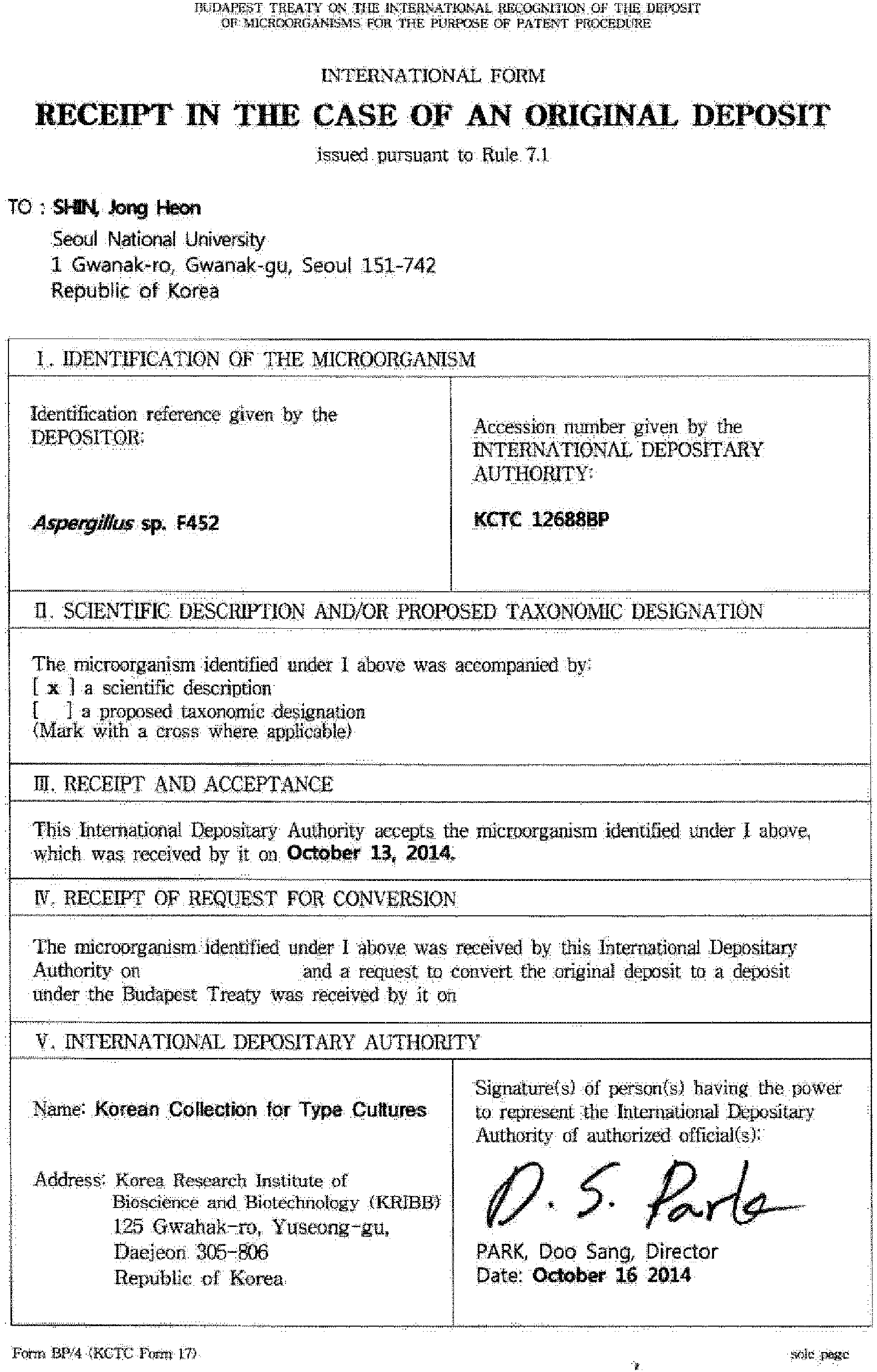

Claims (19)
- A peptide compound or an isomer, a derivative, or a pharmaceutically acceptable salt of the peptide compound, the peptide compound comprising a lipopeptide and a benzophenone.
- The peptide or the isomer, the derivative, or the pharmaceutically acceptable salt of the peptide compound of claim 1, wherein the lipopeptide comprises a lipid and a peptide that are linked via an amide bond.
- The peptide or the isomer, the derivative, or the pharmaceutically acceptable salt of the peptide compound of claim 2, wherein the lipid is a substituted or unsubstituted C1-C20 alkyl group, a substituted or unsubstituted C2-C20 alkenyl group, or a substituted or unsubstituted C2-C20 alkynyl group.
- The peptide or the isomer, the derivative, or the pharmaceutically acceptable salt of the peptide compound of claim 2, wherein the peptide comprises two, three, or four or more amino acids.
- The peptide or the isomer, the derivative, or the pharmaceutically acceptable salt of the peptide compound of claim 2, wherein the peptide comprises beta(β)-amino acid.
- The peptide or the isomer, the derivative, or the pharmaceutically acceptable salt of the peptide compound of claim 1, wherein the benzophenone is substituted with one or more hydroxyl groups.
- The peptide or the isomer, the derivative, or the pharmaceutically acceptable salt of the peptide compound of claim 1, wherein the lipopeptide and the benzophenone are linked via a ketone linkage.
- The peptide or the isomer, the derivative, or the pharmaceutically acceptable salt of the peptide compound of claim 1, wherein the peptide compound comprises the benzophenone at a C-terminal of the lipopeptide.
- The peptide or the isomer, the derivative, or the pharmaceutically acceptable salt of the peptide compound of claim 1, wherein the peptide compound is represented by Formula 1.
 In Formula 1, R1 is a substituted or unsubstituted C1-C20 alkyl group, a substituted or unsubstituted C1-C20 alkenyl group, or a substituted or unsubstituted C1-C20 alkynyl group, wherein R1 is selectively unsubstituted or substituted with a hydroxyl group,R2, R3, and R4 are each indendently hydrogen, a hydroxyl group, a halogen group, a cyano group, -C(=O)Ra, -C(=O)ORa, -OCO(ORa), -C=N(Ra), -SRa, -S(=O)Ra, -S(=O)2Ra, -PRa, a substituted or unsubstituted C1-C20 alkyl group, a substituted or unsubstituted C1-C20 alkoxy group, a sbstituted or unsubstitute du C2-C20 alkenyl group, a substituted or unsubstituted C2-C20 alkynyl group, a C2-C20 alkylene oxide group, a substituted or unsubstituted C3-C30 cycloalkyl group, a subsubstituted or unsubstituted C6-C30 aryl group, a substituted or unsubstituted C6-C30 aryloxy group, a substituted or unsubstituted C6-C30 heteroaryl gorup, or a combination thereof, andR5 is a substituted or unsubstituted benzophenone.
 - The peptide or the isomer, the derivative, or the pharmaceutically acceptable salt of the peptide compound of claim 1, wherein the peptide compound is represented by Formula 2:

- The peptide or the isomer, the derivative, or the pharmaceutically acceptable salt of the peptide compound of claim 10, wherein the compound represented by Formula 2 is represented by Formula 3 or 4:


- A strain F452 (assession number: KCTC12688BP) of Aspergillus sp. producing a peptide compound comprising a lipopeptide and a benzophenone.
- A method of producing a peptide compound comprising a lipopeptide and a benzophenone, the method comprising:culturing a strain F452 (Accession Number: KCTC12688BP) of Aspergillus sp.; andseparating a peptide compound including a lipopeptide and a benzophenone from a culture medium.
- A pharmaceutical compound for preventing or treating cancer, the pharmaceutical composition comprising a peptide compound comprising a lipopeptide and a benzophenone, or an isomer, a derivative, or a pharmaceutically acceptable salt of the peptide compound.
- The pharmaceutical composition of claim 14, wherein the cancer is lung cancer, colon cancer, stomach cancer, liver cancer, or breast cancer.
- The pharmaceutical composition of claim 14, further comprising an anticancer drug.
- The pharmaceutical composition of claim 16, wherein the anticancer drug is irinotecan, 5-fluorouracil, gemsitabin, etoposide, paclitaxel, or a combination thereof.
- The pharmaceutical composition of claim 16, wherein the pharmaceutical composition is a single composition or a separate composition.
- A method of preventing or treating cancer, the method comprising administering a pharmaceutical composition into an individual, wherein the pharmaceutical composition comprises a peptide compound comprising a lipopeptide and a benzophenone, or an isomer, a derivative, or a pharmaceutically acceptable salt of the peptide compound.
Applications Claiming Priority (3)
| Application Number | Priority Date | Filing Date | Title |
|---|---|---|---|
| KR20140144427 | 2014-10-23 | ||
| KR1020150095365A KR101723649B1 (en) | 2014-10-23 | 2015-07-03 | Novel peptide compound, a preparing method thereof, and a use thereof |
| PCT/KR2015/011281 WO2016064245A1 (en) | 2014-10-23 | 2015-10-23 | Novel peptide compound, production method therefor, and use thereof |
Publications (2)
| Publication Number | Publication Date |
|---|---|
| EP3222629A1 true EP3222629A1 (en) | 2017-09-27 |
| EP3222629A4 EP3222629A4 (en) | 2018-10-17 |
Family
ID=56022631
Family Applications (1)
| Application Number | Title | Priority Date | Filing Date |
|---|---|---|---|
| EP15851785.4A Withdrawn EP3222629A4 (en) | 2014-10-23 | 2015-10-23 | Novel peptide compound, production method therefor, and use thereof |
Country Status (4)
| Country | Link |
|---|---|
| US (2) | US10618934B2 (en) |
| EP (1) | EP3222629A4 (en) |
| KR (1) | KR101723649B1 (en) |
| CN (1) | CN107108693B (en) |
Families Citing this family (3)
| Publication number | Priority date | Publication date | Assignee | Title |
|---|---|---|---|---|
| KR101723649B1 (en) | 2014-10-23 | 2017-04-06 | 서울대학교산학협력단 | Novel peptide compound, a preparing method thereof, and a use thereof |
| EP3882256A4 (en) | 2018-11-12 | 2022-08-10 | CJ Cheiljedang Corporation | Method for producing n-acetyl dipeptide and n-acetyl amino acid |
| KR102599650B1 (en) | 2020-11-12 | 2023-11-08 | 서울대학교산학협력단 | Novel lipopeptide compound, a preparing method, and a use thereof |
Family Cites Families (6)
| Publication number | Priority date | Publication date | Assignee | Title |
|---|---|---|---|---|
| CA2529125A1 (en) * | 2003-06-19 | 2004-12-23 | Yeda Research & Development Co. Ltd. | Antimicrobial and anticancer lipopeptides |
| JP2008519848A (en) * | 2004-11-12 | 2008-06-12 | キュービスト ファーマシューティカルズ, インコーポレイテッド | Anti-infective lipopeptide |
| WO2008070357A2 (en) * | 2006-10-31 | 2008-06-12 | Government Of The United States Of America, Represented By The Secretary, Department Of Health And Human Services | Smoothened polypeptides and methods of use |
| WO2008120235A1 (en) | 2007-03-30 | 2008-10-09 | Council Of Scientific & Industrial Research | Novel benzophenone hybrids as potential anticancer agents and a process for the preparation thereof |
| US9045401B2 (en) | 2007-05-21 | 2015-06-02 | The Regents Of The University Of California | Methods for treating or ameliorating a melanoma and killing melanoma cells |
| KR101723649B1 (en) | 2014-10-23 | 2017-04-06 | 서울대학교산학협력단 | Novel peptide compound, a preparing method thereof, and a use thereof |
-
2015
- 2015-07-03 KR KR1020150095365A patent/KR101723649B1/en active Active
- 2015-10-23 CN CN201580070797.5A patent/CN107108693B/en active Active
- 2015-10-23 US US15/521,222 patent/US10618934B2/en active Active
- 2015-10-23 EP EP15851785.4A patent/EP3222629A4/en not_active Withdrawn
-
2020
- 2020-02-28 US US16/805,423 patent/US10759831B2/en active Active
Also Published As
| Publication number | Publication date |
|---|---|
| CN107108693A (en) | 2017-08-29 |
| EP3222629A4 (en) | 2018-10-17 |
| US10618934B2 (en) | 2020-04-14 |
| CN107108693B (en) | 2021-10-15 |
| US20180079780A1 (en) | 2018-03-22 |
| KR20160047976A (en) | 2016-05-03 |
| US20200190140A1 (en) | 2020-06-18 |
| US10759831B2 (en) | 2020-09-01 |
| KR101723649B1 (en) | 2017-04-06 |
Similar Documents
| Publication | Publication Date | Title |
|---|---|---|
| US10759831B2 (en) | Peptide compound, production method therefor, and use thereof | |
| CN102151261A (en) | Use of [3.2.0] heterocyclic compounds and analogs thereof for the treatment of cancer, inflammation and infectious diseases | |
| KR101522625B1 (en) | Novel cyclic peptide compound, a use thereof, and a preparing method thereof | |
| AU2005311572A1 (en) | Methods of using (3.2.0) heterocyclic compounds and analogs thereof | |
| KR101119561B1 (en) | Microorganism of Fusarium genus producing cyclic pentadepsipeptides | |
| KR101957632B1 (en) | Composition for preventing, improving or treating of fibrosis | |
| US11098052B2 (en) | 4-azapodophylotoxins compounds | |
| US11174291B2 (en) | Silstatin compounds | |
| EP4105226A1 (en) | Cyclic peptide compound containing piperazic acid, method of producing same, and uses of same | |
| KR102342719B1 (en) | Antibacterial composition comprising of Micromonospora sp. as effective component | |
| JP2009286705A (en) | Alkylcoumarins of new antitumor substance and use thereof | |
| JP5053444B2 (en) | Cyclic pentadepsipeptides and Fusarium microorganisms producing them | |
| KR20160146414A (en) | Amide-based derivative compound, preparing method and use thereof | |
| US7470714B2 (en) | GM-95-containing antitumor effect potentiator, combined antitumor preparation and antitumor agent | |
| US20260001911A1 (en) | Cyclic peptide compound containing piperazic acid, method of producing same, and uses of same | |
| KR102301151B1 (en) | Peptide compound, a preparing method thereof, and a use thereof | |
| KR101418059B1 (en) | Composition for anti cancer comprising extract from hoo bak | |
| KR102599650B1 (en) | Novel lipopeptide compound, a preparing method, and a use thereof | |
| KR20110139593A (en) | Pharmaceutical composition for the prevention and treatment of cancer containing Komycin-A as an active ingredient | |
| KR20250126986A (en) | New spiroketal macrolide compounds, preparing method and use thereof | |
| WO2016064245A1 (en) | Novel peptide compound, production method therefor, and use thereof | |
| KR20170089822A (en) | A composition for preventing or treating lung cancer comprising atranorin or salt thereof as an active ingredient | |
| KR100507814B1 (en) | Anticancer Drug Comprising Dihydrohinokiflavone or Their Pharmaceutically Acceptable Salt as an Active Ingredient | |
| JPWO2016052656A1 (en) | Novel compound, method for producing the same, and use thereof | |
| WO2014030597A1 (en) | Novel compound and method for producing same, novel microorganism, pharmaceutical composition, and anti-tumor agent |
Legal Events
| Date | Code | Title | Description |
|---|---|---|---|
| STAA | Information on the status of an ep patent application or granted ep patent |
Free format text: STATUS: THE INTERNATIONAL PUBLICATION HAS BEEN MADE |
|
| PUAI | Public reference made under article 153(3) epc to a published international application that has entered the european phase |
Free format text: ORIGINAL CODE: 0009012 |
|
| STAA | Information on the status of an ep patent application or granted ep patent |
Free format text: STATUS: REQUEST FOR EXAMINATION WAS MADE |
|
| 17P | Request for examination filed |
Effective date: 20170523 |
|
| AK | Designated contracting states |
Kind code of ref document: A1 Designated state(s): AL AT BE BG CH CY CZ DE DK EE ES FI FR GB GR HR HU IE IS IT LI LT LU LV MC MK MT NL NO PL PT RO RS SE SI SK SM TR |
|
| AX | Request for extension of the european patent |
Extension state: BA ME |
|
| RAP1 | Party data changed (applicant data changed or rights of an application transferred) |
Owner name: INTRON BIOTECHNOLOGY, INC. |
|
| DAV | Request for validation of the european patent (deleted) | ||
| DAX | Request for extension of the european patent (deleted) | ||
| RIC1 | Information provided on ipc code assigned before grant |
Ipc: A61K 47/50 20170101ALI20180524BHEP Ipc: A61K 38/06 20060101AFI20180524BHEP Ipc: C07K 5/00 20060101ALI20180524BHEP Ipc: C12R 1/66 20060101ALI20180524BHEP Ipc: A61P 35/00 20060101ALI20180524BHEP Ipc: C12N 1/14 20060101ALI20180524BHEP Ipc: C07C 49/786 20060101ALI20180524BHEP Ipc: A61K 38/07 20060101ALI20180524BHEP Ipc: A61K 31/12 20060101ALI20180524BHEP Ipc: A61K 45/06 20060101ALI20180524BHEP |
|
| RIC1 | Information provided on ipc code assigned before grant |
Ipc: C12R 1/66 20060101ALI20180531BHEP Ipc: C07K 5/00 20060101ALI20180531BHEP Ipc: A61K 47/50 20170101ALI20180531BHEP Ipc: C07C 49/786 20060101ALI20180531BHEP Ipc: A61K 38/06 20060101AFI20180531BHEP Ipc: A61K 31/12 20060101ALI20180531BHEP Ipc: A61K 38/07 20060101ALI20180531BHEP Ipc: C12N 1/14 20060101ALI20180531BHEP Ipc: A61P 35/00 20060101ALI20180531BHEP Ipc: A61K 45/06 20060101ALI20180531BHEP |
|
| A4 | Supplementary search report drawn up and despatched |
Effective date: 20180914 |
|
| RIC1 | Information provided on ipc code assigned before grant |
Ipc: A61P 35/00 20060101ALI20180911BHEP Ipc: A61K 45/06 20060101ALI20180911BHEP Ipc: C12R 1/66 20060101ALI20180911BHEP Ipc: A61K 38/07 20060101ALI20180911BHEP Ipc: A61K 47/50 20170101ALI20180911BHEP Ipc: A61K 31/12 20060101ALI20180911BHEP Ipc: C12N 1/14 20060101ALI20180911BHEP Ipc: C07C 49/786 20060101ALI20180911BHEP Ipc: A61K 38/06 20060101AFI20180911BHEP Ipc: C07K 5/00 20060101ALI20180911BHEP |
|
| STAA | Information on the status of an ep patent application or granted ep patent |
Free format text: STATUS: EXAMINATION IS IN PROGRESS |
|
| 17Q | First examination report despatched |
Effective date: 20200220 |
|
| REG | Reference to a national code |
Ref country code: DE Ref legal event code: R079 Free format text: PREVIOUS MAIN CLASS: C07K0005000000 Ipc: A61K0038060000 |
|
| RIC1 | Information provided on ipc code assigned before grant |
Ipc: C12R 1/66 19800101ALI20230105BHEP Ipc: C07K 5/02 19850101ALI20230105BHEP Ipc: A61K 31/165 19740701ALI20230105BHEP Ipc: A61K 38/00 19950101ALI20230105BHEP Ipc: A61K 38/07 19950101ALI20230105BHEP Ipc: C07K 5/00 19850101ALI20230105BHEP Ipc: C07C 49/786 19800101ALI20230105BHEP Ipc: A61K 31/12 19740701ALI20230105BHEP Ipc: C12N 1/14 19800101ALI20230105BHEP Ipc: A61K 47/50 20170101ALI20230105BHEP Ipc: A61K 45/06 19740701ALI20230105BHEP Ipc: A61P 35/00 20000101ALI20230105BHEP Ipc: A61K 38/06 19950101AFI20230105BHEP |
|
| GRAP | Despatch of communication of intention to grant a patent |
Free format text: ORIGINAL CODE: EPIDOSNIGR1 |
|
| STAA | Information on the status of an ep patent application or granted ep patent |
Free format text: STATUS: GRANT OF PATENT IS INTENDED |
|
| INTG | Intention to grant announced |
Effective date: 20230227 |
|
| STAA | Information on the status of an ep patent application or granted ep patent |
Free format text: STATUS: THE APPLICATION IS DEEMED TO BE WITHDRAWN |
|
| 18D | Application deemed to be withdrawn |
Effective date: 20230711 |