EP3221307B1 - Novel 1,3,5 -triazine based pi3k inhibitors as anticancer agents and a process for the preparation thereof - Google Patents
Novel 1,3,5 -triazine based pi3k inhibitors as anticancer agents and a process for the preparation thereof Download PDFInfo
- Publication number
- EP3221307B1 EP3221307B1 EP15820891.8A EP15820891A EP3221307B1 EP 3221307 B1 EP3221307 B1 EP 3221307B1 EP 15820891 A EP15820891 A EP 15820891A EP 3221307 B1 EP3221307 B1 EP 3221307B1
- Authority
- EP
- European Patent Office
- Prior art keywords
- compound
- triazin
- piperidin
- morpholino
- benzo
- Prior art date
- Legal status (The legal status is an assumption and is not a legal conclusion. Google has not performed a legal analysis and makes no representation as to the accuracy of the status listed.)
- Active
Links
- 0 CC[C@](C)C[C@](C)[C@](C[C@](C)[C@](C)C(C)C)*C(CC1)CCN1c1nc(N2CCOCC2)nc(N(*)*)n1 Chemical compound CC[C@](C)C[C@](C)[C@](C[C@](C)[C@](C)C(C)C)*C(CC1)CCN1c1nc(N2CCOCC2)nc(N(*)*)n1 0.000 description 6
- MYOCQYFKHDQOGK-UHFFFAOYSA-N C(CN(CC1)c2nc(N3CCOCC3)nc(N(c3ccccc3)c3ccccc3)n2)C1Oc1ccccc1 Chemical compound C(CN(CC1)c2nc(N3CCOCC3)nc(N(c3ccccc3)c3ccccc3)n2)C1Oc1ccccc1 MYOCQYFKHDQOGK-UHFFFAOYSA-N 0.000 description 1
- XUBKORDYTULPDS-UHFFFAOYSA-N FC(c1nc(cccc2)c2[n]1-c1nc(N(CC2)CCC2N(c(cc2)ccc2F)c(cc2)ccc2Br)nc(N2CCOCC2)n1)F Chemical compound FC(c1nc(cccc2)c2[n]1-c1nc(N(CC2)CCC2N(c(cc2)ccc2F)c(cc2)ccc2Br)nc(N2CCOCC2)n1)F XUBKORDYTULPDS-UHFFFAOYSA-N 0.000 description 1
- HDBVCXHDKPMOSI-UHFFFAOYSA-N O=C(C(F)(F)F)N(C(C(F)(F)F)=O)c1nc(N(CC2)CCC2Oc(cc2)ccc2F)nc(N2CCOCC2)n1 Chemical compound O=C(C(F)(F)F)N(C(C(F)(F)F)=O)c1nc(N(CC2)CCC2Oc(cc2)ccc2F)nc(N2CCOCC2)n1 HDBVCXHDKPMOSI-UHFFFAOYSA-N 0.000 description 1
Images


Classifications
-
- C—CHEMISTRY; METALLURGY
- C07—ORGANIC CHEMISTRY
- C07D—HETEROCYCLIC COMPOUNDS
- C07D401/00—Heterocyclic compounds containing two or more hetero rings, having nitrogen atoms as the only ring hetero atoms, at least one ring being a six-membered ring with only one nitrogen atom
- C07D401/14—Heterocyclic compounds containing two or more hetero rings, having nitrogen atoms as the only ring hetero atoms, at least one ring being a six-membered ring with only one nitrogen atom containing three or more hetero rings
-
- A—HUMAN NECESSITIES
- A61—MEDICAL OR VETERINARY SCIENCE; HYGIENE
- A61K—PREPARATIONS FOR MEDICAL, DENTAL OR TOILETRY PURPOSES
- A61K31/00—Medicinal preparations containing organic active ingredients
- A61K31/33—Heterocyclic compounds
- A61K31/395—Heterocyclic compounds having nitrogen as a ring hetero atom, e.g. guanethidine or rifamycins
- A61K31/495—Heterocyclic compounds having nitrogen as a ring hetero atom, e.g. guanethidine or rifamycins having six-membered rings with two or more nitrogen atoms as the only ring heteroatoms, e.g. piperazine or tetrazines
- A61K31/505—Pyrimidines; Hydrogenated pyrimidines, e.g. trimethoprim
- A61K31/519—Pyrimidines; Hydrogenated pyrimidines, e.g. trimethoprim ortho- or peri-condensed with heterocyclic rings
-
- A—HUMAN NECESSITIES
- A61—MEDICAL OR VETERINARY SCIENCE; HYGIENE
- A61K—PREPARATIONS FOR MEDICAL, DENTAL OR TOILETRY PURPOSES
- A61K31/00—Medicinal preparations containing organic active ingredients
- A61K31/33—Heterocyclic compounds
- A61K31/395—Heterocyclic compounds having nitrogen as a ring hetero atom, e.g. guanethidine or rifamycins
- A61K31/53—Heterocyclic compounds having nitrogen as a ring hetero atom, e.g. guanethidine or rifamycins having six-membered rings with three nitrogens as the only ring hetero atoms, e.g. chlorazanil, melamine
-
- A—HUMAN NECESSITIES
- A61—MEDICAL OR VETERINARY SCIENCE; HYGIENE
- A61P—SPECIFIC THERAPEUTIC ACTIVITY OF CHEMICAL COMPOUNDS OR MEDICINAL PREPARATIONS
- A61P35/00—Antineoplastic agents
-
- A—HUMAN NECESSITIES
- A61—MEDICAL OR VETERINARY SCIENCE; HYGIENE
- A61P—SPECIFIC THERAPEUTIC ACTIVITY OF CHEMICAL COMPOUNDS OR MEDICINAL PREPARATIONS
- A61P43/00—Drugs for specific purposes, not provided for in groups A61P1/00-A61P41/00
-
- C—CHEMISTRY; METALLURGY
- C07—ORGANIC CHEMISTRY
- C07D—HETEROCYCLIC COMPOUNDS
- C07D401/00—Heterocyclic compounds containing two or more hetero rings, having nitrogen atoms as the only ring hetero atoms, at least one ring being a six-membered ring with only one nitrogen atom
- C07D401/02—Heterocyclic compounds containing two or more hetero rings, having nitrogen atoms as the only ring hetero atoms, at least one ring being a six-membered ring with only one nitrogen atom containing two hetero rings
- C07D401/04—Heterocyclic compounds containing two or more hetero rings, having nitrogen atoms as the only ring hetero atoms, at least one ring being a six-membered ring with only one nitrogen atom containing two hetero rings directly linked by a ring-member-to-ring-member bond
-
- A—HUMAN NECESSITIES
- A61—MEDICAL OR VETERINARY SCIENCE; HYGIENE
- A61K—PREPARATIONS FOR MEDICAL, DENTAL OR TOILETRY PURPOSES
- A61K2300/00—Mixtures or combinations of active ingredients, wherein at least one active ingredient is fully defined in groups A61K31/00 - A61K41/00
-
- A—HUMAN NECESSITIES
- A61—MEDICAL OR VETERINARY SCIENCE; HYGIENE
- A61K—PREPARATIONS FOR MEDICAL, DENTAL OR TOILETRY PURPOSES
- A61K39/00—Medicinal preparations containing antigens or antibodies
- A61K39/395—Antibodies; Immunoglobulins; Immune serum, e.g. antilymphocytic serum
- A61K39/39533—Antibodies; Immunoglobulins; Immune serum, e.g. antilymphocytic serum against materials from animals
- A61K39/39558—Antibodies; Immunoglobulins; Immune serum, e.g. antilymphocytic serum against materials from animals against tumor tissues, cells, antigens
Definitions
- the class I PI3Ks are the most extensively studied among lipid kinases, are heterodimeric proteins; each containing a smaller regulatory domain and a larger 110 kDa catalytic domain, which occur in four isoforms differentiated as p110 ⁇ , p110 ⁇ , p110 ⁇ , and p110 ⁇ ( Walker et al., Mol. Cell 2000, 6, 909 ). Moreover, Isoform selective inhibitors capable of attenuating PI3K signalling should have significant therapeutic potential for the treatment of cancer, inflammatory ( Barber et al., Nat. Med. 2005, 11, 933 ), cardiovascular diseases and autoimmune disorders.
- PI3K isoform inhibitors In the last decade, many small molecules have been discovered as PI3K isoform inhibitors and presenting the new opportunities as therapeutic agents. Some of the small molecules are presently in either phase I or II clinical trial against different type of cancers. Examples includes NVP-BEZ235 developed by Novartis, ( Garcia-Echeverria et al., WO2006/ 122806A2 ), NVP-BGT226 developed by Novartis, ( Kwang et al., Clin cancer res. 2011, 17(22), 7114 ), XL-147, XL-765 developed by Exelixis, ( P. Wu et al., Eur. J. Med. Chem.
- the main object of the present invention is to provide 1,3,5-substituted triazine containing heterocyclic compounds as anti-cancer agents. Still another object of the present invention is to provide a process for the preparation of novel 1,3,5 -substituted based compounds. Yet another object of the present invention is to provide the 1,3,5-substituted triazine containing heterocyclic compounds for use in the treatment of cancer
- the present invention relates to 1,3,5-substituted triazine containing heterocyclic compounds, their method of preparation and their use as drugs for treating cancer.
- substituent 'S 1 ' is selected from one of the formula Ia or Ib and substituent 'S 2 ' selected from the group consisting of 1c 'X' is independently selected from any of NR 3 , O, CH 2 , 'R 1 , R 2 ' are independently selected from any of un/substituted alkyl C 1 -C 14 , un/substituted acyl C 2 to C 14 , un/substituted phenyl ring and further substitution contains any of the following atoms or groups such as F, Cl, Br, I, CN, NR 4 R 5 , CF 3 , CHCF 2 , CH 2 F, OCF 3 , OCH 2 CF 3 , OR 6 , NO 2 , NO, CHR 7 R 8 , alky
- a preferred subclass have following formulas 1A or 1B belong to general formula 1 'X' is independently selected from any of NR 3 , O, CH 2 , 'R 1 , R 2 ,' are independently selected from any of following atom or groups un/substituted alkyl C 1 -C 14 , un/substituted acyl C 2 to C 14 , un/substituted phenyl ring, un/substituted heterocycles and further substitution contains any of the following atoms or groups such as F, Cl, Br, I, CN, NR 4 R 5 , CF 3 , CHCF 2 , CH 2 F, OCF 3 , OCH 2 CF 3 , OR 6 , NO 2 , NO, CHR 7 R 8 , alkyl chain from C 1 to C 14 , COOR 9 , CHO, COR 10 , COCF 3 , COCH 2 CF 3 , SR 11 , SOR 12 , SO 2 R 13 , SONR
- a process for the preparation of the compounds of general formula 1 comprises the following steps:
- a preferred subclass have following formulas 1A or 1B belong to general formula 1 'X' is independently selected from any of NR 3 , O, CH 2 , 'R 1 , R 2 ' are independently selected from any of following atom or groups un/substituted alkyl C 1 -C 14 , un/substituted acyl C 2 to C 14 , un/substituted phenyl ring, un/substituted heterocycles and further substitution contains any of the following atoms or groups such as F, Cl, Br, I, CN, NR 4 R 5 , CF 3 , CHCF 2 , CH 2 F, OCF 3 , OCH 2 CF 3 , OR 6 , NO 2 , NO, CHR 7 R 8 , alkyl chain from C 1 to C 14 , COOR 9 , CHO, COR 10 , COCF 3 COCH 2 CF 3 , SR 11 , SOR 12 , SO 2 R 13 , SONR 14 R 15
- the compound of general formula 1 is useful as anti-cancer agent.
- the compounds of formula 1A and 1B of general formula 1 inhibit PI3K ⁇ isoform.
- the compounds of formula 1A and 1B of general formula 1 exhibit an in vitro cancer cell line activity.
- Suitable acids for the preparation of the pharmaceutically acceptable salts are not limited to hydrochloric acid, sulphuric acid, phosphoric acid, acetic acid, citric acid, oxalic acid, malonic acid, salyilic acid, malic acid, fumaric acid, succinic acid, ascorbic acid, maleic acid and methanesulfonic acid, boric acid, galactaric acid, gentisic acid, glucoheptonoic acid, D-gluconic acid, D-glucuronic acid, glycolic acid, hyppuric acid.
- the present invention relates to the most highly preferred of the compounds of formula 1A and 1B, comprising of:
- Cynuric chloride (1) (10g, 54.2 mmol, 1.0 eq) was substituted by morpholine (7) (4.72 ml, 5.42 mmol, 1.0 eq) in methylene chloride (60 ml), at -50 °C for 20 min to obtain intermediate (3).
- the intermediate (3) (5 g, 1.0 eq) on further treatment with di-substitued amine (4) (1.4 eq) in presence of K 2 CO 3 (1.44 eq) in DMF (20 ml) , at -5 °C for 30 min and then at room temperature for 4 h led to intermediate (5) .
- Cynuric chloride (1) (10g, 54.2 mmol, 1.0 eq) was substituted by morpholine (7) (4.72 ml, 5.42 mmol, 1.0 eq) in methylene chloride (60 ml), at -50 °C for 20 min to obtain intermediate (3).
- the intermediate (3) (5 g, 1.0 eq) on further treatment with substitued indole (13) (1.4 eq) in presence of K 2 CO 3 (1.44 eq) in DMF (20 ml) , at -5 °C for 30 min and further stirring at room temperature for 4 h led to intermediate (14) .
- Part B Biological Evaluation
- PI3K alpha % of inhibition values of a drug measures the effectiveness of a compound in inhibiting biological or biochemical function.
- the determination of enzyme based % of inhibition values helps in early analysis and estimation of the drug activities in order to narrow down drug candidates for further experimental purpose.
- Human breast cancer cell lines MDAMB231, MFC-7 and human prostate carcinoma cell line PC-3 were obtained from European Collection of Cell Cultures (ECACC).
- Cells were grown in RPMI-1440 medium supplemented with 10% fetal bovine serum (FBS), penicillin (100 units/ml), streptomycin (100 ⁇ g/ml), L-glutamine (0.3 mg/ml), sodium pyruvate (550 mg/ml), and NaHCO 3 (2mg/ml).
- FBS fetal bovine serum
- penicillin 100 units/ml
- streptomycin 100 ⁇ g/ml
- L-glutamine 0.3 mg/ml
- sodium pyruvate 550 mg/ml
- NaHCO 3 2mg/ml
- MTT assay was done to determine the viability of the cells and was done as described previously (Kumar etal, 2013). Briefly, 6 ⁇ 10 3 were seeded in 96 well plates and were treated with different concentrations of different molecules for 5 days. 20 ⁇ l of MTT dye (2.5mg/ml) was added 3 h before the termination of the experiment. Formazen crystals were dissolved in 150 ⁇ l of DMSO and OD was measured at 570 nm.
Landscapes
- Chemical & Material Sciences (AREA)
- Organic Chemistry (AREA)
- Health & Medical Sciences (AREA)
- General Health & Medical Sciences (AREA)
- Veterinary Medicine (AREA)
- Pharmacology & Pharmacy (AREA)
- Life Sciences & Earth Sciences (AREA)
- Animal Behavior & Ethology (AREA)
- Medicinal Chemistry (AREA)
- Public Health (AREA)
- Epidemiology (AREA)
- Chemical Kinetics & Catalysis (AREA)
- General Chemical & Material Sciences (AREA)
- Nuclear Medicine, Radiotherapy & Molecular Imaging (AREA)
- Engineering & Computer Science (AREA)
- Bioinformatics & Cheminformatics (AREA)
- Pharmaceuticals Containing Other Organic And Inorganic Compounds (AREA)
- Plural Heterocyclic Compounds (AREA)
Description
- The present invention relates to
novel general formula 1, which inhibits phosphoinositide 3-kinase (PI3K). The invention also relates to their method of preparation and their use as an agents or drugs for cancer therapy. - At cellular level, phosphoinositide-3-kinase (PI3K) signalling contributes to many important processes, such as cell cycle progression, cell growth, survival and migration and intracellular vesicular transport. The PI3K represents the family of lipid kinases that can be classified into three subfamilies according to structure and substrate specificity viz., class I, class II and class III (Liu et al., Nature review drug discovery, 2009, 8, 627; Courteny et al., J Clin Oncol, 2010, 28, 1075). The class I PI3Ks are the most extensively studied among lipid kinases, are heterodimeric proteins; each containing a smaller regulatory domain and a larger 110 kDa catalytic domain, which occur in four isoforms differentiated as p110α, p110β, p110γ, and p110δ (Walker et al., Mol. Cell 2000, 6, 909). Moreover, Isoform selective inhibitors capable of attenuating PI3K signalling should have significant therapeutic potential for the treatment of cancer, inflammatory (Barber et al., Nat. Med. 2005, 11, 933), cardiovascular diseases and autoimmune disorders. In cancer, evidence suggests that inhibition of the
class 1A PI3 kinase p110α appear to be the most appropriate to target, as in number of cancer, p110α isoform is amplified and activated (Stephens et al., Curr. Opin. Pharmacol. 2005, 5, 357). - In the last decade, many small molecules have been discovered as PI3K isoform inhibitors and presenting the new opportunities as therapeutic agents. Some of the small molecules are presently in either phase I or II clinical trial against different type of cancers. Examples includes NVP-BEZ235 developed by Novartis, (
Garcia-Echeverria et al., WO2006/ 122806A2 ), NVP-BGT226 developed by Novartis, (Kwang et al., Clin cancer res. 2011, 17(22), 7114), XL-147, XL-765 developed by Exelixis, (P. Wu et al., Eur. J. Med. Chem. 2011, 46, 5540), GDC0941 developed by Genentech, (Adrian et al., J. Med. Chem. 2008, 51, 5522), PKI-587 developed by Pfizer, (Mallon et al., Clin cancer res. 2011, 17(10), 3194), GSK1059615 developed by GSK, (Steven D. Knight et al., ACS Med. Chem. Lett. 2010, 1, 39), ZSTK474 developed by Zenyaku kogyo, (Yaguchi et al., J. Natl. Cancer inst. 2006, 98, 545; Kong et al., Cancer sci. 2007, 98, 1439; Gordon et al., J. Med. Chem. 2011, 54, 7105-7126;Gordon et al., WO2010/ 110686A1 ;Vladimir et al., WO2011/ 135520A1 ;Gordon et al., WO2010/ 110685A2 ;Venkatesan et al., WO2009/ 143317A1 ) etc. In spite of having many PI3K inhibitors in pre-clinical and different clinical trials, still there is need for the discovery of new PI3K inhibitors for the treatment of cancer. - The main object of the present invention is to provide 1,3,5-substituted triazine containing heterocyclic compounds as anti-cancer agents. Still another object of the present invention is to provide a process for the preparation of
novel - The present invention relates to 1,3,5-substituted triazine containing heterocyclic compounds, their method of preparation and their use as drugs for treating cancer.

Wherein substituent 'S1' is selected from one of the formula Ia or Ib

'R1, R2' are independently selected from any of un/substituted alkyl C1-C14, un/substituted acyl C2 to C14, un/substituted phenyl ring and further substitution contains any of the following atoms or groups such as F, Cl, Br, I, CN, NR4R5, CF3, CHCF2, CH2F, OCF3, OCH2CF3, OR6, NO2, NO, CHR7R8, alkyl chain from C1 to C14, COOR9, CHO, COR10, COCF3, COCH2CF3, SR11, SOR12, SO2R13, SONR14R15, SO2NR14R17, cycloalkyl etc either mono or di or poly at any of the available position
R3 is independently selected from any of H, un/substituted alkyl C1-C14, un/substituted acyl C2 to C14, un/substituted phenyl ring and further substitution contains any of the following atoms or groups such as F, Cl, Br, I, CN, NR4R5, CF3, CHCF2, CH2F, OCF3, OCH2CF3, OR6, NO2, NO, CHR7R8, alkyl chain from C1 to C14, COOR9, CHO, COR10, COCF3, COCH2CF3, SR11, SOR12, SO2R13, SONR14R15, SO2NR14R17, cycloalkyl etc either mono or di or poly at any of the available position
'Ar' is independently selected from any of un/substituted phenyl, un/ substituted napthyl and attached through any of the available ring position and further substitution selected from any of the following atom or group such as F, Cl, Br, I, CN, NR4R5, CF3, CHCF2, CH2F, OCF3, OCH2CF3, OR6, NO2, NO, CHR7R8, alkyl chain from C1 to C14, COOR9, CHO, COR10, COCF3, COCH2CF3, SR11, SOR12, SO2R13, SONR14R15, SO2NR14R17, cycloalkyl
'Hetero-Ar' is independently selected from any of un/substituted hetrocycles such as pyridyl, triazolyl, triazinyl, pyrimidinyl, pyridazinyl, oxazolyl, furanyl, benzofuranyl, thiophenyl, pyrrolyl, imidazoyl, thiazoyl, quinolinyl, isoquinolinyl, benzooxazolyl, and benzothiazolyl, indolyl, benzotriazolyl, benzoimidazolyl etc and attached through any of the available ring position and further substituted heterocycles contains any of the following atom or group such as F, Cl, Br, I, CN, NR4R5, CF3, CHCF2, CH2F, OCF3, OCH2CF3, OR6, NO2, NO, CHR7R8, alkyl chain from C1 to C14, COOR9, CHO, COR10, COCF3, COCH2CF3, SR11, SOR12, SO2R13, SONR14R15, SO2NR14R17, cycloalkyl
R4, R5, R6, R7, R8, R9, R10, R11, R12, R13, R14, R15, R14 and R17' are independently selected from any of following substitution such as H, linear alkyl chain C1 -C10, branched alkyl chain C3-C10, un/substituted phenyl ring. - A preferred subclass have following
formulas 
'R1, R2,' are independently selected from any of following atom or groups un/substituted alkyl C1-C14, un/substituted acyl C2 to C14, un/substituted phenyl ring, un/substituted heterocycles and further substitution contains any of the following atoms or groups such as F, Cl, Br, I, CN, NR4R5, CF3, CHCF2, CH2F, OCF3, OCH2CF3, OR6, NO2, NO, CHR7R8, alkyl chain from C1 to C14, COOR9, CHO, COR10, COCF3, COCH2CF3, SR11, SOR12, SO2R13, SONR14R15, SO2NR14R17, cycloalkyl etc either mono or di or poly substituted at any of the available position
R3 is independently selected from any of H, un/substituted alkyl C1-C14, un/substituted acyl C2 to C14, un/substituted phenyl ring and further substitution contains any of the following atoms or groups such as F, Cl, Br, I, CN, NR4R5, CF3, CHCF2, CH2F, OCF3, OCH2CF3, OR6, NO2, NO, CHR7R8, alkyl chain from C1 to C14, COOR9, CHO, COR10, COCF3, COCH2CF3, SR11, SOR12, SO2R13, SONR14R15, SO2NR14R17, cycloalkyl either mono or di or poly at any of the available position
'Ar' is independently selected from any of un/substituted phenyl, un/ substituted napthyl etc and attached through any of the available ring position and further substitution selected from any of the following atom or group such as F, Cl, Br, I, CN, NR4R5, CF3, CHCF2, CH2F, OCF3, OCH2CF3, OR6, NO2, NO, CHR7R8, alkyl chain from C1 to C14, COOR9, CHO, COR10, COCF3, COCH2CF3, SR11, SOR12, SO2R13, SONR14R15, SO2NR14R17, cycloalkyl,
'Hetero-Ar' is independently selected from any of un/substituted hetrocycles such as pyridyl, triazolyl, triazinyl, pyrimidinyl, pyridazinyl, oxazolyl, furanyl, benzofuranyl, thiophenyl, pyrrolyl, imidazoyl, thiazoyl, quinolinyl, isoquinolinyl, benzooxazolyl, and benzothiazolyl, indolyl, benzotriazolyl, benzoimidazolyl etc and attached through any of the available ring position and further substituted heterocycles contains any of the following atom or group such as F, Cl, Br, I, CN, NR4R5, CF3, CHCF2, CH2F, OCF3, OCH2CF3, OR6, NO2, NO, CHR7R8, alkyl chain from C1 to C14, COOR9, CHO, COR10, COCF3, COCH2CF3, SR11, SOR12, SO2R13, SONR14R15, SO2NR14R17, cycloalkyl,
R4, R5, R6, R7, R8, R9, R10, R11, R12, R13, R14, R15, R14 and R17' are independently selected from any of following substitution such as H, linear alkyl chain C1 -C10, branched alkyl chain C3-C10, un/substituted phenyl ring. The compounds ofgeneral formula 1 are useful as PI3K anti-cancer agent. - The compounds of
general formula 1 inhibit PI3Kα isoform. - The compounds of
general formula 1 exhibit an in vitro cancer cell line activity. - A process for the preparation of the compounds of
general formula 1 comprises the following steps: - (i) reacting disubstituted triazine compound of
formula formula 1A(1-20) or 1B(1-20) ortrisubstituted triazine compound - (ii) reacting
trisubstituted triazine compound formula 11, wherein FG4 is selected from a group consisting of 4F, 4-CF3, 4-OCH3, 4-Br, 3, 4 DiCl, 2-F, 2-OCH3, 2-CF3, 3-OCH3, 2-CH3, 4-CH3(added) in an organic solvent selected from a group consisting of DCM, DCE, THF, MeOH (added) in presence of acetic acid and a reducing agent selected from a group consisting of sodium triacetoxy borohydride, sodium borohydride (added) at a temperature ranging between 10 °C to 80 °C for a period renging between 1 to 24 hrs, to obtaincompound 1B (21-40) or 1B (46-50) respectively, - (iii) reacting trisubstituted triazine compound 1B21 with substituted aryl boronic acid of
formula 12, wherein FG5 is selected from a group consisting of halogen or CF3, in an organic solvent selected from a group consisting of DCM, DCE, MeOH, CH3CN (added) in presence of triethylamine and copper acetate at a temperature ranging between 10 °C to 80 °C for a period in the range of 1 to 24 hrs, to obtain compound offormula 1B(41-45). -
-
Fig 1 shows the synthetic approach (schemel) for the synthesis ofcompounds 1A (1-20). -
Fig 2 shows the synthetic approach (scheme2) for the synthesis ofcompounds 1B (1-20). -
Fig 3 shows the synthetic approach (scheme3) for the synthesis ofcompounds 1B (20-40). -
Fig 4 shows the synthetic approach (scheme4) for the synthesis ofcompounds 1B (41-45). -
Fig 5 shows the synthetic approach (scheme5) for the synthesis ofcompounds 1B (45-50).- Table 1 shows the structures of representative compounds IA (1-10) belong to formula IA and synthesized as per
scheme 1 provided in (Fig 1 ). - Table 2 shows the structures of representative compounds IA (10-20) belong to formula IA and synthesized as per
scheme 1 provided in (Fig 1 ). - Table 3 shows the structures of representative compounds IB (1-10) belong to formula IB and synthesized as per
scheme 2 provided in (Fig 2 ). - Table 4 shows the structures of representative compounds IB (10-20) belong to formula IB and synthesized as per
scheme 2 provided in (Fig 2 ). - Table 5 shows the structures of representative compounds IB (21-30) belong to formula IB and synthesized as per
scheme 3 provided in (Fig 3 ). - Table 6 shows the structures of representative compounds IB (31-40) belong to formula IB and synthesized as per
scheme 3 provided in (Fig 3 ). - Table 7 shows the structures of representative compounds IB (40-50) belong to formula IB and synthesized as per
scheme 4 andscheme 5 provided in (Fig 4 &Fig 5 ). - Table 8 shows the inhibition results of compounds
general formula 1 by enzyme based assay PI3Kα. *In vitro PI3K alpha kinase inhibition at 500nm; + indicates greater than 50% to 70% of inhibition and ++ indicates greater than 70% of inhibition. - Table 9 shows the inhibition results of compounds of
general formula 1 by MTT assay on cancer cell line *In vitro cell line inhibition at 10µM: + indicates 30% to 50% of inhibition and ++ indicates greater than 50% of inhibition.
- Table 1 shows the structures of representative compounds IA (1-10) belong to formula IA and synthesized as per
- The present disclosure relates to newer generation of triazine based compounds, their method of preparation and to their use as drugs for treating cancer.


Wherein substituent 'S1' is selected from one of the formula Ia or Ib

'R1, R2' are independently selected from any of un/substituted alkyl C1-C14, un/substituted acyl C2 to C14, un/substituted phenyl ring and further substitution contains any of the following atoms or groups such as F, Cl, Br, I, CN, NR4R5, CF3, CHCF2, CH2F, OCF3, OCH2CF3, OR6, NO2, NO, CHR7R8, alkyl chain from C1 to C14, COOR9, CHO, COR10, COCF3, COCH2CF3, SR11, SOR12, SO2R13, SONR14R15, SO2NR14R17, cycloalkyl etc either mono or di or poly at any of the available position
R3 is independently selected from any of H, un/substituted alkyl C1-C14, un/substituted acyl C2 to C14, un/substituted phenyl ring and further substitution contains any of the following atoms or groups such as F, Cl, Br, I, CN, NR4R5, CF3, CHCF2, CH2F, OCF3, OCH2CF3, OR6, NO2, NO, CHR7R8, alkyl chain from C1 to C14, COOR9, CHO, COR10, COCF3, COCH2CF3, SR11, SOR12, SO2R13, SONR14R15, SO2NR14R17, cycloalkyl etc either mono or di or poly at any of the available position
'Ar' is independently selected from any of un/substituted phenyl, un/ substituted napthyl etc and attached through any of the available ring position and further substitution selected from any of the following atom or group such as F, Cl, Br, I, CN, NR4R5, CF3, CHCF2, CH2F, OCF3, OCH2CF3, OR6, NO2, NO, CHR7R8, alkyl chain from C1 to C14, COOR9, CHO, COR10, COCF3, COCH2CF3, SR11, SOR12, SO2R13, SONR14R15, SO2NR14R17, cycloalkyl,
'Hetero-Ar' is independently selected from any of un/substituted hetrocycles such as pyridyl, triazolyl, triazinyl, pyrimidinyl, pyridazinyl, oxazolyl, furanyl, benzofuranyl, thiophenyl, pyrrolyl, imidazoyl, thiazoyl, quinolinyl, isoquinolinyl, benzooxazolyl, and benzothiazolyl, indolyl, benzotriazolyl, benzoimidazolyl etc and attached through any of the available ring position and further substituted heterocycles contains any of the following atom or group such as F, Cl, Br, I, CN, NR4R5, CF3, CHCF2, CH2F, OCF3, OCH2CF3, OR6, NO2, NO, CHR7R8, alkyl chain from C1 to C14, COOR9, CHO, COR10, COCF3, COCH2CF3, SR11, SOR12, SO2R13, SONR14R15, SO2NR14R17, cycloalkyl,
R4, R5, R6, R7, R8, R9, R10, R11, R12, R13, R14, R15, R14 and R17' are independently selected from any of following substitution such as H, linear alkyl chain C1-C10, branched alkyl chain C3-C10, un/substituted phenyl ring. - A preferred subclass have following
formulas 
'R1, R2' are independently selected from any of following atom or groups un/substituted alkyl C1-C14, un/substituted acyl C2 to C14, un/substituted phenyl ring, un/substituted heterocycles and further substitution contains any of the following atoms or groups such as F, Cl, Br, I, CN, NR4R5, CF3, CHCF2, CH2F, OCF3, OCH2CF3, OR6, NO2, NO, CHR7R8, alkyl chain from C1 to C14, COOR9, CHO, COR10, COCF3 COCH2CF3, SR11, SOR12, SO2R13, SONR14R15, SO2NR14R17, cycloalkyl etc either mono or di or poly substituted at any of the available position
R3 is independently selected from any of following atom or groups H, un/substituted alkyl C1-C14, un/substituted acyl C2 to C14, un/substituted phenyl ring, un/substituted heterocycles and further substitution contains any of the following atoms or groups such as F, Cl, Br, I, CN, NR4R5, CF3, CHCF2, CH2F, OCF3, OCH2CF3, OR6, NO2, NO, CHR7R8, alkyl chain from C1 to C14, COOR9, CHO, COR10, COCF3 COCH2CF3, SR11, SOR12, SO2R13, SONR14R15, SO2NR14R17, cycloalkyl etc either mono or di or poly substituted at any of the available position
'Ar' is independently selected from any of un/substituted phenyl, un/ substituted napthyl etc and attached through any of the available ring position and further substitution selected from any of the following atom or group such as F, Cl, Br, I, CN, NR4R5, CF3, CHCF2, CH2F, OCF3, OCH2CF3, OR6, NO2, NO, CHR7R8, alkyl chain from C1 to C14, COOR9, CHO, COR10, COCF3, COCH2CF3, SR11, SOR12, SO2R13, SONR14R15, SO2NR14R17, cycloalkyl,
'Hetero-Ar' is independently selected from any of un/substituted hetrocycles such as pyridyl, triazolyl, triazinyl, pyrimidinyl, pyridazinyl, oxazolyl, furanyl, benzofuranyl, thiophenyl, pyrrolyl, imidazoyl, thiazoyl, quinolinyl, isoquinolinyl, benzooxazolyl, and benzothiazolyl, indolyl, benzotriazolyl, benzoimidazolyl etc and attached through any of the available ring position and further substituted heterocycles contains any of the following atom or group such as F, Cl, Br, I, CN, NR4R5, CF3, CHCF2, CH2F, OCF3, OCH2CF3, OR6, NO2, NO, CHR7R8, alkyl chain from C1 to C14, COOR9, CHO, COR10, COCF3, COCH2CF3, SR11, SOR12, SO2R13, SONR14R15, SO2NR14R17, cycloalkyl,
R4, R5, R6, R7, R8, R9, R10, R11, R12, R13, R14, R15, R14 and R17' are independently selected from any of following substitution such as H, linear alkyl chain C1-C10, branched alkyl chain C3-C10, un/substituted phenyl ring. - The compound of
general formula 1 is useful as anti-cancer agent. - The compounds of
formula general formula 1 inhibit PI3K α isoform. - The compounds of
formula general formula 1 exhibit an in vitro cancer cell line activity. - The compound of
formula 1A ofgeneral formula 1, wherein said compounds prepared by reacting di-substituted triazine compounds of formula (5) with substituted aryloxy piperidines (6) in an organic solvent N,N-dimethylformamide, in the presence of base potassium carbonate at a room temperature for 24 hrs to obtain the compounds of 1A (1-20) ofgeneral formula 1. - The compound of
formula 1B ofgeneral formula 1, wherein said compounds prepared by reacting di-substituted triazine compounds of formula (8) with substituted aryloxy piperidines (6) in an organic solvent N,N-dimethylformamide in the presence of potassium carbonate at a room temperature for 24 hrs to obtain the compounds of 1B (1-20) ofgeneral formula 1. - These compounds, as well as mixtures thereof, isomers, physiologically functionally salt derivatives and drugs thereof, are useful in prevention of or therapy for treating cancer.
Suitable acids for the preparation of the pharmaceutically acceptable salts, but are not limited to hydrochloric acid, sulphuric acid, phosphoric acid, acetic acid, citric acid, oxalic acid, malonic acid, salyilic acid, malic acid, fumaric acid, succinic acid, ascorbic acid, maleic acid and methanesulfonic acid, boric acid, galactaric acid, gentisic acid, glucoheptonoic acid, D-gluconic acid, D-glucuronic acid, glycolic acid, hyppuric acid. - Suitable bases for the preparation of the pharmaceutically acceptable salts, but are not limited to sodium hydroxide, potassium hydroxide or ammonium hydroxide, ammonia, triethylamine, benethamine, benzathine, choline, deanol, isopropyl amine, L-lysine, L-arginine, morpholine, piperizine, pyrrolidine, pyridine quinoline, isoquinoline, triethanolamine.
- The combination of the standard drugs, which are being prescribed presently for anticancer therapy along with the analogs of
novel general formula 1, in various proportions and dosage, with the suitable pharmaceutical composition and formulation. The combination of the molecules that are reported as anticancer agents that may be derived from the natural sources viz. marine or terrestrial and the synthetic molecules along with the analogs ofnovel general formula 1, in various proportions and dosage, with the suitable pharmaceutical composition and formulation. - The compound of
formula 1B ofgeneral formula 1, wherein said compounds prepared by reacting di substituted triazine compounds of formula (10) with substituted aryl amines (11) in an organic solvent DCM in the presence of acid acetic acid, and reducing agent like a sodium triacetoxy borohydride at a room temperature for 24 hrs to obtain the compounds of 1B (20-40) ofgeneral formula 1. - The compound of
formula 1B ofgeneral formula 1, wherein said compounds prepared by reacting tri-substitued triazine compounds of formula (1B21) with substituted aryl boronic acids compounds of formula (12) in an organic solvent DCM in the presence of triethyl amine and copper acetate at a room temperature for 24 hrs to obtain the compounds of 1B (41-45) ofgeneral formula 1. - The compound of
formula 1B ofgeneral formula 1, wherein said compounds prepared by reacting tri-substitued triazine compounds of formula (15) with substituted aryl amines of formula (11) in an organic solvent DCM in the presence of of acetic acid, and reducing agent sodium triacetoxy borohydride at a room temperature for 24 hrs to obtain the compounds of 1B (45-50) ofgeneral formula 1. - The present invention relates to the most highly preferred of the compounds of
formula - 4-(4-(4-fluorophenoxy)piperidin-1-yl)-N-methyl-6-morpholino-N-phenyl-1,3,5-triazin-2-amine (compound 1A1, Table 1)
- 4-(4-(2-fluorophenoxy)piperidin-1-yl)-N-methyl-6-morpholino-N-phenyl-1,3,5-triazin-2-amine (compound 1A2, Table 1)
- 4-(4-(4-fluorophenoxy)piperidin-1-yl)-N-(4-fluorophenyl)-N-methyl-6-morpholino-1,3,5-triazin-2-amine (compound 1A3, Table 1)
- 2,2,2-trifluoro-N-(4-morpholino-6-(4-phenoxypiperidin-1-yl)-1,3,5-triazin-2-yl)-N-phenylacetamide (compound 1A4, Table 1)
- 2,2,2-trifluoro-N-(4-fluorophenyl)-N-(4-morpholino-6-(4-phenoxypiperidin-1-yl)-1,3,5-triazin-2-yl)acetamide (compound 1A5, Table 1)
- 2,2,2-trifluoro-N-(4-(4-(4-fluorophenoxy)piperidin-1-yl)-6-morpholino-1,3,5-triazin-2-yl)-N-(4-fluoro phenyl)acetamide (compound 1A6, Table 1)
- 2,2,2-trifluoro-N-(4-morpholino-6-(4-(4-(trifluoromethyl)phenoxy)piperidin-1-yl)-1,3,5-triazin-2-yl)-N-phenylacetamide(compound 1A7, Table 1)
- 2,2,2-trifluoro-N-(4-morpholino-6-(4-(p-tolyloxy)piperidin-1-yl)-1,3,5-triazin-2-yl)-N-phenylacetamide (compound 1A8, Table 1)
- 2,2,2-trifluoro-N-(4-morpholino-6-(4-(4-(trifluoromethoxy)phenoxy)piperidin-1-yl)-1,3,5-triazin-2-yl)-N-phenylacetamide (compound 1A9, Table 1)
- 2,2,2-trifluoro-N-(4-morpholino-6-(4-(2-(trifluoromethyl)phenoxy)piperidin-1-yl)-1,3,5-triazin-2-yl)-N-phenylacetamide(compound 1A10, Table 1)
- 2,2,2-trifluoro-N-methyl-N-(4-morpholino-6-(4-phenoxypiperidin-1-yl)-1,3,5-triazin-2-yl)acetamide (compound 1A11, Table 2)
- 2,2,2-trifluoro-N-(4-morpholino-6-(4-phenoxypiperidin-1-yl)-1,3,5-triazin-2-yl)-N-(2,2,2-trifluoro acetyl)acetamide (compound 1A12, Table 2)
- 2,2,2-trifluoro-N-(4-(4-(4-fluorophenoxy)piperidin-1-yl)-6-morpholino-1,3,5-triazin-2-yl)-N-(2,2,2-trifluoroacetyl)acetamide (compound 1A13, Table 2)
- 2,2,2-trifluoro-N-(4-(4-(2-fluorophenoxy)piperidin-1-yl)-6-morpholino-1,3,5-triazin-2-yl)-N-(2,2,2-trifluoroacetyl)acetamide (compound 1A14, Table 2)
- 2,2,2-trifluoro-N-(4-(4-(4-fluorophenoxy)piperidin-1-yl)-6-morpholino-1,3,5-triazin-2-yl)-N-methyl acetamide (compound 1A15, Table 2)
- N,N-dimethyl-4-morpholino-6-(4-(p-tolyloxy)piperidin-1-yl)-1,3,5-triazin-2-amine (compound 1A16, Table 2)
- 4-(4-(4-fluorophenoxy)piperidin-1-yl)-N,N-dimethyl-6-morpholino-1,3,5-triazin-2-amine (compound 1A17, Table 2)
- 4-morpholino-6-(4-phenoxypiperidin-1-yl)-N,N-diphenyl-1,3,5-triazin-2-amine (compound 1A18, Table 2)
- 4-morpholino-N,N-diphenyl-6-(4-(2-(trifluoromethyl)phenoxy)piperidin-1-yl)-1,3,5-triazin-2-amine (compound 1A19, Table 2)
- 4-morpholino-N,N-diphenyl-6-(4-(4-(trifluoromethoxy)phenoxy)piperidin-1-yl)-1,3,5-triazin-2-amine (compound 1A20, Table 2
- 4-(4-(2-(difluoromethyl)-1H-benzo[d]imidazol-1-yl)-6-(4-(4-fluorophenoxy)piperidin-1-yl)-1,3,5-triazin-2-yl)morpholine (compound 1B1, Table 3)
- 4-(4-(2-(difluoromethyl)-1H-benzo[d]imidazol-1-yl)-6-(4-(4-methoxyphenoxy)piperidin-1-yl)-1,3,5-triazin-2-yl)morpholine (compound 1B2, Table 3)
- 4-(4-(2-(difluoromethyl)-1H-benzo[d]imidazol-1-yl)-6-(4-(4-(trifluoromethoxy)phenoxy)piperidin-1-yl)-1,3,5-triazin-2-yl)morpholine (compound 1B3, Table 3)
- 4-(4-(2-(difluoromethyl)-1H-benzo[d]imidazol-1-yl)-6-(4-(2-(trifluoromethyl)phenoxy)piperidin-1-yl)-1,3,5-triazin-2-yl)morpholine (compound 1B4, Table 3)
- 4-(4-(4-(4-chlorophenoxy)piperidin-1-yl)-6-(2-(difluoromethyl)-1H-benzo[d]imidazol-1-yl)-1,3,5-triazin-2-yl)morpholine (compound 1B5, Table 3)
- 4-(4-(4-(3-chlorophenoxy)piperidin-1-yl)-6-(2-(difluoromethyl)-1H-benzo[d]imidazol-1-yl)-1,3,5-triazin-2-yl)morpholine (compound 1B6, Table 3)
- 4-(4-(4-(2-chlorophenoxy)piperidin-1-yl)-6-(2-(difluoromethyl)-1H-benzo[d]imidazol-1-yl)-1,3,5-triazin-2-yl)morpholine (compound 1B7, Table 3)
- 4-(4-(2-(difluoromethyl)-1H-benzo[d]imidazol-1-yl)-6-(4-(3-fluorophenoxy)piperidin-1-yl)-1,3,5-triazin-2-yl)morpholine (compound 1B8, Table 3)
- 4-(4-(2-(difluoromethyl)-1H-benzo[d]imidazol-1-yl)-6-(4-(2-fluorophenoxy)piperidin-1-yl)-1,3,5-triazin-2-yl)morpholine (compound 1B9, Table 3)
- 4-(4-(2-(difluoromethyl)-1H-benzo[d]imidazol-1-yl)-6-(4-(p-tolyloxy)piperidin-1-yl)-1,3,5-triazin-2-yl)morpholine (compound 1B10, Table 3)
- 4-(4-(2-(difluoromethyl)-1H-benzo[d]imidazol-1-yl)-6-(4-(m-tolyloxy)piperidin-1-yl)-1,3,5-triazin-2-yl)morpholine (compound 1B11, Table 4)
- 4-(4-(2-(difluoromethyl)-1H-benzo[d]imidazol-1-yl)-6-(4-(o-tolyloxy)piperidin-1-yl)-1,3,5-triazin-2-yl)morpholine (compound 1B12, Table 4)
- 4-(4-(5-fluoro-1H-benzo[d]imidazol-1-yl)-6-(4-(p-tolyloxy)piperdin-1-yl)-1,3,5-triazin-2-yl)morpholine (compound 1B13, Table 4)
- 4-(4-(5-fluoro-1H-benzo[d]imidazol-1-yl)-6-(4-(4-(trifluoromethyl)phenoxy)piperidin-1-yl)-1,3,5-triazin-2-yl)morpholine (compound 1B14, Table 4)
- 4-(4-(1H-benzo[d]imidazol-1-yl)-6-(4-(4-(trifluoromethyl)phenoxy)piperidin-1-yl)-1,3,5-triazin-2-yl)morpholine (compound 1B15, Table 4)
- 4-(4-(1H-benzo[d]imidazol-1-yl)-6-(4-(4-(trifluoromethoxy)phenoxy)piperidin-1-yl)-1,3,5-triazin-2-yl)morpholine (compound 1B16, Table 4)
- 4-(4-(1H-benzo[d]imidazol-1-yl)-6-(4-(4-fluorophenoxy)piperidin-1-yl)-1,3,5-triazin-2-yl)morpholine (compound 1B17, Table 4)
- 4-(4-(1H-benzo[d]imidazol-1-yl)-6-(4-(2-fluorophenoxy)piperidin-1-yl)-1,3,5-triazin-2-yl)morpholine (compound 1B18, Table 4)
- 4-(4-(1H-benzo[d]imidazol-1-yl)-6-(4-(2-chlorophenoxy)piperidin-1-yl)-1,3,5-triazin-2-yl)morpholine (compound 1B19, Table 4)
- 4-(4-(1H-benzo[d]imidazol-1-yl)-6-(4-(2-(trifluoromethyl)phenoxy)piperidin-1-yl)-1,3,5-triazin-2-yl)morpholine (compound 1B20, Table 4)
- 1-(4-(2-(difluoromethyl)-1H-benzo[d]imidazol-1-yl)-6-morpholino-1,3,5-triazin-2-yl)-N-(4-fluoro phenyl)piperidin-4-amine (compound 1B21, Table 5)
- 1-(4-(2-(difluoromethyl)-1H-benzo[d]imidazol-1-yl)-6-morpholino-1,3,5-triazin-2-yl)-N-(4-(trifluoro methyl)phenyl)piperidin-4-amine (compound 1B22, Table 5)
- 1-(4-(2-(difluoromethyl)-1H-benzo[d]imidazol-1-yl)-6-morpholino-1,3,5-triazin-2-yl)-N-(4-(trifluoro methoxy)phenyl)piperidin-4-amine (compound 1B23, Table 5)
- 1-(4-(2-(difluoromethyl)-1H-benzo[d]imidazol-1-yl)-6-morpholino-1,3,5-triazin-2-yl)-N-(4-methoxy phenyl)piperidin-4-amine (compound 1B24, Table 5)
- N-(4-bromophenyl)-1-(4-(2-(difluoromethyl)-1H-benzo[d]imidazol-1-yl)-6-morpholino-1,3,5-triazin-2-yl)piperidin-4-amine (compound 1B25, Table 5)
- N-(3,4-dichlorophenyl)-1-(4-(2-(difluoromethyl)-1H-benzo[d]imidazol-1-yl)-6-morpholino-1,3,5-triazin-2-yl)piperidin-4-amine (compound 1B26, Table 5)
- 1-(4-(2-(difluoromethyl)-1H-benzo[d]imidazol-1-yl)-6-morpholino-1,3,5-triazin-2-yl)-N-(2-fluoro phenyl)piperidin-4-amine (compound 1B27, Table 5)
- 1-(4-(2-(difluoromethyl)-1H-benzo[d]imidazol-1-yl)-6-morpholino-1,3,5-triazin-2-yl)-N-(2-methoxy phenyl)piperidin-4-amine (compound 1B28, Table 5)
- 1-(4-(2-(difluoromethyl)-1H-benzo[d]imidazol-1-yl)-6-morpholino-1,3,5-triazin-2-yl)-N-(2-(trifluoro methyl)phenyl)piperidin-4-amine (compound 1B29, Table 5)
- 1-(4-(2-(difluoromethyl)-1H-benzo[d]imidazol-1-yl)-6-morpholino-1,3,5-triazin-2-yl)-N-(p-tolyl) piperidin-4-amine (compound 1B30, Table 5)
- 1-(4-(2-(difluoromethyl)-1H-benzo[d]imidazol-1-yl)-6-morpholino-1,3,5-triazin-2-yl)-N-(3-methoxy phenyl)piperidin-4-amine (compound 1B31, Table 5)
- 1-(4-(2-(difluoromethyl)-1H-benzo[d]imidazol-1-yl)-6-morpholino-1,3,5-triazin-2-yl)-N-(o-tolyl) piperidin-4-amine (compound 1B32, Table 6)
- 1-(4-(2-(difluoromethyl)-5-fluoro-1H-benzo[d]imidazol-1-yl)-6-morpholino-1,3,5-triazin-2-yl)-N-(p-tolyl)piperidin-4-amine (compound 1B33, Table 6)
- 1-(4-(2-(difluoromethyl)-5-fluoro-1H-benzo[d]imidazol-1-yl)-6-morpholino-1,3,5-triazin-2-yl)-N-(4-(trifluoromethyl)phenyl)piperidin-4-amine (compound 1B34, Table 6)
- 1-(4-(2-(difluoromethyl)-1H-benzo[d]imidazol-1-yl)-6-morpholino-1,3,5-triazin-2-yl)-N-(4-(trifluoro methyl)phenyl)piperidin-4-amine (compound 1B35, Table 6)
- 1-(4-(2-(difluoromethyl)-1H-benzo[d]imidazol-1-yl)-6-morpholino-1,3,5-triazin-2-yl)-N-(4-(trifluoro methoxy)phenyl)piperidin-4-amine (compound 1B36, Table 6)
- 1-(4-(2-(difluoromethyl)-1H-benzo[d]imidazol-1-yl)-6-morpholino-1,3,5-triazin-2-yl)-N-(4-fluoro phenyl)piperidin-4-amine (compound 1B37, Table 6)
- 1-(4-(2-(difluoromethyl)-1H-benzo[d]imidazol-1-yl)-6-morpholino-1,3,5-triazin-2-yl)-N-(2-fluoro phenyl)piperidin-4-amine (compound 1B38, Table 6)
- N-(2-chlorophenyl)-1-(4-(2-(difluoromethyl)-1H-benzo[d]imidazol-1-yl)-6-morpholino-1,3,5-triazin-2-yl)piperidin-4-amine (compound 1B39, Table 6)
- 1-(4-(2-(difluoromethyl)-1H-benzo[d]imidazol-1-yl)-6-morpholino-1,3,5-triazin-2-yl)-N-(2-(trifluoro methyl)phenyl)piperidin-4-amine (compound 1B40, Table 6)
- 1-(4-(2-(difluoromethyl)-1H-benzo[d]imidazol-1-yl)-6-morpholino-1,3,5-triazin-2-yl)-N,N-bis(4-fluorophenyl)piperidin-4-amine (compound 1B41, Table 7)
- N-(4-bromophenyl)-1-(4-(2-(difluoromethyl)-1H-benzo[d]imidazol-1-yl)-6-morpholino-1,3,5-triazin-2-yl)-N-(4-fluorophenyl)piperidin-4-amine (compound 1B42, Table 7)
- 1-(4-(2-(difluoromethyl)-1H-benzo[d]imidazol-1-yl)-6-morpholino-1,3,5-triazin-2-yl)-N-(4-fluorophenyl)-N-(4-(trifluoromethyl)phenyl)piperidin-4-amine(compound 1B43, Table 7)
- N-(4-chlorophenyl)-1-(4-(2-(difluoromethyl)-1H-benzo[d]imidazol-1-yl)-6-morpholino-1,3,5-triazin-2-yl)-N-(4-fluorophenyl)piperidin-4-amine (compound 1B44, Table 7)
- N-(1-(4-(2-(difluoromethyl)-1H-benzo[d]imidazol-1-yl)-6-morpholino-1,3,5-triazin-2-yl)piperidin-4-yl)-N-(4-fluorophenyl)-3-(trifluoromethyl)pyridin-4-amine(compound1B45, Table 7)
- 1-(4-(2-(difluoromethyl)-1H-indol-1-yl)-6-morpholino-1,3,5-triazin-2-yl)-N-(4-fluoro phenyl)piperidin-4-amine (compound 1B46, Table 7)
- 1-(4-(2-(difluoromethyl)-1H-indol-1-yl)-6-morpholino-1,3,5-triazin-2-yl)-N-(4-methoxy phenyl)piperidin-4-amine (compound 1B47, Table 7)
- 1-(4-(2-(difluoromethyl)-1H-indol-1-yl)-6-morpholino-1,3,5-triazin-2-yl)-N-(4-(trifluoro methoxy)phenyl)piperidin-4-amine (compound 1B48, Table 7)
- 1-(4-(2-(difluoromethyl)-1H-indol-1-yl)-6-morpholino-1,3,5-triazin-2-yl)-N-(4-(trifluoro methyl)phenyl)piperidin-4-amine (compound 1B49, Table 7)
- N-(4-chlorophenyl)-1-(4-(2-(difluoromethyl)-1H-indol-1-yl)-6-morpholino-1,3,5-triazin-2-yl)piperidin-4-amine (compound 1B50, Table 7)
- The invention is further described by reference to following examples which are intended to illustrate, not to limit the scope of the invention.
- Cynuric chloride (1) (10g, 54.2 mmol, 1.0 eq) was substituted by morpholine (7) (4.72 ml, 5.42 mmol, 1.0 eq) in methylene chloride (60 ml), at -50 °C for 20 min to obtain intermediate (3). The intermediate (3) (5 g, 1.0 eq) on further treatment with di-substitued amine (4) (1.4 eq) in presence of K2CO3 (1.44 eq) in DMF (20 ml) , at -5 °C for 30 min and then at room temperature for 4 h led to intermediate (5) . To the solution of intermediate (5) (100 mg, 1.0 eq) in DMF (3 ml) were added K2CO3 (1.4 eq) and substituted aryloxy piperidines (6) (1.44 eq).This resulting reaction mixture was stirred at room temperature for 24 h. The thus-obtained mixture was poured into water (30 ml) and extracted with ethyl acetate twice washed with 2N HCl solution and dried under vacuo. This crude product was purified by silica gel column chromatography using a ethyl acetate and hexane mixture as solvent to obtained the compound of
formula 1A(1-20). - Cynuric chloride (1) (10g, 54.2 mmol, 1.0 eq) was substituted by morpholine (7) (4.72 ml, 5.42 mmol, 1.0 eq) in methylene chloride (60 ml), at -50 °C for 20 min to obtain intermediate (3). The intermediate (3) (5 g, 1.0 eq) on further treatment with di-substitued benzimidazole (7) (1.4 eq) in presence of K2CO3 (1.44 eq) in DMF (20 ml) , at -5 °C for 30 min and then at room temperature for 4 h led to intermediate (8) . To the solution of intermediate (8) (100 mg, 1.0 eq) in DMF (3 ml) are added K2CO3 (1.4 eq) and substituted aryloxy piperidines (6) (1.44 eq).This resulting reaction mixture was stirred at room temperature for 24 h. The thus-obtained mixture was poured into water (30 ml) and extracted with ethyl acetate twice washed with 2N HCl solution and dried under vacuo. This crude product was purified by silica gel column chromatography using an ethyl acetate and hexane mixture as solvent to obtained the compounds formula (1B1-20).
- The intermediate (8) (5 g, 1.0 eq) on reaction with piperidone (9) (1.4 eq) in presence of K2CO3 (1.44 eq) in DMF (20 ml), at room temperature for 24 h led to the formation of intermediate (10). To the solution of intermediate (10) (100 mg, 1.0 eq) in dichloromethane (3 ml) are added acetic acid (1 eq) and substituted primary aromatic amines (11) (1 eq). This resulting reaction mixture was stirred at room temperature for 6 h and then added Sodium triacetoxy borohydride (Na(OAC)3BH) (1 eq).This resulting reaction mixture again stirred at room temperature for 24 h. The thus-obtain mixture was poured into water (30 ml) and extracted with ethyl acetate and dried under vacuo. This crude product was purified by silica gel column chromatography using an ethyl acetate and hexane mixture as solvent to obtain the compounds of formula (1B21-40).
- Take the (IB21) (100 mg, 1.0 eq) on reaction with substituted aryl boronic acid (12) (2 eq) and copper acetate (20 mole %) in dichloromethane solvent at room temperature. To this reaction mixture added the triethylamine (1 eq). This resulting mixture stirred at room temperature for 24 h. The thus-obtained mixture was poured into water (30 ml) and extracted with ethyl acetate and dried under vacuo. This crude product was purified by silica gel column chromatography using an ethyl acetate and hexane mixture as solvent to obtained the compounds formula (1B41-45).
- Cynuric chloride (1) (10g, 54.2 mmol, 1.0 eq) was substituted by morpholine (7) (4.72 ml, 5.42 mmol, 1.0 eq) in methylene chloride (60 ml), at -50 °C for 20 min to obtain intermediate (3). The intermediate (3) (5 g, 1.0 eq) on further treatment with substitued indole (13) (1.4 eq) in presence of K2CO3 (1.44 eq) in DMF (20 ml) , at -5 °C for 30 min and further stirring at room temperature for 4 h led to intermediate (14). The intermediate (14) (5 g, 1.0 eq) on reaction with piperidone (9) (1.4 eq) in presence of K2CO3 (1.44 eq) in DMF (20 ml), at room temperature for 24 h led to intermediate (15). To the solution of intermediate (15) (100 mg, 1.0 eq) in Dichloromethane (3ml) are added acetic acid (1 eq) and substituted primary aromatic amines (11) (1 eq). This resulting reaction mixture was stirred at room temperature for 6h and then added Sodium triacetoxy borohydride (Na(OAC)3BH) (1 eq). This resulting mixture was stirred again at room temperature for 24 h. The thus-obtained mixture was poured into water (30 ml) and extracted with ethyl acetate and dried under vacuo. This crude product was purified by silica gel column chromatography using an ethyl acetate and hexane mixture as solvent to obtain the compounds of formula (1B46-50).
- 1H NMR (400 MHz, CDCl3) δ 7.26 (t, J = 7.5 Hz, 2H), 7.08 - 6.91 (m, 7H), 4.53 - 4.43 (m, 1H), 3.77 (t, J = 4.9 Hz, 4H), 3.52 - 3.42 (m, 4H), 3.40 (t, J = 4.8 Hz, 2H), 3.32 (dt, J = 12.3, 5.3 Hz, 2H), 2.15 (dqd, J = 12.7, 5.4, 2.3 Hz, 2H), 1.88 (dqd, J = 12.8, 5.4, 2.2 Hz, 2H) Mass: ESI [M+ 1] : 465.
- 1H NMR (400 MHz, CDCl3) δ 7.26 (t, J = 7.5 Hz, 2H), 7.09 - 6.84 (m, 7H), 4.31 (p, J = 7.2 Hz, 1H), 3.53 (t, J = 4.9 Hz, 2H), 3.39 (ddq, J = 64.5, 12.3, 6.1 Hz, 6H), 2.34 - 2.20 (m, 2H), 1.92 (qd, J = 12.4, 6.1 Hz, 2H) Mass: ESI [M+ 1] : 465.
- 1H NMR (400 MHz, CDCl3) δ 7.09 - 6.87 (m, 8H), 4.54 - 4.40 (m, 1H), 3.77 (t, J = 4.8 Hz, 4H), 3.52 - 3.24 (m, 8H), 3.01 (s, 3H), 2.20 - 2.07 (m, 2H), 1.99 - 1.80 (m, 2H) Mass: ESI [M+ 1] : 483.
- 1H NMR (400 MHz, CDCl3) δ 7.41 - 7.14 (m, 6H), 7.14 - 6.80 (m, 4H), 4.39 (tt, J = 7.9, 3.8 Hz, 1H), 3.79 (t, J = 4.8 Hz, 4H), 3.54 (t, J = 4.9 Hz, 2H), 3.47 - 3.20 (m, 6H), 2.30 - 2.12 (m, 2H), 1.90 (dqd, J = 11.1, 5.4, 1.9 Hz, 2H) Mass: ESI [M+ 1] : 529.
- 1H NMR (400 MHz, CDCl3) δ 7.34 - 7.14 (m, 4H), 7.09 (t, J = 7.8 Hz, 2H), 6.99 - 6.82 (m, 3H), 4.38 (tt, J = 8.0, 4.0 Hz, 1H), 3.59 - 3.37 (m, 6H), 3.29 (dt, J = 12.3, 5.3 Hz, 2H), 2.27 - 2.10 (m, 2H), 1.91 (tdd, J = 11.4, 5.4, 1.8 Hz, 2H) Mass: ESI [M + 1] : 547.
- 1H NMR (400 MHz, CDCl3) δ 7.31 - 7.19 (m, 2H), 7.04 (dt, J = 49.3, 7.8 Hz, 4H), 6.94 - 6.79 (m, 2H), 4.09 (p, J = 7.4 Hz, 1H), 3.78 (t, J = 4.9 Hz, 4H), 3.57 - 3.37 (m, 6H), 3.21 (dt, J = 12.2, 5.5 Hz, 2H), 2.14 (ddt, J = 12.9, 7.5, 5.5 Hz, 2H), 1.92 (ddt, J = 12.8, 7.5, 5.5 Hz, 2H) Mass: ESI [M+ 1] : 565.
- 1H NMR (400 MHz, CDCl3) δ 7.50 (d, J = 7.5 Hz, 2H), 7.42 - 7.21 (m, 4H), 7.14 - 7.04 (m, 1H), 6.87 (d, J = 7.5 Hz, 2H), 4.40 (tt, J = 8.0, 4.0 Hz, 1H), 3.79 (t, J = 4.8 Hz, 4H), 3.54 (t, J = 4.8 Hz, 2H), 3.45 - 3.18 (m, 6H), 2.32 - 2.10 (m, 2H), 1.99 - 1.80 (m, 2H) Mass: ESI [M+ 1] : 597.
- 1H NMR (400 MHz, CDCl3) δ 7.42 - 7.21 (m, 4H), 7.17 - 7.02 (m, 3H), 6.84 (d, J = 7.5 Hz, 2H), 4.08 (p, J = 7.4 Hz, 1H), 3.78 (t, J = 4.9 Hz, 4H), 3.59 - 3.39 (m, 6H), 3.19 (dt, J = 12.4, 5.5 Hz, 2H), 2.32 (s, 3H), 2.19 (ddt, J = 12.9, 7.5, 5.5 Hz, 2H), 1.95 (ddt, J = 12.9, 7.5, 5.6 Hz, 2H) Mass: ESI [ M+ 1] : 543.
- 1H NMR (400 MHz, CDCl3) δ 7.39 - 7.21 (m, 4H), 7.14 - 7.06 (m, 1H), 6.95 (dd, J = 39.7, 7.5 Hz, 4H), 4.38 (tt, J = 8.0, 4.1 Hz, 1H), 3.78 (t, J= 4.9 Hz, 4H), 3.57 - 3.36 (m, 6H), 3.29 (dt, J = 12.3, 5.4 Hz, 2H), 2.30 - 2.10 (m, 2H), 1.99 - 1.80 (m, 2H) Mass: ESI [M+ 1] : 613.
- 1H NMR (400 MHz, CDCl3) δ 7.56 (dd, J = 7.4, 1.5 Hz, 1H), 7.31 (ddd, J = 33.5, 7.5, 1.4 Hz, 5H), 7.17 - 6.89 (m, 3H), 4.68 (p, J = 3.1 Hz, 1H), 3.78 (t, J = 4.9 Hz, 4H), 3.59 - 3.32 (m, 6H), 3.18 (dt, J = 12.4, 5.6 Hz, 2H), 2.22 (dtd, J = 12.2, 5.6, 2.9 Hz, 2H), 2.00 (dtd, J = 12.4, 5.6, 2.9 Hz, 2H) Mass: ESI [M+ 1] : 597.
- 1H NMR (400 MHz, CDCl3) δ 7.26 (t, J = 7.5 Hz, 2H), 7.06 - 6.86 (m, 3H), 4.14 (p, J = 7.5 Hz, 1H), 3.78 (t, J = 4.9 Hz, 4H), 3.57 - 3.39 (m, 6H), 3.32 (s, 3H), 3.20 (dt, J = 12.4, 5.7 Hz, 2H), 2.22 - 2.05 (m, 2H), 2.00 - 1.87 (m, 2H) Mass: ESI [M+1] : 467.
- 1H NMR (400 MHz, CDCl3) δ 7.23 (t, J = 7.5 Hz, 2H), 6.99 - 6.79 (m, 3H), 4.38 (tt, J = 7.6, 3.7 Hz, 1H), 3.78 (t, J = 4.9 Hz, 4H), 3.55 - 3.34 (m, 6H), 3.29 (dt, J = 12.4, 5.3 Hz, 2H), 2.28 - 2.05 (m, 2H), 2.00 - 1.77 (m, 2H) Mass: ESI [M + 1] : 549.
- 1H NMR (400 MHz, CDCl3) δ 7.11 - 6.84 (m, 4H), 4.12 (p, J = 7.6 Hz, 1H), 3.78 (t, J = 4.8 Hz, 4H), 3.54 - 3.34 (m, 6H), 3.21 (dt, J = 12.3, 5.6 Hz, 2H), 2.14 (ddt, J = 13.0, 7.6, 5.5 Hz, 2H), 1.95 (ddt, J = 13.0, 7.6, 5.6 Hz, 2H) Mass: ESI [M + 1] : 567.
- 1H NMR (400 MHz, CDCl3) δ 7.14 - 6.82 (m, 4H), 4.26 (p, J = 7.6 Hz, 1H), 3.78 (t, J = 4.9 Hz, 4H), 3.60 - 3.34 (m, 6H), 3.18 (dt, J = 12.4, 5.5 Hz, 2H), 2.17 (ddt, J = 12.9, 7.5, 5.5 Hz, 2H), 2.00 (ddt, J = 12.8, 7.5, 5.5 Hz, 2H) Mass: ESI [M + 1] : 567.
- 1H NMR (400 MHz, CDCl3) δ 7.01 (t, J = 7.7 Hz, 2H), 6.96 - 6.88 (m, 2H), 4.61 - 4.52 (m, 1H), 3.78 (t, J = 4.8 Hz, 4H), 3.56 - 3.41 (m, 6H), 3.39 - 3.31 (m, 5H), 2.22 (dqd, J = 12.9, 5.4, 2.3 Hz, 2H), 1.94 (dqd, J = 12.9, 5.4, 2.3 Hz, 2H) Mass: ESI [M + 1] : 485.
- 1H NMR (400 MHz, CDCl3) δ 7.12 (d, J = 7.5 Hz, 2H), 6.85 (d, J = 7.5 Hz, 2H), 4.43 - 4.34 (m, 1H), 3.78 (t, J = 4.8 Hz, 4H), 3.52 (t, J = 4.9 Hz, 2H), 3.48 - 3.39 (m, 4H), 3.30 (dt, J = 12.4, 5.3 Hz, 2H), 2.99 (s, 6H), 2.33 (s, 3H), 2.24 - 2.13 (m, 2H), 1.89 (dqd, J = 12.8, 5.4, 2.0 Hz, 2H) Mass: ESI [M + 1] : 399.
- 1H NMR (400 MHz, CDCl3) δ 7.12 (d, J = 7.5 Hz, 2H), 6.85 (d, J = 7.5 Hz, 2H), 4.43 - 4.34 (m, 1H), 3.78 (t, J = 4.8 Hz, 4H), 3.52 (t, J = 4.9 Hz, 2H), 3.48 - 3.39 (m, 4H), 3.30 (dt, J = 12.4, 5.3 Hz, 2H), 2.99 (s, 6H), 2.24 - 2.13 (m, 2H), 1.89 (dqd, J = 12.8, 5.4, 2.0 Hz Mass: ESI [M+ 1] : 403.
- 1H NMR (400 MHz, CDCl3) δ 7.25 (td, J = 7.7, 1.1 Hz, 6H), 7.04 - 6.86 (m, 9H), 4.50 - 4.41 (m, 1H), 3.44 (ddd, J = 14.0, 10.1, 5.0 Hz, 4H), 3.32 (dt, J = 12.3, 5.3 Hz, 2H), 3.98 - 2.00 (m, 14H), 3.51 - 2.00 (m, 8H), 2.17 (dqd, J = 12.9, 5.4, 2.2 Hz, 2H), 1.91 (dqd, J = 12.8, 5.4, 2.2 Hz, 2H) Mass: ESI [ M + 1] : 509.
- 1H NMR (400 MHz, CDCl3) δ 7.51 (dd, J = 7.4, 1.5 Hz, 1H), 7.33 - 7.21 (m, 5H), 7.05 - 6.86 (m, 8H), 4.10 (p, J = 7.5 Hz, 1H), 3.78 (t, J = 4.5 Hz, 4H), 3.58 - 3.49 (m, 4H), 3.40 (t, J = 4.5 Hz, 2H), 3.20 (dt, J = 12.3, 5.4 Hz, 2H), 2.19 (ddt, J = 12.8, 7.4, 5.5 Hz, 2H), 1.94 (ddt, J = 12.8, 7.4, 5.5 Hz, 2H) Mass: ESI [M + 1] : 577.
- 1H NMR (400 MHz, CDCl3) δ 7.26 (t, J = 7.5 Hz, 4H), 7.05 - 6.94 (m, 6H), 6.89 (q, J = 7.5 Hz, 4H), 4.48 (p, J = 2.7 Hz, 1H), 3.78 (t, J = 4.8 Hz, 4H), 3.56 - 3.41 (m, 6H), 3.30 (dt, J = 12.4, 5.4 Hz, 2H), 2.13 (dtd, J = 12.4, 5.4, 2.8 Hz, 2H), 1.87 (dtd, J = 12.4, 5.4, 2.8 Hz, 2H) Mass: ESI [M+ 1] : 593.
- 1H NMR (400 MHz, CDCl3) δ 8.35 (dd, J = 7.2, 1.2 Hz, 1H), 7.89 (d, J = 7.4 Hz, 1H), 7.65 (d, J = 53.7 Hz, 1H), 7.49 - 7.33 (m, 2H), 7.07 - 6.83 (m, 4H), 4.53 (tt, J = 6.2, 3.1 Hz, 1H), 4.06 (d, J = 4.8 Hz, 2H), 3.84 (dd, J = 33.6, 4.7 Hz, 10H), 1.95 (d, J = 40.2 Hz, 4H). Mass: ESI [M+ 1] : 526.
- 1H NMR (400 MHz, CDCl3) : δ8.36 (d, J = 8 Hz, 1H), 7.90 (d, J = 8 Hz, 1H), 7.73 (t, J = 54, 1H), 7.45 (m, 2H), 6.92 (m, 4H), 4.50 (m, 1H), 4.08 (d, J = 4 Hz, 2H), 3.89 (dd, J = 6 Hz, J = 39 Hz, 13H,), 1.99 (dd, J = 1 Hz, J = 31 Hz, 4H). Mass: ESI [M+ 1] : 538.
- 1H NMR (400 MHz, CDCl3) δ8.36 (d, J = 8 Hz, 1H), 7.90 (d, J = 8 Hz, 1H), 7.73 (t, J = 54, 1H), 7.45 (m, 2H), 6.92 (m, 4H), 4.50 (m, 1H), 4.08 (d, J = 4 Hz, 2H), 3.89 (dd, J = 6 Hz, J = 39 Hz, 13H,), 1.99 (dd, J = 1 Hz, J = 31 Hz, 4H). Mass: ESI [M+ 1] :592.
- 1H NMR (400 MHz, CDCl3) δ 8.35 (d, J = 7.9 Hz, 1H), 7.89 (d, J = 7.1 Hz, 1H), 7.67 (d, J = 41.7 Hz, 1H), 7.59 (d, J = 3.9 Hz, 1H), 7.54 - 7.35 (m, 3H), 7.01 (dd, J = 15.2, 8.7 Hz, 2H), 4.91 - 4.71 (m, 1H), 4.22 (d, J = 10.4 Hz, 2H), 3.84 (d, J = 35.7 Hz, 9H), 2.00 (dd, J = 25.1, 14.4 Hz, 4H). Mass: ESI [M + 1] :576.
- 1H NMR (400 MHz, CDCl3) δ 8.34 (d, J = 7.2 Hz, 1H), 7.89 (d, J = 7.0 Hz, 1H), 7.65 (d, J = 53.6 Hz, 1H), 7.50 - 7.33 (m, 2H), 7.29 - 7.23 (m, 2H), 6.88 (dd, J = 6.6, 2.3 Hz, 2H), 4.62 - 4.52 (m, 1H), 4.05 (d, J = 2.1 Hz, 2H), 3.84 (d, J = 36.6 Hz, 9H), 1.96 (d, J = 39.3 Hz, 4H). Mass: ESI [M+ 1] :542.
- 1H NMR (400 MHz, CDCl3) δ 8.35 (d, J = 7.6 Hz, 1H), 7.89 (d, J = 7.4 Hz, 1H), 7.66 (d, J = 53.6 Hz, 1H), 7.46 - 7.36 (m, 2H), 7.22 (t, J = 8.4 Hz, 1H), 6.99 - 6.94 (m, 2H), 6.84 (d, J = 9.2 Hz, 1H), 4.61 (dd, J = 6.1, 3.0 Hz, 1H), 4.15 - 3.97 (m, 2H), 3.89 (ddd, J = 37.4, 19.6, 4.2 Hz, 10H), 1.97 (d, J = 34.7 Hz, 4H). Mass: ESI [M+ 1] : 542.
- 1H NMR (400 MHz, CDCl3) δ 8.36 (d, J = 7.4 Hz, 2H), 7.88 (d, J = 6.9 Hz, 2H), 7.66 (d, J = 53.6 Hz, 2H), 7.50 - 7.28 (m, 7H), 7.22 (t, J = 12.5 Hz, 2H), 7.06 - 6.84 (m, 4H), 4.80 - 4.61 (m, 2H), 4.03 (d, J = 24.4 Hz, 8H), 3.83 (d, J = 34.1 Hz, 15H), 1.99 (s, 8H). Mass: ESI [M + 1] :542.
- 1H NMR (400 MHz, CDCl3) δ 8.35 (d, J = 7.6 Hz, 1H), 7.89 (d, J = 7.4 Hz, 1H), 7.66 (d, J = 53.6 Hz, 1H), 7.46 - 7.36 (m, 2H), 7.22 (t, J = 8.4 Hz, 1H), 6.99 - 6.94 (m, 2H), 6.84 (d, J = 9.2 Hz, 1H), 4.61 (dd, J = 6.1, 3.0 Hz, 1H), 4.15 - 3.97 (m, 2H), 3.89 (ddd, J = 37.4, 19.6, 4.2 Hz, 10H), 1.97 (d, J = 34.7 Hz, 4H). Mass: ESI [M + 1] : 526.
- 1H NMR (400 MHz, CDCl3) : δ8.36 (d, J=8 Hz, 1H), 7.90 (d, J=8 Hz, 1H), 7.73 (t, J=54, 1H), 7.45 (m, 2H), 7.21 (d, J=3Hz, 1H), 7.01 (d, J=3Hz, 1H), 6.96 (m, 2H), 4.50 (m, 1H), 4.08 (d, J=4 Hz, 2H), 3.89 (dd, J=6 Hz, J=39 Hz, 10H), 1.99 (dd, J=1 Hz, J=31 Hz, 4H). Mass: ESI [M + 1] :526.
- 1H NMR (400 MHz, CDCl3) δ 8.35 (d, J = 7.5 Hz, 1H), 7.89 (d, J = 7.3 Hz, 1H), 7.66 (d, J = 53.6 Hz, 1H), 7.43 - 7.35 (m, 2H), 7.11 (d, J = 8.2 Hz, 2H), 6.86 (d, J = 8.4 Hz, 2H), 4.65 - 4.48 (m, 1H), 4.15 - 3.98 (m, 2H), 3.87 (t, J = 25.4 Hz, 9H), 2.30 (s, 3H), 2.05 - 1.87 (m, 4H). Mass: ESI [M + 1] :522.
- 1H NMR (400 MHz, CDCl3) δ 8.34 (d, J = 7.6 Hz, 1H), 7.88 (d, J = 7.4 Hz, 1H), 7.65 (d, J = 53.6 Hz, 1H), 7.46 - 7.34 (m, 2H), 7.18 (t, J = 7.9 Hz, 1H), 6.77 (dd, J = 13.9, 8.3 Hz, 3H), 4.60 (dd, J = 6.0, 3.0 Hz, 1H), 4.13 - 3.98 (m, 2H), 3.88 (ddd, J = 35.9, 18.7, 4.2 Hz, 10H), 2.34 (s, 3H), 1.96 (d, J = 30.2 Hz, 4H). Mass: ESI [M+ 1] :522.
- 1H NMR (400 MHz, CDCl3) δ 8.35 (d, J = 7.4 Hz, 1H), 7.89 (d, J = 7.2 Hz, 1H), 7.65 (d, J = 53.6 Hz, 1H), 7.49 - 7.33 (m, 2H), 7.11 (d, J = 8.4 Hz, 2H), 6.86 (d, J = 8.5 Hz, 2H), 4.57 (dq, J = 9.3, 3.2 Hz, 1H), 4.15 - 3.97 (m, 2H), 3.86 (ddd, J = 37.4, 7.5, 4.1 Hz, 10H), 2.29 (d, J = 14.1 Hz, 3H), 1.96 (dd, J = 29.1, 3.9 Hz, 4H). Mass: ESI [M+ 1] :522.
- 1H NMR (400 MHz, CDCl3) δ 8.19 (s, 1H), 7.79 (dd, J = 7.5, 5.0 Hz, 1H), 7.43 (dd, J = 8.0, 1.5 Hz, 1H), 7.13 - 7.04 (m, 3H), 6.82 (d, J = 7.5 Hz, 2H), 4.42 (tt, J = 7.8, 3.8 Hz, 1H), 3.79 (t, J = 4.9 Hz, 4H), 3.55 - 3.41 (m, 6H), 3.32 (dt, J = 12.4, 5.3 Hz, 2H), 2.31 (s, 3H), 2.30 - 2.19 (m, 2H), 2.01 - 1.90 (m, 2H) Mass: ESI [M + 1] : 490.
- 1H NMR (400 MHz, CDCl3) δ 8.48 (s, 1H), 7.83 (dd, J = 7.5, 5.0 Hz, 1H), 7.49 (dd, J = 7.9, 1.5 Hz, 3H), 7.07 (td, J = 7.8, 1.5 Hz, 1H), 6.88 (d, J = 7.4 Hz, 2H), 4.41 (p, J = 7.0 Hz, 1H), 3.79 (t, J = 4.8 Hz, 4H), 3.58 - 3.41 (m, 6H), 3.39 - 3.28 (m, 2H), 2.29 (td, J = 12.8, 6.0 Hz, 2H), 1.95 (td, J = 12.8, 6.0 Hz, 2H) Mass: ESI [M + 1] : 544.
- 1H NMR (400 MHz, CDCl3) δ 8.46 (s, 1H), 8.14 - 7.76 (m, 1H), 7.74 - 7.61 (m, 1H), 7.49 (d, J = 7.4 Hz, 2H), 7.37 - 7.23 (m, 2H), 6.88 (d, J = 7.4 Hz, 2H), 4.41 (p, J = 7.1 Hz, 1H), 3.79 (t, J = 4.8 Hz, 4H), 3.58 - 3.41 (m, 6H), 3.33 (dt, J = 12.1, 5.9 Hz, 2H), 2.29 (td, J = 12.7, 5.9 Hz, 2H), 1.95 (td, J = 12.6, 5.9 Hz, 2H) Mass: ESI [M + 1] : 526.
- 1H NMR (400 MHz, CDCl3) δ 8.46 (s, 1H), 8.15 - 7.76 (m, 1H), 7.74 - 7.38 (m, 1H), 7.36 - 7.23 (m, 2H), 6.95 - 6.83 (m, 4H), 4.41 (p, J = 7.0 Hz, 1H), 3.79 (t, J = 4.8 Hz, 4H), 3.58 - 3.41 (m, 6H), 3.33 (dt, J = 12.2, 5.9 Hz, 2H), 2.29 (td, J = 12.7, 5.9 Hz, 2H), 1.95 (td, J = 12.7, 5.9 Hz, 2H) Mass: ESI [ M+ 1] : 542.
- 1H NMR (400 MHz, CDCl3) δ 8.14 (s, 1H), 8.13 - 7.73 (m, 1H), 7.69 - 7.52 (m, 1H), 7.29 (dtd, J = 20.1, 7.4, 1.6 Hz, 2H), 6.97 (t, J = 7.8 Hz, 2H), 6.91 - 6.80 (m, 2H), 4.45 (tt, J = 7.8, 4.0 Hz, 1H), 3.78 (t, J = 4.8 Hz, 4H), 3.57 - 3.40 (m, 6H), 3.33 (dt, J = 12.4, 5.3 Hz, 2H), 2.28 (dqd, J = 11.1, 5.4, 1.9 Hz, 2H), 1.97 (dqd, J = 11.2, 5.5, 1.9 Hz, 2H) Mass: ESI [M + 1] : 476.
- 1H NMR (400 MHz, CDCl3) δ 8.55 - 7.71 (m, 2H), 7.68 - 7.52 (m, 1H), 7.29 (dtd, J = 19.3, 7.4, 1.6 Hz, 2H), 7.03 - 6.81 (m, 4H), 4.83 (tt, J = 7.8, 3.9 Hz, 1H), 3.79 (t, J = 4.9 Hz, 4H), 3.56 - 3.40 (m, 6H), 3.32 (dt, J = 12.4, 5.3 Hz, 2H), 2.28 (dqd, J = 11.1, 5.4, 1.8 Hz, 2H), 1.94 (dqd, J = 11.1, 5.4, 1.8 Hz, 2H) Mass: ESI [M + 1] : 476.
- 1H NMR (400 MHz, CDCl3) δ 8.15 (s, 1H), 7.90 - 7.73 (m, 1H), 7.69 - 7.52 (m, 1H), 7.37 - 7.22 (m, 3H), 7.14 (td, J = 7.5, 1.5 Hz, 1H), 7.09 - 6.31 (m, 2H), 4.71 (p, J = 7.2 Hz, 1H), 3.78 (t, J = 4.8 Hz, 4H), 3.57 - 3.40 (m, 6H), 3.33 (dt, J = 12.2, 6.0 Hz, 2H), 2.28 (ddd, J = 18.6, 10.1, 6.0 Hz, 2H), 1.96 (ddd, J = 12.3, 10.1, 6.0 Hz, 2H) Mass: ESI [M+ 1] : 492.
- 1H NMR (400 MHz, CDCl3) δ 8.47 (s, 1H), 8.14 - 7.76 (m, 1H), 7.74 - 7.62 (m, 1H), 7.54 (dd, J = 7.5, 1.4 Hz, 1H), 7.37 - 7.23 (m, 3H), 7.05 - 6.93 (m, 2H), 4.25 (p, J = 7.5 Hz, 1H), 3.79 (t, J = 4.8 Hz, 4H), 3.58 - 3.42 (m, 6H), 3.20 (dt, J = 12.3, 5.4 Hz, 2H), 2.36 (ddt, J = 12.8, 7.4, 5.4 Hz, 2H), 2.00 (ddt, J = 12.9, 7.5, 5.5 Hz, 2H) Mass: ESI [M + 1] : 526.
- 1H NMR (400 MHz, CDCl3) δ 8.34 (d, J = 8.2 Hz, 1H), 7.89 (d, J = 7.3 Hz, 1H), 7.65 (d, J = 53.7 Hz, 1H), 7.41 (dt, J = 13.7, 5.8 Hz, 2H), 6.92 (t, J = 8.6 Hz, 2H), 6.75 - 6.50 (m, 2H), 4.69 (d, J = 10.4 Hz, 2H), 3.84 (m, 8H), 3.64 - 3.44 (m, 1H), 3.33 - 3.03 (m, 1H), 2.20 (dd, J = 12.2, 9.5 Hz, 2H), 1.45 (dd, J = 21.1, 9.9 Hz, 2H). Mass: ESI [M+ 1] :525.
- 1H NMR (400 MHz, CDCl3) δ 8.34 (d, J = 8.8 Hz, 1H), 7.90 (d, J = 8.3 Hz, 1H), 7.65 (d, J = 53.7 Hz, 1H), 7.53 - 7.28 (m, 4H), 6.64 (d, J = 8.6 Hz, 2H), 4.78 - 4.58 (m, 2H), 3.84 (dd, J = 34.4, 4.2 Hz, 8H), 3.71 - 3.58 (m, 1H), 3.36 - 3.12 (m, 2H), 2.22 (td, J = 10.7, 5.4 Hz, 2H), 1.51 - 1.35 (m, 2H). Mass: ESI [M+ 1] : 575.
- 1H NMR (400 MHz, CDCl3) δ 8.34 (d, J = 7.4 Hz, 1H), 7.90 (d, J = 7.2 Hz, 1H), 7.65 (d, J = 53.7 Hz, 1H), 7.48 - 7.35 (m, 2H), 7.05 (d, J = 8.5 Hz, 2H), 6.60 (d, J = 8.9 Hz, 2H), 4.69 (d, J = 9.2 Hz, 2H), 3.84 (dd, J = 34.0, 3.7 Hz, 8H), 3.64 - 3.52 (m, 1H), 3.23 (dt, J = 17.6, 7.5 Hz, 2H), 2.21 (t, J = 11.4 Hz, 2H), 1.45 (dd, J = 22.7, 11.7 Hz, 2H). Mass: ESI [M+ 1]:591.
- 1H NMR (400 MHz, CDCl3) δ 8.34 (d, J = 7.6 Hz, 1H), 7.89 (d, J = 7.3 Hz, 1H), 7.65 (d, J = 53.6 Hz, 1H), 7.48 - 7.33 (m, 2H), 6.80 (d, J = 8.8 Hz, 2H), 6.65 (d, J = 8.7 Hz, 2H), 4.79 - 4.53 (m, 2H), 3.88 (d, J = 4.4 Hz, 4H), 3.80 (d, J = 4.1 Hz, 4H), 3.76 (s, 3H), 3.55 - 3.48 (m, 1H), 3.21 (dt, J = 23.5, 11.7 Hz, 2H), 2.18 (dd, J = 14.8, 9.0 Hz, 2H), 1.46 - 1.37 (m, 2H). Mass: ESI [M+ 1] :537.
- 1H NMR (400 MHz, CDCl3) δ 8.34 (d, J = 8.4 Hz, 1H), 7.89 (d, J = 8.3 Hz, 1H), 7.65 (d, J = 53.6 Hz, 1H), 7.49 - 7.34 (m, 2H), 7.27 (d, J = 7.5 Hz, 2H), 6.52 (d, J = 8.8 Hz, 2H), 4.68 (d, J = 10.5 Hz, 2H), 3.84 (dd, J = 33.5, 3.9 Hz, 8H), 3.64 - 3.50 (m, 1H), 3.34 - 3.07 (m, 2H), 2.28 - 2.08 (m, 2H), 1.44 (dd, J = 21.4, 10.4 Hz, 2H). Mass: ESI [M+ 1] :585.
- 1H NMR (400 MHz, CDCl3) δ 8.34 (d, J = 8.6 Hz, 1H), 7.90 (d, J = 8.2 Hz, 1H), 7.65 (d, J = 53.6 Hz, 1H), 7.48 - 7.35 (m, 2H), 7.20 (d, J = 8.7 Hz, 1H), 6.71 (d, J = 2.7 Hz, 1H), 6.46 (dd, J = 8.7, 2.7 Hz, 1H), 4.69 (d, J = 17.3 Hz, 2H), 3.84 (d, J = 36.2 Hz, 8H), 3.55 (ddd, J = 14.0, 9.9, 4.2 Hz, 1H), 3.21 (dd, J = 14.7, 9.4 Hz, 2H), 2.26 - 2.11 (m, 2H), 1.47 - 1.38 (m, 2H). Mass: ESI [M+ 1] :575.
- 1H NMR (400 MHz, CDCl3) δ 8.34 (d, J = 7.5 Hz, 1H), 7.89 (d, J = 8.1 Hz, 1H), 7.65 (d, J = 53.6 Hz, 1H), 7.41 (ddd, J = 8.4, 7.1, 3.5 Hz, 2H), 7.06 - 6.94 (m, 2H), 6.77 (t, J = 7.9 Hz, 1H), 6.71 - 6.59 (m, 1H), 4.67 (d, J = 8.7 Hz, 2H), 3.84 (dd, J = 33.4, 4.4 Hz, 8H), 3.70 - 3.55 (m, 1H), 3.36 - 3.15 (m, 2H), 2.21 (t, J = 12.3 Hz, 2H), 1.50 (d, J = 10.5 Hz, 2H). Mass: ESI [M+ 1] :525.
- 1H NMR (400 MHz, CDCl3) δ 8.35 (d, J = 8.4 Hz, 1H), 7.89 (d, J = 8.4 Hz, 1H), 7.66 (d, J = 53.6 Hz, 1H), 7.47 - 7.35 (m, 2H), 6.89 (td, J = 7.8, 1.3 Hz, 1H), 6.79 (dd, J = 8.2, 1.1 Hz, 1H), 6.69 (dd, J = 10.1, 3.7 Hz, 2H), 4.63 (d, J = 7.6 Hz, 2H), 3.88 (d, J = 5.0 Hz, 4H), 3.84 (s, 3H), 3.80 (d, J = 4.5 Hz, 4H), 3.68 - 3.55 (m, 1H), 3.29 (dt, J = 23.5, 11.6 Hz, 2H), 2.30 - 2.09 (m, 2H), 1.58 - 1.44 (m, 2H). Mass: ESI [M + 1] :537.
- 1H NMR (400 MHz, CDCl3) δ 8.34 (d, J = 7.5 Hz, 1H), 7.89 (d, J = 8.1 Hz, 1H), 7.65 (d, J = 53.6 Hz, 1H), 7.41 (ddd, J = 8.4, 7.1, 3.5 Hz, 2H), 7.06 - 6.94 (m, 2H), 6.92 (t, J = 7.9 Hz, 1H), 6.71 - 6.59 (m, 1H), 4.67 (d, J = 8.7 Hz, 2H), 3.84 (dd, J = 33.4, 4.4 Hz, 8H), 3.70 - 3.55 (m, 1H), 3.36 - 3.15 (m, 2H), 2.21 (t, J = 12.3 Hz, 2H), 1.50 (d, J = 10.5 Hz, 2H). Mass: ESI [M+ 1] :575.
- 1H NMR (400 MHz, CDCl3) :: δ 8.34 (d, J = 7.4 Hz, 1H), 7.90 (d, J = 7.2 Hz, 1H), 7.65 (t, J = 53.7 Hz, 1H), 7.42 (m, 2H), 7.05 (d, J = 8.5 Hz, 2H), 6.60 (d, J = 8.9 Hz, 2H), 4.69 (d, J = 17.1 Hz, 2H), 3.84 (dd, J = 34.0, 3.7 Hz, 8H), 3.58 (m, 1H), 3.35 - 3.09 (m, 2H), 2.58 (s, 3H), 2.30 - 2.11 (m, 2H), 1.45 (dd, J = 22.0, 9.8 Hz, 2H). Mass: ESI [M+ 1] : 522.
- 1H NMR (400 MHz, CDCl3) :δ 8.34 (d, J = 7.4 Hz, 1H), 7.90 (d, J = 7.2 Hz, 1H), 7.65 (t, J = 53.7 Hz, 1H), 7.42 (m, 2H), 7.09 (s, 1H), 7.05 (d, J = 6.5 Hz, 1H), 6.75 (d, J = 8.9 Hz, 2H), 4.69 (d, J = 17.1 Hz, 2H), 3.84 (dd, J = 34.0, 3.7 Hz, 8H), 3.58 (m, 1H), 3.42 (s, 3H), 3.35 - 3.09 (m, 2H), 2.30 - 2.11 (m, 2H), 1.45 (dd, J = 22.0, 9.8 Hz, 2H).Mass: ESI [M + 1] : 537.
- 1H NMR (400 MHz, CDCl3) : δ 8.34 (d, J = 7.4 Hz, 1H), 7.90 (d, J = 7.2 Hz, 1H), 7.65 (t, J = 53.7 Hz, 1H), 7.42 (m, 2H), 7.15 (d, J = 8.5 Hz, 1H), 7.05 (d, J = 6.5 Hz, 1H), 6.60 (d, J = 8.9 Hz, 2H), 4.69 (d, J = 17.1 Hz, 2H), 3.84 (dd, J = 34.0, 3.7 Hz, 8H), 3.58 (m, 1H), 3.35 - 3.09 (m, 2H), 2.43 (s, 3H), 2.30 - 2.11 (m, 2H), 1.45 (dd, J = 22.0, 9.8 Hz, 2H).Mass: ESI [M+ 1] : 521.
- 1H NMR (400 MHz, CDCl3) δ 8.48 (s, 1H), 7.82 (dd, J = 7.5, 5.0 Hz, 1H), 7.49 (dd, J = 8.0, 1.5 Hz, 1H), 7.11 - 6.96 (m, 3H), 6.50 (d, J = 7.4 Hz, 2H), 3.80 (dd, J = 13.9, 9.2 Hz, 5H), 3.53 (dddd, J = 20.4, 14.8, 7.8, 3.9 Hz, 7H), 3.29 (dt, J = 12.3, 5.6 Hz, 2H), 2.30 (s, 3H), 1.92 (dtd, J = 12.2, 5.6, 3.1 Hz, 2H), 1.79 (dtd, J = 12.4, 5.6, 3.1 Hz, 2H) Mass: ESI [M+ 1] : 489.
- 1H NMR (400 MHz, CDCl3) δ 8.47 (s, 1H), 7.81 (dd, J = 7.5, 5.0 Hz, 1H), 7.53 - 7.39 (m, 3H), 7.07 (td, J = 7.8, 1.4 Hz, 1H), 6.63 (d, J = 7.4 Hz, 2H), 3.79 (t, J = 4.8 Hz, 4H), 3.63 - 3.41 (m, 7H), 3.13 (dt, J = 12.3, 5.6 Hz, 2H), 1.90 (dtd, J = 12.3, 5.6, 3.9 Hz, 2H), 1.78 (dtd, J = 12.4, 5.6, 3.9 Hz, 2H), 0.36 (s, 1H) Mass: ESI [M + 1] : 543.
- 1H NMR (400 MHz, CDCl3) δ 8.45 (s, 1H), 8.18 - 7.75 (m, 1H), 7.74 - 7.48 (m, 1H), 7.43 (d, J = 7.6 Hz, 2H), 7.30 (pd, J = 7.5, 1.7 Hz, 2H), 6.63 (d, J = 7.4 Hz, 2H), 3.79 (t, J = 4.8 Hz, 4H), 3.63 - 3.41 (m, 7H), 3.13 (dt, J = 12.4, 5.6 Hz, 2H), 1.90 (dtd, J = 12.3, 5.6, 3.9 Hz, 2H), 1.78 (dtd, J = 12.3, 5.6, 3.8 Hz, 2H), 0.37 (s, 1H) Mass: ESI [M + 1] : 525.
- 1H NMR (400 MHz, CDCl3) δ 8.18 (s, 1H), 8.15 - 7.72 (m, 1H), 7.68 - 7.52 (m, 1H), 7.29 (dtd, J = 19.6, 7.4, 1.7 Hz, 2H), 6.77 (d, J = 7.4 Hz, 2H), 6.50 (d, J = 7.4 Hz, 2H), 3.95 (s, 1H), 3.79 (t, J = 4.9 Hz, 4H), 3.61 - 3.42 (m, 7H), 3.29 (dt, J = 12.5, 6.3 Hz, 2H), 1.97 - 1.74 (m, 4H) Mass: ESI [M+ 1] : 541.
- 1H NMR (400 MHz, CDCl3) δ 8.14 (s, 1H), 8.14 - 7.73 (m, 1H), 7.68 - 7.52 (m, 1H), 7.29 (dtd, J = 19.5, 7.4, 1.6 Hz, 2H), 6.86 (t, J = 7.7 Hz, 2H), 6.58 - 6.46 (m, 2H), 3.78 (t, J = 4.9 Hz, 4H), 3.58 - 3.27 (m, 10H), 1.97 (ddt, J = 12.2, 7.4, 6.0 Hz, 2H), 1.81 (ddt, J = 12.3, 7.5, 6.1 Hz, 2H) Mass: ESI [ M + 1] : 475.
- 1H NMR (400 MHz, CDCl3) δ 8.17 (s, 1H), 8.15 - 7.71 (m, 1H), 7.68 - 7.52 (m, 1H), 7.29 (dtd, J = 19.5, 7.4, 1.6 Hz, 2H), 6.93 - 6.80 (m, 2H), 6.69 - 6.51 (m, 2H), 4.00 (s, 1H), 3.79 (t, J = 4.9Hz, 4H), 3.57 -3.38 (m, 7H), 3.36 - 3.25 (m, 2H), 2.06 - 1.93 (m, 2H), 1.91 - 1.79 (m, 2H) Mass: ESI [M+ 1] : 475.
- 1H NMR (400 MHz, CDCl3) δ 8.60 - 7.71 (m, 2H), 7.68 - 7.52 (m, 1H), 7.29 (dtd, J = 19.5, 7.4, 1.6 Hz, 2H), 7.14 (dd, J = 7.5, 1.4 Hz, 1H), 7.02 (td, J = 7.5, 1.4 Hz, 1H), 6.64 - 6.51 (m, 2H), 4.64 (s, 1H), 3.79 (t, J = 4.9 Hz, 4H), 3.57 - 3.41 (m, 7H), 3.36 - 3.25 (m, 2H), 2.06 - 1.93 (m, 2H), 1.91 - 1.78 (m, 2H) Mass: ESI [M + 1] : 491.
- 1H NMR (400 MHz, CDCl3) δ 8.47 (s, 5H), 8.18 - 7.76 (m, 5H), 7.74 - 7.33 (m, 11H), 7.33 (d, J = 1.9 Hz, 1H), 7.36 - 7.23 (m, 10H), 7.18 (td, J = 7.5, 1.4 Hz, 5H), 6.65 (td, J = 7.5, 1.5 Hz, 5H), 6.56 (dd, J = 7.5, 1.5 Hz, 5H), 4.82 (s, 5H), 3.78 (t, J = 4.5 Hz, 20H), 3.59 - 3.29 (m, 45H), 2.11 - 1.98 (m, 10H), 1.77 - 1.63 (m, 10H) Mass: ESI [M+ 1] : 525.
- 1H NMR (400 MHz, CDCl3) δ 7.78 (dt, J = 14.5, 7.2 Hz, 1H), 7.59 (dd, J = 7.3, 1.8 Hz, 1H), 7.33 - 7.20 (m, 2H), 7.07 (d, J = 40.9 Hz, 1H), 7.05 - 6.87 (m, 8H), 4.02 (tt, J = 8.0, 5.0 Hz, 1H), 3.78 (t, J = 4.8 Hz, 4H), 3.54 (t, J = 4.9 Hz, 2H), 3.49 - 3.37 (m, 4H), 3.31 (dt, J = 12.4, 5.3 Hz, 2H), 2.26 - 2.15 (m, 2H), 1.88 - 1.75 (m, 2H).Mass: ESI [M+ 1] : 619
- 1H NMR (400 MHz, CDCl3) δ 7.80 (dd, J = 6.9, 2.1 Hz, 1H), 7.65 (dd, J = 6.9, 2.2 Hz, 1H), 7.34 (d, J = 7.6 Hz, 2H), 7.31 - 7.21 (m, 2H), 7.14 - 7.06 (m, 3H), 6.96 (t, J = 7.7 Hz, 2H), 6.84 (d, J = 7.4 Hz, 2H), 4.19 (p, J = 3.7 Hz, 1H), 3.79 (t, J = 4.8 Hz, 4H), 3.52 (ddt, J = 22.1, 9.5, 5.2 Hz, 6H), 3.21 - 3.07 (m, 2H), 2.09 (dtdd, J = 18.2, 12.3, 5.7, 3.7 Hz, 4H) Mass: ESI [M+ 1] : 679
- 1H NMR (400 MHz, CDCl3) δ 7.85 - 7.74 (m, 1H), 7.70 - 7.58 (m, 1H), 7.48 (d, J = 7.6 Hz, 2H), 7.33 -7.21 (m, 2H), 7.12 (dd, J = 7.7, 4.1 Hz, 5H), 7.02 - 6.89 (m, 2H), 4.14 (p, J = 3.1 Hz, 1H), 3.78 (t, J = 4.5 Hz, 4H), 3.64 - 3.47 (m, 4H), 3.41 (t, J = 4.5 Hz, 2H), 3.25 (dt, J = 12.4, 5.3 Hz, 2H), 1.98 (dtd, J = 12.4, 5.3, 3.1 Hz, 2H), 1.83 (dtd, J = 12.4, 5.3, 3.1 Hz, 2H). ESI [M+ 1] : 669
- 1H NMR (400 MHz, CDCl3) δ 7.76 (dd, J = 7.3, 1.6 Hz, 1H), 7.59 (dd, J = 7.3, 1.8 Hz, 1H), 7.26 (dqd, J = 14.5, 7.4, 1.6 Hz, 2H), 7.18 (d, J = 7.4 Hz, 2H), 7.12 (t, J = 12, 2H), 7.10 - 7.05 (m, 2H), 6.96 (t, J = 7.7 Hz, 2H), 6.88 (d, J = 7.6 Hz, 2H), 3.98 (tt, J = 8.1, 5.1 Hz, 1H), 3.78 (t, J = 4.9 Hz, 4H), 3.51 (t, J = 4.9 Hz, 2H), 3.47 - 3.39 (m, 4H), 3.30 (dt, J = 12.4, 5.4 Hz, 2H), 2.22 - 2.11 (m, 2H), 1.84 - 1.73 (m, 2H). ESI [M+ 1] : 635
- 1H NMR (400 MHz, CDCl3) δ 9.24 (s, 4H), 8.80 (d, J = 7.5 Hz, 4H), 7.89 - 7.77 (m, 4H), 7.65 (ddd, J = 20.2, 14.0, 6.4 Hz, 8H), 7.36 - 7.21 (m, 9H), 7.12 (s, 2H), 6.96 (ddd, J = 26.8, 11.5, 6.4 Hz, 17H), 4.41 (p, J = 7.5 Hz, 4H), 3.78 (t, J = 4.5 Hz, 14H), 3.62 (t, J = 4.5 Hz, 8H), 3.40 (tdt, J = 24.2, 12.2, 6.0 Hz, 24H), 2.22 (ddt, J = 12.2, 7.4, 6.0 Hz, 8H), 2.10 - 1.92 (m, 8H). ESI [M+ 1] : 670
- 1H NMR (400 MHz, CDCl3) δ 7.49 - 7.40 (m, 1H), 7.33 - 7.24 (m, 1H), 7.23 - 7.13 (m, 2H), 7.07 (dd, J = 29.4, 28.0 Hz, 2H), 6.87 (t, J = 7.8 Hz, 2H), 6.57 - 6.47 (m, 2H), 4.25 (s, 1H), 3.78 (t, J = 4.5 Hz, 4H), 3.59 - 3.46 (m, 5H), 3.42 (t, J = 4.5 Hz, 2H), 3.19 (dt, J = 12.4, 5.4 Hz, 2H), 1.99 (dtd, J = 12.4, 5.4, 3.2 Hz, 2H), 1.71 (dtd, J = 12.4, 5.5, 3.2 Hz, 2H). ESI [M+ 1] :524
- 1H NMR (400 MHz, CDCl3) δ 7.48 - 7.37 (m, 1H), 7.32 - 7.24 (m, 1H), 7.22 - 7.13 (m, 2H), 7.06 (dd, J = 29.4, 28.0 Hz, 2H), 6.75 (d, J = 7.4 Hz, 2H), 6.52 (d, J = 7.4 Hz, 2H), 3.79 (dd, J = 9.3, 4.8 Hz, 7H), 3.64 (s, 1H), 3.60 - 3.46 (m, 5H), 3.42 (t, J = 4.5 Hz, 2H), 3.25 (dt, J = 12.4, 5.5 Hz, 2H), 1.90 (dtd, J = 12.3, 5.4, 3.2 Hz, 2H), 1.71 (dtd, J = 12.4, 5.5, 3.2 Hz, 2H). ESI [M+ 1] : 536
- 1H NMR (400 MHz, CDCl3) δ 7.44 - 7.36 (m, 1H), 7.28 - 7.22 (m, 1H), 7.18 (ddd, J = 14.9, 7.2, 1.7 Hz, 2H), 7.13 - 6.96 (m, 2H), 6.76 (d, J = 7.4 Hz, 2H), 6.51 (d, J = 7.4 Hz, 2H), 3.79 (t, J = 4.9 Hz, 4H), 3.58 - 3.40 (m, 7H), 3.31 (p, J = 7.5 Hz, 1H), 3.20 (dt, J = 12.3, 5.5 Hz, 2H), 2.00 (ddt, J = 13.0, 7.6, 5.6 Hz, 2H), 1.81 (ddt, J = 13.0, 7.5, 5.5 Hz, 2H). ESI [M+ 1] : 590
- 1H NMR (400 MHz, CDCl3) δ 7.50 - 7.42 (m, 1H), 7.38 (d, J = 7.4 Hz, 2H), 7.27 - 7.13 (m, 3H), 7.07 (dd, J = 44.8, 14.7 Hz, 1H), 6.97 (d, J = 1.4 Hz, 1H), 6.52 (d, J = 7.4 Hz, 2H), 4.02 (s, 1H), 3.78 (t, J = 4.9 Hz, 4H), 3.61 (t, J = 4.9 Hz, 2H), 3.52 - 3.39 (m, 5H), 3.32 (dt, J = 12.3, 5.3 Hz, 2H), 2.03 - 1.92 (m, 2H), 1.86 - 1.75 (m, 2H). ESI [M + 1] : 574
- 1H NMR (400 MHz, CDCl3) δ 7.45 (dd, J = 7.1, 1.8 Hz, 1H), 7.30 - 7.25 (m, 1H), 7.18 (ddt, J = 7.8, 5.7, 1.6 Hz, 4H), 7.06 (dd, J = 29.4, 28.0 Hz, 2H), 6.49 (d, J = 7.4 Hz, 2H), 4.06 (s, 1H), 3.78 (t, J = 4.5 Hz, 4H), 3.59 - 3.46 (m, 5H), 3.42 (t, J = 4.5 Hz, 2H), 3.24 (dt, J = 12.4, 5.4 Hz, 2H), 1.89 (dtd, J = 12.4, 5.4, 3.2 Hz, 2H), 1.70 (dtd, J = 12.4, 5.4, 3.2 Hz, 2H). ESI [M + 1] : 540
Table 1 Entry Code Structure Entry Code Structure 1. 1A1 
6. 1A6 
2. 1A2 
7. 1A7 
3. 1A3 
8. 1A8 
4. 1A4 
9. 1A9 
5. 1A5 
10. 1A10 
Table 2 Entry Code Structure Entry Code Structure 11 1A11 
16 1A16 
12 1A12 
17 1A17 
13 1A13 
18 1A18 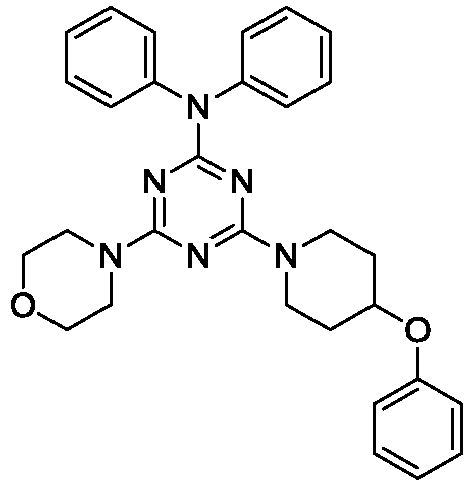
14 1A14 
19 1A19 
15 1A15 
20 1A20 
Table 3 Entry Code Structure Entry Code Structure 21 1B1 
26 1B6 
22 1B2 
27 1B7 
23 1B3 
28 1B8 
24 1B4 
29 1B9 
25 1B5 
30 1B10 
Table 4 Entry Code Structure Entry Code Structure 31 1B11 
36 1B16 
32 1B12 
37 1B17 
33 1B13 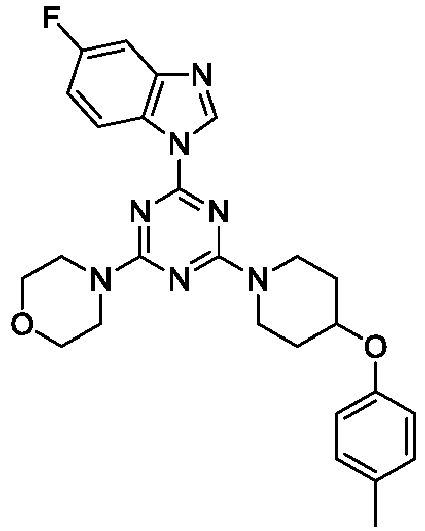
38 1B18 
34 1B14 
39 1B19 
35 1B15 
40 1B20 
Table 5 Entry Code Structure Entry Code Structure 41. 1B21 
46. 1B26 
42. 1B22 
47. 1B27 
43. 1B23 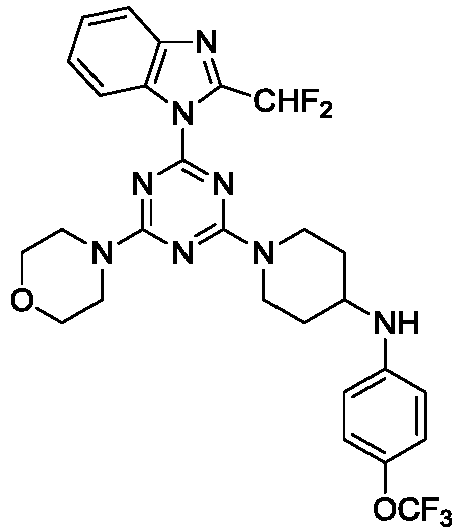
48. 1B28 
44. 1B24 
49. 1B29 
45. 1B25 
50. 1B30 
Table 6 Entry Code Structure Entry Code Structure 51 1B31 
56 1B36 
52 1B32 
57 1B37 
53 1B33 
58 1B38 
54 1B34 
59 1B39 
55 1B35 
60 1B40 
Table 7 Entry Code Structure Entry Code Structure 61 1B41 
66 1B46 
62 1B42 
67 1B47 
63 1B43 
68 1B48 
64 1B44 
69 1B49 
65 1B45 
70 1B50 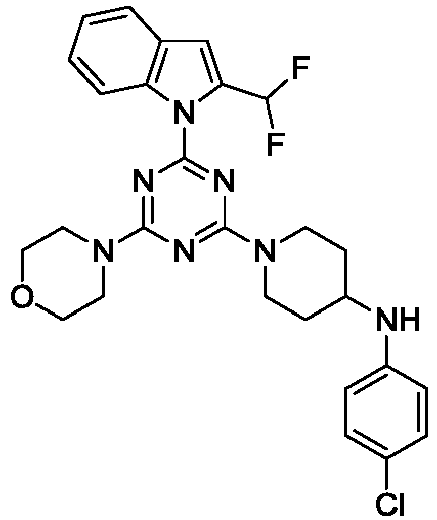
- Compounds were evaluated for their ability to inhibit class I PI3-kinase enzyme alpha as given below. PI3K-α assay: PI3K alpha (diluted in 12.5mM Glycine-NaOH (pH 8.5), 50 mM KCl, 2.5 mM MgCl2, 1 mM DTT, 0.05% CHAPS) is assayed in total volume of 20 ul containing 12.5 mM glycine-NaOH (pH 8.5), 50 mM KCl, 2.5 mM MgCl2, 1 mM DTT, 0.05% CHAPS, 0.01 mM ATP and 0.05 mM diC8 PIP2. The enzyme is assayed for 80 min after which 20 ul of ADP-Glo reagent is added. After a further incubation of 40 min, 40 ul of Kinase Detection Buffer is added. The assays are incubated for 40 min and then read on PerkinElmer Envision for 1sec/well.
- Results: PI3K alpha % of inhibition values of a drug measures the effectiveness of a compound in inhibiting biological or biochemical function. The determination of enzyme based % of inhibition values helps in early analysis and estimation of the drug activities in order to narrow down drug candidates for further experimental purpose. The standard drug ZSTK474 shown greater than 70% inhibition at 500 nm against PI3K alpha and 30 compounds viz., 1A3, 1A5, 1A6, 1A8, 1A9, 1A10, 1A14, 1A15, 1A19, 1B1, 1B4, 1B8, 1B11, 1B12, 1B15, 1B18, 1B19, 1B23, 1B24, 1B25, 1B26, 1B28, 1B31, 1B34, 1B37, 1B41, 1B42, 1B43, 1B47 and 1B49 shown greater than 70% inhibition at 500nm against PI3K alpha. All the screening results given in Table 8.
- Cell culture, growth conditions and treatments: Human breast cancer cell lines MDAMB231, MFC-7 and human prostate carcinoma cell line PC-3 were obtained from European Collection of Cell Cultures (ECACC). Cells were grown in RPMI-1440 medium supplemented with 10% fetal bovine serum (FBS), penicillin (100 units/ml), streptomycin (100 µg/ml), L-glutamine (0.3 mg/ml), sodium pyruvate (550 mg/ml), and NaHCO3(2mg/ml). Cells were grown in CO2 incubator (Thermocon Electron Corporation, USA) at 37°C in an atmosphere of 95% air and 5% CO2 with 98% humidity.
- Different molecules were dissolved in DMSO and were delivered to cell cultures in complete medium.
- Cell proliferation assay: MTT assay was done to determine the viability of the cells and was done as described previously (Kumar etal, 2013). Briefly, 6×10³ were seeded in 96 well plates and were treated with different concentrations of different molecules for 5 days. 20 µl of MTT dye (2.5mg/ml) was added 3 h before the termination of the experiment. Formazen crystals were dissolved in 150 µl of DMSO and OD was measured at 570 nm.
- Results: The several synthesized compounds were also checked for their antiproliferative activity against two breast cancer cell lines MDAMB231, MCF-7 and one prostate cancer cell line PC-3.
- Many molecules displayed potent anti proliferative activities in in vitro cancer cell lines assay and all the results given in Table 9. Standard drug ZSTK474 were taken as reference standard
Table 8 Entry Code In vitro PI3K α % of inhibition * Entry Code In vitro PI3K α % of inhibition* Entry Code In vitro PI3K α % of inhibition* 1. 1A1 + 25. 1B5 + 49. 1B29 + 2. 1A2 + 26. 1B6 + 50. 1B30 + 3. 1A3 ++ 27. 1B7 + 51. 1B31 ++ 4. 1A4 + 28. 1B8 ++ 52. 1B32 + 5. 1A5 ++ 29. 1B9 + 53. 1B33 + 6. 1A6 ++ 30. 1B10 + 54. 1B34 ++ 7. 1A7 + 31. 1B11 ++ 55. 1B35 + 8. 1A8 ++ 32. 1B12 ++ 56. 1B36 + 9. 1A9 ++ 33. 1B13 + 57. 1B37 ++ 10. 1A10 ++ 34. 1B14 + 58. 1B38 + 11. 1A11 + 35. 1B15 ++ 59. 1B39 + 12. 1A12 + 36. 1B16 + 60. 1B40 + 13. 1A13 + 37. 1B17 + 61. 1B41 ++ 14. 1A14 ++ 38. 1B18 ++ 62. 1B42 ++ 15. 1A15 ++ 39. 1B19 ++ 63. 1B43 ++ 16. 1A16 + 40. 1B20 + 64. 1B44 + 17. 1A17 + 41. 1B21 + 65. 1B45 + 18. 1A18 + 42. 1B22 + 66. 1B46 + 19. 1A19 ++ 43. 1B23 ++ 67. 1B47 ++ 20. 1A20 + 44. 1B24 ++ 68. 1B48 + 21. 1B1 ++ 45. 1B25 ++ 69. 1B49 ++ 22. 1B2 + 46. 1B26 ++ 70. 1B50 + 23. 1B3 + 47 1B27 + 71. ZSTK474 ++ 24. 1B4 ++ 48 1B28 ++ *In vitro PI3K alpha kinase inhibition at 500 nm; + indicates greater than 50% to 70% of inhibition and
++ indicates greater than 70% of inhibition.Table 9 Entry Code MCF-7 Cell line %inhibition at 10µM* PC-3 Cell line %inhibition at 10µM* MDA-MB231 Cell line %inhibition at 10µM* 1. 1A5 + ++ + 2. 1A9 ++ + ++ 3. 1B1 ++ ++ ++ 4. 1B2 ++ + ++ 5. 1B4 NC NC NC 6. 1B5 ++ NC + 7. 1B6 ++ + NC 8. 1B7 ++ NC + 9. 1B10 NC NC NC 10. 1B11 NC ++ + 11. 1B12 ++ + + 12. 1B22 + + NC 13. 1B23 + + NC 14. 1B24 NC NC + 15. 1B25 ++ + NC 16. 1B26 ++ + ++ 17. 1B27 ++ + + 18. 1B28 ++ + NC 19. 1B30 ++ + + 20. 1B32 ++ + + 21. ZSTK474 ++ ++ ++ *In vitro cell line inhibition at 10µM: + indicates less than 30 to 50% of inhibition and ++ indicates greater than 50% of inhibition.
Claims (3)
- A compound selected from the group consisting of:4-(4-(4-fluorophenoxy)piperidin-1-yl)-N-methyl-6-morpholino-N-phenyl-1,3,5-triazin-2-amine (compound 1A1),4-(4-(2-fluorophenoxy)piperidin-1-yl)-N-methyl-6-morpholino-N-phenyl-1,3,5-triazin-2-amine (compound 1A2),4-(4-(4-fluorophenoxy)piperidin-l-yl)-N-(4-fluorophenyl)-N-methyl-6-morpholino-1,3,5-triazin-2-amine (compound 1A3),2,2,2-trifluoro-N-(4-morpholino-6-(4-phenoxypiperidin-1-yl)-1,3,5-triazin-2-yl)-N-phenylacetamide (compound 1A4),2,2,2-trifluoro-N-(4-fluorophenyl)-N-(4-morpholino-6-(4-phenoxypiperidin-1-yl)-1,3,5-triazin-2-yl)acetamide (compound 1A5),2,2,2-trifluoro-N-(4-(4-(4-fluorophenoxy)piperidin-1-yl)-6-morpholino-1,3,5-triazin-2-yl)-N-(4-fluorophenyl)acetamide (compound 1A6),2,2,2-trifluoro-N-(4-morpholino-6-(4-(4-(trifluoromethyl)phenoxy)piperidin-1-yl)-1,3,5-triazin-2-yl)-N-phenylacetamide (compound 1A7),2,2,2-trifluoro-N-(4-morpholino-6-(4-(p-tolyloxy)piperidin-1-yl)-1,3,5-triazin-2-yl)-N-phenylacetamide (compound 1A8),2,2,2-trifluoro-N-(4-morpholino-6-(4-(4-(trifluoromethoxy)phenoxy)piperidin-1-yl)-1,3,5-triazin-2-yl)-N-phenylacetamide (compound 1A9),2,2,2-trifluoro-N-(4-morpholino-6-(4-(2-(trifluoromethyl)phenoxy)piperidin-1-yl)-1,3,5-triazin-2-yl)-N-phenylacetamide (compound 1A10),2,2,2-trifluoro-N-methyl-N-(4-morpholino-6-(4-phenoxypiperidin-1-yl)-1,3,5-triazin-2-yl)acetamide (compound 1A11),2,2,2-trifluoro-N-(4-morpholino-6-(4-phenoxypiperidin-1-yl)-1,3,5-triazin-2-yl)-N-(2,2,2-trifluoro acetyl)acetamide (compound 1A12),2,2,2-trifluoro-N-(4-(4-(4-fluorophenoxy)piperidin-1-yl)-6-morpholino-1,3,5-triazin-2-yl)-N-(2,2,2-trifluoroacetyl)acetamide (compound 1A13),2,2,2-trifluoro-N-(4-(4-(2-fluorophenoxy)piperidin-1-yl)-6-morpholino-1,3,5-triazin-2-yl)-N-(2,2,2-trifluoroacetyl)acetamide (compound 1A14),2,2,2-trifluoro-N-(4-(4-(4-fluorophenoxy)piperidin-1-yl)-6-morpholino-1,3,5-triazin-2-yl)-N-methyl acetamide (compound 1A15),N,N-dimethyl-4-morpholino-6-(4-(p-tolyloxy)piperidin-1-yl)-1,3,5-triazin-2-amine (compound 1A16),4-(4-(4-fluorophenoxy)piperidin-1-yl)-N,N-dimethyl-6-morpholino-1,3,5-triazin-2-amine (compound 1A17),4-morpholino-6-(4-phenoxypiperidin-1-yl)-N,N-diphenyl-1,3,5-triazin-2-amine (compound 1A18),4-morpholino-N,N-diphenyl-6-(4-(2-(trifluoromethyl)phenoxy)piperidin-1-yl)-1,3,5-triazin-2-amine (compound 1A19),4-mofpholino-N,N-diphenyl-6-(4-(4-(trifluoromethoxy)phenoxy)piperidin-1-yl)-1,3,5-triazin-2-amine (compound 1A20),4-(4-(2-(difluoromethyl)-1H-benzo[d]imidazol-1-yl)-6-(4-(4-fluorophenoxy) piperidin-1-yl)-1,3,5-triazin-2-yl)morpholine (compound 1B1),4-(4-(2-(difluoromethyl)-1H-benzo[d]imidazol-1-yl)-6-(4-(4-methoxyphenoxy) piperidin-1-yl)-1,3,5-triazin-2-yl)morpholine (compound 1B2),4-(4-(2-(difluoromethyl)-1H-benzo[d]imidazol-1-yl)-6-(4-(4-(trifluoromethoxy )phenoxy)piperidin-1-yl)-1,3,5-triazin-2-yl)morpholine (compound 1B3),4-(4-(2-(difluoromethyl)-1H-benzo[d]imidazol-1-yl)-6-(4-(2-(trifluoromethyl) phenoxy)piperidin-1-yl)-1,3,5-triazin-2-yl)morpholine (compound 1B4),4-(4-(4-(4-chlorophenoxy)piperidin-1-yl)-6-(2-(difluoromethyl)-1H-benzo[d]imidazol-1-yl)-1,3,5-triazin-2-yl)morpholine (compound 1B5),4-(4-(4-(3-chlorophenoxy)piperidin-1-yl)-6-(2-(difluoromethyl)-1H-benzo[d]imidazol-1-yl)-1,3,5-triazin-2-yl)morpholine (compound 1B6),4-(4-(4-(2-chlorophenoxy)piperidin-1-yl)-6-(2-(difluoromethyl)-1H-benzo[d]imidazol-1-yl)-1,3,5-triazin-2-yl)morpholine (compound 1B7),4-(4-(2-(difluoromethyl)-1H-benzo[d]imidazol-1-yl)-6-(4-(3-fluorophenoxy)piperidin-1-yl)-1,3,5-triazin-2-yl)morpholine (compound 1B8),4-(4-(2-(difluoromethyl)-lH-benzo[d]imidazol-1-yl)-6-(4-(2-fluorophenoxy)piperidin-1-yl)-1,3,5-triazin-2-yl)morpholine (compound 1B9),4-(4-(2-(difluoromethyl)-1H-benzo[d]imidazol-1-yl)-6-(4-(p-tolyloxy)piperidin-1-yl)-1,3,5-triazin-2-yl)morpholine (compound 1B10),4-(4-(2-(difluoromethyl)-1H-benzo[d]imidazol-1-yl)-6-(4-(m-tolyloxy)piperidin-1-yl)-1,3,5-triazin-2-yl)morpholine (compound 1B11),4-(4-(2-(difluoromethyl)-1H-benzo[d]imidazol-1-yl)-6-(4-(o-tolyloxy)piperidin-1-yl)-1,3,5-triazin-2-yl)morpholine (compound 1B12),4-(4-(5-fluoro-1H-benzo[d]imidazol-1-yl)-6-(4-(p-tolyloxy)piperidin-1-yl)-1,3,5-triazin-2-yl)morpholine (compound 1B13),4-(4-(5-fluoro-1H-benzo[d]imidazol-1-yl)-6-(4-(4-(trifluoromethyl)phenoxy)piperidin-1-yl)-1,3,5-triazin-2-yl)morpholine (compound 1B14),4-(4-(1H-benzo[d]imidazol-1-yl)-6-(4-(4-(trifluoromethyl)phenoxy)piperidin-1-yl)-1,3,5-triazin-2-yl)morpholine (compound 1B15),4-(4-(1H-benzo[d]imidazol-1-yl)-6-(4-(4-(trifluoromethoxy)phenoxy)piperidin-1-yl)-1,3,5-triazin-2-yl)morpholine (compound 1B16),4-(4-(1H-benzo[d]imidazol-1-yl)-6-(4-(4-fluorophenoxy)piperidin-1-yl)-1,3,5-triazin-2-yl)morpholine (compound 1B17),4-(4-(1H-benzo[d]imidazol-1-yl)-6-(4-(2-fluorophenoxy)piperidin-1-yl)-1,3,5-triazin-2-yl)morpholine (compound 1B18),4-(4-(1H-benzo[d]imidazol-1-yl)-6-(4-(2-chlorophenoxy)piperidin-1-yl)-1,3,5-triazin-2-yl)morpholine (compound 1B19),4-(4-(1H-benzo[d]imidazol-1-yl)-6-(4-(2-(trifluoromethyl)phenoxy)piperidin-1-yl)-1,3,5-triazin-2-yl)morpholine (compound 1B20),1-(4-(2-(difluoromethyl)-1H-benzo[d]imidazol-1-yl)-6-morpholino-1,3,5-triazin-2-yl)-N-(4-fluoro phenyl)piperidin-4-amine (compound 1B21),1-(4-(2-(difluoromethyl)-1H-benzo[d]imidazol-1-yl)-6-morpholino-1,3,5-triazin-2-yl)-N-(4-(trifluoro methyl)phenyl)piperidin-4-amine (compound 1B22),1-(4-(2-(difluoromethyl)-1H-benzo[d]imidazol-1-yl)-6-morpholino-1,3,5-triazin-2-yl)-N-(4-(trifluoro methoxy)phenyl)piperidin-4-amine (compound 1B23),1-(4-(2-(difluoromethyl)-1H-benzo[d]imidazol-1-yl)-6-morpholino-1,3,5-triazin-2-yl)-N-(4-methoxy phenyl)piperidin-4-amine (compound 1B24),N-(4-bromophenyl)-1-(4-(2-(difluoromethyl)-1H-benzo[d]imidazol-1-yl)-6-morpholino-1,3,5-triazin-2-yl)piperidin-4-amine (compound 1B25),N-(3,4-dichlorophenyl)-1-(4-(2-(difluoromethyl)-1H-benzo[d]imidazol-1-yl)-6-morpholino-1,3,5-triazin-2-yl)piperidin-4-amine (compound 1B26),1-(4-(2-(difluoromethyl 1H-benzo[d]imidazol-1-yl)-6-morpholino-1,3,5-triazin-2-yl)-N-(2-fluoro phenyl)piperidin-4-amine (compound 1B27),1-(4-(2-(difluoromethyl)-1H-benzo[d]imidazol-1-yl)-6-morpholino-1,3,5-triazin-2-yl)-N-(2-methoxy phenyl)piperidin-4-amine (compound 1B28),1-(4-(2-(difluoromethyl)-1H-benzo[d]imidazol-1-yl)-6-morpholino-1,3,5-triazin-2-yl)-N-(2-(trifluoro methyl)phenyl)piperidin-4-amine (compound 1B29),1-(4-(2-(difluoromethyl)-1H-benzo[d]imidazol-1-yl)-6-morpholino-1,3,5-triazin-2-yl)-N-(p-tolyl) piperidin-4-amine (compound 1B30),1-(4-(2-(difluoromethyl)-1H-benzo[d]imidazol-1-yl)-6-morpholino-1,3,5-triazin-2-yl)-N-(3-methoxy phenyl)piperidin-4-amine (compound 1B31),1-(4-(2-(difluoromethyl)-1H-benzo[d]imidazol-1-yl)-6-morpholino-1,3,5-triazin-2-yl)-N-(o-tolyl) piperidin-4-amine (compound 1B32),1-(4-(2-(difluoromethyl)-5-fluoro-1H-benzo[d]imidazol-1-yl)-6-morpholino-1,3,5-triazin-2-yl)-N-(p-tolyl)piperidin-4-amine (compound 1B33),1-(4-(2-(difluoromethyl)-5-fluoro-1H-benzo[d]imidazol-1-yl)-6-morpholino-1,3,5-triazin-2-yl)-N-(4-(trifluoromethyl)phenyl)piperidin-4-amine (compound 1B34),1-(4-(2-(difluoromethyl)-1H-benzo[d]imidazol-1-yl)-6-morpholino-1,3,5-triazin-2-yl)-N-(4-(trifluoro methyl)phenyl)piperidin-4-amine (compound 1B35),1-(4-(2-(difluoromethyl)-1H-benzo[d]imidazol-1-yl)-6-morpholino-1,3,5-triazin-2-yl)-N-(4-(trifluoro methoxy)phenyl)piperidin-4-amine (compound 1B36),1-(4-(2-(difluoromethyl)-1H-benzo[d]imidazol-1-yl)-6-morpholino-1,3,5-triazin-2-yl)-N-(4-fluoro phenyl)piperidin-4-amine (compound 1B37),1-(4-(2-(difluoromethyl)-1H-benzo[d]imidazol-1-yl)-6-morpholino-1,3,5-triazin-2-yl)-N-(2-fluoro phenyl)piperidin-4-amine (compound 1B38),N-(2-chlorophenyl)-1-(4-(2-(difluoromethyl)-1H-benzo[d]imidazol-1-yl)-6-morpholino-1,3,5-triazin-2-yl)piperidin-4-amine (compound 1B39),1-(4-(2-(difluoromethyl)-1H-benzo[d]imidazol-1-yl)-6-morpholino-1,3,5-triazin-2-yl)-N-(2-(trifluoro methyl)phenyl)piperidin-4-amine (compound 1B40),1-(4-(2-(difluoromethyl)-1H-benzo[d]imidazol-1-yl)-6-morpholino-1,3,5-triazin-2-yl)-N,N-bis(4-fluorophenyl)piperidin-4-amine (compound 1B41),N-(4-bromophenyl)-1-(4-(2-(difluoromethyl)-1H-benzo[d]imidazol-1-yl)-6-morpholino-1,3,5-triazin-2-yl)-N-(4-fluorophenyl)piperidin-4-amine (compound 1B42),1-(4-(2-(difluoromethyl)-1H-benzo[d]imidazol-1-yl)-6-morpholino-1,3,5-triazin-2-yl)-N-(4-fluorophenyl)-N-(4-(trifluoromethyl)phenyl)piperidin-4-amine(compound 1B43),N-(4-chlorophenyl)-N-(4-(2-(difluoromethyl)-1H-benzo[d]imidazol-1-yl)-6-morpholino-1,3,5-triazin-2-yl)-N-(4-fluorophenyl)piperidin-4-amine (compound 1B44),N-(1-(4-(2-(difluoromethyl)-1H-benzo[d]imidazole-1-yl)-6-morpholino-1,3,5-triazin-2-yl)piperidin-4-yl)-N-(4-fluorophenyl)-3-(trifluoromethyl)pyridin-4-amine (compound 1B45),1-(4-(2-(difluoromethyl)-1H-indol-1-yl)-6-morpholino-1,3,5-triazin-2-yl)-N-(4-fluoro phenyl)piperidin-4-amine (compound 1B46),1-(4-(2-(difluoromethyl)-1H-indol-1-yl)-6-morpholino-1,3,5-triazin-2-yl)-N-(4-methoxy phenyl)piperidin-4-amine (compound 1B47),1-(4-(2-(difluoromethyl)-1H-indol-1-yl)-6-morpholino-1,3,5-triazin-2-yl)-N-(4-(trifluoro methoxy)phenyl)piperidin-4-amine (compound 1B48),1-(4-(2-(difluoromethyl)-1H-indol-1-yl)-6-morpholino-1,3,5-triazin-2-yl)-N-(4-10(trifluoro methyl)phenyl)piperidin-4-amine (compound 1B49), andN-(4-chlorophenyl)-1-(4-(2-(difluoromethyl)-1H-indol-1-yl)-6-morpholino-1,3,5-triazin-2-yl)piperidin-4-amine (compound 1B50).
- Compound of claim 1 for use in the treatment or prevention of cancer.
- A process for the preparation of a compound of claim 1, wherein:(a) a disubstituted triazine compound of formula 5 is reacted with an aryloxy piperidine of formula 6
 G1 is Ph, G2 is CH3 and FG3 is 4-F or 2-F,G1 is (4-F)-Ph, G2 is CH3 and FG3 is 4-F,G1 is Ph, G2 is COCF3 and FG3 is selected from the group consisting of H, 4-CF3, 4-CH3, 4-OCF3, and 2-OCF3,G1 is (4-F)-Ph, G2 is COCF3 and FG3 is H or 4-F,G1 is CH3, G2 is COCF3 and FG3 is H or 4-F,G1 is COCF3, G2 is COCF3 and FG3 is selected from the group consisting of H, 4-F, and 2-F,G1 is CH3, G2 is CH3 and FG3 is H or 4-F, orG1 is Ph, G2 is Ph and FG3 is selected from the group consisting of H, 4-CF3 and 4-OCF3, or(b) a disubstituted triazine compound of formula 8 is reacted with an aryloxy piperidine of formula 6
 FG1 is H, FG2 is 2-CHF2 and FG3 is selected from the group consisting of 4-F, 4-OMe, 4-OCF3, 2-CF3, 4-Cl, 3-Cl, 2-Cl; 4-CN, 2-CN, 4-CH3, 3-CH3, and 2-CH3,FG1 is 5-F, FG2 is H and FG3 is 4-CH3 or 4-CF3, orFG1 is H, FG2 is H and FG3 is selected from the group consisting of 4-CF3, 4-OCF3, 4-F, 2-F, 4-Cl, and 2-CF3, or(c) a trisubstituted triazine compound of formula 10 is reacted with a substituted aryl amine of formula 11
 FG1 is H, FG2 is 2-CHF2 and FG4 is selected from the group consisting of 4-F, 4-CF3, 4-OCF3, 4-OCH3, 4-Br, 3,4-di-Cl, 2-F, 2-OCH3, 2-CF3, 4-CH3, 3-OCH3, 2-CH3,FG1 is 5-F, FG2 is H and FG4 is 4-CH3 or 4-CF3, orFG1 is H, FG2 is H and FG4 is selected from the group consisting of 4-CF3, 4-OCF3, 4-F, 2-F, 4-Cl, and 2-CF3,(d) a trisubstituted triazine compound of formula 1B21 is reacted with a substituted aryl boronic acid of formula 12
 Y is CH and FG5 is selected from the group consisting of 4-F, 4-Br, 4-CF3, and 4-Cl, orY is N and FG5 is 2-CF3, or(e) a trisubstituted triazine compound of formula 15 is reacted with a substituted aryl amine of formula 11
FG1 is H, FG2 is 2-CHF2 and FG4 is selected from the group consisting of 4-F, 4-OMe, 4-OCF3, 4-CF3 and 4-Cl.
Applications Claiming Priority (2)
| Application Number | Priority Date | Filing Date | Title |
|---|---|---|---|
| IN3369DE2014 | 2014-11-20 | ||
| PCT/IN2015/050169 WO2016079760A1 (en) | 2014-11-20 | 2015-11-17 | Novel 1,3,5 -triazine based pi3k inhibitors as anticancer agents and a process for the preparation thereof |
Publications (2)
| Publication Number | Publication Date |
|---|---|
| EP3221307A1 EP3221307A1 (en) | 2017-09-27 |
| EP3221307B1 true EP3221307B1 (en) | 2019-07-24 |
Family
ID=55073074
Family Applications (1)
| Application Number | Title | Priority Date | Filing Date |
|---|---|---|---|
| EP15820891.8A Active EP3221307B1 (en) | 2014-11-20 | 2015-11-17 | Novel 1,3,5 -triazine based pi3k inhibitors as anticancer agents and a process for the preparation thereof |
Country Status (5)
| Country | Link |
|---|---|
| US (1) | US9951040B2 (en) |
| EP (1) | EP3221307B1 (en) |
| JP (1) | JP6695875B2 (en) |
| CN (1) | CN107428730B (en) |
| WO (1) | WO2016079760A1 (en) |
Families Citing this family (3)
| Publication number | Priority date | Publication date | Assignee | Title |
|---|---|---|---|---|
| WO2022013684A1 (en) | 2020-07-11 | 2022-01-20 | Pfizer Inc. | Antiviral heteroaryl ketone derivatives |
| US11351149B2 (en) | 2020-09-03 | 2022-06-07 | Pfizer Inc. | Nitrile-containing antiviral compounds |
| CN113200969B (en) * | 2021-05-19 | 2022-11-25 | 中国药科大学 | PI3K alpha selective inhibitor and preparation method and application thereof |
Family Cites Families (8)
| Publication number | Priority date | Publication date | Assignee | Title |
|---|---|---|---|---|
| CN101137382B (en) * | 2005-03-11 | 2012-11-21 | 全药工业株式会社 | Immunosuppressive agent and anti-tumor agent comprising heterocyclic compound as active ingredient |
| GB0510390D0 (en) | 2005-05-20 | 2005-06-29 | Novartis Ag | Organic compounds |
| JP2010503649A (en) * | 2006-09-14 | 2010-02-04 | アストラゼネカ アクチボラグ | Pyrimidine derivatives |
| WO2009066084A1 (en) * | 2007-11-21 | 2009-05-28 | F. Hoffmann-La Roche Ag | 2 -morpholinopyrimidines and their use as pi3 kinase inhibitors |
| AU2009248993C1 (en) | 2008-05-23 | 2013-10-03 | Wyeth Llc | Triazine compounds as PI3 kinase and mTOR inhibitors |
| WO2010110686A1 (en) | 2009-03-27 | 2010-09-30 | Pathway Therapeutics Limited | Pyrimidinyl and 1,3,5 triazinyl benzimidazoles and their use in cancer therapy |
| AU2010229468A1 (en) * | 2009-03-27 | 2011-10-13 | Vetdc, Inc. | Pyrimidinyl and 1,3,5-triazinyl benzimidazole sulfonamides and their use in cancer therapy |
| GB201007227D0 (en) | 2010-04-30 | 2010-06-16 | Univ Basel | Piperazinotriazines |
-
2015
- 2015-11-17 CN CN201580073862.XA patent/CN107428730B/en active Active
- 2015-11-17 US US15/528,435 patent/US9951040B2/en active Active
- 2015-11-17 JP JP2017527241A patent/JP6695875B2/en active Active
- 2015-11-17 EP EP15820891.8A patent/EP3221307B1/en active Active
- 2015-11-17 WO PCT/IN2015/050169 patent/WO2016079760A1/en not_active Ceased
Non-Patent Citations (1)
| Title |
|---|
| None * |
Also Published As
| Publication number | Publication date |
|---|---|
| CN107428730B (en) | 2020-10-16 |
| WO2016079760A4 (en) | 2016-07-28 |
| JP2017535562A (en) | 2017-11-30 |
| CN107428730A (en) | 2017-12-01 |
| US20170342049A1 (en) | 2017-11-30 |
| US9951040B2 (en) | 2018-04-24 |
| EP3221307A1 (en) | 2017-09-27 |
| JP6695875B2 (en) | 2020-05-20 |
| WO2016079760A1 (en) | 2016-05-26 |
Similar Documents
| Publication | Publication Date | Title |
|---|---|---|
| EP3080125B1 (en) | Novel azaindole derivatives as selective histone deacetylase (hdac) inhibitors and pharmaceutical compositions comprising the same | |
| JP7240784B2 (en) | 8,9-dihydroimidazole[1,2-a]pyrimido[5,4-e]pyrimidine-5(6H)-ketone compounds | |
| EP1539759B1 (en) | Novel imidazopyridines and their use | |
| RU2664055C2 (en) | Dihydronaphthyridines and related compounds suitable as kinase inhibitors for treatment of proliferative diseases | |
| CA3121667A1 (en) | Isoindoline compound, preparation method, pharmaceutical composition and use thereof | |
| JP6704422B2 (en) | Quinazoline derivative salt and method for producing the same | |
| JP2019503395A (en) | Pyrrolopyrimidine 5-membered azacyclic derivatives and uses thereof | |
| PT1294715E (en) | Quinazoline ditosylate salt compounds | |
| HUE034807T2 (en) | Novel quinoline-substituted compound | |
| EP3253754B1 (en) | 2-phenyl-3h-imidazo[4,5-b]pyridine derivates useful as inhibitors of mammalian tyrosine kinase ror1 activity | |
| BR112015019790B1 (en) | monocyclic pyridine derivative with fgfr inhibitory action or a pharmaceutically acceptable salt thereof for medical use | |
| EP3166945B1 (en) | Novel triazolopyrimidinone or triazolopyridinone derivatives, and use thereof | |
| JP2020529968A (en) | Substituted 5- and 6-membered heterocyclic compounds, their preparation methods, drug combinations and their use | |
| WO2023147063A2 (en) | Compounds and methods for yap/tead modulation and indications therefor | |
| WO2022105526A1 (en) | Dihydroisoquinolinone and isoindolinone derivatives and uses thereof | |
| US9951040B2 (en) | 1,3,5 -triazine based PI3K inhibitors as anticancer agents and a process for the preparation thereof | |
| CN119585256A (en) | Chemokine receptor modulators and uses thereof | |
| CN110300587B (en) | Deuterated (S)-2-(4-(piperidin-3-yl)phenyl)-2H-indazole-7-carboxamide | |
| EP3484867B1 (en) | Inhibitors of tryptophan 2,3-dioxygenase | |
| WO2024159079A1 (en) | Compounds and methods for yap/tead modulation and indications therefor | |
| EP3632912B1 (en) | Pyridoquinazoline derivatives useful as protein kinase inhibitors | |
| CN114026097B (en) | Substituted pyrazoquinazolinone compounds and their applications | |
| EP4384518B1 (en) | Tyrosine kinase inhibitors | |
| EP3632913A1 (en) | Carboxylic acid derivatives of pyridoquinazolines useful as protein kinase inhibitors | |
| WO2024159103A1 (en) | Compounds and methods for yap/tead modulation and indications therefor |
Legal Events
| Date | Code | Title | Description |
|---|---|---|---|
| STAA | Information on the status of an ep patent application or granted ep patent |
Free format text: STATUS: THE INTERNATIONAL PUBLICATION HAS BEEN MADE |
|
| PUAI | Public reference made under article 153(3) epc to a published international application that has entered the european phase |
Free format text: ORIGINAL CODE: 0009012 |
|
| STAA | Information on the status of an ep patent application or granted ep patent |
Free format text: STATUS: REQUEST FOR EXAMINATION WAS MADE |
|
| 17P | Request for examination filed |
Effective date: 20170519 |
|
| AK | Designated contracting states |
Kind code of ref document: A1 Designated state(s): AL AT BE BG CH CY CZ DE DK EE ES FI FR GB GR HR HU IE IS IT LI LT LU LV MC MK MT NL NO PL PT RO RS SE SI SK SM TR |
|
| AX | Request for extension of the european patent |
Extension state: BA ME |
|
| DAV | Request for validation of the european patent (deleted) | ||
| DAX | Request for extension of the european patent (deleted) | ||
| STAA | Information on the status of an ep patent application or granted ep patent |
Free format text: STATUS: EXAMINATION IS IN PROGRESS |
|
| 17Q | First examination report despatched |
Effective date: 20180508 |
|
| GRAP | Despatch of communication of intention to grant a patent |
Free format text: ORIGINAL CODE: EPIDOSNIGR1 |
|
| STAA | Information on the status of an ep patent application or granted ep patent |
Free format text: STATUS: GRANT OF PATENT IS INTENDED |
|
| RAP1 | Party data changed (applicant data changed or rights of an application transferred) |
Owner name: COUNCIL OF SCIENTIFIC & INDUSTRIAL RESEARCH |
|
| INTG | Intention to grant announced |
Effective date: 20190225 |
|
| GRAS | Grant fee paid |
Free format text: ORIGINAL CODE: EPIDOSNIGR3 |
|
| GRAA | (expected) grant |
Free format text: ORIGINAL CODE: 0009210 |
|
| STAA | Information on the status of an ep patent application or granted ep patent |
Free format text: STATUS: THE PATENT HAS BEEN GRANTED |
|
| AK | Designated contracting states |
Kind code of ref document: B1 Designated state(s): AL AT BE BG CH CY CZ DE DK EE ES FI FR GB GR HR HU IE IS IT LI LT LU LV MC MK MT NL NO PL PT RO RS SE SI SK SM TR |
|
| REG | Reference to a national code |
Ref country code: GB Ref legal event code: FG4D |
|
| REG | Reference to a national code |
Ref country code: CH Ref legal event code: EP |
|
| REG | Reference to a national code |
Ref country code: DE Ref legal event code: R096 Ref document number: 602015034479 Country of ref document: DE |
|
| REG | Reference to a national code |
Ref country code: AT Ref legal event code: REF Ref document number: 1158013 Country of ref document: AT Kind code of ref document: T Effective date: 20190815 |
|
| REG | Reference to a national code |
Ref country code: IE Ref legal event code: FG4D |
|
| REG | Reference to a national code |
Ref country code: NL Ref legal event code: MP Effective date: 20190724 |
|
| REG | Reference to a national code |
Ref country code: LT Ref legal event code: MG4D |
|
| REG | Reference to a national code |
Ref country code: AT Ref legal event code: MK05 Ref document number: 1158013 Country of ref document: AT Kind code of ref document: T Effective date: 20190724 |
|
| PG25 | Lapsed in a contracting state [announced via postgrant information from national office to epo] |
Ref country code: LT Free format text: LAPSE BECAUSE OF FAILURE TO SUBMIT A TRANSLATION OF THE DESCRIPTION OR TO PAY THE FEE WITHIN THE PRESCRIBED TIME-LIMIT Effective date: 20190724 Ref country code: PT Free format text: LAPSE BECAUSE OF FAILURE TO SUBMIT A TRANSLATION OF THE DESCRIPTION OR TO PAY THE FEE WITHIN THE PRESCRIBED TIME-LIMIT Effective date: 20191125 Ref country code: FI Free format text: LAPSE BECAUSE OF FAILURE TO SUBMIT A TRANSLATION OF THE DESCRIPTION OR TO PAY THE FEE WITHIN THE PRESCRIBED TIME-LIMIT Effective date: 20190724 Ref country code: NL Free format text: LAPSE BECAUSE OF FAILURE TO SUBMIT A TRANSLATION OF THE DESCRIPTION OR TO PAY THE FEE WITHIN THE PRESCRIBED TIME-LIMIT Effective date: 20190724 Ref country code: BG Free format text: LAPSE BECAUSE OF FAILURE TO SUBMIT A TRANSLATION OF THE DESCRIPTION OR TO PAY THE FEE WITHIN THE PRESCRIBED TIME-LIMIT Effective date: 20191024 Ref country code: NO Free format text: LAPSE BECAUSE OF FAILURE TO SUBMIT A TRANSLATION OF THE DESCRIPTION OR TO PAY THE FEE WITHIN THE PRESCRIBED TIME-LIMIT Effective date: 20191024 Ref country code: AT Free format text: LAPSE BECAUSE OF FAILURE TO SUBMIT A TRANSLATION OF THE DESCRIPTION OR TO PAY THE FEE WITHIN THE PRESCRIBED TIME-LIMIT Effective date: 20190724 Ref country code: SE Free format text: LAPSE BECAUSE OF FAILURE TO SUBMIT A TRANSLATION OF THE DESCRIPTION OR TO PAY THE FEE WITHIN THE PRESCRIBED TIME-LIMIT Effective date: 20190724 Ref country code: HR Free format text: LAPSE BECAUSE OF FAILURE TO SUBMIT A TRANSLATION OF THE DESCRIPTION OR TO PAY THE FEE WITHIN THE PRESCRIBED TIME-LIMIT Effective date: 20190724 |
|
| PG25 | Lapsed in a contracting state [announced via postgrant information from national office to epo] |
Ref country code: LV Free format text: LAPSE BECAUSE OF FAILURE TO SUBMIT A TRANSLATION OF THE DESCRIPTION OR TO PAY THE FEE WITHIN THE PRESCRIBED TIME-LIMIT Effective date: 20190724 Ref country code: IS Free format text: LAPSE BECAUSE OF FAILURE TO SUBMIT A TRANSLATION OF THE DESCRIPTION OR TO PAY THE FEE WITHIN THE PRESCRIBED TIME-LIMIT Effective date: 20191124 Ref country code: GR Free format text: LAPSE BECAUSE OF FAILURE TO SUBMIT A TRANSLATION OF THE DESCRIPTION OR TO PAY THE FEE WITHIN THE PRESCRIBED TIME-LIMIT Effective date: 20191025 Ref country code: RS Free format text: LAPSE BECAUSE OF FAILURE TO SUBMIT A TRANSLATION OF THE DESCRIPTION OR TO PAY THE FEE WITHIN THE PRESCRIBED TIME-LIMIT Effective date: 20190724 Ref country code: AL Free format text: LAPSE BECAUSE OF FAILURE TO SUBMIT A TRANSLATION OF THE DESCRIPTION OR TO PAY THE FEE WITHIN THE PRESCRIBED TIME-LIMIT Effective date: 20190724 Ref country code: ES Free format text: LAPSE BECAUSE OF FAILURE TO SUBMIT A TRANSLATION OF THE DESCRIPTION OR TO PAY THE FEE WITHIN THE PRESCRIBED TIME-LIMIT Effective date: 20190724 |
|
| PG25 | Lapsed in a contracting state [announced via postgrant information from national office to epo] |
Ref country code: TR Free format text: LAPSE BECAUSE OF FAILURE TO SUBMIT A TRANSLATION OF THE DESCRIPTION OR TO PAY THE FEE WITHIN THE PRESCRIBED TIME-LIMIT Effective date: 20190724 |
|
| PG25 | Lapsed in a contracting state [announced via postgrant information from national office to epo] |
Ref country code: EE Free format text: LAPSE BECAUSE OF FAILURE TO SUBMIT A TRANSLATION OF THE DESCRIPTION OR TO PAY THE FEE WITHIN THE PRESCRIBED TIME-LIMIT Effective date: 20190724 Ref country code: DK Free format text: LAPSE BECAUSE OF FAILURE TO SUBMIT A TRANSLATION OF THE DESCRIPTION OR TO PAY THE FEE WITHIN THE PRESCRIBED TIME-LIMIT Effective date: 20190724 Ref country code: PL Free format text: LAPSE BECAUSE OF FAILURE TO SUBMIT A TRANSLATION OF THE DESCRIPTION OR TO PAY THE FEE WITHIN THE PRESCRIBED TIME-LIMIT Effective date: 20190724 Ref country code: IT Free format text: LAPSE BECAUSE OF FAILURE TO SUBMIT A TRANSLATION OF THE DESCRIPTION OR TO PAY THE FEE WITHIN THE PRESCRIBED TIME-LIMIT Effective date: 20190724 Ref country code: RO Free format text: LAPSE BECAUSE OF FAILURE TO SUBMIT A TRANSLATION OF THE DESCRIPTION OR TO PAY THE FEE WITHIN THE PRESCRIBED TIME-LIMIT Effective date: 20190724 |
|
| PG25 | Lapsed in a contracting state [announced via postgrant information from national office to epo] |
Ref country code: SM Free format text: LAPSE BECAUSE OF FAILURE TO SUBMIT A TRANSLATION OF THE DESCRIPTION OR TO PAY THE FEE WITHIN THE PRESCRIBED TIME-LIMIT Effective date: 20190724 Ref country code: SK Free format text: LAPSE BECAUSE OF FAILURE TO SUBMIT A TRANSLATION OF THE DESCRIPTION OR TO PAY THE FEE WITHIN THE PRESCRIBED TIME-LIMIT Effective date: 20190724 Ref country code: CZ Free format text: LAPSE BECAUSE OF FAILURE TO SUBMIT A TRANSLATION OF THE DESCRIPTION OR TO PAY THE FEE WITHIN THE PRESCRIBED TIME-LIMIT Effective date: 20190724 Ref country code: IS Free format text: LAPSE BECAUSE OF FAILURE TO SUBMIT A TRANSLATION OF THE DESCRIPTION OR TO PAY THE FEE WITHIN THE PRESCRIBED TIME-LIMIT Effective date: 20200224 |
|
| REG | Reference to a national code |
Ref country code: DE Ref legal event code: R097 Ref document number: 602015034479 Country of ref document: DE Ref country code: DE Ref legal event code: R119 Ref document number: 602015034479 Country of ref document: DE |
|
| REG | Reference to a national code |
Ref country code: CH Ref legal event code: PL |
|
| PLBE | No opposition filed within time limit |
Free format text: ORIGINAL CODE: 0009261 |
|
| STAA | Information on the status of an ep patent application or granted ep patent |
Free format text: STATUS: NO OPPOSITION FILED WITHIN TIME LIMIT |
|
| PG2D | Information on lapse in contracting state deleted |
Ref country code: IS |
|
| PG25 | Lapsed in a contracting state [announced via postgrant information from national office to epo] |
Ref country code: LI Free format text: LAPSE BECAUSE OF NON-PAYMENT OF DUE FEES Effective date: 20191130 Ref country code: CH Free format text: LAPSE BECAUSE OF NON-PAYMENT OF DUE FEES Effective date: 20191130 Ref country code: LU Free format text: LAPSE BECAUSE OF NON-PAYMENT OF DUE FEES Effective date: 20191117 Ref country code: MC Free format text: LAPSE BECAUSE OF FAILURE TO SUBMIT A TRANSLATION OF THE DESCRIPTION OR TO PAY THE FEE WITHIN THE PRESCRIBED TIME-LIMIT Effective date: 20190724 |
|
| 26N | No opposition filed |
Effective date: 20200603 |
|
| REG | Reference to a national code |
Ref country code: BE Ref legal event code: MM Effective date: 20191130 |
|
| PG25 | Lapsed in a contracting state [announced via postgrant information from national office to epo] |
Ref country code: SI Free format text: LAPSE BECAUSE OF FAILURE TO SUBMIT A TRANSLATION OF THE DESCRIPTION OR TO PAY THE FEE WITHIN THE PRESCRIBED TIME-LIMIT Effective date: 20190724 |
|
| PG25 | Lapsed in a contracting state [announced via postgrant information from national office to epo] |
Ref country code: FR Free format text: LAPSE BECAUSE OF NON-PAYMENT OF DUE FEES Effective date: 20191130 Ref country code: IE Free format text: LAPSE BECAUSE OF NON-PAYMENT OF DUE FEES Effective date: 20191117 Ref country code: DE Free format text: LAPSE BECAUSE OF NON-PAYMENT OF DUE FEES Effective date: 20200603 |
|
| PG25 | Lapsed in a contracting state [announced via postgrant information from national office to epo] |
Ref country code: BE Free format text: LAPSE BECAUSE OF NON-PAYMENT OF DUE FEES Effective date: 20191130 |
|
| PG25 | Lapsed in a contracting state [announced via postgrant information from national office to epo] |
Ref country code: CY Free format text: LAPSE BECAUSE OF FAILURE TO SUBMIT A TRANSLATION OF THE DESCRIPTION OR TO PAY THE FEE WITHIN THE PRESCRIBED TIME-LIMIT Effective date: 20190724 |
|
| PG25 | Lapsed in a contracting state [announced via postgrant information from national office to epo] |
Ref country code: HU Free format text: LAPSE BECAUSE OF FAILURE TO SUBMIT A TRANSLATION OF THE DESCRIPTION OR TO PAY THE FEE WITHIN THE PRESCRIBED TIME-LIMIT; INVALID AB INITIO Effective date: 20151117 Ref country code: MT Free format text: LAPSE BECAUSE OF FAILURE TO SUBMIT A TRANSLATION OF THE DESCRIPTION OR TO PAY THE FEE WITHIN THE PRESCRIBED TIME-LIMIT Effective date: 20190724 |
|
| PG25 | Lapsed in a contracting state [announced via postgrant information from national office to epo] |
Ref country code: MK Free format text: LAPSE BECAUSE OF FAILURE TO SUBMIT A TRANSLATION OF THE DESCRIPTION OR TO PAY THE FEE WITHIN THE PRESCRIBED TIME-LIMIT Effective date: 20190724 |
|
| P01 | Opt-out of the competence of the unified patent court (upc) registered |
Effective date: 20230526 |
|
| PGFP | Annual fee paid to national office [announced via postgrant information from national office to epo] |
Ref country code: GB Payment date: 20251118 Year of fee payment: 11 |