EP3219773A1 - Film-forming composition including tannic acid derivative - Google Patents
Film-forming composition including tannic acid derivative Download PDFInfo
- Publication number
- EP3219773A1 EP3219773A1 EP15858158.7A EP15858158A EP3219773A1 EP 3219773 A1 EP3219773 A1 EP 3219773A1 EP 15858158 A EP15858158 A EP 15858158A EP 3219773 A1 EP3219773 A1 EP 3219773A1
- Authority
- EP
- European Patent Office
- Prior art keywords
- film
- tannic acid
- forming composition
- acid derivative
- recited
- Prior art date
- Legal status (The legal status is an assumption and is not a legal conclusion. Google has not performed a legal analysis and makes no representation as to the accuracy of the status listed.)
- Granted
Links
Images







Classifications
-
- C—CHEMISTRY; METALLURGY
- C09—DYES; PAINTS; POLISHES; NATURAL RESINS; ADHESIVES; COMPOSITIONS NOT OTHERWISE PROVIDED FOR; APPLICATIONS OF MATERIALS NOT OTHERWISE PROVIDED FOR
- C09D—COATING COMPOSITIONS, e.g. PAINTS, VARNISHES OR LACQUERS; FILLING PASTES; CHEMICAL PAINT OR INK REMOVERS; INKS; CORRECTING FLUIDS; WOODSTAINS; PASTES OR SOLIDS FOR COLOURING OR PRINTING; USE OF MATERIALS THEREFOR
- C09D5/00—Coating compositions, e.g. paints, varnishes or lacquers, characterised by their physical nature or the effects produced; Filling pastes
-
- B—PERFORMING OPERATIONS; TRANSPORTING
- B05—SPRAYING OR ATOMISING IN GENERAL; APPLYING FLUENT MATERIALS TO SURFACES, IN GENERAL
- B05D—PROCESSES FOR APPLYING FLUENT MATERIALS TO SURFACES, IN GENERAL
- B05D7/00—Processes, other than flocking, specially adapted for applying liquids or other fluent materials to particular surfaces or for applying particular liquids or other fluent materials
- B05D7/24—Processes, other than flocking, specially adapted for applying liquids or other fluent materials to particular surfaces or for applying particular liquids or other fluent materials for applying particular liquids or other fluent materials
-
- C—CHEMISTRY; METALLURGY
- C09—DYES; PAINTS; POLISHES; NATURAL RESINS; ADHESIVES; COMPOSITIONS NOT OTHERWISE PROVIDED FOR; APPLICATIONS OF MATERIALS NOT OTHERWISE PROVIDED FOR
- C09D—COATING COMPOSITIONS, e.g. PAINTS, VARNISHES OR LACQUERS; FILLING PASTES; CHEMICAL PAINT OR INK REMOVERS; INKS; CORRECTING FLUIDS; WOODSTAINS; PASTES OR SOLIDS FOR COLOURING OR PRINTING; USE OF MATERIALS THEREFOR
- C09D199/00—Coating compositions based on natural macromolecular compounds or on derivatives thereof, not provided for in groups C09D101/00 - C09D107/00 or C09D189/00 - C09D197/00
-
- C—CHEMISTRY; METALLURGY
- C09—DYES; PAINTS; POLISHES; NATURAL RESINS; ADHESIVES; COMPOSITIONS NOT OTHERWISE PROVIDED FOR; APPLICATIONS OF MATERIALS NOT OTHERWISE PROVIDED FOR
- C09D—COATING COMPOSITIONS, e.g. PAINTS, VARNISHES OR LACQUERS; FILLING PASTES; CHEMICAL PAINT OR INK REMOVERS; INKS; CORRECTING FLUIDS; WOODSTAINS; PASTES OR SOLIDS FOR COLOURING OR PRINTING; USE OF MATERIALS THEREFOR
- C09D5/00—Coating compositions, e.g. paints, varnishes or lacquers, characterised by their physical nature or the effects produced; Filling pastes
- C09D5/08—Anti-corrosive paints
-
- C—CHEMISTRY; METALLURGY
- C09—DYES; PAINTS; POLISHES; NATURAL RESINS; ADHESIVES; COMPOSITIONS NOT OTHERWISE PROVIDED FOR; APPLICATIONS OF MATERIALS NOT OTHERWISE PROVIDED FOR
- C09D—COATING COMPOSITIONS, e.g. PAINTS, VARNISHES OR LACQUERS; FILLING PASTES; CHEMICAL PAINT OR INK REMOVERS; INKS; CORRECTING FLUIDS; WOODSTAINS; PASTES OR SOLIDS FOR COLOURING OR PRINTING; USE OF MATERIALS THEREFOR
- C09D5/00—Coating compositions, e.g. paints, varnishes or lacquers, characterised by their physical nature or the effects produced; Filling pastes
- C09D5/08—Anti-corrosive paints
- C09D5/082—Anti-corrosive paints characterised by the anti-corrosive pigment
- C09D5/086—Organic or non-macromolecular compounds
-
- C—CHEMISTRY; METALLURGY
- C09—DYES; PAINTS; POLISHES; NATURAL RESINS; ADHESIVES; COMPOSITIONS NOT OTHERWISE PROVIDED FOR; APPLICATIONS OF MATERIALS NOT OTHERWISE PROVIDED FOR
- C09D—COATING COMPOSITIONS, e.g. PAINTS, VARNISHES OR LACQUERS; FILLING PASTES; CHEMICAL PAINT OR INK REMOVERS; INKS; CORRECTING FLUIDS; WOODSTAINS; PASTES OR SOLIDS FOR COLOURING OR PRINTING; USE OF MATERIALS THEREFOR
- C09D5/00—Coating compositions, e.g. paints, varnishes or lacquers, characterised by their physical nature or the effects produced; Filling pastes
- C09D5/14—Paints containing biocides, e.g. fungicides, insecticides or pesticides
-
- C—CHEMISTRY; METALLURGY
- C09—DYES; PAINTS; POLISHES; NATURAL RESINS; ADHESIVES; COMPOSITIONS NOT OTHERWISE PROVIDED FOR; APPLICATIONS OF MATERIALS NOT OTHERWISE PROVIDED FOR
- C09D—COATING COMPOSITIONS, e.g. PAINTS, VARNISHES OR LACQUERS; FILLING PASTES; CHEMICAL PAINT OR INK REMOVERS; INKS; CORRECTING FLUIDS; WOODSTAINS; PASTES OR SOLIDS FOR COLOURING OR PRINTING; USE OF MATERIALS THEREFOR
- C09D7/00—Features of coating compositions, not provided for in group C09D5/00; Processes for incorporating ingredients in coating compositions
- C09D7/40—Additives
- C09D7/65—Additives macromolecular
-
- C—CHEMISTRY; METALLURGY
- C23—COATING METALLIC MATERIAL; COATING MATERIAL WITH METALLIC MATERIAL; CHEMICAL SURFACE TREATMENT; DIFFUSION TREATMENT OF METALLIC MATERIAL; COATING BY VACUUM EVAPORATION, BY SPUTTERING, BY ION IMPLANTATION OR BY CHEMICAL VAPOUR DEPOSITION, IN GENERAL; INHIBITING CORROSION OF METALLIC MATERIAL OR INCRUSTATION IN GENERAL
- C23F—NON-MECHANICAL REMOVAL OF METALLIC MATERIAL FROM SURFACE; INHIBITING CORROSION OF METALLIC MATERIAL OR INCRUSTATION IN GENERAL; MULTI-STEP PROCESSES FOR SURFACE TREATMENT OF METALLIC MATERIAL INVOLVING AT LEAST ONE PROCESS PROVIDED FOR IN CLASS C23 AND AT LEAST ONE PROCESS COVERED BY SUBCLASS C21D OR C22F OR CLASS C25
- C23F11/00—Inhibiting corrosion of metallic material by applying inhibitors to the surface in danger of corrosion or adding them to the corrosive agent
-
- B—PERFORMING OPERATIONS; TRANSPORTING
- B05—SPRAYING OR ATOMISING IN GENERAL; APPLYING FLUENT MATERIALS TO SURFACES, IN GENERAL
- B05D—PROCESSES FOR APPLYING FLUENT MATERIALS TO SURFACES, IN GENERAL
- B05D2202/00—Metallic substrate
- B05D2202/20—Metallic substrate based on light metals
-
- B—PERFORMING OPERATIONS; TRANSPORTING
- B05—SPRAYING OR ATOMISING IN GENERAL; APPLYING FLUENT MATERIALS TO SURFACES, IN GENERAL
- B05D—PROCESSES FOR APPLYING FLUENT MATERIALS TO SURFACES, IN GENERAL
- B05D2401/00—Form of the coating product, e.g. solution, water dispersion, powders or the like
- B05D2401/10—Organic solvent
-
- B—PERFORMING OPERATIONS; TRANSPORTING
- B05—SPRAYING OR ATOMISING IN GENERAL; APPLYING FLUENT MATERIALS TO SURFACES, IN GENERAL
- B05D—PROCESSES FOR APPLYING FLUENT MATERIALS TO SURFACES, IN GENERAL
- B05D3/00—Pretreatment of surfaces to which liquids or other fluent materials are to be applied; After-treatment of applied coatings, e.g. intermediate treating of an applied coating preparatory to subsequent applications of liquids or other fluent materials
- B05D3/02—Pretreatment of surfaces to which liquids or other fluent materials are to be applied; After-treatment of applied coatings, e.g. intermediate treating of an applied coating preparatory to subsequent applications of liquids or other fluent materials by baking
- B05D3/0254—After-treatment
-
- B—PERFORMING OPERATIONS; TRANSPORTING
- B05—SPRAYING OR ATOMISING IN GENERAL; APPLYING FLUENT MATERIALS TO SURFACES, IN GENERAL
- B05D—PROCESSES FOR APPLYING FLUENT MATERIALS TO SURFACES, IN GENERAL
- B05D5/00—Processes for applying liquids or other fluent materials to surfaces to obtain special surface effects, finishes or structures
- B05D5/08—Processes for applying liquids or other fluent materials to surfaces to obtain special surface effects, finishes or structures to obtain an anti-friction or anti-adhesive surface
Definitions
- the present invention relates generally to a film-forming composition containing a tannic acid derivative, and more specification to a film-forming composition that contains a tannic acid derivative having a given chain hydrocarbon group and is capable of forming a film improved in terms of rust prevention, antibacterial activity, sterilization, pasteurization, and so on.
- Element magnesium (Mg) being abundant on the earth's surface, light in weight, tough and well capable of being cast, has wide applications as parts of wheels, airplanes, and cellular phones. Because of being vulnerable to corrosion, however, Mg gets easily corroded with generation of hydrogen as it is immersed in an acidic solution, an alkaline solution or saline; there have been a variety of rust preventives developed for the purpose of protecting the surfaces of metal substrates such as Mg and Mg alloy substrates.
- Patent Publication 1 discloses how to manufacture rustproof, anticorrosive iron materials without recourse to harmful chromium compounds
- Patent Publication 2 discloses a hexavalent chromium-free, surface-treated metal sheet and how to produce it.
- Tannin a sort of polyphenols, has been used as rust preventives since before to form a stable film typically on the surface of zinc as well known in the art (see Non-Patent Publication 1).
- tannin has only limited use because of being hardly soluble in an organic solvent.
- Non-Patent Publication 1 " Metal Surface Technology", Vol. 29, No. 1, pp 38-42, 1978
- the abovementioned stable film comprises a film portion formed by reactions of gallic acid, etc. in tannic acid with zinc and another film portion formed by cohesive or associative polymerization of tannic acid and superposed on the first-mentioned film portion (Non-Patent Publication 1, Fig. 10 and Page 42, left column relating thereto).
- Non-Patent Publication 1, Fig. 10 and Page 42, left column relating thereto What takes part in these reactions is a hydroxyl group of gallic acid, etc. contained in tannic acid; hence, it is predicted that substitution of this hydroxyl group by an alkyl ether or the like would make film formation difficult, resulting in being less effective for rust prevention.
- Patent Publication 1 too, the effect on rust prevention is thus estimated exclusively in a solution state.
- the inventors have now found that as a result of study after study made for the purpose of providing a rust preventive having a higher effect on rust prevention than ever before, the aforesaid alkyl ether derivative is capable of forming a film pursuant to a mechanism quite different from that of tannic acid, said film producing a variety of effects inclusive of a rustproof effect, and have arrived at the invention disclosed herein.
- the present invention provides a film-forming composition containing a tannic acid derivative in which hydrogen atoms in at least some hydroxyl groups in tannic acid are substituted by a chain hydrocarbon group having 3 to 18 carbon atoms.
- the inventive film-forming composition as described above is capable of forming a stable film on various substrates.
- a study of what mechanism that film is formed in gets just started, but the reason would appear that molecules of the tannic acid derivative line up with the chain hydrocarbon groups arranged side by side, resulting in their orientation in good order. This orientation contributes more to stabilization of the film, outweighing the reduction in hydroxyl groups, and allows that film to have a variety of functions inclusive of rust prevention, antibacterial activity and pasteurization, all much more improved than a cohesive film of tannic acid.
- Tannin is a general term of plant components that yield polyvalent phenols via hydrolysis, and are roughly broken down into a hydrolysis type tannin in which the ester bonding of gallic acid or ellagic acid to sugars such as glucose makes it susceptible to hydrolysis by acids or enzymes, and a condensation type tannin formed by the polymerization of a compound having a flavanol skeleton. Both types of tannin may be used alone or in admixture for derivatization that would appear to result in the advantages contemplated herein. Preference is given to the hydrolysis type tannin; for instance, a hydrolysis type tannin composed mainly of tannic acid represented by the following formula (1) may be derivatized.
- tannic acid used in the examples given later is a naturally occurring material that originates from the gall of Japanese sumac and can contain substances occurring as by cleavage or recombination of the ester bond of gallic acid or ellagic acid in the process of extraction or purification; however, it has been well established that such tannic acid can be effective for rust prevention, sterilization, etc.
- tannic acid includes a plurality of hydroxyl groups
- hydrogen atoms in at least some of the plurality of hydroxyl groups in the inventive derivative are substituted by a chain hydrocarbon group having 3 to 18 carbon atoms.
- the total number of hydroxyl groups in the starting material tannic acid varies from type to type. Preferably at least 10%, more preferably at least 20%, and most preferably at least 40% of hydroxyl groups may be substituted.
- the total number of hydroxyl groups is 25, of which at least one, preferably at least three, more preferably at least five, and most preferably at least ten are substituted.
- the upper limit to the number of substituents varies depending on the type of substituent, the substrate to be used, and what purpose it is used for. If the desired fixability is achieved for the substrate to be used, all the hydroxyl groups may be substituted.
- polar substrates such as metal or glass substrates, preferably at most 80%, and more preferably at most 60% of hydroxyl groups should be substituted.
- Formula (1) preferably at most 20, and more preferably at most 15 hydroxyl groups should be substituted.
- the chain hydrocarbon group having 3 to 18 carbon atoms includes a linear or branched alkyl, alkeynl or alkynyl group, each being bonded to the tannic acid skeleton via a bond including an oxygen atom originating from the hydroxyl group.
- linear hydrocarbon group includes a butyl group, a hexyl group, a heptyl group, an octyl group, an isooctyl group, a nonyl group, an isononyl group, a decyl group, an undecyl group, a dodecyl group, a hexadecyl group, a propylene group, a hexylene group, a hexadecenyl group, an octadecenyl group, etc., and that linear hydrocarbon group has preferably 4 to 18, and more preferably 6 to 16 carbon atoms.
- the bond containing the oxygen atom for instance, includes an ether bond, an ester bond, and a urethane bond. While even other groups than that linear hydrocarbon groups may have an ability to form films, it is to be understood that most of the ability of tannic acid derivatives to form films is still unknown and has yet to be clarified, as described above.
- the tannic acid derivatives here may be obtained by the Williamson ether synthesis method that is one of alkylation reactions.
- a tannic acid derivative may be prepared by reaction of an alkyl halogenide to tannic acid in a solvent such as tetrahydrofuran, and dimethyl sulfoxide under the presence of a basic catalyst.
- a basic catalyst one or two or more catalysts selected from the group of consisting of MH, M 2 CO 3 and M (M: an alkaline metal) may be used.
- K 2 CO 3 may convert an OH group into O - M + for acceleration of nucleophilic reaction of an O - group into an alkyl halogenide (X-R 1 : X: halogen, R 1 : an alkyl group).
- alkyl halogenide for instance, an alkyl iodide may be used and instead of the alkyl halogenide, a compound including a sulfonyl group as a leaving group may be used.
- An alkylation reaction other than the Williamson ether synthesis method may also be used.
- a dehydration condensation reaction with carboxylic acids using a condensing agent like N,N'-dicyclohexylcarbodiimide (DCC) or a condensation reaction with an isocyanate may further be used.
- DCC N,N'-dicyclohexylcarbodiimide
- the reaction may be carried out about 1-hour heating at 70°C to 100°C inclusive.
- Fig. 1 is indicative of one example of derivatization of tannic acid represented by Formula (1).
- heating is carried out at 85°C in DMF using K 2 CO 3 as the basic catalyst for synthesis of a derivative having nine decyl groups (TA(C 10 ) 9 ).
- K 2 CO 3 as the basic catalyst for synthesis of a derivative having nine decyl groups
- the inventive composition is capable of forming films. For instance, upon removal of a solvent after application of that composition in a solution form to a substrate, it remains as a film on the substrate. That film is not necessarily a continuous one; it may be discontinuously formed as by spraying.
- the tannin derivative may also be crosslinked or otherwise mixed with a matrix such as resin for the purpose of improving on its durability or the like.
- the crosslinking agent may be premixed with the inventive composition or, alternately, it may be added to the inventive composition upon its application to a substrate.
- the inventive composition may be used in various applications making use of various actions and film-formation capability of the tannic derivative.
- it may be provided in the form of rust preventives, antioxidants, disinfectants, bactericides/sterilizers, and antibacterial agents.
- an associated substrate that is selected from a wide range of substrates inclusive of metals, metal oxides, resins, elastomers, polymers, inorganic materials, concretes, mortars, woods, and animal or human skins.
- the inventive composition may be available in various forms; for instance, it may be provided in a paste, gel, emulsion, and spray form.
- the inventive composition in a solution or paste form contains at least one solvent, for which there is the mention of an alcoholic solvent such as propylene alcohol and butanol, an ether solvent such as ethylene glycol monomethyl ether and ethylene glycol monopropyl ether, an ester solvent such as ethyl acetate and isobutyl acetate, and a ketone solvent such as methyl ethyl ketone with the proviso that the tannic acid derivative can be dissolved in them.
- an alcoholic solvent such as propylene alcohol and butanol
- an ether solvent such as ethylene glycol monomethyl ether and ethylene glycol monopropyl ether
- an ester solvent such as ethyl acetate and isobutyl acetate
- a ketone solvent such as methyl ethyl ketone with the
- the inventive composition in an emulsion form such as a cream or latex form contains a mixed solvent of water and an organic solvent compatible with water such as an alcohol.
- an emulsion form any one of the oil-in-water (o/w), water-in-oil (w/o) and w/o/w type emulsions may be used.
- the tannic acid derivative may be directly dispersed in water or, alternatively, an organic solvent solution of the tannic acid derivative may be dispersed in water.
- an emulsion may be prepared in a mixed solvent of water and an organic solvent that is compatible with water, and the organic solvent alone is volatilized off to obtain an aqueous dispersion.
- the inventive composition in a spray form contains a liquefied or compressed gas acting as a blasting or injecting agent.
- a liquefied gas there is the mention of liquefied petroleum gas, dimethyl ether or the like
- carbon dioxide nitrogen and such. This carbon dioxide may be a supercritical fluid exceeding the critical point for use in industrial pasteurization processes or the like.
- the inventive composition may be prepared by mixing a tannic acid derivative in such an amount as to provide a concentration depending on purpose with such components as mentioned above in a conventional method.
- concentration of the tannic acid derivative may be varied depending on what purpose it is for, and how to coat it.
- the inventive compositions may each be blended with common additives such as surface active agent, dispersants, defoamers, leveling agents, pH regulators, crosslinking agents, fillers and so on in a range without detriment to the object(s) of the invention.
- the film may be formed in any desired way inclusive of bar coating, spin coating, dipping, and spraying.
- the thickness of the film is not limited too; it may be adjusted depending on what purpose the film is used for. Take a rust preventive film as an example.
- the thickness is preferably at least 100 nm. Below 100 nm, it may be hard to prevent water molecules from coming close to the surface of a metal or alloy substrate, resulting in a failure to obtain any sufficient effect on rust prevention.
- Tannic acid powders (WAKO, 203-06331) were kept at the ready.
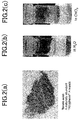
- Fig. 2(a) is a photograph taken of the external view of tannic acid powders
- Fig. 2(b) is a photograph of the external view of tannic acid powders upon added to water
- Fig. 2(c) is a photograph of the external view of tannic acid powders upon added to chloroform.
- the tannic acid powders were ocher powders.
- the tannic acid was dissolved in water, but not in chloroform (CHCl 3 ). This tannic acid material was used for Comparative Example 1.
- TA tannic acid
- alkyl iodide n-decyl iodide, n-hexyl iodide, and n-hexadecyl iodide
- K 2 CO 3 K 2 CO 3
- TA(C 10 ) 5 represented by Chemical Formula (2) was synthesized.
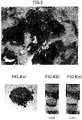
- Fig. 4(a) is a photograph taken of the external view of the derivative
- Figs. 4(b) and 4(c) are photographs taken of the external views of the derivative upon added to water and chloroform, respectively.
- the derivative was in a partly gelled powdery form
- the derivative was not dissolved in water.
- the powders of the derivative were dissolved in CHCl 3 .
- TA(C 6 ) 5 was synthesized under the otherwise same synthesis conditions as in Example 1. The yield was 73%.
- TA(C 6 ) 10 was synthesized under the otherwise same synthesis conditions as in Example 1. The yield was 87%.
- TA(C 16 ) 5 was synthesized under the otherwise same synthesis conditions as in Example 1. The yield was 72%.
- TA(C 16 ) 10 was synthesized under the otherwise same synthesis conditions as in Example 1. The yield was 61%.
- the resultant derivatives were each measured by FT-IR (Fourier-transform infrared spectroscopy).
- FT-IR Fullier-transform infrared spectroscopy
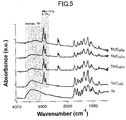
- the spectra of the derivatives obtained in Comparative Example 1 and Inventive Examples 1 to 4 were shown in Fig. 5 in a superposed manner.
- the film-forming composition according to the invention is useful for rust prevention as well as disinfection, pasteurization, sterilization or antibacterial activity.
- This film-forming composition was coated on a substrate such as a metal or glass to obtain materials (samples) having a rust preventive film and a pasteurizing/sterilizing film on the substrate, the effects of which are specifically indicated below.
- a Mg alloy rod (AZ31 made by Osaka Fuji Corporation, composed of 3.2% by mass Al, 0.93% by mass Zn, 0.4% by mass Mn, 0.04% by mass Si, 0.0038% by mass Cu, 0.0086% by mass Ni and 0.003% by mass Fe with the rest of Mg, and having a diameter of 1.5 cm) was cut to prepare a Mg alloy disc having a thickness of 4 mm. Then, this disc was polished by SiC paper on its surface, and cleaned with EtOH, H 2 O and acetone in this order to prepare the following disc test pieces (1) to (6).
- TA used in Examples 1 to 4 and Comparative Example 1 was dissolved in tetrahydrofuran (THF) at 8 wt% to prepare a solution, 40 ⁇ L of which were added dropwise to a substrate and coated by casting. After evaporation of the solvent at room temperature, a one-hour annealing was carried out at 80°C.
- THF tetrahydrofuran
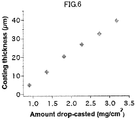
- Fig. 6 is graphically illustrative of the relations between the coating amount by drop-casting and the film thickness upon dried. As shown, the resultant film thickness depended linearly on the coating amount by drop-casting. The same goes true for all the samples and, based on this graph, all the films were assumed to have a film thickness of 20 ⁇ m upon dried.
- I-V (current-voltage) properties were measured in such arrangement as shown in Fig. 7 .
- the scan speed was set at 1 mV/s.
- Fig. 8 shows the results of measurement of cathodic current densities.
- the uncoated sample and Comparative Example 1 (TA) were much the same; the largest current passed through them. In other words, they were the most corrosion prone of all.
- TA(C 10 ) 10 Example 2 had the highest effect on rust prevention.
- Fig. 9 shows the results of measurement of anodic current densities. Comparative Example 1 (TA) was the most corrosion prone of all. On the other hand, TA (C 10 ) 10 (Example 2) was found to have lower and less variable current values, and have the greatest effect on rust prevention.
- Fig. 10 shows the results of measurement of cathodic current densities.
- the uncoated sample was the most corrosion prone of all.
- TA(C 10 ) 10 Example 2
- TA(C 16 ) 10 Example 8
- TA(C 16 ) 10 Example 8
- Fig. 11 shows the results of measurement of anodic current densities.
- the uncoated sample was the most corrosion prone of all.
- TA(C 10 ) 10 Example 2 was found to have lower and less variable current values, and have the most improved effect on rust prevention.
- TA(C 16 ) 10 Example 8 was also found to have less variable current values and have a significant effect on rust prevention.
- Example 2 An uncoated sample of the Mg alloy (AZ31) and a sample coated with TA(C 10 ) 10 on the disc surface of the Mg alloy (AZ31) (Example 2) were each subjected to immersion-in-saline-solution experimentation. As shown in Fig. 12 , the solution was stirred during immersion using a stirring bar at 200 rpm. For the saline solution, a 3.5 wt% NaCl solution was used under a condition of 298 K.
- Fig. 13(a) and 13(b) are photographs taken of the uncoated sample before and 2 hours after the immersion, respectively
- Figs. 13(c) and 13(d) are photographs taken of the sample coated with TA(C 10 ) 10 (Example 2) before and 50 hours after the immersion, respectively.
- Eighty % of the surface of uncoated sample got corroded in a scant 2-hours immersion, but the sample coated with TA(C 10 ) 10 (Example 2) hardly corroded even after a 50-hours immersion.
- Immersion-in-saline-solution experimentation was carried out as in Rust Prevention Testing 3 with the exception of using a sample coated with TA (Comparative Example 1) (TA coated (control)), a sample coated with TA(C 10 ) 20 (Example 4) (TA(C 10 ) 20 coated), a sample coated with TA(C 10 ) 5 (Example 1) (TA(C 10 ) 5 coated), and a sample coated with TA(C 10 ) 15 (Example 3) (TA(C 10 ) 15 coated).
- Photographs taken of the samples before and 50 hours after the immersion are shown in Fig. 14 .
- the TA coated sample got noticeably corroded on its surface with a partial peeling, and the TA(C 10 ) 5 coated sample got slightly corroded.
- both the TA(C 10 ) 20 and TA(C 10 ) 15 samples got hardly corroded even 50 hours after the immersion.
- TA(C 10 ) 10 Example 2 coated samples having film thicknesses of 12, 27, 32 and 40 ⁇ m inclusive of 20 ⁇ m were prepared to measure corrosion currents.
- the corrosion current is defined by the rate of corrosion at a corrosion potential.
- a graph of Fig. 15 with left ordinate and lower abscissa as references is indicative of film thickness vs. corrosion current density relations. It has now been found that there are a decreasing corrosion density and a higher effect on rust prevention as the film thickness grows more than 20 ⁇ m.
- TA(C 6 ) 10 Example 6
- TA(C 10 ) 10 Example 2
- TA(C 16 ) 10 Example 8
- a film was formed by drop-casting on a 5 cm ⁇ 5 cm glass substrate.
- Preparing a THF solution drop-casting of the THF solution in an amount of 1.1 mg/cm 2 was followed by annealing under the conditions of 1 hour and 80°C to prepare a drop-cast film.
- Fig. 17(a) is a photograph taken of a tannic acid film
- Fig. 17(b) is a photograph of a TA(C 6 ) 10 film
- Fig. 17(c) is a photograph of a Ta(C 10 ) 10 film
- Fig. 17(d) is a photograph of a Ta(C 16 ) 10 film.
- TA there could be no clear film formed on the glass with swelled wrinkles.
- the rest of the samples could all provide films of high transparency although they were slightly colored in light orange.
- the TA (Comparative Example 1), TA(C 6 ) 10 (Example 6), TA(C 10 ) 10 (Example 2), and TA(C 16 ) 10 (Example 8) film was formed on the glass substrate by the aforesaid method, and colon bacilli (E. Coli) were scattered on it to observe changes in the surface of the film at room temperature.
- Fig. 18 is a graph representative of the results of proliferation of bacteria on the film.
- the cell count of colon bacilli scattered at the start (0 hour) was 1.2 ⁇ 10 5 CFU/mL. After the lapse of 24 hours, that cell count increased to 1.4 ⁇ 10 7 CFU/mL for the TA coated (control) film.
- the unit CFU/mL is an abbreviation of a colony forming unit indicative of a quantitative unit used in the inspection of bacteria in foods or a unit of the quantity of bacteria. For instance, a unit count of 20 CFU/mL capable of colony formation means that there are 20 bacteria present in 1 mL.
- golden staphs S. Aureus
- MRSA methicillin-resistant Staphylococcus Aureus
- Fig. 19(a) is a photograph taken of the film surface 24 hours after scattering of S. Aureus on the TA coated (control) film
- Fig. 19(b) is a photograph of the film surface 24 hours after scattering of MRSA on the TA coated (control) film
- Fig. 19(c) is a photograph of the film surface 24 hours after scattering of S. Aureus on the drop-cast TA(C 6 ) 10 film
- Fig. 19(d) is a photograph of the film surface 24 hours after scattering of MRSA on the drop-cast TA(C 6 ) 10 film.
- TA(C 6 ) 10 , TA(C 10 ) 10 and TA(C 16 ) 10 have been found to have effects on antibacterial activity and pasteurization against S. Aureus and MRSA.
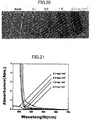
- a TA(C 6 ) 10 film was formed on a glass substrate in a coating amount of 0.1 mg/cm 2 , 0.5 mg/cm 2 , 1.0 mg/cm 2 , and 2.0 mg/cm 2 , respectively. Photographs taken of them are shown in Fig. 20. Fig. 21 is indicative of UV-visible spectra (Abs.) with the glass substrate as a control specimen, and Fig. 22 is indicative of visible transmission (%) spectra.
- the film having a coating amount of 0.1 mg/cm 2 shows a transmittance of greater than 90% over all visible light regions. As described above, the 0.1 mg/cm 2 film, because of having enough bactericidal activity as well, is expected to find use as a bactericidal film for display devices.
- the film-forming composition of the invention because of being formed on a metal, glass or like substrate for the purpose of rust prevention, sterilization and bactericidal activity, is expected to have a wide range of applications.
Landscapes
- Chemical & Material Sciences (AREA)
- Life Sciences & Earth Sciences (AREA)
- Engineering & Computer Science (AREA)
- Materials Engineering (AREA)
- Organic Chemistry (AREA)
- Wood Science & Technology (AREA)
- Plant Pathology (AREA)
- Mechanical Engineering (AREA)
- Metallurgy (AREA)
- Preventing Corrosion Or Incrustation Of Metals (AREA)
- Paints Or Removers (AREA)
- Other Surface Treatments For Metallic Materials (AREA)
- Application Of Or Painting With Fluid Materials (AREA)
Abstract
Description
- The present invention relates generally to a film-forming composition containing a tannic acid derivative, and more specification to a film-forming composition that contains a tannic acid derivative having a given chain hydrocarbon group and is capable of forming a film improved in terms of rust prevention, antibacterial activity, sterilization, pasteurization, and so on.
- Element magnesium (Mg),being abundant on the earth's surface, light in weight, tough and well capable of being cast, has wide applications as parts of wheels, airplanes, and cellular phones. Because of being vulnerable to corrosion, however, Mg gets easily corroded with generation of hydrogen as it is immersed in an acidic solution, an alkaline solution or saline; there have been a variety of rust preventives developed for the purpose of protecting the surfaces of metal substrates such as Mg and Mg alloy substrates.
- For instance,
Patent Publication 1 discloses how to manufacture rustproof, anticorrosive iron materials without recourse to harmful chromium compounds, andPatent Publication 2 discloses a hexavalent chromium-free, surface-treated metal sheet and how to produce it. - Tannin, a sort of polyphenols, has been used as rust preventives since before to form a stable film typically on the surface of zinc as well known in the art (see Non-Patent Publication 1). However, tannin has only limited use because of being hardly soluble in an organic solvent. To provide a solution to this, it has been known in the art that at least some of hydroxyl groups contained in the tannin molecule are substituted by an alkyl ether or an alkyl ester to obtain a water-insoluble tannic acid derivative (Patent Publication 3).
-
- Patent Publication 1:
JP(A) 2004-197151 - Patent Publication 2:
JP(A) 2009-249690 - Patent Publication 3:
JP(A) 2004-307362 - Non-Patent Publication 1: "Metal Surface Technology", Vol. 29, No. 1, pp 38-42, 1978
- It has been assumed that the abovementioned stable film comprises a film portion formed by reactions of gallic acid, etc. in tannic acid with zinc and another film portion formed by cohesive or associative polymerization of tannic acid and superposed on the first-mentioned film portion (
Non-Patent Publication 1,Fig. 10 and Page 42, left column relating thereto). What takes part in these reactions is a hydroxyl group of gallic acid, etc. contained in tannic acid; hence, it is predicted that substitution of this hydroxyl group by an alkyl ether or the like would make film formation difficult, resulting in being less effective for rust prevention. InPatent Publication 1 too, the effect on rust prevention is thus estimated exclusively in a solution state. - Surprisingly, however, the inventors have now found that as a result of study after study made for the purpose of providing a rust preventive having a higher effect on rust prevention than ever before, the aforesaid alkyl ether derivative is capable of forming a film pursuant to a mechanism quite different from that of tannic acid, said film producing a variety of effects inclusive of a rustproof effect, and have arrived at the invention disclosed herein.
- With the foregoing in mind, the present invention provides a film-forming composition containing a tannic acid derivative in which hydrogen atoms in at least some hydroxyl groups in tannic acid are substituted by a chain hydrocarbon group having 3 to 18 carbon atoms.
- The inventive film-forming composition as described above is capable of forming a stable film on various substrates. A study of what mechanism that film is formed in gets just started, but the reason would appear that molecules of the tannic acid derivative line up with the chain hydrocarbon groups arranged side by side, resulting in their orientation in good order. This orientation contributes more to stabilization of the film, outweighing the reduction in hydroxyl groups, and allows that film to have a variety of functions inclusive of rust prevention, antibacterial activity and pasteurization, all much more improved than a cohesive film of tannic acid.
-
- Fig. shows a chemical reaction process indicative of one exemplary derivatization of tannic acid.
-
Fig. 2(a) is a photograph taken of the external view of tannic acid powders,Fig. 2(b) is a photograph of the external view of the tannic acid powders upon added to water, andFig. 2(c) is a photograph of the external view of the tannic acid powders upon added to chloroform. -
Fig. 3 is a photograph taken of an exemplary tannic acid derivative. -
Fig. 4(a) is a photograph taken of the external view of an exemplary tannic acid derivative,Fig. 4(b) is a photograph of the tannic acid derivative upon added to water, andFig. 4(c) is a photograph of the tannic acid derivative upon added to chloroform. -
Fig. 5 is indicative of the FT-IR spectra of derivatives prepared in Comparative Example 1 (tannic acid: TA), Example 1 (TA(C10)5), Example 2 (TA(C10)10), Example 3 (TA(C10)15), and Example 4 (TA(C10)20). -
Fig. 6 is graphically illustrative of the relations between the coating amount by drop-casting on a substrate and the film thickness. -
Fig. 7 is illustrative of the construction of an electrode assembly used for testing of the ability to prevent rust. -
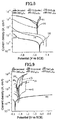
Fig. 8 is indicative of the results of measurement of cathodic current densities in RustPrevention Testing 1. -
Fig. 9 is indicative of the results of measurement of anodic current densities in Rust PreventionTesting 1. -
Fig. 10 is indicative of the results of measurement of cathodic current densities in RustPrevention Testing 2. -
Fig. 11 is indicative of the results of measurement of anodic current densities in Rust PreventionTesting 2. -
Fig. 12 is schematically illustrative of how to carry out immersion-in-saline-solution testing. -
Fig. 13 is a photograph taken of the external view of each sample in Rust PreventionTesting 3. -
Fig. 14 is a photograph taken of the external view of each sample in Rust Prevention Testing 4. -
Fig. 15 is a graphically illustrative of film thickness vs. corrosion current density relations and immersion time vs. corrosion current density relations. -
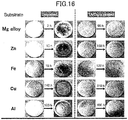
Fig. 16 is photographs indicative of the results of immersion-in-saline-solution testing. -
Fig. 17 is photographs indicative of films on glass substrates. -
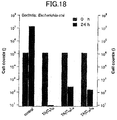
Fig. 18 is graphically illustrative of changes in the cell counts of E. coli scattered on a film formed on a glass substrate. -
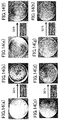
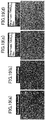
Fig. 19 is photographs taken of the surfaces offilms 24 hours after scattering of S. Aureus ((a), (c)) and MRSA ((b), (d)) on the films formed on a glass substrate. -
Fig. 20 is photographs taken of films formed on a glass substrate in various thicknesses. -
Fig. 21 is indicative of UV-visible absorption spectra of the films shown inFig. 20 . -
Fig. 22 is transmittance spectra of the films shown inFig. 20 . - Tannin is a general term of plant components that yield polyvalent phenols via hydrolysis, and are roughly broken down into a hydrolysis type tannin in which the ester bonding of gallic acid or ellagic acid to sugars such as glucose makes it susceptible to hydrolysis by acids or enzymes, and a condensation type tannin formed by the polymerization of a compound having a flavanol skeleton. Both types of tannin may be used alone or in admixture for derivatization that would appear to result in the advantages contemplated herein. Preference is given to the hydrolysis type tannin; for instance, a hydrolysis type tannin composed mainly of tannic acid represented by the following formula (1) may be derivatized. It is here noted that the tannic acid used in the examples given later is a naturally occurring material that originates from the gall of Japanese sumac and can contain substances occurring as by cleavage or recombination of the ester bond of gallic acid or ellagic acid in the process of extraction or purification; however, it has been well established that such tannic acid can be effective for rust prevention, sterilization, etc.

- While tannic acid includes a plurality of hydroxyl groups, it is to be understood that hydrogen atoms in at least some of the plurality of hydroxyl groups in the inventive derivative are substituted by a chain hydrocarbon group having 3 to 18 carbon atoms. The total number of hydroxyl groups in the starting material tannic acid varies from type to type. Preferably at least 10%, more preferably at least 20%, and most preferably at least 40% of hydroxyl groups may be substituted. In the case of Formula (1) as an example, the total number of hydroxyl groups is 25, of which at least one, preferably at least three, more preferably at least five, and most preferably at least ten are substituted.
- The upper limit to the number of substituents varies depending on the type of substituent, the substrate to be used, and what purpose it is used for. If the desired fixability is achieved for the substrate to be used, all the hydroxyl groups may be substituted. Upon application to polar substrates such as metal or glass substrates, preferably at most 80%, and more preferably at most 60% of hydroxyl groups should be substituted. In the case of Formula (1) as an example, preferably at most 20, and more preferably at most 15 hydroxyl groups should be substituted.
- The chain hydrocarbon group having 3 to 18 carbon atoms includes a linear or branched alkyl, alkeynl or alkynyl group, each being bonded to the tannic acid skeleton via a bond including an oxygen atom originating from the hydroxyl group. Included in the linear hydrocarbon group are specifically a butyl group, a hexyl group, a heptyl group, an octyl group, an isooctyl group, a nonyl group, an isononyl group, a decyl group, an undecyl group, a dodecyl group, a hexadecyl group, a propylene group, a hexylene group, a hexadecenyl group, an octadecenyl group, etc., and that linear hydrocarbon group has preferably 4 to 18, and more preferably 6 to 16 carbon atoms. The bond containing the oxygen atom, for instance, includes an ether bond, an ester bond, and a urethane bond. While even other groups than that linear hydrocarbon groups may have an ability to form films, it is to be understood that most of the ability of tannic acid derivatives to form films is still unknown and has yet to be clarified, as described above.
- The tannic acid derivatives here may be obtained by the Williamson ether synthesis method that is one of alkylation reactions. Specifically, a tannic acid derivative may be prepared by reaction of an alkyl halogenide to tannic acid in a solvent such as tetrahydrofuran, and dimethyl sulfoxide under the presence of a basic catalyst. For the basic catalyst, one or two or more catalysts selected from the group of consisting of MH, M2CO3 and M (M: an alkaline metal) may be used. For instance, K2CO3 may convert an OH group into O-M+ for acceleration of nucleophilic reaction of an O- group into an alkyl halogenide (X-R1: X: halogen, R1: an alkyl group). For the alkyl halogenide, for instance, an alkyl iodide may be used and instead of the alkyl halogenide, a compound including a sulfonyl group as a leaving group may be used. An alkylation reaction other than the Williamson ether synthesis method may also be used. A dehydration condensation reaction with carboxylic acids using a condensing agent like N,N'-dicyclohexylcarbodiimide (DCC) or a condensation reaction with an isocyanate may further be used.
- The reaction may be carried out about 1-hour heating at 70°C to 100°C inclusive.
Fig. 1 is indicative of one example of derivatization of tannic acid represented by Formula (1). There is an example shown in which heating is carried out at 85°C in DMF using K2CO3 as the basic catalyst for synthesis of a derivative having nine decyl groups (TA(C10)9). By varying the molar ratio of the alkyl halogenide to tannic acid, it is possible to set the value of n that stands for the number of alkyl groups introduced into tannic acid as desired. - The inventive composition is capable of forming films. For instance, upon removal of a solvent after application of that composition in a solution form to a substrate, it remains as a film on the substrate. That film is not necessarily a continuous one; it may be discontinuously formed as by spraying. The tannin derivative may also be crosslinked or otherwise mixed with a matrix such as resin for the purpose of improving on its durability or the like. The crosslinking agent may be premixed with the inventive composition or, alternately, it may be added to the inventive composition upon its application to a substrate.
- The inventive composition may be used in various applications making use of various actions and film-formation capability of the tannic derivative. For instance, it may be provided in the form of rust preventives, antioxidants, disinfectants, bactericides/sterilizers, and antibacterial agents. There is also no limitation on an associated substrate that is selected from a wide range of substrates inclusive of metals, metal oxides, resins, elastomers, polymers, inorganic materials, concretes, mortars, woods, and animal or human skins.
- The inventive composition may be available in various forms; for instance, it may be provided in a paste, gel, emulsion, and spray form. The inventive composition in a solution or paste form contains at least one solvent, for which there is the mention of an alcoholic solvent such as propylene alcohol and butanol, an ether solvent such as ethylene glycol monomethyl ether and ethylene glycol monopropyl ether, an ester solvent such as ethyl acetate and isobutyl acetate, and a ketone solvent such as methyl ethyl ketone with the proviso that the tannic acid derivative can be dissolved in them.
- The inventive composition in an emulsion form such as a cream or latex form contains a mixed solvent of water and an organic solvent compatible with water such as an alcohol. There is no limitation on an emulsion form; any one of the oil-in-water (o/w), water-in-oil (w/o) and w/o/w type emulsions may be used. For preparation, the tannic acid derivative may be directly dispersed in water or, alternatively, an organic solvent solution of the tannic acid derivative may be dispersed in water. Further, an emulsion may be prepared in a mixed solvent of water and an organic solvent that is compatible with water, and the organic solvent alone is volatilized off to obtain an aqueous dispersion.
- The inventive composition in a spray form contains a liquefied or compressed gas acting as a blasting or injecting agent. For the liquefied gas there is the mention of liquefied petroleum gas, dimethyl ether or the like, and for the compressed gas there is the mention of carbon dioxide, nitrogen and such. This carbon dioxide may be a supercritical fluid exceeding the critical point for use in industrial pasteurization processes or the like.
- The inventive composition may be prepared by mixing a tannic acid derivative in such an amount as to provide a concentration depending on purpose with such components as mentioned above in a conventional method. The concentration of the tannic acid derivative may be varied depending on what purpose it is for, and how to coat it. The inventive compositions may each be blended with common additives such as surface active agent, dispersants, defoamers, leveling agents, pH regulators, crosslinking agents, fillers and so on in a range without detriment to the object(s) of the invention.
- The film may be formed in any desired way inclusive of bar coating, spin coating, dipping, and spraying. The thickness of the film is not limited too; it may be adjusted depending on what purpose the film is used for. Take a rust preventive film as an example. The thickness is preferably at least 100 nm. Below 100 nm, it may be hard to prevent water molecules from coming close to the surface of a metal or alloy substrate, resulting in a failure to obtain any sufficient effect on rust prevention.
- The present invention is explained with reference to its specific examples, but it is not limited by these examples.
- Tannic acid powders (WAKO, 203-06331) were kept at the ready.
Fig. 2(a) is a photograph taken of the external view of tannic acid powders,Fig. 2(b) is a photograph of the external view of tannic acid powders upon added to water, andFig. 2(c) is a photograph of the external view of tannic acid powders upon added to chloroform. As shown inFig. 2(a) , the tannic acid powders were ocher powders. The tannic acid was dissolved in water, but not in chloroform (CHCl3). This tannic acid material was used for Comparative Example 1. - In Examples 1 to 8 given below, the aforesaid tannic acid (hereinafter often abbreviated as TA) and an alkyl iodide were dissolved in DMF to obtain a solution to which the alkyl iodide (n-decyl iodide, n-hexyl iodide, and n-hexadecyl iodide) and an equal amount of K2CO3 were added, whereupon the solution was heated at 85°C for 8 hours to synthesize the tannic acid derivatives set out in Table 1. In what follows, a tannic acid derivative having n substituents having m carbon atoms is abbreviated as "TA(Cm)n".
Table 1 Compounds Alkyl Iodide (wt.%) Tannic Acid (wt.%) φ -OH Rate of Derivatization (mol%) Yields (%) TA(C6)5 C6H13I (38) 62 20 73 TA(C6)10 C6H13I (55) 45 40 87 TA(C10)5 C10H21I (44) 56 20 88 TA(C10)10 C10H21I (61) 39 40 74 TA(C10)15 C10H21I (70) 30 60 76 TA(C10)20 C10H21I (76) 24 80 94 TA(C16)5 C16H33I (51) 49 20 72 TA(C16)10 C16H33I (67) 33 40 61 - Under the aforesaid synthesis conditions in a tannic acid concentration of 56 wt% and a n-decyl iodide concentration of 44 wt%, TA(C10)5 represented by Chemical Formula (2) was synthesized.
Fig. 3 is a photograph taken of the external view of the resultant derivative that was a gel-like substance. Note here that m in Formula (2) was m=10 and the yield was 88%. The number of the substituents introduced was calculated from the rate of the charged tannic acid and n-decyl iodide.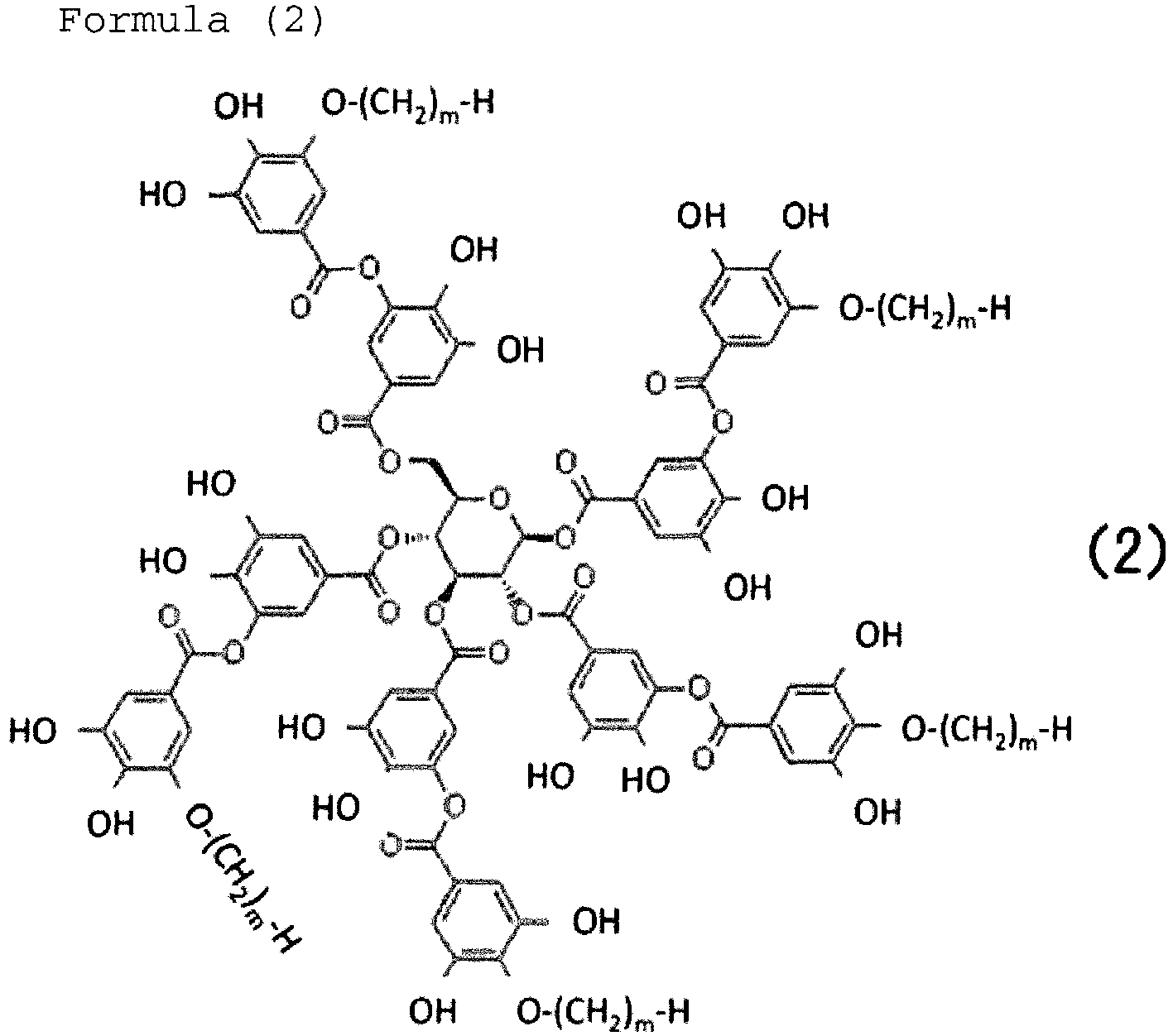
-
Fig. 4(a) is a photograph taken of the external view of the derivative, andFigs. 4(b) and 4(c) are photographs taken of the external views of the derivative upon added to water and chloroform, respectively. As shown inFig. 4(a) , the derivative was in a partly gelled powdery form, and as shown inFig. 4(b) , the derivative was not dissolved in water. As shown inFig. 4(c) , the powders of the derivative were dissolved in CHCl3. - TA(C10)10 represented by Chemical Formula (3) was synthesized with the concentrations of tannic acid and n-decyl iodide changed to 39 wt% and 61 wt%, respectively, under the otherwise same synthesis conditions as in Example 1. Note here that m=10 in Formula (3). The yield was 74%.

- TA(C10)15 represented by Chemical Formula (4) was synthesized with the concentrations of tannic acid and n-decyl iodide changed to 30 wt% and 70 wt%, respectively, under the otherwise same synthesis conditions as in Example 1. Note here that m=10 in Formula (4). The yield was 76%.

- TA(C10)20 represented by Chemical Formula (5) was synthesized with the concentrations of tannic acid and n-decyl iodide changed to 24 wt% and 76 wt%, respectively, under the otherwise same synthesis conditions as in Example 1. Note here that m=10 in Formula (5). The yield was 94%.

- Using tannic acid in a concentration of 62 wt% and n-hexyl iodide in a concentration of 38 wt%, TA(C6)5 was synthesized under the otherwise same synthesis conditions as in Example 1. The yield was 73%.
- Using tannic acid in a concentration of 45 wt% and n-hexyl iodide in a concentration of 55 wt%, TA(C6)10 was synthesized under the otherwise same synthesis conditions as in Example 1. The yield was 87%.
- Using tannic acid in a concentration of 49 wt% and n-hexadecyl iodide in a concentration of 51 wt%, TA(C16)5 was synthesized under the otherwise same synthesis conditions as in Example 1. The yield was 72%.
- Using tannic acid in a concentration of 33 wt% and n-hexadecyl iodide in a concentration of 67 wt%, TA(C16)10 was synthesized under the otherwise same synthesis conditions as in Example 1. The yield was 61%.
- The resultant derivatives were each measured by FT-IR (Fourier-transform infrared spectroscopy). The spectra of the derivatives obtained in Comparative Example 1 and Inventive Examples 1 to 4 were shown in
Fig. 5 in a superposed manner. For each one of the inventive derivatives, there was an alkyl group peak found near 3000 cm-1. - The film-forming composition according to the invention is useful for rust prevention as well as disinfection, pasteurization, sterilization or antibacterial activity. This film-forming composition was coated on a substrate such as a metal or glass to obtain materials (samples) having a rust preventive film and a pasteurizing/sterilizing film on the substrate, the effects of which are specifically indicated below.
- A Mg alloy rod (AZ31 made by Osaka Fuji Corporation, composed of 3.2% by mass Al, 0.93% by mass Zn, 0.4% by mass Mn, 0.04% by mass Si, 0.0038% by mass Cu, 0.0086% by mass Ni and 0.003% by mass Fe with the rest of Mg, and having a diameter of 1.5 cm) was cut to prepare a Mg alloy disc having a thickness of 4 mm. Then, this disc was polished by SiC paper on its surface, and cleaned with EtOH, H2O and acetone in this order to prepare the following disc test pieces (1) to (6).
- (1) Uncoated sample of the Mg alloy (AZ31)
- (2) Sample coated with TA(C10)5 (Example 1) on the disc surface of the Mg alloy (AZ31)
- (3) Sample coated with TA(C10)10 (Example 2) on the disc surface of the Mg alloy (AZ31)
- (4) Sample coated with TA(C10)15 (Example 3) on the disc surface of the Mg alloy (AZ31)
- (5) Sample coated with TA(C10)20 (Example 4) on the disc surface of the Mg alloy (AZ31)
- (6) Sample coated with TA (Comparative Example 1) on the disc surface of the Mg alloy (AZ31)
- TA used in Examples 1 to 4 and Comparative Example 1 was dissolved in tetrahydrofuran (THF) at 8 wt% to prepare a solution, 40 µL of which were added dropwise to a substrate and coated by casting. After evaporation of the solvent at room temperature, a one-hour annealing was carried out at 80°C.
-
Fig. 6 is graphically illustrative of the relations between the coating amount by drop-casting and the film thickness upon dried. As shown, the resultant film thickness depended linearly on the coating amount by drop-casting. The same goes true for all the samples and, based on this graph, all the films were assumed to have a film thickness of 20 µm upon dried. - Using each of the resultant discs as a working electrode, a std. calomel electrode as a reference electrode, a platinum wire as a counter electrode, and a 3.5 wt% NaCl aqueous solution as an electrolyte solution, I-V (current-voltage) properties were measured in such arrangement as shown in
Fig. 7 . The scan speed was set at 1 mV/s. -
Fig. 8 shows the results of measurement of cathodic current densities. The uncoated sample and Comparative Example 1 (TA) were much the same; the largest current passed through them. In other words, they were the most corrosion prone of all. On the other hand, TA(C10)10 (Example 2) had the highest effect on rust prevention. -
Fig. 9 shows the results of measurement of anodic current densities. Comparative Example 1 (TA) was the most corrosion prone of all. On the other hand, TA (C10)10 (Example 2) was found to have lower and less variable current values, and have the greatest effect on rust prevention. - The I-V properties of the following four samples were measured as in
Rust Prevention Testing 1. - (1) Uncoated sample of the Mg alloy (AZ31)
- (2) Sample coated with TA(C10)10 (Example 2) on the disc surface of the Mg alloy (AZ31)
- (3) Sample coated with TA(C6)10 (Example 6) on the disc surface of the Mg alloy (AZ31)
- (4) Sample coated with TA(C16)10 (Example 8) on the disc surface of the Mg alloy (AZ31)
-
Fig. 10 shows the results of measurement of cathodic current densities. The uncoated sample was the most corrosion prone of all. On the other hand, TA(C10)10 (Example 2) and TA(C16)10 (Example 8) had much the same improved effect on rust prevention. -
Fig. 11 shows the results of measurement of anodic current densities. The uncoated sample was the most corrosion prone of all. On the other hand, TA(C10)10 (Example 2) was found to have lower and less variable current values, and have the most improved effect on rust prevention. TA(C16)10 (Example 8) was also found to have less variable current values and have a significant effect on rust prevention. - An uncoated sample of the Mg alloy (AZ31) and a sample coated with TA(C10)10 on the disc surface of the Mg alloy (AZ31) (Example 2) were each subjected to immersion-in-saline-solution experimentation. As shown in
Fig. 12 , the solution was stirred during immersion using a stirring bar at 200 rpm. For the saline solution, a 3.5 wt% NaCl solution was used under a condition of 298 K. -
Fig. 13(a) and 13(b) are photographs taken of the uncoated sample before and 2 hours after the immersion, respectively, andFigs. 13(c) and 13(d) are photographs taken of the sample coated with TA(C10)10 (Example 2) before and 50 hours after the immersion, respectively. Eighty % of the surface of uncoated sample got corroded in a scant 2-hours immersion, but the sample coated with TA(C10)10 (Example 2) hardly corroded even after a 50-hours immersion. - Immersion-in-saline-solution experimentation was carried out as in
Rust Prevention Testing 3 with the exception of using a sample coated with TA (Comparative Example 1) (TA coated (control)), a sample coated with TA(C10)20 (Example 4) (TA(C10)20 coated), a sample coated with TA(C10)5 (Example 1) (TA(C10)5 coated), and a sample coated with TA(C10)15 (Example 3) (TA(C10)15 coated). - Photographs taken of the samples before and 50 hours after the immersion are shown in
Fig. 14 . Fifty hours after the immersion, the TA coated sample got noticeably corroded on its surface with a partial peeling, and the TA(C10)5 coated sample got slightly corroded. On the other hand, both the TA(C10)20 and TA(C10)15 samples got hardly corroded even 50 hours after the immersion. - TA(C10)10 (Example 2) coated samples having film thicknesses of 12, 27, 32 and 40 µm inclusive of 20 µm were prepared to measure corrosion currents. The corrosion current is defined by the rate of corrosion at a corrosion potential.
- A graph of
Fig. 15 with left ordinate and lower abscissa as references is indicative of film thickness vs. corrosion current density relations. It has now been found that there are a decreasing corrosion density and a higher effect on rust prevention as the film thickness grows more than 20 µm. - Then, the aforesaid 20 µm-thick sample was measured in terms of dependency of the corrosion current density on immersion time. The results are shown in
Fig. 15 with right ordinate and upper abscissa as references. For 0 hour up to 40 hours, there was no or little change in the corrosion current density. - An uncoated sample and a TA(C16)10 (Example 8)-coated sample were formed using substrates of the Mg alloy as well as Zn, Fe, Cu, and Al respectively for immersion-in-saline-solution experimentation. Photographs of these samples are shown in
Fig. 16 . Referring to the uncoated samples, all metals got corroded by immersion in saline solution for a given time of period whereas, referring to the TA(C16)10 coated samples, all the metals remained intact. - Using TA (Comparative Example 1), TA(C6)10 (Example 6), TA(C10)10 (Example 2), and TA(C16)10 (Example 8), respectively, a film was formed by drop-casting on a 5 cm ×5 cm glass substrate. Preparing a THF solution, drop-casting of the THF solution in an amount of 1.1 mg/cm2 was followed by annealing under the conditions of 1 hour and 80°C to prepare a drop-cast film.
-
Fig. 17(a) is a photograph taken of a tannic acid film;Fig. 17(b) is a photograph of a TA(C6)10 film;Fig. 17(c) is a photograph of a Ta(C10)10 film; andFig. 17(d) is a photograph of a Ta(C16)10 film. With TA, there could be no clear film formed on the glass with swelled wrinkles. On the other hand, the rest of the samples could all provide films of high transparency although they were slightly colored in light orange. - The TA (Comparative Example 1), TA(C6)10 (Example 6), TA(C10)10 (Example 2), and TA(C16)10 (Example 8) film was formed on the glass substrate by the aforesaid method, and colon bacilli (E. Coli) were scattered on it to observe changes in the surface of the film at room temperature.
Fig. 18 is a graph representative of the results of proliferation of bacteria on the film. The cell count of colon bacilli scattered at the start (0 hour) was 1.2×10⁵ CFU/mL. After the lapse of 24 hours, that cell count increased to 1.4×10⁷ CFU/mL for the TA coated (control) film. In contrast, no or little bacilli (< 10) were found on the TA(C6)10 film, indicating that there were noticeable effects on antibacterial activity and sterilization. After the lapse of 24 hours, the cell count went down to 2.7×10² CFU/mL for TA(C10)10, and 1.6×10² CFU/mL for TA(C16)10, indicating that there were effects on antibacterial activity and sterilization. A problem with tannic acid - known so far to be capable of pasteurization in the form of an aqueous solution - was that a tannic acid film is wrinkled up, running short of durability. Because of having a high solubility in water, tannic acid was incapable of aqueous testing such as antibacterial testing in a thin-film state. With the tannic acid derivative according to the invention, however, it is possible to reduce its solubility in water down to a very low level and, hence, to estimate its antibacterial activity in a thin-film state for the first time. It is here to be noted that the unit CFU/mL is an abbreviation of a colony forming unit indicative of a quantitative unit used in the inspection of bacteria in foods or a unit of the quantity of bacteria. For instance, a unit count of 20 CFU/mL capable of colony formation means that there are 20 bacteria present in 1 mL. - Likewise, golden staphs (S. Aureus) or methicillin-resistant Staphylococcus Aureus (MRSA) were scattered to make studies of effects on antibacterial activity and pasteurization. Set out in Table 2 are the results of effects on antibacterial activity and pasteurization against E. Coli, S. Aureus and MRSA.


-
Fig. 19(a) is a photograph taken of thefilm surface 24 hours after scattering of S. Aureus on the TA coated (control) film;Fig. 19(b) is a photograph of thefilm surface 24 hours after scattering of MRSA on the TA coated (control) film;Fig. 19(c) is a photograph of thefilm surface 24 hours after scattering of S. Aureus on the drop-cast TA(C6)10 film; andFig. 19(d) is a photograph of thefilm surface 24 hours after scattering of MRSA on the drop-cast TA(C6)10 film. As shown, TA(C6)10, TA(C10)10 and TA(C16)10 have been found to have effects on antibacterial activity and pasteurization against S. Aureus and MRSA. - 1.6×10⁵ (CFU/mL) of MRSA were scattered on a TA(C6)10 film formed on a glass substrate (in a coating amount of 1.2 mg/cm2) according to the aforesaid method to make a study of cell count changes at room temperature over time. As can be seen from Table 3, it has been found that MRSA can be pasteurized within 2 hours.
Table 3 0 hour 1 hour 2 hours 4 hours 8 hours 24 hours Cell counts of MRSA (CFU/mL) 1.6×10³ <10 <10 <10 <10 - As in Pasteurization/
Sterilization Testing 2, 1.6× 10⁵ (CFU/mL) of MRSA were scattered on TA(C6)10 films having different thicknesses formed on a glass substrate according to the aforesaid method, and the cell counts of MRSA after the lapse of 24 hours were measured. As can be seen from Table 4, it has been found that MRSA can be pasteurized with no difficulty even when the film is as thin as 0.1 mg/cm2.Table 4 mg/cm2 1.2 0.8 0.4 0.2 0.1 Cell counts of MRSA (CFU/mL) <10 <10 <10 <10 <10 - As in the aforesaid method, a TA(C6)10 film was formed on a glass substrate in a coating amount of 0.1 mg/cm2, 0.5 mg/cm2, 1.0 mg/cm2, and 2.0 mg/cm2, respectively. Photographs taken of them are shown in
Fig. 20. Fig. 21 is indicative of UV-visible spectra (Abs.) with the glass substrate as a control specimen, andFig. 22 is indicative of visible transmission (%) spectra. The film having a coating amount of 0.1 mg/cm2 shows a transmittance of greater than 90% over all visible light regions. As described above, the 0.1 mg/cm2 film, because of having enough bactericidal activity as well, is expected to find use as a bactericidal film for display devices. - The film-forming composition of the invention, because of being formed on a metal, glass or like substrate for the purpose of rust prevention, sterilization and bactericidal activity, is expected to have a wide range of applications.
Claims (8)
- A film-forming composition, which contains a tannic acid derivative in which hydrogen atoms in at least some of hydroxyl groups of tannic acid are substituted by a chain hydrocarbon group having 3 to 18 carbon atoms.
- A film-forming composition as recited in claim 1, wherein said chain hydrocarbon group is an alkyl group.
- A film-forming composition as recited in claim 1 or 2, wherein 10% to 80% of hydroxyl groups of said tannic acid derivative is substituted by said chain hydrocarbon group.
- A film-forming composition as recited in any one of claims 1 to 3, which further includes a solvent and prevails in a solution or paste form.
- A film-forming composition as recited in any one of claims 1 to 3, which further includes water and prevails in an emulsion form.
- A film-forming composition as recited in any one of claims 1 to 3, which further includes an inert gas and prevails in a spray form.
- A film-forming composition as recited in any one of claims 1 to 6, which provides a rust preventive composition.
- A film-forming composition as recited in any one of claims 1 to 6, which provides a composition for disinfection, pasteurization, sterilization or bactericidal activity.
Applications Claiming Priority (2)
| Application Number | Priority Date | Filing Date | Title |
|---|---|---|---|
| JP2014228667 | 2014-11-11 | ||
| PCT/JP2015/081600 WO2016076311A1 (en) | 2014-11-11 | 2015-11-10 | Film-forming composition including tannic acid derivative |
Publications (3)
| Publication Number | Publication Date |
|---|---|
| EP3219773A1 true EP3219773A1 (en) | 2017-09-20 |
| EP3219773A4 EP3219773A4 (en) | 2018-04-25 |
| EP3219773B1 EP3219773B1 (en) | 2019-05-08 |
Family
ID=55954394
Family Applications (1)
| Application Number | Title | Priority Date | Filing Date |
|---|---|---|---|
| EP15858158.7A Active EP3219773B1 (en) | 2014-11-11 | 2015-11-10 | Film-forming composition including tannic acid derivative |
Country Status (4)
| Country | Link |
|---|---|
| US (2) | US20170321061A1 (en) |
| EP (1) | EP3219773B1 (en) |
| JP (2) | JP6531955B2 (en) |
| WO (1) | WO2016076311A1 (en) |
Families Citing this family (10)
| Publication number | Priority date | Publication date | Assignee | Title |
|---|---|---|---|---|
| US11008457B2 (en) | 2016-05-27 | 2021-05-18 | National Institute For Materials Science | Film composition containing a tannic acid derivative and process for producing said film composition |
| US11634617B2 (en) | 2017-01-31 | 2023-04-25 | National Institute For Materials Science | Adhesive composition, a process of producing the adhesive composition, a bonding method using the adhesive composition, and a structure having the adhesive composition applied thereon |
| JP7061815B2 (en) * | 2018-05-16 | 2022-05-02 | 国立研究開発法人物質・材料研究機構 | Microaggregates and their manufacturing methods |
| JP7217883B2 (en) * | 2019-02-01 | 2023-02-06 | 国立研究開発法人物質・材料研究機構 | Functional composition, functional film, structure, functional laminate film, and method for producing functional laminate film |
| EP4261040A4 (en) | 2020-12-11 | 2024-09-18 | National Institute for Materials Science | Laminate, and packaging body or container |
| WO2022124102A1 (en) * | 2020-12-11 | 2022-06-16 | 国立研究開発法人物質・材料研究機構 | Aqueous coating material, layered product, and packaging object or container |
| KR20230119136A (en) * | 2020-12-18 | 2023-08-16 | 도판 인사츠 가부시키가이샤 | Polyphenol derivatives and polymeric materials |
| JP7283710B1 (en) * | 2021-07-16 | 2023-05-30 | 国立研究開発法人物質・材料研究機構 | Antiviral coating agent, laminate, and package or container |
| JP2023023880A (en) * | 2021-08-06 | 2023-02-16 | Basf Inoacポリウレタン株式会社 | polyurethane foam |
| CN115814154B (en) * | 2022-11-25 | 2024-09-17 | 西北工业大学 | A pH-responsive controlled-release bactericidal coating and its preparation method and application |
Family Cites Families (19)
| Publication number | Priority date | Publication date | Assignee | Title |
|---|---|---|---|---|
| US4177174A (en) * | 1976-05-14 | 1979-12-04 | Dai Nippon Toryo Co., Ltd. | Epoxy resin composition cured by reaction product of phenol carboxylic acids with polyamino compounds |
| JPS6144821A (en) * | 1984-07-11 | 1986-03-04 | ユニヴア−シテイ・オブ・シドニ− | Anti-allergenic |
| JPS61103991A (en) * | 1984-10-26 | 1986-05-22 | Idemitsu Petrochem Co Ltd | Rustproof oil composition |
| JPH0723391B2 (en) * | 1986-03-06 | 1995-03-15 | ポーラ化成工業株式会社 | Ascorbic acid-geraniin conjugate |
| JPH01198669A (en) * | 1987-10-19 | 1989-08-10 | Kureha Chem Ind Co Ltd | Corrosion-preventive coating compound composition |
| JPH026573A (en) * | 1988-06-27 | 1990-01-10 | Sankyo Seiki Mfg Co Ltd | Corrosion-resistant coating material |
| US4880478A (en) * | 1988-12-22 | 1989-11-14 | The United States Of America As Represented By The Secretary Of The Army | Protective coating for steel surfaces and method of application |
| JP2511597B2 (en) * | 1991-10-23 | 1996-06-26 | アイシン化工株式会社 | Aqueous coating composition |
| DE60041364D1 (en) * | 2000-11-21 | 2009-02-26 | Sambix Corp | WHISK-FREE GALVANIZED PRODUCT WITH A VARIETY OF WHISK-FREE GALVANIZED PRODUCT WITH A MULTILAYER ANTI-STRIP FILM |
| JP4331933B2 (en) * | 2002-04-03 | 2009-09-16 | エスケー化研株式会社 | Paint composition |
| JP2004307362A (en) * | 2003-04-03 | 2004-11-04 | Wakayama Prefecture | Water-insoluble tannin derivative and method for producing the same |
| JP4454647B2 (en) * | 2007-03-15 | 2010-04-21 | 福島県 | A rust preventive film forming treatment agent using tannin, a rust preventive film forming method, and a rust preventive metal. |
| AT508319A1 (en) * | 2009-05-20 | 2010-12-15 | Mittermayr Alexander | METHOD FOR AROMATING A FOOD PROVIDED IN A PACKAGING METHOD |
| US20110126501A1 (en) * | 2009-10-16 | 2011-06-02 | Woongjin Coway Co., Ltd. | Composition for prevention of influenza viral infection comprising tannic acid, air filter comprising the same and air cleaning device comprising the filter |
| FR2952067B1 (en) * | 2009-11-03 | 2012-05-25 | Saint Gobain Technical Fabrics | FILMOGENIC COMPOSITION COMPRISING AN AGENT SUITABLE FOR TRAPPING FORMALDEHYDE |
| US9127367B2 (en) * | 2010-09-02 | 2015-09-08 | Nippon Steel & Sumitomo Metal Corporation | Precoated metal sheet excellent in conductivity and corrosion resistance |
| WO2014090832A1 (en) * | 2012-12-11 | 2014-06-19 | Sandoz Ag | Tannin derivative and pharmaceutical compositions comprising said tannin derivative |
| US10179114B2 (en) * | 2013-01-24 | 2019-01-15 | Northwestern University | Phenolic coatings and methods of making and using same |
| US9474699B2 (en) * | 2014-03-31 | 2016-10-25 | Johnson & Johnson Consumer Inc. | Compostions and methods for enhancing the topical application of a basic benefit agent |
-
2015
- 2015-11-10 JP JP2016559061A patent/JP6531955B2/en active Active
- 2015-11-10 US US15/526,208 patent/US20170321061A1/en not_active Abandoned
- 2015-11-10 WO PCT/JP2015/081600 patent/WO2016076311A1/en not_active Ceased
- 2015-11-10 EP EP15858158.7A patent/EP3219773B1/en active Active
-
2018
- 2018-05-04 US US15/971,539 patent/US10538674B2/en active Active
-
2019
- 2019-01-25 JP JP2019011459A patent/JP6691698B2/en active Active
Also Published As
| Publication number | Publication date |
|---|---|
| JPWO2016076311A1 (en) | 2017-09-21 |
| JP2019077954A (en) | 2019-05-23 |
| US20180258291A1 (en) | 2018-09-13 |
| EP3219773B1 (en) | 2019-05-08 |
| EP3219773A4 (en) | 2018-04-25 |
| WO2016076311A1 (en) | 2016-05-19 |
| US20170321061A1 (en) | 2017-11-09 |
| JP6531955B2 (en) | 2019-06-19 |
| JP6691698B2 (en) | 2020-05-13 |
| US10538674B2 (en) | 2020-01-21 |
Similar Documents
| Publication | Publication Date | Title |
|---|---|---|
| EP3219773B1 (en) | Film-forming composition including tannic acid derivative | |
| Stroescu et al. | Chitosan-vanillin composites with antimicrobial properties | |
| JP4533383B2 (en) | Capsaicin derivatives and their production and use | |
| EP3131978B1 (en) | Corrosion-resistant coating composition | |
| US20210040331A1 (en) | Corrosion protection for metallic substrates | |
| JP6631928B2 (en) | Film composition containing tannic acid derivative, and method for producing the film composition | |
| Abd El-Fattah et al. | Potential application of some coumarin derivatives incorporated thiazole ring as ecofriendly antimicrobial, flame retardant and corrosion inhibitor additives for polyurethane coating | |
| DE4439193A1 (en) | Mixture for corrosion inhibition of metals | |
| EP3178897B1 (en) | Hydrophilization treatment agent for aluminum-containing metal material | |
| Ghosal et al. | A facile cleaner approach towards the synthesis of silver-doped cardanol-based hydrophobic antimicrobial and anticorrosive polymeric coating material | |
| US20130017305A1 (en) | Lower alkyl carboxylic acid moieties as organoleptic stabilizers and preservatives of food and beverages and for preventing oxidative corrosion of metals | |
| CN104277693B (en) | Anti-rust paint for ship and preparation method thereof | |
| JPS59227842A (en) | Novel quaternary ammonium compound, manufacture and use of same as antiseptic drug | |
| US20150275377A1 (en) | Nanoparticles of diquaternary schiff dibases as corrosion inhibitors for protecting steel against exposure to acidic fluids | |
| Peres et al. | Influence of pH in the synthesis of ferric tannate pigment for application in antifouling coatings | |
| Jaiswal et al. | An investigation of the biochemical properties of tetrazines as potential coating additives | |
| EP1059292B1 (en) | New adamantane derivative and aqueous disinfectant composition containing it | |
| Nikitasari et al. | Anti-corrosion inhibition of API 5L in hydrochloric acid solution by ethanol extract of Phyllanthus niruri leaf | |
| US10669434B2 (en) | Corrosion resistant coatings for metal surfaces | |
| CN104957137A (en) | DBNPA-containing disinfectant composition and preparation method thereof | |
| El-Sabbah et al. | Effect of biocide on the stability of pomegranate peel and roselle as eco-friendly inhibitor on the corrosion control of mild steel in acidic medium | |
| WO2018038690A1 (en) | Boronium cation doped corrosion inhibitor | |
| DE10143521A1 (en) | Addition product, useful as corrosion inhibitor in e.g. paints, adhesives, primers and conversion baths, is prepared by acid-base reaction of hexafluorosilicic acid, hexafluorotitanic acid or hexafluorozirconic acid with organic base(s) | |
| CN121914577A (en) | Environment-friendly water-based antirust composition and preparation method and application thereof | |
| Iorungwa et al. | Synthesis, Characterization and Anti-Fungal activity of Cu (II), Ni (II) and Cd (II) complexes of 5-Bromosalicylidene-2-Nitroaniline |
Legal Events
| Date | Code | Title | Description |
|---|---|---|---|
| STAA | Information on the status of an ep patent application or granted ep patent |
Free format text: STATUS: THE INTERNATIONAL PUBLICATION HAS BEEN MADE |
|
| PUAI | Public reference made under article 153(3) epc to a published international application that has entered the european phase |
Free format text: ORIGINAL CODE: 0009012 |
|
| STAA | Information on the status of an ep patent application or granted ep patent |
Free format text: STATUS: REQUEST FOR EXAMINATION WAS MADE |
|
| 17P | Request for examination filed |
Effective date: 20170610 |
|
| AK | Designated contracting states |
Kind code of ref document: A1 Designated state(s): AL AT BE BG CH CY CZ DE DK EE ES FI FR GB GR HR HU IE IS IT LI LT LU LV MC MK MT NL NO PL PT RO RS SE SI SK SM TR |
|
| AX | Request for extension of the european patent |
Extension state: BA ME |
|
| DAV | Request for validation of the european patent (deleted) | ||
| DAX | Request for extension of the european patent (deleted) | ||
| A4 | Supplementary search report drawn up and despatched |
Effective date: 20180327 |
|
| RIC1 | Information provided on ipc code assigned before grant |
Ipc: C09D 5/08 20060101ALI20180321BHEP Ipc: C23F 11/00 20060101ALI20180321BHEP Ipc: C09D 5/14 20060101ALI20180321BHEP Ipc: C09D 199/00 20060101AFI20180321BHEP Ipc: B05D 7/24 20060101ALI20180321BHEP |
|
| GRAP | Despatch of communication of intention to grant a patent |
Free format text: ORIGINAL CODE: EPIDOSNIGR1 |
|
| STAA | Information on the status of an ep patent application or granted ep patent |
Free format text: STATUS: GRANT OF PATENT IS INTENDED |
|
| INTG | Intention to grant announced |
Effective date: 20181119 |
|
| GRAS | Grant fee paid |
Free format text: ORIGINAL CODE: EPIDOSNIGR3 |
|
| GRAA | (expected) grant |
Free format text: ORIGINAL CODE: 0009210 |
|
| STAA | Information on the status of an ep patent application or granted ep patent |
Free format text: STATUS: THE PATENT HAS BEEN GRANTED |
|
| AK | Designated contracting states |
Kind code of ref document: B1 Designated state(s): AL AT BE BG CH CY CZ DE DK EE ES FI FR GB GR HR HU IE IS IT LI LT LU LV MC MK MT NL NO PL PT RO RS SE SI SK SM TR |
|
| REG | Reference to a national code |
Ref country code: GB Ref legal event code: FG4D |
|
| REG | Reference to a national code |
Ref country code: CH Ref legal event code: EP Ref country code: AT Ref legal event code: REF Ref document number: 1130103 Country of ref document: AT Kind code of ref document: T Effective date: 20190515 |
|
| REG | Reference to a national code |
Ref country code: DE Ref legal event code: R096 Ref document number: 602015030126 Country of ref document: DE Ref country code: IE Ref legal event code: FG4D |
|
| REG | Reference to a national code |
Ref country code: NL Ref legal event code: MP Effective date: 20190508 |
|
| REG | Reference to a national code |
Ref country code: LT Ref legal event code: MG4D |
|
| PG25 | Lapsed in a contracting state [announced via postgrant information from national office to epo] |
Ref country code: AL Free format text: LAPSE BECAUSE OF FAILURE TO SUBMIT A TRANSLATION OF THE DESCRIPTION OR TO PAY THE FEE WITHIN THE PRESCRIBED TIME-LIMIT Effective date: 20190508 Ref country code: ES Free format text: LAPSE BECAUSE OF FAILURE TO SUBMIT A TRANSLATION OF THE DESCRIPTION OR TO PAY THE FEE WITHIN THE PRESCRIBED TIME-LIMIT Effective date: 20190508 Ref country code: PT Free format text: LAPSE BECAUSE OF FAILURE TO SUBMIT A TRANSLATION OF THE DESCRIPTION OR TO PAY THE FEE WITHIN THE PRESCRIBED TIME-LIMIT Effective date: 20190908 Ref country code: NO Free format text: LAPSE BECAUSE OF FAILURE TO SUBMIT A TRANSLATION OF THE DESCRIPTION OR TO PAY THE FEE WITHIN THE PRESCRIBED TIME-LIMIT Effective date: 20190808 Ref country code: HR Free format text: LAPSE BECAUSE OF FAILURE TO SUBMIT A TRANSLATION OF THE DESCRIPTION OR TO PAY THE FEE WITHIN THE PRESCRIBED TIME-LIMIT Effective date: 20190508 Ref country code: LT Free format text: LAPSE BECAUSE OF FAILURE TO SUBMIT A TRANSLATION OF THE DESCRIPTION OR TO PAY THE FEE WITHIN THE PRESCRIBED TIME-LIMIT Effective date: 20190508 Ref country code: SE Free format text: LAPSE BECAUSE OF FAILURE TO SUBMIT A TRANSLATION OF THE DESCRIPTION OR TO PAY THE FEE WITHIN THE PRESCRIBED TIME-LIMIT Effective date: 20190508 Ref country code: NL Free format text: LAPSE BECAUSE OF FAILURE TO SUBMIT A TRANSLATION OF THE DESCRIPTION OR TO PAY THE FEE WITHIN THE PRESCRIBED TIME-LIMIT Effective date: 20190508 Ref country code: FI Free format text: LAPSE BECAUSE OF FAILURE TO SUBMIT A TRANSLATION OF THE DESCRIPTION OR TO PAY THE FEE WITHIN THE PRESCRIBED TIME-LIMIT Effective date: 20190508 |
|
| PG25 | Lapsed in a contracting state [announced via postgrant information from national office to epo] |
Ref country code: LV Free format text: LAPSE BECAUSE OF FAILURE TO SUBMIT A TRANSLATION OF THE DESCRIPTION OR TO PAY THE FEE WITHIN THE PRESCRIBED TIME-LIMIT Effective date: 20190508 Ref country code: RS Free format text: LAPSE BECAUSE OF FAILURE TO SUBMIT A TRANSLATION OF THE DESCRIPTION OR TO PAY THE FEE WITHIN THE PRESCRIBED TIME-LIMIT Effective date: 20190508 Ref country code: BG Free format text: LAPSE BECAUSE OF FAILURE TO SUBMIT A TRANSLATION OF THE DESCRIPTION OR TO PAY THE FEE WITHIN THE PRESCRIBED TIME-LIMIT Effective date: 20190808 Ref country code: GR Free format text: LAPSE BECAUSE OF FAILURE TO SUBMIT A TRANSLATION OF THE DESCRIPTION OR TO PAY THE FEE WITHIN THE PRESCRIBED TIME-LIMIT Effective date: 20190809 |
|
| REG | Reference to a national code |
Ref country code: AT Ref legal event code: MK05 Ref document number: 1130103 Country of ref document: AT Kind code of ref document: T Effective date: 20190508 |
|
| PG25 | Lapsed in a contracting state [announced via postgrant information from national office to epo] |
Ref country code: SK Free format text: LAPSE BECAUSE OF FAILURE TO SUBMIT A TRANSLATION OF THE DESCRIPTION OR TO PAY THE FEE WITHIN THE PRESCRIBED TIME-LIMIT Effective date: 20190508 Ref country code: EE Free format text: LAPSE BECAUSE OF FAILURE TO SUBMIT A TRANSLATION OF THE DESCRIPTION OR TO PAY THE FEE WITHIN THE PRESCRIBED TIME-LIMIT Effective date: 20190508 Ref country code: DK Free format text: LAPSE BECAUSE OF FAILURE TO SUBMIT A TRANSLATION OF THE DESCRIPTION OR TO PAY THE FEE WITHIN THE PRESCRIBED TIME-LIMIT Effective date: 20190508 Ref country code: RO Free format text: LAPSE BECAUSE OF FAILURE TO SUBMIT A TRANSLATION OF THE DESCRIPTION OR TO PAY THE FEE WITHIN THE PRESCRIBED TIME-LIMIT Effective date: 20190508 Ref country code: AT Free format text: LAPSE BECAUSE OF FAILURE TO SUBMIT A TRANSLATION OF THE DESCRIPTION OR TO PAY THE FEE WITHIN THE PRESCRIBED TIME-LIMIT Effective date: 20190508 Ref country code: CZ Free format text: LAPSE BECAUSE OF FAILURE TO SUBMIT A TRANSLATION OF THE DESCRIPTION OR TO PAY THE FEE WITHIN THE PRESCRIBED TIME-LIMIT Effective date: 20190508 |
|
| REG | Reference to a national code |
Ref country code: DE Ref legal event code: R097 Ref document number: 602015030126 Country of ref document: DE |
|
| PG25 | Lapsed in a contracting state [announced via postgrant information from national office to epo] |
Ref country code: SM Free format text: LAPSE BECAUSE OF FAILURE TO SUBMIT A TRANSLATION OF THE DESCRIPTION OR TO PAY THE FEE WITHIN THE PRESCRIBED TIME-LIMIT Effective date: 20190508 Ref country code: IT Free format text: LAPSE BECAUSE OF FAILURE TO SUBMIT A TRANSLATION OF THE DESCRIPTION OR TO PAY THE FEE WITHIN THE PRESCRIBED TIME-LIMIT Effective date: 20190508 |
|
| PLBE | No opposition filed within time limit |
Free format text: ORIGINAL CODE: 0009261 |
|
| STAA | Information on the status of an ep patent application or granted ep patent |
Free format text: STATUS: NO OPPOSITION FILED WITHIN TIME LIMIT |
|
| PG25 | Lapsed in a contracting state [announced via postgrant information from national office to epo] |
Ref country code: TR Free format text: LAPSE BECAUSE OF FAILURE TO SUBMIT A TRANSLATION OF THE DESCRIPTION OR TO PAY THE FEE WITHIN THE PRESCRIBED TIME-LIMIT Effective date: 20190508 |
|
| 26N | No opposition filed |
Effective date: 20200211 |
|
| PG25 | Lapsed in a contracting state [announced via postgrant information from national office to epo] |
Ref country code: PL Free format text: LAPSE BECAUSE OF FAILURE TO SUBMIT A TRANSLATION OF THE DESCRIPTION OR TO PAY THE FEE WITHIN THE PRESCRIBED TIME-LIMIT Effective date: 20190508 |
|
| PG25 | Lapsed in a contracting state [announced via postgrant information from national office to epo] |
Ref country code: SI Free format text: LAPSE BECAUSE OF FAILURE TO SUBMIT A TRANSLATION OF THE DESCRIPTION OR TO PAY THE FEE WITHIN THE PRESCRIBED TIME-LIMIT Effective date: 20190508 |
|
| REG | Reference to a national code |
Ref country code: CH Ref legal event code: PL |
|
| PG25 | Lapsed in a contracting state [announced via postgrant information from national office to epo] |
Ref country code: LU Free format text: LAPSE BECAUSE OF NON-PAYMENT OF DUE FEES Effective date: 20191110 Ref country code: CH Free format text: LAPSE BECAUSE OF NON-PAYMENT OF DUE FEES Effective date: 20191130 Ref country code: LI Free format text: LAPSE BECAUSE OF NON-PAYMENT OF DUE FEES Effective date: 20191130 Ref country code: MC Free format text: LAPSE BECAUSE OF FAILURE TO SUBMIT A TRANSLATION OF THE DESCRIPTION OR TO PAY THE FEE WITHIN THE PRESCRIBED TIME-LIMIT Effective date: 20190508 |
|
| REG | Reference to a national code |
Ref country code: BE Ref legal event code: MM Effective date: 20191130 |
|
| GBPC | Gb: european patent ceased through non-payment of renewal fee |
Effective date: 20191110 |
|
| PG25 | Lapsed in a contracting state [announced via postgrant information from national office to epo] |
Ref country code: IE Free format text: LAPSE BECAUSE OF NON-PAYMENT OF DUE FEES Effective date: 20191110 Ref country code: GB Free format text: LAPSE BECAUSE OF NON-PAYMENT OF DUE FEES Effective date: 20191110 |
|
| PG25 | Lapsed in a contracting state [announced via postgrant information from national office to epo] |
Ref country code: BE Free format text: LAPSE BECAUSE OF NON-PAYMENT OF DUE FEES Effective date: 20191130 |
|
| PG25 | Lapsed in a contracting state [announced via postgrant information from national office to epo] |
Ref country code: CY Free format text: LAPSE BECAUSE OF FAILURE TO SUBMIT A TRANSLATION OF THE DESCRIPTION OR TO PAY THE FEE WITHIN THE PRESCRIBED TIME-LIMIT Effective date: 20190508 |
|
| PG25 | Lapsed in a contracting state [announced via postgrant information from national office to epo] |
Ref country code: IS Free format text: LAPSE BECAUSE OF FAILURE TO SUBMIT A TRANSLATION OF THE DESCRIPTION OR TO PAY THE FEE WITHIN THE PRESCRIBED TIME-LIMIT Effective date: 20190908 |
|
| PG25 | Lapsed in a contracting state [announced via postgrant information from national office to epo] |
Ref country code: MT Free format text: LAPSE BECAUSE OF FAILURE TO SUBMIT A TRANSLATION OF THE DESCRIPTION OR TO PAY THE FEE WITHIN THE PRESCRIBED TIME-LIMIT Effective date: 20190508 Ref country code: HU Free format text: LAPSE BECAUSE OF FAILURE TO SUBMIT A TRANSLATION OF THE DESCRIPTION OR TO PAY THE FEE WITHIN THE PRESCRIBED TIME-LIMIT; INVALID AB INITIO Effective date: 20151110 |
|
| PG25 | Lapsed in a contracting state [announced via postgrant information from national office to epo] |
Ref country code: MK Free format text: LAPSE BECAUSE OF FAILURE TO SUBMIT A TRANSLATION OF THE DESCRIPTION OR TO PAY THE FEE WITHIN THE PRESCRIBED TIME-LIMIT Effective date: 20190508 |
|
| P01 | Opt-out of the competence of the unified patent court (upc) registered |
Effective date: 20230428 |
|
| PGFP | Annual fee paid to national office [announced via postgrant information from national office to epo] |
Ref country code: DE Payment date: 20251128 Year of fee payment: 11 |
|
| PGFP | Annual fee paid to national office [announced via postgrant information from national office to epo] |
Ref country code: FR Payment date: 20251124 Year of fee payment: 11 |