EP3219721A1 - Listeriolysin s or related peptides as antibacterials - Google Patents
Listeriolysin s or related peptides as antibacterials Download PDFInfo
- Publication number
- EP3219721A1 EP3219721A1 EP16305292.1A EP16305292A EP3219721A1 EP 3219721 A1 EP3219721 A1 EP 3219721A1 EP 16305292 A EP16305292 A EP 16305292A EP 3219721 A1 EP3219721 A1 EP 3219721A1
- Authority
- EP
- European Patent Office
- Prior art keywords
- modified
- peptide
- residues
- residue
- cysteine
- Prior art date
- Legal status (The legal status is an assumption and is not a legal conclusion. Google has not performed a legal analysis and makes no representation as to the accuracy of the status listed.)
- Withdrawn
Links
- 108090000765 processed proteins & peptides Proteins 0.000 title claims abstract description 173
- 108700027766 Listeria monocytogenes hlyA Proteins 0.000 title claims abstract description 116
- 102000004196 processed proteins & peptides Human genes 0.000 title abstract description 23
- 230000000844 anti-bacterial effect Effects 0.000 title abstract description 21
- 229940088710 antibiotic agent Drugs 0.000 title description 5
- 230000001225 therapeutic effect Effects 0.000 claims abstract description 13
- 241000186779 Listeria monocytogenes Species 0.000 claims description 98
- 125000000341 threoninyl group Chemical group [H]OC([H])(C([H])([H])[H])C([H])(N([H])[H])C(*)=O 0.000 claims description 35
- 150000001413 amino acids Chemical group 0.000 claims description 27
- 235000001014 amino acid Nutrition 0.000 claims description 25
- 125000000151 cysteine group Chemical group N[C@@H](CS)C(=O)* 0.000 claims description 24
- 125000003607 serino group Chemical group [H]N([H])[C@]([H])(C(=O)[*])C(O[H])([H])[H] 0.000 claims description 20
- 230000001717 pathogenic effect Effects 0.000 claims description 16
- 208000035143 Bacterial infection Diseases 0.000 claims description 12
- XUJNEKJLAYXESH-REOHCLBHSA-N L-Cysteine Chemical compound SC[C@H](N)C(O)=O XUJNEKJLAYXESH-REOHCLBHSA-N 0.000 claims description 10
- 239000003242 anti bacterial agent Substances 0.000 claims description 10
- 208000037265 diseases, disorders, signs and symptoms Diseases 0.000 claims description 10
- 241000191967 Staphylococcus aureus Species 0.000 claims description 9
- 241000194017 Streptococcus Species 0.000 claims description 9
- 208000022362 bacterial infectious disease Diseases 0.000 claims description 9
- 201000010099 disease Diseases 0.000 claims description 9
- 238000011282 treatment Methods 0.000 claims description 9
- MTCFGRXMJLQNBG-REOHCLBHSA-N (2S)-2-Amino-3-hydroxypropansäure Chemical compound OC[C@H](N)C(O)=O MTCFGRXMJLQNBG-REOHCLBHSA-N 0.000 claims description 8
- 235000014897 Streptococcus lactis Nutrition 0.000 claims description 8
- 235000018417 cysteine Nutrition 0.000 claims description 8
- XUJNEKJLAYXESH-UHFFFAOYSA-N cysteine Natural products SCC(N)C(O)=O XUJNEKJLAYXESH-UHFFFAOYSA-N 0.000 claims description 8
- 235000013305 food Nutrition 0.000 claims description 8
- 241000192125 Firmicutes Species 0.000 claims description 4
- 238000011109 contamination Methods 0.000 claims description 4
- 239000000645 desinfectant Substances 0.000 claims description 4
- 235000004400 serine Nutrition 0.000 claims description 4
- 230000003115 biocidal effect Effects 0.000 claims description 3
- MTCFGRXMJLQNBG-UHFFFAOYSA-N Serine Natural products OCC(N)C(O)=O MTCFGRXMJLQNBG-UHFFFAOYSA-N 0.000 claims 6
- AYFVYJQAPQTCCC-GBXIJSLDSA-N L-threonine Chemical compound C[C@@H](O)[C@H](N)C(O)=O AYFVYJQAPQTCCC-GBXIJSLDSA-N 0.000 claims 2
- AYFVYJQAPQTCCC-UHFFFAOYSA-N Threonine Natural products CC(O)C(N)C(O)=O AYFVYJQAPQTCCC-UHFFFAOYSA-N 0.000 claims 2
- 239000004473 Threonine Substances 0.000 claims 2
- 241000194035 Lactococcus lactis Species 0.000 claims 1
- 235000013373 food additive Nutrition 0.000 claims 1
- 239000002778 food additive Substances 0.000 claims 1
- 108010075242 streptolysin S Proteins 0.000 abstract description 8
- 108090000623 proteins and genes Proteins 0.000 description 42
- 241000699670 Mus sp. Species 0.000 description 39
- 241000894006 Bacteria Species 0.000 description 38
- 108010011834 Streptolysins Proteins 0.000 description 36
- 210000004027 cell Anatomy 0.000 description 28
- 210000000936 intestine Anatomy 0.000 description 25
- 229910052717 sulfur Inorganic materials 0.000 description 24
- 208000015181 infectious disease Diseases 0.000 description 22
- 125000003275 alpha amino acid group Chemical group 0.000 description 21
- 230000001580 bacterial effect Effects 0.000 description 20
- 230000000968 intestinal effect Effects 0.000 description 17
- 239000013612 plasmid Substances 0.000 description 16
- 238000012217 deletion Methods 0.000 description 15
- 230000037430 deletion Effects 0.000 description 15
- 108010062877 Bacteriocins Proteins 0.000 description 14
- 210000000056 organ Anatomy 0.000 description 14
- 210000000952 spleen Anatomy 0.000 description 14
- 238000002474 experimental method Methods 0.000 description 13
- 235000018102 proteins Nutrition 0.000 description 12
- 102000004169 proteins and genes Human genes 0.000 description 12
- 239000012634 fragment Substances 0.000 description 11
- 238000000034 method Methods 0.000 description 11
- 239000000203 mixture Substances 0.000 description 11
- 101710164436 Listeriolysin O Proteins 0.000 description 10
- 244000005709 gut microbiome Species 0.000 description 10
- 241000699666 Mus <mouse, genus> Species 0.000 description 9
- 244000057717 Streptococcus lactis Species 0.000 description 9
- 230000029918 bioluminescence Effects 0.000 description 9
- 238000005415 bioluminescence Methods 0.000 description 9
- 210000004899 c-terminal region Anatomy 0.000 description 9
- 210000003736 gastrointestinal content Anatomy 0.000 description 9
- 230000014509 gene expression Effects 0.000 description 9
- 238000000338 in vitro Methods 0.000 description 9
- 210000001519 tissue Anatomy 0.000 description 9
- 241000092431 Listeria monocytogenes EGD Species 0.000 description 8
- 241001465754 Metazoa Species 0.000 description 8
- 230000003321 amplification Effects 0.000 description 8
- 210000004185 liver Anatomy 0.000 description 8
- 238000003199 nucleic acid amplification method Methods 0.000 description 8
- 241000186781 Listeria Species 0.000 description 7
- 206010024641 Listeriosis Diseases 0.000 description 7
- FZWLAAWBMGSTSO-UHFFFAOYSA-N Thiazole Chemical compound C1=CSC=N1 FZWLAAWBMGSTSO-UHFFFAOYSA-N 0.000 description 7
- 244000052616 bacterial pathogen Species 0.000 description 7
- 230000015572 biosynthetic process Effects 0.000 description 7
- 230000001472 cytotoxic effect Effects 0.000 description 7
- 238000006467 substitution reaction Methods 0.000 description 7
- 238000012360 testing method Methods 0.000 description 7
- QTBSBXVTEAMEQO-UHFFFAOYSA-N Acetic acid Chemical compound CC(O)=O QTBSBXVTEAMEQO-UHFFFAOYSA-N 0.000 description 6
- 241000588724 Escherichia coli Species 0.000 description 6
- 102000003960 Ligases Human genes 0.000 description 6
- 108090000364 Ligases Proteins 0.000 description 6
- 108091034117 Oligonucleotide Proteins 0.000 description 6
- 241000193996 Streptococcus pyogenes Species 0.000 description 6
- 238000003501 co-culture Methods 0.000 description 6
- 108020001507 fusion proteins Proteins 0.000 description 6
- 102000037865 fusion proteins Human genes 0.000 description 6
- 238000001727 in vivo Methods 0.000 description 6
- 239000002243 precursor Substances 0.000 description 6
- 230000004083 survival effect Effects 0.000 description 6
- 239000000304 virulence factor Substances 0.000 description 6
- 230000007923 virulence factor Effects 0.000 description 6
- 229920001817 Agar Polymers 0.000 description 5
- FERIUCNNQQJTOY-UHFFFAOYSA-N Butyric acid Chemical compound CCCC(O)=O FERIUCNNQQJTOY-UHFFFAOYSA-N 0.000 description 5
- 108020004414 DNA Proteins 0.000 description 5
- 239000002253 acid Substances 0.000 description 5
- 239000008272 agar Substances 0.000 description 5
- 238000003556 assay Methods 0.000 description 5
- 238000010367 cloning Methods 0.000 description 5
- 238000010790 dilution Methods 0.000 description 5
- 239000012895 dilution Substances 0.000 description 5
- 108091008053 gene clusters Proteins 0.000 description 5
- 239000013598 vector Substances 0.000 description 5
- HZAXFHJVJLSVMW-UHFFFAOYSA-N 2-Aminoethan-1-ol Chemical compound NCCO HZAXFHJVJLSVMW-UHFFFAOYSA-N 0.000 description 4
- 108020005065 3' Flanking Region Proteins 0.000 description 4
- FWMNVWWHGCHHJJ-SKKKGAJSSA-N 4-amino-1-[(2r)-6-amino-2-[[(2r)-2-[[(2r)-2-[[(2r)-2-amino-3-phenylpropanoyl]amino]-3-phenylpropanoyl]amino]-4-methylpentanoyl]amino]hexanoyl]piperidine-4-carboxylic acid Chemical compound C([C@H](C(=O)N[C@H](CC(C)C)C(=O)N[C@H](CCCCN)C(=O)N1CCC(N)(CC1)C(O)=O)NC(=O)[C@H](N)CC=1C=CC=CC=1)C1=CC=CC=C1 FWMNVWWHGCHHJJ-SKKKGAJSSA-N 0.000 description 4
- 108020005029 5' Flanking Region Proteins 0.000 description 4
- 239000006144 Dulbecco’s modified Eagle's medium Substances 0.000 description 4
- 101150110503 END3 gene Proteins 0.000 description 4
- 206010048685 Oral infection Diseases 0.000 description 4
- UIIMBOGNXHQVGW-UHFFFAOYSA-M Sodium bicarbonate Chemical compound [Na+].OC([O-])=O UIIMBOGNXHQVGW-UHFFFAOYSA-M 0.000 description 4
- JLCPHMBAVCMARE-UHFFFAOYSA-N [3-[[3-[[3-[[3-[[3-[[3-[[3-[[3-[[3-[[3-[[3-[[5-(2-amino-6-oxo-1H-purin-9-yl)-3-[[3-[[3-[[3-[[3-[[3-[[5-(2-amino-6-oxo-1H-purin-9-yl)-3-[[5-(2-amino-6-oxo-1H-purin-9-yl)-3-hydroxyoxolan-2-yl]methoxy-hydroxyphosphoryl]oxyoxolan-2-yl]methoxy-hydroxyphosphoryl]oxy-5-(5-methyl-2,4-dioxopyrimidin-1-yl)oxolan-2-yl]methoxy-hydroxyphosphoryl]oxy-5-(6-aminopurin-9-yl)oxolan-2-yl]methoxy-hydroxyphosphoryl]oxy-5-(6-aminopurin-9-yl)oxolan-2-yl]methoxy-hydroxyphosphoryl]oxy-5-(6-aminopurin-9-yl)oxolan-2-yl]methoxy-hydroxyphosphoryl]oxy-5-(6-aminopurin-9-yl)oxolan-2-yl]methoxy-hydroxyphosphoryl]oxyoxolan-2-yl]methoxy-hydroxyphosphoryl]oxy-5-(5-methyl-2,4-dioxopyrimidin-1-yl)oxolan-2-yl]methoxy-hydroxyphosphoryl]oxy-5-(4-amino-2-oxopyrimidin-1-yl)oxolan-2-yl]methoxy-hydroxyphosphoryl]oxy-5-(5-methyl-2,4-dioxopyrimidin-1-yl)oxolan-2-yl]methoxy-hydroxyphosphoryl]oxy-5-(5-methyl-2,4-dioxopyrimidin-1-yl)oxolan-2-yl]methoxy-hydroxyphosphoryl]oxy-5-(6-aminopurin-9-yl)oxolan-2-yl]methoxy-hydroxyphosphoryl]oxy-5-(6-aminopurin-9-yl)oxolan-2-yl]methoxy-hydroxyphosphoryl]oxy-5-(4-amino-2-oxopyrimidin-1-yl)oxolan-2-yl]methoxy-hydroxyphosphoryl]oxy-5-(4-amino-2-oxopyrimidin-1-yl)oxolan-2-yl]methoxy-hydroxyphosphoryl]oxy-5-(4-amino-2-oxopyrimidin-1-yl)oxolan-2-yl]methoxy-hydroxyphosphoryl]oxy-5-(6-aminopurin-9-yl)oxolan-2-yl]methoxy-hydroxyphosphoryl]oxy-5-(4-amino-2-oxopyrimidin-1-yl)oxolan-2-yl]methyl [5-(6-aminopurin-9-yl)-2-(hydroxymethyl)oxolan-3-yl] hydrogen phosphate Polymers Cc1cn(C2CC(OP(O)(=O)OCC3OC(CC3OP(O)(=O)OCC3OC(CC3O)n3cnc4c3nc(N)[nH]c4=O)n3cnc4c3nc(N)[nH]c4=O)C(COP(O)(=O)OC3CC(OC3COP(O)(=O)OC3CC(OC3COP(O)(=O)OC3CC(OC3COP(O)(=O)OC3CC(OC3COP(O)(=O)OC3CC(OC3COP(O)(=O)OC3CC(OC3COP(O)(=O)OC3CC(OC3COP(O)(=O)OC3CC(OC3COP(O)(=O)OC3CC(OC3COP(O)(=O)OC3CC(OC3COP(O)(=O)OC3CC(OC3COP(O)(=O)OC3CC(OC3COP(O)(=O)OC3CC(OC3COP(O)(=O)OC3CC(OC3COP(O)(=O)OC3CC(OC3COP(O)(=O)OC3CC(OC3COP(O)(=O)OC3CC(OC3CO)n3cnc4c(N)ncnc34)n3ccc(N)nc3=O)n3cnc4c(N)ncnc34)n3ccc(N)nc3=O)n3ccc(N)nc3=O)n3ccc(N)nc3=O)n3cnc4c(N)ncnc34)n3cnc4c(N)ncnc34)n3cc(C)c(=O)[nH]c3=O)n3cc(C)c(=O)[nH]c3=O)n3ccc(N)nc3=O)n3cc(C)c(=O)[nH]c3=O)n3cnc4c3nc(N)[nH]c4=O)n3cnc4c(N)ncnc34)n3cnc4c(N)ncnc34)n3cnc4c(N)ncnc34)n3cnc4c(N)ncnc34)O2)c(=O)[nH]c1=O JLCPHMBAVCMARE-UHFFFAOYSA-N 0.000 description 4
- 231100000433 cytotoxic Toxicity 0.000 description 4
- XBDQKXXYIPTUBI-UHFFFAOYSA-N dimethylselenoniopropionate Natural products CCC(O)=O XBDQKXXYIPTUBI-UHFFFAOYSA-N 0.000 description 4
- 230000000694 effects Effects 0.000 description 4
- 230000002949 hemolytic effect Effects 0.000 description 4
- 230000003993 interaction Effects 0.000 description 4
- 238000013507 mapping Methods 0.000 description 4
- 230000004048 modification Effects 0.000 description 4
- 238000012986 modification Methods 0.000 description 4
- 125000002971 oxazolyl group Chemical group 0.000 description 4
- 210000000813 small intestine Anatomy 0.000 description 4
- 241000894007 species Species 0.000 description 4
- 238000012795 verification Methods 0.000 description 4
- 108020004465 16S ribosomal RNA Proteins 0.000 description 3
- 241000122229 Acinetobacter johnsonii Species 0.000 description 3
- 108091093088 Amplicon Proteins 0.000 description 3
- 241000193403 Clostridium Species 0.000 description 3
- 241000194032 Enterococcus faecalis Species 0.000 description 3
- MHAJPDPJQMAIIY-UHFFFAOYSA-N Hydrogen peroxide Chemical compound OO MHAJPDPJQMAIIY-UHFFFAOYSA-N 0.000 description 3
- 241000194036 Lactococcus Species 0.000 description 3
- 241000866438 Listeria monocytogenes 10403S Species 0.000 description 3
- 241001529936 Murinae Species 0.000 description 3
- 102000035195 Peptidases Human genes 0.000 description 3
- 108091005804 Peptidases Proteins 0.000 description 3
- 241000191940 Staphylococcus Species 0.000 description 3
- 241000794282 Staphylococcus pseudintermedius Species 0.000 description 3
- 241000194020 Streptococcus thermophilus Species 0.000 description 3
- 241001312524 Streptococcus viridans Species 0.000 description 3
- 241000021375 Xenogenes Species 0.000 description 3
- 239000000654 additive Substances 0.000 description 3
- 125000000539 amino acid group Chemical group 0.000 description 3
- 238000010171 animal model Methods 0.000 description 3
- 239000006161 blood agar Substances 0.000 description 3
- 150000001875 compounds Chemical class 0.000 description 3
- 238000010276 construction Methods 0.000 description 3
- 238000007796 conventional method Methods 0.000 description 3
- 230000007423 decrease Effects 0.000 description 3
- 229940079593 drug Drugs 0.000 description 3
- 239000003814 drug Substances 0.000 description 3
- 210000003608 fece Anatomy 0.000 description 3
- 210000001035 gastrointestinal tract Anatomy 0.000 description 3
- 239000002054 inoculum Substances 0.000 description 3
- 238000003780 insertion Methods 0.000 description 3
- 230000037431 insertion Effects 0.000 description 3
- 238000004519 manufacturing process Methods 0.000 description 3
- 210000004379 membrane Anatomy 0.000 description 3
- 239000012528 membrane Substances 0.000 description 3
- 230000000813 microbial effect Effects 0.000 description 3
- 230000035772 mutation Effects 0.000 description 3
- 238000003305 oral gavage Methods 0.000 description 3
- 230000002688 persistence Effects 0.000 description 3
- 238000007747 plating Methods 0.000 description 3
- 238000012809 post-inoculation Methods 0.000 description 3
- 235000002020 sage Nutrition 0.000 description 3
- 238000003786 synthesis reaction Methods 0.000 description 3
- 230000001960 triggered effect Effects 0.000 description 3
- 230000001018 virulence Effects 0.000 description 3
- 108091032973 (ribonucleotides)n+m Proteins 0.000 description 2
- 241000521092 Alloprevotella Species 0.000 description 2
- 238000011725 BALB/c mouse Methods 0.000 description 2
- 241000193830 Bacillus <bacterium> Species 0.000 description 2
- VTYYLEPIZMXCLO-UHFFFAOYSA-L Calcium carbonate Chemical compound [Ca+2].[O-]C([O-])=O VTYYLEPIZMXCLO-UHFFFAOYSA-L 0.000 description 2
- 108010000231 Choloylglycine hydrolase Proteins 0.000 description 2
- 241000193155 Clostridium botulinum Species 0.000 description 2
- 241000193470 Clostridium sporogenes Species 0.000 description 2
- 101710088194 Dehydrogenase Proteins 0.000 description 2
- ULGZDMOVFRHVEP-RWJQBGPGSA-N Erythromycin Chemical compound O([C@@H]1[C@@H](C)C(=O)O[C@@H]([C@@]([C@H](O)[C@@H](C)C(=O)[C@H](C)C[C@@](C)(O)[C@H](O[C@H]2[C@@H]([C@H](C[C@@H](C)O2)N(C)C)O)[C@H]1C)(C)O)CC)[C@H]1C[C@@](C)(OC)[C@@H](O)[C@H](C)O1 ULGZDMOVFRHVEP-RWJQBGPGSA-N 0.000 description 2
- PIWKPBJCKXDKJR-UHFFFAOYSA-N Isoflurane Chemical compound FC(F)OC(Cl)C(F)(F)F PIWKPBJCKXDKJR-UHFFFAOYSA-N 0.000 description 2
- 241000218587 Lactobacillus paracasei subsp. paracasei Species 0.000 description 2
- 241000866650 Lactobacillus paraplantarum Species 0.000 description 2
- 240000006024 Lactobacillus plantarum Species 0.000 description 2
- 235000013965 Lactobacillus plantarum Nutrition 0.000 description 2
- 241000218588 Lactobacillus rhamnosus Species 0.000 description 2
- 241000194041 Lactococcus lactis subsp. lactis Species 0.000 description 2
- 108060001084 Luciferase Proteins 0.000 description 2
- 239000005089 Luciferase Substances 0.000 description 2
- 241000736262 Microbiota Species 0.000 description 2
- 108091028043 Nucleic acid sequence Proteins 0.000 description 2
- 241000566145 Otus Species 0.000 description 2
- 102000057297 Pepsin A Human genes 0.000 description 2
- 108090000284 Pepsin A Proteins 0.000 description 2
- 239000004365 Protease Substances 0.000 description 2
- 241000201788 Staphylococcus aureus subsp. aureus Species 0.000 description 2
- 241000193985 Streptococcus agalactiae Species 0.000 description 2
- 241000193998 Streptococcus pneumoniae Species 0.000 description 2
- 238000000692 Student's t-test Methods 0.000 description 2
- KDYFGRWQOYBRFD-UHFFFAOYSA-N Succinic acid Natural products OC(=O)CCC(O)=O KDYFGRWQOYBRFD-UHFFFAOYSA-N 0.000 description 2
- 101000930762 Sulfolobus acidocaldarius (strain ATCC 33909 / DSM 639 / JCM 8929 / NBRC 15157 / NCIMB 11770) Signal recognition particle receptor FtsY Proteins 0.000 description 2
- 102000004142 Trypsin Human genes 0.000 description 2
- 108090000631 Trypsin Proteins 0.000 description 2
- 230000000996 additive effect Effects 0.000 description 2
- 125000001931 aliphatic group Chemical group 0.000 description 2
- 238000004458 analytical method Methods 0.000 description 2
- PYMYPHUHKUWMLA-WDCZJNDASA-N arabinose Chemical compound OC[C@@H](O)[C@@H](O)[C@H](O)C=O PYMYPHUHKUWMLA-WDCZJNDASA-N 0.000 description 2
- PYMYPHUHKUWMLA-UHFFFAOYSA-N arabinose Natural products OCC(O)C(O)C(O)C=O PYMYPHUHKUWMLA-UHFFFAOYSA-N 0.000 description 2
- SRBFZHDQGSBBOR-UHFFFAOYSA-N beta-D-Pyranose-Lyxose Natural products OC1COC(O)C(O)C1O SRBFZHDQGSBBOR-UHFFFAOYSA-N 0.000 description 2
- 239000003833 bile salt Substances 0.000 description 2
- 229940093761 bile salts Drugs 0.000 description 2
- 230000033228 biological regulation Effects 0.000 description 2
- 210000004556 brain Anatomy 0.000 description 2
- KDYFGRWQOYBRFD-NUQCWPJISA-N butanedioic acid Chemical compound O[14C](=O)CC[14C](O)=O KDYFGRWQOYBRFD-NUQCWPJISA-N 0.000 description 2
- 210000004534 cecum Anatomy 0.000 description 2
- 210000000349 chromosome Anatomy 0.000 description 2
- MYSWGUAQZAJSOK-UHFFFAOYSA-N ciprofloxacin Chemical compound C12=CC(N3CCNCC3)=C(F)C=C2C(=O)C(C(=O)O)=CN1C1CC1 MYSWGUAQZAJSOK-UHFFFAOYSA-N 0.000 description 2
- 238000003776 cleavage reaction Methods 0.000 description 2
- 230000000052 comparative effect Effects 0.000 description 2
- 239000003145 cytotoxic factor Substances 0.000 description 2
- 231100000263 cytotoxicity test Toxicity 0.000 description 2
- 238000001514 detection method Methods 0.000 description 2
- 239000003599 detergent Substances 0.000 description 2
- 238000002224 dissection Methods 0.000 description 2
- 239000003937 drug carrier Substances 0.000 description 2
- 238000005516 engineering process Methods 0.000 description 2
- 229940032049 enterococcus faecalis Drugs 0.000 description 2
- 210000003743 erythrocyte Anatomy 0.000 description 2
- 210000003527 eukaryotic cell Anatomy 0.000 description 2
- 239000012530 fluid Substances 0.000 description 2
- 239000011521 glass Substances 0.000 description 2
- 238000003384 imaging method Methods 0.000 description 2
- 238000010348 incorporation Methods 0.000 description 2
- 238000001802 infusion Methods 0.000 description 2
- 230000002401 inhibitory effect Effects 0.000 description 2
- 230000010354 integration Effects 0.000 description 2
- 229960002725 isoflurane Drugs 0.000 description 2
- 229940072205 lactobacillus plantarum Drugs 0.000 description 2
- 238000004895 liquid chromatography mass spectrometry Methods 0.000 description 2
- 238000001294 liquid chromatography-tandem mass spectrometry Methods 0.000 description 2
- 210000002540 macrophage Anatomy 0.000 description 2
- 210000004962 mammalian cell Anatomy 0.000 description 2
- 108091005601 modified peptides Proteins 0.000 description 2
- 238000002703 mutagenesis Methods 0.000 description 2
- 231100000350 mutagenesis Toxicity 0.000 description 2
- 229940111202 pepsin Drugs 0.000 description 2
- 108091033319 polynucleotide Proteins 0.000 description 2
- 102000040430 polynucleotide Human genes 0.000 description 2
- 239000002157 polynucleotide Substances 0.000 description 2
- 230000004481 post-translational protein modification Effects 0.000 description 2
- 244000144977 poultry Species 0.000 description 2
- 235000019260 propionic acid Nutrition 0.000 description 2
- 235000019419 proteases Nutrition 0.000 description 2
- 238000000746 purification Methods 0.000 description 2
- IUVKMZGDUIUOCP-BTNSXGMBSA-N quinbolone Chemical compound O([C@H]1CC[C@H]2[C@H]3[C@@H]([C@]4(C=CC(=O)C=C4CC3)C)CC[C@@]21C)C1=CCCC1 IUVKMZGDUIUOCP-BTNSXGMBSA-N 0.000 description 2
- 230000009467 reduction Effects 0.000 description 2
- 230000002829 reductive effect Effects 0.000 description 2
- 230000007017 scission Effects 0.000 description 2
- 229910000030 sodium bicarbonate Inorganic materials 0.000 description 2
- 239000007790 solid phase Substances 0.000 description 2
- 238000001228 spectrum Methods 0.000 description 2
- 230000006641 stabilisation Effects 0.000 description 2
- 238000011105 stabilization Methods 0.000 description 2
- 238000007619 statistical method Methods 0.000 description 2
- UCSJYZPVAKXKNQ-HZYVHMACSA-N streptomycin Chemical compound CN[C@H]1[C@H](O)[C@@H](O)[C@H](CO)O[C@H]1O[C@@H]1[C@](C=O)(O)[C@H](C)O[C@H]1O[C@@H]1[C@@H](NC(N)=N)[C@H](O)[C@@H](NC(N)=N)[C@H](O)[C@H]1O UCSJYZPVAKXKNQ-HZYVHMACSA-N 0.000 description 2
- AYEKOFBPNLCAJY-UHFFFAOYSA-O thiamine pyrophosphate Chemical compound CC1=C(CCOP(O)(=O)OP(O)(O)=O)SC=[N+]1CC1=CN=C(C)N=C1N AYEKOFBPNLCAJY-UHFFFAOYSA-O 0.000 description 2
- 230000001573 trophoblastic effect Effects 0.000 description 2
- 239000012588 trypsin Substances 0.000 description 2
- NQPDZGIKBAWPEJ-UHFFFAOYSA-N valeric acid Chemical compound CCCCC(O)=O NQPDZGIKBAWPEJ-UHFFFAOYSA-N 0.000 description 2
- 125000003088 (fluoren-9-ylmethoxy)carbonyl group Chemical group 0.000 description 1
- ZCHCHJQEWYIJDQ-UHFFFAOYSA-N 2-methyl-1,3-oxazole Chemical group CC1=NC=CO1 ZCHCHJQEWYIJDQ-UHFFFAOYSA-N 0.000 description 1
- 108010006533 ATP-Binding Cassette Transporters Proteins 0.000 description 1
- 102000005416 ATP-Binding Cassette Transporters Human genes 0.000 description 1
- HJCMDXDYPOUFDY-WHFBIAKZSA-N Ala-Gln Chemical compound C[C@H](N)C(=O)N[C@H](C(O)=O)CCC(N)=O HJCMDXDYPOUFDY-WHFBIAKZSA-N 0.000 description 1
- CXISPYVYMQWFLE-VKHMYHEASA-N Ala-Gly Chemical compound C[C@H]([NH3+])C(=O)NCC([O-])=O CXISPYVYMQWFLE-VKHMYHEASA-N 0.000 description 1
- 108010088751 Albumins Proteins 0.000 description 1
- 102000009027 Albumins Human genes 0.000 description 1
- 241000731710 Allobaculum Species 0.000 description 1
- 241000193833 Bacillales Species 0.000 description 1
- 241000193738 Bacillus anthracis Species 0.000 description 1
- 241000193755 Bacillus cereus Species 0.000 description 1
- 241000194108 Bacillus licheniformis Species 0.000 description 1
- 244000063299 Bacillus subtilis Species 0.000 description 1
- 235000014469 Bacillus subtilis Nutrition 0.000 description 1
- 108091003079 Bovine Serum Albumin Proteins 0.000 description 1
- FERIUCNNQQJTOY-UHFFFAOYSA-M Butyrate Chemical compound CCCC([O-])=O FERIUCNNQQJTOY-UHFFFAOYSA-M 0.000 description 1
- 241000282472 Canis lupus familiaris Species 0.000 description 1
- 108010078791 Carrier Proteins Proteins 0.000 description 1
- 241001112696 Clostridia Species 0.000 description 1
- 241000394482 Clostridium botulinum A str. Hall Species 0.000 description 1
- 241000193468 Clostridium perfringens Species 0.000 description 1
- 241000193449 Clostridium tetani Species 0.000 description 1
- 208000035473 Communicable disease Diseases 0.000 description 1
- 108020004635 Complementary DNA Proteins 0.000 description 1
- 230000004544 DNA amplification Effects 0.000 description 1
- 238000007400 DNA extraction Methods 0.000 description 1
- 238000001712 DNA sequencing Methods 0.000 description 1
- 206010012735 Diarrhoea Diseases 0.000 description 1
- 101150040622 Dp gene Proteins 0.000 description 1
- 102000004190 Enzymes Human genes 0.000 description 1
- 108090000790 Enzymes Proteins 0.000 description 1
- 241000282326 Felis catus Species 0.000 description 1
- 240000008168 Ficus benjamina Species 0.000 description 1
- 102000009338 Gastric Mucins Human genes 0.000 description 1
- 108010009066 Gastric Mucins Proteins 0.000 description 1
- 229930182566 Gentamicin Natural products 0.000 description 1
- CEAZRRDELHUEMR-URQXQFDESA-N Gentamicin Chemical compound O1[C@H](C(C)NC)CC[C@@H](N)[C@H]1O[C@H]1[C@H](O)[C@@H](O[C@@H]2[C@@H]([C@@H](NC)[C@@](C)(O)CO2)O)[C@H](N)C[C@@H]1N CEAZRRDELHUEMR-URQXQFDESA-N 0.000 description 1
- WQZGKKKJIJFFOK-GASJEMHNSA-N Glucose Natural products OC[C@H]1OC(O)[C@H](O)[C@@H](O)[C@@H]1O WQZGKKKJIJFFOK-GASJEMHNSA-N 0.000 description 1
- 102000015779 HDL Lipoproteins Human genes 0.000 description 1
- 108010010234 HDL Lipoproteins Proteins 0.000 description 1
- 101710179002 Hemolytic toxin Proteins 0.000 description 1
- 241000282412 Homo Species 0.000 description 1
- 206010021531 Impetigo Diseases 0.000 description 1
- 238000012404 In vitro experiment Methods 0.000 description 1
- 101710148896 Internalin A Proteins 0.000 description 1
- ONIBWKKTOPOVIA-BYPYZUCNSA-N L-Proline Chemical compound OC(=O)[C@@H]1CCCN1 ONIBWKKTOPOVIA-BYPYZUCNSA-N 0.000 description 1
- QNAYBMKLOCPYGJ-REOHCLBHSA-N L-alanine Chemical compound C[C@H](N)C(O)=O QNAYBMKLOCPYGJ-REOHCLBHSA-N 0.000 description 1
- 241001112724 Lactobacillales Species 0.000 description 1
- 241000186660 Lactobacillus Species 0.000 description 1
- GSDSWSVVBLHKDQ-JTQLQIEISA-N Levofloxacin Chemical compound C([C@@H](N1C2=C(C(C(C(O)=O)=C1)=O)C=C1F)C)OC2=C1N1CCN(C)CC1 GSDSWSVVBLHKDQ-JTQLQIEISA-N 0.000 description 1
- OJMMVQQUTAEWLP-UHFFFAOYSA-N Lincomycin Natural products CN1CC(CCC)CC1C(=O)NC(C(C)O)C1C(O)C(O)C(O)C(SC)O1 OJMMVQQUTAEWLP-UHFFFAOYSA-N 0.000 description 1
- 241000186805 Listeria innocua Species 0.000 description 1
- 241000440393 Listeria monocytogenes EGD-e Species 0.000 description 1
- 239000006137 Luria-Bertani broth Substances 0.000 description 1
- 108010052285 Membrane Proteins Proteins 0.000 description 1
- 201000009906 Meningitis Diseases 0.000 description 1
- 102000015728 Mucins Human genes 0.000 description 1
- 108010063954 Mucins Proteins 0.000 description 1
- 101100301239 Myxococcus xanthus recA1 gene Proteins 0.000 description 1
- 229930193140 Neomycin Natural products 0.000 description 1
- 206010028980 Neoplasm Diseases 0.000 description 1
- NVNLLIYOARQCIX-MSHCCFNRSA-N Nisin Chemical compound N1C(=O)[C@@H](CC(C)C)NC(=O)C(=C)NC(=O)[C@@H]([C@H](C)CC)NC(=O)[C@@H](NC(=O)C(=C/C)/NC(=O)[C@H](N)[C@H](C)CC)CSC[C@@H]1C(=O)N[C@@H]1C(=O)N2CCC[C@@H]2C(=O)NCC(=O)N[C@@H](C(=O)N[C@H](CCCCN)C(=O)N[C@@H]2C(NCC(=O)N[C@H](C)C(=O)N[C@H](CC(C)C)C(=O)N[C@H](CCSC)C(=O)NCC(=O)N[C@H](CS[C@@H]2C)C(=O)N[C@H](CC(N)=O)C(=O)N[C@H](CCSC)C(=O)N[C@H](CCCCN)C(=O)N[C@@H]2C(N[C@H](C)C(=O)N[C@@H]3C(=O)N[C@@H](C(N[C@H](CC=4NC=NC=4)C(=O)N[C@H](CS[C@@H]3C)C(=O)N[C@H](CO)C(=O)N[C@H]([C@H](C)CC)C(=O)N[C@H](CC=3NC=NC=3)C(=O)N[C@H](C(C)C)C(=O)NC(=C)C(=O)N[C@H](CCCCN)C(O)=O)=O)CS[C@@H]2C)=O)=O)CS[C@@H]1C NVNLLIYOARQCIX-MSHCCFNRSA-N 0.000 description 1
- 108010053775 Nisin Proteins 0.000 description 1
- 206010029803 Nosocomial infection Diseases 0.000 description 1
- ZCQWOFVYLHDMMC-UHFFFAOYSA-N Oxazole Chemical compound C1=COC=N1 ZCQWOFVYLHDMMC-UHFFFAOYSA-N 0.000 description 1
- 238000012408 PCR amplification Methods 0.000 description 1
- 229930040373 Paraformaldehyde Natural products 0.000 description 1
- 229930182555 Penicillin Natural products 0.000 description 1
- JGSARLDLIJGVTE-MBNYWOFBSA-N Penicillin G Chemical compound N([C@H]1[C@H]2SC([C@@H](N2C1=O)C(O)=O)(C)C)C(=O)CC1=CC=CC=C1 JGSARLDLIJGVTE-MBNYWOFBSA-N 0.000 description 1
- 101800001442 Peptide pr Proteins 0.000 description 1
- 108010039918 Polylysine Proteins 0.000 description 1
- ONIBWKKTOPOVIA-UHFFFAOYSA-N Proline Natural products OC(=O)C1CCCN1 ONIBWKKTOPOVIA-UHFFFAOYSA-N 0.000 description 1
- 238000011529 RT qPCR Methods 0.000 description 1
- 108020004511 Recombinant DNA Proteins 0.000 description 1
- 102000006382 Ribonucleases Human genes 0.000 description 1
- 108010083644 Ribonucleases Proteins 0.000 description 1
- 240000004808 Saccharomyces cerevisiae Species 0.000 description 1
- 241000438283 Staphylococcus aureus RF122 Species 0.000 description 1
- 241000191963 Staphylococcus epidermidis Species 0.000 description 1
- 241000191984 Staphylococcus haemolyticus Species 0.000 description 1
- 241001147691 Staphylococcus saprophyticus Species 0.000 description 1
- 108091081024 Start codon Proteins 0.000 description 1
- 241000194008 Streptococcus anginosus Species 0.000 description 1
- 235000014969 Streptococcus diacetilactis Nutrition 0.000 description 1
- 241000264435 Streptococcus dysgalactiae subsp. equisimilis Species 0.000 description 1
- 241000194048 Streptococcus equi Species 0.000 description 1
- 241000194056 Streptococcus iniae Species 0.000 description 1
- 241000194019 Streptococcus mutans Species 0.000 description 1
- 201000005010 Streptococcus pneumonia Diseases 0.000 description 1
- 241001505901 Streptococcus sp. 'group A' Species 0.000 description 1
- 108700019146 Transgenes Proteins 0.000 description 1
- 108010059993 Vancomycin Proteins 0.000 description 1
- 210000001015 abdomen Anatomy 0.000 description 1
- 230000003187 abdominal effect Effects 0.000 description 1
- 230000004913 activation Effects 0.000 description 1
- 101150090370 ade4 gene Proteins 0.000 description 1
- 230000002411 adverse Effects 0.000 description 1
- 238000001042 affinity chromatography Methods 0.000 description 1
- 235000004279 alanine Nutrition 0.000 description 1
- 108010047495 alanylglycine Proteins 0.000 description 1
- 230000004075 alteration Effects 0.000 description 1
- 150000001408 amides Chemical class 0.000 description 1
- 239000002260 anti-inflammatory agent Substances 0.000 description 1
- 229940121363 anti-inflammatory agent Drugs 0.000 description 1
- 230000000845 anti-microbial effect Effects 0.000 description 1
- 238000013196 antibiotherapy Methods 0.000 description 1
- 239000004599 antimicrobial Substances 0.000 description 1
- 125000003118 aryl group Chemical group 0.000 description 1
- 239000012298 atmosphere Substances 0.000 description 1
- 229940065181 bacillus anthracis Drugs 0.000 description 1
- 230000002368 bacteriocinic effect Effects 0.000 description 1
- 230000003385 bacteriostatic effect Effects 0.000 description 1
- 230000009286 beneficial effect Effects 0.000 description 1
- 230000008901 benefit Effects 0.000 description 1
- 238000007622 bioinformatic analysis Methods 0.000 description 1
- 235000010216 calcium carbonate Nutrition 0.000 description 1
- 229910000019 calcium carbonate Inorganic materials 0.000 description 1
- 201000011510 cancer Diseases 0.000 description 1
- 125000002915 carbonyl group Chemical group [*:2]C([*:1])=O 0.000 description 1
- 125000003636 chemical group Chemical group 0.000 description 1
- 238000007385 chemical modification Methods 0.000 description 1
- 238000006243 chemical reaction Methods 0.000 description 1
- 239000003153 chemical reaction reagent Substances 0.000 description 1
- 239000003795 chemical substances by application Substances 0.000 description 1
- 229960005091 chloramphenicol Drugs 0.000 description 1
- WIIZWVCIJKGZOK-RKDXNWHRSA-N chloramphenicol Chemical compound ClC(Cl)C(=O)N[C@H](CO)[C@H](O)C1=CC=C([N+]([O-])=O)C=C1 WIIZWVCIJKGZOK-RKDXNWHRSA-N 0.000 description 1
- 239000013611 chromosomal DNA Substances 0.000 description 1
- 230000002759 chromosomal effect Effects 0.000 description 1
- 229960003405 ciprofloxacin Drugs 0.000 description 1
- 230000001332 colony forming effect Effects 0.000 description 1
- 239000002299 complementary DNA Substances 0.000 description 1
- 229940124301 concurrent medication Drugs 0.000 description 1
- 230000001461 cytolytic effect Effects 0.000 description 1
- 229940127089 cytotoxic agent Drugs 0.000 description 1
- 239000002254 cytotoxic agent Substances 0.000 description 1
- 231100000599 cytotoxic agent Toxicity 0.000 description 1
- 230000003013 cytotoxicity Effects 0.000 description 1
- 231100000135 cytotoxicity Toxicity 0.000 description 1
- 208000035475 disorder Diseases 0.000 description 1
- 229960003722 doxycycline Drugs 0.000 description 1
- XQTWDDCIUJNLTR-CVHRZJFOSA-N doxycycline monohydrate Chemical compound O.O=C1C2=C(O)C=CC=C2[C@H](C)[C@@H]2C1=C(O)[C@]1(O)C(=O)C(C(N)=O)=C(O)[C@@H](N(C)C)[C@@H]1[C@H]2O XQTWDDCIUJNLTR-CVHRZJFOSA-N 0.000 description 1
- 210000001198 duodenum Anatomy 0.000 description 1
- 238000001493 electron microscopy Methods 0.000 description 1
- 229940088598 enzyme Drugs 0.000 description 1
- 229960003276 erythromycin Drugs 0.000 description 1
- 238000011156 evaluation Methods 0.000 description 1
- 239000002095 exotoxin Substances 0.000 description 1
- 231100000776 exotoxin Toxicity 0.000 description 1
- 239000013604 expression vector Substances 0.000 description 1
- 230000002550 fecal effect Effects 0.000 description 1
- 239000012091 fetal bovine serum Substances 0.000 description 1
- 230000004927 fusion Effects 0.000 description 1
- 101150045500 galK gene Proteins 0.000 description 1
- 101150041954 galU gene Proteins 0.000 description 1
- 230000002496 gastric effect Effects 0.000 description 1
- 239000008103 glucose Substances 0.000 description 1
- 101150096208 gtaB gene Proteins 0.000 description 1
- 239000003219 hemolytic agent Substances 0.000 description 1
- 125000000623 heterocyclic group Chemical group 0.000 description 1
- 210000003405 ileum Anatomy 0.000 description 1
- 239000002955 immunomodulating agent Substances 0.000 description 1
- 230000001024 immunotherapeutic effect Effects 0.000 description 1
- 230000001771 impaired effect Effects 0.000 description 1
- 230000006698 induction Effects 0.000 description 1
- 230000001939 inductive effect Effects 0.000 description 1
- 230000002458 infectious effect Effects 0.000 description 1
- 238000002347 injection Methods 0.000 description 1
- 239000007924 injection Substances 0.000 description 1
- 238000007912 intraperitoneal administration Methods 0.000 description 1
- 210000001630 jejunum Anatomy 0.000 description 1
- 229940039696 lactobacillus Drugs 0.000 description 1
- 229960003376 levofloxacin Drugs 0.000 description 1
- 230000000670 limiting effect Effects 0.000 description 1
- OJMMVQQUTAEWLP-KIDUDLJLSA-N lincomycin Chemical compound CN1C[C@H](CCC)C[C@H]1C(=O)N[C@H]([C@@H](C)O)[C@@H]1[C@H](O)[C@H](O)[C@@H](O)[C@@H](SC)O1 OJMMVQQUTAEWLP-KIDUDLJLSA-N 0.000 description 1
- 229960005287 lincomycin Drugs 0.000 description 1
- 239000007791 liquid phase Substances 0.000 description 1
- 244000144972 livestock Species 0.000 description 1
- 239000000463 material Substances 0.000 description 1
- 239000011159 matrix material Substances 0.000 description 1
- 230000035800 maturation Effects 0.000 description 1
- 101150023497 mcrA gene Proteins 0.000 description 1
- 238000005259 measurement Methods 0.000 description 1
- 235000013372 meat Nutrition 0.000 description 1
- 230000007246 mechanism Effects 0.000 description 1
- 239000002609 medium Substances 0.000 description 1
- 230000002503 metabolic effect Effects 0.000 description 1
- 244000005700 microbiome Species 0.000 description 1
- 239000006151 minimal media Substances 0.000 description 1
- 230000004660 morphological change Effects 0.000 description 1
- 229960000210 nalidixic acid Drugs 0.000 description 1
- MHWLWQUZZRMNGJ-UHFFFAOYSA-N nalidixic acid Chemical compound C1=C(C)N=C2N(CC)C=C(C(O)=O)C(=O)C2=C1 MHWLWQUZZRMNGJ-UHFFFAOYSA-N 0.000 description 1
- 229960004927 neomycin Drugs 0.000 description 1
- 239000004309 nisin Substances 0.000 description 1
- 235000010297 nisin Nutrition 0.000 description 1
- 230000037311 normal skin Effects 0.000 description 1
- 238000010606 normalization Methods 0.000 description 1
- 108020004707 nucleic acids Proteins 0.000 description 1
- 102000039446 nucleic acids Human genes 0.000 description 1
- 150000007523 nucleic acids Chemical class 0.000 description 1
- 101150012154 nupG gene Proteins 0.000 description 1
- 150000002916 oxazoles Chemical class 0.000 description 1
- 125000004430 oxygen atom Chemical group O* 0.000 description 1
- 229920002866 paraformaldehyde Polymers 0.000 description 1
- 244000052769 pathogen Species 0.000 description 1
- 230000007170 pathology Effects 0.000 description 1
- 229940049954 penicillin Drugs 0.000 description 1
- 239000000816 peptidomimetic Substances 0.000 description 1
- 210000004303 peritoneum Anatomy 0.000 description 1
- 239000008194 pharmaceutical composition Substances 0.000 description 1
- XEBWQGVWTUSTLN-UHFFFAOYSA-M phenylmercury acetate Chemical compound CC(=O)O[Hg]C1=CC=CC=C1 XEBWQGVWTUSTLN-UHFFFAOYSA-M 0.000 description 1
- 230000000704 physical effect Effects 0.000 description 1
- 229920000656 polylysine Polymers 0.000 description 1
- -1 polymixin B Chemical compound 0.000 description 1
- 229920000136 polysorbate Polymers 0.000 description 1
- 230000029279 positive regulation of transcription, DNA-dependent Effects 0.000 description 1
- 230000001323 posttranslational effect Effects 0.000 description 1
- 230000035935 pregnancy Effects 0.000 description 1
- 230000003449 preventive effect Effects 0.000 description 1
- 230000008569 process Effects 0.000 description 1
- 238000012545 processing Methods 0.000 description 1
- 210000001236 prokaryotic cell Anatomy 0.000 description 1
- 230000009465 prokaryotic expression Effects 0.000 description 1
- 238000011321 prophylaxis Methods 0.000 description 1
- 235000019833 protease Nutrition 0.000 description 1
- 229930182852 proteinogenic amino acid Natural products 0.000 description 1
- 238000005215 recombination Methods 0.000 description 1
- 230000006798 recombination Effects 0.000 description 1
- 210000002345 respiratory system Anatomy 0.000 description 1
- 238000004007 reversed phase HPLC Methods 0.000 description 1
- 238000012552 review Methods 0.000 description 1
- 229960001225 rifampicin Drugs 0.000 description 1
- JQXXHWHPUNPDRT-WLSIYKJHSA-N rifampicin Chemical compound O([C@](C1=O)(C)O/C=C/[C@@H]([C@H]([C@@H](OC(C)=O)[C@H](C)[C@H](O)[C@H](C)[C@@H](O)[C@@H](C)\C=C\C=C(C)/C(=O)NC=2C(O)=C3C([O-])=C4C)C)OC)C4=C1C3=C(O)C=2\C=N\N1CC[NH+](C)CC1 JQXXHWHPUNPDRT-WLSIYKJHSA-N 0.000 description 1
- 238000007363 ring formation reaction Methods 0.000 description 1
- 101150098466 rpsL gene Proteins 0.000 description 1
- 230000028327 secretion Effects 0.000 description 1
- 238000012163 sequencing technique Methods 0.000 description 1
- 239000013605 shuttle vector Substances 0.000 description 1
- 238000002741 site-directed mutagenesis Methods 0.000 description 1
- 235000017557 sodium bicarbonate Nutrition 0.000 description 1
- 229960000268 spectinomycin Drugs 0.000 description 1
- UNFWWIHTNXNPBV-WXKVUWSESA-N spectinomycin Chemical compound O([C@@H]1[C@@H](NC)[C@@H](O)[C@H]([C@@H]([C@H]1O1)O)NC)[C@]2(O)[C@H]1O[C@H](C)CC2=O UNFWWIHTNXNPBV-WXKVUWSESA-N 0.000 description 1
- 229940037649 staphylococcus haemolyticus Drugs 0.000 description 1
- HKSZLNNOFSGOKW-HMWZOHBLSA-N staurosporine Chemical compound C12=C3N4C5=CC=CC=C5C3=C3CNC(=O)C3=C2C2=CC=CC=C2N1[C@@H]1C[C@H](NC)[C@H](OC)[C@@]4(C)O1 HKSZLNNOFSGOKW-HMWZOHBLSA-N 0.000 description 1
- 229940031000 streptococcus pneumoniae Drugs 0.000 description 1
- 108010014410 streptolysin S precursor Proteins 0.000 description 1
- 229960005322 streptomycin Drugs 0.000 description 1
- 239000000126 substance Substances 0.000 description 1
- 208000024891 symptom Diseases 0.000 description 1
- 230000008685 targeting Effects 0.000 description 1
- 206010044008 tonsillitis Diseases 0.000 description 1
- 239000003053 toxin Substances 0.000 description 1
- 231100000765 toxin Toxicity 0.000 description 1
- 238000013518 transcription Methods 0.000 description 1
- 230000035897 transcription Effects 0.000 description 1
- 230000002103 transcriptional effect Effects 0.000 description 1
- 238000011426 transformation method Methods 0.000 description 1
- ZSDSQXJSNMTJDA-UHFFFAOYSA-N trifluralin Chemical compound CCCN(CCC)C1=C([N+]([O-])=O)C=C(C(F)(F)F)C=C1[N+]([O-])=O ZSDSQXJSNMTJDA-UHFFFAOYSA-N 0.000 description 1
- IEDVJHCEMCRBQM-UHFFFAOYSA-N trimethoprim Chemical compound COC1=C(OC)C(OC)=CC(CC=2C(=NC(N)=NC=2)N)=C1 IEDVJHCEMCRBQM-UHFFFAOYSA-N 0.000 description 1
- 229960001082 trimethoprim Drugs 0.000 description 1
- 229940005605 valeric acid Drugs 0.000 description 1
- 229960003165 vancomycin Drugs 0.000 description 1
- MYPYJXKWCTUITO-LYRMYLQWSA-N vancomycin Chemical compound O([C@@H]1[C@@H](O)[C@H](O)[C@@H](CO)O[C@H]1OC1=C2C=C3C=C1OC1=CC=C(C=C1Cl)[C@@H](O)[C@H](C(N[C@@H](CC(N)=O)C(=O)N[C@H]3C(=O)N[C@H]1C(=O)N[C@H](C(N[C@@H](C3=CC(O)=CC(O)=C3C=3C(O)=CC=C1C=3)C(O)=O)=O)[C@H](O)C1=CC=C(C(=C1)Cl)O2)=O)NC(=O)[C@@H](CC(C)C)NC)[C@H]1C[C@](C)(N)[C@H](O)[C@H](C)O1 MYPYJXKWCTUITO-LYRMYLQWSA-N 0.000 description 1
- MYPYJXKWCTUITO-UHFFFAOYSA-N vancomycin Natural products O1C(C(=C2)Cl)=CC=C2C(O)C(C(NC(C2=CC(O)=CC(O)=C2C=2C(O)=CC=C3C=2)C(O)=O)=O)NC(=O)C3NC(=O)C2NC(=O)C(CC(N)=O)NC(=O)C(NC(=O)C(CC(C)C)NC)C(O)C(C=C3Cl)=CC=C3OC3=CC2=CC1=C3OC1OC(CO)C(O)C(O)C1OC1CC(C)(N)C(O)C(C)O1 MYPYJXKWCTUITO-UHFFFAOYSA-N 0.000 description 1
- 239000003981 vehicle Substances 0.000 description 1
- 230000035899 viability Effects 0.000 description 1
Images




Classifications
-
- C—CHEMISTRY; METALLURGY
- C07—ORGANIC CHEMISTRY
- C07K—PEPTIDES
- C07K14/00—Peptides having more than 20 amino acids; Gastrins; Somatostatins; Melanotropins; Derivatives thereof
- C07K14/195—Peptides having more than 20 amino acids; Gastrins; Somatostatins; Melanotropins; Derivatives thereof from bacteria
-
- A—HUMAN NECESSITIES
- A61—MEDICAL OR VETERINARY SCIENCE; HYGIENE
- A61P—SPECIFIC THERAPEUTIC ACTIVITY OF CHEMICAL COMPOUNDS OR MEDICINAL PREPARATIONS
- A61P31/00—Antiinfectives, i.e. antibiotics, antiseptics, chemotherapeutics
- A61P31/04—Antibacterial agents
-
- A—HUMAN NECESSITIES
- A61—MEDICAL OR VETERINARY SCIENCE; HYGIENE
- A61K—PREPARATIONS FOR MEDICAL, DENTAL OR TOILETRY PURPOSES
- A61K38/00—Medicinal preparations containing peptides
Definitions
- the present invention relates to the use of Listeriolysin S (LLS) or related Streptolysin S (SLS)-like peptides as antibacterial peptides for therapeutic and non-therapeutic purposes.
- LLC Listeriolysin S
- SLS Streptolysin S
- Listeriolysin S is a bacteriocin-like secreted hemolytic toxin and virulence factor reported to display cytotoxic activities, that is found only in a subset of Listeria monocytogenes strains from lineage I responsible for the majority of outbreaks of listeriosis ( Cotter et al., PLoS Pathog., 2008, 4(9):e1000144 ).
- LLS is post-translationally modified and belongs to the Streptolysin S (SLS)-like peptides, a family of Thiazole/Oxazole-modified peptides consisting of hemolytic and cytotoxic virulence factors produced by some Gram positive pathogenic bacteria including Streptococcus pyogenes (Group A Streptococcus ) and related streptococci (Streptolysin S or SLS), Staphylococcus aureus (Staphylysin), Clostridium botulinum and Clostridium sporogenes (Clostridiolysin) and Listeria monocytogenes lineage I strains ( Molloy et al., Nat. Rev. Microbiol., 2011, 9(9):670-681 ).
- SLS Streptolysin S
- the LLS operon consists of a structural gene coding for a LLS precursor ( llsA ), three genes that are predicted to form a synthetase complex necessary for the maturation of the LLS ( llsB, llsY and llsD, homologous to sagBCD in SLS operon), an ABC transporter ( llsG and llsH ), a putative protease ( llsP ) and a gene of unknown function ( llsX ).
- the LLS precursor (LlsA) is thought to consist of an N-terminal leader region, and a C-terminal core region with an extreme predominance of Cys, Ser and Thr residues as well as a putative Ala-Gly leader cleavage motif.
- the synthetase complex which comprises a dehydrogenase (LlsY), a cyclodehydratase (LlsB) and a docking protein (LlsD) is required for the post-translational conversion of Cys, Ser and/or Thr residues to thiazole, oxazole and/or methyloxazole heterocycles, respectively.
- LLS mature peptide product
- WO 2009/092790 relates to the use of Listeriolysin S as a cytotoxic agent for the treatment of cancer.
- WO 2009/092790 discloses that LLS or bacteria producing LLS are cytotoxic to a number of cell types including cancerous cells.
- WO 2009/092790 discloses also that LLS does not exhibit antimicrobial activity.
- Listeriolysin S has no cytotoxic activity on mammalian cell lines from different origins.
- Listeriolysin S is a bacteriocin highly expressed in the intestine of orally infected mice, which alters the host intestinal microbiota and promotes intestinal colonization as well as deeper organ infection by L. monocytogenes.
- Listeriolysin S bacterial targets include in particular L.
- Staphylococcus aureus monocytogenes Listeriolysin S-negative strains, Lactococcus lactis, Staphylococcus aureus and some pathogenic strains of Streptococcus.
- pathogenic strains of Streptococcus include: S.pneumoniae, S.viridans and S.mutans, causing dental pathologies; S.agalactiae, responsible for meningitis in newborn as well as disorders of pregnancy; S.pyogenes, causing tonsillitis or impetigo. This is the first report that a Streptolysin S-like peptide is a bacteriocin able to kill specifically other bacteria including pathogenic bacteria.
- Streptolysin S-like peptides are very similar in terms of structure and function, it can be expected that other Streptolysin S-likes are also bacteriocins which could enlarge the spectrum of pathogenic bacteria that can be targeted with Listeriolysin S.
- Listeriolysin S and related Streptolysin S-like peptides represent novel antibacterial agents with potential therapeutic and non-therapeutic applications. These new antibacterial peptides can be used in medicine as antibiotics to target specifically bacterial infections and diseases. They can also be used in food as additives to prevent food contamination or as disinfectants. Compared to other SLS-like peptides such as SLS or other bacteriocins such as Bacp222 ( Wladyka et al., Scientific Reports, 2015, 5,14569 -) which exhibit significant cytotoxic activities towards eukaryotic cells, Listeriolysin S has the advantage of having an antibacterial effect and a limited cytotoxic effect.
- the invention relates to the use of Listeriolysin S (LLS), a related Streptolysin S (SLS)-like peptide, or a combination thereof as antibacterial agent for therapeutic and non-therapeutic purposes.
- LLC Listeriolysin S
- SLS Streptolysin S
- Streptolysin (SLS)-like peptides include Listeriolysin S and related Streptolysin S-like peptides.
- Steptolysin (SLS)-like peptide or “peptide” refers indifferently to Listeriolysin S or a related Streptolysin S-like peptide.
- the SLS-like peptide according to the invention comprises an amino acid sequence having at least 35 % identity, preferably at least 40, 45, 50, 55, 60, 65, 70, 75, 80, 85, 90, 95 or 98 % identity with SEQ ID NO: 1, said sequence comprising:
- the 5-membered ring heterocycle carried by the modified S, C and T residues is formed with the side chain of said residues and the oxygen atom of the carbonyl group of the residue preceding directly said residues in the SLS-like peptide precursor or mature peptide.
- the SLS-like peptides according to the invention encompass the well-known class of SLS-like peptides consisting of thiazole/oxazole-modified haemolytic exotoxins produced by pathogenic Gram positive bacterial species (review in Molloy et al., Nat. Rev. Microbiol., 2011, 9(9):670-681 , for example) as well as functional variants thereof having antibacterial activity.
- SLS-like peptides include peptides encoded by the llsA gene of Listeria monocytogenes lineage I strains, by homologous genes from other pathogenic Gram positive bacteria or by functional mutant from these genes.
- a gene locus comprising the SLS-like peptide gene and associated genes responsible for SLS-like peptide biosynthesis has been identified in some Gram-positive pathogenic bacteria ( Lee et al., PNAS, 2008, 105 (15):5879-5884 ; Cotter et al., PLoS Pathog., 2008, 4(9):e1000144 ).
- the nucleotide sequences of these gene loci and the amino acid sequences of the corresponding proteins are well-known in the art and available in public data bases. Homologous genes from other pathogenic bacteria and corresponding proteins can be easily identified using standard sequence analysis software.
- a sagABCDEFGHI gene cluster has been identified in Streptococcus pyogenes, Streptococcus dysgalactiae subsp. equisimilis, Streptococcus iniae and Streptococcus equi.
- SagA Streptolysin S-associated gene A protein
- SagBCD is the synthetase complex, comprising a cyclodehydratase (SagC), a dehydrogenase (SagB) and a docking protein (SacD)
- SagE is expected to be a membrane spanning peptidase, responsible for N-terminal leader sequence cleavage and required for viability
- SagF is predicted to be membrane associated
- SagG, SagH and SagI are thought to be membrane proteins that form an ABC type transporter.
- the sagABCDEFGHI gene cluster corresponds to the locus tag spyM18_0799 to spyM18_0807 in Streptococcus pyogenes strain MGAS8232 genome sequence NCBI accession number NC_003485.1.
- SagA corresponds to the amino acid sequence NCBI accession number WP_002985285.1 or SEQ ID NO: 6 (Table I).
- SagA (SLS precursor) comprises a N-terminal leader sequence (SEQ ID NO: 10) and a core peptide sequence (SEQ ID NO: 2) extremely rich in C and T residues which is post-translationally modified with Oxazole, Thiazole and/or Methyloxazole heterocycles derived from S, C and T residues, respectively, yielding mature SLS peptide.
- StsAGHBB'CC'DP Another homologous gene cluster ( stsAGHBB'CC'DP ) has been identified in Staphylococcus aureus.
- StsA Staphylysin S-associated gene A protein
- StsBB'CC'D correspond to LlsBYD, StsP to LIsP and StsGH to LlsGH.
- the stsAGHBB'CC'DP gene cluster corresponds to the locus tags SAB1381c to 1372 in Staphylococcus aureus strain RF122 genome sequence GenBank accession number AJ938182.1.
- StsA corresponds to the amino acid sequence GenBank accession number CAI81070.1 or SEQ ID NO: 7 which comprises a leader sequence (SEQ ID NO: 11) and a core peptide (SEQ ID NO: 3) extremely rich in C, S and T residues which is post-translationally modified with Oxazole, Thiazole and/or Methyloxazole heterocycles derived from S, C and T residues, respectively, yielding mature Staphylysin peptide.
- ClosABCDEFGHI Another homologous gene cluster closABCDEFGHI has also been identified in Clostridium botulinum and Clostridium sporogenes.
- ClosA (Clostridiolysin S-associated gene A protein) is Clostridiolysin S precursor.
- ClosBCD correspond to SagBCD, ClosE to SagE, and ClosGHI to SagGHI.
- the closABCDEFGHI gene cluster corresponds to the locus tag CLC_0560 to CLC_0568 in Clostridium botulinum A strain Hall genome sequence GenBank accession number CP000727.1.
- ClosA corresponds to the amino acid sequence GenBank accession number ABS35961.1 or SEQ ID NO: 8 which comprises a leader sequence (SEQ ID NO: 12) and a core peptide (SEQ ID NO: 4) extremely rich in C and S residues which is post-translationally modified with Oxazole, Thiazole and/or Methyloxazole heterocycles derived from S, C and T residues, respectively, yielding mature Clostridiolysin peptide.
- Functional variants or mutants are derived from wild-type amino acid or nucleotide sequences by the introduction of mutations (deletion(s), insertion(s) and/or substitutions(s)) at specific positions in said sequences.
- the mutations are advantageously mutations causing dispersed deletions and/or insertions of one to five amino acids in said amino acid sequences, amino acid substitutions, and/or N-or C-terminal deletion(s) of one or more amino acids in said sequences.
- the amino acid substitution(s) are advantageously chosen from conservative substitutions, i.e., substitutions of one amino acid with another which has similar chemical or physical properties (size, charge or polarity), which generally does not adversely affect the antibacterial properties of the protein/peptide.
- said conservative substitution(s) are chosen within one of the following five groups: Group 1-small aliphatic, non-polar or slightly polar residues (A, S, T, P, G); Group 2-polar, negatively charged residues and their amides (D, N, E, Q); Group 3-polar, positively charged residues (H, R, K); Group 4-large aliphatic, nonpolar residues (M, L, I, V, C); and Group 5-large, aromatic residues (F, Y, W).
- the invention encompasses peptides comprising or consisting of natural amino acids (20 gene-encoded amino acids in a L- and/or D-configuration) linked via a peptide bond as well as peptidomimetics of such protein where the amino acid(s) and/or peptide bond(s) have been replaced by functional analogues.
- Such functional analogues include all known amino acids other than said 20 gene-encoded amino acids.
- the invention also encompasses modified peptides derived from the above peptides by introduction of any further chemical modification into one or more amino acid residues, peptide bonds, N-and/or C-terminal ends of the peptide, as long as the modified peptide is functional.
- modifications which are introduced into the peptide by the conventional methods known to those skilled in the art include, in a non-limiting manner: the substitution of a natural amino acid with a non-proteinogenic amino acid (D amino acid or amino acid analog); the modification of the peptide bond, in particular with a bond of the retro or retro-inverso type or a bond different from the peptide bond; the cyclization, and the addition of a chemical group to the side chain or the end(s) of the peptide of the invention.
- modifications may be used to increase the antibacterial activity, stability, and/or bioavailability of the peptide.
- the peptide may be conjugated to a heterologous moiety, such as a tag or an agent of interest to increase its antibacterial activity, stability, and/or bioavailability or to facilitate its production.
- the peptide according to the invention is a functional peptide having antibacterial activity.
- the peptide of the invention inhibits the growth of target bacteria in vitro and in vivo.
- the antibacterial activity of the peptide according to the invention can be readily verified by various assays, which are well-known to the person of ordinary skill in the art such as those described in the examples of the present Application.
- the antibacterial activity of the peptide can be assayed using either isolated peptide or host-cells, such as bacterial host-cells expressing the peptide as a fully processed and post-translationally modified biologically active mature peptide.
- the number of viable bacteria (Colony-Forming-Unit or CFU) in a culture of target bacteria is reduced by at least 10 fold, preferably at least 100 fold, in the presence of the peptide of the invention compared to the same culture of target bacteria in the absence of said peptide.
- the antibacterial effect of the peptide according to the invention in vivo, can be verified in appropriate animal models of bacterial diseases which are well-known in the art.
- the antibacterial effect of the peptide can be determined by measuring various parameters such as the reduction of objective clinical signs of the disease, the increase of survival, and/or the decrease of bacterial load in target organ(s).
- the SLS-like peptide according to the invention comprises:
- the SLS-like peptide according to the invention comprises:
- the SLS-like peptide according to the invention comprises:
- the SLS-like peptide according to the invention comprises:
- all but one or all but two of the C, S and T residues of SEQ ID NO: 1 are thiazole- or 2-thiazoline-modified C residues, oxazole- or 2-oxazoline-modified S residues, and methyloxazole- or 5-methyl-2-oxazoline-modified Threonine (T) residues, respectively.
- all of the C, S and T residues of SEQ ID NO: 1 are are thiazole- or 2-thiazoline-modified C residues, oxazole- or 2-oxazoline-modified S residues, and methyloxazole- or 5-methyl-2-oxazoline-modified Threonine (T) residues, respectively.
- said at least one modified C, S or T residue is at position 1, 2, 3, 4, 5, 6, 7, 8, 9, 10, 11, 12, 13, 14, 15, 17, 18 or 21 of SEQ ID NO: 1.
- said at least one modified C residue is at position 1, 2, 4, 6, 9, 11, 13 or 15 of SEQ ID NO: 1; said at least one modified S residue is at position 3, 5, 7, 17 or 18 of SEQ ID NO: 1; and/or said at least one modified T residue is at position 8, 10, 12, 14 or 21 of SEQ ID NO: 1.
- said at least one modified S residue is an oxazole-modified S residue; said least one modified C residue is a thiazole-modified C residue; and/or said at least one modified T residue is a methyloxazole-modified T residue.
- said motif starts at position 1 of SEQ ID NO: 1.
- said motif comprises at least five C residues, preferably 6, 7, 8 or 9 Cysteine (C) residues.
- the one or two last C-terminal T or S residues of said sequence are modified residues as defined above; preferably, the modified T residue is a methyloxazole-modified T residue and the modified S residue is an oxazole-modified S residue.
- a preferred SLS-like peptide is a Listeriolysin S peptide (i.e. Listeriolysin (LLS) or a functional variant thereof).
- the LLS peptide comprises the amino acid sequence SEQ ID NO: 1 or an amino acid sequence having at least 70 % identity, preferably at least 75, 80, 85, 90, 95 or 98 % identity with SEQ ID NO: 1.
- the LLS peptide comprises advantageously a N-terminal motif of at least 9, preferably of 10, 11, 12, 13, 14 or 15 consecutive amino acids consisting of C, T, and S residues; preferably comprising at least 5 Cysteine residues, more preferably, 6, 7 or 8 Cysteine residues.
- the LLS peptide has at least one modified S, C or T residue as defined above for the SLS-like peptide according to the invention.
- all but one or all but two of the C, S and T residues of SEQ ID NO: 1 are thiazole- or 2-thiazoline-modified C residues, oxazole- or 2-oxazoline-modified S residues, and methyloxazole- or 5-methyl-2-oxazoline-modified Threonine (T) residues, respectively; preferably thiazole-modified C residues, oxazole-modified S residues, and methyloxazole-modified Threonine (T) residues, respectively.
- all of the C, S and T residues of SEQ ID NO: 1 are are thiazole- or 2-thiazoline-modified C residues, oxazole- or 2-oxazoline-modified S residues, and methyloxazole- or 5-methyl-2-oxazoline-modified Threonine (T) residues, respectively; preferably thiazole-modified C residues, oxazole-modified S residues, and methyloxazole-modified Threonine (T) residues, respectively.
- SLS-like peptide is a Streptolysine S (SLS) peptide (i.e. Streptolysin (SLS) or a functional variant thereof).
- the SLS peptide comprises the amino acid sequence SEQ ID NO: 2 or an amino acid sequence having at least 70 % identity, preferably at least 75, 80, 85, 90, 95 or 98 % identity with SEQ ID NO: 2.
- the SLS peptide comprises advantageously a N-terminal motif of 9 or more consecutive amino acids consisting of C and T residues; preferably comprising at least 5 C residues, more preferably, 6 or 7 C residues.
- the SLS peptide has at least one modified S, C or T residue as defined above for the SLS-like peptide according to the invention.
- Said at least one modified residue is advantageously a residue at position 9, 11, 16, 23 or 25 of said amino acid sequence SEQ ID NO: 2; preferably the residue at position 9 is a modified cysteine, and/or the residue at position 11, 16, 23 or 25 is a modified serine
- At least residues 23 and 25 are modified C, S or T residues, preferably modified S residues, more preferably oxazole-modified S residues.
- at least residues 9, 11, 16, 23 and 25 are modified S, C or T residues, preferably the residue at position 9 is a modified cysteine, preferably a thiazole-modified C residue, and the residues at position 11, 16, 23 and 25 are modified serines, more preferably oxazole-modified S residues.
- the residues 9, 11, 16, 23 and 25 are modified S, C or T residues, preferably the residue at position 9 is a modified cysteine, preferably a thiazole-modified C residue, and the residues at position 11, 16, 23 and 25 are modified serines, more preferably oxazole-modified S residues.
- residues 9, 11, 16, 23 and 25 are modified S, C or T residues, preferably the residue at position 9 is a modified cysteine, preferably a thiazole-modified C residue, and the residues at position 11, 16, 23 and 25 are modified serines, more preferably oxazole-modified S residues.
- Staphylysin S peptide is a Staphylysin S peptide (i.e. Staphylysin S or a functional variant thereof).
- the Staphylysin S peptide comprises the amino acid sequence SEQ ID NO: 3 or an amino acid sequence having at least 70 % identity, preferably at least 75, 80, 85, 90, 95 or 98 % identity with SEQ ID NO: 3.
- the Staphylysin S peptide comprises advantageously a N-terminal motif of at least 9, preferably 10, 11, 12, 13, 14, 15, 16, 17 or 18 consecutive amino acids consisting of C, S or T residues; preferably comprising at least 5 C residues, more preferably, 6, 7, 8 or 9 C residues.
- the Staphylysin S peptide has at least one modified S, C or T residue as defined above for the SLS-like peptide according to the invention.
- said at least one modified residue is advantageously a residue at position 1, 2, 3, 4, 5, 6, 7, 8, 9, 10, 11, 12, 13, 14, 15, 16, 17, 18, 20 or 21 of said amino acid sequence SEQ ID NO: 3.
- the residue at position 1, 2, 4, 6, 8, 10, 12, 14 or 16 is a modified cysteine; the residue at position 3, 5, 7, 9, 11, 13, 15, 18 or 20 is a modified serine; and/or the residue at position 17 or 21 is a modified threonine residue as defined above.
- the Staphylysin S peptide according to the invention comprises:
- the Staphylysin S peptide according to the invention comprises:
- the Staphylysin peptide according to the invention comprises:
- all but one or all but two of the C, S and T residues of SEQ ID NO: 3 are thiazole- or 2-thiazoline-modified C residues, oxazole- or 2-oxazoline-modified S residues, and methyloxazole- or 5-methyl-2-oxazoline-modified Threonine (T) residues, respectively; preferably thiazole-modified C residues, oxazole-modified S residues, and methyloxazole-modified Threonine (T) residues, respectively.
- all of the C, S and T residues of SEQ ID NO: 3 are are thiazole- or 2-thiazoline-modified C residues, oxazole- or 2-oxazoline-modified S residues, and methyloxazole- or 5-methyl-2-oxazoline-modified Threonine (T) residues, respectively; preferably thiazole-modified C residues, oxazole-modified S residues, and methyloxazole-modified Threonine (T) residues, respectively.
- Staphylysin S peptide is a Staphylysin S peptide wherein said at least one modified residue comprises or consists advantageously of the last C-terminal T residue of its sequence (corresponding to T21 in SEQ ID NO: 3); the modified threonine residue is preferably a methyloxazole-modified threonine residue.
- Clostridiolysin S peptide is a Clostridiolysin S peptide (i.e. Clostridiolysin S or a functional variant thereof).
- the Staphylysin S peptide comprises the amino acid sequence SEQ ID NO: 4 or an amino acid sequence having at least 70 % identity, preferably at least 75, 80, 85, 90, 95 or 98 % identity with SEQ ID NO: 4.
- the Clostridiolysin S peptide comprises advantageously a N-terminal motif of at least 9, preferably 10, consecutive amino acids consisting of C and S; preferably comprising at least 5 C residues, more preferably, 6, 7 or 8 C residues.
- the Clostridiolysin S peptide has at least one modified S, C or T residue as defined above for the SLS-like peptide according to the invention.
- said at least one modified residue comprises or consists advantageously of the last C-terminal T residue of its sequence (corresponding to T22 in SEQ ID NO: 4); the modified threonine residue is preferably a methyloxazole-modified threonine residue.
- said at least one modified S residue is an oxazole-modified S residue; said least one modified C residue is a thiazole-modified C residue; and/or said at least one modified T residue is a methyloxazole-modified T residue.
- the peptide of the invention has an amino acid sequence comprising or consisting of SEQ ID NO: 1 or a functional variant thereof.
- the peptide of the invention consists of up to 100 amino acids, preferably of up to 50 amino acids, more preferably of about 20 to about 35 amino acids.
- the peptide of the invention further comprises a leader sequence at its N-terminus.
- the leader sequence allows proper processing of the precursor peptide into a post-translationally modified biologically active mature peptide. Following post-translational modification of the core peptide by SagBCD synthetase complex (or an homolog or functional variant thereof), the leader sequence is cleaved by SagE (or an homolog or functional variant thereof), to release the mature peptide.
- the leader sequence is used for the biosynthesis or the in vitro synthesis of the peptide using SagBCD synthetase complex (or an homolog or functional variant thereof).
- the leader sequence is advantageously from the same bacteria species of as the peptide of the invention.
- the leader sequence is selected from the group consisting of the sequences SEQ ID NO: 9 to 12 corresponding to LlsA, StsA, SagA and ClosA leader sequence, respectively and the functional variants thereof having a sequence which is at least 70% identical, preferably at least 75, 80, 85, 90, 95 or 98 % identical to one of SEQ ID NO: 9 to 12.
- the SLS-like peptide of the invention is fused at its N-or C-terminus to an heterologous peptide or protein moiety to form a fusion or chimeric protein.
- the length of the chimeric protein is not critical to the invention as long as the peptide is functional.
- the fusion protein is used to increase the stability, bioavailability, and/or allow the purification, detection, immobilization, production in expression systems, of the peptide of the invention.
- moieties may be selected from: a binding moiety such as an epitope tag (polyHis6, FLAG, HA, myc.), a poly-lysine tag for immobilization onto a support, and a stabilization moiety (MBP or others).
- the peptide of the invention may be separated from the heterologous peptide/protein moiety by a linker which is long enough to avoid inhibiting interactions between the SLS-like peptide and the protein/peptide moiety.
- the linker may also comprise a recognition site for a protease, for example, for removing affinity tags and stabilization moieties from the purified chimeric protein according to the present invention.
- the SLS-like peptide of the invention is complexed with a carrier molecule.
- the carrier molecule is a high-molecular mass molecule, such as non-ionic detergent, albumin, alpha-lipoprotein, lipoteichoic acid, RNase-resistant fraction of yeast RNA (RNA core) and the like.
- the peptide/carrier complex is useful in particular for the purification of the peptide of the invention.
- the peptide of the invention is prepared by the conventional techniques known to those skilled in the art, in particular by solid-phase or liquid-phase synthesis, by expression of a recombinant DNA in a suitable cell system (eukaryotic or prokaryotic) or a combination of both techniques. More specifically, the peptide can be solid-phase synthesized, according to the Fmoc technique, originally described by Merrifield et al. (J. Am. Chem.
- the peptide can also be produced from the corresponding cDNAs, obtained by any means known to those skilled in the art; the cDNA is cloned into a eukaryotic or prokaryotic expression vector and the peptide produced in the cells modified with the recombinant vector is purified by any suitable means, in particular by affinity chromatography.
- the peptide according to the invention is expressed from a host-cell carrying: (i) a sagA gene or a homolog or functional variant thereof and (ii) the associated genes necessary for the biosynthesis of the peptide as defined above, for example in an operon or in separate transcription units.
- the associated genes comprise at least the sagBCD genes of the synthetase complex, an homolog or functional variant thereof.
- the llsX and/or llsP genes may also be used for expressing LlsA and producing LLS.
- the host-cell is advantageously a prokaryotic cell, preferably a bacterial cell, such as for example E. coli.
- the sagA gene or homolog thereof is advantageously under the control of a constitutive promoter that is functional in the host cell.
- the sagA and associated genes may be the endogenous genes present in the bacteria or transgenes that have been introduced in the host cell by standard transformation methods and are transiently expressed in the host cell or incorporated in a stable extrachromosomal replicon, or integrated in the chromosome.
- the sagA and associated genes may be expressed as fusion proteins as described before.
- the SLS-like peptide is advantageously produced and/or purified from the host cells using the method disclosed in Alouf et al., Methods in Enzymology, 1988, 165, 59-64 .
- the peptide according to the invention is used in the treatment of a bacterial disease.
- the disease is caused by a pathogenic or opportunistic bacteria.
- the pathogenic or opportunistic bacteria is a Gram positive bacteria, preferably chosen from Bacillales, Clostridia and Lactobacillales.
- the disease is advantageously caused by Staphylococcus spp., Streptococcus spp., Clostridium spp., Listeria spp., Bacillus spp., or Lactococcus spp. Staphylococcus spp.
- Streptococcus spp. includes in particular Staphylococcus saprophyticus, Staphylococcus aureus, Staphylococcus epidermidis , and Staphylococcus haemolyticus.
- Streptococcus spp. includes in particular Streptococcus pyogenes, Streptococcus pneumonia, Streptococcus viridans, Streptococcus agalactiae and Streptococcus mutants.
- Clostridium spp. includes Clostridium tetani and Clostridium perfringens.
- Listeria spp. includes Listeria innocua and Listeria monocytogenes.
- Bacillus spp. includes Bacillus cereus, Bacillus anthracis, Bacillus subtilis and Bacillus licheniformis.
- Lactococcus spp. includes Lactococcus lactis.
- a preferred use of the invention is the use of Listeriolysin S or a functional variant thereof for the treatment of an infection with a pathogenic or opportunistic bacteria, preferably chosen from the group comprising Staphylococcus spp., Streptococcus spp., Clostridium spp., Listeria spp and Lactococcus spp.
- Listeriolysin S or a functional variant thereof is advantageously used for treating infections with Staphylococcus aureus, Listeriolysin negative strains of Listeria monocytogenes, pathogenic strains of Streptococcus such as Streptococcus pyogenes, Streptococcus pneumoniae, Streptococcus viridans, Streptacoccus agalactiae and Streptococcus mutants, and Lactococcus lactis.
- Clostridiolysin S or a functional variant thereof for the treatment of an infection with a pathogenic or opportunistic bacteria
- the peptide according to the invention may be used simultaneously, separately or sequentially with at least another pharmaceutical drug such as for example, an immunotherapeutic or anti-inflammatory agent, or another antimicrobial agent.
- another pharmaceutical drug such as for example, an immunotherapeutic or anti-inflammatory agent, or another antimicrobial agent.
- the peptide for use an antibacterial medicament is used in the form of a composition comprising a pharmaceutically acceptable vehicle, and eventually also another drug as defined above.
- the pharmaceutical vehicles and carriers are those appropriate to the planned route of administration, which are well known in the art.
- composition of the invention comprises a therapeutically effective dose of peptide, sufficient to decrease the bacterial load in the target body compartment(s) or tissue(s) and thereby alleviate, relieve or cure the symptoms of the disease in the individual to whom it is administered.
- composition according to the invention can be readily verified by various assays, using appropriate animal models of bacterial diseases which are known to the person of ordinary skill in the art.
- the effective dose is determined and adjusted depending on factors such as the composition used, the route of administration, the physical characteristics of the individual under consideration such as sex, age and weight, concurrent medication, and other factors, that those skilled in the medical arts will recognize.
- the invention provides also a method for treating a bacterial infection or disease, comprising: administering to an individual a therapeutically effective amount of the composition as described above.
- composition of the present invention is generally administered according to known procedures used for antibiotherapy, at dosages and for periods of time effective to induce a therapeutic effect against the bacterial infection and associated bacterial disease in the individual.
- the administration may be by oral, sublingual, intranasal, rectal or vaginal administration, inhalation, or transdermal application.
- the administration of the composition is oral.
- the pharmaceutical composition according to the invention is administered simultaneously, separately or sequentially, with at least another pharmaceutical drug as defined above.
- the peptide or composition according to the invention is used for the treatment of humans.
- the peptide or composition according to the invention is used for the treatment of animals such as pets (cats, dogs and others), livestock, poultry or others.
- Another aspect of the invention relates to the use of a peptide according to the invention as antibacterial agent for non-therapeutic purposes.
- the peptide according to the invention can be used in food as an additive to prevent food contamination.
- the peptide according to the invention is used as a disinfectant.
- the invention encompasses the use of several peptides of the invention, simultaneously, separately or sequentially.
- Another aspect of the invention relates to an isolated Listeriolysin peptide as defined above.
- Table II Bacterial strains and plasmids that we used in this study are listed in Table II. Table II : Strains and plasmids used in this study. Strain or Plasmid Description Reference BUG / CIP number L. monocytogenes L. monocytogenes EGDe Lineage II strain commonly used in laboratories (It lacks the LLS operon) Becavin C, et al., MBio, 2014, 5(2):e00969-00914 BUG1600 L. monocytogenes F2365 Lineage I strain associated with the 1985 listeriosis outbreak in California (It contains the LLS operon) Linnan MJ, et al., N. Engl. J.
- L. monocytogenes F2365, L. monocytogenes EGD, L. monocytogenes 10403S, S. aureus aureus, S. thermophilus, E.faecalis and A. johnsonii were grown in Brain heart infusion broth (DIFCO).
- L. lactis lactis, Lactobacillus paracasei paracasei, Lactobacillus paraplantarum, Lactobacillus plantarum plantarum and Lactobacillus rhamnosus were grown in MRS broth (OXOID). E. coli was grown in LB broth.
- antibiotics were added (chloramphenicol, 7 ⁇ g/ml for Listeria or 35 ⁇ g/ml for E.col i) . Unless otherwise indicated, bacteria were grown with shaking at 200 rpm in tubes at 37° C.
- Oligonucleotides used in the present study Name Sequence Purpose Oligonucleotides used to create mutants pMAD-llsA-A ctgatcGGATCCcgctaaaacgacggataattg (SEQ ID NO:13) Amplification of ⁇ 500 bp fragment in 5' flanking region of llsA pMAD-llsA-B2 aaaAGGCCTcattcaaatgcctcctttttattt (SEQ ID NO:14) Amplification of ⁇ 500 bp fragment in 5' flanking region of llsA pMAD-llsA-C2 aaaAGGCCTtaaattttagaatgaaaaagggatac (SEQ ID NO: 15) Amplification of ⁇ 500 bp fragment in 3' flanking region of llsA pMAD-llsA-D gagtcaGAATTCttgcccagttt
- pP12 llsA complementation plasmid
- F2365 genomic DNA was used to amplify a fragment containing the llsA gene (oligos in table III) which was SalI-SmaI digested, and ligated into the pPL2 vector ( Balestrino et al., Appl. Environ. Microbiol., 2010, 76(11):3625-3636 ).
- mice were infected by oral gavage with 5x10 9 CFU of the indicated strains. Mice were anesthetized before oral gavage with Isoflurane. The bacterial inoculum was prepared in a total volume of 200 ⁇ l. The bacterial inoculum was mixed with 300 ⁇ l CaCO3 50mg/ml before oral gavage. Bacterial numbers in the inoculums were verified by plating different dilutions onto Brain Heart Infusion (BHI) agar (BECTON DICKINSON) plates before and after injection. Mice were sacrificed at subsequent time points and intestines, spleens and livers were removed.
- BHI Brain Heart Infusion
- BECTON DICKINSON Brain Heart Infusion
- the small intestine was opened and the luminal content was recovered in a 1.5 ml tube and weighted.
- the small intestine (duodenum, jejunum and ileum) tissue was washed three times in DMEM (Thermofisher), incubated for two hours in DMEM supplemented with 40 ⁇ g/ml gentamycin, and finally washed three times in DMEM. All the organs and the intestinal luminal content were homogenized, serially diluted and plated onto BHI plates or Oxford agar (OXOID) plates (intestinal content) and grown overnight at 37°C for 48 - 72 h. CFU were enumerated to assess bacterial load. Two independent experiments were carried out with 4-6 mice per group in each experiment.
- the promoter of llsA was amplified using specific oligos PllsAmonoFlong and PllsAmonInbluntR (table III), digested with Xhol and cloned into SwaI-SalI digested pPL2 lux as previously described ( Bron et al., Appl. Environ. Microbiol., 2006, 72(4):2876-2884 ).
- the resultant plasmid pPL2 llsA:lux was isolated from E. coli and introduced into L. monocytogenes F2365 generating F2365 llsA:lux .
- BHI hydrogen peroxide
- trypsin pepsin
- mucin NaHCO 3
- bile salts at different concentrations (from 10 mg/ml to 0.6 ng/ml using four fold dilutions).
- TritonTM X-100, TWEEN ® 20 and IPEGAL ® (SIGMA) were used in BHI at different concentrations ranging from 10% v/v to 0.01 % using 10 fold dilutions.
- Succinic acid, butiric acid, propionic acid, octanoid acid and ethanolamine were assayed from 100 mM to 0.02 ⁇ M using four fold dilutions.
- Gastric fluid was prepared as previously described ( Guinane et al., Appl. Environ. Microbiol. 2015, 81(22):7851-7859 ).
- Minimal media was prepared as described by Phan-Thanh and Gormon ( Phan-Thanh L et al., Int. J. Food Microbiol., 1997, 35(1):91-95 ) but arabinose was added as only sugar source.
- SIGMA spectinomycin
- L. monocytogenes F2365 was differentiated from L. monocytogenes 10403 S lux and L. monocytogenes EGD lux by bioluminescence imaging using a Xenogen IVIS 100 imager (XENOGEN). Experiments were carried out three times independently. Data was analyzed using Student's t test. Differences were considered statistically significant when p values were ⁇ 0.05.
- pHELP strong constitutive promoter
- mice were orally infected with 5 x 10 9 CFU of each of the indicated strains ( L.monocytogenes F2365 wt, ⁇ llsA and ⁇ llsA pPL2: llsA ).
- Six mice were used for each strain. Eightweek old mice were kept together during 5 weeks prior to infection in order to homogenize their intestinal microbiota. Two days before infection each mouse was kept in an individual cage. Feces from each mouse were recovered two days and one day before infection as well at 6h and 24h p.i. Feces were kept at -20° C until DNA extraction was performed. 16S rRNA gene amplification was performed by using the NextflexTM 16s v1 - v3 amplicon-seq kit.
- 16S fecal DNA was sequenced using Illumina® Miseq resulting in 287 000 ⁇ 54 000 (mean ⁇ sd) sequences of 300-base-long paired-end reads. Reads with a positive match with human or phiX phage were removed. Library adapters, primer sequences and base pairs occurring at 5' and 3' ends with a Phred quality score ⁇ 20 were trimmed off using Alientrimmer (version 0.4.0) ( Criscuolo et al., Genomics, 2013, 102(5-6):500-506 ). Filtered highquality reads were merged into amplicons with Flash (version 1.2.11) ( Magoc et al., Bioinformatics, 2011, 27(21):2957-2963 .).
- Resulting amplicons were clustered into OTUs with VSEARCH (version 1.4) (Rognes,https://github.com/torognes/vsearch). The process includes several steps for dereplication, singletons removal and chimera detection (when aligned against the ChimeraSlayer reference database). The clustering was performed at 97% sequence identity threshold producing 2090 OTUs. The OTU taxonomic annotation was performed with the SILVA SSU (version 123) database ( Quast C, et al., Nucleic Acids Res., 2013, 41 (Database issue):D590-596.). The input amplicons were then mapped against the OTU set to get an OTU abundance table containing the number of reads associated with each OTU.
- the first two columns of this table were summed to strengthen the description of this initial state.
- the statistical analyses were performed with the R software version 3.1.1 and bioconductor packages version 2.14 ( gentleman et al., Genome Biol., 2004, 5(10):R80 ).
- the matrix of OTU count data was normalized at the OTU level using the normalization method included in the DESeq2 R package version 1.4.5 and described in ( Anders et al., Genome Biol., 2010, 11(10):R106 ), as suggested in ( MeMurdie et al., PLoS Comput. Biol., 2014, 10(4):e1003531 ). Normalized counts were then summed within genera to increase the power of the statistical analysis.
- the Generalized Linear Model implemented in the DESeq2 R package ( Love et al., Genome Biol., 2014, 15(12):550 ) was then applied to detect differences in abundance of genera between time points for each listeria strain.
- a GLM model that included time, mice and listeria strains as main effects and interactions between time and strain as well as mice and strain was defined. The later interaction was useful to model the pairing between successive measurements coming from the same mice. Resulting p-values were adjusted according to the Benjamini and Hochberg (BH) procedure ( Benjamini et al., Journal of the Royal Statistical Society. Series B (Methodological), 1995, 57(1): 289-300 ).
- the PCOA plot was performed with the ade4 R package version 1.7.2 and plots on figure 7 were generated with ggplot2 version 1.0.1.
- Human epithelial HeLa cells (ATCC CCL2), human trophoblastic Jeg3 cells (ATCC HTB36) and murine Raw264.7 macrophages (ATCC TIB71), grown and maintained in Dulbecco's modified Eagle's medium supplemented with 4.5 g/liter Glutamax (GIBCO) and 5% fetal bovine serum (GIBCO), were trypsinized (HeLa and Jeg3, GIBCO) or scraped (Raw264.7, TPP), plated onto glass coverslips (12 mm diameter, Fisher Scientific) in flat-bottom 24-well tissue culture plates (TPP) at a cell density of 1E5 cells per well and incubated for 18h at 37°C in a 10% CO 2 atmosphere.
- GIBCO Dulbecco's modified Eagle's medium supplemented with 4.5 g/liter Glutamax
- GIBCO 5% fetal bovine serum
- Listeriolysin S is a bacteriocin
- LLS is a virulence factor for L. monocytogenes lineage I strains
- L. monocytogenes strains from lineage I are more virulent than L.monocytogenes strains belonging to lineage II
- conventional Balb/c mice were orally infected with 5 x 10 9 L. monocytogenes CFU of lineage I strain F2365 (responsible for the 1985 California outbreak ( Linnan MJ, et al., N. Engl. J. Med., 1988, 319(13):823-828 ) and with the strains EGD-e and 10403S from lineage II and bacterial counts were evaluated in the intestinal content, the small intestine, spleen and liver at 24h and 48h post infection (p.i.).
- LlsB is an enzyme which putatively performs post-translational modifications in the immature LLS peptide, and which deletion renders LLS completely inactive in a blood agar test ( Cotter PD, et al., PLoS Pathog., 2008, 4(9):e1000144 ; Molloy et al., Nat. Rev. Microbiol. 2011, 9(9):670-681 ; Clayton et al., Appl.
- a complemented strain ( ⁇ llsA pP12: llsA ) was also tested and confirmed the results observed with the ⁇ llsA mutant, detecting lower counts of the ⁇ llsA strain in the intestinal content, in the small intestine and in the spleen when compared to the wild-type strain ( Figure 3A and 3B ).
- Complementation of ⁇ llsA mutant with a plasmid containing llsA under the control of its native promoter partially restored the virulence in the intestinal content and in the intestine ( Figure 3A and 3B ).
- the llsA complementation did not function in the spleen ( Figure 3A and 3B ).
- LLS expression is specifically triggered in the intestine which could explain the lack of llsA complementation in the spleen, where the metabolic cost of carrying a pP12 plasmid could be negative for bacterial fitness..
- Listeriolysin S has no cytolytic activity on mammalian cells from different origin
- LLS Since LLS is not produced under routine laboratory growth conditions ( Cotter PD, et al., PLoS Pathog., 2008, 4(9):e1000144 ) and its role during in vivo infection is unknown, the organs in which the LLS gene is activated in the mouse during oral infection were investigated.
- the LLS promoter was fused to a Lux reporter plasmid and integrated into the chromosome of the epidemic strain F2365 (F2365 llsA:lux ).
- F2365 llsA:lux epidemic strain
- the bioluminescent signal is then continuously observed up to 96 h p.i. in the intestine specifically, and is stronger after abdominal skin and peritoneum dissection.
- no other organ including liver and spleen, which are the main organs targeted by L. monocytogenes ) displays bioluminescence on dissection despite the presence of bacteria (CFU determined by plating organ homogenates).
- CFU determined by plating organ homogenates.
- Balb/c were orally infected with higher doses of F2365 llsA:lux, namely 5 x 10 10 and 1 x 10 10 CFU per mouse.
- mice displaying a bioluminescent signal in the intestine contained between 1 x 10 4 and 1 x 10 7 CFU in the intestinal luminal content and ⁇ 1 x 10 4 CFU in the intestinal tissue at 96 h p.i ( Figure4 ).
- the LLS promoter induction could be attributed either to host derived signals, to intestinal microbiota signals, or a combination of both.
- germ-free and conventional C57/BL6J mice were orally infected with 5 x 10 9 L. monocytogenes F2365 llsA:lux.
- Bioluminescent signals at 24h p.i. in the intestine of germ-free C57/BL6J mice were higher than in the conventional C57/BL6J mice.
- the lower bioluminiscent signal in the conventional C57/BL6J mice is due to the lower number of L.
- LLS is a bacteriocin
- LLS sequence and operon are related to the class I bacteriocins family ( Cotter PD, et al., PLoS Pathog., 2008, 4(9):e1000144 ; Molloy et al., Nat. Rev. Microbiol. 2011, 9(9):670-681 ). It was thus hypothesized that LLS could behave as a bacteriocin.
- L. monocytogenes F2365 wt, L. monocytogenes F2365 ⁇ llsA and L. monocytogenes F2365 pHELP :llsA (a synthetic strain that constitutively expresses LLS) was examined against different bacterial species or bioluminiscent L. monocytogenes from other lineages that lack the LLS operon (Table II). Briefly, diluted overnight cultures of L. monocytogenes F2365 strains, and selected target strains were grown either alone or in co-culture for 24 hours in 6% 02 and viable CFUs were determined using either bioluminescence or plating on BHI or Oxford agar plates.
- L. monocytogenes 10403Slux a strain that lacks the LLS operon
- L. monocytogenes EGDlux a strain that lacks the LLS operon
- Lactococcus lactis Figure 5C
- Staphylococcus aureus Figure 5D
- LLS is a bacteriocin, specifically produced in the intestine of orally infected mice and necessary for L. monocytogenes survival in this organ, it was reasoned that this toxin might influence the composition of the host intestinal microbiota and alter the intestinal environment, making this niche more beneficial to L. monocytogenes.
- highthroughput 16S ribosomal DNA was used to examine the intestinal microbiota in mice orally infected with L . monocytogenes F2365 wt, L. monocytogenes F2365 ⁇ llsA and L. monocytogenes F2365 ⁇ llsA pP12 :llsA at 6h and 24h p.i. Infection with L.
- monocytogenes F2365 resulted in alteration of the microbial community.
- An increase of Firmicutes phylum abundance was observed at 6h p.i. (wt P ⁇ 0.01, ⁇ llsA P ⁇ 0.0001 and ⁇ llsA pP12 :llsA P ⁇ 0.05) which did not correlate with an increase in L. monocytogenes.
- Microbial community compositions of the intestine were different in mice orally infected with the L. monocytogenes F2365 wt and the L. monocytogenes F2365 ⁇ llsA pP12 :llsA when compared to the L. monocytogenes F2365 ⁇ llsA strain at 24h p.i.
- Allocabulum genera include bacterial species that produce butyric acid and Alloprevotella genera include species that produce acetic acid ( Greetham et al., Anaerobe, 2004, 10(5):301-307 ; Downes et al., Int. J. Syst. Evol.
- L. monocytogenes bile salt hydrolase was the first factor described to be involved in survival within the intestinal lumen ( Dussurget et al., Mol. Microbiol., 2002, 45(4):1095-1106 ). LLS was previously shown to be a hemolytic and cytotoxic factor associated (together with internalin A and genes related to teichoic acid biosynthesis) to infectious potential in a molecular epidemiological and comparative genomic study of L. monocytogenes strains from different lineages ( Maury MM, et al., Nat. Genet., 2016 ; Cotter et al., PLoS Pathog., 2008, 4(9):e1000144 ).
- LLS is a L. monocytogenes secreted bacteriocin, but also show that this virulence factor is specifically produced in the intestine of infected animals and targets distinct genera of the intestinal microbiota.
- L. monocytogenes lacking LLS is impaired in its capacity to compete with intestinal microbiota and does not survive as efficiently as wild type bacteria in the intestinal lumen, a critical step for the establishment of listeriosis.
- the reference strains EGDe and EGD which lack LLS can rarely cause human disease ( Maury MM, et al., Nat. Genet., 2016 ). The mechanisms by which these strains can colonize the intestine need to be assessed in future experiments.
- Staphylococcus pseudintermedius synthesizes BacSp222, a plasmid encoded peptide that behaves as a bacteriocin and as a cytotoxic factor against eukaryotic cells ( Wladyka et al., Nature scientific reports, 2015, 5,14569 -). Since S. pseudintermedius is a commensal in the skin and mucosal surfaces of domestic animals, BacSp222 secretion could help to outcompete commensal bacteria inhabitants in these niches ( Wladyka et al., Nature scientific reports, 2015, 5,14569 -). This example and the present work show how two different bacteria, L. monocytogenes and S.
- a Streptolysin S-like peptide is a bacteriocin able to kill specifically other bacteria including pathogenic or opportunistic bacteria.
- Listeriolysin S is active only against Listeria monocytogenes Listeriolysin S-negative strains, Lactococcus lactis and Staphylococcus aureus .
- Staphylococcus aureus is frequently found as part of the normal skin, nose and respiratory tract flora without inducing disease, but it is also one of the five common causes of hospital-acquired infections. S.
- aureus multidrug resistant strains are being increasingly isolated from hospital intensive-care units as well as from commercialized meat and poultry food products.
- Lactococcus lactis is considered as an opportunistic bacteria.
- Listeriolysin S is therefore a novel antibiotic with a very narrow bactericidal activity that could be used to target specifically infections with S. aureus, Lactococcus lactis, Listeria monocytogenes Listeriolysin S-negative strains or other pathogenic or opportunistic bacteria that can be potentially targeted specifically with Listeriolysin S.
- LLS could also be used as an additive or disinfectant to prevent food contamination by L. monocytogenes, S.
- Streptolysin S-like peptides are very similar in terms of structure and function, it can be expected that other Streptolysin S-like peptides are also bacteriocins which could enlarge the spectrum of opportunistic or pathogenic bacteria that can be targeted with LLS.
Landscapes
- Health & Medical Sciences (AREA)
- Chemical & Material Sciences (AREA)
- Organic Chemistry (AREA)
- Medicinal Chemistry (AREA)
- General Health & Medical Sciences (AREA)
- Life Sciences & Earth Sciences (AREA)
- General Chemical & Material Sciences (AREA)
- Gastroenterology & Hepatology (AREA)
- Chemical Kinetics & Catalysis (AREA)
- Pharmacology & Pharmacy (AREA)
- Oncology (AREA)
- Animal Behavior & Ethology (AREA)
- Communicable Diseases (AREA)
- Public Health (AREA)
- Veterinary Medicine (AREA)
- Nuclear Medicine, Radiotherapy & Molecular Imaging (AREA)
- Biochemistry (AREA)
- Biophysics (AREA)
- Genetics & Genomics (AREA)
- Molecular Biology (AREA)
- Proteomics, Peptides & Aminoacids (AREA)
- Peptides Or Proteins (AREA)
- Medicines That Contain Protein Lipid Enzymes And Other Medicines (AREA)
Abstract
The present invention relates to the use of Listeriolysin S (LLS) or related Streptolysin S (SLS)-like peptides as antibacterial peptides for therapeutic and non-therapeutic purposes.
Description
- The present invention relates to the use of Listeriolysin S (LLS) or related Streptolysin S (SLS)-like peptides as antibacterial peptides for therapeutic and non-therapeutic purposes.
- Listeriolysin S (LLS) is a bacteriocin-like secreted hemolytic toxin and virulence factor reported to display cytotoxic activities, that is found only in a subset of Listeria monocytogenes strains from lineage I responsible for the majority of outbreaks of listeriosis (Cotter et al., PLoS Pathog., 2008, 4(9):e1000144).
- Bioinformatic analysis suggests that LLS is post-translationally modified and belongs to the Streptolysin S (SLS)-like peptides, a family of Thiazole/Oxazole-modified peptides consisting of hemolytic and cytotoxic virulence factors produced by some Gram positive pathogenic bacteria including Streptococcus pyogenes (Group A Streptococcus) and related streptococci (Streptolysin S or SLS), Staphylococcus aureus (Staphylysin), Clostridium botulinum and Clostridium sporogenes (Clostridiolysin) and Listeria monocytogenes lineage I strains (Molloy et al., Nat. Rev. Microbiol., 2011, 9(9):670-681).
- The LLS operon consists of a structural gene coding for a LLS precursor (llsA), three genes that are predicted to form a synthetase complex necessary for the maturation of the LLS (llsB, llsY and llsD, homologous to sagBCD in SLS operon), an ABC transporter (llsG and llsH), a putative protease (llsP) and a gene of unknown function (llsX).
- By analogy with other SLS-like peptides, the LLS precursor (LlsA) is thought to consist of an N-terminal leader region, and a C-terminal core region with an extreme predominance of Cys, Ser and Thr residues as well as a putative Ala-Gly leader cleavage motif. The synthetase complex which comprises a dehydrogenase (LlsY), a cyclodehydratase (LlsB) and a docking protein (LlsD) is required for the post-translational conversion of Cys, Ser and/or Thr residues to thiazole, oxazole and/or methyloxazole heterocycles, respectively. Following modification, the amino-terminal leader sequence is believed to be cleaved from the mature core peptide by LlsP, resulting in a mature peptide product (LLS) that is exported across the bacteria membrane and secreted.
-
WO 2009/092790 relates to the use of Listeriolysin S as a cytotoxic agent for the treatment of cancer.WO 2009/092790 discloses that LLS or bacteria producing LLS are cytotoxic to a number of cell types including cancerous cells.WO 2009/092790 discloses also that LLS does not exhibit antimicrobial activity. - Here, the inventors have shown that, except for red blood cells, Listeriolysin S has no cytotoxic activity on mammalian cell lines from different origins. In vivo, the inventors have demonstrated instead that Listeriolysin S is a bacteriocin highly expressed in the intestine of orally infected mice, which alters the host intestinal microbiota and promotes intestinal colonization as well as deeper organ infection by L. monocytogenes. Further experiments from a bacterial collection of Gram positive and Gram negative bacteria, have demonstrated that Listeriolysin S has a narrow bactericidal activity. Listeriolysin S bacterial targets include in particular L. monocytogenes Listeriolysin S-negative strains, Lactococcus lactis, Staphylococcus aureus and some pathogenic strains of Streptococcus. Non-limiting examples of pathogenic strains of Streptococcus include: S.pneumoniae, S.viridans and S.mutans, causing dental pathologies; S.agalactiae, responsible for meningitis in newborn as well as disorders of pregnancy; S.pyogenes, causing tonsillitis or impetigo. This is the first report that a Streptolysin S-like peptide is a bacteriocin able to kill specifically other bacteria including pathogenic bacteria. Since Streptolysin S-like peptides are very similar in terms of structure and function, it can be expected that other Streptolysin S-likes are also bacteriocins which could enlarge the spectrum of pathogenic bacteria that can be targeted with Listeriolysin S.
- Therefore, Listeriolysin S and related Streptolysin S-like peptides represent novel antibacterial agents with potential therapeutic and non-therapeutic applications. These new antibacterial peptides can be used in medicine as antibiotics to target specifically bacterial infections and diseases. They can also be used in food as additives to prevent food contamination or as disinfectants. Compared to other SLS-like peptides such as SLS or other bacteriocins such as Bacp222 (Wladyka et al., Scientific Reports, 2015, 5,14569-) which exhibit significant cytotoxic activities towards eukaryotic cells, Listeriolysin S has the advantage of having an antibacterial effect and a limited cytotoxic effect.
- Therefore, the invention relates to the use of Listeriolysin S (LLS), a related Streptolysin S (SLS)-like peptide, or a combination thereof as antibacterial agent for therapeutic and non-therapeutic purposes.
- According to the invention, Streptolysin (SLS)-like peptides include Listeriolysin S and related Streptolysin S-like peptides. In the context of the present invention, unless specified otherwise, "Streptolysin (SLS)-like peptide" or "peptide" refers indifferently to Listeriolysin S or a related Streptolysin S-like peptide.
- In the following description, the standard one letter amino acid code is used.
- The SLS-like peptide according to the invention comprises an amino acid sequence having at least 35 % identity, preferably at least 40, 45, 50, 55, 60, 65, 70, 75, 80, 85, 90, 95 or 98 % identity with SEQ ID NO: 1, said sequence comprising:
- a motif of at least 9 consecutive amino acids consisting of C, T, and S; C and S, or C and T residues, at its N-terminus, and
- at least one modified residue chosen from an oxazole- or 2-oxazoline-modified Serine (S) residue, a thiazole- or 2-thiazoline-modified Cysteine (C) residue and a methyloxazole- or 5-methyl-2-oxazoline-modified Threonine (T) residue.
- In the following description:
- "a", "an", and "the" include plural referents, unless the context clearly indicates otherwise. As such, the term "a" (or "an"), "one or more" or "at least one" can be used interchangeably herein.
- The percent amino acid sequence identity is defined as the percent of amino acid residues in a Compared Sequence that are identical to the Reference Sequence after aligning the sequences and introducing gaps if necessary, to achieve the maximum sequence identity. Alignment for purposes of determining percent amino acid sequence identity can be achieved in various ways known to a person of skill in the art, for instance using publicly available computer software such as BLAST (Altschul et al., J. Mol. Biol., 1990, 215, 403-). When using such software, the default parameters, e.g., for gap penalty and extension penalty, are preferably used. For amino acid sequences, the BLASTP program uses as default a word length (W) of 3 and an expectation (E) of 10. The percent identity is determined on at least 20 consecutive amino acid residues of the reference sequence.
- "functional" refers to a biologically active peptide or protein or a polynucleotide encoding a biologically active peptide or protein. With regards to the peptide of the invention, functional refers to a peptide having antibacterial activity or a polynucleotide encoding a peptide having antibacterial activity.
- unless specified otherwise, "antibacterial" refers to bactericidal (to kill bacteria) or bacteriostatic (to stop the growth of bacteria).
- "individual" or "subject" refers to an individual susceptible to a bacterial disease.
- "bacterial disease" refers to a disease caused by infection with a pathogenic or opportunistic bacteria.
- unless specified otherwise, "treatment" refers to a preventive or prophylactic treatment that is administered prior to infection and/or a therapeutic treatment that is administered after infection with a pathogenic or opportunistic bacteria that causes a disease.
- According to the invention, the 5-membered ring heterocycle carried by the modified S, C and T residues is formed with the side chain of said residues and the oxygen atom of the carbonyl group of the residue preceding directly said residues in the SLS-like peptide precursor or mature peptide.
- The SLS-like peptides according to the invention encompass the well-known class of SLS-like peptides consisting of thiazole/oxazole-modified haemolytic exotoxins produced by pathogenic Gram positive bacterial species (review in Molloy et al., Nat. Rev. Microbiol., 2011, 9(9):670-681, for example) as well as functional variants thereof having antibacterial activity. SLS-like peptides include peptides encoded by the llsA gene of Listeria monocytogenes lineage I strains, by homologous genes from other pathogenic Gram positive bacteria or by functional mutant from these genes.
- A gene locus comprising the SLS-like peptide gene and associated genes responsible for SLS-like peptide biosynthesis has been identified in some Gram-positive pathogenic bacteria (Lee et al., PNAS, 2008, 105 (15):5879-5884; Cotter et al., PLoS Pathog., 2008, 4(9):e1000144). The nucleotide sequences of these gene loci and the amino acid sequences of the corresponding proteins are well-known in the art and available in public data bases. Homologous genes from other pathogenic bacteria and corresponding proteins can be easily identified using standard sequence analysis software.
- A sagABCDEFGHI gene cluster has been identified in Streptococcus pyogenes, Streptococcus dysgalactiae subsp. equisimilis, Streptococcus iniae and Streptococcus equi. SagA (Streptolysin S-associated gene A protein) is Streptolysin S precursor; SagBCD is the synthetase complex, comprising a cyclodehydratase (SagC), a dehydrogenase (SagB) and a docking protein (SacD); SagE is expected to be a membrane spanning peptidase, responsible for N-terminal leader sequence cleavage and required for viability; SagF is predicted to be membrane associated; SagG, SagH and SagI are thought to be membrane proteins that form an ABC type transporter.
- The sagABCDEFGHI gene cluster corresponds to the locus tag spyM18_0799 to spyM18_0807 in Streptococcus pyogenes strain MGAS8232 genome sequence NCBI accession number NC_003485.1.
- SagA corresponds to the amino acid sequence NCBI accession number WP_002985285.1 or SEQ ID NO: 6 (Table I). SagA (SLS precursor) comprises a N-terminal leader sequence (SEQ ID NO: 10) and a core peptide sequence (SEQ ID NO: 2) extremely rich in C and T residues which is post-translationally modified with Oxazole, Thiazole and/or Methyloxazole heterocycles derived from S, C and T residues, respectively, yielding mature SLS peptide. Site directed mutagenesis with alanine and proline suggests that oxazoles are formed at residues S34, S39, S46 and S48 and a thiazole is formed at C32 of the SagA propeptide (C9, S11, S16, S23 and S25 of SLS; Molloy et al., Nat. Rev. Microbiol., 2011, 9(9):670-681; Mitchell et al., J. Biol. Chem., 2009, 284:13004-13012). Liquid chromatography-tandem mass spectrometry (LC-MS:MS) with in vitro modified SLS has confirmed incorporation of oxazole moieties at S46 and S48 of SagA (Molloy et al., Nat. Rev. Microbiol., 2011, 9(9):670-681; Gonzalez et al., J. Biol. Chem.., 2010, 285 (36):28220-28228).
- Another homologous gene cluster (stsAGHBB'CC'DP) has been identified in Staphylococcus aureus. StsA (Staphylysin S-associated gene A protein) is Staphylysin S precursor. StsBB'CC'D correspond to LlsBYD, StsP to LIsP and StsGH to LlsGH.
- The stsAGHBB'CC'DP gene cluster corresponds to the locus tags SAB1381c to 1372 in Staphylococcus aureus strain RF122 genome sequence GenBank accession number AJ938182.1.
- StsA corresponds to the amino acid sequence GenBank accession number CAI81070.1 or SEQ ID NO: 7 which comprises a leader sequence (SEQ ID NO: 11) and a core peptide (SEQ ID NO: 3) extremely rich in C, S and T residues which is post-translationally modified with Oxazole, Thiazole and/or Methyloxazole heterocycles derived from S, C and T residues, respectively, yielding mature Staphylysin peptide.
- Another homologous gene cluster closABCDEFGHI has also been identified in Clostridium botulinum and Clostridium sporogenes. ClosA (Clostridiolysin S-associated gene A protein) is Clostridiolysin S precursor. ClosBCD correspond to SagBCD, ClosE to SagE, and ClosGHI to SagGHI.
- The closABCDEFGHI gene cluster corresponds to the locus tag CLC_0560 to CLC_0568 in Clostridium botulinum A strain Hall genome sequence GenBank accession number CP000727.1.
- ClosA corresponds to the amino acid sequence GenBank accession number ABS35961.1 or SEQ ID NO: 8 which comprises a leader sequence (SEQ ID NO: 12) and a core peptide (SEQ ID NO: 4) extremely rich in C and S residues which is post-translationally modified with Oxazole, Thiazole and/or Methyloxazole heterocycles derived from S, C and T residues, respectively, yielding mature Clostridiolysin peptide. Liquid chromatography-tandem mass spectrometry (LC-MS:MS) with in vitro modified Clostridiolysin has confirmed incorporation of methyloxazole moiety at T46 of ClosA (T22 of Clostridiolysin; Molloy et al., Nat. Rev. Microbiol., 2011, 9(9):670-681; Gonzalez et al., J. Biol. Chem.., 2010, 285 (36):28220-28228).
- Functional variants or mutants are derived from wild-type amino acid or nucleotide sequences by the introduction of mutations (deletion(s), insertion(s) and/or substitutions(s)) at specific positions in said sequences. The mutations are advantageously mutations causing dispersed deletions and/or insertions of one to five amino acids in said amino acid sequences, amino acid substitutions, and/or N-or C-terminal deletion(s) of one or more amino acids in said sequences. The amino acid substitution(s) are advantageously chosen from conservative substitutions, i.e., substitutions of one amino acid with another which has similar chemical or physical properties (size, charge or polarity), which generally does not adversely affect the antibacterial properties of the protein/peptide. More preferably, said conservative substitution(s) are chosen within one of the following five groups: Group 1-small aliphatic, non-polar or slightly polar residues (A, S, T, P, G); Group 2-polar, negatively charged residues and their amides (D, N, E, Q); Group 3-polar, positively charged residues (H, R, K); Group 4-large aliphatic, nonpolar residues (M, L, I, V, C); and Group 5-large, aromatic residues (F, Y, W).
- The invention encompasses peptides comprising or consisting of natural amino acids (20 gene-encoded amino acids in a L- and/or D-configuration) linked via a peptide bond as well as peptidomimetics of such protein where the amino acid(s) and/or peptide bond(s) have been replaced by functional analogues. Such functional analogues include all known amino acids other than said 20 gene-encoded amino acids. The invention also encompasses modified peptides derived from the above peptides by introduction of any further chemical modification into one or more amino acid residues, peptide bonds, N-and/or C-terminal ends of the peptide, as long as the modified peptide is functional. These modifications which are introduced into the peptide by the conventional methods known to those skilled in the art, include, in a non-limiting manner: the substitution of a natural amino acid with a non-proteinogenic amino acid (D amino acid or amino acid analog); the modification of the peptide bond, in particular with a bond of the retro or retro-inverso type or a bond different from the peptide bond; the cyclization, and the addition of a chemical group to the side chain or the end(s) of the peptide of the invention. These modifications may be used to increase the antibacterial activity, stability, and/or bioavailability of the peptide. For example, the peptide may be conjugated to a heterologous moiety, such as a tag or an agent of interest to increase its antibacterial activity, stability, and/or bioavailability or to facilitate its production.
- The peptide according to the invention is a functional peptide having antibacterial activity. In particular, the peptide of the invention inhibits the growth of target bacteria in vitro and in vivo. The antibacterial activity of the peptide according to the invention can be readily verified by various assays, which are well-known to the person of ordinary skill in the art such as those described in the examples of the present Application. The antibacterial activity of the peptide can be assayed using either isolated peptide or host-cells, such as bacterial host-cells expressing the peptide as a fully processed and post-translationally modified biologically active mature peptide. In vitro, the number of viable bacteria (Colony-Forming-Unit or CFU) in a culture of target bacteria is reduced by at least 10 fold, preferably at least 100 fold, in the presence of the peptide of the invention compared to the same culture of target bacteria in the absence of said peptide. The antibacterial effect of the peptide according to the invention, in vivo, can be verified in appropriate animal models of bacterial diseases which are well-known in the art. The antibacterial effect of the peptide can be determined by measuring various parameters such as the reduction of objective clinical signs of the disease, the increase of survival, and/or the decrease of bacterial load in target organ(s).
- In one embodiment, the SLS-like peptide according to the invention comprises:
- at least 1, 2, 3, 4, 5, 6 or 7 thiazole- or 2-thiazoline-modified Cysteine residues, or a combination thereof;
- at least 1, 2, 3 or 4 oxazole- or 2-oxazoline-modified Serine residues, or a combination thereof; and/or
- at least 1, 2, 3 or 4 methyloxazole- or 5-methyl-2-oxazoline-modified Threonine residues, or a combination thereof.
- In another embodiment, the SLS-like peptide according to the invention comprises:
- at most 2, 3, 4, 5, 6, 7 or 8 thiazole- or 2-thiazoline-modified Cysteine residues, or a combination thereof;
- at most 2, 3, 4 or 5 oxazole- or 2-oxazoline-modified Serine residues, or a combination thereof; and/or
- at most 2, 3, 4 or 5 methyloxazole- or 5-methyl-2-oxazoline-modified Threonine residues, or a combination thereof.
- In a preferred embodiment, the SLS-like peptide according to the invention comprises:
- 1 to 8, 2 to 7 or 3 to 6 of said modified Cysteine residues; for example 1 or 2; 2 or 3; 3 or 4; 4 or 5; 6 or 7; or 7 or 8 of said modified Cysteine residues, or a combination thereof;
- 1 to 5 or 2 to 4 of said modified Serine residues; for example 1 or 2; 2 or 3; 3 or 4; 4 or 5 of said modified Serine residues, or a combination thereof; and/or
- 1 to 5 or 2 to 4 of said modified Threonine residues; for example 1 or 2; 2 or 3; 3 or 4; 4 or 5 of said modified Threonine residues, or a combination thereof.
- In another preferred embodiment, the SLS-like peptide according to the invention comprises:
- 6, 7 or 8, in particular 7 or 8 of said modified Cysteine residues, or a combination thereof;
- 3, 4 or 5, in particular 4 or 5 of said modified Serine residues, or a combination thereof; and/or
- 3, 4 or 5, in particular 4 or 5 of said modified Threonine residues, or a combination thereof.
- In a more preferred embodiment of the SLS-like peptide according to the invention, all but one or all but two of the C, S and T residues of SEQ ID NO: 1 are thiazole- or 2-thiazoline-modified C residues, oxazole- or 2-oxazoline-modified S residues, and methyloxazole- or 5-methyl-2-oxazoline-modified Threonine (T) residues, respectively.
- Alternatively, all of the C, S and T residues of SEQ ID NO: 1 are are thiazole- or 2-thiazoline-modified C residues, oxazole- or 2-oxazoline-modified S residues, and methyloxazole- or 5-methyl-2-oxazoline-modified Threonine (T) residues, respectively.
- In another embodiment of the SLS-like peptide according to the invention, said at least one modified C, S or T residue is at
position position 3, 5, 7, 17 or 18 of SEQ ID NO: 1; and/or said at least one modified T residue is atposition 8, 10, 12, 14 or 21 of SEQ ID NO: 1. - In another embodiment of the SLS-like peptide according to the invention, said at least one modified S residue is an oxazole-modified S residue; said least one modified C residue is a thiazole-modified C residue; and/or said at least one modified T residue is a methyloxazole-modified T residue.
- In another embodiment of the SLS-like peptide according to the invention, said motif starts at position 1 of SEQ ID NO: 1.
- In another embodiment of the SLS-like peptide according to the invention, said motif comprises at least five C residues, preferably 6, 7, 8 or 9 Cysteine (C) residues.
- In a preferred embodiment of the SLS-like peptide according to the invention, the one or two last C-terminal T or S residues of said sequence, preferably the last C-terminal T residue or the last two C-terminal S residues (last C-terminal S residue and penultimate one) are modified residues as defined above; preferably, the modified T residue is a methyloxazole-modified T residue and the modified S residue is an oxazole-modified S residue.
- A preferred SLS-like peptide is a Listeriolysin S peptide (i.e. Listeriolysin (LLS) or a functional variant thereof). The LLS peptide comprises the amino acid sequence SEQ ID NO: 1 or an amino acid sequence having at least 70 % identity, preferably at least 75, 80, 85, 90, 95 or 98 % identity with SEQ ID NO: 1. The LLS peptide comprises advantageously a N-terminal motif of at least 9, preferably of 10, 11, 12, 13, 14 or 15 consecutive amino acids consisting of C, T, and S residues; preferably comprising at least 5 Cysteine residues, more preferably, 6, 7 or 8 Cysteine residues. The LLS peptide has at least one modified S, C or T residue as defined above for the SLS-like peptide according to the invention.
- In a preferred embodiment of said LLS peptide, all but one or all but two of the C, S and T residues of SEQ ID NO: 1 are thiazole- or 2-thiazoline-modified C residues, oxazole- or 2-oxazoline-modified S residues, and methyloxazole- or 5-methyl-2-oxazoline-modified Threonine (T) residues, respectively; preferably thiazole-modified C residues, oxazole-modified S residues, and methyloxazole-modified Threonine (T) residues, respectively.
- Alternatively, all of the C, S and T residues of SEQ ID NO: 1 are are thiazole- or 2-thiazoline-modified C residues, oxazole- or 2-oxazoline-modified S residues, and methyloxazole- or 5-methyl-2-oxazoline-modified Threonine (T) residues, respectively; preferably thiazole-modified C residues, oxazole-modified S residues, and methyloxazole-modified Threonine (T) residues, respectively.
- Another preferred SLS-like peptide is a Streptolysine S (SLS) peptide (i.e. Streptolysin (SLS) or a functional variant thereof). The SLS peptide comprises the amino acid sequence SEQ ID NO: 2 or an amino acid sequence having at least 70 % identity, preferably at least 75, 80, 85, 90, 95 or 98 % identity with SEQ ID NO: 2. The SLS peptide comprises advantageously a N-terminal motif of 9 or more consecutive amino acids consisting of C and T residues; preferably comprising at least 5 C residues, more preferably, 6 or 7 C residues. The SLS peptide has at least one modified S, C or T residue as defined above for the SLS-like peptide according to the invention. Said at least one modified residue is advantageously a residue at position 9, 11, 16, 23 or 25 of said amino acid sequence SEQ ID NO: 2; preferably the residue at position 9 is a modified cysteine, and/or the residue at position 11, 16, 23 or 25 is a modified serine
- In a first preferred embodiment of said SLS peptide, at least residues 23 and 25 are modified C, S or T residues, preferably modified S residues, more preferably oxazole-modified S residues. In a second preferred embodiment of said SLS peptide, at least residues 9, 11, 16, 23 and 25 are modified S, C or T residues, preferably the residue at position 9 is a modified cysteine, preferably a thiazole-modified C residue, and the residues at position 11, 16, 23 and 25 are modified serines, more preferably oxazole-modified S residues.
- In a third preferred embodiment of said SLS peptide, the residues 9, 11, 16, 23 and 25 are modified S, C or T residues, preferably the residue at position 9 is a modified cysteine, preferably a thiazole-modified C residue, and the residues at position 11, 16, 23 and 25 are modified serines, more preferably oxazole-modified S residues.
- In a fourth preferred embodiment of said SLS peptide, at most residues 9, 11, 16, 23 and 25 are modified S, C or T residues, preferably the residue at position 9 is a modified cysteine, preferably a thiazole-modified C residue, and the residues at position 11, 16, 23 and 25 are modified serines, more preferably oxazole-modified S residues.
- Another preferred SLS-like peptide is a Staphylysin S peptide (i.e. Staphylysin S or a functional variant thereof). The Staphylysin S peptide comprises the amino acid sequence SEQ ID NO: 3 or an amino acid sequence having at least 70 % identity, preferably at least 75, 80, 85, 90, 95 or 98 % identity with SEQ ID NO: 3. The Staphylysin S peptide comprises advantageously a N-terminal motif of at least 9, preferably 10, 11, 12, 13, 14, 15, 16, 17 or 18 consecutive amino acids consisting of C, S or T residues; preferably comprising at least 5 C residues, more preferably, 6, 7, 8 or 9 C residues. The Staphylysin S peptide has at least one modified S, C or T residue as defined above for the SLS-like peptide according to the invention.
- In the Staphylysin S peptide said at least one modified residue is advantageously a residue at
position position 1, 2, 4, 6, 8, 10, 12, 14 or 16 is a modified cysteine; the residue atposition 3, 5, 7, 9, 11, 13, 15, 18 or 20 is a modified serine; and/or the residue at position 17 or 21 is a modified threonine residue as defined above. - In one embodiment, the Staphylysin S peptide according to the invention comprises:
- at least 1, 2, 3, 4, 5, 6, 7 or 8 thiazole- or 2-thiazoline-modified C residues; in particular 1 to 9, 2 to 8, 3 to 7, 4 to 6 of said modified C residues; for example 1 or 2; 2 or 3; 3 or 4; 4 or 5; 6 or 7; 7 or 8, or 9 of said modified C residues, or a combination thereof;
- at least 1, 2, 3, 4, 5, 6 or 7 oxazole- or 2-oxazoline-modified S residues; in particular 1 to 8, 2 to 7 or 3 to 6 ; for example 1 or 2; 2 or 3; 3 or 4; 4 or 5; 6 or 7; 7 or 8 of said modified S residues, or a combination thereof; and/or
- at least 1 methyloxazole- or 5-methyl-2-oxazoline-modified Threonine (T) residues ; in particular 1 or 2 of said modified T residues, or a combination thereof.
- In another embodiment, the Staphylysin S peptide according to the invention comprises:
- at most 2, 3, 4, 5, 6, 7, 8 or 9 thiazole- or 2-thiazoline-modified C residues;
- at most 2, 3, 4, 5, 6, 7 or 8 oxazole- or 2-oxazoline-modified S residues; and/or
- at most 2 methyloxazole- or 5-methyl-2-oxazoline-modified Threonine (T) residues, or a combination thereof.
- In another preferred embodiment, the Staphylysin peptide according to the invention comprises:
- 6, 7 or 8, in particular 7 or 8 of said modified C residues, or a combination thereof;
- 5, 6 or 7, in particular 6 or 7 of said modified S residues, or a combination thereof; and/or
- 1 or 2, in particular 2 of said modified T residues, or a combination thereof.
- In a more preferred embodiment of the Staphylysin peptide according to the invention, all but one or all but two of the C, S and T residues of SEQ ID NO: 3 are thiazole- or 2-thiazoline-modified C residues, oxazole- or 2-oxazoline-modified S residues, and methyloxazole- or 5-methyl-2-oxazoline-modified Threonine (T) residues, respectively; preferably thiazole-modified C residues, oxazole-modified S residues, and methyloxazole-modified Threonine (T) residues, respectively.
- Alternatively, all of the C, S and T residues of SEQ ID NO: 3 are are thiazole- or 2-thiazoline-modified C residues, oxazole- or 2-oxazoline-modified S residues, and methyloxazole- or 5-methyl-2-oxazoline-modified Threonine (T) residues, respectively; preferably thiazole-modified C residues, oxazole-modified S residues, and methyloxazole-modified Threonine (T) residues, respectively.
- Another preferred Staphylysin S peptide according to the invention is a Staphylysin S peptide wherein said at least one modified residue comprises or consists advantageously of the last C-terminal T residue of its sequence (corresponding to T21 in SEQ ID NO: 3); the modified threonine residue is preferably a methyloxazole-modified threonine residue.
- Yet another preferred SLS-like peptide is a Clostridiolysin S peptide (i.e. Clostridiolysin S or a functional variant thereof). The Staphylysin S peptide comprises the amino acid sequence SEQ ID NO: 4 or an amino acid sequence having at least 70 % identity, preferably at least 75, 80, 85, 90, 95 or 98 % identity with SEQ ID NO: 4. The Clostridiolysin S peptide comprises advantageously a N-terminal motif of at least 9, preferably 10, consecutive amino acids consisting of C and S; preferably comprising at least 5 C residues, more preferably, 6, 7 or 8 C residues. The Clostridiolysin S peptide has at least one modified S, C or T residue as defined above for the SLS-like peptide according to the invention. In a preferred embodiment of the Clostridiolysin S peptide according to the invention, said at least one modified residue comprises or consists advantageously of the last C-terminal T residue of its sequence (corresponding to T22 in SEQ ID NO: 4); the modified threonine residue is preferably a methyloxazole-modified threonine residue.
- Advantageously, in the LLS, SLS, Staphylysin S or Clostridiolysin S peptide, said at least one modified S residue is an oxazole-modified S residue; said least one modified C residue is a thiazole-modified C residue; and/or said at least one modified T residue is a methyloxazole-modified T residue.
- The peptide of the invention has an amino acid sequence comprising or consisting of SEQ ID NO: 1 or a functional variant thereof.
- In some preferred embodiments, the peptide of the invention consists of up to 100 amino acids, preferably of up to 50 amino acids, more preferably of about 20 to about 35 amino acids.
- In some other preferred embodiments, the peptide of the invention further comprises a leader sequence at its N-terminus. The leader sequence allows proper processing of the precursor peptide into a post-translationally modified biologically active mature peptide. Following post-translational modification of the core peptide by SagBCD synthetase complex (or an homolog or functional variant thereof), the leader sequence is cleaved by SagE (or an homolog or functional variant thereof), to release the mature peptide. The leader sequence is used for the biosynthesis or the in vitro synthesis of the peptide using SagBCD synthetase complex (or an homolog or functional variant thereof). The leader sequence is advantageously from the same bacteria species of as the peptide of the invention. In particular, the leader sequence is selected from the group consisting of the sequences SEQ ID NO: 9 to 12 corresponding to LlsA, StsA, SagA and ClosA leader sequence, respectively and the functional variants thereof having a sequence which is at least 70% identical, preferably at least 75, 80, 85, 90, 95 or 98 % identical to one of SEQ ID NO: 9 to 12.
- In yet other preferred embodiments, the SLS-like peptide of the invention is fused at its N-or C-terminus to an heterologous peptide or protein moiety to form a fusion or chimeric protein. The length of the chimeric protein is not critical to the invention as long as the peptide is functional. The fusion protein is used to increase the stability, bioavailability, and/or allow the purification, detection, immobilization, production in expression systems, of the peptide of the invention. These moieties may be selected from: a binding moiety such as an epitope tag (polyHis6, FLAG, HA, myc.), a poly-lysine tag for immobilization onto a support, and a stabilization moiety (MBP or others). In addition, the peptide of the invention may be separated from the heterologous peptide/protein moiety by a linker which is long enough to avoid inhibiting interactions between the SLS-like peptide and the protein/peptide moiety. The linker may also comprise a recognition site for a protease, for example, for removing affinity tags and stabilization moieties from the purified chimeric protein according to the present invention.
- In yet other preferred embodiments, the SLS-like peptide of the invention is complexed with a carrier molecule. The carrier molecule is a high-molecular mass molecule, such as non-ionic detergent, albumin, alpha-lipoprotein, lipoteichoic acid, RNase-resistant fraction of yeast RNA (RNA core) and the like. The peptide/carrier complex is useful in particular for the purification of the peptide of the invention.
- The peptide of the invention is prepared by the conventional techniques known to those skilled in the art, in particular by solid-phase or liquid-phase synthesis, by expression of a recombinant DNA in a suitable cell system (eukaryotic or prokaryotic) or a combination of both techniques. More specifically, the peptide can be solid-phase synthesized, according to the Fmoc technique, originally described by Merrifield et al. (J. Am. Chem. Soc., 1964, 85: 2149-), and purified by reverse-phase high performance liquid chromatography; the peptide, can also be produced from the corresponding cDNAs, obtained by any means known to those skilled in the art; the cDNA is cloned into a eukaryotic or prokaryotic expression vector and the peptide produced in the cells modified with the recombinant vector is purified by any suitable means, in particular by affinity chromatography.
- In particular, the peptide according to the invention is expressed from a host-cell carrying: (i) a sagA gene or a homolog or functional variant thereof and (ii) the associated genes necessary for the biosynthesis of the peptide as defined above, for example in an operon or in separate transcription units. The associated genes comprise at least the sagBCD genes of the synthetase complex, an homolog or functional variant thereof. In addition, the llsX and/or llsP genes may also be used for expressing LlsA and producing LLS. The host-cell is advantageously a prokaryotic cell, preferably a bacterial cell, such as for example E. coli. The sagA gene or homolog thereof is advantageously under the control of a constitutive promoter that is functional in the host cell. The sagA and associated genes may be the endogenous genes present in the bacteria or transgenes that have been introduced in the host cell by standard transformation methods and are transiently expressed in the host cell or incorporated in a stable extrachromosomal replicon, or integrated in the chromosome. The sagA and associated genes may be expressed as fusion proteins as described before. The SLS-like peptide is advantageously produced and/or purified from the host cells using the method disclosed in Alouf et al., Methods in Enzymology, 1988, 165, 59-64.
- One aspect of the invention relates to a peptide according to the invention for use as an antibiotic. The peptide according to the invention is used in the treatment of a bacterial disease. In some embodiment, the disease is caused by a pathogenic or opportunistic bacteria. In some preferred embodiments, the pathogenic or opportunistic bacteria is a Gram positive bacteria, preferably chosen from Bacillales, Clostridia and Lactobacillales. The disease is advantageously caused by Staphylococcus spp., Streptococcus spp., Clostridium spp., Listeria spp., Bacillus spp., or Lactococcus spp. Staphylococcus spp. includes in particular Staphylococcus saprophyticus, Staphylococcus aureus, Staphylococcus epidermidis, and Staphylococcus haemolyticus. Streptococcus spp. includes in particular Streptococcus pyogenes, Streptococcus pneumonia, Streptococcus viridans, Streptococcus agalactiae and Streptococcus mutants. Clostridium spp. includes Clostridium tetani and Clostridium perfringens. Listeria spp. includes Listeria innocua and Listeria monocytogenes. Bacillus spp. includes Bacillus cereus, Bacillus anthracis, Bacillus subtilis and Bacillus licheniformis. Lactococcus spp. includes Lactococcus lactis.
- A preferred use of the invention is the use of Listeriolysin S or a functional variant thereof for the treatment of an infection with a pathogenic or opportunistic bacteria, preferably chosen from the group comprising Staphylococcus spp., Streptococcus spp., Clostridium spp., Listeria spp and Lactococcus spp. In particular, Listeriolysin S or a functional variant thereof is advantageously used for treating infections with Staphylococcus aureus, Listeriolysin negative strains of Listeria monocytogenes, pathogenic strains of Streptococcus such as Streptococcus pyogenes, Streptococcus pneumoniae, Streptococcus viridans, Streptacoccus agalactiae and Streptococcus mutants, and Lactococcus lactis.
- Another preferred use of the invention is the use of Clostridiolysin S or a functional variant thereof for the treatment of an infection with a pathogenic or opportunistic bacteria,
- The peptide according to the invention may be used simultaneously, separately or sequentially with at least another pharmaceutical drug such as for example, an immunotherapeutic or anti-inflammatory agent, or another antimicrobial agent.
- The peptide for use an antibacterial medicament is used in the form of a composition comprising a pharmaceutically acceptable vehicle, and eventually also another drug as defined above.
- The pharmaceutical vehicles and carriers are those appropriate to the planned route of administration, which are well known in the art.
- The composition of the invention comprises a therapeutically effective dose of peptide, sufficient to decrease the bacterial load in the target body compartment(s) or tissue(s) and thereby alleviate, relieve or cure the symptoms of the disease in the individual to whom it is administered.
- The therapeutic effect of the composition according to the invention can be readily verified by various assays, using appropriate animal models of bacterial diseases which are known to the person of ordinary skill in the art. The effective dose is determined and adjusted depending on factors such as the composition used, the route of administration, the physical characteristics of the individual under consideration such as sex, age and weight, concurrent medication, and other factors, that those skilled in the medical arts will recognize.
- The invention provides also a method for treating a bacterial infection or disease, comprising: administering to an individual a therapeutically effective amount of the composition as described above.
- The composition of the present invention is generally administered according to known procedures used for antibiotherapy, at dosages and for periods of time effective to induce a therapeutic effect against the bacterial infection and associated bacterial disease in the individual. The administration may be by oral, sublingual, intranasal, rectal or vaginal administration, inhalation, or transdermal application. Preferably, the administration of the composition is oral.
- In some embodiments, the pharmaceutical composition according to the invention is administered simultaneously, separately or sequentially, with at least another pharmaceutical drug as defined above.
- In some embodiments, the peptide or composition according to the invention is used for the treatment of humans.
- In other embodiments, the peptide or composition according to the invention is used for the treatment of animals such as pets (cats, dogs and others), livestock, poultry or others.
- Another aspect of the invention relates to the use of a peptide according to the invention as antibacterial agent for non-therapeutic purposes. In particular, the peptide according to the invention can be used in food as an additive to prevent food contamination. Alternatively, the peptide according to the invention is used as a disinfectant.
- The invention encompasses the use of several peptides of the invention, simultaneously, separately or sequentially.
- Another aspect of the invention relates to an isolated Listeriolysin peptide as defined above.
- The practice of the present invention will employ, unless otherwise indicated, conventional techniques which are within the skill of the art. Such techniques are explained fully in the literature.
Table I: Peptide sequences Sequence name SEQ ID NO: Sequence Listeriolysin S (LLS) 1 CCSCSCSTCTCTCTCASSAATKM Streptolysin S (SLS) 2 CCCCCTTCCFSIATGSGNSQGGSGSYTPGK Staphylysin S 3 CCSCSCSCSCSCSCSCTSASTAEQ Clostridiolysin S 4 SCCCCSCCCCVSVSVGGGSASTGGGAAAGQGGN LlsA 5 MNIKSQSSNGYSNNAVGSEAMNYAAGCCSCSCSTCTCTCTCASSAATKM SagA 6 MLKFTSNILATSVAETTQVAPGGCCCCCTTCCFSIATGSGNSQGGSGSYTPGK StsA 7 MMKINNHTINGYSDINSSEAMQYAAGCCSCSCSCSCSCSCSCTSASTAEQ ClosA 8 
LlsA leader sequence 9 MNIKSQSSNGYSNNAVGSEAM NYAAG SagA leader sequence 10 MLKFTSNILATSVAETTQVAPGG StsA leader sequence 11 MMKINNHTINGYSDINSSEAMQYAAG ClosA leader sequence 12 MLKFNEHVLTTTNNSNNKVTAPG - In addition to the above arrangements, the invention also comprises other arrangements, which will emerge from the description which follows, which refers to exemplary embodiments of the subject of the present invention, with reference to the attached drawings in which:
-
Figure 1 : Comparative virulence of Lineage I strain F2365 and Lineage II strains EGD-e and 10403S. CFU counts in the intestinal content, intestine and spleen of Balb/c mice were measured at 24 h (A) and 48 h (B) after oral infection with 5 x 10⁹ CFU of the indicated strains. Each dot represents the value for one mouse. Statistically significant differences were evaluated by the Mann-Whitney test. *P < 0.05. -
Figure 2 : Importance of LLS for in vivo infection of a L. monocytogenes epidemic strain. Balb/c mice were injected orally with 5 x 10⁹ colony-forming units (CFU) of L.monocytogenes F2365 wt, ΔllsA or ΔllsB. Importantly, deletion of llsB renders LLS completely inactive in a blood agar test (Clayton et al., Appl. Environ. Microbiol., 2011, 77(1):163-171). CFU in the intestinal luminal content, the intestinal tissue (intestine) and spleen were assessed at 6 hours (A), 24 hours (B) and 48 hours (C) p.i.. Each dot represents the value for one mouse. Statistically significant differences were evaluated by the Mann-Whitney test. *P < 0.05. **P<0.01. -
Figure 3 : Balb/c mice were injected orally with 5 x 10⁹ CFU of L. monocytogenes F2365 wt, ΔllsA and ΔllsApPL2:llsA. CFU in the intestinal luminal content, the intestinal tissue (intestine) and spleen were assessed at 24 hours (A) and 48 hours (B) p.i. Four to five mice per group were used in each experiment. Each dot represents the value for one mouse. Statistically significant differences were evaluated by the Mann-Whitney test. *P < 0.05. **P < 0.01. -
Figure 4 : Bacterial enumeration in the intestinal tissue (intestine), intestinal luminal content and liver at 96 h p.i. in Balb/c mouse infected with 5 x10¹⁰, 1 x 10¹⁰ and 5 x 10⁹ CFU of L. monocytogenes F2365 llsA:lux. -
Figure 5 . LLS inhibits the growth of other bacteria in vitro. Viable L. monocytogenes 10403Slux (A), L. monocytogenes EGDlux (B), L. lactis (C) and S. aureus (D) after 24 hours post-inoculation either alone or in co-culture with L. monocytogenes F2365 pHELP:LLS when compared to L. monocytogenes F2365 wt or L. monocytogenes F2365 ΔllsA. Data from three independent experiments are presented. Error bar shows standard deviation. Data was analyzed using a Student's t test. **, P<0.01. -
Figure 6 : L. monocytogenes F2365 strains (wt, ΔllsA and pHELP:LLS) growth in single culture (alone) or in cocultures with L. monocytogenes 10403Slux (A), L. monocytogenes EGDlux (B), L. lactis (C) and S. aureus (D) after 24 hours post-inoculation. Data from three independent experiments are presented. Error bar shows standard deviation. -
Figure 7 : Intestinal microbiome analysis. Genera significantly altered in the gut microbiota of mice after 24h of infection with L. monocytogenes F2365 wt or L. monocytogenes F2365 ΔllsA pP12:llsA when compared to mice infected with L. monocytogenes F2365 ΔllsA. *P < 0.05, **P < 0.01, ***P < 0.001. - There will now be described by way of example a specific mode contemplated by the Inventors. In the following description numerous specific details are set forth in order to provide a thorough understanding. It will be apparent however, to one skilled in the art, that the present invention may be practiced without limitation to these specific details. In other instances, well known methods and structures have not been described so as not to unnecessarily obscure the description.
- Bacterial strains and plasmids that we used in this study are listed in Table II.
Table II: Strains and plasmids used in this study. Strain or Plasmid Description Reference BUG / CIP number L. monocytogenes L. monocytogenes EGDe Lineage II strain commonly used in laboratories (It lacks the LLS operon) Becavin C, et al., MBio, 2014, 5(2):e00969-00914 BUG1600 L. monocytogenes F2365 Lineage I strain associated with the 1985 listeriosis outbreak in California (It contains the LLS operon) Linnan MJ, et al., N. Engl. J. Med., 1988, 319(13):823-828 BUG 3012 L. monocytogenes EGD Lineage II strain commonly used in laboratories (It lacks the LLS operon) Becavin C, et al., MBio, 2014, 5(2):e009b9-00914 BUG 600 L. monocytogenes 10403S Lineage II strain commonly used in laboratories (It lacks the LLS operon) Bishop et al., J. Immunol., 1987, 139(6):2005-2009 BUG 1361 L. monocytogenes F2365 llsA:lux LLS promoter fused to a Lux reporter system in pPL2 lux This study BUG 3763 L. monocytogenes F2365 ΔllsA Deletion of the llsA gene This study BUG 3781 L. monocytogenes F2365 ΔllsA pP12:llsA L. monocytogenes F2365 ΔllsA expressing llsA under its natural promoter in the plasmid pPL2 This study BUG 3795 L. monocytogenes F2365 pHELP:llsA Synthetic strain that constitutively expresses LLS under the control of the pHELP promoter This study BUG 3817 L. monocytogenes F2365 ΔllsB Deletion of the llsB gene This study BUG 3672 L. monocytogenes EGDlux L. monocytogenes EGD with the hly promoter fused to a Lux reporter system in pPL2 lux Disson et al., Nature, 2008, 455(7216): 1114-1118 L. monocytogenes 10403Slux L. monocytogenes 10403S made luminescent Hardy J, et al., Science 2004, 303(5659):851-853 by chromosomal integration of a lux kan transposon cassette E. coli Top 10 F- mcrA Δ(mrr-hsdRMS-mcrBC) ϕ80lacZΔM15ΔlacX74 recA1 araD139 Δ(ara-leu) 7697 galU galK rpsL (StrR) endAl nupG λ- Invitrogen, C4040 Staphylococcus aureus aureus Strains from the Institut Pasteur Collection CIP 65.8T Streptococcus thermophilus Strains from the Institut Pasteur Collection CIP 102303T Enterococcus faecalis Strains from the Institut Pasteur Collection CIP 103015T Acinetobacter johnsonii Strains from the Institut Pasteur Collection CIP 64.6T Lactococcus lactis lactis Strains from the Institut Pasteur Collection CIP 70.56T Lactobacillus paracasei paracasei Strains from the Institut Pasteur Collection CIP 103918T Lactobacillus paraplantarum Strains from the Institut Pasteur Collection CIP 104668T Lactobacillus plantarum plantarum Strains from the Institut Pasteur Collection CIP 103151T Lactobacillus rhamnosus Strains from the Institut Pasteur Collection CIP A157T Plasmids pMAD shuttle vector used for creating plasmids for mutagenesis Arnaud et al., Appl. Environ. Microbiol., 2004, 70(11):6887-6891 pPL2 Site-specific integration vector Balestrino D, et al., Appl. Environ. Microbiol., 2010, 76(11):3625-3636 pPL2lux derivative of the vector pPL2 which harbors a synthetic luxABCDE operon Bron et al., Appl. Environ. Microbiol., 2006, 72(4):2876-2884) pMAD-llsA plasmid used to create the deletion ΔllsA mutant This study BUG 3751 pMAD-llsB plasmid used to create the deletion ΔllsB mutant This study BUG 3668 pP12:llsA llsA complementation plasmid This study BUG 3791 pPL2 llsA:lux pPL2lux in which the llsA promoter was fused to luxABCDE This study BUG 3755 *BUG numbers are identification numbers of the "Unité des Interactions Bactéries Cellules" laboratory's Listeria strain collection.
**CIP numbers are identification numbers of the "Centre Ressources Biologiques de L'Institut Pasteur". - L. monocytogenes F2365, L. monocytogenes EGD, L. monocytogenes 10403S, S. aureus aureus, S. thermophilus, E.faecalis and A. johnsonii were grown in Brain heart infusion broth (DIFCO). L. lactis lactis, Lactobacillus paracasei paracasei, Lactobacillus paraplantarum, Lactobacillus plantarum plantarum and Lactobacillus rhamnosus were grown in MRS broth (OXOID). E. coli was grown in LB broth. When required, antibiotics were added (chloramphenicol, 7 µg/ml for Listeria or 35 µg/ml for E.coli). Unless otherwise indicated, bacteria were grown with shaking at 200 rpm in tubes at 37° C.
- For the construction of the ΔllsA and ΔllsB deletion mutants, fragments of about 500-bp DNA flanking each gene were amplified by PCR using chromosomal DNA of L. monocytogenes F2365 as template and finally ligated into the thermo-sensitive pMAD using the BamHI/EcoRI or XmaI/SalI restriction sites (Arnaud et al., Appl. Environ. Microbiol., 2004, 70(11):6887-6891). PCR primers are listed in Table III.
Table III: Oligonucleotides used in the present study Name Sequence Purpose Oligonucleotides used to create mutants pMAD-llsA-A ctgatcGGATCCcgctaaaacgacggataattg (SEQ ID NO:13) Amplification of ∼500 bp fragment in 5' flanking region of llsA pMAD-llsA-B2 aaaAGGCCTcattcaaatgcctcctttttattt (SEQ ID NO:14) Amplification of ∼500 bp fragment in 5' flanking region of llsA pMAD-llsA-C2 aaaAGGCCTtaaattttagaatgaaaaagggatac (SEQ ID NO: 15) Amplification of ∼500 bp fragment in 3' flanking region of llsA pMAD-llsA-D gagtcaGAATTCttgcccagttttcaacttcc (SEQ ID NO: 16) Amplification of ∼500 bp fragment in 3' flanking region of llsA pMAD-llsA-X ggttcggtttggattcaact (SEQ ID NO:17) Verification of the ΔllsA deletion (mapping in reading frame) pMAD-llsA-Y aactgctatcccgtcacctg (SEQ ID NO:18) Verification of the ΔllsA deletion (mapping in reading frame) pMAD-llsB-A aatgaCCCGGGtgtattgtaatctagtgcttttgatttt (SEQ ID NO:19) Amplification of ∼500 bp fragment in 5' flanking region of llsB pMAD-llsB-B 
Amplification of ∼500 bp fragment in 5' flanking region of llsB pMAD-llsB-C aaatatttgtggaaaggaatgatattttt (SEQ ID NO:21) Amplification of ∼500 bp fragment in 3' flanking region of llsB llsB pMAD-llsB-D tcgagGTCGACacactcatagcagccagtttct (SEQ ID NO:22) Amplification of ∼500 bp fragment in 3' flanking region of llsB llsB pMAD-llsB-X atatactgtttggctacttggtatat ((SEQ ID NO:23) Verification of the ΔllsB deletion (mapping in reading frame) pMAD-llsB-Y aattcagctgtggaaacattattttc (SEQ ID NO:24) Verification of the ΔllsB deletion (mapping in reading frame) Oligonucleotides used for ΔllsA complementation constructs pP12-llsAGHB-compF ataaCCCGGGttttgatgcttaagtggagtgaa (SEQ ID NO:25) Cloning of llsA for complementation assays pP12-llsA-compR ataaGTCGACtgcacatgcacctcataactt (SEQ ID NO:26) Cloning of llsA for complementation assays Oligonucleotides used for llsA promoter insertion in a luciferase reporter system PllsAmonoFlong ccatccaaCTCGAGttttgatgcttaag (SEQ ID NO:27) Cloning of llsA promoter into pPL2lux 5'phospo cattcaaatgcctcctttttattt (SEQ ID NO:28) Cloning of llsA promoter into pPL2lux PllsAmonInbluntR Restriction sites in capital letters - Allelic exchange was induced as previously described (Arnaud et al., Appl. Environ. Microbiol., 2004, 70(11):6887-6891). All PCR amplifications for cloning were performed using Phusion High fidelity polymerase and reagents (FINNZYMES, F-553) following the manufacturer's instructions. All plasmids and strains were confirmed by DNA sequencing. Quantitative real time PCR discarded any polar effect of the llsA and llsB deletions on the expression of genes located in their vicinity. To construct a pP12:llsA complementation plasmid, F2365 genomic DNA was used to amplify a fragment containing the llsA gene (oligos in table III) which was SalI-SmaI digested, and ligated into the pPL2 vector (Balestrino et al., Appl. Environ. Microbiol., 2010, 76(11):3625-3636).
- BALB/c mice were infected by oral gavage with 5x10⁹ CFU of the indicated strains. Mice were anesthetized before oral gavage with Isoflurane. The bacterial inoculum was prepared in a total volume of 200 µl. The bacterial inoculum was mixed with 300 µl CaCO3 50mg/ml before oral gavage. Bacterial numbers in the inoculums were verified by plating different dilutions onto Brain Heart Infusion (BHI) agar (BECTON DICKINSON) plates before and after injection. Mice were sacrificed at subsequent time points and intestines, spleens and livers were removed. The small intestine was opened and the luminal content was recovered in a 1.5 ml tube and weighted. The small intestine (duodenum, jejunum and ileum) tissue was washed three times in DMEM (Thermofisher), incubated for two hours in DMEM supplemented with 40 µg/ml gentamycin, and finally washed three times in DMEM. All the organs and the intestinal luminal content were homogenized, serially diluted and plated onto BHI plates or Oxford agar (OXOID) plates (intestinal content) and grown overnight at 37°C for 48 - 72 h. CFU were enumerated to assess bacterial load. Two independent experiments were carried out with 4-6 mice per group in each experiment. Statistically significant differences were evaluated by the Mann-Whitney test, and differences were considered statistically significant when p values were < 0.05. This study was carried out in strict accordance with the French national and European laws and conformed to the Council Directive on the approximation of laws, regulations and administrative provisions of the Member States regarding the protection of animals used for experimental and other scientific purposes (86/609/Eec). Experiments that relied on laboratory animals were performed in strict accordance with the Institut Pasteur's regulations for animal care and use protocol, which was approved by the Animal experiment Committee of the Institut Pasteur (approval number n°03-49).
- The promoter of llsA was amplified using specific oligos PllsAmonoFlong and PllsAmonInbluntR (table III), digested with Xhol and cloned into SwaI-SalI digested pPL2lux as previously described (Bron et al., Appl. Environ. Microbiol., 2006, 72(4):2876-2884). The resultant plasmid pPL2 llsA:lux was isolated from E. coli and introduced into L. monocytogenes F2365 generating F2365 llsA:lux . For in vivo bioluminescence experiments, 8 week-old female Balb/c mice were orally inoculated with 5 x 10¹⁰, 1 x 10¹⁰ or 5 x 10⁹ L. monocytogenes F2365 llsA:lux grown in BHI broth to OD 1.0 at 37°C. Bioluminescence imaging was performed using a
Xenogen IVIS 100 imager (XENOGEN) with a 5 min exposure time. Mice were anesthetized with Isoflurane. For CFU determinations, whole luminal content from intestine or cecum, intestinal tissue, cecum, liver and spleen were obtained, homogenized and serially diluted and plated on Oxford agar plates (OXOID). For in vitro bioluminescence experiments, overnight bacteria cultures were washed and resuspended in an equivalent volume of BHI containing the compounds to test, which included hydrogen peroxide (2 mM, 20 mM, 50 mM or 100 mM), trypsin, pepsin, mucin, NaHCO3, or bile salts at different concentrations (from 10 mg/ml to 0.6 ng/ml using four fold dilutions). Triton™ X-100, TWEEN® 20 and IPEGAL® (SIGMA) were used in BHI at different concentrations ranging from 10% v/v to 0.01 % using 10 fold dilutions. Succinic acid, butiric acid, propionic acid, octanoid acid and ethanolamine (SIGMA) were assayed from 100 mM to 0.02 µM using four fold dilutions. Gastric fluid was prepared as previously described (Guinane et al., Appl. Environ. Microbiol. 2015, 81(22):7851-7859). Minimal media was prepared as described by Phan-Thanh and Gormon (Phan-Thanh L et al., Int. J. Food Microbiol., 1997, 35(1):91-95) but arabinose was added as only sugar source. Antibiotics used included: lincomycin, nalidixic acid, streptomycin, neomycin, doxycycline, vancomycin, rifampin, erythromycin, nisin, penicillin, trimethoprim, polymixin B, spectinomycin, ciprofloxacin and levofloxacin (SIGMA) at concentrations ranging from 100 µg/ml to 0.02 ng/ml using four fold dilutions. In vitro bioluminescence was investigated in aXenogen IVIS 100 imager (XENOGEN) with a 5 min exposure time and with a plate-reading luminometer (Tristar LB 941, Berthold Technologies). - For co-culture experiments, 5 x 10⁷ CFU from overnight cultures were inoculated into 5 mL of fresh BHI either in single culture or in co-culture with another strain as indicated in figures and incubated statically at 37°C with 6% O2. At 24 hours post-inoculation, cultures were serially diluted and plated on BHI and Oxford agar plates (OXOID). L. monocytogenes F2365 was differentiated from L. monocytogenes 10403Slux and L. monocytogenes EGD lux by bioluminescence imaging using a
Xenogen IVIS 100 imager (XENOGEN). Experiments were carried out three times independently. Data was analyzed using Student's t test. Differences were considered statistically significant when p values were < 0.05. - To generate a strain that constitutively expresses LLS, we put the lls genes under the control of the strong constitutive promoter pHELP (Riedel et al., Appl. Environ. Microbiol., 2007, 73(9):3091-3094). Briefly, pHELP was fused between two 500 nt DNA fragments flanking the start codon of llsA. This DNA construction was synthetically produced by gene synthesis (Eurofins Genomics) and cloned into SalI - EcoRI restriction sites of thermo-sensitive pMAD vector. Mutagenesis was performed by double recombination as previously described (Arnaud et al., Appl. Environ. Microbiol., 2004, 70(11):6887-6891).
- BALB/c mice were orally infected with 5 x 10⁹ CFU of each of the indicated strains (L.monocytogenes F2365 wt, ΔllsA and ΔllsApPL2:llsA). Six mice were used for each strain. Eightweek old mice were kept together during 5 weeks prior to infection in order to homogenize their intestinal microbiota. Two days before infection each mouse was kept in an individual cage. Feces from each mouse were recovered two days and one day before infection as well at 6h and 24h p.i. Feces were kept at -20° C until DNA extraction was performed. 16S rRNA gene amplification was performed by using the Nextflex™ 16s v1 - v3 amplicon-seq kit. 16S fecal DNA was sequenced using Illumina® Miseq resulting in 287 000 ± 54 000 (mean ± sd) sequences of 300-base-long paired-end reads. Reads with a positive match with human or phiX phage were removed. Library adapters, primer sequences and base pairs occurring at 5' and 3' ends with a Phred quality score <20 were trimmed off using Alientrimmer (version 0.4.0) (Criscuolo et al., Genomics, 2013, 102(5-6):500-506). Filtered highquality reads were merged into amplicons with Flash (version 1.2.11) (Magoc et al., Bioinformatics, 2011, 27(21):2957-2963.). Resulting amplicons were clustered into OTUs with VSEARCH (version 1.4) (Rognes,https://github.com/torognes/vsearch). The process includes several steps for dereplication, singletons removal and chimera detection (when aligned against the ChimeraSlayer reference database). The clustering was performed at 97% sequence identity threshold producing 2090 OTUs. The OTU taxonomic annotation was performed with the SILVA SSU (version 123) database (Quast C, et al., Nucleic Acids Res., 2013, 41 (Database issue):D590-596.). The input amplicons were then mapped against the OTU set to get an OTU abundance table containing the number of reads associated with each OTU. The first two columns of this table (corresponding to the 2 pre-infection time points) were summed to strengthen the description of this initial state. The statistical analyses were performed with the R software version 3.1.1 and bioconductor packages version 2.14 (Gentleman et al., Genome Biol., 2004, 5(10):R80). The matrix of OTU count data was normalized at the OTU level using the normalization method included in the DESeq2 R package version 1.4.5 and described in (Anders et al., Genome Biol., 2010, 11(10):R106), as suggested in (MeMurdie et al., PLoS Comput. Biol., 2014, 10(4):e1003531). Normalized counts were then summed within genera to increase the power of the statistical analysis. The Generalized Linear Model implemented in the DESeq2 R package (Love et al., Genome Biol., 2014, 15(12):550) was then applied to detect differences in abundance of genera between time points for each listeria strain. A GLM model that included time, mice and listeria strains as main effects and interactions between time and strain as well as mice and strain was defined. The later interaction was useful to model the pairing between successive measurements coming from the same mice. Resulting p-values were adjusted according to the Benjamini and Hochberg (BH) procedure (Benjamini et al., Journal of the Royal Statistical Society. Series B (Methodological), 1995, 57(1): 289-300). The PCOA plot was performed with the ade4 R package version 1.7.2 and plots on
figure 7 were generated with ggplot2 version 1.0.1. - Human epithelial HeLa cells (ATCC CCL2), human trophoblastic Jeg3 cells (ATCC HTB36) and murine Raw264.7 macrophages (ATCC TIB71), grown and maintained in Dulbecco's modified Eagle's medium supplemented with 4.5 g/liter Glutamax (GIBCO) and 5% fetal bovine serum (GIBCO), were trypsinized (HeLa and Jeg3, GIBCO) or scraped (Raw264.7, TPP), plated onto glass coverslips (12 mm diameter, Fisher Scientific) in flat-bottom 24-well tissue culture plates (TPP) at a cell density of 1E5 cells per well and incubated for 18h at 37°C in a 10% CO2 atmosphere.
- Cells were then incubated either with partially purified Listeriolysin S (Cotter protocol: PLoS Pathogens 2008; 4 (9): e1000144) with purified Listeriolysin O (Glomski protocol: J Cell Biology 2002; 156(6): 1029-1038), with overnight grown washed L.monocytogenes EGD (
ratio 100 bacteria:cell) or overnight grown washed L.monocytogenes F2365 pHELP:llsAΔhly (ratio 100 bacteria:cell) for 15 min (purified LLS and LLO) or 1h (L.monocytogenes EGD and L. monocytogenes F2365 pHELP:llsAΔhly). - Cells were then washed in PBS (GIBCO), fixed for 20 min in 4% paraformaldehyde (Electron Microscopy Sciences), mounted on glass slides with Fluoromount G® (Interchim) and observed with white light with a 63x apochromatic objective (Zeiss) under a Axiovert 200-M microscope (Zeiss). Images were taken using an EMCCD Neo Camera (Andor) piloted by Metamorph (Molecular Devices). Hemolytic activity of Listeriolysin S, Listeriolysin O, L.monocytogenes EDG and L.monocytogenes pHELP:llsAΔhly was confirmed using Columbia red blood agar plates (Biomerieux).
- To determine whether L. monocytogenes strains from lineage I are more virulent than L.monocytogenes strains belonging to lineage II, conventional Balb/c mice were orally infected with 5 x 10⁹ L. monocytogenes CFU of lineage I strain F2365 (responsible for the 1985 California outbreak (Linnan MJ, et al., N. Engl. J. Med., 1988, 319(13):823-828) and with the strains EGD-e and 10403S from lineage II and bacterial counts were evaluated in the intestinal content, the small intestine, spleen and liver at 24h and 48h post infection (p.i.). L. monocytogenes F2365 counts in the intestine and in the spleen at 24 h p.i. where significantly higher in mice infected with the F2365 strain than mice infected with the strains EGD-e and 10403S (
Figure 1A ). Interestingly, L. monocytogenes F2365 replicated and colonized the intestinal content at 48 h p.i.more efficiently than strains EGD-e and 10403S (Figure 1B ). L. monocytogenes counts in the intestine and spleen at 48h p.i. were also significantly higher in the mice infected with the strain F2365 than mice infected with the EGD-e and 10403S strains (Figure 1B ). These results showthat the L. monocytogenes lineage I strain F2365 is more virulent than lineage II strains in a mouse infection model. - To elucidate the role of LLS during the natural route of Listeria infection, mice were infected orally and first the persistence in the intestinal content of the epidemic F2365 wild type strain was compared to that of a ΔllsA and a ΔllsB isogenic mutant strain. LlsB is an enzyme which putatively performs post-translational modifications in the immature LLS peptide, and which deletion renders LLS completely inactive in a blood agar test (Cotter PD, et al., PLoS Pathog., 2008, 4(9):e1000144; Molloy et al., Nat. Rev. Microbiol. 2011, 9(9):670-681 ; Clayton et al., Appl. Environ. Microbiol., 2011, 77(1):163-171). In the murine oral infection model disclosed herein, the ΔllsA and ΔllsB mutant strains display significantly reduced bacterial loads in the intestinal content at 6 h p.i. compared to the wild-type strain, and these differences are also observed at 24 h and 48 h p.i., indicating that LLS plays a role in the persistence of L. monocytogenes within the intestinal lumen (
Figure 2A, 2B and 2C ). No significant changes in the feces or diarrhea between groups were observed. (. A complemented strain (ΔllsA pP12:llsA) was also tested and confirmed the results observed with the ΔllsA mutant, detecting lower counts of the ΔllsA strain in the intestinal content, in the small intestine and in the spleen when compared to the wild-type strain (Figure 3A and 3B ). Complementation of ΔllsA mutant with a plasmid containing llsA under the control of its native promoter partially restored the virulence in the intestinal content and in the intestine (Figure 3A and 3B ). However, the llsA complementation did not function in the spleen (Figure 3A and 3B ). LLS expression is specifically triggered in the intestine which could explain the lack of llsA complementation in the spleen, where the metabolic cost of carrying a pP12 plasmid could be negative for bacterial fitness.. - Together, these results demonstrate that LLS plays a critical role in L. monocytogenes survival within the gastrointestinal tract, thereby favoring organ colonization.
- Cultures of human epithelial HeLa cells, human trophoblastic Jeg3 cells and murine Raw264.7 macrophages were incubated either with partially purified Listeriolysin S, with purified Listeriolysin O, or with overnight grown L.monocytogenes EGD (
ratio 100 bacteria:cell), or overnight grown washed L.monocytogenes F2365 pHELP:llsAΔhly (ratio 100 bacteria:cell) for 15 min (purified LLS and LLO) or 1h (L.monocytogenes EGD and L.monocytogenes F2365 pHELP:llsAΔhly). Cells were then fixed and examined under the microscope to determine the presence or absence of cytotoxicity in the treated cells compared to the control.Table IV: Cytotoxicity Test Cells Control L. monocytogenes 3819 (LLS+++, no LLO) L.monocytogenes 3651 (no LLS, LLO+++) L.monocytogenes 3012 (no LLS, LLO+) Purified LLO Purified LLS HeLa 0 0 0 0 + 0 Jeg3 0 0 0 0 + 0 Raw 264.7 0 0 0 0 + 0 - Since LLS is not produced under routine laboratory growth conditions (Cotter PD, et al., PLoS Pathog., 2008, 4(9):e1000144) and its role during in vivo infection is unknown, the organs in which the LLS gene is activated in the mouse during oral infection were investigated. For this purpose, the LLS promoter was fused to a Lux reporter plasmid and integrated into the chromosome of the epidemic strain F2365 (F2365llsA:lux). Upon oral infection of conventional Balb/c mice with 5 x 10⁹ L. monocytogenes F2365llsA:lux, a strong bioluminescent signal is detected in the abdomen of infected animals as early as 7 hours postinfection. The bioluminescent signal is then continuously observed up to 96 h p.i. in the intestine specifically, and is stronger after abdominal skin and peritoneum dissection. Interestingly, no other organ (including liver and spleen, which are the main organs targeted by L. monocytogenes) displays bioluminescence on dissection despite the presence of bacteria (CFU determined by plating organ homogenates). To discard the possibility that the absence of bioluminescence in the liver and spleen could be due to a lower number of CFU in these organs compared to the intestine, Balb/c were orally infected with higher doses of F2365llsA:lux, namely 5 x 10¹⁰ and 1 x 10¹⁰ CFU per mouse. Mice orally infected with 5 x 10¹⁰ CFU yield approximately 1 x 10⁷ CFU in the liver at 96h p.i. and no bioluminescent signal was found in this organ in any of the mice analyzed (n=5). For comparison, mice displaying a bioluminescent signal in the intestine contained between 1 x 10⁴ and 1 x 10⁷ CFU in the intestinal luminal content and ≈ 1 x 10⁴ CFU in the intestinal tissue at 96 h p.i (
Figure4 ). These results establish that the expression of LLS is specifically triggered in the intestine. - The LLS promoter induction could be attributed either to host derived signals, to intestinal microbiota signals, or a combination of both. To elucidate the potential contribution of the intestinal microbiota to the LLS activation, germ-free and conventional C57/BL6J mice were orally infected with 5 x 10⁹ L. monocytogenes F2365llsA:lux. Bioluminescent signals at 24h p.i. in the intestine of germ-free C57/BL6J mice were higher than in the conventional C57/BL6J mice. The lower bioluminiscent signal in the conventional C57/BL6J mice is due to the lower number of L. monocytogenes CFU in these mice compared with the germ-free ones, which confirms the role played by the microbiota in protecting the host during orally acquired listeriosis as previously described (Archambaud et al., Proc. Natl. Acad. Sci. USA, 2012, 109(41):16684-16689). These results show that the host produces signals that activate the LLS promoter. Next, different compounds or conditions found in the intestine that could be involved in transcriptional activation of the LLS promoter were examined using L. monocytogenes F2365llsA:lux. None of the compounds tested (mucin, gastric fluid (Guinane et al., Appl. Environ. Microbiol. 2015, 81(22):7851-7859), trypsin, pepsin, NaHCO3, bile salts, detergents, succinic acid, butyric acid, propionic acid, valeric acid, octanoid acid, ethanolamine and different antibiotics) or even 6% O2 or intestinal content of mice added ex vivo could induce bioluminescence in in vitro conditions using the F2365llsA:lux strain. Furthermore, neither spent BHI with different concentrations of H2O2 or minimal medium with arabinose as only sugar source (high glucose levels inhibit expression of Streptococcus anginosus SLS (Asam et al., Med. Microbiol. Immunol., 2015, 204(2):227-237) induced expression of the lux operon.
- Next the contribution of LLS to the increased L. monocytogenes survival in the intestine of infected mice was investigated. The gastrointestinal tract is colonized by the largest microbial community of the body and previous observations suggested that LLS sequence and operon are related to the class I bacteriocins family (Cotter PD, et al., PLoS Pathog., 2008, 4(9):e1000144; Molloy et al., Nat. Rev. Microbiol. 2011, 9(9):670-681). It was thus hypothesized that LLS could behave as a bacteriocin.
- First, the potential inhibitory activity of L. monocytogenes F2365 wt, L. monocytogenes F2365 ΔllsA and L. monocytogenes F2365 pHELP:llsA (a synthetic strain that constitutively expresses LLS) was examined against different bacterial species or bioluminiscent L. monocytogenes from other lineages that lack the LLS operon (Table II). Briefly, diluted overnight cultures of L. monocytogenes F2365 strains, and selected target strains were grown either alone or in co-culture for 24 hours in 6% 02 and viable CFUs were determined using either bioluminescence or plating on BHI or Oxford agar plates. After 24 hours of co-culture, there was a significant reduction in the growth of L. monocytogenes 10403Slux (a strain that lacks the LLS operon) (
Figure 5A ), L. monocytogenes EGDlux (a strain that lacks the LLS operon) (Figure 5B ), Lactococcus lactis (Figure 5C ) and Staphylococcus aureus (Figure 5D ) when cocultured with L. monocytogenes F2365 pHELP:llsA. No growth differences were observed among the different L. monocytogenes F2365 strains when co-cultured with the LLS target strains (Figure 6 ). However, no effect of LLS was detected on Streptococcus thermophilus, Lactobacillus spp., Enterococcus faecalis, Escherichia coli or Acinetobacter johnsonii. These results show that LLS is the first reported L. monocytogenes bacteriocin able to inhibit the growth of other bacteria. - Since LLS is a bacteriocin, specifically produced in the intestine of orally infected mice and necessary for L. monocytogenes survival in this organ, it was reasoned that this toxin might influence the composition of the host intestinal microbiota and alter the intestinal environment, making this niche more beneficial to L. monocytogenes. To investigate this hypothesis, highthroughput 16S ribosomal DNA was used to examine the intestinal microbiota in mice orally infected with L. monocytogenes F2365 wt, L. monocytogenes F2365 ΔllsA and L. monocytogenes F2365 ΔllsA pP12:llsA at 6h and 24h p.i. Infection with L. monocytogenes F2365 resulted in alteration of the microbial community. An increase of Firmicutes phylum abundance was observed at 6h p.i. (wt P< 0.01, ΔllsA P<0.0001 and ΔllsA pP12:llsA P<0.05) which did not correlate with an increase in L. monocytogenes. Microbial community compositions of the intestine were different in mice orally infected with the L. monocytogenes F2365 wt and the L. monocytogenes F2365 ΔllsA pP12:llsA when compared to the L. monocytogenes F2365 ΔllsA strain at 24h p.i. (P<0.05 and P<0.01, respectively). A decrease in representatives of the Allobaculum (P<0.05 for the wt strain and P<0.0001 for the complemented strain ΔllsA pP12:llsA) and Alloprevotella (P<0.0001) genera was observed in mice infected with wt and ΔllsA pP12:llsA at 24h p.i. (
Figure 7 ). Allocabulum genera include bacterial species that produce butyric acid and Alloprevotella genera include species that produce acetic acid (Greetham et al., Anaerobe, 2004, 10(5):301-307; Downes et al., Int. J. Syst. Evol. Microbiol., 2013, 63(4): 1214-1218). Butyrate is reported to inhibit virulence factor production in L. monocytogenes at the transcriptional level (Sun et al., J. Bacteriol., 2012, 194(19):5274-5284), while acetic acid was shown to inhibit L. monocytogenes growth (Ostling et al., J. Appl. Bacteriol., 1993, 75(1):18-24). Together, these data support a model in which LLS alters the host intestinal microbiota to increase L. monocytogenes persistence. Since the discovery of L. monocytogenes in 1926, its virulence factors have been shown to exert their activity by targeting host cells and tissues or by protecting the bacteria from host factors (Cossart P, Proc. Natl. Acad. Sci. USA, 2011, 108(49):19484-19491). The L. monocytogenes bile salt hydrolase (BSH) was the first factor described to be involved in survival within the intestinal lumen (Dussurget et al., Mol. Microbiol., 2002, 45(4):1095-1106). LLS was previously shown to be a hemolytic and cytotoxic factor associated (together with internalin A and genes related to teichoic acid biosynthesis) to infectious potential in a molecular epidemiological and comparative genomic study of L. monocytogenes strains from different lineages (Maury MM, et al., Nat. Genet., 2016; Cotter et al., PLoS Pathog., 2008, 4(9):e1000144). - In this study, the inventors demonstrate that LLS is a L. monocytogenes secreted bacteriocin, but also show that this virulence factor is specifically produced in the intestine of infected animals and targets distinct genera of the intestinal microbiota. As a consequence, L. monocytogenes lacking LLS is impaired in its capacity to compete with intestinal microbiota and does not survive as efficiently as wild type bacteria in the intestinal lumen, a critical step for the establishment of listeriosis. Interestingly, the reference strains EGDe and EGD which lack LLS can rarely cause human disease (Maury MM, et al., Nat. Genet., 2016). The mechanisms by which these strains can colonize the intestine need to be assessed in future experiments. A recent study showed that Staphylococcus pseudintermedius synthesizes BacSp222, a plasmid encoded peptide that behaves as a bacteriocin and as a cytotoxic factor against eukaryotic cells (Wladyka et al., Nature scientific reports, 2015, 5,14569-). Since S. pseudintermedius is a commensal in the skin and mucosal surfaces of domestic animals, BacSp222 secretion could help to outcompete commensal bacteria inhabitants in these niches (Wladyka et al., Nature scientific reports, 2015, 5,14569-). This example and the present work show how two different bacteria, L. monocytogenes and S. pseudintermedius, developed a common strategy to survive in the specific niches where they develop their pathogenic action: the intestine and the skin/mucosal surfaces, respectively. The results from the inventors show that the intestine is the main organ where LLS is expressed. This result does not discard that LLS could be expressed at lower levels not detectable by the bioluminiscent system used here in other organs as spleen and liver where a contribution of LLS in virulence after intraperitoneal infection was previously described (Cotter et al., PLoS Pathog., 2008, 4(9):e1000144).
- The findings reported here could explain why LLS containing L. monocytogenes strains are those associated to the majority of epidemic outbreaks of listeriosis. The present results enhance our current understanding of epidemic listeriosis and highlight potential similarities to other enteric infectious diseases (Kommineni et al., Nature, 2015, 526(7575):719-722), paving the way for future studies to uncover the intestinal bacteria that control infection susceptibility of different groups within a population.
- Furthermore, this is the first report that a Streptolysin S-like peptide is a bacteriocin able to kill specifically other bacteria including pathogenic or opportunistic bacteria. In vitro experiments show that, from a broad bacterial collection including Gram+ and Gram- bacteria, Listeriolysin S is active only against Listeria monocytogenes Listeriolysin S-negative strains, Lactococcus lactis and Staphylococcus aureus. Staphylococcus aureus is frequently found as part of the normal skin, nose and respiratory tract flora without inducing disease, but it is also one of the five common causes of hospital-acquired infections. S. aureus multidrug resistant strains are being increasingly isolated from hospital intensive-care units as well as from commercialized meat and poultry food products. Lactococcus lactis is considered as an opportunistic bacteria. Listeriolysin S is therefore a novel antibiotic with a very narrow bactericidal activity that could be used to target specifically infections with S. aureus, Lactococcus lactis, Listeria monocytogenes Listeriolysin S-negative strains or other pathogenic or opportunistic bacteria that can be potentially targeted specifically with Listeriolysin S. LLS could also be used as an additive or disinfectant to prevent food contamination by L. monocytogenes, S. aureus or other opportunistic or pathogenic bacteria that can be potentially targeted specifically with Listeriolysin. In addition, since Streptolysin S-like peptides are very similar in terms of structure and function, it can be expected that other Streptolysin S-like peptides are also bacteriocins which could enlarge the spectrum of opportunistic or pathogenic bacteria that can be targeted with LLS.

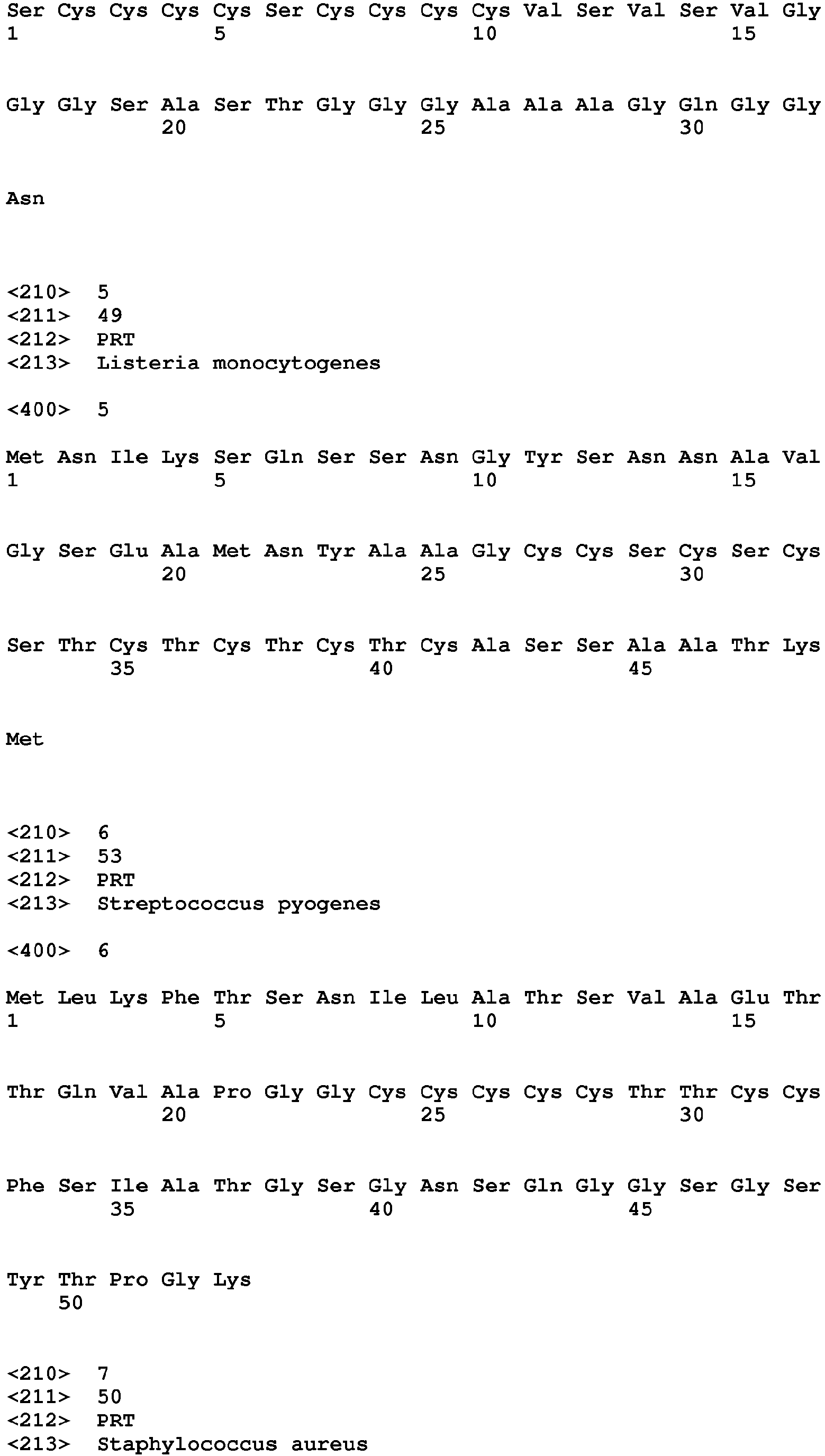


Claims (16)
- Listeriolysin S or related peptide for use as an antibiotic, wherein said peptide comprises an amino acid sequence having at least 35 % identity with SEQ ID NO: 1, said sequence comprising :- at its N-terminus, a motif of at least 9 consecutive amino acids consisting of Cysteine, Threonine, and Serine; Cysteine and Serine, or Cysteine and Threonine residues, and- at least one modified residue chosen from an oxazole- or 2-oxazoline-modified Serine residue, a thiazole- or 2-thiazoline-modified Cysteine residue and a methyloxazole- or 5-methyl-2-oxazoline-modified Threonine residue.
- The peptide for the use according to claim 1, which comprises:- 1 to 8 thiazole- or 2-thiazoline-modified Cysteine residues, or a combination thereof;- 1 to 5 oxazole- or 2-oxazoline-modified Serine residues, or a combination thereof; and/or- 1 to 5 methyloxazole- or 5-methyl-2-oxazoline-modified Threonine residues, or a combination thereof.
- The peptide for the use according to anyone of claim 1 or claim 2, wherein said at least one modified Cysteine, Serine or Threonine residue is at position 1, 2, 3,4, 5, 6, 7, 8, 9, 10, 11, 12, 13, 14, 15, 17, 18 or 21 of SEQ ID NO: 1.
- The peptide for the use according to claim 3, wherein said at least one modified Cysteine residue is at position 1, 2, 4, 6, 9, 11, 13 or 15 of SEQ ID NO: 1; said at least one modified Serine residue is at position 3, 5, 7, 17 or 18 of SEQ ID NO: 1; and/or said at least one modified Threonine residue is at position 8, 10, 12, 14 or 21 of SEQ ID NO: 1.
- The peptide for the use according to any one of claims 1 to 4, wherein all but one or all but two of the Cysteine, Serine and Threonine residues of SEQ ID NO: 1 are thiazole- or 2-thiazoline-modified Cysteine residues, oxazole- or 2-oxazoline-modified Serine residues, and methyloxazole- or 5-methyl-2-oxazoline-modified Threonine residues, respectively.
- The peptide for the use according to any one of claims 1 to 4, wherein all of the Cysteine, Serine and Threonine residues of SEQ ID NO: 1 are thiazole- or 2-thiazoline-modified Cysteine residues, oxazole- or 2-oxazoline-modified Serine residues, and methyloxazole- or 5-methyl-2-oxazoline-modified Threonine residues, respectively.
- The peptide for the use according to any one of claims 1 to 6, wherein said at least one modified Serine residue is an oxazole-modified Serine residue; said least one modified Cysteine residue is a thiazole-modified Cysteine residue; and/or said at least one modified Threoninr residue is a methyloxazole-modified Threonine residue.
- The peptide for the use according to any one of claims 1 to 7, wherein said motif starts at position 1 of SEQ ID NO: 1.
- The peptide for the use according to any one of claims 1 to 8, wherein said motif comprises at least five Cysteine residues.
- The peptide for the use according to any one of claims 1 to 9, which comprises the amino acid sequence SEQ ID NO: 1 or an amino acid sequence having at least 70 % identity with SEQ ID NO: 1, said peptide comprising a N-terminal motif of 15 consecutive amino acids consisting of Cysteine, Threonine, and Serine residues and comprising eight Cysteine residues.
- The peptide as defined in any one of claims 1 to 10, for use in the treatment of a bacterial disease caused by a pathogenic or opportunistic Gram positive bacteria.
- The peptide for the use according to claim 11, wherein said peptide is a peptide as defined in claim 10 and said disease is caused by Staphylococcus aureus, Listeriolysin negative strains, Listeria monocytogenes or Lactococcus lactis or Streptococcus pathogenic strains.
- Use of a peptide as defined in any one of claims 1 to 10, as antibacterial agent for non-therapeutic purposes.
- The use of the peptide according to claim 13, as a food additive to prevent food contamination or as a disinfectant.
- An isolated peptide as defined in claim 10.
- The isolated peptide of claim 15, wherein all, all but one or all but two of the Cysteine, Serine and Threonine residues of SEQ ID NO: 1 are thiazole- or 2-thiazoline-modified Cysteine residues, oxazole- or 2-oxazoline-modified Serine residues, and methyloxazole- or 5-methyl-2-oxazoline-modified Threonine residues, respectively.
Priority Applications (2)
| Application Number | Priority Date | Filing Date | Title |
|---|---|---|---|
| EP16305292.1A EP3219721A1 (en) | 2016-03-16 | 2016-03-16 | Listeriolysin s or related peptides as antibacterials |
| PCT/EP2017/056266 WO2017158108A1 (en) | 2016-03-16 | 2017-03-16 | Listeriolysin s or related peptides as antibacterials |
Applications Claiming Priority (1)
| Application Number | Priority Date | Filing Date | Title |
|---|---|---|---|
| EP16305292.1A EP3219721A1 (en) | 2016-03-16 | 2016-03-16 | Listeriolysin s or related peptides as antibacterials |
Publications (1)
| Publication Number | Publication Date |
|---|---|
| EP3219721A1 true EP3219721A1 (en) | 2017-09-20 |
Family
ID=55628960
Family Applications (1)
| Application Number | Title | Priority Date | Filing Date |
|---|---|---|---|
| EP16305292.1A Withdrawn EP3219721A1 (en) | 2016-03-16 | 2016-03-16 | Listeriolysin s or related peptides as antibacterials |
Country Status (2)
| Country | Link |
|---|---|
| EP (1) | EP3219721A1 (en) |
| WO (1) | WO2017158108A1 (en) |
Families Citing this family (1)
| Publication number | Priority date | Publication date | Assignee | Title |
|---|---|---|---|---|
| CN109160939B (en) * | 2018-09-21 | 2021-05-11 | 铜仁职业技术学院 | Biological antibacterial peptide and application thereof |
Citations (2)
| Publication number | Priority date | Publication date | Assignee | Title |
|---|---|---|---|---|
| WO1999049049A1 (en) * | 1998-03-20 | 1999-09-30 | Mount Sinai Hospital | Streptococcus sag-a, a structural protein associated with sls activity |
| WO2009092790A1 (en) | 2008-01-24 | 2009-07-30 | Teagasc, The Agriculture And Food Development Authority | Listeria monocytogenes cytotoxin listeriolysin s |
-
2016
- 2016-03-16 EP EP16305292.1A patent/EP3219721A1/en not_active Withdrawn
-
2017
- 2017-03-16 WO PCT/EP2017/056266 patent/WO2017158108A1/en not_active Ceased
Patent Citations (2)
| Publication number | Priority date | Publication date | Assignee | Title |
|---|---|---|---|---|
| WO1999049049A1 (en) * | 1998-03-20 | 1999-09-30 | Mount Sinai Hospital | Streptococcus sag-a, a structural protein associated with sls activity |
| WO2009092790A1 (en) | 2008-01-24 | 2009-07-30 | Teagasc, The Agriculture And Food Development Authority | Listeria monocytogenes cytotoxin listeriolysin s |
Non-Patent Citations (49)
| Title |
|---|
| ALAN W. BERNHEIMER: "Disruption of Wall-less Bacteria by Streptococcal and Staphylococcal Toxins", JOURNAL OF BACTERIOLOGY, 1 May 1966 (1966-05-01), UNITED STATES, pages 1677 - 1680, XP055305854, Retrieved from the Internet <URL:https://www.ncbi.nlm.nih.gov/pmc/articles/PMC316105/pdf/jbacter00422-0045.pdf> [retrieved on 20160930] * |
| ALOUF ET AL., METHODS IN ENZYMOLOGY, vol. 165, 1988, pages 59 - 64 |
| ALTSCHUL ET AL., J. MOL. BIOL., vol. 215, 1990, pages 403 |
| ANDERS ET AL., GENOME BIOL., vol. 11, no. 10, 2010, pages R 106 |
| ARCHAMBAUD ET AL., PROC. NATL. ACAD. SCI. U S A, vol. 109, no. 41, 2012, pages 16684 - 16689 |
| ARNAUD ET AL., APPL. ENVIRON. MICROBIOL., vol. 70, no. 11, 2004, pages 6887 - 6891 |
| ASAM ET AL., MED. MICROBIOL. IMMUNOL., vol. 204, no. 2, 2015, pages 227 - 237 |
| BALESTRINO ET AL., APPL. ENVIRON. MICROBIOL., vol. 76, no. 11, 2010, pages 3625 - 3636 |
| BENJAMINI ET AL., JOURNAL OF THE ROYAL STATISTICAL SOCIETY. SERIES B (METHODOLOGICAL, vol. 57, no. 1, 1995, pages 289 - 300 |
| BRON ET AL., APPL. ENVIRON. MICROBIOL, vol. 72, no. 4, 2006, pages 2876 - 2884 |
| CLAYTON ET AL., APPL. ENVIRON. MICROBIOL., vol. 77, no. 1, 2011, pages 163 - 171 |
| COSSART P, PROC. NATL. ACAD. SCI. U S A, vol. 108, no. 49, 2011, pages 19484 - 19491 |
| COTTER ET AL., PLOS PATHOG., vol. 4, no. 9, 2008, pages E1000144 |
| COTTER ET AL., PLOS PATHOG., vol. 4, no. 9, 2008, pages EIOOO144 |
| COTTER ET AL., PLOS PATHOG., vol. 4, no. 9, 2008, pages EL000144 |
| COTTER PD ET AL., PLOS PATHOG., vol. 4, no. 9, 2008, pages E1000144 |
| COTTER PD ET AL., PLOS PATHOG., vol. 4, no. 9, 2008, pages EIO00144 |
| COTTER PROTOCOL: PLOS PATHOGENS, vol. 4, no. 9, 2008, pages EL000144 |
| CRISCUOLO ET AL., GENOMICS, vol. 102, no. 5-6, 2013, pages 500 - 506 |
| DOWNES ET AL., INT. J. SYST. EVOL. MICROBIOL., vol. 63, no. 4, 2013, pages 1214 - 1218 |
| DUSSURGET ET AL., MOL. MICROBIOL., vol. 45, no. 4, 2002, pages 1095 - 1106 |
| EVELYN M. MOLLOY ET AL: "Streptolysin S-like virulence factors: the continuing sagA", NATURE REVIEWS. MICROBIOLOGY, vol. 9, no. 9, 8 August 2011 (2011-08-08), GB, pages 670 - 681, XP055304901, ISSN: 1740-1526, DOI: 10.1038/nrmicro2624 * |
| GENTLEMAN ET AL., GENOME BIOL., vol. 5, no. 10, 2004, pages R80 |
| GLOMSKI PROTOCOL: J CELL BIOLOGY, vol. 156, no. 6, 2002, pages 1029 - 1038 |
| GONZALEZ ET AL., J. BIOL. CHEM., vol. 285, no. 36, 2010, pages 28220 - 28228 |
| GREETHAM ET AL., ANAEROBE, vol. 10, no. 5, 2004, pages 301 - 307 |
| GUINANE ET AL., APPL. ENVIRON. MICROBIOL., vol. 81, no. 22, 2015, pages 7851 - 7859 |
| JOEL O MELBY ET AL: "Thiazole/oxazole-modified microcins: complex natural products from ribosomal templates", CURRENT OPINION IN CHEMICAL BIOLOGY, vol. 15, no. 3, 21 March 2011 (2011-03-21), pages 369 - 378, XP028229485, ISSN: 1367-5931, [retrieved on 20110303], DOI: 10.1016/J.CBPA.2011.02.027 * |
| KOMMINENI ET AL., NATURE, vol. 526, no. 7575, 2015, pages 719 - 722 |
| LEE ET AL., PNAS, vol. 105, no. 15, 2008, pages 5879 - 5884 |
| LINNAN MJ ET AL., N. ENGL. J. MED., vol. 319, no. 13, 1988, pages 823 - 828 |
| LOVE ET AL., GENOME BIOL., vol. 15, no. 12, 2014, pages 550 |
| MAGOC ET AL., BIOINFORMATICS, vol. 27, no. 21, 2011, pages 2957 - 2963 |
| MAURY MM ET AL., NAT. GENET., 2016 |
| MAURY MM, NAT. GENET., 2016 |
| MCMURDIE ET AL., PLOS COMPUT. BIOL., vol. 10, no. 4, 2014, pages E1003531 |
| MERRIFIELD ET AL., J. AM. CHEM. SOC., vol. 85, 1964, pages 2149 |
| MITCHELL ET AL., J. BIOL. CHEM., vol. 284, 2009, pages 13004 - 13012 |
| MOLLOY ET AL., NAT. REV. MICROBIOL., vol. 9, no. 9, 2011, pages 670 - 681 |
| OSTLING ET AL., J. APPL. BACTERIOL., vol. 75, no. 1, 1993, pages 18 - 24 |
| PAUL D. COTTER ET AL: "Bacteriocins - a viable alternative to antibiotics?", NATURE REVIEWS. MICROBIOLOGY, vol. 11, no. 2, 24 December 2012 (2012-12-24), GB, pages 95 - 105, XP055306514, ISSN: 1740-1526, DOI: 10.1038/nrmicro2937 * |
| PAUL D. COTTER ET AL: "Listeriolysin S, a Novel Peptide Haemolysin Associated with a Subset of Lineage I Listeria monocytogenes", PLOS PATHOGENS, vol. 4, no. 9, 12 September 2008 (2008-09-12), pages e1000144, XP055304690, DOI: 10.1371/journal.ppat.1000144 * |
| PHAN-THANH L ET AL., INT. J. FOOD MICROBIOL., vol. 35, no. 1, 1997, pages 91 - 95 |
| QUAST C ET AL., NUCLEIC ACIDS RES., vol. 41, 2013, pages D590 - 596 |
| RIEDEL ET AL., APPL. ENVIRON. MICROBIOL., vol. 73, no. 9, 2007, pages 3091 - 3094 |
| SHIH-CHUN YANG ET AL: "Antibacterial activities of bacteriocins: application in foods and pharmaceuticals", FRONTIERS IN MICROBIOLOGY, 26 May 2014 (2014-05-26), Switzerland, pages 1 - 10, XP055306866, Retrieved from the Internet <URL:https://www.ncbi.nlm.nih.gov/pmc/articles/PMC4033612/pdf/fmicb-05-00241.pdf> [retrieved on 20160930], DOI: 10.3389/fmicb.2014.00241 * |
| SUN ET AL., J. BACTERIOL., vol. 194, no. 19, 2012, pages 5274 - 5284 |
| WLADYKA ET AL., NATURE SCIENTIFIC REPORTS, vol. 5, 2015, pages 14569 |
| WLADYKA ET AL., SCIENTIFIC REPORTS, vol. 5, 2015, pages 14569 |
Also Published As
| Publication number | Publication date |
|---|---|
| WO2017158108A1 (en) | 2017-09-21 |
Similar Documents
| Publication | Publication Date | Title |
|---|---|---|
| Quereda et al. | Bacteriocin from epidemic Listeria strains alters the host intestinal microbiota to favor infection | |
| KR102624665B1 (en) | Antimicrobial therapy | |
| US20160279175A1 (en) | Methods for reducing development of resistance to antibiotics | |
| WO2014052438A1 (en) | Methods for making and using antimicrobial peptides | |
| CN106659748A (en) | Acinetobacter lysins | |
| US20260007718A1 (en) | Lantibiotics, lantibiotic-producing bacteria, compositions and methods of production and use thereof | |
| WO2016176729A1 (en) | Bacteriocin polypeptides and uses thereof | |
| AU2013226402B2 (en) | Variants of the lantibiotic MU1140 and other lantibiotics with improved pharmacological properties and structural features | |
| DK2576604T3 (en) | DIFFOCINES AND METHODS OF USING THEREOF | |
| US20200237888A1 (en) | Compositions comprising recombinant probiotic bacteria and methods of use thereof | |
| EP3219721A1 (en) | Listeriolysin s or related peptides as antibacterials | |
| AU2017296061B2 (en) | Lantibiotic variants and uses thereof | |
| EP3215174B1 (en) | Monocins and methods of use | |
| US20220184174A1 (en) | Lantibiotics and lantibiotic-producing bacteria | |
| JP7773476B2 (en) | Enterocins and methods of use thereof | |
| WO2013050590A1 (en) | Spra1 antimicrobial peptides and uses thereof | |
| Anandharaj et al. | Probioactives: Bacteriocin and Exopolysaccharides | |
| Villa et al. | The Case of Lipid II: The Achilles’ Heel of Bacteria | |
| KR20150127266A (en) | Diffocins and methods of use thereof | |
| Geldart | Engineering Antimicrobial Probiotics for the Treatment of Vancomycin-Resistant Enterococcus | |
| WO2019155002A1 (en) | Anti-prevotella bacteriocin methods and compositions | |
| Cotter et al. | Listeriolysin S, a Novel Peptide Haemolysin Associated with a Subset of Lineage I |
Legal Events
| Date | Code | Title | Description |
|---|---|---|---|
| PUAI | Public reference made under article 153(3) epc to a published international application that has entered the european phase |
Free format text: ORIGINAL CODE: 0009012 |
|
| STAA | Information on the status of an ep patent application or granted ep patent |
Free format text: STATUS: THE APPLICATION HAS BEEN PUBLISHED |
|
| AK | Designated contracting states |
Kind code of ref document: A1 Designated state(s): AL AT BE BG CH CY CZ DE DK EE ES FI FR GB GR HR HU IE IS IT LI LT LU LV MC MK MT NL NO PL PT RO RS SE SI SK SM TR |
|
| AX | Request for extension of the european patent |
Extension state: BA ME |
|
| STAA | Information on the status of an ep patent application or granted ep patent |
Free format text: STATUS: THE APPLICATION IS DEEMED TO BE WITHDRAWN |
|
| 18D | Application deemed to be withdrawn |
Effective date: 20180321 |