EP3219712A1 - Coumarin dyes and conjugates thereof - Google Patents
Coumarin dyes and conjugates thereof Download PDFInfo
- Publication number
- EP3219712A1 EP3219712A1 EP17159893.1A EP17159893A EP3219712A1 EP 3219712 A1 EP3219712 A1 EP 3219712A1 EP 17159893 A EP17159893 A EP 17159893A EP 3219712 A1 EP3219712 A1 EP 3219712A1
- Authority
- EP
- European Patent Office
- Prior art keywords
- amino
- wsg
- acid
- oxo
- substituted
- Prior art date
- Legal status (The legal status is an assumption and is not a legal conclusion. Google has not performed a legal analysis and makes no representation as to the accuracy of the status listed.)
- Granted
Links
- 0 CSC([C@@](C(*)c(c(*)c(*)c(N(*)*)c1*)c1O1)C1=O)=CC=C Chemical compound CSC([C@@](C(*)c(c(*)c(*)c(N(*)*)c1*)c1O1)C1=O)=CC=C 0.000 description 5
- ZVGJJDBSCFDTCX-UHFFFAOYSA-N CCN(CCCCCC(O)=O)c1ccc(C=C(c([s]2)ccc2S(O)(=O)=O)C(O2)=O)c2c1 Chemical compound CCN(CCCCCC(O)=O)c1ccc(C=C(c([s]2)ccc2S(O)(=O)=O)C(O2)=O)c2c1 ZVGJJDBSCFDTCX-UHFFFAOYSA-N 0.000 description 1
- FQGNUJLQTXRYGV-UHFFFAOYSA-N OS(CCNS(CCCN(CCCCCC(ON(C(CC1)=O)C1=O)=O)c(cc1)cc(O2)c1C=C(c([s]c(S(O)(=O)=O)c1)c1S(O)(=O)=O)C2=O)(=O)=O)(=O)=O Chemical compound OS(CCNS(CCCN(CCCCCC(ON(C(CC1)=O)C1=O)=O)c(cc1)cc(O2)c1C=C(c([s]c(S(O)(=O)=O)c1)c1S(O)(=O)=O)C2=O)(=O)=O)(=O)=O FQGNUJLQTXRYGV-UHFFFAOYSA-N 0.000 description 1
Images



Classifications
-
- C—CHEMISTRY; METALLURGY
- C09—DYES; PAINTS; POLISHES; NATURAL RESINS; ADHESIVES; COMPOSITIONS NOT OTHERWISE PROVIDED FOR; APPLICATIONS OF MATERIALS NOT OTHERWISE PROVIDED FOR
- C09B—ORGANIC DYES OR CLOSELY-RELATED COMPOUNDS FOR PRODUCING DYES, e.g. PIGMENTS; MORDANTS; LAKES
- C09B57/00—Other synthetic dyes of known constitution
- C09B57/02—Coumarine dyes
-
- A—HUMAN NECESSITIES
- A61—MEDICAL OR VETERINARY SCIENCE; HYGIENE
- A61K—PREPARATIONS FOR MEDICAL, DENTAL OR TOILETRY PURPOSES
- A61K47/00—Medicinal preparations characterised by the non-active ingredients used, e.g. carriers or inert additives; Targeting or modifying agents chemically bound to the active ingredient
- A61K47/50—Medicinal preparations characterised by the non-active ingredients used, e.g. carriers or inert additives; Targeting or modifying agents chemically bound to the active ingredient the non-active ingredient being chemically bound to the active ingredient, e.g. polymer-drug conjugates
- A61K47/51—Medicinal preparations characterised by the non-active ingredients used, e.g. carriers or inert additives; Targeting or modifying agents chemically bound to the active ingredient the non-active ingredient being chemically bound to the active ingredient, e.g. polymer-drug conjugates the non-active ingredient being a modifying agent
- A61K47/54—Medicinal preparations characterised by the non-active ingredients used, e.g. carriers or inert additives; Targeting or modifying agents chemically bound to the active ingredient the non-active ingredient being chemically bound to the active ingredient, e.g. polymer-drug conjugates the non-active ingredient being a modifying agent the modifying agent being an organic compound
- A61K47/558—Medicinal preparations characterised by the non-active ingredients used, e.g. carriers or inert additives; Targeting or modifying agents chemically bound to the active ingredient the non-active ingredient being chemically bound to the active ingredient, e.g. polymer-drug conjugates the non-active ingredient being a modifying agent the modifying agent being an organic compound the modifying agent being a chemiluminescent acceptor
-
- C—CHEMISTRY; METALLURGY
- C07—ORGANIC CHEMISTRY
- C07D—HETEROCYCLIC COMPOUNDS
- C07D409/00—Heterocyclic compounds containing two or more hetero rings, at least one ring having sulfur atoms as the only ring hetero atoms
- C07D409/02—Heterocyclic compounds containing two or more hetero rings, at least one ring having sulfur atoms as the only ring hetero atoms containing two hetero rings
- C07D409/04—Heterocyclic compounds containing two or more hetero rings, at least one ring having sulfur atoms as the only ring hetero atoms containing two hetero rings directly linked by a ring-member-to-ring-member bond
-
- C—CHEMISTRY; METALLURGY
- C07—ORGANIC CHEMISTRY
- C07D—HETEROCYCLIC COMPOUNDS
- C07D409/00—Heterocyclic compounds containing two or more hetero rings, at least one ring having sulfur atoms as the only ring hetero atoms
- C07D409/14—Heterocyclic compounds containing two or more hetero rings, at least one ring having sulfur atoms as the only ring hetero atoms containing three or more hetero rings
-
- C—CHEMISTRY; METALLURGY
- C07—ORGANIC CHEMISTRY
- C07K—PEPTIDES
- C07K16/00—Immunoglobulins [IG], e.g. monoclonal or polyclonal antibodies
- C07K16/18—Immunoglobulins [IG], e.g. monoclonal or polyclonal antibodies against material from animals or humans
- C07K16/28—Immunoglobulins [IG], e.g. monoclonal or polyclonal antibodies against material from animals or humans against receptors, cell surface antigens or cell surface determinants
- C07K16/2803—Immunoglobulins [IG], e.g. monoclonal or polyclonal antibodies against material from animals or humans against receptors, cell surface antigens or cell surface determinants against the immunoglobulin superfamily
-
- C—CHEMISTRY; METALLURGY
- C07—ORGANIC CHEMISTRY
- C07K—PEPTIDES
- C07K16/00—Immunoglobulins [IG], e.g. monoclonal or polyclonal antibodies
- C07K16/18—Immunoglobulins [IG], e.g. monoclonal or polyclonal antibodies against material from animals or humans
- C07K16/28—Immunoglobulins [IG], e.g. monoclonal or polyclonal antibodies against material from animals or humans against receptors, cell surface antigens or cell surface determinants
- C07K16/2803—Immunoglobulins [IG], e.g. monoclonal or polyclonal antibodies against material from animals or humans against receptors, cell surface antigens or cell surface determinants against the immunoglobulin superfamily
- C07K16/2812—Immunoglobulins [IG], e.g. monoclonal or polyclonal antibodies against material from animals or humans against receptors, cell surface antigens or cell surface determinants against the immunoglobulin superfamily against CD4
-
- C—CHEMISTRY; METALLURGY
- C07—ORGANIC CHEMISTRY
- C07K—PEPTIDES
- C07K16/00—Immunoglobulins [IG], e.g. monoclonal or polyclonal antibodies
- C07K16/42—Immunoglobulins [IG], e.g. monoclonal or polyclonal antibodies against immunoglobulins
- C07K16/4283—Immunoglobulins [IG], e.g. monoclonal or polyclonal antibodies against immunoglobulins against an allotypic or isotypic determinant on Ig
-
- G—PHYSICS
- G01—MEASURING; TESTING
- G01N—INVESTIGATING OR ANALYSING MATERIALS BY DETERMINING THEIR CHEMICAL OR PHYSICAL PROPERTIES
- G01N21/00—Investigating or analysing materials by the use of optical means, i.e. using sub-millimetre waves, infrared, visible or ultraviolet light
-
- G—PHYSICS
- G01—MEASURING; TESTING
- G01N—INVESTIGATING OR ANALYSING MATERIALS BY DETERMINING THEIR CHEMICAL OR PHYSICAL PROPERTIES
- G01N33/00—Investigating or analysing materials by specific methods not covered by groups G01N1/00 - G01N31/00
- G01N33/48—Biological material, e.g. blood, urine; Haemocytometers
- G01N33/50—Chemical analysis of biological material, e.g. blood, urine; Testing involving biospecific ligand binding methods; Immunological testing
- G01N33/52—Use of compounds or compositions for colorimetric, spectrophotometric or fluorometric investigation, e.g. use of reagent paper and including single- and multilayer analytical elements
Definitions
- the present disclosure concerns novel coumarin dyes and conjugates thereof.
- the 405nm diode laser has had a major impact in the biotechnology field, especially in flow cytometry, a laser-based, biophysical technology employed in cell counting, cell sorting, biomarker detection and protein engineering.
- the need for suitable dyes fitting the 405nm excitation source has inspired researchers towards the development of short wavelength excitable dyes, showing large Stokes Shifts and suitable for bio-conjugation applications.
- Fluorescence of 7-hydroxy coumarins is pH dependent due to the intrinsically high pKa value of the C7-hydroxyl proton.
- the protonated or neutral form of these dyes is not fluorescent.
- complete deprotonation of the 7-hydroxyl proton is required to give the deprotonated or anionic form.
- At physiological pH these dyes exist in their neutral form and are not fluorescent and therefore not useful in biological assays.
- Tertiary, or N-di-alkylated, 7-amino coumarins are well known as for example, Alexa Fluor 430 among others. However, most of these dyes are not efficiently excited by a 405nm laser source. Typical excitation maxima are observed in the 425-450nm range with emission maxima between 460 and 490nm.
- quenching effects of the fluorophore may be the result of dye-dye self-quenching or are due to dye-analyte interactions.
- Self-quenching is caused mainly by hydrophobicity, proximity, high degrees of labeling and fluorophore size. Quenching due to dye-analyte interactions is also associated with the hydrophobicity of the fluorophore, where back folding of the fluorophore towards hydrophobic pockets of the analyte results in energy transfer processes between the dye and the hydrophobic side chains of amino acid residues in proteins (e.g. tryptophan and tyrosine).
- the object of the present invention is to provide novel coumarin dyes with strong absorption at 405nm, high fluorescence, large Stokes shift, useful in bio-conjugation applications.
- the 7-amino-3-thienyl coumarin dyes of formula (I), as well as the relative conjugates of formula (V) show large Stokes shifts of at least 80nm with efficient excitability by a 405nm violet excitation source and high fluorescence intensities in the green, and are highly suitable for bio-conjugation applications.
- RG is selected from: carboxylic acid, an activated ester of a carboxylic acid, carbodiimide, sulfonyl halide, acyl halide, silyl halide, acyl azide, acyl nitrile, acrylamide, amine, aldehyde, alkyl or aryl halide, alkyl sulfonate, sulfonate ester, anhydride, azide, aziridine, diazoalkane, haloacetamide, halotriazine, hydrazine, hydroxylamine, isocyanate, isothiocyanate, maleimide, phosphoramidate, thiol, hydroxyl, hydrazine and alkyne.
- RG is selected from carboxylic acid, an activated ester of a carboxylic acid, sulfonyl halide, acyl halide, amine, alkyl or aryl halide, anhydride, azide, haloacetamide, halotriazine, hydrazine, isocyanate, isothiocyanate, maleimide, phosphoramidate, thiol, hydroxyl and alkyne. More preferably RG is selected from carboxylic acid, an activated ester of a carboxylic acid, amine, azide, haloacetamide, hydrazine, isocyanate, maleimide and alkyne.
- L is a linker of formula (VI): [(CH 2 ) a -Y-(CH 2 ) b ] c (VI)
- Y can be the same or different for the various substituents and is selected from none, O, S, SO 2 -NH, SO 2 -NR9, CO-NH, CO-O, CO-S, 1,3-triazole, NH-CO-NH, NH-CS-NH, NH-CO-O, SO 2 -O, aryl, heteroaryl and amino acid. More preferably, Y is selected from none, O, S, SO 2 -NH, SO 2 -NR9, CO-NH, CO-O and 1,3-triazole, wherein R9 has the meaning defined above.
- WSG is selected from sulfonic acid, sulfate, alkyl sulfonic acid, thiosulfonic acid, sulfonamide, phosphate, phosphonic acid, boronic acid, ammonium, pyridinium, quinolium, acridinium, cyclodextrin, monosaccharide, oligosaccharide, dextrane or -(CH 2 -CH 2 -O) x in which x is an integer number from 1 to 10.
- WSG is selected from sulfonic acid, alkyl sulfonic acid, sulfonamide, phosphate, phosphonic acid, ammonium, pyridinium, cyclodextrin, monosaccharide, oligosaccharide, dextrane and -(CH 2 -CH 2 -O) x in which x is an integer number from 1 to 10. More preferably WSG is selected from sulfonic acid, alkyl sulfonic acid, sulfonamide, ammonium and -(CH 2 -CH 2 -O) x in which x is an integer number from 1 to 10.
- the salts of sulfonic acid, alkyl sulfonic acid, thiosulfonic acid, phosphonic acid and boronic acid are selected from alkaline metal ions and ammonium ion, preferably sodium, potassium, and an ammonium ion.
- the 7-amino-3-thienyl coumarin dyes are represented by formula (II): wherein
- the 7-amino-3-thienyl coumarin dyes are represented by formula (III): wherein
- the 7-amino-3-thienyl coumarin dyes are represented by formula (IV): wherein
- the 7-amino-3-thienyl coumarin dyes of formulas (I) to (IV) show large Stokes shifts of at least 80 nm with efficient excitability by a 405 nm violet excitation source and high fluorescence intensities in the green, and are highly suitable for bio-conjugation applications.
- residues R7 and R8 of formula (V) are bound to the thienyl ring in positions 2 and 4, and are sulfonic acid groups or salts thereof.
- residues R3, R4, R5 and R6 of formula (V) are hydrogen atoms.
- residues R2 of formula (V) is substituted or unsubstituted alkyl or L-WSG.
- 7-amino-3-thienyl coumarin means any dye compound containing as core structure the following one:
- 'tertiary' or 'N-di-alkylated 7-amino coumarin' means a dye compound in which the 7-amino group of the coumarin dye is substituted two times by a carbon atom that is itself optionally substituted.
- substituted refers to the formal replacement of a hydrogen atom on a chemical moiety or functional group with an alternative radical.
- the alternative radical substituent moiety is selected from hydroxy, trifluoromethyl, halogen, alkoxy, aminoalkyl, aminoalkoxy, amino, monoalkylamino, dialkylamino, alkylcarbonylamino, alkoxycarbonylamino, alkoxycarbonyl, carboxy, hydroxyalkoxy, alkoxyalkoxy, monoalkylaminoalkoxy, (carboxyalkyl)amino, alkoxycarbonyl, alkynylcarbonyl, alkylsulfonyl, alkenylsulfonyl, alkynylsulfonyl, arylsulfonyl, alkylsulfonamido, arylsulfonamido, carboxyalkoxy, carboxyalkyl, carboxyalkylamino, cyano,
- the alternative radical substituent moiety is selected from hydroxy, trifluoromethyl, halogen, alkoxy, dialkylamino, alkylcarbonylamino, alkoxycarbonylamino, alkoxycarbonyl, hydroxyalkoxy, alkoxyalkoxy, alkylsulfonamido, arylsulfonamido, carboxyalkoxy, carboxyalkylamino, cyano, alkyl azide, azide, aryl, arylalkyl, heteroaryl, heteroarylalkyl, cycloalkylalkyl, cycloalkenylalkyl, cycloheteroalkylalkyl, cycloheteroalkenylalkyl or WSG.
- the alternative radical substituent moiety is selected from hydroxy, trifluoromethyl, halogen, alkoxy, dialkylamino, alkylcarbonylamino, alkoxyalkoxy, alkylsulfonamido, arylsulfonamido, cyano, azide, aryl, heteroaryl or WSG. Still more preferably, the alternative radical substituent moiety is selected from hydroxy, trifluoromethyl, halogen, alkoxy, dialkylamino, alkylcarbonylamino, alkoxyalkoxy, alkylsulfonamido, arylsulfonamido, cyano, azide, aryl, or heteroaryl.
- alkyl is intended to include both branched, linear and cyclic saturated aliphatic hydrocarbon groups.
- alkyl means branched, straight-chain or cyclic alkyl group having from 1 to 10 carbon atoms, more preferably 1 to 6 carbon atoms.
- alkoxy represents an alkyl group singular bonded to an oxygen atom.
- alkoxy means branched, straight-chain or cyclic alkoxy group having from 1 to 10 carbon atoms, more preferably 1 to 6 carbon atoms.
- alkenyl refers to a non-aromatic, linear, branched or cyclic hydrocarbon group containing at least one carbon to carbon double bond.
- alkenyl means non-aromatic, linear, branched or cyclic alkenyl group having from 2 to 10 carbon atoms, more preferably 2 to 6 carbon atoms.
- alkynyl refers to a linear, branched or cyclic hydrocarbon group, containing at least one carbon to carbon triple bond.
- alkynyl means linear, branched or cyclic alkynyl group having from 2 to 10 carbon atoms, more preferably 2 to 6 carbon atoms.
- aryl is intended to mean any stable monocyclic or polycyclic carbon ring of up to 7 atoms in each ring wherein at least one ring is aromatic.
- heteroaryl is intended to mean any stable monocyclic or polycyclic carbon ring of up to 7 atoms in each ring wherein at least one ring is aromatic and at least one ring contains a heteroatom in which the heteroatom is selected from N, O or S, preferably N.
- N-heterocycle means a saturated or unsaturated 5 or 6-membered ring that contains at least one N atom.
- reactive group means a functional group present on the dye compound that is capable of chemically reacting with a functional group on a different compound to form a covalent linkage.
- linker or "L” as used herein, means a chemical moiety that connects the core structure of the dye compound disclosed in the instant description to RG or WSG or SUB.
- water-soluble group or “WSG”, as used herein, means any substituent that enhances the water-solubility of a dye compound of the present description.
- die-conjugate refers to a conjugate between a dye compound of the present invention and a substrate "SUB”.
- substrate or "SUB” as used herein means any organic or inorganic "detection reagent” useful for detecting an analyte of interest present in a sample to be analyzed.
- analyte means any substance to be analyzed, detected, measured, or labeled.
- analytes which can be detected by means of the dyes or dye-conjugates disclosed herein include, but are not limited to, proteins, peptides, hormones, haptens, antigens, antibodies, receptors, enzymes, nucleic acids, polysaccarides, chemicals, polymers, pathogens, toxins, organic drugs, inorganic drugs, cells, tissues, microorganisms, viruses, bacteria, fungi, algae, parasites, allergens, pollutants, and combinations thereof.
- Detection reagents are represented by any “analyte-specific reagents” that bind preferably to the analyte of interest and are generally selected from members of a binding pair. Either member of the pair can be used as the analyte-specific reagent in order to selectively bind to the other member of the pair, wherein in some cases one of the members of the pair is the analyte to be detected.
- analyte-specific reagent pairs include, but are not limited to, biotin/avidin, streptavidin, anti-biotin antibody; IgG/protein; drug/drug receptor; Toxin/Toxin receptor; Peptide/Peptide receptor; Nucleotide/Complimentary nucleotide; Protein/Protein receptor; Enzyme substrate/Enzyme; Nucleic acid/Nucleic acid; Hormone/Hormone receptor; Target molecule/RNA or DNA aptamer.
- the dye compounds disclosed herein can react through the RG residue with a wide variety of substrates "SUB" that contain or are modified to contain functional groups with suitable reactivity, resulting in chemical attachment of the dye compound to the substrate SUB.
- the conjugation reaction between the dye and the functional groups on the substrate results in one or more atoms of the reactive group RG to be incorporated into a new linkage attaching the dye to the substrate.
- activated ester of a carboxylic acid is meant the ester of a carboxylic acid containing a good leaving group.
- Activated esters generally have the formula -COW (or -(CO)W), where W is a good leaving group, wherein the leaving group W is selected from succiminidyloxy (-OC 4 H 4 O 2 ) sulfosuccinimidyloxy (-OC 4 H 3 O 2 -SO 3 H), -l-oxybenzotriazolyl (-OC 2 H 4 N 3 ), an aryloxy or aryloxy group substituted one or more times by electron withdrawing substituents such as nitro, fluoro, chloro, cyano, or trifluoromethyl, or combinations thereof, used to form activated aryl esters, or a carboxylic acid activated by a carbodiimide to form an anhydride or mixed anhydride -OCOAlk or -OCN(
- RG is an activated ester of a carboxylic acid
- the dye of formula (I) is particularly useful for preparing dye-conjugates of proteins, nucleotides, oligonucleotides, or haptens.
- RG is a maleimide or haloacetamide
- the reactive dye is particularly useful for conjugation to thiol-containing substrate.
- RG is a hydrazide
- the dye of formula (I) is particularly useful for conjugation to periodate-oxidized carbohydrates and glycoproteins, and, in addition, is an aldehyde-fixable polar tracer for cell microinjection.
- the dye of formula (I) is particularly useful for conjugation to alkyne-containing substrates by means of a Cu(I) catalyzed 1,3-dipolar cycloaddition reaction.
- kits that facilitate the practice of various assays using any of the dyes herein disclosed.
- the kits typically comprise a fluorescent dye of formula (I) or a dye-conjugate of formula (V) in dry or solution form together with at least one more component.
- the other component of the kit is selected from a buffering agent such as labelling buffer, running buffer and washing buffer, an additional detection reagent such as a fluorescent dye or dye-conjugate different from the dye or dye-conjugate described herein that can be useful in multi-analyte assays, a purification column that can be useful for purifying the resulting labeled substance and an organic solvent to dissolve the fluorescent dye if present in dry form.
- the 7-amino-3-thienyl coumarin dyes of formula (I) are characterized by an absorption maximum at 410 nm + 10 nm with a large Stokes Shift of at least 80nm and an emission maximum at 510 nm ⁇ 10nm in the green.
- 7-amino-3-thienyl coumarin dyes of the present invention are pH independent over a wide pH range as shown e.g. in fig 3 for compound 6. This aspect offers one advantage over 7-hydroxy coumarins that are pH dependent due to high pKa values of the hydroxyl group and are poorly fluorescent at physiologic pH.
- 7-amino-3-thienyl coumarin dyes that are themselves substituted twice by WSG on the thienyl ring, provides a dye with an absorption maximum near 405 nm and an emission maximum near 500nm.
- the absorption maximum at 410 ⁇ 10 nm provides a dye that is useful for applications in which a dye-conjugate can be detected with high sensitivity after excitation with a 405nm violet excitation source.
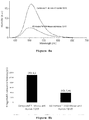
- the introduction of at least one water soluble group onto the thienyl moiety increases the hydrophilicity of the dye, while retaining the optimal spectroscopic properties. Furthermore, the positioning of the water soluble group(s) onto the thienyl ring substantially lower quenching effects due to dye-dye or dye-substrate interactions upon conjugation, resulting in a higher total fluorescence of the dye conjugate in comparison to the corresponding 7-amino-3-thienyl coumarin dye, that is not substituted on the thienyl ring, as shown in figure 9a and 9b .
- Particularly preferred water soluble group(s) present on the thienyl moiety is sulfonic acid and salts thereof. Sulfonic acid or salts thereof provide, in fact, a fluorescent dye with optimal water solubility, low molecular weight, excellent conjugation performance and highly fluorescent conjugates.
- the large Stokes shift provides a dye, after conjugation with a substrate, which is extremely useful for multiplex applications in biological assays, which utilize the 405 nm violet excitation source.
- the spectral separation of various fluorophores into distinct excitation or acquisition channels is essential for multiplex analyte detection.
- Preferred 7-amino-3-thienyl coumarin dyes of formula (I) are shown in Table 2.
- Table 2 Dye Structure sodium 5-(7-((5-carboxypentyl)(ethyl)amino) -2-oxo-2H-chromen-3-yl)thiophene-2,4-disulfonate (compound 6)
- Sodium 5-(7-((6-((2,5-dioxopyrrolidin-1-yl)oxy)-6-oxohexyl) (ethyl)amino)-2-oxo-2H-chromen-3-yl)thiophene-2,4-disulfonate compound 7) sodium 5-(7-(ethyl(6-hydrazinyl-6-oxohexyl)amino)-2-oxo-2H-chromen-3-yl)thiophene-2,4-disulfonate (compound 8) sodium 5-(7-(
- the number of the dyes in table 2 corresponds to the numbering of the compounds described in the examples.
- the dye compounds disclosed herein are synthetized in accord to the general synthesis scheme shown in figure 1 .
- the synthesis of dye compounds of the present description is achieved by amine-alkylation of 3-amino phenols followed by a Vilsmeijer formylation to provide the intermediate salicylaldehyde derivative.
- an acetic anhydride mediated condensation with thiophene acetic acid gives the dye core structure.
- Final functionalization provides the chemically reactive dye required for bioconjugation to provide fluorescent dye conjugates according to the instant description.
- Compound was diluted in PSB buffer at pH 8.4.
- the absorption spectrum was measured in a 1cm cuvette on a UV-Spectrophotometer Varian Cary 100 Bio.
- the emission spectrum was measured in a 1 cm cuvette on a Spectrofluorometer Varian Cary Eclipse.
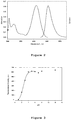
- the absorption and emission spectra of compound 6 were normalized and are shown in Figure 2 .
- the spectra show an optimal fitting of the Abs max with the 405 nm violet excitation source and a large Stokes shift, demonstrating the usefulness in multiplex applications.
- ⁇ Amax ⁇ D ⁇ MW / C
- the molar extinction coefficient of compound 6 was found to be 26000 M -1 cm -1 .
- QY is the quantum yield.
- QY std is the known quantum yield of fluorescein.
- Em sample and Abs sample are the measured fluorescence emission and absorption of compound 6.
- Em std and Abs std are the measured fluorescence emission and absorption of fluorescein.
- Quantum Yield of compound (6) was determined to be 0.7 ⁇ 0.1.
- Samples of compound 6 were prepared over a range of pH values at equal final concentrations in appropriate aqueous solutions (acq HCl for pH 1 and 2; 50 mM potassium phosphate for pH 3 to 8.5; 50 mM sodium bicarbonate for pH 9 to 10 and acq NaOH for pH 12).
- Measurements of fluorescence emission were performed at 1pH unit intervals from pH 1 to pH 8 and pH12 on a Varian Eclipse spectrofluorometer in 1cm cuvettes with excitation at 417nm for all samples and fluorescence emission was measured at 510nm.
- Polyclonal Goat anti-Mouse antibody (AbNova Cod. PAB9347) was diluted to a concentration of 2 mg/mL in 10 mM PBS buffer. The solution was aliquoted into eight sample vials of each 125 ⁇ L to which were added 25 ⁇ L of a sodium bicarbonate buffer (pH9.6). The N-hydroxy succinimidyl ester compound (7) was dissolved in anhydrous DMSO and the concentration was determined spectrophotometrically. Calculated amounts, ranging from 10-100 molar equivalents, of compound 7 with respect to antibody were added to each antibody sample aliquot. The reaction mixtures were incubated at room temperature in the dark for 1 hour.
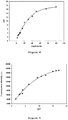
- Non reacted dye excess was removed from the reaction mixtures by separation on a Sephadex G25 column and all samples of isolated dye-conjugates were analyzed for dye to protein ratio (D/P ratio) and concentration. The obtained D/P ratios were then plotted against the molar equivalents of dye used and are shown in Figure 4 .
- Figure 4 and 5 demonstrate high labelling efficiency and excellent fluorescent quantum yield over a wide range of D/P ratios.
- Goat anti-mouse-compound 16 was prepared as described above. The total fluorescence of conjugate Goat anti-mouse-compound 16 was compared to Goat anti-mouse-compound 7 by measuring the total fluorescence integral (total emission band) at equal antibody concentration and equal D/P ratio with excitation at 420nm, ( Figure 9a, 9b ), showing a three times higher fluorescence for the di-sulfonated conjugate Goat anti-mouse-compound 7 in comparison to the non-sulfonated conjugate Goat anti-mouse-compound 16.
- Mouse anti-human CD4 antibody (clone SK3) was purchased from Biolegend (cod. 344602).
- MAVER-1 cells were purchased from ATCC (cod. ATCC® CRL-3008TM), unless specified otherwise. Cell lines propagated in suspension cultures were grown in RPMI1640 medium supplemented with 10% FBS.
- PBMC peripheral blood mononuclear cells
- Sample of 10 ⁇ 6 cells were stained with dye-conjugate for 15-30 minutes at +4°C in the dark at a dye-conjugate quantity of 30ng for peripheral blood lymphocytes ( Figure 8 ) and 5 ug for MAVER-1 ( Figure 9 ) per test in staining buffer (0.5%BSA in D-PBS). Following staining, the sample was washed (adding 1ml of staining buffer) twice, re-suspended with D-PBS and held at 4°C in the dark until flow cytometric acquisition.
- BD FACS ARIAII BD Biosciences, San Jose, Calif.
- the detection optics includes a 530/30 filter.
- the flow cytometer was setup following the manufacturer's instructions, including a Cytometer and Setup Tracking to obtain the best identification of bright populations and the best resolution of dim populations.
- Flow cytometric acquisition of sample of stained cells was performed according to the manufacture's protocols, and the data was analyzed excluding doublet using a pulse geometry gate (FSC-W x FSC-A) to obtain fluorescence intensity for the cell population of interest.
- FSC-W x FSC-A pulse geometry gate
- Figure 10 shows the expression of mouse anti-human CD4 antibody in lymphocytes from healthy donor in flow cytometry using mouse anti-human CD4-compound 7 conjugate.
- Figure 11 shows MAVER-1 cells line stained with mouse anti-human CD19-compound 7 conjugate (white filled histogram) and unstained (grey filled histogram). The results indicate that the dye-conjugates of the present invention are useful in preparing antigen specific detection reagents for immunofluorescence assays analyzed by flow cytometry.
- a 7-amino-3-thienyl coumarin dye may have formula (I): wherein
- the substituent moiety present either on the alkyl or alkoxy is selected from hydroxy, halogen, alkylsulfonamido, cyano, azide, WSG or heteroaryl. More preferably the substituent moiety present either on the alkyl or alkoxy is selected from hydroxy, halogen, alkylsulfonamido, cyano, azide, or heteroaryl.
- a 7-amino-3-thienyl coumarin dye may have formula (II): wherein
- a 7-amino-3-thienyl coumarin dye may have formula (III): wherein
- a 7-amino-3-thienyl coumarin dye may have formula (IV): wherein
- Y in a 7-amino-3-thienyl coumarin dye of formula (I), (II), (III) or (IV), Y may be selected from none, O, S, SO 2 -NH, SO 2 -NR9, CO-NH, CO-O, CO-S, 1,3-triazole, NH-CO-NH, NH-CS-NH, NH-CO-O, SO 2 -O, aryl, heteroaryl and amino acid, preferably Y is selected from none, O, S, SO 2 -NH, SO 2 -NR9, CO-NH, CO-O and 1,3-triazole, wherein wherein R9 is alkyl or WSG, being WSG a water soluble group selected from sulfonic acid, sulfate, alkyl sulfonic acid, sulfonamide, phosphate, phosphonic acid, boronic acid, ammonium, pyridinium, monosaccharide and -(CH 2
- WSG in a 7-amino-3-thienyl coumarin dye of formula (I), (II), (III) or (IV), WSG may be selected from sulfonic acid, alkyl sulfonic acid, sulfonamide, phosphate, phosphonic acid, ammonium, pyridinium, cyclodextrin, monosaccharide, oligosaccharide, dextrane and -(CH 2 -CH 2 -O) x in which x is an integer number from 1 to 10, preferably WSG is selected from sulfonic acid, alkyl sulfonic acid, sulfonamide, ammonium and -(CH2-CH2-O)x in which x is an integer number from 1 to 10.
- RG may be selected from carboxylic acid, an activated ester of a carboxylic acid, sulfonyl halide, acyl halide, amine, alkyl or aryl halide, anhydride, azide, haloacetamide, halotriazine, hydrazine, isocyanate, isothiocyanate, maleimide, phosphoramidate, thiol, alcohol and alkyne, preferably RG is selected from carboxylic acid, an activated ester of a carboxylic acid, amine, azide, haloacetamide, hydrazine, isocyanate, maleimide and alkyne.
- the 7-amino-3-thienyl coumarin dye of formula (I) may be selected from:
- a 7-amino-3-thienyl coumarin dye conjugate may have formula (V): wherein
- R7 and R8 may be bound to the thienyl ring in positions 2 and 4, and may be sulfonic acid groups or salts thereof.
- a 7-amino-3-thienyl coumarin dye conjugate may have formula (V), R3, R4, R5 and R6 may be hydrogen atoms.
- R2 in the 7-amino-3-thienyl coumarin dye conjugate of formula (V), R2 may be substituted or unsubstituted alkyl or L-WSG; L may be a linker as defined above; WSG may be a water soluble group as defined above.
- kits may comprise at least one 7-amino-3-thienyl coumarin dye of formula (I), (II), (III) or (IV).
- a kit may comprise at least one 7-amino-3-thienyl coumarin dye conjugate of formula (V).
- a 7-amino-3-thienyl coumarin dye may have formula (II): wherein
- a 7-amino-3-thienyl coumarin dye may have formula (III): wherein
- a 7-amino-3-thienyl coumarin dye may have formula (IV): wherein
- Y in a 7-amino-3-thienyl coumarin dye of formula (II), (III) or (IV), Y may be selected from none, O, S, SO 2 -NH, SO 2 -NR9, CO-NH, CO-O, CO-S, 1,3-triazole, NH-CO-NH, NH-CS-NH, NH-CO-O, SO 2 -O, aryl, heteroaryl and amino acid, preferably Y is selected from none, O, S, SO 2 -NH, SO 2 -NR9, CO-NH, CO-O and 1,3-triazole, wherein R9 is alkyl or WSG; and wherein WSG is a water soluble group selected from sulfonic acid, sulfate, alkyl sulfonic acid, sulfonamide, phosphate, phosphonic acid, boronic acid, ammonium, pyridinium, monosaccharide and -(CH 2 -CH
- WSG in a 7-amino-3-thienyl coumarin dye of formula (II), (III) or (IV), WSG may be selected from sulfonic acid, alkyl sulfonic acid, sulfonamide, phosphate, phosphonic acid, ammonium, pyridinium, cyclodextrin, monosaccharide, oligosaccharide, dextrane and -(CH 2 -CH 2 -O) x in which x is an integer number from 1 to 10, preferably WSG is selected from sulfonic acid, alkyl sulfonic acid, sulfonamide, ammonium and -(CH 2 -CH 2 -O) x in which x is an integer number from 1 to 10
- RG may be selected from carboxylic acid, an activated ester of a carboxylic acid, sulfonyl halide, acyl halide, amine, alkyl or aryl halide, anhydride, azide, haloacetamide, halotriazine, hydrazine, isocyanate, isothiocyanate, maleimide, phosphoramidate, thiol, alcohol and alkyne, preferably RG is selected from carboxylic acid, an activated ester of a carboxylic acid, amine, azide, haloacetamide, hydrazine, isocyanate, maleimide and alkyne.
- a 7-amino-3-thienyl coumarin dye of formula (II), (III) or (IV) may be selected from:
- a 7-amino-3-thienyl coumarin dye conjugate may have formula (V): wherein
- R3, R4, R5 and R6 may be hydrogen atoms.
- R2 in a 7-amino-3-thienyl coumarin dye conjugate having formula (V), R2 may be substituted or unsubstituted alkyl or L-WSG; L is a linker of formula (VI): [(CH 2 ) a -Y-(CH 2 ) b ] c (VI)
- kits may comprise at least one 7-amino-3-thienyl coumarin dye of formula (II), (III), or (IV) as defined above.
- a kit may comprise at least one 7-amino-3-thienyl coumarin dye conjugate of formula (V).
- a 7-amino-3-thienyl coumarin dye may have formula (II): wherein
- a 7-amino-3-thienyl coumarin dye may have formula (III): wherein
- a 7-amino-3-thienyl coumarin dye may have formula (IV): wherein
- Y in a 7-amino-3-thienyl coumarin dye of formula (II), (III) or (IV), Y may be selected from none, O, S, SO 2 -NH, SO 2 -NR9, CO-NH, CO-O, CO-S, 1,3-triazole, NH-CO-NH, NH-CS-NH, NH-CO-O, SO 2 -O, aryl, heteroaryl and amino acid, preferably Y is selected from none, O, S, SO 2 -NH, SO 2 -NR9, CO-NH, CO-O and 1,3-triazole, wherein R9 is alkyl or WSG.
- WSG in a 7-amino-3-thienyl coumarin dye of formula (II), (III) or (IV), WSG may be selected from sulfonic acid, alkyl sulfonic acid, sulfonamide, phosphate, phosphonic acid, ammonium, pyridinium, cyclodextrin, monosaccharide, oligosaccharide, dextrane and -(CH 2 -CH 2 -O) x in which x is an integer number from 1 to 10, preferably WSG is selected from sulfonic acid, alkyl sulfonic acid, sulfonamide, ammonium and -(CH 2 -CH 2 -O) x in which x is an integer number from 1 to 10.
- RG is selected from carboxylic acid, an activated ester of a carboxylic acid, sulfonyl halide, acyl halide, amine, alkyl or aryl halide, anhydride, azide, haloacetamide, halotriazine, hydrazine, isocyanate, isothiocyanate, maleimide, phosphoramidate, thiol, alcohol and alkyne, preferably RG is selected from carboxylic acid, an activated ester of a carboxylic acid, amine, azide, haloacetamide, hydrazine, isocyanate, maleimide and alkyne.
- a 7-amino-3-thienyl coumarin dye of formula (II), (III) or (IV) may be selected from:
- a 7-amino-3-thienyl coumarin dye conjugate may have formula (V): wherein
- R3, R4, R5 and R6 may be hydrogen atoms.
- R2 is substituted or unsubstituted alkyl or L-WSG;
- L is a linker of formula (VI): [(CH 2 ) a -Y-(CH 2 ) b ] c (VI)
- a kit may comprise at least one 7-amino-3-thienyl coumarin of formula (II), (III) or (IV) as defined above.
- a kit may comprise at least one 7-amino-3-thienyl coumarin dye conjugate of formula (V) as defined above.
Landscapes
- Chemical & Material Sciences (AREA)
- Health & Medical Sciences (AREA)
- Organic Chemistry (AREA)
- Immunology (AREA)
- Life Sciences & Earth Sciences (AREA)
- General Health & Medical Sciences (AREA)
- Molecular Biology (AREA)
- Medicinal Chemistry (AREA)
- Biochemistry (AREA)
- Genetics & Genomics (AREA)
- Proteomics, Peptides & Aminoacids (AREA)
- Biophysics (AREA)
- Engineering & Computer Science (AREA)
- Hematology (AREA)
- Urology & Nephrology (AREA)
- Biomedical Technology (AREA)
- General Physics & Mathematics (AREA)
- Pathology (AREA)
- Physics & Mathematics (AREA)
- Analytical Chemistry (AREA)
- Cell Biology (AREA)
- Biotechnology (AREA)
- Microbiology (AREA)
- Food Science & Technology (AREA)
- Public Health (AREA)
- Veterinary Medicine (AREA)
- Animal Behavior & Ethology (AREA)
- Epidemiology (AREA)
- Bioinformatics & Cheminformatics (AREA)
- Pharmacology & Pharmacy (AREA)
- Plural Heterocyclic Compounds (AREA)
Abstract
Description
- The present disclosure concerns novel coumarin dyes and conjugates thereof.
- With the development of high power diode lasers and the commercialization of an economically viable excitation source in the visible range, the 405nm diode laser has had a major impact in the biotechnology field, especially in flow cytometry, a laser-based, biophysical technology employed in cell counting, cell sorting, biomarker detection and protein engineering. The need for suitable dyes fitting the 405nm excitation source has inspired researchers towards the development of short wavelength excitable dyes, showing large Stokes Shifts and suitable for bio-conjugation applications.
- Coumarin dyes with large Stokes shifts (80 nm or higher) and high fluorescence quantum yield that are efficiently excited by a 405nm laser source are rare.
-
Diwu et al in US Patent 8,431,416 describe halogenated 7-hydroxy coumarin dyes that can be used in flow cytometry applications. - Fluorescence of 7-hydroxy coumarins is pH dependent due to the intrinsically high pKa value of the C7-hydroxyl proton.
- The protonated or neutral form of these dyes is not fluorescent. For these dyes to become fluorescent, complete deprotonation of the 7-hydroxyl proton is required to give the deprotonated or anionic form. At physiological pH these dyes exist in their neutral form and are not fluorescent and therefore not useful in biological assays.
- The incorporation of chlorine atoms in the 6- and/or 8-position of the coumarin core structure lowers the pKa and allows these dyes to be useful near physiological pH. Nevertheless, a strong pH dependency is observed up to pH 6-6.5 and the chlorine atoms may impart a heavy atom effect with consequent reduction of fluorescent quantum yield as well as reduce water solubility. Furthermore, the anionic form of these dyes, required for fluorescence, may be undesirable in some applications as described by Jin et al in ChemBioChem, 2011, 12, 65-70.
- On the contrary, 7-amino coumarins are known to be pH independent over a much wider pH range and show excellent photostability and high fluorescence quantum yields. The primary amine derivatives such as described by
Haugland et al (US 5,696,157 ) show absorption maxima near the UV (350nm) and therefor are not suitable in flow cytometry applications with the 405nm violet excitation source. - Tertiary, or N-di-alkylated, 7-amino coumarins are well known as for example, Alexa Fluor 430 among others. However, most of these dyes are not efficiently excited by a 405nm laser source. Typical excitation maxima are observed in the 425-450nm range with emission maxima between 460 and 490nm.
- Introduction of a 3-thienyl substituent into a 7-amino coumarin gives an absorption maximum near 400nm and an emission maximum near 500nm. Several other derivatives of 7-amino-3-thienyl coumarins have been described in literature as for example in EurJOC, 2015(3), 496-505 and Dyes and Pigments, 112, 227-235; 2015. These fluorophores have found widespread use in, for example, electroluminescence and dye sensitized solar cells.
- However, none of these dyes is water soluble, they are extremely hydrophobic and do not possess a reactive group required for preparing fluorescent conjugates. It is well known that hydrophobic fluorophores tend to show high levels of quenching when conjugated to an analyte.
- These quenching effects of the fluorophore may be the result of dye-dye self-quenching or are due to dye-analyte interactions. Self-quenching is caused mainly by hydrophobicity, proximity, high degrees of labeling and fluorophore size. Quenching due to dye-analyte interactions is also associated with the hydrophobicity of the fluorophore, where back folding of the fluorophore towards hydrophobic pockets of the analyte results in energy transfer processes between the dye and the hydrophobic side chains of amino acid residues in proteins (e.g. tryptophan and tyrosine).
- Therefore, these dyes are not suitable as fluorescent markers in bio-conjugation applications.
- The object of the present invention is to provide novel coumarin dyes with strong absorption at 405nm, high fluorescence, large Stokes shift, useful in bio-conjugation applications.
- According to the invention, the above object is achieved thanks to the subject matter specified in the ensuing claims, which are understood as forming an integral part of the present description.
- In an embodiment, the instant description discloses 7-amino-3-thienyl coumarin dyes of formula (I)

- R1 is L-RG;
- R2, R3, R4, R5, R6, R7 and R8 are independently selected from H, halogen, alkenyl, alkynyl, cyano, trifluoromethyl, aryloxy, azido, amino, hydroxyl, WSG, L-WSG, substituted or unsubstituted alkyl and substituted or unsubstituted alkoxy;
- R2 together with R3 or R6 may form a substituted or unsubstituted 5- or 6-membered N-heterocycle;
- RG is a chemically reactive group;
- L is a linker;
- WSG is a water soluble group;
- with the proviso that at least one of R7 and R8 is WSG,
- and salts thereof.
- In a further embodiment, the instant description discloses 7-amino-3-thienyl coumarin dye conjugates having the general formula (V):

- R2, R3, R4, R5, R6, R7 and R8 are independently selected from H, halogen, alkenyl, alkynyl, cyano, trifluoromethyl, aryloxy, azido, amino, hydroxyl, WSG, L-WSG, substituted or unsubstituted alkyl and substituted or unsubstituted alkoxy;
- R2 together with R3 or R6 may form a substituted or unsubstituted 5- or 6-membered N-heterocycle;
- L is a linker;
- WSG is a water soluble group selected from sulfonic acid, sulfate, alkyl sulfonic acid, thiosulfonic acid, sulfonamide, phosphate, phosphonic acid, boronic acid, ammonium, pyridinium, quinolium, acridinium, cyclodextrin, monosaccharide, oligosaccharide, dextrane orpolyetheleneglycol;
- m is an integer number 1 to 25;
- SUB is an amino acid, a peptide, a protein, a saccharide, a nucleoside, a nucleotide, an oligonucleotide, a nucleic acid, a hapten, a drug or a lipid;
- with the proviso that and at least one of R7 and R8 is a sulfonic acid,
- and salts thereof.
- The 7-amino-3-thienyl coumarin dyes of formula (I), as well as the relative conjugates of formula (V) show large Stokes shifts of at least 80nm with efficient excitability by a 405nm violet excitation source and high fluorescence intensities in the green, and are highly suitable for bio-conjugation applications.
- The instant description discloses the synthesis and properties of 7-amino-3-thienyl coumarin dyes of formula (I) that are useful for preparing fluorescent dye conjugates, in particular employed in, but not limited to, flow cytometry applications.
- The invention will now be described in detail, purely by way of an illustrative and non-limiting example and, with reference to the accompanying drawings, wherein:
-
Figure 1 shows the general reaction scheme for the synthesis of dyes disclosed in the instant description. -
Figure 2 shows the normalized absorption and emission spectra ofcompound 6 in PBS buffer (pH8.5). -
Figure 3 shows a curve of the pH dependency on fluorescence ofcompound 6. -
Figure 4 shows a plot of the dye to protein ratios obtained by conjugation of secondary goat anti-mouse antibodies with increasing molar excess of compound 7. -
Figure 5 shows a plot of the fluorescence data obtained using dye conjugates of secondary goat anti-mouse antibodies conjugated to compound 7 over a range of dye-to-protein ratios. -
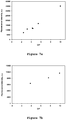
Figure 6a and 6b show a plot of the dye to protein ratios obtained by conjugation of mouse anti-human CD4 (figure 6a ) and mouse anti-human CD19 (figure 6b ) antibodies with increasing molar excess of compound 7. -
Figure 7a and 7b show a plot of the fluorescence data obtained using dye conjugates of mouse anti-human CD4 (figure 7a ) and mouse anti-human CD19 (figure 7b ) antibodies conjugated to compound 7 over a range of dye-to-protein ratios. -
Figure 8a and 8b show full emission spectra (figure 8a ) and integrated fluorescence intensity histogram (figure 8b ) for a mouse anti-human CD19 antibody labeled with either Compound 7 and BD Bioscience Horizon V500 at equal antibody concentration and dye-to-protein ratio when excited at 420nm. -
Figure 9a and 9b show full emission spectra (figure 9a ) and integrated fluorescence intensity histogram (figure 9b ) for a goat anti-mouse antibody labeled with either Compound 7 andcompound 16 at equal antibody concentration and dye-to-protein ratio when excited at 420nm. -
Figure 10 shows the expression of human CD4 in lymphocytes from healthy donor in flow cytometry using mouse anti-human CD4-compound 7 conjugate. -
Figure 11 shows MAVER-1 cells line stained with mouse anti-human CD19-compound 7 conjugate (white filled histogram) and unstained (grey filled histogram). - In the following description, numerous specific details are given to provide a thorough understanding of embodiments. The embodiments can be practiced without one or more of the specific details, or with other methods, components, materials, etc. In other instances, well-known structures, materials, or operations are not shown or described in detail to avoid obscuring aspects of the embodiments.
- Reference throughout this specification to "one embodiment" or "an embodiment" means that a particular feature, structure, or characteristic described in connection with the embodiment is included in at least one embodiment. Thus, the appearances of the phrases "in one embodiment" or "in an embodiment" in various places throughout this specification are not necessarily all referring to the same embodiment. Furthermore, the particular features, structures, or characteristics may be combined in any suitable manner in one or more embodiments.
- The headings provided herein are for convenience only and do not interpret the scope or meaning of the embodiments.
- In an embodiment, the instant description discloses 7-amino-3-thienyl coumarin dyes of formula (I) :

- R1 is L-RG;
- R2, R3, R4, R5, R6, R7 and R8 are independently selected from H, halogen, alkenyl, alkynyl, cyano, trifluoromethyl, aryloxy, azido, amino, hydroxyl, WSG, L-WSG, substituted or unsubstituted alkyl and substituted or unsubstituted alkoxy;
- R2 together with R3 or R6 may form a substituted or unsubstituted 5- or 6-membered N-heterocycle;
- RG is a chemically reactive group;
- L is a linker;
- WSG is a water soluble group;
- with the proviso that at least one of R7 and R8 is WSG, preferably both R7 and R8 are WSG;
- and salts thereof.
- In an embodiment, RG is selected from: carboxylic acid, an activated ester of a carboxylic acid, carbodiimide, sulfonyl halide, acyl halide, silyl halide, acyl azide, acyl nitrile, acrylamide, amine, aldehyde, alkyl or aryl halide, alkyl sulfonate, sulfonate ester, anhydride, azide, aziridine, diazoalkane, haloacetamide, halotriazine, hydrazine, hydroxylamine, isocyanate, isothiocyanate, maleimide, phosphoramidate, thiol, hydroxyl, hydrazine and alkyne. Preferably RG is selected from carboxylic acid, an activated ester of a carboxylic acid, sulfonyl halide, acyl halide, amine, alkyl or aryl halide, anhydride, azide, haloacetamide, halotriazine, hydrazine, isocyanate, isothiocyanate, maleimide, phosphoramidate, thiol, hydroxyl and alkyne. More preferably RG is selected from carboxylic acid, an activated ester of a carboxylic acid, amine, azide, haloacetamide, hydrazine, isocyanate, maleimide and alkyne.
- In an embodiment, L is a linker of formula (VI):
[(CH2)a-Y-(CH2)b]c (VI)
- wherein Y can be the same or different for the various substituents and is selected from none, O, S, NH, NR9, SO2-NH, SO2-NR9, CO-NH, CO-O, C=N-NHR9, CO-S, 1,3-triazole, CO-O-CO, aminotriazine, triazinyl ether, NH-CO-NH, NH-CS-NH, NH-CO-O, O-POR9-O, O-Si, SO2, SO2-O, amino acid, aryl or heteroaryl,
- wherein R9 is alkyl or WSG,
- a and c can be the same or different and are an integer number 1 to 10, and
- b is an
integer number 0 to 10. - In a preferred embodiment, Y can be the same or different for the various substituents and is selected from none, O, S, SO2-NH, SO2-NR9, CO-NH, CO-O, CO-S, 1,3-triazole, NH-CO-NH, NH-CS-NH, NH-CO-O, SO2-O, aryl, heteroaryl and amino acid. More preferably, Y is selected from none, O, S, SO2-NH, SO2-NR9, CO-NH, CO-O and 1,3-triazole, wherein R9 has the meaning defined above.
- In an embodiment, WSG is selected from sulfonic acid, sulfate, alkyl sulfonic acid, thiosulfonic acid, sulfonamide, phosphate, phosphonic acid, boronic acid, ammonium, pyridinium, quinolium, acridinium, cyclodextrin, monosaccharide, oligosaccharide, dextrane or -(CH2-CH2-O)x in which x is an integer number from 1 to 10. Preferably WSG is selected from sulfonic acid, alkyl sulfonic acid, sulfonamide, phosphate, phosphonic acid, ammonium, pyridinium, cyclodextrin, monosaccharide, oligosaccharide, dextrane and -(CH2-CH2-O)x in which x is an integer number from 1 to 10. More preferably WSG is selected from sulfonic acid, alkyl sulfonic acid, sulfonamide, ammonium and -(CH2-CH2-O)x in which x is an integer number from 1 to 10.
- In an embodiment the salts of sulfonic acid, alkyl sulfonic acid, thiosulfonic acid, phosphonic acid and boronic acid are selected from alkaline metal ions and ammonium ion, preferably sodium, potassium, and an ammonium ion.
- In a preferred embodiment, the 7-amino-3-thienyl coumarin dyes are represented by formula (II):
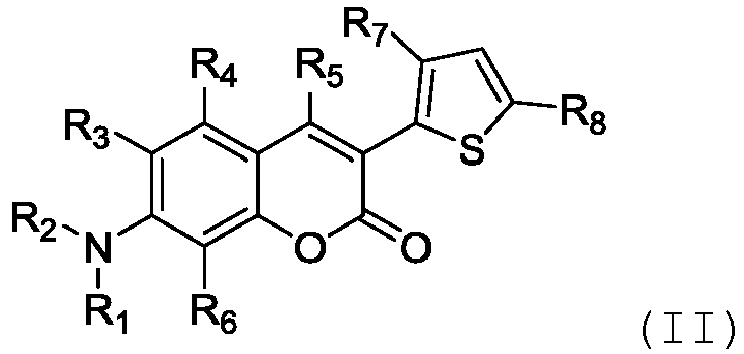
- R1 is L-RG;
- R2, R3, R4, R5, R6, R7 and R8 are independently selected from H, halogen, cyano, trifluoromethyl, hydroxyl, WSG, L-WSG, substituted or unsubstituted alkyl, and substituted or unsubstituted alkoxy;
- R2 together with R3 or R6 may form a substituted or unsubstituted 5- or 6-membered N-heterocycle;
- RG is a chemically reactive group as defined above;
- L is a linker as defined above;
- WSG is a water soluble group and is selected from sulfonic acid, sulfate, alkyl sulfonic acid, thiosulfonic acid, sulfonamide, phosphate, phosphonic acid, boronic acid, ammonium, pyridinium, quinolium, acridinium, cyclodextrin, monosaccharide, oligosaccharide, dextrane andpolyetheleneglycol;
- with the proviso that at least one of R7 and R8 is sulfonic acid, preferably both R7 and R8 are sulfonic acid;
- and salts thereof.
- In a still further preferred embodiment, the 7-amino-3-thienyl coumarin dyes are represented by formula (III):

- R2 is selected from substituted or unsubstituted alkyl, L-WSG;
- R3, R4, R5, R6, R7 and R8 are independently selected from H, halogen, hydroxyl, cyano, substituted or unsubstituted alkyl, and substituted or unsubstituted alkoxy;
- R2 together with R3 or R6 may form a substituted or unsubstituted 5- or 6-membered N-heterocycle;
- L is a linker as defined above;
- WSG is a water soluble group as defined above;
- n is an integer number 1 to 10;
- at least one of R7 and R8 is sulfonic acid, preferably both R7 and R8 are sulfonic acid;
- and salts thereof.
- In a still further preferred embodiment, the 7-amino-3-thienyl coumarin dyes are represented by formula (IV):

- R2 is selected from substituted or unsubstituted alkyl, L-WSG;
- R3, R4, R5, R6 are H;
- R2 together with R3 or R6 may form a substituted or unsubstituted 5- or 6-membered N-heterocycle;
- L is a linker as defined above;
- WSG is a water soluble group as defined above;
- and salts thereof.
- The 7-amino-3-thienyl coumarin dyes of formulas (I) to (IV) show large Stokes shifts of at least 80 nm with efficient excitability by a 405 nm violet excitation source and high fluorescence intensities in the green, and are highly suitable for bio-conjugation applications.
- In a further embodiment, the instant description discloses 7-amino-3-thienyl coumarin dye conjugates having the general formula (V):

- R2, R3, R4, R5, R6, R7 and R8 are independently selected from H, halogen, alkenyl, alkynyl, cyano, trifluoromethyl, aryloxy, azido, amino, hydroxyl, WSG, L-WSG, substituted or unsubstituted alkyl and substituted or unsubstituted alkoxy;
- R2 together with R3 or R6 may form a substituted or unsubstituted 5- or 6-membered N-heterocycle;
- L is a linker as defined above;
- WSG is a water soluble group and is selected from sulfonic acid, sulfate, alkyl sulfonic acid, thiosulfonic acid, sulfonamide, phosphate, phosphonic acid, boronic acid, ammonium, pyridinium, quinolium, acridinium, cyclodextrin, monosaccharide, oligosaccharide, dextrane or -(CH2-CH2-O)x in which x is an integer number from 1 to 10;
- m is an integer number 1 to 25;
- SUB is an amino acid, a peptide, a protein, a saccharide, a nucleoside, a nucleotide, an oligonucleotide, a nucleic acid, a hapten, a drug or a lipid;
- with the proviso that at least one of R7 and R8 is a sulfonic acid, preferably both R7 and R8 are sulfonic acid,
- and salts thereof.
- In a preferred embodiment, residues R7 and R8 of formula (V) are bound to the thienyl ring in
positions - In a preferred embodiment, residues R3, R4, R5 and R6 of formula (V) are hydrogen atoms.
- In a preferred embodiment, residues R2 of formula (V) is substituted or unsubstituted alkyl or L-WSG.
- In order that the invention herein described may be fully understood, a number of terms are explicitly defined, below.
- The term "7-amino-3-thienyl coumarin", as used herein, means any dye compound containing as core structure the following one:

- It is to be understood that the dye compounds as disclosed in the instant description can be formally drawn with other permitted resonance structures.
- The term 'tertiary' or 'N-di-alkylated 7-amino coumarin' means a dye compound in which the 7-amino group of the coumarin dye is substituted two times by a carbon atom that is itself optionally substituted.
- The term "substituted" refers to the formal replacement of a hydrogen atom on a chemical moiety or functional group with an alternative radical. The alternative radical substituent moiety is selected from hydroxy, trifluoromethyl, halogen, alkoxy, aminoalkyl, aminoalkoxy, amino, monoalkylamino, dialkylamino, alkylcarbonylamino, alkoxycarbonylamino, alkoxycarbonyl, carboxy, hydroxyalkoxy, alkoxyalkoxy, monoalkylaminoalkoxy, (carboxyalkyl)amino, alkoxycarbonyl, alkynylcarbonyl, alkylsulfonyl, alkenylsulfonyl, alkynylsulfonyl, arylsulfonyl, alkylsulfonamido, arylsulfonamido, carboxyalkoxy, carboxyalkyl, carboxyalkylamino, cyano, trifluoromethoxy, guanidine, alkyl azide, azide, alkylthio (disulfide), acrylo, aryl, arylalkyl, heteroaryl, heteroarylalkyl, cycloalkylalkyl, cycloalkenylalkyl, cycloheteroalkylalkyl, cycloheteroalkenylalkyl or WSG. Preferably, the alternative radical substituent moiety is selected from hydroxy, trifluoromethyl, halogen, alkoxy, dialkylamino, alkylcarbonylamino, alkoxycarbonylamino, alkoxycarbonyl, hydroxyalkoxy, alkoxyalkoxy, alkylsulfonamido, arylsulfonamido, carboxyalkoxy, carboxyalkylamino, cyano, alkyl azide, azide, aryl, arylalkyl, heteroaryl, heteroarylalkyl, cycloalkylalkyl, cycloalkenylalkyl, cycloheteroalkylalkyl, cycloheteroalkenylalkyl or WSG. More preferably, the alternative radical substituent moiety is selected from hydroxy, trifluoromethyl, halogen, alkoxy, dialkylamino, alkylcarbonylamino, alkoxyalkoxy, alkylsulfonamido, arylsulfonamido, cyano, azide, aryl, heteroaryl or WSG. Still more preferably, the alternative radical substituent moiety is selected from hydroxy, trifluoromethyl, halogen, alkoxy, dialkylamino, alkylcarbonylamino, alkoxyalkoxy, alkylsulfonamido, arylsulfonamido, cyano, azide, aryl, or heteroaryl.
- As used herein, "alkyl" is intended to include both branched, linear and cyclic saturated aliphatic hydrocarbon groups. Preferably, "alkyl" means branched, straight-chain or cyclic alkyl group having from 1 to 10 carbon atoms, more preferably 1 to 6 carbon atoms.
- As used herein, "alkoxy" represents an alkyl group singular bonded to an oxygen atom. Preferably, "alkoxy" means branched, straight-chain or cyclic alkoxy group having from 1 to 10 carbon atoms, more preferably 1 to 6 carbon atoms.
- The term "alkenyl" refers to a non-aromatic, linear, branched or cyclic hydrocarbon group containing at least one carbon to carbon double bond. Preferably, "alkenyl" means non-aromatic, linear, branched or cyclic alkenyl group having from 2 to 10 carbon atoms, more preferably 2 to 6 carbon atoms.
- The term "alkynyl" refers to a linear, branched or cyclic hydrocarbon group, containing at least one carbon to carbon triple bond. Preferably, "alkynyl" means linear, branched or cyclic alkynyl group having from 2 to 10 carbon atoms, more preferably 2 to 6 carbon atoms.
- The term "carboxylic acid" is intended to mean an organic compound that contains a carboxyl group (C(=O)OH).
- The term "aryl" is intended to mean any stable monocyclic or polycyclic carbon ring of up to 7 atoms in each ring wherein at least one ring is aromatic.
- The term "heteroaryl" is intended to mean any stable monocyclic or polycyclic carbon ring of up to 7 atoms in each ring wherein at least one ring is aromatic and at least one ring contains a heteroatom in which the heteroatom is selected from N, O or S, preferably N.
- The term "N-heterocycle" means a saturated or unsaturated 5 or 6-membered ring that contains at least one N atom.
- The term "reactive group", or "RG" as used herein, means a functional group present on the dye compound that is capable of chemically reacting with a functional group on a different compound to form a covalent linkage.
- The term "linker" or "L" as used herein, means a chemical moiety that connects the core structure of the dye compound disclosed in the instant description to RG or WSG or SUB.
- The term "water-soluble group" or "WSG", as used herein, means any substituent that enhances the water-solubility of a dye compound of the present description.
- The term "dye-conjugate" refers to a conjugate between a dye compound of the present invention and a substrate "SUB".
- The term "substrate" or "SUB" as used herein means any organic or inorganic "detection reagent" useful for detecting an analyte of interest present in a sample to be analyzed.
- The term "analyte" as used herein means any substance to be analyzed, detected, measured, or labeled. Examples of analytes which can be detected by means of the dyes or dye-conjugates disclosed herein include, but are not limited to, proteins, peptides, hormones, haptens, antigens, antibodies, receptors, enzymes, nucleic acids, polysaccarides, chemicals, polymers, pathogens, toxins, organic drugs, inorganic drugs, cells, tissues, microorganisms, viruses, bacteria, fungi, algae, parasites, allergens, pollutants, and combinations thereof.
- "Detection reagents" are represented by any "analyte-specific reagents" that bind preferably to the analyte of interest and are generally selected from members of a binding pair. Either member of the pair can be used as the analyte-specific reagent in order to selectively bind to the other member of the pair, wherein in some cases one of the members of the pair is the analyte to be detected. Examples of analyte-specific reagent pairs include, but are not limited to, biotin/avidin, streptavidin, anti-biotin antibody; IgG/protein; drug/drug receptor; Toxin/Toxin receptor; Peptide/Peptide receptor; Nucleotide/Complimentary nucleotide; Protein/Protein receptor; Enzyme substrate/Enzyme; Nucleic acid/Nucleic acid; Hormone/Hormone receptor; Target molecule/RNA or DNA aptamer.
- The dye compounds disclosed herein can react through the RG residue with a wide variety of substrates "SUB" that contain or are modified to contain functional groups with suitable reactivity, resulting in chemical attachment of the dye compound to the substrate SUB. Typically, the conjugation reaction between the dye and the functional groups on the substrate results in one or more atoms of the reactive group RG to be incorporated into a new linkage attaching the dye to the substrate.
- Examples of reactive groups present either on the dye or on SUB, along with the covalent linkage resulting from their reaction, are shown in Table 1.
Table 1 Reactive pairs Resulting Linkage activated esters amines/anilines carboxamides acrylamides thiols thioethers acyl azides* amines/anilines carboxamides acyl halides amines/anilines carboxamides acyl halides alcohols/phenols esters acyl nitriles alcohols/phenols esters acyl nitriles amines/anilines carboxamides aldehydes amines/anilines imines aldehydes or ketones hydrazines hydrazones alkyl halides amines/anilines alkyl amines alkyl halides carboxylic acids esters alkyl halides thiols thioethers alkyl halides alcohols/phenols ethers alkyl sulfonates carboxylic acids esters alkyl sulfonates alcohols/phenols ethers alkyl sulfonates thiols thioethers anhydrides alcohols/phenols esters anhydrides amines/anilines carboxamides azide alkyne 1,3 triazole aziridines thiols thioethers carbodiimides carboxylic acids N-acylureas or anhydrides diazoalkanes carboxylic acids esters haloacetamides thiols thioethers halotriazines amines/anilines aminotriazines halotriazines alcohols/phenols triazinyl ethers isocyanates amines/anilines ureas isocyanates alcohols/phenols urethanes isothiocyanates amines/anilines thioureas maleimides thiols thioethers phosphoramidites alcohols phosphite esters silyl halides alcohols silyl ethers sulfonate esters amines/anilines alkyl amines sulfonate esters thiols thioethers sulfonate esters carboxylic acids esters sulfonate esters alcohols ethers sulfonyl halides amines/anilines sulfonamides sulfonyl halides phenols/alcohols sulfonate esters *Acyl azides can also rearrange to isocyanates. - Within the present description, with the expression "activated ester of a carboxylic acid" is meant the ester of a carboxylic acid containing a good leaving group. Activated esters, as understood in the art, generally have the formula -COW (or -(CO)W), where W is a good leaving group, wherein the leaving group W is selected from succiminidyloxy (-OC4H4O2) sulfosuccinimidyloxy (-OC4H3O2-SO3H), -l-oxybenzotriazolyl (-OC2H4N3), an aryloxy or aryloxy group substituted one or more times by electron withdrawing substituents such as nitro, fluoro, chloro, cyano, or trifluoromethyl, or combinations thereof, used to form activated aryl esters, or a carboxylic acid activated by a carbodiimide to form an anhydride or mixed anhydride -OCOAlk or -OCN(Alk1)NH(Alk2), wherein Alk1 and Alk2, which may be the same or different, are selected from C1-C20 alkyl, C1-C20 perfluoroalkyl, C1-C20 alkoxy, cyclohexyl, 3-dimethylaminopropyl, and N-morpholinoethyl.
- Where RG is an activated ester of a carboxylic acid, the dye of formula (I) is particularly useful for preparing dye-conjugates of proteins, nucleotides, oligonucleotides, or haptens.
- Where RG is a maleimide or haloacetamide the reactive dye is particularly useful for conjugation to thiol-containing substrate.
- Where RG is a hydrazide, the dye of formula (I) is particularly useful for conjugation to periodate-oxidized carbohydrates and glycoproteins, and, in addition, is an aldehyde-fixable polar tracer for cell microinjection.
- Where RG is an azide, the dye of formula (I) is particularly useful for conjugation to alkyne-containing substrates by means of a Cu(I) catalyzed 1,3-dipolar cycloaddition reaction.
- In a further embodiment, the present description concerns kits that facilitate the practice of various assays using any of the dyes herein disclosed. The kits typically comprise a fluorescent dye of formula (I) or a dye-conjugate of formula (V) in dry or solution form together with at least one more component. The other component of the kit is selected from a buffering agent such as labelling buffer, running buffer and washing buffer, an additional detection reagent such as a fluorescent dye or dye-conjugate different from the dye or dye-conjugate described herein that can be useful in multi-analyte assays, a purification column that can be useful for purifying the resulting labeled substance and an organic solvent to dissolve the fluorescent dye if present in dry form.
- The 7-amino-3-thienyl coumarin dyes of formula (I) are characterized by an absorption maximum at 410 nm + 10 nm with a large Stokes Shift of at least 80nm and an emission maximum at 510 nm ± 10nm in the green.
- 7-amino-3-thienyl coumarin dyes of the present invention are pH independent over a wide pH range as shown e.g. in
fig 3 forcompound 6. This aspect offers one advantage over 7-hydroxy coumarins that are pH dependent due to high pKa values of the hydroxyl group and are poorly fluorescent at physiologic pH. - 7-amino-3-thienyl coumarin dyes, that are themselves substituted twice by WSG on the thienyl ring, provides a dye with an absorption maximum near 405 nm and an emission maximum near 500nm.
- The absorption maximum at 410 ± 10 nm provides a dye that is useful for applications in which a dye-conjugate can be detected with high sensitivity after excitation with a 405nm violet excitation source.
- The introduction of at least one water soluble group onto the thienyl moiety increases the hydrophilicity of the dye, while retaining the optimal spectroscopic properties. Furthermore, the positioning of the water soluble group(s) onto the thienyl ring substantially lower quenching effects due to dye-dye or dye-substrate interactions upon conjugation, resulting in a higher total fluorescence of the dye conjugate in comparison to the corresponding 7-amino-3-thienyl coumarin dye, that is not substituted on the thienyl ring, as shown in
figure 9a and 9b . Particularly preferred water soluble group(s) present on the thienyl moiety is sulfonic acid and salts thereof. Sulfonic acid or salts thereof provide, in fact, a fluorescent dye with optimal water solubility, low molecular weight, excellent conjugation performance and highly fluorescent conjugates. - The large Stokes shift provides a dye, after conjugation with a substrate, which is extremely useful for multiplex applications in biological assays, which utilize the 405 nm violet excitation source. The spectral separation of various fluorophores into distinct excitation or acquisition channels is essential for multiplex analyte detection.
- Preferred 7-amino-3-thienyl coumarin dyes of formula (I) are shown in Table 2.
Table 2 Dye Structure sodium 5-(7-((5-carboxypentyl)(ethyl)amino) -2-oxo-2H-chromen-3-yl)thiophene-2,4-disulfonate (compound 6) 
Sodium 5-(7-((6-((2,5-dioxopyrrolidin-1-yl)oxy)-6-oxohexyl) (ethyl)amino)-2-oxo-2H-chromen-3-yl)thiophene-2,4-disulfonate (compound 7) 
sodium 5-(7-(ethyl(6-hydrazinyl-6-oxohexyl)amino)-2-oxo-2H-chromen-3-yl)thiophene-2,4-disulfonate (compound 8) 
sodium 5-(7-((6-((2-(2,5-dioxo-2,5-dihydro-1H-pyrrol-1-yl)ethyl)amino)-6-oxohexyl) (ethyl)amino)-2-oxo-2H-chromen-3-yl)thiophene-2,4-disulfonate (compound 9) 
Sodium 5-(7-((6-((2,5-dioxopyrrolidin-1-yl)oxy)-6-oxohexyl)(3-sulfonatopropyl)amino)-2-oxo-2H-chromen-3-yl)thiophene-2,4-disulfonate (compound 15) 
sodium 5-(9-(6-((2,5-dioxopyrrolidin-1-yl)oxy)-6-oxohexyl)-2-oxo-6,7,8,9-tetrahydro-2H-pyrano[3,2-g]quinolin-3-yl)thiophene-2,4-disulfonate (compound 22) 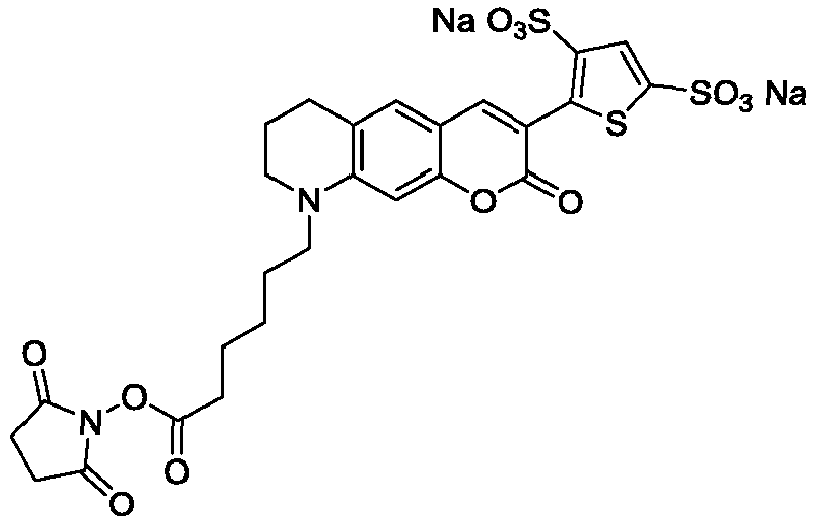
5-(7-((6-((2,5-dioxopyrrolidin-1-yl)oxy)-6-oxohexyl)(2-(2-methoxyethoxy)ethyl)amino)-2-oxo-2H-chromen-3-yl)thiophene-2,4-disulfonic acid 
5-(7-((6-((2,5-dioxopyrrolidin-1-yl)oxy)-6-oxohexyl)(2-oxo-2-((3-sulfopropyl)amino)ethyl)ami no)-2-oxo-2H-chromen-3-yl)thiophene-2,4-disulfonic acid 
5-(7-((6-((2,5-dioxopyrrolidin-1-yl)oxy)-6-oxohexyl)(3-(N-(2-sulfoethyl)sulfamoyl)propyl )amino)-2-oxo-2H-chromen-3-yl)thiophene-2,4-disulfonic acid 
5-(7-((3-(N-(6-((2,5-dioxopyrrolidin-1-yl)oxy)-6-oxohexyl)sulfamoyl)propyl)( ethyl)amino)-2-oxo-2H-chromen-3-yl)thiophene-2,4-disulfonic acid 
5-(7-((4-(((2,5-dioxopyrrolidin-1-yl)oxy)carbonyl)benzyl)(eth yl)amino)-2-oxo-2H-chromen-3-yl)thiophene-2,4-disulfonic acid 
2,5-dioxopyrrolidin-1-yl 6-((3-(3,5-disulfamoylthiophen-2-yl)-2-oxo-2H-chromen-7-yl) (ethyl) amino) hexanoate 
- The number of the dyes in table 2 corresponds to the numbering of the compounds described in the examples.
- In the following examples, the synthesis of selected dyes, the synthesis of selected conjugates, their characterization, and methods of use are provided. Further modifications and permutations will be obvious to those skilled in the art. The examples illustrate the practice of the invention and are not intended to limit or define the entire scope of the invention.
- The dye compounds disclosed herein are synthetized in accord to the general synthesis scheme shown in
figure 1 . The synthesis of dye compounds of the present description is achieved by amine-alkylation of 3-amino phenols followed by a Vilsmeijer formylation to provide the intermediate salicylaldehyde derivative. Next, an acetic anhydride mediated condensation with thiophene acetic acid gives the dye core structure. Final functionalization provides the chemically reactive dye required for bioconjugation to provide fluorescent dye conjugates according to the instant description. - Those skilled in the art will appreciate that other synthetic routes may be used to synthesize the dyes of the invention. Although specific starting materials and reagents are discussed below, other starting materials and reagents can be easily substituted to provide a variety of derivatives and/or reaction conditions. In addition, many of the dyes prepared by the methods described below can be further modified in light of this disclosure using conventional chemistry well known to those skilled in the art. A more detailed description of the individual reaction steps is shown in the examples.
-
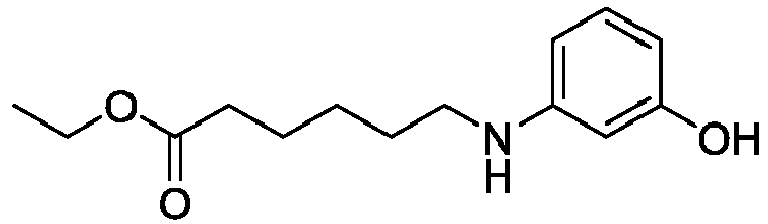
- In a 100 mL round bottom, one necked flask set up with a magnetic stir bar and a reflux condenser, 3-aminophenol (40.0g, 367mmol) was dissolved in DMF. Ethyl-6-bromo hexanoate (16.4g, 73mmol) was added. The reaction mixture was stirred at 50°C for 20h. Solvent was removed under vacuum to give a crude oil. The crude oil was purified on a silica gel column with a gradient of hexanes/ethylacetate as eluent to yield the desired product, compound 1, as a colorless oil. The yield was 13.7g (74%, based on ethyl-6-bromo hexanoate).
- Analysis: 1H NMR (CDCl3, 600 MHz) δ 7.00 (t, 1H, J = 8.2Hz), 6.17 (m, 2H), 6.09 (t, 1H, J = 2.3Hz), 4.13 (q, 2H, J = 7.4Hz), 3.08 (t, 2H, J = 7.0Hz), 2.30 (t, 2H, J = 7.4Hz), 1.71-1.58 (m, 4H), 1.46-1.38 (m, 2H), 1.26 (t, 3H, J = 7.0Hz).
-

- In a 100 mL round bottom, one necked flask set up with a magnetic stir bar and a reflux condenser, compound 1 (5.3g, 21.1mmol) was dissolved in DMF. Ethyl iodide (3.29g, 21.1mmol) and potassium carbonate (2.92g, 21.1mmol) were added. The reaction mixture was stirred at 50°C for 20h. Solvent was removed under vacuum to give a crude oil. The crude oil was dissolved in ethyl acetate (250mL) and extracted with aqueous HCl (0.05M, 2 x 200ml). The organic phase was dried over sodium sulfate and solvent was removed under vacuum to give a crude oil. The crude oil was purified on a silica gel column with a gradient of hexanes/ethylacetate as eluent to yield the desired product,
compound 2 as a colorless oil. The yield was 5.1g (86%). - Analysis: 1H NMR (CDCl3, 600 MHz) δ 7.04 (t, 1H, J = 8.2Hz), 6.23 (d, 1H, J = 8.2Hz), 6.16 (s, 1H), 6.12 (d, 1H, J = 7.6Hz), 5.13 (broad band, 1H), 4.14 (q, 2H, J = 7.0Hz), 3.31 (q, 2H, J = 7.0Hz), 3.21 (t, 2H, J = 7.6Hz), 2.32 (t, 2H, J = 7.0Hz), 1.70-1.66 (m, 2H), 1.62-1.57 (m, 2H), 1.38-1.33 (m, 2H), 1.26 (t, 3H, J = 7.0Hz), 1.13 (t, 3H, J = 7.0Hz).
-

- A flame dried two necked 100mL round bottom flask equipped with stir bar was cooled to 0°C. Anhydrous DMF (14.5mL, 188mmol) was added, followed by slow addition of POCl3 (8.7mL, 94mmol). The reaction mixture was then stirred at 0°C for 30 min. and an additional 30 min. at room temperature. A solution of Compound 2 (3.5g, 12.5mmol) in DMF (anh, 10mL) was slowly added at room temperature (RT) and the reaction mixture was stirred at RT for 20h. The reaction mixture was cooled to 0°C and quenched by addition of small pieces of ice at a time. The pH was neutralized to pH 8-10 with 1M NaOH. The aqueous solution was extracted with DCM(2 x 250mL). Solvent was removed under vacuum to give a crude oil. The crude oil was purified on a silica gel column with a gradient of hexanes/ethylacetate as eluent to yield the desired product, compound 3 as a colorless oil. The yield was 2.0g (53%)
- Analysis: HNMR (CDCl3, 600MHz) purity>98%. δ 11.62 (s, 1H), 9.48 (s, 1H), 7.25 (d, 1H, J=8.8), 6.23 (dd, 1H, J=8.8, 2.3), 6.04 (d, 1H, J=2.3), 4.13 (q, 2H, J=7.0), 3.40 (q, 2H, J=7.0), 3.30 (t, 2H, J=7.6), 2.31 (t, 2H, J=7.6), 1.70-1.60 (m, 4H), 1.37 (m, 2H), 1.25 (t, 3H, J=7.6), 1.19 (t, 3H, J=7.0).
-

- In a 100 mL round bottom, one necked flask set up with a magnetic stir bar and a reflux condenser, 2-thiophene acetic acid (0.53g, 3.69mmol) was dissolved in acetic anhydride. The resulting solution was stirred at 60°C for 15-20min. Compound 3 (1.70g, 5.53mmol) was added followed by triethylamine (0.73mL, 7.38mmol) and the reaction mixture was stirred at 120°C for 3h. The reaction mixture was cooled to room temperature and poured into cold water. The liquid was decanted of and the crude oil was dissolved in DCM (100mL). The organic phase was washed with water (2 x 100mL), dried over sodium sulfate and solvent was removed under vacuum to give a crude oil. The crude oil was purified on a silica gel column with a gradient of hexanes/ethylacetate as eluent to yield the desired product,
compound 4 as a dark orange solid. The yield was 0.54g (35%) - Analysis: HNMR (CDCL3, 600MHz) purity > 98%. δ 7.88 (s, 1H), 7.66 (dd, 1H, J = 3.5, 1.2), 7.31 (d, 1H, J = 8.6), 7.31 (dd, 1H, J = 1.2), 7.08 (dd, 1H, J = 5.1, 3.5), 6.59 (dd, 1H, J = 8.9, 2.3), 6.50 (d, 1H, J = 2.3), 4.13 (quartet, 2H, J = 7.4), 3.43 (quartet, 2H, J = 7.0), 3.32 (t, 2H, J = 7.8), 2.33 (t, 2H, J = 7.4), 1.73-1.61, m, 4H), 1.43-1.36 (m, 2H), 1.26 (t, 3H, J = 7.4), 1.21 (t, 3H, J = 7.0).
-
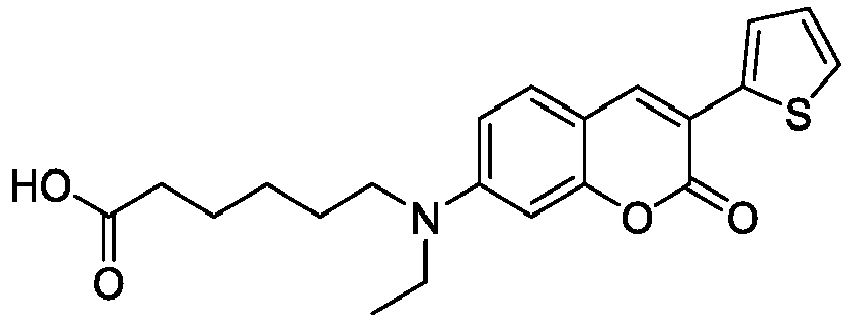
- In a 10 mL round bottom, one necked flask set up with a magnetic stir bar, compound 4 (500mg, 1.21mmol) was dissolved in tetrahydrofuran (10mL). Sodium hydroxide (242mg, 6.05mmol) was dissolved in water (10mL) and the solutions were added together. The reaction mixture was stirred at room temperature for 5h. Tetrahydrofuran was removed under vacuum and the aqueous phase was neutralized with aqueous hydrochloric acid (0.1M) to pH 7. The aqueous phase was then extracted with dichloromethane (2 x 50mL), the combined organic phases were dried over sodium sulfate and solvent was removed under vacuum to give the crude oil. The crude oil was purified on a silica gel column with a gradient of hexanes/ethylacetate as eluent to yield the desired product,
compound 5 as a dark orange solid. The yield was 140mg (32%).
Analysis: HNMR (CDCl3, 600MHz) purity (>95%). δ 7.88 (s, 1H), 7.65 (dd, 1H, J =3.5, 1.2), 7.31 (d, 1H, J = 8.6), 7.30 (dd, 1H, J = 5.5, 1.2), 7.08 (dd, 1H, J = 5.1, 3.5), 6.59 (dd, 1H, J = 8.9, 2.3), 6.51 (d, 1H, J =2.3), 3.43 (quartet, 2H, J =7.0), 3.34 (t, 2H, J =7.8), 2.40 (t, 2H, J = 7.4), 1.75-1.63 (m, 4H), 1.46-1.39 (m, 2H), 1.21 (t, 3H, J = 7.0). -

- In a flame dried two necked round bottom flask set up with a magnetic stir bar and Argon inlet, Compound 5 (90mg, 0.23mmol) was dissolved in anhydrous DMF (5mL). Sulfur trioxide dimethylformamide complex (1.49g, 9.34mmol) was added and the reaction mixture was stirred at 60°C for 20h under an inert Argon atmosphere. The reaction mixture was cooled to room temperature and quenched by addition of NaHCO3 (saturated, 5mL). Solvents where removed under vacuum to give the crude oil. The crude oil was purified on a reverse phase C18 column with a gradient of water/ methanol as eluent to yield the desired product, as a dark orange oil. The obtained dark orange oil was then passed through a Sephadex LH20 column with an isocratic gradient of water as eluent to yield the desired product,
compound 6 as a dark orange solid. The yield was 70mg (55%)
Analysis: HNMR (D2O, 600MHz) purity (>95%). δ 8.78 (s, 1H), 7.34 (d, 1H, J = 8.8), 7.21 (s, 1H), 6.71 (dd, 1H, J = 8.4, 2.3), 6.52 (d, 1H, J = 2.3, 3.45 (quartet, 2H, J = 7.0), 3.34 (t, 2H, J = 7.4), 1.89 (t, 1H, J = 7.0), 1.58-1.52 (m, 2H), 1.52-1.47 (m, 2H), 1.33-1.28 (m, 2H), 1.13 (t, 3H, J = 7.0).
Abs max = 412nm, Em max = 507nm
Mol. ext. coef = 26000-27000 M-1cm-1
QY = 0.70-0.75 -
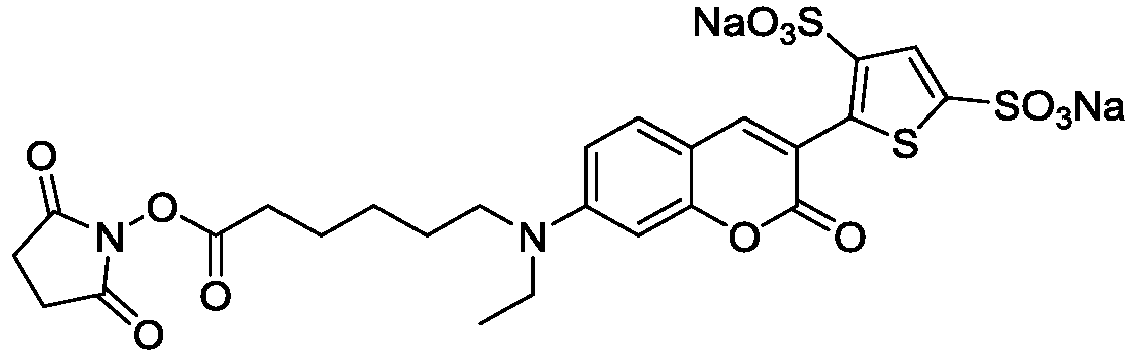
- In a flame dried two necked round bottom flask set up with a magnetic stir bar and Argon inlet, Compound 6 (115mg, 0.20mmol) was dissolved in anhydrous DMF (5mL). TSTU (65mg, 0.22mmol) and DMAP (26mg, 0.22mmol) were added. The reaction mixture was stirred at room temperature for 2 hours. The reaction mixture was drop wise added to diethyl ether (100mL) under stirring. The resulting dark orange precipitate was collected by filtration and washed with diethyl ether (5mL) and dichloromethane (5mL). The dark orange solid was taken up in a minimal amount of anhydrous dimethylformamide, transferred into a 10mL round bottom flask and concentrated under vacuum to yield the desired product, compound 7, as a dark orange solid. The yield was 120mg (95%)
Analysis: HNMR (d6-DMSO, 600MHz) purity (>95%). Spectrum is broadened δ 8.74 (s, 1H), 7.33 (d, 1H, J = 8.8), 7.21 (s, 1H), 6.71 (d, 1H, J = 7.6), 6.50 (s, 1H), 3.44 (quartet, 2H, J = 7.0), 3.34 (t, 2H, J = 8.2), 2.71 (s, 4H), 2.67 (t, 2H, J = 7.0), 1.67 (m, 2H), 1.58 (m, 2H), 1.41 (m, 2H), 1.11 (t, 3H, J = 7.0). -

- In a flame dried two necked round bottom flask set up with a magnetic stir bar and Argon inlet, Compound 7 (115mg, 0.20mmol) was dissolved in anhydrous DMF (0.55mL). A solution of anhydrous hydrazine (125 µL, 4 mmol) in DMF (0.5 mL) was added and the reaction mixture was stirred at room temperature for 15 minutes. The reaction mixture was drop wise added to ethyl acetate (100mL) under stirring. The resulting dark orange precipitate was collected by filtration and washed with diethyl ether (5mL) and dichloromethane (5mL). The dark orange solid was taken up in a minimal amount of anhydrous dimethylformamide, transferred into a 10mL round bottom flask and concentrated under vacuum to yield the desired product,
compound 8, as a dark orange solid. The yield was 115 mg (91%)
Analysis: HNMR (d6-DMSO, 600MHz) purity (>95%). Spectrum is broadened δ 8.87 (s, 1H), 7.33 (d, 1H, J = 8.8), 7.18 (s, 1H), 6.68 (d, 1H, J = 7.6), 6.50 (s, 1H), 4.14 (bs, 2H), 3.44 (quartet, 2H, J = 7.0), 3.34 (t, 2H, J = 8.2), 2.19 (t, 2H, J = 7.0), 1.67 (m, 2H), 1.58 (m, 2H), 1.41 (m, 2H), 1.11 (t, 3H, J = 7.0). -

- In a flame dried two necked round bottom flask set up with a magnetic stir bar and Argon inlet, Compound 7 (115mg, 0.20mmol) was dissolved in anhydrous DMF (2 mL). N-(2-Aminoethyl)maleimide trifluoroacetate salt was addend and the reaction mixture was stirred at room temperature for 2 hours. The reaction mixture was drop wise added to ethyl acetate (100mL) under stirring. The resulting dark orange precipitate was collected by filtration and washed with diethyl ether (5mL) and dichloromethane (5mL). The dark orange solid was taken up in a minimal amount of anhydrous dimethylformamide, transferred into a 10mL round bottom flask and concentrated under vacuum to yield the desired product, compound 9, as a dark orange solid. The yield was 115 mg (91%).
Analysis: HNMR (d6-DMSO, 600MHz) purity (>95%). Spectrum is broadened δ 8.87 (s, 1H), 7.86 (d, 2H, J=10.9), 7.33 (d, 1H, J = 8.8), 7.18 (s, 1H), 6.68 (d, 1H, J = 7.6), 6.50 (s, 1H), 3.66 (m, 2H), 3.44 (quartet, 2H, J = 7.0), 3.34 (t, 2H, J = 8.2), 2.19 (t, 2H, J = 7.0), 1.67 (m, 2H), 1.58 (m, 2H), 1.41 (m, 2H), 1.11 (t, 3H, J = 7.0). -

- In a 100 mL round bottom, one necked flask set up with a magnetic stir bar and a reflux condensor, compound 1 (2.85 g, 11.4mmol) and 1,3-Propan Sultone (2.77 g, 22.69 mmol) were added under Argon. The reaction mixture was stirred at 100°C overnight. The obtained crude oil was purified on a reverse phase C18 column with a gradient of Water/Methanol as eluent to yield the desired product,
compound 10 as a colorless oil. The yield was 1.5 g (y=33%).
Analysis: HNMR (D2O, 600MHz) purity>98%. δ 7.34 (t, 1H, J=8.2), 6.92 (d, 1H, J=1.9), 6.90 (d, 1H, J=2.4), 6.90 (d, 1H, J=2.4), 3.96 (q, 2H, J=7.0), 3.59 (t, 2H, J=7.8), 3.44 (t, 2H, J=7.8), 2.75 (t, 2H, J=7.4), 2.15 (t, 2H, J=7.4), 1.81 (m, 2H), 1.43-1.23 (m, 4H), 1.15 (m, 2H), 1.07 (t, 3H, J=7.4). -

- A flame dried two necked 100mL round bottom flask equipped with stir bar was cooled to 0°C. Anhydrous DMF (2 mL, 25.29 mmol) was added, followed by slow addition of POCl3 (1.17mL, 12.65 mmol). The reaction mixture was then stirred at 0°C for 30 min. and an additional 30 min. at room temperature. A solution of Compound 10 (1.0g, 2.53mmol) in DMF (anh, 5mL) was slowly added at room temperature (RT) and the reaction mixture was stirred at RT for 20h. The reaction mixture was cooled to 0°C and quenched by addition of small pieces of ice at a time. The pH was neutralized to pH 8-10 with 1M NaOH. The aqueous solution was extracted with DCM(2 x 250mL). Solvent was removed under vacuum to give a crude oil. The crude oil was purified on a reverse phase C18 column with a gradient of Water/Methanol as eluent to yield the desired product, compound 11 as a colorless oil. The yield was 500 mg (47%).
Analysis: HNMR (D2O, 600MHz) purity>98%. δ 9.29 (s, 1H), 7.32 (d, 1H, J=9.37), 6.30 (d, 1H, J=9.37), 5.96 (s, 1H), 3.99 (q, 2H, J=7.4), 3.41 (t, 2H, J=7.4), 3.29 (t, J=7.4), 2.81 (t, 2H, J=7.4), 2.23 (t, 2H, J=7.4), 1.92 (m, 2H), 1.49 (m, 2H), 1.21 (m, 2H), 1.08 (t, 3H, J=7.4). -

- In a 100 mL round bottom, one necked flask set up with a magnetic stir bar and a reflux condenser, 2-thiophene acetic acid (167mg, 1.18mmol) was dissolved in acetic anhydride. The resulting solution was stirred at 60°C for 15-20min. Compound 11 (500mg, 1.18mmol) was added followed by triethylamine (0.31mL, 2.24mmol) and the reaction mixture was stirred at 120°C for 3h. The reaction mixture was cooled to room temperature and precipitated in Petroleum Ether. The dark oil wad decanted of and purified on a C18 column with a gradient of H2O/MeOH as eluent to yield the desired product,
compound 12 as a yellowish solid. The yield was 0.25g (35%).
Analysis: HNMR (D2O, 400MHz) purity>98%. δ 7.53 (s, 1H), 7.34 (d, 1H, J=2.2), 7.22 (s, 1H,), 6.83-6.75 (m, 2H), 6.24 (d, 1H, J=8.6), 6.18 (s, 1H), 4.03 (q, 2H, J=7.0), 3.30 (bs, 2H), 2.96 (bs, 2H) 2.87 (t, 2H, J=8.6), 2.15 (t, 2H, J=7.0) 1.98 (m, 2H,), 1.40 (m, 2H), 1.15 (t, 2H, J=7.4), 0.9 (bs, 2H). -
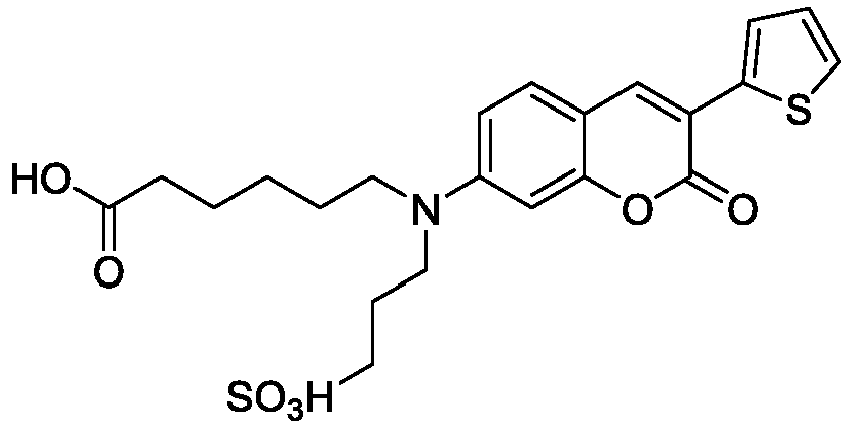
- In a 10 mL round bottom, one necked flask set up with a magnetic stir bar, compound 12 (0.23g, 0.43 mmol) was dissolved in tetrahydrofuran (5mL). Sodium hydroxide (86mg, 2.17mmol) was dissolved in water (5mL) and the solutions were added together. The reaction mixture was stirred at room temperature for 2h. Tetrahydrofuran was removed under vacuum and the aqueous phase was neutralized with aqueous hydrochloric acid (0.1M) to pH 7. The crude oil was purified on a C18 column with a gradient of H2O/MeOH as eluent to yield the desired product, compound 13 as a yellowish solid. The yield was 130mg (60%).
Analysis: HNMR (D2O, 400MHz) purity>98%. δ 7.87 (s, 1H), 7.47 (d, 1H, J=2.7), 7.45 (d, 1H, J=5.7), 7.25 (d, 1H, J=8.6), 7.15 (t, 1H, J=3.5), 6.62 (d, 1H, J=9.37), 6.37 (s, 1H), 3.38 (t, 2H, J=7.8), 3.26-3.15 (m, 2H), 2.94 (t, 2H, J=7.8), 2.23 (m, 2H, J=7.4), 2.02 (m 2H), 1.64-1.50 (m, 4H), 1.34 (m, 2H). -

- In a flame dried two necked round bottom flask set up with a magnetic stir bar and Argon inlet, Compound 13 (127mg, 0.25mmol) was dissolved in anhydrous DMF (5mL). Sulfur trioxide dimethylformamide complex (1.55g, 10mmol) was added and the reaction mixture was stirred at 60°C for 20h under an inert Argon atmosphere. The reaction mixture was cooled to room temperature and quenched by addition of NaHCO3 (saturated, 5mL). Solvents were removed under vacuum to give the crude oil. The crude oil was purified on a reverse phase C18 column with a gradient of water/ methanol as eluent to yield the desired product,
compound 14 as a yellowish solid. The obtained product was then passed through a Sephadex column LH20 (3x40cm, eluent H2O) with an isocratic gradient of water as eluent to yield the desired product,compound 14 as a yellowish solid. The yield was 75mg (42%)
Analysis: HNMR (D2O, 400MHz) purity>98%. δ 8.07 (s, 1H), 7.56 (s, 1H), 7.41 (d, 1H, J=8.9), 6.76 (d, 1H, J=8.6), 6.62 (s, 1H), 3.49 (t, 2H, J=7.8), 3.36 (t, 2H, J=7.4), 2.86 (t, 2H, J=7.6), 2.07 (t, 2H, J=7.4), 1.97 (m, 2H), 1.56 (m, 2H), 1.48 (m 2H), 1.25 (m, 2H).
Abs max = 414nm, Em max = 507nm
Mol. ext. coef = 26000-27000 M-1cm-1
QY = 0.70-0.75 -

- In a flame dried two necked round bottom flask set up with a magnetic stir bar and Argon inlet, Compound 14 (141mg, 0.20mmol) was dissolved in anhydrous DMF (5mL). TSTU (65mg, 0.22mmol) and DMAP (26mg, 0.22mmol) were added. The reaction mixture was stirred at room temperature for 2 hours. The reaction mixture was drop wise added to diethyl ether (100mL) under stirring. The resulting dark orange precipitate was collected by filtration and washed with diethyl ether (5mL) and dichloromethane (5mL). The dark orange solid was taken up in a minimal amount of anhydrous dimethylformamide, transferred into a 10mL round bottom flask and concentrated under vacuum to yield the desired product,
compound 15, as a dark orange solid. The yield was 143 mg (90%)
Analysis: HNMR (d6-DMSO, 600MHz) purity (>95%). Spectrum is broadened δ 8.07 (s, 1H), 7.56 (s, 1H), 7.41 (d, 1H, J=8.9), 6.76 (d, 1H, J=8.6), 6.62 (s, 1H), 3.49 (t, 2H, J=7.8), 3.36 (t, 2H, J=7.4), 2.86 (t, 2H, J=7.6), 2.71 (s, 4H), 2.67 (t, 2H, J = 7.0), 1.97 (m, 2H), 1.56 (m, 2H), 1.48 (m 2H), 1.25 (m, 2H). -
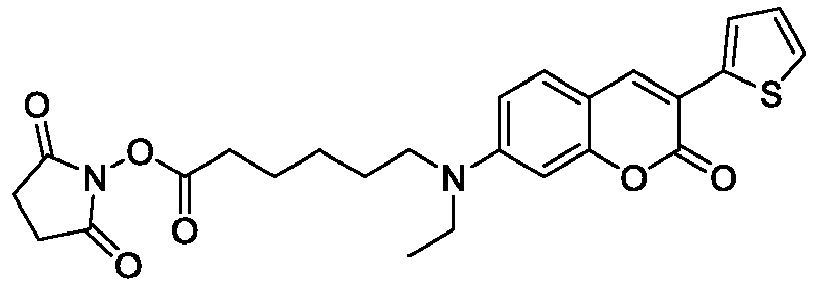
- In a flame dried two necked round bottom flask set up with a magnetic stir bar and Argon inlet, Compound 5 (77 mg, 0.20mmol) was dissolved in anhydrous DMF (5mL). TSTU (65mg, 0.22mmol) and DMAP (26mg, 0.22mmol) were added. The reaction mixture was stirred at room temperature for 2 hours. The reaction mixture was drop wise added to cyclohexane (100mL) under stirring. The resulting dark orange precipitate was collected by filtration and washed with cyclohexane 5mL). The dark orange solid was taken up in a minimal amount of anhydrous dimethylformamide, transferred into a 10mL round bottom flask and concentrated under vacuum to yield the desired product,
compound 16, as a dark orange solid. The yield was 78 mg (90%)
Analysis: HNMR (d6-DMSO, 600MHz) δ 7.88 (s, 1H), 7.65 (dd, 1H, J =3.5, 1.2), 7.31 (d, 1H, J = 8.6), 7.30 (dd, 1H, J = 5.5, 1.2), 7.08 (dd, 1H, J = 5.1, 3.5), 6.59 (dd, 1H, J = 8.9, 2.3), 6.51 (d, 1H, J =2.3), 3.43 (quartet, 2H, J =7.0), 3.34 (t, 2H, J =7.8), 2.71 (s, 4H), 2.67 (t, 2H, J = 7.0 Hz), 1.75-1.63 (m, 4H), 1.46-1.39 (m, 2H), 1.21 (t, 3H, J = 7.0). -

- In a 100 mL round bottom, one necked flask set up with a magnetic stir bar and a reflux condensor, 7-HydroxyQuinoline (10.0g, 67.03 mmol) was dissolved in DMF. Ethyl-6-iodohexanoate (17.9 g, 80 mmol) was added. The reaction mixture was stirred at 50°C for 20h. Solvent was removed under vacuum to give a crude oil. The crude oil was purified on a silica gel column with a gradient of hexanes/ethylacetate as eluent to yield the desired product, compound 17 as a colorless oil. The yield was 13.7g (74%).
Analysis: 1H NMR (CDCl3, 600 MHz): δ 6.79 (d, 1H, J=8.0); 6.11 (bs, 2H); 4.14 (q, 2H, J=7.4); 3.27 (t, 2H, J=5.4); 3.20 (t, 2H, J=7.4) 2.67 (t, 2H, J=6.4); 2.32 (t, 2H, J=7.4); 1.92 (t, 2H, J=7.4) 1.72-1.56 (m; 4H); 1.36 (m, 2H); 1.25 (t, 3H, J=7.4) -

- A flame dried two necked 1L round bottom flask equipped with stir bar was cooled to 0°C. Anhydrous DMF (35mL, 25.29mmol) was added, followed by slow addition of POCl3 (20.9 mL, 223 mmol). The reaction mixture was then stirred at 0°C for 30 min. and an additional 30 min. at room temperature. A solution of Compound 17(13.0g, 44.6mmol) in DMF (anh, 30mL) was slowly added at room temperature (RT) and the reaction mixture was stirred at RT for 20h. The reaction mixture was cooled to 0°C and quenched by addition of small pieces of ice at a time. The pH was neutralized to pH 8-10 with 1M NaOH. The aqueous solution was extracted with DCM(2 x 400mL). Solvent was removed under vacuum to give a crude oil. The crude oil was purified on a silica gel column with a gradient of hexanes/ethylacetate as eluent to yield the desired product, compound 18as a colorless oil. The yield was 4.55 g (32%).
Analysis: HNMR (CDCl3, 600MHz) purity>98%. δ 11.60 (s, 1H; 9.43 (s, 1H); 6.94 (s, 1H); 5.98 (s, 1H); 4.14 (q, 2H, J=7.0); 3.36 (t, 2H, J=5.8); 3.28 (t, 2H, J=7.4); 2.67 (t, 2H, J=6.2); 2.32 (t, 2H, J=7.4); 1.91 (m, 2H; 1.65 (m, 2H); 1.38 (m, 2H); 1.26 (t, 3H, J=7.0). -

- In a 100 mL round bottom, one necked flask set up with a magnetic stir bar and a reflux condenser, 2-thiophene acetic acid (2.00g, 14.11mmol) was dissolved in acetic anhydride (20 ml). The resulting solution was stirred at 60°C for 15-20min. Compound 18(4.5g, 14.11mmol) was added followed by triethylamine (3.73mL, 26.80mmol) and the reaction mixture was stirred at 120°C for 3h. The reaction mixture was cooled to room temperature, water was added. The organic material was extracted with EtOAc, dried over NaSO4, the solvent was evaporated and the crude material was purified on a silica gel column with a gradient of hexanes/ethylacetate as eluent to give an orange solid (2.1g; y=35%).
- Analysis: HNMR (CDCL3, 400MHz) purity>98%. δ 7.39 (s, 1H), 7.21 (d, 1H, J=2.21), 7.08 (d, 1H, J=5.0), 6.83 (s, 1H), 6.06 (d, 1H, J=8.6), 6.02 (s), 4.14 (q, 2H), 3.27 (t, 2H); 3.20 (t, 2H) 2.67 (t, 2H); 2.32 (t, 2H); 1.92 (t, 2H) 1.72-1.56 (m; 4H); 1.36 (m, 2H); 1.25 (t, 3H).
-
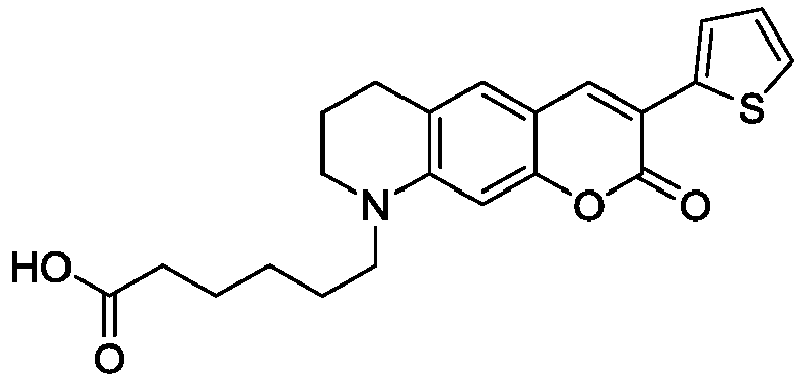
- In a 10 mL round bottom, one necked flask set up with a magnetic stir bar, compound 19(2.1g, 4.93 mmol) was dissolved in tetrahydrofuran (5mL). Sodium hydroxyl (986mg, 24.65mmol) was dissolved in water (10mL) and the solutions were added together. The reaction mixture was stirred at room temperature for 2h. Tetrahydrofuran was removed under vacuum and the aqueous phase was neutralized with aqueous hydrochloric acid (0.1M) to pH 7. The crude material was purified on a silica gel column with a gradient of hexanes/ethylacetate as eluent, compound 20as a yellowish solid. The yield was 783mg (40%).
Analysis: HNMR (CDCL3, 400MHz) purity>98%. δ 8.01 (s, 1H), 7.83 (s, 1H); 7.64 (dd, 1H, J=3.5, 1.2), 7.30 (d, 1H, J=5.8); 7.08 (dd, 1H, J=4.7, 3.5), 7.03 (s, 1H); 3.48 (t, 2H, J=5.2); ); 3.38 (t, 2H, J=5.8) 2.78 (t, 2H, J=6.5); 1.96 (m, 2H) 1.72-1.56 (m; 4H); 1.41 (m, 2H). -

- In a flame dried two necked round bottom flask set up with a magnetic stir bar and Argon inlet, Compound 20 (780mg, 1.97mmol) was dissolved in anhydrous DMF (20mL). Sulfur trioxide dimethylformamide complex (12.07g, 78.88mmol) was added and the reaction mixture was stirred at 60°C for 20h under an inert Argon atmosphere. The reaction mixture was cooled to room temperature and quenched by addition of NaHCO3 (saturated). Solvents where removed under vacuum to give the crude oil. The crude oil was purified on a reverse phase C18 column with a gradient of water/ methanol as eluent to yield the desired product, compound 21 as a yellowish solid. The obtained product was then passed through a Sephadex column LH20 (3x40cm, eluent H2O) with an isocratic gradient of water as eluent to yield the desired product, compound 21 as a yellowish solid. The yield was 403mg (34%)
Analysis: HNMR (D2O, 400MHz) purity>98%. δ 8.14 (s, 1H), 7.69 (s, 1H), 7.21 (s, 1H); 6, 6.59 (s, 1H), 3.35-3.25 (m, 4H) 2.77 (t, 2H, J=5.8); 2.24 (t, 2H, J=7.8) 1.92 (m, 2H); 1.72-1.56 (m; 4H); 1.36 (m, 2H). -

- In a flame dried two necked round bottom flask, set up with a magnetic stir bar and Argon inlet, Compound 21 (350mg, 0.58mmol) was dissolved in anhydrous DMF (5mL). TSTU (209mg, 0.70mmol) and DMAP (84mg, 0.70mmol) were added. The reaction mixture was stirred at room temperature for 2 hours. The reaction mixture was drop wise added to diethyl ether (100mL) under stirring. The resulting dark orange precipitate was collected by filtration and washed with diethyl ether (10mL) and dichloromethane (10mL). The dark orange solid was taken up in a minimal amount of anhydrous dimethylformamide, transferred into a 10mL round bottom flask and concentrated under vacuum to yield the desired product as a dark orange solid. The yield was mg (283 mg; 70%) Analysis: HNMR (DMSO, 400MHz) purity>98%. δ 8.07 (s, 1H), 7.56 (s, 1H), 6.76 (s, 1H), 6.62 (s, 1H), 3.27 (t, 2H); 3.20 (t, 2H) 2.67 (t, 2H); 2.73 (s, 4H); 2.32 (t, 2H); 1.92 (m, 2H) 1.72-1.56 (m; 4H); 1.36 (m, 2H).
-
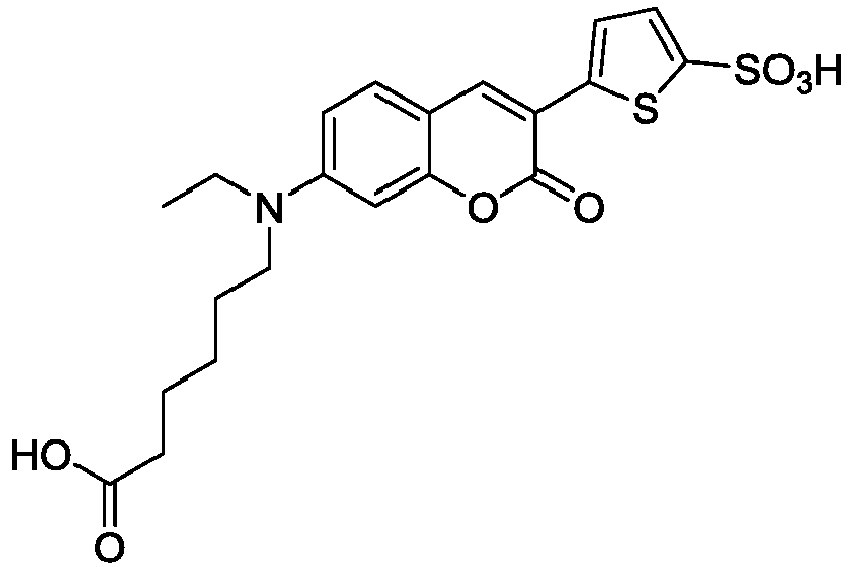
- In a flame dried two necked round bottom flask set up with a magnetic stir bar and Argon inlet, Compound 5 (90mg, 0.23mmol) was dissolved in anhydrous DMF (5mL). Sulfur trioxide dimethylformamide complex (0.75g, 4.65mmol) was added and the reaction mixture was stirred at 60°C for 20h under an inert Argon atmosphere. The reaction mixture was cooled to room temperature and quenched by addition of NaHCO3 (saturated, 5mL). Solvents where removed under vacuum to give the crude oil. The crude oil was purified on a reverse phase C18 column with a gradient of water/ methanol as eluent to yield the desired product, as a dark orange oil. The obtained dark orange oil was then passed through a Sephadex LH20 column with an isocratic gradient of water as eluent to yield the desired product,
compound 6 as a dark orange solid. The yield was 85mg (78%)
Analysis: HNMR (D2O, 600MHz) purity (>95%). δ 7.26 (s, 1H), 7.38 (d, 1H, J=3.9), 7.16 (d, 1H, J=3.9), 7.00 (d, 1H, J=9.0), 6.40 (d, 1H, J=10.5), 6.12 (s, 1H), 3.54 (q, 2H, J=7.1), 3.46 (t, 2H, J=7.7), 2.21 (t, 2H, J=7.7), 1.69 (m, 2H, 1.63 (m, 2H), 1.39 (m, 2H,1.21 (t, 3H, J=6.6).
Abs max = 441nm, Em max = 518nm
Mol. ext. coef = 26000-27000 M-1cm-1
QY = 0.70-0.75 - Compound was diluted in PSB buffer at pH 8.4. The absorption spectrum was measured in a 1cm cuvette on a UV-
Spectrophotometer Varian Cary 100 Bio. The emission spectrum was measured in a 1 cm cuvette on a Spectrofluorometer Varian Cary Eclipse. The absorption and emission spectra ofcompound 6 were normalized and are shown inFigure 2 . The spectra show an optimal fitting of the Absmax with the 405 nm violet excitation source and a large Stokes shift, demonstrating the usefulness in multiplex applications. - An accurately weighed sample of compound (6) was dissolved in a measured amount of water to give a stock solution of known concentration (C = mg/mL). The stock solution was serially diluted over an appropriate range by dilution factors (D) in PBS. The absorption spectra were measured in a 1 cm cuvette on a Varian spectrophotometer. The absorption maxima (Amax) were determined. The molecular weight (MW) of
compound 6 was derived from the structure of example 6. - The molar extinction coefficient (ε) was calculated from the following equation:

- The molar extinction coefficient of
compound 6 was found to be 26000 M-1cm-1. - Fluorescent quantum yield of
compound 6 was determined using fluorescein as reference standard.Compound 6 was serially diluted in 10mM sodium phosphate buffer with absorption at 400nm and 427nm ≤0.10. Fluorescein was serially diluted in 0.1mM sodium hydroxide. Absorptions of all serial dilutions were measured in 1cm cuvettes on an UV-VIS Varian -Cary 100 BIO spectrophotometer. Corrected emission spectra were recorded on a Varian Eclipse spectrofluorometer in 1cm cuvettes with excitation at 427nm for all samples. Data were plotted as total fluorescence integral against the absorbance and analyzed using Sigma plot software. The quantum yield ofcompound 6 was calculated using the following formula:
- Where QY is the quantum yield. QYstd is the known quantum yield of fluorescein. Emsample and Abssample are the measured fluorescence emission and absorption of
compound 6. Emstd and Absstd are the measured fluorescence emission and absorption of fluorescein. - The Quantum Yield of compound (6) was determined to be 0.7±0.1.
- Samples of
compound 6 were prepared over a range of pH values at equal final concentrations in appropriate aqueous solutions (acq HCl forpH 1 and 2; 50 mM potassium phosphate for pH 3 to 8.5; 50 mM sodium bicarbonate for pH 9 to 10 and acq NaOH for pH 12). - Measurements of fluorescence emission were performed at 1pH unit intervals from pH 1 to
pH 8 and pH12 on a Varian Eclipse spectrofluorometer in 1cm cuvettes with excitation at 417nm for all samples and fluorescence emission was measured at 510nm. - The pH dependency curve for compound (6) is shown in
Figure 3 and demonstrates completely pH independence betweenpH values - Polyclonal Goat anti-Mouse antibody (AbNova Cod. PAB9347) was diluted to a concentration of 2 mg/mL in 10 mM PBS buffer. The solution was aliquoted into eight sample vials of each 125µL to which were added 25µL of a sodium bicarbonate buffer (pH9.6). The N-hydroxy succinimidyl ester compound (7) was dissolved in anhydrous DMSO and the concentration was determined spectrophotometrically. Calculated amounts, ranging from 10-100 molar equivalents, of compound 7 with respect to antibody were added to each antibody sample aliquot. The reaction mixtures were incubated at room temperature in the dark for 1 hour. Non reacted dye excess was removed from the reaction mixtures by separation on a Sephadex G25 column and all samples of isolated dye-conjugates were analyzed for dye to protein ratio (D/P ratio) and concentration. The obtained D/P ratios were then plotted against the molar equivalents of dye used and are shown in
Figure 4 . - Next, the fluorescence of each sample was measured at equal antibody concentration (abs 280nm) and the obtained total fluorescence values were plotted against the corresponding D/P ratios and are shown in
Figure 5 . -
Figure 4 and 5 demonstrate high labelling efficiency and excellent fluorescent quantum yield over a wide range of D/P ratios. - Goat anti-mouse-
compound 16 was prepared as described above. The total fluorescence of conjugate Goat anti-mouse-compound 16 was compared to Goat anti-mouse-compound 7 by measuring the total fluorescence integral (total emission band) at equal antibody concentration and equal D/P ratio with excitation at 420nm, (Figure 9a, 9b ), showing a three times higher fluorescence for the di-sulfonated conjugate Goat anti-mouse-compound 7 in comparison to the non-sulfonated conjugate Goat anti-mouse-compound 16. - Purified Mouse anti-human CD4 antibody (clone SK3) was purchased from Biolegend (cod. 344602). Mouse anti-human CD8 (clone RPA-T8, cod. 555364), Mouse anti-human CD4 (clone RPA-T4, cod. 300502) and Mouse anti-human CD19 (clone HIB19, cod. 555410) antibodies as well as the corresponding BD Horizon V500 labeled antibodies: V500-Anti Human CD4 (clone: RPA-T4, cod. 560769), V500-Anti Human CD19 (clone HIB19(RUO), cod. 561125) and V500-Anti Human CD8 clone (clone RPA-T8, cod. 560775) were purchased from BD Bioscience. Purified antibodies were supplied at a 0.5mg/mL concentration. As described above, conjugations were performed in order to assess optimal D/P ratios and are shown in
figures 6a and 6b . - The dye/protein ratios used in the labeling reactions, at various protein concentrations, produced conjugates with different dye to protein ratios as shown in table 3 for each dye/protein pair.
Table 3 Protein Protein concentration Dye compound Nr D/P ratio Mouse anti-human CD4 clone SK3 0.5mg/mL 7 3.8, 7.6, 9.9 Mouse anti-human CD19 clone HIB19 0.5mg/mL 7 2.4, 3.2, 4.3, 4.2, 5.4 Mouse anti-human CD19 clone HIB19 2.0mg/mL 7 10.0 Mouse anti-human CD8 clone RPA-T8 0.5mg/mL 7 2.6, 4.8, 8.3, 11.0 - Fluorescence of each sample was measured at equal antibody concentration (abs 280nm) and the obtained total fluorescence were plotted against the corresponding D/P ratios (
figure 7a and 7b ). - Subsequently, the total fluorescence of conjugate Mouse anti-human CD19-compound 7 was compared to Mouse anti-human CD19-V500 by measuring the total fluorescence integral (total emission band) at equal antibody concentration and equal D/P ratio with excitation at 420nm.
Figure 8a and 8b show a three times higher fluorescence for dye compound 7 conjugate of the present invention in comparison to the BD Horizon V500 dye conjugate. - MAVER-1 cells were purchased from ATCC (cod. ATCC® CRL-3008™), unless specified otherwise. Cell lines propagated in suspension cultures were grown in RPMI1640 medium supplemented with 10% FBS.
- PBMC were isolated from buffy coats by Ficoll-Hypaque standard density gradient technique. Buffy coat of human blood from healthy donor was obtained from the Blood Bank C.R.S. (Centro Regionale Sangue), Ospedale Maggiore - Largo Nigrisoli, 2 - 40133 Bologna, Itlay.
- Sample of 10^6 cells were stained with dye-conjugate for 15-30 minutes at +4°C in the dark at a dye-conjugate quantity of 30ng for peripheral blood lymphocytes (
Figure 8 ) and5 ug for MAVER-1 (Figure 9 ) per test in staining buffer (0.5%BSA in D-PBS). Following staining, the sample was washed (adding 1ml of staining buffer) twice, re-suspended with D-PBS and held at 4°C in the dark until flow cytometric acquisition. Acquisition of the stained cells was carried out using a BD FACS ARIAII (BD Biosciences, San Jose, Calif.) equipped with a blue (488 nm), a red (633 nm), and a violet (405 nm) laser. The detection optics includes a 530/30 filter. The flow cytometer was setup following the manufacturer's instructions, including a Cytometer and Setup Tracking to obtain the best identification of bright populations and the best resolution of dim populations. Flow cytometric acquisition of sample of stained cells was performed according to the manufacture's protocols, and the data was analyzed excluding doublet using a pulse geometry gate (FSC-W x FSC-A) to obtain fluorescence intensity for the cell population of interest. - It will be understood that methods for preparing antibody conjugates used and particular reaction conditions used can affect the result of assay. Routine experimentation and titration should be carried with cells and reagents that mimic each experimental conditions to determinate optimal staining condition.
-
Figure 10 shows the expression of mouse anti-human CD4 antibody in lymphocytes from healthy donor in flow cytometry using mouse anti-human CD4-compound 7 conjugate. -
Figure 11 shows MAVER-1 cells line stained with mouse anti-human CD19-compound 7 conjugate (white filled histogram) and unstained (grey filled histogram). The results indicate that the dye-conjugates of the present invention are useful in preparing antigen specific detection reagents for immunofluorescence assays analyzed by flow cytometry. - In one or more embodiments, a 7-amino-3-thienyl coumarin dye may have formula (I):

- R1 is L-RG;
- R2, R3, R4, R5, and R6 are independently selected from H, halogen, cyano, trifluoromethyl, WSG, L-WSG, substituted or unsubstituted alkyl and substituted or unsubstituted alkoxy;
- R7 and R8 are WSG;
- RG is a chemically reactive group selected from carboxylic acid, an activated ester of a carboxylic acid, sulfonyl halide, acyl halide, acrylamide, amine, aldehyde sulfonate ester, anhydride, azide, haloacetamide, halotriazine, hydrazine, hydroxylamine, isocyanate, isothiocyanate, maleimide, phosphoramidate and alkyne;
- L is a linker of formula (VI):
[(CH2)a-Y-(CH2)b]c (VI)
wherein- Y is the same or different and is selected from none, O, S, NH, NR9, SO2-NH, SO2-NR9, CO-NH, CO-O, CO-S, 1,3-triazole, aminotriazine, triazinyl ether, NH-CO-NH, NH-CS-NH, NH-CO-O, O-POR9-O, SO2-O, amino acid, aryl or heteroaryl;
- wherein R9 is alkyl or WSG;
- a and c can be the same or different and are an integer number 1 to 10, and
- b is an
integer number 0 to 10; - WSG is a water soluble group selected from sulfonic acid, sulfate, alkyl sulfonic acid, sulfonamide, phosphate, phosphonic acid, boronic acid, ammonium, pyridinium, monosaccharide and -(CH2-CH2-O)x in which x is an integer number from 1 to 10;
- and salts thereof.
- In one or more embodiments, the substituent moiety present either on the alkyl or alkoxy is selected from hydroxy, halogen, alkylsulfonamido, cyano, azide, WSG or heteroaryl. More preferably the substituent moiety present either on the alkyl or alkoxy is selected from hydroxy, halogen, alkylsulfonamido, cyano, azide, or heteroaryl.
- In one or more embodiments, a 7-amino-3-thienyl coumarin dye may have formula (II):

- R1 is L-RG;
- R2, R3, R4, R5, and R6 are independently selected from H, halogen, cyano, trifluoromethyl, WSG, L-WSG, substituted or unsubstituted alkyl, and substituted or unsubstituted alkoxy;
- R7 and R8 are sulfonic acid;
- RG is a chemically reactive group selected from carboxylic acid, an activated ester of a carboxylic acid, sulfonyl halide, acyl halide, acrylamide, amine, aldehyde sulfonate ester, anhydride, azide, haloacetamide, halotriazine, hydrazine, hydroxylamine, isocyanate, isothiocyanate, maleimide, phosphoramidate and alkyne;
- L is a linker of formula (VI):
[(CH2)a-Y-(CH2)b]c (VI)
wherein- Y is the same or different and is selected from none, O, S, NH, NR9, SO2-NH, SO2-NR9, CO-NH, CO-O, COS, 1,3-triazole, aminotriazine, triazinyl ether, NH-CO-NH, NH-CS-NH, NH-CO-O, O-POR9-O SO2-O, amino acid, aryl or heteroaryl;
- WSG is a water soluble group selected from sulfonic acid, sulfate, alkyl sulfonic acid, sulfonamide, phosphate, phosphonic acid, boronic acid, ammonium, pyridinium, monosaccharide and -(CH2-CH2-O)x in which x is an integer number from 1 to 10;
- and salts thereof.
- In one or more embodiments, a 7-amino-3-thienyl coumarin dye may have formula (III):
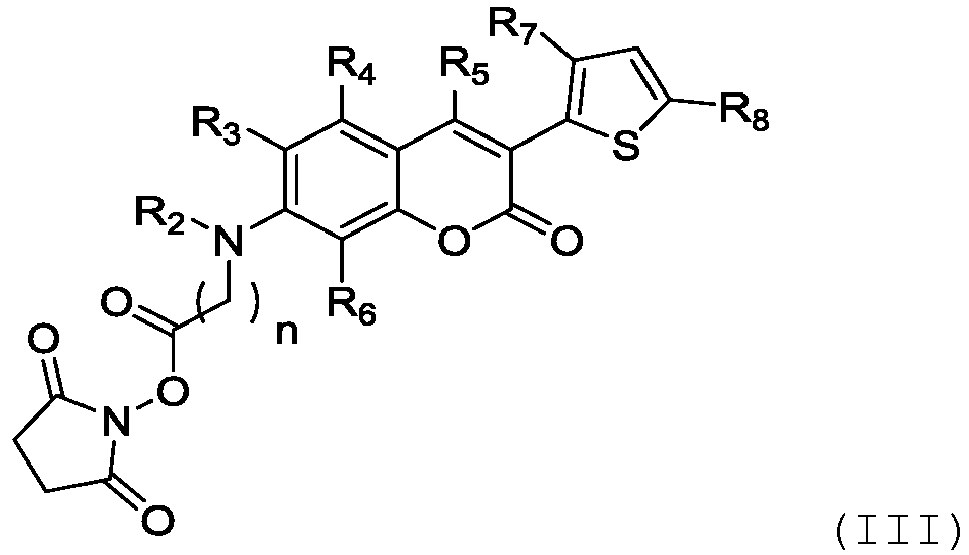
- R2 is selected from substituted or unsubstituted alkyl, and L-WSG;
- R3, R4, R5, R6 are H;
- L is a linker of formula (VI):
[(CH2)a-Y-(CH2)b]c (VI)
wherein- Y is the same or different and is selected from none, O, S, NH, NR9, SO2-NH, SO2-NR9, CO-NH, CO-O, COS, 1,3-triazole, aminotriazine, triazinyl ether, NH-CO-NH, NH-CS-NH, NH-CO-O, O-POR9-O SO2-O, amino acid, aryl or heteroaryl;
- WSG is a water soluble group selected from sulfonic acid, sulfate, alkyl sulfonic acid, sulfonamide, phosphate, phosphonic acid, boronic acid, ammonium, pyridinium, monosaccharide and -(CH2-CH2-O)x in which x is an integer number from 1 to 10;
- n is an integer number 1 to 10;
- R7 and R8 are sulfonic acid;
- and salts thereof.
- In one or more embodiments, a 7-amino-3-thienyl coumarin dye may have formula (IV):

- R2 is selected from substituted or unsubstituted alkyl, and L-WSG;
- R3, R4, R5, R6 are H;
- L is a linker of formula (VI):
[(CH2)a-Y-(CH2)b]c (VI)
wherein- Y is the same or different and is selected from none, O, S, NH, NR9, SO2-NH, SO2-NR9, CO-NH, CO-O, COS, 1,3-triazole, aminotriazine, triazinyl ether, NH-CO-NH, NH-CS-NH, NH-CO-O, O-POR9-O SO2-O, amino acid, aryl or heteroaryl;
- WSG is a water soluble group selected from sulfonic acid, sulfate, alkyl sulfonic acid, sulfonamide, phosphate, phosphonic acid, boronic acid, ammonium, pyridinium, monosaccharide and -(CH2-CH2-O)x in which x is an integer number from 1 to 10;
- and salts thereof.
- In one or more embodiments, in a 7-amino-3-thienyl coumarin dye of formula (I), (II), (III) or (IV), Y may be selected from none, O, S, SO2-NH, SO2-NR9, CO-NH, CO-O, CO-S, 1,3-triazole, NH-CO-NH, NH-CS-NH, NH-CO-O, SO2-O, aryl, heteroaryl and amino acid, preferably Y is selected from none, O, S, SO2-NH, SO2-NR9, CO-NH, CO-O and 1,3-triazole, wherein wherein R9 is alkyl or WSG, being WSG a water soluble group selected from sulfonic acid, sulfate, alkyl sulfonic acid, sulfonamide, phosphate, phosphonic acid, boronic acid, ammonium, pyridinium, monosaccharide and -(CH2-CH2-O)x in which x is an integer number from 1 to 10.
- In one or more embodiments, in a 7-amino-3-thienyl coumarin dye of formula (I), (II), (III) or (IV), WSG may be selected from sulfonic acid, alkyl sulfonic acid, sulfonamide, phosphate, phosphonic acid, ammonium, pyridinium, cyclodextrin, monosaccharide, oligosaccharide, dextrane and -(CH2-CH2-O)x in which x is an integer number from 1 to 10, preferably WSG is selected from sulfonic acid, alkyl sulfonic acid, sulfonamide, ammonium and -(CH2-CH2-O)x in which x is an integer number from 1 to 10.
- In one or more embodiments, in a 7-amino-3-thienyl coumarin dye of formula (I), (II), (III) or (IV), RG may be selected from carboxylic acid, an activated ester of a carboxylic acid, sulfonyl halide, acyl halide, amine, alkyl or aryl halide, anhydride, azide, haloacetamide, halotriazine, hydrazine, isocyanate, isothiocyanate, maleimide, phosphoramidate, thiol, alcohol and alkyne, preferably RG is selected from carboxylic acid, an activated ester of a carboxylic acid, amine, azide, haloacetamide, hydrazine, isocyanate, maleimide and alkyne.
- In one or more embodiments, the 7-amino-3-thienyl coumarin dye of formula (I) may be selected from:
- sodium 5-(7-((5-carboxypentyl)(ethyl)amino)-2-oxo-2H-chromen-3-yl)thiophene-2,4-disulfonate;
- sodium 5-(7-((6-((2,5-dioxopyrrolidin-1-yl)oxy)-6-oxohexyl)(ethyl)amino)-2-oxo-2H-chromen-3-yl)thiophene-2,4-disulfonate;
- sodium 5-(7-(ethyl(6-hydrazinyl-6-oxohexyl)amino)-2-oxo-2H-chromen-3-yl)thiophene-2,4-disulfonate;
- sodium 5-(7-((6-((2-(2,5-dioxo-2,5-dihydro-1H-pyrrol-1-yl)ethyl)amino)-6-oxohexyl)(ethyl)amino)-2-oxo-2H-chromen-3-yl)thiophene-2,4-disulfonate;
- sodium 5-(7-((6-((2,5-dioxopyrrolidin-1-yl)oxy)-6-oxohexyl)(3-sulfonatopropyl)amino)-2-oxo-2H-chromen-3-yl)thiophene-2,4-disulfonate;
- sodium 5-(9-(6-((2,5-dioxopyrrolidin-1-yl)oxy)-6-oxohexyl)-2-oxo-6,7,8,9-tetrahydro-2H-pyrano[3,2-g]quinolin-3-yl)thiophene-2,4-disulfonate;
- 5-(7-((6-((2,5-dioxopyrrolidin-1-yl)oxy)-6-oxohexyl)(2-(2-methoxyethoxy)ethyl)amino)-2-oxo-2H-chromen-3-yl)thiophene-2,4-disulfonic acid;
- 5-(7-((6-((2,5-dioxopyrrolidin-1-yl)oxy)-6-oxohexyl)(2-oxo-2-((3-sulfopropyl)amino)ethyl)amino)-2-oxo-2H-chromen-3-yl)thiophene-2,4-disulfonic acid;
- 5-(7-((6-((2,5-dioxopyrrolidin-1-yl)oxy)-6-oxohexyl)(3-(N-(2-sulfoethyl)sulfamoyl)propyl)amino)-2-oxo-2H-chromen-3-yl)thiophene-2,4-disulfonic acid;
- 5-(7-((3-(N-(6-((2,5-dioxopyrrolidin-1-yl)oxy)-6-oxohexyl)sulfamoyl)propyl)(ethyl)amino)-2-oxo-2H-chromen-3-yl)thiophene-2,4-disulfonic acid;
- 5-(7-((4-(((2,5-dioxopyrrolidin-1-yl)oxy)carbonyl) benzyl)(ethyl)amino)-2-oxo-2H-chromen-3-yl)thiophene-2,4-disulfonic acid.
- In one or more embodiments, a 7-amino-3-thienyl coumarin dye conjugate may have formula (V):

- R2, R3, R4, R5, and R6 are independently selected from H, halogen, cyano, trifluoromethyl, WSG, L-WSG, substituted or unsubstituted alkyl and substituted or unsubstituted alkoxy;
- R7 and R8 are sulfonic acid;
- L is a linker of formula (VI):
[(CH2)a-Y-(CH2)b]c (VI)
- wherein Yis the same or different and is selected from none, O, S, NH, NR9, SO2-NH, SO2-NR9, CO-NH, CO-O, CO-S, 1,3-triazole, aminotriazine, triazinyl ether, NH-CO-NH, NH-CS-NH, NH-CO-O, O-POR9-O SO2-O, amino acid, aryl and heteroaryl,
- wherein R9 is alkyl or WSG,
- a and c can be the same or different and are an integer number 1 to 10, and
- b is an
integer number 0 to 10; - WSG is a water soluble group and is selected from sulfonic acid, sulfate, alkyl sulfonic acid, sulfonamide, phosphate, phosphonic acid, boronic acid, ammonium, pyridinium, monosaccharide and -(CH2-CH2-O)x in which x is an integer number from 1 to 10;
- m is an integer number 1 to 25;
- SUB is an amino acid, a peptide, a protein, a saccharide, a nucleoside, a nucleotide, an oligonucleotide, a nucleic acid, a hapten, a drug or a lipid;
- and salts thereof.
- In one or more embodiments, in a 7-amino-3-thienyl coumarin dye conjugate of formula (V), R7 and R8 may be bound to the thienyl ring in
positions - In one or more embodiments, a 7-amino-3-thienyl coumarin dye conjugate may have formula (V), R3, R4, R5 and R6 may be hydrogen atoms.
- In one or more embodiments, in the 7-amino-3-thienyl coumarin dye conjugate of formula (V), R2 may be substituted or unsubstituted alkyl or L-WSG;
L may be a linker as defined above;
WSG may be a water soluble group as defined above. - In one or more embodiments, a kit may comprise at least one 7-amino-3-thienyl coumarin dye of formula (I), (II), (III) or (IV).
- In one or more embodiments, a kit may comprise at least one 7-amino-3-thienyl coumarin dye conjugate of formula (V).
- In one or more embodiments, a 7-amino-3-thienyl coumarin dye may have formula (II):

- R1 is L-RG;
- R2, R3, R4, R5, and R6 are independently selected from H, halogen, cyano, trifluoromethyl, WSG, L-WSG, substituted or unsubstituted alkyl and substituted or unsubstituted alkoxy;
- R7 and R8 are WSG;
- RG is a chemically reactive group selected from carboxylic acid, an activated ester of a carboxylic acid, sulfonyl halide, acyl halide, acrylamide, amine, aldehyde sulfonate ester, anhydride, azide, haloacetamide, halotriazine, hydrazine, hydroxylamine, isocyanate, isothiocyanate, maleimide, phosphoramidate and alkyne;
- L is a linker of formula (VI):
[(CH2)a-Y-(CH2)b]c (VI)
wherein- Y is the same or different and is selected from none, O, S, NH, NR9, SO2-NH, SO2-NR9, CO-NH, CO-O, COS, 1,3-triazole, aminotriazine, triazinyl ether, NH-CO-NH, NH-CS-NH, NH-CO-O, O-POR9-O SO2-O, amino acid, aryl or heteroaryl,
- wherein R9 is alkyl or WSG,
- a and c can be the same or different and are an integer number 1 to 10, and
- b is an
integer number 0 to 10; - WSG is a water soluble group selected from sulfonic acid, sulfate, alkyl sulfonic acid, sulfonamide, phosphate, phosphonic acid, boronic acid, ammonium, pyridinium, monosaccharide and -(CH2-CH2-O)x in which x is an integer number from 1 to 10;
- and salts thereof.
- In one or more embodiments, a 7-amino-3-thienyl coumarin dye may have formula (III):
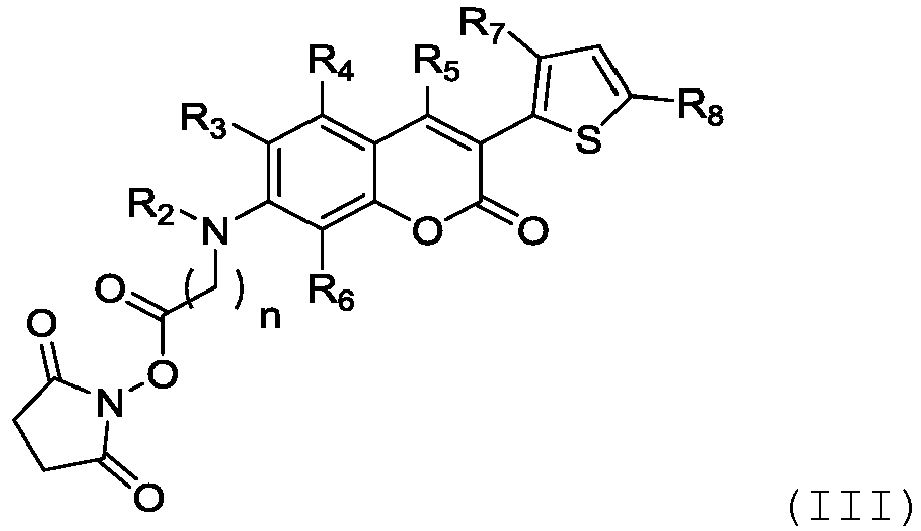
- R2 is selected from substituted or unsubstituted alkyl, and L-WSG;
- R3, R4, R5, R6 are H;
- R7 and R8 are sulfonic acid;
- L is a linker of formula (VI):
[(CH2)a-Y-(CH2)b]c (VI)
wherein- Y is the same or different and is selected from none, O, S, NH, NR9, SO2-NH, SO2-NR9, CO-NH, CO-O, COS, 1,3-triazole, aminotriazine, triazinyl ether, NH-CO-NH, NH-CS-NH, NH-CO-O, O-POR9-O SO2-O, amino acid, aryl or heteroaryl,
- wherein R9 is alkyl or WSG;
- WSG is a water soluble group selected from sulfonic acid, sulfate, alkyl sulfonic acid, sulfonamide, phosphate, phosphonic acid, boronic acid, ammonium, pyridinium, monosaccharide and -(CH2-CH2-O)x in which x is an integer number from 1 to 10;
- n is an integer number 1 to 10;
- and salts thereof.
- In one or more embodiments, a 7-amino-3-thienyl coumarin dye may have formula (IV):

- R2 is selected from substituted or unsubstituted alkyl, and L-WSG;
- R3, R4, R5, R6 are H;
- L is a linker as defined in claim 1;
- WSG is a water soluble group selected from sulfonic acid, sulfate, alkyl sulfonic acid, sulfonamide, phosphate, phosphonic acid, boronic acid, ammonium, pyridinium, monosaccharide and -(CH2-CH2-O)x in which x is an integer number from 1 to 10;
- and salts thereof.
- In one or more embodiments, in a 7-amino-3-thienyl coumarin dye of formula (II), (III) or (IV), Y may be selected from none, O, S, SO2-NH, SO2-NR9, CO-NH, CO-O, CO-S, 1,3-triazole, NH-CO-NH, NH-CS-NH, NH-CO-O, SO2-O, aryl, heteroaryl and amino acid, preferably Y is selected from none, O, S, SO2-NH, SO2-NR9, CO-NH, CO-O and 1,3-triazole, wherein R9 is alkyl or WSG; and wherein WSG is a water soluble group selected from sulfonic acid, sulfate, alkyl sulfonic acid, sulfonamide, phosphate, phosphonic acid, boronic acid, ammonium, pyridinium, monosaccharide and -(CH2-CH2-O)x in which x is an integer number from 1 to 10.
- In one or more embodiments, in a 7-amino-3-thienyl coumarin dye of formula (II), (III) or (IV), WSG may be selected from sulfonic acid, alkyl sulfonic acid, sulfonamide, phosphate, phosphonic acid, ammonium, pyridinium, cyclodextrin, monosaccharide, oligosaccharide, dextrane and -(CH2-CH2-O)x in which x is an integer number from 1 to 10, preferably WSG is selected from sulfonic acid, alkyl sulfonic acid, sulfonamide, ammonium and -(CH2-CH2-O)x in which x is an integer number from 1 to 10
- In one or more embodiments, in a 7-amino-3-thienyl coumarin dye of formula (II), (III) or (IV), RG may be selected from carboxylic acid, an activated ester of a carboxylic acid, sulfonyl halide, acyl halide, amine, alkyl or aryl halide, anhydride, azide, haloacetamide, halotriazine, hydrazine, isocyanate, isothiocyanate, maleimide, phosphoramidate, thiol, alcohol and alkyne, preferably RG is selected from carboxylic acid, an activated ester of a carboxylic acid, amine, azide, haloacetamide, hydrazine, isocyanate, maleimide and alkyne.
- In one or more embodiments, a 7-amino-3-thienyl coumarin dye of formula (II), (III) or (IV) may be selected from:
- sodium 5-(7-((5-carboxypentyl)(ethyl)amino)-2-oxo-2H-chromen-3-yl)thiophene-2,4-disulfonate;
- sodium 5-(7-((6-((2,5-dioxopyrrolidin-1-yl)oxy)-6-oxohexyl)(ethyl)amino)-2-oxo-2H-chromen-3-yl)thiophene-2,4-disulfonate;
- sodium 5-(7-(ethyl(6-hydrazinyl-6-oxohexyl)amino)-2-oxo-2H-chromen-3-yl)thiophene-2,4-disulfonate;
- sodium 5-(7-((6-((2-(2,5-dioxo-2,5-dihydro-1H-pyrrol-1-yl)ethyl)amino)-6-oxohexyl)(ethyl)amino)-2-oxo-2H-chromen-3-yl)thiophene-2,4-disulfonate;
- sodium 5-(7-((6-((2,5-dioxopyrrolidin-1-yl)oxy)-6-oxohexyl)(3-sulfonatopropyl)amino)-2-oxo-2H-chromen-3-yl)thiophene-2,4-disulfonate;
- sodium 5-(9-(6-((2,5-dioxopyrrolidin-1-yl)oxy)-6-oxohexyl)-2-oxo-6,7,8,9-tetrahydro-2H-pyrano[3,2-g]quinolin-3-yl)thiophene-2,4-disulfonate;
- 5-(7-((6-((2,5-dioxopyrrolidin-1-yl)oxy)-6-oxohexyl)(2-(2-methoxyethoxy)ethyl)amino)-2-oxo-2H-chromen-3-yl)thiophene-2,4-disulfonic acid;
- 5-(7-((6-((2,5-dioxopyrrolidin-1-yl)oxy)-6-oxohexyl)(2-oxo-2-((3-sulfopropyl)amino)ethyl)amino)-2-oxo-2H-chromen-3-yl)thiophene-2,4-disulfonic acid;
- 5-(7-((6-((2,5-dioxopyrrolidin-1-yl)oxy)-6-oxohexyl)(3-(N-(2-sulfoethyl)sulfamoyl)propyl)amino)-2-oxo-2H-chromen-3-yl)thiophene-2,4-disulfonic acid;
- 5-(7-((3-(N-(6-((2,5-dioxopyrrolidin-1-yl)oxy)-6-oxohexyl)sulfamoyl)propyl)(ethyl)amino)-2-oxo-2H-chromen-3-yl)thiophene-2,4-disulfonic acid;
- 5-(7-((4-(((2,5-dioxopyrrolidin-1-yl)oxy)carbonyl) benzyl)(ethyl)amino)-2-oxo-2H-chromen-3-yl)thiophene-2,4-disulfonic acid.
- In one or more embodiments, a 7-amino-3-thienyl coumarin dye conjugate may have formula (V):

- R2, R3, R4, R5, and R6 are independently selected from H, halogen, cyano, trifluoromethyl, WSG, L-WSG, substituted or unsubstituted alkyl and substituted or unsubstituted alkoxy;
- R7 and R8 are a sulfonic acid and are bound to the thienyl ring in
positions - L is a linker of formula (VI):
[(CH2)a-Y-(CH2)b]c (VI)
- wherein Yis the same or different and is selected from none, O, S, NH, NR9, SO2-NH, SO2-NR9, CO-NH, CO-O, CO-S, 1,3-triazole, aminotriazine, triazinyl ether, NH-CO-NH, NH-CS-NH, NH-CO-O, O-POR9-O SO2-O, amino acid, aryl and heteroaryl,
- wherein R9 is alkyl or WSG,
- a and c can be the same or different and are an integer number 1 to 10, and
- b is an
integer number 0 to 10; - WSG is a water soluble group and is selected from sulfonic acid, sulfate, alkyl sulfonic acid, sulfonamide, phosphate, phosphonic acid, boronic acid, ammonium, pyridinium, monosaccharide and -(CH2-CH2-O)x in which x is an integer number from 1 to 10;
- m is an integer number 1 to 25;
- SUB is an amino acid, a peptide, a protein, a saccharide, a nucleoside, a nucleotide, an oligonucleotide, a nucleic acid, a hapten, a drug or a lipid;
- and salts thereof.
- In one or more embodiments, in a 7-amino-3-thienyl coumarin dye conjugate having formula (V), R3, R4, R5 and R6 may be hydrogen atoms.
- In one or more embodiments, in a 7-amino-3-thienyl coumarin dye conjugate having formula (V), R2 may be substituted or unsubstituted alkyl or L-WSG;
L is a linker of formula (VI):
[(CH2)a-Y-(CH2)b]c (VI)
- wherein Y is the same or different and is selected from none, O, S, NH, NR9, SO2-NH, SO2-NR9, CO-NH, CO-O, CO-S, 1,3-triazole, aminotriazine, triazinyl ether, NH-CO-NH, NH-CS-NH, NH-CO-O, O-POR9-O SO2-O, amino acid, aryl and heteroaryl,
- wherein R9 is alkyl or WSG,
- a and c can be the same or different and are an integer number 1 to 10, and
- b is an
integer number 0 to 10; - WSG is a water soluble group and is selected from sulfonic acid, sulfate, alkyl sulfonic acid, sulfonamide, phosphate, phosphonic acid, boronic acid, ammonium, pyridinium, monosaccharide and -(CH2-CH2-O)x in which x is an integer number from 1 to 10.
- In one or more embodiments, a kit may comprise at least one 7-amino-3-thienyl coumarin dye of formula (II), (III), or (IV) as defined above.
- In one or more embodiments, a kit may comprise at least one 7-amino-3-thienyl coumarin dye conjugate of formula (V).
- In one or more embodiments, a 7-amino-3-thienyl coumarin dye may have formula (II):

- R1 is L-RG;
- R2 is selected from substituted or unsubstituted alkyl, and L-WSG;
- R3, R4, R5, and R6 are independently selected from H, halogen, cyano, trifluoromethyl, WSG, L-WSG, substituted or unsubstituted alkyl and substituted or unsubstituted alkoxy;
- R7 and R8 are WSG;
- RG is a chemically reactive group selected from carboxylic acid, an activated ester of a carboxylic acid, sulfonyl halide, acyl halide, acrylamide, amine, aldehyde, sulfonate ester, anhydride, azide, haloacetamide, halotriazine, hydrazine, hydroxylamine, isocyanate, isothiocyanate, maleimide, phosphoramidate and alkyne;
- L is a linker of formula (VI):
[(CH2)a-Y-(CH2)b]c (VI)
wherein- Y is the same or different and is selected from none, O, S, NH, NR9, SO2-NH, SO2-NR9, CO-NH, CO-O, COS, 1,3-triazole, aminotriazine, triazinyl ether, NH-CO-NH, NH-CS-NH, NH-CO-O, O-POR9-O SO2-O, amino acid, aryl or heteroaryl,
- wherein R9 is alkyl or WSG,
- a and c can be the same or different and are an integer number 1 to 10, and
- b is an
integer number 0 to 10; - WSG is a water soluble group selected from sulfonic acid, sulfate, alkyl sulfonic acid, sulfonamide, phosphate, phosphonic acid, boronic acid, ammonium, pyridinium, monosaccharide and -(CH2-CH2-O)x in which x is an integer number from 1 to 10;
- and salts thereof.
- In one or more embodiments, a 7-amino-3-thienyl coumarin dye may have formula (III):

- R2 is selected from substituted or unsubstituted alkyl, and L-WSG;
- R3, R4, R5, R6 are H;
- R7 and R8 are sulfonic acid;
- L is a linker of formula (VI):
[(CH2)a-Y-(CH2)b]c (VI)
wherein- Y is the same or different and is selected from none, O, S, NH, NR9, SO2-NH, SO2-NR9, CO-NH, CO-O, COS, 1,3-triazole, aminotriazine, triazinyl ether, NH-CO-NH, NH-CS-NH, NH-CO-O, O-POR9-O SO2-O, amino acid, aryl or heteroaryl,
- wherein R9 is alkyl or WSG,
- a and c can be the same or different and are an integer number 1 to 10, and
- b is an
integer number 0 to 10; - WSG is a water soluble group selected from sulfonic acid, sulfate, alkyl sulfonic acid, sulfonamide, phosphate, phosphonic acid, boronic acid, ammonium, pyridinium, monosaccharide and -(CH2-CH2-O)x in which x is an integer number from 1 to 10;
- and salts thereof.
- In one or more embodiments, a 7-amino-3-thienyl coumarin dye may have formula (IV):

- R2 is selected from substituted or unsubstituted alkyl, and L-WSG;
- R3, R4, R5, R6 are H;
- L is a linker of formula (VI):
[(CH2)a-Y-(CH2)b]c (VI)
wherein- Y is the same or different and is selected from none, O, S, NH, NR9, SO2-NH, SO2-NR9, CO-NH, CO-O, COS, 1,3-triazole, aminotriazine, triazinyl ether, NH-CO-NH, NH-CS-NH, NH-CO-O, O-POR9-O SO2-O, amino acid, aryl or heteroaryl,
- wherein R9 is alkyl or WSG,
- a and c can be the same or different and are an integer number 1 to 10, and
- b is an
integer number 0 to 10; - WSG is a water soluble group selected from sulfonic acid, sulfate, alkyl sulfonic acid, sulfonamide, phosphate, phosphonic acid, boronic acid, ammonium, pyridinium, monosaccharide and -(CH2-CH2-O)x in which x is an integer number from 1 to 10;
- and salts thereof.
- In one or more embodiments, in a 7-amino-3-thienyl coumarin dye of formula (II), (III) or (IV), Y may be selected from none, O, S, SO2-NH, SO2-NR9, CO-NH, CO-O, CO-S, 1,3-triazole, NH-CO-NH, NH-CS-NH, NH-CO-O, SO2-O, aryl, heteroaryl and amino acid, preferably Y is selected from none, O, S, SO2-NH, SO2-NR9, CO-NH, CO-O and 1,3-triazole, wherein R9 is alkyl or WSG.
- In one or more embodiments, in a 7-amino-3-thienyl coumarin dye of formula (II), (III) or (IV), WSG may be selected from sulfonic acid, alkyl sulfonic acid, sulfonamide, phosphate, phosphonic acid, ammonium, pyridinium, cyclodextrin, monosaccharide, oligosaccharide, dextrane and -(CH2-CH2-O)x in which x is an integer number from 1 to 10, preferably WSG is selected from sulfonic acid, alkyl sulfonic acid, sulfonamide, ammonium and -(CH2-CH2-O)x in which x is an integer number from 1 to 10.
- In one or more embodiments, in a 7-amino-3-thienyl coumarin dye of formula (II), (III) or (IV), RG is selected from carboxylic acid, an activated ester of a carboxylic acid, sulfonyl halide, acyl halide, amine, alkyl or aryl halide, anhydride, azide, haloacetamide, halotriazine, hydrazine, isocyanate, isothiocyanate, maleimide, phosphoramidate, thiol, alcohol and alkyne, preferably RG is selected from carboxylic acid, an activated ester of a carboxylic acid, amine, azide, haloacetamide, hydrazine, isocyanate, maleimide and alkyne.
- In one or more embodiments, a 7-amino-3-thienyl coumarin dye of formula (II), (III) or (IV) may be selected from:
- sodium 5-(7-((5-carboxypentyl)(ethyl)amino)-2-oxo-2H-chromen-3-yl)thiophene-2,4-disulfonate;
- sodium 5-(7-((6-((2,5-dioxopyrrolidin-1-yl)oxy)-6-oxohexyl)(ethyl)amino)-2-oxo-2H-chromen-3-yl)thiophene-2,4-disulfonate;
- sodium 5-(7-(ethyl(6-hydrazinyl-6-oxohexyl)amino)-2-oxo-2H-chromen-3-yl)thiophene-2,4-disulfonate;
- sodium 5-(7-((6-((2-(2,5-dioxo-2,5-dihydro-1H-pyrrol-1-yl)ethyl)amino)-6-oxohexyl)(ethyl)amino)-2-oxo-2H-chromen-3-yl)thiophene-2,4-disulfonate;
- sodium 5-(7-((6-((2,5-dioxopyrrolidin-1-yl)oxy)-6-oxohexyl)(3-sulfonatopropyl)amino)-2-oxo-2H-chromen-3-yl)thiophene-2,4-disulfonate;
- sodium 5-(9-(6-((2,5-dioxopyrrolidin-1-yl)oxy)-6-oxohexyl)-2-oxo-6,7,8,9-tetrahydro-2H-pyrano[3,2-g]quinolin-3-yl)thiophene-2,4-disulfonate;
- 5-(7-((6-((2,5-dioxopyrrolidin-1-yl)oxy)-6-oxohexyl)(2-(2-methoxyethoxy)ethyl)amino)-2-oxo-2H-chromen-3-yl)thiophene-2,4-disulfonic acid;
- 5-(7-((6-((2,5-dioxopyrrolidin-1-yl)oxy)-6-oxohexyl)(2-oxo-2-((3-sulfopropyl)amino)ethyl)amino)-2-oxo-2H-chromen-3-yl)thiophene-2,4-disulfonic acid;
- 5-(7-((6-((2,5-dioxopyrrolidin-1-yl)oxy)-6-oxohexyl)(3-(N-(2-sulfoethyl)sulfamoyl)propyl)amino)-2-oxo-2H-chromen-3-yl)thiophene-2,4-disulfonic acid;
- 5-(7-((3-(N-(6-((2,5-dioxopyrrolidin-1-yl)oxy)-6-oxohexyl)sulfamoyl)propyl)(ethyl)amino)-2-oxo-2H-chromen-3-yl)thiophene-2,4-disulfonic acid;
- 5-(7-((4-(((2,5-dioxopyrrolidin-1-yl)oxy)carbonyl) benzyl)(ethyl)amino)-2-oxo-2H-chromen-3-yl)thiophene-2,4-disulfonic acid;
- In one or more embodiments, a 7-amino-3-thienyl coumarin dye conjugate may have formula (V):

- R2, R3, R4, R5, and R6 are independently selected from H, halogen, cyano, trifluoromethyl, WSG, L-WSG, substituted or unsubstituted alkyl and substituted or unsubstituted alkoxy;
- R7 and R8 are sulfonic acid and are bound to the thienyl ring in
positions - L is a linker of formula (VI):
[(CH2)a-Y-(CH2)b]c (VI)
- wherein Yis the same or different and is selected from none, O, S, NH, NR9, SO2-NH, SO2-NR9, CO-NH, CO-O, CO-S, 1,3-triazole, aminotriazine, triazinyl ether, NH-CO-NH, NH-CS-NH, NH-CO-O, O-POR9-O SO2-O, amino acid, aryl and heteroaryl,
- wherein R9 is alkyl or WSG,
- a and c can be the same or different and are an integer number 1 to 10, and
- b is an
integer number 0 to 10; - WSG is a water soluble group and is selected from sulfonic acid, sulfate, alkyl sulfonic acid, sulfonamide, phosphate, phosphonic acid, boronic acid, ammonium, pyridinium, monosaccharide and -(CH2-CH2-O)x in which x is an integer number from 1 to 10;
- m is an integer number 1 to 25;
- SUB is an amino acid, a peptide, a protein, a saccharide, a nucleoside, a nucleotide, an oligonucleotide, a nucleic acid, a hapten, a drug or a lipid;
- and salts thereof.
- In one or more embodiments, in a 7-amino-3-thienyl coumarin dye conjugate of formula (V), R3, R4, R5 and R6 may be hydrogen atoms.
- In one or more embodiments, in a 7-amino-3-thienyl coumarin dye conjugate of formula (V), R2 is substituted or unsubstituted alkyl or L-WSG;
L is a linker of formula (VI):
[(CH2)a-Y-(CH2)b]c (VI)
- wherein Y is the same or different and is selected from none, O, S, NH, NR9, SO2-NH, SO2-NR9, CO-NH, CO-O, CO-S, 1,3-triazole, aminotriazine, triazinyl ether, NH-CO-NH, NH-CS-NH, NH-CO-O, O-POR9-O SO2-O, amino acid, aryl and heteroaryl,
- wherein R9 is alkyl or WSG,
- a and c can be the same or different and are an integer number 1 to 10, and
- b is an
integer number 0 to 10; - WSG is a water soluble group and is selected from sulfonic acid, sulfate, alkyl sulfonic acid, sulfonamide, phosphate, phosphonic acid, boronic acid, ammonium, pyridinium, monosaccharide and -(CH2-CH2-O)x in which x is an integer number from 1 to 10;
- m is an integer number 1 to 25.
- In one or more embodiments, a kit may comprise at least one 7-amino-3-thienyl coumarin of formula (II), (III) or (IV) as defined above.
- In one or more embodiments, a kit may comprise at least one 7-amino-3-thienyl coumarin dye conjugate of formula (V) as defined above.
Claims (14)
- 7-amino-3-thienyl coumarin dye having formula (I) :
 R1 is L-RG;R2, R3, R4, R5, R6, R7 and R8 are independently selected from H, halogen, alkenyl, alkynyl, cyano, trifluoromethyl, aryloxy, azido, amino, hydroxyl, WSG, L-WSG, substituted or unsubstituted alkyl and substituted or unsubstituted alkoxy;R2 together with R3 or R6 may form a substituted or unsubstituted 5- or 6-membered N-heterocycle;RG is a chemically reactive group selected from carboxylic acid, an activated ester of a carboxylic acid, carbodiimide, sulfonyl halide, acyl halide, silyl halide, acyl azide, acyl nitrile, acrylamide, amine, aldehyde or, alkyl or aryl halide, alkyl sulfonate, sulfonate ester, anhydride, azide, aziridine, diazoalkane, haloacetamide, halotriazine, hydrazine, hydroxylamine, isocyanate, isothiocyanate, maleimide, phosphoramidate, thiol, hydroxyl, hydrazine and alkyne;L is a linker of formula (VI):
[(CH2)a-Y-(CH2)b]c (VI)
whereinY is the same or different and is selected from none, O, S, NH, NR9, SO2-NH, SO2-NR9, CO-NH, CO-O, C=N-NHR9, CO-S, 1,3-triazole, CO-O-CO, aminotriazine, triazinyl ether, NH-CO-NH, NH-CS-NH, NH-CO-O, O-POR9-O O-Si, SO2, SO2-O, amino acid, aryl or heteroaryl,wherein R9 is alkyl or WSG,a and c can be the same or different and are an integer number 1 to 10, andb is an integer number 0 to 10;WSG is a water soluble group selected from sulfonic acid, sulfate, alkyl sulfonic acid, thiosulfonic acid, sulfonamide, phosphate, phosphonic acid, boronic acid, ammonium, pyridinium, quinolium, acridinium, cyclodextrin, monosaccharide, oligosaccharide, dextrane and -(CH2-CH2-O)x in which x is a integer number from 1 to 10;with the proviso that at least one of R7 and R8 is WSG,and salts thereof. - 7-amino-3-thienyl coumarin dye according to claim 1 having formula (II):
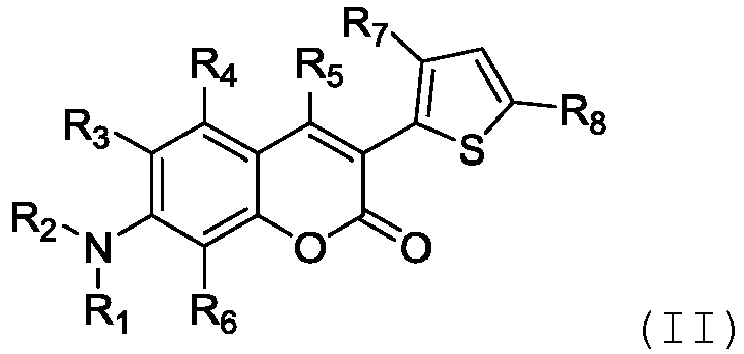 R1 is L-RG;R2, R3, R4, R5, R6, R7 and R8 are independently selected from H, halogen, cyano, trifluoromethyl, hydroxyl, WSG, L-WSG, substituted or unsubstituted alkyl, and substituted or unsubstituted alkoxy;R2 together with R3 or R6 may form a substituted or unsubstituted 5- or 6-membered N-heterocycle;RG is a chemically reactive group as defined in claim 1;L is a linker as defined in claim 1;WSG is a water soluble group as defined in claim 1;with the proviso that at least one of R7 and R8 is a sulfonic acid;and salts thereof.
 - 7-amino-3-thienyl coumarin dye according to claim 1 or claim 2 having formula (III):
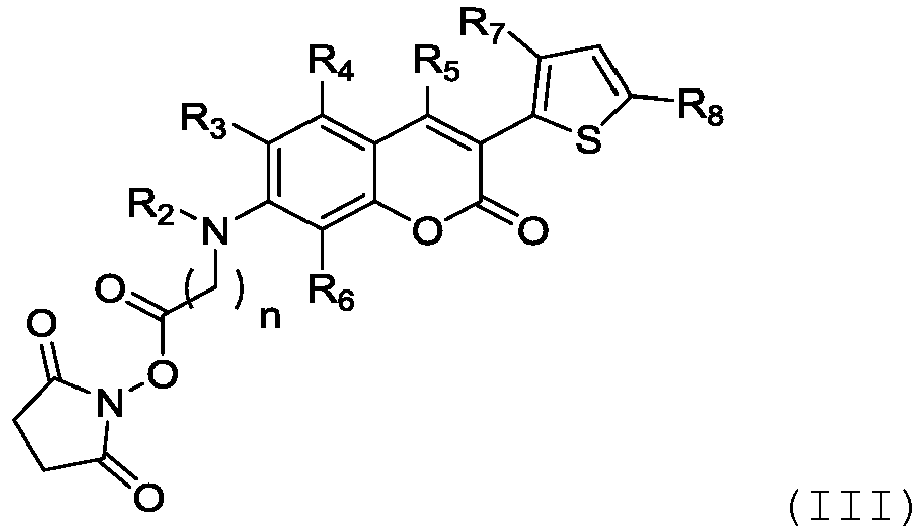 R2 is selected from substituted or unsubstituted alkyl, and L-WSG;R3, R4, R5, R6, R7 and R8 are independently selected from H, halogen, hydroxyl, cyano, substituted or unsubstituted alkyl, and substituted or unsubstituted alkoxy;R2 together with R3 or R6 may form a substituted or unsubstituted 5- or 6-membered N-heterocycle;L is a linker as defined in claim 1;WSG is a water soluble group as defined in claim 1;n is an integer number 1 to 10;at least one of R7 and R8 is sulfonic acid;and salts thereof.
 - 7-amino-3-thienyl coumarin dye according to any one of the preceding claims having formula (IV):
 R2 is selected from substituted or unsubstituted alkyl, and L-WSG;R3, R4, R5, R6 are H;R2 together with R3 or R6 may form a substituted or unsubstituted 5- or 6-membered N-heterocycle;L is a linker as defined in claim 1;WSG is a water soluble group as defined in claim 1;and salts thereof.
 - 7-amino-3-thienyl coumarin dye according to any one of the preceding claims, wherein Y is selected from none, O, S, SO2-NH, SO2-NR9, CO-NH, CO-O, CO-S, 1,3-triazole, NH-CO-NH, NH-CS-NH, NH-CO-O, SO2-O, aryl, heteroaryl and amino acid, preferably Y is selected from none, O, S, SO2-NH, SO2-NR9, CO-NH, CO-O and 1,3-triazole, wherein R9 is as defined in claim 1.
- 7-amino-3-thienyl coumarin dye according to any one of the preceding claims, wherein WSG is selected from sulfonic acid, alkyl sulfonic acid, sulfonamide, phosphate, phosphonic acid, ammonium, pyridinium, cyclodextrin, monosaccharide, oligosaccharide, dextrane and -(CH2-CH2-O)x in which x is a integer number from 1 to 10, preferably WSG is selected from sulfonic acid, alkyl sulfonic acid, sulfonamide, ammonium and -(CH2-CH2-O)x in which x is a integer number from 1 to 10.
- 7-amino-3-thienyl coumarin dye according to any one of the preceding claims, wherein RG is selected from carboxylic acid, an activated ester of a carboxylic acid, sulfonyl halide, acyl halide, amine, alkyl or aryl halide, anhydride, azide, haloacetamide, halotriazine, hydrazine, isocyanate, isothiocyanate, maleimide, phosphoramidate, thiol, hydroxyl and alkyne, preferably RG is selected from carboxylic acid, an activated ester of a carboxylic acid, amine, azide, haloacetamide, hydrazine, isocyanate, maleimide and alkyne.
- 7-amino-3-thienyl coumarin dye according to any one of the preceding claims, selected from:sodium 5-(7-((5-carboxypentyl)(ethyl)amino)-2-oxo-2H-chromen-3-yl)thiophene-2,4-disulfonate;sodium 5-(7-((6-((2,5-dioxopyrrolidin-1-yl)oxy)-6-oxohexyl)(ethyl)amino)-2-oxo-2H-chromen-3-yl)thiophene-2,4-disulfonate;sodium 5-(7-(ethyl(6-hydrazinyl-6-oxohexyl)amino)-2-oxo-2H-chromen-3-yl)thiophene-2,4-disulfonate;sodium 5-(7-((6-((2-(2,5-dioxo-2,5-dihydro-1H-pyrrol-1-yl)ethyl)amino)-6-oxohexyl)(ethyl)amino)-2-oxo-2H-chromen-3-yl)thiophene-2,4-disulfonate;sodium 5-(7-((6-((2,5-dioxopyrrolidin-1-yl)oxy)-6-oxohexyl)(3-sulfonatopropyl)amino)-2-oxo-2H-chromen-3-yl)thiophene-2,4-disulfonate;sodium 5-(9-(6-((2,5-dioxopyrrolidin-1-yl)oxy)-6-oxohexyl)-2-oxo-6,7,8,9-tetrahydro-2H-pyrano[3,2-g]quinolin-3-yl)thiophene-2,4-disulfonate;5-(7-((6-((2,5-dioxopyrrolidin-1-yl)oxy)-6-oxohexyl)(2-(2-methoxyethoxy)ethyl)amino)-2-oxo-2H-chromen-3-yl)thiophene-2,4-disulfonic acid;5-(7-((6-((2,5-dioxopyrrolidin-1-yl)oxy)-6-oxohexyl)(2-oxo-2-((3-sulfopropyl)amino)ethyl)amino)-2-oxo-2H-chromen-3-yl)thiophene-2,4-disulfonic acid;5-(7-((6-((2,5-dioxopyrrolidin-1-yl)oxy)-6-oxohexyl)(3-(N-(2-sulfoethyl)sulfamoyl)propyl)amino)-2-oxo-2H-chromen-3-yl)thiophene-2,4-disulfonic acid;5-(7-((3-(N-(6-((2,5-dioxopyrrolidin-1-yl)oxy)-6-oxohexyl)sulfamoyl)propyl)(ethyl)amino)-2-oxo-2H-chromen-3-yl)thiophene-2,4-disulfonic acid;5-(7-((4-(((2,5-dioxopyrrolidin-1-yl)oxy)carbonyl) benzyl)(ethyl)amino)-2-oxo-2H-chromen-3-yl)thiophene-2,4-disulfonic acid;2,2'-((5-(7-((6-((2,5-dioxopyrrolidin-1-yl)oxy)-6-oxohexyl)(ethyl)amino)-2-oxo-2H-chromen-3-yl)thiophene-2,4-disulfonyl)bis(azanediyl))bis(ethane-1-sulfonic acid);2,5-dioxopyrrolidin-1-yl 6-((3-(3,5-disulfamoylthiophen-2-yl)-2-oxo-2H-chromen-7-yl)(ethyl)amino)hexanoate.
- 7-amino-3-thienyl coumarin dye conjugate having formula (V):
 R2, R3, R4, R5, R6, R7 and R8 are independently selected from H, halogen, alkenyl, alkynyl, cyano, trifluoromethyl, aryloxy, azido, amino, hydroxyl, WSG, L-WSG, substituted or unsubstituted alkyl and substituted or unsubstituted alkoxy;R2 together with R3 or R6 may form a substituted or unsubstituted 5- or 6-membered N-heterocycle;L is a linker of formula (VI):
[(CH2)a-Y-(CH2)b]c (VI)
wherein Yis the same or different and is selected from none, O, S, NH, NR9, SO2-NH, SO2-NR9, CO-NH, CO-O, C=N-NHR9, CO-S, 1,3-triazole, CO-O-CO, aminotriazine, triazinyl ether, NH-CO-NH, NH-CS-NH, NH-CO-O, O-POR9-O O-Si, SO2, SO2-O, amino acid, aryl and heteroaryl,wherein R9 is alkyl or WSG,a and c can be the same or different and are an integer number 1 to 10, andb is an integer number 0 to 10;WSG is a water soluble group and is selected from sulfonic acid, sulfate, alkyl sulfonic acid, thiosulfonic acid, sulfonamide, phosphate, phosphonic acid, boronic acid, ammonium, pyridinium, quinolium, acridinium, cyclodextrin, monosaccharide, oligosaccharide, dextrane and -(CH2-CH2-O)x in which x is a integer number from 1 to 10;m is an integer number 1 to 25;SUB is an amino acid, a peptide, a protein, a saccharide, a nucleoside, a nucleotide, an oligonucleotide, a nucleic acid, a hapten, a drug or a lipid;with the proviso that and at least one of R7 and R8 is a sulfonic acid,and salts thereof. - 7-amino-3-thienyl coumarin dye conjugate according to claim 9, wherein R7 and R8 are bound to the thienyl ring in positions 2 and 4, and are sulfonic acid groups or salts thereof.
- 7-amino-3-thienyl coumarin dye conjugate according to claim 9 or clam 10, wherein R3, R4, R5 and R6 are hydrogen atoms.
- 7-amino-3-thienyl coumarin dye conjugate according to any one of claims 9 to 11, wherein R2 is substituted or unsubstituted alkyl or L-WSG;
L is a linker as defined in claim 9;
WSG is a water soluble group as defined in claim 9. - A kit comprising at least one 7-amino-3-thienyl coumarin dye as defined in any one of claims 1 to 8.
- A kit comprising at least one 7-amino-3-thienyl coumarin dye conjugate as defined in any one of claims 9 to 12.
Applications Claiming Priority (1)
| Application Number | Priority Date | Filing Date | Title |
|---|---|---|---|
| ITUA2016A001706A ITUA20161706A1 (en) | 2016-03-15 | 2016-03-15 | NEW CUMARIN DYES AND RELATED CONJUGES |
Publications (2)
| Publication Number | Publication Date |
|---|---|
| EP3219712A1 true EP3219712A1 (en) | 2017-09-20 |
| EP3219712B1 EP3219712B1 (en) | 2021-08-18 |
Family
ID=56203736
Family Applications (1)
| Application Number | Title | Priority Date | Filing Date |
|---|---|---|---|
| EP17159893.1A Active EP3219712B1 (en) | 2016-03-15 | 2017-03-08 | Coumarin dyes and conjugates thereof |
Country Status (4)
| Country | Link |
|---|---|
| US (1) | US10160861B2 (en) |
| EP (1) | EP3219712B1 (en) |
| ES (1) | ES2898028T3 (en) |
| IT (1) | ITUA20161706A1 (en) |
Cited By (8)
| Publication number | Priority date | Publication date | Assignee | Title |
|---|---|---|---|---|
| US10160861B2 (en) * | 2016-03-15 | 2018-12-25 | Cyanagen S.R.L. | Coumarin dyes and conjugates thereof |
| EP3461814A1 (en) * | 2017-09-29 | 2019-04-03 | ATTO-TEC GmbH | New polysulfonated fluorescent dyes |
| EP3747957A1 (en) | 2019-06-07 | 2020-12-09 | Universidade de Évora | Fluorescent vinyl tiophene and bitiophene coumarins dyes and method of synthesis thereof |
| WO2022023353A1 (en) * | 2020-07-28 | 2022-02-03 | Illumina Cambridge Limited | Substituted coumarin dyes and uses as fluorescent labels |
| CN114746091A (en) * | 2018-10-29 | 2022-07-12 | 肯法姆股份有限公司 | D-amphetamine compounds, compositions, and methods of making and using the same |
| US12196760B2 (en) | 2018-07-12 | 2025-01-14 | Board Of Regents, The University Of Texas System | Molecular neighborhood detection by oligonucleotides |
| US12379381B2 (en) | 2011-06-23 | 2025-08-05 | Board Of Regents, The University Of Texas System | Single molecule peptide sequencing |
| US12498379B2 (en) | 2018-10-05 | 2025-12-16 | Board Of Regents, The University Of Texas System | Solid-phase N-terminal peptide capture and release |
Citations (5)
| Publication number | Priority date | Publication date | Assignee | Title |
|---|---|---|---|---|
| US5696157A (en) | 1996-11-15 | 1997-12-09 | Molecular Probes, Inc. | Sulfonated derivatives of 7-aminocoumarin |
| US6372895B1 (en) * | 2000-07-07 | 2002-04-16 | 3M Innovative Properties Company | Fluorogenic compounds |
| EP1535969A2 (en) * | 2003-11-26 | 2005-06-01 | Dyomics GmbH | Coumarin based new polymethine dyes with adjustable Stoke's-Shift |
| WO2008076916A2 (en) * | 2006-12-15 | 2008-06-26 | Molecular Devices Corporation | Thallium-sensitive agents and methods of using the same |
| EP2236508A1 (en) * | 2009-04-01 | 2010-10-06 | Becton, Dickinson and Company | Reactive Heterocycle-Substituted 7-Hydroxycoumarins and Their Conjugates |
Family Cites Families (1)
| Publication number | Priority date | Publication date | Assignee | Title |
|---|---|---|---|---|
| ITUA20161706A1 (en) * | 2016-03-15 | 2017-09-15 | Cyanagen S R L | NEW CUMARIN DYES AND RELATED CONJUGES |
-
2016
- 2016-03-15 IT ITUA2016A001706A patent/ITUA20161706A1/en unknown
-
2017
- 2017-03-08 EP EP17159893.1A patent/EP3219712B1/en active Active
- 2017-03-08 ES ES17159893T patent/ES2898028T3/en active Active
- 2017-03-14 US US15/458,801 patent/US10160861B2/en active Active
Patent Citations (6)
| Publication number | Priority date | Publication date | Assignee | Title |
|---|---|---|---|---|
| US5696157A (en) | 1996-11-15 | 1997-12-09 | Molecular Probes, Inc. | Sulfonated derivatives of 7-aminocoumarin |
| US6372895B1 (en) * | 2000-07-07 | 2002-04-16 | 3M Innovative Properties Company | Fluorogenic compounds |
| EP1535969A2 (en) * | 2003-11-26 | 2005-06-01 | Dyomics GmbH | Coumarin based new polymethine dyes with adjustable Stoke's-Shift |
| WO2008076916A2 (en) * | 2006-12-15 | 2008-06-26 | Molecular Devices Corporation | Thallium-sensitive agents and methods of using the same |
| EP2236508A1 (en) * | 2009-04-01 | 2010-10-06 | Becton, Dickinson and Company | Reactive Heterocycle-Substituted 7-Hydroxycoumarins and Their Conjugates |
| US8431416B2 (en) | 2009-04-01 | 2013-04-30 | Becton, Dickinson And Company | Reactive heterocycle-substituted 7-hydroxycoumarins and their conjugates |
Non-Patent Citations (4)
| Title |
|---|
| DYES AND PIGMENTS, vol. 112, 2015, pages 227 - 235 |
| EURJOC, 2015, pages 496 - 505 |
| HEIKO SCHILL ET AL: "4-Trifluoromethyl-Substituted Coumarins with Large Stokes Shifts: Synthesis, Bioconjugates, and Their Use in Super-Resolution Fluorescence Microscopy", CHEMISTRY - A EUROPEAN JOURNAL., vol. 19, no. 49, 2 December 2013 (2013-12-02), WEINHEIM, DE, pages 16556 - 16565, XP055287476, ISSN: 0947-6539, DOI: 10.1002/chem.201302037 * |
| JIN ET AL., CHEMBIOCHEM, vol. 12, 2011, pages 65 - 70 |
Cited By (12)
| Publication number | Priority date | Publication date | Assignee | Title |
|---|---|---|---|---|
| US12379381B2 (en) | 2011-06-23 | 2025-08-05 | Board Of Regents, The University Of Texas System | Single molecule peptide sequencing |
| US10160861B2 (en) * | 2016-03-15 | 2018-12-25 | Cyanagen S.R.L. | Coumarin dyes and conjugates thereof |
| EP3461814A1 (en) * | 2017-09-29 | 2019-04-03 | ATTO-TEC GmbH | New polysulfonated fluorescent dyes |
| EP3461815A1 (en) * | 2017-09-29 | 2019-04-03 | ATTO-TEC GmbH | Novel poly sulfonated fluorescence dyes |
| US11180657B2 (en) | 2017-09-29 | 2021-11-23 | Atto-Tec Gmbh | Polysulfonated fluorescence dyes |
| US12196760B2 (en) | 2018-07-12 | 2025-01-14 | Board Of Regents, The University Of Texas System | Molecular neighborhood detection by oligonucleotides |
| US12498379B2 (en) | 2018-10-05 | 2025-12-16 | Board Of Regents, The University Of Texas System | Solid-phase N-terminal peptide capture and release |
| CN114746091A (en) * | 2018-10-29 | 2022-07-12 | 肯法姆股份有限公司 | D-amphetamine compounds, compositions, and methods of making and using the same |
| EP3747957A1 (en) | 2019-06-07 | 2020-12-09 | Universidade de Évora | Fluorescent vinyl tiophene and bitiophene coumarins dyes and method of synthesis thereof |
| WO2022023353A1 (en) * | 2020-07-28 | 2022-02-03 | Illumina Cambridge Limited | Substituted coumarin dyes and uses as fluorescent labels |
| KR20230044364A (en) * | 2020-07-28 | 2023-04-04 | 일루미나 케임브리지 리미티드 | Substituted coumarin dyes and their use as fluorescent labels |
| US12351871B2 (en) | 2020-07-28 | 2025-07-08 | Illumina Cambridge Limited | Substituted coumarin dyes and uses as fluorescent labels |
Also Published As
| Publication number | Publication date |
|---|---|
| ES2898028T3 (en) | 2022-03-03 |
| EP3219712B1 (en) | 2021-08-18 |
| ITUA20161706A1 (en) | 2017-09-15 |
| US10160861B2 (en) | 2018-12-25 |
| US20170267866A1 (en) | 2017-09-21 |
Similar Documents
| Publication | Publication Date | Title |
|---|---|---|
| EP3219712B1 (en) | Coumarin dyes and conjugates thereof | |
| EP2596065B1 (en) | Luminescent dyes with a water-soluble intramolecular bridge and their biological conjugates | |
| US6403807B1 (en) | Bridged fluorescent dyes, their preparation and their use in assays | |
| CN100577742C (en) | Cyanine dye labeling reagent | |
| EP2236508B1 (en) | Reactive Heterocycle-Substituted 7-Hydroxycoumarins and Their Conjugates | |
| Kim et al. | Far-red/near-infrared emitting, two-photon absorbing, and bio-stable amino-Si-pyronin dyes | |
| US9624424B2 (en) | Large stokes shift dyes | |
| US6277984B1 (en) | Monomethine cyanines rigidized by a two-carbon chain | |
| JP2002506518A (en) | Chemiluminescent energy transfer conjugates and their use as labels in binding assays | |
| EP3341377B1 (en) | Polyfluoreno[4,5-cde]oxepine conjugates and their use in methods of analyte detection | |
| EP2270106A2 (en) | Indolium compounds containing fluoro-substituents | |
| WO2020033681A2 (en) | Silicon-substituted rhodamine dyes and dye conjugates | |
| US12297383B2 (en) | Condensed polycyclic conjugated polymers and their use for biological detection | |
| CN102807588B (en) | The compounds and methods of adjacent thiol protein in a kind of in situ detection organism | |
| US20100029017A1 (en) | Mono-chlorinated hydroxycoumarin conjugates | |
| EP4097477A1 (en) | Uv excitable polyfluorene based conjugates and their use in methods of analyte detection |
Legal Events
| Date | Code | Title | Description |
|---|---|---|---|
| PUAI | Public reference made under article 153(3) epc to a published international application that has entered the european phase |
Free format text: ORIGINAL CODE: 0009012 |
|
| STAA | Information on the status of an ep patent application or granted ep patent |
Free format text: STATUS: THE APPLICATION HAS BEEN PUBLISHED |
|
| AK | Designated contracting states |
Kind code of ref document: A1 Designated state(s): AL AT BE BG CH CY CZ DE DK EE ES FI FR GB GR HR HU IE IS IT LI LT LU LV MC MK MT NL NO PL PT RO RS SE SI SK SM TR |
|
| AX | Request for extension of the european patent |
Extension state: BA ME |
|
| STAA | Information on the status of an ep patent application or granted ep patent |
Free format text: STATUS: REQUEST FOR EXAMINATION WAS MADE |
|
| 17P | Request for examination filed |
Effective date: 20180309 |
|
| RBV | Designated contracting states (corrected) |
Designated state(s): AL AT BE BG CH CY CZ DE DK EE ES FI FR GB GR HR HU IE IS IT LI LT LU LV MC MK MT NL NO PL PT RO RS SE SI SK SM TR |
|
| STAA | Information on the status of an ep patent application or granted ep patent |
Free format text: STATUS: EXAMINATION IS IN PROGRESS |
|
| 17Q | First examination report despatched |
Effective date: 20181011 |
|
| REG | Reference to a national code |
Ref country code: DE Ref legal event code: R079 Ref document number: 602017044126 Country of ref document: DE Free format text: PREVIOUS MAIN CLASS: C07D0409040000 Ipc: C09B0057020000 |
|
| GRAP | Despatch of communication of intention to grant a patent |
Free format text: ORIGINAL CODE: EPIDOSNIGR1 |
|
| STAA | Information on the status of an ep patent application or granted ep patent |
Free format text: STATUS: GRANT OF PATENT IS INTENDED |
|
| RIC1 | Information provided on ipc code assigned before grant |
Ipc: C07D 409/14 20060101ALI20210226BHEP Ipc: C07K 16/42 20060101ALI20210226BHEP Ipc: A61K 47/54 20170101ALI20210226BHEP Ipc: C09B 57/02 20060101AFI20210226BHEP Ipc: C07D 409/04 20060101ALI20210226BHEP Ipc: C07K 16/28 20060101ALI20210226BHEP |
|
| INTG | Intention to grant announced |
Effective date: 20210317 |
|
| GRAS | Grant fee paid |
Free format text: ORIGINAL CODE: EPIDOSNIGR3 |
|
| GRAA | (expected) grant |
Free format text: ORIGINAL CODE: 0009210 |
|
| STAA | Information on the status of an ep patent application or granted ep patent |
Free format text: STATUS: THE PATENT HAS BEEN GRANTED |
|
| AK | Designated contracting states |
Kind code of ref document: B1 Designated state(s): AL AT BE BG CH CY CZ DE DK EE ES FI FR GB GR HR HU IE IS IT LI LT LU LV MC MK MT NL NO PL PT RO RS SE SI SK SM TR |
|
| REG | Reference to a national code |
Ref country code: GB Ref legal event code: FG4D |
|
| REG | Reference to a national code |
Ref country code: CH Ref legal event code: EP |
|
| REG | Reference to a national code |
Ref country code: DE Ref legal event code: R096 Ref document number: 602017044126 Country of ref document: DE |
|
| REG | Reference to a national code |
Ref country code: IE Ref legal event code: FG4D Ref country code: AT Ref legal event code: REF Ref document number: 1421618 Country of ref document: AT Kind code of ref document: T Effective date: 20210915 |
|
| REG | Reference to a national code |
Ref country code: SE Ref legal event code: TRGR |
|
| REG | Reference to a national code |
Ref country code: LT Ref legal event code: MG9D |
|
| REG | Reference to a national code |
Ref country code: NL Ref legal event code: MP Effective date: 20210818 |
|
| REG | Reference to a national code |
Ref country code: AT Ref legal event code: MK05 Ref document number: 1421618 Country of ref document: AT Kind code of ref document: T Effective date: 20210818 |
|
| PG25 | Lapsed in a contracting state [announced via postgrant information from national office to epo] |
Ref country code: FI Free format text: LAPSE BECAUSE OF FAILURE TO SUBMIT A TRANSLATION OF THE DESCRIPTION OR TO PAY THE FEE WITHIN THE PRESCRIBED TIME-LIMIT Effective date: 20210818 Ref country code: HR Free format text: LAPSE BECAUSE OF FAILURE TO SUBMIT A TRANSLATION OF THE DESCRIPTION OR TO PAY THE FEE WITHIN THE PRESCRIBED TIME-LIMIT Effective date: 20210818 Ref country code: PT Free format text: LAPSE BECAUSE OF FAILURE TO SUBMIT A TRANSLATION OF THE DESCRIPTION OR TO PAY THE FEE WITHIN THE PRESCRIBED TIME-LIMIT Effective date: 20211220 Ref country code: NO Free format text: LAPSE BECAUSE OF FAILURE TO SUBMIT A TRANSLATION OF THE DESCRIPTION OR TO PAY THE FEE WITHIN THE PRESCRIBED TIME-LIMIT Effective date: 20211118 Ref country code: LT Free format text: LAPSE BECAUSE OF FAILURE TO SUBMIT A TRANSLATION OF THE DESCRIPTION OR TO PAY THE FEE WITHIN THE PRESCRIBED TIME-LIMIT Effective date: 20210818 Ref country code: BG Free format text: LAPSE BECAUSE OF FAILURE TO SUBMIT A TRANSLATION OF THE DESCRIPTION OR TO PAY THE FEE WITHIN THE PRESCRIBED TIME-LIMIT Effective date: 20211118 Ref country code: AT Free format text: LAPSE BECAUSE OF FAILURE TO SUBMIT A TRANSLATION OF THE DESCRIPTION OR TO PAY THE FEE WITHIN THE PRESCRIBED TIME-LIMIT Effective date: 20210818 Ref country code: RS Free format text: LAPSE BECAUSE OF FAILURE TO SUBMIT A TRANSLATION OF THE DESCRIPTION OR TO PAY THE FEE WITHIN THE PRESCRIBED TIME-LIMIT Effective date: 20210818 |
|
| PG25 | Lapsed in a contracting state [announced via postgrant information from national office to epo] |
Ref country code: PL Free format text: LAPSE BECAUSE OF FAILURE TO SUBMIT A TRANSLATION OF THE DESCRIPTION OR TO PAY THE FEE WITHIN THE PRESCRIBED TIME-LIMIT Effective date: 20210818 Ref country code: LV Free format text: LAPSE BECAUSE OF FAILURE TO SUBMIT A TRANSLATION OF THE DESCRIPTION OR TO PAY THE FEE WITHIN THE PRESCRIBED TIME-LIMIT Effective date: 20210818 Ref country code: GR Free format text: LAPSE BECAUSE OF FAILURE TO SUBMIT A TRANSLATION OF THE DESCRIPTION OR TO PAY THE FEE WITHIN THE PRESCRIBED TIME-LIMIT Effective date: 20211119 |
|
| REG | Reference to a national code |
Ref country code: ES Ref legal event code: FG2A Ref document number: 2898028 Country of ref document: ES Kind code of ref document: T3 Effective date: 20220303 |
|
| PG25 | Lapsed in a contracting state [announced via postgrant information from national office to epo] |
Ref country code: NL Free format text: LAPSE BECAUSE OF FAILURE TO SUBMIT A TRANSLATION OF THE DESCRIPTION OR TO PAY THE FEE WITHIN THE PRESCRIBED TIME-LIMIT Effective date: 20210818 |
|
| PG25 | Lapsed in a contracting state [announced via postgrant information from national office to epo] |
Ref country code: DK Free format text: LAPSE BECAUSE OF FAILURE TO SUBMIT A TRANSLATION OF THE DESCRIPTION OR TO PAY THE FEE WITHIN THE PRESCRIBED TIME-LIMIT Effective date: 20210818 |
|
| REG | Reference to a national code |
Ref country code: DE Ref legal event code: R097 Ref document number: 602017044126 Country of ref document: DE |
|
| PG25 | Lapsed in a contracting state [announced via postgrant information from national office to epo] |
Ref country code: SM Free format text: LAPSE BECAUSE OF FAILURE TO SUBMIT A TRANSLATION OF THE DESCRIPTION OR TO PAY THE FEE WITHIN THE PRESCRIBED TIME-LIMIT Effective date: 20210818 Ref country code: SK Free format text: LAPSE BECAUSE OF FAILURE TO SUBMIT A TRANSLATION OF THE DESCRIPTION OR TO PAY THE FEE WITHIN THE PRESCRIBED TIME-LIMIT Effective date: 20210818 Ref country code: RO Free format text: LAPSE BECAUSE OF FAILURE TO SUBMIT A TRANSLATION OF THE DESCRIPTION OR TO PAY THE FEE WITHIN THE PRESCRIBED TIME-LIMIT Effective date: 20210818 Ref country code: EE Free format text: LAPSE BECAUSE OF FAILURE TO SUBMIT A TRANSLATION OF THE DESCRIPTION OR TO PAY THE FEE WITHIN THE PRESCRIBED TIME-LIMIT Effective date: 20210818 Ref country code: CZ Free format text: LAPSE BECAUSE OF FAILURE TO SUBMIT A TRANSLATION OF THE DESCRIPTION OR TO PAY THE FEE WITHIN THE PRESCRIBED TIME-LIMIT Effective date: 20210818 Ref country code: AL Free format text: LAPSE BECAUSE OF FAILURE TO SUBMIT A TRANSLATION OF THE DESCRIPTION OR TO PAY THE FEE WITHIN THE PRESCRIBED TIME-LIMIT Effective date: 20210818 |
|
| PLBE | No opposition filed within time limit |
Free format text: ORIGINAL CODE: 0009261 |
|
| STAA | Information on the status of an ep patent application or granted ep patent |
Free format text: STATUS: NO OPPOSITION FILED WITHIN TIME LIMIT |
|
| 26N | No opposition filed |
Effective date: 20220519 |
|
| PG25 | Lapsed in a contracting state [announced via postgrant information from national office to epo] |
Ref country code: SI Free format text: LAPSE BECAUSE OF FAILURE TO SUBMIT A TRANSLATION OF THE DESCRIPTION OR TO PAY THE FEE WITHIN THE PRESCRIBED TIME-LIMIT Effective date: 20210818 |
|
| PG25 | Lapsed in a contracting state [announced via postgrant information from national office to epo] |
Ref country code: MC Free format text: LAPSE BECAUSE OF FAILURE TO SUBMIT A TRANSLATION OF THE DESCRIPTION OR TO PAY THE FEE WITHIN THE PRESCRIBED TIME-LIMIT Effective date: 20210818 |
|
| REG | Reference to a national code |
Ref country code: BE Ref legal event code: MM Effective date: 20220331 |
|
| PG25 | Lapsed in a contracting state [announced via postgrant information from national office to epo] |
Ref country code: LU Free format text: LAPSE BECAUSE OF NON-PAYMENT OF DUE FEES Effective date: 20220308 Ref country code: IE Free format text: LAPSE BECAUSE OF NON-PAYMENT OF DUE FEES Effective date: 20220308 |
|
| PG25 | Lapsed in a contracting state [announced via postgrant information from national office to epo] |
Ref country code: BE Free format text: LAPSE BECAUSE OF NON-PAYMENT OF DUE FEES Effective date: 20220331 |
|
| P01 | Opt-out of the competence of the unified patent court (upc) registered |
Effective date: 20230522 |
|
| PG25 | Lapsed in a contracting state [announced via postgrant information from national office to epo] |
Ref country code: HU Free format text: LAPSE BECAUSE OF FAILURE TO SUBMIT A TRANSLATION OF THE DESCRIPTION OR TO PAY THE FEE WITHIN THE PRESCRIBED TIME-LIMIT; INVALID AB INITIO Effective date: 20170308 |
|
| PG25 | Lapsed in a contracting state [announced via postgrant information from national office to epo] |
Ref country code: MK Free format text: LAPSE BECAUSE OF FAILURE TO SUBMIT A TRANSLATION OF THE DESCRIPTION OR TO PAY THE FEE WITHIN THE PRESCRIBED TIME-LIMIT Effective date: 20210818 Ref country code: CY Free format text: LAPSE BECAUSE OF FAILURE TO SUBMIT A TRANSLATION OF THE DESCRIPTION OR TO PAY THE FEE WITHIN THE PRESCRIBED TIME-LIMIT Effective date: 20210818 |
|
| PG25 | Lapsed in a contracting state [announced via postgrant information from national office to epo] |
Ref country code: MT Free format text: LAPSE BECAUSE OF FAILURE TO SUBMIT A TRANSLATION OF THE DESCRIPTION OR TO PAY THE FEE WITHIN THE PRESCRIBED TIME-LIMIT Effective date: 20210818 |
|
| PGFP | Annual fee paid to national office [announced via postgrant information from national office to epo] |
Ref country code: ES Payment date: 20250417 Year of fee payment: 9 |
|
| PGFP | Annual fee paid to national office [announced via postgrant information from national office to epo] |
Ref country code: CH Payment date: 20250401 Year of fee payment: 9 |
|
| PG25 | Lapsed in a contracting state [announced via postgrant information from national office to epo] |
Ref country code: TR Free format text: LAPSE BECAUSE OF FAILURE TO SUBMIT A TRANSLATION OF THE DESCRIPTION OR TO PAY THE FEE WITHIN THE PRESCRIBED TIME-LIMIT Effective date: 20210818 |
|
| REG | Reference to a national code |
Ref country code: CH Ref legal event code: U11 Free format text: ST27 STATUS EVENT CODE: U-0-0-U10-U11 (AS PROVIDED BY THE NATIONAL OFFICE) Effective date: 20260401 |
|
| PGFP | Annual fee paid to national office [announced via postgrant information from national office to epo] |
Ref country code: SE Payment date: 20260323 Year of fee payment: 10 |
|
| PGFP | Annual fee paid to national office [announced via postgrant information from national office to epo] |
Ref country code: GB Payment date: 20260304 Year of fee payment: 10 |
|
| PGFP | Annual fee paid to national office [announced via postgrant information from national office to epo] |
Ref country code: DE Payment date: 20260320 Year of fee payment: 10 |
|
| PGFP | Annual fee paid to national office [announced via postgrant information from national office to epo] |
Ref country code: IT Payment date: 20260227 Year of fee payment: 10 |
|
| PGFP | Annual fee paid to national office [announced via postgrant information from national office to epo] |
Ref country code: FR Payment date: 20260323 Year of fee payment: 10 |