EP3216521A1 - Carrier-nanoparticle complex, method for preparing same, and catalyst comprising same - Google Patents
Carrier-nanoparticle complex, method for preparing same, and catalyst comprising same Download PDFInfo
- Publication number
- EP3216521A1 EP3216521A1 EP15856491.4A EP15856491A EP3216521A1 EP 3216521 A1 EP3216521 A1 EP 3216521A1 EP 15856491 A EP15856491 A EP 15856491A EP 3216521 A1 EP3216521 A1 EP 3216521A1
- Authority
- EP
- European Patent Office
- Prior art keywords
- carrier
- metal
- precursor
- core
- solution
- Prior art date
- Legal status (The legal status is an assumption and is not a legal conclusion. Google has not performed a legal analysis and makes no representation as to the accuracy of the status listed.)
- Granted
Links
Images


Classifications
-
- B—PERFORMING OPERATIONS; TRANSPORTING
- B01—PHYSICAL OR CHEMICAL PROCESSES OR APPARATUS IN GENERAL
- B01J—CHEMICAL OR PHYSICAL PROCESSES, e.g. CATALYSIS OR COLLOID CHEMISTRY; THEIR RELEVANT APPARATUS
- B01J23/00—Catalysts comprising metals or metal oxides or hydroxides, not provided for in group B01J21/00
- B01J23/70—Catalysts comprising metals or metal oxides or hydroxides, not provided for in group B01J21/00 of the iron group metals or copper
- B01J23/89—Catalysts comprising metals or metal oxides or hydroxides, not provided for in group B01J21/00 of the iron group metals or copper combined with noble metals
- B01J23/8913—Cobalt and noble metals
-
- B—PERFORMING OPERATIONS; TRANSPORTING
- B01—PHYSICAL OR CHEMICAL PROCESSES OR APPARATUS IN GENERAL
- B01J—CHEMICAL OR PHYSICAL PROCESSES, e.g. CATALYSIS OR COLLOID CHEMISTRY; THEIR RELEVANT APPARATUS
- B01J13/00—Colloid chemistry, e.g. the production of colloidal materials or their solutions, not otherwise provided for; Making microcapsules or microballoons
- B01J13/02—Making microcapsules or microballoons
-
- B—PERFORMING OPERATIONS; TRANSPORTING
- B01—PHYSICAL OR CHEMICAL PROCESSES OR APPARATUS IN GENERAL
- B01J—CHEMICAL OR PHYSICAL PROCESSES, e.g. CATALYSIS OR COLLOID CHEMISTRY; THEIR RELEVANT APPARATUS
- B01J23/00—Catalysts comprising metals or metal oxides or hydroxides, not provided for in group B01J21/00
- B01J23/38—Catalysts comprising metals or metal oxides or hydroxides, not provided for in group B01J21/00 of noble metals
-
- B—PERFORMING OPERATIONS; TRANSPORTING
- B01—PHYSICAL OR CHEMICAL PROCESSES OR APPARATUS IN GENERAL
- B01J—CHEMICAL OR PHYSICAL PROCESSES, e.g. CATALYSIS OR COLLOID CHEMISTRY; THEIR RELEVANT APPARATUS
- B01J23/00—Catalysts comprising metals or metal oxides or hydroxides, not provided for in group B01J21/00
- B01J23/38—Catalysts comprising metals or metal oxides or hydroxides, not provided for in group B01J21/00 of noble metals
- B01J23/40—Catalysts comprising metals or metal oxides or hydroxides, not provided for in group B01J21/00 of noble metals of the platinum group metals
- B01J23/42—Platinum
-
- B—PERFORMING OPERATIONS; TRANSPORTING
- B01—PHYSICAL OR CHEMICAL PROCESSES OR APPARATUS IN GENERAL
- B01J—CHEMICAL OR PHYSICAL PROCESSES, e.g. CATALYSIS OR COLLOID CHEMISTRY; THEIR RELEVANT APPARATUS
- B01J23/00—Catalysts comprising metals or metal oxides or hydroxides, not provided for in group B01J21/00
- B01J23/38—Catalysts comprising metals or metal oxides or hydroxides, not provided for in group B01J21/00 of noble metals
- B01J23/40—Catalysts comprising metals or metal oxides or hydroxides, not provided for in group B01J21/00 of noble metals of the platinum group metals
- B01J23/44—Palladium
-
- B—PERFORMING OPERATIONS; TRANSPORTING
- B01—PHYSICAL OR CHEMICAL PROCESSES OR APPARATUS IN GENERAL
- B01J—CHEMICAL OR PHYSICAL PROCESSES, e.g. CATALYSIS OR COLLOID CHEMISTRY; THEIR RELEVANT APPARATUS
- B01J27/00—Catalysts comprising the elements or compounds of halogens, sulfur, selenium, tellurium, phosphorus or nitrogen; Catalysts comprising carbon compounds
- B01J27/20—Carbon compounds
-
- B—PERFORMING OPERATIONS; TRANSPORTING
- B01—PHYSICAL OR CHEMICAL PROCESSES OR APPARATUS IN GENERAL
- B01J—CHEMICAL OR PHYSICAL PROCESSES, e.g. CATALYSIS OR COLLOID CHEMISTRY; THEIR RELEVANT APPARATUS
- B01J27/00—Catalysts comprising the elements or compounds of halogens, sulfur, selenium, tellurium, phosphorus or nitrogen; Catalysts comprising carbon compounds
- B01J27/24—Nitrogen compounds
-
- B—PERFORMING OPERATIONS; TRANSPORTING
- B01—PHYSICAL OR CHEMICAL PROCESSES OR APPARATUS IN GENERAL
- B01J—CHEMICAL OR PHYSICAL PROCESSES, e.g. CATALYSIS OR COLLOID CHEMISTRY; THEIR RELEVANT APPARATUS
- B01J35/00—Catalysts, in general, characterised by their form or physical properties
- B01J35/30—Catalysts, in general, characterised by their form or physical properties characterised by their physical properties
- B01J35/396—Distribution of the active metal ingredient
-
- B—PERFORMING OPERATIONS; TRANSPORTING
- B01—PHYSICAL OR CHEMICAL PROCESSES OR APPARATUS IN GENERAL
- B01J—CHEMICAL OR PHYSICAL PROCESSES, e.g. CATALYSIS OR COLLOID CHEMISTRY; THEIR RELEVANT APPARATUS
- B01J35/00—Catalysts, in general, characterised by their form or physical properties
- B01J35/30—Catalysts, in general, characterised by their form or physical properties characterised by their physical properties
- B01J35/396—Distribution of the active metal ingredient
- B01J35/397—Egg shell like
-
- B—PERFORMING OPERATIONS; TRANSPORTING
- B01—PHYSICAL OR CHEMICAL PROCESSES OR APPARATUS IN GENERAL
- B01J—CHEMICAL OR PHYSICAL PROCESSES, e.g. CATALYSIS OR COLLOID CHEMISTRY; THEIR RELEVANT APPARATUS
- B01J35/00—Catalysts, in general, characterised by their form or physical properties
- B01J35/30—Catalysts, in general, characterised by their form or physical properties characterised by their physical properties
- B01J35/396—Distribution of the active metal ingredient
- B01J35/398—Egg yolk like
-
- B—PERFORMING OPERATIONS; TRANSPORTING
- B01—PHYSICAL OR CHEMICAL PROCESSES OR APPARATUS IN GENERAL
- B01J—CHEMICAL OR PHYSICAL PROCESSES, e.g. CATALYSIS OR COLLOID CHEMISTRY; THEIR RELEVANT APPARATUS
- B01J35/00—Catalysts, in general, characterised by their form or physical properties
- B01J35/30—Catalysts, in general, characterised by their form or physical properties characterised by their physical properties
- B01J35/396—Distribution of the active metal ingredient
- B01J35/399—Distribution of the active metal ingredient homogeneously throughout the support particle
-
- B—PERFORMING OPERATIONS; TRANSPORTING
- B01—PHYSICAL OR CHEMICAL PROCESSES OR APPARATUS IN GENERAL
- B01J—CHEMICAL OR PHYSICAL PROCESSES, e.g. CATALYSIS OR COLLOID CHEMISTRY; THEIR RELEVANT APPARATUS
- B01J37/00—Processes, in general, for preparing catalysts; Processes, in general, for activation of catalysts
- B01J37/02—Impregnation, coating or precipitation
-
- B—PERFORMING OPERATIONS; TRANSPORTING
- B01—PHYSICAL OR CHEMICAL PROCESSES OR APPARATUS IN GENERAL
- B01J—CHEMICAL OR PHYSICAL PROCESSES, e.g. CATALYSIS OR COLLOID CHEMISTRY; THEIR RELEVANT APPARATUS
- B01J37/00—Processes, in general, for preparing catalysts; Processes, in general, for activation of catalysts
- B01J37/02—Impregnation, coating or precipitation
- B01J37/0215—Coating
- B01J37/0228—Coating in several steps
-
- B—PERFORMING OPERATIONS; TRANSPORTING
- B01—PHYSICAL OR CHEMICAL PROCESSES OR APPARATUS IN GENERAL
- B01J—CHEMICAL OR PHYSICAL PROCESSES, e.g. CATALYSIS OR COLLOID CHEMISTRY; THEIR RELEVANT APPARATUS
- B01J37/00—Processes, in general, for preparing catalysts; Processes, in general, for activation of catalysts
- B01J37/02—Impregnation, coating or precipitation
- B01J37/024—Multiple impregnation or coating
-
- B—PERFORMING OPERATIONS; TRANSPORTING
- B01—PHYSICAL OR CHEMICAL PROCESSES OR APPARATUS IN GENERAL
- B01J—CHEMICAL OR PHYSICAL PROCESSES, e.g. CATALYSIS OR COLLOID CHEMISTRY; THEIR RELEVANT APPARATUS
- B01J37/00—Processes, in general, for preparing catalysts; Processes, in general, for activation of catalysts
- B01J37/12—Oxidising
-
- B—PERFORMING OPERATIONS; TRANSPORTING
- B01—PHYSICAL OR CHEMICAL PROCESSES OR APPARATUS IN GENERAL
- B01J—CHEMICAL OR PHYSICAL PROCESSES, e.g. CATALYSIS OR COLLOID CHEMISTRY; THEIR RELEVANT APPARATUS
- B01J37/00—Processes, in general, for preparing catalysts; Processes, in general, for activation of catalysts
- B01J37/16—Reducing
-
- H—ELECTRICITY
- H01—ELECTRIC ELEMENTS
- H01M—PROCESSES OR MEANS, e.g. BATTERIES, FOR THE DIRECT CONVERSION OF CHEMICAL ENERGY INTO ELECTRICAL ENERGY
- H01M4/00—Electrodes
- H01M4/86—Inert electrodes with catalytic activity, e.g. for fuel cells
-
- H—ELECTRICITY
- H01—ELECTRIC ELEMENTS
- H01M—PROCESSES OR MEANS, e.g. BATTERIES, FOR THE DIRECT CONVERSION OF CHEMICAL ENERGY INTO ELECTRICAL ENERGY
- H01M4/00—Electrodes
- H01M4/86—Inert electrodes with catalytic activity, e.g. for fuel cells
- H01M4/90—Selection of catalytic material
- H01M4/92—Metals of platinum group
- H01M4/925—Metals of platinum group supported on carriers, e.g. powder carriers
- H01M4/926—Metals of platinum group supported on carriers, e.g. powder carriers on carbon or graphite
-
- H—ELECTRICITY
- H01—ELECTRIC ELEMENTS
- H01M—PROCESSES OR MEANS, e.g. BATTERIES, FOR THE DIRECT CONVERSION OF CHEMICAL ENERGY INTO ELECTRICAL ENERGY
- H01M8/00—Fuel cells; Manufacture thereof
-
- Y—GENERAL TAGGING OF NEW TECHNOLOGICAL DEVELOPMENTS; GENERAL TAGGING OF CROSS-SECTIONAL TECHNOLOGIES SPANNING OVER SEVERAL SECTIONS OF THE IPC; TECHNICAL SUBJECTS COVERED BY FORMER USPC CROSS-REFERENCE ART COLLECTIONS [XRACs] AND DIGESTS
- Y02—TECHNOLOGIES OR APPLICATIONS FOR MITIGATION OR ADAPTATION AGAINST CLIMATE CHANGE
- Y02E—REDUCTION OF GREENHOUSE GAS [GHG] EMISSIONS, RELATED TO ENERGY GENERATION, TRANSMISSION OR DISTRIBUTION
- Y02E60/00—Enabling technologies; Technologies with a potential or indirect contribution to GHG emissions mitigation
- Y02E60/30—Hydrogen technology
- Y02E60/50—Fuel cells
-
- Y—GENERAL TAGGING OF NEW TECHNOLOGICAL DEVELOPMENTS; GENERAL TAGGING OF CROSS-SECTIONAL TECHNOLOGIES SPANNING OVER SEVERAL SECTIONS OF THE IPC; TECHNICAL SUBJECTS COVERED BY FORMER USPC CROSS-REFERENCE ART COLLECTIONS [XRACs] AND DIGESTS
- Y02—TECHNOLOGIES OR APPLICATIONS FOR MITIGATION OR ADAPTATION AGAINST CLIMATE CHANGE
- Y02P—CLIMATE CHANGE MITIGATION TECHNOLOGIES IN THE PRODUCTION OR PROCESSING OF GOODS
- Y02P70/00—Climate change mitigation technologies in the production process for final industrial or consumer products
- Y02P70/50—Manufacturing or production processes characterised by the final manufactured product
Definitions
- the present specification relates to a carrier-nanoparticle complex, a method for preparing the same, and a catalyst comprising the same.
- Nanoparticles are particles having nanoscale particle sizes, and show optical, electrical and magnetic properties completely different from those of bulk materials due to a large specific surface area and the quantum confinement effect, in which energy required for electron transfer changes depending on the size of material. Accordingly, due to such properties, much interest has been concentrated on the applicability of nanoparticles in the catalyst, electromagnetic, optical, medical fields, and the like. Nanoparticles may be considered as intermediates between bulks and molecules, and may be synthesized in terms of two approaches, that is, the "top-down” approach and the “bottom-up” approach.
- Examples of a method for synthesizing a metal nanoparticle comprise a method for reducing metal ions in a solution by using a reducing agent, a method for using gamma-rays, an electrochemical method, and the like, but in the existing methods, it is difficult to synthesize nanoparticles having a uniform size and shape, or it is difficult to economically mass-produce high-quality nanoparticles for various reasons such as problems of environmental contamination, high costs, and the like by using organic solvents.
- the present specification has been made in an effort to provide a carrier-nanoparticle complex capable of overcoming the problems, a method for preparing the same, and a catalyst comprising the same.
- An exemplary embodiment of the present specification provides a method for preparing a carrier-nanoparticle complex in which core-shell nanoparticles are supported on a carrier, the method comprising: forming a first solution comprising an aqueous solvent, a precursor of a first metal, a precursor of a second metal, and a carrier; forming a core portion comprising the first metal and the second metal by adding a first reducing agent to the first solution; adjusting a pH of the first solution to 8 or more between the forming of the first solution and the forming of the core portion; forming a second solution by adding a Pt precursor to the first solution after the forming of the core portion; forming a shell portion comprising Pt on at least a portion of a surface of the core portion by adding a second reducing agent to the second solution; and adjusting a pH of the second solution to 8 or more between the forming of the second solution and the forming of the shell portion.
- An exemplary embodiment of the present specification provides a carrier-nanoparticle complex prepared by using the preparation method.
- An exemplary embodiment of the present specification provides a carrier-nanoparticle complex comprising: core-shell nanoparticles which comprises a core portion comprising two different transition metals and a shell portion comprising Pt formed on at least a portion of a surface of the core portion; and a carrier on which the core-shell nanoparticles are supported, in which at least a portion of a surface of the carrier is coated with a polymer electrolyte which comprises one or more functional groups comprising nitrogen, and the at least one core-shell nanoparticle is bonded to a nitrogen atom of the surface of the carrier.
- An exemplary embodiment of the present specification provides a catalyst comprising the carrier-nanoparticle complex.
- a method for preparing a carrier-nanoparticle complex according to an exemplary embodiment of the present specification does not use an organic solvent which is highly likely to cause environmental pollutions, but uses an aqueous solvent, and thus has an advantage in that there is little environmental pollution.
- the method for preparing a carrier-nanoparticle complex according to an exemplary embodiment of the present specification is carried out under a low temperature atmosphere of 100°C or less, and thus has an advantage in that the carrier-nanoparticle complex may be prepared in large amounts at a low cost.
- the method for preparing a carrier-nanoparticle complex does not use a surfactant, and thus has an advantage in that hazardous materials are generated in small amounts in the preparation process, and the carrier-nanoparticle complex may be easily formed at a low cost.
- a carrier-nanoparticle complex according to an exemplary embodiment of the present specification may implement high catalytic activity because core-shell nanoparticles with a uniform size are uniformly supported on a carrier.
- An exemplary embodiment of the present specification provides a method for preparing a carrier-nanoparticle complex in which core-shell nanoparticles are supported on a carrier, the method comprising: forming a first solution comprising an aqueous solvent, a precursor of a first metal, a precursor of a second metal, and a carrier; forming a core portion comprising the first metal and the second metal by adding a first reducing agent to the first solution; adjusting a pH of the first solution to 8 or more between the forming of the first solution and the forming of the core portion; forming a second solution by adding a Pt precursor to the first solution after the forming of the core portion; forming a shell portion comprising Pt on at least a portion of a surface of the core portion by adding a second reducing agent to the second solution; and adjusting a pH of the second solution to 8 or more between the forming of the second solution and the forming of the shell portion.
- the core-shell nanoparticle may comprise a shell portion comprising Pt on at least a portion of a surface of a core portion comprising two metals.
- the core-shell nanoparticle may comprise a shell portion comprising Pt on the entire surface of a core portion comprising two metals.
- a precursor in the present specification means a salt comprising metal ion.
- the precursor may be dissociated in a solvent to provide metal ions, and the metal ion is reduced by a reducing agent, and thus may become a metal constituting the core-shell nanoparticle.
- An exemplary embodiment of the present specification may further comprise adjusting a pH of the first solution to 8 or more between the forming of the first solution and the forming of the core portion.
- the adjusting of the pH of the first solution to 8 or more may be adjusting the pH to 8 or more and 13 or less. More specifically, the adjusting of the pH of the first solution to 8 or more may be adjusting the pH to 10.
- An exemplary embodiment of the present specification may further comprise adjusting a pH of the second solution to 8 or more between the forming of the second solution and the forming of the shell portion.
- the adjusting of the pH of the second solution to 8 or more may be adjusting the pH to 8 or more and 13 or less. More specifically, the adjusting of the pH of the second solution to 8 or more may be adjusting the pH to 10.
- the pH of the second solution is adjusted to the aforementioned range, the surface of the core portion is negatively charged, and as a result, the shell portion is easily formed because the Pt precursor is easily positioned on the surface of the core portion.
- the pH in the process of adjusting the pH, may be adjusted by adding a base solution.
- the pH may be adjusted by adding a base solution selected from the group consisting of sodium hydroxide (NaOH), barium hydroxide (Ba(OH) 2 ), potassium hydroxide (KOH), calcium hydroxide (Ca(OH) 2 ), and lithium hydroxide (LiOH).
- the precursor of the first metal and the precursor of the second metal may be different transition metal precursors, and at least one thereof may be a Pd precursor.
- the precursor of the first metal may be a Pd precursor
- the precursor of the second metal may be a precursor of Co, Ni, Fe, or Cu.
- the precursor of the first metal, the precursor of the second metal, and the Pt precursor may be an aqueous metal salt.
- the precursor of the first metal, the precursor of the second metal, and the Pt precursor may be ionized in an aqueous solvent.
- the preparation method according to an exemplary embodiment of the present specification prepares the carrier-nanoparticle complex by using an aqueous solvent and an aqueous metal salt, and thus has an advantage in that a reducing or thermally decomposing process at high temperature is not needed.
- nanoparticles are prepared by using a carbonyl-based metal precursor or an acetylacetonate-based metal precursor in an organic solvent, there is a problem in that a reducing process or a thermally decomposing process under a high temperature atmosphere exceeding 100°C is needed.
- the preparation method according to an exemplary embodiment of the present specification uses an aqueous metal salt which is relatively inexpensive and less hazardous, and thus may reduce management costs generated in the preparing process.
- the first metal may be Pd
- the second metal may be ruthenium (Ru), molybdenum (Mo), vanadium (V), tungsten (W), cobalt (Co), iron (Fe), selenium (Se), nickel (Ni), bismuth (Bi), tin (Sn), chromium (Cr), titanium (Ti), gold (Au), cerium (Ce), silver (Ag) or copper (Cu).
- the precursor of the first metal may be a nitrate (NO 3 - ), a halide, a hydroxide (OH - ) or a sulfate (SO 4 - ) of the first metal
- the precursor of the second metal may be a nitrate (NO 3 - ), a halide, a hydroxide (OH - ) or a sulfate (SO 4 - ) of the second metal.
- the halide may be chloride (Cl - ), bromide (Br - ), or iodide (I - ).
- the Pt precursor may be represented by the following Chemical Formula 1. [Chemical Formula 1] PtA m B n
- B may be NO 3 - , NO 2 - , OH - , F - , Cl - , Br - , or I - .
- the Pt precursor may be Pt(NH 3 ) 4 (NO 3 ) 2 , Pt(NH 3 ) 4 Cl 2 , Pt(CH 3 NH 2 ) 4 (NO 3 ) 2 , Pt(CH 3 NH 2 ) 4 Cl 2 , Pt(H 2 O) 4 (NO 3 ) 2 , or Pt(H 2 O) 4 Cl 2 .
- the preparation method according to an exemplary embodiment of the present specification has an advantage in that a process of supporting nanoparticles on a carrier is not separately needed. Specifically, a separate supporting process is not needed because the first solution comprises the precursor of the first metal, the precursor of the second metal, and the carrier, and thus a carrier-nanoparticle complex is prepared by a one-pot process.
- a carrier-nanoparticle complex is prepared while together comprising a carrier during the process of forming nanoparticles as described above, there is an advantage in that the adhesion between the carrier and the nanoparticles and the dispersibility are excellent.
- the adhesion between the carrier and the nanoparticles is excellent, there is an advantage in that the durability may be improved because the interaction between the nanoparticles and the carrier is improved. Furthermore, when the dispersibility of nanoparticles is excellent on the carrier, there is an effect in that the reactivity is improved because the number of active points which may participate in reactions is increased.
- the carrier may be a carbon-based carrier.
- the carbon-based carrier may comprise one or more selected from the group consisting of carbon black, carbon nanotube (CNT), graphite, graphene, activated carbon, mesoporous carbon, carbon fiber, and carbon nano wire.
- At least a portion of a surface of the carrier may be coated with a polymer electrolyte comprising one or more functional groups which comprise nitrogen.
- the functional group comprising nitrogen may be an amine group or an imine group.
- the polymer electrolyte may be a polymer electrolyte in which at least one amine group or imine group is substituted at a straight-chained or branch-chained hydrocarbon chain.
- At least one core-shell nanoparticle may be bonded to the amine group of the polymer electrolyte to be supported onto the carbon-based carrier.
- the polymer electrolyte of the present specification may mean a polymer having electric charges.
- the polymer electrolyte may be a synthetic polymer or ion exchange resin having electric charges, and the like.
- the carrier-nanoparticle complex according to an exemplary embodiment of the present specification, it is possible to induce bonding of an amine group to the core-shell nanoparticle by coating a region of the surface of the carrier with a polymer electrolyte comprising the amine group. Accordingly, the aggregation phenomenon of the core-shell nanoparticles may be alleviated to enhance the dispersibility of the core-shell nanoparticles.
- the polymer electrolyte may comprise a polyallylamine hydrochloride (PAH)-based material or a polyethylene imine (PEI)-based material.
- PAH polyallylamine hydrochloride
- PEI polyethylene imine
- the forming of the core portion may be carried out at a temperature of 0°C or more and 100°C or less. Specifically, the forming of the core portion may be carried out at a temperature of 50°C or more and 75°C or less.
- the forming of the shell portion may be carried out at room temperature.
- the room temperature means a temperature in a range of 4°C to 35°C, more specifically 15°C to 28°C.
- the preparation method according to an exemplary embodiment of the present specification is carried out under a low temperature condition of 100°C or less, and thus has an advantage in that high costs are not needed in order to meet the process conditions.
- the aqueous solvent may comprise water.
- the aqueous solvent may be water or a mixture of water and a C 1 to C 6 alcohol, and may be more specifically water.
- the preparation method may not use a surfactant.
- the preparation method uses water and does not use a surfactant, and thus has an effect of reducing costs, and accordingly, the preparation method is also advantageous in being favorable for mass production, and is advantageous in terms of an eco-friendly process.
- a surfactant When a surfactant is used, the surfactant surrounds the surface of the particle, so that a post-process of removing the surfactant is needed because there is a problem in that the reactants are not easily accessed when the surfactant is used in a catalyst reaction. Accordingly, when the surfactant is not used, the preparation method has an effect of reducing costs, and is also favorable for mass production because the process is simplified.
- the first solution may further comprise a stabilizer.
- the stabilizer may comprise one or two or more selected from the group consisting of disodium phosphate, dipotassium phosphate, disodium citrate, and trisodium citrate.
- the first reducing agent and the second reducing agent are not particularly limited as long as the first reducing agent and the second reducing agent each have a reducing force capable of precipitating metal particles by reducing dissolved metal ions while being a strong reducing agent having a standard reduction potential of -0.23 V or less.
- the first reducing agent and the second reducing agent may be at least one selected from the group consisting of NaBH 4 , NH 2 NH 2 , LiAlH 4 , and LiBEt3H.
- a molar ratio of the precursor of the first metal to the precursor of the second metal may be 1:1 to 1:3.
- a mole number of the Pt precursor may be 0.5 times to 2 times a mole number of the precursor of the first metal.
- An exemplary embodiment of the present specification provides a carrier-nanoparticle complex prepared by the preparation method.
- an exemplary embodiment of the present specification provides a carrier-nanoparticle complex prepared by the preparation method, the carrier-nanoparticle complex comprising: core-shell nanoparticles which comprises a core portion comprising two different transition metals and a shell portion comprising Pt formed on at least a portion of a surface of the core portion; and a carrier on which the core-shell nanoparticles are supported.
- an exemplary embodiment of the present specification provides a carrier-nanoparticle complex comprising: core-shell nanoparticles which comprises a core portion comprising two different transition metals and a shell portion comprising Pt formed on at least a portion of a surface of the core portion; and a carrier on which the core-shell nanoparticles are supported, in which at least a portion of a surface of the carrier is coated with a polymer electrolyte which comprises one or more functional groups comprising nitrogen, and at least one core-shell nanoparticle is bonded to a nitrogen atom of the surface of the carrier.
- the polymer electrolyte may be a polymer electrolyte in which at least one amine group or imine group is substituted at a straight-chained or branch-chained hydrocarbon chain.
- the polymer electrolyte may comprise a polyallylamine hydrochloride (PAH)-based material or a polyethylene imine (PEI)-based material.
- PAH polyallylamine hydrochloride
- PEI polyethylene imine
- the at least one core-shell nanoparticle may be bonded to a nitrogen atom of the polymer electrolyte to be bonded to the carrier.
- a position of Pt of the core-shell nanoparticle may be overlapped with a position of N of the polymer electrolyte.
- FIG. 6 illustrates the result of the energy dispersive spectroscopy (EDS) line scanning according to Example 1 of the present specification, and illustrates that the positions of Pt of the core-shell nanoparticle and N of the polymer electrolyte are overlapped with each other.
- each N comprised in the polymer electrolyte may be bonded to each core-shell nanoparticle to uniformly disperse core-shell nanoparticles on the carrier.
- N of the polymer electrolyte coated onto the carrier is bonded to the core-shell nanoparticle, and as a result, the core-shell nanoparticles may be supported onto the carrier with high dispersity, and a high bonding force between the core-shell nanoparticles and the carrier may be exhibited.
- the core-shell nanoparticles may have a particle diameter of 1 nm or more and 10 nm or less. Specifically, according to an exemplary embodiment of the present specification, the core-shell nanoparticles may have a particle diameter of 3 nm or more and 6 nm or less. According to an exemplary embodiment of the present specification, the content of the core-shell nanoparticles may be 20 wt% or more and 50 wt% or less based on the carrier-nanoparticle complex.
- the carrier and the nanoparticles are the same as those described above.
- An exemplary embodiment of the present specification provides a catalyst comprising the carrier-nanoparticle complex.
- the carrier-nanoparticle complex according to an exemplary embodiment of the present specification may be used while replacing existing nanoparticles in the field in which nanoparticles may be generally used.
- the carrier-nanoparticle complex according to an exemplary embodiment of the present specification has a much smaller size and a wider specific surface area than the nanoparticles in the related art, and thus may exhibit better activity than the nanoparticles in the related art.
- the carrier-nanoparticle complex according to an exemplary embodiment of the present specification may be used in the catalyst field.
- a first solution was prepared by adding 0.03 mmol of K 2 PdCl 4 as a precursor of a first metal, 0.09 mmol of CoCl 2 as a precursor of a second metal, 0.45 mmol of trisodium citrate, and 10 mg of carbon treated with polyallylamine hydrochloride (PAH) to 20 ml of distilled water.
- the pH of the first solution was adjusted to 10, and the first solution was stirred for a predetermined time. And then, the first solution was warmed up to 70°C, and then NaBH 4 being a reducing agent was added to the solution to form a core portion comprising Pd and Co.
- the solution was cooled to room temperature, and 0.03 mmol of Pt(NH 3 ) 4 (NO 3 ) 2 as a Pt precursor was added to the first solution to prepare a second solution, the pH of the second solution was adjusted to 10, and then the second solution was stirred for a predetermined time. Thereafter, NaBH 4 being a reducing agent was added to the second solution in a room temperature state to form a shell portion comprising Pt, and then the shell portion was washed with distilled water and dried to prepare a carrier-nanoparticle complex.
- Pt(NH 3 ) 4 (NO 3 ) 2 as a Pt precursor
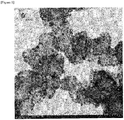
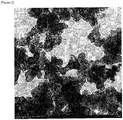
- FIGS. 1 and 2 A TEM image of the carrier-nanoparticle complex prepared according to Example 1 is illustrated in FIGS. 1 and 2 .
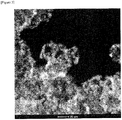
- FIG. 3 illustrates a high-angle annular dark-field (HADDF) image of the carrier-nanoparticle complex according to Example 1.
- HADDF high-angle annular dark-field
- nanoparticles of the carrier-nanoparticle complex according to Example 1 are core-shell nanoparticles which comprises a shell portion comprising Pt because Pt having a high atomic number in the HADDF is brightly exhibited as compared to Pd.
- component ratio of core-shell nanoparticles of the carrier-nanoparticle complex according to Example 1 Pt was 25.1 wt%, Pd was 14.43 wt%, and Co was 2.45 wt%.
- ICP apparatus For the analysis of the component ratio, an ICP apparatus was used.
- FIG. 6 illustrates the result of the energy dispersive spectroscopy (EDS) line scanning of the carrier-nanoparticle complex according to Example 1.
- EDS energy dispersive spectroscopy
- a carrier-nanoparticle complex was prepared in the same manner as in Example 1, except that the pH of the first solution was adjusted to 2.7.
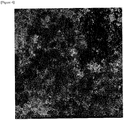
- FIG. 4 A TEM image of the carrier-nanoparticle complex prepared according to Reference Example 1 is illustrated in FIG. 4 .
- a carrier-nanoparticle complex was prepared in the same manner as in Example 1, except that the pH of the first solution was adjusted to 7.
- FIG. 5 A TEM image of the carrier-nanoparticle complex prepared according to Reference Example 2 is illustrated in FIG. 5 .
- the carrier-nanoparticle complex prepared according to Example 1 was applied to an electrode catalyst for a fuel cell air electrode.
- the evaluation of the fuel cell catalyst was carried out in a half cell system.
- a 3-electrode system that is, a reference electrode, a counter electrode, and a working electrode were used, the reference electrode was Ag/AgCl, and as an electrolyte, a 0.5 M sulfuric acid solution or a 0.1 M perchloric acid solution was used.
- scanning was performed 15 times to 20 times from -0.2 V to 1.0 V by using cyclic voltammetry, and the scan rate was 20 mV/s.
- a 0.1 M perchloric acid solution was bubbled with pure oxygen for 30 minutes, and then circulated from the negative direction to the positive direction from 0.9 V to 0.4 V based on a normal hydrogen electrode (NHE), the scan rate was 20 mV/s, and the electrode was rotated at a rotation speed of 1,600 to 2,500 RPM.
- NHE normal hydrogen electrode
- FIG. 7 illustrates the cyclic voltammetry (CV) of the carrier-nanoparticle complexes according to Example 1 and Comparative Example 1.
- the hydrogen adsorption and desorption (0 V to 0.4 V) and the oxidation and reduction peaks (0.6 V to 1.0 V) of Pt may be observed at the electrodes in a half cell, and the ECSA may be calculated by using the area of the hydrogen adsorption and desorption peak.
- FIG. 8 illustrates the linear sweep voltammetry (LSV) of the carrier-nanoparticle complexes according to Example 1 and Comparative Example 1. Specifically, FIG. 8 is for observing only the oxidation reduction reaction of the half cell, a shift to a high potential in the graph means that the reduction reaction occurs more easily, and it can be seen that the carrier-nanoparticle complex according to Example 1 exhibits a higher potential at the same current density than Commercially Available Catalyst 1, and thus exhibits excellent catalytic activity.
- LSV linear sweep voltammetry
- the oxygen reduction reaction (ORR) activity was measured by using 20 wt% and 46 wt% of Pt/C (carbon-supported Pt) commercially available catalysts as the catalyst and the carrier-nanoparticle complex prepared according to Example 1.
- the ORR activity results are as in the following Table 1. [Table 1] @0.8 V Example 1 (25% Pt) Commercially Available Catalyst 1 (20% Pt) Commercially Available Catalyst 2 (46% Pt) ECSA (m 2 /g Pt) 107.0 78.4 71.9 Mass Activity (A/g Pt) 40.8 21.7 16.25 Mass Activity (A/g metal) 24.6 21.7 16.25
- the activity per mass at 0.8 V of the carrier-nanoparticle complex according to Example 1 was nearly 2 times higher than those of the commercially available catalysts.
- the carrier-nanoparticle complex according to Example 1 produced a higher result than those of the commercially available catalysts.
- the electrochemically active surface area (ECSA) of the carrier-nanoparticle complex according to Example 1 is better by approximately 35% than those of the commercially available catalysts.
- the aforementioned results mean that a wider surface area per mass of Pt was formed than Pt particles, and thus the activity per mass of Pt was excellent because Pt formed a shell portion to have a thin thickness on the surface of the core portion.
- FIG. 9 is a result of measuring the performances of single cells comprising the carrier-nanoparticle complexes according to Example 1 and Comparative Example 1 as an electrode catalyst.
- the size of the membrane electrode assembly was 2.5 cm x 2.5 cm
- H 2 /Air was supplied under a 100% humidity condition
- the performance of the single cell was measured under an atmosphere of 80°C
- the sum of the masses of Pt and Pd per unit area of the carrier-nanoparticle complex according to Example 1 was 0.2 mg/cm 2 .
- the single cell comprising the carrier-nanoparticle complex according to Example 1 as an electrode catalyst exhibits a better performance than the single cell comprising the carrier-nanoparticle complex according to Comparative Example 1 as an electrode catalyst.
Landscapes
- Chemical & Material Sciences (AREA)
- Chemical Kinetics & Catalysis (AREA)
- Organic Chemistry (AREA)
- Engineering & Computer Science (AREA)
- Materials Engineering (AREA)
- General Chemical & Material Sciences (AREA)
- Electrochemistry (AREA)
- Dispersion Chemistry (AREA)
- Life Sciences & Earth Sciences (AREA)
- Manufacturing & Machinery (AREA)
- Sustainable Development (AREA)
- Sustainable Energy (AREA)
- Catalysts (AREA)
- Inert Electrodes (AREA)
- Crystallography & Structural Chemistry (AREA)
Abstract
Description
- The present specification claims priority to and the benefit of Korean Patent Application No.
10-2014-0152440 - The present specification relates to a carrier-nanoparticle complex, a method for preparing the same, and a catalyst comprising the same.
- Nanoparticles are particles having nanoscale particle sizes, and show optical, electrical and magnetic properties completely different from those of bulk materials due to a large specific surface area and the quantum confinement effect, in which energy required for electron transfer changes depending on the size of material. Accordingly, due to such properties, much interest has been concentrated on the applicability of nanoparticles in the catalyst, electromagnetic, optical, medical fields, and the like. Nanoparticles may be considered as intermediates between bulks and molecules, and may be synthesized in terms of two approaches, that is, the "top-down" approach and the "bottom-up" approach.
- Examples of a method for synthesizing a metal nanoparticle comprise a method for reducing metal ions in a solution by using a reducing agent, a method for using gamma-rays, an electrochemical method, and the like, but in the existing methods, it is difficult to synthesize nanoparticles having a uniform size and shape, or it is difficult to economically mass-produce high-quality nanoparticles for various reasons such as problems of environmental contamination, high costs, and the like by using organic solvents.
- Meanwhile, [Nano Lett., 2011, 11(3), pp 919-926] describes a method for preparing a core-shell particle comprising gold (Au) as a core and platinum (Pt) as a shell, but only discloses a method for preparing a core-shell particle by using platinum (Pt)-acetylacetonate (Pt-(acac)2), which is an organic metal compound, and an organic solvent, and does not describe a method for preparing a core-shell particle, which may solve environmental pollution and high cost problems.
- The present specification has been made in an effort to provide a carrier-nanoparticle complex capable of overcoming the problems, a method for preparing the same, and a catalyst comprising the same.
- An exemplary embodiment of the present specification provides a method for preparing a carrier-nanoparticle complex in which core-shell nanoparticles are supported on a carrier, the method comprising: forming a first solution comprising an aqueous solvent, a precursor of a first metal, a precursor of a second metal, and a carrier; forming a core portion comprising the first metal and the second metal by adding a first reducing agent to the first solution; adjusting a pH of the first solution to 8 or more between the forming of the first solution and the forming of the core portion; forming a second solution by adding a Pt precursor to the first solution after the forming of the core portion; forming a shell portion comprising Pt on at least a portion of a surface of the core portion by adding a second reducing agent to the second solution; and adjusting a pH of the second solution to 8 or more between the forming of the second solution and the forming of the shell portion.
- An exemplary embodiment of the present specification provides a carrier-nanoparticle complex prepared by using the preparation method.
- An exemplary embodiment of the present specification provides a carrier-nanoparticle complex comprising: core-shell nanoparticles which comprises a core portion comprising two different transition metals and a shell portion comprising Pt formed on at least a portion of a surface of the core portion; and a carrier on which the core-shell nanoparticles are supported, in which at least a portion of a surface of the carrier is coated with a polymer electrolyte which comprises one or more functional groups comprising nitrogen, and the at least one core-shell nanoparticle is bonded to a nitrogen atom of the surface of the carrier.
- An exemplary embodiment of the present specification provides a catalyst comprising the carrier-nanoparticle complex.
- A method for preparing a carrier-nanoparticle complex according to an exemplary embodiment of the present specification does not use an organic solvent which is highly likely to cause environmental pollutions, but uses an aqueous solvent, and thus has an advantage in that there is little environmental pollution.
- The method for preparing a carrier-nanoparticle complex according to an exemplary embodiment of the present specification is carried out under a low temperature atmosphere of 100°C or less, and thus has an advantage in that the carrier-nanoparticle complex may be prepared in large amounts at a low cost.
- The method for preparing a carrier-nanoparticle complex according to an exemplary embodiment of the present specification does not use a surfactant, and thus has an advantage in that hazardous materials are generated in small amounts in the preparation process, and the carrier-nanoparticle complex may be easily formed at a low cost.
- A carrier-nanoparticle complex according to an exemplary embodiment of the present specification may implement high catalytic activity because core-shell nanoparticles with a uniform size are uniformly supported on a carrier.
-
-
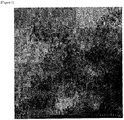
FIGS. 1 and2 each illustrate a transmission electron microscope (TEM) image of the carrier-nanoparticle complex prepared according to Example 1. -
FIG. 3 illustrates a high-angle annular dark-field (HADDF) image of the carrier-nanoparticle complex according to Example 1. -
FIG. 4 illustrates a transmission electron microscope (TEM) image of the carrier-nanoparticle complex prepared according to Reference Example 1. -
FIG. 5 illustrates a transmission electron microscope (TEM) image of the carrier-nanoparticle complex prepared according to Reference Example 2. -
FIG. 6 illustrates the result of the energy dispersive spectroscopy (EDS) line scanning of the carrier-nanoparticle complex according to Example 1. -
FIG. 7 illustrates the cyclic voltammetry (CV) of the carrier-nanoparticle complexes according to Example 1 and Comparative Example 1. -
FIG. 8 illustrates the linear sweep voltammetry (LSV) of the carrier-nanoparticle complexes according to Example 1 and Comparative Example 1. -
FIG. 9 is a result of measuring the performances of single cells comprising the carrier-nanoparticle complexes according to Example 1 and Comparative Example 1. - Hereinafter, the present specification will be described in more detail.
- When one part "comprises" one constituent element in the present specification, unless otherwise specifically described, this does not mean that another constituent element is excluded, but means that another constituent element may be further comprised.
- An exemplary embodiment of the present specification provides a method for preparing a carrier-nanoparticle complex in which core-shell nanoparticles are supported on a carrier, the method comprising: forming a first solution comprising an aqueous solvent, a precursor of a first metal, a precursor of a second metal, and a carrier; forming a core portion comprising the first metal and the second metal by adding a first reducing agent to the first solution; adjusting a pH of the first solution to 8 or more between the forming of the first solution and the forming of the core portion; forming a second solution by adding a Pt precursor to the first solution after the forming of the core portion; forming a shell portion comprising Pt on at least a portion of a surface of the core portion by adding a second reducing agent to the second solution; and adjusting a pH of the second solution to 8 or more between the forming of the second solution and the forming of the shell portion.
- According to an exemplary embodiment of the present specification, the core-shell nanoparticle may comprise a shell portion comprising Pt on at least a portion of a surface of a core portion comprising two metals. Specifically, according to an exemplary embodiment of the present specification, the core-shell nanoparticle may comprise a shell portion comprising Pt on the entire surface of a core portion comprising two metals.
- A precursor in the present specification means a salt comprising metal ion. The precursor may be dissociated in a solvent to provide metal ions, and the metal ion is reduced by a reducing agent, and thus may become a metal constituting the core-shell nanoparticle.
- An exemplary embodiment of the present specification may further comprise adjusting a pH of the first solution to 8 or more between the forming of the first solution and the forming of the core portion. Specifically, the adjusting of the pH of the first solution to 8 or more may be adjusting the pH to 8 or more and 13 or less. More specifically, the adjusting of the pH of the first solution to 8 or more may be adjusting the pH to 10.
- When the pH of the first solution is adjusted to the aforementioned range, there is an advantage in that the dispersibility of the core portion to be synthesized is excellent.
- An exemplary embodiment of the present specification may further comprise adjusting a pH of the second solution to 8 or more between the forming of the second solution and the forming of the shell portion. Specifically, the adjusting of the pH of the second solution to 8 or more may be adjusting the pH to 8 or more and 13 or less. More specifically, the adjusting of the pH of the second solution to 8 or more may be adjusting the pH to 10.
- When the pH of the second solution is adjusted to the aforementioned range, the surface of the core portion is negatively charged, and as a result, the shell portion is easily formed because the Pt precursor is easily positioned on the surface of the core portion.
- According to an exemplary embodiment of the present specification, in the process of adjusting the pH, the pH may be adjusted by adding a base solution. Specifically, the pH may be adjusted by adding a base solution selected from the group consisting of sodium hydroxide (NaOH), barium hydroxide (Ba(OH)2), potassium hydroxide (KOH), calcium hydroxide (Ca(OH)2), and lithium hydroxide (LiOH).
- According to an exemplary embodiment of the present specification, the precursor of the first metal and the precursor of the second metal may be different transition metal precursors, and at least one thereof may be a Pd precursor.
- According to an exemplary embodiment of the present specification, the precursor of the first metal may be a Pd precursor, and the precursor of the second metal may be a precursor of Co, Ni, Fe, or Cu.
- According to an exemplary embodiment of the present specification, the precursor of the first metal, the precursor of the second metal, and the Pt precursor may be an aqueous metal salt.
- Specifically, according to an exemplary embodiment of the present specification, the precursor of the first metal, the precursor of the second metal, and the Pt precursor may be ionized in an aqueous solvent.
- The preparation method according to an exemplary embodiment of the present specification prepares the carrier-nanoparticle complex by using an aqueous solvent and an aqueous metal salt, and thus has an advantage in that a reducing or thermally decomposing process at high temperature is not needed. Specifically, when nanoparticles are prepared by using a carbonyl-based metal precursor or an acetylacetonate-based metal precursor in an organic solvent, there is a problem in that a reducing process or a thermally decomposing process under a high temperature atmosphere exceeding 100°C is needed.
- Further, the preparation method according to an exemplary embodiment of the present specification uses an aqueous metal salt which is relatively inexpensive and less hazardous, and thus may reduce management costs generated in the preparing process.
- According to an exemplary embodiment of the present specification, the first metal may be Pd, and the second metal may be ruthenium (Ru), molybdenum (Mo), vanadium (V), tungsten (W), cobalt (Co), iron (Fe), selenium (Se), nickel (Ni), bismuth (Bi), tin (Sn), chromium (Cr), titanium (Ti), gold (Au), cerium (Ce), silver (Ag) or copper (Cu).
- According to an exemplary embodiment of the present specification, the precursor of the first metal may be a nitrate (NO3 -), a halide, a hydroxide (OH-) or a sulfate (SO4 -) of the first metal, and the precursor of the second metal may be a nitrate (NO3 -), a halide, a hydroxide (OH-) or a sulfate (SO4 -) of the second metal.
- According to an exemplary embodiment of the present specification, the halide may be chloride (Cl-), bromide (Br-), or iodide (I-).
- According to an exemplary embodiment of the present specification, the Pt precursor may be represented by the following Chemical Formula 1.
[Chemical Formula 1] PtAmBn
- In Chemical Formula 1,
- A is (NH3), (CH3NH2), or (H2O),
- B is a monovalent anion,
- m is 2, 4, or 6, and
- n is an integer of any one of 1 to 7.
- According to an exemplary embodiment of the present specification, B may be NO3 -, NO2 -, OH-, F-, Cl-, Br-, or I-.
- According to an exemplary embodiment of the present specification, the Pt precursor may be Pt(NH3)4(NO3)2, Pt(NH3)4Cl2, Pt(CH3NH2)4(NO3)2, Pt(CH3NH2)4Cl2, Pt(H2O)4(NO3)2, or Pt(H2O)4Cl2.
- The preparation method according to an exemplary embodiment of the present specification has an advantage in that a process of supporting nanoparticles on a carrier is not separately needed. Specifically, a separate supporting process is not needed because the first solution comprises the precursor of the first metal, the precursor of the second metal, and the carrier, and thus a carrier-nanoparticle complex is prepared by a one-pot process. When a carrier-nanoparticle complex is prepared while together comprising a carrier during the process of forming nanoparticles as described above, there is an advantage in that the adhesion between the carrier and the nanoparticles and the dispersibility are excellent.
- When the adhesion between the carrier and the nanoparticles is excellent, there is an advantage in that the durability may be improved because the interaction between the nanoparticles and the carrier is improved. Furthermore, when the dispersibility of nanoparticles is excellent on the carrier, there is an effect in that the reactivity is improved because the number of active points which may participate in reactions is increased.
- According to an exemplary embodiment of the present specification, the carrier may be a carbon-based carrier.
- Specifically, according to an exemplary embodiment of the present specification, the carbon-based carrier may comprise one or more selected from the group consisting of carbon black, carbon nanotube (CNT), graphite, graphene, activated carbon, mesoporous carbon, carbon fiber, and carbon nano wire.
- According to an exemplary embodiment of the present specification, at least a portion of a surface of the carrier may be coated with a polymer electrolyte comprising one or more functional groups which comprise nitrogen.
- According to an exemplary embodiment of the present specification, the functional group comprising nitrogen may be an amine group or an imine group.
- According to an exemplary embodiment of the present specification, the polymer electrolyte may be a polymer electrolyte in which at least one amine group or imine group is substituted at a straight-chained or branch-chained hydrocarbon chain.
- According to an exemplary embodiment of the present specification, at least one core-shell nanoparticle may be bonded to the amine group of the polymer electrolyte to be supported onto the carbon-based carrier.
- The polymer electrolyte of the present specification may mean a polymer having electric charges. Specifically, the polymer electrolyte may be a synthetic polymer or ion exchange resin having electric charges, and the like.
- According to the carrier-nanoparticle complex according to an exemplary embodiment of the present specification, it is possible to induce bonding of an amine group to the core-shell nanoparticle by coating a region of the surface of the carrier with a polymer electrolyte comprising the amine group. Accordingly, the aggregation phenomenon of the core-shell nanoparticles may be alleviated to enhance the dispersibility of the core-shell nanoparticles.
- According to an exemplary embodiment of the present specification, the polymer electrolyte may comprise a polyallylamine hydrochloride (PAH)-based material or a polyethylene imine (PEI)-based material.
- According to an exemplary embodiment of the present specification, the forming of the core portion may be carried out at a temperature of 0°C or more and 100°C or less. Specifically, the forming of the core portion may be carried out at a temperature of 50°C or more and 75°C or less.
- According to an exemplary embodiment of the present specification, the forming of the shell portion may be carried out at room temperature.
- The room temperature means a temperature in a range of 4°C to 35°C, more specifically 15°C to 28°C.
- The preparation method according to an exemplary embodiment of the present specification is carried out under a low temperature condition of 100°C or less, and thus has an advantage in that high costs are not needed in order to meet the process conditions.
- According to an exemplary embodiment of the present specification, the aqueous solvent may comprise water. Specifically, according to an exemplary embodiment of the present specification, the aqueous solvent may be water or a mixture of water and a C1 to C6 alcohol, and may be more specifically water.
- According to an exemplary embodiment of the present specification, the preparation method may not use a surfactant.
- The preparation method uses water and does not use a surfactant, and thus has an effect of reducing costs, and accordingly, the preparation method is also advantageous in being favorable for mass production, and is advantageous in terms of an eco-friendly process. When a surfactant is used, the surfactant surrounds the surface of the particle, so that a post-process of removing the surfactant is needed because there is a problem in that the reactants are not easily accessed when the surfactant is used in a catalyst reaction. Accordingly, when the surfactant is not used, the preparation method has an effect of reducing costs, and is also favorable for mass production because the process is simplified.
- According to an exemplary embodiment of the present specification, the first solution may further comprise a stabilizer.
- According to an exemplary embodiment of the present specification, the stabilizer may comprise one or two or more selected from the group consisting of disodium phosphate, dipotassium phosphate, disodium citrate, and trisodium citrate.
- According to an exemplary embodiment of the present specification, the first reducing agent and the second reducing agent are not particularly limited as long as the first reducing agent and the second reducing agent each have a reducing force capable of precipitating metal particles by reducing dissolved metal ions while being a strong reducing agent having a standard reduction potential of -0.23 V or less.
- According to an exemplary embodiment of the present specification, the first reducing agent and the second reducing agent may be at least one selected from the group consisting of NaBH4, NH2NH2, LiAlH4, and LiBEt3H.
- When a weak reducing agent is used, it is difficult to achieve a continuous process in that the reaction rate is slow, and a subsequent heating of a solution is required, and the like, so that there may be a problem with mass production. In particular, when ethylene glycol, which is a kind of weak reducing agent, is used, there is a problem in that the productivity in the continuous process is low due to a reduction in flow rate caused by high viscosity.
- According to an exemplary embodiment of the present specification, a molar ratio of the precursor of the first metal to the precursor of the second metal may be 1:1 to 1:3.
- According to an exemplary embodiment of the present specification, a mole number of the Pt precursor may be 0.5 times to 2 times a mole number of the precursor of the first metal.
- An exemplary embodiment of the present specification provides a carrier-nanoparticle complex prepared by the preparation method. Specifically, an exemplary embodiment of the present specification provides a carrier-nanoparticle complex prepared by the preparation method, the carrier-nanoparticle complex comprising: core-shell nanoparticles which comprises a core portion comprising two different transition metals and a shell portion comprising Pt formed on at least a portion of a surface of the core portion; and a carrier on which the core-shell nanoparticles are supported.
- In addition, an exemplary embodiment of the present specification provides a carrier-nanoparticle complex comprising: core-shell nanoparticles which comprises a core portion comprising two different transition metals and a shell portion comprising Pt formed on at least a portion of a surface of the core portion; and a carrier on which the core-shell nanoparticles are supported, in which at least a portion of a surface of the carrier is coated with a polymer electrolyte which comprises one or more functional groups comprising nitrogen, and at least one core-shell nanoparticle is bonded to a nitrogen atom of the surface of the carrier.
- According to an exemplary embodiment of the present specification, the polymer electrolyte may be a polymer electrolyte in which at least one amine group or imine group is substituted at a straight-chained or branch-chained hydrocarbon chain.
- According to an exemplary embodiment of the present specification, the polymer electrolyte may comprise a polyallylamine hydrochloride (PAH)-based material or a polyethylene imine (PEI)-based material.
- According to an exemplary embodiment of the present specification, the at least one core-shell nanoparticle may be bonded to a nitrogen atom of the polymer electrolyte to be bonded to the carrier.
- According to an exemplary embodiment of the present specification, as a result of an energy dispersive spectroscopy (EDS) line scanning of the carrier-nanoparticle complex, a position of Pt of the core-shell nanoparticle may be overlapped with a position of N of the polymer electrolyte.
FIG. 6 illustrates the result of the energy dispersive spectroscopy (EDS) line scanning according to Example 1 of the present specification, and illustrates that the positions of Pt of the core-shell nanoparticle and N of the polymer electrolyte are overlapped with each other. Specifically, each N comprised in the polymer electrolyte may be bonded to each core-shell nanoparticle to uniformly disperse core-shell nanoparticles on the carrier. - According to the carrier-nanoparticle complex according to an exemplary embodiment of the present specification, N of the polymer electrolyte coated onto the carrier is bonded to the core-shell nanoparticle, and as a result, the core-shell nanoparticles may be supported onto the carrier with high dispersity, and a high bonding force between the core-shell nanoparticles and the carrier may be exhibited.
- According to an exemplary embodiment of the present specification, the core-shell nanoparticles may have a particle diameter of 1 nm or more and 10 nm or less. Specifically, according to an exemplary embodiment of the present specification, the core-shell nanoparticles may have a particle diameter of 3 nm or more and 6 nm or less. According to an exemplary embodiment of the present specification, the content of the core-shell nanoparticles may be 20 wt% or more and 50 wt% or less based on the carrier-nanoparticle complex.
- In the carrier-nanoparticle complex according to an exemplary embodiment of the present specification, the carrier and the nanoparticles are the same as those described above.
- An exemplary embodiment of the present specification provides a catalyst comprising the carrier-nanoparticle complex.
- The carrier-nanoparticle complex according to an exemplary embodiment of the present specification may be used while replacing existing nanoparticles in the field in which nanoparticles may be generally used.
- The carrier-nanoparticle complex according to an exemplary embodiment of the present specification has a much smaller size and a wider specific surface area than the nanoparticles in the related art, and thus may exhibit better activity than the nanoparticles in the related art. Specifically, the carrier-nanoparticle complex according to an exemplary embodiment of the present specification may be used in the catalyst field.
- Hereinafter, the present specification will be described in detail with reference to Examples for specifically describing the present specification. However, the Examples according to the present specification may be modified in various forms, and it is not interpreted that the scope of the present specification is limited to the Examples described below in detail. The Examples of the present specification are provided for more completely explaining the present specification to the person with ordinary skill in the art.
- A first solution was prepared by adding 0.03 mmol of K2PdCl4 as a precursor of a first metal, 0.09 mmol of CoCl2 as a precursor of a second metal, 0.45 mmol of trisodium citrate, and 10 mg of carbon treated with polyallylamine hydrochloride (PAH) to 20 ml of distilled water. The pH of the first solution was adjusted to 10, and the first solution was stirred for a predetermined time. And then, the first solution was warmed up to 70°C, and then NaBH4 being a reducing agent was added to the solution to form a core portion comprising Pd and Co. After being stirred for 2 hours, the solution was cooled to room temperature, and 0.03 mmol of Pt(NH3)4(NO3)2 as a Pt precursor was added to the first solution to prepare a second solution, the pH of the second solution was adjusted to 10, and then the second solution was stirred for a predetermined time. Thereafter, NaBH4 being a reducing agent was added to the second solution in a room temperature state to form a shell portion comprising Pt, and then the shell portion was washed with distilled water and dried to prepare a carrier-nanoparticle complex.
- A TEM image of the carrier-nanoparticle complex prepared according to Example 1 is illustrated in
FIGS. 1 and2 . - According to
FIGS. 1 and2 , it can be confirmed that in the carrier-nanoparticle complex prepared according to Example 1, core-shell nanoparticles having a particle diameter of 3 nm to 6 nm are uniformly distributed on a carrier. - Further,
FIG. 3 illustrates a high-angle annular dark-field (HADDF) image of the carrier-nanoparticle complex according to Example 1. - According to
FIG. 3 , it can be confirmed that nanoparticles of the carrier-nanoparticle complex according to Example 1 are core-shell nanoparticles which comprises a shell portion comprising Pt because Pt having a high atomic number in the HADDF is brightly exhibited as compared to Pd. - Further, as the component ratio of core-shell nanoparticles of the carrier-nanoparticle complex according to Example 1, Pt was 25.1 wt%, Pd was 14.43 wt%, and Co was 2.45 wt%. For the analysis of the component ratio, an ICP apparatus was used.
-
FIG. 6 illustrates the result of the energy dispersive spectroscopy (EDS) line scanning of the carrier-nanoparticle complex according to Example 1. InFIG. 6 , it can be seen that when the distribution of elements in a region of nanoparticles supported onto a carrier is reviewed, N is together provided. From the result, it is analyzed that N of PAH coated onto the carrier is bonded to each of the nanoparticle, and as a result, nanoparticles are uniformly dispersed on the carrier. Furthermore, there may also occur an effect in that the bonding force between the nanoparticles and the carrier becomes stronger due to the bonding of N to the nanoparticles. - A carrier-nanoparticle complex was prepared in the same manner as in Example 1, except that the pH of the first solution was adjusted to 2.7.
- A TEM image of the carrier-nanoparticle complex prepared according to Reference Example 1 is illustrated in
FIG. 4 . - According to
FIG. 4 , it can be confirmed that when the pH is adjusted to acidic at the time of forming a core portion, core portions positioned at the carrier are aggregated and formed. - A carrier-nanoparticle complex was prepared in the same manner as in Example 1, except that the pH of the first solution was adjusted to 7.
- A TEM image of the carrier-nanoparticle complex prepared according to Reference Example 2 is illustrated in
FIG. 5 . - According to
FIG. 5 , it can be observed that a better dispersibility is exhibited than in Reference Example 1, but the nanoparticles are partially aggregated. - Therefore, it can be seen that a higher dispersibility is exhibited when performing a treatment under a base condition, instead of an acid or neutral condition, at the time of forming a core portion.
- The carrier-nanoparticle complex prepared according to Example 1 was applied to an electrode catalyst for a fuel cell air electrode. The evaluation of the fuel cell catalyst was carried out in a half cell system. As an electrode, a 3-electrode system, that is, a reference electrode, a counter electrode, and a working electrode were used, the reference electrode was Ag/AgCl, and as an electrolyte, a 0.5 M sulfuric acid solution or a 0.1 M perchloric acid solution was used.
- In order to clean a surface of the catalyst, scanning was performed 15 times to 20 times from -0.2 V to 1.0 V by using cyclic voltammetry, and the scan rate was 20 mV/s.
- 2 mg of a catalyst, 8 µl of 5% Nafion, 1.6 ml of EtOH, and 0.4 ml of H2O were mixed, and the resulting mixture was dispersed for 1 hour by using an ultrasonic cleaner to prepare a catalyst ink, and then 20 µl of the catalyst ink was coated onto a RDE electrode and dried. The amount of catalyst coated onto the electrode was about 20 µg. The area of the electrode was 0.196 cm2.
- A 0.1 M perchloric acid solution was bubbled with pure oxygen for 30 minutes, and then circulated from the negative direction to the positive direction from 0.9 V to 0.4 V based on a normal hydrogen electrode (NHE), the scan rate was 20 mV/s, and the electrode was rotated at a rotation speed of 1,600 to 2,500 RPM.
-
FIG. 7 illustrates the cyclic voltammetry (CV) of the carrier-nanoparticle complexes according to Example 1 and Comparative Example 1. Specifically, inFIG. 7 , the hydrogen adsorption and desorption (0 V to 0.4 V) and the oxidation and reduction peaks (0.6 V to 1.0 V) of Pt may be observed at the electrodes in a half cell, and the ECSA may be calculated by using the area of the hydrogen adsorption and desorption peak. -
FIG. 8 illustrates the linear sweep voltammetry (LSV) of the carrier-nanoparticle complexes according to Example 1 and Comparative Example 1. Specifically,FIG. 8 is for observing only the oxidation reduction reaction of the half cell, a shift to a high potential in the graph means that the reduction reaction occurs more easily, and it can be seen that the carrier-nanoparticle complex according to Example 1 exhibits a higher potential at the same current density than CommerciallyAvailable Catalyst 1, and thus exhibits excellent catalytic activity. - The oxygen reduction reaction (ORR) activity was measured by using 20 wt% and 46 wt% of Pt/C (carbon-supported Pt) commercially available catalysts as the catalyst and the carrier-nanoparticle complex prepared according to Example 1. The ORR activity results are as in the following Table 1.
[Table 1] @0.8 V Example 1 (25% Pt) Commercially Available Catalyst 1 (20% Pt) Commercially Available Catalyst 2 (46% Pt) ECSA (m2/g Pt) 107.0 78.4 71.9 Mass Activity (A/g Pt) 40.8 21.7 16.25 Mass Activity (A/g metal) 24.6 21.7 16.25 - According to Table 1, based on the content of Pt, the activity per mass at 0.8 V of the carrier-nanoparticle complex according to Example 1 was nearly 2 times higher than those of the commercially available catalysts. In addition, based on the content of all the metals, the carrier-nanoparticle complex according to Example 1 produced a higher result than those of the commercially available catalysts.
- Furthermore, it can be confirmed that based on the content of Pt, the electrochemically active surface area (ECSA) of the carrier-nanoparticle complex according to Example 1 is better by approximately 35% than those of the commercially available catalysts. The aforementioned results mean that a wider surface area per mass of Pt was formed than Pt particles, and thus the activity per mass of Pt was excellent because Pt formed a shell portion to have a thin thickness on the surface of the core portion.
-
FIG. 9 is a result of measuring the performances of single cells comprising the carrier-nanoparticle complexes according to Example 1 and Comparative Example 1 as an electrode catalyst. In this case, the size of the membrane electrode assembly was 2.5 cm x 2.5 cm, H2/Air was supplied under a 100% humidity condition, the performance of the single cell was measured under an atmosphere of 80°C, and the sum of the masses of Pt and Pd per unit area of the carrier-nanoparticle complex according to Example 1 was 0.2 mg/cm2. - As can be seen from the result of
FIG. 9 , it can be confirmed that the single cell comprising the carrier-nanoparticle complex according to Example 1 as an electrode catalyst exhibits a better performance than the single cell comprising the carrier-nanoparticle complex according to Comparative Example 1 as an electrode catalyst.
Claims (24)
- A method for preparing a carrier-nanoparticle complex in which core-shell nanoparticles are supported on a carrier, the method comprising:forming a first solution comprising an aqueous solvent, a precursor of a first metal, a precursor of a second metal, and the carrier;forming a core portion comprising the first metal and the second metal by adding a first reducing agent to the first solution;adjusting a pH of the first solution to 8 or more between the forming of the first solution and the forming of the core portion;forming a second solution by adding a Pt precursor to the first solution after the forming of the core portion;forming a shell portion comprising Pt on at least a portion of a surface of the core portion by adding a second reducing agent to the second solution; andadjusting a pH of the second solution to 8 or more between the forming of the second solution and the forming of the shell portion.
- The method of claim 1, wherein the precursor of the first metal and the precursor of the second metal are different transition metal precursors, and at least one of the precursor of the first metal and the precursor of the second metal is a Pd precursor.
- The method of claim 1, wherein the precursor of the first metal, the precursor of the second metal, and the Pt precursor are an aqueous metal salt.
- The method of claim 1, wherein the first metal is Pd, and
the second metal is ruthenium (Ru), molybdenum (Mo), vanadium (V), tungsten (W), cobalt (Co), iron (Fe), selenium (Se), nickel (Ni), bismuth (Bi), tin (Sn), chromium (Cr), titanium (Ti), gold (Au), cerium (Ce), silver (Ag) or copper (Cu). - The method of claim 1, wherein the precursor of the first metal is a nitrate (NO3 -), a halide, a hydroxide (OH-) or a sulfate (SO4 -) of the first metal, and
the precursor of the second metal is a nitrate (NO3 -), a halide, a hydroxide (OH-) or a sulfate (SO4 -) of the second metal. - The method of claim 1, wherein the Pt precursor is represented by the following Chemical Formula 1:
[Chemical Formula 1] PtAmBn
in Chemical Formula 1,A is (NH3), (CH3NH2), or (H2O),B is a monovalent anion,m is 2, 4, or 6, andn is an integer of any one of 1 to 7. - The method of claim 6, wherein B is NO3 -, NO2-, OH-, F-, Cl-, Br-, or I-.
- The method of claim 1, wherein the carrier is a carbon-based carrier.
- The method of claim 1, wherein at least a portion of a surface of the carrier is coated with a polymer electrolyte which comprises one or more functional groups comprising nitrogen.
- The method of claim 9, wherein the polymer electrolyte comprises a polyallylamine hydrochloride (PAH)-based material or a polyethylene imine (PEI)-based material.
- The method of claim 1, wherein the forming of the core portion is carried out at a temperature of 0°C or more and 100°C or less.
- The method of claim 1, wherein the forming of the shell portion is carried out at room temperature.
- The method of claim 1, wherein the aqueous solvent comprises water.
- The method of claim 1, wherein the first solution further comprises a stabilizer.
- The method of claim 1, wherein a molar ratio of the precursor of the first metal to the precursor of the second metal is 1:1 to 1:3.
- The method of claim 1, wherein a mole number of the Pt precursor is 0.5 times to 2 times a mole number of the precursor of the first metal.
- A carrier-nanoparticle complex prepared by using the preparation method of any one of claims 1 to 16.
- A carrier-nanoparticle complex comprising:core-shell nanoparticles which comprises a core portion comprising two different transition metals and a shell portion comprising Pt formed on at least a portion of a surface of the core portion; anda carrier on which the core-shell nanoparticles are supported,wherein at least a portion of a surface of the carrier is coated with a polymer electrolyte which comprises one or more functional groups comprising nitrogen, andthe at least one core-shell nanoparticle is bonded to a nitrogen atom of the surface of the carrier.
- The carrier-nanoparticle complex of claim 18, wherein the polymer electrolyte comprises a polyallylamine hydrochloride (PAH)-based material or a polyethylene imine (PEI)-based material.
- The carrier-nanoparticle complex of claim 18, wherein as a result of an EDS line scanning of the carrier-nanoparticle complex, a position of Pt of the core-shell nanoparticle is overlapped with a position of N of the polymer electrolyte.
- The carrier-nanoparticle complex of claim 18, wherein the core-shell nanoparticles have a particle diameter of 1 nm or more and 10 nm or less.
- The carrier-nanoparticle complex of claim 18, wherein a content of the core-shell nanoparticles is 20 wt% or more and 50 wt% or less based on the carrier-nanoparticle complex.
- The carrier-nanoparticle complex of claim 18, wherein the carrier is a carbon-based carrier.
- A catalyst comprising the carrier-nanoparticle complex of any one of claims 18 to 23.
Applications Claiming Priority (2)
| Application Number | Priority Date | Filing Date | Title |
|---|---|---|---|
| KR20140152440 | 2014-11-04 | ||
| PCT/KR2015/011814 WO2016072755A1 (en) | 2014-11-04 | 2015-11-04 | Carrier-nanoparticle complex, method for preparing same, and catalyst comprising same |
Publications (3)
| Publication Number | Publication Date |
|---|---|
| EP3216521A1 true EP3216521A1 (en) | 2017-09-13 |
| EP3216521A4 EP3216521A4 (en) | 2018-07-04 |
| EP3216521B1 EP3216521B1 (en) | 2020-12-30 |
Family
ID=55909404
Family Applications (1)
| Application Number | Title | Priority Date | Filing Date |
|---|---|---|---|
| EP15856491.4A Active EP3216521B1 (en) | 2014-11-04 | 2015-11-04 | A method for preparing a carrier-nanoparticle complex |
Country Status (6)
| Country | Link |
|---|---|
| US (1) | US10537880B2 (en) |
| EP (1) | EP3216521B1 (en) |
| JP (1) | JP6429135B2 (en) |
| KR (1) | KR101807919B1 (en) |
| CN (1) | CN107073458A (en) |
| WO (1) | WO2016072755A1 (en) |
Cited By (2)
| Publication number | Priority date | Publication date | Assignee | Title |
|---|---|---|---|---|
| EP3363543A4 (en) * | 2016-11-21 | 2018-10-24 | LG Chem, Ltd. | Catalyst and preparation method therefor |
| EP3379626A4 (en) * | 2016-02-02 | 2018-11-07 | LG Chem, Ltd. | Carrier-nanoparticle composite, catalyst containing same, and method for producing same |
Families Citing this family (8)
| Publication number | Priority date | Publication date | Assignee | Title |
|---|---|---|---|---|
| TWI698326B (en) | 2015-01-14 | 2020-07-11 | 德商科思創德意志股份有限公司 | Process for producing an optical casting with a holographic optical element and optical casting |
| CN108722469B (en) | 2017-04-22 | 2021-11-05 | 天津大学 | Supported high-selectivity core-shell bimetallic catalyst and preparation method and application thereof |
| KR102176879B1 (en) * | 2017-09-14 | 2020-11-10 | 주식회사 엘지화학 | Catalyst and method for fabricating the same |
| KR102121114B1 (en) * | 2017-09-19 | 2020-06-11 | 주식회사 엘지화학 | Carrior-nano particles complex, catalyst comprising the same, electrochemisty cell comprising the same and manufacturing method threof |
| KR102132516B1 (en) * | 2017-09-27 | 2020-07-09 | 주식회사 엘지화학 | Carrier-nano particles complex, catalyst comprising the same and method for fabricating the same |
| KR102141398B1 (en) * | 2018-08-24 | 2020-08-05 | 한국과학기술연구원 | Preparation method of carbon-supported platinum-transition metal alloy core-shell nanoparticle catalyst |
| JP2022045885A (en) * | 2020-09-09 | 2022-03-22 | 国立大学法人東京工業大学 | Nanoparticle coupling catalyst and its manufacturing method, catalyst layer for electrodes, membrane electrode assembly, fuel cell and water electrolyzer |
| KR20220103288A (en) * | 2021-01-15 | 2022-07-22 | 현대자동차주식회사 | Intermetallic catalyst and method for preparing the same |
Family Cites Families (18)
| Publication number | Priority date | Publication date | Assignee | Title |
|---|---|---|---|---|
| KR100506091B1 (en) * | 2003-02-19 | 2005-08-04 | 삼성에스디아이 주식회사 | Catalyst for cathode of fuel cell |
| KR100953545B1 (en) * | 2004-03-23 | 2010-04-21 | 삼성에스디아이 주식회사 | Supported catalyst and its manufacturing method |
| US7691780B2 (en) * | 2004-12-22 | 2010-04-06 | Brookhaven Science Associates, Llc | Platinum- and platinum alloy-coated palladium and palladium alloy particles and uses thereof |
| CN101522345B (en) | 2006-08-30 | 2012-08-29 | 尤米科尔股份公司及两合公司 | Core/shell-type catalyst particles comprising metal or ceramic core materials and methods for their preparation |
| CN101664685B (en) * | 2009-09-27 | 2012-05-02 | 西北师范大学 | Low-platinum high-activity core-shell structure catalyst and preparation method thereof |
| JP5672752B2 (en) * | 2010-04-07 | 2015-02-18 | トヨタ自動車株式会社 | Method for producing carbon-supported core-shell type catalyst fine particles, and method for producing catalyst ink using core-shell type catalyst fine particles obtained by the production method |
| JP5573438B2 (en) * | 2010-07-09 | 2014-08-20 | トヨタ自動車株式会社 | Method for producing core-shell type catalyst fine particles |
| KR101230527B1 (en) * | 2010-11-30 | 2013-02-06 | 한국과학기술연구원 | Methods of preparation of electrocatalysts for fuel cells in core-shell structure and the electrocatalysts |
| US9472811B2 (en) * | 2011-02-15 | 2016-10-18 | GM Global Technology Operations LLC | Graphite particle-supported Pt-shell/Ni-core nanoparticle electrocatalyst for oxygen reduction reaction |
| KR101304219B1 (en) * | 2011-09-05 | 2013-09-06 | 한국과학기술연구원 | Core-shell structured electrocatalysts for fuel cells and the preparation method thereof |
| KR102007412B1 (en) * | 2011-09-27 | 2019-08-05 | 삼성에스디아이 주식회사 | Electrode catalyst for fuel cell, method for preparing the same, membrane electrode assembly and fuel cell including the same |
| CN102500365A (en) * | 2011-10-19 | 2012-06-20 | 华南理工大学 | Preparation method of catalyst with core-shell structure for low-temperature fuel cell |
| KR20130093264A (en) * | 2012-02-14 | 2013-08-22 | 주식회사 엘지화학 | Electrode catalyst for fuel cell, membrane electrode assembly, fuel cell and manyfacturing method of electrode catalyst for fuel cell |
| CN102664275B (en) * | 2012-04-23 | 2015-04-15 | 北京化工大学 | Carbon-loaded kernel-shell copper-palladium-platinum catalyst for fuel battery and preparation method thereof |
| WO2013168912A1 (en) * | 2012-05-11 | 2013-11-14 | 주식회사 엘지화학 | Method for preparing core-shell particle supported with carrier, and core-shell particle supported with carrier prepared thereby |
| CN103041823B (en) | 2012-12-07 | 2015-05-13 | 大连科诺催化有限公司 | Core-shell type ultralow palladium-platinum fuel-cell catalyst and preparation method |
| US9440224B2 (en) * | 2012-12-18 | 2016-09-13 | Umicore Ag & Co. Kg | Catalyst particles comprising hollow multilayered base metal-precious metal core/shell particles and method of their manufacture |
| US10537881B2 (en) * | 2013-12-18 | 2020-01-21 | King Abdullah University Of Science And Technology | Methods of making supported Ni/Pt bimetallic nanoparticles and Ni/Pt multilayer core-shell structures and their uses for CO2 reforming |
-
2015
- 2015-11-04 EP EP15856491.4A patent/EP3216521B1/en active Active
- 2015-11-04 WO PCT/KR2015/011814 patent/WO2016072755A1/en not_active Ceased
- 2015-11-04 KR KR1020150154715A patent/KR101807919B1/en active Active
- 2015-11-04 US US15/520,321 patent/US10537880B2/en active Active
- 2015-11-04 CN CN201580059429.0A patent/CN107073458A/en active Pending
- 2015-11-04 JP JP2017517251A patent/JP6429135B2/en active Active
Cited By (5)
| Publication number | Priority date | Publication date | Assignee | Title |
|---|---|---|---|---|
| EP3379626A4 (en) * | 2016-02-02 | 2018-11-07 | LG Chem, Ltd. | Carrier-nanoparticle composite, catalyst containing same, and method for producing same |
| US10541427B2 (en) | 2016-02-02 | 2020-01-21 | Lg Chem, Ltd. | Carrier-nanoparticle composite, catalyst containing same, and method for producing same |
| EP3363543A4 (en) * | 2016-11-21 | 2018-10-24 | LG Chem, Ltd. | Catalyst and preparation method therefor |
| US11121390B2 (en) | 2016-11-21 | 2021-09-14 | Lg Chem, Ltd. | Catalyst and method for preparing the same |
| US11677089B2 (en) | 2016-11-21 | 2023-06-13 | Lg Chem, Ltd. | Catalyst and method for preparing the same |
Also Published As
| Publication number | Publication date |
|---|---|
| US20170312739A1 (en) | 2017-11-02 |
| JP6429135B2 (en) | 2018-11-28 |
| KR20160052451A (en) | 2016-05-12 |
| KR101807919B1 (en) | 2017-12-12 |
| WO2016072755A1 (en) | 2016-05-12 |
| JP2017536973A (en) | 2017-12-14 |
| EP3216521A4 (en) | 2018-07-04 |
| US10537880B2 (en) | 2020-01-21 |
| CN107073458A (en) | 2017-08-18 |
| EP3216521B1 (en) | 2020-12-30 |
Similar Documents
| Publication | Publication Date | Title |
|---|---|---|
| EP3216521B1 (en) | A method for preparing a carrier-nanoparticle complex | |
| KR101443518B1 (en) | Method for fabricating core-shell particles supported on carrier and core-shell particles supported on carrier fabricated by the method | |
| Hu et al. | Synthesis of graphene-supported hollow Pt–Ni nanocatalysts for highly active electrocatalysis toward the methanol oxidation reaction | |
| Zhang et al. | A strategy in deep eutectic solvents for carbon nanotube-supported PtCo nanocatalysts with enhanced performance toward methanol electrooxidation | |
| Wang et al. | Size-dependent disorder–order transformation in the synthesis of monodisperse intermetallic PdCu nanocatalysts | |
| JP5920643B2 (en) | Method for producing core-shell particles | |
| Li et al. | Self-supported Pt nanoclusters via galvanic replacement from Cu 2 O nanocubes as efficient electrocatalysts | |
| Gu et al. | Shaped Pt-Ni nanocrystals with an ultrathin Pt-enriched shell derived from one-pot hydrothermal synthesis as active electrocatalysts for oxygen reduction | |
| Roy et al. | Size-controlled synthesis, characterization and electrocatalytic behaviors of polymer-protected nickel nanoparticles: a comparison with respect to two polymers | |
| Hong et al. | A new kind of highly active hollow flower-like NiPdPt nanoparticles supported by multiwalled-carbon nanotubes toward ethanol electrooxidation | |
| EP3355397B1 (en) | Carrier-nanoparticle complex, preparation method therefor, and membrane electrode assembly including same | |
| Yan et al. | Methanol electrooxidation on carbon supported Aucore–Ptshell nanoparticles synthesized by an epitaxial growth method | |
| Hu et al. | FeOOH nanospheres decorated bimetallic NiFe-MOF as efficient dual-functional catalyst towards superior electrocatalytic performance | |
| JP2017168385A (en) | Platinum catalyst, method for producing the same, and fuel cell using the platinum catalyst | |
| Ji et al. | Palladium litchi-like nanoclusters for remarkably elevating methanol electrocatalytic activity | |
| Cui et al. | Fabrication of Pd/Mn3O4/plait-like carbon nanocoils catalyst: A highly active catalyst for ethanol electro-oxidation in alkaline media | |
| Jin et al. | The enhanced electro-catalytic performance of Au@ Pd nanoparticles self-assembled on fluorine-modified multi-walled carbon nanotubes for methanol oxidation | |
| Ali et al. | Understanding the impact of Pd content on the electrocatalytic performance of Pd-NiFe LDH as an efficient cathode materials for alkaline hydrogen evolution reaction | |
| Kugai et al. | Effect of reduction enhancer on a radiolytic synthesis of carbon-supported Pt–Cu nanoparticles and their structural and electrochemical properties | |
| KR101522071B1 (en) | Method of fabricating bimetallic particles and bimetallic particles fabricated by the method | |
| JP7082342B2 (en) | Catalyst for air side electrode of fuel cell | |
| Asadpour‑Zeynali et al. | Cu2O/AlZn-LDH Preparation on FTO Electrode Substrate for Enhanced Water Oxidation | |
| Ammar Bin et al. | Engineering and understanding of synergistic effects in the interfaces of rGO-CNTs/PtPd nanocomposite revealed fast electro-oxidation of methanol |
Legal Events
| Date | Code | Title | Description |
|---|---|---|---|
| STAA | Information on the status of an ep patent application or granted ep patent |
Free format text: STATUS: THE INTERNATIONAL PUBLICATION HAS BEEN MADE |
|
| PUAI | Public reference made under article 153(3) epc to a published international application that has entered the european phase |
Free format text: ORIGINAL CODE: 0009012 |
|
| STAA | Information on the status of an ep patent application or granted ep patent |
Free format text: STATUS: REQUEST FOR EXAMINATION WAS MADE |
|
| 17P | Request for examination filed |
Effective date: 20170419 |
|
| AK | Designated contracting states |
Kind code of ref document: A1 Designated state(s): AL AT BE BG CH CY CZ DE DK EE ES FI FR GB GR HR HU IE IS IT LI LT LU LV MC MK MT NL NO PL PT RO RS SE SI SK SM TR |
|
| AX | Request for extension of the european patent |
Extension state: BA ME |
|
| DAV | Request for validation of the european patent (deleted) | ||
| DAX | Request for extension of the european patent (deleted) | ||
| A4 | Supplementary search report drawn up and despatched |
Effective date: 20180604 |
|
| RIC1 | Information provided on ipc code assigned before grant |
Ipc: B01J 27/24 20060101ALI20180525BHEP Ipc: B01J 37/12 20060101ALI20180525BHEP Ipc: B01J 23/42 20060101ALI20180525BHEP Ipc: H01M 8/00 20160101ALI20180525BHEP Ipc: B01J 27/20 20060101ALI20180525BHEP Ipc: B01J 23/38 20060101ALI20180525BHEP Ipc: B01J 23/44 20060101ALI20180525BHEP Ipc: H01M 4/86 20060101ALI20180525BHEP Ipc: B01J 35/00 20060101ALI20180525BHEP Ipc: B01J 13/02 20060101ALI20180525BHEP Ipc: B01J 37/02 20060101AFI20180525BHEP |
|
| STAA | Information on the status of an ep patent application or granted ep patent |
Free format text: STATUS: EXAMINATION IS IN PROGRESS |
|
| 17Q | First examination report despatched |
Effective date: 20200602 |
|
| GRAP | Despatch of communication of intention to grant a patent |
Free format text: ORIGINAL CODE: EPIDOSNIGR1 |
|
| STAA | Information on the status of an ep patent application or granted ep patent |
Free format text: STATUS: GRANT OF PATENT IS INTENDED |
|
| INTG | Intention to grant announced |
Effective date: 20200911 |
|
| GRAS | Grant fee paid |
Free format text: ORIGINAL CODE: EPIDOSNIGR3 |
|
| GRAA | (expected) grant |
Free format text: ORIGINAL CODE: 0009210 |
|
| STAA | Information on the status of an ep patent application or granted ep patent |
Free format text: STATUS: THE PATENT HAS BEEN GRANTED |
|
| AK | Designated contracting states |
Kind code of ref document: B1 Designated state(s): AL AT BE BG CH CY CZ DE DK EE ES FI FR GB GR HR HU IE IS IT LI LT LU LV MC MK MT NL NO PL PT RO RS SE SI SK SM TR |
|
| REG | Reference to a national code |
Ref country code: GB Ref legal event code: FG4D |
|
| REG | Reference to a national code |
Ref country code: AT Ref legal event code: REF Ref document number: 1349395 Country of ref document: AT Kind code of ref document: T Effective date: 20210115 |
|
| REG | Reference to a national code |
Ref country code: DE Ref legal event code: R096 Ref document number: 602015064257 Country of ref document: DE |
|
| REG | Reference to a national code |
Ref country code: IE Ref legal event code: FG4D |
|
| PG25 | Lapsed in a contracting state [announced via postgrant information from national office to epo] |
Ref country code: GR Free format text: LAPSE BECAUSE OF FAILURE TO SUBMIT A TRANSLATION OF THE DESCRIPTION OR TO PAY THE FEE WITHIN THE PRESCRIBED TIME-LIMIT Effective date: 20210331 Ref country code: NO Free format text: LAPSE BECAUSE OF FAILURE TO SUBMIT A TRANSLATION OF THE DESCRIPTION OR TO PAY THE FEE WITHIN THE PRESCRIBED TIME-LIMIT Effective date: 20210330 Ref country code: FI Free format text: LAPSE BECAUSE OF FAILURE TO SUBMIT A TRANSLATION OF THE DESCRIPTION OR TO PAY THE FEE WITHIN THE PRESCRIBED TIME-LIMIT Effective date: 20201230 Ref country code: RS Free format text: LAPSE BECAUSE OF FAILURE TO SUBMIT A TRANSLATION OF THE DESCRIPTION OR TO PAY THE FEE WITHIN THE PRESCRIBED TIME-LIMIT Effective date: 20201230 |
|
| REG | Reference to a national code |
Ref country code: AT Ref legal event code: MK05 Ref document number: 1349395 Country of ref document: AT Kind code of ref document: T Effective date: 20201230 |
|
| PG25 | Lapsed in a contracting state [announced via postgrant information from national office to epo] |
Ref country code: BG Free format text: LAPSE BECAUSE OF FAILURE TO SUBMIT A TRANSLATION OF THE DESCRIPTION OR TO PAY THE FEE WITHIN THE PRESCRIBED TIME-LIMIT Effective date: 20210330 Ref country code: SE Free format text: LAPSE BECAUSE OF FAILURE TO SUBMIT A TRANSLATION OF THE DESCRIPTION OR TO PAY THE FEE WITHIN THE PRESCRIBED TIME-LIMIT Effective date: 20201230 Ref country code: LV Free format text: LAPSE BECAUSE OF FAILURE TO SUBMIT A TRANSLATION OF THE DESCRIPTION OR TO PAY THE FEE WITHIN THE PRESCRIBED TIME-LIMIT Effective date: 20201230 |
|
| REG | Reference to a national code |
Ref country code: NL Ref legal event code: MP Effective date: 20201230 |
|
| PG25 | Lapsed in a contracting state [announced via postgrant information from national office to epo] |
Ref country code: HR Free format text: LAPSE BECAUSE OF FAILURE TO SUBMIT A TRANSLATION OF THE DESCRIPTION OR TO PAY THE FEE WITHIN THE PRESCRIBED TIME-LIMIT Effective date: 20201230 |
|
| REG | Reference to a national code |
Ref country code: LT Ref legal event code: MG9D |
|
| PG25 | Lapsed in a contracting state [announced via postgrant information from national office to epo] |
Ref country code: SK Free format text: LAPSE BECAUSE OF FAILURE TO SUBMIT A TRANSLATION OF THE DESCRIPTION OR TO PAY THE FEE WITHIN THE PRESCRIBED TIME-LIMIT Effective date: 20201230 Ref country code: PT Free format text: LAPSE BECAUSE OF FAILURE TO SUBMIT A TRANSLATION OF THE DESCRIPTION OR TO PAY THE FEE WITHIN THE PRESCRIBED TIME-LIMIT Effective date: 20210430 Ref country code: RO Free format text: LAPSE BECAUSE OF FAILURE TO SUBMIT A TRANSLATION OF THE DESCRIPTION OR TO PAY THE FEE WITHIN THE PRESCRIBED TIME-LIMIT Effective date: 20201230 Ref country code: EE Free format text: LAPSE BECAUSE OF FAILURE TO SUBMIT A TRANSLATION OF THE DESCRIPTION OR TO PAY THE FEE WITHIN THE PRESCRIBED TIME-LIMIT Effective date: 20201230 Ref country code: CZ Free format text: LAPSE BECAUSE OF FAILURE TO SUBMIT A TRANSLATION OF THE DESCRIPTION OR TO PAY THE FEE WITHIN THE PRESCRIBED TIME-LIMIT Effective date: 20201230 Ref country code: LT Free format text: LAPSE BECAUSE OF FAILURE TO SUBMIT A TRANSLATION OF THE DESCRIPTION OR TO PAY THE FEE WITHIN THE PRESCRIBED TIME-LIMIT Effective date: 20201230 |
|
| PG25 | Lapsed in a contracting state [announced via postgrant information from national office to epo] |
Ref country code: PL Free format text: LAPSE BECAUSE OF FAILURE TO SUBMIT A TRANSLATION OF THE DESCRIPTION OR TO PAY THE FEE WITHIN THE PRESCRIBED TIME-LIMIT Effective date: 20201230 Ref country code: AT Free format text: LAPSE BECAUSE OF FAILURE TO SUBMIT A TRANSLATION OF THE DESCRIPTION OR TO PAY THE FEE WITHIN THE PRESCRIBED TIME-LIMIT Effective date: 20201230 |
|
| PG25 | Lapsed in a contracting state [announced via postgrant information from national office to epo] |
Ref country code: IS Free format text: LAPSE BECAUSE OF FAILURE TO SUBMIT A TRANSLATION OF THE DESCRIPTION OR TO PAY THE FEE WITHIN THE PRESCRIBED TIME-LIMIT Effective date: 20210430 |
|
| REG | Reference to a national code |
Ref country code: DE Ref legal event code: R097 Ref document number: 602015064257 Country of ref document: DE |
|
| PG25 | Lapsed in a contracting state [announced via postgrant information from national office to epo] |
Ref country code: AL Free format text: LAPSE BECAUSE OF FAILURE TO SUBMIT A TRANSLATION OF THE DESCRIPTION OR TO PAY THE FEE WITHIN THE PRESCRIBED TIME-LIMIT Effective date: 20201230 Ref country code: IT Free format text: LAPSE BECAUSE OF FAILURE TO SUBMIT A TRANSLATION OF THE DESCRIPTION OR TO PAY THE FEE WITHIN THE PRESCRIBED TIME-LIMIT Effective date: 20201230 |
|
| PLBE | No opposition filed within time limit |
Free format text: ORIGINAL CODE: 0009261 |
|
| STAA | Information on the status of an ep patent application or granted ep patent |
Free format text: STATUS: NO OPPOSITION FILED WITHIN TIME LIMIT |
|
| PG25 | Lapsed in a contracting state [announced via postgrant information from national office to epo] |
Ref country code: DK Free format text: LAPSE BECAUSE OF FAILURE TO SUBMIT A TRANSLATION OF THE DESCRIPTION OR TO PAY THE FEE WITHIN THE PRESCRIBED TIME-LIMIT Effective date: 20201230 |
|
| 26N | No opposition filed |
Effective date: 20211001 |
|
| PG25 | Lapsed in a contracting state [announced via postgrant information from national office to epo] |
Ref country code: ES Free format text: LAPSE BECAUSE OF FAILURE TO SUBMIT A TRANSLATION OF THE DESCRIPTION OR TO PAY THE FEE WITHIN THE PRESCRIBED TIME-LIMIT Effective date: 20201230 |
|
| PG25 | Lapsed in a contracting state [announced via postgrant information from national office to epo] |
Ref country code: SI Free format text: LAPSE BECAUSE OF FAILURE TO SUBMIT A TRANSLATION OF THE DESCRIPTION OR TO PAY THE FEE WITHIN THE PRESCRIBED TIME-LIMIT Effective date: 20201230 |
|
| PG25 | Lapsed in a contracting state [announced via postgrant information from national office to epo] |
Ref country code: IS Free format text: LAPSE BECAUSE OF FAILURE TO SUBMIT A TRANSLATION OF THE DESCRIPTION OR TO PAY THE FEE WITHIN THE PRESCRIBED TIME-LIMIT Effective date: 20210430 |
|
| PG25 | Lapsed in a contracting state [announced via postgrant information from national office to epo] |
Ref country code: MC Free format text: LAPSE BECAUSE OF FAILURE TO SUBMIT A TRANSLATION OF THE DESCRIPTION OR TO PAY THE FEE WITHIN THE PRESCRIBED TIME-LIMIT Effective date: 20201230 |
|
| REG | Reference to a national code |
Ref country code: CH Ref legal event code: PL |
|
| PG25 | Lapsed in a contracting state [announced via postgrant information from national office to epo] |
Ref country code: LU Free format text: LAPSE BECAUSE OF NON-PAYMENT OF DUE FEES Effective date: 20211104 Ref country code: BE Free format text: LAPSE BECAUSE OF NON-PAYMENT OF DUE FEES Effective date: 20211130 |
|
| REG | Reference to a national code |
Ref country code: BE Ref legal event code: MM Effective date: 20211130 |
|
| PG25 | Lapsed in a contracting state [announced via postgrant information from national office to epo] |
Ref country code: LI Free format text: LAPSE BECAUSE OF NON-PAYMENT OF DUE FEES Effective date: 20211130 Ref country code: CH Free format text: LAPSE BECAUSE OF NON-PAYMENT OF DUE FEES Effective date: 20211130 |
|
| PG25 | Lapsed in a contracting state [announced via postgrant information from national office to epo] |
Ref country code: IE Free format text: LAPSE BECAUSE OF NON-PAYMENT OF DUE FEES Effective date: 20211104 |
|
| PG25 | Lapsed in a contracting state [announced via postgrant information from national office to epo] |
Ref country code: HU Free format text: LAPSE BECAUSE OF FAILURE TO SUBMIT A TRANSLATION OF THE DESCRIPTION OR TO PAY THE FEE WITHIN THE PRESCRIBED TIME-LIMIT; INVALID AB INITIO Effective date: 20151104 |
|
| PG25 | Lapsed in a contracting state [announced via postgrant information from national office to epo] |
Ref country code: NL Free format text: LAPSE BECAUSE OF NON-PAYMENT OF DUE FEES Effective date: 20201230 Ref country code: CY Free format text: LAPSE BECAUSE OF FAILURE TO SUBMIT A TRANSLATION OF THE DESCRIPTION OR TO PAY THE FEE WITHIN THE PRESCRIBED TIME-LIMIT Effective date: 20201230 |
|
| PG25 | Lapsed in a contracting state [announced via postgrant information from national office to epo] |
Ref country code: SM Free format text: LAPSE BECAUSE OF FAILURE TO SUBMIT A TRANSLATION OF THE DESCRIPTION OR TO PAY THE FEE WITHIN THE PRESCRIBED TIME-LIMIT Effective date: 20201230 |
|
| PG25 | Lapsed in a contracting state [announced via postgrant information from national office to epo] |
Ref country code: MK Free format text: LAPSE BECAUSE OF FAILURE TO SUBMIT A TRANSLATION OF THE DESCRIPTION OR TO PAY THE FEE WITHIN THE PRESCRIBED TIME-LIMIT Effective date: 20201230 |
|
| PG25 | Lapsed in a contracting state [announced via postgrant information from national office to epo] |
Ref country code: MT Free format text: LAPSE BECAUSE OF FAILURE TO SUBMIT A TRANSLATION OF THE DESCRIPTION OR TO PAY THE FEE WITHIN THE PRESCRIBED TIME-LIMIT Effective date: 20201230 |
|
| PG25 | Lapsed in a contracting state [announced via postgrant information from national office to epo] |
Ref country code: TR Free format text: LAPSE BECAUSE OF FAILURE TO SUBMIT A TRANSLATION OF THE DESCRIPTION OR TO PAY THE FEE WITHIN THE PRESCRIBED TIME-LIMIT Effective date: 20201230 |
|
| PGFP | Annual fee paid to national office [announced via postgrant information from national office to epo] |
Ref country code: DE Payment date: 20251020 Year of fee payment: 11 |
|
| PGFP | Annual fee paid to national office [announced via postgrant information from national office to epo] |
Ref country code: GB Payment date: 20251023 Year of fee payment: 11 |
|
| PGFP | Annual fee paid to national office [announced via postgrant information from national office to epo] |
Ref country code: FR Payment date: 20251021 Year of fee payment: 11 |