EP3211813A2 - Device and method of handling hybrid automatic repeat request transmission - Google Patents
Device and method of handling hybrid automatic repeat request transmission Download PDFInfo
- Publication number
- EP3211813A2 EP3211813A2 EP17154309.3A EP17154309A EP3211813A2 EP 3211813 A2 EP3211813 A2 EP 3211813A2 EP 17154309 A EP17154309 A EP 17154309A EP 3211813 A2 EP3211813 A2 EP 3211813A2
- Authority
- EP
- European Patent Office
- Prior art keywords
- subframe
- communication device
- harq feedback
- reception
- serving cell
- Prior art date
- Legal status (The legal status is an assumption and is not a legal conclusion. Google has not performed a legal analysis and makes no representation as to the accuracy of the status listed.)
- Granted
Links
Images



Classifications
-
- H—ELECTRICITY
- H04—ELECTRIC COMMUNICATION TECHNIQUE
- H04L—TRANSMISSION OF DIGITAL INFORMATION, e.g. TELEGRAPHIC COMMUNICATION
- H04L1/00—Arrangements for detecting or preventing errors in the information received
- H04L1/12—Arrangements for detecting or preventing errors in the information received by using return channel
- H04L1/16—Arrangements for detecting or preventing errors in the information received by using return channel in which the return channel carries supervisory signals, e.g. repetition request signals
- H04L1/18—Automatic repetition systems, e.g. Van Duuren systems
- H04L1/1829—Arrangements specially adapted for the receiver end
- H04L1/1854—Scheduling and prioritising arrangements
-
- H—ELECTRICITY
- H04—ELECTRIC COMMUNICATION TECHNIQUE
- H04W—WIRELESS COMMUNICATION NETWORKS
- H04W72/00—Local resource management
- H04W72/04—Wireless resource allocation
- H04W72/044—Wireless resource allocation based on the type of the allocated resource
- H04W72/0446—Resources in time domain, e.g. slots or frames
-
- H—ELECTRICITY
- H04—ELECTRIC COMMUNICATION TECHNIQUE
- H04L—TRANSMISSION OF DIGITAL INFORMATION, e.g. TELEGRAPHIC COMMUNICATION
- H04L1/00—Arrangements for detecting or preventing errors in the information received
- H04L1/12—Arrangements for detecting or preventing errors in the information received by using return channel
- H04L1/16—Arrangements for detecting or preventing errors in the information received by using return channel in which the return channel carries supervisory signals, e.g. repetition request signals
- H04L1/18—Automatic repetition systems, e.g. Van Duuren systems
- H04L1/1812—Hybrid protocols; Hybrid automatic repeat request [HARQ]
-
- H—ELECTRICITY
- H04—ELECTRIC COMMUNICATION TECHNIQUE
- H04L—TRANSMISSION OF DIGITAL INFORMATION, e.g. TELEGRAPHIC COMMUNICATION
- H04L1/00—Arrangements for detecting or preventing errors in the information received
- H04L1/12—Arrangements for detecting or preventing errors in the information received by using return channel
- H04L1/16—Arrangements for detecting or preventing errors in the information received by using return channel in which the return channel carries supervisory signals, e.g. repetition request signals
- H04L1/1607—Details of the supervisory signal
-
- H—ELECTRICITY
- H04—ELECTRIC COMMUNICATION TECHNIQUE
- H04L—TRANSMISSION OF DIGITAL INFORMATION, e.g. TELEGRAPHIC COMMUNICATION
- H04L1/00—Arrangements for detecting or preventing errors in the information received
- H04L1/12—Arrangements for detecting or preventing errors in the information received by using return channel
- H04L1/16—Arrangements for detecting or preventing errors in the information received by using return channel in which the return channel carries supervisory signals, e.g. repetition request signals
- H04L1/18—Automatic repetition systems, e.g. Van Duuren systems
- H04L1/1829—Arrangements specially adapted for the receiver end
- H04L1/1861—Physical mapping arrangements
-
- H—ELECTRICITY
- H04—ELECTRIC COMMUNICATION TECHNIQUE
- H04L—TRANSMISSION OF DIGITAL INFORMATION, e.g. TELEGRAPHIC COMMUNICATION
- H04L5/00—Arrangements affording multiple use of the transmission path
- H04L5/003—Arrangements for allocating sub-channels of the transmission path
- H04L5/0053—Allocation of signalling, i.e. of overhead other than pilot signals
- H04L5/0055—Physical resource allocation for ACK/NACK
-
- H—ELECTRICITY
- H04—ELECTRIC COMMUNICATION TECHNIQUE
- H04L—TRANSMISSION OF DIGITAL INFORMATION, e.g. TELEGRAPHIC COMMUNICATION
- H04L5/00—Arrangements affording multiple use of the transmission path
- H04L5/003—Arrangements for allocating sub-channels of the transmission path
- H04L5/0078—Timing of allocation
- H04L5/0082—Timing of allocation at predetermined intervals
-
- H—ELECTRICITY
- H04—ELECTRIC COMMUNICATION TECHNIQUE
- H04L—TRANSMISSION OF DIGITAL INFORMATION, e.g. TELEGRAPHIC COMMUNICATION
- H04L5/00—Arrangements affording multiple use of the transmission path
- H04L5/0091—Signalling for the administration of the divided path, e.g. signalling of configuration information
- H04L5/0092—Indication of how the channel is divided
-
- H—ELECTRICITY
- H04—ELECTRIC COMMUNICATION TECHNIQUE
- H04W—WIRELESS COMMUNICATION NETWORKS
- H04W72/00—Local resource management
- H04W72/20—Control channels or signalling for resource management
- H04W72/23—Control channels or signalling for resource management in the downlink direction of a wireless link, i.e. towards a terminal
-
- H—ELECTRICITY
- H04—ELECTRIC COMMUNICATION TECHNIQUE
- H04W—WIRELESS COMMUNICATION NETWORKS
- H04W74/00—Wireless channel access
- H04W74/08—Non-scheduled access, e.g. ALOHA
- H04W74/0808—Non-scheduled access, e.g. ALOHA using carrier sensing, e.g. carrier sense multiple access [CSMA]
-
- H—ELECTRICITY
- H04—ELECTRIC COMMUNICATION TECHNIQUE
- H04L—TRANSMISSION OF DIGITAL INFORMATION, e.g. TELEGRAPHIC COMMUNICATION
- H04L5/00—Arrangements affording multiple use of the transmission path
- H04L5/0001—Arrangements for dividing the transmission path
- H04L5/0003—Two-dimensional division
- H04L5/0005—Time-frequency
- H04L5/0007—Time-frequency the frequencies being orthogonal, e.g. OFDM(A) or DMT
- H04L5/001—Time-frequency the frequencies being orthogonal, e.g. OFDM(A) or DMT the frequencies being arranged in component carriers
-
- H—ELECTRICITY
- H04—ELECTRIC COMMUNICATION TECHNIQUE
- H04L—TRANSMISSION OF DIGITAL INFORMATION, e.g. TELEGRAPHIC COMMUNICATION
- H04L5/00—Arrangements affording multiple use of the transmission path
- H04L5/0001—Arrangements for dividing the transmission path
- H04L5/0014—Three-dimensional division
- H04L5/0023—Time-frequency-space
Definitions
- the present invention relates to a communication device and a method of handling a hybrid automatic repeat request (HARQ) transmission in a wireless communication system.
- HARQ hybrid automatic repeat request
- LTE long-term evolution
- 3GPP 3rd Generation Partnership Project
- 3GPP Rel-8 3rd Generation Partnership Project
- 3GPP Rel-9 3rd Generation Partnership Project
- UMTS universal mobile telecommunication system
- the LTE system includes a new radio interface and a new radio network architecture that provides high data rate, low latency, packet optimization, and improved system capacity and coverage.
- a radio access network known as an evolved universal terrestrial radio access network (E-UTRAN) includes at least one evolved Node-B (eNB) for communicating with at least one user equipment (UE), and for communicating with a core network including a mobility management entity (MME), a serving gateway, etc., for Non-Access Stratum (NAS) control.
- E-UTRAN evolved universal terrestrial radio access network
- eNB evolved Node-B
- MME mobility management entity
- NAS Non-Access Stratum
- LTE-advanced (LTE-A) system is an evolution of the LTE system.
- the LTE-A system targets faster switching between power states, improves performance at the coverage edge of an eNB, increases peak data rate and throughput, and includes advanced techniques, such as carrier aggregation (CA), coordinated multipoint (CoMP) transmissions/reception, uplink (UL) multiple-input multiple-output (UL-MIMO), licensed-assisted access (LAA) (e.g., using LTE), etc.
- CA carrier aggregation
- CoMP coordinated multipoint
- UL-MIMO uplink
- LAA licensed-assisted access
- the UE and the eNB must support standards developed for the LTE-A system, such as the 3GPP Rel-10 standard or later versions.
- Network operators propose to offload network traffic of the LTE/LTE-A system to a serving cell (e.g., licensed serving cell and/or unlicensed serving cell), to ease load of the network traffic.
- a serving cell e.g., licensed serving cell and/or unlicensed serving cell
- the eNB may provide services to the UE via both a licensed serving cell and an unlicensed serving cell.
- the UE may not be able to acknowledge the reception of the packet at a second time instant due to uncertainty of available resource of the unlicensed serving cell of the eNB. That is, there may not be available resource for transmitting a hybrid automatic repeat request (HARQ) for responding to the reception of the packet.
- HARQ hybrid automatic repeat request
- the eNB does not know whether the packet is received correctly by the UE, and the communication between the UE and the eNB cannot proceed regularly.
- Benefit of introduction of the unlicensed serving cell is reduced.
- how to handle a HARQ feedback when the unlicensed serving cell is used an important problem to be solved.
- the present invention therefore provides a method and related communication device for handling a hybrid automatic repeat request (HARQ) transmission to solve the abovementioned problem.
- HARQ hybrid automatic repeat request
- the claimed communication device for handling a hybrid automatic repeat request (HARQ) transmission comprises a storage unit for storing instructions and a processing circuit coupled to the storage unit.
- the processing circuit is configured to execute the instructions stored in the storage unit.
- the instructions comprise performing a first downlink (DL) reception in a first subframe from a serving cell; and transmitting a first HARQ feedback in response to the first DL reception in a second subframe to the serving cell, wherein the second subframe is determined according to the first subframe and a sum of a predetermined timing and a first HARQ timing.
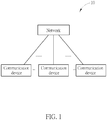
- Fig. 1 is a schematic diagram of a wireless communication system 10 according to an example of the present invention.
- the wireless communication system 10 is briefly composed of a network and a plurality of communication devices.
- the wireless communication system 10 may support a time-division duplexing (TDD) mode, a frequency-division duplexing (FDD) mode, a TDD-FDD joint operation mode or a licensed-assisted access (LAA) mode. That is, the network and a communication device may communicate with each other via FDD carrier(s), TDD carrier(s), licensed carrier(s) (licensed serving cell(s)) and/or unlicensed carrier(s) (unlicensed serving cell(s)).
- the wireless communication system 10 may support a carrier aggregation (CA). That is, the network and a communication device may communicate with each other via multiple serving cells (e.g., multiple serving carriers) including a primary cell (e.g., primary component carrier) and one or more secondary cells (e.g., secondary component carriers
- the network and the communication devices are simply utilized for illustrating the structure of the wireless communication system 10.
- the network may be a universal terrestrial radio access network (UTRAN) including at least one Node-B (NB) in a universal mobile telecommunications system (UMTS).
- the network may be an evolved UTRAN (E-UTRAN) including at least one evolved NB (eNB) and/or at least one relay in a long term evolution (LTE) system, a LTE-Advanced (LTE-A) system or an evolution of the LTE-A system.
- LTE long term evolution
- LTE-A LTE-Advanced
- the network may also include both the UTRAN/E-UTRAN and a core network, wherein the core network may include network entities such as Mobility Management Entity (MME), Serving Gateway (S-GW), Packet Data Network (PDN) Gateway (P-GW), Self-Organizing Networks (SON) server and/or Radio Network Controller (RNC), etc.
- MME Mobility Management Entity
- S-GW Serving Gateway
- PDN Packet Data Network
- P-GW Packet Data Network Gateway
- SON Self-Organizing Networks
- RNC Radio Network Controller
- a communication device may be a user equipment (UE), a low cost device (e.g., machine type communication (MTC) device), a device-to-device (D2D) communication device, a narrow-band internet of things (IoT) (NB-IoT), a mobile phone, a laptop, a tablet computer, an electronic book, a portable computer system, or combination thereof.
- the network and the communication device can be seen as a transmitter or a receiver according to direction (i.e., transmission direction), e.g., for an uplink (UL), the communication device is the transmitter and the network is the receiver, and for a downlink (DL), the network is the transmitter and the communication device is the receiver.
- direction i.e., transmission direction
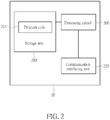
- Fig. 2 is a schematic diagram of a communication device 20 according to an example of the present invention.
- the communication device 20 may be a communication device or the network shown in Fig. 1 , but is not limited herein.
- the communication device 20 may include a processing circuit 200 such as a microprocessor or Application Specific Integrated Circuit (ASIC), a storage unit 210 and a communication interfacing unit 220.
- the storage unit 210 may be any data storage device that may store a program code 214, accessed and executed by the processing circuit 200.
- Examples of the storage unit 210 include but are not limited to a subscriber identity module (SIM), read-only memory (ROM), flash memory, random-access memory (RAM), Compact Disc Read-Only Memory (CD-ROM), digital versatile disc-ROM (DVD-ROM), Blu-ray Disc-ROM (BD-ROM), magnetic tape, hard disk, optical data storage device, non-volatile storage unit, non-transitory computer-readable medium (e.g., tangible media), etc.
- SIM subscriber identity module
- ROM read-only memory
- flash memory random-access memory
- RAM Compact Disc Read-Only Memory
- DVD-ROM digital versatile disc-ROM
- BD-ROM Blu-ray Disc-ROM
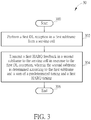
- Fig. 3 is a flowchart of a process 30 according to an example of the present invention.
- the process 30 may be utilized in a communication device shown in Fig. 1 , to handle a hybrid automatic repeat request (HARQ) transmission for a serving cell.
- HARQ hybrid automatic repeat request
- the process 30 may be compiled into the program code 214 and includes the following steps:
- the communication device may perform a first DL reception in a first subframe from a serving cell (e.g., of the network). Then, the communication device may transmit a first HARQ feedback in a second subframe to the serving cell in response to the first DL reception, wherein the second subframe is determined according to the first subframe and a sum of a predetermined timing (e.g., 4, 5, 7, 9, 11, 13, 15 or 17 subframes) and a first HARQ timing (e.g., 0, 2, 4, 6 or 8 subframes).
- a predetermined timing e.g., 4, 5, 7, 9, 11, 13, 15 or 17 subframes
- a first HARQ timing e.g., 0, 2, 4, 6 or 8 subframes.
- a HARQ feedback should be transmitted is determined according to both a predetermined timing (e.g., 4, 5, 7, 9, 11, 13, 15 or 17 subframes) and a HARQ timing which is dynamically or semi-statistically configured.
- a predetermined timing e.g., 4, 5, 7, 9, 11, 13, 15 or 17 subframes
- a HARQ timing which is dynamically or semi-statistically configured.
- Realization of the process 30 is not limited to the above description. The following examples may be applied for realizing the process 30.
- the predetermined timing may be a fixed value stored in the communication device, or may be configured by the serving cell.
- the first HARQ timing may be determined according to a DL control information (DCI) (e.g., transmitted by the serving cell) for (e.g., assigning or granting) the first DL reception, or may be determined according to a common DCI (e.g., transmitted by the serving cell).
- DCI DL control information
- the sum of the predetermined timing and the first HARQ timing may be determined according to the DCI (e.g., transmitted by the serving cell) for (e.g., assigning or granting) the first DL reception.
- the first HARQ timing may indicate whether the first HARQ feedback is postponed and/or a time period postponed with respect to the predetermined timing.
- the communication device may perform a second DL reception in a third subframe from the serving cell. Then, the communication device may transmit a second HARQ feedback in a fourth subframe to the serving cell in response to the second DL reception, wherein the fourth subframe is determined according to the third subframe, and a sum of the predetermined timing and a second HARQ timing. In this situation, the following examples may be applied to the case where the second subframe and the fourth subframe are the same subframe. In one example, the communication device may transmit the first HARQ feedback and the second HARQ feedback according to a time-domain bundling.
- the communication device may transmit the first HARQ feedback and the second HARQ feedback according to the sum of the predetermined timing and the first HARQ timing and the sum of the predetermined timing and the second HARQ timing. In one example, the communication device may transmit the first HARQ feedback and the second HARQ feedback according to a first DCI for (e.g., assigning or granting) the first DL reception and a second DCI (e.g., assigning or granting) for the second DL reception.
- a first DCI for e.g., assigning or granting
- a second DCI e.g., assigning or granting
- the first HARQ feedback may be transmitted via a dedicated resource (e.g., dedicated frequency resource), and the dedicated resource may be determined according to a higher layer configuration, a shift for the second subframe and/or the number of control channel element (CCE) indices of a DCI corresponding to the first DL reception.
- a dedicated resource e.g., dedicated frequency resource
- Fig. 4 is a schematic diagram of timing of HARQ feedbacks according to an example of the present invention.
- one or two DL receptions may be performed in the subframes SF0-SF1 from a serving cell, and HARQ feedback HARQ0-HARQ1 may be transmitted correspondingly to the serving cell in response to the DL reception(s).
- a predetermined timing Tp is 4 subframes and HARQ timings Td for the subframes SF0-SF1 are 1 and 0 subframe, respectively.
- the HARQ feedbacks HARQ0-HARQ1 may be transmitted jointly in the subframe SF5 according to the previous description. In one example, the HARQ feedbacks HARQ0-HARQ1 may be transmitted according to a time-domain bundling.
- a logical "AND" may be used for bundling the HARQ feedbacks HARQ0-HARQ1, and the bundled result [HARQ0 AND HARQ1] is transmitted in the subframe SF5.
- the HARQ feedbacks HARQ0-HARQ1 may be transmitted according to the HARQ timings Td of the subframes SF0-SF1.
- [HARQ1, HARQ0] are transmitted in the subframe SF5, because the HARQ timings Td are 0 and 1, respectively.
- the HARQ feedbacks HARQ0-HARQ1 may be transmitted according to DL assignment indices (DAIs) in DCIs for the first DL reception and the second DL reception.
- [HARQ0, HARQ1] are transmitted in the subframe SF5, because the DAIs are 0 and 1, respectively.
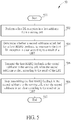
- Fig. 5 is a flowchart of a process 50 according to an example of the present invention.
- the process 50 may be utilized in a communication device shown in Fig. 1 , to handle a HARQ feedback for a serving cell.
- the process 50 may be compiled into the program code 214 and includes the following steps:
- the communication device may perform a first DL reception in a first subframe from a serving cell (e.g., of the network).
- the communication device may determine whether a second subframe scheduled for a first HARQ feedback in response to the first DL reception is clear according to a result of a LBT. Then, the communication device may transmit the first HARQ feedback in the second subframe to the serving cell, when the second subframe is clear according to the result of the LBT.
- the communication device may stop transmitting the first HARQ feedback in the second subframe to the serving cell, when the second subframe is not clear according to the result of the LBT.
- a LBT is performed to check whether the subframe is clear. Whether the HARQ feedback should be performed in the subframe is determined according to a result of the LBT, to improve the reliability of the transmission. Thus, uncertainty of available resource of the serving cell is solved according to the process 50.
- Realization of the process 50 is not limited to the above description. The following examples may be applied for realizing the process 50.
- the communication device may perform a second DL reception in a third subframe from the serving cell. Then, the communication device may transmit the first HARQ feedback and a second HARQ feedback in response to the second DL reception to the serving cell in a dedicated resource (e.g., dedicated frequency resource) of a fourth subframe, when the second subframe is not clear according to the result of the LBT.
- the dedicated resource may be determined according to various ways. For example, the dedicated resource may be determined according to a higher layer configuration, a shift for the second subframe and/or the number of first CCE indices of a DCI corresponding to the second DL reception.
- the communication device may transmit the first HARQ feedback and the second HARQ feedback according to a time-domain bundling.
- the communication device may transmit the first HARQ feedback in a dedicated resource (e.g., dedicated frequency resource) of a third subframe to the serving cell, when the second subframe is not clear according to the result of the LBT.
- the third subframe may be scheduled (or reserved) for a second HARQ feedback. That is, a second DL reception corresponding to the second HARQ feedback is not performed, but the third subframe scheduled (or reserved) for the second HARQ feedback can still be used for transmitting the first HARQ feedback.
- the first HARQ feedback may be transmitted via a dedicated resource, and the dedicated resource may be determined according to a higher layer configuration, a shift for the second subframe and/or the number of first CCE indices of a DCI corresponding to the first DL reception.
- Fig. 6 is a schematic diagram of timing of HARQ feedbacks according to an example of the present invention.
- one or two DL receptions may be performed in the subframes SF0-SF1 from a serving cell, and HARQ feedback HARQ0-HARQ1 may be transmitted correspondingly to the serving cell in response to the DL reception(s).
- a HARQ feedback is scheduled be transmitted in a subframe (n+4) in response to a DL reception performed in a subframe n.
- the communication device performs a LBT to check whether the subframe SF4 is clear. It is assumed that the subframe SF4 is not clear according to a result of the LBT. Accordingly, the communication device does not transmit the HARQ feedback HARQ0 in the subframe SF4.
- the communication device If the communication device further performs a second DL reception in the subframe SF1, the communication device also performs a LBT to check whether the subframe SF5 is clear. It is assumed that the subframe SF5 is clear according to a result of the LBT. Accordingly, the communication device transmits the HARQ feedback HARQ0 and the HARQ feedback HARQ1 in a dedicated resource of the subframe SF5. That is, the first HARQ feedback which is delayed is transmitted jointly with the second HARQ feedback in the subframe SF5 which is scheduled for the second HARQ feedback.
- the communication device does not perform a second DL reception in the subframe SF1.
- the communication device still performs a LBT to check whether the subframe SF5 is clear. It is assumed that the subframe SF5 is clear according to a result of the LBT. Accordingly, the communication device transmits the HARQ feedback HARQ0 in a dedicated resource of the subframe SF5. That is, the first HARQ feedback which is delayed is transmitted in the subframe SF5.
- the subframe SF5 may be scheduled (or reserved) for the second HARQ feedback.
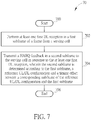
- Fig. 7 is a flowchart of a process 70 according to an example of the present invention.
- the process 70 may be utilized in a communication device shown in Fig. 1 , to handle a HARQ transmission for a serving cell.
- the process 70 may be compiled into the program code 214 and includes the following steps:
- the communication device may perform at least one first DL reception in a first subframe of a frame from a serving cell (e.g., of the network). Then, the communication device may transmit a HARQ feedback in a second subframe to the serving cell in response to the at least one DL reception, wherein the second subframe is determined according to the first subframe, a reference UL/DL configuration and a timing offset between a corresponding subframe of the reference UL/DL configuration and the first subframe. That is, the frame for performing the DL reception(s) and the reference UL/DL configuration for performing the HARQ feedback may not be aligned in the time domain. Thus, uncertainty of available resource of the serving cell can be mitigated by properly configuring the reference UL/DL configuration and the timing offset.
- Realization of the process 70 is not limited to the above description. The following examples may be applied for realizing the process 70.
- the communication device may transmit a second HARQ feedback in a third subframe to the serving cell in response to the at least one first DL reception, wherein the third subframe is determined according to a fourth subframe for at least one second DL reception, the reference UL/DL configuration and the timing offset. That is, the third subframe which is originally scheduled for transmitting another HARQ feedback in response to the at least one second DL reception is also used for transmitting the second HARQ feedback.
- the at least one first DL reception in the first subframe can be acknowledged in multiple subframes. Thus, more opportunities are provided for acknowledging the at least one first DL reception.
- the communication device may determine whether the second subframe is clear according to a result of a LBT.
- the communication device may transmit the first HARQ feedback in the second subframe to the serving cell, when the second subframe is clear according to the result of the LBT.
- the communication device may stop transmitting the first HARQ feedback in the second subframe to the serving cell, when the second subframe is not clear according to the result of the LBT. That is, even if a subframe is scheduled (or is determined) for performing a HARQ feedback corresponding to a DL reception, a LBT is performed to check whether the subframe is clear. Whether the HARQ feedback should be performed in the subframe is determined according to a result of the LBT, to improve the reliability of the transmission.
- the timing offset may be received in a DCI (e.g., transmitted by the serving cell).
- the DCI may be a common DCI or a communication device-specific (e.g., UE-specific) DCI.
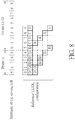
- Fig. 8 is a schematic diagram of timing of HARQ feedbacks according to an example of the present invention.
- "D" denotes a DL reception
- "A” denotes a HARQ feedback.
- a reference UL/DL configuration is not aligned with the frame, i.e., the subframe 0 of the frame is not aligned with the subframe 0 of the reference UL/DL configuration.
- a timing offset between a corresponding subframe (i.e., the subframe 0) of the reference UL/DL configuration and the subframe 5 is 5 subframes.
- a HARQ feedback is transmitted in the subframe 1 of the frame (n+1) to the serving cell in response to the DL reception(s).
- a HARQ feedback is transmitted in the subframe 2 of the frame (n+1) to the serving cell in response to the DL reception(s). Transmissions of HARQ feedbacks in other subframes can be illustrated according to the above description, and is not narrated herein.
- Fig. 9 is a schematic diagram of timing of HARQ feedbacks according to an example of the present invention.
- "D" denotes a DL reception
- "A” denotes a HARQ feedback.
- a reference UL/DL configuration is not aligned with the frame, i.e., the subframe 0 of the frame is not aligned with the subframe 0 of the reference UL/DL configuration.
- a timing offset between a corresponding subframe (i.e., the subframe 2) of the reference UL/DL configuration and the subframe 5 is 3 subframes.
- a HARQ feedback is transmitted in the subframe 0 of the frame (n+1) to the serving cell in response to the DL reception(s).
- a HARQ feedback is transmitted in the subframe 1 of the frame (n+1) to the serving cell in response to the DL reception.
- Fig. 9 is more suitable for the serving cell with a low traffic DL loading, while Fig. 8 is more suitable for the serving cell with a high DL traffic loading.
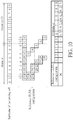
- Fig. 10 is a schematic diagram of timing of HARQ feedbacks according to an example of the present invention.
- "D" without an underline denotes an original DL reception scheduled to be acknowledged.
- "D” with the underline denotes that a DL reception can also be acknowledged in a later subframe.
- a reference UL/DL configuration is not aligned with the frame, i.e., the subframe 0 of the frame is not aligned with the subframe 0 of the reference UL/DL configuration.
- a timing offset between a corresponding subframe (i.e., the subframe 0) of the reference UL/DL configuration and the subframe 1 is 1 subframe.
- a first HARQ feedback is transmitted in the subframe 7 of the frame n to the serving cell in response to the DL reception(s).
- the communication device may also transmit a second HARQ feedback in the subframe 8 of the frame n to the serving cell in response to the DL reception(s).
- the situation may happen, if the HARQ feedback is not transmitted in the subframe 7 of the frame n, e.g., a LBT indicates that the subframe 7 is not clear.
- Another HARQ feedback in response to one or more DL receptions performed in the subframes 3-4 of the frame n may also be transmitted jointly with the second HARQ feedback in the subframe 8 of the frame n to the serving cell.
- the communication device transmits a HARQ feedback in the subframe 9 of the frame n in response to DL reception(s) in the subframes 3-4 of the frame n. Transmissions of HARQ feedbacks in other subframes can be illustrated according to the above description, and is not narrated herein.
- Association indices of the reference UL/DL configuration are shown in Fig. 10 , and operations related to the association indices are explained as follows.
- the association set of the subframe 6 of the reference UL/DL configuration (i.e., the subframe 7 of the communication device) includes the association set indices 6 and 5 and is used for determining HARQ resource, when the communication device intends to transmit a HARQ feedback in the subframe 7 of the communication device.
- the association set indices 6 and 5 correspond to DL receptions performed in the subframes 1-2 of the communication device, respectively.
- the association set of the subframe 7 of the reference UL/DL configuration (i.e., the subframe 8 of the communication device) includes the association set indices 5, 4, 7 and 6 and is used for determining HARQ resource, when the communication device intends to transmit a HARQ feedback in the subframe 8 of the communication device.
- the association set indices 5, 4, 7 and 6 correspond to DL receptions performed in the subframes 3, 4, 1 and 2 of the communication device, respectively.
- the association sets of other subframes can be illustrated according to the above description, and is not narrated herein.
- a serving cell mentioned above may be a UL licensed serving cell, a DL licensed serving cell, a UL unlicensed serving cell and/or a DL unlicensed serving cell, but is not limited herein.
- the features and/or the operations of a communication device mentioned above may imply corresponding features and/or operations of the network, but is not limited herein.
- Examples of the hardware may include analog circuit(s), digital circuit(s) and/or mixed circuit(s).
- the hardware may include ASIC(s), field programmable gate array(s) (FPGA(s)), programmable logic device(s), coupled hardware components or combination thereof.
- the hardware may include general-purpose processor(s), microprocessor(s), controller(s), digital signal processor(s) (DSP(s)) or combination thereof.
- Examples of the software may include set(s) of codes, set(s) of instructions and/or set(s) of functions retained (e.g., stored) in a storage unit, e.g., a computer-readable medium.
- the computer-readable medium may include SIM, ROM, flash memory, RAM, CD-ROM/DVD-ROM/BD-ROM, magnetic tape, hard disk, optical data storage device, non-volatile storage unit, or combination thereof.
- the computer-readable medium (e.g., storage unit) may be coupled to at least one processor internally (e.g., integrated) or externally (e.g., separated).
- the at least one processor which may include one or more modules may (e.g., be configured to) execute the software in the computer-readable medium.
- the set(s) of codes, the set(s) of instructions and/or the set(s) of functions may cause the at least one processor, the module(s), the hardware and/or the electronic system to perform the related steps.
- Examples of the electronic system may include a system on chip (SoC), system in package (SiP), a computer on module (CoM), a computer program product, an apparatus, a mobile phone, a laptop, a tablet computer, an electronic book or a portable computer system, and the communication device 20.
- SoC system on chip
- SiP system in package
- CoM computer on module
- a computer program product an apparatus, a mobile phone, a laptop, a tablet computer, an electronic book or a portable computer system, and the communication device 20.
- the present invention provides device and a method for handling a HARQ feedback for a serving cell. Reliability of a transmission of the HARQ feedback is improved. Uncertainty of available resource of the serving cell is solved.
Landscapes
- Engineering & Computer Science (AREA)
- Signal Processing (AREA)
- Computer Networks & Wireless Communication (AREA)
- Mobile Radio Communication Systems (AREA)
- Detection And Prevention Of Errors In Transmission (AREA)
Abstract
Description
- The present invention relates to a communication device and a method of handling a hybrid automatic repeat request (HARQ) transmission in a wireless communication system.
- A long-term evolution (LTE) system supporting the 3rd Generation Partnership Project (3GPP) Rel-8 standard and/or the 3GPP Rel-9 standard are developed by the 3GPP as a successor of the universal mobile telecommunication system (UMTS) for further enhancing performance of the UMTS to satisfy increasing needs of users. The LTE system includes a new radio interface and a new radio network architecture that provides high data rate, low latency, packet optimization, and improved system capacity and coverage. In the LTE system, a radio access network known as an evolved universal terrestrial radio access network (E-UTRAN) includes at least one evolved Node-B (eNB) for communicating with at least one user equipment (UE), and for communicating with a core network including a mobility management entity (MME), a serving gateway, etc., for Non-Access Stratum (NAS) control.
- A LTE-advanced (LTE-A) system, as its name implies, is an evolution of the LTE system. The LTE-A system targets faster switching between power states, improves performance at the coverage edge of an eNB, increases peak data rate and throughput, and includes advanced techniques, such as carrier aggregation (CA), coordinated multipoint (CoMP) transmissions/reception, uplink (UL) multiple-input multiple-output (UL-MIMO), licensed-assisted access (LAA) (e.g., using LTE), etc. For a UE and an eNB to communicate with each other in the LTE-A system, the UE and the eNB must support standards developed for the LTE-A system, such as the 3GPP Rel-10 standard or later versions.
- Network operators propose to offload network traffic of the LTE/LTE-A system to a serving cell (e.g., licensed serving cell and/or unlicensed serving cell), to ease load of the network traffic. For example, the eNB may provide services to the UE via both a licensed serving cell and an unlicensed serving cell. However, even if the UE can receive a packet from the eNB at a first time instant, the UE may not be able to acknowledge the reception of the packet at a second time instant due to uncertainty of available resource of the unlicensed serving cell of the eNB. That is, there may not be available resource for transmitting a hybrid automatic repeat request (HARQ) for responding to the reception of the packet. Accordingly, the eNB does not know whether the packet is received correctly by the UE, and the communication between the UE and the eNB cannot proceed regularly. Benefit of introduction of the unlicensed serving cell is reduced. Thus, how to handle a HARQ feedback when the unlicensed serving cell is used an important problem to be solved.
- The present invention therefore provides a method and related communication device for handling a hybrid automatic repeat request (HARQ) transmission to solve the abovementioned problem.
- This is achieved by a communication device for handling the HARQ according to the independent claims here below. The dependent claims pertain to corresponding further developments and improvements.
- As will be seen more clearly from the detailed description following below, the claimed communication device for handling a hybrid automatic repeat request (HARQ) transmission comprises a storage unit for storing instructions and a processing circuit coupled to the storage unit. The processing circuit is configured to execute the instructions stored in the storage unit. The instructions comprise performing a first downlink (DL) reception in a first subframe from a serving cell; and transmitting a first HARQ feedback in response to the first DL reception in a second subframe to the serving cell, wherein the second subframe is determined according to the first subframe and a sum of a predetermined timing and a first HARQ timing.
-
-
Fig. 1 is a schematic diagram of a wireless communication system according to an example of the present invention. -
Fig. 2 is a schematic diagram of a communication device according to an example of the present invention. -
Fig. 3 is a flowchart of a process according to an example of the present invention. -
Fig. 4 is a schematic diagram of timing of HARQ feedbacks according to an example of the present invention. -
Fig. 5 is a flowchart of a process according to an example of the present invention. -
Fig. 6 is a schematic diagram of timing of HARQ feedbacks according to an example of the present invention. -
Fig. 7 is a flowchart of a process according to an example of the present invention. -
Fig. 8 is a schematic diagram of timing of HARQ feedbacks according to an example of the present invention. -
Fig. 9 is a schematic diagram of timing of HARQ feedbacks according to an example of the present invention. -
Fig. 10 is a schematic diagram of timing of HARQ feedbacks according to an example of the present invention. -
Fig. 1 is a schematic diagram of awireless communication system 10 according to an example of the present invention. Thewireless communication system 10 is briefly composed of a network and a plurality of communication devices. Thewireless communication system 10 may support a time-division duplexing (TDD) mode, a frequency-division duplexing (FDD) mode, a TDD-FDD joint operation mode or a licensed-assisted access (LAA) mode. That is, the network and a communication device may communicate with each other via FDD carrier(s), TDD carrier(s), licensed carrier(s) (licensed serving cell(s)) and/or unlicensed carrier(s) (unlicensed serving cell(s)). In addition, thewireless communication system 10 may support a carrier aggregation (CA). That is, the network and a communication device may communicate with each other via multiple serving cells (e.g., multiple serving carriers) including a primary cell (e.g., primary component carrier) and one or more secondary cells (e.g., secondary component carriers). - In
Fig. 1 , the network and the communication devices are simply utilized for illustrating the structure of thewireless communication system 10. Practically, the network may be a universal terrestrial radio access network (UTRAN) including at least one Node-B (NB) in a universal mobile telecommunications system (UMTS). In another example, the network may be an evolved UTRAN (E-UTRAN) including at least one evolved NB (eNB) and/or at least one relay in a long term evolution (LTE) system, a LTE-Advanced (LTE-A) system or an evolution of the LTE-A system. - Furthermore, the network may also include both the UTRAN/E-UTRAN and a core network, wherein the core network may include network entities such as Mobility Management Entity (MME), Serving Gateway (S-GW), Packet Data Network (PDN) Gateway (P-GW), Self-Organizing Networks (SON) server and/or Radio Network Controller (RNC), etc. In other words, after the network receives information transmitted by a communication device, the information may be processed only by the UTRAN/E-UTRAN and decisions corresponding to the information are made at the UTRAN/E-UTRAN. Alternatively, the UTRAN/E-UTRAN may forward the information to the core network, and the decisions corresponding to the information are made at the core network after the core network processes the information. In addition, the information may be processed by both the UTRAN/E-UTRAN and the core network, and the decisions are made after coordination and/or cooperation are performed by the UTRAN/E-UTRAN and the core network.
- A communication device may be a user equipment (UE), a low cost device (e.g., machine type communication (MTC) device), a device-to-device (D2D) communication device, a narrow-band internet of things (IoT) (NB-IoT), a mobile phone, a laptop, a tablet computer, an electronic book, a portable computer system, or combination thereof. In addition, the network and the communication device can be seen as a transmitter or a receiver according to direction (i.e., transmission direction), e.g., for an uplink (UL), the communication device is the transmitter and the network is the receiver, and for a downlink (DL), the network is the transmitter and the communication device is the receiver.
-
Fig. 2 is a schematic diagram of acommunication device 20 according to an example of the present invention. Thecommunication device 20 may be a communication device or the network shown inFig. 1 , but is not limited herein. Thecommunication device 20 may include aprocessing circuit 200 such as a microprocessor or Application Specific Integrated Circuit (ASIC), astorage unit 210 and acommunication interfacing unit 220. Thestorage unit 210 may be any data storage device that may store aprogram code 214, accessed and executed by theprocessing circuit 200. Examples of thestorage unit 210 include but are not limited to a subscriber identity module (SIM), read-only memory (ROM), flash memory, random-access memory (RAM), Compact Disc Read-Only Memory (CD-ROM), digital versatile disc-ROM (DVD-ROM), Blu-ray Disc-ROM (BD-ROM), magnetic tape, hard disk, optical data storage device, non-volatile storage unit, non-transitory computer-readable medium (e.g., tangible media), etc. Thecommunication interfacing unit 220 is preferably a transceiver and is used to transmit and receive signals (e.g., data, messages and/or packets) according to processing results of theprocessing circuit 200. -
Fig. 3 is a flowchart of aprocess 30 according to an example of the present invention. Theprocess 30 may be utilized in a communication device shown inFig. 1 , to handle a hybrid automatic repeat request (HARQ) transmission for a serving cell. Theprocess 30 may be compiled into theprogram code 214 and includes the following steps: - Step 300: Start.
- Step 302: Perform a first DL reception in a first subframe from a serving cell.
- Step 304: Transmit a first HARQ feedback in a second subframe to the serving cell in response to the first DL reception, wherein the second subframe is determined according to the first subframe and a sum of a predetermined timing and a first HARQ timing.
- Step 306: End.
- According to the
process 30, the communication device may perform a first DL reception in a first subframe from a serving cell (e.g., of the network). Then, the communication device may transmit a first HARQ feedback in a second subframe to the serving cell in response to the first DL reception, wherein the second subframe is determined according to the first subframe and a sum of a predetermined timing (e.g., 4, 5, 7, 9, 11, 13, 15 or 17 subframes) and a first HARQ timing (e.g., 0, 2, 4, 6 or 8 subframes). That is, when a HARQ feedback should be transmitted is determined according to both a predetermined timing (e.g., 4, 5, 7, 9, 11, 13, 15 or 17 subframes) and a HARQ timing which is dynamically or semi-statistically configured. Thus, uncertainty of available resource of the serving cell is solved according to theprocess 30. - Realization of the
process 30 is not limited to the above description. The following examples may be applied for realizing theprocess 30. - In one example, the predetermined timing may be a fixed value stored in the communication device, or may be configured by the serving cell. In one example, the first HARQ timing may be determined according to a DL control information (DCI) (e.g., transmitted by the serving cell) for (e.g., assigning or granting) the first DL reception, or may be determined according to a common DCI (e.g., transmitted by the serving cell). According to the above examples, the sum of the predetermined timing and the first HARQ timing may be determined according to the DCI (e.g., transmitted by the serving cell) for (e.g., assigning or granting) the first DL reception. In one example, the first HARQ timing may indicate whether the first HARQ feedback is postponed and/or a time period postponed with respect to the predetermined timing.
- In one example, the communication device may perform a second DL reception in a third subframe from the serving cell. Then, the communication device may transmit a second HARQ feedback in a fourth subframe to the serving cell in response to the second DL reception, wherein the fourth subframe is determined according to the third subframe, and a sum of the predetermined timing and a second HARQ timing. In this situation, the following examples may be applied to the case where the second subframe and the fourth subframe are the same subframe. In one example, the communication device may transmit the first HARQ feedback and the second HARQ feedback according to a time-domain bundling. In one example, the communication device may transmit the first HARQ feedback and the second HARQ feedback according to the sum of the predetermined timing and the first HARQ timing and the sum of the predetermined timing and the second HARQ timing. In one example, the communication device may transmit the first HARQ feedback and the second HARQ feedback according to a first DCI for (e.g., assigning or granting) the first DL reception and a second DCI (e.g., assigning or granting) for the second DL reception. In one example, the first HARQ feedback may be transmitted via a dedicated resource (e.g., dedicated frequency resource), and the dedicated resource may be determined according to a higher layer configuration, a shift for the second subframe and/or the number of control channel element (CCE) indices of a DCI corresponding to the first DL reception.
-
Fig. 4 is a schematic diagram of timing of HARQ feedbacks according to an example of the present invention. There are 9 subframes SF0-SF8, wherein the subframes SF0-SF4 are DL subframes and the subframes SF5-SF8 are UL subframes. In the present example, one or two DL receptions may be performed in the subframes SF0-SF1 from a serving cell, and HARQ feedback HARQ0-HARQ1 may be transmitted correspondingly to the serving cell in response to the DL reception(s). It is assumed that a predetermined timing Tp is 4 subframes and HARQ timings Td for the subframes SF0-SF1 are 1 and 0 subframe, respectively. If a communication device performs a first DL reception in the subframe SF0, the communication device transmits the HARQ feedback HARQ0 in the subframe SF5 according to the predetermined timing Tp and the HARQ timing Td of the subframe SF0. That is, a HARQ response time for the first DL reception is 5 subframes (i.e., Tp+Td=5). - If the communication device further performs a second DL reception in the subframe SF1, the communication device also transmits the HARQ feedback HARQ1 in the subframe SF5 according to the predetermined timing Tp and the HARQ timing Td of the subframe SF1. That is, a HARQ response time for the second DL reception is 4 subframes (i.e., Tp+Td=4). The HARQ feedbacks HARQ0-HARQ1 may be transmitted jointly in the subframe SF5 according to the previous description. In one example, the HARQ feedbacks HARQ0-HARQ1 may be transmitted according to a time-domain bundling. In detail, a logical "AND" may be used for bundling the HARQ feedbacks HARQ0-HARQ1, and the bundled result [HARQ0 AND HARQ1] is transmitted in the subframe SF5. In one example, the HARQ feedbacks HARQ0-HARQ1 may be transmitted according to the HARQ timings Td of the subframes SF0-SF1. In detail, [HARQ1, HARQ0] are transmitted in the subframe SF5, because the HARQ timings Td are 0 and 1, respectively. In one example, the HARQ feedbacks HARQ0-HARQ1 may be transmitted according to DL assignment indices (DAIs) in DCIs for the first DL reception and the second DL reception. In detail, [HARQ0, HARQ1] are transmitted in the subframe SF5, because the DAIs are 0 and 1, respectively.
-
Fig. 5 is a flowchart of aprocess 50 according to an example of the present invention. Theprocess 50 may be utilized in a communication device shown inFig. 1 , to handle a HARQ feedback for a serving cell. Theprocess 50 may be compiled into theprogram code 214 and includes the following steps: - Step 500: Start.
- Step 502: Perform a first DL reception in a first subframe from a serving cell.
- Step 504: Determine whether a second subframe scheduled for a first HARQ feedback in response to the first DL reception is clear according to a result of a listen before talk (LBT).
- Step 506: Transmit the first HARQ feedback in the second subframe to the serving cell, when the second subframe is clear according to the result of the LBT.
- Step 508: Stop transmitting the first HARQ feedback in the second subframe to the serving cell, when the second subframe is not clear according to the result of the LBT.
- Step 510: End.
- According to the
process 50, the communication device may perform a first DL reception in a first subframe from a serving cell (e.g., of the network). The communication device may determine whether a second subframe scheduled for a first HARQ feedback in response to the first DL reception is clear according to a result of a LBT. Then, the communication device may transmit the first HARQ feedback in the second subframe to the serving cell, when the second subframe is clear according to the result of the LBT. The communication device may stop transmitting the first HARQ feedback in the second subframe to the serving cell, when the second subframe is not clear according to the result of the LBT. That is, even if a subframe is scheduled (or is determined) for performing a HARQ feedback corresponding to a DL reception, a LBT is performed to check whether the subframe is clear. Whether the HARQ feedback should be performed in the subframe is determined according to a result of the LBT, to improve the reliability of the transmission. Thus, uncertainty of available resource of the serving cell is solved according to theprocess 50. - Realization of the
process 50 is not limited to the above description. The following examples may be applied for realizing theprocess 50. - In one example, the communication device may perform a second DL reception in a third subframe from the serving cell. Then, the communication device may transmit the first HARQ feedback and a second HARQ feedback in response to the second DL reception to the serving cell in a dedicated resource (e.g., dedicated frequency resource) of a fourth subframe, when the second subframe is not clear according to the result of the LBT. The dedicated resource may be determined according to various ways. For example, the dedicated resource may be determined according to a higher layer configuration, a shift for the second subframe and/or the number of first CCE indices of a DCI corresponding to the second DL reception. In one example, the communication device may transmit the first HARQ feedback and the second HARQ feedback according to a time-domain bundling.
- In another example, the communication device may transmit the first HARQ feedback in a dedicated resource (e.g., dedicated frequency resource) of a third subframe to the serving cell, when the second subframe is not clear according to the result of the LBT. For example, the third subframe may be scheduled (or reserved) for a second HARQ feedback. That is, a second DL reception corresponding to the second HARQ feedback is not performed, but the third subframe scheduled (or reserved) for the second HARQ feedback can still be used for transmitting the first HARQ feedback. In one example, the first HARQ feedback may be transmitted via a dedicated resource, and the dedicated resource may be determined according to a higher layer configuration, a shift for the second subframe and/or the number of first CCE indices of a DCI corresponding to the first DL reception.
-
Fig. 6 is a schematic diagram of timing of HARQ feedbacks according to an example of the present invention. There are 6 subframes SF0-SF5, wherein the subframes SF0-SF3 are DL subframes and the subframes SF4-SF5 are UL subframes. In the present example, one or two DL receptions may be performed in the subframes SF0-SF1 from a serving cell, and HARQ feedback HARQ0-HARQ1 may be transmitted correspondingly to the serving cell in response to the DL reception(s). For example, a HARQ feedback is scheduled be transmitted in a subframe (n+4) in response to a DL reception performed in a subframe n. If a communication device performs a first DL reception in the subframe SF0, the communication device performs a LBT to check whether the subframe SF4 is clear. It is assumed that the subframe SF4 is not clear according to a result of the LBT. Accordingly, the communication device does not transmit the HARQ feedback HARQ0 in the subframe SF4. - If the communication device further performs a second DL reception in the subframe SF1, the communication device also performs a LBT to check whether the subframe SF5 is clear. It is assumed that the subframe SF5 is clear according to a result of the LBT. Accordingly, the communication device transmits the HARQ feedback HARQ0 and the HARQ feedback HARQ1 in a dedicated resource of the subframe SF5. That is, the first HARQ feedback which is delayed is transmitted jointly with the second HARQ feedback in the subframe SF5 which is scheduled for the second HARQ feedback.
- In another example, the communication device does not perform a second DL reception in the subframe SF1. The communication device still performs a LBT to check whether the subframe SF5 is clear. It is assumed that the subframe SF5 is clear according to a result of the LBT. Accordingly, the communication device transmits the HARQ feedback HARQ0 in a dedicated resource of the subframe SF5. That is, the first HARQ feedback which is delayed is transmitted in the subframe SF5. For example, the subframe SF5 may be scheduled (or reserved) for the second HARQ feedback.
-
Fig. 7 is a flowchart of aprocess 70 according to an example of the present invention. Theprocess 70 may be utilized in a communication device shown inFig. 1 , to handle a HARQ transmission for a serving cell. Theprocess 70 may be compiled into theprogram code 214 and includes the following steps: - Step 700: Start.
- Step 702: Perform at least one first DL reception in a first subframe of a frame from a serving cell.
- Step 704: Transmit a HARQ feedback in a second subframe to the serving cell in response to the at least one first DL reception, wherein the second subframe is determined according to the first subframe, a reference UL/DL configuration and a timing offset between a corresponding subframe of the reference UL/DL configuration and the first subframe.
- Step 706: End.
- According to the
process 70, the communication device may perform at least one first DL reception in a first subframe of a frame from a serving cell (e.g., of the network). Then, the communication device may transmit a HARQ feedback in a second subframe to the serving cell in response to the at least one DL reception, wherein the second subframe is determined according to the first subframe, a reference UL/DL configuration and a timing offset between a corresponding subframe of the reference UL/DL configuration and the first subframe. That is, the frame for performing the DL reception(s) and the reference UL/DL configuration for performing the HARQ feedback may not be aligned in the time domain. Thus, uncertainty of available resource of the serving cell can be mitigated by properly configuring the reference UL/DL configuration and the timing offset. - Realization of the
process 70 is not limited to the above description. The following examples may be applied for realizing theprocess 70. - In one example, the communication device may transmit a second HARQ feedback in a third subframe to the serving cell in response to the at least one first DL reception, wherein the third subframe is determined according to a fourth subframe for at least one second DL reception, the reference UL/DL configuration and the timing offset. That is, the third subframe which is originally scheduled for transmitting another HARQ feedback in response to the at least one second DL reception is also used for transmitting the second HARQ feedback. In other words, the at least one first DL reception in the first subframe can be acknowledged in multiple subframes. Thus, more opportunities are provided for acknowledging the at least one first DL reception.
- In one example, the communication device may determine whether the second subframe is clear according to a result of a LBT. The communication device may transmit the first HARQ feedback in the second subframe to the serving cell, when the second subframe is clear according to the result of the LBT. The communication device may stop transmitting the first HARQ feedback in the second subframe to the serving cell, when the second subframe is not clear according to the result of the LBT. That is, even if a subframe is scheduled (or is determined) for performing a HARQ feedback corresponding to a DL reception, a LBT is performed to check whether the subframe is clear. Whether the HARQ feedback should be performed in the subframe is determined according to a result of the LBT, to improve the reliability of the transmission. In one example, the timing offset may be received in a DCI (e.g., transmitted by the serving cell). Further, the DCI may be a common DCI or a communication device-specific (e.g., UE-specific) DCI.
-
Fig. 8 is a schematic diagram of timing of HARQ feedbacks according to an example of the present invention. There are two frames n and (n+1) for a communication device and a serving cell, wherein the frame n includes subframes 5-9 and the frame (n+1) includes subframes 0-9. InFig. 8 , "D" denotes a DL reception, and "A" denotes a HARQ feedback. As can be seen, a reference UL/DL configuration is not aligned with the frame, i.e., thesubframe 0 of the frame is not aligned with thesubframe 0 of the reference UL/DL configuration. Taking thesubframe 5 of the frame n as an example, a timing offset between a corresponding subframe (i.e., the subframe 0) of the reference UL/DL configuration and thesubframe 5 is 5 subframes. According to the reference UL/DL configuration and the timing offset, if one or two DL receptions are performed in the subframes 5-6 of the frame n from the serving cell, a HARQ feedback is transmitted in thesubframe 1 of the frame (n+1) to the serving cell in response to the DL reception(s). Similarly, if one or two DL receptions are performed in the subframes 7-8 of the frame n from the serving cell, a HARQ feedback is transmitted in thesubframe 2 of the frame (n+1) to the serving cell in response to the DL reception(s). Transmissions of HARQ feedbacks in other subframes can be illustrated according to the above description, and is not narrated herein. -
Fig. 9 is a schematic diagram of timing of HARQ feedbacks according to an example of the present invention. There are two frames n and (n+1) for a communication device and a serving cell, wherein the frame n includes subframes 5-9 and the frame (n+1) includes subframes 0-9. InFig. 9 , "D" denotes a DL reception, and "A" denotes a HARQ feedback. As can be seen, a reference UL/DL configuration is not aligned with the frame, i.e., thesubframe 0 of the frame is not aligned with thesubframe 0 of the reference UL/DL configuration. Taking thesubframe 5 of the frame n as an example, a timing offset between a corresponding subframe (i.e., the subframe 2) of the reference UL/DL configuration and thesubframe 5 is 3 subframes. According to the reference UL/DL configuration and the timing offset, if one or two DL receptions are performed in the subframes 5-6 of the frame n from the serving cell, a HARQ feedback is transmitted in thesubframe 0 of the frame (n+1) to the serving cell in response to the DL reception(s). Similarly, if a DL reception is performed in thesubframe 7 of the frame n from the serving cell, a HARQ feedback is transmitted in thesubframe 1 of the frame (n+1) to the serving cell in response to the DL reception. Transmissions of HARQ feedbacks in other subframes can be illustrated according to the above description, and is not narrated herein. Comparing withFig. 8 ,Fig. 9 is more suitable for the serving cell with a low traffic DL loading, whileFig. 8 is more suitable for the serving cell with a high DL traffic loading. -
Fig. 10 is a schematic diagram of timing of HARQ feedbacks according to an example of the present invention. There are two frames n and (n+1) for a communication device and a serving cell, wherein each of the frames n and (n+1) includes subframes 0-9. In Fig. 11, "D" without an underline denotes an original DL reception scheduled to be acknowledged. "D" with the underline denotes that a DL reception can also be acknowledged in a later subframe. As can be seen, a reference UL/DL configuration is not aligned with the frame, i.e., thesubframe 0 of the frame is not aligned with thesubframe 0 of the reference UL/DL configuration. Taking thesubframe 1 of the frame n as an example, a timing offset between a corresponding subframe (i.e., the subframe 0) of the reference UL/DL configuration and thesubframe 1 is 1 subframe. - According to the reference UL/DL configuration and the timing offset, if one or two DL receptions are performed in the subframes 1-2 of the frame n from the serving cell, a first HARQ feedback is transmitted in the
subframe 7 of the frame n to the serving cell in response to the DL reception(s). Further, according to the reference UL/DL configuration and the timing offset, the communication device may also transmit a second HARQ feedback in thesubframe 8 of the frame n to the serving cell in response to the DL reception(s). In one example, the situation may happen, if the HARQ feedback is not transmitted in thesubframe 7 of the frame n, e.g., a LBT indicates that thesubframe 7 is not clear. Another HARQ feedback in response to one or more DL receptions performed in the subframes 3-4 of the frame n may also be transmitted jointly with the second HARQ feedback in thesubframe 8 of the frame n to the serving cell. Similarly, according to the reference UL/DL configuration and the timing offset, the communication device transmits a HARQ feedback in thesubframe 9 of the frame n in response to DL reception(s) in the subframes 3-4 of the frame n. Transmissions of HARQ feedbacks in other subframes can be illustrated according to the above description, and is not narrated herein. - Association indices of the reference UL/DL configuration are shown in
Fig. 10 , and operations related to the association indices are explained as follows. The association set of thesubframe 6 of the reference UL/DL configuration (i.e., thesubframe 7 of the communication device) includes the association setindices subframe 7 of the communication device. The association setindices subframe 7 of the reference UL/DL configuration (i.e., thesubframe 8 of the communication device) includes the association setindices subframe 8 of the communication device. The association setindices subframes - It should be noted that a serving cell mentioned above may be a UL licensed serving cell, a DL licensed serving cell, a UL unlicensed serving cell and/or a DL unlicensed serving cell, but is not limited herein. In addition, the features and/or the operations of a communication device mentioned above may imply corresponding features and/or operations of the network, but is not limited herein.
- Those skilled in the art should readily make combinations, modifications and/or alterations on the abovementioned description and examples. The abovementioned description, steps and/or processes including suggested steps can be realized by means that could be hardware, software, firmware (known as a combination of a hardware device and computer instructions and data that reside as read-only software on the hardware device), an electronic system, or combination thereof. An example of the means may be the
communication device 20. - Examples of the hardware may include analog circuit(s), digital circuit(s) and/or mixed circuit(s). For example, the hardware may include ASIC(s), field programmable gate array(s) (FPGA(s)), programmable logic device(s), coupled hardware components or combination thereof. In another example, the hardware may include general-purpose processor(s), microprocessor(s), controller(s), digital signal processor(s) (DSP(s)) or combination thereof.
- Examples of the software may include set(s) of codes, set(s) of instructions and/or set(s) of functions retained (e.g., stored) in a storage unit, e.g., a computer-readable medium. The computer-readable medium may include SIM, ROM, flash memory, RAM, CD-ROM/DVD-ROM/BD-ROM, magnetic tape, hard disk, optical data storage device, non-volatile storage unit, or combination thereof. The computer-readable medium (e.g., storage unit) may be coupled to at least one processor internally (e.g., integrated) or externally (e.g., separated). The at least one processor which may include one or more modules may (e.g., be configured to) execute the software in the computer-readable medium. The set(s) of codes, the set(s) of instructions and/or the set(s) of functions may cause the at least one processor, the module(s), the hardware and/or the electronic system to perform the related steps.
- Examples of the electronic system may include a system on chip (SoC), system in package (SiP), a computer on module (CoM), a computer program product, an apparatus, a mobile phone, a laptop, a tablet computer, an electronic book or a portable computer system, and the
communication device 20. - To sum up, the present invention provides device and a method for handling a HARQ feedback for a serving cell. Reliability of a transmission of the HARQ feedback is improved. Uncertainty of available resource of the serving cell is solved.
Claims (18)
- A communication device for handling a hybrid automatic repeat request (HARQ) transmission, characterized by the communication device comprising:a storage unit, for storing instructions of:performing a first downlink (DL) reception in a first subframe from a serving cell (302); andtransmitting a first HARQ feedback in a second subframe to the serving cell in response to the first DL reception, wherein the second subframe is determined according to the first subframe and a sum of a predetermined timing and a first HARQ timing (304); anda processing circuit, coupled to the storage unit, configured to execute the instructions stored in the storage unit.
- The communication device of claim 1, characterized in that the predetermined timing is a fixed value stored in the communication device, or is configured by the serving cell; or the first HARQ timing is determined according to a DL control information (DCI) for the first DL reception, or is determined according to a common DCI.
- The communication device of any of claims 1-2, characterized in that the sum of the predetermined timing and the first HARQ timing is determined according to a DCI for the first DL reception.
- The communication device of any of claims 1-3, characterized in that the first HARQ timing indicates whether the first HARQ feedback is postponed and/or a time period postponed with respect to the predetermined timing.
- The communication device of any of claims 1-4, characterized in that the storage unit further stores the instruction of:performing a second DL reception in a third subframe from the serving cell; andtransmitting a second HARQ feedback in a fourth subframe to the serving cell in response to the second DL reception, wherein the fourth subframe is determined according to the third subframe, and a sum of the predetermined timing and a second HARQ timing.
- The communication device of claim 5, characterized in that the communication device transmits the first HARQ feedback and the second HARQ feedback according to a time-domain bundling, when the second subframe and the fourth subframe are the same subframe.
- The communication device of claim 5, characterized in that the communication device transmits the first HARQ feedback and the second HARQ feedback according to the sum of the predetermined timing and the first HARQ timing and the sum of the predetermined timing and the second HARQ timing, when the second subframe and the fourth subframe are the same subframe.
- The communication device of claim 5, characterized in that the communication device transmits the first HARQ feedback and the second HARQ feedback according to a first DCI for the first DL reception and a second DCI for the second DL reception, when the second subframe and the fourth subframe are the same subframe.
- A communication device for handling a hybrid automatic repeat request (HARQ) transmission, characterized by the communication device comprising:a storage unit, for storing instructions of:performing a first downlink (DL) reception in a first subframe from a serving cell (502);determining whether a second subframe scheduled for a first HARQ feedback in response to the first DL reception is clear according to a result of a listen before talk (LBT) (504);transmitting the first HARQ feedback in the second subframe to the serving cell, when the second subframe is clear according to the result of the LBT (506); andstopping transmitting the first HARQ feedback in the second subframe to the serving cell, when the second subframe is not clear according to the result of the LBT (508); anda processing circuit, coupled to the storage unit, configured to execute the instructions stored in the storage unit.
- The communication device of claim 9, characterized in that the storage unit further stores the instruction of:performing a second DL reception in a third subframe from the serving cell; andtransmitting the first HARQ feedback and a second HARQ feedback in response to the second DL reception to the serving cell in a dedicated resource of a fourth subframe scheduled for the second HARQ feedback, when the second subframe is not clear according to the result of the LBT.
- The communication device of claim 10, characterized in that the dedicated resource is determined according to a higher layer configuration, a shift for the second subframe and/or the number of first CCE indices of a DL control information (DCI) corresponding to the second DL reception.
- The communication device of claim 10, characterized in that the communication transmits the first HARQ feedback and the second HARQ feedback according to a time-domain bundling.
- The communication device of claim 9, characterized in that the storage unit further stores the instruction of:transmitting the first HARQ feedback in a dedicated resource of a third subframe to the serving cell, when the second subframe is not clear according to the result of the LBT.
- The communication device of any of claims 1, 9 and 13, characterized in that the first HARQ feedback is transmitted via a dedicated resource, and the dedicated resource is determined according to a higher layer configuration, a shift for the second subframe and/or the number of first control channel element (CCE) indices of a DCI corresponding to the first DL reception.
- A communication device for handling a hybrid automatic repeat request (HARQ) transmission, characterized by the communication device comprising:a storage unit, for storing instructions of:performing at least one first downlink (DL) reception in a first subframe of a frame from a serving cell (700); andtransmitting a first HARQ feedback in a second subframe to the serving cell in response to the at least one first DL reception, wherein the second subframe is determined according to the first subframe, a reference uplink (UL)/DL configuration and a timing offset between a corresponding subframe of the reference UL/DL configuration and the first subframe (702); anda processing circuit, coupled to the storage unit, configured to execute the instructions stored in the storage unit.
- The communication device of claim 15, characterized in that the storage unit further stores the instruction of:transmitting a second HARQ feedback in a third subframe to the serving cell in response to the at least one first DL reception, wherein the third subframe is determined according to a fourth subframe for at least one second DL reception, the reference UL/DL configuration and the timing offset.
- The communication device of any of claims 15-16, characterized in that the storage unit further stores the instruction of:determining whether the second subframe is clear according to a result of a listen before talk (LBT);transmitting the first HARQ feedback in the second subframe to the serving cell, when the second subframe is clear according to the result of the LBT; andstopping transmitting the first HARQ feedback in the second subframe to the serving cell, when the second subframe is not clear according to the result of the LBT.
- The communication device of any of claims 15-17, characterized in that the timing offset is received in a DL control information (DCI).
Applications Claiming Priority (2)
| Application Number | Priority Date | Filing Date | Title |
|---|---|---|---|
| US201662290962P | 2016-02-04 | 2016-02-04 | |
| US15/414,647 US11452091B2 (en) | 2016-02-04 | 2017-01-25 | Device and method of handling hybrid automatic repeat request transmission |
Publications (3)
| Publication Number | Publication Date |
|---|---|
| EP3211813A2 true EP3211813A2 (en) | 2017-08-30 |
| EP3211813A3 EP3211813A3 (en) | 2017-11-15 |
| EP3211813B1 EP3211813B1 (en) | 2021-10-20 |
Family
ID=58046482
Family Applications (1)
| Application Number | Title | Priority Date | Filing Date |
|---|---|---|---|
| EP17154309.3A Active EP3211813B1 (en) | 2016-02-04 | 2017-02-02 | Device and method of handling hybrid automatic repeat request transmission |
Country Status (4)
| Country | Link |
|---|---|
| US (1) | US11452091B2 (en) |
| EP (1) | EP3211813B1 (en) |
| CN (1) | CN107040344B (en) |
| TW (1) | TWI669928B (en) |
Cited By (2)
| Publication number | Priority date | Publication date | Assignee | Title |
|---|---|---|---|---|
| WO2021034683A1 (en) * | 2019-08-16 | 2021-02-25 | Qualcomm Incorporated | Ack retransmission processing and mac-ce activation |
| EP3748890A4 (en) * | 2018-02-14 | 2021-03-24 | Huawei Technologies Co., Ltd. | METHOD AND DEVICE FOR DETERMINING A TIME SLOT FORMAT |
Families Citing this family (9)
| Publication number | Priority date | Publication date | Assignee | Title |
|---|---|---|---|---|
| WO2017120804A1 (en) | 2016-01-13 | 2017-07-20 | Lenovo Innovations Limited (Hong Kong) | Data acknowledgement in a wireless communication system |
| EP3412088B1 (en) * | 2016-04-01 | 2024-07-24 | Lenovo Innovations Limited (Hong Kong) | Carrier determination for a device |
| BR112019005363A2 (en) * | 2016-09-30 | 2019-06-18 | Ericsson Telefon Ab L M | node for a radio communication network, method for operating a node, computer program arranged to run on a node, and computer program memory |
| CN108282881B (en) * | 2017-01-06 | 2020-12-15 | 华为技术有限公司 | A resource allocation method and device |
| US11343022B2 (en) | 2018-08-01 | 2022-05-24 | Charter Communications Operating, Llc | Disabling hybrid automatic repeat request (HARQ) acknowledgments for packets for which acknowledgements are supported at network or higher layer |
| CN110830173B (en) * | 2018-08-08 | 2020-09-15 | 展讯通信(上海)有限公司 | Indication method, base station and readable medium of time difference between PUCCH and PDSCH |
| JP2021192466A (en) * | 2018-08-09 | 2021-12-16 | ソニーグループ株式会社 | Radio communication apparatus, radio communication method, and computer program |
| ES2962452T3 (en) * | 2018-08-10 | 2024-03-19 | Beijing Xiaomi Mobile Software Co Ltd | Method and apparatus for sending information |
| US11902967B2 (en) * | 2020-10-22 | 2024-02-13 | Acer Incorporated | Device of handling a HARQ retransmission |
Family Cites Families (59)
| Publication number | Priority date | Publication date | Assignee | Title |
|---|---|---|---|---|
| AU2007301647B2 (en) * | 2006-09-29 | 2011-09-22 | Nokia Technologies Oy | Uplink allocations for acknowledgement of downlink data |
| CN103763774B (en) * | 2007-12-17 | 2017-10-13 | Tcl通讯科技控股有限公司 | Mobile communication system |
| WO2010129295A1 (en) * | 2009-04-28 | 2010-11-11 | Zte U.S.A., Inc. | Method and system for dynamic adjustment of downlink/uplink allocation ratio in lte/tdd systems |
| US9191177B2 (en) * | 2009-05-04 | 2015-11-17 | Qualcomm Incorporated | Transmission of feedback information for multi-carrier operation |
| US8885479B2 (en) * | 2009-05-07 | 2014-11-11 | Qualcomm Incorporated | Multicarrier retransmission feedback |
| CN102651680B (en) * | 2011-02-24 | 2015-02-25 | 华为技术有限公司 | Communication method and device for carrier aggregation system |
| US9648657B2 (en) * | 2011-04-01 | 2017-05-09 | Interdigital Patent Holdings, Inc. | Method and apparatus for controlling connectivity to a network |
| TW201320692A (en) * | 2011-08-10 | 2013-05-16 | Ind Tech Res Inst | Method for data transmission and base station and user equipment using the same |
| US9515780B2 (en) * | 2011-12-23 | 2016-12-06 | Nokia Technologies Oy | Shifting HARQ feedback for cognitive-radio-based TD-LTE systems |
| EP2806591B1 (en) * | 2012-01-15 | 2020-05-20 | LG Electronics Inc. | Method and apparatus for transmitting control information in wireless communication system |
| WO2013112189A1 (en) * | 2012-01-23 | 2013-08-01 | Intel Corporation | Network assisted user association and offloading techniques for integrated multi-rat heterogeneous networks |
| CN103297205B (en) * | 2012-02-24 | 2018-03-16 | 中兴通讯股份有限公司 | A kind of mixed automatic retransferring method and device of dynamic frame structure |
| US8923255B2 (en) * | 2012-03-16 | 2014-12-30 | Blackberry Limited | Uplink control channel resource collision avoidance in carrier aggregation systems |
| JP6308995B2 (en) * | 2012-04-05 | 2018-04-11 | エルジー エレクトロニクス インコーポレイティド | Carrier assembly method and apparatus in wireless communication system |
| KR101935963B1 (en) * | 2012-05-18 | 2019-01-07 | 한국전자통신연구원 | Method and apparatus for adjusting harq timing |
| US9119197B2 (en) * | 2012-05-22 | 2015-08-25 | Futurewei Technologies, Inc. | System and method for delay scheduling |
| KR102451341B1 (en) * | 2012-09-26 | 2022-10-06 | 인터디지탈 패튼 홀딩스, 인크 | Methods for dynamic tdd uplink/downlink configuration |
| JP6378192B2 (en) * | 2012-11-13 | 2018-08-22 | エルジー エレクトロニクス インコーポレイティド | Data transmission method and apparatus, and data transmission method and apparatus |
| WO2014109553A1 (en) * | 2013-01-08 | 2014-07-17 | 엘지전자 주식회사 | Method and apparatus for performing harq in carrier aggregation system |
| TWI641283B (en) * | 2013-01-16 | 2018-11-11 | 內數位專利控股公司 | Method and wireless transmission/reception device associated with device-to-device (D2D) signal transmission |
| US9538503B2 (en) * | 2013-03-28 | 2017-01-03 | Samsung Electronics Co., Ltd. | Aggregation of FDD and TDD cells |
| EP3624379B1 (en) * | 2013-03-28 | 2021-04-21 | NEC Corporation | Method and apparatus for determining harq timing in communication systems |
| WO2014153688A1 (en) | 2013-03-29 | 2014-10-02 | Qualcomm Incorporated | Harq timing design for reconfiguration boundary in eimta |
| US9479293B2 (en) * | 2013-07-10 | 2016-10-25 | Industrial Technology Research Institute | Method of handling HARQ feedbacks and related communication device |
| CN105409135B (en) | 2013-07-25 | 2018-11-09 | Lg 电子株式会社 | Method and device for wireless communication |
| US20150043480A1 (en) * | 2013-08-07 | 2015-02-12 | Broadcom Corporation | System and Method for Multi-Subframe Data Transmission |
| US11431459B2 (en) * | 2013-08-13 | 2022-08-30 | Qualcomm Incorporated | Group ACK/NACK for LTE in unlicensed spectrum |
| US20150098370A1 (en) | 2013-10-04 | 2015-04-09 | Industrial Technology Research Institute | Method of Handling HARQ Resource for FDD Carrier and Related Communication Device |
| US10320532B2 (en) * | 2013-10-04 | 2019-06-11 | Lg Electronics Inc. | Method whereby terminal transmits ACK/NACK in wireless communication system, and device therefor |
| JP6388768B2 (en) * | 2014-01-14 | 2018-09-12 | 株式会社Nttドコモ | User terminal, radio base station, and radio communication method |
| DK3100555T3 (en) * | 2014-01-31 | 2017-06-19 | ERICSSON TELEFON AB L M (publ) | Methods and nodes relating to system information acquisition during operation of a flexible subframe |
| US10033490B2 (en) * | 2014-03-06 | 2018-07-24 | Interdigital Patent Holdings, Inc. | Full duplex operation in wireless systems |
| CN105940731B (en) * | 2014-04-14 | 2019-03-01 | 夏普株式会社 | Terminal device and its wireless communication method, base station device and its wireless communication method |
| US9917676B2 (en) * | 2014-06-11 | 2018-03-13 | Samsung Electronics Co., Ltd. | Harq procedure and frame structure for LTE cells on unlicensed spectrum |
| US10327258B2 (en) * | 2014-07-28 | 2019-06-18 | Lg Electronics Inc. | Method and user equipment for receiving downlink control information, and method and base station for transmitting downlink control information |
| CN106576349A (en) * | 2014-07-31 | 2017-04-19 | 株式会社Ntt都科摩 | User terminal, wireless base station, wireless communication method, and wireless communication system |
| US20170265207A1 (en) * | 2014-07-31 | 2017-09-14 | Ntt Docomo, Inc. | User terminal, radio base station and radio communication method |
| US9882698B2 (en) * | 2014-08-04 | 2018-01-30 | Htc Corporation | Device and method of handling resource for device-to-device communication |
| CN112512123A (en) * | 2014-09-04 | 2021-03-16 | 北京三星通信技术研究有限公司 | Resource management method and base station |
| US12069623B2 (en) * | 2014-09-08 | 2024-08-20 | Interdigital Patent Holdings, Inc. | Systems and methods of operating with different transmission time interval (TTI) durations |
| CN107079334A (en) * | 2014-09-25 | 2017-08-18 | 株式会社Ntt都科摩 | User terminal, wireless base station and wireless communications method |
| WO2016048099A2 (en) * | 2014-09-27 | 2016-03-31 | 엘지전자 주식회사 | Communication method using carrier aggregation and device for same |
| US10334652B2 (en) * | 2014-11-18 | 2019-06-25 | Telefonaktiebolaget Lm Ericsson (Publ) | Methods and apparatuses for determining unsynchronized or synchronized dual connectivity mode of a user equipment |
| KR101749118B1 (en) * | 2014-12-23 | 2017-07-03 | 엘지전자 주식회사 | Method for reporting channel state information in wireless access system supporting unlicensed bands, and apparatus supporting same |
| US10523397B2 (en) * | 2015-01-20 | 2019-12-31 | Lg Electronics Inc. | Method for transmitting uplink control information and apparatus therefor |
| US10568116B2 (en) * | 2015-03-06 | 2020-02-18 | Lg Electronics Inc. | Method for transmitting signal in wireless communication system, and apparatus therefor |
| RU2671007C1 (en) * | 2015-03-17 | 2018-10-29 | Телефонактиеболагет Лм Эрикссон (Пабл) | Connection device and method thereof for determining size of communication network window |
| EP3280204B1 (en) * | 2015-04-02 | 2025-01-01 | NTT DoCoMo, Inc. | Terminal, and radio communication method |
| US10225380B2 (en) * | 2015-05-29 | 2019-03-05 | Futurewei Technologies, Inc. | Systems and methods for a subframe structure for wideband LTE |
| CN105101446B (en) | 2015-06-30 | 2017-12-15 | 宇龙计算机通信科技(深圳)有限公司 | A kind of method for collision avoidance and device for unauthorized frequency range |
| WO2017043950A1 (en) * | 2015-09-12 | 2017-03-16 | 엘지전자 주식회사 | Method for performing tdd communication by terminal in wireless communication system and terminal using same |
| US10492222B2 (en) * | 2015-09-17 | 2019-11-26 | Lg Electronics Inc. | Method and device for performing LBT process on multiple carriers in wireless access system supporting unlicensed band |
| US10735146B2 (en) * | 2015-09-25 | 2020-08-04 | Samsung Electronics Co., Ltd. | Method and device for feeding back and receiving HARQ-ACK information |
| KR102132832B1 (en) * | 2015-11-06 | 2020-07-13 | 모토로라 모빌리티 엘엘씨 | Method and apparatus for low latency transmissions |
| US10075949B2 (en) * | 2016-02-02 | 2018-09-11 | Motorola Mobility Llc | Method and apparatus for low latency transmissions |
| US9801175B2 (en) * | 2015-11-06 | 2017-10-24 | Motorola Mobility Llc | Method and apparatus for low latency transmissions |
| US10321455B2 (en) * | 2015-11-06 | 2019-06-11 | Motorola Mobility Llc | Method and apparatus for low latency transmissions |
| WO2017120804A1 (en) * | 2016-01-13 | 2017-07-20 | Lenovo Innovations Limited (Hong Kong) | Data acknowledgement in a wireless communication system |
| US10484989B2 (en) * | 2016-01-22 | 2019-11-19 | Electronics And Telecommunications Research Institute | Method and apparatus for receiving or transmitting data |
-
2017
- 2017-01-25 US US15/414,647 patent/US11452091B2/en active Active
- 2017-02-02 EP EP17154309.3A patent/EP3211813B1/en active Active
- 2017-02-03 TW TW106103593A patent/TWI669928B/en active
- 2017-02-03 CN CN201710063741.8A patent/CN107040344B/en active Active
Non-Patent Citations (1)
| Title |
|---|
| None |
Cited By (4)
| Publication number | Priority date | Publication date | Assignee | Title |
|---|---|---|---|---|
| EP3748890A4 (en) * | 2018-02-14 | 2021-03-24 | Huawei Technologies Co., Ltd. | METHOD AND DEVICE FOR DETERMINING A TIME SLOT FORMAT |
| US11388709B2 (en) | 2018-02-14 | 2022-07-12 | Huawei Technologies Co., Ltd. | Method for determining slot format and device |
| WO2021034683A1 (en) * | 2019-08-16 | 2021-02-25 | Qualcomm Incorporated | Ack retransmission processing and mac-ce activation |
| US11431446B2 (en) | 2019-08-16 | 2022-08-30 | Qualcomm Incorporated | ACK retransmission processing and MAC-CE activation |
Also Published As
| Publication number | Publication date |
|---|---|
| US20170230971A1 (en) | 2017-08-10 |
| TWI669928B (en) | 2019-08-21 |
| EP3211813B1 (en) | 2021-10-20 |
| CN107040344A (en) | 2017-08-11 |
| EP3211813A3 (en) | 2017-11-15 |
| CN107040344B (en) | 2021-01-26 |
| TW201729558A (en) | 2017-08-16 |
| US11452091B2 (en) | 2022-09-20 |
Similar Documents
| Publication | Publication Date | Title |
|---|---|---|
| US11452091B2 (en) | Device and method of handling hybrid automatic repeat request transmission | |
| CN105515742B (en) | Communication device handling service in unlicensed cell | |
| US9668288B2 (en) | Method of handling device-to-device operation and related communication device | |
| US9882698B2 (en) | Device and method of handling resource for device-to-device communication | |
| US11240842B2 (en) | Device and method of handling transmission/reception for serving cell | |
| US11871363B2 (en) | Device and method of handling power headroom report for multiple time intervals | |
| EP2824861A1 (en) | Method of handling HARQ feedbacks | |
| EP3376704A1 (en) | Method of performing a communication operation via a cell for a communication device | |
| CN104518857A (en) | Method and communication device for determining uplink subframe hybrid automatic repeat request resources | |
| CN108293244B (en) | Collision Avoidance in Wireless Communication Systems | |
| US9929799B2 (en) | Network and user equipment of HD-FDD communication system for handling HARQ | |
| US20160043853A1 (en) | Device and Method of Handling Device-to-Device Communication | |
| US11902967B2 (en) | Device of handling a HARQ retransmission | |
| EP2672645A2 (en) | Method of handling HARQ resource in TDD System and related communication device | |
| US10356724B2 (en) | Device handling power control for time intervals based on power level limit |
Legal Events
| Date | Code | Title | Description |
|---|---|---|---|
| PUAI | Public reference made under article 153(3) epc to a published international application that has entered the european phase |
Free format text: ORIGINAL CODE: 0009012 |
|
| STAA | Information on the status of an ep patent application or granted ep patent |
Free format text: STATUS: THE APPLICATION HAS BEEN PUBLISHED |
|
| AK | Designated contracting states |
Kind code of ref document: A2 Designated state(s): AL AT BE BG CH CY CZ DE DK EE ES FI FR GB GR HR HU IE IS IT LI LT LU LV MC MK MT NL NO PL PT RO RS SE SI SK SM TR |
|
| AX | Request for extension of the european patent |
Extension state: BA ME |
|
| PUAL | Search report despatched |
Free format text: ORIGINAL CODE: 0009013 |
|
| AK | Designated contracting states |
Kind code of ref document: A3 Designated state(s): AL AT BE BG CH CY CZ DE DK EE ES FI FR GB GR HR HU IE IS IT LI LT LU LV MC MK MT NL NO PL PT RO RS SE SI SK SM TR |
|
| AX | Request for extension of the european patent |
Extension state: BA ME |
|
| RIC1 | Information provided on ipc code assigned before grant |
Ipc: H04L 5/00 20060101ALI20171009BHEP Ipc: H04W 72/04 20090101ALI20171009BHEP Ipc: H04L 1/18 20060101AFI20171009BHEP |
|
| STAA | Information on the status of an ep patent application or granted ep patent |
Free format text: STATUS: REQUEST FOR EXAMINATION WAS MADE |
|
| 17P | Request for examination filed |
Effective date: 20180514 |
|
| RBV | Designated contracting states (corrected) |
Designated state(s): AL AT BE BG CH CY CZ DE DK EE ES FI FR GB GR HR HU IE IS IT LI LT LU LV MC MK MT NL NO PL PT RO RS SE SI SK SM TR |
|
| STAA | Information on the status of an ep patent application or granted ep patent |
Free format text: STATUS: EXAMINATION IS IN PROGRESS |
|
| 17Q | First examination report despatched |
Effective date: 20200221 |
|
| GRAP | Despatch of communication of intention to grant a patent |
Free format text: ORIGINAL CODE: EPIDOSNIGR1 |
|
| STAA | Information on the status of an ep patent application or granted ep patent |
Free format text: STATUS: GRANT OF PATENT IS INTENDED |
|
| INTG | Intention to grant announced |
Effective date: 20210531 |
|
| RIN1 | Information on inventor provided before grant (corrected) |
Inventor name: LEE, CHIEN-MIN |
|
| GRAS | Grant fee paid |
Free format text: ORIGINAL CODE: EPIDOSNIGR3 |
|
| GRAA | (expected) grant |
Free format text: ORIGINAL CODE: 0009210 |
|
| STAA | Information on the status of an ep patent application or granted ep patent |
Free format text: STATUS: THE PATENT HAS BEEN GRANTED |
|
| AK | Designated contracting states |
Kind code of ref document: B1 Designated state(s): AL AT BE BG CH CY CZ DE DK EE ES FI FR GB GR HR HU IE IS IT LI LT LU LV MC MK MT NL NO PL PT RO RS SE SI SK SM TR |
|
| REG | Reference to a national code |
Ref country code: GB Ref legal event code: FG4D |
|
| REG | Reference to a national code |
Ref country code: CH Ref legal event code: EP |
|
| REG | Reference to a national code |
Ref country code: IE Ref legal event code: FG4D |
|
| REG | Reference to a national code |
Ref country code: DE Ref legal event code: R096 Ref document number: 602017047776 Country of ref document: DE |
|
| REG | Reference to a national code |
Ref country code: AT Ref legal event code: REF Ref document number: 1440802 Country of ref document: AT Kind code of ref document: T Effective date: 20211115 |
|
| REG | Reference to a national code |
Ref country code: NL Ref legal event code: FP |
|
| REG | Reference to a national code |
Ref country code: LT Ref legal event code: MG9D |
|
| REG | Reference to a national code |
Ref country code: AT Ref legal event code: MK05 Ref document number: 1440802 Country of ref document: AT Kind code of ref document: T Effective date: 20211020 |
|
| PG25 | Lapsed in a contracting state [announced via postgrant information from national office to epo] |
Ref country code: RS Free format text: LAPSE BECAUSE OF FAILURE TO SUBMIT A TRANSLATION OF THE DESCRIPTION OR TO PAY THE FEE WITHIN THE PRESCRIBED TIME-LIMIT Effective date: 20211020 Ref country code: LT Free format text: LAPSE BECAUSE OF FAILURE TO SUBMIT A TRANSLATION OF THE DESCRIPTION OR TO PAY THE FEE WITHIN THE PRESCRIBED TIME-LIMIT Effective date: 20211020 Ref country code: FI Free format text: LAPSE BECAUSE OF FAILURE TO SUBMIT A TRANSLATION OF THE DESCRIPTION OR TO PAY THE FEE WITHIN THE PRESCRIBED TIME-LIMIT Effective date: 20211020 Ref country code: BG Free format text: LAPSE BECAUSE OF FAILURE TO SUBMIT A TRANSLATION OF THE DESCRIPTION OR TO PAY THE FEE WITHIN THE PRESCRIBED TIME-LIMIT Effective date: 20220120 Ref country code: AT Free format text: LAPSE BECAUSE OF FAILURE TO SUBMIT A TRANSLATION OF THE DESCRIPTION OR TO PAY THE FEE WITHIN THE PRESCRIBED TIME-LIMIT Effective date: 20211020 |
|
| PG25 | Lapsed in a contracting state [announced via postgrant information from national office to epo] |
Ref country code: IS Free format text: LAPSE BECAUSE OF FAILURE TO SUBMIT A TRANSLATION OF THE DESCRIPTION OR TO PAY THE FEE WITHIN THE PRESCRIBED TIME-LIMIT Effective date: 20220220 Ref country code: SE Free format text: LAPSE BECAUSE OF FAILURE TO SUBMIT A TRANSLATION OF THE DESCRIPTION OR TO PAY THE FEE WITHIN THE PRESCRIBED TIME-LIMIT Effective date: 20211020 Ref country code: PT Free format text: LAPSE BECAUSE OF FAILURE TO SUBMIT A TRANSLATION OF THE DESCRIPTION OR TO PAY THE FEE WITHIN THE PRESCRIBED TIME-LIMIT Effective date: 20220221 Ref country code: PL Free format text: LAPSE BECAUSE OF FAILURE TO SUBMIT A TRANSLATION OF THE DESCRIPTION OR TO PAY THE FEE WITHIN THE PRESCRIBED TIME-LIMIT Effective date: 20211020 Ref country code: NO Free format text: LAPSE BECAUSE OF FAILURE TO SUBMIT A TRANSLATION OF THE DESCRIPTION OR TO PAY THE FEE WITHIN THE PRESCRIBED TIME-LIMIT Effective date: 20220120 Ref country code: LV Free format text: LAPSE BECAUSE OF FAILURE TO SUBMIT A TRANSLATION OF THE DESCRIPTION OR TO PAY THE FEE WITHIN THE PRESCRIBED TIME-LIMIT Effective date: 20211020 Ref country code: HR Free format text: LAPSE BECAUSE OF FAILURE TO SUBMIT A TRANSLATION OF THE DESCRIPTION OR TO PAY THE FEE WITHIN THE PRESCRIBED TIME-LIMIT Effective date: 20211020 Ref country code: GR Free format text: LAPSE BECAUSE OF FAILURE TO SUBMIT A TRANSLATION OF THE DESCRIPTION OR TO PAY THE FEE WITHIN THE PRESCRIBED TIME-LIMIT Effective date: 20220121 Ref country code: ES Free format text: LAPSE BECAUSE OF FAILURE TO SUBMIT A TRANSLATION OF THE DESCRIPTION OR TO PAY THE FEE WITHIN THE PRESCRIBED TIME-LIMIT Effective date: 20211020 |
|
| REG | Reference to a national code |
Ref country code: DE Ref legal event code: R097 Ref document number: 602017047776 Country of ref document: DE |
|
| PG25 | Lapsed in a contracting state [announced via postgrant information from national office to epo] |
Ref country code: SM Free format text: LAPSE BECAUSE OF FAILURE TO SUBMIT A TRANSLATION OF THE DESCRIPTION OR TO PAY THE FEE WITHIN THE PRESCRIBED TIME-LIMIT Effective date: 20211020 Ref country code: SK Free format text: LAPSE BECAUSE OF FAILURE TO SUBMIT A TRANSLATION OF THE DESCRIPTION OR TO PAY THE FEE WITHIN THE PRESCRIBED TIME-LIMIT Effective date: 20211020 Ref country code: RO Free format text: LAPSE BECAUSE OF FAILURE TO SUBMIT A TRANSLATION OF THE DESCRIPTION OR TO PAY THE FEE WITHIN THE PRESCRIBED TIME-LIMIT Effective date: 20211020 Ref country code: EE Free format text: LAPSE BECAUSE OF FAILURE TO SUBMIT A TRANSLATION OF THE DESCRIPTION OR TO PAY THE FEE WITHIN THE PRESCRIBED TIME-LIMIT Effective date: 20211020 Ref country code: DK Free format text: LAPSE BECAUSE OF FAILURE TO SUBMIT A TRANSLATION OF THE DESCRIPTION OR TO PAY THE FEE WITHIN THE PRESCRIBED TIME-LIMIT Effective date: 20211020 Ref country code: CZ Free format text: LAPSE BECAUSE OF FAILURE TO SUBMIT A TRANSLATION OF THE DESCRIPTION OR TO PAY THE FEE WITHIN THE PRESCRIBED TIME-LIMIT Effective date: 20211020 |
|
| PLBE | No opposition filed within time limit |
Free format text: ORIGINAL CODE: 0009261 |
|
| STAA | Information on the status of an ep patent application or granted ep patent |
Free format text: STATUS: NO OPPOSITION FILED WITHIN TIME LIMIT |
|
| 26N | No opposition filed |
Effective date: 20220721 |
|
| PG25 | Lapsed in a contracting state [announced via postgrant information from national office to epo] |
Ref country code: MC Free format text: LAPSE BECAUSE OF FAILURE TO SUBMIT A TRANSLATION OF THE DESCRIPTION OR TO PAY THE FEE WITHIN THE PRESCRIBED TIME-LIMIT Effective date: 20211020 |
|
| REG | Reference to a national code |
Ref country code: CH Ref legal event code: PL |
|
| REG | Reference to a national code |
Ref country code: BE Ref legal event code: MM Effective date: 20220228 |
|
| PG25 | Lapsed in a contracting state [announced via postgrant information from national office to epo] |
Ref country code: LU Free format text: LAPSE BECAUSE OF NON-PAYMENT OF DUE FEES Effective date: 20220202 Ref country code: AL Free format text: LAPSE BECAUSE OF FAILURE TO SUBMIT A TRANSLATION OF THE DESCRIPTION OR TO PAY THE FEE WITHIN THE PRESCRIBED TIME-LIMIT Effective date: 20211020 |
|
| PG25 | Lapsed in a contracting state [announced via postgrant information from national office to epo] |
Ref country code: SI Free format text: LAPSE BECAUSE OF FAILURE TO SUBMIT A TRANSLATION OF THE DESCRIPTION OR TO PAY THE FEE WITHIN THE PRESCRIBED TIME-LIMIT Effective date: 20211020 |
|
| PG25 | Lapsed in a contracting state [announced via postgrant information from national office to epo] |
Ref country code: LI Free format text: LAPSE BECAUSE OF NON-PAYMENT OF DUE FEES Effective date: 20220228 Ref country code: IE Free format text: LAPSE BECAUSE OF NON-PAYMENT OF DUE FEES Effective date: 20220202 Ref country code: CH Free format text: LAPSE BECAUSE OF NON-PAYMENT OF DUE FEES Effective date: 20220228 |
|
| PG25 | Lapsed in a contracting state [announced via postgrant information from national office to epo] |
Ref country code: BE Free format text: LAPSE BECAUSE OF NON-PAYMENT OF DUE FEES Effective date: 20220228 |
|
| PG25 | Lapsed in a contracting state [announced via postgrant information from national office to epo] |
Ref country code: HU Free format text: LAPSE BECAUSE OF FAILURE TO SUBMIT A TRANSLATION OF THE DESCRIPTION OR TO PAY THE FEE WITHIN THE PRESCRIBED TIME-LIMIT; INVALID AB INITIO Effective date: 20170202 |
|
| PG25 | Lapsed in a contracting state [announced via postgrant information from national office to epo] |
Ref country code: MK Free format text: LAPSE BECAUSE OF FAILURE TO SUBMIT A TRANSLATION OF THE DESCRIPTION OR TO PAY THE FEE WITHIN THE PRESCRIBED TIME-LIMIT Effective date: 20211020 Ref country code: CY Free format text: LAPSE BECAUSE OF FAILURE TO SUBMIT A TRANSLATION OF THE DESCRIPTION OR TO PAY THE FEE WITHIN THE PRESCRIBED TIME-LIMIT Effective date: 20211020 |
|
| REG | Reference to a national code |
Ref country code: DE Ref legal event code: R082 Ref document number: 602017047776 Country of ref document: DE Representative=s name: STRAUS, ALEXANDER, DIPL.-CHEM.UNIV. DR.PHIL., DE |
|
| PG25 | Lapsed in a contracting state [announced via postgrant information from national office to epo] |
Ref country code: MT Free format text: LAPSE BECAUSE OF FAILURE TO SUBMIT A TRANSLATION OF THE DESCRIPTION OR TO PAY THE FEE WITHIN THE PRESCRIBED TIME-LIMIT Effective date: 20211020 |
|
| PG25 | Lapsed in a contracting state [announced via postgrant information from national office to epo] |
Ref country code: TR Free format text: LAPSE BECAUSE OF FAILURE TO SUBMIT A TRANSLATION OF THE DESCRIPTION OR TO PAY THE FEE WITHIN THE PRESCRIBED TIME-LIMIT Effective date: 20211020 |
|
| PGFP | Annual fee paid to national office [announced via postgrant information from national office to epo] |
Ref country code: NL Payment date: 20260116 Year of fee payment: 10 |
|
| PGFP | Annual fee paid to national office [announced via postgrant information from national office to epo] |
Ref country code: GB Payment date: 20260112 Year of fee payment: 10 |
|
| PGFP | Annual fee paid to national office [announced via postgrant information from national office to epo] |
Ref country code: DE Payment date: 20260107 Year of fee payment: 10 |
|
| PGFP | Annual fee paid to national office [announced via postgrant information from national office to epo] |
Ref country code: IT Payment date: 20260122 Year of fee payment: 10 |
|
| PGFP | Annual fee paid to national office [announced via postgrant information from national office to epo] |
Ref country code: FR Payment date: 20260108 Year of fee payment: 10 |