EP3211078A1 - Composition for preparing tagatose and method for preparing tagatose from fructose - Google Patents
Composition for preparing tagatose and method for preparing tagatose from fructose Download PDFInfo
- Publication number
- EP3211078A1 EP3211078A1 EP15852026.2A EP15852026A EP3211078A1 EP 3211078 A1 EP3211078 A1 EP 3211078A1 EP 15852026 A EP15852026 A EP 15852026A EP 3211078 A1 EP3211078 A1 EP 3211078A1
- Authority
- EP
- European Patent Office
- Prior art keywords
- protein
- seq
- fructose
- amino acid
- acid sequence
- Prior art date
- Legal status (The legal status is an assumption and is not a legal conclusion. Google has not performed a legal analysis and makes no representation as to the accuracy of the status listed.)
- Granted
Links
Images










Classifications
-
- C—CHEMISTRY; METALLURGY
- C07—ORGANIC CHEMISTRY
- C07K—PEPTIDES
- C07K14/00—Peptides having more than 20 amino acids; Gastrins; Somatostatins; Melanotropins; Derivatives thereof
- C07K14/195—Peptides having more than 20 amino acids; Gastrins; Somatostatins; Melanotropins; Derivatives thereof from bacteria
-
- C—CHEMISTRY; METALLURGY
- C12—BIOCHEMISTRY; BEER; SPIRITS; WINE; VINEGAR; MICROBIOLOGY; ENZYMOLOGY; MUTATION OR GENETIC ENGINEERING
- C12N—MICROORGANISMS OR ENZYMES; COMPOSITIONS THEREOF; PROPAGATING, PRESERVING, OR MAINTAINING MICROORGANISMS; MUTATION OR GENETIC ENGINEERING; CULTURE MEDIA
- C12N1/00—Microorganisms; Compositions thereof; Processes of propagating, maintaining or preserving microorganisms or compositions thereof; Processes of preparing or isolating a composition containing a microorganism; Culture media therefor
- C12N1/20—Bacteria; Culture media therefor
-
- C—CHEMISTRY; METALLURGY
- C12—BIOCHEMISTRY; BEER; SPIRITS; WINE; VINEGAR; MICROBIOLOGY; ENZYMOLOGY; MUTATION OR GENETIC ENGINEERING
- C12N—MICROORGANISMS OR ENZYMES; COMPOSITIONS THEREOF; PROPAGATING, PRESERVING, OR MAINTAINING MICROORGANISMS; MUTATION OR GENETIC ENGINEERING; CULTURE MEDIA
- C12N15/00—Mutation or genetic engineering; DNA or RNA concerning genetic engineering, vectors, e.g. plasmids, or their isolation, preparation or purification; Use of hosts therefor
- C12N15/09—Recombinant DNA-technology
- C12N15/63—Introduction of foreign genetic material using vectors; Vectors; Use of hosts therefor; Regulation of expression
-
- C—CHEMISTRY; METALLURGY
- C12—BIOCHEMISTRY; BEER; SPIRITS; WINE; VINEGAR; MICROBIOLOGY; ENZYMOLOGY; MUTATION OR GENETIC ENGINEERING
- C12N—MICROORGANISMS OR ENZYMES; COMPOSITIONS THEREOF; PROPAGATING, PRESERVING, OR MAINTAINING MICROORGANISMS; MUTATION OR GENETIC ENGINEERING; CULTURE MEDIA
- C12N9/00—Enzymes; Proenzymes; Compositions thereof; Processes for preparing, activating, inhibiting, separating or purifying enzymes
- C12N9/90—Isomerases (5.)
-
- C—CHEMISTRY; METALLURGY
- C12—BIOCHEMISTRY; BEER; SPIRITS; WINE; VINEGAR; MICROBIOLOGY; ENZYMOLOGY; MUTATION OR GENETIC ENGINEERING
- C12P—FERMENTATION OR ENZYME-USING PROCESSES TO SYNTHESISE A DESIRED CHEMICAL COMPOUND OR COMPOSITION OR TO SEPARATE OPTICAL ISOMERS FROM A RACEMIC MIXTURE
- C12P19/00—Preparation of compounds containing saccharide radicals
- C12P19/02—Monosaccharides
-
- C—CHEMISTRY; METALLURGY
- C12—BIOCHEMISTRY; BEER; SPIRITS; WINE; VINEGAR; MICROBIOLOGY; ENZYMOLOGY; MUTATION OR GENETIC ENGINEERING
- C12P—FERMENTATION OR ENZYME-USING PROCESSES TO SYNTHESISE A DESIRED CHEMICAL COMPOUND OR COMPOSITION OR TO SEPARATE OPTICAL ISOMERS FROM A RACEMIC MIXTURE
- C12P19/00—Preparation of compounds containing saccharide radicals
- C12P19/24—Preparation of compounds containing saccharide radicals produced by the action of an isomerase, e.g. fructose
-
- C—CHEMISTRY; METALLURGY
- C12—BIOCHEMISTRY; BEER; SPIRITS; WINE; VINEGAR; MICROBIOLOGY; ENZYMOLOGY; MUTATION OR GENETIC ENGINEERING
- C12Y—ENZYMES
- C12Y501/00—Racemaces and epimerases (5.1)
- C12Y501/03—Racemaces and epimerases (5.1) acting on carbohydrates and derivatives (5.1.3)
-
- A—HUMAN NECESSITIES
- A23—FOODS OR FOODSTUFFS; TREATMENT THEREOF, NOT COVERED BY OTHER CLASSES
- A23V—INDEXING SCHEME RELATING TO FOODS, FOODSTUFFS OR NON-ALCOHOLIC BEVERAGES AND LACTIC OR PROPIONIC ACID BACTERIA USED IN FOODSTUFFS OR FOOD PREPARATION
- A23V2250/00—Food ingredients
- A23V2250/60—Sugars, e.g. mono-, di-, tri-, tetra-saccharides
- A23V2250/634—Tagatose
Definitions
- the present invention relates to a composition for preparing tagatose and a method for preparing tagatose from fructose, and more particularly, to a gene encoding a thermophilic fructose 4-epimerase derived from thermophilic microorganisms and a method for preparing tagatose from fructose using the enzyme.
- Tagatose is an epimer of D-fructose, and has a natural sweet taste hardly distinguishable from sucrose and physical properties similar to sucrose.
- Tagatose is a natural sweetener, which is present in a small amount in food such as milk, cheese, cacao, and the like, and in sweet fruits such as apples and mandarin.
- Tagatose has a calorie value of 1.5 kcal/g which is one third that of sucrose, and a glycemic index (GI) of 3 which is 5% that of sucrose.
- GI glycemic index
- Tagatose has a sweet taste similar to that of sucrose and various health benefits.
- tagatose can be used as an alternative sweetener capable of satisfying both taste and health when applied to a wide variety of products.
- tagatose can be produced from galactose by a chemical (catalytic reaction) method or a biological (isomerizing enzyme reaction) method ( Korean Patent Laid-open Publication No. 2009-0082774, published on July 31, 2009 ).
- a chemical (catalytic reaction) method or a biological (isomerizing enzyme reaction) method Korean Patent Laid-open Publication No. 2009-0082774, published on July 31, 2009 .
- lactose has been used as the most representative raw material for galactose.
- the price of lactose or lactose-containing products was unstable, depending on produced amounts, supply and demand of raw milk and lactose in global markets, and the like. Such price fluctuations disrupt stable supply of raw materials for producing tagatose.
- tagatose was produced using galactose decomposed from various biological resources such as whey permeate which is a soluble byproduct as food raw materials except lactose, and larch which is plant biomass.
- the present invention is aimed at providing a novel enzyme protein, the function of which is not elucidated in the prior art, and which has D-fructose 4-epimerase activity and is capable of preparing tagatose in high yield from fructose, a gene encoding the same, a composition for preparing tagatose using the same and a method for preparing tagatose from fructose.
- One embodiment of the present invention provides a composition for preparing tagatose from fructose, including: a protein having an amino acid sequence of SEQ ID NO:1 to SEQ ID NO: 7 or a microorganism expressing the protein.
- Another embodiment of the present invention provides a method for preparing tagatose from fructose, including: reacting the composition of the present invention with fructose.
- the present invention can provide a method for producing tagatose, which is economical and has high yield using a common raw material, fructose, by developing a novel D-fructose 4-epimerase which has an activity for producing tagatose by epimerizing fructose at carbon number 4.
- the present invention can provide a method for producing tagatose, which is economical and has high yield using a common raw material, fructose, instead of lactose with violent price fluctuations, thereby reducing production costs.
- raw materials suggested in the present invention encompass not only fructose but also raw materials entirely or partially containing fructose such that more economical production can be ensured.
- the present invention encompasses production of tagatose through enzymatic conversion of starch, crude sugar or sucrose.
- the present invention can produce tagatose from fructose, which ensures efficient mass production of tagatose attracting attention as an important food material today.
- Cn carbon at n-position
- compositions for preparing tagatose from fructose which includes: a protein having an amino acid sequence set forth in SEQ ID NO: 1 to SEQ ID NO: 7 or a microorganism expressing the protein.
- aldohexoses Generally, monosaccharides can be classified into aldohexoses and ketohexoses.
- An aldohexose refers to an aldose that has six carbon atoms and an aldehyde group at one end thereof. Examples of the aldohexose include glucose, galactose, allose, gulose, altrose, mannose, talose, and idose, without being limited thereto.
- ketohexose refers to a monosaccharide having six carbon atoms and a ketone group.
- examples of the ketohexose include fructose, tagatose, psicose, and sorbose, without being limited thereto.
- fructose is used as a ketohexose.
- both fructose and tagatose refer to D-fructose and D-tagatose, unless otherwise specified.
- an amino acid sequence set forth in SEQ ID NO:1 to SEQ ID NO: 7 may be an enzyme which has an activity for producing tagatose by epimerizing fructose at carbon number 4.
- thermophile genus Rhodothermus genus Thermoanaerobacter
- genus Thermotoga genus Dictyoglomus
- enzymes produced from thermophilic microorganisms have the same functions as enzymes produced from mesophilic microorganisms, can stably perform reaction under extreme conditions (high temperature or the like), can prevent contamination by mesophilic microorganisms, can increase solubility of materials having low solubility in substrates, and can increase reaction rate
- the enzymes produced from thermophilic microorganisms can overcome industrial disadvantages of mesophilic enzymes.
- the present inventors screened fructose 4-epimerases from the aforementioned thermophilic microorganisms and then, among their native genes, finally identified for novel polynucleotides, which express enzymes capable of converting fructose to tagatose.
- the present invention provides an enzyme converting fructose to tagatose by synthesizing a polynucleotide sequence optimized to effectively over-express a protein, inserting the polynucleotide into a recombinant vector, and expressing an enzyme.
- An amino acid sequence set forth in SEQ ID NO: 1 to SEQ ID NO: 7 may be transformed by a recombinant vector including a gene encoding a protein having the above sequence.
- microorganisms for transformation include Escherichia. coli, (hereinafter referred to as E. coli ) , Corynebacterum glutamicum, Aspergillus oryzae, or Bacillus subtilis, and the like. Examples of microorganisms transformed by E.
- coli may include Escherichia coli BL21(DE3)-pET21a-RM(accession number: KCCM11576P), Escherichia coli BL21(DE3)-pET21a-TAM(accession number: KCCM11577P), Escherichia coli BL21(DE3)-pET21a-TAS(accession number: KCCM11578P), Escherichia coli BL21(DE3)-pET21a-TAX(accession number: KCCM11579P), Escherichia coli BL21(DE3)-pET21a-TP(accession number: KCCM11580P), Escherichia coli BL21(DE3)-pET21a-TL(accession number: KCCM11581P), and Escherichia coli BL21(DE3)-pET21a-DT(accession number: KCCM11582P), which were deposited at the Korean Culture Center of Microorganisms
- a protein having an amino acid sequence set forth in SEQ ID NO: 1 may be an enzyme derived from Rhodothermus marinus.
- the protein may have a molecular weight of 55 kDa to 60 kDa, an optimum activity temperature of 50°C to 90°C, and an optimum activity pH of 6.0 to 9.0.
- the optimum activity temperature may be 60°C to 80°C
- the optimum activity pH may be 7.0 to 9.0.
- a protein having an amino acid sequence set forth in SEQ ID NO: 2 may be an enzyme derived from Thermotoga petrophila.
- the protein may have a molecular weight of 55 kDa to 58kDa, an optimum activity temperature of 50°C to 90°C, and an optimum activity pH of 7.0 to 9.0.
- the optimum activity temperature may be 70°C to 90°C.
- a protein having an amino acid sequence set forth in SEQ ID NO: 3 may be an enzyme derived from Thermotoga lettingae.
- the protein may have a molecular weight of 55 kDa to 58kDa, an optimum activity temperature of 50°C to 90°C, and an optimum activity pH of 7.0 to 9.0.
- the optimum activity temperature may be 60°C to 80°C.
- a protein having an amino acid sequence set forth in SEQ ID NO: 4 may be an enzyme derived from Thermoanaerobacter mathranii.
- the protein may have a molecular weight of 55 kDa to 58kDa, an optimum activity temperature of 50°C to 90°C, and an optimum activity pH of 7.0 to 10.0.
- the optimum activity temperature may be 70°C to 90°C and the optimum activity pH may be 8.0 to 10.0.
- a protein having an amino acid sequence set forth in SEQ ID NO: 5 may be an enzyme derived from Dictyoglomus turgidum.
- the protein may have a molecular weight of 55 kDa to 58kDa, an optimum activity temperature of 50°C to 90°C, and an optimum activity pH of 7.0 to 9.0.
- the optimum activity temperature may be 60°C to 80°C.
- a protein having an amino acid sequence set forth in SEQ ID NO: 6 may be an enzyme derived from Thermoanaerobacterium xylanolyticum.
- the protein may have a molecular weight of 53kDa to 58kDa, an optimum activity temperature of 50°C to 90°C, and an optimum activity pH of 6.0 to 9.0.
- the optimum activity temperature may be 60°C to 80°C and the optimum activity pH may be 6.0 to 8.0.
- a protein having an amino acid sequence set forth in SEQ ID NO: 7 may be an enzyme derived from Thermoanaerobacter siderophilus.
- the protein may have a molecular weight of 55kDa to 58kDa, an optimum activity temperature of 50°C to 80°C, and an optimum activity pH of 7.0 to 10.0.
- the optimum activity temperature may be 60°C to 80°C and the optimum activity pH may be 8.0 to 10.0.
- Another embodiment of the present invention provides a method for preparing tagatose from fructose, which includes: reacting a composition according to any one of embodiments of the present invention with fructose.
- reaction may be performed at 50°C to 80°C.
- reaction may be performed at pH 6.0 to 9.0.
- reaction may be performed by further adding magnesium ions, zinc ions, nickel ions, cobalt ions, iron ions, manganese ions, or a mixture thereof.
- fructose may be present in a concentration of 5%(w/v) to 60%(w/v).
- fructose may be obtained from sucrose or glucose.
- the present invention can provide a method for producing tagatose in high yield using common and inexpensive raw materials such as glucose, fructose, sucrose, and the like, which enables mass production of tagatose.
- the present invention may further include hydrolyzing sucrose or isomerizing glucose to produce fructose prior to reaction of the composition according to any one of embodiments of the present invention with fructose.
- Enzymes utilized in hydrolysis may be at least one selected from the group consisting of ⁇ -D-fructosidase including ⁇ -fructofuranosidase, invertase, saccharase, and the like; sucrase, ⁇ -glucosidase, and ⁇ -D-glucohydrolase, without being limited thereto.
- Examples of the enzyme isomerizing glucose may include glucose isomerase and phosphogluco isomerase, without being limited thereto.
- Example 1 Preparation of a recombinant microorganism producing D-fructose 4-epimerase
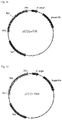
- Polynucleotides encoding amino acid sequences set forth in SEQ ID NO: 1 to SEQ ID NO: 7( Fig. 6a to Fig. 6g ) shown in Table 1 derived from seven thermophilic microorganisms were inserted into a restriction site in an expression vector pET21a (Novagen) using restriction enzymes Ndel and XhoI, thereby preparing recombinant vectors pET21a-RM, pET21a-TAM, pET21a-TAS, pET21a-TAX, pET21a-TP, pET21a-TL, and pET21a-DT( Fig. 1a to Fig. 1g ).
- the recombinant vectors were subjected to a heat shock method (Sambrook and Russell: Molecular Cloning.) to transform E. coli BL21(DE3) (Invitrogen), thereby preparing a recombinant microorganism.
- a heat shock method (Sambrook and Russell: Molecular Cloning.) to transform E. coli BL21(DE3) (Invitrogen), thereby preparing a recombinant microorganism.
- the transformed recombinant microorganism was inoculated to 5ml LB-ampicillin medium (Difco), cultured by shaking at 37°C and 180 rpm until absorbance (OD) at 600nm reached 1.5, and was then inoculated to a 500 ml LB-ampicillin medium. Then, 5 mM lactose was added to the resulting mass in order to induce overexpression of the target enzyme, followed by culturing in a shaking incubator at 37°C. The cultivation conditions were maintained at 37°C and 180 rpm for 16 hours. Thereafter, the resulting mass was centrifuged in a centrifuge at 4,000 rpm for 20 minutes to collect only recombinant microorganisms.
- 5mM lactose was added to the resulting mass in order to induce overexpression of the target enzyme, followed by culturing in a shaking incubator at 37°C.
- the cultivation conditions were maintained at 37°C and 180 rpm for 16 hours. Thereafter, the resulting mass was centr
- Example 1 Seven microorganisms collected in Example 1were dissolved in a lysis buffer (50mM K-phosphate) and then were disrupted using an Ultrasonic processor at 4°C for 10 minutes. The disrupted liquid was subjected to heat treatment in a shaking incubator at 60°C for 30 minutes, followed by centrifuging at 13,000 rpm for 10 minutes to obtain supernatants. The obtained supernatants were applied to a Q-Sepharose DEAE equilibrated with the lysis buffer, followed by sequentially flowing 50mM K-phosphate and a buffer solution containing 200mM NaCl, thereby purifying the intended proteins.
- a lysis buffer 50mM K-phosphate
- the eluted proteins were dialyzed with a buffer solution for enzyme activity evaluation (50mM K-phosphate, pH 7), which was then used in the next experiment. Further, seven purified D-fructose 4-epimerases, RM, TAM, TAS, TAX, TP, TL, and DT were subjected to sodium dodecyl sulfate polyacrylamide gel electrophoresis (SDS-PAGE) and found to have a molecular weight of about 58kDa, 56kDa, 56kDa, 55kDa, 56kDa, 57kDa, and 57kDa, respectively.
- SDS-PAGE sodium dodecyl sulfate polyacrylamide gel electrophoresis
- Example 2-1 In order to identify activity of seven D-fructose 4-epimerases purified in Example 2-1 depending on changes in pH and temperature, the enzymes were reacted with fructose substrate at varying pH and temperature.
- Activity measurement was performed by reacting 50mM fructose, 1 mg/ml of enzymes, and 0.1mM NiSO 4 at each pH and temperature range, followed by quenching the reaction product with ice, and then analyzed by HPLC.
- HPLC analysis was performed using a SUGAR SP0810 (Shodex) column at 80°C while flowing water as a mobile phase at a flow rate of 0.6 ml/min, followed by detecting tagatose using a Differential Refractive Index Detector to analyze tagatose productivity.
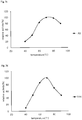
- tagatose productivity was measured at 40°Cto 90°C.
- two enzymes TAM and TP showed maximum conversion rate at 80°C while five enzymes RM, TAS, TAX, TL, and DT showed maximum conversion rate at 70°C( Fig. 3a to Fig. 3g ).
- tagatose productivity was measured at 70°C using buffer solutions of 50mM sodium acetate pH 4-6, 50mM K-phosphate pH 6-8, and 50mM Tris-HCl pH 7 to pH 9, respectively. As a result, it was confirmed that the enzymes demonstrated maximum activity at different pH values, specifically high activity at pH 7 to pH 9.
- Tris-HCl buffer solution exhibited the maximum activity ( Fig. 4a to Fig. 4g ).
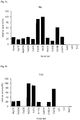
- Example 2-1 Seven proteins purified in Example 2-1 were treated with metal ions through 1 mM of NiSO 4 , NiCl 2 , CuCl 2 , MnCl 2 , CaCl 2 , ZnSO 4 , MgSO 4 , MgCl 2 , FeSO 4 , NaCl, LiCl, KCl or CoCl 2 , thereby measuring enzyme activity.
- metal ions As a control group, seven enzymes were not treated with metal ions. Enzyme activity comparison between metal ion treated enzymes with non-treated enzymes is shown in Fig. 5a to Fig. 5g .
- Tagatose productivity was measured under optimum enzyme reaction conditions selected in Example 2. Specifically, 1 mg/ml of D-fructose 4-epimerases purified in Example 2-1 was reacted with 20g/L (in a concentration of about 110mM) of fructose at a reaction temperature, for example, at 80°C for two enzymes TAM and TP, at 70°C for five enzymes RM, TAS, TAX, TL and DT under 0.1 mM nickel sulfate, and at pH 7 for TAX, pH 8 for TP, TL, RM and DT, and at pH 9 for TAS and TAM, using a 50mM Tris-HCl buffer solution prepared corresponding to each of the pH values.
- a reaction temperature for example, at 80°C for two enzymes TAM and TP, at 70°C for five enzymes RM, TAS, TAX, TL and DT under 0.1 mM nickel sulfate, and at pH 7 for TA
- the solution after above reaction (a mixed solution of tagatose and fructose) was subjected to decolorization (using activated carbon), ion exchange purification, chromatography, and crystallization processes, thereby harvesting final crystalline tagatose.
Landscapes
- Chemical & Material Sciences (AREA)
- Life Sciences & Earth Sciences (AREA)
- Organic Chemistry (AREA)
- Health & Medical Sciences (AREA)
- Engineering & Computer Science (AREA)
- Zoology (AREA)
- Wood Science & Technology (AREA)
- Genetics & Genomics (AREA)
- Bioinformatics & Cheminformatics (AREA)
- Biotechnology (AREA)
- General Engineering & Computer Science (AREA)
- General Health & Medical Sciences (AREA)
- Biochemistry (AREA)
- Microbiology (AREA)
- Biomedical Technology (AREA)
- Medicinal Chemistry (AREA)
- Molecular Biology (AREA)
- Chemical Kinetics & Catalysis (AREA)
- General Chemical & Material Sciences (AREA)
- Tropical Medicine & Parasitology (AREA)
- Virology (AREA)
- Biophysics (AREA)
- Physics & Mathematics (AREA)
- Plant Pathology (AREA)
- Gastroenterology & Hepatology (AREA)
- Proteomics, Peptides & Aminoacids (AREA)
- Enzymes And Modification Thereof (AREA)
- Preparation Of Compounds By Using Micro-Organisms (AREA)
- Micro-Organisms Or Cultivation Processes Thereof (AREA)
Abstract
Description
- The present invention relates to a composition for preparing tagatose and a method for preparing tagatose from fructose, and more particularly, to a gene encoding a thermophilic fructose 4-epimerase derived from thermophilic microorganisms and a method for preparing tagatose from fructose using the enzyme.
- Tagatose is an epimer of D-fructose, and has a natural sweet taste hardly distinguishable from sucrose and physical properties similar to sucrose. Tagatose is a natural sweetener, which is present in a small amount in food such as milk, cheese, cacao, and the like, and in sweet fruits such as apples and mandarin. Tagatose has a calorie value of 1.5 kcal/g which is one third that of sucrose, and a glycemic index (GI) of 3 which is 5% that of sucrose. Tagatose has a sweet taste similar to that of sucrose and various health benefits. In this regard, tagatose can be used as an alternative sweetener capable of satisfying both taste and health when applied to a wide variety of products.
- It is known that tagatose can be produced from galactose by a chemical (catalytic reaction) method or a biological (isomerizing enzyme reaction) method (
Korean Patent Laid-open Publication No. 2009-0082774, published on July 31, 2009 - Specifically, around 2012, sharp increase in global lactose price was mainly caused by rapid demand for skimmed milk powder and whole milk powder containing lactose due to rapid economic growth in China and decrease in annual milk production in dairy-producing countries due to global warming. Such price fluctuations in raw material price make stable production of tagatose difficult. Accordingly, there is a need for a new method for preparing tagatose using common saccharides (sucrose, glucose, fructose, and the like).
- In the past, tagatose was produced using galactose decomposed from various biological resources such as whey permeate which is a soluble byproduct as food raw materials except lactose, and larch which is plant biomass.
- However, there are no suitable raw materials capable of being commercially produced or approaching commercialization in terms of stable supply of raw materials and investment efficiency.
- It is one object of the present invention to provide a composition for preparing tagatose from common saccharides more suitable for industrial applications than prior methods for preparing tagatose from galactose, and a method for preparing tagatose.
- Specifically, the present invention is aimed at providing a novel enzyme protein, the function of which is not elucidated in the prior art, and which has D-fructose 4-epimerase activity and is capable of preparing tagatose in high yield from fructose, a gene encoding the same, a composition for preparing tagatose using the same and a method for preparing tagatose from fructose.
- One embodiment of the present invention provides a composition for preparing tagatose from fructose, including: a protein having an amino acid sequence of SEQ ID NO:1 to SEQ ID NO: 7 or a microorganism expressing the protein.
- Another embodiment of the present invention provides a method for preparing tagatose from fructose, including: reacting the composition of the present invention with fructose.
- The present invention can provide a method for producing tagatose, which is economical and has high yield using a common raw material, fructose, by developing a novel D-fructose 4-epimerase which has an activity for producing tagatose by epimerizing fructose at
carbon number 4. - In addition, the present invention can provide a method for producing tagatose, which is economical and has high yield using a common raw material, fructose, instead of lactose with violent price fluctuations, thereby reducing production costs.
- In general, since it is well known in the art that fructose can be industrially produced from glucose or sucrose, raw materials suggested in the present invention encompass not only fructose but also raw materials entirely or partially containing fructose such that more economical production can be ensured. Namely, the present invention encompasses production of tagatose through enzymatic conversion of starch, crude sugar or sucrose.
- Further, the present invention can produce tagatose from fructose, which ensures efficient mass production of tagatose attracting attention as an important food material today.
-
-
Fig. 1a to Fig. 1g show cleavage maps of recombinant vectors for expressing seven D-fructose 4-epimerases derived from each of thermophilic microorganisms. -
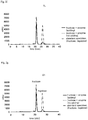
Fig. 2a to Fig. 2g show HPLC graphs depicting seven routes of preparing tagatose derived from each of thermophilic microorganisms via D-fructose 4-epimerase reactions using fructose as a substrate. -
Fig. 3a to Fig. 3g show graphs depicting activity of seven D-fructose 4-epimerases derived from each of thermophilic microorganisms, depending on temperature. -
Fig. 4a to Fig. 4g show graphs depicting activity of seven D-fructose 4-epimerases derived from each of thermophilic microorganisms, depending on pH change. -
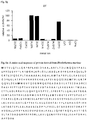
Fig. 5a to Fig. 5g show graphs depicting activity of seven D-fructose 4-epimerases derived from each of thermophilic microorganisms, depending on kinds of metal ions. -
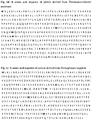
Fig. 6a to Fig. 6g show amino acid sequences of proteins set forth in SEQ ID NO: 1 to SEQ ID NO: 7 derived from each of seven thermophilic microorganisms. - Hereinafter, the present invention will be described in more detail based on concrete embodiments. The present invention are not intended as limitations by the embodiments. Descriptions of details apparent to those skilled in the art having ordinary knowledge in this technical field or relevant field will be omitted herein.
- As used herein, the term "carbon at n-position (hereinafter referred to as Cn)" refers to a carbon position defined in accordance with IUPAC nomenclature, wherein n is an integer of 1 or more. For example, "epimerization at
carbon 4 position" is expressed as "C4-epimerization". - One embodiment of the present invention provides a composition for preparing tagatose from fructose, which includes: a protein having an amino acid sequence set forth in SEQ ID NO: 1 to SEQ ID NO: 7 or a microorganism expressing the protein.
- Generally, monosaccharides can be classified into aldohexoses and ketohexoses. An aldohexose refers to an aldose that has six carbon atoms and an aldehyde group at one end thereof. Examples of the aldohexose include glucose, galactose, allose, gulose, altrose, mannose, talose, and idose, without being limited thereto.
- Further, a ketohexose refers to a monosaccharide having six carbon atoms and a ketone group. Examples of the ketohexose include fructose, tagatose, psicose, and sorbose, without being limited thereto. Specifically, fructose is used as a ketohexose. As used herein, both fructose and tagatose refer to D-fructose and D-tagatose, unless otherwise specified.
- In one embodiment of the present invention, an amino acid sequence set forth in SEQ ID NO:1 to SEQ ID NO: 7 may be an enzyme which has an activity for producing tagatose by epimerizing fructose at
carbon number 4. - Specifically, the present inventors utilized microorganisms belonging to thermophile genus Rhodothermus, genus Thermoanaerobacter, genus Thermotoga, and genus Dictyoglomus. Since enzymes produced from thermophilic microorganisms have the same functions as enzymes produced from mesophilic microorganisms, can stably perform reaction under extreme conditions (high temperature or the like), can prevent contamination by mesophilic microorganisms, can increase solubility of materials having low solubility in substrates, and can increase reaction rate, the enzymes produced from thermophilic microorganisms can overcome industrial disadvantages of mesophilic enzymes. The present inventors screened fructose 4-epimerases from the aforementioned thermophilic microorganisms and then, among their native genes, finally identified for novel polynucleotides, which express enzymes capable of converting fructose to tagatose. The present invention provides an enzyme converting fructose to tagatose by synthesizing a polynucleotide sequence optimized to effectively over-express a protein, inserting the polynucleotide into a recombinant vector, and expressing an enzyme.
- An amino acid sequence set forth in SEQ ID NO: 1 to SEQ ID NO: 7 may be transformed by a recombinant vector including a gene encoding a protein having the above sequence.
- Examples of microorganisms for transformation include Escherichia. coli, (hereinafter referred to as E. coli), Corynebacterum glutamicum, Aspergillus oryzae, or Bacillus subtilis, and the like. Examples of microorganisms transformed by E. coli may include Escherichia coli BL21(DE3)-pET21a-RM(accession number: KCCM11576P), Escherichia coli BL21(DE3)-pET21a-TAM(accession number: KCCM11577P), Escherichia coli BL21(DE3)-pET21a-TAS(accession number: KCCM11578P), Escherichia coli BL21(DE3)-pET21a-TAX(accession number: KCCM11579P), Escherichia coli BL21(DE3)-pET21a-TP(accession number: KCCM11580P), Escherichia coli BL21(DE3)-pET21a-TL(accession number: KCCM11581P), and Escherichia coli BL21(DE3)-pET21a-DT(accession number: KCCM11582P), which were deposited at the Korean Culture Center of Microorganisms (KCCM)(361-221 Hongje 1-dong, Seodaemun-gu, Seoul, Korea) on October 6, 2014 as accession numbers KCCM11576P, KCCM11577P, KCCM11578P, KCCM11579P, KCCM11580P, KCCM11581P, and KCCM11582P, respectively.
- Specifically, in one embodiment, a protein having an amino acid sequence set forth in SEQ ID NO: 1 may be an enzyme derived from Rhodothermus marinus.
- The protein may have a molecular weight of 55 kDa to 60 kDa, an optimum activity temperature of 50°C to 90°C, and an optimum activity pH of 6.0 to 9.0.
- More specifically, the optimum activity temperature may be 60°C to 80°C, and the optimum activity pH may be 7.0 to 9.0.
- Specifically, in one embodiment, a protein having an amino acid sequence set forth in SEQ ID NO: 2 may be an enzyme derived from Thermotoga petrophila.
- The protein may have a molecular weight of 55 kDa to 58kDa, an optimum activity temperature of 50°C to 90°C, and an optimum activity pH of 7.0 to 9.0.
- More specifically, the optimum activity temperature may be 70°C to 90°C.
- Specifically, in one embodiment, a protein having an amino acid sequence set forth in SEQ ID NO: 3 may be an enzyme derived from Thermotoga lettingae.
- The protein may have a molecular weight of 55 kDa to 58kDa, an optimum activity temperature of 50°C to 90°C, and an optimum activity pH of 7.0 to 9.0.
- More specifically, the optimum activity temperature may be 60°C to 80°C.
- Specifically, in one embodiment, a protein having an amino acid sequence set forth in SEQ ID NO: 4 may be an enzyme derived from Thermoanaerobacter mathranii.
- The protein may have a molecular weight of 55 kDa to 58kDa, an optimum activity temperature of 50°C to 90°C, and an optimum activity pH of 7.0 to 10.0.
- More specifically, the optimum activity temperature may be 70°C to 90°C and the optimum activity pH may be 8.0 to 10.0.
- Specifically, in one embodiment, a protein having an amino acid sequence set forth in SEQ ID NO: 5 may be an enzyme derived from Dictyoglomus turgidum.
- The protein may have a molecular weight of 55 kDa to 58kDa, an optimum activity temperature of 50°C to 90°C, and an optimum activity pH of 7.0 to 9.0.
- More specifically, the optimum activity temperature may be 60°C to 80°C.
- Specifically, in one embodiment, a protein having an amino acid sequence set forth in SEQ ID NO: 6 may be an enzyme derived from Thermoanaerobacterium xylanolyticum.
- The protein may have a molecular weight of 53kDa to 58kDa, an optimum activity temperature of 50°C to 90°C, and an optimum activity pH of 6.0 to 9.0.
- More specifically, the optimum activity temperature may be 60°C to 80°C and the optimum activity pH may be 6.0 to 8.0.
- Specifically, in one embodiment, a protein having an amino acid sequence set forth in SEQ ID NO: 7 may be an enzyme derived from Thermoanaerobacter siderophilus.
- The protein may have a molecular weight of 55kDa to 58kDa, an optimum activity temperature of 50°C to 80°C, and an optimum activity pH of 7.0 to 10.0.
- More specifically, the optimum activity temperature may be 60°C to 80°C and the optimum activity pH may be 8.0 to 10.0.
- Another embodiment of the present invention provides a method for preparing tagatose from fructose, which includes: reacting a composition according to any one of embodiments of the present invention with fructose.
- Specifically, the reaction may be performed at 50°C to 80°C.
- Further, the reaction may be performed at pH 6.0 to 9.0.
- In addition, the reaction may be performed by further adding magnesium ions, zinc ions, nickel ions, cobalt ions, iron ions, manganese ions, or a mixture thereof.
- Furthermore, as a substrate, fructose may be present in a concentration of 5%(w/v) to 60%(w/v).
- According to one embodiment of the present invention, fructose may be obtained from sucrose or glucose. As a result, the present invention can provide a method for producing tagatose in high yield using common and inexpensive raw materials such as glucose, fructose, sucrose, and the like, which enables mass production of tagatose.
- Accordingly, the present invention may further include hydrolyzing sucrose or isomerizing glucose to produce fructose prior to reaction of the composition according to any one of embodiments of the present invention with fructose.
- Enzymes utilized in hydrolysis may be at least one selected from the group consisting of β-D-fructosidase including β-fructofuranosidase, invertase, saccharase, and the like; sucrase, α-glucosidase, and α-D-glucohydrolase, without being limited thereto.
- Examples of the enzyme isomerizing glucose may include glucose isomerase and phosphogluco isomerase, without being limited thereto.
- Polynucleotides encoding amino acid sequences set forth in SEQ ID NO: 1 to SEQ ID NO: 7(
Fig. 6a to Fig. 6g ) shown in Table 1 derived from seven thermophilic microorganisms were inserted into a restriction site in an expression vector pET21a (Novagen) using restriction enzymes Ndel and XhoI, thereby preparing recombinant vectors pET21a-RM, pET21a-TAM, pET21a-TAS, pET21a-TAX, pET21a-TP, pET21a-TL, and pET21a-DT(Fig. 1a to Fig. 1g ). The recombinant vectors were subjected to a heat shock method (Sambrook and Russell: Molecular Cloning.) to transform E. coli BL21(DE3) (Invitrogen), thereby preparing a recombinant microorganism.TABLE 1 List of Thermophilic Microorganism RM Rhodothermus marinus TAM Thermoanaerobacter mathranii TAS Thermoanaerobacter siderophilus SR4 TAX Thermoanaerobacterium xylanolyticum TP Thermotoga petrophila TL Thermotoga lettingae DT Dictyoglomus turgidum - The transformed recombinant microorganism was inoculated to 5ml LB-ampicillin medium (Difco), cultured by shaking at 37°C and 180 rpm until absorbance (OD) at 600nm reached 1.5, and was then inoculated to a 500 ml LB-ampicillin medium. Then, 5 mM lactose was added to the resulting mass in order to induce overexpression of the target enzyme, followed by culturing in a shaking incubator at 37°C. The cultivation conditions were maintained at 37°C and 180 rpm for 16 hours. Thereafter, the resulting mass was centrifuged in a centrifuge at 4,000 rpm for 20 minutes to collect only recombinant microorganisms.
- Thus prepared recombinant microorganisms were named as Escherichia coli BL21(DE3)-pET21a-RM(accession number: KCCM11576P), Escherichia coli BL21(DE3)-pET21a-TAM(accession number: KCCM11577P), Escherichia coli BL21(DE3)-pET21a-TAS(accession number: KCCM11578P), Escherichia coli BL21(DE3)-pET21a-TAX(accession number: KCCM11579P), Escherichia coli BL21(DE3)-pET21a-TP(accession number: KCCM11580P), Escherichia coli BL21(DE3)-pET21a-TL(accession number: KCCM11581P), andEscherichia coli BL21(DE3)-pET21a-DT(accession number: KCCM11582P), which were deposited at the Korean Culture Center of Microorganisms (KCCM)(361-221 Hongje 1-dong, Seodaemun-gu, Seoul, Korea) on October 6, 2014 as accession numbers KCCM11576P, KCCM11577P, KCCM11578P, KCCM11579P, KCCM11580P, KCCM11581P, and KCCM11582P, respectively.
- Seven microorganisms collected in Example 1were dissolved in a lysis buffer (50mM K-phosphate) and then were disrupted using an Ultrasonic processor at 4°C for 10 minutes. The disrupted liquid was subjected to heat treatment in a shaking incubator at 60°C for 30 minutes, followed by centrifuging at 13,000 rpm for 10 minutes to obtain supernatants. The obtained supernatants were applied to a Q-Sepharose DEAE equilibrated with the lysis buffer, followed by sequentially flowing 50mM K-phosphate and a buffer solution containing 200mM NaCl, thereby purifying the intended proteins. The eluted proteins were dialyzed with a buffer solution for enzyme activity evaluation (50mM K-phosphate, pH 7), which was then used in the next experiment. Further, seven purified D-fructose 4-epimerases, RM, TAM, TAS, TAX, TP, TL, and DT were subjected to sodium dodecyl sulfate polyacrylamide gel electrophoresis (SDS-PAGE) and found to have a molecular weight of about 58kDa, 56kDa, 56kDa, 55kDa, 56kDa, 57kDa, and 57kDa, respectively.
- In order to identify activity of seven D-fructose 4-epimerases purified in Example 2-1 depending on changes in pH and temperature, the enzymes were reacted with fructose substrate at varying pH and temperature.
- Activity measurement was performed by reacting 50mM fructose, 1 mg/ml of enzymes, and 0.1mM NiSO4 at each pH and temperature range, followed by quenching the reaction product with ice, and then analyzed by HPLC. HPLC analysis was performed using a SUGAR SP0810 (Shodex) column at 80°C while flowing water as a mobile phase at a flow rate of 0.6 ml/min, followed by detecting tagatose using a Differential Refractive Index Detector to analyze tagatose productivity.
- First, in order to evaluate activity of enzymes at
pH 7 depending on temperature change, tagatose productivity was measured at 40°Cto 90°C. As a result, among seven enzymes, two enzymes TAM and TP showed maximum conversion rate at 80°C while five enzymes RM, TAS, TAX, TL, and DT showed maximum conversion rate at 70°C(Fig. 3a to Fig. 3g ). - Further, in order to evaluate activity of enzymes depending on pH change, tagatose productivity was measured at 70°C using buffer solutions of 50mM sodium acetate pH 4-6, 50mM K-phosphate pH 6-8, and 50mM Tris-
HCl pH 7 topH 9, respectively. As a result, it was confirmed that the enzymes demonstrated maximum activity at different pH values, specifically high activity atpH 7 topH 9. - Specifically, TAX exhibited high activity at
pH 7, TP, TL, RM, and DT exhibited high activity at pH8, and TAS and TAM exhibited high activity atpH 9. Further, among buffer solutions corresponding to the above pH values, it was confirmed that the Tris-HCl buffer solution exhibited the maximum activity (Fig. 4a to Fig. 4g ). - As seen from
Fig. 5a to Fig. 5g , it was confirmed that enzymes of Example 2-1 could produce tagatose from fructose. - Previously known epimerases (psicose 3-epimerase) and isomerases (glucose isomerase, arabionose isomerase) are known to require metal ions. Evaluation was performed to determine whether metal ions have an influence on D-fructose 4-epimerases obtained in Example 2-1.
- Seven proteins purified in Example 2-1 were treated with metal ions through 1 mM of NiSO4, NiCl2, CuCl2, MnCl2, CaCl2, ZnSO4, MgSO4, MgCl2, FeSO4, NaCl, LiCl, KCl or CoCl2, thereby measuring enzyme activity. As a control group, seven enzymes were not treated with metal ions. Enzyme activity comparison between metal ion treated enzymes with non-treated enzymes is shown in
Fig. 5a to Fig. 5g . - As shown in
Fig. 5a to Fig. 5g , it was confirmed that enzymes of Example 2-1exhibited increased activity due to addition of nickel ions and cobalt ions, which indicate requirement for metal ion. Specifically, it was confirmed that NiSO4 provided maximum activity. - Tagatose productivity was measured under optimum enzyme reaction conditions selected in Example 2. Specifically, 1 mg/ml of D-fructose 4-epimerases purified in Example 2-1 was reacted with 20g/L (in a concentration of about 110mM) of fructose at a reaction temperature, for example, at 80°C for two enzymes TAM and TP, at 70°C for five enzymes RM, TAS, TAX, TL and DT under 0.1 mM nickel sulfate, and at
pH 7 for TAX,pH 8 for TP, TL, RM and DT, and atpH 9 for TAS and TAM, using a 50mM Tris-HCl buffer solution prepared corresponding to each of the pH values. - HPLC analysis was performed by the same method as in Example 2-2 (
Fig. 2a to Fig. 2g ). Conversion rate from fructose to tagatose was determined from tagatose amount produced from the reaction. Results are shown in Table 2.TABLE 2 Fructose concentration (g/L) Tagatose concentration (g/L) Conversion rate (%) RM 20 3.8 19.0 TAX 20 1.7 8.6 TAM 20 3.3 16.7 TAS 20 2.5 12.4 TP 20 3.6 18.1 TL 20 3.9 19.4 DT 20 2.5 12.6 - The solution after above reaction (a mixed solution of tagatose and fructose) was subjected to decolorization (using activated carbon), ion exchange purification, chromatography, and crystallization processes, thereby harvesting final crystalline tagatose.


Claims (20)
- A composition for preparing tagatose from fructose, comprising:a protein having an amino acid sequence set forth in SEQ ID NOs: 1 to 7 or a microorganism expressing the protein.
- The composition according to claim 1, wherein the protein is an enzyme protein converting fructose into tagatose through epimerization at carbon-4 position of fructose.
- The composition according to claim 1, wherein the protein having an amino acid sequence set forth in SEQ ID NO:1 is derived from Rhodothermus marinus.
- The composition according to claim 1, wherein the protein having an amino acid sequence set forth in SEQ ID NO: 2 is derived from Thermotoga petrophila.
- The composition according to claim 1, wherein the protein having an amino acid sequence set forth in SEQ ID NO: 3 is derived from Thermotoga lettingae.
- The composition according to claim 1, wherein the protein having an amino acid sequence set forth in SEQ ID NO: 4 is derived from Thermoanaerobacter mathranii.
- The composition according to claim 1, wherein the protein having an amino acid sequence set forth in SEQ ID NO: 5 is derived from Dictyoglomu sturgidum.
- The composition according to claim 1, wherein the protein having an amino acid sequence set forth in SEQ ID NO: 6 is derived from Thermoanaerobacterium xylanolyticum.
- The composition according to claim 1, wherein the protein having an amino acid sequence set forth in SEQ ID NO: 7 is derived from Thermoanaerobacter siderophilus.
- The composition according to claim 1, wherein the microorganism is transformed with a recombinant vector comprising a gene encoding the protein having an amino acid sequence set forth in SEQ ID NOs: 1 to 7.
- The composition according to claim 1, wherein the protein having an amino acid sequence set forth in SEQ ID NO: 1 has a molecular weight of 55 kDa to 60 kDa, an optimum activity temperature of 50°C to 90°C, and an optimum activity pH of 6.0 to 9.0.
- The composition according to claim 1, wherein the protein having an amino acid sequence set forth in SEQ ID NO: 2 has a molecular weight of 55 kDa to 58kDa, an optimum activity temperature of 50°C to 90°C, and an optimum activity pH of 7.0 to 9.0.
- The composition according to claim 1, wherein the protein having an amino acid sequence set forth in SEQ ID NO: 3 has a molecular weight of 55 kDa to 58kDa, an optimum activity temperature of 50°C to 90°C, and an optimum activity pH of 7.0 to 9.0.
- The composition according to claim 1, wherein the protein having an amino acid sequence set forth in SEQ ID NO: 4 has a molecular weight of 55 kDa to 58kDa, an optimum activity temperature of 50°C to 80°C, and an optimum activity pH of 7.0 to 10.0.
- The composition according to claim 1, wherein the protein having an amino acid sequence set forth in SEQ ID NO: 5 has a molecular weight of 55 kDa to 58kDa, an optimum activity temperature of 50°C to 90°C, and an optimum activity pH of 7.0 to 9.0.
- The composition according to claim 1, wherein the protein having an amino acid sequence set forth in SEQ ID NO: 6 has a molecular weight of 55 kDa to 58kDa, an optimum activity temperature of 50°C to 90°C, and an optimum activity pH of 6.0 to 9.0.
- The composition according to claim 1, wherein the protein having an amino acid sequence set forth in SEQ ID NO: 7 has a molecular weight of 55 kDa to 58kDa, an optimum activity temperature of 50°C to 80°C, and an optimum activity pH of 7.0 to 10.0.
- A method for preparing tagatose from fructose, comprising: reacting the composition according to any one of claims 1 to 17 with fructose.
- The method for preparing tagatose from fructose according to claim 18, wherein reaction is performed under any one of the following conditions:a) a reaction temperature of 50°Cto 80°C,b) a reaction pH of 6.0 to 9.0, andc) a fructose concentration of 5%(w/v) to 60%(w/v).
- The method for preparing tagatose from fructose according to claim 18, further comprising: adding magnesium ions, zinc ions, nickel ions, cobalt ions, iron ions, manganese ions, or a mixture thereof.
Applications Claiming Priority (2)
| Application Number | Priority Date | Filing Date | Title |
|---|---|---|---|
| KR1020140143703A KR101638024B1 (en) | 2014-10-22 | 2014-10-22 | Composition for preparation of tagatose and manufacturing method for tagatose from fructose |
| PCT/KR2015/011007 WO2016064146A1 (en) | 2014-10-22 | 2015-10-19 | Composition for preparing tagatose and method for preparing tagatose from fructose |
Publications (3)
| Publication Number | Publication Date |
|---|---|
| EP3211078A1 true EP3211078A1 (en) | 2017-08-30 |
| EP3211078A4 EP3211078A4 (en) | 2018-04-18 |
| EP3211078B1 EP3211078B1 (en) | 2019-03-27 |
Family
ID=55761127
Family Applications (1)
| Application Number | Title | Priority Date | Filing Date |
|---|---|---|---|
| EP15852026.2A Active EP3211078B1 (en) | 2014-10-22 | 2015-10-19 | Composition for preparing tagatose and method for preparing tagatose from fructose |
Country Status (9)
| Country | Link |
|---|---|
| US (1) | US10544438B2 (en) |
| EP (1) | EP3211078B1 (en) |
| JP (1) | JP6518761B2 (en) |
| KR (1) | KR101638024B1 (en) |
| CN (1) | CN107109394B (en) |
| ES (1) | ES2721309T3 (en) |
| RU (1) | RU2701669C2 (en) |
| UA (1) | UA119791C2 (en) |
| WO (1) | WO2016064146A1 (en) |
Cited By (6)
| Publication number | Priority date | Publication date | Assignee | Title |
|---|---|---|---|---|
| EP3492589A4 (en) * | 2016-07-29 | 2020-11-04 | Cj Cheiljedang Corporation | Hexuronate c4-epimerase variant having improved d-tagatose conversion activity, and d-tagatose production method using same |
| EP3604516A4 (en) * | 2017-03-31 | 2021-01-20 | Cj Cheiljedang Corporation | COMPOSITION FOR THE PRODUCTION OF TAGATOSE AND PROCESS FOR THE PRODUCTION OF TAGATOSE USING IT |
| EP3604514A4 (en) * | 2017-03-31 | 2021-01-20 | Cj Cheiljedang Corporation | COMPOSITION FOR THE PRODUCTION OF TAGATOSE AND PROCESS FOR THE PRODUCTION OF TAGATOSE USING THE SAME |
| CN112867797A (en) * | 2018-09-27 | 2021-05-28 | Cj第一制糖株式会社 | Novel fructose-4-epimerase and method for preparing tagatose using the same |
| EP3677675A4 (en) * | 2017-08-31 | 2021-06-09 | CJ Cheiljedang Corporation | Fructose-4-epimerase and method for production of tagatose, using same |
| EP3818156A4 (en) * | 2018-07-03 | 2022-05-11 | Arzeda Corp. | METHODS AND COMPOSITIONS FOR PREPARING TAGATOSE FROM FRUCTOSE |
Families Citing this family (12)
| Publication number | Priority date | Publication date | Assignee | Title |
|---|---|---|---|---|
| CN108374031A (en) | 2015-10-02 | 2018-08-07 | 博努莫斯生化有限责任公司 | The enzymatic production of D-Tag |
| WO2019004702A2 (en) * | 2017-06-28 | 2019-01-03 | 주식회사 삼양사 | Method for manufacturing functional sweetener |
| CN109750024B (en) * | 2017-11-02 | 2021-12-14 | 中国科学院天津工业生物技术研究所 | A kind of 4-position epimerase of tagatose 6-phosphate and its application |
| CN108774636A (en) * | 2018-06-25 | 2018-11-09 | 嘉兴欣贝莱生物科技有限公司 | A method for producing D-tagatose by fermentation of Saccharomyces cerevisiae |
| KR102308173B1 (en) * | 2018-09-28 | 2021-10-06 | 씨제이제일제당 주식회사 | A Novel Fructose C4 epimerases and Preparation Method for producing Tagatose using the same |
| KR102194285B1 (en) * | 2018-10-19 | 2020-12-23 | 씨제이제일제당 주식회사 | A Novel Fructose C4 epimerases and Preparation Method for producing Tagatose using the same |
| WO2020081959A1 (en) | 2018-10-19 | 2020-04-23 | Bonumose Llc | Enzymatic production of tagatose |
| KR102219195B1 (en) * | 2019-08-14 | 2021-02-24 | 씨제이제일제당 주식회사 | A Novel Fructose C4 epimerases and Preparation Method for producing Tagatose using the same |
| KR102362873B1 (en) * | 2020-06-05 | 2022-02-11 | 건국대학교 산학협력단 | Tagaturonate epimerase variant and method for producing tagatose from fruxtose using the same |
| EP4464785A1 (en) | 2023-05-15 | 2024-11-20 | Annikki GmbH | Process for producing d-talitol, d-tagatose and d-psicose |
| AR132695A1 (en) | 2023-05-15 | 2025-07-23 | Annikki Gmbh | PROCEDURE FOR THE PREPARATION OF D-THALITOL, D-TAGATOSE AND D-PSYCHOSE |
| CN120173929A (en) * | 2024-12-19 | 2025-06-20 | 浙江工业大学 | Tagatose-4-epimerase mutant and its encoding gene and application |
Family Cites Families (5)
| Publication number | Priority date | Publication date | Assignee | Title |
|---|---|---|---|---|
| BR0211148A (en) * | 2001-07-16 | 2004-06-29 | Arla Foods Amba | Process for tagatose production |
| KR20080053708A (en) * | 2006-12-11 | 2008-06-16 | 씨제이제일제당 (주) | Process for preparing tagatose using high conversion galactose isomerization |
| KR100964091B1 (en) * | 2008-01-28 | 2010-06-16 | 씨제이제일제당 (주) | Method for preparing tagatose using soy oligosaccharides |
| CN105431541B (en) * | 2013-06-05 | 2019-09-24 | Cj第一制糖株式会社 | Production method, Escherichia coli and the ketohexose C4- epimerism enzyme mutant of Tagatose |
| KR101868194B1 (en) | 2013-11-19 | 2018-06-18 | 씨제이제일제당 (주) | Composition for non-phosphate sugar epimerization comprising sugar epimerase derived from thermophilic bacteria |
-
2014
- 2014-10-22 KR KR1020140143703A patent/KR101638024B1/en active Active
-
2015
- 2015-10-19 JP JP2017521088A patent/JP6518761B2/en active Active
- 2015-10-19 WO PCT/KR2015/011007 patent/WO2016064146A1/en not_active Ceased
- 2015-10-19 ES ES15852026T patent/ES2721309T3/en active Active
- 2015-10-19 CN CN201580057200.3A patent/CN107109394B/en active Active
- 2015-10-19 EP EP15852026.2A patent/EP3211078B1/en active Active
- 2015-10-19 UA UAA201703549A patent/UA119791C2/en unknown
- 2015-10-19 RU RU2017113926A patent/RU2701669C2/en active
- 2015-10-19 US US15/521,243 patent/US10544438B2/en active Active
Cited By (13)
| Publication number | Priority date | Publication date | Assignee | Title |
|---|---|---|---|---|
| EP3492589A4 (en) * | 2016-07-29 | 2020-11-04 | Cj Cheiljedang Corporation | Hexuronate c4-epimerase variant having improved d-tagatose conversion activity, and d-tagatose production method using same |
| US11306303B2 (en) | 2016-07-29 | 2022-04-19 | Cj Cheiljedang Corporation | Hexuronate C4-epimerase variant having improved D-tagatose conversion activity, and D-tagatose production method using same |
| US11180785B2 (en) | 2017-03-31 | 2021-11-23 | Cj Cheiljedang Corporation | Composition for producing tagatose and method of producing tagatose using the same |
| EP3604516A4 (en) * | 2017-03-31 | 2021-01-20 | Cj Cheiljedang Corporation | COMPOSITION FOR THE PRODUCTION OF TAGATOSE AND PROCESS FOR THE PRODUCTION OF TAGATOSE USING IT |
| EP3604514A4 (en) * | 2017-03-31 | 2021-01-20 | Cj Cheiljedang Corporation | COMPOSITION FOR THE PRODUCTION OF TAGATOSE AND PROCESS FOR THE PRODUCTION OF TAGATOSE USING THE SAME |
| US11408018B2 (en) | 2017-08-31 | 2022-08-09 | Cj Cheiljedang Corporation | Fructose-C4-epimerase and preparation method for producing tagatose using the same |
| EP3677675A4 (en) * | 2017-08-31 | 2021-06-09 | CJ Cheiljedang Corporation | Fructose-4-epimerase and method for production of tagatose, using same |
| EP3818156A4 (en) * | 2018-07-03 | 2022-05-11 | Arzeda Corp. | METHODS AND COMPOSITIONS FOR PREPARING TAGATOSE FROM FRUCTOSE |
| US11866758B2 (en) | 2018-07-03 | 2024-01-09 | Arzeda Corp. | Methods and compositions for preparing tagatose from fructose |
| EP3845659A4 (en) * | 2018-09-27 | 2021-11-10 | CJ Cheiljedang Corporation | Novel fructose-4-epimerase and method for preparing tagatose using same |
| CN112867797A (en) * | 2018-09-27 | 2021-05-28 | Cj第一制糖株式会社 | Novel fructose-4-epimerase and method for preparing tagatose using the same |
| US11697832B2 (en) | 2018-09-27 | 2023-07-11 | Cj Cheiljedang Corporation | Fructose-C4-epimerase and method of producing tagatose using the same |
| CN112867797B (en) * | 2018-09-27 | 2024-02-13 | Cj第一制糖株式会社 | Fructose-4-epimerase and methods of preparing tagatose using same |
Also Published As
| Publication number | Publication date |
|---|---|
| EP3211078B1 (en) | 2019-03-27 |
| RU2017113926A (en) | 2018-11-22 |
| UA119791C2 (en) | 2019-08-12 |
| ES2721309T3 (en) | 2019-07-30 |
| US20170306370A1 (en) | 2017-10-26 |
| RU2017113926A3 (en) | 2018-11-22 |
| JP2017531438A (en) | 2017-10-26 |
| RU2701669C2 (en) | 2019-09-30 |
| KR101638024B1 (en) | 2016-07-20 |
| CN107109394B (en) | 2021-01-15 |
| CN107109394A (en) | 2017-08-29 |
| KR20160047361A (en) | 2016-05-02 |
| EP3211078A4 (en) | 2018-04-18 |
| JP6518761B2 (en) | 2019-05-22 |
| WO2016064146A1 (en) | 2016-04-28 |
| US10544438B2 (en) | 2020-01-28 |
Similar Documents
| Publication | Publication Date | Title |
|---|---|---|
| EP3211078B1 (en) | Composition for preparing tagatose and method for preparing tagatose from fructose | |
| EP3006568B1 (en) | Production method for tagatose | |
| KR101944027B1 (en) | Enzyme produced by arthrobacter globiformis | |
| US9914919B2 (en) | Aldolase, aldolase mutant, and method and composition for producing tagatose by using same | |
| US9932617B2 (en) | Ketose 3-epimerase produced by arthrobacter globiformis | |
| EP3333260A1 (en) | Hexuronate c4-epimerase mutant with improved conversion activity, and method for producing d-tagatose by using same | |
| KR101695831B1 (en) | Saccharide mixture containing psicose with improved sweetness quality and crystallization | |
| US11976313B2 (en) | Enzymatic method for preparing rebaudioside N | |
| CN111133103B (en) | Composition for preparing tagatose and method for preparing tagatose using same | |
| US20210395718A1 (en) | Novel ketose 3-epimerase | |
| TW201842188A (en) | Composition for producing tagatose and method for producing tagatose using same | |
| AU2002354844B2 (en) | Process for manufacturing of tagatose | |
| KR20230115919A (en) | Composition for producing one pot D-allose and method for producing allose using the same | |
| KR101261004B1 (en) | Method for production of lactulose from lactose using by cellobiose 2-epimerase | |
| KR20020051835A (en) | Thermostable L-Arabinose Isomerase and Process for Preparing D-tagatose thereby | |
| CN112852774A (en) | Phosphofructosyl aminotransferase encoding gene and preparation and application of enzyme | |
| KR101361688B1 (en) | Method for production of lactulose from lactose using N-acetyl glucosamin 2-epimerase | |
| CN116783300A (en) | Novel L-rhamnose isomerase | |
| CN114395542A (en) | Sucrose phosphorylase and application thereof |
Legal Events
| Date | Code | Title | Description |
|---|---|---|---|
| STAA | Information on the status of an ep patent application or granted ep patent |
Free format text: STATUS: THE INTERNATIONAL PUBLICATION HAS BEEN MADE |
|
| PUAI | Public reference made under article 153(3) epc to a published international application that has entered the european phase |
Free format text: ORIGINAL CODE: 0009012 |
|
| STAA | Information on the status of an ep patent application or granted ep patent |
Free format text: STATUS: REQUEST FOR EXAMINATION WAS MADE |
|
| 17P | Request for examination filed |
Effective date: 20170420 |
|
| AK | Designated contracting states |
Kind code of ref document: A1 Designated state(s): AL AT BE BG CH CY CZ DE DK EE ES FI FR GB GR HR HU IE IS IT LI LT LU LV MC MK MT NL NO PL PT RO RS SE SI SK SM TR |
|
| AX | Request for extension of the european patent |
Extension state: BA ME |
|
| DAV | Request for validation of the european patent (deleted) | ||
| DAX | Request for extension of the european patent (deleted) | ||
| A4 | Supplementary search report drawn up and despatched |
Effective date: 20180321 |
|
| RIC1 | Information provided on ipc code assigned before grant |
Ipc: C12N 1/20 20060101ALI20180315BHEP Ipc: C12N 9/90 20060101AFI20180315BHEP Ipc: C12P 19/02 20060101ALI20180315BHEP |
|
| GRAP | Despatch of communication of intention to grant a patent |
Free format text: ORIGINAL CODE: EPIDOSNIGR1 |
|
| STAA | Information on the status of an ep patent application or granted ep patent |
Free format text: STATUS: GRANT OF PATENT IS INTENDED |
|
| INTG | Intention to grant announced |
Effective date: 20181126 |
|
| GRAS | Grant fee paid |
Free format text: ORIGINAL CODE: EPIDOSNIGR3 |
|
| GRAA | (expected) grant |
Free format text: ORIGINAL CODE: 0009210 |
|
| STAA | Information on the status of an ep patent application or granted ep patent |
Free format text: STATUS: THE PATENT HAS BEEN GRANTED |
|
| AK | Designated contracting states |
Kind code of ref document: B1 Designated state(s): AL AT BE BG CH CY CZ DE DK EE ES FI FR GB GR HR HU IE IS IT LI LT LU LV MC MK MT NL NO PL PT RO RS SE SI SK SM TR |
|
| REG | Reference to a national code |
Ref country code: GB Ref legal event code: FG4D |
|
| REG | Reference to a national code |
Ref country code: CH Ref legal event code: EP |
|
| REG | Reference to a national code |
Ref country code: AT Ref legal event code: REF Ref document number: 1113109 Country of ref document: AT Kind code of ref document: T Effective date: 20190415 |
|
| REG | Reference to a national code |
Ref country code: IE Ref legal event code: FG4D |
|
| REG | Reference to a national code |
Ref country code: DE Ref legal event code: R096 Ref document number: 602015027356 Country of ref document: DE |
|
| REG | Reference to a national code |
Ref country code: ES Ref legal event code: FG2A Ref document number: 2721309 Country of ref document: ES Kind code of ref document: T3 Effective date: 20190730 |
|
| PG25 | Lapsed in a contracting state [announced via postgrant information from national office to epo] |
Ref country code: FI Free format text: LAPSE BECAUSE OF FAILURE TO SUBMIT A TRANSLATION OF THE DESCRIPTION OR TO PAY THE FEE WITHIN THE PRESCRIBED TIME-LIMIT Effective date: 20190327 Ref country code: SE Free format text: LAPSE BECAUSE OF FAILURE TO SUBMIT A TRANSLATION OF THE DESCRIPTION OR TO PAY THE FEE WITHIN THE PRESCRIBED TIME-LIMIT Effective date: 20190327 Ref country code: NO Free format text: LAPSE BECAUSE OF FAILURE TO SUBMIT A TRANSLATION OF THE DESCRIPTION OR TO PAY THE FEE WITHIN THE PRESCRIBED TIME-LIMIT Effective date: 20190627 Ref country code: LT Free format text: LAPSE BECAUSE OF FAILURE TO SUBMIT A TRANSLATION OF THE DESCRIPTION OR TO PAY THE FEE WITHIN THE PRESCRIBED TIME-LIMIT Effective date: 20190327 |
|
| REG | Reference to a national code |
Ref country code: NL Ref legal event code: MP Effective date: 20190327 |
|
| PG25 | Lapsed in a contracting state [announced via postgrant information from national office to epo] |
Ref country code: HR Free format text: LAPSE BECAUSE OF FAILURE TO SUBMIT A TRANSLATION OF THE DESCRIPTION OR TO PAY THE FEE WITHIN THE PRESCRIBED TIME-LIMIT Effective date: 20190327 Ref country code: GR Free format text: LAPSE BECAUSE OF FAILURE TO SUBMIT A TRANSLATION OF THE DESCRIPTION OR TO PAY THE FEE WITHIN THE PRESCRIBED TIME-LIMIT Effective date: 20190628 Ref country code: NL Free format text: LAPSE BECAUSE OF FAILURE TO SUBMIT A TRANSLATION OF THE DESCRIPTION OR TO PAY THE FEE WITHIN THE PRESCRIBED TIME-LIMIT Effective date: 20190327 Ref country code: LV Free format text: LAPSE BECAUSE OF FAILURE TO SUBMIT A TRANSLATION OF THE DESCRIPTION OR TO PAY THE FEE WITHIN THE PRESCRIBED TIME-LIMIT Effective date: 20190327 Ref country code: RS Free format text: LAPSE BECAUSE OF FAILURE TO SUBMIT A TRANSLATION OF THE DESCRIPTION OR TO PAY THE FEE WITHIN THE PRESCRIBED TIME-LIMIT Effective date: 20190327 Ref country code: BG Free format text: LAPSE BECAUSE OF FAILURE TO SUBMIT A TRANSLATION OF THE DESCRIPTION OR TO PAY THE FEE WITHIN THE PRESCRIBED TIME-LIMIT Effective date: 20190627 |
|
| REG | Reference to a national code |
Ref country code: AT Ref legal event code: MK05 Ref document number: 1113109 Country of ref document: AT Kind code of ref document: T Effective date: 20190327 |
|
| PG25 | Lapsed in a contracting state [announced via postgrant information from national office to epo] |
Ref country code: EE Free format text: LAPSE BECAUSE OF FAILURE TO SUBMIT A TRANSLATION OF THE DESCRIPTION OR TO PAY THE FEE WITHIN THE PRESCRIBED TIME-LIMIT Effective date: 20190327 Ref country code: RO Free format text: LAPSE BECAUSE OF FAILURE TO SUBMIT A TRANSLATION OF THE DESCRIPTION OR TO PAY THE FEE WITHIN THE PRESCRIBED TIME-LIMIT Effective date: 20190327 Ref country code: CZ Free format text: LAPSE BECAUSE OF FAILURE TO SUBMIT A TRANSLATION OF THE DESCRIPTION OR TO PAY THE FEE WITHIN THE PRESCRIBED TIME-LIMIT Effective date: 20190327 Ref country code: AL Free format text: LAPSE BECAUSE OF FAILURE TO SUBMIT A TRANSLATION OF THE DESCRIPTION OR TO PAY THE FEE WITHIN THE PRESCRIBED TIME-LIMIT Effective date: 20190327 Ref country code: SK Free format text: LAPSE BECAUSE OF FAILURE TO SUBMIT A TRANSLATION OF THE DESCRIPTION OR TO PAY THE FEE WITHIN THE PRESCRIBED TIME-LIMIT Effective date: 20190327 Ref country code: PT Free format text: LAPSE BECAUSE OF FAILURE TO SUBMIT A TRANSLATION OF THE DESCRIPTION OR TO PAY THE FEE WITHIN THE PRESCRIBED TIME-LIMIT Effective date: 20190727 |
|
| PG25 | Lapsed in a contracting state [announced via postgrant information from national office to epo] |
Ref country code: PL Free format text: LAPSE BECAUSE OF FAILURE TO SUBMIT A TRANSLATION OF THE DESCRIPTION OR TO PAY THE FEE WITHIN THE PRESCRIBED TIME-LIMIT Effective date: 20190327 Ref country code: SM Free format text: LAPSE BECAUSE OF FAILURE TO SUBMIT A TRANSLATION OF THE DESCRIPTION OR TO PAY THE FEE WITHIN THE PRESCRIBED TIME-LIMIT Effective date: 20190327 |
|
| PG25 | Lapsed in a contracting state [announced via postgrant information from national office to epo] |
Ref country code: AT Free format text: LAPSE BECAUSE OF FAILURE TO SUBMIT A TRANSLATION OF THE DESCRIPTION OR TO PAY THE FEE WITHIN THE PRESCRIBED TIME-LIMIT Effective date: 20190327 Ref country code: IS Free format text: LAPSE BECAUSE OF FAILURE TO SUBMIT A TRANSLATION OF THE DESCRIPTION OR TO PAY THE FEE WITHIN THE PRESCRIBED TIME-LIMIT Effective date: 20190727 |
|
| REG | Reference to a national code |
Ref country code: DE Ref legal event code: R097 Ref document number: 602015027356 Country of ref document: DE |
|
| PG25 | Lapsed in a contracting state [announced via postgrant information from national office to epo] |
Ref country code: DK Free format text: LAPSE BECAUSE OF FAILURE TO SUBMIT A TRANSLATION OF THE DESCRIPTION OR TO PAY THE FEE WITHIN THE PRESCRIBED TIME-LIMIT Effective date: 20190327 |
|
| PLBE | No opposition filed within time limit |
Free format text: ORIGINAL CODE: 0009261 |
|
| STAA | Information on the status of an ep patent application or granted ep patent |
Free format text: STATUS: NO OPPOSITION FILED WITHIN TIME LIMIT |
|
| PG25 | Lapsed in a contracting state [announced via postgrant information from national office to epo] |
Ref country code: SI Free format text: LAPSE BECAUSE OF FAILURE TO SUBMIT A TRANSLATION OF THE DESCRIPTION OR TO PAY THE FEE WITHIN THE PRESCRIBED TIME-LIMIT Effective date: 20190327 |
|
| 26N | No opposition filed |
Effective date: 20200103 |
|
| PG25 | Lapsed in a contracting state [announced via postgrant information from national office to epo] |
Ref country code: TR Free format text: LAPSE BECAUSE OF FAILURE TO SUBMIT A TRANSLATION OF THE DESCRIPTION OR TO PAY THE FEE WITHIN THE PRESCRIBED TIME-LIMIT Effective date: 20190327 |
|
| PG25 | Lapsed in a contracting state [announced via postgrant information from national office to epo] |
Ref country code: MC Free format text: LAPSE BECAUSE OF FAILURE TO SUBMIT A TRANSLATION OF THE DESCRIPTION OR TO PAY THE FEE WITHIN THE PRESCRIBED TIME-LIMIT Effective date: 20190327 |
|
| REG | Reference to a national code |
Ref country code: CH Ref legal event code: PL |
|
| PG25 | Lapsed in a contracting state [announced via postgrant information from national office to epo] |
Ref country code: LI Free format text: LAPSE BECAUSE OF NON-PAYMENT OF DUE FEES Effective date: 20191031 Ref country code: CH Free format text: LAPSE BECAUSE OF NON-PAYMENT OF DUE FEES Effective date: 20191031 Ref country code: LU Free format text: LAPSE BECAUSE OF NON-PAYMENT OF DUE FEES Effective date: 20191019 |
|
| PG25 | Lapsed in a contracting state [announced via postgrant information from national office to epo] |
Ref country code: IE Free format text: LAPSE BECAUSE OF NON-PAYMENT OF DUE FEES Effective date: 20191019 |
|
| PG25 | Lapsed in a contracting state [announced via postgrant information from national office to epo] |
Ref country code: CY Free format text: LAPSE BECAUSE OF FAILURE TO SUBMIT A TRANSLATION OF THE DESCRIPTION OR TO PAY THE FEE WITHIN THE PRESCRIBED TIME-LIMIT Effective date: 20190327 |
|
| PG25 | Lapsed in a contracting state [announced via postgrant information from national office to epo] |
Ref country code: HU Free format text: LAPSE BECAUSE OF FAILURE TO SUBMIT A TRANSLATION OF THE DESCRIPTION OR TO PAY THE FEE WITHIN THE PRESCRIBED TIME-LIMIT; INVALID AB INITIO Effective date: 20151019 Ref country code: MT Free format text: LAPSE BECAUSE OF FAILURE TO SUBMIT A TRANSLATION OF THE DESCRIPTION OR TO PAY THE FEE WITHIN THE PRESCRIBED TIME-LIMIT Effective date: 20190327 |
|
| PG25 | Lapsed in a contracting state [announced via postgrant information from national office to epo] |
Ref country code: MK Free format text: LAPSE BECAUSE OF FAILURE TO SUBMIT A TRANSLATION OF THE DESCRIPTION OR TO PAY THE FEE WITHIN THE PRESCRIBED TIME-LIMIT Effective date: 20190327 |
|
| P01 | Opt-out of the competence of the unified patent court (upc) registered |
Effective date: 20230606 |
|
| PGFP | Annual fee paid to national office [announced via postgrant information from national office to epo] |
Ref country code: IT Payment date: 20250822 Year of fee payment: 11 |
|
| PGFP | Annual fee paid to national office [announced via postgrant information from national office to epo] |
Ref country code: BE Payment date: 20250820 Year of fee payment: 11 Ref country code: GB Payment date: 20250820 Year of fee payment: 11 |
|
| PGFP | Annual fee paid to national office [announced via postgrant information from national office to epo] |
Ref country code: FR Payment date: 20250821 Year of fee payment: 11 |
|
| PGFP | Annual fee paid to national office [announced via postgrant information from national office to epo] |
Ref country code: DE Payment date: 20250820 Year of fee payment: 11 |
|
| PGFP | Annual fee paid to national office [announced via postgrant information from national office to epo] |
Ref country code: ES Payment date: 20251117 Year of fee payment: 11 |