EP3211051A1 - Aqueous composition for surface coating, and vehicle sheet to which same is applied - Google Patents
Aqueous composition for surface coating, and vehicle sheet to which same is applied Download PDFInfo
- Publication number
- EP3211051A1 EP3211051A1 EP15852810.9A EP15852810A EP3211051A1 EP 3211051 A1 EP3211051 A1 EP 3211051A1 EP 15852810 A EP15852810 A EP 15852810A EP 3211051 A1 EP3211051 A1 EP 3211051A1
- Authority
- EP
- European Patent Office
- Prior art keywords
- surface coating
- aqueous composition
- group
- compound
- main ingredient
- Prior art date
- Legal status (The legal status is an assumption and is not a legal conclusion. Google has not performed a legal analysis and makes no representation as to the accuracy of the status listed.)
- Granted
Links
- 239000000203 mixture Substances 0.000 title claims abstract description 88
- 239000011248 coating agent Substances 0.000 title claims abstract description 73
- 238000000576 coating method Methods 0.000 title claims abstract description 73
- 150000001875 compounds Chemical class 0.000 claims abstract description 74
- 239000003795 chemical substances by application Substances 0.000 claims abstract description 31
- 239000002075 main ingredient Substances 0.000 claims abstract description 30
- 125000002887 hydroxy group Chemical group [H]O* 0.000 claims abstract description 25
- 125000000524 functional group Chemical group 0.000 claims abstract description 22
- 239000003125 aqueous solvent Substances 0.000 claims abstract description 21
- 125000003178 carboxy group Chemical group [H]OC(*)=O 0.000 claims abstract description 20
- 125000003277 amino group Chemical group 0.000 claims abstract description 14
- IQPQWNKOIGAROB-UHFFFAOYSA-N isocyanate group Chemical group [N-]=C=O IQPQWNKOIGAROB-UHFFFAOYSA-N 0.000 claims abstract description 13
- VPKDCDLSJZCGKE-UHFFFAOYSA-N carbodiimide group Chemical group N=C=N VPKDCDLSJZCGKE-UHFFFAOYSA-N 0.000 claims abstract description 11
- 125000004069 aziridinyl group Chemical group 0.000 claims abstract description 10
- 239000010410 layer Substances 0.000 claims description 40
- 238000004132 cross linking Methods 0.000 claims description 32
- 239000011324 bead Substances 0.000 claims description 27
- 239000002345 surface coating layer Substances 0.000 claims description 27
- 229920000642 polymer Polymers 0.000 claims description 26
- XUIMIQQOPSSXEZ-UHFFFAOYSA-N Silicon Chemical group [Si] XUIMIQQOPSSXEZ-UHFFFAOYSA-N 0.000 claims description 24
- 229910052710 silicon Inorganic materials 0.000 claims description 24
- 239000010703 silicon Substances 0.000 claims description 24
- JOYRKODLDBILNP-UHFFFAOYSA-N urethane group Chemical group NC(=O)OCC JOYRKODLDBILNP-UHFFFAOYSA-N 0.000 claims description 20
- 230000032683 aging Effects 0.000 claims description 16
- 238000006243 chemical reaction Methods 0.000 claims description 14
- YCKRFDGAMUMZLT-UHFFFAOYSA-N Fluorine atom Chemical compound [F] YCKRFDGAMUMZLT-UHFFFAOYSA-N 0.000 claims description 10
- 229910052731 fluorine Inorganic materials 0.000 claims description 10
- 239000011737 fluorine Substances 0.000 claims description 10
- 239000001993 wax Substances 0.000 claims description 10
- XLYOFNOQVPJJNP-UHFFFAOYSA-N water Substances O XLYOFNOQVPJJNP-UHFFFAOYSA-N 0.000 claims description 9
- NIXOWILDQLNWCW-UHFFFAOYSA-N acrylic acid group Chemical group C(C=C)(=O)O NIXOWILDQLNWCW-UHFFFAOYSA-N 0.000 claims description 8
- 238000005187 foaming Methods 0.000 claims description 8
- LFQSCWFLJHTTHZ-UHFFFAOYSA-N Ethanol Chemical compound CCO LFQSCWFLJHTTHZ-UHFFFAOYSA-N 0.000 claims description 7
- 229920001296 polysiloxane Polymers 0.000 claims description 7
- 238000001035 drying Methods 0.000 claims description 4
- 125000005373 siloxane group Chemical group [SiH2](O*)* 0.000 claims description 4
- 230000009477 glass transition Effects 0.000 claims description 3
- 239000003607 modifier Substances 0.000 claims description 3
- 239000002904 solvent Substances 0.000 claims description 3
- 239000004094 surface-active agent Substances 0.000 claims description 3
- 239000002562 thickening agent Substances 0.000 claims description 3
- -1 polyol compound Chemical class 0.000 description 23
- 238000010186 staining Methods 0.000 description 13
- 239000000126 substance Substances 0.000 description 13
- 230000003373 anti-fouling effect Effects 0.000 description 12
- 239000012855 volatile organic compound Substances 0.000 description 12
- 239000004814 polyurethane Substances 0.000 description 10
- 230000000052 comparative effect Effects 0.000 description 8
- 229920001451 polypropylene glycol Polymers 0.000 description 8
- 229920002635 polyurethane Polymers 0.000 description 8
- 239000004800 polyvinyl chloride Substances 0.000 description 8
- 238000012360 testing method Methods 0.000 description 8
- ZWEHNKRNPOVVGH-UHFFFAOYSA-N 2-Butanone Chemical compound CCC(C)=O ZWEHNKRNPOVVGH-UHFFFAOYSA-N 0.000 description 6
- ZMXDDKWLCZADIW-UHFFFAOYSA-N N,N-Dimethylformamide Chemical compound CN(C)C=O ZMXDDKWLCZADIW-UHFFFAOYSA-N 0.000 description 6
- 239000002033 PVDF binder Substances 0.000 description 6
- 229920003171 Poly (ethylene oxide) Polymers 0.000 description 6
- 229920006223 adhesive resin Polymers 0.000 description 6
- 238000011109 contamination Methods 0.000 description 6
- 239000012948 isocyanate Substances 0.000 description 6
- 229920002689 polyvinyl acetate Polymers 0.000 description 6
- 239000011118 polyvinyl acetate Substances 0.000 description 6
- 229920002981 polyvinylidene fluoride Polymers 0.000 description 6
- 239000004840 adhesive resin Substances 0.000 description 5
- 239000008199 coating composition Substances 0.000 description 5
- 238000005259 measurement Methods 0.000 description 5
- 229920005862 polyol Polymers 0.000 description 5
- 229920000915 polyvinyl chloride Polymers 0.000 description 5
- 239000000758 substrate Substances 0.000 description 5
- NTIZESTWPVYFNL-UHFFFAOYSA-N Methyl isobutyl ketone Chemical compound CC(C)CC(C)=O NTIZESTWPVYFNL-UHFFFAOYSA-N 0.000 description 4
- UIHCLUNTQKBZGK-UHFFFAOYSA-N Methyl isobutyl ketone Natural products CCC(C)C(C)=O UIHCLUNTQKBZGK-UHFFFAOYSA-N 0.000 description 4
- 229920002319 Poly(methyl acrylate) Polymers 0.000 description 4
- 239000004793 Polystyrene Substances 0.000 description 4
- 239000004372 Polyvinyl alcohol Substances 0.000 description 4
- 239000000356 contaminant Substances 0.000 description 4
- 230000000694 effects Effects 0.000 description 4
- 239000003960 organic solvent Substances 0.000 description 4
- 229920003229 poly(methyl methacrylate) Polymers 0.000 description 4
- 229920001610 polycaprolactone Polymers 0.000 description 4
- 239000004632 polycaprolactone Substances 0.000 description 4
- 239000005056 polyisocyanate Substances 0.000 description 4
- 229920001228 polyisocyanate Polymers 0.000 description 4
- 239000004926 polymethyl methacrylate Substances 0.000 description 4
- 229920002451 polyvinyl alcohol Polymers 0.000 description 4
- 229920000036 polyvinylpyrrolidone Polymers 0.000 description 4
- 239000001267 polyvinylpyrrolidone Substances 0.000 description 4
- 235000013855 polyvinylpyrrolidone Nutrition 0.000 description 4
- 239000011347 resin Substances 0.000 description 4
- 229920005989 resin Polymers 0.000 description 4
- QTBSBXVTEAMEQO-UHFFFAOYSA-N Acetic acid Chemical compound CC(O)=O QTBSBXVTEAMEQO-UHFFFAOYSA-N 0.000 description 3
- UHOVQNZJYSORNB-UHFFFAOYSA-N Benzene Chemical compound C1=CC=CC=C1 UHOVQNZJYSORNB-UHFFFAOYSA-N 0.000 description 3
- OKKJLVBELUTLKV-UHFFFAOYSA-N Methanol Chemical compound OC OKKJLVBELUTLKV-UHFFFAOYSA-N 0.000 description 3
- 239000004721 Polyphenylene oxide Substances 0.000 description 3
- KWYUFKZDYYNOTN-UHFFFAOYSA-M Potassium hydroxide Chemical compound [OH-].[K+] KWYUFKZDYYNOTN-UHFFFAOYSA-M 0.000 description 3
- YXFVVABEGXRONW-UHFFFAOYSA-N Toluene Chemical compound CC1=CC=CC=C1 YXFVVABEGXRONW-UHFFFAOYSA-N 0.000 description 3
- 125000002496 methyl group Chemical group [H]C([H])([H])* 0.000 description 3
- 238000002156 mixing Methods 0.000 description 3
- 239000004417 polycarbonate Substances 0.000 description 3
- 229920000515 polycarbonate Polymers 0.000 description 3
- 229920000570 polyether Polymers 0.000 description 3
- CSCPPACGZOOCGX-UHFFFAOYSA-N Acetone Chemical compound CC(C)=O CSCPPACGZOOCGX-UHFFFAOYSA-N 0.000 description 2
- 239000004604 Blowing Agent Substances 0.000 description 2
- DKPFZGUDAPQIHT-UHFFFAOYSA-N Butyl acetate Natural products CCCCOC(C)=O DKPFZGUDAPQIHT-UHFFFAOYSA-N 0.000 description 2
- 229920008347 Cellulose acetate propionate Polymers 0.000 description 2
- YNQLUTRBYVCPMQ-UHFFFAOYSA-N Ethylbenzene Chemical compound CCC1=CC=CC=C1 YNQLUTRBYVCPMQ-UHFFFAOYSA-N 0.000 description 2
- LYCAIKOWRPUZTN-UHFFFAOYSA-N Ethylene glycol Chemical compound OCCO LYCAIKOWRPUZTN-UHFFFAOYSA-N 0.000 description 2
- 239000005058 Isophorone diisocyanate Substances 0.000 description 2
- LRHPLDYGYMQRHN-UHFFFAOYSA-N N-Butanol Chemical compound CCCCO LRHPLDYGYMQRHN-UHFFFAOYSA-N 0.000 description 2
- 239000004952 Polyamide Substances 0.000 description 2
- XBDQKXXYIPTUBI-UHFFFAOYSA-M Propionate Chemical compound CCC([O-])=O XBDQKXXYIPTUBI-UHFFFAOYSA-M 0.000 description 2
- KGBBDBRJXGILTQ-UHFFFAOYSA-N [3-(2-methylprop-2-enoyloxy)-2,2-bis(2-methylprop-2-enoyloxymethyl)propyl] 2-methylprop-2-enoate Chemical compound CC(=C)C(=O)OCC(COC(=O)C(C)=C)(COC(=O)C(C)=C)COC(=O)C(C)=C KGBBDBRJXGILTQ-UHFFFAOYSA-N 0.000 description 2
- 238000005299 abrasion Methods 0.000 description 2
- KXKVLQRXCPHEJC-UHFFFAOYSA-N acetic acid trimethyl ester Natural products COC(C)=O KXKVLQRXCPHEJC-UHFFFAOYSA-N 0.000 description 2
- 229920000122 acrylonitrile butadiene styrene Polymers 0.000 description 2
- OHJMTUPIZMNBFR-UHFFFAOYSA-N biuret Chemical compound NC(=O)NC(N)=O OHJMTUPIZMNBFR-UHFFFAOYSA-N 0.000 description 2
- 229920002301 cellulose acetate Polymers 0.000 description 2
- 229920006217 cellulose acetate butyrate Polymers 0.000 description 2
- 229920001577 copolymer Polymers 0.000 description 2
- 238000005336 cracking Methods 0.000 description 2
- 239000004744 fabric Substances 0.000 description 2
- 239000010408 film Substances 0.000 description 2
- FUZZWVXGSFPDMH-UHFFFAOYSA-M hexanoate Chemical compound CCCCCC([O-])=O FUZZWVXGSFPDMH-UHFFFAOYSA-M 0.000 description 2
- NIMLQBUJDJZYEJ-UHFFFAOYSA-N isophorone diisocyanate Chemical compound CC1(C)CC(N=C=O)CC(C)(CN=C=O)C1 NIMLQBUJDJZYEJ-UHFFFAOYSA-N 0.000 description 2
- FJQXCDYVZAHXNS-UHFFFAOYSA-N methadone hydrochloride Chemical compound Cl.C=1C=CC=CC=1C(CC(C)N(C)C)(C(=O)CC)C1=CC=CC=C1 FJQXCDYVZAHXNS-UHFFFAOYSA-N 0.000 description 2
- 230000000704 physical effect Effects 0.000 description 2
- 229920002647 polyamide Polymers 0.000 description 2
- 238000006116 polymerization reaction Methods 0.000 description 2
- 229920002223 polystyrene Polymers 0.000 description 2
- 238000002360 preparation method Methods 0.000 description 2
- 239000002994 raw material Substances 0.000 description 2
- 239000002689 soil Substances 0.000 description 2
- 239000000243 solution Substances 0.000 description 2
- 239000008096 xylene Substances 0.000 description 2
- BJZYYSAMLOBSDY-QMMMGPOBSA-N (2s)-2-butoxybutan-1-ol Chemical compound CCCCO[C@@H](CC)CO BJZYYSAMLOBSDY-QMMMGPOBSA-N 0.000 description 1
- 0 *CCCCC*C1CCC(CC2CCC(*CCCC*)CC2)CC1 Chemical compound *CCCCC*C1CCC(CC2CCC(*CCCC*)CC2)CC1 0.000 description 1
- MTZUIIAIAKMWLI-UHFFFAOYSA-N 1,2-diisocyanatobenzene Chemical compound O=C=NC1=CC=CC=C1N=C=O MTZUIIAIAKMWLI-UHFFFAOYSA-N 0.000 description 1
- ZXHZWRZAWJVPIC-UHFFFAOYSA-N 1,2-diisocyanatonaphthalene Chemical compound C1=CC=CC2=C(N=C=O)C(N=C=O)=CC=C21 ZXHZWRZAWJVPIC-UHFFFAOYSA-N 0.000 description 1
- AJIVBYLCKKGTLW-UHFFFAOYSA-N 1-[aziridin-1-yl(butyl)phosphoryl]aziridine Chemical compound C1CN1P(=O)(CCCC)N1CC1 AJIVBYLCKKGTLW-UHFFFAOYSA-N 0.000 description 1
- JIABEENURMZTTI-UHFFFAOYSA-N 1-isocyanato-2-[(2-isocyanatophenyl)methyl]benzene Chemical compound O=C=NC1=CC=CC=C1CC1=CC=CC=C1N=C=O JIABEENURMZTTI-UHFFFAOYSA-N 0.000 description 1
- YKEGOEUSKXVSPN-UHFFFAOYSA-N 2,2-bis[3-(2-methylaziridin-1-yl)propanoyloxymethyl]butyl 3-(2-methylaziridin-1-yl)propanoate Chemical compound C1C(C)N1CCC(=O)OCC(COC(=O)CCN1C(C1)C)(CC)COC(=O)CCN1CC1C YKEGOEUSKXVSPN-UHFFFAOYSA-N 0.000 description 1
- SWQAGNIRETWHEW-UHFFFAOYSA-N 3,3-bis(1,1-difluorohexyl)diaziridine Chemical compound CCCCCC(F)(F)C1(C(F)(F)CCCCC)NN1 SWQAGNIRETWHEW-UHFFFAOYSA-N 0.000 description 1
- BYPFICORERPGJY-UHFFFAOYSA-N 3,4-diisocyanatobicyclo[2.2.1]hept-2-ene Chemical compound C1CC2(N=C=O)C(N=C=O)=CC1C2 BYPFICORERPGJY-UHFFFAOYSA-N 0.000 description 1
- XIVXINZIDLMMRF-UHFFFAOYSA-N 3-(aziridin-1-yl)propanoic acid Chemical compound OC(=O)CCN1CC1 XIVXINZIDLMMRF-UHFFFAOYSA-N 0.000 description 1
- IDYOLIBOFIMVHB-UHFFFAOYSA-N 3-phenyl-3-(trifluoromethyl)diaziridine Chemical compound C=1C=CC=CC=1C1(C(F)(F)F)NN1 IDYOLIBOFIMVHB-UHFFFAOYSA-N 0.000 description 1
- UPMLOUAZCHDJJD-UHFFFAOYSA-N 4,4'-Diphenylmethane Diisocyanate Chemical compound C1=CC(N=C=O)=CC=C1CC1=CC=C(N=C=O)C=C1 UPMLOUAZCHDJJD-UHFFFAOYSA-N 0.000 description 1
- NIXOWILDQLNWCW-UHFFFAOYSA-M Acrylate Chemical compound [O-]C(=O)C=C NIXOWILDQLNWCW-UHFFFAOYSA-M 0.000 description 1
- 229920000742 Cotton Polymers 0.000 description 1
- XDTMQSROBMDMFD-UHFFFAOYSA-N Cyclohexane Chemical compound C1CCCCC1 XDTMQSROBMDMFD-UHFFFAOYSA-N 0.000 description 1
- WSFSSNUMVMOOMR-UHFFFAOYSA-N Formaldehyde Chemical class O=C WSFSSNUMVMOOMR-UHFFFAOYSA-N 0.000 description 1
- 239000005057 Hexamethylene diisocyanate Substances 0.000 description 1
- 239000004472 Lysine Substances 0.000 description 1
- KDXKERNSBIXSRK-UHFFFAOYSA-N Lysine Natural products NCCCCC(N)C(O)=O KDXKERNSBIXSRK-UHFFFAOYSA-N 0.000 description 1
- OMRDSWJXRLDPBB-UHFFFAOYSA-N N=C=O.N=C=O.C1CCCCC1 Chemical compound N=C=O.N=C=O.C1CCCCC1 OMRDSWJXRLDPBB-UHFFFAOYSA-N 0.000 description 1
- IIGAAOXXRKTFAM-UHFFFAOYSA-N N=C=O.N=C=O.CC1=C(C)C(C)=C(C)C(C)=C1C Chemical compound N=C=O.N=C=O.CC1=C(C)C(C)=C(C)C(C)=C1C IIGAAOXXRKTFAM-UHFFFAOYSA-N 0.000 description 1
- QORUGOXNWQUALA-UHFFFAOYSA-N N=C=O.N=C=O.N=C=O.C1=CC=C(C(C2=CC=CC=C2)C2=CC=CC=C2)C=C1 Chemical compound N=C=O.N=C=O.N=C=O.C1=CC=C(C(C2=CC=CC=C2)C2=CC=CC=C2)C=C1 QORUGOXNWQUALA-UHFFFAOYSA-N 0.000 description 1
- CTQNGGLPUBDAKN-UHFFFAOYSA-N O-Xylene Chemical compound CC1=CC=CC=C1C CTQNGGLPUBDAKN-UHFFFAOYSA-N 0.000 description 1
- 239000007983 Tris buffer Substances 0.000 description 1
- KAPCRJOPWXUMSQ-UHFFFAOYSA-N [2,2-bis[3-(aziridin-1-yl)propanoyloxymethyl]-3-hydroxypropyl] 3-(aziridin-1-yl)propanoate Chemical compound C1CN1CCC(=O)OCC(COC(=O)CCN1CC1)(CO)COC(=O)CCN1CC1 KAPCRJOPWXUMSQ-UHFFFAOYSA-N 0.000 description 1
- 230000000397 acetylating effect Effects 0.000 description 1
- 239000003522 acrylic cement Substances 0.000 description 1
- 230000003666 anti-fingerprint Effects 0.000 description 1
- HIFVAOIJYDXIJG-UHFFFAOYSA-N benzylbenzene;isocyanic acid Chemical class N=C=O.N=C=O.C=1C=CC=CC=1CC1=CC=CC=C1 HIFVAOIJYDXIJG-UHFFFAOYSA-N 0.000 description 1
- 230000015572 biosynthetic process Effects 0.000 description 1
- 239000001045 blue dye Substances 0.000 description 1
- 125000004432 carbon atom Chemical group C* 0.000 description 1
- 238000004140 cleaning Methods 0.000 description 1
- 239000000470 constituent Substances 0.000 description 1
- 239000006184 cosolvent Substances 0.000 description 1
- 125000005442 diisocyanate group Chemical group 0.000 description 1
- 239000012153 distilled water Substances 0.000 description 1
- 239000000428 dust Substances 0.000 description 1
- 239000000975 dye Substances 0.000 description 1
- 229920001971 elastomer Polymers 0.000 description 1
- RTZKZFJDLAIYFH-UHFFFAOYSA-N ether Substances CCOCC RTZKZFJDLAIYFH-UHFFFAOYSA-N 0.000 description 1
- 238000011156 evaluation Methods 0.000 description 1
- 238000009408 flooring Methods 0.000 description 1
- 235000019256 formaldehyde Nutrition 0.000 description 1
- 238000007756 gravure coating Methods 0.000 description 1
- 238000010438 heat treatment Methods 0.000 description 1
- RRAMGCGOFNQTLD-UHFFFAOYSA-N hexamethylene diisocyanate Chemical compound O=C=NCCCCCCN=C=O RRAMGCGOFNQTLD-UHFFFAOYSA-N 0.000 description 1
- 230000003301 hydrolyzing effect Effects 0.000 description 1
- WGCNASOHLSPBMP-UHFFFAOYSA-N hydroxyacetaldehyde Natural products OCC=O WGCNASOHLSPBMP-UHFFFAOYSA-N 0.000 description 1
- 238000005286 illumination Methods 0.000 description 1
- 239000012212 insulator Substances 0.000 description 1
- ZFSLODLOARCGLH-UHFFFAOYSA-N isocyanuric acid Chemical group OC1=NC(O)=NC(O)=N1 ZFSLODLOARCGLH-UHFFFAOYSA-N 0.000 description 1
- 150000002596 lactones Chemical class 0.000 description 1
- 239000002649 leather substitute Substances 0.000 description 1
- 238000000691 measurement method Methods 0.000 description 1
- 238000000034 method Methods 0.000 description 1
- 238000000465 moulding Methods 0.000 description 1
- 229910052757 nitrogen Inorganic materials 0.000 description 1
- 125000004433 nitrogen atom Chemical group N* 0.000 description 1
- 239000004745 nonwoven fabric Substances 0.000 description 1
- 230000000149 penetrating effect Effects 0.000 description 1
- 230000035515 penetration Effects 0.000 description 1
- WXZMFSXDPGVJKK-UHFFFAOYSA-N pentaerythritol Chemical compound OCC(CO)(CO)CO WXZMFSXDPGVJKK-UHFFFAOYSA-N 0.000 description 1
- 229920000728 polyester Polymers 0.000 description 1
- 229920006389 polyphenyl polymer Polymers 0.000 description 1
- 230000002028 premature Effects 0.000 description 1
- BDERNNFJNOPAEC-UHFFFAOYSA-N propan-1-ol Chemical compound CCCO BDERNNFJNOPAEC-UHFFFAOYSA-N 0.000 description 1
- 125000001436 propyl group Chemical group [H]C([*])([H])C([H])([H])C([H])([H])[H] 0.000 description 1
- 230000001105 regulatory effect Effects 0.000 description 1
- 230000035939 shock Effects 0.000 description 1
- 239000004753 textile Substances 0.000 description 1
- 239000010409 thin film Substances 0.000 description 1
- DVKJHBMWWAPEIU-UHFFFAOYSA-N toluene 2,4-diisocyanate Chemical compound CC1=CC=C(N=C=O)C=C1N=C=O DVKJHBMWWAPEIU-UHFFFAOYSA-N 0.000 description 1
- AVWRKZWQTYIKIY-UHFFFAOYSA-N urea-1-carboxylic acid Chemical group NC(=O)NC(O)=O AVWRKZWQTYIKIY-UHFFFAOYSA-N 0.000 description 1
- 239000002759 woven fabric Substances 0.000 description 1
Images
Classifications
-
- B—PERFORMING OPERATIONS; TRANSPORTING
- B32—LAYERED PRODUCTS
- B32B—LAYERED PRODUCTS, i.e. PRODUCTS BUILT-UP OF STRATA OF FLAT OR NON-FLAT, e.g. CELLULAR OR HONEYCOMB, FORM
- B32B27/00—Layered products comprising a layer of synthetic resin
- B32B27/06—Layered products comprising a layer of synthetic resin as the main or only constituent of a layer, which is next to another layer of the same or of a different material
- B32B27/08—Layered products comprising a layer of synthetic resin as the main or only constituent of a layer, which is next to another layer of the same or of a different material of synthetic resin
-
- B—PERFORMING OPERATIONS; TRANSPORTING
- B32—LAYERED PRODUCTS
- B32B—LAYERED PRODUCTS, i.e. PRODUCTS BUILT-UP OF STRATA OF FLAT OR NON-FLAT, e.g. CELLULAR OR HONEYCOMB, FORM
- B32B27/00—Layered products comprising a layer of synthetic resin
- B32B27/06—Layered products comprising a layer of synthetic resin as the main or only constituent of a layer, which is next to another layer of the same or of a different material
- B32B27/065—Layered products comprising a layer of synthetic resin as the main or only constituent of a layer, which is next to another layer of the same or of a different material of foam
-
- B—PERFORMING OPERATIONS; TRANSPORTING
- B32—LAYERED PRODUCTS
- B32B—LAYERED PRODUCTS, i.e. PRODUCTS BUILT-UP OF STRATA OF FLAT OR NON-FLAT, e.g. CELLULAR OR HONEYCOMB, FORM
- B32B27/00—Layered products comprising a layer of synthetic resin
- B32B27/28—Layered products comprising a layer of synthetic resin comprising synthetic resins not wholly covered by any one of the sub-groups B32B27/30 - B32B27/42
-
- B—PERFORMING OPERATIONS; TRANSPORTING
- B32—LAYERED PRODUCTS
- B32B—LAYERED PRODUCTS, i.e. PRODUCTS BUILT-UP OF STRATA OF FLAT OR NON-FLAT, e.g. CELLULAR OR HONEYCOMB, FORM
- B32B27/00—Layered products comprising a layer of synthetic resin
- B32B27/30—Layered products comprising a layer of synthetic resin comprising vinyl (co)polymers; comprising acrylic (co)polymers
- B32B27/302—Layered products comprising a layer of synthetic resin comprising vinyl (co)polymers; comprising acrylic (co)polymers comprising aromatic vinyl (co)polymers, e.g. styrenic (co)polymers
-
- B—PERFORMING OPERATIONS; TRANSPORTING
- B32—LAYERED PRODUCTS
- B32B—LAYERED PRODUCTS, i.e. PRODUCTS BUILT-UP OF STRATA OF FLAT OR NON-FLAT, e.g. CELLULAR OR HONEYCOMB, FORM
- B32B27/00—Layered products comprising a layer of synthetic resin
- B32B27/30—Layered products comprising a layer of synthetic resin comprising vinyl (co)polymers; comprising acrylic (co)polymers
- B32B27/304—Layered products comprising a layer of synthetic resin comprising vinyl (co)polymers; comprising acrylic (co)polymers comprising vinyl halide (co)polymers, e.g. PVC, PVDC, PVF, PVDF
-
- B—PERFORMING OPERATIONS; TRANSPORTING
- B32—LAYERED PRODUCTS
- B32B—LAYERED PRODUCTS, i.e. PRODUCTS BUILT-UP OF STRATA OF FLAT OR NON-FLAT, e.g. CELLULAR OR HONEYCOMB, FORM
- B32B27/00—Layered products comprising a layer of synthetic resin
- B32B27/30—Layered products comprising a layer of synthetic resin comprising vinyl (co)polymers; comprising acrylic (co)polymers
- B32B27/306—Layered products comprising a layer of synthetic resin comprising vinyl (co)polymers; comprising acrylic (co)polymers comprising vinyl acetate or vinyl alcohol (co)polymers
-
- B—PERFORMING OPERATIONS; TRANSPORTING
- B32—LAYERED PRODUCTS
- B32B—LAYERED PRODUCTS, i.e. PRODUCTS BUILT-UP OF STRATA OF FLAT OR NON-FLAT, e.g. CELLULAR OR HONEYCOMB, FORM
- B32B27/00—Layered products comprising a layer of synthetic resin
- B32B27/30—Layered products comprising a layer of synthetic resin comprising vinyl (co)polymers; comprising acrylic (co)polymers
- B32B27/308—Layered products comprising a layer of synthetic resin comprising vinyl (co)polymers; comprising acrylic (co)polymers comprising acrylic (co)polymers
-
- B—PERFORMING OPERATIONS; TRANSPORTING
- B32—LAYERED PRODUCTS
- B32B—LAYERED PRODUCTS, i.e. PRODUCTS BUILT-UP OF STRATA OF FLAT OR NON-FLAT, e.g. CELLULAR OR HONEYCOMB, FORM
- B32B27/00—Layered products comprising a layer of synthetic resin
- B32B27/32—Layered products comprising a layer of synthetic resin comprising polyolefins
-
- B—PERFORMING OPERATIONS; TRANSPORTING
- B32—LAYERED PRODUCTS
- B32B—LAYERED PRODUCTS, i.e. PRODUCTS BUILT-UP OF STRATA OF FLAT OR NON-FLAT, e.g. CELLULAR OR HONEYCOMB, FORM
- B32B27/00—Layered products comprising a layer of synthetic resin
- B32B27/34—Layered products comprising a layer of synthetic resin comprising polyamides
-
- B—PERFORMING OPERATIONS; TRANSPORTING
- B32—LAYERED PRODUCTS
- B32B—LAYERED PRODUCTS, i.e. PRODUCTS BUILT-UP OF STRATA OF FLAT OR NON-FLAT, e.g. CELLULAR OR HONEYCOMB, FORM
- B32B27/00—Layered products comprising a layer of synthetic resin
- B32B27/36—Layered products comprising a layer of synthetic resin comprising polyesters
- B32B27/365—Layered products comprising a layer of synthetic resin comprising polyesters comprising polycarbonates
-
- B—PERFORMING OPERATIONS; TRANSPORTING
- B32—LAYERED PRODUCTS
- B32B—LAYERED PRODUCTS, i.e. PRODUCTS BUILT-UP OF STRATA OF FLAT OR NON-FLAT, e.g. CELLULAR OR HONEYCOMB, FORM
- B32B27/00—Layered products comprising a layer of synthetic resin
- B32B27/40—Layered products comprising a layer of synthetic resin comprising polyurethanes
-
- B—PERFORMING OPERATIONS; TRANSPORTING
- B32—LAYERED PRODUCTS
- B32B—LAYERED PRODUCTS, i.e. PRODUCTS BUILT-UP OF STRATA OF FLAT OR NON-FLAT, e.g. CELLULAR OR HONEYCOMB, FORM
- B32B5/00—Layered products characterised by the non- homogeneity or physical structure, i.e. comprising a fibrous, filamentary, particulate or foam layer; Layered products characterised by having a layer differing constitutionally or physically in different parts
- B32B5/02—Layered products characterised by the non- homogeneity or physical structure, i.e. comprising a fibrous, filamentary, particulate or foam layer; Layered products characterised by having a layer differing constitutionally or physically in different parts characterised by structural features of a fibrous or filamentary layer
- B32B5/022—Non-woven fabric
-
- B—PERFORMING OPERATIONS; TRANSPORTING
- B32—LAYERED PRODUCTS
- B32B—LAYERED PRODUCTS, i.e. PRODUCTS BUILT-UP OF STRATA OF FLAT OR NON-FLAT, e.g. CELLULAR OR HONEYCOMB, FORM
- B32B5/00—Layered products characterised by the non- homogeneity or physical structure, i.e. comprising a fibrous, filamentary, particulate or foam layer; Layered products characterised by having a layer differing constitutionally or physically in different parts
- B32B5/02—Layered products characterised by the non- homogeneity or physical structure, i.e. comprising a fibrous, filamentary, particulate or foam layer; Layered products characterised by having a layer differing constitutionally or physically in different parts characterised by structural features of a fibrous or filamentary layer
- B32B5/024—Woven fabric
-
- B—PERFORMING OPERATIONS; TRANSPORTING
- B32—LAYERED PRODUCTS
- B32B—LAYERED PRODUCTS, i.e. PRODUCTS BUILT-UP OF STRATA OF FLAT OR NON-FLAT, e.g. CELLULAR OR HONEYCOMB, FORM
- B32B5/00—Layered products characterised by the non- homogeneity or physical structure, i.e. comprising a fibrous, filamentary, particulate or foam layer; Layered products characterised by having a layer differing constitutionally or physically in different parts
- B32B5/18—Layered products characterised by the non- homogeneity or physical structure, i.e. comprising a fibrous, filamentary, particulate or foam layer; Layered products characterised by having a layer differing constitutionally or physically in different parts characterised by features of a layer of foamed material
-
- B—PERFORMING OPERATIONS; TRANSPORTING
- B32—LAYERED PRODUCTS
- B32B—LAYERED PRODUCTS, i.e. PRODUCTS BUILT-UP OF STRATA OF FLAT OR NON-FLAT, e.g. CELLULAR OR HONEYCOMB, FORM
- B32B5/00—Layered products characterised by the non- homogeneity or physical structure, i.e. comprising a fibrous, filamentary, particulate or foam layer; Layered products characterised by having a layer differing constitutionally or physically in different parts
- B32B5/22—Layered products characterised by the non- homogeneity or physical structure, i.e. comprising a fibrous, filamentary, particulate or foam layer; Layered products characterised by having a layer differing constitutionally or physically in different parts characterised by the presence of two or more layers which are next to each other and are fibrous, filamentary, formed of particles or foamed
- B32B5/24—Layered products characterised by the non- homogeneity or physical structure, i.e. comprising a fibrous, filamentary, particulate or foam layer; Layered products characterised by having a layer differing constitutionally or physically in different parts characterised by the presence of two or more layers which are next to each other and are fibrous, filamentary, formed of particles or foamed one layer being a fibrous or filamentary layer
- B32B5/245—Layered products characterised by the non- homogeneity or physical structure, i.e. comprising a fibrous, filamentary, particulate or foam layer; Layered products characterised by having a layer differing constitutionally or physically in different parts characterised by the presence of two or more layers which are next to each other and are fibrous, filamentary, formed of particles or foamed one layer being a fibrous or filamentary layer another layer next to it being a foam layer
-
- B—PERFORMING OPERATIONS; TRANSPORTING
- B32—LAYERED PRODUCTS
- B32B—LAYERED PRODUCTS, i.e. PRODUCTS BUILT-UP OF STRATA OF FLAT OR NON-FLAT, e.g. CELLULAR OR HONEYCOMB, FORM
- B32B7/00—Layered products characterised by the relation between layers; Layered products characterised by the relative orientation of features between layers, or by the relative values of a measurable parameter between layers, i.e. products comprising layers having different physical, chemical or physicochemical properties; Layered products characterised by the interconnection of layers
- B32B7/04—Interconnection of layers
- B32B7/12—Interconnection of layers using interposed adhesives or interposed materials with bonding properties
-
- C—CHEMISTRY; METALLURGY
- C08—ORGANIC MACROMOLECULAR COMPOUNDS; THEIR PREPARATION OR CHEMICAL WORKING-UP; COMPOSITIONS BASED THEREON
- C08G—MACROMOLECULAR COMPOUNDS OBTAINED OTHERWISE THAN BY REACTIONS ONLY INVOLVING UNSATURATED CARBON-TO-CARBON BONDS
- C08G18/00—Polymeric products of isocyanates or isothiocyanates
- C08G18/06—Polymeric products of isocyanates or isothiocyanates with compounds having active hydrogen
- C08G18/28—Polymeric products of isocyanates or isothiocyanates with compounds having active hydrogen characterised by the compounds used containing active hydrogen
- C08G18/2805—Compounds having only one group containing active hydrogen
- C08G18/2815—Monohydroxy compounds
-
- C—CHEMISTRY; METALLURGY
- C08—ORGANIC MACROMOLECULAR COMPOUNDS; THEIR PREPARATION OR CHEMICAL WORKING-UP; COMPOSITIONS BASED THEREON
- C08G—MACROMOLECULAR COMPOUNDS OBTAINED OTHERWISE THAN BY REACTIONS ONLY INVOLVING UNSATURATED CARBON-TO-CARBON BONDS
- C08G18/00—Polymeric products of isocyanates or isothiocyanates
- C08G18/06—Polymeric products of isocyanates or isothiocyanates with compounds having active hydrogen
- C08G18/28—Polymeric products of isocyanates or isothiocyanates with compounds having active hydrogen characterised by the compounds used containing active hydrogen
- C08G18/40—High-molecular-weight compounds
- C08G18/61—Polysiloxanes
-
- C—CHEMISTRY; METALLURGY
- C08—ORGANIC MACROMOLECULAR COMPOUNDS; THEIR PREPARATION OR CHEMICAL WORKING-UP; COMPOSITIONS BASED THEREON
- C08G—MACROMOLECULAR COMPOUNDS OBTAINED OTHERWISE THAN BY REACTIONS ONLY INVOLVING UNSATURATED CARBON-TO-CARBON BONDS
- C08G18/00—Polymeric products of isocyanates or isothiocyanates
- C08G18/06—Polymeric products of isocyanates or isothiocyanates with compounds having active hydrogen
- C08G18/28—Polymeric products of isocyanates or isothiocyanates with compounds having active hydrogen characterised by the compounds used containing active hydrogen
- C08G18/40—High-molecular-weight compounds
- C08G18/63—Block or graft polymers obtained by polymerising compounds having carbon-to-carbon double bonds on to polymers
-
- C—CHEMISTRY; METALLURGY
- C08—ORGANIC MACROMOLECULAR COMPOUNDS; THEIR PREPARATION OR CHEMICAL WORKING-UP; COMPOSITIONS BASED THEREON
- C08G—MACROMOLECULAR COMPOUNDS OBTAINED OTHERWISE THAN BY REACTIONS ONLY INVOLVING UNSATURATED CARBON-TO-CARBON BONDS
- C08G18/00—Polymeric products of isocyanates or isothiocyanates
- C08G18/06—Polymeric products of isocyanates or isothiocyanates with compounds having active hydrogen
- C08G18/70—Polymeric products of isocyanates or isothiocyanates with compounds having active hydrogen characterised by the isocyanates or isothiocyanates used
- C08G18/72—Polyisocyanates or polyisothiocyanates
- C08G18/77—Polyisocyanates or polyisothiocyanates having heteroatoms in addition to the isocyanate or isothiocyanate nitrogen and oxygen or sulfur
- C08G18/78—Nitrogen
- C08G18/7806—Nitrogen containing -N-C=0 groups
- C08G18/7818—Nitrogen containing -N-C=0 groups containing ureum or ureum derivative groups
- C08G18/7831—Nitrogen containing -N-C=0 groups containing ureum or ureum derivative groups containing biuret groups
-
- C—CHEMISTRY; METALLURGY
- C08—ORGANIC MACROMOLECULAR COMPOUNDS; THEIR PREPARATION OR CHEMICAL WORKING-UP; COMPOSITIONS BASED THEREON
- C08G—MACROMOLECULAR COMPOUNDS OBTAINED OTHERWISE THAN BY REACTIONS ONLY INVOLVING UNSATURATED CARBON-TO-CARBON BONDS
- C08G18/00—Polymeric products of isocyanates or isothiocyanates
- C08G18/06—Polymeric products of isocyanates or isothiocyanates with compounds having active hydrogen
- C08G18/70—Polymeric products of isocyanates or isothiocyanates with compounds having active hydrogen characterised by the isocyanates or isothiocyanates used
- C08G18/72—Polyisocyanates or polyisothiocyanates
- C08G18/77—Polyisocyanates or polyisothiocyanates having heteroatoms in addition to the isocyanate or isothiocyanate nitrogen and oxygen or sulfur
- C08G18/78—Nitrogen
- C08G18/79—Nitrogen characterised by the polyisocyanates used, these having groups formed by oligomerisation of isocyanates or isothiocyanates
- C08G18/791—Nitrogen characterised by the polyisocyanates used, these having groups formed by oligomerisation of isocyanates or isothiocyanates containing isocyanurate groups
- C08G18/792—Nitrogen characterised by the polyisocyanates used, these having groups formed by oligomerisation of isocyanates or isothiocyanates containing isocyanurate groups formed by oligomerisation of aliphatic and/or cycloaliphatic isocyanates or isothiocyanates
-
- C—CHEMISTRY; METALLURGY
- C08—ORGANIC MACROMOLECULAR COMPOUNDS; THEIR PREPARATION OR CHEMICAL WORKING-UP; COMPOSITIONS BASED THEREON
- C08G—MACROMOLECULAR COMPOUNDS OBTAINED OTHERWISE THAN BY REACTIONS ONLY INVOLVING UNSATURATED CARBON-TO-CARBON BONDS
- C08G18/00—Polymeric products of isocyanates or isothiocyanates
- C08G18/06—Polymeric products of isocyanates or isothiocyanates with compounds having active hydrogen
- C08G18/70—Polymeric products of isocyanates or isothiocyanates with compounds having active hydrogen characterised by the isocyanates or isothiocyanates used
- C08G18/72—Polyisocyanates or polyisothiocyanates
- C08G18/77—Polyisocyanates or polyisothiocyanates having heteroatoms in addition to the isocyanate or isothiocyanate nitrogen and oxygen or sulfur
- C08G18/78—Nitrogen
- C08G18/79—Nitrogen characterised by the polyisocyanates used, these having groups formed by oligomerisation of isocyanates or isothiocyanates
- C08G18/797—Nitrogen characterised by the polyisocyanates used, these having groups formed by oligomerisation of isocyanates or isothiocyanates containing carbodiimide and/or uretone-imine groups
-
- C—CHEMISTRY; METALLURGY
- C09—DYES; PAINTS; POLISHES; NATURAL RESINS; ADHESIVES; COMPOSITIONS NOT OTHERWISE PROVIDED FOR; APPLICATIONS OF MATERIALS NOT OTHERWISE PROVIDED FOR
- C09D—COATING COMPOSITIONS, e.g. PAINTS, VARNISHES OR LACQUERS; FILLING PASTES; CHEMICAL PAINT OR INK REMOVERS; INKS; CORRECTING FLUIDS; WOODSTAINS; PASTES OR SOLIDS FOR COLOURING OR PRINTING; USE OF MATERIALS THEREFOR
- C09D175/00—Coating compositions based on polyureas or polyurethanes; Coating compositions based on derivatives of such polymers
- C09D175/04—Polyurethanes
-
- C—CHEMISTRY; METALLURGY
- C09—DYES; PAINTS; POLISHES; NATURAL RESINS; ADHESIVES; COMPOSITIONS NOT OTHERWISE PROVIDED FOR; APPLICATIONS OF MATERIALS NOT OTHERWISE PROVIDED FOR
- C09D—COATING COMPOSITIONS, e.g. PAINTS, VARNISHES OR LACQUERS; FILLING PASTES; CHEMICAL PAINT OR INK REMOVERS; INKS; CORRECTING FLUIDS; WOODSTAINS; PASTES OR SOLIDS FOR COLOURING OR PRINTING; USE OF MATERIALS THEREFOR
- C09D183/00—Coating compositions based on macromolecular compounds obtained by reactions forming in the main chain of the macromolecule a linkage containing silicon, with or without sulfur, nitrogen, oxygen, or carbon only; Coating compositions based on derivatives of such polymers
- C09D183/04—Polysiloxanes
-
- C—CHEMISTRY; METALLURGY
- C09—DYES; PAINTS; POLISHES; NATURAL RESINS; ADHESIVES; COMPOSITIONS NOT OTHERWISE PROVIDED FOR; APPLICATIONS OF MATERIALS NOT OTHERWISE PROVIDED FOR
- C09D—COATING COMPOSITIONS, e.g. PAINTS, VARNISHES OR LACQUERS; FILLING PASTES; CHEMICAL PAINT OR INK REMOVERS; INKS; CORRECTING FLUIDS; WOODSTAINS; PASTES OR SOLIDS FOR COLOURING OR PRINTING; USE OF MATERIALS THEREFOR
- C09D201/00—Coating compositions based on unspecified macromolecular compounds
- C09D201/02—Coating compositions based on unspecified macromolecular compounds characterised by the presence of specified groups, e.g. terminal or pendant functional groups
-
- C—CHEMISTRY; METALLURGY
- C09—DYES; PAINTS; POLISHES; NATURAL RESINS; ADHESIVES; COMPOSITIONS NOT OTHERWISE PROVIDED FOR; APPLICATIONS OF MATERIALS NOT OTHERWISE PROVIDED FOR
- C09D—COATING COMPOSITIONS, e.g. PAINTS, VARNISHES OR LACQUERS; FILLING PASTES; CHEMICAL PAINT OR INK REMOVERS; INKS; CORRECTING FLUIDS; WOODSTAINS; PASTES OR SOLIDS FOR COLOURING OR PRINTING; USE OF MATERIALS THEREFOR
- C09D201/00—Coating compositions based on unspecified macromolecular compounds
- C09D201/02—Coating compositions based on unspecified macromolecular compounds characterised by the presence of specified groups, e.g. terminal or pendant functional groups
- C09D201/025—Coating compositions based on unspecified macromolecular compounds characterised by the presence of specified groups, e.g. terminal or pendant functional groups containing nitrogen atoms
-
- C—CHEMISTRY; METALLURGY
- C09—DYES; PAINTS; POLISHES; NATURAL RESINS; ADHESIVES; COMPOSITIONS NOT OTHERWISE PROVIDED FOR; APPLICATIONS OF MATERIALS NOT OTHERWISE PROVIDED FOR
- C09D—COATING COMPOSITIONS, e.g. PAINTS, VARNISHES OR LACQUERS; FILLING PASTES; CHEMICAL PAINT OR INK REMOVERS; INKS; CORRECTING FLUIDS; WOODSTAINS; PASTES OR SOLIDS FOR COLOURING OR PRINTING; USE OF MATERIALS THEREFOR
- C09D201/00—Coating compositions based on unspecified macromolecular compounds
- C09D201/02—Coating compositions based on unspecified macromolecular compounds characterised by the presence of specified groups, e.g. terminal or pendant functional groups
- C09D201/06—Coating compositions based on unspecified macromolecular compounds characterised by the presence of specified groups, e.g. terminal or pendant functional groups containing oxygen atoms
- C09D201/08—Carboxyl groups
-
- C—CHEMISTRY; METALLURGY
- C09—DYES; PAINTS; POLISHES; NATURAL RESINS; ADHESIVES; COMPOSITIONS NOT OTHERWISE PROVIDED FOR; APPLICATIONS OF MATERIALS NOT OTHERWISE PROVIDED FOR
- C09D—COATING COMPOSITIONS, e.g. PAINTS, VARNISHES OR LACQUERS; FILLING PASTES; CHEMICAL PAINT OR INK REMOVERS; INKS; CORRECTING FLUIDS; WOODSTAINS; PASTES OR SOLIDS FOR COLOURING OR PRINTING; USE OF MATERIALS THEREFOR
- C09D5/00—Coating compositions, e.g. paints, varnishes or lacquers, characterised by their physical nature or the effects produced; Filling pastes
-
- C—CHEMISTRY; METALLURGY
- C09—DYES; PAINTS; POLISHES; NATURAL RESINS; ADHESIVES; COMPOSITIONS NOT OTHERWISE PROVIDED FOR; APPLICATIONS OF MATERIALS NOT OTHERWISE PROVIDED FOR
- C09J—ADHESIVES; NON-MECHANICAL ASPECTS OF ADHESIVE PROCESSES IN GENERAL; ADHESIVE PROCESSES NOT PROVIDED FOR ELSEWHERE; USE OF MATERIALS AS ADHESIVES
- C09J175/00—Adhesives based on polyureas or polyurethanes; Adhesives based on derivatives of such polymers
- C09J175/04—Polyurethanes
- C09J175/14—Polyurethanes having carbon-to-carbon unsaturated bonds
- C09J175/16—Polyurethanes having carbon-to-carbon unsaturated bonds having terminal carbon-to-carbon unsaturated bonds
-
- D—TEXTILES; PAPER
- D06—TREATMENT OF TEXTILES OR THE LIKE; LAUNDERING; FLEXIBLE MATERIALS NOT OTHERWISE PROVIDED FOR
- D06N—WALL, FLOOR, OR LIKE COVERING MATERIALS, e.g. LINOLEUM, OILCLOTH, ARTIFICIAL LEATHER, ROOFING FELT, CONSISTING OF A FIBROUS WEB COATED WITH A LAYER OF MACROMOLECULAR MATERIAL; FLEXIBLE SHEET MATERIAL NOT OTHERWISE PROVIDED FOR
- D06N3/00—Artificial leather, oilcloth or other material obtained by covering fibrous webs with macromolecular material, e.g. resins, rubber or derivatives thereof
- D06N3/0056—Artificial leather, oilcloth or other material obtained by covering fibrous webs with macromolecular material, e.g. resins, rubber or derivatives thereof characterised by the compounding ingredients of the macro-molecular coating
- D06N3/0059—Organic ingredients with special effects, e.g. oil- or water-repellent, antimicrobial, flame-resistant, magnetic, bactericidal, odour-influencing agents; perfumes
-
- B—PERFORMING OPERATIONS; TRANSPORTING
- B32—LAYERED PRODUCTS
- B32B—LAYERED PRODUCTS, i.e. PRODUCTS BUILT-UP OF STRATA OF FLAT OR NON-FLAT, e.g. CELLULAR OR HONEYCOMB, FORM
- B32B2255/00—Coating on the layer surface
- B32B2255/10—Coating on the layer surface on synthetic resin layer or on natural or synthetic rubber layer
-
- B—PERFORMING OPERATIONS; TRANSPORTING
- B32—LAYERED PRODUCTS
- B32B—LAYERED PRODUCTS, i.e. PRODUCTS BUILT-UP OF STRATA OF FLAT OR NON-FLAT, e.g. CELLULAR OR HONEYCOMB, FORM
- B32B2255/00—Coating on the layer surface
- B32B2255/26—Polymeric coating
-
- B—PERFORMING OPERATIONS; TRANSPORTING
- B32—LAYERED PRODUCTS
- B32B—LAYERED PRODUCTS, i.e. PRODUCTS BUILT-UP OF STRATA OF FLAT OR NON-FLAT, e.g. CELLULAR OR HONEYCOMB, FORM
- B32B2266/00—Composition of foam
- B32B2266/02—Organic
- B32B2266/0214—Materials belonging to B32B27/00
-
- B—PERFORMING OPERATIONS; TRANSPORTING
- B32—LAYERED PRODUCTS
- B32B—LAYERED PRODUCTS, i.e. PRODUCTS BUILT-UP OF STRATA OF FLAT OR NON-FLAT, e.g. CELLULAR OR HONEYCOMB, FORM
- B32B2266/00—Composition of foam
- B32B2266/02—Organic
- B32B2266/0214—Materials belonging to B32B27/00
- B32B2266/0221—Vinyl resin
- B32B2266/0228—Aromatic vinyl resin, e.g. styrenic (co)polymers
-
- B—PERFORMING OPERATIONS; TRANSPORTING
- B32—LAYERED PRODUCTS
- B32B—LAYERED PRODUCTS, i.e. PRODUCTS BUILT-UP OF STRATA OF FLAT OR NON-FLAT, e.g. CELLULAR OR HONEYCOMB, FORM
- B32B2266/00—Composition of foam
- B32B2266/02—Organic
- B32B2266/0214—Materials belonging to B32B27/00
- B32B2266/0221—Vinyl resin
- B32B2266/0235—Vinyl halide, e.g. PVC, PVDC, PVF, PVDF
-
- B—PERFORMING OPERATIONS; TRANSPORTING
- B32—LAYERED PRODUCTS
- B32B—LAYERED PRODUCTS, i.e. PRODUCTS BUILT-UP OF STRATA OF FLAT OR NON-FLAT, e.g. CELLULAR OR HONEYCOMB, FORM
- B32B2266/00—Composition of foam
- B32B2266/02—Organic
- B32B2266/0214—Materials belonging to B32B27/00
- B32B2266/025—Polyolefin
-
- B—PERFORMING OPERATIONS; TRANSPORTING
- B32—LAYERED PRODUCTS
- B32B—LAYERED PRODUCTS, i.e. PRODUCTS BUILT-UP OF STRATA OF FLAT OR NON-FLAT, e.g. CELLULAR OR HONEYCOMB, FORM
- B32B2266/00—Composition of foam
- B32B2266/02—Organic
- B32B2266/0214—Materials belonging to B32B27/00
- B32B2266/0257—Polyamide
-
- B—PERFORMING OPERATIONS; TRANSPORTING
- B32—LAYERED PRODUCTS
- B32B—LAYERED PRODUCTS, i.e. PRODUCTS BUILT-UP OF STRATA OF FLAT OR NON-FLAT, e.g. CELLULAR OR HONEYCOMB, FORM
- B32B2266/00—Composition of foam
- B32B2266/02—Organic
- B32B2266/0214—Materials belonging to B32B27/00
- B32B2266/0264—Polyester
-
- B—PERFORMING OPERATIONS; TRANSPORTING
- B32—LAYERED PRODUCTS
- B32B—LAYERED PRODUCTS, i.e. PRODUCTS BUILT-UP OF STRATA OF FLAT OR NON-FLAT, e.g. CELLULAR OR HONEYCOMB, FORM
- B32B2266/00—Composition of foam
- B32B2266/02—Organic
- B32B2266/0214—Materials belonging to B32B27/00
- B32B2266/0278—Polyurethane
-
- B—PERFORMING OPERATIONS; TRANSPORTING
- B32—LAYERED PRODUCTS
- B32B—LAYERED PRODUCTS, i.e. PRODUCTS BUILT-UP OF STRATA OF FLAT OR NON-FLAT, e.g. CELLULAR OR HONEYCOMB, FORM
- B32B2307/00—Properties of the layers or laminate
- B32B2307/10—Properties of the layers or laminate having particular acoustical properties
- B32B2307/102—Insulating
-
- B—PERFORMING OPERATIONS; TRANSPORTING
- B32—LAYERED PRODUCTS
- B32B—LAYERED PRODUCTS, i.e. PRODUCTS BUILT-UP OF STRATA OF FLAT OR NON-FLAT, e.g. CELLULAR OR HONEYCOMB, FORM
- B32B2307/00—Properties of the layers or laminate
- B32B2307/40—Properties of the layers or laminate having particular optical properties
- B32B2307/402—Coloured
-
- B—PERFORMING OPERATIONS; TRANSPORTING
- B32—LAYERED PRODUCTS
- B32B—LAYERED PRODUCTS, i.e. PRODUCTS BUILT-UP OF STRATA OF FLAT OR NON-FLAT, e.g. CELLULAR OR HONEYCOMB, FORM
- B32B2307/00—Properties of the layers or laminate
- B32B2307/40—Properties of the layers or laminate having particular optical properties
- B32B2307/406—Bright, glossy, shiny surface
-
- B—PERFORMING OPERATIONS; TRANSPORTING
- B32—LAYERED PRODUCTS
- B32B—LAYERED PRODUCTS, i.e. PRODUCTS BUILT-UP OF STRATA OF FLAT OR NON-FLAT, e.g. CELLULAR OR HONEYCOMB, FORM
- B32B2307/00—Properties of the layers or laminate
- B32B2307/50—Properties of the layers or laminate having particular mechanical properties
- B32B2307/546—Flexural strength; Flexion stiffness
-
- B—PERFORMING OPERATIONS; TRANSPORTING
- B32—LAYERED PRODUCTS
- B32B—LAYERED PRODUCTS, i.e. PRODUCTS BUILT-UP OF STRATA OF FLAT OR NON-FLAT, e.g. CELLULAR OR HONEYCOMB, FORM
- B32B2307/00—Properties of the layers or laminate
- B32B2307/70—Other properties
- B32B2307/746—Slipping, anti-blocking, low friction
-
- B—PERFORMING OPERATIONS; TRANSPORTING
- B32—LAYERED PRODUCTS
- B32B—LAYERED PRODUCTS, i.e. PRODUCTS BUILT-UP OF STRATA OF FLAT OR NON-FLAT, e.g. CELLULAR OR HONEYCOMB, FORM
- B32B2553/00—Packaging equipment or accessories not otherwise provided for
- B32B2553/02—Shock absorbing
-
- C—CHEMISTRY; METALLURGY
- C08—ORGANIC MACROMOLECULAR COMPOUNDS; THEIR PREPARATION OR CHEMICAL WORKING-UP; COMPOSITIONS BASED THEREON
- C08G—MACROMOLECULAR COMPOUNDS OBTAINED OTHERWISE THAN BY REACTIONS ONLY INVOLVING UNSATURATED CARBON-TO-CARBON BONDS
- C08G2270/00—Compositions for creating interpenetrating networks
-
- D—TEXTILES; PAPER
- D06—TREATMENT OF TEXTILES OR THE LIKE; LAUNDERING; FLEXIBLE MATERIALS NOT OTHERWISE PROVIDED FOR
- D06N—WALL, FLOOR, OR LIKE COVERING MATERIALS, e.g. LINOLEUM, OILCLOTH, ARTIFICIAL LEATHER, ROOFING FELT, CONSISTING OF A FIBROUS WEB COATED WITH A LAYER OF MACROMOLECULAR MATERIAL; FLEXIBLE SHEET MATERIAL NOT OTHERWISE PROVIDED FOR
- D06N2211/00—Specially adapted uses
- D06N2211/12—Decorative or sun protection articles
- D06N2211/26—Vehicles, transportation
- D06N2211/263—Cars
Definitions
- the present disclosure relates to an aqueous composition for surface coating and an automotive sheet using the composition.
- polyvinyl chloride (PVC) resin is inexpensive and heat-resistant, and can take various forms in ductility and rigidity. Thus, it can be used as a raw material for flooring, medical equipment, wire insulator, interior sheet, signboard, or indoor/outdoor decorative sheet.
- PVC polyvinyl chloride
- polyvinyl chloride resin can be used as a raw material for automotive sheet.
- VOCs volatile organic compounds
- the present disclosure is intended to provide an aqueous composition for surface coating, including: a main ingredient comprising a first compound having at least two functional groups selected from the group consisting of a carboxyl group, a hydroxyl group, an amino group and combinations thereof, per molecule; a curing agent comprising a second compound having at least two functional groups selected from the group consisting of an aziridine group, an isocyanate group, a carbodiimide group and combinations thereof, per molecule; and an aqueous solvent.
- the present disclosure provides an aqueous composition for surface coating, including: a main ingredient comprising a first compound having at least two functional groups selected from the group consisting of a carboxyl group, a hydroxyl group, an amino group and combinations thereof, per molecule; a curing agent comprising a second compound having at least two functional groups selected from the group consisting of an aziridine group, an isocyanate group, a carbodiimide group and combinations thereof, per molecule; and an aqueous solvent.
- the main ingredient and the curing agent may form a polymer chain by a three-dimensional cross-linking reaction.
- the polymer chain may have a crosslinking density of from 70% to 95%.
- the polymer chain and a curing agent that does not participate in the three-dimensional crosslinking reaction may form an interpenetrating polymer network.
- the main ingredient may be a prepolymer containing a urethane group in a backbone of the first compound.
- the second compound may be mixed in an amount of 1 to 10 equivalents based on 100 equivalents of the prepolymer.
- the prepolymer may have a weight average molecular weight ranging from 100 to 300,000.
- the main ingredient may be a silicon-containing prepolymer comprising a siloxane group in a backbone of the first compound.
- the second compound may be mixed in an amount of 1 to 10 equivalents based on 100 equivalents of the silicon-containing prepolymer.
- the silicon-containing prepolymer may have a weight average molecular weight ranging from 100 to 300,000.
- the aqueous solvent may be water or an alcohol.
- the aqueous composition for surface coating comprises 20 to 60% by weight of the main ingredient, 10 to 50% by weight of the curing agent, and 10 to 30% by weight of the aqueous solvent, based on the total weight of the aqueous composition for surface coating.
- the composition may include at least one selected from the group consisting of silicone beads, urethane beads, acrylic beads, fluorine-containing waxes, and combinations thereof.
- the composition may further include at least one selected from surfactants, co-solvents, modifiers, leveling agents, thickeners, and combinations thereof.
- an automotive sheet comprising: a surface coating layer formed from the aqueous composition for surface coating; a cover layer formed under the surface coating layer; a foaming layer formed under the cover layer; and a backing layer formed under the foaming layer.
- the surface coating layer may be formed by applying the aqueous composition for surface coating with a thickness of 1 ⁇ m to 20 ⁇ m, followed by drying and aging.
- the aging may be carried out by a primary aging at a temperature of equal to or higher than a minimum film forming temperature (MFFT), and then a secondary aging at a temperature of equal to or higher than a glass transition temperature (Tg).
- MFFT minimum film forming temperature
- Tg glass transition temperature
- a primer layer may be further formed between the surface coating layer and the cover layer.
- the aqueous composition for surface coating according to the present disclosure employs an aqueous solvent, whereby an interpenetrating polymer network can be formed, and the generation of odorous substances from volatile organic compounds (VOCs) caused by the use of an organic solvent can be reduced.
- VOCs volatile organic compounds
- the aqueous composition for surface coating according to the present disclosure can improve antifouling property with excellent stain resistance, and can improve the slip performance, thereby minimizing the problem caused by friction noise.
- the automotive sheet according to the present disclosure can be used to improve the indoor air quality in an automotive and to be applied excellently to the base layer with a bright color due to the improved antifouling property.
- any structure in an "upper (or lower)" of a substrate means not only that any structure is formed in contact with an upper surface (or lower surface) of the substrate, but also that other configurations between the substrate and any structure formed on (or under) the substrate are possible.
- an aqueous composition for surface coating including: a main ingredient comprising a first compound having at least two functional groups selected from the group consisting of a carboxyl group, a hydroxyl group, an amino group and combinations thereof, per molecule; a curing agent comprising a second compound having at least two functional groups selected from the group consisting of an aziridine group, an isocyanate group, a carbodiimide group and combinations thereof, per molecule; and an aqueous solvent.
- the aqueous composition for surface coating may form a polymer chain by a three-dimensional crosslinking reaction of the main ingredient and the curing agent.
- the three-dimensional crosslinking reaction may be carried out at room temperature or at a temperature of from about 40°C to about 1,400°C.
- the polymer chain may have a crosslinking density ranging from 70% to 95%.
- the crosslinking density of the polymer chain refers to a ratio of the number of crosslinking points to the total number of constituent units of the polymer chain.
- the crosslinking density can be determined by the following crosslinking degree measurement method (KS M 3357). The crosslinking density is maintained within the above range such that contaminants such as jeans dyes are prevented from penetrating the aqueous composition for surface coating so that the effect of stain resistance can easily be realized.
- the polymer chain and a curing agent that does not participate in the three-dimensional crosslinking reaction may form an interpenetrating polymer network.
- the interpenetrating polymer network is a multicomponent polymer in which heterogeneous polymer chains are entangled without covalent bonding. Therefore, the polymer chain formed by the three-dimensional crosslinking reaction may be intertwined with a residual curing agent that does not participate in the three-dimensional crosslinking reaction due to the aqueous solvent.
- a conventional one-component type surface coating composition for coating the surface of an automotive sheet shows jeans staining less than grade 4.
- the present aqueous composition for surface coating is a two-component type of aqueous composition for surface coating, wherein the automotive sheet can be applied to a regular thickness as a base layer, allowing excellent stain resistance and slip property.
- the jeans-staining shows a grade 4 or higher.
- the automotive sheet using an one-component type surface coating composition for coating the surface of the automotive sheet showed a high contamination level of about 30% or more, while the automotive sheet using a two-component type surface coating composition showed a contamination level of about 10% or less.
- the aqueous composition for surface coating according to the present disclosure improves the conventional one-component type surface coating composition.
- the composition may be coated on the surface of an automotive sheet by a gravure coating method.
- the two-component type aqueous composition for surface coating can improve the stain resistance in the automotive sheet, so that a bright colored automotive sheet with excellent antifouling properties can be used.
- the two-component type aqueous composition for surface coating can improve the stain resistance in the automotive sheet, so that it is possible to use a bright colored automotive sheet with excellent antifouling properties.
- the composition improves slip performance along with the stain resistance. Accordingly, the composition can minimize a noise in automotive due to the automotive sheet, and can minimize the problems caused by friction noise from a friction between the automotive sheet and the passenger.
- the aqueous composition for surface coating according to the present disclosure can form an interpenetrating polymer network by using an aqueous solvent, and can reduce the generation of odorous substances from volatile organic compounds (VOCs) due to the use of organic solvents such as methyl isobutyl ketone (MIBK), methyl ethyl ketone (MEK), acetone, butyl acetate (BA), methyl acetate (MA), dimethyl formamide (DMF), cyclohexane, etc.
- MIBK methyl isobutyl ketone
- MEK methyl ethyl ketone
- BA butyl acetate
- MA methyl acetate
- DMF dimethyl formamide
- the aqueous composition for surface coating may include a main ingredient comprising a first compound.
- the first compound may have at least two functional groups selected from the group consisting of a carboxyl group, a hydroxyl group, an amino group, and combinations thereof, per molecule.
- the first compound may be at least one compound selected from the group consisting of a polyester-based compound, a lactone-based compound, a polycarbonate-based compound, a polyether-based compound, and combinations thereof, and the first compound may have at least two functional groups selected from the group consisting of a carboxyl group, a hydroxyl group, an amino group, and combinations thereof, at a molecular terminal thereof
- the main ingredient may be a prepolymer containing a urethane group in a backbone of the first compound.
- the prepolymer indicates a polymer having a relatively low degree of polymerization in which the polymerization reaction is stopped in the mid-stage to facilitate molding.
- the prepolymer contains a urethane group in a backbone of the first compound having at least two functional groups selected from the group consisting of a carboxyl group, a hydroxyl group, an amino group, and combinations thereof, per molecule.
- the prepolymer has an isocyanate reactive group at a terminal of the resin.
- the prepolymer may include the following formula (1): wherein R 1 and R 2 are independently of each other identical or different, and are a carboxyl group, a hydroxyl group or an amino group, and n is an integer of 100 to 200.
- the second compound may be mixed in an amount of about 1 to about 10 equivalents based on 100 equivalents of the prepolymer.
- the term "equivalent weight” indicates the amount of another substance that optionally reacts precisely with a fixed amount of a substance or binds to the substance in a reaction.
- the aqueous composition for surface coating formed by mixing about 1 to about 10 equivalents of the second compound relative to 100 equivalents of the prepolymer may reduce cracking and easily increase stain resistance.
- the functional groups of the prepolymer or the functional groups of the second compound remain as a residue to form a weak point at which the bonding is weak in the composition bound after the reaction, whereby the composition formed by the reaction can easily be decomposed. Also, the initial reaction may occur excessively and accordingly premature curing may occur.
- the prepolymer may have a weight average molecular weight ranging from about 100 to about 300,000.
- the weight average molecular weight of the prepolymer is maintained within the above range such that the stain resistance can easily be realized.
- the hydroxyl value (OH Value) of the prepolymer may be about 2 to about 1,000.
- the hydroxyl value refers to a milligram of potassium hydroxide required to neutralize an acetic acid produced by acetylating 1 g of the prepolymer and then hydrolyzing the acetylated prepolymer.
- Polyol compounds with a low hydroxyl value are typically used in the preparation of soft polyurethanes, while polyol compounds with a high hydroxyl value are used in the preparation of hard polyurethanes. That is, the higher hydroxyl value means that the molecular weight of the polyol compound is lowered, and the composition ratio of the second compound constituting the hard segment of the polyurethane increases, resulting in a hard physical property.
- the aqueous composition for surface coating is hardened to cause cracking, and the density of the prepolymer is lowered so that the aqueous composition for surface coating cannot secure a stain resistance. Therefore, the hydroxyl value should be maintained in the above range, such that excellent stain resistance can be secured, and the hardening of the aqueous composition for surface coating can be prevented.
- the main ingredient may be a silicon-containing prepolymer comprising a siloxane group in a backbone of the first compound.
- the main ingredient may include a silicon-containing prepolymer comprising a siloxane group in a backbone of the first compound having at least two functional groups selected from the group consisting of a carboxyl group, a hydroxyl group, an amino group and combinations thereof, per molecule, wherein the silicon-containing prepolymer may have an isocyanate reactive group at a terminal of the resin.
- the prepolymer may include the following formula (2): wherein R 1 and R 2 are independently of each other identical or different, and are a carboxyl group, a hydroxyl group or an amino group, and n, a and b are each an integer of 100 to 200.
- the silicon-containing prepolymer may have antifouling property (resistance to contamination) by containing at least one methyl group in -Si- as in the above formula (2), and the silicon-containing prepolymer may maintain excellent compatibility with polyurethane-based compounds by containing an acrylate. Further, the silicon-containing prepolymer can be introduced into the first compound to react with an organic alkoxysilane compound to increase a crosslinking density, and improve the physical and chemical properties such as hardness, anti-fingerprint, chemical resistance, water resistance, and adhesion.
- the isocyanate compound may be mixed in an amount of about 1 equivalent to about 10 equivalents based on 100 equivalents of the silicon-containing prepolymer.
- the isocyanate compound may be mixed in an amount of about 1 equivalent to about 10 equivalents based on 100 equivalents of the silicon-containing prepolymer, such that the penetration of external contaminants or adhesion of external contaminants can be minimized, thereby facilitating the antifouling effect.
- the silicon-containing prepolymer may have a molecular weight ranging from about 100 to about 100,000.
- the molecular weight of the silicon-containing prepolymer should be maintained within the above range so that the stain resistance effect can easily be realized.
- the hydroxyl value (OH Value) of the silicon-containing prepolymer may be about 2 to about 1,000. Since the silicon-containing prepolymer contains a hydroxyl group, the hydroxyl value can be calculated, and it is advantageous to maintain high antifouling property by keeping the hydroxyl value within the above range.
- the aqueous composition for surface coating may include a curing agent comprising a second compound.
- the second compound may have at least two functional groups selected from the group consisting of an aziridine group, an isocyanate group, a carbodiimide group, and combinations thereof, per molecule.
- the compound having two or more aziridine groups refers to a compound comprising a complex ternary ring composed of two carbon atoms and one nitrogen atom, and particularly, may be at least one compounds selected from the group consisting of 3-(3-methoxyphenyl)-3-trifluoromethyl)-diaziridine; 3-(trifluoromethyl)-3-phenyldiaziridine; propane-2,2-diyldibenzene-4,1-diyl diaziridine-1-carboxylate; 1,1'-(butylphosphoryl)diaziridine; oxydiethane-2,1-diyl diaziridine-1-carboxylate; 3,3-bis(1,1-difluoro-hexyl)-[1,2]diaziridine; 1-Aziridinepropanoicacid; 2-methyl-2-[[3-(2-methyl-1-aziridinyl)-1-oxopropoxy]methyl]-1,
- the compound having two or more isocyanate groups may be at least one compound selected from the group consisting of toluene diisocyanate, diphenylmethane diisocyanate, modified diphenylmethane diisocyanate, naphthalene diisocyanate, phenylene diisocyanate, hexamethylene diisocyanate, lysine isocyanate, cyclohexane diisocyanate, isophorone diisocyanate, methylenediphenyl isocyanate, xylene diisocyanate, tetramethylxylene diisocyanate, norbornene diisocyanate, triphenylmethane triisocyanate, polyphenyl polymethylene polyisocyanate, polyisocyanates containing a carbodiimide group, polyisocyanate containing an allophanate group, polyisocyanates containing a isocyanurate group, and combinations thereof.
- the compound having two or more isocyanate groups may include those of a biuret, a trimeric, and an adduct type.
- the biuret type isocyanate compound may include the following formula (3)
- the trimeric isocyanate compound may include the following formula (4)
- the adduct type isocyanate compound may include the following formula (5):
- the compound having two or more carbodiimide groups may be 1-ethyl-3-(3-dimethylamino)propyl)carbodiimide compound, and particularly CARBODILITETM or BAYDERMTM can be used.
- the jeans staining indicates problems that the stains are dyed on the surface thin film treated with a conventional automotive sheet or a urethane of automotive sheet, and are not removed even after the cleaning of the sheet.
- the jeans' stain resistance against the jeans staining can be measured at a rate of the extent to which blue dye is transferred after an automotive sheet is worn under a constant load using a Martindale Abrasion Tester.
- the staining can be represented by a gray scale grade, and the gray scale grade is divided into total five grades, and the higher the grade, the better the stain resistance.
- the aqueous composition for surface coating comprises an aqueous solvent.
- the aqueous solvent may be water or an alcohol such as methanol, ethanol, propanol, and butanol. Due to the aqueous solvent, the polymer chain and a curing agent that does not participate in the three-dimensional crosslinking reaction may be intertwined to form an interpenetrating polymer network. Thus, the generation of odorous substances due to volatile organic compounds (VOCs) by the use of an organic solvent can be reduced.
- VOCs volatile organic compounds
- 70 to 80% by weight of the main ingredient, 10 to 20% by weight of the curing agent, and 10 to 20% by weight of the aqueous solvent may be included, based on the total weight of the aqueous composition for surface coating.
- the main ingredient, the curing agent and the aqueous solvent are contained within the above-mentioned content range in the aqueous composition for surface coating, such that excellent stain resistance can easily be achieved.
- the composition may further include at least one selected from silicon beads, urethane beads, acrylic beads, fluorine-containing waxes, and combinations thereof.
- the at least one selected from the group consisting of silicon beads, urethane beads, acrylic beads, fluorine-containing waxes, and combinations thereof is contained in the aqueous coating composition for surface coating, such that slip property of the composition can be improved.
- the resistance to contaminants can be increased by the at least one hydrophobicity selected from the silicon beads, urethane beads, acrylic beads, fluorine-containing waxes, and combinations thereof. Further, it is possible to impart slip property to the aqueous composition for surface coating by reducing the surface tension of the aqueous composition for surface coating.
- the at least one selected from the group consisting of silicon beads, urethane beads, acrylic beads, fluorine-containing waxes and combinations thereof may be contained about 1% by weight to about 10% by weight, based on the total weight of the aqueous composition for surface coating.
- the presence of the at least one selected from the group consisting of silicone beads, urethane beads, acrylic beads, fluorine-containing waxes and combinations thereof within the above range can reduce the occurrence of the dye-adhesion of other substances to the aqueous composition for surface coating, and can easily reduce its surface energy.
- the aqueous composition for surface coating may further include a surfactant, a co-solvent, a modifier, a levelling agent, a thickening agent, and combinations thereof, depending on the role of the composition.
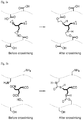
- Fig. 1a to 1c schematically illustrate formulae before and after cross-linking of a main ingredient and a curing agent according to various embodiments of the present disclosure.
- the first compound having a carboxyl group and the second compound having an aziridine group are shown before and after cross-linking.
- the aziridine group of the second compound imparts an active site capable of binding to the carboxyl group of the first compound. Therefore, the crosslinking density can be controlled depending on the number of the respective functional groups and the like.
- the first compound having an amino group and the second compound having an isocyanate group are shown before and after cross-linking.
- the isocyanate group of the second compound imparts an active site capable of binding to the amino group of the first compound. Therefore, the crosslinking density can be controlled depending on the number of the respective functional groups and the like.
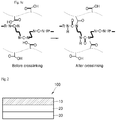
- the first compound having a carboxyl group and the second compound having a carbodiimide group are shown before and after cross-linking.
- the carbodiimide group of the second compound imparts an active site capable of binding to the carboxyl group of the first compound. Therefore, the crosslinking density can be controlled depending on the number of the respective functional groups and the like.
- a further embodiment of the present disclosure provides an automotive sheet, comprising: a surface coating layer formed from the aqueous composition for surface coating; a cover layer formed under the surface coating layer; a foaming layer formed under the cover layer; and a backing layer formed under the foaming layer.
- Fig. 2 is a schematic view of an automotive sheet according to an embodiment of the present disclosure.
- the automotive sheet 100 is formed including a surface coating layer 10, a cover layer 20, a foaming layer 30, and a backing layer 40.
- the surface coating layer 10 is formed from the aqueous composition for surface coating comprising a main ingredient comprising a first compound having at least two functional groups selected from the group consisting of a carboxyl group, a hydroxyl group, an amino group and combinations thereof, per molecule; a curing agent comprising a second compound having at least two functional groups selected from the group consisting of an aziridine group, an isocyanate group, a carbodiimide group and combinations thereof, per molecule; and an aqueous solvent.
- the surface coating layer 10 can improve the antifouling property due to excellent stain resistance of the aqueous composition for surface coating, and can minimize a friction noise due to the improved slip performance.
- the specific aqueous composition for surface coating is as described above.
- the surface coating layer 10 may be formed by applying the aqueous composition for surface coating with a thickness of about 4 ⁇ m to about 20 ⁇ m, followed by drying and aging.
- the aqueous composition for surface coating may be applied to the upper surface of the cove layer to form the surface coating layer having a thickness of about 4 ⁇ m to about 20 ⁇ m.
- the thickness of the surface coating layer should be maintained within the above range, such that the stain resistance can be secured while simultaneously maintaining the flexibility of the surface of the automotive sheet.
- the applied aqueous composition for surface coating is dried to evaporate the aqueous solvent, and the dried aqueous composition for surface coating can be aged to finally form the surface coating layer.
- the aging may be carried out by a primary aging at a temperature of equal to or higher than a minimum film forming temperature (MFFT), and then a secondary aging at a temperature of equal to or higher than a glass transition temperature (Tg).
- MFFT minimum film forming temperature
- Tg glass transition temperature
- a polyhedric structure may be formed through the primary aging and then a homogeneous structure may be formed through the secondary aging.
- the cover layer 20 is a layer formed under the surface coating layer 10, and particularly may include at least one compound selected from the group consisting of polyvinyl chloride (PVC), polyvinyl chloride copolymer, polyurethane (PU), polyurethane copolymer, polypropylene oxide (PPO), polypropylene oxide copolymer, polyethylene oxide (PEO), polyethylene oxide copolymer, polyether urethane, cellulose acetate, cellulose acetate butyrate, cellulose acetate propionate, polymethyl methacrylate (PMMA), polymethyl acrylate (PMA), polyacrylic copolymer, polyvinyl acetate (PVAc), polyvinyl acetate copolymer, polyvinyl alcohol (PVA), polyperfuryl alcohol (PPFA), polystyrene (PS), polystyrene copolymer, polycarbonate (PC), polycaprolactone (PCL), polyvinylpyrrolidone (PVP), polyvinylid
- the foaming layer 30 is formed below the cover layer 20 to absorb shock.
- the backing layer 40 may be a textile comprising a woven or non-woven fabric.
- a primer layer (not shown) may be additionally formed between the surface coating layer 10 and the cover layer 20.
- the primer layer may include a urethane-based adhesive resin or an acrylic adhesive resin containing a urethane acrylate compound.
- the urethane-based adhesive resin includes a urethane acrylate compound.
- the urethane acrylate compound would be similar in properties to the aqueous composition for surface coating forming the surface coating layer. Therefore, the urethane acrylate compound is excellent in adhesion to the surface coating layer, so that the adhesion between the substrate layer and the surface coating layer can be stabilized.
- the urethane-based adhesive resin may include a urethane acrylate compound like a two-component type aqueous composition for surface coating as in the surface coating layer.
- the urethane-based adhesive resin can further secure the stain resistance by using a two-component type urethane acrylate compound not only in the surface coating layer but also in the primer layer, and a bright colored base layer can be used due to excellent antifouling property.
- a urethane-based adhesive resin containing a urethane acrylate compound was applied over an artificial leather to form a primer layer, and the aqueous composition for surface coating was applied over the primer layer to a thickness of 5 ⁇ m. Then, water was evaporated by drying at a temperature of 140°C, a primary aging was performed at a temperature of 80°C, and a secondary aging was performed at a temperature of 50°C to form a surface coating layer, thereby preparing an automotive sheet.
- MIBK methyl isobutyl ketone
- PTMG poly(tetramethyl ether) glycol
- IPDI Isoporon Diisocyanate
- crosslinking densities (%) of the compositions according to Examples 1 and 2 and Comparative Examples 1 and 2 were measured using the Method of Measuring the Degree of Crosslinking (KS M 3357).
- Test specimens of automotive sheet according to Examples 1 and 2 and Comparative Examples 1 and 2 were subjected to 12 kPa using a Martindale Abrasion Tester and worn for 1,000 cycles. Then, the degree of staining was graded in a grey scale, the stained area was washed with 0.5% solution of soapy water, and the degree of jeans staining in the washed area was measured.
- Test specimens of automotive sheet according to Examples 1 and 2 and Comparative Examples 1 and 2 were mounted on a Universal Wear Tester, a piece of Cotton Soil Test Cloth was placed on an upper portion of the automotive sheet, and 0.9 kg of a constant load was applied. At this time, 0.14kgf/cm 2 of pressure was applied to a Rubber Diaphragm to stain the automotive sheet for 500 cycles, and the automotive sheet was stained again for 500 cycles after the stained cloth was replaced. The stained automotive sheet was placed on an opening of the colorimeter, and a green filter was mounted to measure a reflection value for the automotive sheet at an area that was not stained. The reflection values (%) at the mid-polished portions between the center and the periphery of the stained portion were measured, and the average value (%) of staining was calculated.
- each of the automotive sheet test specimens according to Examples 1 and 2 and Comparative Examples 1 and 2 was superimposed on top of each other and pressed with a force of 4.5 Kg, and the deviation ( ⁇ F) and the mean force (Fa) of a force required to pull at a speed of 100 mm/min were measured, and the Squeak index was calculated by ⁇ F/Fa.
- the automotive sheet test specimens according to Examples 1 and 2 and Comparative Examples 1 and 2 were placed in a 4-L desiccator, sealed, and heated in an oven for 2 hours. Then, after being allowed to stand for 1 hour in a laboratory at 25°C, the lid of the desiccator was opened about 3 to 4 cm, and the intensity of the smell emitted was measured under dry conditions. Distilled water was uniformly applied to test specimens of the automotive sheet according to Examples 1 and 2 and Comparative Examples 1 and 2, put in a 4 L test container, and allowed to stand in a laboratory at 25°C for 1 hour. The lid was opened about 3 to 4 cm and the intensity of the smell emitted was measured under wet conditions.
- the automotive sheet comprising the surface coating layer formed of the two-component type aqueous composition for surface coating comprising a main ingredient, a curing agent and an aqueous solvent according to Examples 1 and 2 has high crosslinking density, can improve the antifouling property with an excellent stain resistance, and further provide improved slip performance with a low Squeak index.
- the automotive sheet comprising a surface coating layer formed of a two-component type aqueous composition for surface coating comprising a main ingredient, a curing agent and an aqueous solvent according to Examples 1 and 2 can reduce the generation of odorous substances from volatile organic compounds (VOCs) due to the use of an organic solvent.
- VOCs volatile organic compounds
Landscapes
- Chemical & Material Sciences (AREA)
- Organic Chemistry (AREA)
- Engineering & Computer Science (AREA)
- Chemical Kinetics & Catalysis (AREA)
- Health & Medical Sciences (AREA)
- Medicinal Chemistry (AREA)
- Polymers & Plastics (AREA)
- Materials Engineering (AREA)
- Wood Science & Technology (AREA)
- Life Sciences & Earth Sciences (AREA)
- Textile Engineering (AREA)
- Paints Or Removers (AREA)
- Polyurethanes Or Polyureas (AREA)
- Application Of Or Painting With Fluid Materials (AREA)
Abstract
Description
- The present disclosure relates to an aqueous composition for surface coating and an automotive sheet using the composition.
- In general, polyvinyl chloride (PVC) resin is inexpensive and heat-resistant, and can take various forms in ductility and rigidity. Thus, it can be used as a raw material for flooring, medical equipment, wire insulator, interior sheet, signboard, or indoor/outdoor decorative sheet. For example, polyvinyl chloride resin can be used as a raw material for automotive sheet.
- However, since an automotive has emerged as a second residential space, an automotive sheet occupies the largest portion in the vehicle. Therefore, consumers' interest in automotive sheets that can maintain a high level in the vehicle space is increasing. Further, in order to preserve clean environment in the vehicle, there is a growing need for studies on automotive sheets having high antifouling properties.
- The Ministry of Land, Transport and Maritime Affairs has pronounced the "Standards for the Management of Indoor Air Quality in New Cars" as a result of steadily increasing interests in the indoor air quality of automotive. From new cars manufactured after July 1, 2009, volatile organic compounds (VOCs) such as benzene, toluene, ethylbenzene and xylene, and formaldehydes are recommended to maintain at levels below the regulatory limits. Therefore, efforts should be made to improve the indoor air quality inside newly-manufactured automotive.
- The present disclosure is intended to provide an aqueous composition for surface coating, including: a main ingredient comprising a first compound having at least two functional groups selected from the group consisting of a carboxyl group, a hydroxyl group, an amino group and combinations thereof, per molecule; a curing agent comprising a second compound having at least two functional groups selected from the group consisting of an aziridine group, an isocyanate group, a carbodiimide group and combinations thereof, per molecule; and an aqueous solvent.
- However, the technical problem to be solved by the present disclosure is not limited to the above-mentioned problem, and other matters not mentioned can be clearly understood by those skilled in the art from the following description.
- The present disclosure provides an aqueous composition for surface coating, including: a main ingredient comprising a first compound having at least two functional groups selected from the group consisting of a carboxyl group, a hydroxyl group, an amino group and combinations thereof, per molecule; a curing agent comprising a second compound having at least two functional groups selected from the group consisting of an aziridine group, an isocyanate group, a carbodiimide group and combinations thereof, per molecule; and an aqueous solvent.
- The main ingredient and the curing agent may form a polymer chain by a three-dimensional cross-linking reaction.
- The polymer chain may have a crosslinking density of from 70% to 95%.
- The polymer chain and a curing agent that does not participate in the three-dimensional crosslinking reaction may form an interpenetrating polymer network.
- The main ingredient may be a prepolymer containing a urethane group in a backbone of the first compound.
- The second compound may be mixed in an amount of 1 to 10 equivalents based on 100 equivalents of the prepolymer.
- The prepolymer may have a weight average molecular weight ranging from 100 to 300,000.
- The main ingredient may be a silicon-containing prepolymer comprising a siloxane group in a backbone of the first compound.
- The second compound may be mixed in an amount of 1 to 10 equivalents based on 100 equivalents of the silicon-containing prepolymer.
- The silicon-containing prepolymer may have a weight average molecular weight ranging from 100 to 300,000.
- The aqueous solvent may be water or an alcohol.
- The aqueous composition for surface coating comprises 20 to 60% by weight of the main ingredient, 10 to 50% by weight of the curing agent, and 10 to 30% by weight of the aqueous solvent, based on the total weight of the aqueous composition for surface coating.
- In addition to the main ingredient and the curing agent, the composition may include at least one selected from the group consisting of silicone beads, urethane beads, acrylic beads, fluorine-containing waxes, and combinations thereof.
- In addition to the main ingredient and the curing agent, the composition may further include at least one selected from surfactants, co-solvents, modifiers, leveling agents, thickeners, and combinations thereof.
- In one embodiment of the present disclosure, there is provided an automotive sheet, comprising: a surface coating layer formed from the aqueous composition for surface coating; a cover layer formed under the surface coating layer; a foaming layer formed under the cover layer; and a backing layer formed under the foaming layer.
- The surface coating layer may be formed by applying the aqueous composition for surface coating with a thickness of 1 µm to 20 µm, followed by drying and aging.
- The aging may be carried out by a primary aging at a temperature of equal to or higher than a minimum film forming temperature (MFFT), and then a secondary aging at a temperature of equal to or higher than a glass transition temperature (Tg).
- A primer layer may be further formed between the surface coating layer and the cover layer.
- The aqueous composition for surface coating according to the present disclosure employs an aqueous solvent, whereby an interpenetrating polymer network can be formed, and the generation of odorous substances from volatile organic compounds (VOCs) caused by the use of an organic solvent can be reduced.
- In addition, the aqueous composition for surface coating according to the present disclosure can improve antifouling property with excellent stain resistance, and can improve the slip performance, thereby minimizing the problem caused by friction noise.
- The automotive sheet according to the present disclosure can be used to improve the indoor air quality in an automotive and to be applied excellently to the base layer with a bright color due to the improved antifouling property.
-
-
Fig. 1a to 1c schematically illustrate formulae before and after cross-linking of a main ingredient and a curing agent according to various embodiments of the present disclosure. -
Fig. 2 is a schematic view of an automotive sheet according to an embodiment of the present disclosure. - Hereinafter, exemplary embodiments of the present disclosure will be described in detail with reference to the accompanying drawings, which will be readily practiced to those skilled in the art. The present disclosure may be embodied in many different forms and is not limited to the embodiments described herein.
- In order to clearly illustrate the present disclosure, parts that are not related to the description are omitted, and the same or similar components are denoted by the same reference numerals throughout the specification.
- In the drawings, the thickness is enlarged to clearly indicate layers and regions. In the drawings, for the convenience of explanation, the thicknesses of some layers and regions are exaggerated.
- As used herein, the formation of any structure in an "upper (or lower)" of a substrate means not only that any structure is formed in contact with an upper surface (or lower surface) of the substrate, but also that other configurations between the substrate and any structure formed on (or under) the substrate are possible.
- One embodiment of the present disclosure provides an aqueous composition for surface coating, including: a main ingredient comprising a first compound having at least two functional groups selected from the group consisting of a carboxyl group, a hydroxyl group, an amino group and combinations thereof, per molecule; a curing agent comprising a second compound having at least two functional groups selected from the group consisting of an aziridine group, an isocyanate group, a carbodiimide group and combinations thereof, per molecule; and an aqueous solvent.
- The aqueous composition for surface coating may form a polymer chain by a three-dimensional crosslinking reaction of the main ingredient and the curing agent.
- Particularly, the three-dimensional crosslinking reaction may be carried out at room temperature or at a temperature of from about 40°C to about 1,400°C.
- The polymer chain may have a crosslinking density ranging from 70% to 95%. As used herein, the crosslinking density of the polymer chain refers to a ratio of the number of crosslinking points to the total number of constituent units of the polymer chain. The crosslinking density can be determined by the following crosslinking degree measurement method (KS M 3357). The crosslinking density is maintained within the above range such that contaminants such as jeans dyes are prevented from penetrating the aqueous composition for surface coating so that the effect of stain resistance can easily be realized.
- The polymer chain and a curing agent that does not participate in the three-dimensional crosslinking reaction may form an interpenetrating polymer network.
- The interpenetrating polymer network is a multicomponent polymer in which heterogeneous polymer chains are entangled without covalent bonding. Therefore, the polymer chain formed by the three-dimensional crosslinking reaction may be intertwined with a residual curing agent that does not participate in the three-dimensional crosslinking reaction due to the aqueous solvent.
- A conventional one-component type surface coating composition for coating the surface of an automotive sheet shows jeans staining less than grade 4. However, the present aqueous composition for surface coating is a two-component type of aqueous composition for surface coating, wherein the automotive sheet can be applied to a regular thickness as a base layer, allowing excellent stain resistance and slip property. In this embodiment, the jeans-staining shows a grade 4 or higher.
- In addition to the jeans staining, as the activity in a vehicle becomes more active, there may be general contaminations due to food, external dust, and various other types of causes. Such stain property as a measure of a general contamination can be determined by attaching an automotive sheet to a Universal Wear Tester. The resultant values can be expressed as a percentage. In this case, when the resultant value is 17% or less, it is said that the contamination is generally low.
- Specifically, the automotive sheet using an one-component type surface coating composition for coating the surface of the automotive sheet showed a high contamination level of about 30% or more, while the automotive sheet using a two-component type surface coating composition showed a contamination level of about 10% or less.
- Thus, the aqueous composition for surface coating according to the present disclosure improves the conventional one-component type surface coating composition. The composition may be coated on the surface of an automotive sheet by a gravure coating method. The two-component type aqueous composition for surface coating can improve the stain resistance in the automotive sheet, so that a bright colored automotive sheet with excellent antifouling properties can be used.
- The two-component type aqueous composition for surface coating can improve the stain resistance in the automotive sheet, so that it is possible to use a bright colored automotive sheet with excellent antifouling properties.
- In addition, the composition improves slip performance along with the stain resistance. Accordingly, the composition can minimize a noise in automotive due to the automotive sheet, and can minimize the problems caused by friction noise from a friction between the automotive sheet and the passenger.
- Further, the aqueous composition for surface coating according to the present disclosure can form an interpenetrating polymer network by using an aqueous solvent, and can reduce the generation of odorous substances from volatile organic compounds (VOCs) due to the use of organic solvents such as methyl isobutyl ketone (MIBK), methyl ethyl ketone (MEK), acetone, butyl acetate (BA), methyl acetate (MA), dimethyl formamide (DMF), cyclohexane, etc.
- First, the aqueous composition for surface coating may include a main ingredient comprising a first compound.
- The first compound may have at least two functional groups selected from the group consisting of a carboxyl group, a hydroxyl group, an amino group, and combinations thereof, per molecule. Specifically, the first compound may be at least one compound selected from the group consisting of a polyester-based compound, a lactone-based compound, a polycarbonate-based compound, a polyether-based compound, and combinations thereof, and the first compound may have at least two functional groups selected from the group consisting of a carboxyl group, a hydroxyl group, an amino group, and combinations thereof, at a molecular terminal thereof
- For example, the main ingredient may be a prepolymer containing a urethane group in a backbone of the first compound.
- The prepolymer indicates a polymer having a relatively low degree of polymerization in which the polymerization reaction is stopped in the mid-stage to facilitate molding. The prepolymer contains a urethane group in a backbone of the first compound having at least two functional groups selected from the group consisting of a carboxyl group, a hydroxyl group, an amino group, and combinations thereof, per molecule. The prepolymer has an isocyanate reactive group at a terminal of the resin. For example, the prepolymer may include the following formula (1):

- Further, the second compound may be mixed in an amount of about 1 to about 10 equivalents based on 100 equivalents of the prepolymer. As used herein, the term "equivalent weight" indicates the amount of another substance that optionally reacts precisely with a fixed amount of a substance or binds to the substance in a reaction. The aqueous composition for surface coating formed by mixing about 1 to about 10 equivalents of the second compound relative to 100 equivalents of the prepolymer may reduce cracking and easily increase stain resistance.
- Meanwhile, when the prepolymer and the second compound react with each other out of the mixing ratio of the above range, the functional groups of the prepolymer or the functional groups of the second compound remain as a residue to form a weak point at which the bonding is weak in the composition bound after the reaction, whereby the composition formed by the reaction can easily be decomposed. Also, the initial reaction may occur excessively and accordingly premature curing may occur.
- The prepolymer may have a weight average molecular weight ranging from about 100 to about 300,000. The weight average molecular weight of the prepolymer is maintained within the above range such that the stain resistance can easily be realized.
- In particular, when the prepolymer is a polyol compound containing a hydroxy group, the hydroxyl value (OH Value) of the prepolymer may be about 2 to about 1,000. Specifically, as used herein, the hydroxyl value refers to a milligram of potassium hydroxide required to neutralize an acetic acid produced by acetylating 1 g of the prepolymer and then hydrolyzing the acetylated prepolymer.
- Polyol compounds with a low hydroxyl value are typically used in the preparation of soft polyurethanes, while polyol compounds with a high hydroxyl value are used in the preparation of hard polyurethanes. That is, the higher hydroxyl value means that the molecular weight of the polyol compound is lowered, and the composition ratio of the second compound constituting the hard segment of the polyurethane increases, resulting in a hard physical property.
- Therefore, when the hydroxyl value of the prepolymer is out of the above range, the aqueous composition for surface coating is hardened to cause cracking, and the density of the prepolymer is lowered so that the aqueous composition for surface coating cannot secure a stain resistance. Therefore, the hydroxyl value should be maintained in the above range, such that excellent stain resistance can be secured, and the hardening of the aqueous composition for surface coating can be prevented.
- As another example, the main ingredient may be a silicon-containing prepolymer comprising a siloxane group in a backbone of the first compound.
- The main ingredient may include a silicon-containing prepolymer comprising a siloxane group in a backbone of the first compound having at least two functional groups selected from the group consisting of a carboxyl group, a hydroxyl group, an amino group and combinations thereof, per molecule, wherein the silicon-containing prepolymer may have an isocyanate reactive group at a terminal of the resin. For example, the prepolymer may include the following formula (2):

- The silicon-containing prepolymer may have antifouling property (resistance to contamination) by containing at least one methyl group in -Si- as in the above formula (2), and the silicon-containing prepolymer may maintain excellent compatibility with polyurethane-based compounds by containing an acrylate. Further, the silicon-containing prepolymer can be introduced into the first compound to react with an organic alkoxysilane compound to increase a crosslinking density, and improve the physical and chemical properties such as hardness, anti-fingerprint, chemical resistance, water resistance, and adhesion.
- Specifically, the isocyanate compound may be mixed in an amount of about 1 equivalent to about 10 equivalents based on 100 equivalents of the silicon-containing prepolymer. The isocyanate compound may be mixed in an amount of about 1 equivalent to about 10 equivalents based on 100 equivalents of the silicon-containing prepolymer, such that the penetration of external contaminants or adhesion of external contaminants can be minimized, thereby facilitating the antifouling effect.
- The silicon-containing prepolymer may have a molecular weight ranging from about 100 to about 100,000. The molecular weight of the silicon-containing prepolymer should be maintained within the above range so that the stain resistance effect can easily be realized.
- In particular, when the silicon-containing prepolymer is a silicon-containing polyol compound containing a hydroxy group, the hydroxyl value (OH Value) of the silicon-containing prepolymer may be about 2 to about 1,000. Since the silicon-containing prepolymer contains a hydroxyl group, the hydroxyl value can be calculated, and it is advantageous to maintain high antifouling property by keeping the hydroxyl value within the above range.
- Next, the aqueous composition for surface coating may include a curing agent comprising a second compound.
- The second compound may have at least two functional groups selected from the group consisting of an aziridine group, an isocyanate group, a carbodiimide group, and combinations thereof, per molecule.
- Specifically, the compound having two or more aziridine groups refers to a compound comprising a complex ternary ring composed of two carbon atoms and one nitrogen atom, and particularly, may be at least one compounds selected from the group consisting of 3-(3-methoxyphenyl)-3-trifluoromethyl)-diaziridine; 3-(trifluoromethyl)-3-phenyldiaziridine; propane-2,2-diyldibenzene-4,1-diyl diaziridine-1-carboxylate; 1,1'-(butylphosphoryl)diaziridine; oxydiethane-2,1-diyl diaziridine-1-carboxylate; 3,3-bis(1,1-difluoro-hexyl)-[1,2]diaziridine; 1-Aziridinepropanoicacid; 2-methyl-2-[[3-(2-methyl-1-aziridinyl)-1-oxopropoxy]methyl]-1,3-propanediylester; 2-ethyl-2-[[3-(2-methyl-1-aziridinyl)-1-oxopropoxy]methyl]-1,3-propanediylester; 2-ethyl-2-[[3-(2-methyl-1-aziridinyl)-1-oxopropoxy]methyl]-1,3-propanediylbis(2-methyl-1-aziridinepropanoate); pentaerythritol tris[3-(1-aziridinyl)propionate]); pentaerythritol tris(3-aziridinopropionate), and combinations thereof.
- The compound having two or more isocyanate groups may be at least one compound selected from the group consisting of toluene diisocyanate, diphenylmethane diisocyanate, modified diphenylmethane diisocyanate, naphthalene diisocyanate, phenylene diisocyanate, hexamethylene diisocyanate, lysine isocyanate, cyclohexane diisocyanate, isophorone diisocyanate, methylenediphenyl isocyanate, xylene diisocyanate, tetramethylxylene diisocyanate, norbornene diisocyanate, triphenylmethane triisocyanate, polyphenyl polymethylene polyisocyanate, polyisocyanates containing a carbodiimide group, polyisocyanate containing an allophanate group, polyisocyanates containing a isocyanurate group, and combinations thereof.
- Specifically, the compound having two or more isocyanate groups may include those of a biuret, a trimeric, and an adduct type. For example, the biuret type isocyanate compound may include the following formula (3), the trimeric isocyanate compound may include the following formula (4), and the adduct type isocyanate compound may include the following formula (5):


- The compound having two or more carbodiimide groups may be 1-ethyl-3-(3-dimethylamino)propyl)carbodiimide compound, and particularly CARBODILITE™ or BAYDERM™ can be used.
- Recently, consumers' interest in antifouling automotive sheets has been increasing in order to preserve the clean environment in a car. Especially, the problem of Blue Jean Dye Soil is emerging to meet the needs of consumers. Therefore, the jeans staining indicates problems that the stains are dyed on the surface thin film treated with a conventional automotive sheet or a urethane of automotive sheet, and are not removed even after the cleaning of the sheet. At this time, the jeans' stain resistance against the jeans staining can be measured at a rate of the extent to which blue dye is transferred after an automotive sheet is worn under a constant load using a Martindale Abrasion Tester. The staining can be represented by a gray scale grade, and the gray scale grade is divided into total five grades, and the higher the grade, the better the stain resistance.
- Finally, the aqueous composition for surface coating comprises an aqueous solvent. Specifically, the aqueous solvent may be water or an alcohol such as methanol, ethanol, propanol, and butanol. Due to the aqueous solvent, the polymer chain and a curing agent that does not participate in the three-dimensional crosslinking reaction may be intertwined to form an interpenetrating polymer network. Thus, the generation of odorous substances due to volatile organic compounds (VOCs) by the use of an organic solvent can be reduced.
- In one embodiment of the present disclosure, 70 to 80% by weight of the main ingredient, 10 to 20% by weight of the curing agent, and 10 to 20% by weight of the aqueous solvent may be included, based on the total weight of the aqueous composition for surface coating.
- Specifically, the main ingredient, the curing agent and the aqueous solvent are contained within the above-mentioned content range in the aqueous composition for surface coating, such that excellent stain resistance can easily be achieved.
- In addition to the above-mentioned main ingredient and the curing agent, the composition may further include at least one selected from silicon beads, urethane beads, acrylic beads, fluorine-containing waxes, and combinations thereof. The at least one selected from the group consisting of silicon beads, urethane beads, acrylic beads, fluorine-containing waxes, and combinations thereof is contained in the aqueous coating composition for surface coating, such that slip property of the composition can be improved.
- The resistance to contaminants can be increased by the at least one hydrophobicity selected from the silicon beads, urethane beads, acrylic beads, fluorine-containing waxes, and combinations thereof. Further, it is possible to impart slip property to the aqueous composition for surface coating by reducing the surface tension of the aqueous composition for surface coating.
- The at least one selected from the group consisting of silicon beads, urethane beads, acrylic beads, fluorine-containing waxes and combinations thereof may be contained about 1% by weight to about 10% by weight, based on the total weight of the aqueous composition for surface coating. The presence of the at least one selected from the group consisting of silicone beads, urethane beads, acrylic beads, fluorine-containing waxes and combinations thereof within the above range can reduce the occurrence of the dye-adhesion of other substances to the aqueous composition for surface coating, and can easily reduce its surface energy.
- In addition to the at least one selected from the group consisting of the silicone beads, the urethane beads, the acrylic beads, the fluorine-containing wax, and combinations thereof, the aqueous composition for surface coating may further include a surfactant, a co-solvent, a modifier, a levelling agent, a thickening agent, and combinations thereof, depending on the role of the composition.
-
Fig. 1a to 1c schematically illustrate formulae before and after cross-linking of a main ingredient and a curing agent according to various embodiments of the present disclosure. - Referring to
Fig. 1a , the first compound having a carboxyl group and the second compound having an aziridine group are shown before and after cross-linking. The aziridine group of the second compound imparts an active site capable of binding to the carboxyl group of the first compound. Therefore, the crosslinking density can be controlled depending on the number of the respective functional groups and the like. - Referring to
Fig. 1b , the first compound having an amino group and the second compound having an isocyanate group are shown before and after cross-linking. The isocyanate group of the second compound imparts an active site capable of binding to the amino group of the first compound. Therefore, the crosslinking density can be controlled depending on the number of the respective functional groups and the like. - Referring to
FIG. 1c , the first compound having a carboxyl group and the second compound having a carbodiimide group are shown before and after cross-linking. The carbodiimide group of the second compound imparts an active site capable of binding to the carboxyl group of the first compound. Therefore, the crosslinking density can be controlled depending on the number of the respective functional groups and the like. - A further embodiment of the present disclosure provides an automotive sheet, comprising: a surface coating layer formed from the aqueous composition for surface coating; a cover layer formed under the surface coating layer; a foaming layer formed under the cover layer; and a backing layer formed under the foaming layer.
-
Fig. 2 is a schematic view of an automotive sheet according to an embodiment of the present disclosure. Referring toFig. 2 , theautomotive sheet 100 is formed including asurface coating layer 10, acover layer 20, afoaming layer 30, and a backing layer 40. - The
surface coating layer 10 is formed from the aqueous composition for surface coating comprising a main ingredient comprising a first compound having at least two functional groups selected from the group consisting of a carboxyl group, a hydroxyl group, an amino group and combinations thereof, per molecule; a curing agent comprising a second compound having at least two functional groups selected from the group consisting of an aziridine group, an isocyanate group, a carbodiimide group and combinations thereof, per molecule; and an aqueous solvent. Thus, thesurface coating layer 10 can improve the antifouling property due to excellent stain resistance of the aqueous composition for surface coating, and can minimize a friction noise due to the improved slip performance. - The specific aqueous composition for surface coating is as described above.
- The
surface coating layer 10 may be formed by applying the aqueous composition for surface coating with a thickness of about 4 µm to about 20 µm, followed by drying and aging. - Specifically, the aqueous composition for surface coating may be applied to the upper surface of the cove layer to form the surface coating layer having a thickness of about 4 µm to about 20 µm. The thickness of the surface coating layer should be maintained within the above range, such that the stain resistance can be secured while simultaneously maintaining the flexibility of the surface of the automotive sheet. Thereafter, the applied aqueous composition for surface coating is dried to evaporate the aqueous solvent, and the dried aqueous composition for surface coating can be aged to finally form the surface coating layer.
- In this embodiment, the aging may be carried out by a primary aging at a temperature of equal to or higher than a minimum film forming temperature (MFFT), and then a secondary aging at a temperature of equal to or higher than a glass transition temperature (Tg). A polyhedric structure may be formed through the primary aging and then a homogeneous structure may be formed through the secondary aging.
- The
cover layer 20 is a layer formed under thesurface coating layer 10, and particularly may include at least one compound selected from the group consisting of polyvinyl chloride (PVC), polyvinyl chloride copolymer, polyurethane (PU), polyurethane copolymer, polypropylene oxide (PPO), polypropylene oxide copolymer, polyethylene oxide (PEO), polyethylene oxide copolymer, polyether urethane, cellulose acetate, cellulose acetate butyrate, cellulose acetate propionate, polymethyl methacrylate (PMMA), polymethyl acrylate (PMA), polyacrylic copolymer, polyvinyl acetate (PVAc), polyvinyl acetate copolymer, polyvinyl alcohol (PVA), polyperfuryl alcohol (PPFA), polystyrene (PS), polystyrene copolymer, polycarbonate (PC), polycaprolactone (PCL), polyvinylpyrrolidone (PVP), polyvinylidene fluoride (PVdF), polyvinylidene fluoride copolymer, polyamide, and combinations thereof. At least one compound selected from the group consisting of PVC, PVC-ABS, PU, PPO, and combinations thereof is more preferred, but not limited thereto. - The
foaming layer 30 is formed below thecover layer 20 to absorb shock. Particularly, at least one compound selected from the group consisting of polyvinyl chloride (PVC), polyvinyl chloride copolymer, polyurethane (PU), polyurethane copolymer, polypropylene oxide (PPO), polypropylene oxide copolymer, polyethylene oxide (PEO), polyethylene oxide copolymer, polyether urethane, cellulose acetate, cellulose acetate butyrate, cellulose acetate propionate, polymethyl methacrylate (PMMA), polymethyl acrylate (PMA), polyacrylic copolymer, polyvinyl acetate (PVAc), polyvinyl acetate copolymer, polyvinyl alcohol (PVA), polyperfuryl alcohol (PPFA), polystyrene (PS), polystyrene copolymer, polycarbonate (PC), polycaprolactone (PCL), polyvinylpyrrolidone (PVP), polyvinylidene fluoride (PVdF), polyvinylidene fluoride copolymer, polyamide, and combinations thereof may be foamed by a blowing agent. More preferably, at least one compound selected from the group consisting of PVC, PVC-ABS, PU, PPO, and combinations thereof may be foamed by a blowing agent, but not limited thereto. - The backing layer 40 may be a textile comprising a woven or non-woven fabric.
- Further, a primer layer (not shown) may be additionally formed between the
surface coating layer 10 and thecover layer 20. In this embodiment, the primer layer may include a urethane-based adhesive resin or an acrylic adhesive resin containing a urethane acrylate compound. - The urethane-based adhesive resin includes a urethane acrylate compound. The urethane acrylate compound would be similar in properties to the aqueous composition for surface coating forming the surface coating layer. Therefore, the urethane acrylate compound is excellent in adhesion to the surface coating layer, so that the adhesion between the substrate layer and the surface coating layer can be stabilized. For example, the urethane-based adhesive resin may include a urethane acrylate compound like a two-component type aqueous composition for surface coating as in the surface coating layer. Therefore, the urethane-based adhesive resin can further secure the stain resistance by using a two-component type urethane acrylate compound not only in the surface coating layer but also in the primer layer, and a bright colored base layer can be used due to excellent antifouling property.
- Hereinafter, preferred examples of the present disclosure will be described in order to facilitate understanding of the present disclosure. However, the following examples are provided only for the purpose of easier understanding of the present disclosure, and the present disclosure is not limited by the following examples.
- An aqueous composition for surface coating was prepared by mixing 40 parts by weight of a first compound of the formula (1) (n = 100, R1 and R2 are carboxyl groups), 30 parts by weight of a second compound of the formula (3), 20 parts by weight of water, 5 parts by weight of silicone beads, and 5 parts by weight of fluorine-containing wax, and heating the mixture at a temperature of 100°C for 2 minutes to form an interpenetrating polymer network structure.
- A urethane-based adhesive resin containing a urethane acrylate compound was applied over an artificial leather to form a primer layer, and the aqueous composition for surface coating was applied over the primer layer to a thickness of 5 µm. Then, water was evaporated by drying at a temperature of 140°C, a primary aging was performed at a temperature of 80°C, and a secondary aging was performed at a temperature of 50°C to form a surface coating layer, thereby preparing an automotive sheet.
- An automotive sheet was prepared in the same manner as in Example 1, except that 40 parts by weight of the first compound of Formula (2) (n = 100, R1 and R2 are carboxyl groups), 30 parts by weight of the second compound of Formula (3), 20 parts by weight of water, 5 parts by weight of silicone beads, and 5 parts by weight of fluorine-containing wax were mixed, and the mixture was heated at a temperature of 100°C for 2 minutes to form an interpenetrating polymer network structure, thereby preparing an aqueous composition for surface coating.
- An automotive sheet was prepared in the same manner as in Example 1, except that 40 parts by weight of the first compound of the formula (1) (n = 100, R1 and R2 are carboxyl groups), 30 parts by weight of the second compound of the formula (3), 20 parts by weight of methyl isobutyl ketone (MIBK), and 5 parts by weight of silicone beads were mixed, and the mixture was heated at a temperature of 100°C for 2 minutes to form a polymer network structure, thereby preparing a composition for surface coating.
- An automotive sheet was prepared in the same manner as in Example 1, except that (PTMG (poly(tetramethyl ether) glycol) was used instead of the first compound of the formula (1) (n = 100, R1 and R2 are carboxyl groups) and IPDI (Isoporon Diisocyanate) was used instead of the second compound of the formula (2).
- The crosslinking densities (%) of the compositions according to Examples 1 and 2 and Comparative Examples 1 and 2 were measured using the Method of Measuring the Degree of Crosslinking (KS M 3357).
- Test specimens of automotive sheet according to Examples 1 and 2 and Comparative Examples 1 and 2 were subjected to 12 kPa using a Martindale Abrasion Tester and worn for 1,000 cycles. Then, the degree of staining was graded in a grey scale, the stained area was washed with 0.5% solution of soapy water, and the degree of jeans staining in the washed area was measured.
- Test specimens of automotive sheet according to Examples 1 and 2 and Comparative Examples 1 and 2 were mounted on a Universal Wear Tester, a piece of Cotton Soil Test Cloth was placed on an upper portion of the automotive sheet, and 0.9 kg of a constant load was applied. At this time, 0.14kgf/cm2 of pressure was applied to a Rubber Diaphragm to stain the automotive sheet for 500 cycles, and the automotive sheet was stained again for 500 cycles after the stained cloth was replaced. The stained automotive sheet was placed on an opening of the colorimeter, and a green filter was mounted to measure a reflection value for the automotive sheet at an area that was not stained. The reflection values (%) at the mid-polished portions between the center and the periphery of the stained portion were measured, and the average value (%) of staining was calculated.
- Using a universal testing machine, each of the automotive sheet test specimens according to Examples 1 and 2 and Comparative Examples 1 and 2 was superimposed on top of each other and pressed with a force of 4.5 Kg, and the deviation (ΔF) and the mean force (Fa) of a force required to pull at a speed of 100 mm/min were measured, and the Squeak index was calculated by ΔF/Fa.
- The automotive sheet test specimens according to Examples 1 and 2 and Comparative Examples 1 and 2 were placed in a 4-L desiccator, sealed, and heated in an oven for 2 hours. Then, after being allowed to stand for 1 hour in a laboratory at 25°C, the lid of the desiccator was opened about 3 to 4 cm, and the intensity of the smell emitted was measured under dry conditions. Distilled water was uniformly applied to test specimens of the automotive sheet according to Examples 1 and 2 and Comparative Examples 1 and 2, put in a 4 L test container, and allowed to stand in a laboratory at 25°C for 1 hour. The lid was opened about 3 to 4 cm and the intensity of the smell emitted was measured under wet conditions. The intensity of the smell under the measured dry conditions and the intensity of the smell under the measured wet conditions were averaged to determine the degree of generation of odorous substances by volatile organic compounds (VOCs) (Grade 1: No smell, Grade 2: Nearly undetectable odor, Grade 3: Smell is weakly detected and not disgusting, Grade 4: Smell is easily detected and somewhat disgusting, Grade 5: Strong smell and disgusting, Grade 6: Irritating and intense smell).
[Table 1] Ex. 1 Ex. 2 C. Ex. 1 C. Ex. 2 Solvent aqueous aqueous oily aqueous Type 2-component 2-component 2-component 1-component Crosslinking density (%) 90 85 80 30 Jeans staining grey scale Grade 4.7 Grade 4.3 Grade 4 Grade 3 Staining (%) Before/after illumination 7/8 10/11 14/15 14/15 Squeak index 0.09 0.1 0.14 0.1 Degree of generation of odorous substance Grade 3 Grade 3 Grade 4 Grade 3 - As shown in Table 1, we confirmed that the automotive sheet comprising the surface coating layer formed of the two-component type aqueous composition for surface coating comprising a main ingredient, a curing agent and an aqueous solvent according to Examples 1 and 2 has high crosslinking density, can improve the antifouling property with an excellent stain resistance, and further provide improved slip performance with a low Squeak index.
- In addition, the automotive sheet comprising a surface coating layer formed of a two-component type aqueous composition for surface coating comprising a main ingredient, a curing agent and an aqueous solvent according to Examples 1 and 2 can reduce the generation of odorous substances from volatile organic compounds (VOCs) due to the use of an organic solvent.
- It will be understood by those skilled in the art that the foregoing description of the present disclosure is presented for illustrative purposes and that various other changes in forms and details may be made therein without departing from the spirit and scope of the present disclosure. It is therefore to be understood that the embodiments described above are illustrative in all aspects and not restrictive.
Claims (18)
- An aqueous composition for surface coating, comprising:a main ingredient comprising a first compound having at least two functional groups selected from the group consisting of a carboxyl group, a hydroxyl group, an amino group and combinations thereof, per molecule;a curing agent comprising a second compound having at least two functional groups selected from the group consisting of an aziridine group, an isocyanate group, a carbodiimide group and combinations thereof, per molecule; andan aqueous solvent.
- The aqueous composition for surface coating of claim 1, wherein the main ingredient and the curing agent form a polymer chain by a three-dimensional cross-linking reaction.
- The aqueous composition for surface coating of claim 1, wherein the polymer chain has a crosslinking density of from 70% to 95%.
- The aqueous composition for surface coating of claim 2, wherein the polymer chain and a curing agent that does not participate in the three-dimensional crosslinking reaction form an interpenetrating polymer network.
- The aqueous composition for surface coating of claim 1, wherein the main ingredient is a prepolymer containing a urethane group in a backbone of the first compound.
- The aqueous composition for surface coating of claim 5, wherein the second compound is mixed in an amount of 1 to 10 equivalents based on 100 equivalents of the prepolymer.
- The aqueous composition for surface coating of claim 5, wherein the prepolymer has a weight average molecular weight ranging from 100 to 300,000.
- The aqueous composition for surface coating of claim 1, wherein the main ingredient is a silicon-containing prepolymer comprising a siloxane group in a backbone of the first compound.
- The aqueous composition for surface coating of claim 8, wherein the second compound is mixed in an amount of 1 to 10 equivalents based on 100 equivalents of the silicon-containing prepolymer.
- The aqueous composition for surface coating of claim 8, wherein the silicon-containing prepolymer has a weight average molecular weight ranging from 100 to 300,000.
- The aqueous composition for surface coating of claim 1, wherein the aqueous solvent is water or an alcohol.
- The aqueous composition for surface coating of claim 1, wherein the aqueous composition for surface coating comprises 20 to 60% by weight of the main ingredient, 10 to 50% by weight of the curing agent, and 10 to 30% by weight of the aqueous solvent, based on the total weight of the aqueous composition for surface coating.
- The aqueous composition for surface coating of claim 1, wherein, in addition to the main ingredient and the curing agent, the composition comprises at least one selected from the group consisting of silicone beads, urethane beads, acrylic beads, fluorine-containing waxes, and combinations thereof.
- The aqueous composition for surface coating of claim 1, wherein, in addition to the main ingredient and the curing agent, the composition further comprises at least one selected from surfactants, co-solvents, modifiers, leveling agents, thickeners, and combinations thereof.
- An automotive sheet, comprising:a surface coating layer formed from the aqueous composition for surface coating defined in any one of claims 1 to 14;a cover layer formed under the surface coating layer;a foaming layer formed under the cover layer; anda backing layer formed under the foaming layer.
- The automotive sheet of claim 15, wherein the surface coating layer is formed by applying the aqueous composition for surface coating with a thickness of 1 µm to 20 µm, followed by drying and aging.
- The automotive sheet of claim 16, wherein the aging is carried out by a primary aging at a temperature of equal to or higher than a minimum film forming temperature (MFFT), and then a secondary aging at a temperature of equal to or higher than a glass transition temperature (Tg).
- The automotive sheet of claim 15, wherein a primer layer is further formed between the surface coating layer and the cover layer.
Applications Claiming Priority (2)
| Application Number | Priority Date | Filing Date | Title |
|---|---|---|---|
| KR1020140141566A KR101947421B1 (en) | 2014-10-20 | 2014-10-20 | Aqueous composition for coating a surface and a seat cover for automobile applied the same |
| PCT/KR2015/011043 WO2016064152A1 (en) | 2014-10-20 | 2015-10-19 | Aqueous composition for surface coating, and vehicle sheet to which same is applied |
Publications (3)
| Publication Number | Publication Date |
|---|---|
| EP3211051A1 true EP3211051A1 (en) | 2017-08-30 |
| EP3211051A4 EP3211051A4 (en) | 2017-09-27 |
| EP3211051B1 EP3211051B1 (en) | 2018-12-12 |
Family
ID=55761133
Family Applications (1)
| Application Number | Title | Priority Date | Filing Date |
|---|---|---|---|
| EP15852810.9A Not-in-force EP3211051B1 (en) | 2014-10-20 | 2015-10-19 | Aqueous composition for surface coating, and vehicle sheet to which same is applied |
Country Status (5)
| Country | Link |
|---|---|
| US (1) | US10315393B2 (en) |
| EP (1) | EP3211051B1 (en) |
| KR (1) | KR101947421B1 (en) |
| CN (1) | CN107075307B (en) |
| WO (1) | WO2016064152A1 (en) |
Cited By (1)
| Publication number | Priority date | Publication date | Assignee | Title |
|---|---|---|---|---|
| KR20190030545A (en) * | 2017-09-14 | 2019-03-22 | (주)엘지하우시스 | Method of manufacturing aqueous surface treatment agent and the aqueous surface treatment agent prepared from the above method |
Families Citing this family (5)
| Publication number | Priority date | Publication date | Assignee | Title |
|---|---|---|---|---|
| KR102052275B1 (en) * | 2017-09-14 | 2020-01-08 | (주)엘지하우시스 | artificial leather and a method for producing the same |
| US11421381B2 (en) * | 2017-09-14 | 2022-08-23 | Lg Hausys, Ltd. | Artificial leather and method of manufacturing the same |
| EP4097160B1 (en) * | 2020-01-27 | 2024-03-06 | Italkem Srl | Macromolecular compounds and use thereof in compositions |
| US12577373B2 (en) | 2020-03-27 | 2026-03-17 | Asahi Kasei Kabushiki Kaisha | Carbodiimide composition, curing agent composition, coating composition and resin cured product |
| CN116892119B (en) * | 2023-06-09 | 2025-08-05 | 上海华峰超纤科技股份有限公司 | Low-odor microfiber synthetic leather, preparation method thereof, and deodorant used therein |
Family Cites Families (30)
| Publication number | Priority date | Publication date | Assignee | Title |
|---|---|---|---|---|
| DE2732292A1 (en) | 1977-07-16 | 1979-02-01 | Bayer Ag | METHOD FOR MANUFACTURING POLYURETHANE PLASTICS |
| JPH1053709A (en) * | 1996-06-05 | 1998-02-24 | Sekisui Chem Co Ltd | Emulsion composition and adhesive |
| US6387997B1 (en) * | 1999-11-10 | 2002-05-14 | Ppg Industries Ohio, Inc. | Solvent-free film-forming compositions, coated substrates and method related thereto |
| US6395820B1 (en) * | 1999-11-15 | 2002-05-28 | Air Products And Chemicals, Inc. | Aqueous polymer emulsion-polyester polyol blend for reducing or eliminating flooding and floating in water-based two component polyurethane coatings |
| DE60219383T2 (en) * | 2001-02-22 | 2008-01-03 | Rohm And Haas Co. | Aqueous coating composition |
| DE10122444A1 (en) * | 2001-05-09 | 2002-11-14 | Bayer Ag | Polyurethane-polyurea dispersions as coating agents |
| DE10152723A1 (en) | 2001-10-25 | 2003-05-15 | Degussa Construction Chem Gmbh | Aqueous, highly cross-linked two-component polyurethane coating system with reduced hydrophilicity and improved chemical resistance, process for its production and its use |
| DE10206112A1 (en) * | 2002-02-13 | 2003-08-21 | Basf Ag | Aqueous dispersions made up of polycarbodiimides |
| US7091275B1 (en) * | 2002-06-14 | 2006-08-15 | Rohm And Haas Company | Aqueous polymeric composition containing polymeric nanoparticles and treatments prepared therefrom |
| US8568832B2 (en) * | 2003-11-13 | 2013-10-29 | Ndsu Research Foundation | Method of applying a magnesium-containing powder to the surface of an aluminum or aluminum alloy substrate |
| US20050249958A1 (en) * | 2004-05-07 | 2005-11-10 | Kania Charles M | Film-forming compositions substantially free of organic solvent, multi-layer composite coatings and related methods |
| US7163981B2 (en) | 2004-08-04 | 2007-01-16 | Toyota Technical Center, U.S.A, Inc. Et Al. | Aqueous paint composition and uses thereof |
| US7611772B2 (en) * | 2004-09-02 | 2009-11-03 | Ppg Industries Ohio, Inc. | Multi-component coatings that include polyurea coating layers |
| JP2006077110A (en) | 2004-09-09 | 2006-03-23 | Kansai Paint Co Ltd | Anion electrodeposition coating material |
| JP3959092B2 (en) | 2004-12-27 | 2007-08-15 | 住化バイエルウレタン株式会社 | Polyurethane molded product and method for producing the same |
| US20090306284A1 (en) | 2005-12-19 | 2009-12-10 | Reiners Juergen | Curable Fluorinated Copolymers and Coatings and Processes Thereof |
| WO2007112446A2 (en) * | 2006-03-28 | 2007-10-04 | University Of Washington | Alginate-based nanofibers and related scaffolds |
| JP5463612B2 (en) * | 2006-09-28 | 2014-04-09 | 横浜ゴム株式会社 | Urethane emulsion |
| DE102007061875A1 (en) | 2007-12-19 | 2009-06-25 | Bayer Materialscience Ag | Siloxane-containing binder dispersions |
| EP2110395A1 (en) * | 2008-04-18 | 2009-10-21 | Bayer MaterialScience AG | Aqueous polyurethane solutions for polyurethane systems |
| KR101533135B1 (en) * | 2008-06-02 | 2015-07-01 | 아사히 가라스 가부시키가이샤 | Copolymer, method for producing the same, oil repellent composition and article processed with the oil repellent composition |
| CN101792570B (en) * | 2010-02-10 | 2011-10-12 | 汤汉良 | Hydroxyl-containing crylic acid polyurethane aqueous dispersion body and application |
| CN102869694B (en) * | 2010-03-02 | 2015-09-02 | Ppg工业俄亥俄公司 | One-component, ambient curable aqueous coating composition, related method and coated substrate |
| JP5769382B2 (en) | 2010-03-31 | 2015-08-26 | 本田技研工業株式会社 | Synthetic resin leather and method for producing the same |
| JP5826282B2 (en) * | 2010-11-04 | 2015-12-02 | スリーエム イノベイティブ プロパティズ カンパニー | Fluorinated compositions containing phosphorus-containing acid groups and alkoxysilane groups |
| TWI477395B (en) | 2011-08-10 | 2015-03-21 | Rohm & Haas | Pvc structures for adhesive applications |
| EP2861413B1 (en) * | 2012-06-14 | 2019-05-01 | Novartis AG | Azetidinium-containing copolymers and uses thereof |
| JP6632378B2 (en) * | 2012-12-20 | 2020-01-22 | スリーエム イノベイティブ プロパティズ カンパニー | Fluoropolymer composition containing oligomer having ultraviolet absorbing group |
| CN104884252B (en) * | 2013-01-11 | 2018-11-27 | 陶氏环球技术有限责任公司 | Synthetic leather based on polyurethane dispersion liquid |
| JP6423876B2 (en) * | 2013-12-03 | 2018-11-14 | ローム アンド ハース カンパニーRohm And Haas Company | Aqueous polyurethane dispersion |
-
2014
- 2014-10-20 KR KR1020140141566A patent/KR101947421B1/en active Active
-
2015
- 2015-10-19 WO PCT/KR2015/011043 patent/WO2016064152A1/en not_active Ceased
- 2015-10-19 CN CN201580057109.1A patent/CN107075307B/en not_active Expired - Fee Related
- 2015-10-19 US US15/520,469 patent/US10315393B2/en active Active
- 2015-10-19 EP EP15852810.9A patent/EP3211051B1/en not_active Not-in-force
Cited By (1)
| Publication number | Priority date | Publication date | Assignee | Title |
|---|---|---|---|---|
| KR20190030545A (en) * | 2017-09-14 | 2019-03-22 | (주)엘지하우시스 | Method of manufacturing aqueous surface treatment agent and the aqueous surface treatment agent prepared from the above method |
Also Published As
| Publication number | Publication date |
|---|---|
| KR101947421B1 (en) | 2019-02-14 |
| US10315393B2 (en) | 2019-06-11 |
| WO2016064152A1 (en) | 2016-04-28 |
| EP3211051B1 (en) | 2018-12-12 |
| KR20160046944A (en) | 2016-05-02 |
| US20170313037A1 (en) | 2017-11-02 |
| EP3211051A4 (en) | 2017-09-27 |
| CN107075307B (en) | 2019-09-10 |
| CN107075307A (en) | 2017-08-18 |
Similar Documents
| Publication | Publication Date | Title |
|---|---|---|
| KR102202657B1 (en) | Method of manufacturing aqueous surface treatment agent and the aqueous surface treatment agent prepared from the above method | |
| US10315393B2 (en) | Aqueous composition for surface coating and automotive sheet using the composition | |
| TWI642724B (en) | Urethane resin composition, leather-like piece and method for manufacturing leather-like piece | |
| KR101934662B1 (en) | Manufacturing method of leather-like sheet | |
| EP3553103B1 (en) | Aqueous urethane resin composition and synthetic leather | |
| US10011750B2 (en) | Highly elastic aqueous adhesive composition and method of surface-treating molded article using the same | |
| WO2019099608A1 (en) | Omniphobic polyurethane compositions, related articles, and related methods | |
| KR101800650B1 (en) | Polishing pad | |
| EP3789537A1 (en) | Synthetic leather | |
| US12163277B2 (en) | Composite structure with polyurethane layers, which is substantially free of volatile organic compounds | |
| US20200190731A1 (en) | Artificial leather and method of manufacturing the same | |
| KR102631671B1 (en) | Synthetic Leather | |
| KR101790375B1 (en) | Composition for coating a surface and a seat cover for automobile applied the same | |
| KR101218180B1 (en) | Composition for aqueous 2K polyurethane coating on flexible platic substrates | |
| US20090149580A1 (en) | Non-yellowing flock adhesive | |
| KR101969390B1 (en) | Environment-friendly sun visor fabric surface treatment agent | |
| KR102228195B1 (en) | Aantifouling fabric | |
| KR20160038139A (en) | Composition for coating and a seat cover for automobile applied the same | |
| WO2019054730A9 (en) | Method for producing aqueous surface treatment agent, and aqueous surface treatment agent produced therefrom |
Legal Events
| Date | Code | Title | Description |
|---|---|---|---|
| STAA | Information on the status of an ep patent application or granted ep patent |
Free format text: STATUS: THE INTERNATIONAL PUBLICATION HAS BEEN MADE |
|
| PUAI | Public reference made under article 153(3) epc to a published international application that has entered the european phase |
Free format text: ORIGINAL CODE: 0009012 |
|
| STAA | Information on the status of an ep patent application or granted ep patent |
Free format text: STATUS: REQUEST FOR EXAMINATION WAS MADE |
|
| 17P | Request for examination filed |
Effective date: 20170419 |
|
| AK | Designated contracting states |
Kind code of ref document: A1 Designated state(s): AL AT BE BG CH CY CZ DE DK EE ES FI FR GB GR HR HU IE IS IT LI LT LU LV MC MK MT NL NO PL PT RO RS SE SI SK SM TR |
|
| AX | Request for extension of the european patent |
Extension state: BA ME |
|
| A4 | Supplementary search report drawn up and despatched |
Effective date: 20170828 |
|
| RIC1 | Information provided on ipc code assigned before grant |
Ipc: C08G 18/63 20060101ALI20170822BHEP Ipc: C08G 18/61 20060101ALI20170822BHEP Ipc: C09D 201/02 20060101AFI20170822BHEP Ipc: C09D 175/04 20060101ALI20170822BHEP Ipc: B32B 5/24 20060101ALI20170822BHEP Ipc: B32B 27/40 20060101ALI20170822BHEP Ipc: C09D 183/04 20060101ALI20170822BHEP Ipc: B32B 27/06 20060101ALI20170822BHEP Ipc: D06N 3/00 20060101ALI20170822BHEP Ipc: B32B 27/08 20060101ALI20170822BHEP |
|
| DAV | Request for validation of the european patent (deleted) | ||
| DAX | Request for extension of the european patent (deleted) | ||
| STAA | Information on the status of an ep patent application or granted ep patent |
Free format text: STATUS: EXAMINATION IS IN PROGRESS |
|
| 17Q | First examination report despatched |
Effective date: 20180522 |
|
| GRAP | Despatch of communication of intention to grant a patent |
Free format text: ORIGINAL CODE: EPIDOSNIGR1 |
|
| STAA | Information on the status of an ep patent application or granted ep patent |
Free format text: STATUS: GRANT OF PATENT IS INTENDED |
|
| INTG | Intention to grant announced |
Effective date: 20180809 |
|
| GRAS | Grant fee paid |
Free format text: ORIGINAL CODE: EPIDOSNIGR3 |
|
| GRAA | (expected) grant |
Free format text: ORIGINAL CODE: 0009210 |
|
| STAA | Information on the status of an ep patent application or granted ep patent |
Free format text: STATUS: THE PATENT HAS BEEN GRANTED |
|
| AK | Designated contracting states |
Kind code of ref document: B1 Designated state(s): AL AT BE BG CH CY CZ DE DK EE ES FI FR GB GR HR HU IE IS IT LI LT LU LV MC MK MT NL NO PL PT RO RS SE SI SK SM TR |
|
| REG | Reference to a national code |
Ref country code: GB Ref legal event code: FG4D |
|
| REG | Reference to a national code |
Ref country code: CH Ref legal event code: EP |
|
| REG | Reference to a national code |
Ref country code: AT Ref legal event code: REF Ref document number: 1075935 Country of ref document: AT Kind code of ref document: T Effective date: 20181215 |
|
| REG | Reference to a national code |
Ref country code: DE Ref legal event code: R096 Ref document number: 602015021684 Country of ref document: DE |
|
| REG | Reference to a national code |
Ref country code: IE Ref legal event code: FG4D |
|
| REG | Reference to a national code |
Ref country code: NL Ref legal event code: MP Effective date: 20181212 |
|
| REG | Reference to a national code |
Ref country code: LT Ref legal event code: MG4D |
|
| PG25 | Lapsed in a contracting state [announced via postgrant information from national office to epo] |
Ref country code: ES Free format text: LAPSE BECAUSE OF FAILURE TO SUBMIT A TRANSLATION OF THE DESCRIPTION OR TO PAY THE FEE WITHIN THE PRESCRIBED TIME-LIMIT Effective date: 20181212 Ref country code: NO Free format text: LAPSE BECAUSE OF FAILURE TO SUBMIT A TRANSLATION OF THE DESCRIPTION OR TO PAY THE FEE WITHIN THE PRESCRIBED TIME-LIMIT Effective date: 20190312 Ref country code: LT Free format text: LAPSE BECAUSE OF FAILURE TO SUBMIT A TRANSLATION OF THE DESCRIPTION OR TO PAY THE FEE WITHIN THE PRESCRIBED TIME-LIMIT Effective date: 20181212 Ref country code: HR Free format text: LAPSE BECAUSE OF FAILURE TO SUBMIT A TRANSLATION OF THE DESCRIPTION OR TO PAY THE FEE WITHIN THE PRESCRIBED TIME-LIMIT Effective date: 20181212 Ref country code: BG Free format text: LAPSE BECAUSE OF FAILURE TO SUBMIT A TRANSLATION OF THE DESCRIPTION OR TO PAY THE FEE WITHIN THE PRESCRIBED TIME-LIMIT Effective date: 20190312 Ref country code: LV Free format text: LAPSE BECAUSE OF FAILURE TO SUBMIT A TRANSLATION OF THE DESCRIPTION OR TO PAY THE FEE WITHIN THE PRESCRIBED TIME-LIMIT Effective date: 20181212 Ref country code: FI Free format text: LAPSE BECAUSE OF FAILURE TO SUBMIT A TRANSLATION OF THE DESCRIPTION OR TO PAY THE FEE WITHIN THE PRESCRIBED TIME-LIMIT Effective date: 20181212 |
|
| REG | Reference to a national code |
Ref country code: AT Ref legal event code: MK05 Ref document number: 1075935 Country of ref document: AT Kind code of ref document: T Effective date: 20181212 |
|
| PG25 | Lapsed in a contracting state [announced via postgrant information from national office to epo] |
Ref country code: RS Free format text: LAPSE BECAUSE OF FAILURE TO SUBMIT A TRANSLATION OF THE DESCRIPTION OR TO PAY THE FEE WITHIN THE PRESCRIBED TIME-LIMIT Effective date: 20181212 Ref country code: AL Free format text: LAPSE BECAUSE OF FAILURE TO SUBMIT A TRANSLATION OF THE DESCRIPTION OR TO PAY THE FEE WITHIN THE PRESCRIBED TIME-LIMIT Effective date: 20181212 Ref country code: SE Free format text: LAPSE BECAUSE OF FAILURE TO SUBMIT A TRANSLATION OF THE DESCRIPTION OR TO PAY THE FEE WITHIN THE PRESCRIBED TIME-LIMIT Effective date: 20181212 Ref country code: GR Free format text: LAPSE BECAUSE OF FAILURE TO SUBMIT A TRANSLATION OF THE DESCRIPTION OR TO PAY THE FEE WITHIN THE PRESCRIBED TIME-LIMIT Effective date: 20190313 |
|
| PG25 | Lapsed in a contracting state [announced via postgrant information from national office to epo] |
Ref country code: NL Free format text: LAPSE BECAUSE OF FAILURE TO SUBMIT A TRANSLATION OF THE DESCRIPTION OR TO PAY THE FEE WITHIN THE PRESCRIBED TIME-LIMIT Effective date: 20181212 |
|
| PG25 | Lapsed in a contracting state [announced via postgrant information from national office to epo] |
Ref country code: PL Free format text: LAPSE BECAUSE OF FAILURE TO SUBMIT A TRANSLATION OF THE DESCRIPTION OR TO PAY THE FEE WITHIN THE PRESCRIBED TIME-LIMIT Effective date: 20181212 Ref country code: IT Free format text: LAPSE BECAUSE OF FAILURE TO SUBMIT A TRANSLATION OF THE DESCRIPTION OR TO PAY THE FEE WITHIN THE PRESCRIBED TIME-LIMIT Effective date: 20181212 Ref country code: CZ Free format text: LAPSE BECAUSE OF FAILURE TO SUBMIT A TRANSLATION OF THE DESCRIPTION OR TO PAY THE FEE WITHIN THE PRESCRIBED TIME-LIMIT Effective date: 20181212 Ref country code: PT Free format text: LAPSE BECAUSE OF FAILURE TO SUBMIT A TRANSLATION OF THE DESCRIPTION OR TO PAY THE FEE WITHIN THE PRESCRIBED TIME-LIMIT Effective date: 20190412 |
|
| PG25 | Lapsed in a contracting state [announced via postgrant information from national office to epo] |
Ref country code: EE Free format text: LAPSE BECAUSE OF FAILURE TO SUBMIT A TRANSLATION OF THE DESCRIPTION OR TO PAY THE FEE WITHIN THE PRESCRIBED TIME-LIMIT Effective date: 20181212 Ref country code: SM Free format text: LAPSE BECAUSE OF FAILURE TO SUBMIT A TRANSLATION OF THE DESCRIPTION OR TO PAY THE FEE WITHIN THE PRESCRIBED TIME-LIMIT Effective date: 20181212 Ref country code: IS Free format text: LAPSE BECAUSE OF FAILURE TO SUBMIT A TRANSLATION OF THE DESCRIPTION OR TO PAY THE FEE WITHIN THE PRESCRIBED TIME-LIMIT Effective date: 20190412 Ref country code: RO Free format text: LAPSE BECAUSE OF FAILURE TO SUBMIT A TRANSLATION OF THE DESCRIPTION OR TO PAY THE FEE WITHIN THE PRESCRIBED TIME-LIMIT Effective date: 20181212 Ref country code: SK Free format text: LAPSE BECAUSE OF FAILURE TO SUBMIT A TRANSLATION OF THE DESCRIPTION OR TO PAY THE FEE WITHIN THE PRESCRIBED TIME-LIMIT Effective date: 20181212 |
|
| REG | Reference to a national code |
Ref country code: DE Ref legal event code: R097 Ref document number: 602015021684 Country of ref document: DE |
|
| PLBE | No opposition filed within time limit |
Free format text: ORIGINAL CODE: 0009261 |
|
| STAA | Information on the status of an ep patent application or granted ep patent |
Free format text: STATUS: NO OPPOSITION FILED WITHIN TIME LIMIT |
|
| PG25 | Lapsed in a contracting state [announced via postgrant information from national office to epo] |
Ref country code: AT Free format text: LAPSE BECAUSE OF FAILURE TO SUBMIT A TRANSLATION OF THE DESCRIPTION OR TO PAY THE FEE WITHIN THE PRESCRIBED TIME-LIMIT Effective date: 20181212 Ref country code: DK Free format text: LAPSE BECAUSE OF FAILURE TO SUBMIT A TRANSLATION OF THE DESCRIPTION OR TO PAY THE FEE WITHIN THE PRESCRIBED TIME-LIMIT Effective date: 20181212 Ref country code: SI Free format text: LAPSE BECAUSE OF FAILURE TO SUBMIT A TRANSLATION OF THE DESCRIPTION OR TO PAY THE FEE WITHIN THE PRESCRIBED TIME-LIMIT Effective date: 20181212 |
|
| 26N | No opposition filed |
Effective date: 20190913 |
|
| REG | Reference to a national code |
Ref country code: DE Ref legal event code: R082 Ref document number: 602015021684 Country of ref document: DE Representative=s name: 2K PATENT- UND RECHTSANWAELTE PARTNERSCHAFT MB, DE |
|
| PG25 | Lapsed in a contracting state [announced via postgrant information from national office to epo] |
Ref country code: TR Free format text: LAPSE BECAUSE OF FAILURE TO SUBMIT A TRANSLATION OF THE DESCRIPTION OR TO PAY THE FEE WITHIN THE PRESCRIBED TIME-LIMIT Effective date: 20181212 |
|
| PG25 | Lapsed in a contracting state [announced via postgrant information from national office to epo] |
Ref country code: MC Free format text: LAPSE BECAUSE OF FAILURE TO SUBMIT A TRANSLATION OF THE DESCRIPTION OR TO PAY THE FEE WITHIN THE PRESCRIBED TIME-LIMIT Effective date: 20181212 |
|
| REG | Reference to a national code |
Ref country code: CH Ref legal event code: PL |
|
| PG25 | Lapsed in a contracting state [announced via postgrant information from national office to epo] |
Ref country code: LU Free format text: LAPSE BECAUSE OF NON-PAYMENT OF DUE FEES Effective date: 20191019 Ref country code: LI Free format text: LAPSE BECAUSE OF NON-PAYMENT OF DUE FEES Effective date: 20191031 Ref country code: CH Free format text: LAPSE BECAUSE OF NON-PAYMENT OF DUE FEES Effective date: 20191031 |
|
| REG | Reference to a national code |
Ref country code: BE Ref legal event code: MM Effective date: 20191031 |
|
| PG25 | Lapsed in a contracting state [announced via postgrant information from national office to epo] |
Ref country code: BE Free format text: LAPSE BECAUSE OF NON-PAYMENT OF DUE FEES Effective date: 20191031 |
|
| GBPC | Gb: european patent ceased through non-payment of renewal fee |
Effective date: 20191019 |
|
| PG25 | Lapsed in a contracting state [announced via postgrant information from national office to epo] |
Ref country code: IE Free format text: LAPSE BECAUSE OF NON-PAYMENT OF DUE FEES Effective date: 20191019 Ref country code: GB Free format text: LAPSE BECAUSE OF NON-PAYMENT OF DUE FEES Effective date: 20191019 Ref country code: FR Free format text: LAPSE BECAUSE OF NON-PAYMENT OF DUE FEES Effective date: 20191031 |
|
| PG25 | Lapsed in a contracting state [announced via postgrant information from national office to epo] |
Ref country code: CY Free format text: LAPSE BECAUSE OF FAILURE TO SUBMIT A TRANSLATION OF THE DESCRIPTION OR TO PAY THE FEE WITHIN THE PRESCRIBED TIME-LIMIT Effective date: 20181212 |
|
| PG25 | Lapsed in a contracting state [announced via postgrant information from national office to epo] |
Ref country code: MT Free format text: LAPSE BECAUSE OF FAILURE TO SUBMIT A TRANSLATION OF THE DESCRIPTION OR TO PAY THE FEE WITHIN THE PRESCRIBED TIME-LIMIT Effective date: 20181212 Ref country code: HU Free format text: LAPSE BECAUSE OF FAILURE TO SUBMIT A TRANSLATION OF THE DESCRIPTION OR TO PAY THE FEE WITHIN THE PRESCRIBED TIME-LIMIT; INVALID AB INITIO Effective date: 20151019 |
|
| PG25 | Lapsed in a contracting state [announced via postgrant information from national office to epo] |
Ref country code: MK Free format text: LAPSE BECAUSE OF FAILURE TO SUBMIT A TRANSLATION OF THE DESCRIPTION OR TO PAY THE FEE WITHIN THE PRESCRIBED TIME-LIMIT Effective date: 20181212 |
|
| PGFP | Annual fee paid to national office [announced via postgrant information from national office to epo] |
Ref country code: DE Payment date: 20220603 Year of fee payment: 8 |
|
| REG | Reference to a national code |
Ref country code: DE Ref legal event code: R119 Ref document number: 602015021684 Country of ref document: DE |
|
| PG25 | Lapsed in a contracting state [announced via postgrant information from national office to epo] |
Ref country code: DE Free format text: LAPSE BECAUSE OF NON-PAYMENT OF DUE FEES Effective date: 20240501 |