EP3211013A1 - Triacrylate compound, production method therefor, and composition - Google Patents
Triacrylate compound, production method therefor, and composition Download PDFInfo
- Publication number
- EP3211013A1 EP3211013A1 EP15853309.1A EP15853309A EP3211013A1 EP 3211013 A1 EP3211013 A1 EP 3211013A1 EP 15853309 A EP15853309 A EP 15853309A EP 3211013 A1 EP3211013 A1 EP 3211013A1
- Authority
- EP
- European Patent Office
- Prior art keywords
- carbon atoms
- formula
- alkyl group
- group
- triacrylate
- Prior art date
- Legal status (The legal status is an assumption and is not a legal conclusion. Google has not performed a legal analysis and makes no representation as to the accuracy of the status listed.)
- Granted
Links
- 150000001875 compounds Chemical class 0.000 title claims abstract description 72
- 239000000203 mixture Substances 0.000 title claims description 75
- 238000004519 manufacturing process Methods 0.000 title claims description 9
- 125000004432 carbon atom Chemical group C* 0.000 claims abstract description 53
- 125000000217 alkyl group Chemical group 0.000 claims abstract description 49
- 125000004435 hydrogen atom Chemical group [H]* 0.000 claims abstract description 17
- 125000005843 halogen group Chemical group 0.000 claims abstract description 13
- 125000004029 hydroxymethyl group Chemical group [H]OC([H])([H])* 0.000 claims abstract description 11
- -1 polyol compound Chemical class 0.000 claims description 65
- 239000000178 monomer Substances 0.000 claims description 41
- 229920000642 polymer Polymers 0.000 claims description 19
- 229920005862 polyol Polymers 0.000 claims description 16
- 239000007870 radical polymerization initiator Substances 0.000 claims description 15
- UHESRSKEBRADOO-UHFFFAOYSA-N ethyl carbamate;prop-2-enoic acid Chemical compound OC(=O)C=C.CCOC(N)=O UHESRSKEBRADOO-UHFFFAOYSA-N 0.000 claims description 14
- 238000005809 transesterification reaction Methods 0.000 claims description 13
- 239000011248 coating agent Substances 0.000 claims description 12
- 230000018044 dehydration Effects 0.000 claims description 12
- 238000006297 dehydration reaction Methods 0.000 claims description 12
- 239000000853 adhesive Substances 0.000 claims description 9
- 230000001070 adhesive effect Effects 0.000 claims description 9
- MHCLJIVVJQQNKQ-UHFFFAOYSA-N ethyl carbamate;2-methylprop-2-enoic acid Chemical compound CCOC(N)=O.CC(=C)C(O)=O MHCLJIVVJQQNKQ-UHFFFAOYSA-N 0.000 claims description 8
- 238000006482 condensation reaction Methods 0.000 claims description 6
- 239000003999 initiator Substances 0.000 claims description 5
- 125000001183 hydrocarbyl group Chemical group 0.000 claims 1
- 239000000047 product Substances 0.000 description 36
- 238000001723 curing Methods 0.000 description 35
- 239000003054 catalyst Substances 0.000 description 23
- 238000006243 chemical reaction Methods 0.000 description 22
- DAKWPKUUDNSNPN-UHFFFAOYSA-N Trimethylolpropane triacrylate Chemical compound C=CC(=O)OCC(CC)(COC(=O)C=C)COC(=O)C=C DAKWPKUUDNSNPN-UHFFFAOYSA-N 0.000 description 15
- 238000000034 method Methods 0.000 description 15
- 239000003960 organic solvent Substances 0.000 description 15
- 238000006116 polymerization reaction Methods 0.000 description 15
- 239000003112 inhibitor Substances 0.000 description 13
- OKKJLVBELUTLKV-UHFFFAOYSA-N Methanol Chemical compound OC OKKJLVBELUTLKV-UHFFFAOYSA-N 0.000 description 12
- BAPJBEWLBFYGME-UHFFFAOYSA-N Methyl acrylate Chemical compound COC(=O)C=C BAPJBEWLBFYGME-UHFFFAOYSA-N 0.000 description 12
- OKKRPWIIYQTPQF-UHFFFAOYSA-N Trimethylolpropane trimethacrylate Chemical compound CC(=C)C(=O)OCC(CC)(COC(=O)C(C)=C)COC(=O)C(C)=C OKKRPWIIYQTPQF-UHFFFAOYSA-N 0.000 description 12
- 239000002904 solvent Substances 0.000 description 12
- 239000000126 substance Substances 0.000 description 12
- 125000001931 aliphatic group Chemical group 0.000 description 10
- 230000000052 comparative effect Effects 0.000 description 10
- UHOVQNZJYSORNB-UHFFFAOYSA-N Benzene Chemical compound C1=CC=CC=C1 UHOVQNZJYSORNB-UHFFFAOYSA-N 0.000 description 9
- 125000002496 methyl group Chemical group [H]C([H])([H])* 0.000 description 9
- XLYOFNOQVPJJNP-UHFFFAOYSA-N water Substances O XLYOFNOQVPJJNP-UHFFFAOYSA-N 0.000 description 9
- 239000000976 ink Substances 0.000 description 8
- 239000000049 pigment Substances 0.000 description 8
- 239000004417 polycarbonate Substances 0.000 description 8
- 229920000515 polycarbonate Polymers 0.000 description 8
- NIXOWILDQLNWCW-UHFFFAOYSA-N acrylic acid group Chemical group C(C=C)(=O)O NIXOWILDQLNWCW-UHFFFAOYSA-N 0.000 description 7
- 238000011156 evaluation Methods 0.000 description 7
- 150000003254 radicals Chemical class 0.000 description 7
- 239000000243 solution Substances 0.000 description 7
- 239000012956 1-hydroxycyclohexylphenyl-ketone Substances 0.000 description 6
- WQDUMFSSJAZKTM-UHFFFAOYSA-N Sodium methoxide Chemical compound [Na+].[O-]C WQDUMFSSJAZKTM-UHFFFAOYSA-N 0.000 description 6
- YXFVVABEGXRONW-UHFFFAOYSA-N Toluene Chemical compound CC1=CC=CC=C1 YXFVVABEGXRONW-UHFFFAOYSA-N 0.000 description 6
- 125000003545 alkoxy group Chemical group 0.000 description 6
- MQDJYUACMFCOFT-UHFFFAOYSA-N bis[2-(1-hydroxycyclohexyl)phenyl]methanone Chemical compound C=1C=CC=C(C(=O)C=2C(=CC=CC=2)C2(O)CCCCC2)C=1C1(O)CCCCC1 MQDJYUACMFCOFT-UHFFFAOYSA-N 0.000 description 6
- 239000003795 chemical substances by application Substances 0.000 description 6
- 230000005484 gravity Effects 0.000 description 6
- 238000010438 heat treatment Methods 0.000 description 6
- VLKZOEOYAKHREP-UHFFFAOYSA-N n-Hexane Chemical compound CCCCCC VLKZOEOYAKHREP-UHFFFAOYSA-N 0.000 description 6
- RVTZCBVAJQQJTK-UHFFFAOYSA-N oxygen(2-);zirconium(4+) Chemical compound [O-2].[O-2].[Zr+4] RVTZCBVAJQQJTK-UHFFFAOYSA-N 0.000 description 6
- 239000002994 raw material Substances 0.000 description 6
- 239000000758 substrate Substances 0.000 description 6
- 229910001928 zirconium oxide Inorganic materials 0.000 description 6
- 238000001644 13C nuclear magnetic resonance spectroscopy Methods 0.000 description 5
- 238000005160 1H NMR spectroscopy Methods 0.000 description 5
- LFQSCWFLJHTTHZ-UHFFFAOYSA-N Ethanol Chemical compound CCO LFQSCWFLJHTTHZ-UHFFFAOYSA-N 0.000 description 5
- RTZKZFJDLAIYFH-UHFFFAOYSA-N ether Substances CCOCC RTZKZFJDLAIYFH-UHFFFAOYSA-N 0.000 description 5
- 239000010410 layer Substances 0.000 description 5
- 239000011968 lewis acid catalyst Substances 0.000 description 5
- 239000011342 resin composition Substances 0.000 description 5
- 238000003756 stirring Methods 0.000 description 5
- SMZOUWXMTYCWNB-UHFFFAOYSA-N 2-(2-methoxy-5-methylphenyl)ethanamine Chemical compound COC1=CC=C(C)C=C1CCN SMZOUWXMTYCWNB-UHFFFAOYSA-N 0.000 description 4
- 229920002799 BoPET Polymers 0.000 description 4
- QIGBRXMKCJKVMJ-UHFFFAOYSA-N Hydroquinone Chemical compound OC1=CC=C(O)C=C1 QIGBRXMKCJKVMJ-UHFFFAOYSA-N 0.000 description 4
- CERQOIWHTDAKMF-UHFFFAOYSA-N Methacrylic acid Chemical compound CC(=C)C(O)=O CERQOIWHTDAKMF-UHFFFAOYSA-N 0.000 description 4
- VVQNEPGJFQJSBK-UHFFFAOYSA-N Methyl methacrylate Chemical compound COC(=O)C(C)=C VVQNEPGJFQJSBK-UHFFFAOYSA-N 0.000 description 4
- IMNFDUFMRHMDMM-UHFFFAOYSA-N N-Heptane Chemical compound CCCCCCC IMNFDUFMRHMDMM-UHFFFAOYSA-N 0.000 description 4
- NIXOWILDQLNWCW-UHFFFAOYSA-M acrylate group Chemical group C(C=C)(=O)[O-] NIXOWILDQLNWCW-UHFFFAOYSA-M 0.000 description 4
- 239000000654 additive Substances 0.000 description 4
- 125000002947 alkylene group Chemical group 0.000 description 4
- 230000015572 biosynthetic process Effects 0.000 description 4
- 239000003086 colorant Substances 0.000 description 4
- 238000009833 condensation Methods 0.000 description 4
- 230000005494 condensation Effects 0.000 description 4
- 239000003431 cross linking reagent Substances 0.000 description 4
- PKKGKUDPKRTKLJ-UHFFFAOYSA-L dichloro(dimethyl)stannane Chemical compound C[Sn](C)(Cl)Cl PKKGKUDPKRTKLJ-UHFFFAOYSA-L 0.000 description 4
- 150000002009 diols Chemical class 0.000 description 4
- 230000032050 esterification Effects 0.000 description 4
- 238000005886 esterification reaction Methods 0.000 description 4
- 239000011521 glass Substances 0.000 description 4
- 125000002887 hydroxy group Chemical group [H]O* 0.000 description 4
- 229910052751 metal Inorganic materials 0.000 description 4
- 239000002184 metal Substances 0.000 description 4
- 125000005395 methacrylic acid group Chemical group 0.000 description 4
- NWVVVBRKAWDGAB-UHFFFAOYSA-N p-methoxyphenol Chemical compound COC1=CC=C(O)C=C1 NWVVVBRKAWDGAB-UHFFFAOYSA-N 0.000 description 4
- 239000003505 polymerization initiator Substances 0.000 description 4
- 238000000926 separation method Methods 0.000 description 4
- 238000003786 synthesis reaction Methods 0.000 description 4
- ZWEHNKRNPOVVGH-UHFFFAOYSA-N 2-Butanone Chemical compound CCC(C)=O ZWEHNKRNPOVVGH-UHFFFAOYSA-N 0.000 description 3
- WMYINDVYGQKYMI-UHFFFAOYSA-N 2-[2,2-bis(hydroxymethyl)butoxymethyl]-2-ethylpropane-1,3-diol Chemical compound CCC(CO)(CO)COCC(CC)(CO)CO WMYINDVYGQKYMI-UHFFFAOYSA-N 0.000 description 3
- HXEWWQYSYQOUSD-UHFFFAOYSA-N 2-[5-ethyl-5-(hydroxymethyl)-1,3-dioxan-2-yl]-2-methylpropan-1-ol Chemical compound CCC1(CO)COC(C(C)(C)CO)OC1 HXEWWQYSYQOUSD-UHFFFAOYSA-N 0.000 description 3
- RCPPOXFRRBPVAZ-UHFFFAOYSA-N 2-ethyl-2-[(3-hydroxy-2,2-dimethylpropoxy)methyl]propane-1,3-diol Chemical compound CCC(CO)(CO)COCC(C)(C)CO RCPPOXFRRBPVAZ-UHFFFAOYSA-N 0.000 description 3
- CSCPPACGZOOCGX-UHFFFAOYSA-N Acetone Chemical compound CC(C)=O CSCPPACGZOOCGX-UHFFFAOYSA-N 0.000 description 3
- IJGRMHOSHXDMSA-UHFFFAOYSA-N Atomic nitrogen Chemical compound N#N IJGRMHOSHXDMSA-UHFFFAOYSA-N 0.000 description 3
- XEKOWRVHYACXOJ-UHFFFAOYSA-N Ethyl acetate Chemical compound CCOC(C)=O XEKOWRVHYACXOJ-UHFFFAOYSA-N 0.000 description 3
- CERQOIWHTDAKMF-UHFFFAOYSA-M Methacrylate Chemical compound CC(=C)C([O-])=O CERQOIWHTDAKMF-UHFFFAOYSA-M 0.000 description 3
- 239000004820 Pressure-sensitive adhesive Substances 0.000 description 3
- VYPSYNLAJGMNEJ-UHFFFAOYSA-N Silicium dioxide Chemical compound O=[Si]=O VYPSYNLAJGMNEJ-UHFFFAOYSA-N 0.000 description 3
- DHKHKXVYLBGOIT-UHFFFAOYSA-N acetaldehyde Diethyl Acetal Natural products CCOC(C)OCC DHKHKXVYLBGOIT-UHFFFAOYSA-N 0.000 description 3
- 125000003118 aryl group Chemical group 0.000 description 3
- 150000001728 carbonyl compounds Chemical class 0.000 description 3
- 238000000576 coating method Methods 0.000 description 3
- 239000002537 cosmetic Substances 0.000 description 3
- 239000005548 dental material Substances 0.000 description 3
- 239000000975 dye Substances 0.000 description 3
- 239000010408 film Substances 0.000 description 3
- 239000007789 gas Substances 0.000 description 3
- 238000005984 hydrogenation reaction Methods 0.000 description 3
- 239000004973 liquid crystal related substance Substances 0.000 description 3
- 239000003973 paint Substances 0.000 description 3
- 229920000728 polyester Polymers 0.000 description 3
- 238000012545 processing Methods 0.000 description 3
- 239000000565 sealant Substances 0.000 description 3
- 238000012360 testing method Methods 0.000 description 3
- RYHBNJHYFVUHQT-UHFFFAOYSA-N 1,4-Dioxane Chemical compound C1COCCO1 RYHBNJHYFVUHQT-UHFFFAOYSA-N 0.000 description 2
- AZQWKYJCGOJGHM-UHFFFAOYSA-N 1,4-benzoquinone Chemical compound O=C1C=CC(=O)C=C1 AZQWKYJCGOJGHM-UHFFFAOYSA-N 0.000 description 2
- VZXPHDGHQXLXJC-UHFFFAOYSA-N 1,6-diisocyanato-5,6-dimethylheptane Chemical compound O=C=NC(C)(C)C(C)CCCCN=C=O VZXPHDGHQXLXJC-UHFFFAOYSA-N 0.000 description 2
- TXBCBTDQIULDIA-UHFFFAOYSA-N 2-[[3-hydroxy-2,2-bis(hydroxymethyl)propoxy]methyl]-2-(hydroxymethyl)propane-1,3-diol Chemical compound OCC(CO)(CO)COCC(CO)(CO)CO TXBCBTDQIULDIA-UHFFFAOYSA-N 0.000 description 2
- OMIGHNLMNHATMP-UHFFFAOYSA-N 2-hydroxyethyl prop-2-enoate Chemical compound OCCOC(=O)C=C OMIGHNLMNHATMP-UHFFFAOYSA-N 0.000 description 2
- JJMOMMLADQPZNY-UHFFFAOYSA-N 3-hydroxy-2,2-dimethylpropanal Chemical compound OCC(C)(C)C=O JJMOMMLADQPZNY-UHFFFAOYSA-N 0.000 description 2
- KWOLFJPFCHCOCG-UHFFFAOYSA-N Acetophenone Chemical compound CC(=O)C1=CC=CC=C1 KWOLFJPFCHCOCG-UHFFFAOYSA-N 0.000 description 2
- KAKZBPTYRLMSJV-UHFFFAOYSA-N Butadiene Chemical compound C=CC=C KAKZBPTYRLMSJV-UHFFFAOYSA-N 0.000 description 2
- 0 C*(C)CC(*)(*(C)C)C(OCC(*)(COCC(*)(COC(C(*)(CC(C)(C)N)*(C)N)=O)*I)COC(C(C)(*)CN)=O)=O Chemical compound C*(C)CC(*)(*(C)C)C(OCC(*)(COCC(*)(COC(C(*)(CC(C)(C)N)*(C)N)=O)*I)COC(C(C)(*)CN)=O)=O 0.000 description 2
- VTYYLEPIZMXCLO-UHFFFAOYSA-L Calcium carbonate Chemical compound [Ca+2].[O-]C([O-])=O VTYYLEPIZMXCLO-UHFFFAOYSA-L 0.000 description 2
- 239000005057 Hexamethylene diisocyanate Substances 0.000 description 2
- VEXZGXHMUGYJMC-UHFFFAOYSA-N Hydrochloric acid Chemical compound Cl VEXZGXHMUGYJMC-UHFFFAOYSA-N 0.000 description 2
- WOBHKFSMXKNTIM-UHFFFAOYSA-N Hydroxyethyl methacrylate Chemical compound CC(=C)C(=O)OCCO WOBHKFSMXKNTIM-UHFFFAOYSA-N 0.000 description 2
- AFVFQIVMOAPDHO-UHFFFAOYSA-N Methanesulfonic acid Chemical compound CS(O)(=O)=O AFVFQIVMOAPDHO-UHFFFAOYSA-N 0.000 description 2
- CTQNGGLPUBDAKN-UHFFFAOYSA-N O-Xylene Chemical compound CC1=CC=CC=C1C CTQNGGLPUBDAKN-UHFFFAOYSA-N 0.000 description 2
- KDLHZDBZIXYQEI-UHFFFAOYSA-N Palladium Chemical compound [Pd] KDLHZDBZIXYQEI-UHFFFAOYSA-N 0.000 description 2
- NBIIXXVUZAFLBC-UHFFFAOYSA-N Phosphoric acid Chemical compound OP(O)(O)=O NBIIXXVUZAFLBC-UHFFFAOYSA-N 0.000 description 2
- 239000004721 Polyphenylene oxide Substances 0.000 description 2
- XUIMIQQOPSSXEZ-UHFFFAOYSA-N Silicon Chemical compound [Si] XUIMIQQOPSSXEZ-UHFFFAOYSA-N 0.000 description 2
- FAPWRFPIFSIZLT-UHFFFAOYSA-M Sodium chloride Chemical compound [Na+].[Cl-] FAPWRFPIFSIZLT-UHFFFAOYSA-M 0.000 description 2
- PPBRXRYQALVLMV-UHFFFAOYSA-N Styrene Chemical compound C=CC1=CC=CC=C1 PPBRXRYQALVLMV-UHFFFAOYSA-N 0.000 description 2
- QAOWNCQODCNURD-UHFFFAOYSA-N Sulfuric acid Chemical compound OS(O)(=O)=O QAOWNCQODCNURD-UHFFFAOYSA-N 0.000 description 2
- WYURNTSHIVDZCO-UHFFFAOYSA-N Tetrahydrofuran Chemical compound C1CCOC1 WYURNTSHIVDZCO-UHFFFAOYSA-N 0.000 description 2
- HEDRZPFGACZZDS-MICDWDOJSA-N Trichloro(2H)methane Chemical compound [2H]C(Cl)(Cl)Cl HEDRZPFGACZZDS-MICDWDOJSA-N 0.000 description 2
- ZJCCRDAZUWHFQH-UHFFFAOYSA-N Trimethylolpropane Chemical compound CCC(CO)(CO)CO ZJCCRDAZUWHFQH-UHFFFAOYSA-N 0.000 description 2
- 238000003848 UV Light-Curing Methods 0.000 description 2
- JUDXBRVLWDGRBC-UHFFFAOYSA-N [2-(hydroxymethyl)-3-(2-methylprop-2-enoyloxy)-2-(2-methylprop-2-enoyloxymethyl)propyl] 2-methylprop-2-enoate Chemical compound CC(=C)C(=O)OCC(CO)(COC(=O)C(C)=C)COC(=O)C(C)=C JUDXBRVLWDGRBC-UHFFFAOYSA-N 0.000 description 2
- HVVWZTWDBSEWIH-UHFFFAOYSA-N [2-(hydroxymethyl)-3-prop-2-enoyloxy-2-(prop-2-enoyloxymethyl)propyl] prop-2-enoate Chemical compound C=CC(=O)OCC(CO)(COC(=O)C=C)COC(=O)C=C HVVWZTWDBSEWIH-UHFFFAOYSA-N 0.000 description 2
- IGRWFHBSEZKAEJ-UHFFFAOYSA-N [3-[2,2-bis(2-methylprop-2-enoyloxymethyl)butoxy]-2,2-dimethylpropyl] 2-methylprop-2-enoate Chemical compound C(C(=C)C)(=O)OCC(COC(C(=C)C)=O)(COCC(COC(C(=C)C)=O)(C)C)CC IGRWFHBSEZKAEJ-UHFFFAOYSA-N 0.000 description 2
- RBKVNSBSVZBBEK-UHFFFAOYSA-N [3-[2,2-bis(prop-2-enoyloxymethyl)butoxy]-2,2-dimethylpropyl] prop-2-enoate Chemical compound C(C=C)(=O)OCC(COC(C=C)=O)(CC)COCC(COC(C=C)=O)(C)C RBKVNSBSVZBBEK-UHFFFAOYSA-N 0.000 description 2
- 238000006359 acetalization reaction Methods 0.000 description 2
- 239000003377 acid catalyst Substances 0.000 description 2
- 150000001252 acrylic acid derivatives Chemical class 0.000 description 2
- 150000001338 aliphatic hydrocarbons Chemical class 0.000 description 2
- SMZOGRDCAXLAAR-UHFFFAOYSA-N aluminium isopropoxide Chemical compound [Al+3].CC(C)[O-].CC(C)[O-].CC(C)[O-] SMZOGRDCAXLAAR-UHFFFAOYSA-N 0.000 description 2
- 150000004945 aromatic hydrocarbons Chemical class 0.000 description 2
- ISAOCJYIOMOJEB-UHFFFAOYSA-N benzoin Chemical compound C=1C=CC=CC=1C(O)C(=O)C1=CC=CC=C1 ISAOCJYIOMOJEB-UHFFFAOYSA-N 0.000 description 2
- WTEOIRVLGSZEPR-UHFFFAOYSA-N boron trifluoride Chemical compound FB(F)F WTEOIRVLGSZEPR-UHFFFAOYSA-N 0.000 description 2
- FPCJKVGGYOAWIZ-UHFFFAOYSA-N butan-1-ol;titanium Chemical compound [Ti].CCCCO.CCCCO.CCCCO.CCCCO FPCJKVGGYOAWIZ-UHFFFAOYSA-N 0.000 description 2
- 238000001460 carbon-13 nuclear magnetic resonance spectrum Methods 0.000 description 2
- 239000003153 chemical reaction reagent Substances 0.000 description 2
- JHIVVAPYMSGYDF-UHFFFAOYSA-N cyclohexanone Chemical compound O=C1CCCCC1 JHIVVAPYMSGYDF-UHFFFAOYSA-N 0.000 description 2
- 230000003247 decreasing effect Effects 0.000 description 2
- 125000004386 diacrylate group Chemical group 0.000 description 2
- RJGHQTVXGKYATR-UHFFFAOYSA-L dibutyl(dichloro)stannane Chemical compound CCCC[Sn](Cl)(Cl)CCCC RJGHQTVXGKYATR-UHFFFAOYSA-L 0.000 description 2
- JGFBRKRYDCGYKD-UHFFFAOYSA-N dibutyl(oxo)tin Chemical compound CCCC[Sn](=O)CCCC JGFBRKRYDCGYKD-UHFFFAOYSA-N 0.000 description 2
- ZXDVQYBUEVYUCG-UHFFFAOYSA-N dibutyltin(2+);methanolate Chemical compound CCCC[Sn](OC)(OC)CCCC ZXDVQYBUEVYUCG-UHFFFAOYSA-N 0.000 description 2
- 239000003085 diluting agent Substances 0.000 description 2
- NHWNGVQMIQXKCB-UHFFFAOYSA-N dimethoxy(dimethyl)stannane Chemical compound CO[Sn](C)(C)OC NHWNGVQMIQXKCB-UHFFFAOYSA-N 0.000 description 2
- WNVQCJNZEDLILP-UHFFFAOYSA-N dimethyl(oxo)tin Chemical compound C[Sn](C)=O WNVQCJNZEDLILP-UHFFFAOYSA-N 0.000 description 2
- 238000004821 distillation Methods 0.000 description 2
- 230000000694 effects Effects 0.000 description 2
- 125000001495 ethyl group Chemical group [H]C([H])([H])C([H])([H])* 0.000 description 2
- 125000000524 functional group Chemical group 0.000 description 2
- 238000005227 gel permeation chromatography Methods 0.000 description 2
- RRAMGCGOFNQTLD-UHFFFAOYSA-N hexamethylene diisocyanate Chemical compound O=C=NCCCCCCN=C=O RRAMGCGOFNQTLD-UHFFFAOYSA-N 0.000 description 2
- 239000012948 isocyanate Substances 0.000 description 2
- ZFSLODLOARCGLH-UHFFFAOYSA-N isocyanuric acid Chemical compound OC1=NC(O)=NC(O)=N1 ZFSLODLOARCGLH-UHFFFAOYSA-N 0.000 description 2
- 239000000463 material Substances 0.000 description 2
- 238000005259 measurement Methods 0.000 description 2
- ZEIWWVGGEOHESL-UHFFFAOYSA-N methanol;titanium Chemical compound [Ti].OC.OC.OC.OC ZEIWWVGGEOHESL-UHFFFAOYSA-N 0.000 description 2
- UAEPNZWRGJTJPN-UHFFFAOYSA-N methylcyclohexane Chemical compound CC1CCCCC1 UAEPNZWRGJTJPN-UHFFFAOYSA-N 0.000 description 2
- 229920006289 polycarbonate film Polymers 0.000 description 2
- 229920000570 polyether Polymers 0.000 description 2
- 239000002244 precipitate Substances 0.000 description 2
- 238000002360 preparation method Methods 0.000 description 2
- 238000000425 proton nuclear magnetic resonance spectrum Methods 0.000 description 2
- 229910052710 silicon Inorganic materials 0.000 description 2
- 239000010703 silicon Substances 0.000 description 2
- VXUYXOFXAQZZMF-UHFFFAOYSA-N titanium(IV) isopropoxide Chemical compound CC(C)O[Ti](OC(C)C)(OC(C)C)OC(C)C VXUYXOFXAQZZMF-UHFFFAOYSA-N 0.000 description 2
- JOXIMZWYDAKGHI-UHFFFAOYSA-N toluene-4-sulfonic acid Chemical compound CC1=CC=C(S(O)(=O)=O)C=C1 JOXIMZWYDAKGHI-UHFFFAOYSA-N 0.000 description 2
- 239000004034 viscosity adjusting agent Substances 0.000 description 2
- 238000005406 washing Methods 0.000 description 2
- 239000008096 xylene Substances 0.000 description 2
- NHXVNEDMKGDNPR-UHFFFAOYSA-N zinc;pentane-2,4-dione Chemical compound [Zn+2].CC(=O)[CH-]C(C)=O.CC(=O)[CH-]C(C)=O NHXVNEDMKGDNPR-UHFFFAOYSA-N 0.000 description 2
- PSGCQDPCAWOCSH-UHFFFAOYSA-N (4,7,7-trimethyl-3-bicyclo[2.2.1]heptanyl) prop-2-enoate Chemical compound C1CC2(C)C(OC(=O)C=C)CC1C2(C)C PSGCQDPCAWOCSH-UHFFFAOYSA-N 0.000 description 1
- MYWOJODOMFBVCB-UHFFFAOYSA-N 1,2,6-trimethylphenanthrene Chemical compound CC1=CC=C2C3=CC(C)=CC=C3C=CC2=C1C MYWOJODOMFBVCB-UHFFFAOYSA-N 0.000 description 1
- DKEGCUDAFWNSSO-UHFFFAOYSA-N 1,8-dibromooctane Chemical compound BrCCCCCCCCBr DKEGCUDAFWNSSO-UHFFFAOYSA-N 0.000 description 1
- RVWUHFFPEOKYLB-UHFFFAOYSA-N 2,2,6,6-tetramethyl-1-oxidopiperidin-1-ium Chemical compound CC1(C)CCCC(C)(C)[NH+]1[O-] RVWUHFFPEOKYLB-UHFFFAOYSA-N 0.000 description 1
- NEBBLNDVSSWJLL-UHFFFAOYSA-N 2,3-bis(2-methylprop-2-enoyloxy)propyl 2-methylprop-2-enoate Chemical compound CC(=C)C(=O)OCC(OC(=O)C(C)=C)COC(=O)C(C)=C NEBBLNDVSSWJLL-UHFFFAOYSA-N 0.000 description 1
- PUGOMSLRUSTQGV-UHFFFAOYSA-N 2,3-di(prop-2-enoyloxy)propyl prop-2-enoate Chemical compound C=CC(=O)OCC(OC(=O)C=C)COC(=O)C=C PUGOMSLRUSTQGV-UHFFFAOYSA-N 0.000 description 1
- OZAIFHULBGXAKX-UHFFFAOYSA-N 2-(2-cyanopropan-2-yldiazenyl)-2-methylpropanenitrile Chemical compound N#CC(C)(C)N=NC(C)(C)C#N OZAIFHULBGXAKX-UHFFFAOYSA-N 0.000 description 1
- WYGWHHGCAGTUCH-UHFFFAOYSA-N 2-[(2-cyano-4-methylpentan-2-yl)diazenyl]-2,4-dimethylpentanenitrile Chemical compound CC(C)CC(C)(C#N)N=NC(C)(C#N)CC(C)C WYGWHHGCAGTUCH-UHFFFAOYSA-N 0.000 description 1
- FDSUVTROAWLVJA-UHFFFAOYSA-N 2-[[3-hydroxy-2,2-bis(hydroxymethyl)propoxy]methyl]-2-(hydroxymethyl)propane-1,3-diol;prop-2-enoic acid Chemical compound OC(=O)C=C.OC(=O)C=C.OC(=O)C=C.OC(=O)C=C.OC(=O)C=C.OCC(CO)(CO)COCC(CO)(CO)CO FDSUVTROAWLVJA-UHFFFAOYSA-N 0.000 description 1
- BQZJOQXSCSZQPS-UHFFFAOYSA-N 2-methoxy-1,2-diphenylethanone Chemical compound C=1C=CC=CC=1C(OC)C(=O)C1=CC=CC=C1 BQZJOQXSCSZQPS-UHFFFAOYSA-N 0.000 description 1
- POYODSZSSBWJPD-UHFFFAOYSA-N 2-methylprop-2-enoyloxy 2-methylprop-2-eneperoxoate Chemical compound CC(=C)C(=O)OOOC(=O)C(C)=C POYODSZSSBWJPD-UHFFFAOYSA-N 0.000 description 1
- CEXQWAAGPPNOQF-UHFFFAOYSA-N 2-phenoxyethyl 2-methylprop-2-enoate Chemical compound CC(=C)C(=O)OCCOC1=CC=CC=C1 CEXQWAAGPPNOQF-UHFFFAOYSA-N 0.000 description 1
- RZVINYQDSSQUKO-UHFFFAOYSA-N 2-phenoxyethyl prop-2-enoate Chemical compound C=CC(=O)OCCOC1=CC=CC=C1 RZVINYQDSSQUKO-UHFFFAOYSA-N 0.000 description 1
- ZCYVEMRRCGMTRW-UHFFFAOYSA-N 7553-56-2 Chemical group [I] ZCYVEMRRCGMTRW-UHFFFAOYSA-N 0.000 description 1
- NLHHRLWOUZZQLW-UHFFFAOYSA-N Acrylonitrile Chemical compound C=CC#N NLHHRLWOUZZQLW-UHFFFAOYSA-N 0.000 description 1
- 239000004953 Aliphatic polyamide Substances 0.000 description 1
- VHUUQVKOLVNVRT-UHFFFAOYSA-N Ammonium hydroxide Chemical compound [NH4+].[OH-] VHUUQVKOLVNVRT-UHFFFAOYSA-N 0.000 description 1
- 229910015900 BF3 Inorganic materials 0.000 description 1
- 239000004342 Benzoyl peroxide Substances 0.000 description 1
- OMPJBNCRMGITSC-UHFFFAOYSA-N Benzoylperoxide Chemical compound C=1C=CC=CC=1C(=O)OOC(=O)C1=CC=CC=C1 OMPJBNCRMGITSC-UHFFFAOYSA-N 0.000 description 1
- WKBOTKDWSSQWDR-UHFFFAOYSA-N Bromine atom Chemical group [Br] WKBOTKDWSSQWDR-UHFFFAOYSA-N 0.000 description 1
- CRZLZYXBNPACRV-UHFFFAOYSA-N C(C(=C)C)(=O)O.C(C(=C)C)(=O)O.OCC(C)(CO)C.OCC(C)(CO)C Chemical compound C(C(=C)C)(=O)O.C(C(=C)C)(=O)O.OCC(C)(CO)C.OCC(C)(CO)C CRZLZYXBNPACRV-UHFFFAOYSA-N 0.000 description 1
- OKTJSMMVPCPJKN-UHFFFAOYSA-N Carbon Chemical group [C] OKTJSMMVPCPJKN-UHFFFAOYSA-N 0.000 description 1
- 229920000049 Carbon (fiber) Polymers 0.000 description 1
- XDTMQSROBMDMFD-UHFFFAOYSA-N Cyclohexane Chemical compound C1CCCCC1 XDTMQSROBMDMFD-UHFFFAOYSA-N 0.000 description 1
- JIGUQPWFLRLWPJ-UHFFFAOYSA-N Ethyl acrylate Chemical compound CCOC(=O)C=C JIGUQPWFLRLWPJ-UHFFFAOYSA-N 0.000 description 1
- JOYRKODLDBILNP-UHFFFAOYSA-N Ethyl urethane Chemical compound CCOC(N)=O JOYRKODLDBILNP-UHFFFAOYSA-N 0.000 description 1
- UFHFLCQGNIYNRP-UHFFFAOYSA-N Hydrogen Chemical compound [H][H] UFHFLCQGNIYNRP-UHFFFAOYSA-N 0.000 description 1
- 239000004420 Iupilon Substances 0.000 description 1
- 239000002841 Lewis acid Substances 0.000 description 1
- 229920000557 Nafion® Polymers 0.000 description 1
- YEWMCVXUGJFJMZ-UHFFFAOYSA-N OC(=O)C=C.OC(=O)C=C.OCC(C)(C)CO.OCC(C)(C)CO Chemical compound OC(=O)C=C.OC(=O)C=C.OCC(C)(C)CO.OCC(C)(C)CO YEWMCVXUGJFJMZ-UHFFFAOYSA-N 0.000 description 1
- 229920003171 Poly (ethylene oxide) Polymers 0.000 description 1
- 235000000126 Styrax benzoin Nutrition 0.000 description 1
- 244000028419 Styrax benzoin Species 0.000 description 1
- 235000008411 Sumatra benzointree Nutrition 0.000 description 1
- BGNXCDMCOKJUMV-UHFFFAOYSA-N Tert-Butylhydroquinone Chemical compound CC(C)(C)C1=CC(O)=CC=C1O BGNXCDMCOKJUMV-UHFFFAOYSA-N 0.000 description 1
- LCXXNKZQVOXMEH-UHFFFAOYSA-N Tetrahydrofurfuryl methacrylate Chemical compound CC(=C)C(=O)OCC1CCCO1 LCXXNKZQVOXMEH-UHFFFAOYSA-N 0.000 description 1
- XTXRWKRVRITETP-UHFFFAOYSA-N Vinyl acetate Chemical compound CC(=O)OC=C XTXRWKRVRITETP-UHFFFAOYSA-N 0.000 description 1
- IAXXETNIOYFMLW-COPLHBTASA-N [(1s,3s,4s)-4,7,7-trimethyl-3-bicyclo[2.2.1]heptanyl] 2-methylprop-2-enoate Chemical compound C1C[C@]2(C)[C@@H](OC(=O)C(=C)C)C[C@H]1C2(C)C IAXXETNIOYFMLW-COPLHBTASA-N 0.000 description 1
- ULQMPOIOSDXIGC-UHFFFAOYSA-N [2,2-dimethyl-3-(2-methylprop-2-enoyloxy)propyl] 2-methylprop-2-enoate Chemical compound CC(=C)C(=O)OCC(C)(C)COC(=O)C(C)=C ULQMPOIOSDXIGC-UHFFFAOYSA-N 0.000 description 1
- GCNKJQRMNYNDBI-UHFFFAOYSA-N [2-(hydroxymethyl)-2-(2-methylprop-2-enoyloxymethyl)butyl] 2-methylprop-2-enoate Chemical compound CC(=C)C(=O)OCC(CO)(CC)COC(=O)C(C)=C GCNKJQRMNYNDBI-UHFFFAOYSA-N 0.000 description 1
- TUOBEAZXHLTYLF-UHFFFAOYSA-N [2-(hydroxymethyl)-2-(prop-2-enoyloxymethyl)butyl] prop-2-enoate Chemical compound C=CC(=O)OCC(CO)(CC)COC(=O)C=C TUOBEAZXHLTYLF-UHFFFAOYSA-N 0.000 description 1
- XRMBQHTWUBGQDN-UHFFFAOYSA-N [2-[2,2-bis(prop-2-enoyloxymethyl)butoxymethyl]-2-(prop-2-enoyloxymethyl)butyl] prop-2-enoate Chemical compound C=CC(=O)OCC(COC(=O)C=C)(CC)COCC(CC)(COC(=O)C=C)COC(=O)C=C XRMBQHTWUBGQDN-UHFFFAOYSA-N 0.000 description 1
- MPIAGWXWVAHQBB-UHFFFAOYSA-N [3-prop-2-enoyloxy-2-[[3-prop-2-enoyloxy-2,2-bis(prop-2-enoyloxymethyl)propoxy]methyl]-2-(prop-2-enoyloxymethyl)propyl] prop-2-enoate Chemical compound C=CC(=O)OCC(COC(=O)C=C)(COC(=O)C=C)COCC(COC(=O)C=C)(COC(=O)C=C)COC(=O)C=C MPIAGWXWVAHQBB-UHFFFAOYSA-N 0.000 description 1
- 125000002777 acetyl group Chemical class [H]C([H])([H])C(*)=O 0.000 description 1
- 239000002318 adhesion promoter Substances 0.000 description 1
- 239000012790 adhesive layer Substances 0.000 description 1
- 239000005456 alcohol based solvent Substances 0.000 description 1
- 229920003231 aliphatic polyamide Polymers 0.000 description 1
- 229920003232 aliphatic polyester Polymers 0.000 description 1
- 125000005250 alkyl acrylate group Chemical group 0.000 description 1
- XAGFODPZIPBFFR-UHFFFAOYSA-N aluminium Chemical compound [Al] XAGFODPZIPBFFR-UHFFFAOYSA-N 0.000 description 1
- 229910000147 aluminium phosphate Inorganic materials 0.000 description 1
- 125000003277 amino group Chemical group 0.000 description 1
- 235000011114 ammonium hydroxide Nutrition 0.000 description 1
- 239000002518 antifoaming agent Substances 0.000 description 1
- 239000003963 antioxidant agent Substances 0.000 description 1
- 239000002216 antistatic agent Substances 0.000 description 1
- 238000013459 approach Methods 0.000 description 1
- 239000007864 aqueous solution Substances 0.000 description 1
- 239000004760 aramid Substances 0.000 description 1
- 229920003235 aromatic polyamide Polymers 0.000 description 1
- 125000004104 aryloxy group Chemical group 0.000 description 1
- 238000010533 azeotropic distillation Methods 0.000 description 1
- SRSXLGNVWSONIS-UHFFFAOYSA-N benzenesulfonic acid Chemical compound OS(=O)(=O)C1=CC=CC=C1 SRSXLGNVWSONIS-UHFFFAOYSA-N 0.000 description 1
- 229940092714 benzenesulfonic acid Drugs 0.000 description 1
- WURBFLDFSFBTLW-UHFFFAOYSA-N benzil Chemical group C=1C=CC=CC=1C(=O)C(=O)C1=CC=CC=C1 WURBFLDFSFBTLW-UHFFFAOYSA-N 0.000 description 1
- 229960002130 benzoin Drugs 0.000 description 1
- 235000019400 benzoyl peroxide Nutrition 0.000 description 1
- 238000006664 bond formation reaction Methods 0.000 description 1
- 239000004566 building material Substances 0.000 description 1
- 125000000484 butyl group Chemical group [H]C([*])([H])C([H])([H])C([H])([H])C([H])([H])[H] 0.000 description 1
- 239000006227 byproduct Substances 0.000 description 1
- 229910000019 calcium carbonate Inorganic materials 0.000 description 1
- 239000006229 carbon black Substances 0.000 description 1
- 235000019241 carbon black Nutrition 0.000 description 1
- 239000004917 carbon fiber Substances 0.000 description 1
- 239000012159 carrier gas Substances 0.000 description 1
- 125000002091 cationic group Chemical group 0.000 description 1
- 229910052801 chlorine Inorganic materials 0.000 description 1
- 125000001309 chloro group Chemical group Cl* 0.000 description 1
- 239000004927 clay Substances 0.000 description 1
- 238000004440 column chromatography Methods 0.000 description 1
- 229920001577 copolymer Polymers 0.000 description 1
- 238000007334 copolymerization reaction Methods 0.000 description 1
- 238000004132 cross linking Methods 0.000 description 1
- 239000013078 crystal Substances 0.000 description 1
- KORSJDCBLAPZEQ-UHFFFAOYSA-N dicyclohexylmethane-4,4'-diisocyanate Chemical compound C1CC(N=C=O)CCC1CC1CCC(N=C=O)CC1 KORSJDCBLAPZEQ-UHFFFAOYSA-N 0.000 description 1
- AQNSVANSEBPSMK-UHFFFAOYSA-N dicyclopentenyl methacrylate Chemical compound C12CC=CC2C2CC(OC(=O)C(=C)C)C1C2.C12C=CCC2C2CC(OC(=O)C(=C)C)C1C2 AQNSVANSEBPSMK-UHFFFAOYSA-N 0.000 description 1
- 125000005442 diisocyanate group Chemical group 0.000 description 1
- 229910001873 dinitrogen Inorganic materials 0.000 description 1
- 238000007598 dipping method Methods 0.000 description 1
- 238000007599 discharging Methods 0.000 description 1
- 239000002270 dispersing agent Substances 0.000 description 1
- 239000012769 display material Substances 0.000 description 1
- GMSCBRSQMRDRCD-UHFFFAOYSA-N dodecyl 2-methylprop-2-enoate Chemical compound CCCCCCCCCCCCOC(=O)C(C)=C GMSCBRSQMRDRCD-UHFFFAOYSA-N 0.000 description 1
- 238000010894 electron beam technology Methods 0.000 description 1
- 238000005516 engineering process Methods 0.000 description 1
- 239000003822 epoxy resin Substances 0.000 description 1
- 239000003759 ester based solvent Substances 0.000 description 1
- 150000002148 esters Chemical class 0.000 description 1
- 239000004210 ether based solvent Substances 0.000 description 1
- SUPCQIBBMFXVTL-UHFFFAOYSA-N ethyl 2-methylprop-2-enoate Chemical compound CCOC(=O)C(C)=C SUPCQIBBMFXVTL-UHFFFAOYSA-N 0.000 description 1
- 238000001914 filtration Methods 0.000 description 1
- 229910052731 fluorine Inorganic materials 0.000 description 1
- 125000001153 fluoro group Chemical group F* 0.000 description 1
- 238000009472 formulation Methods 0.000 description 1
- 238000004817 gas chromatography Methods 0.000 description 1
- 238000001879 gelation Methods 0.000 description 1
- 239000003365 glass fiber Substances 0.000 description 1
- 235000019382 gum benzoic Nutrition 0.000 description 1
- LNEPOXFFQSENCJ-UHFFFAOYSA-N haloperidol Chemical compound C1CC(O)(C=2C=CC(Cl)=CC=2)CCN1CCCC(=O)C1=CC=C(F)C=C1 LNEPOXFFQSENCJ-UHFFFAOYSA-N 0.000 description 1
- 239000001307 helium Substances 0.000 description 1
- 229910052734 helium Inorganic materials 0.000 description 1
- SWQJXJOGLNCZEY-UHFFFAOYSA-N helium atom Chemical compound [He] SWQJXJOGLNCZEY-UHFFFAOYSA-N 0.000 description 1
- 229920001519 homopolymer Polymers 0.000 description 1
- 229910052739 hydrogen Inorganic materials 0.000 description 1
- 238000002347 injection Methods 0.000 description 1
- 239000007924 injection Substances 0.000 description 1
- 239000011256 inorganic filler Substances 0.000 description 1
- 229910003475 inorganic filler Inorganic materials 0.000 description 1
- 239000001023 inorganic pigment Substances 0.000 description 1
- 229910052740 iodine Inorganic materials 0.000 description 1
- 239000003456 ion exchange resin Substances 0.000 description 1
- 229920003303 ion-exchange polymer Polymers 0.000 description 1
- 229940119545 isobornyl methacrylate Drugs 0.000 description 1
- 125000000959 isobutyl group Chemical group [H]C([H])([H])C([H])(C([H])([H])[H])C([H])([H])* 0.000 description 1
- NIMLQBUJDJZYEJ-UHFFFAOYSA-N isophorone diisocyanate Chemical compound CC1(C)CC(N=C=O)CC(C)(CN=C=O)C1 NIMLQBUJDJZYEJ-UHFFFAOYSA-N 0.000 description 1
- 125000001449 isopropyl group Chemical group [H]C([H])([H])C([H])(*)C([H])([H])[H] 0.000 description 1
- 239000005453 ketone based solvent Substances 0.000 description 1
- PBOSTUDLECTMNL-UHFFFAOYSA-N lauryl acrylate Chemical compound CCCCCCCCCCCCOC(=O)C=C PBOSTUDLECTMNL-UHFFFAOYSA-N 0.000 description 1
- 150000007517 lewis acids Chemical class 0.000 description 1
- CDOSHBSSFJOMGT-UHFFFAOYSA-N linalool Chemical compound CC(C)=CCCC(C)(O)C=C CDOSHBSSFJOMGT-UHFFFAOYSA-N 0.000 description 1
- JILPJDVXYVTZDQ-UHFFFAOYSA-N lithium methoxide Chemical compound [Li+].[O-]C JILPJDVXYVTZDQ-UHFFFAOYSA-N 0.000 description 1
- AZVCGYPLLBEUNV-UHFFFAOYSA-N lithium;ethanolate Chemical compound [Li+].CC[O-] AZVCGYPLLBEUNV-UHFFFAOYSA-N 0.000 description 1
- 150000002734 metacrylic acid derivatives Chemical class 0.000 description 1
- 229910001510 metal chloride Inorganic materials 0.000 description 1
- 229910044991 metal oxide Inorganic materials 0.000 description 1
- 150000004706 metal oxides Chemical class 0.000 description 1
- 229910052976 metal sulfide Inorganic materials 0.000 description 1
- 229940098779 methanesulfonic acid Drugs 0.000 description 1
- YDKNBNOOCSNPNS-UHFFFAOYSA-N methyl 1,3-benzoxazole-2-carboxylate Chemical compound C1=CC=C2OC(C(=O)OC)=NC2=C1 YDKNBNOOCSNPNS-UHFFFAOYSA-N 0.000 description 1
- LUCXVPAZUDVVBT-UHFFFAOYSA-N methyl-[3-(2-methylphenoxy)-3-phenylpropyl]azanium;chloride Chemical compound Cl.C=1C=CC=CC=1C(CCNC)OC1=CC=CC=C1C LUCXVPAZUDVVBT-UHFFFAOYSA-N 0.000 description 1
- GYNNXHKOJHMOHS-UHFFFAOYSA-N methyl-cycloheptane Natural products CC1CCCCCC1 GYNNXHKOJHMOHS-UHFFFAOYSA-N 0.000 description 1
- SNVLJLYUUXKWOJ-UHFFFAOYSA-N methylidenecarbene Chemical compound C=[C] SNVLJLYUUXKWOJ-UHFFFAOYSA-N 0.000 description 1
- 150000007522 mineralic acids Chemical class 0.000 description 1
- 239000006082 mold release agent Substances 0.000 description 1
- 239000004570 mortar (masonry) Substances 0.000 description 1
- UJVRJBAUJYZFIX-UHFFFAOYSA-N nitric acid;oxozirconium Chemical compound [Zr]=O.O[N+]([O-])=O.O[N+]([O-])=O UJVRJBAUJYZFIX-UHFFFAOYSA-N 0.000 description 1
- 125000000449 nitro group Chemical group [O-][N+](*)=O 0.000 description 1
- 229910052757 nitrogen Inorganic materials 0.000 description 1
- 125000000018 nitroso group Chemical group N(=O)* 0.000 description 1
- NWAHZAIDMVNENC-UHFFFAOYSA-N octahydro-1h-4,7-methanoinden-5-yl methacrylate Chemical compound C12CCCC2C2CC(OC(=O)C(=C)C)C1C2 NWAHZAIDMVNENC-UHFFFAOYSA-N 0.000 description 1
- 150000007524 organic acids Chemical class 0.000 description 1
- 235000005985 organic acids Nutrition 0.000 description 1
- 239000012860 organic pigment Substances 0.000 description 1
- 229910052763 palladium Inorganic materials 0.000 description 1
- PIBWKRNGBLPSSY-UHFFFAOYSA-L palladium(II) chloride Chemical compound Cl[Pd]Cl PIBWKRNGBLPSSY-UHFFFAOYSA-L 0.000 description 1
- PNJWIWWMYCMZRO-UHFFFAOYSA-N pent‐4‐en‐2‐one Natural products CC(=O)CC=C PNJWIWWMYCMZRO-UHFFFAOYSA-N 0.000 description 1
- 150000002978 peroxides Chemical class 0.000 description 1
- 239000004014 plasticizer Substances 0.000 description 1
- 229920000233 poly(alkylene oxides) Polymers 0.000 description 1
- 229920000767 polyaniline Polymers 0.000 description 1
- 125000003367 polycyclic group Chemical group 0.000 description 1
- 229920000647 polyepoxide Polymers 0.000 description 1
- 239000005056 polyisocyanate Substances 0.000 description 1
- 229920001228 polyisocyanate Polymers 0.000 description 1
- 229920001451 polypropylene glycol Polymers 0.000 description 1
- 229920005650 polypropylene glycol diacrylate Polymers 0.000 description 1
- 229920005651 polypropylene glycol dimethacrylate Polymers 0.000 description 1
- 229910052573 porcelain Inorganic materials 0.000 description 1
- RPDAUEIUDPHABB-UHFFFAOYSA-N potassium ethoxide Chemical compound [K+].CC[O-] RPDAUEIUDPHABB-UHFFFAOYSA-N 0.000 description 1
- BDAWXSQJJCIFIK-UHFFFAOYSA-N potassium methoxide Chemical compound [K+].[O-]C BDAWXSQJJCIFIK-UHFFFAOYSA-N 0.000 description 1
- 238000002203 pretreatment Methods 0.000 description 1
- KCTAWXVAICEBSD-UHFFFAOYSA-N prop-2-enoyloxy prop-2-eneperoxoate Chemical compound C=CC(=O)OOOC(=O)C=C KCTAWXVAICEBSD-UHFFFAOYSA-N 0.000 description 1
- NHARPDSAXCBDDR-UHFFFAOYSA-N propyl 2-methylprop-2-enoate Chemical compound CCCOC(=O)C(C)=C NHARPDSAXCBDDR-UHFFFAOYSA-N 0.000 description 1
- 125000001436 propyl group Chemical group [H]C([*])([H])C([H])([H])C([H])([H])[H] 0.000 description 1
- PNXMTCDJUBJHQJ-UHFFFAOYSA-N propyl prop-2-enoate Chemical compound CCCOC(=O)C=C PNXMTCDJUBJHQJ-UHFFFAOYSA-N 0.000 description 1
- 238000000746 purification Methods 0.000 description 1
- 238000010526 radical polymerization reaction Methods 0.000 description 1
- 239000011347 resin Substances 0.000 description 1
- 229920005989 resin Polymers 0.000 description 1
- 238000007665 sagging Methods 0.000 description 1
- 238000007086 side reaction Methods 0.000 description 1
- 239000000377 silicon dioxide Substances 0.000 description 1
- 239000011780 sodium chloride Substances 0.000 description 1
- QDRKDTQENPPHOJ-UHFFFAOYSA-N sodium ethoxide Chemical compound [Na+].CC[O-] QDRKDTQENPPHOJ-UHFFFAOYSA-N 0.000 description 1
- GJIMNMWWEUBESO-UHFFFAOYSA-M sodium formaldehyde hydroxide Chemical compound [OH-].[Na+].O=C GJIMNMWWEUBESO-UHFFFAOYSA-M 0.000 description 1
- 239000007787 solid Substances 0.000 description 1
- 238000001179 sorption measurement Methods 0.000 description 1
- 238000005507 spraying Methods 0.000 description 1
- 150000003440 styrenes Chemical class 0.000 description 1
- 125000001424 substituent group Chemical group 0.000 description 1
- MUTNCGKQJGXKEM-UHFFFAOYSA-N tamibarotene Chemical compound C=1C=C2C(C)(C)CCC(C)(C)C2=CC=1NC(=O)C1=CC=C(C(O)=O)C=C1 MUTNCGKQJGXKEM-UHFFFAOYSA-N 0.000 description 1
- 125000000999 tert-butyl group Chemical group [H]C([H])([H])C(*)(C([H])([H])[H])C([H])([H])[H] 0.000 description 1
- YLQBMQCUIZJEEH-UHFFFAOYSA-N tetrahydrofuran Natural products C=1C=COC=1 YLQBMQCUIZJEEH-UHFFFAOYSA-N 0.000 description 1
- 229920001187 thermosetting polymer Polymers 0.000 description 1
- DVKJHBMWWAPEIU-UHFFFAOYSA-N toluene 2,4-diisocyanate Chemical compound CC1=CC=C(N=C=O)C=C1N=C=O DVKJHBMWWAPEIU-UHFFFAOYSA-N 0.000 description 1
- 150000004072 triols Chemical class 0.000 description 1
Images

Classifications
-
- C—CHEMISTRY; METALLURGY
- C08—ORGANIC MACROMOLECULAR COMPOUNDS; THEIR PREPARATION OR CHEMICAL WORKING-UP; COMPOSITIONS BASED THEREON
- C08F—MACROMOLECULAR COMPOUNDS OBTAINED BY REACTIONS ONLY INVOLVING CARBON-TO-CARBON UNSATURATED BONDS
- C08F265/00—Macromolecular compounds obtained by polymerising monomers on to polymers of unsaturated monocarboxylic acids or derivatives thereof as defined in group C08F20/00
- C08F265/04—Macromolecular compounds obtained by polymerising monomers on to polymers of unsaturated monocarboxylic acids or derivatives thereof as defined in group C08F20/00 on to polymers of esters
- C08F265/06—Polymerisation of acrylate or methacrylate esters on to polymers thereof
-
- C—CHEMISTRY; METALLURGY
- C07—ORGANIC CHEMISTRY
- C07C—ACYCLIC OR CARBOCYCLIC COMPOUNDS
- C07C67/00—Preparation of carboxylic acid esters
- C07C67/03—Preparation of carboxylic acid esters by reacting an ester group with a hydroxy group
-
- C—CHEMISTRY; METALLURGY
- C07—ORGANIC CHEMISTRY
- C07C—ACYCLIC OR CARBOCYCLIC COMPOUNDS
- C07C67/00—Preparation of carboxylic acid esters
- C07C67/08—Preparation of carboxylic acid esters by reacting carboxylic acids or symmetrical anhydrides with the hydroxy or O-metal group of organic compounds
-
- C—CHEMISTRY; METALLURGY
- C07—ORGANIC CHEMISTRY
- C07C—ACYCLIC OR CARBOCYCLIC COMPOUNDS
- C07C69/00—Esters of carboxylic acids; Esters of carbonic or haloformic acids
- C07C69/52—Esters of acyclic unsaturated carboxylic acids having the esterified carboxyl group bound to an acyclic carbon atom
- C07C69/533—Monocarboxylic acid esters having only one carbon-to-carbon double bond
- C07C69/54—Acrylic acid esters; Methacrylic acid esters
-
- C—CHEMISTRY; METALLURGY
- C08—ORGANIC MACROMOLECULAR COMPOUNDS; THEIR PREPARATION OR CHEMICAL WORKING-UP; COMPOSITIONS BASED THEREON
- C08F—MACROMOLECULAR COMPOUNDS OBTAINED BY REACTIONS ONLY INVOLVING CARBON-TO-CARBON UNSATURATED BONDS
- C08F10/00—Homopolymers and copolymers of unsaturated aliphatic hydrocarbons having only one carbon-to-carbon double bond
-
- C—CHEMISTRY; METALLURGY
- C08—ORGANIC MACROMOLECULAR COMPOUNDS; THEIR PREPARATION OR CHEMICAL WORKING-UP; COMPOSITIONS BASED THEREON
- C08F—MACROMOLECULAR COMPOUNDS OBTAINED BY REACTIONS ONLY INVOLVING CARBON-TO-CARBON UNSATURATED BONDS
- C08F20/00—Homopolymers and copolymers of compounds having one or more unsaturated aliphatic radicals, each having only one carbon-to-carbon double bond, and only one being terminated by only one carboxyl radical or a salt, anhydride, ester, amide, imide or nitrile thereof
- C08F20/02—Monocarboxylic acids having less than ten carbon atoms, Derivatives thereof
- C08F20/10—Esters
- C08F20/20—Esters of polyhydric alcohols or polyhydric phenols, e.g. 2-hydroxyethyl (meth)acrylate or glycerol mono-(meth)acrylate
-
- C—CHEMISTRY; METALLURGY
- C08—ORGANIC MACROMOLECULAR COMPOUNDS; THEIR PREPARATION OR CHEMICAL WORKING-UP; COMPOSITIONS BASED THEREON
- C08F—MACROMOLECULAR COMPOUNDS OBTAINED BY REACTIONS ONLY INVOLVING CARBON-TO-CARBON UNSATURATED BONDS
- C08F22/00—Homopolymers and copolymers of compounds having one or more unsaturated aliphatic radicals each having only one carbon-to-carbon double bond, and at least one being terminated by a carboxyl radical and containing at least one other carboxyl radical in the molecule; Salts, anhydrides, esters, amides, imides or nitriles thereof
- C08F22/10—Esters
-
- C—CHEMISTRY; METALLURGY
- C08—ORGANIC MACROMOLECULAR COMPOUNDS; THEIR PREPARATION OR CHEMICAL WORKING-UP; COMPOSITIONS BASED THEREON
- C08F—MACROMOLECULAR COMPOUNDS OBTAINED BY REACTIONS ONLY INVOLVING CARBON-TO-CARBON UNSATURATED BONDS
- C08F22/00—Homopolymers and copolymers of compounds having one or more unsaturated aliphatic radicals each having only one carbon-to-carbon double bond, and at least one being terminated by a carboxyl radical and containing at least one other carboxyl radical in the molecule; Salts, anhydrides, esters, amides, imides or nitriles thereof
- C08F22/10—Esters
- C08F22/26—Esters of unsaturated alcohols
-
- C—CHEMISTRY; METALLURGY
- C08—ORGANIC MACROMOLECULAR COMPOUNDS; THEIR PREPARATION OR CHEMICAL WORKING-UP; COMPOSITIONS BASED THEREON
- C08F—MACROMOLECULAR COMPOUNDS OBTAINED BY REACTIONS ONLY INVOLVING CARBON-TO-CARBON UNSATURATED BONDS
- C08F290/00—Macromolecular compounds obtained by polymerising monomers on to polymers modified by introduction of aliphatic unsaturated end or side groups
- C08F290/02—Macromolecular compounds obtained by polymerising monomers on to polymers modified by introduction of aliphatic unsaturated end or side groups on to polymers modified by introduction of unsaturated end groups
- C08F290/06—Polymers provided for in subclass C08G
-
- C—CHEMISTRY; METALLURGY
- C08—ORGANIC MACROMOLECULAR COMPOUNDS; THEIR PREPARATION OR CHEMICAL WORKING-UP; COMPOSITIONS BASED THEREON
- C08F—MACROMOLECULAR COMPOUNDS OBTAINED BY REACTIONS ONLY INVOLVING CARBON-TO-CARBON UNSATURATED BONDS
- C08F290/00—Macromolecular compounds obtained by polymerising monomers on to polymers modified by introduction of aliphatic unsaturated end or side groups
- C08F290/02—Macromolecular compounds obtained by polymerising monomers on to polymers modified by introduction of aliphatic unsaturated end or side groups on to polymers modified by introduction of unsaturated end groups
- C08F290/06—Polymers provided for in subclass C08G
- C08F290/067—Polyurethanes; Polyureas
-
- C—CHEMISTRY; METALLURGY
- C09—DYES; PAINTS; POLISHES; NATURAL RESINS; ADHESIVES; COMPOSITIONS NOT OTHERWISE PROVIDED FOR; APPLICATIONS OF MATERIALS NOT OTHERWISE PROVIDED FOR
- C09D—COATING COMPOSITIONS, e.g. PAINTS, VARNISHES OR LACQUERS; FILLING PASTES; CHEMICAL PAINT OR INK REMOVERS; INKS; CORRECTING FLUIDS; WOODSTAINS; PASTES OR SOLIDS FOR COLOURING OR PRINTING; USE OF MATERIALS THEREFOR
- C09D11/00—Inks
- C09D11/02—Printing inks
- C09D11/10—Printing inks based on artificial resins
- C09D11/101—Inks specially adapted for printing processes involving curing by wave energy or particle radiation, e.g. with UV-curing following the printing
-
- C—CHEMISTRY; METALLURGY
- C09—DYES; PAINTS; POLISHES; NATURAL RESINS; ADHESIVES; COMPOSITIONS NOT OTHERWISE PROVIDED FOR; APPLICATIONS OF MATERIALS NOT OTHERWISE PROVIDED FOR
- C09D—COATING COMPOSITIONS, e.g. PAINTS, VARNISHES OR LACQUERS; FILLING PASTES; CHEMICAL PAINT OR INK REMOVERS; INKS; CORRECTING FLUIDS; WOODSTAINS; PASTES OR SOLIDS FOR COLOURING OR PRINTING; USE OF MATERIALS THEREFOR
- C09D4/00—Coating compositions, e.g. paints, varnishes or lacquers, based on organic non-macromolecular compounds having at least one polymerisable carbon-to-carbon unsaturated bond ; Coating compositions, based on monomers of macromolecular compounds of groups C09D183/00 - C09D183/16
-
- C—CHEMISTRY; METALLURGY
- C09—DYES; PAINTS; POLISHES; NATURAL RESINS; ADHESIVES; COMPOSITIONS NOT OTHERWISE PROVIDED FOR; APPLICATIONS OF MATERIALS NOT OTHERWISE PROVIDED FOR
- C09J—ADHESIVES; NON-MECHANICAL ASPECTS OF ADHESIVE PROCESSES IN GENERAL; ADHESIVE PROCESSES NOT PROVIDED FOR ELSEWHERE; USE OF MATERIALS AS ADHESIVES
- C09J4/00—Adhesives based on organic non-macromolecular compounds having at least one polymerisable carbon-to-carbon unsaturated bond ; adhesives, based on monomers of macromolecular compounds of groups C09J183/00 - C09J183/16
-
- C—CHEMISTRY; METALLURGY
- C08—ORGANIC MACROMOLECULAR COMPOUNDS; THEIR PREPARATION OR CHEMICAL WORKING-UP; COMPOSITIONS BASED THEREON
- C08F—MACROMOLECULAR COMPOUNDS OBTAINED BY REACTIONS ONLY INVOLVING CARBON-TO-CARBON UNSATURATED BONDS
- C08F120/00—Homopolymers of compounds having one or more unsaturated aliphatic radicals, each having only one carbon-to-carbon double bond, and only one being terminated by only one carboxyl radical or a salt, anhydride, ester, amide, imide or nitrile thereof
- C08F120/02—Monocarboxylic acids having less than ten carbon atoms; Derivatives thereof
- C08F120/10—Esters
- C08F120/12—Esters of monohydric alcohols or phenols
-
- C—CHEMISTRY; METALLURGY
- C08—ORGANIC MACROMOLECULAR COMPOUNDS; THEIR PREPARATION OR CHEMICAL WORKING-UP; COMPOSITIONS BASED THEREON
- C08F—MACROMOLECULAR COMPOUNDS OBTAINED BY REACTIONS ONLY INVOLVING CARBON-TO-CARBON UNSATURATED BONDS
- C08F2810/00—Chemical modification of a polymer
- C08F2810/20—Chemical modification of a polymer leading to a crosslinking, either explicitly or inherently
-
- G—PHYSICS
- G01—MEASURING; TESTING
- G01R—MEASURING ELECTRIC VARIABLES; MEASURING MAGNETIC VARIABLES
- G01R33/00—Arrangements or instruments for measuring magnetic variables
- G01R33/20—Arrangements or instruments for measuring magnetic variables involving magnetic resonance
- G01R33/44—Arrangements or instruments for measuring magnetic variables involving magnetic resonance using nuclear magnetic resonance [NMR]
- G01R33/46—NMR spectroscopy
Definitions
- the present invention relates to triacrylate compounds and methods for producing such compounds, and to compositions.
- Photocurable resin compositions that are cured by UV lights or electron beams have a short curing time and are advantageous over thermosetting resin compositions in terms of such aspects as resource saving, energy saving and high productivity, thus finding use in a wide range of applications such as inks, paints, coating agents, hard coats, films, adhesives, pressure sensitive adhesives, surface processing agents, lenses, resists, polarizers, sealants, liquid crystals, dental materials and nail cosmetics. Acrylates and methacrylates are widely used in such photocurable resin compositions because of their good curability.
- the curable resin compositions sometimes contain triacrylate monomers, trimethacrylate monomers and the like as crosslinking agents or reactive diluents.
- triacrylate monomers are trimethylolpropane triacrylate, alkylene oxide-modified trimethylolpropane triacrylate, ditrimethylolpropane triacrylate, alkylene oxide-modified ditrimethylolpropane triacrylate, pentaerythritol triacrylate, alkylene oxide-modified pentaerythritol triacrylate, isocyanurate triacrylate, alkylene oxide-modified isocyanurate triacrylate, glycerol triacrylate and alkylene oxide-modified glycerol triacrylate.
- trimethacrylates are those corresponding to the above acrylates except that the acrylate moiety is replaced by methacrylate, namely, trimethylolpropane trimethacrylate, alkylene oxide-modified trimethylolpropane trimethacrylate, ditrimethylolpropane trimethacrylate, alkylene oxide-modified ditrimethylolpropane trimethacrylate, pentaerythritol trimethacrylate, alkylene oxide-modified pentaerythritol trimethacrylate, isocyanurate trimethacrylate, alkylene oxide-modified isocyanurate trimethacrylate, glycerol trimethacrylate and alkylene oxide-modified glycerol trimethacrylate.
- methacrylate namely, trimethylolpropane trimethacrylate, alkylene oxide-modified trimethylolpropane trimethacrylate, ditrimethylolpropane trimethacrylate, al
- Patent Literature 1 Japanese Patent Application Kokai Publication No. H6-271623
- Non-Patent Literature 1 Kunihiro Ichimura, Dai 5 sho (Chapter 5) Rajikaru jugokei monoma origoma (Radical polymerizable monomers and oligomers), UV kohka no kiso to jissen (Foundation and practice of UV curing), Yoneda Shuppan (Yoneda Publishing), issued October 7, 2010, pp. 55-69
- objects of the present invention are to provide triacrylate compounds that exhibit low curing shrinkage when cured and attain an excellent balance of properties such as flex resistance, low curling properties and adhesion, and to provide compositions including the compounds and cured products of the compositions.
- the present inventors carried out extensive studies directed to achieving the above objects. As a result, the present inventors have developed novel triacrylate compounds and have found that the novel compounds exhibit low curing shrinkage and are excellent in such characteristics as flex resistance and low curling properties, thus completing the present invention. Specifically, some aspects of the present invention reside in the following.
- each R is independently a hydrogen atom, an alkyl group having 1 to 6 carbon atoms or a halogen atom
- R 1 and R 2 are each independently a linear or branched alkyl group having 1 to 6 carbon atoms
- R 3 is a linear or branched alkyl group having 1 to 6 carbon atoms or a hydroxymethyl group
- Z is an alkyl group having 1 to 6 carbon atoms.
- the triacrylate compounds, the compositions including such compounds and cured products thereof according to the present invention exhibit low curing shrinkage when cured and attain an excellent balance of properties such as flex resistance, low curling properties and adhesion.
- halogen atom comprehends fluorine atom, chlorine atom, bromine atom and iodine atom.
- Triacrylate compounds of the present embodiment are represented by the formula (1) described below.
- the triacrylate compounds represented by the formula (1) show low curing shrinkage when cured, and are excellent in the balance of properties such as flex resistance, low curling properties and adhesion. Further, cured products of such compounds attain excellent properties such as flexibility and weather resistance. The reasons why these advantageous effects are obtained are not clear, but are, for example, probably as described below.
- the triacrylate compounds represented by the formula (1) In contrast to triacrylate compounds composed of a short carbon chain such as trimethylolpropane triacrylate, the triacrylate compounds represented by the formula (1) have a flexible ether bond structure, and further have a relatively long branched chain structure. These characteristics are probably the reasons why the triacrylate compounds of the formula (1), when polymerized, exhibit low curing shrinkage and attain excellent flex resistance and low curling properties as compared to conventional known triacrylate compounds.
- each R is independently a hydrogen atom, an alkyl group having 1 to 6 carbon atoms or a halogen atom
- R 1 and R 2 are each independently a linear or branched alkyl group having 1 to 6 carbon atoms
- R 3 is a linear or branched alkyl group having 1 to 6 carbon atoms or a hydroxymethyl group.
- each R is preferably a hydrogen atom or an alkyl group having 1 to 3 carbon atoms, and is more preferably a hydrogen atom or a methyl group.
- R 1 and R 2 are preferably each independently a linear alkyl group having 1 to 6 carbon atoms, more preferably a linear alkyl group having 1 to 4 carbon atoms, and still more preferably a methyl group.
- R 3 is preferably a linear alkyl group having 1 to 6 carbon atoms, and more preferably a linear alkyl group having 1 or 2 carbon atoms.
- each R is a hydrogen atom or an alkyl group having 1 to 3 carbon atoms
- R 1 and R 2 are each independently a linear alkyl group having 1 to 4 carbon atoms
- R 3 is a linear alkyl group having 1 to 6 carbon atoms.
- each R is a hydrogen atom or a methyl group
- R 1 and R 2 are each a methyl group
- R 3 is an alkyl group having 1 to 2 carbon atoms.
- the triacrylate compound represented by the formula (1) may be produced by a method including reacting a polyol compound represented by the formula (2) with an ⁇ , ⁇ -unsaturated carbonyl compound represented by the formula (3) so as to form ester bonds.
- R and R 1 through R 3 are the same as described above.
- X is a hydroxyl group, a halogen atom, an alkoxy group having 1 to 6 carbon atoms or an aryloxy group having 6 to 10 carbon atoms.
- the alkoxy group with 1 to 6 carbon atoms that is represented by X may be linear or branched, and is preferably a linear or branched alkoxy group having 1 to 6 carbon atoms, more preferably a linear or branched alkoxy group having 1 to 4 carbon atoms, and still more preferably an alkoxy group having 1 or 2 carbon atoms.
- the polyol compound represented by the formula (2) may be obtained by the hydrogenation reduction of an acetal compound of the formula (4).
- R 1 to R 3 are the same as described hereinabove.
- the reaction conditions in the hydrogenation reduction are not particularly limited and may be selected appropriately from usual reaction conditions.
- the acetal compound represented by the formula (4) may be obtained by, as illustrated in the reaction formula below, the acetalization of 2,2-disubstituted-3-hydroxypropanal and 2-substituted-2-hydroxymethylpropane-1,3-diol which are readily available.
- R 1 to R 3 are as already described hereinabove.
- the reaction conditions in the acetalization are not particularly limited and may be selected appropriately from usual reaction conditions.
- examples of the ester bond-forming reactions include dehydration condensation reaction using an ⁇ , ⁇ -unsaturated carbonyl compound of the formula (3) in which X is a hydroxyl group, namely, an ⁇ , ⁇ -unsaturated carboxylic acid compound, and transesterification reaction using an ⁇ , ⁇ -unsaturated carbonyl compound of the formula (3) in which X is an alkoxy group, namely, an ⁇ , ⁇ -unsaturated carboxylate ester compound.
- the triacrylate compound represented by the formula (1) may be produced by a method including subjecting a polyol compound represented by the formula (2) to dehydration condensation reaction with an ⁇ , ⁇ -unsaturated carboxylic acid compound represented by the formula (3a).
- R and R 1 through R 3 are the same as described above.
- the polyol compound represented by the formula (2) and the ⁇ , ⁇ -unsaturated carboxylic acid compound represented by the formula (3 a) are preferably used in such amounts that the amount of the ⁇ , ⁇ -unsaturated carboxylic acid compound is in the range of 3 mol to 10 mol, and more preferably in the range of 3 mol to 5 mol per 1 mol of the polyol compound.
- the esterification by the dehydration condensation between the polyol compound represented by the formula (2) and the ⁇ , ⁇ -unsaturated carboxylic acid compound represented by the formula (3a) may involve an acid catalyst, an organic solvent and a polymerization inhibitor.
- Examples of the catalysts which may be used in the esterification by dehydration condensation include known acid catalysts, specifically, inorganic acids such as sulfuric acid, hydrochloric acid and phosphoric acid; organic acids such as methanesulfonic acid, p-toluenesulfonic acid and benzenesulfonic acid; Lewis acids such as boron trifluoride, dimethyltin oxide, dibutyltin oxide, dimethyltin dichloride, dibutyltin dichloride, dimethyldimethoxytin, dibutyldimethoxytin, aluminum isopropoxide, zinc acetylacetonate, tetramethoxytitanium, tetraisopropoxytitanium and tetrabutoxytitanium; and cationic ion-exchange resins.
- inorganic acids such as sulfuric acid, hydrochloric acid and phosphoric acid
- organic acids such as methanesulfonic acid, p
- the catalysts may be used singly, or two or more may be used at the same time.
- a base may be used to generate any of the above Lewis acid catalysts in the reaction system.
- the amount of the catalyst is 0.1 mol% to 10 mol%, and preferably 0.5 mol% to 5 mol% relative to 1 mol of the polyol compound.
- the organic solvent is not particularly limited as long as it does not undergo side reactions with the raw materials.
- a solvent which allows water resulting from the reaction to be distilled off of the system is advantageous in that the reaction is accelerated. That is, a solvent which forms a layer separated from an aqueous layer and can form an azeotrope with water is preferable.
- Specific examples include aliphatic hydrocarbon solvents such as hexane, heptane, cyclohexane and methylcyclohexane; and aromatic hydrocarbon solvents such as benzene, toluene and xylene. At least one selected from the group consisting of the above solvents may be suitably used.
- the solvents may be used singly, or two or more may be used in combination.
- the amount of the organic solvent may be a minimum amount required for azeotropic dehydration that is derived from the theoretical amount of water production and the azeotropic ratio of such water to the organic solvent used.
- the amount of the solvent may be less than the theoretical amount when a Dean-Stark apparatus is used because dehydration may take place while continuously returning the azeotropic solvent back to the reaction vessel.
- the amount may be 20 mass% to 200 mass%, and preferably 30 mass% to 100 mass% relative to the total mass of the polyol compound and the unsaturated carboxylic acid compound used.
- the polymerization inhibitor is not particularly limited as long as it can scavenge radicals.
- Specific examples of the polymerization inhibitors include known polymerization inhibitors such as hydroquinone, p-methoxyphenol, t-butylhydroquinone, p-benzoquinone and 2,2,6,6-tetramethylpiperidine-1-oxide. It is preferable to use at least one selected from the group consisting of the above polymerization inhibitors.
- the polymerization inhibitors may be used singly, or two or more may be used at the same time.
- the amount of the polymerization inhibitor is, for example, 0.001 mass% to 5 mass%, and preferably 0.01 mass% to 1 mass% relative to the ⁇ , ⁇ -unsaturated carboxylic acid compound.
- the triacrylate compound represented by the formula (1) may be produced by a method including subjecting a polyol compound represented by the formula (2) to transesterification reaction with an ⁇ , ⁇ -unsaturated carboxylate ester compound represented by the formula (3b).
- R and R 1 through R 3 are the same as described above.
- Z represents an alkyl group having 1 to 6 carbon atoms, and may be linear or branched.
- the alkyl group represented by Z is preferably a lower alkyl group, more preferably a linear or branched alkyl group having 1 to 4 carbon atoms, and more preferably an alkyl group having 1 or 2 carbon atoms.
- Specific examples of the alkyl groups represented by Z include methyl group, ethyl group, propyl group, isopropyl group, butyl group, isobutyl group and tert-butyl group.
- Z is preferably a methyl group or an ethyl group, and more preferably a methyl group in view of the fact that the alcohol resulting from the transesterification reaction may be removed easily.
- the polyol compound represented by the formula (2) and the ⁇ , ⁇ -unsaturated carboxylate ester compound represented by the formula (3b) are preferably used in such amounts that the amount of the ⁇ , ⁇ -unsaturated carboxylate ester compound is in the range of 3 mol to 20 mol, and more preferably in the range of 3 mol to 10 mol per 1 mol of the polyol compound.
- the manner in which the transesterification reaction is performed is not particularly limited. Because the reaction is allowed to take place rapidly by removing the lower alcohol resulting from the reaction out of the reaction system, the reactor is preferably equipped with a distillation column so that the reaction is performed while distilling off the lower alcohol.
- the transesterification reaction may involve a catalyst, a polymerization inhibitor or the like.
- the details of the polymerization inhibitor are similar to those described with respect to the esterification by the dehydration condensation of the ⁇ , ⁇ -unsaturated carboxylic acid compound, except that the amount of the polymerization inhibitor is expressed relative to the ⁇ , ⁇ -unsaturated carboxylate ester compound instead of the ⁇ , ⁇ -unsaturated carboxylic acid compound.
- the catalyst for the transesterification reaction may be a Lewis acid catalyst, a base catalyst or the like.
- the Lewis acid catalyst may be a known Lewis acid catalyst, with examples including dimethyltin oxide, dibutyltin oxide, dimethyltin dichloride, dibutyltin dichloride, dimethyldimethoxytin, dibutyldimethoxytin, aluminum isopropoxide, zinc acetylacetonate, tetramethoxytitanium, tetraisopropoxytitanium and tetrabutoxytitanium. It is preferable to use at least one selected from the group consisting of the above catalysts.
- a base may be used to generate any of the above Lewis acid catalysts in the reaction system.
- Examples of the known base catalysts for use in the transesterification reaction include lithium methoxide, sodium methoxide, potassium methoxide, lithium ethoxide, sodium ethoxide and potassium ethoxide. It is preferable to use at least one selected from the group consisting of the above catalysts.
- the catalysts may be used singly, or two or more may be used at the same time appropriately while ensuring that any problems will not be caused.
- the amount of the catalyst is 0.1 mol% to 10 mol%, and preferably 0.5 mol% to 5 mol% relative to 1 mol of the polyol compound.
- the transesterification reaction may involve an organic solvent as required.
- the details of the organic solvent are similar to those described with respect to the esterification by the dehydration condensation of the ⁇ , ⁇ -unsaturated carboxylic acid compound, except that the amount of the organic solvent is expressed relative to the ⁇ , ⁇ -unsaturated carboxylate ester compound instead of the ⁇ , ⁇ -unsaturated carboxylic acid compound.
- the triacrylate compounds represented by the formula (1) may be used as, for example, crosslinking agents, reactive diluents, viscosity modifiers and the like in applications such as inks, paints, coating agents, hard coats, films, adhesives, pressure sensitive adhesives, surface processing agents, lenses, resists, polarizers, sealants, liquid crystal display materials, color filter materials, dental materials and nail cosmetics.
- the scope of the present invention includes, in addition to the triacrylate compounds represented by the general formula (1), diacrylate compounds represented by the formula (6) below.
- the diacrylate compounds represented by the formula (6) when polymerized, exhibit low curing shrinkage and attain excellent flex resistance and low curling properties.
- R and R 1 through R 3 are defined the same as R and R 1 through R 3 in the formula (1).
- Two of the substituents M are groups represented by the formula (6a), and the other is a hydrogen atom.
- the asterisks ** represent that M is bonded at the indicated position.
- a diacrylate compound represented by the formula (6) is byproduced at times during the production of a compound represented by the formula (1), or may be produced using the same raw materials while changing the ratio of the raw materials appropriately.
- the triacrylate compound represented by the formula (1) may be polymerized to give a cured product.
- the triacrylate compound may be polymerized singly or may be copolymerized with other polymerizable monomer or polymerizable oligomer.
- the copolymerization may involve two or more kinds of other polymerizable monomers and polymerizable oligomers at the same time.
- the triacrylate compound represented by the formula (1) may constitute a composition (preferably, a polymerizable composition) which includes at least one triacrylate compound and at least one radical polymerization initiator, or may constitute a composition (preferably, a polymerizable composition) which further includes at least one selected from the group consisting of polymerizable monomers other than the triacrylate compounds, and polymerizable oligomers.
- the additional polymerizable monomers and polymerizable oligomers are not particularly limited, and may be selected appropriately from usual polymerizable compounds in accordance with factors such as purposes.
- the additional polymerizable monomers may be any polymerizable monomers other than the triacrylate compounds represented by the formula (1). Examples thereof include acrylic monomers having an acrylic group, methacrylic monomers having a methacrylic group, and styrene derivatives.
- acrylic monomers include methyl acrylate, ethyl acrylate, propyl acrylate, dicyclopentenyl acrylate, dicyclopentanyl acrylate, isobornyl acrylate, tetrahydrofurfuryl acrylate, phenoxyethyl acrylate, lauryl acrylate, 2-hydroxyethyl acrylate, polypropylene glycol diacrylate, neopentyl glycol diacrylate, dineopentyl glycol diacrylate, trimethylolpropane triacrylate, pentaerythritol tetraacrylate, ditrimethylolpropane tetraacrylate and dipentaerythritol hexaacrylate.
- methacrylic monomers having a methacrylic group include methyl methacrylate, ethyl methacrylate, propyl methacrylate, dicyclopentenyl methacrylate, dicyclopentanyl methacrylate, isobornyl methacrylate, tetrahydrofurfuryl methacrylate, phenoxyethyl methacrylate, lauryl methacrylate, 2-hydroxyethyl methacrylate, polypropylene glycol dimethacrylate, neopentyl glycol dimethacrylate, dineopentyl glycol dimethacrylate, trimethylolpropane trimethacrylate, pentaerythritol tetramethacrylate, ditrimethylolpropane tetramethacrylate and dipentaerythritol hexamethacrylate. It is preferable to use at least one selected from the group consisting of the above monomers.
- polymerizable oligomers examples include polymerizable compounds obtained by the acrylation or methacrylation of oligomers including two or more structural units. Specific examples include polyester acrylate, epoxy acrylate, polyether acrylate, urethane acrylate, polycarbonate diol acrylate, polycarbonate diol urethane acrylate, polyester methacrylate, epoxy methacrylate, polyether methacrylate, urethane methacrylate, polycarbonate diol methacrylate and polycarbonate diol urethane methacrylate. It is preferable to use at least one selected from the group consisting of the above oligomers.
- the composition include at least one selected from urethane acrylate oligomers and urethane methacrylate oligomers. It is still more preferable that the composition include at least one selected from aliphatic urethane acrylate oligomers and aliphatic urethane methacrylate oligomers.
- the polymerizable oligomers may be used singly, or two or more may be used in combination.
- the polymerizable oligomers may be used in combination with at least one of the additional polymerizable monomers.
- the molecular weight of the polymerizable oligomers is not particularly limited.
- the molecular weight is, for example, 500 to 40000, preferably 800 to 5000, and more preferably 2000 to 5000 when expressed as weight average molecular weight.
- the molecular weight of the polymerizable oligomers is the weight average molecular weight and is measured by gel permeation chromatography (GPC).
- the polymerizable oligomer has an oligomer chain moiety and, at an end thereof, a polymerizable group derived from acrylic acid or methacrylic acid or from an ester thereof.
- the oligomer chain moiety is a structure formed by the removal of a hydrogen atom from a terminal functional group in an oligomer such as a terminal hydroxyl or amino group.
- oligomers that can form the oligomer chain moieties are at least one selected from the group consisting of polyalkylene oxides such as polyethylene oxide and polypropylene oxide, aliphatic or aromatic polyester diols, aliphatic or aromatic polyamides, and aliphatic or aromatic polycarbonate diols, or any combinations or derivatives of these oligomers; aliphatic or aromatic epoxy resins; and homopolymers and copolymers of at least one monomer selected from the group consisting of alkyl acrylates, alkyl methacrylates, styrene and derivatives thereof, acrylonitrile, vinyl acetate and butadiene.
- alkylene oxides and aliphatic oligomers having a terminal hydroxyl group such as aliphatic polyester diols and aliphatic polycarbonate diols are preferable.
- the oligomer chains may be linear or branched.
- the polymerizable oligomer has a polymerizable group at an end of the oligomer chain.
- the polymerizable oligomer may be a compound which includes an ester bond, an amide bond or the like formed between acrylic acid or methacrylic acid and the terminal functional group of the oligomer chain, or may be a urethane acrylate oligomer or a urethane methacrylate oligomer which includes a urethane bond formed between a hydroxyalkyl ester of acrylic acid or methacrylic acid and a polyfunctional isocyanate compound.
- the number of polymerizable groups in the polymerizable oligomer is not particularly limited, and is, for example, 2 to 3.
- the hydroxyalkyl ester of acrylic acid or methacrylic acid in the urethane acrylate oligomer is preferably at least one selected from the group consisting of 2-hydroxyethyl acrylate, trimethylolpropane diacrylate, pentaerythritol triacrylate and dipentaerythritol pentaacrylate, and 2-hydroxyethyl methacrylate, trimethylolpropane dimethacrylate, pentaerythritol trimethacrylate and dipentaerythritol pentamethacrylate.
- the polyfunctional isocyanate compound is preferably at least one selected from the group consisting of isophorone diisocyanate (IPDI), 4,4'-dicyclohexylmethane diisocyanate (hydrogenated MDI), hexamethylene diisocyanate (HDI), trimethylhexamethylene diisocyanate (TMDI), 4,4'-diphenylenemethane diisocyanate (MDI), methylcyclohexylene diisocyanate (hydrogenated TDI) and 2,4-tolylene diisocyanate (TDI).
- IPDI isophorone diisocyanate
- HDI hexamethylene diisocyanate
- TMDI trimethylhexamethylene diisocyanate
- MDI 4,4'-diphenylenemethane diisocyanate
- MDI methylcyclohexylene diisocyanate
- TDI 2,4-tolylene diisocyanate
- the polyisocyanates may
- the ratio of the content of the triacrylate compound represented by the formula (1) and that of at least one selected from the group consisting of additional polymerizable monomers and polymerizable oligomers is not particularly limited and may be selected appropriately in accordance with factors such as purposes.
- the content of the triacrylate compound represented by the formula (1) on the mass basis is, for example, 5 mass% to 70 mass%, and preferably 5 mass% to 50 mass%.
- a composition including the triacrylate compound represented by the formula (1) and a radical polymerization initiator can form a cured product upon radical photopolymerization or thermal radical polymerization. It is preferable that the composition include at least a radical photopolymerization initiator.
- the radical polymerization initiator is not particularly limited and may be selected appropriately from general radical polymerization initiators in accordance with factors such as purposes.
- the radical polymerization initiators include radical photopolymerization initiators such as acetophenone, p-anisyl, benzoin, benzoin methyl ether, benzoin isobutyl ether, dibenzoyl and 1-hydroxycyclohexyl phenyl ketone; and thermal radical polymerization initiators such as 2,2'-azobis(isobutyronitrile), 2,2'-azobis(2,4-dimethylvaleronitrile) and benzoyl peroxide. It is preferable to use at least one selected from the group consisting of the above initiators.
- the radical polymerization initiators may be used singly, or two or more may be used in combination.
- the content thereof is, for example, 1 mass% to 20 mass%, and preferably 1 mass% to 5 mass% relative to the total mass of the polymerizable monomer(s) and polymerizable oligomer(s).
- the composition may further contain various additives as required.
- the composition may easily attain desired properties by containing various additives.
- the additives include pigments, dyes, antifoaming agents, anti-sagging agents, adhesion promoters, plasticizers, dispersants, surface leveling agents, viscosity modifiers, antistatic agents, mold release agents, light diffusing agents and antioxidants. It is possible to add inorganic fillers such as glass fibers, carbon fibers and clay compounds. These additives may be used singly, or two or more may be used in combination.
- the composition can be used without a solvent, or may further contain an organic solvent depending on factors such as the type of a substrate and the type of a coating method.
- the organic solvent is not particularly limited and may be selected appropriately from usual organic solvents in accordance with factors such as purposes.
- Specific examples of the organic solvents include aliphatic hydrocarbon solvents such as hexane and heptane: aromatic hydrocarbon solvents such as toluene and xylene; alcohol solvents such as methanol and ethanol; ether solvents such as diethyl ether, tetrahydrofuran and 1,4-dioxane; ester solvents such as ethyl acetate; and ketone solvents such as acetone, methyl ethyl ketone and cyclohexanone.
- the organic solvents may be used singly, or two or more may be used in combination.
- the content thereof is not particularly limited and may be selected appropriately in accordance with factors such as purposes.
- the content of the organic solvent may be such that the amount of nonvolatile components in the composition (the solid content) will be 70 mass% to 95 mass%.
- the scope of the present invention includes cured products of the composition described above. Such cured products attain a good balance of properties such as low curing shrinkage, high flex resistance, adhesion and low curling properties.
- the method for curing the composition is not particularly limited and is selected appropriately from usual methods in accordance with factors such as the type of the radical polymerization initiator present in the composition.
- the composition may be cured by heat treatment or irradiation treatment.
- the irradiation treatment may be followed by heat treatment.
- the heat treatment temperature may be, for example, 60°C to 200°C, and the heat treatment time may be, for example, 10 minutes to 3 hours.
- the irradiation treatment may be performed by applying light having a wavelength of, for example, 210 nm to 450 nm.
- the dose may be, for example, not less than 80 mJ/cm 2 .
- polymers including a structural unit represented by the formula (5) below (hereinafter, also written simply as "polymers").
- polymers By its containing a structural unit represented by the formula (5), the polymer attains a good balance of properties such as low curing shrinkage, high flex resistance, adhesion and low curling properties.
- R 1 and R 2 are each independently a linear or branched alkyl group having 1 to 6 carbon atoms
- R 3 is a linear or branched alkyl group having 1 to 6 carbon atoms or a hydroxymethyl group
- each R is independently a hydrogen atom, an alkyl group having 1 to 6 carbon atoms or a halogen atom
- each * indicates a binding site of the structural unit in the polymer.
- the polymer is not limited as long as it includes structural units represented by the formula (5), and may contain at least one type of structural units derived from other polymerizable monomers and polymerizable oligomers. The details of such additional polymerizable monomers and polymerizable oligomers are the same as described hereinabove.
- the polymer include at least one type of structural units derived from polymerizable oligomers, more preferably include at least one type of structural units selected from those derived from urethane acrylate oligomers and those derived from urethane methacrylate oligomers, and still more preferably include at least one type of structural units selected from those derived from aliphatic urethane acrylate oligomers and those derived from aliphatic urethane methacrylate oligomers.
- structural unit means a partial structure formed by the polymerization of monomer molecules that constitute the polymer.
- the content of the structural units represented by the formula (5) on the mass basis is, for example, 5 mass% to 70 mass%, and preferably 5 mass% to 50 mass%.
- the molecular weight of the polymers is not particularly limited and may be selected appropriately in accordance with factors such as purposes.
- the weight average molecular weight of the polymers is, for example, 1000 to 40000.
- the polymer may include, in addition to the structural unit represented by the formula (5), a structural unit represented by the formula (7) below.
- R 1 , R 2 , R 3 and R are the same as defined above.
- Each T is independently a group represented by the formula (7a) or the formula (7b), and one or two of Ts are represented by the formula (7a).
- the asterisk ** represents a binding site in T
- the asterisk * represents a binding site of the structural unit in the polymer.
- the structural unit represented by the formula (7) may be such that two Ts are represented by the formula (7a) or one T is represented by the formula (7a).
- the polymer will have a crosslink structure represented by the formula (7).
- the polymer may be produced by curing a composition including a triacrylate compound represented by the formula (1). That is, the polymer is a cured product obtained by curing the aforementioned composition.
- the scope of the present invention includes inks including the above-described composition.
- Such an ink includes a triacrylate compound represented by the formula (1) and a radical polymerization initiator, and further includes, for example, a colorant.
- the colorant may be any of pigments and dyes, and is selected appropriately from usual pigments and dyes in accordance with factors such as purposes.
- Specific examples of the pigments include organic pigments such as azo pigments, polycyclic pigments, nitro pigments, nitroso pigments and aniline blacks; and inorganic pigments such as carbon blacks, metal oxides, metal sulfides, metal chlorides, aluminum powder, silica and calcium carbonate.
- the content of the colorant present in the ink is not particularly limited and is selected appropriately in accordance with factors such as purposes.
- the content of the colorant is 1 mass% to 30 mass% of the total mass of the ink.
- the scope of the present invention includes coating agents including the above-described composition.
- a coating agent may be applied onto a desired member to form a composition layer, which is then cured to form on the member a coat layer that is a cured product of the composition.
- the member to which the coating agent is applied is not particularly limited, and a desired member may be provided appropriately in accordance with factors such as purposes.
- the method for applying the coating agent is selected appropriately from usual methods in accordance with factors such as the type of a member and the formulation of the coating agent. Some example application methods are coating, spraying and dipping.
- the scope of the present invention includes films including a cured product of the above-described composition.
- the film may be produced by applying a composition which includes a triacrylate compound represented by the formula (1) and a radical polymerization initiator onto a substrate, curing the coating, and separating the resultant film from the substrate.
- the thickness of the films is not particularly limited and is selected appropriately in accordance with factors such as purposes. For example, the thickness of the film is 5 ⁇ m to 200 ⁇ m.
- the scope of the present invention includes adhesives including the above-described composition.
- the adhesive may be applied between a first member and a second member to form an adhesive layer, and this layer may be cured to bond the first member and the second member to each other.
- the members to which the adhesive is applied are not particularly limited, and desired members may be provided appropriately in accordance with factors such as purposes.
- the first member and the second member may be the same as or different from each other.
- the adhesive has low curing shrinkage and exhibits excellent adhesion.
- the following is information such as the abbreviations and manufacturers of the raw materials used in Examples and Comparative Examples, and pretreatments performed on the raw materials.
- the reaction was analyzed by gas chromatography.
- the gas chromatograph used was 7890A manufactured by Agilent Technologies Japan, Ltd.
- the column used was DB-1701 manufactured by J & W Co., Ltd.
- the column temperature was held at 40°C for 5 minutes, increased to 250°C at 10°C/min, and held constant for 35 minutes.
- the injection temperature was 210°C.
- TCD was used as the detector at 250°C.
- Helium was used as the carrier gas.
- the product was identified by 1 H-NMR and 13 C-NMR spectroscopy. The measurements were performed in CDCl 3 solvent at 500 MHz and 125 MHz, respectively.
- JNM-ECA500 manufactured by JEOL Ltd. was used.
- the reaction was performed at ordinary pressure while discharging byproduct water as an azeotrope with benzene out of the reaction system with use of a Dean-Stark trap until the distillation of water ceased.
- the product was filtered, concentrated and cooled to recrystallize. In this manner, a crystal of 2-(5-ethyl-5-hydroxymethyl-[1,3]dioxan-2-yl)-2-methylpropan-1-ol was obtained.
- a catalyst for use in the hydrogenation of acetal was synthesized as follows.
- Zirconium oxide used as a carrier for metal components was prepared by the following method.
- a catalyst having palladium as a specific metal component was prepared by the following method.
- a 500 mL SUS reactor was loaded with 7.5 g of the catalyst A, 75 g of 2-(5-ethyl-5-hydroxymethyl-[1,3]dioxan-2-yl)-2-methylpropan-1-ol, and 225 g of dioxane.
- the reactor was then purged with nitrogen gas. Thereafter, 8.5 MPa hydrogen gas was fed into the reactor. The temperature was increased to a prescribed reaction temperature of 230°C, and the reaction was performed for 8 hours. After being cooled, the product in the reactor was recovered and recrystallized to give the target compound.
- Example 1 The product obtained in Example 1 was identified by 1 H-NMR and 13 C-NMR spectroscopy to be a novel compound represented by the following chemical structural formula. In the specification, this compound is sometimes written as NTTA.
- NTTA oily, colorless.
- Example 2 The product obtained in Example 2 was identified by 1 H-NMR and 13 C-NMR spectroscopy to be a novel compound represented by the following chemical structural formula. In the specification, the compound is sometimes written as NTTM.
- NTTM oily, colorless.
- triacrylate monomer and the trimethacrylate monomer synthesized in Examples 1 and 2 were UV cured severally, and the properties of the cured products were evaluated as described below. Separately, cured products of generally-used trimethylolpropane triacrylate (TMPTA) and trimethylolpropane trimethacrylate (TMPTM) were tested similarly to evaluate their properties.
- TMPTA trimethylolpropane triacrylate
- TMPTM trimethylolpropane trimethacrylate
- a cured film with a thickness of 50 ⁇ m formed on a 0.5 mm thick polycarbonate substrate was tested in accordance with JIS K 5600-5-4 using a pencil hardness tester manufactured by COTEC to determine the pencil hardness.
- a cured film with a thickness of 50 ⁇ m formed on a 125 ⁇ m thick surface-treated PET film (trade name "Cosmo Shine A2330" manufactured by TOYOBO CO., LTD.) was tested by a cross-cut tape method in accordance with JIS K 5400-8-5-2 using a cross-cut guide manufactured by COTEC.
- the degree of separation per 100 squares was evaluated using the following formula. Number of squares that remained without separation / 100
- a cured film with a thickness of 23 ⁇ m or 50 ⁇ m was formed on a 100 ⁇ m thick polycarbonate film (trade name "Iupilon film FE-2000" manufactured by MITSUBISHI GAS CHEMICAL COMPANY, INC.).
- the cured film, together with the polycarbonate film, was cut into a 100 mm x 100 mm test piece.
- the test piece was placed on a horizontal plate, and the lifting from the plate surface was measured with respect to the four corners of the test piece. The average of the liftings of the four corners was indicated as the measured value of curling properties.
- the monomer composition obtained was cured by the following methods to give cured products.
- Curing method (1) A 1 mm thick glass plate, a 100 ⁇ m PET film, and a 0.5 mm thick silicon mold having a 50 mm x 50 mm hollow were stacked in this order, and the monomer composition was poured into the silicon mold. Further, a PET film and a glass plate were stacked thereon, and the unit was fixed. Thereafter, the composition was cured by the application of 360 nm wavelength UV light.
- Curing method (2) With a bar coater, the composition was spread on substrates so that the film thickness would be 23 ⁇ m or 50 ⁇ m. A PET film was laminated thereon, and the composition was cured by the application of 360 nm wavelength UV light.
- the cured plate obtained by the curing method (1) was tested to determine the specific gravity of the cured product.
- the cured films obtained by the curing method (2) were tested to determine the pencil hardness, the curling properties and the adhesion.
- the curing shrinkage was 10.5%.
- the cured product with a film thickness of 23 ⁇ m showed curling properties of 20.1 mm, an adhesion of 100/100, and a pencil hardness of 3H. The evaluation results are described in Table 1.
- Monomer compositions were prepared in the same manner as in Example 3 by adding 5 mass% of polymerization initiator 1-hydroxycyclohexyl phenyl ketone to each of NTTM produced in Example 2, trimethylolpropane triacrylate (TMPTA) and trimethylolpropane trimethacrylate (TMPTM). Cured products of the compositions were fabricated in the same manner, and the properties were measured. The evaluation results are described in Table 1.
- Example 3 Comparative Example 1
- Example 4 Comparative Example 2 Triacrylate or trimethacrylate NTTA TMPTA NTTM TMPTM Curing shrinkage (%) 10.5 14.1 9.6 10.5 Curling properties (mm) 20.1 34.5 11.0 >35.0 Adhesion 100/100 100/100 100/100 Pencil hardness 3H 3H 3H 3H
- the triacrylate of the present invention gave cured products which exhibited good and balanced properties in all the evaluation items consisting of curing shrinkage, curling properties, adhesion and pencil hardness. While the trimethacrylate of Comparative Example 2 had a large curing shrinkage and poor curling properties, the trimethacrylate of the present invention attained a small curing shrinkage and low curling properties.
- polymerizable compositions were prepared which included the triacrylate monomer or the trimethacrylate monomer synthesized in Example 1 or 2, and a urethane acrylate oligomer generally used in applications such as building materials (trade name "SHIKOH UV-7510B" manufactured by The Nippon Synthetic Chemical Industry Co., Ltd., pencil hardness B).
- the compositions were cured, and the properties of the cured products were evaluated. Separately, cured products were prepared in the same manner except that TMPTA and TMPTM were used, and their properties were evaluated.
- a cured thin plate with a thickness of 50 ⁇ m formed on a 0.5 mm thick polycarbonate as a substrate material was bent 180° by the use of a cylindrical mandrel bend tester manufactured by COTEC.
- the cured film was visually inspected for cracks or separation. The evaluation results indicate the maximum diameter of the mandrel which caused cracks or separation.
- Example 2 On a 45°C water bath, 4.5 g of NTTA produced in Example 1 and 4.5 g of the urethane acrylate oligomer were stirred together to give a uniform solution. To the solution, 450 mg of 1-hydroxycyclohexyl phenyl ketone was added and dissolved therein, thus preparing a polymerizable composition.
- the polymerizable composition obtained was cured by the curing method (2) described in Example 3, and the properties of the cured products were measured.
- the pencil hardness was 2H
- the flex resistance was 10 mm
- the curling properties of the 50 ⁇ m thick film were 7.5 mm
- the adhesion was 100/100.
- the evaluation results are described in Table 2.
- NTTM produced in Example 2 TMPTA and TMPTM were each mixed together with the equal mass of the urethane acrylate oligomer, thus giving uniform solutions.
- polymerizable compositions were prepared by adding polymerization initiator 1-hydroxycyclohexyl phenyl ketone in an amount of 5 mass% relative to the total amount of resins. Cured products were fabricated in the same manner, and their properties were measured. The evaluation results are described in Table 2.
- Example 5 Comparative Example 3
- Example 6 Comparative Example 4
- compositions discussed here contained a urethane acrylate oligomer which was characterized by its flexibility.
- Table 2 the cured products of Comparative Examples exhibited poor curling properties and poor flex resistance as compared to when the inventive triacrylate compound was used as a crosslinking agent.
- the cured products of Examples 5 and 6 maintained the flexibility of the urethane acrylate oligomer, and exhibited smaller curls and good adhesion. Further, the inventive cured products attained practically sufficient pencil hardness.
- the triacrylate compounds represented by the formula (1) are characterized by their capability of giving cured products excellently balanced in properties such as low curing shrinkage, low curling properties, good adhesion and surface hardness.
- the triacrylate compounds represented by the formula (1) may be used in the form of various curable resin compositions, and such compositions give cured products which are excellently balanced in properties such as low curing shrinkage, high flex resistance, adhesion and low curling properties.
- triacrylate compounds of the invention represented by the formula (1) may be used in various applications such as, for example, crosslinking agents, inks, paints, coating agents, hard coats, films, adhesives, pressure sensitive adhesives, surface processing agents, lenses, resists, polarizers, sealants, liquid crystals, dental materials and nail cosmetics.
Landscapes
- Chemical & Material Sciences (AREA)
- Organic Chemistry (AREA)
- Health & Medical Sciences (AREA)
- Chemical Kinetics & Catalysis (AREA)
- Medicinal Chemistry (AREA)
- Polymers & Plastics (AREA)
- Life Sciences & Earth Sciences (AREA)
- Engineering & Computer Science (AREA)
- Materials Engineering (AREA)
- Wood Science & Technology (AREA)
- Addition Polymer Or Copolymer, Post-Treatments, Or Chemical Modifications (AREA)
- Macromonomer-Based Addition Polymer (AREA)
- Adhesives Or Adhesive Processes (AREA)
- Inks, Pencil-Leads, Or Crayons (AREA)
- Organic Low-Molecular-Weight Compounds And Preparation Thereof (AREA)
Abstract
Description
- The present invention relates to triacrylate compounds and methods for producing such compounds, and to compositions.
- Photocurable resin compositions that are cured by UV lights or electron beams have a short curing time and are advantageous over thermosetting resin compositions in terms of such aspects as resource saving, energy saving and high productivity, thus finding use in a wide range of applications such as inks, paints, coating agents, hard coats, films, adhesives, pressure sensitive adhesives, surface processing agents, lenses, resists, polarizers, sealants, liquid crystals, dental materials and nail cosmetics. Acrylates and methacrylates are widely used in such photocurable resin compositions because of their good curability.
- The curable resin compositions sometimes contain triacrylate monomers, trimethacrylate monomers and the like as crosslinking agents or reactive diluents. Some of such triacrylate monomers are trimethylolpropane triacrylate, alkylene oxide-modified trimethylolpropane triacrylate, ditrimethylolpropane triacrylate, alkylene oxide-modified ditrimethylolpropane triacrylate, pentaerythritol triacrylate, alkylene oxide-modified pentaerythritol triacrylate, isocyanurate triacrylate, alkylene oxide-modified isocyanurate triacrylate, glycerol triacrylate and alkylene oxide-modified glycerol triacrylate.
- Some example trimethacrylates are those corresponding to the above acrylates except that the acrylate moiety is replaced by methacrylate, namely, trimethylolpropane trimethacrylate, alkylene oxide-modified trimethylolpropane trimethacrylate, ditrimethylolpropane trimethacrylate, alkylene oxide-modified ditrimethylolpropane trimethacrylate, pentaerythritol trimethacrylate, alkylene oxide-modified pentaerythritol trimethacrylate, isocyanurate trimethacrylate, alkylene oxide-modified isocyanurate trimethacrylate, glycerol trimethacrylate and alkylene oxide-modified glycerol trimethacrylate.
- These monomers that are generally used, such as trimethylolpropane triacrylate, have high curing shrinkage and thus often come with problems such as cracks during curing, decreased flexibility and curls. To decrease the curing shrinkage or to reduce skin irritancy, the raw material triols are sometimes modified with alkylene oxides and then acrylated. This approach, however, often results in a decrease in curability or crosslinking density by the extension of chain length. Further, extended chains can also cause the viscosity to be increased or the adhesion and weather resistance to be decreased (see, for example,
Japanese Patent Application Kokai Publication No. H6-271623 - Thus, there has been a demand for triacrylate compounds as monomers that are balanced in properties such as low curing shrinkage, flexibility, flex resistance, low curling properties, adhesion and curability.
- Patent Literature 1:
Japanese Patent Application Kokai Publication No. H6-271623 - Non-Patent Literature 1: Kunihiro Ichimura, Dai 5 sho (Chapter 5) Rajikaru jugokei monoma origoma (Radical polymerizable monomers and oligomers), UV kohka no kiso to jissen (Foundation and practice of UV curing), Yoneda Shuppan (Yoneda Publishing), issued October 7, 2010, pp. 55-69
- In light of the circumstances discussed above, objects of the present invention are to provide triacrylate compounds that exhibit low curing shrinkage when cured and attain an excellent balance of properties such as flex resistance, low curling properties and adhesion, and to provide compositions including the compounds and cured products of the compositions.
- The present inventors carried out extensive studies directed to achieving the above objects. As a result, the present inventors have developed novel triacrylate compounds and have found that the novel compounds exhibit low curing shrinkage and are excellent in such characteristics as flex resistance and low curling properties, thus completing the present invention. Specifically, some aspects of the present invention reside in the following.
- [1] A triacrylate compound represented by the following formula (1):

In the formula, each R is independently a hydrogen atom, an alkyl group having 1 to 6 carbon atoms or a halogen atom, R1 and R2 are each independently a linear or branched alkyl group having 1 to 6 carbon atoms, and R3 is a linear or branched alkyl group having 1 to 6 carbon atoms or a hydroxymethyl group. - [2] A composition including the triacrylate compound described in [1], and a radical polymerization initiator.
- [3] The composition described in [2], wherein the radical polymerization initiator is a radical photopolymerization initiator.
- [4] The composition described in [2] or [3], further including at least one selected from the group consisting of polymerizable monomers other than the triacrylate compound, and polymerizable oligomers.
- [5] The composition described in [4], wherein the polymerizable oligomer is at least one kind selected from the group consisting of urethane acrylate oligomers and urethane methacrylate oligomers.
- [6] A polymer including a structural unit represented by the following formula (5).


- [7] A cured product of the composition described in any one of [2] to [5].
- [8] An ink including the composition described in any one of [2] to [5].
- [9] A coating agent including the composition described in any one of [2] to [5].
- [10] A film including a cured product of the composition described in any one of [2] to [5].
- [11] An adhesive including the composition described in any one of [2] to [5].
- [12] A method for producing a triacrylate compound represented by the formula (1), including subjecting a polyol compound represented by the formula (2) to dehydration condensation reaction with an unsaturated carboxylic acid compound represented by the formula (3a).

- [13] A method for producing a triacrylate compound represented by the formula (1), including subjecting a polyol compound represented by the formula (2) to transesterification reaction with an unsaturated carboxylate ester compound represented by the formula (3b).

- In the formulae, each R is independently a hydrogen atom, an alkyl group having 1 to 6 carbon atoms or a halogen atom, R1 and R2 are each independently a linear or branched alkyl group having 1 to 6 carbon atoms, R3 is a linear or branched alkyl group having 1 to 6 carbon atoms or a hydroxymethyl group, and Z is an alkyl group having 1 to 6 carbon atoms.
- The triacrylate compounds, the compositions including such compounds and cured products thereof according to the present invention exhibit low curing shrinkage when cured and attain an excellent balance of properties such as flex resistance, low curling properties and adhesion.
-
- [
Fig. 1] Fig. 1 is a 1H-NMR spectrum of a triacrylate compound obtained in Example 1, namely, 2-((3-(acryloyloxy)-2,2-dimethylpropoxy)methyl)-2-ethylpropane-1,3-diyl diacrylate (NTTA). - [
Fig. 2] Fig. 2 is a 13C-NMR spectrum of the triacrylate compound NTTA obtained in Example 1. - [
Fig. 3] Fig. 3 is a 1H-NMR spectrum of a trimethacrylate compound obtained in Example 2, namely, 2-ethyl-2-((3-(methacryloyloxy)-2,2-dimethylpropoxy)methyl)propane-1,3-diyl dimethacrylate (NTTM). - [
Fig. 4] Fig. 4 is a 13C-NMR spectrum of the trimethacrylate compound NTTM obtained in Example 2. - When a plurality of substances belong to any one component in a specific composition recited in the specification, the content of such a component in the composition means the total content of the plurality of substances present in the composition unless otherwise mentioned. The term "halogen atom" comprehends fluorine atom, chlorine atom, bromine atom and iodine atom.
- Hereinbelow, a preferred embodiment of the present invention will be described in detail.
- Triacrylate compounds of the present embodiment are represented by the formula (1) described below. The triacrylate compounds represented by the formula (1) show low curing shrinkage when cured, and are excellent in the balance of properties such as flex resistance, low curling properties and adhesion. Further, cured products of such compounds attain excellent properties such as flexibility and weather resistance. The reasons why these advantageous effects are obtained are not clear, but are, for example, probably as described below. In contrast to triacrylate compounds composed of a short carbon chain such as trimethylolpropane triacrylate, the triacrylate compounds represented by the formula (1) have a flexible ether bond structure, and further have a relatively long branched chain structure. These characteristics are probably the reasons why the triacrylate compounds of the formula (1), when polymerized, exhibit low curing shrinkage and attain excellent flex resistance and low curling properties as compared to conventional known triacrylate compounds.

- In the formula, each R is independently a hydrogen atom, an alkyl group having 1 to 6 carbon atoms or a halogen atom, R1 and R2 are each independently a linear or branched alkyl group having 1 to 6 carbon atoms, and R3 is a linear or branched alkyl group having 1 to 6 carbon atoms or a hydroxymethyl group.
- In the triacrylate compound represented by the formula (1), each R is preferably a hydrogen atom or an alkyl group having 1 to 3 carbon atoms, and is more preferably a hydrogen atom or a methyl group. R1 and R2 are preferably each independently a linear alkyl group having 1 to 6 carbon atoms, more preferably a linear alkyl group having 1 to 4 carbon atoms, and still more preferably a methyl group. R3 is preferably a linear alkyl group having 1 to 6 carbon atoms, and more preferably a linear alkyl group having 1 or 2 carbon atoms.
- In a preferred embodiment of the triacrylate compounds represented by the formula (1), each R is a hydrogen atom or an alkyl group having 1 to 3 carbon atoms, R1 and R2 are each independently a linear alkyl group having 1 to 4 carbon atoms, and R3 is a linear alkyl group having 1 to 6 carbon atoms. In a more preferred embodiment of the triacrylate compounds represented by the formula (1), each R is a hydrogen atom or a methyl group, R1 and R2 are each a methyl group, and R3 is an alkyl group having 1 to 2 carbon atoms.
- For example, the triacrylate compound represented by the formula (1) may be produced by a method including reacting a polyol compound represented by the formula (2) with an α,β-unsaturated carbonyl compound represented by the formula (3) so as to form ester bonds.

- In the formulae, R and R1 through R3, and preferred embodiments thereof are the same as described above. X is a hydroxyl group, a halogen atom, an alkoxy group having 1 to 6 carbon atoms or an aryloxy group having 6 to 10 carbon atoms. The alkoxy group with 1 to 6 carbon atoms that is represented by X may be linear or branched, and is preferably a linear or branched alkoxy group having 1 to 6 carbon atoms, more preferably a linear or branched alkoxy group having 1 to 4 carbon atoms, and still more preferably an alkoxy group having 1 or 2 carbon atoms.
- For example, the polyol compound represented by the formula (2) may be obtained by the hydrogenation reduction of an acetal compound of the formula (4). In the formula, R1 to R3 are the same as described hereinabove. The reaction conditions in the hydrogenation reduction are not particularly limited and may be selected appropriately from usual reaction conditions.


- The acetal compound represented by the formula (4) may be obtained by, as illustrated in the reaction formula below, the acetalization of 2,2-disubstituted-3-hydroxypropanal and 2-substituted-2-hydroxymethylpropane-1,3-diol which are readily available. In the reaction formula below, R1 to R3 are as already described hereinabove. The reaction conditions in the acetalization are not particularly limited and may be selected appropriately from usual reaction conditions.
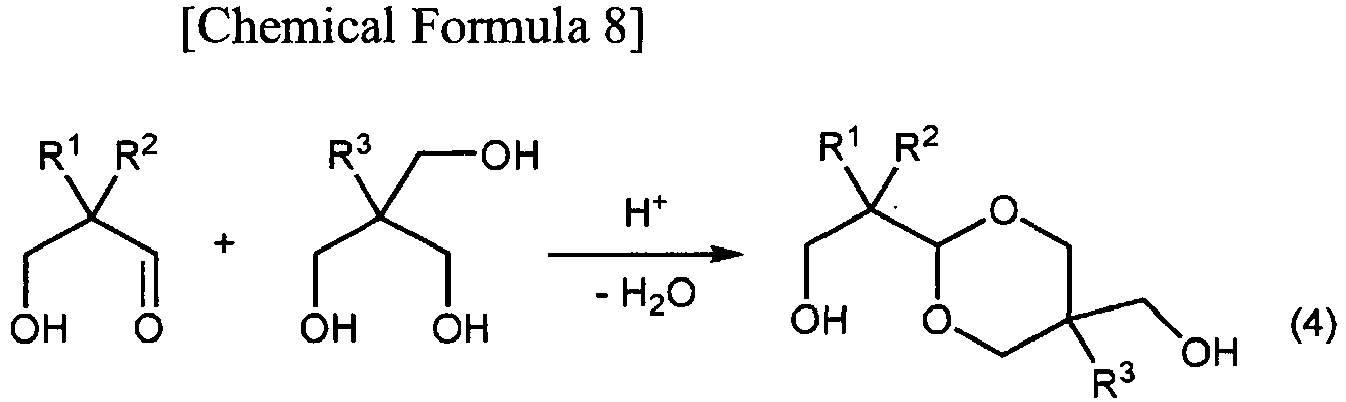
- In the above method for the production of the triacrylate compound represented by the formula (1), examples of the ester bond-forming reactions include dehydration condensation reaction using an α,β-unsaturated carbonyl compound of the formula (3) in which X is a hydroxyl group, namely, an α,β-unsaturated carboxylic acid compound, and transesterification reaction using an α,β-unsaturated carbonyl compound of the formula (3) in which X is an alkoxy group, namely, an α,β-unsaturated carboxylate ester compound.
- When dehydration condensation reaction is used in the above method for production, the triacrylate compound represented by the formula (1) may be produced by a method including subjecting a polyol compound represented by the formula (2) to dehydration condensation reaction with an α,β-unsaturated carboxylic acid compound represented by the formula (3a). In the formulae below, R and R1 through R3 are the same as described above.


- In the dehydration condensation reaction, for example, the polyol compound represented by the formula (2) and the α,β-unsaturated carboxylic acid compound represented by the formula (3 a) are preferably used in such amounts that the amount of the α,β-unsaturated carboxylic acid compound is in the range of 3 mol to 10 mol, and more preferably in the range of 3 mol to 5 mol per 1 mol of the polyol compound.
- The esterification by the dehydration condensation between the polyol compound represented by the formula (2) and the α,β-unsaturated carboxylic acid compound represented by the formula (3a) may involve an acid catalyst, an organic solvent and a polymerization inhibitor.
- Examples of the catalysts which may be used in the esterification by dehydration condensation include known acid catalysts, specifically, inorganic acids such as sulfuric acid, hydrochloric acid and phosphoric acid; organic acids such as methanesulfonic acid, p-toluenesulfonic acid and benzenesulfonic acid; Lewis acids such as boron trifluoride, dimethyltin oxide, dibutyltin oxide, dimethyltin dichloride, dibutyltin dichloride, dimethyldimethoxytin, dibutyldimethoxytin, aluminum isopropoxide, zinc acetylacetonate, tetramethoxytitanium, tetraisopropoxytitanium and tetrabutoxytitanium; and cationic ion-exchange resins. It is preferable to use at least one selected from the group consisting of the above catalysts. The catalysts may be used singly, or two or more may be used at the same time. In an embodiment, a base may be used to generate any of the above Lewis acid catalysts in the reaction system.
- When a catalyst is used, the amount of the catalyst is 0.1 mol% to 10 mol%, and preferably 0.5 mol% to 5 mol% relative to 1 mol of the polyol compound.
- The organic solvent is not particularly limited as long as it does not undergo side reactions with the raw materials. In particular, a solvent which allows water resulting from the reaction to be distilled off of the system is advantageous in that the reaction is accelerated. That is, a solvent which forms a layer separated from an aqueous layer and can form an azeotrope with water is preferable. Specific examples include aliphatic hydrocarbon solvents such as hexane, heptane, cyclohexane and methylcyclohexane; and aromatic hydrocarbon solvents such as benzene, toluene and xylene. At least one selected from the group consisting of the above solvents may be suitably used. The solvents may be used singly, or two or more may be used in combination.
- When an organic solvent is used, for example, the amount of the organic solvent may be a minimum amount required for azeotropic dehydration that is derived from the theoretical amount of water production and the azeotropic ratio of such water to the organic solvent used. The amount of the solvent may be less than the theoretical amount when a Dean-Stark apparatus is used because dehydration may take place while continuously returning the azeotropic solvent back to the reaction vessel. In a simplified case, the amount may be 20 mass% to 200 mass%, and preferably 30 mass% to 100 mass% relative to the total mass of the polyol compound and the unsaturated carboxylic acid compound used.
- The polymerization inhibitor is not particularly limited as long as it can scavenge radicals. Specific examples of the polymerization inhibitors include known polymerization inhibitors such as hydroquinone, p-methoxyphenol, t-butylhydroquinone, p-benzoquinone and 2,2,6,6-tetramethylpiperidine-1-oxide. It is preferable to use at least one selected from the group consisting of the above polymerization inhibitors. The polymerization inhibitors may be used singly, or two or more may be used at the same time.
- When a polymerization inhibitor is used, the amount of the polymerization inhibitor is, for example, 0.001 mass% to 5 mass%, and preferably 0.01 mass% to 1 mass% relative to the α,β-unsaturated carboxylic acid compound.
- When transesterification reaction is used, the triacrylate compound represented by the formula (1) may be produced by a method including subjecting a polyol compound represented by the formula (2) to transesterification reaction with an α,β-unsaturated carboxylate ester compound represented by the formula (3b). In the formulae below, R and R1 through R3 are the same as described above. Z represents an alkyl group having 1 to 6 carbon atoms, and may be linear or branched.
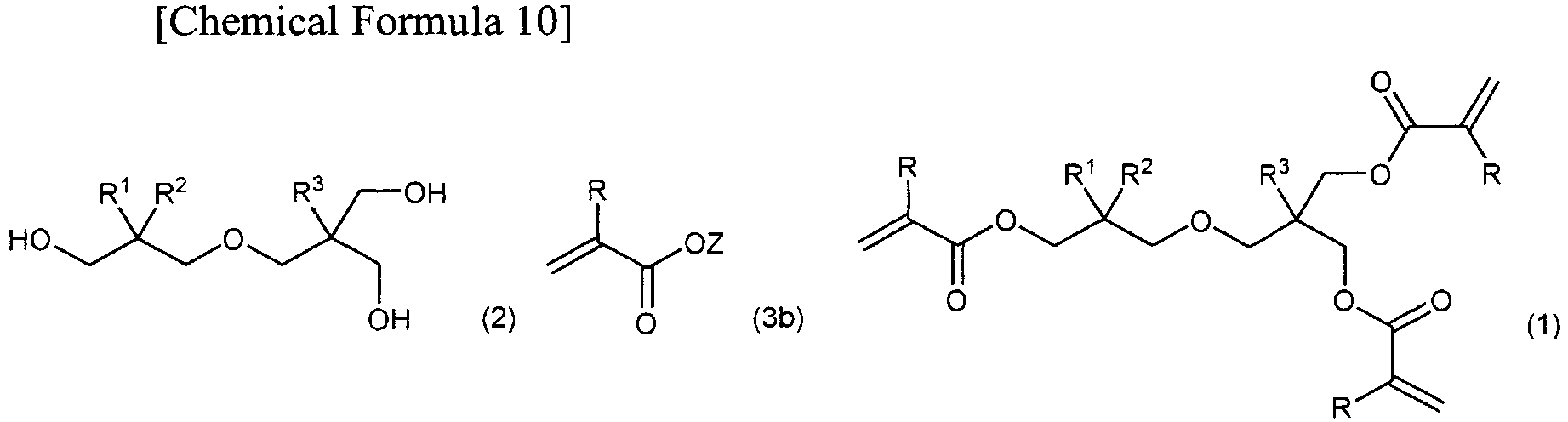
- The alkyl group represented by Z is preferably a lower alkyl group, more preferably a linear or branched alkyl group having 1 to 4 carbon atoms, and more preferably an alkyl group having 1 or 2 carbon atoms. Specific examples of the alkyl groups represented by Z include methyl group, ethyl group, propyl group, isopropyl group, butyl group, isobutyl group and tert-butyl group. In particular, Z is preferably a methyl group or an ethyl group, and more preferably a methyl group in view of the fact that the alcohol resulting from the transesterification reaction may be removed easily.
- In the transesterification reaction, for example, the polyol compound represented by the formula (2) and the α,β-unsaturated carboxylate ester compound represented by the formula (3b) are preferably used in such amounts that the amount of the α,β-unsaturated carboxylate ester compound is in the range of 3 mol to 20 mol, and more preferably in the range of 3 mol to 10 mol per 1 mol of the polyol compound.
- The manner in which the transesterification reaction is performed is not particularly limited. Because the reaction is allowed to take place rapidly by removing the lower alcohol resulting from the reaction out of the reaction system, the reactor is preferably equipped with a distillation column so that the reaction is performed while distilling off the lower alcohol. The transesterification reaction may involve a catalyst, a polymerization inhibitor or the like. The details of the polymerization inhibitor are similar to those described with respect to the esterification by the dehydration condensation of the α,β-unsaturated carboxylic acid compound, except that the amount of the polymerization inhibitor is expressed relative to the α,β-unsaturated carboxylate ester compound instead of the α,β-unsaturated carboxylic acid compound.
- The catalyst for the transesterification reaction may be a Lewis acid catalyst, a base catalyst or the like. The Lewis acid catalyst may be a known Lewis acid catalyst, with examples including dimethyltin oxide, dibutyltin oxide, dimethyltin dichloride, dibutyltin dichloride, dimethyldimethoxytin, dibutyldimethoxytin, aluminum isopropoxide, zinc acetylacetonate, tetramethoxytitanium, tetraisopropoxytitanium and tetrabutoxytitanium. It is preferable to use at least one selected from the group consisting of the above catalysts. In an embodiment, a base may be used to generate any of the above Lewis acid catalysts in the reaction system.
- Examples of the known base catalysts for use in the transesterification reaction include lithium methoxide, sodium methoxide, potassium methoxide, lithium ethoxide, sodium ethoxide and potassium ethoxide. It is preferable to use at least one selected from the group consisting of the above catalysts. The catalysts may be used singly, or two or more may be used at the same time appropriately while ensuring that any problems will not be caused.
- When the transesterification reaction involves a catalyst, the amount of the catalyst is 0.1 mol% to 10 mol%, and preferably 0.5 mol% to 5 mol% relative to 1 mol of the polyol compound.
- The transesterification reaction may involve an organic solvent as required. The details of the organic solvent are similar to those described with respect to the esterification by the dehydration condensation of the α,β-unsaturated carboxylic acid compound, except that the amount of the organic solvent is expressed relative to the α,β-unsaturated carboxylate ester compound instead of the α,β-unsaturated carboxylic acid compound.
- The triacrylate compounds represented by the formula (1) may be used as, for example, crosslinking agents, reactive diluents, viscosity modifiers and the like in applications such as inks, paints, coating agents, hard coats, films, adhesives, pressure sensitive adhesives, surface processing agents, lenses, resists, polarizers, sealants, liquid crystal display materials, color filter materials, dental materials and nail cosmetics.
- The scope of the present invention includes, in addition to the triacrylate compounds represented by the general formula (1), diacrylate compounds represented by the formula (6) below. The diacrylate compounds represented by the formula (6), when polymerized, exhibit low curing shrinkage and attain excellent flex resistance and low curling properties.

- R and R1 through R3 are defined the same as R and R1 through R3 in the formula (1). Two of the substituents M are groups represented by the formula (6a), and the other is a hydrogen atom. The asterisks ** represent that M is bonded at the indicated position. A diacrylate compound represented by the formula (6) is byproduced at times during the production of a compound represented by the formula (1), or may be produced using the same raw materials while changing the ratio of the raw materials appropriately.
- The triacrylate compound represented by the formula (1) may be polymerized to give a cured product. In accordance with the application, the triacrylate compound may be polymerized singly or may be copolymerized with other polymerizable monomer or polymerizable oligomer. The copolymerization may involve two or more kinds of other polymerizable monomers and polymerizable oligomers at the same time. That is, the triacrylate compound represented by the formula (1) may constitute a composition (preferably, a polymerizable composition) which includes at least one triacrylate compound and at least one radical polymerization initiator, or may constitute a composition (preferably, a polymerizable composition) which further includes at least one selected from the group consisting of polymerizable monomers other than the triacrylate compounds, and polymerizable oligomers.
- The additional polymerizable monomers and polymerizable oligomers are not particularly limited, and may be selected appropriately from usual polymerizable compounds in accordance with factors such as purposes. The additional polymerizable monomers may be any polymerizable monomers other than the triacrylate compounds represented by the formula (1). Examples thereof include acrylic monomers having an acrylic group, methacrylic monomers having a methacrylic group, and styrene derivatives.
- Specific examples of the acrylic monomers include methyl acrylate, ethyl acrylate, propyl acrylate, dicyclopentenyl acrylate, dicyclopentanyl acrylate, isobornyl acrylate, tetrahydrofurfuryl acrylate, phenoxyethyl acrylate, lauryl acrylate, 2-hydroxyethyl acrylate, polypropylene glycol diacrylate, neopentyl glycol diacrylate, dineopentyl glycol diacrylate, trimethylolpropane triacrylate, pentaerythritol tetraacrylate, ditrimethylolpropane tetraacrylate and dipentaerythritol hexaacrylate. It is preferable to use at least one selected from the group consisting of the above monomers. Further, specific examples of the methacrylic monomers having a methacrylic group include methyl methacrylate, ethyl methacrylate, propyl methacrylate, dicyclopentenyl methacrylate, dicyclopentanyl methacrylate, isobornyl methacrylate, tetrahydrofurfuryl methacrylate, phenoxyethyl methacrylate, lauryl methacrylate, 2-hydroxyethyl methacrylate, polypropylene glycol dimethacrylate, neopentyl glycol dimethacrylate, dineopentyl glycol dimethacrylate, trimethylolpropane trimethacrylate, pentaerythritol tetramethacrylate, ditrimethylolpropane tetramethacrylate and dipentaerythritol hexamethacrylate. It is preferable to use at least one selected from the group consisting of the above monomers. The additional polymerizable monomers may be used singly, or two or more may be used in combination.
- Examples of the polymerizable oligomers include polymerizable compounds obtained by the acrylation or methacrylation of oligomers including two or more structural units. Specific examples include polyester acrylate, epoxy acrylate, polyether acrylate, urethane acrylate, polycarbonate diol acrylate, polycarbonate diol urethane acrylate, polyester methacrylate, epoxy methacrylate, polyether methacrylate, urethane methacrylate, polycarbonate diol methacrylate and polycarbonate diol urethane methacrylate. It is preferable to use at least one selected from the group consisting of the above oligomers. It is more preferable that the composition include at least one selected from urethane acrylate oligomers and urethane methacrylate oligomers. It is still more preferable that the composition include at least one selected from aliphatic urethane acrylate oligomers and aliphatic urethane methacrylate oligomers. The polymerizable oligomers may be used singly, or two or more may be used in combination. The polymerizable oligomers may be used in combination with at least one of the additional polymerizable monomers. The molecular weight of the polymerizable oligomers is not particularly limited. The molecular weight is, for example, 500 to 40000, preferably 800 to 5000, and more preferably 2000 to 5000 when expressed as weight average molecular weight. The molecular weight of the polymerizable oligomers is the weight average molecular weight and is measured by gel permeation chromatography (GPC).
- For example, the polymerizable oligomer has an oligomer chain moiety and, at an end thereof, a polymerizable group derived from acrylic acid or methacrylic acid or from an ester thereof. For example, the oligomer chain moiety is a structure formed by the removal of a hydrogen atom from a terminal functional group in an oligomer such as a terminal hydroxyl or amino group. Some example oligomers that can form the oligomer chain moieties are at least one selected from the group consisting of polyalkylene oxides such as polyethylene oxide and polypropylene oxide, aliphatic or aromatic polyester diols, aliphatic or aromatic polyamides, and aliphatic or aromatic polycarbonate diols, or any combinations or derivatives of these oligomers; aliphatic or aromatic epoxy resins; and homopolymers and copolymers of at least one monomer selected from the group consisting of alkyl acrylates, alkyl methacrylates, styrene and derivatives thereof, acrylonitrile, vinyl acetate and butadiene. Of these, alkylene oxides and aliphatic oligomers having a terminal hydroxyl group such as aliphatic polyester diols and aliphatic polycarbonate diols are preferable. The oligomer chains may be linear or branched.
- The polymerizable oligomer has a polymerizable group at an end of the oligomer chain. The polymerizable oligomer may be a compound which includes an ester bond, an amide bond or the like formed between acrylic acid or methacrylic acid and the terminal functional group of the oligomer chain, or may be a urethane acrylate oligomer or a urethane methacrylate oligomer which includes a urethane bond formed between a hydroxyalkyl ester of acrylic acid or methacrylic acid and a polyfunctional isocyanate compound. The number of polymerizable groups in the polymerizable oligomer is not particularly limited, and is, for example, 2 to 3.
- The hydroxyalkyl ester of acrylic acid or methacrylic acid in the urethane acrylate oligomer is preferably at least one selected from the group consisting of 2-hydroxyethyl acrylate, trimethylolpropane diacrylate, pentaerythritol triacrylate and dipentaerythritol pentaacrylate, and 2-hydroxyethyl methacrylate, trimethylolpropane dimethacrylate, pentaerythritol trimethacrylate and dipentaerythritol pentamethacrylate. The polyfunctional isocyanate compound is preferably at least one selected from the group consisting of isophorone diisocyanate (IPDI), 4,4'-dicyclohexylmethane diisocyanate (hydrogenated MDI), hexamethylene diisocyanate (HDI), trimethylhexamethylene diisocyanate (TMDI), 4,4'-diphenylenemethane diisocyanate (MDI), methylcyclohexylene diisocyanate (hydrogenated TDI) and 2,4-tolylene diisocyanate (TDI). The polyisocyanates may be used singly, or two or more may be used in combination.
- In a composition, the ratio of the content of the triacrylate compound represented by the formula (1) and that of at least one selected from the group consisting of additional polymerizable monomers and polymerizable oligomers is not particularly limited and may be selected appropriately in accordance with factors such as purposes. With respect to the polymerizable compounds present in the composition, the content of the triacrylate compound represented by the formula (1) on the mass basis is, for example, 5 mass% to 70 mass%, and preferably 5 mass% to 50 mass%.
- A composition including the triacrylate compound represented by the formula (1) and a radical polymerization initiator can form a cured product upon radical photopolymerization or thermal radical polymerization. It is preferable that the composition include at least a radical photopolymerization initiator.
- The radical polymerization initiator is not particularly limited and may be selected appropriately from general radical polymerization initiators in accordance with factors such as purposes. Examples of the radical polymerization initiators include radical photopolymerization initiators such as acetophenone, p-anisyl, benzoin, benzoin methyl ether, benzoin isobutyl ether, dibenzoyl and 1-hydroxycyclohexyl phenyl ketone; and thermal radical polymerization initiators such as 2,2'-azobis(isobutyronitrile), 2,2'-azobis(2,4-dimethylvaleronitrile) and benzoyl peroxide. It is preferable to use at least one selected from the group consisting of the above initiators. The radical polymerization initiators may be used singly, or two or more may be used in combination.
- When the composition contains a radical polymerization initiator, the content thereof is, for example, 1 mass% to 20 mass%, and preferably 1 mass% to 5 mass% relative to the total mass of the polymerizable monomer(s) and polymerizable oligomer(s).
- The composition may further contain various additives as required. The composition may easily attain desired properties by containing various additives. Example of the additives include pigments, dyes, antifoaming agents, anti-sagging agents, adhesion promoters, plasticizers, dispersants, surface leveling agents, viscosity modifiers, antistatic agents, mold release agents, light diffusing agents and antioxidants. It is possible to add inorganic fillers such as glass fibers, carbon fibers and clay compounds. These additives may be used singly, or two or more may be used in combination.
- The composition can be used without a solvent, or may further contain an organic solvent depending on factors such as the type of a substrate and the type of a coating method. The organic solvent is not particularly limited and may be selected appropriately from usual organic solvents in accordance with factors such as purposes. Specific examples of the organic solvents include aliphatic hydrocarbon solvents such as hexane and heptane: aromatic hydrocarbon solvents such as toluene and xylene; alcohol solvents such as methanol and ethanol; ether solvents such as diethyl ether, tetrahydrofuran and 1,4-dioxane; ester solvents such as ethyl acetate; and ketone solvents such as acetone, methyl ethyl ketone and cyclohexanone. The organic solvents may be used singly, or two or more may be used in combination.
- When the composition includes an organic solvent, the content thereof is not particularly limited and may be selected appropriately in accordance with factors such as purposes. For example, the content of the organic solvent may be such that the amount of nonvolatile components in the composition (the solid content) will be 70 mass% to 95 mass%.
- The scope of the present invention includes cured products of the composition described above. Such cured products attain a good balance of properties such as low curing shrinkage, high flex resistance, adhesion and low curling properties.
- The method for curing the composition is not particularly limited and is selected appropriately from usual methods in accordance with factors such as the type of the radical polymerization initiator present in the composition. The composition may be cured by heat treatment or irradiation treatment. The irradiation treatment may be followed by heat treatment. The heat treatment temperature may be, for example, 60°C to 200°C, and the heat treatment time may be, for example, 10 minutes to 3 hours. The irradiation treatment may be performed by applying light having a wavelength of, for example, 210 nm to 450 nm. The dose may be, for example, not less than 80 mJ/cm2.
- The scope of the present invention includes polymers including a structural unit represented by the formula (5) below (hereinafter, also written simply as "polymers"). By its containing a structural unit represented by the formula (5), the polymer attains a good balance of properties such as low curing shrinkage, high flex resistance, adhesion and low curling properties.

- R1 and R2 are each independently a linear or branched alkyl group having 1 to 6 carbon atoms, R3 is a linear or branched alkyl group having 1 to 6 carbon atoms or a hydroxymethyl group, each R is independently a hydrogen atom, an alkyl group having 1 to 6 carbon atoms or a halogen atom, and each * indicates a binding site of the structural unit in the polymer.
- The polymer is not limited as long as it includes structural units represented by the formula (5), and may contain at least one type of structural units derived from other polymerizable monomers and polymerizable oligomers. The details of such additional polymerizable monomers and polymerizable oligomers are the same as described hereinabove. It is preferable that the polymer include at least one type of structural units derived from polymerizable oligomers, more preferably include at least one type of structural units selected from those derived from urethane acrylate oligomers and those derived from urethane methacrylate oligomers, and still more preferably include at least one type of structural units selected from those derived from aliphatic urethane acrylate oligomers and those derived from aliphatic urethane methacrylate oligomers. Here, the term "structural unit" means a partial structure formed by the polymerization of monomer molecules that constitute the polymer.
- When the polymer contains structural units derived from additional polymerizable monomers and polymerizable oligomers, the content of the structural units represented by the formula (5) on the mass basis is, for example, 5 mass% to 70 mass%, and preferably 5 mass% to 50 mass%.
- The molecular weight of the polymers is not particularly limited and may be selected appropriately in accordance with factors such as purposes. The weight average molecular weight of the polymers is, for example, 1000 to 40000.
- The polymer may include, in addition to the structural unit represented by the formula (5), a structural unit represented by the formula (7) below.

- R1, R2, R3 and R are the same as defined above. Each T is independently a group represented by the formula (7a) or the formula (7b), and one or two of Ts are represented by the formula (7a). The asterisk ** represents a binding site in T, and the asterisk * represents a binding site of the structural unit in the polymer.
- The structural unit represented by the formula (7) may be such that two Ts are represented by the formula (7a) or one T is represented by the formula (7a). When two Ts are represented by the formula (7a), the polymer will have a crosslink structure represented by the formula (7).
- For example, the polymer may be produced by curing a composition including a triacrylate compound represented by the formula (1). That is, the polymer is a cured product obtained by curing the aforementioned composition.
- The scope of the present invention includes inks including the above-described composition. Such an ink includes a triacrylate compound represented by the formula (1) and a radical polymerization initiator, and further includes, for example, a colorant.
- The colorant may be any of pigments and dyes, and is selected appropriately from usual pigments and dyes in accordance with factors such as purposes. Specific examples of the pigments include organic pigments such as azo pigments, polycyclic pigments, nitro pigments, nitroso pigments and aniline blacks; and inorganic pigments such as carbon blacks, metal oxides, metal sulfides, metal chlorides, aluminum powder, silica and calcium carbonate.
- The content of the colorant present in the ink is not particularly limited and is selected appropriately in accordance with factors such as purposes. For example, the content of the colorant is 1 mass% to 30 mass% of the total mass of the ink.
- The scope of the present invention includes coating agents including the above-described composition. Such a coating agent may be applied onto a desired member to form a composition layer, which is then cured to form on the member a coat layer that is a cured product of the composition. The member to which the coating agent is applied is not particularly limited, and a desired member may be provided appropriately in accordance with factors such as purposes. The method for applying the coating agent is selected appropriately from usual methods in accordance with factors such as the type of a member and the formulation of the coating agent. Some example application methods are coating, spraying and dipping.
- The scope of the present invention includes films including a cured product of the above-described composition. The film may be produced by applying a composition which includes a triacrylate compound represented by the formula (1) and a radical polymerization initiator onto a substrate, curing the coating, and separating the resultant film from the substrate. The thickness of the films is not particularly limited and is selected appropriately in accordance with factors such as purposes. For example, the thickness of the film is 5 µm to 200 µm.
- The scope of the present invention includes adhesives including the above-described composition. For example, the adhesive may be applied between a first member and a second member to form an adhesive layer, and this layer may be cured to bond the first member and the second member to each other. The members to which the adhesive is applied are not particularly limited, and desired members may be provided appropriately in accordance with factors such as purposes. The first member and the second member may be the same as or different from each other. The adhesive has low curing shrinkage and exhibits excellent adhesion.
- Hereinbelow, the present invention will be described in greater detail based on Examples. However, the scope of the invention is not limited to such Examples presented below.
- The following is information such as the abbreviations and manufacturers of the raw materials used in Examples and Comparative Examples, and pretreatments performed on the raw materials.
- TMPTA: trimethylolpropane triacrylate (manufactured by Tokyo Chemical Industry Co., Ltd.)
- TMPTM: trimethylolpropane trimethacrylate (manufactured by Tokyo Chemical Industry Co., Ltd.)
- Because of a purity of 79%, TMPTA above was used after column purification. Urethane oligomer: trade name "SHIKOH UV-7510B" manufactured by The Nippon Synthetic Chemical Industry Co., Ltd.
- Polymerization initiator: 1-hydroxycyclohexyl phenyl ketone (manufactured by Wako Pure Chemical Industries, Ltd.)
- The reaction was analyzed by gas chromatography. The gas chromatograph used was 7890A manufactured by Agilent Technologies Japan, Ltd. The column used was DB-1701 manufactured by J & W Co., Ltd. The column temperature was held at 40°C for 5 minutes, increased to 250°C at 10°C/min, and held constant for 35 minutes. The injection temperature was 210°C. TCD was used as the detector at 250°C. Helium was used as the carrier gas.
- The product was identified by 1H-NMR and 13C-NMR spectroscopy. The measurements were performed in CDCl3 solvent at 500 MHz and 125 MHz, respectively.
- In the measurement, JNM-ECA500 manufactured by JEOL Ltd. was used.
- A 2-liter round bottomed flask was loaded with 45.1 g of 2,2-dimethyl-3-hydroxypropionaldehyde (hydroxypivalaldehyde, manufactured by MITSUBISHI GAS CHEMICAL COMPANY, INC., purity 99.8%), 59.6 g of 2-ethyl-2-hydroxymethylpropane-1,3-diol (trimethylolpropane, reagent manufactured by Tokyo Chemical Industry Co., Ltd.), 706 g of benzene, and 5.0 g of granular Nafion (trade name "NR-50", reagent manufactured by Sigma-Aldrich Co. LLC.). The reaction was performed at ordinary pressure while discharging byproduct water as an azeotrope with benzene out of the reaction system with use of a Dean-Stark trap until the distillation of water ceased. The product was filtered, concentrated and cooled to recrystallize. In this manner, a crystal of 2-(5-ethyl-5-hydroxymethyl-[1,3]dioxan-2-yl)-2-methylpropan-1-ol was obtained.

- A catalyst for use in the hydrogenation of acetal was synthesized as follows.
- Zirconium oxide used as a carrier for metal components was prepared by the following method.
- While performing stirring, 15.5 g of 28 mass% ammonia water was added dropwise to 505 g of an aqueous zirconium oxynitrate solution having a concentration in terms of zirconium oxide (ZrO2) of 25 mass%, resulting in a white precipitate. The precipitate was removed by filtration, washed with ion-exchanged water, and dried at 110°C for 10 hours to give hydrous zirconium oxide. The oxide was placed into a porcelain crucible, calcined in the air with use of an electric furnace at 400°C for 3 hours, and crushed in an agate mortar to give powdery zirconium oxide (hereinafter, also written as the "carrier A"). The BET specific surface area of the carrier A (measured by the nitrogen adsorption method) was 102.7 m2/g.
- A catalyst having palladium as a specific metal component was prepared by the following method.
- An aqueous solution of 0.66 mass% palladium chloride and 0.44 mass% sodium chloride was added to 50 g of the carrier A, and the metal components were adsorbed on the carrier. An aqueous formaldehyde-sodium hydroxide solution was poured to the carrier to reduce instantaneously the metal components adsorbed. Thereafter, the catalyst was washed with ion-exchanged water and was dried to give a 1.0 mass% palladium-supporting zirconium oxide catalyst (hereinafter, written as the "catalyst A").
- A 500 mL SUS reactor was loaded with 7.5 g of the catalyst A, 75 g of 2-(5-ethyl-5-hydroxymethyl-[1,3]dioxan-2-yl)-2-methylpropan-1-ol, and 225 g of dioxane. The reactor was then purged with nitrogen gas. Thereafter, 8.5 MPa hydrogen gas was fed into the reactor. The temperature was increased to a prescribed reaction temperature of 230°C, and the reaction was performed for 8 hours. After being cooled, the product in the reactor was recovered and recrystallized to give the target compound.

- In a glass reactor equipped with a stirring bar, a thermometer and a Vigreux column were mixed 2-ethyl-2-(3-hydroxy-2,2-dimethyl-propoxymethyl)-propane-1,3-diol (30.0 g, 136 mmol), methyl acrylate (59.3 g, 680 mmol), dimethyltin dichloride (900 mg, 4.1 mmol), sodium methoxide (216 mg, 4.1 mmol), p-methoxyphenol (297 mg, 2.4 mmol) and hydroquinone (120 mg, 1.1 mmol). The mixture was heated at an internal temperature of not less than 82°C and not more than 94°C. While distilling off methanol from the system as an azeotrope with methyl acrylate, stirring was performed for 30 hours while performing heating. During the reaction, a 1 mass% p-methoxyphenol solution of methyl acrylate was added dropwise from the column top, thereby preventing polymerization in the Vigreux column and making up for the loss of methyl acrylate by azeotropic distillation of methanol. The catalyst and the polymerization inhibitor were removed by base washing, and the unreacted methyl acrylate was distilled off under reduced pressure. Consequently, the target triacrylate monomer was obtained (49.4 g, purity 93.5%, 121 mmol, 89% yield).
- The product obtained in Example 1 was identified by 1H-NMR and 13C-NMR spectroscopy to be a novel compound represented by the following chemical structural formula. In the specification, this compound is sometimes written as NTTA.

- NTTA: oily, colorless.
- 1H-NMR δ 0.88 (t, -CH2CH 3 , 3H), 0.93 (s, -C(CH 3 ) 2 , 6H), 1.50 (q, -CH 2 CH3, 2H), 3.16 (s, -CH 2 O-, 2H), 3.30 (s, -CH 2 O-, 2H), 3.95 (s, -COOCH 2 -, 2H), 4.13-4.14 (m, -COOCH 2 x 2, 4H), 5.81-5.84 (m, H a & H a ', 3H), 6.08-6.15 (m, H b & H b ', 3H), 6.37-6.40 (m, H c & H c ', 3H).
- 13C-NMR δ 7.46, 21.87, 23.17, 35.69, 41.77, 64.64, 69.67, 70.94, 77.21, 128.22, 128.23, 128.50, 130.42, 130.83, 165.89, 166.05.
- Example 2
- In a glass reactor equipped with a stirring bar, a thermometer and a Vigreux column were mixed 2-ethyl-2-(3-hydroxy-2,2-dimethyl-propoxymethyl)-propane-1,3-diol (30.0 g, 136 mmol), methyl methacrylate (109 g, 1.09 mol), dimethyltin dichloride (902 mg, 4.1 mmol), sodium methoxide (220 mg, 4.1 mmol) and p-methoxyphenol (125 mg, 1.0 mmol). The mixture was heated at an internal temperature of not less than 93°C and not more than 115°C. While distilling off methanol from the system as an azeotrope with methyl methacrylate, stirring was performed for 42 hours while performing heating. The catalyst and the polymerization inhibitor were removed by base washing, and the unreacted methyl methacrylate was distilled off under reduced pressure. Consequently, the target trimethacrylate monomer was obtained (58.7 g, purity 92.2%, 127 mmol, 94% yield).
- The product obtained in Example 2 was identified by 1H-NMR and 13C-NMR spectroscopy to be a novel compound represented by the following chemical structural formula. In the specification, the compound is sometimes written as NTTM.
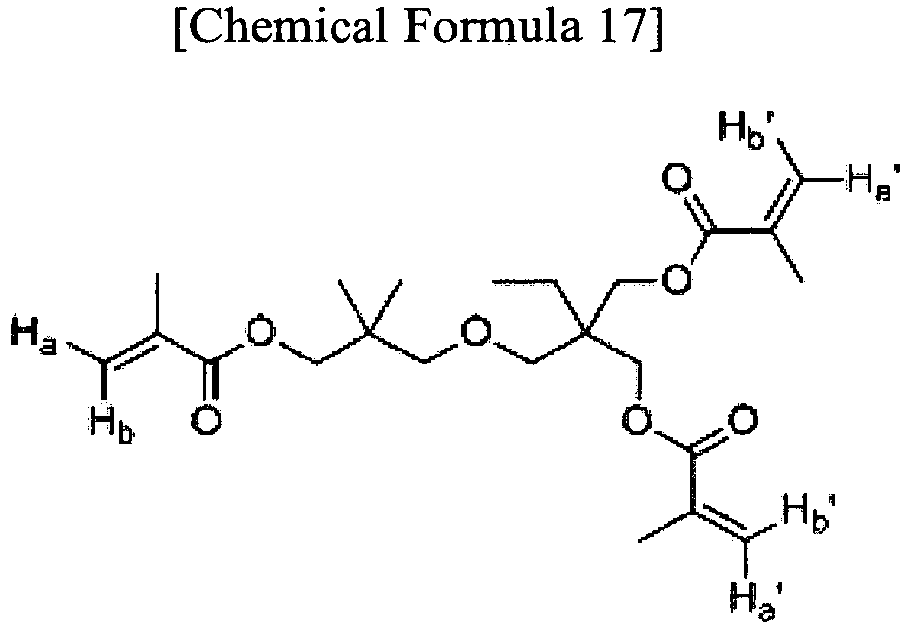
- NTTM: oily, colorless.
- 1H-NMR δ 0.89 (t, -CH2CH 3 , 3H), 0.93 (s, -C(CH 3 ) 2 , 6H), 1.51 (q, -CH 2 CH3, 2H), 1.93 (s, CH2=C(CH 3 )CO-
x 3, 9H), 3.17 (s, -CH 2 O-, 2H), 3.33 (s, -CH 2 O-, 2H), 3.93 (s, -COOCH 2 -, 2H), 4.11-4.12 (m, -COOCH 2 x 2, 4H), 5.54-5.55 (m, H a & H a 'x 2, 3H), 6.08 (s, H b & H b ' x 2, 3H). - 13C-NMR δ 7.53, 18.29, 21.92, 23.36, 35.78, 41.96, 64.79, 69.83, 71.11, 77.32, 125.14, 125.57, 136.17, 136.44, 167.05, 167.19.
- In the following, the triacrylate monomer and the trimethacrylate monomer synthesized in Examples 1 and 2 were UV cured severally, and the properties of the cured products were evaluated as described below. Separately, cured products of generally-used trimethylolpropane triacrylate (TMPTA) and trimethylolpropane trimethacrylate (TMPTM) were tested similarly to evaluate their properties.
- The specific gravity of the monomer before curing was measured with a pycnometer. With use of an electronic hydrometer (EW-300SG manufactured by Alfa Mirage Co., Ltd.), the specific gravity of a 0.5 mm thick cured plate was measured. The curing shrinkage (%) was calculated using the following equation.

- A cured film with a thickness of 50 µm formed on a 0.5 mm thick polycarbonate substrate was tested in accordance with JIS K 5600-5-4 using a pencil hardness tester manufactured by COTEC to determine the pencil hardness.
- A cured film with a thickness of 50 µm formed on a 125 µm thick surface-treated PET film (trade name "Cosmo Shine A2330" manufactured by TOYOBO CO., LTD.) was tested by a cross-cut tape method in accordance with JIS K 5400-8-5-2 using a cross-cut guide manufactured by COTEC. The degree of separation per 100 squares was evaluated using the following formula.

- A cured film with a thickness of 23 µm or 50 µm was formed on a 100 µm thick polycarbonate film (trade name "Iupilon film FE-2000" manufactured by MITSUBISHI GAS CHEMICAL COMPANY, INC.). The cured film, together with the polycarbonate film, was cut into a 100 mm x 100 mm test piece. The test piece was placed on a horizontal plate, and the lifting from the plate surface was measured with respect to the four corners of the test piece. The average of the liftings of the four corners was indicated as the measured value of curling properties.
- To NTTA (12.0 g) produced in Example 1, polymerization initiator 1-hydroxycyclohexyl phenyl ketone was added in an amount corresponding to 5 mass% (600 mg) and was dissolved uniformly. A monomer composition (polymerizable composition) was thus prepared. Incidentally, NTTA used here had been purified after the reaction by column chromatography, and the purity thereof was > 99%.
- The monomer composition obtained was cured by the following methods to give cured products.
- Curing method (1): A 1 mm thick glass plate, a 100 µm PET film, and a 0.5 mm thick silicon mold having a 50 mm x 50 mm hollow were stacked in this order, and the monomer composition was poured into the silicon mold. Further, a PET film and a glass plate were stacked thereon, and the unit was fixed. Thereafter, the composition was cured by the application of 360 nm wavelength UV light.
- Curing method (2): With a bar coater, the composition was spread on substrates so that the film thickness would be 23 µm or 50 µm. A PET film was laminated thereon, and the composition was cured by the application of 360 nm wavelength UV light.
- The cured plate obtained by the curing method (1) was tested to determine the specific gravity of the cured product. The cured films obtained by the curing method (2) were tested to determine the pencil hardness, the curling properties and the adhesion. The curing shrinkage was 10.5%. The cured product with a film thickness of 23 µm showed curling properties of 20.1 mm, an adhesion of 100/100, and a pencil hardness of 3H. The evaluation results are described in Table 1.
- Monomer compositions were prepared in the same manner as in Example 3 by adding 5 mass% of polymerization initiator 1-hydroxycyclohexyl phenyl ketone to each of NTTM produced in Example 2, trimethylolpropane triacrylate (TMPTA) and trimethylolpropane trimethacrylate (TMPTM). Cured products of the compositions were fabricated in the same manner, and the properties were measured. The evaluation results are described in Table 1.
[Table 1] Example 3 Comparative Example 1 Example 4 Comparative Example 2 Triacrylate or trimethacrylate NTTA TMPTA NTTM TMPTM Curing shrinkage (%) 10.5 14.1 9.6 10.5 Curling properties (mm) 20.1 34.5 11.0 >35.0 Adhesion 100/100 100/100 100/100 100/100 Pencil hardness 3H 3H 3H 3H - As shown in Table 1, the triacrylate of the present invention gave cured products which exhibited good and balanced properties in all the evaluation items consisting of curing shrinkage, curling properties, adhesion and pencil hardness. While the trimethacrylate of Comparative Example 2 had a large curing shrinkage and poor curling properties, the trimethacrylate of the present invention attained a small curing shrinkage and low curling properties.
- In Examples 5 and 6 and Comparative Examples 3 and 4 below, polymerizable compositions were prepared which included the triacrylate monomer or the trimethacrylate monomer synthesized in Example 1 or 2, and a urethane acrylate oligomer generally used in applications such as building materials (trade name "SHIKOH UV-7510B" manufactured by The Nippon Synthetic Chemical Industry Co., Ltd., pencil hardness B). The compositions were cured, and the properties of the cured products were evaluated. Separately, cured products were prepared in the same manner except that TMPTA and TMPTM were used, and their properties were evaluated.
- In accordance with JIS K 5600-5-1, a cured thin plate with a thickness of 50 µm formed on a 0.5 mm thick polycarbonate as a substrate material was bent 180° by the use of a cylindrical mandrel bend tester manufactured by COTEC. The cured film was visually inspected for cracks or separation. The evaluation results indicate the maximum diameter of the mandrel which caused cracks or separation.
- On a 45°C water bath, 4.5 g of NTTA produced in Example 1 and 4.5 g of the urethane acrylate oligomer were stirred together to give a uniform solution. To the solution, 450 mg of 1-hydroxycyclohexyl phenyl ketone was added and dissolved therein, thus preparing a polymerizable composition.
- The polymerizable composition obtained was cured by the curing method (2) described in Example 3, and the properties of the cured products were measured. The pencil hardness was 2H, the flex resistance was 10 mm, the curling properties of the 50 µm thick film were 7.5 mm, and the adhesion was 100/100. The evaluation results are described in Table 2.
- NTTM produced in Example 2, TMPTA and TMPTM were each mixed together with the equal mass of the urethane acrylate oligomer, thus giving uniform solutions. Similarly to Example 5, polymerizable compositions were prepared by adding polymerization initiator 1-hydroxycyclohexyl phenyl ketone in an amount of 5 mass% relative to the total amount of resins. Cured products were fabricated in the same manner, and their properties were measured. The evaluation results are described in Table 2.
[Table 2] Example 5 Comparative Example 3 Example 6 Comparative Example 4 Triacrylate or trimethacrylate NTTA TMPTA NTTM TMPTM Pencil hardness 2H H H 2H Flex resistance (mm) 10 20 13 20 Curling properties (mm) 7.5 20.1 5.0 13.3 Adhesion 100/100 100/100 100/100 100/100 - The compositions discussed here contained a urethane acrylate oligomer which was characterized by its flexibility. As shown in Table 2, the cured products of Comparative Examples exhibited poor curling properties and poor flex resistance as compared to when the inventive triacrylate compound was used as a crosslinking agent. In contrast, the cured products of Examples 5 and 6 maintained the flexibility of the urethane acrylate oligomer, and exhibited smaller curls and good adhesion. Further, the inventive cured products attained practically sufficient pencil hardness.
- As discussed above, the triacrylate compounds represented by the formula (1) are characterized by their capability of giving cured products excellently balanced in properties such as low curing shrinkage, low curling properties, good adhesion and surface hardness.
- Further, the triacrylate compounds represented by the formula (1) may be used in the form of various curable resin compositions, and such compositions give cured products which are excellently balanced in properties such as low curing shrinkage, high flex resistance, adhesion and low curling properties.
- The triacrylate compounds of the invention represented by the formula (1), and compositions including the compounds, which attain the characteristics described above, may be used in various applications such as, for example, crosslinking agents, inks, paints, coating agents, hard coats, films, adhesives, pressure sensitive adhesives, surface processing agents, lenses, resists, polarizers, sealants, liquid crystals, dental materials and nail cosmetics.
- The entire contents of
Japanese Patent Application No. 2014-215803 (filed: October 22, 2014
Claims (13)
- A triacrylate compound represented by the following formula (1):

- A composition comprising the triacrylate compound described in Claim 1, and a radical polymerization initiator.
- The composition according to Claim 2, wherein the radical polymerization initiator is a radical photopolymerization initiator.
- The composition according to Claim 2 or 3, further comprising at least one selected from the group consisting of polymerizable monomers other than the triacrylate compound, and polymerizable oligomers.
- The composition according to Claim 4, wherein the polymerizable oligomer is at least one kind selected from the group consisting of urethane acrylate oligomers and urethane methacrylate oligomers.
- A polymer comprising a structural unit represented by the following formula (5):


- A cured product of the composition described in any one of Claims 2 to 5.
- An ink comprising the composition described in any one of Claims 2 to 5.
- A coating agent comprising the composition described in any one of Claims 2 to 5.
- A film comprising a cured product of the composition described in any one of Claims 2 to 5.
- An adhesive comprising the composition described in any one of Claims 2 to 5.
- A method for producing a triacrylate compound represented by the formula (1), comprising subjecting a polyol compound represented by the formula (2) to dehydration condensation reaction with an unsaturated carboxylic acid compound represented by the formula (3a),

- A method for producing a triacrylate compound represented by the formula (1), comprising subjecting a polyol compound represented by the formula (2) to transesterification reaction with an unsaturated carboxylate ester compound represented by the formula (3b),

Applications Claiming Priority (2)
| Application Number | Priority Date | Filing Date | Title |
|---|---|---|---|
| JP2014215803 | 2014-10-22 | ||
| PCT/JP2015/079735 WO2016063919A1 (en) | 2014-10-22 | 2015-10-21 | Triacrylate compound, production method therefor, and composition |
Publications (3)
| Publication Number | Publication Date |
|---|---|
| EP3211013A1 true EP3211013A1 (en) | 2017-08-30 |
| EP3211013A4 EP3211013A4 (en) | 2018-05-16 |
| EP3211013B1 EP3211013B1 (en) | 2019-06-19 |
Family
ID=55760950
Family Applications (1)
| Application Number | Title | Priority Date | Filing Date |
|---|---|---|---|
| EP15853309.1A Not-in-force EP3211013B1 (en) | 2014-10-22 | 2015-10-21 | Triacrylate compounds and methods for producing the same, and compositions |
Country Status (6)
| Country | Link |
|---|---|
| US (1) | US10294319B2 (en) |
| EP (1) | EP3211013B1 (en) |
| JP (1) | JP6432603B2 (en) |
| KR (1) | KR20170076732A (en) |
| CN (1) | CN107075016B (en) |
| WO (1) | WO2016063919A1 (en) |
Cited By (1)
| Publication number | Priority date | Publication date | Assignee | Title |
|---|---|---|---|---|
| EP3530664A4 (en) * | 2016-10-18 | 2019-08-28 | Mitsubishi Gas Chemical Company, Inc. | DIOL, PROCESS FOR PRODUCTION OF DIOL, DI (METH) ACRYLATE, AND PROCESS FOR PRODUCTION OF DI (METH) ACRYLATE |
Families Citing this family (1)
| Publication number | Priority date | Publication date | Assignee | Title |
|---|---|---|---|---|
| KR102123279B1 (en) * | 2020-03-02 | 2020-06-16 | 표상현 | Method for separating partial (meth)acrylated polyols and urethane-based materials functionalized with (meth)acrylate produced by the partial (meth)acrylated polyols |
Family Cites Families (12)
| Publication number | Priority date | Publication date | Assignee | Title |
|---|---|---|---|---|
| JPS5585510A (en) | 1978-12-25 | 1980-06-27 | Shiseido Co Ltd | Toiletery composition |
| JPS5986666A (en) | 1982-11-09 | 1984-05-18 | Mitsui Petrochem Ind Ltd | Curable resin composition for coating |
| JPS611642A (en) | 1984-06-13 | 1986-01-07 | Koei Chem Co Ltd | Acrylate compound |
| JP2629237B2 (en) * | 1988-02-04 | 1997-07-09 | 日本油脂株式会社 | Method for producing pentaerythritol partial ester |
| JPH02261831A (en) | 1989-03-31 | 1990-10-24 | Mitsubishi Rayon Co Ltd | Coated plastic sheet with excellent weather resistance |
| JPH06271623A (en) * | 1993-03-23 | 1994-09-27 | Toagosei Chem Ind Co Ltd | Curable composition |
| DE10234369A1 (en) * | 2002-07-27 | 2004-02-12 | Henkel Kgaa | Radiation-crosslinkable hotmelt PSAs |
| CN1320010C (en) * | 2002-09-13 | 2007-06-06 | 诺誉有限公司 | Multi-purpose polymers, methods and compositions |
| JP2007522499A (en) * | 2004-01-26 | 2007-08-09 | ゼネラル・エレクトリック・カンパニイ | High refractive index product with fine structure |
| JP5584974B2 (en) | 2008-12-03 | 2014-09-10 | コニカミノルタ株式会社 | Organic photoreceptor, image forming apparatus and process cartridge |
| JP5736614B2 (en) | 2011-01-12 | 2015-06-17 | 協立化学産業株式会社 | Active energy ray-curable resin composition containing polyfunctional acrylate compound |
| JP6234792B2 (en) * | 2013-11-22 | 2017-11-22 | 富士フイルム株式会社 | Colored curable composition, method for producing colored curable composition, cured film, color filter, method for producing color filter, solid-state imaging device, and image display device |
-
2015
- 2015-10-21 KR KR1020177013713A patent/KR20170076732A/en not_active Withdrawn
- 2015-10-21 WO PCT/JP2015/079735 patent/WO2016063919A1/en not_active Ceased
- 2015-10-21 JP JP2016555260A patent/JP6432603B2/en not_active Expired - Fee Related
- 2015-10-21 US US15/521,142 patent/US10294319B2/en not_active Expired - Fee Related
- 2015-10-21 CN CN201580056935.4A patent/CN107075016B/en not_active Expired - Fee Related
- 2015-10-21 EP EP15853309.1A patent/EP3211013B1/en not_active Not-in-force
Cited By (2)
| Publication number | Priority date | Publication date | Assignee | Title |
|---|---|---|---|---|
| EP3530664A4 (en) * | 2016-10-18 | 2019-08-28 | Mitsubishi Gas Chemical Company, Inc. | DIOL, PROCESS FOR PRODUCTION OF DIOL, DI (METH) ACRYLATE, AND PROCESS FOR PRODUCTION OF DI (METH) ACRYLATE |
| US10633391B2 (en) | 2016-10-18 | 2020-04-28 | Mitsubishi Gas Chemical Company, Inc. | Diol, method for manufacturing diol, di(meth)acrylate, and method for manufacturing di(meth)acrylate |
Also Published As
| Publication number | Publication date |
|---|---|
| WO2016063919A1 (en) | 2016-04-28 |
| JP6432603B2 (en) | 2018-12-05 |
| EP3211013B1 (en) | 2019-06-19 |
| JPWO2016063919A1 (en) | 2017-08-10 |
| EP3211013A4 (en) | 2018-05-16 |
| CN107075016A (en) | 2017-08-18 |
| US10294319B2 (en) | 2019-05-21 |
| KR20170076732A (en) | 2017-07-04 |
| US20170335043A1 (en) | 2017-11-23 |
| CN107075016B (en) | 2019-05-17 |
Similar Documents
| Publication | Publication Date | Title |
|---|---|---|
| TWI483930B (en) | (Meth) acrylate compound having a cyclic structure and a method for producing the same | |
| AU743197B2 (en) | New acrylates and actinic radiation-curable compositions containing them | |
| EP3211013B1 (en) | Triacrylate compounds and methods for producing the same, and compositions | |
| KR100791917B1 (en) | Composition | |
| JP7673404B2 (en) | Active energy ray curable composition and method for producing same | |
| JPWO1998058912A1 (en) | Novel acrylate and active energy ray-curable composition using said acrylate | |
| JP6696423B2 (en) | Composition containing diacrylate compound and cured product thereof | |
| JP6558368B2 (en) | Diacrylate compounds and compositions thereof and cured products thereof | |
| JP2004143344A (en) | Crosslinkable resin composition having ultraviolet light-absorbing ability | |
| CN112851596A (en) | Oxazolidine-containing radiation-curable urethane (meth) acrylate and preparation method thereof | |
| JP3680705B2 (en) | Crosslinkable resin composition | |
| JPWO2015146876A1 (en) | Glycidyl group-containing (meth) acrylamide | |
| JP7721889B2 (en) | Active energy ray-curable composition | |
| JP6415407B2 (en) | 1,3,4,6-Tetrakis ((meth) acryloyloxyalkyl) glycoluril compound, synthesis method thereof and use of the glycoluril compound | |
| JP7757607B2 (en) | Active energy ray-curable composition | |
| EP4031613B1 (en) | Curable composition comprising uv stabilizer | |
| JP5082907B2 (en) | Novel tri (meth) acrylate and curable composition |
Legal Events
| Date | Code | Title | Description |
|---|---|---|---|
| STAA | Information on the status of an ep patent application or granted ep patent |
Free format text: STATUS: THE INTERNATIONAL PUBLICATION HAS BEEN MADE |
|
| PUAI | Public reference made under article 153(3) epc to a published international application that has entered the european phase |
Free format text: ORIGINAL CODE: 0009012 |
|
| STAA | Information on the status of an ep patent application or granted ep patent |
Free format text: STATUS: REQUEST FOR EXAMINATION WAS MADE |
|
| 17P | Request for examination filed |
Effective date: 20170511 |
|
| AK | Designated contracting states |
Kind code of ref document: A1 Designated state(s): AL AT BE BG CH CY CZ DE DK EE ES FI FR GB GR HR HU IE IS IT LI LT LU LV MC MK MT NL NO PL PT RO RS SE SI SK SM TR |
|
| AX | Request for extension of the european patent |
Extension state: BA ME |
|
| DAV | Request for validation of the european patent (deleted) | ||
| DAX | Request for extension of the european patent (deleted) | ||
| A4 | Supplementary search report drawn up and despatched |
Effective date: 20180413 |
|
| RIC1 | Information provided on ipc code assigned before grant |
Ipc: C09D 11/101 20140101ALI20180409BHEP Ipc: C08F 290/06 20060101ALI20180409BHEP Ipc: C07C 67/08 20060101ALI20180409BHEP Ipc: C07C 67/03 20060101ALI20180409BHEP Ipc: C09J 4/02 20060101ALI20180409BHEP Ipc: C09D 4/02 20060101ALI20180409BHEP Ipc: C07C 69/54 20060101AFI20180409BHEP Ipc: C08F 20/20 20060101ALI20180409BHEP |
|
| REG | Reference to a national code |
Ref country code: DE Ref legal event code: R079 Ref document number: 602015032472 Country of ref document: DE Free format text: PREVIOUS MAIN CLASS: C08F0020200000 Ipc: C07C0069540000 |
|
| RIC1 | Information provided on ipc code assigned before grant |
Ipc: C09D 11/101 20140101ALI20181220BHEP Ipc: C07C 69/54 20060101AFI20181220BHEP Ipc: C07C 67/08 20060101ALI20181220BHEP Ipc: C09D 4/02 20060101ALI20181220BHEP Ipc: C08F 290/06 20060101ALI20181220BHEP Ipc: C07C 67/03 20060101ALI20181220BHEP |
|
| GRAP | Despatch of communication of intention to grant a patent |
Free format text: ORIGINAL CODE: EPIDOSNIGR1 |
|
| STAA | Information on the status of an ep patent application or granted ep patent |
Free format text: STATUS: GRANT OF PATENT IS INTENDED |
|
| INTG | Intention to grant announced |
Effective date: 20190128 |
|
| GRAS | Grant fee paid |
Free format text: ORIGINAL CODE: EPIDOSNIGR3 |
|
| GRAA | (expected) grant |
Free format text: ORIGINAL CODE: 0009210 |
|
| STAA | Information on the status of an ep patent application or granted ep patent |
Free format text: STATUS: THE PATENT HAS BEEN GRANTED |
|
| AK | Designated contracting states |
Kind code of ref document: B1 Designated state(s): AL AT BE BG CH CY CZ DE DK EE ES FI FR GB GR HR HU IE IS IT LI LT LU LV MC MK MT NL NO PL PT RO RS SE SI SK SM TR |
|
| REG | Reference to a national code |
Ref country code: GB Ref legal event code: FG4D |
|
| REG | Reference to a national code |
Ref country code: CH Ref legal event code: EP |
|
| REG | Reference to a national code |
Ref country code: IE Ref legal event code: FG4D |
|
| REG | Reference to a national code |
Ref country code: DE Ref legal event code: R096 Ref document number: 602015032472 Country of ref document: DE |
|
| REG | Reference to a national code |
Ref country code: AT Ref legal event code: REF Ref document number: 1145317 Country of ref document: AT Kind code of ref document: T Effective date: 20190715 |
|
| REG | Reference to a national code |
Ref country code: SE Ref legal event code: TRGR |
|
| REG | Reference to a national code |
Ref country code: NL Ref legal event code: MP Effective date: 20190619 |
|
| PG25 | Lapsed in a contracting state [announced via postgrant information from national office to epo] |
Ref country code: AL Free format text: LAPSE BECAUSE OF FAILURE TO SUBMIT A TRANSLATION OF THE DESCRIPTION OR TO PAY THE FEE WITHIN THE PRESCRIBED TIME-LIMIT Effective date: 20190619 Ref country code: FI Free format text: LAPSE BECAUSE OF FAILURE TO SUBMIT A TRANSLATION OF THE DESCRIPTION OR TO PAY THE FEE WITHIN THE PRESCRIBED TIME-LIMIT Effective date: 20190619 Ref country code: NO Free format text: LAPSE BECAUSE OF FAILURE TO SUBMIT A TRANSLATION OF THE DESCRIPTION OR TO PAY THE FEE WITHIN THE PRESCRIBED TIME-LIMIT Effective date: 20190919 Ref country code: LT Free format text: LAPSE BECAUSE OF FAILURE TO SUBMIT A TRANSLATION OF THE DESCRIPTION OR TO PAY THE FEE WITHIN THE PRESCRIBED TIME-LIMIT Effective date: 20190619 Ref country code: HR Free format text: LAPSE BECAUSE OF FAILURE TO SUBMIT A TRANSLATION OF THE DESCRIPTION OR TO PAY THE FEE WITHIN THE PRESCRIBED TIME-LIMIT Effective date: 20190619 |
|
| REG | Reference to a national code |
Ref country code: LT Ref legal event code: MG4D |
|
| PG25 | Lapsed in a contracting state [announced via postgrant information from national office to epo] |
Ref country code: BG Free format text: LAPSE BECAUSE OF FAILURE TO SUBMIT A TRANSLATION OF THE DESCRIPTION OR TO PAY THE FEE WITHIN THE PRESCRIBED TIME-LIMIT Effective date: 20190919 Ref country code: GR Free format text: LAPSE BECAUSE OF FAILURE TO SUBMIT A TRANSLATION OF THE DESCRIPTION OR TO PAY THE FEE WITHIN THE PRESCRIBED TIME-LIMIT Effective date: 20190920 Ref country code: RS Free format text: LAPSE BECAUSE OF FAILURE TO SUBMIT A TRANSLATION OF THE DESCRIPTION OR TO PAY THE FEE WITHIN THE PRESCRIBED TIME-LIMIT Effective date: 20190619 Ref country code: LV Free format text: LAPSE BECAUSE OF FAILURE TO SUBMIT A TRANSLATION OF THE DESCRIPTION OR TO PAY THE FEE WITHIN THE PRESCRIBED TIME-LIMIT Effective date: 20190619 |
|
| REG | Reference to a national code |
Ref country code: AT Ref legal event code: MK05 Ref document number: 1145317 Country of ref document: AT Kind code of ref document: T Effective date: 20190619 |
|
| PG25 | Lapsed in a contracting state [announced via postgrant information from national office to epo] |
Ref country code: NL Free format text: LAPSE BECAUSE OF FAILURE TO SUBMIT A TRANSLATION OF THE DESCRIPTION OR TO PAY THE FEE WITHIN THE PRESCRIBED TIME-LIMIT Effective date: 20190619 Ref country code: EE Free format text: LAPSE BECAUSE OF FAILURE TO SUBMIT A TRANSLATION OF THE DESCRIPTION OR TO PAY THE FEE WITHIN THE PRESCRIBED TIME-LIMIT Effective date: 20190619 Ref country code: AT Free format text: LAPSE BECAUSE OF FAILURE TO SUBMIT A TRANSLATION OF THE DESCRIPTION OR TO PAY THE FEE WITHIN THE PRESCRIBED TIME-LIMIT Effective date: 20190619 Ref country code: PT Free format text: LAPSE BECAUSE OF FAILURE TO SUBMIT A TRANSLATION OF THE DESCRIPTION OR TO PAY THE FEE WITHIN THE PRESCRIBED TIME-LIMIT Effective date: 20191021 Ref country code: RO Free format text: LAPSE BECAUSE OF FAILURE TO SUBMIT A TRANSLATION OF THE DESCRIPTION OR TO PAY THE FEE WITHIN THE PRESCRIBED TIME-LIMIT Effective date: 20190619 Ref country code: CZ Free format text: LAPSE BECAUSE OF FAILURE TO SUBMIT A TRANSLATION OF THE DESCRIPTION OR TO PAY THE FEE WITHIN THE PRESCRIBED TIME-LIMIT Effective date: 20190619 Ref country code: SK Free format text: LAPSE BECAUSE OF FAILURE TO SUBMIT A TRANSLATION OF THE DESCRIPTION OR TO PAY THE FEE WITHIN THE PRESCRIBED TIME-LIMIT Effective date: 20190619 |
|
| PG25 | Lapsed in a contracting state [announced via postgrant information from national office to epo] |
Ref country code: IS Free format text: LAPSE BECAUSE OF FAILURE TO SUBMIT A TRANSLATION OF THE DESCRIPTION OR TO PAY THE FEE WITHIN THE PRESCRIBED TIME-LIMIT Effective date: 20191019 Ref country code: SM Free format text: LAPSE BECAUSE OF FAILURE TO SUBMIT A TRANSLATION OF THE DESCRIPTION OR TO PAY THE FEE WITHIN THE PRESCRIBED TIME-LIMIT Effective date: 20190619 Ref country code: ES Free format text: LAPSE BECAUSE OF FAILURE TO SUBMIT A TRANSLATION OF THE DESCRIPTION OR TO PAY THE FEE WITHIN THE PRESCRIBED TIME-LIMIT Effective date: 20190619 |
|
| PG25 | Lapsed in a contracting state [announced via postgrant information from national office to epo] |
Ref country code: TR Free format text: LAPSE BECAUSE OF FAILURE TO SUBMIT A TRANSLATION OF THE DESCRIPTION OR TO PAY THE FEE WITHIN THE PRESCRIBED TIME-LIMIT Effective date: 20190619 |
|
| PG25 | Lapsed in a contracting state [announced via postgrant information from national office to epo] |
Ref country code: DK Free format text: LAPSE BECAUSE OF FAILURE TO SUBMIT A TRANSLATION OF THE DESCRIPTION OR TO PAY THE FEE WITHIN THE PRESCRIBED TIME-LIMIT Effective date: 20190619 Ref country code: PL Free format text: LAPSE BECAUSE OF FAILURE TO SUBMIT A TRANSLATION OF THE DESCRIPTION OR TO PAY THE FEE WITHIN THE PRESCRIBED TIME-LIMIT Effective date: 20190619 |
|
| PG25 | Lapsed in a contracting state [announced via postgrant information from national office to epo] |
Ref country code: MC Free format text: LAPSE BECAUSE OF FAILURE TO SUBMIT A TRANSLATION OF THE DESCRIPTION OR TO PAY THE FEE WITHIN THE PRESCRIBED TIME-LIMIT Effective date: 20190619 Ref country code: IS Free format text: LAPSE BECAUSE OF FAILURE TO SUBMIT A TRANSLATION OF THE DESCRIPTION OR TO PAY THE FEE WITHIN THE PRESCRIBED TIME-LIMIT Effective date: 20200224 |
|
| REG | Reference to a national code |
Ref country code: CH Ref legal event code: PL |
|
| REG | Reference to a national code |
Ref country code: DE Ref legal event code: R097 Ref document number: 602015032472 Country of ref document: DE |
|
| PLBE | No opposition filed within time limit |
Free format text: ORIGINAL CODE: 0009261 |
|
| STAA | Information on the status of an ep patent application or granted ep patent |
Free format text: STATUS: NO OPPOSITION FILED WITHIN TIME LIMIT |
|
| PG2D | Information on lapse in contracting state deleted |
Ref country code: IS |
|
| PG25 | Lapsed in a contracting state [announced via postgrant information from national office to epo] |
Ref country code: LI Free format text: LAPSE BECAUSE OF NON-PAYMENT OF DUE FEES Effective date: 20191031 Ref country code: CH Free format text: LAPSE BECAUSE OF NON-PAYMENT OF DUE FEES Effective date: 20191031 Ref country code: LU Free format text: LAPSE BECAUSE OF NON-PAYMENT OF DUE FEES Effective date: 20191021 |
|
| 26N | No opposition filed |
Effective date: 20200603 |
|
| REG | Reference to a national code |
Ref country code: BE Ref legal event code: MM Effective date: 20191031 |
|
| PG25 | Lapsed in a contracting state [announced via postgrant information from national office to epo] |
Ref country code: BE Free format text: LAPSE BECAUSE OF NON-PAYMENT OF DUE FEES Effective date: 20191031 Ref country code: SI Free format text: LAPSE BECAUSE OF FAILURE TO SUBMIT A TRANSLATION OF THE DESCRIPTION OR TO PAY THE FEE WITHIN THE PRESCRIBED TIME-LIMIT Effective date: 20190619 |
|
| GBPC | Gb: european patent ceased through non-payment of renewal fee |
Effective date: 20191021 |
|
| PG25 | Lapsed in a contracting state [announced via postgrant information from national office to epo] |
Ref country code: IE Free format text: LAPSE BECAUSE OF NON-PAYMENT OF DUE FEES Effective date: 20191021 Ref country code: FR Free format text: LAPSE BECAUSE OF NON-PAYMENT OF DUE FEES Effective date: 20191031 Ref country code: GB Free format text: LAPSE BECAUSE OF NON-PAYMENT OF DUE FEES Effective date: 20191021 |
|
| PG25 | Lapsed in a contracting state [announced via postgrant information from national office to epo] |
Ref country code: CY Free format text: LAPSE BECAUSE OF FAILURE TO SUBMIT A TRANSLATION OF THE DESCRIPTION OR TO PAY THE FEE WITHIN THE PRESCRIBED TIME-LIMIT Effective date: 20190619 |
|
| PG25 | Lapsed in a contracting state [announced via postgrant information from national office to epo] |
Ref country code: HU Free format text: LAPSE BECAUSE OF FAILURE TO SUBMIT A TRANSLATION OF THE DESCRIPTION OR TO PAY THE FEE WITHIN THE PRESCRIBED TIME-LIMIT; INVALID AB INITIO Effective date: 20151021 Ref country code: MT Free format text: LAPSE BECAUSE OF FAILURE TO SUBMIT A TRANSLATION OF THE DESCRIPTION OR TO PAY THE FEE WITHIN THE PRESCRIBED TIME-LIMIT Effective date: 20190619 |
|
| PGFP | Annual fee paid to national office [announced via postgrant information from national office to epo] |
Ref country code: IT Payment date: 20210910 Year of fee payment: 7 |
|
| PGFP | Annual fee paid to national office [announced via postgrant information from national office to epo] |
Ref country code: SE Payment date: 20210929 Year of fee payment: 7 |
|
| PGFP | Annual fee paid to national office [announced via postgrant information from national office to epo] |
Ref country code: DE Payment date: 20210908 Year of fee payment: 7 |
|
| PG25 | Lapsed in a contracting state [announced via postgrant information from national office to epo] |
Ref country code: MK Free format text: LAPSE BECAUSE OF FAILURE TO SUBMIT A TRANSLATION OF THE DESCRIPTION OR TO PAY THE FEE WITHIN THE PRESCRIBED TIME-LIMIT Effective date: 20190619 |
|
| REG | Reference to a national code |
Ref country code: DE Ref legal event code: R119 Ref document number: 602015032472 Country of ref document: DE |
|
| REG | Reference to a national code |
Ref country code: SE Ref legal event code: EUG |
|
| PG25 | Lapsed in a contracting state [announced via postgrant information from national office to epo] |
Ref country code: DE Free format text: LAPSE BECAUSE OF NON-PAYMENT OF DUE FEES Effective date: 20230503 |
|
| PG25 | Lapsed in a contracting state [announced via postgrant information from national office to epo] |
Ref country code: SE Free format text: LAPSE BECAUSE OF NON-PAYMENT OF DUE FEES Effective date: 20221022 |
|
| PG25 | Lapsed in a contracting state [announced via postgrant information from national office to epo] |
Ref country code: IT Free format text: LAPSE BECAUSE OF NON-PAYMENT OF DUE FEES Effective date: 20221021 |