EP3209259B1 - Absorbent article with three-dimensional film for liquid distribution - Google Patents
Absorbent article with three-dimensional film for liquid distribution Download PDFInfo
- Publication number
- EP3209259B1 EP3209259B1 EP15787831.5A EP15787831A EP3209259B1 EP 3209259 B1 EP3209259 B1 EP 3209259B1 EP 15787831 A EP15787831 A EP 15787831A EP 3209259 B1 EP3209259 B1 EP 3209259B1
- Authority
- EP
- European Patent Office
- Prior art keywords
- dimensional film
- absorbent article
- film
- plane
- topsheet
- Prior art date
- Legal status (The legal status is an assumption and is not a legal conclusion. Google has not performed a legal analysis and makes no representation as to the accuracy of the status listed.)
- Active
Links
Images

Classifications
-
- A—HUMAN NECESSITIES
- A61—MEDICAL OR VETERINARY SCIENCE; HYGIENE
- A61F—FILTERS IMPLANTABLE INTO BLOOD VESSELS; PROSTHESES; DEVICES PROVIDING PATENCY TO, OR PREVENTING COLLAPSING OF, TUBULAR STRUCTURES OF THE BODY, e.g. STENTS; ORTHOPAEDIC, NURSING OR CONTRACEPTIVE DEVICES; FOMENTATION; TREATMENT OR PROTECTION OF EYES OR EARS; BANDAGES, DRESSINGS OR ABSORBENT PADS; FIRST-AID KITS
- A61F13/00—Bandages or dressings; Absorbent pads
- A61F13/15—Absorbent pads, e.g. sanitary towels, swabs or tampons for external or internal application to the body; Supporting or fastening means therefor; Tampon applicators
- A61F13/51—Absorbent pads, e.g. sanitary towels, swabs or tampons for external or internal application to the body; Supporting or fastening means therefor; Tampon applicators characterised by the outer layers of the pads
- A61F13/515—Absorbent pads, e.g. sanitary towels, swabs or tampons for external or internal application to the body; Supporting or fastening means therefor; Tampon applicators characterised by the outer layers of the pads characterised by the interconnection of the topsheet and the backsheet
-
- A—HUMAN NECESSITIES
- A61—MEDICAL OR VETERINARY SCIENCE; HYGIENE
- A61F—FILTERS IMPLANTABLE INTO BLOOD VESSELS; PROSTHESES; DEVICES PROVIDING PATENCY TO, OR PREVENTING COLLAPSING OF, TUBULAR STRUCTURES OF THE BODY, e.g. STENTS; ORTHOPAEDIC, NURSING OR CONTRACEPTIVE DEVICES; FOMENTATION; TREATMENT OR PROTECTION OF EYES OR EARS; BANDAGES, DRESSINGS OR ABSORBENT PADS; FIRST-AID KITS
- A61F13/00—Bandages or dressings; Absorbent pads
- A61F13/15—Absorbent pads, e.g. sanitary towels, swabs or tampons for external or internal application to the body; Supporting or fastening means therefor; Tampon applicators
- A61F13/51—Absorbent pads, e.g. sanitary towels, swabs or tampons for external or internal application to the body; Supporting or fastening means therefor; Tampon applicators characterised by the outer layers of the pads
- A61F13/511—Topsheet, i.e. the permeable cover or layer facing the skin
- A61F13/51121—Topsheet, i.e. the permeable cover or layer facing the skin characterised by the material
-
- A—HUMAN NECESSITIES
- A61—MEDICAL OR VETERINARY SCIENCE; HYGIENE
- A61F—FILTERS IMPLANTABLE INTO BLOOD VESSELS; PROSTHESES; DEVICES PROVIDING PATENCY TO, OR PREVENTING COLLAPSING OF, TUBULAR STRUCTURES OF THE BODY, e.g. STENTS; ORTHOPAEDIC, NURSING OR CONTRACEPTIVE DEVICES; FOMENTATION; TREATMENT OR PROTECTION OF EYES OR EARS; BANDAGES, DRESSINGS OR ABSORBENT PADS; FIRST-AID KITS
- A61F13/00—Bandages or dressings; Absorbent pads
- A61F13/15—Absorbent pads, e.g. sanitary towels, swabs or tampons for external or internal application to the body; Supporting or fastening means therefor; Tampon applicators
- A61F13/51—Absorbent pads, e.g. sanitary towels, swabs or tampons for external or internal application to the body; Supporting or fastening means therefor; Tampon applicators characterised by the outer layers of the pads
- A61F13/511—Topsheet, i.e. the permeable cover or layer facing the skin
- A61F13/512—Topsheet, i.e. the permeable cover or layer facing the skin characterised by its apertures, e.g. perforations
-
- A—HUMAN NECESSITIES
- A61—MEDICAL OR VETERINARY SCIENCE; HYGIENE
- A61F—FILTERS IMPLANTABLE INTO BLOOD VESSELS; PROSTHESES; DEVICES PROVIDING PATENCY TO, OR PREVENTING COLLAPSING OF, TUBULAR STRUCTURES OF THE BODY, e.g. STENTS; ORTHOPAEDIC, NURSING OR CONTRACEPTIVE DEVICES; FOMENTATION; TREATMENT OR PROTECTION OF EYES OR EARS; BANDAGES, DRESSINGS OR ABSORBENT PADS; FIRST-AID KITS
- A61F13/00—Bandages or dressings; Absorbent pads
- A61F13/15—Absorbent pads, e.g. sanitary towels, swabs or tampons for external or internal application to the body; Supporting or fastening means therefor; Tampon applicators
- A61F13/51—Absorbent pads, e.g. sanitary towels, swabs or tampons for external or internal application to the body; Supporting or fastening means therefor; Tampon applicators characterised by the outer layers of the pads
- A61F13/511—Topsheet, i.e. the permeable cover or layer facing the skin
- A61F13/512—Topsheet, i.e. the permeable cover or layer facing the skin characterised by its apertures, e.g. perforations
- A61F13/5123—Topsheet, i.e. the permeable cover or layer facing the skin characterised by its apertures, e.g. perforations the apertures being formed on a multilayer top sheet
-
- A—HUMAN NECESSITIES
- A61—MEDICAL OR VETERINARY SCIENCE; HYGIENE
- A61F—FILTERS IMPLANTABLE INTO BLOOD VESSELS; PROSTHESES; DEVICES PROVIDING PATENCY TO, OR PREVENTING COLLAPSING OF, TUBULAR STRUCTURES OF THE BODY, e.g. STENTS; ORTHOPAEDIC, NURSING OR CONTRACEPTIVE DEVICES; FOMENTATION; TREATMENT OR PROTECTION OF EYES OR EARS; BANDAGES, DRESSINGS OR ABSORBENT PADS; FIRST-AID KITS
- A61F13/00—Bandages or dressings; Absorbent pads
- A61F13/15—Absorbent pads, e.g. sanitary towels, swabs or tampons for external or internal application to the body; Supporting or fastening means therefor; Tampon applicators
- A61F13/51—Absorbent pads, e.g. sanitary towels, swabs or tampons for external or internal application to the body; Supporting or fastening means therefor; Tampon applicators characterised by the outer layers of the pads
- A61F13/511—Topsheet, i.e. the permeable cover or layer facing the skin
- A61F13/513—Topsheet, i.e. the permeable cover or layer facing the skin characterised by its function or properties, e.g. stretchability, breathability, rewet, visual effect; having areas of different permeability
-
- A—HUMAN NECESSITIES
- A61—MEDICAL OR VETERINARY SCIENCE; HYGIENE
- A61F—FILTERS IMPLANTABLE INTO BLOOD VESSELS; PROSTHESES; DEVICES PROVIDING PATENCY TO, OR PREVENTING COLLAPSING OF, TUBULAR STRUCTURES OF THE BODY, e.g. STENTS; ORTHOPAEDIC, NURSING OR CONTRACEPTIVE DEVICES; FOMENTATION; TREATMENT OR PROTECTION OF EYES OR EARS; BANDAGES, DRESSINGS OR ABSORBENT PADS; FIRST-AID KITS
- A61F13/00—Bandages or dressings; Absorbent pads
- A61F13/15—Absorbent pads, e.g. sanitary towels, swabs or tampons for external or internal application to the body; Supporting or fastening means therefor; Tampon applicators
- A61F13/53—Absorbent pads, e.g. sanitary towels, swabs or tampons for external or internal application to the body; Supporting or fastening means therefor; Tampon applicators characterised by the absorbing medium
- A61F13/534—Absorbent pads, e.g. sanitary towels, swabs or tampons for external or internal application to the body; Supporting or fastening means therefor; Tampon applicators characterised by the absorbing medium having an inhomogeneous composition through the thickness of the pad
- A61F13/537—Absorbent pads, e.g. sanitary towels, swabs or tampons for external or internal application to the body; Supporting or fastening means therefor; Tampon applicators characterised by the absorbing medium having an inhomogeneous composition through the thickness of the pad characterised by a layer facilitating or inhibiting flow in one direction or plane, e.g. a wicking layer
-
- A—HUMAN NECESSITIES
- A61—MEDICAL OR VETERINARY SCIENCE; HYGIENE
- A61F—FILTERS IMPLANTABLE INTO BLOOD VESSELS; PROSTHESES; DEVICES PROVIDING PATENCY TO, OR PREVENTING COLLAPSING OF, TUBULAR STRUCTURES OF THE BODY, e.g. STENTS; ORTHOPAEDIC, NURSING OR CONTRACEPTIVE DEVICES; FOMENTATION; TREATMENT OR PROTECTION OF EYES OR EARS; BANDAGES, DRESSINGS OR ABSORBENT PADS; FIRST-AID KITS
- A61F13/00—Bandages or dressings; Absorbent pads
- A61F13/15—Absorbent pads, e.g. sanitary towels, swabs or tampons for external or internal application to the body; Supporting or fastening means therefor; Tampon applicators
- A61F13/53—Absorbent pads, e.g. sanitary towels, swabs or tampons for external or internal application to the body; Supporting or fastening means therefor; Tampon applicators characterised by the absorbing medium
- A61F13/534—Absorbent pads, e.g. sanitary towels, swabs or tampons for external or internal application to the body; Supporting or fastening means therefor; Tampon applicators characterised by the absorbing medium having an inhomogeneous composition through the thickness of the pad
- A61F13/537—Absorbent pads, e.g. sanitary towels, swabs or tampons for external or internal application to the body; Supporting or fastening means therefor; Tampon applicators characterised by the absorbing medium having an inhomogeneous composition through the thickness of the pad characterised by a layer facilitating or inhibiting flow in one direction or plane, e.g. a wicking layer
- A61F13/53708—Absorbent pads, e.g. sanitary towels, swabs or tampons for external or internal application to the body; Supporting or fastening means therefor; Tampon applicators characterised by the absorbing medium having an inhomogeneous composition through the thickness of the pad characterised by a layer facilitating or inhibiting flow in one direction or plane, e.g. a wicking layer the layer having a promotional function on liquid propagation in at least one direction
- A61F13/53713—Absorbent pads, e.g. sanitary towels, swabs or tampons for external or internal application to the body; Supporting or fastening means therefor; Tampon applicators characterised by the absorbing medium having an inhomogeneous composition through the thickness of the pad characterised by a layer facilitating or inhibiting flow in one direction or plane, e.g. a wicking layer the layer having a promotional function on liquid propagation in at least one direction the layer having a promotional function on liquid propagation in the vertical direction
-
- A—HUMAN NECESSITIES
- A61—MEDICAL OR VETERINARY SCIENCE; HYGIENE
- A61F—FILTERS IMPLANTABLE INTO BLOOD VESSELS; PROSTHESES; DEVICES PROVIDING PATENCY TO, OR PREVENTING COLLAPSING OF, TUBULAR STRUCTURES OF THE BODY, e.g. STENTS; ORTHOPAEDIC, NURSING OR CONTRACEPTIVE DEVICES; FOMENTATION; TREATMENT OR PROTECTION OF EYES OR EARS; BANDAGES, DRESSINGS OR ABSORBENT PADS; FIRST-AID KITS
- A61F13/00—Bandages or dressings; Absorbent pads
- A61F13/15—Absorbent pads, e.g. sanitary towels, swabs or tampons for external or internal application to the body; Supporting or fastening means therefor; Tampon applicators
- A61F13/53—Absorbent pads, e.g. sanitary towels, swabs or tampons for external or internal application to the body; Supporting or fastening means therefor; Tampon applicators characterised by the absorbing medium
- A61F13/534—Absorbent pads, e.g. sanitary towels, swabs or tampons for external or internal application to the body; Supporting or fastening means therefor; Tampon applicators characterised by the absorbing medium having an inhomogeneous composition through the thickness of the pad
- A61F13/537—Absorbent pads, e.g. sanitary towels, swabs or tampons for external or internal application to the body; Supporting or fastening means therefor; Tampon applicators characterised by the absorbing medium having an inhomogeneous composition through the thickness of the pad characterised by a layer facilitating or inhibiting flow in one direction or plane, e.g. a wicking layer
- A61F13/53708—Absorbent pads, e.g. sanitary towels, swabs or tampons for external or internal application to the body; Supporting or fastening means therefor; Tampon applicators characterised by the absorbing medium having an inhomogeneous composition through the thickness of the pad characterised by a layer facilitating or inhibiting flow in one direction or plane, e.g. a wicking layer the layer having a promotional function on liquid propagation in at least one direction
- A61F13/53717—Absorbent pads, e.g. sanitary towels, swabs or tampons for external or internal application to the body; Supporting or fastening means therefor; Tampon applicators characterised by the absorbing medium having an inhomogeneous composition through the thickness of the pad characterised by a layer facilitating or inhibiting flow in one direction or plane, e.g. a wicking layer the layer having a promotional function on liquid propagation in at least one direction the layer having a promotional function on liquid propagation in the horizontal direction
-
- A—HUMAN NECESSITIES
- A61—MEDICAL OR VETERINARY SCIENCE; HYGIENE
- A61F—FILTERS IMPLANTABLE INTO BLOOD VESSELS; PROSTHESES; DEVICES PROVIDING PATENCY TO, OR PREVENTING COLLAPSING OF, TUBULAR STRUCTURES OF THE BODY, e.g. STENTS; ORTHOPAEDIC, NURSING OR CONTRACEPTIVE DEVICES; FOMENTATION; TREATMENT OR PROTECTION OF EYES OR EARS; BANDAGES, DRESSINGS OR ABSORBENT PADS; FIRST-AID KITS
- A61F13/00—Bandages or dressings; Absorbent pads
- A61F13/15—Absorbent pads, e.g. sanitary towels, swabs or tampons for external or internal application to the body; Supporting or fastening means therefor; Tampon applicators
- A61F13/51—Absorbent pads, e.g. sanitary towels, swabs or tampons for external or internal application to the body; Supporting or fastening means therefor; Tampon applicators characterised by the outer layers of the pads
- A61F2013/51002—Absorbent pads, e.g. sanitary towels, swabs or tampons for external or internal application to the body; Supporting or fastening means therefor; Tampon applicators characterised by the outer layers of the pads with special fibres
- A61F2013/51014—Absorbent pads, e.g. sanitary towels, swabs or tampons for external or internal application to the body; Supporting or fastening means therefor; Tampon applicators characterised by the outer layers of the pads with special fibres characterized by the connection between the fibres
-
- A—HUMAN NECESSITIES
- A61—MEDICAL OR VETERINARY SCIENCE; HYGIENE
- A61F—FILTERS IMPLANTABLE INTO BLOOD VESSELS; PROSTHESES; DEVICES PROVIDING PATENCY TO, OR PREVENTING COLLAPSING OF, TUBULAR STRUCTURES OF THE BODY, e.g. STENTS; ORTHOPAEDIC, NURSING OR CONTRACEPTIVE DEVICES; FOMENTATION; TREATMENT OR PROTECTION OF EYES OR EARS; BANDAGES, DRESSINGS OR ABSORBENT PADS; FIRST-AID KITS
- A61F13/00—Bandages or dressings; Absorbent pads
- A61F13/15—Absorbent pads, e.g. sanitary towels, swabs or tampons for external or internal application to the body; Supporting or fastening means therefor; Tampon applicators
- A61F13/51—Absorbent pads, e.g. sanitary towels, swabs or tampons for external or internal application to the body; Supporting or fastening means therefor; Tampon applicators characterised by the outer layers of the pads
- A61F2013/51002—Absorbent pads, e.g. sanitary towels, swabs or tampons for external or internal application to the body; Supporting or fastening means therefor; Tampon applicators characterised by the outer layers of the pads with special fibres
- A61F2013/51023—Absorbent pads, e.g. sanitary towels, swabs or tampons for external or internal application to the body; Supporting or fastening means therefor; Tampon applicators characterised by the outer layers of the pads with special fibres being polymeric fibres
-
- A—HUMAN NECESSITIES
- A61—MEDICAL OR VETERINARY SCIENCE; HYGIENE
- A61F—FILTERS IMPLANTABLE INTO BLOOD VESSELS; PROSTHESES; DEVICES PROVIDING PATENCY TO, OR PREVENTING COLLAPSING OF, TUBULAR STRUCTURES OF THE BODY, e.g. STENTS; ORTHOPAEDIC, NURSING OR CONTRACEPTIVE DEVICES; FOMENTATION; TREATMENT OR PROTECTION OF EYES OR EARS; BANDAGES, DRESSINGS OR ABSORBENT PADS; FIRST-AID KITS
- A61F13/00—Bandages or dressings; Absorbent pads
- A61F13/15—Absorbent pads, e.g. sanitary towels, swabs or tampons for external or internal application to the body; Supporting or fastening means therefor; Tampon applicators
- A61F13/51—Absorbent pads, e.g. sanitary towels, swabs or tampons for external or internal application to the body; Supporting or fastening means therefor; Tampon applicators characterised by the outer layers of the pads
- A61F2013/51078—Absorbent pads, e.g. sanitary towels, swabs or tampons for external or internal application to the body; Supporting or fastening means therefor; Tampon applicators characterised by the outer layers of the pads being embossed
-
- A—HUMAN NECESSITIES
- A61—MEDICAL OR VETERINARY SCIENCE; HYGIENE
- A61F—FILTERS IMPLANTABLE INTO BLOOD VESSELS; PROSTHESES; DEVICES PROVIDING PATENCY TO, OR PREVENTING COLLAPSING OF, TUBULAR STRUCTURES OF THE BODY, e.g. STENTS; ORTHOPAEDIC, NURSING OR CONTRACEPTIVE DEVICES; FOMENTATION; TREATMENT OR PROTECTION OF EYES OR EARS; BANDAGES, DRESSINGS OR ABSORBENT PADS; FIRST-AID KITS
- A61F13/00—Bandages or dressings; Absorbent pads
- A61F13/15—Absorbent pads, e.g. sanitary towels, swabs or tampons for external or internal application to the body; Supporting or fastening means therefor; Tampon applicators
- A61F13/51—Absorbent pads, e.g. sanitary towels, swabs or tampons for external or internal application to the body; Supporting or fastening means therefor; Tampon applicators characterised by the outer layers of the pads
- A61F2013/51092—Absorbent pads, e.g. sanitary towels, swabs or tampons for external or internal application to the body; Supporting or fastening means therefor; Tampon applicators characterised by the outer layers of the pads characterized by the dimensions
-
- A—HUMAN NECESSITIES
- A61—MEDICAL OR VETERINARY SCIENCE; HYGIENE
- A61F—FILTERS IMPLANTABLE INTO BLOOD VESSELS; PROSTHESES; DEVICES PROVIDING PATENCY TO, OR PREVENTING COLLAPSING OF, TUBULAR STRUCTURES OF THE BODY, e.g. STENTS; ORTHOPAEDIC, NURSING OR CONTRACEPTIVE DEVICES; FOMENTATION; TREATMENT OR PROTECTION OF EYES OR EARS; BANDAGES, DRESSINGS OR ABSORBENT PADS; FIRST-AID KITS
- A61F13/00—Bandages or dressings; Absorbent pads
- A61F13/15—Absorbent pads, e.g. sanitary towels, swabs or tampons for external or internal application to the body; Supporting or fastening means therefor; Tampon applicators
- A61F13/51—Absorbent pads, e.g. sanitary towels, swabs or tampons for external or internal application to the body; Supporting or fastening means therefor; Tampon applicators characterised by the outer layers of the pads
- A61F13/511—Topsheet, i.e. the permeable cover or layer facing the skin
- A61F13/513—Topsheet, i.e. the permeable cover or layer facing the skin characterised by its function or properties, e.g. stretchability, breathability, rewet, visual effect; having areas of different permeability
- A61F2013/51338—Topsheet, i.e. the permeable cover or layer facing the skin characterised by its function or properties, e.g. stretchability, breathability, rewet, visual effect; having areas of different permeability having improved touch or feeling, e.g. smooth film
Definitions
- Examples herein relate to an absorbent article comprising a three-dimensional film for liquid distribution providing an end user experience of comfort and performance of handling insults in an absorbent article.
- a transfer layer which is also known in the art as an acquisition distribution layer or "ADL" has been used in absorbent articles to improve comfort by reducing rewetting or evacuation of the bodily fluids contained in the absorbent core to the users' skin.
- a transfer layer is typically positioned between the topsheet and the absorbent core of an absorbent article. Transfer layers have been employed to promote lateral flow of fluids in a direction generally parallel to the plane of the transfer layer, thereby permitting more surface area of the absorbent core to be used to absorb the bodily fluids. These types of transfer layers may be alternatives to nonwoven materials to provide improved protection against rewetting (evacuation of insults from the core of the absorbent article back through the topsheet) and to improve distribution of insults to the absorbent core.
- Patent publication US 2009/299316 A1 describes a three-dimensional film for use as a transfer layer in an absorbent article that has a continuous surface and a discontinuous surface disposed generally parallel to and spaced from the continuous surface. Both the continuous surface and the discontinuous surface have large scale apertures defined by sidewalls originating on the surface and extending outwardly therefrom and sized to permit acquisition of fluids by gravity. Optionally each surface also includes small scale apertures sized to acquire fluids by capillary action.
- Examples herein provide a three-dimensional film that may be used as a transfer layer in an absorbent article.
- the example three-dimensional film may provide a hybrid approach in providing user comfort and performance in handling insults in an absorbent article.
- the hybrid approach may include a loft structure.
- the loft structure may be an open lattice structure formed from a single film.
- irregular shaped apertures may be present within the loft of the three-dimensional film structure, for example, rather than being present in upper and lower planes of the film.
- placement of irregularly shaped apertures within the loft of the three-dimensional film may provide for a more nonwoven like structure from a single film structure compared to the current films where apertures originate and terminate in the upper and lower planes of the resilient plastic web.
- An absorbent article as described herein may include wearable devices that may absorb and/ or hold liquid, and more specifically in examples, may include devices that may be placed against or in proximity to the body of the wearer to absorb and hold various exudates discharged from the body like urine, feces, menstrual fluid, and/or the like.
- the absorbent article may be a disposable absorbent article.
- a disposable absorbent article includes an absorbent article that may not be intended to be laundered or otherwise restored or reused after use.
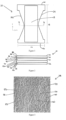
- FIG. 1 illustrates an example absorbent article 10 that may include the three dimensional film (in one or more examples.
- the absorbent article 10 may be a disposable diaper, adult incontinence implement or article, and/or the like.
- the absorbent article may generally have a width 12 and a length 14, sometimes also referred to as a lateral axis and longitudinal axis, respectively.
- the length 14 (longitudinal axis) of the article 10 may be the dimension or direction running from a front edge 20 of the article 10, through a crotch area, to a back edge 16 of the article 10.
- the width 12 (lateral axis) of the article 10 may be the dimension or direction perpendicular to the longitudinal axis and may run from, for example, a widest point of a first or left edge 22 of the article 10 to, for example, a widest point of a second or right edge 24 of the article 10.
- the longitudinal axis or length 14 of the article 10 may be designated as the "Y" direction, the lateral axis or width 12 as the "X" direction as illustrated.
- the X-direction may be generally smaller than the Y-direction, for example, particularly in the crotch area.
- the absorbent article 10 may include a fluid collection portion 18 and a backsheet 32 (e.g. as shown in FIG. 2 ).
- the fluid collection portion 18 to collect and/or absorb fluid as described herein.
- the absorbent article 10 may be constructed to have a topsheet material, a three dimensional film, an absorbent core and a backsheet, orientated in that order in a Z-direction.
- at least the topsheet, three dimensional film, and absorbent core may be part of the fluid collection portion 18.
- FIG. 2 illustrates an example of the absorbent article 10 of FIG. 1 along the line 2-2 illustrating a cross-sectional view thereof (e.g., including a cross-sectional view of the fluid collection portion 18 thereof).
- the absorbent article 10 e.g., including the fluid collection portion 18
- the absorbent article 10 may be constructed to have a topsheet 26, a three-dimensional film 28, an absorbent core 30, and/or a backsheet 32, orientated in that order in a Z-direction.
- surfaces and/or planes of the topsheet 26, three-dimensional film, the topsheet 26 (e.g., topsheet material), absorbent core 30, and/or backsheet 32 may be in contact with other respective surfaces or planes as shown.
- the topsheet 26 may have a first surface 34 and a second surface 36.
- the first surface 34 may be in contact with skin of a user of the absorbent article 10 and the second surface 36 may be in contiguous contact with a top plane 40 of the three-dimensional film 28.
- the three-dimensional film 28 may further have a bottom plane 42 that may be in continuous contact with a first surface 46 of the absorbent core 30.
- a second surface 48 of the absborbent core 30 may be in contiguous contact with a first surface 52 of the backsheet 32.
- a second surface 54 of the back sheet 32 may be the exposed portion (e.g., during use) of the article 10 and/or the outer layer thereof.
- the second surface 36 of the topsheet 26 and the first surface 52 of the backsheet 32 may encompass the three-dimensional film 28 width and length and the absorbent core 30 width and length.
- the absorbent article 10 may further be constructed to have elastic sections to assist in holding the absorbent article in against or in proximity to the body of the wearer such as elastic waistbands, elastic side panels, hook and loop type closures, elastic leg cuffs.
- the absorbent article 10 may have also leg cuffs and/or barrier cuffs.
- the absorbent article 10 may also have elastic members used as waistbands, side panels, side tabs and similar structures.
- the elastic members may be located at the front edge, back edge, right edge or left edge of the absorbent article.
- the waistbands may be located at the front edge or the back edge.
- Leg cuffs may be located at the right edge or left edge.
- examples herein may provide an absorbent article such as the article 10 comprising the three-dimensional film 28 that may provide a balance between user comforts historically provided by a nonwoven material and provides insult handling found in traditional acquisition distribution layers.
- the three-dimensional film 28 may be constructed from a single film that may be manipulated into a three-dimensional structure by a formation process, such as vacuum formation, hydroformation or a combination thereof.
- the three-dimensional film 28 may include comprises a top plane 40, a thickness 44, a bottom plane 42, a width, a length and/or a loft.
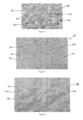
- the loft of the three-dimensional film 28 may provide an open lattice structure comprising a random series of interconnected film fibers 58 comprising a plurality of upper peaks and a plurality of lower peaks and a plurality of irregularly shaped apertures 60 (e.g., as shown in FIG. 3-6 ).
- the height (z-dimension) of the loft may be measured between the plurality of upper p eaks and plurality of lower peaks.
- the upper peaks form an upper plane (x-y plane) (e.g., the top plane 40) that tends to be parallel to a lower plane (e.g., the bottom plane 42) formed from the lower peaks.
- Located between the upper plane and lower plane may be the open lattice structure with the struts of the lattice being formed from the random series of interconnected film fibers 58. These fibers 58 are typically not bonded, but rather result from the manipulation of the single film to result in an integrally formed three-dimensional structure.
- the irregularly shaped apertures 60 of the loft may be defined by the random series of interconnected film fibers 58.
- the size of the irregularly shaped apertures 60 may be random, but may be between about 3,000 and about 1,250,000 square microns. Given the nature of irregular shapes of the apertures 60, the diameter may not a true diameter, but an effective diameter of about 60 to about 1300 microns.
- the irregularly shaped apertures 60 may include an orientation predominately orientated in the x-y plane (making them visible from the z-direction), however, the open lattice structure resembles a sponge structure where the irregularly shaped apertures 60 may be orientated at angles (none-orthogonal directions) or perpendicular to the x-y plane randomly throughout the loft of the three-dimensional film 28.
- the irregularly shaped apertures 60 may be described as having an opening closer to the upper plane 50, a sidewall, and an opening closer to the lower plane 42 as shown. In an example, as shown in FIGs. 4 and 6 , an opening closer (e.g., for one of the apertures 60) to the upper plane 40 may be smoother in appearance and an opening closer to the lower plane 42 may be irregular or ragged in appearance of the three-dimensional film 28.
- the three-dimensional film 28 may be made from thermoplastic polymeric materials conventionally used to make apertured formed films.
- the three-dimensional film 28 may comprise one or more of the following: at least one polymer selected from polyolefins (e.g., C2-C10 olefins such as polyethylene, polypropylene, and copolymers); polyesters; plastomers; polyamides (e.g., nylon); polystyrenes; polyurethanes; vinyl polymers; acrylic and/or methacrylic polymers; elastomers (e.g., styrene block copolymer elastomers); polymers from natural renewable sources; biodegradable polymers; and mixtures or blends thereof.
- polyolefins e.g., C2-C10 olefins such as polyethylene, polypropylene, and copolymers
- polyesters plastomers
- polyamides e.g., nylon
- polystyrenes polyurethan
- the thermoplastic material used to make the three dimensional film 28 may include polyethylene having a density in the range of from 0.910 g/cm 3 to 0.960 g/cm 3 , with the more preferred range being from 0.920 g/cm 3 to 0.950 g/cm 3 .
- the general melt indices range for a typical may be from about 0.10 to about 15 g/10 min., from about 1.5 to about 4.5 g/10 min., and/or the like.
- the loft of the three-dimensional film 28 may vary from about 400 microns to about 1200 microns, such as about 450 microns to about 1000 microns, such as about 500 microns to 850 microns.
- the three-dimensional film 28 may have a basis weight.
- the basis weight of the three-dimensional film 28 may be defined as the weight of the film per unit area.
- Basis weight of the film 28 may range from 20-40 gsm. Preferred ranges are from 22-32 gsm, most preferably 22-26 gsm.
- additives may be added to the thermoplastic polymeric materials of the three-dimensional film 28 and may provide certain desired characteristics, including, but not limited to, roughness, reduction of antistatic charge build-up, abrasion resistance, printability, write-ability, opacity, hydrophilicity, hydrophobicity, processability, UV stabilization, color, etc.
- Such additives are well known in the industry and include, for example, calcium carbonate (abrasion resistance), titanium dioxide (color and opacity), silicon dioxide (roughness), surfactants (hydrophilicity/ hydrophobicity), process aids/ plastomers (processability), and/or the like.
- the three-dimensional film 28 may comprise about 50-60% of high density polyethylene (density of 0.960g/cm 3 ), 20-30% of linear grade low density polyethylene (density of 0.921g/cm 3 cc), 4-5% of a white pigment concentrate of inorganic titanium dioxide, and 5-6% of a surfactant concentrate.
- Other three-dimensional films such as the three-dimensional film 28 may comprise different ratios of high density polyethylene and low density polyethylene.
- the topsheet 26 for use in the absorbent article comprises a first surface 34, a second surface 36 and thickness 38 therebetween and may be suitably compliant, soft-feeling and non-irritating to the wearer's skin.
- the topsheet 26 may be liquid permeable, permitting liquids to readily penetrate through its thickness and may be comprised of a nonwoven or a formed film.
- the topsheet 26 may be contiguous with the three-dimensional film 28 as described herein (e.g., the second top sheet surface 36 may be contiguous with the top plane 40 of the three-dimensional film) and may extend in the length and width direction beyond the three-dimensional film 28 in the absorbent article, for example, from the front edge and the back edge in the length and to the left edge and the right edge in the width.
- the topsheet 26 may include and/or be made of a nonwoven material.
- Nonwoven materials as used herein may include a manufactured web of directionally or randomly orientated fibers, excluding paper and products which are woven, knitted, tufted, stitch-bonded incorporating binding yarns or filaments, or felted by wet-milling, whether or not additionally needled.
- Nonwoven materials and processes for making them are known in the art.
- processes for making nonwoven materials may comprise laying fibers onto a forming surface, which may comprise spunlaying, meltblowing, carding, airlaying, wetlaying, coform and combinations thereof.
- the fibers may be of natural or man-made origin and may be staple fibers or continuous filaments or be formed in situ. Any other additional properties of suitable topsheet materials may be provided and/or used in examples herein.
- the absorbent core 30 may comprise a first surface 46, a second surface 48, a thickness 50 between the first and second surfaces 46,48, a width and a length.
- the absorbent core's 30 width and the length may be less than the topsheet width and length in an example. Further, the absorbent core's 30 width and length may be greather than the three-dimensional film's 28 width and length.
- the absorbent core 30 may be orientated in running the length of the absorbent article (e.g., 10) and in the crotch area of the absorbent article.
- the absorbent core 30 may absorb the insult and may retain the liquid while the absorbent article may be in use.
- the absorbent core 30 may adequately absorb an insult or multiple insults and substantially retain the insult until the absorbent article may be removed and discarded.
- the storage capacity of the absorbent core 30 and the efficiency of distribution of an insult across the absorbent core 30 may determine the amount of liquid that may be held in the absorbent article.
- the absorbent core 30 may comprise any absorbent material which may be generally compressible, conformable, non-irritating to the wearer's skin, and capable of absorbing and retaining liquids such as urine and other certain body exudates.
- the absorbent core 30 may include materials such as cellulose materials including fibers, cellular sponge or foam materials, super absorbent materials, such as superabsorbent polymers, hydrocolloidal materials, gel materials and combinations thereof, or any other known absorbent material or combinations of materials.
- an absorbent materials that may be used for the absorbent core 30 may include high absorbency gel-type materials that may be generally capable of absorbing about 10 to about 50 times their weight in fluid.
- the rate at which the core absorbs liquids may be inversely proportional to the ability of the core to hold the liquids absorbed.
- the superabsorbent materials used in cores e.g., 30
- the delay in liquid uptake results in more unabsorbed or free fluid in the article, and thus decreases the rewet performance of the article.
- the backsheet 32 may comprise a first surface 52, a second surface 54, and a thickness 56 between the first and second surfaces 52, 54. In an example, the thickness 56 may be less than 100 microns, such as less than 50 microns.
- the backsheet 32 may be contiguous with the absorbent core 30 and may extend in the length and width direction beyond the absorbent core 30 in the absorbent article, for example, from the front edge and the back edge in the length and to the left edge and the right edge in the width.
- the topsheet 26 and backsheet 32 may be continuous (e.g., with each other) at the front edge, back edge, left edge and right edge allowing for the topsheet and backsheet to be bonded together e.g., by gluing or welding by heat or ultrasonic.
- the backsheet 32 may be a thin (e.g., less than 50 microns in thickness) plastic film, for example, a polyethylene or polypropylene film, a nonwoven material coated with a liquid impervious material, a hydrophobic nonwoven material, which resists liquid penetration or a laminate comprising plastic films and nonwoven materials.
- the backsheet material may be breathable so as to allow vapor to escape from the absorbent core, while still preventing liquids from passing therethrough.
- Breathable backsheets may utilize an apertured film or a microporous breathable film, both of which are known in the art, and may also include a nonwoven fibrous web for improved aesthetics and consumer acceptance.
- breathable backsheet materials may include porous polymeric films, nonwoven laminates from spunbond and meltblown layers, laminates from porous polymeric films and nonwovens.
- Strikethrough is a measure of the time required for a given volume of surfaceapplied liquid to enter, or "strikethrough", a three-dimensional film placed above an absorbent core. In the present series of tests it is a measure of the time in seconds to completely drain 5 milliliters of simulated urine solution having a surface tension of 0.045 N/m from a one inch diameter by 1.5875 cm deep cavity having a multiplicity of holes in its lowermost surface. The cavity is integrally formed in a 10.16 cm by 10.16 cm strikethrough plate which is placed on a 10.16 cm by 10.16 cm sample of the three-dimensional film with filter paper placed underneath to control liquids.
- the wearer-contacting surface of the three-dimensional film is oriented top plane facing upwards.
- An electric timer is started by the simulated urine solution contacting a pair of spaced electrodes in the previously mentioned cavity. The timer automatically shuts off when all of the simulated urine solution has drained from the cavity and into filter paper. Times are reported in seconds. Strikethrough properties less than 1 second are targeted. This may be similar to the strikethrough test described in US 4,601,868 .
- the rewet test comprises wetting a 10.16 cm by 10.16 cm sample three-dimensional film while superposed, top plane facing up on top of filter paper with a simulated urine solution having a surface tension of approximately 0.045 N/m until the filter paper has become saturated.
- a uniform pressure loading of 3.4473 kPa is applied to the sample for a period of 3 minutes so that the fluid is uniformly distributed throughout the sample.
- the pressure is momentarily removed, a preweighed second sample of filter paper approximately 15 centimeters in diameter is inserted over the top plane of the three-dimensional film and the predetermined pressure loading is reapplied to the sample for a period of 2 minutes.
- the second filter paper is then removed and reweighed, and the amount of fluid absorbed by the second filter paper is termed the "rewet" of the sample. Results are expressed in grams of fluid absorbed by the second filter paper. As should thus be apparent, a lower "rewet" number is indicative of a dryer surface feel. Rewet grams less than 1 gram are targeted. This may be similar to the strikethrough test described in US 4,601,868 .
- Air permeability of the samples is determined by placing a one inch diameter sample of each three-dimensional film on a Frazier High Pressure Differential Air Permeability Tester, such as is available from Frazier Precision Instrument Company of Gaithersburg, Maryland. A Frazier No. 8 orifice plate was used. Results were obtained directly from a manometer and converted by means of a standardized chart to provide air flow readings in cubic feet of air per square foot of web material per minute at 76.2 cm Hg, 21.11° C., 65% Relative Humidity, the preferable conditions under which the tests are performed.
- the performance of the present three-dimensional film demonstrates an improved strikethrough performance than the US 4,601,868 fiber-like plastic web. Air permeability decreases, but the rewet performance remains about the same as the US 4,601,868 fiber-like plastic web, thus demonstrating better fluid handling properties. By comparison, the air permeability of commercially available transfer layer film AquiDry Plus TM is shown.
- a panel of 20 individuals were asked to review absorbent articles with the topsheet in an upwards orientation comprising a series of materials located between the topsheet and the absorbent core for visual softness. Each panelist was asked to rank, based upon visual inspection only, the perceived softness of the center portion of the absorbent article on a scale of 1 to 10, with 10 being the most soft and 1 being the least soft. The test was repeated with two different topsheets, one topsheet being a 17gsm spunbond nonwoven and the other topsheet being a 22gsm air through bonded nonwoven. Panelists were not allowed to touch the absorbent articles.
- the series of materials located between the topsheet included: a nonwoven material; a vacuum formed polyolefin film having an array of 11.2 micron openings in a hexagonal pattern; AQP120 - AquiDry Plus TM 120 sold by Tredegar Film Products Corporation; Radel 1 & Radel 2 which is a vacuum formed film described in US 4,601,868 and shown therein in FIGs. 6 & 7 and also shown herein in FIG. 9 of the present application; and the three-dimensional film (e.g., 28) described herein.
- Table 2 - 17 gsm spunbond nonwoven topsheet nonwoven Radel 1 Radel 2 11.2 micron opening in hexagonal pattern AQP120 three-dimensional film 7.3 5.35 5.05 5.7 6.35 6.7
- the panelist information (e.g., shown herein) demonstrates that the perceived softness of the three-dimensional film can be compared to nonwoven materials and are visually distinct from the film described in US 4,601,868 , a reference that discusses irregularly shaped openings in a formed polymeric film.
Landscapes
- Health & Medical Sciences (AREA)
- Life Sciences & Earth Sciences (AREA)
- Engineering & Computer Science (AREA)
- Biomedical Technology (AREA)
- Heart & Thoracic Surgery (AREA)
- Vascular Medicine (AREA)
- Epidemiology (AREA)
- Animal Behavior & Ethology (AREA)
- General Health & Medical Sciences (AREA)
- Public Health (AREA)
- Veterinary Medicine (AREA)
- Absorbent Articles And Supports Therefor (AREA)
- Laminated Bodies (AREA)
- Orthopedics, Nursing, And Contraception (AREA)
Description
- Examples herein relate to an absorbent article comprising a three-dimensional film for liquid distribution providing an end user experience of comfort and performance of handling insults in an absorbent article.
- A transfer layer, which is also known in the art as an acquisition distribution layer or "ADL", has been used in absorbent articles to improve comfort by reducing rewetting or evacuation of the bodily fluids contained in the absorbent core to the users' skin. A transfer layer is typically positioned between the topsheet and the absorbent core of an absorbent article. Transfer layers have been employed to promote lateral flow of fluids in a direction generally parallel to the plane of the transfer layer, thereby permitting more surface area of the absorbent core to be used to absorb the bodily fluids. These types of transfer layers may be alternatives to nonwoven materials to provide improved protection against rewetting (evacuation of insults from the core of the absorbent article back through the topsheet) and to improve distribution of insults to the absorbent core. However, some users perceive, for example, actually or visually that the transfer layers may result in increased stiffness or discomfort to the user and therefore prefer seeing a nonwoven material in combination with the topsheet of the absorbent article. As such, a resilient plastic web exhibiting a fiber-like appearance may be provided in current examples. Unfortunately, users tend to find the fibers in such current plastic webs to be too defined and perceive the resilient plastic web to be more rigid than desired, and, thus, do not provide a balance in user perceived comfort and performance in handling insults in an absorbent article.
- Patent publication
US 2009/299316 A1 describes a three-dimensional film for use as a transfer layer in an absorbent article that has a continuous surface and a discontinuous surface disposed generally parallel to and spaced from the continuous surface. Both the continuous surface and the discontinuous surface have large scale apertures defined by sidewalls originating on the surface and extending outwardly therefrom and sized to permit acquisition of fluids by gravity. Optionally each surface also includes small scale apertures sized to acquire fluids by capillary action. - An absorbent article in accordance with the invention is defined in claim 1. Embodiments may comprise additional features some of which are defined in the dependent claims.
- A more detailed understanding of the embodiments disclosed herein may be had from the following description, given by way of example in conjunction with the accompanying drawings.
-
FIG. 1 depicts a top plane view of an example absorbent article. -
FIG. 2 depicts a cross-sectional exploded magnified view along 2-2 of the example absorbent article ofFIG. 1 . -
FIG. 3 depicts a top plane view of an example three-dimensional film. -
FIG. 4 depicts a perspective magnified top plane view of the example three-dimensional film. -
FIG. 5 depicts a bottom plane view of the example three-dimensional film. -
FIG. 6 depicts a perspective magnified bottom plane view of the example three-dimensional film. -
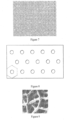
FIG. 7 depicts a view of an example comparative material. -
FIG. 8 depicts a view of another example comparative material. -
FIG. 9 depicts another view of the example comparative material ofFIG. 6 . -
FIG. 10 depicts another view of the example comparative material ofFIG. 7 . - A detailed description of illustrative embodiments will now be described with reference to the various Figures. Although this description provides a detailed example of possible implementations, it should be noted that the details are intended to be exemplary and in no way limit the scope of the application.
- Examples herein provide a three-dimensional film that may be used as a transfer layer in an absorbent article. The example three-dimensional film may provide a hybrid approach in providing user comfort and performance in handling insults in an absorbent article. The hybrid approach may include a loft structure. The loft structure may be an open lattice structure formed from a single film. In an example, irregular shaped apertures may be present within the loft of the three-dimensional film structure, for example, rather than being present in upper and lower planes of the film.
- According to one or more examples, placement of irregularly shaped apertures within the loft of the three-dimensional film may provide for a more nonwoven like structure from a single film structure compared to the current films where apertures originate and terminate in the upper and lower planes of the resilient plastic web.
- An absorbent article as described herein may include wearable devices that may absorb and/ or hold liquid, and more specifically in examples, may include devices that may be placed against or in proximity to the body of the wearer to absorb and hold various exudates discharged from the body like urine, feces, menstrual fluid, and/or the like. According to an example, the absorbent article may be a disposable absorbent article. A disposable absorbent article includes an absorbent article that may not be intended to be laundered or otherwise restored or reused after use.
-
FIG. 1 illustrates an example absorbent article 10 that may include the three dimensional film (in one or more examples. As shown inFIG. 1 , the absorbent article 10 may be a disposable diaper, adult incontinence implement or article, and/or the like. The absorbent article may generally have a width 12 and alength 14, sometimes also referred to as a lateral axis and longitudinal axis, respectively. The length 14 (longitudinal axis) of the article 10 may be the dimension or direction running from a front edge 20 of the article 10, through a crotch area, to a back edge 16 of the article 10. The width 12 (lateral axis) of the article 10 may be the dimension or direction perpendicular to the longitudinal axis and may run from, for example, a widest point of a first or left edge 22 of the article 10 to, for example, a widest point of a second or right edge 24 of the article 10. Herein, the longitudinal axis orlength 14 of the article 10 may be designated as the "Y" direction, the lateral axis or width 12 as the "X" direction as illustrated. In absorbent articles that are worn between the legs such as the article 10, the X-direction may be generally smaller than the Y-direction, for example, particularly in the crotch area. - The absorbent article 10, in an example, may include a fluid collection portion 18 and a backsheet 32 (e.g. as shown in
FIG. 2 ). The fluid collection portion 18 to collect and/or absorb fluid as described herein. For example, the absorbent article 10 may be constructed to have a topsheet material, a three dimensional film, an absorbent core and a backsheet, orientated in that order in a Z-direction. In an example, at least the topsheet, three dimensional film, and absorbent core may be part of the fluid collection portion 18. -
FIG. 2 illustrates an example of the absorbent article 10 ofFIG. 1 along the line 2-2 illustrating a cross-sectional view thereof (e.g., including a cross-sectional view of the fluid collection portion 18 thereof). As shown and described herein, the absorbent article 10 (e.g., including the fluid collection portion 18) may be constructed to have a topsheet 26, a three-dimensional film 28, an absorbent core 30, and/or a backsheet 32, orientated in that order in a Z-direction. In examples, surfaces and/or planes of the topsheet 26, three-dimensional film, the topsheet 26 (e.g., topsheet material), absorbent core 30, and/or backsheet 32 may be in contact with other respective surfaces or planes as shown. For example, the topsheet 26 may have a first surface 34 and a second surface 36. The first surface 34 may be in contact with skin of a user of the absorbent article 10 and the second surface 36 may be in contiguous contact with atop plane 40 of the three-dimensional film 28. The three-dimensional film 28 may further have abottom plane 42 that may be in continuous contact with a first surface 46 of the absorbent core 30. As shown, a second surface 48 of the absborbent core 30 may be in contiguous contact with a first surface 52 of the backsheet 32. In an example, a second surface 54 of the back sheet 32 may be the exposed portion (e.g., during use) of the article 10 and/or the outer layer thereof. Further, in an example, the second surface 36 of the topsheet 26 and the first surface 52 of the backsheet 32 may encompass the three-dimensional film 28 width and length and the absorbent core 30 width and length. - The absorbent article 10 may further be constructed to have elastic sections to assist in holding the absorbent article in against or in proximity to the body of the wearer such as elastic waistbands, elastic side panels, hook and loop type closures, elastic leg cuffs. For example, the absorbent article 10 may have also leg cuffs and/or barrier cuffs. The absorbent article 10 may also have elastic members used as waistbands, side panels, side tabs and similar structures. The elastic members may be located at the front edge, back edge, right edge or left edge of the absorbent article. For example, the waistbands may be located at the front edge or the back edge. Leg cuffs may be located at the right edge or left edge.
- As described, examples herein may provide an absorbent article such as the article 10 comprising the three-
dimensional film 28 that may provide a balance between user comforts historically provided by a nonwoven material and provides insult handling found in traditional acquisition distribution layers. The three-dimensional film 28 may be constructed from a single film that may be manipulated into a three-dimensional structure by a formation process, such as vacuum formation, hydroformation or a combination thereof. As shown inFIGs. 2-6 , the three-dimensional film 28 may include comprises atop plane 40, a thickness 44, abottom plane 42, a width, a length and/or a loft. The loft of the three-dimensional film 28 may provide an open lattice structure comprising a random series ofinterconnected film fibers 58 comprising a plurality of upper peaks and a plurality of lower peaks and a plurality of irregularly shaped apertures 60 (e.g., as shown inFIG. 3-6 ). The height (z-dimension) of the loft may be measured between the plurality of upper p eaks and plurality of lower peaks. The upper peaks form an upper plane (x-y plane) (e.g., the top plane 40) that tends to be parallel to a lower plane (e.g., the bottom plane 42) formed from the lower peaks. Located between the upper plane and lower plane may be the open lattice structure with the struts of the lattice being formed from the random series ofinterconnected film fibers 58. Thesefibers 58 are typically not bonded, but rather result from the manipulation of the single film to result in an integrally formed three-dimensional structure. - In examples, the irregularly shaped
apertures 60 of the loft may be defined by the random series ofinterconnected film fibers 58. The size of the irregularly shapedapertures 60 may be random, but may be between about 3,000 and about 1,250,000 square microns. Given the nature of irregular shapes of theapertures 60, the diameter may not a true diameter, but an effective diameter of about 60 to about 1300 microns. The irregularly shapedapertures 60 may include an orientation predominately orientated in the x-y plane (making them visible from the z-direction), however, the open lattice structure resembles a sponge structure where the irregularly shapedapertures 60 may be orientated at angles (none-orthogonal directions) or perpendicular to the x-y plane randomly throughout the loft of the three-dimensional film 28. The irregularly shapedapertures 60 may be described as having an opening closer to the upper plane 50, a sidewall, and an opening closer to thelower plane 42 as shown. In an example, as shown inFIGs. 4 and 6 , an opening closer (e.g., for one of the apertures 60) to theupper plane 40 may be smoother in appearance and an opening closer to thelower plane 42 may be irregular or ragged in appearance of the three-dimensional film 28. - The three-
dimensional film 28 may be made from thermoplastic polymeric materials conventionally used to make apertured formed films. For example, the three-dimensional film 28 may comprise one or more of the following: at least one polymer selected from polyolefins (e.g., C2-C10 olefins such as polyethylene, polypropylene, and copolymers); polyesters; plastomers; polyamides (e.g., nylon); polystyrenes; polyurethanes; vinyl polymers; acrylic and/or methacrylic polymers; elastomers (e.g., styrene block copolymer elastomers); polymers from natural renewable sources; biodegradable polymers; and mixtures or blends thereof. According to an example, the thermoplastic material used to make the threedimensional film 28 may include polyethylene having a density in the range of from 0.910 g/cm3 to 0.960 g/cm3, with the more preferred range being from 0.920 g/cm3 to 0.950 g/cm3 . The general melt indices range for a typical may be from about 0.10 to about 15 g/10 min., from about 1.5 to about 4.5 g/10 min., and/or the like. The loft of the three-dimensional film 28 may vary from about 400 microns to about 1200 microns, such as about 450 microns to about 1000 microns, such as about 500 microns to 850 microns. Further, in an example, the three-dimensional film 28 may have a basis weight. The basis weight of the three-dimensional film 28 may be defined as the weight of the film per unit area. Basis weight of thefilm 28 may range from 20-40 gsm. Preferred ranges are from 22-32 gsm, most preferably 22-26 gsm. - Any of a variety of additives may be added to the thermoplastic polymeric materials of the three-
dimensional film 28 and may provide certain desired characteristics, including, but not limited to, roughness, reduction of antistatic charge build-up, abrasion resistance, printability, write-ability, opacity, hydrophilicity, hydrophobicity, processability, UV stabilization, color, etc. Such additives are well known in the industry and include, for example, calcium carbonate (abrasion resistance), titanium dioxide (color and opacity), silicon dioxide (roughness), surfactants (hydrophilicity/ hydrophobicity), process aids/ plastomers (processability), and/or the like. In an example, the three-dimensional film 28 may comprise about 50-60% of high density polyethylene (density of 0.960g/cm3 ), 20-30% of linear grade low density polyethylene (density of 0.921g/cm3 cc), 4-5% of a white pigment concentrate of inorganic titanium dioxide, and 5-6% of a surfactant concentrate. Other three-dimensional films such as the three-dimensional film 28 may comprise different ratios of high density polyethylene and low density polyethylene. - The topsheet 26 for use in the absorbent article comprises a first surface 34, a second surface 36 and
thickness 38 therebetween and may be suitably compliant, soft-feeling and non-irritating to the wearer's skin. The topsheet 26 may be liquid permeable, permitting liquids to readily penetrate through its thickness and may be comprised of a nonwoven or a formed film. The topsheet 26 may be contiguous with the three-dimensional film 28 as described herein (e.g., the second top sheet surface 36 may be contiguous with thetop plane 40 of the three-dimensional film) and may extend in the length and width direction beyond the three-dimensional film 28 in the absorbent article, for example, from the front edge and the back edge in the length and to the left edge and the right edge in the width. - In examples herein, the topsheet 26 may include and/or be made of a nonwoven material. Nonwoven materials as used herein may include a manufactured web of directionally or randomly orientated fibers, excluding paper and products which are woven, knitted, tufted, stitch-bonded incorporating binding yarns or filaments, or felted by wet-milling, whether or not additionally needled. Nonwoven materials and processes for making them are known in the art. Generally, processes for making nonwoven materials may comprise laying fibers onto a forming surface, which may comprise spunlaying, meltblowing, carding, airlaying, wetlaying, coform and combinations thereof. The fibers may be of natural or man-made origin and may be staple fibers or continuous filaments or be formed in situ. Any other additional properties of suitable topsheet materials may be provided and/or used in examples herein.
- The absorbent core 30 may comprise a first surface 46, a second surface 48, a thickness 50 between the first and second surfaces 46,48, a width and a length. The absorbent core's 30 width and the length may be less than the topsheet width and length in an example. Further, the absorbent core's 30 width and length may be greather than the three-dimensional film's 28 width and length. The absorbent core 30 may be orientated in running the length of the absorbent article (e.g., 10) and in the crotch area of the absorbent article. The absorbent core 30 may absorb the insult and may retain the liquid while the absorbent article may be in use. The absorbent core 30 may adequately absorb an insult or multiple insults and substantially retain the insult until the absorbent article may be removed and discarded. The storage capacity of the absorbent core 30 and the efficiency of distribution of an insult across the absorbent core 30 may determine the amount of liquid that may be held in the absorbent article.
- The absorbent core 30 that may be used in examples herein may comprise any absorbent material which may be generally compressible, conformable, non-irritating to the wearer's skin, and capable of absorbing and retaining liquids such as urine and other certain body exudates. For example, the absorbent core 30 may include materials such as cellulose materials including fibers, cellular sponge or foam materials, super absorbent materials, such as superabsorbent polymers, hydrocolloidal materials, gel materials and combinations thereof, or any other known absorbent material or combinations of materials. In an example, an absorbent materials that may be used for the absorbent core 30 may include high absorbency gel-type materials that may be generally capable of absorbing about 10 to about 50 times their weight in fluid. As generally described, the rate at which the core absorbs liquids may be inversely proportional to the ability of the core to hold the liquids absorbed. Thus, the superabsorbent materials used in cores (e.g., 30) may be good at holding liquids, but may be relatively slow at liquid uptake. In examples, the delay in liquid uptake results in more unabsorbed or free fluid in the article, and thus decreases the rewet performance of the article.
- The backsheet 32 may comprise a first surface 52, a second surface 54, and a thickness 56 between the first and second surfaces 52, 54. In an example, the thickness 56 may be less than 100 microns, such as less than 50 microns. The backsheet 32 may be contiguous with the absorbent core 30 and may extend in the length and width direction beyond the absorbent core 30 in the absorbent article, for example, from the front edge and the back edge in the length and to the left edge and the right edge in the width. The topsheet 26 and backsheet 32 may be continuous (e.g., with each other) at the front edge, back edge, left edge and right edge allowing for the topsheet and backsheet to be bonded together e.g., by gluing or welding by heat or ultrasonic. The backsheet 32 may be a thin (e.g., less than 50 microns in thickness) plastic film, for example, a polyethylene or polypropylene film, a nonwoven material coated with a liquid impervious material, a hydrophobic nonwoven material, which resists liquid penetration or a laminate comprising plastic films and nonwoven materials. The backsheet material may be breathable so as to allow vapor to escape from the absorbent core, while still preventing liquids from passing therethrough.
- Breathable backsheets (e.g., that may be used for backsheet 32) may utilize an apertured film or a microporous breathable film, both of which are known in the art, and may also include a nonwoven fibrous web for improved aesthetics and consumer acceptance. Examples of breathable backsheet materials may include porous polymeric films, nonwoven laminates from spunbond and meltblown layers, laminates from porous polymeric films and nonwovens.
- Strikethrough, as utilized herein, is a measure of the time required for a given volume of surfaceapplied liquid to enter, or "strikethrough", a three-dimensional film placed above an absorbent core. In the present series of tests it is a measure of the time in seconds to completely drain 5 milliliters of simulated urine solution having a surface tension of 0.045 N/m from a one inch diameter by 1.5875 cm deep cavity having a multiplicity of holes in its lowermost surface. The cavity is integrally formed in a 10.16 cm by 10.16 cm strikethrough plate which is placed on a 10.16 cm by 10.16 cm sample of the three-dimensional film with filter paper placed underneath to control liquids.
- The wearer-contacting surface of the three-dimensional film is oriented top plane facing upwards. An electric timer is started by the simulated urine solution contacting a pair of spaced electrodes in the previously mentioned cavity. The timer automatically shuts off when all of the simulated urine solution has drained from the cavity and into filter paper. Times are reported in seconds. Strikethrough properties less than 1 second are targeted. This may be similar to the strikethrough test described in
US 4,601,868 . - The rewet test comprises wetting a 10.16 cm by 10.16 cm sample three-dimensional film while superposed, top plane facing up on top of filter paper with a simulated urine solution having a surface tension of approximately 0.045 N/m until the filter paper has become saturated. A uniform pressure loading of 3.4473 kPa is applied to the sample for a period of 3 minutes so that the fluid is uniformly distributed throughout the sample. The pressure is momentarily removed, a preweighed second sample of filter paper approximately 15 centimeters in diameter is inserted over the top plane of the three-dimensional film and the predetermined pressure loading is reapplied to the sample for a period of 2 minutes. The second filter paper is then removed and reweighed, and the amount of fluid absorbed by the second filter paper is termed the "rewet" of the sample. Results are expressed in grams of fluid absorbed by the second filter paper. As should thus be apparent, a lower "rewet" number is indicative of a dryer surface feel. Rewet grams less than 1 gram are targeted. This may be similar to the strikethrough test described in
US 4,601,868 . - Air permeability of the samples is determined by placing a one inch diameter sample of each three-dimensional film on a Frazier High Pressure Differential Air Permeability Tester, such as is available from Frazier Precision Instrument Company of Gaithersburg, Maryland. A Frazier No. 8 orifice plate was used. Results were obtained directly from a manometer and converted by means of a standardized chart to provide air flow readings in cubic feet of air per square foot of web material per minute at 76.2 cm Hg, 21.11° C., 65% Relative Humidity, the preferable conditions under which the tests are performed.
Table 1 - Comparison Of Three-Dimensional Film To US 4,601,868 Test Nonwoven* US4601868 fiber-like plastic web**Three-dimensional film AQP120*** Strikethrough (sec) 1.57 3.45 0.71 Rewet (grams) 1.66 0.03 0.046 Air Permeability Frazier (m3/m2/hr) 15381.89 12382.33 4353.02 10791.1 ∗Nonwoven reported in US 4601868 in Table 1 (Example 1)
∗∗Reported inUS 4601868 in Table 1 (Example 3)
* * *AquiDry Plus™ 120 ex Tredegar Film Products Corporation - As shown by Table 1, the performance of the present three-dimensional film demonstrates an improved strikethrough performance than the
US 4,601,868 fiber-like plastic web. Air permeability decreases, but the rewet performance remains about the same as theUS 4,601,868 fiber-like plastic web, thus demonstrating better fluid handling properties. By comparison, the air permeability of commercially available transfer layer film AquiDry Plus™ is shown. - A panel of 20 individuals were asked to review absorbent articles with the topsheet in an upwards orientation comprising a series of materials located between the topsheet and the absorbent core for visual softness. Each panelist was asked to rank, based upon visual inspection only, the perceived softness of the center portion of the absorbent article on a scale of 1 to 10, with 10 being the most soft and 1 being the least soft. The test was repeated with two different topsheets, one topsheet being a 17gsm spunbond nonwoven and the other topsheet being a 22gsm air through bonded nonwoven. Panelists were not allowed to touch the absorbent articles.
- The series of materials located between the topsheet included: a nonwoven material; a vacuum formed polyolefin film having an array of 11.2 micron openings in a hexagonal pattern; AQP120 - AquiDry Plus™ 120 sold by Tredegar Film Products Corporation; Radel 1 &
Radel 2 which is a vacuum formed film described inUS 4,601,868 and shown therein inFIGs. 6 &7 and also shown herein inFIG. 9 of the present application; and the three-dimensional film (e.g., 28) described herein.Table 2 - 17 gsm spunbond nonwoven topsheet nonwoven Radel 1 Radel 211.2 micron opening in hexagonal pattern AQP120 three-dimensional film 7.3 5.35 5.05 5.7 6.35 6.7 - As shown in Table 2, panelist on average rated the three-dimensional film closer in visual softness to a nonwoven than the comparative examples while combined with a 17 gsm spunbond nonwoven topsheet.
Table 3 - 22 gsm air through bonded nonwoven topsheet nonwoven Radel 1 Radel 211.2 micron opening in hexagonal AQP120 Present three-dimensional 7.2 5.4 5.7 5.55 6.95 6.6 - As shown in Table 3, panelist on average rated the three-dimensional film closer in visual softness to a nonwoven than the comparative examples, except for AQP120, while combined with a 22 gsm air through bonded nonwoven topsheet.
- The panelist information (e.g., shown herein) demonstrates that the perceived softness of the three-dimensional film can be compared to nonwoven materials and are visually distinct from the film described in
US 4,601,868 , a reference that discusses irregularly shaped openings in a formed polymeric film. - Although systems, methods, processes, and/or embodiments may be described herein with respect to various materials, techniques, equipment, such systems, methods, processes, and/or embodiments may be applicable to other applications and environments and may include additional materials, equipment and manufacturing techniques, methods, and/or processes in different orders than those disclosed herein.
- The dimensions and values disclosed herein are not to be understood as being strictly limited to the exact numerical values recited. Unless otherwise specified, each such dimension is intended to mean both the recited value and a functionally equivalent range surrounding that value. For example, a dimension disclosed as "100 microns" is intended to mean "about 100 microns."
- While particular embodiments of the present invention have been illustrated and described, it would be obvious to those skilled in the art that various other changes and modifications can be made without departing from the scope of the invention as defined in the appended claims. It is therefore intended to cover in the appended claims all such changes and modifications that are within their scope.
Claims (6)
- An absorbent article comprising:a topsheet material having a first surface, a second surface and thickness there between;a three dimensional film having a top plane, a thickness, a bottom plane, a width, a length and a loft, the three-dimensional film being constructed from a single film that has been manipulated by a formation process so that the loft provides an open lattice structure comprising a random series of interconnected fibers resulting from the manipulation of the single film, whereby the random series of interconnected film fibers comprise a plurality of upper peaks and a plurality of lower peaks and define a plurality of irregularly shaped apertures in the loft;an absorbent core comprising a first surface, a second surface, a thickness between the first and second surfaces, a width and a length; and a backsheet comprising a first surface, a second surface, a thickness between the first and second surfaces,wherein the topsheet material second surface and the three-dimensional film top plane are in contiguous contact, the three-dimensional film bottom plane and the absorbent core first surface are in contiguous contact, the absorbent core second surface and the backsheet first surface are in contiguous contact, the topsheet material second surface and the backsheet first surface encompass the three-dimensional film width and length and the absorbent core width and length, andwherein the top plane is formed from upper peaks of the random series of interconnected fibers and the bottom plane is formed from the lower peaks of the random series of interconnected fibers and the three-dimensional film loft and the lower peaks of the random series of interconnected fibers comprise the irregularly shaped apertures.
- The absorbent article of claim 1, wherein the irregularly shaped apertures have a size comprised between 3,000 and 1,250,000 square microns.
- The absorbent article of claim 1, wherein the irregularly shaped apertures are predominately orientated in an x-y plane, which makes these visible from a z-direction, the x-y plane corresponding with the top plane of the three dimensional film, whereby the open lattice structure resembles a sponge structure where the irregularly shaped apertures are orientated at angles or perpendicular to the x-y plane randomly throughout the loft of the three-dimensional film.
- The absorbent article of claim 1, wherein the three-dimensional film comprises a polyolefin, preferably a polyethylene, a polypropylene and mixtures thereof.
- The absorbent article of claim 1, wherein topsheet comprising a nonwoven with a basis weight of 15 - 25 gsm.
- The absorbent article of claim 1, wherein topsheet is selected from a nonwoven spunbond, an air through bonded nonwoven and a spun lace.
Applications Claiming Priority (2)
| Application Number | Priority Date | Filing Date | Title |
|---|---|---|---|
| US201462066210P | 2014-10-20 | 2014-10-20 | |
| PCT/US2015/056440 WO2016064861A1 (en) | 2014-10-20 | 2015-10-20 | Absorbent article with three-dimensional film for liquid distribution |
Publications (2)
| Publication Number | Publication Date |
|---|---|
| EP3209259A1 EP3209259A1 (en) | 2017-08-30 |
| EP3209259B1 true EP3209259B1 (en) | 2023-03-22 |
Family
ID=54365432
Family Applications (1)
| Application Number | Title | Priority Date | Filing Date |
|---|---|---|---|
| EP15787831.5A Active EP3209259B1 (en) | 2014-10-20 | 2015-10-20 | Absorbent article with three-dimensional film for liquid distribution |
Country Status (8)
| Country | Link |
|---|---|
| US (1) | US10195093B2 (en) |
| EP (1) | EP3209259B1 (en) |
| JP (1) | JP6756707B2 (en) |
| KR (1) | KR20170071562A (en) |
| CN (1) | CN107072852B (en) |
| BR (1) | BR112017008294B8 (en) |
| TW (1) | TWI715540B (en) |
| WO (1) | WO2016064861A1 (en) |
Families Citing this family (4)
| Publication number | Priority date | Publication date | Assignee | Title |
|---|---|---|---|---|
| KR20180069816A (en) | 2015-10-20 | 2018-06-25 | 트레데가르 필름 프로덕츠 코포레이션 | Shaped film acquisition and distribution layer and absorbing device having same |
| US10258517B1 (en) | 2018-05-25 | 2019-04-16 | Tredegar Film Products Corporation | Fluid distribution material for absorbent articles |
| DK4057963T3 (en) * | 2019-11-14 | 2025-11-03 | Fitesa Film Products Llc | Films and laminates for absorbent articles |
| US12569372B2 (en) * | 2023-11-10 | 2026-03-10 | Kimberly-Clark Worldwide, Inc. | Absorbent article with fluid control features |
Family Cites Families (26)
| Publication number | Priority date | Publication date | Assignee | Title |
|---|---|---|---|---|
| EP0018020B1 (en) * | 1979-03-05 | 1984-03-14 | THE PROCTER & GAMBLE COMPANY | Resilient plastic web exhibiting fiber-like properties and method for its manufacture |
| US4342314A (en) | 1979-03-05 | 1982-08-03 | The Procter & Gamble Company | Resilient plastic web exhibiting fiber-like properties |
| US4395215A (en) | 1981-02-02 | 1983-07-26 | The Procter & Gamble Company | Film forming structure for uniformly debossing and selectively aperturing a resilient plastic web and method for its construction |
| US4601868A (en) | 1982-04-21 | 1986-07-22 | The Procter & Gamble Company | Method of imparting a three-dimensional fiber-like appearance and tactile impression to a running ribbon of thermoplastic film |
| ES2141107T3 (en) * | 1992-02-18 | 2000-03-16 | Mcneil Ppc Inc | POROUS PLASTIC FILMS THAT LOOK LIKE TISSUE. |
| USH1377H (en) * | 1993-02-25 | 1994-11-01 | Perry; Bruce F. | Absorbent article with multi-functional topsheet |
| US5704101A (en) | 1995-06-05 | 1998-01-06 | Kimberly-Clark Worldwide, Inc. | Creped and/or apertured webs and process for producing the same |
| US5603707A (en) * | 1995-11-28 | 1997-02-18 | The Procter & Gamble Company | Absorbent article having a rewet barrier |
| DE60110290T2 (en) * | 2000-02-28 | 2005-10-06 | Kao Corp. | Sheet for an absorbent article and absorbent article with such a sheet |
| US6610904B1 (en) * | 2000-09-22 | 2003-08-26 | Tredegar Film Products Corporation | Acquisition distribution layer having void volumes for an absorbent article |
| US6610391B2 (en) * | 2001-05-15 | 2003-08-26 | Paragon Trade Brands, Inc. | Absorbent product with reduced rewet properties |
| US6603052B2 (en) * | 2001-05-25 | 2003-08-05 | John E. Davis | Fluid absorbent article for surgical use |
| US20030171730A1 (en) * | 2002-02-14 | 2003-09-11 | Kelly William G. F. | Three-dimensional apertured film |
| US20050202208A1 (en) * | 2004-03-12 | 2005-09-15 | Kelly William G. | Three dimensional apertured film |
| US20050261649A1 (en) * | 2004-05-19 | 2005-11-24 | Cohen Richmond R | Absorbent article with layered acquisition/distribution system |
| US20050267429A1 (en) * | 2004-05-25 | 2005-12-01 | Cohen Richmond R | Acquisition/distribution layer |
| CN101257871A (en) * | 2005-07-19 | 2008-09-03 | 麦克内尔-Ppc股份有限公司 | 3D porous membrane |
| US7518032B2 (en) * | 2006-11-14 | 2009-04-14 | Tredegar Film Products Corporation | Three-dimensional apertured film for transmitting dynamically-deposited and statically-retained fluids |
| US20100121298A1 (en) * | 2008-11-10 | 2010-05-13 | Tredegar Film Products Corporation | Transfer layer for absorbent article |
| KR20110133548A (en) * | 2009-02-20 | 2011-12-13 | 트레데가르 필름 프로덕츠 코포레이션 | Perforated Hydrophilic Molding Film |
| JP5723548B2 (en) * | 2009-08-04 | 2015-05-27 | トレデガー フィルム プロダクツ コーポレイション | Three-dimensional perforated film delivering dynamically deposited and statically held fluids |
| US8383227B2 (en) * | 2010-01-28 | 2013-02-26 | Tredegar Film Products Corporation | Transfer layer for absorbent article |
| RU2555770C2 (en) * | 2010-02-11 | 2015-07-10 | Дзе Проктер Энд Гэмбл Компани | Absorbing product, containing zones of interaction with liquid |
| WO2012167210A1 (en) * | 2011-06-03 | 2012-12-06 | Tredegar Film Products Corporation | Absorbent article having a troughed film as a transfer layer providing a cool fluid dynamic |
| KR20180069816A (en) * | 2015-10-20 | 2018-06-25 | 트레데가르 필름 프로덕츠 코포레이션 | Shaped film acquisition and distribution layer and absorbing device having same |
| WO2017100647A1 (en) * | 2015-12-11 | 2017-06-15 | Tredegar Film Products Corporation | Hydro-formed film with three-dimensional micro-apertures |
-
2015
- 2015-10-20 JP JP2017522205A patent/JP6756707B2/en not_active Expired - Fee Related
- 2015-10-20 US US14/918,085 patent/US10195093B2/en active Active
- 2015-10-20 EP EP15787831.5A patent/EP3209259B1/en active Active
- 2015-10-20 KR KR1020177013356A patent/KR20170071562A/en not_active Abandoned
- 2015-10-20 BR BR112017008294A patent/BR112017008294B8/en not_active IP Right Cessation
- 2015-10-20 WO PCT/US2015/056440 patent/WO2016064861A1/en not_active Ceased
- 2015-10-20 TW TW104134383A patent/TWI715540B/en not_active IP Right Cessation
- 2015-10-20 CN CN201580056990.3A patent/CN107072852B/en not_active Expired - Fee Related
Also Published As
| Publication number | Publication date |
|---|---|
| BR112017008294B1 (en) | 2022-05-24 |
| BR112017008294A2 (en) | 2017-12-19 |
| JP2017538461A (en) | 2017-12-28 |
| WO2016064861A1 (en) | 2016-04-28 |
| KR20170071562A (en) | 2017-06-23 |
| TW201622675A (en) | 2016-07-01 |
| JP6756707B2 (en) | 2020-09-16 |
| US10195093B2 (en) | 2019-02-05 |
| CN107072852B (en) | 2020-12-22 |
| US20160106602A1 (en) | 2016-04-21 |
| TWI715540B (en) | 2021-01-11 |
| EP3209259A1 (en) | 2017-08-30 |
| BR112017008294B8 (en) | 2023-02-14 |
| CN107072852A (en) | 2017-08-18 |
Similar Documents
| Publication | Publication Date | Title |
|---|---|---|
| JP7623833B2 (en) | 3D Substrate | |
| US8765250B2 (en) | Transfer layer for absorbent article | |
| EP3801423B1 (en) | Fluid distribution material for absorbent articles | |
| EP2356961B1 (en) | Transfer layer for absorbent article | |
| US8344203B2 (en) | Transfer layer for absorbent article | |
| CN1201711C (en) | Acquisition-distribution layer with voids for absorbent articles | |
| US20040019340A1 (en) | Absorbent article having a surface energy gradient between the topsheet and the acquisition distribution layer | |
| MX2013002740A (en) | Liquid management layer for personal care absorbent articles. | |
| WO2012167210A1 (en) | Absorbent article having a troughed film as a transfer layer providing a cool fluid dynamic | |
| US10195093B2 (en) | Absorbent article with three-dimensional film for liquid distribution |
Legal Events
| Date | Code | Title | Description |
|---|---|---|---|
| STAA | Information on the status of an ep patent application or granted ep patent |
Free format text: STATUS: THE INTERNATIONAL PUBLICATION HAS BEEN MADE |
|
| PUAI | Public reference made under article 153(3) epc to a published international application that has entered the european phase |
Free format text: ORIGINAL CODE: 0009012 |
|
| STAA | Information on the status of an ep patent application or granted ep patent |
Free format text: STATUS: REQUEST FOR EXAMINATION WAS MADE |
|
| 17P | Request for examination filed |
Effective date: 20170515 |
|
| AK | Designated contracting states |
Kind code of ref document: A1 Designated state(s): AL AT BE BG CH CY CZ DE DK EE ES FI FR GB GR HR HU IE IS IT LI LT LU LV MC MK MT NL NO PL PT RO RS SE SI SK SM TR |
|
| AX | Request for extension of the european patent |
Extension state: BA ME |
|
| DAV | Request for validation of the european patent (deleted) | ||
| DAX | Request for extension of the european patent (deleted) | ||
| STAA | Information on the status of an ep patent application or granted ep patent |
Free format text: STATUS: EXAMINATION IS IN PROGRESS |
|
| 17Q | First examination report despatched |
Effective date: 20200331 |
|
| RAP1 | Party data changed (applicant data changed or rights of an application transferred) |
Owner name: TREDEGAR FILM PRODUCTS LLC |
|
| RAP3 | Party data changed (applicant data changed or rights of an application transferred) |
Owner name: FITESA FILM PRODUCTS LLC |
|
| GRAP | Despatch of communication of intention to grant a patent |
Free format text: ORIGINAL CODE: EPIDOSNIGR1 |
|
| STAA | Information on the status of an ep patent application or granted ep patent |
Free format text: STATUS: GRANT OF PATENT IS INTENDED |
|
| INTG | Intention to grant announced |
Effective date: 20221024 |
|
| GRAS | Grant fee paid |
Free format text: ORIGINAL CODE: EPIDOSNIGR3 |
|
| GRAA | (expected) grant |
Free format text: ORIGINAL CODE: 0009210 |
|
| STAA | Information on the status of an ep patent application or granted ep patent |
Free format text: STATUS: THE PATENT HAS BEEN GRANTED |
|
| AK | Designated contracting states |
Kind code of ref document: B1 Designated state(s): AL AT BE BG CH CY CZ DE DK EE ES FI FR GB GR HR HU IE IS IT LI LT LU LV MC MK MT NL NO PL PT RO RS SE SI SK SM TR |
|
| REG | Reference to a national code |
Ref country code: GB Ref legal event code: FG4D |
|
| REG | Reference to a national code |
Ref country code: CH Ref legal event code: EP |
|
| REG | Reference to a national code |
Ref country code: IE Ref legal event code: FG4D |
|
| REG | Reference to a national code |
Ref country code: DE Ref legal event code: R096 Ref document number: 602015082888 Country of ref document: DE |
|
| REG | Reference to a national code |
Ref country code: AT Ref legal event code: REF Ref document number: 1554861 Country of ref document: AT Kind code of ref document: T Effective date: 20230415 |
|
| P01 | Opt-out of the competence of the unified patent court (upc) registered |
Effective date: 20230306 |
|
| P02 | Opt-out of the competence of the unified patent court (upc) changed |
Effective date: 20230329 |
|
| REG | Reference to a national code |
Ref country code: LT Ref legal event code: MG9D |
|
| REG | Reference to a national code |
Ref country code: NL Ref legal event code: MP Effective date: 20230322 |
|
| PG25 | Lapsed in a contracting state [announced via postgrant information from national office to epo] |
Ref country code: RS Free format text: LAPSE BECAUSE OF FAILURE TO SUBMIT A TRANSLATION OF THE DESCRIPTION OR TO PAY THE FEE WITHIN THE PRESCRIBED TIME-LIMIT Effective date: 20230322 Ref country code: NO Free format text: LAPSE BECAUSE OF FAILURE TO SUBMIT A TRANSLATION OF THE DESCRIPTION OR TO PAY THE FEE WITHIN THE PRESCRIBED TIME-LIMIT Effective date: 20230622 Ref country code: LV Free format text: LAPSE BECAUSE OF FAILURE TO SUBMIT A TRANSLATION OF THE DESCRIPTION OR TO PAY THE FEE WITHIN THE PRESCRIBED TIME-LIMIT Effective date: 20230322 Ref country code: LT Free format text: LAPSE BECAUSE OF FAILURE TO SUBMIT A TRANSLATION OF THE DESCRIPTION OR TO PAY THE FEE WITHIN THE PRESCRIBED TIME-LIMIT Effective date: 20230322 Ref country code: HR Free format text: LAPSE BECAUSE OF FAILURE TO SUBMIT A TRANSLATION OF THE DESCRIPTION OR TO PAY THE FEE WITHIN THE PRESCRIBED TIME-LIMIT Effective date: 20230322 |
|
| REG | Reference to a national code |
Ref country code: AT Ref legal event code: MK05 Ref document number: 1554861 Country of ref document: AT Kind code of ref document: T Effective date: 20230322 |
|
| PG25 | Lapsed in a contracting state [announced via postgrant information from national office to epo] |
Ref country code: SE Free format text: LAPSE BECAUSE OF FAILURE TO SUBMIT A TRANSLATION OF THE DESCRIPTION OR TO PAY THE FEE WITHIN THE PRESCRIBED TIME-LIMIT Effective date: 20230322 Ref country code: NL Free format text: LAPSE BECAUSE OF FAILURE TO SUBMIT A TRANSLATION OF THE DESCRIPTION OR TO PAY THE FEE WITHIN THE PRESCRIBED TIME-LIMIT Effective date: 20230322 Ref country code: GR Free format text: LAPSE BECAUSE OF FAILURE TO SUBMIT A TRANSLATION OF THE DESCRIPTION OR TO PAY THE FEE WITHIN THE PRESCRIBED TIME-LIMIT Effective date: 20230623 Ref country code: FI Free format text: LAPSE BECAUSE OF FAILURE TO SUBMIT A TRANSLATION OF THE DESCRIPTION OR TO PAY THE FEE WITHIN THE PRESCRIBED TIME-LIMIT Effective date: 20230322 |
|
| PG25 | Lapsed in a contracting state [announced via postgrant information from national office to epo] |
Ref country code: SM Free format text: LAPSE BECAUSE OF FAILURE TO SUBMIT A TRANSLATION OF THE DESCRIPTION OR TO PAY THE FEE WITHIN THE PRESCRIBED TIME-LIMIT Effective date: 20230322 Ref country code: RO Free format text: LAPSE BECAUSE OF FAILURE TO SUBMIT A TRANSLATION OF THE DESCRIPTION OR TO PAY THE FEE WITHIN THE PRESCRIBED TIME-LIMIT Effective date: 20230322 Ref country code: PT Free format text: LAPSE BECAUSE OF FAILURE TO SUBMIT A TRANSLATION OF THE DESCRIPTION OR TO PAY THE FEE WITHIN THE PRESCRIBED TIME-LIMIT Effective date: 20230724 Ref country code: ES Free format text: LAPSE BECAUSE OF FAILURE TO SUBMIT A TRANSLATION OF THE DESCRIPTION OR TO PAY THE FEE WITHIN THE PRESCRIBED TIME-LIMIT Effective date: 20230322 Ref country code: EE Free format text: LAPSE BECAUSE OF FAILURE TO SUBMIT A TRANSLATION OF THE DESCRIPTION OR TO PAY THE FEE WITHIN THE PRESCRIBED TIME-LIMIT Effective date: 20230322 Ref country code: AT Free format text: LAPSE BECAUSE OF FAILURE TO SUBMIT A TRANSLATION OF THE DESCRIPTION OR TO PAY THE FEE WITHIN THE PRESCRIBED TIME-LIMIT Effective date: 20230322 |
|
| PGFP | Annual fee paid to national office [announced via postgrant information from national office to epo] |
Ref country code: IT Payment date: 20230913 Year of fee payment: 9 |
|
| PG25 | Lapsed in a contracting state [announced via postgrant information from national office to epo] |
Ref country code: SK Free format text: LAPSE BECAUSE OF FAILURE TO SUBMIT A TRANSLATION OF THE DESCRIPTION OR TO PAY THE FEE WITHIN THE PRESCRIBED TIME-LIMIT Effective date: 20230322 Ref country code: PL Free format text: LAPSE BECAUSE OF FAILURE TO SUBMIT A TRANSLATION OF THE DESCRIPTION OR TO PAY THE FEE WITHIN THE PRESCRIBED TIME-LIMIT Effective date: 20230322 Ref country code: IS Free format text: LAPSE BECAUSE OF FAILURE TO SUBMIT A TRANSLATION OF THE DESCRIPTION OR TO PAY THE FEE WITHIN THE PRESCRIBED TIME-LIMIT Effective date: 20230722 |
|
| REG | Reference to a national code |
Ref country code: DE Ref legal event code: R097 Ref document number: 602015082888 Country of ref document: DE |
|
| PLBE | No opposition filed within time limit |
Free format text: ORIGINAL CODE: 0009261 |
|
| STAA | Information on the status of an ep patent application or granted ep patent |
Free format text: STATUS: NO OPPOSITION FILED WITHIN TIME LIMIT |
|
| PG25 | Lapsed in a contracting state [announced via postgrant information from national office to epo] |
Ref country code: SI Free format text: LAPSE BECAUSE OF FAILURE TO SUBMIT A TRANSLATION OF THE DESCRIPTION OR TO PAY THE FEE WITHIN THE PRESCRIBED TIME-LIMIT Effective date: 20230322 Ref country code: DK Free format text: LAPSE BECAUSE OF FAILURE TO SUBMIT A TRANSLATION OF THE DESCRIPTION OR TO PAY THE FEE WITHIN THE PRESCRIBED TIME-LIMIT Effective date: 20230322 Ref country code: CZ Free format text: LAPSE BECAUSE OF FAILURE TO SUBMIT A TRANSLATION OF THE DESCRIPTION OR TO PAY THE FEE WITHIN THE PRESCRIBED TIME-LIMIT Effective date: 20230322 |
|
| 26N | No opposition filed |
Effective date: 20240102 |
|
| REG | Reference to a national code |
Ref country code: DE Ref legal event code: R119 Ref document number: 602015082888 Country of ref document: DE |
|
| PG25 | Lapsed in a contracting state [announced via postgrant information from national office to epo] |
Ref country code: MC Free format text: LAPSE BECAUSE OF FAILURE TO SUBMIT A TRANSLATION OF THE DESCRIPTION OR TO PAY THE FEE WITHIN THE PRESCRIBED TIME-LIMIT Effective date: 20230322 |
|
| REG | Reference to a national code |
Ref country code: CH Ref legal event code: PL |
|
| REG | Reference to a national code |
Ref country code: BE Ref legal event code: MM Effective date: 20231031 |
|
| PG25 | Lapsed in a contracting state [announced via postgrant information from national office to epo] |
Ref country code: LU Free format text: LAPSE BECAUSE OF NON-PAYMENT OF DUE FEES Effective date: 20231020 |
|
| GBPC | Gb: european patent ceased through non-payment of renewal fee |
Effective date: 20231020 |
|
| PG25 | Lapsed in a contracting state [announced via postgrant information from national office to epo] |
Ref country code: LU Free format text: LAPSE BECAUSE OF NON-PAYMENT OF DUE FEES Effective date: 20231020 |
|
| PG25 | Lapsed in a contracting state [announced via postgrant information from national office to epo] |
Ref country code: GB Free format text: LAPSE BECAUSE OF NON-PAYMENT OF DUE FEES Effective date: 20231020 |
|
| PG25 | Lapsed in a contracting state [announced via postgrant information from national office to epo] |
Ref country code: CH Free format text: LAPSE BECAUSE OF NON-PAYMENT OF DUE FEES Effective date: 20231031 |
|
| PG25 | Lapsed in a contracting state [announced via postgrant information from national office to epo] |
Ref country code: GB Free format text: LAPSE BECAUSE OF NON-PAYMENT OF DUE FEES Effective date: 20231020 Ref country code: FR Free format text: LAPSE BECAUSE OF NON-PAYMENT OF DUE FEES Effective date: 20231031 Ref country code: DE Free format text: LAPSE BECAUSE OF NON-PAYMENT OF DUE FEES Effective date: 20240501 Ref country code: CH Free format text: LAPSE BECAUSE OF NON-PAYMENT OF DUE FEES Effective date: 20231031 |
|
| PG25 | Lapsed in a contracting state [announced via postgrant information from national office to epo] |
Ref country code: BE Free format text: LAPSE BECAUSE OF NON-PAYMENT OF DUE FEES Effective date: 20231031 |
|
| PG25 | Lapsed in a contracting state [announced via postgrant information from national office to epo] |
Ref country code: IE Free format text: LAPSE BECAUSE OF NON-PAYMENT OF DUE FEES Effective date: 20231020 |
|
| PG25 | Lapsed in a contracting state [announced via postgrant information from national office to epo] |
Ref country code: IE Free format text: LAPSE BECAUSE OF NON-PAYMENT OF DUE FEES Effective date: 20231020 |
|
| PG25 | Lapsed in a contracting state [announced via postgrant information from national office to epo] |
Ref country code: BG Free format text: LAPSE BECAUSE OF FAILURE TO SUBMIT A TRANSLATION OF THE DESCRIPTION OR TO PAY THE FEE WITHIN THE PRESCRIBED TIME-LIMIT Effective date: 20230322 |
|
| PG25 | Lapsed in a contracting state [announced via postgrant information from national office to epo] |
Ref country code: BG Free format text: LAPSE BECAUSE OF FAILURE TO SUBMIT A TRANSLATION OF THE DESCRIPTION OR TO PAY THE FEE WITHIN THE PRESCRIBED TIME-LIMIT Effective date: 20230322 |
|
| PG25 | Lapsed in a contracting state [announced via postgrant information from national office to epo] |
Ref country code: CY Free format text: LAPSE BECAUSE OF FAILURE TO SUBMIT A TRANSLATION OF THE DESCRIPTION OR TO PAY THE FEE WITHIN THE PRESCRIBED TIME-LIMIT; INVALID AB INITIO Effective date: 20151020 |
|
| PG25 | Lapsed in a contracting state [announced via postgrant information from national office to epo] |
Ref country code: HU Free format text: LAPSE BECAUSE OF FAILURE TO SUBMIT A TRANSLATION OF THE DESCRIPTION OR TO PAY THE FEE WITHIN THE PRESCRIBED TIME-LIMIT; INVALID AB INITIO Effective date: 20151020 |
|
| PG25 | Lapsed in a contracting state [announced via postgrant information from national office to epo] |
Ref country code: IT Free format text: LAPSE BECAUSE OF NON-PAYMENT OF DUE FEES Effective date: 20241020 |
|
| PG25 | Lapsed in a contracting state [announced via postgrant information from national office to epo] |
Ref country code: TR Free format text: LAPSE BECAUSE OF FAILURE TO SUBMIT A TRANSLATION OF THE DESCRIPTION OR TO PAY THE FEE WITHIN THE PRESCRIBED TIME-LIMIT Effective date: 20230322 |