EP3209037A1 - Method, computer readable storage medium, and apparatus for multichannel audio playback adaptation for multiple listening positions - Google Patents
Method, computer readable storage medium, and apparatus for multichannel audio playback adaptation for multiple listening positions Download PDFInfo
- Publication number
- EP3209037A1 EP3209037A1 EP17154848.0A EP17154848A EP3209037A1 EP 3209037 A1 EP3209037 A1 EP 3209037A1 EP 17154848 A EP17154848 A EP 17154848A EP 3209037 A1 EP3209037 A1 EP 3209037A1
- Authority
- EP
- European Patent Office
- Prior art keywords
- loudspeakers
- distance
- listening
- listening region
- user input
- Prior art date
- Legal status (The legal status is an assumption and is not a legal conclusion. Google has not performed a legal analysis and makes no representation as to the accuracy of the status listed.)
- Withdrawn
Links
Images


Classifications
-
- H—ELECTRICITY
- H04—ELECTRIC COMMUNICATION TECHNIQUE
- H04S—STEREOPHONIC SYSTEMS
- H04S3/00—Systems employing more than two channels, e.g. quadraphonic
- H04S3/002—Non-adaptive circuits, e.g. manually adjustable or static, for enhancing the sound image or the spatial distribution
-
- H—ELECTRICITY
- H04—ELECTRIC COMMUNICATION TECHNIQUE
- H04S—STEREOPHONIC SYSTEMS
- H04S7/00—Indicating arrangements; Control arrangements, e.g. balance control
- H04S7/30—Control circuits for electronic adaptation of the sound field
- H04S7/302—Electronic adaptation of stereophonic sound system to listener position or orientation
-
- G—PHYSICS
- G06—COMPUTING OR CALCULATING; COUNTING
- G06F—ELECTRIC DIGITAL DATA PROCESSING
- G06F3/00—Input arrangements for transferring data to be processed into a form capable of being handled by the computer; Output arrangements for transferring data from processing unit to output unit, e.g. interface arrangements
- G06F3/16—Sound input; Sound output
- G06F3/165—Management of the audio stream, e.g. setting of volume, audio stream path
-
- H—ELECTRICITY
- H04—ELECTRIC COMMUNICATION TECHNIQUE
- H04S—STEREOPHONIC SYSTEMS
- H04S7/00—Indicating arrangements; Control arrangements, e.g. balance control
- H04S7/30—Control circuits for electronic adaptation of the sound field
- H04S7/302—Electronic adaptation of stereophonic sound system to listener position or orientation
- H04S7/303—Tracking of listener position or orientation
-
- H—ELECTRICITY
- H04—ELECTRIC COMMUNICATION TECHNIQUE
- H04S—STEREOPHONIC SYSTEMS
- H04S7/00—Indicating arrangements; Control arrangements, e.g. balance control
- H04S7/40—Visual indication of stereophonic sound image
-
- H—ELECTRICITY
- H04—ELECTRIC COMMUNICATION TECHNIQUE
- H04S—STEREOPHONIC SYSTEMS
- H04S2400/00—Details of stereophonic systems covered by H04S but not provided for in its groups
- H04S2400/01—Multi-channel, i.e. more than two input channels, sound reproduction with two speakers wherein the multi-channel information is substantially preserved
-
- H—ELECTRICITY
- H04—ELECTRIC COMMUNICATION TECHNIQUE
- H04S—STEREOPHONIC SYSTEMS
- H04S2400/00—Details of stereophonic systems covered by H04S but not provided for in its groups
- H04S2400/11—Positioning of individual sound objects, e.g. moving airplane, within a sound field
-
- H—ELECTRICITY
- H04—ELECTRIC COMMUNICATION TECHNIQUE
- H04S—STEREOPHONIC SYSTEMS
- H04S2420/00—Techniques used stereophonic systems covered by H04S but not provided for in its groups
- H04S2420/05—Application of the precedence or Haas effect, i.e. the effect of first wavefront, in order to improve sound-source localisation
Definitions
- the present solution relates to a method for multichannel audio playback adaptation for multiple listening positions. Further, the solution relates to a computer readable storage medium having stored therein instructions enabling multichannel audio playback adaptation for multiple listening positions. Furthermore, the solution relates to an apparatus configured to perform multichannel audio playback adaptation for multiple listening positions.
- a solution that enables a user to adapt the playback level of the loudspeakers in accordance with the actual positions of all listeners would be desirable in order to create a pleasant listening experience for all listeners.
- a method for multichannel audio playback adaptation comprises:
- a computer readable storage medium has stored therein instructions enabling multichannel audio playback adaptation, wherein the instructions, when executed by a computer, cause the computer to:
- an apparatus for multichannel audio playback adaptation comprises:
- an apparatus for multichannel audio playback adaptation comprises a processing device and a memory device having stored therein instructions, which, when executed by the processing device, cause the apparatus to:
- a listening region is the area where listeners are located relatively to the loudspeaker positions.
- a process adapts the output parameters, such as level/gain and delay, for the signals that are routed to loudspeakers that are too close to certain listeners.
- the critical distance may be determined based on the precedence or Haas effect.
- the whole process may be performed by the actual playback device, by the input device, or by another connected device.
- the output parameters are adapted such that sound produced by those loudspeakers is less dominant relative to sound produced by the other loudspeakers. This ensures a pleasant listening experience also for those listeners that sit close to the loudspeakers.
- the user input is obtained by a touch pad of an input device, e.g. of a tablet or smartphone.
- an input device e.g. of a tablet or smartphone.
- Today smartphones or tablets are available in many households. These devices are already equipped with a touch pad and are thus well suited as an input device.
- the listening regions are preferably specified by the user relative to the loudspeaker positions using a top view of the listening room. Only listening regions inside the area bounded by the loudspeakers are valid. Regions behind the loudspeakers are invalid. This aspect is preferably taken into account when the listening regions are specified by the user by checking whether the user tries to specify an invalid listening region. In such a case a warning is preferably given to the user.
- a further user input selecting a listening region among one or more defined listening regions is received.
- the output parameters of the loudspeakers are then adapted such that audio playback is optimized for the selected listening region. In this way the user can select the right listening region from a menu that best matches the actual positioning of the listeners.
- Fig. 1 depicts a simplified flow chart illustrating a method for multichannel audio playback adaptation.
- the critical distance is preferably determined based on the precedence effect, which is also known as the Haas effect.
- the output parameters that are adapted 13 are, for example, gain parameters and delay parameters.
- Fig. 2 shows a simplified schematic illustration of an apparatus 20 for multichannel audio playback adaptation.
- the apparatus 20 has an input 21 for receiving 10 a user input defining a listening region relative to a loudspeaker arrangement.
- the user input may be obtained by a touch pad of an input device 40.
- a distance calculating unit 22 determines 11 minimal distances between the listening region and the loudspeakers.
- a comparator 23 compares 12 the determined minimal distances with a critical distance.
- a parameter setting unit 24 adapts 13 output parameters for those loudspeakers for which the determined minimal distance is below the critical distance.
- the adapted output parameters are made available via an output 25 for further processing, e.g. to a playback device 50. Alternatively or in addition, they may be stored on a storage unit 24.
- the output 25 may also be combined with the input 21 into a single bidirectional interface.
- the distance calculating unit 22, the comparator 23, and the parameter setting unit 24 can be embodied as dedicated hardware, e.g. as an integrated circuit. Of course, they may likewise be fully or partially combined into or implemented as software running on a suitable processor.
- the apparatus 20 is coupled to the input device 40 using a wireless or a wired connection. However, the apparatus 20 may also be an integral part of the input device 40.
- FIG. 3 there is another apparatus 30 for multichannel audio playback adaptation.
- the apparatus 30 comprises a processing device 32 and a memory device 31.
- the apparatus 30 is for example a computer or workstation.
- the memory device 31 has stored therein instructions, which, when executed by the processing device 32, cause the apparatus 30 to perform steps according to one of the described methods.
- the user input received via an input 33.
- Output parameters generated by the processing device 31 are made available via an output 34.
- the output 34 may also be combined with the input 33 into a single bidirectional interface.
- the processing device 32 can be a processor adapted to perform the steps according to one of the described methods.
- said adaptation comprises that the processor is configured, e.g. programmed, to perform steps according to one of the described methods.
- a processor as used herein may include one or more processing units, such as microprocessors, digital signal processors, or combination thereof.
- the storage unit 26 and the memory device 31 may include volatile and/or non-volatile memory regions and storage devices such as hard disk drives, DVD drives, and solid-state storage devices.
- a part of the memory is a non-transitory program storage device readable by the processing device 32, tangibly embodying a program of instructions executable by the processing device 32 to perform program steps as described herein according to the principles of the invention.
- the proposed solution consists basically of three steps.
- the user creates multiple listening regions, e.g. using a user interface of a playback device.
- the second step one set of loudspeaker correction gain and delay values is computed for each listening region. Both steps need to be performed only once because the gain and delay values are constant for each listening region.
- the gain and delay values for a selected listening region are applied to the signals of the corresponding loudspeakers.
- a listening region specifies the area (region) where the listeners are located in the room.
- a listening region is described by one or more polygons or concatenated rectangles in a plane that is parallel to the floor and at the height of the listener's ears. This assumes that the ears of all listeners are approximately on the same level. If the height of the ears should also be variable a listening region can alternatively be defined by a three dimensional mesh grid or by concatenated cuboids. In the following for simplicity the 2D plane is used to describe the further processing.
- the listening regions are preferably specified by the user relative to the loudspeaker positions using a top view of the listening room. It has to be assured that the distances between the loudspeakers and the borders of the listening region match the real distances in the room. Therefore, it is assumed that the absolute position of each loudspeaker, for example given in Cartesian coordinates, is known by the playback device.
- a grid of a variable scale for example of 20cm ⁇ 20cm, can be used to help the user to approximate the right dimensions of the listening region in relation to the positions of the loudspeakers.
- FIG. 4 One example of a listening region for one listener is illustrated in Fig. 4 .
- the orientation of the room 60 is indicated by the labels 'back', 'front', 'left', and 'right'.
- a small listening region 61 e.g. for one listener, is indicated by the grey area.
- Fig. 5 shows the same environment with several listening regions 62, 63, 64. Among these listening regions there are two small listening regions 63, 64 and one larger listening region 62 for multiple listeners.
- Some loudspeakers are very close to the listening regions. Only listening regions inside the area bounded by the loudspeakers are valid. Regions behind the loudspeakers are invalid. This aspect is preferably taken into account when the listening regions are specified by the user, e.g. by warning the user in case he tries to specify an invalid region.
- the minimal distance between the listening region and each loudspeaker is computed.
- correction gain and delay values are computed.
- the critical distance defines the distance for which the delay and level of the loudspeaker signal has to be adapted because it would otherwise be annoying for the closest listener. It is preferably computed from the well-known precedence or Haas effect. This effect describes the dominance of one sound source over another with respect to the relative delay and level differences between the sources. Thus a delay and a gain value are obtained to make the dominant sound from the closest loudspeaker less dominant relative to other loudspeaker signals.
- the critical distance can be computed from the precedence effect.
- the precedence effect says that if the time delay between two identical signals that arrive from two different directions at the listener is less than 5ms, the listener will perceive only one source at a position in between the two impinging directions. Therefore, one source is not perceived as dominant over the other if the precedence effect is valid.
- the pressure level of a spherical source which is used to model the loudspeaker, is inversely proportional to the distance from the source.
- the gain value may be corrected to the level at the average loudspeaker distance if the critical distance is equal to zero.
- the user selects the listening region that best matches the actual positioning of the listeners.
- the gain and delay values that have been computed for the selected listening region are then applied to the corresponding loudspeaker signals.
Landscapes
- Engineering & Computer Science (AREA)
- Physics & Mathematics (AREA)
- Acoustics & Sound (AREA)
- Signal Processing (AREA)
- Theoretical Computer Science (AREA)
- Audiology, Speech & Language Pathology (AREA)
- Health & Medical Sciences (AREA)
- General Health & Medical Sciences (AREA)
- Human Computer Interaction (AREA)
- General Engineering & Computer Science (AREA)
- General Physics & Mathematics (AREA)
- Multimedia (AREA)
- Stereophonic System (AREA)
Abstract
Description
- The present solution relates to a method for multichannel audio playback adaptation for multiple listening positions. Further, the solution relates to a computer readable storage medium having stored therein instructions enabling multichannel audio playback adaptation for multiple listening positions. Furthermore, the solution relates to an apparatus configured to perform multichannel audio playback adaptation for multiple listening positions.
- For multichannel audio playback in a home environment the number of listeners and their positions are flexible. This makes it difficult to optimize the playback for all possible listener arrangements with only one optimization setting. State of the art playback systems handle this problem by optimizing the playback for a larger listening region. Unfortunately, this approach is not optimal in case only one listener is present.
- One additional problem, which typically occurs in small living rooms, are listeners sitting close to a loudspeaker. This situation can be very annoying for these listeners.
- A solution that enables a user to adapt the playback level of the loudspeakers in accordance with the actual positions of all listeners would be desirable in order to create a pleasant listening experience for all listeners.
- According to one aspect, a method for multichannel audio playback adaptation comprises:
- receiving a user input defining a listening region relative to a loudspeaker arrangement;
- determining minimal distances between the listening region and the loudspeakers;
- comparing the determined minimal distances with a critical distance; and
- adapting output parameters for those loudspeakers for which the determined minimal distance is below the critical distance.
- Similarly, a computer readable storage medium has stored therein instructions enabling multichannel audio playback adaptation, wherein the instructions, when executed by a computer, cause the computer to:
- receive a user input defining a listening region relative to a loudspeaker arrangement;
- determine minimal distances between the listening region and the loudspeakers;
- compare the determined minimal distances with a critical distance; and
- adapt output parameters for those loudspeakers for which the determined minimal distance is below the critical distance.
- Also, in one embodiment an apparatus for multichannel audio playback adaptation comprises:
- an input configured to receive a user input defining a listening region relative to a loudspeaker arrangement;
- a distance calculating unit configured to determine minimal distances between the listening region and the loudspeakers;
- a comparator configured to compare the determined minimal distances with a critical distance; and
- a parameter setting unit configured to adapt output parameters for those loudspeakers for which the determined minimal distance is below the critical distance.
- In another embodiment, an apparatus for multichannel audio playback adaptation comprises a processing device and a memory device having stored therein instructions, which, when executed by the processing device, cause the apparatus to:
- receive a user input defining a listening region relative to a loudspeaker arrangement;
- determine minimal distances between the listening region and the loudspeakers;
- compare the determined minimal distances with a critical distance; and
- adapt output parameters for those loudspeakers for which the determined minimal distance is below the critical distance.
- According to the present solution the users defines one or more listening regions, e.g. using a user interface of the playback device or a dedicated input device. A listening region is the area where listeners are located relatively to the loudspeaker positions. A process adapts the output parameters, such as level/gain and delay, for the signals that are routed to loudspeakers that are too close to certain listeners. The critical distance may be determined based on the precedence or Haas effect. The whole process may be performed by the actual playback device, by the input device, or by another connected device. The output parameters are adapted such that sound produced by those loudspeakers is less dominant relative to sound produced by the other loudspeakers. This ensures a pleasant listening experience also for those listeners that sit close to the loudspeakers.
- Preferably, the user input is obtained by a touch pad of an input device, e.g. of a tablet or smartphone. Today smartphones or tablets are available in many households. These devices are already equipped with a touch pad and are thus well suited as an input device. The listening regions are preferably specified by the user relative to the loudspeaker positions using a top view of the listening room. Only listening regions inside the area bounded by the loudspeakers are valid. Regions behind the loudspeakers are invalid. This aspect is preferably taken into account when the listening regions are specified by the user by checking whether the user tries to specify an invalid listening region. In such a case a warning is preferably given to the user.
- In one embodiment, a further user input selecting a listening region among one or more defined listening regions is received. The output parameters of the loudspeakers are then adapted such that audio playback is optimized for the selected listening region. In this way the user can select the right listening region from a menu that best matches the actual positioning of the listeners.
-
- Fig. 1
- is a simplified flow chart illustrating a method for multichannel audio playback adaptation;
- Fig. 2
- schematically depicts a first embodiment of an apparatus for multichannel audio playback adaptation;
- Fig. 3
- schematically shows a second embodiment of an apparatus for multichannel audio playback adaptation;
- Fig. 4
- depicts an example of a user interface showing a listening region for one listener; and
- Fig. 5
- shows the user interface of
Fig. 4 with multiple listening regions. - For a better understanding the principles of embodiments of the invention shall now be explained in more detail in the following description with reference to the figures. It is understood that the invention is not limited to these exemplary embodiments and that specified features can also expediently be combined and/or modified without departing from the scope of the present invention as defined in the appended claims. In the drawings, the same or similar types of elements or respectively corresponding parts are provided with the same reference numbers in order to prevent the item from needing to be reintroduced.
-
Fig. 1 depicts a simplified flow chart illustrating a method for multichannel audio playback adaptation. First a user input defining a listening region relative to a loudspeaker arrangement is received 10. Then minimal distances between the listening region and the loudspeakers are determined 11. These determined minimal distances are compared 12 with a critical distance. Finally, output parameters are adapted 13 for those loudspeakers for which the determined minimal distance is below the critical distance. In particular, the output parameters are adapted 13 such that sound produced by those loudspeakers is less dominant relative to sound produced by the other loudspeakers. The critical distance is preferably determined based on the precedence effect, which is also known as the Haas effect. The output parameters that are adapted 13 are, for example, gain parameters and delay parameters. -
Fig. 2 shows a simplified schematic illustration of anapparatus 20 for multichannel audio playback adaptation. Theapparatus 20 has aninput 21 for receiving 10 a user input defining a listening region relative to a loudspeaker arrangement. For example, the user input may be obtained by a touch pad of aninput device 40. Adistance calculating unit 22 determines 11 minimal distances between the listening region and the loudspeakers. Acomparator 23 then compares 12 the determined minimal distances with a critical distance. Aparameter setting unit 24 adapts 13 output parameters for those loudspeakers for which the determined minimal distance is below the critical distance. The adapted output parameters are made available via anoutput 25 for further processing, e.g. to aplayback device 50. Alternatively or in addition, they may be stored on astorage unit 24. Theoutput 25 may also be combined with theinput 21 into a single bidirectional interface. Thedistance calculating unit 22, thecomparator 23, and theparameter setting unit 24 can be embodied as dedicated hardware, e.g. as an integrated circuit. Of course, they may likewise be fully or partially combined into or implemented as software running on a suitable processor. InFig. 2 , theapparatus 20 is coupled to theinput device 40 using a wireless or a wired connection. However, theapparatus 20 may also be an integral part of theinput device 40. - In
Fig. 3 , there is anotherapparatus 30 for multichannel audio playback adaptation. Theapparatus 30 comprises aprocessing device 32 and amemory device 31. Theapparatus 30 is for example a computer or workstation. Thememory device 31 has stored therein instructions, which, when executed by theprocessing device 32, cause theapparatus 30 to perform steps according to one of the described methods. As before, the user input received via aninput 33. Output parameters generated by theprocessing device 31 are made available via anoutput 34. In addition, they may be stored on thememory device 31. Theoutput 34 may also be combined with theinput 33 into a single bidirectional interface. - For example, the
processing device 32 can be a processor adapted to perform the steps according to one of the described methods. In an embodiment said adaptation comprises that the processor is configured, e.g. programmed, to perform steps according to one of the described methods. - A processor as used herein may include one or more processing units, such as microprocessors, digital signal processors, or combination thereof.
- The storage unit 26 and the
memory device 31 may include volatile and/or non-volatile memory regions and storage devices such as hard disk drives, DVD drives, and solid-state storage devices. A part of the memory is a non-transitory program storage device readable by theprocessing device 32, tangibly embodying a program of instructions executable by theprocessing device 32 to perform program steps as described herein according to the principles of the invention. - In the following further implementation details shall be described.
- The proposed solution consists basically of three steps. In the first step the user creates multiple listening regions, e.g. using a user interface of a playback device. In the second step one set of loudspeaker correction gain and delay values is computed for each listening region. Both steps need to be performed only once because the gain and delay values are constant for each listening region. In the third step the gain and delay values for a selected listening region are applied to the signals of the corresponding loudspeakers.
- In order to handle different listener arrangements, the user defines different listening regions for typical arrangements. A listening region specifies the area (region) where the listeners are located in the room. In the simplest case a listening region is described by one or more polygons or concatenated rectangles in a plane that is parallel to the floor and at the height of the listener's ears. This assumes that the ears of all listeners are approximately on the same level. If the height of the ears should also be variable a listening region can alternatively be defined by a three dimensional mesh grid or by concatenated cuboids. In the following for simplicity the 2D plane is used to describe the further processing.
- The listening regions are preferably specified by the user relative to the loudspeaker positions using a top view of the listening room. It has to be assured that the distances between the loudspeakers and the borders of the listening region match the real distances in the room. Therefore, it is assumed that the absolute position of each loudspeaker, for example given in Cartesian coordinates, is known by the playback device. A grid of a variable scale, for example of 20cm × 20cm, can be used to help the user to approximate the right dimensions of the listening region in relation to the positions of the loudspeakers.
- One example of a listening region for one listener is illustrated in
Fig. 4 . The orientation of theroom 60 is indicated by the labels 'back', 'front', 'left', and 'right'. Asmall listening region 61, e.g. for one listener, is indicated by the grey area.Fig. 5 shows the same environment with several listeningregions small listening regions larger listening region 62 for multiple listeners. Some loudspeakers are very close to the listening regions. Only listening regions inside the area bounded by the loudspeakers are valid. Regions behind the loudspeakers are invalid. This aspect is preferably taken into account when the listening regions are specified by the user, e.g. by warning the user in case he tries to specify an invalid region. - For each listening region the following processing is applied. First the minimal distance between the listening region and each loudspeaker is computed. For all loudspeakers that have a minimal distance to the listening region that is smaller than a critical distance, correction gain and delay values are computed. The critical distance defines the distance for which the delay and level of the loudspeaker signal has to be adapted because it would otherwise be annoying for the closest listener. It is preferably computed from the well-known precedence or Haas effect. This effect describes the dominance of one sound source over another with respect to the relative delay and level differences between the sources. Thus a delay and a gain value are obtained to make the dominant sound from the closest loudspeaker less dominant relative to other loudspeaker signals.
- In the following an exemplary solution for the computation of the critical distance r crit, the gain value ai , and the time delay value Δ ti for the adaptation of the i -th loudspeaker signal xi at a minimal distance ri between the listener area and the loudspeaker shall be described. In a first step the vector v pointing to the geometric centroid of the loudspeaker setup is computed:


- The critical distance can be computed from the precedence effect. The precedence effect says that if the time delay between two identical signals that arrive from two different directions at the listener is less than 5ms, the listener will perceive only one source at a position in between the two impinging directions. Therefore, one source is not perceived as dominant over the other if the precedence effect is valid. As a compromise for all listeners it is assumed that a loudspeaker is perceived as dominant if its signal arrives Δt max = 5ms earlier at the position v than a signal of a loudspeaker that has a distance of r mean to v . The critical distance between a loudspeaker and the listening array is then defined by


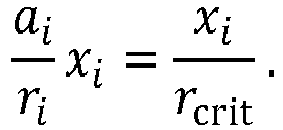
- The pressure level of a spherical source, which is used to model the loudspeaker, is inversely proportional to the distance from the source. The idea is to correct the pressure level of the loudspeaker to the level at the distance r crit by:
- Under consideration of some boundary values the gain values are computed from:

- For example, the gain value may be corrected to the level at the average loudspeaker distance if the critical distance is equal to zero.
- The signal of a loudspeaker that has a minimal distance smaller than the critical distance is delayed in a way that the total runtime from the loudspeaker to the listening array is equal to


- Finally, the corrected speaker signals x̂i (t) are determined from

- For playback the user selects the listening region that best matches the actual positioning of the listeners. The gain and delay values that have been computed for the selected listening region are then applied to the corresponding loudspeaker signals.
Claims (15)
- A method for multichannel audio playback adaptation, the method comprising:- receiving (10) a user input defining a listening region relative to a loudspeaker arrangement;- determining (11) minimal distances between the listening region and the loudspeakers;- comparing (12) the determined minimal distances with a critical distance; and- adapting (13) output parameters for those loudspeakers for which the determined minimal distance is below the critical distance.
- The method according to claim 1, wherein the user input is obtained by a touch pad of an input device.
- The method according to claim 1 or 2, further comprising checking whether the user input defines an invalid listening region.
- The method according to one of the preceding claims, wherein the output parameters for those loudspeakers for which the determined minimal distance is below the critical distance are adapted (13) such that sound produced by those loudspeakers is less dominant relative to sound produced by the other loudspeakers.
- The method according to one of the preceding claims, wherein the output parameters that are adapted (13) are gain parameters and delay parameters.
- The method according to one of the preceding claims, wherein the critical distance is determined based on the precedence or Haas effect.
- The method according to one of the preceding claims, further comprising receiving a further user input selecting a listening region among one or more defined listening regions and adapting output parameters of the loudspeakers such that audio playback is optimized for the selected listening region.
- A computer readable storage medium having stored therein instructions enabling multichannel audio playback adaptation, wherein the instructions, when executed by a computer, cause the computer to:- receive (10) a user input defining a listening region relative to a loudspeaker arrangement;- determine (11) minimal distances between the listening region and the loudspeakers;- compare (12) the determined minimal distances with a critical distance; and- adapt (13) output parameters for those loudspeakers for which the determined minimal distance is below the critical distance.
- An apparatus (20) for multichannel audio playback adaptation, the apparatus (20) comprising:- an input (21) configured to receive (10) a user input defining a listening region relative to a loudspeaker arrangement;- a distance calculating unit (22) configured to determine (11) minimal distances between the listening region and the loudspeakers;- a comparator (23) configured to compare (12) the determined minimal distances with a critical distance; and- a parameter setting unit (24) configured to adapt (13) output parameters for those loudspeakers for which the determined minimal distance is below the critical distance.
- The apparatus according to claim 9, wherein the user input is obtained by a touch pad of an input device.
- The apparatus according to claim 9 or 10, further comprising checking whether the user input defines an invalid listening region.
- The apparatus according to any of claims 9 to 11, wherein the output parameters for those loudspeakers for which the determined minimal distance is below the critical distance are adapted such that sound produced by those loudspeakers is less dominant relative to sound produced by the other loudspeakers.
- The apparatus according to any of claims 9 to 12, wherein the output parameters that are adapted are gain parameters and delay parameters.
- The apparatus according to any of claims 9 to 13, wherein the critical distance is determined based on the precedence or Haas effect.
- The apparatus according to any of claims 9 to 14, further comprising receiving a further user input selecting a listening region among one or more defined listening regions and adapting output parameters of the loudspeakers such that audio playback is optimized for the selected listening region.
Applications Claiming Priority (1)
| Application Number | Priority Date | Filing Date | Title |
|---|---|---|---|
| EP16305199.8A EP3209035A1 (en) | 2016-02-19 | 2016-02-19 | Method, computer readable storage medium, and apparatus for multichannel audio playback adaption for multiple listening positions |
Publications (1)
| Publication Number | Publication Date |
|---|---|
| EP3209037A1 true EP3209037A1 (en) | 2017-08-23 |
Family
ID=55443209
Family Applications (2)
| Application Number | Title | Priority Date | Filing Date |
|---|---|---|---|
| EP16305199.8A Withdrawn EP3209035A1 (en) | 2016-02-19 | 2016-02-19 | Method, computer readable storage medium, and apparatus for multichannel audio playback adaption for multiple listening positions |
| EP17154848.0A Withdrawn EP3209037A1 (en) | 2016-02-19 | 2017-02-06 | Method, computer readable storage medium, and apparatus for multichannel audio playback adaptation for multiple listening positions |
Family Applications Before (1)
| Application Number | Title | Priority Date | Filing Date |
|---|---|---|---|
| EP16305199.8A Withdrawn EP3209035A1 (en) | 2016-02-19 | 2016-02-19 | Method, computer readable storage medium, and apparatus for multichannel audio playback adaption for multiple listening positions |
Country Status (2)
| Country | Link |
|---|---|
| US (1) | US20170245083A1 (en) |
| EP (2) | EP3209035A1 (en) |
Cited By (1)
| Publication number | Priority date | Publication date | Assignee | Title |
|---|---|---|---|---|
| US20230224665A1 (en) * | 2022-01-13 | 2023-07-13 | Electronics And Telecommunications Research Institute | Method and apparatus for processing acoustic spatial information |
Families Citing this family (1)
| Publication number | Priority date | Publication date | Assignee | Title |
|---|---|---|---|---|
| US11817114B2 (en) | 2019-12-09 | 2023-11-14 | Dolby Laboratories Licensing Corporation | Content and environmentally aware environmental noise compensation |
Citations (4)
| Publication number | Priority date | Publication date | Assignee | Title |
|---|---|---|---|---|
| JP2000059898A (en) * | 1998-08-06 | 2000-02-25 | Matsushita Electric Ind Co Ltd | Listening position correction apparatus and method |
| EP1443804A2 (en) * | 2003-02-03 | 2004-08-04 | Denon, Ltd. | A multichannel reproducing apparatus |
| US20060083383A1 (en) * | 2004-09-16 | 2006-04-20 | 1602 Group Llc | Dynamically controlled digital audio signal processor |
| WO2014163657A1 (en) * | 2013-04-05 | 2014-10-09 | Thomson Licensing | Method for managing reverberant field for immersive audio |
-
2016
- 2016-02-19 EP EP16305199.8A patent/EP3209035A1/en not_active Withdrawn
-
2017
- 2017-02-06 EP EP17154848.0A patent/EP3209037A1/en not_active Withdrawn
- 2017-02-13 US US15/431,697 patent/US20170245083A1/en not_active Abandoned
Patent Citations (4)
| Publication number | Priority date | Publication date | Assignee | Title |
|---|---|---|---|---|
| JP2000059898A (en) * | 1998-08-06 | 2000-02-25 | Matsushita Electric Ind Co Ltd | Listening position correction apparatus and method |
| EP1443804A2 (en) * | 2003-02-03 | 2004-08-04 | Denon, Ltd. | A multichannel reproducing apparatus |
| US20060083383A1 (en) * | 2004-09-16 | 2006-04-20 | 1602 Group Llc | Dynamically controlled digital audio signal processor |
| WO2014163657A1 (en) * | 2013-04-05 | 2014-10-09 | Thomson Licensing | Method for managing reverberant field for immersive audio |
Cited By (2)
| Publication number | Priority date | Publication date | Assignee | Title |
|---|---|---|---|---|
| US20230224665A1 (en) * | 2022-01-13 | 2023-07-13 | Electronics And Telecommunications Research Institute | Method and apparatus for processing acoustic spatial information |
| US12464306B2 (en) * | 2022-01-13 | 2025-11-04 | Electronics And Telecommunications Research Institute | Method and apparatus for processing acoustic spatial information |
Also Published As
| Publication number | Publication date |
|---|---|
| US20170245083A1 (en) | 2017-08-24 |
| EP3209035A1 (en) | 2017-08-23 |
Similar Documents
| Publication | Publication Date | Title |
|---|---|---|
| EP3257269B1 (en) | Upmixing of audio signals | |
| JP7578219B2 (en) | Managing the playback of multiple audio streams through multiple speakers | |
| CN110192397B (en) | System and method for loudspeaker position estimation | |
| US20180115850A1 (en) | Processing audio data to compensate for partial hearing loss or an adverse hearing environment | |
| US10715914B2 (en) | Signal processing apparatus, signal processing method, and storage medium | |
| US9930469B2 (en) | System and method for enhancing virtual audio height perception | |
| US9166547B2 (en) | Electronic device and method for adjusting volume levels of audio signal outputted by the electronic device | |
| US12149915B2 (en) | Sound effect optimization method, electronic device, and storage medium | |
| US10219089B2 (en) | Hearing loss compensation apparatus and method using 3D equal loudness contour | |
| US20180270599A1 (en) | Speaker Location Identifying System, Speaker Location Identifying Device, and Speaker Location Identifying Method | |
| US11395087B2 (en) | Level-based audio-object interactions | |
| US10306392B2 (en) | Content-adaptive surround sound virtualization | |
| JP7589304B2 (en) | Dynamics processing across devices with different playback capabilities | |
| EP3369259B1 (en) | Reducing the phase difference between audio channels at multiple spatial positions | |
| EP3209035A1 (en) | Method, computer readable storage medium, and apparatus for multichannel audio playback adaption for multiple listening positions | |
| US20150092944A1 (en) | Apparatus for controlling a sound signal | |
| EP4295587B1 (en) | Clustering audio objects | |
| US20230188922A1 (en) | Audio system with dynamic target listening spot and ambient object interference cancelation | |
| US12490043B2 (en) | Systems and methods for delivering personalized audio to multiple users simultaneously through speakers | |
| KR20180113072A (en) | Apparatus and method for implementing stereophonic sound | |
| US20210076133A1 (en) | Input signal decorrelation | |
| US20250365546A1 (en) | System and a method for generating a loudspeaker position profile for sound management of an acoustic system | |
| US12610206B2 (en) | Generating channel and object-based audio from channel-based audio | |
| US12445795B2 (en) | Audio system with dynamic audio setting adjustment feature | |
| KR102426134B1 (en) | A method and apparatus for controlling sound output through filter change of audio device |
Legal Events
| Date | Code | Title | Description |
|---|---|---|---|
| PUAI | Public reference made under article 153(3) epc to a published international application that has entered the european phase |
Free format text: ORIGINAL CODE: 0009012 |
|
| AK | Designated contracting states |
Kind code of ref document: A1 Designated state(s): AL AT BE BG CH CY CZ DE DK EE ES FI FR GB GR HR HU IE IS IT LI LT LU LV MC MK MT NL NO PL PT RO RS SE SI SK SM TR |
|
| AX | Request for extension of the european patent |
Extension state: BA ME |
|
| 17P | Request for examination filed |
Effective date: 20180215 |
|
| RBV | Designated contracting states (corrected) |
Designated state(s): AL AT BE BG CH CY CZ DE DK EE ES FI FR GB GR HR HU IE IS IT LI LT LU LV MC MK MT NL NO PL PT RO RS SE SI SK SM TR |
|
| 17Q | First examination report despatched |
Effective date: 20180320 |
|
| GRAP | Despatch of communication of intention to grant a patent |
Free format text: ORIGINAL CODE: EPIDOSNIGR1 |
|
| INTG | Intention to grant announced |
Effective date: 20181120 |
|
| STAA | Information on the status of an ep patent application or granted ep patent |
Free format text: STATUS: THE APPLICATION IS DEEMED TO BE WITHDRAWN |
|
| 18D | Application deemed to be withdrawn |
Effective date: 20190402 |