EP3207906B1 - Multi-layer absorbent material - Google Patents
Multi-layer absorbent material Download PDFInfo
- Publication number
- EP3207906B1 EP3207906B1 EP16206908.2A EP16206908A EP3207906B1 EP 3207906 B1 EP3207906 B1 EP 3207906B1 EP 16206908 A EP16206908 A EP 16206908A EP 3207906 B1 EP3207906 B1 EP 3207906B1
- Authority
- EP
- European Patent Office
- Prior art keywords
- layer
- absorbent
- booster
- central
- absorbent layer
- Prior art date
- Legal status (The legal status is an assumption and is not a legal conclusion. Google has not performed a legal analysis and makes no representation as to the accuracy of the status listed.)
- Active
Links
Images

Classifications
-
- A—HUMAN NECESSITIES
- A61—MEDICAL OR VETERINARY SCIENCE; HYGIENE
- A61F—FILTERS IMPLANTABLE INTO BLOOD VESSELS; PROSTHESES; DEVICES PROVIDING PATENCY TO, OR PREVENTING COLLAPSING OF, TUBULAR STRUCTURES OF THE BODY, e.g. STENTS; ORTHOPAEDIC, NURSING OR CONTRACEPTIVE DEVICES; FOMENTATION; TREATMENT OR PROTECTION OF EYES OR EARS; BANDAGES, DRESSINGS OR ABSORBENT PADS; FIRST-AID KITS
- A61F13/00—Bandages or dressings; Absorbent pads
- A61F13/15—Absorbent pads, e.g. sanitary towels, swabs or tampons for external or internal application to the body; Supporting or fastening means therefor; Tampon applicators
- A61F13/53—Absorbent pads, e.g. sanitary towels, swabs or tampons for external or internal application to the body; Supporting or fastening means therefor; Tampon applicators characterised by the absorbing medium
- A61F13/534—Absorbent pads, e.g. sanitary towels, swabs or tampons for external or internal application to the body; Supporting or fastening means therefor; Tampon applicators characterised by the absorbing medium having an inhomogeneous composition through the thickness of the pad
-
- A—HUMAN NECESSITIES
- A61—MEDICAL OR VETERINARY SCIENCE; HYGIENE
- A61F—FILTERS IMPLANTABLE INTO BLOOD VESSELS; PROSTHESES; DEVICES PROVIDING PATENCY TO, OR PREVENTING COLLAPSING OF, TUBULAR STRUCTURES OF THE BODY, e.g. STENTS; ORTHOPAEDIC, NURSING OR CONTRACEPTIVE DEVICES; FOMENTATION; TREATMENT OR PROTECTION OF EYES OR EARS; BANDAGES, DRESSINGS OR ABSORBENT PADS; FIRST-AID KITS
- A61F13/00—Bandages or dressings; Absorbent pads
- A61F13/15—Absorbent pads, e.g. sanitary towels, swabs or tampons for external or internal application to the body; Supporting or fastening means therefor; Tampon applicators
- A61F13/53—Absorbent pads, e.g. sanitary towels, swabs or tampons for external or internal application to the body; Supporting or fastening means therefor; Tampon applicators characterised by the absorbing medium
- A61F13/534—Absorbent pads, e.g. sanitary towels, swabs or tampons for external or internal application to the body; Supporting or fastening means therefor; Tampon applicators characterised by the absorbing medium having an inhomogeneous composition through the thickness of the pad
- A61F13/535—Absorbent pads, e.g. sanitary towels, swabs or tampons for external or internal application to the body; Supporting or fastening means therefor; Tampon applicators characterised by the absorbing medium having an inhomogeneous composition through the thickness of the pad inhomogeneous in the plane of the pad, e.g. core absorbent layers being of different sizes
-
- A—HUMAN NECESSITIES
- A61—MEDICAL OR VETERINARY SCIENCE; HYGIENE
- A61F—FILTERS IMPLANTABLE INTO BLOOD VESSELS; PROSTHESES; DEVICES PROVIDING PATENCY TO, OR PREVENTING COLLAPSING OF, TUBULAR STRUCTURES OF THE BODY, e.g. STENTS; ORTHOPAEDIC, NURSING OR CONTRACEPTIVE DEVICES; FOMENTATION; TREATMENT OR PROTECTION OF EYES OR EARS; BANDAGES, DRESSINGS OR ABSORBENT PADS; FIRST-AID KITS
- A61F13/00—Bandages or dressings; Absorbent pads
- A61F13/15—Absorbent pads, e.g. sanitary towels, swabs or tampons for external or internal application to the body; Supporting or fastening means therefor; Tampon applicators
- A61F13/53—Absorbent pads, e.g. sanitary towels, swabs or tampons for external or internal application to the body; Supporting or fastening means therefor; Tampon applicators characterised by the absorbing medium
- A61F13/534—Absorbent pads, e.g. sanitary towels, swabs or tampons for external or internal application to the body; Supporting or fastening means therefor; Tampon applicators characterised by the absorbing medium having an inhomogeneous composition through the thickness of the pad
- A61F13/537—Absorbent pads, e.g. sanitary towels, swabs or tampons for external or internal application to the body; Supporting or fastening means therefor; Tampon applicators characterised by the absorbing medium having an inhomogeneous composition through the thickness of the pad characterised by a layer facilitating or inhibiting flow in one direction or plane, e.g. a wicking layer
-
- A—HUMAN NECESSITIES
- A61—MEDICAL OR VETERINARY SCIENCE; HYGIENE
- A61F—FILTERS IMPLANTABLE INTO BLOOD VESSELS; PROSTHESES; DEVICES PROVIDING PATENCY TO, OR PREVENTING COLLAPSING OF, TUBULAR STRUCTURES OF THE BODY, e.g. STENTS; ORTHOPAEDIC, NURSING OR CONTRACEPTIVE DEVICES; FOMENTATION; TREATMENT OR PROTECTION OF EYES OR EARS; BANDAGES, DRESSINGS OR ABSORBENT PADS; FIRST-AID KITS
- A61F13/00—Bandages or dressings; Absorbent pads
- A61F13/15—Absorbent pads, e.g. sanitary towels, swabs or tampons for external or internal application to the body; Supporting or fastening means therefor; Tampon applicators
- A61F13/53—Absorbent pads, e.g. sanitary towels, swabs or tampons for external or internal application to the body; Supporting or fastening means therefor; Tampon applicators characterised by the absorbing medium
- A61F13/534—Absorbent pads, e.g. sanitary towels, swabs or tampons for external or internal application to the body; Supporting or fastening means therefor; Tampon applicators characterised by the absorbing medium having an inhomogeneous composition through the thickness of the pad
- A61F13/537—Absorbent pads, e.g. sanitary towels, swabs or tampons for external or internal application to the body; Supporting or fastening means therefor; Tampon applicators characterised by the absorbing medium having an inhomogeneous composition through the thickness of the pad characterised by a layer facilitating or inhibiting flow in one direction or plane, e.g. a wicking layer
- A61F13/53743—Absorbent pads, e.g. sanitary towels, swabs or tampons for external or internal application to the body; Supporting or fastening means therefor; Tampon applicators characterised by the absorbing medium having an inhomogeneous composition through the thickness of the pad characterised by a layer facilitating or inhibiting flow in one direction or plane, e.g. a wicking layer characterised by the position of the layer relative to the other layers
- A61F13/53747—Absorbent pads, e.g. sanitary towels, swabs or tampons for external or internal application to the body; Supporting or fastening means therefor; Tampon applicators characterised by the absorbing medium having an inhomogeneous composition through the thickness of the pad characterised by a layer facilitating or inhibiting flow in one direction or plane, e.g. a wicking layer characterised by the position of the layer relative to the other layers the layer is facing the topsheet
-
- A—HUMAN NECESSITIES
- A61—MEDICAL OR VETERINARY SCIENCE; HYGIENE
- A61F—FILTERS IMPLANTABLE INTO BLOOD VESSELS; PROSTHESES; DEVICES PROVIDING PATENCY TO, OR PREVENTING COLLAPSING OF, TUBULAR STRUCTURES OF THE BODY, e.g. STENTS; ORTHOPAEDIC, NURSING OR CONTRACEPTIVE DEVICES; FOMENTATION; TREATMENT OR PROTECTION OF EYES OR EARS; BANDAGES, DRESSINGS OR ABSORBENT PADS; FIRST-AID KITS
- A61F13/00—Bandages or dressings; Absorbent pads
- A61F13/15—Absorbent pads, e.g. sanitary towels, swabs or tampons for external or internal application to the body; Supporting or fastening means therefor; Tampon applicators
- A61F13/53—Absorbent pads, e.g. sanitary towels, swabs or tampons for external or internal application to the body; Supporting or fastening means therefor; Tampon applicators characterised by the absorbing medium
- A61F2013/530481—Absorbent pads, e.g. sanitary towels, swabs or tampons for external or internal application to the body; Supporting or fastening means therefor; Tampon applicators characterised by the absorbing medium having superabsorbent materials, i.e. highly absorbent polymer gel materials
- A61F2013/53051—Absorbent pads, e.g. sanitary towels, swabs or tampons for external or internal application to the body; Supporting or fastening means therefor; Tampon applicators characterised by the absorbing medium having superabsorbent materials, i.e. highly absorbent polymer gel materials being only in particular parts or specially arranged
-
- A—HUMAN NECESSITIES
- A61—MEDICAL OR VETERINARY SCIENCE; HYGIENE
- A61F—FILTERS IMPLANTABLE INTO BLOOD VESSELS; PROSTHESES; DEVICES PROVIDING PATENCY TO, OR PREVENTING COLLAPSING OF, TUBULAR STRUCTURES OF THE BODY, e.g. STENTS; ORTHOPAEDIC, NURSING OR CONTRACEPTIVE DEVICES; FOMENTATION; TREATMENT OR PROTECTION OF EYES OR EARS; BANDAGES, DRESSINGS OR ABSORBENT PADS; FIRST-AID KITS
- A61F13/00—Bandages or dressings; Absorbent pads
- A61F13/15—Absorbent pads, e.g. sanitary towels, swabs or tampons for external or internal application to the body; Supporting or fastening means therefor; Tampon applicators
- A61F13/53—Absorbent pads, e.g. sanitary towels, swabs or tampons for external or internal application to the body; Supporting or fastening means therefor; Tampon applicators characterised by the absorbing medium
- A61F2013/530481—Absorbent pads, e.g. sanitary towels, swabs or tampons for external or internal application to the body; Supporting or fastening means therefor; Tampon applicators characterised by the absorbing medium having superabsorbent materials, i.e. highly absorbent polymer gel materials
- A61F2013/53051—Absorbent pads, e.g. sanitary towels, swabs or tampons for external or internal application to the body; Supporting or fastening means therefor; Tampon applicators characterised by the absorbing medium having superabsorbent materials, i.e. highly absorbent polymer gel materials being only in particular parts or specially arranged
- A61F2013/530547—Absorbent pads, e.g. sanitary towels, swabs or tampons for external or internal application to the body; Supporting or fastening means therefor; Tampon applicators characterised by the absorbing medium having superabsorbent materials, i.e. highly absorbent polymer gel materials being only in particular parts or specially arranged positioned in a separate layer or layers
-
- A—HUMAN NECESSITIES
- A61—MEDICAL OR VETERINARY SCIENCE; HYGIENE
- A61F—FILTERS IMPLANTABLE INTO BLOOD VESSELS; PROSTHESES; DEVICES PROVIDING PATENCY TO, OR PREVENTING COLLAPSING OF, TUBULAR STRUCTURES OF THE BODY, e.g. STENTS; ORTHOPAEDIC, NURSING OR CONTRACEPTIVE DEVICES; FOMENTATION; TREATMENT OR PROTECTION OF EYES OR EARS; BANDAGES, DRESSINGS OR ABSORBENT PADS; FIRST-AID KITS
- A61F13/00—Bandages or dressings; Absorbent pads
- A61F13/15—Absorbent pads, e.g. sanitary towels, swabs or tampons for external or internal application to the body; Supporting or fastening means therefor; Tampon applicators
- A61F13/53—Absorbent pads, e.g. sanitary towels, swabs or tampons for external or internal application to the body; Supporting or fastening means therefor; Tampon applicators characterised by the absorbing medium
- A61F2013/530481—Absorbent pads, e.g. sanitary towels, swabs or tampons for external or internal application to the body; Supporting or fastening means therefor; Tampon applicators characterised by the absorbing medium having superabsorbent materials, i.e. highly absorbent polymer gel materials
- A61F2013/5307—Absorbent pads, e.g. sanitary towels, swabs or tampons for external or internal application to the body; Supporting or fastening means therefor; Tampon applicators characterised by the absorbing medium having superabsorbent materials, i.e. highly absorbent polymer gel materials characterized by the quantity or ratio of superabsorbent material
-
- A—HUMAN NECESSITIES
- A61—MEDICAL OR VETERINARY SCIENCE; HYGIENE
- A61F—FILTERS IMPLANTABLE INTO BLOOD VESSELS; PROSTHESES; DEVICES PROVIDING PATENCY TO, OR PREVENTING COLLAPSING OF, TUBULAR STRUCTURES OF THE BODY, e.g. STENTS; ORTHOPAEDIC, NURSING OR CONTRACEPTIVE DEVICES; FOMENTATION; TREATMENT OR PROTECTION OF EYES OR EARS; BANDAGES, DRESSINGS OR ABSORBENT PADS; FIRST-AID KITS
- A61F13/00—Bandages or dressings; Absorbent pads
- A61F13/15—Absorbent pads, e.g. sanitary towels, swabs or tampons for external or internal application to the body; Supporting or fastening means therefor; Tampon applicators
- A61F13/53—Absorbent pads, e.g. sanitary towels, swabs or tampons for external or internal application to the body; Supporting or fastening means therefor; Tampon applicators characterised by the absorbing medium
- A61F13/531—Absorbent pads, e.g. sanitary towels, swabs or tampons for external or internal application to the body; Supporting or fastening means therefor; Tampon applicators characterised by the absorbing medium having a homogeneous composition through the thickness of the pad
- A61F2013/5315—Absorbent pads, e.g. sanitary towels, swabs or tampons for external or internal application to the body; Supporting or fastening means therefor; Tampon applicators characterised by the absorbing medium having a homogeneous composition through the thickness of the pad with a tissue-wrapped core
-
- A—HUMAN NECESSITIES
- A61—MEDICAL OR VETERINARY SCIENCE; HYGIENE
- A61F—FILTERS IMPLANTABLE INTO BLOOD VESSELS; PROSTHESES; DEVICES PROVIDING PATENCY TO, OR PREVENTING COLLAPSING OF, TUBULAR STRUCTURES OF THE BODY, e.g. STENTS; ORTHOPAEDIC, NURSING OR CONTRACEPTIVE DEVICES; FOMENTATION; TREATMENT OR PROTECTION OF EYES OR EARS; BANDAGES, DRESSINGS OR ABSORBENT PADS; FIRST-AID KITS
- A61F13/00—Bandages or dressings; Absorbent pads
- A61F13/15—Absorbent pads, e.g. sanitary towels, swabs or tampons for external or internal application to the body; Supporting or fastening means therefor; Tampon applicators
- A61F13/53—Absorbent pads, e.g. sanitary towels, swabs or tampons for external or internal application to the body; Supporting or fastening means therefor; Tampon applicators characterised by the absorbing medium
- A61F13/534—Absorbent pads, e.g. sanitary towels, swabs or tampons for external or internal application to the body; Supporting or fastening means therefor; Tampon applicators characterised by the absorbing medium having an inhomogeneous composition through the thickness of the pad
- A61F2013/53445—Absorbent pads, e.g. sanitary towels, swabs or tampons for external or internal application to the body; Supporting or fastening means therefor; Tampon applicators characterised by the absorbing medium having an inhomogeneous composition through the thickness of the pad from several sheets
-
- A—HUMAN NECESSITIES
- A61—MEDICAL OR VETERINARY SCIENCE; HYGIENE
- A61F—FILTERS IMPLANTABLE INTO BLOOD VESSELS; PROSTHESES; DEVICES PROVIDING PATENCY TO, OR PREVENTING COLLAPSING OF, TUBULAR STRUCTURES OF THE BODY, e.g. STENTS; ORTHOPAEDIC, NURSING OR CONTRACEPTIVE DEVICES; FOMENTATION; TREATMENT OR PROTECTION OF EYES OR EARS; BANDAGES, DRESSINGS OR ABSORBENT PADS; FIRST-AID KITS
- A61F13/00—Bandages or dressings; Absorbent pads
- A61F13/15—Absorbent pads, e.g. sanitary towels, swabs or tampons for external or internal application to the body; Supporting or fastening means therefor; Tampon applicators
- A61F13/53—Absorbent pads, e.g. sanitary towels, swabs or tampons for external or internal application to the body; Supporting or fastening means therefor; Tampon applicators characterised by the absorbing medium
- A61F13/534—Absorbent pads, e.g. sanitary towels, swabs or tampons for external or internal application to the body; Supporting or fastening means therefor; Tampon applicators characterised by the absorbing medium having an inhomogeneous composition through the thickness of the pad
- A61F13/535—Absorbent pads, e.g. sanitary towels, swabs or tampons for external or internal application to the body; Supporting or fastening means therefor; Tampon applicators characterised by the absorbing medium having an inhomogeneous composition through the thickness of the pad inhomogeneous in the plane of the pad, e.g. core absorbent layers being of different sizes
- A61F2013/5355—Absorbent pads, e.g. sanitary towels, swabs or tampons for external or internal application to the body; Supporting or fastening means therefor; Tampon applicators characterised by the absorbing medium having an inhomogeneous composition through the thickness of the pad inhomogeneous in the plane of the pad, e.g. core absorbent layers being of different sizes with terraced core
-
- A—HUMAN NECESSITIES
- A61—MEDICAL OR VETERINARY SCIENCE; HYGIENE
- A61F—FILTERS IMPLANTABLE INTO BLOOD VESSELS; PROSTHESES; DEVICES PROVIDING PATENCY TO, OR PREVENTING COLLAPSING OF, TUBULAR STRUCTURES OF THE BODY, e.g. STENTS; ORTHOPAEDIC, NURSING OR CONTRACEPTIVE DEVICES; FOMENTATION; TREATMENT OR PROTECTION OF EYES OR EARS; BANDAGES, DRESSINGS OR ABSORBENT PADS; FIRST-AID KITS
- A61F13/00—Bandages or dressings; Absorbent pads
- A61F13/15—Absorbent pads, e.g. sanitary towels, swabs or tampons for external or internal application to the body; Supporting or fastening means therefor; Tampon applicators
- A61F13/53—Absorbent pads, e.g. sanitary towels, swabs or tampons for external or internal application to the body; Supporting or fastening means therefor; Tampon applicators characterised by the absorbing medium
- A61F13/534—Absorbent pads, e.g. sanitary towels, swabs or tampons for external or internal application to the body; Supporting or fastening means therefor; Tampon applicators characterised by the absorbing medium having an inhomogeneous composition through the thickness of the pad
- A61F13/537—Absorbent pads, e.g. sanitary towels, swabs or tampons for external or internal application to the body; Supporting or fastening means therefor; Tampon applicators characterised by the absorbing medium having an inhomogeneous composition through the thickness of the pad characterised by a layer facilitating or inhibiting flow in one direction or plane, e.g. a wicking layer
- A61F2013/53765—Absorbent pads, e.g. sanitary towels, swabs or tampons for external or internal application to the body; Supporting or fastening means therefor; Tampon applicators characterised by the absorbing medium having an inhomogeneous composition through the thickness of the pad characterised by a layer facilitating or inhibiting flow in one direction or plane, e.g. a wicking layer characterized by its geometry
-
- A—HUMAN NECESSITIES
- A61—MEDICAL OR VETERINARY SCIENCE; HYGIENE
- A61F—FILTERS IMPLANTABLE INTO BLOOD VESSELS; PROSTHESES; DEVICES PROVIDING PATENCY TO, OR PREVENTING COLLAPSING OF, TUBULAR STRUCTURES OF THE BODY, e.g. STENTS; ORTHOPAEDIC, NURSING OR CONTRACEPTIVE DEVICES; FOMENTATION; TREATMENT OR PROTECTION OF EYES OR EARS; BANDAGES, DRESSINGS OR ABSORBENT PADS; FIRST-AID KITS
- A61F13/00—Bandages or dressings; Absorbent pads
- A61F13/15—Absorbent pads, e.g. sanitary towels, swabs or tampons for external or internal application to the body; Supporting or fastening means therefor; Tampon applicators
- A61F13/53—Absorbent pads, e.g. sanitary towels, swabs or tampons for external or internal application to the body; Supporting or fastening means therefor; Tampon applicators characterised by the absorbing medium
- A61F13/534—Absorbent pads, e.g. sanitary towels, swabs or tampons for external or internal application to the body; Supporting or fastening means therefor; Tampon applicators characterised by the absorbing medium having an inhomogeneous composition through the thickness of the pad
- A61F13/537—Absorbent pads, e.g. sanitary towels, swabs or tampons for external or internal application to the body; Supporting or fastening means therefor; Tampon applicators characterised by the absorbing medium having an inhomogeneous composition through the thickness of the pad characterised by a layer facilitating or inhibiting flow in one direction or plane, e.g. a wicking layer
- A61F2013/53765—Absorbent pads, e.g. sanitary towels, swabs or tampons for external or internal application to the body; Supporting or fastening means therefor; Tampon applicators characterised by the absorbing medium having an inhomogeneous composition through the thickness of the pad characterised by a layer facilitating or inhibiting flow in one direction or plane, e.g. a wicking layer characterized by its geometry
- A61F2013/53769—Absorbent pads, e.g. sanitary towels, swabs or tampons for external or internal application to the body; Supporting or fastening means therefor; Tampon applicators characterised by the absorbing medium having an inhomogeneous composition through the thickness of the pad characterised by a layer facilitating or inhibiting flow in one direction or plane, e.g. a wicking layer characterized by its geometry with the wicking layer not contacting the absorbent core
- A61F2013/53773—Absorbent pads, e.g. sanitary towels, swabs or tampons for external or internal application to the body; Supporting or fastening means therefor; Tampon applicators characterised by the absorbing medium having an inhomogeneous composition through the thickness of the pad characterised by a layer facilitating or inhibiting flow in one direction or plane, e.g. a wicking layer characterized by its geometry with the wicking layer not contacting the absorbent core with a deformable spacing structure
-
- A—HUMAN NECESSITIES
- A61—MEDICAL OR VETERINARY SCIENCE; HYGIENE
- A61F—FILTERS IMPLANTABLE INTO BLOOD VESSELS; PROSTHESES; DEVICES PROVIDING PATENCY TO, OR PREVENTING COLLAPSING OF, TUBULAR STRUCTURES OF THE BODY, e.g. STENTS; ORTHOPAEDIC, NURSING OR CONTRACEPTIVE DEVICES; FOMENTATION; TREATMENT OR PROTECTION OF EYES OR EARS; BANDAGES, DRESSINGS OR ABSORBENT PADS; FIRST-AID KITS
- A61F13/00—Bandages or dressings; Absorbent pads
- A61F13/15—Absorbent pads, e.g. sanitary towels, swabs or tampons for external or internal application to the body; Supporting or fastening means therefor; Tampon applicators
- A61F13/53—Absorbent pads, e.g. sanitary towels, swabs or tampons for external or internal application to the body; Supporting or fastening means therefor; Tampon applicators characterised by the absorbing medium
- A61F13/534—Absorbent pads, e.g. sanitary towels, swabs or tampons for external or internal application to the body; Supporting or fastening means therefor; Tampon applicators characterised by the absorbing medium having an inhomogeneous composition through the thickness of the pad
- A61F13/537—Absorbent pads, e.g. sanitary towels, swabs or tampons for external or internal application to the body; Supporting or fastening means therefor; Tampon applicators characterised by the absorbing medium having an inhomogeneous composition through the thickness of the pad characterised by a layer facilitating or inhibiting flow in one direction or plane, e.g. a wicking layer
- A61F2013/53765—Absorbent pads, e.g. sanitary towels, swabs or tampons for external or internal application to the body; Supporting or fastening means therefor; Tampon applicators characterised by the absorbing medium having an inhomogeneous composition through the thickness of the pad characterised by a layer facilitating or inhibiting flow in one direction or plane, e.g. a wicking layer characterized by its geometry
- A61F2013/53786—Absorbent pads, e.g. sanitary towels, swabs or tampons for external or internal application to the body; Supporting or fastening means therefor; Tampon applicators characterised by the absorbing medium having an inhomogeneous composition through the thickness of the pad characterised by a layer facilitating or inhibiting flow in one direction or plane, e.g. a wicking layer characterized by its geometry with folds
-
- A—HUMAN NECESSITIES
- A61—MEDICAL OR VETERINARY SCIENCE; HYGIENE
- A61F—FILTERS IMPLANTABLE INTO BLOOD VESSELS; PROSTHESES; DEVICES PROVIDING PATENCY TO, OR PREVENTING COLLAPSING OF, TUBULAR STRUCTURES OF THE BODY, e.g. STENTS; ORTHOPAEDIC, NURSING OR CONTRACEPTIVE DEVICES; FOMENTATION; TREATMENT OR PROTECTION OF EYES OR EARS; BANDAGES, DRESSINGS OR ABSORBENT PADS; FIRST-AID KITS
- A61F13/00—Bandages or dressings; Absorbent pads
- A61F13/15—Absorbent pads, e.g. sanitary towels, swabs or tampons for external or internal application to the body; Supporting or fastening means therefor; Tampon applicators
- A61F13/53—Absorbent pads, e.g. sanitary towels, swabs or tampons for external or internal application to the body; Supporting or fastening means therefor; Tampon applicators characterised by the absorbing medium
- A61F13/539—Absorbent pads, e.g. sanitary towels, swabs or tampons for external or internal application to the body; Supporting or fastening means therefor; Tampon applicators characterised by the absorbing medium characterised by the connection of the absorbent layers with each other or with the outer layers
- A61F2013/53975—Absorbent pads, e.g. sanitary towels, swabs or tampons for external or internal application to the body; Supporting or fastening means therefor; Tampon applicators characterised by the absorbing medium characterised by the connection of the absorbent layers with each other or with the outer layers by Hydraulic entanglement
Definitions
- the present invention relates to a multi-layer absorbent material. More particularly, the invention relates to a layered, composite absorbent material with individual layers which are constructed and arranged to selectively cooperate to provide desired performance parameters in the composite, layered structure, to methods for manufacturing said multi-layer absorbent material, as well as to the use of a multi-layer absorbent material according to the invention in an absorbent article, particularly a diaper.
- a multi-layer material provides improved ability to absorb and retain fluids and consequently, prevents excessive rewetting and leakage.
- the present invention is of particular importance to the field of disposable hygiene products, in particular diapers.
- Performance objectives of disposable absorbent articles include no product leakage, dry feel to the wearer, and a comfortable fit throughout the product life. Accordingly, absorbent articles typically contain an absorbent core to provide liquid handling and other absorbent functionalities required to meet the product performance objectives.
- Absorbent cores of absorbent articles are commonly composed of wood pulp fibers, and superabsorbent polymer particles are often distributed in the absorbent cores to enhance the liquid absorbent capacity. Absorbent articles frequently leak before the liquid absorbent capacity of the entire absorbent core is fully utilized.
- One problem resulting in leakage is the inability of the absorbent core to fully uptake liquids rapidly and completely when large amounts of liquids are discharged into the absorbent article.
- US 2001/0014797 A1 discloses an absorbent incontinence pad provided with a liquid impervious air permeable back sheet and an absorbent unit partly covered by the back sheet, wherein the absorbent unit has a non-woven fabric substrate, an absorbent zone formed by a plurality of highly absorbent layers extending in the form of bands on the surface of the non-woven fabric substrate and an air permeable zone where no such highly absorbent layer exists.
- US 2011/0270204 A1 describes a water-absorbent sheet composition containing a structure in which an absorbent layer containing a water-absorbent resin and an adhesive is sandwiched with two or more sheets of hydrophilic nonwoven fabrics.
- EP 3025687 relates to an absorbent article in which a three-dimensional opening hole mesh sheet is combined with an air-laid absorber.
- a liquid-permeable front surface sheet a large number of small convex portions protruding to a skin side are formed.
- the absorber is an air-laid absorber that has a five-layer structure in which an air-laid pulp non-woven fabric layer, a high-absorbent polymer layer, an air-laid pulp non-woven fabric layer, a high-absorbent polymer layer and an air-laid pulp non-woven fabric layer are stacked sequentially from the side of the liquid-permeable front surface sheet.
- WO99/17679 A2 describes an absorbent core having multiple absorbent layers, wherein the absorbent layers interact in such a manner which preferentially locates absorbed liquid in an appointed, high saturation wicking layer.
- the intake capability of the absorbent system is ensured by keeping a second layer of the absorbent system at low saturation levels.
- the low saturation in this layer provides void volume for the incoming insult as well as a high permeability, but the structure of the low saturation layer is also balanced to provide an appropriately high level of capillary tension.
- This low saturation layer is used in addition to a surge material and provides intake functionality in addition to that provided by the surge material.
- the absorbent core of current absorbent articles does not adequately meet current performance objectives. Consequently, there remains a need for absorbent structures which can provide improved fluid uptake of liquids and improved liquid distribution to move liquids out of the target area to maintain this desirable liquid uptake behavior for the life of the product.
- the present invention aims to resolve at least some of the problems mentioned above.
- the present invention concerns an absorbent article, preferably a disposable absorbent article, such as a diaper.
- the present invention specifically concerns a multi-layer absorbent material according to claim 1.
- the differential concentration of superabsorbent polymer particles between the two absorbent layers presents the advantage that the incoming fluids can be efficiently absorbed in a two-fold way, firstly by the superabsorbent polymer particles (3) in said booster absorbent layer (26) and secondly by the superabsorbent polymer particles (28) in said central absorbent layer (18).
- the booster absorbent layer comprises a smaller surface area than the central absorbent layer, more preferably the booster absorbent layer comprises a surface area which is about the surface area of the ADL, preferably the booster absorbent layer and the ADL comprise surface areas which differ within about 50%, more preferably within 60%, still more preferably within 70%, even more preferably within 80%, yet more preferably within 90%, still even more preferably within 95% from one another.
- a multi-layer absorbent material according to the invention provides an at least three-layered structure with very different properties.
- the role of the acquisition and distribution layer (6) is to better distribute the fluids, before accessing the underneath booster absorbent layer (26).
- the booster absorbent layer (26) is comprising superabsorbent polymer particles (3) that are preferably immobilized in a nonwoven carrier (2) comprising a top layer (17) consisting of staple fibers (31) penetrable by the superabsorbent polymer particles (3) and a nonwoven bottom layer (25) preferably hydroentangled to the top layer (17).
- Said booster absorbent layer (26) provides an increased absorption capacity within the "hot" zone of a diaper, i.e. the zone in a diaper where insults are most likely to occur.
- the fluids are also distributed by that layer, via the capillary voids present between e.g. carrier fibers and SAP particles. Therefore, in a preferred embodiment, the booster layer comprises high-permeability SAPs. Such SAPs maintain the voids, even if the particles are swollen by the fluid.
- the present invention provides an absorbent article according to claim 8 comprising a multi-layer absorbent material according to any of claims 1 to 7.
- the invention also provides a process according to claim 9 for manufacturing a multi-layer absorbent material according to any of claims 1 to 7.
- the booster absorbent layer (26) works in tandem with the underneath central absorbent layer (18) because each of those layers comprises an amount of superabsorbent polymer particles (3 and 28) which is preferably between 1 g and 20 g, more preferably between 2 g and 15 g, still more preferably between 3 g and 10 g, e.g. 4 g, 5 g, 6 g, 7 g, 8 g, 9 g or any value there between such as about 6.5 g.
- the amount of SAP in said booster absorbent layer and the amount of SAP in said central absorbent layer differ by less than 50%, preferably by less than 40%, still more preferably by less than 30%, yet more preferably by less than 20%, even more preferably by less than 10%, most preferably said amounts of SAP are about the same.
- the differential concentration of the superabsorbent polymer particles (3 and 28) within the two absorbent layers allows a better absorption of the incoming fluids and the superabsorbent polymer particles (3 and 28) are in a sufficient amount to absorb the incoming fluids.
- the acquisition and distribution layer (6) and the booster absorbent layer (26) are placed towards the front edge of the central absorbent layer (18) to better distribute and absorb fluids in the frontal region of an absorbent article.
- the frontal region is the intake region of incoming fluids and allows an improved fluids intake function.
- the invention provides use according to claim 12 of a multi-layer absorbent material according to any of claims 1 to 7 for manufacturing an absorbent article.
- the multi-layer absorbent material provided by the invention can be particularly advantageous for use in an absorbent article such as a diaper.
- a compartment refers to one or more than one compartment.
- the value to which the modifier "about” refers is itself also specifically disclosed.
- ABSORER article refers to devices that absorb and contain liquid, and more specifically, refers to devices that are placed against or in proximity to the body of the wearer to absorb and contain the various exudates discharged from the body.
- Absorbent articles include but are not limited to diapers, adult incontinence briefs, training pants, diaper holders and liners, sanitary napkins and the like.
- Absorbent articles preferably comprise a longitudinal axis and a transversal axis perpendicular to said longitudinal axis.
- the longitudinal axis is hereby conventionally chosen in the front-to-back direction of the article when referring to the article being worn, and the transversal axis is conventionally chosen in the left-to-right direction of the article when referring to the article being worn.
- the absorbent article of the present invention preferably comprises a liquid permeable topsheet, a liquid impermeable back sheet, and an absorbent medium disposed between the topsheet and the backsheet.
- the absorbent medium may comprise a booster absorbent layer and a central absorbent layer according to the present invention.
- the absorbent article may also include one or more features such as, but not limited to, ears or side panels, leg cuffs, fastener components and/or a belt.
- the top sheet, back sheet and the absorbent medium could be made from any suitable material known to the person skilled in the art.
- Acquisition and distribution layer also refers to a sub-layer which preferably is a nonwoven wicking layer under the topsheet (or face fabric) of an absorbent product, which speeds up the transport and improves distribution of fluids throughout the absorbent core.
- “Absorbent medium” is the absorbent structure disposed between the topsheet and the backsheet of the absorbent article in at least the crotch region of the absorbent article.
- the absorbent material can be of any conventional kind. Examples of commonly occurring absorbent materials are cellulosic fluff pulp, tissue layers, highly absorbent polymers (so called superabsorbent polymer particles (SAP)), absorbent foam materials, absorbent nonwoven materials or the like. It is common to combine cellulosic fluff pulp with superabsorbent polymers in an absorbent material.
- Superabsorbent polymers are water-swellable, water-insoluble organic or inorganic materials capable of absorbing at least about 20 times their own weight of an aqueous solution containing 0.9 weight percent of sodium chloride.
- Organic materials suitable for use as superabsorbent materials can include natural materials such as polysaccharides, polypeptides and the like, as well as synthetic materials such as synthetic hydrogel polymers.
- Such hydrogel polymers include, for example, alkali metal salts of polyacrylic acids, polyacrylamides, polyvinyl alcohol, polyacrylates, polyvinyl pyridines, and the like.
- Other suitable polymers include hydrolyzed acrylonitrile grafted starch, acrylic acid grafted starch, and isobutylene maleic anhydride copolymers and mixtures thereof.
- the hydrogel polymers are preferably lightly cross-linked to render the material substantially water insoluble.
- Preferred superabsorbent materials are further surface cross-linked so that the outer surface or shell of the superabsorbent particle, fibre, flake, sphere, etc. possesses a higher crosslink density than the inner portion of the superabsorbent.
- the superabsorbent materials may be in any form which is suitable for use in absorbent composites including particles, fibres, flakes, spheres, and the like.
- the absorbent medium comprises a nonwoven carrier according to the present invention.
- Diaper refers to an absorbent article generally worn by infants and incontinent persons about the lower torso.
- Disposable is used herein to describe articles that are generally not intended to be laundered or otherwise restored or reused (i. e. they are intended to be discarded after a single use and, preferably, to be recycled, composted or otherwise disposed of in an environmentally compatible manner).
- Hydroentanglement process refers to the manufacturing of nonwoven webs. The process involves directing a series of water jets towards a fibrous web which is supported on a moving porous belt. The water jets pass downwards through the mass of fibres and on making contact with the surface of the belt, the jets rebound, and break up: the energy released causes entanglement of the mass of fibres.
- Nonwoven refers to a manufactured sheet, web, or batt of directionally or randomly oriented fibres bonded by friction and/or cohesion and/or adhesion, excluding paper and products that are woven, knitted, tufted stitchbonded incorporating binding yarns or filaments, or felted by wet-milling, whether or not additionally needled.
- the fibres may be of natural or man-made origin. They may also be staple or continuous filaments or be formed in situ.
- Pulp fluff or "fluff pulp” refers to a material made up of cellulose fibers.
- the fibers can be either natural or synthetic, or a combination thereof.
- the material is typically lightweight and has absorbent properties.
- “Staple fibers” refer to commercially available fibers having diameters ranging from less than about 0.001 mm to more than about 0.2 mm; they come in several different forms such as short fibers ranging from about 10 to 50 mm in length and long fibers with a length higher than 50 mm, preferably up to 100 mm.
- the staple fibers for use in the invention can be prepared from thin and/or coarse fibers, preferably polyester fibers.
- the thin fibers have a dtex below 3, preferably in the range of 1 to 3 whereas the coarse fibers have a dtex of at least 3 and preferably below 45 dtex.
- the coarse fibres preferably have a dtex value which is at least two times, but no greater than 15 times that of the thin fibers.
- Superabsorbent polymer particles or “SAPs” refer to water-swellable, water-insoluble organic or inorganic materials capable, under the most favorable conditions, of absorbing at least about 10 times their weight, or at least about 15 times their weight, or at least about 25 times their weight in an aqueous solution containing 0.9 weight percent sodium chloride.
- the particle size is typically ranging between 100 to 800 ⁇ m, preferably between 300 to 600 ⁇ m, more preferably between 400 to 500 ⁇ m.
- Topsheet refers to a liquid permeable material sheet forming the inner cover of the absorbent article and which in use is placed in direct contact with the skin of the wearer.
- the topsheet can comprise a nonwoven material, e.g. spunbond, meltblown, carded, hydroentangled, wetlaid etc.
- Suitable nonwoven materials can be composed of man-made fibres, such as polyester, polyethylene, polypropylene, viscose, rayon etc. or natural fibers, such as wood pulp or cotton fibres, or from a mixture of natural and man-made fibres.
- Further examples of topsheet materials are porous foams, apertured plastic films, laminates of nonwoven materials and apertured plastic films etc.
- topsheet materials should be soft and non-irritating to the skin and be readily penetrated by body fluid, e.g. urine or menstrual fluid.
- the inner coversheet may further be different in different parts of the absorbent article.
- the "backsheet” refers to a material forming the outer cover of the absorbent article.
- the backsheet may be the same or different in different parts of the absorbent article.
- the backsheet comprises a liquid impervious material in the form of a thin plastic film, e.g. a polyethylene or polypropylene film, a nonwoven material coated with a liquid impervious material, a hydrophobic nonwoven material, which resists liquid penetration, or a laminate of a plastic film and a nonwoven material.
- the backsheet material may be breathable so as to allow vapour to escape from the absorbent material, while still preventing liquids from passing there through.
- breathable backsheet materials are porous polymeric films, nonwoven laminates of spunbond and meltblown layers and laminates of porous polymeric films and nonwoven materials.
- density or “concentration” when referring to the absorbent material, in particular the SAP, of a layer, refers to the amount of the absorbent material divided by the surface area of the layer over which the absorbent material is spread out.
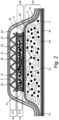
- FIG. 1 and 2 show two embodiments of an absorbent article, Fig. 1 being according to the present invention.
- FIG. 1 is a general schematic cross-sectional view of the multi-layer structure of the absorbent material with a fluffless central absorbent layer (18)
- FIG. 2 is a general schematic cross-sectional view of the multi-layer structure of the absorbent material with a fluff pulp containing central absorbent layer (18).
- the inventors have found a way to provide an improved absorbent core and process for making such a core.
- the present invention provides in a first aspect a multi-layer absorbent material comprising: a topsheet (23), a backsheet (5), a central absorbent layer (18) positioned between the topsheet (23) and the backsheet (5), said central absorbent layer (18) comprising superabsorbent polymer particles (28), an acquisition and distribution layer (6) positioned between the topsheet (23) and the central absorbent layer (18) for receiving fluids from the topsheet (23) and transferring the fluids for absorption by the central absorbent layer (18), and a booster absorbent layer (26) positioned between the acquisition and distribution layer (6) and the central absorbent layer (18) ( Fig.1 ).
- the booster absorbent layer (26) comprises a nonwoven carrier (2) with superabsorbent polymer particles (3) whereby the booster absorbent layer is comprising a higher concentration of superabsorbent polymer particles than the central absorbent layer.
- the differential concentration of superabsorbent polymer particles between the two absorbent layers presents the advantage that the incoming fluids can be more efficiently absorbed than in prior art multi-layer absorbent materials, due to a two-fold process, firstly by the superabsorbent polymer particles (3) in said booster absorbent layer (26) and secondly by the superabsorbent polymer particles (28) in said central absorbent layer (18) ( Fig. 1 ).
- the booster layer can be placed at a region near a probable miction point.
- the booster absorbent layer is disposed mainly near a possible miction point, more preferably at least 50%, even more preferably at least 55%, still more preferably at least 60%, yet more preferably at least 65% of the booster absorbent layer is disposed in the front half of the absorbent article.
- the booster absorbent layer increases the absorbency at the region near possible miction points, which reduces the probability of leakage of fluids which could not be absorbed fast enough in prior art absorbent articles.
- fluids which pass through the booster absorbent layer without directly being absorbed can be absorbed by the central absorbent layer. The above described situation occurs frequently as e.g. urine discharges usually result in a large amount of fluids being discharged in a small area and in a short period.
- a further advantage of the present invention is the ease of producing such an absorbent article whereby the absorbent capacity can be increased near a possible miction point, in particular by the presence of the at least two absorbent layers.
- the use of two layers, e.g. instead of one layer with differential absorption capacity, allows to produce absorbent articles of different types and of different sizes using the same components, methods and/or apparatuses.
- the multi-layer absorbent material is comprising the central absorbent layer (18) as a first absorbent core layer of a first size, and at least one additional booster absorbent layer (26) overlying the first absorbent core layer and being of a different size than the first absorbent core layer thereby forming an absorbent multi-layer core.
- the booster absorbent layer is comprising a maximum length of between 5 cm and 50 cm, more preferably between 10 cm and 40 cm, yet more preferably between 20 cm and 30 cm and a maximum width of between 2.5 cm and 30 cm, more preferably between 5 cm and 20 cm, still more preferably between 7.5 cm and 15 cm.
- the central absorbent layer is comprising a maximum length of between 5 cm and 80 cm, more preferably between 15 cm and 65 cm, yet more preferably between 30 cm and 50 cm and a maximum width of between 2.5 cm and 50 cm, more preferably between 5 cm and 35 cm, still more preferably between 10 cm and 20 cm.
- the booster absorbent layer (26) is comprising an amount of superabsorbent polymer particles (3) which is between 1 g and 30 g, more preferably between 2 g and 20 g, yet more preferably between 3 g and 10 g.
- the central absorbent layer (18) is comprising an amount of superabsorbent polymer particles (28) which is between 1 g and 30 g, more preferably between 2 g and 20 g, yet more preferably between 3 g and 10 g.
- the central and/or booster absorbent layer comprise superabsorbent particles which are distributed according to a pattern, preferably a pattern comprising areas (30) which are essentially free from SAPs, such as a clustered pattern.
- the central absorbent layer (18) is comprising a fluffless absorbent layer.
- the central absorbent layer (18) is comprising a fluffless top layer (7) and superabsorbent polymer particles (28) ( Fig.1 ).
- the central absorbent layer (18) is comprising a blend of fluff pulp (33) and superabsorbent polymer particles (28).
- the central absorbent layer (18) may comprise a fluffless top layer (7) or a fluff pulp (33). As in the previous aspects of the invention, these materials will be configured to provide maximum permeability while maintaining enough capillary tension to control the movement of the liquid and not allow leakage to occur.
- the central absorbent layer (18) of the present invention incorporates nonwoven materials with superabsorbent polymer particles in the fluffless top layer (7).
- the central absorbent layer (18) is preferably attached by thermoplastic adhesive (11) to the booster (26). Note that the central absorbent layer may be provided with a core wrap (4, 34) as indicated in figs. 1 and 2 .
- the central absorbent layer (18) is preferably wrapped between two layers of nonwoven (4, 34), the so-called core wrap.
- the central absorbent layer preferably comprises a core wrap, which preferably comprise two layers of nonwoven (4, 34).
- the lower core wrap (34) can be attached to the bottom layer (8) of the nonwoven carrier (1) by thermoplastic adhesive (9).
- the upper core wrap (4) can be attached to the top surface of the nonwoven carrier (1) by thermoplastic adhesive (10).
- the superabsorbent polymer particles (28) can be partly in contact with the adhesive coating (10) on the upper core wrap (4).
- the widths of the core wrap nonwovens exceed the width of the nonwoven carrier (1), so that the core wrap nonwovens can be bonded with each other along the side edges by thermoplastic adhesive (14 ).
- the core-wrapped central absorbent layer (18) can be attached to the back sheet (5), e.g. by a thermoplastic adhesive layer (35).
- the ADL according to the present invention comprises a thin, 3D nonwoven spacer fabric with discrete, channel-like voids or cells within the fabric cross-section, which relies on fluid forces rather than conventional mechanical methods to periodically interconnect, e.g. hydro-entangle, fibres from at least two web structures which are separated by a spacer system during their production.
- the ADL comprises a nonwoven fabric, the fabric comprising at least two separate but interconnected layers, each of the layers being provided with discrete interconnections so as to provide discrete voids between the two layers of fabric.
- the shape of the voids may vary. However, preferentially, the voids comprise a channel and/or a tube, e. g. a plurality of channels and/or tubes within the structure of the fabric.
- the channels and/or tubes may be substantially cylindrical in shape.
- the size and/or shape of the voids may be influenced by the choice of the spacer material. Similarly, the size of the voids may vary, depending, inter alia, on the nature of the use of the nonwoven fabric.
- the channels and/or tubes are such that they comprise a diameter in the range of from 0.2 mm to 8.5 mm, more preferably from 0.5 mm to 6 mm, yet more preferably from 1 mm to 5 mm, e.g. 2 mm, 3 mm, 4 mm or any value therebetween.
- the acquisition and distribution layer (6) can preferably be attached by thermoplastic adhesive (32) to the underneath booster absorbent layer (26).
- the multi-layer absorbent material being covered by a nonwoven topsheet (23) attached to the components underneath with a layer of thermoplastic adhesive (24). This is particularly preferred for absorbent articles comprising such an ADL or if such an ADL is to be used in an absorbent article.
- Fluids are substantially guided in the longitudinal direction through the channels (21) and are further collected in the tubes (20) by e.g. capillary absorption that allows for the fluids to flow along the tubes (20).
- capillary absorption that allows for the fluids to flow along the tubes (20.
- the acquisition and distribution layer (6) is comprising a top layer (12) comprising staple fibers (22) and a, preferably essentially flat, non woven bottom layer (13), the acquisition and distribution layer (6) comprising an undulated structure.
- said top-layer (12) comprises corrugations which at least partially define said undulated channel structure.
- the ADL (6) comprises a maximum length of between 5 cm and 50 cm, more preferably between 10 cm and 40 cm, yet more preferably between 20 cm and 30 cm, and a maximum width of between 2.5 cm and 30 cm, more preferably between 5 cm and 20 cm, still more preferably between 7.5 cm and 15 cm.
- the undulated structure comprises two neighboring tubes (19) separated by a channel (21) and/or two neighboring channels (21) separated by a tube, whereby said two neighboring tubes and/or channels comprise a separating distance of between 3 mm and 20 mm, preferably between 5 mm and 15 mm, more preferably between 8 mm and 13 mm, still more preferably 9, 10, 11 or 12 mm, the distance being measured between the center of the neighboring tubes or channels (21), to improve fluids distribution, and a nonwoven bottom layer (13) ( Figs. 1 and 2 ).
- the acquisition and distribution layer (6) and the booster absorbent layer (26) are about the same size, preferably the length and/or width of the ADL differs from the length and/or width of the booster absorbent layer by less than 50%, more preferably by less than 40%, still more preferably by less than 30%, yet more preferably by less than 20%, even more preferably by less than 10%, still even more preferably by less than 5%.
- the invention provides an absorbent article according to claim 8 comprising a multi-layer absorbent material according to any of claims 1 to 7.
- the invention provides a process according to claim 9 for manufacturing a multi-layer absorbent material according to any of claims 1 to 7, comprising the steps of:
- the acquisition and distribution layer (6) and the booster absorbent layer (26) are placed mainly within the front half of the central absorbent layer (18) to distribute and absorb fluids, preferably at least 50%, more preferably at least 55%, still more preferably at least 60%, yet more preferably at least 65%, still even more preferably at least 70% of the ADL and/or the booster absorbent layer are disposed within the front half of the central absorbent layer.
- the acquisition distribution layer (6), the nonwoven carrier (2), and the nonwoven carrier (1) are treated with a surfactant.
- the acquisition distribution layer (6), the nonwoven carrier (2), and the nonwoven carrier (1) can preferably be rendered hydrophilic through the use of a post treatment application of a surfactant.
- the hydrophilic characteristics of the acquisition distribution layer (6), the nonwoven carrier (2), and the nonwoven carrier (1) improve absorbent articles such as baby diapers and adult incontinence diapers by improving absorbency.
- the invention provides use according to claim 12 of a multi-layer absorbent material according according to any of claims 1 to 7 for manufacturing an absorbent article.
Landscapes
- Health & Medical Sciences (AREA)
- Epidemiology (AREA)
- Engineering & Computer Science (AREA)
- Biomedical Technology (AREA)
- Heart & Thoracic Surgery (AREA)
- Vascular Medicine (AREA)
- Life Sciences & Earth Sciences (AREA)
- Animal Behavior & Ethology (AREA)
- General Health & Medical Sciences (AREA)
- Public Health (AREA)
- Veterinary Medicine (AREA)
- Absorbent Articles And Supports Therefor (AREA)
- Laminated Bodies (AREA)
Description
- The present invention relates to a multi-layer absorbent material. More particularly, the invention relates to a layered, composite absorbent material with individual layers which are constructed and arranged to selectively cooperate to provide desired performance parameters in the composite, layered structure, to methods for manufacturing said multi-layer absorbent material, as well as to the use of a multi-layer absorbent material according to the invention in an absorbent article, particularly a diaper. Such a multi-layer material provides improved ability to absorb and retain fluids and consequently, prevents excessive rewetting and leakage. The present invention is of particular importance to the field of disposable hygiene products, in particular diapers.
- Performance objectives of disposable absorbent articles, such as infant diapers, include no product leakage, dry feel to the wearer, and a comfortable fit throughout the product life. Accordingly, absorbent articles typically contain an absorbent core to provide liquid handling and other absorbent functionalities required to meet the product performance objectives. Absorbent cores of absorbent articles are commonly composed of wood pulp fibers, and superabsorbent polymer particles are often distributed in the absorbent cores to enhance the liquid absorbent capacity. Absorbent articles frequently leak before the liquid absorbent capacity of the entire absorbent core is fully utilized. One problem resulting in leakage is the inability of the absorbent core to fully uptake liquids rapidly and completely when large amounts of liquids are discharged into the absorbent article. Another associated problem contributing to leakage is the inability of the absorbent core to move or distribute sufficient amounts of liquid between discharges from a target area portion of the absorbent article to more distal and more remote end regions of the absorbent core which have not been utilized. This results in saturation of only the central target area of the absorbent core and excessive thickness, bulkiness, and sagging of the wet, heavy absorbent material resulting in poor performance, product fit and wearer discomfort.
US 6,437,214B1 disclosed an absorbent article which includes an absorbent core having multiple absorbent layers; the intake capability of the absorbent system is maintained by keeping a second layer of the absorbent system at low saturation. A problem with such an absorbent article is that incoming fluids are not properly absorbed and do not provide enough control of the incoming fluids to stop leakage from occurring. -
US 2001/0014797 A1 discloses an absorbent incontinence pad provided with a liquid impervious air permeable back sheet and an absorbent unit partly covered by the back sheet, wherein the absorbent unit has a non-woven fabric substrate, an absorbent zone formed by a plurality of highly absorbent layers extending in the form of bands on the surface of the non-woven fabric substrate and an air permeable zone where no such highly absorbent layer exists. -
US 2011/0270204 A1 describes a water-absorbent sheet composition containing a structure in which an absorbent layer containing a water-absorbent resin and an adhesive is sandwiched with two or more sheets of hydrophilic nonwoven fabrics. -
EP 3025687 relates to an absorbent article in which a three-dimensional opening hole mesh sheet is combined with an air-laid absorber. In a liquid-permeable front surface sheet, a large number of small convex portions protruding to a skin side are formed. The absorber is an air-laid absorber that has a five-layer structure in which an air-laid pulp non-woven fabric layer, a high-absorbent polymer layer, an air-laid pulp non-woven fabric layer, a high-absorbent polymer layer and an air-laid pulp non-woven fabric layer are stacked sequentially from the side of the liquid-permeable front surface sheet. -
WO99/17679 A2 - The absorbent core of current absorbent articles does not adequately meet current performance objectives. Consequently, there remains a need for absorbent structures which can provide improved fluid uptake of liquids and improved liquid distribution to move liquids out of the target area to maintain this desirable liquid uptake behavior for the life of the product.
- The present invention aims to resolve at least some of the problems mentioned above.
- The present invention concerns an absorbent article, preferably a disposable absorbent article, such as a diaper. In a first aspect, the present invention specifically concerns a multi-layer absorbent material according to claim 1. The differential concentration of superabsorbent polymer particles between the two absorbent layers presents the advantage that the incoming fluids can be efficiently absorbed in a two-fold way, firstly by the superabsorbent polymer particles (3) in said booster absorbent layer (26) and secondly by the superabsorbent polymer particles (28) in said central absorbent layer (18). Preferably the booster absorbent layer comprises a smaller surface area than the central absorbent layer, more preferably the booster absorbent layer comprises a surface area which is about the surface area of the ADL, preferably the booster absorbent layer and the ADL comprise surface areas which differ within about 50%, more preferably within 60%, still more preferably within 70%, even more preferably within 80%, yet more preferably within 90%, still even more preferably within 95% from one another.
- A multi-layer absorbent material according to the invention provides an at least three-layered structure with very different properties. The role of the acquisition and distribution layer (6) is to better distribute the fluids, before accessing the underneath booster absorbent layer (26). The booster absorbent layer (26) is comprising superabsorbent polymer particles (3) that are preferably immobilized in a nonwoven carrier (2) comprising a top layer (17) consisting of staple fibers (31) penetrable by the superabsorbent polymer particles (3) and a nonwoven bottom layer (25) preferably hydroentangled to the top layer (17). Said booster absorbent layer (26) provides an increased absorption capacity within the "hot" zone of a diaper, i.e. the zone in a diaper where insults are most likely to occur. To some extent, the fluids are also distributed by that layer, via the capillary voids present between e.g. carrier fibers and SAP particles. Therefore, in a preferred embodiment, the booster layer comprises high-permeability SAPs. Such SAPs maintain the voids, even if the particles are swollen by the fluid.
- In a second aspect, the present invention provides an absorbent article according to
claim 8 comprising a multi-layer absorbent material according to any of claims 1 to 7. - In a third aspect, the invention also provides a process according to
claim 9 for manufacturing a multi-layer absorbent material according to any of claims 1 to 7. - To further improve the desired balance of absorbent properties, there have been identified a number of important factors which can allow the absorbent layer regions to better work in combination, and thereby provide an improved overall system performance. The booster absorbent layer (26) works in tandem with the underneath central absorbent layer (18) because each of those layers comprises an amount of superabsorbent polymer particles (3 and 28) which is preferably between 1 g and 20 g, more preferably between 2 g and 15 g, still more preferably between 3 g and 10 g, e.g. 4 g, 5 g, 6 g, 7 g, 8 g, 9 g or any value there between such as about 6.5 g. According to the invention, the amount of SAP in said booster absorbent layer and the amount of SAP in said central absorbent layer differ by less than 50%, preferably by less than 40%, still more preferably by less than 30%, yet more preferably by less than 20%, even more preferably by less than 10%, most preferably said amounts of SAP are about the same.
- The differential concentration of the superabsorbent polymer particles (3 and 28) within the two absorbent layers allows a better absorption of the incoming fluids and the superabsorbent polymer particles (3 and 28) are in a sufficient amount to absorb the incoming fluids.
- Furthermore, the acquisition and distribution layer (6) and the booster absorbent layer (26) are placed towards the front edge of the central absorbent layer (18) to better distribute and absorb fluids in the frontal region of an absorbent article. The frontal region is the intake region of incoming fluids and allows an improved fluids intake function.
- In a final aspect, the invention provides use according to
claim 12 of a multi-layer absorbent material according to any of claims 1 to 7 for manufacturing an absorbent article. - The multi-layer absorbent material provided by the invention can be particularly advantageous for use in an absorbent article such as a diaper.
- Preferred embodiments are as specified in the dependent claims.
- The invention will be further described in detail with reference to the exemplary embodiments represented by the accompanying figures, in which
-
FIG. 1 shows a general schematic cross-sectional view of the multi-layer structure of the absorbent material with a fluffless central absorbent layer (18) according to the present invention. -
FIG. 2 shows a general schematic cross-sectional view of a multi-layer structure of an absorbent material with a central absorbent layer (18) comprising fluff pulp and superabsorbent. - Unless otherwise defined, all terms used in disclosing the invention, including technical and scientific terms, have the meaning as commonly understood by one of ordinary skill in the art to which this invention belongs. By means of further guidance, term definitions are included to better appreciate the teaching of the present invention.
- As used herein, the following terms have the following meanings:
"A", "an", and "the" as used herein refers to both singular and plural referents unless the context clearly dictates otherwise. By way of example, "a compartment" refers to one or more than one compartment. - "About" as used herein referring to a measurable value such as a parameter, an amount, a temporal duration, and the like, is meant to encompass variations of +/-20% or less, preferably +/-10% or less, more preferably +/-5% or less, even more preferably +/-1% or less, and still more preferably +/-0.1% or less of and from the specified value, in so far such variations are appropriate to perform in the disclosed invention. However, it is to be understood that the value to which the modifier "about" refers is itself also specifically disclosed.
- "Comprise", "comprising", and "comprises" and "comprised of" as used herein are synonymous with "include", "including", "includes" or "contain", "containing", "contains" and are inclusive or open-ended terms that specifies the presence of what follows e.g. component and do not exclude or preclude the presence of additional, non-recited components, features, element, members, steps, known in the art or disclosed therein.
- As used herein, the following terms have the following meanings:
"Absorbent article" refers to devices that absorb and contain liquid, and more specifically, refers to devices that are placed against or in proximity to the body of the wearer to absorb and contain the various exudates discharged from the body. - Absorbent articles include but are not limited to diapers, adult incontinence briefs, training pants, diaper holders and liners, sanitary napkins and the like. Absorbent articles preferably comprise a longitudinal axis and a transversal axis perpendicular to said longitudinal axis. The longitudinal axis is hereby conventionally chosen in the front-to-back direction of the article when referring to the article being worn, and the transversal axis is conventionally chosen in the left-to-right direction of the article when referring to the article being worn.
- The absorbent article of the present invention preferably comprises a liquid permeable topsheet, a liquid impermeable back sheet, and an absorbent medium disposed between the topsheet and the backsheet. The absorbent medium may comprise a booster absorbent layer and a central absorbent layer according to the present invention. The absorbent article may also include one or more features such as, but not limited to, ears or side panels, leg cuffs, fastener components and/or a belt. The top sheet, back sheet and the absorbent medium could be made from any suitable material known to the person skilled in the art.
- "Acquisition and distribution layer" or "ADL", also refers to a sub-layer which preferably is a nonwoven wicking layer under the topsheet (or face fabric) of an absorbent product, which speeds up the transport and improves distribution of fluids throughout the absorbent core.
- "Absorbent medium" is the absorbent structure disposed between the topsheet and the backsheet of the absorbent article in at least the crotch region of the absorbent article. The absorbent material can be of any conventional kind. Examples of commonly occurring absorbent materials are cellulosic fluff pulp, tissue layers, highly absorbent polymers (so called superabsorbent polymer particles (SAP)), absorbent foam materials, absorbent nonwoven materials or the like. It is common to combine cellulosic fluff pulp with superabsorbent polymers in an absorbent material. Superabsorbent polymers are water-swellable, water-insoluble organic or inorganic materials capable of absorbing at least about 20 times their own weight of an aqueous solution containing 0.9 weight percent of sodium chloride. Organic materials suitable for use as superabsorbent materials can include natural materials such as polysaccharides, polypeptides and the like, as well as synthetic materials such as synthetic hydrogel polymers. Such hydrogel polymers include, for example, alkali metal salts of polyacrylic acids, polyacrylamides, polyvinyl alcohol, polyacrylates, polyvinyl pyridines, and the like. Other suitable polymers include hydrolyzed acrylonitrile grafted starch, acrylic acid grafted starch, and isobutylene maleic anhydride copolymers and mixtures thereof. The hydrogel polymers are preferably lightly cross-linked to render the material substantially water insoluble. Preferred superabsorbent materials are further surface cross-linked so that the outer surface or shell of the superabsorbent particle, fibre, flake, sphere, etc. possesses a higher crosslink density than the inner portion of the superabsorbent. The superabsorbent materials may be in any form which is suitable for use in absorbent composites including particles, fibres, flakes, spheres, and the like.
- Preferably, the absorbent medium comprises a nonwoven carrier according to the present invention.
- "Diaper" refers to an absorbent article generally worn by infants and incontinent persons about the lower torso.
- "Disposable" is used herein to describe articles that are generally not intended to be laundered or otherwise restored or reused (i. e. they are intended to be discarded after a single use and, preferably, to be recycled, composted or otherwise disposed of in an environmentally compatible manner).
- "Hydroentanglement process" refers to the manufacturing of nonwoven webs. The process involves directing a series of water jets towards a fibrous web which is supported on a moving porous belt. The water jets pass downwards through the mass of fibres and on making contact with the surface of the belt, the jets rebound, and break up: the energy released causes entanglement of the mass of fibres.
- "Nonwoven" refers to a manufactured sheet, web, or batt of directionally or randomly oriented fibres bonded by friction and/or cohesion and/or adhesion, excluding paper and products that are woven, knitted, tufted stitchbonded incorporating binding yarns or filaments, or felted by wet-milling, whether or not additionally needled. The fibres may be of natural or man-made origin. They may also be staple or continuous filaments or be formed in situ.
- "Pulp fluff" or "fluff pulp" refers to a material made up of cellulose fibers. The fibers can be either natural or synthetic, or a combination thereof. The material is typically lightweight and has absorbent properties.
- "Staple fibers" refer to commercially available fibers having diameters ranging from less than about 0.001 mm to more than about 0.2 mm; they come in several different forms such as short fibers ranging from about 10 to 50 mm in length and long fibers with a length higher than 50 mm, preferably up to 100 mm. The staple fibers for use in the invention can be prepared from thin and/or coarse fibers, preferably polyester fibers. The thin fibers have a dtex below 3, preferably in the range of 1 to 3 whereas the coarse fibers have a dtex of at least 3 and preferably below 45 dtex. In case a blend of thin and coarse fibers is used, the coarse fibres preferably have a dtex value which is at least two times, but no greater than 15 times that of the thin fibers.
- "Superabsorbent polymer particles" or "SAPs" refer to water-swellable, water-insoluble organic or inorganic materials capable, under the most favorable conditions, of absorbing at least about 10 times their weight, or at least about 15 times their weight, or at least about 25 times their weight in an aqueous solution containing 0.9 weight percent sodium chloride. In absorbent articles, such as diapers, incontinent diapers, etc., the particle size is typically ranging between 100 to 800 µm, preferably between 300 to 600 µm, more preferably between 400 to 500 µm.
- "Topsheet" refers to a liquid permeable material sheet forming the inner cover of the absorbent article and which in use is placed in direct contact with the skin of the wearer. The topsheet can comprise a nonwoven material, e.g. spunbond, meltblown, carded, hydroentangled, wetlaid etc. Suitable nonwoven materials can be composed of man-made fibres, such as polyester, polyethylene, polypropylene, viscose, rayon etc. or natural fibers, such as wood pulp or cotton fibres, or from a mixture of natural and man-made fibres. Further examples of topsheet materials are porous foams, apertured plastic films, laminates of nonwoven materials and apertured plastic films etc. The materials suited as topsheet materials should be soft and non-irritating to the skin and be readily penetrated by body fluid, e.g. urine or menstrual fluid. The inner coversheet may further be different in different parts of the absorbent article. The "backsheet" refers to a material forming the outer cover of the absorbent article. The backsheet may be the same or different in different parts of the absorbent article. At least in the area of the absorbent medium, the backsheet comprises a liquid impervious material in the form of a thin plastic film, e.g. a polyethylene or polypropylene film, a nonwoven material coated with a liquid impervious material, a hydrophobic nonwoven material, which resists liquid penetration, or a laminate of a plastic film and a nonwoven material. The backsheet material may be breathable so as to allow vapour to escape from the absorbent material, while still preventing liquids from passing there through. Examples of breathable backsheet materials are porous polymeric films, nonwoven laminates of spunbond and meltblown layers and laminates of porous polymeric films and nonwoven materials.
- The term "density" or "concentration" when referring to the absorbent material, in particular the SAP, of a layer, refers to the amount of the absorbent material divided by the surface area of the layer over which the absorbent material is spread out.
-
FIG. 1 and2 show two embodiments of an absorbent article,Fig. 1 being according to the present invention.FIG. 1 is a general schematic cross-sectional view of the multi-layer structure of the absorbent material with a fluffless central absorbent layer (18) whereasFIG. 2 is a general schematic cross-sectional view of the multi-layer structure of the absorbent material with a fluff pulp containing central absorbent layer (18). - The inventors have found a way to provide an improved absorbent core and process for making such a core.
- In particular, the present invention provides in a first aspect a multi-layer absorbent material comprising: a topsheet (23), a backsheet (5), a central absorbent layer (18) positioned between the topsheet (23) and the backsheet (5), said central absorbent layer (18) comprising superabsorbent polymer particles (28), an acquisition and distribution layer (6) positioned between the topsheet (23) and the central absorbent layer (18) for receiving fluids from the topsheet (23) and transferring the fluids for absorption by the central absorbent layer (18), and a booster absorbent layer (26) positioned between the acquisition and distribution layer (6) and the central absorbent layer (18) (
Fig.1 ). The booster absorbent layer (26) comprises a nonwoven carrier (2) with superabsorbent polymer particles (3) whereby the booster absorbent layer is comprising a higher concentration of superabsorbent polymer particles than the central absorbent layer. The differential concentration of superabsorbent polymer particles between the two absorbent layers presents the advantage that the incoming fluids can be more efficiently absorbed than in prior art multi-layer absorbent materials, due to a two-fold process, firstly by the superabsorbent polymer particles (3) in said booster absorbent layer (26) and secondly by the superabsorbent polymer particles (28) in said central absorbent layer (18) (Fig. 1 ). Furthermore, the booster layer can be placed at a region near a probable miction point. This allows to increase the absorbent capacity at this region without the need to provide an absorbent layer with location-dependent distribution of absorbent material, such as SAPs. Moreover, a higher concentration of SAP in the booster absorbent layer than in the central absorbent layer leads to a larger absorption capacity by the booster absorbent layer, which is preferably smaller than the central absorbent layer and positioned closer to the middle of the absorbent article, i.e. further away from the edges, hereby reducing the probability of leakage. - Therefore, preferably the booster absorbent layer is disposed mainly near a possible miction point, more preferably at least 50%, even more preferably at least 55%, still more preferably at least 60%, yet more preferably at least 65% of the booster absorbent layer is disposed in the front half of the absorbent article. The booster absorbent layer increases the absorbency at the region near possible miction points, which reduces the probability of leakage of fluids which could not be absorbed fast enough in prior art absorbent articles. Furthermore, fluids which pass through the booster absorbent layer without directly being absorbed, can be absorbed by the central absorbent layer. The above described situation occurs frequently as e.g. urine discharges usually result in a large amount of fluids being discharged in a small area and in a short period.
- A further advantage of the present invention, is the ease of producing such an absorbent article whereby the absorbent capacity can be increased near a possible miction point, in particular by the presence of the at least two absorbent layers. The use of two layers, e.g. instead of one layer with differential absorption capacity, allows to produce absorbent articles of different types and of different sizes using the same components, methods and/or apparatuses.
- In a preferred embodiment, the multi-layer absorbent material is comprising the central absorbent layer (18) as a first absorbent core layer of a first size, and at least one additional booster absorbent layer (26) overlying the first absorbent core layer and being of a different size than the first absorbent core layer thereby forming an absorbent multi-layer core. The booster absorbent layer is comprising a maximum length of between 5 cm and 50 cm, more preferably between 10 cm and 40 cm, yet more preferably between 20 cm and 30 cm and a maximum width of between 2.5 cm and 30 cm, more preferably between 5 cm and 20 cm, still more preferably between 7.5 cm and 15 cm. The central absorbent layer is comprising a maximum length of between 5 cm and 80 cm, more preferably between 15 cm and 65 cm, yet more preferably between 30 cm and 50 cm and a maximum width of between 2.5 cm and 50 cm, more preferably between 5 cm and 35 cm, still more preferably between 10 cm and 20 cm.
- In a preferred embodiment, the booster absorbent layer (26) is comprising an amount of superabsorbent polymer particles (3) which is between 1 g and 30 g, more preferably between 2 g and 20 g, yet more preferably between 3 g and 10 g.
- In a preferred embodiment, the central absorbent layer (18) is comprising an amount of superabsorbent polymer particles (28) which is between 1 g and 30 g, more preferably between 2 g and 20 g, yet more preferably between 3 g and 10 g.
- According to the invention, the central and/or booster absorbent layer comprise superabsorbent particles which are distributed according to a pattern, preferably a pattern comprising areas (30) which are essentially free from SAPs, such as a clustered pattern.
- According to the invention, the central absorbent layer (18) is comprising a fluffless absorbent layer. In a preferred embodiment, the central absorbent layer (18) is comprising a fluffless top layer (7) and superabsorbent polymer particles (28) (
Fig.1 ). InFig.2 not according to the invention, the central absorbent layer (18) is comprising a blend of fluff pulp (33) and superabsorbent polymer particles (28). - In the various aspects of the invention, the central absorbent layer (18) may comprise a fluffless top layer (7) or a fluff pulp (33). As in the previous aspects of the invention, these materials will be configured to provide maximum permeability while maintaining enough capillary tension to control the movement of the liquid and not allow leakage to occur. For example, the central absorbent layer (18) of the present invention incorporates nonwoven materials with superabsorbent polymer particles in the fluffless top layer (7).
- The central absorbent layer (18) is preferably attached by thermoplastic adhesive (11) to the booster (26). Note that the central absorbent layer may be provided with a core wrap (4, 34) as indicated in
figs. 1 and2 . - The central absorbent layer (18) is preferably wrapped between two layers of nonwoven (4, 34), the so-called core wrap. Or equivalently, the central absorbent layer preferably comprises a core wrap, which preferably comprise two layers of nonwoven (4, 34). The lower core wrap (34) can be attached to the bottom layer (8) of the nonwoven carrier (1) by thermoplastic adhesive (9). The upper core wrap (4) can be attached to the top surface of the nonwoven carrier (1) by thermoplastic adhesive (10). The superabsorbent polymer particles (28) can be partly in contact with the adhesive coating (10) on the upper core wrap (4).
- In a preferred embodiment, the widths of the core wrap nonwovens exceed the width of the nonwoven carrier (1), so that the core wrap nonwovens can be bonded with each other along the side edges by thermoplastic adhesive (14 ). The core-wrapped central absorbent layer (18) can be attached to the back sheet (5), e.g. by a thermoplastic adhesive layer (35).
- On top of the booster absorbent layer (26), an acquisition and distribution layer (6) is placed which is preferably attached by thermoplastic adhesive (32) to the booster absorbent layer (26). Preferably, the acquisition and distribution layer (6) is based upon Nonwovens Innovation & Research Institute's proprietary Hydrospace technology as described in EP 1644564A1 (
FIGS. 1 and2 ). Therefore, preferably, the ADL according to the present invention comprises a thin, 3D nonwoven spacer fabric with discrete, channel-like voids or cells within the fabric cross-section, which relies on fluid forces rather than conventional mechanical methods to periodically interconnect, e.g. hydro-entangle, fibres from at least two web structures which are separated by a spacer system during their production. Also preferably, the ADL comprises a nonwoven fabric, the fabric comprising at least two separate but interconnected layers, each of the layers being provided with discrete interconnections so as to provide discrete voids between the two layers of fabric. The shape of the voids may vary. However, preferentially, the voids comprise a channel and/or a tube, e. g. a plurality of channels and/or tubes within the structure of the fabric. The channels and/or tubes may be substantially cylindrical in shape. However, it will be understood by one skilled in the art that the size and/or shape of the voids may be influenced by the choice of the spacer material. Similarly, the size of the voids may vary, depending, inter alia, on the nature of the use of the nonwoven fabric. However, preferentially, the channels and/or tubes are such that they comprise a diameter in the range of from 0.2 mm to 8.5 mm, more preferably from 0.5 mm to 6 mm, yet more preferably from 1 mm to 5 mm, e.g. 2 mm, 3 mm, 4 mm or any value therebetween. The acquisition and distribution layer (6) can preferably be attached by thermoplastic adhesive (32) to the underneath booster absorbent layer (26). The multi-layer absorbent material being covered by a nonwoven topsheet (23) attached to the components underneath with a layer of thermoplastic adhesive (24). This is particularly preferred for absorbent articles comprising such an ADL or if such an ADL is to be used in an absorbent article. - Fluids are substantially guided in the longitudinal direction through the channels (21) and are further collected in the tubes (20) by e.g. capillary absorption that allows for the fluids to flow along the tubes (20). This promotes removal of a stationary portion of the fluids present on the nonwoven topsheet (23) and results in a better distribution of the fluids through the acquisition and distribution layer (6), before penetrating first the booster absorbent layer (26) and afterwards the underneath absorbent core (18).
- In a preferred embodiment, the acquisition and distribution layer (6) is comprising a top layer (12) comprising staple fibers (22) and a, preferably essentially flat, non woven bottom layer (13), the acquisition and distribution layer (6) comprising an undulated structure. In a preferred embodiment, said top-layer (12) comprises corrugations which at least partially define said undulated channel structure. In a preferred embodiment, the ADL (6) comprises a maximum length of between 5 cm and 50 cm, more preferably between 10 cm and 40 cm, yet more preferably between 20 cm and 30 cm, and a maximum width of between 2.5 cm and 30 cm, more preferably between 5 cm and 20 cm, still more preferably between 7.5 cm and 15 cm. In a preferred embodiment, the undulated structure comprises two neighboring tubes (19) separated by a channel (21) and/or two neighboring channels (21) separated by a tube, whereby said two neighboring tubes and/or channels comprise a separating distance of between 3 mm and 20 mm, preferably between 5 mm and 15 mm, more preferably between 8 mm and 13 mm, still more preferably 9, 10, 11 or 12 mm, the distance being measured between the center of the neighboring tubes or channels (21), to improve fluids distribution, and a nonwoven bottom layer (13) (
Figs. 1 and2 ). - In a preferred embodiment, the acquisition and distribution layer (6) and the booster absorbent layer (26) are about the same size, preferably the length and/or width of the ADL differs from the length and/or width of the booster absorbent layer by less than 50%, more preferably by less than 40%, still more preferably by less than 30%, yet more preferably by less than 20%, even more preferably by less than 10%, still even more preferably by less than 5%.
- In a second aspect, the invention provides an absorbent article according to
claim 8 comprising a multi-layer absorbent material according to any of claims 1 to 7. - In a third aspect, the invention provides a process according to
claim 9 for manufacturing a multi-layer absorbent material according to any of claims 1 to 7, comprising the steps of: - a) providing a topsheet (23) and a backsheet (5);
- b) providing an acquisition and distribution layer (6);
- c) providing an absorbent multi-layer core by:
- c1) providing a booster absorbent layer (26);
- c2) providing a central absorbent layer (18); and
- d) disposing the absorbent multi-layer core between the top sheet (23) and the back sheet (5) and disposing the booster absorbent layer (26) between the acquisition and distribution layer (6) and the central absorbent layer (18),
- In a preferred embodiment, the acquisition and distribution layer (6) and the booster absorbent layer (26) are placed mainly within the front half of the central absorbent layer (18) to distribute and absorb fluids, preferably at least 50%, more preferably at least 55%, still more preferably at least 60%, yet more preferably at least 65%, still even more preferably at least 70% of the ADL and/or the booster absorbent layer are disposed within the front half of the central absorbent layer.
- In a preferred embodiment, the acquisition distribution layer (6), the nonwoven carrier (2), and the nonwoven carrier (1) are treated with a surfactant. The acquisition distribution layer (6), the nonwoven carrier (2), and the nonwoven carrier (1) can preferably be rendered hydrophilic through the use of a post treatment application of a surfactant. The hydrophilic characteristics of the acquisition distribution layer (6), the nonwoven carrier (2), and the nonwoven carrier (1) improve absorbent articles such as baby diapers and adult incontinence diapers by improving absorbency.
- In a final aspect, the invention provides use according to claim 12 of a multi-layer absorbent material according according to any of claims 1 to 7 for manufacturing an absorbent article.
- Although the present invention has been described with reference to preferred embodiments thereof, many modifications and alterations may be made by a person having ordinary skill in the art without departing from the scope of this invention which is defined by the appended claims.
Claims (13)
- A multi-layer absorbent material comprising: a topsheet (23), a backsheet (5), a central absorbent layer (18) positioned between the topsheet (23) and the backsheet (5), said central absorbent layer (18) comprising superabsorbent polymer particles (28), an acquisition and distribution layer (6) positioned between the topsheet (23) and the central absorbent layer (18) for receiving fluids from the topsheet (23) and transferring the fluids for absorption to the central absorbent layer (18), and a booster absorbent layer (26) positioned between the acquisition and distribution layer (6) and the central absorbent layer (18), the booster absorbent layer (26) comprising a nonwoven carrier (2) with superabsorbent polymer particles (3), whereby the booster absorbent layer (26) comprises a higher concentration of superabsorbent polymer particles than the central absorbent layer (18), the concentration of superabsorbent polymer particles on a layer being defined as the amount of the absorbent material divided by the surface area of the layer over which the absorbent material is spread out,
characterized in that the central absorbent layer (18) is comprising a fluffless absorbent layer and superabsorbent polymer particles (28), in that the central and/or booster absorbent layer comprise superabsorbent polymer particles which are distributed according to a pattern, and in that the amount of superabsorbent polymer particles in the booster absorbent layer (26) and the amount of superabsorbent polymer particles in the central absorbent layer (18) differ by less than 50%. - The multi-layer absorbent material of claim 1 comprising the central absorbent layer (18) as a first absorbent core layer of a first size, and the booster absorbent layer (26) overlying the first absorbent core layer and being of a different size than the first absorbent core layer thereby forming an absorbent multi-layer core, whereby the booster absorbent layer is comprising a maximum length of between 5 cm and 50 cm, preferably between 10 cm and 40 cm, yet more preferably between 20 cm and 30 cm and a maximum width of between 2.5 cm and 30 cm, preferably between 5 cm and 20 cm, more preferably between 7.5 cm and 15 cm, and whereby the central absorbent layer is comprising a maximum length of between 5 cm and 80 cm, preferably between 15 cm and 65 cm, more preferably between 30 cm and 50 cm and a maximum width of between 2.5 cm and 50 cm, preferably between 5 cm and 35 cm, more preferably between 10 cm and 20 cm.
- The multi-layer absorbent material according to any of the previous claims, wherein the booster absorbent layer (26) and/or the central absorbent layer (18) is comprising an amount of superabsorbent polymer particles which is between 1 g and 30 g, preferably between 2 g and 20 g, more preferably between 3 g and 10 g.
- The multi-layer absorbent material according to any of the previous claims, wherein the amount of superabsorbent polymer particles in the booster absorbent layer (26) and the amount of superabsorbent polymer particles in the central absorbent layer (18) differ by less than 40%, preferably by less than 30%.
- The multi-layer absorbent material according to any of the previous claims, wherein the central absorbent layer (18) is comprising a nonwoven carrier (1) with immobilized superabsorbent polymer particles (28).
- The multi-layer absorbent material according to any of the previous claims, wherein the acquisition and distribution layer (6) is comprising a top layer (12) comprising staple fibers (22) and a, preferably flat, nonwoven bottom layer (13), the acquisition and distribution layer (6) comprising an undulated structure.
- The multi-layer absorbent material according to any of the previous claims, wherein the acquisition and distribution layer (6) and the booster absorbent layer (26) each comprise a length and/or a width, whereby the length and/or width of the ADL differs from the length and/or width of the booster absorbent layer by less than 50%, preferably by less than 40%, more preferably by less than 30%, yet more preferably by less than 20%, even more preferably by less than 10%, still even more preferably by less than 5%.
- An absorbent article comprising a multi-layer absorbent material according to any of claims 1 to 7.
- Process for manufacturing a multi-layer absorbent material according to any of claims 1 to 7, comprising the steps of:a) providing a topsheet (23) and a backsheet (5);b) providing an acquisition and distribution layer (6);c) providing an absorbent multi-layer core by:c1) providing a booster absorbent layer (26);c2) providing a central absorbent layer (18); andd) disposing the absorbent multi-layer core between the topsheet (23) and the backsheet (5) and disposing the booster absorbent layer (26) between the acquisition and distribution layer (6) and the central absorbent layer (18),thereby providing the multi-layer absorbent material.
- Process according to claim 9, wherein at least 50%, preferably at least 55%, more preferably at least 60%, yet more preferably at least 65%, still even more preferably at least 70% of the ADL (6) and/or the booster absorbent layer (26) are disposed within the front half of the central absorbent layer (18).
- Process according to any of the claims 9 to 10, wherein the booster absorbent layer (26) and/or the central absorbent layer (18) is comprising a nonwoven carrier (1) and a top layer (7) comprising staple fibers, the method further comprising the step of treating the top layer and the nonwoven carrier with a surfactant.
- Use of a multi-layer absorbent material according to any of claims 1 to 7 for manufacturing an absorbent article.
- Absorbent article according to claim 8, whereby the absorbent article is a diaper.
Priority Applications (2)
| Application Number | Priority Date | Filing Date | Title |
|---|---|---|---|
| ES16206908T ES3014835T3 (en) | 2014-01-31 | 2014-01-31 | Multi-layer absorbent material |
| EP16206908.2A EP3207906B1 (en) | 2014-01-31 | 2014-01-31 | Multi-layer absorbent material |
Applications Claiming Priority (2)
| Application Number | Priority Date | Filing Date | Title |
|---|---|---|---|
| EP16206908.2A EP3207906B1 (en) | 2014-01-31 | 2014-01-31 | Multi-layer absorbent material |
| EP14153470.1A EP2901992B1 (en) | 2014-01-31 | 2014-01-31 | Multi-layer absorbent material |
Related Parent Applications (1)
| Application Number | Title | Priority Date | Filing Date |
|---|---|---|---|
| EP14153470.1A Division EP2901992B1 (en) | 2014-01-31 | 2014-01-31 | Multi-layer absorbent material |
Publications (2)
| Publication Number | Publication Date |
|---|---|
| EP3207906A1 EP3207906A1 (en) | 2017-08-23 |
| EP3207906B1 true EP3207906B1 (en) | 2025-01-29 |
Family
ID=50023478
Family Applications (2)
| Application Number | Title | Priority Date | Filing Date |
|---|---|---|---|
| EP16206908.2A Active EP3207906B1 (en) | 2014-01-31 | 2014-01-31 | Multi-layer absorbent material |
| EP14153470.1A Active EP2901992B1 (en) | 2014-01-31 | 2014-01-31 | Multi-layer absorbent material |
Family Applications After (1)
| Application Number | Title | Priority Date | Filing Date |
|---|---|---|---|
| EP14153470.1A Active EP2901992B1 (en) | 2014-01-31 | 2014-01-31 | Multi-layer absorbent material |
Country Status (3)
| Country | Link |
|---|---|
| EP (2) | EP3207906B1 (en) |
| BE (1) | BE1022337A9 (en) |
| ES (2) | ES3014835T3 (en) |
Families Citing this family (19)
| Publication number | Priority date | Publication date | Assignee | Title |
|---|---|---|---|---|
| US10369246B2 (en) | 2013-06-14 | 2019-08-06 | Krp U.S., Llc | Absorbent articles having pockets and related methods therefor |
| CN106606396A (en) * | 2015-10-26 | 2017-05-03 | 金红叶纸业集团有限公司 | Absorption article |
| WO2017188983A1 (en) * | 2016-04-29 | 2017-11-02 | Kimberly-Clark Worldwide, Inc. | Absorbent article |
| CN109789041B (en) * | 2016-10-11 | 2021-12-10 | 宝洁公司 | Compact disposable absorbent article |
| US10736790B2 (en) | 2016-11-22 | 2020-08-11 | Saathi, Inc. | Absorbent article having natural fibers |
| JP6360540B2 (en) * | 2016-11-29 | 2018-07-18 | 大王製紙株式会社 | Absorbent articles |
| CN107080620B (en) * | 2017-07-03 | 2023-06-23 | 爹地宝贝股份有限公司 | Polymer panty-shape diapers that water absorption performance is good in twinkling of an eye |
| CA3094753A1 (en) | 2018-03-22 | 2019-09-26 | Dsg Technology Holdings Ltd. | Disposable absorbent article and absorbent core composite or construction for incorporation therewith, components therefor or thereof, and systems, apparatus and methods of making the same |
| EP3773397B1 (en) | 2018-04-11 | 2024-12-18 | The Procter & Gamble Company | Disposable absorbent articles |
| WO2019200089A1 (en) | 2018-04-11 | 2019-10-17 | The Procter & Gamble Company | Folded disposable absorbent articles |
| EP3773387B1 (en) | 2018-04-11 | 2023-10-18 | The Procter & Gamble Company | Methods of making absorbent articles |
| JP7153002B2 (en) * | 2019-09-27 | 2022-10-13 | 大王製紙株式会社 | absorbent article |
| WO2021130802A1 (en) * | 2019-12-23 | 2021-07-01 | 花王株式会社 | Absorbent, and absorbent article |
| EP3881814B1 (en) * | 2020-03-17 | 2026-05-06 | The Procter & Gamble Company | Absorbent core comprising a high loft central layer and superabsorbent particles |
| JP7436326B2 (en) * | 2020-08-25 | 2024-02-21 | 花王株式会社 | absorbent articles |
| CN112353564B (en) * | 2020-12-10 | 2021-09-24 | 贵州卡布婴童用品有限责任公司 | Paper diaper with guidable structure |
| CN112494217A (en) * | 2020-12-11 | 2021-03-16 | 露乐新材料科技(广州)有限公司 | Absorption core body for hygienic product and preparation method and application thereof |
| CN112494216A (en) * | 2020-12-11 | 2021-03-16 | 露乐新材料科技(广州)有限公司 | Composite absorption core and preparation method and application thereof |
| WO2026011296A1 (en) * | 2024-07-09 | 2026-01-15 | The Procter & Gamble Company | Absorbent article |
Citations (22)
| Publication number | Priority date | Publication date | Assignee | Title |
|---|---|---|---|---|
| JPH06136654A (en) * | 1992-10-23 | 1994-05-17 | New Oji Paper Co Ltd | Laminated nonwoven fabric and its production |
| WO1998055295A1 (en) * | 1997-06-05 | 1998-12-10 | Bba Nonwovens Simpsonville, Inc. | High strength baby wipe composite |
| WO1999017679A2 (en) * | 1997-10-08 | 1999-04-15 | Kimberly-Clark Worldwide, Inc. | Layered absorbent structure with a zoned basis weight and a heterogeneous layer region |
| EP0947549A1 (en) * | 1996-12-13 | 1999-10-06 | Japan Absorbent Technology Institute | Highly absorbent composite compositions, absorbent sheets provided with the compositions, and process for producing the same |
| EP0976373A1 (en) * | 1998-07-29 | 2000-02-02 | The Procter & Gamble Company | Disposable absorbent article having fecal management member |
| US20010014797A1 (en) | 2000-01-12 | 2001-08-16 | Migaku Suzuki | Absorbent incontinence pads |
| WO2005007962A1 (en) * | 2003-07-11 | 2005-01-27 | Nonwovens Innovation & Research Institute Limited | Nonwoven spacer fabric |
| US20070142803A1 (en) * | 2005-12-15 | 2007-06-21 | Soerens Dave A | Articles comprising superabsorbent polymer compositions |
| EP1870067A1 (en) * | 2005-04-01 | 2007-12-26 | Kao Corporation | Absorbent article |
| JP2008161584A (en) * | 2006-12-28 | 2008-07-17 | Kao Corp | Absorbent articles |
| EP2163266A1 (en) * | 2008-09-12 | 2010-03-17 | The Procter & Gamble | Absorbent article comprising water-absorbing material |
| US20100280479A1 (en) | 2009-04-30 | 2010-11-04 | Attends Healthcare Ab | Absorbent article |
| US20110270204A1 (en) | 2008-12-29 | 2011-11-03 | Sumitomo Seika Chemicals Co., Ltd. | Water-absorbent sheet composition |
| EP2532331A1 (en) | 2011-06-10 | 2012-12-12 | The Procter & Gamble Company | Laminate absorbent core for use in absorbent articles |
| WO2012170778A1 (en) | 2011-06-10 | 2012-12-13 | The Procter & Gamble Company | Absorbent structure for absorbent articles |
| JP2013072151A (en) * | 2011-09-28 | 2013-04-22 | Kao Corp | Nonwoven fabric |
| WO2013152809A1 (en) * | 2012-04-13 | 2013-10-17 | Libeltex | Unitary absorbent structures comprising an absorbent core and/or an acquisition and dispersion layer for absorbent articles |
| US20140005622A1 (en) | 2012-06-28 | 2014-01-02 | The Procter & Gamble Company | Absorbent Articles With Improved Core |
| WO2014004440A1 (en) | 2012-06-28 | 2014-01-03 | The Procter & Gamble Company | Absorbent articles with improved core |
| WO2014068487A1 (en) * | 2012-10-31 | 2014-05-08 | Kimberly-Clark Worldwide, Inc. | Absorbent article |
| WO2014145326A1 (en) * | 2013-03-15 | 2014-09-18 | Dsg Technology Holdings Ltd | Multi-layered absorbent article |
| EP3025687A1 (en) | 2013-07-26 | 2016-06-01 | Daio Paper Corporation | Absorbent article |
Family Cites Families (6)
| Publication number | Priority date | Publication date | Assignee | Title |
|---|---|---|---|---|
| MA20783A1 (en) * | 1985-10-02 | 1987-07-01 | Procter & Gamble | DISPOSABLE LAYERS, WITH SUPERABSORBENT BANDS |
| US5865823A (en) | 1996-11-06 | 1999-02-02 | The Procter & Gamble Company | Absorbent article having a breathable, fluid impervious backsheet |
| US5865824A (en) * | 1997-04-21 | 1999-02-02 | Chen; Fung-Jou | Self-texturing absorbent structures and absorbent articles made therefrom |
| US6437214B1 (en) | 2000-01-06 | 2002-08-20 | Kimberly-Clark Worldwide, Inc. | Layered absorbent structure with a zoned basis weight and a heterogeneous layer region |
| EP1679054B2 (en) * | 2005-01-11 | 2017-04-12 | The Procter & Gamble Company | Sealed core for an absorbent article |
| CN102573729A (en) * | 2009-10-09 | 2012-07-11 | 住友精化株式会社 | Water absorbent sheet |
-
2014
- 2014-01-31 ES ES16206908T patent/ES3014835T3/en active Active
- 2014-01-31 EP EP16206908.2A patent/EP3207906B1/en active Active
- 2014-01-31 EP EP14153470.1A patent/EP2901992B1/en active Active
- 2014-01-31 ES ES14153470.1T patent/ES2613250T3/en active Active
- 2014-11-07 BE BE20145058A patent/BE1022337A9/en not_active IP Right Cessation
Patent Citations (22)
| Publication number | Priority date | Publication date | Assignee | Title |
|---|---|---|---|---|
| JPH06136654A (en) * | 1992-10-23 | 1994-05-17 | New Oji Paper Co Ltd | Laminated nonwoven fabric and its production |
| EP0947549A1 (en) * | 1996-12-13 | 1999-10-06 | Japan Absorbent Technology Institute | Highly absorbent composite compositions, absorbent sheets provided with the compositions, and process for producing the same |
| WO1998055295A1 (en) * | 1997-06-05 | 1998-12-10 | Bba Nonwovens Simpsonville, Inc. | High strength baby wipe composite |
| WO1999017679A2 (en) * | 1997-10-08 | 1999-04-15 | Kimberly-Clark Worldwide, Inc. | Layered absorbent structure with a zoned basis weight and a heterogeneous layer region |
| EP0976373A1 (en) * | 1998-07-29 | 2000-02-02 | The Procter & Gamble Company | Disposable absorbent article having fecal management member |
| US20010014797A1 (en) | 2000-01-12 | 2001-08-16 | Migaku Suzuki | Absorbent incontinence pads |
| WO2005007962A1 (en) * | 2003-07-11 | 2005-01-27 | Nonwovens Innovation & Research Institute Limited | Nonwoven spacer fabric |
| EP1870067A1 (en) * | 2005-04-01 | 2007-12-26 | Kao Corporation | Absorbent article |
| US20070142803A1 (en) * | 2005-12-15 | 2007-06-21 | Soerens Dave A | Articles comprising superabsorbent polymer compositions |
| JP2008161584A (en) * | 2006-12-28 | 2008-07-17 | Kao Corp | Absorbent articles |
| EP2163266A1 (en) * | 2008-09-12 | 2010-03-17 | The Procter & Gamble | Absorbent article comprising water-absorbing material |
| US20110270204A1 (en) | 2008-12-29 | 2011-11-03 | Sumitomo Seika Chemicals Co., Ltd. | Water-absorbent sheet composition |
| US20100280479A1 (en) | 2009-04-30 | 2010-11-04 | Attends Healthcare Ab | Absorbent article |
| EP2532331A1 (en) | 2011-06-10 | 2012-12-12 | The Procter & Gamble Company | Laminate absorbent core for use in absorbent articles |
| WO2012170778A1 (en) | 2011-06-10 | 2012-12-13 | The Procter & Gamble Company | Absorbent structure for absorbent articles |
| JP2013072151A (en) * | 2011-09-28 | 2013-04-22 | Kao Corp | Nonwoven fabric |
| WO2013152809A1 (en) * | 2012-04-13 | 2013-10-17 | Libeltex | Unitary absorbent structures comprising an absorbent core and/or an acquisition and dispersion layer for absorbent articles |
| US20140005622A1 (en) | 2012-06-28 | 2014-01-02 | The Procter & Gamble Company | Absorbent Articles With Improved Core |
| WO2014004440A1 (en) | 2012-06-28 | 2014-01-03 | The Procter & Gamble Company | Absorbent articles with improved core |
| WO2014068487A1 (en) * | 2012-10-31 | 2014-05-08 | Kimberly-Clark Worldwide, Inc. | Absorbent article |
| WO2014145326A1 (en) * | 2013-03-15 | 2014-09-18 | Dsg Technology Holdings Ltd | Multi-layered absorbent article |
| EP3025687A1 (en) | 2013-07-26 | 2016-06-01 | Daio Paper Corporation | Absorbent article |
Also Published As
| Publication number | Publication date |
|---|---|
| EP2901992A1 (en) | 2015-08-05 |
| EP3207906A1 (en) | 2017-08-23 |
| BE1022337B1 (en) | 2016-03-24 |
| EP2901992B1 (en) | 2016-12-28 |
| ES2613250T3 (en) | 2017-05-23 |
| ES3014835T3 (en) | 2025-04-25 |
| BE1022337A9 (en) | 2016-09-30 |
Similar Documents
| Publication | Publication Date | Title |
|---|---|---|
| EP2901992B1 (en) | Multi-layer absorbent material | |
| US20230233735A1 (en) | Absorbent articles having pockets and related methods therefor | |
| EP3085346B1 (en) | Nonwoven carrier for absorbent article | |
| CA2602911C (en) | End seal for an absorbent core | |
| CA2593642C (en) | Sealed core for an absorbent article | |
| US9675502B2 (en) | Absorbent article | |
| CA2579696A1 (en) | Absorbent core with three-dimensional sub-layer | |
| KR20100086034A (en) | Absorbent core | |
| CN101327156A (en) | absorbent product | |
| PL186958B1 (en) | Absorptive articles having outer covering layer of reduced humidity | |
| EP2901993B1 (en) | Undulated structure for an absorbent article | |
| US12622822B2 (en) | Absorbent article for liquid stool management | |
| JPH10309298A (en) | Absorbent articles | |
| JP3505868B2 (en) | Absorbent articles | |
| US11207222B2 (en) | Absorbent article including reinforced backsheet |
Legal Events
| Date | Code | Title | Description |
|---|---|---|---|
| PUAI | Public reference made under article 153(3) epc to a published international application that has entered the european phase |
Free format text: ORIGINAL CODE: 0009012 |
|
| STAA | Information on the status of an ep patent application or granted ep patent |
Free format text: STATUS: THE APPLICATION HAS BEEN PUBLISHED |
|
| AC | Divisional application: reference to earlier application |
Ref document number: 2901992 Country of ref document: EP Kind code of ref document: P |
|
| AK | Designated contracting states |
Kind code of ref document: A1 Designated state(s): AL AT BE BG CH CY CZ DE DK EE ES FI FR GB GR HR HU IE IS IT LI LT LU LV MC MK MT NL NO PL PT RO RS SE SI SK SM TR |
|
| STAA | Information on the status of an ep patent application or granted ep patent |
Free format text: STATUS: REQUEST FOR EXAMINATION WAS MADE |
|
| 17P | Request for examination filed |
Effective date: 20180221 |
|
| RBV | Designated contracting states (corrected) |
Designated state(s): AL AT BE BG CH CY CZ DE DK EE ES FI FR GB GR HR HU IE IS IT LI LT LU LV MC MK MT NL NO PL PT RO RS SE SI SK SM TR |
|
| STAA | Information on the status of an ep patent application or granted ep patent |
Free format text: STATUS: EXAMINATION IS IN PROGRESS |
|
| 17Q | First examination report despatched |
Effective date: 20190703 |
|
| RAP1 | Party data changed (applicant data changed or rights of an application transferred) |
Owner name: ONTEX BVBA |
|
| RAP1 | Party data changed (applicant data changed or rights of an application transferred) |
Owner name: ONTEX BV |
|
| GRAP | Despatch of communication of intention to grant a patent |
Free format text: ORIGINAL CODE: EPIDOSNIGR1 |
|
| STAA | Information on the status of an ep patent application or granted ep patent |
Free format text: STATUS: GRANT OF PATENT IS INTENDED |
|
| GRAJ | Information related to disapproval of communication of intention to grant by the applicant or resumption of examination proceedings by the epo deleted |
Free format text: ORIGINAL CODE: EPIDOSDIGR1 |
|
| STAA | Information on the status of an ep patent application or granted ep patent |
Free format text: STATUS: EXAMINATION IS IN PROGRESS |
|
| RIC1 | Information provided on ipc code assigned before grant |
Ipc: A61F 13/531 20060101ALN20240924BHEP Ipc: A61F 13/539 20060101ALN20240924BHEP Ipc: A61F 13/53 20060101ALN20240924BHEP Ipc: A61F 13/537 20060101ALI20240924BHEP Ipc: A61F 13/535 20060101ALI20240924BHEP Ipc: A61F 13/534 20060101AFI20240924BHEP |
|
| INTG | Intention to grant announced |
Effective date: 20241004 |
|
| GRAP | Despatch of communication of intention to grant a patent |
Free format text: ORIGINAL CODE: EPIDOSNIGR1 |
|
| STAA | Information on the status of an ep patent application or granted ep patent |
Free format text: STATUS: GRANT OF PATENT IS INTENDED |
|
| INTC | Intention to grant announced (deleted) | ||
| GRAS | Grant fee paid |
Free format text: ORIGINAL CODE: EPIDOSNIGR3 |
|
| RIC1 | Information provided on ipc code assigned before grant |
Ipc: A61F 13/531 20060101ALN20241120BHEP Ipc: A61F 13/539 20060101ALN20241120BHEP Ipc: A61F 13/53 20060101ALN20241120BHEP Ipc: A61F 13/537 20060101ALI20241120BHEP Ipc: A61F 13/535 20060101ALI20241120BHEP Ipc: A61F 13/534 20060101AFI20241120BHEP |
|
| GRAA | (expected) grant |
Free format text: ORIGINAL CODE: 0009210 |
|
| STAA | Information on the status of an ep patent application or granted ep patent |
Free format text: STATUS: THE PATENT HAS BEEN GRANTED |
|
| INTG | Intention to grant announced |
Effective date: 20241127 |
|
| AC | Divisional application: reference to earlier application |
Ref document number: 2901992 Country of ref document: EP Kind code of ref document: P |
|
| AK | Designated contracting states |
Kind code of ref document: B1 Designated state(s): AL AT BE BG CH CY CZ DE DK EE ES FI FR GB GR HR HU IE IS IT LI LT LU LV MC MK MT NL NO PL PT RO RS SE SI SK SM TR |
|
| REG | Reference to a national code |
Ref country code: GB Ref legal event code: FG4D |
|
| REG | Reference to a national code |
Ref country code: CH Ref legal event code: EP |
|
| REG | Reference to a national code |
Ref country code: DE Ref legal event code: R096 Ref document number: 602014091510 Country of ref document: DE |
|
| REG | Reference to a national code |
Ref country code: IE Ref legal event code: FG4D |
|
| REG | Reference to a national code |
Ref country code: SE Ref legal event code: TRGR |
|
| REG | Reference to a national code |
Ref country code: ES Ref legal event code: FG2A Ref document number: 3014835 Country of ref document: ES Kind code of ref document: T3 Effective date: 20250425 |
|
| PGFP | Annual fee paid to national office [announced via postgrant information from national office to epo] |
Ref country code: GB Payment date: 20250305 Year of fee payment: 12 |
|
| REG | Reference to a national code |
Ref country code: NL Ref legal event code: MP Effective date: 20250129 |
|
| PG25 | Lapsed in a contracting state [announced via postgrant information from national office to epo] |
Ref country code: NL Free format text: LAPSE BECAUSE OF FAILURE TO SUBMIT A TRANSLATION OF THE DESCRIPTION OR TO PAY THE FEE WITHIN THE PRESCRIBED TIME-LIMIT Effective date: 20250129 |
|
| PG25 | Lapsed in a contracting state [announced via postgrant information from national office to epo] |
Ref country code: RS Free format text: LAPSE BECAUSE OF FAILURE TO SUBMIT A TRANSLATION OF THE DESCRIPTION OR TO PAY THE FEE WITHIN THE PRESCRIBED TIME-LIMIT Effective date: 20250429 |
|
| PG25 | Lapsed in a contracting state [announced via postgrant information from national office to epo] |
Ref country code: FI Free format text: LAPSE BECAUSE OF FAILURE TO SUBMIT A TRANSLATION OF THE DESCRIPTION OR TO PAY THE FEE WITHIN THE PRESCRIBED TIME-LIMIT Effective date: 20250129 |
|
| PG25 | Lapsed in a contracting state [announced via postgrant information from national office to epo] |
Ref country code: PL Free format text: LAPSE BECAUSE OF FAILURE TO SUBMIT A TRANSLATION OF THE DESCRIPTION OR TO PAY THE FEE WITHIN THE PRESCRIBED TIME-LIMIT Effective date: 20250129 |
|
| REG | Reference to a national code |
Ref country code: LT Ref legal event code: MG9D |
|
| PG25 | Lapsed in a contracting state [announced via postgrant information from national office to epo] |
Ref country code: IS Free format text: LAPSE BECAUSE OF FAILURE TO SUBMIT A TRANSLATION OF THE DESCRIPTION OR TO PAY THE FEE WITHIN THE PRESCRIBED TIME-LIMIT Effective date: 20250529 Ref country code: NO Free format text: LAPSE BECAUSE OF FAILURE TO SUBMIT A TRANSLATION OF THE DESCRIPTION OR TO PAY THE FEE WITHIN THE PRESCRIBED TIME-LIMIT Effective date: 20250429 |
|
| REG | Reference to a national code |
Ref country code: AT Ref legal event code: MK05 Ref document number: 1762756 Country of ref document: AT Kind code of ref document: T Effective date: 20250129 |
|
| PG25 | Lapsed in a contracting state [announced via postgrant information from national office to epo] |
Ref country code: HR Free format text: LAPSE BECAUSE OF FAILURE TO SUBMIT A TRANSLATION OF THE DESCRIPTION OR TO PAY THE FEE WITHIN THE PRESCRIBED TIME-LIMIT Effective date: 20250129 |
|
| PG25 | Lapsed in a contracting state [announced via postgrant information from national office to epo] |
Ref country code: LV Free format text: LAPSE BECAUSE OF FAILURE TO SUBMIT A TRANSLATION OF THE DESCRIPTION OR TO PAY THE FEE WITHIN THE PRESCRIBED TIME-LIMIT Effective date: 20250129 Ref country code: PT Free format text: LAPSE BECAUSE OF FAILURE TO SUBMIT A TRANSLATION OF THE DESCRIPTION OR TO PAY THE FEE WITHIN THE PRESCRIBED TIME-LIMIT Effective date: 20250529 |
|
| PG25 | Lapsed in a contracting state [announced via postgrant information from national office to epo] |
Ref country code: GR Free format text: LAPSE BECAUSE OF FAILURE TO SUBMIT A TRANSLATION OF THE DESCRIPTION OR TO PAY THE FEE WITHIN THE PRESCRIBED TIME-LIMIT Effective date: 20250430 Ref country code: BG Free format text: LAPSE BECAUSE OF FAILURE TO SUBMIT A TRANSLATION OF THE DESCRIPTION OR TO PAY THE FEE WITHIN THE PRESCRIBED TIME-LIMIT Effective date: 20250129 |
|
| PG25 | Lapsed in a contracting state [announced via postgrant information from national office to epo] |
Ref country code: AT Free format text: LAPSE BECAUSE OF FAILURE TO SUBMIT A TRANSLATION OF THE DESCRIPTION OR TO PAY THE FEE WITHIN THE PRESCRIBED TIME-LIMIT Effective date: 20250129 |
|
| REG | Reference to a national code |
Ref country code: CH Ref legal event code: PL |
|
| PG25 | Lapsed in a contracting state [announced via postgrant information from national office to epo] |
Ref country code: LU Free format text: LAPSE BECAUSE OF NON-PAYMENT OF DUE FEES Effective date: 20250131 |
|
| PG25 | Lapsed in a contracting state [announced via postgrant information from national office to epo] |
Ref country code: SM Free format text: LAPSE BECAUSE OF FAILURE TO SUBMIT A TRANSLATION OF THE DESCRIPTION OR TO PAY THE FEE WITHIN THE PRESCRIBED TIME-LIMIT Effective date: 20250129 |
|
| PG25 | Lapsed in a contracting state [announced via postgrant information from national office to epo] |
Ref country code: DK Free format text: LAPSE BECAUSE OF FAILURE TO SUBMIT A TRANSLATION OF THE DESCRIPTION OR TO PAY THE FEE WITHIN THE PRESCRIBED TIME-LIMIT Effective date: 20250129 |
|
| PG25 | Lapsed in a contracting state [announced via postgrant information from national office to epo] |
Ref country code: MC Free format text: LAPSE BECAUSE OF FAILURE TO SUBMIT A TRANSLATION OF THE DESCRIPTION OR TO PAY THE FEE WITHIN THE PRESCRIBED TIME-LIMIT Effective date: 20250129 |
|
| PG25 | Lapsed in a contracting state [announced via postgrant information from national office to epo] |
Ref country code: IT Free format text: LAPSE BECAUSE OF FAILURE TO SUBMIT A TRANSLATION OF THE DESCRIPTION OR TO PAY THE FEE WITHIN THE PRESCRIBED TIME-LIMIT Effective date: 20250129 |
|
| PG25 | Lapsed in a contracting state [announced via postgrant information from national office to epo] |
Ref country code: BE Free format text: LAPSE BECAUSE OF NON-PAYMENT OF DUE FEES Effective date: 20250131 |
|
| PG25 | Lapsed in a contracting state [announced via postgrant information from national office to epo] |
Ref country code: CH Free format text: LAPSE BECAUSE OF NON-PAYMENT OF DUE FEES Effective date: 20250131 |
|
| PG25 | Lapsed in a contracting state [announced via postgrant information from national office to epo] |
Ref country code: EE Free format text: LAPSE BECAUSE OF FAILURE TO SUBMIT A TRANSLATION OF THE DESCRIPTION OR TO PAY THE FEE WITHIN THE PRESCRIBED TIME-LIMIT Effective date: 20250129 |
|
| REG | Reference to a national code |
Ref country code: BE Ref legal event code: MM Effective date: 20250131 |
|
| PG25 | Lapsed in a contracting state [announced via postgrant information from national office to epo] |
Ref country code: RO Free format text: LAPSE BECAUSE OF FAILURE TO SUBMIT A TRANSLATION OF THE DESCRIPTION OR TO PAY THE FEE WITHIN THE PRESCRIBED TIME-LIMIT Effective date: 20250129 |
|
| PG25 | Lapsed in a contracting state [announced via postgrant information from national office to epo] |
Ref country code: SK Free format text: LAPSE BECAUSE OF FAILURE TO SUBMIT A TRANSLATION OF THE DESCRIPTION OR TO PAY THE FEE WITHIN THE PRESCRIBED TIME-LIMIT Effective date: 20250129 |
|
| REG | Reference to a national code |
Ref country code: DE Ref legal event code: R026 Ref document number: 602014091510 Country of ref document: DE |
|
| PLBI | Opposition filed |
Free format text: ORIGINAL CODE: 0009260 |
|
| PLAX | Notice of opposition and request to file observation + time limit sent |
Free format text: ORIGINAL CODE: EPIDOSNOBS2 |
|
| 26 | Opposition filed |
Opponent name: ERXLEBEN, CORNELIUS Effective date: 20251030 Opponent name: THE PROCTER & GAMBLE COMPANY Effective date: 20251029 |
|
| PG25 | Lapsed in a contracting state [announced via postgrant information from national office to epo] |
Ref country code: IE Free format text: LAPSE BECAUSE OF NON-PAYMENT OF DUE FEES Effective date: 20250131 |
|
| PLAF | Information modified related to communication of a notice of opposition and request to file observations + time limit |
Free format text: ORIGINAL CODE: EPIDOSCOBS2 |
|
| PGFP | Annual fee paid to national office [announced via postgrant information from national office to epo] |
Ref country code: SE Payment date: 20260121 Year of fee payment: 13 |
|
| PGFP | Annual fee paid to national office [announced via postgrant information from national office to epo] |
Ref country code: ES Payment date: 20260217 Year of fee payment: 13 |
|
| PGFP | Annual fee paid to national office [announced via postgrant information from national office to epo] |
Ref country code: DE Payment date: 20260120 Year of fee payment: 13 |
|
| PGFP | Annual fee paid to national office [announced via postgrant information from national office to epo] |
Ref country code: FR Payment date: 20260128 Year of fee payment: 13 |
|
| PGFP | Annual fee paid to national office [announced via postgrant information from national office to epo] |
Ref country code: CZ Payment date: 20260116 Year of fee payment: 13 |
|
| PLBB | Reply of patent proprietor to notice(s) of opposition received |
Free format text: ORIGINAL CODE: EPIDOSNOBS3 |
|
| PG25 | Lapsed in a contracting state [announced via postgrant information from national office to epo] |
Ref country code: CY Free format text: LAPSE BECAUSE OF FAILURE TO SUBMIT A TRANSLATION OF THE DESCRIPTION OR TO PAY THE FEE WITHIN THE PRESCRIBED TIME-LIMIT Effective date: 20250129 |
|
| PG25 | Lapsed in a contracting state [announced via postgrant information from national office to epo] |
Ref country code: TR Free format text: LAPSE BECAUSE OF FAILURE TO SUBMIT A TRANSLATION OF THE DESCRIPTION OR TO PAY THE FEE WITHIN THE PRESCRIBED TIME-LIMIT Effective date: 20250129 |
|
| PG25 | Lapsed in a contracting state [announced via postgrant information from national office to epo] |
Ref country code: LT Free format text: LAPSE BECAUSE OF FAILURE TO SUBMIT A TRANSLATION OF THE DESCRIPTION OR TO PAY THE FEE WITHIN THE PRESCRIBED TIME-LIMIT Effective date: 20250129 |