EP3206689B1 - Inhibitors of low molecular weight protein tyrosine phosphatase and uses thereof - Google Patents
Inhibitors of low molecular weight protein tyrosine phosphatase and uses thereof Download PDFInfo
- Publication number
- EP3206689B1 EP3206689B1 EP15851085.9A EP15851085A EP3206689B1 EP 3206689 B1 EP3206689 B1 EP 3206689B1 EP 15851085 A EP15851085 A EP 15851085A EP 3206689 B1 EP3206689 B1 EP 3206689B1
- Authority
- EP
- European Patent Office
- Prior art keywords
- substituted
- unsubstituted
- independently
- amino
- phenyl
- Prior art date
- Legal status (The legal status is an assumption and is not a legal conclusion. Google has not performed a legal analysis and makes no representation as to the accuracy of the status listed.)
- Not-in-force
Links
- 0 CC(*)*c1c(*)c(*)nc2c1c(*)c(*)c(S)c2* Chemical compound CC(*)*c1c(*)c(*)nc2c1c(*)c(*)c(S)c2* 0.000 description 8
- KORYPJIITZKYOJ-UHFFFAOYSA-N C(CNc1cc(-c2c[o]cc2)nc2ccccc12)CN1CCCCC1 Chemical compound C(CNc1cc(-c2c[o]cc2)nc2ccccc12)CN1CCCCC1 KORYPJIITZKYOJ-UHFFFAOYSA-N 0.000 description 1
- YNAVUWVOSKDBBP-UHFFFAOYSA-N C1NCCOC1 Chemical compound C1NCCOC1 YNAVUWVOSKDBBP-UHFFFAOYSA-N 0.000 description 1
- SOYBEXQHNURCGE-UHFFFAOYSA-N CCOCCCN Chemical compound CCOCCCN SOYBEXQHNURCGE-UHFFFAOYSA-N 0.000 description 1
- RGPJXVBIGPDHTO-UHFFFAOYSA-N CN(C)c1cc(-c2ccc[nH]2)nc2ccccc12 Chemical compound CN(C)c1cc(-c2ccc[nH]2)nc2ccccc12 RGPJXVBIGPDHTO-UHFFFAOYSA-N 0.000 description 1
- WWXPJKGWWPWBTB-UHFFFAOYSA-N CNCCN1CCOCC1 Chemical compound CNCCN1CCOCC1 WWXPJKGWWPWBTB-UHFFFAOYSA-N 0.000 description 1
- XPPLTLMIURGMAM-UHFFFAOYSA-N COc(cc1)ccc1-c(cc(c1c2)NCCCN3CCCCC3)nc1ccc2Cl Chemical compound COc(cc1)ccc1-c(cc(c1c2)NCCCN3CCCCC3)nc1ccc2Cl XPPLTLMIURGMAM-UHFFFAOYSA-N 0.000 description 1
- YKUDSEKRLNZNTN-UHFFFAOYSA-N COc(cc1)ccc1-c1nc(cccc2)c2c(O)c1 Chemical compound COc(cc1)ccc1-c1nc(cccc2)c2c(O)c1 YKUDSEKRLNZNTN-UHFFFAOYSA-N 0.000 description 1
- LCHARHOIEASPEV-UHFFFAOYSA-N COc(cc1)ccc1-c1nc2ccccc2c(Nc2ccccc2)c1 Chemical compound COc(cc1)ccc1-c1nc2ccccc2c(Nc2ccccc2)c1 LCHARHOIEASPEV-UHFFFAOYSA-N 0.000 description 1
- RGVBXCKHOFQVTC-UHFFFAOYSA-N FC(Oc(cccc1)c1-c1nc2ccccc2c(NCCCN2CCCCC2)c1)(F)F Chemical compound FC(Oc(cccc1)c1-c1nc2ccccc2c(NCCCN2CCCCC2)c1)(F)F RGVBXCKHOFQVTC-UHFFFAOYSA-N 0.000 description 1
Images


Classifications
-
- C—CHEMISTRY; METALLURGY
- C07—ORGANIC CHEMISTRY
- C07D—HETEROCYCLIC COMPOUNDS
- C07D239/00—Heterocyclic compounds containing 1,3-diazine or hydrogenated 1,3-diazine rings
- C07D239/70—Heterocyclic compounds containing 1,3-diazine or hydrogenated 1,3-diazine rings condensed with carbocyclic rings or ring systems
- C07D239/72—Quinazolines; Hydrogenated quinazolines
- C07D239/86—Quinazolines; Hydrogenated quinazolines with hetero atoms directly attached in position 4
- C07D239/94—Nitrogen atoms
-
- A—HUMAN NECESSITIES
- A61—MEDICAL OR VETERINARY SCIENCE; HYGIENE
- A61P—SPECIFIC THERAPEUTIC ACTIVITY OF CHEMICAL COMPOUNDS OR MEDICINAL PREPARATIONS
- A61P29/00—Non-central analgesic, antipyretic or antiinflammatory agents, e.g. antirheumatic agents; Non-steroidal antiinflammatory drugs [NSAID]
-
- A—HUMAN NECESSITIES
- A61—MEDICAL OR VETERINARY SCIENCE; HYGIENE
- A61P—SPECIFIC THERAPEUTIC ACTIVITY OF CHEMICAL COMPOUNDS OR MEDICINAL PREPARATIONS
- A61P3/00—Drugs for disorders of the metabolism
- A61P3/04—Anorexiants; Antiobesity agents
-
- A—HUMAN NECESSITIES
- A61—MEDICAL OR VETERINARY SCIENCE; HYGIENE
- A61P—SPECIFIC THERAPEUTIC ACTIVITY OF CHEMICAL COMPOUNDS OR MEDICINAL PREPARATIONS
- A61P3/00—Drugs for disorders of the metabolism
- A61P3/06—Antihyperlipidemics
-
- A—HUMAN NECESSITIES
- A61—MEDICAL OR VETERINARY SCIENCE; HYGIENE
- A61P—SPECIFIC THERAPEUTIC ACTIVITY OF CHEMICAL COMPOUNDS OR MEDICINAL PREPARATIONS
- A61P3/00—Drugs for disorders of the metabolism
- A61P3/08—Drugs for disorders of the metabolism for glucose homeostasis
- A61P3/10—Drugs for disorders of the metabolism for glucose homeostasis for hyperglycaemia, e.g. antidiabetics
-
- A—HUMAN NECESSITIES
- A61—MEDICAL OR VETERINARY SCIENCE; HYGIENE
- A61P—SPECIFIC THERAPEUTIC ACTIVITY OF CHEMICAL COMPOUNDS OR MEDICINAL PREPARATIONS
- A61P43/00—Drugs for specific purposes, not provided for in groups A61P1/00-A61P41/00
-
- A—HUMAN NECESSITIES
- A61—MEDICAL OR VETERINARY SCIENCE; HYGIENE
- A61P—SPECIFIC THERAPEUTIC ACTIVITY OF CHEMICAL COMPOUNDS OR MEDICINAL PREPARATIONS
- A61P9/00—Drugs for disorders of the cardiovascular system
-
- A—HUMAN NECESSITIES
- A61—MEDICAL OR VETERINARY SCIENCE; HYGIENE
- A61P—SPECIFIC THERAPEUTIC ACTIVITY OF CHEMICAL COMPOUNDS OR MEDICINAL PREPARATIONS
- A61P9/00—Drugs for disorders of the cardiovascular system
- A61P9/04—Inotropic agents, i.e. stimulants of cardiac contraction; Drugs for heart failure
-
- A—HUMAN NECESSITIES
- A61—MEDICAL OR VETERINARY SCIENCE; HYGIENE
- A61P—SPECIFIC THERAPEUTIC ACTIVITY OF CHEMICAL COMPOUNDS OR MEDICINAL PREPARATIONS
- A61P9/00—Drugs for disorders of the cardiovascular system
- A61P9/10—Drugs for disorders of the cardiovascular system for treating ischaemic or atherosclerotic diseases, e.g. antianginal drugs, coronary vasodilators, drugs for myocardial infarction, retinopathy, cerebrovascula insufficiency, renal arteriosclerosis
-
- A—HUMAN NECESSITIES
- A61—MEDICAL OR VETERINARY SCIENCE; HYGIENE
- A61P—SPECIFIC THERAPEUTIC ACTIVITY OF CHEMICAL COMPOUNDS OR MEDICINAL PREPARATIONS
- A61P9/00—Drugs for disorders of the cardiovascular system
- A61P9/12—Antihypertensives
-
- C—CHEMISTRY; METALLURGY
- C07—ORGANIC CHEMISTRY
- C07D—HETEROCYCLIC COMPOUNDS
- C07D215/00—Heterocyclic compounds containing quinoline or hydrogenated quinoline ring systems
- C07D215/02—Heterocyclic compounds containing quinoline or hydrogenated quinoline ring systems having no bond between the ring nitrogen atom and a non-ring member or having only hydrogen atoms or carbon atoms directly attached to the ring nitrogen atom
- C07D215/16—Heterocyclic compounds containing quinoline or hydrogenated quinoline ring systems having no bond between the ring nitrogen atom and a non-ring member or having only hydrogen atoms or carbon atoms directly attached to the ring nitrogen atom with hetero atoms or with carbon atoms having three bonds to hetero atoms with at the most one bond to halogen, e.g. ester or nitrile radicals, directly attached to ring carbon atoms
- C07D215/38—Nitrogen atoms
- C07D215/42—Nitrogen atoms attached in position 4
-
- C—CHEMISTRY; METALLURGY
- C07—ORGANIC CHEMISTRY
- C07D—HETEROCYCLIC COMPOUNDS
- C07D215/00—Heterocyclic compounds containing quinoline or hydrogenated quinoline ring systems
- C07D215/02—Heterocyclic compounds containing quinoline or hydrogenated quinoline ring systems having no bond between the ring nitrogen atom and a non-ring member or having only hydrogen atoms or carbon atoms directly attached to the ring nitrogen atom
- C07D215/16—Heterocyclic compounds containing quinoline or hydrogenated quinoline ring systems having no bond between the ring nitrogen atom and a non-ring member or having only hydrogen atoms or carbon atoms directly attached to the ring nitrogen atom with hetero atoms or with carbon atoms having three bonds to hetero atoms with at the most one bond to halogen, e.g. ester or nitrile radicals, directly attached to ring carbon atoms
- C07D215/38—Nitrogen atoms
- C07D215/42—Nitrogen atoms attached in position 4
- C07D215/46—Nitrogen atoms attached in position 4 with hydrocarbon radicals, substituted by nitrogen atoms, attached to said nitrogen atoms
-
- C—CHEMISTRY; METALLURGY
- C07—ORGANIC CHEMISTRY
- C07D—HETEROCYCLIC COMPOUNDS
- C07D401/00—Heterocyclic compounds containing two or more hetero rings, having nitrogen atoms as the only ring hetero atoms, at least one ring being a six-membered ring with only one nitrogen atom
- C07D401/02—Heterocyclic compounds containing two or more hetero rings, having nitrogen atoms as the only ring hetero atoms, at least one ring being a six-membered ring with only one nitrogen atom containing two hetero rings
- C07D401/04—Heterocyclic compounds containing two or more hetero rings, having nitrogen atoms as the only ring hetero atoms, at least one ring being a six-membered ring with only one nitrogen atom containing two hetero rings directly linked by a ring-member-to-ring-member bond
-
- C—CHEMISTRY; METALLURGY
- C07—ORGANIC CHEMISTRY
- C07D—HETEROCYCLIC COMPOUNDS
- C07D401/00—Heterocyclic compounds containing two or more hetero rings, having nitrogen atoms as the only ring hetero atoms, at least one ring being a six-membered ring with only one nitrogen atom
- C07D401/02—Heterocyclic compounds containing two or more hetero rings, having nitrogen atoms as the only ring hetero atoms, at least one ring being a six-membered ring with only one nitrogen atom containing two hetero rings
- C07D401/12—Heterocyclic compounds containing two or more hetero rings, having nitrogen atoms as the only ring hetero atoms, at least one ring being a six-membered ring with only one nitrogen atom containing two hetero rings linked by a chain containing hetero atoms as chain links
-
- C—CHEMISTRY; METALLURGY
- C07—ORGANIC CHEMISTRY
- C07D—HETEROCYCLIC COMPOUNDS
- C07D403/00—Heterocyclic compounds containing two or more hetero rings, having nitrogen atoms as the only ring hetero atoms, not provided for by group C07D401/00
- C07D403/02—Heterocyclic compounds containing two or more hetero rings, having nitrogen atoms as the only ring hetero atoms, not provided for by group C07D401/00 containing two hetero rings
- C07D403/12—Heterocyclic compounds containing two or more hetero rings, having nitrogen atoms as the only ring hetero atoms, not provided for by group C07D401/00 containing two hetero rings linked by a chain containing hetero atoms as chain links
-
- C—CHEMISTRY; METALLURGY
- C07—ORGANIC CHEMISTRY
- C07D—HETEROCYCLIC COMPOUNDS
- C07D405/00—Heterocyclic compounds containing both one or more hetero rings having oxygen atoms as the only ring hetero atoms, and one or more rings having nitrogen as the only ring hetero atom
- C07D405/02—Heterocyclic compounds containing both one or more hetero rings having oxygen atoms as the only ring hetero atoms, and one or more rings having nitrogen as the only ring hetero atom containing two hetero rings
- C07D405/04—Heterocyclic compounds containing both one or more hetero rings having oxygen atoms as the only ring hetero atoms, and one or more rings having nitrogen as the only ring hetero atom containing two hetero rings directly linked by a ring-member-to-ring-member bond
-
- C—CHEMISTRY; METALLURGY
- C07—ORGANIC CHEMISTRY
- C07D—HETEROCYCLIC COMPOUNDS
- C07D405/00—Heterocyclic compounds containing both one or more hetero rings having oxygen atoms as the only ring hetero atoms, and one or more rings having nitrogen as the only ring hetero atom
- C07D405/02—Heterocyclic compounds containing both one or more hetero rings having oxygen atoms as the only ring hetero atoms, and one or more rings having nitrogen as the only ring hetero atom containing two hetero rings
- C07D405/12—Heterocyclic compounds containing both one or more hetero rings having oxygen atoms as the only ring hetero atoms, and one or more rings having nitrogen as the only ring hetero atom containing two hetero rings linked by a chain containing hetero atoms as chain links
-
- C—CHEMISTRY; METALLURGY
- C07—ORGANIC CHEMISTRY
- C07D—HETEROCYCLIC COMPOUNDS
- C07D409/00—Heterocyclic compounds containing two or more hetero rings, at least one ring having sulfur atoms as the only ring hetero atoms
- C07D409/02—Heterocyclic compounds containing two or more hetero rings, at least one ring having sulfur atoms as the only ring hetero atoms containing two hetero rings
- C07D409/04—Heterocyclic compounds containing two or more hetero rings, at least one ring having sulfur atoms as the only ring hetero atoms containing two hetero rings directly linked by a ring-member-to-ring-member bond
Definitions
- LMPTP low molecular weight protein tyrosine phosphatase
- a first aspect of the invention is a compound having the formula: or a pharmaceutically acceptable salt thereof, wherein:
- the compound is a compound having the formula: or a pharmaceutically acceptable salt thereof, wherein: R 2 is substituted or unsubstituted cycloalkyl or substituted or unsubstituted heterocycloalkyl.
- R 1A is para to the carbon attached to the quinoline moiety.
- the compound is a compound having the formula: or a pharmaceutically acceptable salt thereof, wherein: L 1 is substituted or unsubstituted alkylene or substituted or unsubstituted arylene.
- each of R 3 , R 4 , R 5 , R 6 , and R 8 is hydrogen.
- R 1C is hydrogen
- R 1C is substituted or unsubstituted alkyl.
- R 1D is substituted or unsubstituted alkyl.
- R 1C and R 1D attached to the same nitrogen atom combine to form a substituted or unsubstituted heterocycloalkyl.
- the compound is selected from the following compounds:
- the compound is: or a pharmaceutically acceptable salt thereof.
- a second aspect of the invention is a pharmaceutical composition
- a pharmaceutical composition comprising a compound of the first aspect, or a pharmaceutically acceptable salt thereof, and a pharmaceutically acceptable excipient.
- a third aspect of the invention is a compound of the first aspect, or a pharmaceutical composition of the second aspect, for use in a method of treatment of: diabetes, heart disease, coronary artery disease, hyperlipidemia, lipodystrophy, insulin resistance, rheumatic disease, atherosclerosis, myocardial infarction, stroke, high blood pressure (hypertension), obesity, elevated fasting plasma glucose, high serum triglycerides, elevated blood cholesterol, cardiac hypertrophy, heart failure, or metabolic syndrome.
- Described herein are, inter alia , compounds capable of modulating the level of activity of low molecular weight protein tyrosine phosphatase (LMPTP) and methods of using the same.
- LMPTP low molecular weight protein tyrosine phosphatase
- Described herein is a compound having the formula or a pharmaceutically acceptable salt thereof.
- composition including a compound described herein, or pharmaceutically acceptable salt thereof, and a pharmaceutically acceptable excipient.
- Also described herein is a method of inhibiting low molecular weight protein tyrosine phosphatase (LMPTP) activity including contacting the low molecular weight protein tyrosine phosphatase (LMPTP) with a compound described herein.
- LMPTP low molecular weight protein tyrosine phosphatase
- the disease or condition is diabetes, heart disease, coronary artery disease, hyperlipidemia, lipodystrophy, insulin resistance, rheumatic disease, atherosclerosis, myocardial infarction, stroke, high blood pressure (hypertension), obesity, elevated fasting plasma glucose, high serum triglycerides, elevated blood cholesterol, cardiac hypertrophy, heart failure (e.g., hypertrophy-induced heart failure), or metabolic syndrome.
- LMPTP low molecular weight protein tyrosine phosphatase
- the disease or condition is diabetes, heart disease, coronary artery disease, hyperlipidemia, lipodystrophy, insulin resistance, rheumatic disease, atherosclerosis, myocardial infarction, stroke, high blood pressure (hypertension), obesity, elevated fasting plasma glucose, high serum triglycerides, elevated blood cholesterol, cardiac hypertrophy, heart failure (e.g., hypertrophy-induced heart failure), or metabolic syndrome.
- substituent groups are specified by their conventional chemical formulae, written from left to right, they equally encompass the chemically identical substituents that would result from writing the structure from right to left, e.g., -CH 2 O- is equivalent to-OCH 2 -.
- alkyl by itself or as part of another substituent, means, unless otherwise stated, a straight (i.e., unbranched) or branched carbon chain (or carbon), or combination thereof, which may be fully saturated, mono- or polyunsaturated and can include mono-, di-and multivalent radicals, having the number of carbon atoms designated (i.e., C 1 -C 10 means one to ten carbons).
- Alkyl is an uncyclized chain.
- saturated hydrocarbon radicals include, but are not limited to, groups such as methyl, ethyl, n-propyl, isopropyl, n-butyl, t-butyl, isobutyl, sec-butyl, (cyclohexyl)methyl, homologs and isomers of, for example, n-pentyl, n-hexyl, n-heptyl, n-octyl, and the like.
- An unsaturated alkyl group is one having one or more double bonds or triple bonds.
- unsaturated alkyl groups include, but are not limited to, vinyl, 2-propenyl, crotyl, 2-isopentenyl, 2-(butadienyl), 2,4-pentadienyl, 3-(1,4-pentadienyl), ethynyl, 1- and 3-propynyl, 3-butynyl, and the higher homologs and isomers.
- An alkoxy is an alkyl attached to the remainder of the molecule via an oxygen linker (-O-).
- alkylene by itself or as part of another substituent, means, unless otherwise stated, a divalent radical derived from an alkyl, as exemplified, but not limited by, - CH 2 CH 2 CH 2 CH 2 -.
- an alkyl (or alkylene) group will have from 1 to 24 carbon atoms, with those groups having 10 or fewer carbon atoms being preferred herein.
- a “lower alkyl” or “lower alkylene” is a shorter chain alkyl or alkylene group, generally having eight or fewer carbon atoms.
- alkenylene by itself or as part of another substituent, means, unless otherwise stated, a divalent radical derived from an alkene.
- heteroalkyl by itself or in combination with another term, means, unless otherwise stated, a stable straight or branched chain, or combinations thereof, including at least one carbon atom and at least one heteroatom selected from the group consisting of O, N, P, Si, and S, and wherein the nitrogen and sulfur atoms may optionally be oxidized, and the nitrogen heteroatom may optionally be quaternized.
- the heteroatom(s) O, N, P, S, B, As, and Si may be placed at any interior position of the heteroalkyl group or at the position at which the alkyl group is attached to the remainder of the molecule.
- Heteroalkyl is an uncyclized chain.
- heteroalkylene by itself or as part of another substituent, means, unless otherwise stated, a divalent radical derived from heteroalkyl, as exemplified, but not limited by, -CH 2 -CH 2 -S-CH 2 -CH 2 - and -CH 2 -S-CH 2 -CH 2 -NH-CH 2 -.
- heteroatoms can also occupy either or both of the chain termini (e.g., alkyleneoxy, alkylenedioxy, alkyleneamino, alkylenediamino, and the like).
- heteroalkyl groups include those groups that are attached to the remainder of the molecule through a heteroatom, such as -C(O)R', -C(O)NR', -NR'R", -OR', -SR', and/or -SO 2 R'.
- heteroalkyl is recited, followed by recitations of specific heteroalkyl groups, such as-NR'R” or the like, it will be understood that the terms heteroalkyl and -NR'R" are not redundant or mutually exclusive. Rather, the specific heteroalkyl groups are recited to add clarity. Thus, the term “heteroalkyl” should not be interpreted herein as excluding specific heteroalkyl groups, such as -NR'R" or the like.
- cycloalkyl and heterocycloalkyl by themselves or in combination with other terms, mean, unless otherwise stated, cyclic versions of “alkyl” and “heteroalkyl,” respectively. Cycloalkyl and heterocycloalkyl are not aromatic. Additionally, for heterocycloalkyl, a heteroatom can occupy the position at which the heterocycle is attached to the remainder of the molecule. Examples of cycloalkyl include, but are not limited to, cyclopropyl, cyclobutyl, cyclopentyl, cyclohexyl, 1-cyclohexenyl, 3-cyclohexenyl, cycloheptyl, and the like.
- heterocycloalkyl examples include, but are not limited to, 1-(1,2,5,6-tetrahydropyridyl), 1-piperidinyl, 2-piperidinyl, 3-piperidinyl, 4-morpholinyl, 3-morpholinyl, tetrahydrofuran-2-yl, tetrahydrofuran-3-yl, tetrahydrothien-2-yl, tetrahydrothien-3-yl, 1-piperazinyl, 2-piperazinyl, and the like.
- a “cycloalkylene” and a “heterocycloalkylene,” alone or as part of another substituent, means a divalent radical derived from a cycloalkyl and heterocycloalkyl, respectively.
- halo or halogen
- haloalkyl by themselves or as part of another substituent, mean, unless otherwise stated, a fluorine, chlorine, bromine, or iodine atom.
- terms such as “haloalkyl” are meant to include monohaloalkyl and polyhaloalkyl.
- halo(C 1 -C 4 )alkyl includes, but is not limited to, fluoromethyl, difluoromethyl, trifluoromethyl, 2,2,2-trifluoroethyl, 4-chlorobutyl, 3-bromopropyl, and the like.
- acyl means, unless otherwise stated, -C(O)R where R is a substituted or unsubstituted alkyl, substituted or unsubstituted cycloalkyl, substituted or unsubstituted heteroalkyl, substituted or unsubstituted heterocycloalkyl, substituted or unsubstituted aryl, or substituted or unsubstituted heteroaryl.
- aryl means, unless otherwise stated, a polyunsaturated, aromatic, hydrocarbon substituent, which can be a single ring or multiple rings (preferably from 1 to 3 rings) that are fused together (i.e., a fused ring aryl) or linked covalently.
- a fused ring aryl refers to multiple rings fused together wherein at least one of the fused rings is an aryl ring.
- heteroaryl refers to aryl groups (or rings) that contain at least one heteroatom such as N, O, or S, wherein the nitrogen and sulfur atoms are optionally oxidized, and the nitrogen atom(s) are optionally quaternized.
- heteroaryl includes fused ring heteroaryl groups (i.e., multiple rings fused together wherein at least one of the fused rings is a heteroaromatic ring).
- a 5,6-fused ring heteroarylene refers to two rings fused together, wherein one ring has 5 members and the other ring has 6 members, and wherein at least one ring is a heteroaryl ring.
- a 6,6-fused ring heteroarylene refers to two rings fused together, wherein one ring has 6 members and the other ring has 6 members, and wherein at least one ring is a heteroaryl ring.
- a 6,5-fused ring heteroarylene refers to two rings fused together, wherein one ring has 6 members and the other ring has 5 members, and wherein at least one ring is a heteroaryl ring.
- a heteroaryl group can be attached to the remainder of the molecule through a carbon or heteroatom.
- Non-limiting examples of aryl and heteroaryl groups include phenyl, naphthyl, pyrrolyl, pyrazolyl, pyridazinyl, triazinyl, pyrimidinyl, imidazolyl, pyrazinyl, purinyl, oxazolyl, isoxazolyl, thiazolyl, furyl, thienyl, pyridyl, pyrimidyl, benzothiazolyl, benzoxazoyl benzimidazolyl, benzofuran, isobenzofuranyl, indolyl, isoindolyl, benzothiophenyl, isoquinolyl, quinoxalinyl, quinolyl, 1-naphthyl, 2-naphthyl, 4-biphenyl, 1-pyrrolyl, 2-pyrrolyl, 3-pyrrolyl, 3-pyrazolyl, 2-imidazolyl, 4-imidazo
- arylene and heteroarylene are selected from the group of acceptable substituents described below.
- a heteroaryl group substituent may be -O- bonded to a ring heteroatom nitrogen.
- Spirocyclic rings are two or more rings wherein adjacent rings are attached through a single atom.
- the individual rings within spirocyclic rings may be identical or different.
- Individual rings in spirocyclic rings may be substituted or unsubstituted and may have different substituents from other individual rings within a set of spirocyclic rings.
- Possible substituents for individual rings within spirocyclic rings are the possible substituents for the same ring when not part of spirocyclic rings (e.g. substituents for cycloalkyl or heterocycloalkyl rings).
- Spirocylic rings may be substituted or unsubstituted cycloalkyl, substituted or unsubstituted cycloalkylene, substituted or unsubstituted heterocycloalkyl or substituted or unsubstituted heterocycloalkylene and individual rings within a spirocyclic ring group may be any of the immediately previous list, including having all rings of one type (e.g. all rings being substituted heterocycloalkylene wherein each ring may be the same or different substituted heterocycloalkylene).
- heterocyclic spirocyclic rings means a spirocyclic rings wherein at least one ring is a heterocyclic ring and wherein each ring may be a different ring.
- substituted spirocyclic rings means that at least one ring is substituted and each substituent may optionally be different.
- oxo means an oxygen that is double bonded to a carbon atom.
- alkylarylene as an arylene moiety covalently bonded to an alkylene moiety (also referred to herein as an alkylene linker).
- alkylarylene group has the formula:
- alkylarylene moiety may be substituted (e.g. with a substituent group) on the alkylene moiety or the arylene linker (e.g. at carbons 2, 3, 4, or 6) with halogen, oxo, -N 3 ,-CF 3 , -CCl 3 , -CBr 3 , -CI 3 , -CN, -CHO, -OH, -NH 2 , -COOH, -CONH 2 , -NO 2 , -SH, -SO 2 CH 3 -SO 3 H, , -OSO 3 H, -SO 2 NH 2 , ⁇ NHNH 2 , ⁇ ONH 2 , ⁇ NHC(O)NHNH 2 , substituted or unsubstituted C 1 -C 5 alkyl or substituted or unsubstituted 2 to 5 membered heteroalkyl).
- the alkylarylene is unsubstituted.
- R, R', R", R'", and R" each preferably independently refer to hydrogen, substituted or unsubstituted heteroalkyl, substituted or unsubstituted cycloalkyl, substituted or unsubstituted heterocycloalkyl, substituted or unsubstituted aryl (e.g., aryl substituted with 1-3 halogens), substituted or unsubstituted heteroaryl, substituted or unsubstituted alkyl, alkoxy, or thioalkoxy groups, or arylalkyl groups.
- aryl e.g., aryl substituted with 1-3 halogens
- substituted or unsubstituted heteroaryl substituted or unsubstituted alkyl, alkoxy, or thioalkoxy groups, or arylalkyl groups.
- each of the R groups is independently selected as are each R', R", R'", and R"" group when more than one of these groups is present.
- R' and R" are attached to the same nitrogen atom, they can be combined with the nitrogen atom to form a 4-, 5-, 6-, or 7-membered ring.
- -NR'R includes, but is not limited to, 1-pyrrolidinyl and 4-morpholinyl.
- alkyl is meant to include groups including carbon atoms bound to groups other than hydrogen groups, such as haloalkyl (e.g., -CF 3 and -CH 2 CF 3 ) and acyl (e.g.,-C(O)CH 3 , -C(O)CF 3 , -C(O)CH 2 OCH 3 , and the like).
- haloalkyl e.g., -CF 3 and -CH 2 CF 3
- acyl e.g.,-C(O)CH 3 , -C(O)CF 3 , -C(O)CH 2 OCH 3 , and the like.
- Substituents for rings may be depicted as substituents on the ring rather than on a specific atom of a ring (commonly referred to as a floating substituent).
- the substituent may be attached to any of the ring atoms (obeying the rules of chemical valency) and in the case of fused rings or spirocyclic rings, a substituent depicted as associated with one member of the fused rings or spirocyclic rings (a floating substituent on a single ring), may be a substituent on any of the fused rings or spirocyclic rings (a floating substituent on multiple rings).
- the multiple substituents may be on the same atom, same ring, different atoms, different fused rings, different spirocyclic rings, and each substituent may optionally be different.
- a point of attachment of a ring to the remainder of a molecule is not limited to a single atom (a floating substituent)
- the attachment point may be any atom of the ring and in the case of a fused ring or spirocyclic ring, any atom of any of the fused rings or spirocyclic rings while obeying the rules of chemical valency.
- a ring, fused rings, or spirocyclic rings contain one or more ring heteroatoms and the ring, fused rings, or spirocyclic rings are shown with one more floating substituents (including, but not limited to, points of attachment to the remainder of the molecule), the floating substituents may be bonded to the heteroatoms.
- the ring heteroatoms are shown bound to one or more hydrogens (e.g. a ring nitrogen with two bonds to ring atoms and a third bond to a hydrogen) in the structure or formula with the floating substituent, when the heteroatom is bonded to the floating substituent, the substituent will be understood to replace the hydrogen, while obeying the rules of chemical valency.
- Two or more substituents may optionally be joined to form aryl, heteroaryl, cycloalkyl, or heterocycloalkyl groups.
- Such so-called ring-forming substituents are typically, though not necessarily, found attached to a cyclic base structure.
- the ring-forming substituents are attached to adjacent members of the base structure.
- two ring-forming substituents attached to adjacent members of a cyclic base structure create a fused ring structure.
- the ring-forming substituents are attached to a single member of the base structure.
- two ring-forming substituents attached to a single member of a cyclic base structure create a spirocyclic structure.
- the ring-forming substituents are attached to non-adjacent members of the base structure.
- Two of the substituents on adjacent atoms of the aryl or heteroaryl ring may optionally form a ring of the formula -T-C(O)-(CRR') q -U-, wherein T and U are independently -NR-, -O-, -CRR'-, or a single bond, and q is an integer of from 0 to 3.
- two of the substituents on adjacent atoms of the aryl or heteroaryl ring may optionally be replaced with a substituent of the formula -A-(CH 2 ) r -B-, wherein A and B are independently -CRR'-, -O-, -NR-, -S-, -S(O) -, -S(O) 2 -, -S(O) 2 NR'-, or a single bond, and r is an integer of from 1 to 4.
- One of the single bonds of the new ring so formed may optionally be replaced with a double bond.
- two of the substituents on adjacent atoms of the aryl or heteroaryl ring may optionally be replaced with a substituent of the formula-(CRR')s-X'- (C"R"R"') d -, where s and d are independently integers of from 0 to 3, and X' is-O-, -NR'-, -S-, -S(O)-, -S(O) 2 -, or -S(O) 2 NR'-.
- R, R', R", and R' are preferably independently selected from hydrogen, substituted or unsubstituted alkyl, substituted or unsubstituted heteroalkyl, substituted or unsubstituted cycloalkyl, substituted or unsubstituted heterocycloalkyl, substituted or unsubstituted aryl, and substituted or unsubstituted heteroaryl.
- heteroatom or “ring heteroatom” are meant to include oxygen (O), nitrogen (N), sulfur (S), phosphorus (P), and silicon (Si).
- a “substituent group,” as used herein, means a group selected from the following moieties:
- each substituted group described in the compounds herein is substituted with at least one substituent group. More specifically, in some embodiments, each substituted alkyl, substituted heteroalkyl, substituted cycloalkyl, substituted heterocycloalkyl, substituted aryl, substituted heteroaryl, substituted alkylene, substituted heteroalkylene, substituted cycloalkylene, substituted heterocycloalkylene, substituted arylene, and/or substituted heteroarylene described in the compounds herein are substituted with at least one substituent group. In other embodiments, at least one or all of these groups are substituted with at least one size-limited substituent group. In other embodiments, at least one or all of these groups are substituted with at least one lower substituent group.
- each substituted or unsubstituted alkyl may be a substituted or unsubstituted C 1 -C 20 alkyl
- each substituted or unsubstituted heteroalkyl is a substituted or unsubstituted 2 to 20 membered heteroalkyl
- each substituted or unsubstituted cycloalkyl is a substituted or unsubstituted C 3 -C 8 cycloalkyl
- each substituted or unsubstituted heterocycloalkyl is a substituted or unsubstituted 3 to 8 membered heterocycloalkyl
- each substituted or unsubstituted aryl is a substituted or unsubstituted C 6 -C 10 aryl
- each substituted or unsubstituted heteroaryl is a substituted or unsubstituted 5 to 10 membered heteroaryl.
- each substituted or unsubstituted alkylene is a substituted or unsubstituted C 1 -C 20 alkylene
- each substituted or unsubstituted heteroalkylene is a substituted or unsubstituted 2 to 20 membered heteroalkylene
- each substituted or unsubstituted cycloalkylene is a substituted or unsubstituted C 3 -C 8 cycloalkylene
- each substituted or unsubstituted heterocycloalkylene is a substituted or unsubstituted 3 to 8 membered heterocycloalkylene
- each substituted or unsubstituted arylene is a substituted or unsubstituted C 6 -C 10 arylene
- each substituted or unsubstituted heteroarylene is a substituted or unsubstituted 5 to 10 membered heteroarylene.
- each substituted or unsubstituted alkyl is a substituted or unsubstituted C 1 -C 8 alkyl
- each substituted or unsubstituted heteroalkyl is a substituted or unsubstituted 2 to 8 membered heteroalkyl
- each substituted or unsubstituted cycloalkyl is a substituted or unsubstituted C 3 -C 7 cycloalkyl
- each substituted or unsubstituted heterocycloalkyl is a substituted or unsubstituted 3 to 7 membered heterocycloalkyl
- each substituted or unsubstituted aryl is a substituted or unsubstituted C 6 -C 10 aryl
- each substituted or unsubstituted heteroaryl is a substituted or unsubstituted 5 to 9 membered heteroaryl.
- each substituted or unsubstituted alkylene is a substituted or unsubstituted C 1 -C 8 alkylene
- each substituted or unsubstituted heteroalkylene is a substituted or unsubstituted 2 to 8 membered heteroalkylene
- each substituted or unsubstituted cycloalkylene is a substituted or unsubstituted C 3 -C 7 cycloalkylene
- each substituted or unsubstituted heterocycloalkylene is a substituted or unsubstituted 3 to 7 membered heterocycloalkylene
- each substituted or unsubstituted arylene is a substituted or unsubstituted C 6 -C 10 arylene
- each substituted or unsubstituted heteroarylene is a substituted or unsubstituted 5 to 9 membered heteroarylene.
- the compound is a chemical species set forth in the Examples section, figures, or tables
- Certain compounds of the present disclosure possess asymmetric carbon atoms (optical or chiral centers) or double bonds; the enantiomers, racemates, diastereomers, tautomers, geometric isomers, stereoisometric forms that may be defined, in terms of absolute stereochemistry, as (R)-or (S)- or, as (D)- or (L)- for amino acids, and individual isomers are encompassed within the scope of the present disclosure.
- the compounds of the present disclosure do not include those that are known in art to be too unstable to synthesize and/or isolate.
- the present disclosure is meant to include compounds in racemic and optically pure forms.
- Optically active (R)- and (S)-, or (D)- and (L)-isomers may be prepared using chiral synthons or chiral reagents, or resolved using conventional techniques.
- the compounds described herein contain olefinic bonds or other centers of geometric asymmetry, and unless specified otherwise, it is intended that the compounds include both E and Z geometric isomers.
- isomers refers to compounds having the same number and kind of atoms, and hence the same molecular weight, but differing in respect to the structural arrangement or configuration of the atoms.
- tautomer refers to one of two or more structural isomers which exist in equilibrium and which are readily converted from one isomeric form to another.
- structures depicted herein are also meant to include all stereochemical forms of the structure; i.e., the R and S configurations for each asymmetric center. Therefore, single stereochemical isomers as well as enantiomeric and diastereomeric mixtures of the present compounds are within the scope of the disclosure.
- structures depicted herein are also meant to include compounds which differ only in the presence of one or more isotopically enriched atoms.
- compounds having the present structures except for the replacement of a hydrogen by a deuterium or tritium, or the replacement of a carbon by 13 C- or 14 C-enriched carbon are within the scope of this disclosure.
- structures depicted herein are also meant to include compounds which differ only in the presence of one or more isotopically enriched atoms.
- compounds having the present structures except for the replacement of a hydrogen by a deuterium or tritium, or the replacement of a carbon by 13 C- or 14 C-enriched carbon are within the scope of this disclosure.
- the compounds of the present disclosure may also contain unnatural proportions of atomic isotopes at one or more of the atoms that constitute such compounds.
- the compounds may be radiolabeled with radioactive isotopes, such as for example tritium ( 3 H), iodine-125 ( 125 I), or carbon-14 ( 14 C). All isotopic variations of the compounds of the present disclosure, whether radioactive or not, are encompassed within the scope of the present disclosure.
- each amino acid position that contains more than one possible amino acid. It is specifically contemplated that each member of the Markush group should be considered separately, thereby comprising another embodiment, and the Markush group is not to be read as a single unit.
- an analog is used in accordance with its plain ordinary meaning within Chemistry and Biology and refers to a chemical compound that is structurally similar to another compound (i.e., a so-called “reference” compound) but differs in composition, e.g., in the replacement of one atom by an atom of a different element, or in the presence of a particular functional group, or the replacement of one functional group by another functional group, or the absolute stereochemistry of one or more chiral centers of the reference compound. Accordingly, an analog is a compound that is similar or comparable in function and appearance but not in structure or origin to a reference compound.
- a or “an,” as used in herein means one or more.
- substituted with a[n] means the specified group may be substituted with one or more of any or all of the named substituents.
- a group such as an alkyl or heteroaryl group
- the group may contain one or more unsubstituted C 1 -C 20 alkyls, and/or one or more unsubstituted 2 to 20 membered heteroalkyls.
- R-substituted where a moiety is substituted with an R substituent, the group may be referred to as "R-substituted.” Where a moiety is R-substituted, the moiety is substituted with at least one R substituent and each R substituent is optionally different. Where a particular R group is present in the description of a chemical genus (such as Formula (I)), a Roman alphabetic symbol may be used to distinguish each appearance of that particular R group. For example, where multiple R 13 substituents are present, each R 13 substituent may be distinguished as R 13A , R 13B , R 13C , R 13D , etc., wherein each of R 13A , R 13B , R 13C , R 13D , etc. is defined within the scope of the definition of R 13 and optionally differently.
- salts are meant to include salts of the active compounds that are prepared with relatively nontoxic acids or bases, depending on the particular substituents found on the compounds described herein.
- base addition salts can be obtained by contacting the neutral form of such compounds with a sufficient amount of the desired base, either neat or in a suitable inert solvent.
- pharmaceutically acceptable base addition salts include sodium, potassium, calcium, ammonium, organic amino, or magnesium salt, or a similar salt.
- acid addition salts can be obtained by contacting the neutral form of such compounds with a sufficient amount of the desired acid, either neat or in a suitable inert solvent.
- Examples of pharmaceutically acceptable acid addition salts include those derived from inorganic acids like hydrochloric, hydrobromic, nitric, carbonic, monohydrogencarbonic, phosphoric, monohydrogenphosphoric, dihydrogenphosphoric, sulfuric, monohydrogensulfuric, hydriodic, or phosphorous acids and the like, as well as the salts derived from relatively nontoxic organic acids like acetic, propionic, isobutyric, maleic, malonic, benzoic, succinic, suberic, fumaric, lactic, mandelic, phthalic, benzenesulfonic, p-tolylsulfonic, citric, tartaric, oxalic, methanesulfonic, and the like.
- inorganic acids like hydrochloric, hydrobromic, nitric, carbonic, monohydrogencarbonic, phosphoric, monohydrogenphosphoric, dihydrogenphosphoric, sulfuric, monohydrogensulfuric, hydriodic,
- salts of amino acids such as arginate and the like, and salts of organic acids like glucuronic or galactunoric acids and the like (see, for example, Berge et al., "Pharmaceutical Salts", Journal of Pharmaceutical Science, 1977, 66, 1-19 ).
- Certain specific compounds of the present disclosure contain both basic and acidic functionalities that allow the compounds to be converted into either base or acid addition salts.
- the compounds of the present disclosure may exist as salts, such as with pharmaceutically acceptable acids.
- the present disclosure includes such salts.
- Non-limiting examples of such salts include hydrochlorides, hydrobromides, phosphates, sulfates, methanesulfonates, nitrates, maleates, acetates, citrates, fumarates, proprionates, tartrates (e.g., (+)-tartrates, (-)-tartrates, or mixtures thereof including racemic mixtures), succinates, benzoates, and salts with amino acids such as glutamic acid, and quaternary ammonium salts (e.g. methyl iodide, ethyl iodide, and the like). These salts may be prepared by methods known to those skilled in the art.
- the neutral forms of the compounds are preferably regenerated by contacting the salt with a base or acid and isolating the parent compound in the conventional manner.
- the parent form of the compound may differ from the various salt forms in certain physical properties, such as solubility in polar solvents.
- the present disclosure provides compounds, which are in a prodrug form.
- Prodrugs of the compounds described herein are those compounds that readily undergo chemical changes under physiological conditions to provide the compounds of the present disclosure.
- Prodrugs of the compounds described herein may be converted in vivo after administration.
- prodrugs can be converted to the compounds of the present disclosure by chemical or biochemical methods in an ex vivo environment, such as, for example, when contacted with a suitable enzyme or chemical reagent.
- Certain compounds of the present disclosure can exist in unsolvated forms as well as solvated forms, including hydrated forms. In general, the solvated forms are equivalent to unsolvated forms and are encompassed within the scope of the present disclosure. Certain compounds of the present disclosure may exist in multiple crystalline or amorphous forms. In general, all physical forms are equivalent for the uses contemplated by the present disclosure and are intended to be within the scope of the present disclosure.
- “Pharmaceutically acceptable excipient” and “pharmaceutically acceptable carrier” refer to a substance that aids the administration of an active agent to and absorption by a subject and can be included in the compositions of the present disclosure without causing a significant adverse toxicological effect on the patient.
- Non-limiting examples of pharmaceutically acceptable excipients include water, NaCl, normal saline solutions, lactated Ringer's, normal sucrose, normal glucose, binders, fillers, disintegrants, lubricants, coatings, sweeteners, flavors, salt solutions (such as Ringer's solution), alcohols, oils, gelatins, carbohydrates such as lactose, amylose or starch, fatty acid esters, hydroxymethycellulose, polyvinyl pyrrolidine, and colors, and the like.
- Such preparations can be sterilized and, if desired, mixed with auxiliary agents such as lubricants, preservatives, stabilizers, wetting agents, emulsifiers, salts for influencing osmotic pressure, buffers, coloring, and/or aromatic substances and the like that do not deleteriously react with the compounds of the disclosure.
- auxiliary agents such as lubricants, preservatives, stabilizers, wetting agents, emulsifiers, salts for influencing osmotic pressure, buffers, coloring, and/or aromatic substances and the like that do not deleteriously react with the compounds of the disclosure.
- auxiliary agents such as lubricants, preservatives, stabilizers, wetting agents, emulsifiers, salts for influencing osmotic pressure, buffers, coloring, and/or aromatic substances and the like that do not deleteriously react with the compounds of the disclosure.
- preparation is intended to include the formulation of the active compound with encapsulating material as a carrier providing a capsule in which the active component with or without other carriers, is surrounded by a carrier, which is thus in association with it.
- carrier providing a capsule in which the active component with or without other carriers, is surrounded by a carrier, which is thus in association with it.
- cachets and lozenges are included. Tablets, powders, capsules, pills, cachets, and lozenges can be used as solid dosage forms suitable for oral administration.
- LMPTP inhibitor refers to a compound (e.g. compounds described herein) that reduces the activity of low molecular weight protein tyrosine phosphatase (LMPTP).
- Contacting is used in accordance with its plain ordinary meaning and refers to the process of allowing at least two distinct species (e.g. chemical compounds including biomolecules or cells) to become sufficiently proximal to react, interact or physically touch. It should be appreciated; however, the resulting reaction product can be produced directly from a reaction between the added reagents or from an intermediate from one or more of the added reagents that can be produced in the reaction mixture.
- species e.g. chemical compounds including biomolecules or cells
- contacting may include allowing two species to react, interact, or physically touch, wherein the two species may be a compound as described herein and a protein or enzyme. In some embodiments contacting includes allowing a compound described herein to interact with a protein or enzyme that is involved in a signaling pathway.
- activation As defined herein, the term “activation”, “activate”, “activating” and the like in reference to a protein refers to conversion of a protein into a biologically active derivative from an initial inactive or deactivated state.
- the terms reference activation, or activating, sensitizing, or up-regulating signal transduction or enzymatic activity or the amount of a protein decreased in a disease.
- the term “inhibition”, “inhibit”, “inhibiting” and the like in reference to a protein-inhibitor interaction means negatively affecting (e.g. decreasing) the activity or function of the protein relative to the activity or function of the protein in the absence of the inhibitor. In embodiments inhibition means negatively affecting (e.g. decreasing) the concentration or levels of the protein relative to the concentration or level of the protein in the absence of the inhibitor. In embodiments, inhibition refers to reduction of a disease or symptoms of disease. In embodiments, inhibition refers to a reduction in the activity of a particular protein target.
- inhibition includes, at least in part, partially or totally blocking stimulation, decreasing, preventing, or delaying activation, or inactivating, desensitizing, or down-regulating signal transduction or enzymatic activity or the amount of a protein.
- inhibition refers to a reduction of activity of a target protein resulting from a direct interaction (e.g. an inhibitor binds to the target protein).
- inhibition refers to a reduction of activity of a target protein from an indirect interaction (e.g. an inhibitor binds to a protein that activates the target protein, thereby preventing target protein activation).
- a “low molecular weight protein tyrosine phosphatase (LMPTP) inhibitor” and “LMPTP inhibitor” is a compound that negatively affects (e.g. decreases) the activity or function of low molecular weight protein tyrosine phosphatase (LMPTP) relative to the activity or function of low molecular weight protein tyrosine phosphatase (LMPTP) in the absence of the inhibitor (e.g., wherein the LMPTP inhibitor binds LMPTP).
- the low molecular weight protein tyrosine phosphatase (LMPTP) inhibitor is an allosteric inhibitor.
- an allosteric inhibitor binds to an allosteric site other than the active site of the LMPTP, thereby inhibiting activity of the LMPTP.
- low molecular weight protein tyrosine phosphatase and “LMPTP” refer to a protein (including homologs, isoforms, and functional fragments thereof) with low molecular weight protein tyrosine phosphatase (LMPTP).
- LMPTP low molecular weight protein tyrosine phosphatase
- the term includes any recombinant or naturally-occurring form of low molecular weight protein tyrosine phosphatase (LMPTP) or variants thereof that maintain low molecular weight protein tyrosine phosphatase (LMPTP) (e.g. within at least 30%, 40%, 50%, 60%, 70%, 80%, 90%, 95%, or 100% activity compared to wildtype low molecular weight protein tyrosine phosphatase (LMPTP)).
- the LMPTP is a human LMPTP.
- the terms “disease” or “condition” refer to a state of being or health status of a patient or subject capable of being treated with the compounds or methods provided herein.
- the disease or condition is diabetes, heart disease, coronary artery disease, hyperlipidemia, lipodystrophy, insulin resistance, rheumatic disease, atherosclerosis, myocardial infarction, stroke, high blood pressure (hypertension), obesity, elevated fasting plasma glucose, high serum triglycerides, elevated blood cholesterol, cardiac hypertrophy, heart failure (e.g., hypertrophy-induced heart failure), or metabolic syndrome.
- the term "obesity" is generally defined as a body mass index (BMI) over 30, for purposes of this disclosure, any subject, including those with a body mass index of less than 30, who needs or wishes to reduce body weight or prevent body weight gain is included in the scope of "obese.” Thus, subjects with a BMI of less than 30 and 25 and above (considered overweight) or below 25 are also included in the subjects of the disclosure. Morbid obesity refers to a BMI of 40 or greater.
- the disease or condition is a metabolic disease or disorder including those which can be alleviated by control of plasma glucose levels, insulin levels, and/or insulin secretion, such as diabetes and diabetes-related conditions, and conditions and disorders including, but not limited to, hypertension, dyslipidemia, cardiovascular or heart disease, eating disorders, insulin-resistance, obesity, and diabetes mellitus of any kind, including type 1, type 2, and gestational diabetes.
- metabolic syndrome is meant that a subject has a condition characterized by at least two of increased triglycerides, reduced high-density lipoprotein (HDL), increased blood pressure, increased fasting plasma glucose or type 2 diabetes, or obesity.
- HDL high-density lipoprotein
- cardiac hypertrophy is meant any undesirable cardiac muscle growth, increase in cardiac chamber mass relative to body size, or increase in cardiac chamber wall thickness at normal or increased chamber volume.
- heart disease refers to a disorder of the heart and blood vessels, and includes disorders of the arteries, veins, arterioles, venules, and capillaries.
- Heart disease includes: atherosclerosis; autoimmune myocarditis, chronic cardiac hypoxia, congestive heart failure, coronary artery disease, cardiomyopathy and cardiac cell dysfunction (e.g., aortic smooth muscle cell activation; cardiac cell apoptosis; and immunomodulation of cardiac cell function).
- treating refers to any indicia of success in the therapy or amelioration of an injury, disease, pathology or condition, including any objective or subjective parameter such as abatement; remission; diminishing of symptoms or making the injury, pathology or condition more tolerable to the patient; slowing in the rate of degeneration or decline; making the final point of degeneration less debilitating; improving a patient's physical or mental well-being.
- the treatment or amelioration of symptoms can be based on objective or subjective parameters; including the results of a physical examination, neuropsychiatric exams, and/or a psychiatric evaluation.
- the term "treating” and conjugations thereof, may include prevention of an injury, pathology, condition, or disease.
- Patient or “subject in need thereof' refers to a living organism suffering from or prone to a disease or condition that can be treated by administration of a pharmaceutical composition as provided herein.
- Non-limiting examples include humans, other mammals, bovines, rats, mice, dogs, monkeys, goat, sheep, cows, deer, and other non-mammalian animals.
- a patient is human.
- a “effective amount” is an amount sufficient for a compound to accomplish a stated purpose relative to the absence of the compound (e.g. achieve the effect for which it is administered, treat a disease, reduce enzyme activity, increase enzyme activity, reduce a signaling pathway, or reduce one or more symptoms of a disease or condition).
- An example of an “effective amount” is an amount sufficient to contribute to the treatment, prevention, or reduction of a symptom or symptoms of a disease, which could also be referred to as a "therapeutically effective amount.”
- a “reduction” of a symptom or symptoms means decreasing of the severity or frequency of the symptom(s), or elimination of the symptom(s).
- a “prophylactically effective amount” of a drug is an amount of a drug that, when administered to a subject, will have the intended prophylactic effect, e.g., preventing or delaying the onset (or reoccurrence) of an injury, disease, pathology or condition, or reducing the likelihood of the onset (or reoccurrence) of an injury, disease, pathology, or condition, or their symptoms.
- the full prophylactic effect does not necessarily occur by administration of one dose, and may occur only after administration of a series of doses.
- a prophylactically effective amount may be administered in one or more administrations.
- An “activity decreasing amount,” as used herein, refers to an amount of antagonist required to decrease the activity of an enzyme relative to the absence of the antagonist.
- a “function disrupting amount,” as used herein, refers to the amount of antagonist required to disrupt the function of an enzyme or protein relative to the absence of the antagonist. The exact amounts will depend on the purpose of the treatment, and will be ascertainable by one skilled in the art using known techniques (see, e.g., Lieberman, Pharmaceutical Dosage Forms (vols. 1-3, 1992 ); Lloyd, The Art, Science and Technology of Pharmaceutical Compounding (1999 ); Pickar, Dosage Calculations (1999 ); and Remington: The Science and Practice of Pharmacy, 20th Edition, 2003, Gennaro, Ed., Lippincott, Williams & Wilkins ).
- the therapeutically effective amount can be initially determined from cell culture assays.
- Target concentrations will be those concentrations of active compound(s) that are capable of achieving the methods described herein, as measured using the methods described herein or known in the art.
- therapeutically effective amounts for use in humans can also be determined from animal models.
- a dose for humans can be formulated to achieve a concentration that has been found to be effective in animals.
- the dosage in humans can be adjusted by monitoring compounds effectiveness and adjusting the dosage upwards or downwards, as described above. Adjusting the dose to achieve maximal efficacy in humans based on the methods described above and other methods is well within the capabilities of the ordinarily skilled artisan.
- Dosages may be varied depending upon the requirements of the patient and the compound being employed.
- the dose administered to a patient should be sufficient to effect a beneficial therapeutic response in the patient over time.
- the size of the dose also will be determined by the existence, nature, and extent of any adverse side-effects. Determination of the proper dosage for a particular situation is within the skill of the practitioner. Generally, treatment is initiated with smaller dosages which are less than the optimum dose of the compound. Thereafter, the dosage is increased by small increments until the optimum effect under circumstances is reached. Dosage amounts and intervals can be adjusted individually to provide levels of the administered compound effective for the particular clinical indication being treated. This will provide a therapeutic regimen that is commensurate with the severity of the individual's disease state.
- administering means oral administration, administration as a suppository, topical contact, intravenous, intraperitoneal, intramuscular, intralesional, intrathecal, intranasal or subcutaneous administration, or the implantation of a slow-release device, e.g., a mini-osmotic pump, to a subject.
- Administration is by any route, including parenteral and transmucosal (e.g., buccal, sublingual, palatal, gingival, nasal, vaginal, rectal, or transdermal) compatible with the preparation.
- Parenteral administration includes, e.g., intravenous, intramuscular, intra-arteriole, intradermal, subcutaneous, intraperitoneal, intraventricular, and intracranial.
- Other modes of delivery include, but are not limited to, the use of liposomal formulations, intravenous infusion, transdermal patches, etc.
- compositions described herein are administered at the same time, just prior to, or just after the administration of one or more additional therapies.
- the compounds of the disclosure can be administered alone or can be co-administered to the patient. Co-administration is meant to include simultaneous or sequential administration of the compounds individually or in combination (more than one compound).
- the preparations can also be combined, when desired, with other active substances (e.g. to reduce metabolic degradation).
- the compositions of the present disclosure can be delivered transdermally, by a topical route, or formulated as applicator sticks, solutions, suspensions, emulsions, gels, creams, ointments, pastes, jellies, paints, powders, and aerosols.
- a "cell” as used herein, refers to a cell carrying out metabolic or other function sufficient to preserve or replicate its genomic DNA.
- a cell can be identified by well-known methods in the art including, for example, presence of an intact membrane, staining by a particular dye, ability to produce progeny or, in the case of a gamete, ability to combine with a second gamete to produce a viable offspring.
- Cells may include prokaryotic and eukaroytic cells.
- Prokaryotic cells include but are not limited to bacteria.
- Eukaryotic cells include but are not limited to yeast cells and cells derived from plants and animals, for example mammalian, insect (e.g., spodoptera) and human cells. Cells may be useful when they are naturally nonadherent or have been treated not to adhere to surfaces, for example by trypsinization.
- Control or "control experiment” is used in accordance with its plain ordinary meaning and refers to an experiment in which the subjects or reagents of the experiment are treated as in a parallel experiment except for omission of a procedure, reagent, or variable of the experiment. In some instances, the control is used as a standard of comparison in evaluating experimental effects. In some embodiments, a control is the measurement of the activity of a protein in the absence of a compound as described herein (including embodiments and examples).
- a low molecular weight protein tyrosine phosphatase (LMPTP) associated disease modulator is a compound that reduces the severity of one or more symptoms of a disease associated with low molecular weight protein tyrosine phosphatase (LMPTP).
- LMPTP low molecular weight protein tyrosine phosphatase
- a low molecular weight protein tyrosine phosphatase (LMPTP) modulator is a compound that increases or decreases the activity or function or level of activity or level of function of low molecular weight protein tyrosine phosphatase (LMPTP).
- modulate is used in accordance with its plain ordinary meaning and refers to the act of changing or varying one or more properties. “Modulation” refers to the process of changing or varying one or more properties. For example, as applied to the effects of a modulator on a target protein, to modulate means to change by increasing or decreasing a property or function of the target molecule or the amount of the target molecule.
- a disease e.g. a protein associated disease, a cancer associated with low molecular weight protein tyrosine phosphatase (LMPTP) activity or a low molecular weight protein tyrosine phosphatase (LMPTP) associated disease or condition
- a disease e.g. a protein associated disease, a cancer associated with low molecular weight protein tyrosine phosphatase (LMPTP) activity or a low molecular weight protein tyrosine phosphatase (LMPTP) associated disease or condition
- LMPTP low molecular weight protein tyrosine phosphatase
- LMPTP low molecular weight protein tyrosine phosphatase
- a disease or condition associated with low molecular weight protein tyrosine phosphatase (LMPTP) activity or function may be one that results (entirely or partially) from aberrant low molecular weight protein tyrosine phosphatase (LMPTP) function (e.g. enzyme activity, protein-protein interaction, signaling pathway) or a disease or condition wherein a particular symptom of the disease or condition is caused (entirely or partially) by aberrant low molecular weight protein tyrosine phosphatase (LMPTP) activity or function.
- LMPTP low molecular weight protein tyrosine phosphatase
- LMPTP low molecular weight protein tyrosine phosphatase
- a disease or condition associated with low molecular weight protein tyrosine phosphatase (LMPTP) activity or function or a low molecular weight protein tyrosine phosphatase (LMPTP) associated disease or condition may be treated with a low molecular weight protein tyrosine phosphatase (LMPTP) modulator or low molecular weight protein tyrosine phosphatase (LMPTP) inhibitor, in the instance where increased low molecular weight protein tyrosine phosphatase (LMPTP) activity or function causes the disease or condition.
- LMPTP low molecular weight protein tyrosine phosphatase
- LMPTP low molecular weight protein tyrosine phosphatase
- LMPTP low molecular weight protein tyrosine phosphatase
- LMPTP low molecular weight protein tyrosine phosphatase
- aberrant refers to different from normal. When used to describe enzymatic activity or protein function, aberrant refers to activity or function that is greater or less than a normal control or the average of normal non-diseased control samples. Aberrant activity may refer to an amount of activity that results in a disease, wherein returning the aberrant activity to a normal or non-disease-associated amount (e.g. by administering a compound or using a method as described herein), results in reduction of the disease or one or more disease symptoms.
- signaling pathway refers to a series of interactions between cellular and optionally extra-cellular components (e.g. proteins, nucleic acids, small molecules, ions, lipids) that conveys a change in one component to one or more other components, which in turn may convey a change to additional components, which is optionally propagated to other signaling pathway components.
- extra-cellular components e.g. proteins, nucleic acids, small molecules, ions, lipids
- binding of a low molecular weight protein tyrosine phosphatase (LMPTP) with a compound as described herein may reduce the level of a product of the low molecular weight protein tyrosine phosphatase (LMPTP) catalyzed reaction or the level of a downstream derivative of the product or binding may reduce the interactions between the low molecular weight protein tyrosine phosphatase (LMPTP) enzyme or a low molecular weight protein tyrosine phosphatase (LMPTP) reaction product and downstream effectors or signaling pathway components, resulting in changes in cell growth, proliferation, or survival.
- LMPTP low molecular weight protein tyrosine phosphatase
- LMPTP low molecular weight protein tyrosine phosphatase
- the assays utilized in the primary and secondary screening were designed to identify allosteric inhibitors of LMPTP. All of these compounds inhibit LMPTP in vitro, and show poor inhibition of two other protein tyrosine phosphatases, the lymphoid phosphatase (LYP) and the VH1-related phosphatase (VHR).
- the structure of the compounds was further optimized to generate a series of inhibitors of LMPTP-A isoform, with high selectivity over the LMPTP-B isoform, LYP and VHR, and with cellular activity. Described herein is a compound having the formula: or a pharmaceutically acceptable salt thereof.
- X is independently N. In embodiments, X is independently CR 7 .
- Y is independently N. In embodiments, Y is independently CR 8 .
- X is N
- Y is CR 8 .
- X and Y are each N.
- the compound has a structure according to formula (I-A).
- the compound has a structure according to formula (I-B).
- R 1 is not ⁇ C 6 H 5 , 3-CH 3 C 6 H 4 , 4-CH 3 C 6 H 4 , 2-FC 6 H 4 , or 4-O i PrC 6 H 4 .
- R 1 is not ⁇ C 6 H 5 , 3-CH 3 C 6 H 4 , 4-CH 3 C 6 H 4 , 2-FC 6 H 4 , or 4-O i PrC 6 H 4 .
- R 3 -R 6 are each hydrogen
- L 1 is substituted or unsubstituted C 1-6 alkylene
- R 2 is unsubstituted morpholine, unsubstituted pyridine, unsubstituted phenyl, unsubstituted imidazole, unsubstituted tetrahydrofuran, unsubstituted cyclopentane, or dimethoxybenzene
- R 1 is aryl
- R 1 is not unsubstituted phenyl or a phenyl group substituted only by 1 or 2 groups selected from halogen, unsubstituted alkyl, or unsubstituted alkoxy.
- R 3 -R 6 are each hydrogen
- L 1 is substituted or unsubstituted C 1-6 alkylene (e.g., unsubstituted C 1-3 alkylene)
- R 2 is unsubstituted morpholine, unsubstituted pyridine, unsubstituted phenyl, unsubstituted imidazole, unsubstituted tetrahydrofuran, unsubstituted cyclopentane, or dimethoxybenzene
- R 1 is aryl (e.g., phenyl)
- R 1 comprises an amide substituent (e.g., -C(O)NR 1C R 1D as described herein).
- R 1 when X and Y are each N, Z is NH, R 3 -R 6 are each hydrogen, L 1 is a bond, and R 2 is -C 6 H 4 CO 2 H or unsubstituted cyclopentane, then R 1 is not unsubstituted phenyl or 4-NO 2 C 6 H 4 .
- Z when X and Y are each N, Z is NH, R 3 -R 6 are each hydrogen, L 1 is a bond or substituted or unsubstituted alkylene, and R 2 is -C 6 H 4 CO 2 H or unsubstituted cyclopentane, then R 1 is not unsubstituted phenyl or 4-NO 2 C 6 H 4 .
- R 1 comprises two or more substituents.
- R 1 is not unsubstituted phenyl.
- R 1 comprises 2 or more substituents.
- R 3 -R 6 are each hydrogen, -L 1 -R 2 combine to form an unsubstituted heteroalkylene, and R 1 is phenyl, then R 1 comprises 1 or more (e.g., 1 or more or 2 or more) substituents.
- R 3 -R 6 are each hydrogen
- -L 1 -R 2 combine to form an alkyl having a carboxylic acid or carboxylic ester substituent
- R 1 is phenyl
- R 1 comprises 1 or more (e.g., 1 or more or 2 or more) substituents.
- R 1 when X is N, Y is CH, R 3 -R 6 are each H, and ⁇ Z-L 1 -R 2 is (-NH(CH 2 ) 2 N(CH 2 ) 5 ) or (-N(CH 2 ) 5 ), then R 1 is not unsubstituted phenyl.
- R 3 -R 6 when X is N, Y is CH, R 3 -R 6 are each H, and R 2 is unsubstituted piperidine, then R 1 is not unsubstituted phenyl.
- R 1 when X is N, Y is CH, R 3 -R 6 are each H, and R 2 is unsubstituted piperidine, then R 1 is not unsubstituted phenyl. In embodiments, when X is N, Y is CH, R 3 -R 6 are each H, R 2 is unsubstituted piperidine, and R 1 is aryl (e.g., phenyl), then R 1 comprises an amide substituent (e.g., -C(O)NR 1C R 1D as described herein).
- Z is a bond, -O-, or ⁇ NR 9 -.
- Z is -NH-
- L 1 is substituted or unsubstituted C 1 -C 6 alkylene
- R 2 is selected from: , wherein a1 is 0, 1, 2, or 3; and R 2B is independently hydrogen, substituted or unsubstituted alkyl, substituted or unsubstituted heteroalkyl, substituted or unsubstituted cycloalkyl, substituted or unsubstituted heterocycloalkyl, substituted or unsubstituted aryl, or substituted or unsubstituted heteroaryl.
- -Z-L 1 -R 2 is selected from: , wherein a1 is 0, 1, 2, or 3; b1 is 0, 1, or 2; and R 2B is independently hydrogen, substituted or unsubstituted alkyl, substituted or unsubstituted heteroalkyl, substituted or unsubstituted cycloalkyl, substituted or unsubstituted heterocycloalkyl, substituted or unsubstituted aryl, or substituted or unsubstituted heteroaryl.
- -Z-L 1 -R 2 is ⁇ C(O)NR 2B R 2C or ⁇ C(O)OR 2 .
- R 1 is unsubstituted phenyl.
- R 1 is phenyl comprising substituents (e.g., 1, 2, 3, 4 or 5 substituents) selected from F, Cl, Br, -CN,-NR 4 R 5 , -NO 2 , -CF 3 , -OCF 3 , -OH, substituted or unsubstituted C 1 -C 6 alkyl, and -O(substituted or unsubstituted C 1 -C 6 alkyl).
- substituents e.g., 1, 2, 3, 4 or 5 substituents
- R 1 is selected from , and , wherein a1 is 0, 1, 2, or 3.
- R 1 is selected from and wherein e1 is 0, 1, or 2.
- R 1 is 5- or 6-membered unsubstituted heteroaryl.
- R 1 is an optionally substituted 5- or 6-membered heteroaryl comprising a substitutent (e.g., 1, 2, or 3 substituents) selected from h F, Cl, Br, -CN, -NR 4 R 5 , -NO 2 , -CF 3 , -OCF 3 , -OH, -Ci-C 6 alkyl, or -OC 1 -C 6 alkyl.
- R 1 is optionally substituted bicyclic heteroaryl ring (e.g., benzothiophene, benzofuran, indole, oxindole, or benzimidazole).
- R 1 is substituted or unsubstituted alkyl, substituted or unsubstituted cycloalkyl, or substituted or unsubstituted heterocycloalkyl. In embodiments, R 1 is substituted or unsubstituted alkoxy. In embodiments, R 1 is haloalkyl, or haloalkoxy
- R 2 is selected from the group consisting of substituted or unsubstituted phenyl, substituted or unsubstituted 5- or 6-membered heteroaryl, substituted or unsubstituted alkyl, substituted or unsubstituted cycloalkyl, and substituted or unsubstituted heterocycloalkyl.
- R 2 is ⁇ O(substituted or unsubstituted alkyl).
- R 2 is haloalkyl, or haloalkoxy.
- R 3 is independently hydrogen, F, Cl, Br, -CN, -CF 3 , -OCF 3 , or ⁇ OH.
- R 3 is substituted or unsubstituted alkyl, substituted or unsubstituted heteroalkyl, substituted or unsubstituted cycloalkyl, substituted or unsubstituted heterocycloalkyl, substituted or unsubstituted aryl, or substituted or unsubstituted heteroaryl.
- R 3 is -NR 13 R 14 , -OR 16 , -C(O)NR 13 R 14 , or -C(O)-OR 15 .
- R 4 is independently hydrogen, F, Cl, Br, -CN, -CF 3 , -OCF 3 , or - OH.
- R 4 is substituted or unsubstituted alkyl, substituted or unsubstituted heteroalkyl, substituted or unsubstituted cycloalkyl, substituted or unsubstituted heterocycloalkyl, substituted or unsubstituted aryl, or substituted or unsubstituted heteroaryl.
- R 4 is -NR 17 R 18 , -OR 20 , -C(O)NR 17 R 18 , or -C(O)-OR 19 .
- R 5 is independently hydrogen, F, Cl, Br, -CN, -CF 3 , -OCF 3 , or ⁇ OH.
- R 5 is substituted or unsubstituted alkyl, substituted or unsubstituted heteroalkyl, substituted or unsubstituted cycloalkyl, substituted or unsubstituted heterocycloalkyl, substituted or unsubstituted aryl, or substituted or unsubstituted heteroaryl.
- R 5 is ⁇ NR 21 R 22 , -OR 24 , -C(O)NR 21 R 22 , or -C(O)-OR 23 .
- R 6 is independently hydrogen, F, Cl, Br, -CN, -CF 3 , -OCF 3 , or - OH.
- R 6 is substituted or unsubstituted alkyl, substituted or unsubstituted heteroalkyl, substituted or unsubstituted cycloalkyl, substituted or unsubstituted heterocycloalkyl, substituted or unsubstituted aryl, or substituted or unsubstituted heteroaryl.
- R 6 is ⁇ NR 25 R 26 , -OR 28 , -C(O)NR 25 R 26 , or -C(O)-OR 27 .
- the compound has a structure according to the formula, or a pharmaceutically acceptable salt thereof.
- R 3 -R 6 when R 3 -R 6 are each H, and ⁇ Z-L 1 -R 2 is (-NH(CH 2 ) 2 N(CH 2 ) 5 ) or (-N(CH 2 ) 5 ), then R 1 is not unsubstituted phenyl.
- R 3 -R 6 when X is N, Y is CH, R 3 -R 6 are each H, and R 2 is unsubstituted piperidine, then R 1 is not unsubstituted phenyl.
- R 3 -R 6 when X is N, Y is CH, R 3 -R 6 are each H, and R 2 is unsubstituted piperidine, then R 1 is not unsubstituted phenyl.
- R 1 comprises an amide substituent (e.g., -C(O)NR 1C R 1D as described herein).
- Z is independently a covalent bond or -NR 9 -;
- L 1 is independently a bond, substituted or unsubstituted alkylene, substituted or unsubstituted heteroalkylene, substituted or unsubstituted arylene, or substituted or unsubstituted heteroarylene; and
- R 2 is independently substituted or unsubstituted alkyl, substituted or unsubstituted heteroalkyl, substituted or unsubstituted cycloalkyl, substituted or unsubstituted heterocycloalkyl, substituted or unsubstituted aryl, or substituted or unsubstituted heteroaryl.
- Z is independently -NR 9 -;
- L 1 is independently substituted or unsubstituted alkylene or substituted or unsubstituted arylene; and
- R 2 is independently substituted or unsubstituted alkyl or substituted or unsubstituted heterocycloalkyl.
- Z is independently -NH-;
- L 1 is independently substituted or unsubstituted C 3 -C 6 alkylene; and
- R 2 is substituted or unsubstituted heterocycloalkyl.
- Z is independently -NH-;
- L 1 is independently substituted or unsubstituted arylene;
- R 2 is independently C 1 -C 3 alkyl comprising a substituent group R 2A ;
- R 2A is independently -NR 2B R 2C , substituted or unsubstituted cycloalkyl, substituted or unsubstituted heterocycloalkyl, substituted or unsubstituted aryl, or substituted or unsubstituted heteroaryl;
- each of R 2B and R 2C is independently hydrogen, substituted or unsubstituted alkyl, substituted or unsubstituted heteroalkyl, substituted or unsubstituted cycloalkyl, substituted or unsubstituted heterocycloalkyl, substituted or unsubstituted aryl, or substituted or unsubstituted heteroaryl, or wherein R 2B and R 2C combine to form a substituted or unsubstitute
- R 1 is substituted or unsubstituted aryl or substituted or unsubstituted heteroaryl.
- R 1 is aryl or heteroaryl comprising a substituent group R 1A ;
- R 1A is independently halogen, -CN, -OR 1B , -SR 1B , - NR 1C R 1D , ⁇ NR 1C C(O)R 1B , -C(O)NR 1C R 1D , -CO 2 R 1B , substituted or unsubstituted alkyl, or substituted or unsubstituted heteroalkyl; each of R 1B and R 1C is independently hydrogen, substituted or unsubstituted alkyl, substituted or unsubstituted heteroalkyl, substituted or unsubstituted cycloalkyl, substituted or unsubstituted heterocycloalkyl, substituted or unsubstituted aryl, or substituted or unsubstituted heteroaryl; R 1D is independently substituted or unsubstituted alkyl, substituted or unsubstituted hetero
- R 1 is phenyl comprising a substituent group -C(O)NR 1C R 1D .
- the compound has a structure according to the formula, or a pharmaceutically acceptable salt thereof.
- the compound has a structure according to the formula, or a pharmaceutically acceptable salt thereof.
- R 1 is phenyl comprising a substituent group R 1A ; and R 1A is -C(O)NR 1C R 1D
- R 1A is para to the carbon attached to the quinoline moiety.
- the compound has a structure according to the formula, or a pharmaceutically acceptable salt thereof.
- Z is independently -NR 9 -; and L 1 is independently substituted or unsubstituted alkylene or substituted or unsubstituted arylene.
- each of R 3 , R 4 , R 5 , R 6 , and R 8 is hydrogen.
- the compound has a structure according to the formula, or a pharmaceutically acceptable salt thereof.
- each of R 3 , R 4 , R 5 , R 6 , and R 8 is hydrogen.
- Z is independently a covalent bond. In embodiments, Z is independently -O-. In embodiments, Z is independently -NR 9 -. In embodiments, Z is independently -NR 9 C(O)-. In embodiments, Z is independently -C(O)NR 9 -. In embodiments, Z is independently -O-C(O)-. In embodiments, Z is independently -C(O)-O-.
- L 1 is independently a bond. In embodiments, L 1 is independently substituted or unsubstituted alkylene. In embodiments, L 1 is independently substituted or unsubstituted heteroalkylene. In embodiments, L 1 is independently substituted or unsubstituted cycloalkylene. In embodiments, L 1 is independently substituted or unsubstituted heterocycloalkylene. In embodiments, L 1 is independently substituted or unsubstituted arylene. In embodiments, L 1 is independently substituted or unsubstituted heteroarylene. In embodiments, L 1 is independently substituted alkylene. In embodiments, L 1 is independently substituted heteroalkylene. In embodiments, L 1 is independently substituted cycloalkylene.
- L 1 is independently substituted heterocycloalkylene. In embodiments, L 1 is independently substituted arylene. In embodiments, L 1 is independently substituted heteroarylene. In embodiments, L 1 is independently unsubstituted alkylene. In embodiments, L 1 is independently unsubstituted heteroalkylene. In embodiments, L 1 is independently unsubstituted cycloalkylene. In embodiments, L 1 is independently unsubstituted heterocycloalkylene. In embodiments, L 1 is independently unsubstituted arylene. In embodiments, L 1 is independently unsubstituted heteroarylene.. In embodiments, L 1 is independently substituted or unsubstituted C 1 -C 6 alkylene.
- L 1 is independently substituted or unsubstituted 2 to 6 membered heteroalkylene. In embodiments, L 1 is independently substituted or unsubstituted C 3 -C 8 cycloalkylene. In embodiments, L 1 is independently substituted or unsubstituted 3 to 8 membered heterocycloalkylene. In embodiments, L 1 is independently substituted or unsubstituted C 6 arylene. In embodiments, L 1 is independently substituted or unsubstituted 5 to 6 membered heteroarylene. In embodiments, L 1 is independently substituted C 1 -C 6 alkylene. In embodiments, L 1 is independently substituted 2 to 6 membered heteroalkylene.
- L 1 is independently substituted C 3 -C 8 cycloalkylene. In embodiments, L 1 is independently substituted 3 to 8 membered heterocycloalkylene. In embodiments, L 1 is independently substituted C 6 arylene. In embodiments, L 1 is independently substituted 5 to 6 membered heteroarylene. In embodiments, L 1 is independently unsubstituted C 1 -C 6 alkylene. In embodiments, L 1 is independently unsubstituted 2 to 6 membered heteroalkylene. In embodiments, L 1 is independently unsubstituted C 3 -C 8 cycloalkylene. In embodiments, L 1 is independently unsubstituted 3 to 8 membered heterocycloalkylene. In embodiments, L 1 is independently unsubstituted C 6 arylene. In embodiments, L 1 is independently unsubstituted 5 to 6 membered heteroarylene.
- R 1 is independently hydrogen. In embodiments, R 1 is independently -NR 10 R 11 . In embodiments, R 1 is independently -OR 12 . In embodiments, R 1 is independently substituted or unsubstituted alkyl. In embodiments, R 1 is independently substituted or unsubstituted heteroalkyl. In embodiments, R 1 is independently substituted or unsubstituted cycloalkyl. In embodiments, R 1 is independently substituted or unsubstituted heterocycloalkyl. In embodiments, R 1 is independently substituted or unsubstituted aryl. In embodiments, R 1 is independently or substituted or unsubstituted heteroaryl. In embodiments, R 1 is independently substituted alkyl.
- R 1 is independently substituted heteroalkyl. In embodiments, R 1 is independently substituted cycloalkyl. In embodiments, R 1 is independently substituted heterocycloalkyl. In embodiments, R 1 is independently substituted aryl. In embodiments, R 1 is independently substituted heteroaryl. In embodiments, R 1 is independently unsubstituted alkyl. In embodiments, R 1 is independently unsubstituted heteroalkyl. In embodiments, R 1 is independently unsubstituted cycloalkyl. In embodiments, R 1 is independently unsubstituted heterocycloalkyl. In embodiments, R 1 is independently unsubstituted aryl. In embodiments, R 1 is independently unsubstituted heteroaryl.
- R 1 is independently substituted or unsubstituted C 1 -C 6 alkyl. In embodiments, R 1 is independently substituted or unsubstituted 2 to 6 membered heteroalkyl. In embodiments, R 1 is independently independently substituted or unsubstituted C 3 -C 8 cycloalkyl. In embodiments, R 1 is independently independently substituted or unsubstituted 3 to 8 membered heterocycloalkyl. In embodiments, R 1 is independently substituted or unsubstituted C 6 aryl. In embodiments, R 1 is independently substituted or unsubstituted 5 to 6 membered heteroaryl. In embodiments, R 1 is independently substituted C 1 -C 6 alkyl.
- R 1 is independently substituted 2 to 6 membered heteroalkyl. In embodiments, R 1 is independently substituted C 3 -C 8 cycloalkyl. In embodiments, R 1 is independently substituted 3 to 8 membered heterocycloalkyl. In embodiments, R 1 is independently substituted C 6 aryl. In embodiments, R 1 is independently substituted 5 to 6 membered heteroaryl. In embodiments, R 1 is independently unsubstituted C 1 -C 6 alkyl. In embodiments, R 1 is independently unsubstituted 2 to 6 membered heteroalkyl. In embodiments, R 1 is independently unsubstituted C 3 -C 8 cycloalkyl.
- R 1 is independently unsubstituted 3 to 8 membered heterocycloalkyl. In embodiments, R 1 is independently unsubstituted C 6 aryl. In embodiments, R 1 is independently unsubstituted 5 to 6 membered heteroaryl.
- R 2 is independently hydrogen. In embodiments, R 2 is independently substituted or unsubstituted alkyl. In embodiments, R 2 is independently substituted or unsubstituted heteroalkyl. In embodiments, R 2 is independently substituted or unsubstituted cycloalkyl. In embodiments, R 2 is independently substituted or unsubstituted heterocycloalkyl. In embodiments, R 2 is independently substituted or unsubstituted aryl. In embodiments, R 2 is independently substituted or unsubstituted heteroaryl. In embodiments, R 2 is independently substituted alkyl. In embodiments, R 2 is independently substituted heteroalkyl. In embodiments, R 2 is independently substituted cycloalkyl.
- R 2 is independently substituted heterocycloalkyl. In embodiments, R 2 is independently substituted aryl. In embodiments, R 2 is independently substituted heteroaryl. In embodiments, R 2 is independently unsubstituted alkyl. In embodiments, R 2 is independently unsubstituted heteroalkyl. In embodiments, R 2 is independently unsubstituted cycloalkyl. In embodiments, R 2 is independently unsubstituted heterocycloalkyl. In embodiments, R 2 is independently unsubstituted aryl. In embodiments, R 2 is independently unsubstituted heteroaryl. In embodiments, R 2 is independently substituted or unsubstituted C 1 -C 6 alkyl.
- R 2 is independently substituted or unsubstituted 2 to 6 membered heteroalkyl. In embodiments, R 2 is independently independently substituted or unsubstituted C 3 -C 8 cycloalkyl. In embodiments, R 2 is independently independently substituted or unsubstituted 3 to 8 membered heterocycloalkyl. In embodiments, R 2 is independently substituted or unsubstituted C 6 aryl. In embodiments, R 2 is independently substituted or unsubstituted 5 to 6 membered heteroaryl. In embodiments, R 2 is independently substituted C 1 -C 6 alkyl. In embodiments, R 2 is independently substituted 2 to 6 membered heteroalkyl.
- R 2 is independently substituted C 3 -C 8 cycloalkyl. In embodiments, R 2 is independently substituted 3 to 8 membered heterocycloalkyl. In embodiments, R 2 is independently substituted C 6 aryl. In embodiments, R 2 is independently substituted 5 to 6 membered heteroaryl. In embodiments, R 2 is independently unsubstituted C 1 -C 6 alkyl. In embodiments, R 2 is independently unsubstituted 2 to 6 membered heteroalkyl. In embodiments, R 2 is independently unsubstituted C 3 -C 8 cycloalkyl. In embodiments, R 2 is independently unsubstituted 3 to 8 membered heterocycloalkyl. In embodiments, R 2 is independently unsubstituted C 6 aryl. In embodiments, R 2 is independently unsubstituted 5 to 6 membered heteroaryl.
- R 3 is independently hydrogen. In embodiments, R 3 is independently halogen. In embodiments, R 3 is independently -CX 3 3 . In embodiments, R 3 is independently -CHX 3 2 . In embodiments, R 3 is independently -CH 2 X 3 . In embodiments, R 3 is independently -OCX 3 3 . In embodiments, R 3 is independently -OCHX 3 2 . In embodiments, R 3 is independently -OCH 2 X 3 . In embodiments, R 3 is independently -CN, -SO n3 R 16 . In embodiments, R 3 is independently -SO v3 NR 13 R 14 . In embodiments, R 3 is independently -NHC(O)NR 13 R 14 .
- R 3 is independently -N(O) m3 . In embodiments, R 3 is independently -NR 13 R 14 , -C(O)R 15 . In embodiments, R 3 is independently -C(O)-OR 15 . In embodiments, R 3 is independently -C(O)NR 13 R 14 . In embodiments, R 3 is independently -OR 16 . In embodiments, R 3 is independently -NR 13 SO 2 R 16 . In embodiments, R 3 is independently -NR 13 C(O)R 15 . In embodiments, R 3 is independently -NR 13 C(O)OR 15 . In embodiments, R 3 is independently -NR 13 OR 15 .
- R 3 is independently substituted or unsubstituted alkyl. In embodiments, R 3 is independently substituted or unsubstituted heteroalkyl. In embodiments, R 3 is independently substituted or unsubstituted cycloalkyl. In embodiments, R 3 is independently substituted or unsubstituted heterocycloalkyl. In embodiments, R 3 is independently substituted or unsubstituted aryl. In embodiments, R 3 is independently substituted or unsubstituted heteroaryl. In embodiments, R 3 is independently substituted alkyl. In embodiments, R 3 is independently substituted heteroalkyl. In embodiments, R 3 is independently substituted cycloalkyl.
- R 3 is independently substituted heterocycloalkyl. In embodiments, R 3 is independently substituted aryl. In embodiments, R 3 is independently substituted heteroaryl. In embodiments, R 3 is independently unsubstituted alkyl. In embodiments, R 3 is independently unsubstituted heteroalkyl. In embodiments, R 3 is independently unsubstituted cycloalkyl. In embodiments, R 3 is independently unsubstituted heterocycloalkyl. In embodiments, R 3 is independently unsubstituted aryl. In embodiments, R 3 is independently unsubstituted heteroaryl. In embodiments, R 3 is independently substituted or unsubstituted C 1 -C 6 alkyl.
- R 3 is independently substituted or unsubstituted 2 to 6 membered heteroalkyl. In embodiments, R 3 is independently independently substituted or unsubstituted C 3 -C 8 cycloalkyl. In embodiments, R 3 is independently independently substituted or unsubstituted 3 to 8 membered heterocycloalkyl. In embodiments, R 3 is independently substituted or unsubstituted C 6 aryl. In embodiments, R 3 is independently substituted or unsubstituted 5 to 6 membered heteroaryl. In embodiments, R 3 is independently substituted C 1 -C 6 alkyl. In embodiments, R 3 is independently substituted 2 to 6 membered heteroalkyl.
- R 3 is independently substituted C 3 -C 8 cycloalkyl. In embodiments, R 3 is independently substituted 3 to 8 membered heterocycloalkyl. In embodiments, R 3 is independently substituted C 6 aryl. In embodiments, R 3 is independently substituted 5 to 6 membered heteroaryl. In embodiments, R 3 is independently unsubstituted C 1 -C 6 alkyl. In embodiments, R 3 is independently unsubstituted 2 to 6 membered heteroalkyl. In embodiments, R 3 is independently unsubstituted C 3 -C 8 cycloalkyl. In embodiments, R 3 is independently unsubstituted 3 to 8 membered heterocycloalkyl. In embodiments, R 3 is independently unsubstituted C 6 aryl. In embodiments, R 3 is independently unsubstituted 5 to 6 membered heteroaryl.
- R 4 is independently hydrogen. In embodiments, R 4 is independently halogen. In embodiments, R 4 is independently -CX 4 3 . In embodiments, R 4 is independently -CHX 4 2 . In embodiments, R 4 is independently -CH 2 X 4 . In embodiments, R 4 is independently -OCX 4 3 . In embodiments, R 4 is independently -OCHX 4 2 . In embodiments, R 4 is independently -OCH 2 X 4 . In embodiments, R 4 is independently -CN. In embodiments, R 4 is independently -SO n4 R 20 . In embodiments, R 4 is independently -SO v4 NR 17 R 18 .
- R 4 is independently -NHC(O)NR 17 R 18 . In embodiments, R 4 is independently -N(O) m4 . In embodiments, R 4 is independently -NR 17 R 18 . In embodiments, R 4 is independently -C(O)R 19 . In embodiments, R 4 is independently -C(O)-OR 19 . In embodiments, R 4 is independently -C(O)NR 17 R 18 . In embodiments, R 4 is independently -OR 20 . In embodiments, R 4 is independently -NR 17 SO 2 R 20 . In embodiments, R 4 is independently -NR 17 C(O)R 19 . In embodiments, R 4 is independently -NR 17 C(O)OR 19 .
- R 4 is independently -NR 17 OR 19 . In embodiments, R 4 is independently substituted or unsubstituted alkyl. In embodiments, R 4 is independently substituted or unsubstituted heteroalkyl. In embodiments, R 4 is independently substituted or unsubstituted cycloalkyl. In embodiments, R 4 is independently substituted or unsubstituted heterocycloalkyl. In embodiments, R 4 is independently substituted or unsubstituted aryl. In embodiments, R 4 is independently or substituted or unsubstituted heteroaryl. In embodiments, R 4 is independently substituted alkyl. In embodiments, R 4 is independently substituted heteroalkyl.
- R 4 is independently substituted cycloalkyl. In embodiments, R 4 is independently substituted heterocycloalkyl. In embodiments, R 4 is independently substituted aryl. In embodiments, R 4 is independently substituted heteroaryl. In embodiments, R 4 is independently unsubstituted alkyl. In embodiments, R 4 is independently unsubstituted heteroalkyl. In embodiments, R 4 is independently unsubstituted cycloalkyl. In embodiments, R 4 is independently unsubstituted heterocycloalkyl. In embodiments, R 4 is independently unsubstituted aryl. In embodiments, R 4 is independently unsubstituted heteroaryl.
- R 4 is independently substituted or unsubstituted C 1 -C 6 alkyl. In embodiments, R 4 is independently substituted or unsubstituted 2 to 6 membered heteroalkyl. In embodiments, R 4 is independently independently substituted or unsubstituted C 3 -C 8 cycloalkyl. In embodiments, R 4 is independently independently substituted or unsubstituted 3 to 8 membered heterocycloalkyl. In embodiments, R 4 is independently substituted or unsubstituted C 6 aryl. In embodiments, R 4 is independently substituted or unsubstituted 5 to 6 membered heteroaryl. In embodiments, R 4 is independently substituted C 1 -C 6 alkyl.
- R 4 is independently substituted 2 to 6 membered heteroalkyl. In embodiments, R 4 is independently substituted C 3 -C 8 cycloalkyl. In embodiments, R 4 is independently substituted 3 to 8 membered heterocycloalkyl. In embodiments, R 4 is independently substituted C 6 aryl. In embodiments, R 4 is independently substituted 5 to 6 membered heteroaryl. In embodiments, R 4 is independently unsubstituted C 1 -C 6 alkyl. In embodiments, R 4 is independently unsubstituted 2 to 6 membered heteroalkyl. In embodiments, R 4 is independently unsubstituted C 3 -C 8 cycloalkyl.
- R 4 is independently unsubstituted 3 to 8 membered heterocycloalkyl. In embodiments, R 4 is independently unsubstituted C 6 aryl. In embodiments, R 4 is independently unsubstituted 5 to 6 membered heteroaryl.
- R 5 is independently hydrogen. In embodiments, R 5 is independently halogen. In embodiments, R 5 is independently -CX 5 3 . In embodiments, R 5 is independently -CHX 5 2 . In embodiments, R 5 is independently -CH 2 X 5 . In embodiments, R 5 is independently -OCX 5 3 . In embodiments, R 5 is independently -OCHX 5 2 . In embodiments, R 5 is independently -OCH 2 X 5 . In embodiments, R 5 is independently -CN. In embodiments, R 5 is independently -SO n5 R 24 . In embodiments, R 5 is independently -SO v5 NR 21 R 22 .
- R 5 is independently -NHC(O)NR 21 R 22 . In embodiments, R 5 is independently-N(O) m5 . In embodiments, R 5 is independently -NR 21 R 22 . In embodiments, R 5 is independently -C(O)R 23 . In embodiments, R 5 is independently -C(O)-OR 23 . In embodiments, R 5 is independently -C(O)NR 21 R 22 . In embodiments, R 5 is independently -OR 24 . In embodiments, R 5 is independently -NR 21 SO 2 R 24 . In embodiments, R 5 is independently -NR 21 C(O)R 23 . In embodiments, R 5 is independently -NR 21 C(O)OR 23 .
- R 5 is independently -NR 21 OR 23 . In embodiments, R 5 is independently substituted or unsubstituted alkyl. In embodiments, R 5 is independently substituted or unsubstituted heteroalkyl. In embodiments, R 5 is independently substituted or unsubstituted cycloalkyl. In embodiments, R 5 is independently substituted or unsubstituted heterocycloalkyl. In embodiments, R 5 is independently substituted or unsubstituted aryl. In embodiments, R 5 is independently or substituted or unsubstituted heteroaryl. In embodiments, R 5 is independently substituted alkyl. In embodiments, R 5 is independently substituted heteroalkyl.
- R 5 is independently substituted cycloalkyl. In embodiments, R 5 is independently substituted heterocycloalkyl. In embodiments, R 5 is independently substituted aryl. In embodiments, R 5 is independently substituted heteroaryl. In embodiments, R 5 is independently unsubstituted alkyl. In embodiments, R 5 is independently unsubstituted heteroalkyl. In embodiments, R 5 is independently unsubstituted cycloalkyl. In embodiments, R 5 is independently unsubstituted heterocycloalkyl. In embodiments, R 5 is independently unsubstituted aryl. In embodiments, R 5 is independently unsubstituted heteroaryl.
- R 5 is independently substituted or unsubstituted C 1 -C 6 alkyl. In embodiments, R 5 is independently substituted or unsubstituted 2 to 6 membered heteroalkyl. In embodiments, R 5 is independently independently substituted or unsubstituted C 3 -C 8 cycloalkyl. In embodiments, R 5 is independently independently substituted or unsubstituted 3 to 8 membered heterocycloalkyl. In embodiments, R 5 is independently substituted or unsubstituted C 6 aryl. In embodiments, R 5 is independently substituted or unsubstituted 5 to 6 membered heteroaryl. In embodiments, R 5 is independently substituted C 1 -C 6 alkyl.
- R 5 is independently substituted 2 to 6 membered heteroalkyl. In embodiments, R 5 is independently substituted C 3 -C 8 cycloalkyl. In embodiments, R 5 is independently substituted 3 to 8 membered heterocycloalkyl. In embodiments, R 5 is independently substituted C 6 aryl. In embodiments, R 5 is independently substituted 5 to 6 membered heteroaryl. In embodiments, R 5 is independently unsubstituted C 1 -C 6 alkyl. In embodiments, R 5 is independently unsubstituted 2 to 6 membered heteroalkyl. In embodiments, R 5 is independently unsubstituted C 3 -C 8 cycloalkyl.
- R 5 is independently unsubstituted 3 to 8 membered heterocycloalkyl. In embodiments, R 5 is independently unsubstituted C 6 aryl. In embodiments, R 5 is independently unsubstituted 5 to 6 membered heteroaryl.
- R 6 is independently hydrogen. In embodiments, R 6 is independently halogen. In embodiments, R 6 is independently -CX 6 3 . In embodiments, R 6 is independently -CHX 6 2 . In embodiments, R 6 is independently -CH 2 X 6 . In embodiments, R 6 is independently -OCX 6 3 . In embodiments, R 6 is independently -OCHX 6 2 . In embodiments, R 6 is independently -OCH 2 X 6 . In embodiments, R 6 is independently -CN. In embodiments, R 6 is independently -SO n6 R 28 . In embodiments, R 6 is independently -SO v6 NR 25 R 26 .
- R 6 is independently -NHC(O)NR 25 R 26 . In embodiments, R 6 is independently -N(O) m6 . In embodiments, R 6 is independently -NR 25 R 26 . In embodiments, R 6 is independently -C(O)R 27 . In embodiments, R 6 is independently -C(O)-OR 27 . In embodiments, R 6 is independently -C(O)NR 25 R 26 . In embodiments, R 6 is independently -OR 28 . In embodiments, R 6 is independently -NR 25 SO 2 R 28 . In embodiments, R 6 is independently -NR 25 C(O)R 27 . In embodiments, R 6 is independently -NR 25 C(O)OR 27 .
- R 6 is independently -NR 25 OR 27 . In embodiments, R 6 is independently substituted or unsubstituted alkyl. In embodiments, R 6 is independently substituted or unsubstituted heteroalkyl. In embodiments, R 6 is independently substituted or unsubstituted cycloalkyl. In embodiments, R 6 is independently substituted or unsubstituted heterocycloalkyl. In embodiments, R 6 is independently substituted or unsubstituted aryl. In embodiments, R 6 is independently or substituted or unsubstituted heteroaryl. In embodiments, R 6 is independently substituted alkyl. In embodiments, R 6 is independently substituted heteroalkyl.
- R 6 is independently substituted cycloalkyl. In embodiments, R 6 is independently substituted heterocycloalkyl. In embodiments, R 6 is independently substituted aryl. In embodiments, R 6 is independently substituted heteroaryl. In embodiments, R 6 is independently unsubstituted alkyl. In embodiments, R 6 is independently unsubstituted heteroalkyl. In embodiments, R 6 is independently unsubstituted cycloalkyl. In embodiments, R 6 is independently unsubstituted heterocycloalkyl. In embodiments, R 6 is independently unsubstituted aryl. In embodiments, R 6 is independently unsubstituted heteroaryl.
- R 6 is independently substituted or unsubstituted C 1 -C 6 alkyl. In embodiments, R 6 is independently substituted or unsubstituted 2 to 6 membered heteroalkyl. In embodiments, R 6 is independently independently substituted or unsubstituted C 3 -C 8 cycloalkyl. In embodiments, R 6 is independently independently substituted or unsubstituted 3 to 8 membered heterocycloalkyl. In embodiments, R 6 is independently substituted or unsubstituted C 6 aryl. In embodiments, R 6 is independently substituted or unsubstituted 5 to 6 membered heteroaryl. In embodiments, R 6 is independently substituted C 1 -C 6 alkyl.
- R 6 is independently substituted 2 to 6 membered heteroalkyl. In embodiments, R 6 is independently substituted C 3 -C 8 cycloalkyl. In embodiments, R 6 is independently substituted 3 to 8 membered heterocycloalkyl. In embodiments, R 6 is independently substituted C 6 aryl. In embodiments, R 6 is independently substituted 5 to 6 membered heteroaryl. In embodiments, R 6 is independently unsubstituted C 1 -C 6 alkyl. In embodiments, R 6 is independently unsubstituted 2 to 6 membered heteroalkyl. In embodiments, R 6 is independently unsubstituted C 3 -C 8 cycloalkyl.
- R 6 is independently unsubstituted 3 to 8 membered heterocycloalkyl. In embodiments, R 6 is independently unsubstituted C 6 aryl. In embodiments, R 6 is independently unsubstituted 5 to 6 membered heteroaryl.
- each R 7 is independently hydrogen. In embodiments, each R 7 is independently -CX 3 . In embodiments, each R 7 is independently -CN. In embodiments, each R 7 is independently -COOH. In embodiments, each R 7 is independently -CONH 2 . In embodiments, each R 7 is independently -CHX 2 . In embodiments, each R 7 is independently -CH 2 X. In embodiments, each R 7 is independently substituted or unsubstituted alkyl. In embodiments, each R 7 is independently substituted or unsubstituted heteroalkyl. In embodiments, each R 7 is independently substituted or unsubstituted cycloalkyl.
- each R 7 is independently substituted or unsubstituted heterocycloalkyl. In embodiments, each R 7 is independently substituted or unsubstituted aryl. In embodiments, each R 7 is independently or substituted or unsubstituted heteroaryl. In embodiments, R 7 is independently substituted alkyl. In embodiments, R 7 is independently substituted heteroalkyl. In embodiments, R 7 is independently substituted cycloalkyl. In embodiments, R 7 is independently substituted heterocycloalkyl. In embodiments, R 7 is independently substituted aryl. In embodiments, R 7 is independently substituted heteroaryl. In embodiments, R 7 is independently unsubstituted alkyl.
- R 7 is independently unsubstituted heteroalkyl. In embodiments, R 7 is independently unsubstituted cycloalkyl. In embodiments, R 7 is independently unsubstituted heterocycloalkyl. In embodiments, R 7 is independently unsubstituted aryl. In embodiments, R 7 is independently unsubstituted heteroaryl. In embodiments, R 7 is independently substituted or unsubstituted C 1 -C 6 alkyl. In embodiments, R 7 is independently substituted or unsubstituted 2 to 6 membered heteroalkyl. In embodiments, R 7 is independently substituted or unsubstituted C 3 -C 8 cycloalkyl.
- R 7 is independently substituted or unsubstituted 3 to 8 membered heterocycloalkyl. In embodiments, R 7 is independently substituted or unsubstituted C 6 aryl. In embodiments, R 7 is independently substituted or unsubstituted 5 to 6 membered heteroaryl. In embodiments, R 7 is independently substituted C 1 -C 6 alkyl. In embodiments, R 7 is independently substituted 2 to 6 membered heteroalkyl. In embodiments, R 7 is independently substituted C 3 -C 8 cycloalkyl. In embodiments, R 7 is independently substituted 3 to 8 membered heterocycloalkyl. In embodiments, R 7 is independently substituted C 6 aryl.
- R 7 is independently substituted 5 to 6 membered heteroaryl. In embodiments, R 7 is independently unsubstituted C 1 -C 6 alkyl. In embodiments, R 7 is independently unsubstituted 2 to 6 membered heteroalkyl. In embodiments, R 7 is independently unsubstituted C 3 -C 8 cycloalkyl. In embodiments, R 7 is independently unsubstituted 3 to 8 membered heterocycloalkyl. In embodiments, R 7 is independently unsubstituted C 6 aryl. In embodiments, R 7 is independently unsubstituted 5 to 6 membered heteroaryl.
- each R 8 is independently hydrogen. In embodiments, each R 8 is independently -CX 3 . In embodiments, each R 8 is independently -CN. In embodiments, each R 8 is independently -COOH. In embodiments, each R 8 is independently -CONH 2 . In embodiments, each R 8 is independently -CHX 2 . In embodiments, each R 8 is independently -CH 2 X. In embodiments, each R 8 is independently substituted or unsubstituted alkyl. In embodiments, each R 8 is independently substituted or unsubstituted heteroalkyl. In embodiments, each R 8 is independently substituted or unsubstituted cycloalkyl.
- each R 8 is independently substituted or unsubstituted heterocycloalkyl. In embodiments, each R 8 is independently substituted or unsubstituted aryl. In embodiments, each R 8 is independently or substituted or unsubstituted heteroaryl. In embodiments, R 8 is independently substituted alkyl. In embodiments, R 8 is independently substituted heteroalkyl. In embodiments, R 8 is independently substituted cycloalkyl. In embodiments, R 8 is independently substituted heterocycloalkyl. In embodiments, R 8 is independently substituted aryl. In embodiments, R 8 is independently substituted heteroaryl. In embodiments, R 8 is independently unsubstituted alkyl.
- R 8 is independently unsubstituted heteroalkyl. In embodiments, R 8 is independently unsubstituted cycloalkyl. In embodiments, R 8 is independently unsubstituted heterocycloalkyl. In embodiments, R 8 is independently unsubstituted aryl. In embodiments, R 8 is independently unsubstituted heteroaryl. In embodiments, R 8 is independently substituted or unsubstituted C 1 -C 6 alkyl. In embodiments, R 8 is independently substituted or unsubstituted 2 to 6 membered heteroalkyl. In embodiments, R 8 is independently substituted or unsubstituted C 3 -C 8 cycloalkyl.
- R 8 is independently substituted or unsubstituted 3 to 8 membered heterocycloalkyl. In embodiments, R 8 is independently substituted or unsubstituted C 6 aryl. In embodiments, R 8 is independently substituted or unsubstituted 5 to 6 membered heteroaryl. In embodiments, R 8 is independently substituted C 1 -C 6 alkyl. In embodiments, R 8 is independently substituted 2 to 6 membered heteroalkyl. In embodiments, R 8 is independently substituted C 3 -C 8 cycloalkyl. In embodiments, R 8 is independently substituted 3 to 8 membered heterocycloalkyl. In embodiments, R 8 is independently substituted C 6 aryl.
- R 8 is independently substituted 5 to 6 membered heteroaryl. In embodiments, R 8 is independently unsubstituted C 1 -C 6 alkyl. In embodiments, R 8 is independently unsubstituted 2 to 6 membered heteroalkyl. In embodiments, R 8 is independently unsubstituted C 3 -C 8 cycloalkyl. In embodiments, R 8 is independently unsubstituted 3 to 8 membered heterocycloalkyl. In embodiments, R 8 is independently unsubstituted C 6 aryl. In embodiments, R 8 is independently unsubstituted 5 to 6 membered heteroaryl.
- each R 9 is independently hydrogen. In embodiments, each R 9 is independently -CX 3 . In embodiments, each R 9 is independently -CN. In embodiments, each R 9 is independently -COOH. In embodiments, each R 9 is independently -CONH 2 . In embodiments, each R 9 is independently -CHX 2 . In embodiments, each R 9 is independently -CH 2 X. In embodiments, each R 9 is independently substituted or unsubstituted alkyl. In embodiments, each R 9 is independently substituted or unsubstituted heteroalkyl. In embodiments, each R 9 is independently substituted or unsubstituted cycloalkyl.
- each R 9 is independently substituted or unsubstituted heterocycloalkyl. In embodiments, each R 9 is independently substituted or unsubstituted aryl. In embodiments, each R 9 is independently or substituted or unsubstituted heteroaryl. In embodiments, R 9 is independently substituted alkyl. In embodiments, R 9 is independently substituted heteroalkyl. In embodiments, R 9 is independently substituted cycloalkyl. In embodiments, R 9 is independently substituted heterocycloalkyl. In embodiments, R 9 is independently substituted aryl. In embodiments, R 9 is independently substituted heteroaryl. In embodiments, R 9 is independently unsubstituted alkyl.
- R 9 is independently unsubstituted heteroalkyl. In embodiments, R 9 is independently unsubstituted cycloalkyl. In embodiments, R 9 is independently unsubstituted heterocycloalkyl. In embodiments, R 9 is independently unsubstituted aryl. In embodiments, R 9 is independently unsubstituted heteroaryl. In embodiments, R 9 is independently substituted or unsubstituted C 1 -C 6 alkyl. In embodiments, R 9 is independently substituted or unsubstituted 2 to 6 membered heteroalkyl. In embodiments, R 9 is independently substituted or unsubstituted C 3 -C 8 cycloalkyl.
- R 9 is independently substituted or unsubstituted 3 to 8 membered heterocycloalkyl. In embodiments, R 9 is independently substituted or unsubstituted C 6 aryl. In embodiments, R 9 is independently substituted or unsubstituted 5 to 6 membered heteroaryl. In embodiments, R 9 is independently substituted C 1 -C 6 alkyl. In embodiments, R 9 is independently substituted 2 to 6 membered heteroalkyl. In embodiments, R 9 is independently substituted C 3 -C 8 cycloalkyl. In embodiments, R 9 is independently substituted 3 to 8 membered heterocycloalkyl. In embodiments, R 9 is independently substituted C 6 aryl.
- R 9 is independently substituted 5 to 6 membered heteroaryl. In embodiments, R 9 is independently unsubstituted C 1 -C 6 alkyl. In embodiments, R 9 is independently unsubstituted 2 to 6 membered heteroalkyl. In embodiments, R 9 is independently unsubstituted C 3 -C 8 cycloalkyl. In embodiments, R 9 is independently unsubstituted 3 to 8 membered heterocycloalkyl. In embodiments, R 9 is independently unsubstituted C 6 aryl. In embodiments, R 9 is independently unsubstituted 5 to 6 membered heteroaryl.
- each R 10 is independently hydrogen. In embodiments, each R 10 is independently -CX 3 . In embodiments, each R 10 is independently -CN. In embodiments, each R 10 is independently -COOH. In embodiments, each R 10 is independently -CONH 2 . In embodiments, each R 10 is independently -CHX 2 . In embodiments, each R 10 is independently -CH 2 X. In embodiments, each R 10 is independently substituted or unsubstituted alkyl. In embodiments, each R 10 is independently substituted or unsubstituted heteroalkyl. In embodiments, each R 10 is independently substituted or unsubstituted cycloalkyl.
- each R 10 is independently substituted or unsubstituted heterocycloalkyl. In embodiments, each R 10 is independently substituted or unsubstituted aryl. In embodiments, each R 10 is independently or substituted or unsubstituted heteroaryl. In embodiments, R 10 is independently substituted alkyl. In embodiments, R 10 is independently substituted heteroalkyl. In embodiments, R 10 is independently substituted cycloalkyl. In embodiments, R 10 is independently substituted heterocycloalkyl. In embodiments, R 10 is independently substituted aryl. In embodiments, R 10 is independently substituted heteroaryl. In embodiments, R 10 is independently unsubstituted alkyl.
- R 10 is independently unsubstituted heteroalkyl. In embodiments, R 10 is independently unsubstituted cycloalkyl. In embodiments, R 10 is independently unsubstituted heterocycloalkyl. In embodiments, R 10 is independently unsubstituted aryl. In embodiments, R 10 is independently unsubstituted heteroaryl. In embodiments, R 10 is independently substituted or unsubstituted C 1 -C 6 alkyl. In embodiments, R 10 is independently substituted or unsubstituted 2 to 6 membered heteroalkyl. In embodiments, R 10 is independently substituted or unsubstituted C 3 -C 8 cycloalkyl.
- R 10 is independently substituted or unsubstituted 3 to 8 membered heterocycloalkyl. In embodiments, R 10 is independently substituted or unsubstituted C 6 aryl. In embodiments, R 10 is independently substituted or unsubstituted 5 to 6 membered heteroaryl. In embodiments, R 10 is independently substituted C 1 -C 6 alkyl. In embodiments, R 10 is independently substituted 2 to 6 membered heteroalkyl. In embodiments, R 10 is independently substituted C 3 -C 8 cycloalkyl. In embodiments, R 10 is independently substituted 3 to 8 membered heterocycloalkyl. In embodiments, R 10 is independently substituted C 6 aryl.
- R 10 is independently substituted 5 to 6 membered heteroaryl. In embodiments, R 10 is independently unsubstituted C 1 -C 6 alkyl. In embodiments, R 9 is independently unsubstituted 2 to 6 membered heteroalkyl. In embodiments, R 10 is independently unsubstituted C 3 -C 8 cycloalkyl. In embodiments, R 10 is independently unsubstituted 3 to 8 membered heterocycloalkyl. In embodiments, R 10 is independently unsubstituted C 6 aryl. In embodiments, R 10 is independently unsubstituted 5 to 6 membered heteroaryl.
- each R 11 is independently hydrogen. In embodiments, each R 11 is independently -CX 3 . In embodiments, each R 11 is independently -CN. In embodiments, each R 11 is independently -COOH. In embodiments, each R 11 is independently -CONH 2 . In embodiments, each R 11 is independently -CHX 2 . In embodiments, each R 11 is independently -CH 2 X. In embodiments, each R 11 is independently substituted or unsubstituted alkyl. In embodiments, each R 11 is independently substituted or unsubstituted heteroalkyl. In embodiments, each R 11 is independently substituted or unsubstituted cycloalkyl.
- each R 11 is independently substituted or unsubstituted heterocycloalkyl. In embodiments, each R 11 is independently substituted or unsubstituted aryl. In embodiments, each R 11 is independently or substituted or unsubstituted heteroaryl. In embodiments, R 11 is independently substituted alkyl. In embodiments, R 11 is independently substituted heteroalkyl. In embodiments, R 11 is independently substituted cycloalkyl. In embodiments, R 11 is independently substituted heterocycloalkyl. In embodiments, R 11 is independently substituted aryl. In embodiments, R 11 is independently substituted heteroaryl. In embodiments, R 11 is independently unsubstituted alkyl.
- R 11 is independently unsubstituted heteroalkyl. In embodiments, R 11 is independently unsubstituted cycloalkyl. In embodiments, R 11 is independently unsubstituted heterocycloalkyl. In embodiments, R 11 is independently unsubstituted aryl. In embodiments, R 11 is independently unsubstituted heteroaryl. In embodiments, R 11 is independently substituted or unsubstituted C 1 -C 6 alkyl. In embodiments, R 11 is independently substituted or unsubstituted 2 to 6 membered heteroalkyl. In embodiments, R 11 is independently substituted or unsubstituted C 3 -C 8 cycloalkyl.
- R 11 is independently substituted or unsubstituted 3 to 8 membered heterocycloalkyl. In embodiments, R 11 is independently substituted or unsubstituted C 6 aryl. In embodiments, R 11 is independently substituted or unsubstituted 5 to 6 membered heteroaryl. In embodiments, R 11 is independently substituted C 1 -C 6 alkyl. In embodiments, R 11 is independently substituted 2 to 6 membered heteroalkyl. In embodiments, R 11 is independently substituted C 3 -C 8 cycloalkyl. In embodiments, R 11 is independently substituted 3 to 8 membered heterocycloalkyl. In embodiments, R 11 is independently substituted C 6 aryl.
- R 11 is independently substituted 5 to 6 membered heteroaryl. In embodiments, R 11 is independently unsubstituted C 1 -C 6 alkyl. In embodiments, R 11 is independently unsubstituted 2 to 6 membered heteroalkyl. In embodiments, R 11 is independently unsubstituted C 3 -C 8 cycloalkyl. In embodiments, R 11 is independently unsubstituted 3 to 8 membered heterocycloalkyl. In embodiments, R 11 is independently unsubstituted C 6 aryl. In embodiments, R 11 is independently unsubstituted 5 to 6 membered heteroaryl.
- each R 12 is independently hydrogen. In embodiments, each R 12 is independently -CX 3 . In embodiments, each R 12 is independently -CN. In embodiments, each R 12 is independently -COOH. In embodiments, each R 12 is independently -CONH 2 . In embodiments, each R 12 is independently -CHX 2 . In embodiments, each R 12 is independently -CH 2 X. In embodiments, each R 12 is independently substituted or unsubstituted alkyl. In embodiments, each R 12 is independently substituted or unsubstituted heteroalkyl. In embodiments, each R 12 is independently substituted or unsubstituted cycloalkyl.
- each R 12 is independently substituted or unsubstituted heterocycloalkyl. In embodiments, each R 12 is independently substituted or unsubstituted aryl. In embodiments, each R 12 is independently or substituted or unsubstituted heteroaryl. In embodiments, R 12 is independently substituted alkyl. In embodiments, R 12 is independently substituted heteroalkyl. In embodiments, R 12 is independently substituted cycloalkyl. In embodiments, R 12 is independently substituted heterocycloalkyl. In embodiments, R 12 is independently substituted aryl. In embodiments, R 12 is independently substituted heteroaryl. In embodiments, R 12 is independently unsubstituted alkyl.
- R 12 is independently unsubstituted heteroalkyl. In embodiments, R 12 is independently unsubstituted cycloalkyl. In embodiments, R 12 is independently unsubstituted heterocycloalkyl. In embodiments, R 12 is independently unsubstituted aryl. In embodiments, R 12 is independently unsubstituted heteroaryl. In embodiments, R 12 is independently substituted or unsubstituted C 1 -C 6 alkyl. In embodiments, R 12 is independently substituted or unsubstituted 2 to 6 membered heteroalkyl. In embodiments, R 12 is independently substituted or unsubstituted C 3 -C 8 cycloalkyl.
- R 12 is independently substituted or unsubstituted 3 to 8 membered heterocycloalkyl. In embodiments, R 12 is independently substituted or unsubstituted C 6 aryl. In embodiments, R 12 is independently substituted or unsubstituted 5 to 6 membered heteroaryl. In embodiments, R 12 is independently substituted C 1 -C 6 alkyl. In embodiments, R 12 is independently substituted 2 to 6 membered heteroalkyl. In embodiments, R 12 is independently substituted C 3 -C 8 cycloalkyl. In embodiments, R 12 is independently substituted 3 to 8 membered heterocycloalkyl. In embodiments, R 12 is independently substituted C 6 aryl.
- R 12 is independently substituted 5 to 6 membered heteroaryl. In embodiments, R 12 is independently unsubstituted C 1 -C 6 alkyl. In embodiments, R 12 is independently unsubstituted 2 to 6 membered heteroalkyl. In embodiments, R 12 is independently unsubstituted C 3 -C 8 cycloalkyl. In embodiments, R 12 is independently unsubstituted 3 to 8 membered heterocycloalkyl. In embodiments, R 12 is independently unsubstituted C 6 aryl. In embodiments, R 12 is independently unsubstituted 5 to 6 membered heteroaryl.
- each R 13 is independently hydrogen. In embodiments, each R 13 is independently -CX 3 . In embodiments, each R 13 is independently ⁇ CN. In embodiments, each R 13 is independently -COOH. In embodiments, each R 13 is independently -CONH 2 . In embodiments, each R 13 is independently -CHX 2 . In embodiments, each R 13 is independently -CH 2 X. In embodiments, each R 13 is independently substituted or unsubstituted alkyl. In embodiments, each R 13 is independently substituted or unsubstituted heteroalkyl. In embodiments, each R 13 is independently substituted or unsubstituted cycloalkyl.
- each R 13 is independently substituted or unsubstituted heterocycloalkyl. In embodiments, each R 13 is independently substituted or unsubstituted aryl. In embodiments, each R 13 is independently or substituted or unsubstituted heteroaryl. In embodiments, R 13 is independently substituted alkyl. In embodiments, R 13 is independently substituted heteroalkyl. In embodiments, R 13 is independently substituted cycloalkyl. In embodiments, R 13 is independently substituted heterocycloalkyl. In embodiments, R 13 is independently substituted aryl. In embodiments, R 13 is independently substituted heteroaryl. In embodiments, R 13 is independently unsubstituted alkyl.
- R 13 is independently unsubstituted heteroalkyl. In embodiments, R 13 is independently unsubstituted cycloalkyl. In embodiments, R 13 is independently unsubstituted heterocycloalkyl. In embodiments, R 13 is independently unsubstituted aryl. In embodiments, R 13 is independently unsubstituted heteroaryl. In embodiments, R 13 is independently substituted or unsubstituted C 1 -C 6 alkyl. In embodiments, R 13 is independently substituted or unsubstituted 2 to 6 membered heteroalkyl. In embodiments, R 13 is independently substituted or unsubstituted C 3 -C 8 cycloalkyl.
- R 13 is independently substituted or unsubstituted 3 to 8 membered heterocycloalkyl. In embodiments, R 13 is independently substituted or unsubstituted C 6 aryl. In embodiments, R 13 is independently substituted or unsubstituted 5 to 6 membered heteroaryl. In embodiments, R 13 is independently substituted C 1 -C 6 alkyl. In embodiments, R 13 is independently substituted 2 to 6 membered heteroalkyl. In embodiments, R 13 is independently substituted C 3 -C 8 cycloalkyl. In embodiments, R 13 is independently substituted 3 to 8 membered heterocycloalkyl. In embodiments, R 13 is independently substituted C 6 aryl.
- R 13 is independently substituted 5 to 6 membered heteroaryl. In embodiments, R 13 is independently unsubstituted C 1 -C 6 alkyl. In embodiments, R 13 is independently unsubstituted 2 to 6 membered heteroalkyl. In embodiments, R 13 is independently unsubstituted C 3 -C 8 cycloalkyl. In embodiments, R 13 is independently unsubstituted 3 to 8 membered heterocycloalkyl. In embodiments, R 13 is independently unsubstituted C 6 aryl. In embodiments, R 13 is independently unsubstituted 5 to 6 membered heteroaryl.
- each R 14 is independently hydrogen. In embodiments, each R 14 is independently -CX 3 . In embodiments, each R 14 is independently -CN. In embodiments, each R 14 is independently -COOH. In embodiments, each R 14 is independently -CONH 2 . In embodiments, each R 14 is independently -CHX 2 . In embodiments, each R 14 is independently -CH 2 X. In embodiments, each R 14 is independently substituted or unsubstituted alkyl. In embodiments, each R 14 is independently substituted or unsubstituted heteroalkyl. In embodiments, each R 14 is independently substituted or unsubstituted cycloalkyl.
- each R 14 is independently substituted or unsubstituted heterocycloalkyl. In embodiments, each R 14 is independently substituted or unsubstituted aryl. In embodiments, each R 14 is independently or substituted or unsubstituted heteroaryl. In embodiments, R 14 is independently substituted alkyl. In embodiments, R 14 is independently substituted heteroalkyl. In embodiments, R 14 is independently substituted cycloalkyl. In embodiments, R 14 is independently substituted heterocycloalkyl. In embodiments, R 14 is independently substituted aryl. In embodiments, R 14 is independently substituted heteroaryl. In embodiments, R 14 is independently unsubstituted alkyl.
- R 14 is independently unsubstituted heteroalkyl. In embodiments, R 14 is independently unsubstituted cycloalkyl. In embodiments, R 14 is independently unsubstituted heterocycloalkyl. In embodiments, R 14 is independently unsubstituted aryl. In embodiments, R 14 is independently unsubstituted heteroaryl. In embodiments, R 14 is independently substituted or unsubstituted C 1 -C 6 alkyl. In embodiments, R 14 is independently substituted or unsubstituted 2 to 6 membered heteroalkyl. In embodiments, R 14 is independently substituted or unsubstituted C 3 -C 8 cycloalkyl.
- R 14 is independently substituted or unsubstituted 3 to 8 membered heterocycloalkyl. In embodiments, R 14 is independently substituted or unsubstituted C 6 aryl. In embodiments, R 14 is independently substituted or unsubstituted 5 to 6 membered heteroaryl. In embodiments, R 14 is independently substituted C 1 -C 6 alkyl. In embodiments, R 14 is independently substituted 2 to 6 membered heteroalkyl. In embodiments, R 14 is independently substituted C 3 -C 8 cycloalkyl. In embodiments, R 14 is independently substituted 3 to 8 membered heterocycloalkyl. In embodiments, R 14 is independently substituted C 6 aryl.
- R 14 is independently substituted 5 to 6 membered heteroaryl. In embodiments, R 14 is independently unsubstituted C 1 -C 6 alkyl. In embodiments, R 14 is independently unsubstituted 2 to 6 membered heteroalkyl. In embodiments, R 14 is independently unsubstituted C 3 -C 8 cycloalkyl. In embodiments, R 14 is independently unsubstituted 3 to 8 membered heterocycloalkyl. In embodiments, R 14 is independently unsubstituted C 6 aryl. In embodiments, R 14 is independently unsubstituted 5 to 6 membered heteroaryl.
- each R 15 is independently hydrogen. In embodiments, each R 15 is independently -CX 3 . In embodiments, each R 15 is independently -CN. In embodiments, each R 15 is independently -COOH. In embodiments, each R 15 is independently -CONH 2 . In embodiments, each R 15 is independently -CHX 2 . In embodiments, each R 15 is independently -CH 2 X. In embodiments, each R 15 is independently substituted or unsubstituted alkyl. In embodiments, each R 15 is independently substituted or unsubstituted heteroalkyl. In embodiments, each R 15 is independently substituted or unsubstituted cycloalkyl.
- each R 15 is independently substituted or unsubstituted heterocycloalkyl. In embodiments, each R 15 is independently substituted or unsubstituted aryl. In embodiments, each R 15 is independently or substituted or unsubstituted heteroaryl. In embodiments, R 15 is independently substituted alkyl. In embodiments, R 15 is independently substituted heteroalkyl. In embodiments, R 15 is independently substituted cycloalkyl. In embodiments, R 15 is independently substituted heterocycloalkyl. In embodiments, R 15 is independently substituted aryl. In embodiments, R 15 is independently substituted heteroaryl. In embodiments, R 15 is independently unsubstituted alkyl.
- R 15 is independently unsubstituted heteroalkyl. In embodiments, R 15 is independently unsubstituted cycloalkyl. In embodiments, R 15 is independently unsubstituted heterocycloalkyl. In embodiments, R 15 is independently unsubstituted aryl. In embodiments, R 15 is independently unsubstituted heteroaryl. In embodiments, R 15 is independently substituted or unsubstituted C 1 -C 6 alkyl. In embodiments, R 15 is independently substituted or unsubstituted 2 to 6 membered heteroalkyl. In embodiments, R 15 is independently substituted or unsubstituted C 3 -C 8 cycloalkyl.
- R 15 is independently substituted or unsubstituted 3 to 8 membered heterocycloalkyl. In embodiments, R 15 is independently substituted or unsubstituted C 6 aryl. In embodiments, R 15 is independently substituted or unsubstituted 5 to 6 membered heteroaryl. In embodiments, R 15 is independently substituted C 1 -C 6 alkyl. In embodiments, R 15 is independently substituted 2 to 6 membered heteroalkyl. In embodiments, R 15 is independently substituted C 3 -C 8 cycloalkyl. In embodiments, R 15 is independently substituted 3 to 8 membered heterocycloalkyl. In embodiments, R 15 is independently substituted C 6 aryl.
- R 15 is independently substituted 5 to 6 membered heteroaryl. In embodiments, R 15 is independently unsubstituted C 1 -C 6 alkyl. In embodiments, R 15 is independently unsubstituted 2 to 6 membered heteroalkyl. In embodiments, R 15 is independently unsubstituted C 3 -C 8 cycloalkyl. In embodiments, R 15 is independently unsubstituted 3 to 8 membered heterocycloalkyl. In embodiments, R 15 is independently unsubstituted C 6 aryl. In embodiments, R 15 is independently unsubstituted 5 to 6 membered heteroaryl.
- each R 16 is independently hydrogen. In embodiments, each R 16 is independently -CX 3 . In embodiments, each R 16 is independently -CN. In embodiments, each R 16 is independently -COOH. In embodiments, each R 16 is independently -CONH 2 . In embodiments, each R 16 is independently -CHX 2 . In embodiments, each R 16 is independently -CH 2 X. In embodiments, each R 16 is independently substituted or unsubstituted alkyl. In embodiments, each R 16 is independently substituted or unsubstituted heteroalkyl. In embodiments, each R 16 is independently substituted or unsubstituted cycloalkyl.
- each R 16 is independently substituted or unsubstituted heterocycloalkyl. In embodiments, each R 16 is independently substituted or unsubstituted aryl. In embodiments, each R 16 is independently or substituted or unsubstituted heteroaryl. In embodiments, R 16 is independently substituted alkyl. In embodiments, R 16 is independently substituted heteroalkyl. In embodiments, R 16 is independently substituted cycloalkyl. In embodiments, R 16 is independently substituted heterocycloalkyl. In embodiments, R 16 is independently substituted aryl. In embodiments, R 16 is independently substituted heteroaryl. In embodiments, R 16 is independently unsubstituted alkyl.
- R 16 is independently unsubstituted heteroalkyl. In embodiments, R 16 is independently unsubstituted cycloalkyl. In embodiments, R 16 is independently unsubstituted heterocycloalkyl. In embodiments, R 16 is independently unsubstituted aryl. In embodiments, R 16 is independently unsubstituted heteroaryl. In embodiments, R 16 is independently substituted or unsubstituted C 1 -C 6 alkyl. In embodiments, R 16 is independently substituted or unsubstituted 2 to 6 membered heteroalkyl. In embodiments, R 16 is independently substituted or unsubstituted C 3 -C 8 cycloalkyl.
- R 16 is independently substituted or unsubstituted 3 to 8 membered heterocycloalkyl. In embodiments, R 16 is independently substituted or unsubstituted C 6 aryl. In embodiments, R 16 is independently substituted or unsubstituted 5 to 6 membered heteroaryl. In embodiments, R 16 is independently substituted C 1 -C 6 alkyl. In embodiments, R 16 is independently substituted 2 to 6 membered heteroalkyl. In embodiments, R 16 is independently substituted C 3 -C 8 cycloalkyl. In embodiments, R 16 is independently substituted 3 to 8 membered heterocycloalkyl. In embodiments, R 16 is independently substituted C 6 aryl.
- R 16 is independently substituted 5 to 6 membered heteroaryl. In embodiments, R 16 is independently unsubstituted C 1 -C 6 alkyl. In embodiments, R 16 is independently unsubstituted 2 to 6 membered heteroalkyl. In embodiments, R 16 is independently unsubstituted C 3 -C 8 cycloalkyl. In embodiments, R 16 is independently unsubstituted 3 to 8 membered heterocycloalkyl. In embodiments, R 16 is independently unsubstituted C 6 aryl. In embodiments, R 16 is independently unsubstituted 5 to 6 membered heteroaryl.
- each R 17 is independently hydrogen. In embodiments, each R 17 is independently -CX 3 . In embodiments, each R 17 is independently -CN. In embodiments, each R 17 is independently -COOH. In embodiments, each R 17 is independently -CONH 2 . In embodiments, each R 17 is independently -CHX 2 . In embodiments, each R 17 is independently -CH 2 X. In embodiments, each R 17 is independently substituted or unsubstituted alkyl. In embodiments, each R 17 is independently substituted or unsubstituted heteroalkyl. In embodiments, each R 17 is independently substituted or unsubstituted cycloalkyl.
- each R 17 is independently substituted or unsubstituted heterocycloalkyl. In embodiments, each R 17 is independently substituted or unsubstituted aryl. In embodiments, each R 17 is independently or substituted or unsubstituted heteroaryl. In embodiments, R 17 is independently substituted alkyl. In embodiments, R 17 is independently substituted heteroalkyl. In embodiments, R 17 is independently substituted cycloalkyl. In embodiments, R 17 is independently substituted heterocycloalkyl. In embodiments, R 17 is independently substituted aryl. In embodiments, R 17 is independently substituted heteroaryl. In embodiments, R 17 is independently unsubstituted alkyl.
- R 17 is independently unsubstituted heteroalkyl. In embodiments, R 17 is independently unsubstituted cycloalkyl. In embodiments, R 17 is independently unsubstituted heterocycloalkyl. In embodiments, R 17 is independently unsubstituted aryl. In embodiments, R 17 is independently unsubstituted heteroaryl. In embodiments, R 17 is independently substituted or unsubstituted C 1 -C 6 alkyl. In embodiments, R 17 is independently substituted or unsubstituted 2 to 6 membered heteroalkyl. In embodiments, R 17 is independently substituted or unsubstituted C 3 -C 8 cycloalkyl.
- R 17 is independently substituted or unsubstituted 3 to 8 membered heterocycloalkyl. In embodiments, R 17 is independently substituted or unsubstituted C 6 aryl. In embodiments, R 17 is independently substituted or unsubstituted 5 to 6 membered heteroaryl. In embodiments, R 17 is independently substituted C 1 -C 6 alkyl. In embodiments, R 17 is independently substituted 2 to 6 membered heteroalkyl. In embodiments, R 17 is independently substituted C 3 -C 8 cycloalkyl. In embodiments, R 17 is independently substituted 3 to 8 membered heterocycloalkyl. In embodiments, R 17 is independently substituted C 6 aryl.
- R 17 is independently substituted 5 to 6 membered heteroaryl. In embodiments, R 17 is independently unsubstituted C 1 -C 6 alkyl. In embodiments, R 17 is independently unsubstituted 2 to 6 membered heteroalkyl. In embodiments, R 17 is independently unsubstituted C 3 -C 8 cycloalkyl. In embodiments, R 17 is independently unsubstituted 3 to 8 membered heterocycloalkyl. In embodiments, R 17 is independently unsubstituted C 6 aryl. In embodiments, R 17 is independently unsubstituted 5 to 6 membered heteroaryl.
- each R 18 is independently hydrogen. In embodiments, each R 18 is independently -CX 3 . In embodiments, each R 18 is independently -CN. In embodiments, each R 18 is independently -COOH. In embodiments, each R 18 is independently -CONH 2 . In embodiments, each R 18 is independently -CHX 2 . In embodiments, each R 18 is independently -CH 2 X. In embodiments, each R 18 is independently substituted or unsubstituted alkyl. In embodiments, each R 18 is independently substituted or unsubstituted heteroalkyl. In embodiments, each R 18 is independently substituted or unsubstituted cycloalkyl.
- each R 18 is independently substituted or unsubstituted heterocycloalkyl. In embodiments, each R 18 is independently substituted or unsubstituted aryl. In embodiments, each R 18 is independently or substituted or unsubstituted heteroaryl. In embodiments, R 18 is independently substituted alkyl. In embodiments, R 18 is independently substituted heteroalkyl. In embodiments, R 18 is independently substituted cycloalkyl. In embodiments, R 18 is independently substituted heterocycloalkyl. In embodiments, R 18 is independently substituted aryl. In embodiments, R 18 is independently substituted heteroaryl. In embodiments, R 18 is independently unsubstituted alkyl.
- R 18 is independently unsubstituted heteroalkyl. In embodiments, R 18 is independently unsubstituted cycloalkyl. In embodiments, R 18 is independently unsubstituted heterocycloalkyl. In embodiments, R 18 is independently unsubstituted aryl. In embodiments, R 18 is independently unsubstituted heteroaryl. In embodiments, R 18 is independently substituted or unsubstituted C 1 -C 6 alkyl. In embodiments, R 18 is independently substituted or unsubstituted 2 to 6 membered heteroalkyl. In embodiments, R 18 is independently substituted or unsubstituted C 3 -C 8 cycloalkyl.
- R 18 is independently substituted or unsubstituted 3 to 8 membered heterocycloalkyl. In embodiments, R 18 is independently substituted or unsubstituted C 6 aryl. In embodiments, R 18 is independently substituted or unsubstituted 5 to 6 membered heteroaryl. In embodiments, R 18 is independently substituted C 1 -C 6 alkyl. In embodiments, R 18 is independently substituted 2 to 6 membered heteroalkyl. In embodiments, R 18 is independently substituted C 3 -C 8 cycloalkyl. In embodiments, R 18 is independently substituted 3 to 8 membered heterocycloalkyl. In embodiments, R 18 is independently substituted C 6 aryl.
- R 18 is independently substituted 5 to 6 membered heteroaryl. In embodiments, R 18 is independently unsubstituted C 1 -C 6 alkyl. In embodiments, R 18 is independently unsubstituted 2 to 6 membered heteroalkyl. In embodiments, R 18 is independently unsubstituted C 3 -C 8 cycloalkyl. In embodiments, R 18 is independently unsubstituted 3 to 8 membered heterocycloalkyl. In embodiments, R 18 is independently unsubstituted C 6 aryl. In embodiments, R 18 is independently unsubstituted 5 to 6 membered heteroaryl.
- each R 19 is independently hydrogen. In embodiments, each R 19 is independently -CX 3 . In embodiments, each R 19 is independently -CN. In embodiments, each R 19 is independently -COOH. In embodiments, each R 19 is independently -CONH 2 . In embodiments, each R 19 is independently -CHX 2 . In embodiments, each R 19 is independently -CH 2 X. In embodiments, each R 19 is independently substituted or unsubstituted alkyl. In embodiments, each R 19 is independently substituted or unsubstituted heteroalkyl. In embodiments, each R 19 is independently substituted or unsubstituted cycloalkyl.
- each R 19 is independently substituted or unsubstituted heterocycloalkyl. In embodiments, each R 19 is independently substituted or unsubstituted aryl. In embodiments, each R 19 is independently or substituted or unsubstituted heteroaryl. In embodiments, R 19 is independently substituted alkyl. In embodiments, R 19 is independently substituted heteroalkyl. In embodiments, R 19 is independently substituted cycloalkyl. In embodiments, R 19 is independently substituted heterocycloalkyl. In embodiments, R 19 is independently substituted aryl. In embodiments, R 19 is independently substituted heteroaryl. In embodiments, R 19 is independently unsubstituted alkyl.
- R 19 is independently unsubstituted heteroalkyl. In embodiments, R 19 is independently unsubstituted cycloalkyl. In embodiments, R 19 is independently unsubstituted heterocycloalkyl. In embodiments, R 19 is independently unsubstituted aryl. In embodiments, R 19 is independently unsubstituted heteroaryl. In embodiments, R 19 is independently substituted or unsubstituted C 1 -C 6 alkyl. In embodiments, R 19 is independently substituted or unsubstituted 2 to 6 membered heteroalkyl. In embodiments, R 19 is independently substituted or unsubstituted C 3 -C 8 cycloalkyl.
- R 19 is independently substituted or unsubstituted 3 to 8 membered heterocycloalkyl. In embodiments, R 19 is independently substituted or unsubstituted C 6 aryl. In embodiments, R 19 is independently substituted or unsubstituted 5 to 6 membered heteroaryl. In embodiments, R 19 is independently substituted C 1 -C 6 alkyl. In embodiments, R 19 is independently substituted 2 to 6 membered heteroalkyl. In embodiments, R 19 is independently substituted C 3 -C 8 cycloalkyl. In embodiments, R 19 is independently substituted 3 to 8 membered heterocycloalkyl. In embodiments, R 19 is independently substituted C 6 aryl.
- R 19 is independently substituted 5 to 6 membered heteroaryl. In embodiments, R 19 is independently unsubstituted C 1 -C 6 alkyl. In embodiments, R 19 is independently unsubstituted 2 to 6 membered heteroalkyl. In embodiments, R 19 is independently unsubstituted C 3 -C 8 cycloalkyl. In embodiments, R 19 is independently unsubstituted 3 to 8 membered heterocycloalkyl. In embodiments, R 19 is independently unsubstituted C 6 aryl. In embodiments, R 19 is independently unsubstituted 5 to 6 membered heteroaryl.
- each R 20 is independently hydrogen. In embodiments, each R 20 is independently -CX 3 . In embodiments, each R 20 is independently -CN. In embodiments, each R 20 is independently -COOH. In embodiments, each R 20 is independently -CONH 2 . In embodiments, each R 20 is independently -CHX 2 . In embodiments, each R 20 is independently -CH 2 X. In embodiments, each R 20 is independently substituted or unsubstituted alkyl. In embodiments, each R 20 is independently substituted or unsubstituted heteroalkyl. In embodiments, each R 20 is independently substituted or unsubstituted cycloalkyl.
- each R 20 is independently substituted or unsubstituted heterocycloalkyl. In embodiments, each R 20 is independently substituted or unsubstituted aryl. In embodiments, each R 20 is independently or substituted or unsubstituted heteroaryl. In embodiments, R 20 is independently substituted alkyl. In embodiments, R 20 is independently substituted heteroalkyl. In embodiments, R 20 is independently substituted cycloalkyl. In embodiments, R 20 is independently substituted heterocycloalkyl. In embodiments, R 20 is independently substituted aryl. In embodiments, R 20 is independently substituted heteroaryl. In embodiments, R 20 is independently unsubstituted alkyl.
- R 20 is independently unsubstituted heteroalkyl. In embodiments, R 20 is independently unsubstituted cycloalkyl. In embodiments, R 20 is independently unsubstituted heterocycloalkyl. In embodiments, R 20 is independently unsubstituted aryl. In embodiments, R 20 is independently unsubstituted heteroaryl. In embodiments, R 20 is independently substituted or unsubstituted C 1 -C 6 alkyl. In embodiments, R 20 is independently substituted or unsubstituted 2 to 6 membered heteroalkyl. In embodiments, R 20 is independently substituted or unsubstituted C 3 -C 8 cycloalkyl.
- R 20 is independently substituted or unsubstituted 3 to 8 membered heterocycloalkyl. In embodiments, R 20 is independently substituted or unsubstituted C 6 aryl. In embodiments, R 20 is independently substituted or unsubstituted 5 to 6 membered heteroaryl. In embodiments, R 20 is independently substituted C 1 -C 6 alkyl. In embodiments, R 20 is independently substituted 2 to 6 membered heteroalkyl. In embodiments, R 20 is independently substituted C 3 -C 8 cycloalkyl. In embodiments, R 20 is independently substituted 3 to 8 membered heterocycloalkyl. In embodiments, R 20 is independently substituted C 6 aryl.
- R 20 is independently substituted 5 to 6 membered heteroaryl. In embodiments, R 20 is independently unsubstituted C 1 -C 6 alkyl. In embodiments, R 20 is independently unsubstituted 2 to 6 membered heteroalkyl. In embodiments, R 20 is independently unsubstituted C 3 -C 8 cycloalkyl. In embodiments, R 20 is independently unsubstituted 3 to 8 membered heterocycloalkyl. In embodiments, R 20 is independently unsubstituted C 6 aryl. In embodiments, R 20 is independently unsubstituted 5 to 6 membered heteroaryl.
- each R 21 is independently hydrogen. In embodiments, each R 21 is independently -CX 3 . In embodiments, each R 21 is independently -CN. In embodiments, each R 21 is independently -COOH. In embodiments, each R 21 is independently -CONH 2 . In embodiments, each R 21 is independently -CHX 2 . In embodiments, each R 21 is independently -CH 2 X. In embodiments, each R 21 is independently substituted or unsubstituted alkyl. In embodiments, each R 21 is independently substituted or unsubstituted heteroalkyl. In embodiments, each R 21 is independently substituted or unsubstituted cycloalkyl.
- each R 21 is independently substituted or unsubstituted heterocycloalkyl. In embodiments, each R 21 is independently substituted or unsubstituted aryl. In embodiments, each R 21 is independently or substituted or unsubstituted heteroaryl. In embodiments, R 21 is independently substituted alkyl. In embodiments, R 21 is independently substituted heteroalkyl. In embodiments, R 21 is independently substituted cycloalkyl. In embodiments, R 21 is independently substituted heterocycloalkyl. In embodiments, R 21 is independently substituted aryl. In embodiments, R 21 is independently substituted heteroaryl. In embodiments, R 21 is independently unsubstituted alkyl.
- R 21 is independently unsubstituted heteroalkyl. In embodiments, R 21 is independently unsubstituted cycloalkyl. In embodiments, R 21 is independently unsubstituted heterocycloalkyl. In embodiments, R 21 is independently unsubstituted aryl. In embodiments, R 21 is independently unsubstituted heteroaryl. In embodiments, R 21 is independently substituted or unsubstituted C 1 -C 6 alkyl. In embodiments, R 21 is independently substituted or unsubstituted 2 to 6 membered heteroalkyl. In embodiments, R 21 is independently substituted or unsubstituted C 3 -C 8 cycloalkyl.
- R 21 is independently substituted or unsubstituted 3 to 8 membered heterocycloalkyl. In embodiments, R 21 is independently substituted or unsubstituted C 6 aryl. In embodiments, R 21 is independently substituted or unsubstituted 5 to 6 membered heteroaryl. In embodiments, R 21 is independently substituted C 1 -C 6 alkyl. In embodiments, R 21 is independently substituted 2 to 6 membered heteroalkyl. In embodiments, R 21 is independently substituted C 3 -C 8 cycloalkyl. In embodiments, R 21 is independently substituted 3 to 8 membered heterocycloalkyl. In embodiments, R 21 is independently substituted C 6 aryl.
- R 21 is independently substituted 5 to 6 membered heteroaryl. In embodiments, R 21 is independently unsubstituted C 1 -C 6 alkyl. In embodiments, R 21 is independently unsubstituted 2 to 6 membered heteroalkyl. In embodiments, R 21 is independently unsubstituted C 3 -C 8 cycloalkyl. In embodiments, R 21 is independently unsubstituted 3 to 8 membered heterocycloalkyl. In embodiments, R 21 is independently unsubstituted C 6 aryl. In embodiments, R 21 is independently unsubstituted 5 to 6 membered heteroaryl.
- each R 22 is independently hydrogen. In embodiments, each R 22 is independently -CX 3 . In embodiments, each R 22 is independently -CN. In embodiments, each R 22 is independently -COOH. In embodiments, each R 22 is independently -CONH 2 . In embodiments, each R 22 is independently -CHX 2 . In embodiments, each R 22 is independently -CH 2 X. In embodiments, each R 22 is independently substituted or unsubstituted alkyl. In embodiments, each R 22 is independently substituted or unsubstituted heteroalkyl. In embodiments, each R 22 is independently substituted or unsubstituted cycloalkyl.
- each R 22 is independently substituted or unsubstituted heterocycloalkyl. In embodiments, each R 22 is independently substituted or unsubstituted aryl. In embodiments, each R 22 is independently or substituted or unsubstituted heteroaryl. In embodiments, R 22 is independently substituted alkyl. In embodiments, R 22 is independently substituted heteroalkyl. In embodiments, R 22 is independently substituted cycloalkyl. In embodiments, R 22 is independently substituted heterocycloalkyl. In embodiments, R 22 is independently substituted aryl. In embodiments, R 22 is independently substituted heteroaryl. In embodiments, R 22 is independently unsubstituted alkyl.
- R 22 is independently unsubstituted heteroalkyl. In embodiments, R 22 is independently unsubstituted cycloalkyl. In embodiments, R 22 is independently unsubstituted heterocycloalkyl. In embodiments, R 22 is independently unsubstituted aryl. In embodiments, R 22 is independently unsubstituted heteroaryl. In embodiments, R 22 is independently substituted or unsubstituted C 1 -C 6 alkyl. In embodiments, R 22 is independently substituted or unsubstituted 2 to 6 membered heteroalkyl. In embodiments, R 22 is independently substituted or unsubstituted C 3 -C 8 cycloalkyl.
- R 22 is independently substituted or unsubstituted 3 to 8 membered heterocycloalkyl. In embodiments, R 22 is independently substituted or unsubstituted C 6 aryl. In embodiments, R 22 is independently substituted or unsubstituted 5 to 6 membered heteroaryl. In embodiments, R 22 is independently substituted C 1 -C 6 alkyl. In embodiments, R 22 is independently substituted 2 to 6 membered heteroalkyl. In embodiments, R 22 is independently substituted C 3 -C 8 cycloalkyl. In embodiments, R 22 is independently substituted 3 to 8 membered heterocycloalkyl. In embodiments, R 22 is independently substituted C 6 aryl.
- R 22 is independently substituted 5 to 6 membered heteroaryl. In embodiments, R 22 is independently unsubstituted C 1 -C 6 alkyl. In embodiments, R 22 is independently unsubstituted 2 to 6 membered heteroalkyl. In embodiments, R 22 is independently unsubstituted C 3 -C 8 cycloalkyl. In embodiments, R 22 is independently unsubstituted 3 to 8 membered heterocycloalkyl. In embodiments, R 22 is independently unsubstituted C 6 aryl. In embodiments, R 22 is independently unsubstituted 5 to 6 membered heteroaryl.
- each R 23 is independently hydrogen. In embodiments, each R 23 is independently -CX 3 . In embodiments, each R 23 is independently ⁇ CN. In embodiments, each R 23 is independently -COOH. In embodiments, each R 23 is independently -CONH 2 . In embodiments, each R 23 is independently -CHX 2 . In embodiments, each R 23 is independently -CH 2 X. In embodiments, each R 23 is independently substituted or unsubstituted alkyl. In embodiments, each R 23 is independently substituted or unsubstituted heteroalkyl. In embodiments, each R 23 is independently substituted or unsubstituted cycloalkyl.
- each R 23 is independently substituted or unsubstituted heterocycloalkyl. In embodiments, each R 23 is independently substituted or unsubstituted aryl. In embodiments, each R 23 is independently or substituted or unsubstituted heteroaryl. In embodiments, R 23 is independently substituted alkyl. In embodiments, R 23 is independently substituted heteroalkyl. In embodiments, R 23 is independently substituted cycloalkyl. In embodiments, R 23 is independently substituted heterocycloalkyl. In embodiments, R 23 is independently substituted aryl. In embodiments, R 23 is independently substituted heteroaryl. In embodiments, R 23 is independently unsubstituted alkyl.
- R 23 is independently unsubstituted heteroalkyl. In embodiments, R 23 is independently unsubstituted cycloalkyl. In embodiments, R 23 is independently unsubstituted heterocycloalkyl. In embodiments, R 23 is independently unsubstituted aryl. In embodiments, R 23 is independently unsubstituted heteroaryl. In embodiments, R 23 is independently substituted or unsubstituted C 1 -C 6 alkyl. In embodiments, R 23 is independently substituted or unsubstituted 2 to 6 membered heteroalkyl. In embodiments, R 23 is independently substituted or unsubstituted C 3 -C 8 cycloalkyl.
- R 23 is independently substituted or unsubstituted 3 to 8 membered heterocycloalkyl. In embodiments, R 23 is independently substituted or unsubstituted C 6 aryl. In embodiments, R 23 is independently substituted or unsubstituted 5 to 6 membered heteroaryl. In embodiments, R 23 is independently substituted C 1 -C 6 alkyl. In embodiments, R 23 is independently substituted 2 to 6 membered heteroalkyl. In embodiments, R 23 is independently substituted C 3 -C 8 cycloalkyl. In embodiments, R 23 is independently substituted 3 to 8 membered heterocycloalkyl. In embodiments, R 23 is independently substituted C 6 aryl.
- R 23 is independently substituted 5 to 6 membered heteroaryl. In embodiments, R 23 is independently unsubstituted C 1 -C 6 alkyl. In embodiments, R 23 is independently unsubstituted 2 to 6 membered heteroalkyl. In embodiments, R 23 is independently unsubstituted C 3 -C 8 cycloalkyl. In embodiments, R 23 is independently unsubstituted 3 to 8 membered heterocycloalkyl. In embodiments, R 23 is independently unsubstituted C 6 aryl. In embodiments, R 23 is independently unsubstituted 5 to 6 membered heteroaryl.
- each R 24 is independently hydrogen. In embodiments, each R 24 is independently -CX 3 . In embodiments, each R 24 is independently -CN. In embodiments, each R 24 is independently -COOH. In embodiments, each R 24 is independently -CONH 2 . In embodiments, each R 24 is independently -CHX 2 . In embodiments, each R 23 is independently -CH 2 X. In embodiments, each R 24 is independently substituted or unsubstituted alkyl. In embodiments, each R 24 is independently substituted or unsubstituted heteroalkyl. In embodiments, each R 24 is independently substituted or unsubstituted cycloalkyl.
- each R 24 is independently substituted or unsubstituted heterocycloalkyl. In embodiments, each R 24 is independently substituted or unsubstituted aryl. In embodiments, each R 24 is independently or substituted or unsubstituted heteroaryl. In embodiments, R 24 is independently substituted alkyl. In embodiments, R 24 is independently substituted heteroalkyl. In embodiments, R 24 is independently substituted cycloalkyl. In embodiments, R 24 is independently substituted heterocycloalkyl. In embodiments, R 24 is independently substituted aryl. In embodiments, R 24 is independently substituted heteroaryl. In embodiments, R 24 is independently unsubstituted alkyl.
- R 24 is independently unsubstituted heteroalkyl. In embodiments, R 24 is independently unsubstituted cycloalkyl. In embodiments, R 24 is independently unsubstituted heterocycloalkyl. In embodiments, R 24 is independently unsubstituted aryl. In embodiments, R 24 is independently unsubstituted heteroaryl. In embodiments, R 24 is independently substituted or unsubstituted C 1 -C 6 alkyl. In embodiments, R 24 is independently substituted or unsubstituted 2 to 6 membered heteroalkyl. In embodiments, R 24 is independently substituted or unsubstituted C 3 -C 8 cycloalkyl.
- R 24 is independently substituted or unsubstituted 3 to 8 membered heterocycloalkyl. In embodiments, R 24 is independently substituted or unsubstituted C 6 aryl. In embodiments, R 24 is independently substituted or unsubstituted 5 to 6 membered heteroaryl. In embodiments, R 24 is independently substituted C 1 -C 6 alkyl. In embodiments, R 24 is independently substituted 2 to 6 membered heteroalkyl. In embodiments, R 24 is independently substituted C 3 -C 8 cycloalkyl. In embodiments, R 24 is independently substituted 3 to 8 membered heterocycloalkyl. In embodiments, R 24 is independently substituted C 6 aryl.
- R 24 is independently substituted 5 to 6 membered heteroaryl. In embodiments, R 24 is independently unsubstituted C 1 -C 6 alkyl. In embodiments, R 24 is independently unsubstituted 2 to 6 membered heteroalkyl. In embodiments, R 24 is independently unsubstituted C 3 -C 8 cycloalkyl. In embodiments, R 24 is independently unsubstituted 3 to 8 membered heterocycloalkyl. In embodiments, R 24 is independently unsubstituted C 6 aryl. In embodiments, R 24 is independently unsubstituted 5 to 6 membered heteroaryl.
- each R 25 is independently hydrogen. In embodiments, each R 25 is independently -CX 3 . In embodiments, each R 25 is independently -CN. In embodiments, each R 25 is independently -COOH. In embodiments, each R 25 is independently -CONH 2 . In embodiments, each R 25 is independently -CHX 2 . In embodiments, each R 25 is independently -CH 2 X. In embodiments, each R 25 is independently substituted or unsubstituted alkyl. In embodiments, each R 25 is independently substituted or unsubstituted heteroalkyl. In embodiments, each R 25 is independently substituted or unsubstituted cycloalkyl.
- each R 25 is independently substituted or unsubstituted heterocycloalkyl. In embodiments, each R 25 is independently substituted or unsubstituted aryl. In embodiments, each R 25 is independently or substituted or unsubstituted heteroaryl. In embodiments, R 25 is independently substituted alkyl. In embodiments, R 25 is independently substituted heteroalkyl. In embodiments, R 25 is independently substituted cycloalkyl. In embodiments, R 25 is independently substituted heterocycloalkyl. In embodiments, R 25 is independently substituted aryl. In embodiments, R 25 is independently substituted heteroaryl. In embodiments, R 25 is independently unsubstituted alkyl.
- R 25 is independently unsubstituted heteroalkyl. In embodiments, R 25 is independently unsubstituted cycloalkyl. In embodiments, R 25 is independently unsubstituted heterocycloalkyl. In embodiments, R 25 is independently unsubstituted aryl. In embodiments, R 25 is independently unsubstituted heteroaryl. In embodiments, R 25 is independently substituted or unsubstituted C 1 -C 6 alkyl. In embodiments, R 25 is independently substituted or unsubstituted 2 to 6 membered heteroalkyl. In embodiments, R 25 is independently substituted or unsubstituted C 3 -C 8 cycloalkyl.
- R 25 is independently substituted or unsubstituted 3 to 8 membered heterocycloalkyl. In embodiments, R 25 is independently substituted or unsubstituted C 6 aryl. In embodiments, R 25 is independently substituted or unsubstituted 5 to 6 membered heteroaryl. In embodiments, R 25 is independently substituted C 1 -C 6 alkyl. In embodiments, R 25 is independently substituted 2 to 6 membered heteroalkyl. In embodiments, R 25 is independently substituted C 3 -C 8 cycloalkyl. In embodiments, R 25 is independently substituted 3 to 8 membered heterocycloalkyl. In embodiments, R 25 is independently substituted C 6 aryl.
- R 25 is independently substituted 5 to 6 membered heteroaryl. In embodiments, R 25 is independently unsubstituted C 1 -C 6 alkyl. In embodiments, R 25 is independently unsubstituted 2 to 6 membered heteroalkyl. In embodiments, R 25 is independently unsubstituted C 3 -C 8 cycloalkyl. In embodiments, R 25 is independently unsubstituted 3 to 8 membered heterocycloalkyl. In embodiments, R 25 is independently unsubstituted C 6 aryl. In embodiments, R 25 is independently unsubstituted 5 to 6 membered heteroaryl.
- each R 26 is independently hydrogen. In embodiments, each R 26 is independently -CX 3 . In embodiments, each R 26 is independently -CN. In embodiments, each R 26 is independently -COOH. In embodiments, each R 26 is independently -CONH 2 . In embodiments, each R 26 is independently -CHX 2 . In embodiments, each R 26 is independently -CH 2 X. In embodiments, each R 26 is independently substituted or unsubstituted alkyl. In embodiments, each R 26 is independently substituted or unsubstituted heteroalkyl. In embodiments, each R 26 is independently substituted or unsubstituted cycloalkyl.
- each R 26 is independently substituted or unsubstituted heterocycloalkyl. In embodiments, each R 26 is independently substituted or unsubstituted aryl. In embodiments, each R 26 is independently or substituted or unsubstituted heteroaryl. In embodiments, R 26 is independently substituted alkyl. In embodiments, R 26 is independently substituted heteroalkyl. In embodiments, R 26 is independently substituted cycloalkyl. In embodiments, R 26 is independently substituted heterocycloalkyl. In embodiments, R 26 is independently substituted aryl. In embodiments, R 26 is independently substituted heteroaryl. In embodiments, R 26 is independently unsubstituted alkyl.
- R 26 is independently unsubstituted heteroalkyl. In embodiments, R 26 is independently unsubstituted cycloalkyl. In embodiments, R 26 is independently unsubstituted heterocycloalkyl. In embodiments, R 26 is independently unsubstituted aryl. In embodiments, R 26 is independently unsubstituted heteroaryl. In embodiments, R 26 is independently substituted or unsubstituted C 1 -C 6 alkyl. In embodiments, R 26 is independently substituted or unsubstituted 2 to 6 membered heteroalkyl. In embodiments, R 26 is independently substituted or unsubstituted C 3 -C 8 cycloalkyl.
- R 26 is independently substituted or unsubstituted 3 to 8 membered heterocycloalkyl. In embodiments, R 26 is independently substituted or unsubstituted C 6 aryl. In embodiments, R 26 is independently substituted or unsubstituted 5 to 6 membered heteroaryl. In embodiments, R 26 is independently substituted C 1 -C 6 alkyl. In embodiments, R 26 is independently substituted 2 to 6 membered heteroalkyl. In embodiments, R 26 is independently substituted C 3 -C 8 cycloalkyl. In embodiments, R 26 is independently substituted 3 to 8 membered heterocycloalkyl. In embodiments, R 26 is independently substituted C 6 aryl.
- R 26 is independently substituted 5 to 6 membered heteroaryl. In embodiments, R 26 is independently unsubstituted C 1 -C 6 alkyl. In embodiments, R 26 is independently unsubstituted 2 to 6 membered heteroalkyl. In embodiments, R 26 is independently unsubstituted C 3 -C 8 cycloalkyl. In embodiments, R 26 is independently unsubstituted 3 to 8 membered heterocycloalkyl. In embodiments, R 26 is independently unsubstituted C 6 aryl. In embodiments, R 26 is independently unsubstituted 5 to 6 membered heteroaryl.
- each R 27 is independently hydrogen. In embodiments, each R 27 is independently -CX 3 . In embodiments, each R 27 is independently -CN. In embodiments, each R 27 is independently -COOH. In embodiments, each R 27 is independently -CONH 2 . In embodiments, each R 27 is independently -CHX 2 . In embodiments, each R 27 is independently -CH 2 X. In embodiments, each R 27 is independently substituted or unsubstituted alkyl. In embodiments, each R 27 is independently substituted or unsubstituted heteroalkyl. In embodiments, each R 27 is independently substituted or unsubstituted cycloalkyl.
- each R 27 is independently substituted or unsubstituted heterocycloalkyl. In embodiments, each R 27 is independently substituted or unsubstituted aryl. In embodiments, each R 27 is independently or substituted or unsubstituted heteroaryl. In embodiments, R 27 is independently substituted alkyl. In embodiments, R 27 is independently substituted heteroalkyl. In embodiments, R 27 is independently substituted cycloalkyl. In embodiments, R 27 is independently substituted heterocycloalkyl. In embodiments, R 27 is independently substituted aryl. In embodiments, R 27 is independently substituted heteroaryl. In embodiments, R 27 is independently unsubstituted alkyl.
- R 27 is independently unsubstituted heteroalkyl. In embodiments, R 27 is independently unsubstituted cycloalkyl. In embodiments, R 27 is independently unsubstituted heterocycloalkyl. In embodiments, R 27 is independently unsubstituted aryl. In embodiments, R 27 is independently unsubstituted heteroaryl. In embodiments, R 27 is independently substituted or unsubstituted C 1 -C 6 alkyl. In embodiments, R 27 is independently substituted or unsubstituted 2 to 6 membered heteroalkyl. In embodiments, R 27 is independently substituted or unsubstituted C 3 -C 8 cycloalkyl.
- R 27 is independently substituted or unsubstituted 3 to 8 membered heterocycloalkyl. In embodiments, R 27 is independently substituted or unsubstituted C 6 aryl. In embodiments, R 27 is independently substituted or unsubstituted 5 to 6 membered heteroaryl. In embodiments, R 27 is independently substituted C 1 -C 6 alkyl. In embodiments, R 27 is independently substituted 2 to 6 membered heteroalkyl. In embodiments, R 27 is independently substituted C 3 -C 8 cycloalkyl. In embodiments, R 27 is independently substituted 3 to 8 membered heterocycloalkyl. In embodiments, R 27 is independently substituted C 6 aryl.
- R 27 is independently substituted 5 to 6 membered heteroaryl. In embodiments, R 27 is independently unsubstituted C 1 -C 6 alkyl. In embodiments, R 27 is independently unsubstituted 2 to 6 membered heteroalkyl. In embodiments, R 27 is independently unsubstituted C 3 -C 8 cycloalkyl. In embodiments, R 27 is independently unsubstituted 3 to 8 membered heterocycloalkyl. In embodiments, R 27 is independently unsubstituted C 6 aryl. In embodiments, R 27 is independently unsubstituted 5 to 6 membered heteroaryl.
- each R 28 is independently hydrogen. In embodiments, each R 28 is independently -CX 3 . In embodiments, each R 28 is independently -CN. In embodiments, each R 28 is independently -COOH. In embodiments, each R 28 is independently -CONH 2 . In embodiments, each R 28 is independently -CHX 2 . In embodiments, each R 28 is independently -CH 2 X. In embodiments, each R 28 is independently substituted or unsubstituted alkyl. In embodiments, each R 28 is independently substituted or unsubstituted heteroalkyl. In embodiments, each R 28 is independently substituted or unsubstituted cycloalkyl.
- each R 28 is independently substituted or unsubstituted heterocycloalkyl. In embodiments, each R 28 is independently substituted or unsubstituted aryl. In embodiments, each R 28 is independently or substituted or unsubstituted heteroaryl. In embodiments, R 28 is independently substituted alkyl. In embodiments, R 28 is independently substituted heteroalkyl. In embodiments, R 28 is independently substituted cycloalkyl. In embodiments, R 28 is independently substituted heterocycloalkyl. In embodiments, R 28 is independently substituted aryl. In embodiments, R 28 is independently substituted heteroaryl. In embodiments, R 28 is independently unsubstituted alkyl.
- R 28 is independently unsubstituted heteroalkyl. In embodiments, R 28 is independently unsubstituted cycloalkyl. In embodiments, R 28 is independently unsubstituted heterocycloalkyl. In embodiments, R 28 is independently unsubstituted aryl. In embodiments, R 28 is independently unsubstituted heteroaryl. In embodiments, R 28 is independently substituted or unsubstituted C 1 -C 6 alkyl. In embodiments, R 28 is independently substituted or unsubstituted 2 to 6 membered heteroalkyl. In embodiments, R 28 is independently substituted or unsubstituted C 3 -C 8 cycloalkyl.
- R 28 is independently substituted or unsubstituted 3 to 8 membered heterocycloalkyl. In embodiments, R 28 is independently substituted or unsubstituted C 6 aryl. In embodiments, R 28 is independently substituted or unsubstituted 5 to 6 membered heteroaryl. In embodiments, R 28 is independently substituted C 1 -C 6 alkyl. In embodiments, R 28 is independently substituted 2 to 6 membered heteroalkyl. In embodiments, R 28 is independently substituted C 3 -C 8 cycloalkyl. In embodiments, R 28 is independently substituted 3 to 8 membered heterocycloalkyl. In embodiments, R 28 is independently substituted C 6 aryl.
- R 28 is independently substituted 5 to 6 membered heteroaryl. In embodiments, R 28 is independently unsubstituted C 1 -C 6 alkyl. In embodiments, R 28 is independently unsubstituted 2 to 6 membered heteroalkyl. In embodiments, R 28 is independently unsubstituted C 3 -C 8 cycloalkyl. In embodiments, R 28 is independently unsubstituted 3 to 8 membered heterocycloalkyl. In embodiments, R 28 is independently unsubstituted C 6 aryl. In embodiments, R 28 is independently unsubstituted 5 to 6 membered heteroaryl.
- R 1A is independently halogen. In embodiments, R 1A is independently -CN. In embodiments, R 1A is independently -OR 1B . In embodiments, R 1A is independently -SR 1B . In embodiments, R 1A is independently - NR 1C R 1D . In embodiments, R 1A is independently ⁇ NR 1C C(O)R 1B . In embodiments, R 1A is independently -C(O)NR 1C R 1D . In embodiments, R 1A is independently -CO 2 R 1B . In embodiments, R 1A is independently substituted or unsubstituted alkyl. In embodiments, R 1A is independently substituted or unsubstituted heteroalkyl.
- R 1A is independently substituted alkyl. In embodiments, R 1A is independently substituted heteroalkyl. In embodiments, R 1A is independently unsubstituted alkyl. In embodiments, R 1A is independently unsubstituted heteroalkyl.
- R 1B is independently hydrogen. In embodiments, R 1B is independently substituted or unsubstituted alkyl. In embodiments, R 1B is independently substituted or unsubstituted heteroalkyl. In embodiments, R 1B is independently substituted or unsubstituted cycloalkyl. In embodiments, R 1B is independently substituted or unsubstituted heterocycloalkyl. In embodiments, R 1B is independently substituted or unsubstituted aryl. In embodiments, R 1B is independently substituted or unsubstituted heteroaryl. In embodiments, R 1B is independently substituted alkyl. In embodiments, R 1B is independently substituted heteroalkyl.
- R 1B is independently substituted cycloalkyl. In embodiments, R 1B is independently substituted heterocycloalkyl. In embodiments, R 1B is independently substituted aryl. In embodiments, R 1B is independently substituted heteroaryl. In embodiments, R 1B is independently unsubstituted alkyl. In embodiments, R 1B is independently unsubstituted heteroalkyl. In embodiments, R 1B is independently unsubstituted cycloalkyl. In embodiments, R 1B is independently unsubstituted heterocycloalkyl. In embodiments, R 1B is independently unsubstituted aryl. In embodiments, R 1B is independently unsubstituted heteroaryl.
- R 1C is independently hydrogen. In embodiments, R 1C is independently substituted or unsubstituted alkyl. In embodiments, R 1C is independently substituted or unsubstituted heteroalkyl. In embodiments, R 1C is independently substituted or unsubstituted cycloalkyl. In embodiments, R 1C is independently substituted or unsubstituted heterocycloalkyl. In embodiments, R 1C is independently substituted or unsubstituted aryl. In embodiments, R 1C is independently substituted or unsubstituted heteroaryl. In embodiments, R 1C is independently substituted alkyl. In embodiments, R 1C is independently substituted heteroalkyl.
- R 1C is independently substituted cycloalkyl. In embodiments, R 1C is independently substituted heterocycloalkyl. In embodiments, R 1C is independently substituted aryl. In embodiments, R 1C is independently substituted heteroaryl. In embodiments, R 1C is independently unsubstituted alkyl. In embodiments, R 1C is independently unsubstituted heteroalkyl. In embodiments, R 1C is independently unsubstituted cycloalkyl. In embodiments, R 1C is independently unsubstituted heterocycloalkyl. In embodiments, R 1C is independently unsubstituted aryl. In embodiments, R 1C is independently unsubstituted heteroaryl.
- R 1D is independently substituted or unsubstituted alkyl. In embodiments, R 1D is independently substituted or unsubstituted heteroalkyl. In embodiments, R 1D is independently substituted or unsubstituted cycloalkyl. In embodiments, R 1D is independently substituted or unsubstituted heterocycloalkyl. In embodiments, R 1D is independently substituted or unsubstituted aryl. In embodiments, R 1D is independently or substituted or unsubstituted heteroaryl. In embodiments, R 1D is independently substituted alkyl. In embodiments, R 1D is independently substituted heteroalkyl. In embodiments, R 1D is independently substituted cycloalkyl.
- R 1D is independently substituted heterocycloalkyl. In embodiments, R 1D is independently substituted aryl. In embodiments, R 1D is independently substituted heteroaryl. In embodiments, R 1D is independently unsubstituted alkyl. In embodiments, R 1D is independently unsubstituted heteroalkyl. In embodiments, R 1D is independently unsubstituted cycloalkyl. In embodiments, R 1D is independently unsubstituted heterocycloalkyl. In embodiments, R 1D is independently unsubstituted aryl. In embodiments, R 1D is independently unsubstituted heteroaryl.
- R 1C and R 1D attached to the same nitrogen atom optionally combine to form a substituted or unsubstituted heterocycloalkyl. In embodiments, R 1C and R 1D attached to the same nitrogen atom optionally combine to form a substituted heterocycloalkyl. In embodiments, R 1C and R 1D attached to the same nitrogen atom optionally combine to form an unsubstituted heterocycloalkyl.
- R 2A is independently ⁇ NR 2B R 2C . In embodiments, R 2A is independently substituted or unsubstituted cycloalkyl. In embodiments, R 2A is independently substituted or unsubstituted heterocycloalkyl. In embodiments, R 2A is independently substituted or unsubstituted aryl. In embodiments, R 2A is independently substituted or unsubstituted heteroaryl. In embodiments, R 2A is independently substituted cycloalkyl. In embodiments, R 2A is independently substituted heterocycloalkyl. In embodiments, R 2A is independently substituted aryl. In embodiments, R 2A is independently substituted heteroaryl.
- R 2A is independently unsubstituted cycloalkyl. In embodiments, R 2A is independently unsubstituted heterocycloalkyl. In embodiments, R 2A is independently unsubstituted aryl. In embodiments, R 2A is independently unsubstituted heteroaryl.
- R 2B is independently hydrogen. In embodiments, R 2B is independently substituted or unsubstituted alkyl. In embodiments, R 2B is independently substituted or unsubstituted heteroalkyl. In embodiments, R 2B is independently substituted or unsubstituted cycloalkyl. In embodiments, R 2B is independently substituted or unsubstituted heterocycloalkyl. In embodiments, R 2B is independently substituted or unsubstituted aryl. In embodiments, R 2B is independently substituted or unsubstituted heteroaryl. In embodiments, R 2B is independently substituted alkyl. In embodiments, R 2B is independently substituted heteroalkyl.
- R 2B is independently substituted cycloalkyl. In embodiments, R 2B is independently substituted heterocycloalkyl. In embodiments, R 2B is independently substituted aryl. In embodiments, R 2B is independently substituted heteroaryl. In embodiments, R 2B is independently unsubstituted alkyl. In embodiments, R 2B is independently unsubstituted heteroalkyl. In embodiments, R 2B is independently unsubstituted cycloalkyl. In embodiments, R 2B is independently unsubstituted heterocycloalkyl. In embodiments, R 2B is independently unsubstituted aryl. In embodiments, R 2B is independently unsubstituted heteroaryl.
- R 2C is independently hydrogen. In embodiments, R 2C is independently substituted or unsubstituted alkyl. In embodiments, R 2C is independently substituted or unsubstituted heteroalkyl. In embodiments, R 2C is independently substituted or unsubstituted cycloalkyl. In embodiments, R 2C is independently substituted or unsubstituted heterocycloalkyl. In embodiments, R 2C is independently substituted or unsubstituted aryl. In embodiments, R 2C is independently substituted or unsubstituted heteroaryl. In embodiments, R 2C is independently substituted alkyl. In embodiments, R 2C is independently substituted heteroalkyl.
- R 2C is independently substituted cycloalkyl. In embodiments, R 2C is independently substituted heterocycloalkyl. In embodiments, R 2C is independently substituted aryl. In embodiments, R 2C is independently substituted heteroaryl. In embodiments, R 2C is independently unsubstituted alkyl. In embodiments, R 2C is independently unsubstituted heteroalkyl. In embodiments, R 2C is independently unsubstituted cycloalkyl. In embodiments, R 2C is independently unsubstituted heterocycloalkyl. In embodiments, R 2C is independently unsubstituted aryl. In embodiments, R 2C is independently unsubstituted heteroaryl.
- R 2B and R 2C combine to form a substituted or unsubstituted heterocycloalkyl. In embodiments, R 2B and R 2C combine to form a substituted heterocycloalkyl. In embodiments, R 2B and R 2C combine to form an unsubstituted heterocycloalkyl.
- R 6 and R 7 substituents bonded to the same nitrogen atom may be joined to form a substituted or unsubstituted heterocycloalkyl.
- R 6 and R 7 substituents bonded to the same nitrogen atom may be joined to form a substituted or unsubstituted heteroaryl.
- R 6 and R 7 substituents bonded to the same nitrogen atom may be joined to form a substituted heterocycloalkyl.
- R 6 and R 7 substituents bonded to the same nitrogen atom may be joined to form a substituted heteroaryl.
- R 6 and R 7 substituents bonded to the same nitrogen atom may be joined to form an unsubstituted heterocycloalkyl.
- R 6 and R 7 substituents bonded to the same nitrogen atom may be joined to form an unsubstituted heteroaryl.
- R 6 and R 7 substituents bonded to the same nitrogen atom may be joined to form a substituted or unsubstituted 3 to 8 membered heterocycloalkyl.
- R 6 and R 7 substituents bonded to the same nitrogen atom may be joined to form a substituted or unsubstituted 5 to 6 membered heteroaryl.
- R 6 and R 7 substituents bonded to the same nitrogen atom may be joined to form a substituted 3 to 8 membered heterocycloalkyl.
- R 6 and R 7 substituents bonded to the same nitrogen atom may be joined to form a substituted 5 to 6 membered heteroaryl.
- R 6 and R 7 substituents bonded to the same nitrogen atom may be joined to form an unsubstituted 3 to 8 membered heterocycloalkyl.
- R 6 and R 7 substituents bonded to the same nitrogen atom may be joined to form an unsubstituted 5 to 6 membered heteroaryl.
- R 10 and R 11 substituents bonded to the same nitrogen atom may be joined to form a substituted or unsubstituted heterocycloalkyl.
- R 10 and R 11 substituents bonded to the same nitrogen atom may be joined to form a substituted or unsubstituted heteroaryl.
- R 10 and R 11 substituents bonded to the same nitrogen atom may be joined to form a substituted heterocycloalkyl.
- R 10 and R 11 substituents bonded to the same nitrogen atom may be joined to form a substituted heteroaryl.
- R 10 and R 11 substituents bonded to the same nitrogen atom may be joined to form an unsubstituted heterocycloalkyl.
- R 10 and R 11 substituents bonded to the same nitrogen atom may be joined to form an unsubstituted heteroaryl.
- R 10 and R 11 substituents bonded to the same nitrogen atom may be joined to form a substituted or unsubstituted 3 to 8 membered heterocycloalkyl.
- R 10 and R 11 substituents bonded to the same nitrogen atom may be joined to form a substituted or unsubstituted 5 to 6 membered heteroaryl.
- R 10 and R 11 substituents bonded to the same nitrogen atom may be joined to form a substituted 3 to 8 membered heterocycloalkyl.
- R 10 and R 11 substituents bonded to the same nitrogen atom may be joined to form a substituted 5 to 6 membered heteroaryl.
- R 10 and R 11 substituents bonded to the same nitrogen atom may be joined to form an unsubstituted 3 to 8 membered heterocycloalkyl.
- R 10 and R 11 substituents bonded to the same nitrogen atom may be joined to form an unsubstituted 5 to 6 membered heteroaryl.
- R 14 and R 15 substituents bonded to the same nitrogen atom may be joined to form a substituted or unsubstituted heterocycloalkyl.
- R 14 and R 15 substituents bonded to the same nitrogen atom may be joined to form a substituted or unsubstituted heteroaryl.
- R 14 and R 15 substituents bonded to the same nitrogen atom may be joined to form a substituted heterocycloalkyl.
- R 14 and R 15 substituents bonded to the same nitrogen atom may be joined to form a substituted heteroaryl.
- R 14 and R 15 substituents bonded to the same nitrogen atom may be joined to form an unsubstituted heterocycloalkyl.
- R 14 and R 15 substituents bonded to the same nitrogen atom may be joined to form an unsubstituted heteroaryl.
- R 14 and R 15 substituents bonded to the same nitrogen atom may be joined to form a substituted or unsubstituted 3 to 8 membered heterocycloalkyl.
- R 14 and R 15 substituents bonded to the same nitrogen atom may be joined to form a substituted or unsubstituted 5 to 6 membered heteroaryl.
- R 14 and R 15 substituents bonded to the same nitrogen atom may be joined to form a substituted 3 to 8 membered heterocycloalkyl.
- R 14 and R 15 substituents bonded to the same nitrogen atom may be joined to form a substituted 5 to 6 membered heteroaryl.
- R 14 and R 15 substituents bonded to the same nitrogen atom may be joined to form an unsubstituted 3 to 8 membered heterocycloalkyl.
- R 14 and R 15 substituents bonded to the same nitrogen atom may be joined to form an unsubstituted 5 to 6 membered heteroaryl.
- R 18 and R 19 substituents bonded to the same nitrogen atom may be joined to form a substituted or unsubstituted heterocycloalkyl.
- R 18 and R 19 substituents bonded to the same nitrogen atom may be joined to form a substituted or unsubstituted heteroaryl.
- R 18 and R 19 substituents bonded to the same nitrogen atom may be joined to form a substituted heterocycloalkyl.
- R 18 and R 19 substituents bonded to the same nitrogen atom may be joined to form a substituted heteroaryl.
- R 18 and R 19 substituents bonded to the same nitrogen atom may be joined to form an unsubstituted heterocycloalkyl.
- R 18 and R 19 substituents bonded to the same nitrogen atom may be joined to form an unsubstituted heteroaryl.
- R 18 and R 19 substituents bonded to the same nitrogen atom may be joined to form a substituted or unsubstituted 3 to 8 membered heterocycloalkyl.
- R 18 and R 19 substituents bonded to the same nitrogen atom may be joined to form a substituted or unsubstituted 5 to 6 membered heteroaryl.
- R 18 and R 19 substituents bonded to the same nitrogen atom may be joined to form a substituted 3 to 8 membered heterocycloalkyl.
- R 18 and R 19 substituents bonded to the same nitrogen atom may be joined to form a substituted 5 to 6 membered heteroaryl.
- R 18 and R 19 substituents bonded to the same nitrogen atom may be joined to form an unsubstituted 3 to 8 membered heterocycloalkyl.
- R 18 and R 19 substituents bonded to the same nitrogen atom may be joined to form an unsubstituted 5 to 6 membered heteroaryl.
- Each X 3 is independently -F. Each X 3 is independently -Cl. Each X 3 is independently -Br. Each X 3 is independently -I.
- Each X 4 is independently -F. Each X 4 is independently -Cl. Each X 4 is independently -Br. Each X 4 is independently -I.
- Each X 5 is independently -F. Each X 5 is independently -Cl. Each X 5 is independently -Br. Each X 5 is independently -I.
- Each X 6 is independently -F. Each X 6 is independently -Cl. Each X 6 is independently -Br. Each X 6 is independently -I.
- Each m3 is independently 1. Each m3 is independently 2. Each m4 is independently 1. Each m4 is independently 2. Each m5 is independently 1. Each m5 is independently 2. Each m6 is independently 1. Each m6 is independently 2.
- Each n3 is independently 0. Each n3 is independently 1. Each n3 is independently 2. Each n3 is independently 3. Each n4 is independently 0. Each n4 is independently 1. Each n4 is independently 2. Each n4 is independently 3. Each n5 is independently 0. Each n5 is independently 1. Each n5 is independently 2. Each n5 is independently 3. Each n6 is independently 0. Each n6 is independently 1. Each n6 is independently 2. Each n6 is independently 3.
- L 1 is independently a bond, R 29 -substituted or unsubstituted alkylene, R 29 -substituted or unsubstituted heteroalkylene, R 29 -substituted or unsubstituted cycloalkylene, R 29 -substituted or unsubstituted heterocycloalkylene, R 29 -substituted or unsubstituted arylene, or R 29 -substituted or unsubstituted heteroarylene.
- R 1 is independently hydrogen, -NR 10 R 11 , -OR 12 , R 32 -substituted or unsubstituted alkyl, R 32 -substituted or unsubstituted heteroalkyl, R 32 -substituted or unsubstituted cycloalkyl, R 32 -substituted or unsubstituted heterocycloalkyl, R 32 -substituted or unsubstituted aryl, or R 32 -substituted or unsubstituted heteroaryl.
- R 2 is independently hydrogen, R 35 -substituted or unsubstituted alkyl, R 35 -substituted or unsubstituted heteroalkyl, R 35 -substituted or unsubstituted cycloalkyl, R 35 -substituted or unsubstituted heterocycloalkyl, R 35 -substituted or unsubstituted aryl, or R 35 -substituted or unsubstituted heteroaryl.
- R 3 is independently hydrogen, halogen, -CX 3 3, -CHX 3 2 , - CH 2 X 3 , -OCX 3 3, -OCHX 3 2, -OCH 2 X 3 , -CN, -SO n3 R 16 , -SO v3 NR 13 R 14 , -NHC(O)NR 13 R 14 , -N(O) m3 , -NR 13 R 14 , -C(O)R 15 , -C(O)-OR 15 , -C(O)NR 13 R 14 , -OR 16 , -NR 13 SO 2 R 16 , -NR 13 C(O) R 15 , -NR 13 C(O)OR 15 , -NR 13 OR 15 , R 38 -substituted or unsubstituted alkyl, R 38 -substituted or unsubstituted heteroalkyl, R 38 -substituted or unsubstituted or
- R 4 is independently hydrogen, halogen, -CX 4 3 , -CHX 4 2 , - CH 2 X 4 , -OCX 4 3, -OCHX 4 2, -OCH 2 X 4 , -CN, -SO n4 R 20 , -SO v4 NR 17 R 18 , -NHC(O)NR 17 R 18 -N(O) m4 , -NR 17 R 18 , -C(O)R 19 , -C(O)-OR 19 , -C(O)NR 17 R 18 , -OR 20 , -NR 17 SO 2 R 20 , -NR 17 C(O) R 19 , -NR 17 C(O)OR 19 , -NR 17 OR 19 , R 39 -substituted or unsubstituted alkyl, R 39 -substituted or unsubstituted heteroalkyl, R 39 -substituted or unsubstituted or
- R 5 is independently hydrogen, halogen, -CX 5 3 , -CHX 5 2 , - CH 2 X 5 , -OCX 5 3, -OCHX 5 2, -OCH 2 X 5 , -CN, -SO n5 R 24 , -SO v5 NR 21 R 22 , -NHC(O)NR 21 R 22 , -N(O) m5 , -NR 21 R 22 , -C(O)R 23 , -C(O)-OR 23 , -C(O)NR 21 R 22 , -OR 24 , -NR 21 SO 2 R 24 , -NR 21 C(O) R 23 , -NR 21 C(O)OR 23 , -NR 21 OR 23 , R 40 -substituted or unsubstituted alkyl, R 40 -substituted or unsubstituted heteroalkyl, R 40 -substituted or unsub
- R 6 is independently hydrogen, halogen, -CX 6 3 , -CHX 6 2 , - CH 2 X 6 , -OCX 6 3 , -OCHX 6 2 , -OCH 2 X 6 , -CN, -SO n6 R 28 , -SO v6 NR 25 R 26 , -NHC(O)NR 25 R 26 , -N(O) m6 , -NR 25 R 26 , -C(O)R 27 , -C(O)-OR 27 , -C(O)NR 25 R 26 , -OR 28 , -NR 25 SO 2 R 28 , -NR 25 C(O) R 27 , -NR 25 C(O)OR 27 , -NR 25 OR 27 , R 41 -substituted or unsubstituted alkyl, R 41 -substituted or unsubstituted heteroalkyl, R 41 -substitute
- each R 7 is independently hydrogen, -CX 3 , -CN, -COOH, -CONH 2 , -CHX 2 , -CH 2 X, R 42 -substituted or unsubstituted alkyl, R 42 -substituted or unsubstituted heteroalkyl, R 42 -substituted or unsubstituted cycloalkyl, R 42 -substituted or unsubstituted heterocycloalkyl, R 42 -substituted or unsubstituted aryl, or R 42 -substituted or unsubstituted heteroaryl.
- Each X is independently -F, -Cl, -Br, or -I. In embodiments, X is -F.
- each R 8 is independently hydrogen, -CX 3 , -CN, -COOH, -CONH 2 , -CHX 2 , -CH 2 X, R 45 -substituted or unsubstituted alkyl, R 45 -substituted or unsubstituted heteroalkyl, R 45 -substituted or unsubstituted cycloalkyl, R 45 -substituted or unsubstituted heterocycloalkyl, R 45 -substituted or unsubstituted aryl, or R 45 -substituted or unsubstituted heteroaryl.
- Each X is independently -F, -Cl, -Br, or ⁇ I. In embodiments, X is -F.
- each R 9 is independently hydrogen, -CX 3 , -CN, -COOH, -CONH 2 , -CHX 2 , -CH 2 X, R 48 -substituted or unsubstituted alkyl, R 48 -substituted or unsubstituted heteroalkyl, R 48 -substituted or unsubstituted cycloalkyl, R 48 -substituted or unsubstituted heterocycloalkyl, R 48 -substituted or unsubstituted aryl, or R 48 -substituted or unsubstituted heteroaryl.
- Each X is independently -F, -Cl, -Br, or ⁇ I. In embodiments, X is -F.
- each R 10 is independently hydrogen, -CX 3 , -CN, -COOH, -CONH 2 , -CHX 2 , -CH 2 X, R 51 -substituted or unsubstituted alkyl, R 51 -substituted or unsubstituted heteroalkyl, R 51 -substituted or unsubstituted cycloalkyl, R 51 -substituted or unsubstituted heterocycloalkyl, R 51 -substituted or unsubstituted aryl, or R 51 -substituted or unsubstituted heteroaryl.
- Each X is independently -F, -Cl, -Br, or ⁇ I. In embodiments, X is -F.
- each R 11 is independently hydrogen, -CX 3 , -CN, -COOH, -CONH 2 , -CHX 2 , -CH 2 X, R 54 -substituted or unsubstituted alkyl, R 54 -substituted or unsubstituted heteroalkyl, R 54 -substituted or unsubstituted cycloalkyl, R 54 -substituted or unsubstituted heterocycloalkyl, R 54 -substituted or unsubstituted aryl, or R 54 -substituted or unsubstituted heteroaryl.
- Each X is independently -F, -Cl, -Br, or ⁇ I. In embodiments, X is -F.
- each R 12 is independently hydrogen, -CX 3 , -CN, -COOH, -CONH 2 , -CHX 2 , -CH 2 X, R 57 -substituted or unsubstituted alkyl, R 57 -substituted or unsubstituted heteroalkyl, R 57 -substituted or unsubstituted cycloalkyl, R 57 -substituted or unsubstituted heterocycloalkyl, R 57 -substituted or unsubstituted aryl, or R 57 -substituted or unsubstituted heteroaryl.
- Each X is independently -F, -Cl, -Br, or ⁇ I. In embodiments, X is -F.
- each R 13 is independently hydrogen, -CX 3 , -CN, -COOH, -CONH 2 , -CHX 2 , -CH 2 X, R 60 -substituted or unsubstituted alkyl, R 60 -substituted or unsubstituted heteroalkyl, R 60 -substituted or unsubstituted cycloalkyl, R 60 -substituted or unsubstituted heterocycloalkyl, R 60 -substituted or unsubstituted aryl, or R 60 -substituted or unsubstituted heteroaryl.
- Each X is independently -F, -Cl, -Br, or ⁇ I. In embodiments, X is -F.
- each R 14 is independently hydrogen, -CX 3 , -CN, -COOH, -CONH 2 , -CHX 2 , -CH 2 X, R 63 -substituted or unsubstituted alkyl, R 63 -substituted or unsubstituted heteroalkyl, R 63 -substituted or unsubstituted cycloalkyl, R 63 -substituted or unsubstituted heterocycloalkyl, R 63 -substituted or unsubstituted aryl, or R 63 -substituted or unsubstituted heteroaryl.
- Each X is independently -F, -Cl, -Br, or ⁇ I. In embodiments, X is -F.
- each R 15 is independently hydrogen, -CX 3 , -CN, -COOH, -CONH 2 , -CHX 2 , -CH 2 X, R 66 -substituted or unsubstituted alkyl, R 66 -substituted or unsubstituted heteroalkyl, R 66 -substituted or unsubstituted cycloalkyl, R 66 -substituted or unsubstituted heterocycloalkyl, R 66 -substituted or unsubstituted aryl, or R 66 -substituted or unsubstituted heteroaryl.
- Each X is independently -F, -Cl, -Br, or ⁇ I. In embodiments, X is -F.
- each R 16 is independently hydrogen, -CX 3 , -CN, -COOH, -CONH 2 , -CHX 2 , -CH 2 X, R 69 -substituted or unsubstituted alkyl, R 69 -substituted or unsubstituted heteroalkyl, R 69 -substituted or unsubstituted cycloalkyl, R 69 -substituted or unsubstituted heterocycloalkyl, R 69 -substituted or unsubstituted aryl, or R 69 -substituted or unsubstituted heteroaryl.
- Each X is independently -F, -Cl, -Br, or ⁇ I. In embodiments, X is -F.
- each R 17 is independently hydrogen, -CX 3 , -CN, -COOH, -CONH 2 , -CHX 2 , -CH 2 X, R 72 -substituted or unsubstituted alkyl, R 72 -substituted or unsubstituted heteroalkyl, R 72 -substituted or unsubstituted cycloalkyl, R 72 -substituted or unsubstituted heterocycloalkyl, R 72 -substituted or unsubstituted aryl, or R 72 -substituted or unsubstituted heteroaryl.
- Each X is independently -F, -Cl, -Br, or ⁇ I. In embodiments, X is -F.
- each R 18 is independently hydrogen, -CX 3 , -CN, -COOH, -CONH 2 , -CHX 2 , -CH 2 X, R 75 -substituted or unsubstituted alkyl, R 75 -substituted or unsubstituted heteroalkyl, R 75 -substituted or unsubstituted cycloalkyl, R 75 -substituted or unsubstituted heterocycloalkyl, R 75 -substituted or unsubstituted aryl, or R 75 -substituted or unsubstituted heteroaryl.
- Each X is independently -F, -Cl, -Br, or ⁇ I. In embodiments, X is -F.
- each R 19 is independently hydrogen, -CX 3 , -CN, -COOH, -CONH 2 , -CHX 2 , -CH 2 X, R 78 -substituted or unsubstituted alkyl, R 78 -substituted or unsubstituted heteroalkyl, R 78 -substituted or unsubstituted cycloalkyl, R 78 -substituted or unsubstituted heterocycloalkyl, R 78 -substituted or unsubstituted aryl, or R 78 -substituted or unsubstituted heteroaryl.
- Each X is independently -F, -Cl, -Br, or ⁇ I. In embodiments, X is -F.
- each R 20 is independently hydrogen, -CX 3 , -CN, -COOH, -CONH 2 , -CHX 2 , -CH 2 X, R 81 -substituted or unsubstituted alkyl, R 81 -substituted or unsubstituted heteroalkyl, R 81 -substituted or unsubstituted cycloalkyl, R 81 -substituted or unsubstituted heterocycloalkyl, R 81 -substituted or unsubstituted aryl, or R 81 -substituted or unsubstituted heteroaryl.
- Each X is independently -F, -Cl, -Br, or ⁇ I. In embodiments, X is -F.
- each R 21 is independently hydrogen, -CX 3 , -CN, -COOH, -CONH 2 , -CHX 2 , -CH 2 X, R 84 -substituted or unsubstituted alkyl, R 84 -substituted or unsubstituted heteroalkyl, R 84 -substituted or unsubstituted cycloalkyl, R 84 -substituted or unsubstituted heterocycloalkyl, R 84 -substituted or unsubstituted aryl, or R 84 -substituted or unsubstituted heteroaryl.
- Each X is independently -F, -Cl, -Br, or ⁇ I. In embodiments, X is -F.
- each R 22 is independently hydrogen, -CX 3 , -CN, -COOH, -CONH 2 , -CHX 2 , -CH 2 X, R 87 -substituted or unsubstituted alkyl, R 87 -substituted or unsubstituted heteroalkyl, R 87 -substituted or unsubstituted cycloalkyl, R 87 -substituted or unsubstituted heterocycloalkyl, R 87 -substituted or unsubstituted aryl, or R 87 -substituted or unsubstituted heteroaryl.
- Each X is independently -F, -Cl, -Br, or ⁇ I. In embodiments, X is -F.
- each R 23 is independently hydrogen, -CX 3 , -CN, -COOH, -CONH 2 , -CHX 2 , -CH 2 X, R 90 -substituted or unsubstituted alkyl, R 90 -substituted or unsubstituted heteroalkyl, R 90 -substituted or unsubstituted cycloalkyl, R 90 -substituted or unsubstituted heterocycloalkyl, R 90 -substituted or unsubstituted aryl, or R 90 -substituted or unsubstituted heteroaryl.
- Each X is independently -F, -Cl, -Br, or ⁇ I. In embodiments, X is -F.
- each R 24 is independently hydrogen, -CX 3 , -CN, -COOH, -CONH 2 , -CHX 2 , -CH 2 X, R 93 -substituted or unsubstituted alkyl, R 93 -substituted or unsubstituted heteroalkyl, R 93 -substituted or unsubstituted cycloalkyl, R 93 -substituted or unsubstituted heterocycloalkyl, R 93 -substituted or unsubstituted aryl, or R 93 -substituted or unsubstituted heteroaryl.
- Each X is independently -F, -Cl, -Br, or ⁇ I. In embodiments, X is -F.
- each R 25 is independently hydrogen, -CX 3 , -CN, -COOH, -CONH 2 , -CHX 2 , -CH 2 X, R 96 -substituted or unsubstituted alkyl, R 96 -substituted or unsubstituted heteroalkyl, R 96 -substituted or unsubstituted cycloalkyl, R 96 -substituted or unsubstituted heterocycloalkyl, R 96 -substituted or unsubstituted aryl, or R 96 -substituted or unsubstituted heteroaryl.
- Each X is independently -F, -Cl, -Br, or ⁇ I. In embodiments, X is -F.
- each R 26 is independently hydrogen, -CX 3 , -CN, -COOH, -CONH 2 , -CHX 2 , -CH 2 X, R 99 -substituted or unsubstituted alkyl, R 99 -substituted or unsubstituted heteroalkyl, R 99 -substituted or unsubstituted cycloalkyl, R 99 -substituted or unsubstituted heterocycloalkyl, R 99 -substituted or unsubstituted aryl, or R 99 -substituted or unsubstituted heteroaryl.
- Each X is independently -F, -Cl, -Br, or ⁇ I. In embodiments, X is -F.
- each R 27 is independently hydrogen, -CX 3 , -CN, -COOH, -CONH 2 , -CHX 2 , -CH 2 X, R 102 -substituted or unsubstituted alkyl, R 102 -substituted or unsubstituted heteroalkyl, R 102 -substituted or unsubstituted cycloalkyl, R 102 -substituted or unsubstituted heterocycloalkyl, R 102 -substituted or unsubstituted aryl, or R 102 -substituted or unsubstituted heteroaryl.
- Each X is independently - F, -Cl, -Br, or ⁇ I. In embodiments, X is -F.
- each R 28 is independently hydrogen, -CX 3 , -CN, -COOH, -CONH 2 , -CHX 2 , -CH 2 X, R 105 -substituted or unsubstituted alkyl, R 105 -substituted or unsubstituted heteroalkyl, R 105 -substituted or unsubstituted cycloalkyl, R 105 -substituted or unsubstituted heterocycloalkyl, R 105 -substituted or unsubstituted aryl, or R 105 -substituted or unsubstituted heteroaryl.
- Each X is independently - F, -Cl, -Br, or -I. In embodiments, X is -F.
- R 1A is independently halogen, -CN, -OR 1B , -SR 1B , - NR 1C R 1D , ⁇ NR 1C C(O)R 1B , -C(O)NR 1C R 1D , -CO 2 R 1B , R 108 -substituted or unsubstituted alkyl, or R 108 -substituted or unsubstituted heteroalkyl.
- R 1B is independently hydrogen, R 111 -substituted or unsubstituted alkyl, R 111 -substituted or unsubstituted heteroalkyl, R 111 -substituted or unsubstituted cycloalkyl, R 111 -substituted or unsubstituted heterocycloalkyl, R 111 -substituted or unsubstituted aryl, or R 111 -substituted or unsubstituted heteroaryl.
- R 1C is independently hydrogen, R 114 -substituted or unsubstituted alkyl, R 114 -substituted or unsubstituted heteroalkyl, R 114 -substituted or unsubstituted cycloalkyl, R 114 -substituted or unsubstituted heterocycloalkyl, R 114 -substituted or unsubstituted aryl, or R 114 -substituted or unsubstituted heteroaryl;
- R 1D is independently R 117 -substituted or unsubstituted alkyl, R 117 -substituted or unsubstituted heteroalkyl, R 117 -substituted or unsubstituted cycloalkyl, R 117 -substituted or unsubstituted heterocycloalkyl, R 117 -substituted or unsubstituted aryl, or R 117 -substituted or unsubstituted heteroaryl.
- R 1C and R 1D attached to the same nitrogen atom optionally combine to form a R 120 -substituted or unsubstituted heterocycloalkyl.
- R 2A is independently ⁇ NR 2B R 2C , R 123 -substituted or unsubstituted cycloalkyl, R 123 -substituted or unsubstituted heterocycloalkyl, R 123 -substituted or unsubstituted aryl, or R 123 -substituted or unsubstituted heteroaryl.
- R 2B is independently hydrogen, R 126 -substituted or unsubstituted alkyl, R 126 -substituted or unsubstituted heteroalkyl, R 126 -substituted or unsubstituted cycloalkyl, R 126 -substituted or unsubstituted heterocycloalkyl, R 126 -substituted or unsubstituted aryl, or R 126 -substituted or unsubstituted heteroaryl.
- R 2C is independently hydrogen, R 126 -substituted or unsubstituted alkyl, R 126 -substituted or unsubstituted heteroalkyl, R 126 -substituted or unsubstituted cycloalkyl, R 126 -substituted or unsubstituted heterocycloalkyl, R 126 -substituted or unsubstituted aryl, or R 126 -substituted or unsubstituted heteroaryl.
- R 2B and R 2C attached to the same nitrogen atom optionally combine to form a R 132 -substituted or unsubstituted heterocycloalkyl.
- R 31 , R 34 , R 37 , R 38 , R 39 , R 40 , R 41 , R 44 , R 47 , R 50 , R 53 , R 56 , R 59 , R 62 , R 65 , R 68 , R 71 , R 74 , R 77 , R 80 , R 83 , R 86 , R 89 , R 92 , R 95 , R 98 , R 101 , R 104 , R 107 , R 110 , R 113 , R 116 , R 119 , R 122 , R 125 , R 128 , and R 131 are independently hydrogen, oxo, halogen, -CF 3 , -CN, -OH, -NH 2 , -COOH, -CONH 2 , -NO 2 , -SH, -SO 3 H, -SO 4 H, -SO 2 NH 2 , -NHNH 2 , -ONH
- a compound as described herein may include multiple instances of X and/or other variables.
- each X may be referred to as, for example, X a , X b , X c , X d , X e , X f , X g , X h , X i , X j , X k , X l , X m , X n , X o , X p , X q , X r , X s , X t , X u , X v , X w , X x , X y , X z , X aa , X bb , X cc , X dd , X ee , X ff ,.
- the compound is a compound described herein (e.g., in an embodiment, example, claim, table, scheme, drawing, or figure).
- a compound described herein is a racemic mixture of all stereoisomers. In embodiments, unless otherwise indicated, a compound described herein is a racemic mixture of all enantiomers. In embodiments, unless otherwise indicated, a compound described herein is a racemic mixture of two opposite stereoisomers. In embodiments, unless otherwise indicated, a compound described herein is a racemic mixture of two opposite enantiomers. In embodiments, unless otherwise indicated, a compound described herein is a single stereoisomer. In embodiments, unless otherwise indicated, a compound described herein is a single enantiomer. In embodiments, the compound is a compound described herein (e.g., in an embodiment, example, figure, table, scheme, or claim).
- a compound as described herein may be obtained or used as a pharmaceutically acceptable salt, polymorph, solvate, tautomer, pharmaceutically acceptable prodrug or N-oxide thereof.
- composition including a compound described herein, or pharmaceutically acceptable salt thereof, and a pharmaceutically acceptable excipient.
- the compound, or pharmaceutically acceptable salt thereof is included in a therapeutically effective amount.
- the pharmaceutical composition includes a second agent (e.g. therapeutic agent).
- the pharmaceutical composition includes a second agent (e.g. therapeutic agent) in a therapeutically effective amount.
- the second agent is an agent for treating cancer.
- the second agent is an anti-cancer agent.
- the second agent is a chemotherapeutic.
- the syntheses of compounds described herein are accomplished using means described in the chemical literature, using the methods described herein, or by a combination thereof.
- solvents, temperatures and other reaction conditions presented herein may vary.
- the starting materials and reagents used for the synthesis of the compounds described herein are synthesized or are obtained from commercial sources, such as, but not limited to, Sigma-Aldrich, FisherScientific (Fisher Chemicals), and AcrosOrganics.
- the compounds described herein, and other related compounds having different substituents are synthesized using techniques and materials described herein as well as those that are recognized in the field, such as described, for example, in Fieser and Fieser's Reagents for Organic Synthesis, Volumes 1-17 (John Wiley and Sons, 1991 ); Rodd's Chemistry of Carbon Compounds, Volumes 1-5 and Supplementals (Elsevier Science Publishers, 1989 ); Organic Reactions, Volumes 1-40 (John Wiley and Sons, 1991 ), Larock's Comprehensive Organic Transformations (VCH Publishers Inc., 1989 ), March, Advanced Organic Chemistry 4th Ed., (Wiley 1992 ); Carey and Sundberg, Advanced Organic Chemistry 4th Ed., Vols.
- Also described herein is a method of treating a disease or condition including administering to a subject in need thereof an effective amount of a compound described herein.
- the disease or condition is diabetes, heart disease, coronary artery disease, hyperlipidemia, lipodystrophy, insulin resistance, rheumatic disease, atherosclerosis, myocardial infarction, stroke, high blood pressure (hypertension), obesity, elevated fasting plasma glucose, high serum triglycerides, elevated blood cholesterol, cardiac hypertrophy, heart failure (e.g., hypertrophy-induced heart failure) or metabolic syndrome.
- Also described herein is a method of treating a disease associated with low molecular weight protein tyrosine phosphatase (LMPTP) activity including administering to a subject in need thereof an effective amount of a compound described herein.
- the disease is associated with aberrant low molecular weight protein tyrosine phosphatase (LMPTP) activity.
- LMPTP low molecular weight protein tyrosine phosphatase
- studies have shown that inhibition of low molecular weight protein tyrosine phosphatase (LMPTP) activity may be a target for cardiac diseases (e.g., heart failure). See, e.g., Wade et al., J. Pathol., 2015, pages 1-13 (DOI: 10.1002/path.4594 ).
- the method includes administering a second agent (e.g. therapeutic agent).
- the method includes administering a second agent (e.g. therapeutic agent) in a therapeutically effective amount.
- a second agent include therapeutic agents known in the art for the treatment of diabetes, heart disease, coronary artery disease, hyperlipidemia, lipodystrophy, insulin resistance, rheumatic disease, atherosclerosis, myocardial infarction, stroke, high blood pressure (hypertension), obesity, elevated fasting plasma glucose, high serum triglycerides, elevated blood cholesterol, cardiac hypertrophy, heart failure (e.g., hypertrophy-induced heart failure) or metabolic syndrome.
- the method includes administering to a subject in need thereof an effective amount of a compound described herein in combination with a second therapeutic agent for the treatment of diabetes, heart disease, coronary artery disease, hyperlipidemia, lipodystrophy, insulin resistance, rheumatic disease, atherosclerosis, myocardial infarction, stroke, high blood pressure (hypertension), obesity, elevated fasting plasma glucose, high serum triglycerides, elevated blood cholesterol, cardiac hypertrophy, heart failure (e.g., hypertrophy-induced heart failure) or metabolic syndrome.
- LMPTP low molecular weight protein tyrosine phosphatase
- a method of inhibiting low molecular weight protein tyrosine phosphatase (LMPTP) activity including contacting the low molecular weight protein tyrosine phosphatase (LMPTP) with a compound described herein.
- the low molecular weight protein tyrosine phosphatase (LMPTP) is a human low molecular weight protein tyrosine phosphatase (LMPTP).
- the inhibition is competitive inhibition. In embodiments, the inhibition is non-competitive inhibition. In embodiments, the inhibition is uncompetitive inhibition. In embodiments, the inhibition is irreversible. In embodiments, the inhibition is reversible.
- the compound, or pharmaceutically acceptable salt thereof is an allosteric inhibitor.
- a strong base such as potassium t-butoxide, sodium hydride in a solvent such as tert-butanol, DMF or DMSO at temperatures between 0°C and 100°C produced compound IV.
- Compound IV when treated with phosphorus oxychloride or thionyl chloride at temperatures between 25°C and 100°C produced compound V.
- treatment compound V in an inert organic solvent such as THF, DMF, DMA containing an organic base such as triethylamine, or strong base such as potassium t-butoxide, sodium hydride or potassium hydride with an alcohol or amine compound of formula HZR 2 produces compounds of formula VI.
- the reaction is preferably carried out at temperatures between 25°C and 150°C.
- compound XI can be accomplished by the reactions illustrated in Scheme 2 .
- a mixture of compound VII and compound VII when treated with phosphorus oxychloride or thionyl chloride at temperatures between 25°C and 100°C produced compound VIII.
- Suzuki coupling of compound VIII with an aromatic boronic acid IX employing standard Suzuki coupling conditions using a palladium zero species such as Pd(PPh 3 ) 4 , with aqueous potassium carbonate or sodium carbonate in an inert solvent such as acetonitrile or toluene produces Compound X .
- the reaction is preferably carried out at temperatures between 25°C and 150°C.
- the predominate isomer produced in this reaction is the C2 addition on the quinoline ring.
- treatment compound X in an inert organic solvent such as THF, DMF, DMA containing an organic base such as triethylamine, or strong base such as potassium t-butoxide, sodium hydride or potassium hydride with an alcohol or amine compound of formula HZR 2 produces compounds of formula XI .
- the reaction is preferably carried out at temperatures between 25°C and 150°C.
- the title compound was prepared using general procedure for 3-piperidin-1-yl-propyl)-[2-(2-trifluoromethyl-phenyl)-quinolin-4-yl]-amine.
- Example G20 [2-(1-Methyl-1H-pyrazol-4-yl)-quinolin-4-yl]-(3-piperidin-1-yl-propyl)-amine:
- Example G28 [2-(4-Methoxy-phenyl)-6-trifluoromethyl-quinolin-4-yl]-(3-piperidin-1-yl-propyl)-amine:
- Example G30 [6-Fluoro-2-(4-methoxy-phenyl)-quinolin-4-yl]-(3-piperidin-1-yl-propyl)-amine:
- Example G31 [2-(4-Methoxy-phenyl)-6-trifluoromethoxy-quinolin-4-yl]-(3-piperidin-1-yl-propyl)-amine:
- the synthesis of compound XV can be accomplished by the reactions illustrated in Scheme 3.
- Treatment compound XII in an inert organic solvent such as THF, DMF, DMA containing an organic base such as triethylamine, or strong base such as potassium t-butoxide, sodium hydride or potassium hydride with an alcohol or amine compound of formula HZR 2 produces compounds of formula XIII.
- the reaction is preferably carried out at temperatures between 25°C and 150°C.
- the predominate isomer produced in this reaction is the C4 addition on the aromatic ring. Crystallization of the product of this reaction allows for the isolation of only the C4 isomer.
- Suzuki coupling of compound XIII with an aromatic boronic acid XIV employing standard Suzuki coupling conditions using a palladium zero species such as Pd(PPh 3 ) 4 , with aqueous potassium carbonate or sodium carbonate in an inert solvent such as acetonitrile or toluene produces Compound XV.
- the reaction is preferably carried out at temperatures between 25°C and 150°C.
- This assay attempts to identify inhibitors of the LMPTP-A (Low Molecular Weight Protein Tyrosine Phosphatase-A) enzyme. It is run in 1536-well format and is measured via fluorescence intensity.
- LMPTP-A Low Molecular Weight Protein Tyrosine Phosphatase-A
- the initial SAR strategy focused on the quinazolinone series.
- the SAR strategy for the quinazolinone series is outlined in Figure 15 .
- the inventors found 20 additional analogs in the screening collection and synthesized an additional 18 analogs for the quinazolinone series. From these analogs, the inventors first tested four analogs where the R 1 group was fixed as a 3-morpholinopropan-1-amine and different R 2 substituents on the phenyl ring were examined. In general the substitution at the C-2 position of the phenyl is favored and an electron donating group at this position is also preferred (Entries 1 - 4).
- R 1 group the inventors focused on either a 2 or 3 carbon spacer between the ring coupled nitrogen atom and the cycloalkyl or heterocycloalkyl tail groups. A limited number of R 2 groups were investigated and a small set of R 3 analogs were synthesized.
- the probe Compound D1 was also profiled in an insulin-based mouse 3T3-L1 adipogenesis assay.
- 3T3-L1 pre-adipocytes are grown to 2-days post-confluence in DMEM with 10% bovine calf serum, and then induced to differentiate to adipocytes following stimulation for 2 days with an induction cocktail containing 1 ⁇ g/ml insulin, 1 ⁇ M dexamethasone, and 0.5 mM 3-isobutyl-1-methylxanthine in DMEM containing 10% fetal bovine serum (FBS).
- FBS fetal bovine serum
- the media is replaced with DMEM with 10% FBS and 1 ⁇ g/ml insulin, and after 2 additional days, the media is replaced with DMEM with 10% FBS for 2 additional days, at which point adipogenesis is measured using the AdipoRed Adipogenesis Assay Reagent from Lonza, according to the manufacturer's instructions.
- the assay reagent is added to the wells containing cells, where it partitions into the fat droplets of differentiated adipocytes, and emits fluorescence at 572 nm that can be detected with a plate-reader.
- cells were plated into 48-well plates and allowed to grow to confluence.
- Compound D1 achieved very good concentrations 18-20 x IC 50 in aqueous buffer between a pH range of 5.0-7.4. The solubility was comparable in PBS. See Figure 12 .
- Plasma stability is a measure of the stability of small molecules and peptides in plasma and is an important parameter, which can strongly influence the in vivo efficacy of a test compound.
- Drug candidates are exposed to enzymatic processes (proteinases, esterases) in plasma, and they can undergo intramolecular rearrangement or bind irreversibly (covalently) to proteins.
- Compound D1 showed good stability in both human plasma and mouse plasma.
- microsomal stability assay is commonly used to rank compounds according to their metabolic stability. This assay addresses the pharmacologic question of how long the parent compound will remain circulating in plasma within the body. Compound D1 showed moderate stability in human and mouse liver microsomes after 1 hour.
- the inventors also examined ML400 (also described herein as MLS-0472870 or Compound D1) for its rodent pharmacokinetics.
- Figure 1A shows localization of the gene-trap in the Acp1 gene. Exon 3 and exon 4 are alternatively spliced to generate Lmptp-A and -B isoforms.
- Figure 1B shows PCR-based mouse genotyping using a forward primer located 5' to the gene-trap, a forward primer within the gene-trap, and a reverse primer located 3' to the gene-trap.
- Figure 1C shows RT-PCR with Lmptp primers on RNA extracted from the liver of a KO mouse and heterozygous and wild-type (WT) littermates.
- Figure 1D shows anti-Lmptp Western blot and control anti-tubulin blot of liver lysates of a KO mouse and heterozygous and WT littermates.
- FIGS 2A-2D show that genetic deletion of LMPTP attenuates diabetes of obese mice.
- A-D Male wild-type (WT) and LMPTP KO mice on C57BL/6 background were placed on high-fat diet (HFD; 60% kcal from fat) for 3 months starting at 2 months of age.
- HFD high-fat diet
- A Weight curves over the course of the HFD.
- B Intraperitoneal glucose tolerance test (IPGTT) was performed on mice at 2 months of age, prior to the start of the HFD. Mice were fasted overnight and injected with 1 g glucose/kg body weight, and blood glucose levels were measured at the indicated times.
- C IPGTT was performed on mice after 3 months HFD.
- D Fasting serum insulin levels were assessed by ELISA.
- A-D Mean ⁇ SEM is shown. ⁇ p ⁇ 0.05; NS, non-significant: Two-Way ANOVA (A, B, C) or Wilcoxon matched-pairs signed rank test (D).
- Figure 3 shows that knockdown of Lmptp with antisense oligonucleotides (ASO) impairs adipogenesis of 3T3-L1 cells.
- 3T3-L1 cells were subjected to insulin-stimulated adipogenesis (as described in Example 5, describing cell based activity and efficacy) in the presence of 10 ⁇ M non-targeting (Ctl) or Lmptp ASO.
- Intracellular lipid accumulation was measured using the Lonza AdipoRed Assay Reagent.
- Mean ⁇ SD relative fluorescence units (RFU) are shown. ⁇ , p ⁇ 0.05.
- the IR was immunoprecipitated from liver homogenates of mice subjected to 5 min stimulation with insulin (5 U intracardiac). Panels show WB of immunoprecipitates following incubation with 5 nM recombinant LMPTP-A, LMPTP-B or PTP1B or no enzyme for 30 min at 37°C in 50 mM Bis-Tris, pH 6.0, 1 mM DTT. See Figure 4 .
- Compound D1 inhibits LMPTP with an uncompetitive mechanism of action
- Compound D1 inhibits LMPTP with an uncompetitive mechanism of action, lowering both Vmax and KM.
- Reactions were conducted at 37°C in 50 mM Bis-Tris, pH 6.0 with 1 mM DTT and 0.01% Triton X-100. Mean ⁇ SD is shown. Lines show fitting of data to the Michaelis-Menten equation. Note decrease in both Vmax and KM with increasing inhibitor concentration. See Figure 5 .
- LMPTP inhibitor increases phosphorylation of the insulin receptor in HepG2 cells
- Compound 41 of Table 2 shows efficacy in cellular assays.
- WB of IR immunoprecipitation from human HepG2 hepatocytes incubated overnight in serum-starve culture media (containing 0.1% fetal bovine serum) in the presence of 10 microM of Compound 41 of Table 2 or DMSO. Cells were stimulated with 1.76 microM insulin for 5 min prior to lysis. See Figure 6 .
- Compound D1 treatment improves glucose tolerance of obese mice
- mice Male C57BL/6 mice were maintained on HFD containing 60 kcal % fat for 3 months, followed by daily IP administration of 30 mg/kg Compound D1 or vehicle. After 4 weeks, IPGTT were performed using 2 g glucose/kg body weight. Mean ⁇ SEM is shown. ⁇ , p ⁇ 0.05, Two-way ANOVA. See Figure 8 .
- Serum creatinine levels from mice treated with Compound D1 (ML400) or vehicle (mice shown in Figure 9 ) were assessed using the QuantiChrom Creatinine Assay Kit from BioAssay Systems.
- Compound D1 treatment does not affect liver function
- Serum alanine transaminase or aspartate transaminase levels from mice treated with Compound D1 (ML400) or vehicle (mice shown in Figure 10 ) were assessed using EnzyChrom Assay Kits from BioAssay Systems.
- the LMPTP inhibitor binds to LMPTP by isothermal calorimetry
Landscapes
- Chemical & Material Sciences (AREA)
- Organic Chemistry (AREA)
- Health & Medical Sciences (AREA)
- Engineering & Computer Science (AREA)
- Bioinformatics & Cheminformatics (AREA)
- Animal Behavior & Ethology (AREA)
- Pharmacology & Pharmacy (AREA)
- Chemical Kinetics & Catalysis (AREA)
- General Chemical & Material Sciences (AREA)
- Medicinal Chemistry (AREA)
- Nuclear Medicine, Radiotherapy & Molecular Imaging (AREA)
- Veterinary Medicine (AREA)
- Public Health (AREA)
- Life Sciences & Earth Sciences (AREA)
- General Health & Medical Sciences (AREA)
- Cardiology (AREA)
- Diabetes (AREA)
- Heart & Thoracic Surgery (AREA)
- Obesity (AREA)
- Hematology (AREA)
- Urology & Nephrology (AREA)
- Child & Adolescent Psychology (AREA)
- Vascular Medicine (AREA)
- Hospice & Palliative Care (AREA)
- Pain & Pain Management (AREA)
- Rheumatology (AREA)
- Emergency Medicine (AREA)
- Endocrinology (AREA)
- Pharmaceuticals Containing Other Organic And Inorganic Compounds (AREA)
- Plural Heterocyclic Compounds (AREA)
- Quinoline Compounds (AREA)
Description
- This invention was made with government support under NIHR03DA033986-01 awarded by NIH. The government has certain rights in the invention.
- Obesity is frequently complicated by a constellation of metabolic and cardiovascular anomalies, called the metabolic syndrome, which significantly increases morbidity and mortality of affected individuals. Insulin resistance is an important component of the metabolic syndrome. Protein tyrosine phosphatases (PTPs) that regulate insulin signaling are in principle excellent therapeutic targets for insulin resistance syndromes, including low molecular weight protein tyrosine phosphatase (LMPTP), encoded by the ACP1 gene. LMPTP is highly expressed in liver, muscle, adipocytes, heart and other tissues. There is strong in vitro and in vivo evidence that LMPTP is a negative regulator of insulin signaling and a promising drug target in obesity and heart failure. Genetic association studies in humans support a negative role for LMPTP in insulin resistance and the metabolic complications of obesity. In vivo, partial knock-down of LMPTP expression by specific antisense oligonucleotides (ASOs) led to improved glycemic and lipid profiles and decreased insulin resistance in diet-induced obese C57BL/6 mice. Interestingly, anti-LMPTP ASOs did not induce any metabolic phenotype in lean mice. Additionally, global deletion of LMPTP in mice protected mice from cardiac hypertrophy, fibrosis, and heart failure.
- It has been estimated that every year in the U.S. more than 70 billion dollars are spent for the treatment of obesity-related conditions and almost 300,000 deaths/year can be attributed to the complications of obesity. Obese patients often show multiple metabolic and cardiovascular anomalies known as "the metabolic syndrome", including glucose intolerance, hyperlipidemia (especially high triglycerides with low HDL), and hypertension.
-
US 2008/0207614 A1 (Lee et al., 28 August 2008 ) describes certain quinazoline compounds for use in the treatment and prevention of diabetes and obesity. - A first aspect of the invention is a compound having the formula:

wherein: - Z is -NR9-;
- L1 is a bond, substituted or unsubstituted alkylene, substituted or unsubstituted heteroalkylene, substituted or unsubstituted arylene, or substituted or unsubstituted heteroarylene;
- R1 is phenyl comprising a substituent group R1A, wherein R1A is -C(O)NR1CR1D;
- R1C is hydrogen, substituted or unsubstituted alkyl, substituted or unsubstituted heteroalkyl, substituted or unsubstituted cycloalkyl, substituted or unsubstituted heterocycloalkyl, substituted or unsubstituted aryl, or substituted or unsubstituted heteroaryl;
- R1D is substituted or unsubstituted alkyl, substituted or unsubstituted heteroalkyl, substituted or unsubstituted cycloalkyl, substituted or unsubstituted heterocycloalkyl, substituted or unsubstituted aryl, or substituted or unsubstituted heteroaryl;
- or R1C and R1D attached to the same nitrogen atom optionally combine to form a substituted or unsubstituted heterocycloalkyl;
- R2 is substituted or unsubstituted alkyl, substituted or unsubstituted heteroalkyl, substituted or unsubstituted cycloalkyl, substituted or unsubstituted heterocycloalkyl, substituted or unsubstituted aryl, or substituted or unsubstituted heteroaryl;
- R3 is hydrogen,
halogen, -CX3 3, -CHX3 2, -CH2X3, -OCX3 3, -OCHX3 2, -OCH2X3, -CN, -SOn3R16, -SOv3NR13R 14, -NHC(O)NR13R14, -N(O)m3, -NR13R14, -C(O)R15, -C(O)-OR15, -C(O)NR13R14, -OR16, -NR 13SO2R16, -NR13C(O)R15, -NR13C(O)OR15, -NR13OR15, substituted or unsubstituted alkyl, substituted or unsubstituted heteroalkyl, substituted or unsubstituted cycloalkyl, substituted or unsubstituted heterocycloalkyl, substituted or unsubstituted aryl, or substituted or unsubstituted heteroaryl; - R4 is hydrogen,
halogen, -CX4 3, -CHX4 2, -CH2X4, -OCX4 3, -OCHX4 2, -OCH2X4, -CN, -SOn4R20, -SOv4NR17R 18, -NHC(O)NR17R18, -N(O)m4, -NR17R18, -C(O)R19, -C(O)-OR19, -C(O)NR17R18, -OR20, -NR 17SO2R20, -NR17C(O)R19, -NR17C(O)OR19, -NR17OR19, substituted or unsubstituted alkyl, substituted or unsubstituted heteroalkyl, substituted or unsubstituted cycloalkyl, substituted or unsubstituted heterocycloalkyl, substituted or unsubstituted aryl, or substituted or unsubstituted heteroaryl; - R5 is hydrogen,
halogen, -CX5 3, -CHX5 2, -CH2X5, -OCX5 3, -OCHX5 2, -OCH2X5, -CN, -SOn5R24, -SOv5NR21R 22, NHC(O)NR21R22 -N(O)m5, -NR21R22, -C(O)R23, -C(O)-OR23, -C(O)NR21R22, -OR24, -NR 21SO2R24, -NR21C(O)R23, -NR21C(O)OR23, -NR21OR23, substituted or unsubstituted alkyl, substituted or unsubstituted heteroalkyl, substituted or unsubstituted cycloalkyl, substituted or unsubstituted heterocycloalkyl, substituted or unsubstituted aryl, or substituted or unsubstituted heteroaryl; - R6 is hydrogen,
halogen, -CX6 3, -CHX6 2, -CH2X6, -OCX6 3, -OCHX6 2, -OCH2X6, -CN, -SOn6R28, -SOv6NR25R 26, -NHC(O)NR25R26, -N(O)m6, -NR25R26, -C(O)R27, -C(O)-OR27, -C(O)NR25R26, -OR28, -NR 25SO2R28, -NR25C(O)R27, -NR25C(O)OR27, -NR25OR27, substituted or unsubstituted alkyl, substituted or unsubstituted heteroalkyl, substituted or unsubstituted cycloalkyl, substituted or unsubstituted heterocycloalkyl, substituted or unsubstituted aryl, or substituted or unsubstituted heteroaryl; - each R8, R9, R13, R14, R15, R16, R17, R18, R19, R20, R21, R22, R23, R24, R25, R26, R27, and R28 is hydrogen, -CX3, -CN, -COOH, -CONH2, -CHX2, -CH2X, substituted or unsubstituted alkyl, substituted or unsubstituted heteroalkyl, substituted or unsubstituted cycloalkyl, substituted or unsubstituted heterocycloalkyl, substituted or unsubstituted aryl, or substituted or unsubstituted heteroaryl;
- each X is -F, -Cl, -Br, or -I;
- each X3, X4, X5, and X6 is independently -F, -Cl, -Br, or -I;
- each m3, m4, m5, and m6 is independently 1 or 2;
- each n3, n4, n5, and n6 is independently an integer from 0 to 3; and each v3, v4, v5, and v6 is independently 1 or 2;
- wherein a substituted alkyl, heteroalkyl, cycloalkyl, heterocycloalkyl, aryl, heteroaryl, alkylene, heteroalkylene, arylene, or heteroarylene group is substituted with at least one substituent selected from oxo, halogen, -CF3, -CN, -OH, -NH2, -COOH, -CONH2, -NO2, -SH, -SO3H, -SO4H, -SO2NH2,-NHNH2, -ONH2, -NHC=(O)NHNH2, -NHC=(O)NH2, -NHSO2H,-NHC=(O)H, -NHC(O)-OH, -NHOH, -OCF3, -OCHF2, unsubstituted alkyl, unsubstituted heteroalkyl, unsubstituted cycloalkyl, unsubstituted heterocycloalkyl, unsubstituted aryl, unsubstituted heteroaryl.
- In one embodiment:
- L1 is substituted or unsubstituted alkylene or substituted or unsubstituted arylene; and
- R2 is substituted or unsubstituted alkyl or substituted or unsubstituted heterocycloalkyl.
- In one embodiment:
- Z
- is -NH-;
- L1
- is substituted or unsubstituted C3-C6 alkylene; and
- R2
- is substituted or unsubstituted heterocycloalkyl.
- In one embodiment, the compound is a compound having the formula:

wherein:
R2 is substituted or unsubstituted cycloalkyl or substituted or unsubstituted heterocycloalkyl. - In one embodiment, R1A is para to the carbon attached to the quinoline moiety.
- In one embodiment, the compound is a compound having the formula:

L1 is substituted or unsubstituted alkylene or substituted or unsubstituted arylene. - In one embodiment, each of R3, R4, R5, R6, and R8 is hydrogen.
- In one embodiment, R1C is hydrogen.
- In one embodiment, R1C is substituted or unsubstituted alkyl.
- In one embodiment, R1D is substituted or unsubstituted alkyl.
- In one embodiment, wherein R1C and R1D attached to the same nitrogen atom combine to form a substituted or unsubstituted heterocycloalkyl.
- In one embodiment, the compound is selected from the following compounds:
- (I1) N,N-diethyl-4-(4-((3-(piperidin-1-yl)propyl)amino)quinolin-2-yl)benzamide;
- (157) phenyl-N-(4-{4-[(3-piperidylpropyl)amino](2-quinolyl)}phenyl)carboxamide;
- (158) 3-[N-(4-{4-[(3-piperidylpropyl)amino]-2-quinolyl}phenyl)carbamoyl]propanoic acid;
- (159) N-(2-cyanoethyl)(4-{4-[(3-piperidylpropyl)amino](2-quinolyl)}phenyl)carboxamide;
- (160) N-ethyl-N-methyl(4-{4-[(3-piperidylpropyl)amino](2-quinolyl)}phenyl)carboxamide;
- (161) N-(methylethyl)(4-{4-[(3-piperidylpropyl)amino](2-quinolyl)}phenyl)carboxamide;
- (162) N-ethyl(4-{4-[(3-piperidylpropyl)amino](2-quinolyl)}phenyl)carboxamide;
- (163) (4-{4-[(3-piperidylpropyl)amino](2-quinolyl)}phenyl)-N-(2,2,2-trifluoroethyl)carboxamide;
- (164) N-(oxolan-2-ylmethyl)(4-{4-[(3-piperidylpropyl)amino](2-quinolyl)}phenyl)carboxamide;
- (165) ethyl 2-[(4-{4-[(3-piperidylpropyl)amino]-2-quinolyl}phenyl)carbonylamino]acetate;
- (166) N-[2-(dimethylamino)ethyl](4-{4-[(3-piperidylpropyl)amino](2-quinolyl)}phenyl)carboxamide;
- (167) N-(3-hydroxypropyl)(4-{4-[(3-piperidylpropyl)amino](2-quinolyl)}phenyl)carboxamide;
- (168) 2-[(4-{4-[(3-piperidylpropyl)amino]-2-quinolyl}phenyl)carbonylamino]acetic acid;
- (169) methyl 2-[(4-{4-[(3-piperidylpropyl)amino]-2-quinolyl}phenyl)carbonylamino]acetate;
- (170) N-cyclopropyl(4-{4-[(3-piperidylpropyl)amino](2-quinolyl)}phenyl)carboxamide;
- (171) N,N-diethyl(4-{4-[(3-piperidylpropyl)amino](2-quinolyl)}phenyl)carboxamide;
- (I72) N,N-dimethyl(4-{4-[(3-piperidylpropyl)amino](2-quinolyl)}phenyl)carboxamide;
- (173) N-methyl(4-{4-[(3-piperidylpropyl)amino](2-quinolyl)}phenyl)carboxamide;
- (180) 3-amino-5-{4-[(3-piperidylpropyl)amino](2-quinolyl)}phenyl morpholin-4-yl ketone;
- (184) 4-{4-[(3-piperidylpropyl)amino](2-quinolyl)}phenyl pyrrolidinyl ketone;
- (I189) (4-{4-[(3-piperidylpropyl)amino](2-quinolyl)}phenyl)-N-(2-(4-pyridyl)ethyl)carboxamide;
- (I190) N-[3-(diethylamino)propyl](4-{4- [(3 -piperidylpropyl)amino] (2-quinolyl)}phenyl)carboxamide;
- (I191) N-(2-piperidylethyl)(4-{4-[(3-piperidylpropyl)amino](2-quinolyl)}phenyl)carboxamide;
- (I192) N-(3-morpholin-4-ylpropyl)(4-{4- [(3 -piperidylpropyl)amino] (2-quinolyl)}phenyl)carboxamide;
- (I193) piperazinyl 4-{4-[(3-piperidylpropyl)amino](2-quinolyl)}phenyl ketone;
- (I194) piperidyl 4-{4-[(3-piperidylpropyl)amino](2-quinolyl)}phenyl ketone;
- (I195) N-(3-aminopropyl)(4-{4-[(3-piperidylpropyl)amino](2-quinolyl)}phenyl)carboxamide;
- (I196) N-(4-piperidyl)(4-{4-[(3-piperidylpropyl)amino](2-quinolyl)}phenyl)carboxamide;
- (I197) N-(4-piperidylmethyl)(4-{4-[(3-piperidylpropyl)amino](2-quinolyl)}phenyl)carboxamide;
- (I198) N-(3-piperidylpropyl)(4-{4-[(3-piperidylpropyl)amino](2-quinolyl)}phenyl)carboxamide;
- (I226) N-(2-methylpropyl)(4-{4-[(3-piperidylpropyl)amino](2-quinolyl)}phenyl)carboxamide;
- (I227) N-(2-hydroxyethyl)(4-{4-[(3-piperidylpropyl)amino](2-quinolyl)}phenyl)carboxamide;
- (I228) (2-fluoro-4-{4-[(3-piperidylpropyl)amino](2-quinolyl)}phenyl)-N-methylcarboxamide;
- (I229) N-ethyl(2-fluoro-4-{4-[(3-piperidylpropyl)amino](2-quinolyl)}phenyl)carboxamide;
- (I230) N-cyclohexyl(4-{4-[(3-piperidylpropyl)amino](2-quinolyl)}phenyl)carboxamide;
- (I234) morpholin-4-yl 4-{4-[(3-piperidylpropyl)amino](2-quinolyl)}phenyl ketone;
- (I249) N-cyclopentyl(4-{4-[(3-piperidylpropyl)amino](2-quinolyl)}phenyl)carboxamide;
- (I251) (2-chloro-4-{4-[(3-piperidylpropyl)amino](2-quinolyl)}phenyl)-N-methylcarboxamide;
- (I253) N-benzyl(4-{4-[(3-piperidylpropyl)amino](2-quinolyl)}phenyl)carboxamide;
- (I254) N-[2-(diethylamino)ethyl](4-{4-[(3-piperidylpropyl)amino](2-quinolyl)}phenyl)carboxamide;
- (I259) 3-amino-5-{4-[(3-piperidylpropyl)amino](2-quinolyl)}phenyl morpholin-4-yl ketone;
- (I263) phenyl-N-(4-{4-[(3-piperidylpropyl)amino](2-quinolyl)}phenyl)carboxamide;
- (I265) N-(2-cyanoethyl)(4-{4-[(3-piperidylpropyl)amino](2-quinolyl)}phenyl)carboxamide;
- (I266) N-ethyl-N-methyl(4-{4-[(3-piperidylpropyl)amino](2-quinolyl)}phenyl)carboxamide;
- (I267) N-(methylethyl)(4-{4-[(3-piperidylpropyl)amino](2-quinolyl)}phenyl)carboxamide;
- (I268) N-ethyl(4-{4-[(3-piperidylpropyl)amino](2-quinolyl)}phenyl)carboxamide;
- (I269) (4-{4-[(3-piperidylpropyl)amino](2-quinolyl)}phenyl)-N-(2,2,2-trifluoroethyl)carboxamide;
- (I270) N-(oxolan-2-ylmethyl)(4-{4-[(3-piperidylpropyl)amino](2-quinolyl)}phenyl)carboxamide;
- (I271) N-cyclopropyl(4-{4-[(3-piperidylpropyl)amino](2-quinolyl)}phenyl)carboxamide; and
- (I272) 4-{4-[(3-piperidylpropyl)amino](2-quinolyl)}phenyl pyrrolidinyl ketone;
- In one embodiment, the compound is:

- A second aspect of the invention is a pharmaceutical composition comprising a compound of the first aspect, or a pharmaceutically acceptable salt thereof, and a pharmaceutically acceptable excipient.
- A third aspect of the invention is a compound of the first aspect, or a pharmaceutical composition of the second aspect, for use in a method of treatment of: diabetes, heart disease, coronary artery disease, hyperlipidemia, lipodystrophy, insulin resistance, rheumatic disease, atherosclerosis, myocardial infarction, stroke, high blood pressure (hypertension), obesity, elevated fasting plasma glucose, high serum triglycerides, elevated blood cholesterol, cardiac hypertrophy, heart failure, or metabolic syndrome.
- Described herein are, inter alia, compounds capable of modulating the level of activity of low molecular weight protein tyrosine phosphatase (LMPTP) and methods of using the same. The compounds described are not necessarily part of the invention unless specifically falling in the claims.
- Described herein is a compound having the formula

- X is independently N or CR7.
- Y is independently N or CR8.
- Z is independently a covalent bond, -O-, -NR9-, -NR9C(O)-, -C(O)NR9-, -O-C(O)-, or -C(O)-O-.
- L1 is independently a bond, substituted or unsubstituted alkylene, substituted or unsubstituted heteroalkylene, substituted or unsubstituted cycloalkylene, substituted or unsubstituted heterocycloalkylene, substituted or unsubstituted arylene, or substituted or unsubstituted heteroarylene.
- R1 is independently hydrogen, -NR10R11, -OR12, substituted or unsubstituted alkyl, substituted or unsubstituted heteroalkyl, substituted or unsubstituted cycloalkyl, substituted or unsubstituted heterocycloalkyl, substituted or unsubstituted aryl, or substituted or unsubstituted heteroaryl.
- R2 is independently hydrogen, substituted or unsubstituted alkyl, substituted or unsubstituted heteroalkyl, substituted or unsubstituted cycloalkyl, substituted or unsubstituted heterocycloalkyl, substituted or unsubstituted aryl, or substituted or unsubstituted heteroaryl.
- R3 is independently hydrogen, halogen, -CX3 3, -CHX3 2,-CH2X3, -OCX3 3, -OCHX3 2, -OCH2X3, -CN, -SOn3R16, -SOv3NR13R14, -NHC(O)NR13R14, -N(O)m3, -NR13R14, -C(O)R15, -C(O)-OR15, -C(O)NR13R14, -OR16, -NR13SO2R16, -NR13C(O) R15, -NR13C(O)OR15, -NR13OR15, substituted or unsubstituted alkyl, substituted or unsubstituted heteroalkyl, substituted or unsubstituted cycloalkyl, substituted or unsubstituted heterocycloalkyl, substituted or unsubstituted aryl, or substituted or unsubstituted heteroaryl.
- R4 is independently hydrogen, halogen, -CX4 3, -CHX4 2,-CH2X4, -OCX4 3, -OCHX4 2, -OCH2X4, -CN, -SOn4R20, -SOv4NR17R18, -NHC(O)NR17R18, -N(O)m4, -NR17R18, -C(O)R19, -C(O)-OR19, -C(O)NR17R18, -OR20, -NR17SO2R20, -NR17C(O) R19, -NR17C(O)OR19, -NR17OR19, substituted or unsubstituted alkyl, substituted or unsubstituted heteroalkyl, substituted or unsubstituted cycloalkyl, substituted or unsubstituted heterocycloalkyl, substituted or unsubstituted aryl, or substituted or unsubstituted heteroaryl.
- R5 is independently hydrogen, halogen, -CX5 3, -CHX5 2,-CH2X5, -OCX5 3, -OCHX5 2, -OCH2X5, -CN, -SOn5R24, -SOv5NR21R22, NHC(O)NR21R22, -N(O)m5, -NR21R22, -C(O)R23, -C(O)-OR23, -C(O)NR21R22, -OR24, -NR21SO2R24, -NR21C(O) R23, -NR21C(O)OR23, -NR21OR23, substituted or unsubstituted alkyl, substituted or unsubstituted heteroalkyl, substituted or unsubstituted cycloalkyl, substituted or unsubstituted heterocycloalkyl, substituted or unsubstituted aryl, or substituted or unsubstituted heteroaryl.
- R6 is independently hydrogen, halogen, -CX6 3, -CHX6 2,-CH2X6, -OCX6 3, -OCHX6 2, -OCH2X6, -CN, -SOn6R28, -SOv6NR25R26, -NHC(O)NR25R26, -N(O)m6, -NR25R26, -C(O)R27, -C(O)-OR27, -C(O)NR25R26, -OR28, -NR25SO2R28, -NR25C(O) R27, -NR25C(O)OR27, -NR25OR27, substituted or unsubstituted alkyl, substituted or unsubstituted heteroalkyl, substituted or unsubstituted cycloalkyl, substituted or unsubstituted heterocycloalkyl, substituted or unsubstituted aryl, or substituted or unsubstituted heteroaryl.
- Each of R7, R8, R9, R10, R11, R12, R13, R14, R15, R16, R17, R18, R19, R20, R21, R22, R23, R24, R25, R26, R27, and R28 is independently hydrogen, -CX3, -CN, -COOH, -CONH2, -CHX2, -CH2X, substituted or unsubstituted alkyl, substituted or unsubstituted heteroalkyl, substituted or unsubstituted cycloalkyl, substituted or unsubstituted heterocycloalkyl, substituted or unsubstituted aryl, or substituted or unsubstituted heteroaryl; R6 and R7, R10 and R11, R14 and R15, and R18 and R19 substituents bonded to the same nitrogen atom may optionally be joined to form a substituted or unsubstituted heterocycloalkyl or substituted or unsubstituted heteroaryl.
- Each of X3, X4, X5, and X6 is independently -F, -Cl, -Br, or ―I.
- Each of m3, m4, m5, and m6 is independently 1 or 2.
- Each of n3, n4, n5, and n6 is independently an integer from 0 to 3.
- Each of v3, v4, v5, and v6 is independently 1 or 2.
- Also described herein is a pharmaceutical composition including a compound described herein, or pharmaceutically acceptable salt thereof, and a pharmaceutically acceptable excipient.
- Also described herein is a method of inhibiting low molecular weight protein tyrosine phosphatase (LMPTP) activity including contacting the low molecular weight protein tyrosine phosphatase (LMPTP) with a compound described herein.
- Also described herein is a method of treating a disease or condition associated with low molecular weight protein tyrosine phosphatase (LMPTP) including administering to a subject in need thereof an effective amount of a compound described herein. In embodiments, the disease or condition is diabetes, heart disease, coronary artery disease, hyperlipidemia, lipodystrophy, insulin resistance, rheumatic disease, atherosclerosis, myocardial infarction, stroke, high blood pressure (hypertension), obesity, elevated fasting plasma glucose, high serum triglycerides, elevated blood cholesterol, cardiac hypertrophy, heart failure (e.g., hypertrophy-induced heart failure), or metabolic syndrome.
-
-
Figure 1A shows localization of the gene-trap in the mouse Acp1 gene used to generate an LMPTP knockout mouse.Exon 3 andexon 4 are alternatively spliced to generate Lmptp-A and ―B isoforms. -
Figure 1B shows PCR-based mouse genotyping using a forward primer located 5' to the gene-trap, a forward primer within the gene-trap, and a reverse primer located 3' to the gene-trap. -
Figure 1C shows RT-PCR with Lmptp primers on RNA extracted from the liver of a KO mouse and heterozygous and wild-type (WT) littermates. - Figure ID shows anti-Lmptp Western blot and control anti-tubulin blot of liver lysates of a KO mouse and heterozygous and WT littermates.
-
Figures 2A-2D show that LMPTP KO decreases diabetes of obese mice.Figure 2A shows weight curves over the course of the HFD.Figure 2B shows intraperitoneal glucose tolerance test (IPGTT) was performed on mice at 2 months of age, prior to the start of the HFD. Mice were fasted overnight and injected with 1 g glucose/kg body weight, and blood glucose levels were measured at the indicated times.Figure 2C shows IPGTT was performed on mice after 3 months HFD.Figure 2D shows that fasting serum insulin levels were assessed by ELISA. -
Figure 3 shows that knockdown of Lmptp with antisense oligonucleotides (ASO) impairs adipogenesis of 3T3-L1 cells. -
Figure 4 shows that the LMPTP-A isoform dephosphorylates the IR. -
Figure 5 shows that ML400 (Compound D1) inhibits LMPTP with an uncompetitive mechanism of action. -
Figure 6 shows that an LMPTP inhibitor (Entry 41 of Table 2) increases phosphorylation of the insulin receptor in HepG2 cells. -
Figure 7 shows that Compound D1 inhibits adipogenesis of 3T3-L1 cells. -
Figure 8 shows that treatment with Compound D1 improves glucose tolerance of obese mice. -
Figure 9 shows that treatment with Compound D1 does not affect kidney function. -
Figure 10 shows that treatment with Compound D1 does not affect liver function. -
Figure 11 shows that an LMPTP inhibitor (Compound G53) binds to LMPTP by isothermal calorimetry. -
Figure 12 shows the stability of Compound D1 in IX PBS and 1:1 PBS:ACN at room temperature. -
Figure 13 shows mouse pharmacokinetics of Compound D1 after iv (5 mg/kg), ip (10 mg/kg) or po (30 mg/kg) dosing. -
Figure 14 shows dose response curves of Compound D1 in the LMPTP enzyme inhibition assays with OMFP and pNPP as substrates, as well as in the LYP-1 and VHR-1 phosphatase selectivity assays. -
Figure 15 describes an SAR strategy for the quinazolinone series. -
Figure 16 describes an SAR strategy for the quinoline series. - The abbreviations used herein have their conventional meaning within the chemical and biological arts. The chemical structures and formulae set forth herein are constructed according to the standard rules of chemical valency known in the chemical arts.
- Where substituent groups are specified by their conventional chemical formulae, written from left to right, they equally encompass the chemically identical substituents that would result from writing the structure from right to left, e.g., -CH2O- is equivalent to-OCH2-.
- The term "alkyl," by itself or as part of another substituent, means, unless otherwise stated, a straight (i.e., unbranched) or branched carbon chain (or carbon), or combination thereof, which may be fully saturated, mono- or polyunsaturated and can include mono-, di-and multivalent radicals, having the number of carbon atoms designated (i.e., C1-C10 means one to ten carbons). Alkyl is an uncyclized chain. Examples of saturated hydrocarbon radicals include, but are not limited to, groups such as methyl, ethyl, n-propyl, isopropyl, n-butyl, t-butyl, isobutyl, sec-butyl, (cyclohexyl)methyl, homologs and isomers of, for example, n-pentyl, n-hexyl, n-heptyl, n-octyl, and the like. An unsaturated alkyl group is one having one or more double bonds or triple bonds. Examples of unsaturated alkyl groups include, but are not limited to, vinyl, 2-propenyl, crotyl, 2-isopentenyl, 2-(butadienyl), 2,4-pentadienyl, 3-(1,4-pentadienyl), ethynyl, 1- and 3-propynyl, 3-butynyl, and the higher homologs and isomers. An alkoxy is an alkyl attached to the remainder of the molecule via an oxygen linker (-O-).
- The term "alkylene," by itself or as part of another substituent, means, unless otherwise stated, a divalent radical derived from an alkyl, as exemplified, but not limited by, - CH2CH2CH2CH2-. Typically, an alkyl (or alkylene) group will have from 1 to 24 carbon atoms, with those groups having 10 or fewer carbon atoms being preferred herein. A "lower alkyl" or "lower alkylene" is a shorter chain alkyl or alkylene group, generally having eight or fewer carbon atoms. The term "alkenylene," by itself or as part of another substituent, means, unless otherwise stated, a divalent radical derived from an alkene.
- The term "heteroalkyl," by itself or in combination with another term, means, unless otherwise stated, a stable straight or branched chain, or combinations thereof, including at least one carbon atom and at least one heteroatom selected from the group consisting of O, N, P, Si, and S, and wherein the nitrogen and sulfur atoms may optionally be oxidized, and the nitrogen heteroatom may optionally be quaternized. The heteroatom(s) O, N, P, S, B, As, and Si may be placed at any interior position of the heteroalkyl group or at the position at which the alkyl group is attached to the remainder of the molecule. Heteroalkyl is an uncyclized chain. Examples include, but are not limited to: -CH2-CH2-O-CH3, -CH2-CH2-NH-CH3,-CH2-CH2-N(CH3)-CH3, -CH2-S-CH2-CH3, -CH2-CH2, -S(O)-CH3, -CH2-CH2-S(O)2-CH3,-CH=CH-O-CH3, -Si(CH3)3, -CH2-CH=N-OCH3, -CH=CH-N(CH3)-CH3, -O-CH3, -O-CH2-CH3, and -CN. Up to two or three heteroatoms may be consecutive, such as, for example,-CH2-NH-OCH3 and -CH2-O-Si(CH3)3.
- Similarly, the term "heteroalkylene," by itself or as part of another substituent, means, unless otherwise stated, a divalent radical derived from heteroalkyl, as exemplified, but not limited by, -CH2-CH2-S-CH2-CH2- and -CH2-S-CH2-CH2-NH-CH2-. For heteroalkylene groups, heteroatoms can also occupy either or both of the chain termini (e.g., alkyleneoxy, alkylenedioxy, alkyleneamino, alkylenediamino, and the like). Still further, for alkylene and heteroalkylene linking groups, no orientation of the linking group is implied by the direction in which the formula of the linking group is written. For example, the formula-C(O)2R'- represents both -C(O)2R'- and -R'C(O)2-. As described above, heteroalkyl groups, as used herein, include those groups that are attached to the remainder of the molecule through a heteroatom, such as -C(O)R', -C(O)NR', -NR'R", -OR', -SR', and/or -SO2R'. Where "heteroalkyl" is recited, followed by recitations of specific heteroalkyl groups, such as-NR'R" or the like, it will be understood that the terms heteroalkyl and -NR'R" are not redundant or mutually exclusive. Rather, the specific heteroalkyl groups are recited to add clarity. Thus, the term "heteroalkyl" should not be interpreted herein as excluding specific heteroalkyl groups, such as -NR'R" or the like.
- The terms "cycloalkyl" and "heterocycloalkyl," by themselves or in combination with other terms, mean, unless otherwise stated, cyclic versions of "alkyl" and "heteroalkyl," respectively. Cycloalkyl and heterocycloalkyl are not aromatic. Additionally, for heterocycloalkyl, a heteroatom can occupy the position at which the heterocycle is attached to the remainder of the molecule. Examples of cycloalkyl include, but are not limited to, cyclopropyl, cyclobutyl, cyclopentyl, cyclohexyl, 1-cyclohexenyl, 3-cyclohexenyl, cycloheptyl, and the like. Examples of heterocycloalkyl include, but are not limited to, 1-(1,2,5,6-tetrahydropyridyl), 1-piperidinyl, 2-piperidinyl, 3-piperidinyl, 4-morpholinyl, 3-morpholinyl, tetrahydrofuran-2-yl, tetrahydrofuran-3-yl, tetrahydrothien-2-yl, tetrahydrothien-3-yl, 1-piperazinyl, 2-piperazinyl, and the like. A "cycloalkylene" and a "heterocycloalkylene," alone or as part of another substituent, means a divalent radical derived from a cycloalkyl and heterocycloalkyl, respectively.
- The terms "halo" or "halogen," by themselves or as part of another substituent, mean, unless otherwise stated, a fluorine, chlorine, bromine, or iodine atom. Additionally, terms such as "haloalkyl" are meant to include monohaloalkyl and polyhaloalkyl. For example, the term "halo(C1-C4)alkyl" includes, but is not limited to, fluoromethyl, difluoromethyl, trifluoromethyl, 2,2,2-trifluoroethyl, 4-chlorobutyl, 3-bromopropyl, and the like.
- The term "acyl" means, unless otherwise stated, -C(O)R where R is a substituted or unsubstituted alkyl, substituted or unsubstituted cycloalkyl, substituted or unsubstituted heteroalkyl, substituted or unsubstituted heterocycloalkyl, substituted or unsubstituted aryl, or substituted or unsubstituted heteroaryl.
- The term "aryl" means, unless otherwise stated, a polyunsaturated, aromatic, hydrocarbon substituent, which can be a single ring or multiple rings (preferably from 1 to 3 rings) that are fused together (i.e., a fused ring aryl) or linked covalently. A fused ring aryl refers to multiple rings fused together wherein at least one of the fused rings is an aryl ring. The term "heteroaryl" refers to aryl groups (or rings) that contain at least one heteroatom such as N, O, or S, wherein the nitrogen and sulfur atoms are optionally oxidized, and the nitrogen atom(s) are optionally quaternized. Thus, the term "heteroaryl" includes fused ring heteroaryl groups (i.e., multiple rings fused together wherein at least one of the fused rings is a heteroaromatic ring). A 5,6-fused ring heteroarylene refers to two rings fused together, wherein one ring has 5 members and the other ring has 6 members, and wherein at least one ring is a heteroaryl ring. Likewise, a 6,6-fused ring heteroarylene refers to two rings fused together, wherein one ring has 6 members and the other ring has 6 members, and wherein at least one ring is a heteroaryl ring. And a 6,5-fused ring heteroarylene refers to two rings fused together, wherein one ring has 6 members and the other ring has 5 members, and wherein at least one ring is a heteroaryl ring. A heteroaryl group can be attached to the remainder of the molecule through a carbon or heteroatom. Non-limiting examples of aryl and heteroaryl groups include phenyl, naphthyl, pyrrolyl, pyrazolyl, pyridazinyl, triazinyl, pyrimidinyl, imidazolyl, pyrazinyl, purinyl, oxazolyl, isoxazolyl, thiazolyl, furyl, thienyl, pyridyl, pyrimidyl, benzothiazolyl, benzoxazoyl benzimidazolyl, benzofuran, isobenzofuranyl, indolyl, isoindolyl, benzothiophenyl, isoquinolyl, quinoxalinyl, quinolyl, 1-naphthyl, 2-naphthyl, 4-biphenyl, 1-pyrrolyl, 2-pyrrolyl, 3-pyrrolyl, 3-pyrazolyl, 2-imidazolyl, 4-imidazolyl, pyrazinyl, 2-oxazolyl, 4-oxazolyl, 2-phenyl-4-oxazolyl, 5-oxazolyl, 3-isoxazolyl, 4-isoxazolyl, 5-isoxazolyl, 2-thiazolyl, 4-thiazolyl, 5-thiazolyl, 2-furyl, 3-furyl, 2-thienyl, 3-thienyl, 2-pyridyl, 3-pyridyl, 4-pyridyl, 2-pyrimidyl, 4-pyrimidyl, 5-benzothiazolyl, purinyl, 2-benzimidazolyl, 5-indolyl, 1-isoquinolyl, 5-isoquinolyl, 2-quinoxalinyl, 5-quinoxalinyl, 3-quinolyl, and 6-quinolyl. Substituents for each of the above noted aryl and heteroaryl ring systems are selected from the group of acceptable substituents described below. An "arylene" and a "heteroarylene," alone or as part of another substituent, mean a divalent radical derived from an aryl and heteroaryl, respectively. A heteroaryl group substituent may be -O- bonded to a ring heteroatom nitrogen.
- Spirocyclic rings are two or more rings wherein adjacent rings are attached through a single atom. The individual rings within spirocyclic rings may be identical or different. Individual rings in spirocyclic rings may be substituted or unsubstituted and may have different substituents from other individual rings within a set of spirocyclic rings. Possible substituents for individual rings within spirocyclic rings are the possible substituents for the same ring when not part of spirocyclic rings (e.g. substituents for cycloalkyl or heterocycloalkyl rings). Spirocylic rings may be substituted or unsubstituted cycloalkyl, substituted or unsubstituted cycloalkylene, substituted or unsubstituted heterocycloalkyl or substituted or unsubstituted heterocycloalkylene and individual rings within a spirocyclic ring group may be any of the immediately previous list, including having all rings of one type (e.g. all rings being substituted heterocycloalkylene wherein each ring may be the same or different substituted heterocycloalkylene). When referring to a spirocyclic ring system, heterocyclic spirocyclic rings means a spirocyclic rings wherein at least one ring is a heterocyclic ring and wherein each ring may be a different ring. When referring to a spirocyclic ring system, substituted spirocyclic rings means that at least one ring is substituted and each substituent may optionally be different.
- The symbol "" denotes the point of attachment of a chemical moiety to the remainder of a molecule or chemical formula.

- The term "oxo," as used herein, means an oxygen that is double bonded to a carbon atom.
- The term "alkylarylene" as an arylene moiety covalently bonded to an alkylene moiety (also referred to herein as an alkylene linker). In embodiments, the alkylarylene group has the formula:

- An alkylarylene moiety may be substituted (e.g. with a substituent group) on the alkylene moiety or the arylene linker (e.g. at
carbons - Each of the above terms (e.g., "alkyl," "heteroalkyl," "aryl," and "heteroaryl") includes both substituted and unsubstituted forms of the indicated radical. Preferred substituents for each type of radical are describes below. However, only those substituents specifically disclosed in the claims are part of the invention.
- Substituents for the alkyl and heteroalkyl radicals (including those groups often referred to as alkylene, alkenyl, heteroalkylene, heteroalkenyl, alkynyl, cycloalkyl, heterocycloalkyl, cycloalkenyl, and heterocycloalkenyl) can be one or more of a variety of groups selected from, but not limited to, -OR', =O, =NR', =N-OR', -NR'R", -SR', -halogen,-SiR'R"R"', -OC(O)R', -C(O)R', -CO2R', -CONR'R", -OC(O)NR'R", -NR"C(O)R', -NR'-C(O)NR"R"', -NR"C(O)2R', -NR-C(NR'R"R"')=NR"", -NR-C(NR'R")=NR"', -S(O)R',-S(O)2R', -S(O)2NR'R", -NRSO2R', ―NR'NR"R"', -ONR'R", ―NR'C(O)NR"NR"'R"", -CN,-NO2, -NR'SO2R", -NR'C(O)R", -NR'C(O)-OR", -NR'OR", in a number ranging from zero to (2m'+1), where m' is the total number of carbon atoms in such radical. R, R', R", R'", and R"" each preferably independently refer to hydrogen, substituted or unsubstituted heteroalkyl, substituted or unsubstituted cycloalkyl, substituted or unsubstituted heterocycloalkyl, substituted or unsubstituted aryl (e.g., aryl substituted with 1-3 halogens), substituted or unsubstituted heteroaryl, substituted or unsubstituted alkyl, alkoxy, or thioalkoxy groups, or arylalkyl groups. When a compound described herein includes more than one R group, for example, each of the R groups is independently selected as are each R', R", R'", and R"" group when more than one of these groups is present. When R' and R" are attached to the same nitrogen atom, they can be combined with the nitrogen atom to form a 4-, 5-, 6-, or 7-membered ring. For example, -NR'R" includes, but is not limited to, 1-pyrrolidinyl and 4-morpholinyl. From the above discussion of substituents, one of skill in the art will understand that the term "alkyl" is meant to include groups including carbon atoms bound to groups other than hydrogen groups, such as haloalkyl (e.g., -CF3 and -CH2CF3) and acyl (e.g.,-C(O)CH3, -C(O)CF3, -C(O)CH2OCH3, and the like).
- Similar to the substituents described for the alkyl radical, substituents for the aryl and heteroaryl groups are varied and are selected from, for example: -OR', -NR'R", -SR',-halogen, -SiR'R"R"', -OC(O)R', -C(O)R', -CO2R', -CONR'R", -OC(O)NR'R", -NR"C(O)R',-NR'-C(O)NR"R"', -NR"C(O)2R', -NR-C(NR'R"R"')=NR"", -NR-C(NR'R")=NR"', -S(O)R',-S(O)2R', -S(O)2NR'R", -NRSO2R', ―NR'NR"R"', -ONR'R", ―NR'C(O)NR"NR"'R"", -CN,-NO2, -R', -N3, -CH(Ph)2, fluoro(C1-C4)alkoxy, and fluoro(C1-C4)alkyl, -NR'SO2R",-NR'C(O)R", -NR'C(O)-OR", -NR'OR", in a number ranging from zero to the total number of open valences on the aromatic ring system; and where R', R", R"', and R"" are preferably independently selected from hydrogen, substituted or unsubstituted alkyl, substituted or unsubstituted heteroalkyl, substituted or unsubstituted cycloalkyl, substituted or unsubstituted heterocycloalkyl, substituted or unsubstituted aryl, and substituted or unsubstituted heteroaryl. When a compound described herein includes more than one R group, for example, each of the R groups is independently selected as are each R', R", R"', and R"" groups when more than one of these groups is present.
- Substituents for rings (e.g. cycloalkyl, heterocycloalkyl, aryl, heteroaryl, cycloalkylene, heterocycloalkylene, arylene, or heteroarylene) may be depicted as substituents on the ring rather than on a specific atom of a ring (commonly referred to as a floating substituent). In such a case, the substituent may be attached to any of the ring atoms (obeying the rules of chemical valency) and in the case of fused rings or spirocyclic rings, a substituent depicted as associated with one member of the fused rings or spirocyclic rings (a floating substituent on a single ring), may be a substituent on any of the fused rings or spirocyclic rings (a floating substituent on multiple rings). When a substituent is attached to a ring, but not a specific atom (a floating substituent), and a subscript for the substituent is an integer greater than one, the multiple substituents may be on the same atom, same ring, different atoms, different fused rings, different spirocyclic rings, and each substituent may optionally be different. Where a point of attachment of a ring to the remainder of a molecule is not limited to a single atom (a floating substituent), the attachment point may be any atom of the ring and in the case of a fused ring or spirocyclic ring, any atom of any of the fused rings or spirocyclic rings while obeying the rules of chemical valency. Where a ring, fused rings, or spirocyclic rings contain one or more ring heteroatoms and the ring, fused rings, or spirocyclic rings are shown with one more floating substituents (including, but not limited to, points of attachment to the remainder of the molecule), the floating substituents may be bonded to the heteroatoms. Where the ring heteroatoms are shown bound to one or more hydrogens (e.g. a ring nitrogen with two bonds to ring atoms and a third bond to a hydrogen) in the structure or formula with the floating substituent, when the heteroatom is bonded to the floating substituent, the substituent will be understood to replace the hydrogen, while obeying the rules of chemical valency.
- Two or more substituents may optionally be joined to form aryl, heteroaryl, cycloalkyl, or heterocycloalkyl groups. Such so-called ring-forming substituents are typically, though not necessarily, found attached to a cyclic base structure. In one embodiment, the ring-forming substituents are attached to adjacent members of the base structure. For example, two ring-forming substituents attached to adjacent members of a cyclic base structure create a fused ring structure. In another embodiment, the ring-forming substituents are attached to a single member of the base structure. For example, two ring-forming substituents attached to a single member of a cyclic base structure create a spirocyclic structure. In yet another embodiment, the ring-forming substituents are attached to non-adjacent members of the base structure.
- Two of the substituents on adjacent atoms of the aryl or heteroaryl ring may optionally form a ring of the formula -T-C(O)-(CRR')q-U-, wherein T and U are independently -NR-, -O-, -CRR'-, or a single bond, and q is an integer of from 0 to 3. Alternatively, two of the substituents on adjacent atoms of the aryl or heteroaryl ring may optionally be replaced with a substituent of the formula -A-(CH2)r-B-, wherein A and B are independently -CRR'-, -O-, -NR-, -S-, -S(O) -, -S(O)2-, -S(O)2NR'-, or a single bond, and r is an integer of from 1 to 4. One of the single bonds of the new ring so formed may optionally be replaced with a double bond. Alternatively, two of the substituents on adjacent atoms of the aryl or heteroaryl ring may optionally be replaced with a substituent of the formula-(CRR')s-X'- (C"R"R"')d-, where s and d are independently integers of from 0 to 3, and X' is-O-, -NR'-, -S-, -S(O)-, -S(O)2-, or -S(O)2NR'-. The substituents R, R', R", and R'" are preferably independently selected from hydrogen, substituted or unsubstituted alkyl, substituted or unsubstituted heteroalkyl, substituted or unsubstituted cycloalkyl, substituted or unsubstituted heterocycloalkyl, substituted or unsubstituted aryl, and substituted or unsubstituted heteroaryl.
- As used herein, the terms "heteroatom" or "ring heteroatom" are meant to include oxygen (O), nitrogen (N), sulfur (S), phosphorus (P), and silicon (Si).
- A "substituent group," as used herein, means a group selected from the following moieties:
- (A) oxo, halogen, -CF3, -CN, -OH, -NH2, -COOH, -CONH2, -NO2, -SH, -SO3H, -SO4H,-SO2NH2, ―NHNH2, ―ONH2, -NHC=(O)NHNH2, ―NHC=(O) NH2, -NHSO2H, -NHC= (O)H, -NHC(O)-OH, -NHOH, -OCF3, -OCHF2, unsubstituted alkyl, unsubstituted heteroalkyl, unsubstituted cycloalkyl, unsubstituted heterocycloalkyl, unsubstituted aryl, unsubstituted heteroaryl, and
- (B) alkyl, heteroalkyl, cycloalkyl, heterocycloalkyl, aryl, heteroaryl, substituted with at least one substituent selected from:
- (i) oxo, halogen, -CF3, -CN, -OH, -NH2, -COOH, -CONH2, -NO2, -SH, -SO3H,-SO4H, -SO2NH2, ―NHNH2, ―ONH2, -NHC=(O)NHNH2, ―NHC=(O) NH2,-NHSO2H, -NHC= (O)H, -NHC(O)-OH, -NHOH, -OCF3, -OCHF2, unsubstituted alkyl, unsubstituted heteroalkyl, unsubstituted cycloalkyl, unsubstituted heterocycloalkyl, unsubstituted aryl, unsubstituted heteroaryl, and
- (ii) alkyl, heteroalkyl, cycloalkyl, heterocycloalkyl, aryl, heteroaryl, substituted with at least one substituent selected from:
(a) oxo, halogen, -CF3, -CN, -OH, -NH2, -COOH, -CONH2, -NO2, -SH, -SO3H,-SO4H, -SO2NH2, ―NHNH2, ―ONH2, -NHC=(O)NHNH2, ―NHC=(O) NH2,-NHSO2H, -NHC= (O)H, -NHC(O)-OH, -NHOH, -OCF3, -OCHF2, unsubstituted alkyl, unsubstituted heteroalkyl, unsubstituted cycloalkyl, unsubstituted heterocycloalkyl, unsubstituted aryl, unsubstituted heteroaryl, and (b) alkyl, heteroalkyl, cycloalkyl, heterocycloalkyl, aryl, heteroaryl, substituted with at least one substituent selected from: oxo,
halogen, -CF3, -CN, -OH, -NH2, -COOH, -CONH2, -NO2, -SH, -SO3H, -SO4H,-SO2NH2, ―NHNH2, ―ONH2, -NHC=(O)NHNH2, ―NHC=(O) NH2, -NHSO2H,-NHC= (O)H, -NHC(O)-OH, -NHOH, -OCF3, -OCHF2, unsubstituted alkyl, unsubstituted heteroalkyl, unsubstituted cycloalkyl, unsubstituted heterocycloalkyl, unsubstituted aryl, unsubstituted heteroaryl.
- In some embodiments, each substituted group described in the compounds herein is substituted with at least one substituent group. More specifically, in some embodiments, each substituted alkyl, substituted heteroalkyl, substituted cycloalkyl, substituted heterocycloalkyl, substituted aryl, substituted heteroaryl, substituted alkylene, substituted heteroalkylene, substituted cycloalkylene, substituted heterocycloalkylene, substituted arylene, and/or substituted heteroarylene described in the compounds herein are substituted with at least one substituent group. In other embodiments, at least one or all of these groups are substituted with at least one size-limited substituent group. In other embodiments, at least one or all of these groups are substituted with at least one lower substituent group.
- In other embodiments of the compounds herein, each substituted or unsubstituted alkyl may be a substituted or unsubstituted C1-C20 alkyl, each substituted or unsubstituted heteroalkyl is a substituted or unsubstituted 2 to 20 membered heteroalkyl, each substituted or unsubstituted cycloalkyl is a substituted or unsubstituted C3-C8 cycloalkyl, each substituted or unsubstituted heterocycloalkyl is a substituted or unsubstituted 3 to 8 membered heterocycloalkyl, each substituted or unsubstituted aryl is a substituted or unsubstituted C6-C10 aryl, and/or each substituted or unsubstituted heteroaryl is a substituted or unsubstituted 5 to 10 membered heteroaryl. In some embodiments of the compounds herein, each substituted or unsubstituted alkylene is a substituted or unsubstituted C1-C20 alkylene, each substituted or unsubstituted heteroalkylene is a substituted or unsubstituted 2 to 20 membered heteroalkylene, each substituted or unsubstituted cycloalkylene is a substituted or unsubstituted C3-C8 cycloalkylene, each substituted or unsubstituted heterocycloalkylene is a substituted or unsubstituted 3 to 8 membered heterocycloalkylene, each substituted or unsubstituted arylene is a substituted or unsubstituted C6-C10 arylene, and/or each substituted or unsubstituted heteroarylene is a substituted or unsubstituted 5 to 10 membered heteroarylene.
- In some embodiments, each substituted or unsubstituted alkyl is a substituted or unsubstituted C1-C8 alkyl, each substituted or unsubstituted heteroalkyl is a substituted or unsubstituted 2 to 8 membered heteroalkyl, each substituted or unsubstituted cycloalkyl is a substituted or unsubstituted C3-C7 cycloalkyl, each substituted or unsubstituted heterocycloalkyl is a substituted or unsubstituted 3 to 7 membered heterocycloalkyl, each substituted or unsubstituted aryl is a substituted or unsubstituted C6-C10 aryl, and/or each substituted or unsubstituted heteroaryl is a substituted or unsubstituted 5 to 9 membered heteroaryl. In some embodiments, each substituted or unsubstituted alkylene is a substituted or unsubstituted C1-C8 alkylene, each substituted or unsubstituted heteroalkylene is a substituted or unsubstituted 2 to 8 membered heteroalkylene, each substituted or unsubstituted cycloalkylene is a substituted or unsubstituted C3-C7 cycloalkylene, each substituted or unsubstituted heterocycloalkylene is a substituted or unsubstituted 3 to 7 membered heterocycloalkylene, each substituted or unsubstituted arylene is a substituted or unsubstituted C6-C10 arylene, and/or each substituted or unsubstituted heteroarylene is a substituted or unsubstituted 5 to 9 membered heteroarylene. In some embodiments, the compound is a chemical species set forth in the Examples section, figures, or tables below.
- Certain compounds of the present disclosure possess asymmetric carbon atoms (optical or chiral centers) or double bonds; the enantiomers, racemates, diastereomers, tautomers, geometric isomers, stereoisometric forms that may be defined, in terms of absolute stereochemistry, as (R)-or (S)- or, as (D)- or (L)- for amino acids, and individual isomers are encompassed within the scope of the present disclosure. The compounds of the present disclosure do not include those that are known in art to be too unstable to synthesize and/or isolate. The present disclosure is meant to include compounds in racemic and optically pure forms. Optically active (R)- and (S)-, or (D)- and (L)-isomers may be prepared using chiral synthons or chiral reagents, or resolved using conventional techniques. When the compounds described herein contain olefinic bonds or other centers of geometric asymmetry, and unless specified otherwise, it is intended that the compounds include both E and Z geometric isomers.
- As used herein, the term "isomers" refers to compounds having the same number and kind of atoms, and hence the same molecular weight, but differing in respect to the structural arrangement or configuration of the atoms.
- The term "tautomer," as used herein, refers to one of two or more structural isomers which exist in equilibrium and which are readily converted from one isomeric form to another.
- It will be apparent to one skilled in the art that certain compounds of this disclosure may exist in tautomeric forms, all such tautomeric forms of the compounds being within the scope of the disclosure.
- Unless otherwise stated, structures depicted herein are also meant to include all stereochemical forms of the structure; i.e., the R and S configurations for each asymmetric center. Therefore, single stereochemical isomers as well as enantiomeric and diastereomeric mixtures of the present compounds are within the scope of the disclosure.
- Unless otherwise stated, structures depicted herein are also meant to include compounds which differ only in the presence of one or more isotopically enriched atoms. For example, compounds having the present structures except for the replacement of a hydrogen by a deuterium or tritium, or the replacement of a carbon by 13C- or 14C-enriched carbon are within the scope of this disclosure.
- Unless otherwise stated, structures depicted herein are also meant to include compounds which differ only in the presence of one or more isotopically enriched atoms. For example, compounds having the present structures except for the replacement of a hydrogen by a deuterium or tritium, or the replacement of a carbon by 13C- or 14C-enriched carbon are within the scope of this disclosure.
- The compounds of the present disclosure may also contain unnatural proportions of atomic isotopes at one or more of the atoms that constitute such compounds. For example, the compounds may be radiolabeled with radioactive isotopes, such as for example tritium (3H), iodine-125 (125I), or carbon-14 (14C). All isotopic variations of the compounds of the present disclosure, whether radioactive or not, are encompassed within the scope of the present disclosure.
- It should be noted that throughout the application that alternatives are written in Markush groups, for example, each amino acid position that contains more than one possible amino acid. It is specifically contemplated that each member of the Markush group should be considered separately, thereby comprising another embodiment, and the Markush group is not to be read as a single unit.
- "Analog," or "analogue" is used in accordance with its plain ordinary meaning within Chemistry and Biology and refers to a chemical compound that is structurally similar to another compound (i.e., a so-called "reference" compound) but differs in composition, e.g., in the replacement of one atom by an atom of a different element, or in the presence of a particular functional group, or the replacement of one functional group by another functional group, or the absolute stereochemistry of one or more chiral centers of the reference compound. Accordingly, an analog is a compound that is similar or comparable in function and appearance but not in structure or origin to a reference compound.
- The terms "a" or "an," as used in herein means one or more. In addition, the phrase "substituted with a[n]," as used herein, means the specified group may be substituted with one or more of any or all of the named substituents. For example, where a group, such as an alkyl or heteroaryl group, is "substituted with an unsubstituted C1-C20 alkyl, or unsubstituted 2 to 20 membered heteroalkyl," the group may contain one or more unsubstituted C1-C20 alkyls, and/or one or more unsubstituted 2 to 20 membered heteroalkyls.
- Moreover, where a moiety is substituted with an R substituent, the group may be referred to as "R-substituted." Where a moiety is R-substituted, the moiety is substituted with at least one R substituent and each R substituent is optionally different. Where a particular R group is present in the description of a chemical genus (such as Formula (I)), a Roman alphabetic symbol may be used to distinguish each appearance of that particular R group. For example, where multiple R13 substituents are present, each R13 substituent may be distinguished as R13A, R13B, R13C, R13D, etc., wherein each of R13A, R13B, R13C, R13D, etc. is defined within the scope of the definition of R13 and optionally differently.
- Description of compounds of the present disclosure are limited by principles of chemical bonding known to those skilled in the art. Accordingly, where a group may be substituted by one or more of a number of substituents, such substitutions are selected so as to comply with principles of chemical bonding and to give compounds which are not inherently unstable and/or would be known to one of ordinary skill in the art as likely to be unstable under ambient conditions, such as aqueous, neutral, and several known physiological conditions. For example, a heterocycloalkyl or heteroaryl is attached to the remainder of the molecule via a ring heteroatom in compliance with principles of chemical bonding known to those skilled in the art thereby avoiding inherently unstable compounds.
- The term "pharmaceutically acceptable salts" is meant to include salts of the active compounds that are prepared with relatively nontoxic acids or bases, depending on the particular substituents found on the compounds described herein. When compounds of the present disclosure contain relatively acidic functionalities, base addition salts can be obtained by contacting the neutral form of such compounds with a sufficient amount of the desired base, either neat or in a suitable inert solvent. Examples of pharmaceutically acceptable base addition salts include sodium, potassium, calcium, ammonium, organic amino, or magnesium salt, or a similar salt. When compounds of the present disclosure contain relatively basic functionalities, acid addition salts can be obtained by contacting the neutral form of such compounds with a sufficient amount of the desired acid, either neat or in a suitable inert solvent. Examples of pharmaceutically acceptable acid addition salts include those derived from inorganic acids like hydrochloric, hydrobromic, nitric, carbonic, monohydrogencarbonic, phosphoric, monohydrogenphosphoric, dihydrogenphosphoric, sulfuric, monohydrogensulfuric, hydriodic, or phosphorous acids and the like, as well as the salts derived from relatively nontoxic organic acids like acetic, propionic, isobutyric, maleic, malonic, benzoic, succinic, suberic, fumaric, lactic, mandelic, phthalic, benzenesulfonic, p-tolylsulfonic, citric, tartaric, oxalic, methanesulfonic, and the like. Also included are salts of amino acids such as arginate and the like, and salts of organic acids like glucuronic or galactunoric acids and the like (see, for example, Berge et al., "Pharmaceutical Salts", Journal of Pharmaceutical Science, 1977, 66, 1-19). Certain specific compounds of the present disclosure contain both basic and acidic functionalities that allow the compounds to be converted into either base or acid addition salts.
- Thus, the compounds of the present disclosure may exist as salts, such as with pharmaceutically acceptable acids. The present disclosure includes such salts. Non-limiting examples of such salts include hydrochlorides, hydrobromides, phosphates, sulfates, methanesulfonates, nitrates, maleates, acetates, citrates, fumarates, proprionates, tartrates (e.g., (+)-tartrates, (-)-tartrates, or mixtures thereof including racemic mixtures), succinates, benzoates, and salts with amino acids such as glutamic acid, and quaternary ammonium salts (e.g. methyl iodide, ethyl iodide, and the like). These salts may be prepared by methods known to those skilled in the art.
- The neutral forms of the compounds are preferably regenerated by contacting the salt with a base or acid and isolating the parent compound in the conventional manner. The parent form of the compound may differ from the various salt forms in certain physical properties, such as solubility in polar solvents.
- In addition to salt forms, the present disclosure provides compounds, which are in a prodrug form. Prodrugs of the compounds described herein are those compounds that readily undergo chemical changes under physiological conditions to provide the compounds of the present disclosure. Prodrugs of the compounds described herein may be converted in vivo after administration. Additionally, prodrugs can be converted to the compounds of the present disclosure by chemical or biochemical methods in an ex vivo environment, such as, for example, when contacted with a suitable enzyme or chemical reagent.
- Certain compounds of the present disclosure can exist in unsolvated forms as well as solvated forms, including hydrated forms. In general, the solvated forms are equivalent to unsolvated forms and are encompassed within the scope of the present disclosure. Certain compounds of the present disclosure may exist in multiple crystalline or amorphous forms. In general, all physical forms are equivalent for the uses contemplated by the present disclosure and are intended to be within the scope of the present disclosure.
- "Pharmaceutically acceptable excipient" and "pharmaceutically acceptable carrier" refer to a substance that aids the administration of an active agent to and absorption by a subject and can be included in the compositions of the present disclosure without causing a significant adverse toxicological effect on the patient. Non-limiting examples of pharmaceutically acceptable excipients include water, NaCl, normal saline solutions, lactated Ringer's, normal sucrose, normal glucose, binders, fillers, disintegrants, lubricants, coatings, sweeteners, flavors, salt solutions (such as Ringer's solution), alcohols, oils, gelatins, carbohydrates such as lactose, amylose or starch, fatty acid esters, hydroxymethycellulose, polyvinyl pyrrolidine, and colors, and the like. Such preparations can be sterilized and, if desired, mixed with auxiliary agents such as lubricants, preservatives, stabilizers, wetting agents, emulsifiers, salts for influencing osmotic pressure, buffers, coloring, and/or aromatic substances and the like that do not deleteriously react with the compounds of the disclosure. One of skill in the art will recognize that other pharmaceutical excipients are useful in the present disclosure.
- The term "preparation" is intended to include the formulation of the active compound with encapsulating material as a carrier providing a capsule in which the active component with or without other carriers, is surrounded by a carrier, which is thus in association with it. Similarly, cachets and lozenges are included. Tablets, powders, capsules, pills, cachets, and lozenges can be used as solid dosage forms suitable for oral administration.
- A "low molecular weight protein tyrosine phosphatase (LMPTP) inhibitor" or "LMPTP compound" or "LMPTP inhibitor" refers to a compound (e.g. compounds described herein) that reduces the activity of low molecular weight protein tyrosine phosphatase (LMPTP)."
- "Contacting" is used in accordance with its plain ordinary meaning and refers to the process of allowing at least two distinct species (e.g. chemical compounds including biomolecules or cells) to become sufficiently proximal to react, interact or physically touch. It should be appreciated; however, the resulting reaction product can be produced directly from a reaction between the added reagents or from an intermediate from one or more of the added reagents that can be produced in the reaction mixture.
- The term "contacting" may include allowing two species to react, interact, or physically touch, wherein the two species may be a compound as described herein and a protein or enzyme. In some embodiments contacting includes allowing a compound described herein to interact with a protein or enzyme that is involved in a signaling pathway.
- As defined herein, the term "activation", "activate", "activating" and the like in reference to a protein refers to conversion of a protein into a biologically active derivative from an initial inactive or deactivated state. The terms reference activation, or activating, sensitizing, or up-regulating signal transduction or enzymatic activity or the amount of a protein decreased in a disease.
- As defined herein, the term "inhibition", "inhibit", "inhibiting" and the like in reference to a protein-inhibitor interaction means negatively affecting (e.g. decreasing) the activity or function of the protein relative to the activity or function of the protein in the absence of the inhibitor. In embodiments inhibition means negatively affecting (e.g. decreasing) the concentration or levels of the protein relative to the concentration or level of the protein in the absence of the inhibitor. In embodiments, inhibition refers to reduction of a disease or symptoms of disease. In embodiments, inhibition refers to a reduction in the activity of a particular protein target. Thus, inhibition includes, at least in part, partially or totally blocking stimulation, decreasing, preventing, or delaying activation, or inactivating, desensitizing, or down-regulating signal transduction or enzymatic activity or the amount of a protein. In embodiments, inhibition refers to a reduction of activity of a target protein resulting from a direct interaction (e.g. an inhibitor binds to the target protein). In embodiments, inhibition refers to a reduction of activity of a target protein from an indirect interaction (e.g. an inhibitor binds to a protein that activates the target protein, thereby preventing target protein activation). A "low molecular weight protein tyrosine phosphatase (LMPTP) inhibitor" and "LMPTP inhibitor" is a compound that negatively affects (e.g. decreases) the activity or function of low molecular weight protein tyrosine phosphatase (LMPTP) relative to the activity or function of low molecular weight protein tyrosine phosphatase (LMPTP) in the absence of the inhibitor (e.g., wherein the LMPTP inhibitor binds LMPTP).
- In embodiments, the low molecular weight protein tyrosine phosphatase (LMPTP) inhibitor is an allosteric inhibitor. As used herein, an allosteric inhibitor binds to an allosteric site other than the active site of the LMPTP, thereby inhibiting activity of the LMPTP.
- The terms "low molecular weight protein tyrosine phosphatase" and "LMPTP" refer to a protein (including homologs, isoforms, and functional fragments thereof) with low molecular weight protein tyrosine phosphatase (LMPTP). The term includes any recombinant or naturally-occurring form of low molecular weight protein tyrosine phosphatase (LMPTP) or variants thereof that maintain low molecular weight protein tyrosine phosphatase (LMPTP) (e.g. within at least 30%, 40%, 50%, 60%, 70%, 80%, 90%, 95%, or 100% activity compared to wildtype low molecular weight protein tyrosine phosphatase (LMPTP)). In embodiments, the LMPTP is a human LMPTP.
- The terms "disease" or "condition" refer to a state of being or health status of a patient or subject capable of being treated with the compounds or methods provided herein. In embodiments, the disease or condition is diabetes, heart disease, coronary artery disease, hyperlipidemia, lipodystrophy, insulin resistance, rheumatic disease, atherosclerosis, myocardial infarction, stroke, high blood pressure (hypertension), obesity, elevated fasting plasma glucose, high serum triglycerides, elevated blood cholesterol, cardiac hypertrophy, heart failure (e.g., hypertrophy-induced heart failure), or metabolic syndrome.
- The term "obesity" is generally defined as a body mass index (BMI) over 30, for purposes of this disclosure, any subject, including those with a body mass index of less than 30, who needs or wishes to reduce body weight or prevent body weight gain is included in the scope of "obese." Thus, subjects with a BMI of less than 30 and 25 and above (considered overweight) or below 25 are also included in the subjects of the disclosure. Morbid obesity refers to a BMI of 40 or greater.
- In embodiments, the disease or condition is a metabolic disease or disorder including those which can be alleviated by control of plasma glucose levels, insulin levels, and/or insulin secretion, such as diabetes and diabetes-related conditions, and conditions and disorders including, but not limited to, hypertension, dyslipidemia, cardiovascular or heart disease, eating disorders, insulin-resistance, obesity, and diabetes mellitus of any kind, including
type 1,type 2, and gestational diabetes. - By "metabolic syndrome" is meant that a subject has a condition characterized by at least two of increased triglycerides, reduced high-density lipoprotein (HDL), increased blood pressure, increased fasting plasma glucose or
type 2 diabetes, or obesity. - By "cardiac hypertrophy" is meant any undesirable cardiac muscle growth, increase in cardiac chamber mass relative to body size, or increase in cardiac chamber wall thickness at normal or increased chamber volume.
- The terms "heart disease" and "cardiovascular disease" refers to a disorder of the heart and blood vessels, and includes disorders of the arteries, veins, arterioles, venules, and capillaries. Heart disease includes: atherosclerosis; autoimmune myocarditis, chronic cardiac hypoxia, congestive heart failure, coronary artery disease, cardiomyopathy and cardiac cell dysfunction (e.g., aortic smooth muscle cell activation; cardiac cell apoptosis; and immunomodulation of cardiac cell function).
- The terms "treating", or "treatment" refers to any indicia of success in the therapy or amelioration of an injury, disease, pathology or condition, including any objective or subjective parameter such as abatement; remission; diminishing of symptoms or making the injury, pathology or condition more tolerable to the patient; slowing in the rate of degeneration or decline; making the final point of degeneration less debilitating; improving a patient's physical or mental well-being. The treatment or amelioration of symptoms can be based on objective or subjective parameters; including the results of a physical examination, neuropsychiatric exams, and/or a psychiatric evaluation. The term "treating" and conjugations thereof, may include prevention of an injury, pathology, condition, or disease.
- "Patient" or "subject in need thereof' refers to a living organism suffering from or prone to a disease or condition that can be treated by administration of a pharmaceutical composition as provided herein. Non-limiting examples include humans, other mammals, bovines, rats, mice, dogs, monkeys, goat, sheep, cows, deer, and other non-mammalian animals. In some embodiments, a patient is human.
- A "effective amount" is an amount sufficient for a compound to accomplish a stated purpose relative to the absence of the compound (e.g. achieve the effect for which it is administered, treat a disease, reduce enzyme activity, increase enzyme activity, reduce a signaling pathway, or reduce one or more symptoms of a disease or condition). An example of an "effective amount" is an amount sufficient to contribute to the treatment, prevention, or reduction of a symptom or symptoms of a disease, which could also be referred to as a "therapeutically effective amount." A "reduction" of a symptom or symptoms (and grammatical equivalents of this phrase) means decreasing of the severity or frequency of the symptom(s), or elimination of the symptom(s). A "prophylactically effective amount" of a drug is an amount of a drug that, when administered to a subject, will have the intended prophylactic effect, e.g., preventing or delaying the onset (or reoccurrence) of an injury, disease, pathology or condition, or reducing the likelihood of the onset (or reoccurrence) of an injury, disease, pathology, or condition, or their symptoms. The full prophylactic effect does not necessarily occur by administration of one dose, and may occur only after administration of a series of doses. Thus, a prophylactically effective amount may be administered in one or more administrations. An "activity decreasing amount," as used herein, refers to an amount of antagonist required to decrease the activity of an enzyme relative to the absence of the antagonist. A "function disrupting amount," as used herein, refers to the amount of antagonist required to disrupt the function of an enzyme or protein relative to the absence of the antagonist. The exact amounts will depend on the purpose of the treatment, and will be ascertainable by one skilled in the art using known techniques (see, e.g., Lieberman, Pharmaceutical Dosage Forms (vols. 1-3, 1992); Lloyd, The Art, Science and Technology of Pharmaceutical Compounding (1999); Pickar, Dosage Calculations (1999); and Remington: The Science and Practice of Pharmacy, 20th Edition, 2003, Gennaro, Ed., Lippincott, Williams & Wilkins).
- For any compound described herein, the therapeutically effective amount can be initially determined from cell culture assays. Target concentrations will be those concentrations of active compound(s) that are capable of achieving the methods described herein, as measured using the methods described herein or known in the art.
- As is well known in the art, therapeutically effective amounts for use in humans can also be determined from animal models. For example, a dose for humans can be formulated to achieve a concentration that has been found to be effective in animals. The dosage in humans can be adjusted by monitoring compounds effectiveness and adjusting the dosage upwards or downwards, as described above. Adjusting the dose to achieve maximal efficacy in humans based on the methods described above and other methods is well within the capabilities of the ordinarily skilled artisan.
- Dosages may be varied depending upon the requirements of the patient and the compound being employed. The dose administered to a patient, in the context of the present disclosure should be sufficient to effect a beneficial therapeutic response in the patient over time. The size of the dose also will be determined by the existence, nature, and extent of any adverse side-effects. Determination of the proper dosage for a particular situation is within the skill of the practitioner. Generally, treatment is initiated with smaller dosages which are less than the optimum dose of the compound. Thereafter, the dosage is increased by small increments until the optimum effect under circumstances is reached. Dosage amounts and intervals can be adjusted individually to provide levels of the administered compound effective for the particular clinical indication being treated. This will provide a therapeutic regimen that is commensurate with the severity of the individual's disease state.
- As used herein, the term "administering" means oral administration, administration as a suppository, topical contact, intravenous, intraperitoneal, intramuscular, intralesional, intrathecal, intranasal or subcutaneous administration, or the implantation of a slow-release device, e.g., a mini-osmotic pump, to a subject. Administration is by any route, including parenteral and transmucosal (e.g., buccal, sublingual, palatal, gingival, nasal, vaginal, rectal, or transdermal) compatible with the preparation. Parenteral administration includes, e.g., intravenous, intramuscular, intra-arteriole, intradermal, subcutaneous, intraperitoneal, intraventricular, and intracranial. Other modes of delivery include, but are not limited to, the use of liposomal formulations, intravenous infusion, transdermal patches, etc.
- As used herein, the term "Co-administer" means that a composition described herein is administered at the same time, just prior to, or just after the administration of one or more additional therapies. The compounds of the disclosure can be administered alone or can be co-administered to the patient. Co-administration is meant to include simultaneous or sequential administration of the compounds individually or in combination (more than one compound). Thus, the preparations can also be combined, when desired, with other active substances (e.g. to reduce metabolic degradation). The compositions of the present disclosure can be delivered transdermally, by a topical route, or formulated as applicator sticks, solutions, suspensions, emulsions, gels, creams, ointments, pastes, jellies, paints, powders, and aerosols.
- A "cell" as used herein, refers to a cell carrying out metabolic or other function sufficient to preserve or replicate its genomic DNA. A cell can be identified by well-known methods in the art including, for example, presence of an intact membrane, staining by a particular dye, ability to produce progeny or, in the case of a gamete, ability to combine with a second gamete to produce a viable offspring. Cells may include prokaryotic and eukaroytic cells. Prokaryotic cells include but are not limited to bacteria. Eukaryotic cells include but are not limited to yeast cells and cells derived from plants and animals, for example mammalian, insect (e.g., spodoptera) and human cells. Cells may be useful when they are naturally nonadherent or have been treated not to adhere to surfaces, for example by trypsinization.
- "Control" or "control experiment" is used in accordance with its plain ordinary meaning and refers to an experiment in which the subjects or reagents of the experiment are treated as in a parallel experiment except for omission of a procedure, reagent, or variable of the experiment. In some instances, the control is used as a standard of comparison in evaluating experimental effects. In some embodiments, a control is the measurement of the activity of a protein in the absence of a compound as described herein (including embodiments and examples).
- The term "modulator" refers to a composition that increases or decreases the level of a target molecule or the function of a target molecule or the physical state of the target of the molecule. In some embodiments, a low molecular weight protein tyrosine phosphatase (LMPTP) associated disease modulator is a compound that reduces the severity of one or more symptoms of a disease associated with low molecular weight protein tyrosine phosphatase (LMPTP). A low molecular weight protein tyrosine phosphatase (LMPTP) modulator is a compound that increases or decreases the activity or function or level of activity or level of function of low molecular weight protein tyrosine phosphatase (LMPTP).
- The term "modulate" is used in accordance with its plain ordinary meaning and refers to the act of changing or varying one or more properties. "Modulation" refers to the process of changing or varying one or more properties. For example, as applied to the effects of a modulator on a target protein, to modulate means to change by increasing or decreasing a property or function of the target molecule or the amount of the target molecule.
- The term "associated" or "associated with" in the context of a substance or substance activity or function associated with a disease (e.g. a protein associated disease, a cancer associated with low molecular weight protein tyrosine phosphatase (LMPTP) activity or a low molecular weight protein tyrosine phosphatase (LMPTP) associated disease or condition) means that the disease is caused by (in whole or in part), or a symptom of the disease is caused by (in whole or inpart) the substance or substance activity or function. For example, a disease or condition associated with low molecular weight protein tyrosine phosphatase (LMPTP) activity or function may be one that results (entirely or partially) from aberrant low molecular weight protein tyrosine phosphatase (LMPTP) function (e.g. enzyme activity, protein-protein interaction, signaling pathway) or a disease or condition wherein a particular symptom of the disease or condition is caused (entirely or partially) by aberrant low molecular weight protein tyrosine phosphatase (LMPTP) activity or function. As used herein, what is described as being associated with a disease, if a causative agent, could be a target for treatment of the disease. For example, a disease or condition associated with low molecular weight protein tyrosine phosphatase (LMPTP) activity or function or a low molecular weight protein tyrosine phosphatase (LMPTP) associated disease or condition, may be treated with a low molecular weight protein tyrosine phosphatase (LMPTP) modulator or low molecular weight protein tyrosine phosphatase (LMPTP) inhibitor, in the instance where increased low molecular weight protein tyrosine phosphatase (LMPTP) activity or function causes the disease or condition.
- The term "aberrant" as used herein refers to different from normal. When used to describe enzymatic activity or protein function, aberrant refers to activity or function that is greater or less than a normal control or the average of normal non-diseased control samples. Aberrant activity may refer to an amount of activity that results in a disease, wherein returning the aberrant activity to a normal or non-disease-associated amount (e.g. by administering a compound or using a method as described herein), results in reduction of the disease or one or more disease symptoms.
- The term "signaling pathway" as used herein refers to a series of interactions between cellular and optionally extra-cellular components (e.g. proteins, nucleic acids, small molecules, ions, lipids) that conveys a change in one component to one or more other components, which in turn may convey a change to additional components, which is optionally propagated to other signaling pathway components. For example, binding of a low molecular weight protein tyrosine phosphatase (LMPTP) with a compound as described herein may reduce the level of a product of the low molecular weight protein tyrosine phosphatase (LMPTP) catalyzed reaction or the level of a downstream derivative of the product or binding may reduce the interactions between the low molecular weight protein tyrosine phosphatase (LMPTP) enzyme or a low molecular weight protein tyrosine phosphatase (LMPTP) reaction product and downstream effectors or signaling pathway components, resulting in changes in cell growth, proliferation, or survival.
- Disclosed herein is a collection of small-molecule inhibitors of the low molecular weight protein tyrosine phosphatase (LMPTP). The assays utilized in the primary and secondary screening were designed to identify allosteric inhibitors of LMPTP. All of these compounds inhibit LMPTP in vitro, and show poor inhibition of two other protein tyrosine phosphatases, the lymphoid phosphatase (LYP) and the VH1-related phosphatase (VHR). The structure of the compounds was further optimized to generate a series of inhibitors of LMPTP-A isoform, with high selectivity over the LMPTP-B isoform, LYP and VHR, and with cellular activity. Described herein is a compound having the formula:

- X is independently N or CR7.
- Y is independently N or CR8.
- Z is independently a covalent bond, -O-, -NR9-, -NR9C(O)-, -C(O)NR9-, -O-C(O)-, or -C(O)-O-.
- L1 is independently a bond, substituted or unsubstituted alkylene, substituted or unsubstituted heteroalkylene, substituted or unsubstituted cycloalkylene, substituted or unsubstituted heterocycloalkylene, substituted or unsubstituted arylene, or substituted or unsubstituted heteroarylene.
- R1 is independently hydrogen, -NR10R11, -OR12, substituted or unsubstituted alkyl, substituted or unsubstituted heteroalkyl, substituted or unsubstituted cycloalkyl, substituted or unsubstituted heterocycloalkyl, substituted or unsubstituted aryl, or substituted or unsubstituted heteroaryl.
- R2 is independently hydrogen, -OR2B, substituted or unsubstituted alkyl, substituted or unsubstituted heteroalkyl, substituted or unsubstituted cycloalkyl, substituted or unsubstituted heterocycloalkyl, substituted or unsubstituted aryl, or substituted or unsubstituted heteroaryl.
- R3 is independently hydrogen, halogen, -CX3 3, -CHX3 2,-CH2X3, -OCX3 3, -OCHX3 2, -OCH2X3, -CN, -SOn3R16, -SOv3NR13R14, -NHC(O)NR13R14, -N(O)m3, -NR13R14, -C(O)R15, -C(O)-OR15, -C(O)NR13R14, -OR16, -NR13SO2R16, -NR13C(O) R15, -NR13C(O)OR15, -NR13OR15, substituted or unsubstituted alkyl, substituted or unsubstituted heteroalkyl, substituted or unsubstituted cycloalkyl, substituted or unsubstituted heterocycloalkyl, substituted or unsubstituted aryl, or substituted or unsubstituted heteroaryl.
- R4 is independently hydrogen, halogen, -CX4 3, -CHX4 2, - CH2X4, -OCX4 3, -OCHX4 2, -OCH2X4, -CN, -SOn4R20, -SOv4NR17R18, -NHC(O)NR17R18
- -N(O)m4, -NR17R18, -C(O)R19, -C(O)-OR19, -C(O)NR17R18, -OR20, -NR17SO2R20, -NR17C(O) R19, -NR17C(O)OR19, -NR17OR19, substituted or unsubstituted alkyl, substituted or unsubstituted heteroalkyl, substituted or unsubstituted cycloalkyl, substituted or unsubstituted heterocycloalkyl, substituted or unsubstituted aryl, or substituted or unsubstituted heteroaryl.
- R5 is independently hydrogen, halogen, -CX5 3, -CHX5 2,-CH2X5, -OCX5 3, -OCHX5 2, -OCH2X5, -CN, -SOn5R24, -SOv5NR21R22, NHC(O)NR21R22, -N(O)m5, -NR21R22, -C(O)R23, -C(O)-OR23, -C(O)NR21R22, -OR24, -NR21SO2R24, -NR21C(O) R23, -NR21C(O)OR23, -NR21OR23, substituted or unsubstituted alkyl, substituted or unsubstituted heteroalkyl, substituted or unsubstituted cycloalkyl, substituted or unsubstituted heterocycloalkyl, substituted or unsubstituted aryl, or substituted or unsubstituted heteroaryl.
- R6 is independently hydrogen, halogen, -CX6 3, -CHX6 2,-CH2X6, -OCX6 3, -OCHX6 2, -OCH2X6, -CN, -SOn6R28, -SOv6NR25R26, -NHC(O)NR25R26, -N(O)m6, -NR25R26, -C(O)R27, -C(O)-OR27, -C(O)NR25R26, -OR28, -NR25SO2R28, -NR25C(O) R27, -NR25C(O)OR27, -NR25OR27, substituted or unsubstituted alkyl, substituted or unsubstituted heteroalkyl, substituted or unsubstituted cycloalkyl, substituted or unsubstituted heterocycloalkyl, substituted or unsubstituted aryl, or substituted or unsubstituted heteroaryl.
- R2B is independently hydrogen, substituted or unsubstituted alkyl, substituted or unsubstituted heteroalkyl, substituted or unsubstituted cycloalkyl, substituted or unsubstituted heterocycloalkyl, substituted or unsubstituted aryl, or substituted or unsubstituted heteroaryl.
- Each of R7, R8, R9, R10, R11, R12, R13, R14, R15, R16, R17, R18, R19, R20, R21, R22, R23, R24, R25, R26, R27, and R28 is independently hydrogen, -CX3, -CN, -COOH, -CONH2, -CHX2, -CH2X, substituted or unsubstituted alkyl, substituted or unsubstituted heteroalkyl, substituted or unsubstituted cycloalkyl, substituted or unsubstituted heterocycloalkyl, substituted or unsubstituted aryl, or substituted or unsubstituted heteroaryl; R6 and R7, R10 and R11, R14 and R15, and R18 and R19 substituents bonded to the same nitrogen atom may optionally be joined to form a substituted or unsubstituted heterocycloalkyl or substituted or unsubstituted heteroaryl.
- Each of X3, X4, X5, and X6 is independently -F, -Cl, -Br, or ―I.
- Each of m3, m4, m5, and m6 is independently 1 or 2.
- Each of n3, n4, n5, and n6 is independently an integer from 0 to 3.
- Each of v3, v4, v5, and v6 is independently 1 or 2.
- In embodiments X is independently N. In embodiments, X is independently CR7.
- In embodiments, Y is independently N. In embodiments, Y is independently CR8.
- In embodiments, X is N, and Y is CR8. In embodiments, X and Y are each N.
- In embodiments, the compound has a structure according to formula (I-A).
- In embodiments, the compound has a structure according to formula (I-B).
- In embodiments, when X and Y are each N, Z is -NH-, R3-R6 are each hydrogen, L1 is substituted or unsubstituted C1-3 alkylene, and R2 is unsubstituted morpholine, unsubstituted pyridine, unsubstituted phenyl, unsubstituted imidazole, unsubstituted tetrahydrofuran, unsubstituted cyclopentane, or dimethoxybenzene, then R1 is not ―C6H5, 3-CH3C6H4, 4-CH3C6H4, 2-FC6H4, or 4-OiPrC6H4. In embodiments, when X and Y are each N, Z is -NH-, R3-R6 are each hydrogen, L1 is substituted or unsubstituted C1-6 alkylene, and R2 is unsubstituted morpholine, unsubstituted pyridine, unsubstituted phenyl, unsubstituted imidazole, unsubstituted tetrahydrofuran, unsubstituted cyclopentane, or dimethoxybenzene, then R1 is not ―C6H5, 3-CH3C6H4, 4-CH3C6H4, 2-FC6H4, or 4-OiPrC6H4. In embodiments, when X and Y are each N, Z is -NH-, R3-R6 are each hydrogen, L1 is substituted or unsubstituted C1-6 alkylene, R2 is unsubstituted morpholine, unsubstituted pyridine, unsubstituted phenyl, unsubstituted imidazole, unsubstituted tetrahydrofuran, unsubstituted cyclopentane, or dimethoxybenzene, and R1 is aryl, then R1 is not unsubstituted phenyl or a phenyl group substituted only by 1 or 2 groups selected from halogen, unsubstituted alkyl, or unsubstituted alkoxy. In embodiments, when X and Y are each N, Z is -NH-, R3-R6 are each hydrogen, L1 is substituted or unsubstituted C1-6 alkylene (e.g., unsubstituted C1-3 alkylene), R2 is unsubstituted morpholine, unsubstituted pyridine, unsubstituted phenyl, unsubstituted imidazole, unsubstituted tetrahydrofuran, unsubstituted cyclopentane, or dimethoxybenzene, and R1 is aryl (e.g., phenyl), then R1 comprises an amide substituent (e.g., -C(O)NR1CR1D as described herein).
- In embodiments, when X and Y are each N, Z is NH, R3-R6 are each hydrogen, L1 is a bond, and R2 is -C6H4CO2H or unsubstituted cyclopentane, then R1 is not unsubstituted phenyl or 4-NO2C6H4. In embodiments, when X and Y are each N, Z is NH, R3-R6 are each hydrogen, L1 is a bond or substituted or unsubstituted alkylene, and R2 is -C6H4CO2H or unsubstituted cyclopentane, then R1 is not unsubstituted phenyl or 4-NO2C6H4. In embodiments, when X and Y are each N, Z is NH, R3-R6 are each hydrogen, L1 is a bond or substituted or unsubstituted alkylene, and R2 is -C6H4CO2H or unsubstituted cyclopentane, and R1 is phenyl, then R1 comprises two or more substituents.
- In embodiments, when X and Y are each N, Z is NH, R3-R6 are each hydrogen, and-L1-R2 is -(CH2)3O(iPr), -(CH2)6CO2H, or -(CH2)3OCH2CH3, then R1 is not unsubstituted phenyl. In embodiments, when X and Y are each N, Z is NH, R3-R6 are each hydrogen, -L1-R2 is -(CH2)3O(iPr), -(CH2)6CO2H, or -(CH2)3OCH2CH3, and R1 is phenyl, then R1comprises 2 or more substituents. In embodiments, when X and Y are each N, Z is NH, R3-R6 are each hydrogen, -L1-R2 combine to form an unsubstituted heteroalkylene, and R1 is phenyl, then R1 comprises 1 or more (e.g., 1 or more or 2 or more) substituents. In embodiments, when X and Y are each N, Z is NH, R3-R6 are each hydrogen, -L1-R2 combine to form an alkyl having a carboxylic acid or carboxylic ester substituent, and R1 is phenyl, then R1comprises 1 or more (e.g., 1 or more or 2 or more) substituents.
- In embodiments, when X is N, Y is CH, R3-R6 are each H, and ―Z-L1-R2 is


- In embodiments, Z is a bond, -O-, or ―NR9-.
- In embodiments, Z is -NH-, L1 is substituted or unsubstituted C1-C6 alkylene, and R2 is selected from:


- In embodiments, -Z-L1-R2 is selected from:


- In embodiments, -Z-L1-R2 is ―C(O)NR2BR2C or ―C(O)OR2.
- In embodiments, R1 is unsubstituted phenyl. In embodiments, R1 is phenyl comprising substituents (e.g., 1, 2, 3, 4 or 5 substituents) selected from F, Cl, Br, -CN,-NR4R5, -NO2, -CF3, -OCF3, -OH, substituted or unsubstituted C1-C6alkyl, and -O(substituted or unsubstituted C1-C6alkyl). In embodiments, R1 is -(substituted or unsubstituted C1-C6alkyl)(O)(CF3), -(substituted or unsubstituted C1-C6alkyl)(O)-(substituted or unsubstituted C1-C6alkyl), -(substituted or unsubstituted C1-C6alkyl)NH(substituted or unsubstituted C1-C6alkyl), -(substituted or unsubstituted C1-C6alkyl)N R1BR1C, -C(=O) (substituted or unsubstituted C1-C6alkyl), (substituted or unsubstituted cycloalkyl)-C1-C6alkyl, CO2H, -C(=O)-O-R1B,C(=O)NH2, C(=O)NR1BR1C, or two groups on adjacent carbon atoms of the phenyl group are combined with the adjacent carbon atoms to form a ―O(CH2)c1O-ring. In embodiments, R1 is C(=O)[(CH2)d1] NR1BR1C, C(=O)[(CH2)d1]piperidine, C(=O)[(CH2)d1] morpholine , or C(=O)[(CH2)d1] piperazine, wherein d1 is 0, 1, 2, 3, 4, 5, or 6. In embodiments, R1 is selected from
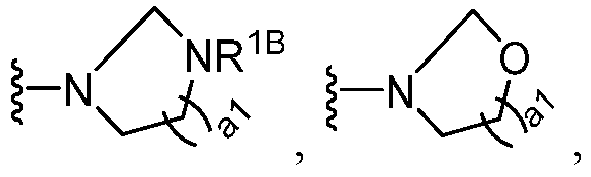


- In embodiments, R1 is 5- or 6-membered unsubstituted heteroaryl. In embodiments, R1 is an optionally substituted 5- or 6-membered heteroaryl comprising a substitutent (e.g., 1, 2, or 3 substituents) selected from h F, Cl, Br, -CN, -NR4R5, -NO2, -CF3, -OCF3, -OH, -Ci-C6alkyl, or -OC1-C6alkyl. In embodiments, R1 is optionally substituted bicyclic heteroaryl ring (e.g., benzothiophene, benzofuran, indole, oxindole, or benzimidazole). In embodiments, R1 is substituted or unsubstituted alkyl, substituted or unsubstituted cycloalkyl, or substituted or unsubstituted heterocycloalkyl. In embodiments, R1 is substituted or unsubstituted alkoxy. In embodiments, R1 is haloalkyl, or haloalkoxy
- In embodiments, R2 is selected from the group consisting of substituted or unsubstituted phenyl, substituted or unsubstituted 5- or 6-membered heteroaryl, substituted or unsubstituted alkyl, substituted or unsubstituted cycloalkyl, and substituted or unsubstituted heterocycloalkyl. In embodiments, R2 is ―O(substituted or unsubstituted alkyl). In embodiments, R2 is haloalkyl, or haloalkoxy.
- In embodiments, R3 is independently hydrogen, F, Cl, Br, -CN, -CF3, -OCF3, or ― OH. In embodiments, R3 is substituted or unsubstituted C1-C6 alkyl, -O-substituted or unsubstituted C1-C6 alkyl), -C(=O)( substituted or unsubstituted C1-C6 alkyl), or CO2H. In embodiments, R3 is substituted or unsubstituted alkyl, substituted or unsubstituted heteroalkyl, substituted or unsubstituted cycloalkyl, substituted or unsubstituted heterocycloalkyl, substituted or unsubstituted aryl, or substituted or unsubstituted heteroaryl. In embodmients, R3 is -NR13R14, -OR16, -C(O)NR13R14, or -C(O)-OR15.
- In embodiments, R4 is independently hydrogen, F, Cl, Br, -CN, -CF3, -OCF3, or - OH. In embodiments, R4 is substituted or unsubstituted C1-C6 alkyl, -O-substituted or unsubstituted C1-C6 alkyl), -C(=O)( substituted or unsubstituted C1-C6 alkyl), or CO2H. In embodiments, R4 is substituted or unsubstituted alkyl, substituted or unsubstituted heteroalkyl, substituted or unsubstituted cycloalkyl, substituted or unsubstituted heterocycloalkyl, substituted or unsubstituted aryl, or substituted or unsubstituted heteroaryl. In embodmients, R4 is -NR17R18, -OR20, -C(O)NR17R18, or -C(O)-OR19.
- In embodiments, R5 is independently hydrogen, F, Cl, Br, -CN, -CF3, -OCF3, or ― OH. In embodiments, R5 is substituted or unsubstituted C1-C6 alkyl, -O-substituted or unsubstituted C1-C6 alkyl), -C(=O)( substituted or unsubstituted C1-C6 alkyl), or CO2H. In embodiments, R5 is substituted or unsubstituted alkyl, substituted or unsubstituted heteroalkyl, substituted or unsubstituted cycloalkyl, substituted or unsubstituted heterocycloalkyl, substituted or unsubstituted aryl, or substituted or unsubstituted heteroaryl. In embodmients, R5 is ―NR21R22, -OR24, -C(O)NR21R22, or -C(O)-OR23.
- In embodiments, R6 is independently hydrogen, F, Cl, Br, -CN, -CF3, -OCF3, or - OH. In embodiments, R6 is substituted or unsubstituted C1-C6 alkyl, -O-substituted or unsubstituted C1-C6 alkyl), -C(=O)( substituted or unsubstituted C1-C6 alkyl), or CO2H. In embodiments, R6 is substituted or unsubstituted alkyl, substituted or unsubstituted heteroalkyl, substituted or unsubstituted cycloalkyl, substituted or unsubstituted heterocycloalkyl, substituted or unsubstituted aryl, or substituted or unsubstituted heteroaryl. In embodmients, R6 is ―NR25R26, -OR28, -C(O)NR25R26, or -C(O)-OR27.
- In embodiments, the compound has a structure according to the formula,

- Z is independently a covalent bond, -O-, -NR9-, -NR9C(O)-, -C(O)NR9-, -O-C(O)-, or -C(O)-O-.
- L1 is independently a bond, substituted or unsubstituted alkylene, substituted or unsubstituted heteroalkylene, substituted or unsubstituted cycloalkylene, substituted or unsubstituted heterocycloalkylene, substituted or unsubstituted arylene, or substituted or unsubstituted heteroarylene.
- R1 is independently hydrogen, -NR10R11, -OR12, substituted or unsubstituted alkyl, substituted or unsubstituted heteroalkyl, substituted or unsubstituted cycloalkyl, substituted or unsubstituted heterocycloalkyl, substituted or unsubstituted aryl, or substituted or unsubstituted heteroaryl.
- R2 is independently hydrogen, substituted or unsubstituted alkyl, substituted or unsubstituted heteroalkyl, substituted or unsubstituted cycloalkyl, substituted or unsubstituted heterocycloalkyl, substituted or unsubstituted aryl, or substituted or unsubstituted heteroaryl.
- R3 is independently hydrogen, halogen, -CX3 3, -CHX3 2, - CH2X3, -OCX3 3, -OCHX3 2, -OCH2X3, -CN, -SOn3R16, -SOv3NR13R14, -NHC(O)NR13R14 -N(O)m3, -NR13R14, -C(O)R15, -C(O)-OR15, -C(O)NR13R14, -OR16, -NR13SO2R16, -NR13C(O) R15, -NR13C(O)OR15, -NR13OR15, substituted or unsubstituted alkyl, substituted or unsubstituted heteroalkyl, substituted or unsubstituted cycloalkyl, substituted or unsubstituted heterocycloalkyl, substituted or unsubstituted aryl, or substituted or unsubstituted heteroaryl.
- R4 is independently hydrogen, halogen, -CX4 3, -CHX4 2, - CH2X4, -OCX4 3, -OCHX4 2, -OCH2X4, -CN, -SOn4R20, -SOv4NR17R18, -NHC(O)NR17R18, -N(O)m4, -NR17R18, -C(O)R19, -C(O)-OR19, -C(O)NR17R18, -OR20, -NR17SO2R20, -NR17C(O) R19, -NR17C(O)OR19, -NR17OR19, substituted or unsubstituted alkyl, substituted or unsubstituted heteroalkyl, substituted or unsubstituted cycloalkyl, substituted or unsubstituted heterocycloalkyl, substituted or unsubstituted aryl, or substituted or unsubstituted heteroaryl.
- R5 is independently hydrogen, halogen, -CX5 3, -CHX5 2, - CH2X5, -OCX5 3, -OCHX5 2, -OCH2X5, -CN, -SOn5R24, -SOv5NR21R22, -NHC(O)NR21R22 -N(O)m5, -NR21R22, -C(O)R23, -C(O)-OR23, -C(O)NR21R22 -OR24, -NR21SO2R24, -NR21C(O) R23, -NR21C(O)OR23, -NR21OR23, substituted or unsubstituted alkyl, substituted or unsubstituted heteroalkyl, substituted or unsubstituted cycloalkyl, substituted or unsubstituted heterocycloalkyl, substituted or unsubstituted aryl, or substituted or unsubstituted heteroaryl.
- R6 is independently hydrogen, halogen, -CX6 3, -CHX6 2, - CH2X6, -OCX6 3, -OCHX6 2, -OCH2X6, -CN, -SOn6R28, -SOv6NR25R26, -NHC(O)NR25R26, -N(O)m6, -NR25R26 -C(O)R27 -C(O)-OR27, -C(O)NR25R26 -OR28, -NR25SO2R28, -NR25C(O) R27, -NR25C(O)OR27, -NR25OR27, substituted or unsubstituted alkyl, substituted or unsubstituted heteroalkyl, substituted or unsubstituted cycloalkyl, substituted or unsubstituted heterocycloalkyl, substituted or unsubstituted aryl, or substituted or unsubstituted heteroaryl.
- Each R7, R8, R9, R10, R11, R12, R13, R14, R15, R16, R17, R18, R19, R20, R21, R22, R23, R24, R25, R26, R27, and R28 is independently hydrogen, -CX3, -CN, -COOH, -CONH2, -CHX2, -CH2X, substituted or unsubstituted alkyl, substituted or unsubstituted heteroalkyl, substituted or unsubstituted cycloalkyl, substituted or unsubstituted heterocycloalkyl, substituted or unsubstituted aryl, or substituted or unsubstituted heteroaryl; R6 and R7, R10 and R11, R14 and R15, and R18 and R19 substituents bonded to the same nitrogen atom may optionally be joined to form a substituted or unsubstituted heterocycloalkyl or substituted or unsubstituted heteroaryl.
- Each X3, X4, X5, and X6 is independently ―F, -Cl, -Br, or ―I.
- Each m3, m4, m5, and m6 is independently 1 or 2.
- Each n3, n4, n5, and n6 is independently an integer from 0 to 3.
- Each v3, v4, v5, and v6 is independently 1 or 2.
- In embodiments, when R3-R6 are each H, and ―Z-L1-R2 is


- In embodiments, Z is independently a covalent bond or -NR9-; L1 is independently a bond, substituted or unsubstituted alkylene, substituted or unsubstituted heteroalkylene, substituted or unsubstituted arylene, or substituted or unsubstituted heteroarylene; and R2 is independently substituted or unsubstituted alkyl, substituted or unsubstituted heteroalkyl, substituted or unsubstituted cycloalkyl, substituted or unsubstituted heterocycloalkyl, substituted or unsubstituted aryl, or substituted or unsubstituted heteroaryl.
- In embodiments, Z is independently -NR9-; L1 is independently substituted or unsubstituted alkylene or substituted or unsubstituted arylene; and R2 is independently substituted or unsubstituted alkyl or substituted or unsubstituted heterocycloalkyl.
- In embodiments, Z is independently -NH-; L1 is independently substituted or unsubstituted C3-C6 alkylene; and R2 is substituted or unsubstituted heterocycloalkyl.
- In embodiments, Z is independently -NH-; L1 is independently substituted or unsubstituted arylene; R2 is independently C1-C3 alkyl comprising a substituent group R2A; R2A is independently -NR2BR2C, substituted or unsubstituted cycloalkyl, substituted or unsubstituted heterocycloalkyl, substituted or unsubstituted aryl, or substituted or unsubstituted heteroaryl; and each of R2B and R2C is independently hydrogen, substituted or unsubstituted alkyl, substituted or unsubstituted heteroalkyl, substituted or unsubstituted cycloalkyl, substituted or unsubstituted heterocycloalkyl, substituted or unsubstituted aryl, or substituted or unsubstituted heteroaryl, or wherein R2B and R2C combine to form a substituted or unsubstituted heterocycloalkyl.
- In embodiments, R1 is substituted or unsubstituted aryl or substituted or unsubstituted heteroaryl.
- In embodiments, R1 is aryl or heteroaryl comprising a substituent group R1A; R1A is independently halogen, -CN, -OR1B, -SR1B, - NR1CR1D,―NR1CC(O)R1B, -C(O)NR1CR1D, -CO2R1B, substituted or unsubstituted alkyl, or substituted or unsubstituted heteroalkyl; each of R1B and R1C is independently hydrogen, substituted or unsubstituted alkyl, substituted or unsubstituted heteroalkyl, substituted or unsubstituted cycloalkyl, substituted or unsubstituted heterocycloalkyl, substituted or unsubstituted aryl, or substituted or unsubstituted heteroaryl; R1D is independently substituted or unsubstituted alkyl, substituted or unsubstituted heteroalkyl, substituted or unsubstituted cycloalkyl, substituted or unsubstituted heterocycloalkyl, substituted or unsubstituted aryl, or substituted or unsubstituted heteroaryl; or wherein R1C and R1D attached to the same nitrogen atom optionally combine to form a substituted or unsubstituted heterocycloalkyl.
- In embodiments, R1 is phenyl comprising a substituent group -C(O)NR1CR1D.
- In embodiments, the compound has a structure according to the formula,

- R1 is substituted or unsubstituted heteroaryl or phenyl comprising a substituent group R1A.
- R2 is substituted or unsubstituted cycloalkyl or substituted or unsubstituted heterocycloalkyl.
- R1A is independently halogen, -CN, -OR1B, -SR1B, - NR1CR1D,―NR1CC(O)R1B, -C(O)NR1CR1D, -CO2R1B, substituted or unsubstituted alkyl, or substituted or unsubstituted heteroalkyl.
- Each of R1B and R1C is independently hydrogen, substituted or unsubstituted alkyl, substituted or unsubstituted heteroalkyl, substituted or unsubstituted cycloalkyl, substituted or unsubstituted heterocycloalkyl, substituted or unsubstituted aryl, or substituted or unsubstituted heteroaryl.
- R1D is independently substituted or unsubstituted alkyl, substituted or unsubstituted heteroalkyl, substituted or unsubstituted cycloalkyl, substituted or unsubstituted heterocycloalkyl, substituted or unsubstituted aryl, or substituted or unsubstituted heteroaryl; or wherein R1C and R1D attached to the same nitrogen atom optionally combine to form a substituted or unsubstituted heterocycloalkyl.
- In embodiments, the compound has a structure according to the formula,

- R1 is substituted or unsubstituted heteroaryl or phenyl comprising a substituent group R1A.
- L1 is independently substituted or unsubstituted arylene.
- R1A is independently halogen, -CN, -OR1B, -SR1B, - NR1CR1D,―NR1CC(O)R1B, -C(O)NR1CR1D, -CO2R1B, substituted or unsubstituted alkyl, or substituted or unsubstituted heteroalkyl.
- Each of R1B and R1C is independently hydrogen, substituted or unsubstituted alkyl, substituted or unsubstituted heteroalkyl, substituted or unsubstituted cycloalkyl, substituted or unsubstituted heterocycloalkyl, substituted or unsubstituted aryl, or substituted or unsubstituted heteroaryl.
- R1D is independently substituted or unsubstituted alkyl, substituted or unsubstituted heteroalkyl, substituted or unsubstituted cycloalkyl, substituted or unsubstituted heterocycloalkyl, substituted or unsubstituted aryl, or substituted or unsubstituted heteroaryl; or wherein R1C and R1D attached to the same nitrogen atom optionally combine to form a substituted or unsubstituted heterocycloalkyl.
- R2A is independently ―NR2B R2C, substituted or unsubstituted cycloalkyl, substituted or unsubstituted heterocycloalkyl, substituted or unsubstituted aryl, or substituted or unsubstituted heteroaryl.
- Each of R2B and R2C is independently hydrogen, substituted or unsubstituted alkyl, substituted or unsubstituted heteroalkyl, substituted or unsubstituted cycloalkyl, substituted or unsubstituted heterocycloalkyl, substituted or unsubstituted aryl, or substituted or unsubstituted heteroaryl, or wherein R2B and R2C combine to form a substituted or unsubstituted heterocycloalkyl.
- In embodiments, R1 is phenyl comprising a substituent group R1A; and R1A is -C(O)NR1CR1D
- In embodiments, R1A is para to the carbon attached to the quinoline moiety.
- In embodiments, the compound has a structure according to the formula,

- R1C is independently hydrogen, substituted or unsubstituted alkyl, substituted or unsubstituted heteroalkyl, substituted or unsubstituted cycloalkyl, substituted or unsubstituted heterocycloalkyl, substituted or unsubstituted aryl, or substituted or unsubstituted heteroaryl.
- R1D is independently substituted or unsubstituted alkyl, substituted or unsubstituted heteroalkyl, substituted or unsubstituted cycloalkyl, substituted or unsubstituted heterocycloalkyl, substituted or unsubstituted aryl, or substituted or unsubstituted heteroaryl; or wherein R1C and R1D attached to the same nitrogen atom optionally combine to form a substituted or unsubstituted heterocycloalkyl.
- In embodiments, Z is independently -NR9-; and L1 is independently substituted or unsubstituted alkylene or substituted or unsubstituted arylene.
- In embodiments, each of R3, R4, R5, R6, and R8 is hydrogen.
- In embodiments, the compound has a structure according to the formula,

- X is independently N or CR7.
- Y is independently N or CR8.
- Z is independently a covalent bond, -O-, -NR9-, -NR9C(O)-, -C(O)NR9-, -O-C(O)-, or -C(O)-O-.
- L1 is a bond, and R2 is unsubstituted alkyl or substituted or unsubstituted heterocycloalkyl; or L1 is substituted or unsubstituted C2-C6 alkylene, and R2 is or substituted or unsubstituted heterocycloalkyl, where said heterocycloalkyl is not unsubstituted morpholine.
- R1 is independently hydrogen, -NR10R11, -OR12, substituted or unsubstituted alkyl, substituted or unsubstituted heteroalkyl, substituted or unsubstituted cycloalkyl, substituted or unsubstituted heterocycloalkyl, substituted or unsubstituted aryl, or substituted or unsubstituted heteroaryl.
- R3 is independently hydrogen, halogen, -CX3 3, -CHX3 2, - CH2X3, -OCX3 3, -OCHX3 2, -OCH2X3, -CN, -SOn3R16, -SOv3NR13R14, -NHC(O(NR13R14, -N(O)m3, -NR13R14, -C(O)R15, -C(O)-OR15, -C(O)NR13R14, -OR16, -NR13SO2R16, -NR13C(O) R15, -NR13C(O)OR15, -NR13OR15, substituted or unsubstituted alkyl, substituted or unsubstituted heteroalkyl, substituted or unsubstituted cycloalkyl, substituted or unsubstituted heterocycloalkyl, substituted or unsubstituted aryl, or substituted or unsubstituted heteroaryl.
- R4 is independently hydrogen, halogen, -CX4 3, -CHX4 2, - CH2X4, -OCX4 3, -OCHX4 2, -OCH2X4, -CN, -SOn4R20, -SOv4NR17R18, -NHC(O)NR17R18, -N(O)m4, -NR17R18, -C(O)R19, -C(O)-OR19, -C(O)NR17R18, -OR20, -NR17SO2R20, -NR17C(O) R19, -NR17C(O)OR19, -NR17OR19, substituted or unsubstituted alkyl, substituted or unsubstituted heteroalkyl, substituted or unsubstituted cycloalkyl, substituted or unsubstituted heterocycloalkyl, substituted or unsubstituted aryl, or substituted or unsubstituted heteroaryl.
- R5 is independently hydrogen, halogen, -CX5 3, -CHX5 2, - CH2X5, -OCX5 3, -OCHX5 2, -OCH2X5, -CN, -SOn5R24, -SOv5NR21R22, -NHC(O)NR21R22 -N(O)m5, -NR21R22, -C(O)R23, -C(O)-OR23, -C(O)NR21R22, -OR24, -NR21SO2R24, -NR21C(O) R23, -NR21C(O)OR23, -NR21OR23, substituted or unsubstituted alkyl, substituted or unsubstituted heteroalkyl, substituted or unsubstituted cycloalkyl, substituted or unsubstituted heterocycloalkyl, substituted or unsubstituted aryl, or substituted or unsubstituted heteroaryl.
- R6 is independently hydrogen, halogen, -CX6 3, -CHX6 2, - CH2X6, -OCX6 3, -OCHX6 2, -OCH2X6, -CN, -SOn6R28, -SOv6NR25R26, -NHC(O)NR25R26, -N(O)m6, -NR25R26,-C(O)R27, -C(O)-OR27, -C(O)NR25R26, -OR28, -NR25SO2R28, -NR25C(O) R27, -NR25C(O)OR27, -NR25OR27, substituted or unsubstituted alkyl, substituted or unsubstituted heteroalkyl, substituted or unsubstituted cycloalkyl, substituted or unsubstituted heterocycloalkyl, substituted or unsubstituted aryl, or substituted or unsubstituted heteroaryl.
- Each R7, R8, R9, R10, R11, R12, R13, R14, R15, R16, R17, R18, R19, R20, R21, R22, R23, R24, R25, R26, R27, and R28 is independently hydrogen, -CX3, -CN, -COOH, -CONH2, -CHX2, -CH2X, substituted or unsubstituted alkyl, substituted or unsubstituted heteroalkyl, substituted or unsubstituted cycloalkyl, substituted or unsubstituted heterocycloalkyl, substituted or unsubstituted aryl, or substituted or unsubstituted heteroaryl; R6 and R7, R10 and R11, R14 and R15, and R18 and R19 substituents bonded to the same nitrogen atom may optionally be joined to form a substituted or unsubstituted heterocycloalkyl or substituted or unsubstituted heteroaryl.
- Each X3, X4, X5, and X6 is independently -F, -Cl, -Br, or ―I.
- Each m3, m4, m5, and m6 is independently 1 or 2.
- Each n3, n4, n5, and n6 is independently an integer from 0 to 3.
- Each v3, v4, v5, and v6 is independently 1 or 2.
- In embodiments, each of R3, R4, R5, R6, and R8 is hydrogen.
- In embodiments, Z is independently a covalent bond. In embodiments, Z is independently -O-. In embodiments, Z is independently -NR9-. In embodiments, Z is independently -NR9C(O)-. In embodiments, Z is independently -C(O)NR9-. In embodiments, Z is independently -O-C(O)-. In embodiments, Z is independently -C(O)-O-.
- In embodiments, L1 is independently a bond. In embodiments, L1 is independently substituted or unsubstituted alkylene. In embodiments, L1 is independently substituted or unsubstituted heteroalkylene. In embodiments, L1 is independently substituted or unsubstituted cycloalkylene. In embodiments, L1 is independently substituted or unsubstituted heterocycloalkylene. In embodiments, L1 is independently substituted or unsubstituted arylene. In embodiments, L1 is independently substituted or unsubstituted heteroarylene. In embodiments, L1 is independently substituted alkylene. In embodiments, L1 is independently substituted heteroalkylene. In embodiments, L1 is independently substituted cycloalkylene. In embodiments, L1 is independently substituted heterocycloalkylene. In embodiments, L1 is independently substituted arylene. In embodiments, L1 is independently substituted heteroarylene. In embodiments, L1 is independently unsubstituted alkylene. In embodiments, L1 is independently unsubstituted heteroalkylene. In embodiments, L1 is independently unsubstituted cycloalkylene. In embodiments, L1 is independently unsubstituted heterocycloalkylene. In embodiments, L1 is independently unsubstituted arylene. In embodiments, L1 is independently unsubstituted heteroarylene.. In embodiments, L1 is independently substituted or unsubstituted C1-C6 alkylene. In embodiments, L1 is independently substituted or unsubstituted 2 to 6 membered heteroalkylene. In embodiments, L1 is independently substituted or unsubstituted C3-C8 cycloalkylene. In embodiments, L1 is independently substituted or unsubstituted 3 to 8 membered heterocycloalkylene. In embodiments, L1 is independently substituted or unsubstituted C6 arylene. In embodiments, L1 is independently substituted or unsubstituted 5 to 6 membered heteroarylene. In embodiments, L1 is independently substituted C1-C6 alkylene. In embodiments, L1 is independently substituted 2 to 6 membered heteroalkylene. In embodiments, L1 is independently substituted C3-C8 cycloalkylene. In embodiments, L1 is independently substituted 3 to 8 membered heterocycloalkylene. In embodiments, L1 is independently substituted C6 arylene. In embodiments, L1 is independently substituted 5 to 6 membered heteroarylene. In embodiments, L1 is independently unsubstituted C1-C6 alkylene. In embodiments, L1 is independently unsubstituted 2 to 6 membered heteroalkylene. In embodiments, L1 is independently unsubstituted C3-C8 cycloalkylene. In embodiments, L1 is independently unsubstituted 3 to 8 membered heterocycloalkylene. In embodiments, L1 is independently unsubstituted C6 arylene. In embodiments, L1 is independently unsubstituted 5 to 6 membered heteroarylene.
- In embodiments, R1 is independently hydrogen. In embodiments, R1 is independently -NR10R11. In embodiments, R1 is independently -OR12. In embodiments, R1 is independently substituted or unsubstituted alkyl. In embodiments, R1 is independently substituted or unsubstituted heteroalkyl. In embodiments, R1 is independently substituted or unsubstituted cycloalkyl. In embodiments, R1 is independently substituted or unsubstituted heterocycloalkyl. In embodiments, R1 is independently substituted or unsubstituted aryl. In embodiments, R1 is independently or substituted or unsubstituted heteroaryl. In embodiments, R1 is independently substituted alkyl. In embodiments, R1 is independently substituted heteroalkyl. In embodiments, R1 is independently substituted cycloalkyl. In embodiments, R1 is independently substituted heterocycloalkyl. In embodiments, R1 is independently substituted aryl. In embodiments, R1 is independently substituted heteroaryl. In embodiments, R1 is independently unsubstituted alkyl. In embodiments, R1 is independently unsubstituted heteroalkyl. In embodiments, R1 is independently unsubstituted cycloalkyl. In embodiments, R1 is independently unsubstituted heterocycloalkyl. In embodiments, R1 is independently unsubstituted aryl. In embodiments, R1 is independently unsubstituted heteroaryl. In embodiments, R1 is independently substituted or unsubstituted C1-C6 alkyl. In embodiments, R1 is independently substituted or unsubstituted 2 to 6 membered heteroalkyl. In embodiments, R1 is independently independently substituted or unsubstituted C3-C8 cycloalkyl. In embodiments, R1 is independently independently substituted or unsubstituted 3 to 8 membered heterocycloalkyl. In embodiments, R1 is independently substituted or unsubstituted C6 aryl. In embodiments, R1 is independently substituted or unsubstituted 5 to 6 membered heteroaryl. In embodiments, R1 is independently substituted C1-C6 alkyl. In embodiments, R1 is independently substituted 2 to 6 membered heteroalkyl. In embodiments, R1 is independently substituted C3-C8 cycloalkyl. In embodiments, R1 is independently substituted 3 to 8 membered heterocycloalkyl. In embodiments, R1 is independently substituted C6 aryl. In embodiments, R1 is independently substituted 5 to 6 membered heteroaryl. In embodiments, R1 is independently unsubstituted C1-C6 alkyl. In embodiments, R1 is independently unsubstituted 2 to 6 membered heteroalkyl. In embodiments, R1 is independently unsubstituted C3-C8 cycloalkyl. In embodiments, R1 is independently unsubstituted 3 to 8 membered heterocycloalkyl. In embodiments, R1 is independently unsubstituted C6 aryl. In embodiments, R1 is independently unsubstituted 5 to 6 membered heteroaryl.
- In embodiments, R2 is independently hydrogen. In embodiments, R2 is independently substituted or unsubstituted alkyl. In embodiments, R2 is independently substituted or unsubstituted heteroalkyl. In embodiments, R2 is independently substituted or unsubstituted cycloalkyl. In embodiments, R2 is independently substituted or unsubstituted heterocycloalkyl. In embodiments, R2 is independently substituted or unsubstituted aryl. In embodiments, R2 is independently substituted or unsubstituted heteroaryl. In embodiments, R2 is independently substituted alkyl. In embodiments, R2 is independently substituted heteroalkyl. In embodiments, R2 is independently substituted cycloalkyl. In embodiments, R2 is independently substituted heterocycloalkyl. In embodiments, R2 is independently substituted aryl. In embodiments, R2 is independently substituted heteroaryl. In embodiments, R2 is independently unsubstituted alkyl. In embodiments, R2 is independently unsubstituted heteroalkyl. In embodiments, R2 is independently unsubstituted cycloalkyl. In embodiments, R2 is independently unsubstituted heterocycloalkyl. In embodiments, R2 is independently unsubstituted aryl. In embodiments, R2 is independently unsubstituted heteroaryl. In embodiments, R2 is independently substituted or unsubstituted C1-C6 alkyl. In embodiments, R2 is independently substituted or unsubstituted 2 to 6 membered heteroalkyl. In embodiments, R2 is independently independently substituted or unsubstituted C3-C8 cycloalkyl. In embodiments, R2 is independently independently substituted or unsubstituted 3 to 8 membered heterocycloalkyl. In embodiments, R2 is independently substituted or unsubstituted C6 aryl. In embodiments, R2 is independently substituted or unsubstituted 5 to 6 membered heteroaryl. In embodiments, R2 is independently substituted C1-C6 alkyl. In embodiments, R2 is independently substituted 2 to 6 membered heteroalkyl. In embodiments, R2 is independently substituted C3-C8 cycloalkyl. In embodiments, R2 is independently substituted 3 to 8 membered heterocycloalkyl. In embodiments, R2 is independently substituted C6 aryl. In embodiments, R2 is independently substituted 5 to 6 membered heteroaryl. In embodiments, R2 is independently unsubstituted C1-C6 alkyl. In embodiments, R2 is independently unsubstituted 2 to 6 membered heteroalkyl. In embodiments, R2 is independently unsubstituted C3-C8 cycloalkyl. In embodiments, R2 is independently unsubstituted 3 to 8 membered heterocycloalkyl. In embodiments, R2 is independently unsubstituted C6 aryl. In embodiments, R2 is independently unsubstituted 5 to 6 membered heteroaryl.
- In embodiments, R3 is independently hydrogen. In embodiments, R3 is independently halogen. In embodiments, R3 is independently -CX3 3. In embodiments, R3 is independently -CHX3 2. In embodiments, R3 is independently -CH2X3. In embodiments, R3 is independently -OCX3 3. In embodiments, R3 is independently -OCHX3 2. In embodiments, R3 is independently -OCH2X3. In embodiments, R3 is independently -CN, -SOn3R16. In embodiments, R3 is independently -SOv3NR13R14. In embodiments, R3 is independently -NHC(O)NR13R14. In embodiments, R3 is independently -N(O)m3. In embodiments, R3 is independently -NR13R14, -C(O)R15. In embodiments, R3 is independently -C(O)-OR15 . In embodiments, R3 is independently -C(O)NR13R14. In embodiments, R3 is independently -OR16. In embodiments, R3 is independently -NR13SO2R16. In embodiments, R3 is independently -NR13C(O)R15. In embodiments, R3 is independently -NR13C(O)OR15. In embodiments, R3 is independently -NR13OR15. In embodiments, R3 is independently substituted or unsubstituted alkyl. In embodiments, R3 is independently substituted or unsubstituted heteroalkyl. In embodiments, R3 is independently substituted or unsubstituted cycloalkyl. In embodiments, R3 is independently substituted or unsubstituted heterocycloalkyl. In embodiments, R3 is independently substituted or unsubstituted aryl. In embodiments, R3 is independently substituted or unsubstituted heteroaryl. In embodiments, R3 is independently substituted alkyl. In embodiments, R3 is independently substituted heteroalkyl. In embodiments, R3 is independently substituted cycloalkyl. In embodiments, R3 is independently substituted heterocycloalkyl. In embodiments, R3 is independently substituted aryl. In embodiments, R3 is independently substituted heteroaryl. In embodiments, R3 is independently unsubstituted alkyl. In embodiments, R3 is independently unsubstituted heteroalkyl. In embodiments, R3 is independently unsubstituted cycloalkyl. In embodiments, R3 is independently unsubstituted heterocycloalkyl. In embodiments, R3 is independently unsubstituted aryl. In embodiments, R3 is independently unsubstituted heteroaryl. In embodiments, R3 is independently substituted or unsubstituted C1-C6 alkyl. In embodiments, R3 is independently substituted or unsubstituted 2 to 6 membered heteroalkyl. In embodiments, R3 is independently independently substituted or unsubstituted C3-C8 cycloalkyl. In embodiments, R3 is independently independently substituted or unsubstituted 3 to 8 membered heterocycloalkyl. In embodiments, R3 is independently substituted or unsubstituted C6 aryl. In embodiments, R3 is independently substituted or unsubstituted 5 to 6 membered heteroaryl. In embodiments, R3 is independently substituted C1-C6 alkyl. In embodiments, R3 is independently substituted 2 to 6 membered heteroalkyl. In embodiments, R3 is independently substituted C3-C8 cycloalkyl. In embodiments, R3 is independently substituted 3 to 8 membered heterocycloalkyl. In embodiments, R3 is independently substituted C6 aryl. In embodiments, R3 is independently substituted 5 to 6 membered heteroaryl. In embodiments, R3 is independently unsubstituted C1-C6 alkyl. In embodiments, R3 is independently unsubstituted 2 to 6 membered heteroalkyl. In embodiments, R3 is independently unsubstituted C3-C8 cycloalkyl. In embodiments, R3 is independently unsubstituted 3 to 8 membered heterocycloalkyl. In embodiments, R3 is independently unsubstituted C6 aryl. In embodiments, R3 is independently unsubstituted 5 to 6 membered heteroaryl.
- In embodiments, R4 is independently hydrogen. In embodiments, R4 is independently halogen. In embodiments, R4 is independently -CX4 3. In embodiments, R4 is independently -CHX4 2. In embodiments, R4 is independently -CH2X4. In embodiments, R4 is independently -OCX4 3. In embodiments, R4 is independently -OCHX4 2. In embodiments, R4 is independently -OCH2X4. In embodiments, R4 is independently -CN. In embodiments, R4 is independently -SOn4R20. In embodiments, R4 is independently -SOv4NR17R18. In embodiments, R4 is independently -NHC(O)NR17R18. In embodiments, R4 is independently -N(O)m4. In embodiments, R4 is independently -NR17R18. In embodiments, R4 is independently -C(O)R19. In embodiments, R4 is independently -C(O)-OR19. In embodiments, R4 is independently -C(O)NR17R18. In embodiments, R4 is independently -OR20. In embodiments, R4 is independently -NR17SO2R20. In embodiments, R4 is independently -NR17C(O)R19. In embodiments, R4 is independently -NR17C(O)OR19. In embodiments, R4 is independently -NR17OR19. In embodiments, R4 is independently substituted or unsubstituted alkyl. In embodiments, R4 is independently substituted or unsubstituted heteroalkyl. In embodiments, R4 is independently substituted or unsubstituted cycloalkyl. In embodiments, R4 is independently substituted or unsubstituted heterocycloalkyl. In embodiments, R4 is independently substituted or unsubstituted aryl. In embodiments, R4 is independently or substituted or unsubstituted heteroaryl. In embodiments, R4 is independently substituted alkyl. In embodiments, R4 is independently substituted heteroalkyl. In embodiments, R4 is independently substituted cycloalkyl. In embodiments, R4 is independently substituted heterocycloalkyl. In embodiments, R4 is independently substituted aryl. In embodiments, R4 is independently substituted heteroaryl. In embodiments, R4 is independently unsubstituted alkyl. In embodiments, R4 is independently unsubstituted heteroalkyl. In embodiments, R4 is independently unsubstituted cycloalkyl. In embodiments, R4 is independently unsubstituted heterocycloalkyl. In embodiments, R4 is independently unsubstituted aryl. In embodiments, R4 is independently unsubstituted heteroaryl. In embodiments, R4 is independently substituted or unsubstituted C1-C6 alkyl. In embodiments, R4 is independently substituted or unsubstituted 2 to 6 membered heteroalkyl. In embodiments, R4 is independently independently substituted or unsubstituted C3-C8 cycloalkyl. In embodiments, R4 is independently independently substituted or unsubstituted 3 to 8 membered heterocycloalkyl. In embodiments, R4 is independently substituted or unsubstituted C6 aryl. In embodiments, R4 is independently substituted or unsubstituted 5 to 6 membered heteroaryl. In embodiments, R4 is independently substituted C1-C6 alkyl. In embodiments, R4 is independently substituted 2 to 6 membered heteroalkyl. In embodiments, R4 is independently substituted C3-C8 cycloalkyl. In embodiments, R4 is independently substituted 3 to 8 membered heterocycloalkyl. In embodiments, R4 is independently substituted C6 aryl. In embodiments, R4 is independently substituted 5 to 6 membered heteroaryl. In embodiments, R4 is independently unsubstituted C1-C6 alkyl. In embodiments, R4 is independently unsubstituted 2 to 6 membered heteroalkyl. In embodiments, R4 is independently unsubstituted C3-C8 cycloalkyl. In embodiments, R4 is independently unsubstituted 3 to 8 membered heterocycloalkyl. In embodiments, R4 is independently unsubstituted C6 aryl. In embodiments, R4 is independently unsubstituted 5 to 6 membered heteroaryl.
- In embodiments, R5 is independently hydrogen. In embodiments, R5 is independently halogen. In embodiments, R5 is independently -CX5 3. In embodiments, R5 is independently -CHX5 2. In embodiments, R5 is independently -CH2X5. In embodiments, R5 is independently -OCX5 3. In embodiments, R5 is independently -OCHX5 2. In embodiments, R5 is independently -OCH2X5. In embodiments, R5 is independently -CN. In embodiments, R5 is independently -SOn5R24 . In embodiments, R5 is independently -SOv5NR21R22. In embodiments, R5 is independently -NHC(O)NR21R22. In embodiments, R5 is independently-N(O)m5. In embodiments, R5 is independently -NR21R22. In embodiments, R5 is independently -C(O)R23. In embodiments, R5 is independently -C(O)-OR23. In embodiments, R5 is independently -C(O)NR21R22. In embodiments, R5 is independently -OR24. In embodiments, R5 is independently -NR21SO2R24. In embodiments, R5 is independently -NR21C(O)R23. In embodiments, R5 is independently -NR21C(O)OR23. In embodiments, R5 is independently -NR21OR23. In embodiments, R5 is independently substituted or unsubstituted alkyl. In embodiments, R5 is independently substituted or unsubstituted heteroalkyl. In embodiments, R5 is independently substituted or unsubstituted cycloalkyl. In embodiments, R5 is independently substituted or unsubstituted heterocycloalkyl. In embodiments, R5 is independently substituted or unsubstituted aryl. In embodiments, R5 is independently or substituted or unsubstituted heteroaryl. In embodiments, R5 is independently substituted alkyl. In embodiments, R5 is independently substituted heteroalkyl. In embodiments, R5 is independently substituted cycloalkyl. In embodiments, R5 is independently substituted heterocycloalkyl. In embodiments, R5 is independently substituted aryl. In embodiments, R5 is independently substituted heteroaryl. In embodiments, R5 is independently unsubstituted alkyl. In embodiments, R5 is independently unsubstituted heteroalkyl. In embodiments, R5 is independently unsubstituted cycloalkyl. In embodiments, R5 is independently unsubstituted heterocycloalkyl. In embodiments, R5 is independently unsubstituted aryl. In embodiments, R5 is independently unsubstituted heteroaryl. In embodiments, R5 is independently substituted or unsubstituted C1-C6 alkyl. In embodiments, R5 is independently substituted or unsubstituted 2 to 6 membered heteroalkyl. In embodiments, R5 is independently independently substituted or unsubstituted C3-C8 cycloalkyl. In embodiments, R5 is independently independently substituted or unsubstituted 3 to 8 membered heterocycloalkyl. In embodiments, R5 is independently substituted or unsubstituted C6 aryl. In embodiments, R5 is independently substituted or unsubstituted 5 to 6 membered heteroaryl. In embodiments, R5 is independently substituted C1-C6 alkyl. In embodiments, R5 is independently substituted 2 to 6 membered heteroalkyl. In embodiments, R5 is independently substituted C3-C8 cycloalkyl. In embodiments, R5 is independently substituted 3 to 8 membered heterocycloalkyl. In embodiments, R5 is independently substituted C6 aryl. In embodiments, R5 is independently substituted 5 to 6 membered heteroaryl. In embodiments, R5 is independently unsubstituted C1-C6 alkyl. In embodiments, R5 is independently unsubstituted 2 to 6 membered heteroalkyl. In embodiments, R5 is independently unsubstituted C3-C8 cycloalkyl. In embodiments, R5 is independently unsubstituted 3 to 8 membered heterocycloalkyl. In embodiments, R5 is independently unsubstituted C6 aryl. In embodiments, R5 is independently unsubstituted 5 to 6 membered heteroaryl.
- In embodiments, R6 is independently hydrogen. In embodiments, R6 is independently halogen. In embodiments, R6 is independently -CX6 3. In embodiments, R6 is independently -CHX6 2. In embodiments, R6 is independently -CH2X6. In embodiments, R6 is independently -OCX6 3. In embodiments, R6 is independently -OCHX6 2. In embodiments, R6 is independently -OCH2X6. In embodiments, R6 is independently -CN. In embodiments, R6 is independently -SOn6R28. In embodiments, R6 is independently -SOv6NR25R26. In embodiments, R6 is independently -NHC(O)NR25R26. In embodiments, R6 is independently -N(O)m6. In embodiments, R6 is independently -NR25R26. In embodiments, R6 is independently -C(O)R27. In embodiments, R6 is independently -C(O)-OR27. In embodiments, R6 is independently -C(O)NR25R26. In embodiments, R6 is independently -OR28. In embodiments, R6 is independently -NR25SO2R28. In embodiments, R6 is independently -NR25C(O)R27. In embodiments, R6 is independently -NR25C(O)OR27. In embodiments, R6 is independently -NR25OR27. In embodiments, R6 is independently substituted or unsubstituted alkyl. In embodiments, R6 is independently substituted or unsubstituted heteroalkyl. In embodiments, R6 is independently substituted or unsubstituted cycloalkyl. In embodiments, R6 is independently substituted or unsubstituted heterocycloalkyl. In embodiments, R6 is independently substituted or unsubstituted aryl. In embodiments, R6 is independently or substituted or unsubstituted heteroaryl. In embodiments, R6 is independently substituted alkyl. In embodiments, R6 is independently substituted heteroalkyl. In embodiments, R6 is independently substituted cycloalkyl. In embodiments, R6 is independently substituted heterocycloalkyl. In embodiments, R6 is independently substituted aryl. In embodiments, R6 is independently substituted heteroaryl. In embodiments, R6 is independently unsubstituted alkyl. In embodiments, R6 is independently unsubstituted heteroalkyl. In embodiments, R6 is independently unsubstituted cycloalkyl. In embodiments, R6 is independently unsubstituted heterocycloalkyl. In embodiments, R6 is independently unsubstituted aryl. In embodiments, R6 is independently unsubstituted heteroaryl. In embodiments, R6 is independently substituted or unsubstituted C1-C6 alkyl. In embodiments, R6 is independently substituted or unsubstituted 2 to 6 membered heteroalkyl. In embodiments, R6 is independently independently substituted or unsubstituted C3-C8 cycloalkyl. In embodiments, R6 is independently independently substituted or unsubstituted 3 to 8 membered heterocycloalkyl. In embodiments, R6 is independently substituted or unsubstituted C6 aryl. In embodiments, R6 is independently substituted or unsubstituted 5 to 6 membered heteroaryl. In embodiments, R6 is independently substituted C1-C6 alkyl. In embodiments, R6 is independently substituted 2 to 6 membered heteroalkyl. In embodiments, R6 is independently substituted C3-C8 cycloalkyl. In embodiments, R6 is independently substituted 3 to 8 membered heterocycloalkyl. In embodiments, R6 is independently substituted C6 aryl. In embodiments, R6 is independently substituted 5 to 6 membered heteroaryl. In embodiments, R6 is independently unsubstituted C1-C6 alkyl. In embodiments, R6 is independently unsubstituted 2 to 6 membered heteroalkyl. In embodiments, R6 is independently unsubstituted C3-C8 cycloalkyl. In embodiments, R6 is independently unsubstituted 3 to 8 membered heterocycloalkyl. In embodiments, R6 is independently unsubstituted C6 aryl. In embodiments, R6 is independently unsubstituted 5 to 6 membered heteroaryl.
- In embodiments, each R7 is independently hydrogen. In embodiments, each R7 is independently -CX3. In embodiments, each R7 is independently -CN. In embodiments, each R7 is independently -COOH. In embodiments, each R7 is independently -CONH2. In embodiments, each R7 is independently -CHX2. In embodiments, each R7 is independently -CH2X. In embodiments, each R7 is independently substituted or unsubstituted alkyl. In embodiments, each R7 is independently substituted or unsubstituted heteroalkyl. In embodiments, each R7 is independently substituted or unsubstituted cycloalkyl. In embodiments, each R7 is independently substituted or unsubstituted heterocycloalkyl. In embodiments, each R7 is independently substituted or unsubstituted aryl. In embodiments, each R7 is independently or substituted or unsubstituted heteroaryl. In embodiments, R7 is independently substituted alkyl. In embodiments, R7 is independently substituted heteroalkyl. In embodiments, R7 is independently substituted cycloalkyl. In embodiments, R7 is independently substituted heterocycloalkyl. In embodiments, R7 is independently substituted aryl. In embodiments, R7 is independently substituted heteroaryl. In embodiments, R7 is independently unsubstituted alkyl. In embodiments, R7 is independently unsubstituted heteroalkyl. In embodiments, R7 is independently unsubstituted cycloalkyl. In embodiments, R7 is independently unsubstituted heterocycloalkyl. In embodiments, R7 is independently unsubstituted aryl. In embodiments, R7 is independently unsubstituted heteroaryl. In embodiments, R7 is independently substituted or unsubstituted C1-C6 alkyl. In embodiments, R7 is independently substituted or unsubstituted 2 to 6 membered heteroalkyl. In embodiments, R7 is independently substituted or unsubstituted C3-C8 cycloalkyl. In embodiments, R7 is independently substituted or unsubstituted 3 to 8 membered heterocycloalkyl. In embodiments, R7 is independently substituted or unsubstituted C6 aryl. In embodiments, R7 is independently substituted or unsubstituted 5 to 6 membered heteroaryl. In embodiments, R7 is independently substituted C1-C6 alkyl. In embodiments, R7 is independently substituted 2 to 6 membered heteroalkyl. In embodiments, R7 is independently substituted C3-C8 cycloalkyl. In embodiments, R7 is independently substituted 3 to 8 membered heterocycloalkyl. In embodiments, R7 is independently substituted C6 aryl. In embodiments, R7 is independently substituted 5 to 6 membered heteroaryl. In embodiments, R7 is independently unsubstituted C1-C6 alkyl. In embodiments, R7 is independently unsubstituted 2 to 6 membered heteroalkyl. In embodiments, R7 is independently unsubstituted C3-C8 cycloalkyl. In embodiments, R7 is independently unsubstituted 3 to 8 membered heterocycloalkyl. In embodiments, R7 is independently unsubstituted C6 aryl. In embodiments, R7 is independently unsubstituted 5 to 6 membered heteroaryl.
- In embodiments, each R8 is independently hydrogen. In embodiments, each R8 is independently -CX3. In embodiments, each R8 is independently -CN. In embodiments, each R8 is independently -COOH. In embodiments, each R8 is independently -CONH2. In embodiments, each R8 is independently -CHX2. In embodiments, each R8 is independently -CH2X. In embodiments, each R8 is independently substituted or unsubstituted alkyl. In embodiments, each R8 is independently substituted or unsubstituted heteroalkyl. In embodiments, each R8 is independently substituted or unsubstituted cycloalkyl. In embodiments, each R8 is independently substituted or unsubstituted heterocycloalkyl. In embodiments, each R8 is independently substituted or unsubstituted aryl. In embodiments, each R8 is independently or substituted or unsubstituted heteroaryl. In embodiments, R8 is independently substituted alkyl. In embodiments, R8 is independently substituted heteroalkyl. In embodiments, R8 is independently substituted cycloalkyl. In embodiments, R8 is independently substituted heterocycloalkyl. In embodiments, R8 is independently substituted aryl. In embodiments, R8 is independently substituted heteroaryl. In embodiments, R8 is independently unsubstituted alkyl. In embodiments, R8 is independently unsubstituted heteroalkyl. In embodiments, R8 is independently unsubstituted cycloalkyl. In embodiments, R8 is independently unsubstituted heterocycloalkyl. In embodiments, R8 is independently unsubstituted aryl. In embodiments, R8 is independently unsubstituted heteroaryl. In embodiments, R8 is independently substituted or unsubstituted C1-C6 alkyl. In embodiments, R8 is independently substituted or unsubstituted 2 to 6 membered heteroalkyl. In embodiments, R8 is independently substituted or unsubstituted C3-C8 cycloalkyl. In embodiments, R8 is independently substituted or unsubstituted 3 to 8 membered heterocycloalkyl. In embodiments, R8 is independently substituted or unsubstituted C6 aryl. In embodiments, R8 is independently substituted or unsubstituted 5 to 6 membered heteroaryl. In embodiments, R8 is independently substituted C1-C6 alkyl. In embodiments, R8 is independently substituted 2 to 6 membered heteroalkyl. In embodiments, R8 is independently substituted C3-C8 cycloalkyl. In embodiments, R8 is independently substituted 3 to 8 membered heterocycloalkyl. In embodiments, R8 is independently substituted C6 aryl. In embodiments, R8 is independently substituted 5 to 6 membered heteroaryl. In embodiments, R8 is independently unsubstituted C1-C6 alkyl. In embodiments, R8 is independently unsubstituted 2 to 6 membered heteroalkyl. In embodiments, R8 is independently unsubstituted C3-C8 cycloalkyl. In embodiments, R8 is independently unsubstituted 3 to 8 membered heterocycloalkyl. In embodiments, R8 is independently unsubstituted C6 aryl. In embodiments, R8 is independently unsubstituted 5 to 6 membered heteroaryl.
- In embodiments, each R9 is independently hydrogen. In embodiments, each R9 is independently -CX3. In embodiments, each R9 is independently -CN. In embodiments, each R9 is independently -COOH. In embodiments, each R9 is independently -CONH2. In embodiments, each R9 is independently -CHX2. In embodiments, each R9 is independently -CH2X. In embodiments, each R9 is independently substituted or unsubstituted alkyl. In embodiments, each R9 is independently substituted or unsubstituted heteroalkyl. In embodiments, each R9 is independently substituted or unsubstituted cycloalkyl. In embodiments, each R9 is independently substituted or unsubstituted heterocycloalkyl. In embodiments, each R9 is independently substituted or unsubstituted aryl. In embodiments, each R9 is independently or substituted or unsubstituted heteroaryl. In embodiments, R9 is independently substituted alkyl. In embodiments, R9 is independently substituted heteroalkyl. In embodiments, R9 is independently substituted cycloalkyl. In embodiments, R9 is independently substituted heterocycloalkyl. In embodiments, R9 is independently substituted aryl. In embodiments, R9 is independently substituted heteroaryl. In embodiments, R9 is independently unsubstituted alkyl. In embodiments, R9 is independently unsubstituted heteroalkyl. In embodiments, R9 is independently unsubstituted cycloalkyl. In embodiments, R9 is independently unsubstituted heterocycloalkyl. In embodiments, R9 is independently unsubstituted aryl. In embodiments, R9 is independently unsubstituted heteroaryl. In embodiments, R9 is independently substituted or unsubstituted C1-C6 alkyl. In embodiments, R9 is independently substituted or unsubstituted 2 to 6 membered heteroalkyl. In embodiments, R9 is independently substituted or unsubstituted C3-C8 cycloalkyl. In embodiments, R9 is independently substituted or unsubstituted 3 to 8 membered heterocycloalkyl. In embodiments, R9 is independently substituted or unsubstituted C6 aryl. In embodiments, R9 is independently substituted or unsubstituted 5 to 6 membered heteroaryl. In embodiments, R9 is independently substituted C1-C6 alkyl. In embodiments, R9 is independently substituted 2 to 6 membered heteroalkyl. In embodiments, R9 is independently substituted C3-C8 cycloalkyl. In embodiments, R9 is independently substituted 3 to 8 membered heterocycloalkyl. In embodiments, R9 is independently substituted C6 aryl. In embodiments, R9 is independently substituted 5 to 6 membered heteroaryl. In embodiments, R9 is independently unsubstituted C1-C6 alkyl. In embodiments, R9 is independently unsubstituted 2 to 6 membered heteroalkyl. In embodiments, R9 is independently unsubstituted C3-C8 cycloalkyl. In embodiments, R9 is independently unsubstituted 3 to 8 membered heterocycloalkyl. In embodiments, R9 is independently unsubstituted C6 aryl. In embodiments, R9 is independently unsubstituted 5 to 6 membered heteroaryl.
- In embodiments, each R10 is independently hydrogen. In embodiments, each R10 is independently -CX3. In embodiments, each R10 is independently -CN. In embodiments, each R10 is independently -COOH. In embodiments, each R10 is independently -CONH2. In embodiments, each R10 is independently -CHX2. In embodiments, each R10 is independently -CH2X. In embodiments, each R10 is independently substituted or unsubstituted alkyl. In embodiments, each R10 is independently substituted or unsubstituted heteroalkyl. In embodiments, each R10 is independently substituted or unsubstituted cycloalkyl. In embodiments, each R10 is independently substituted or unsubstituted heterocycloalkyl. In embodiments, each R10 is independently substituted or unsubstituted aryl. In embodiments, each R10 is independently or substituted or unsubstituted heteroaryl. In embodiments, R10 is independently substituted alkyl. In embodiments, R10 is independently substituted heteroalkyl. In embodiments, R10 is independently substituted cycloalkyl. In embodiments, R10 is independently substituted heterocycloalkyl. In embodiments, R10 is independently substituted aryl. In embodiments, R10 is independently substituted heteroaryl. In embodiments, R10 is independently unsubstituted alkyl. In embodiments, R10 is independently unsubstituted heteroalkyl. In embodiments, R10 is independently unsubstituted cycloalkyl. In embodiments, R10 is independently unsubstituted heterocycloalkyl. In embodiments, R10 is independently unsubstituted aryl. In embodiments, R10 is independently unsubstituted heteroaryl. In embodiments, R10 is independently substituted or unsubstituted C1-C6 alkyl. In embodiments, R10 is independently substituted or unsubstituted 2 to 6 membered heteroalkyl. In embodiments, R10 is independently substituted or unsubstituted C3-C8 cycloalkyl. In embodiments, R10 is independently substituted or unsubstituted 3 to 8 membered heterocycloalkyl. In embodiments, R10 is independently substituted or unsubstituted C6 aryl. In embodiments, R10 is independently substituted or unsubstituted 5 to 6 membered heteroaryl. In embodiments, R10 is independently substituted C1-C6 alkyl. In embodiments, R10 is independently substituted 2 to 6 membered heteroalkyl. In embodiments, R10 is independently substituted C3-C8 cycloalkyl. In embodiments, R10 is independently substituted 3 to 8 membered heterocycloalkyl. In embodiments, R10 is independently substituted C6 aryl. In embodiments, R10 is independently substituted 5 to 6 membered heteroaryl. In embodiments, R10 is independently unsubstituted C1-C6 alkyl. In embodiments, R9 is independently unsubstituted 2 to 6 membered heteroalkyl. In embodiments, R10 is independently unsubstituted C3-C8 cycloalkyl. In embodiments, R10 is independently unsubstituted 3 to 8 membered heterocycloalkyl. In embodiments, R10 is independently unsubstituted C6 aryl. In embodiments, R10 is independently unsubstituted 5 to 6 membered heteroaryl.
- In embodiments, each R11 is independently hydrogen. In embodiments, each R11 is independently -CX3. In embodiments, each R11 is independently -CN. In embodiments, each R11 is independently -COOH. In embodiments, each R11 is independently -CONH2. In embodiments, each R11 is independently -CHX2. In embodiments, each R11 is independently -CH2X. In embodiments, each R11 is independently substituted or unsubstituted alkyl. In embodiments, each R11 is independently substituted or unsubstituted heteroalkyl. In embodiments, each R11 is independently substituted or unsubstituted cycloalkyl. In embodiments, each R11 is independently substituted or unsubstituted heterocycloalkyl. In embodiments, each R11 is independently substituted or unsubstituted aryl. In embodiments, each R11 is independently or substituted or unsubstituted heteroaryl. In embodiments, R11 is independently substituted alkyl. In embodiments, R11 is independently substituted heteroalkyl. In embodiments, R11 is independently substituted cycloalkyl. In embodiments, R11 is independently substituted heterocycloalkyl. In embodiments, R11 is independently substituted aryl. In embodiments, R11 is independently substituted heteroaryl. In embodiments, R11 is independently unsubstituted alkyl. In embodiments, R11 is independently unsubstituted heteroalkyl. In embodiments, R11 is independently unsubstituted cycloalkyl. In embodiments, R11 is independently unsubstituted heterocycloalkyl. In embodiments, R11 is independently unsubstituted aryl. In embodiments, R11 is independently unsubstituted heteroaryl. In embodiments, R11 is independently substituted or unsubstituted C1-C6 alkyl. In embodiments, R11 is independently substituted or unsubstituted 2 to 6 membered heteroalkyl. In embodiments, R11 is independently substituted or unsubstituted C3-C8 cycloalkyl. In embodiments, R11 is independently substituted or unsubstituted 3 to 8 membered heterocycloalkyl. In embodiments, R11 is independently substituted or unsubstituted C6 aryl. In embodiments, R11 is independently substituted or unsubstituted 5 to 6 membered heteroaryl. In embodiments, R11 is independently substituted C1-C6 alkyl. In embodiments, R11 is independently substituted 2 to 6 membered heteroalkyl. In embodiments, R11 is independently substituted C3-C8 cycloalkyl. In embodiments, R11 is independently substituted 3 to 8 membered heterocycloalkyl. In embodiments, R11 is independently substituted C6 aryl. In embodiments, R11 is independently substituted 5 to 6 membered heteroaryl. In embodiments, R11 is independently unsubstituted C1-C6 alkyl. In embodiments, R11 is independently unsubstituted 2 to 6 membered heteroalkyl. In embodiments, R11 is independently unsubstituted C3-C8 cycloalkyl. In embodiments, R11 is independently unsubstituted 3 to 8 membered heterocycloalkyl. In embodiments, R11 is independently unsubstituted C6 aryl. In embodiments, R11 is independently unsubstituted 5 to 6 membered heteroaryl.
- In embodiments, each R12 is independently hydrogen. In embodiments, each R12 is independently -CX3. In embodiments, each R12 is independently -CN. In embodiments, each R12 is independently -COOH. In embodiments, each R12 is independently -CONH2. In embodiments, each R12 is independently -CHX2. In embodiments, each R12 is independently -CH2X. In embodiments, each R12 is independently substituted or unsubstituted alkyl. In embodiments, each R12 is independently substituted or unsubstituted heteroalkyl. In embodiments, each R12 is independently substituted or unsubstituted cycloalkyl. In embodiments, each R12 is independently substituted or unsubstituted heterocycloalkyl. In embodiments, each R12 is independently substituted or unsubstituted aryl. In embodiments, each R12 is independently or substituted or unsubstituted heteroaryl. In embodiments, R12 is independently substituted alkyl. In embodiments, R12 is independently substituted heteroalkyl. In embodiments, R12 is independently substituted cycloalkyl. In embodiments, R12 is independently substituted heterocycloalkyl. In embodiments, R12 is independently substituted aryl. In embodiments, R12 is independently substituted heteroaryl. In embodiments, R12 is independently unsubstituted alkyl. In embodiments, R12 is independently unsubstituted heteroalkyl. In embodiments, R12 is independently unsubstituted cycloalkyl. In embodiments, R12 is independently unsubstituted heterocycloalkyl. In embodiments, R12 is independently unsubstituted aryl. In embodiments, R12 is independently unsubstituted heteroaryl. In embodiments, R12 is independently substituted or unsubstituted C1-C6 alkyl. In embodiments, R12 is independently substituted or unsubstituted 2 to 6 membered heteroalkyl. In embodiments, R12 is independently substituted or unsubstituted C3-C8 cycloalkyl. In embodiments, R12 is independently substituted or unsubstituted 3 to 8 membered heterocycloalkyl. In embodiments, R12 is independently substituted or unsubstituted C6 aryl. In embodiments, R12 is independently substituted or unsubstituted 5 to 6 membered heteroaryl. In embodiments, R12 is independently substituted C1-C6 alkyl. In embodiments, R12 is independently substituted 2 to 6 membered heteroalkyl. In embodiments, R12 is independently substituted C3-C8 cycloalkyl. In embodiments, R12 is independently substituted 3 to 8 membered heterocycloalkyl. In embodiments, R12 is independently substituted C6 aryl. In embodiments, R12 is independently substituted 5 to 6 membered heteroaryl. In embodiments, R12 is independently unsubstituted C1-C6 alkyl. In embodiments, R12 is independently unsubstituted 2 to 6 membered heteroalkyl. In embodiments, R12 is independently unsubstituted C3-C8 cycloalkyl. In embodiments, R12 is independently unsubstituted 3 to 8 membered heterocycloalkyl. In embodiments, R12 is independently unsubstituted C6 aryl. In embodiments, R12 is independently unsubstituted 5 to 6 membered heteroaryl.
- In embodiments, each R13 is independently hydrogen. In embodiments, each R13 is independently -CX3. In embodiments, each R13 is independently ―CN. In embodiments, each R13 is independently -COOH. In embodiments, each R13 is independently -CONH2. In embodiments, each R13 is independently -CHX2. In embodiments, each R13 is independently -CH2X. In embodiments, each R13 is independently substituted or unsubstituted alkyl. In embodiments, each R13 is independently substituted or unsubstituted heteroalkyl. In embodiments, each R13 is independently substituted or unsubstituted cycloalkyl. In embodiments, each R13 is independently substituted or unsubstituted heterocycloalkyl. In embodiments, each R13 is independently substituted or unsubstituted aryl. In embodiments, each R13 is independently or substituted or unsubstituted heteroaryl. In embodiments, R13 is independently substituted alkyl. In embodiments, R13 is independently substituted heteroalkyl. In embodiments, R13 is independently substituted cycloalkyl. In embodiments, R13 is independently substituted heterocycloalkyl. In embodiments, R13 is independently substituted aryl. In embodiments, R13 is independently substituted heteroaryl. In embodiments, R13 is independently unsubstituted alkyl. In embodiments, R13 is independently unsubstituted heteroalkyl. In embodiments, R13 is independently unsubstituted cycloalkyl. In embodiments, R13 is independently unsubstituted heterocycloalkyl. In embodiments, R13 is independently unsubstituted aryl. In embodiments, R13 is independently unsubstituted heteroaryl. In embodiments, R13 is independently substituted or unsubstituted C1-C6 alkyl. In embodiments, R13 is independently substituted or unsubstituted 2 to 6 membered heteroalkyl. In embodiments, R13 is independently substituted or unsubstituted C3-C8 cycloalkyl. In embodiments, R13 is independently substituted or unsubstituted 3 to 8 membered heterocycloalkyl. In embodiments, R13 is independently substituted or unsubstituted C6 aryl. In embodiments, R13 is independently substituted or unsubstituted 5 to 6 membered heteroaryl. In embodiments, R13 is independently substituted C1-C6 alkyl. In embodiments, R13 is independently substituted 2 to 6 membered heteroalkyl. In embodiments, R13 is independently substituted C3-C8 cycloalkyl. In embodiments, R13 is independently substituted 3 to 8 membered heterocycloalkyl. In embodiments, R13 is independently substituted C6 aryl. In embodiments, R13 is independently substituted 5 to 6 membered heteroaryl. In embodiments, R13 is independently unsubstituted C1-C6 alkyl. In embodiments, R13 is independently unsubstituted 2 to 6 membered heteroalkyl. In embodiments, R13 is independently unsubstituted C3-C8 cycloalkyl. In embodiments, R13 is independently unsubstituted 3 to 8 membered heterocycloalkyl. In embodiments, R13 is independently unsubstituted C6 aryl. In embodiments, R13 is independently unsubstituted 5 to 6 membered heteroaryl.
- In embodiments, each R14 is independently hydrogen. In embodiments, each R14 is independently -CX3. In embodiments, each R14 is independently -CN. In embodiments, each R14 is independently -COOH. In embodiments, each R14 is independently -CONH2. In embodiments, each R14 is independently -CHX2. In embodiments, each R14 is independently -CH2X. In embodiments, each R14 is independently substituted or unsubstituted alkyl. In embodiments, each R14 is independently substituted or unsubstituted heteroalkyl. In embodiments, each R14 is independently substituted or unsubstituted cycloalkyl. In embodiments, each R14 is independently substituted or unsubstituted heterocycloalkyl. In embodiments, each R14 is independently substituted or unsubstituted aryl. In embodiments, each R14 is independently or substituted or unsubstituted heteroaryl. In embodiments, R14 is independently substituted alkyl. In embodiments, R14 is independently substituted heteroalkyl. In embodiments, R14 is independently substituted cycloalkyl. In embodiments, R14 is independently substituted heterocycloalkyl. In embodiments, R14 is independently substituted aryl. In embodiments, R14 is independently substituted heteroaryl. In embodiments, R14 is independently unsubstituted alkyl. In embodiments, R14 is independently unsubstituted heteroalkyl. In embodiments, R14 is independently unsubstituted cycloalkyl. In embodiments, R14 is independently unsubstituted heterocycloalkyl. In embodiments, R14 is independently unsubstituted aryl. In embodiments, R14 is independently unsubstituted heteroaryl. In embodiments, R14 is independently substituted or unsubstituted C1-C6 alkyl. In embodiments, R14 is independently substituted or unsubstituted 2 to 6 membered heteroalkyl. In embodiments, R14 is independently substituted or unsubstituted C3-C8 cycloalkyl. In embodiments, R14 is independently substituted or unsubstituted 3 to 8 membered heterocycloalkyl. In embodiments, R14 is independently substituted or unsubstituted C6 aryl. In embodiments, R14 is independently substituted or unsubstituted 5 to 6 membered heteroaryl. In embodiments, R14 is independently substituted C1-C6 alkyl. In embodiments, R14 is independently substituted 2 to 6 membered heteroalkyl. In embodiments, R14 is independently substituted C3-C8 cycloalkyl. In embodiments, R14 is independently substituted 3 to 8 membered heterocycloalkyl. In embodiments, R14 is independently substituted C6 aryl. In embodiments, R14 is independently substituted 5 to 6 membered heteroaryl. In embodiments, R14 is independently unsubstituted C1-C6 alkyl. In embodiments, R14 is independently unsubstituted 2 to 6 membered heteroalkyl. In embodiments, R14 is independently unsubstituted C3-C8 cycloalkyl. In embodiments, R14 is independently unsubstituted 3 to 8 membered heterocycloalkyl. In embodiments, R14 is independently unsubstituted C6 aryl. In embodiments, R14 is independently unsubstituted 5 to 6 membered heteroaryl.
- In embodiments, each R15 is independently hydrogen. In embodiments, each R15 is independently -CX3. In embodiments, each R15 is independently -CN. In embodiments, each R15 is independently -COOH. In embodiments, each R15 is independently -CONH2. In embodiments, each R15 is independently -CHX2. In embodiments, each R15 is independently -CH2X. In embodiments, each R15 is independently substituted or unsubstituted alkyl. In embodiments, each R15 is independently substituted or unsubstituted heteroalkyl. In embodiments, each R15 is independently substituted or unsubstituted cycloalkyl. In embodiments, each R15 is independently substituted or unsubstituted heterocycloalkyl. In embodiments, each R15 is independently substituted or unsubstituted aryl. In embodiments, each R15 is independently or substituted or unsubstituted heteroaryl. In embodiments, R15 is independently substituted alkyl. In embodiments, R15 is independently substituted heteroalkyl. In embodiments, R15 is independently substituted cycloalkyl. In embodiments, R15 is independently substituted heterocycloalkyl. In embodiments, R15 is independently substituted aryl. In embodiments, R15 is independently substituted heteroaryl. In embodiments, R15 is independently unsubstituted alkyl. In embodiments, R15 is independently unsubstituted heteroalkyl. In embodiments, R15 is independently unsubstituted cycloalkyl. In embodiments, R15 is independently unsubstituted heterocycloalkyl. In embodiments, R15 is independently unsubstituted aryl. In embodiments, R15 is independently unsubstituted heteroaryl. In embodiments, R15 is independently substituted or unsubstituted C1-C6 alkyl. In embodiments, R15 is independently substituted or unsubstituted 2 to 6 membered heteroalkyl. In embodiments, R15 is independently substituted or unsubstituted C3-C8 cycloalkyl. In embodiments, R15 is independently substituted or unsubstituted 3 to 8 membered heterocycloalkyl. In embodiments, R15 is independently substituted or unsubstituted C6 aryl. In embodiments, R15 is independently substituted or unsubstituted 5 to 6 membered heteroaryl. In embodiments, R15 is independently substituted C1-C6 alkyl. In embodiments, R15 is independently substituted 2 to 6 membered heteroalkyl. In embodiments, R15 is independently substituted C3-C8 cycloalkyl. In embodiments, R15 is independently substituted 3 to 8 membered heterocycloalkyl. In embodiments, R15 is independently substituted C6 aryl. In embodiments, R15 is independently substituted 5 to 6 membered heteroaryl. In embodiments, R15 is independently unsubstituted C1-C6 alkyl. In embodiments, R15 is independently unsubstituted 2 to 6 membered heteroalkyl. In embodiments, R15 is independently unsubstituted C3-C8 cycloalkyl. In embodiments, R15 is independently unsubstituted 3 to 8 membered heterocycloalkyl. In embodiments, R15 is independently unsubstituted C6 aryl. In embodiments, R15 is independently unsubstituted 5 to 6 membered heteroaryl.
- In embodiments, each R16 is independently hydrogen. In embodiments, each R16 is independently -CX3. In embodiments, each R16 is independently -CN. In embodiments, each R16 is independently -COOH. In embodiments, each R16 is independently -CONH2. In embodiments, each R16 is independently -CHX2. In embodiments, each R16 is independently -CH2X. In embodiments, each R16 is independently substituted or unsubstituted alkyl. In embodiments, each R16 is independently substituted or unsubstituted heteroalkyl. In embodiments, each R16 is independently substituted or unsubstituted cycloalkyl. In embodiments, each R16 is independently substituted or unsubstituted heterocycloalkyl. In embodiments, each R16 is independently substituted or unsubstituted aryl. In embodiments, each R16 is independently or substituted or unsubstituted heteroaryl. In embodiments, R16 is independently substituted alkyl. In embodiments, R16 is independently substituted heteroalkyl. In embodiments, R16 is independently substituted cycloalkyl. In embodiments, R16 is independently substituted heterocycloalkyl. In embodiments, R16 is independently substituted aryl. In embodiments, R16 is independently substituted heteroaryl. In embodiments, R16 is independently unsubstituted alkyl. In embodiments, R16 is independently unsubstituted heteroalkyl. In embodiments, R16 is independently unsubstituted cycloalkyl. In embodiments, R16 is independently unsubstituted heterocycloalkyl. In embodiments, R16 is independently unsubstituted aryl. In embodiments, R16 is independently unsubstituted heteroaryl. In embodiments, R16 is independently substituted or unsubstituted C1-C6 alkyl. In embodiments, R16 is independently substituted or unsubstituted 2 to 6 membered heteroalkyl. In embodiments, R16 is independently substituted or unsubstituted C3-C8 cycloalkyl. In embodiments, R16 is independently substituted or unsubstituted 3 to 8 membered heterocycloalkyl. In embodiments, R16 is independently substituted or unsubstituted C6 aryl. In embodiments, R16 is independently substituted or unsubstituted 5 to 6 membered heteroaryl. In embodiments, R16 is independently substituted C1-C6 alkyl. In embodiments, R16 is independently substituted 2 to 6 membered heteroalkyl. In embodiments, R16 is independently substituted C3-C8 cycloalkyl. In embodiments, R16 is independently substituted 3 to 8 membered heterocycloalkyl. In embodiments, R16 is independently substituted C6 aryl. In embodiments, R16 is independently substituted 5 to 6 membered heteroaryl. In embodiments, R16 is independently unsubstituted C1-C6 alkyl. In embodiments, R16 is independently unsubstituted 2 to 6 membered heteroalkyl. In embodiments, R16 is independently unsubstituted C3-C8 cycloalkyl. In embodiments, R16 is independently unsubstituted 3 to 8 membered heterocycloalkyl. In embodiments, R16 is independently unsubstituted C6 aryl. In embodiments, R16 is independently unsubstituted 5 to 6 membered heteroaryl.
- In embodiments, each R17 is independently hydrogen. In embodiments, each R17 is independently -CX3. In embodiments, each R17 is independently -CN. In embodiments, each R17 is independently -COOH. In embodiments, each R17 is independently -CONH2. In embodiments, each R17 is independently -CHX2. In embodiments, each R17 is independently -CH2X. In embodiments, each R17 is independently substituted or unsubstituted alkyl. In embodiments, each R17 is independently substituted or unsubstituted heteroalkyl. In embodiments, each R17 is independently substituted or unsubstituted cycloalkyl. In embodiments, each R17 is independently substituted or unsubstituted heterocycloalkyl. In embodiments, each R17 is independently substituted or unsubstituted aryl. In embodiments, each R17 is independently or substituted or unsubstituted heteroaryl. In embodiments, R17 is independently substituted alkyl. In embodiments, R17 is independently substituted heteroalkyl. In embodiments, R17 is independently substituted cycloalkyl. In embodiments, R17 is independently substituted heterocycloalkyl. In embodiments, R17 is independently substituted aryl. In embodiments, R17 is independently substituted heteroaryl. In embodiments, R17 is independently unsubstituted alkyl. In embodiments, R17 is independently unsubstituted heteroalkyl. In embodiments, R17 is independently unsubstituted cycloalkyl. In embodiments, R17 is independently unsubstituted heterocycloalkyl. In embodiments, R17 is independently unsubstituted aryl. In embodiments, R17 is independently unsubstituted heteroaryl. In embodiments, R17 is independently substituted or unsubstituted C1-C6 alkyl. In embodiments, R17 is independently substituted or unsubstituted 2 to 6 membered heteroalkyl. In embodiments, R17 is independently substituted or unsubstituted C3-C8 cycloalkyl. In embodiments, R17 is independently substituted or unsubstituted 3 to 8 membered heterocycloalkyl. In embodiments, R17 is independently substituted or unsubstituted C6 aryl. In embodiments, R17 is independently substituted or unsubstituted 5 to 6 membered heteroaryl. In embodiments, R17 is independently substituted C1-C6 alkyl. In embodiments, R17 is independently substituted 2 to 6 membered heteroalkyl. In embodiments, R17 is independently substituted C3-C8 cycloalkyl. In embodiments, R17 is independently substituted 3 to 8 membered heterocycloalkyl. In embodiments, R17 is independently substituted C6 aryl. In embodiments, R17 is independently substituted 5 to 6 membered heteroaryl. In embodiments, R17 is independently unsubstituted C1-C6 alkyl. In embodiments, R17 is independently unsubstituted 2 to 6 membered heteroalkyl. In embodiments, R17 is independently unsubstituted C3-C8 cycloalkyl. In embodiments, R17 is independently unsubstituted 3 to 8 membered heterocycloalkyl. In embodiments, R17 is independently unsubstituted C6 aryl. In embodiments, R17 is independently unsubstituted 5 to 6 membered heteroaryl.
- In embodiments, each R18 is independently hydrogen. In embodiments, each R18 is independently -CX3. In embodiments, each R18 is independently -CN. In embodiments, each R18 is independently -COOH. In embodiments, each R18 is independently -CONH2. In embodiments, each R18 is independently -CHX2. In embodiments, each R18 is independently -CH2X. In embodiments, each R18 is independently substituted or unsubstituted alkyl. In embodiments, each R18 is independently substituted or unsubstituted heteroalkyl. In embodiments, each R18 is independently substituted or unsubstituted cycloalkyl. In embodiments, each R18 is independently substituted or unsubstituted heterocycloalkyl. In embodiments, each R18 is independently substituted or unsubstituted aryl. In embodiments, each R18 is independently or substituted or unsubstituted heteroaryl. In embodiments, R18 is independently substituted alkyl. In embodiments, R18 is independently substituted heteroalkyl. In embodiments, R18 is independently substituted cycloalkyl. In embodiments, R18 is independently substituted heterocycloalkyl. In embodiments, R18 is independently substituted aryl. In embodiments, R18 is independently substituted heteroaryl. In embodiments, R18 is independently unsubstituted alkyl. In embodiments, R18 is independently unsubstituted heteroalkyl. In embodiments, R18 is independently unsubstituted cycloalkyl. In embodiments, R18 is independently unsubstituted heterocycloalkyl. In embodiments, R18 is independently unsubstituted aryl. In embodiments, R18 is independently unsubstituted heteroaryl. In embodiments, R18 is independently substituted or unsubstituted C1-C6 alkyl. In embodiments, R18 is independently substituted or unsubstituted 2 to 6 membered heteroalkyl. In embodiments, R18 is independently substituted or unsubstituted C3-C8 cycloalkyl. In embodiments, R18 is independently substituted or unsubstituted 3 to 8 membered heterocycloalkyl. In embodiments, R18 is independently substituted or unsubstituted C6 aryl. In embodiments, R18 is independently substituted or unsubstituted 5 to 6 membered heteroaryl. In embodiments, R18 is independently substituted C1-C6 alkyl. In embodiments, R18 is independently substituted 2 to 6 membered heteroalkyl. In embodiments, R18 is independently substituted C3-C8 cycloalkyl. In embodiments, R18 is independently substituted 3 to 8 membered heterocycloalkyl. In embodiments, R18 is independently substituted C6 aryl. In embodiments, R18 is independently substituted 5 to 6 membered heteroaryl. In embodiments, R18 is independently unsubstituted C1-C6 alkyl. In embodiments, R18 is independently unsubstituted 2 to 6 membered heteroalkyl. In embodiments, R18 is independently unsubstituted C3-C8 cycloalkyl. In embodiments, R18 is independently unsubstituted 3 to 8 membered heterocycloalkyl. In embodiments, R18 is independently unsubstituted C6 aryl. In embodiments, R18 is independently unsubstituted 5 to 6 membered heteroaryl.
- In embodiments, each R19 is independently hydrogen. In embodiments, each R19 is independently -CX3. In embodiments, each R19 is independently -CN. In embodiments, each R19 is independently -COOH. In embodiments, each R19 is independently -CONH2. In embodiments, each R19 is independently -CHX2. In embodiments, each R19 is independently -CH2X. In embodiments, each R19 is independently substituted or unsubstituted alkyl. In embodiments, each R19 is independently substituted or unsubstituted heteroalkyl. In embodiments, each R19 is independently substituted or unsubstituted cycloalkyl. In embodiments, each R19 is independently substituted or unsubstituted heterocycloalkyl. In embodiments, each R19 is independently substituted or unsubstituted aryl. In embodiments, each R19 is independently or substituted or unsubstituted heteroaryl. In embodiments, R19 is independently substituted alkyl. In embodiments, R19 is independently substituted heteroalkyl. In embodiments, R19 is independently substituted cycloalkyl. In embodiments, R19 is independently substituted heterocycloalkyl. In embodiments, R19 is independently substituted aryl. In embodiments, R19 is independently substituted heteroaryl. In embodiments, R19 is independently unsubstituted alkyl. In embodiments, R19 is independently unsubstituted heteroalkyl. In embodiments, R19 is independently unsubstituted cycloalkyl. In embodiments, R19 is independently unsubstituted heterocycloalkyl. In embodiments, R19 is independently unsubstituted aryl. In embodiments, R19 is independently unsubstituted heteroaryl. In embodiments, R19 is independently substituted or unsubstituted C1-C6 alkyl. In embodiments, R19 is independently substituted or unsubstituted 2 to 6 membered heteroalkyl. In embodiments, R19 is independently substituted or unsubstituted C3-C8 cycloalkyl. In embodiments, R19 is independently substituted or unsubstituted 3 to 8 membered heterocycloalkyl. In embodiments, R19 is independently substituted or unsubstituted C6 aryl. In embodiments, R19 is independently substituted or unsubstituted 5 to 6 membered heteroaryl. In embodiments, R19 is independently substituted C1-C6 alkyl. In embodiments, R19 is independently substituted 2 to 6 membered heteroalkyl. In embodiments, R19 is independently substituted C3-C8 cycloalkyl. In embodiments, R19 is independently substituted 3 to 8 membered heterocycloalkyl. In embodiments, R19 is independently substituted C6 aryl. In embodiments, R19 is independently substituted 5 to 6 membered heteroaryl. In embodiments, R19 is independently unsubstituted C1-C6 alkyl. In embodiments, R19 is independently unsubstituted 2 to 6 membered heteroalkyl. In embodiments, R19 is independently unsubstituted C3-C8 cycloalkyl. In embodiments, R19 is independently unsubstituted 3 to 8 membered heterocycloalkyl. In embodiments, R19 is independently unsubstituted C6 aryl. In embodiments, R19 is independently unsubstituted 5 to 6 membered heteroaryl.
- In embodiments, each R20 is independently hydrogen. In embodiments, each R20 is independently -CX3. In embodiments, each R20 is independently -CN. In embodiments, each R20 is independently -COOH. In embodiments, each R20 is independently -CONH2. In embodiments, each R20 is independently -CHX2. In embodiments, each R20 is independently -CH2X. In embodiments, each R20 is independently substituted or unsubstituted alkyl. In embodiments, each R20 is independently substituted or unsubstituted heteroalkyl. In embodiments, each R20 is independently substituted or unsubstituted cycloalkyl. In embodiments, each R20 is independently substituted or unsubstituted heterocycloalkyl. In embodiments, each R20 is independently substituted or unsubstituted aryl. In embodiments, each R20 is independently or substituted or unsubstituted heteroaryl. In embodiments, R20 is independently substituted alkyl. In embodiments, R20 is independently substituted heteroalkyl. In embodiments, R20 is independently substituted cycloalkyl. In embodiments, R20 is independently substituted heterocycloalkyl. In embodiments, R20 is independently substituted aryl. In embodiments, R20 is independently substituted heteroaryl. In embodiments, R20 is independently unsubstituted alkyl. In embodiments, R20 is independently unsubstituted heteroalkyl. In embodiments, R20 is independently unsubstituted cycloalkyl. In embodiments, R20 is independently unsubstituted heterocycloalkyl. In embodiments, R20 is independently unsubstituted aryl. In embodiments, R20 is independently unsubstituted heteroaryl. In embodiments, R20 is independently substituted or unsubstituted C1-C6 alkyl. In embodiments, R20 is independently substituted or unsubstituted 2 to 6 membered heteroalkyl. In embodiments, R20 is independently substituted or unsubstituted C3-C8 cycloalkyl. In embodiments, R20 is independently substituted or unsubstituted 3 to 8 membered heterocycloalkyl. In embodiments, R20 is independently substituted or unsubstituted C6 aryl. In embodiments, R20 is independently substituted or unsubstituted 5 to 6 membered heteroaryl. In embodiments, R20 is independently substituted C1-C6 alkyl. In embodiments, R20 is independently substituted 2 to 6 membered heteroalkyl. In embodiments, R20 is independently substituted C3-C8 cycloalkyl. In embodiments, R20 is independently substituted 3 to 8 membered heterocycloalkyl. In embodiments, R20 is independently substituted C6 aryl. In embodiments, R20 is independently substituted 5 to 6 membered heteroaryl. In embodiments, R20 is independently unsubstituted C1-C6 alkyl. In embodiments, R20 is independently unsubstituted 2 to 6 membered heteroalkyl. In embodiments, R20 is independently unsubstituted C3-C8 cycloalkyl. In embodiments, R20 is independently unsubstituted 3 to 8 membered heterocycloalkyl. In embodiments, R20 is independently unsubstituted C6 aryl. In embodiments, R20 is independently unsubstituted 5 to 6 membered heteroaryl.
- In embodiments, each R21 is independently hydrogen. In embodiments, each R21 is independently -CX3. In embodiments, each R21 is independently -CN. In embodiments, each R21 is independently -COOH. In embodiments, each R21 is independently -CONH2. In embodiments, each R21 is independently -CHX2. In embodiments, each R21 is independently -CH2X. In embodiments, each R21 is independently substituted or unsubstituted alkyl. In embodiments, each R21 is independently substituted or unsubstituted heteroalkyl. In embodiments, each R21 is independently substituted or unsubstituted cycloalkyl. In embodiments, each R21 is independently substituted or unsubstituted heterocycloalkyl. In embodiments, each R21 is independently substituted or unsubstituted aryl. In embodiments, each R21 is independently or substituted or unsubstituted heteroaryl. In embodiments, R21 is independently substituted alkyl. In embodiments, R21 is independently substituted heteroalkyl. In embodiments, R21 is independently substituted cycloalkyl. In embodiments, R21 is independently substituted heterocycloalkyl. In embodiments, R21 is independently substituted aryl. In embodiments, R21 is independently substituted heteroaryl. In embodiments, R21 is independently unsubstituted alkyl. In embodiments, R21 is independently unsubstituted heteroalkyl. In embodiments, R21 is independently unsubstituted cycloalkyl. In embodiments, R21 is independently unsubstituted heterocycloalkyl. In embodiments, R21 is independently unsubstituted aryl. In embodiments, R21 is independently unsubstituted heteroaryl. In embodiments, R21 is independently substituted or unsubstituted C1-C6 alkyl. In embodiments, R21 is independently substituted or unsubstituted 2 to 6 membered heteroalkyl. In embodiments, R21 is independently substituted or unsubstituted C3-C8 cycloalkyl. In embodiments, R21 is independently substituted or unsubstituted 3 to 8 membered heterocycloalkyl. In embodiments, R21 is independently substituted or unsubstituted C6 aryl. In embodiments, R21 is independently substituted or unsubstituted 5 to 6 membered heteroaryl. In embodiments, R21 is independently substituted C1-C6 alkyl. In embodiments, R21 is independently substituted 2 to 6 membered heteroalkyl. In embodiments, R21 is independently substituted C3-C8 cycloalkyl. In embodiments, R21 is independently substituted 3 to 8 membered heterocycloalkyl. In embodiments, R21 is independently substituted C6 aryl. In embodiments, R21 is independently substituted 5 to 6 membered heteroaryl. In embodiments, R21 is independently unsubstituted C1-C6 alkyl. In embodiments, R21 is independently unsubstituted 2 to 6 membered heteroalkyl. In embodiments, R21 is independently unsubstituted C3-C8 cycloalkyl. In embodiments, R21 is independently unsubstituted 3 to 8 membered heterocycloalkyl. In embodiments, R21 is independently unsubstituted C6 aryl. In embodiments, R21 is independently unsubstituted 5 to 6 membered heteroaryl.
- In embodiments, each R22 is independently hydrogen. In embodiments, each R22 is independently -CX3. In embodiments, each R22 is independently -CN. In embodiments, each R22 is independently -COOH. In embodiments, each R22 is independently -CONH2. In embodiments, each R22 is independently -CHX2. In embodiments, each R22 is independently -CH2X. In embodiments, each R22 is independently substituted or unsubstituted alkyl. In embodiments, each R22 is independently substituted or unsubstituted heteroalkyl. In embodiments, each R22 is independently substituted or unsubstituted cycloalkyl. In embodiments, each R22 is independently substituted or unsubstituted heterocycloalkyl. In embodiments, each R22 is independently substituted or unsubstituted aryl. In embodiments, each R22 is independently or substituted or unsubstituted heteroaryl. In embodiments, R22 is independently substituted alkyl. In embodiments, R22 is independently substituted heteroalkyl. In embodiments, R22 is independently substituted cycloalkyl. In embodiments, R22 is independently substituted heterocycloalkyl. In embodiments, R22 is independently substituted aryl. In embodiments, R22 is independently substituted heteroaryl. In embodiments, R22 is independently unsubstituted alkyl. In embodiments, R22 is independently unsubstituted heteroalkyl. In embodiments, R22 is independently unsubstituted cycloalkyl. In embodiments, R22 is independently unsubstituted heterocycloalkyl. In embodiments, R22 is independently unsubstituted aryl. In embodiments, R22 is independently unsubstituted heteroaryl. In embodiments, R22 is independently substituted or unsubstituted C1-C6 alkyl. In embodiments, R22 is independently substituted or unsubstituted 2 to 6 membered heteroalkyl. In embodiments, R22 is independently substituted or unsubstituted C3-C8 cycloalkyl. In embodiments, R22 is independently substituted or unsubstituted 3 to 8 membered heterocycloalkyl. In embodiments, R22 is independently substituted or unsubstituted C6 aryl. In embodiments, R22 is independently substituted or unsubstituted 5 to 6 membered heteroaryl. In embodiments, R22 is independently substituted C1-C6 alkyl. In embodiments, R22 is independently substituted 2 to 6 membered heteroalkyl. In embodiments, R22 is independently substituted C3-C8 cycloalkyl. In embodiments, R22 is independently substituted 3 to 8 membered heterocycloalkyl. In embodiments, R22 is independently substituted C6 aryl. In embodiments, R22 is independently substituted 5 to 6 membered heteroaryl. In embodiments, R22 is independently unsubstituted C1-C6 alkyl. In embodiments, R22 is independently unsubstituted 2 to 6 membered heteroalkyl. In embodiments, R22 is independently unsubstituted C3-C8 cycloalkyl. In embodiments, R22 is independently unsubstituted 3 to 8 membered heterocycloalkyl. In embodiments, R22 is independently unsubstituted C6 aryl. In embodiments, R22 is independently unsubstituted 5 to 6 membered heteroaryl.
- In embodiments, each R23 is independently hydrogen. In embodiments, each R23 is independently -CX3. In embodiments, each R23 is independently ―CN. In embodiments, each R23 is independently -COOH. In embodiments, each R23 is independently -CONH2. In embodiments, each R23 is independently -CHX2. In embodiments, each R23 is independently -CH2X. In embodiments, each R23 is independently substituted or unsubstituted alkyl. In embodiments, each R23 is independently substituted or unsubstituted heteroalkyl. In embodiments, each R23 is independently substituted or unsubstituted cycloalkyl. In embodiments, each R23 is independently substituted or unsubstituted heterocycloalkyl. In embodiments, each R23 is independently substituted or unsubstituted aryl. In embodiments, each R23 is independently or substituted or unsubstituted heteroaryl. In embodiments, R23 is independently substituted alkyl. In embodiments, R23 is independently substituted heteroalkyl. In embodiments, R23 is independently substituted cycloalkyl. In embodiments, R23 is independently substituted heterocycloalkyl. In embodiments, R23 is independently substituted aryl. In embodiments, R23 is independently substituted heteroaryl. In embodiments, R23 is independently unsubstituted alkyl. In embodiments, R23 is independently unsubstituted heteroalkyl. In embodiments, R23 is independently unsubstituted cycloalkyl. In embodiments, R23 is independently unsubstituted heterocycloalkyl. In embodiments, R23 is independently unsubstituted aryl. In embodiments, R23 is independently unsubstituted heteroaryl. In embodiments, R23 is independently substituted or unsubstituted C1-C6 alkyl. In embodiments, R23 is independently substituted or unsubstituted 2 to 6 membered heteroalkyl. In embodiments, R23 is independently substituted or unsubstituted C3-C8 cycloalkyl. In embodiments, R23 is independently substituted or unsubstituted 3 to 8 membered heterocycloalkyl. In embodiments, R23 is independently substituted or unsubstituted C6 aryl. In embodiments, R23 is independently substituted or unsubstituted 5 to 6 membered heteroaryl. In embodiments, R23 is independently substituted C1-C6 alkyl. In embodiments, R23 is independently substituted 2 to 6 membered heteroalkyl. In embodiments, R23 is independently substituted C3-C8 cycloalkyl. In embodiments, R23 is independently substituted 3 to 8 membered heterocycloalkyl. In embodiments, R23 is independently substituted C6 aryl. In embodiments, R23 is independently substituted 5 to 6 membered heteroaryl. In embodiments, R23 is independently unsubstituted C1-C6 alkyl. In embodiments, R23 is independently unsubstituted 2 to 6 membered heteroalkyl. In embodiments, R23 is independently unsubstituted C3-C8 cycloalkyl. In embodiments, R23 is independently unsubstituted 3 to 8 membered heterocycloalkyl. In embodiments, R23 is independently unsubstituted C6 aryl. In embodiments, R23 is independently unsubstituted 5 to 6 membered heteroaryl.
- In embodiments, each R24 is independently hydrogen. In embodiments, each R24 is independently -CX3. In embodiments, each R24 is independently -CN. In embodiments, each R24 is independently -COOH. In embodiments, each R24 is independently -CONH2. In embodiments, each R24 is independently -CHX2. In embodiments, each R23 is independently -CH2X. In embodiments, each R24 is independently substituted or unsubstituted alkyl. In embodiments, each R24 is independently substituted or unsubstituted heteroalkyl. In embodiments, each R24 is independently substituted or unsubstituted cycloalkyl. In embodiments, each R24 is independently substituted or unsubstituted heterocycloalkyl. In embodiments, each R24 is independently substituted or unsubstituted aryl. In embodiments, each R24 is independently or substituted or unsubstituted heteroaryl. In embodiments, R24 is independently substituted alkyl. In embodiments, R24 is independently substituted heteroalkyl. In embodiments, R24 is independently substituted cycloalkyl. In embodiments, R24 is independently substituted heterocycloalkyl. In embodiments, R24 is independently substituted aryl. In embodiments, R24 is independently substituted heteroaryl. In embodiments, R24 is independently unsubstituted alkyl. In embodiments, R24 is independently unsubstituted heteroalkyl. In embodiments, R24 is independently unsubstituted cycloalkyl. In embodiments, R24 is independently unsubstituted heterocycloalkyl. In embodiments, R24 is independently unsubstituted aryl. In embodiments, R24 is independently unsubstituted heteroaryl. In embodiments, R24 is independently substituted or unsubstituted C1-C6 alkyl. In embodiments, R24 is independently substituted or unsubstituted 2 to 6 membered heteroalkyl. In embodiments, R24 is independently substituted or unsubstituted C3-C8 cycloalkyl. In embodiments, R24 is independently substituted or unsubstituted 3 to 8 membered heterocycloalkyl. In embodiments, R24 is independently substituted or unsubstituted C6 aryl. In embodiments, R24 is independently substituted or unsubstituted 5 to 6 membered heteroaryl. In embodiments, R24 is independently substituted C1-C6 alkyl. In embodiments, R24 is independently substituted 2 to 6 membered heteroalkyl. In embodiments, R24 is independently substituted C3-C8 cycloalkyl. In embodiments, R24 is independently substituted 3 to 8 membered heterocycloalkyl. In embodiments, R24 is independently substituted C6 aryl. In embodiments, R24 is independently substituted 5 to 6 membered heteroaryl. In embodiments, R24 is independently unsubstituted C1-C6 alkyl. In embodiments, R24 is independently unsubstituted 2 to 6 membered heteroalkyl. In embodiments, R24 is independently unsubstituted C3-C8 cycloalkyl. In embodiments, R24 is independently unsubstituted 3 to 8 membered heterocycloalkyl. In embodiments, R24 is independently unsubstituted C6 aryl. In embodiments, R24 is independently unsubstituted 5 to 6 membered heteroaryl.
- In embodiments, each R25 is independently hydrogen. In embodiments, each R25 is independently -CX3. In embodiments, each R25 is independently -CN. In embodiments, each R25 is independently -COOH. In embodiments, each R25 is independently -CONH2. In embodiments, each R25 is independently -CHX2. In embodiments, each R25 is independently -CH2X. In embodiments, each R25 is independently substituted or unsubstituted alkyl. In embodiments, each R25 is independently substituted or unsubstituted heteroalkyl. In embodiments, each R25 is independently substituted or unsubstituted cycloalkyl. In embodiments, each R25 is independently substituted or unsubstituted heterocycloalkyl. In embodiments, each R25 is independently substituted or unsubstituted aryl. In embodiments, each R25 is independently or substituted or unsubstituted heteroaryl. In embodiments, R25 is independently substituted alkyl. In embodiments, R25 is independently substituted heteroalkyl. In embodiments, R25 is independently substituted cycloalkyl. In embodiments, R25 is independently substituted heterocycloalkyl. In embodiments, R25 is independently substituted aryl. In embodiments, R25 is independently substituted heteroaryl. In embodiments, R25 is independently unsubstituted alkyl. In embodiments, R25 is independently unsubstituted heteroalkyl. In embodiments, R25 is independently unsubstituted cycloalkyl. In embodiments, R25 is independently unsubstituted heterocycloalkyl. In embodiments, R25 is independently unsubstituted aryl. In embodiments, R25 is independently unsubstituted heteroaryl. In embodiments, R25 is independently substituted or unsubstituted C1-C6 alkyl. In embodiments, R25 is independently substituted or unsubstituted 2 to 6 membered heteroalkyl. In embodiments, R25 is independently substituted or unsubstituted C3-C8 cycloalkyl. In embodiments, R25 is independently substituted or unsubstituted 3 to 8 membered heterocycloalkyl. In embodiments, R25 is independently substituted or unsubstituted C6 aryl. In embodiments, R25 is independently substituted or unsubstituted 5 to 6 membered heteroaryl. In embodiments, R25 is independently substituted C1-C6 alkyl. In embodiments, R25 is independently substituted 2 to 6 membered heteroalkyl. In embodiments, R25 is independently substituted C3-C8 cycloalkyl. In embodiments, R25 is independently substituted 3 to 8 membered heterocycloalkyl. In embodiments, R25 is independently substituted C6 aryl. In embodiments, R25 is independently substituted 5 to 6 membered heteroaryl. In embodiments, R25 is independently unsubstituted C1-C6 alkyl. In embodiments, R25 is independently unsubstituted 2 to 6 membered heteroalkyl. In embodiments, R25 is independently unsubstituted C3-C8 cycloalkyl. In embodiments, R25 is independently unsubstituted 3 to 8 membered heterocycloalkyl. In embodiments, R25 is independently unsubstituted C6 aryl. In embodiments, R25 is independently unsubstituted 5 to 6 membered heteroaryl.
- In embodiments, each R26 is independently hydrogen. In embodiments, each R26 is independently -CX3. In embodiments, each R26 is independently -CN. In embodiments, each R26 is independently -COOH. In embodiments, each R26 is independently -CONH2. In embodiments, each R26 is independently -CHX2. In embodiments, each R26 is independently -CH2X. In embodiments, each R26 is independently substituted or unsubstituted alkyl. In embodiments, each R26 is independently substituted or unsubstituted heteroalkyl. In embodiments, each R26 is independently substituted or unsubstituted cycloalkyl. In embodiments, each R26 is independently substituted or unsubstituted heterocycloalkyl. In embodiments, each R26 is independently substituted or unsubstituted aryl. In embodiments, each R26 is independently or substituted or unsubstituted heteroaryl. In embodiments, R26 is independently substituted alkyl. In embodiments, R26 is independently substituted heteroalkyl. In embodiments, R26 is independently substituted cycloalkyl. In embodiments, R26 is independently substituted heterocycloalkyl. In embodiments, R26 is independently substituted aryl. In embodiments, R26 is independently substituted heteroaryl. In embodiments, R26 is independently unsubstituted alkyl. In embodiments, R26 is independently unsubstituted heteroalkyl. In embodiments, R26 is independently unsubstituted cycloalkyl. In embodiments, R26 is independently unsubstituted heterocycloalkyl. In embodiments, R26 is independently unsubstituted aryl. In embodiments, R26 is independently unsubstituted heteroaryl. In embodiments, R26 is independently substituted or unsubstituted C1-C6 alkyl. In embodiments, R26 is independently substituted or unsubstituted 2 to 6 membered heteroalkyl. In embodiments, R26 is independently substituted or unsubstituted C3-C8 cycloalkyl. In embodiments, R26 is independently substituted or unsubstituted 3 to 8 membered heterocycloalkyl. In embodiments, R26 is independently substituted or unsubstituted C6 aryl. In embodiments, R26 is independently substituted or unsubstituted 5 to 6 membered heteroaryl. In embodiments, R26 is independently substituted C1-C6 alkyl. In embodiments, R26 is independently substituted 2 to 6 membered heteroalkyl. In embodiments, R26 is independently substituted C3-C8 cycloalkyl. In embodiments, R26 is independently substituted 3 to 8 membered heterocycloalkyl. In embodiments, R26 is independently substituted C6 aryl. In embodiments, R26 is independently substituted 5 to 6 membered heteroaryl. In embodiments, R26 is independently unsubstituted C1-C6 alkyl. In embodiments, R26 is independently unsubstituted 2 to 6 membered heteroalkyl. In embodiments, R26 is independently unsubstituted C3-C8 cycloalkyl. In embodiments, R26 is independently unsubstituted 3 to 8 membered heterocycloalkyl. In embodiments, R26 is independently unsubstituted C6 aryl. In embodiments, R26 is independently unsubstituted 5 to 6 membered heteroaryl.
- In embodiments, each R27 is independently hydrogen. In embodiments, each R27 is independently -CX3. In embodiments, each R27 is independently -CN. In embodiments, each R27 is independently -COOH. In embodiments, each R27 is independently -CONH2. In embodiments, each R27 is independently -CHX2. In embodiments, each R27 is independently -CH2X. In embodiments, each R27 is independently substituted or unsubstituted alkyl. In embodiments, each R27 is independently substituted or unsubstituted heteroalkyl. In embodiments, each R27 is independently substituted or unsubstituted cycloalkyl. In embodiments, each R27 is independently substituted or unsubstituted heterocycloalkyl. In embodiments, each R27 is independently substituted or unsubstituted aryl. In embodiments, each R27 is independently or substituted or unsubstituted heteroaryl. In embodiments, R27 is independently substituted alkyl. In embodiments, R27 is independently substituted heteroalkyl. In embodiments, R27 is independently substituted cycloalkyl. In embodiments, R27 is independently substituted heterocycloalkyl. In embodiments, R27 is independently substituted aryl. In embodiments, R27 is independently substituted heteroaryl. In embodiments, R27 is independently unsubstituted alkyl. In embodiments, R27 is independently unsubstituted heteroalkyl. In embodiments, R27 is independently unsubstituted cycloalkyl. In embodiments, R27 is independently unsubstituted heterocycloalkyl. In embodiments, R27 is independently unsubstituted aryl. In embodiments, R27 is independently unsubstituted heteroaryl. In embodiments, R27 is independently substituted or unsubstituted C1-C6 alkyl. In embodiments, R27 is independently substituted or unsubstituted 2 to 6 membered heteroalkyl. In embodiments, R27 is independently substituted or unsubstituted C3-C8 cycloalkyl. In embodiments, R27 is independently substituted or unsubstituted 3 to 8 membered heterocycloalkyl. In embodiments, R27 is independently substituted or unsubstituted C6 aryl. In embodiments, R27 is independently substituted or unsubstituted 5 to 6 membered heteroaryl. In embodiments, R27 is independently substituted C1-C6 alkyl. In embodiments, R27 is independently substituted 2 to 6 membered heteroalkyl. In embodiments, R27 is independently substituted C3-C8 cycloalkyl. In embodiments, R27 is independently substituted 3 to 8 membered heterocycloalkyl. In embodiments, R27 is independently substituted C6 aryl. In embodiments, R27 is independently substituted 5 to 6 membered heteroaryl. In embodiments, R27 is independently unsubstituted C1-C6 alkyl. In embodiments, R27 is independently unsubstituted 2 to 6 membered heteroalkyl. In embodiments, R27 is independently unsubstituted C3-C8 cycloalkyl. In embodiments, R27 is independently unsubstituted 3 to 8 membered heterocycloalkyl. In embodiments, R27 is independently unsubstituted C6 aryl. In embodiments, R27 is independently unsubstituted 5 to 6 membered heteroaryl.
- In embodiments, each R28 is independently hydrogen. In embodiments, each R28 is independently -CX3. In embodiments, each R28 is independently -CN. In embodiments, each R28 is independently -COOH. In embodiments, each R28 is independently -CONH2. In embodiments, each R28 is independently -CHX2. In embodiments, each R28 is independently -CH2X. In embodiments, each R28 is independently substituted or unsubstituted alkyl. In embodiments, each R28 is independently substituted or unsubstituted heteroalkyl. In embodiments, each R28 is independently substituted or unsubstituted cycloalkyl. In embodiments, each R28 is independently substituted or unsubstituted heterocycloalkyl. In embodiments, each R28 is independently substituted or unsubstituted aryl. In embodiments, each R28 is independently or substituted or unsubstituted heteroaryl. In embodiments, R28 is independently substituted alkyl. In embodiments, R28 is independently substituted heteroalkyl. In embodiments, R28 is independently substituted cycloalkyl. In embodiments, R28 is independently substituted heterocycloalkyl. In embodiments, R28 is independently substituted aryl. In embodiments, R28 is independently substituted heteroaryl. In embodiments, R28 is independently unsubstituted alkyl. In embodiments, R28 is independently unsubstituted heteroalkyl. In embodiments, R28 is independently unsubstituted cycloalkyl. In embodiments, R28 is independently unsubstituted heterocycloalkyl. In embodiments, R28 is independently unsubstituted aryl. In embodiments, R28 is independently unsubstituted heteroaryl. In embodiments, R28 is independently substituted or unsubstituted C1-C6 alkyl. In embodiments, R28 is independently substituted or unsubstituted 2 to 6 membered heteroalkyl. In embodiments, R28 is independently substituted or unsubstituted C3-C8 cycloalkyl. In embodiments, R28 is independently substituted or unsubstituted 3 to 8 membered heterocycloalkyl. In embodiments, R28 is independently substituted or unsubstituted C6 aryl. In embodiments, R28 is independently substituted or unsubstituted 5 to 6 membered heteroaryl. In embodiments, R28 is independently substituted C1-C6 alkyl. In embodiments, R28 is independently substituted 2 to 6 membered heteroalkyl. In embodiments, R28 is independently substituted C3-C8 cycloalkyl. In embodiments, R28 is independently substituted 3 to 8 membered heterocycloalkyl. In embodiments, R28 is independently substituted C6 aryl. In embodiments, R28 is independently substituted 5 to 6 membered heteroaryl. In embodiments, R28 is independently unsubstituted C1-C6 alkyl. In embodiments, R28 is independently unsubstituted 2 to 6 membered heteroalkyl. In embodiments, R28 is independently unsubstituted C3-C8 cycloalkyl. In embodiments, R28 is independently unsubstituted 3 to 8 membered heterocycloalkyl. In embodiments, R28 is independently unsubstituted C6 aryl. In embodiments, R28 is independently unsubstituted 5 to 6 membered heteroaryl.
- In embodiments, R1A is independently halogen. In embodiments, R1A is independently -CN. In embodiments, R1A is independently -OR1B. In embodiments, R1A is independently -SR1B. In embodiments, R1A is independently - NR1CR1D. In embodiments, R1A is independently ―NR1CC(O)R1B. In embodiments, R1A is independently -C(O)NR1CR1D. In embodiments, R1A is independently -CO2R1B. In embodiments, R1A is independently substituted or unsubstituted alkyl. In embodiments, R1A is independently substituted or unsubstituted heteroalkyl. In embodiments, R1A is independently substituted alkyl. In embodiments, R1A is independently substituted heteroalkyl. In embodiments, R1A is independently unsubstituted alkyl. In embodiments, R1A is independently unsubstituted heteroalkyl.
- In embodiments, R1B is independently hydrogen. In embodiments, R1B is independently substituted or unsubstituted alkyl. In embodiments, R1B is independently substituted or unsubstituted heteroalkyl. In embodiments, R1B is independently substituted or unsubstituted cycloalkyl. In embodiments, R1B is independently substituted or unsubstituted heterocycloalkyl. In embodiments, R1B is independently substituted or unsubstituted aryl. In embodiments, R1B is independently substituted or unsubstituted heteroaryl. In embodiments, R1B is independently substituted alkyl. In embodiments, R1B is independently substituted heteroalkyl. In embodiments, R1B is independently substituted cycloalkyl. In embodiments, R1B is independently substituted heterocycloalkyl. In embodiments, R1B is independently substituted aryl. In embodiments, R1B is independently substituted heteroaryl. In embodiments, R1B is independently unsubstituted alkyl. In embodiments, R1B is independently unsubstituted heteroalkyl. In embodiments, R1B is independently unsubstituted cycloalkyl. In embodiments, R1B is independently unsubstituted heterocycloalkyl. In embodiments, R1B is independently unsubstituted aryl. In embodiments, R1B is independently unsubstituted heteroaryl.
- In embodiments, R1C is independently hydrogen. In embodiments, R1C is independently substituted or unsubstituted alkyl. In embodiments, R1C is independently substituted or unsubstituted heteroalkyl. In embodiments, R1C is independently substituted or unsubstituted cycloalkyl. In embodiments, R1C is independently substituted or unsubstituted heterocycloalkyl. In embodiments, R1C is independently substituted or unsubstituted aryl. In embodiments, R1C is independently substituted or unsubstituted heteroaryl. In embodiments, R1C is independently substituted alkyl. In embodiments, R1C is independently substituted heteroalkyl. In embodiments, R1C is independently substituted cycloalkyl. In embodiments, R1C is independently substituted heterocycloalkyl. In embodiments, R1C is independently substituted aryl. In embodiments, R1C is independently substituted heteroaryl. In embodiments, R1C is independently unsubstituted alkyl. In embodiments, R1C is independently unsubstituted heteroalkyl. In embodiments, R1C is independently unsubstituted cycloalkyl. In embodiments, R1C is independently unsubstituted heterocycloalkyl. In embodiments, R1C is independently unsubstituted aryl. In embodiments, R1C is independently unsubstituted heteroaryl.
- In embodiments, R1D is independently substituted or unsubstituted alkyl. In embodiments, R1D is independently substituted or unsubstituted heteroalkyl. In embodiments, R1D is independently substituted or unsubstituted cycloalkyl. In embodiments, R1D is independently substituted or unsubstituted heterocycloalkyl. In embodiments, R1D is independently substituted or unsubstituted aryl. In embodiments, R1D is independently or substituted or unsubstituted heteroaryl. In embodiments, R1D is independently substituted alkyl. In embodiments, R1D is independently substituted heteroalkyl. In embodiments, R1D is independently substituted cycloalkyl. In embodiments, R1D is independently substituted heterocycloalkyl. In embodiments, R1D is independently substituted aryl. In embodiments, R1D is independently substituted heteroaryl. In embodiments, R1D is independently unsubstituted alkyl. In embodiments, R1D is independently unsubstituted heteroalkyl. In embodiments, R1D is independently unsubstituted cycloalkyl. In embodiments, R1D is independently unsubstituted heterocycloalkyl. In embodiments, R1D is independently unsubstituted aryl. In embodiments, R1D is independently unsubstituted heteroaryl.
- In embodiments, R1C and R1D attached to the same nitrogen atom optionally combine to form a substituted or unsubstituted heterocycloalkyl. In embodiments, R1C and R1D attached to the same nitrogen atom optionally combine to form a substituted heterocycloalkyl. In embodiments, R1C and R1D attached to the same nitrogen atom optionally combine to form an unsubstituted heterocycloalkyl.
- In embodiments, R2A is independently ―NR2BR2C. In embodiments, R2A is independently substituted or unsubstituted cycloalkyl. In embodiments, R2A is independently substituted or unsubstituted heterocycloalkyl. In embodiments, R2A is independently substituted or unsubstituted aryl. In embodiments, R2A is independently substituted or unsubstituted heteroaryl. In embodiments, R2A is independently substituted cycloalkyl. In embodiments, R2A is independently substituted heterocycloalkyl. In embodiments, R2A is independently substituted aryl. In embodiments, R2A is independently substituted heteroaryl. In embodiments, R2A is independently unsubstituted cycloalkyl. In embodiments, R2A is independently unsubstituted heterocycloalkyl. In embodiments, R2A is independently unsubstituted aryl. In embodiments, R2A is independently unsubstituted heteroaryl.
- In embodiments, R2B is independently hydrogen. In embodiments, R2B is independently substituted or unsubstituted alkyl. In embodiments, R2B is independently substituted or unsubstituted heteroalkyl. In embodiments, R2B is independently substituted or unsubstituted cycloalkyl. In embodiments, R2B is independently substituted or unsubstituted heterocycloalkyl. In embodiments, R2B is independently substituted or unsubstituted aryl. In embodiments, R2B is independently substituted or unsubstituted heteroaryl. In embodiments, R2B is independently substituted alkyl. In embodiments, R2B is independently substituted heteroalkyl. In embodiments, R2B is independently substituted cycloalkyl. In embodiments, R2B is independently substituted heterocycloalkyl. In embodiments, R2B is independently substituted aryl. In embodiments, R2B is independently substituted heteroaryl. In embodiments, R2B is independently unsubstituted alkyl. In embodiments, R2B is independently unsubstituted heteroalkyl. In embodiments, R2B is independently unsubstituted cycloalkyl. In embodiments, R2B is independently unsubstituted heterocycloalkyl. In embodiments, R2B is independently unsubstituted aryl. In embodiments, R2B is independently unsubstituted heteroaryl.
- In embodiments, R2C is independently hydrogen. In embodiments, R2C is independently substituted or unsubstituted alkyl. In embodiments, R2C is independently substituted or unsubstituted heteroalkyl. In embodiments, R2C is independently substituted or unsubstituted cycloalkyl. In embodiments, R2C is independently substituted or unsubstituted heterocycloalkyl. In embodiments, R2C is independently substituted or unsubstituted aryl. In embodiments, R2C is independently substituted or unsubstituted heteroaryl. In embodiments, R2C is independently substituted alkyl. In embodiments, R2C is independently substituted heteroalkyl. In embodiments, R2C is independently substituted cycloalkyl. In embodiments, R2C is independently substituted heterocycloalkyl. In embodiments, R2C is independently substituted aryl. In embodiments, R2C is independently substituted heteroaryl. In embodiments, R2C is independently unsubstituted alkyl. In embodiments, R2C is independently unsubstituted heteroalkyl. In embodiments, R2C is independently unsubstituted cycloalkyl. In embodiments, R2C is independently unsubstituted heterocycloalkyl. In embodiments, R2C is independently unsubstituted aryl. In embodiments, R2C is independently unsubstituted heteroaryl.
- In embodiments, R2B and R2C combine to form a substituted or unsubstituted heterocycloalkyl. In embodiments, R2B and R2C combine to form a substituted heterocycloalkyl. In embodiments, R2B and R2C combine to form an unsubstituted heterocycloalkyl.
- R6 and R7 substituents bonded to the same nitrogen atom may be joined to form a substituted or unsubstituted heterocycloalkyl. R6 and R7 substituents bonded to the same nitrogen atom may be joined to form a substituted or unsubstituted heteroaryl. R6 and R7 substituents bonded to the same nitrogen atom may be joined to form a substituted heterocycloalkyl. R6 and R7 substituents bonded to the same nitrogen atom may be joined to form a substituted heteroaryl. R6 and R7 substituents bonded to the same nitrogen atom may be joined to form an unsubstituted heterocycloalkyl. R6 and R7 substituents bonded to the same nitrogen atom may be joined to form an unsubstituted heteroaryl. R6 and R7 substituents bonded to the same nitrogen atom may be joined to form a substituted or unsubstituted 3 to 8 membered heterocycloalkyl. R6 and R7 substituents bonded to the same nitrogen atom may be joined to form a substituted or unsubstituted 5 to 6 membered heteroaryl. R6 and R7 substituents bonded to the same nitrogen atom may be joined to form a substituted 3 to 8 membered heterocycloalkyl. R6 and R7 substituents bonded to the same nitrogen atom may be joined to form a substituted 5 to 6 membered heteroaryl. R6 and R7 substituents bonded to the same nitrogen atom may be joined to form an unsubstituted 3 to 8 membered heterocycloalkyl. R6 and R7 substituents bonded to the same nitrogen atom may be joined to form an unsubstituted 5 to 6 membered heteroaryl.
- R10 and R11 substituents bonded to the same nitrogen atom may be joined to form a substituted or unsubstituted heterocycloalkyl. R10 and R11 substituents bonded to the same nitrogen atom may be joined to form a substituted or unsubstituted heteroaryl. R10 and R11 substituents bonded to the same nitrogen atom may be joined to form a substituted heterocycloalkyl. R10 and R11 substituents bonded to the same nitrogen atom may be joined to form a substituted heteroaryl. R10 and R11 substituents bonded to the same nitrogen atom may be joined to form an unsubstituted heterocycloalkyl. R10 and R11 substituents bonded to the same nitrogen atom may be joined to form an unsubstituted heteroaryl. R10 and R11 substituents bonded to the same nitrogen atom may be joined to form a substituted or unsubstituted 3 to 8 membered heterocycloalkyl. R10 and R11 substituents bonded to the same nitrogen atom may be joined to form a substituted or unsubstituted 5 to 6 membered heteroaryl. R10 and R11 substituents bonded to the same nitrogen atom may be joined to form a substituted 3 to 8 membered heterocycloalkyl. R10 and R11 substituents bonded to the same nitrogen atom may be joined to form a substituted 5 to 6 membered heteroaryl. R10 and R11 substituents bonded to the same nitrogen atom may be joined to form an unsubstituted 3 to 8 membered heterocycloalkyl. R10 and R11 substituents bonded to the same nitrogen atom may be joined to form an unsubstituted 5 to 6 membered heteroaryl.
- R14 and R15 substituents bonded to the same nitrogen atom may be joined to form a substituted or unsubstituted heterocycloalkyl. R14 and R15 substituents bonded to the same nitrogen atom may be joined to form a substituted or unsubstituted heteroaryl. R14 and R15 substituents bonded to the same nitrogen atom may be joined to form a substituted heterocycloalkyl. R14 and R15 substituents bonded to the same nitrogen atom may be joined to form a substituted heteroaryl. R14 and R15 substituents bonded to the same nitrogen atom may be joined to form an unsubstituted heterocycloalkyl. R14 and R15 substituents bonded to the same nitrogen atom may be joined to form an unsubstituted heteroaryl. R14 and R15 substituents bonded to the same nitrogen atom may be joined to form a substituted or unsubstituted 3 to 8 membered heterocycloalkyl. R14 and R15 substituents bonded to the same nitrogen atom may be joined to form a substituted or unsubstituted 5 to 6 membered heteroaryl. R14 and R15 substituents bonded to the same nitrogen atom may be joined to form a substituted 3 to 8 membered heterocycloalkyl. R14 and R15 substituents bonded to the same nitrogen atom may be joined to form a substituted 5 to 6 membered heteroaryl. R14 and R15 substituents bonded to the same nitrogen atom may be joined to form an unsubstituted 3 to 8 membered heterocycloalkyl. R14 and R15 substituents bonded to the same nitrogen atom may be joined to form an unsubstituted 5 to 6 membered heteroaryl.
- R18 and R19 substituents bonded to the same nitrogen atom may be joined to form a substituted or unsubstituted heterocycloalkyl. R18 and R19 substituents bonded to the same nitrogen atom may be joined to form a substituted or unsubstituted heteroaryl. R18 and R19 substituents bonded to the same nitrogen atom may be joined to form a substituted heterocycloalkyl. R18 and R19 substituents bonded to the same nitrogen atom may be joined to form a substituted heteroaryl. R18 and R19 substituents bonded to the same nitrogen atom may be joined to form an unsubstituted heterocycloalkyl. R18 and R19 substituents bonded to the same nitrogen atom may be joined to form an unsubstituted heteroaryl. R18 and R19 substituents bonded to the same nitrogen atom may be joined to form a substituted or unsubstituted 3 to 8 membered heterocycloalkyl. R18 and R19 substituents bonded to the same nitrogen atom may be joined to form a substituted or unsubstituted 5 to 6 membered heteroaryl. R18 and R19 substituents bonded to the same nitrogen atom may be joined to form a substituted 3 to 8 membered heterocycloalkyl. R18 and R19 substituents bonded to the same nitrogen atom may be joined to form a substituted 5 to 6 membered heteroaryl. R18 and R19 substituents bonded to the same nitrogen atom may be joined to form an unsubstituted 3 to 8 membered heterocycloalkyl. R18 and R19 substituents bonded to the same nitrogen atom may be joined to form an unsubstituted 5 to 6 membered heteroaryl.
- Each X3 is independently -F. Each X3 is independently -Cl. Each X3 is independently -Br. Each X3 is independently -I.
- Each X4 is independently -F. Each X4 is independently -Cl. Each X4 is independently -Br. Each X4 is independently -I.
- Each X5 is independently -F. Each X5 is independently -Cl. Each X5 is independently -Br. Each X5 is independently -I.
- Each X6 is independently -F. Each X6 is independently -Cl. Each X6 is independently -Br. Each X6 is independently -I.
- Each m3 is independently 1. Each m3 is independently 2. Each m4 is independently 1. Each m4 is independently 2. Each m5 is independently 1. Each m5 is independently 2. Each m6 is independently 1. Each m6 is independently 2.
- Each n3 is independently 0. Each n3 is independently 1. Each n3 is independently 2. Each n3 is independently 3. Each n4 is independently 0. Each n4 is independently 1. Each n4 is independently 2. Each n4 is independently 3. Each n5 is independently 0. Each n5 is independently 1. Each n5 is independently 2. Each n5 is independently 3. Each n6 is independently 0. Each n6 is independently 1. Each n6 is independently 2. Each n6 is independently 3.
- Each v3 is independently 1. Each v3 is independently 2. Each v4 is independently 1. Each v4 is independently 2. Each v5 is independently 1. Each v5 is independently 2. Each v6 is independently 1. Each v6 is independently 2.
- In embodiments, L1 is independently a bond, R29-substituted or unsubstituted alkylene, R29-substituted or unsubstituted heteroalkylene, R29-substituted or unsubstituted cycloalkylene, R29-substituted or unsubstituted heterocycloalkylene, R29-substituted or unsubstituted arylene, or R29-substituted or unsubstituted heteroarylene.
- R29 is independently oxo, halogen, -CX29 3, -CHX29 2, -CH2X29, -OCX29 3, -OCHX29 2, -OCH2X29, -CN, -OH, -NH2, -COOH, -CONH2, -NO2, -SH, -SO3H, -SO4H, - SO2NH2, ―NHNH2, ―ONH2, ―NHC=(O)NHNH2, ―NHC=(O)NH2, -NHSO2H, -NHC=(O)H, - NHC(O)-OH, -NHOH, R30-substituted or unsubstituted alkyl, R30-substituted or unsubstituted heteroalkyl, R30-substituted or unsubstituted cycloalkyl, R30-substituted or unsubstituted heterocycloalkyl, R30-substituted or unsubstituted aryl, or R30-substituted or unsubstituted heteroaryl. X29 is halogen. In embodiments, X29 is F.
- R30 is independently oxo, halogen, -CX30 3, -CHX30 2, -CH2X30, -OCX30 3, -OCHX30 2, -OCH2X30, -CN, -OH, -NH2, -COOH, -CONH2, -NO2, -SH, -SO3H, -SO4H, - SO2NH2, ―NHNH2, ―ONH2, ―NHC=(O)NHNH2, ―NHC=(O)NH2, -NHSO2H, -NHC=(O)H, - NHC(O)-OH, -NHOH, R31-substituted or unsubstituted alkyl, R31-substituted or unsubstituted heteroalkyl, R31-substituted or unsubstituted cycloalkyl, R31-substituted or unsubstituted heterocycloalkyl, R31-substituted or unsubstituted aryl, or R31-substituted or unsubstituted heteroaryl. X30 is halogen. In embodiments, X30 is F.
- In embodiments, R1 is independently hydrogen, -NR10R11, -OR12, R32-substituted or unsubstituted alkyl, R32-substituted or unsubstituted heteroalkyl, R32-substituted or unsubstituted cycloalkyl, R32-substituted or unsubstituted heterocycloalkyl, R32-substituted or unsubstituted aryl, or R32-substituted or unsubstituted heteroaryl.
- R32 is independently oxo, halogen, -CX32 3, -CHX32 2, -CH2X32, -OCX32 3, -OCHX32 2, -OCH2X32, -CN, -OH, -NH2, -COOH, -CONH2, -NO2, -SH, -SO3H, -SO4H, - SO2NH2, ―NHNH2, ―ONH2, ―NHC=(O)NHNH2, ―NHC=(O)NH2, -NHSO2H, -NHC=(O)H, - NHC(O)-OH, -NHOH, R33-substituted or unsubstituted alkyl, R33-substituted or unsubstituted heteroalkyl, R33-substituted or unsubstituted cycloalkyl, R33-substituted or unsubstituted heterocycloalkyl, R33-substituted or unsubstituted aryl, or R33-substituted or unsubstituted heteroaryl. X32 is halogen. In embodiments, X32 is F.
- R33 is independently oxo, halogen, -CX33 3, -CHX33 2, -CH2X33, -OCX33 3, -OCHX33 2, -OCH2X33, -CN, -OH, -NH2, -COOH, -CONH2, -NO2, -SH, -SO3H, -SO4H, - SO2NH2, ―NHNH2, ―ONH2, ―NHC=(O)NHNH2, ―NHC=(O)NH2, -NHSO2H, -NHC=(O)H, - NHC(O)-OH, -NHOH, R34-substituted or unsubstituted alkyl, R34-substituted or unsubstituted heteroalkyl, R34-substituted or unsubstituted cycloalkyl, R34-substituted or unsubstituted heterocycloalkyl, R34-substituted or unsubstituted aryl, or R34-substituted or unsubstituted heteroaryl. X33 is halogen. In embodiments, X33 is F.
- In embodiments, R2 is independently hydrogen, R35-substituted or unsubstituted alkyl, R35-substituted or unsubstituted heteroalkyl, R35-substituted or unsubstituted cycloalkyl, R35-substituted or unsubstituted heterocycloalkyl, R35-substituted or unsubstituted aryl, or R35-substituted or unsubstituted heteroaryl.
- R35 is independently oxo, halogen, -CX35 3, -CHX35 2, -CH2X35, -OCX35 3, -OCHX35 2, -OCH2X35 -CN, -OH, -NH2, -COOH, -CONH2, -NO2, -SH, -SO3H, -SO4H, - SO2NH2, ―NHNH2, ―ONH2, ―NHC=(O)NHNH2, ―NHC=(O)NH2, -NHSO2H, -NHC=(O)H, - NHC(O)-OH, -NHOH, R36-substituted or unsubstituted alkyl, R36-substituted or unsubstituted heteroalkyl, R36-substituted or unsubstituted cycloalkyl, R36-substituted or unsubstituted heterocycloalkyl, R36-substituted or unsubstituted aryl, or R36-substituted or unsubstituted heteroaryl. X35 is halogen. In embodiments, X35 is F.
- R36 is independently oxo, halogen, -CX36 3, -CHX36 2, -CH2X36, -OCX36 3, -OCHX36 2, -OCH2X36, -CN, -OH, -NH2, -COOH, -CONH2, -NO2, -SH, -SO3H, -SO4H, - SO2NH2, ―NHNH2, ―ONH2, ―NHC=(O)NHNH2, ―NHC=(O)NH2, -NHSO2H, -NHC=(O)H, - NHC(O)-OH, -NHOH, R37-substituted or unsubstituted alkyl, R37-substituted or unsubstituted heteroalkyl, R37-substituted or unsubstituted cycloalkyl, R37-substituted or unsubstituted heterocycloalkyl, R37-substituted or unsubstituted aryl, or R37-substituted or unsubstituted heteroaryl. X36 is halogen. In embodiments, X36 is F.
- In embodiments, R3 is independently hydrogen, halogen, -
CX 33, -CHX3 2, - CH2X3, -OCX 33, -OCHX 32, -OCH2X3, -CN, -SOn3R16, -SOv3NR13R14, -NHC(O)NR13R14, -N(O)m3, -NR13R14, -C(O)R15, -C(O)-OR15, -C(O)NR13R14, -OR16, -NR13SO2R16, -NR13C(O) R15, -NR13C(O)OR15, -NR13OR15, R38-substituted or unsubstituted alkyl, R38-substituted or unsubstituted heteroalkyl, R38-substituted or unsubstituted cycloalkyl, R38-substituted or unsubstituted heterocycloalkyl, R38-substituted or unsubstituted aryl, or R38-substituted or unsubstituted heteroaryl. - In embodiments, R4 is independently hydrogen, halogen, -CX4 3, -CHX4 2, - CH2X4, -
OCX 43, -OCHX 42, -OCH2X4, -CN, -SOn4R20, -SOv4NR17R18, -NHC(O)NR17R18 -N(O)m4, -NR17R18, -C(O)R19, -C(O)-OR19, -C(O)NR17R18, -OR20, -NR17SO2R20, -NR17C(O) R19, -NR17C(O)OR19, -NR17OR19, R39-substituted or unsubstituted alkyl, R39-substituted or unsubstituted heteroalkyl, R39-substituted or unsubstituted cycloalkyl, R39-substituted or unsubstituted heterocycloalkyl, R39-substituted or unsubstituted aryl, or R39-substituted or unsubstituted heteroaryl. - In embodiments, R5 is independently hydrogen, halogen, -CX5 3, -CHX5 2, - CH2X5, -
OCX 53, -OCHX 52, -OCH2X5, -CN, -SOn5R24, -SOv5NR21R22, -NHC(O)NR21R22, -N(O)m5, -NR21R22, -C(O)R23, -C(O)-OR23, -C(O)NR21R22, -OR24, -NR21SO2R24, -NR21C(O) R23, -NR21C(O)OR23, -NR21OR23, R40-substituted or unsubstituted alkyl, R40-substituted or unsubstituted heteroalkyl, R40-substituted or unsubstituted cycloalkyl, R40-substituted or unsubstituted heterocycloalkyl, R40-substituted or unsubstituted aryl, or R40-substituted or unsubstituted heteroaryl. - In embodiments, R6 is independently hydrogen, halogen, -CX6 3, -CHX6 2, - CH2X6, -OCX6 3, -OCHX6 2, -OCH2X6, -CN, -SOn6R28, -SOv6NR25R26, -NHC(O)NR25R26, -N(O)m6, -NR25R26, -C(O)R27, -C(O)-OR27, -C(O)NR25R26, -OR28, -NR25SO2R28, -NR25C(O) R27, -NR25C(O)OR27, -NR25OR27, R41-substituted or unsubstituted alkyl, R41-substituted or unsubstituted heteroalkyl, R41-substituted or unsubstituted cycloalkyl, R41-substituted or unsubstituted heterocycloalkyl, R41-substituted or unsubstituted aryl, or R41-substituted or unsubstituted heteroaryl.
- In embodiments, each R7 is independently hydrogen, -CX3, -CN, -COOH, -CONH2, -CHX2, -CH2X, R42-substituted or unsubstituted alkyl, R42-substituted or unsubstituted heteroalkyl, R42-substituted or unsubstituted cycloalkyl, R42-substituted or unsubstituted heterocycloalkyl, R42-substituted or unsubstituted aryl, or R42-substituted or unsubstituted heteroaryl. Each X is independently -F, -Cl, -Br, or -I. In embodiments, X is -F.
- R42 is independently oxo, halogen, -CX42 3, -CHX42 2, -CH2X42, -OCHX 42 2, -OCX42 3, -OCH2X42, -CN, -OH, -NH2, -COOH, -CONH2, -NO2, -SH, -SO3H, -SO4H, - SO2NH2, ―NHNH2, ―ONH2, ―NHC=(O)NHNH2, ―NHC=(O)NH2, -NHSO2H, -NHC=(O)H, - NHC(O)-OH, -NHOH, R43-substituted or unsubstituted alkyl, R43-substituted or unsubstituted heteroalkyl, R43-substituted or unsubstituted cycloalkyl, R43-substituted or unsubstituted heterocycloalkyl, R43-substituted or unsubstituted aryl, or R43-substituted or unsubstituted heteroaryl. X42 is halogen. In embodiments, X42 is F.
- R43 is independently oxo, halogen, -CX43 3, -CHX43 2, -CH2X43, -OCHX43 2, -OCX43 3, -OCH2X43, -CN, -OH, -NH2, -COOH, -CONH2, -NO2, -SH, -SO3H, -SO4H, - SO2NH2, ―NHNH2, ―ONH2, ―NHC=(O)NHNH2, ―NHC=(O)NH2, -NHSO2H, -NHC=(O)H, - NHC(O)-OH, -NHOH, R44-substituted or unsubstituted alkyl, R44-substituted or unsubstituted heteroalkyl, R44-substituted or unsubstituted cycloalkyl, R44-substituted or unsubstituted heterocycloalkyl, R44-substituted or unsubstituted aryl, or R44-substituted or unsubstituted heteroaryl. X43 is halogen. In embodiments, X43 is F.
- In embodiments, each R8 is independently hydrogen, -CX3, -CN, -COOH, -CONH2, -CHX2, -CH2X, R45-substituted or unsubstituted alkyl, R45-substituted or unsubstituted heteroalkyl, R45-substituted or unsubstituted cycloalkyl, R45-substituted or unsubstituted heterocycloalkyl, R45-substituted or unsubstituted aryl, or R45-substituted or unsubstituted heteroaryl. Each X is independently -F, -Cl, -Br, or ―I. In embodiments, X is -F.
- R45 is independently oxo, halogen, -CX45 3, -CHX45 2, -CH2X45, -OCHX 45 2, -OCX45 3, -OCH2X45, -CN, -OH, -NH2, -COOH, -CONH2, -NO2, -SH, -SO3H, -SO4H, - SO2NH2, ―NHNH2, ―ONH2, ―NHC=(O)NHNH2, ―NHC=(O)NH2, -NHSO2H, -NHC=(O)H, - NHC(O)-OH, -NHOH, R46-substituted or unsubstituted alkyl, R46-substituted or unsubstituted heteroalkyl, R46-substituted or unsubstituted cycloalkyl, R46-substituted or unsubstituted heterocycloalkyl, R46-substituted or unsubstituted aryl, or R46-substituted or unsubstituted heteroaryl. X45 is halogen. In embodiments, X45 is F.
- R46 is independently oxo, halogen, -CX46 3, -CHX46 2, -CH2X46, -OCHX46 2, -OCX46 3, -OCH2X46, -CN, -OH, -NH2, -COOH, -CONH2, -NO2, -SH, -SO3H, -SO4H, - SO2NH2, ―NHNH2, ―ONH2, ―NHC=(O)NHNH2, ―NHC=(O)NH2, -NHSO2H, -NHC=(O)H, - NHC(O)-OH, -NHOH, R47-substituted or unsubstituted alkyl, R47-substituted or unsubstituted heteroalkyl, R47-substituted or unsubstituted cycloalkyl, R47-substituted or unsubstituted heterocycloalkyl, R47-substituted or unsubstituted aryl, or R47-substituted or unsubstituted heteroaryl. X46 is halogen. In embodiments, X46 is F.
- In embodiments, each R9 is independently hydrogen, -CX3, -CN, -COOH, -CONH2, -CHX2, -CH2X, R48-substituted or unsubstituted alkyl, R48-substituted or unsubstituted heteroalkyl, R48-substituted or unsubstituted cycloalkyl, R48-substituted or unsubstituted heterocycloalkyl, R48-substituted or unsubstituted aryl, or R48-substituted or unsubstituted heteroaryl. Each X is independently -F, -Cl, -Br, or ―I. In embodiments, X is -F.
- R48 is independently oxo, halogen, -CX48 3, -CHX48 2, -CH2X48, -OCHX48 2, -OCX48 3, -OCH2X48, -CN, -OH, -NH2, -COOH, -CONH2, -NO2, -SH, -SO3H, -SO4H, - SO2NH2, ―NHNH2, ―ONH2, ―NHC=(O)NHNH2, ―NHC=(O)NH2, -NHSO2H, -NHC=(O)H, - NHC(O)-OH, -NHOH, R49-substituted or unsubstituted alkyl, R49-substituted or unsubstituted heteroalkyl, R49-substituted or unsubstituted cycloalkyl, R49-substituted or unsubstituted heterocycloalkyl, R49-substituted or unsubstituted aryl, or R49-substituted or unsubstituted heteroaryl. X48 is halogen. In embodiments, X48 is F.
- R49 is independently oxo, halogen, -CX49 3, -CHX49 2, -CH2X49, -OCHX49 2, -OCX49 3, -OCH2X49, -CN, -OH, -NH2, -COOH, -CONH2, -NO2, -SH, -SO3H, -SO4H, - SO2NH2, ―NHNH2, ―ONH2, ―NHC=(O)NHNH2, ―NHC=(O)NH2, -NHSO2H, -NHC=(O)H, - NHC(O)-OH, -NHOH, R50-substituted or unsubstituted alkyl, R50-substituted or unsubstituted heteroalkyl, R50-substituted or unsubstituted cycloalkyl, R50-substituted or unsubstituted heterocycloalkyl, R50-substituted or unsubstituted aryl, or R50-substituted or unsubstituted heteroaryl. X49 is halogen. In embodiments, X49 is F.
- In embodiments, each R10 is independently hydrogen, -CX3, -CN, -COOH, -CONH2, -CHX2, -CH2X, R51-substituted or unsubstituted alkyl, R51-substituted or unsubstituted heteroalkyl, R51-substituted or unsubstituted cycloalkyl, R51-substituted or unsubstituted heterocycloalkyl, R51-substituted or unsubstituted aryl, or R51-substituted or unsubstituted heteroaryl. Each X is independently -F, -Cl, -Br, or ―I. In embodiments, X is -F.
- R51 is independently oxo, halogen, -CX51 3, -CHX51 2, -CH2X51, -OCHX51 2, -OCX51 3, -OCH2X51, -CN, -OH, -NH2, -COOH, -CONH2, -NO2, -SH, -SO3H, -SO4H, - SO2NH2, ―NHNH2, ―ONH2, ―NHC=(O)NHNH2, ―NHC=(O)NH2, -NHSO2H, -NHC=(O)H, - NHC(O)-OH, -NHOH, R52-substituted or unsubstituted alkyl, R52-substituted or unsubstituted heteroalkyl, R52-substituted or unsubstituted cycloalkyl, R52-substituted or unsubstituted heterocycloalkyl, R52-substituted or unsubstituted aryl, or R52-substituted or unsubstituted heteroaryl. X51 is halogen. In embodiments, X51 is F.
- R52 is independently oxo, halogen, -CX52 3, -CHX52 2, -CH2X52, -OCHX52 2, -OCX52 3, -OCH2X52, -CN, -OH, -NH2, -COOH, -CONH2, -NO2, -SH, -SO3H, -SO4H, - SO2NH2, ―NHNH2, ―ONH2, ―NHC=(O)NHNH2, ―NHC=(O)NH2, -NHSO2H, -NHC=(O)H, - NHC(O)-OH, -NHOH, R53-substituted or unsubstituted alkyl, R53-substituted or unsubstituted heteroalkyl, R53-substituted or unsubstituted cycloalkyl, R53-substituted or unsubstituted heterocycloalkyl, R53-substituted or unsubstituted aryl, or R53-substituted or unsubstituted heteroaryl. X52 is halogen. In embodiments, X52 is F.
- In embodiments, each R11 is independently hydrogen, -CX3, -CN, -COOH, -CONH2, -CHX2, -CH2X, R54-substituted or unsubstituted alkyl, R54-substituted or unsubstituted heteroalkyl, R54-substituted or unsubstituted cycloalkyl, R54-substituted or unsubstituted heterocycloalkyl, R54-substituted or unsubstituted aryl, or R54-substituted or unsubstituted heteroaryl. Each X is independently -F, -Cl, -Br, or ―I. In embodiments, X is -F.
- R54 is independently oxo, halogen, -CX54 3, -CHX54 2, -CH2X54, -OCHX54 2, -OCX54 3, -OCH2X54, -CN, -OH, -NH2, -COOH, -CONH2, -NO2, -SH, -SO3H, -SO4H, - SO2NH2, ―NHNH2, ―ONH2, ―NHC=(O)NHNH2, ―NHC=(O)NH2, -NHSO2H, -NHC=(O)H, - NHC(O)-OH, -NHOH, R55-substituted or unsubstituted alkyl, R55-substituted or unsubstituted heteroalkyl, R55-substituted or unsubstituted cycloalkyl, R55-substituted or unsubstituted heterocycloalkyl, R55-substituted or unsubstituted aryl, or R55-substituted or unsubstituted heteroaryl. X54 is halogen. In embodiments, X54 is F.
- R55 is independently oxo, halogen, -CX55 3, -CHX55 2, -CH2X55, -OCHX55 2, -OCX55 3, -OCH2X55, -CN, -OH, -NH2, -COOH, -CONH2, -NO2, -SH, -SO3H, -SO4H, - SO2NH2, ―NHNH2, ―ONH2, ―NHC=(O)NHNH2, ―NHC=(O)NH2, -NHSO2H, -NHC=(O)H, - NHC(O)-OH, -NHOH, R56-substituted or unsubstituted alkyl, R56-substituted or unsubstituted heteroalkyl, R56-substituted or unsubstituted cycloalkyl, R56-substituted or unsubstituted heterocycloalkyl, R56-substituted or unsubstituted aryl, or R56-substituted or unsubstituted heteroaryl. X55 is halogen. In embodiments, X55 is F.
- In embodiments, each R12 is independently hydrogen, -CX3, -CN, -COOH, -CONH2, -CHX2, -CH2X, R57-substituted or unsubstituted alkyl, R57-substituted or unsubstituted heteroalkyl, R57-substituted or unsubstituted cycloalkyl, R57-substituted or unsubstituted heterocycloalkyl, R57-substituted or unsubstituted aryl, or R57-substituted or unsubstituted heteroaryl. Each X is independently -F, -Cl, -Br, or ―I. In embodiments, X is -F.
- R57 is independently oxo, halogen, -CX57 3, -CHX57 2, -CH2X57, -OCHX57 2, -OCX57 3, -OCH2X57, -CN, -OH, -NH2, -COOH, -CONH2, -NO2, -SH, -SO3H, -SO4H, - SO2NH2, -NHNH2, -ONH2, -NHC=(O)NHNH2, -NHC=(O)NH2, -NHSO2H, -NHC=(O)H, - NHC(O)-OH, -NHOH, R58-substituted or unsubstituted alkyl, R58-substituted or unsubstituted heteroalkyl, R58-substituted or unsubstituted cycloalkyl, R58-substituted or unsubstituted heterocycloalkyl, R58-substituted or unsubstituted aryl, or R58-substituted or unsubstituted heteroaryl. X57 is halogen. In embodiments, X57 is F.
- R58 is independently oxo, halogen, -CX58 3, -CHX58 2, -CH2X58, -OCHX58 2, -OCX58 3, -OCH2X58, -CN, -OH, -NH2, -COOH, -CONH2, -NO2, -SH, -SO3H, -SO4H, - SO2NH2, -NHNH2, -ONH2, -NHC=(O)NHNH2, -NHC=(O)NH2, -NHSO2H, -NHC=(O)H, - NHC(O)-OH, -NHOH, R59-substituted or unsubstituted alkyl, R59-substituted or unsubstituted heteroalkyl, R59-substituted or unsubstituted cycloalkyl, R59-substituted or unsubstituted heterocycloalkyl, R59-substituted or unsubstituted aryl, or R59-substituted or unsubstituted heteroaryl. X58 is halogen. In embodiments, X58 is F.
- In embodiments, each R13 is independently hydrogen, -CX3, -CN, -COOH, -CONH2, -CHX2, -CH2X, R60-substituted or unsubstituted alkyl, R60-substituted or unsubstituted heteroalkyl, R60-substituted or unsubstituted cycloalkyl, R60-substituted or unsubstituted heterocycloalkyl, R60-substituted or unsubstituted aryl, or R60-substituted or unsubstituted heteroaryl. Each X is independently -F, -Cl, -Br, or ―I. In embodiments, X is -F.
- R60 is independently oxo, halogen, -CX60 3, -CHX60 2, -CH2X60, -OCHX60 2, -OCX60 3, -OCH2X60, -CN, -OH, -NH2, -COOH, -CONH2, -NO2, -SH, -SO3H, -SO4H, - SO2NH2, -NHNH2, -ONH2, -NHC=(O)NHNH2, -NHC=(O)NH2, -NHSO2H, -NHC=(O)H, - NHC(O)-OH, -NHOH, R61-substituted or unsubstituted alkyl, R61-substituted or unsubstituted heteroalkyl, R61-substituted or unsubstituted cycloalkyl, R61-substituted or unsubstituted heterocycloalkyl, R61-substituted or unsubstituted aryl, or R61-substituted or unsubstituted heteroaryl. X60 is halogen. In embodiments, X60 is F.
- R61 is independently oxo, halogen, -CX61 3, -CHX61 2, -CH2X61, -OCHX61 2, -OCX61 3, -OCH2X61, -CN, -OH, -NH2, -COOH, -CONH2, -NO2, -SH, -SO3H, -SO4H, - SO2NH2, -NHNH2, -ONH2, -NHC=(O)NHNH2, -NHC=(O)NH2, -NHSO2H, -NHC=(O)H, - NHC(O)-OH, -NHOH, R62-substituted or unsubstituted alkyl, R62-substituted or unsubstituted heteroalkyl, R62-substituted or unsubstituted cycloalkyl, R62-substituted or unsubstituted heterocycloalkyl, R62-substituted or unsubstituted aryl, or R62-substituted or unsubstituted heteroaryl. X61 is halogen. In embodiments, X61 is F.
- In embodiments, each R14 is independently hydrogen, -CX3, -CN, -COOH, -CONH2, -CHX2, -CH2X, R63-substituted or unsubstituted alkyl, R63-substituted or unsubstituted heteroalkyl, R63-substituted or unsubstituted cycloalkyl, R63-substituted or unsubstituted heterocycloalkyl, R63-substituted or unsubstituted aryl, or R63-substituted or unsubstituted heteroaryl. Each X is independently -F, -Cl, -Br, or ―I. In embodiments, X is -F.
- R63 is independently oxo, halogen, -CX63 3, -CHX63 2, -CH2X63, -OCHX63 2, -OCX63 3, -OCH2X63, -CN, -OH, -NH2, -COOH, -CONH2, -NO2, -SH, -SO3H, -SO4H, - SO2NH2, -NHNH2, -ONH2, -NHC=(O)NHNH2, -NHC=(O)NH2, -NHSO2H, -NHC=(O)H, - NHC(O)-OH, -NHOH, R64-substituted or unsubstituted alkyl, R64-substituted or unsubstituted heteroalkyl, R64-substituted or unsubstituted cycloalkyl, R64-substituted or unsubstituted heterocycloalkyl, R64-substituted or unsubstituted aryl, or R64-substituted or unsubstituted heteroaryl. X63 is halogen. In embodiments, X63 is F.
- R64 is independently oxo, halogen, -CX64 3, -CHX64 2, -CH2X64, -OCHX64 2, -OCX64 3, -OCH2X64, -CN, -OH, -NH2, -COOH, -CONH2, -NO2, -SH, -SO3H, -SO4H, - SO2NH2, -NHNH2, -ONH2, -NHC=(O)NHNH2, -NHC=(O)NH2, -NHSO2H, -NHC=(O)H, - NHC(O)-OH, -NHOH, R65-substituted or unsubstituted alkyl, R65-substituted or unsubstituted heteroalkyl, R65-substituted or unsubstituted cycloalkyl, R65-substituted or unsubstituted heterocycloalkyl, R65-substituted or unsubstituted aryl, or R65-substituted or unsubstituted heteroaryl. X64 is halogen. In embodiments, X64 is F.
- In embodiments, each R15 is independently hydrogen, -CX3, -CN, -COOH, -CONH2, -CHX2, -CH2X, R66-substituted or unsubstituted alkyl, R66-substituted or unsubstituted heteroalkyl, R66-substituted or unsubstituted cycloalkyl, R66-substituted or unsubstituted heterocycloalkyl, R66-substituted or unsubstituted aryl, or R66-substituted or unsubstituted heteroaryl. Each X is independently -F, -Cl, -Br, or ―I. In embodiments, X is -F.
- R66 is independently oxo, halogen, -CX66 3, -CHX66 2, -CH2X66, -OCHX66 2, -OCX66 3, -OCH2X66, -CN, -OH, -NH2, -COOH, -CONH2, -NO2, -SH, -SO3H, -SO4H, - SO2NH2, -NHNH2, -ONH2, -NHC=(O)NHNH2, -NHC=(O)NH2, -NHSO2H, -NHC=(O)H, - NHC(O)-OH, -NHOH, R67-substituted or unsubstituted alkyl, R67-substituted or unsubstituted heteroalkyl, R67-substituted or unsubstituted cycloalkyl, R67-substituted or unsubstituted heterocycloalkyl, R67-substituted or unsubstituted aryl, or R67-substituted or unsubstituted heteroaryl. X66 is halogen. In embodiments, X66 is F.
- R67 is independently oxo, halogen, -CX67 3, -CHX67 2, -CH2X67, -OCHX67 2, -OCX67 3, -OCH2X67 -CN, -OH, -NH2, -COOH, -CONH2, -NO2, -SH, -SO3H, -SO4H, - SO2NH2, -NHNH2, -ONH2, -NHC=(O)NHNH2, -NHC=(O)NH2, -NHSO2H, -NHC=(O)H, - NHC(O)-OH, -NHOH, R68-substituted or unsubstituted alkyl, R68-substituted or unsubstituted heteroalkyl, R68-substituted or unsubstituted cycloalkyl, R68-substituted or unsubstituted heterocycloalkyl, R68-substituted or unsubstituted aryl, or R68-substituted or unsubstituted heteroaryl. X67 is halogen. In embodiments, X67 is F.
- In embodiments, each R16 is independently hydrogen, -CX3, -CN, -COOH, -CONH2, -CHX2, -CH2X, R69-substituted or unsubstituted alkyl, R69-substituted or unsubstituted heteroalkyl, R69-substituted or unsubstituted cycloalkyl, R69-substituted or unsubstituted heterocycloalkyl, R69-substituted or unsubstituted aryl, or R69-substituted or unsubstituted heteroaryl. Each X is independently -F, -Cl, -Br, or ―I. In embodiments, X is -F.
- R69 is independently oxo, halogen, -CX69 3, -CHX69 2, -CH2X69, -OCHX69 2, -OCX69 3, -OCH2X69, -CN, -OH, -NH2, -COOH, -CONH2, -NO2, -SH, -SO3H, -SO4H, - SO2NH2, -NHNH2, -ONH2, -NHC=(O)NHNH2, -NHC=(O)NH2, -NHSO2H, -NHC=(O)H, - NHC(O)-OH, -NHOH, R70-substituted or unsubstituted alkyl, R70-substituted or unsubstituted heteroalkyl, R70-substituted or unsubstituted cycloalkyl, R70-substituted or unsubstituted heterocycloalkyl, R70-substituted or unsubstituted aryl, or R70-substituted or unsubstituted heteroaryl. X69 is halogen. In embodiments, X69 is F.
- R70 is independently oxo, halogen, -CX70 3, -CHX70 2, -CH2X70, -OCHX70 2, -OCX70 3, -OCH2X70, -CN, -OH, -NH2, -COOH, -CONH2, -NO2, -SH, -SO3H, -SO4H, - SO2NH2, -NHNH2, -ONH2, -NHC=(O)NHNH2, -NHC=(O)NH2, -NHSO2H, -NHC=(O)H, - NHC(O)-OH, -NHOH, R71-substituted or unsubstituted alkyl, R71-substituted or unsubstituted heteroalkyl, R71-substituted or unsubstituted cycloalkyl, R71-substituted or unsubstituted heterocycloalkyl, R71-substituted or unsubstituted aryl, or R71-substituted or unsubstituted heteroaryl. X70 is halogen. In embodiments, X70 is F.
- In embodiments, each R17 is independently hydrogen, -CX3, -CN, -COOH, -CONH2, -CHX2, -CH2X, R72-substituted or unsubstituted alkyl, R72-substituted or unsubstituted heteroalkyl, R72-substituted or unsubstituted cycloalkyl, R72-substituted or unsubstituted heterocycloalkyl, R72-substituted or unsubstituted aryl, or R72-substituted or unsubstituted heteroaryl. Each X is independently -F, -Cl, -Br, or ―I. In embodiments, X is -F.
- R72 is independently oxo, halogen, -CX72 3, -CHX72 2, -CH2X72, -OCHX72 2, -OCX72 3, -OCH2X72, -CN, -OH, -NH2, -COOH, -CONH2, -NO2, -SH, -SO3H, -SO4H, - SO2NH2, -NHNH2, -ONH2, -NHC=(O)NHNH2, -NHC=(O)NH2, -NHSO2H, -NHC=(O)H, - NHC(O)-OH, -NHOH, R73-substituted or unsubstituted alkyl, R73-substituted or unsubstituted heteroalkyl, R73-substituted or unsubstituted cycloalkyl, R73-substituted or unsubstituted heterocycloalkyl, R73-substituted or unsubstituted aryl, or R73-substituted or unsubstituted heteroaryl. X72 is halogen. In embodiments, X72 is F.
- R73 is independently oxo, halogen, -CX73 3, -CHX73 2, -CH2X73, -OCHX73 2, -OCX73 3, -OCH2X73, -CN, -OH, -NH2, -COOH, -CONH2, -NO2, -SH, -SO3H, -SO4H, - SO2NH2, -NHNH2, -ONH2, -NHC=(O)NHNH2, -NHC=(O)NH2, -NHSO2H, -NHC=(O)H, - NHC(O)-OH, -NHOH, R74-substituted or unsubstituted alkyl, R74-substituted or unsubstituted heteroalkyl, R74-substituted or unsubstituted cycloalkyl, R74-substituted or unsubstituted heterocycloalkyl, R74-substituted or unsubstituted aryl, or R74-substituted or unsubstituted heteroaryl. X73 is halogen. In embodiments, X73 is F.
- In embodiments, each R18 is independently hydrogen, -CX3, -CN, -COOH, -CONH2, -CHX2, -CH2X, R75-substituted or unsubstituted alkyl, R75-substituted or unsubstituted heteroalkyl, R75-substituted or unsubstituted cycloalkyl, R75-substituted or unsubstituted heterocycloalkyl, R75-substituted or unsubstituted aryl, or R75-substituted or unsubstituted heteroaryl. Each X is independently -F, -Cl, -Br, or ―I. In embodiments, X is -F.
- R75 is independently oxo, halogen, -CX75 3, -CHX75 2, -CH2X75, -OCHX75 2, -OCX75 3, -OCH2X75, -CN, -OH, -NH2, -COOH, -CONH2, -NO2, -SH, -SO3H, -SO4H, - SO2NH2, -NHNH2, -ONH2, -NHC=(O)NHNH2, -NHC=(O)NH2, -NHSO2H, -NHC=(O)H, - NHC(O)-OH, -NHOH, R76-substituted or unsubstituted alkyl, R76-substituted or unsubstituted heteroalkyl, R76-substituted or unsubstituted cycloalkyl, R76-substituted or unsubstituted heterocycloalkyl, R76-substituted or unsubstituted aryl, or R76-substituted or unsubstituted heteroaryl. X75 is halogen. In embodiments, X75 is F.
- R76 is independently oxo, halogen, -CX76 3, -CHX76 2, -CH2X76, -OCHX76 2, -OCX76 3, -OCH2X76, -CN, -OH, -NH2, -COOH, -CONH2, -NO2, -SH, -SO3H, -SO4H, - SO2NH2, -NHNH2, -ONH2, -NHC=(O)NHNH2, -NHC=(O)NH2, -NHSO2H, -NHC=(O)H, - NHC(O)-OH, -NHOH, R77-substituted or unsubstituted alkyl, R77-substituted or unsubstituted heteroalkyl, R77-substituted or unsubstituted cycloalkyl, R77-substituted or unsubstituted heterocycloalkyl, R77-substituted or unsubstituted aryl, or R77-substituted or unsubstituted heteroaryl. X76 is halogen. In embodiments, X76 is F.
- In embodiments, each R19 is independently hydrogen, -CX3, -CN, -COOH, -CONH2, -CHX2, -CH2X, R78-substituted or unsubstituted alkyl, R78-substituted or unsubstituted heteroalkyl, R78-substituted or unsubstituted cycloalkyl, R78-substituted or unsubstituted heterocycloalkyl, R78-substituted or unsubstituted aryl, or R78-substituted or unsubstituted heteroaryl. Each X is independently -F, -Cl, -Br, or ―I. In embodiments, X is -F.
- R78 is independently oxo, halogen, -CX78 3, -CHX78 2, -CH2X78, -OCHX78 2, -OCX78 3, -OCH2X78, -CN, -OH, -NH2, -COOH, -CONH2, -NO2, -SH, -SO3H, -SO4H, - SO2NH2, -NHNH2, -ONH2, -NHC=(O)NHNH2, -NHC=(O)NH2, -NHSO2H, -NHC=(O)H, - NHC(O)-OH, -NHOH, R79-substituted or unsubstituted alkyl, R79-substituted or unsubstituted heteroalkyl, R79-substituted or unsubstituted cycloalkyl, R79-substituted or unsubstituted heterocycloalkyl, R79-substituted or unsubstituted aryl, or R79-substituted or unsubstituted heteroaryl. X78 is halogen. In embodiments, X78 is F.
- R79 is independently oxo, halogen, -CX79 3, -CHX79 2, -CH2X79, -OCHX79 2, -OCX79 3, -OCH2X79, -CN, -OH, -NH2, -COOH, -CONH2, -NO2, -SH, -SO3H, -SO4H, - SO2NH2, -NHNH2, -ONH2, -NHC=(O)NHNH2, -NHC=(O)NH2, -NHSO2H, -NHC=(O)H, - NHC(O)-OH, -NHOH, R80-substituted or unsubstituted alkyl, R80-substituted or unsubstituted heteroalkyl, R80-substituted or unsubstituted cycloalkyl, R80-substituted or unsubstituted heterocycloalkyl, R80-substituted or unsubstituted aryl, or R80-substituted or unsubstituted heteroaryl. X79 is halogen. In embodiments, X79 is F.
- In embodiments, each R20 is independently hydrogen, -CX3, -CN, -COOH, -CONH2, -CHX2, -CH2X, R81-substituted or unsubstituted alkyl, R81-substituted or unsubstituted heteroalkyl, R81-substituted or unsubstituted cycloalkyl, R81-substituted or unsubstituted heterocycloalkyl, R81-substituted or unsubstituted aryl, or R81-substituted or unsubstituted heteroaryl. Each X is independently -F, -Cl, -Br, or ―I. In embodiments, X is -F.
- R81 is independently oxo, halogen, -CX81 3, -CHX81 2, -CH2X81, -OCHX81 2, -OCX81 3 , -OCH2X81 -CN, -OH, -NH2, -COOH, -CONH2, -NO2, -SH, -SO3H, -SO4H, - SO2NH2, -NHNH2, -ONH2, -NHC=(O)NHNH2, -NHC=(O)NH2, -NHSO2H, -NHC=(O)H, - NHC(O)-OH, -NHOH, R82-substituted or unsubstituted alkyl, R82-substituted or unsubstituted heteroalkyl, R82-substituted or unsubstituted cycloalkyl, R82-substituted or unsubstituted heterocycloalkyl, R82-substituted or unsubstituted aryl, or R82-substituted or unsubstituted heteroaryl. X81 is halogen. In embodiments, X81 is F.
- R82 is independently oxo, halogen, -CX82 3, -CHX82 2, -CH2X82, -OCHX82 2, -OCX82 3, -OCH2X82, -CN, -OH, -NH2, -COOH, -CONH2, -NO2, -SH, -SO3H, -SO4H, - SO2NH2, -NHNH2, -ONH2, -NHC=(O)NHNH2, -NHC=(O)NH2, -NHSO2H, -NHC=(O)H, - NHC(O)-OH, -NHOH, R83-substituted or unsubstituted alkyl, R83-substituted or unsubstituted heteroalkyl, R83-substituted or unsubstituted cycloalkyl, R83-substituted or unsubstituted heterocycloalkyl, R83-substituted or unsubstituted aryl, or R83-substituted or unsubstituted heteroaryl. X82 is halogen. In embodiments, X82 is F.
- In embodiments, each R21 is independently hydrogen, -CX3, -CN, -COOH, -CONH2, -CHX2, -CH2X, R84-substituted or unsubstituted alkyl, R84-substituted or unsubstituted heteroalkyl, R84-substituted or unsubstituted cycloalkyl, R84-substituted or unsubstituted heterocycloalkyl, R84-substituted or unsubstituted aryl, or R84-substituted or unsubstituted heteroaryl. Each X is independently -F, -Cl, -Br, or ―I. In embodiments, X is -F.
- R84 is independently oxo, halogen, -CX84 3, -CHX84 2, -CH2X84, -OCHX84 2, -OCX84 3, -OCH2X84, -CN, -OH, -NH2, -COOH, -CONH2, -NO2, -SH, -SO3H, -SO4H, - SO2NH2, -NHNH2, -ONH2, -NHC=(O)NHNH2, -NHC=(O)NH2, -NHSO2H, -NHC=(O)H, - NHC(O)-OH, -NHOH, R85-substituted or unsubstituted alkyl, R85-substituted or unsubstituted heteroalkyl, R85-substituted or unsubstituted cycloalkyl, R85-substituted or unsubstituted heterocycloalkyl, R85-substituted or unsubstituted aryl, or R85-substituted or unsubstituted heteroaryl. X84 is halogen. In embodiments, X84 is F.
- R85 is independently oxo, halogen, -CX85 3, -CHX85 2, -CH2X85, -OCHX85 2, -OCX85 3, -OCH2X85, -CN, -OH, -NH2, -COOH, -CONH2, -NO2, -SH, -SO3H, -SO4H, - SO2NH2, -NHNH2, -ONH2, -NHC=(O)NHNH2, -NHC=(O)NH2, -NHSO2H, -NHC=(O)H, - NHC(O)-OH, -NHOH, R86-substituted or unsubstituted alkyl, R86-substituted or unsubstituted heteroalkyl, R86-substituted or unsubstituted cycloalkyl, R86-substituted or unsubstituted heterocycloalkyl, R86-substituted or unsubstituted aryl, or R86-substituted or unsubstituted heteroaryl. X85 is halogen. In embodiments, X85 is F.
- In embodiments, each R22 is independently hydrogen, -CX3, -CN, -COOH, -CONH2, -CHX2, -CH2X, R87-substituted or unsubstituted alkyl, R87-substituted or unsubstituted heteroalkyl, R87-substituted or unsubstituted cycloalkyl, R87-substituted or unsubstituted heterocycloalkyl, R87-substituted or unsubstituted aryl, or R87-substituted or unsubstituted heteroaryl. Each X is independently -F, -Cl, -Br, or ―I. In embodiments, X is -F.
- R87 is independently oxo, halogen, -CX87 3, -CHX87 2, -CH2X87, -OCHX87 2, -OCX87 3, -OCH2X87, -CN, -OH, -NH2, -COOH, -CONH2, -NO2, -SH, -SO3H, -SO4H, - SO2NH2, -NHNH2, -ONH2, -NHC=(O)NHNH2, -NHC=(O)NH2, -NHSO2H, -NHC=(O)H, - NHC(O)-OH, -NHOH, R88-substituted or unsubstituted alkyl, R88-substituted or unsubstituted heteroalkyl, R88-substituted or unsubstituted cycloalkyl, R88-substituted or unsubstituted heterocycloalkyl, R88-substituted or unsubstituted aryl, or R88-substituted or unsubstituted heteroaryl. X87 is halogen. In embodiments, X87 is F.
- R88 is independently oxo, halogen, -CX88 3, -CHX88 2, -CH2X88, -OCHX88 2, -OCX88 3, -OCH2X88, -CN, -OH, -NH2, -COOH, -CONH2, -NO2, -SH, -SO3H, -SO4H, - SO2NH2, -NHNH2, -ONH2, -NHC=(O)NHNH2, -NHC=(O)NH2, -NHSO2H, -NHC=(O)H, - NHC(O)-OH, -NHOH, R89-substituted or unsubstituted alkyl, R89-substituted or unsubstituted heteroalkyl, R89-substituted or unsubstituted cycloalkyl, R89-substituted or unsubstituted heterocycloalkyl, R89-substituted or unsubstituted aryl, or R89-substituted or unsubstituted heteroaryl. X88 is halogen. In embodiments, X88 is F.
- In embodiments, each R23 is independently hydrogen, -CX3, -CN, -COOH, -CONH2, -CHX2, -CH2X, R90-substituted or unsubstituted alkyl, R90-substituted or unsubstituted heteroalkyl, R90-substituted or unsubstituted cycloalkyl, R90-substituted or unsubstituted heterocycloalkyl, R90-substituted or unsubstituted aryl, or R90-substituted or unsubstituted heteroaryl. Each X is independently -F, -Cl, -Br, or ―I. In embodiments, X is -F.
- R90 is independently oxo, halogen, -CX90 3, -CHX90 2, -CH2X90, -OCHX90 2, -OCX90 3, -OCH2X90, -CN, -OH, -NH2, -COOH, -CONH2, -NO2, -SH, -SO3H, -SO4H, - SO2NH2, -NHNH2, -ONH2, -NHC=(O)NHNH2, -NHC=(O)NH2, -NHSO2H, -NHC=(O)H, - NHC(O)-OH, -NHOH, R91-substituted or unsubstituted alkyl, R91-substituted or unsubstituted heteroalkyl, R91-substituted or unsubstituted cycloalkyl, R91-substituted or unsubstituted heterocycloalkyl, R91-substituted or unsubstituted aryl, or R91-substituted or unsubstituted heteroaryl. X90 is halogen. In embodiments, X90 is F.
- R91 is independently oxo, halogen, -CX91 3, -CHX91 2, -CH2X91, -OCHX91 2, -OCX91 3, -OCH2X91, -CN, -OH, -NH2, -COOH, -CONH2, -NO2, -SH, -SO3H, -SO4H, - SO2NH2, -NHNH2, -ONH2, -NHC=(O)NHNH2, -NHC=(O)NH2, -NHSO2H, -NHC=(O)H, - NHC(O)-OH, -NHOH, R92-substituted or unsubstituted alkyl, R92-substituted or unsubstituted heteroalkyl, R92-substituted or unsubstituted cycloalkyl, R92-substituted or unsubstituted heterocycloalkyl, R92-substituted or unsubstituted aryl, or R92-substituted or unsubstituted heteroaryl. X91 is halogen. In embodiments, X91 is F.
- In embodiments, each R24 is independently hydrogen, -CX3, -CN, -COOH, -CONH2, -CHX2, -CH2X, R93-substituted or unsubstituted alkyl, R93-substituted or unsubstituted heteroalkyl, R93-substituted or unsubstituted cycloalkyl, R93-substituted or unsubstituted heterocycloalkyl, R93-substituted or unsubstituted aryl, or R93-substituted or unsubstituted heteroaryl. Each X is independently -F, -Cl, -Br, or ―I. In embodiments, X is -F.
- R93 is independently oxo, halogen, -CX93 3, -CHX93 2, -CH2X93, -OCHX93 2, -OCX93 3, -OCH2X93, -CN, -OH, -NH2, -COOH, -CONH2, -NO2, -SH, -SO3H, -SO4H, - SO2NH2, -NHNH2, -ONH2, -NHC=(O)NHNH2, -NHC=(O)NH2, -NHSO2H, -NHC=(O)H, - NHC(O)-OH, -NHOH, R94-substituted or unsubstituted alkyl, R94-substituted or unsubstituted heteroalkyl, R94-substituted or unsubstituted cycloalkyl, R94-substituted or unsubstituted heterocycloalkyl, R94-substituted or unsubstituted aryl, or R94-substituted or unsubstituted heteroaryl. X93 is halogen. In embodiments, X93 is F.
- R94 is independently oxo, halogen, -CX94 3, -CHX94 2, -CH2X94, -OCHX94 2, -OCX94 3, -OCH2X94, -CN, -OH, -NH2, -COOH, -CONH2, -NO2, -SH, -SO3H, -SO4H, - SO2NH2, -NHNH2, -ONH2, -NHC=(O)NHNH2, -NHC=(O)NH2, -NHSO2H, -NHC=(O)H, - NHC(O)-OH, -NHOH, R95-substituted or unsubstituted alkyl, R95-substituted or unsubstituted heteroalkyl, R95-substituted or unsubstituted cycloalkyl, R95-substituted or unsubstituted heterocycloalkyl, R95-substituted or unsubstituted aryl, or R95-substituted or unsubstituted heteroaryl. X94 is halogen. In embodiments, X94 is F.
- In embodiments, each R25 is independently hydrogen, -CX3, -CN, -COOH, -CONH2, -CHX2, -CH2X, R96-substituted or unsubstituted alkyl, R96-substituted or unsubstituted heteroalkyl, R96-substituted or unsubstituted cycloalkyl, R96-substituted or unsubstituted heterocycloalkyl, R96-substituted or unsubstituted aryl, or R96-substituted or unsubstituted heteroaryl. Each X is independently -F, -Cl, -Br, or ―I. In embodiments, X is -F.
- R96 is independently oxo, halogen, -CX96 3, -CHX96 2, -CH2X96, -OCHX96 2, -OCX96 3, -OCH2X96, -CN, -OH, -NH2, -COOH, -CONH2, -NO2, -SH, -SO3H, -SO4H, - SO2NH2, -NHNH2, -ONH2, -NHC=(O)NHNH2, -NHC=(O)NH2, -NHSO2H, -NHC=(O)H, - NHC(O)-OH, -NHOH, R97-substituted or unsubstituted alkyl, R97-substituted or unsubstituted heteroalkyl, R97-substituted or unsubstituted cycloalkyl, R97-substituted or unsubstituted heterocycloalkyl, R97-substituted or unsubstituted aryl, or R97-substituted or unsubstituted heteroaryl. X96 is halogen. In embodiments, X96 is F.
- R97 is independently oxo, halogen, -CX97 3, -CHX97 2, -CH2X97, -OCHX97 2, -OCX97 3, -OCH2X97, -CN, -OH, -NH2, -COOH, -CONH2, -NO2, -SH, -SO3H, -SO4H, - SO2NH2, -NHNH2, -ONH2, -NHC=(O)NHNH2, -NHC=(O)NH2, -NHSO2H, -NHC=(O)H, - NHC(O)-OH, -NHOH, R98-substituted or unsubstituted alkyl, R98-substituted or unsubstituted heteroalkyl, R98-substituted or unsubstituted cycloalkyl, R98-substituted or unsubstituted heterocycloalkyl, R98-substituted or unsubstituted aryl, or R98-substituted or unsubstituted heteroaryl. X97 is halogen. In embodiments, X97 is F.
- In embodiments, each R26 is independently hydrogen, -CX3, -CN, -COOH, -CONH2, -CHX2, -CH2X, R99-substituted or unsubstituted alkyl, R99-substituted or unsubstituted heteroalkyl, R99-substituted or unsubstituted cycloalkyl, R99-substituted or unsubstituted heterocycloalkyl, R99-substituted or unsubstituted aryl, or R99-substituted or unsubstituted heteroaryl. Each X is independently -F, -Cl, -Br, or ―I. In embodiments, X is -F.
- R99 is independently oxo, halogen, -CX99 3, -CHX99 2, -CH2X99, -OCHX99 2, -OCX99 3, -OCH2X99, -CN, -OH, -NH2, -COOH, -CONH2, -NO2, -SH, -SO3H, -SO4H, - SO2NH2, -NHNH2, -ONH2, -NHC=(O)NHNH2, -NHC=(O)NH2, -NHSO2H, -NHC=(O)H, - NHC(O)-OH, -NHOH, R100-substituted or unsubstituted alkyl, R100-substituted or unsubstituted heteroalkyl, R100-substituted or unsubstituted cycloalkyl, R100-substituted or unsubstituted heterocycloalkyl, R100-substituted or unsubstituted aryl, or R100-substituted or unsubstituted heteroaryl. X99 is halogen. In embodiments, X99 is F.
- R100 is independently oxo, halogen, -CX100 3, -CHX100 2, -CH2X100, -OCHX100 2, -OCX100 3, -OCH2X100, -CN, -OH, -NH2, -COOH, -CONH2, -NO2, -SH, -SO3H, -SO4H, - SO2NH2, -NHNH2, -ONH2, -NHC=(O)NHNH2, -NHC=(O)NH2, -NHSO2H, -NHC=(O)H, - NHC(O)-OH, -NHOH, R101-substituted or unsubstituted alkyl, R101-substituted or unsubstituted heteroalkyl, R101-substituted or unsubstituted cycloalkyl, R101-substituted or unsubstituted heterocycloalkyl, R101-substituted or unsubstituted aryl, or R101-substituted or unsubstituted heteroaryl. X100 is halogen. In embodiments, X100 is F.
- In embodiments, each R27 is independently hydrogen, -CX3, -CN, -COOH, -CONH2, -CHX2, -CH2X, R102-substituted or unsubstituted alkyl, R102-substituted or unsubstituted heteroalkyl, R102-substituted or unsubstituted cycloalkyl, R102-substituted or unsubstituted heterocycloalkyl, R102-substituted or unsubstituted aryl, or R102-substituted or unsubstituted heteroaryl. Each X is independently - F, -Cl, -Br, or ―I. In embodiments, X is -F.
- R102 is independently oxo, halogen, -CX102 3, -CHX102 2, -CH2X102, -OCHX102 2, -OCX102 3, -OCH2X102, -CN, -OH, -NH2, -COOH, -CONH2, -NO2, -SH, -SO3H, -SO4H, - SO2NH2, ―NHNH2, ―ONH2, ―NHC=(O)NHNH2, ―NHC=(O)NH2, -NHSO2H, -NHC=(O)H, - NHC(O)-OH, -NHOH, R103-substituted or unsubstituted alkyl, R103-substituted or unsubstituted heteroalkyl, R103-substituted or unsubstituted cycloalkyl, R103-substituted or unsubstituted heterocycloalkyl, R103-substituted or unsubstituted aryl, or R103-substituted or unsubstituted heteroaryl. X102 is halogen. In embodiments, X102 is F.
- R103 is independently oxo, halogen, -CX103 3, -CHX103 2, -CH2X103, -OCHX103 2, -OCX103 3, -OCH2X103, -CN, -OH, -NH2, -COOH, -CONH2, -NO2, -SH, -SO3H, -SO4H, - SO2NH2, ―NHNH2, ―ONH2, ―NHC=(O)NHNH2, -NHC=(O)NH2, -NHSO2H, -NHC=(O)H, - NHC(O)-OH, -NHOH, R104-substituted or unsubstituted alkyl, R104-substituted or unsubstituted heteroalkyl, R104-substituted or unsubstituted cycloalkyl, R104-substituted or unsubstituted heterocycloalkyl, R104-substituted or unsubstituted aryl, or R104-substituted or unsubstituted heteroaryl. X103 is halogen. In embodiments, X103 is F.
- In embodiments, each R28 is independently hydrogen, -CX3, -CN, -COOH, -CONH2, -CHX2, -CH2X, R105-substituted or unsubstituted alkyl, R105-substituted or unsubstituted heteroalkyl, R105-substituted or unsubstituted cycloalkyl, R105-substituted or unsubstituted heterocycloalkyl, R105-substituted or unsubstituted aryl, or R105-substituted or unsubstituted heteroaryl. Each X is independently - F, -Cl, -Br, or -I. In embodiments, X is -F.
- R105 is independently oxo, halogen, -CX105 3, -CHX105 2, -CH2X105, -OCHX105 2, -OCX105 3, -OCH2X105, -CN, -OH, -NH2, -COOH, -CONH2, -NO2, -SH, -SO3H, -SO4H, - SO2NH2, -NHNH2, -ONH2, ―NHC=(O)NHNH2, -NHC=(O)NH2, -NHSO2H, -NHC=(O)H, - NHC(O)-OH, -NHOH, R106-substituted or unsubstituted alkyl, R106-substituted or unsubstituted heteroalkyl, R106-substituted or unsubstituted cycloalkyl, R106-substituted or unsubstituted heterocycloalkyl, R106-substituted or unsubstituted aryl, or R106-substituted or unsubstituted heteroaryl. X105 is halogen. In embodiments, X105 is F.
- R106 is independently oxo, halogen, -CX106 3, -CHX106 2, -CH2X106, -OCHX106 2, -OCX106 3, -OCH2X106, -CN, -OH, -NH2, -COOH, -CONH2, -NO2, -SH, -SO3H, -SO4H, - SO2NH2, ―NHNH2, -ONH2, ―NHC=(O)NHNH2, -NHC=(O)NH2, -NHSO2H, -NHC=(O)H, - NHC(O)-OH, -NHOH, R107-substituted or unsubstituted alkyl, R107-substituted or unsubstituted heteroalkyl, R107-substituted or unsubstituted cycloalkyl, R107-substituted or unsubstituted heterocycloalkyl, R107-substituted or unsubstituted aryl, or R107-substituted or unsubstituted heteroaryl. X106 is halogen. In embodiments, X106 is F.
- In embodiments, R1A is independently halogen, -CN, -OR1B, -SR1B, - NR1CR1D,― NR1CC(O)R1B, -C(O)NR1CR1D, -CO2R1B, R108-substituted or unsubstituted alkyl, or R108-substituted or unsubstituted heteroalkyl.
- In embodiments, R108 is independently independently oxo, halogen, -CX108 3, -CHX108 2, -CH2X108, -OCHX108 2, -OCX108 3, -OCH2X108, -CN, -OH, -NH2, - COOH, -CONH2, -NO2, -SH, -SO3H, -SO4H, -SO2NH2, ―NHNH2, -ONH2, ―NHC=(O)NHNH2, ―NHC=(O)NH2, -NHSO2H, -NHC=(O)H, -NHC(O)-OH, -NHOH, R109-substituted or unsubstituted alkyl, R109-substituted or unsubstituted heteroalkyl, R109-substituted or unsubstituted cycloalkyl, R109-substituted or unsubstituted heterocycloalkyl, R109-substituted or unsubstituted aryl, or R109-substituted or unsubstituted heteroaryl. X108 is halogen. In embodiments, X108 is F.
- In embodiments, R109 is independently independently oxo, halogen, -CX109 3, -CHX109 2, -CH2X109, -OCHX109 2, -OCX109 3, -OCH2X109, -CN, -OH, -NH2, - COOH, -CONH2, -NO2, -SH, -SO3H, -SO4H, -SO2NH2, -NHNH2, -ONH2, ―NHC=(O)NHNH2, -NHC=(O)NH2, -NHSO2H, -NHC=(O)H, -NHC(O)-OH, -NHOH, R110-substituted or unsubstituted alkyl, R110-substituted or unsubstituted heteroalkyl, R110-substituted or unsubstituted cycloalkyl, R110-substituted or unsubstituted heterocycloalkyl, R110-substituted or unsubstituted aryl, or R110-substituted or unsubstituted heteroaryl. X109 is halogen. In embodiments, X109 is F.
- In embodiments, R1B is independently hydrogen, R111-substituted or unsubstituted alkyl, R111-substituted or unsubstituted heteroalkyl, R111-substituted or unsubstituted cycloalkyl, R111-substituted or unsubstituted heterocycloalkyl, R111-substituted or unsubstituted aryl, or R111-substituted or unsubstituted heteroaryl.
- In embodiments, R111 is independently independently oxo, halogen, -CX111 3, -CHX111 2, -CH2X111, -OCHX111 2, -OCX111 3, -OCH2X111, -CN, -OH, -NH2, - COOH, -CONH2, -NO2, -SH, -SO3H, -SO4H, -SO2NH2, -NHNH2, -ONH2, ―NHC=(O)NHNH2, -NHC=(O)NH2, -NHSO2H, -NHC=(O)H, -NHC(O)-OH, -NHOH, R112-substituted or unsubstituted alkyl, R112-substituted or unsubstituted heteroalkyl, R112-substituted or unsubstituted cycloalkyl, R112-substituted or unsubstituted heterocycloalkyl, R112-substituted or unsubstituted aryl, or R112-substituted or unsubstituted heteroaryl. X111 is halogen. In embodiments, X111 is F.
- In embodiments, R112 is independently independently oxo, halogen, -CX112 3, -CHX112 2, -CH2X112, -OCHX112 2, -OCX112 3, -OCH2X112, -CN, -OH, -NH2, - COOH, -CONH2, -NO2, -SH, -SO3H, -SO4H, -SO2NH2, ―NHNH2, -ONH2, ―NHC=(O)NHNH2, -NHC=(O)NH2, -NHSO2H, -NHC=(O)H, -NHC(O)-OH, -NHOH, R113-substituted or unsubstituted alkyl, R113-substituted or unsubstituted heteroalkyl, R113-substituted or unsubstituted cycloalkyl, R113-substituted or unsubstituted heterocycloalkyl, R113-substituted or unsubstituted aryl, or R113-substituted or unsubstituted heteroaryl. X112 is halogen. In embodiments, X112 is F.
- In embodiments, R1C is independently hydrogen, R114-substituted or unsubstituted alkyl, R114-substituted or unsubstituted heteroalkyl, R114-substituted or unsubstituted cycloalkyl, R114-substituted or unsubstituted heterocycloalkyl, R114-substituted or unsubstituted aryl, or R114-substituted or unsubstituted heteroaryl;
- In embodiments, R114 is independently independently oxo, halogen, -CX114 3, -CHX114 2, -CH2X114, -OCHX114 2, -OCX114 3, -OCH2X114, -CN, -OH, -NH2, - COOH, -CONH2, -NO2, -SH, -SO3H, -SO4H, -SO2NH2, -NHNH2, -ONH2, ―NHC=(O)NHNH2, -NHC=(O)NH2, -NHSO2H, -NHC=(O)H, -NHC(O)-OH, -NHOH, R115-substituted or unsubstituted alkyl, R115-substituted or unsubstituted heteroalkyl, R115-substituted or unsubstituted cycloalkyl, R115-substituted or unsubstituted heterocycloalkyl, R115-substituted or unsubstituted aryl, or R115-substituted or unsubstituted heteroaryl. X114 is halogen. In embodiments, X114 is F.
- In embodiments, R115 is independently independently oxo, halogen, -CX115 3, -CHX115 2, -CH2X115, -OCHX115 2, -OCX115 3, -OCH2X115, -CN, -OH, -NH2, - COOH, -CONH2, -NO2, -SH, -SO3H, -SO4H, -SO2NH2, -NHNH2, -ONH2, ―NHC=(O)NHNH2, -NHC=(O)NH2, -NHSO2H, -NHC=(O)H, -NHC(O)-OH, -NHOH, R116-substituted or unsubstituted alkyl, R116-substituted or unsubstituted heteroalkyl, R116-substituted or unsubstituted cycloalkyl, R116-substituted or unsubstituted heterocycloalkyl, R116-substituted or unsubstituted aryl, or R116-substituted or unsubstituted heteroaryl. X115 is halogen. In embodiments, X115 is F.
- In embodiments, R1D is independently R117-substituted or unsubstituted alkyl, R117-substituted or unsubstituted heteroalkyl, R117-substituted or unsubstituted cycloalkyl, R117-substituted or unsubstituted heterocycloalkyl, R117-substituted or unsubstituted aryl, or R117-substituted or unsubstituted heteroaryl.
- In embodiments, R117 is independently independently oxo, halogen, -CX117 3, -CHX117 2, -CH2X117, -OCHX117 2, -OCX117 3, -OCH2X117, -CN, -OH, -NH2, - COOH, -CONH2, -NO2, -SH, -SO3H, -SO4H, -SO2NH2, ―NHNH2, -ONH2, ―NHC=(O)NHNH2, -NHC=(O)NH2, -NHSO2H, -NHC=(O)H, -NHC(O)-OH, -NHOH, R118-substituted or unsubstituted alkyl, R118-substituted or unsubstituted heteroalkyl, R118-substituted or unsubstituted cycloalkyl, R118-substituted or unsubstituted heterocycloalkyl, R118-substituted or unsubstituted aryl, or R118-substituted or unsubstituted heteroaryl. X117 is halogen. In embodiments, X117 is F.
- In embodiments, R118 is independently independently oxo, halogen, -CX118 3, -CHX118 2, -CH2X118, -OCHX118 2, -OCX118 3, -OCH2X118, -CN, -OH, -NH2, - COOH, -CONH2, -NO2, -SH, -SO3H, -SO4H, -SO2NH2, -NHNH2, -ONH2, ―NHC=(O)NHNH2, -NHC=(O)NH2, -NHSO2H, -NHC=(O)H, -NHC(O)-OH, -NHOH, R119-substituted or unsubstituted alkyl, R119-substituted or unsubstituted heteroalkyl, R119-substituted or unsubstituted cycloalkyl, R119-substituted or unsubstituted heterocycloalkyl, R119-substituted or unsubstituted aryl, or R119-substituted or unsubstituted heteroaryl. X118 is halogen. In embodiments, X118 is F.
- In embodiments, R1C and R1D attached to the same nitrogen atom optionally combine to form a R120-substituted or unsubstituted heterocycloalkyl.
- In embodiments, R120 is independently independently oxo, halogen, -CX120 3, -CHX120 2, -CH2X120, -OCHX120 2, -OCX120 3, -OCH2X120, -CN, -OH, -NH2, - COOH, -CONH2, -NO2, -SH, -SO3H, -SO4H, -SO2NH2, ―NHNH2, -ONH2, ―NHC=(O)NHNH2, -NHC=(O)NH2, -NHSO2H, -NHC=(O)H, -NHC(O)-OH, -NHOH, R121-substituted or unsubstituted alkyl, R121-substituted or unsubstituted heteroalkyl, R121-substituted or unsubstituted cycloalkyl, R121-substituted or unsubstituted heterocycloalkyl, R121-substituted or unsubstituted aryl, or R121-substituted or unsubstituted heteroaryl. X120 is halogen. In embodiments, X120 is F.
- In embodiments, R121 is independently independently oxo, halogen, -CX121 3, -CHX121 2, -CH2X121, -OCHX121 2, -OCX121 3, -OCH2X121, -CN, -OH, -NH2, - COOH, -CONH2, -NO2, -SH, -SO3H, -SO4H, -SO2NH2, -NHNH2, ―ONH2, ―NHC=(O)NHNH2, -NHC=(O)NH2, -NHSO2H, -NHC=(O)H, -NHC(O)-OH, -NHOH, R122-substituted or unsubstituted alkyl, R122-substituted or unsubstituted heteroalkyl, R122-substituted or unsubstituted cycloalkyl, R122-substituted or unsubstituted heterocycloalkyl, R122-substituted or unsubstituted aryl, or R122-substituted or unsubstituted heteroaryl. X121 is halogen. In embodiments, X121 is F.
- In embodiments, R2A is independently ―NR2BR2C, R123-substituted or unsubstituted cycloalkyl, R123-substituted or unsubstituted heterocycloalkyl, R123-substituted or unsubstituted aryl, or R123-substituted or unsubstituted heteroaryl.
- In embodiments, R123 is independently independently oxo, halogen, -CX123 3, -CHX123 2, -CH2X123, -OCHX123 2, -OCX123 3, -OCH2X123, -CN, -OH, -NH2, - COOH, -CONH2, -NO2, -SH, -SO3H, -SO4H, -SO2NH2, -NHNH2, -ONH2, ―NHC=(O)NHNH2, -NHC=(O)NH2, -NHSO2H, -NHC=(O)H, -NHC(O)-OH, -NHOH, R124-substituted or unsubstituted alkyl, R124-substituted or unsubstituted heteroalkyl, R124-substituted or unsubstituted cycloalkyl, R124-substituted or unsubstituted heterocycloalkyl, R124-substituted or unsubstituted aryl, or R124-substituted or unsubstituted heteroaryl. X123 is halogen. In embodiments, X123 is F.
- In embodiments, R124 is independently independently oxo, halogen, -CX124 3, -CHX124 2, -CH2X124, -OCHX124 2, -OCX124 3, -OCH2X124, -CN, -OH, -NH2, - COOH, -CONH2, -NO2, -SH, -SO3H, -SO4H, -SO2NH2, -NHNH2, -ONH2, ―NHC=(O)NHNH2, -NHC=(O)NH2, -NHSO2H, -NHC=(O)H, -NHC(O)-OH, -NHOH, R125-substituted or unsubstituted alkyl, R125-substituted or unsubstituted heteroalkyl, R125-substituted or unsubstituted cycloalkyl, R125-substituted or unsubstituted heterocycloalkyl, R125-substituted or unsubstituted aryl, or R125-substituted or unsubstituted heteroaryl. X124 is halogen. In embodiments, X124 is F.
- In embodiments, R2B is independently hydrogen, R126-substituted or unsubstituted alkyl, R126-substituted or unsubstituted heteroalkyl, R126-substituted or unsubstituted cycloalkyl, R126-substituted or unsubstituted heterocycloalkyl, R126-substituted or unsubstituted aryl, or R126-substituted or unsubstituted heteroaryl.
- In embodiments, R126 is independently independently oxo, halogen, -CX126 3, -CHX126 2, -CH2X126, -OCHX126 2, -OCX126 3, -OCH2X126, -CN, -OH, -NH2, - COOH, -CONH2, -NO2, -SH, -SO3H, -SO4H, -SO2NH2, -NHNH2, ―ONH2, ―NHC=(O)NHNH2, -NHC=(O)NH2, -NHSO2H, -NHC=(O)H, -NHC(O)-OH, -NHOH, R127-substituted or unsubstituted alkyl, R127-substituted or unsubstituted heteroalkyl, R127-substituted or unsubstituted cycloalkyl, R127-substituted or unsubstituted heterocycloalkyl, R127-substituted or unsubstituted aryl, or R127-substituted or unsubstituted heteroaryl. X126 is halogen. In embodiments, X126 is F.
- In embodiments, R127 is independently independently oxo, halogen, -CX127 3, -CHX127 2, -CH2X127, -OCHX127 2, -OCX127 3, -OCH2X127, -CN, -OH, -NH2, - COOH, -CONH2, -NO2, -SH, -SO3H, -SO4H, -SO2NH2, -NHNH2, -ONH2, ―NHC=(O)NHNH2, ―NHC=(O)NH2, -NHSO2H, -NHC=(O)H, -NHC(O)-OH, -NHOH, R128-substituted or unsubstituted alkyl, R128-substituted or unsubstituted heteroalkyl, R128-substituted or unsubstituted cycloalkyl, R128-substituted or unsubstituted heterocycloalkyl, R128-substituted or unsubstituted aryl, or R128-substituted or unsubstituted heteroaryl. X127 is halogen. In embodiments, X127 is F.
- In embodiments, R2C is independently hydrogen, R126-substituted or unsubstituted alkyl, R126-substituted or unsubstituted heteroalkyl, R126-substituted or unsubstituted cycloalkyl, R126-substituted or unsubstituted heterocycloalkyl, R126-substituted or unsubstituted aryl, or R126-substituted or unsubstituted heteroaryl.
- In embodiments, R126 is independently independently oxo, halogen, -CX126 3, -CHX126 2, -CH2X126, -OCHX126 2, -OCX126 3, -OCH2X126, -CN, -OH, -NH2, - COOH, -CONH2, -NO2, -SH, -SO3H, -SO4H, -SO2NH2, -NHNH2, -ONH2, ―NHC=(O)NHNH2, -NHC=(O)NH2, -NHSO2H, -NHC=(O)H, -NHC(O)-OH, -NHOH, R130-substituted or unsubstituted alkyl, R130-substituted or unsubstituted heteroalkyl, R130-substituted or unsubstituted cycloalkyl, R130-substituted or unsubstituted heterocycloalkyl, R130-substituted or unsubstituted aryl, or R130-substituted or unsubstituted heteroaryl. X129 is halogen. In embodiments, X129 is F.
- In embodiments, R130 is independently independently oxo, halogen, -CX130 3, -CHX130 2, -CH2X130, -OCHX130 2, -OCX130 3, -OCH2X130, -CN, -OH, -NH2, - COOH, -CONH2, -NO2, -SH, -SO3H, -SO4H, -SO2NH2, -NHNH2, -ONH2, ―NHC=(O)NHNH2, -NHC=(O)NH2, -NHSO2H, -NHC=(O)H, -NHC(O)-OH, -NHOH, R131-substituted or unsubstituted alkyl, R131-substituted or unsubstituted heteroalkyl, R131-substituted or unsubstituted cycloalkyl, R131-substituted or unsubstituted heterocycloalkyl, R131-substituted or unsubstituted aryl, or R131-substituted or unsubstituted heteroaryl. X130 is halogen. In embodiments, X130 is F.
- In embodiments, R2B and R2C attached to the same nitrogen atom optionally combine to form a R132-substituted or unsubstituted heterocycloalkyl.
- In embodiments, R132 is independently independently oxo, halogen, -CX132 3, -CHX132 2, -CH2X132, -OCHX132 2, -OCX132 3, -OCH2X132, -CN, -OH, -NH2, - COOH, -CONH2, -NO2, -SH, -SO3H, -SO4H, -SO2NH2, -NHNH2, -ONH2, ―NHC=(O)NHNH2, -NHC=(O)NH2, -NHSO2H, -NHC=(O)H, -NHC(O)-OH, -NHOH, R133-substituted or unsubstituted alkyl, R133-substituted or unsubstituted heteroalkyl, R133-substituted or unsubstituted cycloalkyl, R133-substituted or unsubstituted heterocycloalkyl, R133-substituted or unsubstituted aryl, or R133-substituted or unsubstituted heteroaryl. X132 is halogen. In embodiments, X132 is F.
- In embodiments, R133 is independently independently oxo, halogen, -CX133 3, -CHX133 2, -CH2X133, -OCHX133 2, -OCX133 3, -OCH2X133, -CN, -OH, -NH2, - COOH, -CONH2, -NO2, -SH, -SO3H, -SO4H, -SO2NH2, -NHNH2, -ONH2, ―NHC=(O)NHNH2, -NHC=(O)NH2, -NHSO2H, -NHC=(O)H, -NHC(O)-OH, -NHOH, R134-substituted or unsubstituted alkyl, R134-substituted or unsubstituted heteroalkyl, R134-substituted or unsubstituted cycloalkyl, R134-substituted or unsubstituted heterocycloalkyl, R134-substituted or unsubstituted aryl, or R134-substituted or unsubstituted heteroaryl. X133 is halogen. In embodiments, X133 is F.
- R31, R34, R37, R38, R39, R40, R41, R44, R47, R50, R53, R56, R59, R62, R65, R68, R71, R74, R77, R80, R83, R86, R89, R92, R95, R98, R101, R104, R107, R110, R113, R116, R119, R122, R125, R128, and R131 are independently hydrogen, oxo, halogen, -CF3, -CN, -OH, -NH2, -COOH, -CONH2, -NO2, -SH, -SO3H, -SO4H, -SO2NH2, -NHNH2, -ONH2, ―NHC=(O)NHNH2, -NHC=(O)NH2, -NHSO2H, -NHC=(O)H, -NHC(O)-OH, -NHOH, -OCF3, -OCHF2, unsubstituted alkyl, unsubstituted heteroalkyl, unsubstituted cycloalkyl, unsubstituted heterocycloalkyl, unsubstituted aryl, or unsubstituted heteroaryl.
- In some embodiments, a compound as described herein may include multiple instances of X and/or other variables. For example, where each X is different, they may be referred to as, for example, Xa, Xb, Xc, Xd, Xe, Xf, Xg, Xh, Xi, Xj, Xk, Xl, Xm, Xn, Xo, Xp, Xq, Xr, Xs, Xt, Xu, Xv, Xw, Xx, Xy, Xz, Xaa, Xbb, Xcc, Xdd, Xee, Xff,. Xgg, Xhh, Xii, Xjj, Xkk, Xll, Xmm, Xnn, Xoo, Xpp, Xqq, Xrr, Xss, Xtt, Xuu, Xvv, Xww, Xxx, Xyy, Xzz, Xaaa, Xbbb, Xccc, Xddd, Xeee, Xfff, Xggg, Xhhh, Xiii, Xjjj, Xkkk, Xlll, Xmmm, and Xnnn, where the definition of X is assumed for each of Xa, Xb, Xc, Xd, Xe, Xr, Xg, Xh, Xi, Xj, Xk, Xl, Xm, Xn, Xo, Xp, Xq, Xr, Xs, Xt, Xu, Xv, Xw, Xx, Xy, Xz, Xaa, Xbb, Xcc, Xdd, Xee, Xff,. Xgg, Xhh, Xii, Xjj, Xjj, Xll, Xmm, Xnn, Xoo, Xpp, Xqq, Xrr, Xss, Xtt, Xuu, Xvv, Xww, Xxx, Xyy, Xzz, Xaaa, Xbbb, Xccc, Xddd, Xeee, Xfff, Xggg, Xhhh, Xiii, Xjjj, Xkkk, Xlll, Xmmm, and Xnnn. The variables used within a definition of X and/or other variables that appear at multiple instances and are different may similarly be appropriately labeled to distinguish each group for greater clarity.
- In some embodiments, the compound is a compound described herein (e.g., in an embodiment, example, claim, table, scheme, drawing, or figure).
- In embodiments, unless otherwise indicated, a compound described herein is a racemic mixture of all stereoisomers. In embodiments, unless otherwise indicated, a compound described herein is a racemic mixture of all enantiomers. In embodiments, unless otherwise indicated, a compound described herein is a racemic mixture of two opposite stereoisomers. In embodiments, unless otherwise indicated, a compound described herein is a racemic mixture of two opposite enantiomers. In embodiments, unless otherwise indicated, a compound described herein is a single stereoisomer. In embodiments, unless otherwise indicated, a compound described herein is a single enantiomer. In embodiments, the compound is a compound described herein (e.g., in an embodiment, example, figure, table, scheme, or claim).
- In embodiments, a compound as described herein may be obtained or used as a pharmaceutically acceptable salt, polymorph, solvate, tautomer, pharmaceutically acceptable prodrug or N-oxide thereof.
- Also described herein is a pharmaceutical composition including a compound described herein, or pharmaceutically acceptable salt thereof, and a pharmaceutically acceptable excipient.
- In embodiments of the pharmaceutical compositions, the compound, or pharmaceutically acceptable salt thereof, is included in a therapeutically effective amount.
- In embodiments of the pharmaceutical compositions, the pharmaceutical composition includes a second agent (e.g. therapeutic agent). In embodiments of the pharmaceutical compositions, the pharmaceutical composition includes a second agent (e.g. therapeutic agent) in a therapeutically effective amount. In embodiments of the pharmaceutical compositions, the second agent is an agent for treating cancer. In embodiments, the second agent is an anti-cancer agent. In embodiments, the second agent is a chemotherapeutic.
- In some embodiments, the syntheses of compounds described herein are accomplished using means described in the chemical literature, using the methods described herein, or by a combination thereof. In addition, solvents, temperatures and other reaction conditions presented herein may vary.
- In other embodiments, the starting materials and reagents used for the synthesis of the compounds described herein are synthesized or are obtained from commercial sources, such as, but not limited to, Sigma-Aldrich, FisherScientific (Fisher Chemicals), and AcrosOrganics.
- In further embodiments, the compounds described herein, and other related compounds having different substituents are synthesized using techniques and materials described herein as well as those that are recognized in the field, such as described, for example, in Fieser and Fieser's Reagents for Organic Synthesis, Volumes 1-17 (John Wiley and Sons, 1991); Rodd's Chemistry of Carbon Compounds, Volumes 1-5 and Supplementals (Elsevier Science Publishers, 1989); Organic Reactions, Volumes 1-40 (John Wiley and Sons, 1991), Larock's Comprehensive Organic Transformations (VCH Publishers Inc., 1989), March, Advanced Organic Chemistry 4th Ed., (Wiley 1992); Carey and Sundberg, Advanced Organic Chemistry 4th Ed., Vols. A and B (), and Green and Wuts, Protective Groups in Organic Synthesis 3rd Ed., (Wiley 1999). General methods for the preparation of compounds as disclosed herein may be derived from reactions and the reactions may be modified by the use of appropriate reagents and conditions, for the introduction of the various moieties found in the formulae as provided herein. As a guide the following synthetic methods may be utilized.
- In the reactions described, it may be necessary to protect reactive functional groups, for example hydroxy, amino, imino, thio or carboxy groups, where these are desired in the final product, in order to avoid their unwanted participation in reactions. A detailed description of techniques applicable to the creation of protecting groups and their removal are described in Greene and Wuts, Protective Groups in Organic Synthesis, 3rd Ed., John Wiley & Sons, New York, NY, 1999, and Kocienski, Protective Groups, Thieme Verlag, New York, NY, 1994).
- Also described herein is a method of treating a disease or condition including administering to a subject in need thereof an effective amount of a compound described herein.
- In embodiments, the disease or condition is diabetes, heart disease, coronary artery disease, hyperlipidemia, lipodystrophy, insulin resistance, rheumatic disease, atherosclerosis, myocardial infarction, stroke, high blood pressure (hypertension), obesity, elevated fasting plasma glucose, high serum triglycerides, elevated blood cholesterol, cardiac hypertrophy, heart failure (e.g., hypertrophy-induced heart failure) or metabolic syndrome.
- Also described herein is a method of treating a disease associated with low molecular weight protein tyrosine phosphatase (LMPTP) activity including administering to a subject in need thereof an effective amount of a compound described herein. In embodiments, the disease is associated with aberrant low molecular weight protein tyrosine phosphatase (LMPTP) activity. For example, studies have shown that inhibition of low molecular weight protein tyrosine phosphatase (LMPTP) activity may be a target for cardiac diseases (e.g., heart failure). See, e.g., Wade et al., J. Pathol., 2015, pages 1-13 (DOI: 10.1002/path.4594).
- In embodiments, the method includes administering a second agent (e.g. therapeutic agent). In embodiments, the method includes administering a second agent (e.g. therapeutic agent) in a therapeutically effective amount. Examples of a second agent include therapeutic agents known in the art for the treatment of diabetes, heart disease, coronary artery disease, hyperlipidemia, lipodystrophy, insulin resistance, rheumatic disease, atherosclerosis, myocardial infarction, stroke, high blood pressure (hypertension), obesity, elevated fasting plasma glucose, high serum triglycerides, elevated blood cholesterol, cardiac hypertrophy, heart failure (e.g., hypertrophy-induced heart failure) or metabolic syndrome. Thus, in embodiments, the method includes administering to a subject in need thereof an effective amount of a compound described herein in combination with a second therapeutic agent for the treatment of diabetes, heart disease, coronary artery disease, hyperlipidemia, lipodystrophy, insulin resistance, rheumatic disease, atherosclerosis, myocardial infarction, stroke, high blood pressure (hypertension), obesity, elevated fasting plasma glucose, high serum triglycerides, elevated blood cholesterol, cardiac hypertrophy, heart failure (e.g., hypertrophy-induced heart failure) or metabolic syndrome.
- Also described herein is a method of inhibiting low molecular weight protein tyrosine phosphatase (LMPTP) activity including contacting the low molecular weight protein tyrosine phosphatase (LMPTP) with a compound described herein. In embodiments, the low molecular weight protein tyrosine phosphatase (LMPTP) is a human low molecular weight protein tyrosine phosphatase (LMPTP).
- In embodiments, the inhibition is competitive inhibition. In embodiments, the inhibition is non-competitive inhibition. In embodiments, the inhibition is uncompetitive inhibition. In embodiments, the inhibition is irreversible. In embodiments, the inhibition is reversible.
- In embodiments, the compound, or pharmaceutically acceptable salt thereof, is an allosteric inhibitor.
- The following examples are provided to illustate the compounds and methods described herein. Those compounds which are not encompassed by the appended claims are included herein as reference examples.
- In some embodiments, compounds described herein are prepared as shown in
Scheme 1.
- The synthesis of compound VI can be accomplished by the reactions illustrated in
Scheme 1. Treatment of Compound I with an acid chloride II containing an amine base at temperatures between 0°C and 50°C in a solvent such as dichlormethane (DCM) produced compound III. Alternatively, activation of the carboxylic acid of formula II with a coupling reagent such as 1-Ethyl-3-(3-dimethylaminopropyl)carbodiimide (EDC) and Hydroxybenzotriazole (HOBt) in a solvent such as DMF or acetonitrile containing an amine base such as N,N-Diisopropylethylamine, triethylamine or other organic bases followed by treatment of this mixture with compound I gives rise to compounds of formula III. Substitution of the coupling reagent EDC by 1-Propanephosphonic anhydride solution, 2,4,6-Tiipropyl-1,3,5,2,4,6-trioxatriphosphorinane-2,4,6-trioxide (T3P), carbonyliimidazole, BOP reagent, dicyclohexylcarbodimide (DCC), or HATU produces compound III. - Treatment of compound III with a strong base such as potassium t-butoxide, sodium hydride in a solvent such as tert-butanol, DMF or DMSO at temperatures between 0°C and 100°C produced compound IV. Compound IV when treated with phosphorus oxychloride or thionyl chloride at temperatures between 25°C and 100°C produced compound V. Finally, treatment compound V in an inert organic solvent such as THF, DMF, DMA containing an organic base such as triethylamine, or strong base such as potassium t-butoxide, sodium hydride or potassium hydride with an alcohol or amine compound of formula HZR2 produces compounds of formula VI. The reaction is preferably carried out at temperatures between 25°C and 150°C.
- Preparation of tert-butyl piperazine-1-carboxylates Structure III

-

- To a solution of 1-(2-aminophenyl)ethanone (5.0 g, 37 mmol) and DIPEA (13 mL, 74 mmol) in 200 mL of THF in an ice bath was added 4-methoxybenzoyl chloride (7.5 mL, 56 mmol) dropwise. After 30 min at 0°C, the mixture was stirred at room temperature overnight and poured in 50 mL of ice water. The precipitate was collected and washed with water and then methanol. The solid was dried under vacuum to yield 8.0 g of N-(2-acetylphenyl)-4-methoxybenzamide (80% yield). MS (EI) m/z 270 [(M+1)+].
-

-

- N-(2-acetylphenyl)-4-methoxybenzamide (4.0 g, 15 mmol) was suspended in 100 mL of tert-butyl alcohol. Potassium tert-butoxide (3.3 g, 30 mmol) was added. The mixture was heated at 75°C overnight at nitrogen atmosphere. When the reaction was determined to be complete by HPLC, the reaction mixture was cooled and poured into 50 mL of ice water. 10% aqueous HCl was added until pH=6. The solid was collected and washed several times with water to afford 3.1 g of 2-(4-methoxyphenyl)quinolin-4-ol (84 % yield). MS (EI) m/z 252 [(M+1)+].
-

-

- 2-(4-methoxyphenyl)quinolin-4-ol (3.1 g, 12.4 mmol) was added to phosphorus oxychloride POCl3 (50 mL, 540 mmol) to give an dark solution , then several drops of DMF was added. The reaction was heated at 90°C overnight. When the reaction was determined to be complete by HPLC, the reaction mixture was cooled to room temperature and concentrated under reduced pressure. The resulting oil was basified with IN NaOH solution, extracted with ethyl acetate and dried over magnesium sulfate. The organic layer was concentrated under reduced pressure to the crude product, which was chromatographed on silica gel and eluted with ethyl acetate and dichoromethane (0:100 to 30:70 gradient) to yield 2.0 g of product 4 (61 % yield). 1H NMR (400 MHz, DMSO-d) δ 3.84 (s, 3H), 7.09 (m, 2H), 7.70 (m, 1H), 7.88 (m, 1H), 8.09 (m, 1H), 8.18 (m, 1H), 8.27 (m, 2H), 8.36 (m, 1H). MS (EI) m/z [(M+1)+].
-

-

- Potassium tert-butoxide (50 mg, 0.5 mmol)) was added to a solution of 4-chloro-2-(4-methoxy-phenyl)quinoline 4 (1.0 g, 3.7 mmol) and 3-(Piperidin-1-yl)propan-1-amine (1.1 g, 7.7 mmol) in dry DMA (50 ml). The reaction was heated at 135°C overnight at nitrogen atmosphere. When the reaction was determined to be complete by HPLC, the reaction mixture was cooled to room temperature and evaporated under vacuum to give a residue. 20 mL of water was added and extracted with chloroform. The organic layer was dried over magnesium sulfate and concentrated under reduced pressure to give the crude product, which was subjected to be purified by preparative HPLC to afford 0.8 g of 2-(4-methoxyphenyl)-N-(3-(piperidin-1-yl)propyl)quinolin-4-amine (57% yield). 1H NMR (400 MHz, DMSO-d) δ 1.44 (m, 2H), 1.60 (m, 4H), 1.97 (m, 2H), 2.72 (m, 6H), 3.45 (m, 2H), 3.82 (s, 3H), 4.94 (s, 2H), 6.91 (s, 1H), 7.04 (m, 2H), 7.39 (m, 2H), 7.61 (m, 1H), 7 .82 (m, 1H), 8.13 (m, 3H), 8.26 (s, 2H). 13C NMR (400 MHz, DMSO-d) δ(ppm) 22.8, 23.7, 24.1, 53.0, 55.3, 94.5, 113.8, 117.7, 121.5, 123.6, 128.6, 129.3, 132.0, 147.7, 150.9, 156.0, 160.2, 164.4. MS (EI) m/z 376 [(M+1)+].
- In some embodiments, compounds described herein are prepared as shown in
Scheme 2.
- The synthesis of compound XI can be accomplished by the reactions illustrated in
Scheme 2. A mixture of compound VII and compound VII when treated with phosphorus oxychloride or thionyl chloride at temperatures between 25°C and 100°C produced compound VIII. Suzuki coupling of compound VIII with an aromatic boronic acid IX employing standard Suzuki coupling conditions using a palladium zero species such as Pd(PPh3)4, with aqueous potassium carbonate or sodium carbonate in an inert solvent such as acetonitrile or toluene produces Compound X. The reaction is preferably carried out at temperatures between 25°C and 150°C. The predominate isomer produced in this reaction is the C2 addition on the quinoline ring. Finally, treatment compound X in an inert organic solvent such as THF, DMF, DMA containing an organic base such as triethylamine, or strong base such as potassium t-butoxide, sodium hydride or potassium hydride with an alcohol or amine compound of formula HZR2 produces compounds of formula XI. The reaction is preferably carried out at temperatures between 25°C and 150°C. -

-
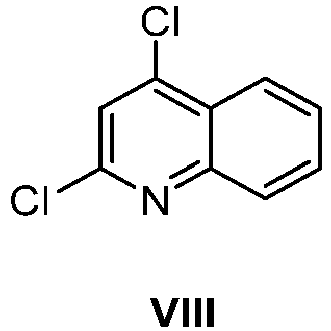
- Aniline (10 g, 108 mmol) and malonic acid (11 g, 108 mmol) was suspended in POCl3 (100 mL). The resulting mixture was stirred at 120 °C overnight. After cooling to room temperature, the mixture was poured into crushed ice while shaking. The mixture was partitioned between water (150 mL) and EA (150 mL). The aqueous phase was extracted with EA (200 mL x2). The combined organic phase was washed with water (250 mL x2) and brine (250 mL), and dried over NaSO4. After filtration, the solvent was removed, and the residue was purified by silica gel column chromatography (PE/EA = 50/1) to give 2,4-dichloroquinoline (4.3 g, yield: 20%) as a white solid. MS (EI): m/z 197.8 [(M+1)+].
-

-

- To a mixture of 2,4-dichloro-quinoline (300 mg, 1.51 mmol) in CH3CN (12 mL) and H2O (4 mL), was added 2-(trifluoromethyl)phenyboronic acid (232 mg, 1.66 mmol), K2CO3 (417 mg, 3.02 mmol) and Pd(PPh3)4 (36 mg, 0.03 mmol). The suspension was degassed under reduced pressure and purged with N2 atmophere for several times. The mixture was stirred at 80 °C overnight. The mixture was partitioned between water (30 mL) and EA (30 mL). The aqueous phase was extracted with EA (30 mL x2). The combined organic phase was washed with brine (80 mL x2) and dried over NaSO4. After filtration, the solvent was removed, and the residue was purified by silica gel column chromatography (PE/EA = 50/1) to give 4-chloro-2-(2-trifluoromethyl-phenyl)-quinoline (400 mg, yield: 86%) as a white solid. MS (EI): m/z 308.3 [(M+1)+].
-

-

- To a mixture of 4-chloro-2-(2-trifluoromethyl-phenyl)-quinoline (61 mg, 0.197 mmol) in DMA (2.5 mL), was added t-BuOK (1.3 mg, 0.012 mmol) and 3-piperidin-1-yl-propylamine (112 mg, 0.788 mmol). The resulting mixture was stirred for 4 hrs at 180 °C by microwave. The mixture was partitioned between water (30 mL) and EA (30 mL), extracted with EA (30 mL x2). The combined organic phase was washed with brine (60 mL x2) and dried over NaSO4. After filtration, the solvent was removed, and the residue was purified by prep-HPLC and lyophilized with 2N HCl to afford (3-piperidin-1-yl-propyl)-[2-(2-trifluoromethyl-phenyl)-quinolin-4-yl]-amine (10 mg, yield: 23%) as a white solid.
- 1H NMR (400 MHz, CD3OD): δ = 8.03 (d, J = 8.0 Hz, 1H), 7.74 (t, J = 6.8 Hz, 2H), 7.63-7.55 (m, 3H), 7.48 (d, J = 7.6 Hz, 1H), 7.41-7.39 (m, 1H), 6.45 (s, 1H), 3.31 (t, J = 6.8 Hz, 2H), 2.43-2.40 (m, 6H), 1.87-1.84 (m, 2H), 1.53-1.49 (m, 4H), 1.40-1.38 (m, 2H). MS (EI): m/z 414.2 [(M+1)+].
-

- 1H NMR (400 MHz, CD3OD): δ = 8.47 (d, J = 8.4 Hz, 1H), 7.93-7.90 (m, 1H), 7.82 (d, J = 9.2 Hz, 2H), 7.73-7.67 (m, 2H), 7.60-7.53 (m, 2H), 6.97 (s, 1H), 3.68 (t, J = 6.8 Hz, 2H), 3.51-3.46 (m, 2H), 3.21-3.16 (m, 2H), 2.90-2.84 (m, 2H), 2.23-2.16 (m, 2H). 1.86-1.79 (m, 2H), 1.77-1.73 (m, 3H), 1.44-1.41 (m, 1H). MS: m/z 430.2 [(M+1)+].
-
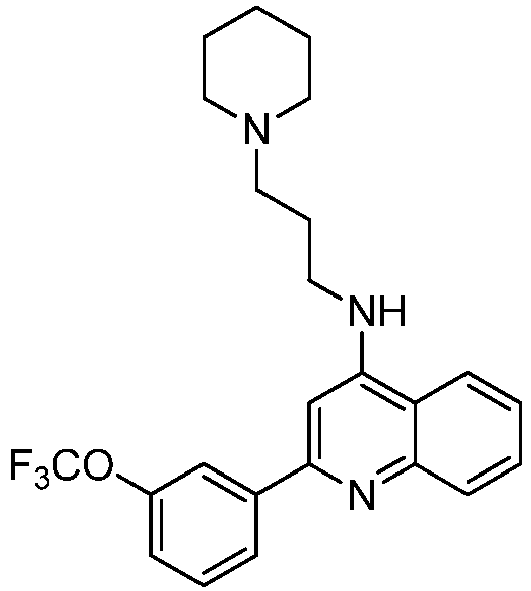
- 1H NMR (400 MHz, CD3OD): δ = 8.42 (d, J = 8.8 Hz, 1H), 7.94-7.88 (m, 3H), 7.86 (s, 1H), 7.72-7.64 (m, 2H), 7.55 (d, J = 7.2 Hz, 1H), 7.03 (s, 1H), 3.74 (t, J = 6.8 Hz, 2H), 3.50-3.47 (m, 2H), 3.21-3.17 (m, 2H), 2.89-2.84 (m, 2H), 2.26-2.18 (m, 2H). 1.86-1.69 (m, 5H), 1.44-1.40 (m, 1H). MS: m/z 430.2 [(M+1)+].
-

- 1H NMR (400 MHz, CD3OD): δ = 8.49 (d, J = 8.4 Hz, 1H), 8.16 (dd, J = 6.4, 2.4 Hz, 2H), 8.05-8.03 (m, 2H), 7.81-7.78 (m, 1H), 7.63 (d, J = 8.4 Hz, 2H), 7.15 (s, 1H), 3.85 (t, J = 7.2 Hz, 2H), 3.62-3.59 (m, 2H), 3.38-3.29 (m, 2H), 3.00-2.98 (m, 2H), 2.35-2.30 (m, 2H), 1.97-1.84 (m, 5H), 1.59-1.55 (m, 1H). MS: m/z 430.2 [(M+1)+].
-

- 1H NMR (400 MHz, CD3OD): δ = 8.35 (d, J = 8.4 Hz, 1H), 7.98 (d, J = 8.8 Hz, 2H), 7.91 (d, J = 8.8 Hz, 1H), 7.87-7.85 (m, 1H), 7.60-7.56 (m, 1H), 7.49 (d, J = 8.4 Hz, 2H), 7.02 (s, 1H), 3.49 (s, 6H),. MS: m/z 333.1[(M+1)+].
-

- 1H NMR (300 MHz, CDCl3): δ = 8.36 (d, J = 8.4 Hz, 1H), 8.17 (d, J = 8.1 Hz, 1H), 8.05-8.01 (m, 1H), 7.67 (t, J = 7.5 Hz, 1H), 7.50 (t, J = 7.5 Hz, 1H), 7.41-7.38 (m, 1H), 7.32-7.28 (m, 1H), 7.19-7.14 (m, 1H), 6.75 (s, 1H), 3.65-3.62 (m, 2H), 3.03-2.92 (m, 4H), 2.24-2.20 (m, 2H), 2.15-1.90 (m, 4H), 1.66-1.62 (m, 2H), 1.28-1.23 (m, 2H). MS: m/z 364.2 [(M+1)+].
-

- 1H NMR (400 MHz, CD3OD): δ = 8.55 (d, J = 8.0 Hz, 1H), 8.08-7.99 (m, 2H), 7.89-7.80 (m, 2H), 7.78-7.71 (m, 2H), 3.74 (td, J = 8.8, 2.4 Hz, 1H), 7.16 (s, 1H), 3.87 (t, J = 6.8 Hz, 2H), 3.63-3.60 (m, 2H), 3.34-3.31 (m, 2H), 3.03-2.97 (m, 2H), 2.39-2.34 (m, 2H). 1.99-1.87 (m, 5H), 1.57-1.54 (m, 1H). MS: m/z 364.2 [(M+1)+].
-

- 1H NMR (400 MHz, CD3OD): δ = 8.53 (d, J = 8.8 Hz, 1H), 8.13-8.10 (m, 2H), 8.07-8.01 (m, 2H), 7.77 (t, J = 8.0 Hz, 1H), 7.46 (t, J = 8.8 Hz, 2H), 7.13 (s, 1H), 3.86 (t, J = 7.2 Hz, 2H), 3.63-3.60 (m, 2H), 3.34-3.31 (m, 2H), 3.03-2.97 (m, 2H), 2.37-2.33 (m, 2H), 1.99-1.87 (m, 5H), 1.60-1.50 (m, 1H). MS: m/z 364.2 [(M+1)+].
-

- 1H NMR (400 MHz, CDCl3): δ = 8.25 (d, J = 8.4 Hz, 2H), 7.68 (s, 1H), 7.70 (d, J = 7.6 Hz, 1H), 7.57 (t, J = 8.0 Hz, 1H), 7.38 (t, J = 7.6 Hz, 1H), 7.23 (t, J = 7.6 Hz, 1H), 7.09 (d, J = 7.6 Hz, 1H), 6.57 (s, 1H), 3.56-3.54 (m, 2H), 2.91-2.88 (m, 2H),2.85-2.72 (m, 4H), 2.34 (s, 3H), 2.15-2.13 (m, 2H), 1.85-1.81 (m, 4H), 1.60-1.50 (m, 2H). MS: m/z 360.2 [(M+1)+].
-

- 1H NMR (400 MHz, CD3OD): δ = 8.42 (d, J = 8.4 Hz, 1H), 8.13 (d, J = 8.4 Hz, 2H), 7.97 (d, J = 8.4 Hz, 1H), 7.89-7.85 (m, 1H), 7.69-7.61 (m, 3H), 7.06 (s, 1H), 3.76 (t, J = 6.8 Hz, 2H), 3.51-3.49 (m, 2H), 3.25-3.21 (m, 2H), 3.20 (s, 6H), 2.93-2.86 (m, 2H), 2.27-2.23 (m, 2H), 1.87-1.73 (m, 5H), 1.45-1.42 (m, 1H). MS: m/z 389.2 [(M+1)+].
-

- 1H NMR (400 MHz, CD3OD): δ = 8.45 (d, J = 8.4 Hz, 1H), 8.19-8.15 (m, 2H), 8.08 (d, J = 8.4, 1Hz, 1H), 7.97 (t, J = 8.0 Hz, 1H), 7.78-7.68 (m, 3H), 7.15 (s, 1H), 3.62 (s, 6H), 3.34 (s, 6H). MS: m/z 292.1 [(M+1)+].
-

- 1H NMR (400 MHz, CD3OD): δ = 8.33 (d, J = 8.4 Hz, 1H), 7.95-7.91 (m, 2H), 7.87-7.83 (m, 1H), 7.74 (d, J = 3.6 Hz, 1H), 7.62-7.58 (m, 1H), 7.13 (s, 1H), 6.76-6.75 (m, 1H), 3.73 (t, J = 6.8 Hz, 2H), 3.51-3.48 (m, 2H), 3.23-3.20 (m, 2H), 2.90-2.85 (m, 2H), 2.24-2.17 (m, 2H), 1.88-1.78 (m, 2H), 1.75-1.72 (m, 3H), 1.44-1.41 (m, 1H). MS: m/z 336.1 [(M+1)+].
-

- 1H NMR (400 MHz, CD3OD): δ = 8.39 (d, J = 8.4 Hz, 1H), 8.07 (d, J = 8.0 Hz, 1H), 8.01 (d, J = 1.2 Hz, 1H), 7.95-7.91 (m, 1H), 7.76 (d, J = 3.6 Hz, 1H), 7.68-7.64 (m, 1H), 7.27 (s, 1H), 6.86 (t, J = 1.2 Hz, 1H), 3.59 (s, 6H). MS: m/z 239.1 [(M+1)+].
-

- 1H NMR (400 MHz, CD3OD): δ = 8.63 (s, 1H), 8.35 (d, J = 8.4 Hz, 1H), 7.93 (d, J = 8.4 Hz, 1H), 7.84 (t, J = 7.6 Hz, 1H), 7.82 (s, 1H), 7.60 (t, J = 7.6 Hz, 1H), 7.25 (d, J = 1.2 Hz, 1H), 7.03 (s, 1H), 3.73 (t, J = 6.8 Hz, 2H), 3.51-3.48 (m, 2H), 3.23-3.20 (m, 2H), 2.92-2.86 (m, 2H), 2.23-2.20 (m, 2H), 1.87-1.75 (m, 5H), 1.48-1.40 (m, 1H). MS: m/z 336.2 [(M+1)+].
-

- The title compound was prepared using general procedure for 3-piperidin-1-yl-propyl)-[2-(2-trifluoromethyl-phenyl)-quinolin-4-yl]-amine.
- 1H NMR (400 MHz, CD3OD): δ = 8.49 (s, 1H), 8.28 (d, J = 8.4 Hz, 1H), 7.90 (d, J = 8.4 Hz, 1H), 7.83-7.79 (m, 1H), 7.72 (t, J = 1.2, 1H), 7.54 (td, J = 8.4, 1.2, 1H), 7.15 (s, 1H), 7.03 (s, 1H), 3.46 (s, 6H). MS: m/z 239.1 [(M+1)+].
-

- 1H NMR (400 MHz, CD3OD): δ = 8.35 (d, J = 8.4 Hz, 1H), 8.03 (d, J = 2.8 Hz, 1H), 7.94 (d, J = 8.0 Hz, 1H), 7.88-7.85 (m, 2H), 7.84- 7.60 (m, 1H), 7.28 (dd, J = 5.2, 4.0 Hz, 1H), 6.95 (s, 1H), 3.71 (t, J = 6.8 Hz, 2H), 3.53-3.48 (m, 2H), 3.26-3.20 (m, 2H), 2.91-2.85 (m, 2H), 2.25-2.17 (m, 2H), 1.90-1.68 (m, 5H), 1.44-1.41 (m, 1H). MS: m/z 352.1 [(M+1)+].
-

- 1H NMR (400 MHz, CD3OD): δ = 8.29 (d, J = 8.4 Hz, 1H), 7.98 (dd, J = 3.6, 1.2 Hz, 1H), 7.94 (d, J = 7.2 Hz, 1H), 7.84-7.80 (m, 2H), 7.57-7.53 (m, 1H), 7.26 (t, J = 4.8 Hz, 1H), 6.98 (s, 1H), 3.47 (s, 6H). MS: m/z 255.1(M+H+).
-

- 1H NMR (400 MHz, CD3OD): δ = 8.73 (d, J = 6.8 Hz, 1H), 8.42-8.40 (m, 2H), 8.01-7.94 (m, 2H), 7.73-7.69 (m, 1H), 7.12 (s, 1H), 4.08 (s, 3H), 3.83 (t, J = 6.8 Hz, 2H), 3.63-3.60 (m, 2H), 3.34-3.30 (m, 2H), 3.03-2.97 (m, 2H), 2.36-2.30 (m, 2H), 2.00-1.97 (m, 2H), 1.91-1.83 (m, 3H), 1.58-1.53 (m, 1H). MS: m/z 350.2 [(M+1)+].
-

- 1H NMR (400 MHz, CD3OD): δ = 8.50 (s, 1H), 8.26-8.23 (m, 2H), 7.92-7.87 (m, 1H), 7.79 (t, J = 7.6 Hz, 1H), 7.52 (t, J = 7.6 Hz, 1H), 7.01 (s, 1H), 3.94 (s, 3H), 3.44 (s, 6H). MS: m/z 253.1 [(M+1)+].
-

- 1H NMR (400 MHz, CD3OD): δ = 8.55-8.53 (m, 1H), 8.05-8.01 (m, 1H), 7.96 (d, J = 8.4 Hz, 1H), 7.80 (t, J = 7.6 Hz, 1H), 7.05-7.04 (m, 1H), 3.80 (t, J = 6.8 Hz, 2H), 3.62-3.59 (m, 2H), 3.31-3.29 (m, 2H), 3.03-2.97 (m, 2H), 2.87 (s, 3H), 2.62 (s, 3H), 2.35-2.29 (m, 2H), 2.00-1.97 (m, 2H), 1.92-1.86 (m, 3H), 1.58-1.53 (m, 1H). MS: m/z 381.1 [(M+1)+].
-

- 1H NMR (400 MHz, CD3OD): δ = 8.48 (d, J = 8.4, 1H), 8.02-7.94 (m, 2H), 7.28-7.23 (m, 1H), 7.04 (s, 1H), 3.62 (s, 6H), 2.90 (s, 3H), 2.62 (s, 3H). MS: m/z 284.0 [(M+1)+].
-

- 1H NMR (400 MHz, CD3OD): δ = 8.35 (d, J = 8.4 Hz, 1H), 7.98-7.92 (m, 2H), 7.66 (t, J = 8.0 Hz, 1H), 7.41-7.40 (m, 1H), 7.31 (s, 1H), 7.18 (d, J = 1.6 Hz, 1H), 6.49-6.47 (m, 1H), 3.83 (t, J = 6.8 Hz, 2H), 3.63-3.60 (m, 2H), 3.36-3.33 (m, 2H), 3.02-2.98 (m, 2H), 2.34-2.31 (m, 2H), 1.97-1.85 (m, 5H), 1.59-1.51 (m, 1H). MS: m/z 335.2 [(M+1)+].
-

- 1H NMR (400 MHz, CD3OD): δ = 8.19 (d, J = 8.4 Hz, 1H), 7.86 (d, J = 8.4 Hz, 1H), 7.77-7.73 (m, 1H), 7.49-7.45 (m, 1H), 7.25-7.24 (m, 1H), 7.15 (t, J = 1.6 Hz, 1H), 7.02 (s, 1H), 6.34 (dd, J = 3.6, 2.8 Hz, 1H), 3.41 (s, 6H). MS: m/z 238.2 [(M+1)+].
-

- 1H NMR (400 MHz, CD3OD): δ = 8.30 (s, 1H), 8.02-7.99 (m, 2H), 7.94 (d, J = 8.4 Hz, 1H), 7.84 (dd, J = 8.8, 1.6 Hz, 1H), 7.23 (d, J = 8.8 Hz, 2H), 7.05 (s, 1H), 3.96 (s, 3H), 3.83 (t, J = 7.2 Hz, 2H), 3.63-3.60 (m, 2H), 3.43-3.30 (m, 2H), 3.02-2.99 (m, 2H), 2.63 (s, 3H), 2.35-2.31 (m, 2H), 2.00-1.85 (m, 5H), 1.60-1.49 (m, 1H). MS: m/z 390.2 [(M+1)+].
-

- 1H NMR (400 MHz, CD3OD): δ = 7.88-7.84 (m, 3H), 7.77 (d, J = 2.4 Hz, 1H), 7.48 (dd, J = 9.2, 2.8 Hz, 1H), 7.10 (d, J = 8.8 Hz, 2H), 6.91 (s, 1H), 3.93 (s, 3H), 3.82 (s, 3H), 3.71 (t, J = 7.2 Hz, 2H), 3.50-3.48 (m, 2H), 3.22-3.19 (m, 2H), 2.90=2.84 (m, 2H), 2.26-2.20 (m, 2H), 1.87-1.73 (m, 5H), 1.46-1.40 (m, 1H). MS: m/z 406.2 [(M+1)+].
-

- 1H NMR (400 MHz, CD3OD): δ = 8.37 (d, J = 9.6 Hz, 1H), 8.00 (dd, J = 12.0, 3.2 Hz, 2H), 7.44-7.42 (m, 1H), 7.34-7.31 (m, 1H), 7.23 (dd, J = 12.0, 3.2 Hz, 2H), 6.98 (s, 1H), 4.03 (s, 3H), 3.96 (s, 3H), 3.81 (t, J = 7.2 Hz, 2H), 3.62-3.59 (m, 2H), 3.43-3.30 (m, 2H), 3.03-2.97 (m, 2H), 2.35 -2.27 (m, 2H), 2.01-1.82 (m, 5H), 1.60-1.52 (m, 1H). MS: m/z 406.2 [(M+1)+].
-

- 1H NMR (300 MHz, CDCl3): δ = 8.08-8.00 (m, 4H), 7.55 (dd, J = 9.0, 1.8 Hz, 1H), 7.02 (d, J = 8.7 Hz, 2H), 6.72 (s, 1H), 3.89 (s, 3H), 3.49-3.47 (m, 2H), 2.67-2.55 (m, 5H), 2.06-1.99 (m, 3H), 1.90-1.82 (m, 6H). MS: m/z 410.1 [(M+1)+].
-

- 1H NMR (400 MHz, CD3OD): δ = 8.95 (s, 1H), 8.23-8.20 (m, 2H), 8.07 (d, J = 8.0 Hz, 2H), 7.25 (dd, J = 6.8, 2.0 Hz, 2H), 7.19 (s, 1H), 3.97 (s, 3H), 3.87 (t, J = 7.2 Hz, 2H), 3.63-3.60 (m, 2H), 3.53-3.31 (m, 2H), 3.03-2.96 (m, 2H), 2.37 -2.33 (m, 2H), 1.96-1.87 (m, 5H), 1.60-1.51 (m, 1H). MS: m/z 444.2 [(M+1)+].
-

- 1H NMR (400 MHz, CD3OD): δ = 9.41 (s, 1H), 8.60 (dd, J = 9.2, 2.0 Hz, 1H), 8.08 (d, J = 9.6 Hz, 1H), 7.96 (d, J = 8.8 Hz, 2H), 7.13 (d, J =7.2 Hz, 2H), 7.08 (s, 1H), 3.84 (s, 3H), 3.80-3.74 (m, 2H), 3.56-3.47 (m, 2H), 3.21-3.20 (m, 2H), 2.90-2.84 (m, 2H), 2.25-2.23 (m, 2H), 1.87-1.74 (m, 5H), 1.50-1.41 (m, 1H). MS: m/z 421.2 [(M+1)+].
-

- 1H NMR (400 MHz, CD3OD): δ = 8.29 (dd, J = 9.6, 2.8 Hz, 1H), 8.11 (dd, J = 9.6, 4.8 Hz, 1H), 8.03 (dd, J = 6.4, 2.4 Hz, 2H), 7.86-7.81 (m, 1H), 7.24 (d, J = 8.0 Hz, 2H), 7.10 (s, 1H), 3.96 (s, 3H), 3.84 (t, J = 7.2 Hz, 2H), 3.63-3.60 (m, 2H), 3.43-3.31 (m, 2H), 3.03-2.96 (m, 2H), 2.35-2.31 (m, 2H), 2.00-1.86 (m, 5H), 1.60-1.53 (m, 1H). MS: m/z 394.2 [(M+1)+].
-

- 1H NMR (400 MHz, CD3OD): δ = 8.50 (s, 1H), 8.19-8.16 (m, 1H), 8.07-8.04 (m, 2H), 7.94 (dd, J = 6.8, 1.6 Hz, 1H), 7.27-7.23 (m, 2H), 7.15 (s, 1H), 3.99 (s, 3H), 3.85 (t, J = 6.8 Hz, 2H), 3.63-3.60 (m, 2H), 3.37-3.31 (m, 2H), 3.03-2.96 (m, 2H), 2.38 -2.31 (m, 2H), 1.99-1.87 (m, 5H), 1.32-1.30 (m, 1H). MS: m/z 460.2 [(M+1)+].
-

- 1H NMR (400 MHz, DMSO-d6): δ = 9.35 (s, 1H), 8.40 (d, J = 8.0 Hz, 1H), 7.95 (d, J = 8.4Hz, 1H), 7.85 (d, J = 8.0Hz, 1H), 7.81-7.52 (m, 9H), 7.09 (s, 1H). MS: m/z 390.1 [(M+1)+].
-

- 1H NMR (400 MHz, DMSO-d6): δ = 9.13 (s, 1H), 8.45 (d, J = 8.0 Hz, 1H), 7.90 (d, J = 8.0 Hz, 1H), 7.82 (d, J = 7.6 Hz, 1H), 7.77-7.71 (m, 2H), 7.66-7.57 (m, 3H), 7.43-7.36 (m, 4H), 7.15-7.12 (m, 1H), 6.93 (s, 1H). MS: m/z 365.1 [(M+1)+].
-

- 1H NMR (400 MHz, DMSO-d6): δ = 9.10 (s, 1H), 8.43 (d, J = 8.4 Hz, 1H), 7.89 (d, J = 8.4 Hz, 1H), 7.82 (d, J = 7.6 Hz, 1H), 7.77-7.71 (m, 2H), 7.66-7.56 (m, 3H), 7.40-7.37 (m, 2H), 7.27-7.23 (m, 2H), 6.78 (s, 1H). MS: m/z 383.1 [(M+1)+].
-

- 1H NMR (400 MHz, DMSO-d6): δ = 8.99 (s, 1H), 8.37 (d, J = 8.0 Hz, 1H), 7.98-7.91 (m, 3H), 7.70 (t, J = 8.0 Hz, J = 1.2 Hz, 1H), 7.52-7.41 (m, 6H), 7.18-7.06 (m, 1H), 7.02 (d, J = 2.8 Hz, 2H), 3.80 (s, 3H). MS: m/z 327.1 [(M+1)+]
-

- 1H NMR (400 MHz, CD3OD): δ = 8.46 (d, J = 8.4 Hz, 1H), 8.02-7.90 (m, 3H), 7.82 (t, J = 8.0 Hz, 1H), 7.75-7.65 (m, 2H), 7.63-7.59 (m, 3H), 7.02 (d, J = 8.8 Hz, 2H), 6.29 (s, 1H), 3.78 (s, 3H). MS: m/z 395.1 [(M+1)+].
-

- 1H NMR (400 MHz, DMSO-d6): δ = 9.26 (s, 1H), 8.34 (d, J = 8.0 Hz, 1H), 8.03 (d, J = 8.8 Hz, 2H), 7.97 (d, J = 8.4 Hz, 1H), 7.79-7.71 (m, 3H), 7.65 (t, J = 8.0 Hz, 1H), 7.59 (s, 1H), 7.54 (t, J = 8.0 Hz, 1H), 7.43 (d, J = 7.6 Hz, 1H), 7.05 (d, J = 9.2 Hz, 2H), 3.82 (s, 3H). MS: m/z 395.1 [(M+1)+].
-

- 1H NMR (400 MHz, DMSO-d6): δ = 9.20 (s, 1H), 8.31-8.29 (m, 1H), 8.06-8.03 (m, 2H), 7.98-7.95 (m, 1H), 7.79-7.71 (m, 3H),7.64-7.52 (m, 4H), 7.05 (d, J = 11.6 Hz, 2H ), 3.83 (s, 3H). MS: m/z 352.1 [(M+1)+].
-

- To a mixture of 4-chloro-2-(4-methoxy-phenyl)-quinoline (100 mg, 0.37 mmol), Pd2(dba)3 (34 mg, 0.04 mmol), xantphos (35 mg, 0.07 mmol), Cs2CO3 (241 mg, 0.74 mmol) in dioxane (5 mL) was added pyridin-2-ylamine (35 mg, 0.37 mmol) under N2 atmosphere. The reaction mixture was stirred at 100 °C for 3 hrs. The mixture was concentrated under reduced pressure and the residue was partitioned between water (20 mL) and DCM (20 mL). It was extracted with DCM (20 mL x3). The combined organic phase was washed with brine, and dried over NaSO4. After filtration, the solvent was removed, and the residue was purified by prep-HPLC to give [2-(4-methoxy-phenyl)-quinolin-4-yl]-pyridin-2-yl-amine (40 mg, yield: 33%) as a white solid. 1H NMR (400 MHz, DMSO-d6): δ = 9.44 (s, 1H), 8.98 (s, 1H), 8.47 (d, J = 8.0 Hz, 1H), 8.39-8.38 (m, 1H), 8.12 (d, J = 8.8 Hz, 2H), 7.97 (d, J = 8.0 Hz, 1H), 7.79-7.75 (m, 1H), 7.72 (t, J = 7.2 Hz, 1H), 7.55 (t, J = 7.2 Hz, 1H), 7.40 (d, J = 8.4 Hz, 1H), 7.11-7.09 (m, 2H), 7.00-6.99 (m, 1H), 3.84 (s, 3H). MS: m/z 328.1 [(M+1)+].
-

- To a mixture of 4-chloro-2-(4-methoxy-phenyl)-quinoline (150 mg, 0.560 mmol) in DMA (2.5 mL), was added t-BuOK (3.7 mg, 0.034 mmol) and 4-chloro-benzylamine (316 mg, 2.240 mmol). The resulting mixture was stirred for 4 hrs at 180 °C by microwave. The mixture was partitioned between water (30 mL) and EA (30 mL), extracted with EA (30 mL x2). The combined organic phase was washed with brine (80 mL x2) and dried over NaSO4. After filtration, the solvent was removed, and the residue was purified by silica gel column chromatography (PE/EA = 2/1) to give (4-chloro-benzyl)-[2-(4-methoxy-phenyl)-quinolin-4-yl]-amine (34 mg, yield: 16%) as a white solid. 1H NMR (400 MHz, CDCl3): 8 = 8.62 (d, J = 8.0 Hz, 1H), 8.57 (d, J = 6.8 Hz, 1H), 7.83 (d, J = 8.0 Hz, 2H), 7.40-7.34 (m, 3H), 7.30-7.20 (m, 3H), 6.94 (d, J = 8.0 Hz, 2H), 6.31 (s, 1H), 4.72 (d, J = 5.2 Hz, 2H), 3.79 (s, 3H). MS: m/z 375.1 [(M+1)+]
- In some embodiments, compounds described herein are prepared as shown in
Scheme 3.
- The synthesis of compound XV can be accomplished by the reactions illustrated in
Scheme 3. Treatment compound XII in an inert organic solvent such as THF, DMF, DMA containing an organic base such as triethylamine, or strong base such as potassium t-butoxide, sodium hydride or potassium hydride with an alcohol or amine compound of formula HZR2 produces compounds of formula XIII. The reaction is preferably carried out at temperatures between 25°C and 150°C. The predominate isomer produced in this reaction is the C4 addition on the aromatic ring. Crystallization of the product of this reaction allows for the isolation of only the C4 isomer. Suzuki coupling of compound XIII with an aromatic boronic acid XIV employing standard Suzuki coupling conditions using a palladium zero species such as Pd(PPh3)4, with aqueous potassium carbonate or sodium carbonate in an inert solvent such as acetonitrile or toluene produces Compound XV. The reaction is preferably carried out at temperatures between 25°C and 150°C. -

- To a mixture of 2,4-dichloroquinolne (5 g), 3-(piperidin-1-yl)propan-1-amine (3.5 g), potassium carbonate (6.96 g) was added DMA (100 ml). The reaction was heated for 20 hours, cooled and the solvent removed under vacuum. The residue was extracted with DCM/ water and dried over sodium sulfate. The resulting solid was purified with silica gel eluted with 70% DCM/ 30% MeOH. The resulting solid was recrystallized from MeOH, to afford of 2-chloro-N-(3-(piperidin-1-yl)propyl)quinolin-4-amine (4 g, yield: 63%) as a white/tan solid, MS (EI): m/z 304 [(M+1)+].

-

-

- To a mixture of 2-chloro-N-(3-(piperidin-1-yl)propyl)quinolin-4-amine (1.72 g), 4-diethylaminoboronic acid (1.87 g) was added 10 ml of 2M sodium carbonate, 10 ml of toluene and 10 ml of EtOH. The reaction mixture was purged with nitrogen and then Pd (500 mg) was added and the reaction was heated to 85°C for 6 hours. The reaction mixture was cooled and extracted with EtOAc/water. The organic layer was dried over sodium sulfate and the solvent removed under vacuum. The residue was purified using silica gel and eluted with a gradient of 70% DCM/ 30% MeOH to 30% DCM/ 70% MeOH, to afford N,N-diethyl-4-(4-((3-(piperidin-1-yl)propyl)amino)quinolin-2-yl)benzamide (1.1 g, yield: 33%) as a white/tan solid, MS (EI): m/z 445 [(M+1)+].
- This assay attempts to identify inhibitors of the LMPTP-A (Low Molecular Weight Protein Tyrosine Phosphatase-A) enzyme. It is run in 1536-well format and is measured via fluorescence intensity.
- A listing of materials is provided:
- Item, source, catalog no.
- LMPTP-A Enzyme Stock Solution (4.22 mg/ml or 206.8µM), SBMRI Protein Facility, N/A
- OMFP, Sigma, M2629-100MG
- Bis-Tris pH 6.0, Fisher Sci, BP301-100
- Triton-
X 100, Sigma, T9284 - DTT, Sigma, D9779
- Mol. Grade Water, Mediatech, Inc., 46-000-CM
- 1536-well black High base opaque bottom plate, Nexus Biosystems, 00019120
- Final assay conditions are:
- 0.625nM LMPTP-A Enzyme
- 400µM OMFP
- 50mM Bis-Tris pH 6.0
- 1mM DTT
- 0.01% Triton-
X 100 - 20µM test compound
- 3% DMSO (2% from substrate and 1% from compounds) 6µL reaction volume
- 50 minutes incubation at room temp
-
- 1. Prepare Reagents as described in section F. Recipe.
- 2. Using LabCyte Echo, transfer 60 nL from 2mM test compound source plate into assay plate Col. 5 ― 48 (final concentration of test compounds is 20 µM). 60nL of DMSO should be transferred to col. 1-4 for positive and negative control wells.
- 3. Spin plates at 1000 rpm for 1 minute in centrifuge.
- 4. Using the Beckman Coulter Bioraptr, add 3 µL/well of control buffer to
columns - 5. Using the Bioraptr, add 3 µL/well of enzyme solution to col. 3-48.
- 6. Using the Bioraptr, add 3 µL/well of substrate solution to col. 1-48.
- 7. Spin plates at 1000 rpm for 1 minute in centrifuge.
- 8. Incubate plates in the dark at room temperature for 50 minutes.
- 9. Read plates on PerkinElmer Viewlux using a FI protocol.
- The following compounds were prepared using Procedures A-I of Example 1 described above, and the IC50 values were obtained using the method of Example 2. IC50 values are categorized according to the below scale.
- A: IC50 > 200 nM - <800 nM
- B: IC50 > 801 nM - <5000 nM
- C: IC50 > 5001 nM
- Those compounds shown below which are not encompassed by the appended claims are included herein as reference examples.
Table A Compound Name MW (EI) [(M+1)+] IC50 (nM) D1 2-(4-methoxyphenyl)-N-(3-(piperidin-1-yl)propyl)quinolin-4-amine: 376 B D2 N,N-dimethyl-2-(2-(trifluoromethyl)phenyl)quinolin-4-amine 317 B G1 (3-piperidin-1-yl-propyl)-[2-(2-trifluoromethylphenyl)-quinolin-4-yl]-amine 414 B G2 (3-piperidylpropyl){2-[2-(trifluoromethoxy)phenyl](4-quinolyl)}amine 430 A G3 (3-Piperidin-1-yl-propyl)-[2-(3-trifluoromethoxyphenyl)-quinolin-4-yl]-amine 430 B G4 (3-Piperidin-1-yl-propyl)-[2-(4-trifluoromethoxyphenyl)-quinolin-4-yl]-amine 430 B G5 N,N-dimethyl-2-(4-(trifluoromethoxy)phenyl)quinolin-4-amine 317 B G6 [2-(2-fluorophenyl)(4-quinolyl)](3-piperidylpropyl)amine 364 B G7 [2-(3-Fluoro-phenyl)-quinolin-4-yl]-(3-piperidin-1-yl-propyl)-amine364 364 B G8 [2-(4-Fluoro-phenyl)-quinolin-4-yl]-(3-piperidin-1-yl-propyl)-amine 364 B G9 (3-Piperidin-1-yl-propyl)-(2-m-tolyl-quinolin-4-yl)-amine 360 B G10 [2-(4-Dimethylamino-phenyl)-quinolin-4-yl]-(3-piperidin-1-yl-propyl)-amine 389 B G11 [2-(4-Dimethylamino-phenyl)-quinolin-4-yl]-dimethyl-amine 292 C G12 (2-Furan-2-yl-quinolin-4-yl)-(3-piperidin-1-yl-propyl)-amine 336 B G13 (2-Furan-2-yl-quinolin-4-yl)-dimethyl-amine: 239 C Compound Name MW (EI) [(M+1)+] IC50 (nM) G14 (2-Furan-3-yl-quinolin-4-yl)-(3-piperidin-1-yl-propyl)-amine 336 B G15 (2-Furan-3-yl-quinolin-4-yl)-dimethyl-amine 239 C G16 (3-Piperidin-1-yl-propyl)-(2-thiophen-2-yl-quinolin-4-yl)-amine 352 B G17 Dimethyl-(2-thiophen-2-yl-quinolin-4-yl)-amine 255 C G18 [2-(1-methylpyrazol-3-yl)(4-quinolyl)](3-piperidylpropyl)amine 350 C G19 Dimethyl[2-(1-methylpyrazol-4-yl)(4-quinolyl)]amine 253 C G20 [2-(2,4-dimethyl(1,3-thiazol-5-yl))(4-quinolyl)](3-piperidylpropyl)amine 381 B G21 [2-(2,4-Dimethyl-thiazol-5-yl)-quinolin-4-yl]-dimethyl-amine 284 C G22 (3-Piperidin-1-yl-propyl)-[2-(1H-pyrrol-2-yl)-quinolin-4-yl] -amine 335 B G23 Dimethyl-[2-(1H-pyrrol-2-yl)-quinolin-4-yl]-amine 238 C G24 [2-(4-methoxy-phenyl)-6-methyl-quinolin-4-yl]-(3-piperidin-1-yl-propyl)-amine 390 C G25 [6-Methoxy-2-(4-methoxy-phenyl)-quinolin-4-yl]-(3-piperidin-1-yl-propyl)-amine 406 C G26 [7-Methoxy-2-(4-methoxy-phenyl)-quinolin-4-yl]-(3-piperidin-1-yl-propyl)-amine 406 C G27 [6-Chloro-2-(4-methoxy-phenyl)-quinolin-4-yl]-(3-piperidin-1-yl-propyl)-amine 410 C G28 [2-(4-Methoxy-phenyl)-6-trifluoromethyl-quinolin-4-yl]-(3-piperidin-1-yl-propyl)-amine 444 C G29 [2-(4-Methoxy-phenyl)-6-nitro-quinolin-4-yl]-(3-piperidin-1-yl-propyl)-amine 421 C G30 [6-Fluoro-2-(4-methoxy-phenyl)-quinolin-4-yl]-(3-piperidin-1-yl-propyl)-amine 394 B G31 [2-(4-Methoxy-phenyl)-6-trifluoromethoxy-quinolin-4-yl]-(3-piperidin-1-yl-propyl)-amine 460 C G32 3 -[2-(2-Trifluoromethyl-phenyl)-quinolin-4-ylamino]-benzonitrile 390 B G33 Phenyl-[2-(2-trifluoromethyl-phenyl)-quinolin-4-yl]-amine 365 C G34 (4-Fluoro-phenyl)-[2-(2-trifluoromethyl-phenyl)-quinolin-4-yl] -amine 383 B G35 [2-(4-Methoxy-phenyl)-quinolin-4-yl]-phenyl-amine 327 B G36 [2-(4-Methoxy-phenyl)-quinolin-4-yl]-(2-trifluoromethyl-phenyl)-amine 395 C G37 [2-(4-Methoxy-phenyl)-quinolin-4-yl]-(3-trifluoromethyl-phenyl)-amine 395 C G38 3-[2-(4-Methoxy-phenyl)-quinolin-4-ylamino]-benzonitrile 352 A G39 (4-fluorophenyl)[2-(4-methoxyphenyl)(4-quinolyl)] amine 345 B G40 (4-chlorophenyl)[2-(4-methoxyphenyl)(4-quinolyl)] amine 361 B G41 (4-bromophenyl)[2-(4-methoxyphenyl)(4-quinolyl)] amine 406 B G42 [2-(4-methoxyphenyl)(4-quinolyl)][4-(trifluoromethyl)phenyl]amine 395 B G43 [2-(4-methoxyphenyl)(4-quinolyl)](4-methylphenyl)amine 341 B G44 [2-(4-methoxyphenyl)(4-quinolyl)][4-(methylethoxy)phenyl]amine 385 B G45 ethyl 4-{[2-(4-methoxyphenyl)-4-quinolyl]amino}benzoate 399 C G46 2-(4-methoxyphenyl)(4-quinolyl)](1-methylpyrazol-3-yl)amine 331 B G47 4-{[2-(4-methoxyphenyl)-4-quinolyl]amino}benzenecarbonitrile 352 A G48 (6-methoxy(3-pyridyl))[2-(4-methoxyphenyl)(4-quinolyl)] amine 358 A G49 (3-chloro-4-fluorophenyl)[2-(4-methoxyphenyl)(4-quinolyl)] amine 379 B G50 [2-(4-methoxyphenyl)(4-quinolyl)] [3-(pyrrolidinylmethyl)phenyl]amine 410 A G51 2-(4-methoxyphenyl)(4-quinolyl)][3-(pyrrolidinylmethyl)phenyl]amine 410 A G52 [2-(4-methoxyphenyl)(4-quinolyl)][4-(morpholin-4-ylmethyl)phenyl]amine 426 B G53 [2-(4-methoxyphenyl)(4-quinolyl)][3-(4-piperidylmethyl)phenyl]amine 424 B G54 [2-(4-methoxyphenyl)(4-quinolyl)] [3-(piperidylmethyl)phenyl]amine 424 B G55 [2-(4-methoxyphenyl)(4-quinolyl)][3-(morpholin-4-ylmethyl)phenyl]amine 426 A G56 [2-(4-methoxyphenyl)(4-quinolyl)][3-(1,4-thiazaperhydroin-4-ylmethyl)phenyl]amine 426 A G57 [2-(4-methoxyphenyl)(4-quinolyl)]{3-[(4-methyl(1,4-diazaperhydroepinyl))methyl]phenyl}amine 453 A G58 [(3-{[2-(4-methoxyphenyl)(4-quinolyl)]amino}phenyl)methyl]dimethylamine 384 A G59 [2-(4-methoxyphenyl)(4-quinolyl)][3-(piperazinylmethyl)phenyl]amine 425 B G60 [2-(4-methoxyphenyl)(4-quinolyl)]{3-[(4-methylpiperazinyl)methyl]phenyl}amine 439 B G61 (3-Diethylaminomethyl-phenyl)-[2-(4-methoxyphenyl)-quinolin-4-yl]-amine 412 B G62 4-[(3-{[2-(4-methoxyphenyl)-4-quinolyl]amino}phenyl)methyl]-1,4-thiazaperhydroine-1,1-dione 474 B G63 [2-(4-methoxyphenyl)(4-quinolyl)]-2-pyridylamine 328 B G64 [2-(4-methoxyphenyl)(4-quinolyl)]-2-pyridylamine 328 B G65 [2-(4-methoxyphenyl)(4-quinolyl)]-4-pyridylamine 328 B G66 [2-(4-methoxyphenyl)(4-quinolyl)]pyrimidin-5-ylamine 329 B G67 [2-(4-methoxyphenyl)(4-quinolyl)](6-methyl(2-pyridyl))amine 342 B G68 [2-(4-methoxyphenyl)(4-quinolyl)]-2-quinolylamine 378 B G69 2-(4-methoxyphenyl)(4-quinolyl)]-8-quinolylamine 378 C G70 [2-(4-methoxyphenyl)(4-quinolyl)]pyrimidin-4-ylamine 329 B G71 [2-(4-methoxyphenyl)(4-quinolyl)]pyridazin-4-ylamine 329 B G72 [2-(4-methoxyphenyl)(4-quinolyl)]pyrimidin-2-ylamine 329 B G73 [2-(4-methoxyphenyl)(4-quinolyl)](6-methylpyrazin-2-yl)amine 343 B G74 [(4-chlorophenyl)methyl][2-(4-methoxyphenyl)(4-quinolyl)]amine 375 B G75 [2-(4-methoxyphenyl)(4-quinolyl)]benzylamine 341 B G76 [2-(4-methoxyphenyl)(4-quinolyl)](phenylethyl)amine 355 B G77 [2-(4-methoxyphenyl)(4-quinolyl)][(2-methoxyphenyl)methyl]amine 371 B G78 [2-(4-methoxyphenyl)(4-quinolyl)] [(3-methoxyphenyl)methyl]amine 371 B G79 [2-(4-methoxyphenyl)(4-quinolyl)] [(4-methoxyphenyl)methyl]amine 371 B G80 [2-(4-methoxyphenyl)(4-quinolyl)]{[2-(trifluoromethyl)phenyl]methyl}amine 409 B G81 [2-(4-methoxyphenyl)(4-quinolyl)]{[4-(trifluoromethyl)phenyl]methyl}amine 409 B G82 3-({[2-(4-methoxyphenyl)-4-quinolyl]amino}methyl)benzenecarbonitrile 366 B G83 [2-(4-methoxyphenyl)(4-quinolyl)](2-phenylethyl)amine 355 B G84 [2-(4-chlorophenyl)ethyl][2-(4-methoxyphenyl)(4-quinolyl)] amine 389 B G85 [2-(4-methoxyphenyl)(4-quinolyl)][2-(4-methoxyphenyl)ethyl]amine 385 B G86 [2-(4-methoxyphenyl)(4-quinolyl)]{2-[4-(trifluoromethyl)phenyl]ethyl}amine 423 B G87 [2-(4-fluorophenyl)ethyl][2-(4-methoxyphenyl)(4-quinolyl)]amine 373 B I1 N,N-diethyl-4-(4-((3-(piperidin-1-yl)propyl)amino)quinolin-2-yl)benzamide 445 A I2 2-(4-{[3-(pyrrolidinylmethyl)phenyl]amino}-2-quinolyl)benzenecarbonitrile 405 B I3 4-(4-{[3-(4-piperidylmethyl)phenyl]amino}-2-quinolyl)benzamide 437 B I4 4-[4-({3-[(dimethylamino)methyl]phenyl}amino)-2-quinolyl]benzamide 397 C I5 4-(4-{[3-(pyrrolidinylmethyl)phenyl]amino}-2-quinolyl)benzamide 423 C I6 4-(4-{[4-(piperidylmethyl)phenyl]amino}-2-quinolyl)benzamide 437 C I7 [2-(4-chloro-2-fluorophenyl)(4-quinolyl)][3-(4-piperidylmethyl)phenyl]amine 446 B I8 [2-(4-chloro-2-fluorophenyl)(4-quinolyl)][4-(piperidylmethyl)phenyl]amine 446 B I9 [(3-{[2-(4-chloro-2-fluorophenyl)(4-quinolyl)]amino}phenyl)methyl]dimethylamine 406 B I10 [2-(4-chloro-2-fluorophenyl)(4-quinolyl)][3-(pyrrolidinylmethyl)phenyl]amine 432 B I11 [2-(3-chlorophenyl)(4-quinolyl)][4-(piperidylmethyl)phenyl]amine 428 B I12 [2-(3-chlorophenyl)(4-quinolyl)][3-(pyrrolidinylmethyl)phenyl]amine 414 B I13 (5-[(dimethylamino)methyl]-3-{[2-(3-chlorophenyl)(4-quinolyl)]amino}phenyl)methan-1-ol 418 B I14 (3-{[2-(3-chlorophenyl)(4-quinolyl)] amino }phenyl)dimethylamine 374 B I15 [2-(3-chlorophenyl)(4-quinolyl)][2-(1-methylpyrrolidin-2-yl)ethyl]amine 366 B I16 [(4-{[2-(3-chlorophenyl)(4-quinolyl)]amino}phenyl)methyl]dimethylamine 388 B I17 [2-(3-chlorophenyl)(4-quinolyl)](3-{[1-benzyl(4-piperidyl)]methyl}phenyl)amine 519 B I18 [2-(3-chlorophenyl)(4-quinolyl)]{3-[(1-methyl(4-piperidyl))methyl]phenyl}amine 442 B I19 [2-(3-chlorophenyl)(4-quinolyl)][3-(4-piperidylmethyl)phenyl]amine 428 B I20 [2-(3-chlorophenyl)(4-quinolyl)][3-(4-piperidylmethyl)phenyl]amine 428 B I21 [2-(3-chlorophenyl)(4-quinolyl)][2-(4-piperidylmethyl)phenyl]amine 428 B I22 [(3-{[2-(3-chlorophenyl)(4-quinolyl)]amino}phenyl)methyl]dimethylamine 388 A I23 [2-(4-methoxyphenyl)(4-quinolyl)][4-(piperidylmethyl)phenyl]amine 424 B I24 [2-(4-methoxyphenyl)(4-quinolyl)][2-(1-methylpyrrolidin-2-yl)ethyl]amine 362 B I25 (3-{[2-(4-methoxyphenyl)(4-quinolyl)] amino }phenyl)dimethylamine 370 B I26 [(4-{[2-(4-methoxyphenyl)(4-quinolyl)]amino}phenyl)methyl]dimethylamine 384 B I27 [2-(4-methoxyphenyl)(4-quinolyl)][3-(2H-1,2,3,4-tetraazol-5-ylmethyl)phenyl]amine 409 B I28 4-[(3-{[2-(4-methoxyphenyl)(4-quinolyl)]amino}phenyl)methyl]-1-(methylsulfonyl)piperidine 502 B I29 1-acetyl-4-[(3-{[2-(4-methoxyphenyl)(4-quinolyl)]amino}phenyl)methyl]piperidine 466 A I30 {3-[(1-ethyl(4-piperidyl))methyl]phenyl}[2-(4-methoxyphenyl)(4-quinolyl)]amine 452 A I31 [2-(4-methoxyphenyl)(4-quinolyl)]{3-[(1-methyl(4-piperidyl))methyl]phenyl}amine 438 A I32 [2-(4-methoxyphenyl)(4-quinolyl)][4-(4-piperidylmethyl)phenyl]amine 424 B I33 {4-[(1-ethyl(4-piperidyl))methyl]phenyl}[2-(4-methoxyphenyl)(4-quinolyl)]amine 452 B I34 1-acetyl-4-[(4-{[2-(4-methoxyphenyl)(4-quinolyl)]amino}phenyl)methyl]piperidine 466 B I35 4-[(4-{[2-(4-methoxyphenyl)(4-quinolyl)]amino}phenyl)methyl]-1-(methylsulfonyl)piperidine 502 B I36 2-(3-{[2-(4-methoxyphenyl)-4-quinolyl]amino}phenyl)ethanenitrile 366 B I37 [2-(4-methoxyphenyl)(4-quinolyl)]{2-[(1-methyl(4-piperidyl))methyl]phenyl}amine 438 C I38 [2-(4-methoxyphenyl)(4-quinolyl)][2-(4-piperidylmethyl)phenyl]amine 424 C I39 [(3-{[2-(4-methoxyphenyl)(4-quinolyl)]amino}phenyl)methyl]dimethylamine 384 B I40 {2-[2,5-bis(trifluoromethyl)phenyl](4-quinolyl)}(3-{[1-benzyl(4-piperidyl)]methyl}phenyl)amine 620 C I41 {2-[2,5-bis(trifluoromethyl)phenyl](4-quinolyl)}[3-(4-piperidylmethyl)phenyl]amine 530 B I42 {[3-({2-[3,5-bis(trifluoromethyl)phenyl](4-quinolyl)}amino)phenyl]methyl}dimethylamine 490 C I43 {2-[3,5-bis(trifluoromethyl)phenyl](4-quinolyl)}[4-(piperidylmethyl)phenyl]amine 530 C I44 {2-[3,5-bis(trifluoromethyl)phenyl](4-quinolyl)}[3-(pyrrolidinylmethyl)phenyl]amine 516 C I45 (5-[(dimethylamino)methyl]-3-{[2-(3-chlorophenyl)(4-quinolyl)]amino}phenyl)methan-1-ol 418 B I46 {2-[3,5-bis(trifluoromethyl)phenyl](4-quinolyl)}[2-(1-methylpyrrolidin-2-yl)ethyl]amine 468 C I47 {[4-({2-[3,5-bis(trifluoromethyl)phenyl](4-quinolyl)}amino)phenyl]methyl}dimethylamine 490 C I48 {2-[(1,1-dimethyl(4-piperidyl))methyl]phenyl}{2-[3,5-bis(trifluoromethyl)phenyl](4-quinolyl)}amine 559 C I49 {2-[3,5-bis(trifluoromethyl)phenyl](4-quinolyl)}[2-(4-piperidylmethyl)phenyl]amine 530 C I50 {2-[3,5-bis(trifluoromethyl)phenyl](4-quinolyl)}(3-{[1-benzyl(4-piperidyl)]methyl}phenyl)amine 620 C I51 {3-[(1,1-dimethyl(4-piperidyl))methyl]phenyl}{2-[3,5-bis(trifluoromethyl)phenyl](4-quinolyl)}amine 559 C I52 {2-[3,5-bis(trifluoromethyl)phenyl](4-quinolyl)}[3-(4-piperidylmethyl)phenyl]amine 530 C I53 {2-[2,4-bis(trifluoromethyl)phenyl](4-quinolyl)} [2-(1-methylpyrrolidin-2-yl)ethyl]amine 468 C I54 {[4-({2-[2,4-bis(trifluoromethyl)phenyl](4-quinolyl)}amino)phenyl]methyl}dimethylamine 490 C I55 {2-[2,4-bis(trifluoromethyl)phenyl](4-quinolyl)}[2-(4-piperidylmethyl)phenyl]amine 530 C I56 2-methyl-N-(4-{4-[(3-piperidylpropyl)amino](2-quinolyl)}phenyl)propanamide 431 B I57 phenyl-N-(4-{4-[(3-piperidylpropyl)amino](2-quinolyl)}phenyl)carboxamide 465 A I58 3-[N-(4-{4-[(3-piperidylpropyl)amino]-2-quinolyl}phenyl)carbamoyl]propanoic acid 461 B I59 N-(2-cyanoethyl)(4-{4-[(3-piperidylpropyl)amino](2-quinolyl)}phenyl)carboxamide 442 A I60 N-ethyl-N-methyl(4-{4-[(3-piperidylpropyl)amino](2-quinolyl)}phenyl)carboxamide 430 B I61 N-(methylethyl)(4-{4-[(3-piperidylpropyl)amino](2-quinolyl)}phenyl)carboxamide 431 B I62 N-ethyl(4-{4-[(3-piperidylpropyl)amino](2-quinolyl)}phenyl)carboxamide 417 B I63 (4-{4-[(3-piperidylpropyl)amino](2-quinolyl)}phenyl)-N-(2,2,2-trifluoroethyl)carboxamide 471 B I64 N-(oxolan-2-ylmethyl)(4-{4-[(3-piperidylpropyl)amino](2-quinolyl)}phenyl)carboxamide 473 B I65 ethyl 2-[(4-{4-[(3-piperidylpropyl)amino]-2-quinolyl}phenyl)carbonylamino]acetate 475 A I66 N-[2-(dimethylamino)ethyl](4-{4-[(3-piperidylpropyl)amino](2-quinolyl)}phenyl)carboxamide 460 A I67 N-(3-hydroxypropyl)(4-{4-[(3-piperidylpropyl)amino](2-quinolyl)}phenyl)carboxamide 447 A I68 2-[(4-{4-[(3-piperidylpropyl)amino]-2-quinolyl}phenyl)carbonylamino]acetic acid 447 B I69 methyl 2-[(4-{4-[(3-piperidylpropyl)amino]-2-quinolyl}phenyl)carbonylamino]acetate 461 B I70 N-cyclopropyl(4-{4-[(3-piperidylpropyl)amino](2-quinolyl)}phenyl)carboxamide 430 B I71 N,N-diethyl(4-{4-[(3-piperidylpropyl)amino](2-quinolyl)}phenyl)carboxamide 445 A 172 N,N-dimethyl(4-{4-[(3-piperidylpropyl)amino](2-quinolyl)}phenyl)carboxamide 417 B 173 N-methyl(4-{4-[(3-piperidylpropyl)amino](2-quinolyl)}phenyl)carboxamide 403 B 174 4-{4- [(3 -piperidylpropyl)amino] -2-quinolyl }benzamide 389 A 175 (2-{[2,4-bis(trifluoromethyl)phenyl]amino}(4-quinolyl))(3-piperidylpropyl)amine 497 C 176 {2-[(3-chlorophenyl)amino](4-quinolyl)}(3-piperidylpropyl)amine 395 C 177 N-(4-{4-[(3-piperidylpropyl)amino](2-quinolyl)}-2-(trifluoromethyl)phenyl)acetamide 471 B 178 (2-benzo[b]thiophen-6-yl(4-quinolyl))(3-piperidylpropyl)amine 402 A 179 3-{4- [(3 -piperidylpropyl)amino] -2-quinolyl}phenyl)methyl acetate 418 B 180 3-amino-5-{4-[(3-piperidylpropyl)amino](2-quinolyl) } phenyl morpholin-4-yl ketone 474 B 181 2-fluoro-4-{4-[(3-piperidylpropyl)amino](2-quinolyl) }benzamide 407 A 182 2-chloro-4-{4-[(3-piperidylpropyl)amino](2-quinolyl) }benzamide 423 A 183 3-methyl-5-{4-[(3-piperidylpropyl)amino](2-quinolyl)}pyridine-2-carbonitrile 386 B 184 4-{4- [(3 -piperidylpropyl)amino] (2-quinolyl)}phenyl pyrrolidinyl ketone 443 B 185 [2-(3,5-difluorophenyl)(4-quinolyl)](3-piperidylpropyl)amine 382 B 186 (3-piperidylpropyl)[2-(2,4,5-trifluorophenyl)(4-quinolyl)] amine 400 B 187 (3-piperidylpropyl)(2-{6-[4-(trifluoromethyl)phenoxy](3-pyridyl)}(4-quinolyl))amine 507 B 188 {2-[3-chloro-2-(phenylmethoxy)(4-pyridyl)](4-quinolyl)}(3-piperidylpropyl)amine 488 B 189 [2-(5-bromo-2-methoxy(4-pyridyl))(4-quinolyl)](3-piperidylpropyl)amine 456 B 190 [2-(2,6-difluoro(3-pyridyl))(4-quinolyl)](3-piperidylpropyl)amine 383 B 191 [2-(3-chloro-2-prop-2-enyloxy(4-pyridyl))(4-quinolyl)] (3 -piperidylpropyl)amine 467 C 192 [2-(5-methylthio(3-pyridyl))(4-quinolyl)](3-piperidylpropyl)amine 393 B 193 [2-(2-butoxy(3-pyridyl))(4-quinolyl)](3-piperidylpropyl)amine 419 B 194 [2-(3-fluoro(2-pyridyl))(4-quinolyl)](3-piperidylpropyl)amine 365 B 195 {2-[5-chloro-2-(cyclopropylmethoxy)(3-pyridyl)](4-quinolyl)}(3-piperidylpropyl)amine 452 B 196 [2-(2-ethoxy(3-pyridyl))(4-quinolyl)](3-piperidylpropyl)amine 391 B 197 [2-(6-fluoro(2-pyridyl))(4-quinolyl)](3-piperidylpropyl)amine 365 B 198 tert-butyl 2-{4-[(3-piperidylpropyl)amino]-2-quinolyl }indolecarboxylate 485 C 199 [2-(2-chloro(3-pyridyl))(4-quinolyl)](3-piperidylpropyl)amine 381 B I100 [2-(2,6-dichlorophenyl)(4-quinolyl)](3-piperidylpropyl)amine 415 C I101 2-(3-bromo-4-chloro-2-fluorophenyl)(4-quinolyl)](3-piperidylpropyl)amine 477 B I102 [2-(2-chloro(4-pyridyl))(4-quinolyl)](3-piperidylpropyl)amine 381 B 1103 [2-(2,4-dichlorophenyl)(4-quinolyl)](3-piperidylpropyl)amine 415 B I104 [2-(2-ethoxy(3-pyridyl))(4-quinolyl)](3-piperidylpropyl)amine 391 B 1105 {2-[5-ethoxy-2-(trifluoromethyl)phenyl](4-quinolyl)}(3-piperidylpropyl)amine 458 B 1106 dimethyl[(3-{4-[(3-piperidylpropyl)amino](2-quinolyl)}-4-(trifluoromethyl)phenyl)sulfonyl]amine 521 B 1107 2-(2,5-dimethylphenyl)(4-quinolyl)](3-piperidylpropyl)amine 374 B 1108 [2-(3,4-dimethoxyphenyl)(4-quinolyl)](3-piperidylpropyl)amine 406 B 1109 [2-(1-methylindol-5-yl)(4-quinolyl)](3-piperidylpropyl)amine 399 A 1110 (2-indol-5-yl(4-quinolyl))(3-piperidylpropyl)amine 385 B I111 (2-benzimidazol-6-yl(4-quinolyl))(3-piperidylpropyl)amine 386 B 1112 [2-(3,5-dimethylisoxazol-4-yl)(4-quinolyl)](3-piperidylpropyl)amine 365 C I113 [2-(4-(2H-3,4,5,6-tetrahydropyran-2-yloxy)phenyl)(4-quinolyl)](3-piperidylpropyl)amine 446 B 1114 {2-[4-methylthio-2-(trifluoromethyl)phenyl](4-quinolyl)}(3-piperidylpropyl)amine 460 B I115 (3-piperidylpropyl)[2-(2,3,4-trifluorophenyl)(4-quinolyl)] amine 400 B 1116 N-(2-{4-[(3-piperidylpropyl)amino]-2-quinolyl }phenyl)acetamide 403 C 1117 N-(4-{4-[(3-piperidylpropyl)amino]-2-quinolyl }phenyl)acetamide 403 B I118 N-(3-{4-[(3-piperidylpropyl)amino]-2-quinolyl}phenyl)acetamide 403 B 1119 {2-[4-chloro-2-(trifluoromethyl)phenyl](4-quinolyl)}(3-piperidylpropyl)amine 448 B 1120 {2-[2-chloro-4-(trifluoromethyl)phenyl](4-quinolyl)}(3- 448 B 1121 4-(methylsulfonyl)-1-{4-[(3-piperidylpropyl)amino](2-quinolyl)}-2-(trifluoromethyl)benzene 492 B I122 {2-[4-fluoro-2-(trifluoromethyl)phenyl](4-quinolyl)}(3-piperidylpropyl)amine 432 B 1123 3-{4- [(3 -piperidylpropyl)amino] -2-quinolyl }benzamide 389 B I124 (2-indol-2-yl(4-quinolyl))(3-piperidylpropyl)amine 385 C 1125 (2-(2H,3H-benzo[3,4-e]1,4-dioxin-6-yl)(4-quinolyl))(3-piperidylpropyl)amine 404 B 1126 2-(4-chloro-2-fluorophenyl)(4-quinolyl)](3-piperidylpropyl)amine 398 A 1127 (3-piperidylpropyl)[2-(3,4,5-trifluorophenyl)(4-quinolyl)] amine 399 B 1128 3-{4- [(3 -piperidylpropyl)amino] -2-quinolyl}benzoic acid 390 B 1129 dimethyl(3-{4-[(3-piperidylpropyl)amino](2-quinolyl)}phenyl)amine 389 B 1130 [2-(2,6-difluorophenyl)(4-quinolyl)](3-piperidylpropyl)amine 382 B 1131 (3-piperidylpropyl){2-[2-(2,2,2-trifluoroethoxy)phenyl](4-quinolyl)}amine 444 B 1132 4-(methylsulfonyl)-1-{4-[(3-piperidylpropyl)amino](2-quinolyl)} benzene 424 B 1133 [2-(5-chloro-2-methoxyphenyl)(4-quinolyl)](3-piperidylpropyl)amine 410 B 1134 [2-(4-chloro-2-methylphenyl)(4-quinolyl)](3-piperidylpropyl)amine 394 B 1135 {2-[4-(methoxymethyl)phenyl](4-quinolyl)}(3-piperidylpropyl)amine 390 A 1136 (3 -piperidylpropyl)(2-(3 -thienyl)(4-quinolyl))amine 352 C 1137 ethyl 3-{4-[(3-piperidylpropyl)amino]-2-quinolyl}benzoate 418 B 1138 [2-(3,4-dichlorophenyl)(4-quinolyl)](3-piperidylpropyl)amine 415 B 1139 (3-piperidylpropyl)(2-(4-pyridyl)(4-quinolyl))amine 347 B 1140 (2-benzo[b]thiophen-2-yl(4-quinolyl))(3-piperidylpropyl)amine 402 B 1141 [2-(2,4-dimethoxypyrimidin-5-yl)(4-quinolyl)](3-piperidylpropyl)amine 408 B I142 [2-(5-chloro(2-thienyl))(4-quinolyl)](3-piperidylpropyl)amine 386 B 1143 (3-piperidylpropyl)(2-pyrimidin-5-yl(4-quinolyl))amine 348 B I144 (3-piperidylpropyl)(2-(2-thienyl)(4-quinolyl))amine 352 B 1145 {2-[3-(1,1-dimethyl-1-silaethyl)phenyl](4-quinolyl)}(3-piperidylpropyl)amine 418 B 1146 1-(methylsulfonyl)-3-{4-[(3-piperidylpropyl)amino](2-quinolyl)}benzene 424 B 1147 (3 -piperidylpropyl)(2-(3 -pyridyl)(4-quinolyl))amine 346 B 1148 {2-[4-(aminomethyl)phenyl](4-quinolyl) }(3-piperidylpropyl)amine 375 A 1149 {2-[2,4-bis(trifluoromethyl)phenyl](4-quinolyl)}(3-piperidylpropyl)amine 482 A I150 2-{4- [(3 -piperidylpropyl)amino] -2-quinolyl}benzenecarbonitrile 371 A I151 (2-methyl(4-quinolyl))(3-piperidylpropyl)amine 284 C 1152 {2-[5-nitro-2-(trifluoromethyl)phenyl](4-quinolyl)}(3-piperidylpropyl)amine 459 B 1153 (3-piperidylpropyl){2-[2-(trifluoromethyl)(3 - pyridyl)](4-quinolyl) } amine 415 B 1154 [2-(2-methoxy(3-pyridyl))(4-quinolyl)](3-piperidylpropyl)amine 377 B 1155 methyl 3-{4-[(3-piperidylpropyl)amino]-2-quinolyl }benzoate 403 B 1156 [2-(6-methoxy(3-pyridyl))(4-quinolyl)](3-piperidylpropyl)amine 377 B 1157 [2-(4-methylphenyl)(4-quinolyl)](3-piperidylpropyl)amine 360 B 1158 [2-(2-methylthiophenyl)(4-quinolyl)](3-piperidylpropyl)amine 392 A 1159 [2-(2-methylphenyl)(4-quinolyl)](3-piperidylpropyl)amine 360 B 1160 4-{4- [(3 -piperidylpropyl)amino] -2-quinolyl}benzoic acid 390 B 1161 [2-(2,3-dimethylphenyl)(4-quinolyl)](3-piperidylpropyl)amine 374 B I162 [2-(3 -fluorophenyl)(4-quinolyl)](3 - piperidylpropyl)amine 364 B 1163 (2-phenyl(4-quinolyl))(3-piperidylpropyl)amine 346 B I164 [2-(2-fluoro-6-methoxyphenyl)(4-quinolyl)] (3 - piperidylpropyl)amine 394 B 1165 [2-(3-methoxyphenyl)(4-quinolyl)](3-piperidylpropyl)amine 376 B 1166 (3-piperidylpropyl){2-[2-(trifluoromethoxy)phenyl](4-quinolyl)}amine 430 A 1167 (2-(2H-benzo[3,4-d]1,3-dioxolen-5-yl)(4-quinolyl))(3-piperidylpropyl)amine 390 B 1168 {2-[2,4-bis(trifluoromethyl)phenyl](4-quinolyl)}(3-piperidylpropyl)amine 462 A 1169 2-(4-methylthiophenyl)(4-quinolyl)](3-piperidylpropyl)amine 392 B 1170 [2-(3,5-dichlorophenyl)(4-quinolyl)](3-piperidylpropyl)amine 415 B 1171 4-{4- [(3 -piperidylpropyl)amino] -2-quinolyl}benzenecarbonitrile 371 B I172 [2-(2,6-dimethoxyphenyl)(4-quinolyl)](3-piperidylpropyl)amine 406 C 1173 [2-(2,5-dimethoxyphenyl)(4-quinolyl)](3-piperidylpropyl)amine 406 B I174 [2-(2,4-dimethoxyphenyl)(4-quinolyl)](3-piperidylpropyl)amine 406 B 1175 (3-piperidylpropyl)(2-pyrrol-2-yl(4-quinolyl))amine 335 B 1176 [2-(2,4-dimethyl(1,3-thiazol-5-yl))(4-quinolyl)](3-piperidylpropyl)amine 381 B 1177 (2-(3-furyl)(4-quinolyl))(3-piperidylpropyl)amine 336 B 1178 [2-(1 -methylpyrazol-3 -yl)(4-quinolyl)] (3-piperidylpropyl)amine 350 C 1179 (3-morpholin-4-ylpropyl)(2-phenyl(4-quinolyl))amine 348 C 1180 (2-morpholin-4-ylethyl)(2-phenyl(4-quinolyl))amine 348 B 1181 (2-phenyl(4-quinolyl))(2-pyrrolidinylethyl)amine 318 C I182 (2-phenyl(4-quinolyl))(3-piperidylpropyl)amine 346 B 1183 dimethyl{2-[(2-phenyl(4-quinolyl))amino]ethyl}amine 292 C I184 (2-morpholin-4-ylethyl)(2-phenylquinazolin-4-yl)amine 335 C 1185 (2-phenylquinazolin-4-yl)(3-piperidylpropyl)amine 347 C 1186 2-phenyl-4-(3-piperidylpropoxy)quinoline 347 C 1887 [2-(4-chlorophenyl)(4-quinolyl)](3-piperidylpropyl)amine 380 B 1188 [2-(4-fluorophenyl)(4-quinolyl)](3-piperidylpropyl)amine 364 B 1189 (4-{4-[(3-piperidylpropyl)amino](2-quinolyl)}phenyl)-N-(2-(4-pyridyl)ethyl)carboxamide 494 A 1190 N-[3-(diethylamino)propyl](4-{4-[(3-piperidylpropyl)amino](2-quinolyl)}phenyl)carboxamide 502 A I191 N-(2-piperidylethyl)(4-{4-[(3-piperidylpropyl)amino](2-quinolyl)}phenyl)carboxamide 500 A I192 N-(3-morpholin-4-ylpropyl)(4-{4-[(3-piperidylpropyl)amino](2-quinolyl)}phenyl)carboxamide 516 A 1193 piperazinyl 4-{4- [(3-piperidylpropyl)amino](2-quinolyl)}phenyl ketone 458 A I194 piperidyl 4-{4-[(3-piperidylpropyl)amino](2-quinolyl)}phenyl ketone 457 B 1195 N-(3-aminopropyl)(4-{4-[(3-piperidylpropyl)amino](2-quinolyl)}phenyl)carboxamide 446 A 1196 N-(4-piperidyl)(4-{4-[(3-piperidylpropyl)amino](2-quinolyl)}phenyl)carboxamide 472 A 1197 N-(4-piperidylmethyl)(4-{4-[(3-piperidylpropyl)amino](2-quinolyl)}phenyl)carboxamide 486 A 1198 N-(3-piperidylpropyl)(4-{4-[(3-piperidylpropyl)amino](2-quinolyl)}phenyl)carboxamide 514 A 1199 [2-(4-methoxyphenyl)(4-quinolyl)](2-(2-pyridyl)ethyl)amine 356 B 1200 [2-(4-methoxyphenyl)(4-quinolyl)](3-(4-pyridyl)propyl)amine 370 B 1201 [2-(4-methoxyphenyl)(4-quinolyl)](2-(4-pyridyl)ethyl)amine 356 B 1202 2-(3-chlorophenyl)(4-quinolyl)](3-(3-pyridyl)propyl)amine 374 B 1203 2-(4-methoxyphenyl)(4-quinolyl)](3-(3-pyridyl)propyl)amine 370 B 1204 [2-(4-chloro-2-fluorophenyl)(4-quinolyl)](3-(3-pyridyl)propyl)amine 392 B I205 [2-(4-(1H-1,2,3,4-tetraazol-5-yl)phenyl)(4-quinolyl)] (3 -piperidylpropyl)amine 414 B 1206 {4-[(4-ethylpiperazinyl)methyl]phenyl}[2-(4-methoxyphenyl)(4-5,6,7,8-tetrahydroquinolyl)]amine 457 B 1207 [2-(4-methoxyphenyl)(4-5,6,7,8-tetrahydroquinolyl)] [4-(piperidylmethyl)phenyl]amine 430 B 1208 [2-(4-methoxyphenyl)(4-5,6,7,8-tetrahydroquinolyl)](3-piperidylpropyl)amine 380 B 1209 [2-(4-methoxyphenyl)(4-5,6,7,8-tetrahydroquinolyl)][3-(pyrrolidinylmethyl)phenyl]amine 414 B 1210 [2-(4-methoxyphenyl)(4-quinolyl)]{[4-(piperidylmethyl)phenyl]methyl}amine 438 B I211 [2-(4-methoxyphenyl)(4-quinolyl)]{ [4-(morpholin-4-ylmethyl)phenyl]methyl}amine 440 B 1212 4-[4-({[4-(morpholin-4-ylmethyl)phenyl]methyl}amino)-2-quinolyl]benzamide 453 C 1213 4-[4-({[4-(piperidylmethyl)phenyl]methyl}amino)-2-quinolyl]benzamide 451 C 1214 4-{4-[({4-[(4-ethylpiperazinyl)methyl]phenyl}methyl)amino]-2-quinolyl }benzamide 480 C I215 4-[4-({4-[(4-ethylpiperazinyl)methyl]phenyl}amino)-2-quinolyl]benzamide 466 C 1216 4-(4-{[4-(2-piperazinylethyl)phenyl]amino}-2-quinolyl)benzamide 452 C 1217 4-[4-({4-[2-(dimethylamino)ethyl]phenyl}amino)-2-quinolyl]benzamide 411 C 1218 4-(4-{[3-(diethylamino)propyl]amino}-2-quinolyl)benzamide 377 C 1219 4-{4- [(3 -azaperhydroepinylpropyl)amino]-2-quinolyl }benzamide 403 C 1220 4-(4-{[4-(4-piperidylmethyl)phenyl]amino}-2-quinolyl)benzamide 437 C 1221 6-{4- [(3 -piperidylpropyl)amino] -2-quinolyl }indolin-2-one 401 B 1222 4-(4-{4-[(4-aminophenyl)methyl]piperidyl}-2-quinolyl)benzamide 437 C 1223 {2-[3-fluoro-2-(trifluoromethyl)phenyl](4-quinolyl)}(3-piperidylpropyl)amine 432 B 1224 (2-benzothiazol-5-yl(4-quinolyl))(3-piperidylpropyl)amine 403 B 1225 {2-[4-(4-fluorophenyl)phenyl](4-quinolyl)}(3-piperidylpropyl)amine 440 B 1226 N-(2-methylpropyl)(4-{4-[(3-piperidylpropyl)amino](2-quinolyl)}phenyl)carboxamide 445 B 1227 N-(2-hydroxyethyl)(4-{4-[(3-piperidylpropyl)amino](2-quinolyl)}phenyl)carboxamide 433 B 1228 (2-fluoro-4-{4-[(3 -piperidylpropyl)amino] (2-quinolyl)}phenyl)-N-methylcarboxamide 421 B 1229 N-ethyl(2-fluoro-4-{4-[(3-piperidylpropyl)amino](2-quinolyl)}phenyl)carboxamide 435 B 1230 N-cyclohexyl(4-{4-[(3-piperidylpropyl)amino](2-quinolyl)}phenyl)carboxamide 471 B I231 N-(4-{4-[(3-piperidylpropyl)amino](2-quinolyl)}-2-(trifluoromethyl)phenyl)acetamide 471 B 1232 N-(2-fluoro-4-{4-[(3 -piperidylpropyl)amino] (2-quinolyl)}phenyl)acetamide 421 B 1233 4-[(2-{4-[(3-piperidylpropyl)amino]-2-quinolyl}phenyl)sulfonyl]morpholine 495 C 1234 morpholin-4-yl 4-{4-[(3-piperidylpropyl)amino](2-quinolyl)}phenyl ketone 459 A 1235 4-[(4-{4-[(3-piperidylpropyl)amino]-2-quinolyl }phenyl)sulfonyl]-1,4-thiazaperhydroine 511 A 1236 4-[(4-{4-[(3-piperidylpropyl)amino] -2-quinolyl}phenyl)sulfonyl]morpholine 495 A 1237 N-{3-[4-({3-[(1-ethyl-4-piperidyl)methyl]phenyl } amino)-2-quinolyl]phenyl }acetamide 479 B 1238 [2-(3-chloro-2-fluorophenyl)(4-quinolyl)](3-piperidylpropyl)amine 398 B 1239 [2-(5-bromo-3-chloro-2-fluorophenyl)(4-quinolyl)](3-piperidylpropyl)amine 477 B 1240 diethyl[(2-{4-[(3-piperidylpropyl)amino](2-quinolyl) }phenyl)sulfonyl]amine 481 C 1241 (2-(2-4,5-dihydrofuryl)(4-quinolyl))(3-piperidylpropyl)amine 338 C 1242 diethyl[(4-methyl-3-{4-[(3-piperidylpropyl)amino](2-quinolyl)}phenyl)sulfonyl]amine 495 C 1243 [2-(4-phenylphenyl)(4-quinolyl)](3-piperidylpropyl)amine 422 B 1244 diethyl[(3-{4-[(3-piperidylpropyl)amino](2-quinolyl) }phenyl)sulfonyl]amine 481 C 1245 {2-[3 -(phenylmethylthio)phenyl] (4-quinolyl)}(3-piperidylpropyl)amine 468 C 1246 diethyl[(4-{4-[(3-piperidylpropyl)amino](2-quinolyl) }phenyl)sulfonyl]amine 481 B 1247 (2-benzo[b]thiophen-5-yl(4-quinolyl))(3-piperidylpropyl)amine 402 A 1248 2-(2-methylbenzothiazol-6-yl)(4-quinolyl)](3-piperidylpropyl)amine 417 B 1249 N-cyclopentyl(4-{4-[(3-piperidylpropyl)amino](2-quinolyl)}phenyl)carboxamide 457 A 1250 5-(acetylamino)-3-{4-[(3-piperidylpropyl)amino](2-quinolyl)}benzoic acid 447 B 1251 (2-chloro-4-{4-[(3-piperidylpropyl)amino](2-quinolyl)}phenyl)-N-methylcarboxamide 437 A 1252 3-fluoro-4-{4-[(3-piperidylpropyl)amino](2-quinolyl)}benzamide 407 A 1253 N-benzyl(4-{4-[(3-piperidylpropyl)amino](2-quinolyl)}phenyl)carboxamide 479 A 1254 N-[2-(diethylamino)ethyl](4-{4-[(3-piperidylpropyl)amino](2-quinolyl)}phenyl)carboxamide 488 A 1255 N-[(4-{4-[(3-piperidylpropyl)amino]-2-quinolyl}phenyl)methyl]acetamide 417 A 1256 (2-acenaphthen-4-yl(4-quinolyl))(3-piperidylpropyl)amine 422 A 1257 (2-benzo[b]thiophen-6-yl(4-quinolyl))(3-piperidylpropyl)amine 402 A 1258 (3-{4-[(3-piperidylpropyl)amino]-2-quinolyl}phenyl)methyl acetate 418 B 1259 3-amino-5-{4-[(3-piperidylpropyl)amino](2-quinolyl) } phenyl morpholin-4-yl ketone 474 B 1260 1-(phenylsulfonyl)-5-{4-[(3-piperidylpropyl)amino](2-quinolyl)}indole 525 B 1261 2-fluoro-4-{4-[(3 -piperidylpropyl)amino] (2-quinolyl)}benzamide 407 A 1262 2-methyl-N-(4-{4-[(3-piperidylpropyl)amino](2-quinolyl)}phenyl)propanamide 431 B 1263 phenyl-N-(4-{4- [(3 -piperidylpropyl)amino] (2-quinolyl)}phenyl)carboxamide 465 A 1264 2-chloro-4-{4-[(3-piperidylpropyl)amino](2-quinolyl)}benzamide 423 A 1265 N-(2-cyanoethyl)(4-{4-[(3-piperidylpropyl)amino](2-quinolyl)}phenyl)carboxamide 442 A 1266 N-ethyl-N-methyl(4-{4-[(3-piperidylpropyl)amino](2-quinolyl)}phenyl)carboxamide 431 B 1267 N-(methylethyl)(4-{4-[(3-piperidylpropyl)amino](2-quinolyl)}phenyl)carboxamide 431 B 1268 N-ethyl(4-{4-[(3-piperidylpropyl)amino](2-quinolyl)}phenyl)carboxamide 417 B 1269 (4-{4-[(3-piperidylpropyl)amino](2-quinolyl)}phenyl)-N-(2,2,2-trifluoroethyl)carboxamide 471 B 1270 N-(oxolan-2-ylmethyl)(4-{4-[(3-piperidylpropyl)amino](2-quinolyl)}phenyl)carboxamide 473 B I271 N-cyclopropyl(4-{4-[(3-piperidylpropyl)amino](2-quinolyl)}phenyl)carboxamide 429 B 1272 4-{4- [(3 -piperidylpropyl)amino] (2-quinolyl)}phenyl pyrrolidinyl ketone 443 B 1273 [2-(3,5-difluorophenyl)(4-quinolyl)](3-piperidylpropyl)amine 382 B - Two initial compounds were selected (Scheme 4).

- The most potent scaffold discovered was the quinoline compound (IC50 = 3.49 µM) The second scaffold identified was the quinazolinone compound (IC50 = 7.12 µM).
- The initial SAR strategy focused on the quinazolinone series. The SAR strategy for the quinazolinone series is outlined in
Figure 15 . - First, at the R1 position the inventors investigated the effects of changing the chain length, looking at the effects of branching on the chain, adding substituents on the chain, both aromatic and heteroaromatic, and the inventors investigated the substitution of cycloamino groups on the alkyl chain. For the R2 group the inventors investigated the effects electron donating and electron withdrawing groups on the activity of the parent series. For all SAR tables shown below: P = purchased compounds, CP = cherry pick of 10 µM DMSO solutions from the NIH MLSMR library and S = synthesized compounds.
Table 1 summarizes studies on the quinazoline series of compounds. Table 1: SAR explorations of the quinazoline core ( Entries 1 ― 7)
• P = compounds purchased from commercial sources • CP = "cherry pick" of 10 mM DMSO from NIH MLSMR • S = compound synthesized de novo by SBCCG Entry P/S* R1 R2 R3 LMPTP (OMFP) (IC50) (µM) n SEM 1 CP 
3-CH3 H 7.12 3 0.72 Screen hit P 13.5 4 0.71 2 CP 
2-F H 22.0 3 2.31 P 13.0 4 3.31 3 CP 
4-CH3 H 16.0 3 1.02 P 18.8 4 0.93 4 CP 
H H 17 3 4.40 5 CP 
H H 8.37 3 0.82 P 19.0 4 2.66 6 CP 
4-CH3 H 8.04 3 0.46 P 12.9 4 1.74 7 CP 
H H 17.0 4 3.85 8 CP 
H H 13.9 3 2.01 P 17.8 4 1.09 Table 1: SAR explorations of the quinazoline core ( Entries 1 ― 7)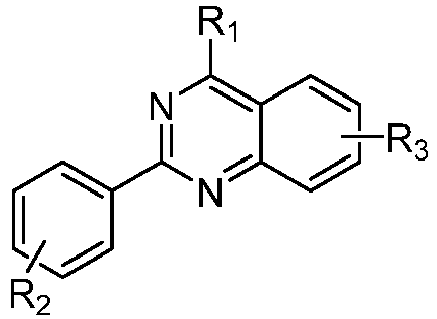
• P = compounds purchased from commercial sources • CP = "cherry pick" of 10 mM DMSO from NIH MLSMR • S = compound synthesized de novo by SBCCG Entry P/S* R1 R2 R3 LMPTP (OMFP) (IC50) (µM) n SEM 9 CP 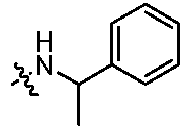
H H 23.1 3 2.22 10 CP 
H H 11.8 3 0.28 P 20.9 4 2.21 11 CP 
H H 7.51 3 1.69 P 24.2 4 1.53 12 CP 
4-O(i-Pr) H 18.1 3 1.20 13 CP 
H H 9.94 3 2.25 14 CP 
2-F H 5.48 3 0.21 15 CP 
H H 7.48 3 1.49 16 P 
4-NO2 H 10.9 3 2.84 17 CP 
4-NO2 H >80 4 - 18 P 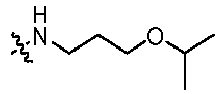
H H 18.1 4 1.29 19 CP 
H H 12.0 3 0.49 Table 1: SAR explorations of the quinazoline core ( Entries 1 ― 7)
• P = compounds purchased from commercial sources • CP = "cherry pick" of 10 mM DMSO from NIH MLSMR • S = compound synthesized de novo by SBCCG Entry P/S* R1 R2 R3 LMPTP (OMFP) (IC50) (µM) n SEM 20 CP P 
H H 10.0 3 0.65 21.1 4 2.02 21 CP 
H H 12.3 3 2.04 22 S 
H H 72.2 2 5.38 23 S 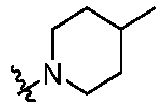
H H >80 3 - 24 S 
H H >80 3 - 25 S 
H H >80 3 - 26 S 
H H >80 3 - 27 S 
H H 53.1 4 1.27 28 S 
H H >80 3 - 29 S 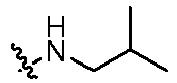
H H 14.5 4 0.98 30 S 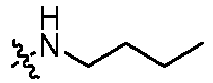
H H 23.2 4 1.72 31 S 
H H 15.0 4 1.04 Table 1: SAR explorations of the quinazoline core ( Entries 1 ― 7)
• P = compounds purchased from commercial sources • CP = "cherry pick" of 10 mM DMSO from NIH MLSMR • S = compound synthesized de novo by SBCCG Entry P/S* R1 R2 R3 LMPTP (OMFP) (IC50) (µM) n SEM 32 S 
H H 48.1 4 3.25 33 S 
H H >80 4 - 34 S 
H H 19.1 4 1.49 35 S 
H H 64.3 4 6.90 36 S 
H H >80 4 - 37 S 
H H 22.5 4 1.76 38 S 
H H 25.4 4 2.29 39 S 
H H 21.9 4 2.12 40 S 
H H 58.1 3 7.04 - The initial hit compound in Table 1, (Entry 1), was obtained and demonstrated similar potency to the solution screening sample (LMPTP (OMFP) IC50 = 13.5 µM). The inventors found 20 additional analogs in the screening collection and synthesized an additional 18 analogs for the quinazolinone series. From these analogs, the inventors first tested four analogs where the R1 group was fixed as a 3-morpholinopropan-1-amine and different R2 substituents on the phenyl ring were examined. In general the substitution at the C-2 position of the phenyl is favored and an electron donating group at this position is also preferred (Entries 1 - 4). A similar observation was noted when the R1 group was fixed and the C-2 position had a fluorine atom versus a hydrogen atom, the 2-F analogs were more potent. (Entry 9 and 14 and Entry 15 and 20). The inventors examined shorting the chain length at R1 coupled with having an aromatic/heteroaromatic group on the chain; for these compounds the inventors observed little change in potency over the lead structure CID1566769. (Entries 5-7, 9, 13-14, 16-17). One interesting observation was when the cycloalkyl or cycloheteroalkyl group was attached directly to the ring with no carbon spacer the compounds were inactive. (Entries 22-26, 28, 33). When the R1 group was an amine containing 2-4 carbon atoms, branched or straight chain, all the compounds had similar potencies (Entries 27, 29-31). Finally, when compounds with similar R1 groups differing by only one carbon atom in the chain were compared the potencies were similar. (Entries 35 and 39, Entries 37 and 38).
Table 2 summarizes studies on the quinolone series of compounds. Table 2: SAR explorations of the quinazoline core ( Entries 1 ― 7)
• P = compounds purchased from commercial sources • CP = "cherry pick" of 10 mM DMSO from NIH MLSMR • S = compound synthesized de novo by SRCCG Entry P/S* R1 R2 R3 LMPTP (OMFP ) (IC50) (µM) n SEM 41 CP 
H H 3.49 3 0.62 Screen P 2.86 4 0.10 hit S 3.70 4 0.36 42 CP 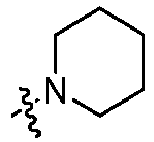
H H 9.25 3 1.32 P 11.1 4 0.70 43 S 
H H 7.68 4 0.71 44 S 
H H 2.13 4 0.13 45 S 
H H 5.46 4 0.58 46 S 
H H 1.56 4 0.08 47 S 
H H 5.72 4 0.53 48 S 
4-Cl H 1.54 4 0.06 49 S 
4-F H 1.40 4 0.09 50 (Compou nd D1) S 
4-OCH3 H 1.68 4 0.15 Table 2: SAR explorations of the quinazoline core ( Entries 1 ― 7)
• P = compounds purchased from commercial sources • CP = "cherry pick" of 10 mM DMSO from NIH MLSMR • S = compound synthesized de novo by SRCCG Entry P/S* R1 R2 R3 LMPTP (OMFP ) (IC50) (µM) n SEM (MLS-0472870) 51 S 
CH3 H 1.34 4 0.08 52 S 
2-Cl H 11.6 4 0.41 53 S 
3-Cl H 1.12 4 0.20 54 S 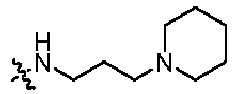
3-CF3 H 2.66 4 0.14 55 S 
2-OCH3 H 2.87 4 0.11 56 S 
3-F H 1.84 4 0.10 57 S 
3-OCH3 H 2.21 4 0.15 58 S 
H 6-F 22.0 4 7.35 59 S 
H 6-Br >80 4 - 60 S 
H 6-CH3 >80 4 - 61 S 
H 6,7-di-OCH3 >80 4 - 62 S 
H H 10.0 3 0.65 21.1 4 2.02 Table 2: SAR explorations of the quinazoline core ( Entries 1 ― 7)
• P = compounds purchased from commercial sources • CP = "cherry pick" of 10 mM DMSO from NIH MLSMR • S = compound synthesized de novo by SRCCG Entry P/S* R1 R2 R3 LMPTP (OMFP ) (IC50) (µM) n SEM 63 S 
H 11.5 4 0.91 64 S 
H H 66.9 3 5.77 - A similar SAR strategy was applied to the quinolone series (
Figure 16 ). - For the R1 group the inventors focused on either a 2 or 3 carbon spacer between the ring coupled nitrogen atom and the cycloalkyl or heterocycloalkyl tail groups. A limited number of R2 groups were investigated and a small set of R3 analogs were synthesized.
- The screening hit CID2728458 (Entry 41) was independently purchased and synthesized and the activity of the purchased and synthesized compound was similar LMPTP (OMFP) IC50 = 2.86 µM and LMPTP (OMFP) IC50 = 3.70 µM respectively. Screening of Entry 42showed that the potency was less than the screening hit.
- Overall, the inventors synthesized 21 compounds in the quinoline series, to ultimately select Entry 50 (CID73050863) for SAR explorations.
- For the first set of SAR analogs, the inventors choose to fix R2 and R3 as hydrogen atoms and vary the R1 position. The most active member of this set of analogs (Entries 41 - 47) was the 3-(piperidin-1-yl)propan-1-amine analog, Entry 46. (LMPTP (OMFP) IC50 = 1.56 µM). Next we fixed the R1 group as the 3-(piperidin-1-yl)propan-1-amine moiety, the R3 group as hydrogen atom and varied the R2 substitution. Substitution around the phenyl substituent R2 indicated little preference for electron withdrawing moieties over analogs containing electron donating groups, the respective LMPTP (OMFP) IC50 values ranged from 1.12 - 2.86 µM range. (Table 2; entries 48-51, 53-57). In addition, no strong preference regarding position (ortho, meta, para) was determined with regards to potency, the notable exception being the 2-Cl analog Entry 52, LMPTP (OMFP) IC = 11.2 µM. The third set of analogs fixed the R1 group as the 3-(piperidin-1-yl)propan-1-amine moiety, the R2 group as hydrogen atom and varied the R3 substitution. The compounds synthesized had substituents at the C-6 or C-6, C-7 positions of the quinoline ring and all the compounds lost significant potency with these modifications. (Table 2; entries 58-61). Finally the inventors replaced the nitrogen atom attached directly to the quinoline ring of Entry 50 (Compound D1 of Example 1) with either an oxygen or sulfur atom and the compounds were inactive. (Entries 63-64).
- The probe Compound D1 was also profiled in an insulin-based mouse 3T3-L1 adipogenesis assay. In this assay, 3T3-L1 pre-adipocytes are grown to 2-days post-confluence in DMEM with 10% bovine calf serum, and then induced to differentiate to adipocytes following stimulation for 2 days with an induction cocktail containing 1 µg/ml insulin, 1 µM dexamethasone, and 0.5 mM 3-isobutyl-1-methylxanthine in DMEM containing 10% fetal bovine serum (FBS).44 2 days later, the media is replaced with DMEM with 10% FBS and 1 µg/ml insulin, and after 2 additional days, the media is replaced with DMEM with 10% FBS for 2 additional days, at which point adipogenesis is measured using the AdipoRed Adipogenesis Assay Reagent from Lonza, according to the manufacturer's instructions. In brief, the assay reagent is added to the wells containing cells, where it partitions into the fat droplets of differentiated adipocytes, and emits fluorescence at 572 nm that can be detected with a plate-reader. To test the effect of probe Compound D1, cells were plated into 48-well plates and allowed to grow to confluence. Cells were then treated with 10 µM Compound D1 or 0.025% DMSO, and after 2 days induced to differentiate in the presence of 10 µM Compound D1 or 0.025% DMSO. Fresh compound or DMSO was added during each media replacement. As shown in the
Figure 7 , it was found that treatment with 10 µM Compound D1 completely abolished 3T3-L1 adipogenesis. - In the course of this investigation many compounds with similar potencies in the LMPTP (OMFP) assay were found. In order to determine which compound would be the best candidate for in vivo studies, an abbreviated ADME panel was ran on these compounds, a tabulation of the most interesting data on this set of compounds is illustrated in Table 3 below. From the hepatic microsome stability data the candidate selected for in vivo studies was Compound D1.
Table 3: Summary of in vitro ADME Properties of selected LMPTP inhibitors Compound ID (Entry) Aqueous Solubility Pion's buffer (µg/mL) pH 5.0/6.2/7.4 Plasma Stability % Remaining @ 3hrs Human/Mouse Hepatic Microsome Stability % Remaining @ 1hr Human/Mouse 41 111.8/95.7/54.5 70.08 / 62.25 26.54/0.38 48 >113/ >113 / >113 100/59.47 23.10 / 15.38 50 (Compound D1) >112 / >112 / >112 89.03 / 68.97 61.56 / 48.75 51 >178 / >178 / >178 92.17 / 46.01 32.21/9.70 53 >99 / >99 / >99 82.81 / 50.16 77.96 / 9.71 54 122.8 / 118.4 / 111.2 77.58 / 70.55 82.50/8.59 55 >103 / >103 / >103 83.67 / 63.60 52.95 /2.62 - Compound D1 achieved very good concentrations 18-20 x IC50 in aqueous buffer between a pH range of 5.0-7.4. The solubility was comparable in PBS. See
Figure 12 . - Plasma stability is a measure of the stability of small molecules and peptides in plasma and is an important parameter, which can strongly influence the in vivo efficacy of a test compound. Drug candidates are exposed to enzymatic processes (proteinases, esterases) in plasma, and they can undergo intramolecular rearrangement or bind irreversibly (covalently) to proteins. Compound D1 showed good stability in both human plasma and mouse plasma.
- The microsomal stability assay is commonly used to rank compounds according to their metabolic stability. This assay addresses the pharmacologic question of how long the parent compound will remain circulating in plasma within the body. Compound D1 showed moderate stability in human and mouse liver microsomes after 1 hour.
- The inventors also examined ML400 (also described herein as MLS-0472870 or Compound D1) for its rodent pharmacokinetics. The probe Compound D1 was profiled in Male C57BL/6 Mice, with n=3 for each group studied (IV, IP and PO arms). The formulation used was 1.00 mg/mL in DMSO:Tween80:Water = 5:5:90, which gave a clear solution. Low clearance and large volume of distribution were observed from IV arm and bioavailability was very good for PO and IP studies. Enterohepatic circulation was also observed for this compound. This compound has acceptable parameters for future in vivo studies (see Table 4 and
Figure 13 ).Table 4 Summary of in vivo Properties of LMPTP inhibitor probe Compound D1 Parameter Route of Adminstration Study Group IV PO IP Administered Dose (mg/kg) 4.89 29.6 9.69 t max (h) 3.33 0.33 Cmax (ng/mL) 3,210 365 t 1/2 (h) 39.6 29.2 32.5 Cl (mL/min/kg) 25.8 Vdss (L/kg) 83.1 AUC0-inf (ng.h/mL) 3,296 6,377 4,522 Bioavailability (%F) 40.5 78 - LYP-1 and VHR-1 dose response assays to assess selectivity of Compound D1 against these non-homologous phosphatases. This data are summarized in
Figure 14 . -
Figure 1A shows localization of the gene-trap in the Acp1 gene.Exon 3 andexon 4 are alternatively spliced to generate Lmptp-A and -B isoforms.Figure 1B shows PCR-based mouse genotyping using a forward primer located 5' to the gene-trap, a forward primer within the gene-trap, and a reverse primer located 3' to the gene-trap.Figure 1C shows RT-PCR with Lmptp primers on RNA extracted from the liver of a KO mouse and heterozygous and wild-type (WT) littermates.Figure 1D shows anti-Lmptp Western blot and control anti-tubulin blot of liver lysates of a KO mouse and heterozygous and WT littermates. -
Figures 2A-2D show that genetic deletion of LMPTP attenuates diabetes of obese mice. (A-D) Male wild-type (WT) and LMPTP KO mice on C57BL/6 background were placed on high-fat diet (HFD; 60% kcal from fat) for 3 months starting at 2 months of age. (A) Weight curves over the course of the HFD. (B) Intraperitoneal glucose tolerance test (IPGTT) was performed on mice at 2 months of age, prior to the start of the HFD. Mice were fasted overnight and injected with 1 g glucose/kg body weight, and blood glucose levels were measured at the indicated times. (C) IPGTT was performed on mice after 3 months HFD. (D) Fasting serum insulin levels were assessed by ELISA. (A-D) Mean±SEM is shown. ∗p<0.05; NS, non-significant: Two-Way ANOVA (A, B, C) or Wilcoxon matched-pairs signed rank test (D). -
Figure 3 shows that knockdown of Lmptp with antisense oligonucleotides (ASO) impairs adipogenesis of 3T3-L1 cells. 3T3-L1 cells were subjected to insulin-stimulated adipogenesis (as described in Example 5, describing cell based activity and efficacy) in the presence of 10 µM non-targeting (Ctl) or Lmptp ASO. Intracellular lipid accumulation was measured using the Lonza AdipoRed Assay Reagent. Mean ± SD relative fluorescence units (RFU) are shown. ∗, p<0.05. - The LMPTP-A isoform dephosphorylates the IR. The IR was immunoprecipitated from liver homogenates of mice subjected to 5 min stimulation with insulin (5 U intracardiac). Panels show WB of immunoprecipitates following incubation with 5 nM recombinant LMPTP-A, LMPTP-B or PTP1B or no enzyme for 30 min at 37°C in 50 mM Bis-Tris, pH 6.0, 1 mM DTT. See
Figure 4 . - Compound D1 (ML400) inhibits LMPTP with an uncompetitive mechanism of action, lowering both Vmax and KM. Activity of 20 nM LMPTP on OMFP substrate in the presence of increasing concentrations of ML400. Reactions were conducted at 37°C in 50 mM Bis-Tris, pH 6.0 with 1 mM DTT and 0.01% Triton X-100. Mean±SD is shown. Lines show fitting of data to the Michaelis-Menten equation. Note decrease in both Vmax and KM with increasing inhibitor concentration. See
Figure 5 . - Compound 41 of Table 2 shows efficacy in cellular assays. WB of IR immunoprecipitation from human HepG2 hepatocytes incubated overnight in serum-starve culture media (containing 0.1% fetal bovine serum) in the presence of 10 microM of Compound 41 of Table 2 or DMSO. Cells were stimulated with 1.76 microM insulin for 5 min prior to lysis. See
Figure 6 . - Male C57BL/6 mice were maintained on HFD containing 60 kcal % fat for 3 months, followed by daily IP administration of 30 mg/kg Compound D1 or vehicle. After 4 weeks, IPGTT were performed using 2 g glucose/kg body weight. Mean±SEM is shown. ∗, p<0.05, Two-way ANOVA. See
Figure 8 . - Serum creatinine levels from mice treated with Compound D1 (ML400) or vehicle (mice shown in
Figure 9 ) were assessed using the QuantiChrom Creatinine Assay Kit from BioAssay Systems. - Serum alanine transaminase or aspartate transaminase levels from mice treated with Compound D1 (ML400) or vehicle (mice shown in
Figure 10 ) were assessed using EnzyChrom Assay Kits from BioAssay Systems. - ML400 analog G53 (Table A) binds to LMPTP. ITC was performed using recombinant human LMPTP-A and a derivative of Compound D1, G53. Kd = 0.9 microM.
- Additional information is provided in Tables 5, 6, 7, and 8 (ML400 = Compound D1).
Table 5 Table 1. Potency and selectivity characteristics for probe ML400 CID/ ML# Target Name IC50 (nM) [SID, AID] Anti-target Name(s) IC50 (µM) [SID, AID] Fold-Selective Secondary Assay(s) Names IC50 (nH) [SID, AID] CID LMPTP 1680 ± 150 (n=4) LYP-1 (Lymphoid phosphatase, PTPN22) >80 (n=2) >60-fold LMPTP Orthogonal 73050863 SID173019983 assay ML400 (low molecular weight protein tyrosnine phosphatase) SID173019983 AID743309 AID686962, AlD743307 VHR-1 (Vaccinia H1-related phosphatase) >80 (n=2) >60-fold 3520 ± 330 (n=2) SID173019983 SID173019983 AID743310 AID 743308 Table 6 Table 2. Summary of Assays and AIDs PubChemBioAssay Name AIDs Probe Type Assay Type Assay Format Assay Detection & well format Center Summary assay for small molecule inhibitors of Low Molecular Weight Protein Tyrosine Phosphatase, LMPTP 651562 Inhibitor Summary Biochemical Fluorescence & 1536 well SBCCG uHTS identification of small molecule inhibitors of Low Molecular Weight Protein Tyrosine Phosphatase, LMPTP, via a fluorescence intensity assay 651560 Inhibitor Primary Biochemical Fluorescence & 1536 well SBCCG Dose response confirmation of small molecule inhibitors of Low Molecular Weight Protein Tyrosine Phosphatase, LMPTP, via a fluorescence intensity assay 651700 Inhibitor Confirmatory (DMSO Dose Response) Biochemical Fluorescence & 1536 well SBCCG Dose response confirmation of small molecule inhibitors of Low Molecular Weight Protein Tyrosine Phosphatase, LMPTP, in an orthogonal absorbance-based assay 652D05 Inhibitor Orthogonal (DMSO Dose Response) Biochemical Absorbance & 1536 well SBCC G Dose response confirmation of small molecule inhibitors of Low Molecular Weight Protein Tyrosine Phosphatase, LMPTP, in a fluorescence-based, Lymphoid Phosphatase (PTPN22, LYP-1) selectivity Assay 652006 Inhibitor Selectivity (DMSO Dose Response) Biochemical Fluorescence & 1536 well SBCCG Dose response confirmation of uHTS small molecule inhibitors of Low Molecular Weight Protein Tyrosine Phosphatase, LMPTP, in a fluorescence-based, VHR-1 (dual specificity phosphatase 3) selectivity assay 686961 Inhibitor Selectivity (DMSO Dose Response) Biochemical Fluorescence & 1536 well SBCCG SAR confirmation of small molecule inhibitors of Low Molecular Weight Protein Tyrosine Phosphatase, LMPTP, via a fluorescence intensity assay 686962 Inhibitor SAR (Dry Powder) Biochemical Fluorescence & 1536 well SBCCG SAR confirmation of small molecule inhibitors of Low Molecular Weight Protein Tyrosine Phosphatase, LMPTP, in an orthogonal absorbance-based assay 686963 Inhibitor SAR (Dry Powder) Biochemical Absorbance & 1536 well SBCCG SAR confirmation of small molecule inhibitors of Low Molecular Weight Protein Tyrosine Phosphatase, LMPTP, via a fluorescence intensity assay, set 2 743307 Inhibitor SAR (Dry Powder) Biochemical Fluorescence & 1536 well SBCCG SAR confirmation of small molecule inhibitors of Low Molecular Weight Protein Tyrosine Phosphatase, LMPTP, in an orthogonal absorbance-based assay, set 2 743308 Inhibitor SAR (Dry Powder) Biochemical Fluorescence & 1536 well SBCCG SAR confirmation of small molecule inhibitors of Low Molecular Weight Protein Tyrosine Phosphatase, LMPTP, in a fluorescence-based, Lymphoid Phosphatase (PTPN22, LYP-1) selectivity Assay 743309 Inhibitor SAR (Dry Powder) Biochemical Fluorescence & 1536 well SBCCG SAR confirmation of uHTS small molecule inhibitors of Low Molecular Weight Protein Tyrosine Phosphatase, LMPTP, in a fluorescence-based, VHR-1 (dual specificity phosphatase 3) selectivity assay 743310 Inhibitor SAR (Dry Powder) Biochemical Fluorescence & 1536 well SBCCG Table 7 Table 3. Calculated Properties for ML400 Calculated Property ML400 CID73050863 Molecular Weight 421.53194 [g/mol] Molecular Formula C25H31N3O3 H-Bond Donor 2 H- Bond Acceptor 6 Rotatable Bond Count 7 Exact Mass 421.236542 MonoIsotopic Mass 421.236542 Topological Polar Surface Area 74.7 Heavy Atom Count 31 Formal Charge 0 Complexity 455 Isotope Atom Count 0 Defined Atom StereoCenter Count 0 Undefined Atom StereoCenter Count 0 Defined Bond StereoCenter Count 0 Undefined Bond StereoCenter Count 0 Covalently- Bonded Unit Count 2 Table 8 Table 4. Probe and Analog Submissions to MLSMR (Evotec) for Small Molecule Inhibitors of LMPTP Probe ML400 - CID73050863 Probe /Analog MLS_ID (SBCCG) MLS_ID (MLSMR] CID SID Source Amt (mg) Date ordered/ Submitted Probe ML400 0472870 MLS005939925 73050863 173019983 Synthesis 27 04/15/2014 Analog 10322825 MLS005939926 2728458 173019996 Synthesis 25.6 04/1512014 Analog 20472782 M LS005939927 73050855 173019979 Synthesis 24.7 04/15/2014 Analog 30472857 MLS005939928 73050883 173019998 Synthesis 22.3 04/15/2014 Analog 40472866 MLS005939929 73050881 173019997 Synthesis 22.8 04/15/2014 Analog 50472781 MLS005939930 73050862 173019976 Synthesis 21.5 04/15/2014
Claims (15)
- A compound having the formula:

wherein:Z is -NR9-;L1 is a bond, substituted or unsubstituted alkylene, substituted or unsubstituted heteroalkylene, substituted or unsubstituted arylene, or substituted or unsubstituted heteroarylene;R1 is phenyl comprising a substituent group R1A, wherein R1A is -C(O)NR1CR1D;R1C is hydrogen, substituted or unsubstituted alkyl, substituted or unsubstituted heteroalkyl, substituted or unsubstituted cycloalkyl, substituted or unsubstituted heterocycloalkyl, substituted or unsubstituted aryl, or substituted or unsubstituted heteroaryl;R1D is substituted or unsubstituted alkyl, substituted or unsubstituted heteroalkyl, substituted or unsubstituted cycloalkyl, substituted or unsubstituted heterocycloalkyl, substituted or unsubstituted aryl, or substituted or unsubstituted heteroaryl;or R1C and R1D attached to the same nitrogen atom optionally combine to form a substituted or unsubstituted heterocycloalkyl;R2 is substituted or unsubstituted alkyl, substituted or unsubstituted heteroalkyl, substituted or unsubstituted cycloalkyl, substituted or unsubstituted heterocycloalkyl, substituted or unsubstituted aryl, or substituted or unsubstituted heteroaryl;R3 is hydrogen, halogen, -CX3 3, -CHX3 2, -CH2X3, -OCX3 3, -OCHX3 2, -OCH2X3, -CN, -SOn3R16, -SOv3NR13R14, -NHC(O)NR13R14, -N(O)m3, -NR13R14, -C(O)R15, -C(O)-OR15, -C(O)NR13R14, -OR16, -NR13SO2R16, -NR13C(O)R15, -NR13C(O)OR15, -NR13OR15, substituted or unsubstituted alkyl, substituted or unsubstituted heteroalkyl, substituted or unsubstituted cycloalkyl, substituted or unsubstituted heterocycloalkyl, substituted or unsubstituted aryl, or substituted or unsubstituted heteroaryl;R4 is hydrogen, halogen, -CX4 3, -CHX4 2, -CH2X4, -OCX4 3, -OCHX4 2, -OCH2X4, -CN, -SOn4R20, -SOv4NR17R18, -NHC(O)NR17R18, -N(O)m4, -NR17R18, -C(O)R19, -C(O)-OR19, -C(O)NR17R18, -OR20, -NR17SO2R20, -NR17C(O)R19, -NR17C(O)OR19, -NR17OR19, substituted or unsubstituted alkyl, substituted or unsubstituted heteroalkyl, substituted or unsubstituted cycloalkyl, substituted or unsubstituted heterocycloalkyl, substituted or unsubstituted aryl, or substituted or unsubstituted heteroaryl;R5 is hydrogen, halogen, -CX5 3, -CHX5 2, -CH2X5, -OCX5 3, -OCHX5 2, -OCH2X5, -CN, -SOn5R24, -SOv5NR21R22, -NHC(O)NR21R22, -N(O)m5, -NR21R22, -C(O)R23, -C(O)-OR23, -C(O)NR21R22, -OR24, -NR21SO2R24, -NR21C(O)R23, -NR21C(O)OR23, -NR21OR23, substituted or unsubstituted alkyl, substituted or unsubstituted heteroalkyl, substituted or unsubstituted cycloalkyl, substituted or unsubstituted heterocycloalkyl, substituted or unsubstituted aryl, or substituted or unsubstituted heteroaryl;R6 is hydrogen, halogen, -CX6 3, -CHX6 2, -CH2X6, -OCX6 3, -OCHX6 2, -OCH2X6, -CN, -SOn6R28, -SOv6NR25R26, -NHC(O)NR25R26, -N(O)m6, -NR25R26, -C(O)R27, -C(O)-OR27, -C(O)NR25R26, -OR28, -NR25SO2R28, -NR25C(O)R27, -NR25C(O)OR27, -NR25OR27, substituted or unsubstituted alkyl, substituted or unsubstituted heteroalkyl, substituted or unsubstituted cycloalkyl, substituted or unsubstituted heterocycloalkyl, substituted or unsubstituted aryl, or substituted or unsubstituted heteroaryl;each R8, R9, R13, R14, R15, R16, R17, R18, R19, R20, R21, R22, R23, R24, R25, R26, R27, and R28 is hydrogen, -CX3, -CN, -COOH, -CONH2, -CHX2, -CH2X, substituted or unsubstituted alkyl, substituted or unsubstituted heteroalkyl, substituted or unsubstituted cycloalkyl, substituted or unsubstituted heterocycloalkyl, substituted or unsubstituted aryl, or substituted or unsubstituted heteroaryl;each X is -F, -Cl, -Br, or -I;each X3, X4, X5, and X6 is independently -F, -Cl, -Br, or -I;each m3, m4, m5, and m6 is independently 1 or 2;each n3, n4, n5, and n6 is independently an integer from 0 to 3; andeach v3, v4, v5, and v6 is independently 1 or 2;wherein a substituted alkyl, heteroalkyl, cycloalkyl, heterocycloalkyl, aryl, heteroaryl, alkylene, heteroalkylene, arylene, or heteroarylene group is substituted with at least one substituent selected from oxo, halogen, -CF3, -CN, -OH, -NH2, -COOH, -CONH2, -NO2, -SH, -SO3H, -SO4H, -SO2NH2,-NHNH2, -ONH2, -NHC=(O)NHNH2, -NHC=(O)NH2, -NHSO2H, -NHC=(O)H, -NHC(O)-OH, -NHOH, -OCF3, -OCHF2, unsubstituted alkyl, unsubstituted heteroalkyl, unsubstituted cycloalkyl, unsubstituted heterocycloalkyl, unsubstituted aryl, unsubstituted heteroaryl. - A compound according to claim 1, or a pharmaceutically acceptable salt thereof, wherein:L1 is substituted or unsubstituted alkylene or substituted or unsubstituted arylene; andR2 is substituted or unsubstituted alkyl or substituted or unsubstituted heterocycloalkyl.
- A compound according to claim 1, or a pharmaceutically acceptable salt thereof, wherein:Z is -NH-;L1 is substituted or unsubstituted C3-C6 alkylene; andR2 is substituted or unsubstituted heterocycloalkyl.
- A compound according to claim 1, having the formula:

wherein:
R2 is substituted or unsubstituted cycloalkyl or substituted or unsubstituted heterocycloalkyl. - A compound according to any one of claims 1 to 4, or a pharmaceutically acceptable salt thereof, wherein R1A is para to the carbon attached to the quinoline moiety.
- A compound according to claim 1, having the formula:

wherein:
L1 is substituted or unsubstituted alkylene or substituted or unsubstituted arylene. - A compound according to any one of claims 1 to 6, or a pharmaceutically acceptable salt thereof, wherein each of R3, R4, R5, R6, and R8 is hydrogen.
- A compound according to any one of claims 1 to 7, or a pharmaceutically acceptable salt thereof, wherein R1C is hydrogen.
- A compound according to any one of claims 1 to 7, or a pharmaceutically acceptable salt thereof, wherein R1C is substituted or unsubstituted alkyl.
- A compound according to any one of claims 1 to 9, or a pharmaceutically acceptable salt thereof, wherein R1D is substituted or unsubstituted alkyl.
- A compound according to any one of claims 1 to 7, or a pharmaceutically acceptable salt thereof, wherein R1C and R1D attached to the same nitrogen atom combine to form a substituted or unsubstituted heterocycloalkyl.
- A compound according to claim 1, selected from the following compounds:(I1) N,N-diethyl-4-(4-((3-(piperidin-1-yl)propyl)amino)quinolin-2-yl)benzamide;(I57) phenyl-N-(4-{4-[(3-piperidylpropyl)amino](2-quinolyl)}phenyl)carboxamide;(I58) 3-[N-(4-{4-[(3-piperidylpropyl)amino]-2-quinolyl}phenyl)carbamoyl]propanoic acid;(I59) N-(2-cyanoethyl)(4-{4-[(3-piperidylpropyl)amino](2-quinolyl)}phenyl)carboxamide;(I60) N-ethyl-N-methyl(4-{4-[(3-piperidylpropyl)amino](2-quinolyl)}phenyl)carboxamide;(I61) N-(methylethyl)(4-{4-[(3-piperidylpropyl)amino](2-quinolyl)}phenyl)carboxamide;(I62) N-ethyl(4-{4-[(3-piperidylpropyl)amino](2-quinolyl)lphenyl)carboxamide;(I63) (4-{4-[(3-piperidylpropyl)amino](2-quinolyl)}phenyl)-N-(2,2,2-trifluoroethyl)carboxam ide;(I64) N-(oxolan-2-ylmethyl)(4-{4-[(3-piperidylpropyl)amino](2-quinolyl)}phenyl)carboxamide;(I65) ethyl 2-[(4-{4-[(3-piperidylpropyl)amino]-2-quinolyl}phenyl)carbonylamino]acetate;(I66) N-[2-(dimethylamino)ethyl](4-{4-[(3-piperidylpropyl)amino](2-quinolyl)}phenyl)carboxamide;(I67) N-(3-hydroxypropyl)(4-{4-[(3-piperidylpropyl)amino](2-quinolyl)}phenyl)carboxamide;(I68) 2-[(4-{4-[(3-piperidylpropyl)amino]-2-quinolyl}phenyl)carbonylamino]acetic acid;(I69) methyl 2-[(4-{4-[(3-piperidylpropyl)amino]-2-quinolyl}phenyl)carbonylamino]acetate;(I70) N-cyclopropyl(4-{4-[(3-piperidylpropyl)amino](2-quinolyl)lphenyl)carboxamide;(I71) N,N-diethyl(4-{4-[(3-piperidylpropyl)amino](2-quinolyl)}phenyl)carboxamide;(I72) N,N-dimethyl(4-{4-[(3-piperidylpropyl)amino](2-quinolyl)lphenyl)carboxamide;(I73) N-methyl(4-{4-[(3-piperidylpropyl)amino](2-quinolyl)}phenyl)carboxamide;(I80) 3-amino-5-{4-[(3-piperidylpropyl)amino](2-quinolyl)}phenyl morpholin-4-yl ketone;(I84) 4-{4-[(3-piperidylpropyl)amino](2-quinolyl)}phenyl pyrrolidinyl ketone;(I189) (4-{4-[(3-piperidylpropyl)amino](2-quinolyl)}phenyl)-N-(2-(4-pyridyl)ethyl)carboxamide;(I190) N-[3-(diethylamino)propyl](4-{4-[(3-piperidylpropyl)amino](2-quinolyl) }phenyl)carboxam ide;(I191) N-(2-piperidylethyl)(4-{4-[(3-piperidylpropyl)amino](2-quinolyl)}phenyl)carboxamide;(I192) N-(3-morpholin-4-ylpropyl)(4-{4-[(3-piperidylpropyl)amino](2-quinolyl) }phenyl)carboxam ide;(I193) piperazinyl 4-{4-[(3-piperidylpropyl)amino](2-quinolyl)}phenyl ketone;(I194) piperidyl 4-{4-[(3-piperidylpropyl)amino](2-quinolyl)}phenyl ketone;(I195) N-(3-aminopropyl)(4-{4-[(3-piperidylpropyl)amino](2-quinolyl)}phenyl)carboxamide;(I196) N-(4-piperidyl)(4-{4-[(3-piperidylpropyl)amino](2-quinolyl)}phenyl)carboxamide;(I197) N-(4-piperidylmethyl)(4-{4-[(3-piperidylpropyl)amino](2-quinolyl)}phenyl)carboxamide;(I198) N-(3-piperidylpropyl)(4-{4-[(3-piperidylpropyl)amino](2-quinolyl)}phenyl)carboxamide;(I226) N-(2-methylpropyl)(4-{4-[(3-piperidylpropyl)amino](2-quinolyl)}phenyl)carboxamide;(I227) N-(2-hydroxyethyl)(4-{4-[(3-piperidylpropyl)amino](2-quinolyl)}phenyl)carboxamide;(I228) (2-fluoro-4-{4-[(3-piperidylpropyl)amino](2-quinolyl)}phenyl)-N-methylcarboxamide;(I229) N-ethyl(2-fluoro-4-{4-[(3-piperidylpropyl)amino](2-quinolyl)}phenyl)carboxamide;(I230) N-cyclohexyl(4-{4-[(3-piperidylpropyl)amino](2-quinolyl)}phenyl)carboxamide;(I234) morpholin-4-yl4-{4-[(3-piperidylpropyl)amino](2-quinolyl)}phenyl ketone;(I249) N-cyclopentyl(4-{4-[(3-piperidylpropyl)amino](2-quinolyl)}phenyl)carboxamide;(I251) (2-chloro-4-{4-[(3-piperidylpropyl)amino](2-quinolyl)lphenyl)-N-methylcarboxamide;(I253) N-benzyl(4-{4-[(3-piperidylpropyl)amino](2-quinolyl)}phenyl)carboxamide;(I254) N-[2-(diethylamino)ethyl](4-{4-[(3-piperidylpropyl)amino](2-quinolyl)}phenyl)carboxamide;(I259) 3-amino-5-{4-[(3-piperidylpropyl)amino](2-quinolyl)}phenylmorpholin-4-yl ketone;(I263) phenyl-N-(4-{4-[(3-piperidylpropyl)amino](2-quinolyl)}phenyl)carboxamide;(I265) N-(2-cyanoethyl)(4-{4-[(3-piperidylpropyl)amino](2-quinolyl)}phenyl)carboxamide;(I266) N-ethyl-N-methyl(4-{4-[(3-piperidylpropyl)amino](2-quinolyl)}phenyl)carboxamide;(I267) N-(methylethyl)(4-{4-[(3-piperidylpropyl)amino](2-quinolyl)}phenyl)carboxamide;(I268) N-ethyl(4-{4-[(3-piperidylpropyl)amino](2-quinolyl)}phenyl)carboxamide;(I269) (4-{4-[(3-piperidylpropyl)amino](2-quinolyl)}phenyl)-N-(2,2,2-trifluoroethyl)carboxamide;(I270) N-(oxolan-2-ylmethyl)(4-{4-[(3-piperidylpropyl)amino](2-quinolyl)}phenyl)carboxamide;(I271) N-cyclopropyl(4-{4-[(3-piperidylpropyl)amino](2-quinolyl)}phenyl)carboxamide; and(I272) 4-{4-[(3-piperidylpropyl)amino](2-quinolyl)}phenyl pyrrolidinyl ketone;or a pharmaceutically acceptable salt thereof.
- A compound according to claim 1 that is:

- A pharmaceutical composition comprising a compound according to any one of claims 1 to 13, or a pharmaceutically acceptable salt thereof, and a pharmaceutically acceptable excipient.
- A compound according to any one of claims 1 to 13, or a pharmaceutical composition according to claim 14, for use in a method of treatment of: diabetes, heart disease, coronary artery disease, hyperlipidemia, lipodystrophy, insulin resistance, rheumatic disease, atherosclerosis, myocardial infarction, stroke, high blood pressure (hypertension), obesity, elevated fasting plasma glucose, high serum triglycerides, elevated blood cholesterol, cardiac hypertrophy, heart failure, or metabolic syndrome.
Applications Claiming Priority (2)
| Application Number | Priority Date | Filing Date | Title |
|---|---|---|---|
| US201462063937P | 2014-10-14 | 2014-10-14 | |
| PCT/US2015/055607 WO2016061280A1 (en) | 2014-10-14 | 2015-10-14 | Inhibitors of low molecular weight protein tyrosine phosphatase and uses thereof |
Publications (3)
| Publication Number | Publication Date |
|---|---|
| EP3206689A1 EP3206689A1 (en) | 2017-08-23 |
| EP3206689A4 EP3206689A4 (en) | 2018-05-09 |
| EP3206689B1 true EP3206689B1 (en) | 2021-12-08 |
Family
ID=55747298
Family Applications (1)
| Application Number | Title | Priority Date | Filing Date |
|---|---|---|---|
| EP15851085.9A Not-in-force EP3206689B1 (en) | 2014-10-14 | 2015-10-14 | Inhibitors of low molecular weight protein tyrosine phosphatase and uses thereof |
Country Status (6)
| Country | Link |
|---|---|
| US (2) | US10626094B2 (en) |
| EP (1) | EP3206689B1 (en) |
| JP (1) | JP6899323B2 (en) |
| CN (1) | CN107427506A (en) |
| CA (1) | CA2964113A1 (en) |
| WO (1) | WO2016061280A1 (en) |
Families Citing this family (12)
| Publication number | Priority date | Publication date | Assignee | Title |
|---|---|---|---|---|
| CN107427506A (en) | 2014-10-14 | 2017-12-01 | 拉霍拉敏感及免疫学研究所 | Inhibitors of low molecular weight protein tyrosine phosphatases and uses thereof |
| CN105646462B (en) * | 2016-01-19 | 2019-04-05 | 河南大学 | Graveolinine derivative, preparation method and application |
| JP2018052878A (en) | 2016-09-29 | 2018-04-05 | 第一三共株式会社 | Pyridine compounds |
| CN108623561B (en) * | 2017-03-24 | 2025-04-01 | 中国海洋大学 | A method for preparing penicillic acid compound |
| CN110730776A (en) | 2017-04-10 | 2020-01-24 | 拜耳股份公司 | Substituted N-arylethyl-2-arylquinoline-4-carboxamides and uses thereof |
| TWI770157B (en) | 2017-04-10 | 2022-07-11 | 德商拜耳廠股份有限公司 | Substituted n-arylethyl-2-aminoquinoline-4-carboxamides and use thereof |
| US11066420B2 (en) | 2017-05-01 | 2021-07-20 | Sanford Burnham Prebys Medical Discovery Institute | Inhibitors of low molecular weight protein tyrosine phosphatase (LMPTP) and uses thereof |
| PH12022550370A1 (en) * | 2019-08-22 | 2023-03-06 | Biohaven Therapeutics Ltd | Molecules that bind to tdp-43 for the treatment of amyotrophic lateral sclerosis and related disorders |
| TW202140473A (en) | 2020-01-15 | 2021-11-01 | 美商纜圖藥品公司 | Map4k1 inhibitors |
| MX2023000263A (en) | 2020-07-16 | 2023-03-29 | Dermavant Sciences GmbH | ISOQUINOLINE COMPOUNDS AND THEIR USE IN THE TREATMENT OF AHR IMBALANCE. |
| MX2024000751A (en) | 2021-07-14 | 2024-03-25 | Blueprint Medicines Corp | Heterocyclic compounds as map4k1 inhibitors. |
| CN119569738B (en) * | 2024-12-09 | 2026-05-08 | 太原学院 | A quinazoline small molecule compound, its preparation method and application |
Family Cites Families (44)
| Publication number | Priority date | Publication date | Assignee | Title |
|---|---|---|---|---|
| US3340260A (en) * | 1962-12-03 | 1967-09-05 | Ciba Geigy Corp | 4-amino-pyrimidines |
| JPH083163A (en) | 1994-06-22 | 1996-01-09 | Kyowa Hakko Kogyo Co Ltd | Condensed pyridine derivative |
| US7037922B1 (en) | 2000-03-10 | 2006-05-02 | Neurogen Corporation | Aryl fused 2,4-disubstituted pyridines: NK3 receptor ligands |
| EP1377554A1 (en) * | 1999-06-16 | 2004-01-07 | University Of Iowa Research Foundation | Antagonism of immunostimulatory cpg-oligonucleotides by 4-aminoquinolines and other weak bases |
| US6294525B1 (en) * | 1999-09-01 | 2001-09-25 | Molecumetics Ltd. | Reverse-turn mimetics and methods relating thereto |
| JP2001089452A (en) * | 1999-09-22 | 2001-04-03 | Sankyo Co Ltd | Pyrimidine derivative |
| US6440995B1 (en) | 1999-10-01 | 2002-08-27 | Hoffman-La Roche Inc. | Quinolin-4-yl derivatives |
| GB0012874D0 (en) | 2000-05-27 | 2000-07-19 | Ufc Limited | 4-Aminoquinolines |
| WO2002000623A2 (en) | 2000-06-26 | 2002-01-03 | Neurogen Corporation | Aryl fused substituted 4-oxy-pyridines |
| WO2002014269A2 (en) | 2000-08-16 | 2002-02-21 | Neurogen Corporation | 2,4-substituted pyridine derivatives |
| JP2005162612A (en) * | 2002-01-09 | 2005-06-23 | Ajinomoto Co Inc | Acylsulfonamide derivative |
| US20040192583A1 (en) | 2002-12-19 | 2004-09-30 | Satyanarayana Medicherla | Treatment of obesity and associated conditions with TGF-beta inhibitors |
| US7169797B2 (en) * | 2003-02-14 | 2007-01-30 | Abbott Laboratories | Protein-tyrosine phosphatase inhibitors and uses thereof |
| CL2004000409A1 (en) * | 2003-03-03 | 2005-01-07 | Vertex Pharma | COMPOUNDS DERIVED FROM 2- (REPLACED CILO) -1- (AMINO OR REPLACED OXI) -CHINAZOLINE, INHIBITORS OF IONIC SODIUM AND CALCIUM VOLTAGE DEPENDENTS; PHARMACEUTICAL COMPOSITION; AND USE OF THE COMPOUND IN THE TREATMENT OF ACUTE PAIN, CHRONIC, NEU |
| US7189733B2 (en) | 2003-03-12 | 2007-03-13 | Millennium Pharmaceuticals, Inc. | Compositions and methods for inhibiting TGF-β |
| EP1633718B1 (en) * | 2003-06-17 | 2012-06-06 | Millennium Pharmaceuticals, Inc. | COMPOSITIONS AND METHODS FOR INHIBITING TGF-s |
| CA2534649A1 (en) * | 2003-08-01 | 2005-02-10 | Genelabs Technologies, Inc. | Bicyclic imidazol derivatives against flaviviridae |
| WO2005035521A1 (en) * | 2003-10-09 | 2005-04-21 | Argenta Discovery Ltd. | Substituted quinolines as mcr modulators |
| EP1678149A2 (en) | 2003-10-31 | 2006-07-12 | Neurogen Corporation | 4-amino(aza)quinoline derivatives as capsaicin receptor agonists |
| RU2006124559A (en) | 2003-12-09 | 2008-01-20 | Вертекс Фармасьютикалз Инкорпорейтед (Us) | NAPHTHIRIDINE DERIVATIVES AND APPLICATION OF THE INDICATED DERIVATIVES AS MUSCARINE RECEPTOR MODULATORS |
| WO2005061519A1 (en) | 2003-12-19 | 2005-07-07 | Takeda San Diego, Inc. | Kinase inhibitors |
| WO2005108370A1 (en) | 2004-04-16 | 2005-11-17 | Ajinomoto Co., Inc. | Benzene compounds |
| US20060128702A1 (en) | 2004-11-23 | 2006-06-15 | Manojit Pal | Heterocyclic and bicyclic compounds, compositions and methods |
| KR20060079122A (en) | 2004-12-31 | 2006-07-05 | 에스케이케미칼주식회사 | Benzothiazole derivatives effective for the prevention of diabetes and obesity |
| WO2007009911A1 (en) | 2005-07-21 | 2007-01-25 | F. Hoffmann-La Roche Ag | PYRIDO [2 , 3-D] PYRIMIDINE-2 , 4-DIAMINE COMPOUNDS AS PTPlB INHIBITORS |
| JP2008179621A (en) * | 2006-12-28 | 2008-08-07 | Taisho Pharmaceutical Co Ltd | Nitrogen-containing saturated heterocyclic compounds |
| RS54706B1 (en) * | 2007-03-23 | 2016-08-31 | Amgen Inc. | HETEROCYCLIC UNITS AND THEIR USES |
| US20090209536A1 (en) * | 2007-06-17 | 2009-08-20 | Kalypsys, Inc. | Aminoquinazoline cannabinoid receptor modulators for treatment of disease |
| PE20091309A1 (en) * | 2007-12-21 | 2009-09-30 | Astrazeneca Ab | CYCLOHEXYL DERIVATIVES AS ACETYL COENZYME CARBOXYLASE INHIBITORS |
| JP5455913B2 (en) | 2008-08-27 | 2014-03-26 | 大正製薬株式会社 | Novel hydroxamic acid derivatives having naphthyridine-N-oxide |
| WO2010088177A1 (en) | 2009-02-02 | 2010-08-05 | Merck Sharp & Dohme Corp. | Inhibitors of akt activity |
| JP2013505909A (en) * | 2009-09-24 | 2013-02-21 | ビーエーエスエフ ソシエタス・ヨーロピア | Aminoquinazoline compounds for combating invertebrate pests |
| WO2011054433A1 (en) * | 2009-11-07 | 2011-05-12 | Merck Patent Gmbh | Heteroarylaminoquinolines as tgf-beta receptor kinase inhibitors |
| CN103079558B (en) * | 2010-04-05 | 2025-09-12 | 上海复星医药产业发展有限公司 | IRE-1α inhibitors |
| EP2575866A4 (en) * | 2010-05-24 | 2013-10-16 | Presidio Pharmaceuticals Inc | Inhibitors of hcv ns5a |
| WO2012145617A2 (en) * | 2011-04-22 | 2012-10-26 | Jasco Pharmaceuticals, LLC | Aminopyrimidine kinase inhibitors |
| EP2847168A1 (en) | 2012-05-10 | 2015-03-18 | Achaogen, Inc. | Antibacterial agents |
| RU2650107C2 (en) | 2012-09-26 | 2018-04-09 | Мерк Патент Гмбх | Quinazolinone derivatives as parp inhibitors |
| AU2014209107B2 (en) | 2013-01-28 | 2018-04-12 | Viamet Pharmaceuticals (NC), Inc. | Metalloenzyme inhibitor compounds |
| HRP20191860T1 (en) * | 2013-03-13 | 2019-12-27 | Forma Therapeutics, Inc. | 2-hydroxy-1-{4-[(4-phenylphenyl)carbonyl]piperazin-1-yl}ethan-1-one derivatives and related compounds as fatty acid synthase (fasn) inhibitors for the treatment of cancer |
| CA2902734A1 (en) * | 2013-03-18 | 2014-09-25 | Genoscience Pharma | Quinolines derivatives as novel anticancer agents |
| WO2015033228A2 (en) * | 2013-09-09 | 2015-03-12 | Glionova Ab | Compounds and use for treating cancer |
| CN107427506A (en) | 2014-10-14 | 2017-12-01 | 拉霍拉敏感及免疫学研究所 | Inhibitors of low molecular weight protein tyrosine phosphatases and uses thereof |
| US11066420B2 (en) | 2017-05-01 | 2021-07-20 | Sanford Burnham Prebys Medical Discovery Institute | Inhibitors of low molecular weight protein tyrosine phosphatase (LMPTP) and uses thereof |
-
2015
- 2015-10-14 CN CN201580067939.2A patent/CN107427506A/en active Pending
- 2015-10-14 CA CA2964113A patent/CA2964113A1/en not_active Abandoned
- 2015-10-14 EP EP15851085.9A patent/EP3206689B1/en not_active Not-in-force
- 2015-10-14 US US15/518,331 patent/US10626094B2/en not_active Expired - Fee Related
- 2015-10-14 WO PCT/US2015/055607 patent/WO2016061280A1/en not_active Ceased
- 2015-10-14 JP JP2017519654A patent/JP6899323B2/en not_active Expired - Fee Related
-
2020
- 2020-02-18 US US16/794,076 patent/US11220486B2/en not_active Expired - Fee Related
Non-Patent Citations (1)
| Title |
|---|
| None * |
Also Published As
| Publication number | Publication date |
|---|---|
| CA2964113A1 (en) | 2016-04-21 |
| EP3206689A1 (en) | 2017-08-23 |
| US11220486B2 (en) | 2022-01-11 |
| WO2016061280A1 (en) | 2016-04-21 |
| US20200290977A1 (en) | 2020-09-17 |
| JP2017536346A (en) | 2017-12-07 |
| EP3206689A4 (en) | 2018-05-09 |
| US10626094B2 (en) | 2020-04-21 |
| CN107427506A (en) | 2017-12-01 |
| US20170247340A1 (en) | 2017-08-31 |
| JP6899323B2 (en) | 2021-07-07 |
Similar Documents
| Publication | Publication Date | Title |
|---|---|---|
| US11220486B2 (en) | Inhibitors of low molecular weight protein tyrosine phosphatase and uses thereof | |
| JP5525812B2 (en) | Novel heteroaryl-substituted arylaminopyridine derivatives as MEK inhibitors | |
| JP6916795B2 (en) | LSD1 inhibitor | |
| JP5517935B2 (en) | Indole and indazole compounds as cell necrosis inhibitors | |
| AU2015365465B2 (en) | Amido thiadiazole derivatives as NADPH Oxidase inhibitors | |
| AU2013366513B2 (en) | Novel benzimidazole derivatives as kinase inhibitors | |
| ES3043183T3 (en) | Compounds and uses thereof | |
| WO2001007411A1 (en) | Biarylurea derivatives | |
| EA022076B1 (en) | Hexafluoroisopropyl carbamate derivatives, their preparation and their therapeutic application | |
| CN110997669B (en) | Substituted five-membered and six-membered heterocyclic compound, preparation method thereof, pharmaceutical composition and application thereof | |
| WO2014084778A1 (en) | Pyrimidine-2,4-diamine derivatives for treatment of cancer | |
| EP3083631B1 (en) | Wnt pathway modulators | |
| CN111484491B (en) | Substituted pyrido-cyclic compounds, process for their preparation and their use | |
| WO2001057044A1 (en) | Pyridoxazine derivatives | |
| EP2662367B1 (en) | Novel indole or indazole derivative or salt thereof | |
| WO2018204176A1 (en) | Inhibitors of low molecular weight protein tyrosine phosphatase (lmptp) and uses thereof | |
| FR2943669A1 (en) | NICOTINAMIDE DERIVATIVES, THEIR PREPARATION AND THEIR THERAPEUTIC APPLICATION | |
| CN106061974A (en) | Maleimide derivatives as modulators of WNT pathway | |
| EA014324B1 (en) | Triazolophthalazines | |
| JP2023523545A (en) | Modulators of Mas-related G protein receptor X4, related products and methods of use thereof | |
| JP2023551197A (en) | Dihydroisoquinolinone and isoindolinone derivatives and their use | |
| WO2019079609A1 (en) | Orally available seh/pde4 dual inhibitors | |
| CA3181351A1 (en) | Nampt modulators | |
| WO2014207508A1 (en) | Pyridyl compound suitable for the treatment of metabolic disorders | |
| US20230227428A1 (en) | Amido compounds |
Legal Events
| Date | Code | Title | Description |
|---|---|---|---|
| STAA | Information on the status of an ep patent application or granted ep patent |
Free format text: STATUS: THE INTERNATIONAL PUBLICATION HAS BEEN MADE |
|
| PUAI | Public reference made under article 153(3) epc to a published international application that has entered the european phase |
Free format text: ORIGINAL CODE: 0009012 |
|
| STAA | Information on the status of an ep patent application or granted ep patent |
Free format text: STATUS: REQUEST FOR EXAMINATION WAS MADE |
|
| 17P | Request for examination filed |
Effective date: 20170508 |
|
| AK | Designated contracting states |
Kind code of ref document: A1 Designated state(s): AL AT BE BG CH CY CZ DE DK EE ES FI FR GB GR HR HU IE IS IT LI LT LU LV MC MK MT NL NO PL PT RO RS SE SI SK SM TR |
|
| AX | Request for extension of the european patent |
Extension state: BA ME |
|
| DAV | Request for validation of the european patent (deleted) | ||
| DAX | Request for extension of the european patent (deleted) | ||
| A4 | Supplementary search report drawn up and despatched |
Effective date: 20180411 |
|
| RIC1 | Information provided on ipc code assigned before grant |
Ipc: A61K 31/4706 20060101AFI20180405BHEP Ipc: C07D 215/02 20060101ALI20180405BHEP |
|
| STAA | Information on the status of an ep patent application or granted ep patent |
Free format text: STATUS: EXAMINATION IS IN PROGRESS |
|
| 17Q | First examination report despatched |
Effective date: 20190723 |
|
| GRAP | Despatch of communication of intention to grant a patent |
Free format text: ORIGINAL CODE: EPIDOSNIGR1 |
|
| STAA | Information on the status of an ep patent application or granted ep patent |
Free format text: STATUS: GRANT OF PATENT IS INTENDED |
|
| RIC1 | Information provided on ipc code assigned before grant |
Ipc: C07D 405/12 20060101ALI20200331BHEP Ipc: A61P 29/00 20060101ALI20200331BHEP Ipc: C07D 401/12 20060101ALI20200331BHEP Ipc: C07D 405/04 20060101ALI20200331BHEP Ipc: C07D 401/04 20060101ALI20200331BHEP Ipc: A61P 3/04 20060101ALI20200331BHEP Ipc: C07D 409/04 20060101ALI20200331BHEP Ipc: C07D 215/02 20060101ALI20200331BHEP Ipc: C07D 403/12 20060101ALI20200331BHEP Ipc: A61K 31/4706 20060101AFI20200331BHEP Ipc: C07D 239/94 20060101ALI20200331BHEP Ipc: C07D 215/42 20060101ALI20200331BHEP Ipc: C07D 215/46 20060101ALI20200331BHEP Ipc: A61P 3/06 20060101ALI20200331BHEP Ipc: A61P 43/00 20060101ALI20200331BHEP |
|
| INTG | Intention to grant announced |
Effective date: 20200504 |
|
| RAP1 | Party data changed (applicant data changed or rights of an application transferred) |
Owner name: SANFORD BURNHAM PREBYS MEDICAL DISCOVERY INSTITUTE Owner name: LA JOLLA INSTITUTE OF ALLERGY & IMMUNOLOGY |
|
| GRAJ | Information related to disapproval of communication of intention to grant by the applicant or resumption of examination proceedings by the epo deleted |
Free format text: ORIGINAL CODE: EPIDOSDIGR1 |
|
| STAA | Information on the status of an ep patent application or granted ep patent |
Free format text: STATUS: EXAMINATION IS IN PROGRESS |
|
| INTC | Intention to grant announced (deleted) | ||
| GRAJ | Information related to disapproval of communication of intention to grant by the applicant or resumption of examination proceedings by the epo deleted |
Free format text: ORIGINAL CODE: EPIDOSDIGR1 |
|
| STAA | Information on the status of an ep patent application or granted ep patent |
Free format text: STATUS: GRANT OF PATENT IS INTENDED |
|
| GRAP | Despatch of communication of intention to grant a patent |
Free format text: ORIGINAL CODE: EPIDOSNIGR1 |
|
| INTG | Intention to grant announced |
Effective date: 20210630 |
|
| GRAS | Grant fee paid |
Free format text: ORIGINAL CODE: EPIDOSNIGR3 |
|
| GRAA | (expected) grant |
Free format text: ORIGINAL CODE: 0009210 |
|
| STAA | Information on the status of an ep patent application or granted ep patent |
Free format text: STATUS: THE PATENT HAS BEEN GRANTED |
|
| AK | Designated contracting states |
Kind code of ref document: B1 Designated state(s): AL AT BE BG CH CY CZ DE DK EE ES FI FR GB GR HR HU IE IS IT LI LT LU LV MC MK MT NL NO PL PT RO RS SE SI SK SM TR |
|
| REG | Reference to a national code |
Ref country code: GB Ref legal event code: FG4D |
|
| REG | Reference to a national code |
Ref country code: AT Ref legal event code: REF Ref document number: 1453234 Country of ref document: AT Kind code of ref document: T Effective date: 20211215 Ref country code: CH Ref legal event code: EP |
|
| REG | Reference to a national code |
Ref country code: DE Ref legal event code: R096 Ref document number: 602015075682 Country of ref document: DE |
|
| REG | Reference to a national code |
Ref country code: IE Ref legal event code: FG4D |
|
| REG | Reference to a national code |
Ref country code: LT Ref legal event code: MG9D |
|
| REG | Reference to a national code |
Ref country code: NL Ref legal event code: MP Effective date: 20211208 |
|
| PG25 | Lapsed in a contracting state [announced via postgrant information from national office to epo] |
Ref country code: RS Free format text: LAPSE BECAUSE OF FAILURE TO SUBMIT A TRANSLATION OF THE DESCRIPTION OR TO PAY THE FEE WITHIN THE PRESCRIBED TIME-LIMIT Effective date: 20211208 Ref country code: LT Free format text: LAPSE BECAUSE OF FAILURE TO SUBMIT A TRANSLATION OF THE DESCRIPTION OR TO PAY THE FEE WITHIN THE PRESCRIBED TIME-LIMIT Effective date: 20211208 Ref country code: FI Free format text: LAPSE BECAUSE OF FAILURE TO SUBMIT A TRANSLATION OF THE DESCRIPTION OR TO PAY THE FEE WITHIN THE PRESCRIBED TIME-LIMIT Effective date: 20211208 Ref country code: BG Free format text: LAPSE BECAUSE OF FAILURE TO SUBMIT A TRANSLATION OF THE DESCRIPTION OR TO PAY THE FEE WITHIN THE PRESCRIBED TIME-LIMIT Effective date: 20220308 |
|
| REG | Reference to a national code |
Ref country code: AT Ref legal event code: MK05 Ref document number: 1453234 Country of ref document: AT Kind code of ref document: T Effective date: 20211208 |
|
| PG25 | Lapsed in a contracting state [announced via postgrant information from national office to epo] |
Ref country code: SE Free format text: LAPSE BECAUSE OF FAILURE TO SUBMIT A TRANSLATION OF THE DESCRIPTION OR TO PAY THE FEE WITHIN THE PRESCRIBED TIME-LIMIT Effective date: 20211208 Ref country code: NO Free format text: LAPSE BECAUSE OF FAILURE TO SUBMIT A TRANSLATION OF THE DESCRIPTION OR TO PAY THE FEE WITHIN THE PRESCRIBED TIME-LIMIT Effective date: 20220308 Ref country code: LV Free format text: LAPSE BECAUSE OF FAILURE TO SUBMIT A TRANSLATION OF THE DESCRIPTION OR TO PAY THE FEE WITHIN THE PRESCRIBED TIME-LIMIT Effective date: 20211208 Ref country code: HR Free format text: LAPSE BECAUSE OF FAILURE TO SUBMIT A TRANSLATION OF THE DESCRIPTION OR TO PAY THE FEE WITHIN THE PRESCRIBED TIME-LIMIT Effective date: 20211208 Ref country code: GR Free format text: LAPSE BECAUSE OF FAILURE TO SUBMIT A TRANSLATION OF THE DESCRIPTION OR TO PAY THE FEE WITHIN THE PRESCRIBED TIME-LIMIT Effective date: 20220309 |
|
| PG25 | Lapsed in a contracting state [announced via postgrant information from national office to epo] |
Ref country code: NL Free format text: LAPSE BECAUSE OF FAILURE TO SUBMIT A TRANSLATION OF THE DESCRIPTION OR TO PAY THE FEE WITHIN THE PRESCRIBED TIME-LIMIT Effective date: 20211208 |
|
| PG25 | Lapsed in a contracting state [announced via postgrant information from national office to epo] |
Ref country code: SM Free format text: LAPSE BECAUSE OF FAILURE TO SUBMIT A TRANSLATION OF THE DESCRIPTION OR TO PAY THE FEE WITHIN THE PRESCRIBED TIME-LIMIT Effective date: 20211208 Ref country code: SK Free format text: LAPSE BECAUSE OF FAILURE TO SUBMIT A TRANSLATION OF THE DESCRIPTION OR TO PAY THE FEE WITHIN THE PRESCRIBED TIME-LIMIT Effective date: 20211208 Ref country code: RO Free format text: LAPSE BECAUSE OF FAILURE TO SUBMIT A TRANSLATION OF THE DESCRIPTION OR TO PAY THE FEE WITHIN THE PRESCRIBED TIME-LIMIT Effective date: 20211208 Ref country code: PT Free format text: LAPSE BECAUSE OF FAILURE TO SUBMIT A TRANSLATION OF THE DESCRIPTION OR TO PAY THE FEE WITHIN THE PRESCRIBED TIME-LIMIT Effective date: 20220408 Ref country code: ES Free format text: LAPSE BECAUSE OF FAILURE TO SUBMIT A TRANSLATION OF THE DESCRIPTION OR TO PAY THE FEE WITHIN THE PRESCRIBED TIME-LIMIT Effective date: 20211208 Ref country code: EE Free format text: LAPSE BECAUSE OF FAILURE TO SUBMIT A TRANSLATION OF THE DESCRIPTION OR TO PAY THE FEE WITHIN THE PRESCRIBED TIME-LIMIT Effective date: 20211208 Ref country code: CZ Free format text: LAPSE BECAUSE OF FAILURE TO SUBMIT A TRANSLATION OF THE DESCRIPTION OR TO PAY THE FEE WITHIN THE PRESCRIBED TIME-LIMIT Effective date: 20211208 |
|
| PG25 | Lapsed in a contracting state [announced via postgrant information from national office to epo] |
Ref country code: PL Free format text: LAPSE BECAUSE OF FAILURE TO SUBMIT A TRANSLATION OF THE DESCRIPTION OR TO PAY THE FEE WITHIN THE PRESCRIBED TIME-LIMIT Effective date: 20211208 Ref country code: AT Free format text: LAPSE BECAUSE OF FAILURE TO SUBMIT A TRANSLATION OF THE DESCRIPTION OR TO PAY THE FEE WITHIN THE PRESCRIBED TIME-LIMIT Effective date: 20211208 |
|
| REG | Reference to a national code |
Ref country code: DE Ref legal event code: R097 Ref document number: 602015075682 Country of ref document: DE |
|
| PG25 | Lapsed in a contracting state [announced via postgrant information from national office to epo] |
Ref country code: IS Free format text: LAPSE BECAUSE OF FAILURE TO SUBMIT A TRANSLATION OF THE DESCRIPTION OR TO PAY THE FEE WITHIN THE PRESCRIBED TIME-LIMIT Effective date: 20220408 |
|
| PLBE | No opposition filed within time limit |
Free format text: ORIGINAL CODE: 0009261 |
|
| STAA | Information on the status of an ep patent application or granted ep patent |
Free format text: STATUS: NO OPPOSITION FILED WITHIN TIME LIMIT |
|
| PG25 | Lapsed in a contracting state [announced via postgrant information from national office to epo] |
Ref country code: DK Free format text: LAPSE BECAUSE OF FAILURE TO SUBMIT A TRANSLATION OF THE DESCRIPTION OR TO PAY THE FEE WITHIN THE PRESCRIBED TIME-LIMIT Effective date: 20211208 Ref country code: AL Free format text: LAPSE BECAUSE OF FAILURE TO SUBMIT A TRANSLATION OF THE DESCRIPTION OR TO PAY THE FEE WITHIN THE PRESCRIBED TIME-LIMIT Effective date: 20211208 |
|
| 26N | No opposition filed |
Effective date: 20220909 |
|
| REG | Reference to a national code |
Ref country code: DE Ref legal event code: R119 Ref document number: 602015075682 Country of ref document: DE |
|
| PG25 | Lapsed in a contracting state [announced via postgrant information from national office to epo] |
Ref country code: MC Free format text: LAPSE BECAUSE OF FAILURE TO SUBMIT A TRANSLATION OF THE DESCRIPTION OR TO PAY THE FEE WITHIN THE PRESCRIBED TIME-LIMIT Effective date: 20211208 Ref country code: IT Free format text: LAPSE BECAUSE OF FAILURE TO SUBMIT A TRANSLATION OF THE DESCRIPTION OR TO PAY THE FEE WITHIN THE PRESCRIBED TIME-LIMIT Effective date: 20211208 |
|
| REG | Reference to a national code |
Ref country code: CH Ref legal event code: PL |
|
| P01 | Opt-out of the competence of the unified patent court (upc) registered |
Effective date: 20230509 |
|
| REG | Reference to a national code |
Ref country code: BE Ref legal event code: MM Effective date: 20221031 |
|
| GBPC | Gb: european patent ceased through non-payment of renewal fee |
Effective date: 20221014 |
|
| PG25 | Lapsed in a contracting state [announced via postgrant information from national office to epo] |
Ref country code: LU Free format text: LAPSE BECAUSE OF NON-PAYMENT OF DUE FEES Effective date: 20221014 |
|
| PG25 | Lapsed in a contracting state [announced via postgrant information from national office to epo] |
Ref country code: LI Free format text: LAPSE BECAUSE OF NON-PAYMENT OF DUE FEES Effective date: 20221031 Ref country code: FR Free format text: LAPSE BECAUSE OF NON-PAYMENT OF DUE FEES Effective date: 20221031 Ref country code: DE Free format text: LAPSE BECAUSE OF NON-PAYMENT OF DUE FEES Effective date: 20230503 Ref country code: CH Free format text: LAPSE BECAUSE OF NON-PAYMENT OF DUE FEES Effective date: 20221031 |
|
| PG25 | Lapsed in a contracting state [announced via postgrant information from national office to epo] |
Ref country code: BE Free format text: LAPSE BECAUSE OF NON-PAYMENT OF DUE FEES Effective date: 20221031 |
|
| PG25 | Lapsed in a contracting state [announced via postgrant information from national office to epo] |
Ref country code: IE Free format text: LAPSE BECAUSE OF NON-PAYMENT OF DUE FEES Effective date: 20221014 Ref country code: GB Free format text: LAPSE BECAUSE OF NON-PAYMENT OF DUE FEES Effective date: 20221014 |
|
| PG25 | Lapsed in a contracting state [announced via postgrant information from national office to epo] |
Ref country code: HU Free format text: LAPSE BECAUSE OF FAILURE TO SUBMIT A TRANSLATION OF THE DESCRIPTION OR TO PAY THE FEE WITHIN THE PRESCRIBED TIME-LIMIT; INVALID AB INITIO Effective date: 20151014 |
|
| PG25 | Lapsed in a contracting state [announced via postgrant information from national office to epo] |
Ref country code: CY Free format text: LAPSE BECAUSE OF FAILURE TO SUBMIT A TRANSLATION OF THE DESCRIPTION OR TO PAY THE FEE WITHIN THE PRESCRIBED TIME-LIMIT Effective date: 20211208 |
|
| PG25 | Lapsed in a contracting state [announced via postgrant information from national office to epo] |
Ref country code: MK Free format text: LAPSE BECAUSE OF FAILURE TO SUBMIT A TRANSLATION OF THE DESCRIPTION OR TO PAY THE FEE WITHIN THE PRESCRIBED TIME-LIMIT Effective date: 20211208 |
|
| PG25 | Lapsed in a contracting state [announced via postgrant information from national office to epo] |
Ref country code: MT Free format text: LAPSE BECAUSE OF FAILURE TO SUBMIT A TRANSLATION OF THE DESCRIPTION OR TO PAY THE FEE WITHIN THE PRESCRIBED TIME-LIMIT Effective date: 20211208 |
|
| PG25 | Lapsed in a contracting state [announced via postgrant information from national office to epo] |
Ref country code: TR Free format text: LAPSE BECAUSE OF FAILURE TO SUBMIT A TRANSLATION OF THE DESCRIPTION OR TO PAY THE FEE WITHIN THE PRESCRIBED TIME-LIMIT Effective date: 20211208 |
|
| PG25 | Lapsed in a contracting state [announced via postgrant information from national office to epo] |
Ref country code: SI Free format text: LAPSE BECAUSE OF FAILURE TO SUBMIT A TRANSLATION OF THE DESCRIPTION OR TO PAY THE FEE WITHIN THE PRESCRIBED TIME-LIMIT Effective date: 20211208 |