EP3206340A1 - Method and network for transmitting data over a network - Google Patents
Method and network for transmitting data over a network Download PDFInfo
- Publication number
- EP3206340A1 EP3206340A1 EP16155661.8A EP16155661A EP3206340A1 EP 3206340 A1 EP3206340 A1 EP 3206340A1 EP 16155661 A EP16155661 A EP 16155661A EP 3206340 A1 EP3206340 A1 EP 3206340A1
- Authority
- EP
- European Patent Office
- Prior art keywords
- token
- nodes
- network
- node
- interval
- Prior art date
- Legal status (The legal status is an assumption and is not a legal conclusion. Google has not performed a legal analysis and makes no representation as to the accuracy of the status listed.)
- Granted
Links
Images

Classifications
-
- H—ELECTRICITY
- H04—ELECTRIC COMMUNICATION TECHNIQUE
- H04L—TRANSMISSION OF DIGITAL INFORMATION, e.g. TELEGRAPHIC COMMUNICATION
- H04L41/00—Arrangements for maintenance, administration or management of data switching networks, e.g. of packet switching networks
- H04L41/04—Network management architectures or arrangements
- H04L41/042—Network management architectures or arrangements comprising distributed management centres cooperatively managing the network
-
- H—ELECTRICITY
- H04—ELECTRIC COMMUNICATION TECHNIQUE
- H04L—TRANSMISSION OF DIGITAL INFORMATION, e.g. TELEGRAPHIC COMMUNICATION
- H04L12/00—Data switching networks
- H04L12/28—Data switching networks characterised by path configuration, e.g. LAN [Local Area Networks] or WAN [Wide Area Networks]
- H04L12/40—Bus networks
- H04L12/407—Bus networks with decentralised control
- H04L12/417—Bus networks with decentralised control with deterministic access, e.g. token passing
-
- H—ELECTRICITY
- H04—ELECTRIC COMMUNICATION TECHNIQUE
- H04L—TRANSMISSION OF DIGITAL INFORMATION, e.g. TELEGRAPHIC COMMUNICATION
- H04L12/00—Data switching networks
- H04L12/28—Data switching networks characterised by path configuration, e.g. LAN [Local Area Networks] or WAN [Wide Area Networks]
- H04L12/42—Loop networks
- H04L12/427—Loop networks with decentralised control
- H04L12/433—Loop networks with decentralised control with asynchronous transmission, e.g. token ring, register insertion
-
- H—ELECTRICITY
- H04—ELECTRIC COMMUNICATION TECHNIQUE
- H04L—TRANSMISSION OF DIGITAL INFORMATION, e.g. TELEGRAPHIC COMMUNICATION
- H04L43/00—Arrangements for monitoring or testing data switching networks
- H04L43/04—Processing captured monitoring data, e.g. for logfile generation
Definitions
- the invention relates to a network, especially to a wireless ad-hoc network, more especially a MANET network, and a method for forwarding at least one token through the network of nodes within a neighborhood.
- some nodes need to take over special roles and perform tasks that do not need to be performed by all nodes. Therefore, these tasks are also called distributed tasks.
- all nodes typically perform some kind of measurement of the environment. However, only a subset of the nodes might then be required to collect the measurement results from their neighboring nodes in order to perform some kind of processing of the raw measurement data. Such a subset of nodes which perform some kind of additional tasks, whether it is processing of sensor data, or something completely different, are referred to here as active nodes.
- the active nodes should be well distributed in the network. Ideally, each node should be close to an active node but at the same time, local accumulations of too many active nodes in a single area of the network should be avoided.
- document CN 1649319 A discloses a method for forwarding multiple tokens between the nodes of a wireless ad-hoc network.
- the forwarding of the tokens according to CN 1649319 A is based on queues.
- this queue based method the same neighboring nodes of the network get a token in the same order.
- a wireless ad-hoc network comprises nodes within a neighborhood, wherein each node has control means, and at least one token, wherein each token is periodically forwarded between the nodes of the network.
- the control means are configured in manner that at each token interval, the at least one token is forwarded from first nodes holding the at least one token within a present token interval to neighboring second nodes, each of which is not a neighboring node of third nodes having held the at least one token within a previous token interval directly preceding the present token interval.
- control means are configured in a manner that the nodes of the network are synchronized in time.
- control means are configured in manner that the at least one token is forwarded to a neighboring node having not had a token for the longest time.
- control means are configured in a manner that the at least one token is forwarded to a neighboring node having the lowest address, especially the lowest MAC (Media-Access-Control) address.
- control means are configured in a manner that a new token is created by a node of the network, if the neighboring nodes of the node are not currently holding a token and/or a predefined time has expired.
- control means are configured in manner that at least one existing token is deleted by merging at least two token into a single token, if a node of the network receives the at least two token from at least two different neighboring nodes.
- control means are configured in a manner that at least one existing token is deleted by discarding the at least one existing token, if there are no second nodes for receiving the at least one existing token available.
- a method comprises forwarding at least one token through a network of nodes within a neighborhood, wherein the at least one token is forwarded periodically at a token interval. Moreover, at each token interval, the at least one token is forwarded from first nodes holding the at least one token within a present token interval to neighboring second nodes, each of which is not a neighboring node of third nodes having held the at least one token within a previous token interval directly preceding the present token interval.
- the nodes of the network are synchronized in time.
- the at least one token is forwarded to a neighboring node having not had a token for the longest time.
- the at least one token is forwarded to neighboring node having the lowest address, especially the MAC address.
- a new token is created by a node of the network, if the neighboring nodes of the node are not currently holding a token and/or a predefined time has expired.
- At least one existing token is deleted by merging at least two token into a single token, if a node of the network receives the at least two token from at least two different neighboring nodes.
- At least one existing token is deleted by discarding the at least one existing token, if there are no second nodes for receiving the at least one exiting token available.
- a computer program with program code means for performing all steps according to the second aspect, if the program is executed on a computer or digital signal processor, is provided.
- the invention allows the responsibility for the above-mentioned distributed tasks to circulate from node to node with little additional overhead.
- a node is selected to perform the distributed tasks while it is holding the token. After a predefined time, it passes the token on to a neighboring node. Since no clusters are formed explicitly, the Directed Geographic Token Algorithm is very robust to changes in the network topology.
- tokens are forwarded through the network in a directed manner: the next token holding node is chosen such that the token is forwarded away from the previous holder of the token. This ensures that a token does not linger in the same region of the network.
- tokens are created and deleted dynamically in order to adapt to the network size and density.
- a wireless network in which a few or all nodes periodically broadcast Hello messages to a few or all of their neighbors. These Hello messages contain a list of the MAC (Media-Access-Control) addresses of all of the node's neighbors. Thus, each node is aware of all nodes in its two-hop neighborhood.
- MAC Media-Access-Control
- NEXT_TOKEN_HOLDER indicates the node that will take over the token at the start of token_interval(n + 1).
- the current holder of the token again sets the TOKEN_HOLDER flag to FALSE, and the node indicated as NEXT_TOKEN_HOLDER automatically sets its TOKEN_HOLDER flag to TRUE and itself selects a new token holder for token_interval(n+2), which it will announce in the NEXT_TOKEN_HOLDER field.
- FIG. 1 depicts a network 10 comprising nodes 11-17 within a neighborhood.
- a node 11- 17 of the network 10 Every time a node 11- 17 of the network 10 receives a Hello message from a neighbor, it checks the TOKEN_HOLDER flag and remembers the current token interval as the last time that this neighbor held a token. When a node 11- 17 must select a neighbor to whom it shall pass a token, it selects the neighboring node which has not had a token (one of the tokens) for the longest time.
- the node 11-17 will prefer to pass the token to a neighbor which is not a neighbor of the token holder in the directly previous token interval. This introduces a directed aspect into the forwarding algorithm. If this still does not provide an unique next token holder, the tie may be broken based on some other property, for example by selecting the neighbor with the lowest MAC address.
- node 11 is initially holding a token - as indicated by the circle around the node 11 - in token_interval(1). Additionally, none of the other nodes 12-17 in the network 10 has had a token yet.
- Token Interval Token Holder Comment 1 A A is assumed as initial holder of token 2 B B,C,D,E all have not had a token yet: A selects B due to the MAC address 3 G A just had the token; C, D, and G all have not had the token yet; G is the only neighbor of B that is not a neighbor of A --> G gets the token 4 F F is not a neighbor of B 5 E E is not a neighbor of G 6 A A has not had the token longer than F 7 C C, D have both not had the token yet; neither is a neighbor of E; C has lower MAC address 8 B B waiting longer than A 9 D D has not had token yet 10 G G has been waiting longer than A or F
- the single existing token travels through the network. Since multiple tokens may be circulating through the network simultaneously, several tokens may end up in the same area of the network. However, as already mentioned above, such a local accumulation of tokens is not desirable. Therefore, in case of multiple tokens forwarded between nodes of network, the following procedure should be applied in order to separate the existing tokens again.
- Fig. 2 shows a network 20 comprising nodes 21-27 within a neighborhood. As indicated by the circles around the nodes 21 and 25, it is assumed that each of these nodes 21 and 25 is holding a token within the same token interval.
- node 21 holding a token finds that one node 22 of its neighbors is also holding a token in the same token interval, node 21 will select the next receiver of its token only among those of its neighbors that are not also neighbors of node 22.
- Node 22 will behave similarly, selecting a node that is not a neighbor of node 21 as the next receiver of its token.
- the two tokens effectively repel each other and will again become separated in the network 20. This helps to achieve the goal of distributing the tokens uniformly in the network 20, avoiding local accumulations of tokens.
- both nodes 21 and 25 are holding a token within the same token interval, respectively in token_interval(n).
- Node 21 knows from the Hello messages received from node 25 that node 25 also has a token, and vice versa. Furthermore, node 21 will only consider nodes 23 and 24 as receivers of its token, since these nodes are neighbors of node 25, or node 25 itself. In an analogous manner, node 25 will only consider node 26 as receiver of its token. Thus, node 25 will pass its token to node 26 and node 21 will pass its token to node 25 in token_interval(n+1).
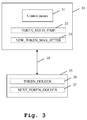
- Fig. 3 shows an exemplary interaction 34 between a node 30 and a token 35.
- the node 30 comprises control means 31, and control parameters such as TOKEN_HOLD_TIME 32 and NEW_TOKEN_MAX_JITTER 33.
- the token 35 respectively the Hello message, comprises two additional fields: TOKEN_HOLDER 36 and NEXT_TOKEN_HOLDER 37.
- control parameter NEW_TOKEN_MAX_JITTER 33 is especially utilized in the context of creating new tokens.
- a node if a node discovers that none of its neighbors is currently holding a token, it will create a new token for itself and begin to signal this in its transmitted Hello messages. This can happen at any time, not just at the boundaries between token intervals.
- a node To prevent too many tokens from being created, a node must wait until is has not received a Hello message with an active TOKEN_HOLDER flag 36 for at least TOKEN_HOLD_TIME 32, and then set a timer with a random jitter value between 0 and NEW_TOKEN_MAX_JITTER 33. When the timer expires and still no Hello message with a token has been received, the node shall create a new token. If a token is detected in a Hello message received from another node before the timer expires, the node cancels its timer and does not create a new token.
- NEW_TOKEN_MAX_JITTER 33 influences the average number of tokens active in the network at any time. If a larger value is chosen, the number of tokens will decrease, and vice versa.
- new tokens cannot only be created but it is also possible to delete already existing tokens in the following two ways, each of which is illustrated with the aid of the respective figure.
- At least two tokens are merged into a single token, if a node receives the at least two tokens from at least two different neighboring nodes. This case may occur, if the at least two neighboring nodes which were previously holding the at least two token are not neighbors of each other.
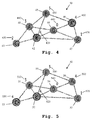
- Fig. 4 is intended to illustrate the above-mentioned first case and depicts a network 40 comprising nodes 41-47 within a neighborhood. Additionally, the numbers 410-470 above the nodes 41-47 indicate the last token interval, in which the respective node has held a token. For example, according to Fig. 4 , node 41 has held a token in token_interval(3) because the number 410 above the node 41 is 3.
- nodes 42 and 46 of the network 40 are holding a token within the same token interval as indicated by the circles around both nodes 42 and 46.
- nodes 42 and 46 would both select node 44 as the receiver of their token. Therefore, only one token will be left in the network 40 for the next token interval.
- At least one existing token is deleted by discarding it, if a first node discovers that one of its neighbors (a second node) is also holding a token, it will try to pass its own token to a node that is not a neighbor of the second node. However, it is possible that the first node does not have such a neighboring node. In this second case, it will not pass its token on, and the token will be lost. Instead of setting the NEXT_TOKEN_HOLDER field 37 to a valid MAC address of one of its neighbors, the first node will set the field to an invalid value, and the token will not be picked up by any neighboring node.
- Fig. 5 shows a network 50 comprising nodes 51-57 within a neighborhood.
- the numbers 510-570 above the nodes 51-57 indicate the last token interval, in which the respective node has held a token.
- Fig. 5 as indicated by the circles around the nodes 52 and 53, both nodes 52 and 53 are holding a token within the same token interval. It can be seen that node 53 does not have any neighbors that are not also neighbors of node 52. Therefore, node 53 does not forward its token, and the token is lost. Nevertheless, node 52 will forward its token to node 54.
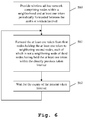
- Fig. 6 shows a flow chart of the inventive method.
- a wireless ad-hoc network comprising nodes within a neighborhood and at least one token periodically forwarded between the nodes at a token interval are provided.
- the at least one token is forwarded form first nodes holding the at least token to neighboring second nodes, each of which is not a neighboring node of third nodes having held the at least one token within the directly previous token interval.
- the at least one token is forwarded again and again according to the steps S61 and S62.
Landscapes
- Engineering & Computer Science (AREA)
- Computer Networks & Wireless Communication (AREA)
- Signal Processing (AREA)
- Data Mining & Analysis (AREA)
- Mobile Radio Communication Systems (AREA)
Abstract
Description
- The invention relates to a network, especially to a wireless ad-hoc network, more especially a MANET network, and a method for forwarding at least one token through the network of nodes within a neighborhood.
- Generally, in many applications of wireless ad-hoc networks, some nodes need to take over special roles and perform tasks that do not need to be performed by all nodes. Therefore, these tasks are also called distributed tasks. For instance, in wireless sensor networks, all nodes typically perform some kind of measurement of the environment. However, only a subset of the nodes might then be required to collect the measurement results from their neighboring nodes in order to perform some kind of processing of the raw measurement data. Such a subset of nodes which perform some kind of additional tasks, whether it is processing of sensor data, or something completely different, are referred to here as active nodes.
- Typically, it is not necessary for all nodes to perform these special tasks and in many cases, it may even be undesired, since the additional processing and communication load that would be placed on these active nodes would result in a faster depletion of battery power. At the same time, the active nodes should be well distributed in the network. Ideally, each node should be close to an active node but at the same time, local accumulations of too many active nodes in a single area of the network should be avoided.
- Nevertheless, conventional networks and methods for token forwarding employ just a single token and are not intended to be used for forwarding multiple tokens. In addition to this, with the aid of traditional token based networks and methods such as Token Ring according to the IEEE 802.5 specification, the single token is passed between the nodes of the network in a predefined order. Thus, such conventional networks and methods cannot provide solutions to the above-mentioned challenges.
- Moreover, document
CN 1649319 A discloses a method for forwarding multiple tokens between the nodes of a wireless ad-hoc network. However, the forwarding of the tokens according toCN 1649319 A is based on queues. As a consequence of this queue based method, the same neighboring nodes of the network get a token in the same order. - The above-described approach though is disadvantageous, since always the same neighboring nodes of the wireless ad-hoc network get a token, which leads to an additional processing and communication load solely placed on these nodes. As already mentioned above, in wireless sensor networks for example, this results in a faster depletion of battery power of the active nodes.
- Accordingly, there is a need to provide a network and method, which allows for forwarding multiple tokens between the nodes of the network, wherein not just the same nodes of the network always get the tokens but each token is spread over the whole network, which ensures that active nodes are well distributed in the network. In addition to this, local accumulations of too many active nodes in a single area of the network are advantageously avoided.
- This is solved by the features of
claim 1 for a wireless ad-hoc network and claim 8 for the method. Further, it is solved by the features ofclaim 15 for the associated computer program. The dependent claims contain further developments. - According to a first aspect of the invention, a wireless ad-hoc network is provided. The network comprises nodes within a neighborhood, wherein each node has control means, and at least one token, wherein each token is periodically forwarded between the nodes of the network. The control means are configured in manner that at each token interval, the at least one token is forwarded from first nodes holding the at least one token within a present token interval to neighboring second nodes, each of which is not a neighboring node of third nodes having held the at least one token within a previous token interval directly preceding the present token interval.
- According to a first preferred implementation form of the first aspect, the control means are configured in a manner that the nodes of the network are synchronized in time.
- According to a further preferred implementation form of the first aspect, the control means are configured in manner that the at least one token is forwarded to a neighboring node having not had a token for the longest time.
- According to a further preferred implementation of the first aspect, the control means are configured in a manner that the at least one token is forwarded to a neighboring node having the lowest address, especially the lowest MAC (Media-Access-Control) address.
- According to a further preferred implementation form of the first aspect, the control means are configured in a manner that a new token is created by a node of the network, if the neighboring nodes of the node are not currently holding a token and/or a predefined time has expired.
- According to a further preferred implementation form of the first aspect, the control means are configured in manner that at least one existing token is deleted by merging at least two token into a single token, if a node of the network receives the at least two token from at least two different neighboring nodes.
- According to a further preferred implementation form of the first aspect, the control means are configured in a manner that at least one existing token is deleted by discarding the at least one existing token, if there are no second nodes for receiving the at least one existing token available.
- According to a second aspect of the invention, a method is provided. The method comprises forwarding at least one token through a network of nodes within a neighborhood, wherein the at least one token is forwarded periodically at a token interval. Moreover, at each token interval, the at least one token is forwarded from first nodes holding the at least one token within a present token interval to neighboring second nodes, each of which is not a neighboring node of third nodes having held the at least one token within a previous token interval directly preceding the present token interval.
- According to a first preferred implementation form of the second aspect, the nodes of the network are synchronized in time.
- According to a further preferred implementation of the second aspect, the at least one token is forwarded to a neighboring node having not had a token for the longest time.
- According to a further preferred implementation of the second aspect, the at least one token is forwarded to neighboring node having the lowest address, especially the MAC address.
- According to a further preferred implementation of the second aspect, a new token is created by a node of the network, if the neighboring nodes of the node are not currently holding a token and/or a predefined time has expired.
- According to a further preferred implementation of the second aspect, at least one existing token is deleted by merging at least two token into a single token, if a node of the network receives the at least two token from at least two different neighboring nodes.
- According to a further preferred implementation of the second aspect, at least one existing token is deleted by discarding the at least one existing token, if there are no second nodes for receiving the at least one exiting token available.
- According to a third preferred aspect of the invention, a computer program with program code means for performing all steps according to the second aspect, if the program is executed on a computer or digital signal processor, is provided.
- Exemplary embodiments of the invention are now further explained with respect to the drawings by way of example only, and not for limitation. In the drawings:
- Fig. 1
- shows an exemplary network comprising neighboring nodes, wherein a single token is forwarded;
- Fig. 2
- shows an exemplar network comprising neighboring nodes, wherein multiple tokens are forwarded;
- Fig. 3
- shows an exemplary interaction between a node of the network and a token;
- Fig. 4
- shows an exemplary network comprising neighboring nodes, wherein a token is deleted by merging two tokens into a single token;
- Fig. 5
- shows an exemplary network comprising neighboring nodes, wherein a token is deleted by discarding it; and
- Fig. 6
- shows a flow chart of an embodiment of the second aspect of the invention.
- In advance, before exemplary embodiments of the invention are explained with respect to the drawings by way of example, one aspect of the subject matter of the invention, in the following also referred to as Directed Geographic Token Algorithm, is summarized.
- The invention allows the responsibility for the above-mentioned distributed tasks to circulate from node to node with little additional overhead. A node is selected to perform the distributed tasks while it is holding the token. After a predefined time, it passes the token on to a neighboring node. Since no clusters are formed explicitly, the Directed Geographic Token Algorithm is very robust to changes in the network topology.
- With the aid of the Directed Geographic Token Algorithm, tokens are forwarded through the network in a directed manner: the next token holding node is chosen such that the token is forwarded away from the previous holder of the token. This ensures that a token does not linger in the same region of the network.
- Furthermore, in case that two tokens are held by neighboring nodes, the next holders of the tokens are selected such that the tokens repel each other. Thus, local accumulations of tokens in the network are avoided.
- In addition to this, tokens are created and deleted dynamically in order to adapt to the network size and density.
- Firstly, a wireless network is assumed, in which a few or all nodes periodically broadcast Hello messages to a few or all of their neighbors. These Hello messages contain a list of the MAC (Media-Access-Control) addresses of all of the node's neighbors. Thus, each node is aware of all nodes in its two-hop neighborhood.
- It is further assumed that all nodes are synchronized to a common time. Nodes that have received a token from a neighboring node hold on to the token for TOKEN_HOLD_TIME seconds and then pass the token on to a neighbor. The time instants when tokens are passed on occur periodically every TOKEN_HOLD_TIME seconds and are known by all nodes. The n-th time interval of duration TOKEN_HOLD_TIME is referred to as token interval, or respectively as token_interval.
- For the Directed Geographic Token Algorithm, two additional fields are defined in each Hello message:
- TOKEN_HOLDER: a flag that indicates, if the sender of the message is currently holding a token (TOKEN_HOLDER = TRUE) or is currently not holding a token (TOKEN_HOLDER = FALSE),
- NEXT_TOKEN_HOLDER: the MAC address of the node which the sender of the Hello message has selected as the next holder of the token.
- That is, for a Hello message that is transmitted in token_interval(n), NEXT_TOKEN_HOLDER indicates the node that will take over the token at the start of token_interval(n+1). At the end of token_interval (n), the current holder of the token again sets the TOKEN_HOLDER flag to FALSE, and the node indicated as NEXT_TOKEN_HOLDER automatically sets its TOKEN_HOLDER flag to TRUE and itself selects a new token holder for token_interval(n+2), which it will announce in the NEXT_TOKEN_HOLDER field.
- With the aid of
Fig. 1 , it is now described how a single existing token is forwarded through a network.Fig. 1 depicts anetwork 10 comprising nodes 11-17 within a neighborhood. - Every time a node 11- 17 of the
network 10 receives a Hello message from a neighbor, it checks the TOKEN_HOLDER flag and remembers the current token interval as the last time that this neighbor held a token. When a node 11- 17 must select a neighbor to whom it shall pass a token, it selects the neighboring node which has not had a token (one of the tokens) for the longest time. - In case that this neighbor is not unique, the node 11-17 will prefer to pass the token to a neighbor which is not a neighbor of the token holder in the directly previous token interval. This introduces a directed aspect into the forwarding algorithm. If this still does not provide an unique next token holder, the tie may be broken based on some other property, for example by selecting the neighbor with the lowest MAC address.
- With respect to
Fig. 1 , it is assumed thatnode 11 is initially holding a token - as indicated by the circle around the node 11 - in token_interval(1). Additionally, none of the other nodes 12-17 in thenetwork 10 has had a token yet. The exemplary path that is taken by the single existing token is listed in the table below:Token Interval Token Holder Comment 1 A A is assumed as initial holder of token 2 B B,C,D,E all have not had a token yet: A selects B due to the MAC address 3 G A just had the token; C, D, and G all have not had the token yet; G is the only neighbor of B that is not a neighbor of A --> G gets the token 4 F F is not a neighbor of B 5 E E is not a neighbor of G 6 A A has not had the token longer than F 7 C C, D have both not had the token yet; neither is a neighbor of E; C has lower MAC address 8 B B waiting longer than A 9 D D has not had token yet 10 G G has been waiting longer than A or F - In this manner, the single existing token travels through the network. Since multiple tokens may be circulating through the network simultaneously, several tokens may end up in the same area of the network. However, as already mentioned above, such a local accumulation of tokens is not desirable. Therefore, in case of multiple tokens forwarded between nodes of network, the following procedure should be applied in order to separate the existing tokens again.
- For the purpose of illustrations,
Fig. 2 shows anetwork 20 comprising nodes 21-27 within a neighborhood. As indicated by the circles around thenodes nodes - In general, when
node 21 holding a token finds that onenode 22 of its neighbors is also holding a token in the same token interval,node 21 will select the next receiver of its token only among those of its neighbors that are not also neighbors ofnode 22.Node 22 will behave similarly, selecting a node that is not a neighbor ofnode 21 as the next receiver of its token. Thus, the two tokens effectively repel each other and will again become separated in thenetwork 20. This helps to achieve the goal of distributing the tokens uniformly in thenetwork 20, avoiding local accumulations of tokens. - With respect to the exemplary embodiment of
Fig. 2 for forwarding multiple tokens and as already mentioned above, bothnodes Node 21 knows from the Hello messages received fromnode 25 thatnode 25 also has a token, and vice versa. Furthermore,node 21 will only considernodes node 25, ornode 25 itself. In an analogous manner,node 25 will only considernode 26 as receiver of its token. Thus,node 25 will pass its token tonode 26 andnode 21 will pass its token tonode 25 in token_interval(n+1). -
Fig. 3 shows anexemplary interaction 34 between anode 30 and a token 35. Thenode 30 comprises control means 31, and control parameters such asTOKEN_HOLD_TIME 32 andNEW_TOKEN_MAX_JITTER 33. As already mentioned above, the token 35, respectively the Hello message, comprises two additional fields: TOKEN_HOLDER 36 andNEXT_TOKEN_HOLDER 37. - The above-mentioned
control parameter NEW_TOKEN_MAX_JITTER 33 is especially utilized in the context of creating new tokens. - Generally, if a node discovers that none of its neighbors is currently holding a token, it will create a new token for itself and begin to signal this in its transmitted Hello messages. This can happen at any time, not just at the boundaries between token intervals.
- In particular, to prevent too many tokens from being created, a node must wait until is has not received a Hello message with an
active TOKEN_HOLDER flag 36 for at least TOKEN_HOLD_TIME 32, and then set a timer with a random jitter value between 0 andNEW_TOKEN_MAX_JITTER 33. When the timer expires and still no Hello message with a token has been received, the node shall create a new token. If a token is detected in a Hello message received from another node before the timer expires, the node cancels its timer and does not create a new token. - In addition to this, it should be mentioned that the value that is selected for
NEW_TOKEN_MAX_JITTER 33 influences the average number of tokens active in the network at any time. If a larger value is chosen, the number of tokens will decrease, and vice versa. - Moreover, according to a preferred embodiment of the invention, new tokens cannot only be created but it is also possible to delete already existing tokens in the following two ways, each of which is illustrated with the aid of the respective figure.
- In the first case, at least two tokens are merged into a single token, if a node receives the at least two tokens from at least two different neighboring nodes. This case may occur, if the at least two neighboring nodes which were previously holding the at least two token are not neighbors of each other.
-
Fig. 4 is intended to illustrate the above-mentioned first case and depicts anetwork 40 comprising nodes 41-47 within a neighborhood. Additionally, the numbers 410-470 above the nodes 41-47 indicate the last token interval, in which the respective node has held a token. For example, according toFig. 4 ,node 41 has held a token in token_interval(3) because thenumber 410 above thenode 41 is 3. - With respect to
Fig. 4 , it is assumed thatnodes network 40 are holding a token within the same token interval as indicated by the circles around bothnodes Fig. 4 ,nodes node 44 as the receiver of their token. Therefore, only one token will be left in thenetwork 40 for the next token interval. - Furthermore, in the second case, at least one existing token is deleted by discarding it, if a first node discovers that one of its neighbors (a second node) is also holding a token, it will try to pass its own token to a node that is not a neighbor of the second node. However, it is possible that the first node does not have such a neighboring node. In this second case, it will not pass its token on, and the token will be lost. Instead of setting the
NEXT_TOKEN_HOLDER field 37 to a valid MAC address of one of its neighbors, the first node will set the field to an invalid value, and the token will not be picked up by any neighboring node. - The above-mentioned second case of deletion of existing tokens is illustrated with the aid of
Fig. 5 that shows anetwork 50 comprising nodes 51-57 within a neighborhood. Analogous toFig. 4 , the numbers 510-570 above the nodes 51-57 indicate the last token interval, in which the respective node has held a token. InFig. 5 , as indicated by the circles around thenodes nodes node 53 does not have any neighbors that are not also neighbors ofnode 52. Therefore,node 53 does not forward its token, and the token is lost. Nevertheless,node 52 will forward its token tonode 54. - Finally,
Fig. 6 shows a flow chart of the inventive method. In a first step S60, a wireless ad-hoc network comprising nodes within a neighborhood and at least one token periodically forwarded between the nodes at a token interval are provided. In a second step S61, the at least one token is forwarded form first nodes holding the at least token to neighboring second nodes, each of which is not a neighboring node of third nodes having held the at least one token within the directly previous token interval. After having waited for the expiry of the present token interval in a third step S62, the at least one token is forwarded again and again according to the steps S61 and S62. - While various embodiments of the present invention have been described above, it should be understood that they have been presented by way of example only, and not limitation. Numerous changes to the disclosed embodiments can be made in accordance with the disclosure herein without departing from the spirit or scope of the invention. Thus, the breadth and scope of the present invention should not be limited by any of the above described embodiments. Rather, the scope of the invention should be defined in accordance with the following claims and their equivalents.
- Although the invention has been illustrated and described with respect to one or more implementations, equivalent alterations and modifications will occur to others skilled in the art upon the reading and understanding of this specification and the annexed drawings. In addition, while a particular feature of the invention may have been disclosed with respect to only one of several implementations, such feature may be combined with one or more other features of the other implementations as may be desired and advantageous for any given or particular application.
Claims (15)
- A network (10, 20, 40, 50) comprising nodes (11-17, 21-27, 30, 41-47, 51-57) within a neighborhood,
wherein at least one token (35) is forwarded between the nodes (11-17, 21-27, 30, 41-47, 51-57) of the network (10, 20, 40, 50),
wherein each node (11-17, 21-27, 30, 41-47, 51-57) has control means (31), and the control means (31) are configured in a manner that the at least one token (35) is forwarded periodically at a token interval,
characterized in that
the control means (31) are configured in a manner that, at each token interval, the at least one token (35) is forwarded from first nodes holding the at least one token (35) within a present token interval to neighboring second nodes, each of which is not a neighboring node of third nodes having held the at least one token (35) within a previous token interval directly preceding the present token interval. - The network according to claim 1,
characterized in that
the control means (31) are configured in a manner that the nodes (11-17, 21-27, 30, 41-47, 51-57) of the network (10, 20, 40, 50) are synchronized in time. - The network according to claim 1 or 2,
characterized in that
the control means (31) are configured in a manner that the at least one token (35) is forwarded to a neighboring node having not had a token (35) for the longest time. - The network according to any of the claims 1 to 3,
characterized in that
the control means (31) are configured in a manner that the at least one token (35) is forwarded to a neighboring node having the lowest address, especially lowest MAC address. - The network according to any of the claims 1 to 4,
characterized in that
the control means (31) are configured in a manner that a new token (35) is created by a node (11-17, 21-27, 30, 41-47, 51-57) of the network (10, 20, 40, 50), if the neighboring nodes of the node (11-17, 21-27, 30, 41-47, 51-57) are not currently holding a token (35) and/or a predefined time (33) is expired. - The network according to any of the claims 1 to 5,
characterized in that
the control means (31) are configured in a manner that at least one existing token (35) is deleted by merging at least two token (35) into a single token (35), if a node (11-17, 21-27, 30, 41-47, 51-57) of the network (10, 20, 40, 50) receives at least two token (35) from at least two different neighboring nodes. - The network according to any of the claims 1 to 6,
characterized in that
the control means (31) are configured in a manner that at least one existing token (35) is deleted by discarding the at least one existing token (35), if there are no second nodes for receiving the at least one existing token (35) available. - A method for forwarding at least one token (35) through a network (10, 20, 40, 50) of nodes (11-17, 21-27, 30, 41-47, 51-57) within a neighborhood,
the at least one token (35) is forwarded periodically at a token interval,
characterized in that
at each token interval, the at least one token (35) is forwarded from first nodes holding the at least one token (35) within a present token interval to neighboring second nodes, each of which is not a neighboring node of third nodes having held the at least one token (35) within a previous token interval directly preceding the present token interval. - The method according to claim 8,
characterized in that
the nodes (11-17, 21-27, 30, 41-47, 51-57) of the network (10, 20, 40, 50) are synchronized in time. - The method according to claim 8 or 9,
characterized in that
the at least one token (35) is forwarded to a neighboring node having not had a token (35) for the longest time. - The method according to any of the claims 8 to 10,
characterized in that
the at least one token (35) is forwarded to a neighboring node having the lowest address, especially lowest MAC address. - The method according to any of the claims 8 to 11,
characterized in that
a new token (35) is created by a node (11-17, 21-27, 30, 41-47, 51-57) of the network (10, 20, 40, 50), if the neighboring nodes of the node (11-17, 21-27, 30, 41-47, 51-57) are not currently holding a token (35) and/or a predefined time (33) is expired. - The method according to any of the claims 8 to 12,
characterized in that
at least one existing token (35) is deleted by merging at least two token (35) into a single token (35), if a node (11-17, 21-27, 30, 41-47, 51-57) of the network (10, 20, 40, 50) receives the at least two token (35) from at least two different neighboring nodes. - The method according to any of the claims 8 to 13,
characterized in that
at least one existing token (35) is deleted by discarding the at least one existing token (35), if there are no second nodes for receiving the at least one existing token (35) available. - A computer program with program code means for performing all steps according to any of the claims 8 to 14, if the program is executed on a computer or a digital signal processor of the nodes (11-17, 21-27, 30, 41-47, 51-57).
Priority Applications (1)
| Application Number | Priority Date | Filing Date | Title |
|---|---|---|---|
| EP16155661.8A EP3206340B8 (en) | 2016-02-15 | 2016-02-15 | Method and network for transmitting data over a network |
Applications Claiming Priority (1)
| Application Number | Priority Date | Filing Date | Title |
|---|---|---|---|
| EP16155661.8A EP3206340B8 (en) | 2016-02-15 | 2016-02-15 | Method and network for transmitting data over a network |
Publications (3)
| Publication Number | Publication Date |
|---|---|
| EP3206340A1 true EP3206340A1 (en) | 2017-08-16 |
| EP3206340B1 EP3206340B1 (en) | 2021-03-31 |
| EP3206340B8 EP3206340B8 (en) | 2021-05-12 |
Family
ID=55411204
Family Applications (1)
| Application Number | Title | Priority Date | Filing Date |
|---|---|---|---|
| EP16155661.8A Active EP3206340B8 (en) | 2016-02-15 | 2016-02-15 | Method and network for transmitting data over a network |
Country Status (1)
| Country | Link |
|---|---|
| EP (1) | EP3206340B8 (en) |
Cited By (1)
| Publication number | Priority date | Publication date | Assignee | Title |
|---|---|---|---|---|
| CN117377056A (en) * | 2023-11-09 | 2024-01-09 | 山东亚华电子股份有限公司 | A method and device for executing synchronization events |
Citations (1)
| Publication number | Priority date | Publication date | Assignee | Title |
|---|---|---|---|---|
| CN1649319A (en) | 2005-02-04 | 2005-08-03 | 西安电子科技大学 | Token transfer and manage method for Ad Hoc network |
-
2016
- 2016-02-15 EP EP16155661.8A patent/EP3206340B8/en active Active
Patent Citations (1)
| Publication number | Priority date | Publication date | Assignee | Title |
|---|---|---|---|---|
| CN1649319A (en) | 2005-02-04 | 2005-08-03 | 西安电子科技大学 | Token transfer and manage method for Ad Hoc network |
Non-Patent Citations (4)
| Title |
|---|
| JUN LUO ET AL: "NASCENT: network layer service for vicinity ad-hoc groups", SENSOR AND AD HOC COMMUNICATIONS AND NETWORKS, 2004. IEEE SECON 2004. 2004 FIRST ANNUAL IEEE COMMUNICATIONS SOCIETY CONFERENCE ON SANTA CLARA, CA, USA 4-7 OCT. 2004, PISCATAWAY, NJ, USA,IEEE, 4 October 2004 (2004-10-04), pages 439 - 448, XP010759621, ISBN: 978-0-7803-8796-6, DOI: 10.1109/SAHCN.2004.1381946 * |
| MALPANI N ET AL: "Distributed token circulation on mobile ad hoc networks", NETWORK PROTOCOLS NINTH INTERNATIONAL CONFERENCE ON ICNP 2001 NOV. 11-14, 2001, PISCATAWAY, NJ, USA,IEEE, 11 November 2001 (2001-11-11), pages 4 - 13, XP010585437, ISBN: 978-0-7695-1429-1 * |
| ONUR SAVAS ET AL: "Randomized Sequential Algorithms for Data Aggregation in Sensor Networks", INFORMATION SCIENCES AND SYSTEMS, 2006 40TH ANNUAL CONFERENCE ON, IEEE, PI, 31 March 2006 (2006-03-31), pages 165 - 170, XP031011816, ISBN: 978-1-4244-0349-3 * |
| PAOLO TENTI ET AL: "Distribution Loss Minimization by Token Ring Control of Power Electronic Interfaces in Residential Microgrids", IEEE TRANSACTIONS ON INDUSTRIAL ELECTRONICS, IEEE SERVICE CENTER, PISCATAWAY, NJ, USA, vol. 59, no. 10, 31 October 2012 (2012-10-31), pages 3817 - 3826, XP011442477, ISSN: 0278-0046, DOI: 10.1109/TIE.2011.2161653 * |
Cited By (1)
| Publication number | Priority date | Publication date | Assignee | Title |
|---|---|---|---|---|
| CN117377056A (en) * | 2023-11-09 | 2024-01-09 | 山东亚华电子股份有限公司 | A method and device for executing synchronization events |
Also Published As
| Publication number | Publication date |
|---|---|
| EP3206340B1 (en) | 2021-03-31 |
| EP3206340B8 (en) | 2021-05-12 |
Similar Documents
| Publication | Publication Date | Title |
|---|---|---|
| US10979348B1 (en) | Zero-overhead efficient flooding | |
| KR101443572B1 (en) | A method of interchannel communication in a multi-channel wireless network | |
| US9301121B2 (en) | Peer to peer multiple identifiers | |
| JP6158198B2 (en) | System and method for fast initial network link setup | |
| JP6138809B2 (en) | System and method for fast initial network link setup | |
| US11350340B2 (en) | Method for updating a number of hops that is to be used for communication between a publisher mesh node and a subscriber mesh node in a wireless mesh network | |
| CN107196859B (en) | Message forwarding method, broadcasting method, message response method and communication equipment | |
| Huang et al. | RC-MAC: A receiver-centric MAC protocol for event-driven wireless sensor networks | |
| TW200935927A (en) | Paging user devices in a wireless access network | |
| US20190014528A1 (en) | Apparatus and method for transmitting beacon messages in a mesh network | |
| WO2018017009A1 (en) | Route discovery in a mesh communication network | |
| US20100271175A1 (en) | Methods and apparatuses for providing a paging process for multicarrier | |
| EP2319214B1 (en) | Enhanced formation of mesh-type networks | |
| CN112740729B (en) | Device and method for autonomously configuring relay node devices in a mesh network | |
| Lenka et al. | Distributed slot scheduling algorithm for hybrid CSMA/TDMA MAC in wireless sensor networks | |
| JP6379883B2 (en) | Time slot allocation method and apparatus | |
| CN105072586B (en) | To the management method of the forwarding of broadcast message in embedded radio self-organizing network | |
| CN108183808B (en) | A broadcasting method and communication system | |
| EP3206340B1 (en) | Method and network for transmitting data over a network | |
| EP3042523A1 (en) | Time slot selection in wireless communication | |
| US9161287B2 (en) | Technique for efficient message delivery in Ad Hoc, mesh, wireless computer networks | |
| CN104104746A (en) | Sectional type address allocation method for wireless ad hoc network | |
| CN101778443B (en) | Method, device and system for route selection | |
| CN101668311B (en) | Routing method of mobile Ad Hoc network | |
| CN111193667B (en) | Routing method, leaf node and storage medium of ad hoc network |
Legal Events
| Date | Code | Title | Description |
|---|---|---|---|
| PUAI | Public reference made under article 153(3) epc to a published international application that has entered the european phase |
Free format text: ORIGINAL CODE: 0009012 |
|
| STAA | Information on the status of an ep patent application or granted ep patent |
Free format text: STATUS: REQUEST FOR EXAMINATION WAS MADE |
|
| 17P | Request for examination filed |
Effective date: 20160902 |
|
| AK | Designated contracting states |
Kind code of ref document: A1 Designated state(s): AL AT BE BG CH CY CZ DE DK EE ES FI FR GB GR HR HU IE IS IT LI LT LU LV MC MK MT NL NO PL PT RO RS SE SI SK SM TR |
|
| AX | Request for extension of the european patent |
Extension state: BA ME |
|
| STAA | Information on the status of an ep patent application or granted ep patent |
Free format text: STATUS: EXAMINATION IS IN PROGRESS |
|
| 17Q | First examination report despatched |
Effective date: 20190701 |
|
| GRAP | Despatch of communication of intention to grant a patent |
Free format text: ORIGINAL CODE: EPIDOSNIGR1 |
|
| STAA | Information on the status of an ep patent application or granted ep patent |
Free format text: STATUS: GRANT OF PATENT IS INTENDED |
|
| INTG | Intention to grant announced |
Effective date: 20210118 |
|
| GRAS | Grant fee paid |
Free format text: ORIGINAL CODE: EPIDOSNIGR3 |
|
| GRAA | (expected) grant |
Free format text: ORIGINAL CODE: 0009210 |
|
| STAA | Information on the status of an ep patent application or granted ep patent |
Free format text: STATUS: THE PATENT HAS BEEN GRANTED |
|
| AK | Designated contracting states |
Kind code of ref document: B1 Designated state(s): AL AT BE BG CH CY CZ DE DK EE ES FI FR GB GR HR HU IE IS IT LI LT LU LV MC MK MT NL NO PL PT RO RS SE SI SK SM TR |
|
| REG | Reference to a national code |
Ref country code: GB Ref legal event code: FG4D |
|
| RBV | Designated contracting states (corrected) |
Designated state(s): AL AT BE BG CY CZ DE DK EE ES FI FR GB GR HR HU IS IT LT LU LV MC MK MT NL NO PL PT RO RS SE SI SK SM TR |
|
| REG | Reference to a national code |
Ref country code: DE Ref legal event code: R096 Ref document number: 602016055101 Country of ref document: DE Ref country code: AT Ref legal event code: REF Ref document number: 1378194 Country of ref document: AT Kind code of ref document: T Effective date: 20210415 |
|
| REG | Reference to a national code |
Ref country code: IE Ref legal event code: FG4D |
|
| REG | Reference to a national code |
Ref country code: LT Ref legal event code: MG9D |
|
| PG25 | Lapsed in a contracting state [announced via postgrant information from national office to epo] |
Ref country code: FI Free format text: LAPSE BECAUSE OF FAILURE TO SUBMIT A TRANSLATION OF THE DESCRIPTION OR TO PAY THE FEE WITHIN THE PRESCRIBED TIME-LIMIT Effective date: 20210331 Ref country code: HR Free format text: LAPSE BECAUSE OF FAILURE TO SUBMIT A TRANSLATION OF THE DESCRIPTION OR TO PAY THE FEE WITHIN THE PRESCRIBED TIME-LIMIT Effective date: 20210331 Ref country code: BG Free format text: LAPSE BECAUSE OF FAILURE TO SUBMIT A TRANSLATION OF THE DESCRIPTION OR TO PAY THE FEE WITHIN THE PRESCRIBED TIME-LIMIT Effective date: 20210630 Ref country code: NO Free format text: LAPSE BECAUSE OF FAILURE TO SUBMIT A TRANSLATION OF THE DESCRIPTION OR TO PAY THE FEE WITHIN THE PRESCRIBED TIME-LIMIT Effective date: 20210630 |
|
| PG25 | Lapsed in a contracting state [announced via postgrant information from national office to epo] |
Ref country code: SE Free format text: LAPSE BECAUSE OF FAILURE TO SUBMIT A TRANSLATION OF THE DESCRIPTION OR TO PAY THE FEE WITHIN THE PRESCRIBED TIME-LIMIT Effective date: 20210331 Ref country code: RS Free format text: LAPSE BECAUSE OF FAILURE TO SUBMIT A TRANSLATION OF THE DESCRIPTION OR TO PAY THE FEE WITHIN THE PRESCRIBED TIME-LIMIT Effective date: 20210331 Ref country code: LV Free format text: LAPSE BECAUSE OF FAILURE TO SUBMIT A TRANSLATION OF THE DESCRIPTION OR TO PAY THE FEE WITHIN THE PRESCRIBED TIME-LIMIT Effective date: 20210331 |
|
| REG | Reference to a national code |
Ref country code: NL Ref legal event code: MP Effective date: 20210331 |
|
| REG | Reference to a national code |
Ref country code: AT Ref legal event code: MK05 Ref document number: 1378194 Country of ref document: AT Kind code of ref document: T Effective date: 20210331 |
|
| PG25 | Lapsed in a contracting state [announced via postgrant information from national office to epo] |
Ref country code: NL Free format text: LAPSE BECAUSE OF FAILURE TO SUBMIT A TRANSLATION OF THE DESCRIPTION OR TO PAY THE FEE WITHIN THE PRESCRIBED TIME-LIMIT Effective date: 20210331 Ref country code: LT Free format text: LAPSE BECAUSE OF FAILURE TO SUBMIT A TRANSLATION OF THE DESCRIPTION OR TO PAY THE FEE WITHIN THE PRESCRIBED TIME-LIMIT Effective date: 20210331 Ref country code: CZ Free format text: LAPSE BECAUSE OF FAILURE TO SUBMIT A TRANSLATION OF THE DESCRIPTION OR TO PAY THE FEE WITHIN THE PRESCRIBED TIME-LIMIT Effective date: 20210331 Ref country code: EE Free format text: LAPSE BECAUSE OF FAILURE TO SUBMIT A TRANSLATION OF THE DESCRIPTION OR TO PAY THE FEE WITHIN THE PRESCRIBED TIME-LIMIT Effective date: 20210331 Ref country code: SM Free format text: LAPSE BECAUSE OF FAILURE TO SUBMIT A TRANSLATION OF THE DESCRIPTION OR TO PAY THE FEE WITHIN THE PRESCRIBED TIME-LIMIT Effective date: 20210331 Ref country code: AT Free format text: LAPSE BECAUSE OF FAILURE TO SUBMIT A TRANSLATION OF THE DESCRIPTION OR TO PAY THE FEE WITHIN THE PRESCRIBED TIME-LIMIT Effective date: 20210331 |
|
| PG25 | Lapsed in a contracting state [announced via postgrant information from national office to epo] |
Ref country code: SK Free format text: LAPSE BECAUSE OF FAILURE TO SUBMIT A TRANSLATION OF THE DESCRIPTION OR TO PAY THE FEE WITHIN THE PRESCRIBED TIME-LIMIT Effective date: 20210331 Ref country code: RO Free format text: LAPSE BECAUSE OF FAILURE TO SUBMIT A TRANSLATION OF THE DESCRIPTION OR TO PAY THE FEE WITHIN THE PRESCRIBED TIME-LIMIT Effective date: 20210331 Ref country code: PL Free format text: LAPSE BECAUSE OF FAILURE TO SUBMIT A TRANSLATION OF THE DESCRIPTION OR TO PAY THE FEE WITHIN THE PRESCRIBED TIME-LIMIT Effective date: 20210331 Ref country code: PT Free format text: LAPSE BECAUSE OF FAILURE TO SUBMIT A TRANSLATION OF THE DESCRIPTION OR TO PAY THE FEE WITHIN THE PRESCRIBED TIME-LIMIT Effective date: 20210802 Ref country code: IS Free format text: LAPSE BECAUSE OF FAILURE TO SUBMIT A TRANSLATION OF THE DESCRIPTION OR TO PAY THE FEE WITHIN THE PRESCRIBED TIME-LIMIT Effective date: 20210731 |
|
| REG | Reference to a national code |
Ref country code: DE Ref legal event code: R097 Ref document number: 602016055101 Country of ref document: DE |
|
| PG25 | Lapsed in a contracting state [announced via postgrant information from national office to epo] |
Ref country code: ES Free format text: LAPSE BECAUSE OF FAILURE TO SUBMIT A TRANSLATION OF THE DESCRIPTION OR TO PAY THE FEE WITHIN THE PRESCRIBED TIME-LIMIT Effective date: 20210331 Ref country code: AL Free format text: LAPSE BECAUSE OF FAILURE TO SUBMIT A TRANSLATION OF THE DESCRIPTION OR TO PAY THE FEE WITHIN THE PRESCRIBED TIME-LIMIT Effective date: 20210331 Ref country code: DK Free format text: LAPSE BECAUSE OF FAILURE TO SUBMIT A TRANSLATION OF THE DESCRIPTION OR TO PAY THE FEE WITHIN THE PRESCRIBED TIME-LIMIT Effective date: 20210331 |
|
| PLBE | No opposition filed within time limit |
Free format text: ORIGINAL CODE: 0009261 |
|
| STAA | Information on the status of an ep patent application or granted ep patent |
Free format text: STATUS: NO OPPOSITION FILED WITHIN TIME LIMIT |
|
| 26N | No opposition filed |
Effective date: 20220104 |
|
| PG25 | Lapsed in a contracting state [announced via postgrant information from national office to epo] |
Ref country code: IS Free format text: LAPSE BECAUSE OF FAILURE TO SUBMIT A TRANSLATION OF THE DESCRIPTION OR TO PAY THE FEE WITHIN THE PRESCRIBED TIME-LIMIT Effective date: 20210731 |
|
| PG25 | Lapsed in a contracting state [announced via postgrant information from national office to epo] |
Ref country code: IT Free format text: LAPSE BECAUSE OF FAILURE TO SUBMIT A TRANSLATION OF THE DESCRIPTION OR TO PAY THE FEE WITHIN THE PRESCRIBED TIME-LIMIT Effective date: 20210331 |
|
| PG25 | Lapsed in a contracting state [announced via postgrant information from national office to epo] |
Ref country code: MC Free format text: LAPSE BECAUSE OF FAILURE TO SUBMIT A TRANSLATION OF THE DESCRIPTION OR TO PAY THE FEE WITHIN THE PRESCRIBED TIME-LIMIT Effective date: 20210331 |
|
| REG | Reference to a national code |
Ref country code: BE Ref legal event code: MM Effective date: 20220228 |
|
| PG25 | Lapsed in a contracting state [announced via postgrant information from national office to epo] |
Ref country code: LU Free format text: LAPSE BECAUSE OF NON-PAYMENT OF DUE FEES Effective date: 20220215 |
|
| PG25 | Lapsed in a contracting state [announced via postgrant information from national office to epo] |
Ref country code: BE Free format text: LAPSE BECAUSE OF NON-PAYMENT OF DUE FEES Effective date: 20220228 |
|
| P01 | Opt-out of the competence of the unified patent court (upc) registered |
Effective date: 20230525 |
|
| PG25 | Lapsed in a contracting state [announced via postgrant information from national office to epo] |
Ref country code: HU Free format text: LAPSE BECAUSE OF FAILURE TO SUBMIT A TRANSLATION OF THE DESCRIPTION OR TO PAY THE FEE WITHIN THE PRESCRIBED TIME-LIMIT; INVALID AB INITIO Effective date: 20160215 |
|
| PG25 | Lapsed in a contracting state [announced via postgrant information from national office to epo] |
Ref country code: MK Free format text: LAPSE BECAUSE OF FAILURE TO SUBMIT A TRANSLATION OF THE DESCRIPTION OR TO PAY THE FEE WITHIN THE PRESCRIBED TIME-LIMIT Effective date: 20210331 Ref country code: CY Free format text: LAPSE BECAUSE OF FAILURE TO SUBMIT A TRANSLATION OF THE DESCRIPTION OR TO PAY THE FEE WITHIN THE PRESCRIBED TIME-LIMIT Effective date: 20210331 |
|
| PG25 | Lapsed in a contracting state [announced via postgrant information from national office to epo] |
Ref country code: TR Free format text: LAPSE BECAUSE OF FAILURE TO SUBMIT A TRANSLATION OF THE DESCRIPTION OR TO PAY THE FEE WITHIN THE PRESCRIBED TIME-LIMIT Effective date: 20210331 |
|
| PG25 | Lapsed in a contracting state [announced via postgrant information from national office to epo] |
Ref country code: MT Free format text: LAPSE BECAUSE OF FAILURE TO SUBMIT A TRANSLATION OF THE DESCRIPTION OR TO PAY THE FEE WITHIN THE PRESCRIBED TIME-LIMIT Effective date: 20210331 |
|
| PG25 | Lapsed in a contracting state [announced via postgrant information from national office to epo] |
Ref country code: GR Free format text: LAPSE BECAUSE OF NON-PAYMENT OF DUE FEES Effective date: 20210331 |
|
| PG25 | Lapsed in a contracting state [announced via postgrant information from national office to epo] |
Ref country code: GR Free format text: LAPSE BECAUSE OF NON-PAYMENT OF DUE FEES Effective date: 20210331 |
|
| PGFP | Annual fee paid to national office [announced via postgrant information from national office to epo] |
Ref country code: GB Payment date: 20260219 Year of fee payment: 11 |
|
| PGFP | Annual fee paid to national office [announced via postgrant information from national office to epo] |
Ref country code: DE Payment date: 20260217 Year of fee payment: 11 |
|
| PGFP | Annual fee paid to national office [announced via postgrant information from national office to epo] |
Ref country code: FR Payment date: 20260223 Year of fee payment: 11 |