EP3203663A1 - Scheduling request transmission supporting high doppler - Google Patents
Scheduling request transmission supporting high doppler Download PDFInfo
- Publication number
- EP3203663A1 EP3203663A1 EP17156338.0A EP17156338A EP3203663A1 EP 3203663 A1 EP3203663 A1 EP 3203663A1 EP 17156338 A EP17156338 A EP 17156338A EP 3203663 A1 EP3203663 A1 EP 3203663A1
- Authority
- EP
- European Patent Office
- Prior art keywords
- spreading
- block
- sequence
- spreading code
- symbols
- Prior art date
- Legal status (The legal status is an assumption and is not a legal conclusion. Google has not performed a legal analysis and makes no representation as to the accuracy of the status listed.)
- Withdrawn
Links
Images



Classifications
-
- H—ELECTRICITY
- H04—ELECTRIC COMMUNICATION TECHNIQUE
- H04L—TRANSMISSION OF DIGITAL INFORMATION, e.g. TELEGRAPHIC COMMUNICATION
- H04L25/00—Baseband systems
- H04L25/02—Details ; arrangements for supplying electrical power along data transmission lines
- H04L25/03—Shaping networks in transmitter or receiver, e.g. adaptive shaping networks
- H04L25/03006—Arrangements for removing intersymbol interference
-
- H—ELECTRICITY
- H04—ELECTRIC COMMUNICATION TECHNIQUE
- H04L—TRANSMISSION OF DIGITAL INFORMATION, e.g. TELEGRAPHIC COMMUNICATION
- H04L5/00—Arrangements affording multiple use of the transmission path
- H04L5/02—Channels characterised by the type of signal
- H04L5/023—Multiplexing of multicarrier modulation signals, e.g. multi-user orthogonal frequency division multiple access [OFDMA]
-
- H—ELECTRICITY
- H04—ELECTRIC COMMUNICATION TECHNIQUE
- H04L—TRANSMISSION OF DIGITAL INFORMATION, e.g. TELEGRAPHIC COMMUNICATION
- H04L5/00—Arrangements affording multiple use of the transmission path
- H04L5/0001—Arrangements for dividing the transmission path
- H04L5/0014—Three-dimensional division
- H04L5/0016—Time-frequency-code
-
- H—ELECTRICITY
- H04—ELECTRIC COMMUNICATION TECHNIQUE
- H04J—MULTIPLEX COMMUNICATION
- H04J13/00—Code division multiplex systems
-
- H—ELECTRICITY
- H04—ELECTRIC COMMUNICATION TECHNIQUE
- H04J—MULTIPLEX COMMUNICATION
- H04J13/00—Code division multiplex systems
- H04J13/0007—Code type
- H04J13/0055—ZCZ [zero correlation zone]
- H04J13/0059—CAZAC [constant-amplitude and zero auto-correlation]
-
- H—ELECTRICITY
- H04—ELECTRIC COMMUNICATION TECHNIQUE
- H04L—TRANSMISSION OF DIGITAL INFORMATION, e.g. TELEGRAPHIC COMMUNICATION
- H04L1/00—Arrangements for detecting or preventing errors in the information received
- H04L1/12—Arrangements for detecting or preventing errors in the information received by using return channel
- H04L1/16—Arrangements for detecting or preventing errors in the information received by using return channel in which the return channel carries supervisory signals, e.g. repetition request signals
- H04L1/1607—Details of the supervisory signal
- H04L1/1671—Details of the supervisory signal the supervisory signal being transmitted together with control information
-
- H—ELECTRICITY
- H04—ELECTRIC COMMUNICATION TECHNIQUE
- H04L—TRANSMISSION OF DIGITAL INFORMATION, e.g. TELEGRAPHIC COMMUNICATION
- H04L1/00—Arrangements for detecting or preventing errors in the information received
- H04L1/12—Arrangements for detecting or preventing errors in the information received by using return channel
- H04L1/16—Arrangements for detecting or preventing errors in the information received by using return channel in which the return channel carries supervisory signals, e.g. repetition request signals
- H04L1/18—Automatic repetition systems, e.g. Van Duuren systems
- H04L1/1812—Hybrid protocols; Hybrid automatic repeat request [HARQ]
-
- H—ELECTRICITY
- H04—ELECTRIC COMMUNICATION TECHNIQUE
- H04L—TRANSMISSION OF DIGITAL INFORMATION, e.g. TELEGRAPHIC COMMUNICATION
- H04L27/00—Modulated-carrier systems
- H04L27/26—Systems using multi-frequency codes
- H04L27/2601—Multicarrier modulation systems
- H04L27/2602—Signal structure
- H04L27/261—Details of reference signals
- H04L27/2613—Structure of the reference signals
-
- H—ELECTRICITY
- H04—ELECTRIC COMMUNICATION TECHNIQUE
- H04L—TRANSMISSION OF DIGITAL INFORMATION, e.g. TELEGRAPHIC COMMUNICATION
- H04L5/00—Arrangements affording multiple use of the transmission path
- H04L5/02—Channels characterised by the type of signal
-
- H—ELECTRICITY
- H04—ELECTRIC COMMUNICATION TECHNIQUE
- H04B—TRANSMISSION
- H04B1/00—Details of transmission systems, not covered by a single one of groups H04B3/00 - H04B13/00; Details of transmission systems not characterised by the medium used for transmission
- H04B1/69—Spread spectrum techniques
-
- H—ELECTRICITY
- H04—ELECTRIC COMMUNICATION TECHNIQUE
- H04W—WIRELESS COMMUNICATION NETWORKS
- H04W72/00—Local resource management
- H04W72/50—Allocation or scheduling criteria for wireless resources
- H04W72/54—Allocation or scheduling criteria for wireless resources based on quality criteria
- H04W72/541—Allocation or scheduling criteria for wireless resources based on quality criteria using the level of interference
Definitions
- the invention relates to mobile communications and, more particularly, to better supporting communication with mobile devices in motion at high speed.
- This invention arose in the context of developments underway in the uplink (UL) part of the Third Generation Partnership Program (3GPP) Universal Terrestrial Radio Access Network (UTRAN) long term evolution (LTE) often referred as 3.9G but is not limited to that context.
- 3GPP Third Generation Partnership Program
- UTRAN Universal Terrestrial Radio Access Network
- LTE long term evolution
- SR scheduling request
- UL uplink
- UE User Equipment
- Fig. 1 shows a transmission of an asynchronous scheduling request indicator message 1 from the UE to the base station where the UE does not yet have an uplink data assignment and a scheduling grant message 2 is shown being sent back.
- the UE already has an uplink data assignment it is in the stage 3 of Fig. 1 and new scheduling requests are transmitted in-band (Scheduling Request + Data).
- a multiplexing scheme for the SR is presented in Document R1-072307, " Uplink Scheduling Request for LTE" 3GPP TSG RAN WG1#49, Kobe, Japan, May 7-11, 2007, Nokia Siemens Networks , Nokia, as shown in Fig. 2 hereof where we proposed the combination of block-spreading and CAZAC sequence modulation as a method to send the SR.
- SR SR multiplexing
- the preferred SR multiplexing scheme is presented in Figure 2 .
- the multiplexing between the different user equipments is achieved through the code domain orthogonality.
- Cyclic shifts of Zadoff-Chu (ZC) sequences are used as the orthogonal codes.
- ZC Zadoff-Chu
- the orthogonality within a single block, or FDMA symbol is limited by the channel delay spread and the sinc pulse shape used in the transceiver. Between the blocks the orthogonality is limited by the channel Doppler spread as well as the frequency error. In practice, the number of orthogonal codes can be less than 84 due to these phenomena.
- the present invention provides better supporting communication with mobile devices in motion at high speed.
- the present invention also provides better support for Scheduling request transmission in an extreme Doppler area.
- the present invention can be configured into both low Doppler environment and high Doppler environment without additional signaling.
- high Doppler environment only codes which are partially orthogonal against each other are taken into use.
- the present disclosure shows how to generate sequences having partial orthogonality properties in an LTE type of frame structure and numerology.
- the present disclosure shows how to use such partial orthogonality properies for improving resistance against Doppler.
- the present invention modifies the scheduling request scheme shown in Fig. 2 to support high speed UEs.
- the spreading factor of block spreading is changed to an even number, e.g., from 7 to 6. This enables usage of partial orthogonality properties of CAZAC sequences and as a result inter-code interference in the case of high Doppler is reduced.
- the invention is in the context of a novel channel structure for E-UTRA, where block spreading and Zadoff Chu Sequence modulation is applied for the uplink control channel.
- the inevitable problem of maximizing the multiplexing capacity will lead to numerology causing odd-length sequences, which do not have the favorable property of even-length sequences, which provide partial orthogonality. The consequence of this is catastrophic in terms of performance at high Doppler.
- the two orthogonal sequences may comprise a first sequence of three symbols followed by a second sequence of four symbols.
- the two orthogonal sequences comprise a first sequence of three symbols preceded and followed by two symbols of said second sequence of four symbols.
- partial orthogonality is carried out by using a same slot structure as used for hybrid automatic repeat request feedback signaling.
- the invention is a novel set of solutions to provide the maximal multiplexing capacity without loss of performance at high Doppler.
- a method for arranging block level spreading in such a way that the actual SF in the block domain is constrained to be an even number N (i.e., 6) even though there are N+1 symbols in the original spreading sequence (e.g., 7).
- the block spreading is performed using a spreading sequence of length N.
- orthogonal multiplexing over N+1 symbols has been achieved without degrading the amount of transmitted energy.
- FIG. 4 illustrates a practical arrangement of an embodiment.
- the CAZAC sequence to be spread is denoted below as C and an even length block spreading code as B.
- C c 0 c 1 ⁇ c 11 T
- B ⁇ b 0 b 1 ⁇ b N ⁇ 1 ⁇ where N is an even number.
- each resource can have at maximum 42 SR resources. It is possible to configure multiple SR formats in one cell in such that
- the partial orthogonality property can be also generated by means of sequence splitting. As shown in the embodiment of Fig. 6 , the length 7 sequence could split into two orthogonal sequences, e.g., length 3 and length 4. The drawback is reduced multiplexing capability because it is determined by shorter sequences. In order to maintain multiplexing capacity, the additional orthogonal cover could apply over the short orthogonal cover sequences resulting in 6 orthogonal sequences. The additional orthogonal cover could switch off in high Doppler conditions. The switching information can be known by eNodeB alone and does not need to be signalled to UEs. Thus no additional signalling is needed.
- the orthogonal cover sequences of SR may be allocated with a structure the same as that used for ACK/NACK, i.e., for HARQ.
- the drawback is further reduced multiplexing of SR in high Doppler environment; only 2 orthogonal cover codes can be used.
- Fig. 8 shows partial orthogonality generated by another way of sequence splitting, i.e., where the two orthogonal sequences comprise a first sequence of three symbols preceded and followed by two symbols of a second sequence of four symbols.
- Fig. 9 shows a sub-frame format for a long CP with six symbols per slot suitable for FDD.
- Fig. 10 shows a sub-frame format with a first sequence of five symbols per slot followed by a second sequence of four symbols suitable for TDD.
- Fig. 11 shows a system comprising user equipment and a base station (called "eNode B" in LTE). Both the user equipment and the base station include a transceiver and a signal processor.
- the signal processors may take various forms including but not limited to the form of processor shown in Fig. 12 .
- Each transceiver is each coupled to an antenna and communications between the user equipment and the base station take place over a wireless interface.
- the scheduling request channel is an uplink channel within LTE.
- the eNodeB allocates and signals the code resources to the UEs. When necessary, the eNodeB can use the inventive SR structure in high Doppler format by allocating the code resources to the UEs according to the invention. The eNodeB will then utilize the inventive SR structure when receiving SRs from the UEs.
- the signal processor of the user equipment may take the form shown in Fig. 6 and as such comprises a spreader for block spreading a symbol sequence with spreading codes with partial orthogonality, according to the invention and as exemplified above.
- the illustrated transceiver of the user equipment of course includes a transmitter for sending one or more scheduling requests block-wise spread with said partial orthogonality.
- the signal processor of the base station may also take the form shown in Fig. 12 and as such comprises a despreader for block de-spreading the symbol sequence sent by the UE with partial orthogonality and received by the base station.
- the illustrated transceiver of the base station of course includes a receiver for receiving the one or more scheduling requests block-wise spread with said partial orthogonality.
- the signal processor of the base station may take a form similar to that shown in Fig. 6 except in reverse, for carrying out the de-spreading function.
- Fig. 12 shows a general purpose signal processor suitable for carrying out the signal processing functions shown above. It includes a read-only-memory (ROM), a random access memory (RAM), a central processing unit (CPU), a clock, an input/output (I/O) port, and miscellaneous functions, all interconnected by a data, address and control (DAC) bus.
- the ROM is a computer readable medium that is able to store program code written to carry out the various functions described above in conjunction with the RAM, CPU, I/O, etc.
- the same signal processing function may be carried out with a combination of hardware and software and may even be carried out entirely in hardware with a dedicated integrated circuit, i.e., without software.
Landscapes
- Engineering & Computer Science (AREA)
- Signal Processing (AREA)
- Computer Networks & Wireless Communication (AREA)
- Power Engineering (AREA)
- Mobile Radio Communication Systems (AREA)
Abstract
Description
- The invention relates to mobile communications and, more particularly, to better supporting communication with mobile devices in motion at high speed.
-
- 3GPP
- Third generation partnership program
- CDM
- Code Division Multiplexing
- CAZAC
- Constant Amplitude Zero Autocorrelation
- CP
- Cyclic Prefix
- E-UTRAN
- Enhanced-UTRAN
- FDMA
- Frequency Division Multiple Access
- LTE
- Long Term Evolution
- OOK
- On-off keying
- Q
- Quadrature
- RACH
- Random Access Channel
- RR
- Resource Request
- SF
- Spreading Factor
- SNR
- Signal to Noise Ratio
- SR
- Scheduling Request
- TTI
- Transmission Time Interval
- UL
- Uplink
- UTRAN
- Universal Terrestrial Radio Access Network
- UL SR
- Uplink Scheduling Request
- ZC
- Zadoff-Chu
- This invention arose in the context of developments underway in the uplink (UL) part of the Third Generation Partnership Program (3GPP) Universal Terrestrial Radio Access Network (UTRAN) long term evolution (LTE) often referred as 3.9G but is not limited to that context.
- In 3G LTE there is a need for a scheduling request (SR) channel for the uplink (UL) to be defined and, more specifically, a method is needed for SR transmission applicable for high User Equipment (UE) velocities. A scheduling request is used to indicate that the UE has some data to transmit towards the network side.
- It has been agreed in the RAN1#47bis meeting in Sorrento that a non-contention based scheduling request (SR) mechanism for time synchronized users is to be supported.
-
Fig. 1 shows a transmission of an asynchronous schedulingrequest indicator message 1 from the UE to the base station where the UE does not yet have an uplink data assignment and ascheduling grant message 2 is shown being sent back. On the other hand, if the UE already has an uplink data assignment, it is in the stage 3 ofFig. 1 and new scheduling requests are transmitted in-band (Scheduling Request + Data). - A multiplexing scheme for the SR is presented in Document R1-072307, "Uplink Scheduling Request for LTE" 3GPP TSG RAN WG1#49, Kobe, Japan, May 7-11, 2007, Nokia Siemens Networks, Nokia, as shown in
Fig. 2 hereof where we proposed the combination of block-spreading and CAZAC sequence modulation as a method to send the SR. - In Document R1-070379 from the 3GPP TSG RAN WG1 Meeting #47bis held in Sorrento, Italy, January 15 - 19, 2007, two different ways of generating the SR were considered: a coherent multiplexing scheme and a non-coherent scheme. A coherent multiplexing scheme is similar to the structure that was agreed in Malta to be used for uplink ACK/NACK transmission (3GPP TSG RAN WG1 Meeting #48bis, St. Julian's, Malta, March 26 - 30, 2007). However we prefer the non-coherent scheme for the SR because of better multiplexing capability. Furthermore, we considered a scheme where only a positive SR is transmitted (i.e., on-off keying).
- Regarding to the UE velocity it has been stated in [TR 25.913] that
- The E-UTRAN shall support mobility across the cellular network and should be optimized for low mobile speed from 0 to 15 km/h.
- Higher mobile speed between 15 and 120 km/h should be supported with high performance.
- Mobility across the cellular network shall be maintained at speeds from 120 km/h to 350 km/h (or even up to 500 km/h depending on the frequency band). For the physical layer parameterization E-UTRAN should be able to maintain the connection up to 350 km/h, or even up to 500 km/h depending on the frequency band.
- It seems that the operation area of the highest UE speeds will play quite an important role when standardizing different functions of the LTE system (this was the case e.g., with RACH). Beside the fact that the highest UE velocities need to be supported, performance differences between various concepts are typically biggest in the extreme operation area, such as the highest UE velocities.
- One of the requirements for SR is that it should support a high enough number of simultaneous UEs in order to keep the system overhead caused by SRs small enough. In order to maximize the multiplexing capacity with CAZAC sequence modulation, the spreading factor (SF) of block spreading code is maximized. The preferred SR multiplexing scheme is presented in
Figure 2 . The number of parallel SR resources per slot equals to 12*7=84 in the illustrated scheme. - The multiplexing between the different user equipments is achieved through the code domain orthogonality. Cyclic shifts of Zadoff-Chu (ZC) sequences are used as the orthogonal codes. As shown in
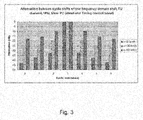
Fig. 2 , the maximum number of orthogonal codes can be computed as 12*7 = 84. The orthogonality within a single block, or FDMA symbol, is limited by the channel delay spread and the sinc pulse shape used in the transceiver. Between the blocks the orthogonality is limited by the channel Doppler spread as well as the frequency error. In practice, the number of orthogonal codes can be less than 84 due to these phenomena. - It is noted that there is a problem caused by the SF=7, i.e., that different cyclic shifts of the same block level code start to interfere with each other as the UE speed increases. This means that it is difficult (or even impossible) to provide sufficient performance for 360 km/h case when using an on-off keying-based SR mechanism. This issue is demonstrated in
Figure 3 , which shows the attenuation between different cyclic shifts of a certain block level code, for a given cyclic shift of frequency domain CAZAC code. - Prior art technique would be to decrease the SF of block level spreading. We note that this approach will
- Either decrease the multiplexing capacity quite dramatically (e.g., combination of SF =3 and SF=4 would mean that the multiplexing capacity is calculated according to SF=3)
- Or decrease the SR coverage by means of TDM component
- 3GPP TSG RAN WG1 Meeting #49bis in Orlando, USA, June 25-29, 2007, NOKIA SIEMENS NETWORKS ET AL "Multiplexing capability of CDM based Dedicated Scheduling Request" analyses the multiplexing capability of the uplink scheduling request and concludes that assuming practical system overhead caused by the UL scheduling request and reasonable delay between two consecutive SR opportunities, it is possible to serve as many as 420 simultaneous UEs that are time synchronized with the Node B.
- The present invention provides better supporting communication with mobile devices in motion at high speed.
- The present invention also provides better support for Scheduling request transmission in an extreme Doppler area.
- The present invention can be configured into both low Doppler environment and high Doppler environment without additional signaling. In high Doppler environment only codes which are partially orthogonal against each other are taken into use.
- The present disclosure shows how to generate sequences having partial orthogonality properties in an LTE type of frame structure and numerology.
- Moreover, the present disclosure shows how to use such partial orthogonality properies for improving resistance against Doppler.
- Also shown is how to multiplex the new sequence structure.
- In one embodiment, the present invention modifies the scheduling request scheme shown in
Fig. 2 to support high speed UEs. The spreading factor of block spreading is changed to an even number, e.g., from 7 to 6. This enables usage of partial orthogonality properties of CAZAC sequences and as a result inter-code interference in the case of high Doppler is reduced. - As mentioned above, the invention is in the context of a novel channel structure for E-UTRA, where block spreading and Zadoff Chu Sequence modulation is applied for the uplink control channel. The inevitable problem of maximizing the multiplexing capacity will lead to numerology causing odd-length sequences, which do not have the favorable property of even-length sequences, which provide partial orthogonality. The consequence of this is catastrophic in terms of performance at high Doppler.
- Another embodiment partial orthogonality is carried out by splitting each slot of a block into only two orthogonal sequences. The two orthogonal sequences may comprise a first sequence of three symbols followed by a second sequence of four symbols. Or, as another example, the two orthogonal sequences comprise a first sequence of three symbols preceded and followed by two symbols of said second sequence of four symbols.
- In yet another embodiment, partial orthogonality is carried out by using a same slot structure as used for hybrid automatic repeat request feedback signaling.
- The invention is a novel set of solutions to provide the maximal multiplexing capacity without loss of performance at high Doppler.
-
- The invention provides a possibility to support an extreme Doppler area (at the expense of reduced multiplexing capacity).
- Additional reduction restores the orthogonality
- No signal loss compared to SF-7 approach (w/o symbol repetition).
- The inventive creation of sequences will maintain the partial orthogonality properties for numerology, which maximizes the multiplexing capacity.
- The invention allows high performance at high Doppler, which is a requirement for the LTE.
- The invention includes additional merits of numerology and sequence consistency for the control channel in general. This yields indirect simplifications of sequence signaling and processing in the receiver.
-
- Reduced multiplexing capacity: this can be handled in such that SF is specified to be configurable
- It is to be understood that all presented exemplary embodiments may also be used in any suitable combination.
- Other objects and features of the present invention will become apparent from the following detailed description considered in conjunction with the accompanying drawings. It is to be understood, however, that the drawings are designed solely for purposes of illustration and not as a definition of the limits of the invention, for which reference should be made to the appended claims. It should be further understood that the drawings are not drawn to scale and that they are merely intended to conceptually illustrate the structures and procedures described herein.
-
- Fig. 1
- shows a scheduling request procedure.
- Fig. 2
- shows a proposed structure of scheduling request transmission.
- Fig. 3
- illustrates attenuation between different cyclic shifts of block level spreading code.
- Fig. 4
- shows an arrangement according to the invention.
- Fig. 5
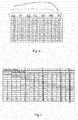
- shows cyclic shift variation of the invention, depending on the SR activity.
- Fig. 6
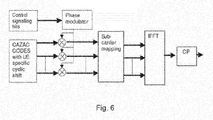
- shows a block diagram of a CAZAC sequence modulator.
- Fig. 7
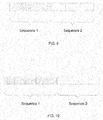
- shows partial orthogonality generated by sequence splitting.
- Fig. 8
- shows partial orthogonality generated by another way of sequence splitting.
- Fig. 9
- shows a sub-frame format for a long CP with six symbols per slot suitable for FDD.
- Fig. 10
- shows a sub-frame format with a first sequence of five symbols per slot followed by a second sequence of four symbols suitable for TDD.
- Fig. 11
- shows a system, according to the present invention.
- Fig. 12
- shows a signal processor suitable for use in the user equipment, in the base station, or both.
- According to the teachings of a first embodiment hereof, a method is shown for arranging block level spreading in such a way that the actual SF in the block domain is constrained to be an even number N (i.e., 6) even though there are N+1 symbols in the original spreading sequence (e.g., 7). In the invented scheme, the block spreading is performed using a spreading sequence of length N.
- Extended sequence of length N+1 blocks is obtained by repetition of a pre-defined block out of N spread blocks
- An outcome of this arrangement is that partial orthogonality which is a property of even-length spreading sequence can be provided for odd number of blocks.
- It is noted that orthogonal multiplexing over N+1 symbols has been achieved without degrading the amount of transmitted energy.
- The above described scheme will provide improved performance in case of high Doppler (reduced inter-code interference between different block codes). Performance improvement is based on utilization of partial the orthogonality properties of orthogonal sequences (CAZAC, Walsh-Hardamard)
- This property is valid for orthogonal sequences of even length
- Cyclic shifts 1:2:N (1, 3, 5) are mutually orthogonal against each other not only over N (6) symbols but also over N/2 (3) symbols. The same applies for cyclic shifts 2:2:N (2, 4, 6).
- Cyclic shifts 1:3:N (1, 4) are orthogonal against each other not only over N (6) symbols but also over N/3 (2) symbols. The same applies for cyclic shifts 2:3:N (2, 5) and 3:3:N (3,6)
-
Figure 4 illustrates a practical arrangement of an embodiment. The CAZAC sequence to be spread is denoted below as C and an even length block spreading code as B.

- It is possible to take the extension into account directly in the spreading code. Extended block spreading code can then be illustrated as

- It is possible to assign partial orthogonal sequences in high Doppler environment and all sequences in low Doppler environment
- For instance, it is possible to specify two formats for SR and to configure them in a cell-specific way
- 1. SF=7 for typical environment
- 2. SF=6 + block repetition for high Doppler environment.
- Typically more than one resource unit will be allocated for the SR usage in each cell (each resource can have at maximum 42 SR resources). It is possible to configure multiple SR formats in one cell in such that
- UEs with high Doppler are allocated into a certain RU and they would apply
SR format # 2 - Low speed UEs are allocated different SR resources. They could still utilize
SR format # 1 - This would minimize the degradation caused by slightly smaller multiplexing capacity of
SR format # 2. - According to another embodiment, it is also possible to vary the code allocation in high Doppler mode as shown in
Figure 5 : - 1. Cyclic shifts 0-6 are used when the SR activity is fairly low
- 2. Every second cyclic shift is used when the SR activity is higher
- The partial orthogonality property can be also generated by means of sequence splitting. As shown in the embodiment of
Fig. 6 , thelength 7 sequence could split into two orthogonal sequences, e.g., length 3 and length 4. The drawback is reduced multiplexing capability because it is determined by shorter sequences. In order to maintain multiplexing capacity, the additional orthogonal cover could apply over the short orthogonal cover sequences resulting in 6 orthogonal sequences. The additional orthogonal cover could switch off in high Doppler conditions. The switching information can be known by eNodeB alone and does not need to be signalled to UEs. Thus no additional signalling is needed. - As a further embodiment, as shown in
Fig. 7 , in order to maximize flexibility of ACK/NACK and SR multiplexing and sequence reuse, the orthogonal cover sequences of SR may be allocated with a structure the same as that used for ACK/NACK, i.e., for HARQ. The drawback is further reduced multiplexing of SR in high Doppler environment; only 2 orthogonal cover codes can be used. - In the case of a positive Scheduling request the cyclically shifted length N ZC =12 CAZAC sequence y(0),...,y(N ZC-1) may be block-wise spread with the orthogonal sequence w(i). Assuming

- Block-wise spreading is done according to either
Method 1 or Method 2:


- and w(m) = w 2(m),m = 0,1; w(m) = w 1(m - 2),m = 2,3,4; w(m) = w 2(m - 3),m = 5,6 (Method 1)
- or w(m) = w 1(m),m = 0,1,2; w(m) = w 2(m - 3),m = 3,4,5,6 (Method 2)
-
Fig. 8 shows partial orthogonality generated by another way of sequence splitting, i.e., where the two orthogonal sequences comprise a first sequence of three symbols preceded and followed by two symbols of a second sequence of four symbols. -
Fig. 9 shows a sub-frame format for a long CP with six symbols per slot suitable for FDD. -
Fig. 10 shows a sub-frame format with a first sequence of five symbols per slot followed by a second sequence of four symbols suitable for TDD. -
Fig. 11 shows a system comprising user equipment and a base station (called "eNode B" in LTE). Both the user equipment and the base station include a transceiver and a signal processor. The signal processors may take various forms including but not limited to the form of processor shown inFig. 12 . Each transceiver is each coupled to an antenna and communications between the user equipment and the base station take place over a wireless interface. The scheduling request channel is an uplink channel within LTE. As such, the eNodeB allocates and signals the code resources to the UEs. When necessary, the eNodeB can use the inventive SR structure in high Doppler format by allocating the code resources to the UEs according to the invention. The eNodeB will then utilize the inventive SR structure when receiving SRs from the UEs. - The signal processor of the user equipment may take the form shown in
Fig. 6 and as such comprises a spreader for block spreading a symbol sequence with spreading codes with partial orthogonality, according to the invention and as exemplified above. The illustrated transceiver of the user equipment of course includes a transmitter for sending one or more scheduling requests block-wise spread with said partial orthogonality. - The signal processor of the base station may also take the form shown in
Fig. 12 and as such comprises a despreader for block de-spreading the symbol sequence sent by the UE with partial orthogonality and received by the base station. The illustrated transceiver of the base station of course includes a receiver for receiving the one or more scheduling requests block-wise spread with said partial orthogonality. The signal processor of the base station may take a form similar to that shown inFig. 6 except in reverse, for carrying out the de-spreading function. -
Fig. 12 shows a general purpose signal processor suitable for carrying out the signal processing functions shown above. It includes a read-only-memory (ROM), a random access memory (RAM), a central processing unit (CPU), a clock, an input/output (I/O) port, and miscellaneous functions, all interconnected by a data, address and control (DAC) bus. The ROM is a computer readable medium that is able to store program code written to carry out the various functions described above in conjunction with the RAM, CPU, I/O, etc. Of course, it should be realized that the same signal processing function may be carried out with a combination of hardware and software and may even be carried out entirely in hardware with a dedicated integrated circuit, i.e., without software.
Claims (13)
- Method, comprising:block spreading a symbol sequence in a slot, wherein the symbol sequence is one or more scheduling requests, with a spreading code, andsending the one or more scheduling requests spread block-wise in a cell of an evolved universal terrestrial radio access network,characterized in that in high Doppler environment a spreading factor having an even number N is used for the block spreading,and in that the spreading code is partially orthogonal against each other spreading code used in the cell,wherein two spreading codes are partially orthogonal against each other when the two spreading codes are mutually orthogonal against each other over the number of symbols N and also over N/2 symbols.
- The method of claim 1, wherein the spreading code is a Walsh-Hadamard sequence or a constant amplitude zero autocorrelation sequence.
- The method of claim 1 or 2, wherein said partial orthogonality is carried out by using a same slot structure as used for hybrid automatic repeat request feedback signaling.
- Apparatus, preferably a user equipment, for transmitting a scheduling request comprising:a spreader to perform block spreading of a symbol sequence in a slot with a spreading code, wherein the symbol sequence is one or more scheduling requests, in high Doppler environment, anda transmitter for sending the one or more scheduling requests spread block-wise in a cell of an evolved universal terrestrial radio access network,characterized in that a spreading factor having an even number N is used for the block spreading,and in that the spreading code is partially orthogonal against each other spreading code used in the cell,wherein two spreading codes are partially orthogonal against each other when the two spreading codes are mutually orthogonal against each other over the number of symbols N and also over N/2 symbols.
- The apparatus of claim 4, wherein the spreading code is a Walsh-Hadamard sequence or a constant amplitude zero autocorrelation sequence.
- The apparatus of claim 4 or 5, wherein said partial orthogonality is carried out by using a same slot structure as used for hybrid automatic repeat request feedback signaling.
- Method, comprising:sending in a cell of an evolved universal terrestrial radio access network a signal to a user equipment in high Doppler environment indicative of a spreading code for block spreading a symbol sequence in a slot, wherein the symbol sequence is one or more scheduling requests, and receiving from the user equipment the one or more scheduling requests spread block-wise,characterized in that a spreading factor having an even number N is used for the block spreading,and in that the spreading code is partially orthogonal against each other spreading code used in the cell,wherein two spreading codes are partially orthogonal against each other when the two spreading codes are mutually orthogonal against each other over the number of symbols N and also over N/2 symbols.
- The method of claim 7, wherein the spreading code is a Walsh-Hadamard sequence or a constant amplitude zero autocorrelation sequence.
- The method of claim 7 or 8, wherein said partial orthogonality is carried out by using a same slot structure as used for hybrid automatic repeat request feedback signaling.
- Apparatus, preferable an eNodeB, for receiving a scheduling request comprising:a transmitter for sending in a cell of an evolved universal terrestrial radio access network a signal to a user equipment in high Doppler environment indicative of a spreading code for block spreading a symbol sequence in a slot, wherein the symbol sequence is one or more scheduling requests, anda receiver for receiving from the user equipment the one or more scheduling requests spread block-wise,characterized in that a spreading factor having an even number N is used for the block spreading,and in that the spreading code is partially orthogonal against each other spreading code used in the cell,wherein two spreading codes are partially orthogonal against each other when the two spreading codes are mutually orthogonal against each other over the number of symbols N and also over N/2 symbols.
- The apparatus of claim 10, wherein the spreading code is a Walsh-Hadamard sequence or a constant amplitude zero autocorrelation sequence.
- The apparatus of claim 10 or 11, wherein said partial orthogonality is carried out by using a same slot structure as used for hybrid automatic repeat request feedback signaling.
- A system, comprising: an apparatus, preferably an eNodeB, according to claim 10 and an apparatus, preferably a user equipment, according to claim 4.
Applications Claiming Priority (2)
| Application Number | Priority Date | Filing Date | Title |
|---|---|---|---|
| US95599807P | 2007-08-15 | 2007-08-15 | |
| EP08787144.8A EP2188941B1 (en) | 2007-08-15 | 2008-08-12 | Scheduling request transmission supporting high doppler |
Related Parent Applications (2)
| Application Number | Title | Priority Date | Filing Date |
|---|---|---|---|
| EP08787144.8A Division EP2188941B1 (en) | 2007-08-15 | 2008-08-12 | Scheduling request transmission supporting high doppler |
| EP08787144.8A Division-Into EP2188941B1 (en) | 2007-08-15 | 2008-08-12 | Scheduling request transmission supporting high doppler |
Publications (1)
| Publication Number | Publication Date |
|---|---|
| EP3203663A1 true EP3203663A1 (en) | 2017-08-09 |
Family
ID=40251708
Family Applications (2)
| Application Number | Title | Priority Date | Filing Date |
|---|---|---|---|
| EP08787144.8A Active EP2188941B1 (en) | 2007-08-15 | 2008-08-12 | Scheduling request transmission supporting high doppler |
| EP17156338.0A Withdrawn EP3203663A1 (en) | 2007-08-15 | 2008-08-12 | Scheduling request transmission supporting high doppler |
Family Applications Before (1)
| Application Number | Title | Priority Date | Filing Date |
|---|---|---|---|
| EP08787144.8A Active EP2188941B1 (en) | 2007-08-15 | 2008-08-12 | Scheduling request transmission supporting high doppler |
Country Status (13)
| Country | Link |
|---|---|
| US (1) | US8576787B2 (en) |
| EP (2) | EP2188941B1 (en) |
| JP (1) | JP5374507B2 (en) |
| KR (1) | KR101174977B1 (en) |
| CN (2) | CN101828349A (en) |
| AU (1) | AU2008288439B2 (en) |
| BR (1) | BRPI0816245A2 (en) |
| CA (1) | CA2696058C (en) |
| ES (1) | ES2638177T3 (en) |
| MX (1) | MX2010001803A (en) |
| RU (1) | RU2492580C2 (en) |
| WO (1) | WO2009021952A2 (en) |
| ZA (1) | ZA201001013B (en) |
Families Citing this family (7)
| Publication number | Priority date | Publication date | Assignee | Title |
|---|---|---|---|---|
| WO2011098136A1 (en) | 2010-02-12 | 2011-08-18 | Nokia Siemens Networks Oy | Scheduling request and ack/nack simultaneous transmission / prioritization over pucch in lte |
| EP2705709A1 (en) | 2011-05-02 | 2014-03-12 | Nokia Solutions and Networks Oy | Scheduling request enhancements |
| CN103188193B (en) * | 2011-12-29 | 2015-11-25 | 同济大学 | A kind of Doppler shift compensation method for TD-LTE system |
| CN104937875A (en) * | 2012-10-05 | 2015-09-23 | 司亚乐无线通讯股份有限公司 | Enhancement for lte communication systems |
| US9655088B2 (en) * | 2013-04-17 | 2017-05-16 | Qualcomm Incorporated | Utilizing unused uplink sequence shifts for signaling |
| CA3194847A1 (en) | 2014-08-25 | 2016-03-03 | ONE Media, LLC | Dynamic configuration of a flexible orthogonal frequency division multiplexing phy transport data frame preamble |
| CN107431549B (en) | 2015-03-09 | 2019-10-25 | 第一媒体有限责任公司 | System Discovery and Signaling |
Family Cites Families (8)
| Publication number | Priority date | Publication date | Assignee | Title |
|---|---|---|---|---|
| US5210770A (en) * | 1991-09-27 | 1993-05-11 | Lockheed Missiles & Space Company, Inc. | Multiple-signal spread-spectrum transceiver |
| US6768768B2 (en) | 2001-09-19 | 2004-07-27 | Qualcomm Incorporated | Method and apparatus for step two W-CDMA searching |
| US7301893B2 (en) * | 2001-11-21 | 2007-11-27 | Texas Instruments Incorporated | Linear space-time block code with block STTD structure |
| RU2297731C2 (en) | 2002-11-13 | 2007-04-20 | Зте Корпорейшн | Method for planning speed of transmission via direct channel and scheduler working in accordance to said method |
| JP3816450B2 (en) | 2003-02-18 | 2006-08-30 | Kddi株式会社 | Transmitter and receiver |
| US7907898B2 (en) | 2004-03-26 | 2011-03-15 | Qualcomm Incorporated | Asynchronous inter-piconet routing |
| US20070183386A1 (en) * | 2005-08-03 | 2007-08-09 | Texas Instruments Incorporated | Reference Signal Sequences and Multi-User Reference Signal Sequence Allocation |
| US8059735B2 (en) * | 2007-06-04 | 2011-11-15 | Texas Instruments Incorporated | Allocation of block spreading sequences |
-
2008
- 2008-08-12 EP EP08787144.8A patent/EP2188941B1/en active Active
- 2008-08-12 JP JP2010520560A patent/JP5374507B2/en active Active
- 2008-08-12 CA CA2696058A patent/CA2696058C/en active Active
- 2008-08-12 AU AU2008288439A patent/AU2008288439B2/en active Active
- 2008-08-12 RU RU2010109362/07A patent/RU2492580C2/en active
- 2008-08-12 BR BRPI0816245A patent/BRPI0816245A2/en not_active Application Discontinuation
- 2008-08-12 KR KR1020107005742A patent/KR101174977B1/en active Active
- 2008-08-12 CN CN200880111539A patent/CN101828349A/en active Pending
- 2008-08-12 WO PCT/EP2008/060589 patent/WO2009021952A2/en not_active Ceased
- 2008-08-12 ES ES08787144.8T patent/ES2638177T3/en active Active
- 2008-08-12 MX MX2010001803A patent/MX2010001803A/en active IP Right Grant
- 2008-08-12 EP EP17156338.0A patent/EP3203663A1/en not_active Withdrawn
- 2008-08-12 CN CN201610202996.3A patent/CN105847202A/en active Pending
- 2008-08-12 US US12/733,166 patent/US8576787B2/en active Active
-
2010
- 2010-02-11 ZA ZA201001013A patent/ZA201001013B/en unknown
Non-Patent Citations (9)
| Title |
|---|
| "3GPP TSG RAN WG1 Meeting #47bis held in Sorrento", RL-070379, 15 January 2007 (2007-01-15) |
| "Uplink Scheduling Request for LTE", RL-072307, pages 20070507 |
| 3GPP TSG RAN WG1 MEETING #48BIS, 26 March 2007 (2007-03-26) |
| ERICSSON: "Scheduling Request in E-UTRAN", 3GPP DRAFT; R1-070471, 3RD GENERATION PARTNERSHIP PROJECT (3GPP), MOBILE COMPETENCE CENTRE ; 650, ROUTE DES LUCIOLES ; F-06921 SOPHIA-ANTIPOLIS CEDEX ; FRANCE, vol. tsg_ran\WG1_RL1\TSGR1_47bis\Docs, no. Sorrento, Italy; 20070115, 10 January 2007 (2007-01-10), XP050104502 * |
| KDDI ET AL: "CDMA based Multiplexing of ACK/NACK and CQI Control Information in E-UTRA Uplink", 3GPP DRAFT; R1-070521, 3RD GENERATION PARTNERSHIP PROJECT (3GPP), MOBILE COMPETENCE CENTRE ; 650, ROUTE DES LUCIOLES ; F-06921 SOPHIA-ANTIPOLIS CEDEX ; FRANCE, vol. tsg_ran\WG1_RL1\TSGR1_47bis\Docs, no. Sorrento, Italy; 20070115, 10 January 2007 (2007-01-10), XP050104548 * |
| NOKIA SIEMENS NETWORKS ET AL.: "Multiplexing capability of CDM based Dedicated Scheduling Request", 3GPP TSG RAN WG1 MEETING #49BIS IN ORLANDO, 25 June 2007 (2007-06-25) |
| NOKIA SIEMENS NETWORKS ET AL: "Multiplexing capability of CDM based Dedicated Scheduling Request", 3GPP DRAFT; R1-073012, 3RD GENERATION PARTNERSHIP PROJECT (3GPP), MOBILE COMPETENCE CENTRE ; 650, ROUTE DES LUCIOLES ; F-06921 SOPHIA-ANTIPOLIS CEDEX ; FRANCE, vol. tsg_ran\WG1_RL1\TSGR1_49b\Docs, no. Orlando, USA; 20070625, 20 June 2007 (2007-06-20), XP050106676 * |
| NOKIA SIEMENS NETWORKS ET AL: "Scheduling Request supporting High Doppler", 3GPP DRAFT; R1-073654, 3RD GENERATION PARTNERSHIP PROJECT (3GPP), MOBILE COMPETENCE CENTRE ; 650, ROUTE DES LUCIOLES ; F-06921 SOPHIA-ANTIPOLIS CEDEX ; FRANCE, vol. tsg_ran\WG1_RL1\TSGR1_50\Docs, no. Athens, Greece; 20070820, 15 August 2007 (2007-08-15), XP050107250 * |
| NOKIA SIEMENS NETWORKS ET AL: "Uplink Scheduling Request for LTE", 3GPP DRAFT; R1-073016, 3RD GENERATION PARTNERSHIP PROJECT (3GPP), MOBILE COMPETENCE CENTRE ; 650, ROUTE DES LUCIOLES ; F-06921 SOPHIA-ANTIPOLIS CEDEX ; FRANCE, vol. tsg_ran\WG1_RL1\TSGR1_49b\Docs, no. Orlando, USA; 20070625, 20 June 2007 (2007-06-20), XP050106680 * |
Also Published As
| Publication number | Publication date |
|---|---|
| AU2008288439A1 (en) | 2009-02-19 |
| EP2188941A2 (en) | 2010-05-26 |
| KR20100044889A (en) | 2010-04-30 |
| JP2010536297A (en) | 2010-11-25 |
| RU2492580C2 (en) | 2013-09-10 |
| ES2638177T3 (en) | 2017-10-19 |
| JP5374507B2 (en) | 2013-12-25 |
| AU2008288439B2 (en) | 2013-09-12 |
| CN105847202A (en) | 2016-08-10 |
| US8576787B2 (en) | 2013-11-05 |
| CA2696058C (en) | 2016-01-26 |
| CA2696058A1 (en) | 2009-02-19 |
| EP2188941B1 (en) | 2017-05-24 |
| BRPI0816245A2 (en) | 2017-05-30 |
| MX2010001803A (en) | 2010-03-10 |
| US20100142474A1 (en) | 2010-06-10 |
| WO2009021952A2 (en) | 2009-02-19 |
| RU2010109362A (en) | 2011-09-20 |
| CN101828349A (en) | 2010-09-08 |
| KR101174977B1 (en) | 2012-08-17 |
| WO2009021952A3 (en) | 2009-04-23 |
| ZA201001013B (en) | 2010-10-27 |
Similar Documents
| Publication | Publication Date | Title |
|---|---|---|
| KR100929978B1 (en) | Method for transmitting a scheduling request on an uplink control channel in a wireless communication system | |
| KR101467567B1 (en) | Method of transmitting scheduling request signal | |
| KR100956494B1 (en) | Control signal transmission method | |
| RU2426236C2 (en) | Method of transmitting control signals on uplink channel in wireless communication system | |
| US8885743B2 (en) | Method of transmitting control signal in wireless communication system | |
| KR100910707B1 (en) | Method for transmitting control signal | |
| EP2178231B1 (en) | Radio transmission device and radio communication method | |
| EP4236123A2 (en) | Signaling of ack/nack resources | |
| KR101345505B1 (en) | Method and apparatus for transmitting and receiving uplink control signalling channels in wireless communication systems | |
| EP2188941B1 (en) | Scheduling request transmission supporting high doppler | |
| EP2070217A2 (en) | Apparatus, method and computer program product providing mulitplexing for data-non-associated control channel | |
| CN104821868A (en) | Method and device for wireless communication |
Legal Events
| Date | Code | Title | Description |
|---|---|---|---|
| PUAI | Public reference made under article 153(3) epc to a published international application that has entered the european phase |
Free format text: ORIGINAL CODE: 0009012 |
|
| AC | Divisional application: reference to earlier application |
Ref document number: 2188941 Country of ref document: EP Kind code of ref document: P |
|
| AK | Designated contracting states |
Kind code of ref document: A1 Designated state(s): AT BE BG CH CY CZ DE DK EE ES FI FR GB GR HR HU IE IS IT LI LT LU LV MC MT NL NO PL PT RO SE SI SK TR |
|
| 17P | Request for examination filed |
Effective date: 20180209 |
|
| RBV | Designated contracting states (corrected) |
Designated state(s): AT BE BG CH CY CZ DE DK EE ES FI FR GB GR HR HU IE IS IT LI LT LU LV MC MT NL NO PL PT RO SE SI SK TR |
|
| 17Q | First examination report despatched |
Effective date: 20190125 |
|
| RAP1 | Party data changed (applicant data changed or rights of an application transferred) |
Owner name: NOKIA SOLUTIONS AND NETWORKS OY |
|
| STAA | Information on the status of an ep patent application or granted ep patent |
Free format text: STATUS: THE APPLICATION IS DEEMED TO BE WITHDRAWN |
|
| 18D | Application deemed to be withdrawn |
Effective date: 20190806 |