EP3203632A1 - System and method for audio volume control - Google Patents
System and method for audio volume control Download PDFInfo
- Publication number
- EP3203632A1 EP3203632A1 EP17161023.1A EP17161023A EP3203632A1 EP 3203632 A1 EP3203632 A1 EP 3203632A1 EP 17161023 A EP17161023 A EP 17161023A EP 3203632 A1 EP3203632 A1 EP 3203632A1
- Authority
- EP
- European Patent Office
- Prior art keywords
- volume
- rules
- volume change
- change step
- computer
- Prior art date
- Legal status (The legal status is an assumption and is not a legal conclusion. Google has not performed a legal analysis and makes no representation as to the accuracy of the status listed.)
- Withdrawn
Links
Images
Classifications
-
- H—ELECTRICITY
- H03—ELECTRONIC CIRCUITRY
- H03G—CONTROL OF AMPLIFICATION
- H03G7/00—Volume compression or expansion in amplifiers
- H03G7/002—Volume compression or expansion in amplifiers in untuned or low-frequency amplifiers, e.g. audio amplifiers
-
- G—PHYSICS
- G06—COMPUTING OR CALCULATING; COUNTING
- G06F—ELECTRIC DIGITAL DATA PROCESSING
- G06F3/00—Input arrangements for transferring data to be processed into a form capable of being handled by the computer; Output arrangements for transferring data from processing unit to output unit, e.g. interface arrangements
- G06F3/16—Sound input; Sound output
- G06F3/165—Management of the audio stream, e.g. setting of volume, audio stream path
-
- H—ELECTRICITY
- H03—ELECTRONIC CIRCUITRY
- H03G—CONTROL OF AMPLIFICATION
- H03G3/00—Gain control in amplifiers or frequency changers
- H03G3/02—Manually-operated control
-
- H—ELECTRICITY
- H03—ELECTRONIC CIRCUITRY
- H03G—CONTROL OF AMPLIFICATION
- H03G3/00—Gain control in amplifiers or frequency changers
- H03G3/20—Automatic control
- H03G3/30—Automatic control in amplifiers having semiconductor devices
- H03G3/3005—Automatic control in amplifiers having semiconductor devices in amplifiers suitable for low-frequencies, e.g. audio amplifiers
- H03G3/3026—Automatic control in amplifiers having semiconductor devices in amplifiers suitable for low-frequencies, e.g. audio amplifiers the gain being discontinuously variable, e.g. controlled by switching
-
- H—ELECTRICITY
- H03—ELECTRONIC CIRCUITRY
- H03G—CONTROL OF AMPLIFICATION
- H03G3/00—Gain control in amplifiers or frequency changers
- H03G3/20—Automatic control
- H03G3/30—Automatic control in amplifiers having semiconductor devices
- H03G3/32—Automatic control in amplifiers having semiconductor devices the control being dependent upon ambient noise level or sound level
-
- H—ELECTRICITY
- H04—ELECTRIC COMMUNICATION TECHNIQUE
- H04S—STEREOPHONIC SYSTEMS
- H04S7/00—Indicating arrangements; Control arrangements, e.g. balance control
-
- H—ELECTRICITY
- H04—ELECTRIC COMMUNICATION TECHNIQUE
- H04R—LOUDSPEAKERS, MICROPHONES, GRAMOPHONE PICK-UPS OR LIKE ACOUSTIC ELECTROMECHANICAL TRANSDUCERS; ELECTRIC HEARING AIDS; PUBLIC ADDRESS SYSTEMS
- H04R2430/00—Signal processing covered by H04R, not provided for in its groups
- H04R2430/01—Aspects of volume control, not necessarily automatic, in sound systems
-
- H—ELECTRICITY
- H04—ELECTRIC COMMUNICATION TECHNIQUE
- H04R—LOUDSPEAKERS, MICROPHONES, GRAMOPHONE PICK-UPS OR LIKE ACOUSTIC ELECTROMECHANICAL TRANSDUCERS; ELECTRIC HEARING AIDS; PUBLIC ADDRESS SYSTEMS
- H04R29/00—Monitoring arrangements; Testing arrangements
- H04R29/004—Monitoring arrangements; Testing arrangements for microphones
-
- H—ELECTRICITY
- H04—ELECTRIC COMMUNICATION TECHNIQUE
- H04R—LOUDSPEAKERS, MICROPHONES, GRAMOPHONE PICK-UPS OR LIKE ACOUSTIC ELECTROMECHANICAL TRANSDUCERS; ELECTRIC HEARING AIDS; PUBLIC ADDRESS SYSTEMS
- H04R3/00—Circuits for transducers
- H04R3/04—Circuits for transducers for correcting frequency response
-
- H—ELECTRICITY
- H04—ELECTRIC COMMUNICATION TECHNIQUE
- H04R—LOUDSPEAKERS, MICROPHONES, GRAMOPHONE PICK-UPS OR LIKE ACOUSTIC ELECTROMECHANICAL TRANSDUCERS; ELECTRIC HEARING AIDS; PUBLIC ADDRESS SYSTEMS
- H04R5/00—Stereophonic arrangements
- H04R5/04—Circuit arrangements, e.g. for selective connection of amplifier inputs/outputs to loudspeakers, for loudspeaker detection, or for adaptation of settings to personal preferences or hearing impairments
-
- H—ELECTRICITY
- H04—ELECTRIC COMMUNICATION TECHNIQUE
- H04S—STEREOPHONIC SYSTEMS
- H04S2400/00—Details of stereophonic systems covered by H04S but not provided for in its groups
- H04S2400/13—Aspects of volume control, not necessarily automatic, in stereophonic sound systems
-
- H—ELECTRICITY
- H04—ELECTRIC COMMUNICATION TECHNIQUE
- H04S—STEREOPHONIC SYSTEMS
- H04S2420/00—Techniques used stereophonic systems covered by H04S but not provided for in its groups
- H04S2420/01—Enhancing the perception of the sound image or of the spatial distribution using head related transfer functions [HRTF's] or equivalents thereof, e.g. interaural time difference [ITD] or interaural level difference [ILD]
Definitions
- the present invention relates to a system and method for audio volume control.
- the present invention relates to a stepwise volume up or volume down control.
- Prior art defines systems where a manufacturer of a device sets a volume up/down step and each selection of volume up function increases the volume by a fixed step while each selection of volume down function decreases the volume by a fixed step.
- Such approach is common in well-known devices such as portable music players, amplifiers, television sets or the like.
- prior art volume control systems detect holding of a volume control key and controlling the volume by a number of steps depending on the duration of the key press, for example on a remote control unit.
- volume control systems determine a number of steps depending on a magnitude of an angular rotation of a rotatable control such as a volume control knob.
- a drawback of known solutions is that, due to its fixed nature, frequently the volume control step does not meet changing or alternating users' needs as well as changing conditions of audio signal presentation.
- the aim of the development of the present invention is an improved system and method for audio volume control.
- a first object of the present invention is a method for audio volume control, the method comprising the steps of: receiving a volume change request; changing the volume according to a volume change step; wherein the volume change step determination is executed by applying one or more rules; wherein each rule provides a definition of at least two ranges, with respect to a monitored condition, wherein the volume change step, associated with each such range, is different; storing a new volume change step in the volume step register wherein there are separate rules for volume up and separate rules for volume down actions and that the volume change step in the volume step register (120) stores a different step value for volume increase and a different step value for volume decrease.
- the one or more rules may be applied separately, or in groups according to a sequence.
- the one or more rules associate a volume change step with a current volume obtained from the current volume register.
- the one or more rules associate a volume change step with a time of day obtained from a timer module.
- one or more rules are based on loudness of the input audio signal.
- the volume of said input audio signal is controlled.
- the one or more rules are based on ambient noise loudness.
- Another object of the present invention is a computer program comprising program code means for performing all the steps of the computer-implemented method according to the present invention when said program is run on a computer.
- Another object of the present invention is a computer readable medium storing computer-executable instructions performing all the steps of the computer-implemented method according to the present invention when executed on a computer.
- a further object of the present invention is a system for audio volume control, the system comprising: an amplifier of an audio signal; a volume step register; wherein volume up/down actions take into account volume step stored in the volume step register; the system further comprises: the volume step determination module configured to program the volume step register in response to application of at least one volume step determination rule; wherein each rule provides a definition of at least two ranges, with respect to a monitored condition, wherein the volume change step, associated with each such range, is different.
- these quantities take the form of electrical or magnetic signals capable of being stored, transferred, combined, compared, and otherwise manipulated in a computer system.
- these signals are referred to as bits, packets, messages, values, elements, symbols, characters, terms, numbers, or the like.
- a computer-readable (storage) medium typically may be non-transitory and/or comprise a non-transitory device.
- a non-transitory storage medium may include a device that may be tangible, meaning that the device has a concrete physical form, although the device may change its physical state.
- non-transitory refers to a device remaining tangible despite a change in state.
- example means serving as a non-limiting example, instance, or illustration.
- terms "for example” and “e.g.” introduce a list of one or more non-limiting examples, instances, or illustrations.
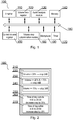
- Fig. 1 presents a diagram of the system (100) according to the present invention.
- An amplifier (110) is controlled by means of volume up/down lines (not shown) the state of which invokes volume up/down actions respectively.
- These volume up/down lines are appropriately driven by first and second user input means that allow the user to change the output volume in an upward or downward direction.
- first and second user input means might be buttons of a remote control unit of an audio outputting device.
- the amplifier (110) comprises a regular audio signal input, on which it operates as will be evident to a person skilled in the art.
- volume up/down actions take into account volume up/down step stored in a volume step register (120).
- This register may store a different step value (e.g. in decibels) for volume increase and a different step value for volume decrease. This is due to a fact, that user's tend to prefer a smaller step in case of volume increase and a larger step in case of volume decrease.
- the amplifier (110) may also report current volume or normalized current volume (e.g. in a scale 0 to 100) to a current volume register (150). This information is applicable in embodiments of the present invention, where current volume is a parameter of a rule for determining volume change step.
- the present system (100) may comprise a programmable timer module (170), which may store time as well as date. This information is applicable in embodiments of the present invention, where current time/date is a parameter of a rule for determining volume change step.
- a further module of the present invention is a volume step determination module (160).
- This module is responsible for programming the volume step register (120) in response to the application of at least one volume step determination rule. Such rules will be elaborated on with reference to Fig. 2 .
- Such rules may include analysis of current time and/or data, analysis of current volume level, analysis of currently played audio.
- the system (100) comprises an audio analysis module (130) configured to analyze current loudness of the processes audio signal subject to amplification by the amplifier (110). Loudness is the characteristic of a sound that is primarily a psychological correlate of physical strength (amplitude). More formally, it is defined as "that attribute of auditory sensation in terms of which sounds can be ordered on a scale extending from quiet to loud" (source: Wikipedia).
- system (100) may comprise a microphone module (190), which may record ambient sound level. This information is applicable in embodiments of the present invention, where current ambient sound level is a parameter of a rule for determining volume change step.
- the system (100) may be realized using dedicated components or custom made FPGA or ASIC circuits.
- the system comprises a data bus (180) communicatively coupled to other components of the system, including the memory (140). Additionally, other components of the system are communicatively coupled to the system bus (180) so that they may be managed by the volume step determination module (160).
- Fig. 2 shows an example of a database of rules.
- the database may be stored in the memory (140) or in the volume step determination module (160).
- GUI graphical user interface
- Rule (210) is a rule that associates a volume change step with a current volume obtained from the current volume register (150).
- three ranges of volume (220, 230 and 240) are given. However, there may be more of fewer ranges defined.
- the ranges are defined such that they do not overlap. For example, if current volume is in a range lower than 20% of the maximum volume, the step of volume change is set to 2dB, if current volume is in a range equal or greater than 20% and below 70% of the maximum volume, the step of volume change is set to 4dB whereas if current volume is in a range equal or greater than 70% of the maximum volume, the step of volume change is set to 3dB.
- Rule (250) is a rule that associates a volume change step with a time of day obtained from the timer module (170).
- two ranges of time (260, 270) are given. However, there may be more of fewer ranges defined.
- the ranges are defined such that they do not overlap. For example, if the current time of day is in a range outside of 9:00 to 20:00, the currently determined volume change step (e.g. determined by the rule (210)) may be decreased by 25%, while if current time of day is in a range within of 9:00 to 20:00, the currently determined volume change step (e.g. determined by the rule (210)) may be increased by 25%.
- the rule (210) and the rule (250) may be applied for the determination of a volume change step.
- rule (210) that sets an absolute volume change step (e.g. 3 dB)
- rule (250) that set a relative volume change step (e.g. +20%) with respect to a previously set absolute volume change step.
- volume change level may be set to +20%, while if the ambient noise loudness is above 60 dB the volume change level may be set to +5%.
- Another example of a rule is based on loudness of the input audio signal currently amplified by the amplifier (110). For example, if loudness of the input audio is below 60 dB the volume change level may be set to +25%, while if the loudness is above 60 dB the volume change level may be set to +0%.
- each rule provides a definition of at least two ranges, with respect to a monitored condition (typically a signal), wherein the volume change step, associated with each such range, is different.
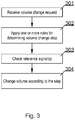
- Fig. 3 depicts a method according to the present invention.
- the process starts at step (301) from receiving a volume change request.
- step (302) there is executed a step of applying one or more rules for determining volume change step.
- step (303) one or more input signals on which the selected rules depend are checked. For example state of the timer, current volume level etc.
- a new volume change step may be stored in the volume step register (120).
- step (304) the volume is changed according to the volume change step.
- the present invention simplifies volume control and adapts it to the users' needs. Therefore, the invention provides a useful, concrete and tangible result.
- the invention has been presented with respect to a device comprising an amplifier (110) and volume control means controlled by a suitable controller (160) as presented herein. Thus the machine or transformation test is fulfilled and the idea is not abstract.
- the aforementioned method for audio volume control may be performed and/or controlled by one or more computer programs.
- Such computer programs are typically executed by utilizing the computing resources in a computing device.
- Applications are stored on a non-transitory medium.
- An example of a non-transitory medium is a non-volatile memory, for example a flash memory while an example of a volatile memory is RAM.
- the computer instructions are executed by a processor.
- These memories are for example recording media for storing computer programs comprising computer-executable instructions performing all the steps of the computer-implemented method according the technical concept presented herein.
Landscapes
- Engineering & Computer Science (AREA)
- Multimedia (AREA)
- Physics & Mathematics (AREA)
- Theoretical Computer Science (AREA)
- Acoustics & Sound (AREA)
- Signal Processing (AREA)
- General Health & Medical Sciences (AREA)
- Health & Medical Sciences (AREA)
- Human Computer Interaction (AREA)
- Audiology, Speech & Language Pathology (AREA)
- General Engineering & Computer Science (AREA)
- General Physics & Mathematics (AREA)
- Circuit For Audible Band Transducer (AREA)
- Otolaryngology (AREA)
Abstract
Method for audio volume control, the method comprising the steps of: receiving (301) a volume change request; changing (304) the volume according to a volume change step; the method being characterized in that the volume change step determination (302) is executed by applying one or more rules wherein each rule provides a definition of at least two ranges, with respect to a monitored condition, wherein the volume change step, associated with each such range, is different; storing a new volume change step in a volume step register (120) wherein there are separate rules for volume up and separate rules for volume down actions and that the volume change step in the volume step register (120) stores a different step value for volume increase and a different step value for volume decrease.
Description
- The present invention relates to a system and method for audio volume control. In particular, the present invention relates to a stepwise volume up or volume down control.
- Prior art defines systems where a manufacturer of a device sets a volume up/down step and each selection of volume up function increases the volume by a fixed step while each selection of volume down function decreases the volume by a fixed step. Such approach is common in well-known devices such as portable music players, amplifiers, television sets or the like.
- Further, prior art volume control systems detect holding of a volume control key and controlling the volume by a number of steps depending on the duration of the key press, for example on a remote control unit.
- Other volume control systems, determine a number of steps depending on a magnitude of an angular rotation of a rotatable control such as a volume control knob.
- It would be advantageous to control volume adjustments more flexibly instead of using means of a predefined step of for example 2-3 dB.
- A drawback of known solutions is that, due to its fixed nature, frequently the volume control step does not meet changing or alternating users' needs as well as changing conditions of audio signal presentation.
- The aim of the development of the present invention is an improved system and method for audio volume control.
- A first object of the present invention is a method for audio volume control, the method comprising the steps of: receiving a volume change request; changing the volume according to a volume change step; wherein the volume change step determination is executed by applying one or more rules; wherein each rule provides a definition of at least two ranges, with respect to a monitored condition, wherein the volume change step, associated with each such range, is different; storing a new volume change step in the volume step register wherein there are separate rules for volume up and separate rules for volume down actions and that the volume change step in the volume step register (120) stores a different step value for volume increase and a different step value for volume decrease.
- Preferably, the one or more rules may be applied separately, or in groups according to a sequence.
- Advantageously, the one or more rules associate a volume change step with a current volume obtained from the current volume register.
- Preferably, the one or more rules associate a volume change step with a time of day obtained from a timer module.
- Advantageously, there is one main rule that sets an absolute volume change step and there are present one or more rules that set a relative volume change step with respect to a previously set absolute volume change step.
- Preferably, one or more rules are based on loudness of the input audio signal. The volume of said input audio signal is controlled.
- Advantageously, the one or more rules are based on ambient noise loudness.
- Another object of the present invention is a computer program comprising program code means for performing all the steps of the computer-implemented method according to the present invention when said program is run on a computer.
- Another object of the present invention is a computer readable medium storing computer-executable instructions performing all the steps of the computer-implemented method according to the present invention when executed on a computer.
- A further object of the present invention is a system for audio volume control, the system comprising: an amplifier of an audio signal; a volume step register; wherein volume up/down actions take into account volume step stored in the volume step register; the system further comprises: the volume step determination module configured to program the volume step register in response to application of at least one volume step determination rule; wherein each rule provides a definition of at least two ranges, with respect to a monitored condition, wherein the volume change step, associated with each such range, is different.
- These and other objects of the invention presented herein, are accomplished by providing a system and method for audio volume control. Further details and features of the present invention, its nature and various advantages will become more apparent from the following detailed description of the preferred embodiments shown in a drawing, in which:
-
Fig. 1 presents a diagram of the system according to the present invention; -
Fig. 2 shows an example of a database of rules; and -
Fig. 3 depicts a method according to the present invention. - Some portions of the detailed description which follows are presented in terms of data processing procedures, steps or other symbolic representations of operations on data bits that can be performed on computer memory. Therefore, a computer executes such logical steps thus requiring physical manipulations of physical quantities.
- Usually these quantities take the form of electrical or magnetic signals capable of being stored, transferred, combined, compared, and otherwise manipulated in a computer system. For reasons of common usage, these signals are referred to as bits, packets, messages, values, elements, symbols, characters, terms, numbers, or the like.
- Additionally, all of these and similar terms are to be associated with the appropriate physical quantities and are merely convenient labels applied to these quantities. Terms such as "processing" or "creating" or "transferring" or "executing" or "determining" or "detecting" or "obtaining" or "selecting" or "calculating" or "generating" or the like, refer to the action and processes of a computer system that manipulates and transforms data represented as physical (electronic) quantities within the computer's registers and memories into other data similarly represented as physical quantities within the memories or registers or other such information storage.
- A computer-readable (storage) medium, such as referred to herein, typically may be non-transitory and/or comprise a non-transitory device. In this context, a non-transitory storage medium may include a device that may be tangible, meaning that the device has a concrete physical form, although the device may change its physical state. Thus, for example, non-transitory refers to a device remaining tangible despite a change in state.
- As utilized herein, the term "example" means serving as a non-limiting example, instance, or illustration. As utilized herein, the terms "for example" and "e.g." introduce a list of one or more non-limiting examples, instances, or illustrations.
-
Fig. 1 presents a diagram of the system (100) according to the present invention. An amplifier (110) is controlled by means of volume up/down lines (not shown) the state of which invokes volume up/down actions respectively. These volume up/down lines are appropriately driven by first and second user input means that allow the user to change the output volume in an upward or downward direction. Such first and second user input means might be buttons of a remote control unit of an audio outputting device. - The amplifier (110) comprises a regular audio signal input, on which it operates as will be evident to a person skilled in the art.
- The volume up/down actions take into account volume up/down step stored in a volume step register (120). This register may store a different step value (e.g. in decibels) for volume increase and a different step value for volume decrease. This is due to a fact, that user's tend to prefer a smaller step in case of volume increase and a larger step in case of volume decrease.
- The amplifier (110) may also report current volume or normalized current volume (e.g. in a scale 0 to 100) to a current volume register (150). This information is applicable in embodiments of the present invention, where current volume is a parameter of a rule for determining volume change step.
- Similarly, the present system (100) may comprise a programmable timer module (170), which may store time as well as date. This information is applicable in embodiments of the present invention, where current time/date is a parameter of a rule for determining volume change step.
- A further module of the present invention is a volume step determination module (160). This module is responsible for programming the volume step register (120) in response to the application of at least one volume step determination rule. Such rules will be elaborated on with reference to
Fig. 2 . - Such rules may include analysis of current time and/or data, analysis of current volume level, analysis of currently played audio. In case of the latter, the system (100) comprises an audio analysis module (130) configured to analyze current loudness of the processes audio signal subject to amplification by the amplifier (110). Loudness is the characteristic of a sound that is primarily a psychological correlate of physical strength (amplitude). More formally, it is defined as "that attribute of auditory sensation in terms of which sounds can be ordered on a scale extending from quiet to loud" (source: Wikipedia).
- Further, the system (100) may comprise a microphone module (190), which may record ambient sound level. This information is applicable in embodiments of the present invention, where current ambient sound level is a parameter of a rule for determining volume change step.
- The system (100) may be realized using dedicated components or custom made FPGA or ASIC circuits. The system comprises a data bus (180) communicatively coupled to other components of the system, including the memory (140). Additionally, other components of the system are communicatively coupled to the system bus (180) so that they may be managed by the volume step determination module (160).
-
Fig. 2 shows an example of a database of rules. The database may be stored in the memory (140) or in the volume step determination module (160). - In this example, two rules (210, 250) are present that may be applied separately. However, more rules may be applied together or groups of rules may be applied as selected by a user via a suitable graphical user interface (GUI) as will be evident to a person skilled in the art of graphical user interfaces. Such GUI may allow for defining a sequence of rules, wherein selected rules are successively applied in a given order.
- Rule (210) is a rule that associates a volume change step with a current volume obtained from the current volume register (150). In this example, three ranges of volume (220, 230 and 240) are given. However, there may be more of fewer ranges defined.
- Preferably, the ranges are defined such that they do not overlap. For example, if current volume is in a range lower than 20% of the maximum volume, the step of volume change is set to 2dB, if current volume is in a range equal or greater than 20% and below 70% of the maximum volume, the step of volume change is set to 4dB whereas if current volume is in a range equal or greater than 70% of the maximum volume, the step of volume change is set to 3dB.
- Rule (250) is a rule that associates a volume change step with a time of day obtained from the timer module (170). In this example, two ranges of time (260, 270) are given. However, there may be more of fewer ranges defined.
- Preferably the ranges are defined such that they do not overlap. For example, if the current time of day is in a range outside of 9:00 to 20:00, the currently determined volume change step (e.g. determined by the rule (210)) may be decreased by 25%, while if current time of day is in a range within of 9:00 to 20:00, the currently determined volume change step (e.g. determined by the rule (210)) may be increased by 25%.
- In this manner both, the rule (210) and the rule (250) may be applied for the determination of a volume change step.
- It is also favorable that there is one main rule, in this case rule (210) that sets an absolute volume change step (e.g. 3 dB), while there may be present other rules, such as rule (250), that set a relative volume change step (e.g. +20%) with respect to a previously set absolute volume change step.
- Another example of a rule is based on input from the microphone (190). For example, if ambient noise loudness is below 60 dB, the volume change level may be set to +20%, while if the ambient noise loudness is above 60 dB the volume change level may be set to +5%.
- Another example of a rule is based on loudness of the input audio signal currently amplified by the amplifier (110). For example, if loudness of the input audio is below 60 dB the volume change level may be set to +25%, while if the loudness is above 60 dB the volume change level may be set to +0%.
- In another embodiment, there may be separate rules for volume up and separate rules for volume down actions.
- Thus, in general it may be defined that different rules, wherein each rule provides a definition of at least two ranges, with respect to a monitored condition (typically a signal), wherein the volume change step, associated with each such range, is different.
-
Fig. 3 depicts a method according to the present invention. The process starts at step (301) from receiving a volume change request. Next, at step (302) there is executed a step of applying one or more rules for determining volume change step. Subsequently, at step (303) one or more input signals on which the selected rules depend are checked. For example state of the timer, current volume level etc. In response, a new volume change step may be stored in the volume step register (120). Finally, at step (304) the volume is changed according to the volume change step. - The present invention simplifies volume control and adapts it to the users' needs. Therefore, the invention provides a useful, concrete and tangible result.
- The invention has been presented with respect to a device comprising an amplifier (110) and volume control means controlled by a suitable controller (160) as presented herein. Thus the machine or transformation test is fulfilled and the idea is not abstract.
- It can easily be recognized by one skilled in the art, that the aforementioned method for audio volume control may be performed and/or controlled by one or more computer programs. Such computer programs are typically executed by utilizing the computing resources in a computing device. Applications are stored on a non-transitory medium. An example of a non-transitory medium is a non-volatile memory, for example a flash memory while an example of a volatile memory is RAM. The computer instructions are executed by a processor. These memories are for example recording media for storing computer programs comprising computer-executable instructions performing all the steps of the computer-implemented method according the technical concept presented herein.
- While the invention presented herein has been depicted, described, and has been defined with reference to particular preferred embodiments, such references and examples of implementation in the foregoing specification do not imply any limitation on the invention. It will, however, be evident that various modifications and changes may be made thereto without departing from the broader scope of the technical concept. The presented preferred embodiments are exemplary only, and are not exhaustive to the scope of the technical concept presented herein.
- Accordingly, the scope of protection is not limited to the preferred embodiments described in the specification, but is only limited by the claims that follow.
Claims (10)
- A method for audio volume control, the method comprising the steps of:• receiving (301) a volume change request;• changing (304) the volume according to a volume change step;the method being characterized in that• the volume change step determination (302) is executed by applying (303) one or more rules;• wherein each rule provides a definition of at least two ranges, with respect to a monitored condition, wherein the volume change step, associated with each such range, is different;• storing a new volume change step in a volume step register (120) wherein there are separate rules for volume up and separate rules for volume down actions and that the volume change step in the volume step register (120) stores a different step value for volume increase and a different step value for volume decrease.
- The method according to claim 1 characterized in that the one or more rules may be applied separately, or in groups according to a sequence.
- The method according to claim 1 characterized in that the one or more rules associate a volume change step with a current volume obtained from the current volume register (150).
- The method according to claim 1 characterized in that the one or more rules associate a volume change step with a time of day obtained from a timer module (170).
- The method according to claim 1 characterized in that there is one main rule (210) that sets an absolute volume change step and that one or more rules (250) are further present, said one or more rules (250) set a relative volume change step with respect to a previously set absolute volume change step.
- The method according to claim 1 characterized in that the one or more rules are based on loudness of the input audio signal, and that the volume of said input audio signal is controlled.
- The method according to claim 1 characterized in that the one or more rules are based on ambient noise loudness.
- A computer program comprising program code means for performing all the steps of the computer-implemented method according to claim 1 when said program is run on a computer.
- A computer readable medium storing computer-executable instructions performing all the steps of the computer-implemented method according to claim 1 when executed on a computer.
- A system for audio volume control, the system comprising:• an amplifier (110) of an audio signal;• a volume step register (120);• wherein volume up/down actions take into account a volume step stored in the volume step register (120);the system being characterized in that it further comprises:• a the volume step determination module (160) configured to program the volume step register (120) in response to application of at least one volume step determination rule;• wherein each rule provides a definition of at least two ranges, with respect to a monitored condition, wherein the volume change step, associated with each such range, is different.
Priority Applications (1)
| Application Number | Priority Date | Filing Date | Title |
|---|---|---|---|
| EP17161023.1A EP3203632A1 (en) | 2015-04-29 | 2015-04-29 | System and method for audio volume control |
Applications Claiming Priority (2)
| Application Number | Priority Date | Filing Date | Title |
|---|---|---|---|
| EP15165555.2A EP3089363A1 (en) | 2015-04-29 | 2015-04-29 | System and method for audio volume control |
| EP17161023.1A EP3203632A1 (en) | 2015-04-29 | 2015-04-29 | System and method for audio volume control |
Related Parent Applications (1)
| Application Number | Title | Priority Date | Filing Date |
|---|---|---|---|
| EP15165555.2A Division EP3089363A1 (en) | 2015-04-29 | 2015-04-29 | System and method for audio volume control |
Publications (1)
| Publication Number | Publication Date |
|---|---|
| EP3203632A1 true EP3203632A1 (en) | 2017-08-09 |
Family
ID=53039752
Family Applications (2)
| Application Number | Title | Priority Date | Filing Date |
|---|---|---|---|
| EP17161023.1A Withdrawn EP3203632A1 (en) | 2015-04-29 | 2015-04-29 | System and method for audio volume control |
| EP15165555.2A Withdrawn EP3089363A1 (en) | 2015-04-29 | 2015-04-29 | System and method for audio volume control |
Family Applications After (1)
| Application Number | Title | Priority Date | Filing Date |
|---|---|---|---|
| EP15165555.2A Withdrawn EP3089363A1 (en) | 2015-04-29 | 2015-04-29 | System and method for audio volume control |
Country Status (2)
| Country | Link |
|---|---|
| US (1) | US9692384B2 (en) |
| EP (2) | EP3203632A1 (en) |
Cited By (3)
| Publication number | Priority date | Publication date | Assignee | Title |
|---|---|---|---|---|
| CN107741841A (en) * | 2017-09-26 | 2018-02-27 | 深圳市丰巢科技有限公司 | A kind of method and system that express delivery cabinet volume is automatically adjusted according to ambient sound |
| EP3477857A1 (en) * | 2017-10-31 | 2019-05-01 | Vestel Elektronik Sanayi ve Ticaret A.S. | Electronic device, method of operation and computer program |
| WO2020015288A1 (en) * | 2018-07-19 | 2020-01-23 | 珠海格力电器股份有限公司 | Smart apparatus control method, apparatus, computer storage medium, and smart apparatus control apparatus |
Families Citing this family (5)
| Publication number | Priority date | Publication date | Assignee | Title |
|---|---|---|---|---|
| JP6693064B2 (en) * | 2015-07-31 | 2020-05-13 | ティアック株式会社 | Audio equipment |
| CN107145221A (en) * | 2017-03-29 | 2017-09-08 | 联想(北京)有限公司 | A kind of information processing method and electronic equipment |
| CN107613146B (en) * | 2017-11-10 | 2020-07-28 | 维沃移动通信有限公司 | A volume adjustment method, device and mobile terminal |
| CN107817965A (en) * | 2017-12-07 | 2018-03-20 | 北海威德电子科技有限公司 | A kind of music adjusting method |
| CN117687595B (en) * | 2024-01-30 | 2024-05-28 | 知鱼智联科技股份有限公司 | Volume adjustment method and device based on Internet of things |
Citations (4)
| Publication number | Priority date | Publication date | Assignee | Title |
|---|---|---|---|---|
| US20070206820A1 (en) * | 2004-03-19 | 2007-09-06 | Pioneer Corporation | Volume Control Method, Volume Controller, Volume Control Program, Electronic Apparatus |
| US20120259441A1 (en) * | 2011-04-06 | 2012-10-11 | International Business Machines Corporation | Dynamic setting of increments on an amplitude scale |
| US20140240595A1 (en) * | 2013-02-28 | 2014-08-28 | United Video Properties, Inc. | Systems and methods for dynamically adjusting volume based on media content |
| WO2015010031A1 (en) * | 2013-07-18 | 2015-01-22 | Harman International Industries, Inc. | Volume control rates |
Family Cites Families (10)
| Publication number | Priority date | Publication date | Assignee | Title |
|---|---|---|---|---|
| JPS6095721U (en) * | 1983-12-07 | 1985-06-29 | パイオニア株式会社 | electronic volume circuit |
| TWI352310B (en) * | 2004-02-17 | 2011-11-11 | Hon Hai Prec Ind Co Ltd | System and method for controlling volume with a si |
| TW200805015A (en) * | 2006-07-12 | 2008-01-16 | Micro Star Int Co Ltd | Method of volume controlling |
| US8135147B2 (en) * | 2006-10-09 | 2012-03-13 | Lg Electronics Inc. | Method and device for adjusting audio volume level |
| JP2008258708A (en) * | 2007-04-02 | 2008-10-23 | Funai Electric Co Ltd | Sound output device |
| CN101350604B (en) * | 2007-07-19 | 2012-07-04 | 鸿富锦精密工业(深圳)有限公司 | Apparatus and method for automatically switching volume control mode |
| BRPI0922050A2 (en) * | 2008-11-14 | 2019-09-24 | That Corp | multi-spatial processing protection and dynamic volume control |
| WO2012140469A1 (en) * | 2011-04-11 | 2012-10-18 | Nokia Corporation | Volume control apparatus |
| WO2013106407A1 (en) * | 2012-01-09 | 2013-07-18 | Imation Corp. | Wireless audio player and speaker system |
| CN103886731B (en) * | 2014-03-10 | 2017-08-22 | 北京智谷睿拓技术服务有限公司 | A kind of noise control method and equipment |
-
2015
- 2015-04-29 EP EP17161023.1A patent/EP3203632A1/en not_active Withdrawn
- 2015-04-29 EP EP15165555.2A patent/EP3089363A1/en not_active Withdrawn
-
2016
- 2016-04-21 US US15/134,421 patent/US9692384B2/en active Active
Patent Citations (4)
| Publication number | Priority date | Publication date | Assignee | Title |
|---|---|---|---|---|
| US20070206820A1 (en) * | 2004-03-19 | 2007-09-06 | Pioneer Corporation | Volume Control Method, Volume Controller, Volume Control Program, Electronic Apparatus |
| US20120259441A1 (en) * | 2011-04-06 | 2012-10-11 | International Business Machines Corporation | Dynamic setting of increments on an amplitude scale |
| US20140240595A1 (en) * | 2013-02-28 | 2014-08-28 | United Video Properties, Inc. | Systems and methods for dynamically adjusting volume based on media content |
| WO2015010031A1 (en) * | 2013-07-18 | 2015-01-22 | Harman International Industries, Inc. | Volume control rates |
Cited By (3)
| Publication number | Priority date | Publication date | Assignee | Title |
|---|---|---|---|---|
| CN107741841A (en) * | 2017-09-26 | 2018-02-27 | 深圳市丰巢科技有限公司 | A kind of method and system that express delivery cabinet volume is automatically adjusted according to ambient sound |
| EP3477857A1 (en) * | 2017-10-31 | 2019-05-01 | Vestel Elektronik Sanayi ve Ticaret A.S. | Electronic device, method of operation and computer program |
| WO2020015288A1 (en) * | 2018-07-19 | 2020-01-23 | 珠海格力电器股份有限公司 | Smart apparatus control method, apparatus, computer storage medium, and smart apparatus control apparatus |
Also Published As
| Publication number | Publication date |
|---|---|
| US9692384B2 (en) | 2017-06-27 |
| US20160322950A1 (en) | 2016-11-03 |
| EP3089363A1 (en) | 2016-11-02 |
Similar Documents
| Publication | Publication Date | Title |
|---|---|---|
| US9692384B2 (en) | System and method for audio volume control | |
| CN111919381B (en) | Method and apparatus for outputting tactile signals to a tactile transducer | |
| KR102623272B1 (en) | Electronic apparatus and Method for controlling electronic apparatus thereof | |
| US20160078864A1 (en) | Identifying un-stored voice commands | |
| MY199517A (en) | Electronic device for controlling audio output and operation method thereof | |
| CN103324483B (en) | Application of smart terminal to display hidden method and device | |
| CN114237399A (en) | Haptic feedback method, apparatus, medium, and device | |
| US11138987B2 (en) | System and method to distinguish sources in a multiple audio source environment | |
| US10299037B2 (en) | Method and apparatus for identifying audio output outlet | |
| US20160175718A1 (en) | Apparatus and method of producing rhythm game, and non-transitory computer readable medium | |
| US20150358748A1 (en) | Remote control for a hearing instrument and a method thereof | |
| US20150280671A1 (en) | Electronic device and method for adjusting volume | |
| CN113453048A (en) | Audio and video tactile feedback setting method, audio and video playing method and computer equipment | |
| KR20150095523A (en) | Electronic apparatus and method for extracting color in electronic apparatus | |
| CN105573646A (en) | A method for controlling playback progress of multimedia content and user terminal | |
| CN110415711B (en) | State recognition method of electronic equipment and electronic equipment | |
| CN107948854B (en) | Operation audio generation method and device, terminal and computer readable medium | |
| WO2020133829A1 (en) | Sound volume adjustment method, sound volume adjustment device, terminal, and medium | |
| CN114495187A (en) | Method, device, equipment and storage medium for detecting counterfeit mode of media file | |
| CN111148007B (en) | Tone quality adjusting method, wireless transmitting equipment, tone quality adjusting system and medium | |
| CN105677104A (en) | User terminal control method and user terminal | |
| US20180296150A1 (en) | Method and device for testing user experience | |
| CN110623677A (en) | Device for simulated hearing correction and method for simulated hearing correction | |
| WO2022065952A3 (en) | Electronic device for performing synchronization of video data and audio data, and control method therefor | |
| CN107889023B (en) | Intelligent sound effect power amplifier chip and intelligent sound effect switching method |
Legal Events
| Date | Code | Title | Description |
|---|---|---|---|
| PUAI | Public reference made under article 153(3) epc to a published international application that has entered the european phase |
Free format text: ORIGINAL CODE: 0009012 |
|
| AC | Divisional application: reference to earlier application |
Ref document number: 3089363 Country of ref document: EP Kind code of ref document: P |
|
| AK | Designated contracting states |
Kind code of ref document: A1 Designated state(s): AL AT BE BG CH CY CZ DE DK EE ES FI FR GB GR HR HU IE IS IT LI LT LU LV MC MK MT NL NO PL PT RO RS SE SI SK SM TR |
|
| AX | Request for extension of the european patent |
Extension state: BA ME |
|
| 18D | Application deemed to be withdrawn |
Effective date: 20170210 |
|
| R18D | Application deemed to be withdrawn (corrected) |
Effective date: 20180210 |