EP3203353B1 - Magnetic apparatus for providing tactile sensation - Google Patents
Magnetic apparatus for providing tactile sensation Download PDFInfo
- Publication number
- EP3203353B1 EP3203353B1 EP14903233.6A EP14903233A EP3203353B1 EP 3203353 B1 EP3203353 B1 EP 3203353B1 EP 14903233 A EP14903233 A EP 14903233A EP 3203353 B1 EP3203353 B1 EP 3203353B1
- Authority
- EP
- European Patent Office
- Prior art keywords
- magnetic field
- tactile sensation
- magnetic
- tactile
- magnetorheological
- Prior art date
- Legal status (The legal status is an assumption and is not a legal conclusion. Google has not performed a legal analysis and makes no representation as to the accuracy of the status listed.)
- Active
Links
Images



Classifications
-
- G—PHYSICS
- G08—SIGNALLING
- G08B—SIGNALLING SYSTEMS, e.g. PERSONAL CALLING SYSTEMS; ORDER TELEGRAPHS; ALARM SYSTEMS
- G08B6/00—Tactile signalling systems, e.g. tactile personal calling systems
-
- A—HUMAN NECESSITIES
- A63—SPORTS; GAMES; AMUSEMENTS
- A63F—CARD, BOARD, OR ROULETTE GAMES; INDOOR GAMES USING SMALL MOVING PLAYING BODIES; VIDEO GAMES; GAMES NOT OTHERWISE PROVIDED FOR
- A63F13/00—Video games, i.e. games using an electronically generated display having two or more dimensions
- A63F13/20—Input arrangements for video game devices
- A63F13/24—Constructional details thereof, e.g. game controllers with detachable joystick handles
-
- A—HUMAN NECESSITIES
- A63—SPORTS; GAMES; AMUSEMENTS
- A63F—CARD, BOARD, OR ROULETTE GAMES; INDOOR GAMES USING SMALL MOVING PLAYING BODIES; VIDEO GAMES; GAMES NOT OTHERWISE PROVIDED FOR
- A63F13/00—Video games, i.e. games using an electronically generated display having two or more dimensions
- A63F13/25—Output arrangements for video game devices
- A63F13/28—Output arrangements for video game devices responding to control signals received from the game device for affecting ambient conditions, e.g. for vibrating players' seats, activating scent dispensers or affecting temperature or light
- A63F13/285—Generating tactile feedback signals via the game input device, e.g. force feedback
-
- G—PHYSICS
- G06—COMPUTING OR CALCULATING; COUNTING
- G06F—ELECTRIC DIGITAL DATA PROCESSING
- G06F3/00—Input arrangements for transferring data to be processed into a form capable of being handled by the computer; Output arrangements for transferring data from processing unit to output unit, e.g. interface arrangements
- G06F3/01—Input arrangements or combined input and output arrangements for interaction between user and computer
- G06F3/016—Input arrangements with force or tactile feedback as computer generated output to the user
-
- H—ELECTRICITY
- H01—ELECTRIC ELEMENTS
- H01F—MAGNETS; INDUCTANCES; TRANSFORMERS; SELECTION OF MATERIALS FOR THEIR MAGNETIC PROPERTIES
- H01F1/00—Magnets or magnetic bodies characterised by the magnetic materials therefor; Selection of materials for their magnetic properties
- H01F1/44—Magnets or magnetic bodies characterised by the magnetic materials therefor; Selection of materials for their magnetic properties of magnetic liquids, e.g. ferrofluids
Definitions
- the present invention relates to a magnetic apparatus for providing a tactile sensation, and more particularly, to a magnetic apparatus for providing a tactile sensation, which provides a tactile sensation to a user through a change in viscosity, rigidity, elasticity or the like due to a magnetic field by using a magnetorheological fluid or a magnetorheological elastomer.
- Haptics refer to a technology about tactile sensation and, more particularly, to a technology for allowing a user of an electronic device to feel touch, forces, motion, etc. through a keyboard, a mouse, a joystick, a touchscreen, or the like.
- visual information accounted for most of the information exchanges between electronic devices and people in the past, the haptic technology currently attracts attention with regard to providing more detailed and realistic information.
- an inertial actuator In general, an inertial actuator, a piezoelectric actuator, an electroactive polymer (EAP) actuator, an electrostatic actuator, etc. are used for the haptic technology.
- the inertial actuator include an eccentric motor that vibrates by an eccentric force generated by the rotation of the motor, and a linear resonant actuator (LRA) that maximizes the vibrational intensity by resonant frequencies.
- the piezoelectric actuator is in the shape of a beam or a disk and is driven by a piezoelectric element whose size or shape changes instantaneously in response to an electric field.
- the EAP actuator generates vibration by repeated movements of a mass attached to an EAP film.
- the electrostatic actuator is driven by an attractive force generated between two oppositely charged glass sheets and a repulsive force generated when the glass sheets have charges with the same polarity.
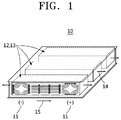
- FIG. 1 is a perspective view of a conventional haptic device.
- FIG. 1 illustrates the cross section of a composite piezoelectric actuator/sensor cell 10 together with associated electrodes 11.
- the composite piezoelectric cell 10 includes an array of piezoceramic fibers 12 in a structural adhesive 13 such as an epoxy material.
- Each of the electrodes 11 may be used to send an individual control signal so that each patch of the fibers 12 inserted into the structural adhesive 13 between two consecutive electrodes 11 and 11 can be actuated, thereby exerting a localized haptic effect at the corresponding location.
- Arrows 14 indicate how the polarized piezoceramic material expands or contracts in response to an applied electric field
- arrow 15 indicates the piezoceramic polarization produced by the electrodes 11.
- US 20130321262A1 discloses a haptic system for a minimally invasive, hand-held surgical instrument and the system's various parts including a graphical user haptic interface, one or more haptic interfaces associated with a hand-held handle used to control a sensorized end-effector of the surgical instrument or inserted catheters, associated hardware, and an operating system.
- the system enables users to acquire, read, modify, store, write, and download sensor-acquired data in real time.
- US 20090133976A1 discloses a magnetorheological force transmission device which comprises at least two solid body parts adapted to be moved in a substantially translational manner against each other, and an MRF gap, which is at least partially fillable and/or filled with a magnetorheological material 2MRF, the MRF gap being arranged at least partially inside one of or both of the two parts and/or being arranged at least partially in-between the two parts, and which is characterized in that the magnetic circuit system of the magnetorheological force transmission device being designed and/or disposed to generate a magnetic flux within at least part of the MRF gap comprises at least one electromagnet, at least one permanent magnet and at least one magnetic-field-balancing insert and/or magnetic isolator.
- US 20100302199A1 discloses ferromagnetic user interfaces that can detect the location of movement on a user-touchable portion by sensing movement of a ferromagnetic material.
- sensors are arranged in a two dimensional array, and the user interface device can determine the location of the movement in a plane substantially parallel to the two-dimensional array and the acceleration of movement substantially perpendicular to the two-dimensional array.
- user interface devices are described that can cause a raised surface region to be formed on a ferrofluid layer of a user-touchable portion, which is detectable by the touch of a user.
- US 20140104047A1 discloses a tactile display device including: a touch screen including ferromagnetic particles; a plurality of actuators including magnet elements distributed against the touch screen; a mechanism for activating each actuator to generate a local magnetic field in the touch screen; and an elastic membrane formed in an elastomer flexible solid material, the elastomer material including the ferromagnetic particles.
- the present invention is made to solve the above-described problems of conventional devices and it is therefore an object of the present invention to provide a magnetic apparatus for providing tactile sensation capable of providing various types of tactile sensations more sensitively.
- Another object of the present invention is to provide a magnetic apparatus for providing tactile sensation capable of providing a user with various tactile feedback by using the physical properties of a magnetorheological fluid or a magnetorheological elastomer.
- a first aspect of the invention provides a magnetic apparatus as set out in claim 1.
- Optional features of this aspect of the invention are set out in claims 2 to 5.
- a further aspect of the invention provides a tactile device according to claim 6 or claim 7.
- various tactile feedback may be given to a user by using the physical properties of a magnetorheological fluid or a magnetorheological elastomer.
- tactile sensation providers are in the shape of a plurality of cells and effectively provide various kinds of tactile information to a user of the apparatus in whole or in part by the strength of a magnetic field.
- FIG. 2 is a view illustrating the configuration of a magnetic apparatus for providing a tactile sensation according to an embodiment of the present invention
- FIG. 3 is a view illustrating a structure in which a tactile sensation provider according to an embodiment of the present invention includes a magnetorheological fluid
- FIG. 4 is a view illustrating a structure in which a tactile sensation provider includes a magnetorheological elastomer.
- a magnetic apparatus for providing tactile sensation includes a housing 400 (see FIG. 5 ), a magnetic field generator 200 that is disposed in the housing and generates a magnetic field, and a tactile sensation provider 100 that includes a magnetic particle 101 (see FIG. 4 ) that interacts with a change in magnetic field.
- the housing 400 forms the outer shape of the magnetic apparatus for providing tactile sensation, and the magnetic field generator 200 and the tactile sensation provider 100 are provided within the housing.
- the magnetic field generator 200 may be a planar coil or a solenoid coil, and a direct current power supply or an alternating current power supply may be applied to the magnetic field generator.
- the magnetic field generator may generate a magnetic field having different characteristics depending on the type of the applied power supply. For example, when a direct current power supply is applied to the magnetic field generator 200, the magnetic field generator generates a direct current magnetic field, and when an alternating current power supply is applied, an alternating current magnetic field is generated.
- the magnetic field generator 200 is disposed on one side of the tactile sensation provider 100, for example, below the tactile sensation provider 100, and the tactile sensation provider may have various shapes in response to a magnetic field generated by the magnetic field generator 200.
- the tactile sensation provider 100 vibrates, and when a direct current magnetic field is applied, the rigidity of the tactile sensation provider 100 changes.
- the magnetic field generator 200 can control the intensity, direction or frequency of the magnetic field, and the intensity (magnitude), direction, frequency, etc. of the change of the tactile sensation provider 100 may change variously according to the intensity, direction or frequency of the magnetic field.
- the tactile sensation provider 100 includes a magnetorheological fluid or a magnetorheological elastomer, and may have various shapes such as a hemispherical shape, a quadrangular shape, and a polyhedral shape depending on the devices or positions to which it is applied. Particularly, the tactile sensation provider 100 is affected by the magnetic field generated by the magnetic field generator 200 disposed at the lower part, and may provide various types of vibration or rigidity changes depending on the type, intensity, position or frequency of the magnetic field. Accordingly, the tactile sensation provider 100 may be utilized as a vibration source for giving a vibrational sensation to a user or be applied to a device for providing a tactile sensation to a user.
- the tactile sensation provider 100 may include a structure that seals the magnetorheological fluid within an outer cover 120 that is made of an elastic body such as rubber, polymer, etc., a magnetorheological elastomer (MRE), or a mixture of an elastic body and a magnetorheological elastomer.
- MRF magnetorheological fluid
- MRE magnetorheological elastomer
- a magnetorheological fluid is a suspension of magnetic particles 101, the viscosity of which varies according to the intensity of an external magnetic field, and generally consists of a dispersion of magnetically polarizable particles such as ferromagnetic and ferrimagnetic particles having a diameter of about 0.01 ⁇ m to 100 ⁇ m.
- the magnetorheological fluid is a controllable fluid having a quick response characteristic and a high yield stress under a magnetic field.
- An outer cover 120 is located on the upper portion of an insulator 300 and is divided into a flat portion 121 and bent portions 122.
- the bent portions 122 are provided on both sides of the flat portion 121 such that a space 110 is formed inside the outer cover.
- a magnetorheological fluid is sealed in the space 110.
- the flat portion 121 and the bent portions 122 may be made of an elastic body or a magnetorheological elastomer.
- the insulator 300 is disposed between the tactile sensation provider 100 and the magnetic field generator 200 and prevents electric currents from being directly applied to the tactile sensation provider 100.
- the tactile sensation provider 100 made of a material including a magnetorheological fluid can provide a vibrational sensation when the internal magnetic particles 101 react in response to the applied alternating current magnetic field and can provide a change in rigidity when the internal magnetic particles 101 react in response to the applied direct current magnetic field. Furthermore, varying the intensity and the frequency of the magnetic field generated in the magnetic field generator 200 may serve to provide various types of vibrational sensations.
- magnetic particles 101 such as nano- or micron-sized iron or ferrite particles may be distributed in a matrix material 102 made of rubber or other polymer material.
- the magnetorheological elastomer is an elastic body including magnetic particles 101.
- the magnetorheological elastomer is a controllable elastomer in which the magnetic particles 101 react, in response to a magnetic field when the magnetic field generated by the magnetic field generator 200 is applied, such that the tensile strength, elongation and the like of the magnetorheological elastomer changes physically.
- the magnetic particles 101 may generally be magnetically polarizable particles such as ferromagnetic and ferrimagnetic particles having a diameter of about 0.01 ⁇ m to 100 ⁇ m.
- the tactile sensation provider 100 made of a material including a magnetorheological elastomer can provide a vibrational sensation when the internal magnetic particles 101 react in response to the applied alternating current magnetic field and can provide a change in rigidity when the internal magnetic particles 101 react in response to the applied direct current magnetic field. Varying the intensity and the frequency of the magnetic field may also serve to provide various types of vibrational sensations.
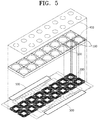
- FIG. 5 is a view illustrating a magnetic apparatus for providing a tactile sensation according to an embodiment of the present invention, in which a tactile sensation provider includes a plurality of cells.
- the tactile sensation provider 100 may occupy at least one cell 130 and the cell 130 may be provided in the housing 400. Furthermore, a plurality of housings 400 may be provided and a plurality of tactile sensation providers 100 may also be provided correspondingly.
- the magnetic field generator 200 may be a planar or solenoid coil of a size or shape corresponding to the cell 130. A plurality of magnetic field generators 200 may be provided corresponding to the number of the cells 130.
- the magnetic field generator 200 may be connected in series or in parallel with a power supply unit 500 that supplies a direct current power or an alternating current power, and the power supply unit 500 may be independently connected to a plurality of the magnetic field generators 200.
- a plurality of cells 130 are arranged in the housing 400, and the housing 400 and the cells 130 may form a single layer or a plurality of layers.
- the magnetic field generator 200 may generate a magnetic field in all of the plurality of cells 130 such that all of the plurality of cells 130 vibrate or undergo a change in rigidity.
- a magnetic field may be generated only in some of the plurality of cells 130 to bring about a local vibration or change in rigidity.
- the tactile sensation provider 100 occupies a plurality of cells 130 such that not only a simple vibration signal such as an alarm, but also complicated information, which corresponds to the cells, such as texts or geometric figures, may be provided as tactile information.
- information such as text may be transferred to a location that contacts a user's skin, thereby effectively transferring secret information that is to be protected.
- FIG. 6 is a view illustrating an example in which a magnetic apparatus for providing a tactile sensation according to an embodiment of the present invention is applied to a game device.
- the magnetic apparatus for providing a tactile sensation is applied to a game device 600 and the like, and can realize various functions of the game device 600.
- the magnetic apparatus for providing a tactile sensation may provide rigidity variations and local vibrations to correspond to various game situations.
- the magnetic apparatus for providing a tactile sensation may use the rigidity changes and local vibrational sensations to provide the strength of the act of pointing a muzzle, the feeling of pulling a real trigger, and whether or not the target is hit, respectively.
- the magnetic apparatus for providing a tactile sensation may transmit the scratching or collision at the front/rear side or at the left/right side as tactile sensations through the intensity of vibrations or the like, thereby enhancing the user's sense of immersion and realism.
- the magnetic apparatus for providing a tactile sensation may be applied to mobile devices, touchscreen devices, online games, etc. in the information technology (IT) field to provide real-time tactile sensations, applied to driver assistance information feedback systems such as lane departure warning systems, front crash prevention systems, and overspeed protection systems, etc. in the car industry, and also applied to pulsimeters, measurement of the pressure distribution in human teeth, surgical robots, braille books, etc. in the medical field.
- IT information technology
- the magnetic apparatus for providing a tactile sensation may provide a user with various tactile feedback by using the physical properties of a magnetorheological fluid or a magnetorheological elastomer. Furthermore, the magnetic apparatus for providing tactile sensation includes tactile sensation providers in the shape of a plurality of cells and effectively provides various kinds of tactile information to a user of the apparatus in whole or in part by the strength of a magnetic field.
Landscapes
- Engineering & Computer Science (AREA)
- Multimedia (AREA)
- General Engineering & Computer Science (AREA)
- Human Computer Interaction (AREA)
- Theoretical Computer Science (AREA)
- Physics & Mathematics (AREA)
- General Physics & Mathematics (AREA)
- Power Engineering (AREA)
- User Interface Of Digital Computer (AREA)
Description
- The present invention relates to a magnetic apparatus for providing a tactile sensation, and more particularly, to a magnetic apparatus for providing a tactile sensation, which provides a tactile sensation to a user through a change in viscosity, rigidity, elasticity or the like due to a magnetic field by using a magnetorheological fluid or a magnetorheological elastomer.
- Haptics refer to a technology about tactile sensation and, more particularly, to a technology for allowing a user of an electronic device to feel touch, forces, motion, etc. through a keyboard, a mouse, a joystick, a touchscreen, or the like. Although visual information accounted for most of the information exchanges between electronic devices and people in the past, the haptic technology currently attracts attention with regard to providing more detailed and realistic information.
- In general, an inertial actuator, a piezoelectric actuator, an electroactive polymer (EAP) actuator, an electrostatic actuator, etc. are used for the haptic technology. Examples of the inertial actuator include an eccentric motor that vibrates by an eccentric force generated by the rotation of the motor, and a linear resonant actuator (LRA) that maximizes the vibrational intensity by resonant frequencies. The piezoelectric actuator is in the shape of a beam or a disk and is driven by a piezoelectric element whose size or shape changes instantaneously in response to an electric field. The EAP actuator generates vibration by repeated movements of a mass attached to an EAP film. The electrostatic actuator is driven by an attractive force generated between two oppositely charged glass sheets and a repulsive force generated when the glass sheets have charges with the same polarity.
- Korean Patent Publication No.
10-2011-0118584 FIG. 1 is a perspective view of a conventional haptic device. - In the haptic device, a layer configured to serve as a sensor and a layer configured to serve as an actuator may be combined into a single module in the form of a composite piezoelectric actuator/sensor cell. Here,
FIG. 1 illustrates the cross section of a composite piezoelectric actuator/sensor cell 10 together with associatedelectrodes 11. The compositepiezoelectric cell 10 includes an array of piezoceramic fibers 12 in a structural adhesive 13 such as an epoxy material. Each of theelectrodes 11 may be used to send an individual control signal so that each patch of the fibers 12 inserted into the structural adhesive 13 between twoconsecutive electrodes Arrows 14 indicate how the polarized piezoceramic material expands or contracts in response to an applied electric field, andarrow 15 indicates the piezoceramic polarization produced by theelectrodes 11. - However, the above-described conventional haptic technology is merely used to provide simple vibrations, and therefore has limitations for emotionally providing various types of tactile sensations or complicated text information. Accordingly, research needs to be conducted on a tactile supply structure capable of effectively providing emotion and complicated information as well as providing simple vibrations.
-
US 20130321262A1 discloses a haptic system for a minimally invasive, hand-held surgical instrument and the system's various parts including a graphical user haptic interface, one or more haptic interfaces associated with a hand-held handle used to control a sensorized end-effector of the surgical instrument or inserted catheters, associated hardware, and an operating system. The system enables users to acquire, read, modify, store, write, and download sensor-acquired data in real time. -
US 20090133976A1 discloses a magnetorheological force transmission device which comprises at least two solid body parts adapted to be moved in a substantially translational manner against each other, and an MRF gap, which is at least partially fillable and/or filled with a magnetorheological material 2MRF, the MRF gap being arranged at least partially inside one of or both of the two parts and/or being arranged at least partially in-between the two parts, and which is characterized in that the magnetic circuit system of the magnetorheological force transmission device being designed and/or disposed to generate a magnetic flux within at least part of the MRF gap comprises at least one electromagnet, at least one permanent magnet and at least one magnetic-field-balancing insert and/or magnetic isolator. -
US 20100302199A1 discloses ferromagnetic user interfaces that can detect the location of movement on a user-touchable portion by sensing movement of a ferromagnetic material. In some embodiments sensors are arranged in a two dimensional array, and the user interface device can determine the location of the movement in a plane substantially parallel to the two-dimensional array and the acceleration of movement substantially perpendicular to the two-dimensional array. In other embodiments, user interface devices are described that can cause a raised surface region to be formed on a ferrofluid layer of a user-touchable portion, which is detectable by the touch of a user. -
US 20140104047A1 discloses a tactile display device including: a touch screen including ferromagnetic particles; a plurality of actuators including magnet elements distributed against the touch screen; a mechanism for activating each actuator to generate a local magnetic field in the touch screen; and an elastic membrane formed in an elastomer flexible solid material, the elastomer material including the ferromagnetic particles. - The present invention is made to solve the above-described problems of conventional devices and it is therefore an object of the present invention to provide a magnetic apparatus for providing tactile sensation capable of providing various types of tactile sensations more sensitively.
- Another object of the present invention is to provide a magnetic apparatus for providing tactile sensation capable of providing a user with various tactile feedback by using the physical properties of a magnetorheological fluid or a magnetorheological elastomer.
- A first aspect of the invention provides a magnetic apparatus as set out in claim 1. Optional features of this aspect of the invention are set out in claims 2 to 5. A further aspect of the invention provides a tactile device according to claim 6 or claim 7.
- According to the present invention, various types of tactile sensations may be provided more emotionally.
- Furthermore, according to the present invention, various tactile feedback may be given to a user by using the physical properties of a magnetorheological fluid or a magnetorheological elastomer.
- In addition, according to some embodiments of the present invention, tactile sensation providers are in the shape of a plurality of cells and effectively provide various kinds of tactile information to a user of the apparatus in whole or in part by the strength of a magnetic field.
-
-
FIG. 1 is a perspective view of a conventional haptic device. -
FIG. 2 is a view illustrating the configuration of a magnetic apparatus for providing a tactile sensation according to an embodiment of the present invention. -
FIG. 3 is a view illustrating a structure in which a tactile sensation provider according to an embodiment of the present invention includes a magnetorheological fluid. -
FIG. 4 is a view illustrating a structure in which a tactile sensation provider includes a magnetorheological elastomer. -
FIG. 5 is a view illustrating a magnetic apparatus for providing a tactile sensation according to an embodiment of the present invention, in which a tactile sensation provider includes a plurality of cells. -
FIG. 6 is a view illustrating an example in which a magnetic apparatus for providing a tactile sensation according to an embodiment of the present invention is applied to a game device. -
- 10: composite piezoelectric actuator/sensor cell
- 100: tactile sensation provider
- 101: magnetic particle
- 102: matrix material
- 120: outer cover
- 200: magnetic field generator
- 300: insulator
- 400: housing
- 500: power supply unit
- 600: game device
- The configuration and application of embodiments of the present invention will now be described in detail with reference to the accompanying drawings. The following description discloses one of various patentable aspects of the present invention and corresponds to part of the detailed description of the present invention.
- In the following description of the present invention, a detailed description of known functions and configurations incorporated herein will be omitted when it may make the subject matter of the present invention unclear.
- Hereinafter, a magnetic apparatus for providing tactile sensation according to the present invention will be described with reference to the attached drawings.
-
FIG. 2 is a view illustrating the configuration of a magnetic apparatus for providing a tactile sensation according to an embodiment of the present invention,FIG. 3 is a view illustrating a structure in which a tactile sensation provider according to an embodiment of the present invention includes a magnetorheological fluid, andFIG. 4 is a view illustrating a structure in which a tactile sensation provider includes a magnetorheological elastomer. - Referring to
FIGS. 2 to 4 , a magnetic apparatus for providing tactile sensation includes a housing 400 (seeFIG. 5 ), amagnetic field generator 200 that is disposed in the housing and generates a magnetic field, and atactile sensation provider 100 that includes a magnetic particle 101 (seeFIG. 4 ) that interacts with a change in magnetic field. - More specifically, the
housing 400 forms the outer shape of the magnetic apparatus for providing tactile sensation, and themagnetic field generator 200 and thetactile sensation provider 100 are provided within the housing. - The
magnetic field generator 200 may be a planar coil or a solenoid coil, and a direct current power supply or an alternating current power supply may be applied to the magnetic field generator. The magnetic field generator may generate a magnetic field having different characteristics depending on the type of the applied power supply. For example, when a direct current power supply is applied to themagnetic field generator 200, the magnetic field generator generates a direct current magnetic field, and when an alternating current power supply is applied, an alternating current magnetic field is generated. - The
magnetic field generator 200 is disposed on one side of thetactile sensation provider 100, for example, below thetactile sensation provider 100, and the tactile sensation provider may have various shapes in response to a magnetic field generated by themagnetic field generator 200. In particular, when an alternating current magnetic field is generated by themagnetic field generator 200, thetactile sensation provider 100 vibrates, and when a direct current magnetic field is applied, the rigidity of thetactile sensation provider 100 changes. - The
magnetic field generator 200 can control the intensity, direction or frequency of the magnetic field, and the intensity (magnitude), direction, frequency, etc. of the change of thetactile sensation provider 100 may change variously according to the intensity, direction or frequency of the magnetic field. - The
tactile sensation provider 100 includes a magnetorheological fluid or a magnetorheological elastomer, and may have various shapes such as a hemispherical shape, a quadrangular shape, and a polyhedral shape depending on the devices or positions to which it is applied. Particularly, thetactile sensation provider 100 is affected by the magnetic field generated by themagnetic field generator 200 disposed at the lower part, and may provide various types of vibration or rigidity changes depending on the type, intensity, position or frequency of the magnetic field. Accordingly, thetactile sensation provider 100 may be utilized as a vibration source for giving a vibrational sensation to a user or be applied to a device for providing a tactile sensation to a user. - Hereinafter, the
tactile sensation provider 100 will be described in more detail with reference toFIGS. 3 and4 . - Referring to
FIG. 3 , when a magnetorheological fluid (MRF) is mainly used as a means for providing a tactile sensation of thetactile sensation provider 100, thetactile sensation provider 100 may include a structure that seals the magnetorheological fluid within anouter cover 120 that is made of an elastic body such as rubber, polymer, etc., a magnetorheological elastomer (MRE), or a mixture of an elastic body and a magnetorheological elastomer. A magnetorheological fluid is a suspension ofmagnetic particles 101, the viscosity of which varies according to the intensity of an external magnetic field, and generally consists of a dispersion of magnetically polarizable particles such as ferromagnetic and ferrimagnetic particles having a diameter of about 0.01 µm to 100 µm. In the magnetorheological fluid, when the magnetic field generated by themagnetic field generator 200 is applied, the magnetizedmagnetic particles 101 interact with each other to form a chain-like microstructure. The magnetorheological fluid is a controllable fluid having a quick response characteristic and a high yield stress under a magnetic field. - An
outer cover 120 is located on the upper portion of aninsulator 300 and is divided into aflat portion 121 andbent portions 122. Thebent portions 122 are provided on both sides of theflat portion 121 such that aspace 110 is formed inside the outer cover. A magnetorheological fluid is sealed in thespace 110. Theflat portion 121 and thebent portions 122 may be made of an elastic body or a magnetorheological elastomer. - The
insulator 300 is disposed between thetactile sensation provider 100 and themagnetic field generator 200 and prevents electric currents from being directly applied to thetactile sensation provider 100. - The
tactile sensation provider 100 made of a material including a magnetorheological fluid can provide a vibrational sensation when the internalmagnetic particles 101 react in response to the applied alternating current magnetic field and can provide a change in rigidity when the internalmagnetic particles 101 react in response to the applied direct current magnetic field. Furthermore, varying the intensity and the frequency of the magnetic field generated in themagnetic field generator 200 may serve to provide various types of vibrational sensations. - Referring to
FIG. 4 , when a magnetorheological elastomer is mainly used as a means for providing a tactile sensation of thetactile sensation provider 100,magnetic particles 101 such as nano- or micron-sized iron or ferrite particles may be distributed in amatrix material 102 made of rubber or other polymer material. Like the magnetorheological fluid, the magnetorheological elastomer is an elastic body includingmagnetic particles 101. The magnetorheological elastomer is a controllable elastomer in which themagnetic particles 101 react, in response to a magnetic field when the magnetic field generated by themagnetic field generator 200 is applied, such that the tensile strength, elongation and the like of the magnetorheological elastomer changes physically. Here, themagnetic particles 101 may generally be magnetically polarizable particles such as ferromagnetic and ferrimagnetic particles having a diameter of about 0.01 µm to 100 µm. - Furthermore, like the magnetorheological fluid, the
tactile sensation provider 100 made of a material including a magnetorheological elastomer can provide a vibrational sensation when the internalmagnetic particles 101 react in response to the applied alternating current magnetic field and can provide a change in rigidity when the internalmagnetic particles 101 react in response to the applied direct current magnetic field. Varying the intensity and the frequency of the magnetic field may also serve to provide various types of vibrational sensations. -
FIG. 5 is a view illustrating a magnetic apparatus for providing a tactile sensation according to an embodiment of the present invention, in which a tactile sensation provider includes a plurality of cells. - Referring to
FIG. 5 , thetactile sensation provider 100 may occupy at least onecell 130 and thecell 130 may be provided in thehousing 400. Furthermore, a plurality ofhousings 400 may be provided and a plurality oftactile sensation providers 100 may also be provided correspondingly. In addition, themagnetic field generator 200 may be a planar or solenoid coil of a size or shape corresponding to thecell 130. A plurality ofmagnetic field generators 200 may be provided corresponding to the number of thecells 130. Here, themagnetic field generator 200 may be connected in series or in parallel with apower supply unit 500 that supplies a direct current power or an alternating current power, and thepower supply unit 500 may be independently connected to a plurality of themagnetic field generators 200. - In particular, a plurality of
cells 130 are arranged in thehousing 400, and thehousing 400 and thecells 130 may form a single layer or a plurality of layers. - The
magnetic field generator 200 may generate a magnetic field in all of the plurality ofcells 130 such that all of the plurality ofcells 130 vibrate or undergo a change in rigidity. On the other hand, a magnetic field may be generated only in some of the plurality ofcells 130 to bring about a local vibration or change in rigidity. - Furthermore, the
tactile sensation provider 100 occupies a plurality ofcells 130 such that not only a simple vibration signal such as an alarm, but also complicated information, which corresponds to the cells, such as texts or geometric figures, may be provided as tactile information. In addition, information such as text may be transferred to a location that contacts a user's skin, thereby effectively transferring secret information that is to be protected. -
FIG. 6 is a view illustrating an example in which a magnetic apparatus for providing a tactile sensation according to an embodiment of the present invention is applied to a game device. - Referring to
FIG. 6 , the magnetic apparatus for providing a tactile sensation is applied to agame device 600 and the like, and can realize various functions of thegame device 600. For example, when applied to the buttons of a console including PS4 and other game controllers, the magnetic apparatus for providing a tactile sensation may provide rigidity variations and local vibrations to correspond to various game situations. Also, in First Person Shooter (FPS) games, the magnetic apparatus for providing a tactile sensation may use the rigidity changes and local vibrational sensations to provide the strength of the act of pointing a muzzle, the feeling of pulling a real trigger, and whether or not the target is hit, respectively. Furthermore, during car chases, the magnetic apparatus for providing a tactile sensation may transmit the scratching or collision at the front/rear side or at the left/right side as tactile sensations through the intensity of vibrations or the like, thereby enhancing the user's sense of immersion and realism. - In addition, the magnetic apparatus for providing a tactile sensation may be applied to mobile devices, touchscreen devices, online games, etc. in the information technology (IT) field to provide real-time tactile sensations, applied to driver assistance information feedback systems such as lane departure warning systems, front crash prevention systems, and overspeed protection systems, etc. in the car industry, and also applied to pulsimeters, measurement of the pressure distribution in human teeth, surgical robots, braille books, etc. in the medical field.
- With such a configuration, the magnetic apparatus for providing a tactile sensation may provide a user with various tactile feedback by using the physical properties of a magnetorheological fluid or a magnetorheological elastomer. Furthermore, the magnetic apparatus for providing tactile sensation includes tactile sensation providers in the shape of a plurality of cells and effectively provides various kinds of tactile information to a user of the apparatus in whole or in part by the strength of a magnetic field.
Claims (7)
- A magnetic apparatus for providing a tactile sensation, the apparatus comprising:a tactile sensation provider (100) includingan outer cover (120) that comprises a magnetorheological elastomer and an elastic body, anda magnetorheological fluid sealed in an inner space of the outer cover (120); anda magnetic field generator (200) that is adapted to generate a magnetic field;wherein the tactile sensation provider (100) is configured to be deformed by the magnetic field and provide tactile sensations to a user,the magnetorheological fluid and the magnetorheological elastomer are configured to vibrate if the magnetic field is an alternating current magnetic field, andthe rigidities of the magnetorheological fluid and the magnetorheological elastomer are configured to change if the magnetic field is a direct current magnetic field.
- The apparatus of claim 1, further comprising a housing (400), wherein the magnetic field generator (200) is provided in the housing.
- The apparatus of claim 1 or 2,
wherein the magnetic apparatus comprises a plurality of cells, each cell comprises a respective said tactile sensation provider (100) and a respective said magnetic field generator (200), and each magnetic field generator (200) includes a planar or solenoid coil of a size or shape corresponding to that of the cell in which it is situated. - The apparatus of any preceding claim,
wherein the tactile sensation provider (100) has a hemispherical shape, a quadrangular shape, or a polyhedral shape. - The apparatus of any preceding claim,
wherein magnetic particles (101) of the magnetorheological fluid and/or magnetorheological elastomer are ferromagnetic or ferrimagnetic particles having a diameter of 0.01 µm to 100 µm. - A tactile device in which the apparatus of any one of claims 1 to 5 is disposed, the said device being configured to provide vibrations.
- A tactile device comprising a surface,
wherein the apparatus of any one of claims 1 to 5 is disposed on the surface and the device is configured to provide a vibration, tapping or rigidity changes in a portion that is in contact with a user.
Priority Applications (1)
| Application Number | Priority Date | Filing Date | Title |
|---|---|---|---|
| EP19177139.3A EP3550407B1 (en) | 2014-10-02 | 2014-11-14 | Magnetic apparatus for providing tactile sensation |
Applications Claiming Priority (3)
| Application Number | Priority Date | Filing Date | Title |
|---|---|---|---|
| KR20140133508 | 2014-10-02 | ||
| KR1020140158038A KR101886711B1 (en) | 2014-10-02 | 2014-11-13 | Magnetic tactile supply device |
| PCT/KR2014/010978 WO2016052803A1 (en) | 2014-10-02 | 2014-11-14 | Magnetic apparatus for providing tactile sensation |
Related Child Applications (2)
| Application Number | Title | Priority Date | Filing Date |
|---|---|---|---|
| EP19177139.3A Division-Into EP3550407B1 (en) | 2014-10-02 | 2014-11-14 | Magnetic apparatus for providing tactile sensation |
| EP19177139.3A Division EP3550407B1 (en) | 2014-10-02 | 2014-11-14 | Magnetic apparatus for providing tactile sensation |
Publications (3)
| Publication Number | Publication Date |
|---|---|
| EP3203353A1 EP3203353A1 (en) | 2017-08-09 |
| EP3203353A4 EP3203353A4 (en) | 2018-05-09 |
| EP3203353B1 true EP3203353B1 (en) | 2019-07-10 |
Family
ID=55801137
Family Applications (2)
| Application Number | Title | Priority Date | Filing Date |
|---|---|---|---|
| EP19177139.3A Active EP3550407B1 (en) | 2014-10-02 | 2014-11-14 | Magnetic apparatus for providing tactile sensation |
| EP14903233.6A Active EP3203353B1 (en) | 2014-10-02 | 2014-11-14 | Magnetic apparatus for providing tactile sensation |
Family Applications Before (1)
| Application Number | Title | Priority Date | Filing Date |
|---|---|---|---|
| EP19177139.3A Active EP3550407B1 (en) | 2014-10-02 | 2014-11-14 | Magnetic apparatus for providing tactile sensation |
Country Status (4)
| Country | Link |
|---|---|
| US (2) | US10467868B2 (en) |
| EP (2) | EP3550407B1 (en) |
| KR (2) | KR101886711B1 (en) |
| CN (2) | CN107077194B (en) |
Families Citing this family (26)
| Publication number | Priority date | Publication date | Assignee | Title |
|---|---|---|---|---|
| KR101784472B1 (en) * | 2015-01-13 | 2017-10-11 | 주식회사 씨케이머티리얼즈랩 | Tactile information supply devide |
| KR101928550B1 (en) | 2016-04-21 | 2018-12-12 | 주식회사 씨케이머티리얼즈랩 | Method and device for supplying tactile message |
| WO2017183821A1 (en) * | 2016-04-21 | 2017-10-26 | 주식회사 씨케이머티리얼즈랩 | Method and apparatus for providing tactile message |
| KR101790880B1 (en) | 2016-04-29 | 2017-10-26 | 주식회사 씨케이머티리얼즈랩 | Tactile actuator and controlling method thereof |
| WO2017188507A1 (en) * | 2016-04-29 | 2017-11-02 | 주식회사 씨케이머티리얼즈랩 | Tactile actuator and control method therefor |
| KR102113508B1 (en) | 2018-07-12 | 2020-05-22 | 한국과학기술연구원 | Tactile Feedback Device |
| KR102102961B1 (en) * | 2018-11-22 | 2020-04-22 | 한국기술교육대학교 산학협력단 | Deformation haptic device |
| KR102102960B1 (en) * | 2018-11-22 | 2020-04-22 | 한국기술교육대학교 산학협력단 | Deformation haptic device |
| KR102052657B1 (en) * | 2018-11-22 | 2019-12-05 | 한국기술교육대학교 산학협력단 | Deformation haptic device |
| KR102172910B1 (en) * | 2019-01-22 | 2020-11-03 | 한국기술교육대학교 산학협력단 | Magneto-rheological elastomer based vibration generator |
| KR102234429B1 (en) * | 2019-03-27 | 2021-04-01 | (주)부품디비 | Vibration actuator using mre and electro-permanent magnet |
| CN110096147B (en) * | 2019-04-17 | 2020-12-18 | 北京航空航天大学 | An active texture rendering device driven by a high-density flexible electromagnetic coil array |
| KR102311039B1 (en) * | 2019-05-03 | 2021-10-12 | 한국기술교육대학교 산학협력단 | Apparatus for generating touch sensation based on virtural environment |
| DE102019206405A1 (en) * | 2019-05-03 | 2020-11-05 | Zf Friedrichshafen Ag | Control element |
| KR102234432B1 (en) * | 2019-05-13 | 2021-04-01 | (주)부품디비 | Kinesthetic actuator using wavy-shaped mre and electro-permanent magnet |
| KR102129215B1 (en) * | 2019-12-17 | 2020-07-01 | 한국기술교육대학교 산학협력단 | 3D shape deformation device using laminated structure smart material module |
| KR102129214B1 (en) * | 2019-12-17 | 2020-07-01 | 한국기술교육대학교 산학협력단 | Haptic system comprising wearable haptic feedback device and magnetic field generating device |
| CN115136102B (en) * | 2020-11-09 | 2025-09-02 | Ck高新材料有限公司 | Haptic device and haptic module |
| KR102646498B1 (en) * | 2020-11-13 | 2024-03-13 | 건국대학교 글로컬산학협력단 | Controller capable of inducing tactile sensation and control method of the controller |
| US11650670B2 (en) * | 2020-11-30 | 2023-05-16 | Logitech Europe S.A. | Combining electropermanent magnets and magnetorheological fluid to modify an operation of an input device |
| CN114327132B (en) * | 2021-12-16 | 2025-01-24 | 昆山工研院新型平板显示技术中心有限公司 | Touch panel and display device |
| KR102657178B1 (en) * | 2022-02-16 | 2024-04-12 | 이화여자대학교 산학협력단 | Stretchable display device provided on one side of a steering device of a vehicle and method for providing an option butten uisng the same |
| KR102480022B1 (en) * | 2022-06-07 | 2022-12-22 | 주식회사 씨케이머티리얼즈랩 | Magneto-Rheological Rotating Load Device And Control Method thereof |
| CN115208156B (en) * | 2022-07-07 | 2023-06-23 | 念君科技(广州)有限责任公司 | Actuator and manufacturing method thereof |
| KR102859415B1 (en) * | 2022-10-28 | 2025-09-12 | 재단법인대구경북과학기술원 | Liquid metal-based shape-variable touch sensor and manufacturing method |
| KR20250097023A (en) | 2023-12-21 | 2025-06-30 | 한국기술교육대학교 산학협력단 | A haptic actuator using magnetic rheological elastomer and magnetic rheological fluid |
Family Cites Families (29)
| Publication number | Priority date | Publication date | Assignee | Title |
|---|---|---|---|---|
| US6535806B2 (en) * | 2001-01-30 | 2003-03-18 | Delphi Technologies, Inc. | Tactile feedback control for steer-by-wire systems |
| US20150257902A1 (en) * | 2002-04-12 | 2015-09-17 | James J. Martin | Electronically controlled prosthetic system |
| KR100877067B1 (en) | 2006-01-03 | 2009-01-07 | 삼성전자주식회사 | Haptic Buttons and Haptic Devices Using the Same |
| KR100778761B1 (en) * | 2006-03-13 | 2007-11-27 | 한국과학기술원 | Image information tactile transmission device using rheological fluid and its method |
| US8408918B2 (en) * | 2007-06-27 | 2013-04-02 | Energid Technologies Corporation | Method and apparatus for haptic simulation |
| EP2065614A1 (en) | 2007-11-28 | 2009-06-03 | Fraunhofer-Gesellschaft zur Förderung der angewandten Forschung e.V. | Magnetorhelogical force transmission device |
| CN101593020B (en) * | 2008-05-28 | 2011-08-24 | 联想(北京)有限公司 | Electronic equipment, input equipment and output equipment capable of providing touch feeling |
| KR100924087B1 (en) * | 2008-07-23 | 2009-11-02 | 한국과학기술원 | Haptic module using magnetorheological fluid, haptic module having a control method and haptic module |
| US8593409B1 (en) * | 2008-10-10 | 2013-11-26 | Immersion Corporation | Method and apparatus for providing haptic feedback utilizing multi-actuated waveform phasing |
| US8362882B2 (en) * | 2008-12-10 | 2013-01-29 | Immersion Corporation | Method and apparatus for providing Haptic feedback from Haptic textile |
| KR101060968B1 (en) * | 2009-01-09 | 2011-08-31 | 한국과학기술원 | Haptic feedback providing device and haptic feedback providing method using the same |
| KR100993485B1 (en) * | 2009-03-11 | 2010-11-10 | 한국과학기술원 | Haptic feedback providing device and method |
| US8400410B2 (en) * | 2009-05-26 | 2013-03-19 | Microsoft Corporation | Ferromagnetic user interfaces |
| KR101036626B1 (en) * | 2009-10-21 | 2011-05-24 | 한국과학기술원 | External force response stiffness implementation device using magnetorheological fluid, haptic provision device using it, micro mobile device using the same and control method |
| JP2011242386A (en) | 2010-04-23 | 2011-12-01 | Immersion Corp | Transparent compound piezoelectric material aggregate of contact sensor and tactile sense actuator |
| KR101153447B1 (en) * | 2010-05-27 | 2012-06-05 | 한국과학기술원 | Stiffness Generation Apparatus Using Magnetorheological Fluid on Reaction upon External Force and Apparatus Providing Passive Haptic Feedback Using the Same |
| KR101091206B1 (en) * | 2011-01-10 | 2011-12-09 | 한국기술교육대학교 산학협력단 | Haptic actuator using permanent magnet and magnetorheological fluid and haptic providing method using same |
| FR2976109B1 (en) | 2011-05-30 | 2014-01-10 | Commissariat Energie Atomique | TOUCH SCREEN DISPLAY DEVICE WITH FERROMAGNETIC PARTICLES |
| WO2013085079A1 (en) * | 2011-12-07 | 2013-06-13 | 동방테크 주식회사 | Pipe joint structure for semiconductor processing |
| KR101891096B1 (en) | 2011-12-15 | 2018-08-24 | 삼성전자주식회사 | Electronic device |
| US20130229272A1 (en) * | 2012-03-05 | 2013-09-05 | Caterpillar Inc. | Manual control device and method |
| CN102692609B (en) * | 2012-05-30 | 2014-09-10 | 电子科技大学 | Minitype magnetic field sensor based on nano particle magneto rheological elastomer film |
| US10013082B2 (en) | 2012-06-05 | 2018-07-03 | Stuart Schecter, LLC | Operating system with haptic interface for minimally invasive, hand-held surgical instrument |
| KR101524906B1 (en) | 2012-06-25 | 2015-06-02 | 한국표준과학연구원 | Apparatus for generating tactile sensation, dielectricpolymer high-perpormance driver, actuator, interfacing apparatus, apparatus for providing tactile feedback using the same |
| JP6141720B2 (en) * | 2012-10-19 | 2017-06-07 | 東洋ゴム工業株式会社 | Tactile sensor |
| KR101439127B1 (en) | 2013-02-08 | 2014-09-12 | 건국대학교 산학협력단 | Haptic apparatus for providng somesthesis using magnetic stimulation and method thereof |
| US9202351B2 (en) * | 2013-03-11 | 2015-12-01 | Immersion Corporation | Systems and methods for haptics in vibrating environments and devices |
| US10359835B2 (en) * | 2013-04-17 | 2019-07-23 | Nokia Technologies Oy | Method and apparatus for causing display of notification content |
| US10168766B2 (en) * | 2013-04-17 | 2019-01-01 | Nokia Technologies Oy | Method and apparatus for a textural representation of a guidance |
-
2014
- 2014-11-13 KR KR1020140158038A patent/KR101886711B1/en active Active
- 2014-11-14 CN CN201480082285.6A patent/CN107077194B/en active Active
- 2014-11-14 US US15/516,141 patent/US10467868B2/en active Active
- 2014-11-14 EP EP19177139.3A patent/EP3550407B1/en active Active
- 2014-11-14 CN CN202010069382.9A patent/CN111176457A/en active Pending
- 2014-11-14 EP EP14903233.6A patent/EP3203353B1/en active Active
-
2016
- 2016-02-18 KR KR1020160019110A patent/KR20160040149A/en not_active Ceased
-
2019
- 2019-09-09 US US16/564,352 patent/US10559175B2/en active Active
Non-Patent Citations (1)
| Title |
|---|
| None * |
Also Published As
| Publication number | Publication date |
|---|---|
| CN111176457A (en) | 2020-05-19 |
| US10467868B2 (en) | 2019-11-05 |
| EP3203353A4 (en) | 2018-05-09 |
| KR20160040149A (en) | 2016-04-12 |
| US10559175B2 (en) | 2020-02-11 |
| KR20160040062A (en) | 2016-04-12 |
| CN107077194A (en) | 2017-08-18 |
| KR101886711B1 (en) | 2018-08-09 |
| US20170309140A1 (en) | 2017-10-26 |
| CN107077194B (en) | 2020-03-06 |
| EP3550407A1 (en) | 2019-10-09 |
| EP3203353A1 (en) | 2017-08-09 |
| EP3550407B1 (en) | 2021-07-07 |
| US20200005607A1 (en) | 2020-01-02 |
Similar Documents
| Publication | Publication Date | Title |
|---|---|---|
| US10559175B2 (en) | Magnetic apparatus for providing tactile sensation | |
| EP3026528B1 (en) | Apparatus for providing tactile sensation | |
| KR102315579B1 (en) | Tactile supply device | |
| US10049536B2 (en) | Haptic actuator incorporating electropermanent magnet | |
| US8593409B1 (en) | Method and apparatus for providing haptic feedback utilizing multi-actuated waveform phasing | |
| US10755539B2 (en) | Tactile information providing device | |
| KR101554289B1 (en) | Tactile supply device | |
| KR101627155B1 (en) | Haptic button having a haptic actuator structure | |
| WO2016052803A1 (en) | Magnetic apparatus for providing tactile sensation |
Legal Events
| Date | Code | Title | Description |
|---|---|---|---|
| STAA | Information on the status of an ep patent application or granted ep patent |
Free format text: STATUS: THE INTERNATIONAL PUBLICATION HAS BEEN MADE |
|
| PUAI | Public reference made under article 153(3) epc to a published international application that has entered the european phase |
Free format text: ORIGINAL CODE: 0009012 |
|
| STAA | Information on the status of an ep patent application or granted ep patent |
Free format text: STATUS: REQUEST FOR EXAMINATION WAS MADE |
|
| 17P | Request for examination filed |
Effective date: 20170331 |
|
| AK | Designated contracting states |
Kind code of ref document: A1 Designated state(s): AL AT BE BG CH CY CZ DE DK EE ES FI FR GB GR HR HU IE IS IT LI LT LU LV MC MK MT NL NO PL PT RO RS SE SI SK SM TR |
|
| AX | Request for extension of the european patent |
Extension state: BA ME |
|
| DAX | Request for extension of the european patent (deleted) | ||
| A4 | Supplementary search report drawn up and despatched |
Effective date: 20180409 |
|
| RIC1 | Information provided on ipc code assigned before grant |
Ipc: G06F 3/01 20060101AFI20180403BHEP Ipc: A63F 13/24 20140101ALI20180403BHEP Ipc: A63F 13/285 20140101ALI20180403BHEP |
|
| REG | Reference to a national code |
Ref country code: DE Ref legal event code: R079 Ref document number: 602014050014 Country of ref document: DE Free format text: PREVIOUS MAIN CLASS: G06F0003010000 Ipc: A63F0013285000 |
|
| GRAP | Despatch of communication of intention to grant a patent |
Free format text: ORIGINAL CODE: EPIDOSNIGR1 |
|
| STAA | Information on the status of an ep patent application or granted ep patent |
Free format text: STATUS: GRANT OF PATENT IS INTENDED |
|
| RIC1 | Information provided on ipc code assigned before grant |
Ipc: A63F 13/285 20140101AFI20181218BHEP Ipc: G06F 3/01 20060101ALI20181218BHEP Ipc: G08B 6/00 20060101ALI20181218BHEP Ipc: A63F 13/24 20140101ALI20181218BHEP |
|
| INTG | Intention to grant announced |
Effective date: 20190118 |
|
| GRAS | Grant fee paid |
Free format text: ORIGINAL CODE: EPIDOSNIGR3 |
|
| GRAA | (expected) grant |
Free format text: ORIGINAL CODE: 0009210 |
|
| STAA | Information on the status of an ep patent application or granted ep patent |
Free format text: STATUS: THE PATENT HAS BEEN GRANTED |
|
| AK | Designated contracting states |
Kind code of ref document: B1 Designated state(s): AL AT BE BG CH CY CZ DE DK EE ES FI FR GB GR HR HU IE IS IT LI LT LU LV MC MK MT NL NO PL PT RO RS SE SI SK SM TR |
|
| REG | Reference to a national code |
Ref country code: GB Ref legal event code: FG4D |
|
| REG | Reference to a national code |
Ref country code: CH Ref legal event code: EP Ref country code: AT Ref legal event code: REF Ref document number: 1152906 Country of ref document: AT Kind code of ref document: T Effective date: 20190715 |
|
| REG | Reference to a national code |
Ref country code: DE Ref legal event code: R096 Ref document number: 602014050014 Country of ref document: DE |
|
| REG | Reference to a national code |
Ref country code: IE Ref legal event code: FG4D |
|
| REG | Reference to a national code |
Ref country code: NL Ref legal event code: MP Effective date: 20190710 |
|
| REG | Reference to a national code |
Ref country code: LT Ref legal event code: MG4D |
|
| REG | Reference to a national code |
Ref country code: AT Ref legal event code: MK05 Ref document number: 1152906 Country of ref document: AT Kind code of ref document: T Effective date: 20190710 |
|
| PG25 | Lapsed in a contracting state [announced via postgrant information from national office to epo] |
Ref country code: PT Free format text: LAPSE BECAUSE OF FAILURE TO SUBMIT A TRANSLATION OF THE DESCRIPTION OR TO PAY THE FEE WITHIN THE PRESCRIBED TIME-LIMIT Effective date: 20191111 Ref country code: HR Free format text: LAPSE BECAUSE OF FAILURE TO SUBMIT A TRANSLATION OF THE DESCRIPTION OR TO PAY THE FEE WITHIN THE PRESCRIBED TIME-LIMIT Effective date: 20190710 Ref country code: NL Free format text: LAPSE BECAUSE OF FAILURE TO SUBMIT A TRANSLATION OF THE DESCRIPTION OR TO PAY THE FEE WITHIN THE PRESCRIBED TIME-LIMIT Effective date: 20190710 Ref country code: SE Free format text: LAPSE BECAUSE OF FAILURE TO SUBMIT A TRANSLATION OF THE DESCRIPTION OR TO PAY THE FEE WITHIN THE PRESCRIBED TIME-LIMIT Effective date: 20190710 Ref country code: BG Free format text: LAPSE BECAUSE OF FAILURE TO SUBMIT A TRANSLATION OF THE DESCRIPTION OR TO PAY THE FEE WITHIN THE PRESCRIBED TIME-LIMIT Effective date: 20191010 Ref country code: LT Free format text: LAPSE BECAUSE OF FAILURE TO SUBMIT A TRANSLATION OF THE DESCRIPTION OR TO PAY THE FEE WITHIN THE PRESCRIBED TIME-LIMIT Effective date: 20190710 Ref country code: FI Free format text: LAPSE BECAUSE OF FAILURE TO SUBMIT A TRANSLATION OF THE DESCRIPTION OR TO PAY THE FEE WITHIN THE PRESCRIBED TIME-LIMIT Effective date: 20190710 Ref country code: NO Free format text: LAPSE BECAUSE OF FAILURE TO SUBMIT A TRANSLATION OF THE DESCRIPTION OR TO PAY THE FEE WITHIN THE PRESCRIBED TIME-LIMIT Effective date: 20191010 Ref country code: AT Free format text: LAPSE BECAUSE OF FAILURE TO SUBMIT A TRANSLATION OF THE DESCRIPTION OR TO PAY THE FEE WITHIN THE PRESCRIBED TIME-LIMIT Effective date: 20190710 |
|
| PG25 | Lapsed in a contracting state [announced via postgrant information from national office to epo] |
Ref country code: IS Free format text: LAPSE BECAUSE OF FAILURE TO SUBMIT A TRANSLATION OF THE DESCRIPTION OR TO PAY THE FEE WITHIN THE PRESCRIBED TIME-LIMIT Effective date: 20191110 Ref country code: LV Free format text: LAPSE BECAUSE OF FAILURE TO SUBMIT A TRANSLATION OF THE DESCRIPTION OR TO PAY THE FEE WITHIN THE PRESCRIBED TIME-LIMIT Effective date: 20190710 Ref country code: ES Free format text: LAPSE BECAUSE OF FAILURE TO SUBMIT A TRANSLATION OF THE DESCRIPTION OR TO PAY THE FEE WITHIN THE PRESCRIBED TIME-LIMIT Effective date: 20190710 Ref country code: AL Free format text: LAPSE BECAUSE OF FAILURE TO SUBMIT A TRANSLATION OF THE DESCRIPTION OR TO PAY THE FEE WITHIN THE PRESCRIBED TIME-LIMIT Effective date: 20190710 Ref country code: RS Free format text: LAPSE BECAUSE OF FAILURE TO SUBMIT A TRANSLATION OF THE DESCRIPTION OR TO PAY THE FEE WITHIN THE PRESCRIBED TIME-LIMIT Effective date: 20190710 Ref country code: GR Free format text: LAPSE BECAUSE OF FAILURE TO SUBMIT A TRANSLATION OF THE DESCRIPTION OR TO PAY THE FEE WITHIN THE PRESCRIBED TIME-LIMIT Effective date: 20191011 |
|
| PG25 | Lapsed in a contracting state [announced via postgrant information from national office to epo] |
Ref country code: TR Free format text: LAPSE BECAUSE OF FAILURE TO SUBMIT A TRANSLATION OF THE DESCRIPTION OR TO PAY THE FEE WITHIN THE PRESCRIBED TIME-LIMIT Effective date: 20190710 |
|
| PG25 | Lapsed in a contracting state [announced via postgrant information from national office to epo] |
Ref country code: DK Free format text: LAPSE BECAUSE OF FAILURE TO SUBMIT A TRANSLATION OF THE DESCRIPTION OR TO PAY THE FEE WITHIN THE PRESCRIBED TIME-LIMIT Effective date: 20190710 Ref country code: PL Free format text: LAPSE BECAUSE OF FAILURE TO SUBMIT A TRANSLATION OF THE DESCRIPTION OR TO PAY THE FEE WITHIN THE PRESCRIBED TIME-LIMIT Effective date: 20190710 Ref country code: EE Free format text: LAPSE BECAUSE OF FAILURE TO SUBMIT A TRANSLATION OF THE DESCRIPTION OR TO PAY THE FEE WITHIN THE PRESCRIBED TIME-LIMIT Effective date: 20190710 Ref country code: RO Free format text: LAPSE BECAUSE OF FAILURE TO SUBMIT A TRANSLATION OF THE DESCRIPTION OR TO PAY THE FEE WITHIN THE PRESCRIBED TIME-LIMIT Effective date: 20190710 Ref country code: IT Free format text: LAPSE BECAUSE OF FAILURE TO SUBMIT A TRANSLATION OF THE DESCRIPTION OR TO PAY THE FEE WITHIN THE PRESCRIBED TIME-LIMIT Effective date: 20190710 |
|
| PG25 | Lapsed in a contracting state [announced via postgrant information from national office to epo] |
Ref country code: IS Free format text: LAPSE BECAUSE OF FAILURE TO SUBMIT A TRANSLATION OF THE DESCRIPTION OR TO PAY THE FEE WITHIN THE PRESCRIBED TIME-LIMIT Effective date: 20200224 Ref country code: SM Free format text: LAPSE BECAUSE OF FAILURE TO SUBMIT A TRANSLATION OF THE DESCRIPTION OR TO PAY THE FEE WITHIN THE PRESCRIBED TIME-LIMIT Effective date: 20190710 Ref country code: CZ Free format text: LAPSE BECAUSE OF FAILURE TO SUBMIT A TRANSLATION OF THE DESCRIPTION OR TO PAY THE FEE WITHIN THE PRESCRIBED TIME-LIMIT Effective date: 20190710 Ref country code: SK Free format text: LAPSE BECAUSE OF FAILURE TO SUBMIT A TRANSLATION OF THE DESCRIPTION OR TO PAY THE FEE WITHIN THE PRESCRIBED TIME-LIMIT Effective date: 20190710 |
|
| REG | Reference to a national code |
Ref country code: DE Ref legal event code: R097 Ref document number: 602014050014 Country of ref document: DE |
|
| REG | Reference to a national code |
Ref country code: CH Ref legal event code: PL |
|
| PLBE | No opposition filed within time limit |
Free format text: ORIGINAL CODE: 0009261 |
|
| STAA | Information on the status of an ep patent application or granted ep patent |
Free format text: STATUS: NO OPPOSITION FILED WITHIN TIME LIMIT |
|
| PG2D | Information on lapse in contracting state deleted |
Ref country code: IS |
|
| PG25 | Lapsed in a contracting state [announced via postgrant information from national office to epo] |
Ref country code: MC Free format text: LAPSE BECAUSE OF FAILURE TO SUBMIT A TRANSLATION OF THE DESCRIPTION OR TO PAY THE FEE WITHIN THE PRESCRIBED TIME-LIMIT Effective date: 20190710 Ref country code: LU Free format text: LAPSE BECAUSE OF NON-PAYMENT OF DUE FEES Effective date: 20191114 Ref country code: CH Free format text: LAPSE BECAUSE OF NON-PAYMENT OF DUE FEES Effective date: 20191130 Ref country code: LI Free format text: LAPSE BECAUSE OF NON-PAYMENT OF DUE FEES Effective date: 20191130 |
|
| 26N | No opposition filed |
Effective date: 20200603 |
|
| REG | Reference to a national code |
Ref country code: BE Ref legal event code: MM Effective date: 20191130 |
|
| PG25 | Lapsed in a contracting state [announced via postgrant information from national office to epo] |
Ref country code: SI Free format text: LAPSE BECAUSE OF FAILURE TO SUBMIT A TRANSLATION OF THE DESCRIPTION OR TO PAY THE FEE WITHIN THE PRESCRIBED TIME-LIMIT Effective date: 20190710 |
|
| PG25 | Lapsed in a contracting state [announced via postgrant information from national office to epo] |
Ref country code: FR Free format text: LAPSE BECAUSE OF NON-PAYMENT OF DUE FEES Effective date: 20191130 Ref country code: IE Free format text: LAPSE BECAUSE OF NON-PAYMENT OF DUE FEES Effective date: 20191114 |
|
| PG25 | Lapsed in a contracting state [announced via postgrant information from national office to epo] |
Ref country code: BE Free format text: LAPSE BECAUSE OF NON-PAYMENT OF DUE FEES Effective date: 20191130 |
|
| PG25 | Lapsed in a contracting state [announced via postgrant information from national office to epo] |
Ref country code: CY Free format text: LAPSE BECAUSE OF FAILURE TO SUBMIT A TRANSLATION OF THE DESCRIPTION OR TO PAY THE FEE WITHIN THE PRESCRIBED TIME-LIMIT Effective date: 20190710 |
|
| PG25 | Lapsed in a contracting state [announced via postgrant information from national office to epo] |
Ref country code: MT Free format text: LAPSE BECAUSE OF FAILURE TO SUBMIT A TRANSLATION OF THE DESCRIPTION OR TO PAY THE FEE WITHIN THE PRESCRIBED TIME-LIMIT Effective date: 20190710 Ref country code: HU Free format text: LAPSE BECAUSE OF FAILURE TO SUBMIT A TRANSLATION OF THE DESCRIPTION OR TO PAY THE FEE WITHIN THE PRESCRIBED TIME-LIMIT; INVALID AB INITIO Effective date: 20141114 |
|
| PG25 | Lapsed in a contracting state [announced via postgrant information from national office to epo] |
Ref country code: MK Free format text: LAPSE BECAUSE OF FAILURE TO SUBMIT A TRANSLATION OF THE DESCRIPTION OR TO PAY THE FEE WITHIN THE PRESCRIBED TIME-LIMIT Effective date: 20190710 |
|
| PGFP | Annual fee paid to national office [announced via postgrant information from national office to epo] |
Ref country code: DE Payment date: 20241015 Year of fee payment: 11 |
|
| PGFP | Annual fee paid to national office [announced via postgrant information from national office to epo] |
Ref country code: GB Payment date: 20241017 Year of fee payment: 11 |