EP3202949A1 - Chemical vapor deposition raw material comprising organic ruthenium compound and chemical vapor deposition method using chemical vapor deposition raw material - Google Patents
Chemical vapor deposition raw material comprising organic ruthenium compound and chemical vapor deposition method using chemical vapor deposition raw material Download PDFInfo
- Publication number
- EP3202949A1 EP3202949A1 EP15845773.9A EP15845773A EP3202949A1 EP 3202949 A1 EP3202949 A1 EP 3202949A1 EP 15845773 A EP15845773 A EP 15845773A EP 3202949 A1 EP3202949 A1 EP 3202949A1
- Authority
- EP
- European Patent Office
- Prior art keywords
- raw material
- chemical deposition
- substituents
- ruthenium
- group
- Prior art date
- Legal status (The legal status is an assumption and is not a legal conclusion. Google has not performed a legal analysis and makes no representation as to the accuracy of the status listed.)
- Withdrawn
Links
Images
Classifications
-
- C—CHEMISTRY; METALLURGY
- C23—COATING METALLIC MATERIAL; COATING MATERIAL WITH METALLIC MATERIAL; CHEMICAL SURFACE TREATMENT; DIFFUSION TREATMENT OF METALLIC MATERIAL; COATING BY VACUUM EVAPORATION, BY SPUTTERING, BY ION IMPLANTATION OR BY CHEMICAL VAPOUR DEPOSITION, IN GENERAL; INHIBITING CORROSION OF METALLIC MATERIAL OR INCRUSTATION IN GENERAL
- C23C—COATING METALLIC MATERIAL; COATING MATERIAL WITH METALLIC MATERIAL; SURFACE TREATMENT OF METALLIC MATERIAL BY DIFFUSION INTO THE SURFACE, BY CHEMICAL CONVERSION OR SUBSTITUTION; COATING BY VACUUM EVAPORATION, BY SPUTTERING, BY ION IMPLANTATION OR BY CHEMICAL VAPOUR DEPOSITION, IN GENERAL
- C23C16/00—Chemical coating by decomposition of gaseous compounds, without leaving reaction products of surface material in the coating, i.e. chemical vapour deposition [CVD] processes
- C23C16/06—Chemical coating by decomposition of gaseous compounds, without leaving reaction products of surface material in the coating, i.e. chemical vapour deposition [CVD] processes characterised by the deposition of metallic material
- C23C16/18—Chemical coating by decomposition of gaseous compounds, without leaving reaction products of surface material in the coating, i.e. chemical vapour deposition [CVD] processes characterised by the deposition of metallic material from metallo-organic compounds
-
- C—CHEMISTRY; METALLURGY
- C07—ORGANIC CHEMISTRY
- C07F—ACYCLIC, CARBOCYCLIC OR HETEROCYCLIC COMPOUNDS CONTAINING ELEMENTS OTHER THAN CARBON, HYDROGEN, HALOGEN, OXYGEN, NITROGEN, SULFUR, SELENIUM OR TELLURIUM
- C07F15/00—Compounds containing elements of Groups 8, 9, 10 or 18 of the Periodic Table
-
- C—CHEMISTRY; METALLURGY
- C07—ORGANIC CHEMISTRY
- C07F—ACYCLIC, CARBOCYCLIC OR HETEROCYCLIC COMPOUNDS CONTAINING ELEMENTS OTHER THAN CARBON, HYDROGEN, HALOGEN, OXYGEN, NITROGEN, SULFUR, SELENIUM OR TELLURIUM
- C07F15/00—Compounds containing elements of Groups 8, 9, 10 or 18 of the Periodic Table
- C07F15/0006—Compounds containing elements of Groups 8, 9, 10 or 18 of the Periodic Table compounds of the platinum group
- C07F15/0046—Ruthenium compounds
-
- C—CHEMISTRY; METALLURGY
- C07—ORGANIC CHEMISTRY
- C07F—ACYCLIC, CARBOCYCLIC OR HETEROCYCLIC COMPOUNDS CONTAINING ELEMENTS OTHER THAN CARBON, HYDROGEN, HALOGEN, OXYGEN, NITROGEN, SULFUR, SELENIUM OR TELLURIUM
- C07F17/00—Metallocenes
- C07F17/02—Metallocenes of metals of Groups 8, 9 or 10 of the Periodic Table
-
- C—CHEMISTRY; METALLURGY
- C09—DYES; PAINTS; POLISHES; NATURAL RESINS; ADHESIVES; COMPOSITIONS NOT OTHERWISE PROVIDED FOR; APPLICATIONS OF MATERIALS NOT OTHERWISE PROVIDED FOR
- C09D—COATING COMPOSITIONS, e.g. PAINTS, VARNISHES OR LACQUERS; FILLING PASTES; CHEMICAL PAINT OR INK REMOVERS; INKS; CORRECTING FLUIDS; WOODSTAINS; PASTES OR SOLIDS FOR COLOURING OR PRINTING; USE OF MATERIALS THEREFOR
- C09D1/00—Coating compositions, e.g. paints, varnishes or lacquers, based on inorganic substances
-
- C—CHEMISTRY; METALLURGY
- C23—COATING METALLIC MATERIAL; COATING MATERIAL WITH METALLIC MATERIAL; CHEMICAL SURFACE TREATMENT; DIFFUSION TREATMENT OF METALLIC MATERIAL; COATING BY VACUUM EVAPORATION, BY SPUTTERING, BY ION IMPLANTATION OR BY CHEMICAL VAPOUR DEPOSITION, IN GENERAL; INHIBITING CORROSION OF METALLIC MATERIAL OR INCRUSTATION IN GENERAL
- C23C—COATING METALLIC MATERIAL; COATING MATERIAL WITH METALLIC MATERIAL; SURFACE TREATMENT OF METALLIC MATERIAL BY DIFFUSION INTO THE SURFACE, BY CHEMICAL CONVERSION OR SUBSTITUTION; COATING BY VACUUM EVAPORATION, BY SPUTTERING, BY ION IMPLANTATION OR BY CHEMICAL VAPOUR DEPOSITION, IN GENERAL
- C23C16/00—Chemical coating by decomposition of gaseous compounds, without leaving reaction products of surface material in the coating, i.e. chemical vapour deposition [CVD] processes
- C23C16/44—Chemical coating by decomposition of gaseous compounds, without leaving reaction products of surface material in the coating, i.e. chemical vapour deposition [CVD] processes characterised by the method of coating
- C23C16/448—Chemical coating by decomposition of gaseous compounds, without leaving reaction products of surface material in the coating, i.e. chemical vapour deposition [CVD] processes characterised by the method of coating characterised by the method used for generating reactive gas streams, e.g. by evaporation or sublimation of precursor materials
-
- H—ELECTRICITY
- H10—SEMICONDUCTOR DEVICES; ELECTRIC SOLID-STATE DEVICES NOT OTHERWISE PROVIDED FOR
- H10D—INORGANIC ELECTRIC SEMICONDUCTOR DEVICES
- H10D64/00—Electrodes of devices having potential barriers
- H10D64/01—Manufacture or treatment
- H10D64/011—Manufacture or treatment of electrodes ohmically coupled to a semiconductor
-
- H—ELECTRICITY
- H10—SEMICONDUCTOR DEVICES; ELECTRIC SOLID-STATE DEVICES NOT OTHERWISE PROVIDED FOR
- H10P—GENERIC PROCESSES OR APPARATUS FOR THE MANUFACTURE OR TREATMENT OF DEVICES COVERED BY CLASS H10
- H10P14/00—Formation of materials, e.g. in the shape of layers or pillars
- H10P14/40—Formation of materials, e.g. in the shape of layers or pillars of conductive or resistive materials
-
- H—ELECTRICITY
- H10—SEMICONDUCTOR DEVICES; ELECTRIC SOLID-STATE DEVICES NOT OTHERWISE PROVIDED FOR
- H10P—GENERIC PROCESSES OR APPARATUS FOR THE MANUFACTURE OR TREATMENT OF DEVICES COVERED BY CLASS H10
- H10P14/00—Formation of materials, e.g. in the shape of layers or pillars
- H10P14/40—Formation of materials, e.g. in the shape of layers or pillars of conductive or resistive materials
- H10P14/42—Formation of materials, e.g. in the shape of layers or pillars of conductive or resistive materials using a gas or vapour
-
- H—ELECTRICITY
- H10—SEMICONDUCTOR DEVICES; ELECTRIC SOLID-STATE DEVICES NOT OTHERWISE PROVIDED FOR
- H10P—GENERIC PROCESSES OR APPARATUS FOR THE MANUFACTURE OR TREATMENT OF DEVICES COVERED BY CLASS H10
- H10P14/00—Formation of materials, e.g. in the shape of layers or pillars
- H10P14/40—Formation of materials, e.g. in the shape of layers or pillars of conductive or resistive materials
- H10P14/42—Formation of materials, e.g. in the shape of layers or pillars of conductive or resistive materials using a gas or vapour
- H10P14/43—Chemical deposition, e.g. chemical vapour deposition [CVD]
Definitions
- the present invention relates to a raw material for chemical deposition including an organoruthenium compound for producing a ruthenium thin film or a ruthenium compound thin film by a chemical deposition method (chemical vapor deposition method (CVD) and atomic layer deposition method (ALD)). Specifically, it relates to a raw material for chemical deposition having a low decomposition temperature and also having moderate thermal stability.
- CVD chemical vapor deposition method
- ALD atomic layer deposition method
- ruthenium and ruthenium compounds are used as thin-film electrode materials for semiconductor devices, such as DRAM and FERAM.
- a chemical deposition method such as CVD (chemical vapor deposition method) or ALD (atomic layer deposition method) is applied.
- CVD chemical vapor deposition method
- ALD atomic layer deposition method
- raw material compounds for use in such a chemical deposition method a large number of organoruthenium compounds are conventionally known.
- an organoruthenium compound for chemical deposition to efficiently form a thin film, a high vapor pressure is required. Additionally, considering handleability, it is preferable that the compound is in a liquid state at ambient temperature. From such a point of view, cyclic or linear dienyl-coordinated organoruthenium compounds are used. Many of cyclic or linear dienyl-coordinated compounds have relatively high stability in air and are easy to handle.
- Examples of compounds having a cyclopentadienyl group include bis(ethylcyclopentadienyl)ruthenium Ru(EtCp) 2 and (2,4-dimethylpentadienyl)(ethylcyclopentadienyl)ruthenium Ru(EtCp)(Me 2 PD) represented by the following formulae (Non Patent Document 1).
- Examples of compounds in which two pentadienyl groups are coordinated include bis(2,4-dimethylpentadienyl)ruthenium Ru(Me 2 PD) 2 and bis(1-ethylpentadienyl)ruthenium Ru(EtPD) 2 (Non Patent Document 1, Patent Document 1), and, as a compound in which a cyclohexadienyl group is coordinated, bis(2,6,6-trimethylcyclohexadienyl)ruthenium Ru(Me 3 CHD) 2 can be mentioned (Patent Document 2).
- the above compounds have relatively high vapor pressures, and many are liquids at ambient temperature.
- the decomposition temperatures of Ru(EtCp)(Me 2 PD) and Ru(Me 2 PD) 2 are as low as about 270°C and about 210°C, respectively, and thus these compounds can be easily formed into films even at low temperatures.
- Non Patent Document 1 Materials Research Society Symposium Proceedings 1155-C09-11 (2009 ).
- Ru(Me 2 PD) 2 has low thermal stability and is difficult to handle.
- the sample heating temperature is made low (about 80°C or less) to prevent pyrolysis at the time of film formation, the vapor pressure decreases at the time of film formation.
- the present invention provides a raw material for chemical deposition having properties required for a CVD compound, that is, which has a high vapor pressure, can be formed into a film at low temperatures (about 250°C or less), and also has moderate thermal stability.
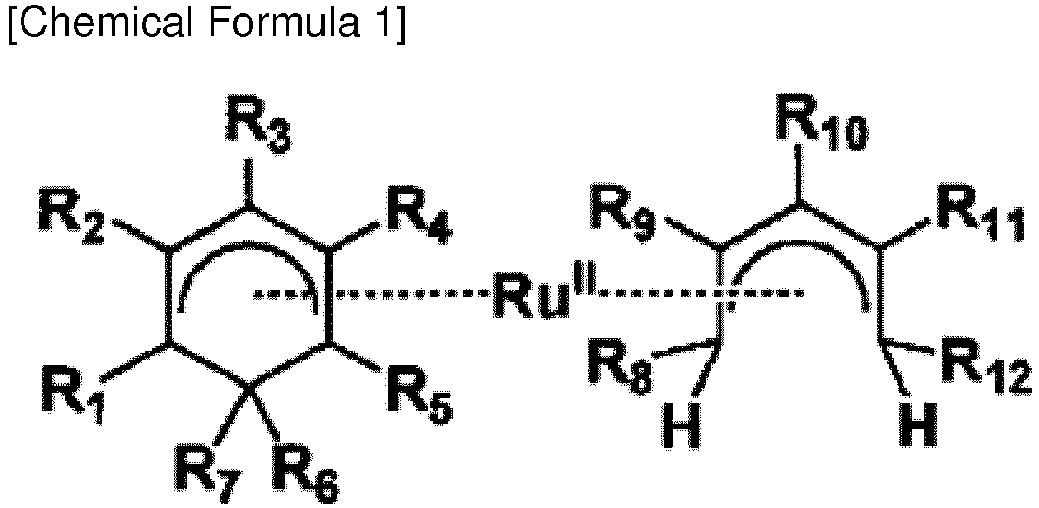
- the present invention for solving the problem relates to a raw material for chemical deposition, for producing a ruthenium thin film or a ruthenium compound thin film by a chemical deposition method, the raw material for chemical deposition including an organoruthenium compound represented by the following formula, in which a cyclohexadienyl group or a derivative thereof and a pentadienyl group or a derivative thereof are coordinated to ruthenium: wherein the substituents R 1 to R 12 are each independently a hydrogen atom, a linear or cyclic hydrocarbon, an amine, an imine, an ether, a ketone, or an ester, and the substituents R 1 to R 12 each have 6 or less carbon atoms.
- the raw material for chemical deposition of the present invention includes an organoruthenium compound having a pentadienyl group and also a cyclohexadienyl group as ligands.
- the compound has a low decomposition temperature (around 250°C) and can be formed into a film at low temperatures, and also has moderate thermal stability and thus has excellent handleability.
- the raw material for chemical deposition of the present invention is characterized by having both a cyclohexadienyl group ligand and a pentadienyl group ligand.
- the present inventors have noted that depending on the kind, ligands for ruthenium have the following tendencies in terms of the strength of bonding between the ligand and ruthenium and the thermal stability of the compound.
- Ru-cyclopentadienyl > Ru-cyclohexadienyl > Ru-pentadienyl (linear dienyl)
- the present inventors have found that when a compound has both a cyclohexadienyl group ligand and a pentadienyl group ligand with ruthenium, the resulting compound has moderate thermal properties as follows, and thus arrived at the present invention described above.
- Ru(EtCp) 2 (decomposition temperature: 350°C) > Ru(Me 3 CHD) 2 > Ru(EtCp)(Me 2 PD) (decomposition temperature: 270°C) > the compound of the present invention > Ru(Me 2 PD) 2 (decomposition temperature: 210°C)
- the "cyclohexadienyl group or derivative thereof” has substituents R 1 to R 7 .
- the substituents R 1 to R 7 are each a hydrogen atom, a linear or cyclic hydrocarbon, an amine, an imine, an ether, a ketone, or an ester.
- the substituents R 1 to R 7 are each a hydrogen atom or a C 1-6 linear or branched hydrocarbon.
- a hydrocarbon a methyl group or an ethyl group is preferable.
- the substituents R 1 to R 7 each have six or less, preferably three or less, and particularly preferably two or less carbon atoms.
- substituents R 1 to R 7 preferably, out of the substituents R 1 to R 7 , two to four substituents are each a hydrogen atom, and the remaining substituents are each a methyl group or an ethyl group, and it is preferable that the substituents R 6 and R 7 are each a methyl group or an ethyl group.
- the number of alkyl substituents is too large relative to hydrogen atoms, or the carbon chains of the alkyl substituents are too long, the vapor pressure decreases, and such a compound is undesirable as a raw material for chemical deposition.
- the "pentadienyl group or derivative thereof” has substituents R 8 to R 12 .
- the substituents R 8 to R 12 are each a hydrogen atom, a linear or cyclic hydrocarbon, an amine, an imine, an ether, a ketone, or an ester.
- the substituents R 1 to R 7 are each a hydrogen atom or a C 1-6 linear or branched hydrocarbon.
- a hydrocarbon a methyl group or an ethyl group is preferable.
- substituents R 8 to R 12 , R 8 , R 10 , and R 12 are each a hydrogen atom, and the remaining substituents R 9 and R 11 are each a methyl group, an ethyl group, or a hydrogen atom.
- the substituents R 8 to R 12 each have six or less, preferably three or less, and particularly preferably two or less carbon atoms. When the number of alkyl substituents is too large relative to hydrogen atoms, or the carbon chains of the alkyl substituents are too long, the vapor pressure decreases, and thus such a compound is undesirable as a raw material for chemical deposition.
- dimethylpentadienyl having two methyl groups as substituents is preferable.
- 2,4-dimethylpentadienyl wherein the substituents R 9 and R 11 are each a methyl group is preferable.
- organoruthenium compounds include compounds of the following formulae. These compounds have decomposition temperatures of around 250°C and can be easily formed into films at low temperatures.
- the raw material for chemical deposition according to the present invention is useful for the formation of a ruthenium thin film by a chemical deposition method.
- a chemical deposition method an organoruthenium compound to serve as a raw material is heated and vaporized in a vacuum to produce a raw material gas.
- the raw material gas is blown to the heated substrate surface to pyrolyze the complex, thereby forming a ruthenium thin film.
- the raw material described above is used as the organoruthenium compound.
- the substrate heating temperature at the time of film formation may be 150°C to 500°C. Because to achieve the substrate heating temperature on the low-temperature side is one of the objects of the present invention, the substrate heating temperature is preferably 150°C to 400°C, more preferably 220°C to 350°C. When the temperature is less than 150°C, the film forming reaction is difficult to proceed, making it difficult to obtain a necessary thickness. When the temperature is too high, it is difficult to form a uniform thin film, and, in the formation of a ruthenium film, the film is likely to be contaminated with impurities.
- the raw material for chemical deposition of the present invention has a high vapor pressure, moderate thermal stability, and also a low decomposition temperature (about 250°C or less), offering excellent film formability at low temperatures.
- organoruthenium compounds represented by the following formulae were produced. Additionally, the decomposition temperature and the performance of the formed thin film were evaluated.
- the decomposition temperatures of the compounds A to C were all 250°C or less, allowing for film formation at low temperatures. At the same time, the decomposition temperatures were not low enough to cause decomposition during handling, and the compounds had moderate thermal stability.
- TG-DTA2000SA manufactured by BRUKER
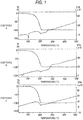
- the compounds A, B, and C were each placed in a cell made of aluminum, and, in a nitrogen atmosphere, changes in heat and weight were observed at a temperature rise rate of 5°C/min and a measurement temperature ranging from room temperature to 500°C. The results are shown in Fig. 1 .
- Test No. 1 By use of a cold-wall film deposition device, ruthenium thin films were formed by CVD from the compound C as a raw material.
- the deposition conditions were as follows: substrate for thin film formation: silicon, sample heating temperature: 90°C, substrate heating temperature: 210°C, reactant gas: hydrogen supplied at 20 sccm, pressure: 150 torr, deposition time: 180 minutes. Additionally, films of Test Nos. 2 to 6 were also formed under the conditions shown in the following table, in which silicon oxide was used as the substrate, the substrate heating temperature varied, etc. [Table 2] Test No.
- Substrate Sample heating temperature Substrate heating temperature Reactant gas Pressure Deposition time 1 Si 90°C 210°C Hydrogen 20 sccm 150 torr 180 min 2 SiO 2 3 Si 250°C 60 min 4 SiO 2 5 350°C Hydrogen 30 sccm 225 torr 30 min 6 70°C 450°C 150 torr 40 min
- all the ruthenium films produced under the above test example conditions showed low specific resistances of 60 ⁇ cm or less.
- the raw material according to the present invention has a high vapor pressure, moderate thermal stability, and also a low decomposition temperature (about 250°C or less), offering excellent film formability at low temperatures, and its specific resistance is also low. Accordingly, the raw material is suitable also for use as a thin-film electrode material for a semiconductor device, such as DRAM or FERAM.
Landscapes
- Chemical & Material Sciences (AREA)
- Organic Chemistry (AREA)
- Engineering & Computer Science (AREA)
- Materials Engineering (AREA)
- General Chemical & Material Sciences (AREA)
- Chemical Kinetics & Catalysis (AREA)
- Metallurgy (AREA)
- Mechanical Engineering (AREA)
- Inorganic Chemistry (AREA)
- Life Sciences & Earth Sciences (AREA)
- Wood Science & Technology (AREA)
- Chemical Vapour Deposition (AREA)
- Electrodes Of Semiconductors (AREA)
Abstract
Description
- The present invention relates to a raw material for chemical deposition including an organoruthenium compound for producing a ruthenium thin film or a ruthenium compound thin film by a chemical deposition method (chemical vapor deposition method (CVD) and atomic layer deposition method (ALD)). Specifically, it relates to a raw material for chemical deposition having a low decomposition temperature and also having moderate thermal stability.
- As thin-film electrode materials for semiconductor devices, such as DRAM and FERAM, ruthenium and ruthenium compounds are used. As a method for producing of such a thin film, a chemical deposition method, such as CVD (chemical vapor deposition method) or ALD (atomic layer deposition method), is applied. As raw material compounds for use in such a chemical deposition method, a large number of organoruthenium compounds are conventionally known.
- Generally, as a required property of an organoruthenium compound for chemical deposition, to efficiently form a thin film, a high vapor pressure is required. Additionally, considering handleability, it is preferable that the compound is in a liquid state at ambient temperature. From such a point of view, cyclic or linear dienyl-coordinated organoruthenium compounds are used. Many of cyclic or linear dienyl-coordinated compounds have relatively high stability in air and are easy to handle.
- Examples of compounds having a cyclopentadienyl group include bis(ethylcyclopentadienyl)ruthenium Ru(EtCp)2 and (2,4-dimethylpentadienyl)(ethylcyclopentadienyl)ruthenium Ru(EtCp)(Me2PD) represented by the following formulae (Non Patent Document 1). Examples of compounds in which two pentadienyl groups are coordinated include bis(2,4-dimethylpentadienyl)ruthenium Ru(Me2PD)2 and bis(1-ethylpentadienyl)ruthenium Ru(EtPD)2 (Non Patent Document 1, Patent Document 1), and, as a compound in which a cyclohexadienyl group is coordinated, bis(2,6,6-trimethylcyclohexadienyl)ruthenium Ru(Me3CHD)2 can be mentioned (Patent Document 2).
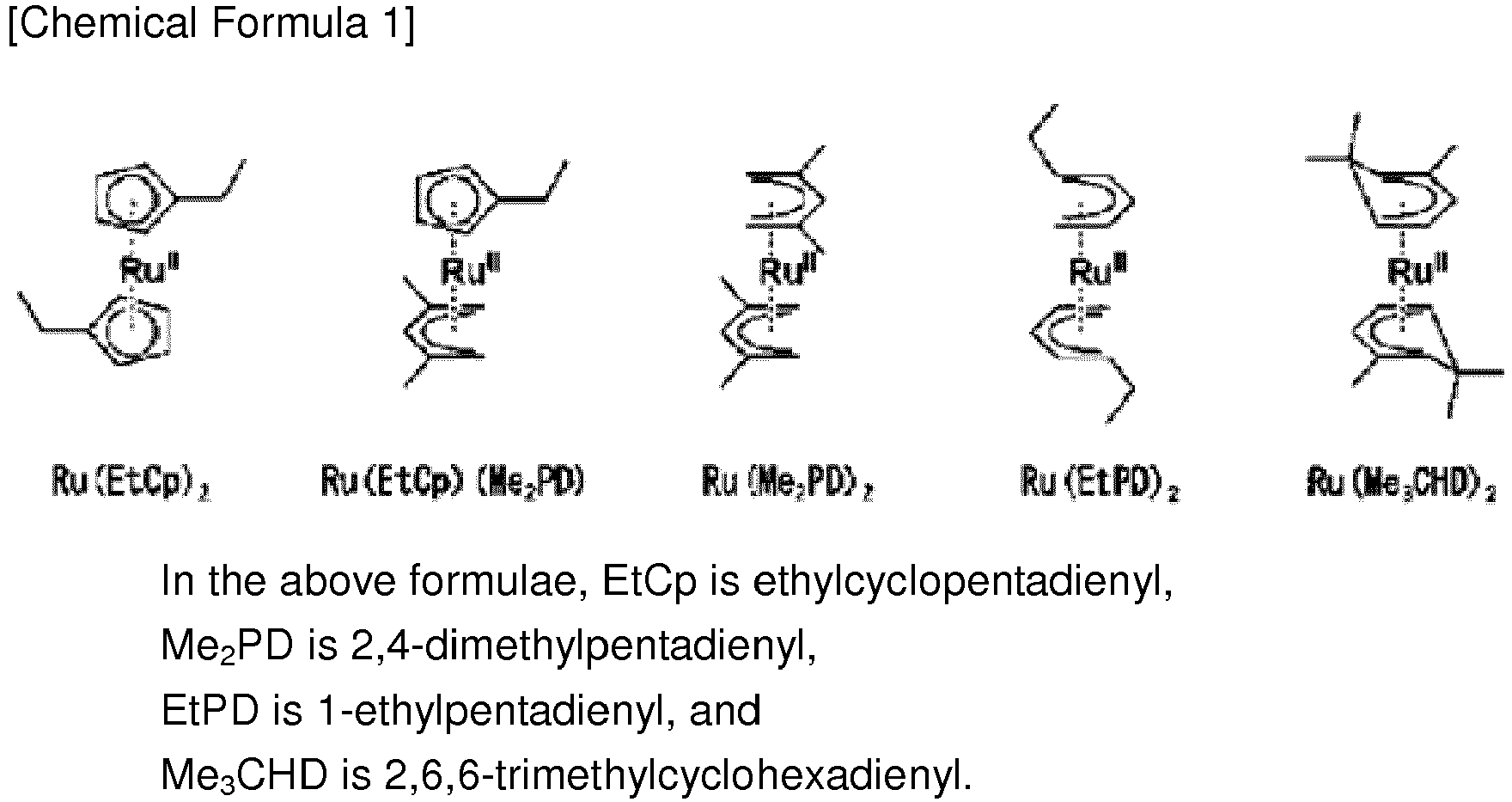
- The above compounds have relatively high vapor pressures, and many are liquids at ambient temperature. In particular, when attention is paid to the decomposition temperature, the decomposition temperatures of Ru(EtCp)(Me2PD) and Ru(Me2PD)2 are as low as about 270°C and about 210°C, respectively, and thus these compounds can be easily formed into films even at low temperatures.
-
- Patent Document 1:
JP 2008-69453 A - Patent Document 2:
JP 2010-513467 A - Non Patent Document 1: Materials Research Society Symposium Proceedings 1155-C09-11 (2009).
- Here, when a ruthenium thin film or a ruthenium compound thin film is formed on a semiconductor device or the like, sometimes high-temperature conditions cannot be applied. Thus, there is a demand to provide an organoruthenium compound that can be formed into a film at a temperature as low as possible. Accordingly, a compound that can be formed into a film at a temperature lower than the decomposition temperature 270°C of Ru(EtCp)(Me2PD) (e.g., around 250°C) is preferable. Meanwhile, when only the decomposition temperature is taken into consideration, the decomposition temperature of Ru(Me2PD)2 is as low as 210°C. However, because of the extremely low decomposition temperature, Ru(Me2PD)2 has low thermal stability and is difficult to handle. For example, because the sample heating temperature is made low (about 80°C or less) to prevent pyrolysis at the time of film formation, the vapor pressure decreases at the time of film formation.
- Against this background, the present invention provides a raw material for chemical deposition having properties required for a CVD compound, that is, which has a high vapor pressure, can be formed into a film at low temperatures (about 250°C or less), and also has moderate thermal stability.
- The present invention for solving the problem relates to a raw material for chemical deposition, for producing a ruthenium thin film or a ruthenium compound thin film by a chemical deposition method, the raw material for chemical deposition including an organoruthenium compound represented by the following formula, in which a cyclohexadienyl group or a derivative thereof and a pentadienyl group or a derivative thereof are coordinated to ruthenium:


- The raw material for chemical deposition of the present invention includes an organoruthenium compound having a pentadienyl group and also a cyclohexadienyl group as ligands. The compound has a low decomposition temperature (around 250°C) and can be formed into a film at low temperatures, and also has moderate thermal stability and thus has excellent handleability.
- As described above, the raw material for chemical deposition of the present invention is characterized by having both a cyclohexadienyl group ligand and a pentadienyl group ligand. In this regard, the present inventors have noted that depending on the kind, ligands for ruthenium have the following tendencies in terms of the strength of bonding between the ligand and ruthenium and the thermal stability of the compound.
- Then, the present inventors have found that when a compound has both a cyclohexadienyl group ligand and a pentadienyl group ligand with ruthenium, the resulting compound has moderate thermal properties as follows, and thus arrived at the present invention described above.
- Hereinafter, each component of the raw material for chemical deposition of the present invention will be described in detail.
- The "cyclohexadienyl group or derivative thereof" has substituents R1 to R7. The substituents R1 to R7 are each a hydrogen atom, a linear or cyclic hydrocarbon, an amine, an imine, an ether, a ketone, or an ester. Preferably, the substituents R1 to R7 are each a hydrogen atom or a C1-6 linear or branched hydrocarbon. As a hydrocarbon, a methyl group or an ethyl group is preferable. The substituents R1 to R7 each have six or less, preferably three or less, and particularly preferably two or less carbon atoms. Further, preferably, out of the substituents R1 to R7, two to four substituents are each a hydrogen atom, and the remaining substituents are each a methyl group or an ethyl group, and it is preferable that the substituents R6 and R7 are each a methyl group or an ethyl group. When the number of alkyl substituents is too large relative to hydrogen atoms, or the carbon chains of the alkyl substituents are too long, the vapor pressure decreases, and such a compound is undesirable as a raw material for chemical deposition.
- The "pentadienyl group or derivative thereof" has substituents R8 to R12. The substituents R8 to R12 are each a hydrogen atom, a linear or cyclic hydrocarbon, an amine, an imine, an ether, a ketone, or an ester. Preferably, the substituents R1 to R7 are each a hydrogen atom or a C1-6 linear or branched hydrocarbon. As a hydrocarbon, a methyl group or an ethyl group is preferable. In particular, preferably, out of the substituents R8 to R12, R8, R10, and R12 are each a hydrogen atom, and the remaining substituents R9 and R11 are each a methyl group, an ethyl group, or a hydrogen atom. The substituents R8 to R12 each have six or less, preferably three or less, and particularly preferably two or less carbon atoms. When the number of alkyl substituents is too large relative to hydrogen atoms, or the carbon chains of the alkyl substituents are too long, the vapor pressure decreases, and thus such a compound is undesirable as a raw material for chemical deposition.
- Additionally, as the pentadienyl group or derivative thereof, dimethylpentadienyl having two methyl groups as substituents is preferable. In particular, 2,4-dimethylpentadienyl wherein the substituents R9 and R11 are each a methyl group is preferable.
- Specific examples of organoruthenium compounds include compounds of the following formulae. These compounds have decomposition temperatures of around 250°C and can be easily formed into films at low temperatures.


- The raw material for chemical deposition according to the present invention is useful for the formation of a ruthenium thin film by a chemical deposition method. In a chemical deposition method, an organoruthenium compound to serve as a raw material is heated and vaporized in a vacuum to produce a raw material gas. The raw material gas is blown to the heated substrate surface to pyrolyze the complex, thereby forming a ruthenium thin film. In such a method, the raw material described above is used as the organoruthenium compound.
- The substrate heating temperature at the time of film formation may be 150°C to 500°C. Because to achieve the substrate heating temperature on the low-temperature side is one of the objects of the present invention, the substrate heating temperature is preferably 150°C to 400°C, more preferably 220°C to 350°C. When the temperature is less than 150°C, the film forming reaction is difficult to proceed, making it difficult to obtain a necessary thickness. When the temperature is too high, it is difficult to form a uniform thin film, and, in the formation of a ruthenium film, the film is likely to be contaminated with impurities.
- The raw material for chemical deposition of the present invention has a high vapor pressure, moderate thermal stability, and also a low decomposition temperature (about 250°C or less), offering excellent film formability at low temperatures.
-
-
Fig. 1 is a diagram showing the results of the TG-DTA measurement of compounds in this embodiment. -
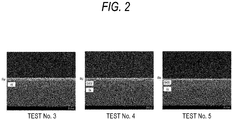
Fig. 2 shows SEM observation photographs of ruthenium thin films in this embodiment. - Hereinafter, best modes for carrying out the present invention will be described.
- In this embodiment, three kinds of organoruthenium compounds represented by the following formulae were produced. Additionally, the decomposition temperature and the performance of the formed thin film were evaluated.

- As compound A, (2,4-dimethylpentadienyl)(2,6,6-trimethylcyclohexadienyl)ruthenium(II) was synthesized by the following steps.
- 2.38 ml of acetonitrile, 35.3 g (366.4 mmol) of 2,4-dimethyl 1,3-pentadiene, 13.5 g (183.2 mmol) of lithium carbonate, and 28.2 g (45.8 mmol) of di-µ-chlorodichloro-bis[(1-3η):(6-8η)-2,7-dimethyloctadiendiyl]diruthenium(IV) were added to a flask containing 900 ml of ethanol in this order to form a suspension. The suspension was heated and stirred under reflux for 4 hours, and then cooled to room temperature. 5.6 g (45.8 mmol) of 2,6,6-trimethy-1,3-cyclohexadiene was added to the cooled liquid, and then heated and stirred under reflux for 6 hours. After the completion of the reaction, the mixture was cooled to room temperature and concentrated to give a muddy reaction mixture. Extraction from the muddy reaction mixture was performed with pentane, and the extract was subjected to column chromatography using a silica gel (or alumina) as the carrier and pentane as the eluent, and further to sublimation purification, thereby giving 2.0 g (6.3 mmol) of (2,4-dimethylpentadienyl)(2,6,6-trimethylcyclohexadienyl)ruthenium(II) as the object substance (yield: 7%, melting point: 104°C).

- As compound B, (2,4-dimethylpentadienyl)(2,4,6,6-tetramethylcyclohexadienyl)ruthenium(II) was synthesized by the following steps.
- 1.04 ml of acetonitrile, 15.4 g (160 mmol) of 2,4-dimethyl 1,3-pentadiene, 6.0 g (80 mmol) of lithium carbonate, and 12.4 g (20 mmol) of di-µ-chlorodichloro-bis[(1-3η):(6-8η)-2,7-dimethyloctadiendiyl]diruthenium(IV) were added to a flask containing 400 ml of ethanol in this order to form a suspension. The suspension was heated and stirred under reflux for 4 hours, and then cooled to room temperature. 2.8 g (20 mmol) of 1,3,5,5-tetramethyl-1,3-cyclohexadiene was added to the cooled liquid, and then heated and stirred under reflux for 6 hours. After the completion of the reaction, the mixture was cooled to room temperature and concentrated to give a muddy reaction mixture. Extraction from the muddy reaction mixture was performed with pentane, and the extract was subjected to column chromatography using a silica gel (or alumina) as the carrier and pentane as the eluent, and further to sublimation purification, thereby giving 1.3 g (3.92 mmol) of (2,4-dimethylpentadienyl)(2,4,6,6-tetramethylcyclohexadienyl)ruthenium(II) as the object substance (yield: 10%, melting point: 67°C).

- As the compound C, (2,4-dimethylpentadienyl)(3-ethyl-2,6,6-trimethylcyclohexadienyl)ruthenium(II) was synthesized by the following steps.
- 0.52 ml of acetonitrile, 7.7 g (80 mmol) of 2,4-dimethyl 1,3-pentadiene, 3.0 g (40 mmol) of lithium carbonate, and 6.2 g (10 mmol) of di-µ-chlorodichloro-bis[(1-3η):(6-8η)-2,7-dimethyloctadiendiyl]diruthenium(IV) were added to a flask containing 200 ml of ethanol in this order to form a suspension. The suspension was heated and stirred under reflux for 4 hours, and then cooled to room temperature. 2.7 g (20 mmol) of 2-ethyl-1,5,5-trimethyl-1,3-cyclohexadiene was added to the cooled liquid, and then heated and stirred under reflux for 6 hours. After the completion of the reaction, the mixture was cooled to room temperature and concentrated to give a muddy reaction mixture. Extraction from the muddy reaction mixture was performed with pentane, and the extract was subjected to column chromatography using a silica gel (or alumina) as the carrier and pentane as the eluent, and further to distillation, thereby giving 0.8 g (3.92 mmol) of (2,4-dimethylpentadienyl)(3-ethyl-2,6,6-trimethylcyclohexadienyl)ruthenium(II) as the object substance (yield: 12%, melting point: -20°C or less).


- The synthesis of compound C was also performed by the following method.
- 114.4 g (1.19 mol) of 2,4-dimethyl 1,3-pentadiene and 31.1 g (0.21 mol) of 2-ethyl-1,5,5-trimethyl-1,3-cyclohexadiene were added to a flask containing 20.0 g (3.06 mol) of zinc in this order to form a suspension. A solution of 30.0 g (0.12 mol) of ruthenium chloride trihydrate dissolved in 500 ml of ethanol was slowly added dropwise to the suspension with stirring at room temperature. The mixture was stirred for about 30 minutes at room temperature, and then heated and stirred under reflux for 4 hours. After the completion of the reaction, the mixture was cooled to room temperature, and zinc was removed from the reaction solution by filtration, followed by concentration to give a reaction mixture. Extraction from the obtained reaction mixture was performed with hexane, and the extract was subjected to column chromatography using a silica gel as the carrier and hexane as the eluent, and further to distillation, thereby giving 13.1 g (0.038 mol) of (2,4-dimethylpentadienyl)(3-ethyl-2,6,6-trimethylcyclohexadienyl)ruthenium(II) as the object substance (yield: 33%, melting point: -20°C or less).

- Incidentally, it was also possible to synthesize (2,4-dimethylpentadienyl)(2,6,6-trimethylcyclohexadienyl)ruthenium(II) and (2,4-dimethylpentadienyl) (2,4,6,6-tetramethylcyclohexadienyl)ruthenium(II) in the same manner as in the above Synthesis of Compound C (2).
- The thermal properties of the compounds A, B, and C synthesized above were evaluated by DSC.
- Calorimetry (DSC): By use of Q2000 manufactured by TA Instruments, each compound (sample weight: 3.8 mg) was placed in a pressure-resistant cell made of stainless steel, and, in a nitrogen atmosphere, changes in heat were observed at a temperature rise rate of 10°C/min and a measurement temperature ranging from room temperature to 300°C. The results are shown in the following table. As the decomposition temperatures of the organoruthenium compounds (X1 to X3) of the following conventional examples, the values described in Non Patent Document 2 are also shown in the table.
Non Patent Document 2: Electrochemical and Solid-State Letters, Vol. 12, No. 10, pD80-83 (2009)
[Table 1] Basic skeleton Decomposition temperature Compound A CHD-Ru-PD 250°C Compound B CHD-Ru-PD 250°C Compound C CHD-Ru-PD 240°C Compound X1 Cp-Ru-Cp 350°C Compound X2 Cp-Ru-PD 270°C Compound X3 PD-Ru-PD 210°C - As shown by the above results, the decomposition temperatures of the compounds A to C were all 250°C or less, allowing for film formation at low temperatures. At the same time, the decomposition temperatures were not low enough to cause decomposition during handling, and the compounds had moderate thermal stability.
- Thermogravimetry-Differential Thermal Analysis (TG-DTA): By use of TG-DTA2000SA manufactured by BRUKER, the compounds A, B, and C (sample weight: 5 mg) were each placed in a cell made of aluminum, and, in a nitrogen atmosphere, changes in heat and weight were observed at a temperature rise rate of 5°C/min and a measurement temperature ranging from room temperature to 500°C. The results are shown in
Fig. 1 . - From
Fig. 1 , in all the compounds A, B, and C, a weight loss was observed at 210°C or less in TG, indicating that they are suitable for deposition at low temperatures (250°C or less). - Deposition Test: By use of a cold-wall film deposition device, ruthenium thin films were formed by CVD from the compound C as a raw material. In Test No. 1, the deposition conditions were as follows: substrate for thin film formation: silicon, sample heating temperature: 90°C, substrate heating temperature: 210°C, reactant gas: hydrogen supplied at 20 sccm, pressure: 150 torr, deposition time: 180 minutes. Additionally, films of Test Nos. 2 to 6 were also formed under the conditions shown in the following table, in which silicon oxide was used as the substrate, the substrate heating temperature varied, etc.
[Table 2] Test No. Substrate Sample heating temperature Substrate heating temperature Reactant gas Pressure Deposition time 1 Si 90°C 210° C Hydrogen 20 sccm 150 torr 180 min 2 SiO 23 Si 250°C 60 min 4 SiO 25 350° C Hydrogen 30 sccm 225 torr 30 min 6 70°C 450°C 150 torr 40 min - Film thickness measurement by SEM observation and specific resistance measurement were performed on the ruthenium films produced at the various substrate heating temperatures.
Fig. 2 shows the SEM observation photographs of Test Nos. 3 to 5. Additionally, the specific resistance is shown in the following table.[Table 3] Test No. Substrate Film thickness/ nm Specific resistance / µ Ω cm 1 SiO2 46.3 59.1 2 Si 22.4 34.1 3 SiO2 30.3 16.8 4 Si 42.2 16.0 5 SiO2 8.5 28.4 6 SiO2 9.5 59.4 - As a result of SEM observation, in all the ruthenium films produced at the above substrate heating temperatures, the thickness was uniform and continuous, and no cracks, holes, island-like aggregation, or the like was observed.
- Additionally, with respect to the specific resistance, all the ruthenium films produced under the above test example conditions showed low specific resistances of 60 µΩcm or less. In particular, the ruthenium films of the Test Nos. 3 to 5, in which the substrate heating temperature at the time of deposition was 220°C to 350°C, had particularly low specific resistances of 30 µΩcm or less.
- The raw material according to the present invention has a high vapor pressure, moderate thermal stability, and also a low decomposition temperature (about 250°C or less), offering excellent film formability at low temperatures, and its specific resistance is also low. Accordingly, the raw material is suitable also for use as a thin-film electrode material for a semiconductor device, such as DRAM or FERAM.
Claims (8)
- A raw material for chemical deposition, for producing a ruthenium thin film or a ruthenium compound thin film by a chemical deposition method,
the raw material for chemical deposition comprising an organoruthenium compound represented by the following formula, in which a cyclohexadienyl group or a derivative thereof and a pentadienyl group or a derivative thereof are coordinated to ruthenium:
- The raw material for chemical deposition according to claim 1, wherein the substituents R1 to R12 are each a hydrogen atom or a C1-6 linear or branched hydrocarbon.
- The raw material for chemical deposition according to claim 1 or 2, wherein the substituents R1 to R12 are each a hydrogen atom, a methyl group, or an ethyl group.
- The raw material for chemical deposition according to any of claims 1 to 3, wherein out of the substituents R1 to R7 of the cyclohexadienyl group or derivative thereof, two to four substituents are each a hydrogen atom, and the remaining substituents are each a methyl group or an ethyl group.
- The raw material for chemical deposition according to any of claims 1 to 4, wherein the substituents R6 and R7 of the cyclohexadienyl group or derivative thereof are each a methyl group or an ethyl group.
- The raw material for chemical deposition according to any of claims 1 to 5, wherein out of the substituents R8 to R12 of the pentadienyl group or derivative thereof, R8, R10, and R12 are each a hydrogen atom, and the remaining substituents R9 and R11 each a methyl group, an ethyl group, or a hydrogen atom.
- The raw material for chemical deposition according to any of claims 1 to 6, wherein the pentadienyl group or derivative thereof is dimethylpentadienyl having two methyl groups as substituents.
- A chemical deposition method for a ruthenium thin film or a ruthenium compound thin film, comprising the steps of:vaporizing a raw material including an organoruthenium compound into a raw material gas; andheating and introducing the raw material gas onto a substrate surface, wherein the chemical deposition method uses the raw material for chemical deposition defined in any one of claims 1 to 7 as the raw material.
Applications Claiming Priority (2)
| Application Number | Priority Date | Filing Date | Title |
|---|---|---|---|
| JP2014204505A JP5892668B1 (en) | 2014-10-03 | 2014-10-03 | Chemical vapor deposition material comprising organic ruthenium compound and chemical vapor deposition method using the chemical vapor deposition material |
| PCT/JP2015/076867 WO2016052288A1 (en) | 2014-10-03 | 2015-09-24 | Chemical vapor deposition raw material comprising organic ruthenium compound and chemical vapor deposition method using chemical vapor deposition raw material |
Publications (2)
| Publication Number | Publication Date |
|---|---|
| EP3202949A1 true EP3202949A1 (en) | 2017-08-09 |
| EP3202949A4 EP3202949A4 (en) | 2018-06-13 |
Family
ID=55541207
Family Applications (1)
| Application Number | Title | Priority Date | Filing Date |
|---|---|---|---|
| EP15845773.9A Withdrawn EP3202949A4 (en) | 2014-10-03 | 2015-09-24 | Chemical vapor deposition raw material comprising organic ruthenium compound and chemical vapor deposition method using chemical vapor deposition raw material |
Country Status (6)
| Country | Link |
|---|---|
| US (1) | US10131987B2 (en) |
| EP (1) | EP3202949A4 (en) |
| JP (1) | JP5892668B1 (en) |
| KR (1) | KR20170057402A (en) |
| TW (1) | TWI588151B (en) |
| WO (1) | WO2016052288A1 (en) |
Families Citing this family (4)
| Publication number | Priority date | Publication date | Assignee | Title |
|---|---|---|---|---|
| US11078224B2 (en) * | 2017-04-07 | 2021-08-03 | Applied Materials, Inc. | Precursors for the atomic layer deposition of transition metals and methods of use |
| JP7148377B2 (en) * | 2018-12-03 | 2022-10-05 | 田中貴金属工業株式会社 | Raw material for chemical vapor deposition comprising a ruthenium complex and chemical vapor deposition method using said raw material for chemical vapor deposition |
| WO2020255822A1 (en) * | 2019-06-21 | 2020-12-24 | 株式会社Adeka | Ruthenium compound, raw material for thin film formation, and method for forming thin film |
| JP7372353B2 (en) * | 2020-01-31 | 2023-10-31 | 田中貴金属工業株式会社 | A chemical vapor deposition raw material comprising an organic ruthenium compound and a chemical vapor deposition method using the chemical vapor deposition raw material |
Family Cites Families (7)
| Publication number | Priority date | Publication date | Assignee | Title |
|---|---|---|---|---|
| JP4152028B2 (en) * | 1999-01-25 | 2008-09-17 | 株式会社Adeka | Method for producing ruthenium-based thin film |
| KR20060131874A (en) * | 2004-02-04 | 2006-12-20 | 프랙스에어 테크놀로지, 인코포레이티드 | High Density Nucleated Organometallic Compound |
| EP1887102B1 (en) | 2006-08-08 | 2020-04-08 | L'AIR LIQUIDE, Société Anonyme pour l'Etude et l'Exploitation des Procédés Georges Claude | Precursors having open ligands for ruthenium containing films deposition |
| EP1935897B1 (en) * | 2006-12-22 | 2011-03-02 | L'AIR LIQUIDE, Société Anonyme pour l'Etude et l'Exploitation des Procédés Georges Claude | New organo-Ruthenium compound, the process for its preparation and its use as a ruthenium precursor to manufacture ruthenium based film coated metal electrodes |
| KR20100060482A (en) * | 2008-11-27 | 2010-06-07 | 주식회사 유피케미칼 | Organometallic precursors for deposition of ruthenium metal and/or ruthenium oxide thin films, and deposition process of the thin films |
| JP5579019B2 (en) * | 2010-10-25 | 2014-08-27 | Jsr株式会社 | Method for producing ruthenium compound |
| TWI610932B (en) * | 2012-12-07 | 2018-01-11 | 東曹股份有限公司 | Hydrazine complex, method for producing the same, cationic trinitrile complex, method for producing the same, and method for producing ruthenium-containing film |
-
2014
- 2014-10-03 JP JP2014204505A patent/JP5892668B1/en active Active
-
2015
- 2015-09-24 US US15/514,778 patent/US10131987B2/en active Active
- 2015-09-24 EP EP15845773.9A patent/EP3202949A4/en not_active Withdrawn
- 2015-09-24 WO PCT/JP2015/076867 patent/WO2016052288A1/en not_active Ceased
- 2015-09-24 KR KR1020177010706A patent/KR20170057402A/en not_active Ceased
- 2015-09-30 TW TW104132178A patent/TWI588151B/en active
Also Published As
| Publication number | Publication date |
|---|---|
| EP3202949A4 (en) | 2018-06-13 |
| JP5892668B1 (en) | 2016-03-23 |
| WO2016052288A1 (en) | 2016-04-07 |
| US20170218509A1 (en) | 2017-08-03 |
| TWI588151B (en) | 2017-06-21 |
| TW201625652A (en) | 2016-07-16 |
| KR20170057402A (en) | 2017-05-24 |
| JP2016074929A (en) | 2016-05-12 |
| US10131987B2 (en) | 2018-11-20 |
Similar Documents
| Publication | Publication Date | Title |
|---|---|---|
| JP5136576B2 (en) | Organoruthenium compound and method for producing the same | |
| US8304567B2 (en) | Organoruthenium complex, and method for production of ruthenium thin film using the ruthenium complex | |
| EP3348667A1 (en) | Chemical vapor deposition feedstock comprising organic ruthenium compound and chemical vapor deposition method using said chemical vapor deposition feedstock | |
| US9556212B2 (en) | Chemical deposition raw material formed of ruthenium complex and method for producing the same, and chemical deposition method | |
| US8617305B2 (en) | Metal complexes for metal-containing film deposition | |
| EP3202949A1 (en) | Chemical vapor deposition raw material comprising organic ruthenium compound and chemical vapor deposition method using chemical vapor deposition raw material | |
| US20250066405A1 (en) | Molybdenum precursor compound, method for preparing same, and method for depositing molybdenum-containing film using same | |
| KR20130112025A (en) | Hydrosilane derivative, method for producing same, and method for producing silicon-containing thin film | |
| CN106661728A (en) | Process for the generation of thin inorganic films | |
| US9382616B2 (en) | Chemical vapor deposition raw material comprising organoplatinum compound, and chemical vapor deposition method using the chemical vapor deposition raw material | |
| EP3342899A1 (en) | Chemical vapor deposition starting material comprising a binuclear ruthenium complex and chemical vapor deposition method using chemical vapor deposition starting material | |
| EP3296425A1 (en) | Chemical vapor deposition starting material comprising organic platinum compound, and chemical vapor deposition method using said chemical vapor deposition starting material | |
| US20190144998A1 (en) | Process for the generation of metallic films | |
| Preischel et al. | Near Room-Temperature Atomic Layer Deposition of Magnesium Oxide Using Bis-3-(N, N-dimethylamino) propyl Magnesium (II) and Water | |
| JP2007526250A (en) | Organometallic compounds with high nucleation density | |
| Karakovskaya et al. | Synthesis, structure and thermal investigation of a new volatile iridium (I) complex with cyclooctadiene and methoxy-substituted [beta]-diketonate. | |
| CN110431253A (en) | Raw material for chemical vapor deposition consisting of iridium complex and chemical vapor deposition method using the raw material for chemical vapor deposition | |
| Zharkova et al. | X-ray diffraction study of volatile complexes of dimethylgold (III) derived from symmetrical β-diketones | |
| US8313807B2 (en) | High coordination sphere group 2 metal β-diketiminate precursors | |
| JP3379315B2 (en) | Raw materials for forming platinum thin films by metal organic chemical vapor deposition | |
| KR101306812B1 (en) | Novel tungsten silylamide compounds, preparation method thereof and process for the formation of thin films using the same | |
| TWI888075B (en) | Ruthenium complexes and process for producing ruthenium film | |
| WO2001042261A1 (en) | Processes for the preparation of organoluthenium compounds useful for thin film formation by cvd | |
| Go et al. | Monomeric Sr Complexes Combined with Tetradentate Enaminolate Ligands for Containing Sr Thin-Film Deposition | |
| Cosham et al. | Synthesis, Structure and Chemical Vapour Deposition Studies on the Group 13 Complexes [Me2M {tfacnac}][M= Al, Ga, In; Htfacnac= F3CC (OH) CHC (CH3) NCH2CH2OCH3] |
Legal Events
| Date | Code | Title | Description |
|---|---|---|---|
| PUAI | Public reference made under article 153(3) epc to a published international application that has entered the european phase |
Free format text: ORIGINAL CODE: 0009012 |
|
| 17P | Request for examination filed |
Effective date: 20170502 |
|
| AK | Designated contracting states |
Kind code of ref document: A1 Designated state(s): AL AT BE BG CH CY CZ DE DK EE ES FI FR GB GR HR HU IE IS IT LI LT LU LV MC MK MT NL NO PL PT RO RS SE SI SK SM TR |
|
| AX | Request for extension of the european patent |
Extension state: BA ME |
|
| DAV | Request for validation of the european patent (deleted) | ||
| DAX | Request for extension of the european patent (deleted) | ||
| A4 | Supplementary search report drawn up and despatched |
Effective date: 20180515 |
|
| RIC1 | Information provided on ipc code assigned before grant |
Ipc: H01L 21/285 20060101ALI20180508BHEP Ipc: C23C 16/18 20060101AFI20180508BHEP Ipc: H01L 21/28 20060101ALI20180508BHEP Ipc: C07F 15/00 20060101ALI20180508BHEP Ipc: C23C 16/448 20060101ALI20180508BHEP |
|
| STAA | Information on the status of an ep patent application or granted ep patent |
Free format text: STATUS: THE APPLICATION HAS BEEN WITHDRAWN |
|
| 18W | Application withdrawn |
Effective date: 20190227 |