EP3202253A1 - Feed means and log processing head - Google Patents
Feed means and log processing head Download PDFInfo
- Publication number
- EP3202253A1 EP3202253A1 EP17151122.3A EP17151122A EP3202253A1 EP 3202253 A1 EP3202253 A1 EP 3202253A1 EP 17151122 A EP17151122 A EP 17151122A EP 3202253 A1 EP3202253 A1 EP 3202253A1
- Authority
- EP
- European Patent Office
- Prior art keywords
- feed means
- log
- elevations
- feed
- carrier
- Prior art date
- Legal status (The legal status is an assumption and is not a legal conclusion. Google has not performed a legal analysis and makes no representation as to the accuracy of the status listed.)
- Granted
Links
Images


Classifications
-
- A—HUMAN NECESSITIES
- A01—AGRICULTURE; FORESTRY; ANIMAL HUSBANDRY; HUNTING; TRAPPING; FISHING
- A01G—HORTICULTURE; CULTIVATION OF VEGETABLES, FLOWERS, RICE, FRUIT, VINES, HOPS OR SEAWEED; FORESTRY; WATERING
- A01G23/00—Forestry
- A01G23/02—Transplanting, uprooting, felling or delimbing trees
- A01G23/08—Felling trees
- A01G23/083—Feller-delimbers
-
- B—PERFORMING OPERATIONS; TRANSPORTING
- B27—WORKING OR PRESERVING WOOD OR SIMILAR MATERIAL; NAILING OR STAPLING MACHINES IN GENERAL
- B27B—SAWS FOR WOOD OR SIMILAR MATERIAL; COMPONENTS OR ACCESSORIES THEREFOR
- B27B25/00—Feeding devices for timber in saw mills or sawing machines; Feeding devices for trees
- B27B25/02—Feeding devices for timber in saw mills or sawing machines; Feeding devices for trees with feed and pressure rollers
-
- B—PERFORMING OPERATIONS; TRANSPORTING
- B27—WORKING OR PRESERVING WOOD OR SIMILAR MATERIAL; NAILING OR STAPLING MACHINES IN GENERAL
- B27B—SAWS FOR WOOD OR SIMILAR MATERIAL; COMPONENTS OR ACCESSORIES THEREFOR
- B27B31/00—Arrangements for conveying, loading, turning, adjusting, or discharging the log or timber, specially designed for saw mills or sawing machines
- B27B31/003—Arrangements for conveying, loading, turning, adjusting, or discharging the log or timber, specially designed for saw mills or sawing machines with rollers
Definitions
- This invention relates to feed means with a carrier and elevations on its circumference and to a log processing head.
- Today's harvester heads have steel feed rolls with ribs running under a constant angle of e.g. 38 degrees. Especially when harvesting Eucalyptus trees, where debarking is difficult and critical, the speed of Eucalyptus stem rotation changes a lot from the base to the top of the tree by using such feed rolls. This causes many problems, like complicate debarking, reduced feeding speed, errors for the length measuring, etc.
- the axial and tangential/radial components of the force applied by the elevation to a log varies with the inclination of the elevation. Depending on the place, where the feed means contacts the log by means of its elevations this causes more or less rotation and less or more axial movement. As the diameter of the log determines, where it will hit the feed means and as with a varying diameter the place of contact varies, more rotation will be achieved at a big diameter log as compared to a small diameter log, whereas the change will happened while the tapering log moves through the processing head.
- the processing head can be provided with or without delimb knives and with or without a top knife. All this depends on whether the processing head will only debark or delimb or also harvest a tree.
- the processing head may be of a 4-wheel, 3-wheel or 2-wheel type, whereas latter is preferred.
- elevations are steel bars or spikes welded onto the peripheral surface of a tube like carrier made of steel. These bars may be dull or sharp.
- a rubber wheel is provided with a profile comprising groves and elevations cut from a base or vulcanized onto a base. Elevations can also be casted in unity with the carrier, or groves and elevations are pressed into strong sheet metal, which is rolled up to a wheel. Also, the elevations can be fixed on the carrier by bolts, reaching through a rim or chains stretched over said carrier, in particular, if the carrier is made of rubber.
- the carriers can be of many different styles depending on the application.
- the simplest way is a carrier formed like a rim type metal cylinder onto or in which the elevations are attached as described before.
- the carrier can also be an endless chain with several strings running over an idler wheel and a drive wheel.
- the carrier is made of rubber, which is fixed to a steel rim, like a tire.
- the elevations may be formed in the rubber or it may be chains with elevations pulled over the rubber.
- a series of mainly radially extending, cylindrical roll portions like spokes are assembled along an axle and connected to each other.
- spoke type carrier portions may all be of the same design, however, when assembled, each carrier portion may be tangentially offset with respect to a neighboring carrier portion, which will provide for the progression of the angle of the elevations.
- the progressiveness can be adjusted by said offset.
- spike like elevations leaving gaps between each other and which may grasp a log more aggressively than bars. Bars however create less damage on the surface of the log. Instead of spikes also short bars may be used or bars with embossed spikes.
- the start and end angle of the elevations with respect to the rotation axis of the feed means or the longitudinal log axis depends on the breed, the condition (hardness, humidity, age, etc.) of the log and the bark and needs to be selected respectively. However, it has been found that a range of 5 to 90 degrees between start and end of the line of elevations is very suitable on a carrier with a diameter of about 500 to 600 mm like 560 mm.
- Said head may be a mere processing head grasping logs from a pile for debarking and/or lengthening or it may be a harvester head debarking the log while it is cut to length, like in the case of Eucalyptus harvesting.
- the feed arms are pivoting about an axis in planes parallel or in a plane perpendicular to the log feeding axis. It is most preferred, that the feed means are used in a 2-wheel head with feed arms pivoting about an axis perpendicular to the longitudinal log axis, i.e. horizontal pivot axes, when the head is in an upright position. If three or more feed means are provided only the contact area of the pivoting feed arms will vary, because they follow the diameter of the log.
- Such a processing head and such feed means may show one or more of the following technical effects: higher productivity and lower fuel consumption (dm 3 /m 3 ), better "single pass" Eucalyptus tree feeding, simple design, no extra components and no need to control the orientation of the feed means.
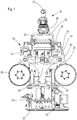
- a log processing head 10 shown in figure 1 contains among others a frame 12, a suspension system 14, movable top and bottom knives 16 and 18, a fix top knife 20, a bottom saw unit 22, a measuring unit 24, feed arms 26 and feed means 28.
- the log processing head 10 may be used to grasp a tree, cut it from its root, delimb and debark it and cut it into calculated lengths. As an alternative, the log processing head 10 picks one or more logs lying on a pile, delimbs and/or debarks them and cuts them to length.
- the log processing head 10 may be attached to a purpose built vehicle like a forest harvester or to an excavator. Such heads are known e.g. from WARATAH and John Deere.
- the frame 12 has a center beam 30 and is made as a welded structure, to which all afore mentioned and additional components are attached by welding, bolting, bearings etc.
- figure 1 which is a position, in which a tree is grasped before and during cutting, the frame 12 and the center beam 30 extend substantially vertically.
- the center beam 30 is connected to the suspension system 14 and at its top region the fix top knife 20 is fastened.
- the center beam 30 is connected to a saw box 32 for the bottom saw unit 22, at the lateral upper and lower right and left side bearings 34 with a vertical bearing axis are provided for the top and bottom knives 16, 18, in the center an opening is given for the measuring unit 24 and between the top and bottom knives 16, 18 bearings 42 exist for the feed arms 26.
- valves, hoses, electrical lines, covers etc. are retained by the frame 12.
- log processing heads 10 with fewer knives, with a bottom and a top saw unit, with totally different measuring units, etc. which all are included in this description, unless something is expressively excluded.
- the suspension system 14 comprises an inverted U-shaped suspension structure 36, a so-called rotator 38 and a link 40.
- the rotator 38 constitutes a driven rotation means between the suspension structure 36 and a link 40, which is to be connected to an un-shown boom of a forest harvester, an excavator or similar.
- the rotator 38 and the link 40 form an universal joint, which allows the log processing head 10 to pivot in two directions in addition to the rotation about a vertical axis.
- tilt hydraulic motors which are connected to the frame 12 with one end and to the suspension structure 36 with the other end and which are able to tilt the frame 12 from a shown upright harvesting position into a horizontal processing position, in which a log L is moved by the feed means 28 along the center beam 30.
- Top knives 16 and bottom knives 18 are connected to the frame in bearings 34 to pivot horizontally when looking to the upright position in figure 1 .
- the shape of the knives 16, 18 is chosen such that together they form a substantially round and cylindrical space, through which logs L with branches on it can be moved. Said round, cylindrical space has a center line, which is parallel to the center beam 30.
- the knives 16, 18 are brought in such a close contact with the log L, that the branches are sheared off, when the log L pulled by the feed means 28 hits the branches against the edge of the knives 16, 18.
- the knives 16, 18 are also used to debark the logs L, i.e. strip the bark off, which is important especially at Eucalyptus trees.
- the fix top knife 20 cuts off the branches at the side of the log L facing the center beam 30, since there the movable knives 16, 18 have no access.
- the knife 20 is called fix, it can also be mounted flexible to adjust to irregularities of the log L.
- the fix top knife 20 also shears of the bark from the log.
- the bottom saw unit 24 is formed as a chain saw, which can pivot parallel to the knives 16, 18 and through the cylindrical space formed by them to cross-cut a log L, as this is well known.
- the bottom saw unit 24 When the bottom saw unit 24 is in its non-operative position, it is covered by the saw box 32. Instead of a chain saw, also a clamping knife or a rotating saw blade could be used.
- the measuring unit 24 is provided to measure the advancement of the log L along the center beam 30. This may happen by means of a wheel and a rotation sensor as shown or by a contact less sensor or any other means.
- Each feed arm 26 is connected to the frame 12 by means of a bearing 42 and is moved by means of an un-shown, but well known hydraulic cylinder.
- the pivot axis of the bearing 42 extends perpendicular to the center beam 30 and parallel to the rotation axis of the feed means 28. This is typically the case, if only two feed means 28 are provided.
- the pivot axis extends parallel to the longitudinal axis of the center beam 30, which often is the case, when the log processing head 10 has three or four feed means 28.
- On each feed arm 26 a hydraulic motor is provided with an output shaft having a hub for receiving the feed means 28.
- Feed means 28 are used for two purposes, namely to transport the log L in the longitudinal direction of the center beam 30, but also to rotate the log L during this longitudinal movement.
- the latter rotational movement is especially important for debarking.
- the rotation brings the entire 360 degree circumference in contact with knives and stips of the strands of bark, which is particularly critical at Eucalyptus.
- feed means 28 are known, like that of pure feed rolls, which form the basis of the ongoing description.
- Other kinds comprise a steel structure on the outer side of which a rubber shell is mounted, which again carries chains.
- Yet another variety has parallel runs of chains with connecting rungs slung around two distant wheels, at least one of them being driven.
- the driven feed means 28 has a radially extending not shown flange or spoke, which is bolted to the aforesaid hub of the hydraulic motor on the feed arms 26 for transferring the rotational movement.
- the feed means 28 is a carrier 44 provided on the radially outer circumference of the hub or spoke, and which in this case is a steel shell, like a part of a strong tube.
- Said carrier 44 has a certain axial extension like 250 mm as to be seen in all the figures, so that it has a considerable area of contact with the log L.
- said area of contact moves axially on the carrier 44 depending on the diameter of the log L, since the log L slides along the center beam 30 and the fix top knife 20, which location is fix, whereas the feed arms 26 pivot to accommodate to the diameter of the log L and thus change the area of contact.
- Elevations 46 are provided, which are either an integral part of or bolted or welded to the carrier 44. These elevations 46 may be of many different kinds and cross sections, which vary depending on the breed of the log L to be handled, its condition etc. but all in all they shall provide for sufficient grip between the feed means 28 and the log L in order to move it longitudinally and tangentially. The kind of elevations 46 also has an effect on the aggressiveness of said grip and the marks the feed means 28 leaves on the log L. All contact points of an elevation 46 follow a line and all the lines are parallel to each other, irrespective, whether they are shaped as continuous metals strip as shown or separate spikes following a certain pattern. Elevations 46 as such are known.
- the elevations 46 do neither follow an axial direction or a radial/tangential direction only, but are inclined under an angle alpha ( ⁇ ) with respect to the rotation axis 48 of the feed means 28, which inclination results in an axial and a tangential component.
- Figures 3 and 4 which are a roll-up of the circumference of the carrier 44 show, that angle alpha varies along the axial position of the feed means 28 and at one side is pretty flat, but on the opposite side it is pretty steep. To the contrary in ordinary feed means the angle may be constant at 38 degrees.
- a log processing head 10 with feed means 28 typically has three or four feed means 28 - one or two inner ones retained in openings in the center beam 30 and one on each feed arm 26. The area of contact would move on the feed means 28 on the feed arms 26. On the inner center feed means 28 it would be possible to have a "neutral" elevation pattern, which does not obstruct the forward and rotational movement, or to have one or two center feed means 28 similar to those on the feed arms 26, which are moved axially to bring areas of differently inclined elevations 46 in contact with the log L.
- carrier 44 shown in the figures is of one piece over the entire axial length, it would also be possible to have several, like 4 to 6 carrier portions of shorter axial dimensions than a complete carrier 44, which portions are assembled along the rotation axis 48 and connected to each other as a stack. Each such carrier portion could have the same inclined elevation(s) 46 and the different angles along a line would be achieved by a tangential offset between the carrier portions.
Landscapes
- Life Sciences & Earth Sciences (AREA)
- Forests & Forestry (AREA)
- Engineering & Computer Science (AREA)
- Mechanical Engineering (AREA)
- Wood Science & Technology (AREA)
- Biodiversity & Conservation Biology (AREA)
- Ecology (AREA)
- Environmental Sciences (AREA)
- Debarking, Splitting, And Disintegration Of Timber (AREA)
- Milling, Drilling, And Turning Of Wood (AREA)
- Harvester Elements (AREA)
Abstract
Description
- This invention relates to feed means with a carrier and elevations on its circumference and to a log processing head.
- Today's harvester heads have steel feed rolls with ribs running under a constant angle of e.g. 38 degrees. Especially when harvesting Eucalyptus trees, where debarking is difficult and critical, the speed of Eucalyptus stem rotation changes a lot from the base to the top of the tree by using such feed rolls. This causes many problems, like complicate debarking, reduced feeding speed, errors for the length measuring, etc.
- From
WO2006/100340 A1 it is known to use feed rolls, the orientation of which can be changed, such that the angle of the elevations varies with respect to the longitudinal direction of the tree moved through the harvester head. - The problem this invention is based on is seen in the need for a proper handling of logs of different diameters
- This problem is solved in an innovative way by means of the teaching of claims 1 and 9, whereas advantageous features further developing the invention are given in the claims related to them.
- By means of this teaching the axial and tangential/radial components of the force applied by the elevation to a log varies with the inclination of the elevation. Depending on the place, where the feed means contacts the log by means of its elevations this causes more or less rotation and less or more axial movement. As the diameter of the log determines, where it will hit the feed means and as with a varying diameter the place of contact varies, more rotation will be achieved at a big diameter log as compared to a small diameter log, whereas the change will happened while the tapering log moves through the processing head. The processing head can be provided with or without delimb knives and with or without a top knife. All this depends on whether the processing head will only debark or delimb or also harvest a tree. The processing head may be of a 4-wheel, 3-wheel or 2-wheel type, whereas latter is preferred.
- Although preferred, it is not necessary that the angle always gets steeper; it is also possible to continue with the same angle for a certain distance. However, an increasing angle will result in also increasing tangential movement forces. So, a bigger diameter stem may be rotated more than a small diameter stem or log.
- For some applications a linear progression of the elevations is sufficient, for others additional aggressiveness is helpful.
- As manifold as are the forms of elevations as manifold are the ways to fix them on the carrier. In the most common way the elevations are steel bars or spikes welded onto the peripheral surface of a tube like carrier made of steel. These bars may be dull or sharp. In other cases a rubber wheel is provided with a profile comprising groves and elevations cut from a base or vulcanized onto a base. Elevations can also be casted in unity with the carrier, or groves and elevations are pressed into strong sheet metal, which is rolled up to a wheel. Also, the elevations can be fixed on the carrier by bolts, reaching through a rim or chains stretched over said carrier, in particular, if the carrier is made of rubber.
- Also the carriers can be of many different styles depending on the application. The simplest way is a carrier formed like a rim type metal cylinder onto or in which the elevations are attached as described before. Yet, the carrier can also be an endless chain with several strings running over an idler wheel and a drive wheel. In other applications the carrier is made of rubber, which is fixed to a steel rim, like a tire. The elevations may be formed in the rubber or it may be chains with elevations pulled over the rubber. Finally, instead of a single drum extending over the entire axial width of the feed means a series of mainly radially extending, cylindrical roll portions like spokes are assembled along an axle and connected to each other.
- In the case that several spoke type carrier portions are used, they may all be of the same design, however, when assembled, each carrier portion may be tangentially offset with respect to a neighboring carrier portion, which will provide for the progression of the angle of the elevations. The progressiveness can be adjusted by said offset.
- While it may be preferred having uninterrupted elevations, it is also possible to have spike like elevations leaving gaps between each other and which may grasp a log more aggressively than bars. Bars however create less damage on the surface of the log. Instead of spikes also short bars may be used or bars with embossed spikes.
- The start and end angle of the elevations with respect to the rotation axis of the feed means or the longitudinal log axis depends on the breed, the condition (hardness, humidity, age, etc.) of the log and the bark and needs to be selected respectively. However, it has been found that a range of 5 to 90 degrees between start and end of the line of elevations is very suitable on a carrier with a diameter of about 500 to 600 mm like 560 mm.
- A log pulled through and guided in a log processing head with a frame, two feed arms and a driven feed means journalled on each arm, is guided by the frame or the respective portion of it between the feed means and thus the varying diameter will cause a move of the contact area on the feed means and consequently a change of the axial movement force and speed. Said head may be a mere processing head grasping logs from a pile for debarking and/or lengthening or it may be a harvester head debarking the log while it is cut to length, like in the case of Eucalyptus harvesting.
- Depending on the number and kind of feed means the feed arms are pivoting about an axis in planes parallel or in a plane perpendicular to the log feeding axis. It is most preferred, that the feed means are used in a 2-wheel head with feed arms pivoting about an axis perpendicular to the longitudinal log axis, i.e. horizontal pivot axes, when the head is in an upright position. If three or more feed means are provided only the contact area of the pivoting feed arms will vary, because they follow the diameter of the log. As the contact area between the log and the fixed position feed means will not change with changing diameter of the log their elevation should be selected to not affect the positive effect created by two moving feed means or if the same elevations are used these feed means may be moved laterally to change their contact area as well.
- Such a processing head and such feed means may show one or more of the following technical effects: higher productivity and lower fuel consumption (dm3/m3), better "single pass" Eucalyptus tree feeding, simple design, no extra components and no need to control the orientation of the feed means.
- In the following one embodiment of the invention is described in more detail and in relation to the drawing. It is shown in:
- Fig. 1
- a log processing head in perspective view with feed means in the kind of ordinary feed rolls,
- Fig. 2
- a feed means in a schematic view with arrows indicating radial/tangential and axial components of a movement diagram,
- Fig. 3
- a rolled up shell surface of a feed means in 2-D depiction with elevations the angle of which does not increase further after an initial phase,
- Fig. 4
- a rolled up shell surface of a feed means in 2-D depiction with elevations the angle of which continuously progresses,
- Fig. 5a
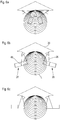
- a situation in which a small diameter log is grasped at one axial end area of feed means journalled on vertically pivoting arms,
- Fig. 5b
- a situation in which a medium diameter log is grasped at a center area of feed means journalled on vertically pivoting arms,
- Fig. 5c
- a situation in which a big diameter log is grasped at an opposite axial end area of feed means journalled on vertically pivoting arms,
- Fig. 6a
- a situation in which a small diameter log is grasped at one axial end area of feed means journalled on horizontally pivoting arms,
- Fig. 6b
- a situation in which a medium diameter log is grasped at a center area of feed means journalled on horizontally pivoting arms, and
- Fig. 6c
- a situation in which a big diameter log is grasped at an opposite axial end area of feed means journalled on horizontally pivoting arms.
- A
log processing head 10 shown infigure 1 contains among others aframe 12, asuspension system 14, movable top andbottom knives top knife 20, a bottom sawunit 22, a measuringunit 24, feedarms 26 and feed means 28. - The
log processing head 10 may be used to grasp a tree, cut it from its root, delimb and debark it and cut it into calculated lengths. As an alternative, thelog processing head 10 picks one or more logs lying on a pile, delimbs and/or debarks them and cuts them to length. Thelog processing head 10 may be attached to a purpose built vehicle like a forest harvester or to an excavator. Such heads are known e.g. from WARATAH and John Deere. - The
frame 12 has acenter beam 30 and is made as a welded structure, to which all afore mentioned and additional components are attached by welding, bolting, bearings etc. In an upright position as shown infigure 1 , which is a position, in which a tree is grasped before and during cutting, theframe 12 and thecenter beam 30 extend substantially vertically. In about the center - seen in the shown vertical orientation - thecenter beam 30 is connected to thesuspension system 14 and at its top region the fixtop knife 20 is fastened. At the bottom thecenter beam 30 is connected to asaw box 32 for the bottom sawunit 22, at the lateral upper and lower right andleft side bearings 34 with a vertical bearing axis are provided for the top andbottom knives unit 24 and between the top andbottom knives bearings 42 exist for thefeed arms 26. Finally and not described, valves, hoses, electrical lines, covers etc. are retained by theframe 12. Of course there is a big variety of log processing heads 10 with fewer knives, with a bottom and a top saw unit, with totally different measuring units, etc. which all are included in this description, unless something is expressively excluded. - The
suspension system 14 comprises an invertedU-shaped suspension structure 36, a so-calledrotator 38 and alink 40. Again, there are other versions ofsuspension structures 36, like those being connected to the rear of theframe 12, rather than to the side. Therotator 38 constitutes a driven rotation means between thesuspension structure 36 and alink 40, which is to be connected to an un-shown boom of a forest harvester, an excavator or similar. Therotator 38 and thelink 40 form an universal joint, which allows thelog processing head 10 to pivot in two directions in addition to the rotation about a vertical axis. For the sake of simplicity no tilt hydraulic motors are shown, which are connected to theframe 12 with one end and to thesuspension structure 36 with the other end and which are able to tilt theframe 12 from a shown upright harvesting position into a horizontal processing position, in which a log L is moved by the feed means 28 along thecenter beam 30. -
Top knives 16 andbottom knives 18 are connected to the frame inbearings 34 to pivot horizontally when looking to the upright position infigure 1 . The shape of theknives center beam 30. Theknives knives knives - The fix
top knife 20 cuts off the branches at the side of the log L facing thecenter beam 30, since there themovable knives knife 20 is called fix, it can also be mounted flexible to adjust to irregularities of the log L. The fixtop knife 20 also shears of the bark from the log. - The bottom saw
unit 24 is formed as a chain saw, which can pivot parallel to theknives - When the bottom saw
unit 24 is in its non-operative position, it is covered by thesaw box 32. Instead of a chain saw, also a clamping knife or a rotating saw blade could be used. - The measuring
unit 24 is provided to measure the advancement of the log L along thecenter beam 30. This may happen by means of a wheel and a rotation sensor as shown or by a contact less sensor or any other means. - Each
feed arm 26 is connected to theframe 12 by means of abearing 42 and is moved by means of an un-shown, but well known hydraulic cylinder. In thelog processing head 10 shown infigure 1 and5a to 5c the pivot axis of thebearing 42 extends perpendicular to thecenter beam 30 and parallel to the rotation axis of the feed means 28. This is typically the case, if only two feed means 28 are provided. In alog processing head 10 illustrated infigures 6a to 6c the pivot axis extends parallel to the longitudinal axis of thecenter beam 30, which often is the case, when thelog processing head 10 has three or four feed means 28. On each feed arm 26 a hydraulic motor is provided with an output shaft having a hub for receiving the feed means 28. - Feed means 28 are used for two purposes, namely to transport the log L in the longitudinal direction of the
center beam 30, but also to rotate the log L during this longitudinal movement. The latter rotational movement is especially important for debarking. The rotation brings the entire 360 degree circumference in contact with knives and stips of the strands of bark, which is particularly critical at Eucalyptus. Various kinds of feed means 28 are known, like that of pure feed rolls, which form the basis of the ongoing description. Other kinds comprise a steel structure on the outer side of which a rubber shell is mounted, which again carries chains. Yet another variety has parallel runs of chains with connecting rungs slung around two distant wheels, at least one of them being driven. In each case the driven feed means 28 has a radially extending not shown flange or spoke, which is bolted to the aforesaid hub of the hydraulic motor on thefeed arms 26 for transferring the rotational movement. - According to the following description the feed means 28 is a
carrier 44 provided on the radially outer circumference of the hub or spoke, and which in this case is a steel shell, like a part of a strong tube.Said carrier 44 has a certain axial extension like 250 mm as to be seen in all the figures, so that it has a considerable area of contact with the log L. As it becomes apparent infigures 5a - 6c said area of contact moves axially on thecarrier 44 depending on the diameter of the log L, since the log L slides along thecenter beam 30 and the fixtop knife 20, which location is fix, whereas thefeed arms 26 pivot to accommodate to the diameter of the log L and thus change the area of contact.Elevations 46 are provided, which are either an integral part of or bolted or welded to thecarrier 44. Theseelevations 46 may be of many different kinds and cross sections, which vary depending on the breed of the log L to be handled, its condition etc. but all in all they shall provide for sufficient grip between the feed means 28 and the log L in order to move it longitudinally and tangentially. The kind ofelevations 46 also has an effect on the aggressiveness of said grip and the marks the feed means 28 leaves on the log L. All contact points of anelevation 46 follow a line and all the lines are parallel to each other, irrespective, whether they are shaped as continuous metals strip as shown or separate spikes following a certain pattern.Elevations 46 as such are known. - As it is shown in
figure 2 , theelevations 46 do neither follow an axial direction or a radial/tangential direction only, but are inclined under an angle alpha (α) with respect to therotation axis 48 of the feed means 28, which inclination results in an axial and a tangential component.Figures 3 and 4 , which are a roll-up of the circumference of thecarrier 44 show, that angle alpha varies along the axial position of the feed means 28 and at one side is pretty flat, but on the opposite side it is pretty steep. To the contrary in ordinary feed means the angle may be constant at 38 degrees. The difference between the feed means 28 infigures 3 and 4 is, that infigure 3 after a certain progression the angle alpha does not get steeper after about the half of the axial dimension, whereas infigure 4 the angle alpha grows continuously along the entire width of the feed means 28. According tofigures 5a to 6c the area with the flat angle alpha, see complementary angle "A" infigure 5a , is determined for logs L or log portions of a small diameter and is about 5 to 30 degrees with respect to therotation axis 48; the area of medium angle alpha, see complimentary angle "B" infigure 5b , is for the medium diameter log L and is about 20 to 60 degrees with respect to therotation axis 48; and the area of the biggest angle, see complimentary angle "C" infigure 5c , is determined for biggest diameter logs L and is about 45 to 90 degrees with respect to therotation axis 48. Due to the varying angles alpha and thus also the changes of the axial and radial/tangential components of the angle at each point along the line of elevations 46 a bigger diameter log L will be rotated more than a small diameter log L. - A
log processing head 10 with feed means 28 according tofigures 6a - 6c typically has three or four feed means 28 - one or two inner ones retained in openings in thecenter beam 30 and one on eachfeed arm 26. The area of contact would move on the feed means 28 on thefeed arms 26. On the inner center feed means 28 it would be possible to have a "neutral" elevation pattern, which does not obstruct the forward and rotational movement, or to have one or two center feed means 28 similar to those on thefeed arms 26, which are moved axially to bring areas of differently inclinedelevations 46 in contact with the log L. - While the
carrier 44 shown in the figures is of one piece over the entire axial length, it would also be possible to have several, like 4 to 6 carrier portions of shorter axial dimensions than acomplete carrier 44, which portions are assembled along therotation axis 48 and connected to each other as a stack. Each such carrier portion could have the same inclined elevation(s) 46 and the different angles along a line would be achieved by a tangential offset between the carrier portions.
Claims (10)
- Feed means (28) with a cylindrical carrier (44) and elevations (46) on its circumference, whereas the elevations (46) follow parallel lines oriented under a progressing angle alpha with respect to the rotation axis (48) of the feed means (28).
- Feed means according to claim 1, whereas the angle alpha is continuously progressive.
- Feed means according to claim 1 or 2, whereas the progression is linear.
- Feed means according to one or more of the preceding claims, whereas the elevations (46) are welded, bolted, casted, vulcanized or embossed onto or into the carrier (44).
- Feed means according to one or more of the preceding claims 1 to 3, whereas the carrier (44) is formed like a rim type metal cylinder, a chain running over idler and drive wheels, a rubber cylinder, or a series of mainly radially extending, cylindrical carrier portions assembled along an axle and connected to each other.
- Feed means according to claim 5, whereas the carrier portions are of the same design but tangentially offset relative to a common rotation axis (48).
- Feed means according to one or more of the previous claims, whereas the elevations (46) extend over part of the axial extension of the feed means (28) only.
- Feed means according to one or more of the previous claims, whereas the angle ranges from 5 to 90 degrees on a carrier (44) with a diameter between 500 and 600 mm.
- Log processing head, in particular a harvester head, having a frame (12), two pivoting feed arms (26) and driven feed means (28) according to one or more of the preceding claims each of latter journalled on a feed arm (26), whereas a center beam (30) of the frame (12) provides for guidance of the log L between the feed means (28).
- Log processing head according to claim 9, whereas the feed arms (26) are pivoting about axes in planes parallel or perpendicular to a log feeding axis.
Priority Applications (1)
| Application Number | Priority Date | Filing Date | Title |
|---|---|---|---|
| PL17151122T PL3202253T3 (en) | 2016-02-04 | 2017-01-12 | Feed means and log processing head |
Applications Claiming Priority (1)
| Application Number | Priority Date | Filing Date | Title |
|---|---|---|---|
| FI20165079A FI20165079A7 (en) | 2016-02-04 | 2016-02-04 | Feed means and log processing head |
Publications (2)
| Publication Number | Publication Date |
|---|---|
| EP3202253A1 true EP3202253A1 (en) | 2017-08-09 |
| EP3202253B1 EP3202253B1 (en) | 2020-01-29 |
Family
ID=57821809
Family Applications (1)
| Application Number | Title | Priority Date | Filing Date |
|---|---|---|---|
| EP17151122.3A Active EP3202253B1 (en) | 2016-02-04 | 2017-01-12 | Feed means and log processing head |
Country Status (4)
| Country | Link |
|---|---|
| EP (1) | EP3202253B1 (en) |
| BR (1) | BR102016030551B1 (en) |
| FI (1) | FI20165079A7 (en) |
| PL (1) | PL3202253T3 (en) |
Citations (4)
| Publication number | Priority date | Publication date | Assignee | Title |
|---|---|---|---|---|
| WO2006100340A1 (en) | 2005-03-22 | 2006-09-28 | Lako Oy | Wood harvesting method and apparatus |
| WO2007069913A1 (en) * | 2005-12-13 | 2007-06-21 | Waratah Nz Limited | A blade |
| AU2009208111A1 (en) * | 2008-08-25 | 2010-03-11 | Waratah Om Oy | A feed roll for a harvester head and a method for manufacturing a feed roll |
| EP2700300A1 (en) * | 2012-08-24 | 2014-02-26 | Waratah OM Oy | Feed wheel of a wood handling unit and a feed wheel assembly |
-
2016
- 2016-02-04 FI FI20165079A patent/FI20165079A7/en not_active Application Discontinuation
- 2016-12-26 BR BR102016030551-9A patent/BR102016030551B1/en active IP Right Grant
-
2017
- 2017-01-12 PL PL17151122T patent/PL3202253T3/en unknown
- 2017-01-12 EP EP17151122.3A patent/EP3202253B1/en active Active
Patent Citations (4)
| Publication number | Priority date | Publication date | Assignee | Title |
|---|---|---|---|---|
| WO2006100340A1 (en) | 2005-03-22 | 2006-09-28 | Lako Oy | Wood harvesting method and apparatus |
| WO2007069913A1 (en) * | 2005-12-13 | 2007-06-21 | Waratah Nz Limited | A blade |
| AU2009208111A1 (en) * | 2008-08-25 | 2010-03-11 | Waratah Om Oy | A feed roll for a harvester head and a method for manufacturing a feed roll |
| EP2700300A1 (en) * | 2012-08-24 | 2014-02-26 | Waratah OM Oy | Feed wheel of a wood handling unit and a feed wheel assembly |
Also Published As
| Publication number | Publication date |
|---|---|
| FI20165079A (en) | 2017-08-05 |
| BR102016030551B1 (en) | 2021-11-23 |
| PL3202253T3 (en) | 2020-08-10 |
| FI20165079A7 (en) | 2017-08-05 |
| EP3202253B1 (en) | 2020-01-29 |
| BR102016030551A2 (en) | 2017-08-08 |
Similar Documents
| Publication | Publication Date | Title |
|---|---|---|
| CN105979768B (en) | Equipment for delimbing standing trees | |
| US3981336A (en) | Tree harvester | |
| EP0428530B1 (en) | Forest harvester | |
| US9750198B2 (en) | Cutter apparatus | |
| JPH09509823A (en) | Cutting tool | |
| US12329061B2 (en) | Cutting device | |
| US4627227A (en) | Right-of-way tree line trimmer | |
| US10882051B1 (en) | Mulcher with improved cutting drum | |
| US4898221A (en) | Method for limbing, barking and chipping, and a device for utilization of the method | |
| AU645725B2 (en) | Tree cutting apparatus | |
| GB2056835A (en) | Crop crushing device | |
| EP4082877B1 (en) | Pneumatic vehicle tyre for forestry use | |
| EP3202253B1 (en) | Feed means and log processing head | |
| US6345651B1 (en) | Delimbing and cutting head of a harvesting machine | |
| US5524685A (en) | Debarking/delimbing apparatus | |
| KR102620926B1 (en) | Agricultural grass cutter with expansion variable structure | |
| CA1286329C (en) | Feeding device for producing a longitudinally directed relative movement between a tree stem and the device proper | |
| FI123056B (en) | Device and method of use in the clearing head of a forest clearing machine | |
| WO2014171865A1 (en) | Feed wheel arrangement, timber working head, crane and timber working machine | |
| AU2007200810A1 (en) | Cutting machine that can be used particularly in agriculture, arboriculture and viticulture | |
| US4344470A (en) | Delimbing apparatus | |
| EP1541009B1 (en) | A multi-blade pruning machine for pruning espalier vineyards | |
| FI90841B (en) | Blade guard for grubbing-up units | |
| CA1080584A (en) | Flailing machine for felled trees | |
| EP1866134A1 (en) | Wood harvesting method and apparatus |
Legal Events
| Date | Code | Title | Description |
|---|---|---|---|
| PUAI | Public reference made under article 153(3) epc to a published international application that has entered the european phase |
Free format text: ORIGINAL CODE: 0009012 |
|
| STAA | Information on the status of an ep patent application or granted ep patent |
Free format text: STATUS: THE APPLICATION HAS BEEN PUBLISHED |
|
| AK | Designated contracting states |
Kind code of ref document: A1 Designated state(s): AL AT BE BG CH CY CZ DE DK EE ES FI FR GB GR HR HU IE IS IT LI LT LU LV MC MK MT NL NO PL PT RO RS SE SI SK SM TR |
|
| AX | Request for extension of the european patent |
Extension state: BA ME |
|
| STAA | Information on the status of an ep patent application or granted ep patent |
Free format text: STATUS: REQUEST FOR EXAMINATION WAS MADE |
|
| 17P | Request for examination filed |
Effective date: 20180209 |
|
| RBV | Designated contracting states (corrected) |
Designated state(s): AL AT BE BG CH CY CZ DE DK EE ES FI FR GB GR HR HU IE IS IT LI LT LU LV MC MK MT NL NO PL PT RO RS SE SI SK SM TR |
|
| STAA | Information on the status of an ep patent application or granted ep patent |
Free format text: STATUS: EXAMINATION IS IN PROGRESS |
|
| 17Q | First examination report despatched |
Effective date: 20180627 |
|
| GRAP | Despatch of communication of intention to grant a patent |
Free format text: ORIGINAL CODE: EPIDOSNIGR1 |
|
| STAA | Information on the status of an ep patent application or granted ep patent |
Free format text: STATUS: GRANT OF PATENT IS INTENDED |
|
| INTG | Intention to grant announced |
Effective date: 20190917 |
|
| GRAS | Grant fee paid |
Free format text: ORIGINAL CODE: EPIDOSNIGR3 |
|
| GRAA | (expected) grant |
Free format text: ORIGINAL CODE: 0009210 |
|
| STAA | Information on the status of an ep patent application or granted ep patent |
Free format text: STATUS: THE PATENT HAS BEEN GRANTED |
|
| AK | Designated contracting states |
Kind code of ref document: B1 Designated state(s): AL AT BE BG CH CY CZ DE DK EE ES FI FR GB GR HR HU IE IS IT LI LT LU LV MC MK MT NL NO PL PT RO RS SE SI SK SM TR |
|
| REG | Reference to a national code |
Ref country code: GB Ref legal event code: FG4D |
|
| REG | Reference to a national code |
Ref country code: CH Ref legal event code: EP |
|
| REG | Reference to a national code |
Ref country code: AT Ref legal event code: REF Ref document number: 1227826 Country of ref document: AT Kind code of ref document: T Effective date: 20200215 |
|
| REG | Reference to a national code |
Ref country code: IE Ref legal event code: FG4D |
|
| REG | Reference to a national code |
Ref country code: DE Ref legal event code: R096 Ref document number: 602017011042 Country of ref document: DE |
|
| REG | Reference to a national code |
Ref country code: SE Ref legal event code: TRGR |
|
| REG | Reference to a national code |
Ref country code: FI Ref legal event code: FGE |
|
| REG | Reference to a national code |
Ref country code: NL Ref legal event code: MP Effective date: 20200129 |
|
| REG | Reference to a national code |
Ref country code: EE Ref legal event code: FG4A Ref document number: E019023 Country of ref document: EE Effective date: 20200427 |
|
| PG25 | Lapsed in a contracting state [announced via postgrant information from national office to epo] |
Ref country code: RS Free format text: LAPSE BECAUSE OF FAILURE TO SUBMIT A TRANSLATION OF THE DESCRIPTION OR TO PAY THE FEE WITHIN THE PRESCRIBED TIME-LIMIT Effective date: 20200129 Ref country code: NO Free format text: LAPSE BECAUSE OF FAILURE TO SUBMIT A TRANSLATION OF THE DESCRIPTION OR TO PAY THE FEE WITHIN THE PRESCRIBED TIME-LIMIT Effective date: 20200429 Ref country code: PT Free format text: LAPSE BECAUSE OF FAILURE TO SUBMIT A TRANSLATION OF THE DESCRIPTION OR TO PAY THE FEE WITHIN THE PRESCRIBED TIME-LIMIT Effective date: 20200621 |
|
| REG | Reference to a national code |
Ref country code: LT Ref legal event code: MG4D |
|
| PG25 | Lapsed in a contracting state [announced via postgrant information from national office to epo] |
Ref country code: BG Free format text: LAPSE BECAUSE OF FAILURE TO SUBMIT A TRANSLATION OF THE DESCRIPTION OR TO PAY THE FEE WITHIN THE PRESCRIBED TIME-LIMIT Effective date: 20200429 Ref country code: HR Free format text: LAPSE BECAUSE OF FAILURE TO SUBMIT A TRANSLATION OF THE DESCRIPTION OR TO PAY THE FEE WITHIN THE PRESCRIBED TIME-LIMIT Effective date: 20200129 Ref country code: LV Free format text: LAPSE BECAUSE OF FAILURE TO SUBMIT A TRANSLATION OF THE DESCRIPTION OR TO PAY THE FEE WITHIN THE PRESCRIBED TIME-LIMIT Effective date: 20200129 Ref country code: IS Free format text: LAPSE BECAUSE OF FAILURE TO SUBMIT A TRANSLATION OF THE DESCRIPTION OR TO PAY THE FEE WITHIN THE PRESCRIBED TIME-LIMIT Effective date: 20200529 Ref country code: GR Free format text: LAPSE BECAUSE OF FAILURE TO SUBMIT A TRANSLATION OF THE DESCRIPTION OR TO PAY THE FEE WITHIN THE PRESCRIBED TIME-LIMIT Effective date: 20200430 |
|
| PG25 | Lapsed in a contracting state [announced via postgrant information from national office to epo] |
Ref country code: NL Free format text: LAPSE BECAUSE OF FAILURE TO SUBMIT A TRANSLATION OF THE DESCRIPTION OR TO PAY THE FEE WITHIN THE PRESCRIBED TIME-LIMIT Effective date: 20200129 |
|
| PG25 | Lapsed in a contracting state [announced via postgrant information from national office to epo] |
Ref country code: SK Free format text: LAPSE BECAUSE OF FAILURE TO SUBMIT A TRANSLATION OF THE DESCRIPTION OR TO PAY THE FEE WITHIN THE PRESCRIBED TIME-LIMIT Effective date: 20200129 Ref country code: RO Free format text: LAPSE BECAUSE OF FAILURE TO SUBMIT A TRANSLATION OF THE DESCRIPTION OR TO PAY THE FEE WITHIN THE PRESCRIBED TIME-LIMIT Effective date: 20200129 Ref country code: CZ Free format text: LAPSE BECAUSE OF FAILURE TO SUBMIT A TRANSLATION OF THE DESCRIPTION OR TO PAY THE FEE WITHIN THE PRESCRIBED TIME-LIMIT Effective date: 20200129 Ref country code: ES Free format text: LAPSE BECAUSE OF FAILURE TO SUBMIT A TRANSLATION OF THE DESCRIPTION OR TO PAY THE FEE WITHIN THE PRESCRIBED TIME-LIMIT Effective date: 20200129 Ref country code: SM Free format text: LAPSE BECAUSE OF FAILURE TO SUBMIT A TRANSLATION OF THE DESCRIPTION OR TO PAY THE FEE WITHIN THE PRESCRIBED TIME-LIMIT Effective date: 20200129 Ref country code: DK Free format text: LAPSE BECAUSE OF FAILURE TO SUBMIT A TRANSLATION OF THE DESCRIPTION OR TO PAY THE FEE WITHIN THE PRESCRIBED TIME-LIMIT Effective date: 20200129 Ref country code: LT Free format text: LAPSE BECAUSE OF FAILURE TO SUBMIT A TRANSLATION OF THE DESCRIPTION OR TO PAY THE FEE WITHIN THE PRESCRIBED TIME-LIMIT Effective date: 20200129 |
|
| REG | Reference to a national code |
Ref country code: DE Ref legal event code: R097 Ref document number: 602017011042 Country of ref document: DE |
|
| REG | Reference to a national code |
Ref country code: AT Ref legal event code: MK05 Ref document number: 1227826 Country of ref document: AT Kind code of ref document: T Effective date: 20200129 |
|
| PLBE | No opposition filed within time limit |
Free format text: ORIGINAL CODE: 0009261 |
|
| STAA | Information on the status of an ep patent application or granted ep patent |
Free format text: STATUS: NO OPPOSITION FILED WITHIN TIME LIMIT |
|
| 26N | No opposition filed |
Effective date: 20201030 |
|
| PG25 | Lapsed in a contracting state [announced via postgrant information from national office to epo] |
Ref country code: AT Free format text: LAPSE BECAUSE OF FAILURE TO SUBMIT A TRANSLATION OF THE DESCRIPTION OR TO PAY THE FEE WITHIN THE PRESCRIBED TIME-LIMIT Effective date: 20200129 Ref country code: IT Free format text: LAPSE BECAUSE OF FAILURE TO SUBMIT A TRANSLATION OF THE DESCRIPTION OR TO PAY THE FEE WITHIN THE PRESCRIBED TIME-LIMIT Effective date: 20200129 |
|
| PG25 | Lapsed in a contracting state [announced via postgrant information from national office to epo] |
Ref country code: SI Free format text: LAPSE BECAUSE OF FAILURE TO SUBMIT A TRANSLATION OF THE DESCRIPTION OR TO PAY THE FEE WITHIN THE PRESCRIBED TIME-LIMIT Effective date: 20200129 |
|
| REG | Reference to a national code |
Ref country code: EE Ref legal event code: HC1A Ref document number: E019023 Country of ref document: EE |
|
| PG25 | Lapsed in a contracting state [announced via postgrant information from national office to epo] |
Ref country code: MC Free format text: LAPSE BECAUSE OF FAILURE TO SUBMIT A TRANSLATION OF THE DESCRIPTION OR TO PAY THE FEE WITHIN THE PRESCRIBED TIME-LIMIT Effective date: 20200129 |
|
| REG | Reference to a national code |
Ref country code: CH Ref legal event code: PL |
|
| GBPC | Gb: european patent ceased through non-payment of renewal fee |
Effective date: 20210112 |
|
| PG25 | Lapsed in a contracting state [announced via postgrant information from national office to epo] |
Ref country code: LU Free format text: LAPSE BECAUSE OF NON-PAYMENT OF DUE FEES Effective date: 20210112 |
|
| REG | Reference to a national code |
Ref country code: BE Ref legal event code: MM Effective date: 20210131 |
|
| PG25 | Lapsed in a contracting state [announced via postgrant information from national office to epo] |
Ref country code: FR Free format text: LAPSE BECAUSE OF NON-PAYMENT OF DUE FEES Effective date: 20210131 |
|
| PG25 | Lapsed in a contracting state [announced via postgrant information from national office to epo] |
Ref country code: CH Free format text: LAPSE BECAUSE OF NON-PAYMENT OF DUE FEES Effective date: 20210131 Ref country code: LI Free format text: LAPSE BECAUSE OF NON-PAYMENT OF DUE FEES Effective date: 20210131 Ref country code: GB Free format text: LAPSE BECAUSE OF NON-PAYMENT OF DUE FEES Effective date: 20210112 |
|
| PG25 | Lapsed in a contracting state [announced via postgrant information from national office to epo] |
Ref country code: IE Free format text: LAPSE BECAUSE OF NON-PAYMENT OF DUE FEES Effective date: 20210112 |
|
| PG25 | Lapsed in a contracting state [announced via postgrant information from national office to epo] |
Ref country code: BE Free format text: LAPSE BECAUSE OF NON-PAYMENT OF DUE FEES Effective date: 20210131 |
|
| PG25 | Lapsed in a contracting state [announced via postgrant information from national office to epo] |
Ref country code: HU Free format text: LAPSE BECAUSE OF FAILURE TO SUBMIT A TRANSLATION OF THE DESCRIPTION OR TO PAY THE FEE WITHIN THE PRESCRIBED TIME-LIMIT; INVALID AB INITIO Effective date: 20170112 |
|
| PG25 | Lapsed in a contracting state [announced via postgrant information from national office to epo] |
Ref country code: CY Free format text: LAPSE BECAUSE OF FAILURE TO SUBMIT A TRANSLATION OF THE DESCRIPTION OR TO PAY THE FEE WITHIN THE PRESCRIBED TIME-LIMIT Effective date: 20200129 |
|
| PG25 | Lapsed in a contracting state [announced via postgrant information from national office to epo] |
Ref country code: MK Free format text: LAPSE BECAUSE OF FAILURE TO SUBMIT A TRANSLATION OF THE DESCRIPTION OR TO PAY THE FEE WITHIN THE PRESCRIBED TIME-LIMIT Effective date: 20200129 |
|
| PG25 | Lapsed in a contracting state [announced via postgrant information from national office to epo] |
Ref country code: MT Free format text: LAPSE BECAUSE OF FAILURE TO SUBMIT A TRANSLATION OF THE DESCRIPTION OR TO PAY THE FEE WITHIN THE PRESCRIBED TIME-LIMIT Effective date: 20200129 |
|
| PG25 | Lapsed in a contracting state [announced via postgrant information from national office to epo] |
Ref country code: TR Free format text: LAPSE BECAUSE OF FAILURE TO SUBMIT A TRANSLATION OF THE DESCRIPTION OR TO PAY THE FEE WITHIN THE PRESCRIBED TIME-LIMIT Effective date: 20200129 |
|
| PGFP | Annual fee paid to national office [announced via postgrant information from national office to epo] |
Ref country code: PL Payment date: 20251218 Year of fee payment: 10 |
|
| PGFP | Annual fee paid to national office [announced via postgrant information from national office to epo] |
Ref country code: EE Payment date: 20251219 Year of fee payment: 10 |
|
| PGFP | Annual fee paid to national office [announced via postgrant information from national office to epo] |
Ref country code: SE Payment date: 20260127 Year of fee payment: 10 |
|
| PGFP | Annual fee paid to national office [announced via postgrant information from national office to epo] |
Ref country code: DE Payment date: 20251219 Year of fee payment: 10 |
|
| PGFP | Annual fee paid to national office [announced via postgrant information from national office to epo] |
Ref country code: FI Payment date: 20260126 Year of fee payment: 10 |