EP3201175B1 - Process for purifying astaxanthin - Google Patents
Process for purifying astaxanthin Download PDFInfo
- Publication number
- EP3201175B1 EP3201175B1 EP15775671.9A EP15775671A EP3201175B1 EP 3201175 B1 EP3201175 B1 EP 3201175B1 EP 15775671 A EP15775671 A EP 15775671A EP 3201175 B1 EP3201175 B1 EP 3201175B1
- Authority
- EP
- European Patent Office
- Prior art keywords
- xanthophyll
- suspension
- process according
- solvent
- astaxanthin
- Prior art date
- Legal status (The legal status is an assumption and is not a legal conclusion. Google has not performed a legal analysis and makes no representation as to the accuracy of the status listed.)
- Active
Links
Classifications
-
- C—CHEMISTRY; METALLURGY
- C07—ORGANIC CHEMISTRY
- C07C—ACYCLIC OR CARBOCYCLIC COMPOUNDS
- C07C403/00—Derivatives of cyclohexane or of a cyclohexene or of cyclohexadiene, having a side-chain containing an acyclic unsaturated part of at least four carbon atoms, this part being directly attached to the cyclohexane or cyclohexene or cyclohexadiene rings, e.g. vitamin A, beta-carotene, beta-ionone
- C07C403/24—Derivatives of cyclohexane or of a cyclohexene or of cyclohexadiene, having a side-chain containing an acyclic unsaturated part of at least four carbon atoms, this part being directly attached to the cyclohexane or cyclohexene or cyclohexadiene rings, e.g. vitamin A, beta-carotene, beta-ionone having side-chains substituted by six-membered non-aromatic rings, e.g. beta-carotene
-
- C—CHEMISTRY; METALLURGY
- C09—DYES; PAINTS; POLISHES; NATURAL RESINS; ADHESIVES; COMPOSITIONS NOT OTHERWISE PROVIDED FOR; APPLICATIONS OF MATERIALS NOT OTHERWISE PROVIDED FOR
- C09B—ORGANIC DYES OR CLOSELY-RELATED COMPOUNDS FOR PRODUCING DYES, e.g. PIGMENTS; MORDANTS; LAKES
- C09B61/00—Dyes of natural origin prepared from natural sources, e.g. vegetable sources
-
- C—CHEMISTRY; METALLURGY
- C09—DYES; PAINTS; POLISHES; NATURAL RESINS; ADHESIVES; COMPOSITIONS NOT OTHERWISE PROVIDED FOR; APPLICATIONS OF MATERIALS NOT OTHERWISE PROVIDED FOR
- C09B—ORGANIC DYES OR CLOSELY-RELATED COMPOUNDS FOR PRODUCING DYES, e.g. PIGMENTS; MORDANTS; LAKES
- C09B67/00—Influencing the physical, e.g. the dyeing or printing properties of dyestuffs without chemical reactions, e.g. by treating with solvents grinding or grinding assistants, coating of pigments or dyes; Process features in the making of dyestuff preparations; Dyestuff preparations of a special physical nature, e.g. tablets, films
- C09B67/0096—Purification; Precipitation; Filtration
-
- C—CHEMISTRY; METALLURGY
- C07—ORGANIC CHEMISTRY
- C07C—ACYCLIC OR CARBOCYCLIC COMPOUNDS
- C07C2601/00—Systems containing only non-condensed rings
- C07C2601/12—Systems containing only non-condensed rings with a six-membered ring
- C07C2601/16—Systems containing only non-condensed rings with a six-membered ring the ring being unsaturated
Definitions
- the present invention relates to a process for purifying the xanthophyll astaxanthin.
- Canthaxanthin ( ⁇ , ⁇ -carotene-4,4'-dione) and astaxanthin (3,3'-dihydroxy- ⁇ , ⁇ -carotene-4,4'-dione) are red carotenoid pigments from the group of the xanthophylls which are described by the formula below (in each case the all-trans isomer is shown).
- Astaxanthin in contrast to canthaxanthin, has a center of asymmetry in the 3- and 3'-position and can therefore be present as a diastereomeric mixture of the (3R,3'R)-, (3S,3'S)- and (3S,3'R)-isomers, as a racemate of the (3R,3'R)- and the (3S,3'S)-isomer or in the form of the pure isomers.
- Synthetic AXT is frequently a mixture of the diastereomers (3S,3'S), (3R,3'S) and (3R,3'R).
- AXT obtained from natural sources can, depending on the respective natural source, be present in virtually pure (3S, 3'S) or (3R, 3'R) form.
- enantiomerically pure astaxanthin is accessible by total synthesis.
- Astaxanthin and canthaxanthin are primarily used as feed component for various animals, in particular for salmon and trout.
- AXT has a vitamin-like activity acting as a result beneficially on the fertility and immune defense of the fish in breeding farms. Astaxanthin and canthaxanthin are permitted as feed additives to the fish food during the production of edible fish. Canthaxanthin and astaxanthin, however, are also used as food dyes, as nutriceuticals or cosmetics additives having antioxidant properties.
- AXT can protect the skin against the stress caused by UV radiation and acts in this function considerably more strongly than vitamin E. AXT supplements the protective action of sunscreen agents and cannot be washed off.
- AXT lowers the blood sugar level and improves various parameters of the metabolic syndrome.
- it leads to an increase in blood flow and of vascular tone.
- AXT appears to promote the formation of Connexin 43 and therefore has a chemoprotective action with respect to cancers (see A. L. Vine et al., Nutr. Cancer 52(1) (2005), 105-113 ).
- Astaxanthin can be obtained on an industrial scale from blood-rain alga (Haematococcus pluvialis) or obtained from the shells of crustacia. Astaxanthin is generally obtained by extraction by means of dichloromethane (see, e.g. CN 102106448 ).
- Astaxanthin and canthaxanthin have only low solubility in most organic solvents.
- the octanol-water partition coefficients log P (octanol/water) are in the same range:
- the log P of astaxanthin is 13,27 ( The EFSA Journal 2005, 291, p. 10 )
- the log P of canthaxanthin is 9,79 (FooDB data base, entry FDB015890) .
- their solubility in halogenated hydrocarbons such as dichloromethane or chloroform is adequate for many purposes.
- the synthetic production of astaxanthin proceeds, at least in the final step, in a halogenated hydrocarbon such as dichloromethane, dichloroethane, chlorobenzene, trichloromethane, tetrachloroethane, tetrachloroethene or trichloroethane.
- a halogenated hydrocarbon such as dichloromethane, dichloroethane, chlorobenzene, trichloromethane, tetrachloroethane, tetrachloroethene or trichloroethane.
- halogenated hydrocarbons such as dichloromethane, dichloroethane or trichloromethane are used in the extraction of astaxanthin from natural sources. Therefore, astaxanthin generally comprises significant amounts of halogenated hydrocarbon as contaminants, which cannot be removed with usual auxiliaries. Halogenated hydrocarbons, however, are of toxicological concern.
- halogenated hydrocarbons For many applications, in particular in those for pharmaceutical purposes, or for use in foods, strict limiting values with respect to halogenated hydrocarbons must be maintained. For instance, for example the content of dichloromethane in astaxanthin or canthaxanthin for many applications must not exceed a value of 600 ppm. For other halogenated hydrocarbons, likewise strict limiting values apply. Despite their comparatively high volatility, halogenated hydrocarbon contaminants in astaxanthin and canthaxanthin may be removed only with difficulty.
- astaxanthin is predominantly produced by reacting [5-(4-hydroxy-2,6,6-trimethyl-3-oxo-1-cyclohexyl)-3-methyl-2,4-pentadienyl]triphenylphosphonium bromide or a corresponding Horner-Emmons derivative with 2,7-dimethyloctatrienedial, C10-dialdehyde, wherein triphenylphosphine oxide or, in the case of the Horner-Wadsworth-Emmons variant, the corresponding phosphonate is formed.
- astaxanthin by reacting a 3-[5-(arylsulfonyl)-4-methylpenta-1,3-dienyl]-6-hydroxy-2,4,4-trimethyl-cyclohex-2-en-1-one with C10-dialdehyde in the context of a Julia-olefination, is likewise known in the literature (see G. Britton et al. loc. cit., p. 12 and pp. 103 ff.). Further contaminants might be canthaxanthin isomers, echinenone and other colored carotenoid impurities. Canthaxanthin isomers are e.g. 9Z-Canthaxanthin and 13Z-Canthaxanthin. Other colored carotenoid impurities are e.g. ⁇ -Carotene and ⁇ -Carotene derived degradation products with ⁇ max in the range from 400 to 700 nm.
- EP1253131A1 discloses a process for the preparation of an xanthophyll through the oxidation of a carotenoid in the presence of hydrogen peroxide and an iodine-containing compound.
- the process of the invention applies to the oxidation of ⁇ -carotene to produce canthaxanthin, and to the oxidation of lutein or zeaxanthin to produce astaxanthin.
- US7329789B1 discloses an extraction/enrichment process of carotenoids from a mixture containing such compounds which involves the use of liquefied or supercritical solvents to extract lipids and carotenoids from carotenoid-containing substrates.
- the extraction process can also be performed in two steps in which lipids and carotenoids are first removed from a carotenoid-containing substrate with a liquefied or supercritical solvent, and subsequently a liquefied or supercritical gas is used to separate the lipids from the carotenoids.
- the process is also applicable to yield an organic solvent-free product from a carotenoid-containing source that was first extracted using an organic solvent.
- WO0181301A2 discloses a method for preparing astaxanthin from zeaxanthin. Specifically, the present invention provides a method for said conversion using a halogenating agent with the salt of chloric or bromic acid in an inert solvent.
- EP0908449A1 discloses a process for preparing carotenoids by the Wittig reaction, wherein the Wittig reaction is carried out in a polar reaction medium in such a way that neither all the reactants nor the carotenoid thus prepared are significantly dissolved in the reaction medium.
- the present invention relates to a process for purifying the xanthophyll astaxanthin, comprising
- the process is linked to a number of advantages. For instance, it is possible in an efficient manner to lower the content of halogenated hydrocarbons in the xanthophyll astaxanthin to the required toxicological threshold values or below. This reduction succeeds advantageously with good recovery rates of purified xanthophyll. In addition, at the same time, an efficient reduction of the content of organophosphorus compounds is observed.
- C n -C m indicates the number of carbon atoms which a molecule denoted therewith, or a radical denoted therewith, can have.
- C 1 -C 6 alkyl is a linear or branched, saturated aliphatic hydrocarbon radical having 1 to 6 carbon atoms, for example one of the radicals cited under C 1 -C 4 alkyl, and also n-pentyl, 2-pentyl, 2-methyl-1-butyl, 3-methyl-1-butyl, 2-methyl-2-butyl, 3-methyl-2-butyl, 2,2-dimethylpropyl, n-hexyl, 2-hexyl, 2-methyl-1-pentyl, 3-methyl-1-pentyl, 2-methyl-2-pentyl, 2-methyl-3-pentyl, 3-methyl-3-pentyl, 2,2-dimethylbutyl, 2,3-dimethylbutyl or 3,3-dimethylbutyl.
- Cycloalkyl is a saturated alicyclic hydrocarbon radical having 3 to 6 carbon atoms, for example cyclopropyl, cyclobutyl, cyclopentyl or cyclohexyl.
- Linear C 4 -C 6 alkanediyl is a saturated unbranched bivalent hydrocarbon radical having 4 to 6 carbon atoms, for example 1,4-butanediyl, 1,5-pentanediyl or 1,6-hexanediyl.
- aryl is phenyl that can be substituted by 1, 2 or 3 identical or different radicals which are selected from C 1 -C 4 alkyl and especially from methyl and ethyl.
- the xanthophyll i.e. astaxanthin
- R 1 and R 2 Preference is given to those ketones where R 1 and R 2 and, in particular in combination, have the following meanings:
- ketones of the formula I are acetone (2-propanone), methyl ethyl ketone (MEK; 2-butanone), diethyl ketone (DEK; 3-pentanone), methyl isobutyl ketone (MIBK), 2-pentanone, 3-methylbutanone, cyclopentanone and cyclohexanone.
- the ketone or the ketones of the formula (I) make up at least 95 % by weight, in particular at least 99 % by weight, of the organic solvents used for the suspension.
- the organic solvent or solvent mixture used to produce the suspension comprises substantially no halogenated alkanes, in particular less than 1000 ppm, and especially less than 500 ppm, of halogenated alkanes. These apply correspondingly to the phosphorus contaminants.
- the organic solvent or solvent mixture used to produce the suspension comprises no, or only small amounts of less than 1 % by weight, of organic solvents, which are different from the ketones of the formula (I).
- C 1 -C 4 alkanols such as methanol, ethanol, n-propanol or isopropanol
- cyclic and acyclic aliphatic ethers such as diethyl ether, methyl tert-butyl ether, diisopropyl ether, tetrahydrofuran or dioxane
- esters of aliphatic carboxylic acids such as ethyl acetates and also acetonitrile.
- the solvent of the formula (I) or solvent mixture thereof used to produce the suspension can comprise water or be substantially anhydrous.
- concentration of water in the solvent used to produce the suspension frequently will not exceed 20 % by weight, and especially will not exceed 10 % by weight.
- a solvent of the formula (I), or a solvent mixture thereof is used which comprises less than 2 % by weight of water.
- acetone is used as sole solvent of the formula (I), or a solvent mixture of solvents of the formula (I) is used which comprises at least 80 % by weight, in particular at least 90 % by weight, acetone and up to 20 % by weight, in particular up to 10 % by weight, of a solvent of the formula (I) that is different from acetone, wherein the solvent of the formula (I) that is different from acetone is selected, in particular, from ketones of the formula (I), where R 1 is methyl or ethyl, and R 2 is selected from C2-C4 alkyl.
- the suspension preferably has a concentration of the xanthophyll astaxanthin in the range from 2 to 50 % by weight, in particular in the range from 5 to 40 % by weight, and especially in the range from 10 to 20 % by weight, in each case based on the total weight of the suspension.
- the expression "at elevated temperature” means at a temperature of at least 80 °C and especially at least 90 °C.
- the suspension of the xanthophyll is preferably treated at a temperature in the range from 80 to 150 °C, in particular in the range from 80 to 120 °C, especially in the range from 90 to 110 °C.
- the treatment can be carried out unpressurized or under pressure, wherein the pressure in the treatment vessel will preferably not exceed 10 bar.
- the treatment proceeds at the inherent pressure of the solvent which is established in a closed treatment vessel at the treatment temperature.
- the solvent tor solvent mixture is removed by distillation and replaced by fresh solvent of the formula (I).
- 5 to 90 % by weight of the solvent or solvent mixture can be distilled off and replaced by fresh solvent.
- the quantitative ratio of solvent distilled off to fresh solvent can be varied, wherein, preferably, no more fresh solvent is added and corresponds to the amount of solvent distilled off.
- the amount of fresh solvent added can be less than the amount of solvent distilled off, in order in this manner to concentrate the suspension.
- the ratio of solvent distilled off to freshly added solvent is then in the range from 1 : 1 to 10 : 1.
- the treatment of the suspension at elevated temperature proceeds, preferably, with mixing or agitation of the suspension, for example by shaking or stirring the suspension.
- the treatment of the suspension at elevated temperature can be carried out discontinuously in the batch mode or semi-batch mode, or continuously. Devices suitable therefor are known to those skilled in the art.
- the treatment usually proceeds in a reaction kettle which can be equipped with means for mixing the suspension, for example stirrer or circulation pump.
- the continuous treatment can be carried out in a manner known per se in stirred-tank cascades or tubular reactors.
- the treatment time i.e. the time of action of the ketone or ketone mixture at the elevated temperature which is necessary for a depletion of the contaminant(s) under the desired threshold value or values of course depends on the concentration of the contaminant in the xanthophyll, the type of contaminant, the permissible toxicological threshold value and the temperature of the treatment.
- the required time can be determined by serial experiments or by sampling.
- the treatment time will generally be at least 1 h.
- the upper limit of the treatment time is generally determined by economic factors and can, if desired, also be up to several days or a week.
- the entire treatment time is at least 6 h, in particular at least 12 h, and especially at least 24 h and is, for example, in the range from 6 to 144 h, in particular in the range from 12 to 120 h, and especially in the range from 24 to 96 h.
- the xanthophyll is separated off, i.e. the astaxanthin, from the solvent mixture.
- the separating off process proceeds naturally by a solid-liquid separation in a manner known per se, for example by a filtration or centrifugation, or a combination of these measures.
- it has proven useful to carry out the solid-liquid separation at low temperatures, preferably at temperatures of a maximum of 20 °C, in particular a maximum of 10 °C, especially a maximum of 0 °C, e.g. at a temperature in the range from -20 to +20 °C, in particular in the range from -10 to +10 °C, especially in the range from -10 to 0 °C.
- the suspension will preferably be cooled before the solid-liquid separation is carried out, to a temperature of a maximum of 20 °C, in particular a maximum of 10 °C, in particular a maximum of 0 °C.
- the temperature limit to which the suspension is cooled will usually not exceed -20 °C, in particular -10 °C.
- the purified xanthophyll, i.e. astaxanthin, arising in the solid-liquid separation can be washed with fresh solvent of the formula (I) to remove adhering solvent residues.
- the washing proceeds at a temperature in the range from -20 to +20 °C, in particular in the range from -10 to +10 °C, especially in the range from -10 to 0 °C.
- the amount of solvent of the formula (I) used for the washing will not make up more than 10 parts by weight, e.g. 1 to 10 parts by weight, in particular 3 to 5 parts by weight, relative to 1 part by weight of xanthophyll.
- the purified xanthophyll, i.e. astaxanthin, arising in the solid-liquid separation can then be dried and confected.
- the drying proceeds in a manner known per se, preferably in a nitrogen stream or at reduced pressure, wherein, preferably, a temperature in the range from 20 to 100 °C is used for the drying.
- the purified xanthophyll, i.e. astaxanthin, occurring in the solid-liquid separation can also again be suspended in the solvent of the formula (I) or mixture of solvents of the formula (I) and the suspension can again be subjected to a treatment at elevated temperature.
- the process according to the invention can accordingly comprise one, or preferably a plurality of, treatment cycles.
- a treatment cycle is taken to mean treatment of the suspension in the solvent or solvents of the formula (I) and the subsequent solid-liquid separation of the xanthophyll.
- the treatment comprises at least 2, in particular at least 3, treatment cycles, e.g. 2 to 6 cycles, in particular 3 to 5 cycles.
- the respective cycle will be carried out in the above described manner.
- the conditions under which the treatment cycles are carried out correspond to the above described conditions. However, it is not required that the conditions of successive cycles are identical. Rather, the conditions employed in the respective cycles such as treatment time, temperature, pressure, concentration, solvent used, solid-liquid separation etc., can be varied. Preferably, with respect to the parameters temperature, pressure, concentration, solvent used, and solid-liquid separation, the conditions cited above as preferred can be employed.
- the treatment time of a single cycle is selected in such a manner that the total time of all treatment cycles is at least 6 h, in particular at least 12 h, and especially at least 24 h, and is, for example, in the range from 6 to 144 h, in particular in the range from 12 to 120 h, and especially in the range from 24 to 96 h.
- the treatment time of one cycle is preferably in the range from 1 to 48 h, in particular in the range from 6 to 36 h, and especially in the range from 12 to 30 h.
- first a suspension of the xanthophyll, i.e. the astaxanthin, will be treated at elevated temperature in one or more cycles, e.g. 1, 2, 3 or 4 cycles, in a ketone of the formula (I), where R 1 is methyl or ethyl, and R 2 is C 2 -C 4 alkyl, e.g. in diethyl ketone, methyl isobutyl ketone or methyl ethyl ketone, and the xanthophyll thus obtained will be treated with acetone in one or more cycles, preferably in 1 or 2 cycles.
- a ketone of the formula (I) where R 1 is methyl or ethyl
- R 2 is C 2 -C 4 alkyl
- the xanthophyll, i.e. astaxanthin, that is to be purified and is used in the process according to the invention of course comprises at least one amount that is to be depleted in an amount which exceeds the limiting value or threshold value desired or demanded for the desired application.
- the xanthophyll i.e. astaxanthin
- the xanthophyll that is to be purified and is used in the process according to the invention generally comprises at least one halogenated hydrocarbon, in particular one or more chlorinated hydrocarbons such as dichloromethane, dichloroethane, chlorobenzene, trichloromethane, trichloroethane, tetrachloroethane or tetrachloroethene.
- halogenated hydrocarbon in particular one or more chlorinated hydrocarbons such as dichloromethane, dichloroethane, chlorobenzene, trichloromethane, trichloroethane, tetrachloroethane or tetrachloroethene is frequently at least 500 ppm, in particular at least 1000 ppm, especially at least 1500 ppm, e.g. 1000 to 10 000 ppm, or 1500 to 5000 ppm.
- the xanthophyll that is to be purified and is used in the process according to the invention can be a synthetic xanthophyll or a xanthophyll from natural sources.
- it is a synthetic xanthophyll, in particular a xanthophyll, in the synthesis of which, in particular in the last stage of the synthesis, a Wittig reaction or Horner-Wadsworth-Emmons reaction or a Julia reaction is carried out.
- a xanthophyll produced in this manner generally comprises organic phosphorus compounds such as triphenylphosphine or triphenylphosphine oxide, if the synthesis comprises a Wittig reaction or Horner-Wadsworth-Emmons reaction.
- an astaxanthin is used which was produced by Wittig reaction of a [5-(4-hydroxy-2,6,6-trimethyl-3-oxo-1-cyclohexyl)-3-methyl-2,4-pentadienyl]triphenylphosphonium salt, in particular of the bromide, with 2,7-dimethyloctatrienedial.
- Such an astaxanthin comprises production-related triphenylphosphine and/or triphenylphosphine oxide.
- an astaxanthin is used which was produced by Julia reaction of a 3-[5-(arylsulfonyl)-4-methylpenta-1,3-dienyl]-6-hydroxy-2,4,4-trimethylcyclohex-2-en-1-one with 2,7-dimethyloctatrienedial.
- the xanthophyll that is to be purified comprises, in particular, one or more organic phosphorus compounds, in particular triphenylphosphine and/or triphenylphosphine oxide.
- the phosphorus content in such a xanthophyll is generally at least 20 ppm, frequently at least 50 ppm, and can be lowered by the process according to the invention to a value below 20 ppm, in particular below 10 ppm.
- the phosphorus content cited here is the content based on elemental phosphorus.
- xanthophyll that is to be purified contains at least one impurity selected from canthaxanthin isomers, echinenone and/or other colored carotenoid impurities.
- Canthaxanthin isomers are e.g. 9Z-Canthaxanthin and 13Z-Canthaxanthin.
- Other colored carotenoid impurities are e.g. ⁇ -Carotene and ⁇ -Carotene derived degradation products with ⁇ max in the range from 400 to 700 nm.
- the xanthophyll used for producing the suspension i.e. the astaxanthin
- the astaxanthin used in the process according to the invention is a synthetic diastereomer mixture, in particular a mixture of the diastereomers (3S,3'S), (3R,3'S) and (3R,3'R).
- the xanthophyll that is used to produce the suspension is generally a powder, preferably a powder having weight-average particle sizes determined by laser diffraction in the range from 5 to 100 ⁇ m.
- the powder has a d 90 value below 150 ⁇ m.
- the starting material used was an astaxanthin powder which had been produced by Wittig reaction of [5-(4-hydroxy-2,6,6-trimethyl-3-oxo-1-cyclohexyl)-3-methyl-2,4-pentadienyl]triphenylphosphonium bromide with 2,7-dimethyloctatrienedial according to the synthesis described in G. Britton, S. Liaanen-Jensen, H. Pfander (editors), Carotenoids, Vol. 2, Birkhäuser Verlag, Basle, 1996, pp. 283 ff . and the literature cited there.
- the solvent content in the astaxanthin was determined by means of headspace gas chromatography: for this purpose 50 mg of the astaxanthin were placed in a closed sample vessel. The sample vessel was heated to 80 °C and, after 1 h, a sample was withdrawn and analyzed by gas chromatography by means of a DB-624-capillary (30 m) from Agilent with a temperature gradient from 40 to 200 °C.
- the phosphorus content was determined by means of atomic absorption spectrometry.
- the contents of canthaxanthin isomers, echinenone, and other colored carotenoid impurities were determined by means of HPCL.
- Example 2 was repeated using a 15 % strength suspension of astaxanthin in diethyl ketone, wherein the suspension was heated for 4 days under reflux and each day 20 % of the diethyl ketone was distilled off and replaced by the same amount of fresh diethyl ketone. On the fourth day, the suspension was cooled to 0 °C and the solids were filtered off. The solids were washed three times with diethyl ketone at 0 °C and then dried in a nitrogen stream at 20 °C. The yield of pure astaxanthin was 85 to 90 %.
- the analytical data of the starting material and the treatment are summarized in the following table. Drying Headspace GC [ppm] Phosphorus [ppm] DEK DCM Starting material 0 2000 100 96 h, 102 °C N 2 stream 1600 400 10
- Example 7 Purification of canthaxanthin with acetone (not according to the invention)
- Example 8 Purification of canthaxanthin with diethylketone (not according to the invention)
- Example 9 Purification of canthaxanthin with isobutylmethylketone (not according to the invention)
Landscapes
- Chemical & Material Sciences (AREA)
- Organic Chemistry (AREA)
- Chemical Kinetics & Catalysis (AREA)
- Organic Low-Molecular-Weight Compounds And Preparation Thereof (AREA)
Description
- The present invention relates to a process for purifying the xanthophyll astaxanthin.
- Canthaxanthin (β,β-carotene-4,4'-dione) and astaxanthin (3,3'-dihydroxy-β,β-carotene-4,4'-dione) are red carotenoid pigments from the group of the xanthophylls which are described by the formula below (in each case the all-trans isomer is shown).
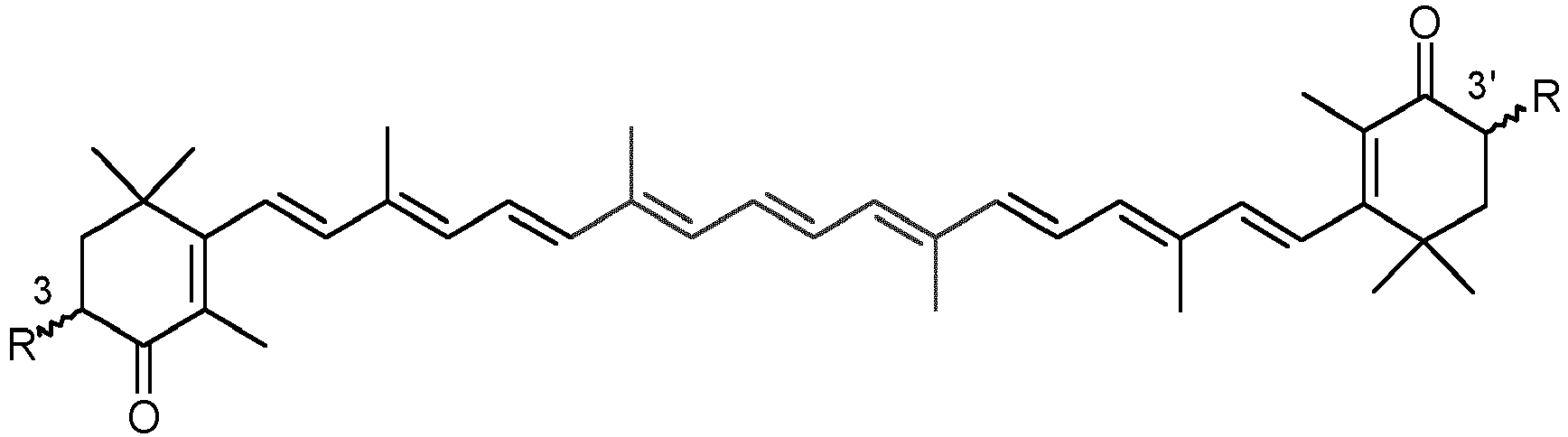
- R = OH: astaxanthin
- R = H: canthaxanthin
- Astaxanthin, hereinafter also AXT, in contrast to canthaxanthin, has a center of asymmetry in the 3- and 3'-position and can therefore be present as a diastereomeric mixture of the (3R,3'R)-, (3S,3'S)- and (3S,3'R)-isomers, as a racemate of the (3R,3'R)- and the (3S,3'S)-isomer or in the form of the pure isomers. Synthetic AXT is frequently a mixture of the diastereomers (3S,3'S), (3R,3'S) and (3R,3'R). AXT obtained from natural sources can, depending on the respective natural source, be present in virtually pure (3S, 3'S) or (3R, 3'R) form. Likewise, enantiomerically pure astaxanthin is accessible by total synthesis.
- Astaxanthin and canthaxanthin are primarily used as feed component for various animals, in particular for salmon and trout. Thus AXT has a vitamin-like activity acting as a result beneficially on the fertility and immune defense of the fish in breeding farms. Astaxanthin and canthaxanthin are permitted as feed additives to the fish food during the production of edible fish. Canthaxanthin and astaxanthin, however, are also used as food dyes, as nutriceuticals or cosmetics additives having antioxidant properties. AXT can protect the skin against the stress caused by UV radiation and acts in this function considerably more strongly than vitamin E. AXT supplements the protective action of sunscreen agents and cannot be washed off. Studies on animals permit the hypothesis that AXT lowers the blood sugar level and improves various parameters of the metabolic syndrome. In addition, in blood hypertension models, it leads to an increase in blood flow and of vascular tone. In addition, AXT appears to promote the formation of Connexin 43 and therefore has a chemoprotective action with respect to cancers (see A. L. Vine et al., Nutr. Cancer 52(1) (2005), 105-113).
- Astaxanthin can be obtained on an industrial scale from blood-rain alga (Haematococcus pluvialis) or obtained from the shells of crustacia. Astaxanthin is generally obtained by extraction by means of dichloromethane (see, e.g.
CN 102106448 ). - The production of synthetic astaxanthin, which is generally a mixture of the meso-(3R,3'S) form with the (3R,3'R)- and (3S,3'S) isomers is extensively described in the literature, e.g. in the monograph G. Britton, S. Liaanen-Jensen, H. Pfander (editors), Carotenoids, Vol. 2, Birkhäuser Verlag, Basle, 1996, in particular p. 11, pp. 267 ff. and pp. 281 ff. and literature cited there, in various textbooks, such as B. Schafer, Naturstoffe der chemischen Industrie [Natural materials of the chemical industry], Akademischer Verlag, Heidelberg, 2007, 427 ff. and literature cited there, and also in the patent literature, e.g.
EP 1197483 orEP 1285912 . Processes for producing canthaxanthin are described in the monograph G. Britton, S. Liaanen-Jensen, H. Pfander (editors), Carotenoids, Vol. 2, Birkhäuser Verlag, Basle, 1996, in particular p. 11, pp. 267 ff. and pp. 281 ff. and literature cited there, and also in Seyoung Choi et al., J. Org. Chem., 2005, 70 (8), p. 3328-333. - Astaxanthin and canthaxanthin have only low solubility in most organic solvents. The octanol-water partition coefficients log P (octanol/water) are in the same range: The log P of astaxanthin is 13,27 (The EFSA Journal 2005, 291, p. 10), the log P of canthaxanthin is 9,79 (FooDB data base, entry FDB015890) .In contrast, their solubility in halogenated hydrocarbons such as dichloromethane or chloroform is adequate for many purposes. Therefore, the synthetic production of astaxanthin proceeds, at least in the final step, in a halogenated hydrocarbon such as dichloromethane, dichloroethane, chlorobenzene, trichloromethane, tetrachloroethane, tetrachloroethene or trichloroethane. Generally, halogenated hydrocarbons such as dichloromethane, dichloroethane or trichloromethane are used in the extraction of astaxanthin from natural sources. Therefore, astaxanthin generally comprises significant amounts of halogenated hydrocarbon as contaminants, which cannot be removed with usual auxiliaries. Halogenated hydrocarbons, however, are of toxicological concern. For many applications, in particular in those for pharmaceutical purposes, or for use in foods, strict limiting values with respect to halogenated hydrocarbons must be maintained. For instance, for example the content of dichloromethane in astaxanthin or canthaxanthin for many applications must not exceed a value of 600 ppm. For other halogenated hydrocarbons, likewise strict limiting values apply. Despite their comparatively high volatility, halogenated hydrocarbon contaminants in astaxanthin and canthaxanthin may be removed only with difficulty.
- Further contaminants which occur, in particular, in the case of synthetic astaxanthin are organophosphorus compounds, in particular triphenylphosphine oxide, since many production methods comprise a Wittig reaction or a Horner-Emmons reaction. Thus, in industrial synthesis, astaxanthin is predominantly produced by reacting [5-(4-hydroxy-2,6,6-trimethyl-3-oxo-1-cyclohexyl)-3-methyl-2,4-pentadienyl]triphenylphosphonium bromide or a corresponding Horner-Emmons derivative with 2,7-dimethyloctatrienedial, C10-dialdehyde, wherein triphenylphosphine oxide or, in the case of the Horner-Wadsworth-Emmons variant, the corresponding phosphonate is formed. The production of astaxanthin by reacting a 3-[5-(arylsulfonyl)-4-methylpenta-1,3-dienyl]-6-hydroxy-2,4,4-trimethyl-cyclohex-2-en-1-one with C10-dialdehyde in the context of a Julia-olefination, is likewise known in the literature (see G. Britton et al. loc. cit., p. 12 and pp. 103 ff.). Further contaminants might be canthaxanthin isomers, echinenone and other colored carotenoid impurities. Canthaxanthin isomers are e.g. 9Z-Canthaxanthin and 13Z-Canthaxanthin. Other colored carotenoid impurities are e.g. β-Carotene and β-Carotene derived degradation products with λmax in the range from 400 to 700 nm.
- Comparable production processes are known for canthaxanthin, e.g. the reaction of [5-(2,6,6-trimethyl-3-oxo-1-cyclohexyl)-3-methyl-2,4-pentadienyl]triphenylphosphonium bromide or a corresponding Horner-Emmons derivative with C10-dialdehyde and also the reaction of 3-[5-(arylsulfonyl)-4-methylpenta-1,3-dienyl]-2,4,4-trimethylcyclohex-2-en-1-one with C10-dialdehyde in the context of a Julia-olefination. The production of canthaxanthin by reacting β-carotene with oxidizing agents (see, e.g.
DE 2534805 and literature cited there) is likewise known.
EP1253131A1 discloses a process for the preparation of an xanthophyll through the oxidation of a carotenoid in the presence of hydrogen peroxide and an iodine-containing compound. In particular, the process of the invention applies to the oxidation of β-carotene to produce canthaxanthin, and to the oxidation of lutein or zeaxanthin to produce astaxanthin. -
US7329789B1 discloses an extraction/enrichment process of carotenoids from a mixture containing such compounds which involves the use of liquefied or supercritical solvents to extract lipids and carotenoids from carotenoid-containing substrates. The extraction process can also be performed in two steps in which lipids and carotenoids are first removed from a carotenoid-containing substrate with a liquefied or supercritical solvent, and subsequently a liquefied or supercritical gas is used to separate the lipids from the carotenoids. The process is also applicable to yield an organic solvent-free product from a carotenoid-containing source that was first extracted using an organic solvent. -
WO0181301A2 -
EP0908449A1 discloses a process for preparing carotenoids by the Wittig reaction, wherein the Wittig reaction is carried out in a polar reaction medium in such a way that neither all the reactants nor the carotenoid thus prepared are significantly dissolved in the reaction medium. - Surprisingly, it has been found that, by treating a suspension of astaxanthin in a ketone solvent of the general formula (I) or of mixtures of ketones of the general formula (I) as defined hereinafter at elevated temperature, and subsequent separation of the xanthophyll from the ketone solvent by a solid-liquid separation, solvent contaminants, in particular the halogenated hydrocarbons, but also other organic solvents such as tetrahydrofuran, dioxane, ethyl acetate or acetonitrile can be efficiently removed. At the same time, in this manner, the depletion of phosphorus-comprising compounds such as triphenylphosphine, triphenylphosphine oxide also succeeds. This is surprising, since the inventors' own studies have found that it is not possible with many current solvents such as C1-C3-alkanols or supercritical CO2, to reduce the content of halogenated hydrocarbons in AXT to the required threshold values.
- Accordingly, the present invention relates to a process for purifying the xanthophyll astaxanthin, comprising
- a) suspending the xanthophyll in an organic solvent or solvent mixture,
- b) treating the suspension of the xanthophyll in the organic solvent or solvent mixture at elevated temperature, and
- c) subsequent separation off of the xanthophyll from the solvent by a solid-liquid separation,
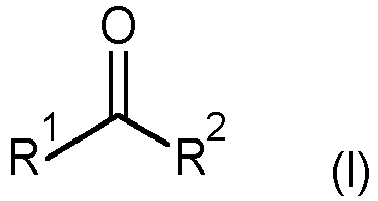
- where R1 is C1-C4 alkyl and R2 is selected from C1-C6 alkyl, C3-C8 cycloalkyl, phenyl and benzyl, wherein the phenyl rings in the two last-mentioned radicals are unsubstituted, or R1 and R2 together are linear C4-C6 alkanediyl, which can bear 1, 2 or 3 methyl groups as substituents,
- wherein the ketone of the formula (I) makes up at least 95 % by weight of the organic solvents used for suspending the xanthophyll, and
- wherein the suspension of the xanthophyll is treated at a temperature of at least 80 °C and for at least 1 h, and
- wherein the xanthophyll used comprises halogenated hydrocarbons and/or phosphorus compounds as contaminants which are depleted.
- The process described hereinafter is applicable not only to the E-isomers of the xanthophylls, but also to various Z-isomers.
- Preferred embodiments of the process according to the invention are presented in the claims of the present application.
- The process is linked to a number of advantages. For instance, it is possible in an efficient manner to lower the content of halogenated hydrocarbons in the xanthophyll astaxanthin to the required toxicological threshold values or below. This reduction succeeds advantageously with good recovery rates of purified xanthophyll. In addition, at the same time, an efficient reduction of the content of organophosphorus compounds is observed.
- Here and hereinafter, the prefix Cn-Cm indicates the number of carbon atoms which a molecule denoted therewith, or a radical denoted therewith, can have.
- For instance, C1-C4 alkyl is a linear or branched, saturated aliphatic hydrocarbon radical having 1 to 4 carbon atoms, for example methyl, ethyl, n-propyl, isopropyl, n-butyl, 2-butyl, isobutyl or tert-butyl (= 2-methyl-2-propyl). Correspondingly, C1-C6 alkyl is a linear or branched, saturated aliphatic hydrocarbon radical having 1 to 6 carbon atoms, for example one of the radicals cited under C1-C4 alkyl, and also n-pentyl, 2-pentyl, 2-methyl-1-butyl, 3-methyl-1-butyl, 2-methyl-2-butyl, 3-methyl-2-butyl, 2,2-dimethylpropyl, n-hexyl, 2-hexyl, 2-methyl-1-pentyl, 3-methyl-1-pentyl, 2-methyl-2-pentyl, 2-methyl-3-pentyl, 3-methyl-3-pentyl, 2,2-dimethylbutyl, 2,3-dimethylbutyl or 3,3-dimethylbutyl.
- C3-C6 Cycloalkyl is a saturated alicyclic hydrocarbon radical having 3 to 6 carbon atoms, for example cyclopropyl, cyclobutyl, cyclopentyl or cyclohexyl.
- Linear C4-C6 alkanediyl is a saturated unbranched bivalent hydrocarbon radical having 4 to 6 carbon atoms, for example 1,4-butanediyl, 1,5-pentanediyl or 1,6-hexanediyl.
- Where used, aryl is phenyl that can be substituted by 1, 2 or 3 identical or different radicals which are selected from C1-C4 alkyl and especially from methyl and ethyl.
- The descriptions given here and hereinafter on the conditions of purification and the solvents of the formula (I) used and also on embodiments of, and modes of carrying out, the process according to the invention apply to astaxanthin.
- In the process of the invention, the xanthophyll, i.e. astaxanthin, is suspended in a ketone of the formula (I) or mixture of ketones of the formula (I). Preference is given to those ketones where R1 and R2 and, in particular in combination, have the following meanings:
- R1
- is, in particular, methyl or ethyl
- R2
- is, in particular, C1-C4 alkyl, especially methyl or ethyl.
- Examples for ketones of the formula I are acetone (2-propanone), methyl ethyl ketone (MEK; 2-butanone), diethyl ketone (DEK; 3-pentanone), methyl isobutyl ketone (MIBK), 2-pentanone, 3-methylbutanone, cyclopentanone and cyclohexanone.
- The ketone or the ketones of the formula (I) make up at least 95 % by weight, in particular at least 99 % by weight, of the organic solvents used for the suspension. Preferably, the organic solvent or solvent mixture used to produce the suspension comprises substantially no halogenated alkanes, in particular less than 1000 ppm, and especially less than 500 ppm, of halogenated alkanes. These apply correspondingly to the phosphorus contaminants. Preferably, the organic solvent or solvent mixture used to produce the suspension comprises no, or only small amounts of less than 1 % by weight, of organic solvents, which are different from the ketones of the formula (I). These include C1-C4 alkanols such as methanol, ethanol, n-propanol or isopropanol, cyclic and acyclic aliphatic ethers such as diethyl ether, methyl tert-butyl ether, diisopropyl ether, tetrahydrofuran or dioxane, and in addition esters of aliphatic carboxylic acids such as ethyl acetates and also acetonitrile.
- The solvent of the formula (I) or solvent mixture thereof used to produce the suspension can comprise water or be substantially anhydrous. The concentration of water in the solvent used to produce the suspension, however, frequently will not exceed 20 % by weight, and especially will not exceed 10 % by weight. Frequently, to produce the suspension a solvent of the formula (I), or a solvent mixture thereof, is used which comprises less than 2 % by weight of water. However, it is also possible to use a solvent of the formula (I) or a solvent mixture thereof that comprises more than 2 % by weight of water.
- In a special embodiment, acetone is used as sole solvent of the formula (I), or a solvent mixture of solvents of the formula (I) is used which comprises at least 80 % by weight, in particular at least 90 % by weight, acetone and up to 20 % by weight, in particular up to 10 % by weight, of a solvent of the formula (I) that is different from acetone, wherein the solvent of the formula (I) that is different from acetone is selected, in particular, from ketones of the formula (I), where R1 is methyl or ethyl, and R2 is selected from C2-C4 alkyl.
- The suspension preferably has a concentration of the xanthophyll astaxanthin in the range from 2 to 50 % by weight, in particular in the range from 5 to 40 % by weight, and especially in the range from 10 to 20 % by weight, in each case based on the total weight of the suspension.
- Here and hereinafter, the expression "at elevated temperature" means at a temperature of at least 80 °C and especially at least 90 °C.
- In order to achieve an efficient depletion of the contaminants from the xanthophyll, the suspension of the xanthophyll is preferably treated at a temperature in the range from 80 to 150 °C, in particular in the range from 80 to 120 °C, especially in the range from 90 to 110 °C.
- The treatment can be carried out unpressurized or under pressure, wherein the pressure in the treatment vessel will preferably not exceed 10 bar. Preferably, the treatment proceeds at the inherent pressure of the solvent which is established in a closed treatment vessel at the treatment temperature.
- For depletion of the contaminants from the xanthophyll, it can be advantageous if, during the treatment, some of the solvent tor solvent mixture is removed by distillation and replaced by fresh solvent of the formula (I). For example, during the treatment, 5 to 90 % by weight of the solvent or solvent mixture can be distilled off and replaced by fresh solvent. The quantitative ratio of solvent distilled off to fresh solvent can be varied, wherein, preferably, no more fresh solvent is added and corresponds to the amount of solvent distilled off. Of course, the amount of fresh solvent added can be less than the amount of solvent distilled off, in order in this manner to concentrate the suspension. In particular, the ratio of solvent distilled off to freshly added solvent is then in the range from 1 : 1 to 10 : 1.
- The treatment of the suspension at elevated temperature proceeds, preferably, with mixing or agitation of the suspension, for example by shaking or stirring the suspension.
- The treatment of the suspension at elevated temperature can be carried out discontinuously in the batch mode or semi-batch mode, or continuously. Devices suitable therefor are known to those skilled in the art. In the case of a discontinuous reaction procedure, the treatment usually proceeds in a reaction kettle which can be equipped with means for mixing the suspension, for example stirrer or circulation pump. The continuous treatment can be carried out in a manner known per se in stirred-tank cascades or tubular reactors.
- The treatment time, i.e. the time of action of the ketone or ketone mixture at the elevated temperature which is necessary for a depletion of the contaminant(s) under the desired threshold value or values of course depends on the concentration of the contaminant in the xanthophyll, the type of contaminant, the permissible toxicological threshold value and the temperature of the treatment. The required time can be determined by serial experiments or by sampling. The treatment time will generally be at least 1 h. The upper limit of the treatment time is generally determined by economic factors and can, if desired, also be up to several days or a week. Preferably, the entire treatment time is at least 6 h, in particular at least 12 h, and especially at least 24 h and is, for example, in the range from 6 to 144 h, in particular in the range from 12 to 120 h, and especially in the range from 24 to 96 h.
- Subsequent to the treatment, the xanthophyll is separated off, i.e. the astaxanthin, from the solvent mixture. The separating off process proceeds naturally by a solid-liquid separation in a manner known per se, for example by a filtration or centrifugation, or a combination of these measures. To avoid losses of yield, it has proven useful to carry out the solid-liquid separation at low temperatures, preferably at temperatures of a maximum of 20 °C, in particular a maximum of 10 °C, especially a maximum of 0 °C, e.g. at a temperature in the range from -20 to +20 °C, in particular in the range from -10 to +10 °C, especially in the range from -10 to 0 °C. Preferably, the suspension will preferably be cooled before the solid-liquid separation is carried out, to a temperature of a maximum of 20 °C, in particular a maximum of 10 °C, in particular a maximum of 0 °C. The temperature limit to which the suspension is cooled will usually not exceed -20 °C, in particular -10 °C. Preferably, it is possible to cool the device in which the solid-liquid separation of the purified xanthophyll is performed.
- The purified xanthophyll, i.e. astaxanthin, arising in the solid-liquid separation can be washed with fresh solvent of the formula (I) to remove adhering solvent residues. Preferably, the washing proceeds at a temperature in the range from -20 to +20 °C, in particular in the range from -10 to +10 °C, especially in the range from -10 to 0 °C. Preferably, the amount of solvent of the formula (I) used for the washing will not make up more than 10 parts by weight, e.g. 1 to 10 parts by weight, in particular 3 to 5 parts by weight, relative to 1 part by weight of xanthophyll.
- The purified xanthophyll, i.e. astaxanthin, arising in the solid-liquid separation can then be dried and confected. The drying proceeds in a manner known per se, preferably in a nitrogen stream or at reduced pressure, wherein, preferably, a temperature in the range from 20 to 100 °C is used for the drying.
- The purified xanthophyll, i.e. astaxanthin, occurring in the solid-liquid separation can also again be suspended in the solvent of the formula (I) or mixture of solvents of the formula (I) and the suspension can again be subjected to a treatment at elevated temperature. In this manner, generally, further depletion of the xanthophyll-comprising contaminants succeeds. The process according to the invention can accordingly comprise one, or preferably a plurality of, treatment cycles. A treatment cycle is taken to mean treatment of the suspension in the solvent or solvents of the formula (I) and the subsequent solid-liquid separation of the xanthophyll. Preferably, the treatment comprises at least 2, in particular at least 3, treatment cycles, e.g. 2 to 6 cycles, in particular 3 to 5 cycles.
- If the treatment comprises a plurality of treatment cycles, the respective cycle will be carried out in the above described manner. The conditions under which the treatment cycles are carried out correspond to the above described conditions. However, it is not required that the conditions of successive cycles are identical. Rather, the conditions employed in the respective cycles such as treatment time, temperature, pressure, concentration, solvent used, solid-liquid separation etc., can be varied. Preferably, with respect to the parameters temperature, pressure, concentration, solvent used, and solid-liquid separation, the conditions cited above as preferred can be employed. In contrast, the treatment time of a single cycle is selected in such a manner that the total time of all treatment cycles is at least 6 h, in particular at least 12 h, and especially at least 24 h, and is, for example, in the range from 6 to 144 h, in particular in the range from 12 to 120 h, and especially in the range from 24 to 96 h. The treatment time of one cycle is preferably in the range from 1 to 48 h, in particular in the range from 6 to 36 h, and especially in the range from 12 to 30 h.
- In a preferred embodiment of the invention, first a suspension of the xanthophyll, i.e. the astaxanthin, will be treated at elevated temperature in one or more cycles, e.g. 1, 2, 3 or 4 cycles, in a ketone of the formula (I), where R1 is methyl or ethyl, and R2 is C2-C4 alkyl, e.g. in diethyl ketone, methyl isobutyl ketone or methyl ethyl ketone, and the xanthophyll thus obtained will be treated with acetone in one or more cycles, preferably in 1 or 2 cycles.
- The xanthophyll, i.e. astaxanthin, that is to be purified and is used in the process according to the invention of course comprises at least one amount that is to be depleted in an amount which exceeds the limiting value or threshold value desired or demanded for the desired application.
- The xanthophyll, i.e. astaxanthin, that is to be purified and is used in the process according to the invention generally comprises at least one halogenated hydrocarbon, in particular one or more chlorinated hydrocarbons such as dichloromethane, dichloroethane, chlorobenzene, trichloromethane, trichloroethane, tetrachloroethane or tetrachloroethene. The content of halogenated hydrocarbon, in particular one or more chlorinated hydrocarbons such as dichloromethane, dichloroethane, chlorobenzene, trichloromethane, trichloroethane, tetrachloroethane or tetrachloroethene is frequently at least 500 ppm, in particular at least 1000 ppm, especially at least 1500 ppm, e.g. 1000 to 10 000 ppm, or 1500 to 5000 ppm.
- The xanthophyll that is to be purified and is used in the process according to the invention can be a synthetic xanthophyll or a xanthophyll from natural sources. Preferably, it is a synthetic xanthophyll, in particular a xanthophyll, in the synthesis of which, in particular in the last stage of the synthesis, a Wittig reaction or Horner-Wadsworth-Emmons reaction or a Julia reaction is carried out. A xanthophyll produced in this manner generally comprises organic phosphorus compounds such as triphenylphosphine or triphenylphosphine oxide, if the synthesis comprises a Wittig reaction or Horner-Wadsworth-Emmons reaction.
- In specific embodiments of the process according to the invention, an astaxanthin is used which was produced by Wittig reaction of a [5-(4-hydroxy-2,6,6-trimethyl-3-oxo-1-cyclohexyl)-3-methyl-2,4-pentadienyl]triphenylphosphonium salt, in particular of the bromide, with 2,7-dimethyloctatrienedial. Such an astaxanthin comprises production-related triphenylphosphine and/or triphenylphosphine oxide.
- In a further specific embodiment of the process according to the invention, an astaxanthin is used which was produced by Julia reaction of a 3-[5-(arylsulfonyl)-4-methylpenta-1,3-dienyl]-6-hydroxy-2,4,4-trimethylcyclohex-2-en-1-one with 2,7-dimethyloctatrienedial.
- In a group of embodiments of the process according to the invention, the xanthophyll that is to be purified comprises, in particular, one or more organic phosphorus compounds, in particular triphenylphosphine and/or triphenylphosphine oxide. The phosphorus content in such a xanthophyll is generally at least 20 ppm, frequently at least 50 ppm, and can be lowered by the process according to the invention to a value below 20 ppm, in particular below 10 ppm. The phosphorus content cited here is the content based on elemental phosphorus.
- In a further group of embodiments of the process according to the invention, xanthophyll that is to be purified contains at least one impurity selected from canthaxanthin isomers, echinenone and/or other colored carotenoid impurities. Canthaxanthin isomers are e.g. 9Z-Canthaxanthin and 13Z-Canthaxanthin. Other colored carotenoid impurities are e.g. β-Carotene and β-Carotene derived degradation products with λmax in the range from 400 to 700 nm.
- The xanthophyll used for producing the suspension, i.e. the astaxanthin, can be crystalline, semicrystalline or amorphous, wherein crystalline forms are preferred. Frequently, the astaxanthin used in the process according to the invention is a synthetic diastereomer mixture, in particular a mixture of the diastereomers (3S,3'S), (3R,3'S) and (3R,3'R).
- The xanthophyll that is used to produce the suspension is generally a powder, preferably a powder having weight-average particle sizes determined by laser diffraction in the range from 5 to 100 µm. In particular, the powder has a d90 value below 150 µm.
- The following abbreviations are used
DEK: Diethyl ketone
DCM: Dichloromethane
MIBK: Methyl isobutyl ketone
ppm: parts per million - The starting material used was an astaxanthin powder which had been produced by Wittig reaction of [5-(4-hydroxy-2,6,6-trimethyl-3-oxo-1-cyclohexyl)-3-methyl-2,4-pentadienyl]triphenylphosphonium bromide with 2,7-dimethyloctatrienedial according to the synthesis described in G. Britton, S. Liaanen-Jensen, H. Pfander (editors), Carotenoids, Vol. 2, Birkhäuser Verlag, Basle, 1996, pp. 283 ff. and the literature cited there.
The solvent content in the astaxanthin was determined by means of headspace gas chromatography: for this purpose 50 mg of the astaxanthin were placed in a closed sample vessel. The sample vessel was heated to 80 °C and, after 1 h, a sample was withdrawn and analyzed by gas chromatography by means of a DB-624-capillary (30 m) from Agilent with a temperature gradient from 40 to 200 °C. - The phosphorus content was determined by means of atomic absorption spectrometry. The contents of canthaxanthin isomers, echinenone, and other colored carotenoid impurities were determined by means of HPCL.
- In a pressure container, 200 g of astaxanthin were suspended in 1100 g of acetone at 20 to 25 °C. The suspension was heated at 100 °C under the inherent pressure (approximately 4 bar) for 20 h with stirring. Subsequently, the mixture was cooled to 0 °C and the suspension was filtered. The filtercake was washed three times with acetone at 0 °C (1st cycle). The filtercake was again suspended in acetone and the suspension was heated at 100 °C for 24 h in the manner described for the 1st cycle and after cooling was filtered and washed with cold acetone (2nd cycle). This was repeated a further two times (3rd and 4th cycles). After the fourth filtration, the solids were dried to constant weight in a nitrogen stream at 20 °C. 160 g (80 % yield) of pure astaxanthin were obtained. After each cycle, a sample was withdrawn and after the drying (20 °C, nitrogen steam, constant weight), the content of phosphorus and the content of solvent were determined. The analytical data of the starting material and after the respective cycles are summarized in the table below.
Drying Headspace GC [ppm] Phosphorus [ppm] Acetone DCM Starting material 20 1900 100 1st cycle N2 stream 1700 1000 15 2nd cycle N2 stream 1500 400 9 3rd cycle N2 stream 1900 200 5 4th cycle N2 stream 1500 130 3 - In a manner similar to example 1, the experiment was carried out using diethyl ketone unpressurized under reflux at 102 °C. The yield of pure astaxanthin was likewise 80 %. The analytical data of the starting material and after the respective cycles are summarized in the following table.
Drying Headspace GC [ppm] Phosphorus [ppm] DEK DCM Starting material 0 2000 100 1st cycle N2 stream 1600 490 10 2nd cycle N2 stream 1500 120 5 3rd cycle N2 stream 1500 <100 3 4th cycle N2 stream 1800 <100 3 - In a manner similar to example 1, the experiment was carried out using isobutyl ethyl ketone unpressurized at 100 °C. The yield of pure astaxanthin was likewise 80 %. The analytical data of the starting material and after the respective cycles are summarized in the following table.
Drying Headspace GC [ppm] Phosphorus [ppm] MIBK DCM Starting material 0 2000 100 1st cycle N2 stream 2200 2000 20 2nd cycle N2 stream 2400 510 10 3rd cycle N2 stream 2600 260 7 4th cycle N2 stream 2400 160 5 - Example 2 was repeated using a 15 % strength suspension of astaxanthin in diethyl ketone, wherein the suspension was heated for 4 days under reflux and each day 20 % of the diethyl ketone was distilled off and replaced by the same amount of fresh diethyl ketone. On the fourth day, the suspension was cooled to 0 °C and the solids were filtered off. The solids were washed three times with diethyl ketone at 0 °C and then dried in a nitrogen stream at 20 °C. The yield of pure astaxanthin was 85 to 90 %. The analytical data of the starting material and the treatment are summarized in the following table.
Drying Headspace GC [ppm] Phosphorus [ppm] DEK DCM Starting material 0 2000 100 96 h, 102 °C N2 stream 1600 400 10 - A suspension of 30 g astaxanthin in 170 g cyclohexanone was heated to 100 °C for 20 h. Subsequently, the mixture was cooled to 0 °C and the suspension was filtered. The filter cake was washed 3 times with cyclohexanone (25 ml each time) and then dried. 22.5 g of product were obtained.
Astaxanthin Phosphorus [ppm] Starting material 100 Product 21 - A suspension of 30 g astaxanthin in 170 g acetophenone was heated to 100 °C for 20 h. Subsequently, the mixture was cooled to 0 °C and the suspension was filtered. The filter cake was washed 4 times with acetone (50 ml each time) and dried. 21.1 g of product were obtained.
Astaxanthin Phosphorus [ppm] Starting material 100 Product 7 - A suspension of 75 g canthaxanthin in 425 g acetone was heated under inherent pressure to 100 °C for 20 h. Subsequently, the mixture was cooled to 0 °C and the suspension was filtered. The filter cake was washed 3 times with acetone (100 ml each time) and dried. 55.9 g of product were obtained.
Canthaxanthin Canthaxanthin isomers (HPLC a%) Echinenone (HPLC a%) Other colored carotenoid impurities (HPLC a%) Starting material 5.73 2.98 0.44 Product 3.32 2.41 0.18 - A suspension of 30 g canthaxanthin in 170 g diethylketon was heated to 100 °C for 20 h. Subsequently, the mixture was cooled to 0 °C and the suspension was filtered. The filter cake was washed 3 times with diethylketone (25 ml each time) and dried. 35.06 g of product were obtained.
Canthaxanthin Canthaxanthin-Isomers (HPLC a%) Echinenone (HPLC a%) Other colored carotenoid impurities (HPLC a%) Starting material 5.73 2.98 0.44 Product 1.75 1.41 0 - A suspension of 30 g canthaxanthin in 170 g isobutylmethylketone was heated to 100 °C for 20 h. Subsequently, the mixture was cooled to 0 °C and the suspension was filtered. The filter cake was washed 3 times with isobutylmethylketone (25 ml each time) and dried. 32.2 g of product were obtained.
Canthaxanthin Canthaxanthin isomers (HPLC a%) Echinenone (HPLC a%) Other colored carotenoid impurities (HPLC a%) Starting material 5.73 2.98 0.44 Product 2.46 1.83 0.14
Claims (14)
- A process for purifying the xanthophyll astaxanthin, comprisinga) suspending the xanthophyll in an organic solvent or solvent mixture,b) treating the suspension of the xanthophyll in the organic solvent or solvent mixture at elevated temperature, andc) subsequent separation off of the xanthophyll from the solvent by a solid-liquid separation,
wherein the organic solvent is selected from ketones of the general formula (I) and mixtures of ketones of the general formula (I) where R1 is C1-C4 alkyl and R2 is selected from C1-C6 alkyl, C3-C8 cycloalkyl, phenyl and benzyl, wherein the phenyl rings in the two last-mentioned radicals are unsubstituted, or R1 and R2 together are linear C4-C6 alkanediyl, which can bear 1, 2 or 3 methyl groups as substituents,wherein the ketone of the formula (I) makes up at least 95 % by weight of the organic solvents used for suspending the xanthophyll, andwherein the suspension of the xanthophyll is treated at a temperature of at least 80°C and for at least 1 h, andwherein the xanthophyll used comprises halogenated hydrocarbons and/or phosphorus compounds as contaminants which are depleted.
 - The process according to claim 1, wherein the ketone of the formula (I) makes up at least 99 % by weight of the organic solvents used for the suspension.
- The process according to any one of the preceding claims, wherein the concentration of water in the solvent used to produce the suspension will not exceed 20 % by weight.
- The process according to any one of the preceding claims, wherein the suspension is treated at a temperature in the range from 80 to 150 °C.
- The process according to any one of the preceding claims, wherein the treatment time of treating the suspension is in the range from 6 to 144 h.
- The process according to any one of the preceding claims, wherein the suspension has a xanthophyll concentration in the range from 2 to 50 % by weight.
- The process according to any one of the preceding claims, wherein, in the course of the treatment, at least some of the ketone of the formula (I) is distilled off and replaced by fresh ketone of the formula (I).
- The process according to any one of the preceding claims, wherein the suspension is cooled to a temperature below 20 °C before separating off the xanthophyll from the organic solvent.
- The process according to any one of the preceding claims, wherein the ketone is selected from compounds of the general formula (I) and mixtures thereof, where R1 is methyl or ethyl and R2 is C1-C4 alkyl.
- The process according to any one of the preceding claims, wherein a suspension of the xanthophyll in a ketone of the formula (I), where R1 is methyl or ethyl and R2 is C2-C4 alkyl, is first treated at elevated temperature and the xanthophyll thus obtained is treated with acetone.
- The process according to any one of the preceding claims, wherein the treatment of the suspension of the xanthophyll in the organic solvent and the subsequent separation off of the xanthophyll from the solvent is repeated at least once.
- The process according to any one of the preceding claims, wherein the xanthophyll used contains one or more halogenated hydrocarbons as contaminant.
- The process according to any one of the preceding claims, wherein the xanthophyll used comprises at least one organic phosphorus compound, in particular triphenylphosphine or triphenylphosphine oxide, as contaminant.
- The process according to any one of the preceding claims, wherein the astaxanthin used is an astaxanthin produced by Wittig reaction of [5-(4-hydroxy-2,6,6-trimethyl-3-oxo-1-cyclohexyl)-3-methyl-2,4-pentadienyl]triphenylphosphonium bromide or 3-[5-(arylsulfonyl)-4-methylpenta-1,3-dienyl]-6-hydroxy-2,4,4-trimethylcyclohex-2-en-1-one with 2,7-dimethyloctatrienedial.
Applications Claiming Priority (2)
| Application Number | Priority Date | Filing Date | Title |
|---|---|---|---|
| EP14187492 | 2014-10-02 | ||
| PCT/EP2015/072685 WO2016050909A1 (en) | 2014-10-02 | 2015-10-01 | Process for purifying astaxanthin and canthaxanthin |
Publications (2)
| Publication Number | Publication Date |
|---|---|
| EP3201175A1 EP3201175A1 (en) | 2017-08-09 |
| EP3201175B1 true EP3201175B1 (en) | 2020-12-16 |
Family
ID=51663028
Family Applications (1)
| Application Number | Title | Priority Date | Filing Date |
|---|---|---|---|
| EP15775671.9A Active EP3201175B1 (en) | 2014-10-02 | 2015-10-01 | Process for purifying astaxanthin |
Country Status (5)
| Country | Link |
|---|---|
| US (1) | US10017466B2 (en) |
| EP (1) | EP3201175B1 (en) |
| JP (1) | JP6689831B2 (en) |
| CN (1) | CN107074760B (en) |
| WO (1) | WO2016050909A1 (en) |
Families Citing this family (4)
| Publication number | Priority date | Publication date | Assignee | Title |
|---|---|---|---|---|
| RU2017137403A (en) | 2015-03-26 | 2019-04-26 | Басф Се | BIOCATALYTIC OBTAINING L-FUKOZY |
| BR112018000481B1 (en) | 2015-07-10 | 2022-01-11 | Basf Se | PROCESSES FOR PREPARATION OF COMPOUNDS AND (-)- AMBROX (V) |
| CN109072265A (en) | 2016-02-19 | 2018-12-21 | 巴斯夫欧洲公司 | The enzymatic of supreme people's court's acid is cyclized |
| CN107473999B (en) * | 2017-09-21 | 2020-05-08 | 嘉必优生物技术(武汉)股份有限公司 | Microbial wall breaking method and carotenoid product |
Citations (9)
| Publication number | Priority date | Publication date | Assignee | Title |
|---|---|---|---|---|
| EP0733619A1 (en) | 1995-03-18 | 1996-09-25 | BASF Aktiengesellschaft | Process for the preparation of astaxanthin |
| EP0908449A1 (en) | 1997-10-03 | 1999-04-14 | F. Hoffmann-La Roche Ag | Preparation of carotenoids |
| EP1253131A1 (en) | 2001-04-24 | 2002-10-30 | Aventis Animal Nutrition S.A. | Process for the preparation of an xanthophyll |
| CN101045702A (en) | 2006-03-31 | 2007-10-03 | 浙江医药股份有限公司新昌制药厂 | Synthetic method of astaxanthin |
| US20100174118A1 (en) | 2006-03-28 | 2010-07-08 | Asahi Kasei Pharma Corporation | Process for production of carotenoid |
| WO2015067707A1 (en) | 2013-11-07 | 2015-05-14 | Dsm Ip Assets B.V. | Process for the purification of astaxanthin |
| WO2015067711A1 (en) | 2013-11-07 | 2015-05-14 | Dsm Ip Assets B.V. | Process for the purification of astaxanthin |
| WO2015067709A1 (en) | 2013-11-07 | 2015-05-14 | Dsm Ip Assets B.V. | Process for the purification of astaxanthin |
| WO2015097717A2 (en) | 2013-12-23 | 2015-07-02 | Laurus Labs Private Limited | AN IMPROVED PROCESS FOR THE PREPARATION OF β-CAROTENE |
Family Cites Families (9)
| Publication number | Priority date | Publication date | Assignee | Title |
|---|---|---|---|---|
| CA1058626A (en) | 1975-08-05 | 1979-07-17 | Joachim Paust | Manufacture of canthaxanthin |
| JP3266719B2 (en) * | 1993-10-21 | 2002-03-18 | 株式会社クラレ | Purification method of astaxanthin |
| US6376717B2 (en) * | 2000-04-26 | 2002-04-23 | Prodemex, S.A. De C.V. | Preparation of astaxanthin |
| DE10049271A1 (en) | 2000-09-28 | 2002-04-11 | Basf Ag | Production of cyclohexene derivatives with pentadienyl substituents, e.g astaxanthin compounds, comprises reduction of corresponding alken-ynyl derivatives with a mixture of zinc and ammonium or copper salt |
| DE10140180A1 (en) | 2001-08-22 | 2003-03-06 | Basf Ag | Process for the selective reduction of alkyne compounds |
| US7329789B1 (en) | 2001-10-25 | 2008-02-12 | Phasex Corporation | Method for extraction and concentration of carotenoids using supercritical fluids |
| DE10254809A1 (en) * | 2002-11-22 | 2004-06-03 | Basf Ag | Process for the production of carotenoids |
| JP4961550B2 (en) * | 2006-05-19 | 2012-06-27 | 国立大学法人山口大学 | Method for producing astaxanthin |
| CN102106448A (en) | 2010-12-02 | 2011-06-29 | 湖州唐氏渔业科技开发有限公司 | Extraction method of astaxanthin and ornamental fish feed with astaxanthin |
-
2015
- 2015-10-01 WO PCT/EP2015/072685 patent/WO2016050909A1/en not_active Ceased
- 2015-10-01 EP EP15775671.9A patent/EP3201175B1/en active Active
- 2015-10-01 CN CN201580053405.4A patent/CN107074760B/en active Active
- 2015-10-01 JP JP2017517273A patent/JP6689831B2/en active Active
- 2015-10-01 US US15/516,216 patent/US10017466B2/en active Active
Patent Citations (9)
| Publication number | Priority date | Publication date | Assignee | Title |
|---|---|---|---|---|
| EP0733619A1 (en) | 1995-03-18 | 1996-09-25 | BASF Aktiengesellschaft | Process for the preparation of astaxanthin |
| EP0908449A1 (en) | 1997-10-03 | 1999-04-14 | F. Hoffmann-La Roche Ag | Preparation of carotenoids |
| EP1253131A1 (en) | 2001-04-24 | 2002-10-30 | Aventis Animal Nutrition S.A. | Process for the preparation of an xanthophyll |
| US20100174118A1 (en) | 2006-03-28 | 2010-07-08 | Asahi Kasei Pharma Corporation | Process for production of carotenoid |
| CN101045702A (en) | 2006-03-31 | 2007-10-03 | 浙江医药股份有限公司新昌制药厂 | Synthetic method of astaxanthin |
| WO2015067707A1 (en) | 2013-11-07 | 2015-05-14 | Dsm Ip Assets B.V. | Process for the purification of astaxanthin |
| WO2015067711A1 (en) | 2013-11-07 | 2015-05-14 | Dsm Ip Assets B.V. | Process for the purification of astaxanthin |
| WO2015067709A1 (en) | 2013-11-07 | 2015-05-14 | Dsm Ip Assets B.V. | Process for the purification of astaxanthin |
| WO2015097717A2 (en) | 2013-12-23 | 2015-07-02 | Laurus Labs Private Limited | AN IMPROVED PROCESS FOR THE PREPARATION OF β-CAROTENE |
Also Published As
| Publication number | Publication date |
|---|---|
| CN107074760A (en) | 2017-08-18 |
| WO2016050909A1 (en) | 2016-04-07 |
| JP2017530144A (en) | 2017-10-12 |
| CN107074760B (en) | 2020-02-21 |
| JP6689831B2 (en) | 2020-04-28 |
| US10017466B2 (en) | 2018-07-10 |
| EP3201175A1 (en) | 2017-08-09 |
| US20170305850A1 (en) | 2017-10-26 |
Similar Documents
| Publication | Publication Date | Title |
|---|---|---|
| EP1534673B1 (en) | An improved process for the preparation of xanthophyll crystals | |
| EP3201175B1 (en) | Process for purifying astaxanthin | |
| CA2696259C (en) | A process for isolation of carotenoids from plant sources | |
| AU2005331246B2 (en) | Isolation and purification of carotenoids from Marigold flowers | |
| WO2010138210A1 (en) | Methods of saponifying xanthophyll esters and isolating xanthophylls | |
| EP2522655A1 (en) | Preparing method for xanthophyll crystals with higher content of zeaxanthin from plant oleoresin | |
| JP2005535609A (en) | Method for producing and isolating carotenoid crystals | |
| US20100081850A1 (en) | Isolation and purification of cartenoids from marigold flowers | |
| US9434660B2 (en) | Methods for preparation of lycopenes from C15-wittig salts and methods for purification of high all-E containing and high 6Z containing C15-wittig salts | |
| CN109476592B (en) | 6-hydroxy-3- [ 3-hydroxy-3-methyl-penta-1, 4-dienyl ] -2,4, 4-trimethyl-cyclohexa-2, 5-dien-1-one | |
| CN115784957B (en) | A method for purifying astaxanthin | |
| JP2015204764A (en) | Colorless carotenoid producing method | |
| EP2957565B1 (en) | Methods for preparation of lycopenes from C-15 Wittig salts and methods for purification of high all-E containing and high 6Z containing C15-Wittig salts | |
| HK1155149A (en) | An improved process for the preparation of xanthophyll crystals | |
| KR20050062139A (en) | Preparation method of β-carotene | |
| KR20050016445A (en) | Process for the formation and isolation of carotenoid crystals |
Legal Events
| Date | Code | Title | Description |
|---|---|---|---|
| STAA | Information on the status of an ep patent application or granted ep patent |
Free format text: STATUS: THE INTERNATIONAL PUBLICATION HAS BEEN MADE |
|
| PUAI | Public reference made under article 153(3) epc to a published international application that has entered the european phase |
Free format text: ORIGINAL CODE: 0009012 |
|
| STAA | Information on the status of an ep patent application or granted ep patent |
Free format text: STATUS: REQUEST FOR EXAMINATION WAS MADE |
|
| 17P | Request for examination filed |
Effective date: 20170502 |
|
| AK | Designated contracting states |
Kind code of ref document: A1 Designated state(s): AL AT BE BG CH CY CZ DE DK EE ES FI FR GB GR HR HU IE IS IT LI LT LU LV MC MK MT NL NO PL PT RO RS SE SI SK SM TR |
|
| AX | Request for extension of the european patent |
Extension state: BA ME |
|
| DAV | Request for validation of the european patent (deleted) | ||
| DAX | Request for extension of the european patent (deleted) | ||
| STAA | Information on the status of an ep patent application or granted ep patent |
Free format text: STATUS: EXAMINATION IS IN PROGRESS |
|
| 17Q | First examination report despatched |
Effective date: 20191206 |
|
| GRAP | Despatch of communication of intention to grant a patent |
Free format text: ORIGINAL CODE: EPIDOSNIGR1 |
|
| STAA | Information on the status of an ep patent application or granted ep patent |
Free format text: STATUS: GRANT OF PATENT IS INTENDED |
|
| RIC1 | Information provided on ipc code assigned before grant |
Ipc: C09B 67/54 20060101ALI20200615BHEP Ipc: C09B 61/00 20060101ALI20200615BHEP Ipc: C07C 403/24 20060101AFI20200615BHEP |
|
| INTG | Intention to grant announced |
Effective date: 20200708 |
|
| GRAS | Grant fee paid |
Free format text: ORIGINAL CODE: EPIDOSNIGR3 |
|
| GRAA | (expected) grant |
Free format text: ORIGINAL CODE: 0009210 |
|
| STAA | Information on the status of an ep patent application or granted ep patent |
Free format text: STATUS: THE PATENT HAS BEEN GRANTED |
|
| AK | Designated contracting states |
Kind code of ref document: B1 Designated state(s): AL AT BE BG CH CY CZ DE DK EE ES FI FR GB GR HR HU IE IS IT LI LT LU LV MC MK MT NL NO PL PT RO RS SE SI SK SM TR |
|
| REG | Reference to a national code |
Ref country code: GB Ref legal event code: FG4D |
|
| REG | Reference to a national code |
Ref country code: IE Ref legal event code: FG4D |
|
| REG | Reference to a national code |
Ref country code: DE Ref legal event code: R096 Ref document number: 602015063582 Country of ref document: DE |
|
| REG | Reference to a national code |
Ref country code: AT Ref legal event code: REF Ref document number: 1345453 Country of ref document: AT Kind code of ref document: T Effective date: 20210115 |
|
| REG | Reference to a national code |
Ref country code: NL Ref legal event code: FP |
|
| PG25 | Lapsed in a contracting state [announced via postgrant information from national office to epo] |
Ref country code: NO Free format text: LAPSE BECAUSE OF FAILURE TO SUBMIT A TRANSLATION OF THE DESCRIPTION OR TO PAY THE FEE WITHIN THE PRESCRIBED TIME-LIMIT Effective date: 20210316 Ref country code: RS Free format text: LAPSE BECAUSE OF FAILURE TO SUBMIT A TRANSLATION OF THE DESCRIPTION OR TO PAY THE FEE WITHIN THE PRESCRIBED TIME-LIMIT Effective date: 20201216 Ref country code: FI Free format text: LAPSE BECAUSE OF FAILURE TO SUBMIT A TRANSLATION OF THE DESCRIPTION OR TO PAY THE FEE WITHIN THE PRESCRIBED TIME-LIMIT Effective date: 20201216 Ref country code: GR Free format text: LAPSE BECAUSE OF FAILURE TO SUBMIT A TRANSLATION OF THE DESCRIPTION OR TO PAY THE FEE WITHIN THE PRESCRIBED TIME-LIMIT Effective date: 20210317 |
|
| REG | Reference to a national code |
Ref country code: AT Ref legal event code: MK05 Ref document number: 1345453 Country of ref document: AT Kind code of ref document: T Effective date: 20201216 |
|
| PG25 | Lapsed in a contracting state [announced via postgrant information from national office to epo] |
Ref country code: SE Free format text: LAPSE BECAUSE OF FAILURE TO SUBMIT A TRANSLATION OF THE DESCRIPTION OR TO PAY THE FEE WITHIN THE PRESCRIBED TIME-LIMIT Effective date: 20201216 Ref country code: LV Free format text: LAPSE BECAUSE OF FAILURE TO SUBMIT A TRANSLATION OF THE DESCRIPTION OR TO PAY THE FEE WITHIN THE PRESCRIBED TIME-LIMIT Effective date: 20201216 Ref country code: BG Free format text: LAPSE BECAUSE OF FAILURE TO SUBMIT A TRANSLATION OF THE DESCRIPTION OR TO PAY THE FEE WITHIN THE PRESCRIBED TIME-LIMIT Effective date: 20210316 |
|
| PG25 | Lapsed in a contracting state [announced via postgrant information from national office to epo] |
Ref country code: HR Free format text: LAPSE BECAUSE OF FAILURE TO SUBMIT A TRANSLATION OF THE DESCRIPTION OR TO PAY THE FEE WITHIN THE PRESCRIBED TIME-LIMIT Effective date: 20201216 |
|
| REG | Reference to a national code |
Ref country code: LT Ref legal event code: MG9D |
|
| PG25 | Lapsed in a contracting state [announced via postgrant information from national office to epo] |
Ref country code: RO Free format text: LAPSE BECAUSE OF FAILURE TO SUBMIT A TRANSLATION OF THE DESCRIPTION OR TO PAY THE FEE WITHIN THE PRESCRIBED TIME-LIMIT Effective date: 20201216 Ref country code: SK Free format text: LAPSE BECAUSE OF FAILURE TO SUBMIT A TRANSLATION OF THE DESCRIPTION OR TO PAY THE FEE WITHIN THE PRESCRIBED TIME-LIMIT Effective date: 20201216 Ref country code: PT Free format text: LAPSE BECAUSE OF FAILURE TO SUBMIT A TRANSLATION OF THE DESCRIPTION OR TO PAY THE FEE WITHIN THE PRESCRIBED TIME-LIMIT Effective date: 20210416 Ref country code: LT Free format text: LAPSE BECAUSE OF FAILURE TO SUBMIT A TRANSLATION OF THE DESCRIPTION OR TO PAY THE FEE WITHIN THE PRESCRIBED TIME-LIMIT Effective date: 20201216 Ref country code: EE Free format text: LAPSE BECAUSE OF FAILURE TO SUBMIT A TRANSLATION OF THE DESCRIPTION OR TO PAY THE FEE WITHIN THE PRESCRIBED TIME-LIMIT Effective date: 20201216 Ref country code: CZ Free format text: LAPSE BECAUSE OF FAILURE TO SUBMIT A TRANSLATION OF THE DESCRIPTION OR TO PAY THE FEE WITHIN THE PRESCRIBED TIME-LIMIT Effective date: 20201216 Ref country code: SM Free format text: LAPSE BECAUSE OF FAILURE TO SUBMIT A TRANSLATION OF THE DESCRIPTION OR TO PAY THE FEE WITHIN THE PRESCRIBED TIME-LIMIT Effective date: 20201216 |
|
| PG25 | Lapsed in a contracting state [announced via postgrant information from national office to epo] |
Ref country code: PL Free format text: LAPSE BECAUSE OF FAILURE TO SUBMIT A TRANSLATION OF THE DESCRIPTION OR TO PAY THE FEE WITHIN THE PRESCRIBED TIME-LIMIT Effective date: 20201216 Ref country code: AT Free format text: LAPSE BECAUSE OF FAILURE TO SUBMIT A TRANSLATION OF THE DESCRIPTION OR TO PAY THE FEE WITHIN THE PRESCRIBED TIME-LIMIT Effective date: 20201216 |
|
| REG | Reference to a national code |
Ref country code: DE Ref legal event code: R026 Ref document number: 602015063582 Country of ref document: DE |
|
| PLBI | Opposition filed |
Free format text: ORIGINAL CODE: 0009260 |
|
| PLAX | Notice of opposition and request to file observation + time limit sent |
Free format text: ORIGINAL CODE: EPIDOSNOBS2 |
|
| PG25 | Lapsed in a contracting state [announced via postgrant information from national office to epo] |
Ref country code: IS Free format text: LAPSE BECAUSE OF FAILURE TO SUBMIT A TRANSLATION OF THE DESCRIPTION OR TO PAY THE FEE WITHIN THE PRESCRIBED TIME-LIMIT Effective date: 20210416 |
|
| 26 | Opposition filed |
Opponent name: DSM NUTRITIONAL PRODUCTS AG Effective date: 20210916 |
|
| PG25 | Lapsed in a contracting state [announced via postgrant information from national office to epo] |
Ref country code: AL Free format text: LAPSE BECAUSE OF FAILURE TO SUBMIT A TRANSLATION OF THE DESCRIPTION OR TO PAY THE FEE WITHIN THE PRESCRIBED TIME-LIMIT Effective date: 20201216 Ref country code: IT Free format text: LAPSE BECAUSE OF FAILURE TO SUBMIT A TRANSLATION OF THE DESCRIPTION OR TO PAY THE FEE WITHIN THE PRESCRIBED TIME-LIMIT Effective date: 20201216 |
|
| PG25 | Lapsed in a contracting state [announced via postgrant information from national office to epo] |
Ref country code: DK Free format text: LAPSE BECAUSE OF FAILURE TO SUBMIT A TRANSLATION OF THE DESCRIPTION OR TO PAY THE FEE WITHIN THE PRESCRIBED TIME-LIMIT Effective date: 20201216 |
|
| PG25 | Lapsed in a contracting state [announced via postgrant information from national office to epo] |
Ref country code: ES Free format text: LAPSE BECAUSE OF FAILURE TO SUBMIT A TRANSLATION OF THE DESCRIPTION OR TO PAY THE FEE WITHIN THE PRESCRIBED TIME-LIMIT Effective date: 20201216 |
|
| PLBB | Reply of patent proprietor to notice(s) of opposition received |
Free format text: ORIGINAL CODE: EPIDOSNOBS3 |
|
| PG25 | Lapsed in a contracting state [announced via postgrant information from national office to epo] |
Ref country code: SI Free format text: LAPSE BECAUSE OF FAILURE TO SUBMIT A TRANSLATION OF THE DESCRIPTION OR TO PAY THE FEE WITHIN THE PRESCRIBED TIME-LIMIT Effective date: 20201216 |
|
| PG25 | Lapsed in a contracting state [announced via postgrant information from national office to epo] |
Ref country code: IS Free format text: LAPSE BECAUSE OF FAILURE TO SUBMIT A TRANSLATION OF THE DESCRIPTION OR TO PAY THE FEE WITHIN THE PRESCRIBED TIME-LIMIT Effective date: 20210416 |
|
| REG | Reference to a national code |
Ref country code: BE Ref legal event code: MM Effective date: 20211031 |
|
| GBPC | Gb: european patent ceased through non-payment of renewal fee |
Effective date: 20211001 |
|
| PG25 | Lapsed in a contracting state [announced via postgrant information from national office to epo] |
Ref country code: MC Free format text: LAPSE BECAUSE OF FAILURE TO SUBMIT A TRANSLATION OF THE DESCRIPTION OR TO PAY THE FEE WITHIN THE PRESCRIBED TIME-LIMIT Effective date: 20201216 |
|
| PG25 | Lapsed in a contracting state [announced via postgrant information from national office to epo] |
Ref country code: LU Free format text: LAPSE BECAUSE OF NON-PAYMENT OF DUE FEES Effective date: 20211001 Ref country code: GB Free format text: LAPSE BECAUSE OF NON-PAYMENT OF DUE FEES Effective date: 20211001 Ref country code: BE Free format text: LAPSE BECAUSE OF NON-PAYMENT OF DUE FEES Effective date: 20211031 |
|
| PLAB | Opposition data, opponent's data or that of the opponent's representative modified |
Free format text: ORIGINAL CODE: 0009299OPPO |
|
| PG25 | Lapsed in a contracting state [announced via postgrant information from national office to epo] |
Ref country code: IE Free format text: LAPSE BECAUSE OF NON-PAYMENT OF DUE FEES Effective date: 20211001 |
|
| R26 | Opposition filed (corrected) |
Opponent name: DSM NUTRITIONAL PRODUCTS AG Effective date: 20210916 |
|
| PLCK | Communication despatched that opposition was rejected |
Free format text: ORIGINAL CODE: EPIDOSNREJ1 |
|
| APBM | Appeal reference recorded |
Free format text: ORIGINAL CODE: EPIDOSNREFNO |
|
| APBP | Date of receipt of notice of appeal recorded |
Free format text: ORIGINAL CODE: EPIDOSNNOA2O |
|
| APAH | Appeal reference modified |
Free format text: ORIGINAL CODE: EPIDOSCREFNO |
|
| REG | Reference to a national code |
Ref country code: DE Ref legal event code: R100 Ref document number: 602015063582 Country of ref document: DE |
|
| APBU | Appeal procedure closed |
Free format text: ORIGINAL CODE: EPIDOSNNOA9O |
|
| PLBN | Opposition rejected |
Free format text: ORIGINAL CODE: 0009273 |
|
| STAA | Information on the status of an ep patent application or granted ep patent |
Free format text: STATUS: OPPOSITION REJECTED |
|
| PG25 | Lapsed in a contracting state [announced via postgrant information from national office to epo] |
Ref country code: HU Free format text: LAPSE BECAUSE OF FAILURE TO SUBMIT A TRANSLATION OF THE DESCRIPTION OR TO PAY THE FEE WITHIN THE PRESCRIBED TIME-LIMIT; INVALID AB INITIO Effective date: 20151001 |
|
| P01 | Opt-out of the competence of the unified patent court (upc) registered |
Effective date: 20230404 |
|
| 27O | Opposition rejected |
Effective date: 20230511 |
|
| PG25 | Lapsed in a contracting state [announced via postgrant information from national office to epo] |
Ref country code: CY Free format text: LAPSE BECAUSE OF FAILURE TO SUBMIT A TRANSLATION OF THE DESCRIPTION OR TO PAY THE FEE WITHIN THE PRESCRIBED TIME-LIMIT Effective date: 20201216 |
|
| PG25 | Lapsed in a contracting state [announced via postgrant information from national office to epo] |
Ref country code: MK Free format text: LAPSE BECAUSE OF FAILURE TO SUBMIT A TRANSLATION OF THE DESCRIPTION OR TO PAY THE FEE WITHIN THE PRESCRIBED TIME-LIMIT Effective date: 20201216 |
|
| PG25 | Lapsed in a contracting state [announced via postgrant information from national office to epo] |
Ref country code: TR Free format text: LAPSE BECAUSE OF FAILURE TO SUBMIT A TRANSLATION OF THE DESCRIPTION OR TO PAY THE FEE WITHIN THE PRESCRIBED TIME-LIMIT Effective date: 20201216 |
|
| PG25 | Lapsed in a contracting state [announced via postgrant information from national office to epo] |
Ref country code: MT Free format text: LAPSE BECAUSE OF FAILURE TO SUBMIT A TRANSLATION OF THE DESCRIPTION OR TO PAY THE FEE WITHIN THE PRESCRIBED TIME-LIMIT Effective date: 20201216 |
|
| REG | Reference to a national code |
Ref country code: CH Ref legal event code: U11 Free format text: ST27 STATUS EVENT CODE: U-0-0-U10-U11 (AS PROVIDED BY THE NATIONAL OFFICE) Effective date: 20251101 |
|
| PGFP | Annual fee paid to national office [announced via postgrant information from national office to epo] |
Ref country code: NL Payment date: 20251024 Year of fee payment: 11 |
|
| PGFP | Annual fee paid to national office [announced via postgrant information from national office to epo] |
Ref country code: DE Payment date: 20251028 Year of fee payment: 11 |
|
| PGFP | Annual fee paid to national office [announced via postgrant information from national office to epo] |
Ref country code: FR Payment date: 20251027 Year of fee payment: 11 |
|
| PGFP | Annual fee paid to national office [announced via postgrant information from national office to epo] |
Ref country code: CH Payment date: 20251101 Year of fee payment: 11 |