EP3200269A1 - Electrolyte and secondary battery comprising the electrolyte - Google Patents
Electrolyte and secondary battery comprising the electrolyte Download PDFInfo
- Publication number
- EP3200269A1 EP3200269A1 EP17153304.5A EP17153304A EP3200269A1 EP 3200269 A1 EP3200269 A1 EP 3200269A1 EP 17153304 A EP17153304 A EP 17153304A EP 3200269 A1 EP3200269 A1 EP 3200269A1
- Authority
- EP
- European Patent Office
- Prior art keywords
- substituted
- group
- unsubstituted
- electrolyte
- halogen
- Prior art date
- Legal status (The legal status is an assumption and is not a legal conclusion. Google has not performed a legal analysis and makes no representation as to the accuracy of the status listed.)
- Granted
Links
Images


Classifications
-
- H—ELECTRICITY
- H01—ELECTRIC ELEMENTS
- H01M—PROCESSES OR MEANS, e.g. BATTERIES, FOR THE DIRECT CONVERSION OF CHEMICAL ENERGY INTO ELECTRICAL ENERGY
- H01M10/00—Secondary cells; Manufacture thereof
- H01M10/05—Accumulators with non-aqueous electrolyte
- H01M10/056—Accumulators with non-aqueous electrolyte characterised by the materials used as electrolytes, e.g. mixed inorganic/organic electrolytes
- H01M10/0564—Accumulators with non-aqueous electrolyte characterised by the materials used as electrolytes, e.g. mixed inorganic/organic electrolytes the electrolyte being constituted of organic materials only
- H01M10/0566—Liquid materials
- H01M10/0569—Liquid materials characterised by the solvents
-
- H—ELECTRICITY
- H01—ELECTRIC ELEMENTS
- H01M—PROCESSES OR MEANS, e.g. BATTERIES, FOR THE DIRECT CONVERSION OF CHEMICAL ENERGY INTO ELECTRICAL ENERGY
- H01M10/00—Secondary cells; Manufacture thereof
- H01M10/05—Accumulators with non-aqueous electrolyte
- H01M10/052—Li-accumulators
- H01M10/0525—Rocking-chair batteries, i.e. batteries with lithium insertion or intercalation in both electrodes; Lithium-ion batteries
-
- H—ELECTRICITY
- H01—ELECTRIC ELEMENTS
- H01M—PROCESSES OR MEANS, e.g. BATTERIES, FOR THE DIRECT CONVERSION OF CHEMICAL ENERGY INTO ELECTRICAL ENERGY
- H01M10/00—Secondary cells; Manufacture thereof
- H01M10/05—Accumulators with non-aqueous electrolyte
- H01M10/056—Accumulators with non-aqueous electrolyte characterised by the materials used as electrolytes, e.g. mixed inorganic/organic electrolytes
- H01M10/0561—Accumulators with non-aqueous electrolyte characterised by the materials used as electrolytes, e.g. mixed inorganic/organic electrolytes the electrolyte being constituted of inorganic materials only
- H01M10/0563—Liquid materials, e.g. for Li-SOCl2 cells
-
- H—ELECTRICITY
- H01—ELECTRIC ELEMENTS
- H01M—PROCESSES OR MEANS, e.g. BATTERIES, FOR THE DIRECT CONVERSION OF CHEMICAL ENERGY INTO ELECTRICAL ENERGY
- H01M10/00—Secondary cells; Manufacture thereof
- H01M10/05—Accumulators with non-aqueous electrolyte
- H01M10/056—Accumulators with non-aqueous electrolyte characterised by the materials used as electrolytes, e.g. mixed inorganic/organic electrolytes
- H01M10/0564—Accumulators with non-aqueous electrolyte characterised by the materials used as electrolytes, e.g. mixed inorganic/organic electrolytes the electrolyte being constituted of organic materials only
- H01M10/0566—Liquid materials
-
- H—ELECTRICITY
- H01—ELECTRIC ELEMENTS
- H01M—PROCESSES OR MEANS, e.g. BATTERIES, FOR THE DIRECT CONVERSION OF CHEMICAL ENERGY INTO ELECTRICAL ENERGY
- H01M10/00—Secondary cells; Manufacture thereof
- H01M10/05—Accumulators with non-aqueous electrolyte
- H01M10/056—Accumulators with non-aqueous electrolyte characterised by the materials used as electrolytes, e.g. mixed inorganic/organic electrolytes
- H01M10/0564—Accumulators with non-aqueous electrolyte characterised by the materials used as electrolytes, e.g. mixed inorganic/organic electrolytes the electrolyte being constituted of organic materials only
- H01M10/0566—Liquid materials
- H01M10/0567—Liquid materials characterised by the additives
-
- H—ELECTRICITY
- H01—ELECTRIC ELEMENTS
- H01M—PROCESSES OR MEANS, e.g. BATTERIES, FOR THE DIRECT CONVERSION OF CHEMICAL ENERGY INTO ELECTRICAL ENERGY
- H01M10/00—Secondary cells; Manufacture thereof
- H01M10/05—Accumulators with non-aqueous electrolyte
- H01M10/052—Li-accumulators
-
- H—ELECTRICITY
- H01—ELECTRIC ELEMENTS
- H01M—PROCESSES OR MEANS, e.g. BATTERIES, FOR THE DIRECT CONVERSION OF CHEMICAL ENERGY INTO ELECTRICAL ENERGY
- H01M2220/00—Batteries for particular applications
- H01M2220/20—Batteries in motive systems, e.g. vehicle, ship, plane
-
- H—ELECTRICITY
- H01—ELECTRIC ELEMENTS
- H01M—PROCESSES OR MEANS, e.g. BATTERIES, FOR THE DIRECT CONVERSION OF CHEMICAL ENERGY INTO ELECTRICAL ENERGY
- H01M2220/00—Batteries for particular applications
- H01M2220/30—Batteries in portable systems, e.g. mobile phone, laptop
-
- H—ELECTRICITY
- H01—ELECTRIC ELEMENTS
- H01M—PROCESSES OR MEANS, e.g. BATTERIES, FOR THE DIRECT CONVERSION OF CHEMICAL ENERGY INTO ELECTRICAL ENERGY
- H01M2300/00—Electrolytes
- H01M2300/0017—Non-aqueous electrolytes
- H01M2300/002—Inorganic electrolyte
-
- H—ELECTRICITY
- H01—ELECTRIC ELEMENTS
- H01M—PROCESSES OR MEANS, e.g. BATTERIES, FOR THE DIRECT CONVERSION OF CHEMICAL ENERGY INTO ELECTRICAL ENERGY
- H01M2300/00—Electrolytes
- H01M2300/0017—Non-aqueous electrolytes
- H01M2300/0025—Organic electrolyte
-
- H—ELECTRICITY
- H01—ELECTRIC ELEMENTS
- H01M—PROCESSES OR MEANS, e.g. BATTERIES, FOR THE DIRECT CONVERSION OF CHEMICAL ENERGY INTO ELECTRICAL ENERGY
- H01M2300/00—Electrolytes
- H01M2300/0017—Non-aqueous electrolytes
- H01M2300/0025—Organic electrolyte
- H01M2300/0028—Organic electrolyte characterised by the solvent
- H01M2300/0034—Fluorinated solvents
-
- H—ELECTRICITY
- H01—ELECTRIC ELEMENTS
- H01M—PROCESSES OR MEANS, e.g. BATTERIES, FOR THE DIRECT CONVERSION OF CHEMICAL ENERGY INTO ELECTRICAL ENERGY
- H01M2300/00—Electrolytes
- H01M2300/0017—Non-aqueous electrolytes
- H01M2300/0025—Organic electrolyte
- H01M2300/0028—Organic electrolyte characterised by the solvent
- H01M2300/0037—Mixture of solvents
-
- Y—GENERAL TAGGING OF NEW TECHNOLOGICAL DEVELOPMENTS; GENERAL TAGGING OF CROSS-SECTIONAL TECHNOLOGIES SPANNING OVER SEVERAL SECTIONS OF THE IPC; TECHNICAL SUBJECTS COVERED BY FORMER USPC CROSS-REFERENCE ART COLLECTIONS [XRACs] AND DIGESTS
- Y02—TECHNOLOGIES OR APPLICATIONS FOR MITIGATION OR ADAPTATION AGAINST CLIMATE CHANGE
- Y02E—REDUCTION OF GREENHOUSE GAS [GHG] EMISSIONS, RELATED TO ENERGY GENERATION, TRANSMISSION OR DISTRIBUTION
- Y02E60/00—Enabling technologies; Technologies with a potential or indirect contribution to GHG emissions mitigation
- Y02E60/10—Energy storage using batteries
Definitions
- Embodiments relate to an electrolyte and a secondary battery comprising the electrolyte.
- HEV hybrid electric vehicles
- PHEV plug-in hybrid electric vehicles
- EV electric vehicles
- the present invention provides an electrolyte comprising a cyclic compound substituted with a sulfonate group, and an organic solvent.
- the cyclic compound may be a cyclic ester, cyclic carbonate or cyclic thiocarbonate, but is referred to generally herein as a cyclic ester.
- the cyclic ester compound may be represented by Formula 1: wherein, in Formula 1, A 1 and A 2 each independently are oxygen (O) or sulfur (S), is selected from a substituted or unsubstituted C1 to C10 alkylene group or a substituted or unsubstituted C2 to C10 alkenylene group, and at least one selected from R 1 and R 2 is a sulfonate group, wherein, when only one of R 1 and R 2 is a sulfonate group, the other one of R 1 and R 2 is hydrogen, a halogen, a substituted or unsubstituted C1 to C30 alkyl group, a substituted or unsubstituted C2 to C30 alkenyl group, a substituted or unsubstituted C2 to C30 alkynyl group, a substituted or unsubstituted C3 to C30 carbocyclic group, a substituted or unsubstituted C1 to C10 alkoxy group
- the sulfonate group may be represented by Formula 2: wherein, in Formula 2, R 3 is a substituted or unsubstituted C1 to C30 alkyl group, a substituted or unsubstituted C2 to C30 alkenyl group, a substituted or unsubstituted C2 to C30 alkynyl group, a substituted or unsubstituted C3 to C30 carbocyclic group, a substituted or unsubstituted C1 to C10 alkoxy group, a substituted or unsubstituted C6 to C30 aryl group, a substituted or unsubstituted C3 to C30 cycloalkenyl group, a substituted or unsubstituted C7 to C20 arylalkyl group, a substituted or unsubstituted C1 to C10 heteroalkyl group, a substituted or unsubstituted C2 to C30 heterocyclic group, or a substituted or unsub
- a 1 and A 2 may each be oxygen (O),
- the cyclic ester compound may includes at least one of compounds represented by Formula 3 or Formula 4: wherein, in Formulae 3 and 4, A 1 and A 2 each independently are oxygen (O) or sulfur (S), at least one selected from R 1 and R 2 is a sulfonate group represented by Formula 2, wherein, when only one of R 1 and R 2 is a sulfonate group, the other one of R 1 and R 2 is hydrogen, a halogen, a substituted or unsubstituted C1 to C30 alkyl group, a substituted or unsubstituted C2 to C30 alkenyl group, a substituted or unsubstituted C2 to C30 alkynyl group, a substituted or unsubstituted C3 to C30 carbocyclic group, a substituted or unsubstituted C1 to C10 alkoxy group, a substituted or unsubstituted C6 to C30 aryl group, a substituted or unsubstituted
- the cyclic ester compound may includes at least one of compounds represented by Formulae 5 to 8: wherein, in Formulae 5 to 8, X is hydrogen, a halogen, a halogen-substituted or unsubstituted C1 to C30 alkyl group, a halogen-substituted or unsubstituted C2 to C30 alkenyl group, or a halogen-substituted or unsubstituted C2 to C30 alkynyl group, and R 4 and R 5 each independently are a halogen-substituted or unsubstituted C1 to C30 alkyl group, a halogen-substituted or unsubstituted C2 to C30 alkenyl group, or a halogen-substituted or unsubstituted C2 to C30 alkynyl group.
- X is hydrogen, a halogen, or a substituted or unsubstituted C1 to C30 alkyl group
- R 4 , and R 5 each independently are a substituted or unsubstituted C1 to C30 alkyl group
- cyclic ester compounds may be used alone or in combination of two or more of the foregoing materials.
- An amount of the cyclic ester compound may be in a range of 0.01 wt% to 20 wt% based on a total weight of the electrolyte.
- the organic solvent comprises at least one selected from a carbonate-based solvent, an ester-based solvent, an ether-based solvent, a ketone-based solvent, an alcohol-based solvent, and an aprotic solvent.
- the electrolyte may further comprise a lithium salt.
- the present invention also provides a secondary battery comprising the electrolyte as described above.
- the secondary battery may operate at a voltage range of 2.8 V to 4.6 V.
- the secondary battery may be a lithium secondary battery.
- An electrolyte according to an embodiment of the present disclosure comprises an organic solvent and a cyclic ester compound that is substituted with a sulfonate group.
- the cyclic ester compound may be represented by Formula 1:
- a 1 and A 2 may each independently be oxygen (O) or sulfur (S), may be a substituted or unsubstituted C1 to C10 alkylene group or a substituted or unsubstituted C2 to C10 alkenylene group, and at least one selected from R 1 and R 2 is a sulfonate group, wherein, when only one of R 1 and R 2 is a sulfonate group, the other one of R 1 and R 2 is hydrogen, a halogen, a substituted or unsubstituted C1 to C30 alkyl group, a substituted or unsubstituted C2 to C30 alkenyl group, a substituted or unsubstituted C2 to C30 alkynyl group, a substituted or unsubstituted C3 to C30 carbocyclic group, a substituted or unsubstituted C1 to C10 alkoxy group, a substituted or unsubstituted C6 to C30
- the statement that " may be a substituted or unsubstituted C1 to C10 alkylene group or a substituted or unsubstituted C2 to C10 alkenylene group” may have the same meaning as a statement that "A 1 and A 2 are connected to each other by a substituted or unsubstituted C1 to C10 alkylene group or a substituted or unsubstituted C2 to C10 alkenylene group.”
- the sulfonate group in Formula 1 may be represented by Formula 2:
- R 3 may be a substituted or unsubstituted C1 to C30 alkyl group, a substituted or unsubstituted C2 to C30 alkenyl group, a substituted or unsubstituted C2 to C30 alkynyl group, a substituted or unsubstituted C3 to C30 carbocyclic group, a substituted or unsubstituted C1 to C10 alkoxy group, a substituted or unsubstituted C6 to C30 aryl group, a substituted or unsubstituted C3 to C30 cycloalkenyl group, a substituted or unsubstituted C7 to C20 arylalkyl group, a substituted or unsubstituted C1 to C10 heteroalkyl group, a substituted or unsubstituted C2 to C30 heterocyclic group, or a substituted or unsubstituted C2 to C30 heteroaryl group.
- * refers to
- the cyclic ester compound may includes at least one of compounds represented by Formulae 3 and 4:
- a 1 and A 2 may each independently be oxygen (O) or sulfur (S), at least one selected from R 1 and R 2 may be the sulfonate group represented by Formula 2, wherein, when only one of R 1 and R 2 is a sulfonate group, the other one of R 1 and R 2 is hydrogen, a halogen, a substituted or unsubstituted C1 to C30 alkyl group, a substituted or unsubstituted C2 to C30 alkenyl group, a substituted or unsubstituted C2 to C30 alkynyl group, a substituted or unsubstituted C3 to C30 carbocyclic group, a substituted or unsubstituted C1 to C10 alkoxy group, a substituted or unsubstituted C6 to C30 aryl group, a substituted or unsubstituted C3 to C30 cycloalkenyl group, a substituted or unsubstituted
- R 3 may be a substituted or unsubstituted C1 to C30 alkyl group, a substituted or unsubstituted C2 to C30 alkenyl group, a substituted or unsubstituted C2 to C30 alkynyl group, a substituted or unsubstituted C3 to C30 carbocyclic group, a substituted or unsubstituted C1 to C10 alkoxy group, a substituted or unsubstituted C6 to C30 aryl group, a substituted or unsubstituted C3 to C30 cycloalkenyl group, a substituted or unsubstituted C7 to C20 arylalkyl group, a substituted or unsubstituted C1 to C10 heteroalkyl group, a substituted or unsubstituted C2 to C30 heterocyclic group, or a substituted or unsubstituted C2 to C30 heteroaryl group.
- * refers to
- the cyclic ester compound may include at least one of compounds represented by Formulae 5 to 8:
- X may be hydrogen, a halogen, a halogen-substituted or unsubstituted C1 to C30 alkyl group, a halogen-substituted or unsubstituted C2 to C30 alkenyl group, or a halogen-substituted or unsubstituted C2 to C30 alkynyl group, and
- R 4 and R 5 may each independently be a halogen-substituted or unsubstituted C1 to C30 alkyl group, a halogen-substituted or unsubstituted C2 to C30 alkenyl group, or a halogen-substituted or unsubstituted C2 to C30 alkynyl group.
- cyclic ester compounds may be used alone or in combination of two or more of the foregoing materials.
- An amount of the cyclic ester compound may be, for example, in a range of 0.01 to 20 wt% based on the total weight of the electrolyte.
- An amount of the cyclic ester compound may be, for example, in a range of 0.1 to 15 wt%, or 1 to 10 wt%.
- the cyclic ester compound comprised in the electrolyte may appropriately form a thin film on the surface of an anode, thereby effectively suppressing an increase in the interior resistance of a secondary battery at a high temperature.
- the organic solvent of the electrolyte may act as a medium through which ions participating in an electrochemical reaction of a battery flow.
- the organic solvent may be a non-aqueous organic solvent.
- the non-aqueous organic solvent include a carbonate-based compound, an ester-based compound, an ether-based compound, a ketone-based compound, an alcohol-based compound, an aprotic solvent, and a combination thereof.
- Examples of the carbonate-based compound include a chain carbonate compound, a cyclic carbonate compound, a fluoro carbonate compound thereof, and a combination thereof.
- chain carbonate compound examples include diethyl carbonate (DEC), dimethyl carbonate (DMC), dipropyl carbonate (DPC), methylpropyl carbonate (MPC), ethylpropyl carbonate (EPC), methylethyl carbonate (MEC), and a combination thereof.
- chain carbonate compound examples include diethyl carbonate (DEC), dimethyl carbonate (DMC), dipropyl carbonate (DPC), methylpropyl carbonate (MPC), ethylpropyl carbonate (EPC), methylethyl carbonate (MEC), and a combination thereof.
- cyclic carbonate compound examples include ethylene carbonate (EC), propylene carbonate (PC), butylene carbonate (BC), vinylethylene carbonate (VEC), and a combination thereof.
- fluoro carbonate compound examples include fluoroethylene carbonate (FEC), 4,5-difluoroethylenecarbonate, 4,4-difluoroethylenecarbonate, 4,4,5-trifluoroethylenecarbonate, 4,4,5,5-tetrafluoroethylenecarbonate, 4-fluoro-5-methylethylenecarbonate, 4-fluoro-4-methylethylenecarbonate, 4,5-difluoro-4-methylethylenecarbonate, 4,4,5-trifluoro-5-methylethylenecarbonate, trifluoromethyl ethylene carbonate, and a combination thereof.
- FEC fluoroethylene carbonate
- 4,5-difluoroethylenecarbonate 4,4-difluoroethylenecarbonate
- 4,4,5-trifluoroethylenecarbonate 4,4,5,5-tetrafluoroethylenecarbonate
- 4-fluoro-5-methylethylenecarbonate 4-fluoro-4-methylethylenecarbonate
- 4,5-difluoro-4-methylethylenecarbonate 4,4,5-trifluoro-5-methylethylenecarbonate
- the chain carbonate compound and the cyclic carbonate compound may be mixed.
- an amount of the cyclic carbonate compound may be, based on the total volume of the non-aqueous organic solvent, at least 20 vol% or more, or 30 vol% or more, or 40 vol% or more to obtain improved cyclic characteristics.
- the amount of the cyclic carbonate compound may be in a range of 20 vol% to 70 vol% based on the total volume of the non-aqueous organic solvent.
- a fluoro carbonate compound may be further mixed with at least one selected from the chain carbonate compound and the cyclic carbonate compound.
- the fluoro carbonate compound may contribute to an increase in solubility of a lithium salt, thereby increasing ion conductivity and allowing a thin film to be well-formed on an anode.
- the fluoro carbonate compound may be FEC.
- the fluoro carbonate compound may be used in an amount of 1 to 30 vol% based on the total volume of a non-aqueous organic solvent. Within this range, desired effects may be obtained while the viscosity of the electrolyte may be appropriately maintained.
- the non-aqueous organic solvent may comprise VEC together with FEC.
- the VEC may be present in an amount of 0.1 to 10 vol% based on the total volume of the non-aqueous organic solvent.
- ester-based compound examples include methyl acetate, ethyl acetate, n-propyl acetate, dimethyl acetate, methyl propionate, ethyl propionate, ⁇ -butyrolactone, decanolide, valerolactone, mevalonolactone, caprolactone, and methyl formate.
- ether-based compound examples include dibutyl ether, tetraglyme, diglyme, 1,2-dimethoxyethane, 1,2-diethoxyethane, ethoxymethoxyethane, 2-methyltetrahydrofuran, and tetrahydrofuran.
- Examples of the ketone-based compound include cyclohexanone.
- Examples of the alcohol-based compound include ethyl alcohol and isopropyl alcohol.
- Examples of the aprotic solvent include dimethyl sulfoxide, 1,2-dioxolane, sulfolane, methyl sulfolane, 1,3-dimethyl-2-imidazolidinone, N-methyl-2-pyrrolidinone, formamide, dimethylformamide, acetonitrile, nitromethane, phosphoric acid trimethyl, phosphoric acid triethyl, phosphoric acid trioctyl, and phosphoric acid triester.
- organic solvents may be used alone or in combination of two or more of the foregoing materials. When two or more organic solvents are used in combination, a mixed ratio thereof may be appropriately adjusted depending on the performance of a battery.
- the electrolyte may further comprise a lithium salt.
- the lithium salt acts as a supplier for lithium ions in a battery, enabling operation of a lithium battery.
- the lithium salt may be a suitable material that is commercially available for use in a secondary battery and is easily dissolved in a non-aqueous electrolyte.
- Examples of such a material include LiCl, LiBr, LiI, LiClO 4 , LiB 10 Cl 10 , LiPF 6 , CF 3 SO 3 Li, CH 3 SO 3 Li, C 4 F 3 SO 3 Li, (CF 3 SO 2 ) 2 NLi, LiN (C x F 2x+1 SO 2 ) (C y F 2+y SO 2 ) (where x and y are each a natural number), CF 3 CO 2 Li, LiAsF 6 , LiSbF 6 , LiAlCl 4 , LiAlF 4 , lithiumchloroborate, low aliphatic lithium carbonate, 4 phenyl lithium borate, and lithium imide.
- the lithium salt may be used in a concentration of, for example, about 0.1 M to about 5.0 M, or about 0.1 M to about 2.0 M.
- concentration of the lithium salt is within these ranges, the electrolyte may have an appropriate level of conductivity and an appropriate level of viscosity, and accordingly, the prepared electrolyte may have excellent performance, and lithium ions may effectively migrate.
- the electrolyte may further comprise an additive.
- SEI solid-electrolyte interface
- the electrolyte may further comprise an additive.
- the additive examples include tris (trimethylsilyl) phosphate (TMSPa), lithium difluorooxalatoborate (LiFOB), vinylene carbonate (VC), propanesultone (PS), succinonitrile (SN), LiBF 4 , a silane compound having a functional group that enables a siloxane bond, and a silazane compound, such as a hexamethyldisilazane, wherein such a functional group may be acryl, amino, epoxy, methoxy, ethoxy, or vinyl.
- TMSPa tris (trimethylsilyl) phosphate
- LiFOB lithium difluorooxalatoborate
- VC vinylene carbonate
- PS propanesultone
- SN succinonitrile
- LiBF 4 LiBF 4
- silane compound having a functional group that enables a siloxane bond such as a hexamethyldisilazane, wherein such a functional group may be
- the additive may be present in a suitable amount to provide improvement effects on the capacity retention ratio of a secondary battery.
- the additive may be present in an amount of 0.01 wt% to 10 wt% based on the total weight of the non-aqueous organic solvent.
- the additive may be present in an amount of 0.05 to 10 wt%, 0.1 to 5 wt%, or 0.5 to 4 wt%, based on the total weight of the non-aqueous organic solvent.
- the electrolyte may be used in a secondary battery that operates in a medium or high voltage range of 2.8 V to 4.6 V to improve cell performance and stability.
- the electrolyte may be appropriately used in a high-voltage battery that operates at a voltage of 4.3 V to 4.6 V.
- Another aspect of embodiments of the present disclosure is directed to a secondary battery comprising the electrolyte.
- the secondary battery may be a lithium secondary battery.
- the lithium secondary battery comprises a cathode, an anode and an electrolyte between the cathode and the anode.
- the lithium secondary battery may be manufactured by a suitable method.
- FIG. 1 illustrates a schematic view of a lithium secondary battery 30 according to an embodiment of the present invention.
- the lithium secondary battery 30 may comprise a cathode 23, an anode 22, and a separator 24 between the cathode 23 and the anode 22.
- the cathode 23, the anode 22, and the separator 24 may be wound or folded and then placed in a battery case 25.
- An electrolyte may be injected into the battery case 25, which is then sealed using a sealing member 26, thereby completing the manufacture of the lithium secondary battery 30.
- the battery case 25 may be a round case, a rectangular case, or a thin-film type case.
- the lithium secondary battery 30 may be a lithium ion battery.
- the cathode 23 may comprise a cathode current collector and a cathode active material layer formed on the cathode current collector.
- the cathode current collector may have a thickness of 3 to 500 ⁇ m.
- a material for forming the cathode current collector may be a suitable material that does not cause chemical changes in a corresponding battery and that has conductivity. Examples of such a material include copper, stainless steel, aluminum, nickel, titanium, calcined carbon, copper or stainless steel that is surface-treated with carbon, nickel, titanium, or silver, and an aluminum-cadmium alloy.
- the cathode current collector may have an uneven surface, and due to the uneven surface, a cathode active material may strongly bond thereto.
- the cathode current collector may have the form of a film, a sheet, a foil, a net, a porous structure, a foam, a non-woven fabric, or the like.
- the cathode active material layer comprises a cathode active material, a binder, and, optionally, a conductive material.
- the cathode active material may be any lithium-containing metal oxide that is conventionally used in the art.
- the cathode active material may comprise one or more composite oxides of lithium and a metal selected from cobalt, manganese, nickel, and a combination thereof.
- Examples of such a composite oxide of lithium and metal include compounds represented by one of Li a A 1-b B' b D 2 (where 0.90 ⁇ a ⁇ 1 and 0 ⁇ b ⁇ 0.5); Li a E 1-b B' b O 2-c D c (where 0.90 ⁇ a ⁇ 1, 0 ⁇ b ⁇ 0.5, and 0 ⁇ c ⁇ 0.05); LiE 2-b B' b O 4-c D c (where 0 ⁇ b ⁇ 0.5 and 0 ⁇ c ⁇ 0.05); Li a Ni 1-b-c Co b B' c D ⁇ (where 0.90 ⁇ a ⁇ 1, 0 ⁇ b ⁇ 0.5, 0 ⁇ c ⁇ 0.05, and 0 ⁇ ⁇ ⁇ 2); Li a Ni 1-b-c Co b B' c O 2- ⁇ F' ⁇ (where 0.90 ⁇ a ⁇ 1, 0 ⁇ b 0.5, 0 ⁇ c ⁇ 0.05
- the coating layer may comprise an oxide of a coating element, a hydroxide of a coating element, an oxyhydroxide of a coating element, an oxycarbonate of a coating element, or a hydroxycarbonate of a coating element.
- the compounds that form the coating layer may be amorphous or crystalline.
- As a coating element present in the coating layer Mg, Al, Co, K, Na, Ca, Si, Ti, V, Sn, Ge, Ga, B, As, Zr, or a mixture thereof may be used.
- the coating layer may be formed using any one of various coating methods that are performed using the compounds and the elements and do not affect properties of the positive active material (for example, spray coating, immersion, or the like). These coating methods may be well understood by one of ordinary skill in the art.
- the binder may allow cathode active material particles to attach to each other, and may also allow the cathode active material to attach to the cathode current collector.
- a material for the binder include polyvinyl alcohol, carboxymethyl cellulose, hydroxypropyl cellulose, diacetyl cellulose, vinyl chloride, carboxylated polyvinyl chloride, polyvinyl fluoride, an ethylene oxide-containing polymer, polyvinylpyrrolidone, polyurethane, polytetrafluoroethylene, polyvinylidene fluoride, polyethylene, polypropylene, styrene-butadiene rubber, acrylated styrene-butadiene rubber, an epoxy resin, and nylon.
- the conductive material is used to provide conductivity to an electrode.
- the conductive material may be a suitable material that does not cause chemical changes in a corresponding battery and that conducts electrons.
- Examples of the conductive material include natural graphite, artificial graphite, carbon black, acetylene black, Ketjen black, carbon fiber, metal in the form of powder or fabric.
- the metal may be copper, nickel, aluminum, silver, or the like.
- the conductive material may comprise at least one conductive material, such as a polyphenylene derivative.
- the anode 22 may comprise an anode current collector and an anode active material layer formed on the anode current collector.
- the anode current collector may have a thickness of 3 to 500 ⁇ m.
- a material for forming the anode current collector may be a suitable material that does not cause chemical changes in a corresponding battery and has conductivity. Examples of such a material include copper, stainless steel, aluminum, nickel, titanium, calcined carbon, copper or stainless steel that is surface-treated with carbon, nickel, titanium, or silver, and an aluminum-cadmium alloy.
- the anode current collector may have an uneven surface. Due to the uneven surface of the anode current collector, the anode active material may strongly bond thereto.
- the anode current collector may have the form of a film, a sheet, a foil, a net, a porous structure, a foam, a non-woven fabric, or the like.
- the anode active material layer may comprise an anode active material, a binder, and, optionally, a conductive material.
- the anode active material may be a suitable material that is used in the art.
- the anode active material may be selected from lithium metal, lithium-alloyable metal, a transition metal oxide, a material capable of doping or dedoping lithium, and a material capable of reversibly intercalating or deintercalating a lithium ion. Two or more of these materials may be mixed or combined for use as the anode active material.
- an alloy of the lithium metal an alloy of lithium and a metal selected from Na, K, Rb, Cs, Fr, Be, Mg, Ca, Sr, Si, Sb, Pb, In, Zn, Ba, Ra, Ge, Al, and Sn may be used.
- Non-limiting examples of the transition metal oxide include tungsten oxide, molybdenum oxide, titanium oxide, lithium titanium oxide, vanadium oxide, and lithium vanadium oxide.
- Examples of the material capable of doping or dedoping lithium include Si, Sn, Al, Ge, Pb, Bi, Sb, SiO x (0 ⁇ x ⁇ 2), a Si-Z alloy (where Z is alkali metal, alkaline earth metal, a Group 11 element, a Group 12 element, a Group 13 element, a Group 14 element, a Group 15 element, a Group 16 element, transition metal, a rare-earth element, or a combination thereof, and is not Si), SnO x (0 ⁇ x ⁇ 2), and a Sn-Z' alloy (where Z' is alkali metal, alkaline earth metal, a Group 11 element, a Group 12 element, a Group 13 element, a Group 14 element, a Group 15 element, a Group 16 element, transition metal, a rare-earth element, or a combination thereof, and is not Sn).
- Z or Z' may be Mg, Ca, Sr, Ba, Ra, Sc, Y, Ti, Zr, Hf, Rf, V, Nb, Ta, Db, Cr, Mo, W, Sg, Tc, Re, Bh, Fe, Pb, Ru, Os, Hs, Rh, Ir, Pd, Pt, Cu, Ag, Au, Zn, Cd, B, Al, Ga, Sn, In, Ti, Ge, P, As, Sb, Bi, S, Se, Te, Po, or a combination thereof.
- the material capable of reversibly intercalating or deintercalating a lithium ion may be a carbonaceous material, for example, a carbonaceous anode active material that is generally used in a lithium battery.
- Examples of the material capable of reversibly intercalating or deintercalating a lithium ion include crystalline carbon, amorphous carbon, or a mixture thereof.
- Non-limiting examples of the crystalline carbon include natural graphite, artificial graphite, expandable graphite, graphene, fullerene soot, carbon nanotube, and carbon fiber.
- Non-limiting examples of the amorphous carbon include soft carbon (low-temperature calcined carbon) or hard carbon, meso-phase pitch carbide, and calcined coke.
- the carbonaceous anode active material may be used in a spherical form, a tabular form, a fibrous form, a tube form, or a powder form.
- the anode active material may comprise a silicon-based anode active material.
- the anode active material may comprise a material selected from Si, SiO x (0 ⁇ x ⁇ 2), Si-Z alloy (where Z is alkali metal, alkaline earth metal, a Group 13 element, a Group 14 element, a Group 15 element, a Group 16 element, transition metal, a rare-earth element, or a combination thereof, and is not Si), and a combination thereof.
- Z may be selected from Mg, Ca, Sr, Ba, Ra, Sc, Y, La, Ti, Zr, Hf, V, Nb, Ta, Cr, Mo, W, Tc, Re, Fe, Ru, Os, Co, Rh, Ir, Ni, Pd, Pt, Cu, Ag, Au, Zn, Cd, B, Ge, P, As, Sb, Bi, S, Se, Te, Po, and a combination thereof.
- Such silicon-based anode active materials comprising Si, SiO x , and Si-Z alloy may substantially be crystalline (including mono-crystalline or polycrystalline), non-crystalline, or a mixture thereof.
- the binder may allow anode active material particles to attach to each other, and may also attach the anode active material to a current collector.
- the binder include polyvinyl alcohol, carboxymethyl cellulose, hydroxypropyl cellulose, polyvinyl chloride, carboxylated polyvinyl chloride, polyvinyl fluoride, an ethylene oxide-containing polymer, polyvinylpyrrolidone, polyurethane, polytetrafluoroethylene, polyvinylidene fluoride, polyethylene, polypropylene, styrene-butadiene rubber, acrylated styrene-butadiene rubber, epoxy resin, and nylon.
- the conductive material may be used to provide conductivity to an electrode.
- the conductive material may be a suitable material that does not cause chemical changes in a corresponding battery and that conducts electrons.
- Examples of the conductive material include a carbonaceous material, such as natural graphite, artificial graphite, carbon black, acetylene black, Ketjen black, or carbon fiber; a metal material, such as copper, nickel, or aluminum, in the form of powder or fiber; a conductive polymer, such as a polyphenylene derivative; and a mixture thereof.
- the cathode 23 and the anode 22 may each be manufactured by mixing an active material, a conductive material, and a binder in a solvent to prepare an active material composition and doping the active material composition onto a current collector.
- the solvent may be N-methylpyrrolidone (NMP), acetone, or water, as examples.
- the cathode 23 and the anode 22 may be separated from each other by the separator 24.
- the separator 24 may be a suitable material that is used in a lithium secondary battery.
- the material for forming the separator 24 may have low resistance to the flow of ions of an electrolyte and excellent electrolytic solution-retaining capability.
- the separator 24 may be a single film or a multi-layered film.
- the material for forming the separator 24 may be selected from glass fiber, polyester, Teflon, polyethylene, polypropylene, polytetrafluoroethylene (PTFE), or a combination thereof.
- the material for forming the separator 24 may be in a woven form or a non-woven form.
- the separator 24 may have pores having a diameter of 0.01 to 10 ⁇ m and may have a thickness of 3 to 100 ⁇ m.
- the electrolyte comprises the cyclic ester compound and the organic solvent.
- the electrolyte may be injected between the cathode 23 and the anode 22, which are separated by the separator 24.
- a thin film may be formed on the anode 22 of the lithium secondary battery 30.
- the thin film on the anode 22 may be an SEI layer that has improved stability, that does not change during high-temperature storage, and that retains its solidity even after charging and discharging.
- the lithium secondary battery 30 may be used in, in addition to mobile phones or mobile computers, applications that require high voltage, high output, and a high-temperature operation.
- An example of such applications is an electric vehicle.
- the secondary battery may be used in hybrid vehicles along with with internal combustion engines, fuel batteries, or super capacitors.
- the secondary battery may also be used in, for example, electric bicycles or gearing tools, which require high voltage, high output, and a high-temperature operation.
- alkyl refers to a fully saturated branched or unbranched (or straight chain or linear) hydrocarbon moiety.
- alkyl used herein include methyl, ethyl, n-propyl, iso-propyl, n-butyl, sec-butyl, iso-butyl, tert-butyl, n-pentyl, isopentyl, neopentyl, n-hexyl, 3-methylhexyl, 2,2-dimethylpentyl, 2,3-dimethylpentyl, and n-heptyl.
- At least one hydrogen atom (e.g. 1, 2, 3 or 4 hydrogen atoms) of the "substituted alkyl" may be substituted with a halogen atom, a C 1 -C 20 alkyl group substituted with a halogen atom (for example, CCF 3 , CHCF 2 , CH 2 F or CCl 3 ), a C 1 -C 20 alkoxy, a C 2 -C 20 alkoxyalkyl, a hydroxy group, a nitro group, a cyano group, an amino group, an amidino group, a hydrazine, a hydrazone, a carboxyl group or a salt thereof, a sulfonyl group, a sulfamoyl, a sulfonic acid group or a salt thereof, a phosphoric acid group or a salt thereof, a C1-C20 alkyl group, a C2-C20 alkenyl group, a C2-C
- halogen atom used herein refers to a fluorine, bromine, chlorine, or iodine atom.
- halo group refers to a fluoro, bromo, chloro, or iodo group.
- a C1-C20 alkyl group substituted with a halogen atom refers to a C1-C20 alkyl group that is substituted with one or more halo groups.
- Non-limiting examples thereof include monohaloalkyl, dihaloalkyl, and polyhaloalkyl groups, including perhaloalkyl groups.
- a monohaloalkyl group has one iodo, bromo, chloro or fluoro group within the alkyl group.
- Dihaloalky and polyhaloalkyl groups have two or more of identical halo groups or a combination of different halo groups within the alkyl.
- alkoxy refers to alkyl-O-, wherein alkyl is defined herein above.
- alkoxy groups include methoxy, ethoxy, propoxy, 2-propoxy, butoxy, tert-butoxy, pentyloxy, hexyloxy, cyclopropyloxy, and cyclohexyloxy groups.
- At least one hydrogen atom (e.g. 1, 2, 3 or 4 hydrogen atoms) of the substituted alkoxy group may be substituted with a same substituent as described above in connection with the alkyl group.
- alkoxyalkyl refers to an alkyl group, as defined above, in which the alkyl group is substituted with an alkoxy group. At least one hydrogen atom (e.g. 1, 2, 3 or 4 hydrogen atoms) of the substituted alkoxyalkyl group may be substituted with a same substituent as described above in connection with the alkyl group.
- alkoxyalkyl used herein includes a substituted alkoxyalkyl moiety.
- alkenyl refers to a branched or unbranched hydrocarbon having at least one carbon-carbon double bond.
- alkenyl group include vinyl, allyl, butenyl, isopropenyl, and isobutenyl groups.
- At least one hydrogen atom (e.g. 1, 2, 3 or 4 hydrogen atoms) of the substituted alkenyl group may be substituted with a same substituent as described above in connection with the alkyl group.
- alkynyl refers to a branched or unbranched hydrocarbon having at least one carbon-carbon triple bond.
- alkynyl group include ethynyl, butynyl, isobutynyl, and isopropynyl groups.
- At least one hydrogen atom (e.g. 1, 2, 3 or 4 hydrogen atoms) of the substituted alkynyl group may be substituted with a same substituent as described above in connection with the alkyl group.
- aryl used herein refers to an aromatic hydrocarbon comprising at least one ring that is used alone or in combination.
- aryl also refers to a group in which an aromatic ring is fused with one or more cycloalkyl rings.
- Non-limiting examples of an aryl group include phenyl, naphthyl, and tetrahydronaphthyl groups.
- At least one hydrogen atom (e.g. 1, 2, 3 or 4 hydrogen atoms) of the substituted aryl group may be substituted with a same substituent as described above in connection with the alkyl group.
- arylalkyl refers to an alkyl group substituted with an aryl group.
- examples of an arylalkyl group include benzyl or phenyl-CH 2 CH 2 -.
- aryloxy refers to an -O-aryl group.
- examples of an aryloxy group include phenoxy.
- At least one hydrogen atom (e.g. 1, 2, 3 or 4 hydrogen atoms) of the substituted aryloxy group may be substituted with a same substituent as described above in connection with the alkyl group.
- heteroalkyl group refers to an alkyl group containing one or more heteroatoms such as N, S, P, or O.
- heteroaryl refers to a monocyclic or bicyclic organic group that contains one or more heteroatoms selected from N, O, P, and S, and carbon atoms as the remaining ring atoms.
- the heteroaryl group may comprise, for example, 1 to 5 heteroatoms, and 5 to 10 ring members. S or N may be oxidized to various oxidation states.
- At least one hydrogen atom (e.g. 1, 2, 3 or 4 hydrogen atoms) of the substituted heteroaryl group may be substituted with a same substituent as described above in connection with the alkyl group.
- heteroarylalkyl refers to an alkyl group substituted with a heteroaryl group.
- heteroaryloxy refers to an -O-heteroaryl group. At least one hydrogen atom (e.g. 1, 2, 3 or 4 hydrogen atoms) of the substituted heteroaryloxy group may be substituted with a same substituent as described above in connection with the alkyl group.
- heteroaryloxyalkyl refers to an alkyl group substituted with a heteroaryloxy group. At least one hydrogen atom (e.g. 1, 2, 3 or 4 hydrogen atoms) of the substituted heteroaryloxyalkyl group may be substituted with a same substituent as described above in connection with the alkyl group.
- Carbocyclic used herein refers to saturated or partially unsaturated but non-aromatic monocyclic, bicyclic or tricyclic hydrocarbon groups.
- Examples of the monocyclic hydrocarbon group include cyclopentyl, cyclopentenyl, cyclohexyl, and cyclohexenyl.
- Examples of the bicyclic hydrocarbon group include bornyl, decahydronaphthyl, bicyclo[2.1.1]hexyl, bicyclo[2.2.1]heptyl, bicyclo[2.2.1]heptenyl, and bicyclo[2.2.2]octyl.
- Examples of the tricyclic hydrocarbon group include adamantyl.
- At least one hydrogen atom (e.g. 1, 2, 3 or 4 hydrogen atoms) of the "substituted carbocyclic" may be substituted with a same substituent as described above in connection with the alkyl group.
- heterocyclic group used herein refers to a ring containing 5-10 ring atoms comprising a heteroatom such as N, S, P, or O.
- An example of a heterocyclic group is pyridyl.
- At least one hydrogen atom (e.g. 1, 2, 3 or 4 hydrogen atoms) of the substituted heterocyclic group may be substituted with a same substituent as described above in connection with the alkyl group.
- heterocyclicoxy refers to an -O-heterocycle group. At least one hydrogen atom (e.g. 1, 2, 3 or 4 hydrogen atoms) in a substituted heterocyclicoxy group may be substituted with a same substituent as described above in connection with the alkyl group.
- sulfonyl used herein refers to R"-SO 2 -, wherein R" is hydrogen, alkyl, aryl, heteroaryl, aryl-alkyl, heteroaryl-alkyl, alkoxy, aryloxy, cycloalkyl, or heterocyclic.
- sulfamoyl used herein encompasses H 2 NS (O 2 )-, alkyl-NHS (O 2 )-, (alkyl) 2 NS (O 2 )- aryl- NHS (O 2 )-, alkyl- (aryl)-NS (O 2 )-, (aryl) 2 NS(O) 2 , heteroaryl-NHS (O 2 )-, (aryl-alkyl)- NHS (O 2 )-, or (heteroaryl-alkyl)-NHS (O 2 )-.
- At least one hydrogen atom (e.g. 1, 2, 3 or 4 hydrogen atoms) of the substituted sulfamoyl group may be substituted with a same substituent as described above in connection with the alkyl group.
- amino group encompasses groups wherein a nitrogen atom is covalently bonded to at least one carbon or heteroatom.
- amino group used herein encompasses -NH 2 and substituted moieties.
- alkylamino wherein a nitrogen atom is bound to at least one additional alkyl group.
- arylamino and “diarylamino” wherein the nitrogen is bound to at least one or two independently selected aryl groups.
- alkylene, arylene, and heteroarylene refer to a divalent group obtained from alkyl, aryl, and heteroaryl, respectively.
- Certain groups described herein are defined in part by a lower and an upper limit to the number of carbon atoms present in the group (e.g. C1 to C30 alkyl group).
- the upper limit to the number of carbon atoms in a group may, independently of the upper limit of other groups, be 20 carbon atoms, e.g. 12 carbon atoms, 10 carbon atoms, 8 carbon atoms, 6 carbon atoms or 4 carbon atoms.
- the C1 to C30 alkyl group described herein may be for example a C1 to C20 alkyl group, C1 to C12 alkyl group, C1 to C10 alkyl group, C1 to C8 alkyl group, C1 to C6 alkyl group, or C1 to C4 alkyl group.
- EC and DMC were mixed at a volumetric ratio of 20:80 to prepare a mixed solvent.
- LiPF 6 was added to the mixed solvent such that the concentration of LiPF 6 was 1.5 M.
- 1 wt% of Compound 1 represented by Formula 9 was added to the mixed solvent, thereby completing the preparation of an electrolyte:
- Artificial graphite which is an active material, styrene-butadiene rubber, and carboxymethylcellulose were mixed at a weight ratio of 90:5:5, and NMP was added in a solid content of 60 wt% thereto to control viscosity of the result, thereby preparing anode slurry.
- the anode slurry was coated to a thickness of about 40 ⁇ m onto a copper foil current collector having a thickness of 10 ⁇ m. The result was dried at room temperature, and then, dried at a temperature of 120°C, followed by compression, thereby completing the preparation of an anode.
- Li metal was used as a counter electrode and a reference electrode.
- the electrolyte was provided to the resultant structure, thereby completing the manufacture of a tri-electrode cell.
- a 18650-type coin full cell was manufactured by using the electrolyte.
- LiNi 1/3 Co 1/3 Mn 1/3 O 2 powder which is a cathode active material, a carbon conductive material (Super-P; Timcal Ltd.), and a polyvinylidene fluoride (PVDF) binder were mixed at a weight ratio of 90:5:5, and then, NMP, which is a solvent, was added in a solid content of 60 wt% thereto to control viscosity of the result, thereby completing the preparation of cathode slurry.
- the cathode slurry was coated to a thickness of about 40 ⁇ m onto an aluminum foil having a thickness of 15 ⁇ m. The result was dried at room temperature, and then, dried at a temperature of 120°C, followed by compression, thereby completing the manufacture of a cathode.
- artificial graphite which is an anode active material, styrene-butadiene rubber, and carboxymethyl cellulose were mixed at a weight ratio of 90:5:5, and NMP was added in a solid content of 60 wt% thereto to control viscosity of the result, thereby completing the preparation of anode slurry.
- the anode slurry was coated to a thickness of about 40 ⁇ m onto a copper foil current collector having a thickness of 10 ⁇ m. The result was dried at room temperature, and then, dried at a temperature of 120°C, followed by compression, thereby completing the manufacture of an anode.
- a 20 ⁇ m -thick polyethylene separator (Celgard PE 20 micron separator), the electrolyte, the anode, and the cathode were used to manufacture a 18650-type coin full cell.
- a tri-electrode cell and a coin full cell were manufactured in the same manner as in Example 1, except that the compound represented by Formula 9 was added to the electrolyte in an amount of 7 wt% of the electrolyte.
- a tri-electrode cell and a coin full cell were manufactured in the same manner as in Example 1, except that the compound represented by Formula 9 was not added to the electrolyte.
- a tri-electrode cell and a coin full cell were manufactured in the same manner as in Example 1, except that FEC represented by Formula 10 was added in an amount of 1 wt% to the electrolyte instead of the compound represented by Formula 9.
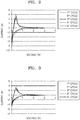
- Cyclovoltametry was performed on the tri-electrode cells manufactured according to Comparative Example 1 and Example 1 to identify whether an initial SEI layer was formed.
- M273A potentiostat/galvanostat (EG&G) was used, and a scan rate was about 2 mV/s.
- Cyclovoltametry was performed by using a Bio-logics impedance analyzer, which is a device for measuring impedance, in a range of 0 V to 3 V, in 5 cycles, and at a scan rate of 1 mV/s.
- the principle for measurement is to identify a change in voltage at a constant current.
- the coin full cells manufactured according to Comparative Example 1 and Examples 1 and 2 were charged with a constant current at a rate of 0.1 C at a temperature of 25°C until the voltage reached 4.30 V (vs. Li), and then, in a constant voltage mode, while the voltage of 4.30 V was maintained, the coin full cells were cutoff at a rate of 0.05 C. Then, the coin full cells were discharged with a constant current at a rate of 0.1 C until the voltage dropped to 2.8 V (vs. Li).
- FIG. 4 shows a graph of a differential charge and discharge (dQ/dV) in this cycle.
- the coin full cells manufactured according to Comparative Example 1 and Examples 1 and 2 were charged with a constant current at a rate of 0.2 C at a temperature of 25°C until the voltage reached 4.2 V, and then, discharged with a constant current at a rate of 0.2 C until the voltage reached 2.5 V. Then, the coin full cells were charged with a constant current at a rate of 0.5C until the voltage reached 4.2 V, and while the voltage of 4.2 V was maintained, the coin full cells were charged at a constant voltage until the current reached 0.05 C. Then, until the voltage reached 2.5 V, the coin full cells were discharged with a constant current of 0.5 C. (Formation process)
- the coin full cells that had been subjected to the formation process were charged with a constant current at a rate of 1.33 C at a temperature of 25°C until the voltage reached 4.2 V, and while the voltage of 4.2 V was maintained, the coin full cells were charged at a constant voltage until the current reached 0.05 C. Then, until the voltage reached 2.5 V, the coin full cells were discharged with a constant current at a rate of 1.33 C. This charging and discharging cycle was repeatedly performed 60 times.
- Examples 1 and 2 have a higher discharge capacity than Comparative Example 1 in each cycle. From this result, it may be seen that the use of the compound of Formula 9 used as the additive contributed to an improvement in room-temperature lifespan characteristics. It may also be seen that the greater the amount of the additive, the better the lifespan characteristics
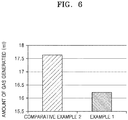
- the coin full cells of Comparative Example 2 and Example 1 were stored at a temperature of 60°C for 20 days. Then, a jig for gas-capturing was used to drill a hole in a bottom end of each of the coin full cells, and gas generated in the coin full cells was quantified by a gas chromatography (GC) system which was connected thereto without leakage of the gas.
- GC gas chromatography
- Electrolytes according to embodiments may generate less gas, leading to higher stability of a manufactured secondary battery.
- silicon-based anode active materials can be applied to an anode to obtain high capacity.
- a silicon anode expands in volume when lithium intercalates/deintercalates. During cycling, the volumetric expansion may lead to cracks, and a solid-electrolyte interface (SEI) may be newly formed, thereby increasing the thickness of a thin film and depleting the electrolyte. Due to these factors, the lifespan of a lithium secondary battery may decrease.
- SEI solid-electrolyte interface
- Batteries having greater capacity have a smaller number of pores therein. In this case, even when the amount of gas generated due to decomposition of an electrolytic solution may be small, the pressure inside a battery may increase. Thus, the stability of the battery may decrease.
- Embodiments provide an electrolyte capable of conferring lifespan characteristics and stability to a secondary battery. Embodiments also provide a secondary battery comprising the electrolyte.
- An electrolyte according to an embodiment of the present disclosure comprises an organic solvent and a cyclic ester compound that is substituted with a sulfonate group.
- the cyclic ester compound decomposes faster than the organic solvent present in the electrolyte, so that decomposition of the organic solvent may be prevented.
- the cyclic ester compound may also contribute to a decrease in an amount of gas generated due to the decomposition of the electrolyte, leading to higher stability of a secondary battery that requires high capacity.
- the cyclic ester compound comprises a sulfonate group, and thus, when stored at a high temperature, a stable thin film is formed on the surface of an anode. Compared to a cyclic ester compound that does not comprise a sulfonate group, the cyclic ester compound comprising a sulfonate group may effectively suppress an interior resistance increase of a secondary battery.
- the cyclic ester compound represented by Formula 1 When the cyclic ester compound represented by Formula 1 is used, during initial charging and discharging, the sulfonate group is adsorbed on the surface of an anode to form a polymer thin film, thereby suppressing a resistance increase of the anode. Since the cyclic ester compound represented by Formula 1 forms a thin film on the surface of the anode, decomposition of the electrolyte due to contact between the electrolyte and a cathode or anode active material is suppressed and gas is less generated. As a result, an increase in the interior resistance of a secondary battery may be suppressed.
- the capacity of the cyclic ester compound represented by Formula 1 may be quickly stabilized, and a strong thin film may be formed and, thus, thermal stability may be obtained. Accordingly, high-temperature characteristics may be improved and output characteristics may be improved.
- the cyclic ester compound may generate less gas, while having a structure that is similar to that of a sulfonate group-free cyclic ester compound, for example, fluoroethylene carbonate (FEC), which is mainly used as an electrolyte additive for a high-capacity secondary battery. Accordingly, as an alternative to FEC, the cyclic ester compound may provide a secondary battery that has excellent room-temperature lifespan characteristics and improved high-temperature stability.
- FEC fluoroethylene carbonate
Landscapes
- Chemical & Material Sciences (AREA)
- Engineering & Computer Science (AREA)
- Manufacturing & Machinery (AREA)
- Chemical Kinetics & Catalysis (AREA)
- Electrochemistry (AREA)
- General Chemical & Material Sciences (AREA)
- Inorganic Chemistry (AREA)
- Physics & Mathematics (AREA)
- Condensed Matter Physics & Semiconductors (AREA)
- General Physics & Mathematics (AREA)
- Materials Engineering (AREA)
- Secondary Cells (AREA)
Abstract
Description
- Embodiments relate to an electrolyte and a secondary battery comprising the electrolyte.
- Due to the advancements of small, high tech devices such as digital cameras, mobile devices, laptops, and computers, demand for lithium secondary batteries as energy sources for such devices is rapidly increasing. Also, due to the commercialization of xEV, that is, hybrid electric vehicles (HEV), plug-in hybrid electric vehicles (PHEV), and electric vehicles (EV), safe lithium ion batteries having high capacity have been developed.
- The present invention provides an electrolyte comprising a cyclic compound substituted with a sulfonate group, and an organic solvent. The cyclic compound may be a cyclic ester, cyclic carbonate or cyclic thiocarbonate, but is referred to generally herein as a cyclic ester.
- The cyclic ester compound may be represented by Formula 1:

Formula 1, A1 and A2 each independently are oxygen (O) or sulfur (S),
wherein, when only one of R1 and R2 is a sulfonate group, the other one of R1 and R2 is hydrogen, a halogen, a substituted or unsubstituted C1 to C30 alkyl group, a substituted or unsubstituted C2 to C30 alkenyl group, a substituted or unsubstituted C2 to C30 alkynyl group, a substituted or unsubstituted C3 to C30 carbocyclic group, a substituted or unsubstituted C1 to C10 alkoxy group, a substituted or unsubstituted C6 to C30 aryl group, a substituted or unsubstituted C3 to C30 cycloalkenyl group, a substituted or unsubstituted C7 to C20 arylalkyl group, a substituted or unsubstituted C1 to C10 heteroalkyl group, a substituted or unsubstituted C2 to C30 heterocyclic group, or a substituted or unsubstituted C2 to C30 heteroaryl group. - The sulfonate group may be represented by Formula 2:

Formula 2, R3 is a substituted or unsubstituted C1 to C30 alkyl group, a substituted or unsubstituted C2 to C30 alkenyl group, a substituted or unsubstituted C2 to C30 alkynyl group, a substituted or unsubstituted C3 to C30 carbocyclic group, a substituted or unsubstituted C1 to C10 alkoxy group, a substituted or unsubstituted C6 to C30 aryl group, a substituted or unsubstituted C3 to C30 cycloalkenyl group, a substituted or unsubstituted C7 to C20 arylalkyl group, a substituted or unsubstituted C1 to C10 heteroalkyl group, a substituted or unsubstituted C2 to C30 heterocyclic group, or a substituted or unsubstituted C2 to C30 heteroaryl group. * refers to a binding site with the neighbor atom. - The cyclic ester compound may includes at least one of compounds represented by Formula 3 or Formula 4:


Formulae Formula 2, wherein, when only one of R1 and R2 is a sulfonate group, the other one of R1 and R2 is hydrogen, a halogen, a substituted or unsubstituted C1 to C30 alkyl group, a substituted or unsubstituted C2 to C30 alkenyl group, a substituted or unsubstituted C2 to C30 alkynyl group, a substituted or unsubstituted C3 to C30 carbocyclic group, a substituted or unsubstituted C1 to C10 alkoxy group, a substituted or unsubstituted C6 to C30 aryl group, a substituted or unsubstituted C3 to C30 cycloalkenyl group, a substituted or unsubstituted C7 to C20 arylalkyl group, a substituted or unsubstituted C1 to C10 heteroalkyl group, a substituted or unsubstituted C2 to C30 heterocyclic group, or a substituted or unsubstituted C2 to C30 heteroaryl group:
Formula 2, R3 is a substituted or unsubstituted C1 to C30 alkyl group, a substituted or unsubstituted C2 to C30 alkenyl group, a substituted or unsubstituted C2 to C30 alkynyl group, a substituted or unsubstituted C3 to C30 carbocyclic group, a substituted or unsubstituted C1 to C10 alkoxy group, a substituted or unsubstituted C6 to C30 aryl group, a substituted or unsubstituted C3 to C30 cycloalkenyl group, a substituted or unsubstituted C7 to C20 arylalkyl group, a substituted or unsubstituted C1 to C10 heteroalkyl group, a substituted or unsubstituted C2 to C30 heterocyclic group, or a substituted or unsubstituted C2 to C30 heteroaryl group. * refers to a binding site with the neighbor atom. - The cyclic ester compound may includes at least one of compounds represented by Formulae 5 to 8:

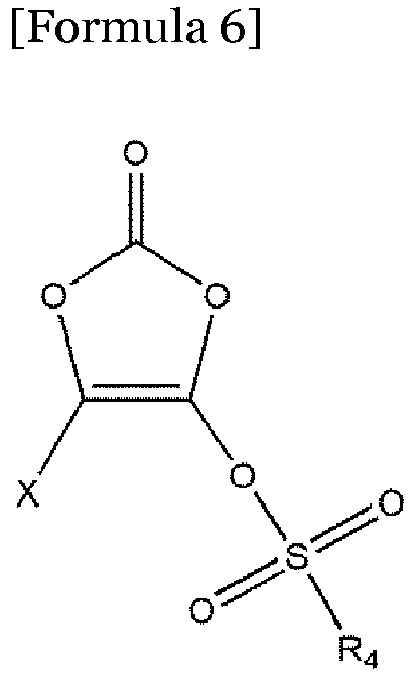


Formulae 5 and 6, X is hydrogen, a halogen, or a substituted or unsubstituted C1 to C30 alkyl group, and in Formulae 5 to 8, R4, and R5 each independently are a substituted or unsubstituted C1 to C30 alkyl group - These cyclic ester compounds may be used alone or in combination of two or more of the foregoing materials.
- An amount of the cyclic ester compound may be in a range of 0.01 wt% to 20 wt% based on a total weight of the electrolyte.
- The organic solvent comprises at least one selected from a carbonate-based solvent, an ester-based solvent, an ether-based solvent, a ketone-based solvent, an alcohol-based solvent, and an aprotic solvent.
- The electrolyte may further comprise a lithium salt.
- The present invention also provides a secondary battery comprising the electrolyte as described above.
- The secondary battery may operate at a voltage range of 2.8 V to 4.6 V.
- The secondary battery may be a lithium secondary battery.
-
-
FIG. 1 illustrates a schematic view of a lithium secondary battery according to an embodiment. -
FIG. 2 illustrates cyclovoltametry analysis results of a tri-electrode cell manufactured according to Comparative Example 1. -
FIG. 3 illustrates cyclovoltametry analysis results of a tri-electrode cell manufactured according to Example 1. -
FIG. 4 illustrates a graph of differential charge and discharge (dQ/dV) during an initial cycle of coin full cells manufactured according to Comparative Example 1 and Examples 1 and 2. -
FIG. 5 illustrates room temperature-lifespan characteristics evaluation results of coin full cells manufactured according to Comparative Examples 1 and Examples 1 and 2. -
FIG. 6 illustrates a graph of an amount of gas generated in coin full cells manufactured according to Comparative Example 2 and Example 1 after 20 days of high-temperature storage. - Example embodiments will now be described more fully hereinafter with reference to the accompanying drawings; however, they may be embodied in different forms and should not be construed as limited to the embodiments set forth herein. Rather, these embodiments are provided so that this disclosure will be thorough and complete, and will fully convey exemplary implementations to those skilled in the art.
- In the drawing figures, the dimensions of layers and regions may be exaggerated for clarity of illustration.
- Expressions such as "at least one of," when preceding a list of elements, modify the entire list of elements and do not modify the individual elements of the list.
- An electrolyte according to an embodiment of the present disclosure comprises an organic solvent and a cyclic ester compound that is substituted with a sulfonate group.
- The cyclic ester compound may be represented by Formula 1:

- In Formula 1,
A1 and A2 may each independently be oxygen (O) or sulfur (S),
at least one selected from R1 and R2 is a sulfonate group, wherein, when only one of R1 and R2 is a sulfonate group, the other one of R1 and R2 is hydrogen, a halogen, a substituted or unsubstituted C1 to C30 alkyl group, a substituted or unsubstituted C2 to C30 alkenyl group, a substituted or unsubstituted C2 to C30 alkynyl group, a substituted or unsubstituted C3 to C30 carbocyclic group, a substituted or unsubstituted C1 to C10 alkoxy group, a substituted or unsubstituted C6 to C30 aryl group, a substituted or unsubstituted C3 to C30 cycloalkenyl group, a substituted or unsubstituted C7 to C20 arylalkyl group, a substituted or unsubstituted C1 to C10 heteroalkyl group, a substituted or unsubstituted C2 to C30 heterocyclic group, or a substituted or unsubstituted C2 to C30 heteroaryl group. Herein, the statement that "
- The sulfonate group in Formula 1 may be represented by Formula 2:

- In
Formula 2, R3 may be a substituted or unsubstituted C1 to C30 alkyl group, a substituted or unsubstituted C2 to C30 alkenyl group, a substituted or unsubstituted C2 to C30 alkynyl group, a substituted or unsubstituted C3 to C30 carbocyclic group, a substituted or unsubstituted C1 to C10 alkoxy group, a substituted or unsubstituted C6 to C30 aryl group, a substituted or unsubstituted C3 to C30 cycloalkenyl group, a substituted or unsubstituted C7 to C20 arylalkyl group, a substituted or unsubstituted C1 to C10 heteroalkyl group, a substituted or unsubstituted C2 to C30 heterocyclic group, or a substituted or unsubstituted C2 to C30 heteroaryl group. * refers to a binding site with the neighbor atom. - In an embodiment, the cyclic ester compound may includes at least one of compounds represented by
Formulae 3 and 4:

- In
Formulae Formula 2, wherein, when only one of R1 and R2 is a sulfonate group, the other one of R1 and R2 is hydrogen, a halogen, a substituted or unsubstituted C1 to C30 alkyl group, a substituted or unsubstituted C2 to C30 alkenyl group, a substituted or unsubstituted C2 to C30 alkynyl group, a substituted or unsubstituted C3 to C30 carbocyclic group, a substituted or unsubstituted C1 to C10 alkoxy group, a substituted or unsubstituted C6 to C30 aryl group, a substituted or unsubstituted C3 to C30 cycloalkenyl group, a substituted or unsubstituted C7 to C20 arylalkyl group, a substituted or unsubstituted C1 to C10 heteroalkyl group, a substituted or unsubstituted C2 to C30 heterocyclic group, or a substituted or unsubstituted C2 to C30 heteroaryl group:
- In
Formula 2, R3 may be a substituted or unsubstituted C1 to C30 alkyl group, a substituted or unsubstituted C2 to C30 alkenyl group, a substituted or unsubstituted C2 to C30 alkynyl group, a substituted or unsubstituted C3 to C30 carbocyclic group, a substituted or unsubstituted C1 to C10 alkoxy group, a substituted or unsubstituted C6 to C30 aryl group, a substituted or unsubstituted C3 to C30 cycloalkenyl group, a substituted or unsubstituted C7 to C20 arylalkyl group, a substituted or unsubstituted C1 to C10 heteroalkyl group, a substituted or unsubstituted C2 to C30 heterocyclic group, or a substituted or unsubstituted C2 to C30 heteroaryl group. * refers to a binding site with the neighbor atom. - In one embodiment, the cyclic ester compound may include at least one of compounds represented by Formulae 5 to 8:


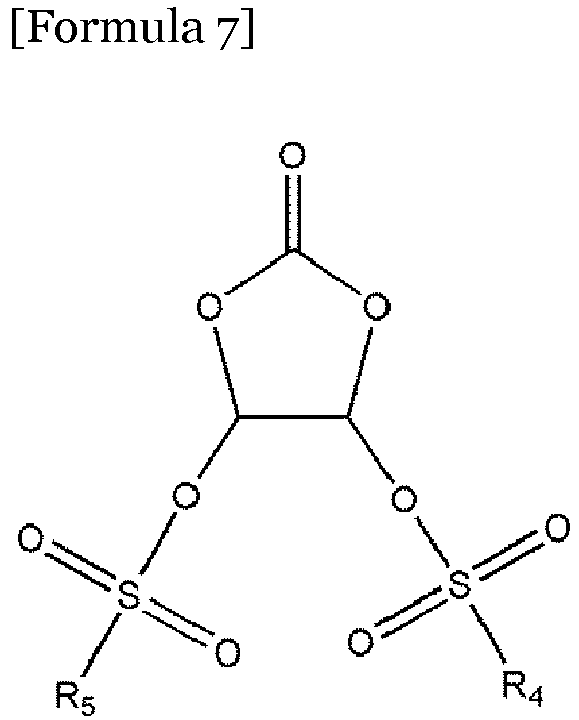


- In
Formulae 5 and 6, X may be hydrogen, a halogen, a halogen-substituted or unsubstituted C1 to C30 alkyl group, a halogen-substituted or unsubstituted C2 to C30 alkenyl group, or a halogen-substituted or unsubstituted C2 to C30 alkynyl group, and - In Formulae 5 to 8, R4 and R5 may each independently be a halogen-substituted or unsubstituted C1 to C30 alkyl group, a halogen-substituted or unsubstituted C2 to C30 alkenyl group, or a halogen-substituted or unsubstituted C2 to C30 alkynyl group.
- These cyclic ester compounds may be used alone or in combination of two or more of the foregoing materials.
- An amount of the cyclic ester compound may be, for example, in a range of 0.01 to 20 wt% based on the total weight of the electrolyte. An amount of the cyclic ester compound may be, for example, in a range of 0.1 to 15 wt%, or 1 to 10 wt%. Within these ranges, the cyclic ester compound comprised in the electrolyte may appropriately form a thin film on the surface of an anode, thereby effectively suppressing an increase in the interior resistance of a secondary battery at a high temperature.
- The organic solvent of the electrolyte may act as a medium through which ions participating in an electrochemical reaction of a battery flow.
- The organic solvent may be a non-aqueous organic solvent. Examples of the non-aqueous organic solvent include a carbonate-based compound, an ester-based compound, an ether-based compound, a ketone-based compound, an alcohol-based compound, an aprotic solvent, and a combination thereof.
- Examples of the carbonate-based compound include a chain carbonate compound, a cyclic carbonate compound, a fluoro carbonate compound thereof, and a combination thereof.
- Examples of the chain carbonate compound include diethyl carbonate (DEC), dimethyl carbonate (DMC), dipropyl carbonate (DPC), methylpropyl carbonate (MPC), ethylpropyl carbonate (EPC), methylethyl carbonate (MEC), and a combination thereof. Examples of the cyclic carbonate compound include ethylene carbonate (EC), propylene carbonate (PC), butylene carbonate (BC), vinylethylene carbonate (VEC), and a combination thereof.
- Examples of the fluoro carbonate compound include fluoroethylene carbonate (FEC), 4,5-difluoroethylenecarbonate, 4,4-difluoroethylenecarbonate, 4,4,5-trifluoroethylenecarbonate, 4,4,5,5-tetrafluoroethylenecarbonate, 4-fluoro-5-methylethylenecarbonate, 4-fluoro-4-methylethylenecarbonate, 4,5-difluoro-4-methylethylenecarbonate, 4,4,5-trifluoro-5-methylethylenecarbonate, trifluoromethyl ethylene carbonate, and a combination thereof.
- For use as the carbonate-based compound, the chain carbonate compound and the cyclic carbonate compound may be mixed. In one embodiment, an amount of the cyclic carbonate compound may be, based on the total volume of the non-aqueous organic solvent, at least 20 vol% or more, or 30 vol% or more, or 40 vol% or more to obtain improved cyclic characteristics. In one embodiment, the amount of the cyclic carbonate compound may be in a range of 20 vol% to 70 vol% based on the total volume of the non-aqueous organic solvent.
- For use as the carbonate-based compound, a fluoro carbonate compound may be further mixed with at least one selected from the chain carbonate compound and the cyclic carbonate compound. The fluoro carbonate compound may contribute to an increase in solubility of a lithium salt, thereby increasing ion conductivity and allowing a thin film to be well-formed on an anode. In one embodiment, the fluoro carbonate compound may be FEC.
- The fluoro carbonate compound may be used in an amount of 1 to 30 vol% based on the total volume of a non-aqueous organic solvent. Within this range, desired effects may be obtained while the viscosity of the electrolyte may be appropriately maintained. In one embodiment, the non-aqueous organic solvent may comprise VEC together with FEC. The VEC may be present in an amount of 0.1 to 10 vol% based on the total volume of the non-aqueous organic solvent.
- Examples of the ester-based compound include methyl acetate, ethyl acetate, n-propyl acetate, dimethyl acetate, methyl propionate, ethyl propionate, γ-butyrolactone, decanolide, valerolactone, mevalonolactone, caprolactone, and methyl formate.
- Examples of the ether-based compound include dibutyl ether, tetraglyme, diglyme, 1,2-dimethoxyethane, 1,2-diethoxyethane, ethoxymethoxyethane, 2-methyltetrahydrofuran, and tetrahydrofuran.
- Examples of the ketone-based compound include cyclohexanone.
- Examples of the alcohol-based compound include ethyl alcohol and isopropyl alcohol.
- Examples of the aprotic solvent include dimethyl sulfoxide, 1,2-dioxolane, sulfolane, methyl sulfolane, 1,3-dimethyl-2-imidazolidinone, N-methyl-2-pyrrolidinone, formamide, dimethylformamide, acetonitrile, nitromethane, phosphoric acid trimethyl, phosphoric acid triethyl, phosphoric acid trioctyl, and phosphoric acid triester.
- These organic solvents may be used alone or in combination of two or more of the foregoing materials. When two or more organic solvents are used in combination, a mixed ratio thereof may be appropriately adjusted depending on the performance of a battery.
- The electrolyte may further comprise a lithium salt.
- The lithium salt acts as a supplier for lithium ions in a battery, enabling operation of a lithium battery. The lithium salt may be a suitable material that is commercially available for use in a secondary battery and is easily dissolved in a non-aqueous electrolyte. Examples of such a material include LiCl, LiBr, LiI, LiClO4, LiB10Cl10, LiPF6, CF3SO3Li, CH3SO3Li, C4F3SO3Li, (CF3SO2)2NLi, LiN (CxF2x+1SO2) (CyF2+ySO2) (where x and y are each a natural number), CF3CO2Li, LiAsF6, LiSbF6, LiAlCl4, LiAlF4, lithiumchloroborate, low aliphatic lithium carbonate, 4 phenyl lithium borate, and lithium imide.
- To obtain an appropriate performance of a battery, the lithium salt may be used in a concentration of, for example, about 0.1 M to about 5.0 M, or about 0.1 M to about 2.0 M. When the concentration of the lithium salt is within these ranges, the electrolyte may have an appropriate level of conductivity and an appropriate level of viscosity, and accordingly, the prepared electrolyte may have excellent performance, and lithium ions may effectively migrate.
- To promote the formation of a stable solid-electrolyte interface (SEI) or thin film on the surface of an electrode to improve electrochemical characteristics, such as cyclic characteristics, the electrolyte may further comprise an additive.
- Examples of the additive include tris (trimethylsilyl) phosphate (TMSPa), lithium difluorooxalatoborate (LiFOB), vinylene carbonate (VC), propanesultone (PS), succinonitrile (SN), LiBF4, a silane compound having a functional group that enables a siloxane bond, and a silazane compound, such as a hexamethyldisilazane, wherein such a functional group may be acryl, amino, epoxy, methoxy, ethoxy, or vinyl. These additives may be used alone or in combination of two or more of the foregoing materials.
- The additive may be present in a suitable amount to provide improvement effects on the capacity retention ratio of a secondary battery. For example, the additive may be present in an amount of 0.01 wt% to 10 wt% based on the total weight of the non-aqueous organic solvent. In one embodiment, the additive may be present in an amount of 0.05 to 10 wt%, 0.1 to 5 wt%, or 0.5 to 4 wt%, based on the total weight of the non-aqueous organic solvent.
- The electrolyte may be used in a secondary battery that operates in a medium or high voltage range of 2.8 V to 4.6 V to improve cell performance and stability. For example, the electrolyte may be appropriately used in a high-voltage battery that operates at a voltage of 4.3 V to 4.6 V.
- Another aspect of embodiments of the present disclosure is directed to a secondary battery comprising the electrolyte.
- The secondary battery may be a lithium secondary battery.
- In one embodiment, the lithium secondary battery comprises a cathode, an anode and an electrolyte between the cathode and the anode. The lithium secondary battery may be manufactured by a suitable method.
-
FIG. 1 illustrates a schematic view of a lithiumsecondary battery 30 according to an embodiment of the present invention. - Referring to
FIG. 1 , the lithiumsecondary battery 30 may comprise acathode 23, ananode 22, and aseparator 24 between thecathode 23 and theanode 22. Thecathode 23, theanode 22, and theseparator 24 may be wound or folded and then placed in abattery case 25. An electrolyte may be injected into thebattery case 25, which is then sealed using a sealingmember 26, thereby completing the manufacture of the lithiumsecondary battery 30. Thebattery case 25 may be a round case, a rectangular case, or a thin-film type case. The lithiumsecondary battery 30 may be a lithium ion battery. - The
cathode 23 may comprise a cathode current collector and a cathode active material layer formed on the cathode current collector. - The cathode current collector may have a thickness of 3 to 500 µm. A material for forming the cathode current collector may be a suitable material that does not cause chemical changes in a corresponding battery and that has conductivity. Examples of such a material include copper, stainless steel, aluminum, nickel, titanium, calcined carbon, copper or stainless steel that is surface-treated with carbon, nickel, titanium, or silver, and an aluminum-cadmium alloy. The cathode current collector may have an uneven surface, and due to the uneven surface, a cathode active material may strongly bond thereto. In one embodiment, the cathode current collector may have the form of a film, a sheet, a foil, a net, a porous structure, a foam, a non-woven fabric, or the like.
- The cathode active material layer comprises a cathode active material, a binder, and, optionally, a conductive material.
- The cathode active material may be any lithium-containing metal oxide that is conventionally used in the art. For example, the cathode active material may comprise one or more composite oxides of lithium and a metal selected from cobalt, manganese, nickel, and a combination thereof. Examples of such a composite oxide of lithium and metal include compounds represented by one of LiaA1-bB'bD2 (where 0.90 ≤ a ≤ 1 and 0 ≤ b ≤ 0.5); LiaE1-bB'bO2-cDc (where 0.90 ≤ a ≤ 1, 0 ≤ b ≤ 0.5, and 0 ≤ c ≤ 0.05); LiE2-bB'bO4-cDc (where 0 ≤ b ≤ 0.5 and 0 ≤ c ≤ 0.05); LiaNi1-b-cCobB'cDα (where 0.90 ≤ a ≤ 1, 0 ≤ b ≤ 0.5, 0 ≤ c ≤ 0.05, and 0 < α ≤ 2); LiaNi1-b-cCobB'cO2-αF'α (where 0.90 ≤ a ≤ 1, 0 ≤ b 0.5, 0 ≤ c ≤ 0.05, and 0 < α < 2); LiaNi1-b-cCobB'cO2-αF'2 (where 0.90 ≤ a ≤ 1, 0 ≤ b ≤ 0.5, 0 ≤ c ≤ 0.05, and 0 < α < 2); LiaNi1-b-cMnbB'cDα (where 0.90 ≤ a ≤ 1, o ≤ b ≤ 0.5, 0 ≤ c ≤ 0.05, and 0 < a ≤ 2); LiaNi1-b-cMnbB'cO2-αF'α (where 0.90 ≤ a ≤ 1, o ≤ b ≤ 0.5, 0 ≤ c ≤ 0.05, and 0 < α < 2); LiaNi1-b-cMnbB'cO2-αF'2 (where 0.90 ≤ a ≤ 1, o ≤ b ≤ 0.5, 0 ≤ c ≤ 0.05, and 0 < α < 2); LiaNibEcGdO2 (where 0.90 ≤ a ≤ 1, o ≤ b ≤ 0.9, 0 ≤ c ≤ 0.5, and 0.001 ≤ d ≤ 0.1.); LiaNibCocMndGeO2 (where 0.90 ≤ a ≤ 1, o ≤ b ≤ 0.9, 0 ≤ c ≤ 0.5, 0 ≤ d ≤ 0.5, and 0.001 ≤ e ≤ 0.1.); LiaNiGbO2 (where 0.90 ≤ a ≤ 1 and 0.001 ≤ b ≤ 0.1.); LiaCoGbO2 (where 0.90 ≤ a ≤ 1 and 0.001 ≤ b ≤ 0.1.); LiaMnGbO2 (where 0.90 ≤ a ≤ 1 and 0.001 ≤ b ≤ 0.1.); LiaMn2GbO4 (where 0.90 ≤ a ≤ 1 and 0.001 ≤ b ≤ 0.1.); QO2; QS2; LiQS2; V2O5; LiV2O5; LiI'O2; LiNiVO4; Li(3-f)J2 (PO4)3 (0 ≤ f ≤ 2); Li(3-f)Fe2 (PO4)3 (0 ≤ f ≤ 2); and LiFePO4.
- In the formulae above, A may be Ni, Co, Mn, or a combination thereof; B' may be Al, Ni, Co, Mn, Cr, Fe, Mg, Sr, V, a rare-earth element, or a combination thereof; D may be O, F, S, P, or a combination thereof; E may be Co, Mn, or a combination thereof; F' may be F, S, P, or a combination thereof; G may be Al, Cr, Mn, Fe, Mg, La, Ce, Sr, V, or a combination thereof; Q may be Ti, Mo, Mn, or a combination thereof; I' may be Cr, V, Fe, Sc, Y, or a combination thereof; and J may be V, Cr, Mn, Co, Ni, Cu, or a combination thereof.
- For example, LiCoO2, LiMnxO2x (x=1, 2), LiNi1-xMnxO2x (0<x<1), LiNi1-x-yCoxMnyO2 (0≤x≤0.5, 0≤y≤0.5), FePO4 maybe used.
- These compounds may each have a coating layer on their surfaces, or these compounds may be mixed with a compound having a coating layer. The coating layer may comprise an oxide of a coating element, a hydroxide of a coating element, an oxyhydroxide of a coating element, an oxycarbonate of a coating element, or a hydroxycarbonate of a coating element. The compounds that form the coating layer may be amorphous or crystalline. As a coating element present in the coating layer, Mg, Al, Co, K, Na, Ca, Si, Ti, V, Sn, Ge, Ga, B, As, Zr, or a mixture thereof may be used. The coating layer may be formed using any one of various coating methods that are performed using the compounds and the elements and do not affect properties of the positive active material (for example, spray coating, immersion, or the like). These coating methods may be well understood by one of ordinary skill in the art.
- The binder may allow cathode active material particles to attach to each other, and may also allow the cathode active material to attach to the cathode current collector. Examples of a material for the binder include polyvinyl alcohol, carboxymethyl cellulose, hydroxypropyl cellulose, diacetyl cellulose, vinyl chloride, carboxylated polyvinyl chloride, polyvinyl fluoride, an ethylene oxide-containing polymer, polyvinylpyrrolidone, polyurethane, polytetrafluoroethylene, polyvinylidene fluoride, polyethylene, polypropylene, styrene-butadiene rubber, acrylated styrene-butadiene rubber, an epoxy resin, and nylon.
- The conductive material is used to provide conductivity to an electrode. The conductive material may be a suitable material that does not cause chemical changes in a corresponding battery and that conducts electrons. Examples of the conductive material include natural graphite, artificial graphite, carbon black, acetylene black, Ketjen black, carbon fiber, metal in the form of powder or fabric. The metal may be copper, nickel, aluminum, silver, or the like. In one embodiment, the conductive material may comprise at least one conductive material, such as a polyphenylene derivative.
- The
anode 22 may comprise an anode current collector and an anode active material layer formed on the anode current collector. - The anode current collector may have a thickness of 3 to 500 µm. A material for forming the anode current collector may be a suitable material that does not cause chemical changes in a corresponding battery and has conductivity. Examples of such a material include copper, stainless steel, aluminum, nickel, titanium, calcined carbon, copper or stainless steel that is surface-treated with carbon, nickel, titanium, or silver, and an aluminum-cadmium alloy. The anode current collector may have an uneven surface. Due to the uneven surface of the anode current collector, the anode active material may strongly bond thereto. In one embodiment, the anode current collector may have the form of a film, a sheet, a foil, a net, a porous structure, a foam, a non-woven fabric, or the like.
- The anode active material layer may comprise an anode active material, a binder, and, optionally, a conductive material.
- The anode active material may be a suitable material that is used in the art. For example, the anode active material may be selected from lithium metal, lithium-alloyable metal, a transition metal oxide, a material capable of doping or dedoping lithium, and a material capable of reversibly intercalating or deintercalating a lithium ion. Two or more of these materials may be mixed or combined for use as the anode active material.
- As an alloy of the lithium metal, an alloy of lithium and a metal selected from Na, K, Rb, Cs, Fr, Be, Mg, Ca, Sr, Si, Sb, Pb, In, Zn, Ba, Ra, Ge, Al, and Sn may be used.
- Non-limiting examples of the transition metal oxide include tungsten oxide, molybdenum oxide, titanium oxide, lithium titanium oxide, vanadium oxide, and lithium vanadium oxide.
- Examples of the material capable of doping or dedoping lithium include Si, Sn, Al, Ge, Pb, Bi, Sb, SiOx (0<x<2), a Si-Z alloy (where Z is alkali metal, alkaline earth metal, a Group 11 element, a Group 12 element, a Group 13 element, a Group 14 element, a Group 15 element, a
Group 16 element, transition metal, a rare-earth element, or a combination thereof, and is not Si), SnOx (0<x<2), and a Sn-Z' alloy (where Z' is alkali metal, alkaline earth metal, a Group 11 element, a Group 12 element, a Group 13 element, a Group 14 element, a Group 15 element, aGroup 16 element, transition metal, a rare-earth element, or a combination thereof, and is not Sn). Herein, Z or Z' may be Mg, Ca, Sr, Ba, Ra, Sc, Y, Ti, Zr, Hf, Rf, V, Nb, Ta, Db, Cr, Mo, W, Sg, Tc, Re, Bh, Fe, Pb, Ru, Os, Hs, Rh, Ir, Pd, Pt, Cu, Ag, Au, Zn, Cd, B, Al, Ga, Sn, In, Ti, Ge, P, As, Sb, Bi, S, Se, Te, Po, or a combination thereof. - The material capable of reversibly intercalating or deintercalating a lithium ion may be a carbonaceous material, for example, a carbonaceous anode active material that is generally used in a lithium battery. Examples of the material capable of reversibly intercalating or deintercalating a lithium ion include crystalline carbon, amorphous carbon, or a mixture thereof. Non-limiting examples of the crystalline carbon include natural graphite, artificial graphite, expandable graphite, graphene, fullerene soot, carbon nanotube, and carbon fiber. Non-limiting examples of the amorphous carbon include soft carbon (low-temperature calcined carbon) or hard carbon, meso-phase pitch carbide, and calcined coke. The carbonaceous anode active material may be used in a spherical form, a tabular form, a fibrous form, a tube form, or a powder form.
- In one embodiment, the anode active material may comprise a silicon-based anode active material. In one embodiment, the anode active material may comprise a material selected from Si, SiOx (0<x<2), Si-Z alloy (where Z is alkali metal, alkaline earth metal, a Group 13 element, a Group 14 element, a Group 15 element, a
Group 16 element, transition metal, a rare-earth element, or a combination thereof, and is not Si), and a combination thereof. Herein, Z may be selected from Mg, Ca, Sr, Ba, Ra, Sc, Y, La, Ti, Zr, Hf, V, Nb, Ta, Cr, Mo, W, Tc, Re, Fe, Ru, Os, Co, Rh, Ir, Ni, Pd, Pt, Cu, Ag, Au, Zn, Cd, B, Ge, P, As, Sb, Bi, S, Se, Te, Po, and a combination thereof. Such silicon-based anode active materials comprising Si, SiOx, and Si-Z alloy may substantially be crystalline (including mono-crystalline or polycrystalline), non-crystalline, or a mixture thereof. - The binder may allow anode active material particles to attach to each other, and may also attach the anode active material to a current collector. Examples of the binder include polyvinyl alcohol, carboxymethyl cellulose, hydroxypropyl cellulose, polyvinyl chloride, carboxylated polyvinyl chloride, polyvinyl fluoride, an ethylene oxide-containing polymer, polyvinylpyrrolidone, polyurethane, polytetrafluoroethylene, polyvinylidene fluoride, polyethylene, polypropylene, styrene-butadiene rubber, acrylated styrene-butadiene rubber, epoxy resin, and nylon.
- The conductive material may be used to provide conductivity to an electrode. The conductive material may be a suitable material that does not cause chemical changes in a corresponding battery and that conducts electrons. Examples of the conductive material include a carbonaceous material, such as natural graphite, artificial graphite, carbon black, acetylene black, Ketjen black, or carbon fiber; a metal material, such as copper, nickel, or aluminum, in the form of powder or fiber; a conductive polymer, such as a polyphenylene derivative; and a mixture thereof.
- The
cathode 23 and theanode 22 may each be manufactured by mixing an active material, a conductive material, and a binder in a solvent to prepare an active material composition and doping the active material composition onto a current collector. - This method of manufacturing an electrode is widely known in the art. The solvent may be N-methylpyrrolidone (NMP), acetone, or water, as examples.
- The
cathode 23 and theanode 22 may be separated from each other by theseparator 24. Theseparator 24 may be a suitable material that is used in a lithium secondary battery. The material for forming theseparator 24 may have low resistance to the flow of ions of an electrolyte and excellent electrolytic solution-retaining capability. Theseparator 24 may be a single film or a multi-layered film. For example, the material for forming theseparator 24 may be selected from glass fiber, polyester, Teflon, polyethylene, polypropylene, polytetrafluoroethylene (PTFE), or a combination thereof. The material for forming theseparator 24 may be in a woven form or a non-woven form. Theseparator 24 may have pores having a diameter of 0.01 to 10 µm and may have a thickness of 3 to 100 µm. - As described above, the electrolyte comprises the cyclic ester compound and the organic solvent. The electrolyte may be injected between the
cathode 23 and theanode 22, which are separated by theseparator 24. - Due to the use of the electrolyte, a thin film may be formed on the
anode 22 of the lithiumsecondary battery 30. The thin film on theanode 22 may be an SEI layer that has improved stability, that does not change during high-temperature storage, and that retains its solidity even after charging and discharging. - The lithium
secondary battery 30 may be used in, in addition to mobile phones or mobile computers, applications that require high voltage, high output, and a high-temperature operation. An example of such applications is an electric vehicle. In one or more embodiments, the secondary battery may be used in hybrid vehicles along with with internal combustion engines, fuel batteries, or super capacitors. The secondary battery may also be used in, for example, electric bicycles or gearing tools, which require high voltage, high output, and a high-temperature operation. - Substituents in the formulae used herein may be defined as follows.
- The term "alkyl" used herein refers to a fully saturated branched or unbranched (or straight chain or linear) hydrocarbon moiety.
- Non-limiting examples of the term "alkyl" used herein include methyl, ethyl, n-propyl, iso-propyl, n-butyl, sec-butyl, iso-butyl, tert-butyl, n-pentyl, isopentyl, neopentyl, n-hexyl, 3-methylhexyl, 2,2-dimethylpentyl, 2,3-dimethylpentyl, and n-heptyl.
- At least one hydrogen atom (e.g. 1, 2, 3 or 4 hydrogen atoms) of the "substituted alkyl" may be substituted with a halogen atom, a C1-C20 alkyl group substituted with a halogen atom (for example, CCF3, CHCF2, CH2F or CCl3), a C1-C20 alkoxy, a C2-C20 alkoxyalkyl, a hydroxy group, a nitro group, a cyano group, an amino group, an amidino group, a hydrazine, a hydrazone, a carboxyl group or a salt thereof, a sulfonyl group, a sulfamoyl, a sulfonic acid group or a salt thereof, a phosphoric acid group or a salt thereof, a C1-C20 alkyl group, a C2-C20 alkenyl group, a C2-C20 alkynyl group, a C1-C20 heteroalkyl group, a C6-C20 aryl group, a C6-C20 arylalkyl group, a C6-C20 heteroaryl group, a C7-C20 heteroarylalkyl group, a C6-C20 heteroaryloxy group, a C6-C20 heteroaryloxyalkyl group, or a C6-C20 heteroarylalkyl group.
- The term "halogen atom" used herein refers to a fluorine, bromine, chlorine, or iodine atom. The term "halo group" refers to a fluoro, bromo, chloro, or iodo group.
- The term "a C1-C20 alkyl group substituted with a halogen atom" used herein refers to a C1-C20 alkyl group that is substituted with one or more halo groups. Non-limiting examples thereof include monohaloalkyl, dihaloalkyl, and polyhaloalkyl groups, including perhaloalkyl groups.
- A monohaloalkyl group has one iodo, bromo, chloro or fluoro group within the alkyl group. Dihaloalky and polyhaloalkyl groups have two or more of identical halo groups or a combination of different halo groups within the alkyl.
- The term "alkoxy" used herein refers to alkyl-O-, wherein alkyl is defined herein above. Non-limiting examples of alkoxy groups include methoxy, ethoxy, propoxy, 2-propoxy, butoxy, tert-butoxy, pentyloxy, hexyloxy, cyclopropyloxy, and cyclohexyloxy groups. At least one hydrogen atom (e.g. 1, 2, 3 or 4 hydrogen atoms) of the substituted alkoxy group may be substituted with a same substituent as described above in connection with the alkyl group.
- The term "alkoxyalkyl" used herein refers to an alkyl group, as defined above, in which the alkyl group is substituted with an alkoxy group. At least one hydrogen atom (e.g. 1, 2, 3 or 4 hydrogen atoms) of the substituted alkoxyalkyl group may be substituted with a same substituent as described above in connection with the alkyl group. The term alkoxyalkyl used herein includes a substituted alkoxyalkyl moiety.
- The term "alkenyl" refers to a branched or unbranched hydrocarbon having at least one carbon-carbon double bond. Non-limiting examples of an alkenyl group include vinyl, allyl, butenyl, isopropenyl, and isobutenyl groups. At least one hydrogen atom (e.g. 1, 2, 3 or 4 hydrogen atoms) of the substituted alkenyl group may be substituted with a same substituent as described above in connection with the alkyl group.
- The term "alkynyl" used herein refers to a branched or unbranched hydrocarbon having at least one carbon-carbon triple bond. Non-limiting examples of an alkynyl group include ethynyl, butynyl, isobutynyl, and isopropynyl groups.
- At least one hydrogen atom (e.g. 1, 2, 3 or 4 hydrogen atoms) of the substituted alkynyl group may be substituted with a same substituent as described above in connection with the alkyl group.
- The term "aryl" used herein refers to an aromatic hydrocarbon comprising at least one ring that is used alone or in combination.
- The term "aryl" also refers to a group in which an aromatic ring is fused with one or more cycloalkyl rings.
- Non-limiting examples of an aryl group include phenyl, naphthyl, and tetrahydronaphthyl groups.
- At least one hydrogen atom (e.g. 1, 2, 3 or 4 hydrogen atoms) of the substituted aryl group may be substituted with a same substituent as described above in connection with the alkyl group.
- The term "arylalkyl" refers to an alkyl group substituted with an aryl group. Examples of an arylalkyl group include benzyl or phenyl-CH2CH2-.
- The term "aryloxy" refers to an -O-aryl group. Examples of an aryloxy group include phenoxy. At least one hydrogen atom (e.g. 1, 2, 3 or 4 hydrogen atoms) of the substituted aryloxy group may be substituted with a same substituent as described above in connection with the alkyl group.
- The term "heteroalkyl" group used herein refers to an alkyl group containing one or more heteroatoms such as N, S, P, or O.
- The term "heteroaryl" used herein refers to a monocyclic or bicyclic organic group that contains one or more heteroatoms selected from N, O, P, and S, and carbon atoms as the remaining ring atoms. The heteroaryl group may comprise, for example, 1 to 5 heteroatoms, and 5 to 10 ring members. S or N may be oxidized to various oxidation states.
- At least one hydrogen atom (e.g. 1, 2, 3 or 4 hydrogen atoms) of the substituted heteroaryl group may be substituted with a same substituent as described above in connection with the alkyl group.
- The term "heteroarylalkyl" used herein refers to an alkyl group substituted with a heteroaryl group.
- The term "heteroaryloxy" used herein refers to an -O-heteroaryl group. At least one hydrogen atom (e.g. 1, 2, 3 or 4 hydrogen atoms) of the substituted heteroaryloxy group may be substituted with a same substituent as described above in connection with the alkyl group.
- The term "heteroaryloxyalkyl" used herein refers to an alkyl group substituted with a heteroaryloxy group. At least one hydrogen atom (e.g. 1, 2, 3 or 4 hydrogen atoms) of the substituted heteroaryloxyalkyl group may be substituted with a same substituent as described above in connection with the alkyl group.
- The term "carbocyclic" used herein refers to saturated or partially unsaturated but non-aromatic monocyclic, bicyclic or tricyclic hydrocarbon groups.
- Examples of the monocyclic hydrocarbon group include cyclopentyl, cyclopentenyl, cyclohexyl, and cyclohexenyl. Examples of the bicyclic hydrocarbon group include bornyl, decahydronaphthyl, bicyclo[2.1.1]hexyl, bicyclo[2.2.1]heptyl, bicyclo[2.2.1]heptenyl, and bicyclo[2.2.2]octyl.
- Examples of the tricyclic hydrocarbon group include adamantyl.
- At least one hydrogen atom (e.g. 1, 2, 3 or 4 hydrogen atoms) of the "substituted carbocyclic" may be substituted with a same substituent as described above in connection with the alkyl group.
- The term "heterocyclic" group used herein refers to a ring containing 5-10 ring atoms comprising a heteroatom such as N, S, P, or O. An example of a heterocyclic group is pyridyl. At least one hydrogen atom (e.g. 1, 2, 3 or 4 hydrogen atoms) of the substituted heterocyclic group may be substituted with a same substituent as described above in connection with the alkyl group.
- The term "heterocyclicoxy" used herein refers to an -O-heterocycle group. At least one hydrogen atom (e.g. 1, 2, 3 or 4 hydrogen atoms) in a substituted heterocyclicoxy group may be substituted with a same substituent as described above in connection with the alkyl group.
- The term "sulfonyl" used herein refers to R"-SO2-, wherein R" is hydrogen, alkyl, aryl, heteroaryl, aryl-alkyl, heteroaryl-alkyl, alkoxy, aryloxy, cycloalkyl, or heterocyclic.
- The term "sulfamoyl" used herein encompasses H2NS (O2)-, alkyl-NHS (O2)-, (alkyl)2NS (O2)- aryl- NHS (O2)-, alkyl- (aryl)-NS (O2)-, (aryl)2NS(O)2, heteroaryl-NHS (O2)-, (aryl-alkyl)- NHS (O2)-, or (heteroaryl-alkyl)-NHS (O2)-.
- At least one hydrogen atom (e.g. 1, 2, 3 or 4 hydrogen atoms) of the substituted sulfamoyl group may be substituted with a same substituent as described above in connection with the alkyl group.
- The term "amino group" encompasses groups wherein a nitrogen atom is covalently bonded to at least one carbon or heteroatom. The term "amino group" used herein encompasses -NH2 and substituted moieties. The term also encompasses "alkylamino" wherein a nitrogen atom is bound to at least one additional alkyl group. The term also encompasses "arylamino" and "diarylamino" wherein the nitrogen is bound to at least one or two independently selected aryl groups.
- The terms alkylene, arylene, and heteroarylene refer to a divalent group obtained from alkyl, aryl, and heteroaryl, respectively.
- Certain groups described herein are defined in part by a lower and an upper limit to the number of carbon atoms present in the group (e.g. C1 to C30 alkyl group). In certain typical embodiments of the groups described herein, and unless otherwise specified, the upper limit to the number of carbon atoms in a group may, independently of the upper limit of other groups, be 20 carbon atoms, e.g. 12 carbon atoms, 10 carbon atoms, 8 carbon atoms, 6 carbon atoms or 4 carbon atoms. For example, the C1 to C30 alkyl group described herein may be for example a C1 to C20 alkyl group, C1 to C12 alkyl group, C1 to C10 alkyl group, C1 to C8 alkyl group, C1 to C6 alkyl group, or C1 to C4 alkyl group.
- Some groups are described herein as substituted or unsubstituted. Unless otherwise specified, a group described herein is typically unsubstituted.
- The following Examples and Comparative Examples are provided in order to highlight characteristics of one or more embodiments, but it will be understood that the Examples and Comparative Examples are not to be construed as limiting the scope of the embodiments, nor are the Comparative Examples to be construed as being outside the scope of the embodiments. Further, it will be understood that the embodiments are not limited to the particular details described in the Examples and Comparative Examples.
- EC and DMC were mixed at a volumetric ratio of 20:80 to prepare a mixed solvent. LiPF6 was added to the mixed solvent such that the concentration of LiPF6 was 1.5 M. As an additive, 1 wt% of
Compound 1 represented by Formula 9 was added to the mixed solvent, thereby completing the preparation of an electrolyte:
- Artificial graphite, which is an active material, styrene-butadiene rubber, and carboxymethylcellulose were mixed at a weight ratio of 90:5:5, and NMP was added in a solid content of 60 wt% thereto to control viscosity of the result, thereby preparing anode slurry. The anode slurry was coated to a thickness of about 40 µm onto a copper foil current collector having a thickness of 10 µm. The result was dried at room temperature, and then, dried at a temperature of 120°C, followed by compression, thereby completing the preparation of an anode.
- With respect to the anode, Li metal was used as a counter electrode and a reference electrode. The electrolyte was provided to the resultant structure, thereby completing the manufacture of a tri-electrode cell.
- A 18650-type coin full cell was manufactured by using the electrolyte.
- LiNi1/3Co1/3Mn1/3O2 powder, which is a cathode active material, a carbon conductive material (Super-P; Timcal Ltd.), and a polyvinylidene fluoride (PVDF) binder were mixed at a weight ratio of 90:5:5, and then, NMP, which is a solvent, was added in a solid content of 60 wt% thereto to control viscosity of the result, thereby completing the preparation of cathode slurry. The cathode slurry was coated to a thickness of about 40 µm onto an aluminum foil having a thickness of 15 µm. The result was dried at room temperature, and then, dried at a temperature of 120°C, followed by compression, thereby completing the manufacture of a cathode.
- Separately, artificial graphite, which is an anode active material, styrene-butadiene rubber, and carboxymethyl cellulose were mixed at a weight ratio of 90:5:5, and NMP was added in a solid content of 60 wt% thereto to control viscosity of the result, thereby completing the preparation of anode slurry. The anode slurry was coated to a thickness of about 40 µm onto a copper foil current collector having a thickness of 10 µm. The result was dried at room temperature, and then, dried at a temperature of 120°C, followed by compression, thereby completing the manufacture of an anode.
- A 20 µm -thick polyethylene separator (
Celgard PE 20 micron separator), the electrolyte, the anode, and the cathode were used to manufacture a 18650-type coin full cell. - A tri-electrode cell and a coin full cell were manufactured in the same manner as in Example 1, except that the compound represented by Formula 9 was added to the electrolyte in an amount of 7 wt% of the electrolyte.
- A tri-electrode cell and a coin full cell were manufactured in the same manner as in Example 1, except that the compound represented by Formula 9 was not added to the electrolyte.
- A tri-electrode cell and a coin full cell were manufactured in the same manner as in Example 1, except that FEC represented by
Formula 10 was added in an amount of 1 wt% to the electrolyte instead of the compound represented by Formula 9.
- Cyclovoltametry was performed on the tri-electrode cells manufactured according to Comparative Example 1 and Example 1 to identify whether an initial SEI layer was formed. For this experiment, M273A potentiostat/galvanostat (EG&G) was used, and a scan rate was about 2 mV/s.
- Cyclovoltametry was performed by using a Bio-logics impedance analyzer, which is a device for measuring impedance, in a range of 0 V to 3 V, in 5 cycles, and at a scan rate of 1 mV/s. The principle for measurement is to identify a change in voltage at a constant current.
- Cyclovoltametry analysis results of the tri-electrode cells manufactured according to Comparative Example 1 and Example 1 are shown in
FIG. 2 and FIG. 3 . - Referring to
FIGS. 2 and 3 , in the case of Comparative Example 1, during reduction, at about 0.5 V, EC decomposed, and in the case of Example 1, during reduction, at about 0.9 V, the compound represented by Formula 9 used as the additive decomposed. From these results, it may be assumed that since, during reduction, the compound of Formula 9 used as the additive decomposes more quickly than the organic solvent, decomposition of the organic solvent may be prevented and accordingly, an increase in interior resistance may be suppressed. - The coin full cells manufactured according to Comparative Example 1 and Examples 1 and 2 were charged with a constant current at a rate of 0.1 C at a temperature of 25°C until the voltage reached 4.30 V (vs. Li), and then, in a constant voltage mode, while the voltage of 4.30 V was maintained, the coin full cells were cutoff at a rate of 0.05 C. Then, the coin full cells were discharged with a constant current at a rate of 0.1 C until the voltage dropped to 2.8 V (vs. Li).
-
FIG. 4 shows a graph of a differential charge and discharge (dQ/dV) in this cycle. - Referring to
FIG. 4 , in the case of Comparative Example 1, a reduction decomposition peak appears at about 2.9 V, and in the case of Examples 1 and 2, a reduction decomposition peak appears in a voltage range that is less than 2.9 V. From these results, it may be confirmed that the compound of Formula 9 used as the additive reduction-decomposes in a voltage range less than that of EC. Meanwhile, the greater the amount of the additive, the stronger the reduction decomposition peak. - The coin full cells manufactured according to Comparative Example 1 and Examples 1 and 2 were charged with a constant current at a rate of 0.2 C at a temperature of 25°C until the voltage reached 4.2 V, and then, discharged with a constant current at a rate of 0.2 C until the voltage reached 2.5 V. Then, the coin full cells were charged with a constant current at a rate of 0.5C until the voltage reached 4.2 V, and while the voltage of 4.2 V was maintained, the coin full cells were charged at a constant voltage until the current reached 0.05 C. Then, until the voltage reached 2.5 V, the coin full cells were discharged with a constant current of 0.5 C. (Formation process)
- The coin full cells that had been subjected to the formation process, were charged with a constant current at a rate of 1.33 C at a temperature of 25°C until the voltage reached 4.2 V, and while the voltage of 4.2 V was maintained, the coin full cells were charged at a constant voltage until the current reached 0.05 C. Then, until the voltage reached 2.5 V, the coin full cells were discharged with a constant current at a rate of 1.33 C. This charging and discharging cycle was repeatedly performed 60 times.
- Regarding each of the coin full cells, a discharge capacity was measured in each cycle. Results thereof are shown in
FIG. 5 . - Regarding each of the coin full cells, a capacity retention ratio (%) in the 60th cycle was calculated according to
Equation 1. Results thereof are shown in Table 1.
Table 1 Additive Capacity retention ratio in 60th cycle (%) Comparative Example 1 None 65% Example 1 Formula 9,1wt% 67% Example 2 Formula 9,7wt% 73% - Referring to
FIG. 5 and Table 1, it may be confirmed that Examples 1 and 2 have a higher discharge capacity than Comparative Example 1 in each cycle. From this result, it may be seen that the use of the compound of Formula 9 used as the additive contributed to an improvement in room-temperature lifespan characteristics. It may also be seen that the greater the amount of the additive, the better the lifespan characteristics - The coin full cells of Comparative Example 2 and Example 1 were stored at a temperature of 60°C for 20 days. Then, a jig for gas-capturing was used to drill a hole in a bottom end of each of the coin full cells, and gas generated in the coin full cells was quantified by a gas chromatography (GC) system which was connected thereto without leakage of the gas.
- Referring to
FIG. 6 , it may be confirmed that when the sulfonate group-containing carbonate compound of Formula 9 was used, much less gas was generated than when FEC was used. FEC is structurally similar to the sulfonate group-containing carbonate compound of Formula 9, but does not contain a sulfonate group. From this result, it is seen that an electrolyte according to an embodiment improves the stability of a lithium battery compared to the commercially available FEC-containing electrolyte. - Electrolytes according to embodiments may generate less gas, leading to higher stability of a manufactured secondary battery.
- By way of summation and review, various electrode systems have been suggested to provide high capacity. For example, silicon-based anode active materials can be applied to an anode to obtain high capacity. However, a silicon anode expands in volume when lithium intercalates/deintercalates. During cycling, the volumetric expansion may lead to cracks, and a solid-electrolyte interface (SEI) may be newly formed, thereby increasing the thickness of a thin film and depleting the electrolyte. Due to these factors, the lifespan of a lithium secondary battery may decrease.
- Batteries having greater capacity have a smaller number of pores therein. In this case, even when the amount of gas generated due to decomposition of an electrolytic solution may be small, the pressure inside a battery may increase. Thus, the stability of the battery may decrease.
- To address these issues, it is desirable to optimize various battery constituting elements, together with the development of active materials having high capacity.
- Embodiments provide an electrolyte capable of conferring lifespan characteristics and stability to a secondary battery. Embodiments also provide a secondary battery comprising the electrolyte.
- An electrolyte according to an embodiment of the present disclosure comprises an organic solvent and a cyclic ester compound that is substituted with a sulfonate group.
- When an electrode is reduced, the cyclic ester compound decomposes faster than the organic solvent present in the electrolyte, so that decomposition of the organic solvent may be prevented.
- The cyclic ester compound may also contribute to a decrease in an amount of gas generated due to the decomposition of the electrolyte, leading to higher stability of a secondary battery that requires high capacity. The cyclic ester compound comprises a sulfonate group, and thus, when stored at a high temperature, a stable thin film is formed on the surface of an anode. Compared to a cyclic ester compound that does not comprise a sulfonate group, the cyclic ester compound comprising a sulfonate group may effectively suppress an interior resistance increase of a secondary battery.
- When the cyclic ester compound represented by
Formula 1 is used, during initial charging and discharging, the sulfonate group is adsorbed on the surface of an anode to form a polymer thin film, thereby suppressing a resistance increase of the anode. Since the cyclic ester compound represented byFormula 1 forms a thin film on the surface of the anode, decomposition of the electrolyte due to contact between the electrolyte and a cathode or anode active material is suppressed and gas is less generated. As a result, an increase in the interior resistance of a secondary battery may be suppressed. - Even when charging and discharging are repeatedly performed, the capacity of the cyclic ester compound represented by
Formula 1 may be quickly stabilized, and a strong thin film may be formed and, thus, thermal stability may be obtained. Accordingly, high-temperature characteristics may be improved and output characteristics may be improved. - The cyclic ester compound may generate less gas, while having a structure that is similar to that of a sulfonate group-free cyclic ester compound, for example, fluoroethylene carbonate (FEC), which is mainly used as an electrolyte additive for a high-capacity secondary battery. Accordingly, as an alternative to FEC, the cyclic ester compound may provide a secondary battery that has excellent room-temperature lifespan characteristics and improved high-temperature stability.
- Example embodiments have been disclosed herein, and although specific terms are employed, they are used and are to be interpreted in a generic and descriptive sense only and not for purpose of limitation. In some instances, as would be apparent to one of ordinary skill in the art as of the filing of the present application, features, characteristics, and/or elements described in connection with a particular embodiment may be used singly or in combination with features, characteristics, and/or elements described in connection with other embodiments unless otherwise specifically indicated. Accordingly, it will be understood by those of skill in the art that various changes in form and details may be made without departing from the spirit and scope thereof as set forth in the following claims.
Claims (13)
- An electrolyte, comprising:a cyclic ester compound substituted with a sulfonate group; andan organic solvent.
- The electrolyte as claimed in claim 1, wherein
the cyclic ester compound is represented by Formula 1: A1 and A2 each independently are oxygen (O) or sulfur (S),
 at least one selected from R1 and R2 is a sulfonate group, wherein, when only one of R1 and R2 is a sulfonate group, the other one of R1 and R2 is hydrogen, a halogen, a substituted or unsubstituted C1 to C30 alkyl group, a substituted or unsubstituted C2 to C30 alkenyl group, a substituted or unsubstituted C2 to C30 alkynyl group, a substituted or unsubstituted C3 to C30 carbocyclic group, a substituted or unsubstituted C1 to C10 alkoxy group, a substituted or unsubstituted C6 to C30 aryl group, a substituted or unsubstituted C3 to C30 cycloalkenyl group, a substituted or unsubstituted C7 to C20 arylalkyl group, a substituted or unsubstituted C1 to C10 heteroalkyl group, a substituted or unsubstituted C2 to C30 heterocyclic group, or a substituted or unsubstituted C2 to C30 heteroaryl group.
 - The electrolyte as claimed in claim 2, wherein:the sulfonate group is represented by Formula 2:


- The electrolyte as claimed in claim 2 or 3, wherein:A1 and A2 are each oxygen (O),
- The electrolyte as claimed in claim 1, wherein:the cyclic ester compound includes at least one of compounds represented by Formula 3 or Formula 4:


A1 and A2 each independently are oxygen (O) or sulfur (S),at least one selected from R1 and R2 is a sulfonate group represented by Formula 2 as defined in claim 3, wherein, when only one of R1 and R2 is a sulfonate group, the other one of R1 and R2 is as defined in claim 2. - The electrolyte as claimed in claim 1, wherein:the cyclic ester compound includes at least one of compounds represented by Formulae 5 to 8:


 X is hydrogen, a halogen, a halogen-substituted or unsubstituted C1 to C30 alkyl group, a halogen-substituted or unsubstituted C2 to C30 alkenyl group, or a halogen-substituted or unsubstituted C2 to C30 alkynyl group, andR4 and R5 each independently are a halogen-substituted or unsubstituted C1 to C30 alkyl group, a halogen-substituted or unsubstituted C2 to C30 alkenyl group, or a halogen-substituted or unsubstituted C2 to C30 alkynyl group.
 - The electrolyte as claimed in claim 6, wherein,:in Formulae 5 and 6, X is hydrogen, a halogen, or a substituted or unsubstituted C1 to C30 alkyl group, andin Formulae 5 to 8, R4, and R5 each independently are a substituted or unsubstituted C1 to C30 alkyl group
- The electrolyte as claimed in any one of the preceding claims, wherein:the amount of the cyclic ester compound is in a range of 0.01 wt% to 20 wt% based on the total weight of the electrolyte.
- The electrolyte as claimed in any one of the preceding claims, wherein:the organic solvent comprises at least one selected from a carbonate-based solvent, an ester-based solvent, an ether-based solvent, a ketone-based solvent, an alcohol-based solvent, and an aprotic solvent.
- The electrolyte as claimed in any one of the preceding claims, further comprising a lithium salt.
- A secondary battery comprising an electrolyte as defined in any one of claims 1 to 10.
- The secondary battery as claimed in claim 11, wherein:the secondary battery operates at a voltage range of 2.8 V to 4.6 V.
- The secondary battery as claimed in claim 11 or 12, wherein the secondary battery is a lithium secondary battery.
Applications Claiming Priority (1)
| Application Number | Priority Date | Filing Date | Title |
|---|---|---|---|
| KR1020160010983A KR102233778B1 (en) | 2016-01-28 | 2016-01-28 | Electrolyte and secondary battery including the electrolyte |
Publications (2)
| Publication Number | Publication Date |
|---|---|
| EP3200269A1 true EP3200269A1 (en) | 2017-08-02 |
| EP3200269B1 EP3200269B1 (en) | 2018-08-15 |
Family
ID=57906553
Family Applications (1)
| Application Number | Title | Priority Date | Filing Date |
|---|---|---|---|
| EP17153304.5A Active EP3200269B1 (en) | 2016-01-28 | 2017-01-26 | Electrolyte and secondary battery comprising the electrolyte |
Country Status (4)
| Country | Link |
|---|---|
| US (1) | US10468723B2 (en) |
| EP (1) | EP3200269B1 (en) |
| KR (1) | KR102233778B1 (en) |
| CN (1) | CN107017435B (en) |
Families Citing this family (1)
| Publication number | Priority date | Publication date | Assignee | Title |
|---|---|---|---|---|
| CN120527463B (en) * | 2025-07-23 | 2025-09-26 | 江苏隐功科技有限公司 | Electrolyte, battery, and battery module |
Citations (4)
| Publication number | Priority date | Publication date | Assignee | Title |
|---|---|---|---|---|
| WO2008035928A1 (en) * | 2006-09-20 | 2008-03-27 | Lg Chem, Ltd. | Additive for non-aqueous electrolyte and secondary battery using the same |
| WO2009022848A1 (en) * | 2007-08-16 | 2009-02-19 | Lg Chem, Ltd. | Non-aqueous electrolyte lithium secondary battery |
| WO2015093580A1 (en) * | 2013-12-18 | 2015-06-25 | 三菱化学株式会社 | Non-aqueous electrolyte solution and non-aqueous electrolyte rechargeable battery using same |
| US20160351962A1 (en) * | 2015-05-28 | 2016-12-01 | Basf Corporation | Electrolyte Compositions for Electrochemical Devices |
Family Cites Families (13)
| Publication number | Priority date | Publication date | Assignee | Title |
|---|---|---|---|---|
| JP2000195544A (en) | 1998-12-25 | 2000-07-14 | Mitsui Chemicals Inc | Nonaqueous electrolyte and secondary battery using it |
| CN100563056C (en) * | 2005-06-15 | 2009-11-25 | 三菱化学株式会社 | Lithium secondary battery |
| JP4544270B2 (en) * | 2007-05-21 | 2010-09-15 | ソニー株式会社 | Secondary battery electrolyte and secondary battery |
| EP2158635B1 (en) * | 2007-06-11 | 2013-07-31 | LG Chem, Ltd. | Non-aqueous electrolyte and secondary battery comprising the same |
| JP4844849B2 (en) * | 2008-04-23 | 2011-12-28 | ソニー株式会社 | Negative electrode for lithium ion secondary battery and lithium ion secondary battery |
| JP5594288B2 (en) * | 2009-08-17 | 2014-09-24 | 宇部興産株式会社 | Non-aqueous electrolyte and electrochemical device using the same |
| EP2475041A4 (en) | 2009-08-31 | 2014-03-12 | Mitsubishi Chem Corp | NONAQUEOUS ELECTROLYTIC SOLUTION, AND NONAQUEOUS ELECTROLYTE BATTERY COMPRISING SAME |
| JP5565212B2 (en) | 2010-01-29 | 2014-08-06 | 三菱化学株式会社 | Non-aqueous electrolyte and non-aqueous electrolyte battery using the same |
| US9257720B2 (en) * | 2010-08-05 | 2016-02-09 | Wako Pure Chemical Industries, Ltd. | Nonaqueous electrolyte solution and nonaqueous electrolyte battery using same |
| IN2014CN02844A (en) * | 2011-10-17 | 2015-07-03 | Ube Industries | |
| CN102522590B (en) | 2011-12-26 | 2014-09-17 | 华为技术有限公司 | Non-aqueous organic electrolyte, lithium ion secondary battery containing non-aqueous organic electrolyte, preparation method of lithium ion secondary battery and terminal communication equipment |
| JP2013211223A (en) | 2012-03-30 | 2013-10-10 | Mitsubishi Chemicals Corp | Nonaqueous electrolytic solution and battery using the same |
| JP6252486B2 (en) * | 2012-11-20 | 2017-12-27 | 日本電気株式会社 | Lithium ion secondary battery |
-
2016
- 2016-01-28 KR KR1020160010983A patent/KR102233778B1/en active Active
-
2017
- 2017-01-19 US US15/409,716 patent/US10468723B2/en active Active
- 2017-01-26 CN CN201710061743.3A patent/CN107017435B/en active Active
- 2017-01-26 EP EP17153304.5A patent/EP3200269B1/en active Active
Patent Citations (5)
| Publication number | Priority date | Publication date | Assignee | Title |
|---|---|---|---|---|
| WO2008035928A1 (en) * | 2006-09-20 | 2008-03-27 | Lg Chem, Ltd. | Additive for non-aqueous electrolyte and secondary battery using the same |
| WO2009022848A1 (en) * | 2007-08-16 | 2009-02-19 | Lg Chem, Ltd. | Non-aqueous electrolyte lithium secondary battery |
| WO2015093580A1 (en) * | 2013-12-18 | 2015-06-25 | 三菱化学株式会社 | Non-aqueous electrolyte solution and non-aqueous electrolyte rechargeable battery using same |
| EP3086398A1 (en) * | 2013-12-18 | 2016-10-26 | Mitsubishi Chemical Corporation | Non-aqueous electrolyte solution and non-aqueous electrolyte rechargeable battery using same |
| US20160351962A1 (en) * | 2015-05-28 | 2016-12-01 | Basf Corporation | Electrolyte Compositions for Electrochemical Devices |
Also Published As
| Publication number | Publication date |
|---|---|
| US20170222269A1 (en) | 2017-08-03 |
| KR20170090302A (en) | 2017-08-07 |
| KR102233778B1 (en) | 2021-03-30 |
| US10468723B2 (en) | 2019-11-05 |
| CN107017435A (en) | 2017-08-04 |
| EP3200269B1 (en) | 2018-08-15 |
| CN107017435B (en) | 2021-09-03 |
Similar Documents
| Publication | Publication Date | Title |
|---|---|---|
| US11539075B2 (en) | Electrolyte for lithium secondary battery, and lithium secondary battery comprising same | |
| KR101212203B1 (en) | Electrolyte for rechargeable lithium battery, and rechargeable lithium battery including the same | |
| KR102163999B1 (en) | Electrolyte for lithium rechargeable battery and lithium rechargeable battery including the same | |
| KR101749186B1 (en) | Electrolyte for lithium battery, lithium battery including the same, and method for manufacturing electrolyte for lithium battery | |
| EP2410600B1 (en) | Positive electrode and lithium battery including the same | |
| KR101233325B1 (en) | Electrolyte for rechargeable lithium battery and rechargeable lithium battery inclduing same | |
| KR102479725B1 (en) | Electrolytic solution for lithium battery and lithium battery including the same | |
| CN106505242B (en) | Electrolyte and lithium battery and secondary battery including the same | |
| CN108604709A (en) | Nonaqueous electrolytic solution for lithium secondary battery and lithium secondary battery including the nonaqueous electrolytic solution | |
| KR20150026113A (en) | Electrolyte solution for seconndary lithium battery and secondary lithium battery using the same | |
| KR20150006364A (en) | Electrolyte for lithium secondary battery, and lithium secondary battery including the same | |
| KR20170028676A (en) | Electrolyte for lithium battery, and lithium battery including the electrolyte | |
| US10873108B2 (en) | Lithium battery | |
| US10396400B2 (en) | Electrolyte for lithium battery and lithium battery including the electrolyte | |
| KR101683211B1 (en) | Electrolyte for rechargeable lithium battery, and rechargeable lithium battery including the same | |
| KR20120104930A (en) | Electrolyte for rechargeable lithium battery, and rechargeable lithium battery including the same | |
| CN105390746B (en) | Electrolyte for lithium battery and lithium battery including the same | |
| CN108701865A (en) | Electrolyte solution for lithium secondary battery and lithium secondary battery containing same | |
| US20220294014A1 (en) | Electrolyte for lithium secondary battery, and lithium secondary battery including same | |
| KR20150094088A (en) | Additive for electrolyte and electrolyte and lithium secondary battery | |
| KR20210041382A (en) | Electrolyte for rechargeable lithium battery and rechargeable lithium battery | |
| KR20170072643A (en) | Electrolyte and secondary battery including the electrolyte | |
| EP3200269B1 (en) | Electrolyte and secondary battery comprising the electrolyte | |
| KR20190088706A (en) | Electrolyte Composition and Secondary Battery Using the Same |
Legal Events
| Date | Code | Title | Description |
|---|---|---|---|
| PUAI | Public reference made under article 153(3) epc to a published international application that has entered the european phase |
Free format text: ORIGINAL CODE: 0009012 |
|
| STAA | Information on the status of an ep patent application or granted ep patent |
Free format text: STATUS: THE APPLICATION HAS BEEN PUBLISHED |
|
| AK | Designated contracting states |
Kind code of ref document: A1 Designated state(s): AL AT BE BG CH CY CZ DE DK EE ES FI FR GB GR HR HU IE IS IT LI LT LU LV MC MK MT NL NO PL PT RO RS SE SI SK SM TR |
|
| AX | Request for extension of the european patent |
Extension state: BA ME |
|
| STAA | Information on the status of an ep patent application or granted ep patent |
Free format text: STATUS: REQUEST FOR EXAMINATION WAS MADE |
|
| 17P | Request for examination filed |
Effective date: 20170908 |
|
| RBV | Designated contracting states (corrected) |
Designated state(s): AL AT BE BG CH CY CZ DE DK EE ES FI FR GB GR HR HU IE IS IT LI LT LU LV MC MK MT NL NO PL PT RO RS SE SI SK SM TR |
|
| GRAP | Despatch of communication of intention to grant a patent |
Free format text: ORIGINAL CODE: EPIDOSNIGR1 |
|
| STAA | Information on the status of an ep patent application or granted ep patent |
Free format text: STATUS: GRANT OF PATENT IS INTENDED |
|
| INTG | Intention to grant announced |
Effective date: 20180226 |
|
| GRAS | Grant fee paid |
Free format text: ORIGINAL CODE: EPIDOSNIGR3 |
|
| GRAA | (expected) grant |
Free format text: ORIGINAL CODE: 0009210 |
|
| STAA | Information on the status of an ep patent application or granted ep patent |
Free format text: STATUS: THE PATENT HAS BEEN GRANTED |
|
| AK | Designated contracting states |
Kind code of ref document: B1 Designated state(s): AL AT BE BG CH CY CZ DE DK EE ES FI FR GB GR HR HU IE IS IT LI LT LU LV MC MK MT NL NO PL PT RO RS SE SI SK SM TR |
|
| REG | Reference to a national code |
Ref country code: CH Ref legal event code: EP Ref country code: GB Ref legal event code: FG4D Ref country code: AT Ref legal event code: REF Ref document number: 1030821 Country of ref document: AT Kind code of ref document: T Effective date: 20180815 |
|
| REG | Reference to a national code |
Ref country code: IE Ref legal event code: FG4D |
|
| REG | Reference to a national code |
Ref country code: DE Ref legal event code: R096 Ref document number: 602017000238 Country of ref document: DE |
|
| REG | Reference to a national code |
Ref country code: NL Ref legal event code: MP Effective date: 20180815 |
|
| REG | Reference to a national code |
Ref country code: LT Ref legal event code: MG4D |
|
| REG | Reference to a national code |
Ref country code: AT Ref legal event code: MK05 Ref document number: 1030821 Country of ref document: AT Kind code of ref document: T Effective date: 20180815 |
|
| PG25 | Lapsed in a contracting state [announced via postgrant information from national office to epo] |
Ref country code: FI Free format text: LAPSE BECAUSE OF FAILURE TO SUBMIT A TRANSLATION OF THE DESCRIPTION OR TO PAY THE FEE WITHIN THE PRESCRIBED TIME-LIMIT Effective date: 20180815 Ref country code: NL Free format text: LAPSE BECAUSE OF FAILURE TO SUBMIT A TRANSLATION OF THE DESCRIPTION OR TO PAY THE FEE WITHIN THE PRESCRIBED TIME-LIMIT Effective date: 20180815 Ref country code: BG Free format text: LAPSE BECAUSE OF FAILURE TO SUBMIT A TRANSLATION OF THE DESCRIPTION OR TO PAY THE FEE WITHIN THE PRESCRIBED TIME-LIMIT Effective date: 20181115 Ref country code: LT Free format text: LAPSE BECAUSE OF FAILURE TO SUBMIT A TRANSLATION OF THE DESCRIPTION OR TO PAY THE FEE WITHIN THE PRESCRIBED TIME-LIMIT Effective date: 20180815 Ref country code: NO Free format text: LAPSE BECAUSE OF FAILURE TO SUBMIT A TRANSLATION OF THE DESCRIPTION OR TO PAY THE FEE WITHIN THE PRESCRIBED TIME-LIMIT Effective date: 20181115 Ref country code: SE Free format text: LAPSE BECAUSE OF FAILURE TO SUBMIT A TRANSLATION OF THE DESCRIPTION OR TO PAY THE FEE WITHIN THE PRESCRIBED TIME-LIMIT Effective date: 20180815 Ref country code: AT Free format text: LAPSE BECAUSE OF FAILURE TO SUBMIT A TRANSLATION OF THE DESCRIPTION OR TO PAY THE FEE WITHIN THE PRESCRIBED TIME-LIMIT Effective date: 20180815 Ref country code: IS Free format text: LAPSE BECAUSE OF FAILURE TO SUBMIT A TRANSLATION OF THE DESCRIPTION OR TO PAY THE FEE WITHIN THE PRESCRIBED TIME-LIMIT Effective date: 20181215 Ref country code: RS Free format text: LAPSE BECAUSE OF FAILURE TO SUBMIT A TRANSLATION OF THE DESCRIPTION OR TO PAY THE FEE WITHIN THE PRESCRIBED TIME-LIMIT Effective date: 20180815 Ref country code: GR Free format text: LAPSE BECAUSE OF FAILURE TO SUBMIT A TRANSLATION OF THE DESCRIPTION OR TO PAY THE FEE WITHIN THE PRESCRIBED TIME-LIMIT Effective date: 20181116 |
|
| PG25 | Lapsed in a contracting state [announced via postgrant information from national office to epo] |
Ref country code: AL Free format text: LAPSE BECAUSE OF FAILURE TO SUBMIT A TRANSLATION OF THE DESCRIPTION OR TO PAY THE FEE WITHIN THE PRESCRIBED TIME-LIMIT Effective date: 20180815 Ref country code: HR Free format text: LAPSE BECAUSE OF FAILURE TO SUBMIT A TRANSLATION OF THE DESCRIPTION OR TO PAY THE FEE WITHIN THE PRESCRIBED TIME-LIMIT Effective date: 20180815 Ref country code: LV Free format text: LAPSE BECAUSE OF FAILURE TO SUBMIT A TRANSLATION OF THE DESCRIPTION OR TO PAY THE FEE WITHIN THE PRESCRIBED TIME-LIMIT Effective date: 20180815 |
|
| PG25 | Lapsed in a contracting state [announced via postgrant information from national office to epo] |
Ref country code: IT Free format text: LAPSE BECAUSE OF FAILURE TO SUBMIT A TRANSLATION OF THE DESCRIPTION OR TO PAY THE FEE WITHIN THE PRESCRIBED TIME-LIMIT Effective date: 20180815 Ref country code: PL Free format text: LAPSE BECAUSE OF FAILURE TO SUBMIT A TRANSLATION OF THE DESCRIPTION OR TO PAY THE FEE WITHIN THE PRESCRIBED TIME-LIMIT Effective date: 20180815 Ref country code: EE Free format text: LAPSE BECAUSE OF FAILURE TO SUBMIT A TRANSLATION OF THE DESCRIPTION OR TO PAY THE FEE WITHIN THE PRESCRIBED TIME-LIMIT Effective date: 20180815 Ref country code: RO Free format text: LAPSE BECAUSE OF FAILURE TO SUBMIT A TRANSLATION OF THE DESCRIPTION OR TO PAY THE FEE WITHIN THE PRESCRIBED TIME-LIMIT Effective date: 20180815 Ref country code: CZ Free format text: LAPSE BECAUSE OF FAILURE TO SUBMIT A TRANSLATION OF THE DESCRIPTION OR TO PAY THE FEE WITHIN THE PRESCRIBED TIME-LIMIT Effective date: 20180815 Ref country code: ES Free format text: LAPSE BECAUSE OF FAILURE TO SUBMIT A TRANSLATION OF THE DESCRIPTION OR TO PAY THE FEE WITHIN THE PRESCRIBED TIME-LIMIT Effective date: 20180815 |
|
| REG | Reference to a national code |
Ref country code: DE Ref legal event code: R097 Ref document number: 602017000238 Country of ref document: DE |
|
| PG25 | Lapsed in a contracting state [announced via postgrant information from national office to epo] |
Ref country code: SK Free format text: LAPSE BECAUSE OF FAILURE TO SUBMIT A TRANSLATION OF THE DESCRIPTION OR TO PAY THE FEE WITHIN THE PRESCRIBED TIME-LIMIT Effective date: 20180815 Ref country code: SM Free format text: LAPSE BECAUSE OF FAILURE TO SUBMIT A TRANSLATION OF THE DESCRIPTION OR TO PAY THE FEE WITHIN THE PRESCRIBED TIME-LIMIT Effective date: 20180815 Ref country code: DK Free format text: LAPSE BECAUSE OF FAILURE TO SUBMIT A TRANSLATION OF THE DESCRIPTION OR TO PAY THE FEE WITHIN THE PRESCRIBED TIME-LIMIT Effective date: 20180815 |
|
| PLBE | No opposition filed within time limit |
Free format text: ORIGINAL CODE: 0009261 |
|
| STAA | Information on the status of an ep patent application or granted ep patent |
Free format text: STATUS: NO OPPOSITION FILED WITHIN TIME LIMIT |
|
| 26N | No opposition filed |
Effective date: 20190516 |
|
| PG25 | Lapsed in a contracting state [announced via postgrant information from national office to epo] |
Ref country code: MC Free format text: LAPSE BECAUSE OF FAILURE TO SUBMIT A TRANSLATION OF THE DESCRIPTION OR TO PAY THE FEE WITHIN THE PRESCRIBED TIME-LIMIT Effective date: 20180815 Ref country code: SI Free format text: LAPSE BECAUSE OF FAILURE TO SUBMIT A TRANSLATION OF THE DESCRIPTION OR TO PAY THE FEE WITHIN THE PRESCRIBED TIME-LIMIT Effective date: 20180815 |
|
| PG25 | Lapsed in a contracting state [announced via postgrant information from national office to epo] |
Ref country code: LU Free format text: LAPSE BECAUSE OF NON-PAYMENT OF DUE FEES Effective date: 20190126 |
|
| REG | Reference to a national code |
Ref country code: BE Ref legal event code: MM Effective date: 20190131 |
|
| REG | Reference to a national code |
Ref country code: IE Ref legal event code: MM4A |
|
| PG25 | Lapsed in a contracting state [announced via postgrant information from national office to epo] |
Ref country code: BE Free format text: LAPSE BECAUSE OF NON-PAYMENT OF DUE FEES Effective date: 20190131 |
|
| PG25 | Lapsed in a contracting state [announced via postgrant information from national office to epo] |
Ref country code: IE Free format text: LAPSE BECAUSE OF NON-PAYMENT OF DUE FEES Effective date: 20190126 |
|
| PG25 | Lapsed in a contracting state [announced via postgrant information from national office to epo] |
Ref country code: TR Free format text: LAPSE BECAUSE OF FAILURE TO SUBMIT A TRANSLATION OF THE DESCRIPTION OR TO PAY THE FEE WITHIN THE PRESCRIBED TIME-LIMIT Effective date: 20180815 |
|
| PG25 | Lapsed in a contracting state [announced via postgrant information from national office to epo] |
Ref country code: MT Free format text: LAPSE BECAUSE OF NON-PAYMENT OF DUE FEES Effective date: 20190126 Ref country code: PT Free format text: LAPSE BECAUSE OF FAILURE TO SUBMIT A TRANSLATION OF THE DESCRIPTION OR TO PAY THE FEE WITHIN THE PRESCRIBED TIME-LIMIT Effective date: 20181215 |
|
| REG | Reference to a national code |
Ref country code: CH Ref legal event code: PL |
|
| PG25 | Lapsed in a contracting state [announced via postgrant information from national office to epo] |
Ref country code: LI Free format text: LAPSE BECAUSE OF NON-PAYMENT OF DUE FEES Effective date: 20200131 Ref country code: CH Free format text: LAPSE BECAUSE OF NON-PAYMENT OF DUE FEES Effective date: 20200131 |
|
| PG25 | Lapsed in a contracting state [announced via postgrant information from national office to epo] |
Ref country code: CY Free format text: LAPSE BECAUSE OF FAILURE TO SUBMIT A TRANSLATION OF THE DESCRIPTION OR TO PAY THE FEE WITHIN THE PRESCRIBED TIME-LIMIT Effective date: 20180815 |
|
| PG25 | Lapsed in a contracting state [announced via postgrant information from national office to epo] |
Ref country code: HU Free format text: LAPSE BECAUSE OF FAILURE TO SUBMIT A TRANSLATION OF THE DESCRIPTION OR TO PAY THE FEE WITHIN THE PRESCRIBED TIME-LIMIT; INVALID AB INITIO Effective date: 20170126 |
|
| PG25 | Lapsed in a contracting state [announced via postgrant information from national office to epo] |
Ref country code: MK Free format text: LAPSE BECAUSE OF FAILURE TO SUBMIT A TRANSLATION OF THE DESCRIPTION OR TO PAY THE FEE WITHIN THE PRESCRIBED TIME-LIMIT Effective date: 20180815 |
|
| P01 | Opt-out of the competence of the unified patent court (upc) registered |
Effective date: 20230528 |
|
| PGFP | Annual fee paid to national office [announced via postgrant information from national office to epo] |
Ref country code: FR Payment date: 20251231 Year of fee payment: 10 |
|
| PGFP | Annual fee paid to national office [announced via postgrant information from national office to epo] |
Ref country code: GB Payment date: 20260106 Year of fee payment: 10 |
|
| PGFP | Annual fee paid to national office [announced via postgrant information from national office to epo] |
Ref country code: DE Payment date: 20251230 Year of fee payment: 10 |