EP3199968A1 - Autofocusing-based correction of b0 fluctuation-induced ghosting - Google Patents
Autofocusing-based correction of b0 fluctuation-induced ghosting Download PDFInfo
- Publication number
- EP3199968A1 EP3199968A1 EP16152932.6A EP16152932A EP3199968A1 EP 3199968 A1 EP3199968 A1 EP 3199968A1 EP 16152932 A EP16152932 A EP 16152932A EP 3199968 A1 EP3199968 A1 EP 3199968A1
- Authority
- EP
- European Patent Office
- Prior art keywords
- image
- phase offsets
- fluctuation
- phase
- autofocusing
- Prior art date
- Legal status (The legal status is an assumption and is not a legal conclusion. Google has not performed a legal analysis and makes no representation as to the accuracy of the status listed.)
- Withdrawn
Links
Images

Classifications
-
- G—PHYSICS
- G01—MEASURING; TESTING
- G01R—MEASURING ELECTRIC VARIABLES; MEASURING MAGNETIC VARIABLES
- G01R33/00—Arrangements or instruments for measuring magnetic variables
- G01R33/20—Arrangements or instruments for measuring magnetic variables involving magnetic resonance
- G01R33/44—Arrangements or instruments for measuring magnetic variables involving magnetic resonance using nuclear magnetic resonance [NMR]
- G01R33/48—NMR imaging systems
- G01R33/54—Signal processing systems, e.g. using pulse sequences ; Generation or control of pulse sequences; Operator console
- G01R33/56—Image enhancement or correction, e.g. subtraction or averaging techniques, e.g. improvement of signal-to-noise ratio and resolution
- G01R33/565—Correction of image distortions, e.g. due to magnetic field inhomogeneities
- G01R33/56563—Correction of image distortions, e.g. due to magnetic field inhomogeneities caused by a distortion of the main magnetic field B0, e.g. temporal variation of the magnitude or spatial inhomogeneity of B0
-
- G—PHYSICS
- G01—MEASURING; TESTING
- G01R—MEASURING ELECTRIC VARIABLES; MEASURING MAGNETIC VARIABLES
- G01R33/00—Arrangements or instruments for measuring magnetic variables
- G01R33/20—Arrangements or instruments for measuring magnetic variables involving magnetic resonance
- G01R33/44—Arrangements or instruments for measuring magnetic variables involving magnetic resonance using nuclear magnetic resonance [NMR]
- G01R33/48—NMR imaging systems
- G01R33/54—Signal processing systems, e.g. using pulse sequences ; Generation or control of pulse sequences; Operator console
- G01R33/56—Image enhancement or correction, e.g. subtraction or averaging techniques, e.g. improvement of signal-to-noise ratio and resolution
- G01R33/561—Image enhancement or correction, e.g. subtraction or averaging techniques, e.g. improvement of signal-to-noise ratio and resolution by reduction of the scanning time, i.e. fast acquiring systems, e.g. using echo-planar pulse sequences
- G01R33/5615—Echo train techniques involving acquiring plural, differently encoded, echo signals after one RF excitation, e.g. using gradient refocusing in echo planar imaging [EPI], RF refocusing in rapid acquisition with relaxation enhancement [RARE] or using both RF and gradient refocusing in gradient and spin echo imaging [GRASE]
- G01R33/5616—Echo train techniques involving acquiring plural, differently encoded, echo signals after one RF excitation, e.g. using gradient refocusing in echo planar imaging [EPI], RF refocusing in rapid acquisition with relaxation enhancement [RARE] or using both RF and gradient refocusing in gradient and spin echo imaging [GRASE] using gradient refocusing, e.g. EPI
-
- G—PHYSICS
- G01—MEASURING; TESTING
- G01R—MEASURING ELECTRIC VARIABLES; MEASURING MAGNETIC VARIABLES
- G01R33/00—Arrangements or instruments for measuring magnetic variables
- G01R33/20—Arrangements or instruments for measuring magnetic variables involving magnetic resonance
- G01R33/44—Arrangements or instruments for measuring magnetic variables involving magnetic resonance using nuclear magnetic resonance [NMR]
- G01R33/48—NMR imaging systems
- G01R33/54—Signal processing systems, e.g. using pulse sequences ; Generation or control of pulse sequences; Operator console
- G01R33/56—Image enhancement or correction, e.g. subtraction or averaging techniques, e.g. improvement of signal-to-noise ratio and resolution
- G01R33/565—Correction of image distortions, e.g. due to magnetic field inhomogeneities
- G01R33/56509—Correction of image distortions, e.g. due to magnetic field inhomogeneities due to motion, displacement or flow, e.g. gradient moment nulling
-
- G—PHYSICS
- G01—MEASURING; TESTING
- G01R—MEASURING ELECTRIC VARIABLES; MEASURING MAGNETIC VARIABLES
- G01R33/00—Arrangements or instruments for measuring magnetic variables
- G01R33/20—Arrangements or instruments for measuring magnetic variables involving magnetic resonance
- G01R33/44—Arrangements or instruments for measuring magnetic variables involving magnetic resonance using nuclear magnetic resonance [NMR]
- G01R33/48—NMR imaging systems
- G01R33/54—Signal processing systems, e.g. using pulse sequences ; Generation or control of pulse sequences; Operator console
- G01R33/56—Image enhancement or correction, e.g. subtraction or averaging techniques, e.g. improvement of signal-to-noise ratio and resolution
- G01R33/565—Correction of image distortions, e.g. due to magnetic field inhomogeneities
- G01R33/56545—Correction of image distortions, e.g. due to magnetic field inhomogeneities caused by finite or discrete sampling, e.g. Gibbs ringing, truncation artefacts, phase aliasing artefacts
-
- G—PHYSICS
- G06—COMPUTING OR CALCULATING; COUNTING
- G06T—IMAGE DATA PROCESSING OR GENERATION, IN GENERAL
- G06T5/00—Image enhancement or restoration
- G06T5/10—Image enhancement or restoration using non-spatial domain filtering
-
- G—PHYSICS
- G01—MEASURING; TESTING
- G01R—MEASURING ELECTRIC VARIABLES; MEASURING MAGNETIC VARIABLES
- G01R33/00—Arrangements or instruments for measuring magnetic variables
- G01R33/20—Arrangements or instruments for measuring magnetic variables involving magnetic resonance
- G01R33/44—Arrangements or instruments for measuring magnetic variables involving magnetic resonance using nuclear magnetic resonance [NMR]
- G01R33/48—NMR imaging systems
- G01R33/54—Signal processing systems, e.g. using pulse sequences ; Generation or control of pulse sequences; Operator console
- G01R33/56—Image enhancement or correction, e.g. subtraction or averaging techniques, e.g. improvement of signal-to-noise ratio and resolution
- G01R33/5608—Data processing and visualization specially adapted for MR, e.g. for feature analysis and pattern recognition on the basis of measured MR data, segmentation of measured MR data, edge contour detection on the basis of measured MR data, for enhancing measured MR data in terms of signal-to-noise ratio by means of noise filtering or apodization, for enhancing measured MR data in terms of resolution by means for deblurring, windowing, zero filling, or generation of gray-scaled images, colour-coded images or images displaying vectors instead of pixels
-
- G—PHYSICS
- G06—COMPUTING OR CALCULATING; COUNTING
- G06T—IMAGE DATA PROCESSING OR GENERATION, IN GENERAL
- G06T2207/00—Indexing scheme for image analysis or image enhancement
- G06T2207/10—Image acquisition modality
- G06T2207/10072—Tomographic images
- G06T2207/10088—Magnetic resonance imaging [MRI]
Definitions
- the present invention relates to autofocusing-based correction of Bo fluctuation-induced ghosting.
- the object is achieved by a method and a system according to the independent claims.
- Advantageous embodiments are defined in the subclaims.
- the invention estimates the phase offsets directly from the raw image data by optimization-based search of phases that minimize an image quality measure. This eliminates the need for any sequence modifications and additional scan time.
- the problem of finding the correct phase offsets is similar to the well-studied autofocusing-based motion correction [1,3], and can be seen as one of its special cases.
- the optimization problem is formulated and solved where one seeks the latent phase offsets in the Fourier domain that are associated with a minimal value of the image quality measure that is evaluated in the spatial domain. This way, the need for extra non-phase-encoded navigator scans and the related increase in sequence complexity and scan time may be avoided.
- the experimental results demonstrate that the inventive method is capable of removing the ghosting artifacts, and that the quality of the outcome images is similar to navigator-based reconstructions. To conclude, the proposed method is a valid alternative to using navigators with only a slight increase in post processing time.
- Equation 1 shows the navigator-less reconstructions formulated as an optimization problem, which involves finding the minimum value of the objective function.
- the unknown phase values ⁇ are searched that are associated with low values of the image quality measure ⁇ , which is chosen to be the entropy function. More precisely, one computes the entropy of the spatial intensity variations in the SOS-combined image (sum of squares).
- the matrices that are used to perform the finite difference operations in the x and y direction are denoted by G x and G y , respectively.
- the phase values ⁇ are applied to the acquired images u c (for each coil element c) using the diagonal matrix A, whose elements are the complex exponentials exp ( i ⁇ t ), with t being the repetition index.
- ⁇ ⁇ arg min ⁇ ⁇ G x + G y SOS F H A ⁇ u c + ⁇ G ⁇ 2
- the objective function is invariant to circular shifts of the image in the phase-encoding direction because such circular shifts amount to phase ramps (composed of recovered phases ⁇ ) in the frequency domain.
- the problem of unnecessary circular shifts can be avoided by adding a regularization term which penalizes strong variations of the recovered phases.
- the parameter X controls the strength of the regularization (it may be set to 0.1).
- the resulting non-linear optimization problem may be solved in 80 iterations of the LBFGS[2] algorithm.
- the operations were implemented from Eq. 1 on the GPU in CUDA, bringing the computation time (for each slice) down to a few seconds.
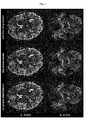
- Figure 1 shows a comparison between uncorrected images with images corrected for Bo fluctuations using a conventional navigator-based approach as well as the proposed autofocusing-based method.
- ghosting artifacts in the uncorrected data are more severe in slice 6 (shown on the bottom), which is positioned lower than slice 3 (top).
- autofocusing and navigator-based correction techniques are able to significantly improve image quality.
Landscapes
- Physics & Mathematics (AREA)
- Engineering & Computer Science (AREA)
- General Physics & Mathematics (AREA)
- Health & Medical Sciences (AREA)
- General Health & Medical Sciences (AREA)
- Nuclear Medicine, Radiotherapy & Molecular Imaging (AREA)
- Radiology & Medical Imaging (AREA)
- Signal Processing (AREA)
- High Energy & Nuclear Physics (AREA)
- Condensed Matter Physics & Semiconductors (AREA)
- Theoretical Computer Science (AREA)
- Magnetic Resonance Imaging Apparatus (AREA)
Abstract
A method for correcting Bo fluctuation-induced ghosting artifacts in long-TE gradient-echo scan images, comprising the steps of
- acquiring an image (u);
- determining phase offsets (Φ);
- applying the phase offsets (Φ) to the image (u);
such that an entropy of the spatial intensity variations in the corrected image (u) decreases.
- acquiring an image (u);
- determining phase offsets (Φ);
- applying the phase offsets (Φ) to the image (u);
such that an entropy of the spatial intensity variations in the corrected image (u) decreases.
Description
- The present invention relates to autofocusing-based correction of Bo fluctuation-induced ghosting.
- Long-TE gradient-echo images are prone to ghosting artifacts. Such degradation is primarily due to magnetic field variations caused by breathing or motion. The effect of these fluctuations amounts to different phase offsets in each acquired k-space line. A common remedy is to measure the problematic phase offsets using an extra non-phase-encoded scan before or after each imaging readout.
- It is therefore an object of the present invention to develop a purely data-driven postprocessing method capable of removing Bo fluctuation-induced ghosting artifacts in long-TE gradient-echo scans.
- The object is achieved by a method and a system according to the independent claims. Advantageous embodiments are defined in the subclaims. Particularly, the invention estimates the phase offsets directly from the raw image data by optimization-based search of phases that minimize an image quality measure. This eliminates the need for any sequence modifications and additional scan time.
- The problem of finding the correct phase offsets is similar to the well-studied autofocusing-based motion correction [1,3], and can be seen as one of its special cases. The optimization problem is formulated and solved where one seeks the latent phase offsets in the Fourier domain that are associated with a minimal value of the image quality measure that is evaluated in the spatial domain. This way, the need for extra non-phase-encoded navigator scans and the related increase in sequence complexity and scan time may be avoided. The experimental results demonstrate that the inventive method is capable of removing the ghosting artifacts, and that the quality of the outcome images is similar to navigator-based reconstructions. To conclude, the proposed method is a valid alternative to using navigators with only a slight increase in post processing time.
- These and other aspects of the present invention will be described in more detail in the following detailed description, in relation to the annexed drawing in which
- Fig. 1
- shows a comparison between uncorrected images with images corrected for Bo fluctuations using a conventional navigator-based approach as well as the proposed autofocusing-based method;
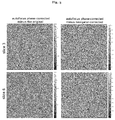
- Fig. 2
- shows the differences between the autofocusing and navigator-based approaches; and
- Fig. 3
- shows the differences between the autofocusing and navigator-based approaches.
-
Equation 1 shows the navigator-less reconstructions formulated as an optimization problem, which involves finding the minimum value of the objective function. The unknown phase values Φ are searched that are associated with low values of the image quality measure ϕ, which is chosen to be the entropy function. More precisely, one computes the entropy of the spatial intensity variations in the SOS-combined image (sum of squares). The matrices that are used to perform the finite difference operations in the x and y direction are denoted by G x and G y, respectively. The phase values Φ are applied to the acquired images u c (for each coil element c) using the diagonal matrix A, whose elements are the complex exponentials exp(iΦt), with t being the repetition index.
- In this formulation, the objective function is invariant to circular shifts of the image in the phase-encoding direction because such circular shifts amount to phase ramps (composed of recovered phases Φ) in the frequency domain. The problem of unnecessary circular shifts can be avoided by adding a regularization term which penalizes strong variations of the recovered phases. The parameter X controls the strength of the regularization (it may be set to 0.1).
- The resulting non-linear optimization problem may be solved in 80 iterations of the LBFGS[2] algorithm. The operations were implemented from Eq. 1 on the GPU in CUDA, bringing the computation time (for each slice) down to a few seconds.
- To evaluate the performance of the proposed method long-TE gradient-echo images were acquired of the brain of a healthy volunteer after obtaining informed consent and approval by the local ethics committee. Data was acquired at 9.4T using a custom-built head coil (16 transmit / 31 receive channels) [4]. 9 slices were acquired of the ventral portions of the brain where field variations are relatively severe, mainly due to breathing-related motion. The GRE sequence included a non-phase-encoded navigator (or phase-stabilization) scan after each imaging readout. The sequence parameters were as follows: TR = 356 ms, TE = 30 ms, nominal flip angle = 45°, matrix = 512x512, resolution = 0.4x0.4 mm2, slice thickness = 1 mm.
-
Figure 1 shows a comparison between uncorrected images with images corrected for Bo fluctuations using a conventional navigator-based approach as well as the proposed autofocusing-based method. Ghosting artifacts in the uncorrected data are more severe in slice 6 (shown on the bottom), which is positioned lower than slice 3 (top). In both slices, autofocusing and navigator-based correction techniques are able to significantly improve image quality. - Apart from some flow-related artifacts, ghosting is completely removed and the images resulting from both techniques are practically indistinguishable from one another. In fact, the differences between the autofocusing and navigator-based approaches amount to the minute high-frequency details as illustrated in
Figure 2 .Figure 3 compares the phase offsets retrieved by our autofocusing algorithm with the navigator-based measurement. - Since there is a sign as well as a global phase offset ambiguity, the sign was adjusted and the mean was subtracted from both phase series before plotting them. Although there are a few differences in the recovered phase values, the general pattern of oscillations (caused by breathing) is the same.
Claims (6)
- Method for correcting Bo fluctuation-induced ghosting artifacts in long-TE gradient-echo scan images, comprising the steps of- acquiring an image (u);- determining phase offsets (Φ);- applying the phase offsets (Φ) to the image (u);such that an entropy of the spatial intensity variations in the corrected image (u) decreases.
- The method of claim 1, wherein the phase offsets are determined using the LBFGS algorithm.
- The method of claim 1, implemented on a GPU in CUDA.
- The method of claim 1, wherein Bo = 9,4 Tesla.
- The method of claim 1, wherein a regularization term is added for penalizing strong variations of the recovered phases.
- Device for correcting Bo fluctuation-induced ghosting artifacts in long-TE gradient-echo scan images, comprising:- an image acquisition unit for acquiring an image (u);- a phase offset determining unit for determining phase offsets (Φ);- a phase offset applying unit for applying the phase offsets (Φ) to the image (u);such that an entropy of the spatial intensity variations in the corrected image (u) decreases.
Priority Applications (3)
| Application Number | Priority Date | Filing Date | Title |
|---|---|---|---|
| EP16152932.6A EP3199968A1 (en) | 2016-01-27 | 2016-01-27 | Autofocusing-based correction of b0 fluctuation-induced ghosting |
| US15/415,584 US20170212202A1 (en) | 2016-01-27 | 2017-01-25 | Autofocusing-based correction of B0 fluctuation-induced ghosting |
| EP17153252.6A EP3199969A1 (en) | 2016-01-27 | 2017-01-26 | Autofocusing-based correction of b0 fluctuation-induced ghosting |
Applications Claiming Priority (1)
| Application Number | Priority Date | Filing Date | Title |
|---|---|---|---|
| EP16152932.6A EP3199968A1 (en) | 2016-01-27 | 2016-01-27 | Autofocusing-based correction of b0 fluctuation-induced ghosting |
Publications (1)
| Publication Number | Publication Date |
|---|---|
| EP3199968A1 true EP3199968A1 (en) | 2017-08-02 |
Family
ID=55310657
Family Applications (2)
| Application Number | Title | Priority Date | Filing Date |
|---|---|---|---|
| EP16152932.6A Withdrawn EP3199968A1 (en) | 2016-01-27 | 2016-01-27 | Autofocusing-based correction of b0 fluctuation-induced ghosting |
| EP17153252.6A Withdrawn EP3199969A1 (en) | 2016-01-27 | 2017-01-26 | Autofocusing-based correction of b0 fluctuation-induced ghosting |
Family Applications After (1)
| Application Number | Title | Priority Date | Filing Date |
|---|---|---|---|
| EP17153252.6A Withdrawn EP3199969A1 (en) | 2016-01-27 | 2017-01-26 | Autofocusing-based correction of b0 fluctuation-induced ghosting |
Country Status (2)
| Country | Link |
|---|---|
| US (1) | US20170212202A1 (en) |
| EP (2) | EP3199968A1 (en) |
Cited By (2)
| Publication number | Priority date | Publication date | Assignee | Title |
|---|---|---|---|---|
| CN108460810A (en) * | 2018-02-11 | 2018-08-28 | 南京邮电大学 | A kind of parallel MR image method for fast reconstruction of full variation |
| CN117953316A (en) * | 2024-03-27 | 2024-04-30 | 湖北楚天龙实业有限公司 | Image quality inspection method and system based on artificial intelligence |
Citations (1)
| Publication number | Priority date | Publication date | Assignee | Title |
|---|---|---|---|---|
| US7728757B2 (en) * | 2008-06-09 | 2010-06-01 | The Boeing Company | Autofocus for minimum entropy through multi-dimensional optimization |
Family Cites Families (1)
| Publication number | Priority date | Publication date | Assignee | Title |
|---|---|---|---|---|
| US10634752B2 (en) * | 2015-09-14 | 2020-04-28 | Cedars-Sinai Medical Center | Motion corrected simultaneously acquired multiple contrast coronary MRI systems and methods |
-
2016
- 2016-01-27 EP EP16152932.6A patent/EP3199968A1/en not_active Withdrawn
-
2017
- 2017-01-25 US US15/415,584 patent/US20170212202A1/en not_active Abandoned
- 2017-01-26 EP EP17153252.6A patent/EP3199969A1/en not_active Withdrawn
Patent Citations (1)
| Publication number | Priority date | Publication date | Assignee | Title |
|---|---|---|---|---|
| US7728757B2 (en) * | 2008-06-09 | 2010-06-01 | The Boeing Company | Autofocus for minimum entropy through multi-dimensional optimization |
Non-Patent Citations (5)
| Title |
|---|
| ALEXANDER LOKTYUSHIN ET AL: "Blind retrospective motion correction of MR images", MAGNETIC RESONANCE IN MEDICINE., vol. 70, no. 6, 11 February 2013 (2013-02-11), US, pages 1608 - 1618, XP055288829, ISSN: 0740-3194, DOI: 10.1002/mrm.24615 * |
| BROCKSTEDT SARA ET AL: "High-resolution diffusion imaging using phase-corrected segmented echo-planer imaging", MAGNETIC RESONANCE IMAGING, ELSEVIER SCIENCE, TARRYTOWN, NY, US, vol. 18, no. 6, 1 January 2000 (2000-01-01), pages 649 - 657, XP002967687, ISSN: 0730-725X, DOI: 10.1016/S0730-725X(00)00159-4 * |
| DAVID ATKINSON ET AL: "Automatic Correction of Motion Artifacts in Magnetic Resonance Images Using an Entropy Focus Criterion", IEEE TRANSACTIONS ON MEDICAL IMAGING, IEEE SERVICE CENTER, PISCATAWAY, NJ, US, vol. 16, no. 6, 1 December 1997 (1997-12-01), XP011035675, ISSN: 0278-0062 * |
| LIN W ET AL: "Improved optimization strategies for autofocusing motion compensation in MRI via the analysis of image metric maps", MAGNETIC RESONANCE IMAGING, ELSEVIER SCIENCE, TARRYTOWN, NY, US, vol. 24, no. 6, 1 July 2006 (2006-07-01), pages 751 - 760, XP028004862, ISSN: 0730-725X, [retrieved on 20060701], DOI: 10.1016/J.MRI.2006.02.003 * |
| MCGEE K P ET AL: "Image metric-based correction (autocorrection) of motion effects: analysis of image metrics", JOURNAL OF MAGNETIC RESONANCE IMAGING, SOCIETY FOR MAGNETIC RESONANCE IMAGING, OAK BROOK, IL, US, vol. 11, no. 2, 1 February 2000 (2000-02-01), pages 174 - 181, XP002276109, ISSN: 1053-1807, DOI: 10.1002/(SICI)1522-2586(200002)11:2<174::AID-JMRI15>3.0.CO;2-3 * |
Cited By (2)
| Publication number | Priority date | Publication date | Assignee | Title |
|---|---|---|---|---|
| CN108460810A (en) * | 2018-02-11 | 2018-08-28 | 南京邮电大学 | A kind of parallel MR image method for fast reconstruction of full variation |
| CN117953316A (en) * | 2024-03-27 | 2024-04-30 | 湖北楚天龙实业有限公司 | Image quality inspection method and system based on artificial intelligence |
Also Published As
| Publication number | Publication date |
|---|---|
| EP3199969A1 (en) | 2017-08-02 |
| US20170212202A1 (en) | 2017-07-27 |
Similar Documents
| Publication | Publication Date | Title |
|---|---|---|
| US20120002859A1 (en) | Magnetic resonance partially parallel imaging (ppi) with motion corrected coil sensitivities | |
| Pipe et al. | Revised motion estimation algorithm for PROPELLER MRI | |
| In et al. | Highly accelerated PSF-mapping for EPI distortion correction with improved fidelity | |
| Gallichan et al. | Retrospective correction of involuntary microscopic head movement using highly accelerated fat image navigators (3D FatNavs) at 7T | |
| EP3123192B1 (en) | Epi ghost correction involving sense | |
| Engström et al. | Collapsed fat navigators for brain 3D rigid body motion | |
| US8854037B2 (en) | Method for compensating for eddy current fields in magnetic resonance images | |
| Burakiewicz et al. | Improved olefinic fat suppression in skeletal muscle DTI using a magnitude‐based dixon method | |
| Ma et al. | A field-monitoring-based approach for correcting eddy-current-induced artifacts of up to the 2nd spatial order in human-connectome-project-style multiband diffusion MRI experiment at 7T: a pilot study | |
| US20190355157A1 (en) | Motion robust reconstruction of multi-shot diffusion-weighted images without phase estimation via locally low-rank regularization | |
| WO2020078131A1 (en) | Magnetic resonance cest imaging sequence and apparatus based on frequency stabilization module | |
| US11313933B2 (en) | Diffusion-weighted MRI with magnitude-based locally low-rank regularization | |
| Kirchner et al. | Mechanisms of SNR and line shape improvement by B0 correction in overdiscrete MRSI reconstruction | |
| Wang et al. | Analytical three‐point Dixon method: With applications for spiral water–fat imaging | |
| Smith et al. | Automatic off‐resonance correction in spiral imaging with piecewise linear autofocus | |
| JP5908878B2 (en) | Magnetic resonance apparatus and program | |
| CN113777545A (en) | Chemical exchange saturation transfer imaging correction method and device and readable storage medium | |
| US9678187B2 (en) | Magnetic resonance imaging device, phase value correction method and program | |
| Mani et al. | Comprehensive reconstruction of multi-shot multi-channel diffusion data using mussels | |
| EP3199969A1 (en) | Autofocusing-based correction of b0 fluctuation-induced ghosting | |
| US7538548B2 (en) | Fast spin echo MRI method compatible with CPMG violation | |
| Ma et al. | Linear phase‐error correction for improved water and fat separation in dual‐echo dixon techniques | |
| Lin et al. | Off‐resonance artifacts correction with convolution in k‐space (ORACLE) | |
| JP2001112735A (en) | Magnetic resonance imaging apparatus | |
| Loktyushin et al. | Autofocusing‐based phase correction |
Legal Events
| Date | Code | Title | Description |
|---|---|---|---|
| PUAI | Public reference made under article 153(3) epc to a published international application that has entered the european phase |
Free format text: ORIGINAL CODE: 0009012 |
|
| STAA | Information on the status of an ep patent application or granted ep patent |
Free format text: STATUS: THE APPLICATION HAS BEEN PUBLISHED |
|
| AK | Designated contracting states |
Kind code of ref document: A1 Designated state(s): AL AT BE BG CH CY CZ DE DK EE ES FI FR GB GR HR HU IE IS IT LI LT LU LV MC MK MT NL NO PL PT RO RS SE SI SK SM TR |
|
| AX | Request for extension of the european patent |
Extension state: BA ME |
|
| STAA | Information on the status of an ep patent application or granted ep patent |
Free format text: STATUS: THE APPLICATION IS DEEMED TO BE WITHDRAWN |
|
| 18D | Application deemed to be withdrawn |
Effective date: 20180203 |