EP3199252A1 - Vibratory apparatus with deck panel and deck panel - Google Patents
Vibratory apparatus with deck panel and deck panel Download PDFInfo
- Publication number
- EP3199252A1 EP3199252A1 EP17153271.6A EP17153271A EP3199252A1 EP 3199252 A1 EP3199252 A1 EP 3199252A1 EP 17153271 A EP17153271 A EP 17153271A EP 3199252 A1 EP3199252 A1 EP 3199252A1
- Authority
- EP
- European Patent Office
- Prior art keywords
- panel
- deck
- disposed
- guards
- panel base
- Prior art date
- Legal status (The legal status is an assumption and is not a legal conclusion. Google has not performed a legal analysis and makes no representation as to the accuracy of the status listed.)
- Withdrawn
Links
Images


Classifications
-
- B—PERFORMING OPERATIONS; TRANSPORTING
- B07—SEPARATING SOLIDS FROM SOLIDS; SORTING
- B07B—SEPARATING SOLIDS FROM SOLIDS BY SIEVING, SCREENING, SIFTING OR BY USING GAS CURRENTS; SEPARATING BY OTHER DRY METHODS APPLICABLE TO BULK MATERIAL, e.g. LOOSE ARTICLES FIT TO BE HANDLED LIKE BULK MATERIAL
- B07B1/00—Sieving, screening, sifting, or sorting solid materials using networks, gratings, grids, or the like
- B07B1/46—Constructional details of screens in general; Cleaning or heating of screens
-
- B—PERFORMING OPERATIONS; TRANSPORTING
- B07—SEPARATING SOLIDS FROM SOLIDS; SORTING
- B07B—SEPARATING SOLIDS FROM SOLIDS BY SIEVING, SCREENING, SIFTING OR BY USING GAS CURRENTS; SEPARATING BY OTHER DRY METHODS APPLICABLE TO BULK MATERIAL, e.g. LOOSE ARTICLES FIT TO BE HANDLED LIKE BULK MATERIAL
- B07B1/00—Sieving, screening, sifting, or sorting solid materials using networks, gratings, grids, or the like
- B07B1/42—Drive mechanisms, regulating or controlling devices, or balancing devices, specially adapted for screens
-
- B—PERFORMING OPERATIONS; TRANSPORTING
- B07—SEPARATING SOLIDS FROM SOLIDS; SORTING
- B07B—SEPARATING SOLIDS FROM SOLIDS BY SIEVING, SCREENING, SIFTING OR BY USING GAS CURRENTS; SEPARATING BY OTHER DRY METHODS APPLICABLE TO BULK MATERIAL, e.g. LOOSE ARTICLES FIT TO BE HANDLED LIKE BULK MATERIAL
- B07B1/00—Sieving, screening, sifting, or sorting solid materials using networks, gratings, grids, or the like
- B07B1/28—Moving screens not otherwise provided for, e.g. swinging, reciprocating, rocking, tilting or wobbling screens
-
- B—PERFORMING OPERATIONS; TRANSPORTING
- B07—SEPARATING SOLIDS FROM SOLIDS; SORTING
- B07B—SEPARATING SOLIDS FROM SOLIDS BY SIEVING, SCREENING, SIFTING OR BY USING GAS CURRENTS; SEPARATING BY OTHER DRY METHODS APPLICABLE TO BULK MATERIAL, e.g. LOOSE ARTICLES FIT TO BE HANDLED LIKE BULK MATERIAL
- B07B1/00—Sieving, screening, sifting, or sorting solid materials using networks, gratings, grids, or the like
- B07B1/46—Constructional details of screens in general; Cleaning or heating of screens
- B07B1/4609—Constructional details of screens in general; Cleaning or heating of screens constructional details of screening surfaces or meshes
-
- B—PERFORMING OPERATIONS; TRANSPORTING
- B07—SEPARATING SOLIDS FROM SOLIDS; SORTING
- B07B—SEPARATING SOLIDS FROM SOLIDS BY SIEVING, SCREENING, SIFTING OR BY USING GAS CURRENTS; SEPARATING BY OTHER DRY METHODS APPLICABLE TO BULK MATERIAL, e.g. LOOSE ARTICLES FIT TO BE HANDLED LIKE BULK MATERIAL
- B07B1/00—Sieving, screening, sifting, or sorting solid materials using networks, gratings, grids, or the like
- B07B1/46—Constructional details of screens in general; Cleaning or heating of screens
- B07B1/4609—Constructional details of screens in general; Cleaning or heating of screens constructional details of screening surfaces or meshes
- B07B1/4645—Screening surfaces built up of modular elements
-
- B—PERFORMING OPERATIONS; TRANSPORTING
- B07—SEPARATING SOLIDS FROM SOLIDS; SORTING
- B07B—SEPARATING SOLIDS FROM SOLIDS BY SIEVING, SCREENING, SIFTING OR BY USING GAS CURRENTS; SEPARATING BY OTHER DRY METHODS APPLICABLE TO BULK MATERIAL, e.g. LOOSE ARTICLES FIT TO BE HANDLED LIKE BULK MATERIAL
- B07B2201/00—Details applicable to machines for screening using sieves or gratings
- B07B2201/02—Fastening means for fastening screens to their frames which do not stretch or sag the screening surfaces
Definitions
- This patent is directed to a vibratory apparatus having a deck and a method for assembling the deck, and, in particular, to a vibratory screening apparatus having a deck including a plurality of deck panels and a method for assembling the plurality of deck panels to form the deck.
- the deck of a vibratory apparatus can experience significant wear over the apparatus's lifetime.
- the movement of material relative to the deck which may involve movement along the surface of the deck as well as movement vertically relative to the deck, can cause the deck to become worn and/or damaged to the point where the deck needs to be repaired or replaced.
- Repair or replacement of a traditional deck can be a lengthy process, and costly in terms of parts and labor. Where the apparatus has been installed in a space that restricts the possibilities for replacement, the repair may become even more complicated.
- modular decks have been designed that divide or portion the deck into a number of deck modules or panels.
- Such modular decks typically include a frame that is attached or secured to the remainder of the vibratory apparatus, and then the deck panels are disposed or supported on top of the frame. Materials are then directed over the deck panels, and potentially through the deck panels as well (in the case of a screen, for example).
- a single deck may include a large number of individual deck panels.
- a vibratory apparatus includes a deck and an exciter coupled to the at least one deck.
- the deck includes at least one deck panel.
- the at least one deck panel includes a panel base having a top defining an upper, load-bearing surface, a bottom disposed opposite the top, and first and second opposite sides, a plurality of passages, each passage connected between an upper opening disposed in the upper, load-bearing surface and a lower opening on the bottom, and first and second guards depending from the bottom of the panel base, each of the guards disposed along one of the first and second opposite sides with the plurality of passages disposed between the two guards.
- a deck panel includes a panel base having a top defining an upper, load-bearing surface, a bottom disposed opposite the top, and first and second opposite sides, a plurality of passages, each passage connected between an upper opening disposed in the upper, load-bearing surface and a lower opening on the bottom, and first and second guards depending from the bottom of the panel base, each of the guards disposed along one of the first and second opposite sides with the plurality of passages disposed between the two guards.
- a vibratory apparatus includes a deck and an exciter coupled to the at least one deck.
- the deck includes at least one deck panel, and at least one deck panel includes a plurality of panel modules.
- Each panel module includes a panel base having a top defining an upper, load-bearing surface, a bottom disposed opposite the top, and first and second opposite sides, a plurality of passages, each passage connected between an upper opening disposed in the upper, load-bearing surface and a lower opening on the bottom, and first and second guards depending from the bottom of the panel base, each of the guards disposed along one of the first and second opposite sides with the plurality of passages disposed between the two guards.
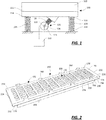
- Fig. 1 illustrates an embodiment of a vibratory apparatus 100 that may have a deck according to the present disclosure.
- This embodiment is intended to be a nonlimiting example of the possible apparatuses that may have a deck formed of deck panels such as those illustrated in Figs. 2-11 . It will be recognized that considerable variation may occur, for example, relative to the structures that support and/or balance the trough and in the manner and shape of the exciter, as will be touched on briefly below.
- the apparatus 100 may include a trough 102 that is supported above a surface by a plurality of resilient members 104.
- the resilient members 104 may be paired with linkages.
- the resilient members 104 may be attached at one end 108 to the trough 102 and at a second end 110 to the surface, often via a support structure that may be bolted or otherwise secured to the surface.
- the trough 102 may have a deck 112 disposed therein, the details of which are discussed below.
- the trough 102 may include a floor 114 beneath the deck 112, as illustrated, or there may be an opening in the trough 102 beneath the deck 112. Further, the deck 112 may include other structures other than the deck panels described below.
- the exciter 120 may be coupled to the trough 102.
- the exciter 120 may include a motor 122 having a shaft 124 to which one or more eccentric weights 126 are attached, for example.
- the exciter 120 may include pneumatic and/or hydraulic actuators instead of the motor 122.
- the shaft 124 and weights 126 may be attached to the trough 102, while the motor 122 is coupled to the shaft 124, but not mounted on the apparatus 100.
- the motor 122, shaft 124 and weights 126 may be coupled to the trough 102 via one or more resilient members 128, as illustrated. It will be recognized that the motor 122 may instead be coupled directly to the trough 102, or to a counterbalance that is then attached to the trough 102. It will also be recognized that one or more weights or stabilizers may be used in conjunction with the motor 122.
- the exciter 120 may cause motion of the trough 102 and associated deck 112, as well as motion of objects supported on the deck 112.
- the exciter 120 may cause the objects to move from one end of the trough 102 to the other (for example, in a series of "catches and throws"), may cause the objects to move up and down without significant lateral motion relative to either end, or some combination thereof
- the operation of the exciter 120 may be controlled by a controller 130 that may be coupled to the exciter 120, particularly to the motor 122 and/or the weights 126 (which may be variable as to their center of mass relative to the shaft 124, for example).
- the controller 130 may be programmable, and may vary the operation of the exciter 120 (via the motor 122 and/or weights 126) such that objects move along the deck 112, move up and down relative to the deck 112, and then resume their motion along the deck 112, for example.
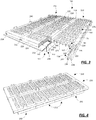
- the deck 112 of the vibratory apparatus 100 is formed from a plurality of deck panels 150, an embodiment of which is illustrated in Fig. 2 .
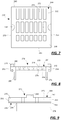
- the deck panels 150 may be attached to a frame 152, as illustrated in Fig. 3 .
- the frame 152 is attached to the trough 102 (and in particular sidewalls of the trough 102) and then the panels 150 are attached to the frame 152, as explained in greater detail below with respect to the illustrated embodiment.
- the assembly illustrated in Fig. 3 is an example of a portion of one row of panels 150 that may be disposed between the sidewalls of the trough 102 to define the deck 112.
- the full row may include, and typically does include, more than the three deck panels illustrated.
- the deck panel 150 includes a panel base 160, a plurality of passages 162 and a pair of guards 164, 166. More particularly, the panel base 160 has a top 170 defining an upper, load-bearing surface 172, a bottom 174 disposed opposite the top 170, and first and second sides 176, 178 disposed opposite each other.
- the plurality of passages 162 are formed in and through the panel base 160. Each passage 162 is connected between an upper opening 180 disposed in the upper, load-bearing surface 172 and a lower opening 182 on the bottom 174.
- the guards 164, 166 depend from the bottom 174 of the panel base 160. Each of the guards 164, 166 is disposed along one of the first and second opposite sides 176, 178 of the panel base 160 with the plurality of passages 162 disposed between the two guards 164, 166.
- the deck frame 152 is disposed below the deck panels 150, and the deck panels 150 are attached or connected to the deck frame 152.
- the deck frame 152 may include a plurality of longitudinal beams 190 and a plurality of transverse cross-members 192.
- the longitudinal beams 190 extend along the length of the vibratory apparatus 100, while the transverse members 192 extend across the width of the apparatus 100 between the sidewalls.
- the beams 190 may be oriented across the width of the apparatus, with the members 192 oriented along the length.
- Formed on the longitudinal beams 190 are one of a pair of connectors, the other of the connectors being disposed on the deck panels 150.
- a longitudinally-directed male connector 194 is attached to the longitudinal beams 190 while a female connector 196, 198 is formed in the bottom of the deck panel 150.
- the male and female connectors may be reversed relative to the panels 150 and frame 152, or other types of connectors or connector assemblies may be used.
- the deck panel 150 includes a first female connector 196 disposed between the first guard 164 and a first longitudinal side edge 200.
- the deck panel 150 also includes a second female connector 198 disposed between the second guard 166 and a second longitudinal side edge 202 disposed opposite the first side edge 200.
- One of the male connectors 194 is received in the first female connector 196, while another of the male connectors 194 is received in the second female connector 198.
- the cooperation of the male and female connectors 194, 196, 198 may be such that the panel 150 is secured to the frame 152 under operating conditions, but the panel 150 may be separated from the frame by decoupling the connectors 194, 196, 198, which decoupling may require the use of a tool or may simply be the result of forces applied to the panel 150 in a fashion unlikely to occur under operating conditions.
- the guards 164, 166 depend from the base 160 of the panel 150 to such an extent that the longitudinal beams 190 are shielded from material passing through the passages 162. That is, the guards 164, 166 present an inner surface 204, 206 against which materials that exit the passages 162 may contact instead of contacting the beams 190.
- the longitudinal beams 190 are disposed between guards 164, 166 of adjacent panels 150. Consequently, the amount of material contacting the beams 190 may be reduced, such that the need to repair and/or replace the beams 190 (which can be a very labor intensive process considering the attachment of the beams 190 to the remainder of the trough 102) may be reduced or eliminated.
- the panels 150 are removable, if the wear on the guard 164, 166 is to such an extent that the guard 164, 166 no longer performs its intended function, the panel 150 may be removed and replaced, such as it would if the base 160 (and in particular the surface 172) is worn to a degree that the panel 150 fails to adequately perform its function of separating materials of different sizes.
- a method of assembling a deck 112 using the aforementioned deck panels 150 may include disposing at least one deck panel 150 on a deck frame 152, the at least one deck panel 150 including a panel base 160 having a top 170 defining an upper, load-bearing surface 172, a bottom 174 disposed opposite the top 170, and first and second sides 176, 178 disposed opposite each other, a plurality of passages 162, each passage 162 connected between an upper opening 180 disposed in the upper, load-bearing surface 172 and a lower opening 182 on the bottom 174, and first and second guards 164, 166 depending from the bottom 174 of the panel base 160, each of the guards 164, 166 disposed along one of the first and second opposite sides 176, 178 with the plurality of passages 162 disposed between the two guards 164, 166.
- the method may also include securing the at least one deck panel 150 to the deck frame 152.
- the securing of the at least one deck panel 150 to the deck frame 152 may be reversible (i.e., the at least one deck panel 150 may be decoupable or detachable from the deck frame 152 without altering or damaging the deck frame 152).
- the at least one deck panel 150 may be permanently secured (i.e., incapable of being decoupled or detached from the deck frame 152 without altering or damaging the deck frame 152).
- the method may include coupling a connector attached to or part of the deck panel 150 with a connector attached to or part of the deck frame 152.
- the deck frame 152 may include at least one male connector 194 and the at least one deck panel 150 may include at least one female connector 196, 198, and the method may include disposing the male connector 194 within the female connector 196, 198.
- the male and female connectors 194, 196, 198 are as illustrated in Fig. 3
- the method may include inserting the male connector 194 into the female connector 196, 198.
- the method may also include decoupling or detaching the at least one deck panel 150 from the deck frame 152, and securing at least one replacement deck panel 150 to the deck frame 152 in place of the at least one deck panel 150 removed from the deck frame 152.
- the panel base 160 comprises a rectangular parallelepiped, having a length in a longitudinal direction that is considerably greater than its width in a transverse direction, or its thickness.
- the shape of the panel base 160 may be of a different shape.
- the panel base 160 may be referred to as a rectangular parallelepiped despite the fact that, for example, not all of the corners of the panel base 160 are perfectly right or square in cross-section (see the bottom corners 210 in Fig. 3 ).
- the first side 176 of the panel base 160 terminates at the first longitudinal side edge 200, and the second side 178 of the panel base 160 terminates at the second longitudinal side edge 202, as mentioned above.
- the first guard 164 is spaced from the first side edge 200 and the second guard 166 is spaced from the second side edge 202.
- the first and second female connectors 196, 198 in the form of first and second channels 212, 214, are also disposed on the bottom 174 of the deck panel base 160.
- the first channel 212 is disposed between the first side edge 200 and the first guard 164 and the second channel 214 is disposed between the second guard 166 and the second side edge 202.
- the panel base 160 has first and second ends 220, 222 disposed opposite each other, in addition to the top 170, bottom 174 and opposite sides 176, 178.
- the first and second guards 164, 166 depend from the bottom 174 of the panel base 160 between the first end 220 and the second end 222 of the panel base 160 (i.e., from one end of the panel base 160 to the other).
- the first and second guards 164, 166 may depend from the bottom 174 of the panel base 160 continuously (i.e., without spaces or breaks) between the first end 220 and the second end 222.
- first and second guards 164, 166 may depend from the bottom 174 of the panel base 160 intermittently (i.e., with spaces, gaps or breaks) between the first end 220 and the second end 222 (see Fig. 12 ).
- first end 220 of the panel base 160 terminates at a first transverse end edge 224 and the second end 222 of the panel base 160 terminates at a second transverse end edge 226.
- first and second guards 164, 166 depending from the bottom 174 of the panel base 160 between a first point 228 spaced from the first end edge 224 to a second point 230 spaced from the second end edge 226 to define a first overhang 232 at the first end 220 and a second overhang 234 at the second end 222.
- the guards 164, 166 may depend between these points 228, 230 continuously or intermittently.
- Each of the guards 164, 166 also may be a rectangular parallelepiped in shape, disposed at right angles to the panel base 160. However, this is not a requirement for all embodiments of the present disclosure.
- the guards 164, 166 may be tapered in cross-section, and may be disposed at an angle relative to the panel base 160 such that the bottommost ends of the guards 164, 166 either converge towards each other or away from each other.
- the guards 164, 166 may vary along the length of the guard 164, 166 (i.e., between the first and second ends 220, 222 of the panel base 160).
- the guard 164, 166 may assume a sinusoidal or sawtooth shape between one end and the other end 220, 222.
- the guards 164, 166 are formed as a single unit or piece with the panel base 160.
- the guards 164, 166 may be molded with the panel base 160 as a single unit.
- the single unit or piece may be molded using a polymer such as polyurethane, for example.
- the guards 164, 166 may be formed separately from and then attached to the bottom of the panel base 160, using an adhesive, for example.
- a plurality of passages 162 are formed in the panel base 160.
- the openings 180 in the upper, load-bearing surface 172 may be generally rectangular. According to other embodiments, the openings 180 may have another shape, such as square or circular.
- the plurality of passages 162 are disposed in a plurality of parallel, transverse rows, each row disposed between the first guard 164 and the second guard 166, and none of the plurality of passages 162 disposed in the first overhang 232 or the second overhang 234. Again, according to other embodiments, it is not necessary that the passages 162 be arranged in parallel, transverse rows or that none of the passages be located in the overhangs 232, 234.
- the inventive deck panel 150 may include a panel base 160 having a top 170 defining an upper, load-bearing surface 172, a bottom 174 disposed opposite the top 170, and first and second opposite sides 176, 178 disposed opposite each other, a plurality of passages 162, each passage 62 connected between an upper opening 180 disposed in the upper, load-bearing surface 172 and a lower opening 182 on the bottom 174, and first and second guards 164, 166 depending from the bottom 174 of the panel base 160, each of the guards 164, 166 disposed along one of the first and second opposite sides 176, 178 with the plurality of passages 162 disposed between the two guards 164, 166.
- a deck panel 150 may include any of the variations described above as alternate embodiments.
- each deck panel 150 may include a plurality of semi-cylindrical posts 240 disposed on the top 170 of the panel base 160.
- the posts 240 may define a plurality of cylindrical posts when the panels 150 are disposed with the first side 176 of a first panel 150 abutting the second side 178 of a second panel 150, as illustrated in Fig. 3 .
- the posts 240 redirect material flowing over the surface 172 of the panel 150 toward the passages 162, and in particular the openings 180 in the surface 172.
- Other alternative features may include textures or coatings for the surface 172, for example.
- the deck panel 150 may also be described as including a plurality of panel modules 250, 252.
- Fig. 4 illustrates how two of the deck panels 150 from Fig. 3 may be represented as a plurality of deck modules 250, 252.
- the deck modules 250, 252 may be used to describe the structure of a single deck panel 150, the deck modules 250, 252 being formed together (e.g., by molding) as a single unit, or the deck modules 250, 252 may be separate units, which as an assembly provide the structure of a single deck panel 150 as descried above.
- the modules 250, 252 may even be secured to the deck frame 152 separately according to such an embodiment.
- each panel module 250, 252 includes a panel base 260 having a top 262 defining an upper, load-bearing surface 264, a bottom 266 disposed opposite the top 262, and first and second opposite sides 268, 270 disposed opposite each other.
- the panel module 250, 252 also includes a plurality of passages 272, each passage 272 connected between an upper opening 274 disposed in the upper, load-bearing surface 264 and a lower opening 276 on the bottom 266, and first and second guards 278, 280 depending from the bottom 266 of the panel base 260, each of the guards 278, 280 disposed along one of the first and second opposite sides 268, 270 with the plurality of passages 272 disposed between the two guards 278, 280.
- the plurality of panel modules may include a first and a second end panel module 250 and at least one intermediate panel module 252.
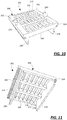
- the end panel modules 250 are illustrated in detail in Figs. 5-9
- the intermediate panel modules 252 are illustrated in detail in Figs. 10 and 11 .
- a panel could have an end that terminates in an intermediate panel module as described below (i.e., a panel module without an overhang).
- the terms "end” and “intermediate” are with reference to the illustrated embodiment, and that the terms "first” and "second” may be substituted instead.
- the first end panel module 250 has an end 290 in addition to the top 262, bottom 266 and opposite sides 268, 270, the end 290 of the panel base 260 of the first end panel module 250 terminating at a transverse end edge 292.
- the first and second guards 278,280 of the first end panel module 250 depend from the bottom 266 of the panel base 260 from a point 294 spaced from the end edge 292 to define an overhang 296 at the first end 290 between the end edge 292 and the point 294.
- the second end panel module 250 also has an end 290 in addition to the top 262, bottom 266 and opposite sides 268, 270, the end 290 of the panel base 260 of the second end panel module 250 terminating at an transverse end edge 292, with the edge 292 of the second end panel module 250 disposed opposite the end edge 292 of the first end panel module 250.
- the first and second guards 278, 280 of the second end panel module 250 depending from the bottom 266 of the panel base 260 from a point 294 spaced from the end edge 292 to define an overhang 296 at the second end 290 between the end edge 292 and the point 294.
- either the first or the second end panel module 250 may be as illustrated in Figs. 5-9 .
- the at least one intermediate panel module 252 does not include an overhang 296.
- the module 252 still includes a top 262, a bottom 266, opposite sides 268, 270, and first and second guards 278, 280, as illustrated in Figs. 10 and 11 .
- the guards 278, 280 may be slightly spaced from either edge to define an intermittent guard along the length of the assembly panel including one or more end panels 250 and/or intermittent panels 252, similar to that illustrated in Fig. 12 .
- Such an embodiment may still differ from that illustrated in that the overhangs 296 do not include passages 272 in the overhangs 296.
Landscapes
- Jigging Conveyors (AREA)
- Vibration Prevention Devices (AREA)
- Vehicle Step Arrangements And Article Storage (AREA)
- Combined Devices Of Dampers And Springs (AREA)
- Casings For Electric Apparatus (AREA)
- Feeding Of Articles To Conveyors (AREA)
- Combined Means For Separation Of Solids (AREA)
Abstract
Description
- This patent is directed to a vibratory apparatus having a deck and a method for assembling the deck, and, in particular, to a vibratory screening apparatus having a deck including a plurality of deck panels and a method for assembling the plurality of deck panels to form the deck.
- The deck of a vibratory apparatus, such as a vibratory screening apparatus or screen, can experience significant wear over the apparatus's lifetime. The movement of material relative to the deck, which may involve movement along the surface of the deck as well as movement vertically relative to the deck, can cause the deck to become worn and/or damaged to the point where the deck needs to be repaired or replaced. Repair or replacement of a traditional deck can be a lengthy process, and costly in terms of parts and labor. Where the apparatus has been installed in a space that restricts the possibilities for replacement, the repair may become even more complicated.
- To reduce the time and expense required to perform such repairs, modular decks have been designed that divide or portion the deck into a number of deck modules or panels. Such modular decks typically include a frame that is attached or secured to the remainder of the vibratory apparatus, and then the deck panels are disposed or supported on top of the frame. Materials are then directed over the deck panels, and potentially through the deck panels as well (in the case of a screen, for example). A single deck may include a large number of individual deck panels.
- With a modular deck, it is no longer necessary to remove and replace the entire deck when only one portion of the deck is worn or damaged and needs to be repaired or replaced. The ability to repair or replace only a section of the deck to address localized wear or damage can reduce the cost of the repair (in terms of labor and materials) and the time required to perform the repair. A reduction in the time required to perform the repair can lead to shorter down-time for the apparatus. Furthermore, because of the size of the panel (relative to the entire deck), it may be easier to repair such a deck even when the apparatus is installed in a space with relatively small clearances about the apparatus.
- According to one aspect of the present disclosure, a vibratory apparatus includes a deck and an exciter coupled to the at least one deck. The deck includes at least one deck panel. The at least one deck panel includes a panel base having a top defining an upper, load-bearing surface, a bottom disposed opposite the top, and first and second opposite sides, a plurality of passages, each passage connected between an upper opening disposed in the upper, load-bearing surface and a lower opening on the bottom, and first and second guards depending from the bottom of the panel base, each of the guards disposed along one of the first and second opposite sides with the plurality of passages disposed between the two guards.
- According to another aspect of the present disclosure, a deck panel includes a panel base having a top defining an upper, load-bearing surface, a bottom disposed opposite the top, and first and second opposite sides, a plurality of passages, each passage connected between an upper opening disposed in the upper, load-bearing surface and a lower opening on the bottom, and first and second guards depending from the bottom of the panel base, each of the guards disposed along one of the first and second opposite sides with the plurality of passages disposed between the two guards.
- According to yet another aspect of the present disclosure, a vibratory apparatus includes a deck and an exciter coupled to the at least one deck. The deck includes at least one deck panel, and at least one deck panel includes a plurality of panel modules. Each panel module includes a panel base having a top defining an upper, load-bearing surface, a bottom disposed opposite the top, and first and second opposite sides, a plurality of passages, each passage connected between an upper opening disposed in the upper, load-bearing surface and a lower opening on the bottom, and first and second guards depending from the bottom of the panel base, each of the guards disposed along one of the first and second opposite sides with the plurality of passages disposed between the two guards.
- It is believed that the disclosure will be more fully understood from the following description taken in conjunction with the accompanying drawings. Some of the figures may have been simplified by the omission of selected elements for the purpose of more clearly showing other elements. Such omissions of elements in some figures are not necessarily indicative of the presence or absence of particular elements in any of the exemplary embodiments, except as may be explicitly delineated in the corresponding written description. None of the drawings is necessarily to scale.
-
Fig. 1 is a side view of an embodiment of a vibratory apparatus according to the present disclosure; -
Fig. 2 is a perspective view of an embodiment of a deck panel for use in the vibratory apparatus ofFig. 1 ; -
Fig. 3 is a perspective view, in partial cross-section, of a plurality of the deck panels ofFig. 2 assembled to form a portion of the deck of the vibratory apparatus ofFig. 1 ; -
Fig. 4 is an alternative representation of the deck panels inFig. 3 , illustrating each deck panel as a plurality of deck panel modules; -
Fig. 5 is a top perspective view of an embodiment of an end deck panel module; -
Fig. 6 is a bottom perspective view of the end deck panel module ofFig. 5 ; -
Fig. 7 is a plan view of the end deck panel module ofFig. 5 ; -
Fig. 8 is an end view of the end deck panel module ofFig. 5 ; -
Fig. 9 is a side view of the end deck panel module ofFig. 5 ; -
Fig. 10 is a top perspective view of an embodiment of an intermediate deck panel module; -
Fig. 11 is a bottom perspective view of an embodiment of the intermediate deck panel module ofFig. 10 ; and -
Fig. 12 is a perspective view of an alternative embodiment of the deck panel ofFig. 2 , illustrating an intermittent form of the guards. -
Fig. 1 illustrates an embodiment of avibratory apparatus 100 that may have a deck according to the present disclosure. This embodiment is intended to be a nonlimiting example of the possible apparatuses that may have a deck formed of deck panels such as those illustrated inFigs. 2-11 . It will be recognized that considerable variation may occur, for example, relative to the structures that support and/or balance the trough and in the manner and shape of the exciter, as will be touched on briefly below. - The
apparatus 100 may include atrough 102 that is supported above a surface by a plurality ofresilient members 104. According to certain embodiments, theresilient members 104 may be paired with linkages. Theresilient members 104 may be attached at oneend 108 to thetrough 102 and at asecond end 110 to the surface, often via a support structure that may be bolted or otherwise secured to the surface. Thetrough 102 may have adeck 112 disposed therein, the details of which are discussed below. Thetrough 102 may include afloor 114 beneath thedeck 112, as illustrated, or there may be an opening in thetrough 102 beneath thedeck 112. Further, thedeck 112 may include other structures other than the deck panels described below. - One or
more exciters 120 may be coupled to thetrough 102. Theexciter 120 may include amotor 122 having ashaft 124 to which one or moreeccentric weights 126 are attached, for example. According to other embodiments, theexciter 120 may include pneumatic and/or hydraulic actuators instead of themotor 122. For that matter, theshaft 124 andweights 126 may be attached to thetrough 102, while themotor 122 is coupled to theshaft 124, but not mounted on theapparatus 100. - The
motor 122,shaft 124 and weights 126 (or simply theshaft 124 and weights 126) may be coupled to thetrough 102 via one or moreresilient members 128, as illustrated. It will be recognized that themotor 122 may instead be coupled directly to thetrough 102, or to a counterbalance that is then attached to thetrough 102. It will also be recognized that one or more weights or stabilizers may be used in conjunction with themotor 122. - The
exciter 120 may cause motion of thetrough 102 and associateddeck 112, as well as motion of objects supported on thedeck 112. Theexciter 120 may cause the objects to move from one end of thetrough 102 to the other (for example, in a series of "catches and throws"), may cause the objects to move up and down without significant lateral motion relative to either end, or some combination thereof The operation of theexciter 120 may be controlled by acontroller 130 that may be coupled to theexciter 120, particularly to themotor 122 and/or the weights 126 (which may be variable as to their center of mass relative to theshaft 124, for example). Thecontroller 130 may be programmable, and may vary the operation of the exciter 120 (via themotor 122 and/or weights 126) such that objects move along thedeck 112, move up and down relative to thedeck 112, and then resume their motion along thedeck 112, for example. - As noted above, according to an embodiment of the present disclosure, the
deck 112 of thevibratory apparatus 100 is formed from a plurality ofdeck panels 150, an embodiment of which is illustrated inFig. 2 . Thedeck panels 150 may be attached to aframe 152, as illustrated inFig. 3 . Theframe 152 is attached to the trough 102 (and in particular sidewalls of the trough 102) and then thepanels 150 are attached to theframe 152, as explained in greater detail below with respect to the illustrated embodiment. The assembly illustrated inFig. 3 is an example of a portion of one row ofpanels 150 that may be disposed between the sidewalls of thetrough 102 to define thedeck 112. The full row may include, and typically does include, more than the three deck panels illustrated. - As illustrated in
Figs 2 and3 , thedeck panel 150 includes apanel base 160, a plurality ofpassages 162 and a pair ofguards panel base 160 has a top 170 defining an upper, load-bearing surface 172, a bottom 174 disposed opposite the top 170, and first andsecond sides passages 162 are formed in and through thepanel base 160. Eachpassage 162 is connected between anupper opening 180 disposed in the upper, load-bearing surface 172 and alower opening 182 on the bottom 174. Theguards bottom 174 of thepanel base 160. Each of theguards opposite sides panel base 160 with the plurality ofpassages 162 disposed between the twoguards - As illustrated in
Fig. 3 , thedeck frame 152 is disposed below thedeck panels 150, and thedeck panels 150 are attached or connected to thedeck frame 152. Thedeck frame 152 may include a plurality oflongitudinal beams 190 and a plurality oftransverse cross-members 192. According to an embodiment, thelongitudinal beams 190 extend along the length of thevibratory apparatus 100, while thetransverse members 192 extend across the width of theapparatus 100 between the sidewalls. According to an alternative embodiment, thebeams 190 may be oriented across the width of the apparatus, with themembers 192 oriented along the length. Formed on thelongitudinal beams 190 are one of a pair of connectors, the other of the connectors being disposed on thedeck panels 150. As illustrated, a longitudinally-directedmale connector 194 is attached to thelongitudinal beams 190 while afemale connector deck panel 150. According to other embodiments, the male and female connectors may be reversed relative to thepanels 150 andframe 152, or other types of connectors or connector assemblies may be used. - As illustrated, the
deck panel 150 includes a firstfemale connector 196 disposed between thefirst guard 164 and a firstlongitudinal side edge 200. Thedeck panel 150 also includes a secondfemale connector 198 disposed between thesecond guard 166 and a secondlongitudinal side edge 202 disposed opposite thefirst side edge 200. One of themale connectors 194 is received in the firstfemale connector 196, while another of themale connectors 194 is received in the secondfemale connector 198. The cooperation of the male andfemale connectors panel 150 is secured to theframe 152 under operating conditions, but thepanel 150 may be separated from the frame by decoupling theconnectors panel 150 in a fashion unlikely to occur under operating conditions. - As illustrated in
Fig. 3 , theguards base 160 of thepanel 150 to such an extent that thelongitudinal beams 190 are shielded from material passing through thepassages 162. That is, theguards inner surface passages 162 may contact instead of contacting thebeams 190. Phrased slightly differently, thelongitudinal beams 190 are disposed betweenguards adjacent panels 150. Consequently, the amount of material contacting thebeams 190 may be reduced, such that the need to repair and/or replace the beams 190 (which can be a very labor intensive process considering the attachment of thebeams 190 to the remainder of the trough 102) may be reduced or eliminated. Furthermore, because thepanels 150 are removable, if the wear on theguard guard panel 150 may be removed and replaced, such as it would if the base 160 (and in particular the surface 172) is worn to a degree that thepanel 150 fails to adequately perform its function of separating materials of different sizes. - A method of assembling a
deck 112 using theaforementioned deck panels 150 may include disposing at least onedeck panel 150 on adeck frame 152, the at least onedeck panel 150 including apanel base 160 having a top 170 defining an upper, load-bearing surface 172, a bottom 174 disposed opposite the top 170, and first andsecond sides passages 162, eachpassage 162 connected between anupper opening 180 disposed in the upper, load-bearing surface 172 and alower opening 182 on the bottom 174, and first andsecond guards bottom 174 of thepanel base 160, each of theguards opposite sides passages 162 disposed between the twoguards deck panel 150 to thedeck frame 152. According to one embodiment, the securing of the at least onedeck panel 150 to thedeck frame 152 may be reversible (i.e., the at least onedeck panel 150 may be decoupable or detachable from thedeck frame 152 without altering or damaging the deck frame 152). According to other embodiments, the at least onedeck panel 150 may be permanently secured (i.e., incapable of being decoupled or detached from thedeck frame 152 without altering or damaging the deck frame 152). - More particularly, the method may include coupling a connector attached to or part of the
deck panel 150 with a connector attached to or part of thedeck frame 152. For example, thedeck frame 152 may include at least onemale connector 194 and the at least onedeck panel 150 may include at least onefemale connector male connector 194 within thefemale connector female connectors Fig. 3 , the method may include inserting themale connector 194 into thefemale connector - The method may also include decoupling or detaching the at least one
deck panel 150 from thedeck frame 152, and securing at least onereplacement deck panel 150 to thedeck frame 152 in place of the at least onedeck panel 150 removed from thedeck frame 152. - Having thus described the
vibratory apparatus 100 withdeck 112 made usingdeck panels 150 and methods of assembly utilizing thedeck panels 150, we now describe the further details of thedeck panels 150 with reference toFigs. 2 and3 , and then with reference toFigs. 4-11 . - According to the illustrated embodiment, the
panel base 160 comprises a rectangular parallelepiped, having a length in a longitudinal direction that is considerably greater than its width in a transverse direction, or its thickness. According to other embodiments, the shape of thepanel base 160 may be of a different shape. In addition, thepanel base 160 may be referred to as a rectangular parallelepiped despite the fact that, for example, not all of the corners of thepanel base 160 are perfectly right or square in cross-section (see thebottom corners 210 inFig. 3 ). - The
first side 176 of thepanel base 160 terminates at the firstlongitudinal side edge 200, and thesecond side 178 of thepanel base 160 terminates at the secondlongitudinal side edge 202, as mentioned above. Referring toFigs. 2 and3 , it will be noted that thefirst guard 164 is spaced from thefirst side edge 200 and thesecond guard 166 is spaced from thesecond side edge 202. According to the illustrated embodiment, the first and secondfemale connectors second channels bottom 174 of thedeck panel base 160. In particular, thefirst channel 212 is disposed between thefirst side edge 200 and thefirst guard 164 and thesecond channel 214 is disposed between thesecond guard 166 and thesecond side edge 202. - Furthermore, the
panel base 160 has first and second ends 220, 222 disposed opposite each other, in addition to the top 170, bottom 174 andopposite sides second guards bottom 174 of thepanel base 160 between thefirst end 220 and thesecond end 222 of the panel base 160 (i.e., from one end of thepanel base 160 to the other). According to certain embodiments, the first andsecond guards bottom 174 of thepanel base 160 continuously (i.e., without spaces or breaks) between thefirst end 220 and thesecond end 222. According to alternate embodiments, the first andsecond guards bottom 174 of thepanel base 160 intermittently (i.e., with spaces, gaps or breaks) between thefirst end 220 and the second end 222 (seeFig. 12 ). - In fact, as illustrated, the
first end 220 of thepanel base 160 terminates at a firsttransverse end edge 224 and thesecond end 222 of thepanel base 160 terminates at a secondtransverse end edge 226. As is also illustrated inFig. 2 , the first andsecond guards bottom 174 of thepanel base 160 between afirst point 228 spaced from thefirst end edge 224 to asecond point 230 spaced from thesecond end edge 226 to define afirst overhang 232 at thefirst end 220 and asecond overhang 234 at thesecond end 222. Theguards points - Each of the
guards panel base 160. However, this is not a requirement for all embodiments of the present disclosure. For example, theguards panel base 160 such that the bottommost ends of theguards guards guard 164, 166 (i.e., between the first and second ends 220, 222 of the panel base 160). For example, theguard other end - Furthermore, as illustrated, the
guards panel base 160. For example, theguards panel base 160 as a single unit. The single unit or piece may be molded using a polymer such as polyurethane, for example. According to alternate embodiments of the present disclosure, theguards panel base 160, using an adhesive, for example. - As noted above, a plurality of
passages 162 are formed in thepanel base 160. As illustrated, theopenings 180 in the upper, load-bearing surface 172 may be generally rectangular. According to other embodiments, theopenings 180 may have another shape, such as square or circular. Further, the plurality ofpassages 162 are disposed in a plurality of parallel, transverse rows, each row disposed between thefirst guard 164 and thesecond guard 166, and none of the plurality ofpassages 162 disposed in thefirst overhang 232 or thesecond overhang 234. Again, according to other embodiments, it is not necessary that thepassages 162 be arranged in parallel, transverse rows or that none of the passages be located in theoverhangs - While the
deck panel 150 has been described relative to thevibratory apparatus 100 of which it is a part, it will also be recognized that thepanel 150 may, in and of itself, represent an embodiment of an invention. As such, theinventive deck panel 150 may include apanel base 160 having a top 170 defining an upper, load-bearing surface 172, a bottom 174 disposed opposite the top 170, and first and secondopposite sides passages 162, each passage 62 connected between anupper opening 180 disposed in the upper, load-bearing surface 172 and alower opening 182 on the bottom 174, and first andsecond guards bottom 174 of thepanel base 160, each of theguards opposite sides passages 162 disposed between the twoguards deck panel 150 may include any of the variations described above as alternate embodiments. - The
deck panel 150 may include other features than those described above. For example, eachdeck panel 150 may include a plurality ofsemi-cylindrical posts 240 disposed on the top 170 of thepanel base 160. Theposts 240 may define a plurality of cylindrical posts when thepanels 150 are disposed with thefirst side 176 of afirst panel 150 abutting thesecond side 178 of asecond panel 150, as illustrated inFig. 3 . Theposts 240 redirect material flowing over thesurface 172 of thepanel 150 toward thepassages 162, and in particular theopenings 180 in thesurface 172. Other alternative features may include textures or coatings for thesurface 172, for example. - The
deck panel 150 may also be described as including a plurality ofpanel modules Fig. 4 illustrates how two of thedeck panels 150 fromFig. 3 may be represented as a plurality ofdeck modules deck modules single deck panel 150, thedeck modules deck modules single deck panel 150 as descried above. Themodules deck frame 152 separately according to such an embodiment. - According to
Figs. 4-11 , eachpanel module panel base 260 having a top 262 defining an upper, load-bearing surface 264, a bottom 266 disposed opposite the top 262, and first and secondopposite sides panel module passages 272, eachpassage 272 connected between anupper opening 274 disposed in the upper, load-bearing surface 264 and alower opening 276 on the bottom 266, and first andsecond guards bottom 266 of thepanel base 260, each of theguards opposite sides passages 272 disposed between the twoguards - In fact, as illustrated in
Fig. 4 , the plurality of panel modules may include a first and a secondend panel module 250 and at least oneintermediate panel module 252. Theend panel modules 250 are illustrated in detail inFigs. 5-9 , while theintermediate panel modules 252 are illustrated in detail inFigs. 10 and 11 . It will be recognized that, while the panel illustrated inFig. 4 has anend panel module 250 at either end, a panel could have an end that terminates in an intermediate panel module as described below (i.e., a panel module without an overhang). It will be further recognized that the terms "end" and "intermediate" are with reference to the illustrated embodiment, and that the terms "first" and "second" may be substituted instead. - As illustrated in
Fig. 4 andFigs. 5-9 , the firstend panel module 250 has anend 290 in addition to the top 262, bottom 266 andopposite sides end 290 of thepanel base 260 of the firstend panel module 250 terminating at atransverse end edge 292. The first and second guards 278,280 of the firstend panel module 250 depend from thebottom 266 of thepanel base 260 from apoint 294 spaced from theend edge 292 to define anoverhang 296 at thefirst end 290 between theend edge 292 and thepoint 294. In a similar fashion, the secondend panel module 250 also has anend 290 in addition to the top 262, bottom 266 andopposite sides end 290 of thepanel base 260 of the secondend panel module 250 terminating at antransverse end edge 292, with theedge 292 of the secondend panel module 250 disposed opposite theend edge 292 of the firstend panel module 250. The first andsecond guards end panel module 250 depending from thebottom 266 of thepanel base 260 from apoint 294 spaced from theend edge 292 to define anoverhang 296 at thesecond end 290 between theend edge 292 and thepoint 294. As such, either the first or the secondend panel module 250 may be as illustrated inFigs. 5-9 . - On the other hand, the at least one
intermediate panel module 252 does not include anoverhang 296. However, themodule 252 still includes a top 262, a bottom 266,opposite sides second guards Figs. 10 and 11 . It will be recognized that theguards more end panels 250 and/orintermittent panels 252, similar to that illustrated inFig. 12 . Such an embodiment may still differ from that illustrated in that theoverhangs 296 do not includepassages 272 in theoverhangs 296. - Although the preceding text sets forth a detailed description of different embodiments of the invention, it should be understood that the legal scope of the invention is defined by the words of the claims set forth at the end of this patent. The detailed description is to be construed as exemplary only and does not describe every possible embodiment of the invention since describing every possible embodiment would be impractical, if not impossible. Numerous alternative embodiments could be implemented, using either current technology or technology developed after the filing date of this patent, which would still fall within the scope of the claims defining the invention.
- It should also be understood that, unless a term is expressly defined in this patent using the sentence "As used herein, the term '_' is hereby defined to mean..." or a similar sentence, there is no intent to limit the meaning of that term, either expressly or by implication, beyond its plain or ordinary meaning, and such term should not be interpreted to be limited in scope based on any statement made in any section of this patent (other than the language of the claims). To the extent that any term recited in the claims at the end of this patent is referred to in this patent in a manner consistent with a single meaning, that is done for sake of clarity only so as to not confuse the reader, and it is not intended that such claim term be limited, by implication or otherwise, to that single meaning. Finally, unless a claim element is defined by reciting the word "means" and a function without the recital of any structure, it is not intended that the scope of any claim element be interpreted based on the application of 35 U.S.C. §112.
- In the following preferred embodiments are described to facilitate a deeper understanding of the invention:
- 1. A vibratory apparatus comprising:
- a deck comprising at least one deck panel, the at least one deck panel comprising:
- a panel base having a top defining an upper, load-bearing surface, a bottom disposed opposite the top, and first and second opposite sides,
- a plurality of passages, each passage connected between an upper opening disposed in the upper, load-bearing surface and a lower opening on the bottom,
and - first and second guards depending from the bottom of the panel base, each of the guards disposed along one of the first and second opposite sides with the plurality of passages disposed between the two guards; and
- an exciter coupled to the at least one deck.
- a deck comprising at least one deck panel, the at least one deck panel comprising:
- 2. The vibratory apparatus of embodiment 1, wherein the first side of the panel base terminates a first longitudinal side edge and the second side of the panel base terminates at a second longitudinal side edge, the first guard being spaced from the first side edge and the second guard being spaced from the second side edge.
- 3. The vibratory apparatus of embodiment 2, further comprising first and second channels, each of the first and second channels defining a female connector, the first channel disposed between the first side edge and the first guard and the second channel disposed between the second guard and the second side edge.
- 4. The vibratory apparatus according to embodiment 1, further comprising a deck frame, the deck frame comprising a plurality of longitudinally-directed male connectors, wherein the panel comprises a first female connector disposed between the first guard and a first longitudinal side edge and a second female connector disposed between the second guard and a second longitudinal side edge disposed opposite the first side edge, a first of the male connectors received in the first female connector and a second of the male connectors received in the second female connector.
- 5. The vibratory apparatus of embodiment 4, wherein the panel base comprises a rectangular parallelepiped having first and second opposite ends in addition to the top, bottom and opposite side edges, the first and second guards depending from the bottom of the panel base between the first end and the second end of the panel base.
- 6. The vibratory apparatus of embodiment 5, wherein the first and second guards depend from the bottom of the panel base continuously between the first end and the second end.
- 7. The vibratory apparatus of embodiment 5, wherein the first and second guards depend from the bottom of the panel base intermittently between the first end and the second end.
- 8. The vibratory apparatus of embodiment 4, wherein the first end of the panel base terminates at a first transverse end edge and the second end of the panel base terminates at a second transverse end edge, and the first and second guards depending from the bottom of the panel base between a first point spaced from the first end edge to a second point spaced from the second end edge to define a first overhang at the first end and a second overhang at the second end.
- 9. The vibratory apparatus of embodiment 8, wherein the first and second guards depend from the bottom of the panel base intermittently between the first point and the second point.
- 10. The vibratory apparatus of embodiment 8, wherein the plurality of passages are disposed in a plurality of transverse rows, each row disposed between the first guard and the second guard, and none of the plurality of passages disposed in the first overhang or the second overhang.
- 11. The deck panel of embodiment 5, wherein the guards each comprise a rectangular parallelepiped disposed at right angles to the panel base.
- 12. The vibratory apparatus according to embodiment 1, wherein the deck comprises a plurality of transverse rows of deck panels, each row comprising a plurality of deck panels.
- 13. A deck panel comprising:
- a panel base having a top defining an upper, load-bearing surface, a bottom disposed opposite the top, and first and second opposite sides;
- a plurality of passages, each passage connected between an upper opening disposed in the upper, load-bearing surface and a lower opening on the bottom; and
- first and second guards depending from the bottom of the panel base, each of the guards disposed along one of the first and second opposite sides with the plurality of passages disposed between the two guards.
- 14. A vibratory apparatus comprising:
- a deck comprising at least one deck panel, the at least one deck panel comprising a plurality of panel modules, each panel module comprising:
- a panel base having a top defining an upper, load-bearing surface, a bottom disposed opposite the top, and first and second opposite sides;
- a plurality of passages, each passage connected between an upper opening disposed in the upper, load-bearing surface and a lower opening on the bottom;
and - first and second guards depending from the bottom of the panel base, each of the guards disposed along one of the first and second opposite sides with the plurality of passages disposed between the two guards; and
- an exciter coupled to the at least one deck.
- a deck comprising at least one deck panel, the at least one deck panel comprising a plurality of panel modules, each panel module comprising:
- 15. The deck panel according to embodiment 14, wherein the plurality of panel modules comprises a first end panel module, a second end panel module and at least one intermediate panel module,
wherein the first end panel module has an end in addition to the top, bottom and opposite sides, the end of the panel base of the first end panel module terminating at a transverse end edge, and the first and second guards of the first end panel module depending from the bottom of the panel base from a point spaced from the end edge to define a first overhang at the first end between the end edge and the point,
wherein the second end panel module has an end in addition to the top, bottom and opposite sides, the end of the panel base of the second end panel module terminating at an transverse end edge opposite the end edge of the first end panel module, and the first and second guards of the second end panel module depending from the bottom of the panel base from a point spaced from the end edge to define a second overhang at the second end between the end edge and the point, and
the at least one intermediate panel module is disposed between the first end panel module and the second end panel module. - 16. The deck panel according to embodiment 14, wherein the first end panel module, the second end panel module and the at least one intermediate panel module are formed as a single piece.
- 17. The vibratory apparatus according to embodiment 14, wherein the deck comprises a plurality of rows of deck panels, each row comprising a plurality of deck panels.
Claims (15)
- A vibratory apparatus comprising:a deck comprising at least one deck panel, the at least one deck panel comprising:a panel base having a top defining an upper, load-bearing surface, a bottom disposed opposite the top, and first and second opposite sides,a plurality of passages, each passage connected between an upper opening disposed in the upper, load-bearing surface and a lower opening on the bottom, andfirst and second guards depending from the bottom of the panel base, each of the guards disposed along one of the first and second opposite sides with the plurality of passages disposed between the two guards; andan exciter coupled to the at least one deck.
- The vibratory apparatus of claim 1, wherein the first side of the panel base terminates a first longitudinal side edge and the second side of the panel base terminates at a second longitudinal side edge, the first guard being spaced from the first side edge and the second guard being spaced from the second side edge.
- The vibratory apparatus of claim 2, further comprising first and second channels, each of the first and second channels defining a female connector, the first channel disposed between the first side edge and the first guard and the second channel disposed between the second guard and the second side edge.
- The vibratory apparatus according to claim 1, further comprising a deck frame, the deck frame comprising a plurality of longitudinally-directed male connectors, wherein the panel comprises a first female connector disposed between the first guard and a first longitudinal side edge and a second female connector disposed between the second guard and a second longitudinal side edge disposed opposite the first side edge, a first of the male connectors received in the first female connector and a second of the male connectors received in the second female connector.
- The vibratory apparatus of claim 4, wherein the panel base comprises a rectangular parallelepiped having first and second opposite ends in addition to the top, bottom and opposite side edges, the first and second guards depending from the bottom of the panel base between the first end and the second end of the panel base;
wherein the first and second guards preferably depend from the bottom of the panel base continuously between the first end and the second end; or
wherein the first and second guards preferably depend from the bottom of the panel base intermittently between the first end and the second end. - The vibratory apparatus of claim 4, wherein the first end of the panel base terminates at a first transverse end edge and the second end of the panel base terminates at a second transverse end edge, and the first and second guards depending from the bottom of the panel base between a first point spaced from the first end edge to a second point spaced from the second end edge to define a first overhang at the first end and a second overhang at the second end.
- The vibratory apparatus of claim 6, wherein the first and second guards depend from the bottom of the panel base intermittently between the first point and the second point.
- The vibratory apparatus of claim 6, wherein the plurality of passages are disposed in a plurality of transverse rows, each row disposed between the first guard and the second guard, and none of the plurality of passages disposed in the first overhang or the second overhang.
- The deck panel of claim 5, wherein the guards each comprise a rectangular parallelepiped disposed at right angles to the panel base.
- The vibratory apparatus according to claim 1, wherein the deck comprises a plurality of transverse rows of deck panels, each row comprising a plurality of deck panels.
- A deck panel comprising:a panel base having a top defining an upper, load-bearing surface, a bottom disposed opposite the top, and first and second opposite sides;a plurality of passages, each passage connected between an upper opening disposed in the upper, load-bearing surface and a lower opening on the bottom; andfirst and second guards depending from the bottom of the panel base, each of the guards disposed along one of the first and second opposite sides with the plurality of passages disposed between the two guards.
- A vibratory apparatus comprising:a deck comprising at least one deck panel, the at least one deck panel comprising a plurality of panel modules, each panel module comprising:a panel base having a top defining an upper, load-bearing surface, a bottom disposed opposite the top, and first and second opposite sides;a plurality of passages, each passage connected between an upper opening disposed in the upper, load-bearing surface and a lower opening on the bottom; andfirst and second guards depending from the bottom of the panel base, each of the guards disposed along one of the first and second opposite sides with the plurality of passages disposed between the two guards; andan exciter coupled to the at least one deck.
- The deck panel according to claim 12, wherein the plurality of panel modules comprises a first end panel module, a second end panel module and at least one intermediate panel module,
wherein the first end panel module has an end in addition to the top, bottom and opposite sides, the end of the panel base of the first end panel module terminating at a transverse end edge, and the first and second guards of the first end panel module depending from the bottom of the panel base from a point spaced from the end edge to define a first overhang at the first end between the end edge and the point,
wherein the second end panel module has an end in addition to the top, bottom and opposite sides, the end of the panel base of the second end panel module terminating at an transverse end edge opposite the end edge of the first end panel module, and the first and second guards of the second end panel module depending from the bottom of the panel base from a point spaced from the end edge to define a second overhang at the second end between the end edge and the point, and
the at least one intermediate panel module is disposed between the first end panel module and the second end panel module. - The deck panel according to claim 12, wherein the first end panel module, the second end panel module and the at least one intermediate panel module are formed as a single piece.
- The vibratory apparatus according to claim 12, wherein the deck comprises a plurality of rows of deck panels, each row comprising a plurality of deck panels.
Applications Claiming Priority (2)
| Application Number | Priority Date | Filing Date | Title |
|---|---|---|---|
| US15/007,935 US20170209901A1 (en) | 2016-01-27 | 2016-01-27 | Vibratory Apparatus With Deck Panel And Assembly Method |
| AU2016100077A AU2016100077A4 (en) | 2016-01-27 | 2016-01-28 | Vibratory apparatus with deck panel and assembly method |
Publications (1)
| Publication Number | Publication Date |
|---|---|
| EP3199252A1 true EP3199252A1 (en) | 2017-08-02 |
Family
ID=55484070
Family Applications (1)
| Application Number | Title | Priority Date | Filing Date |
|---|---|---|---|
| EP17153271.6A Withdrawn EP3199252A1 (en) | 2016-01-27 | 2017-01-26 | Vibratory apparatus with deck panel and deck panel |
Country Status (8)
| Country | Link |
|---|---|
| US (1) | US20170209901A1 (en) |
| EP (1) | EP3199252A1 (en) |
| CN (1) | CN107008647A (en) |
| AU (2) | AU2016100077A4 (en) |
| CA (1) | CA2956143A1 (en) |
| CL (1) | CL2017000190A1 (en) |
| MX (1) | MX2017001323A (en) |
| PE (1) | PE20171679A1 (en) |
Cited By (1)
| Publication number | Priority date | Publication date | Assignee | Title |
|---|---|---|---|---|
| EP3495685A1 (en) * | 2017-12-08 | 2019-06-12 | General Kinematics Corporation | Spring assembly with a transverse attachment site |
Families Citing this family (5)
| Publication number | Priority date | Publication date | Assignee | Title |
|---|---|---|---|---|
| USD931349S1 (en) * | 2017-08-25 | 2021-09-21 | Hebei Gn Solids Control Co., Ltd. | Shaker screen |
| CN108688054B (en) * | 2018-05-24 | 2023-12-05 | 北京泰和磁记录制品有限公司 | Vibration screening machine |
| BR112022025867A2 (en) * | 2020-06-17 | 2023-01-10 | Schenck Process Australia Pty Ltd | SIEVE PANEL |
| CN115475753B (en) * | 2022-10-10 | 2023-09-15 | 云南金鼎锌业有限公司 | A multi-stage screening machine for discarding raw ore waste and processing concentrate |
| CN118477817A (en) * | 2024-06-11 | 2024-08-13 | 常熟理工学院 | Whole-row screening system |
Citations (6)
| Publication number | Priority date | Publication date | Assignee | Title |
|---|---|---|---|---|
| JPS60129413A (en) * | 1983-12-14 | 1985-07-10 | 株式会社ブリヂストン | Protector for bolt head |
| DE3811641A1 (en) * | 1987-04-09 | 1988-10-27 | Hein Lehmann Ag | Screen mat consisting of fabric |
| WO2005077551A1 (en) * | 2004-02-13 | 2005-08-25 | Sandvik Intellectual Property Ab | Screening deck |
| WO2006031176A1 (en) * | 2004-09-15 | 2006-03-23 | Metso Minerals (Wear Protection) Ab | Screen and screen element |
| US20070108107A1 (en) * | 2005-11-15 | 2007-05-17 | Morrow Deborah E | Disposable pre-tensioned sieve frame and method of making same |
| US20130092608A1 (en) * | 2011-10-12 | 2013-04-18 | Syncrude Canada Ltd. In Trust For The Owners Of The Syncrude Project | Screen cloth for vibrating or stationary screens |
Family Cites Families (18)
| Publication number | Priority date | Publication date | Assignee | Title |
|---|---|---|---|---|
| DE3008931A1 (en) * | 1980-03-08 | 1981-09-17 | Hein, Lehmann AG, 4000 Düsseldorf | SYSTEM SCREEN |
| US4661245A (en) * | 1982-12-09 | 1987-04-28 | Fioris Pty Ltd. | Screening system |
| CN2149981Y (en) * | 1993-01-16 | 1993-12-22 | 杨德平 | High-strength wearproof screen plate |
| US6267246B1 (en) * | 2000-02-14 | 2001-07-31 | Western Wire Works, Inc. | Screening system for screening or diverting particulate material |
| US6736271B1 (en) * | 2001-12-17 | 2004-05-18 | Peter C. Hall | Screen apparatus and method |
| WO2006110953A1 (en) * | 2005-04-20 | 2006-10-26 | Weatherford Australia Pty Limited | A screening module |
| AU2005201683B2 (en) * | 2005-04-20 | 2011-02-24 | Flsmidth A/S | A support frame |
| SE529114C2 (en) * | 2005-12-13 | 2007-05-02 | Sandvik Intellectual Property | Viewing device |
| CA2573726C (en) * | 2006-01-13 | 2014-10-21 | Johnson Screens (Australia) Pty Ltd. | A screening module |
| US8127932B2 (en) * | 2006-08-01 | 2012-03-06 | Ludowici Australia Pty Ltd | Screen module for vibratory screening apparatus |
| SE530929C2 (en) * | 2007-04-19 | 2008-10-21 | Sandvik Intellectual Property | Support structure for a vibration layer and a support carrier thereof |
| CN201172041Y (en) * | 2008-01-14 | 2008-12-31 | 路德维希澳大利亚有限公司 | Clamping guide-rail for sieving mechanism |
| SE534710C2 (en) * | 2010-03-03 | 2011-11-29 | Sandvik Intellectual Property | Vibration screen with modular screen media |
| SG185585A1 (en) * | 2010-05-21 | 2012-12-28 | Tega Ind Ltd | Screen panel |
| CN104837571A (en) * | 2012-11-20 | 2015-08-12 | 泰加工业有限公司 | Snap fit fixing system for screen panels |
| CN203155532U (en) * | 2013-03-04 | 2013-08-28 | 安徽方园塑胶有限责任公司 | Magnetic modular polyurethane guard plate |
| DE102013010051B3 (en) * | 2013-06-17 | 2014-07-31 | Schenck Process Gmbh | Screen lining |
| AU2015201729B2 (en) * | 2014-04-08 | 2019-01-03 | Lettela Pty Limited | Screening panel and method of fixing |
-
2016
- 2016-01-27 US US15/007,935 patent/US20170209901A1/en not_active Abandoned
- 2016-01-28 AU AU2016100077A patent/AU2016100077A4/en not_active Ceased
-
2017
- 2017-01-25 CA CA2956143A patent/CA2956143A1/en not_active Abandoned
- 2017-01-25 CL CL2017000190A patent/CL2017000190A1/en unknown
- 2017-01-25 AU AU2017200506A patent/AU2017200506A1/en not_active Abandoned
- 2017-01-26 EP EP17153271.6A patent/EP3199252A1/en not_active Withdrawn
- 2017-01-26 PE PE2017000117A patent/PE20171679A1/en unknown
- 2017-01-27 MX MX2017001323A patent/MX2017001323A/en unknown
- 2017-02-03 CN CN201710064988.1A patent/CN107008647A/en active Pending
Patent Citations (6)
| Publication number | Priority date | Publication date | Assignee | Title |
|---|---|---|---|---|
| JPS60129413A (en) * | 1983-12-14 | 1985-07-10 | 株式会社ブリヂストン | Protector for bolt head |
| DE3811641A1 (en) * | 1987-04-09 | 1988-10-27 | Hein Lehmann Ag | Screen mat consisting of fabric |
| WO2005077551A1 (en) * | 2004-02-13 | 2005-08-25 | Sandvik Intellectual Property Ab | Screening deck |
| WO2006031176A1 (en) * | 2004-09-15 | 2006-03-23 | Metso Minerals (Wear Protection) Ab | Screen and screen element |
| US20070108107A1 (en) * | 2005-11-15 | 2007-05-17 | Morrow Deborah E | Disposable pre-tensioned sieve frame and method of making same |
| US20130092608A1 (en) * | 2011-10-12 | 2013-04-18 | Syncrude Canada Ltd. In Trust For The Owners Of The Syncrude Project | Screen cloth for vibrating or stationary screens |
Cited By (2)
| Publication number | Priority date | Publication date | Assignee | Title |
|---|---|---|---|---|
| EP3495685A1 (en) * | 2017-12-08 | 2019-06-12 | General Kinematics Corporation | Spring assembly with a transverse attachment site |
| US10384877B2 (en) | 2017-12-08 | 2019-08-20 | General Kinematics Corporation | Spring assembly with transverse attachment site |
Also Published As
| Publication number | Publication date |
|---|---|
| CA2956143A1 (en) | 2017-07-25 |
| AU2017200506A1 (en) | 2017-08-10 |
| CN107008647A (en) | 2017-08-04 |
| CL2017000190A1 (en) | 2018-03-16 |
| PE20171679A1 (en) | 2017-11-27 |
| US20170209901A1 (en) | 2017-07-27 |
| AU2016100077A4 (en) | 2016-03-10 |
| MX2017001323A (en) | 2018-07-26 |
Similar Documents
| Publication | Publication Date | Title |
|---|---|---|
| EP3199252A1 (en) | Vibratory apparatus with deck panel and deck panel | |
| US8020705B2 (en) | Screen assemblies utilizing screen elements retained in perforated supports | |
| US9643111B2 (en) | Vector maximizing screen | |
| US9731902B2 (en) | Flexible reticular structure | |
| US7654394B2 (en) | Flexible mat screening or conveying apparatus | |
| US9446432B2 (en) | Vibratory apparatus with transport and assembly method | |
| DE102014100666B4 (en) | Feeding system | |
| US11504744B2 (en) | Modular, pre-tensioned, self-cleaning screening panels | |
| US10384877B2 (en) | Spring assembly with transverse attachment site | |
| EP4477583A2 (en) | Flexible reticular structure | |
| CA2943549C (en) | Screen panel locking system | |
| US20090179134A1 (en) | Modular deck assembly for a vibratory apparatus | |
| US8196753B2 (en) | Screening panel | |
| CA2465644C (en) | Screening panel securing system | |
| AU2012201297B2 (en) | Screening apparatus and methods | |
| BR102017001642A2 (en) | VIBRATORY DEVICE WITH PANEL AND MOUNTING METHOD | |
| CN210550839U (en) | Disassembling device for bolt and spring washer assembly | |
| AU2014233916B2 (en) | Conveyor underguard | |
| DE102022103295A1 (en) | Screening machine with insertable screen bottom elements | |
| MXPA01007302A (en) | Mounting system for modular panels used in a screen deck | |
| WO2015170334A1 (en) | Fixing arrangement having multistage contoured snap-fit fixing means for fixing of a screen panel on a support structure |
Legal Events
| Date | Code | Title | Description |
|---|---|---|---|
| PUAI | Public reference made under article 153(3) epc to a published international application that has entered the european phase |
Free format text: ORIGINAL CODE: 0009012 |
|
| AK | Designated contracting states |
Kind code of ref document: A1 Designated state(s): AL AT BE BG CH CY CZ DE DK EE ES FI FR GB GR HR HU IE IS IT LI LT LU LV MC MK MT NL NO PL PT RO RS SE SI SK SM TR |
|
| AX | Request for extension of the european patent |
Extension state: BA ME |
|
| 17P | Request for examination filed |
Effective date: 20180201 |
|
| RBV | Designated contracting states (corrected) |
Designated state(s): AL AT BE BG CH CY CZ DE DK EE ES FI FR GB GR HR HU IE IS IT LI LT LU LV MC MK MT NL NO PL PT RO RS SE SI SK SM TR |
|
| 17Q | First examination report despatched |
Effective date: 20210120 |
|
| STAA | Information on the status of an ep patent application or granted ep patent |
Free format text: STATUS: THE APPLICATION HAS BEEN WITHDRAWN |
|
| 18W | Application withdrawn |
Effective date: 20210224 |