EP3197143B1 - Method and device for switching from fax channel to voice channel - Google Patents
Method and device for switching from fax channel to voice channel Download PDFInfo
- Publication number
- EP3197143B1 EP3197143B1 EP14898150.9A EP14898150A EP3197143B1 EP 3197143 B1 EP3197143 B1 EP 3197143B1 EP 14898150 A EP14898150 A EP 14898150A EP 3197143 B1 EP3197143 B1 EP 3197143B1
- Authority
- EP
- European Patent Office
- Prior art keywords
- fax
- channel
- switching
- data
- voice
- Prior art date
- Legal status (The legal status is an assumption and is not a legal conclusion. Google has not performed a legal analysis and makes no representation as to the accuracy of the status listed.)
- Active
Links
Images



Classifications
-
- H—ELECTRICITY
- H04—ELECTRIC COMMUNICATION TECHNIQUE
- H04N—PICTORIAL COMMUNICATION, e.g. TELEVISION
- H04N1/00—Scanning, transmission or reproduction of documents or the like, e.g. facsimile transmission; Details thereof
- H04N1/32—Circuits or arrangements for control or supervision between transmitter and receiver or between image input and image output device, e.g. between a still-image camera and its memory or between a still-image camera and a printer device
- H04N1/32609—Fault detection or counter-measures, e.g. original mis-positioned, shortage of paper
- H04N1/32614—Fault detection or counter-measures, e.g. original mis-positioned, shortage of paper related to a single-mode communication, e.g. at the transmitter or at the receiver
-
- H—ELECTRICITY
- H04—ELECTRIC COMMUNICATION TECHNIQUE
- H04N—PICTORIAL COMMUNICATION, e.g. TELEVISION
- H04N1/00—Scanning, transmission or reproduction of documents or the like, e.g. facsimile transmission; Details thereof
- H04N1/32—Circuits or arrangements for control or supervision between transmitter and receiver or between image input and image output device, e.g. between a still-image camera and its memory or between a still-image camera and a printer device
- H04N1/327—Initiating, continuing or ending a single-mode communication; Handshaking therefor
-
- H—ELECTRICITY
- H04—ELECTRIC COMMUNICATION TECHNIQUE
- H04L—TRANSMISSION OF DIGITAL INFORMATION, e.g. TELEGRAPHIC COMMUNICATION
- H04L12/00—Data switching networks
- H04L12/66—Arrangements for connecting between networks having differing types of switching systems, e.g. gateways
-
- H—ELECTRICITY
- H04—ELECTRIC COMMUNICATION TECHNIQUE
- H04M—TELEPHONIC COMMUNICATION
- H04M11/00—Telephonic communication systems specially adapted for combination with other electrical systems
-
- H—ELECTRICITY
- H04—ELECTRIC COMMUNICATION TECHNIQUE
- H04M—TELEPHONIC COMMUNICATION
- H04M2201/00—Electronic components, circuits, software, systems or apparatus used in telephone systems
- H04M2201/52—Telephonic communication in combination with fax communication
-
- H—ELECTRICITY
- H04—ELECTRIC COMMUNICATION TECHNIQUE
- H04M—TELEPHONIC COMMUNICATION
- H04M2203/00—Aspects of automatic or semi-automatic exchanges
- H04M2203/20—Aspects of automatic or semi-automatic exchanges related to features of supplementary services
- H04M2203/2066—Call type detection of indication, e.g. voice or fax, mobile of fixed, PSTN or IP
-
- H—ELECTRICITY
- H04—ELECTRIC COMMUNICATION TECHNIQUE
- H04M—TELEPHONIC COMMUNICATION
- H04M2203/00—Aspects of automatic or semi-automatic exchanges
- H04M2203/65—Aspects of automatic or semi-automatic exchanges related to applications where calls are combined with other types of communication
- H04M2203/657—Combination of voice and fax calls
Definitions
- the present invention relates to the field of communication, and in particular to a method and apparatus for switching from a fax channel to a voice channel.
- the fax service is a kind of voice services based on the Voice over Internet Protocol (VoIP) technology.
- VoIP Voice over Internet Protocol
- the VBD that is the transparent transmission mode, through the G.711 voice coding and decoding, it takes the fax data as the common voice for transmission.
- the advantage of this mode is simply to be realized, and the specific content of the fax data is not required to care about, while only the voice coding and decoding processing is performed.
- the disadvantage is that the impact of the IP network is relatively large, and the fax data will be lost when the network is unstable, resulting in the failure of the fax.
- the T.38 mode means that the fax data sent by the fax machine are demodulated through the T.38 protocol, and they are converted into the message format specified by the protocol for transmission.
- the advantage of this mode is that the protocol itself enhances the adaptability of the message to the IP network, therefore, the capability of resisting network anomaly is stronger in the transmission process, which greatly improves the success rate of the fax.
- the disadvantage is more complexly to be realized, but in order to ensure the quality of the fax service, the existing networks use a large number of that mode for fax.
- the VBD fax mode just transfers the fax data in the voice channel, and therefore, there is no need for channel switching, while only need to modify the channel configuration after entering the fax service, and it does not do any operation when exiting the fax service. Because the fax channel is the voice channel, after the fax is ended, as long as the fax machine is switched back to the voice mode, the sender and the receiver can make calls directly.
- the T.38 fax mode has the channel switching, that is, it is switched to the T.38 channel at the beginning of the fax service, and it is switched to the voice channel at the end of the fax, to ensure that the sender and the receiver can make calls normally after the fax is ended.
- the mode of switching to the T.38 channel is already more mature and stable, and the method of switching back to the voice channel generally adopts detecting a fax ending signal DCN and detecting the two-way silence.
- the traditional mode of switching the T.38 fax back to the voice first adopts detecting the fax ending signal DCN.
- the fax machine needs to send the DCN signal before switching back to the voice mode.
- the traditional switching mode commonly also adopts a second method for redundancy protection, that is, the two-way silence detection.
- the silence detection can not take effect, resulting in a gateway switching failure, and the user can not enter the call status after the fax is ended.
- the duration and threshold of the silence detection is difficult to be set as well. There are some experiences. Sometimes setting different parameters will lead to switching back to the voice during the fax process and the fax failure, and sometimes leads to being unable to switch to the voice normally after the fax is ended. Therefore, the stability of the traditional mode of switching the T.38 fax back to the voice is poor.
- ITU-T Procedures for real-time Group 3 facsimile communication over IP networks, T.38 discloses the MGs shall autonomously transition from fax to a voice when the MG detects one of the following: detection of bidirectional silence: it is recommended that an MG transition back to voice mode after detecting more than 7s of bidirectional silence.
- the control channel is a full duplex channel that, unlike the non-ITU-T V.34 fax modes, sends flags in the absence of data.
- the document US 2013/0083909 A1 discloses a method for implementing gain control enhancement for modulated communications includes establishing a communication session between a first endpoint and a second endpoint.
- the communication session involves forwarding a call signal using an initial gain level until a state transition is detected in the communication session at a digital signal processor.
- the detection may occur in a transmitting gateway associated with the first endpoint or a receiving gateway associated with the second endpoint.
- the state transition indicates modulated communications, which may include fax, modem, or text telephony.
- Also provided is a method for switching from a fax channel to a voice channel including: after entering a T.38 fax, counting a first quantity of scheduling periods during which a local end does not demodulate any fax data continuously, and counting a second quantity of scheduling periods during which a remote end does not have any T.38 packet continuously; and judging whether the first quantity and the second quantity both reach a threshold, and switching from a T.38 fax channel to a voice channel when the first quantity and the second quantity both reach the threshold.
- counting a first quantity of scheduling periods during which a local end does not demodulate any fax data continuously includes: demodulating data at the local end, if no fax data are demodulated in a current scheduling period, then adding a value of the first quantity by 1; otherwise, setting the value of the first quantity as 0.
- the method further includes: detecting whether there is a fax ending signal, and switching from the T.38 fax channel to the voice channel in a situation of detecting that there is the fax ending signal.
- the method before judging whether the first quantity and the second quantity both reach a threshold, the method further includes: determining that the first quantity and / or the second quantity is increased after the current scheduling period is ended.
- an apparatus for switching from a fax channel to a voice channel including: a first counting module, arranged to: after entering a T.38 fax, count a first quantity of scheduling periods during which a local end does not demodulate any fax data continuously; a second counting module, arranged to: after entering the T.38 fax, count a quantity of scheduling periods during which a remote end does not have any T.38 continuously; a judgment module, arranged to: judge whether the first counter and the second counter both reach a threshold, and trigger a switching module when the first counter and the second counter both reach the threshold; and the switching module, arranged to: switch from a T.38 fax channel to a voice channel.
- the first counting module is arranged to: count the first quantity of scheduling periods during which the local end does not demodulate any fax data continuously according to the following mode: demodulating data at the local end, if no fax data are demodulated in a current scheduling period, then adding a value of the first quantity by 1; otherwise, setting the value of the first quantity as 0.
- the apparatus further includes: a determination module, arranged to: determine that the first quantity and / or the second quantity is increased after the current scheduling period is ended, and trigger the judgment module.
- the apparatus further includes: a detection module, arranged to: detect whether there is a fax ending signal after the scheduling period is over, and trigger the switching module to switch from the T.38 fax channel to the voice channel in a situation of detecting that there is the fax ending signal.
- a detection module arranged to: detect whether there is a fax ending signal after the scheduling period is over, and trigger the switching module to switch from the T.38 fax channel to the voice channel in a situation of detecting that there is the fax ending signal.
- the quantity of the scheduling periods without fax data after the demodulation of the local end is counted by adopting the mode of demodulating the fax data instead of the traditional silence detection mode, which solves the problem that the stability of mode of switching from the T. 38 fax back to the voice is poor in the related art, improves the success rate and stability of switching from the T.38 fax back to the voice, and ensures the high quality experience of the user to the fax service.
- the embodiment of the present invention provides a method for switching working modes of fax channel of the T.38 protocol. Compared with the traditional switching mode, the success rate and stability of switching from the T.38 fax back to the voice is improved, and the high quality experience of the user to the fax service is ensured.
- FIG. 1 is a structure diagram of a system for switching from a fax channel to a voice channel according to an embodiment of the present invention.
- the system for switching from a T. 38 fax channel to a voice channel in the embodiment of the present invention includes the setting of a fax between a local fax machine and a remote fax machine, which mainly includes: a local gateway device 10, a signaling server 20, an intermediate device 30, a local fax machine 40 and a remote fax machine 50.
- the fax machine 40 and the remote fax machine 50 can adopt all kinds of current fax machines and can complete the fax function, which is not specifically limited in the present invention.
- the local gateway device 10 is an integrated system product taking the gateway as the core, including but not limited to the following: various uplink home gateways and uplink device thereof, relay gateways and user interface devices mounted thereto, access gateways, etc.
- the core gateway can directly or indirectly be mounted with the fax machine, and it can be directly or indirectly up-linked to the Ethernet.
- that type of gateway is mainly adopted.
- the local gateway device 10 after entering the T.38 fax, the local gateway device 10 counts the quantity of the scheduling periods without fax data continuously after the demodulation of the local end and the quantity of scheduling periods during which the remote end does not have any T.38 packet continuously. It switches from the fax channel to the voice channel when both are greater than the threshold.
- the local gateway device 10 may include an apparatus for switching from a T.38 fax channel to a voice channel as shown in FIG. 2 .
- the calling signaling server 20 is a device for processing a call signaling, including: the sip server and softswitch, etc.
- the intermediate device 30 refers to a device mounted to the remote fax machine, and it may also be a similar gateway system and may also be an interface system of a virtual fax machine or a network fax machine, which is not limited in the embodiment of the present invention.
- An apparatus for switching from a fax channel to a voice channel is provided according to an embodiment of the present invention.
- FIG. 2 is a structure diagram of an apparatus for switching from a fax channel to a voice channel according to an embodiment of the present invention.
- the apparatus mainly includes: a first counting module 110, arranged to: after entering a T.38 fax, count a first quantity of scheduling periods during which a local end does not demodulate any fax data continuously; a second counting module 120, arranged to: after entering the T.38 fax, count a quantity of scheduling periods during which a remote end does not have any T.38 continuously; a judgment module 130, arranged to: judge whether the first counter and the second counter both reach a threshold, and trigger a switching module 140 when the first counter and the second counter both reach the threshold; and the switching module 140, arranged to: switch from a T.38 fax channel to a voice channel.
- the first counting module can count the first quantity of scheduling periods during which the local end does not demodulate any fax data continuously according to the following mode: demodulating data at the local end, if no fax data are demodulated in a current scheduling period, and then adding a value of the first quantity by 1; otherwise, setting the value of the first quantity as 0.
- the apparatus may also include: a detection module, arranged to: detect whether there is a fax ending signal after the scheduling period is over, and trigger the switching module to switch from the T.38 fax channel to the voice channel in a situation of detecting that there is the fax ending signal.
- a detection module arranged to: detect whether there is a fax ending signal after the scheduling period is over, and trigger the switching module to switch from the T.38 fax channel to the voice channel in a situation of detecting that there is the fax ending signal.
- the switching time can be further determined to improve the stability of the switching.
- the apparatus may also include: a determination module, arranged to: determine that the first quantity and / or the second quantity is increased after the current scheduling period is ended, and trigger the judgment module 130.
- a determination module arranged to: determine that the first quantity and / or the second quantity is increased after the current scheduling period is ended, and trigger the judgment module 130.
- a method for switching from a T.38 fax channel to a voice channel is further provided, which can be realized through the above system and apparatus.
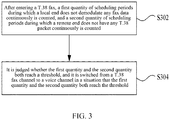
- FIG. 3 is a flow chart of a method for switching from a fax channel to a voice channel according to the present invention. As shown in FIG. 3 , the method mainly includes the following step S302 to step S304.
- step S302 after entering a T.38 fax, a first quantity of scheduling periods during which a local end does not demodulate any fax data continuously is counted, and a second quantity of scheduling periods during which a remote end does not receive any T.38 packet continuously is counted.
- the demodulation module of the local end is enabled, to demodulate data at the local end. If no fax data are demodulated in a current scheduling period, then the value of the first quantity is added by 1; otherwise, the value of the first quantity is set as 0.
- two counters can be set: a counter A (for counting the first quantity of the scheduling periods during which the local end does not have the fax data after continuous demodulation) and a counter B (for counting the second quantity of scheduling periods during which the remote end does not have any T.38 packet continuously), and a judgment threshold C.
- the demodulation module After entering the T.38 fax, the demodulation module is enabled; during the demodulation process of the data of the local end, after every scheduling period is over, if there is no fax data in demodulation, then the set counter A is added by 1; during the demodulation process of the data of the remote end, after every scheduling period is over, if there is no T.38 packet at the remote end, then the set counter B is added by 1. If there are fax data at the local end after demodulation, both the counter A and counter B are cleared. If the remote end receives the T.38 packet, the counter A and counter B are also cleared.
- step S304 it is judged whether the first quantity and the second quantity both reach a threshold, and it is switched from a T.38 fax channel to a voice channel when the first quantity and the second quantity both reach the threshold.
- step S304 it is judged whether both the counter A and counter B reach the threshold. If yes, then the switching condition is satisfied, it is switched from the T.38 fax channel back to the voice channel; otherwise, it performs the T.38 fax normally. At the same time, in the process of judging whether the counter reaches the threshold, the DCN signal is detected. If the DCN signal is detected, it is also switched from the T.38 fax back to the voice.
- step S304 can be executed after every scheduling period is over, or the step S304 can also be executed after it is determined that the current scheduling period is over and when the first quantity and / or the second quantity is added, which can reduce the number of judgment and improve the efficiency.
- the step S304 can be executed after the counter A and/or the counter B is added by 1.
- a fax ending signal e.g., DCN signal
- DCN a fax ending signal
- step S304 if one or both of the first quantity and the second quantity does not reach the threshold, then it is not switched, and the T.38 fax is normally performed.
- the traditional switching mode is improved, the success rate and stability of switching from the T.38 fax back to the voice is improved, and the high quality experience of the user to the fax service is ensured.
- a scheduling period of a gateway system is 10ms; the counter A is used in the T.38 fax transmission flow; and the counter B is used in the T.38 fax reception flow.
- FIG. 4 is a switching and processing flow chart in the present embodiment; as shown in FIG. 4 , it mainly includes the following steps.
- step 401 after every scheduling period 10ms of the system is over, data are acquired from the local fax machine.
- the T.38 demodulation module begins to demodulate the received data, and the data obtained after every demodulation are accumulated, and the data content are judged every time.
- step 403 after the data of this time are demodulated, accumulated and judged, it is determined whether the data are the DCN signal of the fax; if yes, then step 404 is executed; if not, step 405 is executed.
- step 404 after it is determined to be the DCN signal, the signal is packed and sent in accordance with the T.38 protocol, and the service of the fax ending event is reported, and then step 410 is executed according to a command issued by the upper layer service;
- step 405 if it is already determined not to the DCN signal, however, there are also two situations: in one situation, although it is not the DCN signal, it is also a fax signal or fax page data, which is required to send the T.38 packet, and step 406 is executed; in the other situation, it is not the fax information or the cumulative degree is not enough to send the T.38 packet this time, then the step 407 is executed.
- step 406 at this time, it is illustrated that there is still the fax information, both the counter A for a sending packet flow and the counter B for a receiving packet flow are cleared and ready to start recounting, and step 401 is directly executed subsequently.
- step 407 at this time, it is illustrated that there is no fax information at the moment, the counter A for the sending packet flow is required to be added by 1, and step 408 is continued to be executed.
- step 408 after the completion of adding any counter by 1, it is required to perform a threshold judgment for the counter A and the counter B at the same time; if both are greater than the threshold, then step 409 is executed; and if there is one which is not greater than the threshold, then it is returned to step 401.
- step 409 it is illustrated that both the fax sender and receiver do not have fax information for transmission in a fixed period of time, it can be determined that the fax is ended, and the service fax ending event is reported, and then step 410 is executed according to the command issued by the upper layer service.
- step 410 the command of switching from the fax channel to the voice channel is executed, indicating that the T.38 fax is ended, and the call enters a calling state.
- FIG. 5 is a flow chart of switching processing in the present embodiment; as shown in FIG. 5 , it mainly includes the following steps.
- step 501 after every scheduling period 10ms of the system is over, the IP packet on the network is read, and step 2 is executed after an unpacking operation.
- step 502 it is determined whether a T.38 packet sent by a correct remote is received; if yes, step 503 is executed; if no, step 504 is executed.
- step 503 at this time, it is illustrated that the fax information is still in the transmission, the counter A for sending packets and the counter B for receiving packets are cleared and ready to recount, and it is returned to step 501.
- step 504 at this time, it is illustrated that at the current moment no T.38 packet is received from the remote fax machine, the counter B for receiving the packet is required to be added by 1, and the step 505 is executed.
- step 505 after the completion of adding any counter by 1, it is required to perform a threshold judgment for the counter A and the counter B at the same time; if both are greater than the threshold, then step 506 is executed; and if there is one which is not greater than the threshold, then it is returned to step 501.
- step 506 it is illustrated that both the fax sender and receiver do not have fax information for transmission in a fixed period of time, it can be determined that the fax is ended, and the service fax ending event is reported, and then step 507 is executed according to the command issued by the upper layer service.
- step 507 the command of switching from the fax channel to the voice channel is executed, indicating that the T.38 fax is ended, and the call enters a calling state.
- the fax machine is unable to report the DCN signal meanwhile the man-made talking test is performed during the fax process or the fax machine is unable to report the DCN signal meanwhile the fax is performed in a high background noise environment
- the fax channel can be switched from the T.38 to the voice channel for calling, then it can be switched by adopting the technical scheme provided by the embodiment of the present invention.
- each module or each step above-mentioned in the present invention can be implemented by the universal calculating apparatus, and they can be integrated in a single calculating apparatus, or distributed in the network made up by a plurality of calculating apparatus.
- they can be implemented by the executable program codes of the calculating apparatus. Accordingly, they can be stored in the storage apparatus and implemented by the calculating apparatus, and in some situations, the shown or described steps can be executed according to a sequence different from described herein, or they are made into various integrated circuit modules respectively, or a plurality of modules or steps therein are made into the single integrated circuit module to be implemented. In this way, the present invention is not limited to any specific form of the combination of the hardware and software.
- the quantity of the scheduling periods without fax data after the demodulation of the local end is counted by adopting the mode of demodulating the fax data, instead of the traditional silence detection mode, which solves the problem that the stability of mode of switching from the T. 38 fax back to the voice is poor in the related art, improves the success rate and stability of switching from the T.38 fax back to the voice, and ensures the high quality experience of the user to the fax service.
Landscapes
- Engineering & Computer Science (AREA)
- Signal Processing (AREA)
- Multimedia (AREA)
- Computer Networks & Wireless Communication (AREA)
- Facsimiles In General (AREA)
- Telephonic Communication Services (AREA)
- Facsimile Transmission Control (AREA)
- Data Exchanges In Wide-Area Networks (AREA)
Description
- The present invention relates to the field of communication, and in particular to a method and apparatus for switching from a fax channel to a voice channel.
- In the next generation network, the fax service is a kind of voice services based on the Voice over Internet Protocol (VoIP) technology. At present, there are mainly two kinds of modes of realizing the fax service through the gateway in the industry: Voice Band Data (VBD) and T.38 mode.
- The VBD, that is the transparent transmission mode, through the G.711 voice coding and decoding, it takes the fax data as the common voice for transmission. The advantage of this mode is simply to be realized, and the specific content of the fax data is not required to care about, while only the voice coding and decoding processing is performed. The disadvantage is that the impact of the IP network is relatively large, and the fax data will be lost when the network is unstable, resulting in the failure of the fax.
- The T.38 mode means that the fax data sent by the fax machine are demodulated through the T.38 protocol, and they are converted into the message format specified by the protocol for transmission. The advantage of this mode is that the protocol itself enhances the adaptability of the message to the IP network, therefore, the capability of resisting network anomaly is stronger in the transmission process, which greatly improves the success rate of the fax. The disadvantage is more complexly to be realized, but in order to ensure the quality of the fax service, the existing networks use a large number of that mode for fax.
- The VBD fax mode just transfers the fax data in the voice channel, and therefore, there is no need for channel switching, while only need to modify the channel configuration after entering the fax service, and it does not do any operation when exiting the fax service. Because the fax channel is the voice channel, after the fax is ended, as long as the fax machine is switched back to the voice mode, the sender and the receiver can make calls directly.
- While the T.38 fax mode has the channel switching, that is, it is switched to the T.38 channel at the beginning of the fax service, and it is switched to the voice channel at the end of the fax, to ensure that the sender and the receiver can make calls normally after the fax is ended. At present, in the application of the existing network, the mode of switching to the T.38 channel is already more mature and stable, and the method of switching back to the voice channel generally adopts detecting a fax ending signal DCN and detecting the two-way silence. The traditional mode of switching the T.38 fax back to the voice first adopts detecting the fax ending signal DCN. According to the specification of the protocol, regardless of success or failure of the fax, the fax machine needs to send the DCN signal before switching back to the voice mode. However, in practical application, there are a lot of the manufacturer and model of the fax machines, and there are a lot of fax machines which do not send DCN signal and directly return to the voice mode. Therefore, the traditional switching mode commonly also adopts a second method for redundancy protection, that is, the two-way silence detection. However, in the situation of higher background noise or some extreme test condition, the fax machine itself is already switched to the voice mode, and now the silence detection can not take effect, resulting in a gateway switching failure, and the user can not enter the call status after the fax is ended. At the same time, the duration and threshold of the silence detection is difficult to be set as well. There are some experiences. Sometimes setting different parameters will lead to switching back to the voice during the fax process and the fax failure, and sometimes leads to being unable to switch to the voice normally after the fax is ended. Therefore, the stability of the traditional mode of switching the T.38 fax back to the voice is poor.
- Aiming at the problem that the stability of the mode of switching the T.38 fax back to the voice in the related art is poor, there is no effective solution proposed yet.
- The document ITU-T: "ITU-T Procedures for real-time Group 3 facsimile communication over IP networks, T.38" discloses the MGs shall autonomously transition from fax to a voice when the MG detects one of the following: detection of bidirectional silence: it is recommended that an MG transition back to voice mode after detecting more than 7s of bidirectional silence. The control channel is a full duplex channel that, unlike the non-ITU-T V.34 fax modes, sends flags in the absence of data.
- The document
US 2013/0083909 A1 discloses a method for implementing gain control enhancement for modulated communications includes establishing a communication session between a first endpoint and a second endpoint. The communication session involves forwarding a call signal using an initial gain level until a state transition is detected in the communication session at a digital signal processor. The detection may occur in a transmitting gateway associated with the first endpoint or a receiving gateway associated with the second endpoint. The state transition indicates modulated communications, which may include fax, modem, or text telephony. - Aiming at the problem that the stability of the mode of switching the T.38 fax back to the voice in the related art is poor, a method and apparatus for switching from a fax channel to a voice channel according to the independent claims are provided. Further improvements and embodiments are provided in the dependent claims.
- The scope of the invention is limited by the appended claims. The embodiments, which do not fall within the scope of the claims, are to be interpreted as examples.
- Also provided is a method for switching from a fax channel to a voice channel, including: after entering a T.38 fax, counting a first quantity of scheduling periods during which a local end does not demodulate any fax data continuously, and counting a second quantity of scheduling periods during which a remote end does not have any T.38 packet continuously; and judging whether the first quantity and the second quantity both reach a threshold, and switching from a T.38 fax channel to a voice channel when the first quantity and the second quantity both reach the threshold.
- In an exemplary embodiment, counting a first quantity of scheduling periods during which a local end does not demodulate any fax data continuously includes: demodulating data at the local end, if no fax data are demodulated in a current scheduling period, then adding a value of the first quantity by 1; otherwise, setting the value of the first quantity as 0.
- In an exemplary embodiment, after every scheduling period is ended and before judging whether the first quantity and the second quantity both reach a threshold, the method further includes: detecting whether there is a fax ending signal, and switching from the T.38 fax channel to the voice channel in a situation of detecting that there is the fax ending signal.
- In an exemplary embodiment, before judging whether the first quantity and the second quantity both reach a threshold, the method further includes: determining that the first quantity and / or the second quantity is increased after the current scheduling period is ended.
- Also provided is an apparatus for switching from a fax channel to a voice channel, including: a first counting module, arranged to: after entering a T.38 fax, count a first quantity of scheduling periods during which a local end does not demodulate any fax data continuously; a second counting module, arranged to: after entering the T.38 fax, count a quantity of scheduling periods during which a remote end does not have any T.38 continuously; a judgment module, arranged to: judge whether the first counter and the second counter both reach a threshold, and trigger a switching module when the first counter and the second counter both reach the threshold; and the switching module, arranged to: switch from a T.38 fax channel to a voice channel.
- In an exemplary embodiment, the first counting module is arranged to: count the first quantity of scheduling periods during which the local end does not demodulate any fax data continuously according to the following mode: demodulating data at the local end, if no fax data are demodulated in a current scheduling period, then adding a value of the first quantity by 1; otherwise, setting the value of the first quantity as 0.
- In an exemplary embodiment, the apparatus further includes: a determination module, arranged to: determine that the first quantity and / or the second quantity is increased after the current scheduling period is ended, and trigger the judgment module.
- In an exemplary embodiment, the apparatus further includes: a detection module, arranged to: detect whether there is a fax ending signal after the scheduling period is over, and trigger the switching module to switch from the T.38 fax channel to the voice channel in a situation of detecting that there is the fax ending signal.
- According to the present invention, the quantity of the scheduling periods without fax data after the demodulation of the local end is counted by adopting the mode of demodulating the fax data instead of the traditional silence detection mode, which solves the problem that the stability of mode of switching from the T. 38 fax back to the voice is poor in the related art, improves the success rate and stability of switching from the T.38 fax back to the voice, and ensures the high quality experience of the user to the fax service.
- The accompanying drawings described herein are used to provide further understanding for the present invention and constitute a part of the present application. The illustrated embodiments of the present invention and the description thereof are used to explain the present invention, rather than constituting an inappropriate limitation to the present invention. Herein:
-
FIG. 1 is a structure diagram of a system for switching from a fax channel to a voice channel according to an embodiment of the present invention; -
FIG. 2 is a structure diagram of an apparatus for switching from a fax channel to a voice channel according to an embodiment of the present invention; -
FIG. 3 is a flow chart of a method for switching from a fax channel to a voice channel according to an embodiment of the present invention; -
FIG. 4 is a processing flow chart of embodiment one of the present invention; -
FIG. 5 is a processing flow chart of embodiment two of the present invention. - The present invention is described in detail with reference to the accompanying drawings and in combination with embodiments hereinafter. It should be illustrated that, in the case of not conflicting, the embodiments in the present application and features in these embodiments can be combined with each other.
- In view of the problems existing in the related art, the embodiment of the present invention provides a method for switching working modes of fax channel of the T.38 protocol. Compared with the traditional switching mode, the success rate and stability of switching from the T.38 fax back to the voice is improved, and the high quality experience of the user to the fax service is ensured.
-
FIG. 1 is a structure diagram of a system for switching from a fax channel to a voice channel according to an embodiment of the present invention. As shown inFIG. 1 , the system for switching from a T. 38 fax channel to a voice channel in the embodiment of the present invention includes the setting of a fax between a local fax machine and a remote fax machine, which mainly includes: alocal gateway device 10, asignaling server 20, anintermediate device 30, alocal fax machine 40 and aremote fax machine 50. - Herein, the
fax machine 40 and theremote fax machine 50 can adopt all kinds of current fax machines and can complete the fax function, which is not specifically limited in the present invention. - The
local gateway device 10 is an integrated system product taking the gateway as the core, including but not limited to the following: various uplink home gateways and uplink device thereof, relay gateways and user interface devices mounted thereto, access gateways, etc. Herein, the core gateway can directly or indirectly be mounted with the fax machine, and it can be directly or indirectly up-linked to the Ethernet. In the embodiment of the present invention, that type of gateway is mainly adopted. In the specific implementation process, after entering the T.38 fax, thelocal gateway device 10 counts the quantity of the scheduling periods without fax data continuously after the demodulation of the local end and the quantity of scheduling periods during which the remote end does not have any T.38 packet continuously. It switches from the fax channel to the voice channel when both are greater than the threshold. In particular, thelocal gateway device 10 may include an apparatus for switching from a T.38 fax channel to a voice channel as shown inFIG. 2 . - The
calling signaling server 20 is a device for processing a call signaling, including: the sip server and softswitch, etc. - The
intermediate device 30 refers to a device mounted to the remote fax machine, and it may also be a similar gateway system and may also be an interface system of a virtual fax machine or a network fax machine, which is not limited in the embodiment of the present invention. - An apparatus for switching from a fax channel to a voice channel is provided according to an embodiment of the present invention.
-
FIG. 2 is a structure diagram of an apparatus for switching from a fax channel to a voice channel according to an embodiment of the present invention. As shown inFIG. 2 , the apparatus mainly includes: afirst counting module 110, arranged to: after entering a T.38 fax, count a first quantity of scheduling periods during which a local end does not demodulate any fax data continuously; asecond counting module 120, arranged to: after entering the T.38 fax, count a quantity of scheduling periods during which a remote end does not have any T.38 continuously; ajudgment module 130, arranged to: judge whether the first counter and the second counter both reach a threshold, and trigger aswitching module 140 when the first counter and the second counter both reach the threshold; and theswitching module 140, arranged to: switch from a T.38 fax channel to a voice channel. - In an exemplary alternative implementation mode of the embodiment of the present invention, the first counting module can count the first quantity of scheduling periods during which the local end does not demodulate any fax data continuously according to the following mode: demodulating data at the local end, if no fax data are demodulated in a current scheduling period, and then adding a value of the first quantity by 1; otherwise, setting the value of the first quantity as 0.
- In an exemplary alternative implementation mode of the embodiment of the present invention, the apparatus may also include: a detection module, arranged to: detect whether there is a fax ending signal after the scheduling period is over, and trigger the switching module to switch from the T.38 fax channel to the voice channel in a situation of detecting that there is the fax ending signal. Thus, the switching time can be further determined to improve the stability of the switching.
- In an exemplary alternative implementation mode of the embodiment of the present invention, the apparatus may also include: a determination module, arranged to: determine that the first quantity and / or the second quantity is increased after the current scheduling period is ended, and trigger the
judgment module 130. By adopting the method, it is avoided to execute thejudgment module 130 in every scheduling period, so that the process can be saved. - According to the embodiment of the present invention, a method for switching from a T.38 fax channel to a voice channel is further provided, which can be realized through the above system and apparatus.
-
FIG. 3 is a flow chart of a method for switching from a fax channel to a voice channel according to the present invention. As shown inFIG. 3 , the method mainly includes the following step S302 to step S304. - In step S302, after entering a T.38 fax, a first quantity of scheduling periods during which a local end does not demodulate any fax data continuously is counted, and a second quantity of scheduling periods during which a remote end does not receive any T.38 packet continuously is counted.
- For example, after entering the T.38 fax, the demodulation module of the local end is enabled, to demodulate data at the local end. If no fax data are demodulated in a current scheduling period, then the value of the first quantity is added by 1; otherwise, the value of the first quantity is set as 0.
- In the specific implementation process, two counters can be set: a counter A (for counting the first quantity of the scheduling periods during which the local end does not have the fax data after continuous demodulation) and a counter B (for counting the second quantity of scheduling periods during which the remote end does not have any T.38 packet continuously), and a judgment threshold C. After entering the T.38 fax, the demodulation module is enabled; during the demodulation process of the data of the local end, after every scheduling period is over, if there is no fax data in demodulation, then the set counter A is added by 1; during the demodulation process of the data of the remote end, after every scheduling period is over, if there is no T.38 packet at the remote end, then the set counter B is added by 1. If there are fax data at the local end after demodulation, both the counter A and counter B are cleared. If the remote end receives the T.38 packet, the counter A and counter B are also cleared.
- In step S304, it is judged whether the first quantity and the second quantity both reach a threshold, and it is switched from a T.38 fax channel to a voice channel when the first quantity and the second quantity both reach the threshold.
- In the specific implementation process, if the above counter is used for counting, then during the implementation of the step S304, it is judged whether both the counter A and counter B reach the threshold. If yes, then the switching condition is satisfied, it is switched from the T.38 fax channel back to the voice channel; otherwise, it performs the T.38 fax normally. At the same time, in the process of judging whether the counter reaches the threshold, the DCN signal is detected. If the DCN signal is detected, it is also switched from the T.38 fax back to the voice.
- In the specific implementation process, step S304 can be executed after every scheduling period is over, or the step S304 can also be executed after it is determined that the current scheduling period is over and when the first quantity and / or the second quantity is added, which can reduce the number of judgment and improve the efficiency. For example, in the above situation of counting by adopting the counter, the step S304 can be executed after the counter A and/or the counter B is added by 1.
- In an exemplary alternative implementation mode of the embodiment of the present invention, after every scheduling period is over and before the step S304 is executed, it can be detected whether there is a fax ending signal (e.g., DCN signal), and it is switched from the T.38 fax channel to the voice channel in the situation that the fax ending signal is detected. That is, it is switched by combining with the method of detecting the fax ending signal DCN. Thus, the success rate and stability of the switching can be guaranteed.
- In step S304, if one or both of the first quantity and the second quantity does not reach the threshold, then it is not switched, and the T.38 fax is normally performed.
- Through the above method of the embodiment of the present invention, the traditional switching mode is improved, the success rate and stability of switching from the T.38 fax back to the voice is improved, and the high quality experience of the user to the fax service is ensured.
- By taking the system in
FIG. 1 as the hardware architecture and taking two fax machines already entering the T.38 fax as the premise, the function realization is completed in the local gateway device; and at the same time, those are described by dividing into two embodiments according to the T.38 fax sending and receiving packets. The following specific exemplary embodiments set the environmental conditions as follows: a scheduling period of a gateway system is 10ms; the counter A is used in the T.38 fax transmission flow; and the counter B is used in the T.38 fax reception flow. - The present embodiment is illustrated by taking the switching process in the process of sending a packet of the T.38 fax as an example.
FIG. 4 is a switching and processing flow chart in the present embodiment; as shown inFIG. 4 , it mainly includes the following steps. - In
step 401, after every scheduling period 10ms of the system is over, data are acquired from the local fax machine. - In
step 402, the T.38 demodulation module begins to demodulate the received data, and the data obtained after every demodulation are accumulated, and the data content are judged every time. - In
step 403, after the data of this time are demodulated, accumulated and judged, it is determined whether the data are the DCN signal of the fax; if yes, then step 404 is executed; if not, step 405 is executed. - In
step 404, after it is determined to be the DCN signal, the signal is packed and sent in accordance with the T.38 protocol, and the service of the fax ending event is reported, and then step 410 is executed according to a command issued by the upper layer service; - In
step 405, if it is already determined not to the DCN signal, however, there are also two situations: in one situation, although it is not the DCN signal, it is also a fax signal or fax page data, which is required to send the T.38 packet, and step 406 is executed; in the other situation, it is not the fax information or the cumulative degree is not enough to send the T.38 packet this time, then thestep 407 is executed. - In
step 406, at this time, it is illustrated that there is still the fax information, both the counter A for a sending packet flow and the counter B for a receiving packet flow are cleared and ready to start recounting, and step 401 is directly executed subsequently. - In
step 407, at this time, it is illustrated that there is no fax information at the moment, the counter A for the sending packet flow is required to be added by 1, and step 408 is continued to be executed. - In
step 408, after the completion of adding any counter by 1, it is required to perform a threshold judgment for the counter A and the counter B at the same time; if both are greater than the threshold, then step 409 is executed; and if there is one which is not greater than the threshold, then it is returned to step 401. - In
step 409, it is illustrated that both the fax sender and receiver do not have fax information for transmission in a fixed period of time, it can be determined that the fax is ended, and the service fax ending event is reported, and then step 410 is executed according to the command issued by the upper layer service. - In
step 410, the command of switching from the fax channel to the voice channel is executed, indicating that the T.38 fax is ended, and the call enters a calling state. - The exemplary embodiment is illustrated by taking the switching process in the process of receiving a packet of the T.38 fax as an example.
FIG. 5 is a flow chart of switching processing in the present embodiment; as shown inFIG. 5 , it mainly includes the following steps. - In
step 501, after every scheduling period 10ms of the system is over, the IP packet on the network is read, and step 2 is executed after an unpacking operation. - In
step 502, it is determined whether a T.38 packet sent by a correct remote is received; if yes, step 503 is executed; if no, step 504 is executed. - In
step 503, at this time, it is illustrated that the fax information is still in the transmission, the counter A for sending packets and the counter B for receiving packets are cleared and ready to recount, and it is returned to step 501. - In
step 504, at this time, it is illustrated that at the current moment no T.38 packet is received from the remote fax machine, the counter B for receiving the packet is required to be added by 1, and thestep 505 is executed. - In
step 505, after the completion of adding any counter by 1, it is required to perform a threshold judgment for the counter A and the counter B at the same time; if both are greater than the threshold, then step 506 is executed; and if there is one which is not greater than the threshold, then it is returned to step 501. - In
step 506, it is illustrated that both the fax sender and receiver do not have fax information for transmission in a fixed period of time, it can be determined that the fax is ended, and the service fax ending event is reported, and then step 507 is executed according to the command issued by the upper layer service. - In
step 507, the command of switching from the fax channel to the voice channel is executed, indicating that the T.38 fax is ended, and the call enters a calling state. - Through the illustration of the specific implementation mode, it can be learned that in some special fax application scenarios (the fax machine is unable to report the DCN signal meanwhile the man-made talking test is performed during the fax process or the fax machine is unable to report the DCN signal meanwhile the fax is performed in a high background noise environment); if the fax channel can be switched from the T.38 to the voice channel for calling, then it can be switched by adopting the technical scheme provided by the embodiment of the present invention.
- From the above description, it can be seen that, in the embodiment of the present invention, when the data of the local end are demodulated, if no fax data are demodulated during the current scheduling period, then the counter for recording the quantity of scheduling periods during which the local end does not demodulate any fax data continuously is added by 1; if the fax data are demodulated, then the counter for recording the quantity of scheduling periods during which the local end does not demodulate any fax data continuously is cleared. After the scheduling period is over, it is judged whether to switch from the T.38 fax channel to the voice channel according to the value of that counter and the quantity of scheduling periods during which the remote end does not have any T.38 packet continuously, instead of the traditional silence detection method, to solve the problem that the stability of the mode of switching the T.38 fax back to the voice in the related art is poor, improve the success rate and stability of switching the T.38 fax back to the voice, and ensure the high quality experience of the user to the fax service.
- Apparently, it can be understood by those skilled in the art that each module or each step above-mentioned in the present invention can be implemented by the universal calculating apparatus, and they can be integrated in a single calculating apparatus, or distributed in the network made up by a plurality of calculating apparatus. In an exemplary embodiment, they can be implemented by the executable program codes of the calculating apparatus. Accordingly, they can be stored in the storage apparatus and implemented by the calculating apparatus, and in some situations, the shown or described steps can be executed according to a sequence different from described herein, or they are made into various integrated circuit modules respectively, or a plurality of modules or steps therein are made into the single integrated circuit module to be implemented. In this way, the present invention is not limited to any specific form of the combination of the hardware and software.
- The above description is only the preferred embodiments of the present invention and it is not intended to limit the present invention. For those skilled in the art, the present invention can have various modifications and variations.
- Based on the technical scheme provided by the present invention, the quantity of the scheduling periods without fax data after the demodulation of the local end is counted by adopting the mode of demodulating the fax data, instead of the traditional silence detection mode, which solves the problem that the stability of mode of switching from the T. 38 fax back to the voice is poor in the related art, improves the success rate and stability of switching from the T.38 fax back to the voice, and ensures the high quality experience of the user to the fax service.
Claims (8)
- A method for switching from a fax channel to a voice channel, comprising:after entering a T.38 fax channel, counting (S302) a first quantity of scheduling periods during which data demodulated by a local end is not fax data continuously, and counting (S302) a second quantity of scheduling periods during which the local end does not receive any T.38 packet sent by a remote end continuously; andjudging (S304) whether the first quantity and the second quantity both reach a threshold, and switching (S304) from the T.38 fax channel to a voice channel in a situation that the first quantity and the second quantity both reach the threshold.
- The method according to claim 1, wherein, counting a first quantity of scheduling periods during which data demodulated by a local end is not fax data continuously comprises: demodulating data at the local end, if the data demodulated by the local end is not fax data in a current scheduling period, then adding a value of the first quantity by 1; otherwise, setting the value of the first quantity as 0.
- The method according to claim 1, after every scheduling period is ended and before judging whether the first quantity and the second quantity both reach a threshold, further comprising:
detecting whether there is a fax ending signal, and switching from the T.38 fax channel to the voice channel in a situation of detecting that there is the fax ending signal. - The method according to any one of claims 1 to 3, before judging whether the first quantity and the second quantity both reach a threshold, further comprising: determining that the first quantity and / or the second quantity is increased after the current scheduling period is ended.
- An apparatus for switching from a fax channel to a voice channel, comprising:a first counting module (110), arranged to: after entering a T.38 fax channel, count a first quantity of scheduling periods during which data demodulated by a local end is not fax data continuously;a second counting module (120), arranged to: after entering the T.38 fax channel, count a quantity of scheduling periods during which the local end does not receive any T.38 packet sent by a remote end continuously;a judgment module (130), arranged to: judge whether the first counter and the second counter both reach a threshold, and trigger a switching module in a situation that the first counter and the second counter both reach the threshold; andthe switching module (140), arranged to: switch from a T.38 fax channel to a voice channel.
- The apparatus according to claim 5, wherein, the first counting module (110) is arranged to: count the first quantity of scheduling periods during which data demodulated by the local end is not fax data continuously according to the following mode: demodulating data at the local end, if the data demodulated by the local end is not fax data in a current scheduling period, and then adding a value of the first quantity by 1; otherwise, setting the value of the first quantity as 0.
- The apparatus according to claim 5, further comprising: a determination module, arranged to: determine that the first quantity and / or the second quantity is increased after a current scheduling period is ended, and trigger the judgment module.
- The apparatus according to any one of claims 5 to 7, further comprising:
a detection module, arranged to: detect whether there is a fax ending signal after the scheduling period is over, and trigger the switching module to switch from the T.38 fax channel to the voice channel in a situation of detecting that there is the fax ending signal.
Applications Claiming Priority (2)
| Application Number | Priority Date | Filing Date | Title |
|---|---|---|---|
| CN201410360229.6A CN105282390B (en) | 2014-07-25 | 2014-07-25 | Method, device and system for switching from fax channel to voice channel |
| PCT/CN2014/091173 WO2016011730A1 (en) | 2014-07-25 | 2014-11-14 | Method, device, and system for switching from fax channel to voice channel |
Publications (3)
| Publication Number | Publication Date |
|---|---|
| EP3197143A1 EP3197143A1 (en) | 2017-07-26 |
| EP3197143A4 EP3197143A4 (en) | 2017-08-09 |
| EP3197143B1 true EP3197143B1 (en) | 2019-03-27 |
Family
ID=55150645
Family Applications (1)
| Application Number | Title | Priority Date | Filing Date |
|---|---|---|---|
| EP14898150.9A Active EP3197143B1 (en) | 2014-07-25 | 2014-11-14 | Method and device for switching from fax channel to voice channel |
Country Status (5)
| Country | Link |
|---|---|
| EP (1) | EP3197143B1 (en) |
| CN (1) | CN105282390B (en) |
| MX (1) | MX367634B (en) |
| RU (1) | RU2668991C2 (en) |
| WO (1) | WO2016011730A1 (en) |
Family Cites Families (13)
| Publication number | Priority date | Publication date | Assignee | Title |
|---|---|---|---|---|
| CN1133315C (en) * | 1993-09-01 | 2003-12-31 | 佳能株式会社 | Communication device connectable to transit network providing differentiated ring pattern service |
| JP3726725B2 (en) * | 2001-08-01 | 2005-12-14 | 日本電気株式会社 | Communication network system and gateway device |
| EP1309165A1 (en) * | 2001-10-22 | 2003-05-07 | Siemens Aktiengesellschaft | Method for switching between voice transmission and facsimile transmission, apparatus and computer program product therefor |
| GB0201588D0 (en) * | 2002-01-24 | 2002-03-13 | Nortel Networks Ltd | Call establishment procedure |
| US20060285171A1 (en) * | 2003-11-28 | 2006-12-21 | Haiyin Ma | Method of performing fax in next generation network |
| CN101159802B (en) * | 2005-01-26 | 2010-11-10 | 华为技术有限公司 | A method for T.38 gateway to ensure reliable transmission of disconnection command to fax machine |
| CN100555966C (en) * | 2005-01-26 | 2009-10-28 | 华为技术有限公司 | Method for ensuring reliable transmission of disconnecting command to fax machine by T.38 gateway |
| CN1921478B (en) * | 2005-08-26 | 2011-09-14 | 华为技术有限公司 | Business signal transmitting method based on network agreement |
| CN101056349A (en) * | 2006-04-10 | 2007-10-17 | 广东省电信有限公司研究院 | Implementation method of the high-speed fax signaling flow supported by the gateway control protocol |
| CN101883060A (en) * | 2009-05-08 | 2010-11-10 | 中兴通讯股份有限公司 | Business process switching method and media server |
| CN101841611A (en) * | 2010-04-21 | 2010-09-22 | 中兴通讯股份有限公司 | Facsimile method based on voice over internet protocol (VOIP) and system thereof |
| US8891743B2 (en) * | 2011-10-04 | 2014-11-18 | Cisco Technology, Inc. | Gain control enhancement for modulated communications |
| CN102368731A (en) * | 2011-10-17 | 2012-03-07 | 深圳市共进电子股份有限公司 | Method and system for realizing change from fax service to voice service |
-
2014
- 2014-07-25 CN CN201410360229.6A patent/CN105282390B/en active Active
- 2014-11-14 RU RU2017104990A patent/RU2668991C2/en active
- 2014-11-14 WO PCT/CN2014/091173 patent/WO2016011730A1/en not_active Ceased
- 2014-11-14 EP EP14898150.9A patent/EP3197143B1/en active Active
- 2014-11-14 MX MX2017001112A patent/MX367634B/en active IP Right Grant
Non-Patent Citations (1)
| Title |
|---|
| None * |
Also Published As
| Publication number | Publication date |
|---|---|
| RU2017104990A (en) | 2018-08-27 |
| RU2668991C2 (en) | 2018-10-05 |
| RU2017104990A3 (en) | 2018-08-27 |
| MX2017001112A (en) | 2018-02-01 |
| EP3197143A1 (en) | 2017-07-26 |
| MX367634B (en) | 2019-08-29 |
| CN105282390B (en) | 2019-04-09 |
| EP3197143A4 (en) | 2017-08-09 |
| WO2016011730A1 (en) | 2016-01-28 |
| CN105282390A (en) | 2016-01-27 |
Similar Documents
| Publication | Publication Date | Title |
|---|---|---|
| CN101188527A (en) | A heartbeat detection method and device | |
| CN113784392A (en) | Communication method, device and system | |
| CN102802167B (en) | A kind of method and system for obtaining communication link quality of terminal | |
| JP3575435B2 (en) | Telephone system and telephone connection monitoring method | |
| CN102355713B (en) | Method of calling in voice communication and mobile terminal | |
| CN105323250B (en) | A data transmission method based on PTT public network trunking intercom system | |
| CN101702749B (en) | Dual tone multiple frequency event frame processing method, system and media gateway | |
| CN101505239A (en) | Processing apparatus, communication method and system for sending, receiving text by phone | |
| EP3197143A1 (en) | Method, device, and system for switching from fax channel to voice channel | |
| CN100450016C (en) | Realization method of online maintenance in communication network | |
| CN103051489A (en) | Method and device for monitoring speech quality | |
| US12574665B2 (en) | Data processing method, outdoor unit, indoor unit and computer-readable storage medium | |
| CN104284035B (en) | Calling-control method and device | |
| US7646763B2 (en) | Method and apparatus for improving voice band data (VBD) connectivity in a communications network | |
| JP6597392B2 (en) | Gateway device, communication processing program, and network system | |
| CN101917214A (en) | Control method and device for echo suppression in network | |
| CN100385904C (en) | A Method, Device and System for Solving Frame Collision in Fax Process | |
| US7058066B1 (en) | Controlling the transition glitch that occurs when a gateway switches from voice over IP to voice band data | |
| CN110677744B (en) | FXS port control method, storage medium and access network equipment | |
| CN113099041B (en) | Ring back tone playing control method and system | |
| CN102368731A (en) | Method and system for realizing change from fax service to voice service | |
| US20180176411A1 (en) | Fax Control Method and Gateway Device | |
| JP2023117556A (en) | PACKET LOSS DETECTION SYSTEM AND PACKET LOSS DETECTION METHOD | |
| CN102255793A (en) | Double tone multi-frequency processing method and device | |
| CN102572144B (en) | Anti-interference method for fax over IP (internet protocol) and IPPBX (Internet Protocol Private Branch Exchange) equipment |
Legal Events
| Date | Code | Title | Description |
|---|---|---|---|
| STAA | Information on the status of an ep patent application or granted ep patent |
Free format text: STATUS: THE INTERNATIONAL PUBLICATION HAS BEEN MADE |
|
| PUAI | Public reference made under article 153(3) epc to a published international application that has entered the european phase |
Free format text: ORIGINAL CODE: 0009012 |
|
| STAA | Information on the status of an ep patent application or granted ep patent |
Free format text: STATUS: REQUEST FOR EXAMINATION WAS MADE |
|
| 17P | Request for examination filed |
Effective date: 20170223 |
|
| AK | Designated contracting states |
Kind code of ref document: A1 Designated state(s): AL AT BE BG CH CY CZ DE DK EE ES FI FR GB GR HR HU IE IS IT LI LT LU LV MC MK MT NL NO PL PT RO RS SE SI SK SM TR |
|
| AX | Request for extension of the european patent |
Extension state: BA ME |
|
| A4 | Supplementary search report drawn up and despatched |
Effective date: 20170711 |
|
| RIC1 | Information provided on ipc code assigned before grant |
Ipc: H04N 1/327 20060101AFI20170706BHEP Ipc: H04L 12/66 20060101ALI20170706BHEP |
|
| DAX | Request for extension of the european patent (deleted) | ||
| GRAP | Despatch of communication of intention to grant a patent |
Free format text: ORIGINAL CODE: EPIDOSNIGR1 |
|
| STAA | Information on the status of an ep patent application or granted ep patent |
Free format text: STATUS: GRANT OF PATENT IS INTENDED |
|
| INTG | Intention to grant announced |
Effective date: 20181029 |
|
| GRAS | Grant fee paid |
Free format text: ORIGINAL CODE: EPIDOSNIGR3 |
|
| GRAA | (expected) grant |
Free format text: ORIGINAL CODE: 0009210 |
|
| STAA | Information on the status of an ep patent application or granted ep patent |
Free format text: STATUS: THE PATENT HAS BEEN GRANTED |
|
| AK | Designated contracting states |
Kind code of ref document: B1 Designated state(s): AL AT BE BG CH CY CZ DE DK EE ES FI FR GB GR HR HU IE IS IT LI LT LU LV MC MK MT NL NO PL PT RO RS SE SI SK SM TR |
|
| REG | Reference to a national code |
Ref country code: GB Ref legal event code: FG4D |
|
| REG | Reference to a national code |
Ref country code: CH Ref legal event code: EP |
|
| REG | Reference to a national code |
Ref country code: AT Ref legal event code: REF Ref document number: 1114393 Country of ref document: AT Kind code of ref document: T Effective date: 20190415 |
|
| REG | Reference to a national code |
Ref country code: IE Ref legal event code: FG4D |
|
| REG | Reference to a national code |
Ref country code: DE Ref legal event code: R096 Ref document number: 602014043851 Country of ref document: DE |
|
| PG25 | Lapsed in a contracting state [announced via postgrant information from national office to epo] |
Ref country code: FI Free format text: LAPSE BECAUSE OF FAILURE TO SUBMIT A TRANSLATION OF THE DESCRIPTION OR TO PAY THE FEE WITHIN THE PRESCRIBED TIME-LIMIT Effective date: 20190327 Ref country code: NO Free format text: LAPSE BECAUSE OF FAILURE TO SUBMIT A TRANSLATION OF THE DESCRIPTION OR TO PAY THE FEE WITHIN THE PRESCRIBED TIME-LIMIT Effective date: 20190627 Ref country code: LT Free format text: LAPSE BECAUSE OF FAILURE TO SUBMIT A TRANSLATION OF THE DESCRIPTION OR TO PAY THE FEE WITHIN THE PRESCRIBED TIME-LIMIT Effective date: 20190327 Ref country code: SE Free format text: LAPSE BECAUSE OF FAILURE TO SUBMIT A TRANSLATION OF THE DESCRIPTION OR TO PAY THE FEE WITHIN THE PRESCRIBED TIME-LIMIT Effective date: 20190327 |
|
| REG | Reference to a national code |
Ref country code: NL Ref legal event code: MP Effective date: 20190327 |
|
| PG25 | Lapsed in a contracting state [announced via postgrant information from national office to epo] |
Ref country code: LV Free format text: LAPSE BECAUSE OF FAILURE TO SUBMIT A TRANSLATION OF THE DESCRIPTION OR TO PAY THE FEE WITHIN THE PRESCRIBED TIME-LIMIT Effective date: 20190327 Ref country code: RS Free format text: LAPSE BECAUSE OF FAILURE TO SUBMIT A TRANSLATION OF THE DESCRIPTION OR TO PAY THE FEE WITHIN THE PRESCRIBED TIME-LIMIT Effective date: 20190327 Ref country code: NL Free format text: LAPSE BECAUSE OF FAILURE TO SUBMIT A TRANSLATION OF THE DESCRIPTION OR TO PAY THE FEE WITHIN THE PRESCRIBED TIME-LIMIT Effective date: 20190327 Ref country code: BG Free format text: LAPSE BECAUSE OF FAILURE TO SUBMIT A TRANSLATION OF THE DESCRIPTION OR TO PAY THE FEE WITHIN THE PRESCRIBED TIME-LIMIT Effective date: 20190627 Ref country code: HR Free format text: LAPSE BECAUSE OF FAILURE TO SUBMIT A TRANSLATION OF THE DESCRIPTION OR TO PAY THE FEE WITHIN THE PRESCRIBED TIME-LIMIT Effective date: 20190327 Ref country code: GR Free format text: LAPSE BECAUSE OF FAILURE TO SUBMIT A TRANSLATION OF THE DESCRIPTION OR TO PAY THE FEE WITHIN THE PRESCRIBED TIME-LIMIT Effective date: 20190628 |
|
| REG | Reference to a national code |
Ref country code: AT Ref legal event code: MK05 Ref document number: 1114393 Country of ref document: AT Kind code of ref document: T Effective date: 20190327 |
|
| PG25 | Lapsed in a contracting state [announced via postgrant information from national office to epo] |
Ref country code: EE Free format text: LAPSE BECAUSE OF FAILURE TO SUBMIT A TRANSLATION OF THE DESCRIPTION OR TO PAY THE FEE WITHIN THE PRESCRIBED TIME-LIMIT Effective date: 20190327 Ref country code: PT Free format text: LAPSE BECAUSE OF FAILURE TO SUBMIT A TRANSLATION OF THE DESCRIPTION OR TO PAY THE FEE WITHIN THE PRESCRIBED TIME-LIMIT Effective date: 20190727 Ref country code: SK Free format text: LAPSE BECAUSE OF FAILURE TO SUBMIT A TRANSLATION OF THE DESCRIPTION OR TO PAY THE FEE WITHIN THE PRESCRIBED TIME-LIMIT Effective date: 20190327 Ref country code: AL Free format text: LAPSE BECAUSE OF FAILURE TO SUBMIT A TRANSLATION OF THE DESCRIPTION OR TO PAY THE FEE WITHIN THE PRESCRIBED TIME-LIMIT Effective date: 20190327 Ref country code: IT Free format text: LAPSE BECAUSE OF FAILURE TO SUBMIT A TRANSLATION OF THE DESCRIPTION OR TO PAY THE FEE WITHIN THE PRESCRIBED TIME-LIMIT Effective date: 20190327 Ref country code: ES Free format text: LAPSE BECAUSE OF FAILURE TO SUBMIT A TRANSLATION OF THE DESCRIPTION OR TO PAY THE FEE WITHIN THE PRESCRIBED TIME-LIMIT Effective date: 20190327 Ref country code: RO Free format text: LAPSE BECAUSE OF FAILURE TO SUBMIT A TRANSLATION OF THE DESCRIPTION OR TO PAY THE FEE WITHIN THE PRESCRIBED TIME-LIMIT Effective date: 20190327 Ref country code: CZ Free format text: LAPSE BECAUSE OF FAILURE TO SUBMIT A TRANSLATION OF THE DESCRIPTION OR TO PAY THE FEE WITHIN THE PRESCRIBED TIME-LIMIT Effective date: 20190327 |
|
| PG25 | Lapsed in a contracting state [announced via postgrant information from national office to epo] |
Ref country code: SM Free format text: LAPSE BECAUSE OF FAILURE TO SUBMIT A TRANSLATION OF THE DESCRIPTION OR TO PAY THE FEE WITHIN THE PRESCRIBED TIME-LIMIT Effective date: 20190327 Ref country code: PL Free format text: LAPSE BECAUSE OF FAILURE TO SUBMIT A TRANSLATION OF THE DESCRIPTION OR TO PAY THE FEE WITHIN THE PRESCRIBED TIME-LIMIT Effective date: 20190327 |
|
| PG25 | Lapsed in a contracting state [announced via postgrant information from national office to epo] |
Ref country code: AT Free format text: LAPSE BECAUSE OF FAILURE TO SUBMIT A TRANSLATION OF THE DESCRIPTION OR TO PAY THE FEE WITHIN THE PRESCRIBED TIME-LIMIT Effective date: 20190327 Ref country code: IS Free format text: LAPSE BECAUSE OF FAILURE TO SUBMIT A TRANSLATION OF THE DESCRIPTION OR TO PAY THE FEE WITHIN THE PRESCRIBED TIME-LIMIT Effective date: 20190727 |
|
| REG | Reference to a national code |
Ref country code: DE Ref legal event code: R097 Ref document number: 602014043851 Country of ref document: DE |
|
| PG25 | Lapsed in a contracting state [announced via postgrant information from national office to epo] |
Ref country code: DK Free format text: LAPSE BECAUSE OF FAILURE TO SUBMIT A TRANSLATION OF THE DESCRIPTION OR TO PAY THE FEE WITHIN THE PRESCRIBED TIME-LIMIT Effective date: 20190327 |
|
| PLBE | No opposition filed within time limit |
Free format text: ORIGINAL CODE: 0009261 |
|
| STAA | Information on the status of an ep patent application or granted ep patent |
Free format text: STATUS: NO OPPOSITION FILED WITHIN TIME LIMIT |
|
| PG25 | Lapsed in a contracting state [announced via postgrant information from national office to epo] |
Ref country code: SI Free format text: LAPSE BECAUSE OF FAILURE TO SUBMIT A TRANSLATION OF THE DESCRIPTION OR TO PAY THE FEE WITHIN THE PRESCRIBED TIME-LIMIT Effective date: 20190327 |
|
| 26N | No opposition filed |
Effective date: 20200103 |
|
| PG25 | Lapsed in a contracting state [announced via postgrant information from national office to epo] |
Ref country code: TR Free format text: LAPSE BECAUSE OF FAILURE TO SUBMIT A TRANSLATION OF THE DESCRIPTION OR TO PAY THE FEE WITHIN THE PRESCRIBED TIME-LIMIT Effective date: 20190327 |
|
| REG | Reference to a national code |
Ref country code: DE Ref legal event code: R119 Ref document number: 602014043851 Country of ref document: DE |
|
| REG | Reference to a national code |
Ref country code: CH Ref legal event code: PL |
|
| PG25 | Lapsed in a contracting state [announced via postgrant information from national office to epo] |
Ref country code: CH Free format text: LAPSE BECAUSE OF NON-PAYMENT OF DUE FEES Effective date: 20191130 Ref country code: LU Free format text: LAPSE BECAUSE OF NON-PAYMENT OF DUE FEES Effective date: 20191114 Ref country code: LI Free format text: LAPSE BECAUSE OF NON-PAYMENT OF DUE FEES Effective date: 20191130 Ref country code: MC Free format text: LAPSE BECAUSE OF FAILURE TO SUBMIT A TRANSLATION OF THE DESCRIPTION OR TO PAY THE FEE WITHIN THE PRESCRIBED TIME-LIMIT Effective date: 20190327 |
|
| REG | Reference to a national code |
Ref country code: BE Ref legal event code: MM Effective date: 20191130 |
|
| GBPC | Gb: european patent ceased through non-payment of renewal fee |
Effective date: 20191114 |
|
| PG25 | Lapsed in a contracting state [announced via postgrant information from national office to epo] |
Ref country code: IE Free format text: LAPSE BECAUSE OF NON-PAYMENT OF DUE FEES Effective date: 20191114 Ref country code: DE Free format text: LAPSE BECAUSE OF NON-PAYMENT OF DUE FEES Effective date: 20200603 Ref country code: GB Free format text: LAPSE BECAUSE OF NON-PAYMENT OF DUE FEES Effective date: 20191114 |
|
| PG25 | Lapsed in a contracting state [announced via postgrant information from national office to epo] |
Ref country code: BE Free format text: LAPSE BECAUSE OF NON-PAYMENT OF DUE FEES Effective date: 20191130 |
|
| PG25 | Lapsed in a contracting state [announced via postgrant information from national office to epo] |
Ref country code: CY Free format text: LAPSE BECAUSE OF FAILURE TO SUBMIT A TRANSLATION OF THE DESCRIPTION OR TO PAY THE FEE WITHIN THE PRESCRIBED TIME-LIMIT Effective date: 20190327 |
|
| PG25 | Lapsed in a contracting state [announced via postgrant information from national office to epo] |
Ref country code: HU Free format text: LAPSE BECAUSE OF FAILURE TO SUBMIT A TRANSLATION OF THE DESCRIPTION OR TO PAY THE FEE WITHIN THE PRESCRIBED TIME-LIMIT; INVALID AB INITIO Effective date: 20141114 Ref country code: MT Free format text: LAPSE BECAUSE OF FAILURE TO SUBMIT A TRANSLATION OF THE DESCRIPTION OR TO PAY THE FEE WITHIN THE PRESCRIBED TIME-LIMIT Effective date: 20190327 |
|
| PG25 | Lapsed in a contracting state [announced via postgrant information from national office to epo] |
Ref country code: MK Free format text: LAPSE BECAUSE OF FAILURE TO SUBMIT A TRANSLATION OF THE DESCRIPTION OR TO PAY THE FEE WITHIN THE PRESCRIBED TIME-LIMIT Effective date: 20190327 |
|
| PGFP | Annual fee paid to national office [announced via postgrant information from national office to epo] |
Ref country code: FR Payment date: 20250908 Year of fee payment: 12 |