EP3196906A1 - Electric double layer device - Google Patents
Electric double layer device Download PDFInfo
- Publication number
- EP3196906A1 EP3196906A1 EP16152106.7A EP16152106A EP3196906A1 EP 3196906 A1 EP3196906 A1 EP 3196906A1 EP 16152106 A EP16152106 A EP 16152106A EP 3196906 A1 EP3196906 A1 EP 3196906A1
- Authority
- EP
- European Patent Office
- Prior art keywords
- terminal
- double layer
- electric double
- layer device
- plate
- Prior art date
- Legal status (The legal status is an assumption and is not a legal conclusion. Google has not performed a legal analysis and makes no representation as to the accuracy of the status listed.)
- Granted
Links
Images









Classifications
-
- H—ELECTRICITY
- H01—ELECTRIC ELEMENTS
- H01G—CAPACITORS; CAPACITORS, RECTIFIERS, DETECTORS, SWITCHING DEVICES, LIGHT-SENSITIVE OR TEMPERATURE-SENSITIVE DEVICES OF THE ELECTROLYTIC TYPE
- H01G11/00—Hybrid capacitors, i.e. capacitors having different positive and negative electrodes; Electric double-layer [EDL] capacitors; Processes for the manufacture thereof or of parts thereof
- H01G11/74—Terminals, e.g. extensions of current collectors
-
- H—ELECTRICITY
- H01—ELECTRIC ELEMENTS
- H01M—PROCESSES OR MEANS, e.g. BATTERIES, FOR THE DIRECT CONVERSION OF CHEMICAL ENERGY INTO ELECTRICAL ENERGY
- H01M50/00—Constructional details or processes of manufacture of the non-active parts of electrochemical cells other than fuel cells, e.g. hybrid cells
- H01M50/10—Primary casings; Jackets or wrappings
- H01M50/172—Arrangements of electric connectors penetrating the casing
- H01M50/174—Arrangements of electric connectors penetrating the casing adapted for the shape of the cells
- H01M50/179—Arrangements of electric connectors penetrating the casing adapted for the shape of the cells for cells having curved cross-section, e.g. round or elliptic
-
- H—ELECTRICITY
- H01—ELECTRIC ELEMENTS
- H01G—CAPACITORS; CAPACITORS, RECTIFIERS, DETECTORS, SWITCHING DEVICES, LIGHT-SENSITIVE OR TEMPERATURE-SENSITIVE DEVICES OF THE ELECTROLYTIC TYPE
- H01G11/00—Hybrid capacitors, i.e. capacitors having different positive and negative electrodes; Electric double-layer [EDL] capacitors; Processes for the manufacture thereof or of parts thereof
- H01G11/78—Cases; Housings; Encapsulations; Mountings
- H01G11/82—Fixing or assembling a capacitive element in a housing, e.g. mounting electrodes, current collectors or terminals in containers or encapsulations
-
- H—ELECTRICITY
- H01—ELECTRIC ELEMENTS
- H01M—PROCESSES OR MEANS, e.g. BATTERIES, FOR THE DIRECT CONVERSION OF CHEMICAL ENERGY INTO ELECTRICAL ENERGY
- H01M10/00—Secondary cells; Manufacture thereof
- H01M10/04—Construction or manufacture in general
- H01M10/0431—Cells with wound or folded electrodes
-
- H—ELECTRICITY
- H01—ELECTRIC ELEMENTS
- H01M—PROCESSES OR MEANS, e.g. BATTERIES, FOR THE DIRECT CONVERSION OF CHEMICAL ENERGY INTO ELECTRICAL ENERGY
- H01M50/00—Constructional details or processes of manufacture of the non-active parts of electrochemical cells other than fuel cells, e.g. hybrid cells
- H01M50/50—Current conducting connections for cells or batteries
- H01M50/531—Electrode connections inside a battery casing
- H01M50/538—Connection of several leads or tabs of wound or folded electrode stacks
-
- H—ELECTRICITY
- H01—ELECTRIC ELEMENTS
- H01M—PROCESSES OR MEANS, e.g. BATTERIES, FOR THE DIRECT CONVERSION OF CHEMICAL ENERGY INTO ELECTRICAL ENERGY
- H01M10/00—Secondary cells; Manufacture thereof
- H01M10/05—Accumulators with non-aqueous electrolyte
- H01M10/058—Construction or manufacture
- H01M10/0587—Construction or manufacture of accumulators having only wound construction elements, i.e. wound positive electrodes, wound negative electrodes and wound separators
-
- Y—GENERAL TAGGING OF NEW TECHNOLOGICAL DEVELOPMENTS; GENERAL TAGGING OF CROSS-SECTIONAL TECHNOLOGIES SPANNING OVER SEVERAL SECTIONS OF THE IPC; TECHNICAL SUBJECTS COVERED BY FORMER USPC CROSS-REFERENCE ART COLLECTIONS [XRACs] AND DIGESTS
- Y02—TECHNOLOGIES OR APPLICATIONS FOR MITIGATION OR ADAPTATION AGAINST CLIMATE CHANGE
- Y02E—REDUCTION OF GREENHOUSE GAS [GHG] EMISSIONS, RELATED TO ENERGY GENERATION, TRANSMISSION OR DISTRIBUTION
- Y02E60/00—Enabling technologies; Technologies with a potential or indirect contribution to GHG emissions mitigation
- Y02E60/10—Energy storage using batteries
-
- Y—GENERAL TAGGING OF NEW TECHNOLOGICAL DEVELOPMENTS; GENERAL TAGGING OF CROSS-SECTIONAL TECHNOLOGIES SPANNING OVER SEVERAL SECTIONS OF THE IPC; TECHNICAL SUBJECTS COVERED BY FORMER USPC CROSS-REFERENCE ART COLLECTIONS [XRACs] AND DIGESTS
- Y02—TECHNOLOGIES OR APPLICATIONS FOR MITIGATION OR ADAPTATION AGAINST CLIMATE CHANGE
- Y02P—CLIMATE CHANGE MITIGATION TECHNOLOGIES IN THE PRODUCTION OR PROCESSING OF GOODS
- Y02P70/00—Climate change mitigation technologies in the production process for final industrial or consumer products
- Y02P70/50—Manufacturing or production processes characterised by the final manufactured product
-
- Y—GENERAL TAGGING OF NEW TECHNOLOGICAL DEVELOPMENTS; GENERAL TAGGING OF CROSS-SECTIONAL TECHNOLOGIES SPANNING OVER SEVERAL SECTIONS OF THE IPC; TECHNICAL SUBJECTS COVERED BY FORMER USPC CROSS-REFERENCE ART COLLECTIONS [XRACs] AND DIGESTS
- Y02—TECHNOLOGIES OR APPLICATIONS FOR MITIGATION OR ADAPTATION AGAINST CLIMATE CHANGE
- Y02T—CLIMATE CHANGE MITIGATION TECHNOLOGIES RELATED TO TRANSPORTATION
- Y02T10/00—Road transport of goods or passengers
- Y02T10/60—Other road transportation technologies with climate change mitigation effect
- Y02T10/70—Energy storage systems for electromobility, e.g. batteries
Definitions
- the present invention relates to an electric double layer device, and more particularly to an electric double layer device configured such that a lower terminal is directly withdrawn from a lower collecting plate in the same manner as the manner in which an upper terminal is directly withdrawn from an upper collecting plate, thereby improving productivity and ease of assembly, increasing connection force, and improving discharge efficiency during the discharge of high current while reducing internal equivalent resistance.
- an electric double layer device is a device such as a battery, a capacitor, or an electrolytic condenser, which stores electrical energy.
- the electric double layer device is electrically charged and discharged using electrodes that are electrically conductive.
- Electric double layer devices are used in cellular phones, GPS receivers, MP3 players, and backup memories.
- electric double layer devices are used in wind energy systems, solar energy systems, and motors of electric vehicles and hybrid electric vehicles.
- An electric double layer is a layer configured such that positive charges are successively positioned on one surface of a thin film layer of an object and negative charges are successively positioned on the other surface of the thin film layer or such that both surfaces of the thin film layer have the same surface density.
- the electric double layer is typically a double layer that includes electric dipoles. In general, charges are rearranged at the interface between different materials, whereby an electric double layer is formed.
- Positive ions or negative ions in a liquid-state aqueous electrolytic solution are selectively adsorbed at the interface between a solid-state electrode and a liquid-state aqueous electrolytic solution, solid surface molecules are dissociated, or the positive ions or the negative ions are adsorbed on the dipole interface, whereby an electric double layer is formed.
- This layer is referred to as a Helmholtz layer.
- Such an electric double layer is closely related to various electrochemical surface phenomena, such as an electrode reaction, an electrokinetic phenomenon (an electrophoretic phenomenon), and the stability of colloids.
- One example of such an electric double layer device may be a capacitor.
- an electrostatic layer is formed at the interface between an activated carbon electrode and an organic electrolyte, and an electric double layer state is used as the function of a dielectric to accumulate electricity in the same manner as in a battery.
- the capacitor has lower energy density than the battery.
- the capacitor is superior to the battery in terms of power density, that is, instantaneous high output.
- the capacitor is usable hundreds of thousands of times. That is, the lifespan of the capacitor is semi-permanent. For these reasons, capacitors are used in various fields.
- the electric double layer capacitor is operated according to the following principle.
- direct current voltage is applied to a pair of solid electrodes in a state in which the solid electrodes are placed in an electrolyte ion solution
- negative ions are electrostatically drawn to an electrode polarized as a positive electrode
- positive ions are electrostatically drawn to an electrode polarized as a negative electrode.
- an electric double layer is formed at the interface between each electrode and the electrolyte.
- activated carbon has a plurality of pores. For this reason, the electric double layer is easily formed.
- the capacitance of the stored charge may be calculated using Equation 1 below.
- C ⁇ 0 ⁇ 4 ⁇ ⁇ d s
- ⁇ 0 indicates the permittivity of air
- ⁇ indicates the permittivity of an electrolyte
- ⁇ indicates the radius of electrolytic ions
- S indicates the specific surface area of an electrode.
- Equation 1 the larger the specific surface area of the electrode, the larger the permittivity of the electrolyte, and the smaller the radius of the ions during the formation of the double layer, the greater the capacity that can be obtained.
- capacitance is determined by the internal resistance of the electrode, the relationship between the distribution of pores in the electrode and the electrolytic ions, internal voltage, etc.
- the electric double layer capacitor includes electrodes, a separator, an electrolyte, current collectors, and a case.
- the selection of materials for the electrodes is most important when configuring the capacitor. However, the capacitance of the capacitor is changed by various other components of the capacitor.
- the materials for the electrodes must have high electrical conductivity and a large specific surface area. In addition, the materials for the electrodes must be electrochemically stable.
- Another example of such an electric double layer device may be a battery.
- the battery is a device that converts chemical energy, stored in a chemical material (i.e. an active material) contained therein, into electrical energy through an electrochemical oxidation-reduction reaction (redox reaction).
- a chemical material i.e. an active material
- redox reaction electrochemical oxidation-reduction reaction
- the battery is constituted by an assembly of two or more electrochemical cells.
- the battery may be constituted by a single cell.
- the battery is configured such that electrons flow to the outside along a conducting wire due to an electrochemical reaction, rather than a chemical reaction. The electrons flowing along the conducting wire becomes the source of electrical energy, thereby being electrically useful.
- the battery has a positive electrode (cathode) active material and a negative electrode (anode) active material coated on a current collector.
- the positive electrode and the negative electrode are separated from each other by a separator.
- the positive electrode and the negative electrode are contained in an electrolyte, which enables the transfer of ions between the two electrodes.
- the electrode materials and electrolyte In order to operate an electric lamp, an apparatus, an instrument, etc., the electrode materials and electrolyte must be selected appropriately and arranged so as to have a specific structure such that sufficient voltage and current are generated between the two electrodes of the battery.
- a positive electrode the positive electrode active material of which is reduced by electrons received from an external conducting wire
- a negative electrode the negative electrode active material of which is oxidized so as to emit electrons to the conducting wire
- an electrolyte which enables a material to move such that the reduction reaction of the positive electrode and the oxidation reaction of the negative electrode are chemically harmonious
- a separator which prevents physical contact between the positive electrode and the negative electrode, must be arranged so as to convert chemical energy into electrical energy based on interactions therebetween.
- the negative electrode of the battery basically emits electrons while being oxidized, and the positive electrode receives electrons while being reduced (together with positive ions).
- the two electrodes are electrochemically changed to thus perform electrical work.
- reaction is performed in the electrolyte such that charges continuously flow in the external conducting wire, and the electrical operation is performed using the charges.
- the battery may be classified as a liquid electrolyte battery or a polymer electrolyte battery.
- the liquid electrolyte battery is referred to as a lithium ion battery
- the polymer electrolyte battery is referred to as a lithium polymer battery.
- FIG. 1 is a schematic view showing the structure of a general electric double layer device
- FIG. 2 is a schematic view illustrating a principle whereby an electric double layer capacitor, applied to a general electric double layer device, is charged
- FIG. 3 is a circuit diagram illustrating a principle whereby the electric double layer capacitor applied to the general electric double layer device is charged and discharged.
- a general electric double layer device 100 includes electrodes 10, an electrolytic solution 20, current collectors 30, a separator 40, a first lead terminal 61, and a second lead terminal 62.
- the chemical energy of a chemical material i.e. an active material
- redox reaction electrochemical oxidation-reduction reaction
- the electrodes 10 are made of activated carbon, which has a large specific surface area, and store charges generated at the electric double layer, which is disposed at the interface with the electrolytic solution 20.
- capacitance and internal resistance are the most important criteria in evaluating the performance thereof. Consequently, the electrodes 10 must exhibit low specific resistance and have a porous structure. In the porous structure, the size and distribution of pores must be simple and biased within a predetermined range.
- the material characteristics of the electrodes 10 most strongly affect the inherent charge and discharge characteristics of the electric double layer capacitor.
- an activated carbon-based material which has a large specific surface area and is inexpensive, has been mainly used as the material for the electrodes 10, and research into the use of metal oxides and conductive polymers in order to increase energy density has been increasingly conducted.
- an organic solvent, quaternary ammonium salt (organic), or sulfuric acid solution is used as the electrolytic solution 20.
- organic solvent electrolytic solution polycarbonate (PC) and ethyl methyl carbonate (EMC) or PC and dimethoxyethane (DME) may be mixed at a predetermined ratio in order to improve electrical conductivity.
- An electric double layer capacitor 100 using an organic electrolytic solution has a capacitance per unit area of 4 to 6 ⁇ F/cm2.
- the electrical conductivity of the organic electrolytic solution is higher than that of the aqueous electrolytic solution. Consequently, the electric double layer capacitor 100 using the aqueous electrolytic solution has a capacitance per unit area of 5 to 10 ⁇ F/cm2, which is higher than that of the electric double layer capacitor 100 using the organic electrolyte.
- the electric double layer capacitor 100 using the aqueous electrolytic solution has problems in that the potential window is narrow and decomposition occurs.
- Nonwoven fabric, porous polyethylene (PE), or polypropylene (PP) film is used as the separator 40.
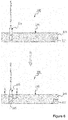
- the principle whereby the electric double layer capacitor is charged is as follows. As shown in FIG. 1 , the two electrodes 10 are placed opposite the electrolytic solution 20 in a state in which the separator 40 is located therebetween. In a state in which electrical energy is not supplied from the outside, as shown in FIG. 2 , which is a schematic view illustrating the principle whereby the electric double layer capacitor is charged, the electric double layer capacitor is in a bulk state, in which charges are non-uniformly distributed. As a result, the potential difference between the electrodes 10 becomes 0. When electrical energy is supplied from the outside, as shown in FIG. 3 , which is a circuit diagram illustrating the principle whereby the electric double layer capacitor is charged and discharged, charges are uniformly distributed throughout the electric double layer capacitor. As a result, as shown in FIG. 2 , an energy having voltage corresponding to a potential difference of 2 ⁇ 1 is charged between the two electrodes 10.
- FIG. 4 is a view showing a process of manufacturing an electric double layer capacitor according to Related Art Document 1
- FIG. 5 is a view illustrating a method of manufacturing an integrated electric double layer capacitor according to Related Art Document 1
- FIG. 6 is a view illustrating a process of manufacturing an electrode device that constitutes the electric double layer capacitor according to Related Art Document 1.
- a secondary battery that can be charged and discharged, for example, an energy storage apparatus, such as an electrolytic condenser or an electrochemical double layer capacitor (EDLC), is configured to have a wound type structure, e.g. a jelly-roll type structure.
- an energy storage apparatus such as an electrolytic condenser or an electrochemical double layer capacitor (EDLC)
- EDLC electrochemical double layer capacitor
- a wound type energy storage apparatus such as a wound type electrochemical double layer capacitor, generally includes a cylindrical case 20 made of aluminum (Al) and a wound device 10 mounted in the case 20.
- the wound device 10 is formed by winding a strip-shaped electrode stack, that is, positive and negative electrode devices with an electrolyte interposed between the positive and negative electrode devices, in a cylindrical shape and taping the outside of the strip-shaped electrode stack in order to prevent the strip-shaped electrode stack from being unwound.
- the wound device 10 formed as described above is impregnated with an electrolytic solution, and is mounted in the cylindrical case 20.
- a terminal plate 30 is installed above the wound device 10, and lug- or screw- type external terminals 40 are fastened to the terminal plate 30.
- the wound device 10 is mounted in the case 20 after the neck 21 is formed in the case 20.
- the wound device 10 is electrically connected to the external terminals 40 via terminals 120.
- an upper end 22 of the case 20 is curled.
- the terminal plate 30 is fixed in the case 20, and the assembly process is completed.
- an electrode device 100 includes an electrode current collection sheet 111 made of general aluminum foil and an electrode active material 112 applied to the current collection sheet 111.
- the electrode active material 112 is formed by applying conductive paste including mostly activated carbon.
- a terminal 120 is coupled to the electrode device 100. Specifically, a portion of the electrode device 100 to which the terminal 120 will be coupled is scratched to remove the electrode active material 112 therefrom, the scratched portion of the electrode device 100 is drilled, and the terminal 120 is coupled to the drilled portion of the electrode device 100 by riveting.
- the applicant of the present application has improved the electric double layer device having the above-mentioned characteristics, and proposes the improved electric double layer device as the present invention.
- FIG. 7 is an exploded perspective view showing an electric double layer device according to Related Art Document 2
- FIG. 8 is a sectional view showing the electric double layer device according to Related Art Document 2
- FIG. 9A is a plan view showing a wound unit for the electric double layer device according to Related Art Document 2
- FIG. 9B is a half-sectional view showing the wound unit for the electric double layer device according to Related Art Document 2.
- the electric double layer device according to Related Art Document 2 includes a wound unit 10, which includes a first current collector 11 and a second current collector 12, which are wound while being separated from each other by a separator 10a, and a case 20 having an upper opening 21, through which the wound unit 10 is received, and a lower closure 22.
- the electric double layer device further includes a lower connection plate 31 connected to the first current collector 11 of the wound unit 10, a lower insulating plate 32 placed on the lower closure 22 while receiving the lower connection plate 31, a connection core 40 connected to the lower connection plate 31 while being exposed upward in a state in which the connection core 40 is upright along the center of the wound unit 10, one terminal 50a extending upward from an upper collecting plate 50 connected to the second current collector 12 of the wound unit 10, the upper collecting plate 50 having therein a center hole 51, through which the connection core 40 extends, an upper insulating plate 60 fitted on the upper collecting plate 50 excluding the one terminal 50a, the upper insulating plate 60 having therein a through hole 61, through which the connection core 40 extends, and the other terminal 70a connected to the upper end of the connection core 40, the other terminal 70a extending upward while being spaced apart from the one terminal 50a.
- connection core 40 is perpendicularly connected to the lower connection plate 31, which is connected to the first current collector 11, and then the other terminal 70a is connected to the connection core 40 and is withdrawn.
- the upper collecting plate 50 is connected to the second current collector 12, and then the one terminal 50a is withdrawn.
- the one terminal 50a and the other terminal 70a are withdrawn upward.
- the wound unit 10 for the electric double layer device includes a first current collector 11 and a second current collector 12, which are wound while being separated from each other by a separator 10a, a lower connection plate 31 connected to the first current collector 11, a connection core 40 connected to the lower connection plate 31 while being exposed upward in a state in which the connection core 40 is upright along the center of the first current collector 11 and the second current collector 12, which are wound while being separated from each other by the separator 10a, and one terminal 50a extending upward from an upper collecting plate 50 connected to the second current collector 12 of the wound unit 10, the upper collecting plate 50 having therein a center hole 51, through which the connection core 40 extends.
- the one terminal 50a may extend upward from the upper collecting plate 50 and may then be bent.
- the other terminal 70a may be connected to the upper end of the connection core 40 such that the other terminal 70a is spaced apart from the one terminal 50a.
- the other terminal 70a may extend upward and may then be bent.
- connection plate 31 is connected to the first current collector 11 of the wound unit 10 in a state in which the connection core 40 is upright along the center of the first current collector 11, for example, such that a negative electrode of the first current collector 11 is withdrawn upward through the connection core 40.
- the one terminal 50a is connected to the second current collector 12 of the wound unit 10 in a state in which the one terminal 50a extends upward from the upper collecting plate 50, which has therein the center hole 51 through which the connection core 40 extends, for example, such that a positive electrode of the second current collector 12 is withdrawn upward.
- the other terminal 70a is connected to the upper end of the connection core 40 while extending upward such that the other terminal 70a is spaced apart from the one terminal 50a.
- the upper insulating plate 60 is fitted on the upper collecting plate 50 excluding the one terminal 50a such that the one terminal 50a is exposed outward.
- the electric double layer device according to Related Art Document 2 may further include an upper nonconductive plate 80 fitted in the case 20 to cover the upper opening 21, the upper nonconductive plate 80 having a first connection terminal 81 and a second connection terminal 82 respectively connected to the other terminal 70a and the one terminal 50a.
- connection between the other terminal 70a and the connection core 40 is frequently poor since the other terminal 70a is connected to the upper end of the connection core 40 while extending upward.
- a plurality of components, such as the connection core 40 and the other terminal 70a is needed, which makes it difficult to perform assembly and connection.
- productivity and ease of assembly are considerably reduced.
- the connection core 40 increases the weight of the electric double layer device.
- the present invention has been made in view of the above problems, and it is an object of the present invention to provide an electric double layer device configured such that a lower terminal is directly withdrawn from a lower collecting plate in the same manner as the manner in which an upper terminal is directly withdrawn from an upper collecting plate, thereby improving productivity and ease of assembly, and in addition increasing connection force.
- an electric double layer device including a wound unit, which includes a first current collector and a second current collector, which are wound while being separated from each other by a separator, and a case having an upper opening, through which the wound unit is received, and a lower closure
- the electric double layer device further includes a lower collecting plate connected to the first current collector of the wound unit, the lower collecting plate having a lower terminal extending upward along the outer circumference of the wound unit, a lower insulating plate placed on the lower closure to receive the lower collecting plate, an upper collecting plate connected to the second current collector of the wound unit, the upper collecting plate having an upper terminal extending upward, an upper insulating plate fitted on the upper collecting plate such that the upper terminal and the lower terminal are directed upward, and an upper nonconductive plate fitted in the case to cover the upper opening, the upper nonconductive plate having a first connection terminal and a second connection terminal respectively connected to the lower terminal and the upper terminal.
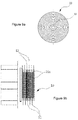
- FIG. 13A is a plan view showing a wound unit that is applied to an electric double layer device according to the present invention
- FIG. 13B is a half-sectional view showing the wound unit that is applied to the electric double layer device according to the present invention
- FIG. 13C is a development view showing the wound unit that is applied to the electric double layer device according to the present invention.
- a wound unit 10 that is applied to an electric double layer device is configured to have a structure in which a first current collector 11 and a second current collector 12 are wound such that the first current collector 11 extends downward and the second current collector 12 extends upward in a state in which a separator 10a is disposed between the first current collector 11 and the second current collector 12.
- the first current collector 11 may be a negative electrode
- the second current collector 12 may be a positive electrode
- the first current collector 11 may be a positive electrode
- the second current collector 12 may be a negative electrode.
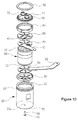
- FIG. 10 is an exploded perspective view showing an electric double layer device according to the present invention
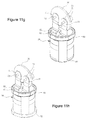
- FIGS. 11A to 11K are perspective views showing a process of assembling the electric double layer device according to the present invention
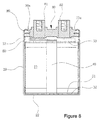
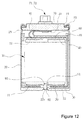
- FIG. 12 is a sectional view showing the electric double layer device according to the present invention.
- the electric double layer device basically includes a wound unit 10, which includes a first current collector 11 and a second current collector 12, which are wound while being separated from each other by a separator 10a, and a case 20 having an upper opening 21, through which the wound unit 10 is received, and a lower closure 22.
- the electric double layer device further includes a lower collecting plate 30 connected to the first current collector 11 of the wound unit 10, the lower collecting plate 30 having a lower terminal 31 extending upward along the outer circumference of the wound unit 10, a lower insulating plate 50 placed on the lower closure 22 to receive the lower collecting plate 30, an upper collecting plate 40 connected to the second current collector 12 of the wound unit 10, the upper collecting plate 40 having an upper terminal 41 extending upward, an upper insulating plate 60 fitted on the upper collecting plate 40 such that the upper terminal 41 and the lower terminal 31 are directed upward, and an upper nonconductive plate 70 fitted in the case 20 to cover the upper opening 21, the upper nonconductive plate 70 having a first connection terminal 71 and a second connection terminal 72 respectively connected to the lower terminal 31 and the upper terminal 41.
- the lower terminal 31 is withdrawn from the lower collecting plate 30, which is connected to the first current collector 11, and extends upward.
- components such as the connection core and the other terminal, disclosed in Related Art Document 2 are not needed. Consequently, it is possible to omit the process of connecting the connection core to the lower connection plate and the process of connecting the other terminal to the connection core, which are required in Related Art Document 2, thereby improving productivity and ease of assembly.
- the lower terminal 31 is withdrawn from the lower collecting plate 30 in the same manner as the manner in which the upper terminal 41 is withdrawn from the upper collecting plate 40, thereby preventing the risk of a poor connection therebetween. In particular, internal equivalent resistance is reduced, and discharge efficiency is improved during the discharge of high current.
- first connection terminal 71 and the second connection terminal 72 are more securely positioned by the upper nonconductive plate 70, thereby more smoothly achieving connection with an external apparatus.
- the wound unit 10 for the electric double layer device includes a first current collector 11 and a second current collector 12, which are wound while being separated from each other by a separator 10a.
- the lower terminal 31 extends upward along the outer circumference of the wound unit 10, is bent so as to be placed above the upper insulating plate 60, and is then bent upward so as to be connected to the first connection terminal 71.
- the upper insulating plate 60 has therein a through hole 61 through which the upper terminal 41 extends.
- the upper terminal 41 extends upward from the upper collecting plate 40, extends through the through hole 61, and is then bent so as to be connected to the second connection terminal 72.
- the lower terminal 31 and the upper terminal 41 are directly withdrawn respectively from the lower collecting plate 30 and the upper collecting plate 40 without welding, thereby improving productivity and ease of assembly and increasing electrical connection force.
- the upper terminal 41 and the lower terminal 31 may be connected to an external apparatus, such as a cellular phone, a GPS receiver, or an MP3 player.
- the upper terminal 41 and the lower terminal 31 may be connected to a wind energy system, a solar energy system, or a motor of an electric vehicle or a hybrid electric vehicle.
- the electric double layer device further includes an upper insulating ring 80, disposed so as to be in tight contact with the edge of the upper insulation plate 60 while receiving the lower terminal 31 therein to enable the lower terminal 31 to maintain a state in which the wound unit 10 and the case 20 are spaced apart from each other, thereby more securely insulating the lower terminal 31.
- the wound unit 10 may be more easily inserted into the case 20, since the upper insulating ring 80 enables the lower terminal 31 to be disposed in tight contact with the edge of the upper insulation plate 60.
- the electric double layer device further includes a first through hole 22a and a second through hole 51 formed respectively through the lower closure 22 of the case 20 and the lower insulating plate 50 so as to be used as introduction ports of an electrolytic solution, a rubber plug 91 fitted in the upper part of the first through hole 22a to seal the first through hole 22a, and a closure plug 92 fitted in the lower part of the first through hole 22a and welded to the lower part of the first through hole 22a.
- the closure plug 92 may be made of aluminum.
- the electric double layer device according to the present invention may further include curling rubber 93 placed on the edge of the upper nonconductive plate 70 to seal the upper opening 21 after curling of the case 20, thereby sealing the interior of the case 20.
- the electric double layer device according to the present invention may further include a beading part 23 provided at the upper part of the case 20 to maximize firmness between the upper nonconductive plate 70, including the upper terminal 41 and the lower terminal 31, and the case 20.
- the lower terminal is directly withdrawn from the lower collecting plate in the same manner as the manner in which the upper terminal is directly withdrawn from the upper collecting plate, thereby improving productivity and ease of assembly, and in addition increasing connection force.
- the lower terminal is directly withdrawn from the lower collecting plate, thereby improving discharge efficiency during the discharge of high current while reducing internal equivalent resistance.
- the electric double layer device further includes an upper insulating ring, configured to enable the lower terminal to maintain a state in which the wound unit and the case are spaced apart from each other, thereby more securely achieving insulation of the lower terminal.
- the upper insulating ring enables the lower terminal to be disposed in tight contact with the edge of the upper insulation plate, whereby the wound unit is more easily inserted into the case.
- an electrolytic solution is introduced into the case via a first through hole and a second through hole in a state in which all parts, including the wound unit, are assembled in the case, thereby improving productivity and workability.
- the present invention may be applied to the field of devices such as a battery, a capacitor, and an electrolytic condenser, which store electrical energy.
Landscapes
- Engineering & Computer Science (AREA)
- Chemical & Material Sciences (AREA)
- Chemical Kinetics & Catalysis (AREA)
- Electrochemistry (AREA)
- General Chemical & Material Sciences (AREA)
- Power Engineering (AREA)
- Microelectronics & Electronic Packaging (AREA)
- Manufacturing & Machinery (AREA)
- Electric Double-Layer Capacitors Or The Like (AREA)
Abstract
Description
- The present invention relates to an electric double layer device, and more particularly to an electric double layer device configured such that a lower terminal is directly withdrawn from a lower collecting plate in the same manner as the manner in which an upper terminal is directly withdrawn from an upper collecting plate, thereby improving productivity and ease of assembly, increasing connection force, and improving discharge efficiency during the discharge of high current while reducing internal equivalent resistance.
- In general, an electric double layer device is a device such as a battery, a capacitor, or an electrolytic condenser, which stores electrical energy. The electric double layer device is electrically charged and discharged using electrodes that are electrically conductive. Electric double layer devices are used in cellular phones, GPS receivers, MP3 players, and backup memories. In addition, electric double layer devices are used in wind energy systems, solar energy systems, and motors of electric vehicles and hybrid electric vehicles.
- An electric double layer is a layer configured such that positive charges are successively positioned on one surface of a thin film layer of an object and negative charges are successively positioned on the other surface of the thin film layer or such that both surfaces of the thin film layer have the same surface density. The electric double layer is typically a double layer that includes electric dipoles. In general, charges are rearranged at the interface between different materials, whereby an electric double layer is formed.
- Positive ions or negative ions in a liquid-state aqueous electrolytic solution are selectively adsorbed at the interface between a solid-state electrode and a liquid-state aqueous electrolytic solution, solid surface molecules are dissociated, or the positive ions or the negative ions are adsorbed on the dipole interface, whereby an electric double layer is formed. This layer is referred to as a Helmholtz layer.
- Such an electric double layer is closely related to various electrochemical surface phenomena, such as an electrode reaction, an electrokinetic phenomenon (an electrophoretic phenomenon), and the stability of colloids.
- One example of such an electric double layer device may be a capacitor.
- In the electric double layer capacitor, an electrostatic layer is formed at the interface between an activated carbon electrode and an organic electrolyte, and an electric double layer state is used as the function of a dielectric to accumulate electricity in the same manner as in a battery.
- In particular, charges that accumulate in an electric double layer, formed between a solid electrode and a solid-state or liquid-state electrolyte, are used.
- The capacitor has lower energy density than the battery. However, the capacitor is superior to the battery in terms of power density, that is, instantaneous high output. In addition, the capacitor is usable hundreds of thousands of times. That is, the lifespan of the capacitor is semi-permanent. For these reasons, capacitors are used in various fields.
- The electric double layer capacitor is operated according to the following principle. When direct current voltage is applied to a pair of solid electrodes in a state in which the solid electrodes are placed in an electrolyte ion solution, negative ions are electrostatically drawn to an electrode polarized as a positive electrode, and positive ions are electrostatically drawn to an electrode polarized as a negative electrode. As a result, an electric double layer is formed at the interface between each electrode and the electrolyte. In particular, activated carbon has a plurality of pores. For this reason, the electric double layer is easily formed. The capacitance of the stored charge may be calculated using Equation 1 below.

- Where ε0 indicates the permittivity of air, ε indicates the permittivity of an electrolyte, σ indicates the radius of electrolytic ions, and S indicates the specific surface area of an electrode.
- The factors that determine the capacity of an electric double layer capacitor are as follows. As can be seen from Equation 1 above, the larger the specific surface area of the electrode, the larger the permittivity of the electrolyte, and the smaller the radius of the ions during the formation of the double layer, the greater the capacity that can be obtained. In addition, capacitance is determined by the internal resistance of the electrode, the relationship between the distribution of pores in the electrode and the electrolytic ions, internal voltage, etc.
- The electric double layer capacitor includes electrodes, a separator, an electrolyte, current collectors, and a case.
- The selection of materials for the electrodes is most important when configuring the capacitor. However, the capacitance of the capacitor is changed by various other components of the capacitor.
- The materials for the electrodes must have high electrical conductivity and a large specific surface area. In addition, the materials for the electrodes must be electrochemically stable.
- Another example of such an electric double layer device may be a battery.
- The battery is a device that converts chemical energy, stored in a chemical material (i.e. an active material) contained therein, into electrical energy through an electrochemical oxidation-reduction reaction (redox reaction).
- The battery is constituted by an assembly of two or more electrochemical cells. Alternatively, the battery may be constituted by a single cell. The battery is configured such that electrons flow to the outside along a conducting wire due to an electrochemical reaction, rather than a chemical reaction. The electrons flowing along the conducting wire becomes the source of electrical energy, thereby being electrically useful.
- More specifically, the battery has a positive electrode (cathode) active material and a negative electrode (anode) active material coated on a current collector. The positive electrode and the negative electrode are separated from each other by a separator. In addition, the positive electrode and the negative electrode are contained in an electrolyte, which enables the transfer of ions between the two electrodes.
- In order to operate an electric lamp, an apparatus, an instrument, etc., the electrode materials and electrolyte must be selected appropriately and arranged so as to have a specific structure such that sufficient voltage and current are generated between the two electrodes of the battery.
- For example, a positive electrode, the positive electrode active material of which is reduced by electrons received from an external conducting wire, a negative electrode, the negative electrode active material of which is oxidized so as to emit electrons to the conducting wire, an electrolyte, which enables a material to move such that the reduction reaction of the positive electrode and the oxidation reaction of the negative electrode are chemically harmonious, and a separator, which prevents physical contact between the positive electrode and the negative electrode, must be arranged so as to convert chemical energy into electrical energy based on interactions therebetween.
- The negative electrode of the battery, arranged as described above, basically emits electrons while being oxidized, and the positive electrode receives electrons while being reduced (together with positive ions). When the battery is operated in a state of being connected to an external load, therefore, the two electrodes are electrochemically changed to thus perform electrical work.
- At this time, the electrons, which are generated by the oxidation reaction of the negative electrode, move to the positive electrode via the external load, and undergo a reduction reaction with the positive electrode active material. Consequently, the flow of charges is completed as the result of movement of anions (negative ions) and cations (positive ions) toward the negative electrode and the positive electrode in the electrolyte.
- In this way, the reaction is performed in the electrolyte such that charges continuously flow in the external conducting wire, and the electrical operation is performed using the charges.
- Based on the kind of an electrolytic solution, the battery may be classified as a liquid electrolyte battery or a polymer electrolyte battery. In general, the liquid electrolyte battery is referred to as a lithium ion battery, and the polymer electrolyte battery is referred to as a lithium polymer battery.
-
FIG. 1 is a schematic view showing the structure of a general electric double layer device,FIG. 2 is a schematic view illustrating a principle whereby an electric double layer capacitor, applied to a general electric double layer device, is charged, andFIG. 3 is a circuit diagram illustrating a principle whereby the electric double layer capacitor applied to the general electric double layer device is charged and discharged. - As shown in
FIG. 1 , a general electricdouble layer device 100 includeselectrodes 10, anelectrolytic solution 20,current collectors 30, aseparator 40, afirst lead terminal 61, and asecond lead terminal 62. - On the assumption that the electric
double layer device 100 is a battery, the chemical energy of a chemical material (i.e. an active material) therein is converted into electrical energy through an electrochemical oxidation-reduction reaction (redox reaction), and theelectrodes 10, which are put on thecurrent collectors 30, have a positive electrode and a negative electrode as the active material. - Describing the characteristics of the electric
double layer device 100 in more detail based on the assumption that the electricdouble layer device 100 is a capacitor, on the other hand, energy is stored using the distribution of positive and negative charges which are arranged within a short distance from each other at the interface between the twodifferent electrodes 10, the capacitance, in farads, is high, and the change and deterioration in performance upon repeated charge and discharge cycles thereof are very low. - The
electrodes 10 are made of activated carbon, which has a large specific surface area, and store charges generated at the electric double layer, which is disposed at the interface with theelectrolytic solution 20. Of the electrical characteristics of theelectrodes 10, capacitance and internal resistance are the most important criteria in evaluating the performance thereof. Consequently, theelectrodes 10 must exhibit low specific resistance and have a porous structure. In the porous structure, the size and distribution of pores must be simple and biased within a predetermined range. The material characteristics of theelectrodes 10 most strongly affect the inherent charge and discharge characteristics of the electric double layer capacitor. - In recent years, therefore, an activated carbon-based material, which has a large specific surface area and is inexpensive, has been mainly used as the material for the
electrodes 10, and research into the use of metal oxides and conductive polymers in order to increase energy density has been increasingly conducted. - Meanwhile, an organic solvent, quaternary ammonium salt (organic), or sulfuric acid solution (aqueous solution) is used as the
electrolytic solution 20. For the organic solvent electrolytic solution, polycarbonate (PC) and ethyl methyl carbonate (EMC) or PC and dimethoxyethane (DME) may be mixed at a predetermined ratio in order to improve electrical conductivity. - An electric
double layer capacitor 100 using an organic electrolytic solution has a capacitance per unit area of 4 to 6 µF/cm2. The electrical conductivity of the organic electrolytic solution is higher than that of the aqueous electrolytic solution. Consequently, the electricdouble layer capacitor 100 using the aqueous electrolytic solution has a capacitance per unit area of 5 to 10 µF/cm2, which is higher than that of the electricdouble layer capacitor 100 using the organic electrolyte. However, the electricdouble layer capacitor 100 using the aqueous electrolytic solution has problems in that the potential window is narrow and decomposition occurs. - Nonwoven fabric, porous polyethylene (PE), or polypropylene (PP) film is used as the
separator 40. - The principle whereby the electric double layer capacitor is charged is as follows. As shown in
FIG. 1 , the twoelectrodes 10 are placed opposite theelectrolytic solution 20 in a state in which theseparator 40 is located therebetween. In a state in which electrical energy is not supplied from the outside, as shown inFIG. 2 , which is a schematic view illustrating the principle whereby the electric double layer capacitor is charged, the electric double layer capacitor is in a bulk state, in which charges are non-uniformly distributed. As a result, the potential difference between theelectrodes 10 becomes 0. When electrical energy is supplied from the outside, as shown inFIG. 3 , which is a circuit diagram illustrating the principle whereby the electric double layer capacitor is charged and discharged, charges are uniformly distributed throughout the electric double layer capacitor. As a result, as shown inFIG. 2 , an energy having voltage corresponding to a potential difference of 2Φ1 is charged between the twoelectrodes 10. - At this time, even when the supply of electrical energy is interrupted, the electric double layer, which has already been formed, is not extinguished, and therefore the charged electrical energy is retained.
- Related Art Document 1 (10-2008-0044054: Module type electric double layer capacitor and method of manufacturing the same)
-
FIG. 4 is a view showing a process of manufacturing an electric double layer capacitor according to Related Art Document 1,FIG. 5 is a view illustrating a method of manufacturing an integrated electric double layer capacitor according to Related Art Document 1, andFIG. 6 is a view illustrating a process of manufacturing an electrode device that constitutes the electric double layer capacitor according to Related Art Document 1. - In general, a secondary battery that can be charged and discharged, for example, an energy storage apparatus, such as an electrolytic condenser or an electrochemical double layer capacitor (EDLC), is configured to have a wound type structure, e.g. a jelly-roll type structure.
- As shown in
FIG. 4 , a wound type energy storage apparatus, such as a wound type electrochemical double layer capacitor, generally includes acylindrical case 20 made of aluminum (Al) and awound device 10 mounted in thecase 20. - The
wound device 10 is formed by winding a strip-shaped electrode stack, that is, positive and negative electrode devices with an electrolyte interposed between the positive and negative electrode devices, in a cylindrical shape and taping the outside of the strip-shaped electrode stack in order to prevent the strip-shaped electrode stack from being unwound. - The
wound device 10 formed as described above is impregnated with an electrolytic solution, and is mounted in thecylindrical case 20. Aterminal plate 30 is installed above thewound device 10, and lug- or screw- typeexternal terminals 40 are fastened to theterminal plate 30. - In addition, a
neck 21, which prevents theterminal plate 30 from being pushed downward, is formed in the upper part of thecase 20 in a depressed state. Thewound device 10 is mounted in thecase 20 after theneck 21 is formed in thecase 20. Thewound device 10 is electrically connected to theexternal terminals 40 viaterminals 120. Subsequently, anupper end 22 of thecase 20 is curled. As a result, theterminal plate 30 is fixed in thecase 20, and the assembly process is completed. - Referring to the upper part of
FIG. 6 , anelectrode device 100 includes an electrodecurrent collection sheet 111 made of general aluminum foil and an electrodeactive material 112 applied to thecurrent collection sheet 111. - The electrode
active material 112 is formed by applying conductive paste including mostly activated carbon. - A terminal 120 is coupled to the
electrode device 100. Specifically, a portion of theelectrode device 100 to which the terminal 120 will be coupled is scratched to remove the electrodeactive material 112 therefrom, the scratched portion of theelectrode device 100 is drilled, and the terminal 120 is coupled to the drilled portion of theelectrode device 100 by riveting. - The applicant of the present application has improved the electric double layer device having the above-mentioned characteristics, and proposes the improved electric double layer device as the present invention.
- Related Art Document 2 (10-2013-0065485: Electric double layer device and wound unit for the same)
-
FIG. 7 is an exploded perspective view showing an electric double layer device according to Related Art Document 2,FIG. 8 is a sectional view showing the electric double layer device according to Related Art Document 2,FIG. 9A is a plan view showing a wound unit for the electric double layer device according to Related Art Document 2, andFIG. 9B is a half-sectional view showing the wound unit for the electric double layer device according to Related Art Document 2. - As shown in
FIGS. 7 to 9B , the electric double layer device according to Related Art Document 2 includes awound unit 10, which includes a firstcurrent collector 11 and a secondcurrent collector 12, which are wound while being separated from each other by aseparator 10a, and acase 20 having anupper opening 21, through which thewound unit 10 is received, and alower closure 22. - More specifically, as shown in
FIGS. 7 to 9B , the electric double layer device according to Related Art Document 2 further includes alower connection plate 31 connected to the firstcurrent collector 11 of thewound unit 10, a lower insulatingplate 32 placed on thelower closure 22 while receiving thelower connection plate 31, aconnection core 40 connected to thelower connection plate 31 while being exposed upward in a state in which theconnection core 40 is upright along the center of thewound unit 10, oneterminal 50a extending upward from anupper collecting plate 50 connected to the secondcurrent collector 12 of thewound unit 10, theupper collecting plate 50 having therein acenter hole 51, through which theconnection core 40 extends, an upper insulatingplate 60 fitted on theupper collecting plate 50 excluding the oneterminal 50a, the upper insulatingplate 60 having therein a throughhole 61, through which theconnection core 40 extends, and theother terminal 70a connected to the upper end of theconnection core 40, theother terminal 70a extending upward while being spaced apart from the oneterminal 50a. - The
connection core 40 is perpendicularly connected to thelower connection plate 31, which is connected to the firstcurrent collector 11, and then theother terminal 70a is connected to theconnection core 40 and is withdrawn. Theupper collecting plate 50 is connected to the secondcurrent collector 12, and then the oneterminal 50a is withdrawn. The oneterminal 50a and theother terminal 70a are withdrawn upward. - Furthermore, the
wound unit 10 for the electric double layer device according to Related Art Document 2 includes a firstcurrent collector 11 and a secondcurrent collector 12, which are wound while being separated from each other by aseparator 10a, alower connection plate 31 connected to the firstcurrent collector 11, aconnection core 40 connected to thelower connection plate 31 while being exposed upward in a state in which theconnection core 40 is upright along the center of the firstcurrent collector 11 and the secondcurrent collector 12, which are wound while being separated from each other by theseparator 10a, and one terminal 50a extending upward from anupper collecting plate 50 connected to the secondcurrent collector 12 of thewound unit 10, theupper collecting plate 50 having therein acenter hole 51, through which theconnection core 40 extends. - The one
terminal 50a may extend upward from theupper collecting plate 50 and may then be bent. Theother terminal 70a may be connected to the upper end of theconnection core 40 such that theother terminal 70a is spaced apart from the oneterminal 50a. In addition, theother terminal 70a may extend upward and may then be bent. - The
lower connection plate 31 is connected to the firstcurrent collector 11 of thewound unit 10 in a state in which theconnection core 40 is upright along the center of the firstcurrent collector 11, for example, such that a negative electrode of the firstcurrent collector 11 is withdrawn upward through theconnection core 40. - The one
terminal 50a is connected to the secondcurrent collector 12 of thewound unit 10 in a state in which the oneterminal 50a extends upward from theupper collecting plate 50, which has therein thecenter hole 51 through which theconnection core 40 extends, for example, such that a positive electrode of the secondcurrent collector 12 is withdrawn upward. Theother terminal 70a is connected to the upper end of theconnection core 40 while extending upward such that theother terminal 70a is spaced apart from the oneterminal 50a. - At this time, the upper insulating
plate 60 is fitted on theupper collecting plate 50 excluding the oneterminal 50a such that the oneterminal 50a is exposed outward. - The electric double layer device according to Related Art Document 2 may further include an upper
nonconductive plate 80 fitted in thecase 20 to cover theupper opening 21, the uppernonconductive plate 80 having afirst connection terminal 81 and asecond connection terminal 82 respectively connected to theother terminal 70a and the oneterminal 50a. - In the electric double layer device according to Related Art Document 2, however, the connection between the
other terminal 70a and theconnection core 40 is frequently poor since theother terminal 70a is connected to the upper end of theconnection core 40 while extending upward. In particular, a plurality of components, such as theconnection core 40 and theother terminal 70a, is needed, which makes it difficult to perform assembly and connection. As a result, productivity and ease of assembly are considerably reduced. Furthermore, theconnection core 40 increases the weight of the electric double layer device. -
- (Patent Document 1) Related Art Document 1 (10-2008-0044054: Module type electric double layer capacitor and method of manufacturing the same)
- (Patent Document 2) Related Art Document 2 (10-2013-0065485: Electric double layer device and wound unit for the same)
- Therefore, the present invention has been made in view of the above problems, and it is an object of the present invention to provide an electric double layer device configured such that a lower terminal is directly withdrawn from a lower collecting plate in the same manner as the manner in which an upper terminal is directly withdrawn from an upper collecting plate, thereby improving productivity and ease of assembly, and in addition increasing connection force.
- It is another object of the present invention to provide an electric double layer device configured such that a lower terminal is directly withdrawn from a lower collecting plate, thereby improving discharge efficiency during the discharge of high current while reducing internal equivalent resistance.
- It is a further object of the present invention to provide an electric double layer device further including an upper insulating ring configured to enable a lower terminal to maintain a state in which a wound unit and a case are spaced apart from each other, thereby more securely insulating the lower terminal and, in addition, making it easier to insert the wound unit into the case.
- In accordance with the present invention, the above and other objects can be accomplished by the provision of an electric double layer device including a wound unit, which includes a first current collector and a second current collector, which are wound while being separated from each other by a separator, and a case having an upper opening, through which the wound unit is received, and a lower closure, wherein the electric double layer device further includes a lower collecting plate connected to the first current collector of the wound unit, the lower collecting plate having a lower terminal extending upward along the outer circumference of the wound unit, a lower insulating plate placed on the lower closure to receive the lower collecting plate, an upper collecting plate connected to the second current collector of the wound unit, the upper collecting plate having an upper terminal extending upward, an upper insulating plate fitted on the upper collecting plate such that the upper terminal and the lower terminal are directed upward, and an upper nonconductive plate fitted in the case to cover the upper opening, the upper nonconductive plate having a first connection terminal and a second connection terminal respectively connected to the lower terminal and the upper terminal.
- The above and other objects, features and other advantages of the present invention will be more clearly understood from the following detailed description taken in conjunction with the accompanying drawings, in which:
-
FIG. 1 is a schematic view showing the structure of a general electric double layer device; -
FIG. 2 is a schematic view illustrating a principle whereby an electric double layer capacitor, applied to a general electric double layer device, is charged; -
FIG. 3 is a circuit diagram illustrating a principle whereby the electric double layer capacitor applied to the general electric double layer device is charged and discharged; -
FIG. 4 is a view showing a process of manufacturing an electric double layer capacitor according to Related Art Document 1; -
FIG. 5 is a view illustrating a method of manufacturing an integrated electric double layer capacitor according to Related Art Document 1; -
FIG. 6 is a view illustrating a process of manufacturing an electrode device that constitutes the electric double layer capacitor according to Related Art Document 1; -
FIG. 7 is an exploded perspective view showing an electric double layer device according to Related Art Document 2; -
FIG. 8 is a sectional view showing the electric double layer device according to Related Art Document 2; -
FIG. 9A is a plan view showing a wound unit for the electric double layer device according to Related Art Document 2; -
FIG. 9B is a half-sectional view showing the wound unit for the electric double layer device according to Related Art Document 2; -
FIG. 10 is an exploded perspective view showing an electric double layer device according to the present invention; -
FIGS. 11A to 11K are perspective views showing a process of assembling the electric double layer device according to the present invention; -
FIG. 12 is a sectional view showing the electric double layer device according to the present invention; -
FIG. 13A is a plan view showing a wound unit that is applied to the electric double layer device according to the present invention; -
FIG. 13B is a half-sectional view showing the wound unit that is applied to the electric double layer device according to the present invention; and -
FIG. 13C is a development view showing the wound unit that is applied to the electric double layer device according to the present invention. - An exemplary embodiment of an electric double layer device according to the present invention will be described in detail with reference to the accompanying drawings. A plurality of embodiments may be provided. The objects, features, and advantages of the present invention will be more clearly understood from the following detailed description of the embodiment.
-
FIG. 13A is a plan view showing a wound unit that is applied to an electric double layer device according to the present invention,FIG. 13B is a half-sectional view showing the wound unit that is applied to the electric double layer device according to the present invention, andFIG. 13C is a development view showing the wound unit that is applied to the electric double layer device according to the present invention. - As shown in
FIGS. 13A to 13B , awound unit 10 that is applied to an electric double layer device according to the present invention is configured to have a structure in which a firstcurrent collector 11 and a secondcurrent collector 12 are wound such that the firstcurrent collector 11 extends downward and the secondcurrent collector 12 extends upward in a state in which aseparator 10a is disposed between the firstcurrent collector 11 and the secondcurrent collector 12. For example, the firstcurrent collector 11 may be a negative electrode, and the secondcurrent collector 12 may be a positive electrode. Alternatively, the firstcurrent collector 11 may be a positive electrode, and the secondcurrent collector 12 may be a negative electrode. -
FIG. 10 is an exploded perspective view showing an electric double layer device according to the present invention,FIGS. 11A to 11K are perspective views showing a process of assembling the electric double layer device according to the present invention, andFIG. 12 is a sectional view showing the electric double layer device according to the present invention. - As shown in
FIGS. 10 to 13C , the electric double layer device according to the present invention basically includes awound unit 10, which includes a firstcurrent collector 11 and a secondcurrent collector 12, which are wound while being separated from each other by aseparator 10a, and acase 20 having anupper opening 21, through which thewound unit 10 is received, and alower closure 22. - More specifically, the electric double layer device according to the present invention further includes a
lower collecting plate 30 connected to the firstcurrent collector 11 of thewound unit 10, thelower collecting plate 30 having alower terminal 31 extending upward along the outer circumference of thewound unit 10, a lower insulatingplate 50 placed on thelower closure 22 to receive thelower collecting plate 30, anupper collecting plate 40 connected to the secondcurrent collector 12 of thewound unit 10, theupper collecting plate 40 having anupper terminal 41 extending upward, an upper insulatingplate 60 fitted on theupper collecting plate 40 such that theupper terminal 41 and thelower terminal 31 are directed upward, and an uppernonconductive plate 70 fitted in thecase 20 to cover theupper opening 21, the uppernonconductive plate 70 having afirst connection terminal 71 and asecond connection terminal 72 respectively connected to thelower terminal 31 and theupper terminal 41. - The
lower terminal 31 is withdrawn from thelower collecting plate 30, which is connected to the firstcurrent collector 11, and extends upward. As a result, components such as the connection core and the other terminal, disclosed in Related Art Document 2, are not needed. Consequently, it is possible to omit the process of connecting the connection core to the lower connection plate and the process of connecting the other terminal to the connection core, which are required in Related Art Document 2, thereby improving productivity and ease of assembly. In addition, thelower terminal 31 is withdrawn from thelower collecting plate 30 in the same manner as the manner in which theupper terminal 41 is withdrawn from theupper collecting plate 40, thereby preventing the risk of a poor connection therebetween. In particular, internal equivalent resistance is reduced, and discharge efficiency is improved during the discharge of high current. - In addition, the
first connection terminal 71 and thesecond connection terminal 72 are more securely positioned by the uppernonconductive plate 70, thereby more smoothly achieving connection with an external apparatus. - Furthermore, the
wound unit 10 for the electric double layer device according to the present invention includes a firstcurrent collector 11 and a secondcurrent collector 12, which are wound while being separated from each other by aseparator 10a. More specifically, thelower terminal 31 extends upward along the outer circumference of thewound unit 10, is bent so as to be placed above the upper insulatingplate 60, and is then bent upward so as to be connected to thefirst connection terminal 71. The upper insulatingplate 60 has therein a throughhole 61 through which theupper terminal 41 extends. Theupper terminal 41 extends upward from theupper collecting plate 40, extends through the throughhole 61, and is then bent so as to be connected to thesecond connection terminal 72. - That is, the
lower terminal 31 and theupper terminal 41 are directly withdrawn respectively from thelower collecting plate 30 and theupper collecting plate 40 without welding, thereby improving productivity and ease of assembly and increasing electrical connection force. - The
upper terminal 41 and thelower terminal 31 may be connected to an external apparatus, such as a cellular phone, a GPS receiver, or an MP3 player. Alternatively, theupper terminal 41 and thelower terminal 31 may be connected to a wind energy system, a solar energy system, or a motor of an electric vehicle or a hybrid electric vehicle. - In addition, the electric double layer device according to the present invention further includes an upper insulating
ring 80, disposed so as to be in tight contact with the edge of theupper insulation plate 60 while receiving thelower terminal 31 therein to enable thelower terminal 31 to maintain a state in which thewound unit 10 and thecase 20 are spaced apart from each other, thereby more securely insulating thelower terminal 31. - In particular, the
wound unit 10 may be more easily inserted into thecase 20, since the upper insulatingring 80 enables thelower terminal 31 to be disposed in tight contact with the edge of theupper insulation plate 60. - The electric double layer device according to the present invention further includes a first through
hole 22a and a second throughhole 51 formed respectively through thelower closure 22 of thecase 20 and the lower insulatingplate 50 so as to be used as introduction ports of an electrolytic solution, arubber plug 91 fitted in the upper part of the first throughhole 22a to seal the first throughhole 22a, and aclosure plug 92 fitted in the lower part of the first throughhole 22a and welded to the lower part of the first throughhole 22a. The closure plug 92 may be made of aluminum. In a state in which all parts, including thewound unit 10, are assembled in thecase 20, therefore, an electrolytic solution is introduced into thecase 20 via the first throughhole 22a and the second throughhole 51, and the first throughhole 22a is sealed, thereby improving productivity and ease of assembly. - Meanwhile, the electric double layer device according to the present invention may further include curling
rubber 93 placed on the edge of the uppernonconductive plate 70 to seal theupper opening 21 after curling of thecase 20, thereby sealing the interior of thecase 20. - In addition, the electric double layer device according to the present invention may further include a
beading part 23 provided at the upper part of thecase 20 to maximize firmness between the uppernonconductive plate 70, including theupper terminal 41 and thelower terminal 31, and thecase 20. - As is apparent from the above description, according to the present invention, the lower terminal is directly withdrawn from the lower collecting plate in the same manner as the manner in which the upper terminal is directly withdrawn from the upper collecting plate, thereby improving productivity and ease of assembly, and in addition increasing connection force.
- According to the present invention, the lower terminal is directly withdrawn from the lower collecting plate, thereby improving discharge efficiency during the discharge of high current while reducing internal equivalent resistance.
- According to the present invention, the electric double layer device further includes an upper insulating ring, configured to enable the lower terminal to maintain a state in which the wound unit and the case are spaced apart from each other, thereby more securely achieving insulation of the lower terminal.
- According to the present invention, the upper insulating ring enables the lower terminal to be disposed in tight contact with the edge of the upper insulation plate, whereby the wound unit is more easily inserted into the case.
- According to the present invention, an electrolytic solution is introduced into the case via a first through hole and a second through hole in a state in which all parts, including the wound unit, are assembled in the case, thereby improving productivity and workability.
- The present invention may be applied to the field of devices such as a battery, a capacitor, and an electrolytic condenser, which store electrical energy.
- Although the preferred embodiments of the present invention have been disclosed for illustrative purposes, those skilled in the art will appreciate that various modifications, additions and substitutions are possible, without departing from the scope and spirit of the invention as disclosed in the accompanying claims.
Claims (4)
- An electric double layer device comprising a wound unit, which comprises a first current collector and a second current collector, which are wound while being separated from each other by a separator, and a case having therein an upper opening, through which the wound unit is received, and a lower closure, wherein the electric double layer device further comprises:a lower collecting plate connected to the first current collector of the wound unit, the lower collecting plate having a lower terminal extending upward along an outer circumference of the wound unit;a lower insulating plate placed on the lower closure to receive the lower collecting plate;an upper collecting plate connected to the second current collector of the wound unit, the upper collecting plate having an upper terminal extending upward;an upper insulating plate fitted on the upper collecting plate such that the upper terminal and the lower terminal are directed upward; andan upper nonconductive plate fitted in the case to cover the upper opening, the upper nonconductive plate having a first connection terminal and a second connection terminal respectively connected to the lower terminal and the upper terminal.
- The electric double layer device according to claim 1, wherein
the lower terminal extends upward along the outer circumference of the wound unit, is bent so as to be placed above the upper insulating plate, and is bent upward so as to be connected to the first connection terminal,
the upper insulating plate has therein a through hole, through which the upper terminal extends, and
the upper terminal extends upward from the upper collecting plate, extends through the through hole, and is bent so as to be connected to the second connection terminal. - The electric double layer device according to claim 2, further comprising an upper insulating ring, which is disposed so as to be in tight contact with an edge of the upper insulation plate while receiving the lower terminal therein to enable the lower terminal to maintain a state in which the wound unit and the case are spaced apart from each other.
- The electric double layer device according to any one of claims 1 to 3, further comprising:a first through hole and a second through hole formed respectively through the lower closure of the case and the lower insulating plate so as to be used as introduction ports of an electrolytic solution;a rubber plug fitted in an upper part of the first through hole to seal the first through hole; anda closure plug fitted in a lower part of the first through hole and welded to the lower part of the first through hole.
Priority Applications (1)
| Application Number | Priority Date | Filing Date | Title |
|---|---|---|---|
| EP16152106.7A EP3196906B1 (en) | 2016-01-20 | 2016-01-20 | Electric double layer device |
Applications Claiming Priority (1)
| Application Number | Priority Date | Filing Date | Title |
|---|---|---|---|
| EP16152106.7A EP3196906B1 (en) | 2016-01-20 | 2016-01-20 | Electric double layer device |
Publications (3)
| Publication Number | Publication Date |
|---|---|
| EP3196906A1 true EP3196906A1 (en) | 2017-07-26 |
| EP3196906C0 EP3196906C0 (en) | 2023-09-06 |
| EP3196906B1 EP3196906B1 (en) | 2023-09-06 |
Family
ID=55221318
Family Applications (1)
| Application Number | Title | Priority Date | Filing Date |
|---|---|---|---|
| EP16152106.7A Active EP3196906B1 (en) | 2016-01-20 | 2016-01-20 | Electric double layer device |
Country Status (1)
| Country | Link |
|---|---|
| EP (1) | EP3196906B1 (en) |
Citations (1)
| Publication number | Priority date | Publication date | Assignee | Title |
|---|---|---|---|---|
| EP1688975A1 (en) * | 2003-11-25 | 2006-08-09 | Asahi Glass Company, Limited | Capacitor |
-
2016
- 2016-01-20 EP EP16152106.7A patent/EP3196906B1/en active Active
Patent Citations (1)
| Publication number | Priority date | Publication date | Assignee | Title |
|---|---|---|---|---|
| EP1688975A1 (en) * | 2003-11-25 | 2006-08-09 | Asahi Glass Company, Limited | Capacitor |
Also Published As
| Publication number | Publication date |
|---|---|
| EP3196906C0 (en) | 2023-09-06 |
| EP3196906B1 (en) | 2023-09-06 |
Similar Documents
| Publication | Publication Date | Title |
|---|---|---|
| US6762926B1 (en) | Supercapacitor with high energy density | |
| KR101537999B1 (en) | Electric double layer device | |
| CN101517817A (en) | Hybrid Electrode Assembly of Capacitor-Battery Structure | |
| US10658128B2 (en) | Electric double-layer device | |
| US10692662B2 (en) | Electric double layer device | |
| KR101599711B1 (en) | Electric double layer device | |
| EP1471545B1 (en) | Super capacitor with high energy density | |
| KR101638566B1 (en) | Electric double layer device | |
| US20110170234A1 (en) | Electric double layer capacitor | |
| EP3196906B1 (en) | Electric double layer device | |
| KR101732688B1 (en) | Electric double layer device | |
| WO2005076296A1 (en) | Electrochemical device and electrode body | |
| CN215451186U (en) | Large-capacity aluminum electrolytic capacitor | |
| CN214956461U (en) | Hollow rotary connection type super capacitor | |
| KR20140014411A (en) | High-capacity supercapacitor box | |
| HK1242467A1 (en) | Electric double layer device | |
| HK1242467A (en) | Electric double layer device | |
| CN106997809A (en) | Electric double layer device | |
| KR101999736B1 (en) | An axial-type lithium ion capacitor comprising graphene electrode | |
| KR100529253B1 (en) | Supercapacitor with high energy density | |
| HK1242467B (en) | Electric double layer device | |
| KR101791894B1 (en) | Electric double layer device | |
| CN112490011A (en) | Aluminum electrolytic capacitor | |
| CN215451185U (en) | Aluminum electrolytic capacitor cover plate and aluminum electrolytic capacitor | |
| EP1335395A1 (en) | Cylindrical high voltage supercapacitor and method of manufacturing the same |
Legal Events
| Date | Code | Title | Description |
|---|---|---|---|
| PUAI | Public reference made under article 153(3) epc to a published international application that has entered the european phase |
Free format text: ORIGINAL CODE: 0009012 |
|
| STAA | Information on the status of an ep patent application or granted ep patent |
Free format text: STATUS: REQUEST FOR EXAMINATION WAS MADE |
|
| 17P | Request for examination filed |
Effective date: 20160120 |
|
| AK | Designated contracting states |
Kind code of ref document: A1 Designated state(s): AL AT BE BG CH CY CZ DE DK EE ES FI FR GB GR HR HU IE IS IT LI LT LU LV MC MK MT NL NO PL PT RO RS SE SI SK SM TR |
|
| AX | Request for extension of the european patent |
Extension state: BA ME |
|
| RBV | Designated contracting states (corrected) |
Designated state(s): AL AT BE BG CH CY CZ DE DK EE ES FI FR GB GR HR HU IE IS IT LI LT LU LV MC MK MT NL NO PL PT RO RS SE SI SK SM TR |
|
| STAA | Information on the status of an ep patent application or granted ep patent |
Free format text: STATUS: EXAMINATION IS IN PROGRESS |
|
| 17Q | First examination report despatched |
Effective date: 20200724 |
|
| RAP3 | Party data changed (applicant data changed or rights of an application transferred) |
Owner name: MAXWELL TECHNOLOGIES KOREA CO., LTD. |
|
| RIC1 | Information provided on ipc code assigned before grant |
Ipc: H01M 10/0587 20100101ALI20230209BHEP Ipc: H01M 10/04 20060101ALI20230209BHEP Ipc: H01G 11/82 20130101ALI20230209BHEP Ipc: H01G 11/74 20130101AFI20230209BHEP |
|
| GRAP | Despatch of communication of intention to grant a patent |
Free format text: ORIGINAL CODE: EPIDOSNIGR1 |
|
| STAA | Information on the status of an ep patent application or granted ep patent |
Free format text: STATUS: GRANT OF PATENT IS INTENDED |
|
| INTG | Intention to grant announced |
Effective date: 20230331 |
|
| GRAS | Grant fee paid |
Free format text: ORIGINAL CODE: EPIDOSNIGR3 |
|
| GRAA | (expected) grant |
Free format text: ORIGINAL CODE: 0009210 |
|
| STAA | Information on the status of an ep patent application or granted ep patent |
Free format text: STATUS: THE PATENT HAS BEEN GRANTED |
|
| AK | Designated contracting states |
Kind code of ref document: B1 Designated state(s): AL AT BE BG CH CY CZ DE DK EE ES FI FR GB GR HR HU IE IS IT LI LT LU LV MC MK MT NL NO PL PT RO RS SE SI SK SM TR |
|
| REG | Reference to a national code |
Ref country code: GB Ref legal event code: FG4D |
|
| REG | Reference to a national code |
Ref country code: CH Ref legal event code: EP |
|
| REG | Reference to a national code |
Ref country code: IE Ref legal event code: FG4D |
|
| REG | Reference to a national code |
Ref country code: DE Ref legal event code: R096 Ref document number: 602016082472 Country of ref document: DE |
|
| U01 | Request for unitary effect filed |
Effective date: 20230911 |
|
| U07 | Unitary effect registered |
Designated state(s): AT BE BG DE DK EE FI FR IT LT LU LV MT NL PT SE SI Effective date: 20230918 |
|
| PG25 | Lapsed in a contracting state [announced via postgrant information from national office to epo] |
Ref country code: GR Free format text: LAPSE BECAUSE OF FAILURE TO SUBMIT A TRANSLATION OF THE DESCRIPTION OR TO PAY THE FEE WITHIN THE PRESCRIBED TIME-LIMIT Effective date: 20231207 |
|
| PG25 | Lapsed in a contracting state [announced via postgrant information from national office to epo] |
Ref country code: RS Free format text: LAPSE BECAUSE OF FAILURE TO SUBMIT A TRANSLATION OF THE DESCRIPTION OR TO PAY THE FEE WITHIN THE PRESCRIBED TIME-LIMIT Effective date: 20230906 Ref country code: NO Free format text: LAPSE BECAUSE OF FAILURE TO SUBMIT A TRANSLATION OF THE DESCRIPTION OR TO PAY THE FEE WITHIN THE PRESCRIBED TIME-LIMIT Effective date: 20231206 Ref country code: HR Free format text: LAPSE BECAUSE OF FAILURE TO SUBMIT A TRANSLATION OF THE DESCRIPTION OR TO PAY THE FEE WITHIN THE PRESCRIBED TIME-LIMIT Effective date: 20230906 Ref country code: GR Free format text: LAPSE BECAUSE OF FAILURE TO SUBMIT A TRANSLATION OF THE DESCRIPTION OR TO PAY THE FEE WITHIN THE PRESCRIBED TIME-LIMIT Effective date: 20231207 |
|
| U21 | Renewal fee for the european patent with unitary effect paid with additional fee |
Year of fee payment: 9 Effective date: 20240207 |
|
| PG25 | Lapsed in a contracting state [announced via postgrant information from national office to epo] |
Ref country code: IS Free format text: LAPSE BECAUSE OF FAILURE TO SUBMIT A TRANSLATION OF THE DESCRIPTION OR TO PAY THE FEE WITHIN THE PRESCRIBED TIME-LIMIT Effective date: 20240106 |
|
| PG25 | Lapsed in a contracting state [announced via postgrant information from national office to epo] |
Ref country code: ES Free format text: LAPSE BECAUSE OF FAILURE TO SUBMIT A TRANSLATION OF THE DESCRIPTION OR TO PAY THE FEE WITHIN THE PRESCRIBED TIME-LIMIT Effective date: 20230906 |
|
| PG25 | Lapsed in a contracting state [announced via postgrant information from national office to epo] |
Ref country code: SM Free format text: LAPSE BECAUSE OF FAILURE TO SUBMIT A TRANSLATION OF THE DESCRIPTION OR TO PAY THE FEE WITHIN THE PRESCRIBED TIME-LIMIT Effective date: 20230906 Ref country code: RO Free format text: LAPSE BECAUSE OF FAILURE TO SUBMIT A TRANSLATION OF THE DESCRIPTION OR TO PAY THE FEE WITHIN THE PRESCRIBED TIME-LIMIT Effective date: 20230906 Ref country code: IS Free format text: LAPSE BECAUSE OF FAILURE TO SUBMIT A TRANSLATION OF THE DESCRIPTION OR TO PAY THE FEE WITHIN THE PRESCRIBED TIME-LIMIT Effective date: 20240106 Ref country code: ES Free format text: LAPSE BECAUSE OF FAILURE TO SUBMIT A TRANSLATION OF THE DESCRIPTION OR TO PAY THE FEE WITHIN THE PRESCRIBED TIME-LIMIT Effective date: 20230906 Ref country code: CZ Free format text: LAPSE BECAUSE OF FAILURE TO SUBMIT A TRANSLATION OF THE DESCRIPTION OR TO PAY THE FEE WITHIN THE PRESCRIBED TIME-LIMIT Effective date: 20230906 Ref country code: SK Free format text: LAPSE BECAUSE OF FAILURE TO SUBMIT A TRANSLATION OF THE DESCRIPTION OR TO PAY THE FEE WITHIN THE PRESCRIBED TIME-LIMIT Effective date: 20230906 |
|
| PGFP | Annual fee paid to national office [announced via postgrant information from national office to epo] |
Ref country code: GB Payment date: 20240201 Year of fee payment: 9 |
|
| PG25 | Lapsed in a contracting state [announced via postgrant information from national office to epo] |
Ref country code: PL Free format text: LAPSE BECAUSE OF FAILURE TO SUBMIT A TRANSLATION OF THE DESCRIPTION OR TO PAY THE FEE WITHIN THE PRESCRIBED TIME-LIMIT Effective date: 20230906 |
|
| REG | Reference to a national code |
Ref country code: DE Ref legal event code: R097 Ref document number: 602016082472 Country of ref document: DE |
|
| PLBE | No opposition filed within time limit |
Free format text: ORIGINAL CODE: 0009261 |
|
| STAA | Information on the status of an ep patent application or granted ep patent |
Free format text: STATUS: NO OPPOSITION FILED WITHIN TIME LIMIT |
|
| 26N | No opposition filed |
Effective date: 20240607 |
|
| PG25 | Lapsed in a contracting state [announced via postgrant information from national office to epo] |
Ref country code: MC Free format text: LAPSE BECAUSE OF FAILURE TO SUBMIT A TRANSLATION OF THE DESCRIPTION OR TO PAY THE FEE WITHIN THE PRESCRIBED TIME-LIMIT Effective date: 20230906 |
|
| PG25 | Lapsed in a contracting state [announced via postgrant information from national office to epo] |
Ref country code: MC Free format text: LAPSE BECAUSE OF FAILURE TO SUBMIT A TRANSLATION OF THE DESCRIPTION OR TO PAY THE FEE WITHIN THE PRESCRIBED TIME-LIMIT Effective date: 20230906 |
|
| REG | Reference to a national code |
Ref country code: CH Ref legal event code: PL |
|
| PG25 | Lapsed in a contracting state [announced via postgrant information from national office to epo] |
Ref country code: CH Free format text: LAPSE BECAUSE OF NON-PAYMENT OF DUE FEES Effective date: 20240131 |
|
| PG25 | Lapsed in a contracting state [announced via postgrant information from national office to epo] |
Ref country code: CH Free format text: LAPSE BECAUSE OF NON-PAYMENT OF DUE FEES Effective date: 20240131 |
|
| PG25 | Lapsed in a contracting state [announced via postgrant information from national office to epo] |
Ref country code: IE Free format text: LAPSE BECAUSE OF NON-PAYMENT OF DUE FEES Effective date: 20240120 |
|
| PG25 | Lapsed in a contracting state [announced via postgrant information from national office to epo] |
Ref country code: IE Free format text: LAPSE BECAUSE OF NON-PAYMENT OF DUE FEES Effective date: 20240120 |
|
| PG25 | Lapsed in a contracting state [announced via postgrant information from national office to epo] |
Ref country code: CY Free format text: LAPSE BECAUSE OF FAILURE TO SUBMIT A TRANSLATION OF THE DESCRIPTION OR TO PAY THE FEE WITHIN THE PRESCRIBED TIME-LIMIT; INVALID AB INITIO Effective date: 20160120 |
|
| PG25 | Lapsed in a contracting state [announced via postgrant information from national office to epo] |
Ref country code: HU Free format text: LAPSE BECAUSE OF FAILURE TO SUBMIT A TRANSLATION OF THE DESCRIPTION OR TO PAY THE FEE WITHIN THE PRESCRIBED TIME-LIMIT; INVALID AB INITIO Effective date: 20160120 |
|
| U90 | Renewal fees not paid: noting of loss of rights |
Free format text: RENEWAL FEE NOT PAID FOR YEAR 10 Effective date: 20250819 |
|
| GBPC | Gb: european patent ceased through non-payment of renewal fee |
Effective date: 20250120 |
|
| PG25 | Lapsed in a contracting state [announced via postgrant information from national office to epo] |
Ref country code: GB Free format text: LAPSE BECAUSE OF NON-PAYMENT OF DUE FEES Effective date: 20250120 |
|
| U93 | Unitary patent lapsed |
Free format text: RENEWAL FEE NOT PAID Effective date: 20250131 |
|
| PG25 | Lapsed in a contracting state [announced via postgrant information from national office to epo] |
Ref country code: TR Free format text: LAPSE BECAUSE OF FAILURE TO SUBMIT A TRANSLATION OF THE DESCRIPTION OR TO PAY THE FEE WITHIN THE PRESCRIBED TIME-LIMIT Effective date: 20230906 |