EP3196597A1 - A system and method for linking oscillating movements of exercise equipment to a user of the exercise equipment in a database - Google Patents
A system and method for linking oscillating movements of exercise equipment to a user of the exercise equipment in a database Download PDFInfo
- Publication number
- EP3196597A1 EP3196597A1 EP16152235.4A EP16152235A EP3196597A1 EP 3196597 A1 EP3196597 A1 EP 3196597A1 EP 16152235 A EP16152235 A EP 16152235A EP 3196597 A1 EP3196597 A1 EP 3196597A1
- Authority
- EP
- European Patent Office
- Prior art keywords
- oscillating movement
- data
- user
- data pertaining
- movement
- Prior art date
- Legal status (The legal status is an assumption and is not a legal conclusion. Google has not performed a legal analysis and makes no representation as to the accuracy of the status listed.)
- Withdrawn
Links
Images

Classifications
-
- A—HUMAN NECESSITIES
- A63—SPORTS; GAMES; AMUSEMENTS
- A63B—APPARATUS FOR PHYSICAL TRAINING, GYMNASTICS, SWIMMING, CLIMBING, OR FENCING; BALL GAMES; TRAINING EQUIPMENT
- A63B71/00—Games or sports accessories not covered in groups A63B1/00 - A63B69/00
- A63B71/06—Indicating or scoring devices for games or players, or for other sports activities
-
- A—HUMAN NECESSITIES
- A63—SPORTS; GAMES; AMUSEMENTS
- A63B—APPARATUS FOR PHYSICAL TRAINING, GYMNASTICS, SWIMMING, CLIMBING, OR FENCING; BALL GAMES; TRAINING EQUIPMENT
- A63B24/00—Electric or electronic controls for exercising apparatus of preceding groups; Controlling or monitoring of exercises, sportive games, training or athletic performances
- A63B24/0003—Analysing the course of a movement or motion sequences during an exercise or trainings sequence, e.g. swing for golf or tennis
-
- A—HUMAN NECESSITIES
- A63—SPORTS; GAMES; AMUSEMENTS
- A63B—APPARATUS FOR PHYSICAL TRAINING, GYMNASTICS, SWIMMING, CLIMBING, OR FENCING; BALL GAMES; TRAINING EQUIPMENT
- A63B21/00—Exercising apparatus for developing or strengthening the muscles or joints of the body by working against a counterforce, with or without measuring devices
- A63B21/06—User-manipulated weights
- A63B21/072—Dumb-bells, bar-bells or the like, e.g. weight discs having an integral peripheral handle
- A63B21/0724—Bar-bells; Hand bars
-
- A—HUMAN NECESSITIES
- A63—SPORTS; GAMES; AMUSEMENTS
- A63B—APPARATUS FOR PHYSICAL TRAINING, GYMNASTICS, SWIMMING, CLIMBING, OR FENCING; BALL GAMES; TRAINING EQUIPMENT
- A63B71/00—Games or sports accessories not covered in groups A63B1/00 - A63B69/00
- A63B71/06—Indicating or scoring devices for games or players, or for other sports activities
- A63B71/0686—Timers, rhythm indicators or pacing apparatus using electric or electronic means
-
- G—PHYSICS
- G01—MEASURING; TESTING
- G01D—MEASURING NOT SPECIALLY ADAPTED FOR A SPECIFIC VARIABLE; ARRANGEMENTS FOR MEASURING TWO OR MORE VARIABLES NOT COVERED IN A SINGLE OTHER SUBCLASS; TARIFF METERING APPARATUS; MEASURING OR TESTING NOT OTHERWISE PROVIDED FOR
- G01D3/00—Indicating or recording apparatus with provision for the special purposes referred to in the subgroups
- G01D3/10—Indicating or recording apparatus with provision for the special purposes referred to in the subgroups with provision for switching-in of additional or auxiliary indicators or recorders
-
- G—PHYSICS
- G06—COMPUTING OR CALCULATING; COUNTING
- G06F—ELECTRIC DIGITAL DATA PROCESSING
- G06F16/00—Information retrieval; Database structures therefor; File system structures therefor
- G06F16/90—Details of database functions independent of the retrieved data types
-
- G—PHYSICS
- G06—COMPUTING OR CALCULATING; COUNTING
- G06V—IMAGE OR VIDEO RECOGNITION OR UNDERSTANDING
- G06V40/00—Recognition of biometric, human-related or animal-related patterns in image or video data
- G06V40/20—Movements or behaviour, e.g. gesture recognition
- G06V40/23—Recognition of whole body movements, e.g. for sport training
-
- A—HUMAN NECESSITIES
- A63—SPORTS; GAMES; AMUSEMENTS
- A63B—APPARATUS FOR PHYSICAL TRAINING, GYMNASTICS, SWIMMING, CLIMBING, OR FENCING; BALL GAMES; TRAINING EQUIPMENT
- A63B24/00—Electric or electronic controls for exercising apparatus of preceding groups; Controlling or monitoring of exercises, sportive games, training or athletic performances
- A63B24/0062—Monitoring athletic performances, e.g. for determining the work of a user on an exercise apparatus, the completed jogging or cycling distance
- A63B2024/0068—Comparison to target or threshold, previous performance or not real time comparison to other individuals
-
- A—HUMAN NECESSITIES
- A63—SPORTS; GAMES; AMUSEMENTS
- A63B—APPARATUS FOR PHYSICAL TRAINING, GYMNASTICS, SWIMMING, CLIMBING, OR FENCING; BALL GAMES; TRAINING EQUIPMENT
- A63B71/00—Games or sports accessories not covered in groups A63B1/00 - A63B69/00
- A63B71/06—Indicating or scoring devices for games or players, or for other sports activities
- A63B71/0619—Displays, user interfaces and indicating devices, specially adapted for sport equipment, e.g. display mounted on treadmills
- A63B2071/0658—Position or arrangement of display
- A63B2071/0661—Position or arrangement of display arranged on the user
- A63B2071/0663—Position or arrangement of display arranged on the user worn on the wrist, e.g. wrist bands
-
- A—HUMAN NECESSITIES
- A63—SPORTS; GAMES; AMUSEMENTS
- A63B—APPARATUS FOR PHYSICAL TRAINING, GYMNASTICS, SWIMMING, CLIMBING, OR FENCING; BALL GAMES; TRAINING EQUIPMENT
- A63B71/00—Games or sports accessories not covered in groups A63B1/00 - A63B69/00
- A63B71/06—Indicating or scoring devices for games or players, or for other sports activities
- A63B2071/0675—Input for modifying training controls during workout
- A63B2071/0683—Input by handheld remote control
-
- A—HUMAN NECESSITIES
- A63—SPORTS; GAMES; AMUSEMENTS
- A63B—APPARATUS FOR PHYSICAL TRAINING, GYMNASTICS, SWIMMING, CLIMBING, OR FENCING; BALL GAMES; TRAINING EQUIPMENT
- A63B2220/00—Measuring of physical parameters relating to sporting activity
- A63B2220/20—Distances or displacements
-
- A—HUMAN NECESSITIES
- A63—SPORTS; GAMES; AMUSEMENTS
- A63B—APPARATUS FOR PHYSICAL TRAINING, GYMNASTICS, SWIMMING, CLIMBING, OR FENCING; BALL GAMES; TRAINING EQUIPMENT
- A63B2220/00—Measuring of physical parameters relating to sporting activity
- A63B2220/40—Acceleration
-
- A—HUMAN NECESSITIES
- A63—SPORTS; GAMES; AMUSEMENTS
- A63B—APPARATUS FOR PHYSICAL TRAINING, GYMNASTICS, SWIMMING, CLIMBING, OR FENCING; BALL GAMES; TRAINING EQUIPMENT
- A63B2220/00—Measuring of physical parameters relating to sporting activity
- A63B2220/62—Time or time measurement used for time reference, time stamp, master time or clock signal
-
- A—HUMAN NECESSITIES
- A63—SPORTS; GAMES; AMUSEMENTS
- A63B—APPARATUS FOR PHYSICAL TRAINING, GYMNASTICS, SWIMMING, CLIMBING, OR FENCING; BALL GAMES; TRAINING EQUIPMENT
- A63B2220/00—Measuring of physical parameters relating to sporting activity
- A63B2220/80—Special sensors, transducers or devices therefor
- A63B2220/803—Motion sensors
-
- A—HUMAN NECESSITIES
- A63—SPORTS; GAMES; AMUSEMENTS
- A63B—APPARATUS FOR PHYSICAL TRAINING, GYMNASTICS, SWIMMING, CLIMBING, OR FENCING; BALL GAMES; TRAINING EQUIPMENT
- A63B2220/00—Measuring of physical parameters relating to sporting activity
- A63B2220/80—Special sensors, transducers or devices therefor
- A63B2220/805—Optical or opto-electronic sensors
-
- A—HUMAN NECESSITIES
- A63—SPORTS; GAMES; AMUSEMENTS
- A63B—APPARATUS FOR PHYSICAL TRAINING, GYMNASTICS, SWIMMING, CLIMBING, OR FENCING; BALL GAMES; TRAINING EQUIPMENT
- A63B2220/00—Measuring of physical parameters relating to sporting activity
- A63B2220/80—Special sensors, transducers or devices therefor
- A63B2220/83—Special sensors, transducers or devices therefor characterised by the position of the sensor
- A63B2220/833—Sensors arranged on the exercise apparatus or sports implement
-
- A—HUMAN NECESSITIES
- A63—SPORTS; GAMES; AMUSEMENTS
- A63B—APPARATUS FOR PHYSICAL TRAINING, GYMNASTICS, SWIMMING, CLIMBING, OR FENCING; BALL GAMES; TRAINING EQUIPMENT
- A63B2220/00—Measuring of physical parameters relating to sporting activity
- A63B2220/80—Special sensors, transducers or devices therefor
- A63B2220/83—Special sensors, transducers or devices therefor characterised by the position of the sensor
- A63B2220/836—Sensors arranged on the body of the user
-
- A—HUMAN NECESSITIES
- A63—SPORTS; GAMES; AMUSEMENTS
- A63B—APPARATUS FOR PHYSICAL TRAINING, GYMNASTICS, SWIMMING, CLIMBING, OR FENCING; BALL GAMES; TRAINING EQUIPMENT
- A63B2225/00—Miscellaneous features of sport apparatus, devices or equipment
- A63B2225/15—Miscellaneous features of sport apparatus, devices or equipment with identification means that can be read by electronic means
-
- A—HUMAN NECESSITIES
- A63—SPORTS; GAMES; AMUSEMENTS
- A63B—APPARATUS FOR PHYSICAL TRAINING, GYMNASTICS, SWIMMING, CLIMBING, OR FENCING; BALL GAMES; TRAINING EQUIPMENT
- A63B2225/00—Miscellaneous features of sport apparatus, devices or equipment
- A63B2225/20—Miscellaneous features of sport apparatus, devices or equipment with means for remote communication, e.g. internet or the like
-
- A—HUMAN NECESSITIES
- A63—SPORTS; GAMES; AMUSEMENTS
- A63B—APPARATUS FOR PHYSICAL TRAINING, GYMNASTICS, SWIMMING, CLIMBING, OR FENCING; BALL GAMES; TRAINING EQUIPMENT
- A63B2225/00—Miscellaneous features of sport apparatus, devices or equipment
- A63B2225/50—Wireless data transmission, e.g. by radio transmitters or telemetry
-
- G—PHYSICS
- G16—INFORMATION AND COMMUNICATION TECHNOLOGY [ICT] SPECIALLY ADAPTED FOR SPECIFIC APPLICATION FIELDS
- G16H—HEALTHCARE INFORMATICS, i.e. INFORMATION AND COMMUNICATION TECHNOLOGY [ICT] SPECIALLY ADAPTED FOR THE HANDLING OR PROCESSING OF MEDICAL OR HEALTHCARE DATA
- G16H20/00—ICT specially adapted for therapies or health-improving plans, e.g. for handling prescriptions, for steering therapy or for monitoring patient compliance
- G16H20/30—ICT specially adapted for therapies or health-improving plans, e.g. for handling prescriptions, for steering therapy or for monitoring patient compliance relating to physical therapies or activities, e.g. physiotherapy, acupressure or exercising
Definitions
- the invention relates generally to a system and a method for linking oscillating movements of an exercise equipment to a user of the exercise equipment in a database.
- Connected devices may facilitate automation of activities that previously were done manually by a person.
- One such activity that may be automated is the activity of registering training activities of a person.
- a smart phone with a suitable application may be used for measuring e.g. distance and speed of a running workout, and storing such data for later retrieval.
- an objective of the invention is to solve or at least reduce one or several of the drawbacks discussed above.
- the above objective is achieved by the attached independent patent claims.
- the present invention is realized by a system for linking oscillating movements of an exercise equipment having a equipment ID to a user of the exercise equipment in a database, the system comprising:
- oscillating movements should, in the context of present specification, be understood a repeating movement or a periodic motion, back and forth over a range of positions. Such a movement may for example be when the user is stretching and retracting his arms over his head, e.g. when doing a shoulder press exercise with a dumbbell.
- the oscillating movement of the exercise equipment may be linked to the user wearing the first device. Consequently, the repetitions performed by the user on the exercise equipment may be registered to the user in a database.
- the training activities of the user may thus be automatically registered, and the user may focus on the training instead remember to manually print down and log each exercise.
- the user does not need to log on to the equipment that he/she intends to use.
- the present invention provides a method for linking oscillating movements of an exercise equipment to a user of the exercise equipment in a database, the method being performed in a system comprising a first device adapted to be attached to a user and comprising a user ID, a second device adapted to be attached to the exercise equipment and comprising an equipment ID of the exercise equipment, and a third device connected to the database, the method comprising the steps of:
- the second aspect may generally have the same features and advantages as the first aspect.
- Figure 1 shows by way of example a person 100.
- a first device 102a is attached to the wrist of the person.
- a further first device 102b is attached to the foot of the person.
- These placements of the first devices 102a-102b is merely by way of example, other placements are equally possible.
- only one, or more than two first devices 102 is/are attached to the user.
- different exercises may be logged using the invention, since e.g. some exercises involves movement of the arms of the person 100 while others involve movement of the legs.
- FIG. 1 further shows an exercise equipment 110, in this case an exercise machine 110.
- the exercise machine 110 comprises a handle 114 for pulling a weight 116 up and down.
- the exercise machine 110 comprises a second device 112a-b, positioned on a part of the machine 110 which while the machine 110 is in use, will be oscillating.
- the second device 112a-b may in this example be positioned on the handle 114, and/or on the weight 116. Other positions are equally possible, for example on the wire connecting the handle 114 to the weight 116, or on one of the wheels 118 of the exercise machine 110.
- the first 102a-b and second devices 112a-b are both arranged for extracting data pertaining to an oscillating movement of the respective device.
- the devices 102a-b, 112a-b may for example comprise accelerometers, or gyroscopes. This will be further described below.
- Figure 2 shows a person 100 (user etc.) which is exercising using an exercise equipment 110 (in this case a barbell 110). Since the user 100 is wearing a first device 102 on the wrist and a second device 112 is attached to the barbell 110, the data extracted by the first and second device 102, 112 pertaining to an oscillating movement of the respective devices will be similar, and a correlation calculation between the two data should yield a high value.
- an exercise equipment 110 in this case a barbell 110
- Figure 3 describe by way of example the design of a first 102 and second 112 device.
- the device 102, 112 may comprise a sensor 202 arranged for measuring movements of the device 102, 112 and for producing movement data pertaining to the measured movements.
- the sensor may for example be an accelerometer or a gyroscope.
- the accelerometer may be of any suitable type, e.g. an optical or a piezoelectric accelerometer.
- the device 102 may further comprise a battery 206 for powering the device.
- the second device 112 (arranged to be attached to the exercise equipment) has a low power consumption, e.g. such that the battery can last for more than a year. This reduces the need of recharging/replacing the battery.
- the sensor 202 of the second device 112 may be arranged to have a first and a second state.
- the first state may be a low energy state where the sensor 202 is running at the lowest possible power and only arranged to detect a movement exceeding a threshold.
- the sensor 202 may in response thereto configure itself in a second state in which the sensor 202 is arranged for measuring movements of the second device 202 and for producing movement data pertaining to the measured movements.
- the sensor may run at 10 microAmps when being in its first state, which with a 1000 mAh battery means 100 000 hours of battery time when the device is only in the first state. The battery time will obviously decrease when the sensor is in the second state, but generally, an exercise equipment is only used for a minor part of the day, and not used at all during the night.
- the sensor 202 when the sensor 202 has not detected any movement for a threshold amount of time, the sensor 202 will configure itself in the first state again.
- Such a setup may not be needed in the first device 102 since this device generally may be recharged after each workout session and the battery 206 of the first device 102 thus only need to last for e.g. 3 hours.
- the sensor 202 of the first device 102 may be arranged as described above with a first and second state.
- the device 102, 112 may further comprise a microcontroller or microcontroller unit (MCU) 208 arranged for receiving the movement data from the sensor 202, and for extracting data pertaining to the oscillating movement of the device 102, 112. This data may then be transmitted from the device 102, 112 by using a Bluetooth Low Energy (BLE) radio 204.
- BLE Bluetooth Low Energy
- Other ways of transmitting the data are equally possible such as regular Bluetooth, Wi-Fi, Cellular data service such as 3g/4g etc.
- the devices 112 attached to the exercise equipment transmit the data via a wired connection, especially if they are attached to an exercise machine which generally is not moved around in a gym environment.
- the data transmitted from the BLE radio (or similar) 204 of the devices 102, 112 are then received by a third device 402 which is connected to a database 404.
- a third device 402 An example of this setup is shown in figure 4 .
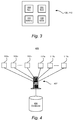
- the third device e.g. a server, 402 is connected (wireless or wired as described above) to a plurality of first devices 102a-n and a plurality of second devices 112a-n.
- the third device 402 is arranged for calculating a correlation between data pertaining to an oscillating movement received from a first device 102a-n and data pertaining to an oscillating movement from a second device 112a-n in order to calculate which of the first devises 102a-n are attached to the user which causes a second device 112a-n to oscillate. This is done by calculating a correlation between data pertaining to an oscillating movement of a first device 102a-n and data pertaining to an oscillating movement of a second device 112a-n and comparing the calculated correlation to a threshold.
- the third device 402 determines that the two oscillating movements are connected. Since the third device also is receiving a user ID from the first device 102a-n and the equipment ID, this user ID can be linked to the oscillating movement of the exercise equipment in the database 404. Consequently, an exercise activity of the exercise equipment having the equipment ID is automatically registered to the user having the user ID.
- the first device 102a-n may be configured with the user ID in any suitable way, e.g. by some central log in system at the gym, or by the user inputting a user name into the first device 102a-n when starting to use the first device 102a-n at the gym.
- the second device 112a-n may be configured with the equipment ID in any suitable way such as configuring the second device with the equipment ID when attaching it to the exercise equipment.
- the first device 102 a-b may for example be a smart phone, or a smart watch.
- the first device may according to some embodiments comprise an NFC-reader for configuring the first device with a user ID.
- the second device 112a-b may be based on any type of data chip comprising the required features, and to which a sensor for measuring movements of the second device and for producing movement data pertaining to the measured movements can be connected.
- the data chip should also be easily connected to a power source, e.g. a battery.
- the chip should e.g. be suited for Bluetooth low energy and ultra low-power wireless applications and be built around a CPU with a flash memory and/or RAM memory for improved application performance.
- the chip should comprise a transmitter/transceiver which may support both BLE and/or Wi-Fi. Such a design may also be used for the first device 102 a-b.
- the calculation of correlation performed by the third device may be carried out by a processor of the third device running software for calculating a correlation between two data sets.
- the third device 402 is a separate device from the first and the second device. However, it is envisaged that the third device may also be part of the first or second device.
- either the first or second device is connected to the database.
- the device that is connected to the database is further arranged to receive the data pertaining to an oscillating movement from the other device (i.e. first or second), calculate the correlation, and in case the correlation exceeds the first threshold, linking said oscillating movement of the exercise equipment to the user ID in the database using the equipment ID.
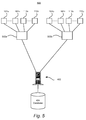
- Figure 5 shows another possible setup, wherein the system 500 further comprises a fourth device 502a-b being wirelessly connected to the first and second device, and further being connected to the third device 402.
- This embodiment may be advantageous in the case where the third device 402 (server) is used for registering training activities for users for multiple gyms or locations.
- the fourth devices 502a-b may thus be used for retransmitting the data received from the first and second devices of the gym where the fourth device is located, e.g. as shown in figure 5 where the fourth device 502a is connected (wireless or wired) to first devices 102a-n and second devices 112a-n while the fourth device 502b is connected (wireless or wired) to first devices 102o-z and second devices 112o-z.
- a first device and a second device may be sending its data to more than one fourth device.
- the third device 402 may be configured to filter received data such that such duplicates will be removed. For example, if it receives data simultaneously from more than one fourth device, where more than one instance of data have the same user id or equipment id, the third device may use only one instance of data (of the more than one instance of data with the same user id or equipment id) when performing a correlation calculation and disregard the other instances.
- the fourth device 502a-b may be any type of device which can receive data from the first/second device, e.g. equipped with a BLE/BT/Wi-Fi receiver and comprising a transmitter (e.g. WiFi) for retransmitting the data to the third device 412.
- the fourth device may for example be a laptop, or stationary computer.
- Other off the shelf-products such as an Intel Edison may be used, which according to one embodiment is connected to the first/second devices via Bluetooth (e.g. BLE) and connected to the third device 402 via Wi-Fi.
- the fourth device 502a-b may comprise an ID of a gym wherein the exercise equipment (i.e. the connected second devices) is located, wherein the fourth device is further arranged for transmitting the ID of the gym to the third device 402.
- This ID may then be used by the third device in a filtering step of the received data pertaining to an oscillating movement of the first devices/second device such that only data originating from the same gym may be correlated.
- Figure 6 schematically shows different oscillating movements measured by the first/second devices.
- an oscillating movement is a repeating movement or a periodic motion, back and forth over a range of positions, for example measured by an accelerometer.
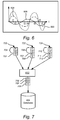
- Such movements are plotted in the graph of figure 6 , where e.g. the vertical position of the first/second device is plotted on the y-axis and where the time is plotted on the x-axis.
- the graph comprises three different movements 602, 604, 606, thus occurring at the same time.
- the movement 602 may originate from a first device 102, while the two other movements 604, 606 may originate from two different second devices 112.
- the time points for the two extremes of displacement for each single oscillating movement are marked t1-t7.
- two of the oscillation movements 602, 604 share such time points, i.e. t1, t3, t5, t7, while the remaining oscillating movement 606 has other time points, i.e. t2, t4, t6.
- the microcontrollers of the first 102 and second devices 112 are arranged for time-stamping at least one of the two extremes of displacement of the first device. Such time stamps may then be included in the data sent to the third device 402.
- the data pertaining to an oscillating movement of the first 102 and second devices 112 comprises the time stamp of the at least one of the two extremes of displacement. Such embodiment is shown in figure 7 .
- data 720 sent from the first device (e.g. via BLE) to the third device 402 is shown.
- data 704 pertaining to an oscillating movement of the first device is included. This may be calculated by a sensor in the first device being arranged for measuring movements of the first device and for producing movement data pertaining to the measured movements (the movement 602 in figure 6 ), which is then sent to the microcontroller in the first device which is arranged for receiving the movement data from the sensor, and for extracting data 704 pertaining to the oscillating movement of the first device.
- the microcontroller in the first device is arranged for time-stamping both of the two extremes t1, t3 of displacement of the first device and including such time stamps in the data 720 pertaining to an oscillating movement of the first device.
- the user ID 702 of the user wearing the first device is also included in the data 720 sent from the first device to the third device 402.
- data 722 sent from the second device (e.g. via BLE) to the third device 402 is shown.
- data 706 pertaining to an oscillating movement of the second device is included. This may be calculated by a sensor in the second device being arranged for measuring movements of the second device and for producing movement data pertaining to the measured movements (the movement 604 in figure 6 ), which is then sent to the microcontroller in the second device which is arranged for receiving the movement data from the sensor, and for extracting data 706 pertaining to the oscillating movement of the second device.
- the microcontroller in the second device is arranged for time-stamping both of the two extremes t1, t3 of displacement of the second device and including such time stamps in the data 722 pertaining to an oscillating movement of the second device.
- the ID 707 of the equipment onto which the second device is attached is included in the data 722 sent from the second device (e.g. via BLE) to the third device 402.
- a current setting 708 of the exercise equipment onto which the second device is attached is included in the data 722 pertaining to an oscillating movement of the second device.
- Such setting 708 may include e.g. a weight setting of an exercise machine onto which the second device is attached, the weight of the barbell onto which the second device is attached or a resistance setting of rowing machine onto which the second device is attached.
- data 724 is extracted from the measured movements (the movement 606 in figure 6 ) of a further second device.
- the third device 402 which is connected to a database 404 is thus arranged for receiving the data 704 pertaining to an oscillating movement of the first device, the user ID 702, the equipment ID 707, and the data 706 pertaining to an oscillating movement of the second device.
- the third device 402 is further arranged for receiving data 708 pertaining to a current setting of the exercise equipment onto which the second device is attached.
- the third device 402 may at any given moment receive data from a plurality of first and/or second devices.
- the third device is also receiving the data 710 pertaining to an oscillating movement of the further second device, the equipment ID 711, and optionally the data 712 pertaining to a current setting of the exercise equipment onto which the further second device is attached.
- the third device 402 may further receive data from more first/second devices, but this is excluded from figure 7 for the ease of description.
- the third device When receiving data from at least one first device, and at least one second device, the third device is arranged for calculating a correlation between the data pertaining to an oscillating movement of the first device and the data pertaining to an oscillating movement of the second device.
- the third device may be arranged for looking for e.g. the user ID 702 having a certain format to distinguish data 720 received from a first device from data 722, 724 received from a second device. Any other means for distinguishing data may be employed, such as setting a specific bit in the data as a one or a zero depending from which type of device (first or second) that it originates from.
- the third device 402 may be arranged to calculate a correlation for all possible combinations of data from a first device and data from a second device. According to other embodiments, the third device may be arranged to stop the correlation calculation as soon as a calculated correlation that exceeds the matching threshold is found.
- a fourth device is included in the system for linking oscillating movements of an exercise equipment to a user of the exercise equipment in a database as shown in figure 5 , and the fourth device is arranged for transmitting the ID of gym where it is located to the third device, the third device may use this ID when determining between which of the received data a correlation should be calculated as described above.
- the calculation of the correlation may comprise comparing the first and second time stamps 704 of the data 720 received from the first device with the first and second time stamps of the two data 722, 724 received from the second devices, and if they match for one of the two second devices (possibly within some predetermined difference such as 0.05 sec, 0,1 sec, 0.5 sec etc), the calculated correlation is determined by the third device 402 to exceed the threshold.
- the correlation between the data 704 pertaining to an oscillating movement of the first device and the data 706 pertaining to an oscillating movement of the second device is determined to exceed the threshold while the correlation between the data 704 pertaining to an oscillating movement of the first device and the data 7010 pertaining to an oscillating movement of the further second device is determined to not exceed the threshold.
- any match i.e. a correlation exceeding the threshold
- the third device may increase a counter in a data entry which belongs to the user ID 702 and the exercise equipment having the equipment ID 707. Incrementing a counter means that repetition is counted.
- this can be included in the stored registry of the exercise performed by the user having the user ID 702 on the exercise equipment having the equipment ID 707, e.g. user X has performed Y repetition on machine Z with the weight N.
- the microcontrollers of the first/second devices are arranged for extracting data pertaining to a single oscillating movement from the movement data (e.g. movement data 602, 604, 606 in figure 6 ) from the sensors of the respective device, and using this data as the data pertaining to an oscillating movement of the respective device.
- the first/second device may be arranged to extract accelerometer data pertaining to a single oscillating movement from the movement data of the device measured by the accelerometer, and include the accelerometer data of the complete single oscillating movement in the data sent to the third device. This may increase the possibility to detect matching movements between a first and a second device at the third device.
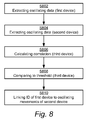
- Figure 8 shows a method for linking oscillating movements of an exercise equipment to a user of the exercise equipment in a database according to some embodiments.
- the method being performed in a system as described above (e.g. in figure 4-5 ), i.e. comprising a first device adapted to be attached to a user and comprising a user ID, a second device adapted to be attached to the exercise equipment and comprising an equipment ID, and a third device connected to the database.
- the method comprises the steps of:
- the devices e.g. the first, second, third and/or fourth device
- methods disclosed hereinabove may be implemented as software, firmware, hardware or a combination thereof.
- the division of tasks between functional units or components referred to in the above description does not necessarily correspond to the division into physical units; to the contrary, one physical component may have multiple functionalities, and one task may be carried out by several physical components in cooperation.
- Certain components or all components may be implemented as software executed by a digital signal processor, microprocessor or microcontroller, or be implemented as hardware or as an application-specific integrated circuit.
- Such software may be distributed on computer readable media, which may comprise computer storage media (or non-transitory media) and communication media (or transitory media).
- Computer storage media includes both volatile and nonvolatile, removable and non-removable media implemented in any method or technology for storage of information such as computer readable instructions, data structures, program modules or other data.
- Computer storage media includes, but is not limited to, RAM, ROM, EEPROM, flash memory or other memory technology, CD-ROM, digital versatile disks (DVD) or other optical disk storage, magnetic cassettes, magnetic tape, magnetic disk storage or other magnetic storage devices, or any other medium which can be used to store the desired information and which can be accessed by a computer.
Landscapes
- Health & Medical Sciences (AREA)
- General Health & Medical Sciences (AREA)
- Physical Education & Sports Medicine (AREA)
- Engineering & Computer Science (AREA)
- Physics & Mathematics (AREA)
- General Physics & Mathematics (AREA)
- Theoretical Computer Science (AREA)
- Orthopedic Medicine & Surgery (AREA)
- Biophysics (AREA)
- Life Sciences & Earth Sciences (AREA)
- Databases & Information Systems (AREA)
- Multimedia (AREA)
- Human Computer Interaction (AREA)
- Data Mining & Analysis (AREA)
- General Engineering & Computer Science (AREA)
- Social Psychology (AREA)
- Psychiatry (AREA)
- Computer Vision & Pattern Recognition (AREA)
- Measurement Of The Respiration, Hearing Ability, Form, And Blood Characteristics Of Living Organisms (AREA)
Abstract
Description
- The invention relates generally to a system and a method for linking oscillating movements of an exercise equipment to a user of the exercise equipment in a database.
- The market for connected devices, e.g. internet of things, is increasing. The areas of use are continuously developing. Connected devices may facilitate automation of activities that previously were done manually by a person. One such activity that may be automated is the activity of registering training activities of a person. For example, a smart phone with a suitable application may be used for measuring e.g. distance and speed of a running workout, and storing such data for later retrieval.
- In a gym environment or similar, such automatic registration of exercise activities requires knowledge of which user is using which exercise equipment. One solution is to employ a log on system where the user logs on to the exercise equipment that he/she is using and then logs of when he/she has finished the exercise. However, this may be difficult for a user to remember while exercising. An alternative solution would thus be beneficial.
- In view of the above, an objective of the invention is to solve or at least reduce one or several of the drawbacks discussed above. Generally, the above objective is achieved by the attached independent patent claims.
- According to a first aspect, the present invention is realized by a system for linking oscillating movements of an exercise equipment having a equipment ID to a user of the exercise equipment in a database, the system comprising:
- a first device adapted to be attached to a user, the first device comprising a user ID, the first device being arranged for extracting data pertaining to an oscillating movement of the first device,
- a second device adapted to be attached to the exercise equipment, the second device comprising the equipment ID, the second device being arranged for extracting data pertaining to an oscillating movement of the second device,
- a third device connected to the database and arranged for:
- o receiving said data pertaining to an oscillating movement of the first device, the user ID, the equipment ID and said data pertaining to an oscillating movement of the second device,
- o calculating a correlation between said data pertaining to an oscillating movement of the first device and said data pertaining to an oscillating movement of the second device, comparing the calculated correlation to a first threshold, and if the calculated correlation exceeds the first threshold, linking said oscillating movement of the exercise equipment to the user ID in the database using the equipment ID.
- By the term "oscillating movements" should, in the context of present specification, be understood a repeating movement or a periodic motion, back and forth over a range of positions. Such a movement may for example be when the user is stretching and retracting his arms over his head, e.g. when doing a shoulder press exercise with a dumbbell.
- By calculating a correlation between an oscillating movement of a first device attached to a user, and an oscillating movement of a second device attached to an exercise equipment (e.g. attached to a part of an exercise machine such as a rowing machine, to a dumbbell or to a barbell), the oscillating movement of the exercise equipment may be linked to the user wearing the first device. Consequently, the repetitions performed by the user on the exercise equipment may be registered to the user in a database. The training activities of the user may thus be automatically registered, and the user may focus on the training instead remember to manually print down and log each exercise. Moreover, with the present system, the user does not need to log on to the equipment that he/she intends to use.
- In a second aspect, the present invention provides a method for linking oscillating movements of an exercise equipment to a user of the exercise equipment in a database, the method being performed in a system comprising a first device adapted to be attached to a user and comprising a user ID, a second device adapted to be attached to the exercise equipment and comprising an equipment ID of the exercise equipment, and a third device connected to the database, the method comprising the steps of:
- extracting, by the first device, data pertaining to an oscillating movement of the first device,
- extracting, by the second device, data pertaining to an oscillating movement of the second device,
- calculating, by the third device, a correlation between said data pertaining to an oscillating movement of the first device and said data pertaining to an oscillating movement of the second device,
- comparing, by the third device, the calculated correlation to a first threshold, and,
- if the calculated correlation exceeds the first threshold, linking, by the third device, said oscillating movement of the exercise equipment to the user ID in the database using the equipment ID.
- The second aspect may generally have the same features and advantages as the first aspect.
- Other objectives, features and advantages of the present invention will appear from the following detailed disclosure, from the attached dependent claims as well as from the drawings.
- Generally, all terms used in the claims are to be interpreted according to their ordinary meaning in the technical field, unless explicitly defined otherwise herein. All references to "a/an/the [element, device, component, means, step, etc]" are to be interpreted openly as referring to at least one instance of the element, device, component, means, step, etc., unless explicitly stated otherwise.
- Examples of embodiments herein are described in more detail with reference to attached drawings where the same reference numerals will be used for similar elements, wherein:
-
figure 1 shows a user wearing a first device and a second device attached to a exercise equipment according to embodiments of the invention, -
figure 2 shows a user performing a exercise activity, -
figure 3 shows a first and/or a second device according to embodiments of the invention, -
figure 4 shows a system for linking oscillating movements of an exercise equipment to a user of the exercise equipment in a database according to a first embodiment, -
figure 5 shows a system for linking oscillating movements of an exercise equipment to a user of the exercise equipment in a database according to a second embodiment, -
figure 6 shows data of sensors arranged for measuring movements of the first and second device, -
figure 7 shows data sent to the third device and data stored in the database which links an oscillating movements of an exercise equipment to a user according to embodiments of the invention, -
figure 8 shows a method for linking oscillating movements of an exercise equipment to a user of the exercise equipment in a database according to embodiments of the invention. -
Figure 1 shows by way of example aperson 100. Afirst device 102a is attached to the wrist of the person. A furtherfirst device 102b is attached to the foot of the person. These placements of thefirst devices 102a-102b is merely by way of example, other placements are equally possible. It should also be noted that according to some embodiments, only one, or more than twofirst devices 102 is/are attached to the user. By having a plurality of devices attached to the person, different exercises may be logged using the invention, since e.g. some exercises involves movement of the arms of theperson 100 while others involve movement of the legs. -
Figure 1 further shows anexercise equipment 110, in this case anexercise machine 110. Theexercise machine 110 comprises ahandle 114 for pulling aweight 116 up and down. Theexercise machine 110 comprises asecond device 112a-b, positioned on a part of themachine 110 which while themachine 110 is in use, will be oscillating. Thesecond device 112a-b may in this example be positioned on thehandle 114, and/or on theweight 116. Other positions are equally possible, for example on the wire connecting thehandle 114 to theweight 116, or on one of thewheels 118 of theexercise machine 110. - The first 102a-b and
second devices 112a-b are both arranged for extracting data pertaining to an oscillating movement of the respective device. Thedevices 102a-b, 112a-b may for example comprise accelerometers, or gyroscopes. This will be further described below. -
Figure 2 shows a person 100 (user etc.) which is exercising using an exercise equipment 110 (in this case a barbell 110). Since theuser 100 is wearing afirst device 102 on the wrist and asecond device 112 is attached to thebarbell 110, the data extracted by the first andsecond device -
Figure 3 describe by way of example the design of a first 102 and second 112 device. Thedevice sensor 202 arranged for measuring movements of thedevice - The
device 102 may further comprise abattery 206 for powering the device. According to some embodiments, it is important that the second device 112 (arranged to be attached to the exercise equipment) has a low power consumption, e.g. such that the battery can last for more than a year. This reduces the need of recharging/replacing the battery. In order to achieve this, thesensor 202 of thesecond device 112 may be arranged to have a first and a second state. The first state may be a low energy state where thesensor 202 is running at the lowest possible power and only arranged to detect a movement exceeding a threshold. When such a movement is detected, thesensor 202 may in response thereto configure itself in a second state in which thesensor 202 is arranged for measuring movements of thesecond device 202 and for producing movement data pertaining to the measured movements. Using this setup, the sensor may run at 10 microAmps when being in its first state, which with a 1000 mAh battery means 100 000 hours of battery time when the device is only in the first state. The battery time will obviously decrease when the sensor is in the second state, but generally, an exercise equipment is only used for a minor part of the day, and not used at all during the night. In some embodiments, when thesensor 202 has not detected any movement for a threshold amount of time, thesensor 202 will configure itself in the first state again. - Such a setup may not be needed in the
first device 102 since this device generally may be recharged after each workout session and thebattery 206 of thefirst device 102 thus only need to last for e.g. 3 hours. Of course, in order to reduce the need of recharging, also thesensor 202 of thefirst device 102 may be arranged as described above with a first and second state. - The
device sensor 202, and for extracting data pertaining to the oscillating movement of thedevice device radio 204. Other ways of transmitting the data are equally possible such as regular Bluetooth, Wi-Fi, Cellular data service such as 3g/4g etc. It is also possible that thedevices 112 attached to the exercise equipment transmit the data via a wired connection, especially if they are attached to an exercise machine which generally is not moved around in a gym environment. - The data transmitted from the BLE radio (or similar) 204 of the
devices third device 402 which is connected to adatabase 404. An example of this setup is shown infigure 4 . In this example, the third device, e.g. a server, 402 is connected (wireless or wired as described above) to a plurality offirst devices 102a-n and a plurality ofsecond devices 112a-n. When receiving data from thedevices 102a-n, 112 a-n, thethird device 402 is arranged for calculating a correlation between data pertaining to an oscillating movement received from afirst device 102a-n and data pertaining to an oscillating movement from asecond device 112a-n in order to calculate which of thefirst devises 102a-n are attached to the user which causes asecond device 112a-n to oscillate. This is done by calculating a correlation between data pertaining to an oscillating movement of afirst device 102a-n and data pertaining to an oscillating movement of asecond device 112a-n and comparing the calculated correlation to a threshold. In case the calculated correlation exceeds the threshold, it is determined by thethird device 402 that the two oscillating movements are connected. Since the third device also is receiving a user ID from thefirst device 102a-n and the equipment ID, this user ID can be linked to the oscillating movement of the exercise equipment in thedatabase 404. Consequently, an exercise activity of the exercise equipment having the equipment ID is automatically registered to the user having the user ID. Thefirst device 102a-n may be configured with the user ID in any suitable way, e.g. by some central log in system at the gym, or by the user inputting a user name into thefirst device 102a-n when starting to use thefirst device 102a-n at the gym. Similarly, thesecond device 112a-n may be configured with the equipment ID in any suitable way such as configuring the second device with the equipment ID when attaching it to the exercise equipment. - The
first device 102 a-b may for example be a smart phone, or a smart watch. The first device may according to some embodiments comprise an NFC-reader for configuring the first device with a user ID. - The
second device 112a-b may be based on any type of data chip comprising the required features, and to which a sensor for measuring movements of the second device and for producing movement data pertaining to the measured movements can be connected. The data chip should also be easily connected to a power source, e.g. a battery. The chip should e.g. be suited for Bluetooth low energy and ultra low-power wireless applications and be built around a CPU with a flash memory and/or RAM memory for improved application performance. The chip should comprise a transmitter/transceiver which may support both BLE and/or Wi-Fi. Such a design may also be used for thefirst device 102 a-b. - The calculation of correlation performed by the third device may be carried out by a processor of the third device running software for calculating a correlation between two data sets.
- In the embodiment shown in
figure 4 , thethird device 402 is a separate device from the first and the second device. However, it is envisaged that the third device may also be part of the first or second device. In this embodiment, either the first or second device is connected to the database. The device that is connected to the database is further arranged to receive the data pertaining to an oscillating movement from the other device (i.e. first or second), calculate the correlation, and in case the correlation exceeds the first threshold, linking said oscillating movement of the exercise equipment to the user ID in the database using the equipment ID. -
Figure 5 shows another possible setup, wherein thesystem 500 further comprises afourth device 502a-b being wirelessly connected to the first and second device, and further being connected to thethird device 402. This embodiment may be advantageous in the case where the third device 402 (server) is used for registering training activities for users for multiple gyms or locations. - The
fourth devices 502a-b may thus be used for retransmitting the data received from the first and second devices of the gym where the fourth device is located, e.g. as shown infigure 5 where thefourth device 502a is connected (wireless or wired) tofirst devices 102a-n andsecond devices 112a-n while thefourth device 502b is connected (wireless or wired) to first devices 102o-z and second devices 112o-z. - According to some embodiments, a first device and a second device may be sending its data to more than one fourth device. For example if a single fourth device cannot cover the entire area of a gym, two or more fourth devices may be installed in the gym. In this case, the
third device 402 may be configured to filter received data such that such duplicates will be removed. For example, if it receives data simultaneously from more than one fourth device, where more than one instance of data have the same user id or equipment id, the third device may use only one instance of data (of the more than one instance of data with the same user id or equipment id) when performing a correlation calculation and disregard the other instances. - According to some embodiments, the
fourth device 502a-b may be any type of device which can receive data from the first/second device, e.g. equipped with a BLE/BT/Wi-Fi receiver and comprising a transmitter (e.g. WiFi) for retransmitting the data to the third device 412. The fourth device may for example be a laptop, or stationary computer. Other off the shelf-products such as an Intel Edison may be used, which according to one embodiment is connected to the first/second devices via Bluetooth (e.g. BLE) and connected to thethird device 402 via Wi-Fi. - In order to reduce the risk of inadvertently logging a user id from one gym with an exercise equipment from another gym, the
fourth device 502a-b may comprise an ID of a gym wherein the exercise equipment (i.e. the connected second devices) is located, wherein the fourth device is further arranged for transmitting the ID of the gym to thethird device 402. This ID may then be used by the third device in a filtering step of the received data pertaining to an oscillating movement of the first devices/second device such that only data originating from the same gym may be correlated. -
Figure 6 schematically shows different oscillating movements measured by the first/second devices. - As mentioned above, an oscillating movement is a repeating movement or a periodic motion, back and forth over a range of positions, for example measured by an accelerometer. Such movements are plotted in the graph of
figure 6 , where e.g. the vertical position of the first/second device is plotted on the y-axis and where the time is plotted on the x-axis. The graph comprises threedifferent movements movement 602 may originate from afirst device 102, while the twoother movements second devices 112. - At the x-axis, the time points for the two extremes of displacement for each single oscillating movement, i.e. one time back and forth over a range of positions, are marked t1-t7. As visible on the graph, two of the
oscillation movements oscillating movement 606 has other time points, i.e. t2, t4, t6. - According to some embodiments, the microcontrollers of the first 102 and
second devices 112 are arranged for time-stamping at least one of the two extremes of displacement of the first device. Such time stamps may then be included in the data sent to thethird device 402. According to some embodiments, the data pertaining to an oscillating movement of the first 102 andsecond devices 112 comprises the time stamp of the at least one of the two extremes of displacement. Such embodiment is shown infigure 7 . - In
figure 7 ,data 720 sent from the first device (e.g. via BLE) to thethird device 402 is shown. In thisdata 720,data 704 pertaining to an oscillating movement of the first device is included. This may be calculated by a sensor in the first device being arranged for measuring movements of the first device and for producing movement data pertaining to the measured movements (themovement 602 infigure 6 ), which is then sent to the microcontroller in the first device which is arranged for receiving the movement data from the sensor, and for extractingdata 704 pertaining to the oscillating movement of the first device. In the example offigure 7 , the microcontroller in the first device is arranged for time-stamping both of the two extremes t1, t3 of displacement of the first device and including such time stamps in thedata 720 pertaining to an oscillating movement of the first device. Theuser ID 702 of the user wearing the first device is also included in thedata 720 sent from the first device to thethird device 402. - Also in
figure 7 ,data 722 sent from the second device (e.g. via BLE) to thethird device 402 is shown. In thisdata 722,data 706 pertaining to an oscillating movement of the second device is included. This may be calculated by a sensor in the second device being arranged for measuring movements of the second device and for producing movement data pertaining to the measured movements (themovement 604 infigure 6 ), which is then sent to the microcontroller in the second device which is arranged for receiving the movement data from the sensor, and for extractingdata 706 pertaining to the oscillating movement of the second device. In the example offigure 7 , the microcontroller in the second device is arranged for time-stamping both of the two extremes t1, t3 of displacement of the second device and including such time stamps in thedata 722 pertaining to an oscillating movement of the second device. TheID 707 of the equipment onto which the second device is attached is included in thedata 722 sent from the second device (e.g. via BLE) to thethird device 402. According to some embodiments, also acurrent setting 708 of the exercise equipment onto which the second device is attached is included in thedata 722 pertaining to an oscillating movement of the second device. Such setting 708 may include e.g. a weight setting of an exercise machine onto which the second device is attached, the weight of the barbell onto which the second device is attached or a resistance setting of rowing machine onto which the second device is attached. - In a similar way,
data 724 is extracted from the measured movements (themovement 606 infigure 6 ) of a further second device. - The third device (e.g. a server) 402 which is connected to a
database 404 is thus arranged for receiving thedata 704 pertaining to an oscillating movement of the first device, theuser ID 702, theequipment ID 707, and thedata 706 pertaining to an oscillating movement of the second device. Optionally, thethird device 402 is further arranged for receivingdata 708 pertaining to a current setting of the exercise equipment onto which the second device is attached. - The
third device 402 may at any given moment receive data from a plurality of first and/or second devices. Infigure 7 , the third device is also receiving thedata 710 pertaining to an oscillating movement of the further second device, theequipment ID 711, and optionally thedata 712 pertaining to a current setting of the exercise equipment onto which the further second device is attached. - As understood by the person skilled in the art, the
third device 402 may further receive data from more first/second devices, but this is excluded fromfigure 7 for the ease of description. - When receiving data from at least one first device, and at least one second device, the third device is arranged for calculating a correlation between the data pertaining to an oscillating movement of the first device and the data pertaining to an oscillating movement of the second device. The third device may be arranged for looking for e.g. the
user ID 702 having a certain format to distinguishdata 720 received from a first device fromdata - When receiving data from more than one first and/or second devices, for example as shown in
figure 7 , thethird device 402 may be arranged to calculate a correlation for all possible combinations of data from a first device and data from a second device. According to other embodiments, the third device may be arranged to stop the correlation calculation as soon as a calculated correlation that exceeds the matching threshold is found. - In case a fourth device is included in the system for linking oscillating movements of an exercise equipment to a user of the exercise equipment in a database as shown in
figure 5 , and the fourth device is arranged for transmitting the ID of gym where it is located to the third device, the third device may use this ID when determining between which of the received data a correlation should be calculated as described above. - For example, in the example of
figure 7 , the calculation of the correlation may comprise comparing the first andsecond time stamps 704 of thedata 720 received from the first device with the first and second time stamps of the twodata third device 402 to exceed the threshold. So infigure 7 , the correlation between thedata 704 pertaining to an oscillating movement of the first device and thedata 706 pertaining to an oscillating movement of the second device is determined to exceed the threshold while the correlation between thedata 704 pertaining to an oscillating movement of the first device and the data 7010 pertaining to an oscillating movement of the further second device is determined to not exceed the threshold. - Subsequent to the correlation calculation, any match (i.e. a correlation exceeding the threshold) between oscillating movements of a first device and a second device is linked and stored in the database. For example, using the received ID of the first device and the received equipment ID, the third device may increase a counter in a data entry which belongs to the
user ID 702 and the exercise equipment having theequipment ID 707. Incrementing a counter means that repetition is counted. By including the current setting of the exercise equipment onto which the second device is attached, this can be included in the stored registry of the exercise performed by the user having theuser ID 702 on the exercise equipment having theequipment ID 707, e.g. user X has performed Y repetition on machine Z with the weight N. - In the example of
figure 7 , only the time stamp of the at least one of the two extremes of displacement of an oscillating movement is included in thedata e.g. movement data figure 6 ) from the sensors of the respective device, and using this data as the data pertaining to an oscillating movement of the respective device. In other words, instead of just sending the time stamps of one or both extremes of displacement of an oscillating movement, the first/second device may be arranged to extract accelerometer data pertaining to a single oscillating movement from the movement data of the device measured by the accelerometer, and include the accelerometer data of the complete single oscillating movement in the data sent to the third device. This may increase the possibility to detect matching movements between a first and a second device at the third device. -
Figure 8 shows a method for linking oscillating movements of an exercise equipment to a user of the exercise equipment in a database according to some embodiments. The method being performed in a system as described above (e.g. infigure 4-5 ), i.e. comprising a first device adapted to be attached to a user and comprising a user ID, a second device adapted to be attached to the exercise equipment and comprising an equipment ID, and a third device connected to the database. - The method comprises the steps of:
- extracting S802, by the first device, data pertaining to an oscillating movement of the first device,
- extracting S804, by the second device, data pertaining to an oscillating movement of the second device,
- calculating S806, by the third device, a correlation between said data pertaining to an oscillating movement of the first device and said data pertaining to an oscillating movement of the second device,
- comparing S808, by the third device, the calculated correlation to a first threshold, and,
- if the calculated correlation exceeds the first threshold, linking S810, by the third device, said oscillating movement of the exercise equipment to the user ID in the database using the equipment ID.
- The devices (e.g. the first, second, third and/or fourth device) and methods disclosed hereinabove may be implemented as software, firmware, hardware or a combination thereof. In a hardware implementation, the division of tasks between functional units or components referred to in the above description does not necessarily correspond to the division into physical units; to the contrary, one physical component may have multiple functionalities, and one task may be carried out by several physical components in cooperation. Certain components or all components may be implemented as software executed by a digital signal processor, microprocessor or microcontroller, or be implemented as hardware or as an application-specific integrated circuit. Such software may be distributed on computer readable media, which may comprise computer storage media (or non-transitory media) and communication media (or transitory media). As is well known to a person skilled in the art, the term computer storage media includes both volatile and nonvolatile, removable and non-removable media implemented in any method or technology for storage of information such as computer readable instructions, data structures, program modules or other data. Computer storage media includes, but is not limited to, RAM, ROM, EEPROM, flash memory or other memory technology, CD-ROM, digital versatile disks (DVD) or other optical disk storage, magnetic cassettes, magnetic tape, magnetic disk storage or other magnetic storage devices, or any other medium which can be used to store the desired information and which can be accessed by a computer.
Claims (15)
- A system (400, 500) for linking oscillating movements of an exercise equipment (110) to a user (100) of the exercise equipment having an equipment ID in a database (404), the system comprising:a first device (102, 102a-z) adapted to be attached to the user, the first device comprising a user ID (702), the first device being arranged for extracting (S802) data (704) pertaining to an oscillating movement of the first device,a second device (112, 112a-z) adapted to be attached to the exercise equipment, the second device comprising the equipment ID (707, 711), the second device being arranged for extracting (S804) data (706, 710) pertaining to an oscillating movement of the second device,a third device (402) connected to the database and arranged for:receiving said data pertaining to an oscillating movement of the first device, the user ID, the equipment ID and said data pertaining to an oscillating movement of the second device,calculating (S806) a correlation between said data pertaining to an oscillating movement of the first device and said data pertaining to an oscillating movement of the second device, comparing (S808) the calculated correlation to a first threshold, and if the calculated correlation exceeds the first threshold, linking (S810) said oscillating movement of the exercise equipment to the user ID in the database using the equipment ID.
- The system according to claim 1,
wherein the first device comprising:a first sensor (202) arranged for measuring movements of the first device and for producing movement data pertaining to the measured movements,a first microcontroller (208) arranged for receiving the movement data from the first sensor, and for extracting data pertaining to the oscillating movement of the first device, andwherein the second device comprising:a second sensor (202) arranged for measuring movement of the second devicea second microcontroller (208) arranged for receiving movement data from the second sensor, and for extracting data pertaining to the oscillating movement of the second device. - The system according to claim 2, wherein the second sensor is a battery driven accelerometer having a first and a second state, wherein the first state is a low energy state wherein the accelerometer is arranged for detecting a movement exceeding a threshold and in a response thereto configuring itself in a second state wherein the accelerometer is arranged for measuring movements of the second device and for producing movement data pertaining to the measured movements.
- The system according to any one of claims 2-3,
wherein the oscillating movement of the first device and the second device comprises two extremes of displacement,
wherein the first microcontroller is arranged for time-stamping (t1-t7) at least one of the two extremes of displacement of the first device and wherein said data pertaining to an oscillating movement of the first device comprises the time stamp of the at least one of the two extremes of displacement of the first device, and
wherein the second microcontroller is arranged for time-stamping (t1-t7) at least one of the two extremes of displacement of the second device and wherein said data pertaining to an oscillating movement of the second device comprises the time stamp of the at least one of the two extremes of displacement of the second device. - The system according to any one of claims 2-3, wherein the first and second sensors are accelerometers and wherein the movement data from the first and second sensors comprises data from the respective accelerometer, wherein first and second microcontroller are arranged for extracting data pertaining to a single oscillating movement from the movement data from the first and second sensors respectively, and using this data as the data pertaining to an oscillating movement of the first and second device respectively.
- The system according to any one of claims 1-5, wherein the third device is a part of the first or the second device.
- The system according to any one of claims 1-5, wherein the third device is a separate device from the first and the second device.
- The system according to claim 7, wherein the system further comprises a fourth device (502a-b) being wirelessly connected to the first and second device, and further being connected to the third device,
wherein the fourth device being arranged for receiving said data pertaining to an oscillating movement of the first device, the user ID, the equipment ID, and said data pertaining to an oscillating movement of the second device and for transmitting said data pertaining to an oscillating movement of the first device, the user ID, the equipment ID, and said data pertaining to an oscillating movement of the second device to the third device. - The system according to claim 8, wherein the fourth device comprises an ID of a gym wherein the exercise equipment is located, wherein the fourth device is further arranged for transmitting the ID of the gym to the third device.
- The system according to any one of claims 1-9, wherein the first and second device comprises a Bluetooth Low Energy, BLE, radio (204) arranged for transmitting the data pertaining to an oscillating movement of the first and second device respectively.
- The system according to any one of claims 1-10, wherein the third device is arrange for linking said oscillating movement of the exercise equipment to the user ID in the database by incrementing a counter.
- The system according to any one of claims 1-11, wherein the third device is further arranged for receiving data pertaining to a current setting of the exercise equipment, and for adding said data pertaining to a current setting (708, 712) of the exercise equipment to the database when linking said oscillating movement of the exercise equipment to the user ID in the database.
- A method for linking oscillating movements of an exercise equipment (110) to a user (100) of the exercise equipment in a database (404), the method being performed in a system (400, 500) comprising a first device (102, 102a-z) adapted to be attached to a user and comprising a user ID, a second device adapted to be attached to the exercise equipment and comprising an equipment ID of the exercise equipment, and a third device connected to the database, the method comprising the steps of:extracting (S802), by the first device, data pertaining to an oscillating movement of the first device,extracting (S804), by the second device, data pertaining to an oscillating movement of the second device,calculating (S806), by the third device, a correlation between said data pertaining to an oscillating movement of the first device and said data pertaining to an oscillating movement of the second device,comparing (S808), by the third device, the calculated correlation to a first threshold, and,if the calculated correlation exceeds the first threshold, linking (S810), by the third device, said oscillating movement of the exercise equipment to the user ID in the database using the equipment ID.
- The method of claim 13, wherein the oscillating movement of the first device and the second device comprises two extremes of displacement,
wherein said data pertaining to an oscillating movement of the first device comprises the time stamp of the at least one of the two extremes of displacement of the first device, and
wherein said data pertaining to an oscillating movement of the second device comprises the time stamp of the at least one of the two extremes of displacement of the second device. - The method according to claim 13,
wherein the oscillating movement of the first device comprises data from an accelerometer of the first device pertaining to a single oscillating movement of the first device as detected by the accelerometer of the first device,
wherein the oscillating movement of the second device comprises data from an accelerometer of the second device pertaining to a single oscillating movement of the second device as detected by the accelerometer of the second device.
Priority Applications (3)
| Application Number | Priority Date | Filing Date | Title |
|---|---|---|---|
| EP16152235.4A EP3196597A1 (en) | 2016-01-21 | 2016-01-21 | A system and method for linking oscillating movements of exercise equipment to a user of the exercise equipment in a database |
| CN201710037454.XA CN106984025A (en) | 2016-01-21 | 2017-01-19 | The system and method that exercise apparatus oscillating movement is associated with equipment user in database |
| US15/411,432 US20170209743A1 (en) | 2016-01-21 | 2017-01-20 | System and method for linking oscillating movements of exercise equipment to a user of the exercise equipment in a database |
Applications Claiming Priority (1)
| Application Number | Priority Date | Filing Date | Title |
|---|---|---|---|
| EP16152235.4A EP3196597A1 (en) | 2016-01-21 | 2016-01-21 | A system and method for linking oscillating movements of exercise equipment to a user of the exercise equipment in a database |
Publications (1)
| Publication Number | Publication Date |
|---|---|
| EP3196597A1 true EP3196597A1 (en) | 2017-07-26 |
Family
ID=55315300
Family Applications (1)
| Application Number | Title | Priority Date | Filing Date |
|---|---|---|---|
| EP16152235.4A Withdrawn EP3196597A1 (en) | 2016-01-21 | 2016-01-21 | A system and method for linking oscillating movements of exercise equipment to a user of the exercise equipment in a database |
Country Status (3)
| Country | Link |
|---|---|
| US (1) | US20170209743A1 (en) |
| EP (1) | EP3196597A1 (en) |
| CN (1) | CN106984025A (en) |
Families Citing this family (10)
| Publication number | Priority date | Publication date | Assignee | Title |
|---|---|---|---|---|
| US11874716B2 (en) | 2015-08-05 | 2024-01-16 | Suunto Oy | Embedded computing device management |
| FI127926B (en) * | 2015-12-21 | 2019-05-31 | Suunto Oy | Sensor-based context management |
| US11838990B2 (en) | 2015-12-21 | 2023-12-05 | Suunto Oy | Communicating sensor data in wireless communication systems |
| US11587484B2 (en) | 2015-12-21 | 2023-02-21 | Suunto Oy | Method for controlling a display |
| US11541280B2 (en) | 2015-12-21 | 2023-01-03 | Suunto Oy | Apparatus and exercising device |
| US11857842B2 (en) | 2015-12-21 | 2024-01-02 | Suunto Oy | Apparatus and exercising device |
| CN205379610U (en) * | 2016-02-19 | 2016-07-13 | 广州市迅茄软件科技有限公司 | Changeable intelligent body -building handle and contain intelligent body -building suit equipment of this handle |
| US20180169461A1 (en) * | 2016-12-20 | 2018-06-21 | Robert Jeffrey Saar | Stability Apparatus |
| CN109865247A (en) * | 2019-04-03 | 2019-06-11 | 南昌大学 | A kind of dumbbell action recognition and specification evaluation system |
| ES2774343A1 (en) * | 2020-02-14 | 2020-07-20 | Ubeda Juan Pedro Alonso | ELECTRONIC DUCK AND EQUIPMENT TO PERFORM PHYSICAL EXERCISE (Machine-translation by Google Translate, not legally binding) |
Citations (4)
| Publication number | Priority date | Publication date | Assignee | Title |
|---|---|---|---|---|
| WO2006060472A1 (en) * | 2004-12-02 | 2006-06-08 | Baylor University | Exercise circuit system and method |
| US20130127636A1 (en) * | 2011-11-20 | 2013-05-23 | Cardibo, Inc. | Wireless sensor network for determining cardiovascular machine usage |
| US8900099B1 (en) * | 2013-08-05 | 2014-12-02 | Robert B. Boyette | Systems and methods for optimizing muscle development |
| US8928587B1 (en) * | 2013-11-25 | 2015-01-06 | Google Inc. | Automatic device login based on wearable sensor fusion |
Family Cites Families (3)
| Publication number | Priority date | Publication date | Assignee | Title |
|---|---|---|---|---|
| KR20160124254A (en) * | 2011-02-17 | 2016-10-26 | 나이키 이노베이트 씨.브이. | Tracking of user performance metrics during a workout session |
| CN103699795B (en) * | 2013-12-20 | 2018-01-23 | 东软熙康健康科技有限公司 | A kind of motor behavior recognition methods, device and exercise intensity monitoring system |
| CN105183152A (en) * | 2015-08-25 | 2015-12-23 | 小米科技有限责任公司 | Sport ability analysis method, apparatus and terminal |
-
2016
- 2016-01-21 EP EP16152235.4A patent/EP3196597A1/en not_active Withdrawn
-
2017
- 2017-01-19 CN CN201710037454.XA patent/CN106984025A/en active Pending
- 2017-01-20 US US15/411,432 patent/US20170209743A1/en not_active Abandoned
Patent Citations (4)
| Publication number | Priority date | Publication date | Assignee | Title |
|---|---|---|---|---|
| WO2006060472A1 (en) * | 2004-12-02 | 2006-06-08 | Baylor University | Exercise circuit system and method |
| US20130127636A1 (en) * | 2011-11-20 | 2013-05-23 | Cardibo, Inc. | Wireless sensor network for determining cardiovascular machine usage |
| US8900099B1 (en) * | 2013-08-05 | 2014-12-02 | Robert B. Boyette | Systems and methods for optimizing muscle development |
| US8928587B1 (en) * | 2013-11-25 | 2015-01-06 | Google Inc. | Automatic device login based on wearable sensor fusion |
Also Published As
| Publication number | Publication date |
|---|---|
| US20170209743A1 (en) | 2017-07-27 |
| CN106984025A (en) | 2017-07-28 |
Similar Documents
| Publication | Publication Date | Title |
|---|---|---|
| US20170209743A1 (en) | System and method for linking oscillating movements of exercise equipment to a user of the exercise equipment in a database | |
| US10900992B2 (en) | Calculating pace and energy expenditure from athletic movement attributes | |
| US10789855B2 (en) | Fitness device configured to provide goal motivation | |
| US10021188B2 (en) | Athletic performance monitoring with dynamic proximity pairing | |
| US20160346617A1 (en) | Systems, methods and devices for tracking workout related information | |
| US9734389B2 (en) | System with multi-axis athletic performance tracking | |
| EP3242595B1 (en) | Energy expenditure calculation using data from multiple devices | |
| WO2016037012A1 (en) | Measuring health and fitness data using proximity sensors and mobile technologies | |
| KR102070351B1 (en) | Calculate Energy Consumption Using Data from Multiple Devices | |
| CN107961523B (en) | Human body training system and intelligent fitness system based on heart rate detection | |
| KR20140116481A (en) | Activity classification in a multi-axis activity monitor device | |
| KR20160026258A (en) | A smart fitness system and a method for controlling thereof | |
| US11426629B2 (en) | Method for quantifying a sporting activity | |
| KR102279780B1 (en) | Smart exercise management system and operation method thereof | |
| JP2019042209A (en) | Walking posture analysis method and walking posture analysis device | |
| CN106659929B (en) | motion information measurement device and control method | |
| JP6780869B2 (en) | Sensor module for body parameter measurement | |
| KR102835673B1 (en) | Apparatus for automatic measuring and recording number of repetitions | |
| US20170232299A1 (en) | Body Movement Tracking System | |
| KR20150135176A (en) | System for managing exercise information in real-time | |
| KR101622338B1 (en) | System for managing exercise information in real-time | |
| KR20180033436A (en) | System including a mobile device for detecting abnormal activity | |
| WO2018119916A1 (en) | Bluetooth headset and data acquisition system thereof |
Legal Events
| Date | Code | Title | Description |
|---|---|---|---|
| PUAI | Public reference made under article 153(3) epc to a published international application that has entered the european phase |
Free format text: ORIGINAL CODE: 0009012 |
|
| STAA | Information on the status of an ep patent application or granted ep patent |
Free format text: STATUS: THE APPLICATION HAS BEEN PUBLISHED |
|
| AK | Designated contracting states |
Kind code of ref document: A1 Designated state(s): AL AT BE BG CH CY CZ DE DK EE ES FI FR GB GR HR HU IE IS IT LI LT LU LV MC MK MT NL NO PL PT RO RS SE SI SK SM TR |
|
| AX | Request for extension of the european patent |
Extension state: BA ME |
|
| STAA | Information on the status of an ep patent application or granted ep patent |
Free format text: STATUS: REQUEST FOR EXAMINATION WAS MADE |
|
| 17P | Request for examination filed |
Effective date: 20171215 |
|
| RBV | Designated contracting states (corrected) |
Designated state(s): AL AT BE BG CH CY CZ DE DK EE ES FI FR GB GR HR HU IE IS IT LI LT LU LV MC MK MT NL NO PL PT RO RS SE SI SK SM TR |
|
| GRAP | Despatch of communication of intention to grant a patent |
Free format text: ORIGINAL CODE: EPIDOSNIGR1 |
|
| STAA | Information on the status of an ep patent application or granted ep patent |
Free format text: STATUS: GRANT OF PATENT IS INTENDED |
|
| RIC1 | Information provided on ipc code assigned before grant |
Ipc: G01D 3/10 20060101AFI20180207BHEP |
|
| INTG | Intention to grant announced |
Effective date: 20180312 |
|
| STAA | Information on the status of an ep patent application or granted ep patent |
Free format text: STATUS: THE APPLICATION IS DEEMED TO BE WITHDRAWN |
|
| 18D | Application deemed to be withdrawn |
Effective date: 20180724 |