EP3196271A1 - Gas-generating agent, and process for producing foamed object using same - Google Patents
Gas-generating agent, and process for producing foamed object using same Download PDFInfo
- Publication number
- EP3196271A1 EP3196271A1 EP16783059.5A EP16783059A EP3196271A1 EP 3196271 A1 EP3196271 A1 EP 3196271A1 EP 16783059 A EP16783059 A EP 16783059A EP 3196271 A1 EP3196271 A1 EP 3196271A1
- Authority
- EP
- European Patent Office
- Prior art keywords
- group
- generating agent
- gas generating
- acid
- compound represented
- Prior art date
- Legal status (The legal status is an assumption and is not a legal conclusion. Google has not performed a legal analysis and makes no representation as to the accuracy of the status listed.)
- Granted
Links
- 238000000034 method Methods 0.000 title description 11
- 150000001875 compounds Chemical class 0.000 claims abstract description 100
- 239000007789 gas Substances 0.000 claims description 182
- 239000003795 chemical substances by application Substances 0.000 claims description 117
- HHLFWLYXYJOTON-UHFFFAOYSA-N glyoxylic acid Chemical compound OC(=O)C=O HHLFWLYXYJOTON-UHFFFAOYSA-N 0.000 claims description 60
- 239000006260 foam Substances 0.000 claims description 46
- 125000004432 carbon atom Chemical group C* 0.000 claims description 38
- 239000000203 mixture Substances 0.000 claims description 36
- 239000005060 rubber Substances 0.000 claims description 35
- 229920001971 elastomer Polymers 0.000 claims description 34
- 239000000463 material Substances 0.000 claims description 29
- 229920005992 thermoplastic resin Polymers 0.000 claims description 26
- 239000003094 microcapsule Substances 0.000 claims description 22
- 238000010438 heat treatment Methods 0.000 claims description 18
- 238000005187 foaming Methods 0.000 claims description 12
- 238000004519 manufacturing process Methods 0.000 claims description 8
- 125000004430 oxygen atom Chemical group O* 0.000 claims description 8
- 125000003545 alkoxy group Chemical group 0.000 claims description 7
- 125000003277 amino group Chemical group 0.000 claims description 7
- 125000003302 alkenyloxy group Chemical group 0.000 claims description 6
- 125000005336 allyloxy group Chemical group 0.000 claims description 6
- 125000004104 aryloxy group Chemical group 0.000 claims description 6
- 125000000051 benzyloxy group Chemical group [H]C1=C([H])C([H])=C(C([H])=C1[H])C([H])([H])O* 0.000 claims description 6
- 125000002887 hydroxy group Chemical group [H]O* 0.000 claims description 6
- 125000001841 imino group Chemical group [H]N=* 0.000 claims description 6
- 125000000217 alkyl group Chemical group 0.000 claims description 4
- 125000003903 2-propenyl group Chemical group [H]C([*])([H])C([H])=C([H])[H] 0.000 claims description 3
- 125000003342 alkenyl group Chemical group 0.000 claims description 3
- 125000003118 aryl group Chemical group 0.000 claims description 3
- 125000001797 benzyl group Chemical group [H]C1=C([H])C([H])=C(C([H])=C1[H])C([H])([H])* 0.000 claims description 3
- 125000004435 hydrogen atom Chemical group [H]* 0.000 claims description 3
- 230000015556 catabolic process Effects 0.000 description 59
- 238000006731 degradation reaction Methods 0.000 description 59
- QGZKDVFQNNGYKY-UHFFFAOYSA-N Ammonia Chemical compound N QGZKDVFQNNGYKY-UHFFFAOYSA-N 0.000 description 40
- 230000015572 biosynthetic process Effects 0.000 description 37
- 238000003786 synthesis reaction Methods 0.000 description 37
- 239000000126 substance Substances 0.000 description 33
- 239000007787 solid Substances 0.000 description 30
- -1 carbazic acid ester Chemical class 0.000 description 28
- 230000000052 comparative effect Effects 0.000 description 21
- VEXZGXHMUGYJMC-UHFFFAOYSA-N Hydrochloric acid Chemical class Cl VEXZGXHMUGYJMC-UHFFFAOYSA-N 0.000 description 20
- 239000003431 cross linking reagent Substances 0.000 description 19
- 238000005160 1H NMR spectroscopy Methods 0.000 description 17
- 239000004156 Azodicarbonamide Substances 0.000 description 17
- XOZUGNYVDXMRKW-AATRIKPKSA-N azodicarbonamide Chemical compound NC(=O)\N=N\C(N)=O XOZUGNYVDXMRKW-AATRIKPKSA-N 0.000 description 17
- 235000019399 azodicarbonamide Nutrition 0.000 description 17
- 238000006243 chemical reaction Methods 0.000 description 17
- 230000005484 gravity Effects 0.000 description 17
- 238000002844 melting Methods 0.000 description 17
- 230000008018 melting Effects 0.000 description 17
- IAZDPXIOMUYVGZ-WFGJKAKNSA-N Dimethyl sulfoxide Chemical compound [2H]C([2H])([2H])S(=O)C([2H])([2H])[2H] IAZDPXIOMUYVGZ-WFGJKAKNSA-N 0.000 description 16
- 239000002666 chemical blowing agent Substances 0.000 description 16
- 229920003023 plastic Polymers 0.000 description 16
- 239000004033 plastic Substances 0.000 description 16
- 239000002253 acid Substances 0.000 description 15
- 229910021529 ammonia Inorganic materials 0.000 description 14
- 235000014113 dietary fatty acids Nutrition 0.000 description 14
- 239000000194 fatty acid Substances 0.000 description 14
- 229930195729 fatty acid Natural products 0.000 description 14
- 239000012071 phase Substances 0.000 description 14
- XLYOFNOQVPJJNP-UHFFFAOYSA-N water Substances O XLYOFNOQVPJJNP-UHFFFAOYSA-N 0.000 description 14
- CYYLVDOFWSFXDF-UHFFFAOYSA-N 2-(methoxycarbonylhydrazinylidene)acetic acid Chemical compound COC(=O)NN=CC(O)=O CYYLVDOFWSFXDF-UHFFFAOYSA-N 0.000 description 12
- 239000002671 adjuvant Substances 0.000 description 12
- XEVRDFDBXJMZFG-UHFFFAOYSA-N carbonyl dihydrazine Chemical compound NNC(=O)NN XEVRDFDBXJMZFG-UHFFFAOYSA-N 0.000 description 12
- GDVKFRBCXAPAQJ-UHFFFAOYSA-A dialuminum;hexamagnesium;carbonate;hexadecahydroxide Chemical compound [OH-].[OH-].[OH-].[OH-].[OH-].[OH-].[OH-].[OH-].[OH-].[OH-].[OH-].[OH-].[OH-].[OH-].[OH-].[OH-].[Mg+2].[Mg+2].[Mg+2].[Mg+2].[Mg+2].[Mg+2].[Al+3].[Al+3].[O-]C([O-])=O GDVKFRBCXAPAQJ-UHFFFAOYSA-A 0.000 description 12
- 229960001545 hydrotalcite Drugs 0.000 description 12
- 229910001701 hydrotalcite Inorganic materials 0.000 description 12
- 229910052751 metal Inorganic materials 0.000 description 12
- 239000002184 metal Substances 0.000 description 12
- 239000003921 oil Substances 0.000 description 12
- 238000003756 stirring Methods 0.000 description 12
- XLOMVQKBTHCTTD-UHFFFAOYSA-N Zinc monoxide Chemical compound [Zn]=O XLOMVQKBTHCTTD-UHFFFAOYSA-N 0.000 description 11
- 230000000694 effects Effects 0.000 description 11
- 239000007790 solid phase Substances 0.000 description 11
- KYJNVSMTPGUARM-UHFFFAOYSA-N 2-(diaminomethylidenehydrazinylidene)acetic acid Chemical compound NC(N)=NN=CC(O)=O KYJNVSMTPGUARM-UHFFFAOYSA-N 0.000 description 10
- PNJLTXHFWVFROZ-UHFFFAOYSA-N 2-(ethoxycarbonylhydrazinylidene)acetic acid Chemical compound CCOC(=O)NN=CC(O)=O PNJLTXHFWVFROZ-UHFFFAOYSA-N 0.000 description 10
- NBOCQTNZUPTTEI-UHFFFAOYSA-N 4-[4-(hydrazinesulfonyl)phenoxy]benzenesulfonohydrazide Chemical compound C1=CC(S(=O)(=O)NN)=CC=C1OC1=CC=C(S(=O)(=O)NN)C=C1 NBOCQTNZUPTTEI-UHFFFAOYSA-N 0.000 description 10
- VTYYLEPIZMXCLO-UHFFFAOYSA-L Calcium carbonate Chemical compound [Ca+2].[O-]C([O-])=O VTYYLEPIZMXCLO-UHFFFAOYSA-L 0.000 description 10
- 239000002736 nonionic surfactant Substances 0.000 description 10
- DUIOPKIIICUYRZ-UHFFFAOYSA-N semicarbazide Chemical compound NNC(N)=O DUIOPKIIICUYRZ-UHFFFAOYSA-N 0.000 description 10
- IJGRMHOSHXDMSA-UHFFFAOYSA-N Atomic nitrogen Chemical compound N#N IJGRMHOSHXDMSA-UHFFFAOYSA-N 0.000 description 9
- IOVCWXUNBOPUCH-UHFFFAOYSA-N Nitrous acid Chemical class ON=O IOVCWXUNBOPUCH-UHFFFAOYSA-N 0.000 description 9
- VYPSYNLAJGMNEJ-UHFFFAOYSA-N Silicium dioxide Chemical compound O=[Si]=O VYPSYNLAJGMNEJ-UHFFFAOYSA-N 0.000 description 9
- 239000008358 core component Substances 0.000 description 9
- WFJRIDQGVSJLLH-UHFFFAOYSA-N methyl n-aminocarbamate Chemical compound COC(=O)NN WFJRIDQGVSJLLH-UHFFFAOYSA-N 0.000 description 9
- 239000004094 surface-active agent Substances 0.000 description 9
- 238000004073 vulcanization Methods 0.000 description 9
- DZLIKTHCVGMTLR-UHFFFAOYSA-N 2-[(2-methylpropan-2-yl)oxycarbonylhydrazinylidene]acetic acid Chemical compound CC(C)(C)OC(=O)NN=CC(O)=O DZLIKTHCVGMTLR-UHFFFAOYSA-N 0.000 description 8
- XSQUKJJJFZCRTK-UHFFFAOYSA-N Urea Chemical compound NC(N)=O XSQUKJJJFZCRTK-UHFFFAOYSA-N 0.000 description 8
- 238000006482 condensation reaction Methods 0.000 description 8
- LEQAOMBKQFMDFZ-UHFFFAOYSA-N glyoxal Chemical compound O=CC=O LEQAOMBKQFMDFZ-UHFFFAOYSA-N 0.000 description 8
- 238000011084 recovery Methods 0.000 description 8
- 238000001291 vacuum drying Methods 0.000 description 8
- 238000005406 washing Methods 0.000 description 8
- XMNIXWIUMCBBBL-UHFFFAOYSA-N 2-(2-phenylpropan-2-ylperoxy)propan-2-ylbenzene Chemical compound C=1C=CC=CC=1C(C)(C)OOC(C)(C)C1=CC=CC=C1 XMNIXWIUMCBBBL-UHFFFAOYSA-N 0.000 description 7
- 150000002429 hydrazines Chemical class 0.000 description 7
- 239000002245 particle Substances 0.000 description 7
- 238000006116 polymerization reaction Methods 0.000 description 7
- 238000012360 testing method Methods 0.000 description 7
- OKKJLVBELUTLKV-UHFFFAOYSA-N Methanol Chemical compound OC OKKJLVBELUTLKV-UHFFFAOYSA-N 0.000 description 6
- 239000006185 dispersion Substances 0.000 description 6
- 238000011156 evaluation Methods 0.000 description 6
- 125000000717 hydrazino group Chemical group [H]N([*])N([H])[H] 0.000 description 6
- 239000011777 magnesium Substances 0.000 description 6
- 239000000178 monomer Substances 0.000 description 6
- 238000000465 moulding Methods 0.000 description 6
- 239000002994 raw material Substances 0.000 description 6
- 239000011342 resin composition Substances 0.000 description 6
- 239000011787 zinc oxide Substances 0.000 description 6
- 235000014692 zinc oxide Nutrition 0.000 description 6
- NIXOWILDQLNWCW-UHFFFAOYSA-M Acrylate Chemical compound [O-]C(=O)C=C NIXOWILDQLNWCW-UHFFFAOYSA-M 0.000 description 5
- 239000004604 Blowing Agent Substances 0.000 description 5
- LFQSCWFLJHTTHZ-UHFFFAOYSA-N Ethanol Chemical compound CCO LFQSCWFLJHTTHZ-UHFFFAOYSA-N 0.000 description 5
- 229920003171 Poly (ethylene oxide) Polymers 0.000 description 5
- 239000004698 Polyethylene Substances 0.000 description 5
- QAOWNCQODCNURD-UHFFFAOYSA-N Sulfuric acid Chemical class OS(O)(=O)=O QAOWNCQODCNURD-UHFFFAOYSA-N 0.000 description 5
- 239000003945 anionic surfactant Substances 0.000 description 5
- 235000010216 calcium carbonate Nutrition 0.000 description 5
- OWIUPIRUAQMTTK-UHFFFAOYSA-N carbazic acid Chemical class NNC(O)=O OWIUPIRUAQMTTK-UHFFFAOYSA-N 0.000 description 5
- 239000007857 degradation product Substances 0.000 description 5
- 239000000945 filler Substances 0.000 description 5
- 230000001771 impaired effect Effects 0.000 description 5
- 229920000573 polyethylene Polymers 0.000 description 5
- 239000003381 stabilizer Substances 0.000 description 5
- FAPWRFPIFSIZLT-UHFFFAOYSA-M Sodium chloride Chemical compound [Na+].[Cl-] FAPWRFPIFSIZLT-UHFFFAOYSA-M 0.000 description 4
- 229910000019 calcium carbonate Inorganic materials 0.000 description 4
- 239000002775 capsule Substances 0.000 description 4
- 239000004202 carbamide Substances 0.000 description 4
- DKVNPHBNOWQYFE-UHFFFAOYSA-N carbamodithioic acid Chemical class NC(S)=S DKVNPHBNOWQYFE-UHFFFAOYSA-N 0.000 description 4
- 239000000306 component Substances 0.000 description 4
- 238000009833 condensation Methods 0.000 description 4
- 230000005494 condensation Effects 0.000 description 4
- 238000011109 contamination Methods 0.000 description 4
- ZQMIGQNCOMNODD-UHFFFAOYSA-N diacetyl peroxide Chemical compound CC(=O)OOC(C)=O ZQMIGQNCOMNODD-UHFFFAOYSA-N 0.000 description 4
- ZBCBWPMODOFKDW-UHFFFAOYSA-N diethanolamine Chemical compound OCCNCCO ZBCBWPMODOFKDW-UHFFFAOYSA-N 0.000 description 4
- VYSYZMNJHYOXGN-UHFFFAOYSA-N ethyl n-aminocarbamate Chemical compound CCOC(=O)NN VYSYZMNJHYOXGN-UHFFFAOYSA-N 0.000 description 4
- 229940015043 glyoxal Drugs 0.000 description 4
- 239000012456 homogeneous solution Substances 0.000 description 4
- 238000005259 measurement Methods 0.000 description 4
- 229910052757 nitrogen Inorganic materials 0.000 description 4
- QIQXTHQIDYTFRH-UHFFFAOYSA-N octadecanoic acid Chemical compound CCCCCCCCCCCCCCCCCC(O)=O QIQXTHQIDYTFRH-UHFFFAOYSA-N 0.000 description 4
- 150000002894 organic compounds Chemical class 0.000 description 4
- 239000007800 oxidant agent Substances 0.000 description 4
- 229920001084 poly(chloroprene) Polymers 0.000 description 4
- 239000003505 polymerization initiator Substances 0.000 description 4
- 239000000047 product Substances 0.000 description 4
- 150000003839 salts Chemical class 0.000 description 4
- 239000000377 silicon dioxide Substances 0.000 description 4
- DKACXUFSLUYRFU-UHFFFAOYSA-N tert-butyl n-aminocarbamate Chemical compound CC(C)(C)OC(=O)NN DKACXUFSLUYRFU-UHFFFAOYSA-N 0.000 description 4
- WRXCBRHBHGNNQA-UHFFFAOYSA-N (2,4-dichlorobenzoyl) 2,4-dichlorobenzenecarboperoxoate Chemical compound ClC1=CC(Cl)=CC=C1C(=O)OOC(=O)C1=CC=C(Cl)C=C1Cl WRXCBRHBHGNNQA-UHFFFAOYSA-N 0.000 description 3
- QTBSBXVTEAMEQO-UHFFFAOYSA-N Acetic acid Chemical compound CC(O)=O QTBSBXVTEAMEQO-UHFFFAOYSA-N 0.000 description 3
- 239000004342 Benzoyl peroxide Substances 0.000 description 3
- OMPJBNCRMGITSC-UHFFFAOYSA-N Benzoylperoxide Chemical compound C=1C=CC=CC=1C(=O)OOC(=O)C1=CC=CC=C1 OMPJBNCRMGITSC-UHFFFAOYSA-N 0.000 description 3
- 229920002943 EPDM rubber Polymers 0.000 description 3
- LYCAIKOWRPUZTN-UHFFFAOYSA-N Ethylene glycol Chemical compound OCCO LYCAIKOWRPUZTN-UHFFFAOYSA-N 0.000 description 3
- KFZMGEQAYNKOFK-UHFFFAOYSA-N Isopropanol Chemical compound CC(C)O KFZMGEQAYNKOFK-UHFFFAOYSA-N 0.000 description 3
- VVQNEPGJFQJSBK-UHFFFAOYSA-N Methyl methacrylate Chemical group COC(=O)C(C)=C VVQNEPGJFQJSBK-UHFFFAOYSA-N 0.000 description 3
- MUBZPKHOEPUJKR-UHFFFAOYSA-N Oxalic acid Chemical compound OC(=O)C(O)=O MUBZPKHOEPUJKR-UHFFFAOYSA-N 0.000 description 3
- OFOBLEOULBTSOW-UHFFFAOYSA-N Propanedioic acid Natural products OC(=O)CC(O)=O OFOBLEOULBTSOW-UHFFFAOYSA-N 0.000 description 3
- NINIDFKCEFEMDL-UHFFFAOYSA-N Sulfur Chemical group [S] NINIDFKCEFEMDL-UHFFFAOYSA-N 0.000 description 3
- GWEVSGVZZGPLCZ-UHFFFAOYSA-N Titan oxide Chemical compound O=[Ti]=O GWEVSGVZZGPLCZ-UHFFFAOYSA-N 0.000 description 3
- BZHJMEDXRYGGRV-UHFFFAOYSA-N Vinyl chloride Chemical compound ClC=C BZHJMEDXRYGGRV-UHFFFAOYSA-N 0.000 description 3
- 239000000654 additive Substances 0.000 description 3
- 235000019400 benzoyl peroxide Nutrition 0.000 description 3
- 239000006229 carbon black Substances 0.000 description 3
- 239000003093 cationic surfactant Substances 0.000 description 3
- 238000004132 cross linking Methods 0.000 description 3
- 239000013078 crystal Substances 0.000 description 3
- LSXWFXONGKSEMY-UHFFFAOYSA-N di-tert-butyl peroxide Chemical compound CC(C)(C)OOC(C)(C)C LSXWFXONGKSEMY-UHFFFAOYSA-N 0.000 description 3
- 229910001873 dinitrogen Inorganic materials 0.000 description 3
- 150000007857 hydrazones Chemical class 0.000 description 3
- 238000004898 kneading Methods 0.000 description 3
- 125000001160 methoxycarbonyl group Chemical group [H]C([H])([H])OC(*)=O 0.000 description 3
- 125000002496 methyl group Chemical group [H]C([H])([H])* 0.000 description 3
- 238000002156 mixing Methods 0.000 description 3
- 229910052717 sulfur Inorganic materials 0.000 description 3
- 239000011593 sulfur Substances 0.000 description 3
- XOOUIPVCVHRTMJ-UHFFFAOYSA-L zinc stearate Chemical compound [Zn+2].CCCCCCCCCCCCCCCCCC([O-])=O.CCCCCCCCCCCCCCCCCC([O-])=O XOOUIPVCVHRTMJ-UHFFFAOYSA-L 0.000 description 3
- QEQBMZQFDDDTPN-UHFFFAOYSA-N (2-methylpropan-2-yl)oxy benzenecarboperoxoate Chemical compound CC(C)(C)OOOC(=O)C1=CC=CC=C1 QEQBMZQFDDDTPN-UHFFFAOYSA-N 0.000 description 2
- KDGNCLDCOVTOCS-UHFFFAOYSA-N (2-methylpropan-2-yl)oxy propan-2-yl carbonate Chemical compound CC(C)OC(=O)OOC(C)(C)C KDGNCLDCOVTOCS-UHFFFAOYSA-N 0.000 description 2
- OXYKVVLTXXXVRT-UHFFFAOYSA-N (4-chlorobenzoyl) 4-chlorobenzenecarboperoxoate Chemical compound C1=CC(Cl)=CC=C1C(=O)OOC(=O)C1=CC=C(Cl)C=C1 OXYKVVLTXXXVRT-UHFFFAOYSA-N 0.000 description 2
- NALFRYPTRXKZPN-UHFFFAOYSA-N 1,1-bis(tert-butylperoxy)-3,3,5-trimethylcyclohexane Chemical compound CC1CC(C)(C)CC(OOC(C)(C)C)(OOC(C)(C)C)C1 NALFRYPTRXKZPN-UHFFFAOYSA-N 0.000 description 2
- HSLFISVKRDQEBY-UHFFFAOYSA-N 1,1-bis(tert-butylperoxy)cyclohexane Chemical compound CC(C)(C)OOC1(OOC(C)(C)C)CCCCC1 HSLFISVKRDQEBY-UHFFFAOYSA-N 0.000 description 2
- MYRTYDVEIRVNKP-UHFFFAOYSA-N 1,2-Divinylbenzene Chemical compound C=CC1=CC=CC=C1C=C MYRTYDVEIRVNKP-UHFFFAOYSA-N 0.000 description 2
- UBRWPVTUQDJKCC-UHFFFAOYSA-N 1,3-bis(2-tert-butylperoxypropan-2-yl)benzene Chemical compound CC(C)(C)OOC(C)(C)C1=CC=CC(C(C)(C)OOC(C)(C)C)=C1 UBRWPVTUQDJKCC-UHFFFAOYSA-N 0.000 description 2
- HNSDLXPSAYFUHK-UHFFFAOYSA-N 1,4-bis(2-ethylhexyl) sulfosuccinate Chemical compound CCCCC(CC)COC(=O)CC(S(O)(=O)=O)C(=O)OCC(CC)CCCC HNSDLXPSAYFUHK-UHFFFAOYSA-N 0.000 description 2
- ODBCKCWTWALFKM-UHFFFAOYSA-N 2,5-bis(tert-butylperoxy)-2,5-dimethylhex-3-yne Chemical compound CC(C)(C)OOC(C)(C)C#CC(C)(C)OOC(C)(C)C ODBCKCWTWALFKM-UHFFFAOYSA-N 0.000 description 2
- DMWVYCCGCQPJEA-UHFFFAOYSA-N 2,5-bis(tert-butylperoxy)-2,5-dimethylhexane Chemical compound CC(C)(C)OOC(C)(C)CCC(C)(C)OOC(C)(C)C DMWVYCCGCQPJEA-UHFFFAOYSA-N 0.000 description 2
- OZAIFHULBGXAKX-UHFFFAOYSA-N 2-(2-cyanopropan-2-yldiazenyl)-2-methylpropanenitrile Chemical compound N#CC(C)(C)N=NC(C)(C)C#N OZAIFHULBGXAKX-UHFFFAOYSA-N 0.000 description 2
- UBDZFAGVPPMTIT-UHFFFAOYSA-N 2-aminoguanidine;hydron;chloride Chemical compound [Cl-].NC(N)=N[NH3+] UBDZFAGVPPMTIT-UHFFFAOYSA-N 0.000 description 2
- BIISIZOQPWZPPS-UHFFFAOYSA-N 2-tert-butylperoxypropan-2-ylbenzene Chemical compound CC(C)(C)OOC(C)(C)C1=CC=CC=C1 BIISIZOQPWZPPS-UHFFFAOYSA-N 0.000 description 2
- UJTTUOLQLCQZEA-UHFFFAOYSA-N 9h-fluoren-9-ylmethyl n-(4-hydroxybutyl)carbamate Chemical compound C1=CC=C2C(COC(=O)NCCCCO)C3=CC=CC=C3C2=C1 UJTTUOLQLCQZEA-UHFFFAOYSA-N 0.000 description 2
- KAKZBPTYRLMSJV-UHFFFAOYSA-N Butadiene Chemical compound C=CC=C KAKZBPTYRLMSJV-UHFFFAOYSA-N 0.000 description 2
- SOGAXMICEFXMKE-UHFFFAOYSA-N Butylmethacrylate Chemical compound CCCCOC(=O)C(C)=C SOGAXMICEFXMKE-UHFFFAOYSA-N 0.000 description 2
- CURLTUGMZLYLDI-UHFFFAOYSA-N Carbon dioxide Chemical compound O=C=O CURLTUGMZLYLDI-UHFFFAOYSA-N 0.000 description 2
- 244000043261 Hevea brasiliensis Species 0.000 description 2
- YIVJZNGAASQVEM-UHFFFAOYSA-N Lauroyl peroxide Chemical compound CCCCCCCCCCCC(=O)OOC(=O)CCCCCCCCCCC YIVJZNGAASQVEM-UHFFFAOYSA-N 0.000 description 2
- BAPJBEWLBFYGME-UHFFFAOYSA-N Methyl acrylate Chemical compound COC(=O)C=C BAPJBEWLBFYGME-UHFFFAOYSA-N 0.000 description 2
- LRHPLDYGYMQRHN-UHFFFAOYSA-N N-Butanol Chemical compound CCCCO LRHPLDYGYMQRHN-UHFFFAOYSA-N 0.000 description 2
- NBIIXXVUZAFLBC-UHFFFAOYSA-N Phosphoric acid Chemical compound OP(O)(O)=O NBIIXXVUZAFLBC-UHFFFAOYSA-N 0.000 description 2
- PMZURENOXWZQFD-UHFFFAOYSA-L Sodium Sulfate Chemical compound [Na+].[Na+].[O-]S([O-])(=O)=O PMZURENOXWZQFD-UHFFFAOYSA-L 0.000 description 2
- UIIMBOGNXHQVGW-UHFFFAOYSA-M Sodium bicarbonate Chemical compound [Na+].OC([O-])=O UIIMBOGNXHQVGW-UHFFFAOYSA-M 0.000 description 2
- 235000021355 Stearic acid Nutrition 0.000 description 2
- PPBRXRYQALVLMV-UHFFFAOYSA-N Styrene Chemical compound C=CC1=CC=CC=C1 PPBRXRYQALVLMV-UHFFFAOYSA-N 0.000 description 2
- ZJCCRDAZUWHFQH-UHFFFAOYSA-N Trimethylolpropane Chemical compound CCC(CO)(CO)CO ZJCCRDAZUWHFQH-UHFFFAOYSA-N 0.000 description 2
- 229920000122 acrylonitrile butadiene styrene Polymers 0.000 description 2
- WNLRTRBMVRJNCN-UHFFFAOYSA-N adipic acid Chemical compound OC(=O)CCCCC(O)=O WNLRTRBMVRJNCN-UHFFFAOYSA-N 0.000 description 2
- 125000001931 aliphatic group Chemical group 0.000 description 2
- CEGOLXSVJUTHNZ-UHFFFAOYSA-K aluminium tristearate Chemical compound [Al+3].CCCCCCCCCCCCCCCCCC([O-])=O.CCCCCCCCCCCCCCCCCC([O-])=O.CCCCCCCCCCCCCCCCCC([O-])=O CEGOLXSVJUTHNZ-UHFFFAOYSA-K 0.000 description 2
- 229940063655 aluminum stearate Drugs 0.000 description 2
- HAMNKKUPIHEESI-UHFFFAOYSA-N aminoguanidine Chemical compound NNC(N)=N HAMNKKUPIHEESI-UHFFFAOYSA-N 0.000 description 2
- 150000001450 anions Chemical class 0.000 description 2
- 239000008346 aqueous phase Substances 0.000 description 2
- 125000000751 azo group Chemical group [*]N=N[*] 0.000 description 2
- TZCXTZWJZNENPQ-UHFFFAOYSA-L barium sulfate Chemical compound [Ba+2].[O-]S([O-])(=O)=O TZCXTZWJZNENPQ-UHFFFAOYSA-L 0.000 description 2
- BXIQXYOPGBXIEM-UHFFFAOYSA-N butyl 4,4-bis(tert-butylperoxy)pentanoate Chemical compound CCCCOC(=O)CCC(C)(OOC(C)(C)C)OOC(C)(C)C BXIQXYOPGBXIEM-UHFFFAOYSA-N 0.000 description 2
- BRPQOXSCLDDYGP-UHFFFAOYSA-N calcium oxide Chemical compound [O-2].[Ca+2] BRPQOXSCLDDYGP-UHFFFAOYSA-N 0.000 description 2
- 239000000292 calcium oxide Substances 0.000 description 2
- ODINCKMPIJJUCX-UHFFFAOYSA-N calcium oxide Inorganic materials [Ca]=O ODINCKMPIJJUCX-UHFFFAOYSA-N 0.000 description 2
- 235000012255 calcium oxide Nutrition 0.000 description 2
- 239000001506 calcium phosphate Substances 0.000 description 2
- 229910000389 calcium phosphate Inorganic materials 0.000 description 2
- 235000011010 calcium phosphates Nutrition 0.000 description 2
- OSGAYBCDTDRGGQ-UHFFFAOYSA-L calcium sulfate Chemical compound [Ca+2].[O-]S([O-])(=O)=O OSGAYBCDTDRGGQ-UHFFFAOYSA-L 0.000 description 2
- 239000007795 chemical reaction product Substances 0.000 description 2
- 229920006026 co-polymeric resin Polymers 0.000 description 2
- 238000001816 cooling Methods 0.000 description 2
- 238000005260 corrosion Methods 0.000 description 2
- 230000007797 corrosion Effects 0.000 description 2
- XLJMAIOERFSOGZ-UHFFFAOYSA-N cyanic acid Chemical compound OC#N XLJMAIOERFSOGZ-UHFFFAOYSA-N 0.000 description 2
- MLIREBYILWEBDM-UHFFFAOYSA-N cyanoacetic acid Chemical compound OC(=O)CC#N MLIREBYILWEBDM-UHFFFAOYSA-N 0.000 description 2
- 239000012933 diacyl peroxide Substances 0.000 description 2
- 239000002270 dispersing agent Substances 0.000 description 2
- 239000000839 emulsion Substances 0.000 description 2
- 150000004665 fatty acids Chemical class 0.000 description 2
- 238000010097 foam moulding Methods 0.000 description 2
- 229910052742 iron Inorganic materials 0.000 description 2
- XEEYBQQBJWHFJM-UHFFFAOYSA-N iron Substances [Fe] XEEYBQQBJWHFJM-UHFFFAOYSA-N 0.000 description 2
- ZXEKIIBDNHEJCQ-UHFFFAOYSA-N isobutanol Chemical compound CC(C)CO ZXEKIIBDNHEJCQ-UHFFFAOYSA-N 0.000 description 2
- 229940057995 liquid paraffin Drugs 0.000 description 2
- 229910052749 magnesium Inorganic materials 0.000 description 2
- HQKMJHAJHXVSDF-UHFFFAOYSA-L magnesium stearate Chemical compound [Mg+2].CCCCCCCCCCCCCCCCCC([O-])=O.CCCCCCCCCCCCCCCCCC([O-])=O HQKMJHAJHXVSDF-UHFFFAOYSA-L 0.000 description 2
- 229910021645 metal ion Inorganic materials 0.000 description 2
- 229920003052 natural elastomer Polymers 0.000 description 2
- 229920001194 natural rubber Polymers 0.000 description 2
- 229910017604 nitric acid Inorganic materials 0.000 description 2
- OQCDKBAXFALNLD-UHFFFAOYSA-N octadecanoic acid Natural products CCCCCCCC(C)CCCCCCCCC(O)=O OQCDKBAXFALNLD-UHFFFAOYSA-N 0.000 description 2
- VLTRZXGMWDSKGL-UHFFFAOYSA-N perchloric acid Chemical compound OCl(=O)(=O)=O VLTRZXGMWDSKGL-UHFFFAOYSA-N 0.000 description 2
- 150000002978 peroxides Chemical class 0.000 description 2
- 125000000864 peroxy group Chemical group O(O*)* 0.000 description 2
- 125000005634 peroxydicarbonate group Chemical group 0.000 description 2
- 239000000049 pigment Substances 0.000 description 2
- 239000002798 polar solvent Substances 0.000 description 2
- 229920003229 poly(methyl methacrylate) Polymers 0.000 description 2
- 229920001223 polyethylene glycol Polymers 0.000 description 2
- 229920000642 polymer Polymers 0.000 description 2
- 239000004926 polymethyl methacrylate Substances 0.000 description 2
- 229920002503 polyoxyethylene-polyoxypropylene Polymers 0.000 description 2
- 239000000843 powder Substances 0.000 description 2
- 239000002244 precipitate Substances 0.000 description 2
- 238000003825 pressing Methods 0.000 description 2
- 239000010734 process oil Substances 0.000 description 2
- 238000000746 purification Methods 0.000 description 2
- 230000009257 reactivity Effects 0.000 description 2
- 229920005989 resin Polymers 0.000 description 2
- 239000011347 resin Substances 0.000 description 2
- 239000011780 sodium chloride Substances 0.000 description 2
- LPXPTNMVRIOKMN-UHFFFAOYSA-M sodium nitrite Chemical compound [Na+].[O-]N=O LPXPTNMVRIOKMN-UHFFFAOYSA-M 0.000 description 2
- 229910052938 sodium sulfate Inorganic materials 0.000 description 2
- 235000011152 sodium sulphate Nutrition 0.000 description 2
- 239000008117 stearic acid Substances 0.000 description 2
- 239000000725 suspension Substances 0.000 description 2
- 239000000454 talc Substances 0.000 description 2
- 229910052623 talc Inorganic materials 0.000 description 2
- 235000012222 talc Nutrition 0.000 description 2
- GJBRNHKUVLOCEB-UHFFFAOYSA-N tert-butyl benzenecarboperoxoate Chemical compound CC(C)(C)OOC(=O)C1=CC=CC=C1 GJBRNHKUVLOCEB-UHFFFAOYSA-N 0.000 description 2
- WGTYBPLFGIVFAS-UHFFFAOYSA-M tetramethylammonium hydroxide Chemical compound [OH-].C[N+](C)(C)C WGTYBPLFGIVFAS-UHFFFAOYSA-M 0.000 description 2
- JOXIMZWYDAKGHI-UHFFFAOYSA-N toluene-4-sulfonic acid Chemical compound CC1=CC=C(S(O)(=O)=O)C=C1 JOXIMZWYDAKGHI-UHFFFAOYSA-N 0.000 description 2
- QORWJWZARLRLPR-UHFFFAOYSA-H tricalcium bis(phosphate) Chemical compound [Ca+2].[Ca+2].[Ca+2].[O-]P([O-])([O-])=O.[O-]P([O-])([O-])=O QORWJWZARLRLPR-UHFFFAOYSA-H 0.000 description 2
- BOXSVZNGTQTENJ-UHFFFAOYSA-L zinc dibutyldithiocarbamate Chemical compound [Zn+2].CCCCN(C([S-])=S)CCCC.CCCCN(C([S-])=S)CCCC BOXSVZNGTQTENJ-UHFFFAOYSA-L 0.000 description 2
- 229940057977 zinc stearate Drugs 0.000 description 2
- DUBNHZYBDBBJHD-UHFFFAOYSA-L ziram Chemical compound [Zn+2].CN(C)C([S-])=S.CN(C)C([S-])=S DUBNHZYBDBBJHD-UHFFFAOYSA-L 0.000 description 2
- ZORJPNCZZRLEDF-UHFFFAOYSA-N (3-methoxy-3-methylbutoxy)carbonyloxy (3-methoxy-3-methylbutyl) carbonate Chemical compound COC(C)(C)CCOC(=O)OOC(=O)OCCC(C)(C)OC ZORJPNCZZRLEDF-UHFFFAOYSA-N 0.000 description 1
- NOBYOEQUFMGXBP-UHFFFAOYSA-N (4-tert-butylcyclohexyl) (4-tert-butylcyclohexyl)oxycarbonyloxy carbonate Chemical compound C1CC(C(C)(C)C)CCC1OC(=O)OOC(=O)OC1CCC(C(C)(C)C)CC1 NOBYOEQUFMGXBP-UHFFFAOYSA-N 0.000 description 1
- MTANTOSWGQDIGK-NSCUHMNNSA-N (e)-but-2-enehydrazide Chemical compound C\C=C\C(=O)NN MTANTOSWGQDIGK-NSCUHMNNSA-N 0.000 description 1
- 0 *OC(NN=CC(O)=O)=O Chemical compound *OC(NN=CC(O)=O)=O 0.000 description 1
- OKIRBHVFJGXOIS-UHFFFAOYSA-N 1,2-di(propan-2-yl)benzene Chemical compound CC(C)C1=CC=CC=C1C(C)C OKIRBHVFJGXOIS-UHFFFAOYSA-N 0.000 description 1
- KEQXNNJHMWSZHK-UHFFFAOYSA-L 1,3,2,4$l^{2}-dioxathiaplumbetane 2,2-dioxide Chemical compound [Pb+2].[O-]S([O-])(=O)=O KEQXNNJHMWSZHK-UHFFFAOYSA-L 0.000 description 1
- ROFVGYAMRSGUSQ-UHFFFAOYSA-N 1-(2-bromoethyl)piperazine;hydrobromide Chemical compound Br.BrCCN1CCNCC1 ROFVGYAMRSGUSQ-UHFFFAOYSA-N 0.000 description 1
- FYBFGAFWCBMEDG-UHFFFAOYSA-N 1-[3,5-di(prop-2-enoyl)-1,3,5-triazinan-1-yl]prop-2-en-1-one Chemical compound C=CC(=O)N1CN(C(=O)C=C)CN(C(=O)C=C)C1 FYBFGAFWCBMEDG-UHFFFAOYSA-N 0.000 description 1
- GGSRTHRSSCWGGK-UHFFFAOYSA-L 2,2-dibutyl-5-hydroxy-1,3,2-dioxastannepane-4,7-dione Chemical compound CCCC[Sn]1(CCCC)OC(=O)CC(O)C(=O)O1 GGSRTHRSSCWGGK-UHFFFAOYSA-L 0.000 description 1
- CRJIYMRJTJWVLU-UHFFFAOYSA-N 2,4,4-trimethylpentan-2-yl 3-(5,5-dimethylhexyl)dioxirane-3-carboxylate Chemical compound CC(C)(C)CCCCC1(C(=O)OC(C)(C)CC(C)(C)C)OO1 CRJIYMRJTJWVLU-UHFFFAOYSA-N 0.000 description 1
- NICULOGJPUPISE-UHFFFAOYSA-N 2,4-dibenzyl-1,1-bis(sulfanylidene)-1,3-thiazole Chemical compound N1=C(CC=2C=CC=CC=2)S(=S)(=S)C=C1CC1=CC=CC=C1 NICULOGJPUPISE-UHFFFAOYSA-N 0.000 description 1
- JAHNSTQSQJOJLO-UHFFFAOYSA-N 2-(3-fluorophenyl)-1h-imidazole Chemical compound FC1=CC=CC(C=2NC=CN=2)=C1 JAHNSTQSQJOJLO-UHFFFAOYSA-N 0.000 description 1
- OEPOKWHJYJXUGD-UHFFFAOYSA-N 2-(3-phenylmethoxyphenyl)-1,3-thiazole-4-carbaldehyde Chemical compound O=CC1=CSC(C=2C=C(OCC=3C=CC=CC=3)C=CC=2)=N1 OEPOKWHJYJXUGD-UHFFFAOYSA-N 0.000 description 1
- PFHOSZAOXCYAGJ-UHFFFAOYSA-N 2-[(2-cyano-4-methoxy-4-methylpentan-2-yl)diazenyl]-4-methoxy-2,4-dimethylpentanenitrile Chemical compound COC(C)(C)CC(C)(C#N)N=NC(C)(C#N)CC(C)(C)OC PFHOSZAOXCYAGJ-UHFFFAOYSA-N 0.000 description 1
- WYGWHHGCAGTUCH-UHFFFAOYSA-N 2-[(2-cyano-4-methylpentan-2-yl)diazenyl]-2,4-dimethylpentanenitrile Chemical compound CC(C)CC(C)(C#N)N=NC(C)(C#N)CC(C)C WYGWHHGCAGTUCH-UHFFFAOYSA-N 0.000 description 1
- VSXHKKXYCVWKFG-UHFFFAOYSA-N 2-cyclohexylpropan-2-yl 7,7-dimethyloctaneperoxoate Chemical compound CC(C)(C)CCCCCC(=O)OOC(C)(C)C1CCCCC1 VSXHKKXYCVWKFG-UHFFFAOYSA-N 0.000 description 1
- MOKRDWKSHLLYKM-UHFFFAOYSA-N 2-hydrazinyl-2-oxoacetamide Chemical compound NNC(=O)C(N)=O MOKRDWKSHLLYKM-UHFFFAOYSA-N 0.000 description 1
- XSXYESVZDBAKKT-UHFFFAOYSA-N 2-hydroxybenzohydrazide Chemical compound NNC(=O)C1=CC=CC=C1O XSXYESVZDBAKKT-UHFFFAOYSA-N 0.000 description 1
- TVWBTVJBDFTVOW-UHFFFAOYSA-N 2-methyl-1-(2-methylpropylperoxy)propane Chemical compound CC(C)COOCC(C)C TVWBTVJBDFTVOW-UHFFFAOYSA-N 0.000 description 1
- RTEZVHMDMFEURJ-UHFFFAOYSA-N 2-methylpentan-2-yl 2,2-dimethylpropaneperoxoate Chemical compound CCCC(C)(C)OOC(=O)C(C)(C)C RTEZVHMDMFEURJ-UHFFFAOYSA-N 0.000 description 1
- YMMLZUQDXYPNOG-UHFFFAOYSA-N 2-methylpentan-2-yl 7,7-dimethyloctaneperoxoate Chemical compound CCCC(C)(C)OOC(=O)CCCCCC(C)(C)C YMMLZUQDXYPNOG-UHFFFAOYSA-N 0.000 description 1
- WRCDBWVYCOKFIO-UHFFFAOYSA-N 2-methylprop-2-enehydrazide Chemical compound CC(=C)C(=O)NN WRCDBWVYCOKFIO-UHFFFAOYSA-N 0.000 description 1
- FPTCVTJCJMVIDV-UHFFFAOYSA-N 2-phenylacetohydrazide Chemical compound NNC(=O)CC1=CC=CC=C1 FPTCVTJCJMVIDV-UHFFFAOYSA-N 0.000 description 1
- KFGFVPMRLOQXNB-UHFFFAOYSA-N 3,5,5-trimethylhexanoyl 3,5,5-trimethylhexaneperoxoate Chemical compound CC(C)(C)CC(C)CC(=O)OOC(=O)CC(C)CC(C)(C)C KFGFVPMRLOQXNB-UHFFFAOYSA-N 0.000 description 1
- BMYNFMYTOJXKLE-UHFFFAOYSA-N 3-azaniumyl-2-hydroxypropanoate Chemical compound NCC(O)C(O)=O BMYNFMYTOJXKLE-UHFFFAOYSA-N 0.000 description 1
- FDNAQCWUERCJBK-UHFFFAOYSA-N 3-hydroxynaphthalene-2-carbohydrazide Chemical compound C1=CC=C2C=C(O)C(C(=O)NN)=CC2=C1 FDNAQCWUERCJBK-UHFFFAOYSA-N 0.000 description 1
- VMZSDAQEWPNOIB-UHFFFAOYSA-N 3-methoxybenzohydrazide Chemical compound COC1=CC=CC(C(=O)NN)=C1 VMZSDAQEWPNOIB-UHFFFAOYSA-N 0.000 description 1
- NQEWXLVDAVTOHM-UHFFFAOYSA-N 3-nitrobenzohydrazide Chemical compound NNC(=O)C1=CC=CC([N+]([O-])=O)=C1 NQEWXLVDAVTOHM-UHFFFAOYSA-N 0.000 description 1
- WPBZMCGPFHZRHJ-UHFFFAOYSA-N 4-aminobenzohydrazide Chemical compound NNC(=O)C1=CC=C(N)C=C1 WPBZMCGPFHZRHJ-UHFFFAOYSA-N 0.000 description 1
- DBCAQXHNJOFNGC-UHFFFAOYSA-N 4-bromo-1,1,1-trifluorobutane Chemical compound FC(F)(F)CCCBr DBCAQXHNJOFNGC-UHFFFAOYSA-N 0.000 description 1
- ZMZGIVVRBMFZSG-UHFFFAOYSA-N 4-hydroxybenzohydrazide Chemical compound NNC(=O)C1=CC=C(O)C=C1 ZMZGIVVRBMFZSG-UHFFFAOYSA-N 0.000 description 1
- REKQLYUAUXYJSZ-UHFFFAOYSA-N 4-methoxybenzohydrazide Chemical compound COC1=CC=C(C(=O)NN)C=C1 REKQLYUAUXYJSZ-UHFFFAOYSA-N 0.000 description 1
- MFFVZXOPRXMVET-UHFFFAOYSA-N 4-methylbenzohydrazide Chemical compound CC1=CC=C(C(=O)NN)C=C1 MFFVZXOPRXMVET-UHFFFAOYSA-N 0.000 description 1
- FKZXYJYTUSGIQE-UHFFFAOYSA-N 4-nitrobenzohydrazide Chemical compound NNC(=O)C1=CC=C([N+]([O-])=O)C=C1 FKZXYJYTUSGIQE-UHFFFAOYSA-N 0.000 description 1
- NLHHRLWOUZZQLW-UHFFFAOYSA-N Acrylonitrile Chemical compound C=CC#N NLHHRLWOUZZQLW-UHFFFAOYSA-N 0.000 description 1
- 239000004135 Bone phosphate Substances 0.000 description 1
- OYPRJOBELJOOCE-UHFFFAOYSA-N Calcium Chemical compound [Ca] OYPRJOBELJOOCE-UHFFFAOYSA-N 0.000 description 1
- JIGUQPWFLRLWPJ-UHFFFAOYSA-N Ethyl acrylate Chemical compound CCOC(=O)C=C JIGUQPWFLRLWPJ-UHFFFAOYSA-N 0.000 description 1
- 229920000181 Ethylene propylene rubber Polymers 0.000 description 1
- WSFSSNUMVMOOMR-UHFFFAOYSA-N Formaldehyde Chemical compound O=C WSFSSNUMVMOOMR-UHFFFAOYSA-N 0.000 description 1
- 108010010803 Gelatin Proteins 0.000 description 1
- WHXSMMKQMYFTQS-UHFFFAOYSA-N Lithium Chemical compound [Li] WHXSMMKQMYFTQS-UHFFFAOYSA-N 0.000 description 1
- FYYHWMGAXLPEAU-UHFFFAOYSA-N Magnesium Chemical compound [Mg] FYYHWMGAXLPEAU-UHFFFAOYSA-N 0.000 description 1
- GYCMBHHDWRMZGG-UHFFFAOYSA-N Methylacrylonitrile Chemical compound CC(=C)C#N GYCMBHHDWRMZGG-UHFFFAOYSA-N 0.000 description 1
- 229910002651 NO3 Inorganic materials 0.000 description 1
- GRYLNZFGIOXLOG-UHFFFAOYSA-N Nitric acid Chemical compound O[N+]([O-])=O GRYLNZFGIOXLOG-UHFFFAOYSA-N 0.000 description 1
- 229920000459 Nitrile rubber Polymers 0.000 description 1
- 229940123973 Oxygen scavenger Drugs 0.000 description 1
- 239000005062 Polybutadiene Substances 0.000 description 1
- 229920002873 Polyethylenimine Polymers 0.000 description 1
- 239000004743 Polypropylene Substances 0.000 description 1
- 229920001214 Polysorbate 60 Polymers 0.000 description 1
- 239000004372 Polyvinyl alcohol Substances 0.000 description 1
- ZLMJMSJWJFRBEC-UHFFFAOYSA-N Potassium Chemical compound [K] ZLMJMSJWJFRBEC-UHFFFAOYSA-N 0.000 description 1
- 230000018199 S phase Effects 0.000 description 1
- XTXRWKRVRITETP-UHFFFAOYSA-N Vinyl acetate Chemical compound CC(=O)OC=C XTXRWKRVRITETP-UHFFFAOYSA-N 0.000 description 1
- FMRLDPWIRHBCCC-UHFFFAOYSA-L Zinc carbonate Chemical compound [Zn+2].[O-]C([O-])=O FMRLDPWIRHBCCC-UHFFFAOYSA-L 0.000 description 1
- AZFNGPAYDKGCRB-XCPIVNJJSA-M [(1s,2s)-2-amino-1,2-diphenylethyl]-(4-methylphenyl)sulfonylazanide;chlororuthenium(1+);1-methyl-4-propan-2-ylbenzene Chemical compound [Ru+]Cl.CC(C)C1=CC=C(C)C=C1.C1=CC(C)=CC=C1S(=O)(=O)[N-][C@@H](C=1C=CC=CC=1)[C@@H](N)C1=CC=CC=C1 AZFNGPAYDKGCRB-XCPIVNJJSA-M 0.000 description 1
- IAXXETNIOYFMLW-COPLHBTASA-N [(1s,3s,4s)-4,7,7-trimethyl-3-bicyclo[2.2.1]heptanyl] 2-methylprop-2-enoate Chemical compound C1C[C@]2(C)[C@@H](OC(=O)C(=C)C)C[C@H]1C2(C)C IAXXETNIOYFMLW-COPLHBTASA-N 0.000 description 1
- KYIKRXIYLAGAKQ-UHFFFAOYSA-N abcn Chemical compound C1CCCCC1(C#N)N=NC1(C#N)CCCCC1 KYIKRXIYLAGAKQ-UHFFFAOYSA-N 0.000 description 1
- OFLXLNCGODUUOT-UHFFFAOYSA-N acetohydrazide Chemical compound C\C(O)=N\N OFLXLNCGODUUOT-UHFFFAOYSA-N 0.000 description 1
- 239000003377 acid catalyst Substances 0.000 description 1
- 125000005396 acrylic acid ester group Chemical group 0.000 description 1
- XECAHXYUAAWDEL-UHFFFAOYSA-N acrylonitrile butadiene styrene Chemical compound C=CC=C.C=CC#N.C=CC1=CC=CC=C1 XECAHXYUAAWDEL-UHFFFAOYSA-N 0.000 description 1
- 239000004676 acrylonitrile butadiene styrene Substances 0.000 description 1
- 239000001361 adipic acid Substances 0.000 description 1
- 235000011037 adipic acid Nutrition 0.000 description 1
- IBVAQQYNSHJXBV-UHFFFAOYSA-N adipic acid dihydrazide Chemical compound NNC(=O)CCCCC(=O)NN IBVAQQYNSHJXBV-UHFFFAOYSA-N 0.000 description 1
- 239000003905 agrochemical Substances 0.000 description 1
- 150000005215 alkyl ethers Chemical class 0.000 description 1
- 150000008051 alkyl sulfates Chemical class 0.000 description 1
- 125000005211 alkyl trimethyl ammonium group Chemical group 0.000 description 1
- XYLMUPLGERFSHI-UHFFFAOYSA-N alpha-Methylstyrene Chemical compound CC(=C)C1=CC=CC=C1 XYLMUPLGERFSHI-UHFFFAOYSA-N 0.000 description 1
- 229910052782 aluminium Inorganic materials 0.000 description 1
- WNROFYMDJYEPJX-UHFFFAOYSA-K aluminium hydroxide Chemical compound [OH-].[OH-].[OH-].[Al+3] WNROFYMDJYEPJX-UHFFFAOYSA-K 0.000 description 1
- 229910000147 aluminium phosphate Inorganic materials 0.000 description 1
- ROOXNKNUYICQNP-UHFFFAOYSA-N ammonium peroxydisulfate Substances [NH4+].[NH4+].[O-]S(=O)(=O)OOS([O-])(=O)=O ROOXNKNUYICQNP-UHFFFAOYSA-N 0.000 description 1
- VAZSKTXWXKYQJF-UHFFFAOYSA-N ammonium persulfate Chemical compound [NH4+].[NH4+].[O-]S(=O)OOS([O-])=O VAZSKTXWXKYQJF-UHFFFAOYSA-N 0.000 description 1
- 229910001870 ammonium persulfate Inorganic materials 0.000 description 1
- AGXUVMPSUKZYDT-UHFFFAOYSA-L barium(2+);octadecanoate Chemical compound [Ba+2].CCCCCCCCCCCCCCCCCC([O-])=O.CCCCCCCCCCCCCCCCCC([O-])=O AGXUVMPSUKZYDT-UHFFFAOYSA-L 0.000 description 1
- AYJRCSIUFZENHW-DEQYMQKBSA-L barium(2+);oxomethanediolate Chemical compound [Ba+2].[O-][14C]([O-])=O AYJRCSIUFZENHW-DEQYMQKBSA-L 0.000 description 1
- UTTHLMXOSUFZCQ-UHFFFAOYSA-N benzene-1,3-dicarbohydrazide Chemical compound NNC(=O)C1=CC=CC(C(=O)NN)=C1 UTTHLMXOSUFZCQ-UHFFFAOYSA-N 0.000 description 1
- ALHNLFMSAXZKRC-UHFFFAOYSA-N benzene-1,4-dicarbohydrazide Chemical compound NNC(=O)C1=CC=C(C(=O)NN)C=C1 ALHNLFMSAXZKRC-UHFFFAOYSA-N 0.000 description 1
- WARCRYXKINZHGQ-UHFFFAOYSA-N benzohydrazide Chemical compound NNC(=O)C1=CC=CC=C1 WARCRYXKINZHGQ-UHFFFAOYSA-N 0.000 description 1
- 238000007664 blowing Methods 0.000 description 1
- 238000009835 boiling Methods 0.000 description 1
- HCOMFAYPHBFMKU-UHFFFAOYSA-N butanedihydrazide Chemical compound NNC(=O)CCC(=O)NN HCOMFAYPHBFMKU-UHFFFAOYSA-N 0.000 description 1
- FCCCRBDJBTVFSJ-UHFFFAOYSA-N butanehydrazide Chemical compound CCCC(=O)NN FCCCRBDJBTVFSJ-UHFFFAOYSA-N 0.000 description 1
- CQEYYJKEWSMYFG-UHFFFAOYSA-N butyl acrylate Chemical compound CCCCOC(=O)C=C CQEYYJKEWSMYFG-UHFFFAOYSA-N 0.000 description 1
- 239000011575 calcium Substances 0.000 description 1
- 229910052791 calcium Inorganic materials 0.000 description 1
- AXCZMVOFGPJBDE-UHFFFAOYSA-L calcium dihydroxide Chemical compound [OH-].[OH-].[Ca+2] AXCZMVOFGPJBDE-UHFFFAOYSA-L 0.000 description 1
- 239000000920 calcium hydroxide Substances 0.000 description 1
- 229910001861 calcium hydroxide Inorganic materials 0.000 description 1
- QXDMQSPYEZFLGF-UHFFFAOYSA-L calcium oxalate Chemical compound [Ca+2].[O-]C(=O)C([O-])=O QXDMQSPYEZFLGF-UHFFFAOYSA-L 0.000 description 1
- CJZGTCYPCWQAJB-UHFFFAOYSA-L calcium stearate Chemical compound [Ca+2].CCCCCCCCCCCCCCCCCC([O-])=O.CCCCCCCCCCCCCCCCCC([O-])=O CJZGTCYPCWQAJB-UHFFFAOYSA-L 0.000 description 1
- 235000013539 calcium stearate Nutrition 0.000 description 1
- 239000008116 calcium stearate Substances 0.000 description 1
- 229940078456 calcium stearate Drugs 0.000 description 1
- HRBZRZSCMANEHQ-UHFFFAOYSA-L calcium;hexadecanoate Chemical compound [Ca+2].CCCCCCCCCCCCCCCC([O-])=O.CCCCCCCCCCCCCCCC([O-])=O HRBZRZSCMANEHQ-UHFFFAOYSA-L 0.000 description 1
- 235000013877 carbamide Nutrition 0.000 description 1
- 229910052799 carbon Inorganic materials 0.000 description 1
- 239000001569 carbon dioxide Substances 0.000 description 1
- 229910002092 carbon dioxide Inorganic materials 0.000 description 1
- 125000003178 carboxy group Chemical group [H]OC(*)=O 0.000 description 1
- 239000004359 castor oil Substances 0.000 description 1
- 235000019438 castor oil Nutrition 0.000 description 1
- 238000005119 centrifugation Methods 0.000 description 1
- 239000013064 chemical raw material Substances 0.000 description 1
- 239000003638 chemical reducing agent Substances 0.000 description 1
- YACLQRRMGMJLJV-UHFFFAOYSA-N chloroprene Chemical compound ClC(=C)C=C YACLQRRMGMJLJV-UHFFFAOYSA-N 0.000 description 1
- 229910052804 chromium Inorganic materials 0.000 description 1
- 238000005345 coagulation Methods 0.000 description 1
- 230000015271 coagulation Effects 0.000 description 1
- 239000008119 colloidal silica Substances 0.000 description 1
- 239000002131 composite material Substances 0.000 description 1
- 229920001577 copolymer Polymers 0.000 description 1
- 239000011258 core-shell material Substances 0.000 description 1
- ZWLIYXJBOIDXLL-UHFFFAOYSA-N decanedihydrazide Chemical compound NNC(=O)CCCCCCCCC(=O)NN ZWLIYXJBOIDXLL-UHFFFAOYSA-N 0.000 description 1
- 230000003247 decreasing effect Effects 0.000 description 1
- UQLDLKMNUJERMK-UHFFFAOYSA-L di(octadecanoyloxy)lead Chemical compound [Pb+2].CCCCCCCCCCCCCCCCCC([O-])=O.CCCCCCCCCCCCCCCCCC([O-])=O UQLDLKMNUJERMK-UHFFFAOYSA-L 0.000 description 1
- USIUVYZYUHIAEV-UHFFFAOYSA-N diphenyl ether Chemical compound C=1C=CC=CC=1OC1=CC=CC=C1 USIUVYZYUHIAEV-UHFFFAOYSA-N 0.000 description 1
- VTIIJXUACCWYHX-UHFFFAOYSA-L disodium;carboxylatooxy carbonate Chemical group [Na+].[Na+].[O-]C(=O)OOC([O-])=O VTIIJXUACCWYHX-UHFFFAOYSA-L 0.000 description 1
- 239000012153 distilled water Substances 0.000 description 1
- 238000009826 distribution Methods 0.000 description 1
- 229960000878 docusate sodium Drugs 0.000 description 1
- 238000010556 emulsion polymerization method Methods 0.000 description 1
- 238000005516 engineering process Methods 0.000 description 1
- SWRGUMCEJHQWEE-UHFFFAOYSA-N ethanedihydrazide Chemical compound NNC(=O)C(=O)NN SWRGUMCEJHQWEE-UHFFFAOYSA-N 0.000 description 1
- SUPCQIBBMFXVTL-UHFFFAOYSA-N ethyl 2-methylprop-2-enoate Chemical compound CCOC(=O)C(C)=C SUPCQIBBMFXVTL-UHFFFAOYSA-N 0.000 description 1
- STVZJERGLQHEKB-UHFFFAOYSA-N ethylene glycol dimethacrylate Substances CC(=C)C(=O)OCCOC(=O)C(C)=C STVZJERGLQHEKB-UHFFFAOYSA-N 0.000 description 1
- 229960004887 ferric hydroxide Drugs 0.000 description 1
- 238000001914 filtration Methods 0.000 description 1
- 239000004088 foaming agent Substances 0.000 description 1
- 230000002431 foraging effect Effects 0.000 description 1
- 239000008098 formaldehyde solution Substances 0.000 description 1
- 229920000159 gelatin Polymers 0.000 description 1
- 239000008273 gelatin Substances 0.000 description 1
- 235000019322 gelatine Nutrition 0.000 description 1
- 235000011852 gelatine desserts Nutrition 0.000 description 1
- ZEMPKEQAKRGZGQ-XOQCFJPHSA-N glycerol triricinoleate Natural products CCCCCC[C@@H](O)CC=CCCCCCCCC(=O)OC[C@@H](COC(=O)CCCCCCCC=CC[C@@H](O)CCCCCC)OC(=O)CCCCCCCC=CC[C@H](O)CCCCCC ZEMPKEQAKRGZGQ-XOQCFJPHSA-N 0.000 description 1
- 229920001519 homopolymer Polymers 0.000 description 1
- 229940042795 hydrazides for tuberculosis treatment Drugs 0.000 description 1
- 150000003840 hydrochlorides Chemical group 0.000 description 1
- XMBWDFGMSWQBCA-UHFFFAOYSA-N hydrogen iodide Chemical compound I XMBWDFGMSWQBCA-UHFFFAOYSA-N 0.000 description 1
- 229940071870 hydroiodic acid Drugs 0.000 description 1
- 239000005457 ice water Substances 0.000 description 1
- OOCSVLHOTKHEFZ-UHFFFAOYSA-N icosanamide Chemical compound CCCCCCCCCCCCCCCCCCCC(N)=O OOCSVLHOTKHEFZ-UHFFFAOYSA-N 0.000 description 1
- 230000002401 inhibitory effect Effects 0.000 description 1
- 229910017053 inorganic salt Inorganic materials 0.000 description 1
- 239000000543 intermediate Substances 0.000 description 1
- 239000002563 ionic surfactant Substances 0.000 description 1
- 150000002500 ions Chemical class 0.000 description 1
- IEECXTSVVFWGSE-UHFFFAOYSA-M iron(3+);oxygen(2-);hydroxide Chemical compound [OH-].[O-2].[Fe+3] IEECXTSVVFWGSE-UHFFFAOYSA-M 0.000 description 1
- 229940119545 isobornyl methacrylate Drugs 0.000 description 1
- 229940035429 isobutyl alcohol Drugs 0.000 description 1
- 239000012948 isocyanate Substances 0.000 description 1
- 150000002513 isocyanates Chemical class 0.000 description 1
- ZFSLODLOARCGLH-UHFFFAOYSA-N isocyanuric acid Chemical compound OC1=NC(O)=NC(O)=N1 ZFSLODLOARCGLH-UHFFFAOYSA-N 0.000 description 1
- QRXWMOHMRWLFEY-UHFFFAOYSA-N isoniazide Chemical compound NNC(=O)C1=CC=NC=C1 QRXWMOHMRWLFEY-UHFFFAOYSA-N 0.000 description 1
- MOUPNEIJQCETIW-UHFFFAOYSA-N lead chromate Chemical compound [Pb+2].[O-][Cr]([O-])(=O)=O MOUPNEIJQCETIW-UHFFFAOYSA-N 0.000 description 1
- 229910000464 lead oxide Inorganic materials 0.000 description 1
- UMKARVFXJJITLN-UHFFFAOYSA-N lead;phosphorous acid Chemical compound [Pb].OP(O)O UMKARVFXJJITLN-UHFFFAOYSA-N 0.000 description 1
- 229910052744 lithium Inorganic materials 0.000 description 1
- HGPXWXLYXNVULB-UHFFFAOYSA-M lithium stearate Chemical compound [Li+].CCCCCCCCCCCCCCCCCC([O-])=O HGPXWXLYXNVULB-UHFFFAOYSA-M 0.000 description 1
- ZLNQQNXFFQJAID-UHFFFAOYSA-L magnesium carbonate Chemical compound [Mg+2].[O-]C([O-])=O ZLNQQNXFFQJAID-UHFFFAOYSA-L 0.000 description 1
- 239000001095 magnesium carbonate Substances 0.000 description 1
- 229910000021 magnesium carbonate Inorganic materials 0.000 description 1
- VTHJTEIRLNZDEV-UHFFFAOYSA-L magnesium dihydroxide Chemical compound [OH-].[OH-].[Mg+2] VTHJTEIRLNZDEV-UHFFFAOYSA-L 0.000 description 1
- 239000000347 magnesium hydroxide Substances 0.000 description 1
- 229910001862 magnesium hydroxide Inorganic materials 0.000 description 1
- 239000000395 magnesium oxide Substances 0.000 description 1
- CPLXHLVBOLITMK-UHFFFAOYSA-N magnesium oxide Inorganic materials [Mg]=O CPLXHLVBOLITMK-UHFFFAOYSA-N 0.000 description 1
- 235000019359 magnesium stearate Nutrition 0.000 description 1
- 229940057948 magnesium stearate Drugs 0.000 description 1
- AXZKOIWUVFPNLO-UHFFFAOYSA-N magnesium;oxygen(2-) Chemical compound [O-2].[Mg+2] AXZKOIWUVFPNLO-UHFFFAOYSA-N 0.000 description 1
- VZCYOOQTPOCHFL-UPHRSURJSA-N maleic acid Chemical compound OC(=O)\C=C/C(O)=O VZCYOOQTPOCHFL-UPHRSURJSA-N 0.000 description 1
- 239000011976 maleic acid Substances 0.000 description 1
- 229910052748 manganese Inorganic materials 0.000 description 1
- 239000011572 manganese Substances 0.000 description 1
- MIVBAHRSNUNMPP-UHFFFAOYSA-N manganese(2+);dinitrate Chemical compound [Mn+2].[O-][N+]([O-])=O.[O-][N+]([O-])=O MIVBAHRSNUNMPP-UHFFFAOYSA-N 0.000 description 1
- 229910000000 metal hydroxide Inorganic materials 0.000 description 1
- 150000004692 metal hydroxides Chemical class 0.000 description 1
- 150000002739 metals Chemical class 0.000 description 1
- 125000005397 methacrylic acid ester group Chemical group 0.000 description 1
- WSFSSNUMVMOOMR-NJFSPNSNSA-N methanone Chemical compound O=[14CH2] WSFSSNUMVMOOMR-NJFSPNSNSA-N 0.000 description 1
- 229920000609 methyl cellulose Polymers 0.000 description 1
- LUCXVPAZUDVVBT-UHFFFAOYSA-N methyl-[3-(2-methylphenoxy)-3-phenylpropyl]azanium;chloride Chemical compound Cl.C=1C=CC=CC=1C(CCNC)OC1=CC=CC=C1C LUCXVPAZUDVVBT-UHFFFAOYSA-N 0.000 description 1
- 239000001923 methylcellulose Substances 0.000 description 1
- LVHBHZANLOWSRM-UHFFFAOYSA-N methylenebutanedioic acid Natural products OC(=O)CC(=C)C(O)=O LVHBHZANLOWSRM-UHFFFAOYSA-N 0.000 description 1
- DYGOPFFOGFHOIB-UHFFFAOYSA-N methylperoxyethane Chemical compound CCOOC DYGOPFFOGFHOIB-UHFFFAOYSA-N 0.000 description 1
- 238000005065 mining Methods 0.000 description 1
- LNOPIUAQISRISI-UHFFFAOYSA-N n'-hydroxy-2-propan-2-ylsulfonylethanimidamide Chemical compound CC(C)S(=O)(=O)CC(N)=NO LNOPIUAQISRISI-UHFFFAOYSA-N 0.000 description 1
- VMFUMDXVTKTZQY-UHFFFAOYSA-N naphthalene-1-carbohydrazide Chemical compound C1=CC=C2C(C(=O)NN)=CC=CC2=C1 VMFUMDXVTKTZQY-UHFFFAOYSA-N 0.000 description 1
- 125000004433 nitrogen atom Chemical group N* 0.000 description 1
- ZWLFGLCGZUVIEA-UHFFFAOYSA-N nonanedihydrazide Chemical compound NNC(=O)CCCCCCCC(=O)NN ZWLFGLCGZUVIEA-UHFFFAOYSA-N 0.000 description 1
- LYRFLYHAGKPMFH-UHFFFAOYSA-N octadecanamide Chemical compound CCCCCCCCCCCCCCCCCC(N)=O LYRFLYHAGKPMFH-UHFFFAOYSA-N 0.000 description 1
- WWZKQHOCKIZLMA-UHFFFAOYSA-N octanoic acid Chemical compound CCCCCCCC(O)=O WWZKQHOCKIZLMA-UHFFFAOYSA-N 0.000 description 1
- 235000006408 oxalic acid Nutrition 0.000 description 1
- YEXPOXQUZXUXJW-UHFFFAOYSA-N oxolead Chemical compound [Pb]=O YEXPOXQUZXUXJW-UHFFFAOYSA-N 0.000 description 1
- WXZMFSXDPGVJKK-UHFFFAOYSA-N pentaerythritol Chemical compound OCC(CO)(CO)CO WXZMFSXDPGVJKK-UHFFFAOYSA-N 0.000 description 1
- PNJWIWWMYCMZRO-UHFFFAOYSA-N pent‐4‐en‐2‐one Natural products CC(=O)CC=C PNJWIWWMYCMZRO-UHFFFAOYSA-N 0.000 description 1
- RAFRTSDUWORDLA-UHFFFAOYSA-N phenyl 3-chloropropanoate Chemical compound ClCCC(=O)OC1=CC=CC=C1 RAFRTSDUWORDLA-UHFFFAOYSA-N 0.000 description 1
- 125000001997 phenyl group Chemical group [H]C1=C([H])C([H])=C(*)C([H])=C1[H] 0.000 description 1
- OJMIONKXNSYLSR-UHFFFAOYSA-N phosphorous acid Chemical class OP(O)O OJMIONKXNSYLSR-UHFFFAOYSA-N 0.000 description 1
- 229920002857 polybutadiene Polymers 0.000 description 1
- 229920001195 polyisoprene Polymers 0.000 description 1
- 229920000098 polyolefin Polymers 0.000 description 1
- 229920001155 polypropylene Polymers 0.000 description 1
- 229920005990 polystyrene resin Polymers 0.000 description 1
- 229920002451 polyvinyl alcohol Polymers 0.000 description 1
- 229920000036 polyvinylpyrrolidone Polymers 0.000 description 1
- 239000001267 polyvinylpyrrolidone Substances 0.000 description 1
- 235000013855 polyvinylpyrrolidone Nutrition 0.000 description 1
- 239000011591 potassium Substances 0.000 description 1
- 229910052700 potassium Inorganic materials 0.000 description 1
- 239000004304 potassium nitrite Substances 0.000 description 1
- 235000010289 potassium nitrite Nutrition 0.000 description 1
- USHAGKDGDHPEEY-UHFFFAOYSA-L potassium persulfate Chemical compound [K+].[K+].[O-]S(=O)(=O)OOS([O-])(=O)=O USHAGKDGDHPEEY-UHFFFAOYSA-L 0.000 description 1
- 229940114930 potassium stearate Drugs 0.000 description 1
- ANBFRLKBEIFNQU-UHFFFAOYSA-M potassium;octadecanoate Chemical compound [K+].CCCCCCCCCCCCCCCCCC([O-])=O ANBFRLKBEIFNQU-UHFFFAOYSA-M 0.000 description 1
- KJASTBCNGFYKSR-UHFFFAOYSA-N prop-2-enehydrazide Chemical compound NNC(=O)C=C KJASTBCNGFYKSR-UHFFFAOYSA-N 0.000 description 1
- FBCQUCJYYPMKRO-UHFFFAOYSA-N prop-2-enyl 2-methylprop-2-enoate Chemical compound CC(=C)C(=O)OCC=C FBCQUCJYYPMKRO-UHFFFAOYSA-N 0.000 description 1
- BDERNNFJNOPAEC-UHFFFAOYSA-N propan-1-ol Chemical compound CCCO BDERNNFJNOPAEC-UHFFFAOYSA-N 0.000 description 1
- BWJUFXUULUEGMA-UHFFFAOYSA-N propan-2-yl propan-2-yloxycarbonyloxy carbonate Chemical compound CC(C)OC(=O)OOC(=O)OC(C)C BWJUFXUULUEGMA-UHFFFAOYSA-N 0.000 description 1
- YPVDWEHVCUBACK-UHFFFAOYSA-N propoxycarbonyloxy propyl carbonate Chemical compound CCCOC(=O)OOC(=O)OCCC YPVDWEHVCUBACK-UHFFFAOYSA-N 0.000 description 1
- KFUSANSHCADHNJ-UHFFFAOYSA-N pyridine-3-carbohydrazide Chemical compound NNC(=O)C1=CC=CN=C1 KFUSANSHCADHNJ-UHFFFAOYSA-N 0.000 description 1
- 238000011160 research Methods 0.000 description 1
- 229930195734 saturated hydrocarbon Natural products 0.000 description 1
- 238000000926 separation method Methods 0.000 description 1
- 235000012239 silicon dioxide Nutrition 0.000 description 1
- 235000017557 sodium bicarbonate Nutrition 0.000 description 1
- 229910000030 sodium bicarbonate Inorganic materials 0.000 description 1
- 235000010288 sodium nitrite Nutrition 0.000 description 1
- RYYKJJJTJZKILX-UHFFFAOYSA-M sodium octadecanoate Chemical compound [Na+].CCCCCCCCCCCCCCCCCC([O-])=O RYYKJJJTJZKILX-UHFFFAOYSA-M 0.000 description 1
- 229940045870 sodium palmitate Drugs 0.000 description 1
- 229940045872 sodium percarbonate Drugs 0.000 description 1
- 229940080350 sodium stearate Drugs 0.000 description 1
- GGXKEBACDBNFAF-UHFFFAOYSA-M sodium;hexadecanoate Chemical compound [Na+].CCCCCCCCCCCCCCCC([O-])=O GGXKEBACDBNFAF-UHFFFAOYSA-M 0.000 description 1
- 238000003860 storage Methods 0.000 description 1
- 229920003048 styrene butadiene rubber Polymers 0.000 description 1
- 238000000859 sublimation Methods 0.000 description 1
- 230000008022 sublimation Effects 0.000 description 1
- 238000010558 suspension polymerization method Methods 0.000 description 1
- 238000010557 suspension polymerization reaction Methods 0.000 description 1
- 229920003002 synthetic resin Polymers 0.000 description 1
- 239000000057 synthetic resin Substances 0.000 description 1
- OPQYOFWUFGEMRZ-UHFFFAOYSA-N tert-butyl 2,2-dimethylpropaneperoxoate Chemical compound CC(C)(C)OOC(=O)C(C)(C)C OPQYOFWUFGEMRZ-UHFFFAOYSA-N 0.000 description 1
- NMOALOSNPWTWRH-UHFFFAOYSA-N tert-butyl 7,7-dimethyloctaneperoxoate Chemical compound CC(C)(C)CCCCCC(=O)OOC(C)(C)C NMOALOSNPWTWRH-UHFFFAOYSA-N 0.000 description 1
- 229920002725 thermoplastic elastomer Polymers 0.000 description 1
- 239000004408 titanium dioxide Substances 0.000 description 1
- OGIDPMRJRNCKJF-UHFFFAOYSA-N titanium oxide Inorganic materials [Ti]=O OGIDPMRJRNCKJF-UHFFFAOYSA-N 0.000 description 1
- VZCYOOQTPOCHFL-UHFFFAOYSA-N trans-butenedioic acid Natural products OC(=O)C=CC(O)=O VZCYOOQTPOCHFL-UHFFFAOYSA-N 0.000 description 1
- ZIBGPFATKBEMQZ-UHFFFAOYSA-N triethylene glycol Chemical compound OCCOCCOCCO ZIBGPFATKBEMQZ-UHFFFAOYSA-N 0.000 description 1
- 235000013311 vegetables Nutrition 0.000 description 1
- 239000011701 zinc Substances 0.000 description 1
- 229910052725 zinc Inorganic materials 0.000 description 1
- 239000011667 zinc carbonate Substances 0.000 description 1
- 235000004416 zinc carbonate Nutrition 0.000 description 1
- 229910000010 zinc carbonate Inorganic materials 0.000 description 1
- 229940043825 zinc carbonate Drugs 0.000 description 1
- 229940105125 zinc myristate Drugs 0.000 description 1
- 229960001296 zinc oxide Drugs 0.000 description 1
- 229940012185 zinc palmitate Drugs 0.000 description 1
- GJAPSKMAVXDBIU-UHFFFAOYSA-L zinc;hexadecanoate Chemical compound [Zn+2].CCCCCCCCCCCCCCCC([O-])=O.CCCCCCCCCCCCCCCC([O-])=O GJAPSKMAVXDBIU-UHFFFAOYSA-L 0.000 description 1
- GBFLQPIIIRJQLU-UHFFFAOYSA-L zinc;tetradecanoate Chemical compound [Zn+2].CCCCCCCCCCCCCC([O-])=O.CCCCCCCCCCCCCC([O-])=O GBFLQPIIIRJQLU-UHFFFAOYSA-L 0.000 description 1
Classifications
-
- C—CHEMISTRY; METALLURGY
- C06—EXPLOSIVES; MATCHES
- C06B—EXPLOSIVES OR THERMIC COMPOSITIONS; MANUFACTURE THEREOF; USE OF SINGLE SUBSTANCES AS EXPLOSIVES
- C06B43/00—Compositions characterised by explosive or thermic constituents not provided for in groups C06B25/00 - C06B41/00
-
- C—CHEMISTRY; METALLURGY
- C08—ORGANIC MACROMOLECULAR COMPOUNDS; THEIR PREPARATION OR CHEMICAL WORKING-UP; COMPOSITIONS BASED THEREON
- C08J—WORKING-UP; GENERAL PROCESSES OF COMPOUNDING; AFTER-TREATMENT NOT COVERED BY SUBCLASSES C08B, C08C, C08F, C08G or C08H
- C08J9/00—Working-up of macromolecular substances to porous or cellular articles or materials; After-treatment thereof
- C08J9/04—Working-up of macromolecular substances to porous or cellular articles or materials; After-treatment thereof using blowing gases generated by a previously added blowing agent
- C08J9/06—Working-up of macromolecular substances to porous or cellular articles or materials; After-treatment thereof using blowing gases generated by a previously added blowing agent by a chemical blowing agent
- C08J9/10—Working-up of macromolecular substances to porous or cellular articles or materials; After-treatment thereof using blowing gases generated by a previously added blowing agent by a chemical blowing agent developing nitrogen, the blowing agent being a compound containing a nitrogen-to-nitrogen bond
-
- C—CHEMISTRY; METALLURGY
- C06—EXPLOSIVES; MATCHES
- C06D—MEANS FOR GENERATING SMOKE OR MIST; GAS-ATTACK COMPOSITIONS; GENERATION OF GAS FOR BLASTING OR PROPULSION (CHEMICAL PART)
- C06D5/00—Generation of pressure gas, e.g. for blasting cartridges, starting cartridges, rockets
-
- C—CHEMISTRY; METALLURGY
- C07—ORGANIC CHEMISTRY
- C07C—ACYCLIC OR CARBOCYCLIC COMPOUNDS
- C07C281/00—Derivatives of carbonic acid containing functional groups covered by groups C07C269/00 - C07C279/00 in which at least one nitrogen atom of these functional groups is further bound to another nitrogen atom not being part of a nitro or nitroso group
-
- C—CHEMISTRY; METALLURGY
- C07—ORGANIC CHEMISTRY
- C07C—ACYCLIC OR CARBOCYCLIC COMPOUNDS
- C07C281/00—Derivatives of carbonic acid containing functional groups covered by groups C07C269/00 - C07C279/00 in which at least one nitrogen atom of these functional groups is further bound to another nitrogen atom not being part of a nitro or nitroso group
- C07C281/06—Compounds containing any of the groups, e.g. semicarbazides
- C07C281/08—Compounds containing any of the groups, e.g. semicarbazides the other nitrogen atom being further doubly-bound to a carbon atom, e.g. semicarbazones
-
- C—CHEMISTRY; METALLURGY
- C08—ORGANIC MACROMOLECULAR COMPOUNDS; THEIR PREPARATION OR CHEMICAL WORKING-UP; COMPOSITIONS BASED THEREON
- C08J—WORKING-UP; GENERAL PROCESSES OF COMPOUNDING; AFTER-TREATMENT NOT COVERED BY SUBCLASSES C08B, C08C, C08F, C08G or C08H
- C08J9/00—Working-up of macromolecular substances to porous or cellular articles or materials; After-treatment thereof
- C08J9/04—Working-up of macromolecular substances to porous or cellular articles or materials; After-treatment thereof using blowing gases generated by a previously added blowing agent
- C08J9/06—Working-up of macromolecular substances to porous or cellular articles or materials; After-treatment thereof using blowing gases generated by a previously added blowing agent by a chemical blowing agent
-
- C—CHEMISTRY; METALLURGY
- C08—ORGANIC MACROMOLECULAR COMPOUNDS; THEIR PREPARATION OR CHEMICAL WORKING-UP; COMPOSITIONS BASED THEREON
- C08J—WORKING-UP; GENERAL PROCESSES OF COMPOUNDING; AFTER-TREATMENT NOT COVERED BY SUBCLASSES C08B, C08C, C08F, C08G or C08H
- C08J9/00—Working-up of macromolecular substances to porous or cellular articles or materials; After-treatment thereof
- C08J9/04—Working-up of macromolecular substances to porous or cellular articles or materials; After-treatment thereof using blowing gases generated by a previously added blowing agent
- C08J9/06—Working-up of macromolecular substances to porous or cellular articles or materials; After-treatment thereof using blowing gases generated by a previously added blowing agent by a chemical blowing agent
- C08J9/08—Working-up of macromolecular substances to porous or cellular articles or materials; After-treatment thereof using blowing gases generated by a previously added blowing agent by a chemical blowing agent developing carbon dioxide
-
- C—CHEMISTRY; METALLURGY
- C08—ORGANIC MACROMOLECULAR COMPOUNDS; THEIR PREPARATION OR CHEMICAL WORKING-UP; COMPOSITIONS BASED THEREON
- C08K—Use of inorganic or non-macromolecular organic substances as compounding ingredients
- C08K5/00—Use of organic ingredients
- C08K5/16—Nitrogen-containing compounds
- C08K5/22—Compounds containing nitrogen bound to another nitrogen atom
- C08K5/24—Derivatives of hydrazine
-
- C—CHEMISTRY; METALLURGY
- C08—ORGANIC MACROMOLECULAR COMPOUNDS; THEIR PREPARATION OR CHEMICAL WORKING-UP; COMPOSITIONS BASED THEREON
- C08L—COMPOSITIONS OF MACROMOLECULAR COMPOUNDS
- C08L101/00—Compositions of unspecified macromolecular compounds
-
- C—CHEMISTRY; METALLURGY
- C09—DYES; PAINTS; POLISHES; NATURAL RESINS; ADHESIVES; COMPOSITIONS NOT OTHERWISE PROVIDED FOR; APPLICATIONS OF MATERIALS NOT OTHERWISE PROVIDED FOR
- C09K—MATERIALS FOR MISCELLANEOUS APPLICATIONS, NOT PROVIDED FOR ELSEWHERE
- C09K3/00—Materials not provided for elsewhere
-
- C—CHEMISTRY; METALLURGY
- C08—ORGANIC MACROMOLECULAR COMPOUNDS; THEIR PREPARATION OR CHEMICAL WORKING-UP; COMPOSITIONS BASED THEREON
- C08J—WORKING-UP; GENERAL PROCESSES OF COMPOUNDING; AFTER-TREATMENT NOT COVERED BY SUBCLASSES C08B, C08C, C08F, C08G or C08H
- C08J2203/00—Foams characterized by the expanding agent
- C08J2203/02—CO2-releasing, e.g. NaHCO3 and citric acid
-
- C—CHEMISTRY; METALLURGY
- C08—ORGANIC MACROMOLECULAR COMPOUNDS; THEIR PREPARATION OR CHEMICAL WORKING-UP; COMPOSITIONS BASED THEREON
- C08J—WORKING-UP; GENERAL PROCESSES OF COMPOUNDING; AFTER-TREATMENT NOT COVERED BY SUBCLASSES C08B, C08C, C08F, C08G or C08H
- C08J2203/00—Foams characterized by the expanding agent
- C08J2203/04—N2 releasing, ex azodicarbonamide or nitroso compound
Definitions
- the present invention relates to a gas generating agent and a method for producing a foam of a thermoplastic resin, a rubber, or the like using the gas generating agent.
- ADCA Azodicarbonamide
- the amount of generated gas is 200 mL/g or more and is larger than that of other commercially available chemical blowing agents, that the degradation starting temperature can be lowered to near 140°C by using a blowing auxiliary in combination although ADCA when used alone has a relatively high degradation starting temperature of 200 to 210°C so that ADCA is usable as a chemical blowing agent for general-purpose plastics (for example, thermoplastic resins) and rubbers, and that the generated gas is mainly composed of nitrogen and is self-extinguishing so that ADCA is highly safe in terms of handling (see, for example, Patent Literature 1 and Non Patent Literature 1).
- ADCA a small amount of ammonia gas is contained in the gas generated during foaming and this ammonia gas is corrosive, and that cyanic acid, which is a degradation product of ADCA, is sublimable and polymerizes after sublimation to become corrosive cyanuric acid, which is likely to cause metal mold contamination.
- OBSH 4,4'-oxybis(benzenesulfonyl hydrazide)
- EPDM ethylene-propylene-diene rubber
- CR chloroprene rubber
- hydrazine derivatives such as semicarbazide, carbohydrazide, and carbazic acid esters can also be used as gas generating agents.
- These hydrazine derivatives are often used in applications such as crosslinking agents and curing agents for synthetic resins, pharmaceutical and agrochemical raw materials and intermediates, and reducing agents (oxygen scavengers) for boilers.
- reducing agents oxygen scavengers
- gas generating agent applications for example, semicarbazide and carbohydrazide are known to form complexes with manganese nitrate and thus become gas generating agents for air bags (see, for example, Patent Literatures 2, 3, and 4).
- Patent Literature 5 discloses that a reaction product obtained by reacting a compound having an -NH 2 group, such as semicarbazide or carbohydrazide, with an organic compound having a -CHO group in the structural formula or an organic compound capable of forming a -CHO group is used as a gas generating component and can be used as a gas generating agent in combination with an oxidizer.
- a compound having an -NH 2 group such as semicarbazide or carbohydrazide
- Non Patent Literature 1 Hitoshi Kondo, "The Characteristic of Foaming Agents", Nippon Gomu Kyokaishi, The Society of Rubber Science and Technology, Japan, 2001, Vol. 74, No. 10, pp. 406-411
- a compound As a gas generating agent, a compound is desired that, for example, has a degradation starting temperature at which the compound is usable as a chemical blowing agent for general-purpose plastics (for example, thermoplastic resins) and rubbers, generates a large amount of gas, barely contains corrosive gas such as ammonia in the generated gas, and is usable used alone.
- the ADCA has problems such as corrosion by ammonia in the generated gas and metal mold contamination by a degradation product as described above (see, for example, Patent Literature 1 and Non Patent Literature 1).
- the OBSH has a low degradation starting temperature and does not result in metal mold contamination by a degradation product because the generated gases contain only nitrogen and water.
- the OBSH is problematic from the viewpoint of economy and resource saving because the amount of generated gas is as small as 120 mL/g and it is necessary to increase the amount of OBSH added to obtain a desired expansion ratio (see, for example, Non Patent Literature 1).
- Hydrazine derivatives such as semicarbazide, carbohydrazide, and carbazic acid esters are easily synthesized and are widely used compounds.
- the amount of generated gas is small when semicarbazide and carbohydrazide are used alone or in a hydrochloride form as chemical blowing agents for general-purpose plastics (for example, thermoplastic resins) and rubbers.
- the degradation starting temperature of methyl carbazate is lower than 100°C, and the degradation starting temperature is too low to use methyl carbazate as the above chemical blowing agent.
- these hydrazine derivatives have problems, for example, in that the amount of generated gas is small or that the gas generating temperature is greatly different from the molding temperatures of general-purpose plastics (for example, thermoplastic resins) and rubbers.
- Patent Literature 5 which is obtained by reacting a compound having an - NH 2 group, such as semicarbazide or carbohydrazide, with an organic compound having a -CHO group in the structural formula or an organic compound capable of forming a -CHO group, needs to be used in combination with an oxidizer.
- a compound having an - NH 2 group such as semicarbazide or carbohydrazide
- the present invention has been conceived in view of the above problems, and an object thereof is to provide a gas generating agent comprising a compound, a raw material of which is an easily synthesized and widely used hydrazine derivative and which, for example, has a degradation starting temperature at which the compound is usable as a chemical blowing agent for general-purpose plastics (for example, thermoplastic resins) and rubbers, generates a large amount of gas, barely contains corrosive gas such as ammonia in the generated gas, and is usable as a gas generating agent even used alone.
- the present invention is as follows.
- the present invention can provide a gas generating agent comprising a compound, raw materials of which are an easily synthesized and widely used chemical raw material hydrazine derivative and glyoxylic acid and which, for example, has a degradation starting temperature at which the compound is usable as a chemical blowing agent for general-purpose plastics (for example, thermoplastic resins) and rubbers, generates a large amount of gas, barely contains corrosive gas such as ammonia in the generated gas, and is usable as a gas generating agent even used alone.
- a gas generating agent comprising a compound, raw materials of which are an easily synthesized and widely used chemical raw material hydrazine derivative and glyoxylic acid and which, for example, has a degradation starting temperature at which the compound is usable as a chemical blowing agent for general-purpose plastics (for example, thermoplastic resins) and rubbers, generates a large amount of gas, barely contains corrosive gas such as ammonia in the generated gas, and is usable as a gas
- the present embodiment of the present invention is described in detail.
- the following embodiment is an example for describing the present invention, and the present invention is not limited only to the embodiment.
- the gas generating agent of the present embodiment comprises a compound represented by general formula (1) below.
- X is an oxygen atom or an imino group
- Y is an amino group, a hydroxy group, an alkoxy group having 1 to 8 carbon atoms, an allyloxy group having 3 to 8 carbon atoms, a benzyloxy group, an alkenyloxy group having 2 to 8 carbon atoms, an aryloxy group having 6 to 10 carbon atoms, or a group represented by formula (2) below.
- the compound represented by general formula (1) generates a large amount of gas, barely contains corrosive gas such as ammonia in the generated gas, and can be suitably used as a gas generating agent even used alone. Although the mechanism with which the compound represented by general formula (1) provides such effects is not clear, the present inventors infer that it is due to the generation of nitrogen gas from the hydrazide structure and the generation of carbon dioxide gas from the carboxy group in the compound represented by general formula (1).
- the amount of generated gas during the foaming of the gas generating agent of the present embodiment is preferably 120 mL/g or more.
- the amount of generated ammonia during the foaming of the gas generating agent of the present embodiment is preferably 10 mg/g or less, more preferably 5 mg/g or less, and even more preferably 2 mg/g or less.
- the degradation starting temperature of the gas generating agent of the present embodiment is preferably a degradation starting temperature at which the gas generating agent is usable as a chemical blowing agent for, for example, general-purpose plastics (for example, thermoplastic resins) and rubbers and, specifically, is preferably 90 to 380°C and more preferably 110 to 250°C.
- the amount of generated gas during foaming, the amount of generated ammonia, and the degradation starting temperature of the gas generating agent can be measured by the methods described in the Examples below.
- the compound represented by general formula (1) is preferably a compound obtained by subjecting compound (A) represented by general formula (3) below and glyoxylic acid (B) to a dehydrative condensation reaction.
- the compound represented by general formula (1) preferably includes a structure derived from compound (A) represented by general formula (3) below and a structure derived from glyoxylic acid (B).
- X is an oxygen atom or an imino group
- Y' is an amino group, a hydroxy group, an alkoxy group having 1 to 8 carbon atoms, an allyloxy group having 3 to 8 carbon atoms, a benzyloxy group, an alkenyloxy group having 2 to 8 carbon atoms, an aryloxy group having 6 to 10 carbon atoms, or a group represented by formula (4) below.
- X is preferably an oxygen atom.
- Y is preferably an amino group or an alkoxy group having 1 to 4 carbon atoms.
- the compound obtained by subjecting compound (A-1) having a hydrazide group and glyoxylic acid (B) to a dehydrative condensation reaction is a compound that has a degradation starting temperature at which the compound is usable as a chemical blowing agent for general-purpose plastics (for example, thermoplastic resins) and rubbers, generates a large amount of gas, barely contains corrosive gas such as ammonia in the generated gas, and is usable as a gas generating agent used alone.
- the kind of compound (A-1) having a hydrazide group is not particularly limited, and examples include acetic acid hydrazide, propionic acid hydrazide, butyric acid hydrazide, acrylic acid hydrazide, methacrylic acid hydrazide, crotonic acid hydrazide, benzoic acid hydrazide, 4-methylbenzoic acid hydrazide, phenylacetic acid hydrazide, oxamic acid hydrazide, oxalyldihydrazide, octanic acid hydrazide, adipic acid dihydrazide, cyanoacetic acid dihydrazide, succinic acid dihydrazide, azelaic acid
- one of these may be used singly, or two or more may be used in combination.
- semicarbazide and carbohydrazide that are compounds in which a nitrogen atom is bonded to the above hydrazide group, hydrochloric acid salts thereof, and/or carbazic acid esters such as methyl carbazate, ethyl carbazate, and t-butyl carbazate that are compounds in which an oxygen atom is bonded to the hydrazide group.
- a compound obtained by a condensation reaction between such compound (A-1) having a hydrazide group and glyoxylic acid (B) has a degradation starting temperature at which the compound is usable as a chemical blowing agent for general-purpose plastics (for example, thermoplastic resins) and rubbers, generates a large amount of gas, and is thus preferable.
- the aforementioned compounds having a hydrazide group are all known compounds and are obtainable as commercially available products.
- Another raw material of the compound usable as the gas generating agent of the present embodiment is glyoxylic acid (B).
- Glyoxylic acid is a known compound, and a commercially available product can be used.
- a compound represented by formula (5), formula (8), or general formula (7) below is preferable because the compound has a degradation starting temperature at which the compound is usable as a chemical blowing agent for general-purpose plastics (for example, thermoplastic resins) and rubbers, the amount of generated gas is large, and the amount of generated ammonia is small.
- R is a hydrogen atom, an alkyl group having 1 to 8 carbon atoms, an allyl group having 3 to 8 carbon atoms, a benzyl group, an alkenyl group having 2 to 8 carbon atoms, or an aryl group having 6 to 10 carbon atoms.
- a compound represented by formula (6) is preferable as the gas generating agent of the present embodiment.
- reaction conditions are not particularly limited, and, for example, the reaction can be carried out by using 1 mol to an excess of glyoxylic acid (B) and as necessary 0.001 to 1 mol of an acid catalyst as a condensation promoter per mole of compound (A-1) having a hydrazide group, and performing stirring in a polar solvent such as water or alcohol under normal pressure at 0 to 100°C for 10 minutes to 24 hours.
- a separation and purification method is a method in which crystals are obtained by cooling the reaction solution by ice water or the like to precipitate and isolate crystals.
- the proportion of the compound (A-1) having a hydrazide group to glyoxylic acid (B) used is not particularly limited, and is preferably 1:1 to 1:100 and particularly preferably 1:1 to 1:10 as a molar ratio.
- the reaction may be performed at room temperature, or may be performed with increasing temperature as necessary.
- the reaction temperature is preferably 0 to 100°C and particularly preferably 20 to 80°C.
- the polar solvent that can be used in the reaction is not particularly limited, and examples include water, methanol, ethanol, propanol, isopropyl alcohol, butanol, and isobutyl alcohol.
- water is preferable with which the purification of the product is easy and which is highly economical.
- the condensation promoter is not particularly limited, and examples include hydrochloric acid, sulfuric acid, acetic acid, p-toluenesulfonic acid, nitric acid, oxalic acid, phosphoric acid, hydrobromic acid, hydroiodic acid, sulfamic acid, and perchloric acid.
- hydrochloric acid and sulfuric acid are preferable in terms of economy.
- the compound used as the gas generating agent may be in the form of a hydrate, or may be in the form of a salt formed with an acid used as a condensation promoter.
- the gas generating agent comprising the compound thus obtained can be suitably used as a chemical blowing agent for general-purpose plastics (for example, thermoplastic resins) and rubbers.
- the compound used for the gas generating agent of the present embodiment can suppress the generation of corrosive gas such as ammonia and provide a foam having a high expansion ratio when used alone at the foam molding temperature (for example, about 130 to 250°C) of general-purpose plastics (for example, thermoplastic resins) and rubbers.
- the gas generating agent of the present embodiment can be suitably used as a chemical blowing agent for general-purpose plastics (for example, thermoplastic resins) and rubbers even when composed solely of the compound represented by general formula (1)
- the gas generating agent may further comprise an adjuvant in addition to the compound represented by general formula (1).
- the adjuvant is not particularly limited, and examples include oxidizers, crosslinking agents (C), nitrous acid salts, and hydrotalcite.
- the gas generating agent of the present embodiment further comprises such an adjuvant, there is a tendency that the generation of corrosive gas such as ammonia can be further suppressed, and the temperature when producing a foam, which will be described below, also is in a suitable range.
- the content of the compound represented by general formula (1) is preferably 0.5 to 95 mass% based on the total mass of the compound represented by general formula (1) and the adjuvant.
- the oxidizers are not particularly limited, and an example is sodium percarbonate.
- One oxidizer may be used singly, or two or more may be used in combination.
- the content of the oxidizer is preferably 0.5 to 95 mass% and more preferably 5 to 50 mass% based on the total mass of the compound represented by general formula (1) and the adjuvant.
- the crosslinking agents (C) are not particularly limited, and examples include dicumyl peroxide, di-t-butyl peroxide, 2,5-dimethyl-2,5-di-(t-butylperoxy)hexane, 2,5-dimethyl-2,5-di-(t-butylperoxy)hexyne, 1,3-bis(t-butylperoxyisopropyl)benzene, 1,1-bis(t-butylperoxy)-3,3,5-trimethylcyclohexane, 1,1-bis[t-butylperoxy]cyclohexane, n-butyl-4,4-bis(t-butylperoxy)valerate, benzoyl peroxide, p-chlorobenzoyl peroxide, 2,4-dichlorobenzoyl peroxide, t-butyl peroxybenzoate, t-butyl perbenzoate, t-butylperoxy isoprop
- the content of the crosslinking agent (C) is preferably 0.1 to 10 mass% and more preferably 0.5 to 1.5 mass% based on the total mass of the compound represented by general formula (1) and the adjuvant.
- the nitrous acid salts are not particularly limited, and examples include sodium nitrite, potassium nitrite, and calcium nitrite. One selected from these can be used singly, or two or more can be used in combination. These nitrous acid salts preferably are pulverized fine powder.
- the content of a nitrous acid salt is preferably 0.5 to 60 mass% and more preferably 15 to 55 mass% based on the total mass of the compound represented by general formula (1) and the adjuvant.
- hydrotalcite is a crystalline composite metal hydroxide, and hydrotalcite represented by general formula (H) below is preferable.
- H hydrotalcite represented by general formula (H) below is preferable.
- M 2+ is a divalent metal ion of a metal selected from the group consisting of Mg, Mn, Fe, and Zn
- M 3+ is a trivalent metal ion of a metal selected from the group consisting of Al, Fe, and Cr
- a n- is an anion having a valency of n selected from the group consisting of OH, F, Cl, Br, NO 3 , CO 3 , and SO 4
- x is in a range of 0 ⁇ x ⁇ 0.33
- n is an integer
- m is 0 or greater.
- n is the valency of an anion and is preferably 1 or 2 and more preferably 2.
- hydrotalcite in which M 2+ is Mg 2+ and M 3+ is Al 3+ is preferable, and the molar ratio of Al:Mg is preferably 2:5 to 2:10 in terms of availability.
- the molar ratio of Al:Mg is 2:5
- the molar fraction x of Al is 0.29
- the molar fraction x of Al is 0.17.
- the hydrotalcite acts to enhance the reactivity of a nitrous acid salt. Blending hydrotalcite makes it possible to promote the degradation of ammonia gas that may be generated during the foaming of the gas generating agent, enhance the reactivity of a nitrous acid salt to thereby suppress the generation of nitrous acid gas, and promote the generation of nitrogen gas to enhance the foamability of the gas generating agent.
- the particle diameter of the hydrotalcite is not particularly limited, increased dispersibility in the gas generating agent is preferable for causing hydrotalcite to effectively act on the reaction between the compound represented by general formula (1) and a nitrous acid salt, and fine-powder hydrotalcite having a maximum particle diameter of 80 ⁇ m or less is more preferable.
- the content of the hydrotalcite is preferably 1 to 40 mass% and more preferably 5 to 25 mass% based on the total mass of the compound represented by general formula (1) and the adjuvant.
- Stabilizers are not particularly limited, and examples include tribasic lead sulphate, dibasic phosphorous acid salts, lead stearate, zinc stearate, zinc carbonate, zinc oxide, aluminum stearate, dibutyltin malate, and urea.
- pigments/fillers are not particularly limited, and examples include chrome yellow, carbon black, titanium dioxide, and calcium carbonate.
- Foaming regulators are not particularly limited, and examples include maleic acid and the like.
- a method for producing the gas generating agent of the present embodiment is not particularly limited, and a commonly used mixing method can be used.
- the compound represented by general formula (1), a nitrous acid salt, and hydrotalcite may be mixed to be uniformly dispersed under conditions including a temperature of 60°C or less and a time of about 5 minutes using a high speed mixer, a ribbon blender, a cone blender, or the like.
- the gas generating agent of the present embodiment may be a microcapsule-based gas generating agent.
- a microcapsule-based gas generating agent refers to a gas generating agent having a core-shell structure.
- microcapsule-based gas generating agent is a microcapsule-based gas generating agent having as a core component the compound represented by general formula (1) or a composition containing the compound represented by general formula (1) and further the adjuvant and the like.
- the main component of the shell of the microcapsule-based gas generating agent is not particularly limited, and an example is polymethyl methacrylate, and a fatty acid salt or a surfactant as a dispersant which will be described below is preferably contained.
- Introducing air bubbles into a rubber or a thermoplastic resin using such a microcapsule-based gas generating agent makes it possible to introduce uniform air bubbles into a polymer without inhibiting vulcanization and crosslinking and, moreover, without generating degradation residues and VOC components, thereby a decrease in crosslinking density is suppressed, and a crosslinked foam having a good air bubble state and excellent foam characteristics can be obtained.
- the polymethyl methacrylate is preferably a homopolymer having a methyl methacrylate monomer as a constitutional unit, it may be copolymerized with another monomer as long as the effect of the present invention is not impaired.
- Another monomer is not particularly limited, and examples include acrylic acid esters such as methyl acrylate, ethyl acrylate, butyl acrylate, and dicyclopentenyl acrylate, methacrylic acid esters such as ethyl methacrylate, butyl methacrylate, and isobornyl methacrylate, acrylonitrile, methacrylonitrile, vinylidene chloride, vinyl chloride, styrene, vinyl acetate, ⁇ -methylstyrene, chloroprene, neoprene, and butadiene.
- the crosslinking agent (D) used when producing the microcapsule-based gas generating agent is not particularly limited, and examples include (poly)ethylene glycol, divinylbenzene, ethylene glycol di(meth)acrylate, triethylene glycol di(meth)acrylate, allyl methacrylate, triallyl isocyanate, triacrylformal, trimethylolpropane tri(meth)acrylate, 1,3-butylglycol dimethacrylate, and pentaerythritol tri(meth)acrylate.
- ethylene glycol dimethacrylate, (poly)ethylene glycol, and trimethylolpropane tri(meth)acrylate are preferable.
- a preferable range of the proportion of the crosslinking agent (D) added is 1 to 5 mass% based on the mass of the microcapsule shell monomers (the total mass of the methyl methacrylate monomer and other monomers).
- the proportion of the crosslinking agent (D) is less than 1 mass%, the crosslinking of the capsule shell is insufficient, degradation residues generated when the core component degrades cannot be efficiently adsorbed, and therefore degradation residues readily pass through the capsule shell.
- the proportion of the crosslinking agent (D) exceeds 5 mass%, the capsule shell becomes hard and brittle, the capsule shell breaks during the degradation of the core component, and the effect of adsorbing degradation residues is decreased.
- a polymerization initiator used when producing the microcapsule-based gas generating agent is not particularly limited, and those that are commonly used in this field can be used.
- Examples of polymerization initiators that can be used include dialkyl peroxides, diacyl peroxides, peroxy esters, peroxydicarbonates, and azo compounds.
- dialkyl peroxides such as methylethyl peroxide, di-t-butyl peroxide, and dicumyl peroxide
- diacyl peroxides such as isobutyl peroxide, benzoyl peroxide, 2,4-dichlorobenzoyl peroxide, and 3,5,5-trimethylhexanoyl peroxide
- peroxy esters such as t-butyl peroxypivalate, t-hexyl peroxypivalate, t-butyl peroxyneodecanoate, t-hexyl peroxyneodecanoate, 1-cyclohexyl-1-methylethyl peroxyneodecanoate, 1,1,3,3-tetramethylbutyl peroxyneodecanoate, cumyl peroxyneodecanoate, and ( ⁇ , ⁇ -bis-neodecanoylperoxy)diisopropylbenzene, peroxy
- the microcapsule-based gas generating agent can be produced by an emulsion polymerization method such as a suspension polymerization method.
- a solid-phase (S phase) core component for example, the compound represented by general formula (1) or a composition containing the compound represented by general formula (1) and further the adjuvant and the like
- O phase oil phase having a monomer (for example, a methyl methacrylate monomer) for a microcapsule shell, a crosslinking agent (D), and a polymerization initiator, and stirring/mixing is performed to thereby prepare a S/O emulsion.
- This S/O emulsion is added to a water phase (W phase) and stirred/mixed to thereby prepare a S/O/W suspension.
- This S/O/W suspension is introduced into a pressure polymerizer such as an autoclave and subjected to pressure polymerization to obtain a cake-like substance.
- This cake-like substance is filtered off by a commonly used method such as filtration or centrifugation, the resulting residue is washed with distilled water about 3 to 5 times, and then dried at a temperature of 40 to 60°C all day and night using a dryer, and it is thus possible to obtain the microcapsule-based gas generating agent.
- pressure polymerization conditions commonly used conditions can be used, and, for example, the polymerization temperature is 40 to 70°C, the polymerization time is 10 to 24 hours, and the polymerization pressure is 0.2 to 0.3 MPa.
- Suspension polymerization is preferably performed in the presence of a dispersion stabilizer and a dispersion stability aid.
- the dispersion stabilizer is not particularly limited, and, for example, silica, calcium phosphate, magnesium hydroxide, aluminum hydroxide, ferric hydroxide, barium sulfate, calcium sulfate, sodium sulfate, sodium chloride, calcium oxalate, calcium carbonate, barium carbonate, and magnesium carbonate can be used.
- silica and calcium phosphate are preferable.
- the dispersion stability aid is not particularly limited, and, for example, a condensate of diethanolamine and aliphatic dicarboxylic acid, a condensate of urea and formaldehyde, polyvinylpyrrolidone, polyethylene oxide, polyethyleneimine, tetramethylammonium hydroxide, gelatin, methylcellulose, polyvinyl alcohol, dioctyl sulfosuccinate, polyglycerin fatty acid ester, and sorbitan ester can be used.
- a preferable combination of a dispersion stabilizer and a dispersion stability aid is a combination of colloidal silica and a condensate.
- the condensate is preferably a condensate of diethanolamine and aliphatic dicarboxylic acid, and, in particular, a condensate of diethanolamine and adipic acid and a condensate of diethanolamine and itaconic acid are preferable.
- a condensate is specified by the acid value, and an acid value of 65 or more and 90 or less is preferable.
- an inorganic salt in particular, sodium chloride, sodium sulfate, or the like is suitable for obtaining a uniform microcapsule-based gas generating agent having a small particle diameter.
- the microcapsule-based gas generating agent preferably contains a fatty acid salt or a surfactant as a dispersant. This fatty acid salt or surfactant is added to the oil phase (O phase) having a monomer for the microcapsule shell, a crosslinking agent (D), and a polymerization initiator when producing the microcapsule-based gas generating agent.
- the content of the fatty acid salt or surfactant in the microcapsule-based gas generating agent is preferably 0.01 to 3 mass% based on the core component (the compound represented by general formula (1) or a composition containing the compound represented by general formula (1) and further the adjuvant and the like).
- the content is 0.01 mass% or more, there is a tendency that the core component is sufficiently stable, thus the coagulation of solid phase/oil phase droplets is suppressed, and aggregates are unlikely to be formed during polymerization.
- the content is 3 mass% or less, there is a tendency that the viscosity of solid phase/oil phase droplets does not become excessively high, droplets are unlikely to adhere to each other, and a broadening of the particle size distribution of microcapsule particles is suppressed.
- the fatty acid salt is not particularly limited, and examples include fatty acid amides such as stearic acid amide and arachidic acid amide, zinc stearate, calcium stearate, potassium stearate, aluminum stearate, lithium stearate, sodium stearate, magnesium stearate, zinc palmitate, zinc myristate, calcium palmitate, and sodium palmitate.
- fatty acid amides such as stearic acid amide and arachidic acid amide
- fatty acid salts one or more selected from higher fatty acid salts having 15 to 22 carbon atoms are preferable, and one or more higher fatty acid salts of metals selected from the group consisting of potassium, calcium, lithium, and magnesium are more preferable.
- the surfactant is not particularly limited, and includes known cationic surfactants, anionic surfactants, ampholytic surfactants, and nonionic surfactants.
- Cationic surfactants are not particularly limited, and examples include alkyltrimethylammonium salts, dialkyldimethylammonium salts, and alkyldimethylbenzylammonium salts.
- Anionic surfactants are not particularly limited, and examples include sulfonate-type anionic surfactants such as alkylbenzenesulfonates, alkylsulfosuccinates, and allylsulfonates, sulfate-type anionic surfactants such as alkylsulfates and polyoxyethylenealkylsulfates, and lignosulfites.
- Nonionic surfactants are not particularly limited, and examples include sugar ester-type nonionic surfactants such as sorbitan fatty acid esters and polyoxyethylene sorbitan fatty acid esters, fatty acid ester-type nonionic surfactants such as polyoxyethylene fatty acid esters, vegetable oil-type nonionic surfactants such as polyoxyethylene castor oil, alcohol-type nonionic surfactants such as polyoxyethylene alkyl ethers, alkylphenol-type nonionic surfactants such as polyoxyethylene alkyl (C8-12) phenyl ether-formalin condensates, polyoxyethylene-polyoxypropylene block polymer-type nonionic surfactants such as polyoxyethylene-polyoxypropylene block polymers, and polyaromatic-type nonionic surfactants such as phenyl phenyl ether.
- sugar ester-type nonionic surfactants such as sorbitan fatty acid esters and polyoxyethylene sorbitan fatty acid esters
- nonionic surfactants are most suitable. It is also possible to use anionic surfactants, cationic surfactants, and various additives in combination as long as the effect of the present invention is not impaired.
- a preferable range of the HLB value (Hydrophile-Lipophile Balance) of the surfactants is 0.01 to 16, more preferably 0.01 to 9, and even more preferably 0.01 to 3.
- the HLB value exceeds 16
- the surfactants have strong hydrophilicity, and the solid phase in solid phase/oil phase droplets has an affinity for the aqueous phase.
- the core component is concentrated near the surface of polymerized microcapsule particles, and the effect of reducing degradation residues is small when the core component degrades.
- the solid phase in solid phase/oil phase droplets is uniformly dispersed in the oil phase, and thus the effect of reducing degradation residues is large.
- the surfactants are highly lipophilic, the solid phase in solid phase/oil phase droplets is concentrated in the center of the oil phase, microcapsules in which the core component is concentrated in the center of particles after polymerization are obtained, and also the effect of reducing degradation residues during heating is large.
- the foamable composition of the present embodiment comprises the above-described gas generating agent and a material to be foamed.
- the material to be foamed that is contained together with the above-described gas generating agent is not particularly limited, and examples include thermoplastic resins and/or rubbers.
- One material to be foamed may be used singly, or two or more may be used in combination.
- the thermoplastic resins include, but are not limited to, vinyl chloride resins, vinyl chloride copolymer resins, polyethylene, polypropylene, and polyolefin copolymer resins represented by ethylene-propylene copolymers, polystyrene resins, and acrylonitrile-butadiene-styrene copolymers (ABS resins).
- the foamable composition of the present embodiment may further comprise a crosslinking agent (E).
- the crosslinking agent (E) contained in the foamable composition of the present embodiment may be the same as or different from the crosslinking agent (C) contained in the above-described gas generating agent.
- the foam of the present embodiment is a foam obtained by foaming the above-described foamable composition.
- a method for producing the foam of the present embodiment is not particularly limited as long as the method comprises a step of heating a foamable composition comprising the above-described gas generating agent and a material to be foamed, and a commonly used method for producing a foam can be used.
- a foamable composition an unfoamed resin composition
- a thermoplastic resin e.g., polyethylene glycol
- E crosslinking agent
- the kneading temperature is preferably 90 to 130°C.
- the crosslinking agent (E) contained in the foamable composition is not particularly limited, and examples include dicumyl peroxide, di-t-butyl peroxide, 2,5-dimethyl-2,5-di-(t-butylperoxy)hexane, 2,5-dimethyl-2,5-di-(t-butylperoxy)hexyne, 1,3-bis(t-butylperoxyisopropyl)benzene, 1,1-bis(t-butylperoxy)-3,3,5-trimethylcyclohexane, 1,1-bis[t-butylperoxy]cyclohexane, n-butyl-4,4-bis(t-butylperoxy)valerate, benzoyl peroxide, p-chlorobenzoyl peroxide, 2,4-dichlorobenzoyl peroxide, t-butyl peroxybenzoate, t-butyl perbenzoate, t-but-
- crosslinking agent (E) may be used singly, or two or more may be used in combination.
- the content of crosslinking agent (E) is preferably 0.1 to 10 parts by mass and more preferably 0.5 to 1.5 parts by mass based on 100 parts by mass of the thermoplastic resin.
- the unfoamed resin composition thus obtained is introduced into a metal mold, pressurized with a press, and thereby a foam of a resin composition (for example, a thermoplastic resin) is obtained.
- the metal mold thickness, pressurizing conditions, and the like are not particularly limited, and a conventionally known foam molding method can be suitably employed according to the kind, the application, and the like of the thermoplastic resin.
- the unfoamed resin composition is introduced into a metal mold having a thickness of 1 to 30 mm to an extent of 100%, pressurized with a press for 3 to 60 minutes under 100 to 170°C and 150 kg/cm 2 conditions, and water-cooled for 3 to 60 minutes, and thereby a sheet-like composition is obtained.
- the resulting sheet-like composition is left to stand still for one day, then heated for 1 hour in an oven at 40 to 80°C, and heated at 130 to 250°C for 150 to 600 seconds, and a foam of the resin composition is obtained.
- the amount of the above-described gas generating agent used can be suitably selected according to the intended expansion ratio and is not particularly limited, but preferably 1 to 30 parts by mass of the gas generating agent is blended based on 100 parts by mass of a thermoplastic resin.
- Examples of rubbers used in the present embodiment include, but are not limited to, natural rubber (NR), polyisoprene rubber, styrene-butadiene rubber (SBR), acrylonitrile-butadiene rubber, chloroprene rubber, ethylene-propylene rubber, ethylene-propylene-diene rubber, and butadiene rubber.
- NR natural rubber
- SBR styrene-butadiene rubber
- chloroprene rubber ethylene-propylene rubber
- ethylene-propylene-diene rubber ethylene-propylene-diene rubber
- butadiene rubber butadiene rubber
- foam production conditions can be used.
- a rubber material, a vulcanizing agent, a filler, a vulcanization accelerator, and the above-described gas generating agent are uniformly dispersed with kneading rolls to obtain a foamable composition.
- the resulting foamable composition is fed to an extruder heated to 70 to 90°C to prepare an unvulcanized molding.
- the resulting unvulcanized molding is heated for 5 to 15 minutes in an oven heated to 60 to 220°C to perform vulcanization and foaming, and a foam of the rubber material is obtained.
- each component blended in the foamable composition is not particularly limited, preferably 0.1 to 10 parts by mass of the vulcanizing agent is blended based on 100 parts by mass of the rubber material.
- Preferably 10 to 150 parts by mass of the filler is blended based on 100 parts by mass of the rubber material.
- Preferably 0.1 to 20 parts by mass of the vulcanization accelerator is blended based on 100 parts by mass of the rubber material.
- the amount of the above-described gas generating agent used can be suitably selected according to the intended expansion ratio and is not particularly limited, but preferably 1 to 20 parts by mass of the gas generating agent is blended based on 100 parts by mass of the rubber.
- vulcanizing agent used in the present embodiment are not particularly limited, and an example is sulfur.
- filler used in the present embodiment are not particularly limited, and examples include heavy and light calcium carbonates, and carbon black.
- vulcanization accelerator used in the present embodiment are not particularly limited, and examples include dithiocarbamic acid salt-based vulcanization accelerators and dithiocarbamic acid-based vulcanization accelerators, and specifically examples include DM (dibenzylthiazole disulfide), zinc dimethyldithiocarbamate, and zinc dibutyldithiocarbamate.
- the foamable composition of the present embodiment may contain other additives.
- Other additives are not particularly limited, and examples include Diana Process Oil, zinc oxide, stearic acid, calcium oxide, urea-based auxiliaries, silicon dioxide (silica), talc, magnesium oxide, zinc stearate, calcium hydroxide, barium stearate, dibasic lead phosphite, and lead oxide.
- the degradation starting temperature of a gas generating agent was measured using a differential thermal-thermogravimetric simultaneous analyzer (EXSTAR 6000 manufactured by SII NanoTechnology Inc.) in air under conditions where the starting temperature was 25°C and the temperature was increased at 10°C/min. The temperature at which the weight was lower by 5% than the weight at the beginning of increasing the temperature was regarded as the degradation starting temperature.
- EXSTAR 6000 manufactured by SII NanoTechnology Inc.
- test tube After 0.5 g of a gas generating agent was placed in a test tube and 10 mL of liquid paraffin as a heating medium was added, the test tube and a gas buret were connected by a rubber tube, and the test tube was immersed in an oil bath at 60°C. Then, the oil bath was heated to 240°C at a heating rate of 2°C/min. Gas generated during this heating was all captured by the gas buret to determine the amount (mL) of generated gas per gram of the gas generating agent.
- test tube After 0.5 g of a gas generating agent was placed in a test tube and 10 mL of liquid paraffin was added as a heating medium, this test tube, a screw-cap test tube, and a screw-cap bottle having 100 mL of 0.1 N hydrochloric acid were connected by a rubber tube in this order. While allowing nitrogen gas to flow at a flow rate of 0.4 L/min, the test tube containing the gas generating agent was heated to 228°C in a block heater.
- Ammonia gas generated during this heating was captured by 0.1 N hydrochloric acid, and ammonium ions in hydrochloric acid were quantified by an ion chromatograph (DX-320J manufactured by Nippon Dionex K.K.) to determine the amount (mg) of generated ammonia gas per gram of the gas generating agent.
- DX-320J manufactured by Nippon Dionex K.K.
- the molar yield was 83%.
- the resulting solids degraded at 145°C when the melting point was measured using a micro melting point apparatus BY-1 (manufactured by Yazawa Scientific Co., Ltd.).
- the molar yield was 82%.
- the resulting solids degraded at 129 to 131°C when the melting point was measured using a micro melting point apparatus BY-1 (manufactured by Yazawa Scientific Co., Ltd.).
- the degradation starting temperature of semicarbazonoacetic acid (5) obtained in Synthesis Example 1 and the amount of generated gas were measured.
- the degradation starting temperature and the amount of generated gas are shown in Table 1.
- the degradation starting temperature of carbohydrazidediacetic acid (8) obtained in Synthesis Example 2 and the amount of generated gas were measured under the same conditions as in Example 1.
- the degradation starting temperature and the amount of generated gas are shown in Table 1.
- the degradation starting temperature of (methoxycarbonyl)hydrazonoacetic acid (7-1) obtained in Synthesis Example 3 and the amount of generated gas were measured under the same conditions as in Example 1.
- the degradation starting temperature and the amount of generated gas are shown in Table 1.
- the degradation starting temperature of (ethoxycarbonyl)hydrazonoacetic acid (7-2) obtained in Synthesis Example 4 and the amount of generated gas were measured under the same conditions as in Example 1.
- the degradation starting temperature and the amount of generated gas are shown in Table 1.
- the degradation starting temperature of (t-butoxycarbonyl)hydrazonoacetic acid (7-3) obtained in Synthesis Example 5 and the amount of generated gas were measured under the same conditions as in Example 1.
- the degradation starting temperature and the amount of generated gas are shown in Table 1.
- the degradation starting temperature of (amidino)hydrazonoacetic acid (6) obtained in Synthesis Example 6 and the amount of generated gas were measured under the same conditions as in Example 1.
- the degradation starting temperature and the amount of generated gas are shown in Table 1.
- the degradation starting temperature of semicarbazide hydrochloride (manufactured by Tokyo Chemical Industry Co., Ltd.) and the amount of generated gas were measured under the same conditions as in Example 1. The degradation starting temperature and the amount of generated gas are shown in Table 1.
- the degradation starting temperature of carbohydrazide (manufactured by Wako Pure Chemical Industries, Ltd.) and the amount of generated gas were measured under the same conditions as in Example 1. The degradation starting temperature and the amount of generated gas are shown in Table 1.
- the degradation starting temperature of methyl carbazate (manufactured by Tokyo Chemical Industry Co., Ltd.) and the amount of generated gas were measured under the same conditions as in Example 1.
- the degradation starting temperature and the amount of generated gas are shown in Table 1.
- the degradation starting temperature of ethyl carbazate (manufactured by Tokyo Chemical Industry Co., Ltd.) and the amount of generated gas were measured under the same conditions as in Example 1.
- the degradation starting temperature and the amount of generated gas are shown in Table 1.
- the degradation starting temperature of t-butyl carbazate (manufactured by Tokyo Chemical Industry Co., Ltd.) and the amount of generated gas were measured under the same conditions as in Example 1.
- the degradation starting temperature and the amount of generated gas are shown in Table 1.
- the degradation starting temperature of aminoguanidine hydrochloride (manufactured by Tokyo Chemical Industry Co., Ltd.) and the amount of generated gas were measured under the same conditions as in Example 1. The degradation starting temperature and the amount of generated gas are shown in Table 1.
- the degradation starting temperature of glyoxal bis[(methoxycarbonyl)hydrazone] (9) obtained in Comparative Synthesis Example 1 and the amount of generated gas were measured under the same conditions as in Example 1.
- the degradation starting temperature and the amount of generated gas are shown in Table 1.
- the degradation starting temperature of methyl 1-methylidenecarbazate (10) obtained in Comparative Synthesis Example 2 and the amount of generated gas were measured under the same conditions as in Example 1.
- the degradation starting temperature and the amount of generated gas are shown in Table 1.
- the degradation starting temperature of 4,4'-oxybis(benzenesulfonyl hydrazide) (OBSH) manufactured by Eiwa Chemical Ind. Co., Ltd.
- the amount of generated gas were measured under the same conditions as in Example 1.
- the degradation starting temperature and the amount of generated gas are shown in Table 1.
- Example 7 The amount of generated ammonia gas of azodicarbonamide (ADCA) (manufactured by Eiwa Chemical Ind. Co., Ltd.) was measured under the same conditions as in Example 7 except that the heating temperature of the block heater was changed to 210°C. The result is shown in Table 2. [Table 2] Example 7 Example 8 Example 9 Example 10 Comparative Example 10 Amount of generated ammonia gas (mg/g) 0.50 0.49 1.35 0.80 11.11
- the gas generating agents of the present embodiment generate smaller amounts of ammonia gas and, as chemical blowing agents for general-purpose plastics (for example, thermoplastic resins) and rubbers, do not contaminate the metal mold during molding and are highly safe.
- Polyethylene (trade name "LE200M” manufactured by Japan Polyethylene Corporation) in an amount of 100 parts by mass was kneaded with an open mill heated to 120°C, then 16 parts by mass of semicarbazonoacetic acid (5) obtained in Synthesis Example 1 as a gas generating agent was added and kneaded for 4 minutes and 30 seconds, then 0.8 parts by mass of dicumyl peroxide (DCP) (trade name “Percumyl D” manufactured by NOF Corporation) was added and kneaded for 1 minute and 30 seconds, and the kneaded material was removed from the open mill.
- DCP dicumyl peroxide
- the kneaded material was introduced into a metal mold (2 mm) of a press heated to 165°C such that the inner volume was filled 100%, pressurized for 3 minutes at a pressing pressure of 50 kg/cm 2 , then pressurized for 3 minutes at a pressing pressure of 150 kg/cm 2 , and water-cooled for 5 minutes, thus giving a sheet-like composition.
- the resulting sheet-like composition was left to stand still for one day, heated for 1 hour in an oven at 60°C, and heated at 220°C for 300 seconds, thus giving a foam.
- the evaluation results of the resulting foam are shown in Table 3.
- a foam was obtained under the same conditions as in Example 11 except that the gas generating agent was changed to carbohydrazidediacetic acid (8) obtained in Synthesis Example 2, and the time of heating at 220°C was 242 seconds.
- the evaluation results of the resulting foam are shown in Table 3.
- a foam was obtained under the same conditions as in Example 11 except that the gas generating agent was changed to (methoxycarbonyl)hydrazonoacetic acid (7-1) obtained in Synthesis Example 3, and the time of heating at 220°C was 300 seconds.
- the evaluation results of the resulting foam are shown in Table 3.
- a foam was obtained under the same conditions as in Example 11 except that the gas generating agent was changed to (ethoxycarbonyl)hydrazonoacetic acid (7-2) obtained in Synthesis Example 4, and the time of heating at 220°C was 286 seconds.
- the evaluation results of the resulting foam are shown in Table 3.
- a foam was obtained under the same conditions as in Example 11 except that the gas generating agent was changed to azodicarbonamide (ADCA) (manufactured by Eiwa Chemical Ind. Co., Ltd.), and the time of heating at 220°C was 305 seconds.
- ADCA azodicarbonamide
- a foam was obtained under the same conditions as in Example 11 except that the gas generating agent was changed to sodium hydrogencarbonate (trade name "Cellborn FE-507", manufactured by Eiwa Chemical Ind. Co., Ltd.) and the time of heating at 220°C was 240 seconds.
- the evaluation results of the resulting foam are shown in Table 3.
- the specific gravity, the expansion ratio, and the number of air bubbles of a foam were measured as follows.
- Kneaded material A was stored for 1 day or more at normal temperature for aging.
- the aged kneaded material A was kneaded with a cooled (water-flowed) roll mill, then 1.1 parts by mass of a dithiocarbamic acid salt-based vulcanization accelerator (zinc dimethyldithiocarbamate, trade name "Nocceler PZ” manufactured by Ouchi Shinko Chemical Industrial Co., Ltd.), 1.7 parts by mass of a dithiocarbamic acid-based vulcanization accelerator (zinc dibutyldithiocarbamate, trade name "Nocceler BZ” manufactured by Ouchi Shinko Chemical Industrial Co., Ltd.) were added and kneaded, then 1.7 parts by mass of sulfur (trade name "Fine Powder Sulfur S” manufactured by Hosoi Chemical Industry Co., Ltd.), 5 parts by mass of calcium oxide (trade name "F Lime 1300D” manufactured by Calfine Co., Ltd.), 3.84 parts by mass of semicarbazon
- kneaded material B was removed from the roll mill. Kneaded material B was introduced into an extruder and extruded at a die temperature of 50°C, thus giving a sheet-like molding. The resulting sheet-like molding was aged for 1 day at normal temperature and then heated for 10 minutes in an oven at 180°C, thus giving a form. The expansion ratio of the resulting blowing agent was 1.946. As a blank for calculating the expansion ratio, kneaded material C was produced by the same production method as that for kneaded material B except that no gas generating agent was blended, and the specific gravity of kneaded material C was measured.
- the expansion ratio was calculated by the specific gravity of kneaded material C (0.860 g/cm 3 )/the specific gravity of the foam (0.442 g/cm 3 ). In the present Examples, the specific gravity was measured with an electronic gravimeter MD-200S.
- a foam was obtained under the same conditions as in Example 15 except that the gas generating agent was changed to 4.84 parts by mass of carbohydrazidediacetic acid (8) obtained in Synthesis Example 2.
- the expansion ratio of the resulting blowing agent was 1.541.
- the expansion ratio was calculated by the specific gravity of kneaded material C (0.860 g/cm 3 )/the specific gravity of the foam (0.558 g/cm 3 ).
- a foam was obtained under the same conditions as in Example 15 except that the gas generating agent was changed to 3.18 parts by mass of (methoxycarbonyl)hydrazonoacetic acid (7-1) obtained in Synthesis Example 3.
- the expansion ratio of the resulting blowing agent was 1.274.
- the expansion ratio was calculated by the specific gravity of kneaded material C (0.860 g/cm 3 )/the specific gravity of the foam (0.675 g/cm 3 ).
- a foam was obtained under the same conditions as in Example 15 except that the gas generating agent was changed to 4.14 parts by mass of (ethoxycarbonyl)hydrazonoacetic acid (7-2) obtained in Synthesis Example 4.
- the expansion ratio of the resulting blowing agent was 1.509.
- the expansion ratio was calculated by the specific gravity of kneaded material C (0.860 g/cm 3 )/the specific gravity of the foam (0.570 g/cm 3 ).
- a foam was obtained under the same conditions as in Example 15 except that the gas generating agent was changed to 3.94 parts by mass of (t-butoxycarbonyl)hydrazonoacetic acid (7-3) obtained in Synthesis Example 5.
- the expansion ratio of the resulting blowing agent was 1.528.
- the expansion ratio was calculated by the specific gravity of kneaded material C (0.860 g/cm 3 )/the specific gravity of the foam (0.563 g/cm 3 ).
Landscapes
- Chemical & Material Sciences (AREA)
- Organic Chemistry (AREA)
- Chemical Kinetics & Catalysis (AREA)
- Engineering & Computer Science (AREA)
- Health & Medical Sciences (AREA)
- Medicinal Chemistry (AREA)
- Polymers & Plastics (AREA)
- Materials Engineering (AREA)
- General Chemical & Material Sciences (AREA)
- Combustion & Propulsion (AREA)
- Compositions Of Macromolecular Compounds (AREA)
- Manufacture Of Porous Articles, And Recovery And Treatment Of Waste Products (AREA)
Abstract
Description
- The present invention relates to a gas generating agent and a method for producing a foam of a thermoplastic resin, a rubber, or the like using the gas generating agent.
- Azodicarbonamide (hereinafter also referred to as "ADCA"), which is a typical gas generating agent, is a compound used in a broad range of applications as a chemical blowing agent for plastics and rubbers in general. Advantages of ADCA include that the amount of generated gas is 200 mL/g or more and is larger than that of other commercially available chemical blowing agents, that the degradation starting temperature can be lowered to near 140°C by using a blowing auxiliary in combination although ADCA when used alone has a relatively high degradation starting temperature of 200 to 210°C so that ADCA is usable as a chemical blowing agent for general-purpose plastics (for example, thermoplastic resins) and rubbers, and that the generated gas is mainly composed of nitrogen and is self-extinguishing so that ADCA is highly safe in terms of handling (see, for example, Patent Literature 1 and Non Patent Literature 1).
- On the other hand, disadvantages of ADCA include that a small amount of ammonia gas is contained in the gas generated during foaming and this ammonia gas is corrosive, and that cyanic acid, which is a degradation product of ADCA, is sublimable and polymerizes after sublimation to become corrosive cyanuric acid, which is likely to cause metal mold contamination. In the fields that do not welcome such disadvantages of ADCA, i.e., corrosion by ammonia and metal mold contamination by a degradation product, 4,4'-oxybis(benzenesulfonyl hydrazide) (hereinafter also referred to as "OBSH") is used as a gas generating agent, the generated gases of which are only nitrogen and water and also the degradation product of which is not contaminating. OBSH has a low degradation starting temperature of about 170°C and is mainly used for ethylene-propylene-diene rubber (EPDM) for weather strips and chloroprene rubber (CR) for wet suits.
- In addition to ADCA and OBSH described above, hydrazine derivatives such as semicarbazide, carbohydrazide, and carbazic acid esters can also be used as gas generating agents. These hydrazine derivatives are often used in applications such as crosslinking agents and curing agents for synthetic resins, pharmaceutical and agrochemical raw materials and intermediates, and reducing agents (oxygen scavengers) for boilers. In gas generating agent applications, for example, semicarbazide and carbohydrazide are known to form complexes with manganese nitrate and thus become gas generating agents for air bags (see, for example, Patent Literatures 2, 3, and 4).
- Patent Literature 5 discloses that a reaction product obtained by reacting a compound having an -NH2 group, such as semicarbazide or carbohydrazide, with an organic compound having a -CHO group in the structural formula or an organic compound capable of forming a -CHO group is used as a gas generating component and can be used as a gas generating agent in combination with an oxidizer.
-
- Patent Literature 1: Japanese Patent Laid-Open No.
11-21364 - Patent Literature 2: International Publication No.
WO 98/29362 - Patent Literature 3: International Publication No.
WO 98/29425 - Patent Literature 4: International Publication No.
WO 98/29426 - Patent Literature 5: International Publication No.
WO 96/10000 - Non Patent Literature 1: Hitoshi Kondo, "The Characteristic of Foaming Agents", Nippon Gomu Kyokaishi, The Society of Rubber Science and Technology, Japan, 2001, Vol. 74, No. 10, pp. 406-411
- As a gas generating agent, a compound is desired that, for example, has a degradation starting temperature at which the compound is usable as a chemical blowing agent for general-purpose plastics (for example, thermoplastic resins) and rubbers, generates a large amount of gas, barely contains corrosive gas such as ammonia in the generated gas, and is usable used alone.
- However, the ADCA has problems such as corrosion by ammonia in the generated gas and metal mold contamination by a degradation product as described above (see, for example, Patent Literature 1 and Non Patent Literature 1).
- On the other hand, the OBSH has a low degradation starting temperature and does not result in metal mold contamination by a degradation product because the generated gases contain only nitrogen and water. However, the OBSH is problematic from the viewpoint of economy and resource saving because the amount of generated gas is as small as 120 mL/g and it is necessary to increase the amount of OBSH added to obtain a desired expansion ratio (see, for example, Non Patent Literature 1).
- Hydrazine derivatives such as semicarbazide, carbohydrazide, and carbazic acid esters are easily synthesized and are widely used compounds. However, the amount of generated gas is small when semicarbazide and carbohydrazide are used alone or in a hydrochloride form as chemical blowing agents for general-purpose plastics (for example, thermoplastic resins) and rubbers. The degradation starting temperature of methyl carbazate is lower than 100°C, and the degradation starting temperature is too low to use methyl carbazate as the above chemical blowing agent. That is to say, when compared with ADCA and OBSH, these hydrazine derivatives have problems, for example, in that the amount of generated gas is small or that the gas generating temperature is greatly different from the molding temperatures of general-purpose plastics (for example, thermoplastic resins) and rubbers.
- The reaction product disclosed in Patent Literature 5, which is obtained by reacting a compound having an - NH2 group, such as semicarbazide or carbohydrazide, with an organic compound having a -CHO group in the structural formula or an organic compound capable of forming a -CHO group, needs to be used in combination with an oxidizer.
- The present invention has been conceived in view of the above problems, and an object thereof is to provide a gas generating agent comprising a compound, a raw material of which is an easily synthesized and widely used hydrazine derivative and which, for example, has a degradation starting temperature at which the compound is usable as a chemical blowing agent for general-purpose plastics (for example, thermoplastic resins) and rubbers, generates a large amount of gas, barely contains corrosive gas such as ammonia in the generated gas, and is usable as a gas generating agent even used alone.
- As a result of having conducted diligent research on the above problems, the inventors found that a compound represented by a specific chemical formula, such as a compound obtained by subjecting compound (A) having a hydrazide group represented by -C(=O)NHNH2 within the molecule such as semicarbazide, carbohydrazide or a carbazic acid ester, and glyoxylic acid (B) to a dehydrative condensation reaction, solves the above problems, and the inventors accomplished the present invention.
- That is to say, the present invention is as follows.
- [1]
A gas generating agent comprising a compound represented by general formula (1) below.

- [2]
The gas generating agent according to [1], wherein the compound represented by general formula (1) comprises a structure derived from compound (A) represented by general formula (3) below and a structure derived from glyoxylic acid (B).

- [3]
The gas generating agent according to [1], wherein the compound represented by general formula (1) is a compound represented by formula (5) below.
- [4]
The gas generating agent according to [1], wherein the compound represented by general formula (1) is a compound represented by formula (6) below.
- [5]
The gas generating agent according to [1], wherein the compound represented by general formula (1) is a compound represented by general formula (7) below.
- [6]
The gas generating agent according to [1], wherein the compound represented by general formula (1) is a compound represented by formula (8) below.
- [7]
The gas generating agent according to any of [1] to [6], wherein the gas generating agent is a microcapsule-based agent. - [8]
A foamable composition comprising the gas generating agent according to any of [1] to [7] and a material to be foamed. - [9]
The foamable composition according to [8], wherein the material to be foamed is a thermoplastic resin and/or a rubber. - [10]
A method for producing a foam, comprising a step of heating the foamable composition according to [8] or [9]. - [11]
A foam, wherein the foam obtained by foaming the foamable composition according to [8] or [9]. - [12]
A compound represented by formula (8) below.
- The present invention can provide a gas generating agent comprising a compound, raw materials of which are an easily synthesized and widely used chemical raw material hydrazine derivative and glyoxylic acid and which, for example, has a degradation starting temperature at which the compound is usable as a chemical blowing agent for general-purpose plastics (for example, thermoplastic resins) and rubbers, generates a large amount of gas, barely contains corrosive gas such as ammonia in the generated gas, and is usable as a gas generating agent even used alone.
- Below, an embodiment (hereinafter also referred to as "the present embodiment") of the present invention is described in detail. The following embodiment is an example for describing the present invention, and the present invention is not limited only to the embodiment.
- The gas generating agent of the present embodiment comprises a compound represented by general formula (1) below.


- The compound represented by general formula (1) generates a large amount of gas, barely contains corrosive gas such as ammonia in the generated gas, and can be suitably used as a gas generating agent even used alone. Although the mechanism with which the compound represented by general formula (1) provides such effects is not clear, the present inventors infer that it is due to the generation of nitrogen gas from the hydrazide structure and the generation of carbon dioxide gas from the carboxy group in the compound represented by general formula (1).
- The amount of generated gas during the foaming of the gas generating agent of the present embodiment is preferably 120 mL/g or more.
- The amount of generated ammonia during the foaming of the gas generating agent of the present embodiment is preferably 10 mg/g or less, more preferably 5 mg/g or less, and even more preferably 2 mg/g or less.
- The degradation starting temperature of the gas generating agent of the present embodiment is preferably a degradation starting temperature at which the gas generating agent is usable as a chemical blowing agent for, for example, general-purpose plastics (for example, thermoplastic resins) and rubbers and, specifically, is preferably 90 to 380°C and more preferably 110 to 250°C.
- In the present embodiment, the amount of generated gas during foaming, the amount of generated ammonia, and the degradation starting temperature of the gas generating agent can be measured by the methods described in the Examples below.
- The compound represented by general formula (1) is preferably a compound obtained by subjecting compound (A) represented by general formula (3) below and glyoxylic acid (B) to a dehydrative condensation reaction.
- Accordingly, the compound represented by general formula (1) preferably includes a structure derived from compound (A) represented by general formula (3) below and a structure derived from glyoxylic acid (B).


- In the compound represented by general formula (1), X is preferably an oxygen atom. In the compound represented by general formula (1), Y is preferably an amino group or an alkoxy group having 1 to 4 carbon atoms.
- More preferably, the gas generating agent of the present embodiment comprises a compound obtained by subjecting compound (A-1) having a hydrazide group represented by -C(=O)NHNH2 within the molecule and glyoxylic acid (B) to a dehydrative condensation reaction. In the description below, compound (A-1) having a hydrazide group represented by -C(=O)NHNH2 within the molecule may be simply referred to as compound (A-1) having a hydrazide group. The compound obtained by subjecting compound (A-1) having a hydrazide group and glyoxylic acid (B) to a dehydrative condensation reaction is a compound that has a degradation starting temperature at which the compound is usable as a chemical blowing agent for general-purpose plastics (for example, thermoplastic resins) and rubbers, generates a large amount of gas, barely contains corrosive gas such as ammonia in the generated gas, and is usable as a gas generating agent used alone.
- Next, compound (A-1) having a hydrazide group represented by -C(=O)NHNH2 within the molecule is described, which serves as a raw material of a compound usable as the gas generating agent of the present embodiment. The kind of compound (A-1) having a hydrazide group is not particularly limited, and examples include acetic acid hydrazide, propionic acid hydrazide, butyric acid hydrazide, acrylic acid hydrazide, methacrylic acid hydrazide, crotonic acid hydrazide, benzoic acid hydrazide, 4-methylbenzoic acid hydrazide, phenylacetic acid hydrazide, oxamic acid hydrazide, oxalyldihydrazide, octanic acid hydrazide, adipic acid dihydrazide, cyanoacetic acid dihydrazide, succinic acid dihydrazide, azelaic acid dihydrazide, sebacic acid dihydrazide, terephthalic acid dihydrazide, isophthalic acid dihydrazide, 1-naphthohydrazide, 4-aminobenzoic acid hydrazide, 4-hydroxybenzoic acid hydrazide, 4-methoxybenzoic acid hydrazide, 3-methoxybenzoic acid hydrazide, 4-nitrobenzoic acid hydrazide, 3-nitrobenzoic acid hydrazide, salicylic acid hydrazide, 3-hydroxy-2-naphthoic acid hydrazide, isonicotinic acid hydrazide, nicotinic acid hydrazide, semicarbazide, carbohydrazide, salts (hydrochloric acid salts, sulfuric acid salts, nitric acid salts) of these hydrazides, and carbazic acid esters such as methyl carbazate, ethyl carbazate, and t-butyl carbazate.
- In the present embodiment, one of these may be used singly, or two or more may be used in combination. Preferable among these are semicarbazide and carbohydrazide that are compounds in which a nitrogen atom is bonded to the above hydrazide group, hydrochloric acid salts thereof, and/or carbazic acid esters such as methyl carbazate, ethyl carbazate, and t-butyl carbazate that are compounds in which an oxygen atom is bonded to the hydrazide group. A compound obtained by a condensation reaction between such compound (A-1) having a hydrazide group and glyoxylic acid (B) has a degradation starting temperature at which the compound is usable as a chemical blowing agent for general-purpose plastics (for example, thermoplastic resins) and rubbers, generates a large amount of gas, and is thus preferable. The aforementioned compounds having a hydrazide group are all known compounds and are obtainable as commercially available products.
- Another raw material of the compound usable as the gas generating agent of the present embodiment is glyoxylic acid (B). Glyoxylic acid is a known compound, and a commercially available product can be used.
- As the gas generating agent of the present embodiment, a compound represented by formula (5), formula (8), or general formula (7) below is preferable because the compound has a degradation starting temperature at which the compound is usable as a chemical blowing agent for general-purpose plastics (for example, thermoplastic resins) and rubbers, the amount of generated gas is large, and the amount of generated ammonia is small.


- A compound represented by formula (6) is preferable as the gas generating agent of the present embodiment.
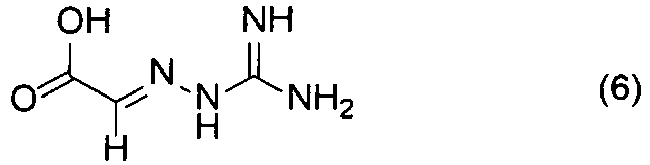
- Next, the conditions of a dehydrative condensation reaction between compound (A-1) having a hydrazide group represented by -C(=O)NHNH2 within the molecule and glyoxylic acid (B) is described in detail. The reaction conditions are not particularly limited, and, for example, the reaction can be carried out by using 1 mol to an excess of glyoxylic acid (B) and as necessary 0.001 to 1 mol of an acid catalyst as a condensation promoter per mole of compound (A-1) having a hydrazide group, and performing stirring in a polar solvent such as water or alcohol under normal pressure at 0 to 100°C for 10 minutes to 24 hours. After reaction, the intended product can be separated and purified by a known method. An example of a separation and purification method is a method in which crystals are obtained by cooling the reaction solution by ice water or the like to precipitate and isolate crystals.
- In the dehydrative condensation reaction, the proportion of the compound (A-1) having a hydrazide group to glyoxylic acid (B) used is not particularly limited, and is preferably 1:1 to 1:100 and particularly preferably 1:1 to 1:10 as a molar ratio. The reaction may be performed at room temperature, or may be performed with increasing temperature as necessary. In consideration of the boiling point of raw-material glyoxylic acid (B) being 111°C, the reaction temperature is preferably 0 to 100°C and particularly preferably 20 to 80°C.
- The polar solvent that can be used in the reaction is not particularly limited, and examples include water, methanol, ethanol, propanol, isopropyl alcohol, butanol, and isobutyl alcohol. In particular, water is preferable with which the purification of the product is easy and which is highly economical.
- The condensation promoter is not particularly limited, and examples include hydrochloric acid, sulfuric acid, acetic acid, p-toluenesulfonic acid, nitric acid, oxalic acid, phosphoric acid, hydrobromic acid, hydroiodic acid, sulfamic acid, and perchloric acid. Among these, hydrochloric acid and sulfuric acid are preferable in terms of economy.
- After the end of reaction, crystals precipitated by a cooling operation or the like are filtered off, washed with water, alcohol, or the like, and then dried under reduced pressure, and it is thereby possible to obtain a compound used as the gas generating agent of the present embodiment (a compound obtained by a dehydrative condensation reaction between the compound (A-1) having a hydrazide group represented by -C(=O)NHNH2 within the molecule and glyoxylic acid (B)). The compound used as the gas generating agent may be in the form of a hydrate, or may be in the form of a salt formed with an acid used as a condensation promoter.
- The gas generating agent comprising the compound thus obtained can be suitably used as a chemical blowing agent for general-purpose plastics (for example, thermoplastic resins) and rubbers. Preferably, the compound used for the gas generating agent of the present embodiment can suppress the generation of corrosive gas such as ammonia and provide a foam having a high expansion ratio when used alone at the foam molding temperature (for example, about 130 to 250°C) of general-purpose plastics (for example, thermoplastic resins) and rubbers.
- Although the gas generating agent of the present embodiment can be suitably used as a chemical blowing agent for general-purpose plastics (for example, thermoplastic resins) and rubbers even when composed solely of the compound represented by general formula (1), the gas generating agent may further comprise an adjuvant in addition to the compound represented by general formula (1). The adjuvant is not particularly limited, and examples include oxidizers, crosslinking agents (C), nitrous acid salts, and hydrotalcite. When the gas generating agent of the present embodiment further comprises such an adjuvant, there is a tendency that the generation of corrosive gas such as ammonia can be further suppressed, and the temperature when producing a foam, which will be described below, also is in a suitable range.
- When an adjuvant in addition to the compound represented by general formula (1) is contained in the gas generating agent of the present embodiment, the content of the compound represented by general formula (1) is preferably 0.5 to 95 mass% based on the total mass of the compound represented by general formula (1) and the adjuvant.
- The oxidizers are not particularly limited, and an example is sodium percarbonate. One oxidizer may be used singly, or two or more may be used in combination.
- In the gas generating agent of the present embodiment, the content of the oxidizer is preferably 0.5 to 95 mass% and more preferably 5 to 50 mass% based on the total mass of the compound represented by general formula (1) and the adjuvant.
- The crosslinking agents (C) are not particularly limited, and examples include dicumyl peroxide, di-t-butyl peroxide, 2,5-dimethyl-2,5-di-(t-butylperoxy)hexane, 2,5-dimethyl-2,5-di-(t-butylperoxy)hexyne, 1,3-bis(t-butylperoxyisopropyl)benzene, 1,1-bis(t-butylperoxy)-3,3,5-trimethylcyclohexane, 1,1-bis[t-butylperoxy]cyclohexane, n-butyl-4,4-bis(t-butylperoxy)valerate, benzoyl peroxide, p-chlorobenzoyl peroxide, 2,4-dichlorobenzoyl peroxide, t-butyl peroxybenzoate, t-butyl perbenzoate, t-butylperoxy isopropyl carbonate, diacetyl peroxide, lauroyl peroxide, and t-butyl cumyl peroxide. One crosslinking agent (C) may be used singly, or two or more may be used in combination.
- In the gas generating agent of the present embodiment, the content of the crosslinking agent (C) is preferably 0.1 to 10 mass% and more preferably 0.5 to 1.5 mass% based on the total mass of the compound represented by general formula (1) and the adjuvant.
- The nitrous acid salts are not particularly limited, and examples include sodium nitrite, potassium nitrite, and calcium nitrite. One selected from these can be used singly, or two or more can be used in combination. These nitrous acid salts preferably are pulverized fine powder.
- In the gas generating agent of the present embodiment, the content of a nitrous acid salt is preferably 0.5 to 60 mass% and more preferably 15 to 55 mass% based on the total mass of the compound represented by general formula (1) and the adjuvant.
- The hydrotalcite is a crystalline composite metal hydroxide, and hydrotalcite represented by general formula (H) below is preferable.
[M2+ 1-xM3+ x(OH)2]x+[An- x/n·mH2O]x- (H)
- In general formula (H) above, M2+ is a divalent metal ion of a metal selected from the group consisting of Mg, Mn, Fe, and Zn, M3+ is a trivalent metal ion of a metal selected from the group consisting of Al, Fe, and Cr, An- is an anion having a valency of n selected from the group consisting of OH, F, Cl, Br, NO3, CO3, and SO4, x is in a range of 0<x≤0.33, n is an integer, and m is 0 or greater.
- Here, m is preferably 0 but varies depending of the dryness and the state of storage of hydrotalcite, and thus m is not particularly limited as long as the effect of the present invention is not impaired. And, n is the valency of an anion and is preferably 1 or 2 and more preferably 2.
- Among these, hydrotalcite in which M2+ is Mg2+ and M3+ is Al3+ is preferable, and the molar ratio of Al:Mg is preferably 2:5 to 2:10 in terms of availability. For example, when the molar ratio of Al:Mg is 2:5, the molar fraction x of Al (x=Al/(Mg+Al)) is 0.29, and when the molar ratio of Al to Mg is 2:10, the molar fraction x of Al is 0.17.
- The hydrotalcite acts to enhance the reactivity of a nitrous acid salt. Blending hydrotalcite makes it possible to promote the degradation of ammonia gas that may be generated during the foaming of the gas generating agent, enhance the reactivity of a nitrous acid salt to thereby suppress the generation of nitrous acid gas, and promote the generation of nitrogen gas to enhance the foamability of the gas generating agent. Although the particle diameter of the hydrotalcite is not particularly limited, increased dispersibility in the gas generating agent is preferable for causing hydrotalcite to effectively act on the reaction between the compound represented by general formula (1) and a nitrous acid salt, and fine-powder hydrotalcite having a maximum particle diameter of 80 µm or less is more preferable.
- In the gas generating agent of the present embodiment, the content of the hydrotalcite is preferably 1 to 40 mass% and more preferably 5 to 25 mass% based on the total mass of the compound represented by general formula (1) and the adjuvant.
- Various stabilizers, pigments/fillers, foaming regulators, and the like may be further blended with the gas generating agent of the present embodiment as long as the effect of the present invention is not impaired. Stabilizers are not particularly limited, and examples include tribasic lead sulphate, dibasic phosphorous acid salts, lead stearate, zinc stearate, zinc carbonate, zinc oxide, aluminum stearate, dibutyltin malate, and urea. Examples of pigments/fillers are not particularly limited, and examples include chrome yellow, carbon black, titanium dioxide, and calcium carbonate. Foaming regulators are not particularly limited, and examples include maleic acid and the like.
- A method for producing the gas generating agent of the present embodiment is not particularly limited, and a commonly used mixing method can be used. For example, the compound represented by general formula (1), a nitrous acid salt, and hydrotalcite may be mixed to be uniformly dispersed under conditions including a temperature of 60°C or less and a time of about 5 minutes using a high speed mixer, a ribbon blender, a cone blender, or the like.
- The gas generating agent of the present embodiment may be a microcapsule-based gas generating agent.
- In the present embodiment, a microcapsule-based gas generating agent refers to a gas generating agent having a core-shell structure.
- A specific example of the microcapsule-based gas generating agent is a microcapsule-based gas generating agent having as a core component the compound represented by general formula (1) or a composition containing the compound represented by general formula (1) and further the adjuvant and the like. The main component of the shell of the microcapsule-based gas generating agent is not particularly limited, and an example is polymethyl methacrylate, and a fatty acid salt or a surfactant as a dispersant which will be described below is preferably contained. Introducing air bubbles into a rubber or a thermoplastic resin using such a microcapsule-based gas generating agent makes it possible to introduce uniform air bubbles into a polymer without inhibiting vulcanization and crosslinking and, moreover, without generating degradation residues and VOC components, thereby a decrease in crosslinking density is suppressed, and a crosslinked foam having a good air bubble state and excellent foam characteristics can be obtained.
- Although the polymethyl methacrylate is preferably a homopolymer having a methyl methacrylate monomer as a constitutional unit, it may be copolymerized with another monomer as long as the effect of the present invention is not impaired. Another monomer is not particularly limited, and examples include acrylic acid esters such as methyl acrylate, ethyl acrylate, butyl acrylate, and dicyclopentenyl acrylate, methacrylic acid esters such as ethyl methacrylate, butyl methacrylate, and isobornyl methacrylate, acrylonitrile, methacrylonitrile, vinylidene chloride, vinyl chloride, styrene, vinyl acetate, α-methylstyrene, chloroprene, neoprene, and butadiene.
- The crosslinking agent (D) used when producing the microcapsule-based gas generating agent is not particularly limited, and examples include (poly)ethylene glycol, divinylbenzene, ethylene glycol di(meth)acrylate, triethylene glycol di(meth)acrylate, allyl methacrylate, triallyl isocyanate, triacrylformal, trimethylolpropane tri(meth)acrylate, 1,3-butylglycol dimethacrylate, and pentaerythritol tri(meth)acrylate. In particular, ethylene glycol dimethacrylate, (poly)ethylene glycol, and trimethylolpropane tri(meth)acrylate are preferable.
- A preferable range of the proportion of the crosslinking agent (D) added is 1 to 5 mass% based on the mass of the microcapsule shell monomers (the total mass of the methyl methacrylate monomer and other monomers). When the proportion of the crosslinking agent (D) is less than 1 mass%, the crosslinking of the capsule shell is insufficient, degradation residues generated when the core component degrades cannot be efficiently adsorbed, and therefore degradation residues readily pass through the capsule shell. When the proportion of the crosslinking agent (D) exceeds 5 mass%, the capsule shell becomes hard and brittle, the capsule shell breaks during the degradation of the core component, and the effect of adsorbing degradation residues is decreased.
- A polymerization initiator used when producing the microcapsule-based gas generating agent is not particularly limited, and those that are commonly used in this field can be used. Examples of polymerization initiators that can be used include dialkyl peroxides, diacyl peroxides, peroxy esters, peroxydicarbonates, and azo compounds. Specific examples include dialkyl peroxides such as methylethyl peroxide, di-t-butyl peroxide, and dicumyl peroxide, diacyl peroxides such as isobutyl peroxide, benzoyl peroxide, 2,4-dichlorobenzoyl peroxide, and 3,5,5-trimethylhexanoyl peroxide, peroxy esters such as t-butyl peroxypivalate, t-hexyl peroxypivalate, t-butyl peroxyneodecanoate, t-hexyl peroxyneodecanoate, 1-cyclohexyl-1-methylethyl peroxyneodecanoate, 1,1,3,3-tetramethylbutyl peroxyneodecanoate, cumyl peroxyneodecanoate, and (α,α-bis-neodecanoylperoxy)diisopropylbenzene, peroxydicarbonates such as bis(4-t-butylcyclohexyl) peroxydicarbonate, di-n-propyl-peroxydicarbonate, diisopropyl peroxydicarbonate, and di-(3-methyl-3-methoxybutyl) peroxydicarbonate, persulfuric acid salts such as potassium persulfate and ammonium persulfate, and azo compounds such as 2,2'-azobisisobutyronitrile, 2,2'-azobis(2,4-dimethylvaleronitrile), 2,2'-azobis(4-methoxy-2,4-dimethylvaleronitrile), and 1,1'-azobis(1-cyclohexanecarbonitrile).
- The microcapsule-based gas generating agent can be produced by an emulsion polymerization method such as a suspension polymerization method. For example, a solid-phase (S phase) core component (for example, the compound represented by general formula (1) or a composition containing the compound represented by general formula (1) and further the adjuvant and the like) is added to an oil phase (O phase) having a monomer (for example, a methyl methacrylate monomer) for a microcapsule shell, a crosslinking agent (D), and a polymerization initiator, and stirring/mixing is performed to thereby prepare a S/O emulsion. This S/O emulsion is added to a water phase (W phase) and stirred/mixed to thereby prepare a S/O/W suspension. This S/O/W suspension is introduced into a pressure polymerizer such as an autoclave and subjected to pressure polymerization to obtain a cake-like substance. This cake-like substance is filtered off by a commonly used method such as filtration or centrifugation, the resulting residue is washed with distilled water about 3 to 5 times, and then dried at a temperature of 40 to 60°C all day and night using a dryer, and it is thus possible to obtain the microcapsule-based gas generating agent. As for pressure polymerization conditions, commonly used conditions can be used, and, for example, the polymerization temperature is 40 to 70°C, the polymerization time is 10 to 24 hours, and the polymerization pressure is 0.2 to 0.3 MPa.
- Suspension polymerization is preferably performed in the presence of a dispersion stabilizer and a dispersion stability aid. The dispersion stabilizer is not particularly limited, and, for example, silica, calcium phosphate, magnesium hydroxide, aluminum hydroxide, ferric hydroxide, barium sulfate, calcium sulfate, sodium sulfate, sodium chloride, calcium oxalate, calcium carbonate, barium carbonate, and magnesium carbonate can be used. In particular, silica and calcium phosphate are preferable.
- The dispersion stability aid is not particularly limited, and, for example, a condensate of diethanolamine and aliphatic dicarboxylic acid, a condensate of urea and formaldehyde, polyvinylpyrrolidone, polyethylene oxide, polyethyleneimine, tetramethylammonium hydroxide, gelatin, methylcellulose, polyvinyl alcohol, dioctyl sulfosuccinate, polyglycerin fatty acid ester, and sorbitan ester can be used.
- A preferable combination of a dispersion stabilizer and a dispersion stability aid is a combination of colloidal silica and a condensate. The condensate is preferably a condensate of diethanolamine and aliphatic dicarboxylic acid, and, in particular, a condensate of diethanolamine and adipic acid and a condensate of diethanolamine and itaconic acid are preferable. A condensate is specified by the acid value, and an acid value of 65 or more and 90 or less is preferable. Moreover, the addition of an inorganic salt, in particular, sodium chloride, sodium sulfate, or the like is suitable for obtaining a uniform microcapsule-based gas generating agent having a small particle diameter.
- The microcapsule-based gas generating agent preferably contains a fatty acid salt or a surfactant as a dispersant. This fatty acid salt or surfactant is added to the oil phase (O phase) having a monomer for the microcapsule shell, a crosslinking agent (D), and a polymerization initiator when producing the microcapsule-based gas generating agent. The content of the fatty acid salt or surfactant in the microcapsule-based gas generating agent is preferably 0.01 to 3 mass% based on the core component (the compound represented by general formula (1) or a composition containing the compound represented by general formula (1) and further the adjuvant and the like). When the content is 0.01 mass% or more, there is a tendency that the core component is sufficiently stable, thus the coagulation of solid phase/oil phase droplets is suppressed, and aggregates are unlikely to be formed during polymerization. When the content is 3 mass% or less, there is a tendency that the viscosity of solid phase/oil phase droplets does not become excessively high, droplets are unlikely to adhere to each other, and a broadening of the particle size distribution of microcapsule particles is suppressed.
- The fatty acid salt is not particularly limited, and examples include fatty acid amides such as stearic acid amide and arachidic acid amide, zinc stearate, calcium stearate, potassium stearate, aluminum stearate, lithium stearate, sodium stearate, magnesium stearate, zinc palmitate, zinc myristate, calcium palmitate, and sodium palmitate. Among these fatty acid salts, one or more selected from higher fatty acid salts having 15 to 22 carbon atoms are preferable, and one or more higher fatty acid salts of metals selected from the group consisting of potassium, calcium, lithium, and magnesium are more preferable. Titanium oxide, zinc oxide, talc, calcium carbonate, and the like may be used as long as the effect of the present invention is not impaired.
- The surfactant is not particularly limited, and includes known cationic surfactants, anionic surfactants, ampholytic surfactants, and nonionic surfactants. Cationic surfactants are not particularly limited, and examples include alkyltrimethylammonium salts, dialkyldimethylammonium salts, and alkyldimethylbenzylammonium salts. Anionic surfactants are not particularly limited, and examples include sulfonate-type anionic surfactants such as alkylbenzenesulfonates, alkylsulfosuccinates, and allylsulfonates, sulfate-type anionic surfactants such as alkylsulfates and polyoxyethylenealkylsulfates, and lignosulfites.
- Nonionic surfactants are not particularly limited, and examples include sugar ester-type nonionic surfactants such as sorbitan fatty acid esters and polyoxyethylene sorbitan fatty acid esters, fatty acid ester-type nonionic surfactants such as polyoxyethylene fatty acid esters, vegetable oil-type nonionic surfactants such as polyoxyethylene castor oil, alcohol-type nonionic surfactants such as polyoxyethylene alkyl ethers, alkylphenol-type nonionic surfactants such as polyoxyethylene alkyl (C8-12) phenyl ether-formalin condensates, polyoxyethylene-polyoxypropylene block polymer-type nonionic surfactants such as polyoxyethylene-polyoxypropylene block polymers, and polyaromatic-type nonionic surfactants such as phenyl phenyl ether.
- Among the surfactants, nonionic surfactants are most suitable. It is also possible to use anionic surfactants, cationic surfactants, and various additives in combination as long as the effect of the present invention is not impaired.
- A preferable range of the HLB value (Hydrophile-Lipophile Balance) of the surfactants is 0.01 to 16, more preferably 0.01 to 9, and even more preferably 0.01 to 3. When the HLB value exceeds 16, the surfactants have strong hydrophilicity, and the solid phase in solid phase/oil phase droplets has an affinity for the aqueous phase. When the solid phase of solid phase/oil phase droplets has an affinity for the aqueous phase, the core component is concentrated near the surface of polymerized microcapsule particles, and the effect of reducing degradation residues is small when the core component degrades. When the HLB value is 16 or less, the solid phase in solid phase/oil phase droplets is uniformly dispersed in the oil phase, and thus the effect of reducing degradation residues is large. In particular, when the HLB value is 3 or less, the surfactants are highly lipophilic, the solid phase in solid phase/oil phase droplets is concentrated in the center of the oil phase, microcapsules in which the core component is concentrated in the center of particles after polymerization are obtained, and also the effect of reducing degradation residues during heating is large.
- The foamable composition of the present embodiment comprises the above-described gas generating agent and a material to be foamed.
- In the foamable composition of the present embodiment, the material to be foamed that is contained together with the above-described gas generating agent is not particularly limited, and examples include thermoplastic resins and/or rubbers. One material to be foamed may be used singly, or two or more may be used in combination. Examples of the thermoplastic resins include, but are not limited to, vinyl chloride resins, vinyl chloride copolymer resins, polyethylene, polypropylene, and polyolefin copolymer resins represented by ethylene-propylene copolymers, polystyrene resins, and acrylonitrile-butadiene-styrene copolymers (ABS resins).
- The foamable composition of the present embodiment may further comprise a crosslinking agent (E). The crosslinking agent (E) contained in the foamable composition of the present embodiment may be the same as or different from the crosslinking agent (C) contained in the above-described gas generating agent.
- The foam of the present embodiment is a foam obtained by foaming the above-described foamable composition.
- A method for producing the foam of the present embodiment is not particularly limited as long as the method comprises a step of heating a foamable composition comprising the above-described gas generating agent and a material to be foamed, and a commonly used method for producing a foam can be used. For example, a foamable composition (an unfoamed resin composition) can be prepared by kneading a thermoplastic resin, a crosslinking agent (E), and the above-described gas generating agent with heated rolls. The kneading temperature is preferably 90 to 130°C. Here, the crosslinking agent (E) contained in the foamable composition is not particularly limited, and examples include dicumyl peroxide, di-t-butyl peroxide, 2,5-dimethyl-2,5-di-(t-butylperoxy)hexane, 2,5-dimethyl-2,5-di-(t-butylperoxy)hexyne, 1,3-bis(t-butylperoxyisopropyl)benzene, 1,1-bis(t-butylperoxy)-3,3,5-trimethylcyclohexane, 1,1-bis[t-butylperoxy]cyclohexane, n-butyl-4,4-bis(t-butylperoxy)valerate, benzoyl peroxide, p-chlorobenzoyl peroxide, 2,4-dichlorobenzoyl peroxide, t-butyl peroxybenzoate, t-butyl perbenzoate, t-butylperoxy isopropyl carbonate, diacetyl peroxide, lauroyl peroxide, and t-butyl cumyl peroxide. One crosslinking agent (E) may be used singly, or two or more may be used in combination. The content of crosslinking agent (E) is preferably 0.1 to 10 parts by mass and more preferably 0.5 to 1.5 parts by mass based on 100 parts by mass of the thermoplastic resin.
- The unfoamed resin composition thus obtained is introduced into a metal mold, pressurized with a press, and thereby a foam of a resin composition (for example, a thermoplastic resin) is obtained. The metal mold thickness, pressurizing conditions, and the like are not particularly limited, and a conventionally known foam molding method can be suitably employed according to the kind, the application, and the like of the thermoplastic resin. For example, the unfoamed resin composition is introduced into a metal mold having a thickness of 1 to 30 mm to an extent of 100%, pressurized with a press for 3 to 60 minutes under 100 to 170°C and 150 kg/cm2 conditions, and water-cooled for 3 to 60 minutes, and thereby a sheet-like composition is obtained. The resulting sheet-like composition is left to stand still for one day, then heated for 1 hour in an oven at 40 to 80°C, and heated at 130 to 250°C for 150 to 600 seconds, and a foam of the resin composition is obtained.
- When producing a foam of the resin composition in this way, the amount of the above-described gas generating agent used can be suitably selected according to the intended expansion ratio and is not particularly limited, but preferably 1 to 30 parts by mass of the gas generating agent is blended based on 100 parts by mass of a thermoplastic resin.
- Examples of rubbers used in the present embodiment include, but are not limited to, natural rubber (NR), polyisoprene rubber, styrene-butadiene rubber (SBR), acrylonitrile-butadiene rubber, chloroprene rubber, ethylene-propylene rubber, ethylene-propylene-diene rubber, and butadiene rubber.
- As a method in which the above-described gas generating agent is blended with a rubber to prepare a foamable composition and a foam is produced therefrom, commonly used foam production conditions can be used. For example, a rubber material, a vulcanizing agent, a filler, a vulcanization accelerator, and the above-described gas generating agent are uniformly dispersed with kneading rolls to obtain a foamable composition. The resulting foamable composition is fed to an extruder heated to 70 to 90°C to prepare an unvulcanized molding. The resulting unvulcanized molding is heated for 5 to 15 minutes in an oven heated to 60 to 220°C to perform vulcanization and foaming, and a foam of the rubber material is obtained.
- Although the proportion of each component blended in the foamable composition is not particularly limited, preferably 0.1 to 10 parts by mass of the vulcanizing agent is blended based on 100 parts by mass of the rubber material. Preferably 10 to 150 parts by mass of the filler is blended based on 100 parts by mass of the rubber material. Preferably 0.1 to 20 parts by mass of the vulcanization accelerator is blended based on 100 parts by mass of the rubber material.
- When producing a foam of the rubber material in this way, the amount of the above-described gas generating agent used can be suitably selected according to the intended expansion ratio and is not particularly limited, but preferably 1 to 20 parts by mass of the gas generating agent is blended based on 100 parts by mass of the rubber.
- Specific examples of the vulcanizing agent used in the present embodiment are not particularly limited, and an example is sulfur.
- Specific examples of the filler used in the present embodiment are not particularly limited, and examples include heavy and light calcium carbonates, and carbon black.
- Specific examples of the vulcanization accelerator used in the present embodiment are not particularly limited, and examples include dithiocarbamic acid salt-based vulcanization accelerators and dithiocarbamic acid-based vulcanization accelerators, and specifically examples include DM (dibenzylthiazole disulfide), zinc dimethyldithiocarbamate, and zinc dibutyldithiocarbamate.
- The foamable composition of the present embodiment may contain other additives. Other additives are not particularly limited, and examples include Diana Process Oil, zinc oxide, stearic acid, calcium oxide, urea-based auxiliaries, silicon dioxide (silica), talc, magnesium oxide, zinc stearate, calcium hydroxide, barium stearate, dibasic lead phosphite, and lead oxide.
- The present invention is described in more detail by way of Examples and Comparative Examples below, but the present invention is not at all limited to the Examples. In Examples and Comparative Examples provided below, unless specified otherwise, the structure of a compound used for a gas generating agent was identified by 1H-NMR and the melting point, and the degradation starting temperature of a gas generating agent, the amount of generated gas, and the amount of generated ammonia were respectively evaluated by the following methods.
- The degradation starting temperature of a gas generating agent was measured using a differential thermal-thermogravimetric simultaneous analyzer (EXSTAR 6000 manufactured by SII NanoTechnology Inc.) in air under conditions where the starting temperature was 25°C and the temperature was increased at 10°C/min. The temperature at which the weight was lower by 5% than the weight at the beginning of increasing the temperature was regarded as the degradation starting temperature.
- After 0.5 g of a gas generating agent was placed in a test tube and 10 mL of liquid paraffin as a heating medium was added, the test tube and a gas buret were connected by a rubber tube, and the test tube was immersed in an oil bath at 60°C. Then, the oil bath was heated to 240°C at a heating rate of 2°C/min. Gas generated during this heating was all captured by the gas buret to determine the amount (mL) of generated gas per gram of the gas generating agent.
- After 0.5 g of a gas generating agent was placed in a test tube and 10 mL of liquid paraffin was added as a heating medium, this test tube, a screw-cap test tube, and a screw-cap bottle having 100 mL of 0.1 N hydrochloric acid were connected by a rubber tube in this order. While allowing nitrogen gas to flow at a flow rate of 0.4 L/min, the test tube containing the gas generating agent was heated to 228°C in a block heater. Ammonia gas generated during this heating was captured by 0.1 N hydrochloric acid, and ammonium ions in hydrochloric acid were quantified by an ion chromatograph (DX-320J manufactured by Nippon Dionex K.K.) to determine the amount (mg) of generated ammonia gas per gram of the gas generating agent.
-

- To a 30 mL recovery flask were added 1.33 g (12 mmol) of semicarbazide hydrochloride (manufactured by Kanto Chemical Co., Inc.) and 6 mL of water, and the mixture was stirred at room temperature using a magnetic stirrer until a homogeneous solution was formed, and then 1.91 g (13 mmol) of a 50 mass% aqueous glyoxylic acid solution (manufactured by Tokyo Chemical Industry Co., Ltd.) was added. White solids precipitated shortly after adding glyoxylic acid, and after stirring for 1.0 hour, the reaction solution was filtered, and water-washing and then vacuum-drying at 50°C for 17 hours were performed, thus giving 1.458 g (11 mmol) of white solids. The resulting solids were analyzed by 1H-NMR and confirmed as semicarbazonoacetic acid (5) (1H-NMR (DMSO-d6, 500 MHz, δ; ppm) = 6.6-6.9 (br; 2H), 7.1 (s; 1H), 10.9 (s; 1H)). The molar yield was 92%. The melting point of the resulting solids measured using a micro melting point apparatus BY-1 (manufactured by Yazawa Scientific Co., Ltd.) was 223°C.
-

- To a 30 mL recovery flask were added 1.07 g (12 mmol) of carbohydrazide (manufactured by Wako Pure Chemical Industries, Ltd.) and 12 mL of water, and the mixture was stirred at room temperature using a magnetic stirrer until a homogeneous solution was formed, and then 3.840 g (26 mmol) of a 50 mass% aqueous glyoxylic acid solution (manufactured by Tokyo Chemical Industry Co., Ltd.) was added. White solids precipitated shortly after adding glyoxylic acid, and after stirring for 1.0 hour, the reaction solution was filtered, and water-washing and then vacuum-drying at 50°C for 17 hours were performed, thus giving 2.52 g (11 mmol) of white solids. The resulting solids were analyzed by 1H-NMR and confirmed as carbohydrazidediacetic acid (8) (1H-NMR (DMSO-d6, 500 MHz, δ; ppm) = 7.4 (s; 2H), 11.5 (s; 2H)). The molar yield was 93%. The melting point of the resulting solids measured using a micro melting point apparatus BY-1 (manufactured by Yazawa Scientific Co., Ltd.) was 207 to 208°C.
-

- To a 30 mL recovery flask were added 8.41 g (93 mmol) of methyl carbazate (manufactured by Tokyo Chemical Industry Co., Ltd.) and 10 mL of 0.1 N hydrochloric acid and the mixture was stirred at room temperature using a magnetic stirrer until a homogeneous solution was formed, and then 14.38 g (97 mmol) of a 50 mass% aqueous glyoxylic acid solution (manufactured by Tokyo Chemical Industry Co., Ltd.) was added. White solids gradually precipitated after adding glyoxylic acid, and after stirring for 24 hours, the reaction solution was filtered, and washing with 10 mL of water and then vacuum-drying at 50°C for 18 hours were performed, thus giving 11.043 g (76 mmol) of white solids. The resulting solids were analyzed by 1H-NMR and confirmed as (methoxycarbonyl)hydrazonoacetic acid (7-1) (1H-NMR (DMSO-d6, 500 MHz, δ; ppm) = 3.7 (s; 3H), 7.3 (s; 1H), 11.5-11.7 (br)). The molar yield was 82%. The melting point of the resulting solids measured using a micro melting point apparatus BY-1 (manufactured by Yazawa Scientific Co., Ltd.) was 181°C.
-

- To a 30 mL recovery flask were added 1.04 g (10 mmol) of ethyl carbazate (manufactured by Tokyo Chemical Industry Co., Ltd.) and 1 mL of water, 0.1 mL of concentrated hydrochloric acid was added, the mixture was stirred at room temperature using a magnetic stirrer, and then 1.69 g (11 mmol) of a 50 mass% aqueous glyoxylic acid solution (manufactured by Tokyo Chemical Industry Co., Ltd.) was added. White solids precipitated shortly after adding glyoxylic acid, and after stirring for 18 hours, the reaction solution was filtered, and water-washing and then vacuum-drying at 50°C for 21 hours were performed, thus giving 1.02 g (6.4 mmol) of white solids. The resulting solids were analyzed by 1H-NMR and confirmed as (ethoxycarbonyl)hydrazonoacetic acid (7-2) (1H-NMR (DMSO-d6, 500 MHz, δ; ppm) = 1.2 (t; 3H), 4.1 (q; 2H), 7.3 (s; 1H), 11.5-11.7 (br)). The molar yield was 64%. The melting point of the resulting solids measured using a micro melting point apparatus BY-1 (manufactured by Yazawa Scientific Co., Ltd.) was 173 to 174°C.
-
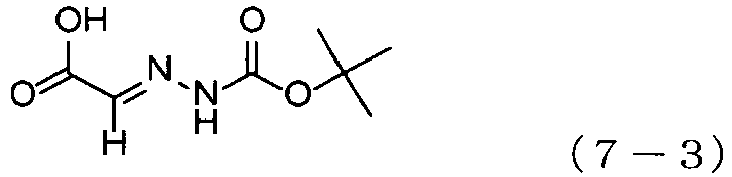
- To a 30 mL recovery flask were added 1.04 g (7.9 mmol) of t-butyl carbazate (manufactured by Tokyo Chemical Industry Co., Ltd.) and 3 mL of water and the mixture was stirred at room temperature using a magnetic stirrer, and then 1.20 g (8.1 mmol) of a 50 mass% aqueous glyoxylic acid solution (manufactured by Tokyo Chemical Industry Co., Ltd.) was added. White solids precipitated shortly after adding glyoxylic acid, and after stirring for 1.0 hour, the reaction solution was filtered, and water-washing and then vacuum-drying at 50°C for 17 hours were performed, thus giving 1.07 g (5.7 mmol) of white solids. The resulting solids were analyzed by 1H-NMR and confirmed as (t-butoxycarbonyl)hydrazonoacetic acid (7-3) (1H-NMR (DMSO-d6, 500 MHz, δ; ppm) = 1.5 (s; 9H), 7.3 (s; 1H), 11.2-11.3 (br)). The molar yield was 72%. The melting point of the resulting solids measured using a micro melting point apparatus BY-1 (manufactured by Yazawa Scientific Co., Ltd.) was 139 to 140°C.
-

- To a 30 mL recovery flask were added 1.322 g (12 mmol) of aminoguanidine hydrochloride (manufactured by Tokyo Chemical Industry Co., Ltd.) and 6 mL of 0.1 N hydrochloric acid and the mixture was stirred at room temperature using a magnetic stirrer until a homogeneous solution was formed at room temperature, and then 1.777 g (12 mmol) of a 50 mass% aqueous glyoxylic acid solution was added. White solids precipitated shortly after adding glyoxylic acid, and after stirring for 2.5 hour, the reaction solution was filtered, and water-washing and then vacuum-drying at 50°C for 4 hours were performed, thus giving 1.545 g (10 mmol) of white solids. The resulting solids were analyzed by 1H-NMR and confirmed as (amidino)hydrazonoacetic acid (6), which is a condensate of aminoguanidine and glyoxylic acid (1H-NMR (DMSO-d6, 500 MHz, δ; ppm) = 7.1 (s; 1H)). The molar yield was 83%. The resulting solids degraded at 145°C when the melting point was measured using a micro melting point apparatus BY-1 (manufactured by Yazawa Scientific Co., Ltd.).
-

- To a 100 mL recovery flask were added 1.064 g (12 mmol) of methyl carbazate (manufactured by Tokyo Chemical Industry Co., Ltd.) and 3 mL of 0.1 N hydrochloric acid and stirred for 5 minutes to completely dissolve methyl carbazate. Then, 877 mg (5.9 mmol) of a 39% aqueous glyoxal solution (manufactured by Tokyo Chemical Industry Co., Ltd.) was added, and the mixture was stirred at room temperature using a magnetic stirrer. White precipitates were generated when stirring was started, and after stirring for 2 hours, the reaction solution was filtered, and washing with water and methanol and then vacuum-drying at 50°C for 18 hours were performed, thus giving 936 mg (4.6 mmol) of white solids. The resulting solids were analyzed by 1H-NMR and confirmed as glyoxal bis[(methoxycarbonyl)hydrazone] (9) (1H-NMR (DMSO-d6, 500 MHz, δ; ppm) = 3.7 (s, 6H), 7.7 (s, 2H), 11.4-11.5 (br)). The molar yield was 79%. The resulting solids degraded at 268 to 270°C when the melting point was measured using a micro melting point apparatus BY-1 (manufactured by Yazawa Scientific Co., Ltd.).
-

- To a 100 mL recovery flask were added 1.361 g (15 mmol) of methyl carbazate (manufactured by Tokyo Chemical Industry Co., Ltd.) and 1.30 g (16 mmol) of a 37% aqueous formaldehyde solution (manufactured by Tokyo Chemical Industry Co., Ltd.) and the mixture was stirred at room temperature using a magnetic stirrer. White precipitates were generated when stirring was started, and after stirring for 3 hours, the reaction solution was filtered, and water-washing and then vacuum-drying at 50°C for 16 hours were performed, thus giving 1.243 g (12 mmol) of white solids. The resulting solids were analyzed by 1H-NMR and confirmed as methyl 1-methylidenecarbazate (1H-NMR (DMSO-d6, 500 MHz, δ; ppm) = 3.6 (s, 3H), 3.8 (s, 2H), 8.7-8.9 (br)). The molar yield was 82%. The resulting solids degraded at 129 to 131°C when the melting point was measured using a micro melting point apparatus BY-1 (manufactured by Yazawa Scientific Co., Ltd.).
- The degradation starting temperature of semicarbazonoacetic acid (5) obtained in Synthesis Example 1 and the amount of generated gas were measured. The degradation starting temperature and the amount of generated gas are shown in Table 1.
- The degradation starting temperature of carbohydrazidediacetic acid (8) obtained in Synthesis Example 2 and the amount of generated gas were measured under the same conditions as in Example 1. The degradation starting temperature and the amount of generated gas are shown in Table 1.
- The degradation starting temperature of (methoxycarbonyl)hydrazonoacetic acid (7-1) obtained in Synthesis Example 3 and the amount of generated gas were measured under the same conditions as in Example 1. The degradation starting temperature and the amount of generated gas are shown in Table 1.
- The degradation starting temperature of (ethoxycarbonyl)hydrazonoacetic acid (7-2) obtained in Synthesis Example 4 and the amount of generated gas were measured under the same conditions as in Example 1. The degradation starting temperature and the amount of generated gas are shown in Table 1.
- The degradation starting temperature of (t-butoxycarbonyl)hydrazonoacetic acid (7-3) obtained in Synthesis Example 5 and the amount of generated gas were measured under the same conditions as in Example 1. The degradation starting temperature and the amount of generated gas are shown in Table 1.
- The degradation starting temperature of (amidino)hydrazonoacetic acid (6) obtained in Synthesis Example 6 and the amount of generated gas were measured under the same conditions as in Example 1. The degradation starting temperature and the amount of generated gas are shown in Table 1.
- The degradation starting temperature of semicarbazide hydrochloride (manufactured by Tokyo Chemical Industry Co., Ltd.) and the amount of generated gas were measured under the same conditions as in Example 1. The degradation starting temperature and the amount of generated gas are shown in Table 1.
- The degradation starting temperature of carbohydrazide (manufactured by Wako Pure Chemical Industries, Ltd.) and the amount of generated gas were measured under the same conditions as in Example 1. The degradation starting temperature and the amount of generated gas are shown in Table 1.
- The degradation starting temperature of methyl carbazate (manufactured by Tokyo Chemical Industry Co., Ltd.) and the amount of generated gas were measured under the same conditions as in Example 1. The degradation starting temperature and the amount of generated gas are shown in Table 1.
- The degradation starting temperature of ethyl carbazate (manufactured by Tokyo Chemical Industry Co., Ltd.) and the amount of generated gas were measured under the same conditions as in Example 1. The degradation starting temperature and the amount of generated gas are shown in Table 1.
- The degradation starting temperature of t-butyl carbazate (manufactured by Tokyo Chemical Industry Co., Ltd.) and the amount of generated gas were measured under the same conditions as in Example 1. The degradation starting temperature and the amount of generated gas are shown in Table 1.
- The degradation starting temperature of aminoguanidine hydrochloride (manufactured by Tokyo Chemical Industry Co., Ltd.) and the amount of generated gas were measured under the same conditions as in Example 1. The degradation starting temperature and the amount of generated gas are shown in Table 1.
- The degradation starting temperature of glyoxal bis[(methoxycarbonyl)hydrazone] (9) obtained in Comparative Synthesis Example 1 and the amount of generated gas were measured under the same conditions as in Example 1. The degradation starting temperature and the amount of generated gas are shown in Table 1.
- The degradation starting temperature of methyl 1-methylidenecarbazate (10) obtained in Comparative Synthesis Example 2 and the amount of generated gas were measured under the same conditions as in Example 1. The degradation starting temperature and the amount of generated gas are shown in Table 1.
- The degradation starting temperature of 4,4'-oxybis(benzenesulfonyl hydrazide) (OBSH) (manufactured by Eiwa Chemical Ind. Co., Ltd.) and the amount of generated gas were measured under the same conditions as in Example 1. The degradation starting temperature and the amount of generated gas are shown in Table 1.

- It was found from Table 1 that due to the condensation of hydrazine derivatives such as semicarbazide, carbohydrazide, carbazic acid esters, and aminoguanidine with glyoxylic acid, the amount of generated gas is increased, and also the degradation starting temperature is 130°C or higher, which is a suitable temperature for a chemical blowing agent for general-purpose plastics (for example, thermoplastic resins) and rubbers.
- The amount of generated ammonia gas of semicarbazonoacetic acid (5) obtained in Synthesis Example 1 was measured by the method described above. The result is shown in Table 2.
- The amount of generated ammonia gas of carbohydrazidediacetic acid (8) obtained in Synthesis Example 2 was measured under the same conditions as in Example 7 except that the heating temperature of the block heater was changed to 185°C. The result is shown in Table 2.
- The amount of generated ammonia gas of (methoxycarbonyl)hydrazonoacetic acid (7-1) obtained in Synthesis Example 3 was measured under the same conditions as in Example 7 except that the heating temperature of the block heater was changed to 191°C. The result is shown in Table 2.
- The amount of generated ammonia gas of (amidino)hydrazonoacetic acid (6) obtained in Synthesis Example 6 was measured under the same conditions as in Example 7 except that the heating temperature of the block heater was changed to 191°C. The result is shown in Table 2.
- The amount of generated ammonia gas of azodicarbonamide (ADCA) (manufactured by Eiwa Chemical Ind. Co., Ltd.) was measured under the same conditions as in Example 7 except that the heating temperature of the block heater was changed to 210°C. The result is shown in Table 2.
[Table 2] Example 7 Example 8 Example 9 Example 10 Comparative Example 10 Amount of generated ammonia gas (mg/g) 0.50 0.49 1.35 0.80 11.11 - It was found from Table 2 that the gas generating agents of the present embodiment generate smaller amounts of ammonia gas and, as chemical blowing agents for general-purpose plastics (for example, thermoplastic resins) and rubbers, do not contaminate the metal mold during molding and are highly safe.
- Polyethylene (trade name "LE200M" manufactured by Japan Polyethylene Corporation) in an amount of 100 parts by mass was kneaded with an open mill heated to 120°C, then 16 parts by mass of semicarbazonoacetic acid (5) obtained in Synthesis Example 1 as a gas generating agent was added and kneaded for 4 minutes and 30 seconds, then 0.8 parts by mass of dicumyl peroxide (DCP) (trade name "Percumyl D" manufactured by NOF Corporation) was added and kneaded for 1 minute and 30 seconds, and the kneaded material was removed from the open mill. The kneaded material was introduced into a metal mold (2 mm) of a press heated to 165°C such that the inner volume was filled 100%, pressurized for 3 minutes at a pressing pressure of 50 kg/cm2, then pressurized for 3 minutes at a pressing pressure of 150 kg/cm2, and water-cooled for 5 minutes, thus giving a sheet-like composition. The resulting sheet-like composition was left to stand still for one day, heated for 1 hour in an oven at 60°C, and heated at 220°C for 300 seconds, thus giving a foam. The evaluation results of the resulting foam are shown in Table 3.
- A foam was obtained under the same conditions as in Example 11 except that the gas generating agent was changed to carbohydrazidediacetic acid (8) obtained in Synthesis Example 2, and the time of heating at 220°C was 242 seconds. The evaluation results of the resulting foam are shown in Table 3.
- A foam was obtained under the same conditions as in Example 11 except that the gas generating agent was changed to (methoxycarbonyl)hydrazonoacetic acid (7-1) obtained in Synthesis Example 3, and the time of heating at 220°C was 300 seconds. The evaluation results of the resulting foam are shown in Table 3.
- A foam was obtained under the same conditions as in Example 11 except that the gas generating agent was changed to (ethoxycarbonyl)hydrazonoacetic acid (7-2) obtained in Synthesis Example 4, and the time of heating at 220°C was 286 seconds. The evaluation results of the resulting foam are shown in Table 3.
- A foam was obtained under the same conditions as in Example 11 except that the gas generating agent was changed to azodicarbonamide (ADCA) (manufactured by Eiwa Chemical Ind. Co., Ltd.), and the time of heating at 220°C was 305 seconds. The evaluation results of the resulting foam are shown in Table 3.
- A foam was obtained under the same conditions as in Example 11 except that the gas generating agent was changed to sodium hydrogencarbonate (trade name "Cellborn FE-507", manufactured by Eiwa Chemical Ind. Co., Ltd.) and the time of heating at 220°C was 240 seconds. The evaluation results of the resulting foam are shown in Table 3.
[Table 3] Example Number Example 11 Example 12 Example 13 Example 14 Comparative Example 11 Comparative Example 12 Resin Polyethylene 100 parts 100 parts 100 parts 100 parts 100 parts 100 parts Gas generating agent ADCA - - - - 16 parts - Cellborn FE-507 - - - - - 16 parts Formula (5) 16 parts - - - - - Formula (8) - 16 parts - - - - Formula (7-1) - - 16 parts - - - Formula (7-2) - - - 16 parts - - Crosslinking agent (E) Percumyl D 0.8 parts 0.8 parts 0.8 parts 0.8 parts 0.8 parts 0.8 parts Foaming time [sec] 300 242 300 286 305 240 Specific gravity [g/cm3] 0.081 0.105 0.120 0.118 0.032 0.318 Expansion ratio 11.4 8.8 7.7 7.8 28.8 2.9 Number of air bubbles n=5 per 1 cm 5-9 9-13 14-23 22-29 23-30 7-11 Color of foam Brown Brown Brown Brown Pale yellow White - In the present Examples, the specific gravity, the expansion ratio, and the number of air bubbles of a foam were measured as follows.
- Specific gravity: measured with an electronic gravimeter MD-200S.
- Expansion ratio: calculated by the specific gravity of polyethylene (0.92 g/cm3)/the specific gravity of a foam.
- Number of air bubbles: measured with a microscope HIROX KH7700 2D measurement.
- Saturated hydrocarbon rubber (trade name "EPT 4021" manufactured by Mitsui Chemicals, Inc.) in an amount of 100 parts by mass was kneaded with a cooled (water-flowed) roll mill, then 70 parts by mass of carbon black (trade name "Asahi #50 UG" manufactured by Asahi Carbon Co., Ltd.), 40 parts by mass of light calcium carbonate (manufactured by Ohmi Chemical Industry Co., Ltd.), 45 parts by mass Diana Process Oil (trade name "PW-90", manufactured by Idemitsu Kosan Co., Ltd.), 5 parts by mass of zinc oxide (ZnO (zinc white) manufactured by Mitsui Mining & Smelting Co., Ltd.), and 1 part by mass of stearic acid (CH3(CH2)16COOH, trade name "Tsubaki" manufactured by NOF Corporation) were added and kneaded, thus giving kneaded material A. Kneaded material A was stored for 1 day or more at normal temperature for aging. The aged kneaded material A was kneaded with a cooled (water-flowed) roll mill, then 1.1 parts by mass of a dithiocarbamic acid salt-based vulcanization accelerator (zinc dimethyldithiocarbamate, trade name "Nocceler PZ" manufactured by Ouchi Shinko Chemical Industrial Co., Ltd.), 1.7 parts by mass of a dithiocarbamic acid-based vulcanization accelerator (zinc dibutyldithiocarbamate, trade name "Nocceler BZ" manufactured by Ouchi Shinko Chemical Industrial Co., Ltd.) were added and kneaded, then 1.7 parts by mass of sulfur (trade name "Fine Powder Sulfur S" manufactured by Hosoi Chemical Industry Co., Ltd.), 5 parts by mass of calcium oxide (trade name "F Lime 1300D" manufactured by Calfine Co., Ltd.), 3.84 parts by mass of semicarbazonoacetic acid (5) obtained in Synthesis Example 1 as a gas generating agent, and 6 parts by mass of a urea-based auxiliary (trade name "Cellpaste K5" manufactured by Eiwa Chemical Ind. Co., Ltd.) were added and kneaded, and kneaded material B was removed from the roll mill. Kneaded material B was introduced into an extruder and extruded at a die temperature of 50°C, thus giving a sheet-like molding. The resulting sheet-like molding was aged for 1 day at normal temperature and then heated for 10 minutes in an oven at 180°C, thus giving a form. The expansion ratio of the resulting blowing agent was 1.946. As a blank for calculating the expansion ratio, kneaded material C was produced by the same production method as that for kneaded material B except that no gas generating agent was blended, and the specific gravity of kneaded material C was measured. The expansion ratio was calculated by the specific gravity of kneaded material C (0.860 g/cm3)/the specific gravity of the foam (0.442 g/cm3). In the present Examples, the specific gravity was measured with an electronic gravimeter MD-200S.
- A foam was obtained under the same conditions as in Example 15 except that the gas generating agent was changed to 4.84 parts by mass of carbohydrazidediacetic acid (8) obtained in Synthesis Example 2. The expansion ratio of the resulting blowing agent was 1.541. The expansion ratio was calculated by the specific gravity of kneaded material C (0.860 g/cm3)/the specific gravity of the foam (0.558 g/cm3).
- A foam was obtained under the same conditions as in Example 15 except that the gas generating agent was changed to 3.18 parts by mass of (methoxycarbonyl)hydrazonoacetic acid (7-1) obtained in Synthesis Example 3. The expansion ratio of the resulting blowing agent was 1.274. The expansion ratio was calculated by the specific gravity of kneaded material C (0.860 g/cm3)/the specific gravity of the foam (0.675 g/cm3).
- A foam was obtained under the same conditions as in Example 15 except that the gas generating agent was changed to 4.14 parts by mass of (ethoxycarbonyl)hydrazonoacetic acid (7-2) obtained in Synthesis Example 4. The expansion ratio of the resulting blowing agent was 1.509. The expansion ratio was calculated by the specific gravity of kneaded material C (0.860 g/cm3)/the specific gravity of the foam (0.570 g/cm3).
- A foam was obtained under the same conditions as in Example 15 except that the gas generating agent was changed to 3.94 parts by mass of (t-butoxycarbonyl)hydrazonoacetic acid (7-3) obtained in Synthesis Example 5. The expansion ratio of the resulting blowing agent was 1.528. The expansion ratio was calculated by the specific gravity of kneaded material C (0.860 g/cm3)/the specific gravity of the foam (0.563 g/cm3).
Claims (12)
- A gas generating agent comprising a compound represented by general formula (1) below:


- The gas generating agent according to claim 1, wherein the compound represented by general formula (1) comprises a structure derived from compound (A) represented by general formula (3) below and a structure derived from glyoxylic acid (B):


- The gas generating agent according to claim 1, wherein the compound represented by general formula (1) is a compound represented by formula (5) below.

- The gas generating agent according to claim 1, wherein the compound represented by general formula (1) is a compound represented by formula (6) below.

- The gas generating agent according to claim 1, wherein the compound represented by general formula (1) is a compound represented by general formula (7) below:

- The gas generating agent according to claim 1, wherein the compound represented by general formula (1) is a compound represented by formula (8) below.

- The gas generating agent according to any one of claims 1 to 6, wherein the gas generating agent is a microcapsule-based agent.
- A foamable composition comprising the gas generating agent according to any one of claims 1 to 7 and a material to be foamed.
- The foamable composition according to claim 8, wherein the material to be foamed is a thermoplastic resin and/or a rubber.
- A method for producing a foam, comprising a step of heating the foamable composition according to claim 8 or 9.
- A foam, wherein the foam obtained by foaming the foamable composition according to claim 8 or 9.
- A compound represented by formula (8) below.

Applications Claiming Priority (2)
| Application Number | Priority Date | Filing Date | Title |
|---|---|---|---|
| JP2015088659 | 2015-04-23 | ||
| PCT/JP2016/061805 WO2016171038A1 (en) | 2015-04-23 | 2016-04-12 | Gas-generating agent, and process for producing foamed object using same |
Publications (3)
| Publication Number | Publication Date |
|---|---|
| EP3196271A1 true EP3196271A1 (en) | 2017-07-26 |
| EP3196271A4 EP3196271A4 (en) | 2018-05-02 |
| EP3196271B1 EP3196271B1 (en) | 2019-01-09 |
Family
ID=57143056
Family Applications (1)
| Application Number | Title | Priority Date | Filing Date |
|---|---|---|---|
| EP16783059.5A Not-in-force EP3196271B1 (en) | 2015-04-23 | 2016-04-12 | Gas-generating agent, and process for producing foamed object using same |
Country Status (4)
| Country | Link |
|---|---|
| EP (1) | EP3196271B1 (en) |
| JP (1) | JP6121638B2 (en) |
| CN (1) | CN106661422B (en) |
| WO (1) | WO2016171038A1 (en) |
Families Citing this family (1)
| Publication number | Priority date | Publication date | Assignee | Title |
|---|---|---|---|---|
| KR20210141456A (en) * | 2019-03-15 | 2021-11-23 | 에이와 가세이 고교 가부시키가이샤 | Gas generating agent, composition for foaming, foam, and method for manufacturing foam |
Family Cites Families (8)
| Publication number | Priority date | Publication date | Assignee | Title |
|---|---|---|---|---|
| DE793646T1 (en) * | 1994-11-23 | 1999-12-30 | Pharmacia & Upjohn Co., Kalamazoo | CARBOXYLATED AMINOGUANIDINE FOR TREATING INSULIN-INDEPENDENT DIABETES MELLITUS |
| AU3117497A (en) * | 1996-05-21 | 1997-12-09 | Pharmacia & Upjohn Company | Aminoguanidine carboxylate lactams for the treatment of non-insulin-dependent diabetes mellitus |
| DE19925593A1 (en) * | 1999-06-04 | 2000-12-07 | Bayer Ag | Substituted 2-aryl-1,2,4-triazine-3,5-di (thi) one |
| JP2001139928A (en) * | 1999-11-18 | 2001-05-22 | Otsuka Chem Co Ltd | Foaming composition and foam |
| DE102004013797A1 (en) * | 2004-03-20 | 2005-10-06 | Bayer Chemicals Ag | Solid blowing agent preparations and process for their preparation |
| EP1772480B1 (en) * | 2005-10-06 | 2013-12-04 | Henkel AG & Co. KGaA | Reduction of transfer of vibrations |
| JP5647606B2 (en) * | 2009-06-19 | 2015-01-07 | 永和化成工業株式会社 | Gas generating agent |
| CN103146178B (en) * | 2013-03-22 | 2014-08-20 | 淄博正华发泡材料有限公司 | Chemical polyurethane foaming agent and preparation method thereof |
-
2016
- 2016-04-12 CN CN201680001759.9A patent/CN106661422B/en not_active Expired - Fee Related
- 2016-04-12 EP EP16783059.5A patent/EP3196271B1/en not_active Not-in-force
- 2016-04-12 JP JP2016563211A patent/JP6121638B2/en active Active
- 2016-04-12 WO PCT/JP2016/061805 patent/WO2016171038A1/en not_active Ceased
Also Published As
| Publication number | Publication date |
|---|---|
| WO2016171038A1 (en) | 2016-10-27 |
| JPWO2016171038A1 (en) | 2017-05-18 |
| EP3196271B1 (en) | 2019-01-09 |
| EP3196271A4 (en) | 2018-05-02 |
| JP6121638B2 (en) | 2017-04-26 |
| CN106661422A (en) | 2017-05-10 |
| CN106661422B (en) | 2018-10-09 |
Similar Documents
| Publication | Publication Date | Title |
|---|---|---|
| US11084782B2 (en) | Gas generating agent, and method for producing foam using the same | |
| EP3713664B1 (en) | Thermally expandable microspheres prepared from bio-based monomers | |
| CN101998968B (en) | Manufacturing method of polytetrafluoroethylene fine powder | |
| WO2019049881A1 (en) | Heat-expandable microcapsules, production method therefor, and foamed molded article | |
| WO2019150951A1 (en) | Heat-expandable microspheres and use thereof | |
| EP3484608A1 (en) | Thermally expandable thermoplastic microspheres and process for their preparation | |
| KR20150024817A (en) | Microspheres | |
| CN102037028A (en) | Method for producing polytetrafluoroethylene fine powder | |
| CN107922519A (en) | The manufacture method of the water-based emulsion of modified Teflon, fine powder and stretchable porous body | |
| EP3950748A1 (en) | Method for producing fluorine-containing polymer, aqueous dispersion liquid, and fluorine-containing polymer composition | |
| CN1073997C (en) | Expandable styrene resin beads and suspension-polymerization process for producing the same | |
| EP3196271B1 (en) | Gas-generating agent, and process for producing foamed object using same | |
| TWI544003B (en) | Preparation of molecular weight polyoxyalkane | |
| CN105051074B (en) | The manufacture method of polymer | |
| WO2006083041A1 (en) | Thermally foamable microsphere, process for producing the same, and composition | |
| CN106883331A (en) | A kind of method that microsuspending method prepares PVC paste resin | |
| EP3939953A1 (en) | Gas generating agent, foaming composition, foam, and method for producing foam | |
| CN1138591A (en) | Process for producing polystyrene beads and expandable polystyrene beads | |
| EP4454746A1 (en) | Expanded microspheres with excellent barrier properties | |
| EP4032919A1 (en) | Method for preparing vinyl chloride-vinyl acetate copolymer latex | |
| JP2006249382A (en) | Polymer composition containing radical initiator and production method thereof | |
| JP2010163494A (en) | Rubber composition | |
| JP2007204533A (en) | Modified natural rubber, method for producing the same and rubber composition using the same and tire |
Legal Events
| Date | Code | Title | Description |
|---|---|---|---|
| STAA | Information on the status of an ep patent application or granted ep patent |
Free format text: STATUS: THE INTERNATIONAL PUBLICATION HAS BEEN MADE |
|
| PUAI | Public reference made under article 153(3) epc to a published international application that has entered the european phase |
Free format text: ORIGINAL CODE: 0009012 |
|
| STAA | Information on the status of an ep patent application or granted ep patent |
Free format text: STATUS: REQUEST FOR EXAMINATION WAS MADE |
|
| 17P | Request for examination filed |
Effective date: 20170420 |
|
| AK | Designated contracting states |
Kind code of ref document: A1 Designated state(s): AL AT BE BG CH CY CZ DE DK EE ES FI FR GB GR HR HU IE IS IT LI LT LU LV MC MK MT NL NO PL PT RO RS SE SI SK SM TR |
|
| AX | Request for extension of the european patent |
Extension state: BA ME |
|
| RIN1 | Information on inventor provided before grant (corrected) |
Inventor name: YASUDA, YUJI Inventor name: NAKATA, KAZUYA Inventor name: KASUGA, MITSURU Inventor name: KAGEYAMA, TAKUYA Inventor name: IWASAKI, HIROSHI Inventor name: IWATA, TOMOKI Inventor name: UERA, KAZUYOSHI Inventor name: SAKAI, HARUKA |
|
| A4 | Supplementary search report drawn up and despatched |
Effective date: 20180405 |
|
| RIC1 | Information provided on ipc code assigned before grant |
Ipc: C09K 3/00 20060101AFI20180329BHEP Ipc: C08J 9/10 20060101ALI20180329BHEP Ipc: C06D 5/00 20060101ALI20180329BHEP Ipc: C08J 9/06 20060101ALI20180329BHEP Ipc: C07C 281/08 20060101ALI20180329BHEP Ipc: C06B 43/00 20060101ALI20180329BHEP Ipc: C08L 101/00 20060101ALI20180329BHEP Ipc: C07C 281/00 20060101ALI20180329BHEP Ipc: C08K 5/24 20060101ALI20180329BHEP Ipc: C08J 9/08 20060101ALI20180329BHEP |
|
| DAV | Request for validation of the european patent (deleted) | ||
| DAX | Request for extension of the european patent (deleted) | ||
| RIC1 | Information provided on ipc code assigned before grant |
Ipc: C06B 43/00 20060101ALI20180705BHEP Ipc: C08J 9/06 20060101ALI20180705BHEP Ipc: C08K 5/24 20060101ALI20180705BHEP Ipc: C07C 281/00 20060101ALI20180705BHEP Ipc: C07C 281/08 20060101ALI20180705BHEP Ipc: C08J 9/08 20060101ALI20180705BHEP Ipc: C09K 3/00 20060101AFI20180705BHEP Ipc: C08L 101/00 20060101ALI20180705BHEP Ipc: C08J 9/10 20060101ALI20180705BHEP Ipc: C06D 5/00 20060101ALI20180705BHEP |
|
| GRAP | Despatch of communication of intention to grant a patent |
Free format text: ORIGINAL CODE: EPIDOSNIGR1 |
|
| STAA | Information on the status of an ep patent application or granted ep patent |
Free format text: STATUS: GRANT OF PATENT IS INTENDED |
|
| INTG | Intention to grant announced |
Effective date: 20180830 |
|
| GRAS | Grant fee paid |
Free format text: ORIGINAL CODE: EPIDOSNIGR3 |
|
| GRAA | (expected) grant |
Free format text: ORIGINAL CODE: 0009210 |
|
| STAA | Information on the status of an ep patent application or granted ep patent |
Free format text: STATUS: THE PATENT HAS BEEN GRANTED |
|
| AK | Designated contracting states |
Kind code of ref document: B1 Designated state(s): AL AT BE BG CH CY CZ DE DK EE ES FI FR GB GR HR HU IE IS IT LI LT LU LV MC MK MT NL NO PL PT RO RS SE SI SK SM TR |
|
| REG | Reference to a national code |
Ref country code: GB Ref legal event code: FG4D |
|
| REG | Reference to a national code |
Ref country code: CH Ref legal event code: EP Ref country code: AT Ref legal event code: REF Ref document number: 1087255 Country of ref document: AT Kind code of ref document: T Effective date: 20190115 |
|
| REG | Reference to a national code |
Ref country code: DE Ref legal event code: R096 Ref document number: 602016009286 Country of ref document: DE |
|
| REG | Reference to a national code |
Ref country code: IE Ref legal event code: FG4D |
|
| REG | Reference to a national code |
Ref country code: NL Ref legal event code: MP Effective date: 20190109 |
|
| REG | Reference to a national code |
Ref country code: LT Ref legal event code: MG4D |
|
| PG25 | Lapsed in a contracting state [announced via postgrant information from national office to epo] |
Ref country code: NL Free format text: LAPSE BECAUSE OF FAILURE TO SUBMIT A TRANSLATION OF THE DESCRIPTION OR TO PAY THE FEE WITHIN THE PRESCRIBED TIME-LIMIT Effective date: 20190109 |
|
| REG | Reference to a national code |
Ref country code: AT Ref legal event code: MK05 Ref document number: 1087255 Country of ref document: AT Kind code of ref document: T Effective date: 20190109 |
|
| PG25 | Lapsed in a contracting state [announced via postgrant information from national office to epo] |
Ref country code: PT Free format text: LAPSE BECAUSE OF FAILURE TO SUBMIT A TRANSLATION OF THE DESCRIPTION OR TO PAY THE FEE WITHIN THE PRESCRIBED TIME-LIMIT Effective date: 20190509 Ref country code: NO Free format text: LAPSE BECAUSE OF FAILURE TO SUBMIT A TRANSLATION OF THE DESCRIPTION OR TO PAY THE FEE WITHIN THE PRESCRIBED TIME-LIMIT Effective date: 20190409 Ref country code: FI Free format text: LAPSE BECAUSE OF FAILURE TO SUBMIT A TRANSLATION OF THE DESCRIPTION OR TO PAY THE FEE WITHIN THE PRESCRIBED TIME-LIMIT Effective date: 20190109 Ref country code: SE Free format text: LAPSE BECAUSE OF FAILURE TO SUBMIT A TRANSLATION OF THE DESCRIPTION OR TO PAY THE FEE WITHIN THE PRESCRIBED TIME-LIMIT Effective date: 20190109 Ref country code: PL Free format text: LAPSE BECAUSE OF FAILURE TO SUBMIT A TRANSLATION OF THE DESCRIPTION OR TO PAY THE FEE WITHIN THE PRESCRIBED TIME-LIMIT Effective date: 20190109 Ref country code: ES Free format text: LAPSE BECAUSE OF FAILURE TO SUBMIT A TRANSLATION OF THE DESCRIPTION OR TO PAY THE FEE WITHIN THE PRESCRIBED TIME-LIMIT Effective date: 20190109 Ref country code: LT Free format text: LAPSE BECAUSE OF FAILURE TO SUBMIT A TRANSLATION OF THE DESCRIPTION OR TO PAY THE FEE WITHIN THE PRESCRIBED TIME-LIMIT Effective date: 20190109 |
|
| PG25 | Lapsed in a contracting state [announced via postgrant information from national office to epo] |
Ref country code: HR Free format text: LAPSE BECAUSE OF FAILURE TO SUBMIT A TRANSLATION OF THE DESCRIPTION OR TO PAY THE FEE WITHIN THE PRESCRIBED TIME-LIMIT Effective date: 20190109 Ref country code: RS Free format text: LAPSE BECAUSE OF FAILURE TO SUBMIT A TRANSLATION OF THE DESCRIPTION OR TO PAY THE FEE WITHIN THE PRESCRIBED TIME-LIMIT Effective date: 20190109 Ref country code: LV Free format text: LAPSE BECAUSE OF FAILURE TO SUBMIT A TRANSLATION OF THE DESCRIPTION OR TO PAY THE FEE WITHIN THE PRESCRIBED TIME-LIMIT Effective date: 20190109 Ref country code: IS Free format text: LAPSE BECAUSE OF FAILURE TO SUBMIT A TRANSLATION OF THE DESCRIPTION OR TO PAY THE FEE WITHIN THE PRESCRIBED TIME-LIMIT Effective date: 20190509 Ref country code: GR Free format text: LAPSE BECAUSE OF FAILURE TO SUBMIT A TRANSLATION OF THE DESCRIPTION OR TO PAY THE FEE WITHIN THE PRESCRIBED TIME-LIMIT Effective date: 20190410 Ref country code: BG Free format text: LAPSE BECAUSE OF FAILURE TO SUBMIT A TRANSLATION OF THE DESCRIPTION OR TO PAY THE FEE WITHIN THE PRESCRIBED TIME-LIMIT Effective date: 20190409 |
|
| REG | Reference to a national code |
Ref country code: DE Ref legal event code: R097 Ref document number: 602016009286 Country of ref document: DE |
|
| PG25 | Lapsed in a contracting state [announced via postgrant information from national office to epo] |
Ref country code: IT Free format text: LAPSE BECAUSE OF FAILURE TO SUBMIT A TRANSLATION OF THE DESCRIPTION OR TO PAY THE FEE WITHIN THE PRESCRIBED TIME-LIMIT Effective date: 20190109 Ref country code: RO Free format text: LAPSE BECAUSE OF FAILURE TO SUBMIT A TRANSLATION OF THE DESCRIPTION OR TO PAY THE FEE WITHIN THE PRESCRIBED TIME-LIMIT Effective date: 20190109 Ref country code: DK Free format text: LAPSE BECAUSE OF FAILURE TO SUBMIT A TRANSLATION OF THE DESCRIPTION OR TO PAY THE FEE WITHIN THE PRESCRIBED TIME-LIMIT Effective date: 20190109 Ref country code: AT Free format text: LAPSE BECAUSE OF FAILURE TO SUBMIT A TRANSLATION OF THE DESCRIPTION OR TO PAY THE FEE WITHIN THE PRESCRIBED TIME-LIMIT Effective date: 20190109 Ref country code: EE Free format text: LAPSE BECAUSE OF FAILURE TO SUBMIT A TRANSLATION OF THE DESCRIPTION OR TO PAY THE FEE WITHIN THE PRESCRIBED TIME-LIMIT Effective date: 20190109 Ref country code: CZ Free format text: LAPSE BECAUSE OF FAILURE TO SUBMIT A TRANSLATION OF THE DESCRIPTION OR TO PAY THE FEE WITHIN THE PRESCRIBED TIME-LIMIT Effective date: 20190109 Ref country code: AL Free format text: LAPSE BECAUSE OF FAILURE TO SUBMIT A TRANSLATION OF THE DESCRIPTION OR TO PAY THE FEE WITHIN THE PRESCRIBED TIME-LIMIT Effective date: 20190109 Ref country code: SK Free format text: LAPSE BECAUSE OF FAILURE TO SUBMIT A TRANSLATION OF THE DESCRIPTION OR TO PAY THE FEE WITHIN THE PRESCRIBED TIME-LIMIT Effective date: 20190109 |
|
| PLBE | No opposition filed within time limit |
Free format text: ORIGINAL CODE: 0009261 |
|
| STAA | Information on the status of an ep patent application or granted ep patent |
Free format text: STATUS: NO OPPOSITION FILED WITHIN TIME LIMIT |
|
| REG | Reference to a national code |
Ref country code: CH Ref legal event code: PL |
|
| 26N | No opposition filed |
Effective date: 20191010 |
|
| REG | Reference to a national code |
Ref country code: BE Ref legal event code: MM Effective date: 20190430 |
|
| PG25 | Lapsed in a contracting state [announced via postgrant information from national office to epo] |
Ref country code: LU Free format text: LAPSE BECAUSE OF NON-PAYMENT OF DUE FEES Effective date: 20190412 Ref country code: MC Free format text: LAPSE BECAUSE OF FAILURE TO SUBMIT A TRANSLATION OF THE DESCRIPTION OR TO PAY THE FEE WITHIN THE PRESCRIBED TIME-LIMIT Effective date: 20190109 |
|
| PG25 | Lapsed in a contracting state [announced via postgrant information from national office to epo] |
Ref country code: CH Free format text: LAPSE BECAUSE OF NON-PAYMENT OF DUE FEES Effective date: 20190430 Ref country code: LI Free format text: LAPSE BECAUSE OF NON-PAYMENT OF DUE FEES Effective date: 20190430 |
|
| PG25 | Lapsed in a contracting state [announced via postgrant information from national office to epo] |
Ref country code: BE Free format text: LAPSE BECAUSE OF NON-PAYMENT OF DUE FEES Effective date: 20190430 Ref country code: SI Free format text: LAPSE BECAUSE OF FAILURE TO SUBMIT A TRANSLATION OF THE DESCRIPTION OR TO PAY THE FEE WITHIN THE PRESCRIBED TIME-LIMIT Effective date: 20190109 Ref country code: FR Free format text: LAPSE BECAUSE OF NON-PAYMENT OF DUE FEES Effective date: 20190430 |
|
| PG25 | Lapsed in a contracting state [announced via postgrant information from national office to epo] |
Ref country code: TR Free format text: LAPSE BECAUSE OF FAILURE TO SUBMIT A TRANSLATION OF THE DESCRIPTION OR TO PAY THE FEE WITHIN THE PRESCRIBED TIME-LIMIT Effective date: 20190109 |
|
| PG25 | Lapsed in a contracting state [announced via postgrant information from national office to epo] |
Ref country code: IE Free format text: LAPSE BECAUSE OF NON-PAYMENT OF DUE FEES Effective date: 20190412 |
|
| PGFP | Annual fee paid to national office [announced via postgrant information from national office to epo] |
Ref country code: DE Payment date: 20200331 Year of fee payment: 5 |
|
| GBPC | Gb: european patent ceased through non-payment of renewal fee |
Effective date: 20200412 |
|
| PG25 | Lapsed in a contracting state [announced via postgrant information from national office to epo] |
Ref country code: GB Free format text: LAPSE BECAUSE OF NON-PAYMENT OF DUE FEES Effective date: 20200412 |
|
| PG25 | Lapsed in a contracting state [announced via postgrant information from national office to epo] |
Ref country code: CY Free format text: LAPSE BECAUSE OF FAILURE TO SUBMIT A TRANSLATION OF THE DESCRIPTION OR TO PAY THE FEE WITHIN THE PRESCRIBED TIME-LIMIT Effective date: 20190109 |
|
| PG25 | Lapsed in a contracting state [announced via postgrant information from national office to epo] |
Ref country code: SM Free format text: LAPSE BECAUSE OF FAILURE TO SUBMIT A TRANSLATION OF THE DESCRIPTION OR TO PAY THE FEE WITHIN THE PRESCRIBED TIME-LIMIT Effective date: 20190109 |
|
| PG25 | Lapsed in a contracting state [announced via postgrant information from national office to epo] |
Ref country code: MT Free format text: LAPSE BECAUSE OF FAILURE TO SUBMIT A TRANSLATION OF THE DESCRIPTION OR TO PAY THE FEE WITHIN THE PRESCRIBED TIME-LIMIT Effective date: 20190109 Ref country code: HU Free format text: LAPSE BECAUSE OF FAILURE TO SUBMIT A TRANSLATION OF THE DESCRIPTION OR TO PAY THE FEE WITHIN THE PRESCRIBED TIME-LIMIT; INVALID AB INITIO Effective date: 20160412 |
|
| REG | Reference to a national code |
Ref country code: DE Ref legal event code: R119 Ref document number: 602016009286 Country of ref document: DE |
|
| PG25 | Lapsed in a contracting state [announced via postgrant information from national office to epo] |
Ref country code: DE Free format text: LAPSE BECAUSE OF NON-PAYMENT OF DUE FEES Effective date: 20211103 |
|
| PG25 | Lapsed in a contracting state [announced via postgrant information from national office to epo] |
Ref country code: MK Free format text: LAPSE BECAUSE OF FAILURE TO SUBMIT A TRANSLATION OF THE DESCRIPTION OR TO PAY THE FEE WITHIN THE PRESCRIBED TIME-LIMIT Effective date: 20190109 |