EP3195520B1 - Authentication of communications - Google Patents
Authentication of communications Download PDFInfo
- Publication number
- EP3195520B1 EP3195520B1 EP15777616.2A EP15777616A EP3195520B1 EP 3195520 B1 EP3195520 B1 EP 3195520B1 EP 15777616 A EP15777616 A EP 15777616A EP 3195520 B1 EP3195520 B1 EP 3195520B1
- Authority
- EP
- European Patent Office
- Prior art keywords
- transaction
- session key
- issuer
- point
- cryptogram
- Prior art date
- Legal status (The legal status is an assumption and is not a legal conclusion. Google has not performed a legal analysis and makes no representation as to the accuracy of the status listed.)
- Active
Links
Images





Classifications
-
- H—ELECTRICITY
- H04—ELECTRIC COMMUNICATION TECHNIQUE
- H04L—TRANSMISSION OF DIGITAL INFORMATION, e.g. TELEGRAPHIC COMMUNICATION
- H04L9/00—Cryptographic mechanisms or cryptographic arrangements for secret or secure communications; Network security protocols
- H04L9/32—Cryptographic mechanisms or cryptographic arrangements for secret or secure communications; Network security protocols including means for verifying the identity or authority of a user of the system or for message authentication, e.g. authorization, entity authentication, data integrity or data verification, non-repudiation, key authentication or verification of credentials
-
- G—PHYSICS
- G06—COMPUTING OR CALCULATING; COUNTING
- G06F—ELECTRIC DIGITAL DATA PROCESSING
- G06F21/00—Security arrangements for protecting computers, components thereof, programs or data against unauthorised activity
- G06F21/30—Authentication, i.e. establishing the identity or authorisation of security principals
-
- G—PHYSICS
- G06—COMPUTING OR CALCULATING; COUNTING
- G06Q—INFORMATION AND COMMUNICATION TECHNOLOGY [ICT] SPECIALLY ADAPTED FOR ADMINISTRATIVE, COMMERCIAL, FINANCIAL, MANAGERIAL OR SUPERVISORY PURPOSES; SYSTEMS OR METHODS SPECIALLY ADAPTED FOR ADMINISTRATIVE, COMMERCIAL, FINANCIAL, MANAGERIAL OR SUPERVISORY PURPOSES, NOT OTHERWISE PROVIDED FOR
- G06Q20/00—Payment architectures, schemes or protocols
- G06Q20/02—Payment architectures, schemes or protocols involving a neutral party, e.g. certification authority, notary or trusted third party [TTP]
-
- G—PHYSICS
- G06—COMPUTING OR CALCULATING; COUNTING
- G06Q—INFORMATION AND COMMUNICATION TECHNOLOGY [ICT] SPECIALLY ADAPTED FOR ADMINISTRATIVE, COMMERCIAL, FINANCIAL, MANAGERIAL OR SUPERVISORY PURPOSES; SYSTEMS OR METHODS SPECIALLY ADAPTED FOR ADMINISTRATIVE, COMMERCIAL, FINANCIAL, MANAGERIAL OR SUPERVISORY PURPOSES, NOT OTHERWISE PROVIDED FOR
- G06Q20/00—Payment architectures, schemes or protocols
- G06Q20/38—Payment protocols; Details thereof
- G06Q20/382—Payment protocols; Details thereof insuring higher security of transaction
- G06Q20/3829—Payment protocols; Details thereof insuring higher security of transaction involving key management
-
- G—PHYSICS
- G06—COMPUTING OR CALCULATING; COUNTING
- G06Q—INFORMATION AND COMMUNICATION TECHNOLOGY [ICT] SPECIALLY ADAPTED FOR ADMINISTRATIVE, COMMERCIAL, FINANCIAL, MANAGERIAL OR SUPERVISORY PURPOSES; SYSTEMS OR METHODS SPECIALLY ADAPTED FOR ADMINISTRATIVE, COMMERCIAL, FINANCIAL, MANAGERIAL OR SUPERVISORY PURPOSES, NOT OTHERWISE PROVIDED FOR
- G06Q20/00—Payment architectures, schemes or protocols
- G06Q20/38—Payment protocols; Details thereof
- G06Q20/40—Authorisation, e.g. identification of payer or payee, verification of customer or shop credentials; Review and approval of payers, e.g. check credit lines or negative lists
- G06Q20/401—Transaction verification
-
- H—ELECTRICITY
- H04—ELECTRIC COMMUNICATION TECHNIQUE
- H04L—TRANSMISSION OF DIGITAL INFORMATION, e.g. TELEGRAPHIC COMMUNICATION
- H04L63/00—Network architectures or network communication protocols for network security
- H04L63/08—Network architectures or network communication protocols for network security for authentication of entities
-
- H—ELECTRICITY
- H04—ELECTRIC COMMUNICATION TECHNIQUE
- H04L—TRANSMISSION OF DIGITAL INFORMATION, e.g. TELEGRAPHIC COMMUNICATION
- H04L9/00—Cryptographic mechanisms or cryptographic arrangements for secret or secure communications; Network security protocols
- H04L9/32—Cryptographic mechanisms or cryptographic arrangements for secret or secure communications; Network security protocols including means for verifying the identity or authority of a user of the system or for message authentication, e.g. authorization, entity authentication, data integrity or data verification, non-repudiation, key authentication or verification of credentials
- H04L9/321—Cryptographic mechanisms or cryptographic arrangements for secret or secure communications; Network security protocols including means for verifying the identity or authority of a user of the system or for message authentication, e.g. authorization, entity authentication, data integrity or data verification, non-repudiation, key authentication or verification of credentials involving a third party or a trusted authority
-
- H—ELECTRICITY
- H04—ELECTRIC COMMUNICATION TECHNIQUE
- H04L—TRANSMISSION OF DIGITAL INFORMATION, e.g. TELEGRAPHIC COMMUNICATION
- H04L9/00—Cryptographic mechanisms or cryptographic arrangements for secret or secure communications; Network security protocols
- H04L9/32—Cryptographic mechanisms or cryptographic arrangements for secret or secure communications; Network security protocols including means for verifying the identity or authority of a user of the system or for message authentication, e.g. authorization, entity authentication, data integrity or data verification, non-repudiation, key authentication or verification of credentials
- H04L9/3226—Cryptographic mechanisms or cryptographic arrangements for secret or secure communications; Network security protocols including means for verifying the identity or authority of a user of the system or for message authentication, e.g. authorization, entity authentication, data integrity or data verification, non-repudiation, key authentication or verification of credentials using a predetermined code, e.g. password, passphrase or PIN
- H04L9/3228—One-time or temporary data, i.e. information which is sent for every authentication or authorization, e.g. one-time-password, one-time-token or one-time-key
-
- H—ELECTRICITY
- H04—ELECTRIC COMMUNICATION TECHNIQUE
- H04L—TRANSMISSION OF DIGITAL INFORMATION, e.g. TELEGRAPHIC COMMUNICATION
- H04L9/00—Cryptographic mechanisms or cryptographic arrangements for secret or secure communications; Network security protocols
- H04L9/32—Cryptographic mechanisms or cryptographic arrangements for secret or secure communications; Network security protocols including means for verifying the identity or authority of a user of the system or for message authentication, e.g. authorization, entity authentication, data integrity or data verification, non-repudiation, key authentication or verification of credentials
- H04L9/3236—Cryptographic mechanisms or cryptographic arrangements for secret or secure communications; Network security protocols including means for verifying the identity or authority of a user of the system or for message authentication, e.g. authorization, entity authentication, data integrity or data verification, non-repudiation, key authentication or verification of credentials using cryptographic hash functions
- H04L9/3242—Cryptographic mechanisms or cryptographic arrangements for secret or secure communications; Network security protocols including means for verifying the identity or authority of a user of the system or for message authentication, e.g. authorization, entity authentication, data integrity or data verification, non-repudiation, key authentication or verification of credentials using cryptographic hash functions involving keyed hash functions, e.g. message authentication codes [MACs], CBC-MAC or HMAC
-
- G—PHYSICS
- G06—COMPUTING OR CALCULATING; COUNTING
- G06Q—INFORMATION AND COMMUNICATION TECHNOLOGY [ICT] SPECIALLY ADAPTED FOR ADMINISTRATIVE, COMMERCIAL, FINANCIAL, MANAGERIAL OR SUPERVISORY PURPOSES; SYSTEMS OR METHODS SPECIALLY ADAPTED FOR ADMINISTRATIVE, COMMERCIAL, FINANCIAL, MANAGERIAL OR SUPERVISORY PURPOSES, NOT OTHERWISE PROVIDED FOR
- G06Q2220/00—Business processing using cryptography
-
- H—ELECTRICITY
- H04—ELECTRIC COMMUNICATION TECHNIQUE
- H04L—TRANSMISSION OF DIGITAL INFORMATION, e.g. TELEGRAPHIC COMMUNICATION
- H04L2209/00—Additional information or applications relating to cryptographic mechanisms or cryptographic arrangements for secret or secure communication H04L9/00
- H04L2209/56—Financial cryptography, e.g. electronic payment or e-cash
Definitions
- the present invention relates to authentication of communications, more particularly but not exclusively to authentication of communications in a transaction between an issuer and a Point of Interaction, and between a transaction device and a Point of Interaction in a payment transaction.
- a transaction device e.g. a contact or contactless integrated circuit chip card
- a Point of Interaction e.g. a card payment terminal, an automated teller machine or an online payment terminal
- transaction data is sent by the POI to an issuer for approval and verification.
- the response of the issuer to the POI for example, to approve or decline the payment transaction, is sent back to the POI which can then take action accordingly.
- the response from the issuer could be modified. For example, a response to decline a payment transaction could be changed to an approval. The POI would then approve the transaction as it is unable to verify that the response from the issuer is authentic. Generally, the fraud would be noticed when the payment transaction undergoes clearing, but this may be too late to prevent the fraudulent user from obtaining any goods or services paid for by the fraudulent payment transaction.
- a typical payment transaction may also involve a user of the transaction device verifying their identity by entering a Personal Identification Number (PIN) or by undergoing biometric authentication (e.g. fingerprint or finger vein recognition, iris scanning etc.) at the POI.
- PIN Personal Identification Number
- biometric authentication e.g. fingerprint or finger vein recognition, iris scanning etc.
- the POI then sends the information identifying the user to the transaction device for verification.
- the transaction device can then respond to the POI as to whether the verification was successful or failed.
- the communications between the transaction device and the POI were intercepted by a fraudulent user, then the response from the transaction device could be modified. For example, the result of a PIN verification could be changed from failed to successful. Generally, the fraud would be noticed when the payment transaction undergoes clearing, but this may be too late to prevent the fraudulent user from obtaining any goods or services paid for by the fraudulent payment transaction.
- the present invention has been devised to mitigate or overcome at least some of the above-mentioned problems.
- a method of authenticating a communication network comprising a transaction device, an issuer entity and a point of interaction device, wherein there is a first path between the transaction device and the point of interaction device and a second path between the issuer entity and the point of interaction device, the method being executed at the point of interaction device and comprising: receiving, from the transaction device, a first session key, the first session key being generated by the transaction device using a function, wherein an input to the function comprises an incremented variable; receiving, from the transaction device, a first device response and a first device cryptogram; forwarding the first device response and the first device cryptogram to the issuer entity for validation; receiving, from the issuer entity, a second device response regarding allowability of a transaction following processing of the first device response and the first device cryptogram by the issuer entity, and a second device cryptogram that is signed with a second session key, the second session key being generated by the issuer entity using the function; verifying the second device cryptogram by determining that the
- the step of determining may comprise directly comparing the first session key and the second session key.
- the incremented variable is a count of the number of transactions carried out by the transaction device.
- the incremented variable is a time.
- the first session key is received with data associated with a transaction.
- the second session key is received with data associated with a transaction.
- the transaction device is arranged to carry out transactions with the point of interaction device.
- the issuer entity is arranged to validate transactions between the transaction device and the point of interaction device.
- a non-transitory computer-readable storage medium storing executable computer program instructions may be configured to implement the above method.
- a point of interaction device suitable for authenticating a communication network, the communication network comprising a transaction device, an issuer entity and a point of interaction device, wherein there is a first path between the transaction device and the point of interaction device and a second path between the issuer entity and the point of interaction device, the point of interaction device comprising: a first input, arranged to receive: a first session key from the transaction device, the first session key being generated by the transaction device using a function, wherein an input to the function comprises an incremented variable; a first device response from the transaction device; and a first device cryptogram from the transaction device; an output, arranged to forward the first device response and the first device cryptogram to the issuer entity for validation; a second input, arranged to receive a second device response regarding allowability of a transaction following processing of the first device response and the first device cryptogram by the issuer entity, and a second device cryptogram that is signed with a second session key from the issuer entity, the second session key being
- the processor may be arranged to determine that the first session key and the second session key are the same by directly comparing the first session key and the second session key.
- the first input and the second input are the same.
- the point of interaction device may comprise an output arranged to output a verification message to the transaction device or the issuer entity device, wherein the verification message comprises whether the communication was successfully authenticated by the point of interaction device.
- the point of interaction device may comprise a display and an output arranged to output a transaction outcome to the display.
- the present invention provides a system and method for authenticating responses in data communications between a first party and a second party via an intermediary by signing the responses with a session key independently generated by each party and sent to the intermediary for validation.
- the intermediary is a POI
- the first party is a transaction device
- the second party is an issuer. Accordingly, in order to defraud the transaction, an attacker would have to tamper with both the communication channel between the transaction device and the POI as well as the communication channel between the POI and the issuer.
- Figure 1 shows an example environment 100 in which a transaction can occur.
- the environment comprises a Point of Interaction (POI) 102 and an issuer 104 each with separate data connections to a network 106.
- POI Point of Interaction
- the network 106 allows two way data transfer between any of the entities connected to it.
- the network 106 may be a local area network, wide area network or the Internet.
- the POI 102 is arranged to form temporary communication channels with a transaction device 108 to carry out transactions.
- the POI 102 may be a card payment terminal, an automated teller machine or an online payment terminal, and the transaction device 108 may be a contact or contactless integrated circuit chip card.
- the POI 102 sends and receives transaction data to and from the issuer 104 via the network 106.
- the issuer 104 is arranged to process the transaction data and determine whether the transaction should be allowed to complete or be rejected. For example, if there are insufficient funds to complete the transaction or the transaction device has expired etc.
- the issuer 104 sends a response communication to the POI 102 comprising its determination of whether the transaction should be approved or declined.
- the transaction device 108 is associated with a user. Accordingly, the transaction device is arranged to only allow the user to carry out transactions (see also the description relating to Figure 3 below).
- the POI 102 comprises a POI processor 130 for controlling the POI 102.
- the POI 102 further comprises an input/output (I/O) module 132 for communicating with the transaction device 108, a communication module 134 for communicating with the network 106, an identity information receiver 136 for verifying the identity of a user of the transaction device 108, a session key comparator 138 for validating received session keys and a display 140 for providing visual feedback to users.
- the I/O module 132, the communication module 134, the identity information receiver 136, the session key comparator 138 and the display 140 are each connected to the POI processor 130.
- the identity information receiver 136 is arranged to obtain verifiable information associated with the user.
- the identity information receiver 136 may comprise a PIN-entry pad, a keyboard suitable for password input, a fingerprint scanner, a finger vein scanner or an iris scanner.
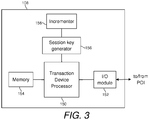
- FIG. 3 shows the transaction device 108 in greater detail.
- the transaction device 108 comprises a transaction device processor 150 for controlling the transaction device 108.
- the transaction device 108 further comprises an I/O module 152 for communicating with the POI 102, a memory 154 for securely storing data, a session key generator 156 and an incrementer 158.
- the I/O module 152, the memory 154 and the session key generator 156 are each connected to the transaction device processor 150.
- the incrementer 158 is connected to the session key generator 156 which uses the incrementer 158 to generate a session key for a transaction.
- the memory 154 stores information associated with the user, for example a PIN or biometric data.
- the POI 102 obtains information associated with the user and sends the information to the transaction device 108 for verification with the data stored in the memory 154.
- the transaction device processor 150 is arranged to determine whether the received information corresponds to an authorised user of the transaction device 108.
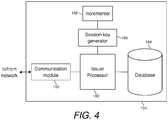
- FIG. 4 shows the issuer 104 in greater detail.
- the issuer 104 comprises an issuer processor 180 for controlling the issuer 104.
- the issuer 104 further comprises a communication module 182 for communicating with the network 106, a database 184, a session key generator 186 and an incrementer 188.
- the communication module 182, the database 184 and the session key generator 186 are each connected to the issuer processor 180.
- the incrementer 188 is connected to the session key generator 186 which uses the incrementer 188 to generate a session key for a transaction.
- the database 184 comprises information associated with the transaction device 108 such as a transaction device number, a security code (e.g. a card security code, card verification data, a card verification number, a card verification value, a card verification value code, a card verification code a or signature panel code), a name of an authorised user, an address of an authorised user, time validity and an available balance of credit of the user.
- a security code e.g. a card security code, card verification data, a card verification number, a card verification value, a card verification value code, a card verification code a or signature panel code
- the session key generator 156 of the transaction device 108 and the session key generator 186 of the issuer 104 are arranged in substantially the same way to perform a function to generate a session key that is different for each transaction.
- the input to the function is obtained from the incremeters 158 and 188 of the transaction device 108 and the issuer 104 respectively.
- the incrementers 158 and 188 independently count the total number of transactions carried out using the transaction device 108.
- the incrementer 158 of the transaction device 108 counts the number of transactions by counting the number of times it carries out (successful or unsuccessful) transactions with POIs.
- the incrementer 188 of the issuer 104 counts the number of transaction by counting the number of times it is requested to approve or deny a transaction. Accordingly, the independent counts maintained by the incrementers 158 and 188 remain synchronised.
- the incrementers 158 and 188 may both be configured to ascend the same predetermined number sequence using the transaction number to determine the position in the number sequence.
- the incrementers 158 and 188 may be clocks that are synchronised at an initial time.
- the communications between the transaction device 108 and the POI 102, and between the issuer 104 and the POI 102, are referred to as 'responses'. Further, the examples below do not illustrate all communications that occur during a transaction for clarity.
- Figures 5 to 8 below show example dataflows between the transaction device 108, POI 102 and issuer 104 and the generation of session keys by the issuer 104 and the transaction device 108. It is noted that the session keys can be generated by the issuer 104 and the transaction device 108 respectively at any time prior to them being sent to the POI 102, and not necessarily in the sequence shown in dataflows 198 and 250.
- Figure 5 shows an example dataflow 198 between the transaction device 108, the POI 102 and the issuer 104 in which the communications from the issuer 104 are authenticated.
- the session key generator 156 of the transaction device 108 generates at Step 200 a session key for the transaction.
- the transaction device 108 sends at Step 202 a device response, a device cryptogram and a session key to the POI 102.
- the POI 102 forwards at Step 204 the device response and the device cryptogram to the issuer 104 via the network 106.
- the issuer 104 processes at Step 206 the device response and the device cryptogram to check if the transaction is valid.
- the issuer 104 uses the information associated with the transaction device in the database 184 to determine whether the transaction should be approved or denied based on the transaction data comprising the device response and the device cryptogram.
- the session key generator 186 of the issuer 104 generates at Step 208 a session key for the transaction.
- the response of the issuer regarding the allowability of the transaction and the session key are then sent at Step 210 back to the POI.
- the POI 102 then compares at Step 212 the session key from the transaction device 108 and the session key from the issuer 104 to determine whether they match. If they match, then the POI 102 can trust that the issuer response is valid. Accordingly, the response received by the POI 102 regarding whether the transaction should be approved or denied is a genuine response.
- Figure 6 shows an example dataflow 250 between the transaction device 108, the POI 102 and the issuer 104 in which the communications from the transaction device 108 are authenticated.
- the transaction device 108 and the POI 102 form a temporary connection between the I/O module 132 of the POI and the I/O module 152 of the transaction device for carrying out a payment transaction
- the transaction device 108 sends at Step 252 transaction data comprising a first device response and a first device cryptogram to the POI 102.
- the POI 102 then forwards at Step 254 the transaction data to the issuer 104.
- the issuer 104 processes at Step 256 the first device response and the first device cryptogram to check if the transaction is valid.
- the issuer 104 uses the information associated with the transaction device in the database 184 to determine whether the transaction should be approved or denied based on the transaction data in the first device response and the first device cryptogram.
- the issuer 104 determines the allowability of the transaction that is conditional on successful identity verification of the user of the transaction device. In other examples, the issuer response is not conditional on identity verification of the user.
- the session key generator 186 of the issuer 104 generates at Step 258 a session key for the transaction.
- the response of the issuer regarding the allowability of the transaction and the session key are then sent at Step 260 back to the POI 102.
- the display 140 indicates to the user to provide information associated with them that can be used to verify their identity (e.g. the user's PIN).
- the POI 102 sends at Step 262 the information associated with the user to the transaction device 108.
- the transaction device processor 150 Upon receiving the information associated with the user, the transaction device processor 150 verifies at Step 264 that the user is authorised to use the transaction device. This verification is done by comparing the received information associated with the user with the information associated with the user stored in the memory 154.
- the session key generator 156 of the transaction device 108 generates at Step 266 a session key for the transaction.
- the response of the issuer sent at Step 260 is forwarded at Step 268 to the transaction device 108.
- the transaction device 108 processes at Step 270 the response of the issuer.
- the transaction device 108 sends at Step 272 a second device response along with a second device cryptogram and the session key generated at Step 266.
- the second device response comprises information including whether the identity of the user was successfully verified.
- the POI 102 compares at Step 274 the session key from the transaction device 108 and the session key from the issuer 104 to determine whether they match. If they match, then the POI 102 can trust that the second device response is valid. Accordingly, the response received by the POI 102 regarding whether the user is authorised to use the transaction device 108 is a genuine response.
- Steps 262, 264 and 266 may be carried out substantially at the same time as Steps 254, 256, 258, 260 and 268. Carrying out these steps in parallel reduces the overall time required to carry out the transaction.
- the dataflows of Figures 7 and 8 are substantially similar to the dataflows of Figures 5 and 6 respectively.
- the transaction device 108 and the issuer 104 do not both send the session key to the POI 102. Instead, one device sends the session key and the other devices sends data associated with the session key, for example, a response or cryptogram signed with the session key.
- the POI 102 then verifies the signed cryptogram or response using the received session key. This is discussed in more detail below.
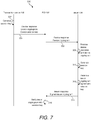
- Figure 7 shows an example dataflow 300 between the transaction device 108, the POI 102 and the issuer 104 in which the communications from the issuer 104 are authenticated.
- the session key generator 156 of the transaction device 108 generates at Step 302 a session key for the transaction.
- the transaction device 108 sends at Step 304 a device response, a device cryptogram and a session key to the POI 102.
- the POI 102 forwards at Step 306 the device response and the device cryptogram to the issuer 104 via the network 106.
- the issuer 104 processes at Step 308 the device response and the device cryptogram to check if the transaction is valid.
- the issuer 104 uses the information associated with the transaction device in the database 184 to determine whether the transaction should be approved or denied based on the transaction data comprising the device response and the device cryptogram.
- the session key generator 186 of the issuer 104 generates at Step 310 a session key for the transaction.
- the issuer 104 then generates at Step 312 a cryptogram that is signed with the session key.
- the response of the issuer regarding the allowability of the transaction and the signed issuer cryptogram are then sent at Step 314 back to the POI.
- the POI 102 then verifies at Step 316 the signed issuer cryptogram using an authentication algorithm and the session key from the transaction device 108 to infer the session key generated by the issuer 104. If the issuer cryptogram is successfully verified, then the POI 102 can trust that the issuer response is valid. Accordingly, the response received by the POI 102 regarding whether the transaction should be approved or denied is a genuine response.
- Figure 8 shows an example dataflow 350 between the transaction device 108, the POI 102 and the issuer 104 in which the communications from the transaction device 108 are authenticated.
- the transaction device 108 and the POI 102 form a temporary connection between the I/O module 132 of the POI and the I/O module 152 of the transaction device for carrying out a payment transaction
- the transaction device 108 sends at Step 352 transaction data comprising a first device response and a first device cryptogram to the POI 102.
- the POI 102 then forwards at Step 354 the transaction data to the issuer 104.
- the issuer 104 processes at Step 356 the first device response and the first device cryptogram to check if the transaction is valid.
- the issuer 104 uses the information associated with the transaction device in the database 184 to determine whether the transaction should be approved or denied based on the transaction data in the first device response and the first device cryptogram.
- the issuer 104 determines the allowability of the transaction that is conditional on successful identity verification of the user of the transaction device. In other embodiments, the issuer response is not conditional on identity verification of the user.
- the session key generator 186 of the issuer 104 generates at Step 358 a session key for the transaction.
- the response of the issuer regarding the allowability of the transaction and the session key are then sent at Step 360 back to the POI 102.
- the display 140 indicates to the user to provide information associated with them that can be used to verify their identity (e.g. the user's PIN).
- the POI 102 sends at Step 362 the information associated with the user to the transaction device 108.
- the transaction device processor 150 Upon receiving the information associated with the user, the transaction device processor 150 verifies at Step 364 that the user is authorised to use the transaction device. This verification is done by comparing the received information associated with the user with the information associated with the user stored in the memory 154.
- the session key generator 156 of the transaction device 108 generates at Step 366 a session key for the transaction.
- the response of the issuer sent at Step 360 is forwarded at Step 368 to the transaction device 108.
- the transaction device 108 processes at Step 370 the response of the issuer. Then the transaction device 108 generates at Step 372 a cryptogram that is signed with the session key.
- the transaction device 108 sends at Step 374 a second device response along with the signed second device cryptogram.
- the second device response comprises information including whether the identity of the user was successfully verified.
- the POI 102 then verifies at Step 376 the signed transaction device cryptogram using an authentication algorithm and the session key from the issuer 104 to infer the session key generated by the transaction device 108. If the transaction device cryptogram is successfully verified, then the POI 102 can trust that the transaction device response is valid. Accordingly, the response received by the POI 102 regarding whether the user is authorised to use the transaction device 108 is a genuine response.
- Steps 362, 364 and 366 may be carried out substantially at the same time as Steps 354, 356, 358, 360 and 368. Carrying out these steps in parallel reduces the overall time required to carry out the transaction.
- the transaction device may comprise an identity information receiver instead of the POI.
- a user may provide information to verify their identity before the transaction device performs any communication with a POI.
- a further example is where the issuer 104 does not comprise an incrementer. Instead, an output value of the incrementer 158 of the transaction device 108 is sent to the issuer 104 with the first transaction device response (i.e. in Step 202, 252, 304 or 352).
- the output value is signed by the transaction device 108 so that the issuer can trust the output value.
- Freshness of the session key e.g. to prevent a replay attack, where the same input variables are provided
- the POI 102 sends the random value to the issuer 104.
- the issuer 104 can then verify that the transaction device 108 has signed the random value so that this signature cannot be pre-computed and cannot be replayed as the random value is unpredictable and changes for every transaction.
- the issuer 104 receives the output value of the incrementer 158 and checks that it is fresh (i.e. has not been used before) and genuine by verifying the signature.
- the issuer 104 uses the output value of the incrementer 158 of the transaction device 108 to compute the session key.
Landscapes
- Engineering & Computer Science (AREA)
- Computer Security & Cryptography (AREA)
- Business, Economics & Management (AREA)
- Accounting & Taxation (AREA)
- Signal Processing (AREA)
- Computer Networks & Wireless Communication (AREA)
- Theoretical Computer Science (AREA)
- General Physics & Mathematics (AREA)
- Physics & Mathematics (AREA)
- General Business, Economics & Management (AREA)
- Strategic Management (AREA)
- Finance (AREA)
- Computer Hardware Design (AREA)
- General Engineering & Computer Science (AREA)
- Computing Systems (AREA)
- Power Engineering (AREA)
- Software Systems (AREA)
- Financial Or Insurance-Related Operations Such As Payment And Settlement (AREA)
- Computer And Data Communications (AREA)
Description
- The present invention relates to authentication of communications, more particularly but not exclusively to authentication of communications in a transaction between an issuer and a Point of Interaction, and between a transaction device and a Point of Interaction in a payment transaction.
- In a typical payment transaction between a transaction device (e.g. a contact or contactless integrated circuit chip card) and a Point of Interaction (POI, e.g. a card payment terminal, an automated teller machine or an online payment terminal), transaction data is sent by the POI to an issuer for approval and verification. The response of the issuer to the POI, for example, to approve or decline the payment transaction, is sent back to the POI which can then take action accordingly.
- However, if the communications between the issuer and the POI were intercepted by a fraudulent user, then the response from the issuer could be modified. For example, a response to decline a payment transaction could be changed to an approval. The POI would then approve the transaction as it is unable to verify that the response from the issuer is authentic. Generally, the fraud would be noticed when the payment transaction undergoes clearing, but this may be too late to prevent the fraudulent user from obtaining any goods or services paid for by the fraudulent payment transaction.
- A typical payment transaction may also involve a user of the transaction device verifying their identity by entering a Personal Identification Number (PIN) or by undergoing biometric authentication (e.g. fingerprint or finger vein recognition, iris scanning etc.) at the POI. The POI then sends the information identifying the user to the transaction device for verification. The transaction device can then respond to the POI as to whether the verification was successful or failed.
- However, if the communications between the transaction device and the POI were intercepted by a fraudulent user, then the response from the transaction device could be modified. For example, the result of a PIN verification could be changed from failed to successful. Generally, the fraud would be noticed when the payment transaction undergoes clearing, but this may be too late to prevent the fraudulent user from obtaining any goods or services paid for by the fraudulent payment transaction.
- An article entitled "Keep Your Enemies Close: Distance Bounding Against Smartcard Relay Attacks", by Saar Drimer and Steven J Murdoch Computer Laboratory et al. (8 August 2007) describes a distance bounding protocol with the aim of preventing relay attacks.
- The present invention has been devised to mitigate or overcome at least some of the above-mentioned problems.
- According to an aspect of the present invention, there is provided a method of authenticating a communication network comprising a transaction device, an issuer entity and a point of interaction device, wherein there is a first path between the transaction device and the point of interaction device and a second path between the issuer entity and the point of interaction device, the method being executed at the point of interaction device and comprising: receiving, from the transaction device, a first session key, the first session key being generated by the transaction device using a function, wherein an input to the function comprises an incremented variable; receiving, from the transaction device, a first device response and a first device cryptogram; forwarding the first device response and the first device cryptogram to the issuer entity for validation; receiving, from the issuer entity, a second device response regarding allowability of a transaction following processing of the first device response and the first device cryptogram by the issuer entity, and a second device cryptogram that is signed with a second session key, the second session key being generated by the issuer entity using the function; verifying the second device cryptogram by determining that the first session key matches the second session key; and defining the communication network as authentic in the event that the second device cryptogram is verified.
- Accordingly, in order to defraud the transaction, an attacker would have to tamper with both the session key received from the transaction device as well as the session key from the issuer entity.
- The step of determining may comprise directly comparing the first session key and the second session key.
- Preferably, the incremented variable is a count of the number of transactions carried out by the transaction device. Alternatively, the incremented variable is a time.
- Preferably, the first session key is received with data associated with a transaction. Optionally, the second session key is received with data associated with a transaction.
- Preferably, the transaction device is arranged to carry out transactions with the point of interaction device.
- Preferably, the issuer entity is arranged to validate transactions between the transaction device and the point of interaction device.
- A non-transitory computer-readable storage medium storing executable computer program instructions may be configured to implement the above method.
- According to an aspect of the present invention, there is provided a point of interaction device suitable for authenticating a communication network, the communication network comprising a transaction device, an issuer entity and a point of interaction device, wherein there is a first path between the transaction device and the point of interaction device and a second path between the issuer entity and the point of interaction device, the point of interaction device comprising: a first input, arranged to receive: a first session key from the transaction device, the first session key being generated by the transaction device using a function, wherein an input to the function comprises an incremented variable; a first device response from the transaction device; and a first device cryptogram from the transaction device; an output, arranged to forward the first device response and the first device cryptogram to the issuer entity for validation; a second input, arranged to receive a second device response regarding allowability of a transaction following processing of the first device response and the first device cryptogram by the issuer entity, and a second device cryptogram that is signed with a second session key from the issuer entity, the second session key being generated by the issuer entity using the function; a processor arranged to verify the second device cryptogram by determining that the first session key matches the second session key, and define that the communication network is authentic in the event that the second device cryptogram is verified.
- The processor may be arranged to determine that the first session key and the second session key are the same by directly comparing the first session key and the second session key.
- Preferably, the first input and the second input are the same.
- Additionally, the point of interaction device may comprise an output arranged to output a verification message to the transaction device or the issuer entity device, wherein the verification message comprises whether the communication was successfully authenticated by the point of interaction device.
- Optionally, the point of interaction device may comprise a display and an output arranged to output a transaction outcome to the display.
- In order that the invention may be more readily understood, embodiments of the invention will now be described in more detail, by way of example only, and with reference to the following figures in which:
-
Figure 1 is a schematic block diagram of an environment in which an embodiment of the present invention is carried out; -
Figure 2 is a schematic block diagram of a Point of Interaction according to an embodiment of the present invention; -
Figure 3 is a schematic block diagram of a transaction device according to an embodiment of the present invention; -
Figure 4 is a schematic block diagram of an issuer according to an embodiment of the present invention; -
Figures 5 ,6 and8 are example dataflows; and -
Figure 7 is a dataflow according to an embodiment of the invention. - The present invention provides a system and method for authenticating responses in data communications between a first party and a second party via an intermediary by signing the responses with a session key independently generated by each party and sent to the intermediary for validation. In the embodiments described below, the intermediary is a POI, the first party is a transaction device and the second party is an issuer. Accordingly, in order to defraud the transaction, an attacker would have to tamper with both the communication channel between the transaction device and the POI as well as the communication channel between the POI and the issuer.
-
Figure 1 shows anexample environment 100 in which a transaction can occur. The environment comprises a Point of Interaction (POI) 102 and anissuer 104 each with separate data connections to anetwork 106. Thenetwork 106 allows two way data transfer between any of the entities connected to it. For example, thenetwork 106 may be a local area network, wide area network or the Internet. - The
POI 102 is arranged to form temporary communication channels with atransaction device 108 to carry out transactions. ThePOI 102 may be a card payment terminal, an automated teller machine or an online payment terminal, and thetransaction device 108 may be a contact or contactless integrated circuit chip card. During a transaction, thePOI 102 sends and receives transaction data to and from theissuer 104 via thenetwork 106. - The
issuer 104 is arranged to process the transaction data and determine whether the transaction should be allowed to complete or be rejected. For example, if there are insufficient funds to complete the transaction or the transaction device has expired etc. Theissuer 104 sends a response communication to thePOI 102 comprising its determination of whether the transaction should be approved or declined. - The
transaction device 108 is associated with a user. Accordingly, the transaction device is arranged to only allow the user to carry out transactions (see also the description relating toFigure 3 below). -
Figure 2 shows thePOI 102 in greater detail. ThePOI 102 comprises aPOI processor 130 for controlling thePOI 102. ThePOI 102 further comprises an input/output (I/O)module 132 for communicating with thetransaction device 108, acommunication module 134 for communicating with thenetwork 106, anidentity information receiver 136 for verifying the identity of a user of thetransaction device 108, asession key comparator 138 for validating received session keys and adisplay 140 for providing visual feedback to users. The I/O module 132, thecommunication module 134, theidentity information receiver 136, thesession key comparator 138 and thedisplay 140 are each connected to thePOI processor 130. - The
identity information receiver 136 is arranged to obtain verifiable information associated with the user. For example, theidentity information receiver 136 may comprise a PIN-entry pad, a keyboard suitable for password input, a fingerprint scanner, a finger vein scanner or an iris scanner. -
Figure 3 shows thetransaction device 108 in greater detail. Thetransaction device 108 comprises atransaction device processor 150 for controlling thetransaction device 108. Thetransaction device 108 further comprises an I/O module 152 for communicating with thePOI 102, amemory 154 for securely storing data, a sessionkey generator 156 and anincrementer 158. The I/O module 152, thememory 154 and the sessionkey generator 156 are each connected to thetransaction device processor 150. Theincrementer 158 is connected to the sessionkey generator 156 which uses theincrementer 158 to generate a session key for a transaction. - The
memory 154 stores information associated with the user, for example a PIN or biometric data. During transactions, thePOI 102 obtains information associated with the user and sends the information to thetransaction device 108 for verification with the data stored in thememory 154. Thetransaction device processor 150 is arranged to determine whether the received information corresponds to an authorised user of thetransaction device 108. -
Figure 4 shows theissuer 104 in greater detail. Theissuer 104 comprises anissuer processor 180 for controlling theissuer 104. Theissuer 104 further comprises acommunication module 182 for communicating with thenetwork 106, adatabase 184, a sessionkey generator 186 and anincrementer 188. Thecommunication module 182, thedatabase 184 and the sessionkey generator 186 are each connected to theissuer processor 180. Theincrementer 188 is connected to the sessionkey generator 186 which uses theincrementer 188 to generate a session key for a transaction. - The
database 184 comprises information associated with thetransaction device 108 such as a transaction device number, a security code (e.g. a card security code, card verification data, a card verification number, a card verification value, a card verification value code, a card verification code a or signature panel code), a name of an authorised user, an address of an authorised user, time validity and an available balance of credit of the user. - The session
key generator 156 of thetransaction device 108 and the sessionkey generator 186 of theissuer 104 are arranged in substantially the same way to perform a function to generate a session key that is different for each transaction. The input to the function is obtained from theincremeters transaction device 108 and theissuer 104 respectively. Theincrementers transaction device 108. Theincrementer 158 of thetransaction device 108 counts the number of transactions by counting the number of times it carries out (successful or unsuccessful) transactions with POIs. Theincrementer 188 of theissuer 104 counts the number of transaction by counting the number of times it is requested to approve or deny a transaction. Accordingly, the independent counts maintained by theincrementers - The
incrementers incrementers - In the examples below, the communications between the
transaction device 108 and thePOI 102, and between theissuer 104 and thePOI 102, are referred to as 'responses'. Further, the examples below do not illustrate all communications that occur during a transaction for clarity. -
Figures 5 to 8 below show example dataflows between thetransaction device 108,POI 102 andissuer 104 and the generation of session keys by theissuer 104 and thetransaction device 108. It is noted that the session keys can be generated by theissuer 104 and thetransaction device 108 respectively at any time prior to them being sent to thePOI 102, and not necessarily in the sequence shown indataflows -
Figure 5 shows anexample dataflow 198 between thetransaction device 108, thePOI 102 and theissuer 104 in which the communications from theissuer 104 are authenticated. Once thetransaction device 108 and thePOI 102 form a temporary connection between the I/O module 132 of the POI and the I/O module 152 of the transaction device for carrying out a payment transaction, the sessionkey generator 156 of thetransaction device 108 generates at Step 200 a session key for the transaction. Then thetransaction device 108 sends at Step 202 a device response, a device cryptogram and a session key to thePOI 102. ThePOI 102 forwards atStep 204 the device response and the device cryptogram to theissuer 104 via thenetwork 106. - Following this, the
issuer 104 processes atStep 206 the device response and the device cryptogram to check if the transaction is valid. Theissuer 104 uses the information associated with the transaction device in thedatabase 184 to determine whether the transaction should be approved or denied based on the transaction data comprising the device response and the device cryptogram. - The session
key generator 186 of theissuer 104 generates at Step 208 a session key for the transaction. The response of the issuer regarding the allowability of the transaction and the session key are then sent atStep 210 back to the POI. ThePOI 102 then compares atStep 212 the session key from thetransaction device 108 and the session key from theissuer 104 to determine whether they match. If they match, then thePOI 102 can trust that the issuer response is valid. Accordingly, the response received by thePOI 102 regarding whether the transaction should be approved or denied is a genuine response. -
Figure 6 shows anexample dataflow 250 between thetransaction device 108, thePOI 102 and theissuer 104 in which the communications from thetransaction device 108 are authenticated. Once thetransaction device 108 and thePOI 102 form a temporary connection between the I/O module 132 of the POI and the I/O module 152 of the transaction device for carrying out a payment transaction, thetransaction device 108 sends atStep 252 transaction data comprising a first device response and a first device cryptogram to thePOI 102. ThePOI 102 then forwards atStep 254 the transaction data to theissuer 104. - Following this, the
issuer 104 processes atStep 256 the first device response and the first device cryptogram to check if the transaction is valid. Theissuer 104 uses the information associated with the transaction device in thedatabase 184 to determine whether the transaction should be approved or denied based on the transaction data in the first device response and the first device cryptogram. Theissuer 104 determines the allowability of the transaction that is conditional on successful identity verification of the user of the transaction device. In other examples, the issuer response is not conditional on identity verification of the user. - The session
key generator 186 of theissuer 104 generates at Step 258 a session key for the transaction. The response of the issuer regarding the allowability of the transaction and the session key are then sent atStep 260 back to thePOI 102. - After the
transaction device 108 sends inStep 252 the first device response and the first device cryptogram to thePOI 102, thedisplay 140 indicates to the user to provide information associated with them that can be used to verify their identity (e.g. the user's PIN). ThePOI 102 sends atStep 262 the information associated with the user to thetransaction device 108. - Upon receiving the information associated with the user, the
transaction device processor 150 verifies atStep 264 that the user is authorised to use the transaction device. This verification is done by comparing the received information associated with the user with the information associated with the user stored in thememory 154. - Then the session
key generator 156 of thetransaction device 108 generates at Step 266 a session key for the transaction. - The response of the issuer sent at
Step 260 is forwarded atStep 268 to thetransaction device 108. Thetransaction device 108 processes atStep 270 the response of the issuer. Then thetransaction device 108 sends at Step 272 a second device response along with a second device cryptogram and the session key generated atStep 266. The second device response comprises information including whether the identity of the user was successfully verified. - The
POI 102 then compares atStep 274 the session key from thetransaction device 108 and the session key from theissuer 104 to determine whether they match. If they match, then thePOI 102 can trust that the second device response is valid. Accordingly, the response received by thePOI 102 regarding whether the user is authorised to use thetransaction device 108 is a genuine response. -
Steps Steps - The dataflows of
Figures 7 and8 are substantially similar to the dataflows ofFigures 5 and6 respectively. However, in the embodiments described with reference toFigure 7 and in the example described with reference toFigure 8 , thetransaction device 108 and theissuer 104 do not both send the session key to thePOI 102. Instead, one device sends the session key and the other devices sends data associated with the session key, for example, a response or cryptogram signed with the session key. ThePOI 102 then verifies the signed cryptogram or response using the received session key. This is discussed in more detail below. -
Figure 7 shows anexample dataflow 300 between thetransaction device 108, thePOI 102 and theissuer 104 in which the communications from theissuer 104 are authenticated. Once thetransaction device 108 and thePOI 102 form a temporary connection between the I/O module 132 of the POI and the I/O module 152 of the transaction device for carrying out a payment transaction, the sessionkey generator 156 of thetransaction device 108 generates at Step 302 a session key for the transaction. Then thetransaction device 108 sends at Step 304 a device response, a device cryptogram and a session key to thePOI 102. ThePOI 102 forwards atStep 306 the device response and the device cryptogram to theissuer 104 via thenetwork 106. - Following this, the
issuer 104 processes atStep 308 the device response and the device cryptogram to check if the transaction is valid. Theissuer 104 uses the information associated with the transaction device in thedatabase 184 to determine whether the transaction should be approved or denied based on the transaction data comprising the device response and the device cryptogram. - The session
key generator 186 of theissuer 104 generates at Step 310 a session key for the transaction. Theissuer 104 then generates at Step 312 a cryptogram that is signed with the session key. - The response of the issuer regarding the allowability of the transaction and the signed issuer cryptogram are then sent at
Step 314 back to the POI. ThePOI 102 then verifies atStep 316 the signed issuer cryptogram using an authentication algorithm and the session key from thetransaction device 108 to infer the session key generated by theissuer 104. If the issuer cryptogram is successfully verified, then thePOI 102 can trust that the issuer response is valid. Accordingly, the response received by thePOI 102 regarding whether the transaction should be approved or denied is a genuine response. -
Figure 8 shows anexample dataflow 350 between thetransaction device 108, thePOI 102 and theissuer 104 in which the communications from thetransaction device 108 are authenticated. Once thetransaction device 108 and thePOI 102 form a temporary connection between the I/O module 132 of the POI and the I/O module 152 of the transaction device for carrying out a payment transaction, thetransaction device 108 sends atStep 352 transaction data comprising a first device response and a first device cryptogram to thePOI 102. ThePOI 102 then forwards atStep 354 the transaction data to theissuer 104. - Following this, the
issuer 104 processes atStep 356 the first device response and the first device cryptogram to check if the transaction is valid. Theissuer 104 uses the information associated with the transaction device in thedatabase 184 to determine whether the transaction should be approved or denied based on the transaction data in the first device response and the first device cryptogram. Theissuer 104 determines the allowability of the transaction that is conditional on successful identity verification of the user of the transaction device. In other embodiments, the issuer response is not conditional on identity verification of the user. - The session
key generator 186 of theissuer 104 generates at Step 358 a session key for the transaction. The response of the issuer regarding the allowability of the transaction and the session key are then sent atStep 360 back to thePOI 102. - After the
transaction device 108 sends inStep 352 the first device response and the first device cryptogram to thePOI 102, thedisplay 140 indicates to the user to provide information associated with them that can be used to verify their identity (e.g. the user's PIN). ThePOI 102 sends atStep 362 the information associated with the user to thetransaction device 108. - Upon receiving the information associated with the user, the
transaction device processor 150 verifies atStep 364 that the user is authorised to use the transaction device. This verification is done by comparing the received information associated with the user with the information associated with the user stored in thememory 154. - Then the session
key generator 156 of thetransaction device 108 generates at Step 366 a session key for the transaction. - The response of the issuer sent at
Step 360 is forwarded atStep 368 to thetransaction device 108. Thetransaction device 108 processes atStep 370 the response of the issuer. Then thetransaction device 108 generates at Step 372 a cryptogram that is signed with the session key. - Then the
transaction device 108 sends at Step 374 a second device response along with the signed second device cryptogram. The second device response comprises information including whether the identity of the user was successfully verified. - The
POI 102 then verifies atStep 376 the signed transaction device cryptogram using an authentication algorithm and the session key from theissuer 104 to infer the session key generated by thetransaction device 108. If the transaction device cryptogram is successfully verified, then thePOI 102 can trust that the transaction device response is valid. Accordingly, the response received by thePOI 102 regarding whether the user is authorised to use thetransaction device 108 is a genuine response. -
Steps Steps - Many modifications may be made to the above examples without departing from the scope of the present invention as defined in the accompanying claims.
- For example, the transaction device may comprise an identity information receiver instead of the POI. In this case a user may provide information to verify their identity before the transaction device performs any communication with a POI.
- A further example is where the
issuer 104 does not comprise an incrementer. Instead, an output value of theincrementer 158 of thetransaction device 108 is sent to theissuer 104 with the first transaction device response (i.e. inStep transaction device 108 so that the issuer can trust the output value. Freshness of the session key (e.g. to prevent a replay attack, where the same input variables are provided) is ensured by a random value generated by thePOI 102 and sent to thetransaction device 108 and also signed by thetransaction device 108 along with the output value of theincrementer 158. ThePOI 102 sends the random value to theissuer 104. Theissuer 104 can then verify that thetransaction device 108 has signed the random value so that this signature cannot be pre-computed and cannot be replayed as the random value is unpredictable and changes for every transaction. Theissuer 104 receives the output value of theincrementer 158 and checks that it is fresh (i.e. has not been used before) and genuine by verifying the signature. Theissuer 104 then uses the output value of theincrementer 158 of thetransaction device 108 to compute the session key.
Claims (10)
- A method of authenticating a communication network comprising a transaction device (108), an issuer entity (104) and a point of interaction device (102), wherein there is a first path between the transaction device (108) and the point of interaction device (102) and a second path between the issuer entity (104) and the point of interaction device (102), the method being executed at the point of interaction device (102) and comprising:receiving, from the transaction device (108), a first session key, the first session key being generated (304) by the transaction device (108) using a function, wherein an input to the function comprises an incremented variable;receiving, from the transaction device (108), a first device response and a first device cryptogram;forwarding (306) the first device response and the first device cryptogram to the issuer entity (104) for validation;receiving, from the issuer entity (104), a second device response regarding allowability of a transaction following processing of the first device response and the first device cryptogram by the issuer entity (104), and a second device cryptogram that is signed with a second session key, the second session key being generated (310) by the issuer entity (104) using the function;verifying (316) the second device cryptogram by determining that the first session key matches the second session key; anddefining the communication network as authentic in the event that the second device cryptogram is verified.
- The method of authenticating a communication network of Claim 1, wherein the step of determining comprises directly comparing the first session key and the second session key.
- The method of authenticating a communication network of Claim 1 or Claim 2, wherein the incremented variable is a count of the number of transactions carried out by the transaction device (108), or the incremented variable is a time.
- The method of authenticating a communication network of any preceding claim, wherein the first session key is received with data associated with a transaction and/or the second session key is received with data associated with a transaction.
- The method of authenticating a communication network of any preceding claim, wherein the transaction device (108) is arranged to carry out transactions with the point of interaction device (102), and the issuer entity (104) is arranged to validate transactions between the transaction device (108) and the point of interaction device (102).
- A non-transitory computer-readable storage medium storing executable computer program instructions for implementing on a point of interaction device the method of any preceding claim.
- A point of interaction device suitable for authenticating a communication network, the communication network comprising a transaction device (108), an issuer entity (104) and a point of interaction device (102), wherein there is a first path between the transaction device (108) and the point of interaction device (102) and a second path between the issuer entity (104) and the point of interaction device (102), the point of interaction device (102) comprising:a first input, arranged to receive:a first session key from the transaction device (108), the first session key being generated by the transaction device (108) using a function, wherein an input to the function comprises an incremented variable;a first device response from the transaction device (108); anda first device cryptogram from the transaction device (108);an output, arranged to forward the first device response and the first device cryptogram to the issuer entity (104) for validation;a second input, arranged to receive a second device response regarding allowability of a transaction following processing of the first device response and the first device cryptogram by the issuer entity (104), and a second device cryptogram that is signed with a second session key from the issuer entity (104), the second session key being generated by the issuer entity (104) using the function;a processor arranged to verify the second device cryptogram by determining that the first session key matches the second session key, and define that the communication network is authentic in the event that the second device cryptogram is verified.
- The point of interaction device of Claim 7, wherein the first input and the second input are the same.
- The point of interaction device of Claim 7 or Claim 8, comprising an output arranged to output a verification message to the transaction device (108) or the issuer entity (104), wherein the verification message comprises whether the communication was successfully authenticated by the point of interaction device (102).
- The point of interaction device of any of Claims 7 to 9, comprising a display and an output arranged to output a transaction outcome to the display.
Applications Claiming Priority (2)
| Application Number | Priority Date | Filing Date | Title |
|---|---|---|---|
| GB1416282.0A GB2530258A (en) | 2014-09-15 | 2014-09-15 | Authentication of communications |
| PCT/EP2015/071039 WO2016041931A1 (en) | 2014-09-15 | 2015-09-15 | Authentication of communications |
Publications (2)
| Publication Number | Publication Date |
|---|---|
| EP3195520A1 EP3195520A1 (en) | 2017-07-26 |
| EP3195520B1 true EP3195520B1 (en) | 2021-04-28 |
Family
ID=51869629
Family Applications (1)
| Application Number | Title | Priority Date | Filing Date |
|---|---|---|---|
| EP15777616.2A Active EP3195520B1 (en) | 2014-09-15 | 2015-09-15 | Authentication of communications |
Country Status (4)
| Country | Link |
|---|---|
| US (1) | US20160080151A1 (en) |
| EP (1) | EP3195520B1 (en) |
| GB (1) | GB2530258A (en) |
| WO (1) | WO2016041931A1 (en) |
Families Citing this family (2)
| Publication number | Priority date | Publication date | Assignee | Title |
|---|---|---|---|---|
| CN106941487B (en) | 2017-02-24 | 2021-01-05 | 创新先进技术有限公司 | Data sending method and device |
| US11882438B2 (en) * | 2018-10-29 | 2024-01-23 | Zorday IP, LLC | Network-enabled electronic cigarette |
Family Cites Families (8)
| Publication number | Priority date | Publication date | Assignee | Title |
|---|---|---|---|---|
| US20080301776A1 (en) * | 2001-02-14 | 2008-12-04 | Weatherford Sidney L | System method for providing secure access to a communications network |
| US20030053629A1 (en) * | 2001-09-14 | 2003-03-20 | Koninklijke Philips Electronics N.V. | USB authentication interface |
| EP1836543A1 (en) * | 2004-12-22 | 2007-09-26 | Telecom Italia S.p.A. | Method and system for access control and data protection in digital memories, related digital memory and computer program product therefor |
| US8752770B2 (en) * | 2008-08-19 | 2014-06-17 | Mastercard International Incorporated | Methods and systems to remotely issue proximity payment devices |
| WO2010081218A1 (en) * | 2009-01-13 | 2010-07-22 | Neville Stephen W | Secure protocol for transactions |
| US11514451B2 (en) * | 2011-03-15 | 2022-11-29 | Capital One Services, Llc | Systems and methods for performing financial transactions using active authentication |
| WO2013109370A2 (en) * | 2012-01-18 | 2013-07-25 | Square, Inc. | Secure communications between devices and a trusted server |
| US9203874B2 (en) * | 2013-01-14 | 2015-12-01 | Sap Portals Israel Ltd | Portal multi-device session context preservation |
-
2014
- 2014-09-15 GB GB1416282.0A patent/GB2530258A/en not_active Withdrawn
-
2015
- 2015-09-10 US US14/850,286 patent/US20160080151A1/en not_active Abandoned
- 2015-09-15 WO PCT/EP2015/071039 patent/WO2016041931A1/en not_active Ceased
- 2015-09-15 EP EP15777616.2A patent/EP3195520B1/en active Active
Non-Patent Citations (1)
| Title |
|---|
| TIMO OLKKONEN: "Generic Authentication Architecture", 11 December 2006 (2006-12-11), XP055519153, Retrieved from the Internet <URL:https://pdfs.semanticscholar.org/7325/61fa7c0d24459a4b61e8fdb0bb3a29deb4fb.pdf> [retrieved on 20181025] * |
Also Published As
| Publication number | Publication date |
|---|---|
| US20160080151A1 (en) | 2016-03-17 |
| WO2016041931A1 (en) | 2016-03-24 |
| EP3195520A1 (en) | 2017-07-26 |
| GB2530258A (en) | 2016-03-23 |
| GB201416282D0 (en) | 2014-10-29 |
Similar Documents
| Publication | Publication Date | Title |
|---|---|---|
| US11895491B2 (en) | Method and system for provisioning access data to mobile device | |
| EP3138265B1 (en) | Enhanced security for registration of authentication devices | |
| US20230247047A1 (en) | Systems And Methods For Protecting Against Relay Attacks | |
| US20250168639A1 (en) | User authentication at access control server using mobile device | |
| CN113014400A (en) | Secure authentication of users and mobile devices | |
| US12229773B2 (en) | Identity authentication systems and methods | |
| KR101499906B1 (en) | Smart card having OTP generation function and OTP authentication server | |
| US12333542B2 (en) | Systems, methods, and non-transitory computer- readable media for authentication and authorization of payment request | |
| CN111937023B (en) | Security certification systems and methods | |
| KR101176023B1 (en) | Repudiation Checking System for e-Commerce | |
| US20160080151A1 (en) | Systems and Methods of Authentication of Communications | |
| Nithyanand | Securing plastic money using an rfid based protocol stack | |
| HK1236268B (en) | System and method for authenticating a client to a device | |
| HK1234909B (en) | Enhanced security for registration of authentication devices | |
| HK1234909A1 (en) | Enhanced security for registration of authentication devices |
Legal Events
| Date | Code | Title | Description |
|---|---|---|---|
| STAA | Information on the status of an ep patent application or granted ep patent |
Free format text: STATUS: THE INTERNATIONAL PUBLICATION HAS BEEN MADE |
|
| PUAI | Public reference made under article 153(3) epc to a published international application that has entered the european phase |
Free format text: ORIGINAL CODE: 0009012 |
|
| STAA | Information on the status of an ep patent application or granted ep patent |
Free format text: STATUS: REQUEST FOR EXAMINATION WAS MADE |
|
| 17P | Request for examination filed |
Effective date: 20170315 |
|
| AK | Designated contracting states |
Kind code of ref document: A1 Designated state(s): AL AT BE BG CH CY CZ DE DK EE ES FI FR GB GR HR HU IE IS IT LI LT LU LV MC MK MT NL NO PL PT RO RS SE SI SK SM TR |
|
| AX | Request for extension of the european patent |
Extension state: BA ME |
|
| DAV | Request for validation of the european patent (deleted) | ||
| DAX | Request for extension of the european patent (deleted) | ||
| STAA | Information on the status of an ep patent application or granted ep patent |
Free format text: STATUS: EXAMINATION IS IN PROGRESS |
|
| 17Q | First examination report despatched |
Effective date: 20181031 |
|
| GRAP | Despatch of communication of intention to grant a patent |
Free format text: ORIGINAL CODE: EPIDOSNIGR1 |
|
| STAA | Information on the status of an ep patent application or granted ep patent |
Free format text: STATUS: GRANT OF PATENT IS INTENDED |
|
| INTG | Intention to grant announced |
Effective date: 20201119 |
|
| GRAS | Grant fee paid |
Free format text: ORIGINAL CODE: EPIDOSNIGR3 |
|
| GRAA | (expected) grant |
Free format text: ORIGINAL CODE: 0009210 |
|
| STAA | Information on the status of an ep patent application or granted ep patent |
Free format text: STATUS: THE PATENT HAS BEEN GRANTED |
|
| AK | Designated contracting states |
Kind code of ref document: B1 Designated state(s): AL AT BE BG CH CY CZ DE DK EE ES FI FR GB GR HR HU IE IS IT LI LT LU LV MC MK MT NL NO PL PT RO RS SE SI SK SM TR |
|
| REG | Reference to a national code |
Ref country code: GB Ref legal event code: FG4D |
|
| REG | Reference to a national code |
Ref country code: CH Ref legal event code: EP |
|
| REG | Reference to a national code |
Ref country code: DE Ref legal event code: R096 Ref document number: 602015068698 Country of ref document: DE |
|
| REG | Reference to a national code |
Ref country code: AT Ref legal event code: REF Ref document number: 1388360 Country of ref document: AT Kind code of ref document: T Effective date: 20210515 |
|
| REG | Reference to a national code |
Ref country code: IE Ref legal event code: FG4D |
|
| REG | Reference to a national code |
Ref country code: DE Ref legal event code: R082 Ref document number: 602015068698 Country of ref document: DE Representative=s name: KUHNEN & WACKER PATENT- UND RECHTSANWALTSBUERO, DE |
|
| REG | Reference to a national code |
Ref country code: LT Ref legal event code: MG9D |
|
| REG | Reference to a national code |
Ref country code: AT Ref legal event code: MK05 Ref document number: 1388360 Country of ref document: AT Kind code of ref document: T Effective date: 20210428 |
|
| PG25 | Lapsed in a contracting state [announced via postgrant information from national office to epo] |
Ref country code: HR Free format text: LAPSE BECAUSE OF FAILURE TO SUBMIT A TRANSLATION OF THE DESCRIPTION OR TO PAY THE FEE WITHIN THE PRESCRIBED TIME-LIMIT Effective date: 20210428 Ref country code: AT Free format text: LAPSE BECAUSE OF FAILURE TO SUBMIT A TRANSLATION OF THE DESCRIPTION OR TO PAY THE FEE WITHIN THE PRESCRIBED TIME-LIMIT Effective date: 20210428 Ref country code: BG Free format text: LAPSE BECAUSE OF FAILURE TO SUBMIT A TRANSLATION OF THE DESCRIPTION OR TO PAY THE FEE WITHIN THE PRESCRIBED TIME-LIMIT Effective date: 20210728 Ref country code: FI Free format text: LAPSE BECAUSE OF FAILURE TO SUBMIT A TRANSLATION OF THE DESCRIPTION OR TO PAY THE FEE WITHIN THE PRESCRIBED TIME-LIMIT Effective date: 20210428 Ref country code: LT Free format text: LAPSE BECAUSE OF FAILURE TO SUBMIT A TRANSLATION OF THE DESCRIPTION OR TO PAY THE FEE WITHIN THE PRESCRIBED TIME-LIMIT Effective date: 20210428 Ref country code: NL Free format text: LAPSE BECAUSE OF FAILURE TO SUBMIT A TRANSLATION OF THE DESCRIPTION OR TO PAY THE FEE WITHIN THE PRESCRIBED TIME-LIMIT Effective date: 20210428 |
|
| PG25 | Lapsed in a contracting state [announced via postgrant information from national office to epo] |
Ref country code: PL Free format text: LAPSE BECAUSE OF FAILURE TO SUBMIT A TRANSLATION OF THE DESCRIPTION OR TO PAY THE FEE WITHIN THE PRESCRIBED TIME-LIMIT Effective date: 20210428 Ref country code: NO Free format text: LAPSE BECAUSE OF FAILURE TO SUBMIT A TRANSLATION OF THE DESCRIPTION OR TO PAY THE FEE WITHIN THE PRESCRIBED TIME-LIMIT Effective date: 20210728 Ref country code: PT Free format text: LAPSE BECAUSE OF FAILURE TO SUBMIT A TRANSLATION OF THE DESCRIPTION OR TO PAY THE FEE WITHIN THE PRESCRIBED TIME-LIMIT Effective date: 20210830 Ref country code: SE Free format text: LAPSE BECAUSE OF FAILURE TO SUBMIT A TRANSLATION OF THE DESCRIPTION OR TO PAY THE FEE WITHIN THE PRESCRIBED TIME-LIMIT Effective date: 20210428 Ref country code: RS Free format text: LAPSE BECAUSE OF FAILURE TO SUBMIT A TRANSLATION OF THE DESCRIPTION OR TO PAY THE FEE WITHIN THE PRESCRIBED TIME-LIMIT Effective date: 20210428 Ref country code: GR Free format text: LAPSE BECAUSE OF FAILURE TO SUBMIT A TRANSLATION OF THE DESCRIPTION OR TO PAY THE FEE WITHIN THE PRESCRIBED TIME-LIMIT Effective date: 20210729 Ref country code: LV Free format text: LAPSE BECAUSE OF FAILURE TO SUBMIT A TRANSLATION OF THE DESCRIPTION OR TO PAY THE FEE WITHIN THE PRESCRIBED TIME-LIMIT Effective date: 20210428 Ref country code: IS Free format text: LAPSE BECAUSE OF FAILURE TO SUBMIT A TRANSLATION OF THE DESCRIPTION OR TO PAY THE FEE WITHIN THE PRESCRIBED TIME-LIMIT Effective date: 20210828 |
|
| REG | Reference to a national code |
Ref country code: NL Ref legal event code: MP Effective date: 20210428 |
|
| PG25 | Lapsed in a contracting state [announced via postgrant information from national office to epo] |
Ref country code: SM Free format text: LAPSE BECAUSE OF FAILURE TO SUBMIT A TRANSLATION OF THE DESCRIPTION OR TO PAY THE FEE WITHIN THE PRESCRIBED TIME-LIMIT Effective date: 20210428 Ref country code: SK Free format text: LAPSE BECAUSE OF FAILURE TO SUBMIT A TRANSLATION OF THE DESCRIPTION OR TO PAY THE FEE WITHIN THE PRESCRIBED TIME-LIMIT Effective date: 20210428 Ref country code: CZ Free format text: LAPSE BECAUSE OF FAILURE TO SUBMIT A TRANSLATION OF THE DESCRIPTION OR TO PAY THE FEE WITHIN THE PRESCRIBED TIME-LIMIT Effective date: 20210428 Ref country code: DK Free format text: LAPSE BECAUSE OF FAILURE TO SUBMIT A TRANSLATION OF THE DESCRIPTION OR TO PAY THE FEE WITHIN THE PRESCRIBED TIME-LIMIT Effective date: 20210428 Ref country code: EE Free format text: LAPSE BECAUSE OF FAILURE TO SUBMIT A TRANSLATION OF THE DESCRIPTION OR TO PAY THE FEE WITHIN THE PRESCRIBED TIME-LIMIT Effective date: 20210428 Ref country code: RO Free format text: LAPSE BECAUSE OF FAILURE TO SUBMIT A TRANSLATION OF THE DESCRIPTION OR TO PAY THE FEE WITHIN THE PRESCRIBED TIME-LIMIT Effective date: 20210428 Ref country code: ES Free format text: LAPSE BECAUSE OF FAILURE TO SUBMIT A TRANSLATION OF THE DESCRIPTION OR TO PAY THE FEE WITHIN THE PRESCRIBED TIME-LIMIT Effective date: 20210428 |
|
| REG | Reference to a national code |
Ref country code: DE Ref legal event code: R097 Ref document number: 602015068698 Country of ref document: DE |
|
| PLBE | No opposition filed within time limit |
Free format text: ORIGINAL CODE: 0009261 |
|
| STAA | Information on the status of an ep patent application or granted ep patent |
Free format text: STATUS: NO OPPOSITION FILED WITHIN TIME LIMIT |
|
| 26N | No opposition filed |
Effective date: 20220131 |
|
| REG | Reference to a national code |
Ref country code: CH Ref legal event code: PL |
|
| REG | Reference to a national code |
Ref country code: BE Ref legal event code: MM Effective date: 20210930 |
|
| PG25 | Lapsed in a contracting state [announced via postgrant information from national office to epo] |
Ref country code: IS Free format text: LAPSE BECAUSE OF FAILURE TO SUBMIT A TRANSLATION OF THE DESCRIPTION OR TO PAY THE FEE WITHIN THE PRESCRIBED TIME-LIMIT Effective date: 20210828 Ref country code: MC Free format text: LAPSE BECAUSE OF FAILURE TO SUBMIT A TRANSLATION OF THE DESCRIPTION OR TO PAY THE FEE WITHIN THE PRESCRIBED TIME-LIMIT Effective date: 20210428 Ref country code: AL Free format text: LAPSE BECAUSE OF FAILURE TO SUBMIT A TRANSLATION OF THE DESCRIPTION OR TO PAY THE FEE WITHIN THE PRESCRIBED TIME-LIMIT Effective date: 20210428 |
|
| PG25 | Lapsed in a contracting state [announced via postgrant information from national office to epo] |
Ref country code: LU Free format text: LAPSE BECAUSE OF NON-PAYMENT OF DUE FEES Effective date: 20210915 Ref country code: IT Free format text: LAPSE BECAUSE OF FAILURE TO SUBMIT A TRANSLATION OF THE DESCRIPTION OR TO PAY THE FEE WITHIN THE PRESCRIBED TIME-LIMIT Effective date: 20210428 Ref country code: IE Free format text: LAPSE BECAUSE OF NON-PAYMENT OF DUE FEES Effective date: 20210915 Ref country code: BE Free format text: LAPSE BECAUSE OF NON-PAYMENT OF DUE FEES Effective date: 20210930 |
|
| PG25 | Lapsed in a contracting state [announced via postgrant information from national office to epo] |
Ref country code: LI Free format text: LAPSE BECAUSE OF NON-PAYMENT OF DUE FEES Effective date: 20210930 Ref country code: CH Free format text: LAPSE BECAUSE OF NON-PAYMENT OF DUE FEES Effective date: 20210930 |
|
| PG25 | Lapsed in a contracting state [announced via postgrant information from national office to epo] |
Ref country code: HU Free format text: LAPSE BECAUSE OF FAILURE TO SUBMIT A TRANSLATION OF THE DESCRIPTION OR TO PAY THE FEE WITHIN THE PRESCRIBED TIME-LIMIT; INVALID AB INITIO Effective date: 20150915 |
|
| PG25 | Lapsed in a contracting state [announced via postgrant information from national office to epo] |
Ref country code: CY Free format text: LAPSE BECAUSE OF FAILURE TO SUBMIT A TRANSLATION OF THE DESCRIPTION OR TO PAY THE FEE WITHIN THE PRESCRIBED TIME-LIMIT Effective date: 20210428 |
|
| PG25 | Lapsed in a contracting state [announced via postgrant information from national office to epo] |
Ref country code: MK Free format text: LAPSE BECAUSE OF FAILURE TO SUBMIT A TRANSLATION OF THE DESCRIPTION OR TO PAY THE FEE WITHIN THE PRESCRIBED TIME-LIMIT Effective date: 20210428 |
|
| PG25 | Lapsed in a contracting state [announced via postgrant information from national office to epo] |
Ref country code: MT Free format text: LAPSE BECAUSE OF FAILURE TO SUBMIT A TRANSLATION OF THE DESCRIPTION OR TO PAY THE FEE WITHIN THE PRESCRIBED TIME-LIMIT Effective date: 20210428 |
|
| PGFP | Annual fee paid to national office [announced via postgrant information from national office to epo] |
Ref country code: DE Payment date: 20250702 Year of fee payment: 11 |
|
| PGFP | Annual fee paid to national office [announced via postgrant information from national office to epo] |
Ref country code: GB Payment date: 20250703 Year of fee payment: 11 |
|
| PGFP | Annual fee paid to national office [announced via postgrant information from national office to epo] |
Ref country code: FR Payment date: 20250708 Year of fee payment: 11 |
|
| PG25 | Lapsed in a contracting state [announced via postgrant information from national office to epo] |
Ref country code: TR Free format text: LAPSE BECAUSE OF FAILURE TO SUBMIT A TRANSLATION OF THE DESCRIPTION OR TO PAY THE FEE WITHIN THE PRESCRIBED TIME-LIMIT Effective date: 20210428 |