EP3192529A1 - Amatoxin-armed therapeutic cell surface binding components designed for tumour therapy - Google Patents
Amatoxin-armed therapeutic cell surface binding components designed for tumour therapy Download PDFInfo
- Publication number
- EP3192529A1 EP3192529A1 EP17158119.2A EP17158119A EP3192529A1 EP 3192529 A1 EP3192529 A1 EP 3192529A1 EP 17158119 A EP17158119 A EP 17158119A EP 3192529 A1 EP3192529 A1 EP 3192529A1
- Authority
- EP
- European Patent Office
- Prior art keywords
- target
- binding moiety
- amatoxin
- cancer
- amanitin
- Prior art date
- Legal status (The legal status is an assumption and is not a legal conclusion. Google has not performed a legal analysis and makes no representation as to the accuracy of the status listed.)
- Granted
Links
- JHLVEBNWCCKSGY-UHFFFAOYSA-N CC(C)(C)OC(NC)=O Chemical compound CC(C)(C)OC(NC)=O JHLVEBNWCCKSGY-UHFFFAOYSA-N 0.000 description 1
- DWTPEQRBEXHWJY-UHFFFAOYSA-N CCC(C)C(C(NCC(NC(CS(C(NC(CC)=C)=C)O)C(NC(CC(N)=O)C(N(CC(C1)O)C1C(NC(C(C)C(COC=O)O)C=O)=O)=O)=O)=O)=O)NC(CNC(C)=O)=O Chemical compound CCC(C)C(C(NCC(NC(CS(C(NC(CC)=C)=C)O)C(NC(CC(N)=O)C(N(CC(C1)O)C1C(NC(C(C)C(COC=O)O)C=O)=O)=O)=O)=O)=O)NC(CNC(C)=O)=O DWTPEQRBEXHWJY-UHFFFAOYSA-N 0.000 description 1
- USVBIAHAYZEDHV-UHFFFAOYSA-N CCC(C)C(C(NCC(NC(CS(c([nH]c1c2)c(CCC(NC3)=O)c1ccc2O)O)C(NC(CC(N)=O)C(N(CC(C1)O)C1C(N)=O)=O)=O)=O)=O)NC3=O Chemical compound CCC(C)C(C(NCC(NC(CS(c([nH]c1c2)c(CCC(NC3)=O)c1ccc2O)O)C(NC(CC(N)=O)C(N(CC(C1)O)C1C(N)=O)=O)=O)=O)=O)NC3=O USVBIAHAYZEDHV-UHFFFAOYSA-N 0.000 description 1
Images


Classifications
-
- C—CHEMISTRY; METALLURGY
- C07—ORGANIC CHEMISTRY
- C07K—PEPTIDES
- C07K16/00—Immunoglobulins [IG], e.g. monoclonal or polyclonal antibodies
- C07K16/18—Immunoglobulins [IG], e.g. monoclonal or polyclonal antibodies against material from animals or humans
- C07K16/32—Immunoglobulins [IG], e.g. monoclonal or polyclonal antibodies against material from animals or humans against translation products of oncogenes
-
- A—HUMAN NECESSITIES
- A61—MEDICAL OR VETERINARY SCIENCE; HYGIENE
- A61K—PREPARATIONS FOR MEDICAL, DENTAL OR TOILETRY PURPOSES
- A61K47/00—Medicinal preparations characterised by the non-active ingredients used, e.g. carriers or inert additives; Targeting or modifying agents chemically bound to the active ingredient
- A61K47/50—Medicinal preparations characterised by the non-active ingredients used, e.g. carriers or inert additives; Targeting or modifying agents chemically bound to the active ingredient the non-active ingredient being chemically bound to the active ingredient, e.g. polymer-drug conjugates
- A61K47/51—Medicinal preparations characterised by the non-active ingredients used, e.g. carriers or inert additives; Targeting or modifying agents chemically bound to the active ingredient the non-active ingredient being chemically bound to the active ingredient, e.g. polymer-drug conjugates the non-active ingredient being a modifying agent
- A61K47/68—Medicinal preparations characterised by the non-active ingredients used, e.g. carriers or inert additives; Targeting or modifying agents chemically bound to the active ingredient the non-active ingredient being chemically bound to the active ingredient, e.g. polymer-drug conjugates the non-active ingredient being a modifying agent the modifying agent being an antibody, an immunoglobulin or a fragment thereof, e.g. an Fc-fragment
- A61K47/6801—Drug-antibody or immunoglobulin conjugates defined by the pharmacologically or therapeutically active agent
- A61K47/6803—Drugs conjugated to an antibody or immunoglobulin, e.g. cisplatin-antibody conjugates
- A61K47/6811—Drugs conjugated to an antibody or immunoglobulin, e.g. cisplatin-antibody conjugates the drug being a protein or peptide, e.g. transferrin or bleomycin
- A61K47/6817—Toxins
- A61K47/6831—Fungal toxins, e.g. alpha sarcine, mitogillin, zinniol or restrictocin
-
- A—HUMAN NECESSITIES
- A61—MEDICAL OR VETERINARY SCIENCE; HYGIENE
- A61K—PREPARATIONS FOR MEDICAL, DENTAL OR TOILETRY PURPOSES
- A61K47/00—Medicinal preparations characterised by the non-active ingredients used, e.g. carriers or inert additives; Targeting or modifying agents chemically bound to the active ingredient
- A61K47/50—Medicinal preparations characterised by the non-active ingredients used, e.g. carriers or inert additives; Targeting or modifying agents chemically bound to the active ingredient the non-active ingredient being chemically bound to the active ingredient, e.g. polymer-drug conjugates
- A61K47/51—Medicinal preparations characterised by the non-active ingredients used, e.g. carriers or inert additives; Targeting or modifying agents chemically bound to the active ingredient the non-active ingredient being chemically bound to the active ingredient, e.g. polymer-drug conjugates the non-active ingredient being a modifying agent
- A61K47/68—Medicinal preparations characterised by the non-active ingredients used, e.g. carriers or inert additives; Targeting or modifying agents chemically bound to the active ingredient the non-active ingredient being chemically bound to the active ingredient, e.g. polymer-drug conjugates the non-active ingredient being a modifying agent the modifying agent being an antibody, an immunoglobulin or a fragment thereof, e.g. an Fc-fragment
- A61K47/6835—Medicinal preparations characterised by the non-active ingredients used, e.g. carriers or inert additives; Targeting or modifying agents chemically bound to the active ingredient the non-active ingredient being chemically bound to the active ingredient, e.g. polymer-drug conjugates the non-active ingredient being a modifying agent the modifying agent being an antibody, an immunoglobulin or a fragment thereof, e.g. an Fc-fragment the modifying agent being an antibody or an immunoglobulin bearing at least one antigen-binding site
- A61K47/6849—Medicinal preparations characterised by the non-active ingredients used, e.g. carriers or inert additives; Targeting or modifying agents chemically bound to the active ingredient the non-active ingredient being chemically bound to the active ingredient, e.g. polymer-drug conjugates the non-active ingredient being a modifying agent the modifying agent being an antibody, an immunoglobulin or a fragment thereof, e.g. an Fc-fragment the modifying agent being an antibody or an immunoglobulin bearing at least one antigen-binding site the antibody targeting a receptor, a cell surface antigen or a cell surface determinant
-
- A—HUMAN NECESSITIES
- A61—MEDICAL OR VETERINARY SCIENCE; HYGIENE
- A61K—PREPARATIONS FOR MEDICAL, DENTAL OR TOILETRY PURPOSES
- A61K47/00—Medicinal preparations characterised by the non-active ingredients used, e.g. carriers or inert additives; Targeting or modifying agents chemically bound to the active ingredient
- A61K47/50—Medicinal preparations characterised by the non-active ingredients used, e.g. carriers or inert additives; Targeting or modifying agents chemically bound to the active ingredient the non-active ingredient being chemically bound to the active ingredient, e.g. polymer-drug conjugates
- A61K47/51—Medicinal preparations characterised by the non-active ingredients used, e.g. carriers or inert additives; Targeting or modifying agents chemically bound to the active ingredient the non-active ingredient being chemically bound to the active ingredient, e.g. polymer-drug conjugates the non-active ingredient being a modifying agent
- A61K47/68—Medicinal preparations characterised by the non-active ingredients used, e.g. carriers or inert additives; Targeting or modifying agents chemically bound to the active ingredient the non-active ingredient being chemically bound to the active ingredient, e.g. polymer-drug conjugates the non-active ingredient being a modifying agent the modifying agent being an antibody, an immunoglobulin or a fragment thereof, e.g. an Fc-fragment
- A61K47/6835—Medicinal preparations characterised by the non-active ingredients used, e.g. carriers or inert additives; Targeting or modifying agents chemically bound to the active ingredient the non-active ingredient being chemically bound to the active ingredient, e.g. polymer-drug conjugates the non-active ingredient being a modifying agent the modifying agent being an antibody, an immunoglobulin or a fragment thereof, e.g. an Fc-fragment the modifying agent being an antibody or an immunoglobulin bearing at least one antigen-binding site
- A61K47/6851—Medicinal preparations characterised by the non-active ingredients used, e.g. carriers or inert additives; Targeting or modifying agents chemically bound to the active ingredient the non-active ingredient being chemically bound to the active ingredient, e.g. polymer-drug conjugates the non-active ingredient being a modifying agent the modifying agent being an antibody, an immunoglobulin or a fragment thereof, e.g. an Fc-fragment the modifying agent being an antibody or an immunoglobulin bearing at least one antigen-binding site the antibody targeting a determinant of a tumour cell
-
- A—HUMAN NECESSITIES
- A61—MEDICAL OR VETERINARY SCIENCE; HYGIENE
- A61K—PREPARATIONS FOR MEDICAL, DENTAL OR TOILETRY PURPOSES
- A61K47/00—Medicinal preparations characterised by the non-active ingredients used, e.g. carriers or inert additives; Targeting or modifying agents chemically bound to the active ingredient
- A61K47/50—Medicinal preparations characterised by the non-active ingredients used, e.g. carriers or inert additives; Targeting or modifying agents chemically bound to the active ingredient the non-active ingredient being chemically bound to the active ingredient, e.g. polymer-drug conjugates
- A61K47/51—Medicinal preparations characterised by the non-active ingredients used, e.g. carriers or inert additives; Targeting or modifying agents chemically bound to the active ingredient the non-active ingredient being chemically bound to the active ingredient, e.g. polymer-drug conjugates the non-active ingredient being a modifying agent
- A61K47/68—Medicinal preparations characterised by the non-active ingredients used, e.g. carriers or inert additives; Targeting or modifying agents chemically bound to the active ingredient the non-active ingredient being chemically bound to the active ingredient, e.g. polymer-drug conjugates the non-active ingredient being a modifying agent the modifying agent being an antibody, an immunoglobulin or a fragment thereof, e.g. an Fc-fragment
- A61K47/6835—Medicinal preparations characterised by the non-active ingredients used, e.g. carriers or inert additives; Targeting or modifying agents chemically bound to the active ingredient the non-active ingredient being chemically bound to the active ingredient, e.g. polymer-drug conjugates the non-active ingredient being a modifying agent the modifying agent being an antibody, an immunoglobulin or a fragment thereof, e.g. an Fc-fragment the modifying agent being an antibody or an immunoglobulin bearing at least one antigen-binding site
- A61K47/6851—Medicinal preparations characterised by the non-active ingredients used, e.g. carriers or inert additives; Targeting or modifying agents chemically bound to the active ingredient the non-active ingredient being chemically bound to the active ingredient, e.g. polymer-drug conjugates the non-active ingredient being a modifying agent the modifying agent being an antibody, an immunoglobulin or a fragment thereof, e.g. an Fc-fragment the modifying agent being an antibody or an immunoglobulin bearing at least one antigen-binding site the antibody targeting a determinant of a tumour cell
- A61K47/6855—Medicinal preparations characterised by the non-active ingredients used, e.g. carriers or inert additives; Targeting or modifying agents chemically bound to the active ingredient the non-active ingredient being chemically bound to the active ingredient, e.g. polymer-drug conjugates the non-active ingredient being a modifying agent the modifying agent being an antibody, an immunoglobulin or a fragment thereof, e.g. an Fc-fragment the modifying agent being an antibody or an immunoglobulin bearing at least one antigen-binding site the antibody targeting a determinant of a tumour cell the tumour determinant being from breast cancer cell
-
- A—HUMAN NECESSITIES
- A61—MEDICAL OR VETERINARY SCIENCE; HYGIENE
- A61P—SPECIFIC THERAPEUTIC ACTIVITY OF CHEMICAL COMPOUNDS OR MEDICINAL PREPARATIONS
- A61P1/00—Drugs for disorders of the alimentary tract or the digestive system
- A61P1/16—Drugs for disorders of the alimentary tract or the digestive system for liver or gallbladder disorders, e.g. hepatoprotective agents, cholagogues, litholytics
-
- A—HUMAN NECESSITIES
- A61—MEDICAL OR VETERINARY SCIENCE; HYGIENE
- A61P—SPECIFIC THERAPEUTIC ACTIVITY OF CHEMICAL COMPOUNDS OR MEDICINAL PREPARATIONS
- A61P17/00—Drugs for dermatological disorders
- A61P17/06—Antipsoriatics
-
- A—HUMAN NECESSITIES
- A61—MEDICAL OR VETERINARY SCIENCE; HYGIENE
- A61P—SPECIFIC THERAPEUTIC ACTIVITY OF CHEMICAL COMPOUNDS OR MEDICINAL PREPARATIONS
- A61P19/00—Drugs for skeletal disorders
- A61P19/02—Drugs for skeletal disorders for joint disorders, e.g. arthritis, arthrosis
-
- A—HUMAN NECESSITIES
- A61—MEDICAL OR VETERINARY SCIENCE; HYGIENE
- A61P—SPECIFIC THERAPEUTIC ACTIVITY OF CHEMICAL COMPOUNDS OR MEDICINAL PREPARATIONS
- A61P25/00—Drugs for disorders of the nervous system
- A61P25/18—Antipsychotics, i.e. neuroleptics; Drugs for mania or schizophrenia
-
- A—HUMAN NECESSITIES
- A61—MEDICAL OR VETERINARY SCIENCE; HYGIENE
- A61P—SPECIFIC THERAPEUTIC ACTIVITY OF CHEMICAL COMPOUNDS OR MEDICINAL PREPARATIONS
- A61P29/00—Non-central analgesic, antipyretic or antiinflammatory agents, e.g. antirheumatic agents; Non-steroidal antiinflammatory drugs [NSAID]
-
- A—HUMAN NECESSITIES
- A61—MEDICAL OR VETERINARY SCIENCE; HYGIENE
- A61P—SPECIFIC THERAPEUTIC ACTIVITY OF CHEMICAL COMPOUNDS OR MEDICINAL PREPARATIONS
- A61P3/00—Drugs for disorders of the metabolism
- A61P3/08—Drugs for disorders of the metabolism for glucose homeostasis
- A61P3/10—Drugs for disorders of the metabolism for glucose homeostasis for hyperglycaemia, e.g. antidiabetics
-
- A—HUMAN NECESSITIES
- A61—MEDICAL OR VETERINARY SCIENCE; HYGIENE
- A61P—SPECIFIC THERAPEUTIC ACTIVITY OF CHEMICAL COMPOUNDS OR MEDICINAL PREPARATIONS
- A61P35/00—Antineoplastic agents
-
- A—HUMAN NECESSITIES
- A61—MEDICAL OR VETERINARY SCIENCE; HYGIENE
- A61P—SPECIFIC THERAPEUTIC ACTIVITY OF CHEMICAL COMPOUNDS OR MEDICINAL PREPARATIONS
- A61P35/00—Antineoplastic agents
- A61P35/02—Antineoplastic agents specific for leukemia
-
- A—HUMAN NECESSITIES
- A61—MEDICAL OR VETERINARY SCIENCE; HYGIENE
- A61P—SPECIFIC THERAPEUTIC ACTIVITY OF CHEMICAL COMPOUNDS OR MEDICINAL PREPARATIONS
- A61P37/00—Drugs for immunological or allergic disorders
- A61P37/02—Immunomodulators
- A61P37/06—Immunosuppressants, e.g. drugs for graft rejection
-
- A—HUMAN NECESSITIES
- A61—MEDICAL OR VETERINARY SCIENCE; HYGIENE
- A61P—SPECIFIC THERAPEUTIC ACTIVITY OF CHEMICAL COMPOUNDS OR MEDICINAL PREPARATIONS
- A61P43/00—Drugs for specific purposes, not provided for in groups A61P1/00-A61P41/00
-
- A—HUMAN NECESSITIES
- A61—MEDICAL OR VETERINARY SCIENCE; HYGIENE
- A61P—SPECIFIC THERAPEUTIC ACTIVITY OF CHEMICAL COMPOUNDS OR MEDICINAL PREPARATIONS
- A61P7/00—Drugs for disorders of the blood or the extracellular fluid
- A61P7/06—Antianaemics
-
- A—HUMAN NECESSITIES
- A61—MEDICAL OR VETERINARY SCIENCE; HYGIENE
- A61P—SPECIFIC THERAPEUTIC ACTIVITY OF CHEMICAL COMPOUNDS OR MEDICINAL PREPARATIONS
- A61P9/00—Drugs for disorders of the cardiovascular system
-
- C—CHEMISTRY; METALLURGY
- C07—ORGANIC CHEMISTRY
- C07K—PEPTIDES
- C07K16/00—Immunoglobulins [IG], e.g. monoclonal or polyclonal antibodies
- C07K16/18—Immunoglobulins [IG], e.g. monoclonal or polyclonal antibodies against material from animals or humans
- C07K16/28—Immunoglobulins [IG], e.g. monoclonal or polyclonal antibodies against material from animals or humans against receptors, cell surface antigens or cell surface determinants
- C07K16/30—Immunoglobulins [IG], e.g. monoclonal or polyclonal antibodies against material from animals or humans against receptors, cell surface antigens or cell surface determinants from tumour cells
-
- C—CHEMISTRY; METALLURGY
- C07—ORGANIC CHEMISTRY
- C07K—PEPTIDES
- C07K2317/00—Immunoglobulins specific features
- C07K2317/20—Immunoglobulins specific features characterized by taxonomic origin
- C07K2317/24—Immunoglobulins specific features characterized by taxonomic origin containing regions, domains or residues from different species, e.g. chimeric, humanized or veneered
-
- C—CHEMISTRY; METALLURGY
- C07—ORGANIC CHEMISTRY
- C07K—PEPTIDES
- C07K2317/00—Immunoglobulins specific features
- C07K2317/50—Immunoglobulins specific features characterized by immunoglobulin fragments
- C07K2317/56—Immunoglobulins specific features characterized by immunoglobulin fragments variable (Fv) region, i.e. VH and/or VL
-
- C—CHEMISTRY; METALLURGY
- C07—ORGANIC CHEMISTRY
- C07K—PEPTIDES
- C07K2317/00—Immunoglobulins specific features
- C07K2317/70—Immunoglobulins specific features characterized by effect upon binding to a cell or to an antigen
- C07K2317/73—Inducing cell death, e.g. apoptosis, necrosis or inhibition of cell proliferation
-
- C—CHEMISTRY; METALLURGY
- C07—ORGANIC CHEMISTRY
- C07K—PEPTIDES
- C07K2317/00—Immunoglobulins specific features
- C07K2317/90—Immunoglobulins specific features characterized by (pharmaco)kinetic aspects or by stability of the immunoglobulin
- C07K2317/92—Affinity (KD), association rate (Ka), dissociation rate (Kd) or EC50 value
Definitions
- the invention relates to tumour therapy.
- the present invention relates to conjugates of a toxin and a target-binding moiety, e.g. an antibody, which are useful in the treatment of cancer.
- the toxin is an amatoxin
- the target-binding moiety is preferably directed against tumour-associated antigens.
- the amatoxin is conjugated to the antibody by linker moieties.
- the linker moieties are covalently bound to functional groups located in positions of the amatoxin proved as preferred positions for the attachment of linkers with respect to optimum antitumor activity.
- the invention relates to pharmaceutical compositions comprising such target-binding moiety toxin conjugates and to the use of such target-binding moiety toxin conjugates for the preparation of such pharmaceutical compositions.
- the target-binding moiety toxin conjugates and pharmaceutical compositions of the invention are useful for the treatment of cancer.
- ADC antibody-drug conjugates
- cytotoxic or cytostatic agents i. e. drugs to kill or inhibit tumor cells in the treatment of cancer
- cytotoxic or cytostatic agents i. e. drugs to kill or inhibit tumor cells in the treatment of cancer
- cytotoxic or cytostatic agents i. e. drugs to kill or inhibit tumor cells in the treatment of cancer
- cytostatic agents i. e. drugs to kill or inhibit tumor cells in the treatment of cancer
- systemic administration of these unconjugated drug agents may result in unacceptable levels of toxicity to normal cells as well as the tumor cells sought to be. Maximal efficacy with minimal toxicity is sought thereby.
- Efforts to design and refine ADC have focused on the selectivity of monoclonal antibodies (mAbs) as well as drug-linking and drug-releasing properties. Both polyclonal antibodies and monoclonal antibodies have been reported as useful in these strategies.
- EpCAM Epithelial cell adhesion molecule
- Ep ithelial c ell a dhesion m olecule (EpCAM, CD326) is one of the best-studied target antigens on human tumors (Trzpis et al., 2007; Baeuerle and Gires, 2007). It represents a type I membrane glycoprotein of 314 amino acids with an apparent molecular weight of 40 kDa (Balzar et al., 1999). It is overexpressed in the majority of adenocarcinomas (Winter et al., 2003; Went et al., 2004).
- EpCAM expression is enhanced in node-positive breast cancer, epithelial ovarian cancer, cholangiocarcinoma, pancreatic adenocarcinoma and squamous cell head and neck cancer.
- Increased EpCAM expression is indicative for a poor prognosis in breast and gallbladder carcinomas (Gastl et al., 2000; Varga et al., 2004; Spizzo et al., 2002; Spizzo et al., 2004).
- EpCAM is expressed by tumor initiating or cancer stem cells in mammary, colorectal and pancreatic carcinomas (Al-Hajj et al., 2003; Dalerba et al., 2007; Li et al., 2007).
- EpCAM-specific monoclonal antibodies have been used as a diagnostic tool for the detection of rare circulating tumor cells in cancer patients (Allard et al., 2004; Nagrath et al., 2007). A couple of engineered anti-EpCAM antibodies are currently investigated in clinical studies.
- HER2 Her2/neu; ErbB2
- HER2 a receptor tyrosine kinase with an apparent molecular weight of 185 kDa is overexpressed in about 25-30% of human breast cancers and gastric cancers.
- This overexpression which is often due to amplification of the receptor-encoding gene, generally represents a poor prognosis, often involving progressive disease in the years after the initial diagnosis is made.
- Trastuzumab is an IgG1 kappa antibody that contains human framework regions with the complementarity-determining regions of a murine antibody (4D5) that binds to HER2.
- Trastuzumab binds to the HER2 antigen and thus inhibits the growth of cancerous cells.
- trastuzumab is a humanized antibody, it minimizes any HAMA response in patients.
- Trastuzumab has been shown, in both in vitro assays and in animals, to inhibit the proliferation of human tumor cells that overexpress HER2.
- Trastuzumab is a mediator of antibody-dependent cellular cytotoxicity, ADCC.
- HERCEPTIN ® is clinically active in patients with ErbB2-overexpressing metastatic breast cancers that have received extensive prior anti-cancer therapy. Although HERCEPTIN ® is a breakthrough in treating patients with ErbB2-overexpressing breast cancers that have received extensive prior anti-cancer therapy, the majority of the patients in this population fail to respond or respond only poorly to HERCEPTIN ® treatment. Therefore, there is a significant clinical need for developing further HER2-directed cancer therapies for those patients with HER2-overexpressing tumors or other diseases associated with HER2 expression that do not respond, or respond poorly, to HERCEPTIN ® treatment.
- target-binding moiety toxin conjugates in particular antibody amatoxin conjugates
- target-binding moiety toxin conjugates can be constructed by choosing particular linkage points in the amatoxin part of the conjugate and by choosing particular linker compounds.
- target-binding moiety toxin conjugates are very effective in that they exert their toxic activity to the target cells at very low concentrations (IC 50 of about 5x10 -12 M) as well as by being highly specific for their target cells.
- the present invention relates to a target-binding moiety toxin conjugate comprising: (i) a target-binding moiety; (ii) at least one amatoxin; and (iii) optionally a linker L2; wherein the at least one amatoxin is connected to the target-binding moiety or, if present, to the linker L2 via the 6' C-atom of amatoxin amino acid 4.
- the present invention relates to a target-binding moiety toxin conjugate comprising: (i) a target-binding moiety; (ii) at least one amatoxin; and (iii) optionally a linker L3; wherein the at least one amatoxin is connected to the target-binding moiety or, if present, to the linker L3 via the ⁇ C-atom of amatoxin amino acid 3.
- the present invention relates to a target-binding moiety toxin conjugate comprising: (i) a target-binding moiety; (ii) at least one amatoxin; and (iii) optionally a linker L1; wherein the at least one amatoxin is connected to the target-binding moiety or, if present, to the linker L1 via the ⁇ C-atom of amatoxin amino acid 1.
- the present invention relates to the target-binding moiety toxin conjugate according to the first, the second, or the third aspect for use in medicine.
- the present invention relates to the target-binding moiety toxin conjugate according to the first, the second, the third or the fourth aspect for the treatment of cancer or of an autoimmune disease in a patient
- the cancer is preferably selected from the group consisting of pancreatic cancer, cholangiocarcinoma, breast cancer, colorectal cancer, lung cancer, prostate cancer, ovarian cancer, stomach cancer, kidney cancer, head and neck cancer, brain tumors, childhood neoplasms, soft tissue sarcomas, epithelial skin cancer, malignant melanoma, leukemia, and malignant lymphoma
- the autoimmune disease is preferably selected from the group consisting of Ankylosing Spondylitis, Chagas disease, Crohn's Disease, Dermatomyositis, Diabetes mellitus type 1, Goodpasture's syndrome, Graves' disease, Guillain-Barré syndrome (GBS), Hashimoto's disease, Hidradenitis suppurativa, I
- the present invention relates to a pharmaceutical composition
- a pharmaceutical composition comprising at least one type of target-binding moiety toxin conjugate according to the first, the second, and/or the third aspect and further comprising one or more pharmaceutically acceptable diluents, carriers, excipients, fillers, binders, lubricants, glidants, disintegrants, adsorbents; and/or preservatives.
- the terms used herein are defined as described in " A multilingual glossary of biotechnological terms: (IUPAC Recommendations)", Leuenberger, H.G.W, Nagel, B. and Kölbl, H. eds. (1995), Helvetica Chimica Acta, CH-4010 Basel, Switzerl and).
- target-binding moiety refers to any molecule or part of a molecule that can specifically bind to a target molecule or target epitope.
- Preferred target-binding moieties in the context of the present application are (i) antibodies or antigen-binding fragments thereof; (ii) antibody-like proteins; and (iii) nucleic acid aptamers.
- “Target-binding moieties” suitable for use in the present invention typically have a molecular mass of at least 15 kDa, at least 20 kDa, at least 30 kDa or of at least 40 kDa or more.
- an "antibody toxin conjugate” refers to a target-binding moiety toxin conjugate in which the target-binding moiety is an antibody or antigen-binding fragment thereof according to above alternative (i).
- an "antibody-like protein toxin conjugate” refers to a target-binding moiety toxin conjugate in which the target-binding moiety is an antibody-like protein according to above alternative (ii).
- an "aptamer conjugate” refers to a target-binding moiety toxin conjugate in which the target-binding moiety is a nucleic acid aptamer according to above alternative (iii).
- target molecule and “target epitope”, respectively, refers to an antigen and an epitope of an antigen, respectively, that is specifically bound by a target-binding moiety, preferably the target molecule is a tumour-associated antigen, in particular an antigen or an epitope which is present on the surface of one or more tumour cell types in an increased concentration and/or in a different steric configuration as compared to the surface of non-tumour cells or an antigen preferentially expressed on cells involved in autoimmune diseases, examples of such antigens are Immunoglobulin G Fc-part, Thyreotropin-receptor, Type IV Collagen, Proteinase 3, DNA Topoisomerase I, Placoglobin.
- said antigen or epitope is present on the surface of one or more tumour cell types but not on the surface of non-tumour cells.
- tumour associated antigen comprises all substances, which elicit an immune response against a tumour.
- Particular suitable substances are those which are enriched in a tumour cell in comparison to a healthy cell. These substances are preferably present within and/or are accessible on the outside of the tumour cell. If the tumour antigen is only present within a tumour cell, it will still be accessible for the immune system, since the antigen or fragments thereof will be presented by the MHC system at the surface of the cell. In a preferred aspect tumour antigen is almost exclusively present on and/or in the tumour cell and not in a healthy cell of the same cell type.
- Suitable tumour antigens can be identified, for example, by analyzing the differential expression of proteins between tumour and healthy cells of the same cell type using a microarray-based approach ( Russo et al., Oncogene. 2003,22 : 6497-507 ), by PCR- or microarray-based screening for tumor specific mutated cellular genes (Heller, Annu. Rev.
- tumour antigens are selected, which elicit a strong immune response, preferentially a MHC class I immune response.
- Antigens eliciting a strong immune response will induce at least 1%, preferably at least 5%, more preferably at least 10% and most preferably at least 15% IFN- ⁇ -producing CD8 + T or CD4 + T cells isolated from mice previously immunized with the antigen, upon challenge with the antigen and/or will induce preferably at least 5%, and most preferably at least 15% of B-cells cells isolated from mice previously immunized with the antigen, upon challenge with the antigen to proliferate.
- Antigens fulfilling these criterions are candidates for use in therapeutic and/or prophylactic cancer vaccines.
- tumour antigen is selected from the group consisting of T-cell or B-cell-defined cancer-associated antigens belonging to unique gene products of mutated or recombined cellular genes, in particular cyclin-dependent kinases (e.g.
- tumour antigens are antigens derived from HER-2 and EpCAM.
- fragment refers to C-terminally and/or N-terminally deleted proteins, which comprise at least one epitope which can be specifically bound by a target-binding moiety.
- antibody or antigen binding fragment thereof refers to immunoglobulin molecules and immunologically active portions of immunoglobulin molecules, i.e. molecules that contain an antigen binding site that immunospecifically binds an antigen. Also comprised are immunoglobulin-like proteins that are selected through techniques including, for example, phage display to specifically bind to a target molecule, e.g. to the target protein EpCAM or Her2.
- the immunoglobulin molecules of the invention can be of any type (e.g., IgG, IgE, IgM, IgD, IgA and IgY), class (e.g., IgG1, IgG2, IgG3, IgG4, IgA1 and IgA2) or subclass of immunoglobulin molecule.
- Antibodies and antigen-binding fragments thereof suitable for use in the present invention include, but are not limited to, polyclonal, monoclonal, monovalent, bispecific, heteroconjugate, multispecific, human, humanized (in particular CDR-grafted), deimmunized, or chimeric antibodies, single chain antibodies (e.g.
- scFv fragments
- F(ab') 2 fragments fragments produced by a Fab expression library
- diabodies or tetrabodies Holliger P. et al., 1993
- nanobodies anti-idiotypic (anti-Id) antibodies (including, e.g., anti-Id antibodies to antibodies of the invention), and epitope-binding fragments of any of the above.
- the antigen-binding fragments are human antigen-binding antibody fragments of the present invention and include, but are not limited to, Fab, Fab' and F(ab') 2 , Fd, single-chain Fvs (scFv), single-chain antibodies, disulfide-linked Fvs (dsFv) and fragments comprising either a VL or VH domain.
- Antigen-binding antibody fragments, including single-chain antibodies may comprise the variable domain(s) alone or in combination with the entirety or a portion of the following: hinge region, CL, CH1, CH2, and CH3 domains. Also included in the invention are antigen-binding fragments also comprising any combination of variable domain(s) with a hinge region, CL, CH1, CH2, and CH3 domains.
- Antibodies usable in the invention may be from any animal origin including birds and mammals.
- the antibodies are from human, rodent (e.g. mouse, rat, guinea pig, or rabbit), chicken, pig, sheep, goat, camel, cow, horse, donkey, cat, or dog origin. It is particularly preferred that the antibodies are of human or murine origin.
- "human antibodies” include antibodies having the amino acid sequence of a human immunoglobulin and include antibodies isolated from human immunoglobulin libraries or from animals transgenic for one or more human immunoglobulin and that do not express endogenous immunoglobulins, as described for example in U.S. Patent No. 5,939,598 by Kucherlapati & Jakobovits .
- antibody-like protein refers to a protein that has been engineered (e.g. by mutagenesis of loops) to specifically bind to a target molecule.
- an antibody-like protein comprises at least one variable peptide loop attached at both ends to a protein scaffold. This double structural constraint greatly increases the binding affinity of the antibody-like protein to levels comparable to that of an antibody.
- the length of the variable peptide loop typically consists of 10 to 20 amino acids.
- the scaffold protein may be any protein having good solubility properties.
- the scaffold protein is a small globular protein.
- Antibody-like proteins include without limitation affibodies, anticalins, designed ankyrin repeat proteins (for review see: Binz et al.
- Antibody-like proteins can be derived from large libraries of mutants, e.g. be panned from large phage display libraries and can be isolated in analogy to regular antibodies. Also, antibody-like binding proteins can be obtained by combinatorial mutagenesis of surface-exposed residues in globular proteins.
- nucleic acid aptamer refers to a nucleic acid molecule that has been engineered through repeated rounds of in vitro selection or SELEX (systematic evolution of ligands by exponential enrichment) to bind to a target molecule (for a review see: Brody and Gold, 2000).
- the nucleic acid aptamer may be a DNA or RNA molecule.
- the aptamers may contain modifications, e.g. modified nucleotides such as 2'-fluorine-substituted pyrimidines.
- amatoxin includes all cyclic peptides composed of 8 amino acids as isolated from the genus Amanita and described in ref. (Wieland, T. and Faulstich H., 1978); further all chemical derivatives thereof; further all semisynthetic analogs thereof; further all synthetic analogs thereof built from building blocks according to the master structure of the natural compounds (cyclic, 8 amino acids), further all synthetic or semisynthetic analogs containing non-hydroxylated amino acids instead of the hydroxylated amino acids, further all synthetic or semisynthetic analogs, in which the thioether sulfoxide moiety is replaced by a sulfide, sulfone, or by atoms different from sulfur, e.g. a carbon atom as in a carbaanalog of amanitin.
- amatoxins are defined as peptides or depsipeptides that inhibit mammalian RNA polymerase II.
- Preferred amatoxins are those with a functional group (e.g. a carboxylic group, an amino group, a hydroxy group, a thiol or a thiol-capturing group) that can be reacted with linker molecules or target-binding moieties as defined above.
- Amatoxins which are particularly suitable for the conjugates of the present invention are ⁇ -amanitin, ⁇ -amanitin, ⁇ -amanitin, ⁇ -amanitin, amanin, amaninamide, amanullin, and amanullinic acid as shown in Fig. 1 as well as salts, chemical derivatives, semisynthetic analogs, and synthetic analogs thereof.
- Particularly preferred amatoxins for use in the present invention are ⁇ -amanitin, ⁇ -amanitin, and amaninamide.
- a “chemical derivative” (or short: a “derivative”) of a compound refers to a species having a chemical structure that is similar to the compound, yet containing at least one chemical group not present in the compound and/or deficient of at least one chemical group that is present in the compound.
- the compound to which the derivative is compared is known as the "parent” compound.
- a “derivative” may be produced from the parent compound in one or more chemical reaction steps.
- an "analog" of a compound is structurally related but not identical to the compound and exhibits at least one activity of the compound.
- the compound to which the analog is compared is known as the "parent” compound.
- the afore-mentioned activities include, without limitation: binding activity to another compound; inhibitory activity, e.g. enzyme inhibitory activity; toxic effects; activating activity, e.g. enzyme-activating activity. It is not required that the analog exhibits such an activity to the same extent as the parent compound.
- a compound is regarded as an analog within the context of the present application, if it exhibits the relevant activity to a degree of at least 1% (more preferably at least 5%, more preferably at least 10%, more preferably at least 20%, more preferably at least 30%, more preferably at least 40%, and more preferably at least 50%) of the activity of the parent compound.
- an "analog of an amatoxin" refers to a compound that is structurally related to any one of ⁇ -amanitin, ⁇ -amanitin, ⁇ -amanitin, ⁇ -amanitin, amanin, amaninamide, amanullin, and amanullinic acid as shown in Fig.
- RNA polymerase II that exhibits at least 1% (more preferably at least 5%, more preferably at least 10%, more preferably at least 20%, more preferably at least 30%, more preferably at least 40%, and more preferably at least 50%) of the inhibitory activity against mammalian RNA polymerase II as compared to at least one of ⁇ -amanitin, ⁇ -amanitin, ⁇ -amanitin, ⁇ -amanitin, amanin, amaninamide, amanullin, and amanullinic acid.
- An "analog of an amatoxin" suitable for use in the present invention may even exhibit a greater inhibitory activity against mammalian RNA polymerase II than any one of ⁇ -amanitin, ⁇ -amanitin, ⁇ -amanitin, ⁇ -amanitin, amanin, amaninamide, amanullin, or amanullinic acid.
- the inhibitory activity might be measured by determining the concentration at which 50% inhibition occurs (IC 50 value).
- the inhibitory activity against mammalian RNA polymerase II can be determined indirectly by measuring the inhibitory activity on cell proliferation. A suitable assay for measuring inhibition of cell proliferation is described in Example 3.
- a “semisynthetic analog” refers to an analog that has been obtained by chemical synthesis using compounds from natural sources (e.g. plant materials, bacterial cultures, or cell cultures) as starting material. Typically, a “semisynthetic analog” of the present invention has been synthesized starting from a compound isolated from a mushroom of the Amanita family. In contrast, a “synthetic analog” refers to an analog synthesized by so-called total synthesis from small (typically petrochemical) building blocks. Usually, this total synthesis is carried out without the aid of biological processes.
- a “linker” in the context of the present application refers to a molecule that increases the distance between two components, e.g. to alleviate steric interference between the target-binding moiety and the amatoxin, which may otherwise decrease the ability of the amatoxin to interact with RNA polymerase II.
- the linker may serve another purpose as it may facilitate the release of the amatoxin specifically in the cell being targeted by the target binding moiety. It is preferred that the linker and preferably the bond between the linker and the amatoxin on one side and the bond between the linker and the antibody on the other side is stable under the physiological conditions outside the cell, e.g. the blood, while it can be cleaved inside the cell, in particular inside the target cell, e.g.
- the linker may comprise functionalities that are preferably pH-sensitive to generate pH-sensitive linkers as described, e.g. in S. Fletcher, M. R. Jorgensens and A. D. Miller; Org. Lett. 2004, 6(23), pp 4245-4248 , or protease sensitive to generate protease sensitive linkers as described, e.g. in L. DA Ibsen, Blood 2003, 102, 1458-65 or Francisco JA, Cerreny CG, Meyer DL, Nat. Biotechnol 2003, 21, 778-84 .
- the bond linking the linker to the target binding moiety may provide the selective stability.
- a linker has a length of at least 1, preferably of 1-20 atoms length (e.g. 1, 2, 3, 4, 5, 6, 7, 8, 9, 10, 11, 12, 13, 14, 15, 16, 17, 18, 19, or 20 atoms) wherein one side of the linker has been reacted with the amatoxin and, the other side with a target-binding moiety.
- 1-20 atoms length e.g. 1, 2, 3, 4, 5, 6, 7, 8, 9, 10, 11, 12, 13, 14, 15, 16, 17, 18, 19, or 20 atoms
- a linker preferably is a C 1-20 -alkyl, C 1-20 -heteroalkyl, C 2-20 -alkenyl, C 2-20 -heteroalkenyl, C 2-20 -alkynyl, C 2-20 -heteroalkynyl, cycloalkyl, heterocycloalkyl, aryl, heteroaryl, aralkyl, or a heteroaralkyl group, optionally substituted.
- the linker may contain one or more structural elements such as amide, ester, ether, thioether, disulfide, hydrocarbon moieties and the like. The linker may also contain combinations of two or more of these structural elements.
- each one of these structural elements may be present in the linker more than once, e.g. twice, three times, four times, five times, or six times.
- the linker may comprise a disulfide bond. It is understood that the linker has to be attached either in a single step or in two or more subsequent steps to the amatoxin and the target binding moiety. To that end the linker to be will carry two groups, preferably at a proximal and distal end, which can (i) form a covalent bond to a group, preferably an activated group on an amatoxin or the target binding-peptide or (ii) which is or can be activated to form a covalent bond with a group on an amatoxin.
- linker if the linker is present, it is preferred that chemical groups are at the distal and proximal end of the linker, which are the result of such a coupling reaction, e.g. an ester, an ether, a urethane, a peptide bond etc.
- the presence of a "linker” is optional, i.e. the toxin may be directly linked to a residue of the target-binding moiety in some embodiments of the target-binding moiety toxin conjugate of the present invention. It is preferred that the linker is connected directly via a bond to the targeting moiety, preferably at its terminus. If the target-binding moiety comprises free amino, carboxy or sulfhydryl groups, e.g. in the form of Asp, Glu, Arg, Lys, Cys residues, which may be comprised in a polypeptide, then it is preferred that the linker is coupled to such a group.
- a first compound e.g. an antibody
- a second compound e.g. an antigen, such as a target protein
- K D dissociation constant K D to said second compound of 100 ⁇ M or less, preferably 50 ⁇ M or less, preferably 30 ⁇ M or less, preferably 20 ⁇ M or less, preferably 10 ⁇ M or less, preferably 5 ⁇ M or less, more preferably 1 ⁇ M or less, more preferably 900 nM or less, more preferably 800 nM or less, more preferably 700 nM or less, more preferably 600 nM or less, more preferably 500 nM or less, more preferably 400 nM or less, more preferably 300 nM or less, more preferably 200 nM or less, even more preferably 100 nM or less, even more preferably 90 nM or less, even more preferably 80 nM or less, even more preferably 70 nM or less, even more preferably
- a "patient” means any mammal or bird who may benefit from a treatment with the target-binding moiety toxin conjugates described herein.
- a “patient” is selected from the group consisting of laboratory animals (e.g. mouse or rat), domestic animals (including e.g. guinea pig, rabbit, chicken, pig, sheep, goat, camel, cow, horse, donkey, cat, or dog), or primates including human beings. It is particularly preferred that the "patient” is a human being.
- treat means accomplishing one or more of the following: (a) reducing the severity of the disorder; (b) limiting or preventing development of symptoms characteristic of the disorder(s) being treated; (c) inhibiting worsening of symptoms characteristic of the disorder(s) being treated; (d) limiting or preventing recurrence of the disorder(s) in patients that have previously had the disorder(s); and (e) limiting or preventing recurrence of symptoms in patients that were previously symptomatic for the disorder(s).
- administering includes in vivo administration, as well as administration directly to tissue ex vivo , such as vein grafts.
- an “effective amount” is an amount of a therapeutic agent sufficient to achieve the intended purpose.
- the effective amount of a given therapeutic agent will vary with factors such as the nature of the agent, the route of administration, the size and species of the animal to receive the therapeutic agent, and the purpose of the administration.
- the effective amount in each individual case may be determined empirically by a skilled artisan according to established methods in the art.
- “Pharmaceutically acceptable” means approved by a regulatory agency of the Federal or a state government or listed in the U.S. Pharmacopeia or other generally recognized pharmacopeia for use in animals, and more particularly in humans.
- the present invention is directed to a target-binding moiety toxin conjugate comprising: (i) a target-binding moiety; (ii) an amatoxin; and (iii) optionally a linker L2; wherein the amatoxin is connected to the target-binding moiety or, if present, to the linker L2 via the 6' C-atom of amatoxin amino acid 4 (see Fig. 1 ).
- said amino acid 4 is 2'-sulfur-substituted tryptophan or 2'-sulfur-substituted 6'-hydroxy-tryptophan.
- amatoxin is connected to the target-binding moiety or, if present, to the linker L2 via an oxygen atom bound to the 6' C-atom of amatoxin amino acid 4. It is further preferred that the amatoxin is connected to the target-binding moiety or, if present, to the linker L2 via an ether linkage (i.e. amatoxin-O-L2 or amatoxin-O-target-binding moiety). In these embodiments, it is preferred that amino acid 4 is 6'-hydroxy-tryptophan.
- linker L2 is present and the conjugate has the following structure: amatoxin-6'C-O-L2-C(O)-NH-target-binding moiety.
- the present invention is directed to a target-binding moiety toxin conjugate comprising: (i) a target-binding moiety; (ii) an amatoxin; and (iii) optionally a linker L3; wherein the amatoxin is connected to the target-binding moiety or, if present, to the linker L3 via the ⁇ C-atom of amatoxin amino acid 3 (see Fig. 1 ).
- said amino acid 3 is isoleucine, ⁇ -hydroxy-isoleucine or ⁇ , ⁇ -dihydroxy-isoleucine.
- the amatoxin is connected to the target-binding moiety or, if present, to the linker L3 via an oxygen atom bound to the ⁇ C-atom of amatoxin amino acid 3. It is further preferred that the amatoxin is connected to the target-binding moiety or, if present, to the linker L3 via an ester linkage preferably in the form of an amatoxin-O-C(O)-L3-target binding boiety or an amatoxin-O-C(O)-target-binding moiety, more preferably an amatoxin- ⁇ C-O-C(O)-L3-target-binding moiety or an amatoxin- ⁇ C-O-C(O)-target-binding moiety, i.e.
- amino acid 3 is ⁇ , ⁇ -dihydroxy-isoleucine.
- the linker L3 is present and the conjugate has one of the following structures: (i) amatoxin- ⁇ C-O-C(O)-L3-C(O)-NH-target-binding moiety; (ii) amatoxin- ⁇ C-O-L3-C(O)-NH-target-binding moiety; or (iii) amatoxin- ⁇ C-O-C(O)-NH-L3-C(O)-NH-target-binding moiety, i.e.
- amatoxin- ⁇ CH 2 -O-C(O)-L3-C(O)-NH-target-binding moiety (i) amatoxin- ⁇ CH2-O-L3-C(O)-NH-target-binding moiety; or (iii) amatoxin- ⁇ CH 2 -O-C(O)-NH-L3-C(O)-NH-target-binding moiety.
- the present invention is directed to a target-binding moiety toxin conjugate comprising: (i) a target-binding moiety; (ii) an amatoxin; and (iii) optionally a linker L1; wherein the amatoxin is connected to the target-binding moiety or, if present, to the linker L1 via the ⁇ C-atom of amatoxin amino acid 1 (see Fig. 1 ).
- said amino acid 1 is asparagine or aspartic acid.
- the amatoxin is connected to the target-binding moiety or, if present, to the linker L1 via a nitrogen atom bound to the ⁇ C-atom of amatoxin amino acid 1. It is further preferred that the amatoxin is connected to the target-binding moiety or, if present, to the linker L1 via an amide linkage (i.e. amatoxin-C(O)-NH-L1 or amatoxin-C(O)-NH-target-binding moiety; the C-atom in the aforementioned C(O)-moiety is the ⁇ C-atom of amatoxin amino acid 1). In these embodiments, it is preferred that amino acid 1 is asparagine.
- the linker L1 is present and the conjugate has the following structure: amatoxin- ⁇ C(O)-NH-L1-C(O)-NH-target-binding moiety.
- the amide on the target-binding moiety side of the conjugate is the product of a reaction with a free amino group that was present in the target-binding moiety.
- the target-binding moiety is connected to the amatoxin or, if present, to the linker L1, L2, or L3 via an amino group present in the target-binding moiety.
- the amatoxin is selected from ⁇ -amanitin, ⁇ -amanitin, ⁇ -amanitin, ⁇ -amanitin, amanin, amaninamide, amanullin, or amanullinic acid (all shown in Fig. 1 ), as well as salts, chemical derivatives, semisynthetic analogs, and synthetic analogs thereof.
- Particularly preferred amatoxins are ⁇ -amanitin, ⁇ -amanitin, and amaninamide, as well as salts, chemical derivatives, semisynthetic analogs, and synthetic analogs thereof.
- the target binding moiety is in preferred embodiments a protein, in particular an antibody.
- Proteins and in particular antibodies will comprise several amino acids, which allow the coupling of amatoxins.
- Preferred amino acids have free amino, hydroxy, or carbonyl-groups, including Lys, Gln, Glu, Asp, Asn, Thr, and Ser. Accordingly, it is possible to couple more than one amatoxin molecules to one protein molecule.
- An increase of the number of amatoxins per molecule will also increase the toxicity.
- the ratio of protein to amatoxin is between 1 protein molecule to between 1 and 15 amatoxin molecules, preferably 1, 2, 3, 4, 5, 6, 7, 8, 9, 10, 11, 12, 13, 14, or 15. For the purpose of the calculation of the ratio in case of dimers like IgGs the dimer is considered as one molecule. Similar ratios are preferred, if the target binding moiety is not a protein.
- the linker L1, L2, or L3 has above indicated meaning and preferred meanings.
- the linker L1, L2, or L3 comprises a disulfide bond.
- the linker L1, L2, or L3 has a length of 1 to 20 atoms, e.g. 1, 2, 3, 4, 5, 6, 7, 8, 9, 10, 11, 12, 13, 14, 15, 16, 17, 18, 19, or 20 atoms.
- the length of the linker is defined as the shortest connection - as measured by the number of atoms or bonds - between the toxin moiety and the target-binding moiety.
- the target-binding moiety specifically binds to an epitope that is present on a tumour cell. It is particularly preferred that the target-binding moiety specifically binds to an epitope of T-cell- or B-Cell-defined cancer-associated antigen belonging to unique gene products of mutated or recombined cellular genes, in particular cyclin-dependent kinases (e.g.
- the target-binding moiety is selected from the group consisting of: (i) antibody or antigen-binding fragment thereof; (ii) antibody-like protein; and (iii) nucleic acid aptamer.
- the antibody or the antigen-binding fragment thereof is selected from a diabody, a tetrabody, a nanobody, a chimeric antibody, a deimmunized antibody, a humanized antibody or a human antibody.
- the antigen binding fragment is selected from the group consisting of Fab, F(ab') 2 , Fd, Fv, single-chain Fv, and disulfide-linked Fvs (dsFv).
- the antibody or the antigen binding fragment thereof comprises (a) either the membrane-bound form of the heavy chain of huHEA125 (SEQ ID NO: 1) or the soluble form of the heavy chain of huHEA125 (SEQ ID NO: 2); and/or (b) the light chain of huHEA125 (SEQ ID NO: 11).
- the target-binding moiety toxin conjugate comprises (i) an antibody or an antigen binding fragment thereof specifically binding to epithelial cell adhesion molecule (EpCAM), wherein the antibody or an antigen binding fragment thereof comprises: (a) the heavy chain of huHEA125, wherein the heavy chain is selected from the group consisting of: (a1) the membrane-bound form of the heavy chain according to SEQ ID NO: 1, wherein the variable domain of the heavy chain VH as shown in SEQ ID NO: 3 comprises between 0 and 10 (e.g. 0, 1, 2, 3, 4, 5, 6, 7, 8, 9, or 10) amino acid exchanges, between 0 and 10 (e.g.
- amino acid deletions and/or between 0 and 10 amino acid deletions and/or between 0 and 10 (e.g. 0, 1, 2, 3, 4, 5, 6, 7, 8, 9, or 10) amino acid additions positioned in the framework regions of VH, and wherein the constant domain of the heavy chain as shown in SEQ ID NO: 26 comprises between 0 and 10 (e.g. 0, 1, 2, 3, 4, 5, 6, 7, 8, 9, or 10) amino acid exchanges, between 0 and 10 (e.g. 0, 1, 2, 3, 4, 5, 6, 7, 8, 9, or 10) amino acid deletions and/or between 0 and 10 (e.g.
- variable domain of the heavy chain VH as shown in SEQ ID NO: 3 comprises between 0 and 10 (e.g. 0, 1, 2, 3, 4, 5, 6, 7, 8, 9, or 10) amino acid exchanges, between 0 and 10 (e.g. 0, 1, 2, 3, 4, 5, 6, 7, 8, 9, or 10) amino acid deletions and/or between 0 and 10 (e.g. 0, 1, 2, 3, 4, 5, 6, 7, 8, 9, or 10) amino acid additions positioned in the framework regions of VH
- the constant domain of the heavy chain as shown in SEQ ID NO: 27 comprises between 0 and 10 (e.g.
- amino acid exchanges between 0 and 10 (e.g. 0, 1, 2, 3, 4, 5, 6, 7, 8, 9, or 10) amino acid deletions and/or between 0 and 10 (e.g. 0, 1, 2, 3, 4, 5, 6, 7, 8, 9, or 10) amino acid additions; and (b) the light chain of huHEA125 according to SEQ ID NO: 11, wherein the variable domain of the light chain VL as shown in SEQ ID NO: 12 comprises between 0 and 10 (e.g. 0, 1, 2, 3, 4, 5, 6, 7, 8, 9, or 10) amino acid exchanges, between 0 and 10 (e.g. 0, 1, 2, 3, 4, 5, 6, 7, 8, 9, or 10) amino acid deletions and/or between 0 and 10 (e.g.
- the constant domain of the light chain CL as shown in SEQ ID NO: 28 comprises between 0 and 10 (e.g. 0, 1, 2, 3, 4, 5, 6, 7, 8, 9, or 10) amino acid exchanges, between 0 and 10 (e.g. 0, 1, 2, 3, 4, 5, 6, 7, 8, 9, or 10) amino acid deletions and/or between 0 and 10 (e.g. 0, 1, 2, 3, 4, 5, 6, 7, 8, 9, or 10) amino acid additions; (ii) an amatoxin; and (iii) optionally a linker L1, L2, or L3.
- the target-binding moiety toxin conjugate comprises: (a) the heavy chain of huHEA125, wherein the heavy chain is selected from the group consisting of: (a1) the membrane-bound form of the heavy chain according to SEQ ID NO: 1, wherein the variable domain of the heavy chain VH as shown in SEQ ID NO: 3 comprises between 0 and 10 (e.g. 0, 1, 2, 3, 4, 5, 6, 7, 8, 9, or 10) amino acid exchanges, between 0 and 10 (e.g. 0, 1, 2, 3, 4, 5, 6, 7, 8, 9, or 10) amino acid deletions and/or between 0 and 10 (e.g.
- variable domain of the heavy chain VH as shown in SEQ ID NO: 3 comprises between 0 and 10 (e.g. 0, 1, 2, 3, 4, 5, 6, 7, 8, 9, or 10) amino acid exchanges, between 0 and 10 (e.g. 0, 1, 2, 3, 4, 5, 6, 7, 8, 9, or 10) amino acid deletions and/or between 0 and 10 (e.g.
- variable domain of the light chain VL as shown in SEQ ID NO: 12 comprises between 0 and 10 (e.g. 0, 1, 2, 3, 4, 5, 6, 7, 8, 9, or 10) amino acid exchanges, between 0 and 10 (e.g. 0, 1, 2, 3, 4, 5, 6, 7, 8, 9, or 10) amino acid deletions and/or between 0 and 10 (e.g. 0, 1, 2, 3, 4, 5, 6, 7, 8, 9, or 10) amino acid additions positioned in the framework regions of VL.
- the target-binding moiety toxin conjugate comprises: (a) the heavy chain of huHEA125, wherein the heavy chain is selected from the group consisting of: (a1) the membrane-bound form of the heavy chain according to SEQ ID NO: 1, wherein the variable domain of the heavy chain VH as shown in SEQ ID NO: 3 comprises between 0 and 10 (e.g. 0, 1, 2, 3, 4, 5, 6, 7, 8, 9, or 10) amino acid exchanges, amino acid deletions and/or amino acid additions positioned in the framework regions of VH, and wherein the constant domain of the heavy chain as shown in SEQ ID NO: 26 comprises between 0 and 10 (e.g.
- variable domain of the heavy chain VH as shown in SEQ ID NO: 3 comprises between 0 and 10 (e.g. 0, 1, 2, 3, 4, 5, 6, 7, 8, 9, or 10) amino acid exchanges, amino acid deletions and/or amino acid additions positioned in the framework regions of VH, and wherein the constant domain of the heavy chain as shown in SEQ ID NO: 27 comprises between 0 and 10 (e.g.
- variable domain of the light chain VL as shown in SEQ ID NO: 12 comprises between 0 and 10 (e.g. 0, 1, 2, 3, 4, 5, 6, 7, 8, 9, or 10) amino acid exchanges, amino acid deletions and/or amino acid additions positioned in the framework regions of VL
- constant domain of the light chain CL as shown in SEQ ID NO: 28 comprises between 0 and 10 (e.g. 0, 1, 2, 3, 4, 5, 6, 7, 8, 9, or 10) amino acid exchanges, amino acid deletions and/or amino acid additions.
- the target-binding moiety toxin conjugate comprises: (a) the heavy chain of huHEA125, wherein the heavy chain is selected from the group consisting of: (a1) the membrane-bound form of the heavy chain according to SEQ ID NO: 1, wherein the variable domain of the heavy chain VH as shown in SEQ ID NO: 3 comprises between 0 and 10 (e.g. 0, 1, 2, 3, 4, 5, 6, 7, 8, 9, or 10) amino acid exchanges positioned in the framework regions of VH, and wherein the constant domain of the heavy chain as shown in SEQ ID NO: 26 comprises between 0 and 10 (e.g.
- variable domain of the heavy chain VH as shown in SEQ ID NO: 3 comprises between 0 and 10 (e.g. 0, 1, 2, 3, 4, 5, 6, 7, 8, 9, or 10) amino acid exchanges positioned in the framework regions of VH, and wherein the constant domain of the heavy chain as shown in SEQ ID NO: 27 comprises between 0 and 10 (e.g.
- variable domain of the light chain VL as shown in SEQ ID NO: 12 comprises between 0 and 10 (e.g. 0, 1, 2, 3, 4, 5, 6, 7, 8, 9, or 10) amino acid exchanges positioned in the framework regions of VL
- constant domain of the light chain CL as shown in SEQ ID NO: 28 comprises between 0 and 10 (e.g. 0, 1, 2, 3, 4, 5, 6, 7, 8, 9, or 10) amino acid exchanges.
- the target-binding moiety comprises the heavy chain of huHEA125 (membrane-bound form, SEQ ID NO: 1) and/or the light chain of huHEA125 (SEQ ID NO: 11).
- the heavy chain of huHEA125 and/or the light chain of huHEA125 each comprise independently from each other up to 20 (e.g.
- amino acid exchanges, deletions, or additions wherein these amino acid exchanges, deletions, or additions may be positioned in the constant domains of the heavy chain and/or in the constant domain of the light chain and/or in the framework regions of the variable domain of the heavy chain and/or in the framework regions of the variable domain of the light chain.
- the antibody is a complete IgG antibody comprising two heavy chains of huHEA125 (SEQ ID NO: 1) and two light chains of huHEA125 (SEQ ID NO: 11), wherein one heavy chain is connected to one light chain via a disulfide linkage and wherein the heavy chains are connected to each other by one or two (preferably two) disulfide linkages.
- the target-binding moiety comprises the heavy chain of huHEA125 (soluble form, SEQ ID NO: 2) and/or the light chain of huHEA125 (SEQ ID NO: 11).
- the heavy chain of huHEA125 and/or the light chain of huHEA125 each comprise independently from each other up to 20 (e.g.
- amino acid exchanges, deletions, or additions wherein these amino acid exchanges, deletions, or additions may be positioned in the constant domains of the heavy chain and/or in the constant domain of the light chain and/or in the framework regions of the variable domain of the heavy chain and/or in the framework regions of the variable domain of the light chain.
- the antibody is a complete IgG antibody comprising two heavy chains of huHEA125 (SEQ ID NO: 2) and two light chains of huHEA125 (SEQ ID NO: 11), wherein one heavy chain is connected to one light chain via a disulfide linkage and wherein the heavy chains are connected to each other by one or two (preferably two) disulfide linkages.
- the present invention is directed to the target-binding moiety toxin conjugate according to the first, the second, or the third aspect for use in medicine.
- the present invention is directed to the target-binding moiety toxin conjugate according to the first, the second, the third or the fourth aspect for the treatment of cancer or an autoimmune disease in a patient
- the cancer is preferably selected from the group consisting of pancreatic cancer, cholangiocarcinoma, breast cancer, colorectal cancer, lung cancer, prostate cancer, ovarian cancer, stomach cancer, kidney cancer, head and neck cancer, brain tumors, childhood neoplasms, soft tissue sarcomas, epithelial skin cancer, malignant melanoma, leukemia, and malignant lymphoma
- the autoimmune disease is preferably selected from the group consisting of Ankylosing Spondylitis, Chagas disease, Crohn's Disease, Dermatomyositis, Diabetes mellitus type 1, Goodpasture's syndrome, Graves' disease, Guillain-Barré syndrome (GBS), Hashimoto's disease, Hidradenitis suppurativa, Id
- the present invention is directed to a pharmaceutical composition
- a pharmaceutical composition comprising at least one type of the target-binding moiety toxin conjugate according to the first, the second, or the third aspect and further comprising one or more pharmaceutically acceptable diluents, carriers, excipients, fillers, binders, lubricants, glidants, disintegrants, adsorbents; and/or preservatives.
- the pharmaceutical composition may comprise two or more different target-binding moiety toxin conjugates.
- the target binding moieties bind to different targets..
- the pharmaceutical composition of the seventh aspect or as prepared in the sixth aspect can be used in the form of systemically administered medicaments.
- parenterals which comprise among others injectables and infusions.
- injectables are formulated either in the form of ampoules or as so called ready-for-use injectables, e.g. ready-to-use syringes or single-use syringes and aside from this in puncturable flasks for multiple withdrawal.
- the administration of injectables can be in the form of subcutaneous (s.c.), intramuscular (i.m.), intravenous (i.v.) or intracutaneous (i.c.) application.
- Injectable formulations can further be produced as concentrates, which can be dissolved or dispersed with aqueous isotonic diluents.
- the infusion can also be prepared in form of isotonic solutions, fatty emulsions, liposomal formulations and micro-emulsions. Similar to injectables, infusion formulations can also be prepared in the form of concentrates for dilution. Injectable formulations can also be applied in the form of permanent infusions both in in-patient and ambulant therapy, e.g. by way of mini-pumps.
- parenteral drug formulations for example, albumin, plasma, expander, surface-active substances, organic diluents, pH-influencing substances, complexing substances or polymeric substances, in particular as substances to influence the adsorption of the target-binding moiety toxin conjugates of the invention to proteins or polymers or they can also be added with the aim to reduce the adsorption of the target-binding moiety toxin conjugates of the invention to materials like injection instruments or packaging-materials, for example, plastic or glass.
- parenteral drug formulations for example, albumin, plasma, expander, surface-active substances, organic diluents, pH-influencing substances, complexing substances or polymeric substances, in particular as substances to influence the adsorption of the target-binding moiety toxin conjugates of the invention to proteins or polymers or they can also be added with the aim to reduce the adsorption of the target-binding moiety toxin conjugates of the invention to materials like injection instruments or packaging-materials, for example, plastic or glass.
- target-binding moiety toxin conjugates of the invention can be bound to microcarriers or nanoparticles in parenterals like, for example, to finely dispersed particles based on poly(meth)acrylates, polylactates, polyglycolates, polyamino acids or polyether urethanes.
- Parenteral formulations can also be modified as depot preparations, e.g.
- the target-binding moiety toxin conjugates of the invention are introduced in finely dispersed, dispersed and suspended form, respectively, or as a suspension of crystals in the medicament or based on the "single unit principle” if the target-binding moiety toxin conjugate of the invention is enclosed in a formulation, e.g. in a tablet or a rod which is subsequently implanted.
- a formulation e.g. in a tablet or a rod which is subsequently implanted.
- implants or depot medicaments in single unit and multiple unit formulations often consist of so called biodegradable polymers like e.g. polyesters of lactic acid and glycolic acid, polyether urethanes, polyamino acids, poly(meth)acrylates or polysaccharides.
- Adjuvants and carriers added during the production of the pharmaceutical compositions of the present invention formulated as parenterals are preferably aqua sterilisata (sterilized water), pH value influencing substances like, e.g. organic or inorganic acids or bases as well as salts thereof, buffering substances for adjusting pH values, substances for isotonization like e.g. sodium chloride, sodium hydrogen carbonate, glucose and fructose, tensides and surfactants, respectively, and emulsifiers like, e.g. partial esters of fatty acids of polyoxyethylene sorbitans (for example, Tween ® ) or, e.g.
- aqua sterilisata sterilized water
- pH value influencing substances like, e.g. organic or inorganic acids or bases as well as salts thereof
- buffering substances for adjusting pH values e.g. sodium chloride, sodium hydrogen carbonate, glucose and fructose, tensides and surfactants, respectively
- fatty acid esters of polyoxyethylenes for example, Cremophor ®
- fatty oils like, e.g. peanut oil, soybean oil or castor oil
- synthetic esters of fatty acids like, e.g. ethyl oleate, isopropyl myristate and neutral oil (for example, Miglyol ® ) as well as polymeric adjuvants like, e.g. gelatine, dextran, polyvinylpyrrolidone, additives which increase the solubility of organic solvents like, e.g. propylene glycol, ethanol, N,N-dimethylacetamide, propylene glycol or complex forming substances like, e.g.
- organic solvents e.g. propylene glycol, ethanol, N,N-dimethylacetamide, propylene glycol or complex forming substances like, e.g.
- citrate and urea preservatives like, e.g. benzoic acid hydroxypropyl ester and methyl ester, benzyl alcohol, antioxidants like e.g. sodium sulfite and stabilizers like e.g. EDTA.
- preservatives like, e.g. benzoic acid hydroxypropyl ester and methyl ester, benzyl alcohol, antioxidants like e.g. sodium sulfite and stabilizers like e.g. EDTA.
- thickening agents to prevent the setting of the target-binding moiety toxin conjugates of the invention or, tensides and polyelectrolytes to assure the resuspendability of sediments and/or complex forming agents like, for example, EDTA are added. It is also possible to achieve complexes of the active ingredient with various polymers. Examples of such polymers are polyethylene glycol, polystyrol, carboxymethyl cellulose, Pluronics ® or polyethylene glycol sorbit fatty acid ester.
- the target-binding moiety toxin conjugates of the invention can also be incorporated in liquid formulations in the form of inclusion compounds e.g. with cyclodextrins. In particular embodiments dispersing agents can be added as further adjuvants. For the production of lyophilisates scaffolding agents like mannite, dextran, saccharose, human albumin, lactose, PVP or varieties of gelatine can be used.
- the present invention is directed to a method of treating cancer, or an autoimmune disease
- the cancer is preferably selected from pancreatic cancer, cholangiocarcinoma, breast cancer, colorectal cancer, lung cancer, prostate cancer, ovarian cancer, stomach cancer, kidney cancer, head and neck cancer, brain tumors, childhood neoplasms, soft tissue sarcomas, epithelial skin cancer, malignant melanoma, leukemia, or malignant lymphoma
- the autoimmune disease is preferably selected from the group consisting of Ankylosing Spondylitis, Chagas disease, Crohn's Disease, Dermatomyositis, Diabetes mellitus type 1, Goodpasture's syndrome, Graves' disease, Guillain-Barré syndrome (GBS), Hashimoto's disease, Hidradenitis suppurativa, Idiopathic thrombocytopenic purpura, Lupus erythematosus, Mixed Connective Tissue Disease, Myasth
- Nucleic acid sequence (annotated according to the IMGT-nomenclature, IGHV/IGHD/IGHJ; IGHD underlined; IGHJ doubly underlined):
- Nucleic acid sequence (annotated according to the IMGT-nomenclature, IGKV/IGKJ; IGKV is underlined; IGKJ is doubly underlined):
- control antibody Xolair® (Omalizumab, human IgG1 antibody directed against human IgE immunoglobulin) was produced by Novartis, Germany.
- carcinoma cell lines were used for growth inhibition studies with huHEA125-amatoxin conjugates: Capan-1 pancreatic adenocarcinoma MCF-7 human breast adenocarcinoma (derived from pleural effusion) Colo205 colon cancer metastasis OZ cholangiocarcinoma
- carcinoma cell lines were used for growth inhibition studies or mouse xenograft studies with HERCEPTIN-amatoxin conjugates: SKOV-3 ovarian carcinoma SK-BR-3 breast adenocarcinoma NCI-N87 gastric carcinoma MDA-MB231 breast carcinoma Cells were obtained from the American Type Culture Collection (Manassas, USA).
- reaction mixture was applied to 4 tlc silica plates (20 x 20 cm) and developed in chloroform/methanol/water (65:25:5).
- Solvent A 95% water: 5% methanol 0.05% trifluoroacetic acid.
- Solvent B 10% water: 90% methanol 0.05% trifluoroacetic acid. Gradient: 0-5 min 100% A; 5-20 25 min 0% A; 25-27 min 100% A ; 27-35 min 100% A. The fractions with the same retention time were collected and the solvents evaporated.
- ß-amanitin-hexamethylendiamide (II) was dissolved in 144 ⁇ l molecular sieve dried DMF.
- 16.0 ⁇ l solution of DSS (disuccinimidyl suberate; 3.7 mg DSS/100 ⁇ l DMF) or 16.0 ⁇ l solution of DSP (dithiobis(succinimidyl) propionate; 3.4 mg DSP/100 ⁇ l DMF) and 3.7 ⁇ l triethylamine have been added respectively. Reaction was performed over night at RT. Reaction products have been precipitated by 2x 30ml dried diethylether and resolubilized in 133 ⁇ l dried DMF.
- the ⁇ -amanitin conjugate with the control antibody Xolair (2mg/ml) was prepared according to the huHEA125 conjugate.
- Ratio toxin : IgG was ca 1 : 1.
- the mixture was rotated slowly for 16 h at 5°C, and the toxin-antibody conjugate was separated from unreacted amanitin and N-hydroxy-succinimide on a Sephadex G25 column (100 x 2 cm) developed with PBS.
- the precipitate of (I) was dissolved in 0.2 ml of DMF, added to 4 ml of huHEA125 (2 mg/ml) in PBS and rotated slowly over night at 5°C. Applied to a Sephadex G25 column (100 x 2cm) developed with PBS, the reaction product was separated from unreacted ⁇ -amanitin and N-hydroxysuccinimide. The toxin load was ca. 1 amanitin per IgG molecule.
- Solvent A 95% water: 5% methanol 0.05% trifluoroacetic acid.
- Solvent B 10% water: 90% methanol 0.05% trifluoroacetic acid. Gradient: 0-5 min 100% A; 5-20 min 0% A; 20-25 min 0% A; 25-27 min 100% A ; 27-30 min 100% A. The fractions with the same retention time were collected and the solvents evaporated.
- Solvent B 10% water: 90% methanol 0.05% trifluoroacetic acid. Gradient: 0-5 min 100% A; 5-25 min 50% A; 25-30 min 0% A; 30-35 min 0% A ; 35-40min 100% A, 40-45 min 100% A. The fractions with the same retention time were collected and the solvents evaporated.
- DMF 59 ⁇ l (DSS) or 173 ⁇ l (DSP) of the DMF solutions were added to 6.0ml antibody solution (2 mg/ml in PBS). Reaction was performed over night at RT on a rotating shaker. Isolation of the antibody-conjugates (3) and (4) was performed by separation of macromolecular components on a G25-gelfiltration column.
- Solvent A 95% water : 5% methanol 0.05% trifluoroacetic acid.
- Solvent B 10% water: 90% methanol 0.05% trifluoroacetic acid.
- Gradient 0-5 min 100% A; 5-20 min 0% A; 20-25 min 0% A; 25-27 min 100% A ; 27-35 min 100% A. The fractions with the same retention time (20.2 min) were collected and the solvent evaporated.
- Solvent A 95% water : 5% methanol 0.05% trifluoroacetic acid.
- Solvent B 10% water: 90% methanol 0.05% trifluoroacetic acid. Gradient: 0-5 min 100% A; 5-20 min 0% A; 20-40 min 0% A. The fractions with the same retention time were collected and evaporated.
- DMF 122 ⁇ l (DSS) or 176 ⁇ l (DSP) of the DMF solutions were added to 6.0 ml of a solution of Her-2 specific Herceptin antibody (2 mg/ml in PBS). The reaction was performed over night at RT on a rotating shaker. The isolation of the antibody-conjugate (10) and (11), respectively, was performed by separation of macromolecular components on a G25-gelfiltration column.
- Solvent B 5% water: 95% acetonitrile. Gradient: 0-5 min 100% A; 5-20 min 0% A; 20-25 min 0% A; 25-27 min 100% A; 27-35 min 100%A. The fractions with the same retention time 12-17min were collected and the solvents evaporated.
- HDP compound (13) 10.0 mg HDP compound (13) was dissolved in 100 ⁇ l molecular sieve dried DMF. 80.0 ⁇ l solution of N-hydroxysuccinimide (7.4 mg N-OH-Succ/80 ⁇ l DMF) and 80.0 ⁇ l solution of DCCi (N,N-dicyclohexylcarbodimide; 3.4 mg DCCi/80 ⁇ l DMF) were added. The reaction was performed over night at RT. The reaction product was precipitated by 2x 30 ml dried diethylether and resolubilized in 800 ⁇ l dried DMF. 266 ⁇ l of the DMF solution was added to 5.0 ml antibody solution (6 mg/ml in PBS). Reaction was performed over night at RT on a rotating shaker. The isolation of the antibody-conjugate (14) was performed by separation of macromolecular components on a G25-gelfiltration column.
- Aminophalloidin was prepared from mono-tosylphalloidin by reaction with methanolic ammonia. Conjugation of aminophalloidin with huHEA125 was performed in analogy to the reaction described in 1.5.3.
- Colo205 target cells (colon cancer metastasis) were washed twice in FACS buffer (Dulbecco's PBS with 1% heat-inactivated fetal calf serum and 0.1% sodium azide) counted and adjusted to 2x10 7 cells per ml. Fifty ⁇ l of cell suspension was given to each well of a 96 well U-bottom microtiter plate to which 50 ⁇ l/well of FITC-labeled huHEA125 antibody was pipetted.
- FACS buffer Dulbecco's PBS with 1% heat-inactivated fetal calf serum and 0.1% sodium azide
- Binding of huHEA125-amanitin and huHEA125-phalloidin conjugates versus non-conjugated huHEA125 antibody was analyzed by flow cytometry.
- MCF-7 target cells were washed twice in FACS buffer (Dulbecco's PBS with 1 % heat-inactivated fetal calf serum and 0.1 % sodium azide) counted and adjusted to 2x10 7 cells per ml. Fifty ⁇ l of cell suspension was given to each well of a 96 well U-bottom microtiter plate.
- Immunotoxins huHEA125-amanitin1, huHEA125-amanitin4 and huHEA125-phalloidin as well as unconjugated huHEA125 antibody were added at a concentration of 1 ⁇ g/ml in a volume of 100 ⁇ l per well and incubated for 1 h on ice. The plate was centrifuged (2 min at 2000 rpm) and the supernatant was removed from the cells. Cells were re-suspended in 150 ⁇ l of FACS buffer and centrifuged again.
- Example 3 Specific growth inhibition of carcinoma cells by immunoconjugates composed of huHEA125 antibody and amanitin at different binding sites
- Inhibition of cell growth by amanitin-IgG conjugates was determined by incorporation of [ 3 H]-thymidine.
- Serial dilutions of amanitin-huHEA125 and amanitin in complete medium RPMI 1640 supplemented with 10% heat-inactivated FCS, 2 mM L-glutamine and 1 mM sodium pyruvate) ranging from 2x10 -5 M to 6x10 -13 M were prepared in triplicates in a volume of 100 ⁇ l in the wells of a 96 well flat-bottom tissue culture microtiter plate.
- Figures 5 , 6 , and 9 Three examples of growth inhibition induced by different amanitin-IgG conjugates are depicted in Figures 5 , 6 , and 9 .
- MCF-7 cells were used.
- Figure 5 shows a comparison of huHEA125-Amanitin1 with the non-binding control Xolair-Amanitin1 and with free Amanitin.
- huHEA125-Amanitin4 was compared with an alpha-phalloidin huHEA125 conjugate and with free Amanitin.
- Figure 9 shows a comparison of huHEA125-Amanitin3 with Amanitin-armed control antibody Xolair and with free Amanitin.
- the IC 50 of conjugates huHEA125-amanitin1 and huHEA125-amanitin4 were both approximately 5x10 -12 M ( Figures 5 and 6 ) and the IC 50 of conjugate huHEA125-amanitin3 was approximately 2x10 -12 M ( Figure 9 ).
- the phalloidin-huHEA125 preparation exhibited virtually no effect at least at the dose levels tested ( Fig. 6 ).
- the IC 50 of Amanitin alone is in the range of 10 -7 M ( Figures 5 , 6 , and 9 ).
- pancreatic carcinoma cell line Capan-1 the pancreatic carcinoma cell line Capan-1 the huHEA125-Amanitin3 immunotoxin induced growth arrest at amanitin concentrations of 1x10 -11 to 3x10 -10 M as depicted in Figure 7 .
- Example 4 Specific growth inhibition of carcinoma cells by immunoconjugates composed of Herceptin antibody and amanitin at different binding sites and using different linking chemistry
- Non conjugated Herceptin showed no cytotoxicity on any cell line while the various amanitin conjugates showed a marked toxicity on the Her2/neu positive cell lines with an EC 50 in the pico- to nanomolar range, no siginifcant toxicity was observed on the Her2/neu negative cell line. (See Figures 11A to 11D ). The indicated molar concentration is indicated on the basis of the entire amanitin comprised in the respective conjugate.
- a mouse tumor xenograft model wherein 2.5 x 10 & SKOV-3 ovarial carcinoma cells are implated sub-cutaneously (s.c.) into SCID mice and allowed to grow for 10 days. After 10 days a single dose of 30 ⁇ g/kg body weight (see Figure 12A ) or at 150 ⁇ g/kg body weight (see Figure 12B ) of various ⁇ -amanitin-Herceptin conjugates (Compounds (15), (3), (4), (10), (11), and (7)) and non-conjugated Herceptin (Control) were administered intravenously. A clear concentration dependent reduction of tumor growth was observed. Conjugates (7), (10) and (15) led to full tumor remission within the period of observation, i.e. 87 days from the initiation of the experiment.
- the present invention particularly relates to the following items 1 to 25:
Landscapes
- Health & Medical Sciences (AREA)
- Life Sciences & Earth Sciences (AREA)
- Chemical & Material Sciences (AREA)
- Bioinformatics & Cheminformatics (AREA)
- Engineering & Computer Science (AREA)
- General Health & Medical Sciences (AREA)
- Medicinal Chemistry (AREA)
- Veterinary Medicine (AREA)
- Public Health (AREA)
- Animal Behavior & Ethology (AREA)
- Pharmacology & Pharmacy (AREA)
- Organic Chemistry (AREA)
- Immunology (AREA)
- Chemical Kinetics & Catalysis (AREA)
- Nuclear Medicine, Radiotherapy & Molecular Imaging (AREA)
- General Chemical & Material Sciences (AREA)
- Cell Biology (AREA)
- Epidemiology (AREA)
- Molecular Biology (AREA)
- Oncology (AREA)
- Toxicology (AREA)
- Diabetes (AREA)
- Biochemistry (AREA)
- Biophysics (AREA)
- Genetics & Genomics (AREA)
- Proteomics, Peptides & Aminoacids (AREA)
- Hematology (AREA)
- Mycology (AREA)
- Microbiology (AREA)
- Rheumatology (AREA)
- Pain & Pain Management (AREA)
- Transplantation (AREA)
- Endocrinology (AREA)
- Physical Education & Sports Medicine (AREA)
- Dermatology (AREA)
- Emergency Medicine (AREA)
- Psychiatry (AREA)
- Biomedical Technology (AREA)
- Neurology (AREA)
- Neurosurgery (AREA)
Abstract
Description
- The invention relates to tumour therapy. In one aspect, the present invention relates to conjugates of a toxin and a target-binding moiety, e.g. an antibody, which are useful in the treatment of cancer. In particular, the toxin is an amatoxin, and the target-binding moiety is preferably directed against tumour-associated antigens. In particular, the amatoxin is conjugated to the antibody by linker moieties. In particular the linker moieties are covalently bound to functional groups located in positions of the amatoxin proved as preferred positions for the attachment of linkers with respect to optimum antitumor activity. In a further aspect the invention relates to pharmaceutical compositions comprising such target-binding moiety toxin conjugates and to the use of such target-binding moiety toxin conjugates for the preparation of such pharmaceutical compositions. The target-binding moiety toxin conjugates and pharmaceutical compositions of the invention are useful for the treatment of cancer.
- Antibody therapy has been established for the targeted treatment of patients with cancer, immunological and angiogenic disorders. The use of antibody-drug conjugates (ADC), i. e. immunoconjugates, for the local delivery of cytotoxic or cytostatic agents, i. e. drugs to kill or inhibit tumor cells in the treatment of cancer theoretically allows targeted delivery of the drug moiety to tumors, and intracellular accumulation therein, where systemic administration of these unconjugated drug agents may result in unacceptable levels of toxicity to normal cells as well as the tumor cells sought to be. Maximal efficacy with minimal toxicity is sought thereby. Efforts to design and refine ADC have focused on the selectivity of monoclonal antibodies (mAbs) as well as drug-linking and drug-releasing properties. Both polyclonal antibodies and monoclonal antibodies have been reported as useful in these strategies.
- Amatoxins are cyclic peptides composed of 8 amino acids. They can be isolated from Amanita phalloides mushrooms or prepared from the building blocks by synthesis. Amatoxins specifically inhibit the DNA-dependent RNA polymerase II of mammalian cells, and thereby also the transcription and protein biosynthesis of the affected cells. Inhibition of transcription in a cell causes stop of growth and proliferation. Though not covalently bound, the complex between amanitin and RNA-polymerase II is very tight (KD = 3nM). Dissociation of amanitin from the enzyme is a very slow process what makes recovery of an affected cell unlikely. When the inhibition of transcription lasts too long, the cell will undergo programmed cell death (apoptosis).
- Earlier
patent application EP 1 859 811 A1 (published November 28, 2007 ) by the inventors describes conjugates, in which β-amanitin is coupled to albumin or to the monoclonal antibodies HEA125, OKT3, and PA-1. Furthermore, the inhibitory effect of these conjugates on the proliferation of breast cancer cells (MCF-7), Burkitt's lymphoma cells (Raji), and T-lymphoma cells (Jurkat) was studied. - Epithelial cell adhesion molecule (EpCAM, CD326) is one of the best-studied target antigens on human tumors (Trzpis et al., 2007; Baeuerle and Gires, 2007). It represents a type I membrane glycoprotein of 314 amino acids with an apparent molecular weight of 40 kDa (Balzar et al., 1999). It is overexpressed in the majority of adenocarcinomas (Winter et al., 2003; Went et al., 2004). In particular, EpCAM expression is enhanced in node-positive breast cancer, epithelial ovarian cancer, cholangiocarcinoma, pancreatic adenocarcinoma and squamous cell head and neck cancer. Increased EpCAM expression is indicative for a poor prognosis in breast and gallbladder carcinomas (Gastl et al., 2000; Varga et al., 2004; Spizzo et al., 2002; Spizzo et al., 2004). Importantly, EpCAM is expressed by tumor initiating or cancer stem cells in mammary, colorectal and pancreatic carcinomas (Al-Hajj et al., 2003; Dalerba et al., 2007; Li et al., 2007).
- EpCAM-specific monoclonal antibodies have been used as a diagnostic tool for the detection of rare circulating tumor cells in cancer patients (Allard et al., 2004; Nagrath et al., 2007). A couple of engineered anti-EpCAM antibodies are currently investigated in clinical studies.
- HER2 (Her2/neu; ErbB2), a receptor tyrosine kinase with an apparent molecular weight of 185 kDa is overexpressed in about 25-30% of human breast cancers and gastric cancers. This overexpression, which is often due to amplification of the receptor-encoding gene, generally represents a poor prognosis, often involving progressive disease in the years after the initial diagnosis is made.
- Monoclonal antibody therapy has been established for the targeted treatment of patients with Her2/neu-positive cancers. HERCEPTIN® (trastuzumab) is a recombinant DNA-derived humanized monoclonal antibody that selectively binds with high affinity in a cell-based assay (Kd = 5 nM) to the extracellular domain of the human epidermal
growth factor receptor 2 protein, HER2 (ErbB2). Trastuzumab is an IgG1 kappa antibody that contains human framework regions with the complementarity-determining regions of a murine antibody (4D5) that binds to HER2. Trastuzumab binds to the HER2 antigen and thus inhibits the growth of cancerous cells. Because trastuzumab is a humanized antibody, it minimizes any HAMA response in patients. Trastuzumab has been shown, in both in vitro assays and in animals, to inhibit the proliferation of human tumor cells that overexpress HER2. Trastuzumab is a mediator of antibody-dependent cellular cytotoxicity, ADCC. HERCEPTIN® is clinically active in patients with ErbB2-overexpressing metastatic breast cancers that have received extensive prior anti-cancer therapy. Although HERCEPTIN® is a breakthrough in treating patients with ErbB2-overexpressing breast cancers that have received extensive prior anti-cancer therapy, the majority of the patients in this population fail to respond or respond only poorly to HERCEPTIN® treatment. Therefore, there is a significant clinical need for developing further HER2-directed cancer therapies for those patients with HER2-overexpressing tumors or other diseases associated with HER2 expression that do not respond, or respond poorly, to HERCEPTIN® treatment. - There was a need in the prior art for target-binding moiety toxin conjugates that exert their toxic effects to target cells or tissues at much lower concentration so that the conjugates may be administered at lower concentrations and harmful side effects to non-target cells are minimized. Furthermore, there was a need in the prior art for the treatment of other types of cancer, particularly those being therapy resistant, or poorly responding to actual tumour therapies.
- The present invention fulfils these and other needs. For example, the inventors found out in the experiments underlying the present invention that very effective target-binding moiety toxin conjugates, in particular antibody amatoxin conjugates, can be constructed by choosing particular linkage points in the amatoxin part of the conjugate and by choosing particular linker compounds. Such target-binding moiety toxin conjugates are very effective in that they exert their toxic activity to the target cells at very low concentrations (IC50 of about 5x10-12 M) as well as by being highly specific for their target cells. Without wishing to be bound by a particular theory, these advantages might be explained in that the linkage between the target-binding moiety and the amatoxin or, if present, between the linker and the amatoxin is efficiently cleaved inside the target cell and to a much lesser degree outside the cell.
- The above overview does not necessarily describe all problems solved by the present invention.
- In a first aspect the present invention relates to a target-binding moiety toxin conjugate comprising: (i) a target-binding moiety; (ii) at least one amatoxin; and (iii) optionally a linker L2; wherein the at least one amatoxin is connected to the target-binding moiety or, if present, to the linker L2 via the 6' C-atom of
amatoxin amino acid 4. - In a second aspect the present invention relates to a target-binding moiety toxin conjugate comprising: (i) a target-binding moiety; (ii) at least one amatoxin; and (iii) optionally a linker L3; wherein the at least one amatoxin is connected to the target-binding moiety or, if present, to the linker L3 via the δ C-atom of
amatoxin amino acid 3. - In a third aspect the present invention relates to a target-binding moiety toxin conjugate comprising: (i) a target-binding moiety; (ii) at least one amatoxin; and (iii) optionally a linker L1; wherein the at least one amatoxin is connected to the target-binding moiety or, if present, to the linker L1 via the γ C-atom of
amatoxin amino acid 1. - In a fourth aspect the present invention relates to the target-binding moiety toxin conjugate according to the first, the second, or the third aspect for use in medicine.
- In a fifth aspect the present invention relates to the target-binding moiety toxin conjugate according to the first, the second, the third or the fourth aspect for the treatment of cancer or of an autoimmune disease in a patient, wherein the cancer is preferably selected from the group consisting of pancreatic cancer, cholangiocarcinoma, breast cancer, colorectal cancer, lung cancer, prostate cancer, ovarian cancer, stomach cancer, kidney cancer, head and neck cancer, brain tumors, childhood neoplasms, soft tissue sarcomas, epithelial skin cancer, malignant melanoma, leukemia, and malignant lymphoma and wherein the autoimmune disease is preferably selected from the group consisting of Ankylosing Spondylitis, Chagas disease, Crohn's Disease, Dermatomyositis, Diabetes mellitus
type 1, Goodpasture's syndrome, Graves' disease, Guillain-Barré syndrome (GBS), Hashimoto's disease, Hidradenitis suppurativa, Idiopathic thrombocytopenic purpura, Lupus erythematosus, Mixed Connective Tissue Disease, Myasthenia gravis, Narcolepsy, Pemphigus vulgaris, Pernicious anaemia, Psoriasis, Psoriatic Arthritis, Polymyositis, Primary biliary cirrhosis, Relapsing polychondritis, Rheumatoid arthritis, Schizophrenia, Sjögren's syndrome, Temporal arteritis, Ulcerative Colitis, Vasculitis Wegener's granulomatosis, in particular Rheumatoid arthritis. - In a sixth aspect the present invention relates to a pharmaceutical composition comprising at least one type of target-binding moiety toxin conjugate according to the first, the second, and/or the third aspect and further comprising one or more pharmaceutically acceptable diluents, carriers, excipients, fillers, binders, lubricants, glidants, disintegrants, adsorbents; and/or preservatives.
- This summary of the invention does not necessarily describe all features of the invention.
-
-
Fig. 1 shows the structural formulae of different amatoxins. The numbers in bold type (1 to 8) designate the standard numbering of the eight amino acids forming the amatoxin. The standard designations of the atoms inamino acids -
Fig. 2 shows a comparison of the binding affinities of huHEA125-Ama and huHEA125 to target cells by a binding competition analysis. EpCAM-expressing Colo205 cells were incubated with a fixed amount of directly FITC-labeled mouse HEA125 antibody. Binding to target cells was analyzed by flow cytometry. Competition of binding with increasing amounts of huHEA125-Ama or huHEA125 revealed a very similar affinity towards the target antigen. -
Fig. 3 shows the surface expression of EpCAM antigen on various carcinoma cell lines detected by indirect immunofluorescence:Fig. 3A Capan-1;Fig. 3B Colo205;Fig. 3C OZ; andFig. 3D MCF-7. The grey-shaded histograms on the left side of each diagram show the results obtained with control antibody Xolair®; the histograms having a white area on the right side of each diagram show the results obtained with antibody huHEA125. The abbreviation FL1-H stands for "fluorescence 1 height" which means the intensity offluorescence 1, i.e. the green channel for FITC. -
Fig. 4 shows the binding of huHEA125-Amanitin and huHEA125-Phalloidin conjugates to MCF-7 breast cancer cells analyzed by flow cytometry. The abbreviation FL1-H stands for "fluorescence 1 height" which means the intensity offluorescence 1, i.e. the green channel for FITC.- A: bold histogram, huHEA125-Amanitin1; shaded histogram, huHEA125; dotted histogram, Xolair (negative control);
- B: bold histogram, huHEA125-Amanitin4; shaded histogram, huHEA125; dotted histogram, Xolair (negative control);
- C: bold histogram, huHEA125-α-Phalloidin; shaded histogram, huHEA125; dotted histogram, Xolair (negative control).
-
Fig. 5 shows a comparison of the inhibition of MCF-7 cell proliferation caused by the conjugate huHEA125-Amanitin1, the non-binding control conjugate Xolair-Amanitin1, and free Amanitin. -
Fig. 6 shows a comparison of the inhibition of MCF-7 cell proliferation caused by the conjugate huHEA125-Amanitin4, the conjugate alpha-phalloidin-huHEA125, and free Amanitin. -
Fig. 7 shows a comparison of the inhibition of Capan-1 cell proliferation caused by conjugate huHEA125-Amanitin3, Amanitin-armed control antibody Xolair®, and free Amanitin. -
Fig. 8 shows a comparison of the inhibition of Colo205 cell proliferation caused by conjugate huHEA125-Amanitin3, Amanitin-armed control antibody Xolair®, and free Amanitin. -
Fig. 9 shows a comparison of the inhibition of MCF-7 cell proliferation caused by conjugate huHEA125-Amanitin3, Amanitin-armed control antibody Xolair®, and free Amanitin. -
Fig. 10 shows a comparison of the inhibition of OZ cell proliferation caused by conjugate huHEA125-Amanitin3, Amanitin-armed control antibody Xolair®, and free Amanitin. -
Fig 11 A to D show a comparison of the inhibition on cell proliferation exerted by various α-amanitin conjugates at different amanitin concentrations using the Her2/neu positive cell lines SKOV-3, SKBR-3 and NCI-N87 as well as the Her2/neu negative cell line MDA-MB231. -
Fig. 12 shows the antitumor activity of various α-amanitin conjugates at two different concentrations (A: 30 µg/kg and B: 150 µg/kg body weight) in an in vivo SKOV-3 xenograft tumor model. - Before the present invention is described in detail below, it is to be understood that this invention is not limited to the particular methodology, protocols and reagents described herein as these may vary. It is also to be understood that the terminology used herein is for the purpose of describing particular embodiments only, and is not intended to limit the scope of the present invention which will be limited only by the appended claims. Unless defined otherwise, all technical and scientific terms used herein have the same meanings as commonly understood by one of ordinary skill in the art.
- Preferably, the terms used herein are defined as described in "A multilingual glossary of biotechnological terms: (IUPAC Recommendations)", Leuenberger, H.G.W, Nagel, B. and Kölbl, H. eds. (1995), Helvetica Chimica Acta, CH-4010 Basel, Switzerland).
- Throughout this specification and the claims which follow, unless the context requires otherwise, the word "comprise", and variations such as "comprises" and "comprising", will be understood to imply the inclusion of a stated integer or step or group of integers or steps but not the exclusion of any other integer or step or group of integer or step.
- Several documents are cited throughout the text of this specification. Each of the documents cited herein (including all patents, patent applications, scientific publications, manufacturer's specifications, instructions, GenBank Accession Number sequence submissions etc.), whether supra or infra, is hereby incorporated by reference in its entirety. Nothing herein is to be construed as an admission that the invention is not entitled to antedate such disclosure by virtue of prior invention.
- The term "target-binding moiety", as used herein, refers to any molecule or part of a molecule that can specifically bind to a target molecule or target epitope. Preferred target-binding moieties in the context of the present application are (i) antibodies or antigen-binding fragments thereof; (ii) antibody-like proteins; and (iii) nucleic acid aptamers. "Target-binding moieties" suitable for use in the present invention typically have a molecular mass of at least 15 kDa, at least 20 kDa, at least 30 kDa or of at least 40 kDa or more.
- As used herein, an "antibody toxin conjugate" refers to a target-binding moiety toxin conjugate in which the target-binding moiety is an antibody or antigen-binding fragment thereof according to above alternative (i).
- As used herein, an "antibody-like protein toxin conjugate" refers to a target-binding moiety toxin conjugate in which the target-binding moiety is an antibody-like protein according to above alternative (ii).
- As used herein, an "aptamer conjugate" refers to a target-binding moiety toxin conjugate in which the target-binding moiety is a nucleic acid aptamer according to above alternative (iii).
- In the context of the present application the terms "target molecule" and "target epitope", respectively, refers to an antigen and an epitope of an antigen, respectively, that is specifically bound by a target-binding moiety, preferably the target molecule is a tumour-associated antigen, in particular an antigen or an epitope which is present on the surface of one or more tumour cell types in an increased concentration and/or in a different steric configuration as compared to the surface of non-tumour cells or an antigen preferentially expressed on cells involved in autoimmune diseases, examples of such antigens are Immunoglobulin G Fc-part, Thyreotropin-receptor, Type IV Collagen,
Proteinase 3, DNA Topoisomerase I, Placoglobin. Preferably, said antigen or epitope is present on the surface of one or more tumour cell types but not on the surface of non-tumour cells. - Preferably the term "tumour associated antigen" comprises all substances, which elicit an immune response against a tumour. Particular suitable substances are those which are enriched in a tumour cell in comparison to a healthy cell. These substances are preferably present within and/or are accessible on the outside of the tumour cell. If the tumour antigen is only present within a tumour cell, it will still be accessible for the immune system, since the antigen or fragments thereof will be presented by the MHC system at the surface of the cell. In a preferred aspect tumour antigen is almost exclusively present on and/or in the tumour cell and not in a healthy cell of the same cell type.
- Suitable tumour antigens can be identified, for example, by analyzing the differential expression of proteins between tumour and healthy cells of the same cell type using a microarray-based approach (Russo et al., Oncogene. 2003,22 : 6497-507), by PCR- or microarray-based screening for tumor specific mutated cellular genes (Heller, Annu. Rev.
- Biomed. Eng. 2002, 4: 129-53) or by serological identification of antigens by recombinant expression cloning (SEREX; Tureci et al., Mol Med Today. 1997,3 : 342-349). The skilled artisan is aware of a large number of substances which are preferentially or exclusively present on and/or in tumor cell, which include for example, oncogenes like, for example truncated epidermal growth factor, folate binding protein, melanoferrin, carcinoembryonic antigen, prostate-specific membrane antigen, HER2-neu and certain sugar chains like, for example, epithelial mucins.
- It is preferred that tumour antigens are selected, which elicit a strong immune response, preferentially a MHC class I immune response. Antigens eliciting a strong immune response will induce at least 1%, preferably at least 5%, more preferably at least 10% and most preferably at least 15% IFN-γ-producing CD8+ T or CD4+ T cells isolated from mice previously immunized with the antigen, upon challenge with the antigen and/or will induce preferably at least 5%, and most preferably at least 15% of B-cells cells isolated from mice previously immunized with the antigen, upon challenge with the antigen to proliferate. Antigens fulfilling these criterions are candidates for use in therapeutic and/or prophylactic cancer vaccines.
- In a particular preferred embodiment the tumour antigen is selected from the group consisting of T-cell or B-cell-defined cancer-associated antigens belonging to unique gene products of mutated or recombined cellular genes, in particular cyclin-dependent kinases (e.g. CDC2, CDK2, CDK4), p15Ink4b, p53, AFP, β-catenin, caspase 8, p53, Bcr-abl fusion product, MUM-1 MUM-2, MUM-3, ELF2M, HSP70-2M, HST-2, KIAA0205, RAGE, myosin/m, 707-AP, CDC27/m, ETV6/AML, TEL/Amll, Dekcain, LDLR/FUT, Pml-RARa, TEL/AMLI; Cancer-testis (CT) antigens, in particular NY-ESO- 1, members of the MAGE-family (MAGE-A1, MAGE-A2, MAGE-A3, MAGE-A4, MAGE-A6, MAGE-10, MAGE-12), BAGE, DAM-6, DAM-10, members of the GAGE- family (GAGE-1, GAGE-2, GAGE-3, GAGE-4, GAGE-5, GAGE-6, GAGE-7B, GAGE- 8), NY-ESO-1, NA-88A, CAG-3, RCC-associated antigen G250; Tumour virus antigens, in particular human papilloma virus (HPV) - derived E6 or E7 oncoproteins, Epstein Barr virus EBNA2-6, LMP-1, LMP-2; overexpressed or tissue-specific differentiation antigens, in particular gp77, gp100, MART-1/Melan-A, p53, tyrosinase, tyrosinase-related protein (TRP-1 and TPR-2), PSA, PSM, MC1R ; widely expressed antigens, in particular ART4, CAMEL, CEA, CypB, EpCAM, HER2/neu, hTERT, hTRT, ICE, Muc1, Muc2, PRAME RU1, RU2, SART-1, SART-2, SART-3, and WT1; and fragments and derivatives thereof. Particular preferred tumour antigens are antigens derived from HER-2 and EpCAM. In the context of this section the term fragment refers to C-terminally and/or N-terminally deleted proteins, which comprise at least one epitope which can be specifically bound by a target-binding moiety.
- The term "antibody or antigen binding fragment thereof", as used herein, refers to immunoglobulin molecules and immunologically active portions of immunoglobulin molecules, i.e. molecules that contain an antigen binding site that immunospecifically binds an antigen. Also comprised are immunoglobulin-like proteins that are selected through techniques including, for example, phage display to specifically bind to a target molecule, e.g. to the target protein EpCAM or Her2. The immunoglobulin molecules of the invention can be of any type (e.g., IgG, IgE, IgM, IgD, IgA and IgY), class (e.g., IgG1, IgG2, IgG3, IgG4, IgA1 and IgA2) or subclass of immunoglobulin molecule. "Antibodies and antigen-binding fragments thereof" suitable for use in the present invention include, but are not limited to, polyclonal, monoclonal, monovalent, bispecific, heteroconjugate, multispecific, human, humanized (in particular CDR-grafted), deimmunized, or chimeric antibodies, single chain antibodies (e.g. scFv), Fab fragments, F(ab')2 fragments, fragments produced by a Fab expression library, diabodies or tetrabodies (Holliger P. et al., 1993), nanobodies, anti-idiotypic (anti-Id) antibodies (including, e.g., anti-Id antibodies to antibodies of the invention), and epitope-binding fragments of any of the above.
- In some embodiments the antigen-binding fragments are human antigen-binding antibody fragments of the present invention and include, but are not limited to, Fab, Fab' and F(ab')2, Fd, single-chain Fvs (scFv), single-chain antibodies, disulfide-linked Fvs (dsFv) and fragments comprising either a VL or VH domain. Antigen-binding antibody fragments, including single-chain antibodies, may comprise the variable domain(s) alone or in combination with the entirety or a portion of the following: hinge region, CL, CH1, CH2, and CH3 domains. Also included in the invention are antigen-binding fragments also comprising any combination of variable domain(s) with a hinge region, CL, CH1, CH2, and CH3 domains.
- Antibodies usable in the invention may be from any animal origin including birds and mammals. Preferably, the antibodies are from human, rodent (e.g. mouse, rat, guinea pig, or rabbit), chicken, pig, sheep, goat, camel, cow, horse, donkey, cat, or dog origin. It is particularly preferred that the antibodies are of human or murine origin. As used herein, "human antibodies" include antibodies having the amino acid sequence of a human immunoglobulin and include antibodies isolated from human immunoglobulin libraries or from animals transgenic for one or more human immunoglobulin and that do not express endogenous immunoglobulins, as described for example in
U.S. Patent No. 5,939,598 by Kucherlapati & Jakobovits . - The term "antibody-like protein" refers to a protein that has been engineered (e.g. by mutagenesis of loops) to specifically bind to a target molecule. Typically, such an antibody-like protein comprises at least one variable peptide loop attached at both ends to a protein scaffold. This double structural constraint greatly increases the binding affinity of the antibody-like protein to levels comparable to that of an antibody. The length of the variable peptide loop typically consists of 10 to 20 amino acids. The scaffold protein may be any protein having good solubility properties. Preferably, the scaffold protein is a small globular protein. Antibody-like proteins include without limitation affibodies, anticalins, designed ankyrin repeat proteins (for review see: Binz et al. 2005) and proteins with ubiquitine based scaffolds. Antibody-like proteins can be derived from large libraries of mutants, e.g. be panned from large phage display libraries and can be isolated in analogy to regular antibodies. Also, antibody-like binding proteins can be obtained by combinatorial mutagenesis of surface-exposed residues in globular proteins.
- The term "nucleic acid aptamer" refers to a nucleic acid molecule that has been engineered through repeated rounds of in vitro selection or SELEX (systematic evolution of ligands by exponential enrichment) to bind to a target molecule (for a review see: Brody and Gold, 2000). The nucleic acid aptamer may be a DNA or RNA molecule. The aptamers may contain modifications, e.g. modified nucleotides such as 2'-fluorine-substituted pyrimidines.
- The term "amatoxin" includes all cyclic peptides composed of 8 amino acids as isolated from the genus Amanita and described in ref. (Wieland, T. and Faulstich H., 1978); further all chemical derivatives thereof; further all semisynthetic analogs thereof; further all synthetic analogs thereof built from building blocks according to the master structure of the natural compounds (cyclic, 8 amino acids), further all synthetic or semisynthetic analogs containing non-hydroxylated amino acids instead of the hydroxylated amino acids, further all synthetic or semisynthetic analogs, in which the thioether sulfoxide moiety is replaced by a sulfide, sulfone, or by atoms different from sulfur, e.g. a carbon atom as in a carbaanalog of amanitin.
- Functionally, amatoxins are defined as peptides or depsipeptides that inhibit mammalian RNA polymerase II. Preferred amatoxins are those with a functional group (e.g. a carboxylic group, an amino group, a hydroxy group, a thiol or a thiol-capturing group) that can be reacted with linker molecules or target-binding moieties as defined above. Amatoxins which are particularly suitable for the conjugates of the present invention are α-amanitin, β-amanitin, γ-amanitin, ε-amanitin, amanin, amaninamide, amanullin, and amanullinic acid as shown in
Fig. 1 as well as salts, chemical derivatives, semisynthetic analogs, and synthetic analogs thereof. Particularly preferred amatoxins for use in the present invention are α-amanitin, β-amanitin, and amaninamide. - As used herein, a "chemical derivative" (or short: a "derivative") of a compound refers to a species having a chemical structure that is similar to the compound, yet containing at least one chemical group not present in the compound and/or deficient of at least one chemical group that is present in the compound. The compound to which the derivative is compared is known as the "parent" compound. Typically, a "derivative" may be produced from the parent compound in one or more chemical reaction steps.
- As used herein, an "analog" of a compound is structurally related but not identical to the compound and exhibits at least one activity of the compound. The compound to which the analog is compared is known as the "parent" compound. The afore-mentioned activities include, without limitation: binding activity to another compound; inhibitory activity, e.g. enzyme inhibitory activity; toxic effects; activating activity, e.g. enzyme-activating activity. It is not required that the analog exhibits such an activity to the same extent as the parent compound. A compound is regarded as an analog within the context of the present application, if it exhibits the relevant activity to a degree of at least 1% (more preferably at least 5%, more preferably at least 10%, more preferably at least 20%, more preferably at least 30%, more preferably at least 40%, and more preferably at least 50%) of the activity of the parent compound. Thus, an "analog of an amatoxin", as it is used herein, refers to a compound that is structurally related to any one of α-amanitin, β-amanitin, γ-amanitin, ε-amanitin, amanin, amaninamide, amanullin, and amanullinic acid as shown in
Fig. 1 and that exhibits at least 1% (more preferably at least 5%, more preferably at least 10%, more preferably at least 20%, more preferably at least 30%, more preferably at least 40%, and more preferably at least 50%) of the inhibitory activity against mammalian RNA polymerase II as compared to at least one of α-amanitin, β-amanitin, γ-amanitin, ε-amanitin, amanin, amaninamide, amanullin, and amanullinic acid. An "analog of an amatoxin" suitable for use in the present invention may even exhibit a greater inhibitory activity against mammalian RNA polymerase II than any one of α-amanitin, β-amanitin, γ-amanitin, ε-amanitin, amanin, amaninamide, amanullin, or amanullinic acid. The inhibitory activity might be measured by determining the concentration at which 50% inhibition occurs (IC50 value). The inhibitory activity against mammalian RNA polymerase II can be determined indirectly by measuring the inhibitory activity on cell proliferation. A suitable assay for measuring inhibition of cell proliferation is described in Example 3. - A "semisynthetic analog" refers to an analog that has been obtained by chemical synthesis using compounds from natural sources (e.g. plant materials, bacterial cultures, or cell cultures) as starting material. Typically, a "semisynthetic analog" of the present invention has been synthesized starting from a compound isolated from a mushroom of the Amanita family. In contrast, a "synthetic analog" refers to an analog synthesized by so-called total synthesis from small (typically petrochemical) building blocks. Usually, this total synthesis is carried out without the aid of biological processes.
- A "linker" in the context of the present application refers to a molecule that increases the distance between two components, e.g. to alleviate steric interference between the target-binding moiety and the amatoxin, which may otherwise decrease the ability of the amatoxin to interact with RNA polymerase II. The linker may serve another purpose as it may facilitate the release of the amatoxin specifically in the cell being targeted by the target binding moiety. It is preferred that the linker and preferably the bond between the linker and the amatoxin on one side and the bond between the linker and the antibody on the other side is stable under the physiological conditions outside the cell, e.g. the blood, while it can be cleaved inside the cell, in particular inside the target cell, e.g. cancer cell or immune cell. To provide this selective stability the linker may comprise functionalities that are preferably pH-sensitive to generate pH-sensitive linkers as described, e.g. in S. Fletcher, M. R. Jorgensens and A. D. Miller; Org. Lett. 2004, 6(23), pp 4245-4248, or protease sensitive to generate protease sensitive linkers as described, e.g. in L. DA Ibsen, or Francisco JA, Cerreny CG, Meyer DL, Nat. Biotechnol 2003, 21, 778-84. Alternatively, the bond linking the linker to the target binding moiety may provide the selective stability. Preferably a linker has a length of at least 1, preferably of 1-20 atoms length (e.g. 1, 2, 3, 4, 5, 6, 7, 8, 9, 10, 11, 12, 13, 14, 15, 16, 17, 18, 19, or 20 atoms) wherein one side of the linker has been reacted with the amatoxin and, the other side with a target-binding moiety. In the context of the present invention, a linker preferably is a C1-20-alkyl, C1-20-heteroalkyl, C2-20-alkenyl, C2-20-heteroalkenyl, C2-20-alkynyl, C2-20-heteroalkynyl, cycloalkyl, heterocycloalkyl, aryl, heteroaryl, aralkyl, or a heteroaralkyl group, optionally substituted. The linker may contain one or more structural elements such as amide, ester, ether, thioether, disulfide, hydrocarbon moieties and the like. The linker may also contain combinations of two or more of these structural elements. Each one of these structural elements may be present in the linker more than once, e.g. twice, three times, four times, five times, or six times. In some embodiments the linker may comprise a disulfide bond. It is understood that the linker has to be attached either in a single step or in two or more subsequent steps to the amatoxin and the target binding moiety. To that end the linker to be will carry two groups, preferably at a proximal and distal end, which can (i) form a covalent bond to a group, preferably an activated group on an amatoxin or the target binding-peptide or (ii) which is or can be activated to form a covalent bond with a group on an amatoxin. Accordingly, if the linker is present, it is preferred that chemical groups are at the distal and proximal end of the linker, which are the result of such a coupling reaction, e.g. an ester, an ether, a urethane, a peptide bond etc. The presence of a "linker" is optional, i.e. the toxin may be directly linked to a residue of the target-binding moiety in some embodiments of the target-binding moiety toxin conjugate of the present invention. It is preferred that the linker is connected directly via a bond to the targeting moiety, preferably at its terminus. If the target-binding moiety comprises free amino, carboxy or sulfhydryl groups, e.g. in the form of Asp, Glu, Arg, Lys, Cys residues, which may be comprised in a polypeptide, then it is preferred that the linker is coupled to such a group.
- As used herein, a first compound (e.g. an antibody) is considered to "specifically bind" to a second compound (e.g. an antigen, such as a target protein), if it has a dissociation constant KD to said second compound of 100 µM or less, preferably 50 µM or less, preferably 30 µM or less, preferably 20 µM or less, preferably 10 µM or less, preferably 5 µM or less, more preferably 1 µM or less, more preferably 900 nM or less, more preferably 800 nM or less, more preferably 700 nM or less, more preferably 600 nM or less, more preferably 500 nM or less, more preferably 400 nM or less, more preferably 300 nM or less, more preferably 200 nM or less, even more preferably 100 nM or less, even more preferably 90 nM or less, even more preferably 80 nM or less, even more preferably 70 nM or less, even more preferably 60 nM or less, even more preferably 50 nM or less, even more preferably 40 nM or less, even more preferably 30 nM or less, even more preferably 20 nM or less, and even more preferably 10 nM or less.
- As used herein, a "patient" means any mammal or bird who may benefit from a treatment with the target-binding moiety toxin conjugates described herein. Preferably, a "patient" is selected from the group consisting of laboratory animals (e.g. mouse or rat), domestic animals (including e.g. guinea pig, rabbit, chicken, pig, sheep, goat, camel, cow, horse, donkey, cat, or dog), or primates including human beings. It is particularly preferred that the "patient" is a human being.
- As used herein, "treat", "treating" or "treatment" of a disease or disorder means accomplishing one or more of the following: (a) reducing the severity of the disorder; (b) limiting or preventing development of symptoms characteristic of the disorder(s) being treated; (c) inhibiting worsening of symptoms characteristic of the disorder(s) being treated; (d) limiting or preventing recurrence of the disorder(s) in patients that have previously had the disorder(s); and (e) limiting or preventing recurrence of symptoms in patients that were previously symptomatic for the disorder(s).
- As used herein, "administering" includes in vivo administration, as well as administration directly to tissue ex vivo, such as vein grafts.
- An "effective amount" is an amount of a therapeutic agent sufficient to achieve the intended purpose. The effective amount of a given therapeutic agent will vary with factors such as the nature of the agent, the route of administration, the size and species of the animal to receive the therapeutic agent, and the purpose of the administration. The effective amount in each individual case may be determined empirically by a skilled artisan according to established methods in the art.
- "Pharmaceutically acceptable" means approved by a regulatory agency of the Federal or a state government or listed in the U.S. Pharmacopeia or other generally recognized pharmacopeia for use in animals, and more particularly in humans.
- The present invention will now be further described. In the following passages different aspects of the invention are defined in more detail. Each aspect so defined may be combined with any other aspect or aspects unless clearly indicated to the contrary. In particular, any feature indicated as being preferred or advantageous may be combined with any other feature or features indicated as being preferred or advantageous.
- In a first aspect the present invention is directed to a target-binding moiety toxin conjugate comprising: (i) a target-binding moiety; (ii) an amatoxin; and (iii) optionally a linker L2; wherein the amatoxin is connected to the target-binding moiety or, if present, to the linker L2 via the 6' C-atom of amatoxin amino acid 4 (see
Fig. 1 ). In preferred amatoxins usable in the first aspect saidamino acid 4 is 2'-sulfur-substituted tryptophan or 2'-sulfur-substituted 6'-hydroxy-tryptophan. - In a preferred embodiment of the first aspect the amatoxin is connected to the target-binding moiety or, if present, to the linker L2 via an oxygen atom bound to the 6' C-atom of amatoxin
amino acid 4. It is further preferred that the amatoxin is connected to the target-binding moiety or, if present, to the linker L2 via an ether linkage (i.e. amatoxin-O-L2 or amatoxin-O-target-binding moiety). In these embodiments, it is preferred thatamino acid 4 is 6'-hydroxy-tryptophan. - In preferred embodiments of the first aspect the linker L2 is present and the conjugate has the following structure: amatoxin-6'C-O-L2-C(O)-NH-target-binding moiety.
- In a second aspect the present invention is directed to a target-binding moiety toxin conjugate comprising: (i) a target-binding moiety; (ii) an amatoxin; and (iii) optionally a linker L3; wherein the amatoxin is connected to the target-binding moiety or, if present, to the linker L3 via the δ C-atom of amatoxin amino acid 3 (see
Fig. 1 ). In preferred amatoxins usable in the second aspect saidamino acid 3 is isoleucine, γ-hydroxy-isoleucine or γ,δ-dihydroxy-isoleucine. - In a preferred embodiment of the second aspect the amatoxin is connected to the target-binding moiety or, if present, to the linker L3 via an oxygen atom bound to the δ C-atom of amatoxin
amino acid 3. It is further preferred that the amatoxin is connected to the target-binding moiety or, if present, to the linker L3 via an ester linkage preferably in the form of an amatoxin-O-C(O)-L3-target binding boiety or an amatoxin-O-C(O)-target-binding moiety, more preferably an amatoxin-δC-O-C(O)-L3-target-binding moiety or an amatoxin-δC-O-C(O)-target-binding moiety, i.e. an amatoxin-δCH2-O-C(O)-L3-target-binding moiety or an amatoxin-δCH2-O-C(O)-target-binding moiety; an ether linkage preferably in the form of an amatoxin-O-L3 or an amatoxin-O-target-binding moiety preferably an amatoxin-δC-O-L3-target binding moiety or an amatoxin-δC-O-target binding moiety, more preferably an amatoxin-δCH2-O-L3-target binding moiety or an amatoxin-δCH2-O-target binding moiety; or a urethane linkage preferably in the form of an amatoxin-O-C(O)-NH-L3 or amatoxin-O-C(O)-NH-target-binding moiety, preferably an amatoxin-δC-O-C(O)-NH-L3-target-binding moiety or an amatoxin-δC-O-C(O)-NH-target-binding moiety, i.e. an amatoxin-δCH2-O-C(O)-NH-L3-target-binding moiety or an amatoxin-δCH2-O-C(O)-NH-target-binding moiety. In these embodiments, it is preferred thatamino acid 3 is γ,δ-dihydroxy-isoleucine. - In preferred embodiments of the second aspect the linker L3 is present and the conjugate has one of the following structures: (i) amatoxin-δC-O-C(O)-L3-C(O)-NH-target-binding moiety; (ii) amatoxin-δC-O-L3-C(O)-NH-target-binding moiety; or (iii) amatoxin-δC-O-C(O)-NH-L3-C(O)-NH-target-binding moiety, i.e. (i) amatoxin-δCH2-O-C(O)-L3-C(O)-NH-target-binding moiety; (ii) amatoxin-δCH2-O-L3-C(O)-NH-target-binding moiety; or (iii) amatoxin-δCH2-O-C(O)-NH-L3-C(O)-NH-target-binding moiety.
- In a third aspect the present invention is directed to a target-binding moiety toxin conjugate comprising: (i) a target-binding moiety; (ii) an amatoxin; and (iii) optionally a linker L1; wherein the amatoxin is connected to the target-binding moiety or, if present, to the linker L1 via the γ C-atom of amatoxin amino acid 1 (see
Fig. 1 ). In preferred amatoxins usable in the third aspect saidamino acid 1 is asparagine or aspartic acid. - In a preferred embodiment of the third aspect the amatoxin is connected to the target-binding moiety or, if present, to the linker L1 via a nitrogen atom bound to the γ C-atom of amatoxin
amino acid 1. It is further preferred that the amatoxin is connected to the target-binding moiety or, if present, to the linker L1 via an amide linkage (i.e. amatoxin-C(O)-NH-L1 or amatoxin-C(O)-NH-target-binding moiety; the C-atom in the aforementioned C(O)-moiety is the γ C-atom of amatoxin amino acid 1). In these embodiments, it is preferred thatamino acid 1 is asparagine. - In preferred embodiments of the third aspect the linker L1 is present and the conjugate has the following structure: amatoxin-γC(O)-NH-L1-C(O)-NH-target-binding moiety. In this context it is preferred that the amide on the target-binding moiety side of the conjugate is the product of a reaction with a free amino group that was present in the target-binding moiety.
- In preferred embodiments of the first, the second, or the third aspect the target-binding moiety is connected to the amatoxin or, if present, to the linker L1, L2, or L3 via an amino group present in the target-binding moiety.
- In preferred embodiments of the first, the second, or the third aspect the amatoxin is selected from α-amanitin, β-amanitin, γ-amanitin, ε-amanitin, amanin, amaninamide, amanullin, or amanullinic acid (all shown in
Fig. 1 ), as well as salts, chemical derivatives, semisynthetic analogs, and synthetic analogs thereof. Particularly preferred amatoxins are α-amanitin, β-amanitin, and amaninamide, as well as salts, chemical derivatives, semisynthetic analogs, and synthetic analogs thereof. - The target binding moiety is in preferred embodiments a protein, in particular an antibody. Proteins and in particular antibodies will comprise several amino acids, which allow the coupling of amatoxins. Preferred amino acids have free amino, hydroxy, or carbonyl-groups, including Lys, Gln, Glu, Asp, Asn, Thr, and Ser. Accordingly, it is possible to couple more than one amatoxin molecules to one protein molecule. An increase of the number of amatoxins per molecule will also increase the toxicity. Accordingly, in a preferred embodiment the ratio of protein to amatoxin is between 1 protein molecule to between 1 and 15 amatoxin molecules, preferably 1, 2, 3, 4, 5, 6, 7, 8, 9, 10, 11, 12, 13, 14, or 15. For the purpose of the calculation of the ratio in case of dimers like IgGs the dimer is considered as one molecule. Similar ratios are preferred, if the target binding moiety is not a protein.
- In preferred embodiments of the first, the second, or the third aspect the linker L1, L2, or L3 has above indicated meaning and preferred meanings. In further preferred embodiments of the first, the second, or the third aspect the linker L1, L2, or L3 comprises a disulfide bond.
- In preferred embodiments of the first, the second, or the third aspect the linker L1, L2, or L3 has a length of 1 to 20 atoms, e.g. 1, 2, 3, 4, 5, 6, 7, 8, 9, 10, 11, 12, 13, 14, 15, 16, 17, 18, 19, or 20 atoms. The length of the linker is defined as the shortest connection - as measured by the number of atoms or bonds - between the toxin moiety and the target-binding moiety.
- In preferred embodiments of the first, the second, or the third aspect the target-binding moiety specifically binds to an epitope that is present on a tumour cell. It is particularly preferred that the target-binding moiety specifically binds to an epitope of T-cell- or B-Cell-defined cancer-associated antigen belonging to unique gene products of mutated or recombined cellular genes, in particular cyclin-dependent kinases (e.g. CDC2, CDK2, CDK4), p15Ink4b, p53, AFP, β-catenin, caspase 8, p53, Bcr-abl fusion product, MUM-1 MUM-2, MUM-3, ELF2M, HSP70-2M, HST-2, KIAA0205, RAGE, myosin/m, 707-AP, CDC27/m, ETV6/AML, TEL/Amll, Dekcain, LDLR/FUT, Pml-RARa, TEL/AMLI; Cancer-testis (CT) antigens, in particular NY-ESO- 1, members of the MAGE-family (MAGE-A1, MAGE-A2, MAGE-A3, MAGE-A4, MAGE-A6, MAGE-10, MAGE-12), BAGE, DAM-6, DAM-10, members of the GAGE- family (GAGE-1, GAGE-2, GAGE-3, GAGE-4, GAGE-5, GAGE-6, GAGE-7B, GAGE- 8), NY-ESO-1, NA-88A, CAG-3, RCC-associated antigen G250; Tumour virus antigens, in particular human papilloma virus (HPV) -derived E6 or E7 oncoproteins, Epstein Barr virus EBNA2-6, LMP-1, LMP-2; overexpressed or tissue-specific differentiation antigens, in particular gp77, gp100, MART-1/Melan-A, p53, tyrosinase, tyrosinase-related protein (TRP-1 and TPR-2), PSA, PSM, MC1R ; widely expressed antigens, in particular ART4, CAMEL, CEA, CypB, EpCAM, HER2/neu, hTERT, hTRT, ICE, Muc1, Muc2, PRAME RU1, RU2, SART-1, SART-2, SART-3, and WT1; and fragments and derivatives thereof. Particular preferred tumour antigens are antigens derived from the HER-2 and EpCAM proteins.
- In preferred embodiments of the first, the second, or the third aspect the target-binding moiety is selected from the group consisting of: (i) antibody or antigen-binding fragment thereof; (ii) antibody-like protein; and (iii) nucleic acid aptamer. In preferred embodiments the antibody or the antigen-binding fragment thereof is selected from a diabody, a tetrabody, a nanobody, a chimeric antibody, a deimmunized antibody, a humanized antibody or a human antibody. In preferred embodiments the antigen binding fragment is selected from the group consisting of Fab, F(ab')2, Fd, Fv, single-chain Fv, and disulfide-linked Fvs (dsFv). In preferred embodiments the antibody or the antigen binding fragment thereof comprises (a) either the membrane-bound form of the heavy chain of huHEA125 (SEQ ID NO: 1) or the soluble form of the heavy chain of huHEA125 (SEQ ID NO: 2); and/or (b) the light chain of huHEA125 (SEQ ID NO: 11).
- In preferred embodiments of the first, the second, or the third aspect the target-binding moiety toxin conjugate comprises (i) an antibody or an antigen binding fragment thereof specifically binding to epithelial cell adhesion molecule (EpCAM), wherein the antibody or an antigen binding fragment thereof comprises: (a) the heavy chain of huHEA125, wherein the heavy chain is selected from the group consisting of: (a1) the membrane-bound form of the heavy chain according to SEQ ID NO: 1, wherein the variable domain of the heavy chain VH as shown in SEQ ID NO: 3 comprises between 0 and 10 (e.g. 0, 1, 2, 3, 4, 5, 6, 7, 8, 9, or 10) amino acid exchanges, between 0 and 10 (e.g. 0, 1, 2, 3, 4, 5, 6, 7, 8, 9, or 10) amino acid deletions and/or between 0 and 10 (e.g. 0, 1, 2, 3, 4, 5, 6, 7, 8, 9, or 10) amino acid additions positioned in the framework regions of VH, and wherein the constant domain of the heavy chain as shown in SEQ ID NO: 26 comprises between 0 and 10 (e.g. 0, 1, 2, 3, 4, 5, 6, 7, 8, 9, or 10) amino acid exchanges, between 0 and 10 (e.g. 0, 1, 2, 3, 4, 5, 6, 7, 8, 9, or 10) amino acid deletions and/or between 0 and 10 (e.g. 0, 1, 2, 3, 4, 5, 6, 7, 8, 9, or 10) amino acid additions; and (a2) the soluble form of the heavy chain according to SEQ ID NO: 2, wherein the variable domain of the heavy chain VH as shown in SEQ ID NO: 3 comprises between 0 and 10 (e.g. 0, 1, 2, 3, 4, 5, 6, 7, 8, 9, or 10) amino acid exchanges, between 0 and 10 (e.g. 0, 1, 2, 3, 4, 5, 6, 7, 8, 9, or 10) amino acid deletions and/or between 0 and 10 (e.g. 0, 1, 2, 3, 4, 5, 6, 7, 8, 9, or 10) amino acid additions positioned in the framework regions of VH, and wherein the constant domain of the heavy chain as shown in SEQ ID NO: 27 comprises between 0 and 10 (e.g. 0, 1, 2, 3, 4, 5, 6, 7, 8, 9, or 10) amino acid exchanges, between 0 and 10 (e.g. 0, 1, 2, 3, 4, 5, 6, 7, 8, 9, or 10) amino acid deletions and/or between 0 and 10 (e.g. 0, 1, 2, 3, 4, 5, 6, 7, 8, 9, or 10) amino acid additions; and (b) the light chain of huHEA125 according to SEQ ID NO: 11, wherein the variable domain of the light chain VL as shown in SEQ ID NO: 12 comprises between 0 and 10 (e.g. 0, 1, 2, 3, 4, 5, 6, 7, 8, 9, or 10) amino acid exchanges, between 0 and 10 (e.g. 0, 1, 2, 3, 4, 5, 6, 7, 8, 9, or 10) amino acid deletions and/or between 0 and 10 (e.g. 0, 1, 2, 3, 4, 5, 6, 7, 8, 9, or 10) amino acid additions positioned in the framework regions of VL, and wherein the constant domain of the light chain CL as shown in SEQ ID NO: 28 comprises between 0 and 10 (e.g. 0, 1, 2, 3, 4, 5, 6, 7, 8, 9, or 10) amino acid exchanges, between 0 and 10 (e.g. 0, 1, 2, 3, 4, 5, 6, 7, 8, 9, or 10) amino acid deletions and/or between 0 and 10 (e.g. 0, 1, 2, 3, 4, 5, 6, 7, 8, 9, or 10) amino acid additions; (ii) an amatoxin; and (iii) optionally a linker L1, L2, or L3.
- In preferred embodiments of the first, the second, or the third aspect the target-binding moiety toxin conjugate comprises: (a) the heavy chain of huHEA125, wherein the heavy chain is selected from the group consisting of: (a1) the membrane-bound form of the heavy chain according to SEQ ID NO: 1, wherein the variable domain of the heavy chain VH as shown in SEQ ID NO: 3 comprises between 0 and 10 (e.g. 0, 1, 2, 3, 4, 5, 6, 7, 8, 9, or 10) amino acid exchanges, between 0 and 10 (e.g. 0, 1, 2, 3, 4, 5, 6, 7, 8, 9, or 10) amino acid deletions and/or between 0 and 10 (e.g. 0, 1, 2, 3, 4, 5, 6, 7, 8, 9, or 10) amino acid additions positioned in the framework regions of VH; and (a2) the soluble form of the heavy chain according to SEQ ID NO: 2, wherein the variable domain of the heavy chain VH as shown in SEQ ID NO: 3 comprises between 0 and 10 (e.g. 0, 1, 2, 3, 4, 5, 6, 7, 8, 9, or 10) amino acid exchanges, between 0 and 10 (e.g. 0, 1, 2, 3, 4, 5, 6, 7, 8, 9, or 10) amino acid deletions and/or between 0 and 10 (e.g. 0, 1, 2, 3, 4, 5, 6, 7, 8, 9, or 10) amino acid additions positioned in the framework regions of VH; and (b) the light chain of huHEA125 according to SEQ ID NO: 11, wherein the variable domain of the light chain VL as shown in SEQ ID NO: 12 comprises between 0 and 10 (e.g. 0, 1, 2, 3, 4, 5, 6, 7, 8, 9, or 10) amino acid exchanges, between 0 and 10 (e.g. 0, 1, 2, 3, 4, 5, 6, 7, 8, 9, or 10) amino acid deletions and/or between 0 and 10 (e.g. 0, 1, 2, 3, 4, 5, 6, 7, 8, 9, or 10) amino acid additions positioned in the framework regions of VL.
- In preferred embodiments of the first, the second, or the third aspect the target-binding moiety toxin conjugate comprises: (a) the heavy chain of huHEA125, wherein the heavy chain is selected from the group consisting of: (a1) the membrane-bound form of the heavy chain according to SEQ ID NO: 1, wherein the variable domain of the heavy chain VH as shown in SEQ ID NO: 3 comprises between 0 and 10 (e.g. 0, 1, 2, 3, 4, 5, 6, 7, 8, 9, or 10) amino acid exchanges, amino acid deletions and/or amino acid additions positioned in the framework regions of VH, and wherein the constant domain of the heavy chain as shown in SEQ ID NO: 26 comprises between 0 and 10 (e.g. 0, 1, 2, 3, 4, 5, 6, 7, 8, 9, or 10) amino acid exchanges, amino acid deletions and/or amino acid additions; and (a2) the soluble form of the heavy chain according to SEQ ID NO: 2, wherein the variable domain of the heavy chain VH as shown in SEQ ID NO: 3 comprises between 0 and 10 (e.g. 0, 1, 2, 3, 4, 5, 6, 7, 8, 9, or 10) amino acid exchanges, amino acid deletions and/or amino acid additions positioned in the framework regions of VH, and wherein the constant domain of the heavy chain as shown in SEQ ID NO: 27 comprises between 0 and 10 (e.g. 0, 1, 2, 3, 4, 5, 6, 7, 8, 9, or 10) amino acid exchanges, amino acid deletions and/or amino acid additions; and (b) the light chain of huHEA125 according to SEQ ID NO: 11, wherein the variable domain of the light chain VL as shown in SEQ ID NO: 12 comprises between 0 and 10 (e.g. 0, 1, 2, 3, 4, 5, 6, 7, 8, 9, or 10) amino acid exchanges, amino acid deletions and/or amino acid additions positioned in the framework regions of VL, and wherein the constant domain of the light chain CL as shown in SEQ ID NO: 28 comprises between 0 and 10 (e.g. 0, 1, 2, 3, 4, 5, 6, 7, 8, 9, or 10) amino acid exchanges, amino acid deletions and/or amino acid additions.
- In preferred embodiments of the first, the second, or the third aspect the target-binding moiety toxin conjugate comprises: (a) the heavy chain of huHEA125, wherein the heavy chain is selected from the group consisting of: (a1) the membrane-bound form of the heavy chain according to SEQ ID NO: 1, wherein the variable domain of the heavy chain VH as shown in SEQ ID NO: 3 comprises between 0 and 10 (e.g. 0, 1, 2, 3, 4, 5, 6, 7, 8, 9, or 10) amino acid exchanges positioned in the framework regions of VH, and wherein the constant domain of the heavy chain as shown in SEQ ID NO: 26 comprises between 0 and 10 (e.g. 0, 1, 2, 3, 4, 5, 6, 7, 8, 9, or 10) amino acid exchanges; and (a2) the soluble form of the heavy chain according to SEQ ID NO: 2, wherein the variable domain of the heavy chain VH as shown in SEQ ID NO: 3 comprises between 0 and 10 (e.g. 0, 1, 2, 3, 4, 5, 6, 7, 8, 9, or 10) amino acid exchanges positioned in the framework regions of VH, and wherein the constant domain of the heavy chain as shown in SEQ ID NO: 27 comprises between 0 and 10 (e.g. 0, 1, 2, 3, 4, 5, 6, 7, 8, 9, or 10) amino acid exchanges; and (b) the light chain of huHEA125 according to SEQ ID NO: 11, wherein the variable domain of the light chain VL as shown in SEQ ID NO: 12 comprises between 0 and 10 (e.g. 0, 1, 2, 3, 4, 5, 6, 7, 8, 9, or 10) amino acid exchanges positioned in the framework regions of VL, and wherein the constant domain of the light chain CL as shown in SEQ ID NO: 28 comprises between 0 and 10 (e.g. 0, 1, 2, 3, 4, 5, 6, 7, 8, 9, or 10) amino acid exchanges.
- Within further preferred embodiments of the first, the second, or the third aspect the target-binding moiety comprises the heavy chain of huHEA125 (membrane-bound form, SEQ ID NO: 1) and/or the light chain of huHEA125 (SEQ ID NO: 11). In one embodiment of the first, the second, or the third aspect, the heavy chain of huHEA125 and/or the light chain of huHEA125 each comprise independently from each other up to 20 (e.g. 1, 2, 3, 4, 5, 6, 7, 8, 9, 10, 11, 12, 13, 14, 15, 16, 17, 18, 19 or 20) amino acid exchanges, deletions, or additions, wherein these amino acid exchanges, deletions, or additions may be positioned in the constant domains of the heavy chain and/or in the constant domain of the light chain and/or in the framework regions of the variable domain of the heavy chain and/or in the framework regions of the variable domain of the light chain. In a particularly preferred embodiment of the first, the second, or the third aspect, the antibody is a complete IgG antibody comprising two heavy chains of huHEA125 (SEQ ID NO: 1) and two light chains of huHEA125 (SEQ ID NO: 11), wherein one heavy chain is connected to one light chain via a disulfide linkage and wherein the heavy chains are connected to each other by one or two (preferably two) disulfide linkages.
- Within further preferred embodiments of the first, the second, or the third aspect the target-binding moiety comprises the heavy chain of huHEA125 (soluble form, SEQ ID NO: 2) and/or the light chain of huHEA125 (SEQ ID NO: 11). In one embodiment of the first, the second, or the third aspect, the heavy chain of huHEA125 and/or the light chain of huHEA125 each comprise independently from each other up to 20 (e.g. 1, 2, 3, 4, 5, 6, 7, 8, 9, 10, 11, 12, 13, 14, 15, 16, 17, 18, 19 or 20) amino acid exchanges, deletions, or additions, wherein these amino acid exchanges, deletions, or additions may be positioned in the constant domains of the heavy chain and/or in the constant domain of the light chain and/or in the framework regions of the variable domain of the heavy chain and/or in the framework regions of the variable domain of the light chain. In a particularly preferred embodiment of the first, the second, or the third aspect, the antibody is a complete IgG antibody comprising two heavy chains of huHEA125 (SEQ ID NO: 2) and two light chains of huHEA125 (SEQ ID NO: 11), wherein one heavy chain is connected to one light chain via a disulfide linkage and wherein the heavy chains are connected to each other by one or two (preferably two) disulfide linkages.
- In a fourth aspect the present invention is directed to the target-binding moiety toxin conjugate according to the first, the second, or the third aspect for use in medicine.
- In a fifth aspect the present invention is directed to the target-binding moiety toxin conjugate according to the first, the second, the third or the fourth aspect for the treatment of cancer or an autoimmune disease in a patient, wherein the cancer is preferably selected from the group consisting of pancreatic cancer, cholangiocarcinoma, breast cancer, colorectal cancer, lung cancer, prostate cancer, ovarian cancer, stomach cancer, kidney cancer, head and neck cancer, brain tumors, childhood neoplasms, soft tissue sarcomas, epithelial skin cancer, malignant melanoma, leukemia, and malignant lymphoma and wherein the autoimmune disease is preferably selected from the group consisting of Ankylosing Spondylitis, Chagas disease, Crohn's Disease, Dermatomyositis,
Diabetes mellitus type 1, Goodpasture's syndrome, Graves' disease, Guillain-Barré syndrome (GBS), Hashimoto's disease, Hidradenitis suppurativa, Idiopathic thrombocytopenic purpura, Lupus erythematosus, Mixed Connective Tissue Disease, Myasthenia gravis, Narcolepsy, Pemphigus vulgaris, Pernicious anaemia, Psoriasis, Psoriatic Arthritis, Polymyositis, Primary biliary cirrhosis, Relapsing polychondritis, Rheumatoid arthritis, Schizophrenia, Sjögren's syndrome, Temporal arteritis, Ulcerative Colitis, and Vasculitis Wegener's granulomatosis, in particular Rheumatoid arthritis. - In a sixth aspect the present invention is directed to a pharmaceutical composition comprising at least one type of the target-binding moiety toxin conjugate according to the first, the second, or the third aspect and further comprising one or more pharmaceutically acceptable diluents, carriers, excipients, fillers, binders, lubricants, glidants, disintegrants, adsorbents; and/or preservatives. It is envisioned that the pharmaceutical composition may comprise two or more different target-binding moiety toxin conjugates. Preferably the target binding moieties bind to different targets.. In particular in tumour therapy it has be recognized that it may be advantageous to administer two or more target-binding moieties directed against two different targets on the same tumour cell thereby increasing the likelihood that all tumour cells are killed by the administration of the therapeutic and decreasing the likelihood of development of resistance.
- It is particularly preferred that the pharmaceutical composition of the seventh aspect or as prepared in the sixth aspect can be used in the form of systemically administered medicaments. These include parenterals, which comprise among others injectables and infusions. Injectables are formulated either in the form of ampoules or as so called ready-for-use injectables, e.g. ready-to-use syringes or single-use syringes and aside from this in puncturable flasks for multiple withdrawal. The administration of injectables can be in the form of subcutaneous (s.c.), intramuscular (i.m.), intravenous (i.v.) or intracutaneous (i.c.) application. In particular, it is possible to produce the respectively suitable injection formulations as a suspension of crystals, solutions, nanoparticular or a colloid dispersed systems like, e.g. hydrosols.
- Injectable formulations can further be produced as concentrates, which can be dissolved or dispersed with aqueous isotonic diluents. The infusion can also be prepared in form of isotonic solutions, fatty emulsions, liposomal formulations and micro-emulsions. Similar to injectables, infusion formulations can also be prepared in the form of concentrates for dilution. Injectable formulations can also be applied in the form of permanent infusions both in in-patient and ambulant therapy, e.g. by way of mini-pumps.
- It is possible to add to parenteral drug formulations, for example, albumin, plasma, expander, surface-active substances, organic diluents, pH-influencing substances, complexing substances or polymeric substances, in particular as substances to influence the adsorption of the target-binding moiety toxin conjugates of the invention to proteins or polymers or they can also be added with the aim to reduce the adsorption of the target-binding moiety toxin conjugates of the invention to materials like injection instruments or packaging-materials, for example, plastic or glass.
- The target-binding moiety toxin conjugates of the invention can be bound to microcarriers or nanoparticles in parenterals like, for example, to finely dispersed particles based on poly(meth)acrylates, polylactates, polyglycolates, polyamino acids or polyether urethanes. Parenteral formulations can also be modified as depot preparations, e.g. based on the "multiple unit principle", if the target-binding moiety toxin conjugates of the invention are introduced in finely dispersed, dispersed and suspended form, respectively, or as a suspension of crystals in the medicament or based on the "single unit principle" if the target-binding moiety toxin conjugate of the invention is enclosed in a formulation, e.g. in a tablet or a rod which is subsequently implanted. These implants or depot medicaments in single unit and multiple unit formulations often consist of so called biodegradable polymers like e.g. polyesters of lactic acid and glycolic acid, polyether urethanes, polyamino acids, poly(meth)acrylates or polysaccharides.
- Adjuvants and carriers added during the production of the pharmaceutical compositions of the present invention formulated as parenterals are preferably aqua sterilisata (sterilized water), pH value influencing substances like, e.g. organic or inorganic acids or bases as well as salts thereof, buffering substances for adjusting pH values, substances for isotonization like e.g. sodium chloride, sodium hydrogen carbonate, glucose and fructose, tensides and surfactants, respectively, and emulsifiers like, e.g. partial esters of fatty acids of polyoxyethylene sorbitans (for example, Tween®) or, e.g. fatty acid esters of polyoxyethylenes (for example, Cremophor®), fatty oils like, e.g. peanut oil, soybean oil or castor oil, synthetic esters of fatty acids like, e.g. ethyl oleate, isopropyl myristate and neutral oil (for example, Miglyol®) as well as polymeric adjuvants like, e.g. gelatine, dextran, polyvinylpyrrolidone, additives which increase the solubility of organic solvents like, e.g. propylene glycol, ethanol, N,N-dimethylacetamide, propylene glycol or complex forming substances like, e.g. citrate and urea, preservatives like, e.g. benzoic acid hydroxypropyl ester and methyl ester, benzyl alcohol, antioxidants like e.g. sodium sulfite and stabilizers like e.g. EDTA.
- When formulating the pharmaceutical compositions of the present invention as suspensions in a preferred embodiment thickening agents to prevent the setting of the target-binding moiety toxin conjugates of the invention or, tensides and polyelectrolytes to assure the resuspendability of sediments and/or complex forming agents like, for example, EDTA are added. It is also possible to achieve complexes of the active ingredient with various polymers. Examples of such polymers are polyethylene glycol, polystyrol, carboxymethyl cellulose, Pluronics® or polyethylene glycol sorbit fatty acid ester. The target-binding moiety toxin conjugates of the invention can also be incorporated in liquid formulations in the form of inclusion compounds e.g. with cyclodextrins. In particular embodiments dispersing agents can be added as further adjuvants. For the production of lyophilisates scaffolding agents like mannite, dextran, saccharose, human albumin, lactose, PVP or varieties of gelatine can be used.
- In a further aspect the present invention is directed to a method of treating cancer, or an autoimmune disease, wherein the cancer is preferably selected from pancreatic cancer, cholangiocarcinoma, breast cancer, colorectal cancer, lung cancer, prostate cancer, ovarian cancer, stomach cancer, kidney cancer, head and neck cancer, brain tumors, childhood neoplasms, soft tissue sarcomas, epithelial skin cancer, malignant melanoma, leukemia, or malignant lymphoma and wherein the autoimmune disease is preferably selected from the group consisting of Ankylosing Spondylitis, Chagas disease, Crohn's Disease, Dermatomyositis,
Diabetes mellitus type 1, Goodpasture's syndrome, Graves' disease, Guillain-Barré syndrome (GBS), Hashimoto's disease, Hidradenitis suppurativa, Idiopathic thrombocytopenic purpura, Lupus erythematosus, Mixed Connective Tissue Disease, Myasthenia gravis, Narcolepsy, Pemphigus vulgaris, Pernicious anaemia, Psoriasis, Psoriatic Arthritis, Polymyositis, Primary biliary cirrhosis, Relapsing polychondritis, Rheumatoid arthritis, Schizophrenia, Sjögren's syndrome, Temporal arteritis, Ulcerative Colitis, and Vasculitis Wegener's granulomatosis, in a patient in need thereof, comprising administering to the patient an effective amount of a target-binding moiety toxin conjugate as defined in the first, the second, or the third aspect. - In the following, the invention is explained in more detail by non-limiting examples:
- Several years ago, the inventors have established a hybridoma cell line secreting the anti-EpCAM mouse monoclonal antibody HEA125 (Moldenhauer et al., 1987; Momburg et al., 1987). Using molecular biology techniques this hybridoma line was reconstructed to produce a chimeric version of the antibody consisting of the mouse variable domains hooked up to human kappa constant light chain and human IgG1 constant heavy chain. The resulting antibody huHEA125 binds to EpCAM-expressing cells with high affinity (Kd = 2.2x10⁻⁹ M) and high specificity. The gene sequences and the amino acid sequences of huHEA125 immunoglobulin are shown below:
- Peptide sequence heavy chain, membrane bound form (IGHV/IGHD/IGHJ/IGHG1; IGHG1 is underlined) (SEQ ID NO: 1):


- Peptide sequence heavy chain, secreted form (SEQ ID NO: 2):

- Peptide sequence (IGHV/IGHD/IGHJ = VH domain; the framework regions FR1, FR2, FR3 and FR4 are underlined) (SEQ ID NO: 3):

- Nucleic acid sequence (annotated according to the IMGT-nomenclature, IGHV/IGHD/IGHJ; IGHD underlined; IGHJ doubly underlined):
- FR1 (SEQ ID NO: 4):

- CDR1 (SEQ ID NO: 5):
GGATTCGATTTTAGTAGATTCTGG - FR2 (SEQ ID NO: 6): ATGACTTGGGTCCGGCAGGCTCCAGGGAAAGGGCTAGAATGGATTGGAGAA
- CDR2 (SEQ ID NO: 7):
ATTAATCTAGATAGCAGTACGATA - FR3 (SEQ ID NO: 8):

- CDR3 (SEQ ID NO: 9):
TCAAGAGGTATTTCTATGGACTAC - FR4 (SEQ ID NO: 10):
TGGGGTCAGGGAACCTCAGTCACCGTCTCCTCA - Peptide sequence light chain (IGKV/IGKJ/IGKC; IGKC is underlined) (SEQ ID NO: 11):

- Peptide sequence (IGKV/IGKJ = VL domain; the framework regions FR1, FR2, FR3 and FR4 are underlined) (SEQ ID NO: 12):

- Nucleic acid sequence (annotated according to the IMGT-nomenclature, IGKV/IGKJ; IGKV is underlined; IGKJ is doubly underlined):
- FR1 (SEQ ID NO: 13):

- CDR1 (SEQ ID NO: 14):
CAGAGCATTGGCATAAGT - FR2 (SEQ ID NO: 15): TTACACTGGTATCAGCAAAGACCAAGTGATTCTCCAAGGCTTCTCATAAAG
- CDR2 (SEQ ID NO: 16):
TATGCTTCT - FR3 (SEQ ID NO: 17):

- CDR3 (SEQ ID NO: 18:
CAACAAAGTAATATCTGGCCAACCACG - FR4 (SEQ ID NO: 19):
TTCGGTGCTGGGACCAAGCTGGAGCTGAAA - The control antibody Xolair® (Omalizumab, human IgG1 antibody directed against human IgE immunoglobulin) was produced by Novartis, Germany.
- The following carcinoma cell lines were used for growth inhibition studies with huHEA125-amatoxin conjugates:
Capan-1 pancreatic adenocarcinoma MCF-7 human breast adenocarcinoma (derived from pleural effusion) Colo205 colon cancer metastasis OZ cholangiocarcinoma - The following carcinoma cell lines were used for growth inhibition studies or mouse xenograft studies with HERCEPTIN-amatoxin conjugates:
SKOV-3 ovarian carcinoma SK-BR-3 breast adenocarcinoma NCI-N87 gastric carcinoma MDA-MB231 breast carcinoma - Thirty g of t-butyloxycarbonylazide was dissolved in 50 ml of 1.4-dioxan and added dropwise to 12 g of hexamethylenediamine dissolved in 60 ml of 1,4-dioxane at 0°C. After 20h at RT diethylether was added and the precipitate isolated in a Büchner funnel. Recrystallized from methanol/water.
- 12.9 g of di-t-butyloxycarbonyl-hexamethylenediamine was suspended in 100 ml of diethylether containing HCl (2N) and stirred magnetically for 3h at RT. The precipitate formed was isolated and thoroughly washed with diethylether yielding a first fraction of the product. Addition of another 100 ml of diethylether containing HCl (2N) yields another fraction of the product, which is pure after several washings with diethylether. Yield ca. 3 g.
-

- 20 mg of dried β-amanitin (22µmol) was dissolved in 0.3 ml of dried dimethylformamide (DMF), and 0.005 ml of triethylamine was added. Under magnetic stirring, the reaction mixture was cooled to -18°C (ice/NaCl) and after 10 min 0.164 ml of a mixture of 0.1 ml of chloroisobutylformate and 1.0 ml of DMF (110 µmol, 5 eq.) was added. The reaction was allowed to proceed for 20 min at -18°C. Fifty-five mg (220 µmol, 10 eq.) of t-butyloxycarbonyl-hexamethylenediamine hydrochloride and 0.005 ml of triethylamine were dissolved in 0.3 ml of DMF, added to the reaction and stirred for 1h at RT.
- The reaction mixture was applied to 4 tlc silica plates (20 x 20 cm) and developed in chloroform/methanol/water (65:25:5). The product was identified in the u.v. light (RF = 0.49), scraped off and extracted with methanol. Yield 11.5 mg. Recovery of β-amanitin by the same procedure was 7.5 mg.
-

- 4.54 mg (4.05µmol) β-Amanitin-(t-butyloxy-carbonyl)-hexamethylenediamide (I) was stirred at room temperature in 250 µl trifluoroacetic acid. After 2 minutes the excess TFA was evaporated at 20°C and the remaining
solid coevaporated 2 times with 1ml acetonitrile and methanol. The crude amine was dissolved in 1000µl dmso and prified on a LaPrep-HPLC: column: Kromasil 100-C18, 10 µm, 250x20 mm, with methanol/water (0.05% TFA), flow: 26 ml/min, detection at λ=295 nm. Solvent A: 95% water: 5% methanol 0.05% trifluoroacetic acid. Solvent B: 10% water: 90% methanol 0.05% trifluoroacetic acid. Gradient: 0-5min 100% A; 5-20 25min 0% A; 25-27min 100% A ; 27-35min 100% A. The fractions with the same retention time were collected and the solvents evaporated. - 4.0 mg (70% yield) of a white foam. MS: 1019 M+H;
- 1.33 mg of ß-amanitin-hexamethylendiamide (II) was dissolved in 144 µl molecular sieve dried DMF. 16.0µl solution of DSS (disuccinimidyl suberate; 3.7 mg DSS/100µl DMF) or 16.0 µl solution of DSP (dithiobis(succinimidyl) propionate; 3.4 mg DSP/100µl DMF) and 3.7 µl triethylamine have been added respectively. Reaction was performed over night at RT. Reaction products have been precipitated by 2x 30ml dried diethylether and resolubilized in 133 µl dried DMF. 133 µl of each DMF solution was added to 2.25ml HERCEPTIN solution (2 mg/ml in PBS). Reaction was performed over night at RT on a rotating shaker. Isolation of the antibody-conjugates β-amanitin-hexamethylenediamido-suberoyl-HERCEPTIN and β-amanitin-hexamethylenediamido-suberoyl-HERCEPTIN was performed by separation of macromolecular components on a G25-gelfiltration column.
- The β-amanitin conjugate with the control antibody Xolair (2mg/ml) was prepared according to the huHEA125 conjugate. Ratio toxin : IgG was ca 1 : 1.
- 10 mg of (I) (9.0 µmol) were treated with 0.2 ml of trifluoroacetic acid for 2 min at RT. The acid was removed in vacuo, and the residue dissolved in 0.2 ml of DMF. After the addition of 0.010 ml of triethylamine, 9.0 mg of disuccinimidylsuberate (DSS) (27 µmol) in 0.1 ml of DMF was added and reacted for 2.5 h at RT. The reaction product was precipitated with dietylether, centrifuged, and the pellet dissolved in 0.2 ml of DMF. Half of this solution was added to 8 mg of huHEA125 in 4 ml of PBS. The mixture was rotated slowly for 16 h at 5°C, and the toxin-antibody conjugate was separated from unreacted amanitin and N-hydroxy-succinimide on a Sephadex G25 column (100 x 2 cm) developed with PBS.
- 10 mg of dried β-amanitin (11 µmol) was dissolved in 0.1 ml of dry dimethylformamide (DMF). To this
solution 8 mg of N-hydroxysuccinimide (70 µmol) in 0.02 ml of DMF was added, followed by 4 mg of dicyclohexylcarbodiimide (20 µmol) in 0.02 ml of DMF. The mixture was allowed to react for 16 h at RT, and the solution separated from crystallized dicyclohexylurea. β-Amanitin-N-hydroxysuccinimide ester was precipitated by the addition of 10 ml of diethylether, and the precipitate isolated by centrifugation. The pellet was macerated with another 10 ml of ether and centrifuged again. Purification was not necessary, because the following step allowed separation and recovery of unreacted β-amanitin. - The precipitate of (I) was dissolved in 0.2 ml of DMF, added to 4 ml of huHEA125 (2 mg/ml) in PBS and rotated slowly over night at 5°C. Applied to a Sephadex G25 column (100 x 2cm) developed with PBS, the reaction product was separated from unreacted β-amanitin and N-hydroxysuccinimide. The toxin load was ca. 1 amanitin per IgG molecule.
- Twenty mg of α-amanitin (22 µmol) was dissolved in 0.4 ml of dry dimethylformamide (DMF), and 1.5 eq. (33 µmol) of 0.5M sodium ethylate were added under magnetic stirring. Immediately, 18 µl (5.5 eq., 120 µmol, 23.4 mg, d = 1.3) of t-butyl bromoacetate (mwt. 195) was added and allowed to react for 10 min. The reaction mixture was applied to 2 silica tlc plates (20cm x 20cm, Merck HF254) and developed in chloroform/methanol/water (65:25:4).The product (RF = 0.41) was detected in u.v. light, scraped off and eluted with methanol. Yield: 55%.
- Five mg (5 µmol) of (I) were reacted with 0.2 ml of trifluoroacetic acid for 2 min, and the acid was removed in vacuo. The residue was dissolved in 0.2 ml DMF, and 0.005 ml of triethylamine was added. Under magnetic stirring, the solution was brought to -18°C (ice/NaCl) and 3.4 mg (25 µmol, 5 eq.) of isobutylchloroformate was added. The reaction was allowed to proceed at -18°C for 20 min., and 9.8 mg (50µmol, 10 eq.) of t-butyloxycarbonyl-ethylenediamine hydrochloride dissolved in 0.1 ml DMF and 0.006 ml triethylamine were added. The reaction mixture was stirred for 1h at RT. The product was precipitated with dry diethylether, and the residue developed on a silica tlc plate as described above. (RF = 0.28). Yield: 85%.
- Four mg (3.6 µmol) of (II) was dissolved in 0.2 ml of trifluoroacetic acid for 2 min and evaporated in vacuo. The residue was dissolved in 0.2 ml of dry DMF, 0.005 ml of triethylamine added, and reacted with 3 mg (8.2 µmol, 2.3 eq.) of disuccinimidyl suberate (DSS) under magnetic stirring for 2.5 h at RT. The amanitin derivative was precipitated with dry diethylether, centrifuged, macerated with ether again, and centrifuged. Dissolved in 0.15 ml of DMF it was added to 5 ml of huHEA125 (2mg/ml) in PBS and rotated slowly over night at 5°C. Developed on a Sephadex G25 column (100 x 2 cm) with PBS the antibody amanitin conjugate was separated from unreacted amanitin derivative and by-products. The ratio toxin : antibody was 3.0.
-

- Under argon 30.00 mg (32.6 µmol) of vacuum dried α-amanitin was dissolved in 1000 µl dry dimethyl sulfoxide (DMSO). 73.18 mg (261.2 µl, 6 eq.) NH-boc-aminohexylbromide (Fluka 89171) and 3.66 mg (32.6 µmol) potassium tert.-butylate was added. After 90 minutes at room temperature the reaction mixture was acidified to pH= 4 with acetic acid and diluted with 40 ml diethylether. The solid was collected and taken up in 1000 µl methanol. The methanol solution was diluted with 1000µl water. The solution was purified on a LaPrep-HPLC: column: Kromasil 100-C18, 10 µm, 250x20 mm, with methanol/water (0.05% TFA), flow: 26 ml/min, detection at λ=295 nm. Solvent A: 95% water: 5% methanol 0.05% trifluoroacetic acid. Solvent B: 10% water: 90% methanol 0.05% trifluoroacetic acid. Gradient: 0-5
min 100% A; 5-20min 0% A; 20-25min 0% A; 25-27min 100% A ; 27-30min 100% A. The fractions with the same retention time were collected and the solvents evaporated. - 9.9 mg (27% yield) of a white powder. MS: 1118 M+H; 1140 M+Na+
-

- 9.90 mg (8.85 µmol) 6'-(-NH-boc-6-aminohexyl-)-α-amanitin (compound (1)) was dissolved in 250 µl trifluoroacetic acid. The reaction mixture was stirred under argon at ambient temperature. After 2 minutes the acid was removed in vacuum at 20°C and the residue dried. The crude α-amanitin ether was purified on a LaPrep-HPLC: column: Kromasil 100-C18, 10 µm, 250x20 mm, with methanol/water (0.05% TFA), flow: 26 ml/min, detection at λ=295 nm. Solvent A: 95% water: 5% methanol 0.05% trifluoroacetic acid. Solvent B: 10% water: 90% methanol 0.05% trifluoroacetic acid. Gradient: 0-5
min 100% A; 5-25min 50% A; 25-30min 0% A; 30-35min 0% A ; 35-40min 100% A, 40-45min 100% A. The fractions with the same retention time were collected and the solvents evaporated. - 9.10mg (99% yield) of a white powder. MS: 1019 M+H+; 1041 M+Na+
- 2.0 mg of compound (2) was dissolved in 113 µl molecular sieve dried DMF. 21.8µl solution of DSS (disuccinimidyl suberate; 3.7 mg DSS/100µl DMF) or 23.9 µl solution of DSP (dithiobis(succinimidyl) propionate; 3.7 mg DSP/100µl DMF) and 5.7 µl triethylamine have been added respectively. Reaction was performed over night at RT. Reaction products have been precipitated by 2x 30ml dried diethylether and resolubilized in 200 µl dried DMF. 59 µl (DSS) or 173 µl (DSP) of the DMF solutions were added to 6.0ml antibody solution (2 mg/ml in PBS). Reaction was performed over night at RT on a rotating shaker. Isolation of the antibody-conjugates (3) and (4) was performed by separation of macromolecular components on a G25-gelfiltration column.


-

- Under argon 17.07 mg (18.6 µmol) of vacuum dried α-amanitin was dissolved in 1000 µl dry dimethyl sulfoxide (DMSO). 60.1 µl (18.6 µmol, 1 eq.) potassium-tert-butanolate as a 3.09 M solution in DMSO was added at once. After the addition of the base 38 µl (148.6 µmol) of 6-bromoheptanoic acid-tert-butylester was added. The reaction mixture was stirred for 8 hours. After 8, 11, 23, 34, 50 and 52h additional amounts of potassium-tert-butanolate ( 60.1µl) and 6-bromoheptanoic acid-tert-butylester (38 µl) was added. After 56h the reaction mixture was quenched with 100µl of a 0.3M solution of acetic acid in DMSO. The volatiles of the reaction mixture were removed at 40°C and 8 mbar. The crude amanitin ether was purified on a LaPrep-HPLC: column: Kromasil 100-C18, 10 µm, 250x20 mm, with methanol/water( 0.05% TFA), flow: 26 ml/min, detection at λ=295 nm. Solvent A: 95% water : 5% methanol 0.05% trifluoroacetic acid. Solvent B: 10% water: 90% methanol 0.05% trifluoroacetic acid. Gradient: 0-5
min 100% A; 5-20min 0% A; 20-25min 0% A; 25-27min 100% A ; 27-35min 100% A. The fractions with the same retention time (20.2 min) were collected and the solvent evaporated. - 17.88 mg (53% yield) of a white powder. MS: 1089 M+H+; 1111 M+Na+
-


- 14.84 mg (13.64mmol) 6'-(-carboxypentyl-)-α-amanitin (compound (5)) was dissolved under argon in 250µl trifluoro acetic acid (TFA). The reaction mixture was stirred for 2 minutes and evaporated to dryness at 20°C. The residue was co-evaporated 2 times with 1ml methanol. The remaining solid was purified on a LaPrep-HPLC: column: Kromasil 100-C18, 10 µm, 250x20 mm, with methanol/water (0.05% TFA), flow: 26 ml/min, detection at λ=295 nm. Solvent A: 95% water : 5% methanol 0.05% trifluoroacetic acid. Solvent B: 10% water: 90% methanol 0.05% trifluoroacetic acid. Gradient: 0-5
min 100% A; 5-20min 0% A; 20-40min 0% A. The fractions with the same retention time were collected and evaporated. - 7.05 mg (50% yield) of a white powder. MS: 1033 M+H+; 1056 M+Na+
- 10.0 mg of compound (6) was dissolved in 100 µl molecular sieve dried DMF. 80.0 µl solution of N-hydroxysuccinimide (7.4 mg N-OH-Succ/80µl DMF) and 80.0 µl solution of DCCi (N,N-dicyclohexylcarbodimide; 3.4 mg DCCi/80µl DMF) was added. Reaction was performed over night at RT. Reaction product was precipitated by
2x 30 ml dried diethylether and resolubilized in 800µl dried DMF. 266 µl of the DMF solution was added to 5.0 ml antibody solution (6mg/ml in PBS). Reaction was performed over night at RT on a rotating shaker. Isolation of the antibody-conjugate (7) was performed by separation of macromolecular components on a G25-gelfiltration column.
- 3.0 mg (3.3 µmol) of α-amanitin, dried in vacuo over P4O10 was dissolved in 0.25 ml of dry pyridine and reacted with 0.9 mg (79 µmol) glutaric anhydride in 0.1 ml pyridine for 24h at RT in the dark. The peptide was precipitated by addition of 7 ml of dry diethylether, centrifuged, and the solid washed a second time with diethylether and centrifuged.
- By way of this reaction an α-amanitin derivative is obtained wherein R1 = -OH (in
Fig. 1 ) is replaced by R1 = -O-C(O)-(CH2)3-COOH. - 3.4 mg of α-amanitin glutarate (3.3 µmol) was dissolved in 0.05 ml of dry dimethylformamide (DMF), and 2.4 mg (7 eq.) of N-hydroxy-succinimide dissolved in 0.01 ml of DMF were added. After the addition of 1.2 mg of dicyclohexylcarbodiimide in 0.01 ml of DMF the reaction was allowed to proceed for 16 h at RT. The solution was separated from the crystals formed, and the peptide precipitated by the addition of 4 ml of dry diethylether. After centrifugation, the pellet was washed with another 4 ml of ether and centrifuged. The solid was dissolved in 0.1 ml of dimethylformamide and immediately used for the reaction with the antibody solution.
- 0.1 ml of the solution of 3.0 mg of α-amanitin-glutaric acid N-hydroxysuccinimidate was added to 10 mg of hu-HEA125 antibody in 5 ml of PBS and reacted under slow rotation at 5°C in the dark. After 16h the solution was applied to a Sephadex G25 column (120 x 1.5 cm) equilibrated with PBS, and the protein fraction collected. Amanitin load was determined spectrophotometrically from the absorption difference at 310 nm of the protein solution against a blank containing the same concentration of the native antibody, using the molar extinction coefficient for amatoxins of 13.500 cm-1·M-1. Ratio α-amanitin: IgG of this preparation was ca. 8.
-

- Under argon 13.43 mg (14.6 µmol) vacuum dried α-amanitin was dissolved in 1000 µl dry dimethyl formamide (DMF). 7.08 mg (29.2 µmol) NH-Boc-6-isocyanato aminohexane and 18.46 mg (29.2µmol) di-Butyl dilaurylstannate was added and the reaction mixture stirred at ambient temperature. After 23 hours additional 13.43 mg (14.6 µmol) NH-Boc-6-isocyanatoaminohexane was added. After 52 hours the reaction mixture was hydrolyzed with 200µl methanol and evaporated to dryness. The residue was dissolved in 1200 µl DMSO and purified on a LaPrep-HPLC:column: Kromasil 100-C18, 10 µm, 250x20 mm, with methanol/water (0.05% TFA), flow: 26 ml/min, detection at λ=295 nm. Solvent A: 95% water : 5% methanol. Solvent B: 5% water: 95% methanol. Gradient: 0-5
min 100% A; 5-20min 0% A; 20-25min 0% A; 25-27min 100% A; 27-35min 100%A. The fractions with the same retention time were collected and the solvents evaporated. - 9.06 mg (53% yield) of a white solid. MS: 1161 M+H+; 1183 M
-

- 9.06 mg (7.8 µmol) compound (8) was dissolved in 250 µl trifluoroacetic acid and stirred for 2 minutes at ambient temperature. The reaction mixture was evaporated to dryness and the
residue koevaporated 2 times with 1.5 ml acetonitrile. The solid was purified on a LaPrep-HPLC: column: Kromasil 100-C18, 10 µm, 250x20 mm, with acetonitrile/water, flow: 26 ml/min, detection at λ=295 nm. Solvent A: 95% water: 5% acetonitrile. Solvent B: 5% water: 95% acetonitrile. Gradient: 0-5min 100% A; 5-20min 0% A; 20-25min 0% A; 25-27min 100% A; 27-35min 100% A. The fractions with the retention time between 12-17 min were collected and evaporated to a white solid. - 8.75 mg (95% yield). MS: 1061 M+H+; 1083 M+Na+
- 2.0 mg of compound (9) was dissolved in 113 µl molecular sieve dried DMF. 21.8 µl solution of DSS (disuccinimidyl suberate; 3.7 mg DSS/100µl DMF) or 23.9 µl solution of DSP (dithiobis(succinimidyl) propionate; 3.7 mg DSP/100 µl DMF) and 5.7 µl triethylamine was added respectively. The reaction was performed over night at RT. Reaction products were precipitated by
2x 30 ml dried diethylether and resolubilized in 200 µl dried DMF. 122 µl (DSS) or 176 µl (DSP) of the DMF solutions were added to 6.0 ml of a solution of Her-2 specific Herceptin antibody (2 mg/ml in PBS). The reaction was performed over night at RT on a rotating shaker. The isolation of the antibody-conjugate (10) and (11), respectively, was performed by separation of macromolecular components on a G25-gelfiltration column.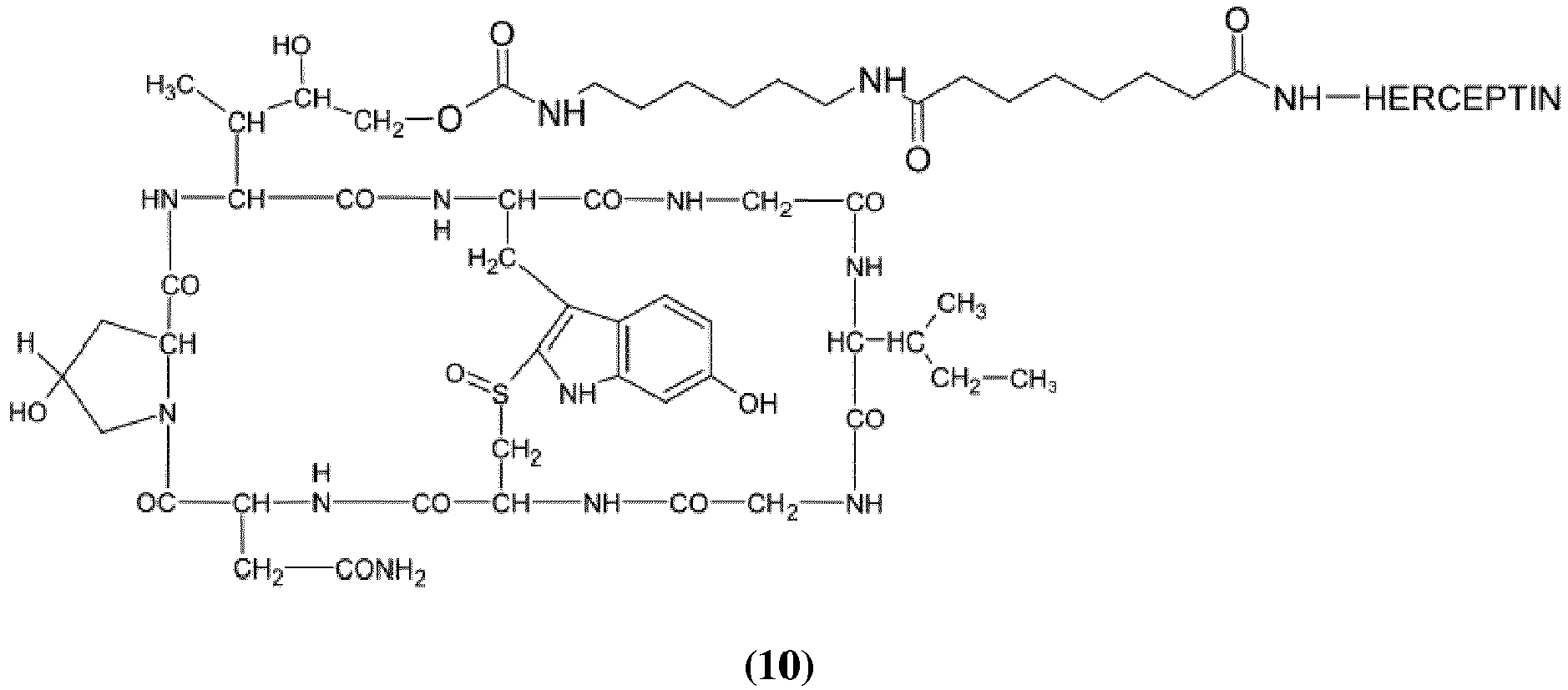

-

- Under argon 30.76 mg (33.5 µmol) vacuum dried α-amanitin was dissolved in 1000µl dry dimethyl formamide (DMF). 14.28 mg (13.83 µl, 66.9µmol) isocyanatohexanoic acid-tert-butylester and 42.28 mg (40.26 µl, 66.9 µmol) dibutyll dilaurylstannate was added. After 23 hours stirring at room temperature additional isocyanato ester (13.83 µl) was added and the reaction mixture was quenched with methanol after 33 hours. The reaction mixture was evaporated to dryness and the remaining solid was dissolved in DMSO and purified on a LaPrep-HPLC: column: Kromasil 100-C18, 10 µm, 250x20 mm, with methanol/water (0.05% TFA), flow: 26 ml/min, detection at λ=295 nm. Solvent A: 95% water: 5% methanol 0.05% trifluoroacetic acid. Solvent B: 10% water: 90% methanol 0.05% trifluoroacetic acid. Gradient: 0-5
min 100% A; 5-20min 0% A; 20-25min 0% A; 25-27min 100% A; 27-35min 100%A. The fractions with the same retention time were collected and the solvents evaporated. - 17.95 mg (47% yield) of a powder. MS: 1133 M+H+; 1155 M+Na+
-

- 17.95 mg (15.9 µmol) tert-butylester (Compound (12)) was dissolved in 500 µl trifluoro acetic acid (TFA) and stirred for 2 minutes at ambient temperature. Excess trifluoro acetic aceid was removed in vacuum and the remaining solid was coevaporated two times with 1.5 ml acetonitrile. The free carboxylic derivative (13) was purified on a LaPrep-HPLC: column: Kromasil 100-C18, d=10 mm, 10 µm, 250x20 mm, with acetonitril/water, flow: 26ml/min, detection at λ=295nm. Solvent A: 95% water : 5% acetonitrile. Solvent B: 5% water: 95% acetonitrile. Gradient: 0-5
min 100% A; 5-20min 0% A; 20-25min 0% A; 25-27min 100% A; 27-35min 100%A. The fractions with the same retention time 12-17min were collected and the solvents evaporated. - 11.34 mg (66% yield) of a white slid. MS: 1076 M+H+; 1098 M+Na+
- 10.0 mg HDP compound (13) was dissolved in 100 µl molecular sieve dried DMF. 80.0 µl solution of N-hydroxysuccinimide (7.4 mg N-OH-Succ/80 µl DMF) and 80.0 µl solution of DCCi (N,N-dicyclohexylcarbodimide; 3.4 mg DCCi/80 µl DMF) were added. The reaction was performed over night at RT. The reaction product was precipitated by
2x 30 ml dried diethylether and resolubilized in 800 µl dried DMF. 266 µl of the DMF solution was added to 5.0 ml antibody solution (6 mg/ml in PBS). Reaction was performed over night at RT on a rotating shaker. The isolation of the antibody-conjugate (14) was performed by separation of macromolecular components on a G25-gelfiltration column.
- 3.0 mg (3.3 µmol) of α-amanitin, dried in vacuo over P4O10 was dissolved in 0.25 ml of dry pyridine and reacted with 0.9 mg (79 µmol) glutaric anhydride in 0.1 ml pyridine for 24h at RT in the dark. The peptide was precipitated by addition of 7 ml of dry diethylether, centrifuged, and the solid washed a second time with diethylether and centrifuged.
By way of this reaction an α-amanitin derivative is obtained wherein R1 = -OH (inFig. 1 ) is replaced by R1 = -O-C(O)-(CH2)3-COOH. - 3.4 mg of α-amanitin glutarate (3.3 µmol) was dissolved in 0.05 ml of dry dimethylformamide (DMF), and 2.4 mg (7 eq.) of N-hydroxy-succinimide dissolved in 0.01 ml of DMF were added. After the addition of 1.2 mg of dicyclohexylcarbodiimide in 0.01 ml of DMF the reaction was allowed to proceed for 16 h at RT. The solution was separated from the crystals formed, and the peptide precipitated by the addition of 4 ml of dry diethylether. After centrifugation, the pellet was washed with another 4 ml of ether and centrifuged. The solid was dissolved in 0.1 ml of dimethylformamide and immediately used for the reaction with the antibody solution.
- 0.1 ml of the solution of 3.0 mg of α-amanitin-glutaric acid N-hydroxysuccinimidate was added to 10 mg of Herceptin antibody in 5 ml of PBS and reacted under slow rotation at 5°C in the dark. After 16h the solution was applied to a Sephadex G25 column (120 x 1.5 cm) equilibrated with PBS, and the protein fraction collected. Amanitin load was determined spectrophotometrically from the absorption difference at 310 nm of the protein solution against a blank containing the same concentration of the native antibody, using the molar extinction coefficient for amatoxins of 13.500 cm-1·M-1. Ratio α-amanitin: IgG of this preparation was about 4.

- Aminophalloidin was prepared from mono-tosylphalloidin by reaction with methanolic ammonia. Conjugation of aminophalloidin with huHEA125 was performed in analogy to the reaction described in 1.5.3.
- Binding of conjugate huHEA125-amanitin3 vs. non-conjugated huHEA125 antibody was analyzed in a competition experiment by flow cytometry. The α-amanitin-huHEA125 conjugate was synthesized as described above in sections 1.6.1 to 1.6.3.
- Colo205 target cells (colon cancer metastasis) were washed twice in FACS buffer (Dulbecco's PBS with 1% heat-inactivated fetal calf serum and 0.1% sodium azide) counted and adjusted to 2x10⁷ cells per ml. Fifty µl of cell suspension was given to each well of a 96 well U-bottom microtiter plate to which 50 µl/well of FITC-labeled huHEA125 antibody was pipetted. Serial dilutions of amanitin-huHEA125 or huHEA125 ranging from 400µg/ml to 10ng/ml final dilution were added in triplicates in a volume of 50 µl/well and incubated for 1 h on ice. Subsequently, the plate was centrifuged (2 min at 2000 rpm) and the supernatant was removed from the cells. Cells were re-suspended in 150 µl of FACS buffer and centrifuged again. After two washing steps by centrifugation, cells were taken up in 100 µl/well of propidium iodide solution (1 µg/ml in FACS buffer) allowing discrimination of dead cells. Analysis was performed on a FACScan cytometer (Becton and Dickinson, Heidelberg, Germany) using CellQuest software.
- As shown in
Figure 2 competition of binding to target cells with increasing amounts of huHEA125-amanitin conjugate or unmodified huHEA125 antibody revealed a comparable binding strength over the whole concentration range from 10ng/ml to 400µg/ml competing antibody or antibody conjugate. Therefore, the conjugation procedure did not significantly alter the affinity of huHEA125-amanitin to the target cells. - Cell lines Capan-1, Colo205, OZ, and MCF-7 were first incubated with either huHEA125 or Xolair®. After washing, binding of the primary antibody was visualized by FITC-labelled F(ab')2 goat anti-human IgG (H+L) as second step reagent. The results are shown in
Fig. 3A (Capan-1),Fig. 3B (Colo205),Fig. 3C (OZ), andFig. 3D (MCF-7). The grey-shaded histograms in the left side of each diagram show the results obtained with control antibody Xolair®; the histograms having a white area in the right side of each diagram show the results obtained with antibody huHEA125. - Binding of huHEA125-amanitin and huHEA125-phalloidin conjugates versus non-conjugated huHEA125 antibody was analyzed by flow cytometry. MCF-7 target cells were washed twice in FACS buffer (Dulbecco's PBS with 1 % heat-inactivated fetal calf serum and 0.1 % sodium azide) counted and adjusted to 2x10⁷ cells per ml. Fifty µl of cell suspension was given to each well of a 96 well U-bottom microtiter plate. Immunotoxins huHEA125-amanitin1, huHEA125-amanitin4 and huHEA125-phalloidin as well as unconjugated huHEA125 antibody were added at a concentration of 1 µg/ml in a volume of 100 µl per well and incubated for 1 h on ice. The plate was centrifuged (2 min at 2000 rpm) and the supernatant was removed from the cells. Cells were re-suspended in 150 µl of FACS buffer and centrifuged again. Subsequently, 100 µl of FITC-labeled F(ab')2 goat anti-human IgG (H+L) secondary antibody was added per well and incubated again for 1 h on ice. After two washing steps by centrifugation, cells were taken up in 100 µl/well of propidium iodide solution (1 µg/ml in FACS buffer) allowing discrimination of dead cells. Analysis was performed on a FACScan cytometer (Becton and Dickinson, Heidelberg, Germany) using CellQuest software.
- As shown in
Figure 4 the binding capacity of immunotoxins to target cells was only moderately reduced by the conjugation procedure. When compared with the non-modified huHEA125 antibody showing a mean fluorescence intensity (MFI) of 1094, conjugation with amanitin1 decreased binding to MFI 730, conjugation with amanitin4 resulted in a MFI of 905, whereas coupling to alpha-phalloidin reduced MFI to 604. These values were obtained with identical antibody amounts of conjugates. - Inhibition of cell growth by amanitin-IgG conjugates was determined by incorporation of [3H]-thymidine. Serial dilutions of amanitin-huHEA125 and amanitin in complete medium (RPMI 1640 supplemented with 10% heat-inactivated FCS, 2 mM L-glutamine and 1 mM sodium pyruvate) ranging from 2x10⁻⁵ M to 6x10-13 M were prepared in triplicates in a volume of 100 µl in the wells of a 96 well flat-bottom tissue culture microtiter plate. In each well, cells were added in 50 µl at a density of 5x10⁴ per ml in the experiments with huHEA125-Amanitin1 and huHEA125-Amanitin4 and at a density of 2x10⁴ per ml in the experiments with huHEA125-Amanitin3. Plates were incubated in a humidified atmosphere at 37 °C and 5% CO2 for 72 or 96 h. At 20 h before the end of the assay, 1 µCi of [3H]-thymidine was added. Subsequently, plates were processed with a Tomtec cell harvester and the incorporated radioactivity was determined by liquid scintillation counting (Wallac Betaplate Liquid Scintillation Counter, PerkinElmer Life and Analytical Sciences) and given as cpm.
- Three examples of growth inhibition induced by different amanitin-IgG conjugates are depicted in
Figures 5 ,6 , and9 . In all three experiments MCF-7 cells were used.Figure 5 shows a comparison of huHEA125-Amanitin1 with the non-binding control Xolair-Amanitin1 and with free Amanitin. In the experiment outlined inFigure 6 huHEA125-Amanitin4 was compared with an alpha-phalloidin huHEA125 conjugate and with free Amanitin.Figure 9 shows a comparison of huHEA125-Amanitin3 with Amanitin-armed control antibody Xolair and with free Amanitin. - The IC50 of conjugates huHEA125-amanitin1 and huHEA125-amanitin4 were both approximately 5x10-12 M (
Figures 5 and6 ) and the IC50 of conjugate huHEA125-amanitin3 was approximately 2x10-12 M (Figure 9 ). In contrast, the phalloidin-huHEA125 preparation exhibited virtually no effect at least at the dose levels tested (Fig. 6 ). In accordance with our previous findings, the IC50 of Amanitin alone is in the range of 10-7 M (Figures 5 ,6 , and9 ). - Four examples of growth inhibition tested in four different carcinoma cell lines are depicted in
Figures 7 ,8 ,9 , and10 . In all four experiments, the conjugate huHEA125-Amanitin3 was used. - In case of the pancreatic carcinoma cell line Capan-1 the huHEA125-Amanitin3 immunotoxin induced growth arrest at amanitin concentrations of 1x10-11 to 3x10⁻¹⁰ M as depicted in
Figure 7 . - In case of the colon cancer cell line Colo205 the huHEA125-Amanitin3 immunotoxin induced growth arrest at amanitin concentrations of 1x10-12 to 4x10-11 M as depicted in
Figure 8 . - In case of the breast cancer cell line MCF-7 the huHEA125-Amanitin3 immunotoxin induced growth arrest at amanitin concentrations of 1x10-12 to 1x10-11 M as depicted in
Figure 9 . - In case of the cholangiocarcinoma cell line OZ the huHEA125-Amanitin3 immunotoxin induced growth arrest at amanitin concentrations of 1x10-11 to 6x10⁻¹⁰ M as depicted in
Figure 10 . - Inhibition of cell growth by amanitin-Herceptin conjugates was determined by in vitro BrdU incorporation as described in Current Protocols in Immunology 1 (see chapter 7.10. Coligan, J. E. et al., eds.) John-Wiley & Sons, New York). Compounds (3), (4), (7), (10), (11), (14), non-conjugated Herceptin and α-amanitin as such were incubated for 72 h and 120 h, respectively, with three tumor cell lines expressing Her2/neu in high concentration, namely, SKOV-3, SK-BR-3 and NCI-N87 and one Her2/neu negative cell line MDA-MB231. Non conjugated Herceptin showed no cytotoxicity on any cell line while the various amanitin conjugates showed a marked toxicity on the Her2/neu positive cell lines with an EC50 in the pico- to nanomolar range, no siginifcant toxicity was observed on the Her2/neu negative cell line. (See
Figures 11A to 11D ). The indicated molar concentration is indicated on the basis of the entire amanitin comprised in the respective conjugate. - A mouse tumor xenograft model, wherein 2.5 x 10& SKOV-3 ovarial carcinoma cells are implated sub-cutaneously (s.c.) into SCID mice and allowed to grow for 10 days. After 10 days a single dose of 30 µg/kg body weight (see
Figure 12A ) or at 150 µg/kg body weight (seeFigure 12B ) of various α-amanitin-Herceptin conjugates (Compounds (15), (3), (4), (10), (11), and (7)) and non-conjugated Herceptin (Control) were administered intravenously. A clear concentration dependent reduction of tumor growth was observed. Conjugates (7), (10) and (15) led to full tumor remission within the period of observation, i.e. 87 days from the initiation of the experiment. -
- Al-Hajj M., Wicha M.S., Benito-Hernandez A., Morrison S.J., Clarke M.F. Prospective identification of tumorigenic breast cancer cells. Proc. Natl. Acad. Sci. USA 100(7), 3983-3988 (2003)
- Allard W.J., Matera J., Miller M.C., Repollet M., Connelly M.C., Rao C., Tibbe A.G., Uhr J.W., Terstappen L.W. Tumor cells circulate in the peripheral blood of all major carcinomas but not in healthy subjects or patients with nonmalignant diseases. Clin. Cancer Res. 10(20), 6897-6904 (2004)
- Baeuerle P.A. and Gires O. EpCAM (CD326) finding its role in cancer. Br. J. Cancer 96(3), 417-423 (2007)
- Balzar M., Winter M.J., de Boer C.J., Litvinov S.V. The biology of the 17-1A antigen (Ep-CAM). J. Mol. Med. 77(10), 699-712 (1999)
- Binz H.K., Amstutz P., Plückthun A. Engineering novel binding proteins from nonimmunoglobulin domains. Nat Biotechnol. 23(10):1257-1268 (2005)
- Brody E.N. and Gold L., Aptamers as therapeutic and diagnostic agents. J. Biotechnol. 74(1):5-13 (2000)
- Dalerba P., Dylla S.J., Park I.K., Liu R., Wang X., Cho R.W., Hoey T., Gurney A., Huang E.H., Simeone D.M., Shelton A.A., Parmiani G., Castelli C., Clarke M.F. Phenotypic characterization of human colorectal cancer stem cells. Proc. Natl. Acad. Sci. USA 104(24), 10158-10163 (2007)
- Gastl G., Spizzo G., Obrist P., Dünser M., Mikuz G. Ep-CAM overexpression in breast cancer as a predictor of survival. Lancet 356(9246), 1981-1982 (2000)
- Holliger P., Prospero T., Winter G. "Diabodies": small bivalent and bispecific antibody fragments. Proc. Natl. Acad. Sci. U.S.A. 90(14), 6444-6448 (1993)
- Leuenberger, H.G.W, Nagel, B. and Kölbl, H. eds. "A multilingual glossary of biotechnological terms: (IUPAC Recommendations)", Helvetica Chimica Acta, CH-4010 Basel, Switzerland), 1995
- Li C., Heidt D.G., Dalerba P., Burant C.F., Zhang L., Adsay V., Wicha M., Clarke M.F., Simeone D.M. Identification of pancreatic cancer stem cells. Cancer Res. 67(3), 1030-1037 (2007)
- Moldenhauer G., Momburg F., Möller P., Schwartz R., Hämmerling G.J. Epithelium-specific surface glycoprotein of Mr 34,000 is a widely distributed human carcinoma marker. Br. J. Cancer 56(6), 714-721 (1987)
- Momburg F., Moldenhauer G., Hämmerling G.J., Möller P. Immunohistochemical study of the expression of a Mr 34,000 human epithelium-specific surface glycoprotein in normal and malignant tissues. Cancer Res. 47(11), 2883-2891 (1987)
- Nagrath S., Sequist L.V., Maheswaran S., Bell D.W., Irimia D., Ulkus L., Smith M.R., Kwak E.L., Digumarthy S., Muzikansky A., Ryan P., Balis U.J., Tompkins R.G., Haber D.A., Toner M. Isolation of rare circulating tumour cells in cancer patients by microchip technology. Nature 450(7173), 1235-1239 (2007)
- Spizzo G., Obrist P., Ensinger C., Theurl I., Dünser M., Ramoni A., Gunsilius E., Eibl G., Mikuz G., Gastl G. Prognostic significance of Ep-CAM AND Her-2/neu overexpression in invasive breast cancer. Int. J. Cancer 98(6), 883-888 (2002)
- Spizzo G., Went P., Dirnhofer S., Obrist P., Simon R., Spichtin H., Maurer R., Metzger U., von Castelberg B., Bart R., Stopatschinskaya S., Köchli O.R., Haas P., Mross F., Zuber M., Dietrich H., Bischoff S., Mirlacher M., Sauter G., Gastl G. High Ep-CAM expression is associated with poor prognosis in node-positive breast cancer. Breast Cancer Res. Treat. 86(3), 207-213 (2004)
- Trzpis M., McLaughlin P.M., de Leij L.M., Harmsen M.C. Epithelial cell adhesion molecule: more than a carcinoma marker and adhesion molecule. Am. J. Pathol. 171(2), 386-395 (2007)
- Varga M., Obrist P., Schneeberger S., Mühlmann G., Felgel-Farnholz C., Fong D., Zitt M., Brunhuber T., Schäfer G., Gastl G., Spizzo G. Overexpression of epithelial cell adhesion molecule antigen in gallbladder carcinoma is an independent marker for poor survival. Clin. Cancer Res. 10(9), 3131-3136 (2004)
- Went P.T., Lugli A., Meier S., Bundi M., Mirlacher M., Sauter G., Dirnhofer S. Frequent EpCam protein expression in human carcinomas. Hum. Pathol. 35(1), 122-128, 2004
- Wieland, T. and Faulstich H. Amatoxins, phallotoxins, phallolysin, and antamanide: the biologically active components of poisonous Amanita mushrooms. CRC Crit. Rev. Biochem. 5(3), 185-260 (1978)
- Winter M.J., Nagtegaal I.D., van Krieken J.H., Litvinov S.V. The epithelial cell adhesion molecule (Ep-CAM) as a morphoregulatory molecule is a tool in surgical pathology. Am. J. Pathol. 163(6), 2139-2148 (2003)
- The present invention particularly relates to the following
items 1 to 25: - 1. A target-binding moiety toxin conjugate comprising:
- (i) a target-binding moiety;
- (ii) at least one amatoxin; and
- (iii) optionally a linker L2;
amino acid 4. - 2. The target-binding moiety toxin conjugate of
item 1, wherein the amatoxin is connected to the target-binding moiety or, if present, to the linker L2 via an oxygen atom bound to the 6' C-atom of amatoxinamino acid 4. - 3. The target-binding moiety toxin conjugate of
item - 4. The target-binding moiety toxin conjugate of any one of
items 1 to 3, wherein the linker L2 is present and the conjugate has the following structure: amatoxin-6'C-O-L2-C(O)-NH-target-binding moiety. - 5. A target-binding moiety toxin conjugate comprising:
- (i) a target-binding moiety;
- (ii) at least one amatoxin; and
- (iii) optionally a linker L3;
amino acid 3. - 6. The target-binding moiety toxin conjugate of
item 5, wherein the amatoxin is connected to the target-binding moiety or, if present, to the linker L3 via an oxygen atom bound to the δ C-atom of amatoxinamino acid 3. - 7. The target-binding moiety toxin conjugate of
item - 8. The target-binding moiety toxin conjugate of any one of
items 5 to 7, wherein the linker L3 is present and the conjugate has one of the following structures:- (i) amatoxin-δC-O-C(O)-L3-C(O)-NH-target-binding moiety;
- (ii) amatoxin-δC-O-L3-C(O)-NH-target-binding moiety; or
- (iii) amatoxin-δC-O-C(O)-NH-L3-C(O)-NH-target-binding moiety.
- 9. A target-binding moiety toxin conjugate comprising:
- (i) a target-binding moiety;
- (ii) at least one amatoxin; and
- (iii) optionally a linker L1;
amino acid 1. - 10. The target-binding moiety toxin conjugate of
item 9, wherein the amatoxin is connected to the target-binding moiety or, if present, to the linker L1 via a nitrogen atom bound to the γ C-atom of amatoxinamino acid 1. - 11. The target-binding moiety toxin conjugate of
item - 12. The target-binding moiety toxin conjugate of any one of
items 9 to 11, wherein the linker L1 is present and the conjugate has the following structure: amatoxin-γC(O)-NH-L1-C(O)-NH- target-binding moiety. - 13. The target-binding moiety toxin conjugate of any one of
items 1 to 12, wherein the target-binding moiety is connected to the amatoxin or, if present, to the linker L1, L2, or L3 via an amino group present in the target-binding moiety. - 14. The target-binding moiety toxin conjugate of any one of
items 1 to 13, wherein the amatoxin is selected from α-amanitin, β-amanitin, γ-amanitin, ε-amanitin, amanin, amaninamide, amanullin, or amanullinic acid, or from salts or analogs thereof. - 15. The target-binding moiety toxin conjugate of any one of
items 1 to 14, wherein the linker L1, L2, or L3 is an alkyl, heteroalkyl, alkenyl, heteroalkenyl, alkynyl, heteroalkynyl, cycloalkyl, heterocycloalkyl, aryl, heteroaryl, aralkyl, or a heteroaralkyl group, optionally substituted. - 16. The target-binding moiety toxin conjugate of any one of
items 1 to 15, wherein the linker L1, L2, or L3 comprises a disulfide bond. - 17. The target-binding moiety toxin conjugate of any one of
items 1 to 16 wherein the target-binding moiety specifically binds to an epitope that is present on a tumour cell. - 18. The target-binding moiety toxin conjugate of any one of items 1 to 17 wherein the epitope that is present on a tumour cell is comprised in cell-defined cancer-associated antigens belonging to unique gene products of mutated or recombined cellular genes, in particular cyclin-dependent kinases, p15Ink4b, p53, AFP, B-catenin, caspase 8, p53, Bcr-abl fusion product, MUM-1 MUM-2, MUM-3, ELF2M, HSP70-2M, HST-2, KIAA0205, RAGE, myosin/m, 707-AP, CDC27/m, ETV6/AML, TEL/Amll, Dekcain, LDLR/FUT, Pml-RARa, TEL/AMLI; Cancer-testis (CT) antigens, members of the MAGE-family, BAGE, DAM-6, DAM-10, members of the GAGE- family, NY-ESO-1, NA-88A, CAG-3, RCC-associated antigen G250, Tumor virus antigens, in particular human papilloma virus (HPV) -derived E6 E7 oncoproteins, Epstein Barr virus EBNA2-6, LMP-1, LMP-2; gp77, gp100, MART-1/Melan-A, p53, tyrosinase, tyrosinase-related protein 1 and 2, PSA, PSM, MC1R; ART4, CAMEL, CEA, CypB, epithelial cell adhesion molecule (EpCAM) HER2/neu, HER-3, hTERT, hTRT, ICE, Muc1, Muc2, PRAME RU1, RU2, SART-1, SART-2, SART-3, and WT1; and fragments and derivatives thereof.
- 19. The target-binding moiety toxin conjugate of any one of
items 1 to 18, wherein the target-binding moiety is selected from the group consisting of:- (i) antibody or antigen-binding fragment thereof;
- (ii) antibody-like protein; and
- (iii) nucleic acid aptamer.
- 20. The target-binding moiety toxin conjugate of item 19, wherein the antibody or the antigen-binding fragment thereof is selected from a diabody, a tetrabody, a nanobody, a chimeric antibody, a deimmunized antibody, a humanized antibody or a human antibody.
- 21. The target-binding moiety toxin conjugate of
item 19 or 20, wherein the antigen binding fragment is selected from the group consisting of Fab, F(ab')2, Fd, Fv, single-chain Fv, and disulfide-linked Fvs (dsFv). - 22. The target-binding moiety toxin conjugate of item 19 to 20 wherein the antibody or the antigen binding fragment thereof comprises
- (a) either the membrane-bound form of the heavy chain of huHEA125 (SEQ ID NO: 1) or the soluble form of the heavy chain of huHEA125 (SEQ ID NO: 2); and/or
- (b) the light chain of huHEA125 (SEQ ID NO: 11).
- 23. The target-binding moiety toxin conjugate of any one of
items 1 to 22 for use in medicine. - 24. The target-binding moiety toxin conjugate of any one of
items 1 to 23 for the treatment of cancer or an autoimmune disease in a patient, wherein the cancer is preferably selected from the group consisting of pancreatic cancer, cholangiocarcinoma, breast cancer, colorectal cancer, lung cancer, prostate cancer, ovarian cancer, stomach cancer, kidney cancer, head and neck cancer, brain tumors, childhood neoplasms, soft tissue sarcomas, epithelial skin cancer, malignant melanoma, leukemia, and malignant lymphoma and the autoimmune disease is preferably selected from the group consisting of and wherein the autoimmune disease is selected from the group consisting of Ankylosing Spondylitis, Chagas disease, Crohn's Disease, Dermatomyositis,Diabetes mellitus type 1, Goodpasture's syndrome, Graves' disease, Guillain-Barré syndrome (GBS), Hashimoto's disease, Hidradenitis suppurativa, Idiopathic thrombocytopenic purpura, Lupus erythematosus, Mixed Connective Tissue Disease, Myasthenia gravis, Narcolepsy, Pemphigus vulgaris, Pernicious anaemia, Psoriasis, Psoriatic Arthritis, Polymyositis, Primary biliary cirrhosis, Relapsing polychondritis, Rheumatoid arthritis, Schizophrenia, Sjögren's syndrome, Temporal arteritis, Ulcerative Colitis, and Vasculitis Wegener's granulomatosis, in particular Rheumatoid arthritis. - 25. Pharmaceutical composition comprising at least one type of the target-binding moiety toxin conjugate according to any one of
items 1 to 22 and further comprising one or more pharmaceutically acceptable diluents, carriers, excipients, fillers, binders, lubricants, glidants, disintegrants, adsorbents; and/or preservatives.
| SEQ ID NO: 1: | chimeric antibody huHEA125, heavy chain, membrane-bound form |
| SEQ ID NO: 2: | chimeric antibody huHEA125, heavy chain, secreted form |
| SEQ ID NO: 3: | chimeric antibody huHEA125, heavy chain, VH domain |
| SEQ ID NO: 4: | chimeric antibody huHEA125, heavy chain, FR1 segment |
| SEQ ID NO: 5: | chimeric antibody huHEA125, heavy chain, CDR1 segment |
| SEQ ID NO: 6: | chimeric antibody huHEA125, heavy chain, FR2 segment |
| SEQ ID NO: 7: | chimeric antibody huHEA125, heavy chain, CDR2 segment |
| SEQ ID NO: 8: | chimeric antibody huHEA125, heavy chain, FR3 segment |
| SEQ ID NO: 9: | chimeric antibody huHEA125, heavy chain, CDR3 segment |
| SEQ ID NO: 10: | chimeric antibody huHEA125, heavy chain, FR4 segment |
| SEQ ID NO: 11: | chimeric antibody huHEA125, light chain |
| SEQ ID NO: 12: | chimeric antibody huHEA125, light chain, VL domain |
| SEQ ID NO: 13: | chimeric antibody huHEA125, light chain, FR1 segment |
| SEQ ID NO: 14: | chimeric antibody huHEA125, light chain, CDR1 segment |
| SEQ ID NO: 15: | chimeric antibody huHEA125, light chain, FR2 segment |
| SEQ ID NO: 16: | chimeric antibody huHEA125, light chain, CDR2 segment |
| SEQ ID NO: 17: | chimeric antibody huHEA125, light chain, FR3 segment |
| SEQ ID NO: 18: | chimeric antibody huHEA125, light chain, CDR3 segment |
| SEQ ID NO: 19: | chimeric antibody huHEA125, light chain, FR4 segment |
| SEQ ID NO: 20: | chimeric antibody huHEA125, heavy chain, CDR1 domain |
| SEQ ID NO: 21: | chimeric antibody huHEA125, heavy chain, CDR2 domain |
| SEQ ID NO: 22: | chimeric antibody huHEA125, heavy chain, CDR3 domain |
| SEQ ID NO: 23: | chimeric antibody huHEA125, light chain, CDR1 domain |
| SEQ ID NO: 24: | chimeric antibody huHEA125, light chain, CDR2 domain |
| SEQ ID NO: 25: | chimeric antibody huHEA125, light chain, CDR3 domain |
| SEQ ID NO: 26: | chimeric antibody huHEA125, heavy chain, constant domain, membrane bound form |
| SEQ ID NO: 27: | chimeric antibody huHEA125, heavy chain, constant domain, secreted form |
| SEQ ID NO: 28: | chimeric antibody huHEA125, light chain, constant domain |


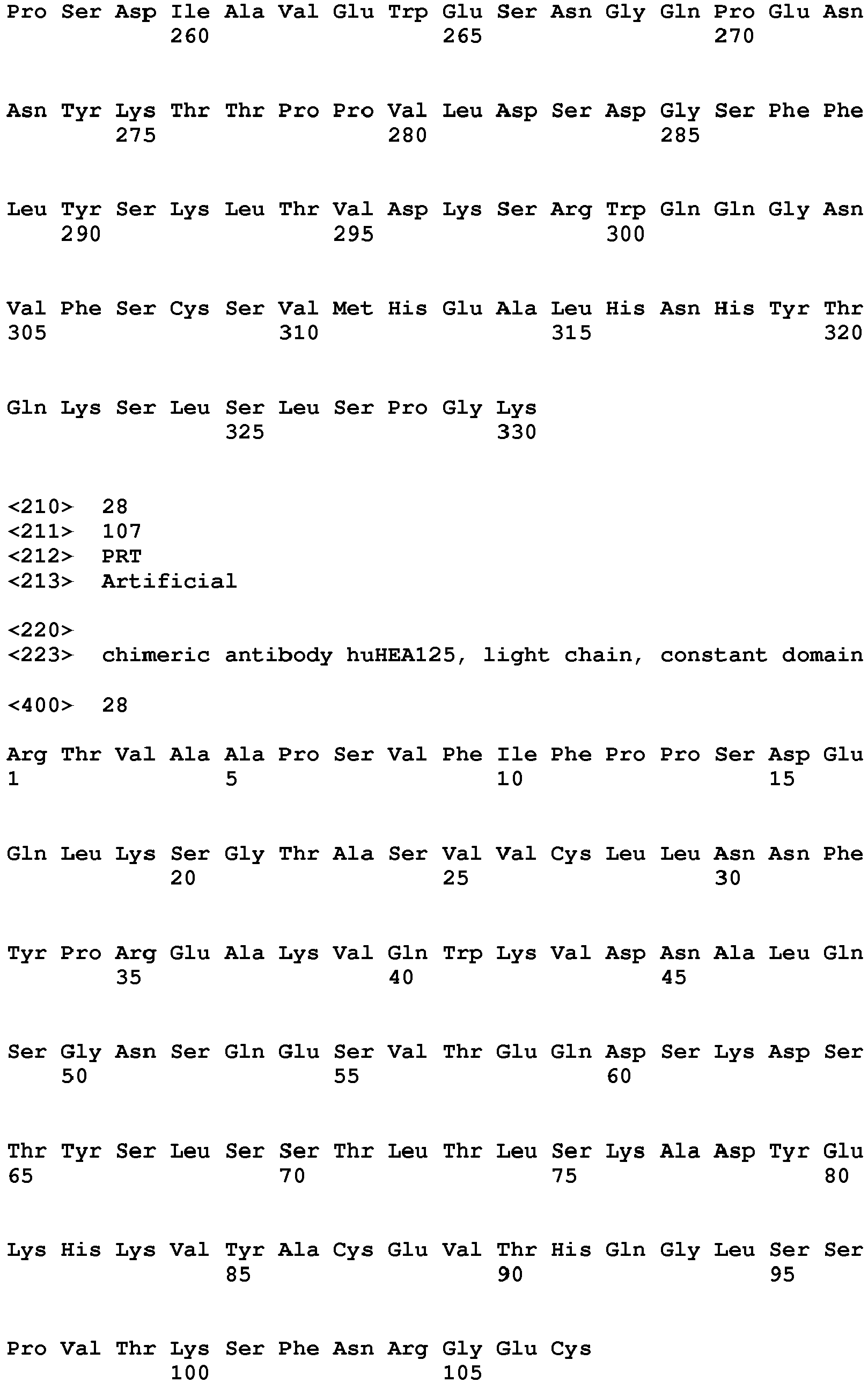
Claims (15)
- A target-binding moiety toxin conjugate comprising:(i) a target-binding moiety;(ii) at least one amatoxin; and(iii) optionally a linker L2;wherein the at least one amatoxin is connected to the target-binding moiety or, if present, to the linker L2 via the 6' C-atom of amatoxin amino acid 4.
- The target-binding moiety toxin conjugate of claim 1, wherein the amatoxin is connected to the target-binding moiety or, if present, to the linker L2 via an oxygen atom bound to the 6' C-atom of amatoxin amino acid 4.
- The target-binding moiety toxin conjugate of claim 1 or 2, wherein the amatoxin is connected to the target-binding moiety or, if present, to the linker L2 via an ether linkage.
- The target-binding moiety toxin conjugate of any one of claims 1 to 3, wherein the linker L2 is present and the conjugate has the following structure: amatoxin-6'C-O-L2-C(O)-NH-target-binding moiety.
- The target-binding moiety toxin conjugate of any one of claims 1 to 4, wherein the target-binding moiety is connected to the amatoxin or, if present, to the linker L2 via an amino group present in the target-binding moiety.
- The target-binding moiety toxin conjugate of any one of claims 1 to 5, wherein the amatoxin is selected from α-amanitin, β-amanitin, γ-amanitin, ε-amanitin, amanin, amaninamide, amanullin, or amanullinic acid, or from salts or analogs thereof.
- The target-binding moiety toxin conjugate of any one of claims 1 to 6,
wherein the linker L2 is an alkyl, heteroalkyl, alkenyl, heteroalkenyl, alkynyl, heteroalkynyl, cycloalkyl, heterocycloalkyl, aryl, heteroaryl, aralkyl, or a heteroaralkyl group, optionally substituted; and/or
wherein the linker L2 comprises a disulfide bond. - The target-binding moiety toxin conjugate of any one of claims 1 to 8 wherein the target-binding moiety specifically binds to an epitope that is present on a tumour cell; wherein preferably the epitope that is present on a tumour cell is comprised in cell-defined cancer-associated antigens belonging to unique gene products of mutated or recombined cellular genes, in particular cyclin-dependent kinases, p15Ink4b, p53, AFP, B-catenin, caspase 8, p53, Bcr-abl fusion product, MUM-1 MUM-2, MUM-3, ELF2M, HSP70-2M, HST-2, KIAA0205, RAGE, myosin/m, 707-AP, CDC27/m, ETV6/AML, TEL/Amll, Dekcain, LDLR/FUT, Pml-RARa, TEL/AMLI; Cancer-testis (CT) antigens, members of the MAGE-family, BAGE, DAM-6, DAM-10, members of the GAGE- family, NY-ESO-1, NA-88A, CAG-3, RCC-associated antigen G250, Tumor virus antigens, in particular human papilloma virus (HPV) -derived E6 E7 oncoproteins, Epstein Barr virus EBNA2-6, LMP-1, LMP-2; gp77, gp100, MART-1/Melan-A, p53, tyrosinase, tyrosinase-related protein 1 and 2, PSA, PSM, MC1R; ART4, CAMEL, CEA, CypB, epithelial cell adhesion molecule (EpCAM) HER2/neu, HER-3, hTERT, hTRT, ICE, Muc1, Muc2, PRAME RU1, RU2, SART-1, SART-2, SART-3, and WT1; and fragments and derivatives thereof.
- The target-binding moiety toxin conjugate of any one of claims 1 to 8, wherein the target-binding moiety is selected from the group consisting of:(i) antibody or antigen-binding fragment thereof;(ii) antibody-like protein; and(iii) nucleic acid aptamer.
- The target-binding moiety toxin conjugate of claim 9, wherein the antibody or the antigen-binding fragment thereof is selected from a diabody, a tetrabody, a nanobody, a chimeric antibody, a deimmunized antibody, a humanized antibody or a human antibody.
- The target-binding moiety toxin conjugate of claim 9 or 10, wherein the antigen binding fragment is selected from the group consisting of Fab, F(ab')2, Fd, Fv, single-chain Fv, and disulfide-linked Fvs (dsFv).
- The target-binding moiety toxin conjugate of claim 9 to 10 wherein the antibody or the antigen binding fragment thereof comprises(a) either the membrane-bound form of the heavy chain of huHEA125 (SEQ ID NO: 1) or the soluble form of the heavy chain of huHEA125 (SEQ ID NO: 2); and/or(b) the light chain of huHEA125 (SEQ ID NO: 11).
- The target-binding moiety toxin conjugate of any one of claims 1 to 12 for use in medicine.
- The target-binding moiety toxin conjugate of any one of claims 1 to 13 for use in the treatment of cancer or an autoimmune disease in a patient, wherein the cancer is preferably selected from the group consisting of pancreatic cancer, cholangiocarcinoma, breast cancer, colorectal cancer, lung cancer, prostate cancer, ovarian cancer, stomach cancer, kidney cancer, head and neck cancer, brain tumors, childhood neoplasms, soft tissue sarcomas, epithelial skin cancer, malignant melanoma, leukemia, and malignant lymphoma and the autoimmune disease is preferably selected from the group consisting of and wherein the autoimmune disease is selected from the group consisting of Ankylosing Spondylitis, Chagas disease, Crohn's Disease, Dermatomyositis, Diabetes mellitus type 1, Goodpasture's syndrome, Graves' disease, Guillain-Barré syndrome (GBS), Hashimoto's disease, Hidradenitis suppurativa, Idiopathic thrombocytopenic purpura, Lupus erythematosus, Mixed Connective Tissue Disease, Myasthenia gravis, Narcolepsy, Pemphigus vulgaris, Pernicious anaemia, Psoriasis, Psoriatic Arthritis, Polymyositis, Primary biliary cirrhosis, Relapsing polychondritis, Rheumatoid arthritis, Schizophrenia, Sjögren's syndrome, Temporal arteritis, Ulcerative Colitis, and Vasculitis Wegener's granulomatosis, in particular Rheumatoid arthritis.
- Pharmaceutical composition comprising at least one type of the target-binding moiety toxin conjugate according to any one of claims 1 to 12 and further comprising one or more pharmaceutically acceptable diluents, carriers, excipients, fillers, binders, lubricants, glidants, disintegrants, adsorbents; and/or preservatives.
Priority Applications (5)
| Application Number | Priority Date | Filing Date | Title |
|---|---|---|---|
| PL17158119T PL3192529T3 (en) | 2009-04-08 | 2010-04-08 | Amatoxin-armed therapeutic cell surface binding components designed for tumour therapy |
| SM20200263T SMT202000263T1 (en) | 2009-04-08 | 2010-04-08 | Amatoxin-armed therapeutic cell surface binding components designed for tumour therapy |
| SI201031993T SI3192529T1 (en) | 2009-04-08 | 2010-04-08 | Amatoxin-bonded therapeutic cell surface binding components designed to treat tumors |
| EP18214020.2A EP3485912A1 (en) | 2009-04-08 | 2010-04-08 | Amatoxin-armed therapeutic cell surface binding components designed for tumour therapy |
| HRP20200612TT HRP20200612T1 (en) | 2009-04-08 | 2020-04-09 | Amatoxin-armed therapeutic cell surface binding components designed for tumour therapy |
Applications Claiming Priority (4)
| Application Number | Priority Date | Filing Date | Title |
|---|---|---|---|
| US16769009P | 2009-04-08 | 2009-04-08 | |
| US22222709P | 2009-07-01 | 2009-07-01 | |
| EP10713429.8A EP2416804B1 (en) | 2009-04-08 | 2010-04-08 | Amatoxin-armed therapeutic cell surface binding components designed for tumour therapy |
| PCT/EP2010/002205 WO2010115629A2 (en) | 2009-04-08 | 2010-04-08 | Amatoxin-armed therapeutic cell surface binding components designed for tumour therapy |
Related Parent Applications (1)
| Application Number | Title | Priority Date | Filing Date |
|---|---|---|---|
| EP10713429.8A Division EP2416804B1 (en) | 2009-04-08 | 2010-04-08 | Amatoxin-armed therapeutic cell surface binding components designed for tumour therapy |
Related Child Applications (2)
| Application Number | Title | Priority Date | Filing Date |
|---|---|---|---|
| EP18214020.2A Division-Into EP3485912A1 (en) | 2009-04-08 | 2010-04-08 | Amatoxin-armed therapeutic cell surface binding components designed for tumour therapy |
| EP18214020.2A Division EP3485912A1 (en) | 2009-04-08 | 2010-04-08 | Amatoxin-armed therapeutic cell surface binding components designed for tumour therapy |
Publications (2)
| Publication Number | Publication Date |
|---|---|
| EP3192529A1 true EP3192529A1 (en) | 2017-07-19 |
| EP3192529B1 EP3192529B1 (en) | 2020-03-25 |
Family
ID=42269753
Family Applications (3)
| Application Number | Title | Priority Date | Filing Date |
|---|---|---|---|
| EP17158119.2A Active EP3192529B1 (en) | 2009-04-08 | 2010-04-08 | Amatoxin-armed therapeutic cell surface binding components designed for tumour therapy |
| EP18214020.2A Withdrawn EP3485912A1 (en) | 2009-04-08 | 2010-04-08 | Amatoxin-armed therapeutic cell surface binding components designed for tumour therapy |
| EP10713429.8A Active EP2416804B1 (en) | 2009-04-08 | 2010-04-08 | Amatoxin-armed therapeutic cell surface binding components designed for tumour therapy |
Family Applications After (2)
| Application Number | Title | Priority Date | Filing Date |
|---|---|---|---|
| EP18214020.2A Withdrawn EP3485912A1 (en) | 2009-04-08 | 2010-04-08 | Amatoxin-armed therapeutic cell surface binding components designed for tumour therapy |
| EP10713429.8A Active EP2416804B1 (en) | 2009-04-08 | 2010-04-08 | Amatoxin-armed therapeutic cell surface binding components designed for tumour therapy |
Country Status (15)
| Country | Link |
|---|---|
| US (2) | US9233173B2 (en) |
| EP (3) | EP3192529B1 (en) |
| AU (1) | AU2010234334B2 (en) |
| CA (3) | CA2758201C (en) |
| CY (1) | CY1122855T1 (en) |
| DK (1) | DK3192529T3 (en) |
| ES (2) | ES2784829T3 (en) |
| HR (1) | HRP20200612T1 (en) |
| HU (1) | HUE050296T2 (en) |
| LT (1) | LT3192529T (en) |
| PL (1) | PL3192529T3 (en) |
| PT (1) | PT3192529T (en) |
| SI (1) | SI3192529T1 (en) |
| SM (1) | SMT202000263T1 (en) |
| WO (1) | WO2010115629A2 (en) |
Families Citing this family (54)
| Publication number | Priority date | Publication date | Assignee | Title |
|---|---|---|---|---|
| CA2756246A1 (en) * | 2009-04-08 | 2010-10-14 | Heinz Faulstich | Amatoxin-armed target-binding moieties for the treatment of cancer |
| WO2011100508A2 (en) * | 2010-02-12 | 2011-08-18 | Arizona Board Of Regents For And On Behalf Of Arizona State University | Methods and compositions related to glycoprotein-immunoglobulin fusions |
| EP2436398B1 (en) * | 2010-09-30 | 2013-01-23 | Heidelberg Pharma GmbH | Amatoxin-conjugates with improved linkers |
| EP2497499A1 (en) * | 2011-03-10 | 2012-09-12 | Heidelberg Pharma GmbH | Amatoxin-conjugates with improved linkages |
| EP2684865A1 (en) * | 2012-07-13 | 2014-01-15 | Heidelberg Pharma GmbH | Methods for synthesizing amatoxin building block and amatoxins |
| US20150218220A1 (en) * | 2012-09-12 | 2015-08-06 | Brian Alan MENDELSOHN | Amatoxin derivatives and cell-permeable conjugates thereof as inhibitors of rna polymerase |
| EP2774624A1 (en) * | 2013-03-04 | 2014-09-10 | Heidelberg Pharma GmbH | Amatoxin derivatives |
| CN105377304B (en) * | 2014-03-10 | 2018-05-15 | 海德堡医药有限责任公司 | Amanitin Derivatives |
| CN103948872B (en) * | 2014-05-12 | 2017-02-15 | 胡梁谱 | Traditional Chinese medicine for treating psoriatic arthritis |
| MY186334A (en) | 2014-09-12 | 2021-07-12 | Genentech Inc | Anti-her2 antibodies and immunoconjugates |
| TW201625688A (en) | 2014-09-12 | 2016-07-16 | 建南德克公司 | Cysteine engineered antibodies and conjugates |
| MA40579A (en) | 2014-09-12 | 2016-03-17 | Genentech Inc | ANTI-CLL-1 ANTIBODIES AND IMMUNOCONJUGATES |
| US9938323B2 (en) | 2014-11-06 | 2018-04-10 | Novartis Ag | Amatoxin derivatives and conjugates thereof as inhibitors of RNA polymerase |
| DK3268047T3 (en) | 2015-03-09 | 2024-01-02 | Heidelberg Pharma Res Gmbh | AMATOXIN/ANTISTOF CONJUGATES |
| WO2016164502A1 (en) | 2015-04-06 | 2016-10-13 | President And Fellows Of Harvard College | Compositions and methods for non-myeloablative conditioning |
| EP3328897A1 (en) * | 2015-07-31 | 2018-06-06 | Sutro Biopharma, Inc. | ANTI-EpCAM ANTIBODIES, COMPOSITIONS COMPRISING ANTI-EpCAM ANTIBODIES AND METHODS OF MAKING AND USING ANTI-EPCAM ANTIBODIES |
| WO2017064675A1 (en) | 2015-10-16 | 2017-04-20 | Genentech, Inc. | Hindered disulfide drug conjugates |
| US10723766B2 (en) | 2015-11-27 | 2020-07-28 | Heidelberg Pharma Research Gmbh | Derivatives of gamma-amanitin |
| EP3222292A1 (en) | 2016-03-03 | 2017-09-27 | Heidelberg Pharma GmbH | Amanitin conjugates |
| MX2018012803A (en) * | 2016-04-20 | 2019-06-24 | Hangzhou Dac Biotech Co Ltd | Derivatives of amanita toxins and their conjugation to a cell binding molecule. |
| US10464969B2 (en) | 2016-05-05 | 2019-11-05 | Novartis Ag | Amatoxin derivatives and conjugates thereof as inhibitors of RNA polymerase |
| JP7022080B2 (en) | 2016-05-27 | 2022-02-17 | ジェネンテック, インコーポレイテッド | Biochemical analytical methods for the characterization of site-specific antibody-drug conjugates |
| EP3471771A4 (en) * | 2016-05-31 | 2020-04-15 | Sorrento Therapeutics, Inc. | ANTIBODY CONJUGATES HAVING AMATOXIN DERIVATIVES AS A MEDICINAL PRODUCT |
| KR20230082055A (en) | 2016-06-17 | 2023-06-08 | 마젠타 테라퓨틱스 인코포레이티드 | Compositions and methods for the depletion of cells |
| MX2018015684A (en) | 2016-06-17 | 2019-08-29 | Magenta Therapeutics Inc | Compositions and methods for the depletion of cd117+cells. |
| CN109963871A (en) | 2016-08-05 | 2019-07-02 | 豪夫迈·罗氏有限公司 | Multivalent and multiepitopic antibodies with agonistic activity and methods of use |
| HUE069487T2 (en) * | 2016-12-23 | 2025-03-28 | Heidelberg Pharma Res Gmbh | Amanitin antibody conjugates |
| CN106810467A (en) * | 2017-01-03 | 2017-06-09 | 苏州昊帆生物股份有限公司 | Diamine compounds list Boc guard methods |
| IL268058B2 (en) | 2017-01-20 | 2023-09-01 | Magenta Therapeutics Inc | Compositions and methods for the depletion of cd137plus cells |
| KR20210125094A (en) * | 2017-04-06 | 2021-10-15 | 항저우 디에이씨 바이오테크 씨오, 엘티디 | Conjugation of a cytotoxic drug with bis-linkage |
| EP3661938B1 (en) * | 2017-08-07 | 2025-01-15 | Heidelberg Pharma Research GmbH | Novel method for synthesizing amanitins |
| LT3665173T (en) | 2017-08-07 | 2025-06-25 | Heidelberg Pharma Research Gmbh | Novel method for synthesizing amanitins |
| AU2018317611B2 (en) * | 2017-08-18 | 2022-03-10 | Systimmune, Inc. | Non-natural amatoxin-type antibody conjugate |
| CA3177215A1 (en) | 2017-09-19 | 2019-03-28 | Daiichi Sankyo Company, Limited | Antibody-pyrrolobenzodiazepine derivative conjugate |
| NZ762865A (en) | 2017-09-22 | 2023-03-31 | Heidelberg Pharma Res Gmbh | Psma-targeting amanitin conjugates |
| EP3700568A4 (en) | 2017-10-24 | 2021-11-10 | Magenta Therapeutics, Inc. | COMPOSITIONS AND METHODS OF DEPRODUCTION FROM CD117 + CELLS |
| US10882915B2 (en) | 2017-10-24 | 2021-01-05 | Magenta Therapeutics, Inc. | Compositions and methods for the depletion of CD117+ cells |
| CN111727075B (en) | 2017-11-27 | 2024-04-05 | 普渡制药公司 | Humanized antibodies targeting human tissue factor |
| CN119857155A (en) * | 2017-11-29 | 2025-04-22 | 海德堡医药研究有限责任公司 | Compositions and methods for depleting CD5+ cells |
| JP7857730B2 (en) * | 2018-04-13 | 2026-05-13 | ハイデルベルク ファルマ リサーチ ゲゼルシャフト ミット ベシュレンクテル ハフツング | Targeted amatoxin conjugates for the treatment of solid tumors |
| CN112739340B (en) | 2018-07-23 | 2025-05-13 | 海德堡医药研究有限责任公司 | Use of anti-CD5 antibody drug conjugates (ADCs) in allogeneic cell therapy |
| MX2021012961A (en) * | 2019-04-24 | 2021-11-25 | Heidelberg Pharma Res Gmbh | Amatoxin antibody-drug conjugates and uses thereof. |
| CN114144201B (en) * | 2019-05-23 | 2024-10-01 | 海德堡医药研究有限责任公司 | Antibody drug conjugates containing cleavable linkers |
| AR120218A1 (en) * | 2019-10-15 | 2022-02-02 | Heidelberg Pharma Res Gmbh | AMATOXIN AND B LYMPHOCYTE SPECIFIC ANTIBODY CONJUGATES |
| WO2021209007A1 (en) * | 2020-04-15 | 2021-10-21 | Shenzhen Enduring Biotech, Ltd. | Antibody-drug conjugate |
| KR20230069211A (en) | 2020-09-18 | 2023-05-18 | 아라리스 바이오테크 아게 | Transglutaminase conjugation method using an amino acid-based linker |
| WO2022084560A1 (en) | 2020-10-25 | 2022-04-28 | Araris Biotech Ag | Means and methods for producing antibody-linker conjugates |
| CA3195572A1 (en) | 2020-11-04 | 2022-05-12 | Heidelberg Pharma Research Gmbh | Composition comprising a combination of immune checkpoint inhibitor and antibody-amatoxin conjugate for use in cancer therapy |
| WO2022194988A2 (en) | 2021-03-19 | 2022-09-22 | Heidelberg Pharma Research Gmbh | B-lymphocyte specific amatoxin antibody conjugates |
| EP4422695A1 (en) | 2021-10-25 | 2024-09-04 | Araris Biotech AG | Methods for producing antibody-linker conjugates |
| CN118742328A (en) | 2022-02-22 | 2024-10-01 | 阿拉里斯生物技术股份公司 | Peptide linkers containing two or more payloads |
| WO2024121632A1 (en) | 2022-12-09 | 2024-06-13 | Crispr Therapeutics Ag | Use of anti-cd117 antibody drug conjugate (adc) |
| WO2025082990A1 (en) | 2023-10-15 | 2025-04-24 | Araris Biotech Ag | Antibody-drug conjugates using two different types of topoisomerase i inhibitors |
| WO2026013234A1 (en) | 2024-07-10 | 2026-01-15 | Araris Biotech Ag | Triple-payload antibody-drug conjugates (adcs) |
Citations (2)
| Publication number | Priority date | Publication date | Assignee | Title |
|---|---|---|---|---|
| US5939598A (en) | 1990-01-12 | 1999-08-17 | Abgenix, Inc. | Method of making transgenic mice lacking endogenous heavy chains |
| EP1859811A1 (en) | 2006-05-27 | 2007-11-28 | Faulstich, Heinz, Dr. | Use of conjugates of amatoxins or phallotoxins with macromolecules for tumor and inflammation therapy |
Family Cites Families (7)
| Publication number | Priority date | Publication date | Assignee | Title |
|---|---|---|---|---|
| US7009034B2 (en) * | 1996-09-23 | 2006-03-07 | Incept, Llc | Biocompatible crosslinked polymers |
| CA2427858A1 (en) * | 2000-11-03 | 2002-05-10 | University Of Vermont And State Agricultural College | Compositions for inhibiting grb7 |
| ATE476503T1 (en) * | 2001-10-01 | 2010-08-15 | Deutsches Krebsforsch | METHOD FOR PRODUCING PROTEIN LIBRARIES AND FOR SELECTING PROTEINS THEREOF |
| US6890765B2 (en) * | 2001-11-02 | 2005-05-10 | Roche Diagnostics Operations, Inc. | Particles for immunoassays and methods for treating the same |
| EP1661584A1 (en) | 2004-11-26 | 2006-05-31 | Heinz Dr. Faulstich | Use of conjugates of amatoxins and phallotoxins with macromolecules for cancer and inflammation therapy |
| CA2649114A1 (en) * | 2006-04-12 | 2007-10-25 | Crosslink Genetics Corporation | Compositions and methods for modulating gene expression |
| EP2436398B1 (en) * | 2010-09-30 | 2013-01-23 | Heidelberg Pharma GmbH | Amatoxin-conjugates with improved linkers |
-
2010
- 2010-04-08 US US13/263,287 patent/US9233173B2/en active Active
- 2010-04-08 EP EP17158119.2A patent/EP3192529B1/en active Active
- 2010-04-08 CA CA2758201A patent/CA2758201C/en active Active
- 2010-04-08 ES ES17158119T patent/ES2784829T3/en active Active
- 2010-04-08 EP EP18214020.2A patent/EP3485912A1/en not_active Withdrawn
- 2010-04-08 HU HUE17158119A patent/HUE050296T2/en unknown
- 2010-04-08 DK DK17158119.2T patent/DK3192529T3/en active
- 2010-04-08 CA CA3026727A patent/CA3026727C/en active Active
- 2010-04-08 SM SM20200263T patent/SMT202000263T1/en unknown
- 2010-04-08 PT PT171581192T patent/PT3192529T/en unknown
- 2010-04-08 LT LTEP17158119.2T patent/LT3192529T/en unknown
- 2010-04-08 WO PCT/EP2010/002205 patent/WO2010115629A2/en not_active Ceased
- 2010-04-08 AU AU2010234334A patent/AU2010234334B2/en active Active
- 2010-04-08 SI SI201031993T patent/SI3192529T1/en unknown
- 2010-04-08 EP EP10713429.8A patent/EP2416804B1/en active Active
- 2010-04-08 PL PL17158119T patent/PL3192529T3/en unknown
- 2010-04-08 ES ES10713429.8T patent/ES2621104T3/en active Active
- 2010-04-08 CA CA2970774A patent/CA2970774C/en active Active
-
2015
- 2015-11-30 US US14/954,266 patent/US10513559B2/en active Active
-
2020
- 2020-04-07 CY CY20201100329T patent/CY1122855T1/en unknown
- 2020-04-09 HR HRP20200612TT patent/HRP20200612T1/en unknown
Patent Citations (2)
| Publication number | Priority date | Publication date | Assignee | Title |
|---|---|---|---|---|
| US5939598A (en) | 1990-01-12 | 1999-08-17 | Abgenix, Inc. | Method of making transgenic mice lacking endogenous heavy chains |
| EP1859811A1 (en) | 2006-05-27 | 2007-11-28 | Faulstich, Heinz, Dr. | Use of conjugates of amatoxins or phallotoxins with macromolecules for tumor and inflammation therapy |
Non-Patent Citations (33)
| Title |
|---|
| "A multilingual glossary of biotechnological terms: (IUPAC Recommendations", 1995, HELVETICA CHIMICA ACTA |
| "Current Protocols in Immunology 1", JOHN-WILEY & SONS |
| AL-HAJJ M.; WICHA M.S.; BENITO-HERNANDEZ A.; MORRISON S.J.; CLARKE M.F.: "Prospective identification of tumorigenic breast cancer cells.", PROC. NATL. ACAD. SCI. USA, vol. 100, no. 7, 2003, pages 3983 - 3988 |
| ALLARD W.J.; MATERA J.; MILLER M.C.; REPOLLET M.; CONNELLY M.C.; RAO C.; TIBBE A.G.; UHR J.W.; TERSTAPPEN L.W.: "Tumor cells circulate in the peripheral blood of all major carcinomas but not in healthy subjects or patients with nonmalignant diseases.", CLIN. CANCER RES., vol. 10, no. 20, 2004, pages 6897 - 6904, XP002489234, DOI: doi:10.1158/1078-0432.CCR-04-0378 |
| BAEUERLE P.A.; GIRES O.: "EpCAM (CD326) finding its role in cancer", BR. J. CANCER, vol. 96, no. 3, 2007, pages 417 - 423, XP055160516, DOI: doi:10.1038/sj.bjc.6603494 |
| BALZAR M.; WINTER M.J.; DE BOER C.J.; LITVINOV S.V.: "The biology of the 17-1A antigen (Ep-CAM", J. MOL. MED., vol. 77, no. 10, 1999, pages 699 - 712, XP000925817, DOI: doi:10.1007/s001099900038 |
| BINZ H.K.; AMSTUTZ P.; PLIICKTHUN A.: "Engineering novel binding proteins from nonimmunoglobulin domains", NAT BIOTECHNOL., vol. 23, no. 10, 2005, pages 1257 - 1268, XP002381839, DOI: doi:10.1038/nbt1127 |
| BRODY E.N.; GOLD L.: "Aptamers as therapeutic and diagnostic agents", J. BIOTECHNOL., vol. 74, no. 1, 2000, pages 5 - 13, XP009031105 |
| DALERBA P.; DYLLA S.J.; PARK I.K.; LIU R.; WANG X.; CHO R.W.; HOEY T.; GURNEY A.; HUANG E.H.; SIMEONE D.M.: "Phenotypic characterization of human colorectal cancer stem cells.", PROC. NATL. ACAD. SCI. USA, vol. 104, no. 24, 2007, pages 10158 - 10163 |
| FAULSTICH H ET AL: "A rapid radioimmunoassay, using a nylon support, for amatoxins from Amanita mushrooms", TOXICON, ELMSFORD, NY, US, vol. 20, no. 5, 1 January 1982 (1982-01-01), pages 913 - 924, XP025540166, ISSN: 0041-0101, [retrieved on 19820101], DOI: 10.1016/0041-0101(82)90079-4 * |
| FAULSTICH H ET AL: "Ether derivatives of [alpha]-amanitin. Introduction of spacer moieties, lipophilic residues, and radioactive labels", BIOCHEMISTRY, AMERICAN CHEMICAL SOCIETY, US, vol. 20, no. 22, 1 January 1981 (1981-01-01), pages 6498 - 6504, XP002592362, ISSN: 0006-2960 * |
| FAULSTICH H ET AL: "PROTEIN CONJUGATES OF FUNGAL TOXINS", METHODS IN ENZYMOLOGY, ACADEMIC PRESS, US, vol. 112, 1 January 1985 (1985-01-01), pages 225 - 237, XP008053933, ISSN: 0076-6879, DOI: 10.1016/S0076-6879(85)12019-7 * |
| FRANCISCO JA; CERRENY CG; MEYER DL, NAT. BIOTECHNOL, vol. 21, 2003, pages 778 - 84 |
| GASTL G.; SPIZZO G.; OBRIST P.; DTINSER M.; MIKUZ G.: "Ep-CAM overexpression in breast cancer as a predictor of survival.", LANCET, vol. 356, no. 9246, 2000, pages 1981 - 1982, XP004824514, DOI: doi:10.1016/S0140-6736(00)03312-2 |
| HELLER, ANNU. REV.BIOMED. ENG., vol. 4, 2002, pages 129 - 53 |
| HOLLIGER P.; PROSPERO T.; WINTER G.: "Diabodies'': small bivalent and bispecific antibody fragments", PROC. NATL. ACAD. SCI. U.S.A., vol. 90, no. 14, 1993, pages 6444 - 6448, XP002008022, DOI: doi:10.1073/pnas.90.14.6444 |
| L. DA IBSEN, BLOOD, vol. 102, 2003, pages 1458 - 65 |
| LI C.; HEIDT D.G.; DALERBA P.; BURANT C.F.; ZHANG L.; ADSAY V.; WICHA M.; CLARKE M.F.; SIMEONE D.M.: "Identification of pancreatic cancer stem cells", CANCER RES., vol. 67, no. 3, 2007, pages 1030 - 1037 |
| MOLDENHAUER G.; MOMBURG F.; MOLLER P.; SCHWARTZ R.; HAMMERLING G.J.: "Epithelium-specific surface glycoprotein of Mr 34,000 is a widely distributed human carcinoma marker", BR. J. CANCER, vol. 56, no. 6, 1987, pages 714 - 721 |
| MOMBURG F.; MOLDENHAUER G.; HAMMERLING G.J.; MOLLER P.: "Immunohistochemical study of the expression of a Mr 34,000 human epithelium-specific surface glycoprotein in normal and malignant tissues", CANCER RES., vol. 47, no. 11, 1987, pages 2883 - 2891, XP055036979 |
| NAGRATH S.; SEQUIST L.V.; MAHESWARAN S.; BELL D.W.; IRIMIA D.; ULKUS L.; SMITH M.R.; KWAK E.L.; DIGUMARTHY S.; MUZIKANSKY A.: "Isolation of rare circulating tumour cells in cancer patients by microchip technology", NATURE, vol. 450, no. 7173, 2007, pages 1235 - 1239 |
| NIAN CHEN ET AL: "Polyclonai amanitin-specific antibodies: production and cytoprotective properties in vitro", BIOCHEMICAL PHARMACOLOGY, vol. 46, no. 2, 1 January 1993 (1993-01-01), pages 327 - 329, XP055374315 * |
| RUSSO ET AL., ONCOGENE, vol. 22, 2003, pages 6497 - 507 |
| S. FLETCHER; M. R. JORGENSENS; A. D. MILLER, ORG. LETT., vol. 6, no. 23, 2004, pages 4245 - 4248 |
| SPIZZO G.; OBRIST P.; ENSINGER C.; THEURL I.; DTINSER M.; RAMONI A.; GUNSILIUS E.; EIBL G.; MIKUZ G.; GASTL G.: "Prognostic significance of Ep-CAM AND Her-2/neu overexpression in invasive breast cancer.", INT. J. CANCER, vol. 98, no. 6, 2002, pages 883 - 888 |
| SPIZZO G.; WENT P.; DIRNHOFER S.; OBRIST P.; SIMON R.; SPICHTIN H.; MAURER R.; METZGER U.; VON CASTELBERG B.; BART R.: "High Ep-CAM expression is associated with poor prognosis in node-positive breast cancer", BREAST CANCER RES. TREAT, vol. 86, no. 3, 2004, pages 207 - 213 |
| STEHLE G ET AL: "The loading rate determines tumor targeting properties of methotrexate-albumin conjugates in rats", ANTI-CANCER DRUGS, LIPPINCOTT WILLIAMS & WILKINS, US; NL, vol. 8, no. 7, 1 August 1997 (1997-08-01), pages 677 - 685, XP009029047, ISSN: 0959-4973, DOI: 10.1097/00001813-199708000-00006 * |
| TRZPIS M.; MCLAUGHLIN P.M.; DE LEIJ L.M.; HARMSEN M.C.: "Epithelial cell adhesion molecule: more than a carcinoma marker and adhesion molecule", AM. J. PATHOL., vol. 171, no. 2, 2007, pages 386 - 395, XP002581967, DOI: doi:10.2353/AJPATH.2007.070152 |
| TURECI ET AL., MOL MED TODAY, vol. 3, 1997, pages 342 - 349 |
| VARGA M.; OBRIST P.; SCHNEEBERGER S.; MUHLMANN G.; FELGEL-FARNHOLZ C.; FONG D.; ZITT M.; BRUNHUBER T.; SCHAFER G.; GASTL G.: "Overexpression of epithelial cell adhesion molecule antigen in gallbladder carcinoma is an independent marker for poor survival", CLIN. CANCER RES., vol. 10, no. 9, 2004, pages 3131 - 3136 |
| WENT P.T.; LUGLI A.; MEIER S.; BUNDI M.; MIRLACHER M.; SAUTER G.; DIRNHOFER S.: "Frequent EpCam protein expression in human carcinomas", HUM. PATHOL., vol. 35, no. 1, 2004, pages 122 - 128, XP002592037, DOI: doi:10.1016/S0046-8177(03)00502-1 |
| WIELAND, T.; FAULSTICH H.: "Amatoxins, phallotoxins, phallolysin, and antamanide: the biologically active components of poisonous Amanita mushrooms.", CRC CRIT. REV. BIOCHEM., vol. 5, no. 3, 1978, pages 185 - 260 |
| WINTER M.J.; NAGTEGAAL I.D.; VAN KRIEKEN J.H.; LITVINOV S.V.: "The epithelial cell adhesion molecule (Ep-CAM) as a morphoregulatory molecule is a tool in surgical pathology", AM. J. PATHOL, vol. 163, no. 6, 2003, pages 2139 - 2148, XP002592036 |
Also Published As
| Publication number | Publication date |
|---|---|
| US10513559B2 (en) | 2019-12-24 |
| HRP20200612T1 (en) | 2020-08-07 |
| US20120100161A1 (en) | 2012-04-26 |
| SMT202000263T1 (en) | 2020-07-08 |
| EP3192529B1 (en) | 2020-03-25 |
| SI3192529T1 (en) | 2020-07-31 |
| ES2784829T3 (en) | 2020-10-01 |
| DK3192529T3 (en) | 2020-04-20 |
| CY1122855T1 (en) | 2021-05-05 |
| CA3026727A1 (en) | 2010-10-14 |
| CA3026727C (en) | 2022-03-22 |
| CA2758201A1 (en) | 2010-10-14 |
| CA2970774A1 (en) | 2010-10-14 |
| PL3192529T3 (en) | 2020-08-24 |
| US9233173B2 (en) | 2016-01-12 |
| US20160089450A1 (en) | 2016-03-31 |
| EP3485912A1 (en) | 2019-05-22 |
| LT3192529T (en) | 2020-06-25 |
| AU2010234334B2 (en) | 2014-10-09 |
| WO2010115629A3 (en) | 2010-12-23 |
| ES2621104T3 (en) | 2017-07-03 |
| WO2010115629A2 (en) | 2010-10-14 |
| CA2758201C (en) | 2017-08-01 |
| CA2970774C (en) | 2019-01-08 |
| HUE050296T2 (en) | 2020-11-30 |
| PT3192529T (en) | 2020-04-16 |
| AU2010234334A1 (en) | 2011-11-10 |
| EP2416804A2 (en) | 2012-02-15 |
| EP2416804B1 (en) | 2017-03-01 |
Similar Documents
| Publication | Publication Date | Title |
|---|---|---|
| EP3192529B1 (en) | Amatoxin-armed therapeutic cell surface binding components designed for tumour therapy | |
| EP2416805B1 (en) | Amatoxin antibody conjugates for the treatment of cancer | |
| CA2829421C (en) | Amatoxin-conjugates with improved linkages | |
| EP2964264B1 (en) | Amatoxin derivatives | |
| EP2004696B1 (en) | Antibody molecules specific for fibroblast activation protein and immunoconjugates containing them | |
| US20210361776A1 (en) | Glypican 3 antibodies and conjugates thereof | |
| CN115297889A (en) | anti-c-Met antibody drug conjugate and application thereof | |
| CN105377304A (en) | Amatoxin derivatives | |
| AU2018286601B2 (en) | Amatoxin-armed therapeutic cell surface binding components designed for tumour therapy | |
| HK40008383A (en) | Amatoxin-armed therapeutic cell surface binding components designed for tumour therapy | |
| HK1192839B (en) | Amatoxin-conjugates with improved linkages |
Legal Events
| Date | Code | Title | Description |
|---|---|---|---|
| PUAI | Public reference made under article 153(3) epc to a published international application that has entered the european phase |
Free format text: ORIGINAL CODE: 0009012 |
|
| AC | Divisional application: reference to earlier application |
Ref document number: 2416804 Country of ref document: EP Kind code of ref document: P |
|
| AK | Designated contracting states |
Kind code of ref document: A1 Designated state(s): AT BE BG CH CY CZ DE DK EE ES FI FR GB GR HR HU IE IS IT LI LT LU LV MC MK MT NL NO PL PT RO SE SI SK SM TR |
|
| RIN1 | Information on inventor provided before grant (corrected) |
Inventor name: MOLDENHAUER, GERHARD Inventor name: FAULSTICH, HEINZ Inventor name: WERNER, SIMON Inventor name: MUELLER, CHRISTOPH Inventor name: ANDERL, JAN |
|
| 17P | Request for examination filed |
Effective date: 20180108 |
|
| RBV | Designated contracting states (corrected) |
Designated state(s): AT BE BG CH CY CZ DE DK EE ES FI FR GB GR HR HU IE IS IT LI LT LU LV MC MK MT NL NO PL PT RO SE SI SK SM TR |
|
| 17Q | First examination report despatched |
Effective date: 20180710 |
|
| GRAP | Despatch of communication of intention to grant a patent |
Free format text: ORIGINAL CODE: EPIDOSNIGR1 |
|
| RIC1 | Information provided on ipc code assigned before grant |
Ipc: C07K 16/30 20060101ALI20190919BHEP Ipc: A61K 47/68 20170101AFI20190919BHEP Ipc: A61P 43/00 20060101ALI20190919BHEP Ipc: A61P 35/00 20060101ALI20190919BHEP |
|
| INTG | Intention to grant announced |
Effective date: 20191010 |
|
| GRAS | Grant fee paid |
Free format text: ORIGINAL CODE: EPIDOSNIGR3 |
|
| GRAJ | Information related to disapproval of communication of intention to grant by the applicant or resumption of examination proceedings by the epo deleted |
Free format text: ORIGINAL CODE: EPIDOSDIGR1 |
|
| GRAL | Information related to payment of fee for publishing/printing deleted |
Free format text: ORIGINAL CODE: EPIDOSDIGR3 |
|
| GRAR | Information related to intention to grant a patent recorded |
Free format text: ORIGINAL CODE: EPIDOSNIGR71 |
|
| GRAA | (expected) grant |
Free format text: ORIGINAL CODE: 0009210 |
|
| STAA | Information on the status of an ep patent application or granted ep patent |
Free format text: STATUS: THE PATENT HAS BEEN GRANTED |
|
| INTC | Intention to grant announced (deleted) | ||
| AC | Divisional application: reference to earlier application |
Ref document number: 2416804 Country of ref document: EP Kind code of ref document: P |
|
| AK | Designated contracting states |
Kind code of ref document: B1 Designated state(s): AT BE BG CH CY CZ DE DK EE ES FI FR GB GR HR HU IE IS IT LI LT LU LV MC MK MT NL NO PL PT RO SE SI SK SM TR |
|
| INTG | Intention to grant announced |
Effective date: 20200214 |
|
| REG | Reference to a national code |
Ref country code: GB Ref legal event code: FG4D |
|
| REG | Reference to a national code |
Ref country code: HR Ref legal event code: TUEP Ref document number: P20200612T Country of ref document: HR Ref country code: DE Ref legal event code: R096 Ref document number: 602010063698 Country of ref document: DE |
|
| REG | Reference to a national code |
Ref country code: RO Ref legal event code: EPE |
|
| REG | Reference to a national code |
Ref country code: AT Ref legal event code: REF Ref document number: 1247798 Country of ref document: AT Kind code of ref document: T Effective date: 20200415 Ref country code: IE Ref legal event code: FG4D |
|
| REG | Reference to a national code |
Ref country code: PT Ref legal event code: SC4A Ref document number: 3192529 Country of ref document: PT Date of ref document: 20200416 Kind code of ref document: T Free format text: AVAILABILITY OF NATIONAL TRANSLATION Effective date: 20200407 |
|
| REG | Reference to a national code |
Ref country code: DK Ref legal event code: T3 Effective date: 20200417 Ref country code: FI Ref legal event code: FGE |
|
| REG | Reference to a national code |
Ref country code: NL Ref legal event code: FP |
|
| REG | Reference to a national code |
Ref country code: SE Ref legal event code: TRGR |
|
| REG | Reference to a national code |
Ref country code: CH Ref legal event code: NV Representative=s name: TR-IP CONSULTING LLC, CH |
|
| REG | Reference to a national code |
Ref country code: HR Ref legal event code: ODRP Ref document number: P20200612T Country of ref document: HR Payment date: 20200514 Year of fee payment: 11 |
|
| REG | Reference to a national code |
Ref country code: SK Ref legal event code: T3 Ref document number: E 33987 Country of ref document: SK |
|
| REG | Reference to a national code |
Ref country code: NO Ref legal event code: T2 Effective date: 20200325 |
|
| REG | Reference to a national code |
Ref country code: EE Ref legal event code: FG4A Ref document number: E019080 Country of ref document: EE Effective date: 20200407 |
|
| REG | Reference to a national code |
Ref country code: GR Ref legal event code: EP Ref document number: 20200401423 Country of ref document: GR Effective date: 20200716 |
|
| REG | Reference to a national code |
Ref country code: HR Ref legal event code: T1PR Ref document number: P20200612 Country of ref document: HR |
|
| REG | Reference to a national code |
Ref country code: ES Ref legal event code: FG2A Ref document number: 2784829 Country of ref document: ES Kind code of ref document: T3 Effective date: 20201001 |
|
| REG | Reference to a national code |
Ref country code: HU Ref legal event code: AG4A Ref document number: E050296 Country of ref document: HU |
|
| REG | Reference to a national code |
Ref country code: DE Ref legal event code: R097 Ref document number: 602010063698 Country of ref document: DE |
|
| PLBE | No opposition filed within time limit |
Free format text: ORIGINAL CODE: 0009261 |
|
| STAA | Information on the status of an ep patent application or granted ep patent |
Free format text: STATUS: NO OPPOSITION FILED WITHIN TIME LIMIT |
|
| 26N | No opposition filed |
Effective date: 20210112 |
|
| REG | Reference to a national code |
Ref country code: HR Ref legal event code: ODRP Ref document number: P20200612 Country of ref document: HR Payment date: 20210330 Year of fee payment: 12 |
|
| REG | Reference to a national code |
Ref country code: HR Ref legal event code: ODRP Ref document number: P20200612 Country of ref document: HR Payment date: 20220328 Year of fee payment: 13 |
|
| REG | Reference to a national code |
Ref country code: AT Ref legal event code: UEP Ref document number: 1247798 Country of ref document: AT Kind code of ref document: T Effective date: 20200325 |
|
| REG | Reference to a national code |
Ref country code: HR Ref legal event code: ODRP Ref document number: P20200612 Country of ref document: HR Payment date: 20230328 Year of fee payment: 14 |
|
| P01 | Opt-out of the competence of the unified patent court (upc) registered |
Effective date: 20230516 |
|
| REG | Reference to a national code |
Ref country code: HR Ref legal event code: ODRP Ref document number: P20200612 Country of ref document: HR Payment date: 20240328 Year of fee payment: 15 |
|
| PGFP | Annual fee paid to national office [announced via postgrant information from national office to epo] |
Ref country code: HR Payment date: 20250328 Year of fee payment: 16 |
|
| REG | Reference to a national code |
Ref country code: HR Ref legal event code: ODRP Ref document number: P20200612 Country of ref document: HR Payment date: 20250328 Year of fee payment: 16 |
|
| PGFP | Annual fee paid to national office [announced via postgrant information from national office to epo] |
Ref country code: LT Payment date: 20250325 Year of fee payment: 16 |
|
| PGFP | Annual fee paid to national office [announced via postgrant information from national office to epo] |
Ref country code: SI Payment date: 20250326 Year of fee payment: 16 |
|
| PGFP | Annual fee paid to national office [announced via postgrant information from national office to epo] |
Ref country code: SK Payment date: 20250327 Year of fee payment: 16 |
|
| PGFP | Annual fee paid to national office [announced via postgrant information from national office to epo] |
Ref country code: TR Payment date: 20250328 Year of fee payment: 16 |
|
| PGFP | Annual fee paid to national office [announced via postgrant information from national office to epo] |
Ref country code: NL Payment date: 20250422 Year of fee payment: 16 |
|
| PGFP | Annual fee paid to national office [announced via postgrant information from national office to epo] |
Ref country code: LU Payment date: 20250417 Year of fee payment: 16 |
|
| PGFP | Annual fee paid to national office [announced via postgrant information from national office to epo] |
Ref country code: SM Payment date: 20250417 Year of fee payment: 16 |
|
| PGFP | Annual fee paid to national office [announced via postgrant information from national office to epo] |
Ref country code: FI Payment date: 20250417 Year of fee payment: 16 |
|
| PGFP | Annual fee paid to national office [announced via postgrant information from national office to epo] |
Ref country code: DE Payment date: 20250422 Year of fee payment: 16 |
|
| PGFP | Annual fee paid to national office [announced via postgrant information from national office to epo] |
Ref country code: ES Payment date: 20250519 Year of fee payment: 16 Ref country code: DK Payment date: 20250423 Year of fee payment: 16 |
|
| PGFP | Annual fee paid to national office [announced via postgrant information from national office to epo] |
Ref country code: HU Payment date: 20250404 Year of fee payment: 16 Ref country code: IS Payment date: 20250416 Year of fee payment: 16 Ref country code: NO Payment date: 20250422 Year of fee payment: 16 |
|
| PGFP | Annual fee paid to national office [announced via postgrant information from national office to epo] |
Ref country code: BE Payment date: 20250422 Year of fee payment: 16 Ref country code: IT Payment date: 20250430 Year of fee payment: 16 |
|
| PGFP | Annual fee paid to national office [announced via postgrant information from national office to epo] |
Ref country code: LV Payment date: 20250422 Year of fee payment: 16 |
|
| PGFP | Annual fee paid to national office [announced via postgrant information from national office to epo] |
Ref country code: EE Payment date: 20250417 Year of fee payment: 16 Ref country code: FR Payment date: 20250422 Year of fee payment: 16 |
|
| PGFP | Annual fee paid to national office [announced via postgrant information from national office to epo] |
Ref country code: MT Payment date: 20250421 Year of fee payment: 16 Ref country code: BG Payment date: 20250415 Year of fee payment: 16 Ref country code: GR Payment date: 20250416 Year of fee payment: 16 |
|
| PGFP | Annual fee paid to national office [announced via postgrant information from national office to epo] |
Ref country code: CH Payment date: 20250501 Year of fee payment: 16 |
|
| PGFP | Annual fee paid to national office [announced via postgrant information from national office to epo] |
Ref country code: RO Payment date: 20250401 Year of fee payment: 16 Ref country code: AT Payment date: 20250416 Year of fee payment: 16 |
|
| PGFP | Annual fee paid to national office [announced via postgrant information from national office to epo] |
Ref country code: IE Payment date: 20250428 Year of fee payment: 16 |
|
| PGFP | Annual fee paid to national office [announced via postgrant information from national office to epo] |
Ref country code: SE Payment date: 20250423 Year of fee payment: 16 |
|
| PGFP | Annual fee paid to national office [announced via postgrant information from national office to epo] |
Ref country code: MK Payment date: 20250325 Year of fee payment: 16 |
|
| PGFP | Annual fee paid to national office [announced via postgrant information from national office to epo] |
Ref country code: CY Payment date: 20250326 Year of fee payment: 16 |
|
| PGFP | Annual fee paid to national office [announced via postgrant information from national office to epo] |
Ref country code: GB Payment date: 20260327 Year of fee payment: 17 |
|
| PGFP | Annual fee paid to national office [announced via postgrant information from national office to epo] |
Ref country code: MC Payment date: 20260327 Year of fee payment: 17 |
|
| PGFP | Annual fee paid to national office [announced via postgrant information from national office to epo] |
Ref country code: CZ Payment date: 20260326 Year of fee payment: 17 Ref country code: PT Payment date: 20260326 Year of fee payment: 17 |
|
| PGFP | Annual fee paid to national office [announced via postgrant information from national office to epo] |
Ref country code: PL Payment date: 20260330 Year of fee payment: 17 |
|
| REG | Reference to a national code |
Ref country code: HR Ref legal event code: ODRP Ref document number: P20200612 Country of ref document: HR Payment date: 20260331 Year of fee payment: 17 |
|
| REG | Reference to a national code |
Ref country code: CH Ref legal event code: U11 Free format text: ST27 STATUS EVENT CODE: U-0-0-U10-U11 (AS PROVIDED BY THE NATIONAL OFFICE) Effective date: 20260501 |