EP3191902B1 - Verfahren zum zugreifen auf funktionen eines embedded-geräts - Google Patents
Verfahren zum zugreifen auf funktionen eines embedded-geräts Download PDFInfo
- Publication number
- EP3191902B1 EP3191902B1 EP15797048.4A EP15797048A EP3191902B1 EP 3191902 B1 EP3191902 B1 EP 3191902B1 EP 15797048 A EP15797048 A EP 15797048A EP 3191902 B1 EP3191902 B1 EP 3191902B1
- Authority
- EP
- European Patent Office
- Prior art keywords
- embedded device
- level
- access
- functional block
- accordance
- Prior art date
- Legal status (The legal status is an assumption and is not a legal conclusion. Google has not performed a legal analysis and makes no representation as to the accuracy of the status listed.)
- Active
Links
Images

Classifications
-
- G—PHYSICS
- G05—CONTROLLING; REGULATING
- G05B—CONTROL OR REGULATING SYSTEMS IN GENERAL; FUNCTIONAL ELEMENTS OF SUCH SYSTEMS; MONITORING OR TESTING ARRANGEMENTS FOR SUCH SYSTEMS OR ELEMENTS
- G05B19/00—Program-control systems
- G05B19/02—Program-control systems electric
- G05B19/04—Program control other than numerical control, i.e. in sequence controllers or logic controllers
- G05B19/042—Program control other than numerical control, i.e. in sequence controllers or logic controllers using digital processors
- G05B19/0428—Safety, monitoring
-
- G—PHYSICS
- G06—COMPUTING OR CALCULATING; COUNTING
- G06F—ELECTRIC DIGITAL DATA PROCESSING
- G06F21/00—Security arrangements for protecting computers, components thereof, programs or data against unauthorised activity
- G06F21/70—Protecting specific internal or peripheral components, in which the protection of a component leads to protection of the entire computer
- G06F21/71—Protecting specific internal or peripheral components, in which the protection of a component leads to protection of the entire computer to assure secure computing or processing of information
- G06F21/76—Protecting specific internal or peripheral components, in which the protection of a component leads to protection of the entire computer to assure secure computing or processing of information in application-specific integrated circuits [ASIC] or field-programmable devices, e.g. field-programmable gate arrays [FPGA] or programmable logic devices [PLD]
-
- G—PHYSICS
- G05—CONTROLLING; REGULATING
- G05B—CONTROL OR REGULATING SYSTEMS IN GENERAL; FUNCTIONAL ELEMENTS OF SUCH SYSTEMS; MONITORING OR TESTING ARRANGEMENTS FOR SUCH SYSTEMS OR ELEMENTS
- G05B19/00—Program-control systems
- G05B19/02—Program-control systems electric
- G05B19/04—Program control other than numerical control, i.e. in sequence controllers or logic controllers
- G05B19/05—Programmable logic controllers, e.g. simulating logic interconnections of signals according to ladder diagrams or function charts
- G05B19/058—Safety, monitoring
-
- G—PHYSICS
- G05—CONTROLLING; REGULATING
- G05B—CONTROL OR REGULATING SYSTEMS IN GENERAL; FUNCTIONAL ELEMENTS OF SUCH SYSTEMS; MONITORING OR TESTING ARRANGEMENTS FOR SUCH SYSTEMS OR ELEMENTS
- G05B2219/00—Program-control systems
- G05B2219/10—Plc systems
- G05B2219/13—Plc programming
- G05B2219/13195—Protected programs, running these programs
-
- G—PHYSICS
- G05—CONTROLLING; REGULATING
- G05B—CONTROL OR REGULATING SYSTEMS IN GENERAL; FUNCTIONAL ELEMENTS OF SUCH SYSTEMS; MONITORING OR TESTING ARRANGEMENTS FOR SUCH SYSTEMS OR ELEMENTS
- G05B2219/00—Program-control systems
- G05B2219/20—Pc systems
- G05B2219/24—Pc safety
- G05B2219/24167—Encryption, password, user access privileges
-
- G—PHYSICS
- G06—COMPUTING OR CALCULATING; COUNTING
- G06F—ELECTRIC DIGITAL DATA PROCESSING
- G06F21/00—Security arrangements for protecting computers, components thereof, programs or data against unauthorised activity
- G06F21/30—Authentication, i.e. establishing the identity or authorisation of security principals
- G06F21/31—User authentication
-
- G—PHYSICS
- G06—COMPUTING OR CALCULATING; COUNTING
- G06F—ELECTRIC DIGITAL DATA PROCESSING
- G06F21/00—Security arrangements for protecting computers, components thereof, programs or data against unauthorised activity
- G06F21/60—Protecting data
- G06F21/602—Providing cryptographic facilities or services
Definitions
- the present invention relates to a method for accessing functions of an embedded device, in particular a programmable logic controller.
- Embedded devices i.e.
- programmable logic controllers (PLC) or programmable logic controllers (PLC) are used in a variety of areas to control machines and systems.
- PLC programmable logic controllers
- PLC programmable logic controllers
- PLC programmable logic controllers
- PLC programmable logic controllers
- PLC programmable logic controllers
- PLC programmable logic controllers
- PLC programmable logic controllers
- the embedded devices themselves have no or only very small security mechanisms that prevent unauthorized persons from accessing the embedded devices. Such access can take place, for example, by means of a data connection using remote access.
- the embedded devices are conventionally protected by means of a separate firewall or by completely sealed off data networks.
- An attacker disadvantageously only has to overcome the firewall in order to be able to access the embedded devices "behind" the firewall. Especially with regard to the increasing networking of embedded devices and the increasing number of attacks via the Internet or via Defense against such threats is playing an increasingly important role.
- the invention is based on the finding that the security of the embedded device can be greatly increased if the embedded device itself is equipped with security functions.
- the functions of the embedded device are divided into function blocks, which in turn are hierarchical superimposed levels can be assigned. For example, to access a level below the top level, authentication must first be done for the top level. An authentication for the lower level must then be carried out again.
- the security mechanism implemented in this way is based on an onion skin principle, which makes multiple authentications necessary for functions in lower levels. Due to the multiple authentication that may be required, security, in particular of function blocks in lower levels, is significantly increased.
- a plurality of function blocks can preferably also be arranged in one level, the same number of authentication processes being necessary in each case for the function blocks in one level.
- access to all function blocks of the level cannot be automatically granted. Instead, full, re-authentication may be required for each functional block at the level.
- the hierarchy of the superimposed levels can be purely virtual or can be created by connecting the hardware of the embedded device in series.
- the division of the functionality of the embedded device into several function blocks also has the advantage that, in the event of a successful attack, only parts of the functionality of the embedded device are activated.
- a user If a user is authenticated for a level, he can access the functions of the function blocks, i.e. Use their functionality and, for example, change the embedded device, read parameters or control connected other embedded devices.
- the functions of the function blocks also allow access to what is executed on the embedded device Application program.
- firmware on the embedded device that functions as the operating system.
- the firmware can also provide a so-called "runtime", which is preferably real-time capable and executes an application program.
- the application program can contain, for example, control commands for controlling an industrial plant and the like.
- the functions of the function blocks can therefore refer to both the firmware and the application program. Authentication for different levels can thus be used to access functions of the firmware and / or the application program.
- authentication for different levels is carried out using different keys.
- the security of the embedded device is further increased by using different keys.
- the embedded device preferably uses a key-based cryptographic method for authentication for one level. For example, a random number is generated, the key for authentication for the respective level being generated by encrypting the random number using a public key, and the embedded device decrypting the key using a private key and comparing the result of the decryption with the random number.
- the random number can be encrypted by a user who needs access to the embedded device.
- An asymmetrical encryption method can therefore be used to generate the key and to verify the key.
- the public and private keys belong together and form a key pair.
- the random number can be different for each authentication process, so that reading the keys transmitted to the embedded device does not lead to a successful attack.
- the embedded device gives the respective Function block is free when the random number generated and the decrypted key are the same.
- a symmetric encryption method can be used for authentication at one level.
- the random number can be encrypted and decrypted using the symmetrical encryption method.
- a password can also be entered in order to carry out authentication for a level.
- a combination of the input of a password and the additional use of a cryptographic method can also take place.
- the embedded device can preferably provide a web server, via which the functional blocks of the embedded device can be accessed. Access can be made in particular by means of an Internet connection, a browser being used to display the content transmitted by the web server.
- a public key required for this can be stored or installed as a certificate in the browser, as a result of which the authentication on the embedded device can take place without user interaction.
- a separate certificate can preferably be used for each level, which further increases the security of the embedded device.
- a user can establish a data connection to the embedded device using a web browser, whereupon the web server of the embedded device transmits a random number to the browser.
- the random number e.g. using a plug-in
- the public key of a certificate can be encrypted.
- the encrypted random number is sent back to the web server of the embedded device and decrypted by the web server using the private key. If the random number and the decrypted value correspond, a respective function block is released. If access to a function block is requested in a lower level using the browser, the above-described authentication is carried out several times in succession with different random numbers. Intervention by the user is not required for this.
- a symmetrical encryption method can also be used instead of the asymmetrical encryption method. Then the random number can be encrypted with the same key in the browser and decrypted in the embedded device.
- a first function block which allows direct access to hardware of the embedded device, is arranged on a first level, which is the lowest level, a function belonging to the first function block in particular allowing direct access to a network interface.
- the network interface can be identical to the data interface or allow a separate data connection.
- the functions of the first function block can, for example, enable direct control of the hardware of the data interface or a fieldbus interface (e.g. CAN bus - Controller Area Network Bus or SERCOS 3).
- SERCOS 3 CAN bus - Controller Area Network Bus
- the firmware of the embedded device can enable access to the hardware. Since access to the hardware can allow full control of the embedded device, the first function block is arranged on the lowest level, which offers the greatest security.
- a second function block which has direct access to an operating system kernel (kernel) of the Embedded devices allowed, arranged in a second level, which is above the first level.
- a function belonging to the second function block in particular allows direct access to a file system.
- the file system can belong to the firmware of the embedded device or can be generated by the firmware.
- a third function block which allows access to the executed application program, is arranged on a third level, which lies above the second level.
- a function belonging to the third function block allows, in particular, monitoring of the application program being executed.
- the third function block can therefore be used to monitor the application program but also the firmware.
- a fourth function block which allows access to a web server of the embedded device, is arranged on a fourth level, which is above the third level.
- a function belonging to the fourth function block permits, in particular, data input and data output on the web server. This means that access to the web server itself can be protected by authentication.
- Access to functions of the embedded device is preferably checked by a firewall of the embedded device.
- the firewall can be provided by the embedded device itself, that is to say integrated as separate hardware in the embedded device, for example.
- the firewall can provide additional security for the embedded device by, for example, the firewall preselecting authorized requests based on predetermined rules.
- the firewall can serve as the end point of a VPN connection (Virtual Private Network). In this case, only access via the VPN connection from the embedded device can be permitted.
- VPN connection Virtual Private Network
- a user administration is used in which users are stored who are permitted to authenticate for predetermined function blocks. Authentication can take place centrally, for example by means of an access matrix (ACM - Access Control Matrix) or at the respective level.
- An access list (ACL - Access Control List) can be available for the respective level. In the access matrix and the access list, those users can be stored who are each allowed access to the function blocks of a certain level.
- the access list for a level can be stored in the level above.
- User groups with access to different levels can also be created. In particular, only the lowest level to which a user or a user group has access can be specified in the access matrix.
- the individual users can be identified using a certificate or their respective public and private keys.
- the access matrix can preferably communicate with the different levels, in particular by means of interprocess communication.
- the D-Bus known from Linux can be used.
- the embedded device can preferably use Linux as the operating system or build on a Linux-based operating system.
- the invention further comprises an embedded device, in particular a programmable logic controller, with a data interface, a computing device and a storage device.
- the embedded device is characterized by the fact that the computing device is designed to assign function blocks of the embedded device hierarchically above one another, when accessing a function block of the embedded device from outside the embedded device using the data interface, authentication for the level, to which the function block is assigned and to be carried out again for each individual level above the level assigned to the function block before an execution of a function of the function block is permitted, the functions of the function blocks having access to firmware of the embedded device and in particular also accessing allow an application program to run on the embedded device.
- the firm and software of the embedded device can be stored in the memory device, both firm and software being executed by the computing device.
- the embedded device is designed to execute a real-time application.
- the real-time capability of the embedded device is particularly necessary in the control of time-critical industrial processes in order to enable the interaction of different components in such industrial processes.
- the embedded device is therefore in particular not a "conventional" personal computer (PC).
- a fieldbus connection is preferably provided on the embedded device and the embedded device can be operated with a voltage of 24 V.
- the embedded device can thus be easily integrated into the conventional infrastructure of automation processes.
- the fieldbus connection can be, for example, a connection for the CAN bus.
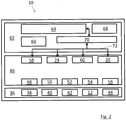
- Fig. 1 schematically shows an embedded device, namely a programmable logic controller (PLC) 10.
- the PLC 10 comprises an Ethernet connection 12, which serves as a data interface for communication, for example with a web browser of a (not shown) computer.
- firewall 14 The data coming in via the Ethernet connection 12 are checked by a firewall 14 using firewall rules 16. Only authorized requests or data are passed through the firewall 14.
- a web server 20 is arranged in a top, ie fourth, level 18.
- a monitoring service 24 is assigned to the underlying third level 22. Access to an application program can also be assigned to third level 22.
- the second level 26 is provided, to which the operating system core 28, i.e. the kernel or runtime is assigned.
- the lowest and thus first level 30 comprises a function block for hardware access 32.
- a separate authentication process 34 must be carried out for each level Fig. 1 is symbolized by an openable switch.
- a random number is generated in the exemplary embodiment shown, which is sent via the Ethernet connection 12 to the accessing browser.
- the browser encrypts the random number with a public key, which is contained in a certificate of the browser.
- the encrypted random number is then sent back to the PLC 10 and decrypted there with a private key. If the result of the decryption matches the original random number, access to the respective level 18, 22, 26, 30 is granted.
- three authentication processes 34 are necessary, namely for the fourth level 18, for the third level 22 and for the second level 26.
- the first area is a hardware layer 36, to which the Ethernet connection 12 belongs.
- the hardware layer 36 also includes the hardware components for a CAN bus 38 (Controller Area Network bus), for a USB connection 40 (Universal Serial Bus), for an encoder 42 and a touch-sensitive screen 44.
- CAN bus 38 Controller Area Network bus
- USB connection 40 Universal Serial Bus
- the hardware layer 36 is controlled by an operating system 46, which forms the second area and is real-time capable, for example.
- Operating system 46 includes a CAN driver 48, which controls CAN bus 38.
- Farther Operating system 46 includes a USB driver 50 for controlling USB port 40.
- the encoder 42 can be controlled by the operating system 46 via an encoder driver 52.
- An Ethernet stack 54 ensures the function of the Ethernet connection 12.
- a graphics driver 56 takes over the control of the touch-sensitive screen 44.
- the operating system 46 also provides various services, including an input and output management 58 (I / O management), the monitoring service 24 and a hot code swap service 60.
- the input and output management 58 enables access to hardware functions, for example to the CAN bus 38.
- the monitoring service 24 allows processes of the operating system 46 to be monitored and, for example, individual registers of the operating system 46 to be displayed.
- the hot code swap service 60 is used, which makes it possible to make changes to the operating system 46 at runtime.
- the operating system 46 also makes the web server 20 available.
- a code management 62 which represents the third area of the PLC 10, is based on the operating system 46.
- the code manager 62 essentially serves to execute a user program 64.
- the user program 64 can be used, for example, to control an automation system.
- the operating system 46 of the PLC 10 can also be referred to as firmware and the user program 64 as software or application program.
- the code management 62 comprises libraries 66 which do not contain information present in the user program 64.
- the code manager 62 further includes websites 68 that can be displayed by the web server 20 and a key manager 70.
- the key management 70 present in the exemplary embodiment essentially represents the one in FIG Fig. 1 shown functionality of authentication at different levels 18, 22, 26, 30 by means of several authentication processes 34.
- Key management 70 also includes user management (not shown) in the form of an access control matrix (ACM).
- ACM access control matrix
- the key management For authentication, the key management generates the random numbers for the respective authentication processes 34.
- the key manager 70 communicates with the various function blocks 20, 24, 28, 32, 60 by means of a D-bus 72.
- communication takes place with the input and output manager 58, hardware accesses 32 and accesses to the operating system core of the operating system 46 in the second level 26.
- Access to the monitoring service 24 requires an authentication process 34 for the third level 22, for which the key manager 70 communicates with the monitoring service 24.
- the hot code swap service 60 is also assigned to the third level 22 (in Fig. 1 not shown), which is why the key manager also communicates with the hot code swap service 60.
- a data exchange takes place between the key management 70 and the web server 20.
- the key management can also carry out an authentication process 34 for the user program 64, as a result of which, for example, blocked parts of the user program 64 can be executed.
Landscapes
- Engineering & Computer Science (AREA)
- Physics & Mathematics (AREA)
- Computer Hardware Design (AREA)
- General Physics & Mathematics (AREA)
- Theoretical Computer Science (AREA)
- Automation & Control Theory (AREA)
- Computer Security & Cryptography (AREA)
- Software Systems (AREA)
- General Engineering & Computer Science (AREA)
- Mathematical Physics (AREA)
- Microelectronics & Electronic Packaging (AREA)
- Programmable Controllers (AREA)
- Storage Device Security (AREA)
- Data Exchanges In Wide-Area Networks (AREA)
- Health & Medical Sciences (AREA)
- Bioethics (AREA)
- General Health & Medical Sciences (AREA)
Description
- Die vorliegende Erfindung betrifft ein Verfahren zum Zugreifen auf Funktionen eines Embedded-Geräts, insbesondere einer speicherprogrammierbaren Steuerung.
- Embedded-Geräte, d.h. beispielsweise speicherprogrammierbare Steuerungen (SPS) oder Programmable Logic Controller (PLC), werden in einer Vielzahl von Bereichen zur Steuerung von Maschinen und Anlagen eingesetzt. Insbesondere steuern solche Embedded-Geräte automatisierte Prozesse, wie beispielsweise Fertigungsstraßen, Kraftwerke oder Wasserversorgungssysteme.
- Üblicherweise verfügen die Embedded-Geräte selbst über keine oder nur sehr geringe Sicherheitsmechanismen, die einen Zugriff unbefugter Personen auf die Embedded-Geräte verhindern. Ein solcher Zugriff kann beispielsweise mittels einer Datenverbindung unter Verwendung eines Fernzugriffs erfolgen. Um einen gewissen Schutz der Embedded-Geräte zu erreichen, werden die Embedded-Geräte herkömmlicherweise mittels einer separaten Firewall oder durch komplett abgeschottete Datennetze geschützt.
- Nachteiligerweise muss ein Angreifer z.B. lediglich die Firewall überwinden, um auf die "hinter" der Firewall liegenden Embedded-Geräte zugreifen zu können. Insbesondere im Hinblick auf die zunehmende Vernetzung von Embedded-Geräten und die weiter steigende Anzahl von Angriffen über das Internet bzw. über Datennetze kommt der Abwehr solcher Bedrohungen eine immer größere Rolle zu.
- Aus der
EP 2 458 463 A1 ist ein Fernsteuerungssystem für eine Maschine bekannt. Dieses Dokument lehrt, in einer Datenbank registrierte Namen einem jeweiligen "authorization level" zuzuordnen, wobei nach einer einmaligen Autorisierung des Namens auf alle für den jeweiligen Namen freigegebenen Funktionen zugegriffen werden kann. - Es ist die der Erfindung zugrundeliegende Aufgabe, ein Embedded-Gerät und ein Verfahren zum Zugreifen auf ein solches Embedded-Gerät anzugeben, welche eine erhöhte Sicherheit des Embedded-Geräts gewährleisten.
- Diese Aufgabe wird durch ein Verfahren gemäß Anspruch 1 und insbesondere dadurch gelöst, dass
- (a) Funktionsblöcke des Embedded-Geräts zumindest zwei hierarchisch übereinanderliegenden Ebenen zugeordnet werden,
- (b) ein Zugriff auf einen Funktionsblock des Embedded-Geräts von außerhalb des Embedded-Geräts mittels einer Datenschnittstelle erfolgt und
- (c) bei dem Zugriff eine Authentifizierung für die Ebene, der der jeweilige Funktionsblock zugeordnet ist, und erneut für jede einzelne über der dem Funktionsblock zugeordneten Ebene liegenden Ebenen erfolgen muss, um eine Ausführung einer Funktion des Funktionsblocks zu gestatten, wobei die Funktionen der Funktionsblöcke einen Zugriff auf eine Firmware des Embedded-Geräts gestatten.
- Der Erfindung liegt dabei die Erkenntnis zugrunde, dass die Sicherheit des Embedded-Geräts stark erhöht werden kann, wenn das Embedded-Gerät selbst mit Sicherheitsfunktionen ausgestattet wird. Zu diesem Zweck werden die Funktionen des Embedded-Geräts in Funktionsblöcke aufgeteilt, die wiederum hierarchisch übereinanderliegenden Ebenen zugeordnet werden. Um beispielsweise auf eine Ebene unterhalb der obersten Ebene zuzugreifen, muss zunächst eine Authentifizierung für die oberste Ebene erfolgen. Anschließend muss nochmals eine Authentifizierung für die untere Ebene durchgeführt werden.
- Der damit implementierte Sicherheitsmechanismus beruht auf einem Zwiebelschalenprinzip, welches mehrfache Authentifizierungen für Funktionen in unteren Ebenen notwendig macht. Aufgrund der gegebenenfalls notwendigen mehrfachen Authentifizierung wird die Sicherheit, insbesondere von Funktionsblöcken in unteren Ebenen, deutlich erhöht.
- Bevorzugt können in einer Ebene auch mehrere Funktionsblöcke angeordnet sein, wobei für die Funktionsblöcke in einer Ebene jeweils die gleiche Anzahl an Authentifizierungsvorgängen notwendig ist. Jedoch kann bei einer Authentifizierung für einen Funktionsblock nicht automatisch ein Zugriff auf sämtliche Funktionsblöcke der Ebene gewährt werden. Stattdessen kann eine vollständige, erneute Authentifizierung für jeden Funktionsblock der Ebene erforderlich sein.
- Die Hierarchie der übereinanderliegenden Ebenen kann rein virtuell sein oder durch eine entsprechende Hintereinanderschaltung von Hardware des Embedded-Geräts geschaffen werden. Durch die Aufteilung der Funktionalität des Embedded-Geräts in mehrere Funktionsblöcke ergibt sich zudem der Vorteil, dass bei einem erfolgreichen Angriff lediglich Teile der Funktionalität des Embedded-Geräts freigeschaltet werden.
- Ist ein Benutzer für eine Ebene authentifiziert, kann er auf die Funktionen der Funktionsblöcke zugreifen, d.h. deren Funktionalität nutzen und beispielsweise das Embedded-Gerät verändern, Parameter auslesen oder angeschlossene weitere Embedded-Geräte ansteuern.
- Vorteilhafte Ausführungsformen der Erfindung sind der Beschreibung, den Unteransprüchen und den Zeichnungen zu entnehmen.
- Gemäß einer ersten vorteilhaften Ausführungsform gestatten die Funktionen der Funktionsblöcke auch einen Zugriff auf das auf dem Embedded-Gerät ausgeführte Anwendungsprogramm. Auf dem Embedded-Gerät ist eine Firmware vorhanden, die als Betriebssystem fungiert. Auch kann die Firmware eine sogenannte "Runtime" zur Verfügung stellen, die bevorzugt echtzeitfähig ist und ein Anwendungsprogramm ausführt. Das Anwendungsprogramm kann beispielsweise Steuerbefehle zur Steuerung einer Industrieanlage und dergleichen enthalten. Die Funktionen der Funktionsblöcke können sich also sowohl auf die Firmware als auch auf das Anwendungsprogramm beziehen. Somit kann durch die Authentifizierung für verschiedene Ebenen ein Zugriff auf Funktionen der Firmware und/oder des Anwendungsprogramms erfolgen.
- Gemäß einer weiteren vorteilhaften Ausführungsform erfolgt die Authentifizierung für verschiedene Ebenen durch unterschiedliche Schlüssel. Durch die Verwendung unterschiedlicher Schlüssel wird die Sicherheit des Embedded-Geräts zusätzlich erhöht.
- Das Embedded-Gerät wendet zur Authentifizierung für eine Ebene bevorzugt ein schlüsselbasierendes kryptographisches Verfahren an. Beispielsweise wird eine Zufallszahl generiert, wobei der Schlüssel zur Authentifizierung für die jeweilige Ebene durch Verschlüsselung der Zufallszahl mittels eines öffentlichen Schlüssels erzeugt wird und das Embedded-Gerät den Schlüssel mittels eines privaten Schlüssels entschlüsselt und das Ergebnis der Entschlüsselung mit der Zufallszahl vergleicht. Die Verschlüsselung der Zufallszahl kann von einem Benutzer vorgenommen werden, der Zugriff auf das Embedded-Gerät benötigt.
- Es kann also ein asymmetrisches Verschlüsselungsverfahren zur Erzeugung des Schlüssels und zur Verifizierung des Schlüssels verwendet werden. Der öffentliche und der private Schlüssel gehören zusammen und bilden ein Schlüsselpaar. Die Zufallszahl kann für jeden Authentifizierungsvorgang verschieden sein, wodurch auch ein Mitlesen der an das Embedded-Gerät übermittelten Schlüssel nicht zu einem erfolgreichen Angriff führt. Das Embedded-Gerät gibt den jeweiligen Funktionsblock dann frei, wenn die jeweils generierte Zufallszahl und der entschlüsselte Schlüssel gleich sind.
- Alternativ kann auch ein symmetrisches Verschlüsselungsverfahren zur Authentifizierung an einer Ebene verwendet werden. Insbesondere kann die Zufallszahl dazu mit dem symmetrischen Verschlüsselungsverfahren ver- und entschlüsselt werden.
- Als eine weitere Alternative kann auch die Eingabe eines Passworts erfolgen, um eine Authentifizierung für eine Ebene durchzuführen. Ebenfalls kann eine Kombination der Eingabe eines Passworts und der zusätzlichen Verwendung eines kryptographischen Verfahrens erfolgen.
- Bevorzugt kann das Embedded-Gerät einen Webserver bereitstellen, über welchen auf die Funktionsblöcke des Embedded-Geräts zugegriffen werden kann. Der Zugriff kann insbesondere mittels einer Internetverbindung erfolgen, wobei ein Browser verwendet wird, um die von dem Webserver übermittelten Inhalte darzustellen.
- Wird beispielsweise ein asymmetrisches Verschlüsselungsverfahren zur Authentifizierung verwendet, so kann ein dafür benötigter öffentlicher Schlüssel als Zertifikat in dem Browser gespeichert bzw. installiert sein, wodurch die Authentifizierung an dem Embedded-Gerät ohne Interaktion eines Benutzers erfolgen kann. Bevorzugt kann für jede Ebene ein separates Zertifikat verwendet werden, was die Sicherheit des Embedded-Geräts weiter erhöht.
- Während des Betriebs des Embedded-Geräts kann ein Benutzer mit einem Webbrowser eine Datenverbindung zu dem Embedded-Gerät herstellen, woraufhin der Webserver des Embedded-Geräts an den Browser eine Zufallszahl übermittelt. Im Browser kann die Zufallszahl (z.B. mittels eines Plug-Ins) und dem öffentlichen Schlüssel eines Zertifikats verschlüsselt werden. Die verschlüsselte Zufallszahl wird an den Webserver des Embedded-Geräts zurückgesendet und von dem Webserver mittels des privaten Schlüssels entschlüsselt. Entsprechen sich die Zufallszahl und der entschlüsselte Wert, wird ein jeweiliger Funktionsblock freigegeben. Wird mittels des Browsers Zugriff auf einen Funktionsblock in einer unteren Ebene angefordert, so wird die voranstehend beschriebene Authentifizierung mehrmals hintereinander mit verschiedenen Zufallszahlen durchgeführt. Ein Eingriff des Nutzers wird hierzu nicht benötigt.
- Entsprechend dem obigen Beispiel kann anstelle des asymmetrischen Verschlüsselungsverfahrens auch ein symmetrisches Verschlüsselungsverfahren eingesetzt werden. Dann kann die Zufallszahl jeweils mit dem gleichen Schlüssel im Browser verschlüsselt und im Embedded-Gerät entschlüsselt werden.
- Gemäß einer weiteren vorteilhaften Ausführungsform wird ein erster Funktionsblock, welcher einen direkten Zugriff auf Hardware des Embedded-Geräts gestattet, in einer ersten Ebene angeordnet, die die unterste Ebene ist, wobei eine zu dem ersten Funktionsblock gehörende Funktion insbesondere direkten Zugriff auf eine Netzwerkschnittstelle gestattet. Die Netzwerkschnittstelle kann mit der Datenschnittstelle identisch sein oder eine separate Datenverbindung erlauben. Die Funktionen des ersten Funktionsblocks können beispielsweise die direkte Steuerung der Hardware der Datenschnittstelle oder einer Feldbusschnittstelle (z.B. CAN-Bus - Controller Area Network Bus oder SERCOS 3) ermöglichen. Insbesondere kann die Firmware des Embedded-Geräts den Zugriff auf die Hardware ermöglichen. Da ein Zugriff auf die Hardware die vollständige Kontrolle des Embedded-Geräts ermöglichen kann, ist der erste Funktionsblock in der untersten Ebene angeordnet, die die größte Sicherheit bietet.
- Gemäß einer weiteren vorteilhaften Ausführungsform wird ein zweiter Funktionsblock, welcher einen direkten Zugriff auf einen Betriebssystemkern (Kernel) des Embedded-Geräts gestattet, in einer zweiten Ebene angeordnet, die oberhalb der ersten Ebene liegt. Dabei gestattet eine zu dem zweiten Funktionsblock gehörende Funktion insbesondere direkten Zugriff auf ein Dateisystem. Das Dateisystem kann zur Firmware des Embedded-Geräts gehören bzw. von der Firmware generiert werden.
- Gemäß einer weiteren vorteilhaften Ausführungsform wird ein dritter Funktionsblock, welcher einen Zugriff auf das ausgeführte Anwendungsprogramm gestattet, in einer dritten Ebene angeordnet, die oberhalb der zweiten Ebene liegt. Dabei gestattet eine zu dem dritten Funktionsblock gehörende Funktion insbesondere eine Überwachung des ausgeführten Anwendungsprogramms. Mittels des dritten Funktionsblocks kann also ein Monitoring des Anwendungsprogramms aber auch der Firmware durchgeführt werden.
- Gemäß einer weiteren vorteilhaften Ausführungsform wird ein vierter Funktionsblock, welcher einen Zugriff auf einen Webserver des Embedded-Geräts gestattet, in einer vierten Ebene angeordnet, die oberhalb der dritten Ebene liegt. Dabei gestattet eine zu dem vierten Funktionsblock gehörende Funktion insbesondere eine Dateneingabe und eine Datenausgabe an dem Webserver. Dies bedeutet, dass auch der Zugriff auf den Webserver selbst schon durch eine Authentifizierung geschützt werden kann.
- Bevorzugt wird ein Zugriff auf Funktionen des Embedded-Geräts von einer Firewall des Embedded-Geräts überprüft. Die Firewall kann von dem Embedded-Gerät selbst bereitgestellt werden, d.h. beispielsweise als separate Hardware in dem Embedded-Gerät integriert sein. Die Firewall kann zusätzliche Sicherheit für das Embedded-Gerät schaffen, indem die Firewall beispielsweise eine Vorauswahl berechtigter Anfragen anhand von vorbestimmten Regeln durchführt.
- Zusätzlich kann die Firewall als Endpunkt einer VPN-Verbindung (Virtual Private Network) dienen. In diesem Fall können ausschließlich Zugriffe mittels der VPN-Verbindung von dem Embedded-Gerät zugelassen werden.
- Gemäß einer weiteren vorteilhaften Ausführungsform wird eine Benutzerverwaltung verwendet, in welcher Benutzer hinterlegt sind, denen eine Authentifizierung für vorbestimmte Funktionsblöcke gestattet ist. Die Authentifizierung kann zentral, beispielsweise mittels einer Zugriffsmatrix (ACM - Access Control Matrix) oder in der jeweiligen Ebene erfolgen. Für die jeweilige Ebene kann eine Zugriffsliste (ACL - Access Control List) vorliegen. In der Zugriffsmatrix und der Zugriffsliste können diejenigen Benutzer gespeichert sein, die jeweils auf die Funktionsblöcke einer bestimmten Ebene zugreifen dürfen. Die Zugriffsliste für eine Ebene kann jeweils in der darüber liegenden Ebene gespeichert sein.
- Dabei können auch Benutzergruppen mit Zugriff auf unterschiedliche Ebenen gebildet werden. Insbesondere kann in der Zugriffsmatrix jeweils nur die unterste Ebene angegeben werden, auf die ein Benutzer oder eine Benutzergruppe Zugriff haben.
- Die einzelnen Benutzer können jeweils über ein Zertifikat bzw. ihre jeweiligen öffentlichen und privaten Schlüssel identifiziert werden.
- Die Zugriffsmatrix kann bevorzugt mit den verschiedenen Ebenen insbesondere mittels einer Interprozesskommunikation kommunizieren. Dabei kann beispielsweise der aus Linux bekannte D-Bus eingesetzt werden. Bevorzugt kann das Embedded-Gerät dazu Linux als Betriebssystem einsetzen oder auf einem Linuxbasierten Betriebssystem aufbauen.
- Die Erfindung umfasst weiterhin ein Embedded-Gerät, insbesondere eine speicherprogrammierbare Steuerung, mit einer Datenschnittstelle, einer Recheneinrichtung und einer Speichereinrichtung. Das Embedded-Gerät zeichnet sich dadurch aus, das die Recheneinrichtung ausgebildet ist, Funktionsblöcke des Embedded-Geräts hierarchisch übereinanderliegenden Ebenen zuzuordnen, bei einem Zugriff auf einen Funktionsblock des Embedded-Geräts von außerhalb des Embedded-Geräts mittels der Datenschnittstelle eine Authentifizierung für die Ebene, der der Funktionsblock zugeordnet ist und erneut für jede einzelne über der dem Funktionsblock zugeordneten Ebene liegenden Ebenen durchzuführen, bevor eine Ausführung einer Funktion des Funktionsblocks gestattet wird, wobei die Funktionen der Funktionsblöcke einen Zugriff auf eine Firmware des Embedded-Geräts und insbesondere auch einen Zugriff auf ein auf dem Embedded-Gerät ausgeführtes Anwendungsprogramm gestatten.
- In der Speichereinrichtung können die Firm- und die Software des Embedded-Geräts gespeichert sein, wobei sowohl Firm- als auch Software von der Recheneinrichtung ausgeführt werden.
- Gemäß einer vorteilhaften Ausführungsform ist das Embedded-Gerät ausgebildet, eine Echtzeitanwendung auszuführen. Die Echtzeitfähigkeit des Embedded-Geräts ist insbesondere bei der Steuerung zeitkritischer Industrieprozesse notwendig, um ein Zusammenspiel verschiedener Komponenten bei solchen Industrieprozessen zu ermöglichen. Bei dem Embedded-Gerät handelt es sich also insbesondere nicht um einen "herkömmlichen" Personal Computer (PC).
- Bevorzugt ist an dem Embedded-Gerät ein Feldbus-Anschluss vorgesehen und das Embedded-Gerät ist mit einer Spannung von 24 V betreibbar. Das Embedded-Gerät ist somit in die herkömmliche Infrastruktur von Automatisierungsprozessen ohne weiteres einbindbar. Bei dem Feldbusanschluss kann es sich dabei z.B. um einen Anschluss für den CAN-Bus handeln.
- Im Übrigen gelten für das erfindungsgemäße Embedded-Gerät die zu dem erfindungsgemäßen Verfahren getroffenen Aussagen.
- Nachfolgend wird die Erfindung rein beispielhaft unter Bezugnahme auf die Zeichnungen beschrieben. Es zeigen:
- Fig. 1
- eine schematische Ansicht eines Embedded-Geräts mit hierarchisch übereinanderliegenden Ebenen und jeweils zugehörigen Funktionsblöcken; und
- Fig. 2
- eine schematische Ansicht der Firm- und Software eines Embedded-Geräts.
-
Fig. 1 zeigt schematisch ein Embedded-Gerät, nämlich eine speicherprogrammierbare Steuerung (SPS) 10. Die SPS 10 umfasst einen Ethernetanschluss 12, der als Datenschnittstelle zur Kommunikation z.B. mit einem Webbrowser eines (nicht gezeigten) Computers dient. - Die über den Ethernetanschluss 12 eingehenden Daten werden von einer Firewall 14 anhand von Firewall-Regeln 16 überprüft. Lediglich berechtigte Anfragen bzw. Daten werden von der Firewall 14 durchgelassen.
- Hat eine Anfrage die Firewall 14 passiert, so kann nach einer weitergehenden Authentifizierung auf Funktionsblöcke zugegriffen werden, die hierarchisch übereinanderliegenden Ebenen zugeordnet sind. Dabei ist in einer obersten, d.h. vierten Ebene 18 ein Webserver 20 angeordnet. Der darunterliegenden dritten Ebene 22 ist ein Monitoring-Dienst 24 zugeordnet. Der dritten Ebene 22 kann auch der Zugriff auf ein Anwendungsprogramm zugeordnet sein.
- Unterhalb der dritten Ebene 22 ist die zweite Ebene 26 vorgesehen, der der Betriebssystemkern 28, d.h. der Kernel bzw. die Runtime, zugeordnet ist. Die unterste und damit erste Ebene 30 umfasst einen Funktionsblock zum Hardwarezugriff 32.
- Um Zugriff auf die Funktionsblöcke 20, 24, 28, 32 der verschiedenen Ebenen 18, 22, 26, 30 zu erlangen, muss für jede Ebene ein separater Authentifizierungsvorgang 34 durchgeführt werden, der in
Fig. 1 durch einen öffenbaren Schalter symbolisiert ist. Bei jedem Authentifizierungsvorgang 34 wird bei dem dargestellten Ausführungsbeispiel eine Zufallszahl erzeugt, die über den Ethernetanschluss 12 an den zugreifenden Browser gesendet wird. Der Browser verschlüsselt die Zufallszahl mit einem öffentlichen Schlüssel, welcher in einem Zertifikat des Browsers enthalten ist. Die verschlüsselte Zufallszahl wird anschließend an die SPS 10 zurückgesandt und dort mit einem privaten Schlüssel entschlüsselt. Wenn das Ergebnis der Entschlüsselung mit der ursprünglichen Zufallszahl übereinstimmt, wird Zugriff auf die jeweilige Ebene 18, 22, 26, 30 gewährt. Um beispielsweise Zugriff auf den Betriebssystemkern 28 zu erlangen, sind somit drei Authentifizierungsvorgänge 34 notwendig, nämlich für die vierte Ebene 18, für die dritte Ebene 22 und für die zweite Ebene 26. - In
Fig. 2 ist der schematische Aufbau der SPS 10 detaillierter dargestellt, wobei die SPS 10 im Wesentlichen drei Bereiche umfasst. Der erste Bereich ist eine Hardwareschicht 36, zu welcher der Ethernetanschluss 12 gehört. Die Hardwareschicht 36 umfasst zudem die Hardwarekomponenten für einen CAN-Bus 38 (Controller Area Network-Bus), für einen USB-Anschluss 40 (Universal Serial Bus), für einen Encoder 42 und einen berührungsempfindlichen Bildschirm 44. - Die Hardwareschicht 36 wird von einem Betriebssystem 46 gesteuert, welches den zweiten Bereich bildet und beispielsweise echtzeitfähig ist. Das Betriebssystem 46 umfasst einen CAN-Treiber 48, welcher den CAN-Bus 38 steuert. Weiterhin umfasst das Betriebssystem 46 einen USB-Treiber 50 zur Ansteuerung des USB-Anschlusses 40.
- Der Encoder 42 ist über einen Encodertreiber 52 von dem Betriebssystem 46 steuerbar. Ein Ethernet-Stack 54 gewährleistet die Funktion des Ethernetanschlusses 12. Ein Graphiktreiber 56 übernimmt die Steuerung des berührungsempfindlichen Bildschirms 44.
- Das Betriebssystem 46 stellt zudem verschiedene Dienste bereit, dazu zählen eine Ein- und Ausgabe-Verwaltung 58 (I/O-Management), der Monitoring-Dienst 24 und ein Hot-Code-Swap-Dienst 60. Die Ein- und Ausgabeverwaltung 58 ermöglicht dabei einen Zugriff auf Hardwarefunktionen, beispielsweise auf den CAN-Bus 38. Der Monitoring-Dienst 24 gestattet es, Prozesse des Betriebssystems 46 zu überwachen und beispielsweise einzelne Register des Betriebssystems 46 anzuzeigen.
- Zur Änderung der Funktionalität der SPS 10 im laufenden Betrieb wird der Hot-Code-Swap-Dienst 60 verwendet, der es ermöglicht, Änderungen am Betriebssystem 46 zur Laufzeit vorzunehmen.
- Das Betriebssystem 46 stellt zudem den Webserver 20 zur Verfügung.
- Auf dem Betriebssystem 46 setzt eine Codeverwaltung 62 auf, die den dritten Bereich der SPS 10 darstellt. Die Codeverwaltung 62 dient im Wesentlichen dazu, ein Benutzerprogramm 64 auszuführen. Das Benutzerprogramm 64 kann beispielsweise der Steuerung einer Automatisierungsanlage dienen. Allgemein kann das Betriebssystem 46 der SPS 10 auch als Firmware und das Benutzerprogramm 64 als Software oder Anwendungsprogramm bezeichnet werden.
- Zur Ausführung des Benutzerprogramms 64 umfasst die Codeverwaltung 62 Bibliotheken 66, die nicht in dem Benutzerprogramm 64 vorhandene Informationen enthalten. Die Codeverwaltung 62 umfasst ferner von dem Webserver 20 anzeigbare Webseiten 68 sowie eine Schlüsselverwaltung 70.
- Die beim Ausführungsbeispiel vorhandene Schlüsselverwaltung 70 stellt im Wesentlichen die in
Fig. 1 gezeigte Funktionalität der Authentifizierung an verschiedenen Ebenen 18, 22, 26, 30 mittels mehrerer Authentifizierungsvorgänge 34 bereit. Die Schlüsselverwaltung 70 umfasst zudem eine (nicht dargestellte) Benutzerverwaltung in Form einer Access Control Matrix (ACM). Zur Authentifizierung generiert die Schlüsselverwaltung für die jeweiligen Authentifizierungsvorgänge 34 die Zufallszahlen. Die Schlüsselverwaltung 70 kommuniziert mittels eines D-Busses 72 mit den verschiedenen Funktionsblöcken 20, 24, 28, 32, 60. Dabei wird zur Authentifizierung für die erste Ebene 30 mit der Ein- und Ausgabeverwaltung 58 kommuniziert, um Hardwarezugriffe 32 und Zugriffe auf den Betriebssystemkern des Betriebssystems 46 in der zweiten Ebene 26 zu gestatten. - Zugriffe auf den Monitoring-Dienst 24 erfordern einen Authentifizierungsvorgang 34 für die dritte Ebene 22, wozu die Schlüsselverwaltung 70 mit dem Monitoring-Dienst 24 kommuniziert. Der Hot-Code-Swap-Dienst 60 ist ebenfalls der dritten Ebene 22 zugeordnet (in
Fig. 1 nicht gezeigt), weshalb die Schlüsselverwaltung auch mit dem Hot-Code-Swap-Dienst 60 kommuniziert. Für Zugriffe auf den Webserver 20 findet ein Datenaustausch zwischen der Schlüsselverwaltung 70 und dem Webserver 20 statt. - Zusätzlich zu Zugriffen auf die Hardwareschicht 36 und das Betriebssystem 46 kann die Schlüsselverwaltung auch einen Authentifizierungsvorgang 34 für das Benutzerprogramm 64 durchführen, wodurch beispielsweise gesperrte Teile des Benutzerprogramms 64 ausgeführt werden können.
- Durch die Gliederung der SPS 10 in verschiedene Ebenen 18, 22, 26, 30 und der Zuordnung verschiedener Funktionsblöcke 20, 24, 28, 32, 60 zu diesen Ebenen kann je nach Wichtigkeit der verschiedenen Funktionsblöcke 20, 24, 28, 32, 60 ein unterschiedliches Sicherheitsniveau erzeugt werden. Dabei kann eine Abwägung zwischen dem erforderlichen Aufwand und dem benötigten Sicherheitsniveau getroffen werden.
-
- 10
- SPS
- 12
- Ethernetanschluss
- 14
- Firewall
- 16
- Firewallregeln
- 18
- vierte Ebene
- 20
- Webserver
- 22
- dritte Ebene
- 24
- Monitoring-Dienst
- 26
- zweite Ebene
- 28
- Betriebssystem kern
- 30
- erste Ebene
- 32
- Hardwarezugriff
- 34
- Authentifizierungsvorgang
- 36
- Hardwareschicht
- 38
- CAN-Bus
- 40
- USB-Anschluss
- 42
- Encoder
- 44
- berührungsempfindlicher Bildschirm
- 46
- Betriebssystem
- 48
- CAN-Treiber
- 50
- USB-Treiber
- 52
- Encoder-Treiber
- 54
- Ethernet-Stack
- 56
- Graphiktreiber
- 58
- Ein- und Ausgabeverwaltung
- 60
- Hot-Code-Swap-Dienst
- 62
- Codeverwaltung
- 64
- Benutzerprogramm
- 66
- Bibliotheken
- 68
- Webseiten
- 70
- Schlüsselverwaltung
- 72
- D-Bus
Claims (13)
- Verfahren zum Zugreifen auf Funktionen eines Embedded-Geräts (10), bei welchem(a) Funktionsblöcke (20, 24, 28, 32, 60) des Embedded-Geräts zumindest zwei hierarchisch übereinander liegenden Ebenen (18, 22, 26, 30) zugeordnet werden,(b) ein Zugriff auf einen Funktionsblock (20, 24, 28, 32, 60) des Embedded-Geräts (10) von außerhalb des Embedded-Geräts (10) mittels einer Datenschnittstelle (12) erfolgt und(c) bei dem Zugriff eine Authentifizierung (34) für die Ebene (18, 22, 26, 30), der der jeweilige Funktionsblock (20, 24, 28, 32, 60) zugeordnet ist, und erneut für jede einzelne über der dem Funktionsblock (20, 24, 28, 32, 60) zugeordneten Ebene (18, 22, 26, 30) liegenden Ebenen (18, 22, 26, 30) erfolgen muss, um eine Ausführung einer Funktion des Funktionsblocks (20, 24, 28, 32, 60) zu gestatten, wobeidie Funktionen der Funktionsblöcke (20, 24, 28, 32, 60) einen Zugriff auf eine Firmware (46) des Embedded-Geräts (10) gestatten.
- Verfahren nach Anspruch 1,
dadurch gekennzeichnet, dass
die Funktionen der Funktionsblöcke (20, 24, 28, 32, 60) auch einen Zugriff auf das auf dem Embedded-Gerät (10) ausgeführte Anwendungsprogramm (64) gestatten. - Verfahren nach Anspruch 1 oder 2,
dadurch gekennzeichnet, dass
die Authentifizierung (34) für verschiedene Ebenen (18, 22, 26, 30) durch unterschiedliche Schlüssel erfolgt. - Verfahren nach zumindest einem der vorstehenden Ansprüche,
dadurch gekennzeichnet, dass
das Embedded-Gerät (10) zur Authentifizierung (34) für eine Ebene (18, 22, 26, 30) ein schlüsselbasierendes kryptographisches Verfahren anwendet. - Verfahren nach zumindest einem der vorstehenden Ansprüche,
dadurch gekennzeichnet, dass
ein erster Funktionsblock (32), welcher einen direkten Zugriff auf Hardware (36) des Embedded-Gerätes (10) gestattet in einer ersten Ebene (30), die die unterste Ebene ist, angeordnet wird, wobei eine zu dem ersten Funktionsblock (32) gehörende Funktion Zugriff auf eine Netzwerkschnittstelle (12) gestattet. - Verfahren nach Anspruch 5,
dadurch gekennzeichnet, dass
ein zweiter Funktionsblock (28), welcher einen direkten Zugriff auf einen Betriebssystemkern (Kernel) des Embedded-Gerätes (10) gestattet in einer zweiten Ebene (26), die oberhalb der ersten Ebene (30) liegt, angeordnet wird, wobei eine zu dem zweiten Funktionsblock (28) gehörende Funktion Zugriff auf ein Dateisystem gestattet. - Verfahren nach Anspruch 6,
dadurch gekennzeichnet, dass
ein dritter Funktionsblock (58), welcher einen Zugriff auf das ausgeführte Anwendungsprogramm (64) gestattet, in einer dritten Ebene (22), die oberhalb der zweiten Ebene (26) liegt, angeordnet wird, wobei eine zu dem dritten Funktionsblock (28) gehörende Funktion eine Überwachung (24) (Monitoring) des ausgeführten Anwendungsprogramms (64) gestattet. - Verfahren nach Anspruch 7,
dadurch gekennzeichnet, dass
ein vierter Funktionsblock, welcher einen Zugriff auf einen Webserver (20) des Embedded-Geräts (10) gestattet, in einer vierten Ebene (18), die oberhalb der dritten Ebene (22) liegt, angeordnet wird, wobei eine zu dem vierten Funktionsblock gehörende Funktion eine Dateneingabe und eine Datenausgabe an dem Webserver (20) gestattet. - Verfahren nach zumindest einem der vorstehenden Ansprüche,
dadurch gekennzeichnet, dass
ein Zugriff auf Funktionen des Embedded-Geräts (10) von einer Firewall (14) des Embedded-Geräts (10) überprüft wird. - Verfahren nach zumindest einem der vorstehenden Ansprüche,
dadurch gekennzeichnet, dass
eine Benutzerverwaltung (70) verwendet wird, in welcher Benutzer hinterlegt sind, denen eine Authentifizierung (34) für vorbestimmte Funktionsblöcke (20, 24, 28, 32, 60) gestattet ist. - Embedded-Gerät (10) miteiner Datenschnittstelle (12),einer Recheneinrichtung undeiner Speichereinrichtung,wobei die Recheneinrichtung ausgebildet ist,a) Funktionsblöcke (20, 24, 28, 32, 60) des Embedded-Geräts (10) hierarchisch übereinander liegenden Ebenen (18, 22, 26, 30) zuzuordnen,b) bei einem Zugriff auf einen Funktionsblock (20, 24, 28, 32, 60) des Embedded-Geräts (10) von außerhalb des Embedded-Geräts (10) mittels der Datenschnittstelle (12) eine Authentifizierung (34) für die Ebene (18, 22, 26, 30), der der Funktionsblock (20, 24, 28, 32, 60) zugeordnet ist, und erneut für jede einzelne über der dem Funktionsblock (20, 24, 28, 32, 60) zugeordneten Ebene (18, 22, 26, 30) liegenden Ebenen (18, 22, 26, 30) durchzuführen, bevor eine Ausführung einer Funktion des Funktionsblocks (20, 24, 28, 32, 60) gestattet wird, wobeic) die Funktionen der Funktionsblöcke (20, 24, 28, 32, 60) einen Zugriff auf eine Firmware (46) des Embedded-Geräts (10) gestatten.
- Embedded-Gerät (10) nach Anspruch 11,
dadurch gekennzeichnet, dass
das Embedded-Gerät (10) ausgebildet ist, eine Echtzeitanwendung auszuführen. - Embedded-Gerät nach Anspruch 11 oder 12,
dadurch gekennzeichnet, dass
ein Feldbus-Anschluss (38) vorgesehen ist und das Embedded-Gerät (10) mit einer Spannung von 24 Volt betreibbar ist.
Applications Claiming Priority (2)
| Application Number | Priority Date | Filing Date | Title |
|---|---|---|---|
| DE102014116883.6A DE102014116883B4 (de) | 2014-11-18 | 2014-11-18 | Verfahren zum Zugreifen auf Funktionen eines Embedded-Geräts |
| PCT/EP2015/076534 WO2016079018A1 (de) | 2014-11-18 | 2015-11-13 | Verfahren zum zugreifen auf funktionen eines embedded-geräts |
Publications (2)
| Publication Number | Publication Date |
|---|---|
| EP3191902A1 EP3191902A1 (de) | 2017-07-19 |
| EP3191902B1 true EP3191902B1 (de) | 2020-04-22 |
Family
ID=54557392
Family Applications (1)
| Application Number | Title | Priority Date | Filing Date |
|---|---|---|---|
| EP15797048.4A Active EP3191902B1 (de) | 2014-11-18 | 2015-11-13 | Verfahren zum zugreifen auf funktionen eines embedded-geräts |
Country Status (4)
| Country | Link |
|---|---|
| US (1) | US10867077B2 (de) |
| EP (1) | EP3191902B1 (de) |
| DE (1) | DE102014116883B4 (de) |
| WO (1) | WO2016079018A1 (de) |
Families Citing this family (5)
| Publication number | Priority date | Publication date | Assignee | Title |
|---|---|---|---|---|
| DE102016224784A1 (de) * | 2016-12-13 | 2018-06-14 | Robert Bosch Gmbh | Steuervorrichtung zur Steuerung mindestens eines Teils einer industriellen Anlage und Verfahren zur Programmierung und/oder Diagnose der Steuervorrichtung |
| WO2020055426A1 (en) * | 2018-09-14 | 2020-03-19 | Hewlett-Packard Development Company, L.P. | Securing computing devices |
| US11956367B2 (en) * | 2019-02-19 | 2024-04-09 | Bruno SANGLE-FERRIERE | Cryptographic method for verifying data |
| US20230018586A1 (en) * | 2021-07-19 | 2023-01-19 | Rockwell Automation Technologies, Inc. | Systems and methods for distributing and executing loadable embedded software extensions in industrial controllers |
| DE102022211725A1 (de) * | 2022-11-07 | 2024-05-08 | Robert Bosch Gesellschaft mit beschränkter Haftung | Verfahren zur Überwachung von Schnittstellen zwischen einer Software-Applikation und einem Steuergerät |
Citations (11)
| Publication number | Priority date | Publication date | Assignee | Title |
|---|---|---|---|---|
| US5127099A (en) | 1989-06-30 | 1992-06-30 | Icom, Inc. | Method and apparatus for securing access to a ladder logic programming and monitoring system |
| DE10229704A1 (de) | 2002-07-02 | 2004-01-29 | Endress + Hauser Process Solutions Ag | Verfahren zum Schutz vor unerlaubtem Zugriff auf ein Feldgerät in der Prozessautomatisierungstechnik |
| EP1887447A2 (de) | 2006-08-10 | 2008-02-13 | Yokogawa Electric Corporation | Sicherheitsinstrumentensystem und Anlagensicherheitssystem |
| US20080238594A1 (en) | 2005-09-09 | 2008-10-02 | Jinping Liu | Low-Power Numerically Controlled Contactor and Control System Made of the Contactors |
| US20090064026A1 (en) | 2007-08-30 | 2009-03-05 | Walker David R | System for Displaying and Monitoring Practical Data in Controllers |
| US20090125983A1 (en) | 2006-02-10 | 2009-05-14 | Siemens Aktiengesellschaft | Security key with instructions |
| US7536548B1 (en) | 2002-06-04 | 2009-05-19 | Rockwell Automation Technologies, Inc. | System and methodology providing multi-tier-security for network data exchange with industrial control components |
| US20120005735A1 (en) | 2010-07-01 | 2012-01-05 | Bidare Prasanna | System for Three Level Authentication of a User |
| EP2458463A1 (de) | 2009-07-22 | 2012-05-30 | Makino Milling Machine Co. Ltd. | Fernsteuerungssystem für eine werkzeugmaschine |
| US20130117803A1 (en) | 2011-11-04 | 2013-05-09 | Honeywell International Inc. | Security and safety manager implementation in a multi-core processor |
| US20140336786A1 (en) | 2013-05-09 | 2014-11-13 | Rockwell Automation Technologies, Inc. | Using cloud-based data for virtualization of an industrial automation environment with information overlays |
Family Cites Families (15)
| Publication number | Priority date | Publication date | Assignee | Title |
|---|---|---|---|---|
| US6411987B1 (en) * | 1998-08-21 | 2002-06-25 | National Instruments Corporation | Industrial automation system and method having efficient network communication |
| DE60024319T2 (de) | 2000-02-08 | 2006-08-03 | Swisscom Mobile Ag | Vereinter einloggungsprozess |
| US7395122B2 (en) * | 2001-07-13 | 2008-07-01 | Siemens Aktiengesellschaft | Data capture for electronically delivered automation services |
| US20070162957A1 (en) * | 2003-07-01 | 2007-07-12 | Andrew Bartels | Methods, systems and devices for securing supervisory control and data acquisition (SCADA) communications |
| US20080109889A1 (en) * | 2003-07-01 | 2008-05-08 | Andrew Bartels | Methods, systems and devices for securing supervisory control and data acquisition (SCADA) communications |
| US20050246529A1 (en) * | 2004-04-30 | 2005-11-03 | Microsoft Corporation | Isolated persistent identity storage for authentication of computing devies |
| US20070067119A1 (en) * | 2005-09-16 | 2007-03-22 | Power Measurement Ltd. | Rack-mounted power meter having removable metering options module |
| US20070201540A1 (en) * | 2006-02-14 | 2007-08-30 | Berkman William H | Hybrid power line wireless communication network |
| US8856522B2 (en) * | 2007-02-27 | 2014-10-07 | Rockwell Automation Technologies | Security, safety, and redundancy employing controller engine instances |
| DE102007062915A1 (de) | 2007-12-21 | 2009-06-25 | Endress + Hauser Process Solutions Ag | Verfahren zum Betreiben einer speicherprogrammierbaren Steuerung |
| US8868907B2 (en) | 2009-03-18 | 2014-10-21 | University Of Louisville Research Foundation, Inc. | Device, method, and system for processing communications for secure operation of industrial control system field devices |
| US8479260B2 (en) | 2009-12-21 | 2013-07-02 | The Boeing Company | Multi-level security controls system |
| US9066125B2 (en) * | 2012-02-10 | 2015-06-23 | Advanced Biometric Controls, Llc | Secure display |
| US20150040192A1 (en) * | 2013-07-31 | 2015-02-05 | Michael Christopher Kobold | Graduated access multi-password authentication |
| KR20150032963A (ko) * | 2013-09-23 | 2015-04-01 | 주식회사 팬택 | 단말기의 사생활 보호 장치 및 방법 |
-
2014
- 2014-11-18 DE DE102014116883.6A patent/DE102014116883B4/de active Active
-
2015
- 2015-11-13 US US15/526,110 patent/US10867077B2/en active Active
- 2015-11-13 WO PCT/EP2015/076534 patent/WO2016079018A1/de not_active Ceased
- 2015-11-13 EP EP15797048.4A patent/EP3191902B1/de active Active
Patent Citations (11)
| Publication number | Priority date | Publication date | Assignee | Title |
|---|---|---|---|---|
| US5127099A (en) | 1989-06-30 | 1992-06-30 | Icom, Inc. | Method and apparatus for securing access to a ladder logic programming and monitoring system |
| US7536548B1 (en) | 2002-06-04 | 2009-05-19 | Rockwell Automation Technologies, Inc. | System and methodology providing multi-tier-security for network data exchange with industrial control components |
| DE10229704A1 (de) | 2002-07-02 | 2004-01-29 | Endress + Hauser Process Solutions Ag | Verfahren zum Schutz vor unerlaubtem Zugriff auf ein Feldgerät in der Prozessautomatisierungstechnik |
| US20080238594A1 (en) | 2005-09-09 | 2008-10-02 | Jinping Liu | Low-Power Numerically Controlled Contactor and Control System Made of the Contactors |
| US20090125983A1 (en) | 2006-02-10 | 2009-05-14 | Siemens Aktiengesellschaft | Security key with instructions |
| EP1887447A2 (de) | 2006-08-10 | 2008-02-13 | Yokogawa Electric Corporation | Sicherheitsinstrumentensystem und Anlagensicherheitssystem |
| US20090064026A1 (en) | 2007-08-30 | 2009-03-05 | Walker David R | System for Displaying and Monitoring Practical Data in Controllers |
| EP2458463A1 (de) | 2009-07-22 | 2012-05-30 | Makino Milling Machine Co. Ltd. | Fernsteuerungssystem für eine werkzeugmaschine |
| US20120005735A1 (en) | 2010-07-01 | 2012-01-05 | Bidare Prasanna | System for Three Level Authentication of a User |
| US20130117803A1 (en) | 2011-11-04 | 2013-05-09 | Honeywell International Inc. | Security and safety manager implementation in a multi-core processor |
| US20140336786A1 (en) | 2013-05-09 | 2014-11-13 | Rockwell Automation Technologies, Inc. | Using cloud-based data for virtualization of an industrial automation environment with information overlays |
Non-Patent Citations (1)
| Title |
|---|
| QIMIN ZHANG: "Konzepte für die Kommunikation zwischen Automatisierungsgeräten", DISSERTATION, FAKULT�T IV � ELEKTROTECHNIK UND INFORMATIK DER TECHNISCHEN UNIVERSIT�T BERLIN, vol. D 83, 3 September 2002 (2002-09-03), pages 153 pp., XP009120901 |
Also Published As
| Publication number | Publication date |
|---|---|
| WO2016079018A1 (de) | 2016-05-26 |
| US10867077B2 (en) | 2020-12-15 |
| DE102014116883B4 (de) | 2022-07-14 |
| DE102014116883A1 (de) | 2016-05-19 |
| US20170308720A1 (en) | 2017-10-26 |
| EP3191902A1 (de) | 2017-07-19 |
Similar Documents
| Publication | Publication Date | Title |
|---|---|---|
| DE102014116883B4 (de) | Verfahren zum Zugreifen auf Funktionen eines Embedded-Geräts | |
| EP2272199B1 (de) | Verteilte datenspeicherungseinrichtung | |
| EP4288886B1 (de) | Bereitstellung von zu schützenden daten in einer sicheren ausführungsumgebung eines datenverarbeitungssystems | |
| EP2407843B1 (de) | Sichere Datenübertragung in einem Automatisierungsnetzwerk | |
| EP2235598B1 (de) | Feldgerät und verfahren zu dessen betrieb | |
| EP3798878A1 (de) | Anordnung und verfahren zur sicheren ausführung eines automatisierungsprogramms in einem cloud-computing-umfeld | |
| EP3422234B1 (de) | Container-image, computerprogrammprodukt und verfahren | |
| WO2014044507A1 (de) | Verfahren zum sicheren bedienen eines feldgerätes | |
| EP3373545A1 (de) | Sicherheitseinheit insbesondere ein für iot-gerät und verfahren zur ausführung einer oder mehrerer applikationen zum gesicherten datenaustausch mit einem oder mehrere web-dienste bereitstellenden servern | |
| EP3105899B1 (de) | Verfahren zum hochfahren eines produktions-computersystems | |
| EP3820081B1 (de) | Verfahren zur durchführung einer erlaubnisabhängigen kommunikation zwischen wenigstens einem feldgerät der automatisierungstechnik und einem bediengerät | |
| DE102014213454A1 (de) | Verfahren und System zur Erkennung einer Manipulation von Datensätzen | |
| EP3682317B1 (de) | Verfahren zum betrieb einer berührungssensitiven, flächigen eingabevorrichtung einer gesamtvorrichtung und gesamtvorrichtung | |
| DE102010006432A1 (de) | Verfahren und System zum Bereitstellen von EDRM-geschützten Datenobjekten | |
| DE102009040615A1 (de) | Verfahren zur digitalen Rechteverwaltung in einem Computernetz mit einer Vielzahl von Teilnehmerrechnern | |
| EP4096182A1 (de) | Verfahren zur gesicherten einräumung eines zugriffs auf daten und/oder ressourcen und gateway-komponente | |
| WO2011147693A1 (de) | Verfahren zum bereitstellen von edrm (enterprise digital rights management) geschützten datenobjekten | |
| EP3731483B1 (de) | Verfahren zur erzeugung von digitalen signaturen | |
| EP4740121A1 (de) | Verfahren zum überprüfen eines zugriffs auf zugangsinformationen innerhalb einer laufzeitumgebung, sowie laufzeitumgebungs-system, computerprogramm und datenträger | |
| EP4641416A1 (de) | Verfahren und system zur zugangskontrolle für einen zugriff von einer containerinstanz auf einen abgesetzten dienst | |
| EP2950227B1 (de) | Authentifizierungsverfahren | |
| DE102014008654A1 (de) | Temporäre Berechtigung | |
| DE10345468B4 (de) | Verfahren zur sicheren Ausführung von Programmen | |
| EP4629115A1 (de) | Verfahren, insbesondere computergestütztes verfahren, vorrichtung, computerprogrammprodukt und computerlesbares medium | |
| WO2025180706A1 (de) | Verfahren zum gewähren von zugriff auf funktionalität in einem industriellen automatisierungssystem, computerprogrammprodukt und industrielles automatisierungssystem |
Legal Events
| Date | Code | Title | Description |
|---|---|---|---|
| STAA | Information on the status of an ep patent application or granted ep patent |
Free format text: STATUS: THE INTERNATIONAL PUBLICATION HAS BEEN MADE |
|
| PUAI | Public reference made under article 153(3) epc to a published international application that has entered the european phase |
Free format text: ORIGINAL CODE: 0009012 |
|
| STAA | Information on the status of an ep patent application or granted ep patent |
Free format text: STATUS: REQUEST FOR EXAMINATION WAS MADE |
|
| 17P | Request for examination filed |
Effective date: 20170410 |
|
| AK | Designated contracting states |
Kind code of ref document: A1 Designated state(s): AL AT BE BG CH CY CZ DE DK EE ES FI FR GB GR HR HU IE IS IT LI LT LU LV MC MK MT NL NO PL PT RO RS SE SI SK SM TR |
|
| AX | Request for extension of the european patent |
Extension state: BA ME |
|
| DAV | Request for validation of the european patent (deleted) | ||
| DAX | Request for extension of the european patent (deleted) | ||
| REG | Reference to a national code |
Ref country code: DE Ref legal event code: R079 Ref document number: 502015012373 Country of ref document: DE Free format text: PREVIOUS MAIN CLASS: G05B0019042000 Ipc: G05B0019050000 |
|
| GRAP | Despatch of communication of intention to grant a patent |
Free format text: ORIGINAL CODE: EPIDOSNIGR1 |
|
| STAA | Information on the status of an ep patent application or granted ep patent |
Free format text: STATUS: GRANT OF PATENT IS INTENDED |
|
| RIC1 | Information provided on ipc code assigned before grant |
Ipc: G05B 19/05 20060101AFI20191016BHEP |
|
| INTG | Intention to grant announced |
Effective date: 20191105 |
|
| GRAS | Grant fee paid |
Free format text: ORIGINAL CODE: EPIDOSNIGR3 |
|
| GRAA | (expected) grant |
Free format text: ORIGINAL CODE: 0009210 |
|
| STAA | Information on the status of an ep patent application or granted ep patent |
Free format text: STATUS: THE PATENT HAS BEEN GRANTED |
|
| AK | Designated contracting states |
Kind code of ref document: B1 Designated state(s): AL AT BE BG CH CY CZ DE DK EE ES FI FR GB GR HR HU IE IS IT LI LT LU LV MC MK MT NL NO PL PT RO RS SE SI SK SM TR |
|
| REG | Reference to a national code |
Ref country code: CH Ref legal event code: EP |
|
| REG | Reference to a national code |
Ref country code: DE Ref legal event code: R096 Ref document number: 502015012373 Country of ref document: DE |
|
| REG | Reference to a national code |
Ref country code: IE Ref legal event code: FG4D Free format text: LANGUAGE OF EP DOCUMENT: GERMAN |
|
| REG | Reference to a national code |
Ref country code: AT Ref legal event code: REF Ref document number: 1260951 Country of ref document: AT Kind code of ref document: T Effective date: 20200515 |
|
| REG | Reference to a national code |
Ref country code: LT Ref legal event code: MG4D |
|
| REG | Reference to a national code |
Ref country code: NL Ref legal event code: MP Effective date: 20200422 |
|
| PG25 | Lapsed in a contracting state [announced via postgrant information from national office to epo] |
Ref country code: PT Free format text: LAPSE BECAUSE OF FAILURE TO SUBMIT A TRANSLATION OF THE DESCRIPTION OR TO PAY THE FEE WITHIN THE PRESCRIBED TIME-LIMIT Effective date: 20200824 Ref country code: LT Free format text: LAPSE BECAUSE OF FAILURE TO SUBMIT A TRANSLATION OF THE DESCRIPTION OR TO PAY THE FEE WITHIN THE PRESCRIBED TIME-LIMIT Effective date: 20200422 Ref country code: GR Free format text: LAPSE BECAUSE OF FAILURE TO SUBMIT A TRANSLATION OF THE DESCRIPTION OR TO PAY THE FEE WITHIN THE PRESCRIBED TIME-LIMIT Effective date: 20200723 Ref country code: NL Free format text: LAPSE BECAUSE OF FAILURE TO SUBMIT A TRANSLATION OF THE DESCRIPTION OR TO PAY THE FEE WITHIN THE PRESCRIBED TIME-LIMIT Effective date: 20200422 Ref country code: SE Free format text: LAPSE BECAUSE OF FAILURE TO SUBMIT A TRANSLATION OF THE DESCRIPTION OR TO PAY THE FEE WITHIN THE PRESCRIBED TIME-LIMIT Effective date: 20200422 Ref country code: NO Free format text: LAPSE BECAUSE OF FAILURE TO SUBMIT A TRANSLATION OF THE DESCRIPTION OR TO PAY THE FEE WITHIN THE PRESCRIBED TIME-LIMIT Effective date: 20200722 Ref country code: IS Free format text: LAPSE BECAUSE OF FAILURE TO SUBMIT A TRANSLATION OF THE DESCRIPTION OR TO PAY THE FEE WITHIN THE PRESCRIBED TIME-LIMIT Effective date: 20200822 Ref country code: FI Free format text: LAPSE BECAUSE OF FAILURE TO SUBMIT A TRANSLATION OF THE DESCRIPTION OR TO PAY THE FEE WITHIN THE PRESCRIBED TIME-LIMIT Effective date: 20200422 |
|
| PG25 | Lapsed in a contracting state [announced via postgrant information from national office to epo] |
Ref country code: RS Free format text: LAPSE BECAUSE OF FAILURE TO SUBMIT A TRANSLATION OF THE DESCRIPTION OR TO PAY THE FEE WITHIN THE PRESCRIBED TIME-LIMIT Effective date: 20200422 Ref country code: LV Free format text: LAPSE BECAUSE OF FAILURE TO SUBMIT A TRANSLATION OF THE DESCRIPTION OR TO PAY THE FEE WITHIN THE PRESCRIBED TIME-LIMIT Effective date: 20200422 Ref country code: HR Free format text: LAPSE BECAUSE OF FAILURE TO SUBMIT A TRANSLATION OF THE DESCRIPTION OR TO PAY THE FEE WITHIN THE PRESCRIBED TIME-LIMIT Effective date: 20200422 Ref country code: BG Free format text: LAPSE BECAUSE OF FAILURE TO SUBMIT A TRANSLATION OF THE DESCRIPTION OR TO PAY THE FEE WITHIN THE PRESCRIBED TIME-LIMIT Effective date: 20200722 |
|
| PG25 | Lapsed in a contracting state [announced via postgrant information from national office to epo] |
Ref country code: AL Free format text: LAPSE BECAUSE OF FAILURE TO SUBMIT A TRANSLATION OF THE DESCRIPTION OR TO PAY THE FEE WITHIN THE PRESCRIBED TIME-LIMIT Effective date: 20200422 |
|
| REG | Reference to a national code |
Ref country code: DE Ref legal event code: R026 Ref document number: 502015012373 Country of ref document: DE |
|
| PLBI | Opposition filed |
Free format text: ORIGINAL CODE: 0009260 |
|
| PG25 | Lapsed in a contracting state [announced via postgrant information from national office to epo] |
Ref country code: RO Free format text: LAPSE BECAUSE OF FAILURE TO SUBMIT A TRANSLATION OF THE DESCRIPTION OR TO PAY THE FEE WITHIN THE PRESCRIBED TIME-LIMIT Effective date: 20200422 Ref country code: CZ Free format text: LAPSE BECAUSE OF FAILURE TO SUBMIT A TRANSLATION OF THE DESCRIPTION OR TO PAY THE FEE WITHIN THE PRESCRIBED TIME-LIMIT Effective date: 20200422 Ref country code: ES Free format text: LAPSE BECAUSE OF FAILURE TO SUBMIT A TRANSLATION OF THE DESCRIPTION OR TO PAY THE FEE WITHIN THE PRESCRIBED TIME-LIMIT Effective date: 20200422 Ref country code: EE Free format text: LAPSE BECAUSE OF FAILURE TO SUBMIT A TRANSLATION OF THE DESCRIPTION OR TO PAY THE FEE WITHIN THE PRESCRIBED TIME-LIMIT Effective date: 20200422 Ref country code: SM Free format text: LAPSE BECAUSE OF FAILURE TO SUBMIT A TRANSLATION OF THE DESCRIPTION OR TO PAY THE FEE WITHIN THE PRESCRIBED TIME-LIMIT Effective date: 20200422 Ref country code: DK Free format text: LAPSE BECAUSE OF FAILURE TO SUBMIT A TRANSLATION OF THE DESCRIPTION OR TO PAY THE FEE WITHIN THE PRESCRIBED TIME-LIMIT Effective date: 20200422 |
|
| PLAX | Notice of opposition and request to file observation + time limit sent |
Free format text: ORIGINAL CODE: EPIDOSNOBS2 |
|
| 26 | Opposition filed |
Opponent name: DTS PATENT- UND RECHTSANWAELTE SCHNEKENBUEHL UND PARTNER MBB Effective date: 20210121 |
|
| PG25 | Lapsed in a contracting state [announced via postgrant information from national office to epo] |
Ref country code: SK Free format text: LAPSE BECAUSE OF FAILURE TO SUBMIT A TRANSLATION OF THE DESCRIPTION OR TO PAY THE FEE WITHIN THE PRESCRIBED TIME-LIMIT Effective date: 20200422 Ref country code: PL Free format text: LAPSE BECAUSE OF FAILURE TO SUBMIT A TRANSLATION OF THE DESCRIPTION OR TO PAY THE FEE WITHIN THE PRESCRIBED TIME-LIMIT Effective date: 20200422 |
|
| PG25 | Lapsed in a contracting state [announced via postgrant information from national office to epo] |
Ref country code: SI Free format text: LAPSE BECAUSE OF FAILURE TO SUBMIT A TRANSLATION OF THE DESCRIPTION OR TO PAY THE FEE WITHIN THE PRESCRIBED TIME-LIMIT Effective date: 20200422 |
|
| PLBB | Reply of patent proprietor to notice(s) of opposition received |
Free format text: ORIGINAL CODE: EPIDOSNOBS3 |
|
| PG25 | Lapsed in a contracting state [announced via postgrant information from national office to epo] |
Ref country code: MC Free format text: LAPSE BECAUSE OF FAILURE TO SUBMIT A TRANSLATION OF THE DESCRIPTION OR TO PAY THE FEE WITHIN THE PRESCRIBED TIME-LIMIT Effective date: 20200422 |
|
| REG | Reference to a national code |
Ref country code: CH Ref legal event code: PL |
|
| GBPC | Gb: european patent ceased through non-payment of renewal fee |
Effective date: 20201113 |
|
| PG25 | Lapsed in a contracting state [announced via postgrant information from national office to epo] |
Ref country code: LU Free format text: LAPSE BECAUSE OF NON-PAYMENT OF DUE FEES Effective date: 20201113 |
|
| REG | Reference to a national code |
Ref country code: BE Ref legal event code: MM Effective date: 20201130 |
|
| PG25 | Lapsed in a contracting state [announced via postgrant information from national office to epo] |
Ref country code: LI Free format text: LAPSE BECAUSE OF NON-PAYMENT OF DUE FEES Effective date: 20201130 Ref country code: CH Free format text: LAPSE BECAUSE OF NON-PAYMENT OF DUE FEES Effective date: 20201130 |
|
| PG25 | Lapsed in a contracting state [announced via postgrant information from national office to epo] |
Ref country code: IE Free format text: LAPSE BECAUSE OF NON-PAYMENT OF DUE FEES Effective date: 20201113 |
|
| PG25 | Lapsed in a contracting state [announced via postgrant information from national office to epo] |
Ref country code: GB Free format text: LAPSE BECAUSE OF NON-PAYMENT OF DUE FEES Effective date: 20201113 |
|
| REG | Reference to a national code |
Ref country code: AT Ref legal event code: MM01 Ref document number: 1260951 Country of ref document: AT Kind code of ref document: T Effective date: 20201113 |
|
| PG25 | Lapsed in a contracting state [announced via postgrant information from national office to epo] |
Ref country code: AT Free format text: LAPSE BECAUSE OF NON-PAYMENT OF DUE FEES Effective date: 20201113 |
|
| REG | Reference to a national code |
Ref country code: DE Ref legal event code: R100 Ref document number: 502015012373 Country of ref document: DE |
|
| PG25 | Lapsed in a contracting state [announced via postgrant information from national office to epo] |
Ref country code: TR Free format text: LAPSE BECAUSE OF FAILURE TO SUBMIT A TRANSLATION OF THE DESCRIPTION OR TO PAY THE FEE WITHIN THE PRESCRIBED TIME-LIMIT Effective date: 20200422 Ref country code: MT Free format text: LAPSE BECAUSE OF FAILURE TO SUBMIT A TRANSLATION OF THE DESCRIPTION OR TO PAY THE FEE WITHIN THE PRESCRIBED TIME-LIMIT Effective date: 20200422 Ref country code: CY Free format text: LAPSE BECAUSE OF FAILURE TO SUBMIT A TRANSLATION OF THE DESCRIPTION OR TO PAY THE FEE WITHIN THE PRESCRIBED TIME-LIMIT Effective date: 20200422 |
|
| PG25 | Lapsed in a contracting state [announced via postgrant information from national office to epo] |
Ref country code: MK Free format text: LAPSE BECAUSE OF FAILURE TO SUBMIT A TRANSLATION OF THE DESCRIPTION OR TO PAY THE FEE WITHIN THE PRESCRIBED TIME-LIMIT Effective date: 20200422 |
|
| PG25 | Lapsed in a contracting state [announced via postgrant information from national office to epo] |
Ref country code: BE Free format text: LAPSE BECAUSE OF NON-PAYMENT OF DUE FEES Effective date: 20201130 |
|
| PLCK | Communication despatched that opposition was rejected |
Free format text: ORIGINAL CODE: EPIDOSNREJ1 |
|
| PLBN | Opposition rejected |
Free format text: ORIGINAL CODE: 0009273 |
|
| STAA | Information on the status of an ep patent application or granted ep patent |
Free format text: STATUS: OPPOSITION REJECTED |
|
| 27O | Opposition rejected |
Effective date: 20220512 |
|
| P01 | Opt-out of the competence of the unified patent court (upc) registered |
Effective date: 20230803 |
|
| PG25 | Lapsed in a contracting state [announced via postgrant information from national office to epo] |
Ref country code: IS Free format text: LAPSE BECAUSE OF NON-PAYMENT OF DUE FEES Effective date: 20200822 |
|
| PGFP | Annual fee paid to national office [announced via postgrant information from national office to epo] |
Ref country code: IT Payment date: 20251128 Year of fee payment: 11 |
|
| PGFP | Annual fee paid to national office [announced via postgrant information from national office to epo] |
Ref country code: FR Payment date: 20251128 Year of fee payment: 11 |
|
| PGFP | Annual fee paid to national office [announced via postgrant information from national office to epo] |
Ref country code: DE Payment date: 20260128 Year of fee payment: 11 |