EP3191541B1 - Cationically curable benzoxazine compositions - Google Patents
Cationically curable benzoxazine compositions Download PDFInfo
- Publication number
- EP3191541B1 EP3191541B1 EP15839675.4A EP15839675A EP3191541B1 EP 3191541 B1 EP3191541 B1 EP 3191541B1 EP 15839675 A EP15839675 A EP 15839675A EP 3191541 B1 EP3191541 B1 EP 3191541B1
- Authority
- EP
- European Patent Office
- Prior art keywords
- composition
- lithium
- group
- percent
- catalyst
- Prior art date
- Legal status (The legal status is an assumption and is not a legal conclusion. Google has not performed a legal analysis and makes no representation as to the accuracy of the status listed.)
- Active
Links
Classifications
-
- C—CHEMISTRY; METALLURGY
- C08—ORGANIC MACROMOLECULAR COMPOUNDS; THEIR PREPARATION OR CHEMICAL WORKING-UP; COMPOSITIONS BASED THEREON
- C08G—MACROMOLECULAR COMPOUNDS OBTAINED OTHERWISE THAN BY REACTIONS ONLY INVOLVING UNSATURATED CARBON-TO-CARBON BONDS
- C08G73/00—Macromolecular compounds obtained by reactions forming a linkage containing nitrogen with or without oxygen or carbon in the main chain of the macromolecule, not provided for in groups C08G12/00 - C08G71/00
- C08G73/02—Polyamines
- C08G73/0233—Polyamines derived from (poly)oxazolines, (poly)oxazines or having pendant acyl groups
-
- B—PERFORMING OPERATIONS; TRANSPORTING
- B01—PHYSICAL OR CHEMICAL PROCESSES OR APPARATUS IN GENERAL
- B01J—CHEMICAL OR PHYSICAL PROCESSES, e.g. CATALYSIS OR COLLOID CHEMISTRY; THEIR RELEVANT APPARATUS
- B01J23/00—Catalysts comprising metals or metal oxides or hydroxides, not provided for in group B01J21/00
- B01J23/02—Catalysts comprising metals or metal oxides or hydroxides, not provided for in group B01J21/00 of the alkali- or alkaline earth metals or beryllium
- B01J23/04—Alkali metals
-
- C—CHEMISTRY; METALLURGY
- C08—ORGANIC MACROMOLECULAR COMPOUNDS; THEIR PREPARATION OR CHEMICAL WORKING-UP; COMPOSITIONS BASED THEREON
- C08L—COMPOSITIONS OF MACROMOLECULAR COMPOUNDS
- C08L79/00—Compositions of macromolecular compounds obtained by reactions forming in the main chain of the macromolecule a linkage containing nitrogen with or without oxygen or carbon only, not provided for in groups C08L61/00 - C08L77/00
- C08L79/02—Polyamines
Definitions
- a curable composition which includes a benzoxazine component; and a cationic catalyst comprised of a lithium cation and an anion comprising a hexahalogenated Group 15 element.
- Cationic catalysts are known.
- WO 01/25225 A2 describes adducts of glycidylesters of ⁇ , ⁇ -branched carboxylic acids and carboxylic acids, to poly (ortho ester) as intermediate for their preparation and to a process for the preparation of solid poly (ortho ester) intermediates.
- the adducts are used as constituent for binders in two component curable coating compositions for clear coat or coloured top coat for automotives or general metal coatings or industrial coatings.
- EP 1 860 723 A1 describes a polymer electrolyte containing lithium hexafluorophosphate and a polymer.
- the present invention relates to a curable composition as defined in appended claim 1 and comprising: (a) a benzoxazine component; and (b) a catalyst composition; wherein the catalyst composition comprises: (i) a lithium salt, an anion of which has a conjugate acid with a pKa of less than 5; and (ii) a carboxylic acid, a sulfonic acid, or a combination thereof; or wherein the catalyst composition comprises: (iii) a lithium salt, an anion of which has a conjugate acid with a pKa of less than 5; and (iv) a salt having as an anion a hexahalogenated Group 15 element.
- the present invention relates to a curable composition as defined in appended claim 2 and comprising: (a) a benzoxazine component; and (b) a catalyst composition comprising: (i) a cationic catalyst that is either comprised of a lithium cation and an anion comprising a hexahalogenated Group 15 element; or selected from lithium trifluoromethane sulfate, lithium palmitate, lithium tetrafluoroborate and lithium perchlorate; and (ii) a co-catalyst selected from tetrabutyl ammonium hexafluorophosphate and adipic acid.
- a cationic catalyst that is either comprised of a lithium cation and an anion comprising a hexahalogenated Group 15 element; or selected from lithium trifluoromethane sulfate, lithium palmitate, lithium tetrafluoroborate and lithium perchlorate
- a co-catalyst selected from te
- cationic catalyst examples include lithium hexafluorophosphate and lithium hexafluoroantimonate.
- cationic catalysts should be used in catalytic amounts, such as about 0.1 to about 10 percent by weight.
- a co-catalyst with the so-defined cationic catalysts and other cationic catalysts.
- a cationic catalyst that itself does not confer a polymerization conversion greater than 90% (such as lithium trifluoromethane sulfate, lithium palmitate, lithium tetrafluoroborate and lithium perchlorate), together with one or more co-catalysts, such as tetrabutyl ammonium hexafluorophosphate and adipic acid, is suitable to achieve a polymerization conversion greater than 90% polymerization conversion.
- the benzoxazine component comprises one or more of where o is 1-4, X is selected from a direct bond (when o is 2), alkyl (when o is 1), alkylene (when o is 2-4), carbonyl (when o is 2), thiol (when o is 1), thioether (when o is 2), sulfoxide (when o is 2), and sulfone (when o is 2), R 1 is selected from hydrogen, alkyl, and aryl, and R 4 is selected from hydrogen, halogen, alkyl, and alkenyl, or where p is 1-4, Y is selected from biphenyl (when p is 2), diphenyl methane (when p is 2) and derivatives thereof, diphenyl isopropane (when p is 2), diphenyl sulfide (when p is 2), diphenyl sulfoxide (when p is 2), diphenyl sulfone (when
- benzoxazine examples include one or more of
- Monofunctional benzoxazines include those represented by following structure: where R is alkyl, such as methyl, ethyl, propyls and butyls, or aryl with or without substitution on one, some or all of the available substitutable sites, and R 4 is selected from hydrogen, halogen, alkyl and alkenyl.
- Benzoxazines are presently available commercially from several sources, including Huntsman Advanced Materials; Georgia-Pacific Resins, Inc.; and Shikoku Chemicals Corporation, Chiba, Japan, the last of which offers among others B-a, B-m, F-a, C-a, Pd and F-a benzoxazine resins.
- the benzoxazine may typically be prepared by reacting a phenolic compound, such as a bisphenol A, bisphenol F, bisphenol S or thiodiphenol, with an aldehyde and an alkyl or aryl amine.
- a phenolic compound such as a bisphenol A, bisphenol F, bisphenol S or thiodiphenol
- U.S. Patent No. 5,543,516 describes a method of forming benzoxazines, where the reaction time can vary from a few minutes to a few hours, depending on reactant concentration, reactivity and temperature. See also Burke et al., J. Org. Chem., 30(10), 3423 (1965 ); see generally U.S. Patent Nos. 4,607,091 (Schreiber ), 5,021,484 (Schreiber ), 5,200,452 (Schreiber ) and 5,443,911 (Schreiber ).
- the benzoxazine should be present in the inventive composition in an amount in the range of about 10 to about 90 percent by weight, such as about 25 to about 75 percent by weight, desirably about 35 to about 65 percent by weight, based on the total weight of the composition.
- the composition may also include one or more of epoxy, episulfide, oxetane, (meth)acrylate, maleimide, and cyanate ester as a coreactant.
- the epoxy may be selected from glycidylated bisphenols (such as bisphenol A diglycidyl ether, bisphenol F diglycidyl ether, bisphenol S diglycidyl ether, bisphenol E diglycidyl ether), glycidylated biphenyls, and hydrogenated versions thereof; cycloaliphatic epoxy resins; glycidylated anilines and glycidylated hydroxyanilines.
- glycidylated bisphenols such as bisphenol A diglycidyl ether, bisphenol F diglycidyl ether, bisphenol S diglycidyl ether, bisphenol E diglycidyl ether
- glycidylated biphenyls such as bisphenol A diglycidyl ether, bisphenol F diglycidyl ether, bisphenol S diglycidyl ether, bisphenol E diglycidyl ether
- glycidylated biphenyls such as bisphenol A diglycidyl
- the episulfides may be chosen from the sulfur analogues of any one or more of the epoxies noted in the previous paragraph.
- the oxetanes may be chosen from the four membered oxygen-containing rings of any one or more of the epoxies noted.
- G may be hydrogen, halogen or alkyl groups having from 1 to about 4 carbon atoms
- R 8 may be selected from alkyl, cycloalkyl, alkenyl, cycloalkenyl,
- Additional (meth)acrylate monomers suitable for use herein include polyfunctional (meth)acrylate monomers, for example, di-or tri-functional (meth)acrylates such as polyethylene glycol di(meth)acrylates, tetrahydrofuran (meth)acrylates and di(meth)acrylates, hydroxypropyl (meth)acrylate ("HPMA”), hexanediol di(meth) acrylate, trimethylol propane tri(meth)acrylates (“TMPTMA”), diethylene glycol dimethacrylate, triethylene glycol dimethacrylates (“TRIEGMA”), tetraethylene glycol di(meth)acrylates, dipropylene glycol di(meth)acrylates, di-(pentamethylene glycol) di (meth)acrylates, tetraethylene diglycol di(meth)acrylates, diglycerol tetra(meth)acrylates, tetramethylene di(meth)acrylates, ethylene di(meth)
- Still other (meth)acrylate monomers that may be used herein include silicone (meth)acrylate moieties (“SiMA”), such as those taught by and claimed in United States Patent No. 5,605,999 (Chu ).
- SiMA silicone (meth)acrylate moieties
- Suitable monomers include polyacrylate esters represented by the formula where R 4 is a radical selected from hydrogen, halogen, and alkyl of from 1 to about 4 carbon atoms; q is an integer equal to at least 1, and preferably equal to from 1 to about 4; and X is an organic radical containing at least two carbon atoms and having a total bonding capacity of q plus 1.
- R 4 is a radical selected from hydrogen, halogen, and alkyl of from 1 to about 4 carbon atoms
- q is an integer equal to at least 1, and preferably equal to from 1 to about 4
- X is an organic radical containing at least two carbon atoms and having a total bonding capacity of q plus 1.
- workable monomers exist at essentially any value. As a practical matter, however, a general upper limit is about 50 carbon atoms, preferably 30, and most preferably about 20.
- X can be an organic radical of the formula: where each of Y 1 and Y 2 is an organic radical, preferably a hydrocarbon group, containing at least 2 carbon atoms, and preferably from 2 to about 10 carbon atoms, and Z is an organic radical, preferably a hydrocarbon group, containing at least 1 carbon atom, and preferably from 2 to about 10 carbon atoms.
- Other classes of useful monomers are the reaction products of di- or tri-alkylolamines (e.g., ethanolamines or propanolamines) with acrylic acids, such as are disclosed in French Patent N 1,581,361 .
- Non-limiting examples of useful acrylic ester oligomers include those having the following general formula where R 5 represents a radical selected from hydrogen, lower alkyl of from 1 to about 4 carbon atoms, hydroxyalkyl of from 1 to about 4 carbon atoms, and where R 4 is a radical selected from hydrogen, halogen, and lower alkyl of from 1 to about 4 carbon atoms; R 6 is a radical selected from hydrogen, hydroxyl, and m is an integer equal to at least 1, e.g., from 1 to about 15 or higher, and preferably from 1 to about 8; n is an integer equal to at least 1, e.g., 1 to about 40 or more, and preferably between about 2 and about 10; and p is 0 or 1.
- acrylic ester oligomers corresponding to the above general formula include di-, tri- and tetraethyleneglycol dimethacrylate; di (pentamethyleneglycol)dimethacrylate; tetraethyleneglycol diacrylate; tetraethyleneglycol di(chloroacrylate); diglycerol diacrylate; diglycerol tetramethacrylate; butyleneglycol dimethacrylate; neopentylglycol diacrylate; and trimethylolpropane triacrylate.
- monofunctional acrylate esters esters containing one acrylate group
- an ester which has a relatively polar alcoholic moiety Such materials are less volatile than low molecular weight alkyl esters and, more important, the polar group tends to provide intermolecular attraction during and after cure, thus producing more desirable cure properties, as well as a more durable sealant or adhesive.
- the polar group is selected from labile hydrogen, heterocyclic ring, hydroxy, amino, cyano, and halo polar groups.
- Typical examples of compounds within this category are cyclohexyl methacrylate, tetrahydrofurfuryl methacrylate, hydroxyethyl acrylate, hydroxypropyl methacrylate (“HPMA”), t-butylaminoethyl methacrylate, cyanoethylacrylate, and chloroethyl methacrylate.
- the malemide has the general structure:
- the maleimide may be in liquid or solid form.
- maleimides itaconamides or nadimides may likewise be used.
- J is a monovalent or polyvalent radical selected from the group consisting of hydrocarbyl, substituted hydrocarbyl, heteroatom-containing hydrocarbyl, substituted heteroatom-containing hydrocarbyl, hydrocarbylene, substituted hydrocarbylene, heteroatom-containing hydrocarbylene, substituted heteroatom-containing hydrocarbylene, polysiloxane, polysiloxane-polyurethane block copolymer, and combinations of two or more thereof, optionally containing one or more linkers selected from a covalent bond, -O-, -S-, -NR-, -O-C(O)-, -O-C(O)-O-, -O-C(O)-NR-, -NR-C(O)-, -NR-C(O)-O-, -NR-C(O)-NR-, -S-C(O)-, -S-C(O)-O-, -S-C(O)-NR-, -S-C(
- linkers to form the "J" appendage of a maleimide, nadimide or itaconimide group
- linkers can be produced, such as, for example, oxyalkyl, thioalkyl, aminoalkyl, carboxylalkyl, oxyalkenyl, thioalkenyl, aminoalkenyl, carboxyalkenyl, oxyalkynyl, thioalkynyl, aminoalkynyl, carboxyalkynyl, oxycycloalkyl, thiocycloalkyl, aminocycloalkyl, carboxycycloalkyl, oxycloalkenyl, thiocycloalkenyl, aminocycloalkenyl, carboxycycloalkenyl, heterocyclic, oxyheterocyclic, thioheterocyclic,
- maleimides, nadimides, and itaconimides include, for example, maleimides, nadimides, and itaconimides having the following structures: or
- Particularly desirable maleiitiides and nadimides include, but are not limited to, and where R 5 and R 6 here are each selected from alkyl, aryl, aralkyl or alkaryl groups, having from about 6 to about 100 carbon atoms, with or without substitution or interruption by a member selected from silane, silicon, oxygen, halogen, carbonyl, hydroxyl, ester, carboxylic acid, urea, urethane, carbamate, sulfur, sulfonate and sulfone.
- Maleimides should be present in the compositions within the range of from about 1 percent by weight to about 60 percent by weight, desirably from about 5 percent by weight to about 50 percent by weight, such as from about 10 percent by weight to about 40 percent by weight, based on the weight of the total composition.
- the cyanate ester may include compounds having the general structure: where m is from 2 to 5 and R 1 is an aromatic nucleus-containing residue and an (meth)acrylate monomer.
- the composition is free of added metallic catalyst.
- R 1 here should contain at least 6 carbon atoms and may be derived, for example, from aromatic hydrocarbons, such as benzene, biphenyl, naphthalene, anthracene, pyrene or the like.
- aromatic residue may be also be derived from a polynuclear aromatic hydrocarbon in which at least two aromatic rings are attached to each other through a bridging group.
- the bridging member has the formula where R a and R b are the same or different and each represents a hydrogen atom or an alkyl group containing 1 to 4 carbon atoms.
- the composition may further include a silica component.
- the silica component should be present in an amount in the range of about 1 to about 60 percent by weight, such as about 3 to about 30 percent by weight, desirably about 5 to about 20 percent by weight, based on the total weight of the composition.
- the composition may further include a toughening agent.
- a toughening agent include a core-shell rubber, a CTBN elastomer, or a block copolymer.
- the present invention makes use of a catalyst composition.
- the catalyst composition comprises a lithium salt, an anion of which has a conjugate acid with a pKa of less than 5; and a carboxylic acid, a sulfonic acid, or a combination thereof.
- the carboxylic acid or sulfonic acid should have a pKa of 6 or less, examples of which include adipic acid.
- the anion of the lithium salt may be a Group 15 element, such as P, Sb or As.
- the halogen of the hexahalogenated Group 15 element may be selected from F, Cl, Br or I.
- the lithium salt may be lithium hexafluoroantimonate.
- this catalyst examples include lithium perchlorate, lithium tetrafluoroborate, lithium perchlorate, lithium carboxylates (such as lithium palmitate), lithium sulfonates (such as lithium trifluoromethanesulfonate), and combinations thereof.
- the catalyst composition comprises a lithium salt, an anion of which has a conjugate acid with a pKa of less than 5; and a salt having as an anion a hexahalogenated Group 15 element, an example of which anion is hexafluorophosphate.
- the salt may have as a cation a tetraalkyl ammonium.
- the anion of the lithium salt may be a Group 15 element, such as P, Sb or As.
- the halogen of the hexahalogenated Group 15 element may be selected from F, Cl, Br or I.
- the lithium salt may be lithium hexafluoroantimonate.
- the composition may also include one or more of epoxy, episulfide, oxetane, acrylate, methacrylate, maleimide, and cyanate ester as a coreactant, examples of which are as set forth above.
- the coreactant should be used in an amount of about 10 to about 70 percent by weight, based on the total weight of the composition.
- inventive curable compositions when exposed to appropriate cure conditions, demonstrates over 90 percent polymerization conversion, such as over 93 percent polymerization conversion, desirably over 95 percent polymerization conversion, and particularly desirably over 98 percent polymerization conversion.
- the appropriate cure conditions ordinarily are a period of time of 120 minutes at a temperature of 170°C.
- Example 2 illustrates enhanced cure activity using various lithium salts and combinations with co-catalysts.
- the procedure of Example 1 was followed. All co-catalysts are present at 1 ⁇ 10 -4 mol/g.
- the percent conversion results shown below in Table 2 confirm that higher percent conversions were observed when an acid or a hexafluorophosphate salt co-catalyst was used, even with an unreactive lithium salt.
- the first two entries in Table 2 sodium and potassium hexafluorophosphate
- Examples that do not use a co-catalyst are provided for reference purposes.
- Example 2 illustrated high percent conversions in quite short cure times using lithium catalysts, with and without co-catalysts.
- the procedure of Example 2 was followed here, except that cure times of 30 and 120 minutes were both used at 170°C.
- High percent conversion at a short cure time i.e., 30 minutes
- Examples that do not use a co-catalyst are provided for reference purposes.
- This example illustrates use of the lithium catalysts with and without co-catalysts with a single monofunctional benzoxazine.
- the procedure of Example 1 was followed here, except that only a single monofunctional benzoxazine (3,4-dihydro-3-phenyl-2H-1,3-benzoxazine) was used instead of the 60:40 benzoxazine combination recited there.
- Reference to Table 4 below shows that these lithium catalysts together with a co-catalyst in each case with a single monofunctional benzoxazine demonstrated a percent conversion of over 90.
Landscapes
- Chemical & Material Sciences (AREA)
- Organic Chemistry (AREA)
- Chemical Kinetics & Catalysis (AREA)
- Medicinal Chemistry (AREA)
- Health & Medical Sciences (AREA)
- Polymers & Plastics (AREA)
- Materials Engineering (AREA)
- Engineering & Computer Science (AREA)
- Adhesives Or Adhesive Processes (AREA)
- Epoxy Resins (AREA)
- Phenolic Resins Or Amino Resins (AREA)
- Plural Heterocyclic Compounds (AREA)
- Compositions Of Macromolecular Compounds (AREA)
Description
- A curable composition is provided, which includes a benzoxazine component; and a cationic catalyst comprised of a lithium cation and an anion comprising a hexahalogenated Group 15 element.
- Benzoxazine compositions are known.
- Cationic catalysts are known.
- Polymers prepared from benzoxazines with a cationic polymerization catalyst are known. Indeed,
U.S. Patent No. 6,225,440 (Ishida ) is directed to and claims a polymer comprising the reaction product of reacting at least one 2H-1,3,-dihydrobenzoxazine monomer with a cationic polymerization initiator, where the cationic polymerization initiator compris PCl5, PCl3, POCl3, TiCl5, (C6H5)3C+(SbCl6)-, SbCl5, methyl triflat methyl tosylate, triflic acid, or aluminum phthalocyanine chloride or combinations thereof. In addition,WO 01/25225 A2 EP 1 860 723 A1 describes a polymer electrolyte containing lithium hexafluorophosphate and a polymer. - Notwithstanding the above, it has been a long felt, yet unmet, desire to improve the polymerization conversion percent of cationically polymerizable benzoxazine compositions.
- That desire has been satisfied here.
- In one aspect the present invention relates to a curable composition as defined in appended claim 1 and comprising: (a) a benzoxazine component; and (b) a catalyst composition; wherein the catalyst composition comprises: (i) a lithium salt, an anion of which has a conjugate acid with a pKa of less than 5; and (ii) a carboxylic acid, a sulfonic acid, or a combination thereof; or wherein the catalyst composition comprises: (iii) a lithium salt, an anion of which has a conjugate acid with a pKa of less than 5; and (iv) a salt having as an anion a hexahalogenated Group 15 element.
- In another aspect the present invention relates to a curable composition as defined in appended claim 2 and comprising: (a) a benzoxazine component; and (b) a catalyst composition comprising: (i) a cationic catalyst that is either comprised of a lithium cation and an anion comprising a hexahalogenated Group 15 element; or selected from lithium trifluoromethane sulfate, lithium palmitate, lithium tetrafluoroborate and lithium perchlorate; and (ii) a co-catalyst selected from tetrabutyl ammonium hexafluorophosphate and adipic acid.
- As noted above, a curable composition is provided as defined in the appended claims.
- Specific examples of the cationic catalyst include lithium hexafluorophosphate and lithium hexafluoroantimonate.
- And of course the cationic catalysts should be used in catalytic amounts, such as about 0.1 to about 10 percent by weight.
- It is desirable to include a co-catalyst with the so-defined cationic catalysts and other cationic catalysts. Here, and as further illustrated in the examples, a cationic catalyst that itself does not confer a polymerization conversion greater than 90% (such as lithium trifluoromethane sulfate, lithium palmitate, lithium tetrafluoroborate and lithium perchlorate), together with one or more co-catalysts, such as tetrabutyl ammonium hexafluorophosphate and adipic acid, is suitable to achieve a polymerization conversion greater than 90% polymerization conversion. Polymerization conversion is determined by the following formula: percent conversion = ((I0-I120)/I120) * 100, where I0 is the integration (enthalpy) of the DSC cure peak of the uncured formulation and I120 is the integration of the DSC cure peak after a period of time of 120 minutes at a temperature of 170°C.
- The benzoxazine component comprises one or more of


- More specific examples of benzoxazines include one or more of the representative structures


- Specific examples of the benzoxazine include one or more of


- Monofunctional benzoxazines include those represented by following structure:

- For instance, monofunctional benzoxazines may be embraced by the structure

- Specific examples of such a monofunctional benzoxazine


- Benzoxazines are presently available commercially from several sources, including Huntsman Advanced Materials; Georgia-Pacific Resins, Inc.; and Shikoku Chemicals Corporation, Chiba, Japan, the last of which offers among others B-a, B-m, F-a, C-a, Pd and F-a benzoxazine resins.
- If desired, however, instead of using commercially available sources, the benzoxazine may typically be prepared by reacting a phenolic compound, such as a bisphenol A, bisphenol F, bisphenol S or thiodiphenol, with an aldehyde and an alkyl or aryl amine.
U.S. Patent No. 5,543,516 describes a method of forming benzoxazines, where the reaction time can vary from a few minutes to a few hours, depending on reactant concentration, reactivity and temperature. See also Burke et al., J. Org. Chem., 30(10), 3423 (1965); see generallyU.S. Patent Nos. 4,607,091 (Schreiber ),5,021,484 (Schreiber ),5,200,452 (Schreiber ) and5,443,911 (Schreiber ). - The benzoxazine should be present in the inventive composition in an amount in the range of about 10 to about 90 percent by weight, such as about 25 to about 75 percent by weight, desirably about 35 to about 65 percent by weight, based on the total weight of the composition.
- The composition may also include one or more of epoxy, episulfide, oxetane, (meth)acrylate, maleimide, and cyanate ester as a coreactant.
- The epoxy may be selected from glycidylated bisphenols (such as bisphenol A diglycidyl ether, bisphenol F diglycidyl ether, bisphenol S diglycidyl ether, bisphenol E diglycidyl ether), glycidylated biphenyls, and hydrogenated versions thereof; cycloaliphatic epoxy resins; glycidylated anilines and glycidylated hydroxyanilines.
- The episulfides may be chosen from the sulfur analogues of any one or more of the epoxies noted in the previous paragraph.
- The oxetanes may be chosen from the four membered oxygen-containing rings of any one or more of the epoxies noted.
- The (meth)acrylate may be selected from a wide variety of materials, such as those represented by H2C=CGCO2R8, where G may be hydrogen, halogen or alkyl groups having from 1 to about 4 carbon atoms, and R8 may be selected from alkyl, cycloalkyl, alkenyl, cycloalkenyl, alkaryl, aralkyl, or aryl groups having from 1 to about 16 carbon atoms, any of which may be optionally substituted or interrupted as the case may be with silane, silicon, oxygen, halogen, carbonyl, hydroxyl, ester, carboxylic acid, urea, urethane, carbonate, amine, amide, sulfur, sulfonate, sulfone, and the like.
- Additional (meth)acrylate monomers suitable for use herein include polyfunctional (meth)acrylate monomers, for example, di-or tri-functional (meth)acrylates such as polyethylene glycol di(meth)acrylates, tetrahydrofuran (meth)acrylates and di(meth)acrylates, hydroxypropyl (meth)acrylate ("HPMA"), hexanediol di(meth) acrylate, trimethylol propane tri(meth)acrylates ("TMPTMA"), diethylene glycol dimethacrylate, triethylene glycol dimethacrylates ("TRIEGMA"), tetraethylene glycol di(meth)acrylates, dipropylene glycol di(meth)acrylates, di-(pentamethylene glycol) di (meth)acrylates, tetraethylene diglycol di(meth)acrylates, diglycerol tetra(meth)acrylates, tetramethylene di(meth)acrylates, ethylene di(meth)acrylates, neopentyl glycol di(meth)acrylates, and bisphenol-A mono and di(meth)acrylates, such as ethoxylated bisphenol-A (meth)acrylate ("EBIPMA"), and bisphenol-F mono and di(meth)acrylates, such as ethoxylated bisphenol-A (meth)acrylate.
- Still other (meth)acrylate monomers that may be used herein include silicone (meth)acrylate moieties ("SiMA"), such as those taught by and claimed in
United States Patent No. 5,605,999 (Chu ). - Other suitable monomers include polyacrylate esters represented by the formula

- For example, X can be an organic radical of the formula:

French Patent N 1,581,361 - Non-limiting examples of useful acrylic ester oligomers include those having the following general formula


- Typical examples of acrylic ester oligomers corresponding to the above general formula include di-, tri- and tetraethyleneglycol dimethacrylate; di (pentamethyleneglycol)dimethacrylate; tetraethyleneglycol diacrylate; tetraethyleneglycol di(chloroacrylate); diglycerol diacrylate; diglycerol tetramethacrylate; butyleneglycol dimethacrylate; neopentylglycol diacrylate; and trimethylolpropane triacrylate.
- While di- and other polyacrylate esters, and particularly the polyacrylate esters described in the preceding paragraphs, can be desirable, monofunctional acrylate esters (esters containing one acrylate group) also may be used. When dealing with monofunctional acrylate esters, it is highly preferable to use an ester which has a relatively polar alcoholic moiety. Such materials are less volatile than low molecular weight alkyl esters and, more important, the polar group tends to provide intermolecular attraction during and after cure, thus producing more desirable cure properties, as well as a more durable sealant or adhesive. Most preferably, the polar group is selected from labile hydrogen, heterocyclic ring, hydroxy, amino, cyano, and halo polar groups. Typical examples of compounds within this category are cyclohexyl methacrylate, tetrahydrofurfuryl methacrylate, hydroxyethyl acrylate, hydroxypropyl methacrylate ("HPMA"), t-butylaminoethyl methacrylate, cyanoethylacrylate, and chloroethyl methacrylate.
- The malemide has the general structure:

- where m is 1, 2, or 3,
- R is independently selected from hydrogen or lower alkyl, and
- X is a branched chain alkyl or alkylene species having at least 12 carbon atoms.
- The maleimide may be in liquid or solid form.
- Alternatively, while mention is made of maleimides, itaconamides or nadimides may likewise be used. Thus, the maleimides, nadimides, and itaconimides include compounds having, respectively, the following structures:


- In one embodiment, J is a monovalent or polyvalent radical selected from the group consisting of hydrocarbyl, substituted hydrocarbyl, heteroatom-containing hydrocarbyl, substituted heteroatom-containing hydrocarbyl, hydrocarbylene, substituted hydrocarbylene, heteroatom-containing hydrocarbylene, substituted heteroatom-containing hydrocarbylene, polysiloxane, polysiloxane-polyurethane block copolymer, and combinations of two or more thereof, optionally containing one or more linkers selected from a covalent bond, -O-, -S-, -NR-, -O-C(O)-, -O-C(O)-O-, -O-C(O)-NR-, -NR-C(O)-, -NR-C(O)-O-, -NR-C(O)-NR-, -S-C(O)-, -S-C(O)-O-, -S-C(O)-NR-, -S(O)-, -S(O)2-, -O-S(O)2-, -O-S(O)2-O-, -O-S(O)2-NR-, -O-S(O)-, -O-S(O)-O-, -O-S(O)-NR-, -O-NR-C(O)-, -O-NR-C(O)-O-, -O-NR-C(O)-NR-, -NR-O-C(O)-, -NR-O-C(O)-O-, -NR-O-C(O)-NR-, -O-NR-C (S)-, -0-NR-C (S)-O-, -O-NR-C(S)-NR-, -NR-O-C(S)-, -NR-O-C(S)-O-, -NR-O-C(S)-NR-, -O-C(S)-, -O-C(S)-O-, -O-C(S)-NR-, -NR-C(S)-, -NR- C(S)-O-, -NR-C(S)-NR-, -S-S(O)2-, -S-S(O)2-O-, -S-S(O)2-NR-, -NR-O-S (O)-, -NR-O-S(O) -O-, -NR-O-S(O)-NR-, -NR-O-S(O)2-, -NR-O-S (O)2-O-, -NR-O-S(O)2-NR-, -O-NR-S(O)-, -O-NR-S(O)-O-, -O-NR-S(O)-NR-, -O-NR-S(O)2-O-, -O-NR-S(O)2-NR-, - O-NR-S(O)2-, -O-P(O)R2-, -S-P(O)R2-, and -NR-P(O)R2-, where each R is independently hydrogen, alkyl or substituted alkyl, and combinations of any two or more thereof.
- When one or more of the above described monovalent or polyvalent groups contain one or more of the above described linkers to form the "J" appendage of a maleimide, nadimide or itaconimide group, as readily recognized by those of skill in the art, a wide variety of linkers can be produced, such as, for example, oxyalkyl, thioalkyl, aminoalkyl, carboxylalkyl, oxyalkenyl, thioalkenyl, aminoalkenyl, carboxyalkenyl, oxyalkynyl, thioalkynyl, aminoalkynyl, carboxyalkynyl, oxycycloalkyl, thiocycloalkyl, aminocycloalkyl, carboxycycloalkyl, oxycloalkenyl, thiocycloalkenyl, aminocycloalkenyl, carboxycycloalkenyl, heterocyclic, oxyheterocyclic, thioheterocyclic, aminoheterocyclic, carboxyheterocyclic, oxyaryl, thioaryl, aminoaryl, carboxyaryl, heteroaryl, oxyheteroaryl, thioheteroaryl, aminoheteroaryl, carboxyheteroaryl, oxyalkylaryl, thioalkylaryl, aminoalkylaryl, carboxyalkylaryl, oxyarylalkyl,thioarylalkyl, aminoarylalkyl, carboxyarylalkyl, oxyarylalkenyl, thioarylalkenyl, aminoarylalkenyl, carboxyarylalkenyl, oxyalkenylaryl, thioalkenylaryl, aminoalkenylaryl, carboxyalkenylaryl, oxyarylalkynyl, thioarylalkynyl, aminoarylalkynyl, carboxyarylalkynyl, oxyalkynylaryl, thioalkynylaryl, aminoalkynylaryl or carboxyalkynylaryl. oxyalkylene, thioalkylene, aminoalkylene, carboxyalkylene, oxyalkenylene, thioalkenylene, aminoalkenylene, carboxyalkenylene, oxyalkynylene, thioalkynylene, aminoalkynylene, carboxyalkynylene, oxycycloalkylene, thiocycloalkylene, aminocycloalkylene, carboxycycloalkylene, oxycycloalkenylene, thiocycloalkenylene, aminocycloalkenylene, carboxycycloalkenylene, oxyarylene, thioarylene, aminoarylene, carboxyarylene, oxyalkylarylene, thioalkylarylene, aminoalkylarylene, carboxyalkylarylene, oxyarylalkylene, thioarylalkylene, aminoarylalkylene, carboxyarylalkylene, oxyarylalkenylene, thioarylalkenylene, aminoarylalkenylene, carboxyarylalkenylene, oxyalkenylarylene, thioalkenylarylene, aminoalkenylarylene, carboxyalkenylarylene, oxyarylalkynylene, thioarylalkynylene, aminoarylalkynylene, carboxy arylalkynylene, oxyalkynylarylene, thioalkynylarylene, aminoalkynylarylene, carboxyalkynylarylene, heteroarylene, oxyheteroarylene, thioheteroarylene, aminoheteroarylene, carboxyheteroarylene, heteroatom-containing di- or polyvalent cyclic moiety, oxyheteroatom-containing di- or polyvalent cyclic moiety, thioheteroatom-containing di- or polyvalent cyclic moiety, aminoheteroatom-containing di- or polyvalent cyclic moiety, carboxyheteroatom-containing di- or polyvalent cyclic moiety, disulfide, sulfonamide, and the like.
- Particularly desirable maleimides, nadimides, and itaconimides include, for example, maleimides, nadimides, and itaconimides having the following structures:


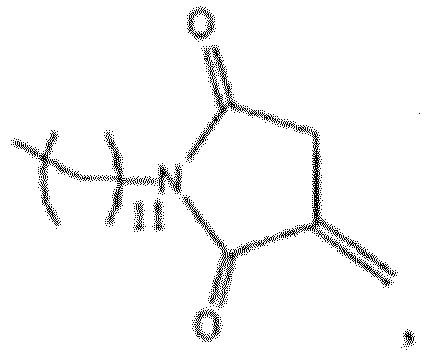


- Particularly desirable maleiitiides and nadimides include, but are not limited to,
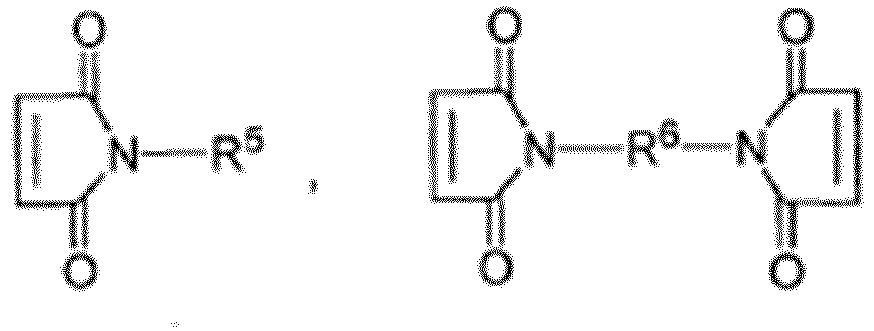


- Other desirable maleimides include


- Maleimides should be present in the compositions within the range of from about 1 percent by weight to about 60 percent by weight, desirably from about 5 percent by weight to about 50 percent by weight, such as from about 10 percent by weight to about 40 percent by weight, based on the weight of the total composition.
- The cyanate ester may include compounds having the general structure:

- R1 here should contain at least 6 carbon atoms and may be derived, for example, from aromatic hydrocarbons, such as benzene, biphenyl, naphthalene, anthracene, pyrene or the like. The aromatic residue may be also be derived from a polynuclear aromatic hydrocarbon in which at least two aromatic rings are attached to each other through a bridging group.
In one embodiment, the bridging member has the formula
- R1 also includes residues derived from novolac-type phenolic resins - i.e., cyanate esters of these phenolic resins. R1 may also contain further ring attached, nonreactive substituents.
- Examples of useful cyanate esters include, for instance 1,3-dicyanatobenzene; 1,4-dicyanatobenzene; 1,3,5-tricyanatobenzene; 1,3-, 1,4-, 1,6-, 1,8-, 2,6- or 2,7-dicyanatonaphthalene; 1,3,6-tricyanatonaphthalene; 4,4'-dicyanato-biphenyl; bis(4-cyanatophenyl)methane and 3,3',5,5'-tetramethyl, bis(4-cyanatophenyl)methane; 2,2-bis(3,5-dichloro-4-cyanatophenyl)propane; 2,2-bis(3,5-dibromo-4-dicyanatophenyl)propane; bis(4-cyanatophenyl)ether; bis(4-cyanatophenyl)sulfide; 2,2-bis(4-cyanatophenyl)propane; tris(4-cyanatophenyl)-phosphite; tris(4-cyanatophenyl)phosphate; bis(3-chloro-4-cyanatophenyl)methane; cyanated novolac; 1,3-bis[4-cyanatophenyl-1-(methylethylidene)]benzene and cyanated, bisphenol-terminated polycarbonate or other thermoplastic oligomer.
- Other cyanate esters include those disclosed in
U.S. Patent Nos. 4,477,629 and4,528,366 ,U.K. Patent No. 1,305,702 WO 85/02184 - Particularly desirable cyanate esters for use herein are available commercially from Ciba Specialty Chemicals, Tarrytown, New York under the tradename "AROCY" [1,1-di(4-cyanatophenylethane)]. The structures of four desirable "AROCY" cyanate esters are


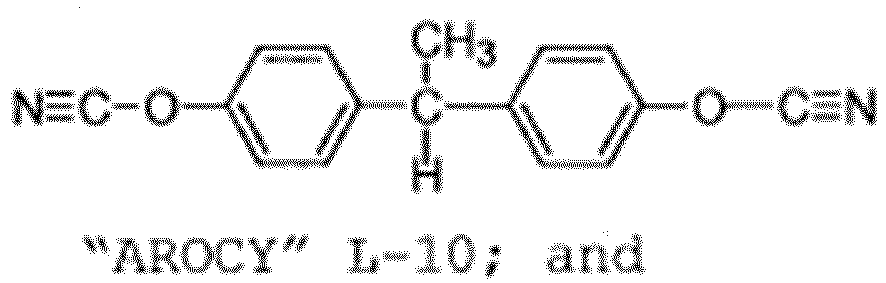
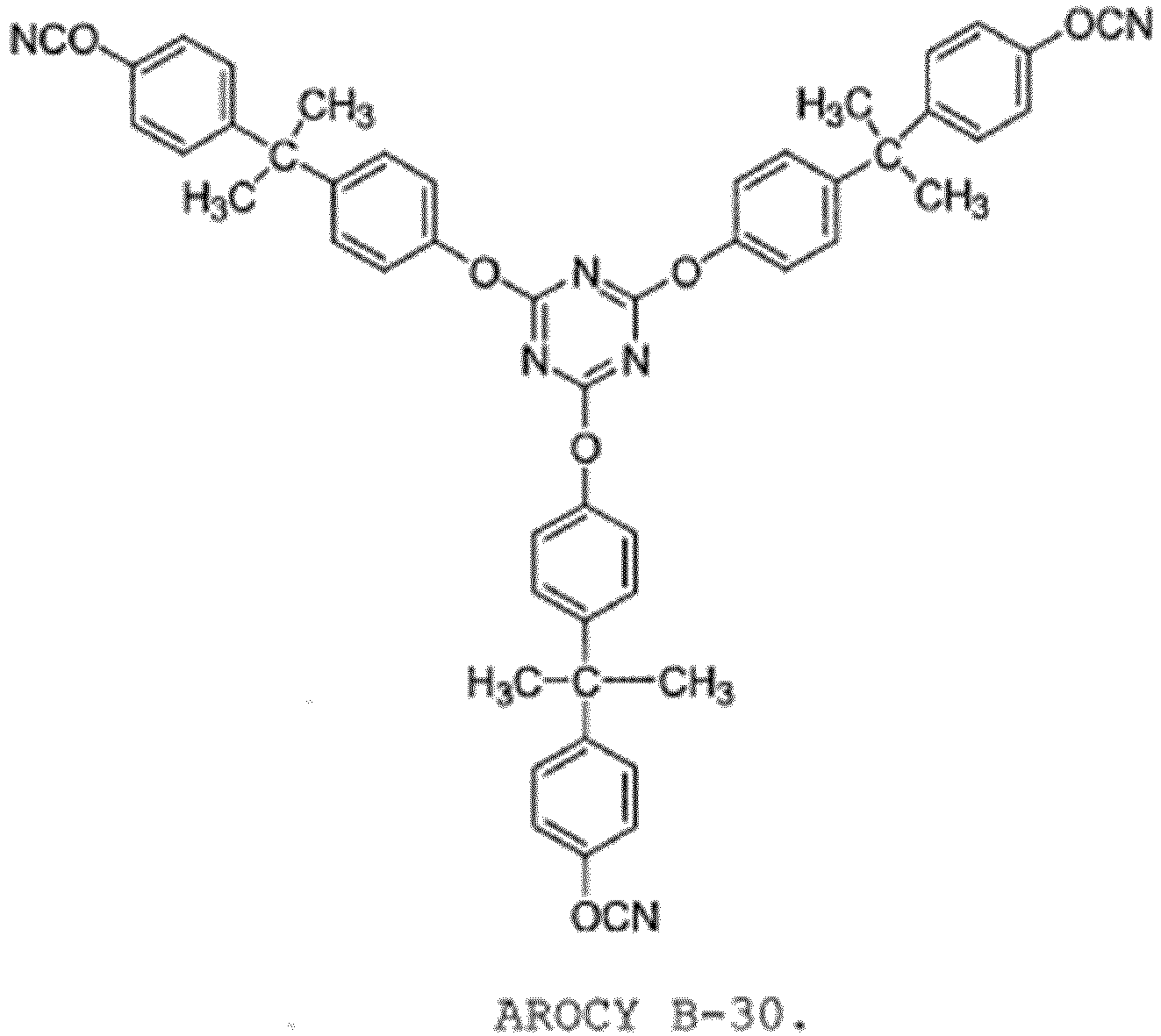
- The coreactant should be used in an amount of about 10 to about 70 percent by weight, based on the total weight of the composition.
- The composition may further include a silica component.
- In some instances, the silica component should have a mean particle diameter on the nanoparticle size; that is, having a mean particle diameter on the order of 10-9 meters. The silica nanoparticles can be pre-dispersed in epoxy resins, and may be selected from those commercially available under the tradename NANOPOX, from Hanse Chemie, Germany. NANOPOX is a tradename for a product family of silica nanoparticle reinforced epoxy resins showing an outstanding combination of material properties. The silica phase consists of surface-modified, synthetic SiO2 nanospheres with less than 50 nm diameter and an extremely narrow particle size distribution. The SiO2 nanospheres are agglomerate-free dispersions in the epoxy resin matrix resulting in a low viscosity for resins containing up to 50 wt% silica.
- Commercially available examples of the NANOPOX products include NANOPOX XP 0314 (a cycloaliphatic epoxy resin matrix), XP 0516 (a bisphenol A epoxy resin matrix), and XP 0525 (a bisphenol F epoxy resin matrix). These NANOPOX products are silica nanoparticle dispersions in the noted epoxy resins, at a level of up to about 50% by weight, though the manufacturer reports 40% by weight for the three noted products. These NANOPOX products are believed to have a particle size of about 5 nm to about 80 nm, though the manufacturer reports less than 50 nm.
- The silica component should be present in an amount in the range of about 1 to about 60 percent by weight, such as about 3 to about 30 percent by weight, desirably about 5 to about 20 percent by weight, based on the total weight of the composition.
- The composition may further include a toughening agent. Representative toughening agents include a core-shell rubber, a CTBN elastomer, or a block copolymer.
- When used, the toughening agent should present in an amount between 2 to 25 percent by weight, based on the total weight of the composition.
- The present invention makes use of a catalyst composition. The catalyst composition comprises a lithium salt, an anion of which has a conjugate acid with a pKa of less than 5; and a carboxylic acid, a sulfonic acid, or a combination thereof. The carboxylic acid or sulfonic acid should have a pKa of 6 or less, examples of which include adipic acid.
- In some embodiments, the anion of the lithium salt may be a Group 15 element, such as P, Sb or As.
- In some embodiments, the halogen of the hexahalogenated Group 15 element may be selected from F, Cl, Br or I.
- More specifically, the lithium salt may be lithium hexafluoroantimonate.
- Examples of this catalyst include lithium perchlorate, lithium tetrafluoroborate, lithium perchlorate, lithium carboxylates (such as lithium palmitate), lithium sulfonates (such as lithium trifluoromethanesulfonate), and combinations thereof.
- A different catalyst composition can also be used. Here, the catalyst composition comprises a lithium salt, an anion of which has a conjugate acid with a pKa of less than 5; and a salt having as an anion a hexahalogenated Group 15 element, an example of which anion is hexafluorophosphate. The salt may have as a cation a tetraalkyl ammonium.
- In some embodiments, the anion of the lithium salt may be a Group 15 element, such as P, Sb or As.
- In some embodiments, the halogen of the hexahalogenated Group 15 element may be selected from F, Cl, Br or I.
- More specifically, the lithium salt may be lithium hexafluoroantimonate.
- The composition may also include one or more of epoxy, episulfide, oxetane, acrylate, methacrylate, maleimide, and cyanate ester as a coreactant, examples of which are as set forth above.
- And like above, the coreactant should be used in an amount of about 10 to about 70 percent by weight, based on the total weight of the composition.
- The inventive curable compositions, when exposed to appropriate cure conditions, demonstrates over 90 percent polymerization conversion, such as over 93 percent polymerization conversion, desirably over 95 percent polymerization conversion, and particularly desirably over 98 percent polymerization conversion.
- The appropriate cure conditions ordinarily are a period of time of 120 minutes at a temperature of 170°C.
- The examples below are provided for illustrative purposes.
- 10 g samples of benzoxazine (60:40 by weight combination of 3,3'-(methylenedi-4,1-phenylene) bis[3,4-dihydro-2H-1,3-benzoxazine] and 3,4-dihydro-3-phenyl-2H-1,3-benzoxazine) with 1×10⁻⁴ mol/g of catalyst were prepared by transferring the components into aluminum weighing dishes and mixing vigorously by hand on a hot plate at a temperature of about 80°C for a period of time of about 5 minutes. Small portions (~10 mg) of each sample were removed from each weighing dish for initial differential scale calorimeter ("DSC") measurements, and the samples were cured in a convection oven at a temperature of about 170°C for a period of time of about 120 minutes. DSC was performed on the cured samples and the percent conversion was calculated from the peak integrations by the following formula: percent conversion = ((I0-I120)/I120) * 100, where I0 is the integration (enthalpy) of the DSC cure peak of the uncured formulation and I120 is the integration of the DSC cure peak after a period of time of 120 minutes at a temperature of 170°C. In all cases the ramp rate was 40°C/minute and the measurement were taken at 0.13°C intervals from 25-300°C.
- In Table 1 below, the catalyst is identified together with the percent conversion.


- This example illustrates enhanced cure activity using various lithium salts and combinations with co-catalysts. The procedure of Example 1 was followed. All co-catalysts are present at 1×10⁻⁴ mol/g. The percent conversion results shown below in Table 2 confirm that higher percent conversions were observed when an acid or a hexafluorophosphate salt co-catalyst was used, even with an unreactive lithium salt. The first two entries in Table 2 (sodium and potassium hexafluorophosphate) provide negative controls showing that a percent conversion of 90 or greater was not obtained using these two salts with or without a co-catalyst. Examples that do not use a co-catalyst are provided for reference purposes.


- This example illustrated high percent conversions in quite short cure times using lithium catalysts, with and without co-catalysts. The procedure of Example 2 was followed here, except that cure times of 30 and 120 minutes were both used at 170°C. High percent conversion at a short cure time (i.e., 30 minutes) were measured for all of the lithium catalyst systems, as can be seen with reference to Table 3 below. Examples that do not use a co-catalyst are provided for reference purposes.
Table 3 Percent conversion Catalyst 30 min 120 min No catalyst 32 79 Ammonium triflate 53 79 Manganese(II) hexafluoroacetylacetonate trihydrate 70 91 LiSbF6 88 92 LiSbF6 + AA 99 99 LiSbF6 + Nu4NPF6 98 100 LiSbF6 + Nu4NPF6 + AA 99 100 LiSbF6 86 91 LiPF6/AA 89 98 - This example illustrates use of the lithium catalysts with and without co-catalysts with a single monofunctional benzoxazine. The procedure of Example 1 was followed here, except that only a single monofunctional benzoxazine (3,4-dihydro-3-phenyl-2H-1,3-benzoxazine) was used instead of the 60:40 benzoxazine combination recited there. Reference to Table 4 below shows that these lithium catalysts together with a co-catalyst in each case with a single monofunctional benzoxazine demonstrated a percent conversion of over 90. The lithium hexafluorantimonate catalyst, even without a co-catalyst, demonstrated over a 90 percent conversion with a single monofunctional benzoxazine. Examples that do not use a co-catalyst are provided for reference purposes.
Table 4 Catalyst Co-Catalyst Percent conversion None None 62 Lithium trifluoromethanesutfonate None 77 AA 95 Bu4NPF6 97 Lithium hexafluoroantimonate none 93 AA 97 Bu4NPF6 95
Claims (24)
- A curable composition comprising:(a) a benzoxazine component; and(b) a catalyst composition;wherein the catalyst composition comprises:(i) a lithium salt, an anion of which has a conjugate acid with a pKa of less than 5; and(ii) a carboxylic acid, a sulfonic acid, or a combination thereof;or wherein the catalyst composition comprises:(iii) a lithium salt, an anion of which has a conjugate acid with a pKa of less than 5; and(iv) a salt having as an anion a hexahalogenated Group 15 element.
- A curable composition comprising:(a) a benzoxazine component; and(b) a catalyst composition comprising:(i) a cationic catalyst that is either comprised of a lithium cation and an anion comprising a hexahalogenated Group 15 element; or selected from lithium trifluoromethane sulfate, lithium palmitate, lithium tetrafluoroborate and lithium perchlorate; and(ii) a co-catalyst selected from tetrabutyl ammonium hexafluorophosphate and adipic acid.
- The composition of Claim 1, wherein the hexahalogenated Group 15 element is selected from P, Sb or As.
- The composition of Claim 1, wherein the halogen of the hexahalogenated Group 15 element is selected from F, CI, Br or I.
- The composition of Claim 1, wherein the composition demonstrates over 90 percent polymerization conversion, optionally over 93 percent, over 95 percent, or over 98 percent polymerization conversion.
- The composition of Claim 2, wherein the benzoxazine component comprises one or more of:


- The composition of Claim 2, wherein the benzoxazine component comprises one or more of:


- The composition of Claim 2, wherein the benzoxazine component comprises one or more of:


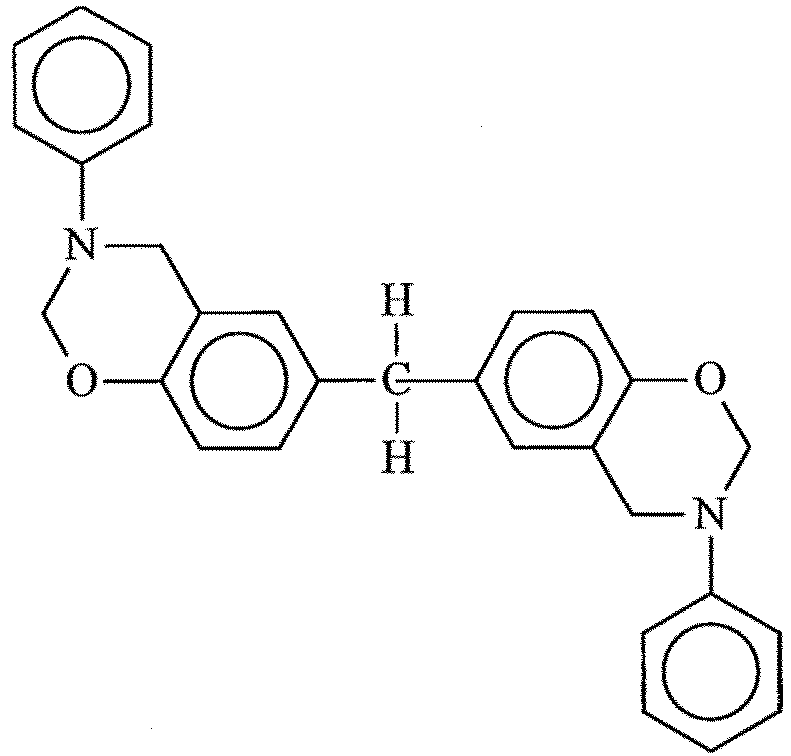


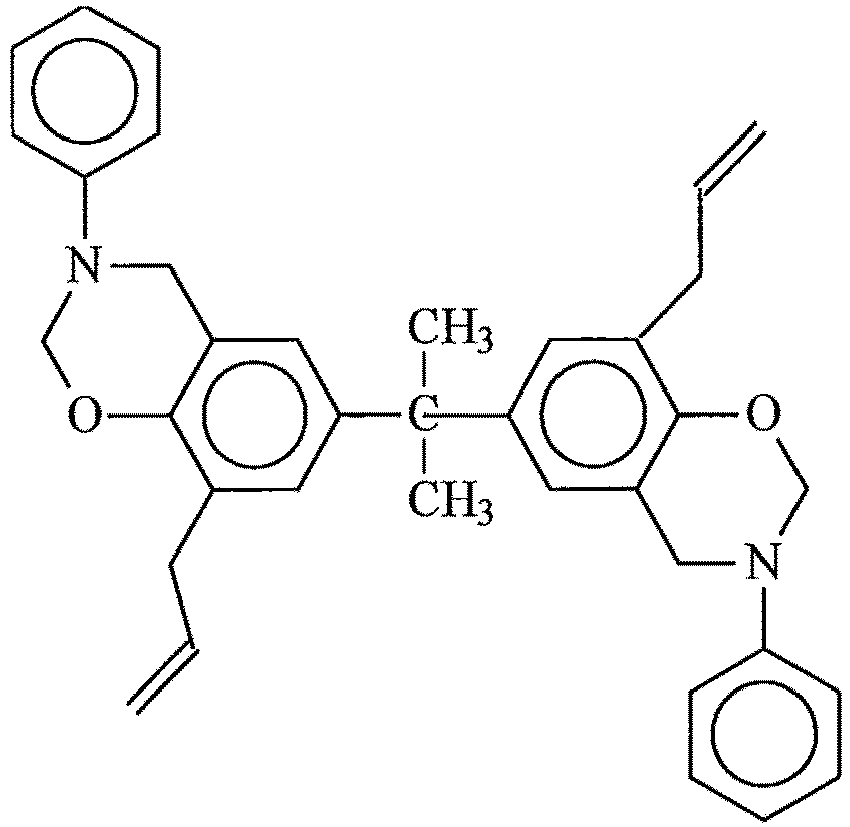

- The composition of Claim 1, further comprising a member selected from the group consisting of epoxy, episulfide, oxetane, acrylate, methacrylate, maleimide, and cyanate ester.
- The composition of Claim 9, wherein the epoxy is selected from the group consisting of glycidylated bisphenols (bisphenol A diglycidyl ether, bisphenol F diglycidyl ether, bisphenol S diglycidyl ether, bisphenol E diglycidyl ether), glycidylated biphenyls, cycloaliphatic epoxy resins, glycidylated anilines and glycidylated hydroxyanilines.
- The composition of Claim 2, further comprising a silica component.
- The composition of Claim 11, wherein the silica component is present in an amount between about 0.5 to about 80 percent by weight.
- The composition of Claim 2, further comprising a toughening agent.
- The composition of Claim 13, wherein the toughening agent is a core-shell rubber, a CTBN elastomer, or a block copolymer.
- The composition of Claim 13, wherein the toughening agent is present in an amount between about 2 to about 25 percent by weight.
- The composition of Claim 1, wherein the acid in (ii) has a pKa of 6 or less.
- The composition of Claim 2, wherein the anion in (i) is a hexahalogenated Group 15 element selected from P, Sb or As.
- The composition of Claim 2, wherein the acid in (ii) is adipic acid.
- The composition of Claim 17, wherein the halogen of the hexahalogenated Group 15 element is selected from F, CI, Br or I.
- The composition of Claim 1, wherein the lithium salt in (i) or (iii) is lithium hexafluoroantimonate.
- The composition of Claim 1, wherein the salt in (iv) has as an anion hexafluorophosphate.
- The composition of Claim 1, wherein the salt in (iv) has as a cation a tetraalkyl ammonium.
- The composition of Claim 2, wherein the lithium salt in (i) is selected from lithium perchlorate, lithium tetrafluoroborate, and combinations thereof.
- The composition of Claim 2, wherein the lithium salt in (i) is selected from lithium palmitate, lithium trifluoromethanesulfate and combinations thereof.
Applications Claiming Priority (2)
| Application Number | Priority Date | Filing Date | Title |
|---|---|---|---|
| US201462049454P | 2014-09-12 | 2014-09-12 | |
| PCT/US2015/049278 WO2016040541A1 (en) | 2014-09-12 | 2015-09-10 | Cationically curable benzoxazine compositions |
Publications (3)
| Publication Number | Publication Date |
|---|---|
| EP3191541A1 EP3191541A1 (en) | 2017-07-19 |
| EP3191541A4 EP3191541A4 (en) | 2018-05-16 |
| EP3191541B1 true EP3191541B1 (en) | 2025-03-12 |
Family
ID=55459545
Family Applications (1)
| Application Number | Title | Priority Date | Filing Date |
|---|---|---|---|
| EP15839675.4A Active EP3191541B1 (en) | 2014-09-12 | 2015-09-10 | Cationically curable benzoxazine compositions |
Country Status (7)
| Country | Link |
|---|---|
| US (1) | US20170183450A1 (en) |
| EP (1) | EP3191541B1 (en) |
| JP (2) | JP2017526793A (en) |
| CN (1) | CN107108883B (en) |
| BR (1) | BR112017004610A2 (en) |
| CA (1) | CA2960646A1 (en) |
| WO (1) | WO2016040541A1 (en) |
Families Citing this family (4)
| Publication number | Priority date | Publication date | Assignee | Title |
|---|---|---|---|---|
| CN106986974B (en) * | 2017-03-01 | 2019-07-30 | 浙江大学宁波理工学院 | Metal salts of trifluoromethane sulphonic acid/benzoxazine resin composition and preparation method thereof |
| TWI839353B (en) * | 2018-06-28 | 2024-04-21 | 德商漢高股份有限及兩合公司 | Cationically curable compositions with latent reducing agent demonstrating low cure temperature |
| WO2020169785A1 (en) | 2019-02-22 | 2020-08-27 | Universitat Autonoma De Barcelona | Process for polymerizing 1,3-benzoxazines |
| JP7796583B2 (en) * | 2022-04-21 | 2026-01-09 | 太陽ホールディングス株式会社 | Curable resin compositions, dry films, prepregs, cured products, laminates, and electronic components |
Family Cites Families (21)
| Publication number | Priority date | Publication date | Assignee | Title |
|---|---|---|---|---|
| DE1719144C3 (en) | 1967-12-01 | 1974-08-22 | Henkel & Cie Gmbh, 4000 Duesseldorf | Accelerated hardening adhesives or sealants in the absence of oxygen |
| GB1305702A (en) | 1969-02-20 | 1973-02-07 | ||
| US4528366A (en) | 1982-09-28 | 1985-07-09 | The Dow Chemical Company | Production of polytriazines from aromatic polycyanates with cobalt salt of a carboxylic acid as catalyst |
| US4477629A (en) | 1983-07-27 | 1984-10-16 | The Dow Chemical Company | Cyanate-containing polymers |
| US4751323A (en) | 1983-11-16 | 1988-06-14 | The Dow Chemical Company | Novel polyaromatic cyanates |
| DE3433851C2 (en) | 1984-09-14 | 1987-01-08 | Gurit-Essex Ag, Freienbach | Chemically curable resins from compounds containing 1-oxa-3-aza-tetralin groups and cycloaliphatic epoxy resins, processes for their preparation and use of such resins |
| ES2088905T3 (en) | 1988-07-18 | 1996-10-01 | Gurit Essex Ag | HARDENABLE RESINS FOR FORMING PLASTICS HARDLY FLAMMABLE AND RESISTANT TO HIGH TEMPERATURES AND PROCEDURES FOR THEIR MANUFACTURE. |
| US5443911A (en) | 1990-05-21 | 1995-08-22 | Gurit-Essex Ag | Curable resins comprising halogenated epoxy resins and 1-oxa-3-aza tetraline compounds, method for preparing and use of resins |
| EP0493310A1 (en) | 1990-12-21 | 1992-07-01 | Gurit-Essex AG | Curable resin compositions having flame resistant properties in the cured state and use thereof |
| US5254664A (en) * | 1991-12-31 | 1993-10-19 | Nippon Shokubai Co., Ltd. | Curing composition |
| US5543516A (en) | 1994-05-18 | 1996-08-06 | Edison Polymer Innovation Corporation | Process for preparation of benzoxazine compounds in solventless systems |
| US5605999A (en) | 1995-06-05 | 1997-02-25 | Loctite Corporation | Anaerobically curable silicones |
| US6225440B1 (en) | 1998-06-26 | 2001-05-01 | Edison Polymer Innovation Corporation | Cationic ring-opening polymerization of benzoxazines |
| AU2833701A (en) * | 1999-09-30 | 2001-05-10 | Shell Internationale Research Maatschappij B.V. | Adducts of glycidylesters of alpha, alpha-branched carboxylic acids and carboxylic acids and poly(ortho ester) as intermediate for their preparation |
| JP4302366B2 (en) * | 2001-07-10 | 2009-07-22 | 三菱化学株式会社 | Non-aqueous electrolyte and secondary battery using the same |
| JP4570419B2 (en) * | 2004-08-20 | 2010-10-27 | ナミックス株式会社 | Liquid sealing resin composition |
| KR101486577B1 (en) * | 2005-03-14 | 2015-01-26 | 소니 주식회사 | Polymer electrolytes and batteries |
| JP2006253087A (en) * | 2005-03-14 | 2006-09-21 | Sony Corp | Polymer electrolyte and battery using the same |
| DK2115069T3 (en) * | 2007-02-08 | 2021-03-29 | Huntsman Adv Mat Licensing Switzerland Gmbh | HEAT-CURING COMPOSITION |
| US20110054100A1 (en) * | 2009-08-26 | 2011-03-03 | 3M Innovative Properties Company | Polybenzoxazine composition |
| EP2336221A1 (en) * | 2010-12-10 | 2011-06-22 | Henkel AG & Co. KGaA | Curable compositions |
-
2015
- 2015-09-10 JP JP2017513683A patent/JP2017526793A/en active Pending
- 2015-09-10 CN CN201580049033.8A patent/CN107108883B/en active Active
- 2015-09-10 BR BR112017004610A patent/BR112017004610A2/en not_active Application Discontinuation
- 2015-09-10 CA CA2960646A patent/CA2960646A1/en active Pending
- 2015-09-10 EP EP15839675.4A patent/EP3191541B1/en active Active
- 2015-09-10 WO PCT/US2015/049278 patent/WO2016040541A1/en not_active Ceased
-
2017
- 2017-03-13 US US15/456,624 patent/US20170183450A1/en not_active Abandoned
-
2020
- 2020-12-04 JP JP2020201913A patent/JP2021036058A/en active Pending
Also Published As
| Publication number | Publication date |
|---|---|
| US20170183450A1 (en) | 2017-06-29 |
| JP2017526793A (en) | 2017-09-14 |
| WO2016040541A1 (en) | 2016-03-17 |
| EP3191541A1 (en) | 2017-07-19 |
| CN107108883B (en) | 2022-06-03 |
| CA2960646A1 (en) | 2016-03-17 |
| JP2021036058A (en) | 2021-03-04 |
| CN107108883A (en) | 2017-08-29 |
| BR112017004610A2 (en) | 2017-12-05 |
| EP3191541A4 (en) | 2018-05-16 |
Similar Documents
| Publication | Publication Date | Title |
|---|---|---|
| JP2021036058A (en) | Cationically curable benzoxazine compositions | |
| KR101979482B1 (en) | Liquid compression molding encapsulants | |
| US20100140542A1 (en) | Benzoxazine containing compositions of matter and curable compositions made therewith | |
| US9865551B2 (en) | Methods to control wafer warpage upon compression molding thereof and articles useful therefor | |
| US11578202B2 (en) | Liquid compression molding encapsulants | |
| US20180127537A1 (en) | Resins and compositions for high temperature applications | |
| JP5200805B2 (en) | One-component thermosetting epoxy resin composition | |
| BR112016012775B1 (en) | process to form a polymer and polymer | |
| JP2017538836A (en) | Curable benzoxazine composition with improved thermal stability | |
| TWI777922B (en) | Barrier film-containing format and the use thereof for pre-applied underfill film for 3d tsv packages | |
| US8847415B1 (en) | Liquid compression molding encapsulants | |
| KR20190018414A (en) | As a potential catalyst for benzoxazine resin, benzothiazole | |
| TW201902867A (en) | Polyaromatic compounds and high refractive index, light stable, yellowing resistant resins containing same | |
| US11542268B2 (en) | Cationically curable compositions with latent reducing agent demonstrating low cure temperature | |
| JP6011960B2 (en) | Photothiol generator and photosensitive resin composition containing the photothiol generator | |
| WO2018074308A1 (en) | Photo-base generator and photosensitive composition |
Legal Events
| Date | Code | Title | Description |
|---|---|---|---|
| STAA | Information on the status of an ep patent application or granted ep patent |
Free format text: STATUS: THE INTERNATIONAL PUBLICATION HAS BEEN MADE |
|
| PUAI | Public reference made under article 153(3) epc to a published international application that has entered the european phase |
Free format text: ORIGINAL CODE: 0009012 |
|
| STAA | Information on the status of an ep patent application or granted ep patent |
Free format text: STATUS: REQUEST FOR EXAMINATION WAS MADE |
|
| 17P | Request for examination filed |
Effective date: 20170310 |
|
| AK | Designated contracting states |
Kind code of ref document: A1 Designated state(s): AL AT BE BG CH CY CZ DE DK EE ES FI FR GB GR HR HU IE IS IT LI LT LU LV MC MK MT NL NO PL PT RO RS SE SI SK SM TR |
|
| AX | Request for extension of the european patent |
Extension state: BA ME |
|
| DAV | Request for validation of the european patent (deleted) | ||
| DAX | Request for extension of the european patent (deleted) | ||
| A4 | Supplementary search report drawn up and despatched |
Effective date: 20180416 |
|
| RIC1 | Information provided on ipc code assigned before grant |
Ipc: B01J 23/04 20060101ALI20180410BHEP Ipc: C08L 79/02 20060101ALI20180410BHEP Ipc: C08G 73/02 20060101AFI20180410BHEP |
|
| STAA | Information on the status of an ep patent application or granted ep patent |
Free format text: STATUS: EXAMINATION IS IN PROGRESS |
|
| 17Q | First examination report despatched |
Effective date: 20220830 |
|
| GRAP | Despatch of communication of intention to grant a patent |
Free format text: ORIGINAL CODE: EPIDOSNIGR1 |
|
| STAA | Information on the status of an ep patent application or granted ep patent |
Free format text: STATUS: GRANT OF PATENT IS INTENDED |
|
| INTG | Intention to grant announced |
Effective date: 20240718 |
|
| RAP1 | Party data changed (applicant data changed or rights of an application transferred) |
Owner name: HENKEL AG & CO. KGAA |
|
| GRAS | Grant fee paid |
Free format text: ORIGINAL CODE: EPIDOSNIGR3 |
|
| GRAA | (expected) grant |
Free format text: ORIGINAL CODE: 0009210 |
|
| STAA | Information on the status of an ep patent application or granted ep patent |
Free format text: STATUS: THE PATENT HAS BEEN GRANTED |
|
| AK | Designated contracting states |
Kind code of ref document: B1 Designated state(s): AL AT BE BG CH CY CZ DE DK EE ES FI FR GB GR HR HU IE IS IT LI LT LU LV MC MK MT NL NO PL PT RO RS SE SI SK SM TR |
|
| REG | Reference to a national code |
Ref country code: GB Ref legal event code: FG4D |
|
| REG | Reference to a national code |
Ref country code: CH Ref legal event code: EP |
|
| REG | Reference to a national code |
Ref country code: DE Ref legal event code: R096 Ref document number: 602015091206 Country of ref document: DE |
|
| REG | Reference to a national code |
Ref country code: IE Ref legal event code: FG4D |
|
| PG25 | Lapsed in a contracting state [announced via postgrant information from national office to epo] |
Ref country code: RS Free format text: LAPSE BECAUSE OF FAILURE TO SUBMIT A TRANSLATION OF THE DESCRIPTION OR TO PAY THE FEE WITHIN THE PRESCRIBED TIME-LIMIT Effective date: 20250612 |
|
| PG25 | Lapsed in a contracting state [announced via postgrant information from national office to epo] |
Ref country code: FI Free format text: LAPSE BECAUSE OF FAILURE TO SUBMIT A TRANSLATION OF THE DESCRIPTION OR TO PAY THE FEE WITHIN THE PRESCRIBED TIME-LIMIT Effective date: 20250312 |
|
| PG25 | Lapsed in a contracting state [announced via postgrant information from national office to epo] |
Ref country code: ES Free format text: LAPSE BECAUSE OF FAILURE TO SUBMIT A TRANSLATION OF THE DESCRIPTION OR TO PAY THE FEE WITHIN THE PRESCRIBED TIME-LIMIT Effective date: 20250312 |
|
| REG | Reference to a national code |
Ref country code: LT Ref legal event code: MG9D |
|
| PG25 | Lapsed in a contracting state [announced via postgrant information from national office to epo] |
Ref country code: NO Free format text: LAPSE BECAUSE OF FAILURE TO SUBMIT A TRANSLATION OF THE DESCRIPTION OR TO PAY THE FEE WITHIN THE PRESCRIBED TIME-LIMIT Effective date: 20250612 |
|
| PG25 | Lapsed in a contracting state [announced via postgrant information from national office to epo] |
Ref country code: HR Free format text: LAPSE BECAUSE OF FAILURE TO SUBMIT A TRANSLATION OF THE DESCRIPTION OR TO PAY THE FEE WITHIN THE PRESCRIBED TIME-LIMIT Effective date: 20250312 |
|
| REG | Reference to a national code |
Ref country code: NL Ref legal event code: MP Effective date: 20250312 |
|
| PG25 | Lapsed in a contracting state [announced via postgrant information from national office to epo] |
Ref country code: LV Free format text: LAPSE BECAUSE OF FAILURE TO SUBMIT A TRANSLATION OF THE DESCRIPTION OR TO PAY THE FEE WITHIN THE PRESCRIBED TIME-LIMIT Effective date: 20250312 |
|
| PG25 | Lapsed in a contracting state [announced via postgrant information from national office to epo] |
Ref country code: GR Free format text: LAPSE BECAUSE OF FAILURE TO SUBMIT A TRANSLATION OF THE DESCRIPTION OR TO PAY THE FEE WITHIN THE PRESCRIBED TIME-LIMIT Effective date: 20250613 Ref country code: BG Free format text: LAPSE BECAUSE OF FAILURE TO SUBMIT A TRANSLATION OF THE DESCRIPTION OR TO PAY THE FEE WITHIN THE PRESCRIBED TIME-LIMIT Effective date: 20250312 |
|
| REG | Reference to a national code |
Ref country code: AT Ref legal event code: MK05 Ref document number: 1774997 Country of ref document: AT Kind code of ref document: T Effective date: 20250312 |
|
| PG25 | Lapsed in a contracting state [announced via postgrant information from national office to epo] |
Ref country code: NL Free format text: LAPSE BECAUSE OF FAILURE TO SUBMIT A TRANSLATION OF THE DESCRIPTION OR TO PAY THE FEE WITHIN THE PRESCRIBED TIME-LIMIT Effective date: 20250312 |
|
| PG25 | Lapsed in a contracting state [announced via postgrant information from national office to epo] |
Ref country code: SE Free format text: LAPSE BECAUSE OF FAILURE TO SUBMIT A TRANSLATION OF THE DESCRIPTION OR TO PAY THE FEE WITHIN THE PRESCRIBED TIME-LIMIT Effective date: 20250312 |
|
| PG25 | Lapsed in a contracting state [announced via postgrant information from national office to epo] |
Ref country code: SM Free format text: LAPSE BECAUSE OF FAILURE TO SUBMIT A TRANSLATION OF THE DESCRIPTION OR TO PAY THE FEE WITHIN THE PRESCRIBED TIME-LIMIT Effective date: 20250312 |
|
| PG25 | Lapsed in a contracting state [announced via postgrant information from national office to epo] |
Ref country code: PT Free format text: LAPSE BECAUSE OF FAILURE TO SUBMIT A TRANSLATION OF THE DESCRIPTION OR TO PAY THE FEE WITHIN THE PRESCRIBED TIME-LIMIT Effective date: 20250714 |
|
| PG25 | Lapsed in a contracting state [announced via postgrant information from national office to epo] |
Ref country code: PL Free format text: LAPSE BECAUSE OF FAILURE TO SUBMIT A TRANSLATION OF THE DESCRIPTION OR TO PAY THE FEE WITHIN THE PRESCRIBED TIME-LIMIT Effective date: 20250312 Ref country code: IT Free format text: LAPSE BECAUSE OF FAILURE TO SUBMIT A TRANSLATION OF THE DESCRIPTION OR TO PAY THE FEE WITHIN THE PRESCRIBED TIME-LIMIT Effective date: 20250312 |
|
| PG25 | Lapsed in a contracting state [announced via postgrant information from national office to epo] |
Ref country code: AT Free format text: LAPSE BECAUSE OF FAILURE TO SUBMIT A TRANSLATION OF THE DESCRIPTION OR TO PAY THE FEE WITHIN THE PRESCRIBED TIME-LIMIT Effective date: 20250312 |
|
| PG25 | Lapsed in a contracting state [announced via postgrant information from national office to epo] |
Ref country code: CZ Free format text: LAPSE BECAUSE OF FAILURE TO SUBMIT A TRANSLATION OF THE DESCRIPTION OR TO PAY THE FEE WITHIN THE PRESCRIBED TIME-LIMIT Effective date: 20250312 Ref country code: EE Free format text: LAPSE BECAUSE OF FAILURE TO SUBMIT A TRANSLATION OF THE DESCRIPTION OR TO PAY THE FEE WITHIN THE PRESCRIBED TIME-LIMIT Effective date: 20250312 |
|
| PG25 | Lapsed in a contracting state [announced via postgrant information from national office to epo] |
Ref country code: RO Free format text: LAPSE BECAUSE OF FAILURE TO SUBMIT A TRANSLATION OF THE DESCRIPTION OR TO PAY THE FEE WITHIN THE PRESCRIBED TIME-LIMIT Effective date: 20250312 |
|
| PG25 | Lapsed in a contracting state [announced via postgrant information from national office to epo] |
Ref country code: SK Free format text: LAPSE BECAUSE OF FAILURE TO SUBMIT A TRANSLATION OF THE DESCRIPTION OR TO PAY THE FEE WITHIN THE PRESCRIBED TIME-LIMIT Effective date: 20250312 |
|
| PG25 | Lapsed in a contracting state [announced via postgrant information from national office to epo] |
Ref country code: IS Free format text: LAPSE BECAUSE OF FAILURE TO SUBMIT A TRANSLATION OF THE DESCRIPTION OR TO PAY THE FEE WITHIN THE PRESCRIBED TIME-LIMIT Effective date: 20250712 |
|
| REG | Reference to a national code |
Ref country code: DE Ref legal event code: R097 Ref document number: 602015091206 Country of ref document: DE |
|
| PG25 | Lapsed in a contracting state [announced via postgrant information from national office to epo] |
Ref country code: DK Free format text: LAPSE BECAUSE OF FAILURE TO SUBMIT A TRANSLATION OF THE DESCRIPTION OR TO PAY THE FEE WITHIN THE PRESCRIBED TIME-LIMIT Effective date: 20250312 |
|
| PLBE | No opposition filed within time limit |
Free format text: ORIGINAL CODE: 0009261 |
|
| STAA | Information on the status of an ep patent application or granted ep patent |
Free format text: STATUS: NO OPPOSITION FILED WITHIN TIME LIMIT |
|
| REG | Reference to a national code |
Ref country code: CH Ref legal event code: L10 Free format text: ST27 STATUS EVENT CODE: U-0-0-L10-L00 (AS PROVIDED BY THE NATIONAL OFFICE) Effective date: 20260121 |
|
| 26N | No opposition filed |
Effective date: 20251215 |
|
| REG | Reference to a national code |
Ref country code: CH Ref legal event code: H13 Free format text: ST27 STATUS EVENT CODE: U-0-0-H10-H13 (AS PROVIDED BY THE NATIONAL OFFICE) Effective date: 20260425 |