EP3191491B1 - Pyridazinone derivatives as phosphoinositide 3-kinases inhibitors - Google Patents
Pyridazinone derivatives as phosphoinositide 3-kinases inhibitors Download PDFInfo
- Publication number
- EP3191491B1 EP3191491B1 EP15770829.8A EP15770829A EP3191491B1 EP 3191491 B1 EP3191491 B1 EP 3191491B1 EP 15770829 A EP15770829 A EP 15770829A EP 3191491 B1 EP3191491 B1 EP 3191491B1
- Authority
- EP
- European Patent Office
- Prior art keywords
- dihydropyridazin
- phenyl
- amino
- pyrimidin
- ethyl
- Prior art date
- Legal status (The legal status is an assumption and is not a legal conclusion. Google has not performed a legal analysis and makes no representation as to the accuracy of the status listed.)
- Active
Links
- 0 *C(*)(C(C(*)=NN1)=C(*)C1=O)N Chemical compound *C(*)(C(C(*)=NN1)=C(*)C1=O)N 0.000 description 8
- GNTCGHMPQVXZKV-UHFFFAOYSA-N CC(C(C(c1ccccc1)=NN1)=CC1=O)=O Chemical compound CC(C(C(c1ccccc1)=NN1)=CC1=O)=O GNTCGHMPQVXZKV-UHFFFAOYSA-N 0.000 description 1
- FZYYBFCSHMTBLS-UHFFFAOYSA-N CC(C(C(c1ccccc1)=NN1C)=CC1=O)O Chemical compound CC(C(C(c1ccccc1)=NN1C)=CC1=O)O FZYYBFCSHMTBLS-UHFFFAOYSA-N 0.000 description 1
- NCTKGPOWQJLWRT-UHFFFAOYSA-N CC(C(C(c1ccccc1)=NN1CC2CC2)=CC1=O)=O Chemical compound CC(C(C(c1ccccc1)=NN1CC2CC2)=CC1=O)=O NCTKGPOWQJLWRT-UHFFFAOYSA-N 0.000 description 1
- PTDDCBUKRUPVES-UHFFFAOYSA-N CC(C(C(c1ccccc1)=NN1c2ccccc2)=CC1=O)=O Chemical compound CC(C(C(c1ccccc1)=NN1c2ccccc2)=CC1=O)=O PTDDCBUKRUPVES-UHFFFAOYSA-N 0.000 description 1
- XMDBSHBYGQVDJP-UHFFFAOYSA-N CC(C)N(C(C=C1C(C)N)=O)N=C1c1ccccc1 Chemical compound CC(C)N(C(C=C1C(C)N)=O)N=C1c1ccccc1 XMDBSHBYGQVDJP-UHFFFAOYSA-N 0.000 description 1
- PRGVWCDUUXFELI-UHFFFAOYSA-N CN1N=C(c2ccccc2)C(Br)=CC1=O Chemical compound CN1N=C(c2ccccc2)C(Br)=CC1=O PRGVWCDUUXFELI-UHFFFAOYSA-N 0.000 description 1
- KTUYKKMTMDONRM-UHFFFAOYSA-N O=C1N(Cc2ccccc2)N=C(c2ccccc2)C(Br)=C1 Chemical compound O=C1N(Cc2ccccc2)N=C(c2ccccc2)C(Br)=C1 KTUYKKMTMDONRM-UHFFFAOYSA-N 0.000 description 1
Classifications
-
- C—CHEMISTRY; METALLURGY
- C07—ORGANIC CHEMISTRY
- C07D—HETEROCYCLIC COMPOUNDS
- C07D487/00—Heterocyclic compounds containing nitrogen atoms as the only ring hetero atoms in the condensed system, not provided for by groups C07D451/00 - C07D477/00
- C07D487/02—Heterocyclic compounds containing nitrogen atoms as the only ring hetero atoms in the condensed system, not provided for by groups C07D451/00 - C07D477/00 in which the condensed system contains two hetero rings
- C07D487/04—Ortho-condensed systems
-
- A—HUMAN NECESSITIES
- A61—MEDICAL OR VETERINARY SCIENCE; HYGIENE
- A61K—PREPARATIONS FOR MEDICAL, DENTAL OR TOILETRY PURPOSES
- A61K31/00—Medicinal preparations containing organic active ingredients
- A61K31/33—Heterocyclic compounds
- A61K31/395—Heterocyclic compounds having nitrogen as a ring hetero atom, e.g. guanethidine or rifamycins
- A61K31/495—Heterocyclic compounds having nitrogen as a ring hetero atom, e.g. guanethidine or rifamycins having six-membered rings with two or more nitrogen atoms as the only ring heteroatoms, e.g. piperazine or tetrazines
- A61K31/50—Pyridazines; Hydrogenated pyridazines
- A61K31/501—Pyridazines; Hydrogenated pyridazines not condensed and containing further heterocyclic rings
-
- A—HUMAN NECESSITIES
- A61—MEDICAL OR VETERINARY SCIENCE; HYGIENE
- A61K—PREPARATIONS FOR MEDICAL, DENTAL OR TOILETRY PURPOSES
- A61K31/00—Medicinal preparations containing organic active ingredients
- A61K31/33—Heterocyclic compounds
- A61K31/395—Heterocyclic compounds having nitrogen as a ring hetero atom, e.g. guanethidine or rifamycins
- A61K31/495—Heterocyclic compounds having nitrogen as a ring hetero atom, e.g. guanethidine or rifamycins having six-membered rings with two or more nitrogen atoms as the only ring heteroatoms, e.g. piperazine or tetrazines
- A61K31/505—Pyrimidines; Hydrogenated pyrimidines, e.g. trimethoprim
- A61K31/506—Pyrimidines; Hydrogenated pyrimidines, e.g. trimethoprim not condensed and containing further heterocyclic rings
-
- A—HUMAN NECESSITIES
- A61—MEDICAL OR VETERINARY SCIENCE; HYGIENE
- A61K—PREPARATIONS FOR MEDICAL, DENTAL OR TOILETRY PURPOSES
- A61K31/00—Medicinal preparations containing organic active ingredients
- A61K31/33—Heterocyclic compounds
- A61K31/395—Heterocyclic compounds having nitrogen as a ring hetero atom, e.g. guanethidine or rifamycins
- A61K31/495—Heterocyclic compounds having nitrogen as a ring hetero atom, e.g. guanethidine or rifamycins having six-membered rings with two or more nitrogen atoms as the only ring heteroatoms, e.g. piperazine or tetrazines
- A61K31/505—Pyrimidines; Hydrogenated pyrimidines, e.g. trimethoprim
- A61K31/519—Pyrimidines; Hydrogenated pyrimidines, e.g. trimethoprim ortho- or peri-condensed with heterocyclic rings
-
- A—HUMAN NECESSITIES
- A61—MEDICAL OR VETERINARY SCIENCE; HYGIENE
- A61K—PREPARATIONS FOR MEDICAL, DENTAL OR TOILETRY PURPOSES
- A61K31/00—Medicinal preparations containing organic active ingredients
- A61K31/33—Heterocyclic compounds
- A61K31/395—Heterocyclic compounds having nitrogen as a ring hetero atom, e.g. guanethidine or rifamycins
- A61K31/495—Heterocyclic compounds having nitrogen as a ring hetero atom, e.g. guanethidine or rifamycins having six-membered rings with two or more nitrogen atoms as the only ring heteroatoms, e.g. piperazine or tetrazines
- A61K31/505—Pyrimidines; Hydrogenated pyrimidines, e.g. trimethoprim
- A61K31/519—Pyrimidines; Hydrogenated pyrimidines, e.g. trimethoprim ortho- or peri-condensed with heterocyclic rings
- A61K31/52—Purines, e.g. adenine
-
- A—HUMAN NECESSITIES
- A61—MEDICAL OR VETERINARY SCIENCE; HYGIENE
- A61K—PREPARATIONS FOR MEDICAL, DENTAL OR TOILETRY PURPOSES
- A61K31/00—Medicinal preparations containing organic active ingredients
- A61K31/33—Heterocyclic compounds
- A61K31/395—Heterocyclic compounds having nitrogen as a ring hetero atom, e.g. guanethidine or rifamycins
- A61K31/535—Heterocyclic compounds having nitrogen as a ring hetero atom, e.g. guanethidine or rifamycins having six-membered rings with at least one nitrogen and one oxygen as the ring hetero atoms, e.g. 1,2-oxazines
- A61K31/5375—1,4-Oxazines, e.g. morpholine
- A61K31/5377—1,4-Oxazines, e.g. morpholine not condensed and containing further heterocyclic rings, e.g. timolol
-
- A—HUMAN NECESSITIES
- A61—MEDICAL OR VETERINARY SCIENCE; HYGIENE
- A61P—SPECIFIC THERAPEUTIC ACTIVITY OF CHEMICAL COMPOUNDS OR MEDICINAL PREPARATIONS
- A61P1/00—Drugs for disorders of the alimentary tract or the digestive system
-
- A—HUMAN NECESSITIES
- A61—MEDICAL OR VETERINARY SCIENCE; HYGIENE
- A61P—SPECIFIC THERAPEUTIC ACTIVITY OF CHEMICAL COMPOUNDS OR MEDICINAL PREPARATIONS
- A61P1/00—Drugs for disorders of the alimentary tract or the digestive system
- A61P1/04—Drugs for disorders of the alimentary tract or the digestive system for ulcers, gastritis or reflux esophagitis, e.g. antacids, inhibitors of acid secretion, mucosal protectants
-
- A—HUMAN NECESSITIES
- A61—MEDICAL OR VETERINARY SCIENCE; HYGIENE
- A61P—SPECIFIC THERAPEUTIC ACTIVITY OF CHEMICAL COMPOUNDS OR MEDICINAL PREPARATIONS
- A61P1/00—Drugs for disorders of the alimentary tract or the digestive system
- A61P1/18—Drugs for disorders of the alimentary tract or the digestive system for pancreatic disorders, e.g. pancreatic enzymes
-
- A—HUMAN NECESSITIES
- A61—MEDICAL OR VETERINARY SCIENCE; HYGIENE
- A61P—SPECIFIC THERAPEUTIC ACTIVITY OF CHEMICAL COMPOUNDS OR MEDICINAL PREPARATIONS
- A61P11/00—Drugs for disorders of the respiratory system
-
- A—HUMAN NECESSITIES
- A61—MEDICAL OR VETERINARY SCIENCE; HYGIENE
- A61P—SPECIFIC THERAPEUTIC ACTIVITY OF CHEMICAL COMPOUNDS OR MEDICINAL PREPARATIONS
- A61P11/00—Drugs for disorders of the respiratory system
- A61P11/02—Nasal agents, e.g. decongestants
-
- A—HUMAN NECESSITIES
- A61—MEDICAL OR VETERINARY SCIENCE; HYGIENE
- A61P—SPECIFIC THERAPEUTIC ACTIVITY OF CHEMICAL COMPOUNDS OR MEDICINAL PREPARATIONS
- A61P11/00—Drugs for disorders of the respiratory system
- A61P11/06—Antiasthmatics
-
- A—HUMAN NECESSITIES
- A61—MEDICAL OR VETERINARY SCIENCE; HYGIENE
- A61P—SPECIFIC THERAPEUTIC ACTIVITY OF CHEMICAL COMPOUNDS OR MEDICINAL PREPARATIONS
- A61P11/00—Drugs for disorders of the respiratory system
- A61P11/14—Antitussive agents
-
- A—HUMAN NECESSITIES
- A61—MEDICAL OR VETERINARY SCIENCE; HYGIENE
- A61P—SPECIFIC THERAPEUTIC ACTIVITY OF CHEMICAL COMPOUNDS OR MEDICINAL PREPARATIONS
- A61P13/00—Drugs for disorders of the urinary system
- A61P13/12—Drugs for disorders of the urinary system of the kidneys
-
- A—HUMAN NECESSITIES
- A61—MEDICAL OR VETERINARY SCIENCE; HYGIENE
- A61P—SPECIFIC THERAPEUTIC ACTIVITY OF CHEMICAL COMPOUNDS OR MEDICINAL PREPARATIONS
- A61P19/00—Drugs for skeletal disorders
- A61P19/02—Drugs for skeletal disorders for joint disorders, e.g. arthritis, arthrosis
-
- A—HUMAN NECESSITIES
- A61—MEDICAL OR VETERINARY SCIENCE; HYGIENE
- A61P—SPECIFIC THERAPEUTIC ACTIVITY OF CHEMICAL COMPOUNDS OR MEDICINAL PREPARATIONS
- A61P25/00—Drugs for disorders of the nervous system
- A61P25/28—Drugs for disorders of the nervous system for treating neurodegenerative disorders of the central nervous system, e.g. nootropic agents, cognition enhancers, drugs for treating Alzheimer's disease or other forms of dementia
-
- A—HUMAN NECESSITIES
- A61—MEDICAL OR VETERINARY SCIENCE; HYGIENE
- A61P—SPECIFIC THERAPEUTIC ACTIVITY OF CHEMICAL COMPOUNDS OR MEDICINAL PREPARATIONS
- A61P29/00—Non-central analgesic, antipyretic or antiinflammatory agents, e.g. antirheumatic agents; Non-steroidal antiinflammatory drugs [NSAID]
-
- A—HUMAN NECESSITIES
- A61—MEDICAL OR VETERINARY SCIENCE; HYGIENE
- A61P—SPECIFIC THERAPEUTIC ACTIVITY OF CHEMICAL COMPOUNDS OR MEDICINAL PREPARATIONS
- A61P3/00—Drugs for disorders of the metabolism
- A61P3/08—Drugs for disorders of the metabolism for glucose homeostasis
- A61P3/10—Drugs for disorders of the metabolism for glucose homeostasis for hyperglycaemia, e.g. antidiabetics
-
- A—HUMAN NECESSITIES
- A61—MEDICAL OR VETERINARY SCIENCE; HYGIENE
- A61P—SPECIFIC THERAPEUTIC ACTIVITY OF CHEMICAL COMPOUNDS OR MEDICINAL PREPARATIONS
- A61P35/00—Antineoplastic agents
-
- A—HUMAN NECESSITIES
- A61—MEDICAL OR VETERINARY SCIENCE; HYGIENE
- A61P—SPECIFIC THERAPEUTIC ACTIVITY OF CHEMICAL COMPOUNDS OR MEDICINAL PREPARATIONS
- A61P37/00—Drugs for immunological or allergic disorders
-
- A—HUMAN NECESSITIES
- A61—MEDICAL OR VETERINARY SCIENCE; HYGIENE
- A61P—SPECIFIC THERAPEUTIC ACTIVITY OF CHEMICAL COMPOUNDS OR MEDICINAL PREPARATIONS
- A61P37/00—Drugs for immunological or allergic disorders
- A61P37/02—Immunomodulators
- A61P37/06—Immunosuppressants, e.g. drugs for graft rejection
-
- A—HUMAN NECESSITIES
- A61—MEDICAL OR VETERINARY SCIENCE; HYGIENE
- A61P—SPECIFIC THERAPEUTIC ACTIVITY OF CHEMICAL COMPOUNDS OR MEDICINAL PREPARATIONS
- A61P37/00—Drugs for immunological or allergic disorders
- A61P37/08—Antiallergic agents
-
- A—HUMAN NECESSITIES
- A61—MEDICAL OR VETERINARY SCIENCE; HYGIENE
- A61P—SPECIFIC THERAPEUTIC ACTIVITY OF CHEMICAL COMPOUNDS OR MEDICINAL PREPARATIONS
- A61P7/00—Drugs for disorders of the blood or the extracellular fluid
- A61P7/02—Antithrombotic agents; Anticoagulants; Platelet aggregation inhibitors
-
- A—HUMAN NECESSITIES
- A61—MEDICAL OR VETERINARY SCIENCE; HYGIENE
- A61P—SPECIFIC THERAPEUTIC ACTIVITY OF CHEMICAL COMPOUNDS OR MEDICINAL PREPARATIONS
- A61P9/00—Drugs for disorders of the cardiovascular system
- A61P9/10—Drugs for disorders of the cardiovascular system for treating ischaemic or atherosclerotic diseases, e.g. antianginal drugs, coronary vasodilators, drugs for myocardial infarction, retinopathy, cerebrovascula insufficiency, renal arteriosclerosis
-
- C—CHEMISTRY; METALLURGY
- C07—ORGANIC CHEMISTRY
- C07D—HETEROCYCLIC COMPOUNDS
- C07D403/00—Heterocyclic compounds containing two or more hetero rings, having nitrogen atoms as the only ring hetero atoms, not provided for by group C07D401/00
- C07D403/02—Heterocyclic compounds containing two or more hetero rings, having nitrogen atoms as the only ring hetero atoms, not provided for by group C07D401/00 containing two hetero rings
- C07D403/12—Heterocyclic compounds containing two or more hetero rings, having nitrogen atoms as the only ring hetero atoms, not provided for by group C07D401/00 containing two hetero rings linked by a chain containing hetero atoms as chain links
-
- C—CHEMISTRY; METALLURGY
- C07—ORGANIC CHEMISTRY
- C07D—HETEROCYCLIC COMPOUNDS
- C07D473/00—Heterocyclic compounds containing purine ring systems
- C07D473/26—Heterocyclic compounds containing purine ring systems with an oxygen, sulphur, or nitrogen atom directly attached in position 2 or 6, but not in both
- C07D473/32—Nitrogen atom
- C07D473/34—Nitrogen atom attached in position 6, e.g. adenine
-
- Y—GENERAL TAGGING OF NEW TECHNOLOGICAL DEVELOPMENTS; GENERAL TAGGING OF CROSS-SECTIONAL TECHNOLOGIES SPANNING OVER SEVERAL SECTIONS OF THE IPC; TECHNICAL SUBJECTS COVERED BY FORMER USPC CROSS-REFERENCE ART COLLECTIONS [XRACs] AND DIGESTS
- Y02—TECHNOLOGIES OR APPLICATIONS FOR MITIGATION OR ADAPTATION AGAINST CLIMATE CHANGE
- Y02A—TECHNOLOGIES FOR ADAPTATION TO CLIMATE CHANGE
- Y02A50/00—TECHNOLOGIES FOR ADAPTATION TO CLIMATE CHANGE in human health protection, e.g. against extreme weather
- Y02A50/30—Against vector-borne diseases, e.g. mosquito-borne, fly-borne, tick-borne or waterborne diseases whose impact is exacerbated by climate change
Definitions
- the present invention relates to compounds inhibiting Phosphoinositide 3-kinases (hereinafter PI3K); particularly the invention relates to pyridazinone derivatives, methods for the preparation of such compounds, pharmaceutical compositions comprising them and therapeutic use thereof.
- PI3K Phosphoinositide 3-kinases
- the compounds of the invention are inhibitors of the activity or function of the Class I of PI3K and more specifically, they are inhibitors of the activity or function of PI3K ⁇ , PI3K ⁇ , PI3K ⁇ and/or PI3K ⁇ isoforms of the Class I PI3K.
- the compounds of the invention may be useful in the treatment of many disorders associated with PI3K enzymes mechanisms, such as respiratory diseases including asthma, chronic obstructive pulmonary disease (COPD), idiopathic pulmonary fibrosis (IPF) and cough; allergic diseases including allergic rhinitis and atopic dermatitis; autoimmune diseases including systemic lupus erythematous, rheumatoid arthritis and multiple sclerosis; inflammatory disorders including inflammatory bowel disease; cardiovascular diseases including thrombosis and atherosclerosis; hematologic malignancies; cystic fibrosis; neurodegenerative diseases; pancreatitis; multiorgan failure; kidney diseases; platelet aggregation; cancer; sperm motility; organ transplantation and in particular in transplant rejection; graft rejection; lung injuries; and pain including pain associated with rheumatoid arthritis or osteoarthritis, back pain, general inflammatory pain, post herpetic neuralgia, diabetic neuropathy, inflammatory neuropathic pain, tri
- a kinase In biochemistry, a kinase is a type of enzyme that transfers phosphate groups from high-energy donor molecules, such as ATP, to specific substrates, a process referred to as phosphorylation.
- PI3K enzymes are lipid enzyme kinases that can phosphorylate Phosphoinositides (PIs) at the 3'-hydroxyl group of the inositol ring ( Panayotou et al, Trends Cell Biol 2:358-60 (1992 )).
- PIs localised in the plasma membranes, can act as second messengers in signaling cascades by docking proteins containing pleckstrin-homology (PH), FYVE, PX and other phospholipid-binding domains ( Vanhaesebroeck B et al, Annu. Rev. Biochem 70, 535-602, 2001 ; Katso R et al, Annu. Rev. Cell Dev. Biol. 17, 615-675, 2001 ).
- PIs can act as second messengers in many cellular processes including signal transduction, regulation of membrane trafficking and transport, cytoskeleton organization, cell survival and death, and many other functions.
- PIs may be bound to the lipid bilayer of the cell membrane via two fatty acids that are attached to the cytosolic inositol ring via a glycerol phosphate linker.
- PIs inositol ring can be phosphorylated by PI3K enzymes, leading to the regulation of cellular growth, survival and proliferation. For this reason, PIs phosphorylation by PI3K enzymes is one of the most relevant signal transduction events associated with mammalian cell surface receptor activation ( Cantley LC, Science 296, 1655-7, 2002 ; Vanhaesebroeck B et al, Annu. Rev. Biochem 70, 535-602, 2001 ).
- the PI3K enzymes have been divided into three classes: Class I PI3K, Class II PI3K and Class III PI3K, on the basis of sequence homology, structure, binding partners, mode of activation, and substrate preference ( Vanhaesebroeck B et al, Exp. Cell Res. 253(1), 239-54, 1999 ; and Leslie NR et al, Chem. Rev. 101(8), 2365-80, 2001 ).
- Class I PI3K convert phosphoinositide-(4,5)-diphosphate (PI(4,5)P2) to phosphoinositide-(3,4,5)-triphosphate (PI(3,4,5)P3), which functions as a second messenger.
- the signaling cascade activated by the increase in intracellular levels of PI(3,4,5)P3 is negatively regulated through the action of 5'-specific and 3'-specific phosphatases ( Vanhaesebroeck B et al., Trends Biochem. Sci. 22(7), 267-72, 1997 ; Katso R et al, Annu. Rev. Cell Dev. Biol. 17, 615-75, 2001 ; and Toker A, Cell. Mol. Life Sci. 59(5), 761-79, 2002 ).
- Class II PI3K enzymes are the most recently identified class of PI3K and their exact function is still unclear.
- Class III PI3K enzymes consists of a single family member which is structurally related to Class I PI3K enzymes and appears to be important in endocytosis and vesicular trafficking. However, there are some evidences showing that Class III PI3K may be relevant in immune cell processes, such as phagocytosis and Toll-like receptor (TLR) signalling.
- TLR Toll-like receptor
- Class I PI3K enzymes can be further divided in class IA and class IB on the basis of their activation mechanisms.
- Class IA PI3K enzymes comprises three closely related isoforms: PI3K ⁇ , PI3K ⁇ and PI3K ⁇ , while Class IB comprises only the PI3K ⁇ isoform.
- These enzymes are heterodimers composed of a catalytic subunit known as p110, with four types: alpha ( ⁇ ), beta ( ⁇ ), delta ( ⁇ ) and gamma ( ⁇ ) isoforms, constitutively associated with a regulatory subunit.
- the first two p110 isoforms ( ⁇ and ⁇ ) are ubiquitously expressed and involved in cellular differentiation and proliferation. Consequently, PI3K ⁇ and PI3K ⁇ enzymes have been extensively studied as targets for the development of new chemotherapeutic agents.
- p110 ⁇ and p110 ⁇ isoforms are mainly expressed in leukocytes and are important in the activation of the immune response, such as leukocytes migration, B and T cells activation and mast cells degranulation. Therefore, PI3K ⁇ and PI3K ⁇ isoforms are very relevant in inflammatory respiratory diseases and in cancer.
- the inhibitors derivatives of PI3K enzymes known in the art could generally inhibit said isoforms (alpha ⁇ , beta ⁇ , delta ⁇ and gamma ⁇ isoforms) and they could act on the individual roles played in various diseases by said specific isoforms.
- Such disorders could, for example, include respiratory diseases selected from idiopathic chronic cough, cough-variant asthma, cough associated with thoracic tumour or lung cancer, viral or post-viral cough, upper airways cough syndrome (UACS) or post nasal drip cough, or cough associated with gastro-oesophageal reflux disease both acid and non-acid, asthma, chronic bronchitis, chronic obstructive pulmonary disease (COPD), interstitial lung disease, idiopathic pulmonary fibrosis (IPF), congestive heart disease, sarcoidosis, infections (such as whooping cough), viral infections including viral respiratory tract infections and viral exacerbation of respiratory diseases; non-viral respiratory infections including aspergillosis and leishmaniasis; allergic diseases including allergic rhinitis and atopic dermatitis; autoimmune diseases including systemic lupus erythematous, rheumatoid arthritis and multiple sclerosis; inflammatory disorders including inflammatory bowel disease; cardiovascular diseases including thrombosis and
- the present invention relates to novel compounds which are inhibitors of PI3K ⁇ , PI3K ⁇ , PI3K ⁇ and PI3K ⁇ isoforms of Class I PI3K enzymes that, for the above reasons, may often have therapeutically desirable characteristics.
- compounds of the invention may have much more selectivity for the ⁇ isoform of PI3K enzyme over other isoforms of the same enzyme.
- the present invention is directed to compounds of formula (I) wherein R 1 , R 2 , R 3 , R 4 , R 5 , Cy, Z, m, n and p are as reported below in the detailed description of the invention, acting as inhibitors of phosphoinositide 3-kinases, to processes for the preparation thereof, pharmaceutical compositions comprising them either alone or in combination with one or more active ingredient, in admixture with one or more pharmaceutically acceptable carrier.
- the invention provides the use of a compound of the invention for the manufacture of a medicament.
- the compounds of the invention may be used for the preparation of a medicament for the prevention and/or treatment of diseases characterized by phosphoinositide-3-kinase (PI3K) enzyme overactivity and/or wherein an inhibition of PI3K activity is desirable and in particular through the selective inhibition of the delta or of both the delta and the gamma enzyme isoforms over the alpha and beta ones.
- PI3K phosphoinositide-3-kinase
- the compounds of the invention alone or combined with other active ingredients may be administered for the prevention and/or treatment of a disease of the respiratory tract characterized by inflammatory airway obstruction such as, for example, cough, asthma, COPD and IPF.
- PI3K inhibitors are widely known in the art as disclosed, for instance, in " PI3K ⁇ and PI3K ⁇ as Targets for Autoimmune and Inflammatory Diseases", Timothy D. Cushing, Daniela P. Metz, Douglas A. Whittington, and Lawrence R. McGee; Journal of Medicinal Chemistry 2012 55 (20), 8559-8581 .
- Isocoumarines and Indolizines derivatives are disclosed as PI3K inhibitors in the European Patent Applications EP 13197986.6 and EP 14172764.4 in the name of Chiesi Farmaceutici.
- the invention is directed to a class of compounds acting as inhibitors of Phosphoinositide 3 Kinases (PI3K).
- PI3K Phosphoinositide 3 Kinases
- Said class of compounds inhibits the activity or function of the Class I of PI3K and more specifically, they are inhibitors derivatives of the activity or function of PI3K ⁇ , PI3K ⁇ , PI3K ⁇ , and/or PI3K ⁇ isoforms of the Class I PI3K.
- the compounds of the invention have the following formula (I) wherein
- pharmaceutically acceptable salts refers to derivatives of compounds of formula (I) wherein the parent compound is suitably modified by converting any of the free acid or basic group, if present, into the corresponding addition salt with any base or acid conventionally intended as being pharmaceutically acceptable.
- Suitable examples of said salts may thus include mineral or organic acid addition salts of basic residues such as amino groups, as well as mineral or organic basic addition salts of acid residues such as carboxylic groups.
- Cations of inorganic bases which can be suitably used to prepare salts within the invention may comprise ions of alkali or alkaline earth metals such as potassium, sodium, calcium or magnesium or even ammonium salts.
- Those obtained by reacting the compound of formula (I), functioning as a base, with an inorganic or organic acid to form a salt comprise, for example, salts of hydrochloric acid, hydrobromic acid, sulfuric acid, phosphoric acid, methane sulfonic acid, toluene sulfonic acid, camphor sulfonic acid, acetic acid, oxalic acid, maleic acid, fumaric acid, succinic acid and citric acid.
- the compounds of the invention bearing acidic or basic groups can be suitably salified as above reported with amino acids.
- (C 1 -C 6 ) alkyl refers to straight-chained or branched-chained alkyl groups wherein the number of constituent carbon atoms is in the range 1 to 6. Particularly preferred alkyl groups are methyl, ethyl, n-propyl, isopropyl and t-butyl.
- (C 1 -C 6 ) haloalkyl refer to the above defined “(C 1 -C 6 ) alkyl” groups wherein one or more hydrogen atoms are replaced by one or more halogen atoms, which can be the same or different from each other.
- Examples of said (C 1 -C 6 ) haloalkyl groups may thus include halogenated, poly-halogenated and fully halogenated alkyl groups wherein, in these latter, all of the hydrogen atoms are replaced by halogen atoms.
- Preferred examples of (C 1 -C 6 ) haloalkyl groups may be thus represented by trifluoromethyl or difluoro methyl groups.
- (C 1 -C 6 ) hydroxyalkyl or "(C 1 -C 6 ) aminoalkyl” refer to the above defined “(C 1 -C 6 ) alkyl” groups wherein one or more hydrogen atoms are replaced by one or more hydroxy or amino group respectively.
- (C 3 -C 7 ) cycloalkyl refers to saturated cyclic hydrocarbon groups containing 3 to 7 ring carbon atoms such as, for instance, cyclopropyl, cyclobutyl, cyclopentyl, cyclohexyl and cycloheptyl.
- (C 2 -C 6 ) alkenyl refers to straight or branched carbon chains with one or more double bonds, conjugated or not conjugated, in cis or trans configuration, wherein the number of carbon atoms is 2 to 6.
- (C 5 -C 7 ) cycloalkenyl refers to cyclic hydrocarbon groups containing from 5 to 7 ring carbon atoms and one or two double bonds.
- (C 2 -C 6 ) alkynyl refers to straight or branched carbon chains with one or more triple bonds wherein the number of carbon atoms is 2 to 6.
- hydroxyalkynyl refers to the above alkynyl moieties wherein one or more hydrogen atoms are replaced by one or more hydroxyl groups.
- aryl refers to mono, bi- or tri-cyclic carbon ring systems which have 6 to 20, preferably 6 to 15 ring atoms, wherein at least one ring is aromatic.
- heteroaryl refers to mono-, bi- or tri-cyclic ring systems with 5 to 20, preferably 5 to 15 ring atoms, in which at least one ring is aromatic and in which at least one ring atom is a heteroatom or heteroaromatic group selected from N, NH, S or O.
- Suitable aryl or heteroaryl monocyclic ring systems include, for instance, phenyl, thienyl, pyrrolyl, pyrazolyl, imidazolyl, isoxazolyl, oxazolyl, isothiazolyl, thiazolyl, pyridinyl, pyrimidinyl, pyrazinyl, triazinyl, furanyl groups and the like.
- Suitable aryl or heteroaryl bicyclic ring systems include naphthalenyl, biphenyl-yl, purinyl, pteridinyl, pyrazolopyrimidinyl, benzotriazolyl, quinolinyl, isoquinolinyl, indolyl, isoindolyl, benzothiophenyl, benzodioxinyl, dihydrobenzodioxinyl, indenyl, dihydro-indenyl, dihydrobenzodioxepinyl, benzooxazinyl groups and the like.
- Suitable aryl or heteroaryl tricyclic ring systems include fluorenyl as well as benzocondensed derivatives of the aforementioned heteroaryl bicyclic ring systems.
- heterocycloalkyl refers to saturated or partially unsaturated monocyclic cycloalkyl groups which have 3 to 6 ring atoms in which at least one ring carbon atom is replaced by at least one heteroatom or hetero-group selected from N, NH, S or O.
- Examples of (C 3 -C 6 ) heterocycloalkyl are represented by: pyrrolidinyl, imidazolidinyl, thiazolidinyl, piperazinyl, piperidinyl, morpholinyl, thiomorpholinyl, dihydro- or tetrahydro-pyridinyl, tetrahydropyranyl, pyranyl, 2H- or 4H-pyranyl, dihydro- or tetrahydrofuranyl, dihydroisoxazolyl groups and the like.
- aryl (C 1 -C 6 ) alkyl refers to any (C 1 -C 6 ) alkyl group as above defined, further substituted by an aryl group or ring as above defined. Suitable examples of the above aryl (C 1 -C 6 ) alkyl groups may thus include phenylmethyl, better known as benzyl, phenylethyl or phenylpropyl.
- (C 1 -C 6 ) alkanoyl refers to HC(O)- (i.e. formyl) or to alkylcarbonyl groups (e.g. (C 1 -C 6 ) alkylC(O)- wherein the group "alkyl” has the meanings above reported).
- alkyl e.g. (C 1 -C 6 ) alkylC(O)- wherein the group "alkyl” has the meanings above reported.
- Examples of (C 1 -C 6 ) alkanoyl may thus include formyl, acetyl, propanoyl, butanoyl, isobutyryl, and the like.
- (C 1 -C 6 )alkoxy refers to a straight or branched hydrocarbon of from 1 to 6 carbon atoms, attached to the rest of the molecule through an oxygen bridge (e.g. alkyloxy groups). Suitable examples of (C 1 -C 6 )alkoxy groups may thus include methoxy, ethoxy, n.propoxy, isopropoxy, n.butoxy, and the like.
- aryl (C 1 -C 6 ) alkanoyl refers to the above (C 1 -C 6 )alkanoyl groups wherein the alkyl moiety is further substituted by an aryl group, wherein aryl and alkyl have the meaning above defined. Examples are represented by benzoyl, phenylacetyl, phenylpropanoyl or phenylbutanoyl groups.
- ring system refers to mono- or bicyclic or tricyclic ring systems which may be saturated, partially unsaturated or unsaturated, such as aryl, (C 3 -C 7 ) cycloalkyl, (C 3 -C 6 ) heterocycloalkyl or heteroaryl.
- group refers to groups or fragments of molecules attachable to a bond or other fragments or molecules.
- a dash (“-") that is not between two letters or symbols is meant to represent the point of attachment for a substituent.
- a dot When graphically represented the point of attachment in a cyclic functional group (e.g. formulae 1-1 to 1-9) is indicated with a dot ("•”) localized in one of the available ring atom where the functional group is attachable to a bond or other fragment of molecules.
- the bracketed group is a lateral group, not included into the chain, and brackets are used, when deemed useful, to help disambiguating linear chemical formulas; e.g. the sulfonyl group -SO 2 - might be also represented as -S(O) 2 - to disambiguate e.g. with respect to the sulfinic group -S(O)O-.
- compounds of formula (I) may contain one or more stereogenic centers, for instance as represented in formula (IA) by the carbon atom (*) with an asterisk, wherein R 2 and R 3 have different meanings, and therefore may exist as optical stereoisomers.
- the compounds according to the invention may accordingly exist as enantiomers. Where the compounds according to the invention possess two or more stereogenic centers, they may additionally exist as diastereoisomers. It is to be understood that all such single enantiomers, diastereoisomers and mixtures thereof in any proportion are encompassed within the scope of the present invention.
- the absolute configuration (R) or (S) for carbon (*) is assigned on the basis of Cahn-Ingold-Prelog nomenclature rules based on groups' priorities.
- Atropisomers are stereoisomers resulting from hindered rotation about single bonds where the steric strain barrier to rotation is high enough to allow for the isolation of the conformers ( Bringmann G et al, Angew. Chemie Int. Ed. 44 (34), 5384-5427, 2005. doi: 10.1002/anie.200462661 ).
- Atropisomers differ from other chiral compounds in that in many cases they can be equilibrated thermally whereas in the other forms of chirality isomerization is usually only possible chemically.
- Atropisomers Separation of atropisomers is possible by chiral resolution methods such as selective crystallization.
- one atropisomer is formed at the expense of the other.
- Atroposelective synthesis may be carried out by use of chiral auxiliaries like a Corey Bakshi Shibata (CBS) catalyst, an asymmetric catalyst derived from proline, or by approaches based on thermodynamic equilibration when an isomerization reaction favors one atropisomer over the other.
- CBS Corey Bakshi Shibata
- Racemic forms of compounds of formula (I) as well as the individual atropisomers if present (substantially free of its corresponding enantiomer) and stereoisomer-enriched atropisomers mixtures are included in the scope of the invention.
- the preferred configuration of the carbon (*) is (S).
- the compounds of formula (I) are present as mixtures of enantiomers or diastereoisomers.
- a first class of preferred compounds of formula (I) for use as a medicament is that wherein Cy is 1H-pyrazolo[3,4-d]pyrimidin-1-yl, optionally and independently substituted by one or more groups selected from halogen, -OH, -(CH 2 ) p NR 6 R 7 ; -CN, or aryl, which can be optionally and independently substituted with one or more groups selected from -OH, halogen, -CN, (C 1 -C 6 ) alkyl, (C 1 -C 6 ) haloalkyl, (C 1 -C 6 ) hydroxyalkyl; wherein m is zero and all the other variables are as defined above; or pharmaceutically acceptable salts and or solvates thereof.
- R 1 and R 4 may be the same or different and are independently selected from the group consisting of: H, (C 3 -C 7 ) cycloalkyl which is cyclopentyl and aryl which is phenyl;
- R 2 is selected from H and (C 1 -C 6 ) alkyl which is methyl;
- R 3 is H;
- R 5 is selected from the group consisting of (C 1 -C 6 ) alkyl which is methyl, isopropyl or tert-butyl, (C 3 -C 7 ) cycloalkyl which is cyclopropyl, aryl which is phenyl, heteroaryl which is pyridinyl, and heterocycloalkyl which is morpholinyl;
- Cy is a heteroaryl which is 1H-pyrazolo[3,4-d]pyrimidin-1-yl, optionally and independently substituted by one or more groups selected from halogen which is
- Cy is (1-6) is pyrimidin-4-yl, optionally substituted by one or more groups selected from halogen, -OH, -(CH 2 ) p NR 6 R 7 ; -CN, (C 1 -C 6 ) alkyl, (C 1 -C 6 ) haloalkyl, (C 1 -C6) hydroxyalkyl; m is 1 and all the other variables are as defined above; or pharmaceutically acceptable salts and or solvates thereof.
- a further preferred embodiment in this class is represented by compounds of formula I wherein R 1 is aryl which is phenyl and R 4 is H; R 2 is (C 1 -C 6 ) alkyl which is methyl; R 3 is H; R 5 is selected from the group consisting of (C 1 -C 6 ) alkyl which is methyl or isopropyl, (C 3 -C 7 ) cycloalkyl which is cyclopropyl, aryl which is phenyl; Cy is (1-6) is pyrimidin-4-yl substituted by -(CH 2 ) p NR 6 R 7 which is -NH 2 , and -CN; m is 1; R 6 , R 7 are -H; Z is -NH-; n is 1; p is at each occurrence independently zero or 1; or pharmaceutically acceptable salts and or solvates thereof.
- 1-1 to 1-9 can be graphically represented as follows
- aryl, heteroaryl, heterocycloalkyl groups are phenyl, pyridinyl, thiazolyl and tetrazolyl groups, 3-fluoro-5-hydroxyphenyl, 2-amino-1,3-thiazol-5-yl, 5-hydroxypyridin-3yl, 1-methyl-1,2,3,6-tetrahydropyridin-4-yl; corresponding to the below reported structures (CHEMAXON 6.0.4 name to structure tool) are particularly preferred.
- the invention provides the compounds listed in the table below and pharmaceutical acceptable salts thereof.
- Example Chemical name Example 1 5- ⁇ 1-[4-amino-3-(3-fluoro-5-hydroxyphenyl)-1H-pyrazolo[3,4-d]pyrimidin-1-yl]ethyl ⁇ -2-benzyl-6-phenyl-2,3-dihydropyridazin-3-one
- Example 2 5- ⁇ 1-[4-amino-3-(3-fluoro-5-hydroxyphenyl)-1H-pyrazolo[3,4-d]pyrimidin-1-yl]ethyl ⁇ -2-methyl-6-phenyl-2,3-dihydropyridazin-3-one
- Example 3 5- ⁇ 1-[4-amino-3-(3-fluoro-5-hydroxyphenyl)-1H-pyrazolo[3,4-d]pyrimidin-1-yl]ethyl ⁇ -6-phenyl-2-(propan-2-yl)-2,3-
- the compounds of Formula (Ia) can be prepared by reacting intermediate of Formula (II) and a suitable halide Cy-Hal (III), where all variable has the meaning above defined, and Cy-Hal is for example 6-bromopurine, 4-amino-6-chloropyrimidine-5-carbonitrile.
- Typical reaction is performed in a suitable polar solvent, such as t-BuOH, in the presence of a base, such as DIPEA, at an appropriate temperature ranging for example from 80°C to 100°C.
- a suitable polar solvent such as t-BuOH
- DIPEA such as DIPEA
- the compounds of Formula (IV) can be converted into compounds of Formula (V) by reaction with a nitrogen-based nucleophile of Formula (VI), under Mitsunobu reaction conditions.
- Compounds of Formula (V) were then converted into compounds of formula (Ib), where all variable has the meaning above defined, by Suzuki cross-coupling reaction with a suitable boronic acid or ester of Formula (VII).
- Het(Aryl) stands for any substituent group like aryl, heteroaryl.
- Typical Mitsunobu coupling is performed by reaction of a compound of formula (IV) with nitrogen-based nucleophile (VI), such as for example 3-iodo-1H-pyrazolo[3,4-d]pyrimidin-4-amine in a polar aprotic solvent, such as THF, in the presence of a dialkyl azodicarboxylate, such as DIAD and a triaryl phosphine, such as triphenylphosphine, at an appropriate temperature, such as, for example, at r.t. (room temperature).
- VI nitrogen-based nucleophile
- Typical Suzuky cross-coupling conditions comprise reacting a compound of formula (V) with a suitable boronic acid or boronic ester (VII), in the presence of a Pd catalyst, such as Pd(PPh3)4, using a base, such as aqueous sodium bicarbonate, in in a mixture of polar solvents, such as DME and EtOH, at an appropriate temperature, ranging from r.t. to 80°C.
- Pd catalyst such as Pd(PPh3)4
- a base such as aqueous sodium bicarbonate
- polar solvents such as DME and EtOH
- intermediates of Formula (IV) can be converted into intermediates of formula (II) by preparation of azide (VIII) followed by reduction under Staudinger conditions.
- Typical reaction conditions comprise reacting a compound of formula (IV) with diphenylphosphorylazide in the presence of a base, such as DBU, in a polar aprotic solvent, such as THF, at an appropriate temperature, such as r.t.
- Typical Staudinger reduction conditions comprise reacting a compound of formula (VIII) with a triaryl phosphine, such as triphenylphosphine, in a suitable polar aprotic solvent, such as THF, at an appropriate temperature, such as, for example r.t., followed by water and stirring at an appropriate temperature, such as, for example, ranging from 50°C to 60°C.
- Intermediate of Formula (IXa) can be converted into intermediate of Formula (Xa) by alkylation with an alkyl halide in the presence of a base, or with dimethylformamide dimethyl acetal.
- Typical alkylation conditions comprise reacting a compound of formula (IXa) with a suitable alkyl halide [i.e. R 5 (CH 2 ) p -Hal] in the presence of a base, such as potassium carbonate, or with dimethylformamide dimethyl acetal, in a polar aprotic solvent, such as in DMF, at an appropriate temperature, for example at ranging from RT to 60°C.
- Intermediate of Formula (Xa) can be converted into intermediate of Formula (XIa) by means of Palladium catalysed cross-coupling reaction under Stille conditions with tributyl(1-ethoxyvinyl)tin.
- Typical reaction conditions comprise reacting a compound of formula (Xa) with tributyl(1-ethoxyvinyl)tin, in the presence of a Pd catalyst, such as bis(triphenylphosphine)palladium(II) dichloride, in a polar aprotic solvent, such as in toluene, at an appropriate temperature, such as for example at 110°C.
- a Pd catalyst such as bis(triphenylphosphine)palladium(II) dichloride
- a polar aprotic solvent such as in toluene
- Typical reduction conditions comprise reacting a compound of formula (XIIa) with a reducing reagent, such as NaBH 4 , in a mixture of polar aprotic and protic solvents, such as THF and MeOH, at an appropriate temperature, for example at r.t.
- a suitable oxidant such as CuCl 2 in a polar aprotic solvent, such as CH 3 CN, at an appropriate temperature, such as at 85°C, or sodium 3-nitrobenzenesulfonate in aqueous NaOH, at an appropriate temperature, such as heating to reflux.
- Intermediate of Formula (IXa) is protected by means of a suitable protecting group, such as for example THP.
- Typical reaction conditions comprise reacting a compound of formula (IXa) with 3,4-dihydro-2H-pyran, in the presence of an acid, such as pyridinium p-toluenesulfonate, in a suitable solvent, such as THF, at an appropriate temperature, for example, ranging from 60°C to 90°C.
- Intermediate of Formula (XIIIa) may be converted into intermediate of Formula (XIVa) by means of Palladium catalysed cross-coupling reaction under Stille condition with tributyl(1-ethoxyvinyl)tin.
- Typical reaction conditions comprise reacting a compound of Formula (XIVa) with tributyl(1-ethoxyvinyl)tin, in the presence of a Pd catalyst, such as bis(triphenylphosphine)palladium(II) dichloride, in a polar aprotic solvent, such as in toluene, at an appropriate temperature, such as for example at 110°C.
- a Pd catalyst such as bis(triphenylphosphine)palladium(II) dichloride
- a polar aprotic solvent such as in toluene
- Intermediate (XIVa) was then deprotected into intermediate of Formula (XVa) by treatment with HCl.
- Typical reaction conditions comprise reacting a compound of Formula (XVa) with aqueous 6N HCl at an appropriate temperature, for example heating to reflux.
- Intermediate of Formula (XVa) was finally converted into intermediate of Formula (XIIa) with an alkylation reaction with an alkyl halide, or in a Chan Lam reaction with a suitable boronic acid or ester (VII).
- Typical alkylation conditions comprise reacting a compound of formula (XVa) with a suitable alkyl halide in the presence of a base, such as potassium carbonate, in a polar aprotic solvent, such as in DMF, at an appropriate temperature, for example at r.t..
- Typical Chan Lam reaction conditions comprise reacting a compound of formula (XVa) with a suitable boronic acid (VII), such as phenylboronic acid, in the presence of copper (II) acetate and pyridine, in a mixture of polar aprotic solvents, such as DCM and DMF, at an appropriate temperature, for example at r.t., in the open air.
- VIPa boronic acid
- VII phenylboronic acid
- An intermediate of Formula (XVI) can be converted into compound of Formula (XVII) by reaction with a suitable Grignard reagent.
- Typical reaction conditions comprise reacting a compound of Formula (XVI) with a suitable arylmagnesium halide or alkylmagnesium halide, such as phenylmagnesium bromide or cyclopentylmagnesium chloride, in a polar aprotic solvent, such as in THF, at an appropriate temperature, for example at 0°C.
- a compound of Formula (XVII) is then reacted with tributyl(1-ethoxyvinyl)tin under Stille cross-coupling conditions to give intermediate of formula (XVIII).
- Typical reaction conditions comprise reacting a compound of formula (XVII) with tributyl(1-ethoxyvinyl)tin, in the presence of a Pd catalyst, such as bis(triphenylphosphine)palladium(II) dichloride, in a polar aprotic solvent, such as in toluene, at an appropriate temperature, for example at 110°C.
- a Pd catalyst such as bis(triphenylphosphine)palladium(II) dichloride
- a polar aprotic solvent such as in toluene
- Typical reaction conditions comprise reaction of a compound of Formula (XIX) with TFA, at an appropriate temperature, for example at 120°C under microwave (MW) irradiation.
- Typical alkylation conditions comprise reacting a compound of formula (XVb) with a suitable alkyl halide in the presence of a base, such as potassium carbonate, in a polar aprotic solvent, such as in DMF, at an appropriate temperature, for example at ranging from r.t. to 50°C.
- Typical reaction conditions comprise a reaction of a compound of formula (XIIb) with a reducing reagent, such as NaBH 4 , in a mixture of polar aprotic and protic solvents, such as THF and MeOH, at an appropriate temperature, for example ranging from 0°C to r.t.
- a reducing reagent such as NaBH 4
- a mixture of polar aprotic and protic solvents such as THF and MeOH
- An intermediate of Formula (XX) can be prepared by deprotection of a compound of Formula (XVII) in sulphuric acid and nitric acid.
- Typical reaction conditions comprise reacting a compound of Formula (XVII) with conc. H 2 SO 4 and conc. HNO 3 , at an appropriate temperature, for example at r.t.
- Intermediate (XX) can be converted into intermediate of Formula (XXI) with an alkyl halide in the presence of a base.
- Typical alkylation conditions comprise reacting a compound of Formula (XX) with a suitable alkyl halide, such as benzyl bromide, in the presence of a base, such as potassium carbonate, in a polar aprotic solvent, such as in DMF, at an appropriate temperature, for example at r.t.
- a suitable alkyl halide such as benzyl bromide
- a base such as potassium carbonate
- a polar aprotic solvent such as in DMF
- Typical reaction conditions comprise reacting a compound of Formula (XXI) with tributyl(1-ethoxyvinyl)tin, in the presence of a Pd catalyst, such as bis(triphenylphosphine)palladium(II) dichloride, in a polar aprotic solvent, such as in toluene, at an appropriate temperature, for example at 110°C.
- a Pd catalyst such as bis(triphenylphosphine)palladium(II) dichloride
- a polar aprotic solvent such as in toluene
- Intermediate of Formula (XIb) was hydrolyzed to ketone of Formula (XIIb) with HCl.
- Typical reaction conditions comprise reacting a compound of Formula (XIb) with conc. HCl, in a polar aprotic solvent, such as in toluene, at an appropriate temperature, for example at r.t.
- a compound of Formula (Xc) can be prepared reacting a compound of Formula (IXc) in an alkylation reaction with an alkyl halide [i.e. R 5 (CH 2 ) p -Hal], or in a Chan Lam reaction with a suitable boronic acid or ester (VII).
- Typical alkylation conditions comprise reacting a compound of formula (IXc) with a suitable alkyl halide, such as benzylbromide, in the presence of a base, such as potassium carbonate, in a polar aprotic solvent, such as in DMF, at an appropriate temperature, for example at r.t.
- Typical Chan Lam reaction conditions comprise reacting a compound of Formula (IXc) with a suitable boronic acid or ester (VII), such as phenylboronic acid, in the presence of copper (II) acetate and pyridine, in a mixture of polar aprotic solvents, such as DCM and DMF, at an appropriate temperature, for example at r.t., in the open air.
- VIP boronic acid or ester
- Typical reduction conditions comprise reacting a compound of formula (XIIc) with a reducing reagent, such as NaBH 4 , in a mixture of polar aprotic and protic solvents, such as THF and MeOH, at an appropriate temperature, for example at r.t.
- the crude obtained from reduction of a compound of formula (XIIc) was partially oxidized with a suitable oxidant such as CuCl 2 in a polar aprotic solvent, such as CH 3 CN, at an appropriate temperature, such as at 85°C, or sodium 3-nitrobenzenesulfonate in aqueous NaOH, at an appropriate temperature, such as heating to reflux.
- a suitable oxidant such as CuCl 2 in a polar aprotic solvent, such as CH 3 CN
- An intermediate of Formula (XXIII) can be prepared by reaction of a compound of formula (XXII) in an alkylation reaction.
- Typical alkylation conditions comprise reacting a compound of formula (XXII) with a suitable alkyl halide, such as benzyl bromide, in the presence of a base, such as potassium carbonate, in a polar aprotic solvent, such as DMF, at an appropriate temperature, for example at r.t.
- a compound of formula (XXII) can be prepared accordingly to the procedure reported in the patent US2009/111821 A1, 2009 .
- An intermediate of Formula (IVd) may be prepared by reduction of a compound of formula (XXIII) followed by oxidation of the obtained crude.
- Typical reduction conditions comprise reacting a compound of formula (XXIII) with a reducing reagent, such as NaBH 4 in the presence of CaCl 2 , in a mixture of polar aprotic and protic solvents, such as THF and MeOH, at an appropriate temperature, for example at r.t..
- Typical oxidation conditions comprise reacting the crude obtained from reduction of a compound of formula (XXIII) with an oxidation system, such as CuCl 2 in a polar aprotic solvent, such as CH 3 CN, at an appropriate temperature, such as at 85°C.
- the compounds of the invention are inhibitors of kinase activity, in particular PI3-kinase activity.
- compounds which are PI3K inhibitors may be useful in the treatment of many disorders associated with PI3K enzymes mechanisms.
- the disorders that can be treated by the compounds of the present invention include respiratory diseases selected from idiopathic chronic cough, cough-variant asthma, cough associated with thoracic tumour or lung cancer, viral or post-viral cough, upper airways cough syndrome (UACS), or post nasal drip cough, or cough associated with gastro- oesophageal reflux disease (both acid and non-acid reflux), asthma, chronic bronchitis, chronic obstructive pulmonary disease (COPD), interstitial lung disease, (such as idiopathic pulmonary fibrosis (IPF)), congestive heart disease, sarcoidosis, infections (such as whooping cough); viral infections (including viral respiratory tract infections and viral exacerbation of respiratory diseases; non-viral respiratory infections including aspergillosis and leishmaniasis; allergic diseases including allergic rhinitis and atopic dermatitis; autoimmune diseases including rheumatoid arthritis and multiple sclerosis; inflammatory disorders including inflammatory bowel disease; cardiovascular diseases including
- the disorder that can be treated by the compound of the present invention is selected from the group consisting of idiopathic chronic cough, cough-variant asthma, cough associated with thoracic tumour or lung cancer, viral or post-viral cough, upper airways cough syndrome (UACS), post nasal drip cough, cough associated gastro- oesophageal reflux disease (both acid and non-acid reflux), asthma, chronic bronchitis, chronic obstructive pulmonary disease (COPD) and interstitial lung disease (such as idiopathic pulmonary fibrosis (IPF)).
- the disorder is selected from the group of asthma, chronic obstructive pulmonary disease (COPD), idiopathic pulmonary fibrosis (IPF), cough and chronic cough.
- COPD chronic obstructive pulmonary disease
- IPF idiopathic pulmonary fibrosis
- the methods of treatment of the invention comprise administering a safe and effective amount of a compound of formula (I) or a pharmaceutically acceptable salt thereof to a patient in need thereof.
- safe and effective amount in reference to a compound of formula (I) or a pharmaceutically acceptable salt thereof or other pharmaceutically-active agent means an amount of the compound sufficient to treat the patient's condition but low enough to avoid serious side effects and it can nevertheless be routinely determined by the skilled artisan.
- the compounds of formula (I) or pharmaceutically acceptable salts and or solvates thereof may be administered once or according to a dosing regimen wherein a number of doses are administered at varying intervals of time for a given period of time. Typical daily dosages may vary depending upon the particular route of administration chosen.
- the invention also provides pharmaceutical compositions of compounds of formula (I) in admixture with one or more pharmaceutically acceptable carrier or excipient, for example those described in Remington's Pharmaceutical Sciences Handbook, XVII Ed., Mack Pub., N.Y., U.S.A .
- Administration of the compounds of the present invention and their pharmaceutical compositions may be accomplished according to patient needs, for example, orally, nasally, parenterally (subcutaneously, intravenously, intramuscularly, intrasternally and by infusion), by inhalation, rectally, vaginally, topically, locally, transdermally, and by ocular administration.
- solid oral dosage forms can be used for administering compounds of the invention including such solid forms as tablets, gelcaps, capsules, caplets, granules, lozenges and bulk powders.
- the compounds of the present invention can be administered alone or combined with various pharmaceutically acceptable carriers, diluents (such as sucrose, mannitol, lactose, starches) and known excipients, including suspending agents, solubilizers, buffering agents, binders, disintegrants, preservatives, colorants, flavorants, lubricants and the like.
- Time release capsules, tablets and gels are also advantageous in administering the compounds of the present invention.
- liquid oral dosage forms can also be used for administering compounds of the invention, including aqueous and non-aqueous solutions, emulsions, suspensions, syrups, and elixirs.
- dosage forms can also contain suitable known inert diluents such as water and suitable known excipients such as preservatives, wetting agents, sweeteners, flavorants, as well as agents for emulsifying and/or suspending the compounds of the invention.
- the compounds of the present invention may be injected, for example, intravenously, in the form of an isotonic sterile solution. Other preparations are also possible.
- Suppositories for rectal administration of the compounds of the invention can be prepared by mixing the compound with a suitable excipient such as cocoa butter, salicylates and polyethylene glycols.
- Formulations for vaginal administration can be in the form of cream, gel, paste, foam, or spray formula containing, in addition to the active ingredient, such as suitable carriers, are also known.
- the pharmaceutical composition can be in the form of creams, ointments, liniments, lotions, emulsions, suspensions, gels, solutions, pastes, powders, sprays, and drops suitable for administration to the skin, eye, ear or nose. Topical administration may also involve transdermal administration via means such as transdermal patches.
- the compounds according to the invention are preferably administered by inhalation.
- Inhalable preparations include inhalable powders, propellant-containing metering aerosols or propellant-free inhalable formulations.
- the powder may be filled in gelatine, plastic or other capsules, cartridges or blister packs or in a reservoir.
- a diluent or carrier generally non-toxic and chemically inert to the compounds of the invention, e.g. lactose or any other additive suitable for improving the respirable fraction may be added to the powdered compounds of the invention.
- Inhalation aerosols containing propellant gas such as hydrofluoroalkanes may contain the compounds of the invention either in solution or in dispersed form.
- the propellant-driven formulations may also contain other ingredients such as co-solvents, stabilizers and optionally other excipients.
- the propellant-free inhalable formulations comprising the compounds of the invention may be in form of solutions or suspensions in an aqueous, alcoholic or hydroalcoholic medium and they may be delivered by jet or ultrasonic nebulizers known from the prior art or by soft-mist nebulizers such as Respimat®.
- the compounds of the invention can be administered as the sole active agent or in combination with other pharmaceutical active ingredients including those currently used in the treatment of respiratory disorders, e.g. beta2-agonists, antimuscarinic agents, corticosteroids, mitogen-activated kinases (P38 MAP kinases) inhibitors,, human neutrophil elastase (HNE) inhibitors, phosphodiesterase 4 (PDE4) inhibitors, leukotriene modulators, non-steroidal anti-inflammatory agents (NSAIDs) and mucus regulators.
- other pharmaceutical active ingredients including those currently used in the treatment of respiratory disorders, e.g. beta2-agonists, antimuscarinic agents, corticosteroids, mitogen-activated kinases (P38 MAP kinases) inhibitors,, human neutrophil elastase (HNE) inhibitors, phosphodiesterase 4 (PDE4) inhibitors, leukotriene modulators, non-steroidal anti-inflammatory agents (NSAIDs) and mucus regulators
- the dosages of the compounds of the invention depend upon a variety of factors including the particular disease to be treated, the severity of the symptoms, the route of administration, the frequency of the dosage interval, the particular compound utilized, the efficacy, toxicology profile, and pharmacokinetic profile of the compound.
- the compounds of formula (I) can be administered for example, at a dosage comprised between 0.001 and 1000 mg/day, preferably between 0.1 and 500 mg/day.
- the compounds of formula (I) are administered by inhalation route, they are preferably given at a dosage comprised between 0.001 and 500 mg/day, preferably between 0.1 and 200 mg/day.
- LCMS may be recorded under the following conditions: diode array detector DAD chromatographic traces, mass chromatograms and mass spectra may be taken on UPLC/PDA/MS AcquityTM system coupled with Micromass ZQTM or Waters SQD single quadrupole mass spectrometer operated in positive and/or negative electron spray ES ionization mode and/ or Fractionlynx system used in analytical mode coupled with ZQTM single quadrupole operated in positive and/or negative ES ionization mode.
- the experiment performed under microwave irradiation were carried out using a Biotage Initiator 2.0 system.
- Flash chromatography purifications were performed using Biotage Isolera or Biotage SP1 flash chromatography systems, both instruments working with Biotage KP-SIL cartridges and Biotage KP-NH cartridges, or were manually performed using Isolute Flash silica gel pre-packed cartridges, or Varian Bond Elut pre-packed cartridges.
- Reverse phase flash chromatography were carried out over pre-packed Biotage C18 SNAP cartridges or Varan Bond Elut C18 cartridges.
- SPE-SCX cartridges are ion exchange solid phase extraction columns supplied by Varian.
- Brine refers to a saturated aqueous solution of NaCl, unless otherwise specified.
- DPPA 0.281 mL, 1.305 mmol
- DBU 0.195 mL, 1.305 mmol
- 2-benzyl-5-(1-hydroxyethyl)-6-phenyl-2,3-dihydropyridazin-3-one G1 (0.200 g, 0.652 mmol) in THF (10 mL) under nitrogen, and the mixture was stirred at r.t. overnight.
- the solvent was removed under vacuum and the residue was partitioned between EtOAc and water.
- the aqueous phase was extracted with EtOAc and the combined organic layers were washed with brine and dried over sodium sulfate.
- PPh 3 (0.206 g, 0.78 mmol) was added to a solution of 5-(1-azidoethyl)-2-benzyl-6-phenyl-2,3-dihydropyridazin-3-one H1 (0.130 g, 0.39 mmol) in THF (5 mL) under nitrogen, and the mixture was stirred at r.t. overnight. Water (1 mL) was added and the reaction was heated at 60°C for 4 h. The solvent was removed under vacuum and the residue was dissolved in MeOH and charged on a SCX cartridge (2 g), washing with MeOH.
- Example 2 Prepared similarly to Example 2, starting from 5-(1- ⁇ 4-amino-3-iodo-1H-pyrazolo [3,4-d]pyrimidin-1-yl ⁇ ethyl)-2-methyl-4-phenyl-2,3 -dihydropyridazin-3 -one J12 (0.069 g, 0.146), heating at 80°C for 2 h; additional (3-fluoro-5-hydroxyphenyl)boronic acid (1.1 eq) and Pd(PPh 3 ) 4 (0.05 eq) were added and the mixture was heated at the same temperature overnight.
- Example 2 Prepared similarly to Example 2, starting from 5-(1- ⁇ 4-amino-3-iodo-1H-pyrazolo[3,4-d]pyrimidin-1-yl ⁇ ethyl)-4-phenyl-2-(pyridin-3-yl)-2,3-dihydropyridazin-3-on J15 (0.080 g), heating at 65°C overnight; additional (3-fluoro-5-hydroxyphenyl)boronic acid (1.1 eq) and Pd(PPh 3 ) 4 (0.06) were added and the mixture was heated at 80°C for 2 h.
- Example 22 4-amino-6-( ⁇ 1-[1-(cyclopropylmethyl)-6-oxo-3-phenyl-1 ,6- dihydropyridazin-4-yl]ethyl ⁇ amino)pyrimidine-5-carbonitrile
- Human recombinant proteins PI3K ⁇ , PI3K ⁇ , PI3K ⁇ and PI3K ⁇ were purchased from Millipore Ltd (Billerica, MA). Compounds were dissolved at 0.5mM in DMSO and were tested at different concentrations for their activity against PI3Ks using the ADP-GloTM Kinase Assay (Promega, Madison WI) according to the manufacturer's instructions.
- kinase reactions were performed in 384-well white plates (Greiner Bio-One GmbH, Frickenhausen). Each well was loaded with 0.1 ⁇ l of test compounds and 2.5 ⁇ l of 2x reaction buffer (40mM Tris pH7.5, 0.5 mM EGTA, 0.5 mM Na 3 VO 4 , 5 mM ⁇ -glycerophosphate, 0.1mg/ml BSA, 1mM DTT), containing 50 ⁇ M PI and PS substrates (L- ⁇ -phosphatidylinositol sodium salt and L- ⁇ -phosphatidyl-L-serine, Sigma-Aldrich, St.
- 2x reaction buffer 40mM Tris pH7.5, 0.5 mM EGTA, 0.5 mM Na 3 VO 4 , 5 mM ⁇ -glycerophosphate, 0.1mg/ml BSA, 1mM DTT
- PI and PS substrates L- ⁇ -phosphatidylinositol sodium salt and
- the reactions were started by adding 2.5 ⁇ l of 2x ATP solution to each well (final concentrations: PI3K ⁇ ATP 30 ⁇ M; PI3K ⁇ ATP 80 ⁇ M; PI3K ⁇ ATP 50 ⁇ M; PI3K ⁇ ATP 100 ⁇ M) and incubated for 60 min at room temperature. Subsequently, each kinase reaction was incubated for 40 min with 5 ⁇ l ADP-GloTM Reagent, allowing depletion of unconsumed ATP. Then, the Kinase Detection Reagent (10 ⁇ l) was added in each well to convert ADP to ATP and to allow the newly synthesized ATP to be measured using a luciferase/luciferin reaction. Following 60 min incubation, the luminescence signal was measured using a Wallac EnVision® multilabel reader (PerkinElmer, Waltham MA).
- Curve fitting and IC50 calculation were carried out using a four-parameter logistic model in XLfit (IDBS, Guilford, UK) for Microsoft Excel (Microsoft, Redmont, WA).
- the compounds according to the invention showed IC50 even lower than 100 nM, or even IC50 ⁇ 10 nM in the PI3Kdelta inhibitory assay herein above described.
Landscapes
- Health & Medical Sciences (AREA)
- Chemical & Material Sciences (AREA)
- Organic Chemistry (AREA)
- General Health & Medical Sciences (AREA)
- Veterinary Medicine (AREA)
- Medicinal Chemistry (AREA)
- Life Sciences & Earth Sciences (AREA)
- Animal Behavior & Ethology (AREA)
- Pharmacology & Pharmacy (AREA)
- Public Health (AREA)
- Chemical Kinetics & Catalysis (AREA)
- General Chemical & Material Sciences (AREA)
- Nuclear Medicine, Radiotherapy & Molecular Imaging (AREA)
- Engineering & Computer Science (AREA)
- Bioinformatics & Cheminformatics (AREA)
- Epidemiology (AREA)
- Pulmonology (AREA)
- Immunology (AREA)
- Diabetes (AREA)
- Rheumatology (AREA)
- Neurology (AREA)
- Hematology (AREA)
- Urology & Nephrology (AREA)
- Pain & Pain Management (AREA)
- Biomedical Technology (AREA)
- Neurosurgery (AREA)
- Transplantation (AREA)
- Cardiology (AREA)
- Psychiatry (AREA)
- Physical Education & Sports Medicine (AREA)
- Orthopedic Medicine & Surgery (AREA)
- Otolaryngology (AREA)
- Vascular Medicine (AREA)
- Hospice & Palliative Care (AREA)
- Heart & Thoracic Surgery (AREA)
- Emergency Medicine (AREA)
- Endocrinology (AREA)
- Obesity (AREA)
- Pharmaceuticals Containing Other Organic And Inorganic Compounds (AREA)
- Nitrogen Condensed Heterocyclic Rings (AREA)
Description
- The present invention relates to compounds inhibiting Phosphoinositide 3-kinases (hereinafter PI3K); particularly the invention relates to pyridazinone derivatives, methods for the preparation of such compounds, pharmaceutical compositions comprising them and therapeutic use thereof.
- The compounds of the invention are inhibitors of the activity or function of the Class I of PI3K and more specifically, they are inhibitors of the activity or function of PI3Kα, PI3Kβ, PI3Kδ and/or PI3Kγ isoforms of the Class I PI3K.
- Therefore, the compounds of the invention may be useful in the treatment of many disorders associated with PI3K enzymes mechanisms, such as respiratory diseases including asthma, chronic obstructive pulmonary disease (COPD), idiopathic pulmonary fibrosis (IPF) and cough; allergic diseases including allergic rhinitis and atopic dermatitis; autoimmune diseases including systemic lupus erythematous, rheumatoid arthritis and multiple sclerosis; inflammatory disorders including inflammatory bowel disease; cardiovascular diseases including thrombosis and atherosclerosis; hematologic malignancies; cystic fibrosis; neurodegenerative diseases; pancreatitis; multiorgan failure; kidney diseases; platelet aggregation; cancer; sperm motility; organ transplantation and in particular in transplant rejection; graft rejection; lung injuries; and pain including pain associated with rheumatoid arthritis or osteoarthritis, back pain, general inflammatory pain, post herpetic neuralgia, diabetic neuropathy, inflammatory neuropathic pain, trigeminal neuralgia, and central pain.
- In biochemistry, a kinase is a type of enzyme that transfers phosphate groups from high-energy donor molecules, such as ATP, to specific substrates, a process referred to as phosphorylation. Specifically, PI3K enzymes are lipid enzyme kinases that can phosphorylate Phosphoinositides (PIs) at the 3'-hydroxyl group of the inositol ring (Panayotou et al, Trends Cell Biol 2:358-60 (1992)). It is well known that PIs, localised in the plasma membranes, can act as second messengers in signaling cascades by docking proteins containing pleckstrin-homology (PH), FYVE, PX and other phospholipid-binding domains (Vanhaesebroeck B et al, Annu. Rev. Biochem 70, 535-602, 2001; Katso R et al, Annu. Rev. Cell Dev. Biol. 17, 615-675, 2001).
- Therefore, PIs can act as second messengers in many cellular processes including signal transduction, regulation of membrane trafficking and transport, cytoskeleton organization, cell survival and death, and many other functions.
- PIs may be bound to the lipid bilayer of the cell membrane via two fatty acids that are attached to the cytosolic inositol ring via a glycerol phosphate linker. PIs inositol ring can be phosphorylated by PI3K enzymes, leading to the regulation of cellular growth, survival and proliferation. For this reason, PIs phosphorylation by PI3K enzymes is one of the most relevant signal transduction events associated with mammalian cell surface receptor activation (Cantley LC, Science 296, 1655-7, 2002; Vanhaesebroeck B et al, Annu. Rev. Biochem 70, 535-602, 2001).
- The PI3K enzymes have been divided into three classes: Class I PI3K, Class II PI3K and Class III PI3K, on the basis of sequence homology, structure, binding partners, mode of activation, and substrate preference (Vanhaesebroeck B et al, Exp. Cell Res. 253(1), 239-54, 1999; and Leslie NR et al, Chem. Rev. 101(8), 2365-80, 2001).
- Class I PI3K convert phosphoinositide-(4,5)-diphosphate (PI(4,5)P2) to phosphoinositide-(3,4,5)-triphosphate (PI(3,4,5)P3), which functions as a second messenger. The signaling cascade activated by the increase in intracellular levels of PI(3,4,5)P3 is negatively regulated through the action of 5'-specific and 3'-specific phosphatases (Vanhaesebroeck B et al., Trends Biochem. Sci. 22(7), 267-72, 1997; Katso R et al, Annu. Rev. Cell Dev. Biol. 17, 615-75, 2001; and Toker A, Cell. Mol. Life Sci. 59(5), 761-79, 2002).
- Class II PI3K enzymes are the most recently identified class of PI3K and their exact function is still unclear.
- Class III PI3K enzymes consists of a single family member which is structurally related to Class I PI3K enzymes and appears to be important in endocytosis and vesicular trafficking. However, there are some evidences showing that Class III PI3K may be relevant in immune cell processes, such as phagocytosis and Toll-like receptor (TLR) signalling.
- Class I PI3K enzymes can be further divided in class IA and class IB on the basis of their activation mechanisms.
- In more detail, Class IA PI3K enzymes comprises three closely related isoforms: PI3Kα, PI3Kβ and PI3Kδ, while Class IB comprises only the PI3Kγ isoform. These enzymes are heterodimers composed of a catalytic subunit known as p110, with four types: alpha (α), beta (β), delta (δ) and gamma (γ) isoforms, constitutively associated with a regulatory subunit. The first two p110 isoforms (α and β) are ubiquitously expressed and involved in cellular differentiation and proliferation. Consequently, PI3Kα and PI3Kβ enzymes have been extensively studied as targets for the development of new chemotherapeutic agents.
- Otherwise, p110δ and p110γ isoforms are mainly expressed in leukocytes and are important in the activation of the immune response, such as leukocytes migration, B and T cells activation and mast cells degranulation. Therefore, PI3Kδ and PI3Kγ isoforms are very relevant in inflammatory respiratory diseases and in cancer.
- Presently, the inhibitors derivatives of PI3K enzymes known in the art could generally inhibit said isoforms (alpha α, beta β, delta δ and gamma γ isoforms) and they could act on the individual roles played in various diseases by said specific isoforms.
- Therefore, specific activity assays of Class IA inhibitors for one specific PI3Kα, PI3Kβ, PI3Kδ and PI3Kγ isoform over another have been extensively developed in order to discern the suitable profile for the treatment of disorders associated with PI3K enzymes mechanisms. Such disorders could, for example, include respiratory diseases selected from idiopathic chronic cough, cough-variant asthma, cough associated with thoracic tumour or lung cancer, viral or post-viral cough, upper airways cough syndrome (UACS) or post nasal drip cough, or cough associated with gastro-oesophageal reflux disease both acid and non-acid, asthma, chronic bronchitis, chronic obstructive pulmonary disease (COPD), interstitial lung disease, idiopathic pulmonary fibrosis (IPF), congestive heart disease, sarcoidosis, infections (such as whooping cough), viral infections including viral respiratory tract infections and viral exacerbation of respiratory diseases; non-viral respiratory infections including aspergillosis and leishmaniasis; allergic diseases including allergic rhinitis and atopic dermatitis; autoimmune diseases including systemic lupus erythematous, rheumatoid arthritis and multiple sclerosis; inflammatory disorders including inflammatory bowel disease; cardiovascular diseases including thrombosis and atherosclerosis; hematologic malignancies; neurodegenerative diseases; pancreatitis; multiorgan failure; kidney diseases; platelet aggregation; cancer; sperm motility; transplantation rejection; graft rejection; lung injuries; and pain including pain associated with rheumatoid arthritis or osteoarthritis, back pain, general inflammatory pain, post herpetic neuralgia, diabetic neuropathy, inflammatory neuropathic pain (trauma), trigeminal neuralgia and central pain.
- In view of the number of pathological responses which are mediated by PI3K enzymes, there is a continuing need for inhibitors of PI3K enzymes which can be useful in the treatment of many disorders. Thus, the present invention relates to novel compounds which are inhibitors of PI3Kα, PI3Kβ, PI3Kδ and PI3Kγ isoforms of Class I PI3K enzymes that, for the above reasons, may often have therapeutically desirable characteristics.
- Particularly, compounds of the invention may have much more selectivity for the δ isoform of PI3K enzyme over other isoforms of the same enzyme.
- The present invention is directed to compounds of formula (I)

- In one aspect, the invention provides the use of a compound of the invention for the manufacture of a medicament.
- The compounds of the invention may be used for the preparation of a medicament for the prevention and/or treatment of diseases characterized by phosphoinositide-3-kinase (PI3K) enzyme overactivity and/or wherein an inhibition of PI3K activity is desirable and in particular through the selective inhibition of the delta or of both the delta and the gamma enzyme isoforms over the alpha and beta ones.
- The compounds of the invention alone or combined with other active ingredients may be administered for the prevention and/or treatment of a disease of the respiratory tract characterized by inflammatory airway obstruction such as, for example, cough, asthma, COPD and IPF.
- PI3K inhibitors are widely known in the art as disclosed, for instance, in "PI3Kδ and PI3Kγ as Targets for Autoimmune and Inflammatory Diseases", Timothy D. Cushing, Daniela P. Metz, Douglas A. Whittington, and Lawrence R. McGee; Journal of Medicinal Chemistry 2012 55 (20), 8559-8581. In addition, Isocoumarines and Indolizines derivatives are disclosed as PI3K inhibitors in the European Patent Applications
EP 13197986.6 EP 14172764.4 - The invention is directed to a class of compounds acting as inhibitors of Phosphoinositide 3 Kinases (PI3K).
- Said class of compounds inhibits the activity or function of the Class I of PI3K and more specifically, they are inhibitors derivatives of the activity or function of PI3Kα, PI3Kβ, PI3Kγ, and/or PI3Kδ isoforms of the Class I PI3K. The compounds of the invention have the following formula (I)

- R1 and R4 may be the same or different and are independently selected from the group consisting of: H, (C3-C7) cycloalkyl and aryl, said aryl being optionally and independently substituted by one or more groups selected from halogen, -OH, (C1-C6) alkyl, (C1-C6) haloalkyl and (C1-C6) hydroxyalkyl;
- R2 is H or (C1-C6) alkyl;
- R3 is H;
- R5 is selected from the group consisting of: -NR6R7, (C1-C6) alkyl, (C1-C6) haloalkyl, (C1-C6) hydroxyalkyl, (C1-C6) aminoalkyl, (C3-C7) cycloalkyl, aryl, heteroaryl, and heterocycloalkyl; said aryl, heteroaryl, and heterocycloalkyl being optionally and independently substituted by one or more groups selected from halogen, -OH, -CN, (C1-C6) alkyl;
- Cy is a heteroaryl selected from the group consisting of 9H-purin-6-yl (1-3), 1H-pyrazolo[3,4-d]pyrimidin-1-yl, (1-4), pyrimidin-4-yl (1-6),; said heteroaryl can be optionally and independently substituted by one or more groups selected from halogen, - OH, -(CH2)pNR6R7; -CN, (C1-C6) alkyl, (C1-C6) haloalkyl, (C1-C6) hydroxyalkyl, and aryl, said aryl can be optionally and independently substituted with one or more groups selected from -OH, halogen, -CN, (C1-C6) alkyl, (C1-C6) haloalkyl, (C1-C6) hydroxyalkyl;
- R6, R7 may have the same or different meanings at each occurrence, and are independently selected from the group consisting of -H and (C1-C6) alkyl, (C1-C6) haloalkyl, (C1-C6) hydroxyalkyl, or they form, taken together with a nitrogen atom they are linked to, a 4 to 6 membered heterocycle optionally containing one or more additional group selected from O, S, N, NH;
- Z, when present, is -NH;m is zero or 1;
- n is 1 or 2;
- p at each occurrence independently is zero or an integer ranging from 1 to 3;
- or pharmaceutically acceptable salts and or solvates thereof;
- wherein said aryl are mono, bi- or tri-cyclic carbon ring systems which have 6 to 20 atoms, wherein at least one ring is aromatic;
- said heteroaryl are mono-, bi- or tri-cyclic ring systems with 5 to 20 atoms, in which at least one ring is aromatic and in which at least one ring atom is a group selected from N, NH, S or O;
- said heterocycloalkyl refers to saturated or partially unsaturated monocyclic cycloalkyl groups, which have 3 to 6 ring atoms, in which at least one ring carbon atom is replaced by at least one group selected from N, NH, S or O.
- The term "pharmaceutically acceptable salts", as used herein, refers to derivatives of compounds of formula (I) wherein the parent compound is suitably modified by converting any of the free acid or basic group, if present, into the corresponding addition salt with any base or acid conventionally intended as being pharmaceutically acceptable.
- Suitable examples of said salts may thus include mineral or organic acid addition salts of basic residues such as amino groups, as well as mineral or organic basic addition salts of acid residues such as carboxylic groups.
- Cations of inorganic bases which can be suitably used to prepare salts within the invention may comprise ions of alkali or alkaline earth metals such as potassium, sodium, calcium or magnesium or even ammonium salts.
- Those obtained by reacting the compound of formula (I), functioning as a base, with an inorganic or organic acid to form a salt comprise, for example, salts of hydrochloric acid, hydrobromic acid, sulfuric acid, phosphoric acid, methane sulfonic acid, toluene sulfonic acid, camphor sulfonic acid, acetic acid, oxalic acid, maleic acid, fumaric acid, succinic acid and citric acid.
- Likewise, the compounds of the invention bearing acidic or basic groups can be suitably salified as above reported with amino acids.
- In the present description, unless otherwise provided, the term "halogen" or "halogen atom" includes fluorine, chlorine, bromine and iodine, preferably chlorine or fluorine.
- The term "(C1-C6) alkyl" refers to straight-chained or branched-chained alkyl groups wherein the number of constituent carbon atoms is in the range 1 to 6. Particularly preferred alkyl groups are methyl, ethyl, n-propyl, isopropyl and t-butyl.
- The expression "(C1-C6) haloalkyl" refer to the above defined "(C1-C6) alkyl" groups wherein one or more hydrogen atoms are replaced by one or more halogen atoms, which can be the same or different from each other.
- Examples of said (C1-C6) haloalkyl groups may thus include halogenated, poly-halogenated and fully halogenated alkyl groups wherein, in these latter, all of the hydrogen atoms are replaced by halogen atoms. Preferred examples of (C1-C6) haloalkyl groups may be thus represented by trifluoromethyl or difluoro methyl groups.
- By way of analogy, the terms "(C1-C6) hydroxyalkyl" or "(C1-C6) aminoalkyl" refer to the above defined "(C1-C6) alkyl" groups wherein one or more hydrogen atoms are replaced by one or more hydroxy or amino group respectively.
- The term "(C3-C7) cycloalkyl" refers to saturated cyclic hydrocarbon groups containing 3 to 7 ring carbon atoms such as, for instance, cyclopropyl, cyclobutyl, cyclopentyl, cyclohexyl and cycloheptyl.
- The term "(C2-C6) alkenyl" refers to straight or branched carbon chains with one or more double bonds, conjugated or not conjugated, in cis or trans configuration, wherein the number of carbon atoms is 2 to 6.
- By way of analogy, the terms "(C5-C7) cycloalkenyl" refers to cyclic hydrocarbon groups containing from 5 to 7 ring carbon atoms and one or two double bonds.
- The term "(C2-C6) alkynyl" refers to straight or branched carbon chains with one or more triple bonds wherein the number of carbon atoms is 2 to 6.
- Likewise, the expression (C2-C6) hydroxyalkynyl refers to the above alkynyl moieties wherein one or more hydrogen atoms are replaced by one or more hydroxyl groups.
- The expression "aryl" refers to mono, bi- or tri-cyclic carbon ring systems which have 6 to 20, preferably 6 to 15 ring atoms, wherein at least one ring is aromatic. The expression "heteroaryl" refers to mono-, bi- or tri-cyclic ring systems with 5 to 20, preferably 5 to 15 ring atoms, in which at least one ring is aromatic and in which at least one ring atom is a heteroatom or heteroaromatic group selected from N, NH, S or O.
- Examples of suitable aryl or heteroaryl monocyclic ring systems include, for instance, phenyl, thienyl, pyrrolyl, pyrazolyl, imidazolyl, isoxazolyl, oxazolyl, isothiazolyl, thiazolyl, pyridinyl, pyrimidinyl, pyrazinyl, triazinyl, furanyl groups and the like.
- Examples of suitable aryl or heteroaryl bicyclic ring systems include naphthalenyl, biphenyl-yl, purinyl, pteridinyl, pyrazolopyrimidinyl, benzotriazolyl, quinolinyl, isoquinolinyl, indolyl, isoindolyl, benzothiophenyl, benzodioxinyl, dihydrobenzodioxinyl, indenyl, dihydro-indenyl, dihydrobenzodioxepinyl, benzooxazinyl groups and the like.
- Examples of suitable aryl or heteroaryl tricyclic ring systems include fluorenyl as well as benzocondensed derivatives of the aforementioned heteroaryl bicyclic ring systems.
- The expression "heterocycloalkyl" refers to saturated or partially unsaturated monocyclic cycloalkyl groups which have 3 to 6 ring atoms in which at least one ring carbon atom is replaced by at least one heteroatom or hetero-group selected from N, NH, S or O. Examples of (C3-C6) heterocycloalkyl are represented by: pyrrolidinyl, imidazolidinyl, thiazolidinyl, piperazinyl, piperidinyl, morpholinyl, thiomorpholinyl, dihydro- or tetrahydro-pyridinyl, tetrahydropyranyl, pyranyl, 2H- or 4H-pyranyl, dihydro- or tetrahydrofuranyl, dihydroisoxazolyl groups and the like.
- From all of the above, it is clear to the skilled person that any group or substituent being defined through a composite name has to be intended as construed from the moieties from which it derives. Therefore, just as an example, the term "aryl (C1-C6) alkyl" refers to any (C1-C6) alkyl group as above defined, further substituted by an aryl group or ring as above defined. Suitable examples of the above aryl (C1-C6) alkyl groups may thus include phenylmethyl, better known as benzyl, phenylethyl or phenylpropyl.
- The term "(C1-C6) alkanoyl", refers to HC(O)- (i.e. formyl) or to alkylcarbonyl groups (e.g. (C1-C6) alkylC(O)- wherein the group "alkyl" has the meanings above reported). Examples of (C1-C6) alkanoyl may thus include formyl, acetyl, propanoyl, butanoyl, isobutyryl, and the like.
- The term "(C1-C6)alkoxy" refers to a straight or branched hydrocarbon of from 1 to 6 carbon atoms, attached to the rest of the molecule through an oxygen bridge (e.g. alkyloxy groups). Suitable examples of (C1-C6)alkoxy groups may thus include methoxy, ethoxy, n.propoxy, isopropoxy, n.butoxy, and the like.
- The term "aryl (C1-C6) alkanoyl" refers to the above (C1-C6)alkanoyl groups wherein the alkyl moiety is further substituted by an aryl group, wherein aryl and alkyl have the meaning above defined. Examples are represented by benzoyl, phenylacetyl, phenylpropanoyl or phenylbutanoyl groups.
- As used herein, the expression "ring system" refers to mono- or bicyclic or tricyclic ring systems which may be saturated, partially unsaturated or unsaturated, such as aryl, (C3-C7) cycloalkyl, (C3-C6) heterocycloalkyl or heteroaryl.
- The terms "group", "radical" or "fragment" or "substituent" are synonymous and are intended to indicate functional groups or fragments of molecules attachable to a bond or other fragments or molecules. A dash ("-") that is not between two letters or symbols is meant to represent the point of attachment for a substituent. When graphically represented the point of attachment in a cyclic functional group (e.g. formulae 1-1 to 1-9) is indicated with a dot ("•") localized in one of the available ring atom where the functional group is attachable to a bond or other fragment of molecules.
- An oxo moiety is represented by (O) as an alternative to the other common representation, e.g. (=O). Thus, in terms of general formula, the carbonyl group is herein preferably represented as -C(O)- as an alternative to the other common representations such as -CO-, -(CO)- or -C(=O)-. In general the bracketed group is a lateral group, not included into the chain, and brackets are used, when deemed useful, to help disambiguating linear chemical formulas; e.g. the sulfonyl group -SO2- might be also represented as -S(O)2- to disambiguate e.g. with respect to the sulfinic group -S(O)O-.
- It will be apparent to those skilled in the art that compounds of formula (I) may contain one or more stereogenic centers, for instance as represented in formula (IA) by the carbon atom (*) with an asterisk, wherein R2 and R3 have different meanings, and therefore may exist as optical stereoisomers.

- Where the compounds according to the invention have at least one stereogenic center, they may accordingly exist as enantiomers. Where the compounds according to the invention possess two or more stereogenic centers, they may additionally exist as diastereoisomers. It is to be understood that all such single enantiomers, diastereoisomers and mixtures thereof in any proportion are encompassed within the scope of the present invention. The absolute configuration (R) or (S) for carbon (*) is assigned on the basis of Cahn-Ingold-Prelog nomenclature rules based on groups' priorities.
- Atropisomers are stereoisomers resulting from hindered rotation about single bonds where the steric strain barrier to rotation is high enough to allow for the isolation of the conformers (Bringmann G et al, Angew. Chemie Int. Ed. 44 (34), 5384-5427, 2005. doi: 10.1002/anie.200462661).
- Oki defined atropisomers as conformers that interconvert with a half-life of more than 1000 seconds at a given temperature (Oki M, Topics in Stereochemistry 14, 1-82, 1983).
- Atropisomers differ from other chiral compounds in that in many cases they can be equilibrated thermally whereas in the other forms of chirality isomerization is usually only possible chemically.
- Separation of atropisomers is possible by chiral resolution methods such as selective crystallization. In an atropo-enantioselective or atroposelective synthesis one atropisomer is formed at the expense of the other. Atroposelective synthesis may be carried out by use of chiral auxiliaries like a Corey Bakshi Shibata (CBS) catalyst, an asymmetric catalyst derived from proline, or by approaches based on thermodynamic equilibration when an isomerization reaction favors one atropisomer over the other.
- Racemic forms of compounds of formula (I) as well as the individual atropisomers if present (substantially free of its corresponding enantiomer) and stereoisomer-enriched atropisomers mixtures are included in the scope of the invention.
- In a preferred embodiment, the invention is directed to compounds of formula (I) as above defined wherein n=1, R2 has the same meaning as above except H, R3 is H and the absolute configuration of the chiral carbon (*) is (R).
- In another embodiment the preferred configuration of the carbon (*) is (S).
- In a preferred embodiment, the compounds of formula (I) are present as mixtures of enantiomers or diastereoisomers.
- A first class of preferred compounds of formula (I) for use as a medicament is that wherein Cy is 1H-pyrazolo[3,4-d]pyrimidin-1-yl, optionally and independently substituted by one or more groups selected from halogen, -OH, -(CH2)pNR6R7; -CN, or aryl, which can be optionally and independently substituted with one or more groups selected from -OH, halogen, -CN, (C1-C6) alkyl, (C1-C6) haloalkyl, (C1-C6) hydroxyalkyl;
wherein m is zero and all the other variables are as defined above;
or pharmaceutically acceptable salts and or solvates thereof. - A further preferred embodiment in this first class is represented by compounds of formula I wherein
R1 and R4 may be the same or different and are independently selected from the group consisting of: H, (C3-C7) cycloalkyl which is cyclopentyl and aryl which is phenyl;
R2 is selected from H and (C1-C6) alkyl which is methyl;
R3 is H;
R5 is selected from the group consisting of (C1-C6) alkyl which is methyl, isopropyl or tert-butyl, (C3-C7) cycloalkyl which is cyclopropyl, aryl which is phenyl, heteroaryl which is pyridinyl, and heterocycloalkyl which is morpholinyl;
Cy is a heteroaryl which is 1H-pyrazolo[3,4-d]pyrimidin-1-yl, optionally and independently substituted by one or more groups selected from halogen which is iodine, - (CH2)pNR6R7 which is -NH2, aryl which is phenyl, said aryl and heteroaryl can be optionally and independently substituted with one or more groups selected from -OH and halogen which is fluorine;
wherein R6 and R7 are -H
m is zero;
n is 1;
p is in each occurrence independently 0 or 1 or 2;
or pharmaceutically acceptable salts and or solvates thereof. - Another class of preferred compounds of formula (I) for use as a medicament is that wherein Cy is (1-6) is pyrimidin-4-yl, optionally substituted by one or more groups selected from halogen, -OH, -(CH2)pNR6R7; -CN, (C1-C6) alkyl, (C1-C6) haloalkyl, (C1-C6) hydroxyalkyl;
m is 1 and all the other variables are as defined above;
or pharmaceutically acceptable salts and or solvates thereof.
A further preferred embodiment in this class is represented by compounds of formula I wherein
R1 is aryl which is phenyl and R4 is H;
R2 is (C1-C6) alkyl which is methyl;
R3 is H;
R5 is selected from the group consisting of (C1-C6) alkyl which is methyl or isopropyl, (C3-C7) cycloalkyl which is cyclopropyl, aryl which is phenyl;
Cy is (1-6) is pyrimidin-4-yl substituted by -(CH2)pNR6R7 which is -NH2, and -CN;
m is 1;
R6, R7 are -H;
Z is -NH-;
n is 1;
p is at each occurrence independently zero or 1;
or pharmaceutically acceptable salts and or solvates thereof.
1-1 to 1-9 can be graphically represented as follows


- As above explained when graphically represented the monoradical symbol "•" is localized in one of the available ring atom indicating where the functional group is attachable to a bond or other fragment of molecules. This is not limiting the scope solely to the graphically represented structures; the invention includes also other chemically acceptable localization of the point of attachment in the functional group.
- Examples of preferred aryl, heteroaryl, heterocycloalkyl groups are phenyl, pyridinyl, thiazolyl and tetrazolyl groups, 3-fluoro-5-hydroxyphenyl, 2-amino-1,3-thiazol-5-yl, 5-hydroxypyridin-3yl, 1-methyl-1,2,3,6-tetrahydropyridin-4-yl; corresponding to the below reported structures (CHEMAXON 6.0.4 name to structure tool) are particularly preferred.
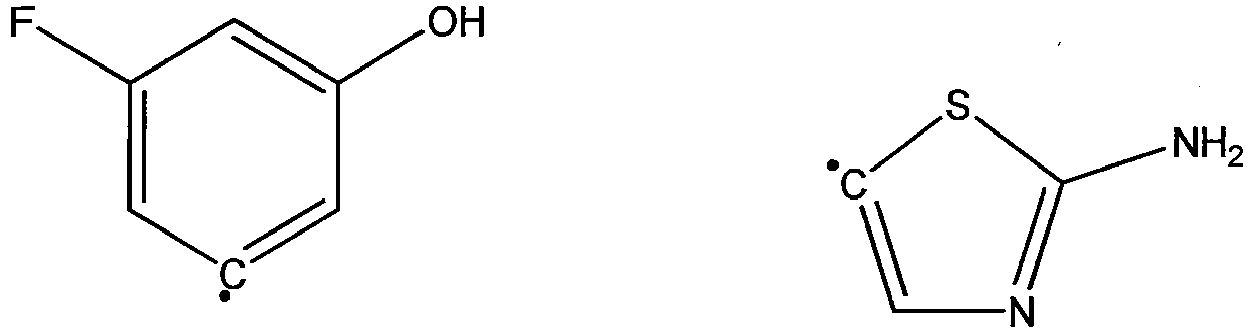

- According to specific embodiments, the invention provides the compounds listed in the table below and pharmaceutical acceptable salts thereof.
Example Chemical name Example 1 5-{1-[4-amino-3-(3-fluoro-5-hydroxyphenyl)-1H-pyrazolo[3,4-d]pyrimidin-1-yl]ethyl}-2-benzyl-6-phenyl-2,3-dihydropyridazin-3-one Example 2 5-{1-[4-amino-3-(3-fluoro-5-hydroxyphenyl)-1H-pyrazolo[3,4-d]pyrimidin-1-yl]ethyl}-2-methyl-6-phenyl-2,3-dihydropyridazin-3-one Example 3 5-{1-[4-amino-3-(3-fluoro-5-hydroxyphenyl)-1H-pyrazolo[3,4-d]pyrimidin-1-yl]ethyl}-6-phenyl-2-(propan-2-yl)-2,3-dihydropyridazin-3-one Example 4 5-{1-[4-amino-3-(3-fluoro-5-hydroxyphenyl)-1H-pyrazolo[3,4-d]pyrimidin-1-yl]ethyl}-2-(cyclopropylmethyl)-6-phenyl-2,3-dihydropyridazin-3-one Example 5 5-{1-[4-amino-3-(3-fluoro-5-hydroxyphenyl)-1H-pyrazolo[3,4-d]pyrimidin-1-yl]ethyl}-2,6-diphenyl-2,3-dihydropyridazin-3-one Example 6 5-{1-[4-amino-3-(3-fluoro-5-hydroxyphenyl)-1H-pyrazolo[3,4-d]pyrimidin-1-yl]ethyl}-6-phenyl-2-(pyridin-2-ylmethyl)-2,3-dihydropyridazin-3-one Example 7 5-{1-[4-amino-3-(3-fluoro-5-hydroxyphenyl)-1H-pyrazolo[3,4-d]pyrimidin-1-yl]ethyl}-2-benzyl-2,3-dihydropyridazin-3-one Example 8 5-{1-[4-amino-3-(3-fluoro-5-hydroxyphenyl)-1H-pyrazolo[3,4-d]pyrimidin-1-yl]ethyl}-2-phenyl-2,3-dihydropyridazin-3-one Example 9 5-{1-[4-amino-3-(3-fluoro-5-hydroxyphenyl)-1H-pyrazolo[3,4-d]pyrimidin-1-yl]ethyl}-2-methyl-2,3 -dihydropyridazin-3 -one Example 10 5-{1-[4-amino-3-(3-fluoro-5-hydroxyphenyl)-1H-pyrazolo[3,4-d]pyrimidin-1-yl]ethyl}-2-tert-butyl-4-phenyl-2,3-dihydropyridazin-3- one Example 11 5-{1-[4-amino-3-(3-fluoro-5-hydroxyphenyl)-1H-pyrazolo[3,4-d]pyrimidin-1-yl] ethyl} -2-benzyl-4-phenyl-2,3 -dihydropyridazin-3 -one Example 12 5-{1-[4-amino-3-(3-fluoro-5-hydroxyphenyl)-1H-pyrazolo[3,4-d]pyrimidin-1-yl]ethyl}-2-methyl-4-phenyl-2,3-dihydropyridazin-3-one Example 13 5-{1-[4-amino-3-(3-fluoro-5-hydroxyphenyl)-1H-pyrazolo[3,4-d]pyrimidin-1-yl]ethyl}-2,4-diphenyl-2,3-dihydropyridazin-3-one Example 14 5-{1-[4-amino-3-(3-fluoro-5-hydroxyphenyl)-1H-pyrazolo[3,4-d]pyrimidin-1-yl]ethyl}-2-[2-(morpholin-4-yl)ethyl]-4-phenyl-2,3-dihydropyridazin-3 -one Example 15 5-{1-[4-amino-3-(3-fluoro-5-hydroxyphenyl)-1H-pyrazolo[3,4-d]pyrimidin-1-yl]ethyl}-4-phenyl-2-(pyridin-3-yl)-2,3- dihydropyridazin-3-one Example 16 5-{1-[4-amino-3-(3-fluoro-5-hydroxyphenyl)-1H-pyrazolo[3,4-d]pyrimidin-1-yl]ethyl}-2-benzyl-4-cyclopentyl-2,3-dihydropyridazin-3-one Example 17 5-{1-[4-amino-3-(5-hydroxypyridin-3-yl)-1H-pyrazolo[3,4-d]pyrimidin-1-yl]ethyl}-2-benzyl-4-cyclopentyl-2,3-dihydropyridazin-3-one Example 18 5-{[4-amino-3-(3-fluoro-5-hydroxyphenyl)-1H-pyrazolo[3,4-d]pyrimidin-1 -yl]methyl}-2-benzyl-2,3-dihydropyridazin-3-one Example 19 4-amino-6-{[1-(1-benzyl-6-oxo-3-phenyl-1,6-dihydropyridazin-4-yl)ethyl]amino}pyrimidine-5-carbonitrile Example 20 4-amino-6-(1-(1-methyl-6-oxo-3-phenyl-1,6-dihydropyridazin-4-yl)ethylamino)pyrimidine-5-carbonitrile Example 21 4-amino-6-({1-[6-oxo-3-phenyl-1-(propan-2-yl)-1,6-dihydropyridazin-4-yl]ethyl}amino)pyrimidine-5-carbonitrile Example 22 4-amino-6-({1-[1-(cyclopropylmethyl)-6-oxo-3-phenyl-1,6-dihydropyridazin-4-yl]ethyl}amino)pyrimidine-5-carbonitrile Example 23 4-amino-6- {[1-(6-oxo-1,3 -diphenyl-1,6-dihydropyridazin-4-yl)ethyl] amino} pyrimidine-5-carbonitrile Example 24 2-benzyl-6-phenyl-5-{1-[(9H-purin-6-yl)amino]ethyl}-2,3-dihydropyridazin-3 -one - The compounds of formula (I) including all the compounds here above listed can be generally prepared according to the procedure outlined in the following Schemes shown below using generally known methods.
- According to the Reaction scheme 1, the compounds of Formula (Ia) can be prepared by reacting intermediate of Formula (II) and a suitable halide Cy-Hal (III), where all variable has the meaning above defined, and Cy-Hal is for example 6-bromopurine, 4-amino-6-chloropyrimidine-5-carbonitrile. Typical reaction is performed in a suitable polar solvent, such as t-BuOH, in the presence of a base, such as DIPEA, at an appropriate temperature ranging for example from 80°C to 100°C. This scheme provides a synthetic route for the preparation of the compound of examples 19, 20, 21, 22, 23, 24.

- According to the Reaction scheme 2, the compounds of Formula (IV) can be converted into compounds of Formula (V) by reaction with a nitrogen-based nucleophile of Formula (VI), under Mitsunobu reaction conditions. Compounds of Formula (V) were then converted into compounds of formula (Ib), where all variable has the meaning above defined, by Suzuki cross-coupling reaction with a suitable boronic acid or ester of Formula (VII). Wherein Het(Aryl) stands for any substituent group like aryl, heteroaryl.

- Typical Mitsunobu coupling is performed by reaction of a compound of formula (IV) with nitrogen-based nucleophile (VI), such as for example 3-iodo-1H-pyrazolo[3,4-d]pyrimidin-4-amine in a polar aprotic solvent, such as THF, in the presence of a dialkyl azodicarboxylate, such as DIAD and a triaryl phosphine, such as triphenylphosphine, at an appropriate temperature, such as, for example, at r.t. (room temperature). Typical Suzuky cross-coupling conditions comprise reacting a compound of formula (V) with a suitable boronic acid or boronic ester (VII), in the presence of a Pd catalyst, such as Pd(PPh3)4, using a base, such as aqueous sodium bicarbonate, in in a mixture of polar solvents, such as DME and EtOH, at an appropriate temperature, ranging from r.t. to 80°C. Boronic acid and esters of formula (VII) are commercially available. This scheme provides a synthetic route for the preparation of the compound of examples 1, 2, 3, 4, 5, 6, 7, 8, 9, 10, 11, 12, 13, 14, 15, 16, 17, 18.
- According to the Reaction scheme 3, intermediates of Formula (IV) can be converted into intermediates of formula (II) by preparation of azide (VIII) followed by reduction under Staudinger conditions.
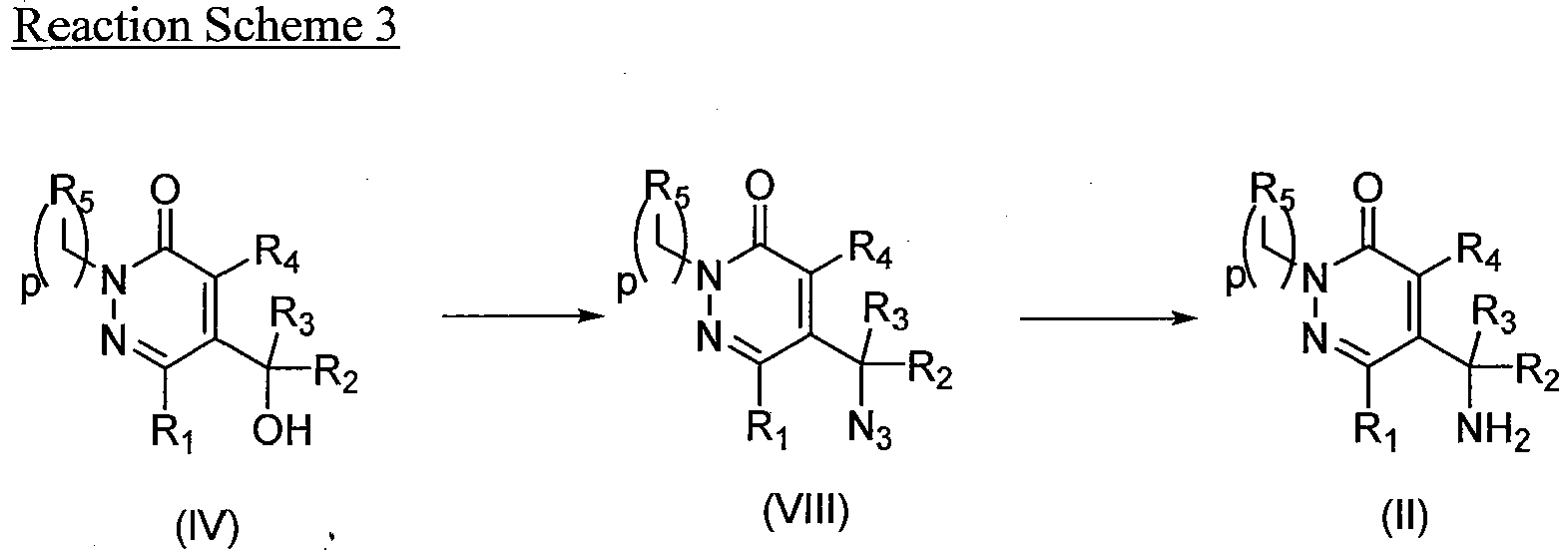
- Typical reaction conditions comprise reacting a compound of formula (IV) with diphenylphosphorylazide in the presence of a base, such as DBU, in a polar aprotic solvent, such as THF, at an appropriate temperature, such as r.t. Typical Staudinger reduction conditions comprise reacting a compound of formula (VIII) with a triaryl phosphine, such as triphenylphosphine, in a suitable polar aprotic solvent, such as THF, at an appropriate temperature, such as, for example r.t., followed by water and stirring at an appropriate temperature, such as, for example, ranging from 50°C to 60°C.
- According to the Reaction scheme 4, intermediate of Formula (IVa), wherein R2= Me, R3, R4=H and R1=Ph, can be prepared from commercially available intermediate (IXa), wherein R4=H and Ri=Ph and Hal is bromide.

- Intermediate of Formula (IXa) can be converted into intermediate of Formula (Xa) by alkylation with an alkyl halide in the presence of a base, or with dimethylformamide dimethyl acetal. Typical alkylation conditions comprise reacting a compound of formula (IXa) with a suitable alkyl halide [i.e. R5(CH2)p-Hal] in the presence of a base, such as potassium carbonate, or with dimethylformamide dimethyl acetal, in a polar aprotic solvent, such as in DMF, at an appropriate temperature, for example at ranging from RT to 60°C. Intermediate of Formula (Xa) can be converted into intermediate of Formula (XIa) by means of Palladium catalysed cross-coupling reaction under Stille conditions with tributyl(1-ethoxyvinyl)tin. Typical reaction conditions comprise reacting a compound of formula (Xa) with tributyl(1-ethoxyvinyl)tin, in the presence of a Pd catalyst, such as bis(triphenylphosphine)palladium(II) dichloride, in a polar aprotic solvent, such as in toluene, at an appropriate temperature, such as for example at 110°C. Intermediate (XIa) was then deprotected into intermediate of Formula (XIIa) by treatment with conc. HCl, in a polar aprotic solvent, such as in toluene, at an appropriate temperature, for example at r.t.. (For deprotection conditions see the general protocols reported in Greene's Protective Groups in Organic Synthesis, Peter G. M. Wuts, Theodora W. Greene; Wiley&Sons Editors, 4th Edition Dec. 2006. This deprotection step was used for the preparation of example 45, 46 and 103). Finally, an intermediate of formula (XIa) can be converted into alcohol (IVa). Typical reduction conditions comprise reacting a compound of formula (XIIa) with a reducing reagent, such as NaBH4, in a mixture of polar aprotic and protic solvents, such as THF and MeOH, at an appropriate temperature, for example at r.t. The crude obtained from reduction of a compound of formula (XIIa) was partially oxidized with a suitable oxidant such as CuCl2 in a polar aprotic solvent, such as CH3CN, at an appropriate temperature, such as at 85°C, or sodium 3-nitrobenzenesulfonate in aqueous NaOH, at an appropriate temperature, such as heating to reflux.
- According to the Reaction scheme 5, intermediate of Formula (XIIa), wherein R2= Me, R4=H and R1=Ph, can be alternatively prepared from commercially available intermediate (IXa), wherein R4=H and R1=Ph and Hal is bromide.

- Intermediate of Formula (IXa) is protected by means of a suitable protecting group, such as for example THP. Typical reaction conditions comprise reacting a compound of formula (IXa) with 3,4-dihydro-2H-pyran, in the presence of an acid, such as pyridinium p-toluenesulfonate, in a suitable solvent, such as THF, at an appropriate temperature, for example, ranging from 60°C to 90°C. Intermediate of Formula (XIIIa) may be converted into intermediate of Formula (XIVa) by means of Palladium catalysed cross-coupling reaction under Stille condition with tributyl(1-ethoxyvinyl)tin. Typical reaction conditions comprise reacting a compound of Formula (XIVa) with tributyl(1-ethoxyvinyl)tin, in the presence of a Pd catalyst, such as bis(triphenylphosphine)palladium(II) dichloride, in a polar aprotic solvent, such as in toluene, at an appropriate temperature, such as for example at 110°C. Intermediate (XIVa) was then deprotected into intermediate of Formula (XVa) by treatment with HCl. Typical reaction conditions comprise reacting a compound of Formula (XVa) with aqueous 6N HCl at an appropriate temperature, for example heating to reflux. Intermediate of Formula (XVa) was finally converted into intermediate of Formula (XIIa) with an alkylation reaction with an alkyl halide, or in a Chan Lam reaction with a suitable boronic acid or ester (VII). Typical alkylation conditions comprise reacting a compound of formula (XVa) with a suitable alkyl halide in the presence of a base, such as potassium carbonate, in a polar aprotic solvent, such as in DMF, at an appropriate temperature, for example at r.t.. Typical Chan Lam reaction conditions comprise reacting a compound of formula (XVa) with a suitable boronic acid (VII), such as phenylboronic acid, in the presence of copper (II) acetate and pyridine, in a mixture of polar aprotic solvents, such as DCM and DMF, at an appropriate temperature, for example at r.t., in the open air.
- According to the Reaction scheme 6, intermediate of Formula (IVb), wherein R2= Me, R1, R3= H, can be prepared from commercially available intermediate (XVI), wherein R1=H.

- An intermediate of Formula (XVI) can be converted into compound of Formula (XVII) by reaction with a suitable Grignard reagent. Typical reaction conditions comprise reacting a compound of Formula (XVI) with a suitable arylmagnesium halide or alkylmagnesium halide, such as phenylmagnesium bromide or cyclopentylmagnesium chloride, in a polar aprotic solvent, such as in THF, at an appropriate temperature, for example at 0°C. A compound of formula (XVI) wherein R1= H could be prepared accordingly to the procedure reported in the patent
US2005/0191238 A1 . A compound of Formula (XVII) is then reacted with tributyl(1-ethoxyvinyl)tin under Stille cross-coupling conditions to give intermediate of formula (XVIII). Typical reaction conditions comprise reacting a compound of formula (XVII) with tributyl(1-ethoxyvinyl)tin, in the presence of a Pd catalyst, such as bis(triphenylphosphine)palladium(II) dichloride, in a polar aprotic solvent, such as in toluene, at an appropriate temperature, for example at 110°C. A compound of Formula (XVIII) can be hydrolyzed to give intermediate ketone of Formula (XIX) with HCl. Typical reaction conditions comprise reacting a compound of formula (XVIII) with conc. HCl, in a polar aprotic solvent, such as in toluene, at an appropriate temperature, for example at r.t. Intermediate ketones of Formula (XIX) were then converted into intermediate of Formula (XVb), wherein R2= Me, R1= H, with TFA. Typical reaction conditions comprise reaction of a compound of Formula (XIX) with TFA, at an appropriate temperature, for example at 120°C under microwave (MW) irradiation. Intermediate of Formula (XVb), wherein R2= Me, R1= H, where then used in an alkylation reaction with an alkyl halide, or in a Chan Lam reaction with a suitable boronic acid or ester (VII) to give intermediate (XIIb), wherein R2= Me, R1= H. Typical alkylation conditions comprise reacting a compound of formula (XVb) with a suitable alkyl halide in the presence of a base, such as potassium carbonate, in a polar aprotic solvent, such as in DMF, at an appropriate temperature, for example at ranging from r.t. to 50°C. Typical Chan Lam reaction conditions comprise reacting a compound of formula (XVb) with a suitable boronic acid, in the presence of copper (II) acetate and pyridine, in a mixture of polar aprotic solvents, such as DCM and DMF, at an appropriate temperature, for example at r.t., in the open air. Finally an intermediate of Formula (XIIb) may be reduced to give intermediate (IVb), wherein R2= Me, R1, R3 = H. Typical reaction conditions comprise a reaction of a compound of formula (XIIb) with a reducing reagent, such as NaBH4, in a mixture of polar aprotic and protic solvents, such as THF and MeOH, at an appropriate temperature, for example ranging from 0°C to r.t. - According to the Reaction scheme 7, intermediate of Formula (XIIb), wherein R2= Me, R1=H, can be alternatively prepared from intermediate (XVII).

- An intermediate of Formula (XX) can be prepared by deprotection of a compound of Formula (XVII) in sulphuric acid and nitric acid. Typical reaction conditions comprise reacting a compound of Formula (XVII) with conc. H2SO4 and conc. HNO3, at an appropriate temperature, for example at r.t. Intermediate (XX) can be converted into intermediate of Formula (XXI) with an alkyl halide in the presence of a base. Typical alkylation conditions comprise reacting a compound of Formula (XX) with a suitable alkyl halide, such as benzyl bromide, in the presence of a base, such as potassium carbonate, in a polar aprotic solvent, such as in DMF, at an appropriate temperature, for example at r.t. This intermediate of Formula (XXI) was then reacted with tributyl(1-ethoxyvinyl)tin under Stille cross-coupling conditions. Typical reaction conditions comprise reacting a compound of Formula (XXI) with tributyl(1-ethoxyvinyl)tin, in the presence of a Pd catalyst, such as bis(triphenylphosphine)palladium(II) dichloride, in a polar aprotic solvent, such as in toluene, at an appropriate temperature, for example at 110°C. Intermediate of Formula (XIb) was hydrolyzed to ketone of Formula (XIIb) with HCl. Typical reaction conditions comprise reacting a compound of Formula (XIb) with conc. HCl, in a polar aprotic solvent, such as in toluene, at an appropriate temperature, for example at r.t.
- According to the Reaction scheme 8, intermediate of Formula (IVc), wherein R1= R3= R4= H, and R2= Me, can be prepared from intermediate (IXc), wherein R1= R4= H and Hal is Iodine.

- A compound of Formula (Xc) can be prepared reacting a compound of Formula (IXc) in an alkylation reaction with an alkyl halide [i.e. R5(CH2)p-Hal], or in a Chan Lam reaction with a suitable boronic acid or ester (VII). Typical alkylation conditions comprise reacting a compound of formula (IXc) with a suitable alkyl halide, such as benzylbromide, in the presence of a base, such as potassium carbonate, in a polar aprotic solvent, such as in DMF, at an appropriate temperature, for example at r.t. Typical Chan Lam reaction conditions comprise reacting a compound of Formula (IXc) with a suitable boronic acid or ester (VII), such as phenylboronic acid, in the presence of copper (II) acetate and pyridine, in a mixture of polar aprotic solvents, such as DCM and DMF, at an appropriate temperature, for example at r.t., in the open air. A compound of formula (Xc) wherein R1= R4= H, R5= Me, P=0, can be prepared accordingly to the procedure reported in Tetrahedron, 2004, 60, 12177-12189. A compound of Formula (IXc) wherein R1= R4= H and Hal is Iodine, can be prepared accordingly to the procedure reported in Bioorg. Med. Chem. 2012, 20, 3880-3886. Intermediate of formula (Xc) was then reacted with tributyl(1-ethoxyvinyl)tin under Stille cross-coupling conditions. Typical reaction conditions comprise reacting a compound of Formula (Xc) with tributyl(1-ethoxyvinyl)tin, in the presence of a Pd catalyst, such as bis(triphenylphosphine)palladium(II) dichloride, in a polar aprotic solvent, such as in toluene, at an appropriate temperature, for example at 110°C. Intermediate of Formula (XIc) was hydrolyzed to ketone of Formula (XIIc) with HCl. Typical reaction conditions comprise reacting a compound of Formula (XIc) with conc. HCl, in a polar aprotic solvent, such as in toluene, at an appropriate temperature, for example at r.t. Finally, an intermediate of formula (XIIc) can be converted into alcohol (IVc), wherein R1= R3= R4= H, and R2= Me. Typical reduction conditions comprise reacting a compound of formula (XIIc) with a reducing reagent, such as NaBH4, in a mixture of polar aprotic and protic solvents, such as THF and MeOH, at an appropriate temperature, for example at r.t. The crude obtained from reduction of a compound of formula (XIIc) was partially oxidized with a suitable oxidant such as CuCl2 in a polar aprotic solvent, such as CH3CN, at an appropriate temperature, such as at 85°C, or sodium 3-nitrobenzenesulfonate in aqueous NaOH, at an appropriate temperature, such as heating to reflux.
- According to the Reaction scheme 9, intermediate of Formula (IVd), wherein R1, R2, R3, R4= H, can be prepared from intermediate (XXII), wherein R1= R4= H.

- An intermediate of Formula (XXIII) can be prepared by reaction of a compound of formula (XXII) in an alkylation reaction. Typical alkylation conditions comprise reacting a compound of formula (XXII) with a suitable alkyl halide, such as benzyl bromide, in the presence of a base, such as potassium carbonate, in a polar aprotic solvent, such as DMF, at an appropriate temperature, for example at r.t. A compound of formula (XXII) can be prepared accordingly to the procedure reported in the patent
US2009/111821 A1, 2009 . An intermediate of Formula (IVd) may be prepared by reduction of a compound of formula (XXIII) followed by oxidation of the obtained crude. Typical reduction conditions comprise reacting a compound of formula (XXIII) with a reducing reagent, such as NaBH4 in the presence of CaCl2, in a mixture of polar aprotic and protic solvents, such as THF and MeOH, at an appropriate temperature, for example at r.t.. Typical oxidation conditions comprise reacting the crude obtained from reduction of a compound of formula (XXIII) with an oxidation system, such as CuCl2 in a polar aprotic solvent, such as CH3CN, at an appropriate temperature, such as at 85°C. - The compounds of the invention are inhibitors of kinase activity, in particular PI3-kinase activity. Generally speaking, compounds which are PI3K inhibitors may be useful in the treatment of many disorders associated with PI3K enzymes mechanisms.
- In one embodiment, the disorders that can be treated by the compounds of the present invention include respiratory diseases selected from idiopathic chronic cough, cough-variant asthma, cough associated with thoracic tumour or lung cancer, viral or post-viral cough, upper airways cough syndrome (UACS), or post nasal drip cough, or cough associated with gastro- oesophageal reflux disease (both acid and non-acid reflux), asthma, chronic bronchitis, chronic obstructive pulmonary disease (COPD), interstitial lung disease, (such as idiopathic pulmonary fibrosis (IPF)), congestive heart disease, sarcoidosis, infections (such as whooping cough); viral infections (including viral respiratory tract infections and viral exacerbation of respiratory diseases; non-viral respiratory infections including aspergillosis and leishmaniasis; allergic diseases including allergic rhinitis and atopic dermatitis; autoimmune diseases including rheumatoid arthritis and multiple sclerosis; inflammatory disorders including inflammatory bowel disease; cardiovascular diseases including thrombosis and atherosclerosis; hematologic malignancies; neurodegenerative diseases; pancreatitis; multiorgan failure; kidney diseases; platelet aggregation; cancer; sperm motility; transplantation rejection; graft rejection; lung injuries; and pain including pain associated with rheumatoid arthritis or osteoarthritis, back pain, general inflammatory pain, post herpetic neuralgia, diabetic neuropathy, inflammatory neuropathic pain (trauma), trigeminal neuralgia and central pain.
- In another embodiment, the disorder that can be treated by the compound of the present invention is selected from the group consisting of idiopathic chronic cough, cough-variant asthma, cough associated with thoracic tumour or lung cancer, viral or post-viral cough, upper airways cough syndrome (UACS), post nasal drip cough, cough associated gastro- oesophageal reflux disease (both acid and non-acid reflux), asthma, chronic bronchitis, chronic obstructive pulmonary disease (COPD) and interstitial lung disease (such as idiopathic pulmonary fibrosis (IPF)).
- In a further embodiment, the disorder is selected from the group of asthma, chronic obstructive pulmonary disease (COPD), idiopathic pulmonary fibrosis (IPF), cough and chronic cough.
- The methods of treatment of the invention comprise administering a safe and effective amount of a compound of formula (I) or a pharmaceutically acceptable salt thereof to a patient in need thereof. As used herein, "safe and effective amount" in reference to a compound of formula (I) or a pharmaceutically acceptable salt thereof or other pharmaceutically-active agent means an amount of the compound sufficient to treat the patient's condition but low enough to avoid serious side effects and it can nevertheless be routinely determined by the skilled artisan. The compounds of formula (I) or pharmaceutically acceptable salts and or solvates thereof may be administered once or according to a dosing regimen wherein a number of doses are administered at varying intervals of time for a given period of time. Typical daily dosages may vary depending upon the particular route of administration chosen.
- The invention also provides pharmaceutical compositions of compounds of formula (I) in admixture with one or more pharmaceutically acceptable carrier or excipient, for example those described in Remington's Pharmaceutical Sciences Handbook, XVII Ed., Mack Pub., N.Y., U.S.A.
- Administration of the compounds of the present invention and their pharmaceutical compositions may be accomplished according to patient needs, for example, orally, nasally, parenterally (subcutaneously, intravenously, intramuscularly, intrasternally and by infusion), by inhalation, rectally, vaginally, topically, locally, transdermally, and by ocular administration.
- Various solid oral dosage forms can be used for administering compounds of the invention including such solid forms as tablets, gelcaps, capsules, caplets, granules, lozenges and bulk powders. The compounds of the present invention can be administered alone or combined with various pharmaceutically acceptable carriers, diluents (such as sucrose, mannitol, lactose, starches) and known excipients, including suspending agents, solubilizers, buffering agents, binders, disintegrants, preservatives, colorants, flavorants, lubricants and the like. Time release capsules, tablets and gels are also advantageous in administering the compounds of the present invention.
- Various liquid oral dosage forms can also be used for administering compounds of the invention, including aqueous and non-aqueous solutions, emulsions, suspensions, syrups, and elixirs. Such dosage forms can also contain suitable known inert diluents such as water and suitable known excipients such as preservatives, wetting agents, sweeteners, flavorants, as well as agents for emulsifying and/or suspending the compounds of the invention. The compounds of the present invention may be injected, for example, intravenously, in the form of an isotonic sterile solution. Other preparations are also possible.
- Suppositories for rectal administration of the compounds of the invention can be prepared by mixing the compound with a suitable excipient such as cocoa butter, salicylates and polyethylene glycols.
- Formulations for vaginal administration can be in the form of cream, gel, paste, foam, or spray formula containing, in addition to the active ingredient, such as suitable carriers, are also known.
- For topical administration the pharmaceutical composition can be in the form of creams, ointments, liniments, lotions, emulsions, suspensions, gels, solutions, pastes, powders, sprays, and drops suitable for administration to the skin, eye, ear or nose. Topical administration may also involve transdermal administration via means such as transdermal patches.
- For the treatment of the diseases of the respiratory tract, the compounds according to the invention are preferably administered by inhalation.
- Inhalable preparations include inhalable powders, propellant-containing metering aerosols or propellant-free inhalable formulations.
- For administration as a dry powder, single- or multi-dose inhalers known from the prior art may be utilized. In that case the powder may be filled in gelatine, plastic or other capsules, cartridges or blister packs or in a reservoir.
- A diluent or carrier, generally non-toxic and chemically inert to the compounds of the invention, e.g. lactose or any other additive suitable for improving the respirable fraction may be added to the powdered compounds of the invention.
- Inhalation aerosols containing propellant gas such as hydrofluoroalkanes may contain the compounds of the invention either in solution or in dispersed form. The propellant-driven formulations may also contain other ingredients such as co-solvents, stabilizers and optionally other excipients.
- The propellant-free inhalable formulations comprising the compounds of the invention may be in form of solutions or suspensions in an aqueous, alcoholic or hydroalcoholic medium and they may be delivered by jet or ultrasonic nebulizers known from the prior art or by soft-mist nebulizers such as Respimat®.
- The compounds of the invention can be administered as the sole active agent or in combination with other pharmaceutical active ingredients including those currently used in the treatment of respiratory disorders, e.g. beta2-agonists, antimuscarinic agents, corticosteroids, mitogen-activated kinases (P38 MAP kinases) inhibitors,, human neutrophil elastase (HNE) inhibitors, phosphodiesterase 4 (PDE4) inhibitors, leukotriene modulators, non-steroidal anti-inflammatory agents (NSAIDs) and mucus regulators.
- The dosages of the compounds of the invention depend upon a variety of factors including the particular disease to be treated, the severity of the symptoms, the route of administration, the frequency of the dosage interval, the particular compound utilized, the efficacy, toxicology profile, and pharmacokinetic profile of the compound.
- Advantageously, the compounds of formula (I) can be administered for example, at a dosage comprised between 0.001 and 1000 mg/day, preferably between 0.1 and 500 mg/day.
- When the compounds of formula (I) are administered by inhalation route, they are preferably given at a dosage comprised between 0.001 and 500 mg/day, preferably between 0.1 and 200 mg/day.
- The following examples illustrate the invention.
- Chemical Names of the compounds were generated with CHEMAXON 6.0.4 tool.
- Solutions of common inorganic salts used in workups are aqueous solutions.
Abbreviations: EtOAc Ethyl acetate DCM Dichloromethane MeOH Methanol DMF N,N-Dimethylformamide MeCN Acetonitrile THF Tetrahydrofuran DMSO Dimethyl sulfoxide t-BuOH tert-Butanol EtOH Ethanol DME 1,2-Dimethoxyethane PdCl2(PPh3)2 Bis(triphenylphosphine)palladium(II) dichloride Pd(OAc)2 Palladium(II) acetate Pd(PPh3)4 Tetrakis(triphenylphosphine)palladium(0) PPH3 Triphenylphosphine DPPA Diphenyl phosphoryl azide DBU 1,8-Diazabicyclo[5.4.0]undec-7-ene DIPEA N,N-Diisopropylethylamine MeMgBr Methylmagnesium bromide EtMgBr Ethylmagnesium bromide PhMgCl Phenylmagnesium chloride DIAD Diisopropyl azodicarboxylate TFA Trifluoroacetic acid MW microwave SCX Strong cation exchanger Silica NH Secondary amine functionalized silica cartridge r.t./RT Room temperature Rt Retention time H hour Min minutes Cone concentrated Eq equivalent Sat saturated MDAP mass directed autopurification - Proton Magnetic Resonance (1H NMR) spectra were collected using deuterated solvents (DMSO-d6, CDCl3) at 25°C on Agilent VNMRS-500, Agilent VNMRS-400 and Bruker Avance 400.
- Chemical shifts are expressed in parts per million (ppm) downfield of tetramethylsilane (δ units). Multiplicity is indicated as follow: (s) singlet, (d) doublet, (dd) double doublet, (ddd) triple doublet, (t) triplet, (dt) double triplet, (q) quartet, (m) multiplet, (br s) broad signal. Coupling constants J are expressed in unit of hertz (Hz).
- LCMS may be recorded under the following conditions: diode array detector DAD chromatographic traces, mass chromatograms and mass spectra may be taken on UPLC/PDA/MS AcquityTM system coupled with Micromass ZQTM or Waters SQD single quadrupole mass spectrometer operated in positive and/or negative electron spray ES ionization mode and/ or Fractionlynx system used in analytical mode coupled with ZQTM single quadrupole operated in positive and/or negative ES ionization mode.
- Quality Control methods used were two, one operated under low pH conditions and the other one operated under high pH conditions:
- Method A, low pH conditions: column: Acquity CSH C18, 1.7 µm, 2.1 x 50 mm, the column temperature was 40 °C; mobile phase solvent A was milliQ water + 0.1% HCOOH, mobile phase solvent B MeCN + 0.1% HCOOH. The flow rate was 1 ml/min. The gradient table was t= 0 min 97% A - 3% B, t= 1.5 min 0.1% A - 99.9% B, t= 1.9 min 0.1% A - 99.9% B and t= 2 min 97% A - 3% B. The UV detection range was 210 - 350 nm and the ES+/ES- range was 100 - 1000 amu.
- Method B, low pH conditions: column: Acquity UPLC BEH C18, 1.7 µm, 50 mm x 2.1 mm, the column temperature was 40 °C; mobile phase solvent A was milliQ water + 0.1% HCOOH, mobile phase solvent B MeCN + 0.1% HCOOH. The flow rate was 1 ml/min. The gradient table was t= 0 min 97% A - 3% B, t= 1.5 min 0.1% A - 99.9% B, t= 1.9 min 0.1% A - 99.9% B and t= 2 min 97% A - 3% B. The UV detection range was 210 - 350 nm and the ES+/ES- range was 100 - 1000 amu.
- The experiment performed under microwave irradiation were carried out using a Biotage Initiator 2.0 system.
- Flash chromatography purifications were performed using Biotage Isolera or Biotage SP1 flash chromatography systems, both instruments working with Biotage KP-SIL cartridges and Biotage KP-NH cartridges, or were manually performed using Isolute Flash silica gel pre-packed cartridges, or Varian Bond Elut pre-packed cartridges.
- Reverse phase flash chromatography were carried out over pre-packed Biotage C18 SNAP cartridges or Varan Bond Elut C18 cartridges.
- SPE-SCX cartridges are ion exchange solid phase extraction columns supplied by Varian.
- Many of the compounds described in the following Examples have been prepared from stereochemically pure starting materials, for example 95% ee.
- Brine refers to a saturated aqueous solution of NaCl, unless otherwise specified.
- Where the preparation of starting materials is not described, these are known, commercially available, or readily obtainable using standard procedures.
- The stereochemistry of the compounds in the Examples, where indicated, has been assigned on the assumption that absolute configuration at resolved stereogenic centers of staring materials is maintained throughout any subsequent reaction conditions.
- In the procedures that follow, after each starting material, reference to a compound number is sometimes provided. This is provided merely for assistance to the skilled chemist. The starting material may not necessarily have been prepared from the batch referred to.
- When reference is made to the use of a "similar" or "analogous" procedure, as will be appreciated by those skilled in the art, such a procedure may involve minor variations, for example reaction temperature, reagent/solvent amount, reaction time, work-up conditions or chromatographic purification conditions.
-

- To a solution of 5-bromo-6-phenyl-2,3-dihydropyridazin-3-one (1.0 g, 3.98 mmol) in DMF (20 mL), potassium carbonate (0.661 g, 4.78 mmol) was added followed by benzyl bromide (0.569 mL, 4.78 mmol) and the resulting mixture was stirred at r.t. for 2 h. The mixture was diluted with EtOAc and washed with water and then several times with brine. The organic phase was dried over sodium sulfate and the solvent was removed. The crude was purified by flash chromatography on silica gel Biotage SNAP cartridge (cyclohexane to cyclohexane : EtOAc = 80 : 20) to afford title compound as a yellow solid (1.212 g, 3.55 mmol, 89% yield). MS/ESI+ 341.1 - 343. 1 [MH]+, Rt = 1.19 min (Method A).
-
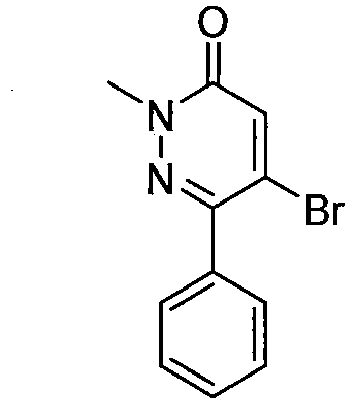
- A mixture of 5-bromo-6-phenyl-2,3-dihydropyridazin-3-one (0.500 g, 1.99 mmol) and N,N-dimethylformamide dimethyl acetal (0.397 mL, 2.978 mmol) in DMF (20 mL) was refluxed for 2 h. The mixture was diluted with EtOAc and washed with water and then several times with brine. The organic phase was dried over sodium sulfate and the solvent was removed. The crude was purified by flash chromatography on silica gel Biotage cartridge (cyclohexane : EtOAc = 90 : 10 to 50 : 50) to afford title compound as a white solid (0.279 g, 1.05 mmol, 53% yield). MS/ESI+ 265.0 - 267.0 [MH]+, Rt = 0.92 min (Method A).
-

- To a solution of 5-bromo-6-phenyl-2,3-dihydropyridazin-3-one (0.700 g, 2.788 mmol) in DMF (12 mL), potassium carbonate (0.462 g, 3.345 mmol) was added followed by 2-bromopropane (0.314 mL, 3.345 mmol) and the resulting mixture heated at 60°C for 2 h. The mixture was partitioned between EtOAc and water, the aqueous phase was extracted with EtOAc, and the combined organic layers were washed several times with brine. The organic phase was dried over sodium sulfate and the solvent was removed. The crude was purified by flash chromatography on silica gel Biotage cartridge (cyclohexane to cyclohexane : EtOAc = 85 : 15) to afford title compound as a pale yellow solid (0.630 g, 2.149 mmol, 77% yield). MS/ESI+ 293.1 - 295.1 [MH]+, Rt = 1.11 min (Method A).
-

- A mixture of 5-bromo-6-phenyl-2,3-dihydropyridazin-3-one (2.572 g, 10.24 mmol), 3,4-dihydro-2H-pyran (15 mL, 164.4 mmol) and pyridinium p-toluenesulfonate (0.489 g, 1.945 mmol), in THF (12 mL) was heated to reflux for 5 h. Additional 3,4-dihydro-2H-pyran (7.5 mL, 82.2 mmol) was added and the reaction was heated to reflux overnight. The mixture was concentrated in vacuo and the residue was taken up with EtOAc and washed with aqueous 2N sodium hydroxide. The organic phase was dried over sodium sulfate and concentrated in vacuo. The crude was purified by flash chromatography on Biotage silica gel cartridge (cyclohexane: EtOAc = 90 : 10 60 : 40) to afford title compound as a yellow oil (3.4 g, 10.15 mmol, 99% yield). MS/ESI+ 335.1 - 337.1 [MH]+, Rt = 1.08 min (Method A).
-

- To a solution of 5-iodo-2,3-dihydropyridazin-3-one (prepared according to the procedure reported in Bioorg. Med. Chem. 2012, 20, 3880-3886) (0.500 g) in DMF (5 mL), potassium carbonate (0.375 g, 2.71 mmol) was added followed by benzyl bromide (0.323 mL, 2.71 mmol) and the resulting mixture was stirred at r.t. for 18 h. The mixture was diluted with EtOAc and washed with water and then several times with brine. The organic phase was dried over sodium sulfate and the solvent was removed in vacuo. The crude was purified by flash chromatography on silica gel Biotage cartridge (cyclohexane to cyclohexane : EtOAc = 80 : 20) to afford title compound as a white solid (0.504 g, 1.61 mmol). MS/ESI+ 312.8 [MH]+, Rt = 0.97 min (Method A).
-

- To a solution of 5-iodo-2,3-dihydropyridazin-3-one (prepared according to the procedure reported in Bioorg. Med. Chem. 2012, 20, 3880-3886) (0.500 g) in DCM (24 mL) and DMF (8 mL), copper (II) acetate (0.822 g, 4.52 mmol), phenylboronic acid (0.331 g, 2.71 mmol), pyridine (366 µL, 4.52 mmol) and activated 4 Å molecular sieves (1.200 g) were added and the resulting mixture was stirred at r.t. in the open air for 24 hours. Additional phenylboronic acid (0.331 g, 2.71 mmol) was added and the reaction was stirred for further 4 h. Concentrated NH4OHaq. was added, the volatiles were removed under reduced pressure and the insoluble materials were filtered off; the crude was purified by flash chromatography on silica gel Biotage cartridge (cyclohexane : EtOAc = 90 : 10 to 20: 80) to afford title compound (0.513 g). MS/ESI+ 298.8 [MH]+, Rt = 0.88 min (Method A).
-

- To a solution of 2-tert-butyl-4,5-dichloro-2,3-dihydropyridazin-3-one (prepared according to the procedure reported in the patent
US2005/0191238 A1 ) (2.00 g, 9.05 mmol) in THF (35 mL) cooled at 0°C, a 2M solution of PhMgCl in THF (5.65 mL, 11.3 mmol) was added and the resulting mixture was stirred at 0°C for 30 min. Additional 2M PhMgCl in THF (5.65 mL, 11.3 mmol) was added at 0°C and the mixture was stirred at the same temperature for 1 h. The reaction was quenched at 0°C by drop-wise addition of aqueous 6M HCl (5 mL). The mixture was extracted with AcOEt, and the organic phase was washed with water and brine and then dried over sodium sulfate. The solvent was removed and the crude was purified by flash chromatography on Biotage silica gel cartridge (cyclohexane to cyclohexane : EtOAc = 95 : 5) to afford title compound as a pale yellow oil (1.190 g, 4.53 mmol, 50% yield). MS/ESI+ 263.2 [MH]+, Rt = 1.25 min (Method A). -

- Prepared similarly to intermediate C1, starting from 2-tert-butyl-4,5-dichloro-2,3-dihydropyridazin-3-one (prepared according to the procedure reported in the patent
US2005/0191238 A1 ) (2.00 g, 9.05 mmol) and 2.0 M cyclopentylmagnesium chloride in diethyl ether (5.65 mL, 11.3 mmol), stirring for 30 min, and purified by flash chromatography on Biotage silica gel cartridge (cyclohexane to cyclohexane : EtOAc = 95 : 5) to afford title compound as a pale yellow oil (1.278 g, 5.03 mmol, 56 % yield). MS/ESI+ 255.2 [MH]+, Rt = 1.52 min (Method A). -

- 2-tert-butyl-5-chloro-4-cyclopentyl-2,3-dihydropyridazin-3-one C2 (1.126 g, 4.43 mmol) was dissolved in conc. H2SO4 (22.2 mL) and conc. HNO3 (7.4 mL) was added drop-wise maintaining the temperature below 30°C and the mixture was stirred at r.t. for 1 h. Then the mixture was poured into ice water (20 ml), whereupon precipitated crystals were collected by filtration, washed with water and dried under reduced pressure to provide title compound (0.632 g, 3.19 mmol, 72% yield). MS/ESI+ 199.1 [MH]+, Rt = 0.93 min (Method A).
-
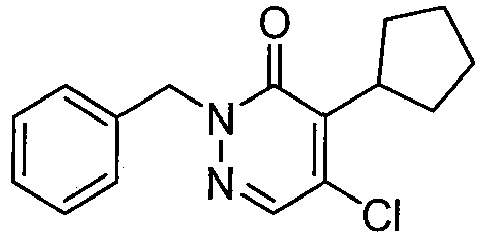
- To a solution of 5-chloro-4-cyclopentyl-2,3-dihydropyridazin-3-one C3 (0.350 g, 1.76 mmol) in DMF (12 mL), potassium carbonate (0.293 g, 2.12 mmol) was added followed by benzyl bromide (0.252 mL, 2.12 mmol) and the resulting mixture was stirred at r.t. for 3 h. The mixture was partitioned between EtOAc and water and the organic phase was washed several times with brine and dried over sodium sulfate. The solvent was removed and the crude was purified by flash chromatography on Biotage silica gel cartridge (cyclohexane to cyclohexane : EtOAc = 80 : 20) to afford title compound as a white solid (0.389 g, 1.35 mmol, 77% yield). MS/ESI+ 289.2 [MH]+, Rt = 1.39 min (Method A).
-

- To a solution of 2-benzyl-5-bromo-6-phenyl-2,3-dihydropyridazin-3-one A1 (1.212 g, 3.55 mmol) in toluene (15 mL), bis(triphenylphosphine)palladium(II) dichloride (0.125 g, 0.17 mmol) was added followed by tributyl(1-ethoxyvinyl)tin (1.3 mL, 3.9 mmol) and the resulting mixture was heated to reflux for 2 h. The mixture was allowed to cool to r.t. and then filtered through a celite pad. The filtrate was evaporated to dryness and the crude was purified by flash chromatography on silica gel Biotage cartridge (cyclohexane to cyclohexane : EtOAc = 60 : 40) to afford title compound (1.17 g, 3.52 mmol, 99% yield). MS/ESI+ 333.2 [MH]+, Rt = 1.28 min (Method A).
-

- Prepared similarly to intermediate D1 starting from 5-bromo-2-methyl-6-phenyl-2,3-dihydropyridazin-3-one A2 (0.279 g, 1.05 mmol), and purified by flash chromatography on silica gel Biotage cartridge (cyclohexane : EtOAc = 93 : 7 to 40 : 60) to afford title compound (0.264 g, 1.03 mmol, 98% yield). MS/ESI+ 257.2 [MH]+, Rt = 1.01 min (Method A).
-

- Prepared similarly to intermediate D1 starting from 5-bromo-6-phenyl-2-(propan-2-yl)-2,3-dihydropyridazin-3-one A3 (0.625 g, 2.132 mmol), and purified by flash chromatography on silica gel Biotage cartridge (cyclohexane to cyclohexane : EtOAc = 80 : 20); the obtained product was dissolved in EtOAc and vigorously stirred with aqueous sat. KF for 15 min. The phases were separated and the organic layer was evaporated to dryness to afford title compound as pale brown solid (0.555 g, 1.952 mmol, 91% yield). MS/ESI+ 285.2 [MH]+, Rt = 1.20 min (Method A).
-

- Prepared similarly to intermediate D1 starting from 5-bromo-2-(oxan-2-yl)-6-phenyl-2,3-dihydropyridazin-3-one A4 (3.4 g, 10.15 mmol), and purified by flash chromatography on silica gel Biotage cartridge (cyclohexane : EtOAc = 93 : 7 to 40 : 60) to afford title compound (3.308 g, 10.15 mmol, quantitative yield). MS/ESI+ 327.3 [MH]+, Rt = 1.16 min (Method A).
-

- Prepared similarly to intermediate D1 starting from 2-benzyl-5-iodo-2,3-dihydropyridazin-3-one B1 (0.504 g, 1.61 mmol), and purified by flash chromatography on silica gel Biotage cartridge (cyclohexane : EtOAc = 93 : 7 to 40 : 60) to afford title compound (0.372 g, 1.45 mmol, 90% yield). MS/ESI+ 257.0 [MH]+, Rt = 1.04 min (Method A).
-

- Prepared similarly to intermediate D1 starting from 5-iodo-2-phenyl-2,3-dihydropyridazin-3-one B2 (0.513 g), and purified by flash chromatography on silica gel Biotage cartridge (cyclohexane : EtOAc = 93 : 7 to 40 : 60) to afford title compound (0.374 g, 1.55 mmol). MS/ESI+ 243.0 [MH]+, Rt = 0.98 min (Method A).
-

- Prepared similarly to intermediate D1 starting from 5-iodo-2-methyl-2,3-dihydropyridazin-3-one (prepared according to the procedure reported in Tetrahedron, 2004, 60, 12177-12189) (0.904 g), and purified by flash chromatography on silica gel Biotage cartridge (cyclohexane : EtOAc = 93 : 7 to = 40 : 60) to afford title compound (0.659 g, 3.66 mmol). MS/ESI+ 181.1 [MH]+, Rt = 0.73 min (Method A).
-

- To a degassed solution of 2-tert-butyl-5-chloro-4-phenyl-2,3-dihydropyridazin-3-one C1 (1.190 g, 4.53 mmol) in toluene (20 mL), PdCl2(PPh3)2 (0.159 g, 0.226 mmol) was added followed by tributyl(1-ethoxyvinyl)tin (1.683 mL, 4.98 mmol) and the resulting mixture was heated to reflux overnight. The mixture was allowed to cool to r.t. and then filtered through a celite pad. The filtrate was evaporated to dryness and the crude was purified by flash chromatography on silica gel Biotage cartridge (cyclohexane to cyclohexane : EtOAc = 95 : 5) to afford title compound as a pale yellow oil (1.074 g, 3.60 mmol, 79% yield). MS/ESI+ 299.3 [MH]+, Rt = 1.29 min (Method A).
-

- Prepared similarly to intermediate D8 starting from 2-benzyl-5-chloro-4-cyclopentyl-2,3-dihydropyridazin-3-one C4 (0.389 g, 1.35mmol), and purified by flash chromatography on silica gel Biotage cartridge (cyclohexane to cyclohexane : EtOAc = 90 : 10) to afford title compound as a pale yellow oil (0.410 g, 1.26 mmol, 94% yield). MS/ESI+ 325.3 [MH]+, Rt = 1.42 min (Method A).
-

- To a solution of 2-benzyl-5-(1-ethoxyethenyl)-6-phenyl-2,3-dihydropyridazin-3-one D1 (1.17 g, 3.52 mmol) in toluene (15 mL), aqueous 37% HCl (0.75 mL) was added and the resulting mixture was stirred at r.t. for 12 h. The mixture was extracted with DCM, the organic phase was dried over sodium sulfate and the solvent evaporated to afford title compound (1.066 g, 3.5 mmol, 99% yield). MS/ESI+ 305.2 [MH]+, Rt = 1.07 min (Method A).
-

- Prepared similarly to intermediate E1 starting from 5-(1-ethoxyethenyl)-2-methyl-6-phenyl-2,3-dihydropyridazin-3-one D2 (0.264 g, 1.03 mmol), and purified by flash chromatography on silica gel Biotage cartridge (cyclohexane : EtOAc = 90 : 10 to 20 : 80) to afford title compound (0.204 g, 0.894 mmol, 87% yield). MS/ESI+ 229.1 [MH]+, Rt = 0.78 min (Method A).
-

- Prepared similarly to intermediate E1 starting from 5-(1-ethoxyethenyl)-6-phenyl-2-(propan-2-yl)-2,3-dihydropyridazin-3-one D3 (0.515 g, 1.811 mmol), stirring for 2 h, to afford title compound as a beige solid (0.442 g, 1.724 mmol, 95% yield). MS/ESI+ 257.2 [MH]+, Rt = 0.98 min (Method A).
-

- A mixture of 5-(1-ethoxyethenyl)-2-(oxan-2-yl)-6-phenyl-2,3-dihydropyridazin-3-one D4 (3.308 g, 10.15 mmol) in aqueous 6N HCl (30 mL) was heated to reflux for 2 h. The mixture was extracted with DCM, the organic layer was dried over sodium sulfate and the solvent evaporated. The crude was purified by flash chromatography on silica gel Biotage cartridge (cyclohexane : EtOAc = 90 : 10 to = 20 : 80) to afford an orange solid which was recrystallized from 2-propanol to afford title compound as a pale yellow solid (1.486 g, 6.9 mmol, 68% yield). The mother liquor was recovered to afford a second fraction of title compound which was used without any additional purification (0.771 g). MS/ESI+ 215.1 [MH]+, Rt = 0.67 min (Method A).
-

- To a solution of 5-acetyl-6-phenyl-2,3-dihydropyridazin-3-one E4 (0.300 g) in DMF (6 mL), potassium carbonate (0.232 g, 1.68 mmol) was added followed by (bromomethyl)cyclopropane (0.163 mL, 1.68 mmol) and the resulting mixture was stirred at r.t. for 2 h. The mixture was diluted with EtOAc, washed with water and then several times with brine. The organic phase was dried over sodium sulfate and the solvent was removed in vacuo. The crude was purified by flash chromatography on silica gel Biotage cartridge (cyclohexane to cyclohexane : EtOAc = 60 : 40) to afford title compound as a yellow oil (0.212 g, 0.79 mmol). MS/ESI+ 269.2 [MH]+, Rt = 0.99 min (Method A).
-

- To a solution of 5-acetyl-6-phenyl-2,3-dihydropyridazin-3-one E4 (0.214 g) in DCM (12 mL) and DMF (4 mL), copper (II) acetate (0.363 g, 2 mmol), phenylboronic acid (0.146 g, 1.2 mmol), pyridine (0.162 mL, 2 mmol) and activated 4 Å molecular sieves (1.200 g) were added and the resulting mixture was stirred at r.t. in the open air for 24 h. Additional phenylboronic acid (0.146 g, 1.2 mmol) was added and the stirring was continued for further 4 h. Concentrated aqueous NH4OH was added, the solvents were evaporated under vacuum and the insoluble materials were filtered off; the crude was purified by flash chromatography on silica gel Biotage cartridge (cyclohexane : EtOAc = 90 : 10 to = 20 : 80) to afford title compound (0.290 g, 1 mmol). MS/ESI+ 291.1 [MH]+, Rt = 1.01 min (Method A).
-

- To a solution of 5-acetyl-6-phenyl-2,3-dihydropyridazin-3-one E4 (0.300 g) in DMF (3 mL), potassium carbonate (0.518 g, 4.2 mmol) was added followed by 2-(bromomethyl)pyridine hydrobromide (0.709 g, 2.8 mmol) and the resulting mixture was stirred at r.t. for 1 h. The mixture was diluted with EtOAc and washed with water and then several times with brine. The organic phase was dried over sodium sulfate and the solvent was removed in vacuo. The crude was purified by flash chromatography on silica gel Biotage cartridge (cyclohexane : EtOAc = 80 : 20 to 100% EtOAc) to afford title compound as a yellow oil (0.268 g, 0.878 mmol). MS/ESI+ 306.2 [MH]+, Rt = 0.77 min (Method A).
-

- Prepared similarly to intermediate E1 starting from 2-benzyl-5-(1-ethoxyethenyl)-2,3-dihydropyridazin-3-one D5 (0.372 g, 1.45 mmol) to afford title compound (0.288 g, 1.26 mmol, 87% yield). MS/ESI+ 229.0 [MH]+, Rt = 0.81 min (Method A).
-

- Prepared similarly to intermediate E1 starting from 5-(1-ethoxyethenyl)-2-phenyl-2,3-dihydropyridazin-3-one D6 (0.374 g, 1.55 mmol) to afford title compound (0.262 g, 1.22 mmol, 79% yield). MS/ESI+ 214.9 [MH]+, Rt = 0.70 min (Method A).
-

- Prepared similarly to intermediate E1 starting from 5-(1-ethoxyethenyl)-2-methyl-2,3-dihydropyridazin-3-one D7 (0.735 g, 4.08 mmol) and purified by flash chromatography on silica gel Biotage cartridge (cyclohexane : EtOAc = 90 : 10 to = 20 : 80) to afford title compound (0.544 g, 3.57 mmol, 88% yield). MS/ESI+ 153.1 [MH]+, Rt = 0.42 min (Method A).
-
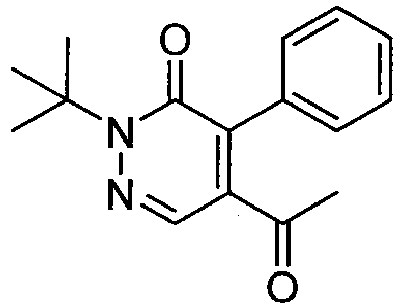
- Prepared similarly to intermediate E1 starting from 2-tert-butyl-5-(1-ethoxyethenyl)-4-phenyl-2,3-dihydropyridazin-3-one D8 (1.074 g, 3.60 mmol), stirring for 2 h, to afford title compound as a pale yellow solid (0.847 g, 3.13 mmol, 87% yield). MS/ESI+ 271.0 [MH]+, Rt = 1.10 min (Method A).
-

- 5-acetyl-2-tert-butyl-4-phenyl-2,3-dihydropyridazin-3-one E11 (0.645 g, 2.386 mmol) was dissolved in TFA (16 mL), and the resulting mixture was heated to reflux overnight and then heated under MW irradiation at 120°C for 8 h. The volatiles were removed under vacuum and the brown residue was triturated with EtOAc. The precipitate was collected by filtration to afford title compound as a pale yellow solid (0.275 g, 1.284 mmol, 54% yield). MS/ESI+ 215.1 [MH]+, Rt = 0.65 min (Method A).
-

- To a solution of 5-acetyl-4-phenyl-2,3-dihydropyridazin-3-one E12 (0.092 g, 0.429 mmol) in DMF (3 mL), potassium carbonate (0.071 g, 0.515 mmol) was added followed by benzyl bromide (0.061 mL, 0.515 mmol) and the resulting mixture was stirred at r.t. for 4 h. The mixture was partitioned between EtOAc and water and the organic phase was washed several times with brine and dried over sodium sulfate. The solvent was removed and the crude was purified by flash chromatography on silica gel Biotage cartridge (cyclohexane to cyclohexane : EtOAc = 80 : 20) to afford title compound as a white solid (0.105 g, 0.345 mmol, 80% yield). MS/ESI+ 305.2 [MH]+, Rt = 1.08 min (Method A).
-

- To a solution of 5-acetyl-4-phenyl-2,3-dihydropyridazin-3-one E12 (0.090 g, 0.42 mmol) in DMF (3 mL), potassium carbonate (0.069 g, 0.50 mmol) was added followed by iodomethane (0.063 mL, 1.01 mmol) and the resulting mixture was stirred at r.t. for 8 h. The mixture was partitioned between EtOAc and water, the organic phase was extracted with EtOAc and the combined organic layers were washed several times with brine and dried over sodium sulfate. The solvent was removed and the crude was purified by flash chromatography on silica gel Biotage cartridge (cyclohexane to cyclohexane: EtOAc = 65 : 35) to afford title compound as a pale orange solid (0.075 g, 0.329 mmol, 78% yield). MS/ESI+ 229.1 [MH]+, Rt = 0.75 min (Method A).
-

- To a solution of 5-acetyl-4-phenyl-2,3-dihydropyridazin-3-one E12 (0.092 g, 0.429 mmol) in DCM (4.5 mL) and DMF (1.5 mL), copper (II) acetate (0.156 g, 0.859 mmol), phenylboronic acid (0.063 g, 0.515 mmol), pyridine (0.069 mL, 0.859 mmol) and activated 4 Å molecular sieves (0.228 g) were added and the resulting mixture was stirred at r.t. in the open air for 24 h. The mixture was diluted with DCM and aqueous concentrated NH4OH was added. The mixture was filtered through a celite pad and the filtrate was evaporated to dryness. The residue was purified by flash chromatography on silica gel Biotage cartridge (cyclohexane to cyclohexane : EtOAc = 80 : 20) to afford title compound as a pale yellow solid (0.092 g, 0.317 mmol, 74% yield). MS/ESI+ 291.2 [MH]+, Rt = 1.00 min (Method A).
-

- To a solution of 5-acetyl-4-phenyl-2,3-dihydropyridazin-3-one E12 (0.250 g, 1.17 mmol) in DMF (7.5 mL), potassium carbonate (0.388 g, 2.81 mmol) was added followed by 4-(2-chloroethyl)morpholine hydrochloride (0.260 g, 1.40 mmol) and the resulting mixture was stirred at r.t. for 7 h and then heated to 50°C overnight. The mixture was partitioned between EtOAc and water and the organic phase was washed several times with brine and dried over sodium sulfate. The solvent was removed and the crude was purified by flash chromatography on silica gel Biotage cartridge (DCM to DCM : MeOH = 95 : 5) to afford title compound as a yellow oil (0.380 g). MS/ESI+ 328.2 [MH]+, Rt = 0.40 min (Method A).
-

- To a solution of 5-acetyl-4-phenyl-2,3-dihydropyridazin-3-one E12 (0.150 g, 0.7 mmol) in DCM (9 mL) and DMF (3 mL), copper (II) acetate (0.254 g, 1.4 mmol), 3-pyridinylboronic acid (0.103 g, 0.84 mmol), pyridine (0.11 mL, 1.4 mmol) and activated 4 Å molecular sieves (0.250 g) were added and the resulting mixture was stirred at r.t. in the open air for 4 days. Additional copper (II) acetate (0.150 g, 0.82 mmol) was added, and the reaction was stirred for further 72 h. The mixture was diluted with DCM and 7N NH3 in MeOH was added until the solution turned from green to blue. The mixture was filtered through a celite pad and the filtrate was evaporated to dryness. The residue was purified by flash chromatography on a silica gel Biotage cartridge, (cyclohexane : EtOAc = 70 : 30 to 40 : 60) to afford title compound as a white solid (0.141 g, 0.48 mmol, 57% yield). MS/ESI+ 292.2 [MH]+, Rt = 0.77 min (Method A).
-

- Prepared similarly to intermediate E1 starting from 2-benzyl-4-cyclopentyl-5-(1-ethoxyethenyl)-2,3-dihydropyridazin-3-one D9 (0.410 g, 1.26 mmol), stirring for 2 h, to afford title compound as a pale yellow solid (0.361 g, 1.219 mmol, 97% yield). MS/ESI+ 297.2 [MH]+, Rt = 1.18 min (Method A).
-

- To a solution of ethyl 6-oxo-1,6-dihydropyridazine-4-carboxylate (prepared according to the procedure reported in the patent
US2009/111821 A1, 2009 ) (0.150 g, 0.89 mmol) in DMF (5 mL), potassium carbonate (0.149 g, 1.07 mmol) was added followed by benzyl bromide (0.127 mL, 1.07 mmol) and the resulting mixture was stirred at r.t. for 2 h. The mixture was diluted with EtOAc and washed with water and then several times with brine. The organic phase was dried over sodium sulfate and the solvent was removed in vacuo. The crude was purified by flash chromatography on silica gel Biotage cartridge (cyclohexane to cyclohexane : EtOAc = 80 : 20) to afford title compound as a white solid (0.201 g, 0.778 mmol, 87% yield). MS/ESI+ 259.1 [MH]+, Rt = 0.98 min (Method A). -

- To a solution of 5-acetyl-2-benzyl-6-phenyl-2,3-dihydropyridazin-3-one E1 (1.066 g, 3.50 mmol) in THF (5 mL) and MeOH (5 mL), NaBH4 (0.199 g, 5.25 mmol) was added and the resulting mixture was stirred at r.t. for 2 h. Water was added and the mixture was extracted with DCM; the organic layer was dried over sodium sulfate and the solvent was evaporated. The crude was dissolved in CH3CN (30 mL), CuCl2 (0.961 g, 7.14 mmol) was added and the reaction was refluxed overnight. The mixture was then poured into ice and extracted with DCM; the organic phase was dried over sodium sulfate and the solvent evaporated. The crude was purified by flash chromatography on a silica gel Biotage SNAP cartridge (cyclohexane : EtOAc = 1 : 1) to afford title compound (0.525 g, 1.71 mmol, 49% yield). MS/ESI+ 307.2 [MH]+, RT = 0.97 min (Method A).
-

- Prepared similarly to intermediate G1 starting from 5-acetyl-2-methyl-6-phenyl-2,3-dihydropyridazin-3-one E2 (0.204 g, 0.894 mmol) in THF (4 mL) and MeOH (1 mL) and purified by flash chromatography on silica gel Biotage SNAP cartridge (DCM to DCM : MeOH = 98 : 2) to afford title compound (0.105 g, 0.456 mmol, 51% yield). MS/ESI+ 231.1 [MH]+, RT = 0.69 min (Method A).
-

- Prepared similarly to intermediate G1 starting from 5-acetyl-6-phenyl-2-(propan-2-yl)-2,3-dihydropyridazin-3-one E3 (0.440 g, 1.718 mmol) in THF (5 mL) and MeOH (1 mL), and purified by flash chromatography on Biotage silica NH cartridge (cyclohexane : EtOAc = 80 : 20 to 100% EtOAc) to afford title compound as a white solid (0.132 g, 0.511 mmol, 30% yield). MS/ESI+ 259.0 [MH]+, RT = 0.86 min (Method A).
-
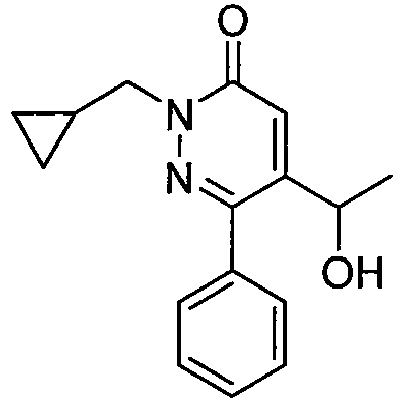
- Prepared similarly to intermediate G1 starting from 5-acetyl-2-(cyclopropylmethyl)-6-phenyl-2,3-dihydropyridazin-3-one E5 (0.212 g, 0.79 mmol) in THF (4 mL) and MeOH (1 mL), and purified by flash chromatography on silica gel Biotage cartridge (DCM to DCM : MeOH = 98 : 2) to afford title compound (0.178 g). MS/ESI+ 271.2 [MH]+, RT = 0.88 min (Method A).
-

- Prepared similarly to intermediate G1 starting from 5-acetyl-2,6-diphenyl-2,3-dihydropyridazin-3-one E6 (0.370 g, 1.275 mmol) in THF (8 mL) and MeOH (2 mL), and purified by flash chromatography on silica gel Biotage cartridge (DCM to DCM : MeOH = 98 : 2) to afford title compound (0.097 g, 0.33 mmol, 26% yield). MS/ESI+ 293.2 [MH]+, RT = 0.90 min (Method A).
-
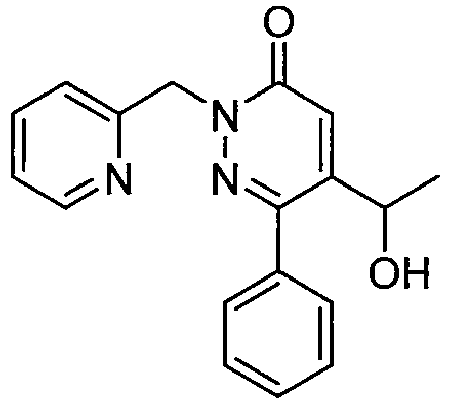
- To a solution of 5-acetyl-6-phenyl-2-(pyridin-2-ylmethyl)-2,3-dihydropyridazin-3-one E7 (0.268 g, 0.878 mmol) in THF (4 mL) and MeOH (1 mL), NaBH4 (0.050 g, 1.32 mmol) was added and the resulting mixture was stirred at r.t. for 2 h. Water was added and the mixture was extracted with DCM; the organic phase was dried over sodium sulfate and the solvent evaporated. The crude was suspended in aqueous 0.5M NaOH (15 mL), sodium 3-nitrobenzenesulfonate (0.190 g, 0.855 mmol) was added and the resulting mixture was refluxed for 1 h. The mixture was neutralized with aqueous 6M HCl and extracted with DCM. The combined organic layers were washed with brine and dried over sodium sulfate; the solvent was removed and the crude was purified by flash chromatography on silica gel Biotage cartridge (cyclohexane : AcOEt= 90 : 10 to 60 : 40) to afford title compound (0.041 g, 0.133 mmol, 16% yield). MS/ESI+ 308.2 [MH]+, RT = 0.67 min (Method A).
-

- To a solution of 5-acetyl-2-benzyl-2,3-dihydropyridazin-3-one E8 (0.288 g, 1.26 mmol) in THF (5 mL) and MeOH (0.5 mL) cooled at 0°C, NaBH4 (0.062 g, 1.64 mmol) was added and the resulting mixture was left to warm to r.t. stirring for 2 h. The mixture was quenched by addition of aqueous 1N HCl, the volatiles were removed in vacuo and the residue was suspended in DCM/MeOH 1:1. The insoluble materials were filtered off and solvent was removed to afford title compound (0.140 g). MS/ESI+ 231.0 [MH]+, RT = 0.69 min (Method A).
-

- Prepared similarly to intermediate G7 starting from 5-acetyl-2-phenyl-2,3-dihydropyridazin-3-one E9 (0.262 g, 1.22 mmol) and further purified by flash chromatography on Biotage silica cartridge (toluene : AcOEt = 90:10 to 100% EtOAc) to afford title compound (0.080 g, 0.37mmol, 30% yield). MS/ESI+ 216.9 [MH]+, RT = 0.59 min (Method A).
-

- Prepared similarly to intermediate G1 starting from 5-acetyl-2-methyl-2,3-dihydropyridazin-3-one E10 (0.544 g, 3.57 mmol) in THF (8 mL) and MeOH (2 mL), and purified by flash chromatography on silica gel Biotage SNAP cartridge (DCM to DCM : MeOH = 98 : 2) to afford title compound (0.220 g, 1.428 mmol, 40% yield). MS/ESI+ 155.1 [MH]+, RT = 0.37 min (Method A).
-

- To a solution of 5-acetyl-2-tert-butyl-4-phenyl-2,3-dihydropyridazin-3-one E11 (0.200 g, 0.740 mmol) in THF (5 mL) and MeOH (0.5 mL) cooled at 0°C, NaBH4 (0.036 g, 0.962 mmol) was added and the resulting mixture was left to warm to r.t. stirring for 2 h. The mixture was partitioned between DCM and water and the aqueous phase was extracted with DCM. The combined organic layers were washed with brine and dried over sodium sulfate. The solvent was removed to afford title compound as a pale yellow solid (0.190 g, 0.698 mmol, 94% yield). MS/ESI+ 273.0 [MH]+, RT = 0.93 min (Method A).
-

- Prepared similarly to intermediate G10 starting from 5-acetyl-2-benzyl-4-phenyl-2,3-dihydropyridazin-3-one E13 (0.103 g, 0.338 mmol), stirring for 1 h, to afford title compound as a white solid (0.090 g, 0.294 mmol, 87% yield). MS/ESI+ 307.3 [MH]+, RT = 0.93 min (Method A).
-

- Prepared similarly to intermediate G10 starting from 5-acetyl-2-methyl-4-phenyl-2,3-dihydropyridazin-3-one E14 (0.073 g, 0.320 mmol), stirring for 1 h, to afford title compound as colorless amorphous (0.066 g, 0.287 mmol, 89% yield). MS/ESI+ 231.1 [MH]+, RT = 0.61 min (Method A).
-
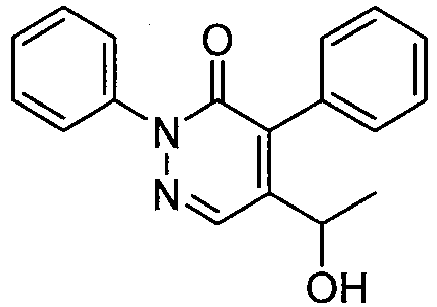
- Prepared similarly to intermediate G10 starting from 5-acetyl-2,4-diphenyl-2,3-dihydropyridazin-3-one E15 (0.090 g, 0.310 mmol), stirring for 1 h, to afford title compound as white solid (0.089 g, 0.304 mmol, 98% yield). MS/ESI+ 293.2 [MH]+, RT = 0.85 min (Method A).
-

- Prepared similarly to intermediate G10 starting from 5-acetyl-2-[2-(morpholin-4-yl)ethyl]-4-phenyl-2,3-dihydropyridazin-3-one E16 (0.380 g) stirring for 1 h, to afford title compound as a yellow oil (0.372 g). MS/ESI+ 330.3 [MH]+, RT = 0.36 min (Method A).
-

- Prepared similarly to intermediate G10 starting from 5-acetyl-4-phenyl-2-(pyridin-3-yl)-2,3-dihydropyridazin-3-one E17 (0.141 g, 0.45 mmol), stirring for 30 min, to afford title compound as white solid (0.121 g). MS/ESI+ 294.3 [MH]+, RT = 0.64 min (Method A).
-

- Prepared similarly to intermediate G10 starting from 5-acetyl-2-benzyl-4-cyclopentyl-2,3-dihydropyridazin-3-one E18 (0.361 g, 1.219 mmol), stirring for 1 h, to afford title compound (0.358 g, 1.201 mmol, 98% yield). MS/ESI+ 299.2 [MH]+, RT = 1.06 min (Method A).
-

- CaCl2 (0.173 g, 1.55 mmol) was added portion-wise to a stirred cooled mixture of ethyl 1-benzyl-6-oxo-1,6-dihydropyridazine-4-carboxylate F (0.201 g, 0.77 mmol) and NaBH4 (0.118 g, 3.11 mmol) in THF (5 mL) and MeOH (5 mL), keeping the temperature around 30°C. After stirring at r.t. for 2 h the mixture was quenched with aqueous 1N HCl and extracted with EtOAc; the organic phase was dried over sodium sulfate and the solvent was removed in vacuo. The crude was dissolved in CH3CN (10 mL), CuCl2 (0.247 g, 1.83 mmol) was added and the resulting mixture was refluxed overnight. The mixture was poured into ice and extracted with DCM; the organic phase was dried over sodium sulfate and the solvent evaporated. The crude was purified by flash chromatography on silica gel Biotage cartridge (cyclohexane : EtOAc = 1 : 1) to afford title compound (0.030 g, 0.138 mmol, 18 % yield). MS/ESI+ 217.1 [MH]+, RT = 0.66 min (Method A).
-
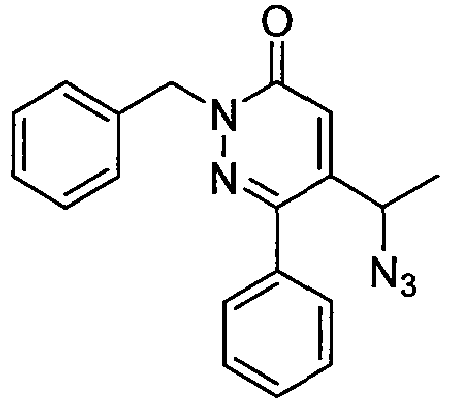
- DPPA (0.281 mL, 1.305 mmol), followed by DBU (0.195 mL, 1.305 mmol) were added to a solution of 2-benzyl-5-(1-hydroxyethyl)-6-phenyl-2,3-dihydropyridazin-3-one G1 (0.200 g, 0.652 mmol) in THF (10 mL) under nitrogen, and the mixture was stirred at r.t. overnight. The solvent was removed under vacuum and the residue was partitioned between EtOAc and water. The aqueous phase was extracted with EtOAc and the combined organic layers were washed with brine and dried over sodium sulfate. The solvent was removed and the crude was purified by flash chromatography on silica gel Biotage SNAP cartridge (cyclohexane : EtOAc = 90 : 10 to 60 : 40) to afford title compound (0.130 g, 0.39 mmol, 60% yield). MS/ESI+ 333.2 [MH]+, RT = 1.18 min (Method A).
-

- Prepared similarly to intermediate H1, starting from 5-(1-hydroxyethyl)-2-methyl-6-phenyl-2,3-dihydropyridazin-3-one G2 (0.040 g, 0.17 mmol), and purified by flash chromatography on silica gel Biotage cartridge (cyclohexane : EtOAc = 90 : 10 to 60 : 40) to afford title compound (0.036 g, 0.141 mmol, 83% yield). MS/ESI+ 256.1 [MH]+, RT = 0.93 min (Method A).
-
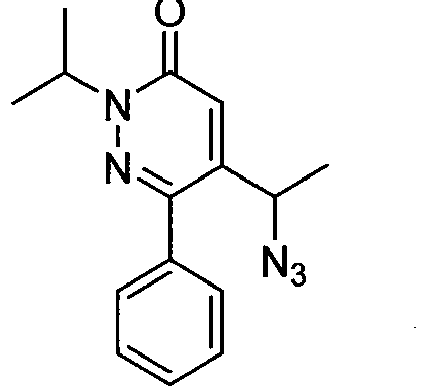
- Prepared similarly to intermediate H1, starting from 5-(1-hydroxyethyl)-6-phenyl-2-(propan-2-yl)-2,3-dihydropyridazin-3-one G3 (0.060 g, 0.232 mmol); after stirring at r.t. overnight additional DPPA (2 eq) and DBU (2 eq) were added and the mixture was stirred at r.t. for further 24 h. The crude was purified by flash chromatography on silica gel Biotage cartridge (cyclohexane to cyclohexane: EtOAc = 80 : 20) to afford title compound as a colorless oil (0.038 g, 0.134 mmol, 58% yield). MS/ESI+ 284.2 [MH]+, RT = 1.11 min (Method A).
-

- Prepared similarly to intermediate H1, starting from 2-(cyclopropylmethyl)-5-(1-hydroxyethyl)-6-phenyl-2,3-dihydropyridazin-3-one G4 (0.092 g) and purified by flash chromatography on silica gel Biotage cartridge (cyclohexane : AcOEt = 90 : 10 to 60 : 40) to afford title compound (0.061 g, 0.206 mmol). MS/ESI+ 296.2 [MH]+, RT = 1.12 min (Method A).
-

- Prepared similarly to intermediate H1, starting from 5-(1-hydroxyethyl)-2,6-diphenyl-2,3-dihydropyridazin-3-one G5 (0.047 g, 0.16 mmol) and purified by flash chromatography on silica gel Biotage cartridge (cyclohexane : AcOEt = 90 : 10 to 60 : 40) to afford title compound (0.028 g, 0.088 mmol, 55% yield). MS/ESI+ 318.2 [MH]+, RT = 1.13 min (Method A).
-

- PPh3 (0.206 g, 0.78 mmol) was added to a solution of 5-(1-azidoethyl)-2-benzyl-6-phenyl-2,3-dihydropyridazin-3-one H1 (0.130 g, 0.39 mmol) in THF (5 mL) under nitrogen, and the mixture was stirred at r.t. overnight. Water (1 mL) was added and the reaction was heated at 60°C for 4 h. The solvent was removed under vacuum and the residue was dissolved in MeOH and charged on a SCX cartridge (2 g), washing with MeOH. The product was eluted with 2 M NH3 in MeOH and the volatiles were removed under reduced pressure to afford title compound as brown oil which was used without any further purification (0.112 g, 0.366 mmol, 94% yield). MS/ESI+ 306.2 [MH]+, Rt = 0.61 min (Method A).
-

- Prepared similarly to intermediate I1 starting from 5-(1-azidoethyl)-2-methyl-6-phenyl-2,3-dihydropyridazin-3-one H2 (0.036 g, 0.141 mmol) to afford title compound as brown oil which was used without any further purification (0.0324 g, 0.141 mmol, quantitative yield). MS/ESI+ 230.2 [MH]+, Rt = 0.37 min (Method A).
-

- Prepared similarly to intermediate I1 starting from 5-(1-azidoethyl)-6-phenyl-2-(propan-2-yl)-2,3-dihydropyridazin-3-one H3 (0.038 g, 0.134 mmol), heating at 50°C for 4 h after addition of water, to afford title compound as colorless amorphous which was used without any further purification (0.031 g, 0.120 mmol, 90% yield). MS/ESI+ 258.2 [MH]+, Rt = 0.52 min (Method A).
-

- Prepared similarly to intermediate I1 starting from 5-(1-azidoethyl)-2-(cyclopropylmethyl)-6-phenyl-2,3-dihydropyridazin-3-one H4 (0.061 g, 0.206 mmol), heating at 60°C overnight after addition of water, to afford title compound as brown oil which was used without any further purification (0.043 g). MS/ESI+ 270.2 [MH]+, Rt = 0.53 min (Method A).
-

- Prepared similarly to intermediate I1 starting from 5-(1-azidoethyl)-2,6-diphenyl-2,3-dihydropyridazin-3-one H5 (0.028 g, 0.088 mmol) to afford title compound as brown oil which was used without any further purification (0.023 g). MS/ESI+ 292.2 [MH]+, Rt = 0.55 min (Method A).
-

- To a mixture of 2-benzyl-5-(1-hydroxyethyl)-6-phenyl-2,3-dihydropyridazin-3-one G1 (0.100 g, 0.326 mmol), 3-iodo-1H-pyrazolo[3,4-d]pyrimidin-4-amine (0.111 g, 0.424mmol) and PPh3 (0.128 g, 0.489 mmol) in dry THF (9 mL), a solution of DIAD (0.083 mL, 0.424 mmol) in THF (1 mL) was added drop-wise at r.t. and the reaction was stirred for 3 h. The solvent was removed and the residue was purified by flash chromatography on Biotage silica gel cartridge (DCM to DCM : MeOH = 98 : 2) to afford title compound (0.146 g, 0.265 mmol, 81% yield). MS/ESI+ 550.2 [MH]+, Rt 0.97 min (Method A).
-

- Prepared similarly to intermediate J1 starting from 5-(1-hydroxyethyl)-2-methyl-6-phenyl-2,3-dihydropyridazin-3-one G2 (0.065 g, 0.26 mmol), stirring for 2 h, and purified by flash chromatography on Biotage silica gel cartridge (DCM to DCM : MeOH = 98 : 2) to afford title compound (0.102 g). MS/ESI+ 474.2 [MH]+, Rt 0.71 min (Method A).
-

- Prepared similarly to intermediate J1 starting from 5-(1-hydroxyethyl)-6-phenyl-2-(propan-2-yl)-2,3-dihydropyridazin-3-one G3 (0.070 g, 0.271 mmol), stirring for 2 h, and purified by flash chromatography on Biotage silica-NH cartridge (DCM to DCM : EtOAc = 85 : 15) to afford title compound as a white solid (0.101 g). MS/ESI+ 502.2 [MH]+, Rt 0.87 min (Method A).
-
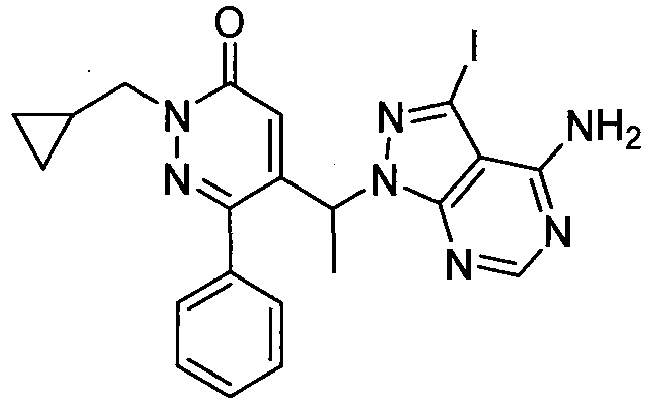
- Prepared similarly to intermediate J1 starting from 2-(cyclopropylmethyl)-5-(1-hydroxyethyl)-6-phenyl-2,3-dihydropyridazin-3-one G4 (0.086 g), stirring for 2 h, and purified by flash chromatography on Biotage silica gel cartridge (DCM to DCM : MeOH = 98 : 2) to afford title compound (0.105 g). MS/ESI+ 514.2 [MH]+, Rt 0.89 min (Method A).
-
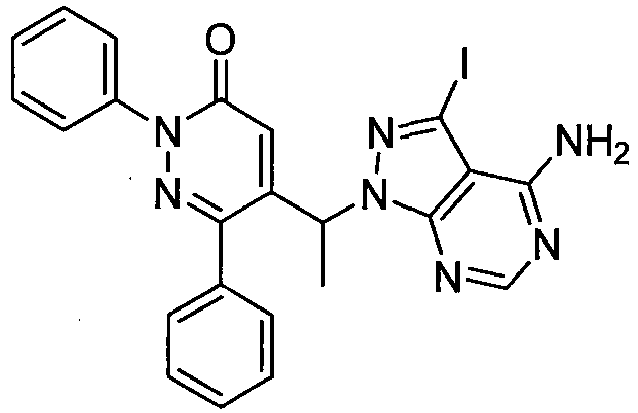
- Prepared similarly to intermediate J1 starting from 5-(1-hydroxyethyl)-2,6-diphenyl-2,3-dihydropyridazin-3-one G5 (0.050 g, 0.17 mmol), stirring for 2 h, and purified by flash chromatography on Biotage silica gel cartridge (DCM to DCM : MeOH = 98 : 2) followed by filtration through SCX cartridge (1 g), washing with MeOH and then eluting with 2M NH3 in MeOH to afford title compound (0.033 g). MS/ESI+ 536.2 [MH]+, Rt 0.91 min (Method A).
-

- Prepared similarly to intermediate J1 starting from 5-(1-hydroxyethyl)-6-phenyl-2-(pyridin-2-ylmethyl)-2,3-dihydropyridazin-3-one G6 (0.041 g, 0.133 mmol), stirring for 2 h, and purified by flash chromatography on Biotage silica gel cartridge (DCM to DCM : MeOH = 98 : 2) to afford title compound, (0.031 g). MS/ESI+ 551.1 [MH]+, Rt 0.70 min (Method A).
-

- Prepared similarly to intermediate J1 starting from 2-benzyl-5-(1-hydroxyethyl)-2,3-dihydropyridazin-3-one G7 (0.140 g), stirring for 2 h, and purified by flash chromatography on Biotage silica gel cartridge (DCM to DCM : MeOH = 98 : 2) to afford title compound (0.287 g, 0.607 mmol). MS/ESI+ 474.0 [MH]+, Rt 0.84 min (Method A).
-

- Prepared similarly to intermediate J1 starting from 5-(1-hydroxyethyl)-2-phenyl-2,3-dihydropyridazin-3-one G8 (0.080 g, 0.37 mmol), stirring for 2 h, and purified by flash chromatography on Biotage silica gel cartridge (DCM to DCM : MeOH = 98 : 2) to afford title compound (0.170 g). MS/ESI+ 460.2 [MH]+, Rt 0.79 min (Method A).
-

- Prepared similarly to intermediate J1 starting from 5-(1-hydroxyethyl)-2-methyl-2,3-dihydropyridazin-3-one G9 (0.100 g, 0.649 mmol), stirring for 2 h, and purified by flash chromatography on Biotage silica gel cartridge (DCM to DCM : MeOH = 98 : 2) to afford title compound (0.115 g). MS/ESI+ 398.1 [MH]+, Rt 0.58 min (Method A).
-

- Prepared similarly to intermediate J1 starting from 2-tert-butyl-5-(1-hydroxyethyl)-4-phenyl-2,3-dihydropyridazin-3-one G10 (0.100 g, 0.367 mmol), stirring overnight, and purified by flash chromatography on Biotage silica-NH cartridge (DCM : MeOH = 99 : 1 to 90 : 10) to afford title compound (0.135 g). MS/ESI+ 516.3 [MH]+, Rt 1.11 min (Method A).
-

- Prepared similarly to intermediate J1 starting from 2-benzyl-5-(1-hydroxyethyl)-4-phenyl-2,3-dihydropyridazin-3-one G11 (0.088 g, 0.287 mmol), stirring overnight, and purified by flash chromatography on Biotage silica-NH cartridge (DCM to DCM : EtOAc = 90 : 10). A further purification by flash chromatography on Biotage silica-NH cartridge (cyclohexane : EtOAc = 90 : 10 to 50 : 50) was required to afford title compound as a colorless amorphous (0.095 g). MS/ESI+ 550.2 [MH]+, Rt 1.06 min (Method A).
-

- Prepared similarly to intermediate J1 starting from 5-(1-hydroxyethyl)-2-methyl-4-phenyl-2,3-dihydropyridazin-3-one G12 (0.065 g, 0.282 mmol), stirring for 2 h; additional PPh3 (0.3 eq.) was added followed by DIAD (0.3 eq.), and the reaction was stirred at r.t. for further 2 h. The crude was purified by flash chromatography on Biotage silica-NH cartridge (DCM to DCM : EtOAc = 90 : 10) followed by filtration through SCX cartridge (5 g), washing with MeOH and then eluting with 1M NH3 in MeOH to afford title compound as a white solid (0.070 g, 0.148 mmol, 52% yield). MS/ESI+ 474.2 [MH]+, Rt 0.77 min (Method A).
-

- Prepared similarly to intermediate J1 starting from 5-(1-hydroxyethyl)-2,4-diphenyl-2,3-dihydropyridazin-3-one G13 (0.087 g, 0.298 mmol), stirring for 2 h and purified by flash chromatography on Biotage silica-NH cartridge (DCM to DCM : EtOAc = 90 : 10) followed by filtration through SCX cartridge (2 g), washing with MeOH and then eluting with 1M NH3 in MeOH. A further purification by flash chromatography on Biotage silica-NH cartridge (cyclohexane : EtOAc = 80 : 20 to 40 : 60) was required to afford title compound as a white solid (0.080 g, 0.149 mmol, 50% yield). MS/ESI+ 536.2 [MH]+, Rt 1.00 min (Method A).
-

- Prepared similarly to intermediate J1 starting from 5-(1-hydroxyethyl)-2-[2-(morpholin-4-yl)ethyl]-4-phenyl-2,3-dihydropyridazin-3-one G14 (0.372 g), stirring overnight and purified by flash chromatography on Biotage silica-NH cartridge (DCM to DCM : MeOH= 95 : 5) to afford title compound as a yellow oil (0.114 g). MS/ESI+ 573.2 [MH]+, Rt 0.49 min (Method A).
-

- Prepared similarly to intermediate J1 starting from 5-(1-hydroxyethyl)-4-phenyl-2-(pyridin-3-yl)-2,3-dihydropyridazin-3-one G15 (0.121 g), stirring overnight; additional DIAD (1 eq.) was added and the reaction was stirred at r.t. overnight. The crude was purified by flash chromatography on silica gel (DCM : MeOH = 99 : 1 to 97 : 3) afford title compound as a white solid (0.080 g). MS/ESI+ 536.9 [MH]+, Rt 0.79 min (Method A).
-
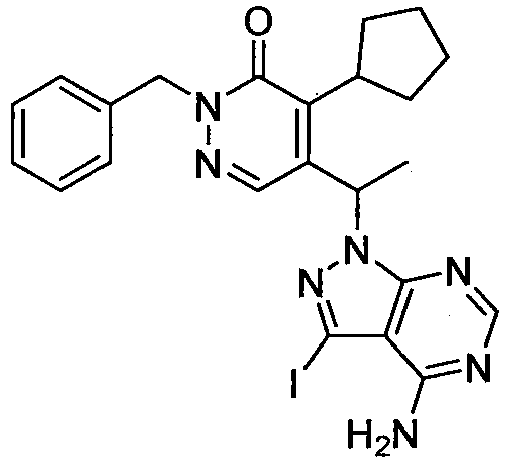
- Prepared similarly to intermediate J1 starting from 2-benzyl-4-cyclopentyl-5-(1-hydroxyethyl)-2,3-dihydropyridazin-3-one G16 (0.358 g, 1.201mmol), stirring overnight, and purified by flash chromatography on Biotage silica gel cartridge (cyclohexane : EtOAc = 95 : 5 to 60 : 40) followed by filtration on SCX cartridge, washing with MeOH and then eluting with 2M NH3 in MeOH, to afford title compound as a pale yellow solid (0.070 g, 0.148 mmol, 52% yield). MS/ESI+ 542.2 [MH]+, Rt 1.21 min (Method A).
-

- Prepared similarly to intermediate J1 starting from 2-benzyl-5-(hydroxymethyl)-2,3-dihydropyridazin-3-one G17 (0.030 g, 0.138 mmol), stirring for 2 h, and purified by flash chromatography on Biotage silica gel cartridge (DCM to DCM : MeOH = 98 : 2) to afford title compound (0.063 g). MS/ESI+ 460.2 [MH]+, Rt 0.80 min (Method A).
-
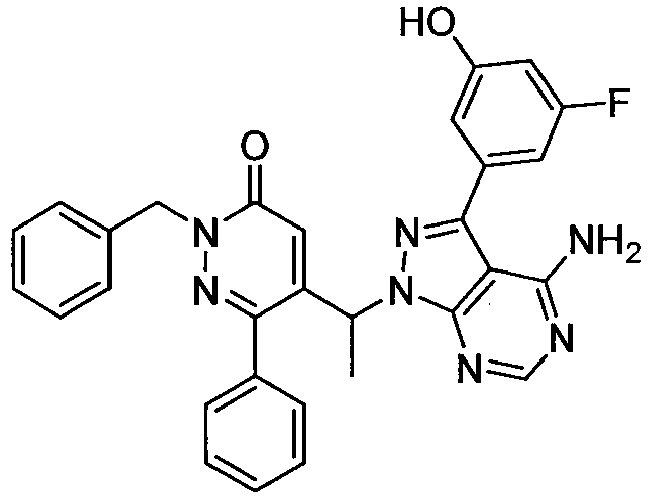
- A mixture of 5-(1-{4-amino-3-iodo-1H-pyrazolo[3,4-d]pyrimidin-1-yl}ethyl)-2-benzyl-6-phenyl-2,3-dihydropyridazin-3-one J1 (0.094 g, 0.17 mmol), (3-fluoro-5-hydroxyphenyl)boronic acid (0.029 g, 0.188 mmol) and Pd(PPh3)4 (10 mg, 0.008 mmol) in DME (12 mL), ethanol (2 mL) and saturated aqueous sodium carbonate (4 mL) was stirred at room temperature for 4 hours. The reaction was quenched by addition of water and extracted with DCM; the organic layer was dried over sodium sulfate, filtered and concentrated. The residue was purified by flash chromatography on Biotage silica-NH cartridge (DCM to DCM : MeOH = 80 : 20) to afford title compound (32.2 mg, 0.06 mmol, 35% yield). MS/ESI+ 534.3 [MH]+, Rt 0.95 min (Method A).
1H NMR (400 MHz, DMSO-d6) δ ppm 10.20 (br. s., 1 H), 8.08 (s, 1 H), 7.21-7.36 (m, 10 H), 6.98 - 7.00 (m, 1 H), 6.83 - 6.87 (m, 1 H), 6.74 - 6.80 (m, 1 H), 6.64-6.69 (m, 1 H), 6.04 (q, 1 H), 6.00 - 8.00 (m, 2 H), 5.19 - 5.34 (m, 2 H), 1.66 (d, 3 H). -

- A mixture of 5-(1-{4-amino-3-iodo-1H-pyrazolo[3,4-d]pyrimidin-1-yl}ethyl)-2-methyl-6-phenyl-2,3-dihydropyridazin-3-one J2 (0.102 g), (3-fluoro-5-hydroxyphenyl)boronic acid (0.037 g, 0.236 mmol), Pd(PPh3)4 (12 mg, 0.01 mmol) in DME (12 mL), ethanol (2 mL) and saturated aqueous sodium carbonate (4 mL) was heated at 80°C for 4 hours. The reaction was quenched by addition of water and extracted with DCM; the organic layer was dried over sodium sulfate, filtered and concentrated. The residue was purified by flash chromatography on Biotage silica gel cartridge (DCM to DCM : MeOH = 80 : 20) to afford title compound (10.5 mg, 0.022 mmol). MS/ESI+ 458.3 [MH]+, Rt 0.73 min (Method A).
1H NMR (400 MHz, DMSO-d6) δ ppm 10.20 (br. s., 1 H), 8.09 (s, 1 H), 7.24-7.31 (m, 5 H), 6.90 - 6.93 (m, 1 H), 6.84 - 6.88 (m, 1 H), 6.77 - 6.82 (m, 1 H), 6.64 - 6.69 (m, 1 H), 6.25 - 7.50 (m, 2 H), 6.01 (q, 1 H), 3.66 (s, 3 H), 1.65 (d, 3 H). -

- Prepared similarly to Example 2, starting from 5-(1-{4-amino-3-iodo-1H-pyrazolo[3,4-d]pyrimidin-1-yl}ethyl)-6-phenyl-2-(propan-2-yl)-2,3-dihydropyridazin-3-one J3 (0.100 g), heating at 80°C overnight; additional (3-fluoro-5-hydroxyphenyl)boronic acid (0.5 eq) and Pd(PPh3)4 (0.05 eq) were added and the mixture was heated at the same temperature for further 7 h. The crude was purified by flash chromatography on Biotage silica gel cartridge (DCM to DCM : MeOH = 95 : 5) to afford title compound as a pale yellow powder (0.045 g, 0.093 mmol). MS/ESI+ 486.3 [MH]+, Rt 0.88 min (Method A).
1H NMR (400 MHz, DMSO-d6) δ ppm 10.22 (br. s., 1 H), 8.12 (s, 1 H), 7.25-7.37 (m, 5 H), 6.83 - 6.89 (m, 2 H), 6.76 - 6.82 (m, 1 H), 6.64 - 6.70 (m, 1 H), 6.06 (q, 1 H), 6.00 - 8.00 (m, 2 H), 5.09 - 5.20 (m, 1 H), 1.65 (d, 3 H), 1.22 - 1.30 (m, 6 H). -

- Prepared similarly to Example 2, starting from 5-(1-{4-amino-3-iodo-1H-pyrazolo [3,4-d]pyrimidin-1-yl}ethyl)-2-(cyclopropylmethyl)-6-phenyl-2,3-dihydropyridazin-3-one J4 (0.105 g), heating at 80°C for 16 h, and purified by flash chromatography on Biotage silica gel cartridge (DCM to DCM : MeOH = 80 : 20) to afford title compound (0.0153 g, 0.031 mmol). MS/ESI+ 498.3 [MH]+, Rt 0.89 min (Method A).
1H NMR (500 MHz, DMSO-d6) δ ppm 10.20 (s, 1 H), 8.10 (s, 1 H), 7.23 - 7.34 (m, 5 H), 6.92 (s, 1 H), 6.86 (s, 1 H), 6.76 - 6.81 (m, 1 H), 6.63 - 6.69 (m, 1H), 6.30 - 7.90 (m, 2 H), 6.05 (q, 1 H), 3.83 - 4.03 (m, 2 H), 1.66 (d, 3 H), 1.16 - 1.32 (m, 1 H), 0.42-0.51 (m, 2 H), 0.29 - 0.41 (m, 2 H). -
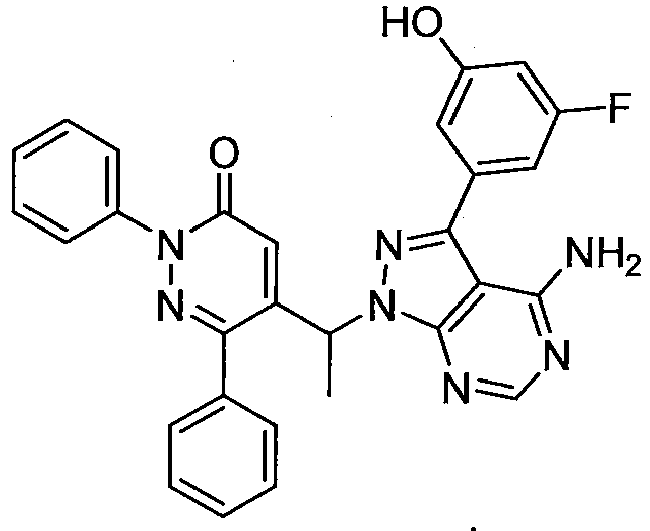
- Prepared similarly to Example 2, starting from 5-(1-{4-amino-3-iodo-1H-pyrazolo [3,4-d]pyrimidin-1-yl} ethyl)-2,6-diphenyl-2,3-dihydropyridazin-3 -one J5 (0.033 g), heating at 80°C for 4 h, and purified by flash chromatography on Biotage silica gel cartridge (DCM to DCM : MeOH = 80 : 20) to afford title compound (0.0142 g,0.027 mmol). MS/ESI+ 520.3 [MH]+, Rt 0.91 min (Method A).
1H NMR (500 MHz, DMSO-d6) δ ppm 10.23 (s, 1 H), 8.13 (s, 1 H), 7.59 - 7.64 (m, 2 H), 7.46 - 7.52 (m, 2 H), 7.36 - 7.44 (m, 3 H), 7.24 - 7.34 (m, 3 H), 7.07 (s, 1 H), 6.89 (s, 1 H), 6.80 - 6.85 (m, 1 H), 6.65 - 6.71 (m, 1 H), 6.11 (q, 1 H), 1.71 (d, 3 H). -

- Prepared similarly to Example 2, starting from 5-(1-{4-amino-3-iodo-1H-pyrazolo[3,4-d]pyrimidin-1-yl}ethyl)-6-phenyl-2-(pyridin-2-ylmethyl)-2,3-dihydropyridazin-3-one J6 (0.031 g), heating at 80°C for 16 h, and purified by flash chromatography on Biotage silica gel cartridge (DCM to DCM : MeOH = 80 : 20) to afford title compound (7.7 mg, 0.014 mmol). MS/ESI+ 535.3 [MH]+, Rt 0.73 min (Method A).
1H NMR (400 MHz, DMSO-d6) δ ppm 10.24 (s, 1 H), 8.50 (d, 1 H), 8.11 (s, 1 H), 7.76 (td, 1 H), 7.20 - 7.32 (m, 7 H), 7.02 (s, 1 H), 6.87 (s, 1 H), 6.77 - 6.83 (m, 1 H), 6.65 - 6.71 (m, 1 H), 6.20 - 8.00 (m, 2 H), 6.09 (q, 1 H), 5.31 - 5.46 (m, 2 H), 1.69 (d, 3 H). -

- Prepared similarly to Example 2, starting from 5-(1-{4-amino-3-iodo-1H-pyrazolo[3,4-d]pyrimidin-1-yl}ethyl)-2-benzyl-2,3-dihydropyridazin-3-one J7 (0.287 g, 0.607 mmol), heating at 80°C for 2 h, and purified by flash chromatography on Biotage silica-NH cartridge (DCM to DCM : MeOH = 80 : 20) to afford title compound (0.026 g, 0.057 mmol, 9% yield). MS/ESI+ 458.0 [MH]+, Rt 0.85 min (Method A).
1H NMR (400 MHz, DMSO-d6) δ ppm 10.22 (br. s., 1 H), 8.26 (s, 1 H), 7.95 (d, J=2.1 Hz, 1 H), 7.23 - 7.35 (m, 5 H), 6.91 - 6.94 (m, 1 H), 6.86 - 6.91 (m, 1 H), 6.64-6.71 (m, 2 H), 6.06 (q, J=7.0 Hz, 1 H), 6.00 - 8.00 (m, 2 H), 5.15 - 5.24 (m, 2 H), 1.85 (d, J=7.2 Hz, 3 H). -

- Prepared similarly to Example 2, starting from 5-(1-{4-amino-3-iodo-1H-pyrazolo[3,4-d]pyrimidin-1-yl}ethyl)-2-phenyl-2,3-dihydropyridazin-3-one J8 (0.170 g), heating at 80°C for 2 h, and purified by flash chromatography on Biotage silica-NH cartridge (DCM to DCM : MeOH = 80 : 20) to afford title compound (0.032 g, 0.072 mmol). MS/ESI+ 444.3 [MH]+, Rt 0.82 min (Method A).
1H NMR (400 MHz, DMSO-d6) δ ppm 10.23 (s, 1 H), 8.29 (s, 1 H), 8.09 (d, 1 H), 7.38 - 7.54 (m, 5 H), 6.94 - 6.97 (m, 1 H), 6.89 - 6.94 (m, 1 H), 6.77 - 6.80 (m, 1 H), 6.65 - 6.71 (m, 1 H), 6.25 - 8.00 (m, 2 H), 6.13 (q, 1 H), 1.91 (d, 3 H). -

- Prepared similarly to Example 2, starting from 5-(1-{4-amino-3-iodo-1H-pyrazolo[3,4-d]pyrimidin-1-yl}ethyl)-2-methyl-2,3-dihydropyridazin-3-one J9 (0.115 g), heating at 80°C for 4 h, and purified by flash chromatography on Biotage silica gel cartridge (DCM to DCM : MeOH = 80 : 20) to afford title compound (0.067 g, 0.175 mmol). MS/ESI+ 382.3 [MH]+, Rt 0.62 min (Method A).
1H NMR (400 MHz, DMSO-d6) δ ppm 10.20 (s, 1 H), 8.27 (s, 1 H), 7.89 (d, 1 H), 6.92 - 6.94 (m, 1 H), 6.87 - 6.92 (m, 1 H), 6.64 - 6.71 (m, 2 H), 6.01 - 6.09 (m, 1 H), 6.10 - 8.00 (m, 2 H), 3.59 (s, 3 H), 1.85 (d, 3 H). -

- Prepared similarly to Example 2, starting from 5-(1-{4-amino-3-iodo-1H-pyrazolo [3,4-d]pyrimidin-1-yl}ethyl)-2-tert-butyl-4-phenyl-2,3-dihydropyridazin-3 -one J10 (0.135 g), heating at 80°C for 3 h, and purified by flash chromatography on Biotage silica-NH cartridge (EtOAc to EtOAc : MeOH = 80 : 20) and dried to afford title compound as white solid (0.046 g, 0.092 mmol). MS/ESI+ 500.4 [MH]+, Rt 1.06 min (Method A).
1H NMR (400 MHz, DMSO-d6) δ ppm 10.28 (br. s., 1 H), 8.18 (s, 1 H), 8.10 (s, 1 H), 7.41 - 7.52 (m, 3 H), 7.30 - 7.38 (m, 2 H), 6.94 - 6.98 (m, 1 H), 6.89 - 6.94 (m, 1 H), 6.66 - 6.73 (m, 1 H), 6.20- 7.80 (m, 2 H), 5.82 (q, 1 H), 1.78 (d, 3 H), 1.57 (s, 9 H). -

- Prepared similarly to Example 2, starting from 5-(1-{4-amino-3-iodo-1H-pyrazolo [3,4-d]pyrimidin-1-yl}ethyl)-2-benzyl-4-phenyl-2,3 -dihydropyridazin-3-one J11 (0.93 g), and purified by flash chromatography on Biotage silica gel cartridge (DCM : MeOH = 99 : 1 to 90 : 10) to afford title compound as a white solid (0.041 g, 0.077 mmol). MS/ESI+ 534.3 [MH]+, Rt 1.02 min (Method A).
1H NMR (400 MHz, DMSO-d6) δ ppm 10.23 (s, 1 H), 8.20 (s, 1 H), 8.15 (s, 1 H), 7.42 - 7.50 (m, 3 H), 7.27 - 7.37 (m, 7 H), 6.88 - 6.95 (m, 2 H), 6.66 - 6.71 (m, 1 H), 6.40 - 8.05 (m, 2 H), 5.83 (q, J=7.2 Hz, 1 H), 5.16 - 5.31 (m, 2 H), 1.78 (d, J=7.0 Hz, 3 H). -

- Prepared similarly to Example 2, starting from 5-(1-{4-amino-3-iodo-1H-pyrazolo [3,4-d]pyrimidin-1-yl} ethyl)-2-methyl-4-phenyl-2,3 -dihydropyridazin-3 -one J12 (0.069 g, 0.146), heating at 80°C for 2 h; additional (3-fluoro-5-hydroxyphenyl)boronic acid (1.1 eq) and Pd(PPh3)4 (0.05 eq) were added and the mixture was heated at the same temperature overnight. The crude was purified by flash chromatography on Biotage silica gel cartridge (DCM to DCM : MeOH = 94 : 6) to afford title compound as an off-white solid (0.033 g, 0.072 mmol, 49% yield). MS/ESI+ 458.2 [MH]+, Rt 0.71 min (Method B).
1H NMR (400 MHz, DMSO-d6) δ ppm 10.22 (br. s., 1 H), 8.15 (s, 1 H), 8.11 (s, 1 H), 7.41 - 7.50 (m, 3 H), 7.30 - 7.36 (m, 2 H), 6.92 - 6.95 (m, 1 H), 6.87 - 6.92 (m, 1 H), 6.65 - 6.71 (m, 1 H), 6.10 - 7.80 (m, 2 H), 5.77 - 5.84 (m, 1 H), 3.64 (s, 3 H), 1.77 (d, J=7.2 Hz, 3 H). -
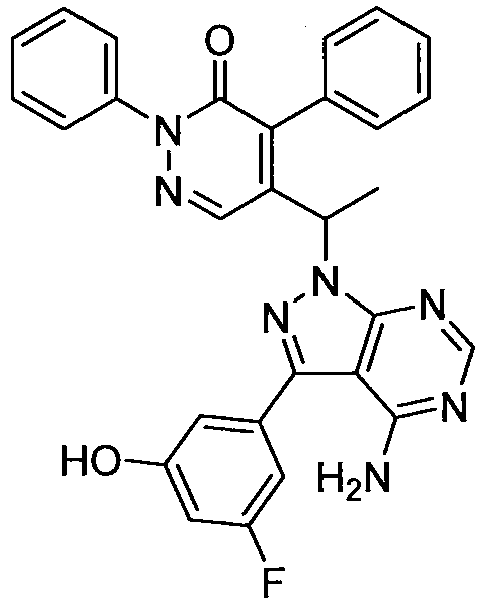
- Prepared similarly to Example 2, starting from 5-(1-{4-amino-3-iodo-1H-pyrazolo[3,4-d]pyrimidin-1-yl}ethyl)-2,4-diphenyl-2,3-dihydropyridazin-3 -one J13 (0.078 g, 0.146 mmol), heating at 80°C for 2 h; additional (3-fluoro-5-hydroxyphenyl)boronic acid (1.1 eq) and Pd(PPh3)4 (0.05) were added and the mixture was heated at the same temperature overnight. The crude was purified by flash chromatography on Biotage silica gel cartridge (DCM to DCM : EtOAc = 40 : 60) to afford title compound as a beige solid (0.037 g, 0.071 mmol, 49% yield). MS/ESI+ 520.3 [MH]+, Rt 0.97 min (Method A).
1H NMR (400 MHz, DMSO-d6) δ ppm 10.22 (s, 1 H), 8.34 (s, 1 H), 8.18 (s, 1 H), 7.53 - 7.59 (m, 2 H), 7.38 - 7.52 (m, 8 H), 6.90 - 6.97 (m, 2 H), 6.66 - 6.72 (m, 1 H), 6.20 - 8.30 (m, 2 H), 5.85 - 5.92 (m, 1 H), 1.84 (d, 3 H). -

- Prepared similarly to Example 2, starting from 5-(1-{4-amino-3-iodo-1H-pyrazolo[3,4-d]pyrimidin-1-yl}ethyl)-2-[2-(morpholin-4-yl)ethyl]-4-phenyl-2,3-dihydropyridazin-3-one J14 (0.114), heating at 80°C overnight; additional (3-fluoro-5-hydroxyphenyl)boronic acid (1.1 eq) and Pd(PPh3)4 (0.05 eq) were added and the mixture was heated at the same temperature for further 2 h. The crude was purified by flash chromatography on Biotage silica-NH cartridge (DCM to DCM : MeOH to 90:10) to afford title compound as a white solid (0.056 g, 0.099 mmol). MS/ESI+ 557.4 [MH]+, Rt 0.54 min (Method A).
1H NMR (500 MHz, DMSO-d6) δ ppm 10.22 (br. s., 1 H), 8.14 - 8.18 (m, 2 H), 7.37 - 7.50 (m, 3 H), 7.28 - 7.36 (m, 2 H), 6.91 - 6.95 (m, 1 H), 6.85 - 6.91 (m,1 H), 6.68 (dt, 1 H), 5.93 - 8.36 (m, 2 H), 5.82 (q, 1 H), 4.10 - 4.23 (m, 2 H), 3.45 - 3.53 (m, 4 H), 2.63 (t, 2 H), 2.34 -2.44 (m, 4 H), 1.78 (d, 3 H). -

- Prepared similarly to Example 2, starting from 5-(1-{4-amino-3-iodo-1H-pyrazolo[3,4-d]pyrimidin-1-yl}ethyl)-4-phenyl-2-(pyridin-3-yl)-2,3-dihydropyridazin-3-on J15 (0.080 g), heating at 65°C overnight; additional (3-fluoro-5-hydroxyphenyl)boronic acid (1.1 eq) and Pd(PPh3)4 (0.06) were added and the mixture was heated at 80°C for 2 h. The crude was purified by flash chromatography on silica-NH cartridge (DCM : MeOH = 99 : 1 to 90 : 10) to afford title compound as a white solid (0.024 g, 0.046 mmol). MS/ESI+ 521.3 [MH]+, Rt 0.81 min (Method A).
1H NMR (400 MHz, DMSO-d6) δ ppm 10.23 (br. s., 1 H), 8.82 (d, 1H), 8.59 (dd, 1 H), 8.41 (s, 1 H), 8.19 (s, 1 H), 8.03 - 8.09 (m, 1 H), 7.42 - 7.57 (m, 6 H), 6.91 - 6.99 (m, 2 H), 6.66 - 6.73 (m, 1 H), 6.00 - 8.00 (m, 2 H), 5.91 (q, 1 H), 1.85 (d, 3 H). -

- Prepared similarly to Example 2, starting from 5-(1-{4-amino-3-iodo-1H-pyrazolo[3,4-d]pyrimidin-1-yl}ethyl)-2-benzyl-4-cyclopentyl-2,3-dihydropyridazin-3-one J16 (0.200 g, 0.369 mmol), heating at 80°C overnight, and purified by flash chromatography on Biotage silica gel cartridge (cyclohexane : EtOAc = 90 : 10 to 100% EtOAc) to afford title compound as a white solid (0.107g, 0.099 mmol, 55% yield). MS/ESI+ 526.4 [MH]+, Rt 1.17 min (Method A).
1H NMR (400 MHz, DMSO-d6) δ ppm 10.20 (s, 1 H), 8.25 (s, 1 H), 7.94 (s, 1 H), 7.20 - 7.37 (m, 5 H), 6.85 - 6.96 (m, 2 H), 6.64 - 6.76 (m, 1 H), 6.33 - 6.41 (m, 1 H), 5.95 - 7.77 (m, 2 H), 5.00 - 5.31 (m, 2 H), 3.52 (quin, 1 H), 1.32 - 2.13 (m, 11 H). -

- To a mixture of 5-(1-{4-amino-3-iodo-1H-pyrazolo[3,4-d]pyrimidin-1-yl}ethyl)-2-benzyl-4-cyclopentyl-2,3-dihydropyridazin-3-one J16 (0.214 g, 0.395 mmol), 5-(tetramethyl-1,3,2-dioxaborolan-2-yl)pyridin-3-ol (0.105 g, 0.474 mmol) in DME (20 mL), Pd(PPh3)4 (0.023 g, 0.019 mmol), ethanol (3 mL) and saturated aqueous sodium carbonate (5 mL) were added and the reaction was stirred at 80°C for 3 h. The reaction was quenched by addition of water and extracted with DCM; the organic layer was dried over sodium sulfate, filtered and concentrated. The residue was purified by flash chromatography on Biotage silica gel cartridge (cyclohexane : EtOAc = 98 : 2 to 80 : 20) to afford title compound (0.093 g, 0.183 mmol, 46% yield). MS/ESI+ 509.4 [MH]+, Rt 0.94 min (Method A).
- 1H NMR (400 MHz, DMSO-d6) δ ppm 10.12 - 10.25 (m, 1 H),, 8.31 (d, 1 H), 8.26 (s, 1 H), 8.22 (d, 1 H), 7.95 (s, 1 H), 7.40 (dd, 1 H), 7.22 - 7.35 (m, 5 H), 6.96 - 7.65 (m, 2 H), 6.37 (q, 1 H), 5.09 - 5.26 (m, 2 H), 3.53 (quin, 1 H), 1.87 (d, 3 H), 1.33 - 2.17 (m, 8 H).
-

- Prepared similarly to Example 2, starting from 5-({4-amino-3-iodo-1H-pyrazolo[3,4-d]pyrimidin-1-yl}methyl)-2-benzyl-2,3-dihydropyridazin-3-one J17 (0.063 g), heating at 80°C for 2 h, and purified by flash chromatography on Biotage silica NH-cartridge (DCM to DCM : MeOH = 80 : 20) to afford title compound (0.015 g, 0.03 mmol). MS/ESI+ 444.2 [MH]+, Rt 0.82 min (Method A).
1H NMR (400 MHz, DMSO-d6) δ ppm 10.19 (br. s., 1 H), 8.28 (s, 1 H), 7.90 (d, J=2.01 Hz, 1 H), 7.24 - 7.34 (m, 5 H), 6.91 - 6.93 (m, 1 H), 6.85 - 6.90 (m, 1 H), 6.64-6.70 (m, 1 H), 6.55 - 6.57 (m, 1 H), 6.40- 7.80 (m, 2 H), 5.53 (s, 2 H), 5.20 (s, 2 H). -
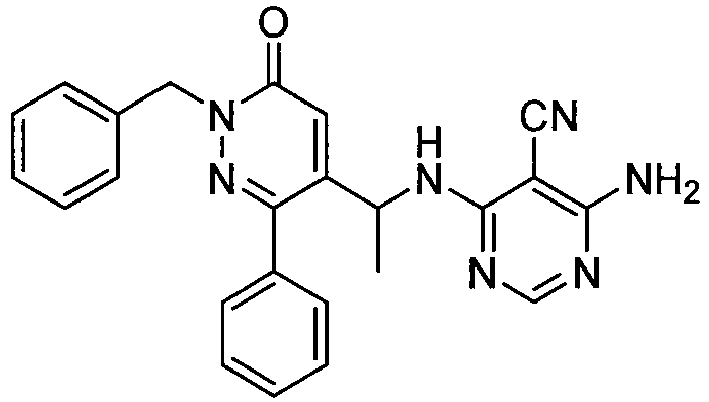
- To a solution of 5-(1-aminoethyl)-2-benzyl-6-phenyl-2,3-dihydropyridazin-3-one I1 (0.056 g, 0.183 mmol) in t-BuOH (2 mL), 4-amino-6-chloropyrimidine-5-carbonitrile (0.028 g, 0.183 mmol) was added followed by DIPEA (0.064 mL, 0.366 mmol) and the resulting mixture was heated to reflux overnight. The solvent was removed under reduced pressure and the crude was purified by flash chromatography on Biotage silica gel cartridge (DCM : MeOH = 99: 1 to 90 : 10) to afford title compound (0.044 g, 0.10 mmol, 57% yield). MS/ESI+ 424.3 [MH]+, Rt 0.98 min (Method A).
1H NMR (400 MHz, DMSO-d6) δ ppm 7.96 (s, 1 H), 7.77 (d, 1 H), 7.55 - 7.59 (m, 2 H), 7.43 - 7.50 (m, 3 H), 7.24 - 7.37 (m, 7 H), 7.04 (s, 1 H), 5.20 - 5.30 (m, 2 H), 5.01-5.10 (m, 1 H), 1.23 (d, 3 H). -
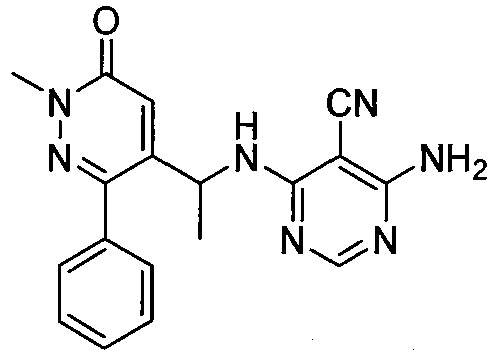
- Prepared similarly to Example 19 starting from 5-(1-aminoethyl)-2-methyl-6-phenyl-2,3-dihydropyridazin-3-one 12 (0.032 g, 0.141 mmol) and purified by flash chromatography on Biotage silica gel cartridge (DCM : MeOH = 99: 1 to 90 : 10) to afford title compound (0.033 g, 0.09 mmol, 67% yield). MS/ESI+ 348.2 [MH]+, Rt 0.73 min (Method A).
1H NMR (400 MHz, DMSO-d6) δ ppm 7.96 (s, 1 H), 7.75 (d, 1 H), 7.55 - 7.60 (m, 2 H), 7.42 - 7.51 (m, 3 H), 7.27 (br. s., 2 H), 6.98 (s, 1 H), 4.97 - 5.05 (m, 1 H), 3.65 (s, 3 H), 1.22 (d, 3 H). -

- Prepared similarly to Example 19 starting from 5-(1-aminoethyl)-6-phenyl-2-(propan-2-yl)-2,3-dihydropyridazin-3-one 13 (0.030 g, 0.116 mmol) and purified by flash chromatography on Biotage silica-NH SNAP cartridge (cyclohexane : EtOAc = 80 : 20 to 40 : 60) to afford title compound as a white solid (0.029 g, 0.077 mmol, 67% yield). MS/ESI+ 376.1 [MH]+, Rt 0.87 min (Method A).
1H NMR (400 MHz, DMSO-d6) δ ppm 7.97 (s, 1 H), 7.77 (d, 1 H), 7.55 - 7.61 (m, 2 H), 7.43 - 7.51 (m, 3 H), 7.28 (br. s., 2 H), 6.96 (s, 1 H), 5.09 - 5.19 (m, 2 H), 1.19-1.32 (m, 9 H). -

- Prepared similarly to Example 19 starting from 5-(1-aminoethyl)-2-(cyclopropylmethyl)-6-phenyl-2,3-dihydropyridazin-3-one 14 (0.020 g) and purified by flash chromatography on Biotage silica gel cartridge (DCM : MeOH = 99 : 1 to 90 : 10) to afford title compound (0.0187 g, 0.048 mmol). MS/ESI+ 388.3 [MH]+, Rt 0.90 min (Method A).
1H NMR (400 MHz, DMSO-d6) δ ppm 7.98 (s, 1 H), 7.79 (d, 1 H), 7.56 - 7.61 (m, 2 H), 7.44 - 7.51 (m, 3 H), 7.30 (br. s., 2 H), 7.00 (s, 1 H), 5.04 - 5.12 (m, 1 H), 3.86-4.00 (m, 2 H), 1.20 - 1.30 (m, 4 H), 0.45 - 0.51 (m, 2 H), 0.32 - 0.40 (m, 2 H). -

- Prepared similarly to Example 19 starting from 5-(1-aminoethyl)-2,6-diphenyl-2,3-dihydropyridazin-3-one 15 (0.023 g) and purified by flash chromatography on Biotage silica gel cartridge (DCM : MeOH = 99 : 1 to 90 : 10) to afford title compound (17.2 mg, 0.042 mmol). MS/ESI+ 410.3 [MH]+, Rt 0.93 min (Method A).
1H NMR (400 MHz, DMSO-d6) δ ppm 8.01 (s, 1 H), 7.84 (d, 1 H), 7.64 - 7.69 (m, 2 H), 7.58 - 7.64 (m, 2 H), 7.45 - 7.54 (m, 5 H), 7.38 - 7.45 (m, 1 H), 7.32 (br. s., 2 H), 7.13 (s, 1 H), 5.08 - 5.17 (m, 1 H), 1.28 (d, 3 H). -

- To a solution of 5-(1-aminoethyl)-2-benzyl-6-phenyl-2,3-dihydropyridazin-3-one I1 (0.056 g, 0.183 mmol) in t-BuOH (2 mL), 6-bromopurine (0.036 g, 0.183 mmol) was added followed by DIPEA (0.064 mL, 0.366 mmol) and the resulting mixture was heated to reflux overnight. The solvent was removed under reduced pressure and the crude was purified by flash chromatography on Biotage silica gel cartridge (DCM : MeOH = 99: 1 to 90 : 10) to afford title compound (0.0337 g, 0.079 mmol, 43% yield). MS/ESI+ 424.3 [MH]+, Rt 0.85 min (Method A).
1H NMR (400 MHz, DMSO-d6) δ ppm 13.01 (br. s., 1 H), 8.05 - 8.48 (m, 3 H), 7.69 (br. s., 2 H), 7.44 - 7.57 (m, 3 H), 7.24 - 7.39 (m, 5 H), 7.04 (br. s., 1 H), 5.08- 5.34 (m, 3 H), 1.27 (br. s., 3 H). - In vitro determination of the PI3K enzyme inhibitory activity in the cell free assay.
- Human recombinant proteins PI3Kα, PI3Kβ, PI3Kγ and PI3Kδ were purchased from Millipore Ltd (Billerica, MA). Compounds were dissolved at 0.5mM in DMSO and were tested at different concentrations for their activity against PI3Ks using the ADP-Glo™ Kinase Assay (Promega, Madison WI) according to the manufacturer's instructions.
- Briefly, the kinase reactions were performed in 384-well white plates (Greiner Bio-One GmbH, Frickenhausen). Each well was loaded with 0.1 µl of test compounds and 2.5 µl of 2x reaction buffer (40mM Tris pH7.5, 0.5 mM EGTA, 0.5 mM Na3VO4, 5 mM β-glycerophosphate, 0.1mg/ml BSA, 1mM DTT), containing 50µM PI and PS substrates (L-α-phosphatidylinositol sodium salt and L-α-phosphatidyl-L-serine, Sigma-Aldrich, St. Louis MO) and the PI3K recombinant proteins (PI3Kγ 0.25ng/µl, PI3Kδ 1 ng/µl, PI3Kα 0.125 ng/µl, PI3Kβ 1 ng/µl).
- The reactions were started by adding 2.5 µl of 2x ATP solution to each well (final concentrations: PI3Kγ ATP 30 µM; PI3Kδ ATP 80µM; PI3Kα ATP 50 µM; PI3Kβ ATP 100 µM) and incubated for 60 min at room temperature. Subsequently, each kinase reaction was incubated for 40 min with 5µl ADP-Glo™ Reagent, allowing depletion of unconsumed ATP. Then, the Kinase Detection Reagent (10µl) was added in each well to convert ADP to ATP and to allow the newly synthesized ATP to be measured using a luciferase/luciferin reaction. Following 60 min incubation, the luminescence signal was measured using a Wallac EnVision® multilabel reader (PerkinElmer, Waltham MA).
- Curve fitting and IC50 calculation were carried out using a four-parameter logistic model in XLfit (IDBS, Guilford, UK) for Microsoft Excel (Microsoft, Redmont, WA).
- The compounds according to the invention showed IC50 even lower than 100 nM, or even IC50 < 10 nM in the PI3Kdelta inhibitory assay herein above described.
- The results are provided below in Table.
Table: Results of the in vitro determination of the PI3K enzyme inhibitory activity in the cell free assay Compound of Example N. PI3K delta inhibition PI3K gamma inhibition PI3K alpha inhibition PI3K beta inhibition 1 ++ + + ++ 2 ++ ++ + ++ 3 ++ + + ++ 4 ++ + + ++ 5 ++ ++ + ++ 6 ++ + + ++ 7 +++ ++ ++ +++ 8 +++ ++ ++ +++ 9 +++ ++ ++ ++ 10 +++ + + ++ 11 +++ + + ++ 12 +++ ++ + ++ 13 ++ ++ ++ ++ 14 +++ + + + 15 +++ ++ + ++ 16 +++ + + ++ 17 +++ ++ + ++ 18 +++ ++ ++ ++ 19 + + + + 20 ++ + + + 21 + + + + 22 + + + + 23 + + + + 24 + + + + - +++: IC50 < 10 nM
- ++: IC50 in the range 10-1000 nM
- +:IC50 > 1000 nM
Claims (10)
- A compound of formula (I)
 R1 and R4 may be the same or different and are independently selected from the group consisting of: H, (C3-C7) cycloalkyl and aryl, said aryl being optionally and independently substituted by one or more groups selected from halogen, -OH, (C1-C6) alkyl, (C1-C6) haloalkyl and (C1-C6) hydroxyalkyl;R2 is H or (C1-C6) alkyl;R3 is H;R5 is selected from the group consisting of: -NR6R7, (C1-C6) alkyl, (C1-C6) haloalkyl, (C1-C6) hydroxyalkyl, (C1-C6) aminoalkyl, (C3-C7) cycloalkyl, aryl, heteroaryl, and heterocycloalkyl; said aryl, heteroaryl, and heterocycloalkyl being optionally and independently substituted by one or more groups selected from halogen, -OH, -CN, (C1-C6) alkyl;Cy is a heteroaryl selected from the group consisting of 9H-purin-6-yl (I-3), 1H-pyrazolo[3,4-d]pyrimidin-1-yl, (I-4), pyrimidin-4-yl (I-6),; said heteroaryl can be optionally and independently substituted by one or more groups selected from halogen,-OH, -(CH2)pNR6R7; -CN, (C1-C6) alkyl, (C1-C6) haloalkyl, (C1-C6) hydroxyalkyl, and aryl, said aryl can be optionally and independently substituted with one or more groups selected from -OH, halogen, -CN, (C1-C6) alkyl, (C1-C6) haloalkyl, (C1-C6) hydroxyalkyl;R6, R7 may have the same or different meanings at each occurrence, and are independently selected from the group consisting of -H and (C1-C6) alkyl, (C1-C6) haloalkyl, (C1-C6) hydroxyalkyl, or they form, taken together with a nitrogen atom they are linked to, a 4 to 6 membered heterocycle optionally containing one or more additional group selected from O, S, N, NH;Z, when present, is -NH;m is zero or 1;n is 1 or 2;p at each occurrence independently is zero or an integer ranging from 1 to 3;or pharmaceutically acceptable salts and or solvates thereof;wherein said aryl are mono, bi- or tri-cyclic carbon ring systems which have 6 to 20 atoms, wherein at least one ring is aromatic;said heteroaryl are mono-, bi- or tri-cyclic ring systems with 5 to 20 atoms, in which at least one ring is aromatic and in which at least one ring atom is a group selected from N, NH, S or O;said heterocycloalkyl refers to saturated or partially unsaturated monocyclic cycloalkyl groups, which have 3 to 6 ring atoms, in which at least one ring carbon atom is replaced by at least one group selected from N, NH, S or O.
 - A compound according to Claim 1 in form of a mixture of enantiomers or diastereoisomers.
- A compound according to Claim 1 wherein Cy is 1H-pyrazolo[3,4-d]pyrimidin-1-yl (I-4), optionally and independently substituted by one or more groups selected from halogen, -OH, -(CH2)pNR6R7; -CN, aryl, which can be optionally and independently substituted with one or more groups selected from -OH, halogen, -CN, - (C1-C6) alkyl, (C1-C6) haloalkyl, (C1-C6) hydroxyalkyl;
wherein m is zero and all the other variables are as defined in claim 1;
or pharmaceutically acceptable salts or solvates thereof. - A compound according to Claim 3 wherein
R1 and R4 may be the same or different and are independently selected from the group consisting of: H, (C3-C7) cycloalkyl which is cyclopentyl and aryl which is phenyl;
R2 is selected from H and (C1-C6) alkyl which is methyl;
R3 is H;
R5 is selected from the group consisting of (C1-C6) alkyl which is methyl, isopropyl or tert-butyl, (C3-C7) cycloalkyl which is cyclopropyl, aryl which is phenyl, heteroaryl which is pyridinyl, and heterocycloalkyl which is morpholinyl;
Cy is a heteroaryl which is 1H-pyrazolo[3,4-d]pyrimidin-1-yl (I-4), optionally and independently substituted by one or more groups selected from halogen which is iodine, -(CH2)pNR6R7 which is -NH2, aryl which is phenyl, said aryl can be optionally and independently substituted with one or more groups selected from -OH and halogen which is fluorine;
wherein -:R6 and R7 are -H;m is zero;n is 1;p is in each occurrence independently 0 or 1 or 2;or pharmaceutically acceptable salts and or solvates thereof. - A compound according to Claim 1 wherein Cy is pyrimidin-4-yl (1-6), optionally substituted by one or more groups selected from halogen, -OH, -(CH2)pNR6R7; -CN, (C1-C6) alkyl, (C1-C6) haloalkyl, (C1-C6) hydroxyalkyl;
wherein m is 1 and all the other variables are as defined in claim 1;
or pharmaceutically acceptable salts and or solvates thereof. - A compound according to Claim 5 wherein
R1 is aryl which is phenyl and R4 is H;
R2 is (C1-C6) alkyl which is methyl;
R3 is H;
R5 is selected from the group consisting of (C1-C6) alkyl which is methyl or isopropyl, (C3-C7) cycloalkyl which is cyclopropyl, aryl which is phenyl;
Cy is pyrimidin-4-yl (1-6), substituted by -(CH2)pNR6R7 ,which is -NH2, and -CN; R6 and R7 are -H;
m is 1;
Z is -NH-;
n is 1;
p is at each occurrence independently zero or 1;
or pharmaceutically acceptable salts and or solvates thereof. - A compound according to Claim 1 selected from:5-{1-[4-amino-3-(3-fluoro-5-hydroxyphenyl)-1H-pyrazolo[3,4-d]pyrimidin-1-yl]ethyl}-2-benzyl-6-phenyl-2,3-dihydropyridazin-3-one;5-{1-[4-amino-3-(3-fluoro-5-hydroxyphenyl)-1H-pyrazolo[3,4-d]pyrimidin-1-yl]ethyl}-2-methyl-6-phenyl-2,3-dihydropyridazin-3-one;5-{1-[4-amino-3-(3-fluoro-5-hydroxyphenyl)-1H-pyrazolo[3,4-d]pyrimidin-1-yl]ethyl}-6-phenyl-2-(propan-2-yl)-2,3-dihydropyridazin-3-one;5-{1-[4-amino-3-(3-fluoro-5-hydroxyphenyl)-1H-pyrazolo[3,4-d]pyrimidin-1-yl]ethyl}-2-(cyclopropylmethyl)-6-phenyl-2,3-dihydropyridazin-3-one;5-{1-[4-amino-3-(3-fluoro-5-hydroxyphenyl)-1H-pyrazolo[3,4-d]pyrimidin-1-yl]ethyl}-2,6-diphenyl-2,3-dihydropyridazin-3-one;5-{1-[4-amino-3-(3-fluoro-5-hydroxyphenyl)-1H-pyrazolo[3,4-d]pyrimidin-1-yl]ethyl}-6-phenyl-2-(pyridin-2-ylmethyl)-2,3-dihydropyridazin-3-one;5-{1-[4-amino-3-(3-fluoro-5-hydroxyphenyl)-1H-pyrazolo[3,4-d]pyrimidin-1-yl]ethyl}-2-benzyl-2,3-dihydropyridazin-3-one;5-{1-[4-amino-3-(3-fluoro-5-hydroxyphenyl)-1H-pyrazolo[3,4-d]pyrimidin-1-yl]ethyl}-2-phenyl-2,3-dihydropyridazin-3-one;5-{1-[4-amino-3-(3-fluoro-5-hydroxyphenyl)-1H-pyrazolo[3,4-d]pyrimidin-1-yl]ethyl}-2-methyl-2,3-dihydropyridazin-3-one;5-{1-[4-amino-3-(3-fluoro-5-hydroxyphenyl)-1H-pyrazolo[3,4-d]pyrimidin-1-yl]ethyl}-2-tert-butyl-4-phenyl-2,3-dihydropyridazin-3-one;5-{1-[4-amino-3-(3-fluoro-5-hydroxyphenyl)-1H-pyrazolo[3,4-d]pyrimidin-1-yl]ethyl}-2-benzyl-4-phenyl-2,3-dihydropyridazin-3-one;5-{1-[4-amino-3-(3-fluoro-5-hydroxyphenyl)-1H-pyrazolo[3,4-d]pyrimidin-1-yl]ethyl}-2-methyl-4-phenyl-2,3-dihydropyridazin-3-one;5-{1-[4-amino-3-(3-fluoro-5-hydroxyphenyl)-1H-pyrazolo[3,4-d]pyrimidin-1-yl]ethyl}-2,4-diphenyl-2,3-dihydropyridazin-3-one;5-{1-[4-amino-3-(3-fluoro-5-hydroxyphenyl)-1H-pyrazolo[3,4-d]pyrimidin-1-yl]ethyl}-2-[2-(morpholin-4-yl)ethyl]-4-phenyl-2,3-dihydropyridazin-3-one;5-{1-[4-amino-3-(3-fluoro-5-hydroxyphenyl)-1H-pyrazolo[3,4-d]pyrimidin-1-yl]ethyl}-4-phenyl-2-(pyridin-3-yl)-2,3-dihydropyridazin-3-one;5-{1-[4-amino-3-(3-fluoro-5-hydroxyphenyl)-1H-pyrazolo[3,4-d]pyrimidin-1-yl]ethyl}-2-benzyl-4-cyclopentyl-2,3-dihydropyridazin-3-one;5-{1-[4-amino-3-(5-hydroxypyridin-3-yl)-1H-pyrazolo[3,4-d]pyrimidin-1-yl]ethyl}-2-benzyl-4-cyclopentyl-2,3-dihydropyridazin-3-one;5-{[4-amino-3-(3-fluoro-5-hydroxyphenyl)-1H-pyrazolo[3,4-d]pyrimidin-1-yl]methyl}-2-benzyl-2,3-dihydropyridazin-3-one;4-amino-6-{[1-(1-benzyl-6-oxo-3-phenyl-1,6-dihydropyridazin-4-yl)ethyl]amino}pyrimidine-5-carbonitrile;4-amino-6-(1-(1-methyl-6-oxo-3-phenyl-1,6-dihydropyridazin-4-yl)ethylamino)pyrimidine-5-carbonitrile;4-amino-6-({1-[6-oxo-3-phenyl-1-(propan-2-yl)-1,6-dihydropyridazin-4-yl]ethyl} amino)pyrimidine-5-carbonitrile;4-amino-6-({1-[1-(cyclopropylmethyl)-6-oxo-3-phenyl-1,6-dihydropyridazin-4-yl]ethyl} amino)pyrimidine-5-carbonitrile;4-amino-6-{[1-(6-oxo-1,3-diphenyl-1,6-dihydropyridazin-4-yl)ethyl]amino}pyrimidine-5-carbonitrile;2-benzyl-6-phenyl-5-{1-[(9H-purin-6-yl)amino]ethyl}-2,3-dihydropyridazin-3-one,and the pharmaceutically acceptable salts and/or solvates thereof.
- A pharmaceutical composition comprising a compound as defined in any one of claims 1 to 7, or a pharmaceutically acceptable salt thereof, either alone or in combination with one or more active ingredient, in admixture with one or more pharmaceutically acceptable carrier or excipient.
- A compound according to any one of claims 1 to 7, for use as a medicament.
- A compound as defined in any one of claims 1 to 7, or pharmaceutically acceptable salts and or solvates thereof, for use for the treatment of a disorder selected from the group consisting of respiratory diseases including idiopathic chronic cough, cough variant asthma, cough associated with thoracic tumour or lung cancer, viral or post-viral cough, upper airways cough syndrome (UACS) or post nasal drip cough, or cough associated gastro oesophageal reflux disease (both acid and non-acid reflux), asthma, chronic bronchitis, chronic obstructive pulmonary disease (COPD), interstitial lung disease (such as idiopathic pulmonary fibrosis (IPF)), congestive heart disease, sarcoidosis or infection (such as whooping cough); viral infections (including viral respiratory tract infections and viral exacerbation of respiratory diseases such as asthma and COPD); non-viral respiratory infections (including aspergillosis and leishmaniasis); allergic diseases (including allergic rhinitis and atopic dermatitis); autoimmune diseases (including rheumatoid arthritis and multiple sclerosis); inflammatory disorders (including inflammatory bowel disease); cardiovascular diseases (including thrombosis and atherosclerosis); hematologic malignancies; neurodegenerative diseases; pancreatitis; multiorgan failure; kidney diseases; platelet aggregation; cancer; sperm motility; transplantation rejection; graft rejection; lung injuries; and pain (including pain associated with rheumatoid arthritis or osteoarthritis, back pain, general inflammatory pain, post herpetic neuralgia, diabetic neuropathy, inflammatory neuropathic pain (trauma), trigeminal neuralgia and central pain.
Priority Applications (1)
| Application Number | Priority Date | Filing Date | Title |
|---|---|---|---|
| PL15770829T PL3191491T3 (en) | 2014-09-12 | 2015-09-10 | Pyridazinone derivatives as phosphoinositide 3-kinases inhibitors |
Applications Claiming Priority (2)
| Application Number | Priority Date | Filing Date | Title |
|---|---|---|---|
| EP14184586 | 2014-09-12 | ||
| PCT/EP2015/070715 WO2016038140A1 (en) | 2014-09-12 | 2015-09-10 | Pyridazinone derivatives as phosphoinositide 3-kinases inhibitors |
Publications (2)
| Publication Number | Publication Date |
|---|---|
| EP3191491A1 EP3191491A1 (en) | 2017-07-19 |
| EP3191491B1 true EP3191491B1 (en) | 2019-09-04 |
Family
ID=51662997
Family Applications (1)
| Application Number | Title | Priority Date | Filing Date |
|---|---|---|---|
| EP15770829.8A Active EP3191491B1 (en) | 2014-09-12 | 2015-09-10 | Pyridazinone derivatives as phosphoinositide 3-kinases inhibitors |
Country Status (11)
| Country | Link |
|---|---|
| US (1) | US9745308B2 (en) |
| EP (1) | EP3191491B1 (en) |
| KR (1) | KR102571785B1 (en) |
| CN (1) | CN106715433B (en) |
| BR (1) | BR112017003227B1 (en) |
| CA (1) | CA2960703C (en) |
| ES (1) | ES2747648T3 (en) |
| MX (1) | MX375545B (en) |
| PL (1) | PL3191491T3 (en) |
| RU (1) | RU2695374C2 (en) |
| WO (1) | WO2016038140A1 (en) |
Families Citing this family (3)
| Publication number | Priority date | Publication date | Assignee | Title |
|---|---|---|---|---|
| EP3947384B1 (en) | 2019-04-04 | 2023-11-01 | Chiesi Farmaceutici S.p.A. | Isochromene derivatives as phosphoinositide 3-kinases inhibitors |
| WO2023150034A2 (en) * | 2022-02-01 | 2023-08-10 | Raadysan Biotech, Inc. | Compounds and methods for inhibiting cancers over-expressing replication factor c 40 |
| TW202543631A (en) * | 2024-03-14 | 2025-11-16 | 美商凡況生化公司 | Pyridazinone c5ar1 antagonists and uses thereof |
Family Cites Families (8)
| Publication number | Priority date | Publication date | Assignee | Title |
|---|---|---|---|---|
| GB8609331D0 (en) | 1986-04-16 | 1986-05-21 | Pfizer Ltd | Anti-arrythmia agents |
| DE3727150A1 (en) * | 1987-08-14 | 1989-02-23 | Skf Gmbh | ARRANGEMENT FOR FASTENING A BEARING |
| US7344702B2 (en) | 2004-02-13 | 2008-03-18 | Bristol-Myers Squibb Pharma Company | Contrast agents for myocardial perfusion imaging |
| US20050256124A1 (en) | 2004-04-15 | 2005-11-17 | Neurocrine Biosciences, Inc. | Melanin-concentrating hormone receptor antagonists and compositions and methods related thereto |
| CN101809021B (en) * | 2007-09-11 | 2013-04-24 | 雅培制药有限公司 | Octahydro-pyrrolo[3,4-B]pyrrole N-oxide |
| CA2702974A1 (en) | 2007-10-26 | 2009-04-30 | Astrazeneca Ab | Amino 1,2,4-triazole derivatives as modulators of mglur5 |
| GB0725059D0 (en) | 2007-12-21 | 2008-01-30 | Syngenta Participations Ag | Novel pyridazine derivatives |
| KR20140009244A (en) * | 2010-11-11 | 2014-01-22 | 애크런 몰레큘스 게엠베하 | Compounds and methods for treating pain |
-
2015
- 2015-08-31 US US14/840,420 patent/US9745308B2/en not_active Expired - Fee Related
- 2015-09-10 KR KR1020177007642A patent/KR102571785B1/en active Active
- 2015-09-10 BR BR112017003227-9A patent/BR112017003227B1/en not_active IP Right Cessation
- 2015-09-10 MX MX2017003016A patent/MX375545B/en active IP Right Grant
- 2015-09-10 RU RU2017107539A patent/RU2695374C2/en active
- 2015-09-10 PL PL15770829T patent/PL3191491T3/en unknown
- 2015-09-10 WO PCT/EP2015/070715 patent/WO2016038140A1/en not_active Ceased
- 2015-09-10 CN CN201580048883.6A patent/CN106715433B/en not_active Expired - Fee Related
- 2015-09-10 EP EP15770829.8A patent/EP3191491B1/en active Active
- 2015-09-10 ES ES15770829T patent/ES2747648T3/en active Active
- 2015-09-10 CA CA2960703A patent/CA2960703C/en active Active
Non-Patent Citations (1)
| Title |
|---|
| None * |
Also Published As
| Publication number | Publication date |
|---|---|
| MX2017003016A (en) | 2017-05-23 |
| WO2016038140A1 (en) | 2016-03-17 |
| MX375545B (en) | 2025-03-06 |
| US9745308B2 (en) | 2017-08-29 |
| ES2747648T3 (en) | 2020-03-11 |
| RU2695374C2 (en) | 2019-07-23 |
| PL3191491T3 (en) | 2020-05-18 |
| BR112017003227A2 (en) | 2017-11-28 |
| KR102571785B1 (en) | 2023-08-29 |
| CA2960703A1 (en) | 2016-03-17 |
| KR20170045747A (en) | 2017-04-27 |
| RU2017107539A3 (en) | 2019-02-25 |
| CN106715433B (en) | 2019-05-28 |
| CN106715433A (en) | 2017-05-24 |
| BR112017003227B1 (en) | 2022-12-06 |
| CA2960703C (en) | 2023-02-28 |
| EP3191491A1 (en) | 2017-07-19 |
| US20160075710A1 (en) | 2016-03-17 |
| RU2017107539A (en) | 2018-10-12 |
Similar Documents
| Publication | Publication Date | Title |
|---|---|---|
| EP3429994B1 (en) | 2-cyanoisoindoline derivatives for treating cancer | |
| EP2872509B1 (en) | Inhibition of enzymes | |
| EP3573987B1 (en) | Tyrosine amide derivatives as rho- kinase inhibitors | |
| KR102420322B1 (en) | Indolizine derivatives as phosphoinositide 3-kinases inhibitors | |
| CA2934135C (en) | Isochromene derivatives as phosphoinositide 3-kinases inhibitors | |
| CA3039754A1 (en) | Bicyclic dihydropyrimidine-carboxamide derivatives as rho-kinase inhibitors | |
| EP3283481B1 (en) | Chromene derivatives as phoshoinositide 3-kinases inhibitors | |
| EP3807273B1 (en) | Azaindole derivatives as rho-kinase inhibitors | |
| EP3679039B1 (en) | Tyrosine analogues derivatives as rho- kinase inhibitors | |
| CA2960703C (en) | Pyridazinone derivatives as phosphoinositide 3-kinases inhibitors | |
| EP3411375B1 (en) | Pyrazole derivatives as phosphoinositide 3-kinases inhibitors | |
| EP3843726B1 (en) | Parp inhibitors for treating cancer and asthma | |
| EP4182323B1 (en) | Pyrido oxazine amino derivatives as alk5 inhibitors | |
| WO2023208986A1 (en) | Imidazole derivatives as alk5 inhibitors | |
| HK1236933B (en) | Pyridazinone derivatives as phosphoinositide 3-kinases inhibitors | |
| HK1236933A1 (en) | Pyridazinone derivatives as phosphoinositide 3-kinases inhibitors |
Legal Events
| Date | Code | Title | Description |
|---|---|---|---|
| STAA | Information on the status of an ep patent application or granted ep patent |
Free format text: STATUS: THE INTERNATIONAL PUBLICATION HAS BEEN MADE |
|
| PUAI | Public reference made under article 153(3) epc to a published international application that has entered the european phase |
Free format text: ORIGINAL CODE: 0009012 |
|
| STAA | Information on the status of an ep patent application or granted ep patent |
Free format text: STATUS: REQUEST FOR EXAMINATION WAS MADE |
|
| 17P | Request for examination filed |
Effective date: 20170308 |
|
| AK | Designated contracting states |
Kind code of ref document: A1 Designated state(s): AL AT BE BG CH CY CZ DE DK EE ES FI FR GB GR HR HU IE IS IT LI LT LU LV MC MK MT NL NO PL PT RO RS SE SI SK SM TR |
|
| AX | Request for extension of the european patent |
Extension state: BA ME |
|
| STAA | Information on the status of an ep patent application or granted ep patent |
Free format text: STATUS: EXAMINATION IS IN PROGRESS |
|
| 17Q | First examination report despatched |
Effective date: 20180724 |
|
| GRAP | Despatch of communication of intention to grant a patent |
Free format text: ORIGINAL CODE: EPIDOSNIGR1 |
|
| STAA | Information on the status of an ep patent application or granted ep patent |
Free format text: STATUS: GRANT OF PATENT IS INTENDED |
|
| INTG | Intention to grant announced |
Effective date: 20190220 |
|
| GRAJ | Information related to disapproval of communication of intention to grant by the applicant or resumption of examination proceedings by the epo deleted |
Free format text: ORIGINAL CODE: EPIDOSDIGR1 |
|
| STAA | Information on the status of an ep patent application or granted ep patent |
Free format text: STATUS: EXAMINATION IS IN PROGRESS |
|
| GRAR | Information related to intention to grant a patent recorded |
Free format text: ORIGINAL CODE: EPIDOSNIGR71 |
|
| GRAS | Grant fee paid |
Free format text: ORIGINAL CODE: EPIDOSNIGR3 |
|
| STAA | Information on the status of an ep patent application or granted ep patent |
Free format text: STATUS: GRANT OF PATENT IS INTENDED |
|
| GRAA | (expected) grant |
Free format text: ORIGINAL CODE: 0009210 |
|
| STAA | Information on the status of an ep patent application or granted ep patent |
Free format text: STATUS: THE PATENT HAS BEEN GRANTED |
|
| INTC | Intention to grant announced (deleted) | ||
| INTG | Intention to grant announced |
Effective date: 20190725 |
|
| AK | Designated contracting states |
Kind code of ref document: B1 Designated state(s): AL AT BE BG CH CY CZ DE DK EE ES FI FR GB GR HR HU IE IS IT LI LT LU LV MC MK MT NL NO PL PT RO RS SE SI SK SM TR |
|
| AX | Request for extension of the european patent |
Extension state: BA ME |
|
| REG | Reference to a national code |
Ref country code: GB Ref legal event code: FG4D |
|
| REG | Reference to a national code |
Ref country code: CH Ref legal event code: EP Ref country code: CH Ref legal event code: NV Representative=s name: WAGNER + HELBIG PATENTANWAELTE CONSEILS EN PRO, CH |
|
| REG | Reference to a national code |
Ref country code: AT Ref legal event code: REF Ref document number: 1175166 Country of ref document: AT Kind code of ref document: T Effective date: 20190915 |
|
| REG | Reference to a national code |
Ref country code: NL Ref legal event code: FP |
|
| REG | Reference to a national code |
Ref country code: DE Ref legal event code: R096 Ref document number: 602015037253 Country of ref document: DE |
|
| REG | Reference to a national code |
Ref country code: IE Ref legal event code: FG4D |
|
| REG | Reference to a national code |
Ref country code: GR Ref legal event code: EP Ref document number: 20190403058 Country of ref document: GR Effective date: 20200122 |
|
| REG | Reference to a national code |
Ref country code: LT Ref legal event code: MG4D |
|
| PG25 | Lapsed in a contracting state [announced via postgrant information from national office to epo] |
Ref country code: NO Free format text: LAPSE BECAUSE OF FAILURE TO SUBMIT A TRANSLATION OF THE DESCRIPTION OR TO PAY THE FEE WITHIN THE PRESCRIBED TIME-LIMIT Effective date: 20191204 Ref country code: FI Free format text: LAPSE BECAUSE OF FAILURE TO SUBMIT A TRANSLATION OF THE DESCRIPTION OR TO PAY THE FEE WITHIN THE PRESCRIBED TIME-LIMIT Effective date: 20190904 Ref country code: LT Free format text: LAPSE BECAUSE OF FAILURE TO SUBMIT A TRANSLATION OF THE DESCRIPTION OR TO PAY THE FEE WITHIN THE PRESCRIBED TIME-LIMIT Effective date: 20190904 Ref country code: HR Free format text: LAPSE BECAUSE OF FAILURE TO SUBMIT A TRANSLATION OF THE DESCRIPTION OR TO PAY THE FEE WITHIN THE PRESCRIBED TIME-LIMIT Effective date: 20190904 Ref country code: SE Free format text: LAPSE BECAUSE OF FAILURE TO SUBMIT A TRANSLATION OF THE DESCRIPTION OR TO PAY THE FEE WITHIN THE PRESCRIBED TIME-LIMIT Effective date: 20190904 Ref country code: BG Free format text: LAPSE BECAUSE OF FAILURE TO SUBMIT A TRANSLATION OF THE DESCRIPTION OR TO PAY THE FEE WITHIN THE PRESCRIBED TIME-LIMIT Effective date: 20191204 |
|
| PG25 | Lapsed in a contracting state [announced via postgrant information from national office to epo] |
Ref country code: LV Free format text: LAPSE BECAUSE OF FAILURE TO SUBMIT A TRANSLATION OF THE DESCRIPTION OR TO PAY THE FEE WITHIN THE PRESCRIBED TIME-LIMIT Effective date: 20190904 Ref country code: AL Free format text: LAPSE BECAUSE OF FAILURE TO SUBMIT A TRANSLATION OF THE DESCRIPTION OR TO PAY THE FEE WITHIN THE PRESCRIBED TIME-LIMIT Effective date: 20190904 Ref country code: RS Free format text: LAPSE BECAUSE OF FAILURE TO SUBMIT A TRANSLATION OF THE DESCRIPTION OR TO PAY THE FEE WITHIN THE PRESCRIBED TIME-LIMIT Effective date: 20190904 |
|
| REG | Reference to a national code |
Ref country code: ES Ref legal event code: FG2A Ref document number: 2747648 Country of ref document: ES Kind code of ref document: T3 Effective date: 20200311 |
|
| PG25 | Lapsed in a contracting state [announced via postgrant information from national office to epo] |
Ref country code: RO Free format text: LAPSE BECAUSE OF FAILURE TO SUBMIT A TRANSLATION OF THE DESCRIPTION OR TO PAY THE FEE WITHIN THE PRESCRIBED TIME-LIMIT Effective date: 20190904 Ref country code: PT Free format text: LAPSE BECAUSE OF FAILURE TO SUBMIT A TRANSLATION OF THE DESCRIPTION OR TO PAY THE FEE WITHIN THE PRESCRIBED TIME-LIMIT Effective date: 20200106 Ref country code: EE Free format text: LAPSE BECAUSE OF FAILURE TO SUBMIT A TRANSLATION OF THE DESCRIPTION OR TO PAY THE FEE WITHIN THE PRESCRIBED TIME-LIMIT Effective date: 20190904 |
|
| PG25 | Lapsed in a contracting state [announced via postgrant information from national office to epo] |
Ref country code: CZ Free format text: LAPSE BECAUSE OF FAILURE TO SUBMIT A TRANSLATION OF THE DESCRIPTION OR TO PAY THE FEE WITHIN THE PRESCRIBED TIME-LIMIT Effective date: 20190904 Ref country code: SM Free format text: LAPSE BECAUSE OF FAILURE TO SUBMIT A TRANSLATION OF THE DESCRIPTION OR TO PAY THE FEE WITHIN THE PRESCRIBED TIME-LIMIT Effective date: 20190904 Ref country code: SK Free format text: LAPSE BECAUSE OF FAILURE TO SUBMIT A TRANSLATION OF THE DESCRIPTION OR TO PAY THE FEE WITHIN THE PRESCRIBED TIME-LIMIT Effective date: 20190904 Ref country code: IS Free format text: LAPSE BECAUSE OF FAILURE TO SUBMIT A TRANSLATION OF THE DESCRIPTION OR TO PAY THE FEE WITHIN THE PRESCRIBED TIME-LIMIT Effective date: 20200224 |
|
| REG | Reference to a national code |
Ref country code: DE Ref legal event code: R097 Ref document number: 602015037253 Country of ref document: DE |
|
| RAP2 | Party data changed (patent owner data changed or rights of a patent transferred) |
Owner name: CHIESI FARMACEUTICI S.P.A. |
|
| PLBE | No opposition filed within time limit |
Free format text: ORIGINAL CODE: 0009261 |
|
| STAA | Information on the status of an ep patent application or granted ep patent |
Free format text: STATUS: NO OPPOSITION FILED WITHIN TIME LIMIT |
|
| PG2D | Information on lapse in contracting state deleted |
Ref country code: IS |
|
| PG25 | Lapsed in a contracting state [announced via postgrant information from national office to epo] |
Ref country code: DK Free format text: LAPSE BECAUSE OF FAILURE TO SUBMIT A TRANSLATION OF THE DESCRIPTION OR TO PAY THE FEE WITHIN THE PRESCRIBED TIME-LIMIT Effective date: 20190904 Ref country code: LU Free format text: LAPSE BECAUSE OF NON-PAYMENT OF DUE FEES Effective date: 20190910 Ref country code: IS Free format text: LAPSE BECAUSE OF FAILURE TO SUBMIT A TRANSLATION OF THE DESCRIPTION OR TO PAY THE FEE WITHIN THE PRESCRIBED TIME-LIMIT Effective date: 20200105 |
|
| 26N | No opposition filed |
Effective date: 20200605 |
|
| PG25 | Lapsed in a contracting state [announced via postgrant information from national office to epo] |
Ref country code: MC Free format text: LAPSE BECAUSE OF FAILURE TO SUBMIT A TRANSLATION OF THE DESCRIPTION OR TO PAY THE FEE WITHIN THE PRESCRIBED TIME-LIMIT Effective date: 20190904 Ref country code: SI Free format text: LAPSE BECAUSE OF FAILURE TO SUBMIT A TRANSLATION OF THE DESCRIPTION OR TO PAY THE FEE WITHIN THE PRESCRIBED TIME-LIMIT Effective date: 20190904 |
|
| PG25 | Lapsed in a contracting state [announced via postgrant information from national office to epo] |
Ref country code: CY Free format text: LAPSE BECAUSE OF FAILURE TO SUBMIT A TRANSLATION OF THE DESCRIPTION OR TO PAY THE FEE WITHIN THE PRESCRIBED TIME-LIMIT Effective date: 20190904 |
|
| VS25 | Lapsed in a validation state [announced via postgrant information from nat. office to epo] |
Ref country code: MA Free format text: LAPSE BECAUSE OF FAILURE TO SUBMIT A TRANSLATION OF THE DESCRIPTION OR TO PAY THE FEE WITHIN THE PRESCRIBED TIME-LIMIT Effective date: 20190904 |
|
| REG | Reference to a national code |
Ref country code: AT Ref legal event code: UEP Ref document number: 1175166 Country of ref document: AT Kind code of ref document: T Effective date: 20190904 |
|
| PG25 | Lapsed in a contracting state [announced via postgrant information from national office to epo] |
Ref country code: MT Free format text: LAPSE BECAUSE OF FAILURE TO SUBMIT A TRANSLATION OF THE DESCRIPTION OR TO PAY THE FEE WITHIN THE PRESCRIBED TIME-LIMIT Effective date: 20190904 Ref country code: HU Free format text: LAPSE BECAUSE OF FAILURE TO SUBMIT A TRANSLATION OF THE DESCRIPTION OR TO PAY THE FEE WITHIN THE PRESCRIBED TIME-LIMIT; INVALID AB INITIO Effective date: 20150910 |
|
| PG25 | Lapsed in a contracting state [announced via postgrant information from national office to epo] |
Ref country code: MK Free format text: LAPSE BECAUSE OF FAILURE TO SUBMIT A TRANSLATION OF THE DESCRIPTION OR TO PAY THE FEE WITHIN THE PRESCRIBED TIME-LIMIT Effective date: 20190904 |
|
| PGFP | Annual fee paid to national office [announced via postgrant information from national office to epo] |
Ref country code: TR Payment date: 20230823 Year of fee payment: 9 Ref country code: NL Payment date: 20230926 Year of fee payment: 9 Ref country code: IT Payment date: 20230921 Year of fee payment: 9 Ref country code: IE Payment date: 20230927 Year of fee payment: 9 Ref country code: GB Payment date: 20230927 Year of fee payment: 9 Ref country code: AT Payment date: 20230821 Year of fee payment: 9 |
|
| PGFP | Annual fee paid to national office [announced via postgrant information from national office to epo] |
Ref country code: PL Payment date: 20230821 Year of fee payment: 9 Ref country code: GR Payment date: 20230928 Year of fee payment: 9 Ref country code: FR Payment date: 20230925 Year of fee payment: 9 Ref country code: DE Payment date: 20230927 Year of fee payment: 9 Ref country code: BE Payment date: 20230927 Year of fee payment: 9 |
|
| PGFP | Annual fee paid to national office [announced via postgrant information from national office to epo] |
Ref country code: ES Payment date: 20231002 Year of fee payment: 9 |
|
| PGFP | Annual fee paid to national office [announced via postgrant information from national office to epo] |
Ref country code: CH Payment date: 20231004 Year of fee payment: 9 |
|
| REG | Reference to a national code |
Ref country code: DE Ref legal event code: R119 Ref document number: 602015037253 Country of ref document: DE |
|
| REG | Reference to a national code |
Ref country code: CH Ref legal event code: PL |
|
| REG | Reference to a national code |
Ref country code: NL Ref legal event code: MM Effective date: 20241001 |
|
| REG | Reference to a national code |
Ref country code: AT Ref legal event code: MM01 Ref document number: 1175166 Country of ref document: AT Kind code of ref document: T Effective date: 20240910 |
|
| GBPC | Gb: european patent ceased through non-payment of renewal fee |
Effective date: 20240910 |
|
| PG25 | Lapsed in a contracting state [announced via postgrant information from national office to epo] |
Ref country code: NL Free format text: LAPSE BECAUSE OF NON-PAYMENT OF DUE FEES Effective date: 20241001 |
|
| PG25 | Lapsed in a contracting state [announced via postgrant information from national office to epo] |
Ref country code: DE Free format text: LAPSE BECAUSE OF NON-PAYMENT OF DUE FEES Effective date: 20250401 |
|
| PG25 | Lapsed in a contracting state [announced via postgrant information from national office to epo] |
Ref country code: GB Free format text: LAPSE BECAUSE OF NON-PAYMENT OF DUE FEES Effective date: 20240910 |
|
| REG | Reference to a national code |
Ref country code: BE Ref legal event code: MM Effective date: 20240930 |
|
| PG25 | Lapsed in a contracting state [announced via postgrant information from national office to epo] |
Ref country code: IT Free format text: LAPSE BECAUSE OF NON-PAYMENT OF DUE FEES Effective date: 20240910 Ref country code: BE Free format text: LAPSE BECAUSE OF NON-PAYMENT OF DUE FEES Effective date: 20240930 |
|
| PG25 | Lapsed in a contracting state [announced via postgrant information from national office to epo] |
Ref country code: FR Free format text: LAPSE BECAUSE OF NON-PAYMENT OF DUE FEES Effective date: 20240930 |
|
| PG25 | Lapsed in a contracting state [announced via postgrant information from national office to epo] |
Ref country code: GR Free format text: LAPSE BECAUSE OF NON-PAYMENT OF DUE FEES Effective date: 20250407 |
|
| PG25 | Lapsed in a contracting state [announced via postgrant information from national office to epo] |
Ref country code: CH Free format text: LAPSE BECAUSE OF NON-PAYMENT OF DUE FEES Effective date: 20240930 |
|
| PG25 | Lapsed in a contracting state [announced via postgrant information from national office to epo] |
Ref country code: AT Free format text: LAPSE BECAUSE OF NON-PAYMENT OF DUE FEES Effective date: 20240910 |
|
| PG25 | Lapsed in a contracting state [announced via postgrant information from national office to epo] |
Ref country code: IE Free format text: LAPSE BECAUSE OF NON-PAYMENT OF DUE FEES Effective date: 20240910 |
|
| REG | Reference to a national code |
Ref country code: ES Ref legal event code: FD2A Effective date: 20251030 |
|
| PG25 | Lapsed in a contracting state [announced via postgrant information from national office to epo] |
Ref country code: ES Free format text: LAPSE BECAUSE OF NON-PAYMENT OF DUE FEES Effective date: 20240911 |
|
| PG25 | Lapsed in a contracting state [announced via postgrant information from national office to epo] |
Ref country code: PL Free format text: LAPSE BECAUSE OF NON-PAYMENT OF DUE FEES Effective date: 20240910 |
|
| PG25 | Lapsed in a contracting state [announced via postgrant information from national office to epo] |
Ref country code: TR Free format text: LAPSE BECAUSE OF NON-PAYMENT OF DUE FEES Effective date: 20240910 |