EP3190129A1 - Centrally-acting peptide derivative, and pharmaceutical composition - Google Patents
Centrally-acting peptide derivative, and pharmaceutical composition Download PDFInfo
- Publication number
- EP3190129A1 EP3190129A1 EP15837573.3A EP15837573A EP3190129A1 EP 3190129 A1 EP3190129 A1 EP 3190129A1 EP 15837573 A EP15837573 A EP 15837573A EP 3190129 A1 EP3190129 A1 EP 3190129A1
- Authority
- EP
- European Patent Office
- Prior art keywords
- centrally
- acting
- peptide
- derivative
- amino acid
- Prior art date
- Legal status (The legal status is an assumption and is not a legal conclusion. Google has not performed a legal analysis and makes no representation as to the accuracy of the status listed.)
- Granted
Links
Images





Classifications
-
- C—CHEMISTRY; METALLURGY
- C07—ORGANIC CHEMISTRY
- C07K—PEPTIDES
- C07K14/00—Peptides having more than 20 amino acids; Gastrins; Somatostatins; Melanotropins; Derivatives thereof
- C07K14/435—Peptides having more than 20 amino acids; Gastrins; Somatostatins; Melanotropins; Derivatives thereof from animals; from humans
- C07K14/575—Hormones
- C07K14/605—Glucagons
-
- A—HUMAN NECESSITIES
- A61—MEDICAL OR VETERINARY SCIENCE; HYGIENE
- A61K—PREPARATIONS FOR MEDICAL, DENTAL OR TOILETRY PURPOSES
- A61K38/00—Medicinal preparations containing peptides
- A61K38/16—Peptides having more than 20 amino acids; Gastrins; Somatostatins; Melanotropins; Derivatives thereof
- A61K38/17—Peptides having more than 20 amino acids; Gastrins; Somatostatins; Melanotropins; Derivatives thereof from animals; from humans
- A61K38/22—Hormones
- A61K38/2264—Obesity-gene products, e.g. leptin
-
- A—HUMAN NECESSITIES
- A61—MEDICAL OR VETERINARY SCIENCE; HYGIENE
- A61K—PREPARATIONS FOR MEDICAL, DENTAL OR TOILETRY PURPOSES
- A61K38/00—Medicinal preparations containing peptides
- A61K38/04—Peptides having up to 20 amino acids in a fully defined sequence; Derivatives thereof
- A61K38/08—Peptides having 5 to 11 amino acids
- A61K38/095—Oxytocins; Vasopressins; Related peptides
-
- A—HUMAN NECESSITIES
- A61—MEDICAL OR VETERINARY SCIENCE; HYGIENE
- A61K—PREPARATIONS FOR MEDICAL, DENTAL OR TOILETRY PURPOSES
- A61K38/00—Medicinal preparations containing peptides
- A61K38/16—Peptides having more than 20 amino acids; Gastrins; Somatostatins; Melanotropins; Derivatives thereof
- A61K38/17—Peptides having more than 20 amino acids; Gastrins; Somatostatins; Melanotropins; Derivatives thereof from animals; from humans
- A61K38/22—Hormones
- A61K38/2271—Neuropeptide Y
-
- A—HUMAN NECESSITIES
- A61—MEDICAL OR VETERINARY SCIENCE; HYGIENE
- A61K—PREPARATIONS FOR MEDICAL, DENTAL OR TOILETRY PURPOSES
- A61K38/00—Medicinal preparations containing peptides
- A61K38/16—Peptides having more than 20 amino acids; Gastrins; Somatostatins; Melanotropins; Derivatives thereof
- A61K38/17—Peptides having more than 20 amino acids; Gastrins; Somatostatins; Melanotropins; Derivatives thereof from animals; from humans
- A61K38/22—Hormones
- A61K38/26—Glucagons
-
- A—HUMAN NECESSITIES
- A61—MEDICAL OR VETERINARY SCIENCE; HYGIENE
- A61K—PREPARATIONS FOR MEDICAL, DENTAL OR TOILETRY PURPOSES
- A61K38/00—Medicinal preparations containing peptides
- A61K38/16—Peptides having more than 20 amino acids; Gastrins; Somatostatins; Melanotropins; Derivatives thereof
- A61K38/17—Peptides having more than 20 amino acids; Gastrins; Somatostatins; Melanotropins; Derivatives thereof from animals; from humans
- A61K38/22—Hormones
- A61K38/28—Insulins
-
- A—HUMAN NECESSITIES
- A61—MEDICAL OR VETERINARY SCIENCE; HYGIENE
- A61K—PREPARATIONS FOR MEDICAL, DENTAL OR TOILETRY PURPOSES
- A61K9/00—Medicinal preparations characterised by special physical form
- A61K9/0012—Galenical forms characterised by the site of application
- A61K9/0043—Nose
-
- A—HUMAN NECESSITIES
- A61—MEDICAL OR VETERINARY SCIENCE; HYGIENE
- A61P—SPECIFIC THERAPEUTIC ACTIVITY OF CHEMICAL COMPOUNDS OR MEDICINAL PREPARATIONS
- A61P25/00—Drugs for disorders of the nervous system
- A61P25/18—Antipsychotics, i.e. neuroleptics; Drugs for mania or schizophrenia
-
- A—HUMAN NECESSITIES
- A61—MEDICAL OR VETERINARY SCIENCE; HYGIENE
- A61P—SPECIFIC THERAPEUTIC ACTIVITY OF CHEMICAL COMPOUNDS OR MEDICINAL PREPARATIONS
- A61P25/00—Drugs for disorders of the nervous system
- A61P25/24—Antidepressants
-
- A—HUMAN NECESSITIES
- A61—MEDICAL OR VETERINARY SCIENCE; HYGIENE
- A61P—SPECIFIC THERAPEUTIC ACTIVITY OF CHEMICAL COMPOUNDS OR MEDICINAL PREPARATIONS
- A61P25/00—Drugs for disorders of the nervous system
- A61P25/28—Drugs for disorders of the nervous system for treating neurodegenerative disorders of the central nervous system, e.g. nootropic agents, cognition enhancers, drugs for treating Alzheimer's disease or other forms of dementia
-
- A—HUMAN NECESSITIES
- A61—MEDICAL OR VETERINARY SCIENCE; HYGIENE
- A61P—SPECIFIC THERAPEUTIC ACTIVITY OF CHEMICAL COMPOUNDS OR MEDICINAL PREPARATIONS
- A61P43/00—Drugs for specific purposes, not provided for in groups A61P1/00-A61P41/00
-
- C—CHEMISTRY; METALLURGY
- C07—ORGANIC CHEMISTRY
- C07K—PEPTIDES
- C07K19/00—Hybrid peptides, i.e. peptides covalently bound to nucleic acids, or non-covalently bound protein-protein complexes
-
- A—HUMAN NECESSITIES
- A61—MEDICAL OR VETERINARY SCIENCE; HYGIENE
- A61K—PREPARATIONS FOR MEDICAL, DENTAL OR TOILETRY PURPOSES
- A61K38/00—Medicinal preparations containing peptides
Definitions
- the invention relates to a centrally-acting peptide derivative and a pharmaceutical composition.
- GLP-1 glucagon-like peptide-1
- GLP-2 glucagon-like peptide-2
- Non-Patent Documents 1 and 2 Regarding the pharmacological activity of GLP-1 (amide activity types 7-37 and 7-36 are present) in the brain, there have been reports of an effect of alleviating learning disorders (for example, Non-Patent Documents 1 and 2).
- Non-Patent Documents 3 to 9 there have been reports of effects of anti-depresssive activity even in treatment resistant depression model animals, lowering blood pressure and alleviating learning disorders (for example, Non-Patent Documents 3 to 9).
- Neuromedin U which is a peptide formed of 23 amino acid residues, binds to a GPCR in the brain and exerts an effect of alleviating learning disorders (for example, Non-Patent Document 10).
- Peptides having a central activity such as opioid peptides, oxytocin, leptin, neuropeptide Y, orexin and insulin, and antibody drugs, have also been developed.
- substances derived from a biological body such as peptides, may be used as an active component of a drug with fewer side effects than previous drugs. It is desirable for drugs that need to be taken on a daily basis to be administered in a less invasive manner.
- the inventors have focused on intranasal administration, which is a promising administration in terms of being less invasive and capable of delivering a peptide to the central nervous system, and have enabled the delivery of a centrally-acting peptide to the brain in an efficient manner by adding a peptide having a specific sequence to the centrally-acting peptide.
- the invention aims to provide a centrally-acting peptide derivative having a superior ability to migrate to the central nervous system, and a pharmaceutical composition including the centrally-acting peptide derivative.
- the means for solving the problem includes the following embodiments.
- a centrally-acting peptide derivative having a superior ability to migrate to the central nervous system, and a pharmaceutical composition including the centrally-acting peptide derivative.
- Numerical ranges indicated as “from A to B" described herein include A and B as a minimum value and a maximum value, respectively.
- the left side of the amino acid sequence refers to the N-terminal, and the amino acid residue may be indicated by a one-letter abbreviation (for example, G for glycine residue) or a three-letter abbreviation (for example, Gly for glycine residue).
- Treatment refers not only to an activity or an effect that quenches or alleviates a symptom, but also to an activity or an effect that suppresses aggravation of the symptom.
- anti-depressive activity or “anti-depressive effect” refers not only to an activity or an effect that quenches a symptom of depression, but also to an activity or an effect that suppresses aggravation of the symptom.
- a “learning disorder-alleviating activity” or “learning disorder-alleviating effect” refers not only to an activity or an effect that quenches a symptom of a learning disorder, but also to an activity or an effect that suppresses aggravation of the symptom.
- the centrally-acting peptide derivative of the invention has a centrally-active portion, a cell-penetrating sequence portion and an endosomal-escape portion.
- the inventors have studied on a method to deliver a centrally-acting peptide to the brain in an expeditious manner before the peptide decomposes in a body, and to deliver a centrally-acting peptide to the brain in an efficient manner.
- the inventors have found that the ability of a peptide to migrate to a brain is significantly improved when the peptide is intranasally administered as derivative having a centrally-active portion, a cell-penetrating sequence portion and an endosomal-escape portion, as compared with the case in which the centrally-active portion alone is intranasally administered.
- the intended purpose of the centrally-acting peptide derivative is not limited, as long as it employs a pharmacological activity that is expressed by the centrally-acting portion upon acting on the central nervous system.
- the pharmacological activity include an anti-depression activity, a learning disorder-alleviating activity, an anti-anxiety activity, a feeding suppression activity, a cognitive disorder-alleviating activity, a blood-pressure-lowering activity, an analgesic activity, a sleep-inducing activity, and an anti-epileptic activity.
- the centrally-acting peptide derivative is suitably used as a drug for the treatment of neuropsychiatric disorders, such as an anti-depression agent, a learning disorder-alleviating agent, an anti-anxiety agent, a feeding suppression agent, a cognitive disorder-alleviating agent, a blood-pressure-lowering agent, an analgesic agent, a sleep-inducing agent, and an anti-epileptic agent.
- neuropsychiatric disorders such as an anti-depression agent, a learning disorder-alleviating agent, an anti-anxiety agent, a feeding suppression agent, a cognitive disorder-alleviating agent, a blood-pressure-lowering agent, an analgesic agent, a sleep-inducing agent, and an anti-epileptic agent.
- the centrally-acting portion in the centrally-acting peptide derivative is not particularly limited, as long as it exerts a pharmacological activity by acting on the central nervous system. Addition of a cell-penetrating sequence portion and an endosomal-escape portion to a centrally-acting portion may be performed by a known process without particular restriction.
- the centrally-acting portion is an amino acid sequence portion derived from a centrally-acting peptide (also referred to as a centrally-acting peptide portion).
- a centrally-acting peptide also referred to as a centrally-acting peptide portion.
- the centrally-acting peptide include GLP-1, GLP-2, neuromedin U, opioid peptide (such as enkephalin and dynorphin), oxytocin, leptin, orexin, neuropeptide Y and insulin.
- the centrally-acting portion is a peptide portion derived from a peptide that is any of the following (a1) to (a3) or (b).
- GLP-2 exerts an anti-depression activity and a blood-pressure-lowering activity
- GLP-1 exerts a learning disorder-alleviating activity
- neuromedin U exerts a learning disorder-alleviating activity. Therefore, these peptides are useful as a centrally-acting portion of the centrally-acting peptide derivative.
- amino acid sequence derived from the specific peptide refers to a portion of the peptide corresponding to the amino acid sequence of the specific peptide.
- the centrally-acting portion is derived from "(b) a peptide including an amino acid sequence represented by any of (a1) to (a3) in which one or more amino acid residues are deleted, replaced or added"
- the number of the amino acid residues to be deleted, replaced or added is not particularly limited as long as the centrally-acting peptide portion exert the effect of the invention.
- the number of the amino acid residues to be deleted, replaced or added may be from 1 to 10, preferably from 1 to 5, more preferably from 1 to 3.
- the total number of the amino acid residues of the peptide (b) is preferably 40 or less, more preferably 35 or less, further preferably 33 or less.
- the centrally-acting peptide derivative has a cell-penetrating sequence portion.
- the cell-penetrating sequence portion is formed of an amino acid sequence of a cell-penetrating peptide (CPP).
- the cell-penetrating peptide refers to a peptide having an activity to penetrate a cell membrane.
- the cell-penetrating sequence portion introduces the centrally-acting peptide derivative into a cell by its cell-penetrating activity. It is considered that the centrally-acting peptide derivative is delivered to the brain via nasal membrane, olfactory epithelium or the like, mainly through the axonal transport or the like, and is distributed therein.
- the structure or the mechanism of penetration of a cell-penetrating peptide that constitutes the cell-penetrating sequence portion is not particularly limited, as long as it has an activity to introduce the centrally-acting peptide derivative into a cell.
- Examples of the cell-penetrating peptide include oligoarginine (Rn, n is the number of arginine residues ranging from 6 to 12), Angiopep-5(RFFYGGSRGKRNNFRTEEY, sequence number 4), Antp (RQIKIWFQNRRMKWKK, sequence number 5), Bac (YGRKKRRQRRR, sequence number 6), BR1 (RAGLQFPVGRLLR, sequence number 7), BR2 (RAGLQFPVGRLLRRLLR, sequence number 8), Buf IIb[BR3] (RAGLQFPVGRLLRRLLRRLLR, sequence number 9), SH-CPPP-2 (KLPVM, sequence number 10), CyLoP-1(CRWRWKCCKK, sequence number 11), Cys-Antp (CRQIKIWFQNRRMKWKK, sequence number 12), Cys-pVEC (CLLIILRRRIRKQAHAHKS, sequence number 13), Cys-SAP (CVRLPPPVRLPPPVRLPPP, sequence number
- a cell-penetrating peptide formed of an amino acid sequence that is rich in basic amino acid residues such as arginine, lycine, histidine and triptophan (for example, half or more of the total amino acid residues are basic amino acid residues) is preferred.
- Examples of such cell-penetrating peptides include oligoarginine (Rn, n is the number of arginine residues ranging from 6 to 12) and TAT derived from a Tat protein of human immunodeficiency virus 1 (HIV-1).
- a cell-penetrating peptide formed of an amino acid sequence that is rich in basic amino acid residues is considered to induce macropinocytosis, a form of endocytosis that is a process of a cell to take in extracellular substance. As a result, it is considered that the centrally-acting peptide derivative is introduced into a cell in a more efficient manner.
- the cell-penetrating peptide is preferably a peptide in which half or more of the total amino acid residues are arginine residues, more preferably oligoarginine formed of 6 to 12 arginine residues, further preferably oligoarginine formed of 7 to 9 arginine residues, yet further preferably oligoarginine formed of 8 arginine residues.
- the centrally-acting peptide derivative has an endosomal-escape portion.
- An endosomal-escape portion is considered to shorten the time for the centrally-acting peptide derivative to remain in a cell, and enables escape from the endosome in a shorter period. As a result, it is considered to become possible to expedite the delivery of the centrally-acting peptide derivative to the brain and the distribution of the centrally-acting peptide derivative in the brain.
- the structure or the mechanism of endosomal escape of the endosomal-escape portion is not specifically limited, as long as it has an activity of promoting the escape of the centrally-acting peptide derivative from an endosome.
- a PAS is a preferred endosomal escape portion.
- the position of the cell-penetrating sequence portion and the endosomal-escape portion in the centrally-acting peptide derivative is not particularly restricted.
- the cell-penetrating sequence portion may be positioned closer to the centrally-acting portion than the endosomal-escape portion, or the endosomal-escape portion may be positioned closer to the centrally-acting portion than the cell-penetrating sequence portion.
- the centrally-acting peptide derivative preferably has the cell-penetrating sequence portion at a position closer to the centrally-acting portion than the endosomal-escape portion, and more preferably has a PAS as the endosomal-escape portion at the N-terminal side of the cell-penetrating sequence portion.
- the centrally-acting portion may be linked to the cell-penetrating sequence portion or the endosomal-escape portion directly or via a spacer.
- the amino acid sequence of the spacer is not particularly restricted as long as it has a function to suppress a decrease or a loss of the activity of the centrally-acting portion.
- the cell-penetrating sequence portion is formed of basic amino acid residues.
- the centrally-acting portion when the centrally-acting portion includes an acidic amino acid residue, it is preferred to position a spacer having a sequence formed of one or more (for example, 1 to 10, preferably 2 to 6) neutral amino acid residues, such as glycine, in order to suppress a decrease or a loss of the activity of the centrally-acting portion caused by an interaction between the cell-penetrating sequence portion and the centrally-acting portion.
- a spacer having a sequence formed of one or more (for example, 1 to 10, preferably 2 to 6) neutral amino acid residues, such as glycine
- the centrally-acting peptide derivative may be subjected various modification according to the intended purposes.
- the modification include amino gorup modification (such as biotinylation, myristoylation, palmitoylation, acetylation and maleimidation), carboxy group modification (such as amidation and esterification), thiol group modification (such as farnesylation, geranylation, methylation and palmitoylation), hydroxy group modification (such as phosphorylation, sulfation, octanoylation, palmitoylation and palmitoleoylation, fluorescence labelling (such as FITC, FAM, rhodamine, BODIPY, NBD and MCA), pegylation, and introduciton of unnatural amino acids, D-amino acids or the like.
- the modification may be performed on any of the centrally-acting portion, cell-penetrating sequence portion, the endosomal-escape portion or the spacer of the centrally-acting
- Each of the amino acid residues that constitute the centrally-acting peptide derivative may be either L-form or D-form, as long as the effect of the invention is achieved.
- the method of obtaining the centrally-acting peptide derivative is not particularly restricted, and may be extracted from a living body or a natural substance, or may be prepared by a genetic engineering process or an organic synthetic process.
- the total number of amino acid residues of the centrally-acting peptide derivative is not particularly restricted as long as the effect of the invention is achieved, and may be selected according tothe intended purposes.
- the total number of amino acid residues of the centrally-acting peptide derivative may be 80 or less, preferably 70 or less, more preferably 60 or less.
- the total number of amino acid residues of the centrally-acting peptide derivative may be 35 or more, preferably 40 or more, more preferably 45 or more.
- the pharmaceutical composition of the invention includes a centrally-acting peptide derivative having a centrally-acting portion, a cell-penetrating sequence portion and an endosomal-escape portion as an active ingredient.
- a centrally-acting peptide derivative as an active ingredient, the pharmaceutical composition can be rapidly delivered to the brain and efficiently exert a pharmacological effect.
- the pharmaceutical composition can be administered is a less invasive manner, it is useful as a drug that needs to be taken on a daily basis at home. Therefore, a nasal formulation is a preferred form of the pharmaceutical composition.
- the neuropsychiatric disorder which is a therapeutic objective of the pharmaceutical composition, is not particularly restricted as long as a therapeutic effect is exerted by the action of the centrally-acting portion of the centrally-acting peptide derivative on the central nervous system.
- Examples of the neuropsychiatric disorder include depression, learning disorder, anxiety, eating disorder, cognition disorder, high blood pressure, sleeping disorder and epilepsia.
- the pharmaceutical composition include an anti-depression agent, a learning disorder-alleviating agent, an anti-anxiety agent, a feeding suppression agent, a cognitive disorder-alleviating agent, a blood-pressure-lowering agent, an analgesic agent, a sleep-inducing agent, and an anti-epileptic agent.
- the type of the centrally-acting portion, the cell-penetrating sequence portion and the endosomal-escape portion of the centrally-acting peptide derivative may be selected according to the therapeutic objective.
- a pharmaceutical composition including a centrally-acting peptide derivative having a peptide portion derived from GLP-2 as an active ingredient is effective as an anti-depression agent.
- the pharmaceutical composition including a centrally-acting peptide derivative having a peptide portion derived from GLP-2 as an active ingredient is considered to be particularly effective for a patient with depression due to strong pressure and high blood pressure in combination.
- a pharmaceutical composition including a centrally-acting peptide derivative having a peptide portion derived from GLP-1 or NmU as an active ingredient is effective as a learning disorder-alleviating agent.
- the method of using the pharmaceutical composition is not particularly restricted, and may be any of intranasal administration, oral administration, intravenous administration and the like. In view of adaptability to daily administration, intranasal administration and oral administration are preferred. In view of adaptability to delivery to the brain, intranasal administration is more preferred.
- the pharmaceutical composition may include a component other than the centrally-acting peptide derivative. Examples of the component other than the centrally-acting peptide derivative include a medium and a formulation additive that are used for the preparation of a pharmaceutical composition.
- the formulation additive include a diluent, a disintegrant, a binder, a lubricant, a surfactant, a buffer, a solubilizing agent, a stabilizer, a tonicity agent, a suspending agent, an emulcifier, a solvent, a thickner, a mucolytic agent, a humectant and a preservative.
- the dosage amount of the pharmaceutical composition may be selected according to the type of disease, the symptomatic state, weight or age of the patient, the administration form and the like.
- the nasal formulation of the inveniton includes a centrally-acting peptide derivative having a centrally-acting portion, a cell-penetrating sequence portion and an endosomal-escape portion as an active ingredient.
- a centrally-acting peptide derivative as an active ingredient, the nasal formulation can be rapidly delivered to the brain and efficiently exert a pharmacological effect.
- the nasal formulation can be administered is a less invasive manner, it is useful as a drug that needs to be taken on a daily basis at home. Therefore, a nasal formulation is a preferred form of the pharmaceutical composition.
- the deails and the preferred embodiments of the centrally-acting peptide derivative included in the nasal formulation are as described above.
- the nasal formulation may include a component other than the centrally-acting peptide derivative.
- the component other than the centrally-acting peptide derivative include a medium and a formulation additive that may be used for the preparation of the pharmaceutical composition as descried above.
- the embodiments of the invention include a use of the pharmaceutical composition including a centrally-acting peptide derivative as an active ingredient, as described above, for intranasal administration.
- the details and the preferred embodiments of the centrally-acting peptide derivative for the use are as described above.
- the embodiments of the invention include a method of stabilizing a centrally-acting peptide, the method including adding a cell-penetrating sequence portion and an endosomal-escape portion to the centrally-acting peptide.
- the details and the preferred embodiments of the cell-penetrating sequence portion, the endosomal-escape portion and the centrally-acting peptide in the method are as described above.
- GLP-2 derivative having an amino acid sequence of FITC-FFLIPKG-(R) 8 -(G) 2 -HADGSFSDEMNTILDNLAARDFINWLIQTKITD was prepared by an ordinary method as a centrally-acting peptide derivative.
- the GLP-2 derivative was primarily dissolved in DMSO and diluted with phosphate-buffered saline (PBS) to adjust the final concentration of DMSO to 16%, thereby preparing a DMSO solution of GLP-2 derivative.
- PBS phosphate-buffered saline
- the anti-depression activity of the GLP-2 derivative was evaluated by a forced-swim test on rats using the DMSO solution of GLP-2 derivative.
- the forced-swim test was performed in accordance with the following procedure.
- the rats were intranasally administered with the DMSO solution of GLP-2 derivative by 18 ⁇ g/day for two days, 30 minutes before the test.
- the rats were allowed to swim for 15 minutes, one by one in a transparent plastic cylinder with a diameter of 18 cm and a height of 50 cm filled with water of 25 ⁇ 1°C to a height of 30 cm.
- the immobility time (s) was measured.
- the rats after the test were wiped with a Kimtowel and placed back to a cage. The test was performed for consecutive 2 days, day 1 as a preliminary test and day 2 as a main test.
- the results are shown in Table 1 and Fig. 1 .
- a peptide having an amino acid sequence of HADGSFSDEMNTILDNLAARDFINWLIQTKITD was prepared by an ordinary method, and a DMSO solution of GLP-2 (16%) was prepared in the same manner as Example 1.
- the state of distribution of GLP-2 derivative in olfactory bulb, infralimbic cortex, basolateral amygdala, central amygdala), medial amygdala, paraventricular hypothalamic nucleus, dorsomedial hypothalamic nucleus, hippocampus and parabrachial nucleus of rats was evaluated by the following process.
- the rats were intranasally administered with a DMSO solution of GLP-2 derivative (16%) by 18 ⁇ g in the same manner as Example 1.
- a GLP-2 derivative having an amino acid sequence of FFLIPKG-(R) 8 -(G) 2 -HADGSFSDEMNTILDNLAARDFINWLIQTKITD was prepared as a centrally-acting peptide derivative.
- This DLP-2 derivative is different from the GLP-2 derivative prepared in Example 1 in that FITC is not added thereto.
- the GLP-2 derivative is primarily dissolved in DMSO and diluted with phosphate buffer (PBS) in order to adjust the final concentration of DMSO to 16%, thereby preparing a DMSO solution of GLP-2 derivative.
- PBS phosphate buffer
- the anti-depression activity of the GLP-2 derivative was evaluated by a forced-swim test on a mouse.
- the test was performed by the following process.
- the anti-depression activity of the GLP-2 derivative was evaluated by a tail suspension test on a mouse, using the DMSO solution of GLP-2 derivative as prepared in Example 3. The test was performed by the following process.
- the anti-depression activity of the GLP-2 derivative was evaluated by a forced-swim test on a depression model rat using the DMSO solution of GLP-2 derivative as prepared in Example 3.
- ACTH adrenocorticotropic hormone
- HPA system hypothalamic-pituitary-adrenal axis
- mice were intranasally administered with GLP-2 derivative by 3.6 ⁇ g as a DMSO solution of GLP-2 derivative, each day for consecutive 6 days until the day for the test.
- mice were administered with a solvent without GLP-2 derivative by 4 ⁇ L each day for consecutive 6 days and subjected to a forced-swim test in the same manner.
- the results are shown in Table 4 and Fig. 6 .
- Table 4 Immobility time (s) Control GLP-2 derivative 193 25 214 113 251 268 307 149 177 287 265 58 289 207 310 192 252 151 316 221 264 96
- a derivative of GLP-1 (7-36 amide) having an amino acid sequence of FFLIPKG-(R) 8 -(G) 2 -HAEGTFTSDVSSYLEGQAAKEFIAWLVKGR-NH 2 was prepared by an ordinary method as a centrally-acting peptide derivative.
- the GLP-1 derivative was primarily dissolved in FOS 12 (n-dodecylphosphocholine), and diluted with PBS to adjust the final concentration of FOS 12 to 1%, thereby preparing a FOS 12 solution of GLP-1 derivative.
- the learning disorder-alleviating activity of the GLP-1 derivative was evaluated by a Y-maze test on a learning disorder-induced mouse, using the FOS 12 solution of GLP-1 derivative.
- LPS lipopolysaccharide
- the Y-maze test was performed by using a device having three arms of the same size. The number of times that the mouse entered the different arm for consecutive three times was counted, and the result was divided by a number obtained by deducting 2 from the total number of times of entering the arm. The result was multiplied by 100, and used as a spontaneous alternation behavior (%).
- intranasally administered a solvent without GLP-1 derivative by 4 ⁇ L 15 minutes before the administration of LPS were subjected to the same test as the above.
- mice that were not administered with LPS were subjected to the same test as the above.
- the results are shown in Table 5 and Fig. 7 .
- a derivative of NmU having an amino acid sequence of FFFFG-(R) 8 -(G) 2 -YKVNEYQGPVAPSGGFFLFRPRN-NH 2 was prepared by an ordinary method as a centrally-acting peptide derivative.
- the NmU derivative was primarily dissolved in FOS 12 and diluted with PBS to adjust the final concentration of FOS 12 to 5%, thereby preparing a FOS 12 solution of NmU derivative.
- LPS lipopolysaccharide
- mice which were intranasally administered a solvent without NmU derivative by 4 ⁇ L 15 minutes before the administration of LPS, were subjected to the same test as the above.
- mice not administered with LPS were subjected to the same test as the above.
- the results are shown in Table 6 and Fig. 8 .
- the GLP-2 and the GLP-2 derivative prepared in Example 3 were primarily dissolved in DMSO and diluted with PBS to adjust the final concentration of DMSO to 1%, respectively, thereby preparing samples.
- GLP-2 or GLP-2 derivative in each sample was adjusted to 12 ng/ ⁇ L, and DPP-4 (dipeptidyl peptidase-4) was added to each sample.
- the samples were stored at 37 °C, and the content of the GLP-2 or GLP-2 derivative was measured at 1 hour and 6 hours after the preparation. The measured values were converted to a relative value as a residual ratio (%) based on the content of the GLP-2 or GLP-2 derivative immediately after the preparation as 100%.
- the results are shown in Fig. 9 .
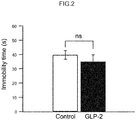
- Example 1 and Comparative Example 1 showed that the immobility time in the forced-swim test of the group administered with GLP-2 derivative, prepared by adding a cell-penetrating sequence portion and an endosome-escape portion to GLP-2, was significantly shorter than that of the control group, indicating a significant difference in the anti-depression activity between the groups. In contrast, no significant difference in the anti-depression activity was shown between the group administered with GLP-2, not added with a cell-penetrating sequence portion and an endosome-escape portion, and the control group. These results suggest that the anti-depression activity of GLP-2 is improved by adding a cell-penetrating sequence portion and an endosome-escape portion thereto.
- Example 2 show that the GLP-2 derivative widely distributes in the brain, indicating that the improvement in anti-depression activity, achieved by adding a cell-penetrating sequence portion and an endosomal-escape portion to GLP-2, is due to the enhanced distribution of GLP-2 in the brain.
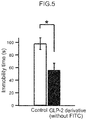
- Example 3 The results of Example 3 and Example 4, in which the test object and the test method were changed, and Example 5, in which a treatment-resistive depression model was used, suggest that an effect of suppressing depression is obtained by the administration of GLP-2.
- Example 6 and Example 7 in which a Y-maze test was performed with GLP-1 and NmU as a centrally-acting peptide, suggest that the learning ability is significantly ameliorated by the administration of GLP-1 or NmU, while the learning ability of the LPS-administered group was lower than that of the vehicle group (not administered with LPS).
- Example 8 a stability test of a centrally-acting peptide derivative, showed that the GLP-2 derivative is more stable than GLP-2 alone with respect to DPP-4, which is an enzyme capable of decomposing GLP-2.
Landscapes
- Health & Medical Sciences (AREA)
- Life Sciences & Earth Sciences (AREA)
- Chemical & Material Sciences (AREA)
- General Health & Medical Sciences (AREA)
- Medicinal Chemistry (AREA)
- Bioinformatics & Cheminformatics (AREA)
- Engineering & Computer Science (AREA)
- Veterinary Medicine (AREA)
- Pharmacology & Pharmacy (AREA)
- Animal Behavior & Ethology (AREA)
- Public Health (AREA)
- Proteomics, Peptides & Aminoacids (AREA)
- Gastroenterology & Hepatology (AREA)
- Organic Chemistry (AREA)
- Epidemiology (AREA)
- Zoology (AREA)
- Endocrinology (AREA)
- Immunology (AREA)
- Biochemistry (AREA)
- Genetics & Genomics (AREA)
- Molecular Biology (AREA)
- Biophysics (AREA)
- Chemical Kinetics & Catalysis (AREA)
- General Chemical & Material Sciences (AREA)
- Nuclear Medicine, Radiotherapy & Molecular Imaging (AREA)
- Biomedical Technology (AREA)
- Neurology (AREA)
- Neurosurgery (AREA)
- Psychiatry (AREA)
- Toxicology (AREA)
- Diabetes (AREA)
- Obesity (AREA)
- Otolaryngology (AREA)
- Hospice & Palliative Care (AREA)
- Pain & Pain Management (AREA)
- Medicines That Contain Protein Lipid Enzymes And Other Medicines (AREA)
- Peptides Or Proteins (AREA)
- Medicinal Preparation (AREA)
Abstract
Description
- The invention relates to a centrally-acting peptide derivative and a pharmaceutical composition.
- In recent years, there has been a large amount of research on the pharmacological applications of the physiological activities of substances, such as peptides, that are derived from biological bodies. For example, it is known that the glucagon-like peptide-1 (GLP-1), which is a peptide that is derived from proglucagon and formed from 37 amino acid residues, and the glucagon-like peptide-2 (GLP-2), which is a peptide that is derived from proglucagon and formed from 33 amino acid residues, bind to a G-protein-coupled receptor (GPCR) and activate signaling transduction.
- Regarding the pharmacological activity of GLP-1 (amide activity types 7-37 and 7-36 are present) in the brain, there have been reports of an effect of alleviating learning disorders (for example,
Non-Patent Documents 1 and 2). - Regarding the pharmacological activity of GLP-2 in the brain, there have been reports of effects of anti-depresssive activity even in treatment resistant depression model animals, lowering blood pressure and alleviating learning disorders (for example, Non-Patent
Documents 3 to 9). - Further, it has been reported that neuromedin U (NmU), which is a peptide formed of 23 amino acid residues, binds to a GPCR in the brain and exerts an effect of alleviating learning disorders (for example, Non-Patent Document 10).
- Peptides having a central activity such as opioid peptides, oxytocin, leptin, neuropeptide Y, orexin and insulin, and antibody drugs, have also been developed.
-
- Non-Patent Document 1: Neuroscience Research 64(2009)67-74
- Non-Patent Document 2: Journal of Neuroscience Research 92(2014)446-454
- Non-Patent Document 3: Behavioural Brain Research 204(2009)235-240
- Non-Patent Document 4: Neuroscience 212(2012)140-148
- Non-Patent Document 5: Life Sciences 93(2013)889-896
- Non-Patent Document 6: Neuroscience Letters 550(2013)104-108
- Non-Patent Document 7: Behavioural Brain Research 243(2013)153-157
- Non-Patent Document 8: Neuropeptides 49(2015)7-14
- Non-Patent Document 9: Neuroscience 294(2015)156-165
- Non-Patent Document 10: Neuroscience Research 61(2008)113-119
- It is anticipated that substances derived from a biological body, such as peptides, may be used as an active component of a drug with fewer side effects than previous drugs. It is desirable for drugs that need to be taken on a daily basis to be administered in a less invasive manner.
- Therefore, development of a nasal formulation as a dosage form that is adaptable for less-invasive administration has been studied.
- However, there have been problems in that a peptide that has been administered in an intranasal manner does not easily pass the blood-brain barrier, or that the effect of a peptide is lost within a short period of time due to enzymatic decomposition in a biological body.
- The inventors have focused on intranasal administration, which is a promising administration in terms of being less invasive and capable of delivering a peptide to the central nervous system, and have enabled the delivery of a centrally-acting peptide to the brain in an efficient manner by adding a peptide having a specific sequence to the centrally-acting peptide.
- Specifically, the invention aims to provide a centrally-acting peptide derivative having a superior ability to migrate to the central nervous system, and a pharmaceutical composition including the centrally-acting peptide derivative.
- The means for solving the problem includes the following embodiments.
- <1> A centrally-acting peptide derivative, comprising a centrally-acting portion, a cell-penetrating sequence portion, and an endosomal-escape portion.
- <2> The centrally-acting peptide derivative according to <1>, wherein the centrally-acting portion is an amino acid sequence portion that is derived from a peptide.
- <3> The centrally-acting peptide derivative according to <2>, wherein the amino acid sequence portion is derived from a peptide that is GLP-1, GLP-2, neuromedin U, an opioid peptide, oxytocin, leptin, orexin, neuropeptide Y or insulin.
- <4> The centrally-acting peptide derivative according to <2> or <3>, wherein the amino acid sequence portion is derived from a peptide selected from the following (a1), (a2), (a3) or (b):
- (a1) a peptide comprising an amino acid sequence represented by His-Ala-Asp-Gly-Ser-Phe-Ser-Asp-Glu-Met-Asn-Thr-Ile-Leu-Asp-Asn-Leu-Ala-Ala-Arg-Asp-Phe-Ile-Asn-Trp-Leu-Ile-Gln-Thr-Lys-Ile-Thr-Asp (sequence number 1);
- (a2) a peptide comprising an amino acid sequences represented by His-Ala-Glu-Gly-Thr-Phe-Thr-Ser-Asp-Val-Ser-Ser-Tyr-Leu-Glu-Gly-Gln-Ala-Ala-Lys-Glu-Phe-Ile-Ala-Trp-Leu-Val-Lys-Gly-Arg-NH2 (sequence number 2);
- (a3) a peptide comprising an amino acid sequence represented by Tyr-Lys-Val-Asn-Glu-Tyr-Gln-Gly-Pro-Val-Ala-Pro-Ser-Gly-Gly-Phe-Phe-Leu-Phe-Arg-Pro-Arg-Asn-NH2 (neuromedin U, sequence number 3); and
- (b) a peptide comprising an amino acid sequence represented by any of (a1) to (a3) in which one or more amino acid residues are deleted, replaced or added, the peptide having a centrally-acting activity.
- <5> The centrally-acting peptide derivative according to any one of <1> to <4>, used for treatment of a neuropsychiatric disorder.
- <6> The centrally-acting peptide derivative according to any one of < 1> to <4>, used for treatment of depression or a learning disorder.
- <7> A pharmaceutical composition, comprising the centrally-acting peptide derivative according to any one of
claim 1 to <6> as an active ingredient. - <8> The pharmaceutical composition according to <7>, used for treatment of a neuropsychiatric disorder.
- <9> The pharmaceutical composition according to <7> or <8>, used for treatment of depression or a learning disorder.
- <10> A nasal formulation comprising the centrally-acting peptide derivative according to any one of < 1 > to < 6> as an active ingredient.
- <11> The nasal formulation according to <10>, used for treatment of a neuropsychiatric disorder.
- <12> The nasal formulation according to <10> or <11>, used for treatment of depression or a learning disorder.
- <13> Use of a pharmaceutical composition for intranasal administration, the pharmaceutical composition comprising the centrally-acting peptide derivative according to any one of <1> to <6> as an active ingredient.
- <14> A method of stabilizing a centrally-acting peptide, the method comprising adding a cell-penetrating sequence portion and an endosomal-escape portion to a centrally-acting peptide.
- According to the invention, it is possible to provide a centrally-acting peptide derivative having a superior ability to migrate to the central nervous system, and a pharmaceutical composition including the centrally-acting peptide derivative.
-
-
Fig. 1 shows the result of a forced-swim test on a rat administered with a GLP-2 derivative. -
Fig. 2 shows the result of a forced-swim test on a rat administered with GLP-2 alone. -
Fig. 3 shows the distribution of a GLP-2 derivative in the brain of a rat. -
Fig. 4 shows the result of a forced-swim test on a mouse administered with a GLP-2 derivative. -
Fig. 5 shows the result of a tail suspension test on a mouse administered with a GLP-2 derivative. -
Fig. 6 shows the result of a forced-swim test on a treatment-resistant depression model mouse administered with a GLP-2 derivative. -
Fig. 7 shows the result of a Y-maze test on a learning disorder model mouse administered with a GLP-1 derivative. -
Fig. 8 shows the result of a Y-maze test on a learning disorder model mouse administered with an NmU derivative. -
Fig. 9 shows the result of a stability test of DPP-4, which is an enzyme that decomposes a GLP-2 derivative. - In the following, embodiments of the invention are explained. The explanation and the embodiments are exemplify the invention, and do not limit the scope of the invention.
- Numerical ranges indicated as "from A to B" described herein include A and B as a minimum value and a maximum value, respectively.
- The left side of the amino acid sequence refers to the N-terminal, and the amino acid residue may be indicated by a one-letter abbreviation (for example, G for glycine residue) or a three-letter abbreviation (for example, Gly for glycine residue).
- "Treatment" as described herein refers not only to an activity or an effect that quenches or alleviates a symptom, but also to an activity or an effect that suppresses aggravation of the symptom.
- An "anti-depressive activity" or "anti-depressive effect" refers not only to an activity or an effect that quenches a symptom of depression, but also to an activity or an effect that suppresses aggravation of the symptom.
- A "learning disorder-alleviating activity" or "learning disorder-alleviating effect" refers not only to an activity or an effect that quenches a symptom of a learning disorder, but also to an activity or an effect that suppresses aggravation of the symptom.
- The centrally-acting peptide derivative of the invention has a centrally-active portion, a cell-penetrating sequence portion and an endosomal-escape portion. The inventors have studied on a method to deliver a centrally-acting peptide to the brain in an expeditious manner before the peptide decomposes in a body, and to deliver a centrally-acting peptide to the brain in an efficient manner. As a result, the inventors have found that the ability of a peptide to migrate to a brain is significantly improved when the peptide is intranasally administered as derivative having a centrally-active portion, a cell-penetrating sequence portion and an endosomal-escape portion, as compared with the case in which the centrally-active portion alone is intranasally administered.
- The intended purpose of the centrally-acting peptide derivative is not limited, as long as it employs a pharmacological activity that is expressed by the centrally-acting portion upon acting on the central nervous system. Examples of the pharmacological activity include an anti-depression activity, a learning disorder-alleviating activity, an anti-anxiety activity, a feeding suppression activity, a cognitive disorder-alleviating activity, a blood-pressure-lowering activity, an analgesic activity, a sleep-inducing activity, and an anti-epileptic activity. Therefore, the centrally-acting peptide derivative is suitably used as a drug for the treatment of neuropsychiatric disorders, such as an anti-depression agent, a learning disorder-alleviating agent, an anti-anxiety agent, a feeding suppression agent, a cognitive disorder-alleviating agent, a blood-pressure-lowering agent, an analgesic agent, a sleep-inducing agent, and an anti-epileptic agent.
- The centrally-acting portion in the centrally-acting peptide derivative is not particularly limited, as long as it exerts a pharmacological activity by acting on the central nervous system. Addition of a cell-penetrating sequence portion and an endosomal-escape portion to a centrally-acting portion may be performed by a known process without particular restriction.
- In an embodiment of the centrally-acting peptide derivative, the centrally-acting portion is an amino acid sequence portion derived from a centrally-acting peptide (also referred to as a centrally-acting peptide portion). Examples of the centrally-acting peptide include GLP-1, GLP-2, neuromedin U, opioid peptide (such as enkephalin and dynorphin), oxytocin, leptin, orexin, neuropeptide Y and insulin.
- In an embodiment of the centrally-acting peptide derivative, the centrally-acting portion is a peptide portion derived from a peptide that is any of the following (a1) to (a3) or (b).
- (a1) a peptide comprising an amino acid sequence represented by HADGSFSDEMNTILDNLAARDFINWLIQTKITD (GLP-2, sequence number 1)
- (a2) a peptide comprising an amino acid sequences represented by HAEGTFTSDVSSYLEGQAAKEFIAWLVKGR-NH2 (GLP-1, 7-36 amide, sequence number 2)
- (a3) a peptide comprising an amino acid sequence represented by YKVNEYQGPVAPSGGFFLFRPRN-NH2 (neuromedin U, sequence number 3)
- (b) a peptide comprising an amino acid sequence represented by any of (a1) to (a3) in which one or more amino acid residues are deleted, replaced or added, the peptide having a centrally-acting activity.
- Among these peptides, GLP-2 exerts an anti-depression activity and a blood-pressure-lowering activity, GLP-1 exerts a learning disorder-alleviating activity, and neuromedin U exerts a learning disorder-alleviating activity. Therefore, these peptides are useful as a centrally-acting portion of the centrally-acting peptide derivative.
- When a peptide is formed of an amino acid sequence of a specific peptide and an amino acid sequence of a different peptide, the term "amino acid sequence derived from the specific peptide" refers to a portion of the peptide corresponding to the amino acid sequence of the specific peptide.
- When the centrally-acting portion is derived from "(b) a peptide including an amino acid sequence represented by any of (a1) to (a3) in which one or more amino acid residues are deleted, replaced or added", the number of the amino acid residues to be deleted, replaced or added is not particularly limited as long as the centrally-acting peptide portion exert the effect of the invention. For example, the number of the amino acid residues to be deleted, replaced or added may be from 1 to 10, preferably from 1 to 5, more preferably from 1 to 3. From the viewpoint of synthetic efficiency, handleability, stability and the like, the total number of the amino acid residues of the peptide (b) is preferably 40 or less, more preferably 35 or less, further preferably 33 or less.
- The centrally-acting peptide derivative has a cell-penetrating sequence portion. The cell-penetrating sequence portion is formed of an amino acid sequence of a cell-penetrating peptide (CPP). The cell-penetrating peptide refers to a peptide having an activity to penetrate a cell membrane. The cell-penetrating sequence portion introduces the centrally-acting peptide derivative into a cell by its cell-penetrating activity. It is considered that the centrally-acting peptide derivative is delivered to the brain via nasal membrane, olfactory epithelium or the like, mainly through the axonal transport or the like, and is distributed therein.
- The structure or the mechanism of penetration of a cell-penetrating peptide that constitutes the cell-penetrating sequence portion is not particularly limited, as long as it has an activity to introduce the centrally-acting peptide derivative into a cell.
- Examples of the cell-penetrating peptide include oligoarginine (Rn, n is the number of arginine residues ranging from 6 to 12), Angiopep-5(RFFYGGSRGKRNNFRTEEY, sequence number 4), Antp (RQIKIWFQNRRMKWKK, sequence number 5), Bac (YGRKKRRQRRR, sequence number 6), BR1 (RAGLQFPVGRLLR, sequence number 7), BR2 (RAGLQFPVGRLLRRLLR, sequence number 8), Buf IIb[BR3] (RAGLQFPVGRLLRRLLRRLLR, sequence number 9), SH-CPPP-2 (KLPVM, sequence number 10), CyLoP-1(CRWRWKCCKK, sequence number 11), Cys-Antp (CRQIKIWFQNRRMKWKK, sequence number 12), Cys-pVEC (CLLIILRRRIRKQAHAHKS, sequence number 13), Cys-SAP (CVRLPPPVRLPPPVRLPPP, sequence number 14), Cys-SAPr (CPPPLRVPPPLRVPPPLRV, sequence number 15), Cys-TAT (CYGRKKRRQRRR, sequence number 16), Cys-TP10 (CAGYLLGKINLKALAALAKKIL, sequence number 17), Cys-TP10K (CAGYLLGKINKLKALAALAKKIL, sequence number 18), FAK (FAKLAARLYRKALARQLGVAA, sequence number 19), H9(HHHHHHHHH, sequence number 20), HC-[poly(K)] (QYIKANSKFIGITEL-poly(K), sequence number 21), hLF (KCFQWQRNMRKVRGPPVSCIKR, sequence number 22), HR9 (CHHHHHHRRRRRRRRRHHHHHC, sequence number 23), IR9 (GLFEAIEGFIENGWEGMIDGWYGRRRRRRRRR, sequence number 24), JNKI-1D-TAT (TDQSRPVQPFLNLTTPRKPRRPPRRRQRRKKRG, sequence number 25), K9(KKKKKKKKK, sequence number 26), low molecular weight protamine (LMWP) (VSRRRRRRGGRRRR, sequence number 27), MAP(KLALKLALKALKAALKLA, sequence number 28), Mitoparan (INLKKLAKL(Aib)KKIL, sequence number 29), m-N2-10-1(MTS-C) (HYSRLEICNL-AAVALLPAVLLALLP, sequence number 30), m-N2-10-1(MTS-N) (AAVALLPAVLLALLP-HYSRLEICNL, sequence number 31), m-N2-10-1 (NIV-C) (HYSRLEICNL-GRKKRRQRRRPPQ, sequence number 32), m-N2-10-1 (NIV-N) (GRKKRRQRRRPPQ-HYSRLEICNL, sequence number 33), m-N2-10-1 (OR-C) (RRRRRRRR-HYSRLEICNL, sequence number 34), m-N2-10-1 (OR-N) (HYSRLEICNL-RRRRRRRR, sequence number 35), MPG-8 (AFLGWLGAWGTMGWSPKKKRK-Cysteamide, sequence number 36), MPGα (GALFLAAALSLMGLWSQPKKKRKV-NH-CH2-CH2-SH, sequence number 37), MPGβ (GALFLGAALSLMGLWSQPKKKRKV-NH-CH2-CH2-SH, sequence number 38), NrTP1 (YKQCHKKGGKKGSG, sequence number 39), NrTP2 (YKQCHKKGG-Ahx-KKGSG, sequence number 40), NrTP5 (YKGCHKKGGKKGSG, sequence number 41), NrTP6 (YKQSHKKGGKKGSG, sequence number 42), NrTP7 (YRQSHRRGGRRGSG, sequence number 43), MPG HIV-gp41/SV40 T-antigen (GALFLGFLGAAGSTMGAWSQPKKKRKV, sequence number 44), NrTP8(WKQSHKKGGKKGSG, sequence number 45), PAMAM-PEG-Angiopep-2 (PFFYGGSGGNRNNYLREEY, sequence number 46), PEI-TAT (TGRKKRRQRRR-PEI, sequence number 47), penetratin (43-58) (RQIKIWFQNRRMKWKK, sequence number 48), penetratin (RQIKIWFQNRRMKWKKK, sequence number 49), Pep-1 HIV-reverse transcriptase/SV40 T-antigen (KETWWETWWTEWSQPKKKRKV, sequence number 50), Pep1 (KETWWETWWTEWSQPKKKRKV, sequence number 51), pepM residues 45-72 of DENV-2 C protein (KLFMALVAFLRFLTIPPTAGILKRWGTI, sequence number 52), pepR residues 67-100 of DENV-2 C protein (LKRWGTIKKSKAINVLRGFRKEIGRMLNILNRRRR, sequence number 53), peptide derived from protamine (RRRRRRGGRRRRG, sequence number 54), peptide vascular endothelial cadherin (pVEC) (LLIILRRRIRKQAHAHSK, sequence number 55), PF14 (AGYLLGKLLOOLAAAALOOLL, O represents any amino acid residue, sequence number 56), PR9 (FFLIPKGRRRRRRRRR, sequence number 57), protamine (VSRRRRRRGGRRRRK, sequence number 58), PYC36L-TAT (GRKKRRQRRRGGLQGRRRQGYQSIKP, sequence number 59), R6W3 based on penetratin (RRWWRRWRR, sequence number 60), R9-hLF (RRRRRRRRRKCFQWQRNMRKVRGPPVSCIKR, sequence number 61), RA9 (RRAARRARR, sequence number 62), RH9(RRHHRRHRR, sequence number 63), RL9(RRLLRRLRR, sequence number 64), RVG-9R (YTIWMPENPRPGTPCDIFTNSRGKRASNG-9R, sequence number 65), RW9 (RRWWRRWRR, sequence number 66), S8 (SSSSSSSSK, sequence number 67), SAP (VRLPPPVRLPPPVRLPPP, sequence number 68), SAPr (PPPLRVPPPLRVPPPLRV, sequence number 69), SynB1 (RGGRLSYSRRRFSTSTGR, sequence number 70), SynB3 (RRLSYSRRRF, sequence number 71), Xentry (LCLRPVG, sequence number 72), YARA (YARAAARQARAKALARQLGVAA, sequence number 73), TAT (47-57) (GRKKRRQRRRP, sequence number 74), TAT (48-60) (GRKKRRQRRRPPQ, sequence number 75), TAT (49-57) (RKKRRQRRR, sequence number 76), TAT-D (GRRRQRRKKRG, sequence number 77), TAT-L (GRKKRRQRRRG, sequence number 78), TAT-PEG-Cholesterol (YGRKKRRQRRR-PEG-cholesterol, sequence number 79), TP-10 (AGYLLGKINLKALAALAKKIL, sequence number 80), TP-10K (AGYLLGKINKLKALAALAKKIL, sequence number 81), transportan (GWTLNSAGYLLGKINLKALAALAKKIL, sequence number 82), CAD-2 (GLWRALWRLLRSLWRLLWKA-NH-CH2-CH2-SH, sequence number 83), PF6 (AGYLLGK(K(K2(TFQ4)))INLKALAALAKKIL, sequence number 84), and polyarginine derivative (RRRQRRKRRRQ, sequence number 85).
- Among these cell-penetrating peptides, from the viewpoint of affinity with a cell membrane and ease of synthesis, a cell-penetrating peptide formed of an amino acid sequence that is rich in basic amino acid residues such as arginine, lycine, histidine and triptophan (for example, half or more of the total amino acid residues are basic amino acid residues) is preferred. Examples of such cell-penetrating peptides include oligoarginine (Rn, n is the number of arginine residues ranging from 6 to 12) and TAT derived from a Tat protein of human immunodeficiency virus 1 (HIV-1). A cell-penetrating peptide formed of an amino acid sequence that is rich in basic amino acid residues is considered to induce macropinocytosis, a form of endocytosis that is a process of a cell to take in extracellular substance. As a result, it is considered that the centrally-acting peptide derivative is introduced into a cell in a more efficient manner.
- From the viewpoint of the efficiency of cell penetration of the centrally-acting peptide derivative, the cell-penetrating peptide is preferably a peptide in which half or more of the total amino acid residues are arginine residues, more preferably oligoarginine formed of 6 to 12 arginine residues, further preferably oligoarginine formed of 7 to 9 arginine residues, yet further preferably oligoarginine formed of 8 arginine residues.
- The centrally-acting peptide derivative has an endosomal-escape portion. An endosomal-escape portion is considered to shorten the time for the centrally-acting peptide derivative to remain in a cell, and enables escape from the endosome in a shorter period. As a result, it is considered to become possible to expedite the delivery of the centrally-acting peptide derivative to the brain and the distribution of the centrally-acting peptide derivative in the brain.
- The structure or the mechanism of endosomal escape of the endosomal-escape portion is not specifically limited, as long as it has an activity of promoting the escape of the centrally-acting peptide derivative from an endosome. Examples of the endosomal-escape portion include an acetyl group (CnH2n+1CO-, n=3~9) and a penetration accelerating sequence (PAS) such as FFLIPKG (sequence number 86), LILIG (sequence number 87), FFG (sequence number 88), FFFFG (sequence number 89) and FFFFFFG (sequence number 90). From the viewpoint of the function of causing endosomal escape, a PAS is a preferred endosomal escape portion.
- The position of the cell-penetrating sequence portion and the endosomal-escape portion in the centrally-acting peptide derivative is not particularly restricted. For example, the cell-penetrating sequence portion may be positioned closer to the centrally-acting portion than the endosomal-escape portion, or the endosomal-escape portion may be positioned closer to the centrally-acting portion than the cell-penetrating sequence portion. From the viewpoint of achieving the effect of the invention more efficiently, the centrally-acting peptide derivative preferably has the cell-penetrating sequence portion at a position closer to the centrally-acting portion than the endosomal-escape portion, and more preferably has a PAS as the endosomal-escape portion at the N-terminal side of the cell-penetrating sequence portion.
- In the centrally-acting peptide derivative, the centrally-acting portion may be linked to the cell-penetrating sequence portion or the endosomal-escape portion directly or via a spacer. When a spacer is positioned between the centrally-acting portion and the cell-penetrating sequence portion, the amino acid sequence of the spacer is not particularly restricted as long as it has a function to suppress a decrease or a loss of the activity of the centrally-acting portion. Generally, the cell-penetrating sequence portion is formed of basic amino acid residues. Therefore, when the centrally-acting portion includes an acidic amino acid residue, it is preferred to position a spacer having a sequence formed of one or more (for example, 1 to 10, preferably 2 to 6) neutral amino acid residues, such as glycine, in order to suppress a decrease or a loss of the activity of the centrally-acting portion caused by an interaction between the cell-penetrating sequence portion and the centrally-acting portion.
- The centrally-acting peptide derivative may be subjected various modification according to the intended purposes. Examples of the modification include amino gorup modification (such as biotinylation, myristoylation, palmitoylation, acetylation and maleimidation), carboxy group modification (such as amidation and esterification), thiol group modification (such as farnesylation, geranylation, methylation and palmitoylation), hydroxy group modification (such as phosphorylation, sulfation, octanoylation, palmitoylation and palmitoleoylation, fluorescence labelling (such as FITC, FAM, rhodamine, BODIPY, NBD and MCA), pegylation, and introduciton of unnatural amino acids, D-amino acids or the like. The modification may be performed on any of the centrally-acting portion, cell-penetrating sequence portion, the endosomal-escape portion or the spacer of the centrally-acting peptide derivative.
- Each of the amino acid residues that constitute the centrally-acting peptide derivative may be either L-form or D-form, as long as the effect of the invention is achieved. The method of obtaining the centrally-acting peptide derivative is not particularly restricted, and may be extracted from a living body or a natural substance, or may be prepared by a genetic engineering process or an organic synthetic process.
- In an embodiment, the centrally-acting peptide derivative is formed of an amino acid sequence in which an amino acid sequence of PAS, an amino acid sequence of CPP, an amino acid sequence of a spacer as necessary, and an amino acid sequence of the centrally-acting portion are positioned in this order from the N-terminal side, where PAS is selected from FFLIPKG, LILIG, FFG, FFFFG or FFFFFFG, CPP is selected from oligoarginine (Rn, n=6-12), and the spacer is selected from glycine residues (Gn, n=2-6).
- When the centrally-acting portion of the centrally-acting peptide derivative is an amino acid sequence, the total number of amino acid residues of the centrally-acting peptide derivative is not particularly restricted as long as the effect of the invention is achieved, and may be selected according tothe intended purposes. For example, the total number of amino acid residues of the centrally-acting peptide derivative may be 80 or less, preferably 70 or less, more preferably 60 or less. For example, the total number of amino acid residues of the centrally-acting peptide derivative may be 35 or more, preferably 40 or more, more preferably 45 or more.
- The pharmaceutical composition of the invention includes a centrally-acting peptide derivative having a centrally-acting portion, a cell-penetrating sequence portion and an endosomal-escape portion as an active ingredient. By including a centrally-acting peptide derivative as an active ingredient, the pharmaceutical composition can be rapidly delivered to the brain and efficiently exert a pharmacological effect. Further, since the pharmaceutical composition can be administered is a less invasive manner, it is useful as a drug that needs to be taken on a daily basis at home. Therefore, a nasal formulation is a preferred form of the pharmaceutical composition.
- The neuropsychiatric disorder, which is a therapeutic objective of the pharmaceutical composition, is not particularly restricted as long as a therapeutic effect is exerted by the action of the centrally-acting portion of the centrally-acting peptide derivative on the central nervous system. Examples of the neuropsychiatric disorder include depression, learning disorder, anxiety, eating disorder, cognition disorder, high blood pressure, sleeping disorder and epilepsia.
- Specific examples of the pharmaceutical composition include an anti-depression agent, a learning disorder-alleviating agent, an anti-anxiety agent, a feeding suppression agent, a cognitive disorder-alleviating agent, a blood-pressure-lowering agent, an analgesic agent, a sleep-inducing agent, and an anti-epileptic agent. The type of the centrally-acting portion, the cell-penetrating sequence portion and the endosomal-escape portion of the centrally-acting peptide derivative may be selected according to the therapeutic objective. For example, a pharmaceutical composition including a centrally-acting peptide derivative having a peptide portion derived from GLP-2 as an active ingredient is effective as an anti-depression agent. Further, since GLP-2 exerts a blood pressure-lowering activity, the pharmaceutical composition including a centrally-acting peptide derivative having a peptide portion derived from GLP-2 as an active ingredient is considered to be particularly effective for a patient with depression due to strong pressure and high blood pressure in combination. A pharmaceutical composition including a centrally-acting peptide derivative having a peptide portion derived from GLP-1 or NmU as an active ingredient is effective as a learning disorder-alleviating agent.
- The details and the preferred embodiments of the centrally-acting peptide derivative included in the pharmaceutical composition are as described above.
- The method of using the pharmaceutical composition is not particularly restricted, and may be any of intranasal administration, oral administration, intravenous administration and the like. In view of adaptability to daily administration, intranasal administration and oral administration are preferred. In view of adaptability to delivery to the brain, intranasal administration is more preferred. The pharmaceutical composition may include a component other than the centrally-acting peptide derivative. Examples of the component other than the centrally-acting peptide derivative include a medium and a formulation additive that are used for the preparation of a pharmaceutical composition. Specific examples of the formulation additive include a diluent, a disintegrant, a binder, a lubricant, a surfactant, a buffer, a solubilizing agent, a stabilizer, a tonicity agent, a suspending agent, an emulcifier, a solvent, a thickner, a mucolytic agent, a humectant and a preservative. The dosage amount of the pharmaceutical composition may be selected according to the type of disease, the symptomatic state, weight or age of the patient, the administration form and the like.
- The nasal formulation of the inveniton includes a centrally-acting peptide derivative having a centrally-acting portion, a cell-penetrating sequence portion and an endosomal-escape portion as an active ingredient. By including a centrally-acting peptide derivative as an active ingredient, the nasal formulation can be rapidly delivered to the brain and efficiently exert a pharmacological effect. Further, since the nasal formulation can be administered is a less invasive manner, it is useful as a drug that needs to be taken on a daily basis at home. Therefore, a nasal formulation is a preferred form of the pharmaceutical composition.
- The deails and the preferred embodiments of the centrally-acting peptide derivative included in the nasal formulation are as described above. The nasal formulation may include a component other than the centrally-acting peptide derivative. Examples of the component other than the centrally-acting peptide derivative include a medium and a formulation additive that may be used for the preparation of the pharmaceutical composition as descried above.
- The embodiments of the invention include a use of the pharmaceutical composition including a centrally-acting peptide derivative as an active ingredient, as described above, for intranasal administration. The details and the preferred embodiments of the centrally-acting peptide derivative for the use are as described above.
- The embodiments of the invention include a method of stabilizing a centrally-acting peptide, the method including adding a cell-penetrating sequence portion and an endosomal-escape portion to the centrally-acting peptide. The details and the preferred embodiments of the cell-penetrating sequence portion, the endosomal-escape portion and the centrally-acting peptide in the method are as described above.
- The invention are explained in further detail by referring to the following examples. The materials, amounts, rates, procedures and the like may be modified without departing from the scope of the invention. Therefore, the scope of the invention should not be construed in a restricted manner by the examples as described below.
- Evaluation on anti-depression activity of centrally-acting peptide peptide derivative
- A derivative of GLP-2 (GLP-2 derivative) having an amino acid sequence of FITC-FFLIPKG-(R)8-(G)2-HADGSFSDEMNTILDNLAARDFINWLIQTKITD was prepared by an ordinary method as a centrally-acting peptide derivative. The GLP-2 derivative was primarily dissolved in DMSO and diluted with phosphate-buffered saline (PBS) to adjust the final concentration of DMSO to 16%, thereby preparing a DMSO solution of GLP-2 derivative.
- The anti-depression activity of the GLP-2 derivative was evaluated by a forced-swim test on rats using the DMSO solution of GLP-2 derivative. The forced-swim test was performed in accordance with the following procedure.
- One hour before the test, rats (8-10 week old, male, n=6) were transferred to the laboratory for habituation. The rats were intranasally administered with the DMSO solution of GLP-2 derivative by 18 µg/day for two days, 30 minutes before the test. The rats were allowed to swim for 15 minutes, one by one in a transparent plastic cylinder with a diameter of 18 cm and a height of 50 cm filled with water of 25±1°C to a height of 30 cm. During the swimming, the immobility time (s) was measured. The rats after the test were wiped with a Kimtowel and placed back to a cage. The test was performed for consecutive 2 days,
day 1 as a preliminary test andday 2 as a main test. As a control, rats (8-10 week old, male, n=6) were intranasally administered with a solvent without GLP-2 derivative by 10 µL and subjected to a forced-swim test in the same manner. The results are shown in Table 1 andFig. 1 . The error bar represents mean±SE (n=6), and the statistical processing was performed by Mann-Whitney test (*P<0.05). - A peptide having an amino acid sequence of HADGSFSDEMNTILDNLAARDFINWLIQTKITD, i.e., an amino acid sequence of GLP-2 alone without a cell-penetrating sequence portion and an endosomal-escape portion, was prepared by an ordinary method, and a DMSO solution of GLP-2 (16%) was prepared in the same manner as Example 1. The forced-swim test was performed in the same manner as Example 1, except that the rats (8-10 week old, male, n=6) were intranasally administered with the DMSO solution of GLP-2 by 18 µg/day. The results are shown in Table 1 and
Fig. 2 . The error bar represents mean±SE (n=6), and the statistical processing was performed by Mann-Whitney test (ns refers to not significant).Table 1 Immobility time (s) Example 1 Comparative Example 1 Control GLP-2 derivative Control GLP-2 55 36 48 45 22 13 43 41 45 8 35 30 25 25 47 33 76 16 30 46 26 24 35 15 - The state of distribution of GLP-2 derivative in olfactory bulb, infralimbic cortex, basolateral amygdala, central amygdala), medial amygdala, paraventricular hypothalamic nucleus, dorsomedial hypothalamic nucleus, hippocampus and parabrachial nucleus of rats was evaluated by the following process. The rats were intranasally administered with a DMSO solution of GLP-2 derivative (16%) by 18 µg in the same manner as Example 1.
- Thirty minutes after the intranasal administration to a rat with a DMSO solution of GLP-2 derivative (16%) as prepared in the same manner as Example 1, the rat was formalin-fixed to prepare a brain specimen. A section (30 µm) was obtained from the brain specimen with a cryostat (Leica Microsystems, CM1560S), and the section was observed with a fluorescence microscope (Keyence Corporation, BZ-9000). As a control, a brain specimen of a rat intranasally administered with a solvent without GLP-2 was prepared and observed in the same manner. The results are shown in Table 1. The error bar represents mean ± SE (n = 6), and the statistical processing was performed by Mann-Whitney test (*P<0.05, **P<0.01).
- A GLP-2 derivative having an amino acid sequence of FFLIPKG-(R)8-(G)2-HADGSFSDEMNTILDNLAARDFINWLIQTKITD was prepared as a centrally-acting peptide derivative. This DLP-2 derivative is different from the GLP-2 derivative prepared in Example 1 in that FITC is not added thereto. The GLP-2 derivative is primarily dissolved in DMSO and diluted with phosphate buffer (PBS) in order to adjust the final concentration of DMSO to 16%, thereby preparing a DMSO solution of GLP-2 derivative.
- The anti-depression activity of the GLP-2 derivative was evaluated by a forced-swim test on a mouse. The test was performed by the following process.
- Twenty-four hours before the test, ddY mice (5-7 week old, male, n=12) were subjected to a preliminary swimming for 15 minutes. The mice were administered GLP-2 derivative by 3.6 µg with the DMSO solution, on the day before the test and on the day for the test, respectively. Then, the test was performed in the same manner as Example 1, and the immobility time (s) was measured. As a control, mice (5-7 week old, male, n=12) were administered with a solution without GLP-2 derivative were subjected to a forced-swim test in the same manner. The results are shown in Table 2 and
Fig. 4 . The error bar represents mean±SE (n=12), and the statistical processing was performed by Mann-Whitney test (*P<0.05).Table 2 Immobility time (s) Control GLP-2 derivative 205 163 263 65 216 217 218 147 278 185 47 152 276 154 175 151 239 231 280 218 321 236 236 141 - The anti-depression activity of the GLP-2 derivative was evaluated by a tail suspension test on a mouse, using the DMSO solution of GLP-2 derivative as prepared in Example 3. The test was performed by the following process.
- On the day before the test and on the day for the test, ddY mice (5-7 week old, male, n = 9) were administered with the GLP-derivative by 3.6 µg, respectively, with the DMSO solution. Then, the mice were suspended by the tail and the immobility time (s) was measured. As a control, mice (5-7 week old, male, n = 9) were intranasally administered with a solvent without GLP-2 derivative and subjected to a tail suspension test in the same manner. The results are shown in Table 3 and
Fig. 5 . The error bar represents mean±SE (n=9), and the statistical processing was performed by Mann-Whitney test (*P<0.05).Table 3 Immobility time (s) Control GLP-2 derivative 57 27 74 49 121 131 147 45 73 71 101 34 107 27 92 54 109 67 - The anti-depression activity of the GLP-2 derivative was evaluated by a forced-swim test on a depression model rat using the DMSO solution of GLP-2 derivative as prepared in Example 3.
- As the depression model mouse, ddY mice (5-7 week old, male, n=11) were administered with adrenocorticotropic hormone (ACTH) to induce an enhanced state of hypothalamic-pituitary-adrenal axis (HPA system). The administration of ACTH was performed by 0.45mg/kg/day for consecutive 14 days.
- The forced-swim test was performed in the same manner as Example 3 and the immobility time (s) was measured. The mice were intranasally administered with GLP-2 derivative by 3.6 µg as a DMSO solution of GLP-2 derivative, each day for consecutive 6 days until the day for the test. As a control, mice (5-7 week old, male, n=11) were administered with a solvent without GLP-2 derivative by 4 µL each day for consecutive 6 days and subjected to a forced-swim test in the same manner. The results are shown in Table 4 and
Fig. 6 . The error bar represents mean±SE (n=11), and the statistical processing was performed by Mann-Whitney test (*P<0.01).Table 4 Immobility time (s) Control GLP-2 derivative 193 25 214 113 251 268 307 149 177 287 265 58 289 207 310 192 252 151 316 221 264 96 - A derivative of GLP-1 (7-36 amide) having an amino acid sequence of FFLIPKG-(R)8-(G)2-HAEGTFTSDVSSYLEGQAAKEFIAWLVKGR-NH2 was prepared by an ordinary method as a centrally-acting peptide derivative. The GLP-1 derivative was primarily dissolved in FOS 12 (n-dodecylphosphocholine), and diluted with PBS to adjust the final concentration of FOS 12 to 1%, thereby preparing a FOS 12 solution of GLP-1 derivative.
- The learning disorder-alleviating activity of the GLP-1 derivative was evaluated by a Y-maze test on a learning disorder-induced mouse, using the FOS 12 solution of GLP-1 derivative.
- As the learning disorder-induced mouse, ddY mice (5-7 week old, male, n=5) were administered with lipopolysaccharide (LPS) by 10 µg at three days before the test. Fifteen minutes before the administration of LPS, the mice were administered with GLP-1 derivative by 3 µg with the FOS 12 solution of GLP-1 derivative.
- The Y-maze test was performed by using a device having three arms of the same size. The number of times that the mouse entered the different arm for consecutive three times was counted, and the result was divided by a number obtained by deducting 2 from the total number of times of entering the arm. The result was multiplied by 100, and used as a spontaneous alternation behavior (%).
- As a control, mice (5-7 week old, male, n =5 or 7), intranasally administered a solvent without GLP-1 derivative by 4 µL 15 minutes before the administration of LPS, were subjected to the same test as the above. Further, mice that were not administered with LPS (vehicle) were subjected to the same test as the above. The results are shown in Table 5 and
Fig. 7 . The error bar represents mean±SE (n=5 or 7), and the statistical processing was performed by Mann-Whitney test (*P<0.05, **P<0.01).Table 5 Alternation behavior (%) Vehicle LPS Control GLP-1 derivative Control GLP-1 derivative 65.7 72.2 52.0 66.7 60.0 70.3 56.5 66.7 66.7 78.6 48.6 67.9 59.6 67.6 54.8 67.4 61.5 56.4 56.8 64.3 76.0 62.1 - A derivative of NmU having an amino acid sequence of FFFFG-(R)8-(G)2-YKVNEYQGPVAPSGGFFLFRPRN-NH2 was prepared by an ordinary method as a centrally-acting peptide derivative. The NmU derivative was primarily dissolved in FOS 12 and diluted with PBS to adjust the final concentration of FOS 12 to 5%, thereby preparing a FOS 12 solution of NmU derivative.
- As the learning disorder-induced mouse, ddY mice (5-7 week old, male, n = 6) administered with lipopolysaccharide (LPS) by 10 µg three days before the test were used. Fifteen minutes before the administration of LPS, the mice were administered with NmU derivative by 3 µg with the FOS 12 solution of NmU derivative. A Y-maze test was performed in the same manner as Example 6, and a spontaneous alternation behavior (%) was calculated from the measurement results.
- As a control, mice (5-7 week old, male, n = 6), which were intranasally administered a solvent without NmU derivative by 4 µL 15 minutes before the administration of LPS, were subjected to the same test as the above. Further, mice not administered with LPS (vehicle) were subjected to the same test as the above. The results are shown in Table 6 and
Fig. 8 . The error bar represents mean±SE (n=6), and the statistical processing was performed by Mann-Whitney test (*P<0.01, **P<0.001).Table 6 Alternation behavior (%) Vehicle LPS Control NmU derivative Control NmU derivative 67.7 69.0 68.2 66.7 66.7 63.9 52.1 60.0 79.1 67.8 50.8 74.1 69.2 78.8 48.9 69.4 68.6 65.9 49.0 58.6 69.6 70.5 48.9 72.4 - The GLP-2 and the GLP-2 derivative prepared in Example 3 were primarily dissolved in DMSO and diluted with PBS to adjust the final concentration of DMSO to 1%, respectively, thereby preparing samples.
- The content of GLP-2 or GLP-2 derivative in each sample was adjusted to 12 ng/µL, and DPP-4 (dipeptidyl peptidase-4) was added to each sample.
- The samples were stored at 37 °C, and the content of the GLP-2 or GLP-2 derivative was measured at 1 hour and 6 hours after the preparation. The measured values were converted to a relative value as a residual ratio (%) based on the content of the GLP-2 or GLP-2 derivative immediately after the preparation as 100%. The results are shown in
Fig. 9 . The value shown inFig. 9 represents mean ± SE (n = 3), and the statistical processing was performed by t-test (**P<0.001). - The results of Example 1 and Comparative Example 1 showed that the immobility time in the forced-swim test of the group administered with GLP-2 derivative, prepared by adding a cell-penetrating sequence portion and an endosome-escape portion to GLP-2, was significantly shorter than that of the control group, indicating a significant difference in the anti-depression activity between the groups. In contrast, no significant difference in the anti-depression activity was shown between the group administered with GLP-2, not added with a cell-penetrating sequence portion and an endosome-escape portion, and the control group. These results suggest that the anti-depression activity of GLP-2 is improved by adding a cell-penetrating sequence portion and an endosome-escape portion thereto.
- The results of Example 2 show that the GLP-2 derivative widely distributes in the brain, indicating that the improvement in anti-depression activity, achieved by adding a cell-penetrating sequence portion and an endosomal-escape portion to GLP-2, is due to the enhanced distribution of GLP-2 in the brain.
- The results of Example 3 and Example 4, in which the test object and the test method were changed, and Example 5, in which a treatment-resistive depression model was used, suggest that an effect of suppressing depression is obtained by the administration of GLP-2.
- The results of Example 6 and Example 7, in which a Y-maze test was performed with GLP-1 and NmU as a centrally-acting peptide, suggest that the learning ability is significantly ameliorated by the administration of GLP-1 or NmU, while the learning ability of the LPS-administered group was lower than that of the vehicle group (not administered with LPS).
- The results of Example 8, a stability test of a centrally-acting peptide derivative, showed that the GLP-2 derivative is more stable than GLP-2 alone with respect to DPP-4, which is an enzyme capable of decomposing GLP-2. These results suggest that the addition of a cell-penetrating sequence portion and an endosomal-escape portion to a centrally-acting portion suppress the decomposition of GLP-2 by DPP-4, thereby providing additional effects such as improved stability of a peptide and improved ability of migrating to the central nervous system.
- The disclosure of
Japanese Patent Application Nos. 2014-177974 2014-184436 




Claims (14)
- A centrally-acting peptide derivative, comprising a centrally-acting portion, a cell-penetrating sequence portion, and an endosomal-escape portion.
- The centrally-acting peptide derivative according to claim 1, wherein the centrally-acting portion is an amino acid sequence portion that is derived from a peptide.
- The centrally-acting peptide derivative according to claim 2, wherein the amino acid sequence portion is derived from a peptide that is GLP-1, GLP-2, neuromedin U, an opioid peptide, oxytocin, leptin, orexin, neuropeptide Y or insulin.
- The centrally-acting peptide derivative according to claim 2 or claim 3, wherein the amino acid sequence portion is derived from a peptide selected from the following (a1), (a2), (a3) or (b):(a1) a peptide comprising an amino acid sequence represented by His-Ala-Asp-Gly-Ser-Phe-Ser-Asp-Glu-Met-Asn-Thr-Ile-Leu-Asp-Asn-Leu-Ala-Ala-Arg-Asp-Phe-Ile-Asn-Trp-Leu-Ile-Gln-Thr-Lys-Ile-Thr-Asp (sequence number 1);(a2) a peptide comprising an amino acid sequences represented by His-Ala-Glu-Gly-Thr-Phe-Thr-Ser-Asp-Val-Ser-Ser-Tyr-Leu-Glu-Gly-Gln-Ala-Ala-Lys-Glu-Phe-Ile-Ala-Trp-Leu-Val-Lys-Gly-Arg-NH2 (sequence number 2);(a3) a peptide comprising an amino acid sequence represented by Tyr-Lys-Val-Asn-Glu-Tyr-Gln-Gly-Pro-Val-Ala-Pro-Ser-Gly-Gly-Phe-Phe-Leu-Phe-Arg-Pro-Arg-Asn-NH2 (neuromedin U, sequence number 3); and(b) a peptide comprising an amino acid sequence represented by any of (a1) to (a3) in which one or more amino acid residues are deleted, replaced or added, the peptide having a centrally-acting activity.
- The centrally-acting peptide derivative according to any one of claim 1 to claim 4, used for treatment of a neuropsychiatric disorder.
- The centrally-acting peptide derivative according to any one of claim 1 to claim 4, used for treatment of depression or a learning disorder.
- A pharmaceutical composition, comprising the centrally-acting peptide derivative according to any one of claim 1 to claim 6 as an active ingredient.
- The pharmaceutical composition according to claim 7, used for treatment of a neuropsychiatric disorder.
- The pharmaceutical composition according to claim 7 or claim 8, used for treatment of depression or a learning disorder.
- A nasal formulation comprising the centrally-acting peptide derivative according to any one of claim 1 to claim 6 as an active ingredient.
- The nasal formulation according to claim 10, used for treatment of a neuropsychiatric disorder.
- The nasal formulation according to claim 10 or claim 11, used for treatment of depression or a learning disorder.
- Use of a pharmaceutical composition for intranasal administration, the pharmaceutical composition comprising the centrally-acting peptide derivative according to any one of claim 1 to claim 6 as an active ingredient.
- A method of stabilizing a centrally-acting peptide, the method comprising adding a cell-penetrating sequence portion and an endosomal-escape portion to a centrally-acting peptide.
Applications Claiming Priority (3)
| Application Number | Priority Date | Filing Date | Title |
|---|---|---|---|
| JP2014177974 | 2014-09-02 | ||
| JP2014184436 | 2014-09-10 | ||
| PCT/JP2015/074962 WO2016035820A1 (en) | 2014-09-02 | 2015-09-02 | Centrally-acting peptide derivative, and pharmaceutical composition |
Publications (3)
| Publication Number | Publication Date |
|---|---|
| EP3190129A1 true EP3190129A1 (en) | 2017-07-12 |
| EP3190129A4 EP3190129A4 (en) | 2017-09-13 |
| EP3190129B1 EP3190129B1 (en) | 2020-01-08 |
Family
ID=55439879
Family Applications (1)
| Application Number | Title | Priority Date | Filing Date |
|---|---|---|---|
| EP15837573.3A Active EP3190129B1 (en) | 2014-09-02 | 2015-09-02 | Centrally-acting peptide derivative, and pharmaceutical composition |
Country Status (4)
| Country | Link |
|---|---|
| US (2) | US20170253643A1 (en) |
| EP (1) | EP3190129B1 (en) |
| JP (2) | JPWO2016035820A1 (en) |
| WO (1) | WO2016035820A1 (en) |
Cited By (1)
| Publication number | Priority date | Publication date | Assignee | Title |
|---|---|---|---|---|
| WO2021156451A1 (en) * | 2020-02-06 | 2021-08-12 | INSERM (Institut National de la Santé et de la Recherche Médicale) | C-x-c motif chemokine receptor 4 antagonist |
Families Citing this family (5)
| Publication number | Priority date | Publication date | Assignee | Title |
|---|---|---|---|---|
| CN111727243A (en) | 2017-12-19 | 2020-09-29 | 北卡罗来纳-查佩尔山大学 | Methods and compositions for delivering viral vectors across the blood-brain barrier |
| US20240270811A1 (en) * | 2021-05-13 | 2024-08-15 | Tokyo University Of Science Foundation | Glycosylated Neuropeptide Derivative, Pharmaceutical Composition, Intranasal/Nasal Drop Formulation, and Use of Pharmaceutical Composition |
| KR20250102040A (en) * | 2022-11-10 | 2025-07-04 | 가부시키가이샤 도우사 고가쿠 겐큐쇼 | Physiologically active peptide derivatives, pharmaceutical compositions, nasal and nasal preparations and use of physiologically active peptide derivatives for the treatment of eye diseases |
| JPWO2024101433A1 (en) | 2022-11-10 | 2024-05-16 | ||
| TW202604934A (en) * | 2024-05-08 | 2026-02-01 | 日商糖鎖工學研究所股份有限公司 | Novel peptide derivative and use thereof |
Family Cites Families (8)
| Publication number | Priority date | Publication date | Assignee | Title |
|---|---|---|---|---|
| US20070004616A1 (en) * | 2005-06-30 | 2007-01-04 | Roland Cherif-Cheikh | GLP-1 pharmaceutical compositions |
| EP1884521A1 (en) * | 2006-07-31 | 2008-02-06 | Xigen S.A. | Fusion peptide for inhibiting interaction of neuronal NMDA receptor (NMDAR) and NMDAR interacting proteins |
| US7928186B2 (en) * | 2006-08-02 | 2011-04-19 | Phoenix Pharmaceuticals, Inc. | Cell permeable bioactive peptide conjugates |
| JP2010043001A (en) * | 2006-11-09 | 2010-02-25 | Sanwa Kagaku Kenkyusho Co Ltd | Glp-1 derivative and use thereof |
| WO2009033746A2 (en) * | 2007-09-11 | 2009-03-19 | Mondobiotech Laboratories Ag | Use of a peptide as a therapeutic agent |
| WO2010054326A2 (en) * | 2008-11-07 | 2010-05-14 | The General Hospital Corporation | C-terminal fragments of glucagon-like peptide-1 (glp-1) |
| CN102348723A (en) * | 2008-12-05 | 2012-02-08 | 安吉奥开米公司 | Peptide therapeutic conjugates and uses thereof |
| JP6033780B2 (en) * | 2010-10-15 | 2016-11-30 | コーネル・ユニバーシティーCornell University | Compositions and methods for treating endocrine disorders, gastrointestinal disorders or autoimmune disorders |
-
2015
- 2015-09-02 JP JP2016546673A patent/JPWO2016035820A1/en active Pending
- 2015-09-02 EP EP15837573.3A patent/EP3190129B1/en active Active
- 2015-09-02 US US15/507,403 patent/US20170253643A1/en not_active Abandoned
- 2015-09-02 WO PCT/JP2015/074962 patent/WO2016035820A1/en not_active Ceased
-
2020
- 2020-07-20 JP JP2020123607A patent/JP7263667B2/en active Active
-
2021
- 2021-02-10 US US17/172,408 patent/US20210163567A1/en not_active Abandoned
Cited By (1)
| Publication number | Priority date | Publication date | Assignee | Title |
|---|---|---|---|---|
| WO2021156451A1 (en) * | 2020-02-06 | 2021-08-12 | INSERM (Institut National de la Santé et de la Recherche Médicale) | C-x-c motif chemokine receptor 4 antagonist |
Also Published As
| Publication number | Publication date |
|---|---|
| JP7263667B2 (en) | 2023-04-25 |
| WO2016035820A1 (en) | 2016-03-10 |
| EP3190129B1 (en) | 2020-01-08 |
| JP2020183423A (en) | 2020-11-12 |
| US20170253643A1 (en) | 2017-09-07 |
| US20210163567A1 (en) | 2021-06-03 |
| EP3190129A4 (en) | 2017-09-13 |
| JPWO2016035820A1 (en) | 2017-06-22 |
Similar Documents
| Publication | Publication Date | Title |
|---|---|---|
| US20210163567A1 (en) | Method of Delivering a Centrally-Acting Peptide Derivative, and Method of Treating a Neuropsychiatric Disorder | |
| EP3510044B1 (en) | Amylin analogues | |
| CA2739416C (en) | Agents and methods for treatment of pain | |
| AU2008223469B2 (en) | Treating stroke and other diseases without inhibiting N-type calcium channels | |
| EP2440230B1 (en) | Treatment regimes for treatment of neurological disease | |
| EP2229185B1 (en) | Co-administration of an agent linked to a tat internalization peptide with an anti-inflammatory agent | |
| EP2616094A2 (en) | Treatment of penetrative injury to the brain | |
| AU2025201270A1 (en) | NPRA agonists, compositions, and uses thereof | |
| US10046024B2 (en) | Cyclic-GluR6 analogs, methods of treatment and use | |
| US20240270811A1 (en) | Glycosylated Neuropeptide Derivative, Pharmaceutical Composition, Intranasal/Nasal Drop Formulation, and Use of Pharmaceutical Composition | |
| EP4617288A1 (en) | Glycosylated neuropeptide derivative including neuropeptide sequence and sugar chain, pharmaceutical composition, transnasal/nasal drip formulation, and use of glycosylated neuropeptide derivative | |
| EP4705440A1 (en) | Nampt fusion proteins | |
| HK40004264B (en) | Amylin analogues |
Legal Events
| Date | Code | Title | Description |
|---|---|---|---|
| STAA | Information on the status of an ep patent application or granted ep patent |
Free format text: STATUS: THE INTERNATIONAL PUBLICATION HAS BEEN MADE |
|
| PUAI | Public reference made under article 153(3) epc to a published international application that has entered the european phase |
Free format text: ORIGINAL CODE: 0009012 |
|
| STAA | Information on the status of an ep patent application or granted ep patent |
Free format text: STATUS: REQUEST FOR EXAMINATION WAS MADE |
|
| 17P | Request for examination filed |
Effective date: 20170324 |
|
| AK | Designated contracting states |
Kind code of ref document: A1 Designated state(s): AL AT BE BG CH CY CZ DE DK EE ES FI FR GB GR HR HU IE IS IT LI LT LU LV MC MK MT NL NO PL PT RO RS SE SI SK SM TR |
|
| AX | Request for extension of the european patent |
Extension state: BA ME |
|
| A4 | Supplementary search report drawn up and despatched |
Effective date: 20170811 |
|
| RIC1 | Information provided on ipc code assigned before grant |
Ipc: A61P 25/28 20060101ALI20170807BHEP Ipc: A61K 38/11 20060101ALI20170807BHEP Ipc: A61P 25/24 20060101ALI20170807BHEP Ipc: A61K 38/28 20060101ALI20170807BHEP Ipc: A61P 43/00 20060101ALI20170807BHEP Ipc: A61K 38/26 20060101ALI20170807BHEP Ipc: C07K 19/00 20060101AFI20170807BHEP Ipc: A61K 38/22 20060101ALI20170807BHEP Ipc: C07K 14/605 20060101ALI20170807BHEP |
|
| DAV | Request for validation of the european patent (deleted) | ||
| DAX | Request for extension of the european patent (deleted) | ||
| STAA | Information on the status of an ep patent application or granted ep patent |
Free format text: STATUS: EXAMINATION IS IN PROGRESS |
|
| 17Q | First examination report despatched |
Effective date: 20180920 |
|
| GRAJ | Information related to disapproval of communication of intention to grant by the applicant or resumption of examination proceedings by the epo deleted |
Free format text: ORIGINAL CODE: EPIDOSDIGR1 |
|
| GRAP | Despatch of communication of intention to grant a patent |
Free format text: ORIGINAL CODE: EPIDOSNIGR1 |
|
| GRAP | Despatch of communication of intention to grant a patent |
Free format text: ORIGINAL CODE: EPIDOSNIGR1 |
|
| STAA | Information on the status of an ep patent application or granted ep patent |
Free format text: STATUS: GRANT OF PATENT IS INTENDED |
|
| RIC1 | Information provided on ipc code assigned before grant |
Ipc: A61K 38/28 20060101ALI20190702BHEP Ipc: A61P 25/24 20060101ALI20190702BHEP Ipc: C07K 19/00 20060101AFI20190702BHEP Ipc: A61P 25/28 20060101ALI20190702BHEP Ipc: A61K 38/26 20060101ALI20190702BHEP Ipc: A61K 38/22 20060101ALI20190702BHEP Ipc: C07K 14/605 20060101ALI20190702BHEP Ipc: A61P 43/00 20060101ALI20190702BHEP |
|
| INTG | Intention to grant announced |
Effective date: 20190806 |
|
| GRAS | Grant fee paid |
Free format text: ORIGINAL CODE: EPIDOSNIGR3 |
|
| GRAA | (expected) grant |
Free format text: ORIGINAL CODE: 0009210 |
|
| STAA | Information on the status of an ep patent application or granted ep patent |
Free format text: STATUS: THE PATENT HAS BEEN GRANTED |
|
| AK | Designated contracting states |
Kind code of ref document: B1 Designated state(s): AL AT BE BG CH CY CZ DE DK EE ES FI FR GB GR HR HU IE IS IT LI LT LU LV MC MK MT NL NO PL PT RO RS SE SI SK SM TR |
|
| REG | Reference to a national code |
Ref country code: GB Ref legal event code: FG4D |
|
| REG | Reference to a national code |
Ref country code: CH Ref legal event code: EP |
|
| REG | Reference to a national code |
Ref country code: DE Ref legal event code: R096 Ref document number: 602015045332 Country of ref document: DE |
|
| REG | Reference to a national code |
Ref country code: IE Ref legal event code: FG4D |
|
| REG | Reference to a national code |
Ref country code: AT Ref legal event code: REF Ref document number: 1222611 Country of ref document: AT Kind code of ref document: T Effective date: 20200215 |
|
| REG | Reference to a national code |
Ref country code: NL Ref legal event code: MP Effective date: 20200108 |
|
| REG | Reference to a national code |
Ref country code: LT Ref legal event code: MG4D |
|
| PG25 | Lapsed in a contracting state [announced via postgrant information from national office to epo] |
Ref country code: PT Free format text: LAPSE BECAUSE OF FAILURE TO SUBMIT A TRANSLATION OF THE DESCRIPTION OR TO PAY THE FEE WITHIN THE PRESCRIBED TIME-LIMIT Effective date: 20200531 Ref country code: NO Free format text: LAPSE BECAUSE OF FAILURE TO SUBMIT A TRANSLATION OF THE DESCRIPTION OR TO PAY THE FEE WITHIN THE PRESCRIBED TIME-LIMIT Effective date: 20200408 Ref country code: LT Free format text: LAPSE BECAUSE OF FAILURE TO SUBMIT A TRANSLATION OF THE DESCRIPTION OR TO PAY THE FEE WITHIN THE PRESCRIBED TIME-LIMIT Effective date: 20200108 Ref country code: FI Free format text: LAPSE BECAUSE OF FAILURE TO SUBMIT A TRANSLATION OF THE DESCRIPTION OR TO PAY THE FEE WITHIN THE PRESCRIBED TIME-LIMIT Effective date: 20200108 Ref country code: RS Free format text: LAPSE BECAUSE OF FAILURE TO SUBMIT A TRANSLATION OF THE DESCRIPTION OR TO PAY THE FEE WITHIN THE PRESCRIBED TIME-LIMIT Effective date: 20200108 Ref country code: NL Free format text: LAPSE BECAUSE OF FAILURE TO SUBMIT A TRANSLATION OF THE DESCRIPTION OR TO PAY THE FEE WITHIN THE PRESCRIBED TIME-LIMIT Effective date: 20200108 |
|
| PG25 | Lapsed in a contracting state [announced via postgrant information from national office to epo] |
Ref country code: BG Free format text: LAPSE BECAUSE OF FAILURE TO SUBMIT A TRANSLATION OF THE DESCRIPTION OR TO PAY THE FEE WITHIN THE PRESCRIBED TIME-LIMIT Effective date: 20200408 Ref country code: GR Free format text: LAPSE BECAUSE OF FAILURE TO SUBMIT A TRANSLATION OF THE DESCRIPTION OR TO PAY THE FEE WITHIN THE PRESCRIBED TIME-LIMIT Effective date: 20200409 Ref country code: LV Free format text: LAPSE BECAUSE OF FAILURE TO SUBMIT A TRANSLATION OF THE DESCRIPTION OR TO PAY THE FEE WITHIN THE PRESCRIBED TIME-LIMIT Effective date: 20200108 Ref country code: SE Free format text: LAPSE BECAUSE OF FAILURE TO SUBMIT A TRANSLATION OF THE DESCRIPTION OR TO PAY THE FEE WITHIN THE PRESCRIBED TIME-LIMIT Effective date: 20200108 Ref country code: IS Free format text: LAPSE BECAUSE OF FAILURE TO SUBMIT A TRANSLATION OF THE DESCRIPTION OR TO PAY THE FEE WITHIN THE PRESCRIBED TIME-LIMIT Effective date: 20200508 Ref country code: HR Free format text: LAPSE BECAUSE OF FAILURE TO SUBMIT A TRANSLATION OF THE DESCRIPTION OR TO PAY THE FEE WITHIN THE PRESCRIBED TIME-LIMIT Effective date: 20200108 |
|
| REG | Reference to a national code |
Ref country code: DE Ref legal event code: R097 Ref document number: 602015045332 Country of ref document: DE |
|
| PG25 | Lapsed in a contracting state [announced via postgrant information from national office to epo] |
Ref country code: DK Free format text: LAPSE BECAUSE OF FAILURE TO SUBMIT A TRANSLATION OF THE DESCRIPTION OR TO PAY THE FEE WITHIN THE PRESCRIBED TIME-LIMIT Effective date: 20200108 Ref country code: ES Free format text: LAPSE BECAUSE OF FAILURE TO SUBMIT A TRANSLATION OF THE DESCRIPTION OR TO PAY THE FEE WITHIN THE PRESCRIBED TIME-LIMIT Effective date: 20200108 Ref country code: CZ Free format text: LAPSE BECAUSE OF FAILURE TO SUBMIT A TRANSLATION OF THE DESCRIPTION OR TO PAY THE FEE WITHIN THE PRESCRIBED TIME-LIMIT Effective date: 20200108 Ref country code: SK Free format text: LAPSE BECAUSE OF FAILURE TO SUBMIT A TRANSLATION OF THE DESCRIPTION OR TO PAY THE FEE WITHIN THE PRESCRIBED TIME-LIMIT Effective date: 20200108 Ref country code: RO Free format text: LAPSE BECAUSE OF FAILURE TO SUBMIT A TRANSLATION OF THE DESCRIPTION OR TO PAY THE FEE WITHIN THE PRESCRIBED TIME-LIMIT Effective date: 20200108 Ref country code: SM Free format text: LAPSE BECAUSE OF FAILURE TO SUBMIT A TRANSLATION OF THE DESCRIPTION OR TO PAY THE FEE WITHIN THE PRESCRIBED TIME-LIMIT Effective date: 20200108 Ref country code: EE Free format text: LAPSE BECAUSE OF FAILURE TO SUBMIT A TRANSLATION OF THE DESCRIPTION OR TO PAY THE FEE WITHIN THE PRESCRIBED TIME-LIMIT Effective date: 20200108 |
|
| PLBE | No opposition filed within time limit |
Free format text: ORIGINAL CODE: 0009261 |
|
| STAA | Information on the status of an ep patent application or granted ep patent |
Free format text: STATUS: NO OPPOSITION FILED WITHIN TIME LIMIT |
|
| REG | Reference to a national code |
Ref country code: AT Ref legal event code: MK05 Ref document number: 1222611 Country of ref document: AT Kind code of ref document: T Effective date: 20200108 |
|
| 26N | No opposition filed |
Effective date: 20201009 |
|
| PG25 | Lapsed in a contracting state [announced via postgrant information from national office to epo] |
Ref country code: IT Free format text: LAPSE BECAUSE OF FAILURE TO SUBMIT A TRANSLATION OF THE DESCRIPTION OR TO PAY THE FEE WITHIN THE PRESCRIBED TIME-LIMIT Effective date: 20200108 Ref country code: AT Free format text: LAPSE BECAUSE OF FAILURE TO SUBMIT A TRANSLATION OF THE DESCRIPTION OR TO PAY THE FEE WITHIN THE PRESCRIBED TIME-LIMIT Effective date: 20200108 |
|
| PG25 | Lapsed in a contracting state [announced via postgrant information from national office to epo] |
Ref country code: SI Free format text: LAPSE BECAUSE OF FAILURE TO SUBMIT A TRANSLATION OF THE DESCRIPTION OR TO PAY THE FEE WITHIN THE PRESCRIBED TIME-LIMIT Effective date: 20200108 Ref country code: PL Free format text: LAPSE BECAUSE OF FAILURE TO SUBMIT A TRANSLATION OF THE DESCRIPTION OR TO PAY THE FEE WITHIN THE PRESCRIBED TIME-LIMIT Effective date: 20200108 |
|
| PG25 | Lapsed in a contracting state [announced via postgrant information from national office to epo] |
Ref country code: MC Free format text: LAPSE BECAUSE OF FAILURE TO SUBMIT A TRANSLATION OF THE DESCRIPTION OR TO PAY THE FEE WITHIN THE PRESCRIBED TIME-LIMIT Effective date: 20200108 |
|
| REG | Reference to a national code |
Ref country code: CH Ref legal event code: PL |
|
| REG | Reference to a national code |
Ref country code: BE Ref legal event code: MM Effective date: 20200930 |
|
| PG25 | Lapsed in a contracting state [announced via postgrant information from national office to epo] |
Ref country code: LU Free format text: LAPSE BECAUSE OF NON-PAYMENT OF DUE FEES Effective date: 20200902 |
|
| PG25 | Lapsed in a contracting state [announced via postgrant information from national office to epo] |
Ref country code: IE Free format text: LAPSE BECAUSE OF NON-PAYMENT OF DUE FEES Effective date: 20200902 Ref country code: LI Free format text: LAPSE BECAUSE OF NON-PAYMENT OF DUE FEES Effective date: 20200930 Ref country code: BE Free format text: LAPSE BECAUSE OF NON-PAYMENT OF DUE FEES Effective date: 20200930 Ref country code: CH Free format text: LAPSE BECAUSE OF NON-PAYMENT OF DUE FEES Effective date: 20200930 |
|
| PG25 | Lapsed in a contracting state [announced via postgrant information from national office to epo] |
Ref country code: TR Free format text: LAPSE BECAUSE OF FAILURE TO SUBMIT A TRANSLATION OF THE DESCRIPTION OR TO PAY THE FEE WITHIN THE PRESCRIBED TIME-LIMIT Effective date: 20200108 Ref country code: MT Free format text: LAPSE BECAUSE OF FAILURE TO SUBMIT A TRANSLATION OF THE DESCRIPTION OR TO PAY THE FEE WITHIN THE PRESCRIBED TIME-LIMIT Effective date: 20200108 Ref country code: CY Free format text: LAPSE BECAUSE OF FAILURE TO SUBMIT A TRANSLATION OF THE DESCRIPTION OR TO PAY THE FEE WITHIN THE PRESCRIBED TIME-LIMIT Effective date: 20200108 |
|
| PG25 | Lapsed in a contracting state [announced via postgrant information from national office to epo] |
Ref country code: MK Free format text: LAPSE BECAUSE OF FAILURE TO SUBMIT A TRANSLATION OF THE DESCRIPTION OR TO PAY THE FEE WITHIN THE PRESCRIBED TIME-LIMIT Effective date: 20200108 Ref country code: AL Free format text: LAPSE BECAUSE OF FAILURE TO SUBMIT A TRANSLATION OF THE DESCRIPTION OR TO PAY THE FEE WITHIN THE PRESCRIBED TIME-LIMIT Effective date: 20200108 |
|
| REG | Reference to a national code |
Ref country code: DE Ref legal event code: R081 Ref document number: 602015045332 Country of ref document: DE Owner name: GLYTECH, INC., JP Free format text: FORMER OWNER: TOKYO UNIVERSITY OF SCIENCE FOUNDATION, TOKYO, JP |
|
| REG | Reference to a national code |
Ref country code: GB Ref legal event code: 732E Free format text: REGISTERED BETWEEN 20250703 AND 20250709 |
|
| PGFP | Annual fee paid to national office [announced via postgrant information from national office to epo] |
Ref country code: DE Payment date: 20250919 Year of fee payment: 11 |
|
| PGFP | Annual fee paid to national office [announced via postgrant information from national office to epo] |
Ref country code: GB Payment date: 20250919 Year of fee payment: 11 |
|
| PGFP | Annual fee paid to national office [announced via postgrant information from national office to epo] |
Ref country code: FR Payment date: 20250922 Year of fee payment: 11 |