EP3190107A1 - Aryl compound substituted with glycidyl and allyl groups as macromonomer for heat resistant resin materials - Google Patents
Aryl compound substituted with glycidyl and allyl groups as macromonomer for heat resistant resin materials Download PDFInfo
- Publication number
- EP3190107A1 EP3190107A1 EP16207328.2A EP16207328A EP3190107A1 EP 3190107 A1 EP3190107 A1 EP 3190107A1 EP 16207328 A EP16207328 A EP 16207328A EP 3190107 A1 EP3190107 A1 EP 3190107A1
- Authority
- EP
- European Patent Office
- Prior art keywords
- compound
- groups
- formula
- aryl compound
- glycidyl
- Prior art date
- Legal status (The legal status is an assumption and is not a legal conclusion. Google has not performed a legal analysis and makes no representation as to the accuracy of the status listed.)
- Granted
Links
- -1 Aryl compound Chemical group 0.000 title claims abstract description 37
- 125000003903 2-propenyl group Chemical group [H]C([*])([H])C([H])=C([H])[H] 0.000 title claims abstract description 32
- 125000003055 glycidyl group Chemical group C(C1CO1)* 0.000 title claims abstract description 20
- 239000000463 material Substances 0.000 title description 6
- 229920006015 heat resistant resin Polymers 0.000 title description 4
- ISWSIDIOOBJBQZ-UHFFFAOYSA-N phenol group Chemical group C1(=CC=CC=C1)O ISWSIDIOOBJBQZ-UHFFFAOYSA-N 0.000 claims abstract description 12
- 125000002496 methyl group Chemical group [H]C([H])([H])* 0.000 claims abstract description 10
- 125000004435 hydrogen atom Chemical group [H]* 0.000 claims abstract description 9
- 239000001257 hydrogen Substances 0.000 claims abstract description 8
- 229910052739 hydrogen Inorganic materials 0.000 claims abstract description 8
- 125000003118 aryl group Chemical group 0.000 claims description 8
- 238000000034 method Methods 0.000 claims description 6
- 125000002723 alicyclic group Chemical group 0.000 claims description 5
- 229910052736 halogen Inorganic materials 0.000 claims description 3
- 125000005843 halogen group Chemical group 0.000 claims description 3
- 125000001183 hydrocarbyl group Chemical group 0.000 claims 1
- 239000004215 Carbon black (E152) Substances 0.000 abstract description 2
- 229930195733 hydrocarbon Natural products 0.000 abstract description 2
- 150000001875 compounds Chemical class 0.000 description 53
- YXFVVABEGXRONW-UHFFFAOYSA-N Toluene Chemical compound CC1=CC=CC=C1 YXFVVABEGXRONW-UHFFFAOYSA-N 0.000 description 48
- 238000006243 chemical reaction Methods 0.000 description 29
- 239000000243 solution Substances 0.000 description 28
- XLYOFNOQVPJJNP-UHFFFAOYSA-N water Substances O XLYOFNOQVPJJNP-UHFFFAOYSA-N 0.000 description 17
- 239000012044 organic layer Substances 0.000 description 12
- 239000002904 solvent Substances 0.000 description 12
- BRLQWZUYTZBJKN-UHFFFAOYSA-N Epichlorohydrin Chemical compound ClCC1CO1 BRLQWZUYTZBJKN-UHFFFAOYSA-N 0.000 description 9
- 230000000052 comparative effect Effects 0.000 description 9
- 239000010410 layer Substances 0.000 description 8
- 229920000642 polymer Polymers 0.000 description 8
- IJGRMHOSHXDMSA-UHFFFAOYSA-N Atomic nitrogen Chemical compound N#N IJGRMHOSHXDMSA-UHFFFAOYSA-N 0.000 description 7
- XUIMIQQOPSSXEZ-UHFFFAOYSA-N Silicon Chemical compound [Si] XUIMIQQOPSSXEZ-UHFFFAOYSA-N 0.000 description 7
- 229910001873 dinitrogen Inorganic materials 0.000 description 7
- 239000000203 mixture Substances 0.000 description 7
- 229910052710 silicon Inorganic materials 0.000 description 7
- 239000010703 silicon Substances 0.000 description 7
- 239000007787 solid Substances 0.000 description 7
- 238000005160 1H NMR spectroscopy Methods 0.000 description 6
- 239000004971 Cross linker Substances 0.000 description 6
- 239000004593 Epoxy Substances 0.000 description 6
- 150000008044 alkali metal hydroxides Chemical class 0.000 description 6
- 239000011248 coating agent Substances 0.000 description 6
- 238000000576 coating method Methods 0.000 description 6
- 150000002430 hydrocarbons Chemical class 0.000 description 6
- BASFCYQUMIYNBI-UHFFFAOYSA-N platinum Chemical compound [Pt] BASFCYQUMIYNBI-UHFFFAOYSA-N 0.000 description 6
- 239000000178 monomer Substances 0.000 description 5
- 229920005989 resin Polymers 0.000 description 5
- 239000011347 resin Substances 0.000 description 5
- 150000003839 salts Chemical class 0.000 description 5
- RUVNKAUVVBCURD-UHFFFAOYSA-N 2-[[4-[2-[4-(oxiran-2-ylmethoxy)-3-prop-2-enylphenyl]propan-2-yl]-2-prop-2-enylphenoxy]methyl]oxirane Chemical compound C=1C=C(OCC2OC2)C(CC=C)=CC=1C(C)(C)C(C=C1CC=C)=CC=C1OCC1CO1 RUVNKAUVVBCURD-UHFFFAOYSA-N 0.000 description 4
- 229940126062 Compound A Drugs 0.000 description 4
- NLDMNSXOCDLTTB-UHFFFAOYSA-N Heterophylliin A Natural products O1C2COC(=O)C3=CC(O)=C(O)C(O)=C3C3=C(O)C(O)=C(O)C=C3C(=O)OC2C(OC(=O)C=2C=C(O)C(O)=C(O)C=2)C(O)C1OC(=O)C1=CC(O)=C(O)C(O)=C1 NLDMNSXOCDLTTB-UHFFFAOYSA-N 0.000 description 4
- WYURNTSHIVDZCO-UHFFFAOYSA-N Tetrahydrofuran Chemical compound C1CCOC1 WYURNTSHIVDZCO-UHFFFAOYSA-N 0.000 description 4
- 125000004432 carbon atom Chemical group C* 0.000 description 4
- 238000005259 measurement Methods 0.000 description 4
- 239000000758 substrate Substances 0.000 description 4
- ZWEHNKRNPOVVGH-UHFFFAOYSA-N 2-Butanone Chemical compound CCC(C)=O ZWEHNKRNPOVVGH-UHFFFAOYSA-N 0.000 description 3
- UHOVQNZJYSORNB-UHFFFAOYSA-N Benzene Chemical compound C1=CC=CC=C1 UHOVQNZJYSORNB-UHFFFAOYSA-N 0.000 description 3
- ZMXDDKWLCZADIW-UHFFFAOYSA-N N,N-Dimethylformamide Chemical compound CN(C)C=O ZMXDDKWLCZADIW-UHFFFAOYSA-N 0.000 description 3
- HEMHJVSKTPXQMS-UHFFFAOYSA-M Sodium hydroxide Chemical compound [OH-].[Na+] HEMHJVSKTPXQMS-UHFFFAOYSA-M 0.000 description 3
- 239000002253 acid Substances 0.000 description 3
- 125000001931 aliphatic group Chemical group 0.000 description 3
- 125000003342 alkenyl group Chemical group 0.000 description 3
- 239000000010 aprotic solvent Substances 0.000 description 3
- 239000007864 aqueous solution Substances 0.000 description 3
- JNGZXGGOCLZBFB-IVCQMTBJSA-N compound E Chemical compound N([C@@H](C)C(=O)N[C@@H]1C(N(C)C2=CC=CC=C2C(C=2C=CC=CC=2)=N1)=O)C(=O)CC1=CC(F)=CC(F)=C1 JNGZXGGOCLZBFB-IVCQMTBJSA-N 0.000 description 3
- 125000000524 functional group Chemical group 0.000 description 3
- 238000005227 gel permeation chromatography Methods 0.000 description 3
- VLKZOEOYAKHREP-UHFFFAOYSA-N n-Hexane Chemical compound CCCCCC VLKZOEOYAKHREP-UHFFFAOYSA-N 0.000 description 3
- 229910052697 platinum Inorganic materials 0.000 description 3
- RTZKZFJDLAIYFH-UHFFFAOYSA-N Diethyl ether Chemical compound CCOCC RTZKZFJDLAIYFH-UHFFFAOYSA-N 0.000 description 2
- IAZDPXIOMUYVGZ-UHFFFAOYSA-N Dimethylsulphoxide Chemical compound CS(C)=O IAZDPXIOMUYVGZ-UHFFFAOYSA-N 0.000 description 2
- IMNFDUFMRHMDMM-UHFFFAOYSA-N N-Heptane Chemical compound CCCCCCC IMNFDUFMRHMDMM-UHFFFAOYSA-N 0.000 description 2
- SECXISVLQFMRJM-UHFFFAOYSA-N N-Methylpyrrolidone Chemical compound CN1CCCC1=O SECXISVLQFMRJM-UHFFFAOYSA-N 0.000 description 2
- 238000005481 NMR spectroscopy Methods 0.000 description 2
- OFBQJSOFQDEBGM-UHFFFAOYSA-N Pentane Chemical compound CCCCC OFBQJSOFQDEBGM-UHFFFAOYSA-N 0.000 description 2
- 239000003054 catalyst Substances 0.000 description 2
- BGTOWKSIORTVQH-UHFFFAOYSA-N cyclopentanone Chemical compound O=C1CCCC1 BGTOWKSIORTVQH-UHFFFAOYSA-N 0.000 description 2
- DIOQZVSQGTUSAI-UHFFFAOYSA-N decane Chemical compound CCCCCCCCCC DIOQZVSQGTUSAI-UHFFFAOYSA-N 0.000 description 2
- 238000004090 dissolution Methods 0.000 description 2
- 125000003700 epoxy group Chemical group 0.000 description 2
- 150000002367 halogens Chemical group 0.000 description 2
- 125000005394 methallyl group Chemical group 0.000 description 2
- 239000012299 nitrogen atmosphere Substances 0.000 description 2
- 125000000466 oxiranyl group Chemical group 0.000 description 2
- 125000001997 phenyl group Chemical group [H]C1=C([H])C([H])=C(*)C([H])=C1[H] 0.000 description 2
- 229920001296 polysiloxane Polymers 0.000 description 2
- CASUWPDYGGAUQV-UHFFFAOYSA-M potassium;methanol;hydroxide Chemical compound [OH-].[K+].OC CASUWPDYGGAUQV-UHFFFAOYSA-M 0.000 description 2
- LVTJOONKWUXEFR-FZRMHRINSA-N protoneodioscin Natural products O(C[C@@H](CC[C@]1(O)[C@H](C)[C@@H]2[C@]3(C)[C@H]([C@H]4[C@@H]([C@]5(C)C(=CC4)C[C@@H](O[C@@H]4[C@H](O[C@H]6[C@@H](O)[C@@H](O)[C@@H](O)[C@H](C)O6)[C@@H](O)[C@H](O[C@H]6[C@@H](O)[C@@H](O)[C@@H](O)[C@H](C)O6)[C@H](CO)O4)CC5)CC3)C[C@@H]2O1)C)[C@H]1[C@H](O)[C@H](O)[C@H](O)[C@@H](CO)O1 LVTJOONKWUXEFR-FZRMHRINSA-N 0.000 description 2
- HHVIBTZHLRERCL-UHFFFAOYSA-N sulfonyldimethane Chemical compound CS(C)(=O)=O HHVIBTZHLRERCL-UHFFFAOYSA-N 0.000 description 2
- YLQBMQCUIZJEEH-UHFFFAOYSA-N tetrahydrofuran Natural products C=1C=COC=1 YLQBMQCUIZJEEH-UHFFFAOYSA-N 0.000 description 2
- 238000005406 washing Methods 0.000 description 2
- CYSGHNMQYZDMIA-UHFFFAOYSA-N 1,3-Dimethyl-2-imidazolidinon Chemical compound CN1CCN(C)C1=O CYSGHNMQYZDMIA-UHFFFAOYSA-N 0.000 description 1
- RYHBNJHYFVUHQT-UHFFFAOYSA-N 1,4-Dioxane Chemical compound C1COCCO1 RYHBNJHYFVUHQT-UHFFFAOYSA-N 0.000 description 1
- ATVJXMYDOSMEPO-UHFFFAOYSA-N 3-prop-2-enoxyprop-1-ene Chemical compound C=CCOCC=C ATVJXMYDOSMEPO-UHFFFAOYSA-N 0.000 description 1
- WKBOTKDWSSQWDR-UHFFFAOYSA-N Bromine atom Chemical compound [Br] WKBOTKDWSSQWDR-UHFFFAOYSA-N 0.000 description 1
- WJVUSRVLJNIHCZ-UHFFFAOYSA-N CC(Cc(cc(C(c1ccc(C(c(cc2CC(C)=C)ccc2OCC2OC2)c(cc2)cc(CC(C)=C)c2OCC2OC2)cc1)c(cc1CC(C)=C)ccc1OCC1OC1)cc1)c1OCC1OC1)=C Chemical compound CC(Cc(cc(C(c1ccc(C(c(cc2CC(C)=C)ccc2OCC2OC2)c(cc2)cc(CC(C)=C)c2OCC2OC2)cc1)c(cc1CC(C)=C)ccc1OCC1OC1)cc1)c1OCC1OC1)=C WJVUSRVLJNIHCZ-UHFFFAOYSA-N 0.000 description 1
- ZAMOUSCENKQFHK-UHFFFAOYSA-N Chlorine atom Chemical compound [Cl] ZAMOUSCENKQFHK-UHFFFAOYSA-N 0.000 description 1
- 238000005821 Claisen rearrangement reaction Methods 0.000 description 1
- LFQSCWFLJHTTHZ-UHFFFAOYSA-N Ethanol Chemical compound CCO LFQSCWFLJHTTHZ-UHFFFAOYSA-N 0.000 description 1
- 238000004566 IR spectroscopy Methods 0.000 description 1
- NTIZESTWPVYFNL-UHFFFAOYSA-N Methyl isobutyl ketone Chemical compound CC(C)CC(C)=O NTIZESTWPVYFNL-UHFFFAOYSA-N 0.000 description 1
- UIHCLUNTQKBZGK-UHFFFAOYSA-N Methyl isobutyl ketone Natural products CCC(C)C(C)=O UIHCLUNTQKBZGK-UHFFFAOYSA-N 0.000 description 1
- CTQNGGLPUBDAKN-UHFFFAOYSA-N O-Xylene Chemical compound CC1=CC=CC=C1C CTQNGGLPUBDAKN-UHFFFAOYSA-N 0.000 description 1
- 239000004793 Polystyrene Substances 0.000 description 1
- NIXOWILDQLNWCW-UHFFFAOYSA-N acrylic acid group Chemical group C(C=C)(=O)O NIXOWILDQLNWCW-UHFFFAOYSA-N 0.000 description 1
- 230000002411 adverse Effects 0.000 description 1
- 125000001797 benzyl group Chemical group [H]C1=C([H])C([H])=C(C([H])=C1[H])C([H])([H])* 0.000 description 1
- 230000015572 biosynthetic process Effects 0.000 description 1
- GDTBXPJZTBHREO-UHFFFAOYSA-N bromine Substances BrBr GDTBXPJZTBHREO-UHFFFAOYSA-N 0.000 description 1
- 229910052794 bromium Inorganic materials 0.000 description 1
- 239000006227 byproduct Substances 0.000 description 1
- 239000007795 chemical reaction product Substances 0.000 description 1
- 239000007810 chemical reaction solvent Substances 0.000 description 1
- 239000000460 chlorine Substances 0.000 description 1
- 229910052801 chlorine Inorganic materials 0.000 description 1
- 238000010276 construction Methods 0.000 description 1
- 238000004132 cross linking Methods 0.000 description 1
- 125000000113 cyclohexyl group Chemical group [H]C1([H])C([H])([H])C([H])([H])C([H])(*)C([H])([H])C1([H])[H] 0.000 description 1
- WVIIMZNLDWSIRH-UHFFFAOYSA-N cyclohexylcyclohexane Chemical group C1CCCCC1C1CCCCC1 WVIIMZNLDWSIRH-UHFFFAOYSA-N 0.000 description 1
- 125000001511 cyclopentyl group Chemical group [H]C1([H])C([H])([H])C([H])([H])C([H])(*)C1([H])[H] 0.000 description 1
- KPUWHANPEXNPJT-UHFFFAOYSA-N disiloxane Chemical class [SiH3]O[SiH3] KPUWHANPEXNPJT-UHFFFAOYSA-N 0.000 description 1
- 230000000694 effects Effects 0.000 description 1
- GKIPXFAANLTWBM-UHFFFAOYSA-N epibromohydrin Chemical compound BrCC1CO1 GKIPXFAANLTWBM-UHFFFAOYSA-N 0.000 description 1
- 238000001914 filtration Methods 0.000 description 1
- 238000009472 formulation Methods 0.000 description 1
- 238000010438 heat treatment Methods 0.000 description 1
- 125000004051 hexyl group Chemical group [H]C([H])([H])C([H])([H])C([H])([H])C([H])([H])C([H])([H])C([H])([H])* 0.000 description 1
- 238000006459 hydrosilylation reaction Methods 0.000 description 1
- 125000002887 hydroxy group Chemical group [H]O* 0.000 description 1
- 125000000959 isobutyl group Chemical group [H]C([H])([H])C([H])(C([H])([H])[H])C([H])([H])* 0.000 description 1
- 125000001449 isopropyl group Chemical group [H]C([H])([H])C([H])(*)C([H])([H])[H] 0.000 description 1
- 125000006178 methyl benzyl group Chemical group 0.000 description 1
- 238000012986 modification Methods 0.000 description 1
- 230000004048 modification Effects 0.000 description 1
- 125000004108 n-butyl group Chemical group [H]C([H])([H])C([H])([H])C([H])([H])C([H])([H])* 0.000 description 1
- 125000004123 n-propyl group Chemical group [H]C([H])([H])C([H])([H])C([H])([H])* 0.000 description 1
- TVMXDCGIABBOFY-UHFFFAOYSA-N octane Chemical compound CCCCCCCC TVMXDCGIABBOFY-UHFFFAOYSA-N 0.000 description 1
- 125000001147 pentyl group Chemical group C(CCCC)* 0.000 description 1
- 125000000286 phenylethyl group Chemical group [H]C1=C([H])C([H])=C(C([H])=C1[H])C([H])([H])C([H])([H])* 0.000 description 1
- 125000004344 phenylpropyl group Chemical group 0.000 description 1
- 238000006116 polymerization reaction Methods 0.000 description 1
- 229920002223 polystyrene Polymers 0.000 description 1
- CHWRSCGUEQEHOH-UHFFFAOYSA-N potassium oxide Chemical compound [O-2].[K+].[K+] CHWRSCGUEQEHOH-UHFFFAOYSA-N 0.000 description 1
- 229910001950 potassium oxide Inorganic materials 0.000 description 1
- 230000035484 reaction time Effects 0.000 description 1
- 229920013730 reactive polymer Polymers 0.000 description 1
- 229920002050 silicone resin Polymers 0.000 description 1
- 239000000126 substance Substances 0.000 description 1
- 125000000999 tert-butyl group Chemical group [H]C([H])([H])C(*)(C([H])([H])[H])C([H])([H])[H] 0.000 description 1
- 125000003944 tolyl group Chemical group 0.000 description 1
- 230000000007 visual effect Effects 0.000 description 1
- 239000008096 xylene Substances 0.000 description 1
- 125000005023 xylyl group Chemical group 0.000 description 1
Classifications
-
- C—CHEMISTRY; METALLURGY
- C07—ORGANIC CHEMISTRY
- C07D—HETEROCYCLIC COMPOUNDS
- C07D303/00—Compounds containing three-membered rings having one oxygen atom as the only ring hetero atom
- C07D303/02—Compounds containing oxirane rings
- C07D303/12—Compounds containing oxirane rings with hydrocarbon radicals, substituted by singly or doubly bound oxygen atoms
- C07D303/18—Compounds containing oxirane rings with hydrocarbon radicals, substituted by singly or doubly bound oxygen atoms by etherified hydroxyl radicals
- C07D303/28—Ethers with hydroxy compounds containing oxirane rings
- C07D303/30—Ethers of oxirane-containing polyhydroxy compounds in which all hydroxyl radicals are etherified with oxirane-containing hydroxy compounds
-
- C—CHEMISTRY; METALLURGY
- C07—ORGANIC CHEMISTRY
- C07D—HETEROCYCLIC COMPOUNDS
- C07D407/00—Heterocyclic compounds containing two or more hetero rings, at least one ring having oxygen atoms as the only ring hetero atoms, not provided for by group C07D405/00
- C07D407/14—Heterocyclic compounds containing two or more hetero rings, at least one ring having oxygen atoms as the only ring hetero atoms, not provided for by group C07D405/00 containing three or more hetero rings
Definitions
- This invention relates to a novel aryl compound having at least three glycidyl groups and at least three (meth)allyl groups in the molecule and a method for preparing the same.
- Patent Document 1 discloses a compound of the following formula: which is commercially available under the trade name of RE-810NM from Nippon Kayaku Co., Ltd. Since the compound has two epoxy groups in the monomer molecule, a linear polymer is formed by linking epoxy groups, which exhibits poor heat resistance and loses bond strength when exposed to high temperature.
- Patent Document 2 discloses a compound of the following formula.
- An object of the invention is to provide a novel aryl compound having glycidyl and (meth)allyl groups which overcomes the aforementioned disadvantages and shortcomings and a method for preparing the compound.
- an aryl compound having at least three glycidyl groups and at least three (meth)allyl groups in the molecule represented by the general formula (1): is prepared by reacting an aryl compound having at least three (meth)allyl-containing phenol groups, represented by the general formula (2): with a 2-halomethyloxirane having the following formula (3): wherein R 1 is a trivalent or tetravalent C 3 -C 20 hydrocarbon group, R 2 is hydrogen or methyl, n is 3 or 4, and X is halogen, and that a polymer formed using the aryl compound of formula (1) has satisfactory strength, heat resistance, weather resistance, and water resistance.
- the invention provides an aryl compound terminated with glycidyl and (meth)allyl groups, having the general formula (1).
- R 1 is a tri- or tetravalent C 3 -C 20 hydrocarbon group
- R 2 is hydrogen or methyl
- n is 3 or 4.
- R 1 is a tri- or tetravalent C 3 -C 15 hydrocarbon group, more preferably having at least an aromatic or alicyclic group. Most preferably, R 1 is selected from the following. Herein the wavy line designates a valence bond.
- the invention provides a method for preparing an aryl compound having glycidyl and (meth)allyl groups, represented by formula (1), comprising the step of reacting an aryl compound having (meth)allyl-containing phenol groups, represented by the general formula (2) with a 2-halomethyloxirane having the general formula (3).
- R 1 is a tri- or tetravalent C 3 -C 20 hydrocarbon group
- R 2 is hydrogen or methyl
- n is 3 or 4
- X is halogen.
- the aryl compound having at least three glycidyl groups and at least three (meth)allyl groups in the molecule is polymerizable in two ways using (meth)allyl groups and oxirane rings. Since the aryl compound has at least three functional groups of each type in the molecule, the resulting polymer has a three-dimensional crosslinked structure. A polymer as polymerized using such functional groups is further crosslinkable and curable, and the resulting polymer has satisfactory strength, heat resistance, weather resistance, and water resistance. Therefore, the aryl compound is useful as a macromonomer for heat resistant resin materials.
- Cn-Cm means a group containing from n to m carbon atoms per group.
- One embodiment of the invention is an aryl compound having at least three glycidyl groups and at least three (meth)allyl groups in the molecule, represented by the formula (1): wherein R 1 is a trivalent or tetravalent C 3 -C 20 hydrocarbon group, R 2 is hydrogen or methyl, and n is 3 or 4.
- R 1 is a tri- or tetra-valent hydrocarbon group of 3 to 20 carbon atoms, preferably 3 to 15 carbon atoms. Specifically, R 1 is a substituted or unsubstituted tri- or tetravalent hydrocarbon group containing one or more, linear or branched aliphatic groups, alicyclic groups or aromatic groups. These linear or branched aliphatic groups, alicyclic groups, and aromatic groups may be contained alone or in combination of two or more.
- hydrocarbon group examples include n-propyl, isopropyl, n-butyl, isobutyl, t-butyl, pentyl, hexyl, cyclopentyl, cyclohexyl, bicyclohexyl, dicyclohexylmethyl, phenyl, tolyl, xylyl, benzyl, phenylethyl, phenylpropyl, methylbenzyl, and combinations thereof, with two or three hydrogen atoms being eliminated, which may be substituted or unsubstituted.
- R 1 is a tri- or tetravalent hydrocarbon group of at least 6 carbon atoms containing an aromatic group (aromatic ring) or alicyclic group (aliphatic ring), with the following groups being more preferred.
- aromatic group aromatic ring
- alicyclic group aliphatic ring
- the wavy line designates a valence bond.
- the aryl compound having formula (1) can be prepared by reacting an aryl compound having (meth)allyl-containing phenol groups, represented by the general formula (2): wherein R 1 , R 2 , and n are as defined above, with a 2-halomethyloxirane having the general formula (3): wherein X is a halogen atom, typically chlorine or bromine.
- the compound of formula (2) is readily obtained by converting a well-known polyhydric phenol to a (meth)allyl ether and subjecting the ether to the known reaction of Claisen rearrangement. Typical examples of the polyhydric phenol are shown below.
- Typical of the 2-halomethyloxirane of formula (3) are 2-chloromethyloxirane and 2-bromomethyloxirane.
- the compound of formula (2) may be reacted with the 2-halomethyloxirane of formula (3) in any desired ratio.
- the 2-halomethyloxirane of formula (3) is used in an amount of 1 to 10 moles, preferably 2 to 6 moles of halogen groups per mole of phenol groups on the compound of formula (2).
- the compound of formula (1) is obtained. If the amount of 2-halomethyloxirane of formula (3) relative to the compound of formula (2) is reduced, an oxirane ring on the 2-halomethyloxirane of formula (3) may react with a phenol group on the compound of formula (2) to form a linked component, which does not adversely affect the invention.
- a catalyst is optional.
- alkali metal hydroxides are used as the catalyst.
- Suitable alkali metal hydroxides include sodium hydroxide and potassium oxide.
- the alkali metal hydroxide may be added in solid form or as an aqueous solution or alcohol solution.
- the alkali metal hydroxide in solid form may be used alone or in admixture and added in divided portions or continuously to the reaction system.
- an aqueous solution of the alkali metal hydroxide which means that an excess of water is carried over from the aqueous solution to the reaction system, it is preferred to perform the reaction while removing water from the reaction system.
- the alkali metal hydroxide is preferably used in an amount of 1.0 to 1.2 equivalents, more preferably 1.0 to 1.1 equivalents per equivalent of phenolic hydroxyl group.
- a solvent may be used in the reaction to form the compound of formula (1). If the 2-halomethyloxirane is added in a large excess, it may also serve as the reaction solvent. Optionally, a separate solvent may be added, and in that case, aprotic solvents are preferred.
- aprotic solvent examples include dimethyl sulfone, dimethyl sulfoxide, dimethylformamide, 1,3-dimethyl-2-imidazolidinone, 1,4-dioxane, tetrahydrofuran, methyl ethyl ketone, methyl isobutyl ketone, toluene, xylene, benzene, pentane, hexane, heptane, octane, and decane.
- the aprotic solvent is typically used in an amount of 0 to 500% by weight, preferably 0 to 150% by weight based on the weight of 2-halomethyloxirane. When added, the amount of the solvent is preferably at least 5% by weight.
- the reaction between the compound of formula (2) and 2-halomethyloxirane of formula (3) is performed at any desired temperature, typically in a range of 40°C to 200°C, preferably 50°C to 100°C.
- the reaction time is about 2 to about 30 hours, preferably 2 to 5 hours.
- the reaction product as such or after washing with water is heated in vacuum to remove the excess 2-halomethyloxirane and the solvent, if used, or the like, obtaining the aryl compound of the invention.
- the aryl compound is preferably recovered by removing the by-product salt through filtration or water-washing at the end of reaction, and heating in vacuum to distill off the excess 2-halomethyloxirane, solvent and the like.
- the aryl compound Since the aryl compound has at least three glycidyl groups and at least three (meth)allyl groups in the molecule, it may be polymerized by taking advantage of reactive (meth)allyl groups. Particularly, in the case of hydrosilylation reaction of the aryl compound with a SiH-containing siloxane compound, a high-molecular-weight silicone material having a glycidyl-containing three-dimensional crosslinked structure is obtained. In the case of reaction of the aryl compound with OH-containing silicone monomer units, phenol monomer units, or acrylic monomer units, reactive polymers are obtained.
- the aryl compound When reactive epoxy is utilized, the aryl compound may be used as a curable material having a three-dimensional crosslinked structure. After polymerization using these groups, the remaining functional groups are still available for crosslinking and curing.
- the aryl compound is useful as a macromonomer for forming polymerizable heat resistant resin materials.
- the weight average molecular weight (Mw) of a polymer is measured by gel permeation chromatography (GPC) versus monodisperse polystyrene standards using GPC columns TSKgel Super HZM-H (Tosoh Corp.) under analytical conditions: flow rate 0.6 mL/min, tetrahydrofuran as the elute, and column temperature 40°C. All parts are by weight (pbw).
- GPC gel permeation chromatography
- TSKgel Super HZM-H Tosoh Corp.
- the organic layer was 442 g and the water layer was 382 g. From the organic layer, 2-chloromethyloxirane and the solvent were distilled off in vacuum, yielding 155 g of a brown solid compound. On epoxy equivalent measurement and 1 H-NMR spectroscopy, the resulting compound was identified to be aryl compound B having four allyl groups and four glycidyl groups in the molecule, represented by the following formula.
- the organic layer was 420 g and the water layer was 384 g. From the organic layer, 2-chloromethyloxirane and the solvent were distilled off in vacuum, yielding 175 g of a brown solid compound. On epoxy equivalent measurement and 1 H-NMR spectroscopy, the resulting compound was identified to be aryl compound C having four allyl groups and four glycidyl groups in the molecule, represented by the following formula.
- Example 2 The same reaction and post-treatment procedure of Example 1 was repeated except that the allyl-containing compound of the following formula: was replaced by 117 g (0.2 mol) of the methallyl-containing compound of the following formula.
- a 2-L separable flask equipped with a nitrogen gas inlet tube, thermometer, Dimroth condenser, vacuum controller, and aspirator was charged with 10.7 g (0.013 mol) of the compound having formula (i-5) (i.e., Compound B in Example 2), 14 g (0.075 mol) of the compound having formula (i-2) and 63.1 g (0.15 mol) of RE-810NM, then with 1,000 g of toluene, and heated at 70°C.
- Curable compositions were prepared by mixing an epoxy-modified silicone resin (resins (I) to (III) obtained in Reference Examples 1 and 2 and Comparative Reference Example 1), a crosslinker (CL) having the following structural formula, and a solvent in accordance with the formulation (type and pbw) shown in Table 2.
- the curable composition solution was spin coated onto a silicon substrate, then baked on a hot plate at 130°C for 2 minutes and further at 190° C for 1 hour, forming a cured film of 30 ⁇ m thick.
- the cured film was inspected for outer appearance by visual observation and tack by finger touch. The film was rated good " ⁇ ” when neither cracks nor tack was found and poor " ⁇ ” when cracks and tack were found.
- the curable composition solution was spin coated onto a silicon substrate, then baked on a hot plate at 130° C for 2 minutes and further at 190°C for 1 hour, forming a cured film of 30 ⁇ m thick.
- the cured film was placed in a nitrogen atmosphere oven at 250°C for 2 hours and then heated on a hot plate at 270° C for 10 minutes.
- the outer appearance of the film was observed for anomaly.
- the film was rated good " ⁇ " when appearance anomalies such as voids and peels were not found and poor " ⁇ " when appearance anomalies were found.
- the curable composition solution was spin coated onto a silicon substrate or copper-deposited silicon substrate, then baked at 130°C for 2 minutes and further at 190°C for 1 hour, forming a cured film.
- the cured film was placed in a nitrogen atmosphere oven at 250°C for 2 hours and then heated on a hot plate at 270° C for 10 minutes.
- the film was evaluated for adhesion after temperature exposure by the cross-cut peeling test of JIS K5400 at room temperature.
- the fractional number represents the number of unpeeled sections per 100 cross-cut sections. Specifically, 100/100 means that all sections are kept intact or unpeeled, and 0/100 means that all sections are peeled off.
- the curable composition solution was spin coated onto a 6-inch (150 mm diameter) silicon wafer, forming a coating of 30 ⁇ m thick.
- the coating was heat dried at 150°C for 2 minutes and then at 200°C for 2 minutes, after which it was immersed in N-methylpyrrolidone (NMP) at 25°C for 10 minutes.
- NMP N-methylpyrrolidone
- novel aryl compound having at least three glycidyl groups and at least three (meth)allyl groups in the molecule is useful as a macro-monomer for heat resistant resin materials.
Landscapes
- Chemical & Material Sciences (AREA)
- Organic Chemistry (AREA)
- Epoxy Resins (AREA)
Abstract
Description
- This non-provisional application claims priority under 35 U.S.C. §119(a) on Patent Application No.
2016-001905 - This invention relates to a novel aryl compound having at least three glycidyl groups and at least three (meth)allyl groups in the molecule and a method for preparing the same.
- Compounds having glycidyl and (meth)allyl groups are known in the art. For example, Patent Document 1 discloses a compound of the following formula:

- Patent Document 2 discloses a compound of the following formula.

- In this compound, three phenyl groups having epoxy and allyl are bonded to methyl. The compound has poor heat resistance because the linking hydrocarbon is a low molecular weight one like methyl. This raises the problem that a polymer of the compound with a siloxane is less resistant to CVD film formation and loses bond strength.
-
- Patent Document 1:
JP-A H11-130838 - Patent Document 2:
JP-A 2002-249584 6,709,753 ) - An object of the invention is to provide a novel aryl compound having glycidyl and (meth)allyl groups which overcomes the aforementioned disadvantages and shortcomings and a method for preparing the compound.
- The inventors have found that an aryl compound having at least three glycidyl groups and at least three (meth)allyl groups in the molecule, represented by the general formula (1):


- In one aspect, the invention provides an aryl compound terminated with glycidyl and (meth)allyl groups, having the general formula (1).

- Preferably, R1 is a tri- or tetravalent C3-C15 hydrocarbon group, more preferably having at least an aromatic or alicyclic group. Most preferably, R1 is selected from the following.


- In another aspect, the invention provides a method for preparing an aryl compound having glycidyl and (meth)allyl groups, represented by formula (1), comprising the step of reacting an aryl compound having (meth)allyl-containing phenol groups, represented by the general formula (2) with a 2-halomethyloxirane having the general formula (3).


- The aryl compound having at least three glycidyl groups and at least three (meth)allyl groups in the molecule is polymerizable in two ways using (meth)allyl groups and oxirane rings. Since the aryl compound has at least three functional groups of each type in the molecule, the resulting polymer has a three-dimensional crosslinked structure. A polymer as polymerized using such functional groups is further crosslinkable and curable, and the resulting polymer has satisfactory strength, heat resistance, weather resistance, and water resistance. Therefore, the aryl compound is useful as a macromonomer for heat resistant resin materials.
- As used herein, the notation (Cn-Cm) means a group containing from n to m carbon atoms per group.
- One embodiment of the invention is an aryl compound having at least three glycidyl groups and at least three (meth)allyl groups in the molecule, represented by the formula (1):

- In formula (1), R1 is a tri- or tetra-valent hydrocarbon group of 3 to 20 carbon atoms, preferably 3 to 15 carbon atoms. Specifically, R1 is a substituted or unsubstituted tri- or tetravalent hydrocarbon group containing one or more, linear or branched aliphatic groups, alicyclic groups or aromatic groups. These linear or branched aliphatic groups, alicyclic groups, and aromatic groups may be contained alone or in combination of two or more.
- Examples of the hydrocarbon group include n-propyl, isopropyl, n-butyl, isobutyl, t-butyl, pentyl, hexyl, cyclopentyl, cyclohexyl, bicyclohexyl, dicyclohexylmethyl, phenyl, tolyl, xylyl, benzyl, phenylethyl, phenylpropyl, methylbenzyl, and combinations thereof, with two or three hydrogen atoms being eliminated, which may be substituted or unsubstituted.
- Preferably, R1 is a tri- or tetravalent hydrocarbon group of at least 6 carbon atoms containing an aromatic group (aromatic ring) or alicyclic group (aliphatic ring), with the following groups being more preferred.


- Typical examples of the compound having formula (1) are shown below.


- The aryl compound having formula (1) can be prepared by reacting an aryl compound having (meth)allyl-containing phenol groups, represented by the general formula (2):


- Typical examples of the aryl compound having (meth)allyl-containing phenol groups, represented by formula (2) are shown below.


- The compound of formula (2) is readily obtained by converting a well-known polyhydric phenol to a (meth)allyl ether and subjecting the ether to the known reaction of Claisen rearrangement. Typical examples of the polyhydric phenol are shown below.


- Typical of the 2-halomethyloxirane of formula (3) are 2-chloromethyloxirane and 2-bromomethyloxirane.
- The compound of formula (2) may be reacted with the 2-halomethyloxirane of formula (3) in any desired ratio. Typically, the 2-halomethyloxirane of formula (3) is used in an amount of 1 to 10 moles, preferably 2 to 6 moles of halogen groups per mole of phenol groups on the compound of formula (2). Using the 2-halomethyloxirane of formula (3) in a large excess relative to the compound of formula (2), the compound of formula (1) is obtained. If the amount of 2-halomethyloxirane of formula (3) relative to the compound of formula (2) is reduced, an oxirane ring on the 2-halomethyloxirane of formula (3) may react with a phenol group on the compound of formula (2) to form a linked component, which does not adversely affect the invention.
- In the reaction to form the compound of formula (1), a catalyst is optional. Typically, alkali metal hydroxides are used as the catalyst. Suitable alkali metal hydroxides include sodium hydroxide and potassium oxide. The alkali metal hydroxide may be added in solid form or as an aqueous solution or alcohol solution. The alkali metal hydroxide in solid form may be used alone or in admixture and added in divided portions or continuously to the reaction system. On use of an aqueous solution of the alkali metal hydroxide, which means that an excess of water is carried over from the aqueous solution to the reaction system, it is preferred to perform the reaction while removing water from the reaction system. The alkali metal hydroxide is preferably used in an amount of 1.0 to 1.2 equivalents, more preferably 1.0 to 1.1 equivalents per equivalent of phenolic hydroxyl group.
- A solvent may be used in the reaction to form the compound of formula (1). If the 2-halomethyloxirane is added in a large excess, it may also serve as the reaction solvent. Optionally, a separate solvent may be added, and in that case, aprotic solvents are preferred. Examples of the aprotic solvent include dimethyl sulfone, dimethyl sulfoxide, dimethylformamide, 1,3-dimethyl-2-imidazolidinone, 1,4-dioxane, tetrahydrofuran, methyl ethyl ketone, methyl isobutyl ketone, toluene, xylene, benzene, pentane, hexane, heptane, octane, and decane. The aprotic solvent is typically used in an amount of 0 to 500% by weight, preferably 0 to 150% by weight based on the weight of 2-halomethyloxirane. When added, the amount of the solvent is preferably at least 5% by weight.
- The reaction between the compound of formula (2) and 2-halomethyloxirane of formula (3) is performed at any desired temperature, typically in a range of 40°C to 200°C, preferably 50°C to 100°C. The reaction time is about 2 to about 30 hours, preferably 2 to 5 hours.
- The reaction product as such or after washing with water is heated in vacuum to remove the excess 2-halomethyloxirane and the solvent, if used, or the like, obtaining the aryl compound of the invention. The aryl compound is preferably recovered by removing the by-product salt through filtration or water-washing at the end of reaction, and heating in vacuum to distill off the excess 2-halomethyloxirane, solvent and the like.
- Since the aryl compound has at least three glycidyl groups and at least three (meth)allyl groups in the molecule, it may be polymerized by taking advantage of reactive (meth)allyl groups. Particularly, in the case of hydrosilylation reaction of the aryl compound with a SiH-containing siloxane compound, a high-molecular-weight silicone material having a glycidyl-containing three-dimensional crosslinked structure is obtained. In the case of reaction of the aryl compound with OH-containing silicone monomer units, phenol monomer units, or acrylic monomer units, reactive polymers are obtained.
- When reactive epoxy is utilized, the aryl compound may be used as a curable material having a three-dimensional crosslinked structure. After polymerization using these groups, the remaining functional groups are still available for crosslinking and curing.
- Therefore, the aryl compound is useful as a macromonomer for forming polymerizable heat resistant resin materials.
- Examples of the invention are given below by way of illustration and not by way of limitation.
- In Reference Examples, the weight average molecular weight (Mw) of a polymer is measured by gel permeation chromatography (GPC) versus monodisperse polystyrene standards using GPC columns TSKgel Super HZM-H (Tosoh Corp.) under analytical conditions: flow rate 0.6 mL/min, tetrahydrofuran as the elute, and column temperature 40°C. All parts are by weight (pbw). The abbreviation NMR stands for nuclear magnetic resonance.
- In a 1-L separable flask equipped with a nitrogen gas inlet tube, thermometer, Dimroth condenser, vacuum controller, and aspirator, 109 g (0.2 mol) of the allyl-containing compound of the following formula was dissolved in 100 g of toluene and 167 g (1.8 mol) of 2-chloromethyloxirane.

- To the solution, 26.4 g (0.66 mol) of KOH was gradually added. The contents were heated at 60°C and allowed to react for 3 hours. At the end of reaction, 300 g of pure water was added to the reaction solution to dissolve the precipitated salt whereupon the reaction solution separated into an organic layer and a water layer. The organic layer was 332 g and the water layer was 369 g. From the organic layer, 2-chloromethyloxirane and toluene were distilled off in vacuum, yielding 135 g of a yellowish brown solid compound. On epoxy equivalent measurement and 1H-NMR spectroscopy, the resulting compound was identified to be aryl compound A having three allyl groups and three glycidyl groups in the molecule, represented by the following formula. The 1H-NMR data are shown in Table 1.
-

Table 1 Peak δ, ppm j, j' 1.64 6 H m 2.18 3 H a, s, s' 2.64 to 2.77 6 H b, r, r', g, t, t' 3.36 to 3.41 9 H c, q, q' 3.86 to 4.11 6 H i, v, v' 5.05 to 5.10 6 H h, u, u' 5.99 to 6.08 3 H d, e, f, k, k', l, l', n, n', o, o', p, p' 6.66 to 7.14 13 H 
- In a 1-L separable flask equipped with a nitrogen gas inlet tube, thermometer, Dimroth condenser, dropping funnel, vacuum controller, and aspirator, 127 g (0.2 mol) of the allyl-containing compound of the following formula was dissolved in 100 g of toluene and 167 g (1.8 mol) of 2-chloromethyloxirane.

-

- In a 1-L separable flask equipped with a nitrogen gas inlet tube, thermometer, Dimroth condenser, dropping funnel, vacuum controller, and aspirator, 147 g (0.2 mol) of the allyl-containing compound of the following formula was dissolved in 100 g of toluene and 167 g (1.8 mol) of 2-chloromethyloxirane.

-

- The same reaction and post-treatment procedure of Example 1 was repeated except that the allyl-containing compound of the following formula:


- There was obtained 135 g of a brown solid compound. On infrared absorption spectroscopy and 1H-NMR spectroscopy, the resulting compound was identified to be aryl compound D having three methallyl groups and three glycidyl groups in the molecule, represented by the following formula.
-

- In a 1-L separable flask equipped with a nitrogen gas inlet tube, thermometer, Dimroth condenser, vacuum controller, and aspirator, 83 g (0.2 mol) of the allyl-containing compound of the following formula was dissolved in 100 g of toluene and 167 g (1.8 mol) of 2-chloromethyloxirane.

-

- The compounds used in Reference Examples and Comparative Reference Examples are shown below.
- i-1: Compound A obtained in Example 1

- i-2: available from Shin-Etsu Chemical Co., Ltd.

- i-3: available from Shin-Etsu Chemical Co., Ltd.

- i-4: available from Shin-Etsu Chemical Co,, Ltd.

- i-5: Compound B obtained in Example 2
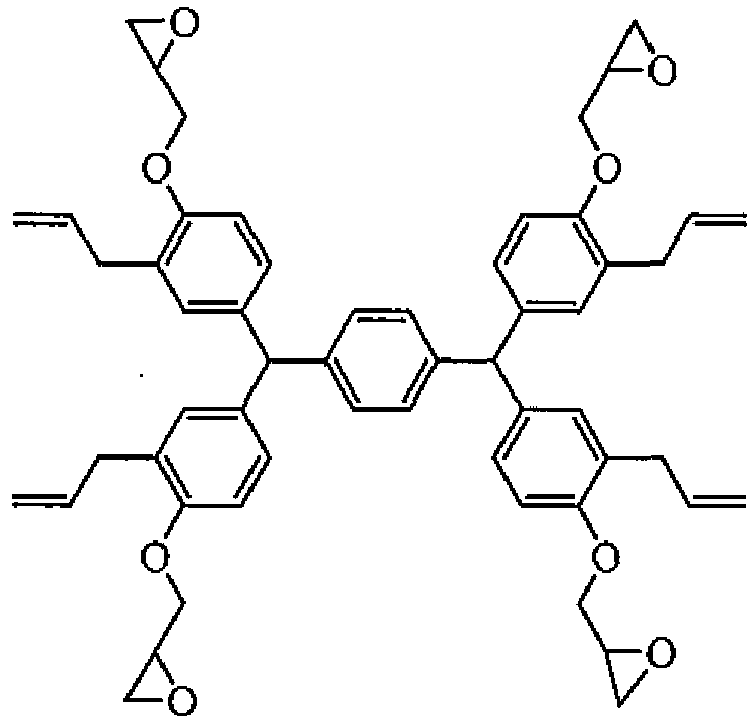
- i-6: Compound E obtained in Comparative Example 1

- RE-810NM: available from Nippon Kayaku Co., Ltd.

- A 2-L separable flask equipped with a nitrogen gas inlet tube, thermometer, Dimroth condenser, vacuum controller, and aspirator was charged with 11.9 g (0.017 mol) of the compound having formula (i-1) (i.e., Compound A in Example 1), 14 g (0.075 mol) of the compound having formula (i-2) and 63.1 g (0.15 mol) of RE-810NM, then with 1,000 g of toluene, and heated at 70°C. Thereafter, 0.25 g of a toluene solution of chloroplatinic acid (platinum concentration 0.5 wt%) was added and 154.7 g (0.05 mol) of the compound having formula (i-3) wherein x=40 and 38.9 g (0.2 mol) of the compound having formula (i-4) were added dropwise over 1 hour. The total moles of hydrosilyl groups to the total moles of alkenyl groups was 1/1. At the end of dropwise addition, the reaction solution was heated at 100°C and aged for 6 hours. Toluene was distilled off in vacuum from the reaction solution, yielding a resin (I) having Mw of 45,000.
- A 2-L separable flask equipped with a nitrogen gas inlet tube, thermometer, Dimroth condenser, vacuum controller, and aspirator was charged with 10.7 g (0.013 mol) of the compound having formula (i-5) (i.e., Compound B in Example 2), 14 g (0.075 mol) of the compound having formula (i-2) and 63.1 g (0.15 mol) of RE-810NM, then with 1,000 g of toluene, and heated at 70°C. Thereafter, 0.25 g of a toluene solution of chloroplatinic acid (platinum concentration 0.5 wt%) was added and 154.7 g (0.05 mol) of the compound having formula (i-3) wherein x=40 and 38.9 g (0.2 mol) of the compound having formula (i-4) were added dropwise over 1 hour. The total moles of hydrosilyl groups to the total moles of alkenyl groups was 1/1. At the end of dropwise addition, the reaction solution was heated at 100°C and aged for 5 hours. Toluene was distilled off in vacuum from the reaction solution, yielding a resin (II) having Mw of 42,000.
- A 2-L separable flask equipped with a nitrogen gas inlet tube, thermometer, Dimroth condenser, vacuum controller, and aspirator was charged with 9.9 g (0.017 mol) of the compound having formula (i-6) (i.e., Compound E in Comparative Example 1) and 14 g (0.075 mol) of the compound having formula (i-2), then with 1,000 g of toluene, and heated at 70°C. Thereafter, 0.25 g of a toluene solution of chloroplatinic acid (platinum concentration 0.5 wt%) was added and 154.7 g (0.05 mol) of the compound having formula (i-3) wherein x=40 and 38.9 g (0.2 mol) of the compound having formula (i-4) were added dropwise over 1 hour. The total moles of hydrosilyl groups to the total moles of alkenyl groups was 1/1. At the end of dropwise addition, the reaction solution was heated at 100°C and aged for 6 hours. Toluene was distilled off in vacuum from the reaction solution, yielding a resin (III) having Mw of 35,000.
- Curable compositions were prepared by mixing an epoxy-modified silicone resin (resins (I) to (III) obtained in Reference Examples 1 and 2 and Comparative Reference Example 1), a crosslinker (CL) having the following structural formula, and a solvent in accordance with the formulation (type and pbw) shown in Table 2.
-

Table 2 Resin pbw Crosslinker pbw Solvent pbw Reference Example 3 (I) 100 CL 15 cyclopentanone 100 Reference Example 4 (II) 100 Comparative Reference Example 2 (III) 100 - The curable compositions obtained in Reference Examples were evaluated for outer appearance, heat resistance, adhesion, and solvent resistance by the following tests. The results are shown in Table 3.
- The curable composition solution was spin coated onto a silicon substrate, then baked on a hot plate at 130°C for 2 minutes and further at 190° C for 1 hour, forming a cured film of 30 µm thick. The cured film was inspected for outer appearance by visual observation and tack by finger touch. The film was rated good "○" when neither cracks nor tack was found and poor "×" when cracks and tack were found.
- The curable composition solution was spin coated onto a silicon substrate, then baked on a hot plate at 130° C for 2 minutes and further at 190°C for 1 hour, forming a cured film of 30 µm thick. The cured film was placed in a nitrogen atmosphere oven at 250°C for 2 hours and then heated on a hot plate at 270° C for 10 minutes. The outer appearance of the film was observed for anomaly. The film was rated good "○" when appearance anomalies such as voids and peels were not found and poor "×" when appearance anomalies were found.
- The curable composition solution was spin coated onto a silicon substrate or copper-deposited silicon substrate, then baked at 130°C for 2 minutes and further at 190°C for 1 hour, forming a cured film. The cured film was placed in a nitrogen atmosphere oven at 250°C for 2 hours and then heated on a hot plate at 270° C for 10 minutes. The film was evaluated for adhesion after temperature exposure by the cross-cut peeling test of JIS K5400 at room temperature. In Table 3, the fractional number represents the number of unpeeled sections per 100 cross-cut sections. Specifically, 100/100 means that all sections are kept intact or unpeeled, and 0/100 means that all sections are peeled off.
- The curable composition solution was spin coated onto a 6-inch (150 mm diameter) silicon wafer, forming a coating of 30 µm thick. The coating was heat dried at 150°C for 2 minutes and then at 200°C for 2 minutes, after which it was immersed in N-methylpyrrolidone (NMP) at 25°C for 10 minutes. The coating was visually inspected whether or not it was dissolved away. The coating was rated good "○" when coating dissolution was not observed and poor "×" when coating dissolution was observed.
Table 3 Reference Example 3 Reference Example 4 Comparative Reference Example 2 Outer appearance ○ ○ ○ Heat resistance ○ ○ × Adhesion (cross-cut peeling test) Silicon 100/100 100/100 90/100 Cu-deposited silicon 100/100 100/100 70/100 Solvent resistance ○ ○ ○ - It has been demonstrated that the novel aryl compound having at least three glycidyl groups and at least three (meth)allyl groups in the molecule is useful as a macro-monomer for heat resistant resin materials.
- It is noted that the invention is not limited to the aforementioned embodiments. While the embodiments are merely exemplary, any embodiments having substantially the same construction as the technical concept set forth in the following claims and exerting equivalent functions and results are believed to be within the spirit and scope of the invention.
- Japanese Patent Application No.
2016-001905 - Although some preferred embodiments have been described, many modifications and variations may be made thereto in light of the above teachings. It is therefore to be understood that the invention may be practiced otherwise than as specifically described without departing from the scope of the appended claims.
Claims (5)
- An aryl compound terminated with glycidyl and (meth)allyl groups, having the general formula (1):

- The aryl compound of claim 1 wherein R1 in formula (1) is a trivalent or tetravalent C3-C15 hydrocarbon group.
- The aryl compound of claim 2 wherein R1 has at least an aromatic or alicyclic group.
- The aryl compound of claim 3 wherein R1 is selected from the following groups:


- A method for preparing an aryl compound having glycidyl and (meth)allyl groups, represented by the general formula (1):

the method comprising the step of reacting an aryl compound having (meth)allyl-containing phenol groups, represented by the general formula (2):

Applications Claiming Priority (2)
| Application Number | Priority Date | Filing Date | Title |
|---|---|---|---|
| JP2016001905 | 2016-01-07 | ||
| JP2016247324A JP6763293B2 (en) | 2016-01-07 | 2016-12-21 | Aryl compound and its production method |
Publications (2)
| Publication Number | Publication Date |
|---|---|
| EP3190107A1 true EP3190107A1 (en) | 2017-07-12 |
| EP3190107B1 EP3190107B1 (en) | 2019-01-30 |
Family
ID=57629470
Family Applications (1)
| Application Number | Title | Priority Date | Filing Date |
|---|---|---|---|
| EP16207328.2A Not-in-force EP3190107B1 (en) | 2016-01-07 | 2016-12-29 | Aryl compound substituted with glycidyl and allyl groups as macromonomer for heat resistant resin materials |
Country Status (2)
| Country | Link |
|---|---|
| US (1) | US9840484B2 (en) |
| EP (1) | EP3190107B1 (en) |
Citations (3)
| Publication number | Priority date | Publication date | Assignee | Title |
|---|---|---|---|---|
| JPH11130838A (en) | 1997-10-28 | 1999-05-18 | Nippon Kayaku Co Ltd | Epoxy resin composition and cured product thereof |
| JP2002249584A (en) | 2001-02-23 | 2002-09-06 | Shin Etsu Chem Co Ltd | Resin composition containing silicone-modified epoxy resin or silicone-modified phenol resin, and semiconductor device using the same |
| US20030078322A1 (en) * | 2001-09-06 | 2003-04-24 | Tsuyoshi Honda | Conductive resin compositions and electronic parts using the same |
-
2016
- 2016-12-29 EP EP16207328.2A patent/EP3190107B1/en not_active Not-in-force
-
2017
- 2017-01-05 US US15/398,838 patent/US9840484B2/en active Active
Patent Citations (5)
| Publication number | Priority date | Publication date | Assignee | Title |
|---|---|---|---|---|
| JPH11130838A (en) | 1997-10-28 | 1999-05-18 | Nippon Kayaku Co Ltd | Epoxy resin composition and cured product thereof |
| JP2002249584A (en) | 2001-02-23 | 2002-09-06 | Shin Etsu Chem Co Ltd | Resin composition containing silicone-modified epoxy resin or silicone-modified phenol resin, and semiconductor device using the same |
| US20020192477A1 (en) * | 2001-02-23 | 2002-12-19 | Tsuyoshi Honda | Silicone-modified epoxy or phenolic resin compositions and semiconductor devices sealed therewith |
| US6709753B2 (en) | 2001-02-23 | 2004-03-23 | Shin-Etsu Chemical Co., Ltd. | Silicone-modified epoxy or phenolic resin compositions and semiconductor devices sealed therewith |
| US20030078322A1 (en) * | 2001-09-06 | 2003-04-24 | Tsuyoshi Honda | Conductive resin compositions and electronic parts using the same |
Also Published As
| Publication number | Publication date |
|---|---|
| EP3190107B1 (en) | 2019-01-30 |
| US9840484B2 (en) | 2017-12-12 |
| US20170197928A1 (en) | 2017-07-13 |
Similar Documents
| Publication | Publication Date | Title |
|---|---|---|
| US8921495B2 (en) | High refractive index compositions containing resin-linear organosiloxane block copolymers | |
| US9181402B2 (en) | Compositions of resin-linear organosiloxane block copolymers | |
| US8476379B2 (en) | Silphenylene skeleton-containing silicone type polymer and method for manufacturing the same | |
| JP5369629B2 (en) | Crosslinkable silicon compound, method for producing the same, crosslinkable composition, siloxane polymer, silicone film, silicon compound as a raw material for the crosslinkable silicon compound, and method for producing the same | |
| EP3190144B1 (en) | Epoxy-modified silicone resin, making method, curable composition, and electronic part | |
| US9212262B2 (en) | Compositions of resin-linear organosiloxane block copolymers | |
| CN106946815B (en) | Aryl compound and method for producing same | |
| JPH05408B2 (en) | ||
| EP3190107B1 (en) | Aryl compound substituted with glycidyl and allyl groups as macromonomer for heat resistant resin materials | |
| US11518852B2 (en) | Polyamideimide resin and use thereof | |
| JP6759031B2 (en) | Aromatic polyetherketone cured product and its manufacturing method | |
| CN118027089A (en) | Double-curable epoxy-terminated polysiloxane and preparation method thereof | |
| JP2000178332A (en) | Thermosetting resin composition | |
| US11214709B2 (en) | Polyamideimide resin and coating material | |
| CN105801864A (en) | Synthesis method for preparing alternating organic silicon polymers at low temperature | |
| WO2022002438A1 (en) | Method for obtaining biosourced polyepoxides with improved properties | |
| US11142611B2 (en) | Aliphatic polycarbonate resin for forming partition, partition material, substrate and production method therefor, production method for wiring substrate, and wiring forming method | |
| CN118978689B (en) | A cross-linked fluorinated polyarylether membrane material, its preparation method and application | |
| US11084902B2 (en) | Aliphatic polycarbonate resin, partition material, substrate and production method therefor, production method for wiring substrate, and wiring forming method | |
| JP5396694B2 (en) | Crosslinkable prepolymer and production method and use thereof | |
| KR102191326B1 (en) | Nitrogen-containing cyclic compound and preparation method thereof | |
| TW200304455A (en) | Polyether and its production method |
Legal Events
| Date | Code | Title | Description |
|---|---|---|---|
| PUAI | Public reference made under article 153(3) epc to a published international application that has entered the european phase |
Free format text: ORIGINAL CODE: 0009012 |
|
| STAA | Information on the status of an ep patent application or granted ep patent |
Free format text: STATUS: THE APPLICATION HAS BEEN PUBLISHED |
|
| AK | Designated contracting states |
Kind code of ref document: A1 Designated state(s): AL AT BE BG CH CY CZ DE DK EE ES FI FR GB GR HR HU IE IS IT LI LT LU LV MC MK MT NL NO PL PT RO RS SE SI SK SM TR |
|
| AX | Request for extension of the european patent |
Extension state: BA ME |
|
| STAA | Information on the status of an ep patent application or granted ep patent |
Free format text: STATUS: REQUEST FOR EXAMINATION WAS MADE |
|
| 17P | Request for examination filed |
Effective date: 20180108 |
|
| RBV | Designated contracting states (corrected) |
Designated state(s): AL AT BE BG CH CY CZ DE DK EE ES FI FR GB GR HR HU IE IS IT LI LT LU LV MC MK MT NL NO PL PT RO RS SE SI SK SM TR |
|
| REG | Reference to a national code |
Ref country code: DE Ref legal event code: R079 Ref document number: 602016009641 Country of ref document: DE Free format text: PREVIOUS MAIN CLASS: C07D0303230000 Ipc: C07D0407140000 |
|
| RIC1 | Information provided on ipc code assigned before grant |
Ipc: C07D 407/14 20060101AFI20180614BHEP |
|
| GRAP | Despatch of communication of intention to grant a patent |
Free format text: ORIGINAL CODE: EPIDOSNIGR1 |
|
| STAA | Information on the status of an ep patent application or granted ep patent |
Free format text: STATUS: GRANT OF PATENT IS INTENDED |
|
| INTG | Intention to grant announced |
Effective date: 20180806 |
|
| GRAS | Grant fee paid |
Free format text: ORIGINAL CODE: EPIDOSNIGR3 |
|
| GRAA | (expected) grant |
Free format text: ORIGINAL CODE: 0009210 |
|
| STAA | Information on the status of an ep patent application or granted ep patent |
Free format text: STATUS: THE PATENT HAS BEEN GRANTED |
|
| RIN1 | Information on inventor provided before grant (corrected) |
Inventor name: YANAIZUMI, KAZUHIDE Inventor name: YANAGISAWA, HIDEYOSHI |
|
| AK | Designated contracting states |
Kind code of ref document: B1 Designated state(s): AL AT BE BG CH CY CZ DE DK EE ES FI FR GB GR HR HU IE IS IT LI LT LU LV MC MK MT NL NO PL PT RO RS SE SI SK SM TR |
|
| REG | Reference to a national code |
Ref country code: GB Ref legal event code: FG4D |
|
| REG | Reference to a national code |
Ref country code: CH Ref legal event code: EP |
|
| REG | Reference to a national code |
Ref country code: AT Ref legal event code: REF Ref document number: 1093155 Country of ref document: AT Kind code of ref document: T Effective date: 20190215 |
|
| REG | Reference to a national code |
Ref country code: IE Ref legal event code: FG4D |
|
| REG | Reference to a national code |
Ref country code: DE Ref legal event code: R096 Ref document number: 602016009641 Country of ref document: DE |
|
| REG | Reference to a national code |
Ref country code: LT Ref legal event code: MG4D |
|
| REG | Reference to a national code |
Ref country code: NL Ref legal event code: MP Effective date: 20190130 |
|
| PG25 | Lapsed in a contracting state [announced via postgrant information from national office to epo] |
Ref country code: ES Free format text: LAPSE BECAUSE OF FAILURE TO SUBMIT A TRANSLATION OF THE DESCRIPTION OR TO PAY THE FEE WITHIN THE PRESCRIBED TIME-LIMIT Effective date: 20190130 Ref country code: PT Free format text: LAPSE BECAUSE OF FAILURE TO SUBMIT A TRANSLATION OF THE DESCRIPTION OR TO PAY THE FEE WITHIN THE PRESCRIBED TIME-LIMIT Effective date: 20190530 Ref country code: SE Free format text: LAPSE BECAUSE OF FAILURE TO SUBMIT A TRANSLATION OF THE DESCRIPTION OR TO PAY THE FEE WITHIN THE PRESCRIBED TIME-LIMIT Effective date: 20190130 Ref country code: PL Free format text: LAPSE BECAUSE OF FAILURE TO SUBMIT A TRANSLATION OF THE DESCRIPTION OR TO PAY THE FEE WITHIN THE PRESCRIBED TIME-LIMIT Effective date: 20190130 Ref country code: NO Free format text: LAPSE BECAUSE OF FAILURE TO SUBMIT A TRANSLATION OF THE DESCRIPTION OR TO PAY THE FEE WITHIN THE PRESCRIBED TIME-LIMIT Effective date: 20190430 Ref country code: LT Free format text: LAPSE BECAUSE OF FAILURE TO SUBMIT A TRANSLATION OF THE DESCRIPTION OR TO PAY THE FEE WITHIN THE PRESCRIBED TIME-LIMIT Effective date: 20190130 Ref country code: FI Free format text: LAPSE BECAUSE OF FAILURE TO SUBMIT A TRANSLATION OF THE DESCRIPTION OR TO PAY THE FEE WITHIN THE PRESCRIBED TIME-LIMIT Effective date: 20190130 Ref country code: NL Free format text: LAPSE BECAUSE OF FAILURE TO SUBMIT A TRANSLATION OF THE DESCRIPTION OR TO PAY THE FEE WITHIN THE PRESCRIBED TIME-LIMIT Effective date: 20190130 |
|
| REG | Reference to a national code |
Ref country code: AT Ref legal event code: MK05 Ref document number: 1093155 Country of ref document: AT Kind code of ref document: T Effective date: 20190130 |
|
| PG25 | Lapsed in a contracting state [announced via postgrant information from national office to epo] |
Ref country code: BG Free format text: LAPSE BECAUSE OF FAILURE TO SUBMIT A TRANSLATION OF THE DESCRIPTION OR TO PAY THE FEE WITHIN THE PRESCRIBED TIME-LIMIT Effective date: 20190430 Ref country code: RS Free format text: LAPSE BECAUSE OF FAILURE TO SUBMIT A TRANSLATION OF THE DESCRIPTION OR TO PAY THE FEE WITHIN THE PRESCRIBED TIME-LIMIT Effective date: 20190130 Ref country code: GR Free format text: LAPSE BECAUSE OF FAILURE TO SUBMIT A TRANSLATION OF THE DESCRIPTION OR TO PAY THE FEE WITHIN THE PRESCRIBED TIME-LIMIT Effective date: 20190501 Ref country code: LV Free format text: LAPSE BECAUSE OF FAILURE TO SUBMIT A TRANSLATION OF THE DESCRIPTION OR TO PAY THE FEE WITHIN THE PRESCRIBED TIME-LIMIT Effective date: 20190130 Ref country code: HR Free format text: LAPSE BECAUSE OF FAILURE TO SUBMIT A TRANSLATION OF THE DESCRIPTION OR TO PAY THE FEE WITHIN THE PRESCRIBED TIME-LIMIT Effective date: 20190130 Ref country code: IS Free format text: LAPSE BECAUSE OF FAILURE TO SUBMIT A TRANSLATION OF THE DESCRIPTION OR TO PAY THE FEE WITHIN THE PRESCRIBED TIME-LIMIT Effective date: 20190530 |
|
| PG25 | Lapsed in a contracting state [announced via postgrant information from national office to epo] |
Ref country code: IT Free format text: LAPSE BECAUSE OF FAILURE TO SUBMIT A TRANSLATION OF THE DESCRIPTION OR TO PAY THE FEE WITHIN THE PRESCRIBED TIME-LIMIT Effective date: 20190130 Ref country code: RO Free format text: LAPSE BECAUSE OF FAILURE TO SUBMIT A TRANSLATION OF THE DESCRIPTION OR TO PAY THE FEE WITHIN THE PRESCRIBED TIME-LIMIT Effective date: 20190130 Ref country code: SK Free format text: LAPSE BECAUSE OF FAILURE TO SUBMIT A TRANSLATION OF THE DESCRIPTION OR TO PAY THE FEE WITHIN THE PRESCRIBED TIME-LIMIT Effective date: 20190130 Ref country code: AL Free format text: LAPSE BECAUSE OF FAILURE TO SUBMIT A TRANSLATION OF THE DESCRIPTION OR TO PAY THE FEE WITHIN THE PRESCRIBED TIME-LIMIT Effective date: 20190130 Ref country code: DK Free format text: LAPSE BECAUSE OF FAILURE TO SUBMIT A TRANSLATION OF THE DESCRIPTION OR TO PAY THE FEE WITHIN THE PRESCRIBED TIME-LIMIT Effective date: 20190130 Ref country code: EE Free format text: LAPSE BECAUSE OF FAILURE TO SUBMIT A TRANSLATION OF THE DESCRIPTION OR TO PAY THE FEE WITHIN THE PRESCRIBED TIME-LIMIT Effective date: 20190130 Ref country code: CZ Free format text: LAPSE BECAUSE OF FAILURE TO SUBMIT A TRANSLATION OF THE DESCRIPTION OR TO PAY THE FEE WITHIN THE PRESCRIBED TIME-LIMIT Effective date: 20190130 |
|
| REG | Reference to a national code |
Ref country code: DE Ref legal event code: R097 Ref document number: 602016009641 Country of ref document: DE |
|
| PG25 | Lapsed in a contracting state [announced via postgrant information from national office to epo] |
Ref country code: SM Free format text: LAPSE BECAUSE OF FAILURE TO SUBMIT A TRANSLATION OF THE DESCRIPTION OR TO PAY THE FEE WITHIN THE PRESCRIBED TIME-LIMIT Effective date: 20190130 |
|
| PLBE | No opposition filed within time limit |
Free format text: ORIGINAL CODE: 0009261 |
|
| STAA | Information on the status of an ep patent application or granted ep patent |
Free format text: STATUS: NO OPPOSITION FILED WITHIN TIME LIMIT |
|
| PG25 | Lapsed in a contracting state [announced via postgrant information from national office to epo] |
Ref country code: AT Free format text: LAPSE BECAUSE OF FAILURE TO SUBMIT A TRANSLATION OF THE DESCRIPTION OR TO PAY THE FEE WITHIN THE PRESCRIBED TIME-LIMIT Effective date: 20190130 |
|
| 26N | No opposition filed |
Effective date: 20191031 |
|
| PGFP | Annual fee paid to national office [announced via postgrant information from national office to epo] |
Ref country code: DE Payment date: 20191217 Year of fee payment: 4 |
|
| PG25 | Lapsed in a contracting state [announced via postgrant information from national office to epo] |
Ref country code: SI Free format text: LAPSE BECAUSE OF FAILURE TO SUBMIT A TRANSLATION OF THE DESCRIPTION OR TO PAY THE FEE WITHIN THE PRESCRIBED TIME-LIMIT Effective date: 20190130 |
|
| PGFP | Annual fee paid to national office [announced via postgrant information from national office to epo] |
Ref country code: FR Payment date: 20191115 Year of fee payment: 4 |
|
| PG25 | Lapsed in a contracting state [announced via postgrant information from national office to epo] |
Ref country code: TR Free format text: LAPSE BECAUSE OF FAILURE TO SUBMIT A TRANSLATION OF THE DESCRIPTION OR TO PAY THE FEE WITHIN THE PRESCRIBED TIME-LIMIT Effective date: 20190130 |
|
| REG | Reference to a national code |
Ref country code: CH Ref legal event code: PL |
|
| REG | Reference to a national code |
Ref country code: BE Ref legal event code: MM Effective date: 20191231 |
|
| PG25 | Lapsed in a contracting state [announced via postgrant information from national office to epo] |
Ref country code: MC Free format text: LAPSE BECAUSE OF FAILURE TO SUBMIT A TRANSLATION OF THE DESCRIPTION OR TO PAY THE FEE WITHIN THE PRESCRIBED TIME-LIMIT Effective date: 20190130 |
|
| PG25 | Lapsed in a contracting state [announced via postgrant information from national office to epo] |
Ref country code: IE Free format text: LAPSE BECAUSE OF NON-PAYMENT OF DUE FEES Effective date: 20191229 Ref country code: LU Free format text: LAPSE BECAUSE OF NON-PAYMENT OF DUE FEES Effective date: 20191229 |
|
| PG25 | Lapsed in a contracting state [announced via postgrant information from national office to epo] |
Ref country code: LI Free format text: LAPSE BECAUSE OF NON-PAYMENT OF DUE FEES Effective date: 20191231 Ref country code: CH Free format text: LAPSE BECAUSE OF NON-PAYMENT OF DUE FEES Effective date: 20191231 Ref country code: BE Free format text: LAPSE BECAUSE OF NON-PAYMENT OF DUE FEES Effective date: 20191231 |
|
| PG25 | Lapsed in a contracting state [announced via postgrant information from national office to epo] |
Ref country code: CY Free format text: LAPSE BECAUSE OF FAILURE TO SUBMIT A TRANSLATION OF THE DESCRIPTION OR TO PAY THE FEE WITHIN THE PRESCRIBED TIME-LIMIT Effective date: 20190130 |
|
| REG | Reference to a national code |
Ref country code: DE Ref legal event code: R119 Ref document number: 602016009641 Country of ref document: DE |
|
| PG25 | Lapsed in a contracting state [announced via postgrant information from national office to epo] |
Ref country code: MT Free format text: LAPSE BECAUSE OF FAILURE TO SUBMIT A TRANSLATION OF THE DESCRIPTION OR TO PAY THE FEE WITHIN THE PRESCRIBED TIME-LIMIT Effective date: 20190130 Ref country code: HU Free format text: LAPSE BECAUSE OF FAILURE TO SUBMIT A TRANSLATION OF THE DESCRIPTION OR TO PAY THE FEE WITHIN THE PRESCRIBED TIME-LIMIT; INVALID AB INITIO Effective date: 20161229 |
|
| GBPC | Gb: european patent ceased through non-payment of renewal fee |
Effective date: 20201229 |
|
| PG25 | Lapsed in a contracting state [announced via postgrant information from national office to epo] |
Ref country code: FR Free format text: LAPSE BECAUSE OF NON-PAYMENT OF DUE FEES Effective date: 20201231 |
|
| PG25 | Lapsed in a contracting state [announced via postgrant information from national office to epo] |
Ref country code: DE Free format text: LAPSE BECAUSE OF NON-PAYMENT OF DUE FEES Effective date: 20210701 Ref country code: GB Free format text: LAPSE BECAUSE OF NON-PAYMENT OF DUE FEES Effective date: 20201229 |
|
| PG25 | Lapsed in a contracting state [announced via postgrant information from national office to epo] |
Ref country code: MK Free format text: LAPSE BECAUSE OF FAILURE TO SUBMIT A TRANSLATION OF THE DESCRIPTION OR TO PAY THE FEE WITHIN THE PRESCRIBED TIME-LIMIT Effective date: 20190130 |