EP3189053B1 - An improved process for the preparation of apixaban and intermediates thereof - Google Patents
An improved process for the preparation of apixaban and intermediates thereof Download PDFInfo
- Publication number
- EP3189053B1 EP3189053B1 EP15837485.0A EP15837485A EP3189053B1 EP 3189053 B1 EP3189053 B1 EP 3189053B1 EP 15837485 A EP15837485 A EP 15837485A EP 3189053 B1 EP3189053 B1 EP 3189053B1
- Authority
- EP
- European Patent Office
- Prior art keywords
- formula
- compound
- inorganic base
- preparation
- morpholine
- Prior art date
- Legal status (The legal status is an assumption and is not a legal conclusion. Google has not performed a legal analysis and makes no representation as to the accuracy of the status listed.)
- Active
Links
- ATNPZEGMKLGIFA-UVTDQMKNSA-N CCOC(/C(/Cl)=N/Nc(cc1)ccc1OC)=O Chemical compound CCOC(/C(/Cl)=N/Nc(cc1)ccc1OC)=O ATNPZEGMKLGIFA-UVTDQMKNSA-N 0.000 description 1
- PPWDTHHKHDAIJM-UHFFFAOYSA-N CCOC(C(C(C(CCN(c(cc1)ccc1N(CCCC1)C1=O)C1=O)=C1Nc(cc1)ccc1OC)=N)=O)=O Chemical compound CCOC(C(C(C(CCN(c(cc1)ccc1N(CCCC1)C1=O)C1=O)=C1Nc(cc1)ccc1OC)=N)=O)=O PPWDTHHKHDAIJM-UHFFFAOYSA-N 0.000 description 1
- SCVWQFDPLBFZAP-UHFFFAOYSA-N O=C(CCCC1)N1c(cc1)ccc1N(CCC=C1N2CCOCC2)C1=O Chemical compound O=C(CCCC1)N1c(cc1)ccc1N(CCC=C1N2CCOCC2)C1=O SCVWQFDPLBFZAP-UHFFFAOYSA-N 0.000 description 1
Images

Classifications
-
- C—CHEMISTRY; METALLURGY
- C07—ORGANIC CHEMISTRY
- C07D—HETEROCYCLIC COMPOUNDS
- C07D471/00—Heterocyclic compounds containing nitrogen atoms as the only ring hetero atoms in the condensed system, at least one ring being a six-membered ring with one nitrogen atom, not provided for by groups C07D451/00 - C07D463/00
- C07D471/02—Heterocyclic compounds containing nitrogen atoms as the only ring hetero atoms in the condensed system, at least one ring being a six-membered ring with one nitrogen atom, not provided for by groups C07D451/00 - C07D463/00 in which the condensed system contains two hetero rings
- C07D471/04—Ortho-condensed systems
-
- C—CHEMISTRY; METALLURGY
- C07—ORGANIC CHEMISTRY
- C07D—HETEROCYCLIC COMPOUNDS
- C07D211/00—Heterocyclic compounds containing hydrogenated pyridine rings, not condensed with other rings
- C07D211/04—Heterocyclic compounds containing hydrogenated pyridine rings, not condensed with other rings with only hydrogen or carbon atoms directly attached to the ring nitrogen atom
- C07D211/80—Heterocyclic compounds containing hydrogenated pyridine rings, not condensed with other rings with only hydrogen or carbon atoms directly attached to the ring nitrogen atom having two double bonds between ring members or between ring members and non-ring members
- C07D211/84—Heterocyclic compounds containing hydrogenated pyridine rings, not condensed with other rings with only hydrogen or carbon atoms directly attached to the ring nitrogen atom having two double bonds between ring members or between ring members and non-ring members with hetero atoms or with carbon atoms having three bonds to hetero atoms, with at the most one bond to halogen directly attached to ring carbon atoms
- C07D211/86—Oxygen atoms
Definitions
- the present invention is related to an improved process for the preparation of Apixaban and to a process to prepare intermediates to be used therein.
- Apixaban a factor Xa inhibitor, marketed as ELIQUIS® reduces the risk of stroke and systemic embolism in patients with nonvalvular atrial fibrillation and for the prophylaxis of deep vein thrombosis (DVT), is chemically described as 1-(4-methoxyphenyl)-7-oxo-6-[4-(2-oxopiperidin-1-yl)phenyl]-4,5,6,7-tetrahydro-1H-pyrazolo[3,4-c]pyridine-3-carboxamide i.e. compound of formula (1).
- PCT application no. 2007/001385 discloses process to prepare of Apixaban by reacting 4-nitroaniline compound of formula (9) with compound of formula (3) in presence of K 2 CO 3 /KOH in the mixture of THF and chlorobenzene to obtain nitrolactam compound of formula (10). It, on dichlorination with PCl 5 produces dichloro compound of formula (11). On dehydrohalogenation in presence of lithium carbonate, it produced mono chloro intermediate compound of formula (12). It, on reaction with hydrazono compound of formula (6) produced compound of formula (13). It is reduced to compound of formula (14) in presence of Pd/C in THF. It's reaction with, compound of formula (3) produces compound of formula (15).
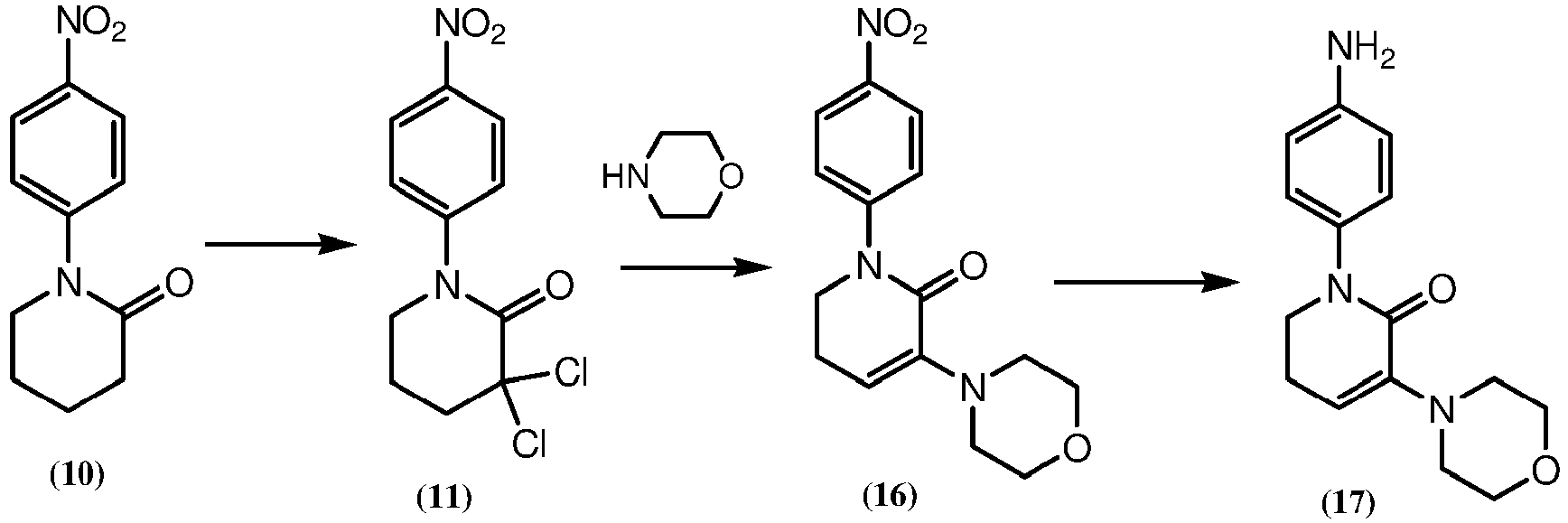
- the starting material 4-nitroaniline compound of formula (9) is reacted with compound of formula (3) in presence of triethyl amine/THF and cyclization is carried out in presence of potassium tert -butoxide to obtain compound of formula (10) which on chlorination with PCl 5 , followed by the condensation-elimination process with excessive morpholine produced nitro-morpholine compound of formula (16) in 78% yield followed by reduction of nitro group in presence of sodium sulfide to obtain aniline-morpholine compound of formula (17).
- Non-patent literature discloses the use of TEA as an acid scavenger in the acylation reaction and then potassium tert -butoxide as a strong condensing agent in the subsequent cyclization during the preparation of compound of formula (10) and (18). It uses large volume of THF for preparation of (10) and (18) and Potassium tert -butoxide is hygroscopic, corrosive in nature.
- the chlorination of compound of formula (10) requires overall 25 volumes of chloroform with PCl 5 . which is undesirable. It uses Na 2 S, a potential environmentally hazardous compound for the reduction of nitro group.
- U.S. Patent No. 7,396,932 discloses complicated process to prepare the Apixaban N-1 crystalline form and H2-2 crystalline form.
- the main object of the invention is to provide a simple and improved process to prepare Apixaban starting from Aniline and the intermediates required in the process.
- the invention provides a simple and improved process to prepare Apixaban from starting from Aniline and the intermediates required in the process.
- the invention provides a single step process to prepare compound of the formula (10) comprising steps of;
- the process to prepare amino-morpholine compound of the formula(17) comprising a process for preparation of a compound of formula (10) as above and further comprising the steps of:
- the invention mainly provides simple and improved process to prepare Apixaban starting from Aniline and the intermediates required in the process.
- the compound of formula (22) is selected from bromovalerylchloride (BVC) or chlorovalerychloride (CVC), more preferably chlorovaleryl chloride.
- the example of leaving group may include but not limited Cl, Br, I, F ,methane sulfate, mesylate, triflate, tosylate and tert-butyldimethylsilyloxy group.
- the inorganic base used in step a) and step c) is selected from sodium carbonate, potassium carbonate, lithium carbonate, lithium hydroxide, sodium hydroxide (NaOH), potassium hydroxide (KOH), ammonium hydroxide, lithium hydrate, potassium hydrate, sodium hydrate, lithium hydrogen carbonate, sodium hydrogen carbonate, potassium hydrogen carbonate or aqueous solution thereof and mixture(s) thereof.
- Preferred base used is KOH or NaOH.
- any base includes organic or inorganic base.
- the reaction in step a) and step c) can be conveniently carried out in presence of a solvent.
- solvent in step a) and step c) may include but not limited to dichloromethane (MDC), ethyl acetate (EtOAc), methyl acetate, CHCl 3 , toluene, chlorobenzene, dimethylformamide (DMF), dimethylacetamide, N-methylpyrrolidone, acetonitrile, dimethyl sulfoxide, tetrahydrofuran (THF), dioxane, ethanol (EtOH), methanol (MeOH) and mixture(s) thereof, preferably used are DMF or MDC.
- step a) reaction of aniline with compound of formula (22) is carried out without using any base i.e. in absence of any base to provide compound of formula (24).
- phase transfer catalyst is selected from quaternary ammonium and phosphonium salts such as methyltridecyl ammonium chloride, trimethyl ammonium chloride, tetrabutyl ammonium bromide, dimethylethyl hexadecyl ammonium bromide, ethyltripentyl ammonium iodide, hexadecyltributylphosphonium bromide benzyl trimethyl ammonium chloride, and the like.
- reaction is successfully carried out optionally isolating compound of the formula (24) and can be isolated by method known in the art such as cooling, filtration, centrifugation, washing, drying and combination thereof.
- molar equivalent of halovalerylhalide used in step a) from 1.0, 1.05, 1.1, 1.25, 1.35, to 1.5 equivalents, preferably between 1.1 to 1.5 equivalents and more preferably between 1.1 to 1.2 equivalents.
- the molar equivalent of base used in step a) from 0.5, 0.6, 0.7, 0.8, 0.9, 1.0, 1.1, 1.2, 1.3, 1.4 to 1.5 and in step c) from 2.0, 2.5, 3.0, 3.5 to 4.0, more preferably 3.0 equivalents.
- step a) and c) is performed preferably in a temperature range between 0°C to ambient temperature.
- Inventive step of the present invention resides in use of single inorganic base or in the absence of the base as against two bases (organic and inorganic) used in CN 103626689 .
- Inherent limitations of CN 103626689 forced the use of inorganic base in next part of reaction, as is evident from the claim 1.
- Prior art discloses acylation/cyclization reaction in presence of multiple bases such as TEA and potassium tert -butoxide which is hygroscopic and corrosive in nature.
- acylation / cyclization reaction for the preparation of compound of formula (21) is performed in the presence of single inorganic base or aqueous solution of inorganic base such as KOH instead of use of multiple bases.
- the inventive step resides not only in improved purity and better yields but also in flexibility to use more than one inorganic base to carry out the same reaction.
- the nitration of compound of formula (24) is carried out with a nitrating agent, such as nitric acid in presence of sulfuric acid or acetic acid.
- a nitrating agent such as nitric acid in presence of sulfuric acid or acetic acid.
- the molar equivalent of nitrating agent used is from 0.9. 1.0. 1.05 0.9, 1.0 1.05, 1.1 to 1.2, more preferably 1.05 equivalents.
- the amount of sulfuric acid used from 1.0, 1.2, 1.3, 1.5, 1.8 to 2.0 Vol wrt the compound of formula (24) accordingly, preferred being 1.6 Vol.
- the nitration of compound of formula(24) can be performed in a temperature between -10°C to ambient temperature, more preferably at temperature in between -5°C to 10°C.
- Present invention provides a simple and cost effective process for the preparation of compound of formula (10) by using very cheap aniline as starting material as compared to expensive nitro aniline described in prior art.
- the reaction is successfully carried out optionally isolating compound of the formula (24) and (25).
- Isolation of compound of formula (24) and (25) can be carried out by any method known in the art such as cooling, filtration, centrifugation, washing, drying and combination thereof.
- Another aspect of the present invention is to provide a process for the preparation of amino-morpholine compound of formula (17) comprising a process for the preparation of the compound of formula (10) as above and comprising the further steps of:
- Inventive step of the invention also resides in use of non halogenated solvents and mixtures thereof in step d) as shown in one preferred embodiment of the invention, the chlorination of compound of formula (10) in step d).
- Chlorinating agents selected from group consisting of thionyl chloride (SOCl 2 ), phosphorous trichloride (PCl 3 ) or PCl 5 .
- SOCl 2 thionyl chloride
- PCl 3 phosphorous trichloride
- the molar equivalent of chlorinating agent used from 2.5, 2.7, 2.9, 3.0, 3.2, 3.4, to 3.5 more preferably 3.0 equivalents.
- the said chlorination can be performed in a temperature between 45°C to 90°C more preferably at temperature 65°C-75°C.
- Non limiting examples of non-halogenated solvents include toluene, xylene, benzene, acetic acid, ethyl acetate, tetrahydrofuran, methyl t-butyl ether, methyl ethyl ketone; dioxane and mixture(s) thereof preferably used toluene.
- the nitro-morpholine compound of formula (16) of step e) is obtained by simultaneous condensation-elimination reaction with excess of morpholine with compound of formula (11).
- the excess of morpholine used from 2.0, 3.0, 4.0 to 5.0 volumes, more preferably 2.0 to 3.0 volumes wrt the compound of formula (11).
- the reaction can be performed at a temperature 90°C to 130°C.
- nitro-morpholine of formula (16) involves exothermic reaction of dissolving compound of formula (11) in morpholine and refluxing it.
- Present invention minimizes exothermic reaction using solvent and morpholine in preparation of nitro-morpholine.
- the solvent used in step (b) may include N-Methyl-2-pyrrolidone or DMF.
- the morpholine is used from 2.0, 3.0, and 4.0 to 5.0 volumes, more preferably 1.5 to 2.0 volumes wrt the compound of formula (11).
- the reaction can be performed at a temperature 60°C to 130°C.
- the obtained product can be optionally recrystallized in presence of suitable solvent selected from the group of alcohols, ketones, esters, ethers, nitriles and mixture(s) thereof, preferably MeOH.
- the amino-morpholine compound of formula (17) of step f) is obtained by reducing nitro-morpholine compound of formula (16).
- Prior art disclose the reduction of nitro group of compound of formula (16) in presence of potentially environmentally hazardous Na 2 S, in the presence of expensive metals like palladium, platinum, ruthenium etc. and requires precautions, due to their flammable nature in the air. It also required highly diffusible and flammable compressed hydrogen gas, besides reflux temperatures and longer hours. Procedures of prior art are complicated.
- Present invention is devoid of Na 2 S.
- Present invention reduces of nitro group of nitro-morpholine by drop wise addition of hydrazine hydrate to the solution of nitro-morpholine, EtOH, water and catalytic amount of Raney Nickel at temperature in between 50°C to 75°C.
- Solvent is selected from water, isopropyl alcohol (IPA), EtOH, MeOH, n-propanol or aq. solution thereof and mixture(s) thereof or aqueous solutions thereof.
- IPA isopropyl alcohol
- EtOH EtOH
- MeOH MeOH
- n-propanol n-propanol or aq. solution thereof
- mixture(s) thereof or aqueous solutions thereof IPA
- the molar equivalent of hydrogenating agent is used from 2.0, 3.0, 4.0, 5.0, to 6.0 equivalents more preferably 4.0 mole equivalent.
- the mole ratio of catalyst includes 2%, 3%, 4% to 5% more preferably around 4%.
- the 1,3-cycloaddition involves reaction of hydrazono compound of formula (6) with lactam compound of formula (18) in presence of a solvent and base at ambient temperature to reflux temperature to obtain ester compound of formula (8).
- solvents may include but not limited to ethyl acetate, dichloromethane, tetrahydrofuran, acetonitrile and mixture(s) thereof.
- base may include triethyl amine, diisopropylethylamine and the like at temperature between 0°C to ambient more preferably at room temperature.
- Another aspect of the present invention is to provide improved process for the preparation of Apixaban compound of formula (1) comprising a process for the preparation of the compound of formula (10) as above and further comprising the aminolysis of compound of formula (8) in anhydrous
- Methanolic ammonia Methanolic ammonia.
- the aminolysis of carried out at temperature range between 60°C to 70°C in a closed autoclave condition.
- Reaction of compound of formula (8) with ammonia can also be carried out at temperature between 40°C to 65°C in a closed autoclave condition.
- N-1 crystalline form of Apixaban may comprise steps of;
- Another process for the preparation N-1 crystalline form of Apixaban may comprise steps of;
- polar solvent includes but not limited to alcohols, amides and sulfoxides or mixture(s) thereof.
- alcoholic solvents may include MeOH, EtOH, propanol, 1,2-propylene glycol, chlorobutanol.
- amide solvents may include DMF, diethylformamide, dimethylacetamide, N-methylpyrrolidone.
- sulfoxide may include dimethyl sulfoxide.
- Apixaban can be prepared such that the compound of formula (8), imp-A and imp-6 is less than 0.1% w/w of Apixaban, as measured by HPLC (high performance liquid chromatography).
- the product is isolated by conventional means e.g. either direct filtration of the solid product or addition of antisolvent followed by filtration of the product, or complete or partial solvent evaporation and recovering the product.
- the obtained product can optionally be purified by conventional means, such as recrystallization from a suitable solvent or mixture(s) of solvents, recrystallization using solvent-anti-solvent mixture(s), reslurrying in solvent or mixture(s) of solvent, treatment with a base or an acid.
- Apixaban N-1 form can be recovered by one of the known techniques, such as filtration or centrifugation, preferably filtration.
- synthesis products are listed as having been isolated as a residue. It will be understood by one of ordinary skill in the art that the term “residue” does not limit the physical state in which the product was isolated and may include, for example, a solid, oil, foam, a gum, syrup, and the like.
- the process to produce Apixaban comprises processes to produce compounds of the formula (8), (10), (11), (16), (17), (18), (23), (24) and (25) as described above and is schematically represented as below:
- Example IIA The compound of example IIA were prepared by a method analogous to that described in Example No II by using 5-chloro-N-phenylpentanamide as a Starting material.
- Example IIB The compound of example IIB were prepared by a method analogous to that described in Example No IA for cyclisation reaction by using 5-chloro-N-(4-nitrophenyl) pentanamide as a Starting material.
- PCl 5 (212.5 g, 1.02 mol) was slowly added to a solution of the product of example-II (75 g, 0.340mol) in Toluene (225 mL) at 25-30°C.
- the resulting mixture was gradually heated to 75-80°C for 1b and poured into ice water (1L), maintaining temperature below 10°C.
- the quenched mass was stirred at 0-5°C for 1h and filtered under suction.
- the pale yellow colored product was dried in air oven at 55°-60°C for 6-8 hrs.
- the dried product was dissolved in DMF (130ml) and morpholine (130 ml) and refluxed for 1 h.
- the reaction mixture was cooled to 60°C and water was added to the reaction mass at the same temperature.
- Example-VA Synthesis of 3-Morpholino-1-(4-(2-oxopiperidin-1-yl)phenyl)-5,6-dihydro pyridin-2(1H)-one (18)
- Example-IX Synthesis of compound of formula (I) : 1-(4-Methoxyphenyl)-7-oxo-6-(4-(2-oxopiperidin-1-yl)phenyl)-4,5,6,7-tetrahydro-1H-pyrazolo[3,4-c]pyridine-3-carboxamide :[Apixaban] (1)
- Example-X Preparation of Apixaban of formula (I), crystalline form N-1 (not according to the invention) : The obtained
- Apixaban (25gm) was dissolved in mixture of MeOH and DMF [(7:3), 650ml] at about 70°C. After cooling the reaction mass the crystallized product was collected by filtration and dried under vacuum at 70°C for 12hrs to afford 20gm Apixaban.
- XRPD main peaks in 2 ⁇ : 8.4, 10.0, 10.50, 11.2, 12.3, 12.8, 13.9, 15.16, 16.2, 16.9, 18.4, 18.8, 19.5, 21.1, 21.5, 22.2, 24.7, 25.3, 25.9, 26.9, 27.7, 28.6, 29.2, 29.9, 30.6, 31.7, 32.7 and 34.9 0 in 2 theta value. As in Fig No. 1.
- XRPD main peaks in 2 ⁇ : 8.4, 10.0, 10.50, 11.2, 12.3, 12.8, 13.9, 15.16, 16.2, 16.9, 18.4, 18.8, 19.5, 21.1, 21.5, 22.2, 24.7, 25.3, 25.9, 26.9, 27.7, 28.6, 29.2, 29.9, 30.6, 31.7, 32.7 and 34.9 0 in 2 theta value.
- Fig No. 1 Fig No. 1.
Landscapes
- Chemical & Material Sciences (AREA)
- Organic Chemistry (AREA)
- Low-Molecular Organic Synthesis Reactions Using Catalysts (AREA)
- Pharmaceuticals Containing Other Organic And Inorganic Compounds (AREA)
- Heterocyclic Carbon Compounds Containing A Hetero Ring Having Nitrogen And Oxygen As The Only Ring Hetero Atoms (AREA)
- Organic Low-Molecular-Weight Compounds And Preparation Thereof (AREA)
Description
- The present invention is related to an improved process for the preparation of Apixaban and to a process to prepare intermediates to be used therein.
- Apixaban, a factor Xa inhibitor, marketed as ELIQUIS® reduces the risk of stroke and systemic embolism in patients with nonvalvular atrial fibrillation and for the prophylaxis of deep vein thrombosis (DVT), is chemically described as 1-(4-methoxyphenyl)-7-oxo-6-[4-(2-oxopiperidin-1-yl)phenyl]-4,5,6,7-tetrahydro-1H-pyrazolo[3,4-c]pyridine-3-carboxamide i.e. compound of formula (1).

-
US 6,413,980 by Bristol-Mayer first disclosed Apixaban, but is silent on process to prepare Apixaban. It is disclosed inUS 6,967,208 . It teaches use of multiple bases, TEA as acid scavenger and potassium tert-butoxide as strong condensing agent to produce iodo-lactam compound of formula (4) in 81% yield which is dichlorinated with phosphorus pentachloride (PCl5) in presence of chloroform to obtain morpholine compound of formula (5) in 63% yield and finally to iodo compound of formula (7) in 18 % yield. Compound of formula (7) undergoes Ullmann reaction with piperidine-2-one catalyzed by copper or bivalent copper ions in presence of base at 130°C for 24 hrs to obtain ester of compound of formula (8) followed by aminolysis in presence of ethylene glycol at 125°C to Apixaban compound of formula (1) in 68% yield as depicted in Scheme 1.
-
PCT application 2012/168364 described process to prepare Apixaban by reacting Para-Iodo ketolactam compound of formula (19) with trimethyl silyl chloride to obtain diene compound of formula (20). On cycloaddition with hydrazono compound of formula (6), it produces iodo compound of formula (7) in 63% yield. It, on Ullmann reaction with Pipyridin-2-one in presence of Copper produces ester compound of formula (8) in 67% yield followed by aminolysis with aq. Ammonia to obtain Apixaban compound of formula (1) as shown inscheme 2.
- US'980 and WO' 364 teach use of costly Iodo-compounds. Ullmann reaction / condensation involves use of copper besides drawbacks of harsh reaction conditions, high reaction temperature, long reaction time, high metal loading and the reaction has a reputation for erratic yields.
-
PCT application no. 2007/001385 discloses process to prepare of Apixaban by reacting 4-nitroaniline compound of formula (9) with compound of formula (3) in presence of K2CO3/KOH in the mixture of THF and chlorobenzene to obtain nitrolactam compound of formula (10). It, on dichlorination with PCl5 produces dichloro compound of formula (11). On dehydrohalogenation in presence of lithium carbonate, it produced mono chloro intermediate compound of formula (12). It, on reaction with hydrazono compound of formula (6) produced compound of formula (13). It is reduced to compound of formula (14) in presence of Pd/C in THF. It's reaction with, compound of formula (3) produces compound of formula (15). On cyclization and aminolysis with ammonia in presence of propylene glycol it produces Apixaban compound of formula (1) as depicted in Scheme 3.
Synthetic communication, 2013, 43, 72-79 disclosed preparation of Apixaban using key intermediate compound of formula (18). The starting material 4-nitroaniline compound of formula (9) is reacted with compound of formula (3) in presence of triethyl amine/THF and cyclization is carried out in presence of potassium tert-butoxide to obtain compound of formula (10) which on chlorination with PCl5, followed by the condensation-elimination process with excessive morpholine produced nitro-morpholine compound of formula (16) in 78% yield followed by reduction of nitro group in presence of sodium sulfide to obtain aniline-morpholine compound of formula (17). Similarly second acylation /cyclization of compound of formula (17) with compound of formula (3') in two steps, produced key intermediate having lactam compound of formula (18), wherein acylation is carried out in presence of triethyl amine/THF and cyclization is carried out in presence of potassium tert-butoxide. The compound of formula (18) is reacted with hydrazono compound of formula (6) to obtain ester compound of formula (8) which by aminolysis in methanolic ammonia solution produced Apixaban compound of formula (1) as depicted in Scheme 4.
CN 103626689 patent application discloses the reaction of aniline with compound of formula (3') in presence of organic base in organic solvent to obtain compound of formula (24), which is then reacted with inorganic base to obtain compound of formula (21). Nitrating compound of formula (21) by conc. sulfuric acid and nitric acid produces compound of formula (10). The process to prepare (21) needs with two bases, organic base for acylation and inorganic base for cyclization. This multiplied material requirement has disadvantages associated with it. Reported yields in some stages are poor and it is silent on purity aspects. -
U.S. Patent No. 7,396,932 discloses complicated process to prepare the Apixaban N-1 crystalline form and H2-2 crystalline form. - US'980 disclosed the aminolysis of compound of formula (8) in presence of ammonia in ethylene glycol. Whereas WO'364 and Syn. Comm. 2013 disclosed aminolysis in aqueous ammonia in MeOH which produces acid impurity (8a). The acid impurity (8a) directly effect on yield of the final product and also involves extra purification process.
- Above prior arts disclosed the use of expensive nitro aniline compound for the preparation of compound of formula (10).
- Various processes are disclosed in
CN101967145 ,CN102675314 andWO2013119328 for the preparation of Apixaban which are quite complicated. - In view of prior art methods available for the preparation Apixaban and its intermediates, there is a need for simple and cost effective processes as well as industrial and environmental friendly improved process for preparing Apixaban. Industry needs a simpler process that uses relatively inexpensive starting materials to provide significant economic advantages yet produces Apixaban in high yield.
- The main object of the invention is to provide a simple and improved process to prepare Apixaban starting from Aniline and the intermediates required in the process.
- The invention provides a simple and improved process to prepare Apixaban from starting from Aniline and the intermediates required in the process.
- The invention provides a single step process to prepare compound of the formula (10) comprising steps of;

- a. reacting aniline with compound of formula (22) in presence of inorganic base or aqueous solution of inorganic base or absence of any base to obtain compound of formula (24) wherein X is leaving group;
- a1. optionally isolating the compound of formula (24);
- b. nitrating compound of formula (24) to obtain compound of formula (25) using Nitric acid in Sulphuric acid or Acetic acid;
b1.optionally isolating the compound of formula (25); - c. cyclizing compound of formula (25) in presence of inorganic base or aqueous solution of inorganic base or absence of any base to obtain compound of formula (10).
- According to another aspect of the invention is provided the process to prepare amino-morpholine compound of the formula(17) comprising a process for preparation of a compound of formula (10) as above and further comprising the steps of:
- d. reacting a compound of formula (10) with chlorinating agent in presence of non-halogenated solvent to obtain compound of formula (11);
- e. reacting compound of formula (11) with morpholine optionally in presence solvent to obtain nitro-morpholine of formula (16);
- e1. optionally isolating and purifying the nitro-morpholine of formula (16);
- f. reducing nitro-morpholine of formula (16) in presence of a hydrazine hydrate with catalytic amount of Raney Nickel to obtain compound of formula (17).

- According to one aspect of the invention is provided the process to prepare Apixaban.

- The invention mainly provides simple and improved process to prepare Apixaban starting from Aniline and the intermediates required in the process.
- According to the invention, there is provided an improved process to prepare compound of the formula (10) as described in claim 1. The compound of formula (22) is selected from bromovalerylchloride (BVC) or chlorovalerychloride (CVC), more preferably chlorovaleryl chloride.
- The example of leaving group may include but not limited Cl, Br, I, F ,methane sulfate, mesylate, triflate, tosylate and tert-butyldimethylsilyloxy group.
- The inorganic base used in step a) and step c) is selected from sodium carbonate, potassium carbonate, lithium carbonate, lithium hydroxide, sodium hydroxide (NaOH), potassium hydroxide (KOH), ammonium hydroxide, lithium hydrate, potassium hydrate, sodium hydrate, lithium hydrogen carbonate, sodium hydrogen carbonate, potassium hydrogen carbonate or aqueous solution thereof and mixture(s) thereof. Preferred base used is KOH or NaOH. Hereafter the term any base includes organic or inorganic base.
- The reaction in step a) and step c) can be conveniently carried out in presence of a solvent. The example of solvent in step a) and step c) may include but not limited to dichloromethane (MDC), ethyl acetate (EtOAc), methyl acetate, CHCl3, toluene, chlorobenzene, dimethylformamide (DMF), dimethylacetamide, N-methylpyrrolidone, acetonitrile, dimethyl sulfoxide, tetrahydrofuran (THF), dioxane, ethanol (EtOH), methanol (MeOH) and mixture(s) thereof, preferably used are DMF or MDC.
- In step a) reaction of aniline with compound of formula (22) is carried out without using any base i.e. in absence of any base to provide compound of formula (24).
- The reaction in step a) and step c) can be conveniently and optionally carried out in presence of a phase transfer catalyst. The examples of phase transfer catalyst is selected from quaternary ammonium and phosphonium salts such as methyltridecyl ammonium chloride, trimethyl ammonium chloride, tetrabutyl ammonium bromide, dimethylethyl hexadecyl ammonium bromide, ethyltripentyl ammonium iodide, hexadecyltributylphosphonium bromide benzyl trimethyl ammonium chloride, and the like.
- The reaction is successfully carried out optionally isolating compound of the formula (24) and can be isolated by method known in the art such as cooling, filtration, centrifugation, washing, drying and combination thereof.
- The molar equivalent of halovalerylhalide used in step a) from 1.0, 1.05, 1.1, 1.25, 1.35, to 1.5 equivalents, preferably between 1.1 to 1.5 equivalents and more preferably between 1.1 to 1.2 equivalents.
- The molar equivalent of base used in step a) from 0.5, 0.6, 0.7, 0.8, 0.9, 1.0, 1.1, 1.2, 1.3, 1.4 to 1.5 and in step c) from 2.0, 2.5, 3.0, 3.5 to 4.0, more preferably 3.0 equivalents.
- The reaction of step a) and c) is performed preferably in a temperature range between 0°C to ambient temperature.
- Inventive step of the present invention resides in use of single inorganic base or in the absence of the base as against two bases (organic and inorganic) used in
CN 103626689 . Inherent limitations ofCN 103626689 forced the use of inorganic base in next part of reaction, as is evident from the claim 1. Prior art discloses acylation/cyclization reaction in presence of multiple bases such as TEA and potassium tert-butoxide which is hygroscopic and corrosive in nature. In the present invention acylation / cyclization reaction for the preparation of compound of formula (21) is performed in the presence of single inorganic base or aqueous solution of inorganic base such as KOH instead of use of multiple bases. Further, the inventive step resides not only in improved purity and better yields but also in flexibility to use more than one inorganic base to carry out the same reaction. - Prior art teaches or discloses reaction of Aniline with compound of the formula (22) in presence of base. Inventive step of the present invention also resides in reaction of the Aniline with compound of formula (22) without using base.
- Present invention provides a cleaner method free of tedious and cumbersome procedures for isolation of product. Surprisingly the yields of acylation and cyclization are far better than the yields disclosed by
CN 103626689 . - The nitration of compound of formula (24) is carried out with a nitrating agent, such as nitric acid in presence of sulfuric acid or acetic acid. The molar equivalent of nitrating agent used is from 0.9. 1.0. 1.05 0.9, 1.0 1.05, 1.1 to 1.2, more preferably 1.05 equivalents. The amount of sulfuric acid used from 1.0, 1.2, 1.3, 1.5, 1.8 to 2.0 Vol wrt the compound of formula (24) accordingly, preferred being 1.6 Vol. The nitration of compound of formula(24) can be performed in a temperature between -10°C to ambient temperature, more preferably at temperature in between -5°C to 10°C.
- Present invention provides a simple and cost effective process for the preparation of compound of formula (10) by using very cheap aniline as starting material as compared to expensive nitro aniline described in prior art. The reaction is successfully carried out optionally isolating compound of the formula (24) and (25). Isolation of compound of formula (24) and (25) can be carried out by any method known in the art such as cooling, filtration, centrifugation, washing, drying and combination thereof.
- Another aspect of the present invention is to provide a process for the preparation of amino-morpholine compound of formula (17) comprising a process for the preparation of the compound of formula (10) as above and comprising the further steps of:
- d. reacting the compound of formula (10) with chlorinating agent in presence of non- halogenated solvent to obtain compound of formula (11);
- e. reacting compound of formula (11) with morpholine optionally in presence solvent to obtain nitro-morpholine of formula (16);
- e1. optionally isolating and purifying the nitro-morpholine of formula (16);
- f. reducing nitro-morpholine of formula (16) in presence of a hydrazine hydrate with catalytic amount of Raney Nickel to obtain compound of formula (17).

- Inventive step of the invention also resides in use of non halogenated solvents and mixtures thereof in step d) as shown in one preferred embodiment of the invention, the chlorination of compound of formula (10) in step d).
- Chlorinating agents selected from group consisting of thionyl chloride (SOCl2), phosphorous trichloride (PCl3) or PCl5. The molar equivalent of chlorinating agent used from 2.5, 2.7, 2.9, 3.0, 3.2, 3.4, to 3.5 more preferably 3.0 equivalents. The said chlorination can be performed in a temperature between 45°C to 90°C more preferably at temperature 65°C-75°C.
- Non limiting examples of non-halogenated solvents include toluene, xylene, benzene, acetic acid, ethyl acetate, tetrahydrofuran, methyl t-butyl ether, methyl ethyl ketone; dioxane and mixture(s) thereof preferably used toluene.
- The nitro-morpholine compound of formula (16) of step e) is obtained by simultaneous condensation-elimination reaction with excess of morpholine with compound of formula (11). The excess of morpholine used from 2.0, 3.0, 4.0 to 5.0 volumes, more preferably 2.0 to 3.0 volumes wrt the compound of formula (11). The reaction can be performed at a temperature 90°C to 130°C.
- The process for the preparation of nitro-morpholine of formula (16) involves exothermic reaction of dissolving compound of formula (11) in morpholine and refluxing it. Present invention minimizes exothermic reaction using solvent and morpholine in preparation of nitro-morpholine. The solvent used in step (b) may include N-Methyl-2-pyrrolidone or DMF. The morpholine is used from 2.0, 3.0, and 4.0 to 5.0 volumes, more preferably 1.5 to 2.0 volumes wrt the compound of formula (11).
- The reaction can be performed at a temperature 60°C to 130°C. The obtained product can be optionally recrystallized in presence of suitable solvent selected from the group of alcohols, ketones, esters, ethers, nitriles and mixture(s) thereof, preferably MeOH.
- The amino-morpholine compound of formula (17) of step f) is obtained by reducing nitro-morpholine compound of formula (16).
- Prior art disclose the reduction of nitro group of compound of formula (16) in presence of potentially environmentally hazardous Na2S, in the presence of expensive metals like palladium, platinum, ruthenium etc. and requires precautions, due to their flammable nature in the air. It also required highly diffusible and flammable compressed hydrogen gas, besides reflux temperatures and longer hours. Procedures of prior art are complicated. Present invention is devoid of Na2S. Present invention reduces of nitro group of nitro-morpholine by drop wise addition of hydrazine hydrate to the solution of nitro-morpholine, EtOH, water and catalytic amount of Raney Nickel at temperature in between 50°C to 75°C.
- Solvent is selected from water, isopropyl alcohol (IPA), EtOH, MeOH, n-propanol or aq. solution thereof and mixture(s) thereof or aqueous solutions thereof.
- The molar equivalent of hydrogenating agent is used from 2.0, 3.0, 4.0, 5.0, to 6.0 equivalents more preferably 4.0 mole equivalent. The mole ratio of catalyst includes 2%, 3%, 4% to 5% more preferably around 4%.
- The process for the preparation of hydrazono compound of formula (6) comprising reacting p-anisidine with sodium nitrite and hydrochloric acid, followed by reaction with ethyl-2-chloroacetoacetate it is well known in the art.

- The 1,3-cycloaddition involves reaction of hydrazono compound of formula (6) with lactam compound of formula (18) in presence of a solvent and base at ambient temperature to reflux temperature to obtain ester compound of formula (8).

- The example of solvents may include but not limited to ethyl acetate, dichloromethane, tetrahydrofuran, acetonitrile and mixture(s) thereof. The examples of base may include triethyl amine, diisopropylethylamine and the like at temperature between 0°C to ambient more preferably at room temperature.
- Another aspect of the present invention is to provide improved process for the preparation of Apixaban compound of formula (1) comprising a process for the preparation of the compound of formula (10) as above and further comprising the aminolysis of compound of formula (8) in anhydrous
- Methanolic ammonia. The aminolysis of carried out at temperature range between 60°C to 70°C in a closed autoclave condition. Reaction of compound of formula (8) with ammonia can also be carried out at temperature between 40°C to 65°C in a closed autoclave condition.
- The preparation of N-1 crystalline form of Apixaban may comprise steps of;
- dissolving apixaban in mixture of MeOH and DMF;
- optionally heating the solution at temperature range of 60°C to 70°C; recovering N-1 crystalline form of Apixaban.
- Another process for the preparation N-1 crystalline form of Apixaban may comprise steps of;
- dissolving Apixaban in polar solvent;
- optionally heating the solution at temperature range of 60°C to 80°C;
- add water to the solution;
- recovering N-1 crystalline form of Apixaban.
- The example of polar solvent includes but not limited to alcohols, amides and sulfoxides or mixture(s) thereof. The examples of alcoholic solvents may include MeOH, EtOH, propanol, 1,2-propylene glycol, chlorobutanol. The example of amide solvents may include DMF, diethylformamide, dimethylacetamide, N-methylpyrrolidone. The example of sulfoxide may include dimethyl sulfoxide.
- For purification of Apixaban it can be dissolved in DMF and water can be added as an antisolvent.
- Apixaban can be prepared such that the compound of formula (8), imp-A and imp-6 is less than 0.1% w/w of Apixaban, as measured by HPLC (high performance liquid chromatography).
- The product is isolated by conventional means e.g. either direct filtration of the solid product or addition of antisolvent followed by filtration of the product, or complete or partial solvent evaporation and recovering the product.
- The obtained product can optionally be purified by conventional means, such as recrystallization from a suitable solvent or mixture(s) of solvents, recrystallization using solvent-anti-solvent mixture(s), reslurrying in solvent or mixture(s) of solvent, treatment with a base or an acid. Apixaban N-1 form can be recovered by one of the known techniques, such as filtration or centrifugation, preferably filtration.
- In following examples, some synthesis products are listed as having been isolated as a residue. It will be understood by one of ordinary skill in the art that the term "residue" does not limit the physical state in which the product was isolated and may include, for example, a solid, oil, foam, a gum, syrup, and the like.
- The process to produce Apixaban comprises processes to produce compounds of the formula (8), (10), (11), (16), (17), (18), (23), (24) and (25) as described above and is schematically represented as below:

- The following examples are set forth to aid the understanding of the invention, and should not be construed to limit in any way the invention set forth in the claims which follow thereafter. The present invention provides process for preparation of Apixaban which is devoid of Ullmann reaction.
- A solution of 5-chlorovaleroyl chloride (CVC, 174gm, 1.12mol) in methylene dichloride (MDC) (100ml) added to the suspension of aniline (100gm, 1.07mol), sodium hydroxide (52gm, 1.3mol), TBAB (2gm) in MDC (900ml) and Water (112ml) at 0-5°C over 1hrs and was slowly brought to 25 to 30°C. Organic layer separated, washed with water (200ml), dried over anhydrous sodium sulfate and distilled at 50°C to get a residue. The residue was purified in hexane to get white crystals of 5-Chloro-pentanoic acid phenylamide (24). Yield: 222.4 gm, 97.84%
- A solution of 5-chlorovaleroyl chloride (CVC, 174gm, 1.12mol) in methylene dichloride (100ml) was added to the suspension of aniline (100gm, 1.07mol), sodium hydroxide (52gm, 1.3 mol), TBAB (2gm) in methylene dichloride (900ml) and Water (112ml) at 0-5°C over 1hrs. The mixture was slowly brought to 25 to 30°C and then aq. solution of KOH (200gm, 3.57mol in 310ml water) was added slowly in 10-15 min and stirred for 5-6hrs at room temperature. Organic layer was separated, washed with water (200ml) and distilled out atmospherically at 50°C to get a residue. Toluene (200ml) and Hexane (600ml) were added to the residue and stirred at same temperature for 30min. The resulting slurry was gradually cooled to 0-5°C and filtered. Solid dried at about 50°C to afford the desired product as white crystals. Yield: 185 g, 97.36% Purity: 99.55% MP-98-100°C
- Cold nitric acid (70%, 54g, 0.6mol) was added drop wise to the precooled solution of example - IA (100gm, 0.57mol) in 160ml of Sulphuric acid at 0-5°C over 1- 2 hrs. After complete addition, reaction mass was quenched over ice-water and stirred for 1hr. Filtered off solid, washed with cold water (65ml x 3times), unloaded and dried at 50-60C in hot air oven for about 5-6hrs. Pale yellow solid was obtained. Yield: 100.5 gm, 80%. The product can be optionally purified from IPA to give off white solid.
- The compound of example IIA were prepared by a method analogous to that described in Example No II by using 5-chloro-N-phenylpentanamide as a Starting material.
- The compound of example IIB were prepared by a method analogous to that described in Example No IA for cyclisation reaction by using 5-chloro-N-(4-nitrophenyl) pentanamide as a Starting material.
- PCl5 (212.5 g, 1.02 mol) was slowly added to a solution of the product of example-II (75 g, 0.340mol) in Toluene (225 mL) at 25-30°C. The resulting mixture was gradually heated to 75-80°C for 1b and poured into ice water (1L), maintaining temperature below 10°C. The quenched mass was stirred at 0-5°C for 1h and filtered under suction. The pale yellow colored product was dried in air oven at 55°-60°C for 6-8 hrs. The dried product was dissolved in DMF (130ml) and morpholine (130 ml) and refluxed for 1 h. The reaction mixture was cooled to 60°C and water was added to the reaction mass at the same temperature. The resulting slurry was filtered under suction, washed with water to get a yellow solid. Recrystallization of the solid from MeOH afforded the desired product as an off-white solid. Yield: 85.73 g, 83.0%; MP 158-160°C
- Hydrazine hydrate 80% (60gm, 1.19mol) was added drop wise at around 60-65°C to the solution containing product of example-III (50gm, 0.16mol), Raney nickel (1gm, 2%) in EtOH (750ml) and water (150ml). After completion of addition, stirred for 30min at same temperature and brought to room temperature. The reaction mass was filtered through celite bed, concentrated under vacuum, added EtOAc (100ml) and filter under suction. Dried the wet cake in air oven to afford the desired product as a cream colored solid. Yield: 43 gm; 95.55%
- A solution of 5-chlorovaleroyl chloride (CVC, 82gm , 0.5273 mol) in MDC (100ml) was added to the suspension of product of example-IV (125gm, 0.4573 mol), sodium hydroxide (22gm, 0.55mol), TBAB (3.75gm) in MDC (1150ml) and Water (49ml) at 0-5°C over 1hrs. The mixture was slowly brought to 25 to 30 °C, 300 ml water was added to the reaction mass and stirred for 10min. Organic layer was separated and washed with water (200 ml), dried over anhydrous sodium sulfate and distilled atmospherically at 50°C to get a residue. The residue was purified in EtOAc to get pale yellow solid. Yield: 172 gm, 96.08%
- A solution of 5-chlorovaleroyl chloride (CVC, 82gm, 0.5273 mol) in MDC (100ml) was added to the suspension of product of example-IV (125gm, 0.4573 mol), sodium hydroxide (22gm, 0.55 mol), TBAB (3.75gm) in MDC (1150 ml) and Water (49ml) at 0-5°C over 1hr. The mixture was slowly brought to 25 to 30°C, and then the aq. solution of KOH (187 gm, 3.33mol in 311ml water) was added slowly in 10-15 min and stirred for 8-10 hrs at room temperature. 300 ml water was added to the reaction mass and stirred for 10 min. Organic layer was separated, washed with water (300ml) and distilled at 50°C to get a solid product. Recrystallization of the solid from EtOAc afforded the desired product as a buff colored solid. Yield: 153gm, 94.27% Purity: 98+%; MP 204-206 °C.
- Hydrochloric acid (35-36%, 60 ml, 0.6 mol) was added to a solution of 4-methoxyaniline (24.6 g, 0.2 mol) in water (120 ml) at -5 to 0°C. A solution of sodium nitrite (16.6 g, 0.24 mol) in water (80 mL) was added to the mixture drop wise below 0°C. Then, the reaction solution was stirred for 30 min at 0°C, followed by the addition of sodium acetate (32.8 g, 0.40 mol) until pH 5-6. To this, a solution of ethyl 2- chloroacetoacetate (28 mL, 32.8 g, 0.2 mol) in MeOH (300 mL) was added drop wise maintaining temperature between 0 - 5°C. The resulting solution was stirred at 25-30°C for 4-6 h; concentrated in vacuum at low pressure, and the residue so obtained was dissolved in water (100 mL) and EtOAc (200 ml). Organic layer was separated. Aqueous phase was extracted with EtOAc (2 X 100 ml). The combined organic phase was washed with water (2 X 100 ml) and brine (2 X 100 ml), dried over anhydrous sodium sulfate, filtrated, and concentrated till residual stage. Recrystallization of the product from EtOAc afforded the pure product as a pale yellow solid. Yield: 39.4 g, 77%
- Product of example-VA (14.2 g, 0.04mol), TEA (17mL, 0.12 mol), and potassium iodide (KI) (0.64 g,0.004mol) were added to a solution of the product of example-VI (11.3 g, 0.044 mol) in EtOAc (200mL) at room temperature. The mixture was stirred for 6 h under reflux and then cooled to 0°C. To the resulting mixture was added 4.0N hydrochloric acid (50mL, 0.02mol) drop wise and stirred at room temperature for 2 h. Thereafter water (100 mL) was added to the mixture to separate the organic layer. The aqueous layer was extracted with EtOAc (3x100 mL), and then the combined organic extracts were washed with brine (2x100 mL), dried over anhydrous sodium sulfate, and concentrated to dryness. Recrystallization of the residue from EtOAc and drying in vacuum afforded as cream colored solid. Yield: 14.6 g, 75%
- Product of example-VA (14.2 g, 0.04 mol), TEA (17mL, 0.12 mol), and KI (0.64 g,0.004mol) were added to a solution of the product of example-VI (11.3 g, 0.044 mol) in MDC (80mL) at room temperature. The mixture was stirred at 42-45°C for 12-15 hrs and then cooled to 0°C. To the resulting mixture was added 4.0N hydrochloric acid (50mL, 0.02 mol) drop wise and stirred at room temperature for 2-4hrs. Thereafter water (100 mL) was added to the mixture to separate the organic layer. The aqueous layer was extracted with MDC, 50 mL and then the combined organic extracts were washed with brine (2x100 mL), and concentrated to dryness. Recrystallization of the residue from EtOAc and drying in vacuum afforded product as cream colored solid. Yield: 16.58 g, 85%. Purity: 99.5+%
- The Mixture of product of example-VIII (25 g, 0.051mol) and Methanolic solution of ammonia (200ml, 15-18%,w/w) were heated at 65-70°C in a Autoclave for 24hrs. The solvent was evaporated under low pressure and solid residue obtained was suspended in 175ml water and left under stirring for 2 hr. solid filtered through Buchner funnel and washed with water (50mlX 2), dried in vacuum at 60°C to afford the desired product. Yield: 21.5 g, 91.48%;
- Apixaban (25gm) was dissolved in mixture of MeOH and DMF [(7:3), 650ml] at about 70°C. After cooling the reaction mass the crystallized product was collected by filtration and dried under vacuum at 70°C for 12hrs to afford 20gm Apixaban. XRPD: main peaks in 2θ: 8.4, 10.0, 10.50, 11.2, 12.3, 12.8, 13.9, 15.16, 16.2, 16.9, 18.4, 18.8, 19.5, 21.1, 21.5, 22.2, 24.7, 25.3, 25.9, 26.9, 27.7, 28.6, 29.2, 29.9, 30.6, 31.7, 32.7 and 34.90 in 2 theta value. As in Fig No. 1.
- (25gm) was dissolved in DMF (200ml) at a temperature of about 70-75°C. To this water (300ml) was added as anti-solvent. The product crystallized was collected by filtration and dried under vacuum at 70°C for 12hrs to afford 22.5gm Apixaban. Purity: 99.7+%, single max impurity NMT 0.05 w/w. XRPD: main peaks in 2θ : 8.4, 10.0, 10.50, 11.2, 12.3, 12.8, 13.9, 15.16, 16.2, 16.9, 18.4, 18.8, 19.5, 21.1, 21.5, 22.2, 24.7, 25.3, 25.9, 26.9, 27.7, 28.6, 29.2, 29.9, 30.6, 31.7, 32.7 and 34.90 in 2 theta value. As in Fig No. 1.
Claims (11)
- A process for preparation of a compound of formula (10) comprising steps of:a. reacting aniline with compound of formula (22) in presence of inorganic base or aqueous solution of inorganic base or absence of any base to obtain compound of formula (24) wherein X is leaving group;b. nitrating compound of formula (24) to obtain compound of formula (25) in presence of nitric acid in sulphuric acid or acetic acid; andc. cyclizing compound of formula (25) in presence of inorganic base or aqueous solution of inorganic base or absence of any base to obtain compound of formula (10):

- A process for preparation of an amino-morpholine compound of the formula (17) comprising a process for preparation of a compound of formula (10) according to claim 1 and further comprising the steps of:d. reacting the compound of formula (10) with chlorinating agent in presence of non-halogenated solvent to obtain compound of formula (11);e. reacting compound of formula (11) with morpholine optionally in presence solvent to obtain nitro-morpholine of formula (16); andf. reducing nitro-morpholine of formula (16) in presence of a hydrazine hydrate with catalytic amount of Raney Nickel to obtain compound of formula (17):
- A process for the preparation of Apixaban comprising a process for preparation of a compound of formula (17) according to claim 2 and further comprising the steps of:g. reacting the amino-morpholine compound of formula (17) with compound of formula (22) in presence of inorganic base or aqueous solution of inorganic base or absence of any base to obtain an amide-compound of formula (23) wherein X is leaving group;h. cyclizing amide-compound of formula (23) in presence of inorganic base or aqueous solution of inorganic base to obtain a lactam compound of formula (18);i. reacting hydrazono compound of formula (6) with lactam compound of formula (18) in presence of a solvent and base to obtain ester compound of formula (8); andj. converting ester compound of formula (8) into Apixaban in presence of anhydrous methanolic ammonia:

- The process according to any preceding claim, wherein inorganic base is selected form the group consisting of sodium carbonate, potassium carbonate, lithium carbonate, lithium hydroxide, sodium hydroxide, potassium hydroxide, ammonium hydroxide, lithium hydrate, potassium hydrate, sodium hydrate, lithium hydrogen carbonate, sodium hydrogen carbonate, potassium hydrogen carbonate or aqueous solution thereof and mixture(s) thereof.
- The process according to any preceding claim, wherein step c is carried out in presence of a solvent selected from group consisting of MDC, toluene, ethyl acetate, methyl acetate, CHCl3, chlorobenzene, DMF, diemthylacetamide, N-methylpyrrolidone, acetonitrile, dimethyl sulfoxide, THF, dioxane and mixture(s) thereof.
- The process according to any preceding claim, wherein step c is carried out in presence of a phase transfer catalyst selected from group consisting of methyltridecyl ammonium chloride, trimethyl ammonium chloride, tetrabutyl ammonium bromide, dimethylethyl hexadecyl ammonium bromide, ethyltripentyl ammonium iodide, benzyltrimethylammonium chloride, hexadecyltributylphosphonium bromide.
- The process according to any preceding claim, wherein the leaving group X is selected from group consisting of CI, Br, I, F, methane sulfate, mesylate, triflate, tosylate and tert-butyldimethylsilyloxy group.
- The process according to any one of claims 2-7, wherein the non-halogenated solvent is selected from the group consisting of toluene, xylene, benzene, acetic acid, ethyl acetate, THF, methyl t-butyl ether, methyl ethyl ketone, dioxane and mixture(s) thereof.
- The process according to any one of claims 2-8, wherein the chlorinating agent selected form group consisting of SOCl2, PCl3, PCl5.
- The process according to any one of claims 2-9, wherein the solvent used in step e is N-methylpyrrolidone or DMF.
- The process according to any one of claims 2-10, wherein step f is carried out in presence of a solvent selected from water, IPA, EtOH, MeOH, n-propanol or aqueous solutions thereof or mixture(s) thereof at temperature range of 50°C to 75°C.
Applications Claiming Priority (3)
| Application Number | Priority Date | Filing Date | Title |
|---|---|---|---|
| IN2833MU2014 | 2014-09-05 | ||
| IN2690MU2015 | 2015-07-16 | ||
| PCT/IB2015/056630 WO2016035007A2 (en) | 2014-09-05 | 2015-09-01 | An improved process for the preparation of apixaban and intermediates thereof |
Publications (3)
| Publication Number | Publication Date |
|---|---|
| EP3189053A2 EP3189053A2 (en) | 2017-07-12 |
| EP3189053A4 EP3189053A4 (en) | 2018-01-24 |
| EP3189053B1 true EP3189053B1 (en) | 2021-05-05 |
Family
ID=55440453
Family Applications (1)
| Application Number | Title | Priority Date | Filing Date |
|---|---|---|---|
| EP15837485.0A Active EP3189053B1 (en) | 2014-09-05 | 2015-09-01 | An improved process for the preparation of apixaban and intermediates thereof |
Country Status (4)
| Country | Link |
|---|---|
| US (4) | US9908881B2 (en) |
| EP (1) | EP3189053B1 (en) |
| ES (1) | ES2881373T3 (en) |
| WO (1) | WO2016035007A2 (en) |
Families Citing this family (10)
| Publication number | Priority date | Publication date | Assignee | Title |
|---|---|---|---|---|
| WO2018158620A1 (en) * | 2017-02-28 | 2018-09-07 | Sun Pharmaceutical Industries Limited | Preparation of active pharmaceutical ingredients and intermediates thereof |
| CN108503580A (en) * | 2018-04-13 | 2018-09-07 | 上海皓元医药股份有限公司 | A kind of preparation method of Eliquis intermediate |
| EP3666773A1 (en) | 2018-12-11 | 2020-06-17 | KRKA, D.D., Novo Mesto | Process for preparing apixaban |
| CN111116553B (en) * | 2019-12-10 | 2022-02-08 | 北京鑫开元医药科技有限公司 | Preparation method of dihydropyridone derivatives |
| CN111018833B (en) * | 2019-12-13 | 2021-01-01 | 宁波申泰生物科技有限公司 | A kind of apixaban intermediate and preparation method thereof |
| CN113264931B (en) * | 2020-02-17 | 2022-06-07 | 成都先导药物开发股份有限公司 | A kind of preparation method of 1,4,6,7-tetrahydro-5H-pyrazolo[4,3-c]pyridine derivative |
| CN115215749A (en) * | 2021-04-20 | 2022-10-21 | 浙江九洲药业股份有限公司 | Apixaban intermediate and preparation method thereof |
| CN113666924A (en) * | 2021-08-30 | 2021-11-19 | 上海金不换兰考制药有限公司 | A kind of preparation method of apixaban intermediate |
| CN116444514A (en) * | 2022-01-05 | 2023-07-18 | 浙江华海药业股份有限公司 | A kind of preparation method of apixaban ethyl ester |
| CN119552160A (en) * | 2024-11-29 | 2025-03-04 | 济南健丰化工有限公司 | A kind of preparation method of apixaban |
Family Cites Families (10)
| Publication number | Priority date | Publication date | Assignee | Title |
|---|---|---|---|---|
| CN100340559C (en) | 1998-12-23 | 2007-10-03 | 布里斯托尔-迈尔斯斯奎布药品公司 | Nitrogen containing heterobicycles as factor XA inhibitors |
| TWI331526B (en) | 2001-09-21 | 2010-10-11 | Bristol Myers Squibb Pharma Co | Lactam-containing compounds and derivatives thereof as factor xa inhibitors |
| US7396932B2 (en) | 2004-09-28 | 2008-07-08 | Bristol-Myers Squibb Company | Process for preparing 4,5-dihydro-pyrazolo[3,4-c]pyrid-2-ones |
| CN101967145B (en) | 2010-09-09 | 2012-07-04 | 华东理工大学 | Method for preparing antithrombotic medicament apixaban |
| JP2014516072A (en) | 2011-06-10 | 2014-07-07 | ディフアルマ フランチス ソシエタ ア レスポンサビリタ リミタータ | Apixaban production method |
| WO2013119328A1 (en) | 2012-02-07 | 2013-08-15 | Assia Chemical Industries Ltd. | Solid state forms of apixaban |
| CN102675314A (en) | 2012-06-14 | 2012-09-19 | 南京正科制药有限公司 | Method for synthesizing apixaban |
| CN103626689B (en) | 2012-08-24 | 2016-03-09 | 上海医药工业研究院 | A kind of preparation method of intermediate of Eliquis |
| WO2014056434A1 (en) * | 2012-10-10 | 2014-04-17 | Sunshine Lake Pharma Co., Ltd. | Crystalline form and amorphous form of apixaban and preparation thereof |
| CN104341336B (en) * | 2013-08-02 | 2018-10-16 | 上海科胜药物研发有限公司 | A kind of new method of synthesis Eliquis important intermediate |
-
2015
- 2015-09-01 WO PCT/IB2015/056630 patent/WO2016035007A2/en not_active Ceased
- 2015-09-01 EP EP15837485.0A patent/EP3189053B1/en active Active
- 2015-09-01 ES ES15837485T patent/ES2881373T3/en active Active
-
2016
- 2016-09-30 US US15/282,373 patent/US9908881B2/en not_active Expired - Fee Related
-
2017
- 2017-09-06 US US15/696,853 patent/US10208036B2/en active Active
- 2017-09-06 US US15/696,758 patent/US10118924B2/en active Active
-
2018
- 2018-08-22 US US16/108,929 patent/US10336753B2/en not_active Expired - Fee Related
Also Published As
| Publication number | Publication date |
|---|---|
| US10336753B2 (en) | 2019-07-02 |
| US20180099963A1 (en) | 2018-04-12 |
| EP3189053A2 (en) | 2017-07-12 |
| US10208036B2 (en) | 2019-02-19 |
| US20180362528A1 (en) | 2018-12-20 |
| US20170015663A1 (en) | 2017-01-19 |
| WO2016035007A2 (en) | 2016-03-10 |
| US10118924B2 (en) | 2018-11-06 |
| WO2016035007A3 (en) | 2016-05-06 |
| ES2881373T3 (en) | 2021-11-29 |
| US9908881B2 (en) | 2018-03-06 |
| US20170362232A1 (en) | 2017-12-21 |
| EP3189053A4 (en) | 2018-01-24 |
Similar Documents
| Publication | Publication Date | Title |
|---|---|---|
| US10118924B2 (en) | Process for the preparation of Apixaban and intermediates thereof | |
| CN106866553B (en) | Synthesis method of Favipiravir | |
| CN105503867B (en) | The method for being used to prepare the fluoro- 1H- pyrazolo-pyridines of substituted 5- | |
| ES2431618T3 (en) | A process for the preparation of 6- (7 - ((1-aminocyclopropyl) methoxy) -6-methoxyquinolin-4-yloxy) -N-methyl-1-naphthamide and synthetic intermediates thereof | |
| JP5161023B2 (en) | Process for producing piperazine derivatives | |
| JP5575921B2 (en) | Method for producing tetrazole methanesulfonate and novel compound used therefor | |
| WO2010036831A1 (en) | Preparation of a quinolinyloxydiphenylcyclopropanedicarboxamide | |
| TW201609696A (en) | Process for the preparation of 3-(3-chloro-1H-pyrazol-1-yl)pyridine | |
| CN105473544B (en) | Compounds of 3-(5-substituted oxy-2,4-dinitro-phenyl)-2-oxo-propionates, methods and uses thereof | |
| CN106831737B (en) | Preparation of vipatavir and derivatives thereof | |
| CN104650045B (en) | Preparation method of avanafil | |
| WO2023035571A1 (en) | Synthesis method for esaxerenone and intermediate thereof | |
| CN105859703A (en) | Preparation method of novel brexpiprazole, aripiprazole and salts thereof | |
| EP2401253A2 (en) | A process for the preparation of etoricoxib | |
| ZA200609242B (en) | Improved process for the preparation of biologically active tetrahydrobenzthiazole derivative | |
| CN103059098A (en) | Preparation method of dutasteride | |
| WO2017004964A1 (en) | Preparation method of 3-[5-(2-fluorophenyl)-1,2,4-oxadiazol-3-yl]benzoic acid | |
| CN107690427B (en) | A new method for preparing enzalutamide | |
| JP4238978B2 (en) | Benzazepine compounds and process for producing the same | |
| WO2006036498A2 (en) | A process for the preparation of 1,3,5-trisubstituted pyrazoles via [3+2] cycloaddition | |
| WO2016034150A1 (en) | Method for preparing bosutinib and crystal thereof | |
| WO2019130254A1 (en) | An improved process for 3-(4-methyl-1h-imidazol-1-yl)-5-(trifluoromethyl) aniline | |
| WO2023102800A1 (en) | Synthesis of 5, 7-dichloro-1, 6-naphthyridine | |
| EP4545523A1 (en) | Preparation process for jaktinib dihydrochloride monohydrate | |
| WO2015162551A1 (en) | Process for the preparation of apixaban |
Legal Events
| Date | Code | Title | Description |
|---|---|---|---|
| STAA | Information on the status of an ep patent application or granted ep patent |
Free format text: STATUS: THE INTERNATIONAL PUBLICATION HAS BEEN MADE |
|
| PUAI | Public reference made under article 153(3) epc to a published international application that has entered the european phase |
Free format text: ORIGINAL CODE: 0009012 |
|
| STAA | Information on the status of an ep patent application or granted ep patent |
Free format text: STATUS: REQUEST FOR EXAMINATION WAS MADE |
|
| 17P | Request for examination filed |
Effective date: 20170117 |
|
| AK | Designated contracting states |
Kind code of ref document: A2 Designated state(s): AL AT BE BG CH CY CZ DE DK EE ES FI FR GB GR HR HU IE IS IT LI LT LU LV MC MK MT NL NO PL PT RO RS SE SI SK SM TR |
|
| AX | Request for extension of the european patent |
Extension state: BA ME |
|
| DAV | Request for validation of the european patent (deleted) | ||
| DAX | Request for extension of the european patent (deleted) | ||
| A4 | Supplementary search report drawn up and despatched |
Effective date: 20180104 |
|
| RIC1 | Information provided on ipc code assigned before grant |
Ipc: C07D 471/04 20060101AFI20171221BHEP Ipc: C07D 211/86 20060101ALI20171221BHEP |
|
| RIN1 | Information on inventor provided before grant (corrected) |
Inventor name: SURVE, YASHWANT Inventor name: SATHE, DHANANJAY G. Inventor name: AHIRE, RAMDAS N. Inventor name: DAS, ARIJIT |
|
| STAA | Information on the status of an ep patent application or granted ep patent |
Free format text: STATUS: EXAMINATION IS IN PROGRESS |
|
| 17Q | First examination report despatched |
Effective date: 20200102 |
|
| GRAP | Despatch of communication of intention to grant a patent |
Free format text: ORIGINAL CODE: EPIDOSNIGR1 |
|
| STAA | Information on the status of an ep patent application or granted ep patent |
Free format text: STATUS: GRANT OF PATENT IS INTENDED |
|
| INTG | Intention to grant announced |
Effective date: 20201208 |
|
| GRAS | Grant fee paid |
Free format text: ORIGINAL CODE: EPIDOSNIGR3 |
|
| GRAA | (expected) grant |
Free format text: ORIGINAL CODE: 0009210 |
|
| STAA | Information on the status of an ep patent application or granted ep patent |
Free format text: STATUS: THE PATENT HAS BEEN GRANTED |
|
| AK | Designated contracting states |
Kind code of ref document: B1 Designated state(s): AL AT BE BG CH CY CZ DE DK EE ES FI FR GB GR HR HU IE IS IT LI LT LU LV MC MK MT NL NO PL PT RO RS SE SI SK SM TR |
|
| REG | Reference to a national code |
Ref country code: GB Ref legal event code: FG4D |
|
| REG | Reference to a national code |
Ref country code: CH Ref legal event code: EP |
|
| REG | Reference to a national code |
Ref country code: AT Ref legal event code: REF Ref document number: 1389707 Country of ref document: AT Kind code of ref document: T Effective date: 20210515 |
|
| REG | Reference to a national code |
Ref country code: IE Ref legal event code: FG4D |
|
| REG | Reference to a national code |
Ref country code: DE Ref legal event code: R096 Ref document number: 602015069087 Country of ref document: DE |
|
| REG | Reference to a national code |
Ref country code: LT Ref legal event code: MG9D |
|
| REG | Reference to a national code |
Ref country code: AT Ref legal event code: MK05 Ref document number: 1389707 Country of ref document: AT Kind code of ref document: T Effective date: 20210505 |
|
| PG25 | Lapsed in a contracting state [announced via postgrant information from national office to epo] |
Ref country code: HR Free format text: LAPSE BECAUSE OF FAILURE TO SUBMIT A TRANSLATION OF THE DESCRIPTION OR TO PAY THE FEE WITHIN THE PRESCRIBED TIME-LIMIT Effective date: 20210505 Ref country code: BG Free format text: LAPSE BECAUSE OF FAILURE TO SUBMIT A TRANSLATION OF THE DESCRIPTION OR TO PAY THE FEE WITHIN THE PRESCRIBED TIME-LIMIT Effective date: 20210805 Ref country code: AT Free format text: LAPSE BECAUSE OF FAILURE TO SUBMIT A TRANSLATION OF THE DESCRIPTION OR TO PAY THE FEE WITHIN THE PRESCRIBED TIME-LIMIT Effective date: 20210505 Ref country code: FI Free format text: LAPSE BECAUSE OF FAILURE TO SUBMIT A TRANSLATION OF THE DESCRIPTION OR TO PAY THE FEE WITHIN THE PRESCRIBED TIME-LIMIT Effective date: 20210505 Ref country code: LT Free format text: LAPSE BECAUSE OF FAILURE TO SUBMIT A TRANSLATION OF THE DESCRIPTION OR TO PAY THE FEE WITHIN THE PRESCRIBED TIME-LIMIT Effective date: 20210505 |
|
| REG | Reference to a national code |
Ref country code: ES Ref legal event code: FG2A Ref document number: 2881373 Country of ref document: ES Kind code of ref document: T3 Effective date: 20211129 |
|
| PG25 | Lapsed in a contracting state [announced via postgrant information from national office to epo] |
Ref country code: PL Free format text: LAPSE BECAUSE OF FAILURE TO SUBMIT A TRANSLATION OF THE DESCRIPTION OR TO PAY THE FEE WITHIN THE PRESCRIBED TIME-LIMIT Effective date: 20210505 Ref country code: NO Free format text: LAPSE BECAUSE OF FAILURE TO SUBMIT A TRANSLATION OF THE DESCRIPTION OR TO PAY THE FEE WITHIN THE PRESCRIBED TIME-LIMIT Effective date: 20210805 Ref country code: PT Free format text: LAPSE BECAUSE OF FAILURE TO SUBMIT A TRANSLATION OF THE DESCRIPTION OR TO PAY THE FEE WITHIN THE PRESCRIBED TIME-LIMIT Effective date: 20210906 Ref country code: SE Free format text: LAPSE BECAUSE OF FAILURE TO SUBMIT A TRANSLATION OF THE DESCRIPTION OR TO PAY THE FEE WITHIN THE PRESCRIBED TIME-LIMIT Effective date: 20210505 Ref country code: RS Free format text: LAPSE BECAUSE OF FAILURE TO SUBMIT A TRANSLATION OF THE DESCRIPTION OR TO PAY THE FEE WITHIN THE PRESCRIBED TIME-LIMIT Effective date: 20210505 Ref country code: IS Free format text: LAPSE BECAUSE OF FAILURE TO SUBMIT A TRANSLATION OF THE DESCRIPTION OR TO PAY THE FEE WITHIN THE PRESCRIBED TIME-LIMIT Effective date: 20210905 Ref country code: GR Free format text: LAPSE BECAUSE OF FAILURE TO SUBMIT A TRANSLATION OF THE DESCRIPTION OR TO PAY THE FEE WITHIN THE PRESCRIBED TIME-LIMIT Effective date: 20210806 Ref country code: LV Free format text: LAPSE BECAUSE OF FAILURE TO SUBMIT A TRANSLATION OF THE DESCRIPTION OR TO PAY THE FEE WITHIN THE PRESCRIBED TIME-LIMIT Effective date: 20210505 |
|
| REG | Reference to a national code |
Ref country code: NL Ref legal event code: MP Effective date: 20210505 |
|
| PG25 | Lapsed in a contracting state [announced via postgrant information from national office to epo] |
Ref country code: NL Free format text: LAPSE BECAUSE OF FAILURE TO SUBMIT A TRANSLATION OF THE DESCRIPTION OR TO PAY THE FEE WITHIN THE PRESCRIBED TIME-LIMIT Effective date: 20210505 |
|
| PG25 | Lapsed in a contracting state [announced via postgrant information from national office to epo] |
Ref country code: CZ Free format text: LAPSE BECAUSE OF FAILURE TO SUBMIT A TRANSLATION OF THE DESCRIPTION OR TO PAY THE FEE WITHIN THE PRESCRIBED TIME-LIMIT Effective date: 20210505 Ref country code: DK Free format text: LAPSE BECAUSE OF FAILURE TO SUBMIT A TRANSLATION OF THE DESCRIPTION OR TO PAY THE FEE WITHIN THE PRESCRIBED TIME-LIMIT Effective date: 20210505 Ref country code: EE Free format text: LAPSE BECAUSE OF FAILURE TO SUBMIT A TRANSLATION OF THE DESCRIPTION OR TO PAY THE FEE WITHIN THE PRESCRIBED TIME-LIMIT Effective date: 20210505 Ref country code: SK Free format text: LAPSE BECAUSE OF FAILURE TO SUBMIT A TRANSLATION OF THE DESCRIPTION OR TO PAY THE FEE WITHIN THE PRESCRIBED TIME-LIMIT Effective date: 20210505 Ref country code: SM Free format text: LAPSE BECAUSE OF FAILURE TO SUBMIT A TRANSLATION OF THE DESCRIPTION OR TO PAY THE FEE WITHIN THE PRESCRIBED TIME-LIMIT Effective date: 20210505 Ref country code: RO Free format text: LAPSE BECAUSE OF FAILURE TO SUBMIT A TRANSLATION OF THE DESCRIPTION OR TO PAY THE FEE WITHIN THE PRESCRIBED TIME-LIMIT Effective date: 20210505 |
|
| REG | Reference to a national code |
Ref country code: DE Ref legal event code: R097 Ref document number: 602015069087 Country of ref document: DE |
|
| PLBE | No opposition filed within time limit |
Free format text: ORIGINAL CODE: 0009261 |
|
| STAA | Information on the status of an ep patent application or granted ep patent |
Free format text: STATUS: NO OPPOSITION FILED WITHIN TIME LIMIT |
|
| 26N | No opposition filed |
Effective date: 20220208 |
|
| REG | Reference to a national code |
Ref country code: CH Ref legal event code: PL |
|
| REG | Reference to a national code |
Ref country code: BE Ref legal event code: MM Effective date: 20210930 |
|
| PG25 | Lapsed in a contracting state [announced via postgrant information from national office to epo] |
Ref country code: IS Free format text: LAPSE BECAUSE OF FAILURE TO SUBMIT A TRANSLATION OF THE DESCRIPTION OR TO PAY THE FEE WITHIN THE PRESCRIBED TIME-LIMIT Effective date: 20210905 Ref country code: MC Free format text: LAPSE BECAUSE OF FAILURE TO SUBMIT A TRANSLATION OF THE DESCRIPTION OR TO PAY THE FEE WITHIN THE PRESCRIBED TIME-LIMIT Effective date: 20210505 Ref country code: AL Free format text: LAPSE BECAUSE OF FAILURE TO SUBMIT A TRANSLATION OF THE DESCRIPTION OR TO PAY THE FEE WITHIN THE PRESCRIBED TIME-LIMIT Effective date: 20210505 |
|
| PG25 | Lapsed in a contracting state [announced via postgrant information from national office to epo] |
Ref country code: LU Free format text: LAPSE BECAUSE OF NON-PAYMENT OF DUE FEES Effective date: 20210901 Ref country code: IE Free format text: LAPSE BECAUSE OF NON-PAYMENT OF DUE FEES Effective date: 20210901 Ref country code: BE Free format text: LAPSE BECAUSE OF NON-PAYMENT OF DUE FEES Effective date: 20210930 |
|
| PG25 | Lapsed in a contracting state [announced via postgrant information from national office to epo] |
Ref country code: LI Free format text: LAPSE BECAUSE OF NON-PAYMENT OF DUE FEES Effective date: 20210930 Ref country code: CH Free format text: LAPSE BECAUSE OF NON-PAYMENT OF DUE FEES Effective date: 20210930 |
|
| PGFP | Annual fee paid to national office [announced via postgrant information from national office to epo] |
Ref country code: GB Payment date: 20220909 Year of fee payment: 8 Ref country code: DE Payment date: 20220907 Year of fee payment: 8 |
|
| PGFP | Annual fee paid to national office [announced via postgrant information from national office to epo] |
Ref country code: FR Payment date: 20220908 Year of fee payment: 8 |
|
| PGFP | Annual fee paid to national office [announced via postgrant information from national office to epo] |
Ref country code: IT Payment date: 20220909 Year of fee payment: 8 Ref country code: ES Payment date: 20221006 Year of fee payment: 8 |
|
| PG25 | Lapsed in a contracting state [announced via postgrant information from national office to epo] |
Ref country code: HU Free format text: LAPSE BECAUSE OF FAILURE TO SUBMIT A TRANSLATION OF THE DESCRIPTION OR TO PAY THE FEE WITHIN THE PRESCRIBED TIME-LIMIT; INVALID AB INITIO Effective date: 20150901 |
|
| PG25 | Lapsed in a contracting state [announced via postgrant information from national office to epo] |
Ref country code: CY Free format text: LAPSE BECAUSE OF FAILURE TO SUBMIT A TRANSLATION OF THE DESCRIPTION OR TO PAY THE FEE WITHIN THE PRESCRIBED TIME-LIMIT Effective date: 20210505 |
|
| REG | Reference to a national code |
Ref country code: DE Ref legal event code: R119 Ref document number: 602015069087 Country of ref document: DE |
|
| PG25 | Lapsed in a contracting state [announced via postgrant information from national office to epo] |
Ref country code: MK Free format text: LAPSE BECAUSE OF FAILURE TO SUBMIT A TRANSLATION OF THE DESCRIPTION OR TO PAY THE FEE WITHIN THE PRESCRIBED TIME-LIMIT Effective date: 20210505 |
|
| GBPC | Gb: european patent ceased through non-payment of renewal fee |
Effective date: 20230901 |
|
| PG25 | Lapsed in a contracting state [announced via postgrant information from national office to epo] |
Ref country code: GB Free format text: LAPSE BECAUSE OF NON-PAYMENT OF DUE FEES Effective date: 20230901 |
|
| PG25 | Lapsed in a contracting state [announced via postgrant information from national office to epo] |
Ref country code: GB Free format text: LAPSE BECAUSE OF NON-PAYMENT OF DUE FEES Effective date: 20230901 Ref country code: FR Free format text: LAPSE BECAUSE OF NON-PAYMENT OF DUE FEES Effective date: 20230930 Ref country code: DE Free format text: LAPSE BECAUSE OF NON-PAYMENT OF DUE FEES Effective date: 20240403 |
|
| PG25 | Lapsed in a contracting state [announced via postgrant information from national office to epo] |
Ref country code: MT Free format text: LAPSE BECAUSE OF FAILURE TO SUBMIT A TRANSLATION OF THE DESCRIPTION OR TO PAY THE FEE WITHIN THE PRESCRIBED TIME-LIMIT Effective date: 20210505 |
|
| REG | Reference to a national code |
Ref country code: ES Ref legal event code: FD2A Effective date: 20241025 |
|
| PG25 | Lapsed in a contracting state [announced via postgrant information from national office to epo] |
Ref country code: IT Free format text: LAPSE BECAUSE OF NON-PAYMENT OF DUE FEES Effective date: 20230901 |
|
| PG25 | Lapsed in a contracting state [announced via postgrant information from national office to epo] |
Ref country code: IT Free format text: LAPSE BECAUSE OF NON-PAYMENT OF DUE FEES Effective date: 20230901 |
|
| PG25 | Lapsed in a contracting state [announced via postgrant information from national office to epo] |
Ref country code: ES Free format text: LAPSE BECAUSE OF NON-PAYMENT OF DUE FEES Effective date: 20230902 |
|
| PG25 | Lapsed in a contracting state [announced via postgrant information from national office to epo] |
Ref country code: ES Free format text: LAPSE BECAUSE OF NON-PAYMENT OF DUE FEES Effective date: 20230902 |
|
| PG25 | Lapsed in a contracting state [announced via postgrant information from national office to epo] |
Ref country code: TR Free format text: LAPSE BECAUSE OF FAILURE TO SUBMIT A TRANSLATION OF THE DESCRIPTION OR TO PAY THE FEE WITHIN THE PRESCRIBED TIME-LIMIT Effective date: 20210505 |