EP3188535A1 - Control device, base station, control method and program - Google Patents
Control device, base station, control method and program Download PDFInfo
- Publication number
- EP3188535A1 EP3188535A1 EP15818455.6A EP15818455A EP3188535A1 EP 3188535 A1 EP3188535 A1 EP 3188535A1 EP 15818455 A EP15818455 A EP 15818455A EP 3188535 A1 EP3188535 A1 EP 3188535A1
- Authority
- EP
- European Patent Office
- Prior art keywords
- terminal
- base station
- information
- packet
- control device
- Prior art date
- Legal status (The legal status is an assumption and is not a legal conclusion. Google has not performed a legal analysis and makes no representation as to the accuracy of the status listed.)
- Granted
Links
Images

Classifications
-
- H—ELECTRICITY
- H04—ELECTRIC COMMUNICATION TECHNIQUE
- H04W—WIRELESS COMMUNICATION NETWORKS
- H04W24/00—Supervisory, monitoring or testing arrangements
- H04W24/04—Arrangements for maintaining operational condition
-
- H—ELECTRICITY
- H04—ELECTRIC COMMUNICATION TECHNIQUE
- H04W—WIRELESS COMMUNICATION NETWORKS
- H04W28/00—Network traffic management; Network resource management
- H04W28/02—Traffic management, e.g. flow control or congestion control
- H04W28/04—Error control
-
- H—ELECTRICITY
- H04—ELECTRIC COMMUNICATION TECHNIQUE
- H04W—WIRELESS COMMUNICATION NETWORKS
- H04W36/00—Hand-off or reselection arrangements
- H04W36/0005—Control or signalling for completing the hand-off
- H04W36/0055—Transmission or use of information for re-establishing the radio link
- H04W36/0064—Transmission or use of information for re-establishing the radio link of control information between different access points
-
- H—ELECTRICITY
- H04—ELECTRIC COMMUNICATION TECHNIQUE
- H04W—WIRELESS COMMUNICATION NETWORKS
- H04W36/00—Hand-off or reselection arrangements
- H04W36/24—Reselection being triggered by specific parameters
- H04W36/30—Reselection being triggered by specific parameters by measured or perceived connection quality data
- H04W36/305—Handover due to radio link failure
-
- H—ELECTRICITY
- H04—ELECTRIC COMMUNICATION TECHNIQUE
- H04W—WIRELESS COMMUNICATION NETWORKS
- H04W36/00—Hand-off or reselection arrangements
- H04W36/34—Reselection control
- H04W36/38—Reselection control by fixed network equipment
-
- H—ELECTRICITY
- H04—ELECTRIC COMMUNICATION TECHNIQUE
- H04W—WIRELESS COMMUNICATION NETWORKS
- H04W76/00—Connection management
- H04W76/10—Connection setup
- H04W76/19—Connection re-establishment
-
- H—ELECTRICITY
- H04—ELECTRIC COMMUNICATION TECHNIQUE
- H04W—WIRELESS COMMUNICATION NETWORKS
- H04W76/00—Connection management
- H04W76/20—Manipulation of established connections
Definitions
- the present invention relates to a control device, a base station, a control method, and a program and, more particularly, to a technique of controlling communication between a terminal and a base station.
- LTE long term evolution
- the HFN is a common number held by the base station and the terminal.
- the header of a packet is compressed using the HFN.
- the HFN needs to match between the base station and the terminal.
- the PDCP-SN is a number notified by a device on the transmitting side, and its value is incremented one by one on a packet basis.
- the devices on the transmitting and receiving sides increment the HFN by one.
- the device on the transmitting side and the device on the receiving side manage the order of a packet using the HFN and PDCP-SN, and compress or decode the header of the packet using the HFN of them.
- Management of the above-described HFN and PDCP-SN is effective unless reception of packets in a number corresponding to the maximum value of the PDCP-SN fails.
- the order of a packet can be managed commonly between the device on the transmitting side and the device on the receiving side only by transmitting/receiving the 7-bit PDCP-SN, as compared to a case in which all parts (for example, 32 bits) of a packet number are transmitted.
- the device on the receiving side continuously fails in receiving packets in a number (for example, 128) corresponding to the maximum value of the PDCP-SN, the PDCP-SN of a packet successfully received next becomes larger than the PDCP-SN of a packet successfully received previously.
- the device on the receiving side does not increment the HFN, although the device on the transmitting side increments the HFN by one because it transmitted packets in the number corresponding to the maximum value of the PDCP-SN.
- the device on the receiving side fails in decoding the headers of the packets and consequently discards data included in the packets for a long time.
- the communication error state continues for a long time because of the shift of the value of the HFN between the transmitting side and the receiving side.
- the present invention has been made in consideration of the above-described problem, and has as its object to provide a technique for implementing early recovery from a communication error state if the value of the HFN shifts between the transmitting side and the receiving side.
- a control device configured to control communication between a terminal and a base station, comprising management means for managing, concerning the communication, first information representing a part of a number corresponding to an order of a packet and held by each of the terminal and the base station and second information representing another part of the number corresponding to the order of the packet and transmitted from the terminal to the base station, determination means for determining whether the first information matches between the base station and the terminal, and control means for controlling the terminal to transmit a signal used to execute reconnection processing for resetting the number of the packet upon determining that the first information does not match between the base station and the terminal.
- a control device configured to control communication between a terminal and a base station, comprising management means for managing, concerning the communication, first information representing a part of a number corresponding to an order of a packet and held by each of the terminal and the base station and second information representing another part of the number corresponding to the order of the packet and transmitted from the terminal to the base station, determination means for determining whether the first information matches between the base station and the terminal, and control means for controlling the base station to instruct the terminal to cause the terminal to perform handover without switching of the connected base station upon determining that the first information does not match between the base station and the terminal.
- Fig. 1 is a view showing an example of the arrangement of a wireless communication system according to this embodiment.
- the wireless communication system according to this embodiment is, for example, an LTE system including a base station and a terminal.
- the wireless communication system can be any other wireless communication system which includes a plurality of communication devices and to which the following technique can be applied.
- the base station includes a control device configured to control communication between the base station and the terminal.
- the control device may exist as a network node outside the base station. A case in which a signal (packet) is transmitted from the terminal to the base station will be described below.
- the present invention is not limited to this.
- a number corresponding to the order of the packet is managed by, for example, 32 bits.
- a part (HFN) of the bits is held by the base station and the terminal, and the remaining part (PDCP-SN) is included in a packet and transmitted from the terminal (transmitting side) to the base station (receiving side).
- the PDCP-SN is represented by, for example, 7 bits and exhibits a value from 0 to 127.
- the value of the PDCP-SN of a packet successfully received next is smaller than the value of the PDCP-SN of a packet successfully received previously, the value of the HFN is incremented by one. Otherwise, the value is kept unchanged. For example, if the PDCP-SN of the packet successfully received previously is 120, and the PDCP-SN of the packet successfully received next is 127, the value of the HFN does not change. However, if the PDCP-SN of the packet successfully received next is 1, the value of the HFN is incremented by one. The order of a packet is thus managed by 32 bits as a whole. On the other hand, assume that the maximum value of the PDCP-SN is 127, and the reception continuously fails for 128 packets.
- the PDCP-SN of the packet successfully received previously is 120
- the PDCP-SN of the packet successfully received next is 121.
- focus is placed only on the value of the PDCP-SN
- the value of the HFN does not change on the receiving side because the value of the PDCP-SN increases.
- the value of the HFN is incremented by one in this case. Hence, an HFN mismatch occurs between the base station and the terminal.
- the probability of occurrence of the mismatch can be reduced.
- the maximum value of the PDCP-SN is 4095.
- the HFN updating frequency lowers as compared to the case in which the PDCP-SN is represented by 7 bits. Accordingly, the probability of occurrence of the HFN mismatch lowers.
- making the maximum value of the PDCP-SN large means making the data size of a packet to be transmitted/received large. This has such an influence that, for example, data that can be transmitted/received by one packet in a case in which the PDCP-SN is formed from 7 bits needs to be transmitted/received by a plurality of packets.
- the control device (base station) executes a procedure of shortening the time during which a communication error state continues in a case in which an HFN mismatch occurs.
- the functional arrangement of the control device configured to execute this processing and a detailed example of the procedure of the processing will be described below.
- Fig. 2 is a block diagram showing an example of the hardware arrangement of the control device according to this embodiment.
- the control device includes, for example, a CPU 201, a ROM 202, a RAM 203, an external storage device 204, and a communication device 205.
- the CPU 201 executes a program that is configured to implement each function of the control device and recorded in one of the ROM 202, the RAM 203, and the external storage device 204.
- the control device controls the communication device 205 by the CPU 201, the control device performs wired communication with the base station or various kinds of nodes in the network.
- the control device includes the communication device 205.
- an interface to another hardware of the base station may alternately be provided.
- control device may include dedicated hardware configured to execute each function. Alternatively, some functions may be executed by hardware, and the remaining portions may be executed by a computer in which a program is operated. The control device may execute all functions by a computer and a program.
- Fig. 3 is a block diagram showing an example of the functional arrangement of the control device.
- the control device includes, for example, a management unit 301, a determination unit 302, a control unit 303, and a communication unit 304.
- the management unit 301 manages the HFN and the PDCP-SN. Note that if the control device exists in the base station, the management unit 301 manages the HFN and the PDCP-SN held by the base station.
- the communication unit 304 performs communication with, for example, the base station. Note that if the control device exists in the base station, such a communication unit can be given as an interface in the base station.
- the determination unit 302 determines whether an HFN mismatch does not occur between a terminal and the base station. If, for example, a predetermined time or more elapses without reception of a packet from a terminal by the base station, and packet reception is then resumed in the base station, the determination unit 302 determines whether the count of header decoding failures in a plurality of packet after the resumption reaches a predetermined count. Upon detecting that the count of header decoding failures in the plurality of packet after the resumption reaches the predetermined count, the determination unit 302 determines that the HFN does not match. Note that the determination unit 302 may determine that the HFN does not match when packets from the terminal are not received by the base station for a predetermined time or more.
- the control unit 303 controls the terminal to execute reconnection processing to reset the HFN (and PDCP-SN) held by the terminal and the base station.
- the control unit 303 causes the terminal to issue, for example, an RRC Connection Request as a connection request that is not based on the information (for example, a UE context) of the terminal.
- the control unit 303 for example, causes the base station to transmit a PDCCH Order to the terminal and causes the terminal to transmit an RACH (Random Access Channel). Note that PDCCH Order and the RACH can be different predetermined signals. After that the control unit 303 controls the base station and causes it to ignore the RACH from the terminal.
- the terminal resends the RACH a predetermined number of times, and after that, recognizes that a failure occurs in the radio link in accordance with, for example, the elapse of a time set as a parameter of the system or resend failures in a set count.
- the terminal transmits a reconnection request (ReEstablishment Request) using the UE context to the base station.
- the control unit 303 causes the base station to ignore or reject the reconnection request. Note that if, for example, the control unit 303 causes the base station to discard the UE context at this point of time, the base station consequently ignores or rejects the reconnection request.
- the terminal subsequently issues the RRC Connection Request as a connection request that is not based on the information (for example, the UE context) of the terminal.
- the HFN and the PDCP-SN are thus reset in the connection between the terminal and the base station, and the HFN mismatch is eliminated. Accordingly, even if the HFN mismatch occurs, the mismatch can be eliminated in a short time.
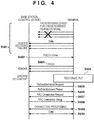
- Fig. 4 shows processing executed by the wireless communication system according to this embodiment. Note that the following explanation will be made assuming that the control device is included in the base station, and the base station operates as the control device. The procedure of processing does not change even if the control device exists outside the base station. However, when the control device exists outside the base station, signal exchange performed in the base station in the case in which the control device exists in the base station is replaced with communication (by, for example, a wired network) between the control device and the base station.
- the base station determines whether a mismatch occurs in the HFN (step S401).
- the base station determines whether, for example, a state in which no packet is received continues for a predetermined time or more, and determines, for a packet received after that, whether decoding of the header based on the HFN succeeds.
- the base station determines that a mismatch occurs in the HFN in a case in which the state in which no packet is received continues for the predetermined time or more, and after that, the number of packets for which header decoding based on the HFN does not succeed reaches a predetermined number.
- the base station transmits a PDCCH Order to the terminal (step S402) to promote the terminal to transmit an RACH.
- the terminal transmits an RACH (step S403).
- the base station ignores the RACH transmitted from the terminal. Since no response to the RACH is returned, the terminal repetitively resends the RACH. The base station ignores this resending, too.
- the terminal recognizes that a failure occurs in the radio link (step S404). That is, the base station intentionally shifts the state of connection to the terminal to the state of Radio Link Failure (RLF) independently of the radio quality of the radio link.
- RLF Radio Link Failure
- the terminal When recognizing the RLF, the terminal transmits a reconnection request (ReEstablishment Request) using the information (UE context) of the terminal to the base station (step S405).
- the base station receives the reconnection request but rejects it (step S406). More specifically, the base station transmits, for example, a ReEstablishment Reject to the terminal. Note that the base station may ignore the reconnection request instead of explicitly rejecting it. In addition, the base station may discard the UE context before the reception of the above-described reconnection request.
- the terminal transmits a connection request (RRC connection request) that does not use the information (UE context) of the terminal to the base station (step S407).
- the base station accepts the connection request (transmits an RRC connection setup to the terminal (step S408)), and a new connection is established between the base station and the terminal (step S409).
- the HFN and the PDCP-SN are reset, and the HFN mismatch is eliminated.
- the terminal resumes data transmission (step S410).
- reconnection processing for resetting the HFN and the PDCP-SN is executed.
- the processing according to this embodiment is not executed, if an HFN mismatch occurs, header decoding fails, and data is continuously discarded for a long time (for example, about 20 sec). After that, the connection is disconnected by a host device such as IMS.
- the processing according to this embodiment is executed, even if an HFN mismatch occurs, the HFN mismatch can be eliminated in a short time, and the connection can be maintained.
- step S401 For example, if the maximum value of the PDCP-SN is 127, and a packet is transmitted every 20 sec, the above-described process of step S401 needs about 2.5 sec. If the processes of steps S402 and S403 need about 600 ms, and the processes of steps S404 to S409 need about 250 to 300 ms, the HFN mismatch is eliminated in a total of 3.5 sec or less, and data transmission from the terminal to the base station is continued. As described above, according to this embodiment, it is possible to eliminate the HFN mismatch in a short time and maintain the connection.
- the base station After it is determined that a mismatch occurs in the HFN, the base station causes the terminal to transmit an RRC Connection request and execute reconnection processing without using the information of the terminal, thereby resetting the HFN and the PDCP-SN.
- a base station that is the connection destination of a terminal transmits, to the terminal, a handover instruction message that designates the same base station as a handover destination, thereby resetting the HFN and the PDCP-SN.
- control device The system arrangement and the arrangement of a control device according to this embodiment are the same as in the first embodiment, and a detailed description thereof will be omitted. Note that in the functional arrangement of the control device, the same operation as in the first embodiment is performed except the operation of a control unit 303.
- the control unit 303 of the control device causes the base station to transmit a handover instruction message such that the terminal executes handover.
- the control unit 303 causes, for example, the base station as the connection destination of the terminal to transmit an RRC Connection Reconfiguration including mobilityControlInfo.
- the control unit 303 causes the base station that transmits the RRC Connection Reconfiguration to notify the terminal of the PCI (Physical Cell Identity) of the base station as the cell ID of the handover destination.
- PCI Physical Cell Identity
- the terminal Upon receiving the RRC Connection Reconfiguration message including mobilityControlInfo, the terminal needs to do handover (see NPL 2). In addition, when receiving the message, the terminal needs to set the PDCP again (see NPL 2). When the PDCP is set again, the HFN and the PDCP-SN are reset to 0 (see NPL 3). Hence, the HFN mismatch in connection between the terminal and the base station is thus eliminated. Even if the HFN mismatch occurs, the mismatch can be eliminated in a short time.
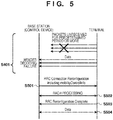
- Fig. 5 shows processing executed by a wireless communication system according to this embodiment. Note that the following explanation will be made assuming that the control device is included in the base station, and the base station operates as the control device. The procedure of processing does not change even if the control device exists outside the base station. However, when the control device exists outside the base station, signal exchange performed in the base station in the case in which the control device exists in the base station is replaced with communication (by, for example, a wired network) between the control device and the base station.
- the base station determines whether a mismatch occurs in the HFN (step S401). Note that since this processing is the same as in the first embodiment, the same reference numerals denote the same parts, and a detailed description thereof will be omitted.
- the base station transmits an RRC Connection Reconfiguration message including mobilityControlInfo as an information element to the terminal (step S501).
- This message is a handover instruction message that instructs the terminal to do handover.
- the base station notifies the terminal of a PCI that designates the base station itself as the base station of the handover destination at this time. Note that this notification may be transmitted together with the message to instruct the handover, or may be transmitted independently of the message. The terminal thus executes handover without switching of the base station of the connection destination.
- RACH processing is executed between the base station and the terminal (step S502). If handover is completed, the terminal transmits an RRC Reconfiguration Completion message to the base station (step S503).
- the HFN and the PDCP-SN are reset to 0, and the HFN mismatch is eliminated while maintaining the connection between the base station and the terminal. After that, the terminal resumes data transmission (step S504).
- the processing according to this embodiment if the HFN mismatch is detected, handover processing without changing the base station of the connection destination is executed to reset the HFN and the PDCP-SN.
- the processing according to this embodiment is executed, even if the HFN mismatch occurs, the HFN mismatch can be eliminated in a short time, and the connection can be maintained. For example, if the processes of steps S501 to S503 need about 100 ms to 200 ms, the HFN mismatch is eliminated in a total of 3 sec or less, and data transmission from the terminal to the base station is continued. As described above, according to this embodiment as well, it is possible to eliminate the HFN mismatch in a short time and maintain the connection.
- each process described above is conspicuously effective in an environment where the probability of occurrence of the HFN mismatch is not low, for example, in a case in which, for example, the PDCP-SN is formed from 7 bits in the RLC UM (Unacknowledged Mode) of LTE but is also effective in another mode or communication system. That is, in a case in which part of a number concerning the order of a packet is held on each of the transmitting side and the receiving side, and a mismatch of the number can occur, it is possible to maintain the connection while eliminating the mismatch in a short time by executing the above-described processing.
- the PDCP-SN is formed from 7 bits in the RLC UM (Unacknowledged Mode) of LTE but is also effective in another mode or communication system. That is, in a case in which part of a number concerning the order of a packet is held on each of the transmitting side and the receiving side, and a mismatch of the number can occur, it is possible to maintain the connection while eliminating the mismatch in
Landscapes
- Engineering & Computer Science (AREA)
- Computer Networks & Wireless Communication (AREA)
- Signal Processing (AREA)
- Mobile Radio Communication Systems (AREA)
- Detection And Prevention Of Errors In Transmission (AREA)
- Communication Control (AREA)
- Maintenance And Management Of Digital Transmission (AREA)
Abstract
Description
- The present invention relates to a control device, a base station, a control method, and a program and, more particularly, to a technique of controlling communication between a terminal and a base station.
- In recent years, communication services using a long term evolution (LTE) system are spreading nationwide. In communication between a base station and a terminal in the LTE system, a number concerning the order of a packet transmitted and received between the base station and the terminal is managed in a PDCP (Packet Data Convergence Protocol) layer. This number is specified by an HFN (Hyper Frame Number) and a PDCP-SN (Sequence Number) (NPL 1).
- The HFN is a common number held by the base station and the terminal. The header of a packet is compressed using the HFN. Hence, the HFN needs to match between the base station and the terminal. On the other hand, the PDCP-SN is a number notified by a device on the transmitting side, and its value is incremented one by one on a packet basis. When the PDCP-SN reaches the maximum value, the devices on the transmitting and receiving sides increment the HFN by one.
- That is, assume that the maximum value of the PDCP-SN is 127. If 128 packets with PDCP-SNs "0" to "127" are transmitted/received, the HFN is incremented by one. On the other hand, after reaching the maximum value, the PDCP-SN is reset to 0. If the PDCP-SN of a received packet is larger than the PDCP-SN of a previously received packet, the device on the receiving side does not increment the HFN. If the PDCP-SN of the received packet is equal to or smaller than the PDCP-SN of the previously received packet, the device increments the HFN. In this way, the device on the transmitting side and the device on the receiving side manage the order of a packet using the HFN and PDCP-SN, and compress or decode the header of the packet using the HFN of them.
-
- NPL 1: 3GPP TS 36.300 V.8.0.0
- NPL 2: 3GPP TS 36.331 V.11.8.0
- NPL 3: 3GPP TS 36.323 V.11.3.0
- Management of the above-described HFN and PDCP-SN is effective unless reception of packets in a number corresponding to the maximum value of the PDCP-SN fails. In the effective case, the order of a packet can be managed commonly between the device on the transmitting side and the device on the receiving side only by transmitting/receiving the 7-bit PDCP-SN, as compared to a case in which all parts (for example, 32 bits) of a packet number are transmitted.
- On the other hand, if the device on the receiving side continuously fails in receiving packets in a number (for example, 128) corresponding to the maximum value of the PDCP-SN, the PDCP-SN of a packet successfully received next becomes larger than the PDCP-SN of a packet successfully received previously. Hence, the device on the receiving side does not increment the HFN, although the device on the transmitting side increments the HFN by one because it transmitted packets in the number corresponding to the maximum value of the PDCP-SN. For this reason, the device on the receiving side fails in decoding the headers of the packets and consequently discards data included in the packets for a long time. As a result, the communication error state continues for a long time because of the shift of the value of the HFN between the transmitting side and the receiving side.
- The present invention has been made in consideration of the above-described problem, and has as its object to provide a technique for implementing early recovery from a communication error state if the value of the HFN shifts between the transmitting side and the receiving side.
- According to an aspect of the present invention, there is provided a control device configured to control communication between a terminal and a base station, comprising management means for managing, concerning the communication, first information representing a part of a number corresponding to an order of a packet and held by each of the terminal and the base station and second information representing another part of the number corresponding to the order of the packet and transmitted from the terminal to the base station, determination means for determining whether the first information matches between the base station and the terminal, and control means for controlling the terminal to transmit a signal used to execute reconnection processing for resetting the number of the packet upon determining that the first information does not match between the base station and the terminal.
- According to another aspect of the present invention, there is provided a control device configured to control communication between a terminal and a base station, comprising management means for managing, concerning the communication, first information representing a part of a number corresponding to an order of a packet and held by each of the terminal and the base station and second information representing another part of the number corresponding to the order of the packet and transmitted from the terminal to the base station, determination means for determining whether the first information matches between the base station and the terminal, and control means for controlling the base station to instruct the terminal to cause the terminal to perform handover without switching of the connected base station upon determining that the first information does not match between the base station and the terminal.
- According to the present invention, it is possible to provide a technique for implementing early recovery from a communication error state if the value of the HFN shifts between the transmitting side and the receiving side.
- Other features and advantages of the present invention will be apparent from the following descriptions taken in conjunction with the accompanying drawings, in which like reference characters designate the same or similar parts throughout the figures thereof.
- The accompanying drawings, which are incorporated in and constitute a part of the specification, illustrate embodiments of the invention and, together with the description, serve to explain the principles of the invention.
-
Fig. 1 is a view showing an example of the arrangement of a wireless communication system; -
Fig. 2 is a block diagram showing an example of the hardware arrangement of a control device; -
Fig. 3 is a block diagram showing an example of the functional arrangement of the control device; -
Fig. 4 is a sequence chart showing the procedure of processing of a wireless communication system according to the first embodiment; and -
Fig. 5 is a sequence chart showing the procedure of processing of a wireless communication system according to the second embodiment. - The embodiments of the present invention will now be described in detail with reference to the accompanying drawings.
-
Fig. 1 is a view showing an example of the arrangement of a wireless communication system according to this embodiment. The wireless communication system according to this embodiment is, for example, an LTE system including a base station and a terminal. However, the wireless communication system can be any other wireless communication system which includes a plurality of communication devices and to which the following technique can be applied. The base station includes a control device configured to control communication between the base station and the terminal. The control device may exist as a network node outside the base station. A case in which a signal (packet) is transmitted from the terminal to the base station will be described below. However, the present invention is not limited to this. - In this embodiment, concerning a packet transmitted/received between the base station and the terminal, a number corresponding to the order of the packet is managed by, for example, 32 bits. A part (HFN) of the bits is held by the base station and the terminal, and the remaining part (PDCP-SN) is included in a packet and transmitted from the terminal (transmitting side) to the base station (receiving side). The PDCP-SN is represented by, for example, 7 bits and exhibits a value from 0 to 127. The HFN (Hyper Frame Number) and the PDCP-SN (Sequence Number) are represented by 32 - 7 = 25 bits. Using this value, the header of an associated packet is compressed or decoded. For this reason, if an HFN used by the terminal to compress the header of a packet and an HFN used by the base station to decode the header of the packet do not match, a decoding error occurs, and as a result, data in the packet is discarded. In this state, a decoding error occurs for a very long time, and then, the communication is disconnected. This problem is conspicuous in the UM (Unacknowledged Mode) in an RLC layer, for example, in VoLTE (Voice over LTE) that implements speech communication by the LTE system. That is, in VoLTE, data from the terminal does not reach the base station, a one-way communication state continues for a long time (for example, about 20 sec), and after that, the communication is disconnected by a host device such as IMS. Hence, the HFN mismatch exerts a very large influence on the service.
- Here, if the value of the PDCP-SN of a packet successfully received next is smaller than the value of the PDCP-SN of a packet successfully received previously, the value of the HFN is incremented by one. Otherwise, the value is kept unchanged. For example, if the PDCP-SN of the packet successfully received previously is 120, and the PDCP-SN of the packet successfully received next is 127, the value of the HFN does not change. However, if the PDCP-SN of the packet successfully received next is 1, the value of the HFN is incremented by one. The order of a packet is thus managed by 32 bits as a whole. On the other hand, assume that the maximum value of the PDCP-SN is 127, and the reception continuously fails for 128 packets. In this case, if the PDCP-SN of the packet successfully received previously is 120, the PDCP-SN of the packet successfully received next is 121. If focus is placed only on the value of the PDCP-SN, the value of the HFN does not change on the receiving side because the value of the PDCP-SN increases. On the transmitting side, however, since the value of the HFN is changed in accordance with the number of transmitted packets, the value of the HFN is incremented by one in this case. Hence, an HFN mismatch occurs between the base station and the terminal.
- On the other hand, by making the maximum value of the PDCP-SN large, the probability of occurrence of the mismatch can be reduced. For example, when the PDCP-SN is represented by 12 bits, the maximum value of the PDCP-SN is 4095. The HFN updating frequency lowers as compared to the case in which the PDCP-SN is represented by 7 bits. Accordingly, the probability of occurrence of the HFN mismatch lowers. However, making the maximum value of the PDCP-SN large means making the data size of a packet to be transmitted/received large. This has such an influence that, for example, data that can be transmitted/received by one packet in a case in which the PDCP-SN is formed from 7 bits needs to be transmitted/received by a plurality of packets.
- For this reason, in this embodiment, assuming that the maximum value of the PDCP-SN is not made large, the control device (base station) executes a procedure of shortening the time during which a communication error state continues in a case in which an HFN mismatch occurs. The functional arrangement of the control device configured to execute this processing and a detailed example of the procedure of the processing will be described below.
-
Fig. 2 is a block diagram showing an example of the hardware arrangement of the control device according to this embodiment. The control device includes, for example, aCPU 201, aROM 202, aRAM 203, anexternal storage device 204, and acommunication device 205. In the control device, for example, theCPU 201 executes a program that is configured to implement each function of the control device and recorded in one of theROM 202, theRAM 203, and theexternal storage device 204. By, for example, controlling thecommunication device 205 by theCPU 201, the control device performs wired communication with the base station or various kinds of nodes in the network. Note that inFig. 3 , the control device includes thecommunication device 205. However, for example, if the control device exists in the base station, an interface to another hardware of the base station may alternately be provided. - Note that the control device may include dedicated hardware configured to execute each function. Alternatively, some functions may be executed by hardware, and the remaining portions may be executed by a computer in which a program is operated. The control device may execute all functions by a computer and a program.
-
Fig. 3 is a block diagram showing an example of the functional arrangement of the control device. The control device includes, for example, amanagement unit 301, adetermination unit 302, acontrol unit 303, and acommunication unit 304. Themanagement unit 301 manages the HFN and the PDCP-SN. Note that if the control device exists in the base station, themanagement unit 301 manages the HFN and the PDCP-SN held by the base station. Thecommunication unit 304 performs communication with, for example, the base station. Note that if the control device exists in the base station, such a communication unit can be given as an interface in the base station. - The
determination unit 302 determines whether an HFN mismatch does not occur between a terminal and the base station. If, for example, a predetermined time or more elapses without reception of a packet from a terminal by the base station, and packet reception is then resumed in the base station, thedetermination unit 302 determines whether the count of header decoding failures in a plurality of packet after the resumption reaches a predetermined count. Upon detecting that the count of header decoding failures in the plurality of packet after the resumption reaches the predetermined count, thedetermination unit 302 determines that the HFN does not match. Note that thedetermination unit 302 may determine that the HFN does not match when packets from the terminal are not received by the base station for a predetermined time or more. - If the
determination unit 302 determines that the HFN does not match, thecontrol unit 303 controls the terminal to execute reconnection processing to reset the HFN (and PDCP-SN) held by the terminal and the base station. Thecontrol unit 303 causes the terminal to issue, for example, an RRC Connection Request as a connection request that is not based on the information (for example, a UE context) of the terminal. To do this, if thedetermination unit 302 determines that an HFN mismatch occurs, thecontrol unit 303, for example, causes the base station to transmit a PDCCH Order to the terminal and causes the terminal to transmit an RACH (Random Access Channel). Note that PDCCH Order and the RACH can be different predetermined signals. After that thecontrol unit 303 controls the base station and causes it to ignore the RACH from the terminal. - Then, the terminal resends the RACH a predetermined number of times, and after that, recognizes that a failure occurs in the radio link in accordance with, for example, the elapse of a time set as a parameter of the system or resend failures in a set count. As a result, the terminal transmits a reconnection request (ReEstablishment Request) using the UE context to the base station. The
control unit 303 causes the base station to ignore or reject the reconnection request. Note that if, for example, thecontrol unit 303 causes the base station to discard the UE context at this point of time, the base station consequently ignores or rejects the reconnection request. Then, the terminal subsequently issues the RRC Connection Request as a connection request that is not based on the information (for example, the UE context) of the terminal. The HFN and the PDCP-SN are thus reset in the connection between the terminal and the base station, and the HFN mismatch is eliminated. Accordingly, even if the HFN mismatch occurs, the mismatch can be eliminated in a short time. -
Fig. 4 shows processing executed by the wireless communication system according to this embodiment. Note that the following explanation will be made assuming that the control device is included in the base station, and the base station operates as the control device. The procedure of processing does not change even if the control device exists outside the base station. However, when the control device exists outside the base station, signal exchange performed in the base station in the case in which the control device exists in the base station is replaced with communication (by, for example, a wired network) between the control device and the base station. - In this processing, first, the base station (control device) determines whether a mismatch occurs in the HFN (step S401). The base station determines whether, for example, a state in which no packet is received continues for a predetermined time or more, and determines, for a packet received after that, whether decoding of the header based on the HFN succeeds. The base station determines that a mismatch occurs in the HFN in a case in which the state in which no packet is received continues for the predetermined time or more, and after that, the number of packets for which header decoding based on the HFN does not succeed reaches a predetermined number.
- Next, the base station transmits a PDCCH Order to the terminal (step S402) to promote the terminal to transmit an RACH. In response to this, the terminal transmits an RACH (step S403). On the other hand, the base station ignores the RACH transmitted from the terminal. Since no response to the RACH is returned, the terminal repetitively resends the RACH. The base station ignores this resending, too. Hence, if a time or resend count set as a parameter of the system is reached, the terminal recognizes that a failure occurs in the radio link (step S404). That is, the base station intentionally shifts the state of connection to the terminal to the state of Radio Link Failure (RLF) independently of the radio quality of the radio link.
- When recognizing the RLF, the terminal transmits a reconnection request (ReEstablishment Request) using the information (UE context) of the terminal to the base station (step S405). The base station receives the reconnection request but rejects it (step S406). More specifically, the base station transmits, for example, a ReEstablishment Reject to the terminal. Note that the base station may ignore the reconnection request instead of explicitly rejecting it. In addition, the base station may discard the UE context before the reception of the above-described reconnection request.
- After that, in accordance with the rejection of the ReEstablishment Request, the terminal transmits a connection request (RRC connection request) that does not use the information (UE context) of the terminal to the base station (step S407). The base station accepts the connection request (transmits an RRC connection setup to the terminal (step S408)), and a new connection is established between the base station and the terminal (step S409). By the establishment of the new connection, the HFN and the PDCP-SN are reset, and the HFN mismatch is eliminated. After that, the terminal resumes data transmission (step S410).
- As described above, in the processing according to this embodiment, if the HFN mismatch is detected, reconnection processing for resetting the HFN and the PDCP-SN is executed. In a case in which the processing according to this embodiment is not executed, if an HFN mismatch occurs, header decoding fails, and data is continuously discarded for a long time (for example, about 20 sec). After that, the connection is disconnected by a host device such as IMS. On the other hand, in a case in which the processing according to this embodiment is executed, even if an HFN mismatch occurs, the HFN mismatch can be eliminated in a short time, and the connection can be maintained. For example, if the maximum value of the PDCP-SN is 127, and a packet is transmitted every 20 sec, the above-described process of step S401 needs about 2.5 sec. If the processes of steps S402 and S403 need about 600 ms, and the processes of steps S404 to S409 need about 250 to 300 ms, the HFN mismatch is eliminated in a total of 3.5 sec or less, and data transmission from the terminal to the base station is continued. As described above, according to this embodiment, it is possible to eliminate the HFN mismatch in a short time and maintain the connection.
- In the first embodiment, after it is determined that a mismatch occurs in the HFN, the base station causes the terminal to transmit an RRC Connection request and execute reconnection processing without using the information of the terminal, thereby resetting the HFN and the PDCP-SN. In this embodiment, an example will be described in which after it is determined that a mismatch occurs in the HFN, a base station that is the connection destination of a terminal transmits, to the terminal, a handover instruction message that designates the same base station as a handover destination, thereby resetting the HFN and the PDCP-SN.
- The system arrangement and the arrangement of a control device according to this embodiment are the same as in the first embodiment, and a detailed description thereof will be omitted. Note that in the functional arrangement of the control device, the same operation as in the first embodiment is performed except the operation of a
control unit 303. - That is, in this embodiment, if a
determination unit 302 determines that the HFN does not match, thecontrol unit 303 of the control device causes the base station to transmit a handover instruction message such that the terminal executes handover. Thecontrol unit 303 causes, for example, the base station as the connection destination of the terminal to transmit an RRC Connection Reconfiguration including mobilityControlInfo. At this time, thecontrol unit 303 causes the base station that transmits the RRC Connection Reconfiguration to notify the terminal of the PCI (Physical Cell Identity) of the base station as the cell ID of the handover destination. - Upon receiving the RRC Connection Reconfiguration message including mobilityControlInfo, the terminal needs to do handover (see NPL 2). In addition, when receiving the message, the terminal needs to set the PDCP again (see NPL 2). When the PDCP is set again, the HFN and the PDCP-SN are reset to 0 (see NPL 3). Hence, the HFN mismatch in connection between the terminal and the base station is thus eliminated. Even if the HFN mismatch occurs, the mismatch can be eliminated in a short time.
-
Fig. 5 shows processing executed by a wireless communication system according to this embodiment. Note that the following explanation will be made assuming that the control device is included in the base station, and the base station operates as the control device. The procedure of processing does not change even if the control device exists outside the base station. However, when the control device exists outside the base station, signal exchange performed in the base station in the case in which the control device exists in the base station is replaced with communication (by, for example, a wired network) between the control device and the base station. - In this processing, first, the base station (control device) determines whether a mismatch occurs in the HFN (step S401). Note that since this processing is the same as in the first embodiment, the same reference numerals denote the same parts, and a detailed description thereof will be omitted.
- Next, the base station transmits an RRC Connection Reconfiguration message including mobilityControlInfo as an information element to the terminal (step S501). This message is a handover instruction message that instructs the terminal to do handover. Note that the base station notifies the terminal of a PCI that designates the base station itself as the base station of the handover destination at this time. Note that this notification may be transmitted together with the message to instruct the handover, or may be transmitted independently of the message. The terminal thus executes handover without switching of the base station of the connection destination.
- After that, RACH processing is executed between the base station and the terminal (step S502). If handover is completed, the terminal transmits an RRC Reconfiguration Completion message to the base station (step S503). By this handover, the HFN and the PDCP-SN are reset to 0, and the HFN mismatch is eliminated while maintaining the connection between the base station and the terminal. After that, the terminal resumes data transmission (step S504).
- As described above, in the processing according to this embodiment, if the HFN mismatch is detected, handover processing without changing the base station of the connection destination is executed to reset the HFN and the PDCP-SN. In a case in which the processing according to this embodiment is executed, even if the HFN mismatch occurs, the HFN mismatch can be eliminated in a short time, and the connection can be maintained. For example, if the processes of steps S501 to S503 need about 100 ms to 200 ms, the HFN mismatch is eliminated in a total of 3 sec or less, and data transmission from the terminal to the base station is continued. As described above, according to this embodiment as well, it is possible to eliminate the HFN mismatch in a short time and maintain the connection.
- Note that each process described above is conspicuously effective in an environment where the probability of occurrence of the HFN mismatch is not low, for example, in a case in which, for example, the PDCP-SN is formed from 7 bits in the RLC UM (Unacknowledged Mode) of LTE but is also effective in another mode or communication system. That is, in a case in which part of a number concerning the order of a packet is held on each of the transmitting side and the receiving side, and a mismatch of the number can occur, it is possible to maintain the connection while eliminating the mismatch in a short time by executing the above-described processing.
- The present invention is not limited to the above embodiments, and various changes and modifications can be made within the spirit and scope of the present invention. Therefore, to apprise the public of the scope of the present invention, the following claims are made.
- This application claims the benefit of Japanese Patent Application No.
2014-141758 filed July 9, 2014 2014-189437 filed September 17, 2014
Claims (13)
- A control device configured to control communication between a terminal and a base station, characterized by comprising:management means for managing, concerning the communication, first information representing a part of a number corresponding to an order of a packet and held by each of the terminal and the base station and second information representing another part of the number corresponding to the order of the packet and transmitted from the terminal to the base station;determination means for determining whether the first information matches between the base station and the terminal; andcontrol means for controlling the terminal to transmit a signal used to execute reconnection processing for resetting the number of the packet upon determining that the first information does not match between the base station and the terminal.
- The control device according to claim 1, characterized in that upon determining that the first information does not match between the base station and the terminal, the control means causes the terminal to issue a connection request that is not based on information of the terminal as the signal used to execute the reconnection processing.
- The control device according to claim 2, characterized in that upon determining that the first information does not match between the base station and the terminal, the control means causes the terminal to issue a reconnection request based on the information of the terminal by controlling the base station to cause the terminal to recognize that a failure occurs in a radio link between the base station and the terminal, and causes the terminal to issue the connection request that is not based on the information of the terminal by causing the base station to reject or ignore the reconnection request.
- The control device according to claim 3, characterized in that upon determining that the first information does not match between the base station and the terminal, the control means controls the base station to cause the terminal to transmit a predetermined signal and causes the base station to ignore the predetermined signal transmitted from the terminal, thereby causing the terminal to recognize that a failure occurs in a radio link.
- The control device according to claim 3 or 4, characterized in that the control means discards the information of the terminal before issuance of the reconnection request by the terminal, thereby rejecting or ignoring the reconnection request.
- A control device configured to control communication between a terminal and a base station, characterized by comprising:management means for managing, concerning the communication, first information representing a part of a number corresponding to an order of a packet and held by each of the terminal and the base station and second information representing another part of the number corresponding to the order of the packet and transmitted from the terminal to the base station;determination means for determining whether the first information matches between the base station and the terminal; andcontrol means for controlling the base station to instruct the terminal to cause the terminal to perform handover without switching of the connected base station upon determining that the first information does not match between the base station and the terminal.
- The control device according to claim 6, characterized in that the control means controls the base station to transmit, to the terminal, a handover instruction message that designates the base station as a handover destination.
- The control device according to any one of claims 1 to 7, characterized in that the first information is used to decode at least part of the packet with which the first information is associated, and
the determination means determines that the first information does not match between the base station and the terminal in a case in which, for a plurality of packets received after not less than a predetermined time has elapsed without reception of a packet by the base station, a count of decoding failures based on the first information for the plurality of packet reaches a predetermined count. - A base station configured to perform communication with a terminal, characterized by comprising a control device defined in any one of claims 1 to 8.
- A control method of a control device including management means for managing, concerning communication, first information representing a part of a number corresponding to an order of a packet and held by each of a terminal and a base station and second information representing another part of the number corresponding to the order of the packet and transmitted from the terminal to the base station, and configured to control the communication between the terminal and the base station, characterized by comprising:a determination step of determining, by determination means, whether the first information matches between the base station and the terminal; anda control step of, by control means, controlling the terminal to transmit a signal used to execute reconnection processing for resetting the number of the packet upon determining that the first information does not match between the base station and the terminal.
- A control method of a control device including management means for managing, concerning communication, first information representing a part of a number corresponding to an order of a packet and held by each of a terminal and a base station and second information representing another part of the number corresponding to the order of the packet and transmitted from the terminal to the base station, and configured to control the communication between the terminal and the base station, characterized by comprising:a determination step of determining, by determination means, whether the first information matches between the base station and the terminal; andcontrol means for, by control means, controlling the base station to instruct the terminal to cause the terminal to perform handover without switching of the connected base station upon determining that the first information does not match between the base station and the terminal.
- A program that causes a computer provided in a control device including management means for managing, concerning communication, first information representing a part of a number corresponding to an order of a packet and held by each of a terminal and a base station and second information representing another part of the number corresponding to the order of the packet and transmitted from the terminal to the base station, and configured to control the communication between the terminal and the base station to execute:a determination step of determining whether the first information matches between the base station and the terminal; anda control step of controlling the terminal to transmit a signal used to execute reconnection processing for resetting the number of the packet upon determining that the first information does not match between the base station and the terminal.
- A program that causes a computer provided in a control device including management means for managing, concerning communication, first information representing a part of a number corresponding to an order of a packet and held by each of a terminal and a base station and second information representing another part of the number corresponding to the order of the packet and transmitted from the terminal to the base station, and configured to control the communication between the terminal and the base station to execute:a determination step of determining whether the first information matches between the base station and the terminal; andcontrol means for controlling the base station to instruct the terminal to cause the terminal to perform handover without switching of the connected base station upon determining that the first information does not match between the base station and the terminal.
Applications Claiming Priority (3)
| Application Number | Priority Date | Filing Date | Title |
|---|---|---|---|
| JP2014141758 | 2014-07-09 | ||
| JP2014189437A JP6052739B2 (en) | 2014-07-09 | 2014-09-17 | Control device, base station, control method, and program |
| PCT/JP2015/067818 WO2016006422A1 (en) | 2014-07-09 | 2015-06-22 | Control device, base station, control method and program |
Publications (3)
| Publication Number | Publication Date |
|---|---|
| EP3188535A1 true EP3188535A1 (en) | 2017-07-05 |
| EP3188535A4 EP3188535A4 (en) | 2017-09-06 |
| EP3188535B1 EP3188535B1 (en) | 2022-04-06 |
Family
ID=55064061
Family Applications (1)
| Application Number | Title | Priority Date | Filing Date |
|---|---|---|---|
| EP15818455.6A Active EP3188535B1 (en) | 2014-07-09 | 2015-06-22 | Control device, base station, control method and program |
Country Status (4)
| Country | Link |
|---|---|
| US (1) | US10327162B2 (en) |
| EP (1) | EP3188535B1 (en) |
| JP (1) | JP6052739B2 (en) |
| WO (1) | WO2016006422A1 (en) |
Families Citing this family (3)
| Publication number | Priority date | Publication date | Assignee | Title |
|---|---|---|---|---|
| US20170215218A1 (en) * | 2014-07-25 | 2017-07-27 | Kyocera Corporation | User terminal and mobile communication system |
| WO2018169523A1 (en) | 2017-03-15 | 2018-09-20 | Nokia Solutions And Networks Oy | Back-off timer for network reattachment |
| WO2019215634A1 (en) * | 2018-05-10 | 2019-11-14 | Telefonaktiebolaget Lm Ericsson (Publ) | Handling re-establishment rejection |
Family Cites Families (7)
| Publication number | Priority date | Publication date | Assignee | Title |
|---|---|---|---|---|
| KR100765123B1 (en) * | 2002-02-16 | 2007-10-11 | 엘지전자 주식회사 | How to reassign the SRS |
| WO2008060097A1 (en) * | 2006-11-15 | 2008-05-22 | Samsung Electronics Co., Ltd. | Apparatus and method for transmitting/receiving ciphered packet in mobile communication system |
| KR101163275B1 (en) * | 2008-03-17 | 2012-07-05 | 엘지전자 주식회사 | Method for transmitting pdcp status report |
| US8213610B2 (en) * | 2009-06-25 | 2012-07-03 | Nokia Corporation | Generation of key streams in wireless communication systems |
| US9661476B2 (en) * | 2011-06-09 | 2017-05-23 | Avago Technologies General Ip (Singapore) Pte. Ltd. | Method and apparatus for facilitating multicast service |
| JP5953107B2 (en) * | 2012-05-11 | 2016-07-20 | 株式会社Nttドコモ | Mobile station and radio base station |
| GB2506868B (en) * | 2012-10-09 | 2015-04-08 | Broadcom Corp | Error recovery |
-
2014
- 2014-09-17 JP JP2014189437A patent/JP6052739B2/en active Active
-
2015
- 2015-06-22 WO PCT/JP2015/067818 patent/WO2016006422A1/en not_active Ceased
- 2015-06-22 EP EP15818455.6A patent/EP3188535B1/en active Active
-
2017
- 2017-05-02 US US15/584,445 patent/US10327162B2/en active Active
Also Published As
| Publication number | Publication date |
|---|---|
| JP6052739B2 (en) | 2016-12-27 |
| US10327162B2 (en) | 2019-06-18 |
| EP3188535B1 (en) | 2022-04-06 |
| EP3188535A4 (en) | 2017-09-06 |
| JP2016028464A (en) | 2016-02-25 |
| WO2016006422A1 (en) | 2016-01-14 |
| US20170238198A1 (en) | 2017-08-17 |
Similar Documents
| Publication | Publication Date | Title |
|---|---|---|
| US11818620B2 (en) | Method and device for user mobility | |
| US9723647B2 (en) | Handling a radio link failure in communications | |
| US9974113B2 (en) | Systems and methods providing improved success rate for RRC connection reestablishments | |
| US10123240B2 (en) | Control of communication using dual-connectivity mode description | |
| US20230284310A1 (en) | Methods and apparatuses for a failure handling procedure in a sidelink relay system | |
| EP3713299B1 (en) | Retransmission of data to a terminal in dual connectivity | |
| US20140287726A1 (en) | Handover method and apparatus in wireless communication system | |
| CN111148097A (en) | A communication method, communication device and system | |
| US20240064785A1 (en) | Terminal apparatus, base station apparatus, and method | |
| US12513771B2 (en) | Terminal apparatus and method for performing random access procedures in carrier aggregation (CA) based networks | |
| TWI679915B (en) | Method of handling secondary node change in dual connectivity | |
| US20210410144A1 (en) | MAC Reset Procedures | |
| CN116326188A (en) | Method and device for SCG deactivation mechanism and SCG activation mechanism in MR-DC scenario | |
| EP4274289A1 (en) | Terminal device, base station device, and method | |
| CN116325905A (en) | Method and device for mobility robustness optimization mechanism for conditional handover process | |
| US10327162B2 (en) | Control device, base station, control method, and storage medium | |
| WO2010118694A1 (en) | System and method for supporting a keep alive mechanism in a wireless communications system | |
| US20160165497A1 (en) | Communications processing system, communications processing method, communications control device, and control method and control program for these | |
| EP4319408A1 (en) | Terminal device, method, and integrated circuit | |
| WO2022145409A1 (en) | Terminal device, base station device, and method | |
| US10742365B2 (en) | Apparatus and method for radio communication | |
| CN120186663A (en) | Information reporting method and user equipment | |
| US20130244674A1 (en) | Mobile terminal, radio base station, control method for a mobile terminal and method for a radio base station |
Legal Events
| Date | Code | Title | Description |
|---|---|---|---|
| STAA | Information on the status of an ep patent application or granted ep patent |
Free format text: STATUS: THE INTERNATIONAL PUBLICATION HAS BEEN MADE |
|
| PUAI | Public reference made under article 153(3) epc to a published international application that has entered the european phase |
Free format text: ORIGINAL CODE: 0009012 |
|
| STAA | Information on the status of an ep patent application or granted ep patent |
Free format text: STATUS: REQUEST FOR EXAMINATION WAS MADE |
|
| 17P | Request for examination filed |
Effective date: 20170504 |
|
| AK | Designated contracting states |
Kind code of ref document: A1 Designated state(s): AL AT BE BG CH CY CZ DE DK EE ES FI FR GB GR HR HU IE IS IT LI LT LU LV MC MK MT NL NO PL PT RO RS SE SI SK SM TR |
|
| AX | Request for extension of the european patent |
Extension state: BA ME |
|
| A4 | Supplementary search report drawn up and despatched |
Effective date: 20170804 |
|
| RIC1 | Information provided on ipc code assigned before grant |
Ipc: H04L 29/06 20060101AFI20170728BHEP Ipc: H04W 76/02 20090101ALI20170728BHEP |
|
| DAV | Request for validation of the european patent (deleted) | ||
| DAX | Request for extension of the european patent (deleted) | ||
| STAA | Information on the status of an ep patent application or granted ep patent |
Free format text: STATUS: EXAMINATION IS IN PROGRESS |
|
| 17Q | First examination report despatched |
Effective date: 20200421 |
|
| GRAP | Despatch of communication of intention to grant a patent |
Free format text: ORIGINAL CODE: EPIDOSNIGR1 |
|
| STAA | Information on the status of an ep patent application or granted ep patent |
Free format text: STATUS: GRANT OF PATENT IS INTENDED |
|
| RIC1 | Information provided on ipc code assigned before grant |
Ipc: H04W 36/00 20090101ALI20211012BHEP Ipc: H04W 36/30 20090101ALI20211012BHEP Ipc: H04W 76/20 20180101ALI20211012BHEP Ipc: H04W 76/19 20180101ALI20211012BHEP Ipc: H04W 28/04 20090101AFI20211012BHEP |
|
| INTG | Intention to grant announced |
Effective date: 20211108 |
|
| GRAS | Grant fee paid |
Free format text: ORIGINAL CODE: EPIDOSNIGR3 |
|
| GRAA | (expected) grant |
Free format text: ORIGINAL CODE: 0009210 |
|
| STAA | Information on the status of an ep patent application or granted ep patent |
Free format text: STATUS: THE PATENT HAS BEEN GRANTED |
|
| AK | Designated contracting states |
Kind code of ref document: B1 Designated state(s): AL AT BE BG CH CY CZ DE DK EE ES FI FR GB GR HR HU IE IS IT LI LT LU LV MC MK MT NL NO PL PT RO RS SE SI SK SM TR |
|
| REG | Reference to a national code |
Ref country code: GB Ref legal event code: FG4D |
|
| REG | Reference to a national code |
Ref country code: CH Ref legal event code: EP |
|
| REG | Reference to a national code |
Ref country code: AT Ref legal event code: REF Ref document number: 1482555 Country of ref document: AT Kind code of ref document: T Effective date: 20220415 |
|
| REG | Reference to a national code |
Ref country code: IE Ref legal event code: FG4D |
|
| REG | Reference to a national code |
Ref country code: DE Ref legal event code: R096 Ref document number: 602015078079 Country of ref document: DE |
|
| REG | Reference to a national code |
Ref country code: LT Ref legal event code: MG9D |
|
| REG | Reference to a national code |
Ref country code: NL Ref legal event code: MP Effective date: 20220406 |
|
| REG | Reference to a national code |
Ref country code: AT Ref legal event code: MK05 Ref document number: 1482555 Country of ref document: AT Kind code of ref document: T Effective date: 20220406 |
|
| PG25 | Lapsed in a contracting state [announced via postgrant information from national office to epo] |
Ref country code: NL Free format text: LAPSE BECAUSE OF FAILURE TO SUBMIT A TRANSLATION OF THE DESCRIPTION OR TO PAY THE FEE WITHIN THE PRESCRIBED TIME-LIMIT Effective date: 20220406 |
|
| PG25 | Lapsed in a contracting state [announced via postgrant information from national office to epo] |
Ref country code: SE Free format text: LAPSE BECAUSE OF FAILURE TO SUBMIT A TRANSLATION OF THE DESCRIPTION OR TO PAY THE FEE WITHIN THE PRESCRIBED TIME-LIMIT Effective date: 20220406 Ref country code: PT Free format text: LAPSE BECAUSE OF FAILURE TO SUBMIT A TRANSLATION OF THE DESCRIPTION OR TO PAY THE FEE WITHIN THE PRESCRIBED TIME-LIMIT Effective date: 20220808 Ref country code: NO Free format text: LAPSE BECAUSE OF FAILURE TO SUBMIT A TRANSLATION OF THE DESCRIPTION OR TO PAY THE FEE WITHIN THE PRESCRIBED TIME-LIMIT Effective date: 20220706 Ref country code: LT Free format text: LAPSE BECAUSE OF FAILURE TO SUBMIT A TRANSLATION OF THE DESCRIPTION OR TO PAY THE FEE WITHIN THE PRESCRIBED TIME-LIMIT Effective date: 20220406 Ref country code: HR Free format text: LAPSE BECAUSE OF FAILURE TO SUBMIT A TRANSLATION OF THE DESCRIPTION OR TO PAY THE FEE WITHIN THE PRESCRIBED TIME-LIMIT Effective date: 20220406 Ref country code: GR Free format text: LAPSE BECAUSE OF FAILURE TO SUBMIT A TRANSLATION OF THE DESCRIPTION OR TO PAY THE FEE WITHIN THE PRESCRIBED TIME-LIMIT Effective date: 20220707 Ref country code: FI Free format text: LAPSE BECAUSE OF FAILURE TO SUBMIT A TRANSLATION OF THE DESCRIPTION OR TO PAY THE FEE WITHIN THE PRESCRIBED TIME-LIMIT Effective date: 20220406 Ref country code: ES Free format text: LAPSE BECAUSE OF FAILURE TO SUBMIT A TRANSLATION OF THE DESCRIPTION OR TO PAY THE FEE WITHIN THE PRESCRIBED TIME-LIMIT Effective date: 20220406 Ref country code: BG Free format text: LAPSE BECAUSE OF FAILURE TO SUBMIT A TRANSLATION OF THE DESCRIPTION OR TO PAY THE FEE WITHIN THE PRESCRIBED TIME-LIMIT Effective date: 20220706 Ref country code: AT Free format text: LAPSE BECAUSE OF FAILURE TO SUBMIT A TRANSLATION OF THE DESCRIPTION OR TO PAY THE FEE WITHIN THE PRESCRIBED TIME-LIMIT Effective date: 20220406 |
|
| PG25 | Lapsed in a contracting state [announced via postgrant information from national office to epo] |
Ref country code: RS Free format text: LAPSE BECAUSE OF FAILURE TO SUBMIT A TRANSLATION OF THE DESCRIPTION OR TO PAY THE FEE WITHIN THE PRESCRIBED TIME-LIMIT Effective date: 20220406 Ref country code: PL Free format text: LAPSE BECAUSE OF FAILURE TO SUBMIT A TRANSLATION OF THE DESCRIPTION OR TO PAY THE FEE WITHIN THE PRESCRIBED TIME-LIMIT Effective date: 20220406 Ref country code: LV Free format text: LAPSE BECAUSE OF FAILURE TO SUBMIT A TRANSLATION OF THE DESCRIPTION OR TO PAY THE FEE WITHIN THE PRESCRIBED TIME-LIMIT Effective date: 20220406 Ref country code: IS Free format text: LAPSE BECAUSE OF FAILURE TO SUBMIT A TRANSLATION OF THE DESCRIPTION OR TO PAY THE FEE WITHIN THE PRESCRIBED TIME-LIMIT Effective date: 20220806 |
|
| REG | Reference to a national code |
Ref country code: DE Ref legal event code: R097 Ref document number: 602015078079 Country of ref document: DE |
|
| PG25 | Lapsed in a contracting state [announced via postgrant information from national office to epo] |
Ref country code: SM Free format text: LAPSE BECAUSE OF FAILURE TO SUBMIT A TRANSLATION OF THE DESCRIPTION OR TO PAY THE FEE WITHIN THE PRESCRIBED TIME-LIMIT Effective date: 20220406 Ref country code: SK Free format text: LAPSE BECAUSE OF FAILURE TO SUBMIT A TRANSLATION OF THE DESCRIPTION OR TO PAY THE FEE WITHIN THE PRESCRIBED TIME-LIMIT Effective date: 20220406 Ref country code: RO Free format text: LAPSE BECAUSE OF FAILURE TO SUBMIT A TRANSLATION OF THE DESCRIPTION OR TO PAY THE FEE WITHIN THE PRESCRIBED TIME-LIMIT Effective date: 20220406 Ref country code: MC Free format text: LAPSE BECAUSE OF FAILURE TO SUBMIT A TRANSLATION OF THE DESCRIPTION OR TO PAY THE FEE WITHIN THE PRESCRIBED TIME-LIMIT Effective date: 20220406 Ref country code: EE Free format text: LAPSE BECAUSE OF FAILURE TO SUBMIT A TRANSLATION OF THE DESCRIPTION OR TO PAY THE FEE WITHIN THE PRESCRIBED TIME-LIMIT Effective date: 20220406 Ref country code: DK Free format text: LAPSE BECAUSE OF FAILURE TO SUBMIT A TRANSLATION OF THE DESCRIPTION OR TO PAY THE FEE WITHIN THE PRESCRIBED TIME-LIMIT Effective date: 20220406 Ref country code: CZ Free format text: LAPSE BECAUSE OF FAILURE TO SUBMIT A TRANSLATION OF THE DESCRIPTION OR TO PAY THE FEE WITHIN THE PRESCRIBED TIME-LIMIT Effective date: 20220406 |
|
| REG | Reference to a national code |
Ref country code: CH Ref legal event code: PL |
|
| PLBE | No opposition filed within time limit |
Free format text: ORIGINAL CODE: 0009261 |
|
| STAA | Information on the status of an ep patent application or granted ep patent |
Free format text: STATUS: NO OPPOSITION FILED WITHIN TIME LIMIT |
|
| REG | Reference to a national code |
Ref country code: BE Ref legal event code: MM Effective date: 20220630 |
|
| 26N | No opposition filed |
Effective date: 20230110 |
|
| PG25 | Lapsed in a contracting state [announced via postgrant information from national office to epo] |
Ref country code: AL Free format text: LAPSE BECAUSE OF FAILURE TO SUBMIT A TRANSLATION OF THE DESCRIPTION OR TO PAY THE FEE WITHIN THE PRESCRIBED TIME-LIMIT Effective date: 20220406 |
|
| PG25 | Lapsed in a contracting state [announced via postgrant information from national office to epo] |
Ref country code: LU Free format text: LAPSE BECAUSE OF NON-PAYMENT OF DUE FEES Effective date: 20220622 Ref country code: LI Free format text: LAPSE BECAUSE OF NON-PAYMENT OF DUE FEES Effective date: 20220630 Ref country code: IE Free format text: LAPSE BECAUSE OF NON-PAYMENT OF DUE FEES Effective date: 20220622 Ref country code: CH Free format text: LAPSE BECAUSE OF NON-PAYMENT OF DUE FEES Effective date: 20220630 |
|
| PG25 | Lapsed in a contracting state [announced via postgrant information from national office to epo] |
Ref country code: SI Free format text: LAPSE BECAUSE OF FAILURE TO SUBMIT A TRANSLATION OF THE DESCRIPTION OR TO PAY THE FEE WITHIN THE PRESCRIBED TIME-LIMIT Effective date: 20220406 Ref country code: BE Free format text: LAPSE BECAUSE OF NON-PAYMENT OF DUE FEES Effective date: 20220630 |
|
| PG25 | Lapsed in a contracting state [announced via postgrant information from national office to epo] |
Ref country code: IT Free format text: LAPSE BECAUSE OF FAILURE TO SUBMIT A TRANSLATION OF THE DESCRIPTION OR TO PAY THE FEE WITHIN THE PRESCRIBED TIME-LIMIT Effective date: 20220406 |
|
| PG25 | Lapsed in a contracting state [announced via postgrant information from national office to epo] |
Ref country code: HU Free format text: LAPSE BECAUSE OF FAILURE TO SUBMIT A TRANSLATION OF THE DESCRIPTION OR TO PAY THE FEE WITHIN THE PRESCRIBED TIME-LIMIT; INVALID AB INITIO Effective date: 20150622 |
|
| PG25 | Lapsed in a contracting state [announced via postgrant information from national office to epo] |
Ref country code: MK Free format text: LAPSE BECAUSE OF FAILURE TO SUBMIT A TRANSLATION OF THE DESCRIPTION OR TO PAY THE FEE WITHIN THE PRESCRIBED TIME-LIMIT Effective date: 20220406 Ref country code: CY Free format text: LAPSE BECAUSE OF FAILURE TO SUBMIT A TRANSLATION OF THE DESCRIPTION OR TO PAY THE FEE WITHIN THE PRESCRIBED TIME-LIMIT Effective date: 20220406 |
|
| PG25 | Lapsed in a contracting state [announced via postgrant information from national office to epo] |
Ref country code: MT Free format text: LAPSE BECAUSE OF FAILURE TO SUBMIT A TRANSLATION OF THE DESCRIPTION OR TO PAY THE FEE WITHIN THE PRESCRIBED TIME-LIMIT Effective date: 20220406 |
|
| PG25 | Lapsed in a contracting state [announced via postgrant information from national office to epo] |
Ref country code: BG Free format text: LAPSE BECAUSE OF FAILURE TO SUBMIT A TRANSLATION OF THE DESCRIPTION OR TO PAY THE FEE WITHIN THE PRESCRIBED TIME-LIMIT Effective date: 20220406 |
|
| PG25 | Lapsed in a contracting state [announced via postgrant information from national office to epo] |
Ref country code: BG Free format text: LAPSE BECAUSE OF FAILURE TO SUBMIT A TRANSLATION OF THE DESCRIPTION OR TO PAY THE FEE WITHIN THE PRESCRIBED TIME-LIMIT Effective date: 20220406 |
|
| PGFP | Annual fee paid to national office [announced via postgrant information from national office to epo] |
Ref country code: DE Payment date: 20250618 Year of fee payment: 11 |
|
| PGFP | Annual fee paid to national office [announced via postgrant information from national office to epo] |
Ref country code: GB Payment date: 20250618 Year of fee payment: 11 |
|
| PGFP | Annual fee paid to national office [announced via postgrant information from national office to epo] |
Ref country code: FR Payment date: 20250625 Year of fee payment: 11 |
|
| PG25 | Lapsed in a contracting state [announced via postgrant information from national office to epo] |
Ref country code: TR Free format text: LAPSE BECAUSE OF FAILURE TO SUBMIT A TRANSLATION OF THE DESCRIPTION OR TO PAY THE FEE WITHIN THE PRESCRIBED TIME-LIMIT Effective date: 20220406 |