EP3188445A1 - Data transmission method, apparatus, and system - Google Patents
Data transmission method, apparatus, and system Download PDFInfo
- Publication number
- EP3188445A1 EP3188445A1 EP14902723.7A EP14902723A EP3188445A1 EP 3188445 A1 EP3188445 A1 EP 3188445A1 EP 14902723 A EP14902723 A EP 14902723A EP 3188445 A1 EP3188445 A1 EP 3188445A1
- Authority
- EP
- European Patent Office
- Prior art keywords
- transmission
- data
- terminal
- operating system
- target terminal
- Prior art date
- Legal status (The legal status is an assumption and is not a legal conclusion. Google has not performed a legal analysis and makes no representation as to the accuracy of the status listed.)
- Withdrawn
Links
Images

Classifications
-
- H—ELECTRICITY
- H04—ELECTRIC COMMUNICATION TECHNIQUE
- H04L—TRANSMISSION OF DIGITAL INFORMATION, e.g. TELEGRAPHIC COMMUNICATION
- H04L63/00—Network architectures or network communication protocols for network security
- H04L63/10—Network architectures or network communication protocols for network security for controlling access to devices or network resources
- H04L63/105—Multiple levels of security
-
- G—PHYSICS
- G06—COMPUTING OR CALCULATING; COUNTING
- G06F—ELECTRIC DIGITAL DATA PROCESSING
- G06F21/00—Security arrangements for protecting computers, components thereof, programs or data against unauthorised activity
- G06F21/60—Protecting data
- G06F21/606—Protecting data by securing the transmission between two devices or processes
-
- G—PHYSICS
- G06—COMPUTING OR CALCULATING; COUNTING
- G06F—ELECTRIC DIGITAL DATA PROCESSING
- G06F21/00—Security arrangements for protecting computers, components thereof, programs or data against unauthorised activity
- G06F21/70—Protecting specific internal or peripheral components, in which the protection of a component leads to protection of the entire computer
- G06F21/71—Protecting specific internal or peripheral components, in which the protection of a component leads to protection of the entire computer to assure secure computing or processing of information
- G06F21/74—Protecting specific internal or peripheral components, in which the protection of a component leads to protection of the entire computer to assure secure computing or processing of information operating in dual or compartmented mode, i.e. at least one secure mode
-
- H—ELECTRICITY
- H04—ELECTRIC COMMUNICATION TECHNIQUE
- H04L—TRANSMISSION OF DIGITAL INFORMATION, e.g. TELEGRAPHIC COMMUNICATION
- H04L63/00—Network architectures or network communication protocols for network security
- H04L63/14—Network architectures or network communication protocols for network security for detecting or protecting against malicious traffic
- H04L63/1441—Countermeasures against malicious traffic
- H04L63/1475—Passive attacks, e.g. eavesdropping or listening without modification of the traffic monitored
-
- H—ELECTRICITY
- H04—ELECTRIC COMMUNICATION TECHNIQUE
- H04L—TRANSMISSION OF DIGITAL INFORMATION, e.g. TELEGRAPHIC COMMUNICATION
- H04L63/00—Network architectures or network communication protocols for network security
- H04L63/18—Network architectures or network communication protocols for network security using different networks or channels, e.g. using out of band channels
-
- H—ELECTRICITY
- H04—ELECTRIC COMMUNICATION TECHNIQUE
- H04W—WIRELESS COMMUNICATION NETWORKS
- H04W76/00—Connection management
- H04W76/10—Connection setup
- H04W76/11—Allocation or use of connection identifiers
-
- G—PHYSICS
- G06—COMPUTING OR CALCULATING; COUNTING
- G06F—ELECTRIC DIGITAL DATA PROCESSING
- G06F2221/00—Indexing scheme relating to security arrangements for protecting computers, components thereof, programs or data against unauthorised activity
- G06F2221/21—Indexing scheme relating to G06F21/00 and subgroups addressing additional information or applications relating to security arrangements for protecting computers, components thereof, programs or data against unauthorised activity
- G06F2221/2105—Dual mode as a secondary aspect
-
- H—ELECTRICITY
- H04—ELECTRIC COMMUNICATION TECHNIQUE
- H04W—WIRELESS COMMUNICATION NETWORKS
- H04W12/00—Security arrangements; Authentication; Protecting privacy or anonymity
- H04W12/12—Detection or prevention of fraud
- H04W12/128—Anti-malware arrangements, e.g. protection against SMS fraud or mobile malware
-
- H—ELECTRICITY
- H04—ELECTRIC COMMUNICATION TECHNIQUE
- H04W—WIRELESS COMMUNICATION NETWORKS
- H04W76/00—Connection management
- H04W76/10—Connection setup
Definitions
- the present disclosure relates to the technical field of terminals, and in particular, to a data transmission method, a data transmission device, and a data transmission system.
- a connection is directly established between a transmitter and a receiver, and the transmitter directly transmits data to the receiver.
- the transmitter cannot determine whether the reception environment of the receiver is secure, which may result in a risk of stealing and eavesdropping after content is received.
- the present disclosure provides a new technical solution, which can ensure security of shared data when a transmitter and a receiver share data, and prevent the problem that the shared data is stolen or eavesdropped after the receiver receives the shared data.
- the secure transmission mode can be selected.
- the terminal detects that the transmission mode for the data is the secure transmission, and the current operating system is not the designated operating system, the user is prompted to switch to the designated operating system or the terminal automatically switches to the designated operating system.
- the designated operating system can be a secure operating system.
- a connection with the target terminal of the receiver is then established, and whether the target terminal supports the secure transmission is determined, that is, whether the target terminal includes a secure operating system or a secure transmission module is determined.
- the determination result is yes, the data is transmitted to the target terminal via the secure transmission mode, thereby ensuring data security during data transmission and after the data is transmitted to the target terminal.
- the method further includes prompting the user of the terminal to terminate the transmission of the data or adopt the normal transmission mode to transmit the data to the target terminal when the determination result is that the target terminal does not support the secure transmission.
- determining whether the target terminal supports the secure transmission includes: sending a transmission environment check command to the target terminal, so as to cause the target terminal to check whether a corresponding designated operating system is included according to the transmission environment check command, and send a support response to the terminal when the determination result is yes; and determining whether the support response is received from the target terminal, determining that the target terminal supports the secure transmission when the determination result is yes, and determining that the target terminal does not support the secure transmission when the determination result is no.
- the terminal of the transmitter sends the transmission environment check command to the target terminal of the receiver, and the target terminal determines whether the designated operating system is included according to the command, that is, whether the secure operating system is included.
- the target terminal sends the support response when the designated operating system is included, so as to inform the terminal of the transmitter that the secure transmission can be performed.
- transmitting the data to the target terminal via the secure transmission mode includes: establishing a connection between a first transmission module corresponding to the designated operating system of the terminal and a second transmission module corresponding to the designated operating system of the target terminal, and transmitting the data from the first transmission module to the second transmission module.
- the data when the data can be transmitted via the secure transmission mode, it indicates that the terminal of the transmitter has the designated operating system and the transmission module corresponding to the designated operating system, and the terminal of the receiver has the designated operating system and the transmission module corresponding to the designated operating system. At this point, a transmission channel is established between the two transmission modules, thereby ensuring security of transmission of the data.
- data transmission can be directly performed between the designated operating system for example the secure operating system and a designated operating system of the other terminal, for example, data is directly transmitted from a secure operating system of a terminal A to a secure operating system of a terminal B.
- the secure operating system may not be allowed to directly communicate with external devices to perform data service.
- the data of the secure operating system can be transmitted to the other normal operating system of the terminal, and the data is then transmitted from the other normal operating system of the terminal to a normal operating system of an external target terminal, and then the data is transmitted from the normal operating system to a designated operating system, that is, a secure operating system.
- encryption processing can be performed on transmission of the data. After the target terminal of the receiver receives the data, decryption processing is performed.
- the designated operating system is the operating system of the multiple operating systems having the highest security level.
- the operating system having the highest security level that is, the secure operating system is set to be the designated operating system, thus the security of data transmission and data storage can be ensured.
- a data transmission device is further provided.
- the data transmission device is applied in a terminal.
- the terminal includes multiple operating systems, wherein each operating system corresponds to a transmission module.
- the data transmission device includes: a determining unit configured to determine a target transmission mode for data of the terminal when a data transmission command for transmitting the data of the terminal to a target terminal is received, wherein the target transmission mode includes a normal transmission mode and a secure transmission mode.
- the device further includes a connection establishing unit configured to switch from the current operating system of the terminal to a designated operating system of the multiple operating systems when the target transmission mode is the secure transmission mode, and establish a connection with the target terminal via the designated operating system, a judging unit configured to determine whether the target terminal supports secure transmission, and a transmitting unit configured to transmit the data to the target terminal via the secure transmission mode when the determination result is that the target terminal supports the secure transmission.
- a connection establishing unit configured to switch from the current operating system of the terminal to a designated operating system of the multiple operating systems when the target transmission mode is the secure transmission mode, and establish a connection with the target terminal via the designated operating system
- a judging unit configured to determine whether the target terminal supports secure transmission
- a transmitting unit configured to transmit the data to the target terminal via the secure transmission mode when the determination result is that the target terminal supports the secure transmission.
- the secure transmission mode can be selected.
- the terminal detects that the transmission mode for the data is the secure transmission, and the current operating system is not the designated operating system, the user is prompted to switch to the designated operating system or the terminal automatically switches to the designated operating system.
- the designated operating system can be a secure operating system.
- a connection with the target terminal of the receiver is then established, and whether the target terminal supports the secure transmission is determined, that is, whether the target terminal includes a secure operating system or a secure transmission module is determined.
- the determination result is yes, the data is transmitted to the target terminal via the secure transmission mode, thereby ensuring data security during data transmission and after the data is transmitted to the target terminal.
- the device further includes a prompting unit configured to prompt the user of the terminal to terminate the transmission of the data or adopt the normal transmission mode to transmit the data to the target terminal when the determination result is that the target terminal does not support the secure transmission.
- the target terminal does not support the secure transmission, for ensuring security of transmission of the data, the user is prompted to terminate the transmission of the data, or to adopt the normal transmission mode to directly transmit the data.
- the judging unit includes a sending unit configured to send a transmission environment check command to the target terminal, so as to cause the target terminal to check whether a corresponding designated operating system is included according to the transmission environment check command, and send a support response to the terminal when the determination result is yes, and a deciding unit configured to determine whether the support response is received from the target terminal, determine that the target terminal supports the secure transmission when the determination result is yes, and determine that the target terminal does not support the secure transmission when the determination result is no.
- the terminal of the transmitter sends the transmission environment check command to the target terminal of the receiver, and the target terminal determines whether the designated operating system is included according to the command, that is, whether the secure operating system is included.
- the target terminal also sends the support response when the designated operating system is included, so as to inform the terminal of the transmitter that secure transmission can be performed.
- the data when the data can be transmitted via the secure transmission mode, it indicates that the terminal of the transmitter has the designated operating system and the transmission module corresponding to the designated operating system, and the terminal of the receiver has the designated operating system and the transmission module corresponding to the designated operating system. At this point, a transmission channel is established between the two transmission modules, thereby ensuring security of transmission of the data.
- data transmission can be directly performed between the designated operating system for example the secure operating system and a designated operating system of the other terminal, for example, data is directly transmitted from a secure operating system of a terminal A to a secure operating system of a terminal B.
- encryption processing can be performed on transmission of the data. After the target terminal of the receiver receives the data, decryption processing is performed.
- the designated operating system is the operating system of the multiple operating systems having the highest security level.
- the operating system having the highest security level that is, the secure operating system is set to be the designated operating system, thus the security of data transmission and data storage can be ensured.
- a data transmission system is further provided, and the data transmission system includes the data transmission device of any of the above technical solutions.
- FIG. 1 is a flow chart of a data transmission method in accordance with an embodiment of the present disclosure.
- a data transmission method in accordance with an embodiment of the present disclosure includes: step 102, determining a target transmission mode for data of a terminal when a data transmission command for transmitting the data of the terminal to a target terminal is received, wherein the target transmission mode includes a normal transmission mode and a secure transmission mode; step 104, switching from the current operating system of the terminal to a designated operating system of multiple operating systems when the target transmission mode is the secure transmission mode, and establishing a connection with the target terminal via the designated operating system; step 106, determining whether the target terminal supports secure transmission; step 108, transmitting the data to the target terminal via the secure transmission mode when the determination result is that the target terminal supports the secure transmission.
- the secure transmission mode can be selected.
- the terminal detects that the transmission mode for the data is the secure transmission, and the current operating system is not the designated operating system, the user is prompted to switch to the designated operating system or the terminal automatically switches to the designated operating system.
- the designated operating system can be a secure operating system.
- a connection with the target terminal of the receiver is then established, and whether the target terminal supports the secure transmission is determined, that is, whether the target terminal includes a secure operating system or a secure transmission module is determined.
- the determination result is yes, the data is transmitted to the target terminal via the secure transmission mode, thereby ensuring data security during data transmission and after the data is transmitted to the target terminal.
- the method further includes prompting the user of the terminal to terminate the transmission of the data or adopt the normal transmission mode to transmit the data to the target terminal when the determination result is that the target terminal does not support the secure transmission.
- determining whether the target terminal supports the secure transmission includes: sending a transmission environment check command to the target terminal, so as to cause the target terminal to check whether a corresponding designated operating system is included according to the transmission environment check command, and send a support response to the terminal when the determination result is yes; and determining whether the support response is received from the target terminal, determining that the target terminal supports the secure transmission when the determination result is yes, and determining that the target terminal does not support the secure transmission when the determination result is no.
- the terminal of the transmitter sends the transmission environment check command to the target terminal of the receiver, and the target terminal determines whether the designated operating system is included according to the command, that is, whether the secure operating system is included.
- the target terminal sends the support response when the designated operating system is included, so as to inform the terminal of the transmitter that the secure transmission can be performed.
- transmitting the data to the target terminal via the secure transmission mode includes: establishing a connection between a first transmission module corresponding to the designated operating system of the terminal and a second transmission module corresponding to the designated operating system of the target terminal, and transmitting the data from the first transmission module to the second transmission module.
- data transmission can be directly performed between the designated operating system for example the secure operating system and a designated operating system of the other terminal, for example, data is directly transmitted from a secure operating system of a terminal A to a secure operating system of a terminal B.
- encryption processing can be performed on transmission of the data. After the target terminal of the receiver receives the data, decryption processing is performed.
- the designated operating system is the operating system of the multiple operating systems having the highest security level.
- the operating system having the highest security level that is, the secure operating system is set to be the designated operating system, thus the security of data transmission and data storage can be ensured.
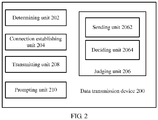
- FIG. 2 is a block diagram of a data transmission device in accordance with an embodiment of the present disclosure.
- a data transmission device 200 in accordance with an embodiment of the present includes a determining unit 202 configured to determine a target transmission mode for data of a terminal when a data transmission command for transmitting the data of the terminal to a target terminal is received, wherein the target transmission mode includes a normal transmission mode and a secure transmission mode.
- the device 200 further includes a connection establishing unit 204 configured to switch from the current operating system of the terminal to a designated operating system of multiple operating systems when the target transmission mode is the secure transmission mode, and establish a connection with the target terminal via the designated operating system, a judging unit 206 configured to determine whether the target terminal supports secure transmission, and a transmitting unit 208 configured to transmit the data to the target terminal via the secure transmission mode when the determination result is that the target terminal supports the secure transmission.
- a connection establishing unit 204 configured to switch from the current operating system of the terminal to a designated operating system of multiple operating systems when the target transmission mode is the secure transmission mode, and establish a connection with the target terminal via the designated operating system
- a judging unit 206 configured to determine whether the target terminal supports secure transmission
- a transmitting unit 208 configured to transmit the data to the target terminal via the secure transmission mode when the determination result is that the target terminal supports the secure transmission.
- the secure transmission mode can be selected.
- the terminal detects that the transmission mode for the data is the secure transmission, and the current operating system is not the designated operating system, the user is prompted to switch to the designated operating system or the terminal automatically switches to the designated operating system.
- the designated operating system can be a secure operating system.
- a connection with the target terminal of the receiver is then established, and whether the target terminal supports the secure transmission is determined, that is, whether the target terminal includes a secure operating system or a secure transmission module is determined.
- the determination result is yes, the data is transmitted to the target terminal via the secure transmission mode, thereby ensuring data security during data transmission and after the data is transmitted to the target terminal.
- the device 200 further includes a prompting unit 210 configured to prompt the user of the terminal to terminate the transmission of the data or adopt the normal transmission mode to transmit the data to the target terminal when the determination result is that the target terminal does not support the secure transmission.
- a prompting unit 210 configured to prompt the user of the terminal to terminate the transmission of the data or adopt the normal transmission mode to transmit the data to the target terminal when the determination result is that the target terminal does not support the secure transmission.
- the target terminal does not support the secure transmission, for ensuring security of transmission of the data, the user is prompted to terminate the transmission of the data, or to adopt the normal transmission mode to directly transmit the data.
- the judging unit 206 includes a sending unit 2062 configured to send a transmission environment check command to the target terminal, so as to cause the target terminal to check whether a corresponding designated operating system is included according to the transmission environment check command, and send a support response to the terminal when the determination result is yes, and a deciding unit 2064 configured to determine whether the support response is received from the target terminal, determine that the target terminal supports the secure transmission when the determination result is yes, and determine that the target terminal does not support the secure transmission when the determination result is no.
- a sending unit 2062 configured to send a transmission environment check command to the target terminal, so as to cause the target terminal to check whether a corresponding designated operating system is included according to the transmission environment check command, and send a support response to the terminal when the determination result is yes
- a deciding unit 2064 configured to determine whether the support response is received from the target terminal, determine that the target terminal supports the secure transmission when the determination result is yes, and determine that the target terminal does not support the secure transmission when the determination result is no.
- the terminal of the transmitter sends the transmission environment check command to the target terminal of the receiver, and the target terminal determines whether the target terminal includes the designated operating system according to the command, that is, whether the target terminal includes the secure operating system.
- the target terminal also sends the support response when the designated operating system is included, so as to inform the terminal of the transmitter that secure transmission can be performed.
- the transmitting unit 208 is configured to establish a connection between a first transmission module corresponding to the designated operating system of the terminal and a second transmission module corresponding to the designated operating system of the target terminal, and transmit the data from the first transmission module to the second transmission module.
- the data when the data can be transmitted via the secure transmission mode, it indicates that the terminal of the transmitter has the designated operating system and the transmission module corresponding to the designated operating system, and the terminal of the receiver has the designated operating system and the transmission module corresponding to the designated operating system. At this point, a transmission channel is established between the two transmission modules, thereby ensuring security of transmission of the data.
- data transmission can be directly performed between the designated operating system for example the secure operating system and a designated operating system of the other terminal, for example, data is directly transmitted from a secure operating system of a terminal A to a secure operating system of a terminal B.
- the secure operating system may not be allowed to directly communicate with external devices to perform data service.
- the data of the secure operating system can be transmitted to the other normal operating system of the terminal, and the data is then transmitted from the other normal operating system of the terminal to a normal operating system of an external target terminal, and then the data is transmitted from the normal operating system to a designated operating system, that is, a secure operating system.
- encryption processing can be performed on transmission of the data. After the target terminal of the receiver receives the data, decryption processing is performed.
- the designated operating system is the operating system of the multiple operating systems having the highest security level.
- the operating system having the highest security level that is, the secure operating system is set to be the designated operating system, thus the security of data transmission and data storage can be ensured.
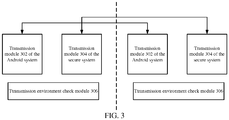
- the terminal includes two transmission modules, that is, includes a transmission module 302 of the Android system and a transmission module 304 of the secure system.
- the terminal further includes a transmission environment check module 306 (equivalent to the judging unit) to check transmission environment of the terminal and the receiver.
- the local transmission environment check module firstly checks whether the secure system is running. If not, the user is prompted to switch to the secure system, and a connection with a mobile phone of the receiver is established via the transmission module of the secure system.
- the receiver When the receiver includes the secure transmission module, the receiver receives the check command, and prompts the user that secure transmission information is received. Under the condition of receiving an allowance from the user, the terminal of the receiver starts current reception environment check. If the secure system is not running, the user is prompted to switch to the secure system.
- a connection is established between the two parties based on the transmission modules of the secure systems, and data transmission starts. After transmission, switching to the system which is running before transmission is performed according to user intention.
- the secure transmission module and the environment check module both are not needed, and transmission can be started by directly starting the Android normal transmission module.
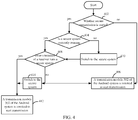
- FIG. 4 is a detailed flow chart of a data transmission method in accordance with an embodiment of the present disclosure.
- a detailed process of a data transmission method in accordance with an embodiment of the present disclosure includes following steps.
- Step 402 whether secure transmission is started is determined.
- step 404 is executed, and when the determination result is no, step 406 is executed.
- Step 404 whether the terminal runs a secure system is determined.
- step 408 is executed, and when the determination result is no, step 410 is executed.
- Step 406 the transmission module 302 of the Android system is invoked to start transmission process.
- Step 408 whether the terminal of the receiver runs the secure system is determined. When the determination result is yes, step 412 is executed, and when the determination result is no, step 414 is executed.
- Step 410 the terminal switches to the secure system.
- Step 412 the transmission module 304 of the secure system is invoked to start transmission process.
- Step 414 the terminal switches to the secure system.
Landscapes
- Engineering & Computer Science (AREA)
- Computer Security & Cryptography (AREA)
- Computer Hardware Design (AREA)
- General Engineering & Computer Science (AREA)
- Theoretical Computer Science (AREA)
- Computer Networks & Wireless Communication (AREA)
- Signal Processing (AREA)
- Physics & Mathematics (AREA)
- Computing Systems (AREA)
- Software Systems (AREA)
- General Physics & Mathematics (AREA)
- Bioethics (AREA)
- Health & Medical Sciences (AREA)
- General Health & Medical Sciences (AREA)
- Mathematical Physics (AREA)
- Mobile Radio Communication Systems (AREA)
- Data Exchanges In Wide-Area Networks (AREA)
- Telephonic Communication Services (AREA)
Abstract
The present disclosure provides a data transmission method which is applied in a terminal. The terminal includes multiple operating systems, wherein each operating system corresponds to a transmission module. The method includes: determining a target transmission mode for data of the terminal when a data transmission command for transmitting the data of the terminal to a target terminal is received, wherein the target transmission mode includes a normal transmission mode and a secure transmission mode; switching from the current operating system of the terminal to a designated operating system of the multiple operating systems when the target transmission mode is the secure transmission mode, and establishing a connection with the target terminal via the designated operating system; determining whether the target terminal supports secure transmission; transmitting the data to the target terminal via the secure transmission mode when the determination result is that the target terminal supports the secure transmission. Correspondingly, the present disclosure further provides a data transmission device and a data transmission system. By means of the technical solution of the present disclosure, secure transmission and storage of user secure data can be ensured, and malicious attacks from other operating systems can be avoided.
Description
- The present disclosure relates to the technical field of terminals, and in particular, to a data transmission method, a data transmission device, and a data transmission system.
- Presently, when mobile phone terminals share data, a connection is directly established between a transmitter and a receiver, and the transmitter directly transmits data to the receiver. The transmitter cannot determine whether the reception environment of the receiver is secure, which may result in a risk of stealing and eavesdropping after content is received.
- Therefore, what is needed is a new technical solution, which can ensure security of shared data when the transmitter and the receiver share data, and prevent the problem that the shared data is stolen or eavesdropped after the receiver receives the shared data.
- Based on the above problems, the present disclosure provides a new technical solution, which can ensure security of shared data when a transmitter and a receiver share data, and prevent the problem that the shared data is stolen or eavesdropped after the receiver receives the shared data.
- In view of the above, the present disclosure provides a data transmission method which is applied in a terminal. The terminal includes multiple operating systems, wherein each operating system corresponds to a transmission module. The method includes: determining a target transmission mode for data of the terminal when a data transmission command for transmitting the data of the terminal to a target terminal is received, wherein the target transmission mode includes a normal transmission mode and a secure transmission mode; switching from the current operating system of the terminal to a designated operating system of the multiple operating systems when the target transmission mode is the secure transmission mode, and establishing a connection with the target terminal via the designated operating system; determining whether the target terminal supports secure transmission; transmitting the data to the target terminal via the secure transmission mode when the determination result is that the target terminal supports the secure transmission.
- In the technical solution, when a user of the terminal wants the data to be securely transmitted, the secure transmission mode can be selected. When the terminal detects that the transmission mode for the data is the secure transmission, and the current operating system is not the designated operating system, the user is prompted to switch to the designated operating system or the terminal automatically switches to the designated operating system. Specifically, the designated operating system can be a secure operating system. A connection with the target terminal of the receiver is then established, and whether the target terminal supports the secure transmission is determined, that is, whether the target terminal includes a secure operating system or a secure transmission module is determined. When the determination result is yes, the data is transmitted to the target terminal via the secure transmission mode, thereby ensuring data security during data transmission and after the data is transmitted to the target terminal.
- In the above technical solution, preferably, the method further includes prompting the user of the terminal to terminate the transmission of the data or adopt the normal transmission mode to transmit the data to the target terminal when the determination result is that the target terminal does not support the secure transmission.
- In the technical solution, when the target terminal does not support the secure transmission, for ensuring security of transmission of the data, the user is prompted to terminate the transmission of the data, or to adopt the normal transmission mode to directly transmit the data.
- In the above technical solution, preferably, determining whether the target terminal supports the secure transmission includes: sending a transmission environment check command to the target terminal, so as to cause the target terminal to check whether a corresponding designated operating system is included according to the transmission environment check command, and send a support response to the terminal when the determination result is yes; and determining whether the support response is received from the target terminal, determining that the target terminal supports the secure transmission when the determination result is yes, and determining that the target terminal does not support the secure transmission when the determination result is no.
- In the technical solution, the terminal of the transmitter sends the transmission environment check command to the target terminal of the receiver, and the target terminal determines whether the designated operating system is included according to the command, that is, whether the secure operating system is included. The target terminal sends the support response when the designated operating system is included, so as to inform the terminal of the transmitter that the secure transmission can be performed.
- In the above technical solution, preferably, transmitting the data to the target terminal via the secure transmission mode includes: establishing a connection between a first transmission module corresponding to the designated operating system of the terminal and a second transmission module corresponding to the designated operating system of the target terminal, and transmitting the data from the first transmission module to the second transmission module.
- In the technical solution, when the data can be transmitted via the secure transmission mode, it indicates that the terminal of the transmitter has the designated operating system and the transmission module corresponding to the designated operating system, and the terminal of the receiver has the designated operating system and the transmission module corresponding to the designated operating system. At this point, a transmission channel is established between the two transmission modules, thereby ensuring security of transmission of the data.
- Specifically, data transmission can be directly performed between the designated operating system for example the secure operating system and a designated operating system of the other terminal, for example, data is directly transmitted from a secure operating system of a terminal A to a secure operating system of a terminal B.
- Furthermore, for ensuring security of the data of the terminal, the secure operating system may not be allowed to directly communicate with external devices to perform data service. At this point, when data transmission is performed, the data of the secure operating system can be transmitted to the other normal operating system of the terminal, and the data is then transmitted from the other normal operating system of the terminal to a normal operating system of an external target terminal, and then the data is transmitted from the normal operating system to a designated operating system, that is, a secure operating system.
- For further ensuring security of data, encryption processing can be performed on transmission of the data. After the target terminal of the receiver receives the data, decryption processing is performed.
- In the above technical solution, preferably, the designated operating system is the operating system of the multiple operating systems having the highest security level.
- In the technical solution, the operating system having the highest security level, that is, the secure operating system is set to be the designated operating system, thus the security of data transmission and data storage can be ensured.
- According to another aspect of the present disclosure, a data transmission device is further provided. The data transmission device is applied in a terminal. The terminal includes multiple operating systems, wherein each operating system corresponds to a transmission module. The data transmission device includes: a determining unit configured to determine a target transmission mode for data of the terminal when a data transmission command for transmitting the data of the terminal to a target terminal is received, wherein the target transmission mode includes a normal transmission mode and a secure transmission mode. The device further includes a connection establishing unit configured to switch from the current operating system of the terminal to a designated operating system of the multiple operating systems when the target transmission mode is the secure transmission mode, and establish a connection with the target terminal via the designated operating system, a judging unit configured to determine whether the target terminal supports secure transmission, and a transmitting unit configured to transmit the data to the target terminal via the secure transmission mode when the determination result is that the target terminal supports the secure transmission.
- In the technical solution, when a user of the terminal wants the data to be securely transmitted, the secure transmission mode can be selected. When the terminal detects that the transmission mode for the data is the secure transmission, and the current operating system is not the designated operating system, the user is prompted to switch to the designated operating system or the terminal automatically switches to the designated operating system. Specifically, the designated operating system can be a secure operating system. A connection with the target terminal of the receiver is then established, and whether the target terminal supports the secure transmission is determined, that is, whether the target terminal includes a secure operating system or a secure transmission module is determined. When the determination result is yes, the data is transmitted to the target terminal via the secure transmission mode, thereby ensuring data security during data transmission and after the data is transmitted to the target terminal.
- In the above technical solution, preferably, the device further includes a prompting unit configured to prompt the user of the terminal to terminate the transmission of the data or adopt the normal transmission mode to transmit the data to the target terminal when the determination result is that the target terminal does not support the secure transmission.
- In the technical solution, when the target terminal does not support the secure transmission, for ensuring security of transmission of the data, the user is prompted to terminate the transmission of the data, or to adopt the normal transmission mode to directly transmit the data.
- In the above technical solution, preferably, the judging unit includes a sending unit configured to send a transmission environment check command to the target terminal, so as to cause the target terminal to check whether a corresponding designated operating system is included according to the transmission environment check command, and send a support response to the terminal when the determination result is yes, and a deciding unit configured to determine whether the support response is received from the target terminal, determine that the target terminal supports the secure transmission when the determination result is yes, and determine that the target terminal does not support the secure transmission when the determination result is no.
- In the technical solution, the terminal of the transmitter sends the transmission environment check command to the target terminal of the receiver, and the target terminal determines whether the designated operating system is included according to the command, that is, whether the secure operating system is included. The target terminal also sends the support response when the designated operating system is included, so as to inform the terminal of the transmitter that secure transmission can be performed.
- In the above technical solution, preferably, the transmitting unit is configured to establish a connection between a first transmission module corresponding to the designated operating system of the terminal and a second transmission module corresponding to the designated operating system of the target terminal, and transmit the data from the first transmission module to the second transmission module.
- In the technical solution, when the data can be transmitted via the secure transmission mode, it indicates that the terminal of the transmitter has the designated operating system and the transmission module corresponding to the designated operating system, and the terminal of the receiver has the designated operating system and the transmission module corresponding to the designated operating system. At this point, a transmission channel is established between the two transmission modules, thereby ensuring security of transmission of the data.
- Specifically, data transmission can be directly performed between the designated operating system for example the secure operating system and a designated operating system of the other terminal, for example, data is directly transmitted from a secure operating system of a terminal A to a secure operating system of a terminal B.
- Furthermore, for ensuring security of the data of the terminal, the secure operating system may not be allowed to directly communicate with external devices to perform data service. At this point, when data transmission is performed, the data of the secure operating system can be transmitted to the other normal operating system of the terminal, and the data is then transmitted from the other normal operating system of the terminal to a normal operating system of an external target terminal, and then the data is transmitted from the normal operating system to a designated operating system, that is, a secure operating system.
- For further ensuring security of the data, encryption processing can be performed on transmission of the data. After the target terminal of the receiver receives the data, decryption processing is performed.
- In the above technical solution, preferably, the designated operating system is the operating system of the multiple operating systems having the highest security level.
- In the technical solution, the operating system having the highest security level, that is, the secure operating system is set to be the designated operating system, thus the security of data transmission and data storage can be ensured.
- According to yet another embodiment of the present disclosure, a data transmission system is further provided, and the data transmission system includes the data transmission device of any of the above technical solutions.
- By means of the above technical solution, secure transmission and storage of user secure data can be ensured, and malicious attacks from other operating systems can be avoided.
-
-
FIG. 1 is a flow chart of a data transmission method in accordance with an embodiment of the present disclosure. -
FIG. 2 is a block diagram of a data transmission device in accordance with an embodiment of the present disclosure. -
FIG. 3 is a diagrammatic view of a data transmission system in accordance with an embodiment of the present disclosure. -
FIG. 4 is a detailed flow chart of a data transmission method in accordance with an embodiment of the present disclosure. - To understand the above-mentioned purposes, features and advantages of the present disclosure more clearly, the present disclosure will be further described in detail below in combination with the accompanying drawings and the specific implementations. It should be noted that, the embodiments of the present application and the features in the embodiments may be combined with one another without conflicts.
- Many specific details will be described below for sufficiently understanding the present disclosure. However, the present disclosure may also be implemented by adopting other manners different from those described herein. Accordingly, the protection scope of the present disclosure is not limited by the specific embodiments disclosed below.
-
FIG. 1 is a flow chart of a data transmission method in accordance with an embodiment of the present disclosure. - As illustrated by
FIG. 1 , a data transmission method in accordance with an embodiment of the present disclosure includes:step 102, determining a target transmission mode for data of a terminal when a data transmission command for transmitting the data of the terminal to a target terminal is received, wherein the target transmission mode includes a normal transmission mode and a secure transmission mode;step 104, switching from the current operating system of the terminal to a designated operating system of multiple operating systems when the target transmission mode is the secure transmission mode, and establishing a connection with the target terminal via the designated operating system;step 106, determining whether the target terminal supports secure transmission;step 108, transmitting the data to the target terminal via the secure transmission mode when the determination result is that the target terminal supports the secure transmission. - In the technical solution, when a user of the terminal wants the data to be securely transmitted, the secure transmission mode can be selected. When the terminal detects that the transmission mode for the data is the secure transmission, and the current operating system is not the designated operating system, the user is prompted to switch to the designated operating system or the terminal automatically switches to the designated operating system. Specifically, the designated operating system can be a secure operating system. A connection with the target terminal of the receiver is then established, and whether the target terminal supports the secure transmission is determined, that is, whether the target terminal includes a secure operating system or a secure transmission module is determined. When the determination result is yes, the data is transmitted to the target terminal via the secure transmission mode, thereby ensuring data security during data transmission and after the data is transmitted to the target terminal.
- In the above technical solution, preferably, the method further includes prompting the user of the terminal to terminate the transmission of the data or adopt the normal transmission mode to transmit the data to the target terminal when the determination result is that the target terminal does not support the secure transmission.
- In the technical solution, when the target terminal does not support the secure transmission, for ensuring security of transmission of the data, the user is prompted to terminate the transmission of the data, or to adopt the normal transmission mode to directly transmit the data.
- In the above technical solution, preferably, determining whether the target terminal supports the secure transmission includes: sending a transmission environment check command to the target terminal, so as to cause the target terminal to check whether a corresponding designated operating system is included according to the transmission environment check command, and send a support response to the terminal when the determination result is yes; and determining whether the support response is received from the target terminal, determining that the target terminal supports the secure transmission when the determination result is yes, and determining that the target terminal does not support the secure transmission when the determination result is no.
- In the technical solution, the terminal of the transmitter sends the transmission environment check command to the target terminal of the receiver, and the target terminal determines whether the designated operating system is included according to the command, that is, whether the secure operating system is included. The target terminal sends the support response when the designated operating system is included, so as to inform the terminal of the transmitter that the secure transmission can be performed.
- In the above technical solution, preferably, transmitting the data to the target terminal via the secure transmission mode includes: establishing a connection between a first transmission module corresponding to the designated operating system of the terminal and a second transmission module corresponding to the designated operating system of the target terminal, and transmitting the data from the first transmission module to the second transmission module.
- In the technical solution, when the data can be transmitted via the secure transmission mode, it indicates that the terminal of the transmitter has the designated operating system and the transmission module corresponding to the designated operating system, and the terminal of the receiver has the designated operating system and the transmission module corresponding to the designated operating system. At this point, a transmission channel is established between the two transmission modules, thereby ensuring security of transmission of the data.
- Specifically, data transmission can be directly performed between the designated operating system for example the secure operating system and a designated operating system of the other terminal, for example, data is directly transmitted from a secure operating system of a terminal A to a secure operating system of a terminal B.
- Furthermore, for ensuring security of the data of the terminal, the secure operating system may not be allowed to directly communicate with external devices to perform data service. At this point, when data transmission is performed, the data of the secure operating system can be transmitted to the other normal operating system of the terminal, and the data is then transmitted from the other normal operating system of the terminal to a normal operating system of an external target terminal, and then the data is transmitted from the normal operating system to a designated operating system, that is, a secure operating system.
- For further ensuring security of the data, encryption processing can be performed on transmission of the data. After the target terminal of the receiver receives the data, decryption processing is performed.
- In the above technical solution, preferably, the designated operating system is the operating system of the multiple operating systems having the highest security level.
- In the technical solution, the operating system having the highest security level, that is, the secure operating system is set to be the designated operating system, thus the security of data transmission and data storage can be ensured.
-
FIG. 2 is a block diagram of a data transmission device in accordance with an embodiment of the present disclosure. - As illustrated by
FIG. 2 , adata transmission device 200 in accordance with an embodiment of the present includes a determiningunit 202 configured to determine a target transmission mode for data of a terminal when a data transmission command for transmitting the data of the terminal to a target terminal is received, wherein the target transmission mode includes a normal transmission mode and a secure transmission mode. Thedevice 200 further includes aconnection establishing unit 204 configured to switch from the current operating system of the terminal to a designated operating system of multiple operating systems when the target transmission mode is the secure transmission mode, and establish a connection with the target terminal via the designated operating system, a judgingunit 206 configured to determine whether the target terminal supports secure transmission, and a transmittingunit 208 configured to transmit the data to the target terminal via the secure transmission mode when the determination result is that the target terminal supports the secure transmission. - In the technical solution, when a user of the terminal wants the data to be securely transmitted, the secure transmission mode can be selected. When the terminal detects that the transmission mode for the data is the secure transmission, and the current operating system is not the designated operating system, the user is prompted to switch to the designated operating system or the terminal automatically switches to the designated operating system. Specifically, the designated operating system can be a secure operating system. A connection with the target terminal of the receiver is then established, and whether the target terminal supports the secure transmission is determined, that is, whether the target terminal includes a secure operating system or a secure transmission module is determined. When the determination result is yes, the data is transmitted to the target terminal via the secure transmission mode, thereby ensuring data security during data transmission and after the data is transmitted to the target terminal.
- In the above technical solution, preferably, the
device 200 further includes a promptingunit 210 configured to prompt the user of the terminal to terminate the transmission of the data or adopt the normal transmission mode to transmit the data to the target terminal when the determination result is that the target terminal does not support the secure transmission. - In the technical solution, when the target terminal does not support the secure transmission, for ensuring security of transmission of the data, the user is prompted to terminate the transmission of the data, or to adopt the normal transmission mode to directly transmit the data.
- In the above technical solution, preferably, the judging
unit 206 includes a sendingunit 2062 configured to send a transmission environment check command to the target terminal, so as to cause the target terminal to check whether a corresponding designated operating system is included according to the transmission environment check command, and send a support response to the terminal when the determination result is yes, and a decidingunit 2064 configured to determine whether the support response is received from the target terminal, determine that the target terminal supports the secure transmission when the determination result is yes, and determine that the target terminal does not support the secure transmission when the determination result is no. - In the technical solution, the terminal of the transmitter sends the transmission environment check command to the target terminal of the receiver, and the target terminal determines whether the target terminal includes the designated operating system according to the command, that is, whether the target terminal includes the secure operating system. The target terminal also sends the support response when the designated operating system is included, so as to inform the terminal of the transmitter that secure transmission can be performed.
- In the above technical solution, preferably, the transmitting
unit 208 is configured to establish a connection between a first transmission module corresponding to the designated operating system of the terminal and a second transmission module corresponding to the designated operating system of the target terminal, and transmit the data from the first transmission module to the second transmission module. - In the technical solution, when the data can be transmitted via the secure transmission mode, it indicates that the terminal of the transmitter has the designated operating system and the transmission module corresponding to the designated operating system, and the terminal of the receiver has the designated operating system and the transmission module corresponding to the designated operating system. At this point, a transmission channel is established between the two transmission modules, thereby ensuring security of transmission of the data.
- Specifically, data transmission can be directly performed between the designated operating system for example the secure operating system and a designated operating system of the other terminal, for example, data is directly transmitted from a secure operating system of a terminal A to a secure operating system of a terminal B.
- Furthermore, for ensuring security of the data of the terminal, the secure operating system may not be allowed to directly communicate with external devices to perform data service. At this point, when data transmission is performed, the data of the secure operating system can be transmitted to the other normal operating system of the terminal, and the data is then transmitted from the other normal operating system of the terminal to a normal operating system of an external target terminal, and then the data is transmitted from the normal operating system to a designated operating system, that is, a secure operating system.
- For further ensuring security of the data, encryption processing can be performed on transmission of the data. After the target terminal of the receiver receives the data, decryption processing is performed.
- In the above technical solution, preferably, the designated operating system is the operating system of the multiple operating systems having the highest security level.
- In the technical solution, the operating system having the highest security level, that is, the secure operating system is set to be the designated operating system, thus the security of data transmission and data storage can be ensured.
- Take a dual system terminal (Android system and secure system) for an example, the following will specifically illustrate the technical solution of the present disclosure.
- As illustrate by
FIG. 3 , based on the dual systems, the terminal includes two transmission modules, that is, includes atransmission module 302 of the Android system and atransmission module 304 of the secure system. The terminal further includes a transmission environment check module 306 (equivalent to the judging unit) to check transmission environment of the terminal and the receiver. When a secure transmission function is needed by a user, the local transmission environment check module firstly checks whether the secure system is running. If not, the user is prompted to switch to the secure system, and a connection with a mobile phone of the receiver is established via the transmission module of the secure system. - After the connection is successfully established, the terminal transmits a transmission environment check command to the terminal of the receiver. If the terminal of the receiver does not include the secure transmission module, the terminal of the transmitter determines that this transmission is not a secure transmission, and prompts the user to terminate the transmission or switch to the normal transmission mode.
- When the receiver includes the secure transmission module, the receiver receives the check command, and prompts the user that secure transmission information is received. Under the condition of receiving an allowance from the user, the terminal of the receiver starts current reception environment check. If the secure system is not running, the user is prompted to switch to the secure system.
- After finishing security check of the two parties, a connection is established between the two parties based on the transmission modules of the secure systems, and data transmission starts. After transmission, switching to the system which is running before transmission is performed according to user intention.
- If the user just wants to adopt the normal transmission mode of the Android system, then the secure transmission module and the environment check module both are not needed, and transmission can be started by directly starting the Android normal transmission module.
-
FIG. 4 is a detailed flow chart of a data transmission method in accordance with an embodiment of the present disclosure. - As illustrated by
FIG. 4 , a detailed process of a data transmission method in accordance with an embodiment of the present disclosure includes following steps. -
Step 402, whether secure transmission is started is determined. When the determination result is yes, step 404 is executed, and when the determination result is no, step 406 is executed. -
Step 404, whether the terminal runs a secure system is determined. When the determination result is yes, step 408 is executed, and when the determination result is no, step 410 is executed. -
Step 406, thetransmission module 302 of the Android system is invoked to start transmission process. -
Step 408, whether the terminal of the receiver runs the secure system is determined. When the determination result is yes, step 412 is executed, and when the determination result is no, step 414 is executed. -
Step 410, the terminal switches to the secure system. -
Step 412, thetransmission module 304 of the secure system is invoked to start transmission process. -
Step 414, the terminal switches to the secure system. - The above descriptions specifically illustrate the technical solution of the present disclosure in combination with the accompanying drawings. By means of the technical solution of the present disclosure, secure transmission and storage of user secure data can be ensured, and malicious attacks from other operating systems can be avoided.
- The foregoing descriptions are merely preferred embodiments of the present disclosure, but are not intended to limit the present disclosure. For those skilled in the art, various changes and variations can be made according to the present disclosure. Any modifications, equivalent replacements, and improvements within the spirit and principle of the technical solution shall fall within the protection scope of the present disclosure.
Claims (11)
- A data transmission method applied in a terminal, the terminal comprising multiple operating systems, each operating system corresponding to a transmission module, the method comprising:determining a target transmission mode for data of the terminal when a data transmission command for transmitting the data of the terminal to a target terminal is received, wherein the target transmission mode comprises a normal transmission mode and a secure transmission mode;switching from the current operating system of the terminal to a designated operating system of the multiple operating systems when the target transmission mode is the secure transmission mode, and establishing a connection with the target terminal via the designated operating system;determining whether the target terminal supports secure transmission; andtransmitting the data to the target terminal via the secure transmission mode when the determination result is that the target terminal supports the secure transmission.
- The data transmission method of claim 1, wherein the method further comprises:prompting a user of the terminal to terminate the transmission of the data or adopt the normal transmission mode to transmit the data to the target terminal when the determination result is that the target terminal does not support the secure transmission.
- The data transmission method of claim 1, wherein determining whether the target terminal supports the secure transmission comprises:sending a transmission environment check command to the target terminal, so as to cause the target terminal to check whether a corresponding designated operating system is comprised according to the transmission environment check command, and send a support response to the terminal when the determination result is yes; anddetermining whether the support response is received from the target terminal, determining that the target terminal supports the secure transmission when the determination result is yes, and determining that the target terminal does not support the secure transmission when the determination result is no.
- The data transmission method of claim 3, wherein transmitting the data to the target terminal via the secure transmission mode comprises:establishing a connection between a first transmission module corresponding to the designated operating system of the terminal and a second transmission module corresponding to the designated operating system of the target terminal, and transmitting the data from the first transmission module to the second transmission module.
- The data transmission method of any of claims 1-4, wherein the designated operating system is the operating system of the multiple operating systems having the highest security level.
- A data transmission device applied in a terminal, the terminal comprising multiple operating systems, each operating system corresponding to a transmission module, the data transmission device comprising:a determining unit configured to determine a target transmission mode for data of the terminal when a data transmission command for transmitting the data of the terminal to a target terminal is received, wherein the target transmission mode comprises a normal transmission mode and a secure transmission mode;a connection establishing unit configured to switch from the current operating system of the terminal to a designated operating system of the multiple operating systems when the target transmission mode is the secure transmission mode, and establish a connection with the target terminal via the designated operating system;a judging unit configured to determine whether the target terminal supports secure transmission; anda transmitting unit configured to transmit the data to the target terminal via the secure transmission mode when the determination result is that the target terminal supports the secure transmission.
- The data transmission device of claim 6, wherein the data transmission device further comprises:a prompting unit configured to prompt a user of the terminal to terminate the transmission of the data or adopt the normal transmission mode to transmit the data to the target terminal when the determination result is that the target terminal does not support the secure transmission.
- The data transmission device of claim 6, wherein the judging unit comprises:a sending unit configured to send a transmission environment check command to the target terminal, so as to cause the target terminal to check whether a corresponding designated operating system is comprised according to the transmission environment check command, and send a support response to the terminal when the determination result is yes; anda deciding unit configured to determine whether the support response is received from the target terminal, determine that the target terminal supports the secure transmission when the determination result is yes, and determine that the target terminal does not support the secure transmission when the determination result is no.
- The data transmission device of claim 8, wherein the transmitting unit is configured to establish a connection between a first transmission module corresponding to the designated operating system of the terminal and a second transmission module corresponding to the designated operating system of the target terminal, and transmit the data from the first transmission module to the second transmission module.
- The data transmission device of any of claims 6-9, wherein the designated operating system is the operating system of the multiple operating systems having the highest security level.
- A data transmission system comprising the data transmission device of any of claims 6-10.
Applications Claiming Priority (2)
| Application Number | Priority Date | Filing Date | Title |
|---|---|---|---|
| CN201410505903.5A CN104202343A (en) | 2014-09-26 | 2014-09-26 | Data transmission method, data transmission device and data transmission system |
| PCT/CN2014/090092 WO2016045167A1 (en) | 2014-09-26 | 2014-10-31 | Data transmission method, apparatus, and system |
Publications (1)
| Publication Number | Publication Date |
|---|---|
| EP3188445A1 true EP3188445A1 (en) | 2017-07-05 |
Family
ID=52087568
Family Applications (1)
| Application Number | Title | Priority Date | Filing Date |
|---|---|---|---|
| EP14902723.7A Withdrawn EP3188445A1 (en) | 2014-09-26 | 2014-10-31 | Data transmission method, apparatus, and system |
Country Status (4)
| Country | Link |
|---|---|
| US (1) | US10489602B2 (en) |
| EP (1) | EP3188445A1 (en) |
| CN (1) | CN104202343A (en) |
| WO (1) | WO2016045167A1 (en) |
Cited By (1)
| Publication number | Priority date | Publication date | Assignee | Title |
|---|---|---|---|---|
| US10320786B2 (en) | 2015-09-14 | 2019-06-11 | Samsung Electronics Co., Ltd. | Electronic apparatus and method for controlling the same |
Families Citing this family (8)
| Publication number | Priority date | Publication date | Assignee | Title |
|---|---|---|---|---|
| CN106161733B (en) * | 2015-03-26 | 2020-02-21 | 深圳酷派技术有限公司 | A system switching method, device and mobile terminal |
| CN105631344B (en) * | 2015-04-30 | 2018-11-06 | 南京酷派软件技术有限公司 | The access control method and system of secure data, terminal |
| CN105005746A (en) * | 2015-06-04 | 2015-10-28 | 上海卓易科技股份有限公司 | Terminal data transmission method and system for Android capacitive screen |
| KR102489918B1 (en) * | 2015-09-14 | 2023-01-20 | 삼성전자주식회사 | User terminal device and Method for controlling the user terminal device thereof |
| CN105611528B (en) * | 2015-12-28 | 2019-02-26 | 北京元心科技有限公司 | Multi-system intelligent terminal and encrypted telephone communication method thereof |
| CN107508882B (en) * | 2017-08-18 | 2021-03-19 | 珠海市魅族科技有限公司 | Data transmission method, related device and storage medium |
| CN110213283A (en) * | 2019-06-11 | 2019-09-06 | 山东管理学院 | A kind of trade economy information interconnected network transmission method |
| EP3822836A1 (en) * | 2019-11-12 | 2021-05-19 | Koninklijke Philips N.V. | Device and method for secure communication |
Family Cites Families (9)
| Publication number | Priority date | Publication date | Assignee | Title |
|---|---|---|---|---|
| CA2391717A1 (en) * | 2002-06-26 | 2003-12-26 | Ibm Canada Limited-Ibm Canada Limitee | Transferring data and storing metadata across a network |
| US8782405B2 (en) * | 2004-03-18 | 2014-07-15 | International Business Machines Corporation | Providing transaction-level security |
| US20050273708A1 (en) * | 2004-06-03 | 2005-12-08 | Verity, Inc. | Content-based automatic file format indetification |
| FR2886801B1 (en) * | 2005-06-07 | 2007-08-03 | Alcatel Sa | NETWORK EQUIPMENT FOR PROVIDING MULTI-MODE MOBILE DATA TERMINALS NECESSARY FOR THE AUTOMATIC SELECTION OF RADIO ACCESS NETWORK INTERFACES DURING SERVICE SESSIONS |
| US8935677B2 (en) * | 2008-04-07 | 2015-01-13 | Microsoft Corporation | Automatic reverse engineering of input formats |
| CN102202075B (en) * | 2010-03-26 | 2013-12-04 | 联想(北京)有限公司 | Data sharing method and portable terminal |
| CN103136052A (en) * | 2011-11-25 | 2013-06-05 | 展讯通信(上海)有限公司 | Mobile terminal and control method of mobile terminal provided with multiple operating systems |
| GB2498724A (en) * | 2012-01-24 | 2013-07-31 | Ibm | Automatically determining File Transfer Mode |
| CN103618736A (en) * | 2013-12-09 | 2014-03-05 | 成都达信通通讯设备有限公司 | Safety application system for mobile terminal to automatically switch between different channel networking interfaces |
-
2014
- 2014-09-26 CN CN201410505903.5A patent/CN104202343A/en active Pending
- 2014-10-31 WO PCT/CN2014/090092 patent/WO2016045167A1/en not_active Ceased
- 2014-10-31 EP EP14902723.7A patent/EP3188445A1/en not_active Withdrawn
-
2017
- 2017-03-24 US US15/468,345 patent/US10489602B2/en active Active
Cited By (1)
| Publication number | Priority date | Publication date | Assignee | Title |
|---|---|---|---|---|
| US10320786B2 (en) | 2015-09-14 | 2019-06-11 | Samsung Electronics Co., Ltd. | Electronic apparatus and method for controlling the same |
Also Published As
| Publication number | Publication date |
|---|---|
| CN104202343A (en) | 2014-12-10 |
| US10489602B2 (en) | 2019-11-26 |
| WO2016045167A1 (en) | 2016-03-31 |
| US20170193242A1 (en) | 2017-07-06 |
Similar Documents
| Publication | Publication Date | Title |
|---|---|---|
| US10489602B2 (en) | Data transmission method, apparatus, and system | |
| EP2391149A1 (en) | Configuring wifi parameters via a USB connection | |
| CA2841063C (en) | Data integrity for proximity-based communication | |
| US9615257B2 (en) | Data integrity for proximity-based communication | |
| KR102210897B1 (en) | Security authentication method, configuration method and related device | |
| US9736693B2 (en) | Systems and methods for monitoring an operating system of a mobile wireless communication device for unauthorized modifications | |
| US9326114B2 (en) | Transferring a voice call | |
| CN110719583B (en) | A communication method and device | |
| EP3422798B1 (en) | Communication methods and devices for direct communication | |
| US10492245B2 (en) | Call termination method, application processor, and modem | |
| EP3435730A1 (en) | Method, apparatus, storage medium, and terminal for establishing a wi-fi connection | |
| CN106162718A (en) | A kind of WiFi network access detection method and device | |
| CN105792149A (en) | Short message processing system and initialization method thereof, short message storage method and reading method | |
| EP2739072A1 (en) | Verifying a wireless device | |
| CN106559850B (en) | Network access switching method and device | |
| US10333949B1 (en) | Proactive protection of mobile operating system malware via blocking of infection vector | |
| CN109803260A (en) | Method, device and system for access rejection | |
| CN118784219A (en) | Password resetting system and method | |
| US20180248868A1 (en) | Method and communication system for secured and automated communication | |
| HK1240007B (en) | Bluetooth communication method and device, and application system and device thereof | |
| CN105025481A (en) | System and method for wireless authentication service |
Legal Events
| Date | Code | Title | Description |
|---|---|---|---|
| PUAI | Public reference made under article 153(3) epc to a published international application that has entered the european phase |
Free format text: ORIGINAL CODE: 0009012 |
|
| 17P | Request for examination filed |
Effective date: 20170327 |
|
| AK | Designated contracting states |
Kind code of ref document: A1 Designated state(s): AL AT BE BG CH CY CZ DE DK EE ES FI FR GB GR HR HU IE IS IT LI LT LU LV MC MK MT NL NO PL PT RO RS SE SI SK SM TR |
|
| AX | Request for extension of the european patent |
Extension state: BA ME |
|
| DAX | Request for extension of the european patent (deleted) | ||
| STAA | Information on the status of an ep patent application or granted ep patent |
Free format text: STATUS: THE APPLICATION IS DEEMED TO BE WITHDRAWN |
|
| 18D | Application deemed to be withdrawn |
Effective date: 20180501 |